


Abstract
Contrasting mainstream operational definitions of mindfulness, this article introduces the Dialectical Mandala Model of Mindfulness (DMMM), a dialectically articulated framework integrating Daoist internal alchemy and Buddhist contemplative theory. It reconceptualizes mindfulness as a multilayered developmental architecture rather than a set of techniques or cognitive skills, extending beyond cognitive adjustment to encompass the psycho-physical dynamics of qi, shen (spirit), hun (cloud-soul), and po (white-soul). Grounded in the catuṣkoṭi framework, the DMMM proposes a reconstruction of the dialectical logic underlying certain contemplative traditions through a systematic integration of the subject–object polarity, and aligns with the second stage of Kwang-Kuo Hwang’s three-step epistemological strategy for developing indigenous psychology, contributing to theory-building within cross-cultural and indigenous psychological discourse. The study combines close textual analysis with a reflexive use of autoethnographic vignettes from long-term practice, not as reports of experience themselves but as an epistemically situated resource for model construction. The DMMM formalizes a recursively unfolding developmental trajectory of mindfulness cultivation into a system of four interrelated cycles, each comprising four distinct phases. Across these phases, the developmental qualities of faith, understanding, practice, and realization function as recurrent structural principles rather than merely experiential descriptors. By articulating the internal dynamics and causal coherence of these phases, the model offers a systematic theoretical account of how spontaneous or non-discursive states may be understood as structured by a deeper dialectical logic. These four cycles provide a framework for analyzing transformations in mindfulness across stages and traditions, thereby contributing to religious studies, contemplative studies, and cross-cultural psychological theory-building.
1. Introduction
1.1. Mindfulness Beyond Present-Moment, Non-Judgmental Awareness: Recovering the Doctrinal–Intentional Dimension
Recent decades have witnessed the widespread transplantation of ‘mindfulness’ into medicine, psychology, education, and management (cf. Levit-Binnun et al. 2021). Flagship protocols, such as Mindfulness-Based Stress Reduction (Kabat-Zinn 1982, 1990, 2011) and Mindfulness-Based Cognitive Therapy (Segal et al. 2002), exemplify this trend. While these adaptations are methodologically effective in applied contexts, a growing body of scholarship notes that their pragmatic reframing tends to bracket important doctrinal considerations, thereby inviting conceptual ambiguity when generalized (Sauer et al. 2011; Dunne 2011; Sharf 2014). This section therefore addresses one such neglected dimension—what may be termed the doctrinal–intentional dimension of mindfulness.
Etymologically, mindfulness is commonly used to translate the Pāli term sati and its Sanskrit cognate smṛti, which T. W. Rhys Davids glossed simply as “remembrance” (Davids 1881, p. 145). Early Buddhist texts, however, instruct practitioners to “keep in mind” three mutually reinforcing dimensions (Maharaj 2013; Levman 2017):
- Remembering the Dhamma itself—the precepts, teachings, and the liberative intention grounded in right view (Pāli sammā-diṭṭhi)—which orients the entire practice.
- In the Satisutta, a practitioner is described as “one who, with mindfulness, protects and remembers the well-spoken Dhamma” (yassaṃ dhātuyaṃ sato dhammaṃ suppavattitaṃ rakkhati anussarati; AN 7.64, iv 105–06).
- Remembering the immediate object of attention—breath, feelings, mental states, or presently arising phenomena—anchors awareness in lived experience. Here, mindfulness is not analytical self-observation but an intuitive, direct apprehension—“a bare display of what is taking place” (Shear and Jevning 1999, p. 204). Distinct from “self-awareness” or “reflexive consciousness” (Baumeister 1999; Bermúdez 1998; Brown and Ryan 2003, p. 823), mindfulness is “‘prereflexive’ in that its foundation is perceptual and nonevaluative” (Brown and Ryan 2003, p. 843).
- In the Satipaṭṭhāna Sutta, mindfulness is repeatedly framed by the refrain ‘there is a body’ ‘there are feelings’ or ‘there is mind.’ The corresponding Pāli formula reads: ‘atthi kāyo/vedanā/citta’ ti vā panassa sati paccupaṭṭhitā hoti. (Satipaṭṭhāna Sutta, MN 10, i 56–58; and Mahā Satipaṭṭhāna Sutta, DN 22, ii 295–296; cf. Sanskrit Smṛtyupasthāna Sūtra; cf. Chinese Madhyama Āgama 中阿含 98, 念處經, T 1, no. 26).
- Remembering the state of non-forgetfulness itself—a pre-reflective awareness that continuously registers mental events without subject–object polarity—sustains that vigilance (cf. Dreyfus n.d.; Dunne 2011; Saunders 2016).
- The canonical Dhammasaṅgaṇī defines mindfulness in dispositional terms: “sati … apilāpanatā, asammussanatā,” literally “non-slippage, non-forgetfulness,” classed under sammāsati (§93, Dhs 22).
- The Visuddhimagga likewise characterizes sati functionally: “Saranti tāya, sayaṃ vā sarati, saraṇamattam eva vā, esā ti sati. Sā apilāpanalakkhaṇā, asammoharasā…” (Vism I 464, 25–26).
Mainstream operational definitions prioritize only the latter two dimensions because they appear religiously neutral and are readily operationalized. Brown and Ryan (2003, p. 822) describe mindfulness as “being attentive to and aware of what is taking place in the present,” Baer (2003, p. 125) as “intentional self-regulation of attention from moment to moment,” and Bishop et al. (2004, p. 236) reduce it to “a quality of self-focused attention characterised by openness and acceptance.”
Such modern descriptions reflect the pure mind-state often portrayed in popular Zen literature, yet they bracket out the doctrinal–intentional compass that made the Buddha sammā-sambuddha—fully awakened; such bracketing overlooks what made the Buddha’s awakening distinctive among contemporaries who also mastered deep meditation. Dreyfus (2011) offers a sustained critique of this now-standard characterization as “present-centred non-judgmental awareness” (Bishop et al. 2004, p. 232), showing that classical Buddhist sources treat mindfulness primarily as a retentive faculty that “holds its object and thus allows for sustained attention, regardless of whether the object is present or not” (Dreyfus 2011, p. 41), and that it can be explicitly evaluative.
Drawing on a detailed survey of Nikāya passages, Levman (2017) restores this missing compass. He notes that sati is repeatedly praised as “that special faculty … endowed with the highest memory and wisdom” (satimā hoti paramena satinepakkena; Levman 2017, p. 121), whose core task is to “remember and recollect what was said and done a long time ago” (Levman 2017, p. 121)—namely, to keep the Buddha’s teaching vividly present. Levman concludes:
Sati is that special faculty of memory … which bears in mind the Buddha’s teachings and their relevance to one’s own personal spiritual quest, thereby facilitating detachment, equanimity and liberating insight.(2017, p. 145)
The “memory” Levman foregrounds, therefore, corresponds to the first dimension above—remembering the Dhamma—not to present-object focus or reflexive vigilance. Neglecting this doctrinal–intentional dimension flattens the distinct trajectories that different traditional systems design (Levman 2017).
Empirical psychology inevitably reconstructs mindfulness in observable, dualistic terms, even when it gestures toward holistic correctives such as panpsychism (Griffin 1997), yet still operationalizes, and thereby simplifies, mystical language into behavioral metrics. As Lazzarelli (2022) shows, culturally shaped intentions operate at both conscious and subterranean levels; what counts as ‘mindful’ is thus not universally applicable. Dreyfus (2011, p. 41) likewise warns that such operational definitions “fail to emphasise [mindfulness’] retentive nature” and instead privilege its alleged non-conceptual present-focus. Assessment frameworks, therefore, should acknowledge that practitioners from distinct cultural backgrounds carry different intentional horizons—and empirical work confirms that identical protocols can yield divergent “experiential understandings” when taught under different pedagogical intentions (Levit-Binnun et al. 2021, p. 7). Without this doctrinal–intentional compass, the very criterion for regarding the Buddha as fully awakened becomes difficult to justify. If mindfulness—integral to every self-cultivation tradition—is reduced to an operational definition that considers only the latter two dimensions, it risks losing the capacity to foster the specific experiential progression intended within its source tradition (Levman 2017).
Scholars such as Bhikkhu Bodhi concur, arguing that honoring the memory of the Dhamma safeguards mindfulness from becoming a mere attentional exercise (Bodhi 2011), while Kabat-Zinn (2011, pp. 291–92) himself warns that techniques severed from their ethical–intentional roots may lose their potential for genuine self-transcendence (cf. Purser 2019). This concern is further highlighted by Huntington (2015), who shows that Theravāda-derived meditation, when embedded in market logics, may function less to dismantle self-clinging and more to reinforce narcissistic configurations of modern subjectivity.
This study adopts a middle position to negotiate the divergent aims and emphases of traditional and contemporary mindfulness. The central question addressed by this study is how mindfulness can be theorized in a way that remains open to cross-cultural application without losing the doctrinal–intentional dynamics that historically enabled mindfulness to function as a transformative path of self-cultivation. In response to this challenge, the present article develops a new cross-cultural theoretical model of mindfulness that seeks to preserve the dialectical developmental logic underlying traditional contemplative systems while articulating this logic in a theoretically systematic and practically accessible framework. The scope of this article is therefore not to empirically validate the efficacy of this model, but to construct a cross-cultural ontological model that can guide future theoretical and empirical investigations of mindfulness.
This article argues that—while accepting the claim, advanced by modern mindfulness researchers, that mindfulness is not exclusively Buddhist but a pathway to self-transcendence available to people in every culture (cf. Dockstader 2023; Hung et al. 2020; Levit-Binnun et al. 2021; Monteiro et al. 2015; Purser 2019; Sellars 2018; Stratton 2015; von Fircks 2023)—a comprehensive pedagogy and research program on mindfulness should distinguish the various forms of mindfulness according to the following three dimensions and examine their respective contexts and functions: (1) the doctrinal–intentional foundation, (2) the immediate object of attention, and (3) reflexive awareness of the mind itself. Even contemporary, ostensibly universal forms of mindfulness, once anchored in a fully articulated doctrinal–intentional dimension, may gain a clearer developmental orientation—thus recovering mindfulness as a vehicle of transformative self-cultivation across traditions.
1.2. Dialectical and Multifaceted Nature of Mindfulness
Monteiro et al. (2015, p. 5) describe contemporary and traditional mindfulness as sharing “a common intention to transform faulty perceptions and mistaken ways of experiencing phenomena,” pointing to common roots. Although contemporary mindfulness programs are often presented in secular terms, they still draw on heterogeneous spiritual lineages, each with its own ontological and epistemological commitments (Arat 2017). Scholarship increasingly acknowledges this plurality across Buddhist, Yogic, Daoist, and Western sources (cf. Hung et al. 2020; Husgafvel 2019; Monteiro et al. 2015; Saunders 2016; Sellars 2018). Theravāda integrates mindfulness with samyag-vyāyāma (‘right effort’) (Bodhi 2011); many Mahāyāna texts emphasize non-dual, non-doing (Skt. akriyā; Chin. 無為) approaches (Dunne 2011; Watt 2017). Classical Yogic presupposes transcendental entities such as Puruṣa and Īśvara (Maharaj 2013), whereas so-called “Daoist mindfulness” (Dockstader 2023, p. 175; Dang 2025, p. 7; Hung et al. 2020, p. 10)—or, more cautiously, “Taoistic-Informed Mindfulness” (von Fircks 2023, p. 787)—centers on experiential yin–yang energetics without recourse to a creator deity. By contrast, what Sellars (2018, p. 15) calls “Stoic mindfulness” relies on the constant recollection of ethical principles to ensure that reason rather than habit guides actions. Given this diversity, although the latter two dimensions of mindfulness (see Section 1.1) are widespread and central to many wisdom traditions (Hassed 2021), close attention to first-dimension distinctions remains crucial when integrating them into a unified program (Sharf 2014).
To broaden mindfulness studies beyond an exclusive focus on the Theravāda paradigm, recent scholarship has turned toward Chinese Mahāyāna Buddhism—especially the Tiantai system of doctrinal classification (jiaoxiang panshi 教相判釋)—and Daoist internal-alchemy dialectics. Dockstader (2023, p. 175) argues that “the very contradictory plurality of conceptions of mindfulness might itself provide insight into what mindfulness can tell us about the world and how it can help us live in accordance with it,” and that engaging classical Daoism and Tiantai Buddhism can yield a model able to affirm, rather than suppress, these contradictions.
Tiantai and Daoist writings explicitly elaborate such a layered dialectic, yet its outlines are already discernible within Theravāda Abhidhamma. Olendzki (2011, p. 55) argues that the dialectical nature of mindfulness, revealed through the Abhidhamma’s systematic classification of phenomena (dharmas), naturally unfolds as multilayered experiences and thus necessitates a “layered approach to the practice of mental development.” Similar layered structures appear widely across spiritual traditions (Dunne 2011; Monteiro et al. 2015; Olendzki 2011). Rabbi Alan Lew, for instance, described a “layered grid of awareness” shared by Buddhist and Jewish mystical teachings, encompassing bodily, emotional, intellectual, and spiritual dimensions (Lew 2003, p. 190).
This layered dialectic of mindfulness finds resonance in the scholarly literature, as exemplified by Georges Dreyfus’s distinction between two modes of mindfulness (Dreyfus n.d., p. 9): (1) Reflective mindfulness, characterized by deliberate attention to a chosen object, predominates early in Theravāda training and explicitly establishes a subject–object polarity; and (2) pre-reflective (reflexive) mindfulness, which involves a non-dual, immediate registration of mental events without an explicit polarity. While this second mode prominently characterizes innatist traditions such as Mahāmudrā and Dzogchen (cf. Dunne 2011; Saunders 2016), Theravāda practitioners likewise cultivate it as their proficiency deepens (Dreyfus n.d.). According to Dreyfus, mindfulness in many contemplative traditions may be understood as following a developmental trajectory from reflective toward pre-reflective mindfulness, with mastery of the latter mode depending upon strengthening the mind’s innate capacity to track salient mental states—a capacity phenomenologists call pre-reflective self-awareness and Buddhist epistemologists such as Dignāga and Dharmakīrti term svasaṃvedana (Skt.; lit. ‘reflexive awareness’; Chin. 自證分). Consequently, mindfulness involves distinct modes and states across multiple layers, precluding unitary definitions. Prematurely setting higher states as explicit goals can inadvertently conceptualize mindfulness, thereby replacing natural spontaneity with artificial striving. From the perspective developed in this study, mindfulness goals are more coherently understood as developing dialectically and cyclically rather than linearly (cf. Sauer et al. 2011).
Dialectical complexity likewise emerges in modern clinical adaptations, such as dialectical behavior therapy, where mindfulness balances opposing forces like “acceptance and change” (Baer 2003, p. 127). Sauer et al. (2011, p. 1) characterize this as the “dialectical structure of mindfulness,” spanning tensions such as activity versus passivity and desire versus non-desire. Earlier scholarship on dialectics of mindfulness, however, has emphasized conceptual contradictions rather than transformations intrinsic to meditation. This cognitive emphasis neglects the deeper psycho-physical dimensions. By highlighting the spontaneous evolution of mind–body phenomena and meditative states, mindfulness can more accurately be understood as inherently dialectical—a process involving experiential dialectics rather than mere cognitive conflicts.
For the purposes of the present study, ‘dialectic’ refers not primarily to a method of argumentation but to the spontaneous evolutionary dynamics through which apparently opposed factors condition, generate, transform, and reconfigure one another over time. This understanding draws on both Nāgārjuna’s tetralemmatic dialectic, which deconstructs attachment to intrinsic nature by revealing that phenomena arise neither from themselves, nor from others, nor from both, nor without cause, and Daoist yin–yang and Five-Phase (wuxing 五行) thought, whose logic of mutual generation and mutual overcoming likewise describes self-unfolding processes of transformation. Accordingly, the term ‘dialectical’ in this article refers not primarily to a mode of reasoning, but to the intrinsic developmental dynamics of contemplative objects, states, and processes disclosed through mindfulness practice. It should therefore not be understood in an exclusively Hegelian sense.
The dialectical dynamics of mindfulness inherently challenge positivist subject–object dichotomies, making its multilayered and self-unfolding character difficult to capture within conventional scientific frameworks (Olendzki 2011). However, positivist approaches often simplify, marginalize, or reinterpret such spontaneous experiences in ways that obscure the developmental complexity of these phenomena (Bigman-Peer and Yovel 2024). For instance, linear spiritual development models, like Fowler’s (1981) stages of faith, have faced criticism for Western biases and oversimplifications of spiritual complexity (Friedman et al. 2010, p. 88), potentially misconstruing controlled experiences as genuinely spontaneous (Wyatt 1988). Reductionist readings, also rooted in mind–body dualism, often misinterpret enhanced cognitive control as spiritual progress and pathologize widely reported psycho-physical phenomena such as vertigo, tinnitus, unusual somatic sensations, synesthetic cross-sensations, visionary phenomena, states of rapture, unusual somnolence, involuntary vocalizations, motor tics, and other spontaneous bodily movements (Lindahl et al. 2017; Cooper et al. 2021). Such phenomena have traditionally been interpreted in terms of subtle qi (氣) dynamics in Daoist alchemical traditions, where they are treated not as pathological abnormalities but as legitimate objects of contemplative awareness, and closely parallel classical yogic accounts of kuṇḍalinī awakening (cf. Cooper et al. 2021; Wang and Martínková 2024). Recognizing these dialectically unfolding phenomena therefore calls for a more holistic model of mindfulness capable of accommodating their experiential complexity.
1.3. An Operational Definition of ‘Inward Transcendence’: Embracing Spontaneity and Naturalness
In both Daoist and Buddhist traditions, spontaneity and naturalness are guiding ideals linked to a state of egolessness (Hatchell 2014; Wyatt 1988). Bruya (2010, p. 207) explores the Daoist concept of ‘spontaneity,’ contrasting it with the Western view that separates spontaneity into natural determinism for nonhumans and voluntarism for humans. Unlike this dualistic approach, Daoism’s integrated human/nonhuman perspective redefines action, seeing humans as integral to nature (Wang and Martínková 2024). Since Aristotle, much of Western philosophy has treated the self as a “discrete, monadic substance,” positing that inanimate objects move only through direct physical interactions while the body moves through the self’s drive (Bruya 2010, p. 221). In contrast, classical Daoist texts suggest that the body—like other cosmic forms—may move in accord with the circulation of qi rather than by an initiating, independent self. One “listens with qi” (聽之以氣; Zhuangzi 莊子, SKQS 1056.24a1–3), one “lets the spirit act as the faculties rest” (官知止而神欲行; Zhuangzi, SKQS 1056.20b6), and one uses the mind “like a mirror, neither anticipating nor storing” (至人之用心若鏡不將不迎應而不藏; Zhuangzi, SKQS 1056.47a6–7). In contemporary qigong discourse, “spontaneous movement” (also called zifa gong 自發功, “spontaneous qigong”) is explicitly treated as a practice stage in which the body moves with qi under minimal volitional control (e.g., Deadman 2014; Lazzarelli 2022; Lin 2021; Ots 1994; Palmer 2003; L.-W. Wang 2010). Classical taijiquan (太極拳) dicta likewise state, “The qi can mobilize the body, but you need not will the qi in order to move it” (Taijiquan jing 太極拳經, trans. B. Davis 2004, p. 140). Moreover, while visual and auditory perceptions are ordinarily controlled by the self, they can also arise and subside spontaneously as subtler qi phenomena when the self’s control is relaxed, reflecting the Daoist principle of spontaneity (Bruya 2010, p. 215). Within a Chinese holistic “qi cosmology” (Ames 2015, p. 7; J. Liu 2015, p. 33), an individual’s qi resonates with the “qi of the macrocosm” (S. Davis 1996, p. 96); because such entrainment depends on a larger field, the process may not be regarded as entirely spontaneous (S. Davis 1996; Lazzarelli 2022). Even so, it accords with the operative sense of spontaneity adopted here, embodying the Buddhist transcendence of self-control and the Daoist concept of ‘effortless action’ (wuwei erwei 無為而為) in harmony with nature (Maharaj 2013).
Wyatt (1988) highlights the paradox that actively striving for spontaneity contradicts its very essence. Attempting to forcibly imagine or fabricate spontaneity likewise runs counter to it. Daoist and Buddhist traditions emphasize “a kind of letting go,” achieved by abandoning the usual “goal-oriented, striving” mentality (Wyatt 1988, p. 97). This paper underscores the dialectical quality—or ‘spontaneous evolution’—in mindfulness experiences. At the same time, the underlying intention to experience spontaneity can function as “the vehicle through which we can open to the continuous, spontaneous arising and passing of all phenomena” (Goldstein 2003, p. 49). Self-awareness practices often emphasize conscious control, thereby constraining the spontaneous unfolding of one’s experiential realm. In contrast, practices of Tantra and Daoist alchemy are intentionally oriented toward experiencing spontaneity, thereby loosening conscious control within awareness (Hatchell 2014). This facilitates uncoerced unfolding. Within Buddhist and Daoist contemplative frameworks, spontaneity (non-doing) is understood as facilitating the realization of “not-self” (Gombrich 2009, pp. 69–70; Skt. anātman, Pāli Anatta).
Genuine ‘spontaneity’ entails ‘naturalness,’ resonating with the Dao (道; the Way or natural order) rather than with self-reference (Wyatt 1988; Bruya 2010). Experiencing genuine spontaneity marks a profound “inward transcendence” (Yü 2016, p. 7; Azanlansh 2023, p. 2), thereby sidestepping self-hypnosis (Hatchell 2014), self-deception, and agency misattribution—for example, projecting unconscious fear as an external ‘spirit’ presumed to drive spontaneous movements. Likewise, genuine ‘naturalness’ implies freedom from unconscious inertia and self-attachment, avoiding the error of confusing stagnant passivity with enlightened tranquility, and thus entails ‘spontaneity.’ For the purposes of an operational and practicable definition, the present study employs ‘spontaneity’ as the primary term, using it to encompass what classical sources also describe as ‘naturalness,’ rather than invoking the latter explicitly. This choice reflects the need for terminological economy and implementability, while preserving the classical insight that genuine spontaneity is inseparable from naturalness. Accordingly, throughout this article, the term ‘spontaneity’ is used as an umbrella term encompassing both spontaneity and naturalness. In this usage, ‘genuine spontaneity’ denotes not spontaneity as first manifested in psycho-physical phenomena, but spontaneity as progressively purified through contemplative cultivation.
Drawing on Daoist and Buddhist contemplative perspectives, adhering to the fundamental intention of experiencing genuine spontaneity allows the mind to function more like a clear mirror of emptiness, exposing self-referential motivations and afflictions through reflexive juxtaposition (cf. Maharaj 2013). This psychological mechanism of reflexive juxtaposition reveals the incongruence between true spontaneity and fabrication, thereby further purifying the fundamental intention—a process that operates intuitively rather than discursively. For example, when a meditator directly discerns the underlying artificiality of their illusory mystical experiences, these illusions naturally dissipate. This discernment between genuine and fabricated experiences of spontaneity arises not from intellect, but from direct experiential insight. Erich Fromm similarly argues that “intellect restricts the spontaneity of experience” (Fromm 1959, p. 85). Relatedly, discussions on spontaneity often “denigrate the intellect” (Burley 2000, p. 69). Tremblay et al. (2024) further contend that defining spiritual principles such as ‘nonattachment,’ ‘non-doing,’ and ‘non-self’ in negative terms, as often seen in canonical texts, renders them overly abstract and susceptible to intellectualization. A purely prohibitive framing can inadvertently reinforce the very tendencies it intends to curb—much like repeatedly telling a child what not to do, which often heightens fixation. By contrast, positive, action-oriented definitions provide an alternative direction of practice, making these principles more accessible and conducive to direct experience.
Accordingly, ‘inward transcendence’ should not remain merely a concept for discursive reasoning, but should instead be embraced as a fundamental intention in meditation, where concepts recede in favor of direct experience.
Building on these insights, this paper offers an operational definition of ‘inward transcendence’ for mindfulness practitioners: experiencing genuine spontaneity in the present moment—most concretely felt in ‘qi movement’ (which includes breath and other instinctively driven movements), “inner sound” (nāda), and “inner light” (pravṛttyāloka)—and allowing this spontaneity to deepen through successive dialectical turns of inner contemplation (Burley 2000, p. 114; Lindahl et al. 2017; Singh 1974, pp. 135–43; Zhang 2016, p. 30). Here, ‘spontaneity’ refers to the natural arising and development of meditative states and phenomena. By embodying spontaneous, non-self-referential experiences, practitioners loosen identification with both the experiences and the presumed agent, thereby developing “meta-awareness” (Schooler et al. 2011, p. 319) and cultivating awareness of not-self.
1.4. Towards a Model of Dialectical Mindfulness
Building on Bai et al.’s (2022, p. 10) observation that “sati foundationally supports and facilitates the realization of Interbeing and the manifestation of bodhicitta,” reintroducing the classical notion of bodhicitta can enrich contemporary mindfulness by restoring its intrinsic compassionate dimension. Bodhicitta, often under-emphasized in modern programs, is understood here as an innate Buddha-heart, the inner drive toward benevolence and insight that serves as the root of enlightenment (cf. Anderl 2004, p. 166; Fan 2026, p. 2). Similar to existential perspectives seeking transcendence without reliance on external deities (Blackham 1972; Flynn 2006), bodhicitta resonates with Tillich’s notion of ultimate concern—the root of pilgrimage being, which “determines our being and nonbeing” and holds the power of “threatening and saving our being” (Tillich 1951, p. 14). In this study, bodhicitta denotes a ‘fundamental intention’ rooted unconsciously in ultimate concern, guiding practitioners toward ‘inward transcendence’ and counteracting the self-referential afflictions (Srt. kleśas): self-delusion (ātma-moha), self-belief (ātma-dṛṣṭi), self-conceit (ātma-māna), and self-love (ātma-sneha) (Laish 2017). ‘Inward transcendence,’ recognized across traditions as liberation, enlightenment, or awakening (Azanlansh 2023), aligns with Norman Fischer’s description of the Buddha’s path as the “development of bodhicitta,” characterized by the aspiration toward awakening and the reduction of attachment to self-illusion (Fischer 2013, p. 11).
G. I. Gurdjieff’s call to “remember yourself” (Nicoll 1996, p. 787) opens naturally into the Buddhist–Daoist imperative to remember the self’s spontaneous dialectic from a pre-reflective vantage. In some Buddhist lineages, practitioners receive a Dharma name or mantra symbolizing their fundamental intention or bodhicitta, reshaping their self-identity beyond ordinary egoic constraints. For instance, the name of Avalokiteśvara—from avalokita (PPP of ava-√lok: ‘observed/seen,’ often construed as ‘observing/contemplatively regarding’) + īśvara (‘the self-mastered and unhindered one’)—one of Buddhism’s central bodhisattvas, serves to remind practitioners to witness the spontaneous unfolding of both outer and inner phenomena, the latter revealing the self, with transcendent equanimity (Chaiyapong 2013, pp. 13–14). Comparable practices exist in other traditions, including the Christian baptismal name, the Sufi spiritual name, the Hindu guru-given name, and the Daoist ‘Dao name’ (道號), all functioning as symbolic anchors on the spiritual path. Such spiritually significant names may spontaneously surface even in dreams, reflecting sustained commitment to bodhicitta and highlighting the capacity for transcendence through the spontaneous energetics of the sleep–wake cycle.
Drawing on Buddhist teachings of mindfulness and integrating insights from Daoist internal alchemy, this article introduces ‘dialectical mindfulness’ as a practice grounded in Eastern traditions. Dialectical mindfulness is defined as a path of self-cultivation driven by a continuously purified fundamental intention to fully and transcendently experience the genuine spontaneity—the spontaneous unfolding and dialectical evolution—of inwardly observed bodily–mental phenomena, including qi, inner sound, inner light, and the self.
This fundamental intention guides the practitioner toward relinquishing forms of mental control tied to self-referential motivations, initially through a balanced focus on qi energetics, and progressively moving beyond any pursuit or maintenance of meditative objects. This enables the practitioner to engage fully with the dialectical interplay of arising and dissolving phenomena, without reifying any experience as fixed or enduring, thereby apprehending experiences as interdependent, mutually conditioning, and evolving toward the ultimate realization of genuine spontaneity.
Through sustained immersion in such fluid processes, what initially appears merely as the flux of mental events may gradually settle, allowing a deeper crystallization of experience to become discernible—namely, the emergence of a genuine and enduringly operative ‘mind-heart’ (a term used descriptively here, without committing to later doctrinal formulations such as Jungian archetypes or the Buddhist tathāgatagarbha), previously unrecognized within impermanent phenomena. The term ‘dialectical’ here thus refers to a mode of insight in which full immersion in spontaneity precludes fixation, discloses the evolutionary and relational nature of phenomena, and allows what is essential to be discerned through transformation itself.
This definition of mindfulness offers a crucial clarification of its root term ‘mind.’ Rather than identifying ‘mind’ with sensory attachments or reifying it as a substantial, enduring self independent of psycho-physical processes, dialectical mindfulness recognizes ‘mind’ as the locus where phenomena unfold without fixed self-identification—a field that practice progressively brings into clearer awareness. This conception parallels the classical Chinese notion of mind-heart (xin 心), which integrates thought and feeling and serves as both the moral source of action and the bridge between humanity and Heaven (Liu and Shun 1996). As Confucius observes: “The gentleman seeks it in himself; the petty man seeks it in others” (君子求諸己小人求諸人; Analects 15.21, SKQS 197.74b10–11). Likewise, Mencius states: “The sole concern of learning is to go after this strayed mind-heart. That is all” (學問之道無他求其放心而已矣; Mencius 6A:11, SKQS 197.172b4–5). Both passages reflect a non-dual view of the ‘mind’ as the experiential center of cultivation. To be ‘mindful’ is to experience phenomena free of self-referential grasping, thereby opening the way to inward transcendence.
The deliberate use of the term ‘experiencing’ rather than ‘observing’ highlights this natural, uncontrived, unattached, and non-dual mode of awareness—one that encompasses even experiences arising without deliberate observation. This formulation avoids falling into mind–body dualism and prevents practitioners from reducing mindfulness to detached observation or mistaking themselves as unchanging subjects standing apart from phenomena. Within this framework, even profound meditative states such as the Golden Elixir (jindan 金丹) are not ultimate sacred ends but serve as provisional, dual-natured ‘medicines’ assisting the path of inward transcendence (Crowe 2014; Pregadio 2009; M. Wang 2011). As practitioners maintain the fundamental intention to fully experience genuine spontaneity, all arising phenomena become naturally integrated, progressively illuminating the self’s true nature and the unfolding of inward transcendence. Dialectical mindfulness thus centers on such bodhicitta, dismantling self-referential motivations behind artificial spiritual experiences and dissolving attachments and delusions entangling the self.
Whenever a meditator encounters a phenomenon that emerges spontaneously—beyond the reach of deliberate will—the event reveals its transcendence of egoic control (Wang and Martínková 2024). Recognizing this limit loosens the impulse to manage experience and consolidates the meditator’s fundamental intention to experience genuine spontaneity—an intention that naturally unfolds as inward transcendence, namely the direct realization of spontaneity in qi movement, inner light, and inner mandala (Skt. maṇḍala; see Section 5.4), which deepens with each dialectical turn beyond self-referential volition.
‘Experiencing genuine spontaneity’ entails embodying the spontaneous dialectic of arising and dissolving phenomena, symbolized in the I-Ching by the interplay of yin and yang. As Zhu Xi 朱熹 explains, “Yin emerges as yang culminates and subsides; yang emerges as yin culminates and subsides” (陽極則消而陰生,陰極則消而陽生; SKQS 193.285a2). Every such manifestation, therefore, moves through inescapable phases of emergence and cessation (Hu 2017, p. 218). These spiraling, dialectical rhythms instantiate an integrative engagement with transitional objects and accord with the Buddhist principles of impermanence and interdependence.
Grounded in Azanlansh’s (2023) Dialectical Mandala Model of Self-cultivation (DMMS), which employs catuṣkoṭi (lit. ‘four-cornered’; four-pronged propositions, four-alternative assumptions, tetralemmic dialectics) to bridge the subject–object dichotomy and map ontological possibilities through exhaustive negation and affirmation, this paper redefines mindfulness through the Dialectical Mandala Model of Mindfulness (DMMM). Within the DMMM, the successive cycles of cultivation should therefore not be understood as progressively manifesting genuine spontaneity itself, but as progressively removing the psycho-physical conditions that obscure it, allowing genuine spontaneity to become increasingly disclosed toward the Bodhi Cycle. Throughout the DMMM, the continual purification of this fundamental intention serves as the developmental axis underlying the successive dialectical transformations described in the following sections.
The remainder of this article is organized as follows. Section 2 examines the refinement of dialectical mindfulness and introduces the analytical framework and process mechanism used to construct the DMMM. Section 3, Section 4, Section 5 and Section 6 detail the 16 DMMM domains across the model’s four layers, and Section 7 concludes the paper.
Unless otherwise indicated, all translations from Pāli and classical Chinese sources are the author’s own.
2. The Construction of the Dialectical Mandala Model of Mindfulness
The construction of the DMMM relies on the ontological architecture provided by the DMMS (Azanlansh 2023), which was adopted because it theorizes the dialectical co-dependence of subject (first-person phenomenology) and object (third-person constructs), integrating first-person experience, doctrinal normativity, and third-person empirical findings within a unified framework.
The DMMM emerged through a prolonged process of theoretical reflection and comparative inquiry aimed at identifying recurrent developmental patterns, transformative mechanisms, and common obstacles in mindfulness cultivation. Rather than merely applying the pre-existing DMMS structure to contemplative practices, this process iteratively moved between concrete experiential observations, textual analysis, and broader theoretical abstraction. The DMMS ultimately served as the ontological architecture through which these convergences took shape as a coherent cross-cultural model. Rather than employing a formal meta-synthesis protocol, this study uses the DMMS as an integrative scaffold drawing on three sources of material:
- Interdisciplinary mindfulness research—empirical studies and theoretical discussions across psychology, religious studies, and philosophy;
- Documented accounts from multiple contemplative traditions—textual descriptions and doctrinal expositions analyzed via humanistic, comparative methods;
- Autoethnographic vignettes—four decades of reflective practice (retreats, daily meditation, journals) analyzed through iterative thematic analysis.
Systematic comparison of these bodies of evidence with existing theoretical frameworks highlighted recurring patterns and obstacles in mindfulness cultivation. Such convergences inform the DMMM’s four-layer ontological architecture and sixteen-phase phenomenological trajectory. Although space precludes exhaustive exposition of each analytic step, principal observations from each source have been retained to ensure the model remains grounded in practical application.
The following subsections elaborate on the major components of the model’s construction. First, the unique ontology and practice pathways of dialectical mindfulness inherited from Buddhist and Daoist traditions are explored and contrasted with approaches prone to over-conceptualization and rigidity. Second, the rationale for employing the DMMS to synthesize key aspects of Eastern spiritual teachings in constructing the DMMM—particularly why alternative existing theoretical models are inadequate—is detailed along with the actual methodological steps. Third, Neidan (內丹) terminology is introduced to illustrate underlying process mechanisms of dialectical mindfulness. Finally, a comprehensive overview of the DMMM demonstrates how these components are integrated into a coherent framework.
2.1. Exploring the Depths of Mindfulness
2.1.1. Untapped Potential of Mindfulness
Contemporary mindfulness typically focuses on everyday experiences, such as emotions or breath, aiming for calm introspection and cognitive recalibration (Teasdale et al. 2003). However, traditional mindfulness carries a deeper ontological commitment, acknowledging the experiential significance of spiritual phenomena that are commonly described as transcending ordinary life (Arat 2017). As mindfulness deepens, it naturally shifts attention to these subtler phenomena, facilitating their evolution. These include the spontaneous flow of qi, inner sound, and inner light (Burley 2000; Lindahl et al. 2017; Singh 1974; Zhang 2016). Qi, often translated as ‘life force,’ refers to the vital energy flowing through all living beings and the universe in Chinese philosophy and medicine (Lazzarelli 2022; Lin 2021). Nāda refers to inner sounds that arise without external stimuli, often perceived during meditation (Burley 2000, pp. 114–15; Singh 1974, pp. 145–47; see Section 4.2). Inner illumination refers to light and related visual phenomena that “occur without deliberate effort or conceptual imagination” (Hatchell 2014, p. 11) and is not induced by external sources (Burley 2000). Rigid adherence to predetermined goals (calm introspection and cognitive recalibration) and methods can confine mindfulness, obstructing the recognition and development of these experiences, and leaving its extensive possibilities largely untapped.
Daoist mindfulness, for instance, contrasts with cognitive-behavioral therapies and logotherapy by focusing on the evolution of profound psycho-physical elements (von Fircks 2023). These elements include jing 精 (‘essence’), qi, shen 神 (‘spirit’), hun 魂 (‘cloud-soul’), and po 魄 (‘white-soul’), which are defined within the Five Phases framework (see Section 2.3). The construction of the DMMM requires a framework encompassing these categories.
2.1.2. The Reduction of Self-Cultivation to One-Dimensional Faith
As noted in Section 1.2, treating any stage of mindfulness as final—or willfully visualizing the next—undermines genuine progress. Many spiritual traditions acknowledge the necessity of varied mindsets across different stages of cultivation. Yet this nuance is often lost in secular reinterpretations. Absent a dialectically integrative framework, practices may become fixated on predetermined mindsets—for instance, a unilateral conception of God—thereby devolving into one-dimensional faith: an intellectualized form of religion that prioritizes theory over embodied experience and reduces spiritual practice to abstraction.
In meditation, for example, fixating on specific mystical experiences as ultimate goals distorts spiritual progression and impedes movement into subsequent phases. Religious leaders, seeking broader appeal, may misrepresent beginner experiences as signs of advanced realization, thereby fostering self-deception among secular practitioners. Consequently, echoing Section 1.2, traditions once grounded in dialectically organized stages of cultivation risk becoming overly theoretical and flattened, forfeiting both depth and transformative practicality (C.-T. Kim 1987, p. 546; G. W. Williams 2013, p. 111).
The DMMM counters this reductionism by integrating essential phases—such as the emergence of qi, sound, bliss, and light—into mindfulness practice, and by elucidating the dialectical interrelations among them. This approach aligns with the Middle Way of Mādhyamaka Buddhism, which avoids extremes by neither neglecting nor over-sanctifying any stage of the path.
2.1.3. Buddhism’s Dialectical Nimitta Approach
Buddhist and Daoist traditions offer intricate belief systems that contribute to societal stability and personal inspiration. However, these complexities are often reduced to mere ideological constructs. Mainstream Buddhists and Daoists frequently favor cognitive self-adjustment as a spiritual refuge over genuine self-transformation. For instance, the Pure Land tradition of Mahāyāna Buddhism suggests that believers can attain a “favorable rebirth” in the Pure Land solely through faith, bypassing the rigorous practices required for Nirvana (P. Williams 1989, p. 254). This perspective defers true self-cultivation to an afterlife in the Pure Land. Yet, from its early days in India and throughout its integration with the Chinese Neidan tradition, Buddhism has been skeptical of the notion that mere religious experiences, mental constructs, and cognitive shifts could lead to significant transformation.
The Saṃyukta Āgama (Za ahan jing 雜阿含經) shows how Buddhism diverges from Brahmanism by rejecting attachment to religious experiences (and the mental constructs built upon them) as ultimate truths. Instead, it guides practitioners to regard such experiences as transient phenomena—merely arising and passing away:
One elevates awareness of the five aggregates, observing their emergence and dissolution. This includes the practitioner’s bodily form and movements—from inception to cessation—and extends to feelings, apperception, mental formations, and consciousness. Observing the five aggregates’ arising and ceasing dispels self-related pride, desires, and causations. This is called ‘insight into true thusness.’(於五受陰增進思惟觀察生滅: 此色—此色集此色滅、 此受、想、行、識—此識集此識滅。 於五受陰如是觀生滅已, 我慢我欲我使一切悉除, 是名真實正觀; T 2, no. 99, 30b29–c4)
Similar examples are abundant in the Saṃyukta Āgama. The passage above, describing a layered mindfulness approach (Olendzki 2011), transcends cognitive self-adjustments, self-hypnosis, subconscious fabrications, and the pursuit of solace from deities. It methodically explores the dialectical cycles between the emergence and dissolution of experiences, nurturing “the faculty of wisdom” (Pāli paññindriya), which Buddhism defines as foundational wisdom for inward transcendence, as described in the Dutiyavibhaṅgasutta:
And what, monks, is ‘the faculty of wisdom’? Here, monks, a noble disciple possesses wisdom that leads to understanding, endowed with noble insight that correctly leads to the cessation of suffering. He truly understands ‘this is suffering,’ ‘this is the origin of suffering,’ ‘this is the cessation of suffering,’ and ‘this is the path leading to the cessation of suffering’—this is called, monks, the ‘faculty of wisdom.’(Katamañca bhikkhave, paññindriyaṃ? Idha, bhikkhave, ariyasāvako paññavā hoti udayatthagāminiyā paññāya samannāgato ariyāya nibbedhikāya, sammā dukkhakkhayagāminiyā. So ‘idaṃ dukkhan’ti yathābhūtaṃ pajānāti, ‘ayaṃ dukkhasamudayo’ti yathābhūtaṃ pajānāti, ‘ayaṃ dukkhanirodho’ti yathābhūtaṃ pajānāti, ‘ayaṃ dukkhanirodhagāminī paṭipadā’ti yathābhūtaṃ pajānāti– idaṃ vuccati, bhikkhave, paññindriyaṃ; Saṃyutta Nikāya 48.10, v 199)
This approach not only reveals the cyclic mechanisms inherent in life but also enables practitioners to break free from the confines of consciousness, achieving transformative wisdom.
One hallmark of the DMMM is its disciplined—yet ultimately natural—progression of attentional objects: practice begins with deliberate tracking of a somatic-energetic qi current and, once effort relaxes, shifts to the effortless witnessing of spontaneously arising images. The Samāhitā-bhūmi of the Yogācārabhūmi-śāstra frames this shift with its theory of ‘nimitta.’ It defines the ālambana-nimitta (所緣相) as “所知事分別體相” (T 30, no. 1579, 333c27–28), the distinctive sign of the chosen object, and recommends settling on a luminous sign (光明相, āloka-nimitta) to dispel dullness and enter first dhyāna. The same section labels the operative factors of a lower dhyāna “coarse signs (麁相)” and those of the next level “calm signs (靜相)” (T 30, no. 1579, 334a20–25). This indicates that progress is made by shifting attention from the coarse sign of the current stage to the calm sign of the higher one. In this way, the various nimittas—whether visual images or subtler qualitative signs—serve as markers guiding the meditator from access concentration into progressively deeper stages of the form-dhyānas.
2.1.4. Dialectical Emptiness
Dialectical mindfulness has roots in early Buddhist scriptures and parallels in Mādhyamaka Buddhism. Although some scholars see the Mādhyamika concept of “emptying emptiness again” (空亦復空; T 30, no. 1564, 33a20–21) as paradoxical (Kantor 2021, p. 7), it actually offers a practical framework for this practice. The Mādhyamika dialectical method, which rejects fixed absolutes like Brahman or God, prevents stagnation and fosters dynamic transformation. Without this dialectical approach, meditation risks becoming stagnant due to subconscious attachments. Through sublation—negation and preservation—meditative states naturally evolve toward inward transcendence.
This article argues that while special experiences in mindfulness are crucial for progress, they should not be viewed as final goals. Instead, the primary aim of all practices should be the purification of mindfulness intention—understanding not just what we are doing but why—guiding the journey toward ultimate enlightenment.
2.2. Framework for Constructing the DMMM
2.2.1. Oversimplification in the Application of Positivist Frameworks
Research on mindfulness faces a fundamental dilemma: psychological variables are often observed across diverse cultural contexts without a clear ontological foundation (Arat 2017; Genkova 2015). Certain ontological premises must underlie any such investigation, even if implicitly, and yet, paradoxically, the implicit nature of these ontologies is, in part, the source of the dilemma (Azanlansh 2023; Slife and Richardson 2008).
An example of how scientific positivism may oversimplify complex mental phenomena is found in Bigman-Peer and Yovel’s (2024) two-dimensional mindfulness model, which uses Construal-Level Theory (CLT; Trope and Liberman 2010) as its ontological framework. In this model, mindfulness is defined as a dynamic interplay between decreased psychological distance from sensory experiences and increased distance from mental experiences. However, CLT may oversimplify by framing mental phenomena within predetermined metaphysical concepts like ‘psychological distance’—rooted in Western, individual-centered, self-referential thought—whereas practitioners of traditions such as Buddhism and Daoism might experience, understand, and measure psychological distance differently. This approach may fail to capture the deeply symbolic, collective unconscious, and mystical aspects of mindfulness, which often transcend ordinary cognition. Thus, while CLT offers valuable insights into the psychological distance, it also highlights the broader limitations of positivist frameworks in fully addressing the complexity of human experience.
2.2.2. Framework Developed Through Contrastive Analysis of Cultural Systems
While positivist methods attempt to construct an ontological framework through scientific reductionism by adopting general principles from biochemistry, neuroscience, and psychology (Genkova 2015; Bhatia 2019), some researchers turn to specific traditions for ontological foundations more deeply rooted in the extensive human experiences documented in the classics (Arat 2017). One notable example is Edward Canda’s use of the Zen tradition’s Ten Oxherding Pictures as a research framework (Canda and Gomi 2019), which preserves the ontological status of many mental phenomena during spiritual development. However, frameworks derived directly from specific religious traditions are inevitably constrained by their religious boundaries.
Unearthing the underlying structure or inherent mechanisms of mindfulness experiences across various traditions requires a comparative study of the related cultural systems. However, Archer (1995, p. 58) warns against the “fallacy of conflation,” which occurs when a theory confuses “cultural system” with “socio-cultural interaction.” As a result, cultural systems cannot be adequately explored through empirical research alone. Instead, the initial analysis must employ humanities methodologies to examine cultural morphostasis and morphogenesis in classical texts (Archer and Elder-Vass 2012), thereby addressing the limitations of positivism, which, while claiming scientific objectivity, overlooks the irreducibility of experience. Therefore, an appropriate cross-cultural ontological framework, such as Azanlansh’s (2023) DMMS adopted here, can only be developed through contrastive analysis of diverse cultural systems and retroductive argumentation that infers the trans-empirical generative mechanisms of phenomena (Bhaskar 1975).
2.2.3. Implementing Hwang’s Epistemological Strategy: Advancing from the DMMS to the DMMM
Building on the foundational stage established by Azanlansh’s DMMS (Azanlansh 2023) in Kwang-Kuo Hwang’s (Hwang 2015b) epistemological strategy for the scientific theorization of traditional wisdom, this study progresses to the second stage of the process. Hwang’s approach consists of three key stages (Azanlansh 2023; McWhorter 2023).
First, philosophical reflections on modernization, combined with insights from structuralism and ontological realism, reveal biases in scientific approaches, particularly the underestimation of cultural influences. These reflections guide the development of universal meta-models, universal ontological models such as the DMMS, to encompass extensive human experiences and describe the generative mechanisms underlying reality (Bhaskar 1975; McWhorter 2023). These meta-models, as fundamental ontological models, cannot simply replicate a specific tradition’s ontology but must arise from deep insight as a universal framework that encompasses it.
Second, these meta-models are applied as analytical frameworks for understanding and integrating cultural systems, reinterpreting classical texts, and enabling scholars to formulate additional culture-specific ontological models that incorporate indigenous perspectives at “the cultural system level” (Hwang 2015a, p. 18).
Finally, these culturally grounded ontologies form the basis for developing and testing theories that have been conceptualized into psychological terms and made operational for experimental testing—referred to as “culture-inclusive theories” (Hwang 2015b, p. 40)—at “the social-cultural level” (Hwang 2015a, p. 18). This involves reinterpreting existing studies and conducting new experiments to validate these theories (McWhorter 2023).
This scientific approach necessitates both universal and culture-specific ontological models, effectively bridging classical traditions with contemporary methods based on the realist philosophy of science. The first two stages belong chiefly to the humanities and philosophy and already yield guidance for practitioners (cf. Shiah 2016; Xu et al. 2022). A third step—empirical operationalization (protocol design) and outcome evaluation—is needed to complete a scientific theory (Hwang 2015a; McWhorter 2023; Shiah 2016). The present article confines itself to steps one and two and leaves step three to future empirical work.
2.2.4. Ontological Model Rooted in Dialectics for Integrating Cultural Systems
The DMMS is an ontological model rooted in dialectics, as opposed to predetermined dogmatic metaphysics. Constructed through contrastive analysis of diverse cultural systems, it aligns with the Avataṃsaka concept of ‘inward transcendence’ and the Mādhyamaka philosophy of ‘emptiness.’ It bridges the subject–object dichotomy through the Four-Layered Catuṣkoṭi dialectics proposed by Mādhyamika master Jizang (549–623). These characteristics make it well-suited for analyzing the full spectrum of mindfulness experiences, including mystical non-dual experiences. The Avataṃsaka Sutra delineates staged enlightenment while simultaneously supporting approaches that transcend this sequence—such as methods emphasizing immediate salvational blessings or sudden enlightenment (頓悟)—in a coherent and integrated manner. Drawing on these insights, scholars can construct comprehensive models of mindfulness that deepen practitioners’ experiences (Azanlansh 2023; Chang 2018).
By applying the DMMS framework to analyze and reinterpret contemplative experiences, particularly those documented in Buddhist and Daoist canons, an integral model of deep mindfulness encompassing the primary developmental processes can be developed. The dialectical structure of the DMMS assists in unpacking intricate Neidan concepts like ‘utilizing phenomena to realize noumena’ (jiejia xiuzhen 借假修真) and the cyclical interplay of ‘yang emerges as yin culminates; yin emerges as yang culminates’ (陰極陽生; 陽極陰生). By reconstructing the developmental trajectory of mindfulness as dialectically structured processes, the DMMM transcends dogmatic metaphysical hierarchies.
2.3. The Employed Neidan Terminology
Neidan, a Chinese tradition of internal alchemy, ranks among the most systematic paths for transcending aging and death (Komjathy 2007). It is often miscast as exclusively Daoist, and therefore implicitly opposed to Buddhism. Yet Tang-dynasty compilers such as Xuan Ying 玄英 and Wang Xuanlan 王玄覽 had already woven Buddhist ideas into their works (Assandri 2019; Lan and Chen 2024). As Gong (1999) observes, Song-dynasty Neidan pushed the synthesis further: discarding mineral elixirs and embracing a ‘mind-that-refines qi,’ thereby formalizing the inner-alchemy tradition—an advance shaped by sustained Daoist–Buddhist interaction. Zhang Boduan (張伯端, ca. 987–1082), a renowned Song-dynasty Neidan master often described as strongly influenced by Chan Buddhism (Pregadio 2009), titled his work Wuzhen pian 悟真篇 (Folios on Awakening to Perfection, j. 26, DZ266; CT263) using wu (“awakening”), a Buddhist term, paired with zhen (“reality, perfection”), a Daoist one—an emblem of the field’s cross-tradition vocabulary. As Pregadio (2009) notes, Buddhism became one of Neidan’s chief sources of concepts and terminology. Notably, the term neidan (內丹, ‘inner elixir’) predates this technical Daoist usage: its earliest attested occurrence is in a remark by the Tiantai master Huisi 慧思 (515–577), “Make use of external elixirs for cultivating neidan” (藉外丹力修內丹; T 46, no. 1933, 791c15–16). Drawing on shamanic practices, Daoist techniques, and Buddhist thought (Pregadio 2009), Neidan evolved into a holistic contemplative tradition with a conceptual vocabulary capable of describing multiple dimensions of contemplative transformation. Accordingly, this paper adopts selected Neidan terminology as an analytical vocabulary for explicating dialectical mindfulness.
2.3.1. The Root Metaphors of yin–yang and the Five Phases
For the sake of convenience, yin and yang are often reduced to fixed essences, even though their traditional function is relational and dialectical. The Huangdi neijing 黃帝內經 (Yellow Emperor’s Inner Classic) maxim “yang differentiates as qi while yin congeals as form” (陽化氣陰成形; Suwen, DZ1041 21.24a5) gestures toward this dynamism, yet is frequently read as a rigid definition. Peng and Nisbett (1999, p. 744) label such relational thinking “naïve dialecticism,” in which each pole exists only through the other and has no intrinsic essence.
Within the DMMM, the catuṣkoṭi framework provides the dialectical structure through which yin and yang are understood not as fixed ontological essences but as relational and mutually conditioning principles.
In the DMMM, this polarity unfolds across four successive layers, each propelled by specific yin–yang pairs. In the first layer, water (yin) refines into qi (yang), while every mental process—whether a moment of focused attention or a surge of afflictive thought—ultimately subsides into quiescent unawareness (yin). This cyclic rhythm recurs, ever more subtly, in the higher layers; their patterns are examined in later chapters.
Drawing on the Huangdi neijing, the Neidan tradition uses the root metaphors of the Five Phases and yin–yang energetics to analyze the body–mind as follows:
The heart harbors shen, the lungs contain po, the liver holds hun, the spleen houses yi, and the kidneys retain zhi.(心藏神,肺藏魄,肝藏魂,脾藏意,腎藏志; Suwen, DZ1041 21.106a11-b3; trans. Raphals 2023, p. 189)
In the Five Phases framework, Water (shui 水), Fire (huo 火), Wood (mu 木), Metal (jin 金), and Earth (tu 土) symbolize the North, South, East, West, and Center, respectively; they also correspond to the five psycho-physical constituents—jing 精 (‘essence’), shen 神 (‘spirit’), hun 魂 (‘ethereal/cloud-soul’), po 魄 (‘corporeal/white-soul’), and yi 意 (‘intention’) (translations following S. Davis 1996, pp. 103, 109; Komjathy 2007, p. 127; Hudson 2008, p. 260), as defined below.
The origin of life is called jing; the clash of two jing is called shen. What accompanies the shen through reincarnation is called hun; what enters and exits the body with essence is called po. That which responds to things is called xin; when xin forms intention, it is called yi; where yi abides, it is called zhi (resolve); when zhi gives rise to discernment, it is called si; when si turns toward strategic reasoning about what is not yet present, it is called lv; when lv culminates in appropriate responsiveness to things, it is called zhi (wisdom).
(生之來謂之精,兩精相搏謂之神,隨神往來者謂之魂,並精而出入者謂之魄。所以任物者謂之心,心有所憶謂之意,意之所存謂之志,因志而存變謂之思,因思而遠慕謂之慮,因慮而處物謂之智; Huangdi neijing, Lingshu, DZ1042 21.383c11–16; trans. Raphals 2023, p. 186)
The quoted passage introduces the principal terminology employed throughout the DMMM, which is clarified in the following subsections.
2.3.2. Essence (jing), qi, Spirit (shen), Primordial Qi (xiantian qi), and Primordial Spirit (yuan-shen)
Xue Daoguang 薛道光 (1078–1191), in his commentary on the Wuzhen pian, writes: “Jìng can generate qi, and qi can generate shen” (精能生氣氣能生神; Wuzhenpian sanzhu 悟真篇三註, j. 2, DZ142 2.983b8–9). In this context, jing serves as a foundational psycho-physical substrate from which qi emerges. Shen, in turn, denotes the fundamental psychological element that arises from the dynamic interplay of yin and yang—what the Huangdi neijing describes as “the clash of two essences” (see Section 2.3.1).
In Chinese qi cosmology, all entities in the cosmos—especially all phenomena occurring in meditation—are manifestations of qi at varying degrees of subtlety (Ames 2015; S. Davis 1996; J.-Y. Kim 2010; J. Liu 2015; see Section 1.3); its primordial form is xiantian qi (先天炁; primordial qi), discussed in Section 3.1—often treated as near-synonymous with yuan-qi (元炁/元氣, ‘original qi’), although some lineages (e.g., Liu Yiming’s) distinguish xiantian qi as a more ineffable “Precelestial Breath of True Unity” from yuan-qi (Y. Liu 2013, p. 5). By contrast, shen, translated as “spirit” or “spirituality” (Ames 2015, p. 3), denotes the qualitative aspects of mental phenomena (e.g., awareness and attentional modes at different levels of subtlety). Within Daoist internal alchemy, the deepest form of shen is traditionally termed yuan-shen (元神, ‘primordial spirit’). Within the present model, yuan-shen is employed as a heuristic designation for the deepest mode of awareness disclosed in advanced mindfulness practice, without presupposing whether such awareness is innate, developmentally emergent, or metaphysically continuous across lives. In mature mindfulness, yuan-shen functions as pre-reflective self-awareness that retentively registers the ongoing flow of experience (cf. Dreyfus n.d.). Although not equivalent to the Yogācāra concept of storehouse consciousness, Daoist descriptions of yuan-shen are broadly analogous in depicting awareness as potentially continuous beyond bodily death (Kohn 2020, p. 141).
2.3.3. Cloud-Soul (hun) and White-Soul (po)
The hun, yang in nature, is associated with the spirit and the heavens, while the po, yin in nature, is linked to the body and the earth. As stated in the Huangdi neijing passage quoted in Section 2.3.1, the hun “comes and goes with spirit” (隨神往來). Thus, the hun, also referred to as the Wood soul, the “ethereal soul” (Komjathy 2007, p. 127), or Crow’s Liver (wugan 烏肝), is associated with consciousness and intellect and may, under certain circumstances, continue beyond bodily death (cf. Komjathy 2008, p. 6). During mystical experience, the hun appears as a luminous manifestation of spirit (cf. Komjathy 2007, p. 446; Hudson 2008, p. 253).and is responsible for consciousness and intellect. During mystical experience, the hun appears as a luminous manifestation of spirit (cf. Komjathy 2007, p. 446; Hudson 2008, p. 253).
The po remains with the body after death (Komjathy 2008, p. 6), governing physical functions, sensory perceptions, and instinctual responses. Known as the Metal Ghost, “corporeal soul” (Komjathy 2007, p. 127), or Rabbit’s Marrow (tusui 兔髓), it represents a tranquil, refined state of qi (Komjathy 2007, p. 458; Hudson 2008, p. 253).
2.3.4. Mind-Heart (xin), Intention (yi), and Wisdom (zhi)
As noted in the preceding section, the Lingshu describes the mind-heart (xin 心) as “what is transcendent and responsive to things” (任物). According to Raphals (2023, p. 180), such passages reflect a model of xin as both “decentralized and corporeal.” Drawing on the Suwen, she notes that xin is one of the five viscera and is explicitly contrasted with ‘things’ (wu 物), suggesting a form of qualified dualism. This dualism, however, does not collapse into a Cartesian mind–body split; rather, it arises within a framework in which jing, shen, hun, and po function as mediating forces that defy strict mental or material categorization. Furthermore, xin is described as “the container or lodging place of shén” (Raphals 2023, pp. 180–81), indicating its holistic function as a site of resonance between physiological and subtle processes.
Building on this reading, the present study foregrounds xin as a dynamic and generative center that gives rise to yi 意 (intention), zhi 志 (resolve), si 思 (discernment), lv 慮 (strategic deliberation), and zhi 智 (wisdom)—a progression articulated in the Suwen as xin’s responsive unfolding toward the world. This sequence portrays xin not as a static faculty but as the generative center from which increasingly differentiated functions of the mind-heart unfold. Accordingly, xin occupies the central axis of the DMMM, where the practitioner’s fundamental intention anchors the dynamic progression of self-cultivation. Rather than opposing Raphals’ account, this perspective extends it by showing how xin, while physiologically situated, is cultivated across traditions as the unifying field of cognitive, affective, and ethical transformation. In Confucian, Daoist, and Buddhist contexts, xin is not merely one organ among others but the subtle locus through which embodied awareness becomes ethically and soteriologically operative (cf. Liu and Shun 1996). Thus, xin is both embedded in bodily processes and oriented toward transcendent aims.
Among these successive functions, yi occupies a distinctive position because it serves as the pivotal link between xin and Earth within the DMMM. Earth, as the central hub and integrating force in the Five Phases framework, symbolizes yi at the mental level and the spleen at the material level. In academic discussions, yi is commonly translated as “intention” (Hudson 2008, p. 260; Pregadio 2014a, pp. 165, 196); however, alternative translations such as “meaning-intention” (S. Davis 1996, pp. 103–4), “interested tendency” (S. Davis 1996, p. 103), “thought” (Raphals 2019, p. 244), “sentiments” (Unschuld and Tessenow 2011, p. 409), and “awareness” (Raphals 2019, p. 243) are also noted.
As cited in Section 2.3.1, the Suwen describes zhi 智 as emerging from xin, yi, zhi 志, and lv, suggesting its alignment with Earth’s role in coordinating the Five Phases. Yet its formation does not arise from the evolution of a single phase; rather, it results from a multilayered dialectic of yin–yang and Five Phases. In particular, as further discussed in Section 2.4.1, what enables the breakthrough between layers is not Earth per se, but Earth’s mediating function in activating the primordial qi associated with the Water phase that remains latent within each layer.
2.4. The Sequential Layered DMMM
2.4.1. The Four Simplified Cycles of the Contingently Recursive Yet Cumulatively Progressive Trajectory of DMMM Practice
Attain utmost emptiness; abide in deepest stillness.
As all things rise together, I watch their return.
(致虛極,守靖篤,萬物並作,吾以觀其復; 道德經古本篇, DZ692 11.483a19)
As the Daodejing advises, this counsel not only frames “return” as a cyclical motif but also permits an unpredictable, nonlinear drift: abiding in deepest stillness—resting attention in the spontaneous unfolding of experience—practitioners may loop or regress in unforeseeable ways; yet over time a cumulative advance becomes discernible.
The DMMM comprises four ontological layers, each phenomenologically manifested as a ‘cycle’ of cultivation comprising four phases. Each cycle is interpretively informed by both the Indian four-alternative logic (catuṣkoṭi) and the Chinese Five Phases. While the catuṣkoṭi supplies a logical frame, it does not prescribe a temporal order of practice. In lived cultivation, the development trajectory of mindfulness is contingently recursive—returns and detours occur with no fixed sequence—yet the long-run tendency remains cumulatively progressive. Within a given cycle, this can take the form of revisitations and partial regressions among its four phases before consolidation; across cycles, practitioners can also recur to an earlier cycle before advancing again. What stabilizes is the cumulative advance, not a fixed sequence. Accordingly, each ontological layer is phenomenologically articulated as a four-phase developmental cycle.
At the ontological level, the DMMM derives from the sixteen domains of the DMMS (Azanlansh 2023)—each dialectically established. Ontologically, these sixteen domains are organized into four mutually conditioning and continuously co-present layers rather than four temporally successive ones. The upward progression is therefore illustrated schematically later in the manuscript. Phenomenologically, these layers tend to become salient in an approximately ascending order during cultivation, even though all remain continuously operative. Each of the sixteen ontological domains corresponds to a distinct psycho-physical operation that co-arises and interacts with the others throughout practice. Importantly, these ontological domains should not be equated with phenomenological phases; rather, a phase denotes the temporary phenomenological predominance of a domain within the ongoing interplay of all sixteen domains. As domains, they coexist throughout cultivation as mutually conditioning aspects of the practitioner’s psycho-physical organization. Their experiential manifestations vary considerably in salience and developmental influence. While some domains may remain largely latent throughout life, sustained mindfulness practice progressively discloses the experiential qualities of others. Only when these qualities become phenomenologically salient do the corresponding domains become identifiable as phases, temporarily guiding subsequent development and progressively reshaping the practitioner’s psycho-physical organization. For example, before the third layer becomes phenomenologically salient, the phases of the first two layers may already have been traversed, and their domains may be fully active, whereas third-layer domains remain untransformed and largely quiescent—manifesting as entrenched ego-clinging—and fourth-layer domains may likewise be under-activated, remaining alienated and thereby taken as mystical phenomena or external deities.
At the phenomenological level, each ontological domain gives rise to characteristicexperiential qualities. A domain is designated as a phase when its characteristic qualities become sufficiently salient within practice to exert a developmental predominance, naturally orienting experience toward subsequent phases. Although all sixteen domains remain continuously operative, they do not thereby undergo developmental refinement. Only when a domain becomes phenomenologically disclosed as a phase does its characteristic mode of operation become amenable to cultivation and progressive psycho-physical transformation. Thus, the developmental trajectory emerges not from a fixed temporal sequence of underlying functions but from a contingent pattern in which these experiential qualities wax and wane in reciprocal counterpoint, unfolding their correspondences over time. An analogy can be drawn from Freud’s psychosexual theory: the oral, anal, and phallic stages appear in sequence, yet the mouth, anus, and genitals coexist and remain functionally active throughout life. Likewise, the DMMM’s phases do not unfold because one function stops and another starts, but because each domain’s experiential quality only emerges with particular prominence at particular junctures. For example, in the first layer, the attentional function represented by the fourth phase pervades the entire mindfulness process; but its distinctive experiential quality—such as entering a hazy, absorptive state—only emerges with particular prominence at the moment identified as the fourth phase. Accordingly, the discussions in Section 3, Section 4, Section 5 and Section 6 should be understood as tracing a phenomenological trajectory rather than the successive emergence of ontological structures: the sixteen domains remain continuously co-present, while their characteristic experiential qualities become salient in different phases of practice.
The trajectory’s simplified trace is organized around four recurrent developmental functions—faith (信), understanding (解), practice (行), and realization (證)—which reappear within every cycle despite differing phenomenological contents. These were systematized by the Huayan exegete Chengguan 澄觀, who wrote:
The bodhisattvas, regarding this ultimate truth, give rise to deep faith, understanding, practice, and realization.(諸菩薩於此實義,發深信、解、起行、證真; Huatyanjing shu 華嚴經疏, T 35, no. 1735, 601b20–21)
His successor Zongmi 宗密 further clarified their recursive interdependence:
Understanding accords with faith; practice enacts understanding; realization confirms practice.(解則解其所信,修則修其所解,證則證其所修; Yuanjuejing lueshu 圓覺經略疏, T 39, no. 1795, 573a8–9)
The Four Phases can be heuristically mapped onto the four logical stances of the catuṣkoṭi. Faith marks the initial, subjective, and disembodied confidence in awakening, while realization signifies its terminal, objective, and embodied confirmation—placing them in the first and second stances. Practice, as the process that connects and propels both, occupies the third. Understanding, which reflects on both subjective faith and objective realization, completes the sequence as the fourth. The relationship between these four phases and the catuṣkoṭi structure is illustrated in Figure 1.
Figure 1.
Logical frame (catuṣkoṭi) and a schematic four-phase sequence.
While the actual trajectory of DMMM practice is contingently recursive (condition-dependent and hence irregular) yet cumulatively progressive, the diagram’s solid arrows denote the cumulative progression from faith to understanding, then to practice, and finally to realization; the dashed arrow suggests that, once realization completes a given layer, faith begins the next higher layer. The figure therefore presents a simplified cycle of DMMM practice.
In the DMMM, the dialectical evolution across the sixteen phases is interpreted through the Five Phases, with each phase situated within symbolic and functional correlations. This reading is further supported by the Taixuanjing (太玄經), which associates directional and elemental correspondences with psychological and ethical dynamics, offering an additional scaffolding for understanding transformation across the model.
Faith (xin 信; Skt. śraddhā) arises first, emerging from profound inner stillness as a spontaneous trust in something not yet conceptually grasped. According to the Taixuan jing (太玄經), Water (North) is “characterized by wisdom… its forms include shells, spirits, rituals, and temples” (性智… 類為介為鬼為祠為廟; Xuanshu 玄數, SKQS 803.85a8–13). Within the DMMM’s interpretive framework, Water symbolizes not only intuitive knowing and the still depths from which insight first stirs, but also a latent potential whose further significance becomes progressively clarified through the Neidan symbolism discussed below.
Understanding (jie 解; Skt. adhimukti), the second phase, arises through reflection grounded in faith. It penetrates into principles and reveals ethical discernment (yi 義). The Taixuanjing associates Metal (West) with “penetrating, withholding… principles and rules” (類…為入為取…為理為矩; SKQS 803.84a8–16). Metal’s incisive and clarifying quality can be read as aligning with understanding—as a process of analytic discernment and cognitive stabilization in this interpretive scheme.
Practice (xing 行; Skt. caryā), the third phase, unfolds in the East and corresponds to Wood. The Taixuanjing describes Wood as “containing aspiration, benevolence in essence, bliss in spirit… manifesting reverence in conduct… outwardly giving and sharing” (侟志性仁情喜事貌用恭撝肅…為出為予; SKQS 803.83b2–10). Wood’s expansive and ethical character is taken to reflect practice as moral action grounded in reverence and growth—within the DMMM’s interpretive alignment.
Realization (zheng 證; Skt. abhisamaya), the fourth phase, is the culmination in which understanding and practice merge, and the faith rooted in insight is confirmed through embodied experience. Fire (South), says the Taixuanjing, “pertains to the metaphysical realm… aligns with ritual and music… involves observation, clarity, and discernment… and serves as seal and ribbon of office” (火…形上…性禮情樂事視用明撝哲…為印為綬; SKQS 803.84b2–9). In this reading, Fire is invoked to signify illumination and confirmation, marking the sealing of a cycle and its renewal.
In this scheme, the symbolic sequence is taken to mirror the DMMM’s fourfold horizontal logic. Water and Fire occupy opposing poles, while Wood unfolds integratively between them, and Metal reflects upon their dynamic. Earth is construed as the fifth element that mediates the system. Thus, the Five Phases can serve as an interpretive scaffold within the DMMM framework. Water, Fire, Wood, and Metal correspond to the four horizontal positions, while Earth at the center enables dynamic synthesis within and across layers. Vertically, Earth catalyzes the emergence and refinement of primordial qi within the Water of a subsequent higher layer. As this qi is engaged by yi (intention; Earth) and forged by sustained attention or witnessing (Fire), it gradually reveals deeper dimensions of the mind-heart—first as energetic stirrings, then as luminous perceptions, self-glimpses, and ultimately bodhi-glimpses associated with the transpersonal horizon of experience.
Here, ‘glimpse’ denotes a non-chronological disclosure as lived within practice. At the transpersonal level, however, such glimpses no longer merely suspend the sequencing of experience but disclose the temporal horizon itself, revealing a mode of lived time irreducible to linear succession; in this limited and heuristic sense, their temporal structure may be compared to the classical Greek notion of aiôn—not as eternal completion, but as a lived disclosure beyond chronological ordering.
In this way, zhi (wisdom) takes shape through a layered unfolding of experience, each layer resonantly preparing the conditions for the next.
Figure 2 illustrates this simplified developmental trajectory through the four phenomenological cycles corresponding to the model’s four ontological layers. The diagram should be read as a heuristic representation of cumulative developmental tendencies rather than as a rigid chronological sequence.
Figure 2.
Four stacked cycles (N–W–E–S per layer) with upward transition (S → N).
Although each DMMM cycle contains its own four distinct phases, which differ essentially in nature across layers—ranging from qi-based somatic experiences in the first cycle, to experiences of inner luminosity in the second, to glimpses in the third, and finally to transpersonal glimpses in the fourth—a recurring developmental pattern can be discerned across the full set of sixteen. The first phase of each cycle, aligned with Water, denotes experiences emerging within Water and initiates a new level of faith. The second phase, associated with Metal, points to experiences crystallized as Metal and reflects a comprehensive understanding of what was previously intuited. The third phase, aligned with Wood, develops in response to this understanding—as East responds to West—and embodies a practice grounded in the insight of that cycle. Finally, the fourth phase, associated with Fire, fulfills the culmination and realization of that practice within its respective cycle. The four cycles depicted in Figure 2 are elaborated further at the outset of Section 3, Section 4, Section 5 and Section 6, respectively.
As a heuristic—meant to organize inquiry rather than fix a chronology—the four-phase sequence (Water → Metal → Wood → Fire) finds symbolic resonance in classical texts. The Zhouyi Cantong qi (周易參同契, DZ1026; CT999; ca. 2nd century CE) states: “Collecting it, it resembles white; refining it, it becomes red” (望之類白造之則朱; DZ1026 20.122b8). “Collecting” is read as the extraction of primordial qi from Water (North), while “white” symbolizes the gathered qi, aligned with Metal (West) and associated with the po. “Refining” denotes the practical transformation that follows the collection of Metal, involving the interaction with Wood (East, linked with the hun). As the Cantong qi later states, “By raising the East to join with the West, the hun and po naturally bind to one another” (舉東以合西魂魄自相拘; DZ1026 20.122c11–12). Finally, “red” corresponds to Fire (South), signifying the culmination of this refinement cycle. This sequence is further clarified by Peng Xiao (彭曉; d. ca. 954), who explains: “Collecting it, it resembles white” marks the initiation of refinement, signaled by the appearance of a white metallic substance; “Refining it, it becomes red” points to the next step, which involves firing red cinnabar under red heat (採之類白者謂初運動之時先以白金為首也,造之則朱者謂陶冶之際次以赫火成朱也; DZ1027 20.138c18–19). These formulations metaphorize the alchemical process—from the mining to the refining of cinnabar (red mercury sulfide)—as a way to illustrate the psycho-physical transformation cycle in Neidan cultivation (cf. Zhou and Xie 2020, p. 6).
Similarly, in the Wuzhen pian, Zhang Boduan employs a range of metaphors—for example:
The finest ghee of singular flavor from Snowy Mountain pours into the furnace of creation under the eastern sun.
(雪山一味好醍醐頃入東陽造化爐; DZ266 4.735a11)
For the first time, the eldest son (East) drinks western wine, and the youngest daughter (West) sees northern flowers bloom.
(長男乍飲西方酒少女初開北地花; DZ266 4.731b4)
Fire arises from Wood (East) and should be contained.
(火生於木本藏鋒; DZ266 4.728c1).
Within the DMMM, these metaphors are read as illustrating a progression from Water (North) through Metal (West) and Wood (East) to Fire (South). These correspondences therefore function as heuristic interpretive scaffolding within the DMMM rather than as claims concerning the original doctrinal intent of the cited classics.
2.4.2. Mechanisms of Dialectical Evolution of Experiences in Neidan Practices
In the Daodejing, it is asked: “Attend to qi until it becomes supple—can you be like an infant?” (專氣致柔能嬰兒乎; DZ692 11.482c4–5) The Zhong-Lv Chuandao ji 鐘呂傳道集 teaches: “Refine form to transform it into qi; refine qi to transform it into spirit; refine spirit to merge with the Dao” (煉形成氣煉氣成神煉神合道; DZ264 4.672b7). In Neidan practice, the progressive awareness, attunement, and refinement of qi together constitute the essential path of practice, serving as a skillful means (upāya) applied to the cultivation of mindfulness in a Buddhist sense. When one attends to the subtle, formless flow of qi, relaxed clarity arises—the threshold of mindfulness. In qi cosmology, because qi is intrinsically open and indeterminate, its cultivation itself realizes the progressive deepening of meditative awareness.
Neidan practice moves beyond mere intellectual understanding, involving a profound dialectical exploration of life’s manifold dimensions. Rooted in the I-Ching’s Fu hexagram (復卦), emphasizing a “cyclical return to origins” (反復其道; SKQS 12.666a12), and the Daodejing’s principle that “recurrence is the movement of the Dao” (反者道之動; DZ692 11.485c2), Neidan represents a universal spiritual journey. By Zhang Boduan’s time, Neidan had assimilated Buddhist insights, analogizing enlightenment to the refinement of internal substances (Pregadio 2009, p. 6). His Four Hundred Characters on the Golden Elixir (Jindan sibaizi 金丹四百字, DZ1102; CT 263, j. 4) underscores that the elixir’s constituents—Crow’s Liver (from Wood), Rabbit’s Marrow (from Metal), True Mercury (from Fire), and True Lead (from Water)—are not external but arise through dialectical interplay within layers of body–mind experience. Zhang adeptly employs Mādhyamika nonduality to reinterpret the cyclical yin–yang and the Five Phases interplay, stating:
True Earth attracts True Lead, and True Lead controls True Mercury. Both Lead and Mercury return to True Earth, allowing body and mind to settle into stillness.
(真土擒真鉛,真鉛制真汞,鉛汞歸真土,身心寂不動; DZ1102 24.162b4–5)
The hexagrams of East and West converge, while North and South imply mutual evolution. The dipper’s cosmic cycle operates, guiding one toward integration.
(震兌非東西,坎離不南北,斗柄運周天,要人會攢簇; DZ1102 24.163b17–18)
The vital elements Crow’s Liver and Rabbit’s Marrow must be cultivated and combined into one elixir, manifesting repeatedly, from subtlety to prominence.
(烏肝與兔髓,擒來歸一處,一粒復一粒,從微而至著; DZ1102 24.162c9–10)
In the first quoted verse, True Earth (zhentu 真土), or “Perfect Earth” (Komjathy 2009, p. 75), signifies intention free from attachment. Practitioners adopting this intention extract True Lead (zhenqian 真鉛)—primordial qi (see Section 1.3, Section 2.3.2 and Section 3.1) manifesting as qi flow, inner sound, and inner light, all characterized by their present-centeredness, completely detached from past–future fixations—from the “black lead” of Water in the North (Pregadio 2011, p. 24), thereby achieving “yang emergence” (Komjathy 2007, p. 116). True Lead, associated with Metal in the West, dialectically reflects, reorients, and reshapes True Mercury (zhengong 真汞)—a Wood/East manifestation of yuan-shen, whose bliss arises from detachment from past–future fixations. Strictly speaking, only upon reaching complete awakening does pure yuan-shen fully supplant the volitional attention of discursive consciousness (cf. Komjathy 2014, p. 222, who notes that the correspondences between lead/mercury and primordial qi/primordial spirit vary across Daozang texts). Refined from “cinnabar,” this True Mercury symbolizes yuan-shen’s infinite potential and, in each cycle, manifests first in the East/Wood mode and then returns to be sealed in focused attention in the South/Fire (Pregadio 2011, p. 25). Thus, through elemental interplay—from Water to Metal, then to Wood, and finally to Fire—a cyclical, dialectical process refines life.
The second verse highlights an interpretation of the Five Phases that resonates with—and enriches—the Buddhist Middle Way, advocating nonattachment, holistic harmony, and inward transcendence. Invoking the “dipper’s cosmic cycle” (斗柄運周天) to symbolize practitioners’ mind-heart, Zhang emphasizes the immovability of intention amidst cyclic transformations.
Within Neidan’s experiential framework, ‘Crow’s Liver’ denotes an elixir formed in early evolutionary cycles, marking the awakening of the Wood element. Conversely, ‘Rabbit’s Marrow’ emerges in subsequent, advanced cycles, revealing deeper self-structures and signifying the illumination of the Metal element. The third quoted verse emphasizes the necessity of vertical integration of Crow’s Liver and Rabbit’s Marrow, despite their belonging to distinct stages. Consequently, Neidan’s experiential evolution unfolds as an upward spiral, involving horizontal development and vertical reflexivity. Moreover, the effects described “from subtlety to prominence” (從微而至著) intensify at higher levels until they fully transform life.
2.4.3. The Role of Intention in the Spiral Mechanism of Experiential Evolution
In Xingming guizhi 性命圭旨 (Principles of the Tablets on the Innate Nature and the Vital Force; ZW105; CT314)—a highly influential Neidan treatise generally dated no later than the late Ming—a passage explains how Ji-Earth (己土) and Wu-Earth (戊土) act as pivotal markers in the progressive unfolding of internal-alchemy experience:
When motion reaches its zenith and stillness ensues, ‘true intention’ manifests, leading one into a profound and elusive state, yin in nature, known as Ji-Earth…
In the delicate balance of yin and yang, at the cusp of differentiation amidst vagueness, stillness once again transitions into motion. This phase of true intention, yang in nature, is called Wu-Earth.
(蓋動極而靜,真意一到則人窈冥,此意屬陰是謂己土;…陰陽交媾將判未判,恍恍惚惚乃是靜極而動,此意屬陽是為戊土; ZW105 9.562a8–13)
These excerpts underscore the pivotal role of intention (yi 意) in the cyclical evolution of yin–yang energetics. Ji-Earth, paradigmatically yin, denotes an unconscious and pre-reflective intentionality that draws awareness into ever subtler strata of experience (an implicit wisdom operating below the threshold of deliberation). The dialectical evolution catalyzed by Ji-Earth within the Five-Phase yin–yang continuum exemplifies the axiom that ‘yin emerges as yang culminates.’ Conversely, Wu-Earth, paradigmatically yang, embodies a conscious and post-reflective intentionality that initiates cognitive activity amid indeterminacy, thereby manifesting awakened awareness. The corresponding dialectical evolution illustrates the complementary axiom: ‘yang emerges as yin culminates.’
In dialectical mindfulness, the key mechanism is the spontaneous transition from lower to higher levels, achieved without forcing or suppressing mental states, and guided by a continuously purified core intention. This mechanism, first and foremost, aligns with the principles of the fluctuating yin–yang interplay, where extreme movement gives way to stillness, and profound stillness transitions into motion. This dialectical process, expressed through the multi-layer refinement of Water (North), Fire (South), Metal (West), and Wood (East), revolves around a central axis: foundational intention. This core intention is characterized by non-interference and non-promotion, while simultaneously refining and assimilating experiences of arising and ceasing, leading to inner transcendence.
2.4.4. Diagram of the DMMM
Dialectical mindfulness involves the sequential refinement of spontaneity. Practitioners progress through four dialectical cycles that spiral upward (see Figure 2), each corresponding to the deconstruction of aggregates: the Qi Cycle (form and sensation), the Illumination Cycle (apperception), the Self Cycle (mental formations), and the Bodhi Cycle (transpersonal).
The first ontological layer of the DMMM consists of four domains—North, South, East, and West—associated with the psycho-physical elements of Water, Fire, Wood, and Metal. Phenomenologically, this ontological layer is expressed as the Qi Cycle, aligning with the foundational stage of Neidan known as “Foundation Building” (zhuji 築基) (Zhang 2016, p. 21). This cycle embodies the yin/yang and Five Phases worldview and begins with ‘spontaneous movement’ (see Section 1.3), shedding the control and constraints of consciousness and inertia on the body (Lazzarelli 2022, p. 111; Lin 2021, p. 40; Ots 1994, p. 123; Palmer 2003, p. 108).
In the second layer, as outlined in Cui Xifan’s 崔希範 Ruyaojing 入藥鏡 (Mirror for Compounding the Medicine), which is preserved in the Annotated Master Cui’s Ruyaojing (崔公入藥鏡註解, DZ 135; CT 263), practitioners embody the essential elements of Neidan and rejuvenate both body and mind. This transformation channels these psycho-physical constituents (qi, shen, hun, po, and yi) toward realizing one’s inherent luminosity.
The third layer fosters initial self-awakening, symbolized as a heart glimpsed, a lotus-born hun, a po like a round mirror, and a mandala. The fourth layer culminates in a transpersonal awakening that transcends the boundaries of the self and individual space and time. Consequently, the insights and transformations realized within the fourth layer through the Bodhi Cycle endure, becoming latent wisdom and a core aspect of one’s character.
This paper proposes an integral model that dialectically unfolds the essential, irreducible, and universal experiential domains of mindfulness. In response to the 16 domains of the DMMS, it recognizes, compares, and synthesizes representative terms from Buddhist and Daoist cultural systems, particularly those of Neidan. Methodologically, the DMMM is developed as a phenomenologically informed and heuristically oriented analytical framework, in which the proposed domains are treated as analytically distinguishable modes of experiential organization rather than as metaphysical or ontological entities. The overall structure of the DMMM is presented in Figure 3; the sixteen domains comprising the model are discussed in detail in Section 3, Section 4, Section 5 and Section 6.
Figure 3.
Dialectical Mandala Model of Mindfulness (DMMM).
3. The First Layer of the DMMM: The Qi Cycle
The four “establishments of mindfulness” (Pāli satipaṭṭhānā) articulate the concrete structure of sammā-sati (‘right mindfulness’) in early Buddhist practice (Anālayo 2024, p. 733). As presented in the Satipaṭṭhāna-sutta and the Āgamas, they encompass contemplation of the body (kāyānupassanā), feelings (vedanānupassanā), mind (cittānupassanā), and phenomena (dhammānupassanā). Contemplation of the body often serves as an entry point—beginning with mindful awareness of breathing, posture, and movements—and grounds the progressive refinement of awareness. Likewise, the DMMM begins from bodily awareness but approaches this starting point through the awakening of primordial qi, integrating somatic vitality and awareness from the very outset.
Among these four establishments, contemplation of the body provides the natural point of departure for the DMMM. Unlike many contemporary religious training systems—often distanced from their classical origins, as argued in Section 2.1.2—and most current mindfulness programs, the DMMM begins by awakening primordial qi. As Xu Jingyang (許旌陽) warns in the Daoist canon, “If the Gate has not opened, sitting is like turning a millstone without grain” (關未開休打坐如無麥子空挨磨; Huangji hepi zhengdao xianjing 皇極闔闢證道仙經, ch. 4, ZW121.9 10.372b4), underscoring that formal seated practice is premature until the coccygeal pass has stirred.
Awareness of qi marks the first step of dialectical mindfulness. It begins with the practice of zhanzhuang (站樁; standing meditation), a foundational method in traditional Chinese qigong cultivation systems. According to Jiang and Zhang (2021), its textual roots can be traced to the Huangdi neijing, which describes ancient zhenren (真人; true person) as follows:
I have heard that in ancient times there were true persons who could realize their oneness with Heaven and Earth, attune themselves to the principles of yin and yang, and breathe in harmony with essential qi—standing centered, with spirit held inward, and body and flesh in unison. Thus they lived as long as Heaven and Earth, with no end to their years. This was the way they followed into life.(余聞上古有真人者,提挈天地,把握陰陽,呼吸精氣,獨立守神,肌肉若一,故能壽敝天地,無有終時,此其道生; Suwen 1, DZ1041 21.7a7–b3)
Tang-dynasty commentator Wang Bing 王冰 explains that the key to the phrase “standing centered, with spirit held inward, and body and flesh in unison” lies in “the mind united with qi” (心合於氣). Through zhanzhuang, the entire body becomes harmonized within the dynamic flow of qi.
Within the DMMM, qi is treated as the foundational experiential domain of the first cycle, from which all subsequent cycles and phases dialectically unfold. Thus, all later phenomena are understood as transformations of qi, resonating with classical Chinese cosmology (S. Davis 1996; J.-Y. Kim 2010; J. Liu 2015). As the Huangdi neijing states: “yang differentiates as qi while yin congeals as form” (see Section 2.3.1), implying a cosmos generated by continuous transformations of a primordial current. Accordingly, qi cosmology (see Section 1.3 and Section 2.3.2) posits that both the material and mental universes spontaneously arise from qi, without external creators or immutable substrates. By grounding the evolution of meditative states in the dialectical unfolding of qi, the DMMM aligns inner self-cultivation with this broader metaphysical perspective, thus providing an integrative framework for comprehending personal transformation and cosmic dynamism.
A verse attributed to Lv Dongbin 呂洞賓—a prominent Daoist figure from the Tang Dynasty—states: “Do nothing and be free of affairs; trust in natural spontaneity” (無為無事信天真; Lvzuzhi 呂祖誌, j. 4, DZ1506 36.473c13). The verse can be read as suggesting an effortless mode of mindfulness, in contrast with more deliberate techniques. Zhang Sanfeng (張三丰), in his Houtian zhujige 後天築基歌 (Song of Postnatal Foundation Building), states: “With thoughts and deliberations extinguished, the heart of a newborn is found; returning to the root, life’s original state is reclaimed, marking the work of immortals” (絕慮忘思赤子心,歸根復命仙人業; ZW79 5.440a8). The couplet largely captures the aim of Foundation Building: to relinquish mental artifice and return to the unspoiled, ”prenatal” (xiantian 先天) state, thereby embarking on the immortal’s path (Hu 2017, pp. 1–2; Hudson 2008, p. 277; Komjathy 2022, p. 120). Achieving this requires shedding personality masks and psychological defense, allowing inherent energy to flow naturally and act spontaneously, returning to an unconditioned state of authentic being (Burley 2000, pp. 114–15). In line with this view, qi practitioners have, for centuries, stood on green pastures with eyes closed and minds tranquilized, patiently awaiting qi’s emergence and the spontaneous movements it guides (Lazzarelli 2022, p. 111; Lin 2021, p. 40), thus reaching the Qi Cycle, the first layer of the DMMM.
Individuals across cultures who activate latent vital-energy processes often report spontaneous movements that grow subtler over time. Cui Xifan describes this condition as one in which “primordial and acquired qi leave one as if intoxicated” (先天炁後天炁得之者常似醉; DZ135 2.881c3, a trope linking qi-induced spontaneity with the Vedic Soma-like ecstasy of total relaxation). When intentional control subsides, the body moves of its own accord, releasing long-suppressed psycho-physical patterns.
Recent scholarship confirms the cross-cultural character of this phenomenon. Ethnographic and historical works (Ots 1994; Xu 1999; Palmer 2003; Lazzarelli 2022) show that such automatic, trance-like motions—often resembling dance, martial postures, or animal gestures—appear worldwide and challenge conventional categories in religion, medicine, and the social sciences and are therefore frequently marginalized by orthodox institutions.
Across traditions, the core instruction is the same: relinquish deliberate control so that deeper energies or spiritual forces may guide the body. Examples include the following:
Chinese lineages. In spontaneous-movement Qigong (zifagong 自發功), practitioners relax completely so that qi may induce swaying, spinning, shaking, or vocalization without conscious direction. Late Daoist and folk traditions call this ‘movement arising from stillness’ and recommend practicing outdoors to harmonize with Heaven and Earth (cf. Lin 2021).
Indian lineages. Yoga texts likewise describe involuntary kriyas that follow Kundalinī awakening: “the body may shake, perform āsanas and mudrās, or breathe in unfamiliar patterns” (Muktananda 1994, p. 19). These motions, interpreted as the energy’s own purificatory work, are allowed to unfold while the practitioner remains relaxed yet attentive (Stiles 2011, p. 355; Sovatsky 2009, p. 5).
Sufi lineages. Mevlevi whirling and the improvisational dance Tawājud begin as structured rituals but mature into uncontrived spinning that expresses surrender to divine love (Qian 2021, p. 179).
Shamanic and indigenous lineages. Siberian shamans, Amazonian healers, and many African groups use drumming and chant to enter altered states in which the body freely sways or dances (Jilek 1982, p. 331; Winkelman 2011).
Christian lineages. Shaker worship and Pentecostal revivals feature involuntary trembling, glossolalia, and outdoor “Holy Spirit” dances that express the same surrender to a higher power—phenomena attributed to the Holy Spirit rather than personal will (Fudge 2003, p. 191).
Contemporary movement therapies. 5 Rhythms, Biodanza, and Ecstatic Dance invite participants to follow bodily impulses rather than choreography, often in parks or on beaches, offering a liberating sense of connection to energy, spirit, or transcendent unity (Farahmand 2024).
Despite their doctrinal differences, these traditions converge on a common practical principle: relinquishing deliberate control allows spontaneous psycho-physical transformation to unfold. By preserving the spontaneous nature of these practices, the mind gradually learns the art of non-interference, allowing previously repressed energy patterns to be released (Lin 2021, p. 53). The ascension from lower to higher levels in mindfulness practice involves three factors of the Saptabodhyaṅga (lit. ‘seven factors of enlightenment’; Skt.: Dharma-saṃgraha §49; Pāli: SN 46.14–16).
First, cultivating spontaneity in mindfulness.
In dialectical mindfulness, practitioners aim for authentic spontaneity by consciously letting go of mental control to fully embrace profound experiences. Thus, this approach avoids deliberate practices like deity visualization (Skt. iṣṭadevatā bhāvana), mantra chanting (Skt. japa), bodily focal points, or structured contemplation. Instead, it is grounded in meta-awareness and sustained by patience, calmness, and proper attention, allowing spontaneous qi to emerge when ‘yang emerges as yin culminates’ (Eskildsen 2019). This practice embodies the first factor of the Saptabodhyaṅga, ‘smṛti-saṃbodhyaṅga,’ which means mindfulness, or the practice of maintaining awareness.
Second, recognizing the yang-representative qi.
To experience genuine spontaneity, practitioners attune to yang-representative qi, thereby shedding the pull of less refined states, such as (1) self-induced hypnotic states and (2) “impure energy” (zhuo qi 濁氣) stemming from trauma or illness (Lazzarelli 2022, p. 111), allowing qi to evolve into ever finer, more potent forms. This practice aligns with the second factor of the Saptabodhyaṅga, dharmapravicaya-saṃbodhyaṅga, which calls for discriminating inquiry. Yang-representative qi denotes the most vivid currents—often newly emergent or reflecting the practitioner’s latest stage of development—that naturally capture attention and tend to evolve, whether they appear as kinetic force, nāda, or light. Attending to these manifestations cultivates a kind of balanced “soft focus” that neither dissects nor chases the play of motion and appearance (Hatchell 2014, p. 113). If such qi dissipates into spirit before completing its cycle, it can lie dormant and hinder progress; given balanced attention, however, it spontaneously refines itself and deepens psycho-energetic integration. Should the qi present chiefly as light, the adept may transition directly into the Illumination Cycle—an analog of sudden enlightenment. Finally, lineage-specific taxonomies of qi (Komjathy 2022) can further help practitioners identify yang-representative currents and forestall distraction.
Third, sustaining practice for a full yin–yang evolution cycle.
If sustained long enough, the spontaneous movements of qi naturally subside into a restful state, exemplifying the transition where ‘yin emerges as yang culminates.’ By focusing on the yang-representative qi, the various minor and scattered forms of qi dissolve into the spirit and become concealed during this phase. As most movements subside, the mind enters what Lazzarelli (2022, p. 111) describes as a “trance state,” preparing for a crucial reversal where ‘yang emerges as yin culminates.’ This second emergence of yang marks the practitioner’s entry into the second cycle of the DMMM. This dynamic reversal facilitates breakthroughs in the form aggregate (Skt. rūpa-skandha) and the sensation aggregate (vedanā-skandha). Progressing through these phases requires engaging with ‘vīrya-saṃbodhyaṅga,’ the third factor of the Saptabodhyaṅga, symbolizing determination, effort, and energy—crucial for advancing to subsequent layers.
The actual development within the first DMMM layer is contingently recursive—i.e., condition-dependent and without a fixed order. Yet over time, the long-run development is cumulatively progressive, and its overall arc can be heuristically framed as the Qi Cycle (see Figure 2 and Figure 3). It begins with awareness of qi. As qi gives rise to somatic sensations or induces spontaneous bodily movements, habitual self- and world-models loosen, and afflictive reactivity pauses, thereby releasing a lucid, ecstatic sense of freedom. This marks the transition from ‘qi initiating faith’ to ‘qi crystallizing understanding’—from Water’s hidden potential to Metal’s reflective discernment. As that lucid, ecstatic release brings relaxation, unfolds inherent benevolence, and establishes the positive mental set needed for dhyāna, ‘qi crystallizing understanding’ evolves into ‘qi embodying practice’—from Metal’s reflective capacity to Wood’s directed growth, extension, and ethical responsiveness. Finally, as the foregoing qi sensation or movement is steadily cultivated by balanced attention, and consistent with the dictum ‘Yin emerges as yang culminates and subsides’ (see Section 1.4), the practitioner enters a state akin to deep sleep yet with mnemonic continuity. This completes the move from ‘qi embodying practice’ to ‘qi fulfilling realization’—from Wood’s extension to Fire’s integrative illumination, confirmation, and internal stabilization. In turn, this realization renews faith, now oriented toward the next layer. The four subsections that follow detail these phases in order. In practice, local patterns vary: some practitioners oscillate between second- and third-phase experiential qualities (exhilaration vs. quiet ease), while others bypass the former and move directly into the latter.
3.1. Qi-Emerging Water: Awakening Primordial Qi Through Receptive Stillness as Water Gathers and Yields
The Daodejing states: “A great state is like the lower reaches of a river, where all waters gather, assuming the yielding, feminine role in the world” (大國者天下之下流天下之交天下之牝; DZ692 11.487b13). Huang Yuanji (黃元吉, 1271–1325) glosses:
“A great state” symbolizes yuan-shen; “lower reaches” mark the descent of shen-guang 神光 (attention, awareness) into the dantian 丹田 (Elixir Field), drawing inward the yin jing (陰精). When refined by the ‘spirit fire’ (shen-huo 神火; the energetic fire of attention), jing transforms into qi.(大國,喻元神也。下流,喻以神光下照丹田,而陰精亦下流入丹田。神火一煆,精化氣矣; Daodejing zhushi 道德經注釋, ch. 61; Huang 2012).
Thus, the Daodejing enjoins living like water—effortless, adaptive, spontaneous (Watts 1975; Slingerland 2014; Tang 2016). In internal alchemy, qi is said to arise precisely from Water’s spontaneity. The first catuṣkoṭi in the DMMM clarifies the mechanism: within its four alternatives, the Water posited in the first alternative is refined into qi by the Fire of the second. Water, though yin in nature, harbors the pure-yang primordial qi that gives rise to ‘awakening of faith’ (qi xin 起信; from Awakening of Faith in the Mahāyāna [大乘起信論]), which later unfolds into zhi (wisdom). As the Taixuanjing notes, Water “is characterized by wisdom.”
Cultivation, therefore, opens with Qi-Emerging Water (shui-xiang yang qi 水鄉養炁). Here, the text uses 炁 rather than 氣: 炁 names the pre-cosmic, undifferentiated ‘primordial qi’ (xiantian qi 先天炁), a luminous and non-polar substrate, whereas 氣 denotes its post-cosmic, manifest phase that becomes perceptible as breath, weather, or emotion.
The Ruyaojing introduces this phase with an ontologically significant line, “The lead of the water realm is of one taste” (水鄉鈆[鉛]只一味), a designation read in Neidan exegesis as referring to primordial qi (DZ135 2.884a14–17). Within the body’s yin fluids (Water) lies a dormant yang potential (Lead) that precedes and ultimately generates the apparent dyad of spirit (神) and manifest qi (氣) (Hudson 2008, p. 314; Pregadio 2014a, p. 175). Also, the Zhouyi Cantong qi states that the Lead can only be gathered from Water: “Lead looks black (associated with Water) but contains golden light; Metal is Water’s mother but hides in the womb of her child” (鉛外黑內懷金華…金為水母母隱子胎; DZ1026 20.122b1–3). Alchemical work does not forcibly “concentrate” Water; rather, by settling attention into that fluid substratum, it lets the latent current rise of itself. When this primordial qi first stirs, practitioners feel waves of warmth, cool drafts, faint electrical surges, or involuntary movement—the moment when “yang emerges as yin culminates.” Practitioners are therefore counseled to foster relaxed receptivity and to restrain deliberate will, lest the ascent be blocked before it begins (cf. Eskildsen 2019, p. 3).
Autoethnographic ReflectionAmong the many Chinese, Indian, and Tibetan lineages into which I have been formally initiated, one Daoist mentor shaped my early practice most decisively. He taught that primordial qi is a finite, inborn reservoir—seldom allowed to rise to its full power because habitual misuse keeps it dormant in the Qi-Emerging Water phase. His counsel was two-fold: (1) never dissipate this reserve through self-draining habits—especially masturbation or other compulsive indulgence rooted in bleak, constrictive moods—and (2) never assume the reservoir is spent or enlightenment complete; complacency invites premature teaching, warps into self-inflation, and arrests further inward transcendence, freezing what could still evolve. Forty years on, his warning still guides my daily standing practice. I simply return to that “Water,” listening for the first uprush of energy; when it comes, I know the foundation is intact, and whatever higher cycles unfold still draw from the same hidden well.
3.2. Moon-Reflecting Metals: Revealing a Subtler Body Through Qi and Rapture as Metal Contracts Inward
Spontaneous qi-driven movements are commonly experienced by Qigong (氣功) practitioners (Lin 2021, p. 40). Although this phenomenon, existing across various traditions, is often overlooked in Buddhist scriptures, traces of it can still be found. The Mahākappinasuttaṃ states:
Monks, when an undistractible lucidity has been developed and cultivated, there’s no motion or trembling of the body or mind.(Yassa, bhikkhave, samādhissa bhāvitattā bahulīkatattā neva kāyassa iñjitattaṃ vā hoti phanditattaṃ vā, na cittassa iñjitattaṃ vā hoti phanditattaṃ vā; SN.54.7/[7])
This suggests that bodily tremors or movements often occur before achieving deep meditative absorption (samādhi), ceasing once such a state is reached. It implies that, when facing natural movements of the body and mind, the practitioner’s approach is not to suppress or cognitively transform these movements but to enter samādhi through mindful awareness.
The Buddhist practice manual Vimutti-magga (Liberation Path Treatise), traditionally attributed to the Arahant Upatissa (c. 1st or 2nd century), elucidates:
What are bodily conditionings (shenxing 身行; Skt. kāya-saṃskāra)? In this context, they refer to breathing. This process starts with the contraction and expansion, leading to the subsequent movements, jumping, vibrating, and swaying of the limbs. In this way, various bodily conditionings gradually dissolve in meditation. As prominent bodily conditionings cease, one may enter the First Dhyana with subtle conditionings, proceed to the Second Dhyana with only subtle conditionings, advance to the Third Dhyana with the most subtle conditionings, and ultimately reach the Fourth Dhyana, characterized by the absence of bodily conditionings.(云何名身行者?此謂出入息,以如是身行曲申,形隨申動踊振搖,如是於身行現令寂滅。復次於麁身行現令寂滅,以細身行修行初禪。從彼以最細修第二禪,從彼最細修行學第三禪,令滅無餘修第四禪; T 32, no. 1648, 430c22–26)
The described movements, “jumping, vibrating, and swaying of the limbs,” exemplify classic spontaneous qi movement. As meditation deepens, such qi movements transition into subtler forms and eventually dissipate completely.
Within the Five Phases framework, breath and primary qi currents correspond to Metal. The Huangdi neijing states, “All kinds of qi are governed by the lung” (諸氣者皆屬於肺; DZ1041 21.53a13), adding, “The lung is the root of qi and the dwelling of the po” (肺者氣之本魄之處也; DZ1041 21.49c2). These passages collectively indicate that the lung—assigned to the Metal phase—not only regulates qi flow but also houses the po. The qi-channel (qimai 氣脈) network and the po thus share a common center in the lung, functioning as a unified system. Zhang Jing-yue 張景岳 (1563–1640) further emphasizes this connection: “The lung is the master of qi, while the kidney is its root” (肺為氣之主腎為氣之根; Jingyue quanshu 景岳全書, SKQS 777.39a14). Qi, although nourished by Water (kidney), remains regulated by Metal (lung). Consequently, Metal interactions integrate the qi-channel network into a subtle matrix identified with the po or “subtle body,” poetically depicted as the moon (Hatchell 2014, p. 87). Accordingly, this DMMM phase is termed “Moon-Reflecting Metals” (jinjin ying yue 金金映月).
In the Hongfan chapter of the Confucian classic Shangshu (尚書), it is stated: “Metal is characterized by compliance and transformation” (金曰從革; SKQS 68.135b9). At this phase of the practitioner’s cyclical progression through the Five Phases dialectic, one enters a period marked by contraction, inward withdrawal, self-transformation, and the cutting away of delusive attachments to the self. The abundant qi at this phase not only triggers spontaneous limb movements but also makes perceptible its passage through specific channels and the concomitant stretching of certain plexuses. Moon-Reflecting Metals designates this qi flow as it is mirrored on the subtle body, thereby embodying the lunar imagery and the metaphysical valences ascribed to Metal.
This phase highlights the fourth factor of the Saptabodhyaṅga, ‘prīti-saṃbodhyaṅga’—a quality of joyous elation often rendered as “rapture.” In this context, such joy emerges through the present-centered flow of qi, detached from past–future fixations. As the qi channels open and refine, a range of qi sensations arises—irreducible to neurophysiological explanation—yet coherently aligned with the po’s integration of the body’s subtle energetic and channel systems mapped in inner alchemy. The po’s orchestration of various elusive qi flows allows the practitioner to taste, for the first time, a state of rapture born from partial liberation from entrenched bodily and mental patterns—vividly manifesting the Moon-Reflecting Metals phase described above.
3.3. Gathering Sunward Woods: Entering Tranquil Ease Through Joyous Presence as Wood Softens and Opens from Within
The Shangshu states: “Wood is characterized by bending and straightening” (木曰曲直; SKQS 68.135b9). Here qu zhi (曲直, “bending and straightening”) names the growth tendency of trees—their trunks and branches curving yet extending upward and outward. Accordingly, in this phase of the Five Phases dialectic, practitioners tend to manifest a spontaneous unfolding of body and mind, echoing the Wood phase’s characteristics of growth and smooth expansion.
The spontaneous qi movements naturally draw the practitioner’s focus inward. As attention settles and coarser mental activities subside, an “uncontaminated joy” arises (Hatchell 2014, p. 164). The joy that appears in the Moon-Reflecting Metals phase corresponds to pīti (Pāli; Skt. prīti; Chin. 喜). Together with the bliss (Pāli/Skt. sukha; Chin. 樂) characteristic of the Gathering Sunward Woods phase, this dyad is termed in the Saṃyukta Āgama “joy-and-bliss born of seclusion” (Pāli vivekaja pīti-sukha; Chin. 離生喜樂; T 2, no. 99, 45c1)—that is, joy and bliss that arise while one abides in a qi-focused present moment free of sense-desire.
The Nikāyas present a clear causal progression linking renunciation, rapture, tranquility, and absorption: Secluded from sensuality and unwholesome states, a meditator “enters and dwells in the first dhyāna, experiencing rapture and pleasure that are born of seclusion” (vivicceva kāmehi … vivekajaṃ pīti-sukhaṃ paṭhamajjhānaṃ upasampajja viharati; Dīgha Nikāya 2, PTS DN i 73). Once rapture is established, “for one whose mind is filled with rapture, the body becomes tranquil and so does the mind; when the body is tranquil and happy, the mind becomes concentrated” (pīti-manassa kāyo pi passambhati cittam pi passambhati. Passaddha-kāyassa sukhino cittaṃ samādhiyati; Saṃyutta Nikāya 46.3, PTS SN v 68).
This canonical sequence shows that joy (pīti) is vivekaja—born of withdrawal—while tranquility (passaddhi) and happiness (sukha) naturally give rise to stable concentration (samādhi). In these passages, both withdrawal (viveka) and joy align with the Moon-Reflecting Metals phase, characterized by introspective clarity and self-collected detachment, while tranquility and happiness correspond to the Gathering Sunward Woods phase, marking the energetic stabilization that supports meditative absorption. This sequence is also affirmed by Anālayo (2003, p. 250): “The progression of the awakening factors then leads from joy (pīti), via tranquility (passaddhi), to concentration (samādhi).”
The Taixuan jing describes Wood as “benevolence in essence, bliss in spirit” (性仁情喜; see Section 2.3.1). Wood corresponds to ren (仁; benevolence). In its phase of growth, it does not exhibit the sharp, glittering, short-lived elation emblematic of Metal—akin to pīti—but rather the bliss proper to ren. Two lines from the Analects capture this posture: “the humane person abides at ease in ren” (仁者安仁; Analects 4.2, SKQS 197.25a9)—where the term an (安) conveys a settled, unagitated ease, close to praśrabdhi (Skt.; lit. ‘tranquil pliancy’; Pāli passaddhi, Chin. 輕安)—and “the humane person delights in mountains” (仁者樂山; Analects 6.23, SKQS 197.35b4). Taken together, they portray a settled ease in consonance with the myriad things—an inward sufficiency rather than an outwardly seeking excitement. In Buddhist terms, this affective tone accords with praśrabdhi and sukha; in this model, it belongs to the Wood/East register. Practically, just as trees turn sunward, awareness inclines toward present-centered qi, releasing past–future fixations and tasting joy in the present. This process is captured by “Gathering Sunward Woods” (mumu chao yang 木木朝陽), highlighting the fifth factor of awakening, praśrabdhi-saṃbodhyaṅga—relaxation, tranquility, and buoyant ease.
3.4. Spirit-Concealing Fire: Tempering Attention into Fuel for Inner Transformation as Fire Preserves Spirit in Balance
In the first DMMM cycle, a steady, receptive yet deliberately balanced attention—Fire acting upon Water—draws latent primordial qi from essence; at this stage, this qi manifests primarily as flowing somatic currents. Even as attention becomes increasingly passive and effortless in subsequent cycles, it continues to distill primordial qi from the same reservoir of essence, thereby constructing and transforming whatever it engages—be it inner sounds, inner luminosity, or timeless glimpses.
In the Five Phases framework, the concept of ‘spirit’ is associated with ‘fire’ (see Section 2.3.2). Fire, symbolizing attentive awareness or witnessing, is linked to yang, and is termed “fire” because it exerts a natural, non-contrived effect that catalyzes maturation and development of its object of attention. Yet this attention is not external to spirit itself. Rather, Spirit-Concealing Fire designates the paradox whereby spirit, through its own outward-directed attentional activity, gradually obscures its primordial ground. The spirit hidden within Fire, metaphorically described as mercury, is linked to yin, reflecting the transformative nature of consciousness (Hudson 2008, p. 344; Pregadio 2014a, p. 175). It is called “spirit-concealing” because, by potentiating or ripening the attended object, attention simultaneously narrows what would otherwise remain an open field of possibilities. The term Spirit-Concealing Fire (huo-zhai cang shen 火宅藏神) is introduced in this paper to describe a state where the spirit, like mercury in fire, can dissolve and conceal itself within intense focus. This ‘concealment’ indicates latency, not annihilation: spirit abides as latent potential within this transformative dynamic of attention (Fire). This concept parallels quantum mechanics, where multiple possibilities exist in a wave function until observation collapses it into a specific state. Similarly, the spirit’s attention determines the manifestation of phenomena.
For practitioners, qi awareness is essential but only a step toward inward transcendence. For instance, a Sufi dancing spontaneously must avoid overvaluing the dance itself. By allowing the dance to unfold naturally without attachment, a deeper awareness can emerge, and the practice progresses. Within a preserved mindfulness tradition, practitioners recognize that phenomena do not exhaust ultimate reality, and this insight forestalls attachment while fostering clear discernment and balanced attention (Hatchell 2014, p. 112). In contrast, those unaware that focusing on one phenomenon can obscure others may become overly attached, resulting in misjudgment and imbalanced attention. For instance, they might confuse qi movements with ghost possession, obstructing their ability to remain open to genuine spontaneity.
As attention traverses the Qi Cycle, arrival at the Spirit-Concealing Fire phase (phase 4) initiates a reversal—‘yin emerges as yang culminates.’ The active attention and bliss that occupied the yang pole in the first cycle subside as yin gains ascendancy; their force does not vanish but condenses into a subtle, enduring latent spirit, becoming the seed of further inner evolution. This shift marks an increasing yin dominance that can either deepen and simplify the mind or intensify sensory illusions, producing what Daoist texts call mojing (魔境), “devilish surroundings” (Eskildsen 2019, p. 10). The pleasure generated by qi movements can become overpowering, dissipating energy and jeopardizing Foundation Building. Suppressed emotions may also reappear alongside qi dynamics, amplifying illusory phenomena. Techniques for managing such illusions are sometimes differentiated by gender (Valussi 2014, p. 215).
The fundamental intention to experience spontaneity naturally unlocks the spirit’s potential, fostering the evolution of mindfulness experiences. The Buddha teaches in the Oghataraṇasuttaṃ (Method of Crossing the Torrent of Suffering) the importance of a Middle Way—neither clinging to stillness nor resisting—to navigate life’s challenges:
As I stand, friend, I sink; as I struggle, friend, I get swept away. Thus, friend, unestablished and without striving, I have crossed the flood.(Yadākhvāhaṃ, āvuso, santiṭṭhāmi tadāssu saṃsīdāmi yadākhvāhaṃ, āvuso, āyūhāmi tadāssu nibbuyhāmi. Evaṃ khvāhaṃ, āvuso, appatiṭṭhaṃ anāyūhaṃ oghamatarin’”ti; Saṃyutta Nikāya 1.1, PTS SN i 1)
This teaching emphasizes maintaining dynamic equilibrium on the path. By adhering to fundamental intention, one remains unshaken and avoids deliberate manipulation, sustaining balanced attention to all phenomena, including the natural ebb and flow of drowsiness (Hu 2017, p. 218; Lin 2021). As Yu Yan (俞琰, ca. 1253–1314) notes, the mind must be allowed to drift into a trance-like state, where the breath and qi become subtle, setting the stage for deeper awakening:
Thus, jing, shen, hun, po, and yi all coalesce, converging within the Elixir Field as a unified qi. As this singular breath supersedes nasal breathing, the mind drifts into a trance, setting the stage for the dragon and tiger to clear the grand path.(則精、神、魂、魄、意相與混融,化為一氣而聚於丹田也,迨夫一息換鼻,吾心恍然,則龍虎衝關大路開; Zhouyi cantongqi fahui, j. 2, DZ1030 20.204a7–9)
The evolution of qi movements goes through states of relaxation, bliss, and even a mystical “trance” (huangran 恍然); practitioners should neither interrupt this process with overly intense attention nor lose themselves in unconsciousness (Eskildsen 2019). Guidance on balancing attention can be traced back to Mencius’ teachings:
One must maintain a steady intention, free from fixation on outcomes. In every engagement, the mind should preserve its most primordial state—neither forgetting nor artificially promoting its growth.(必有事焉而勿正,心勿忘勿助長也; Mencius 2A:2, SKQS 197.111c7–8).
Balanced attention is crucial for ‘developing qi’ (yangqi 養炁). If too light, it may not support nourishing qi, causing spontaneous qi evolution to fade. If too heavy, it may be associated with attachment or a shift away from the fundamental intention, leading to artificiality or disturbances in experience (Wyatt 1988). This aligns with what Cui Xifan describes as “keep the fire sufficient and avoid damaging the elixir 火候足莫傷丹” (DZ135 2.886a12). Excessively light attention equates to insufficient fire for internal alchemy, while excessively intense attention distorts the direction of the alchemical process, disrupting the formation of the Golden Elixir.
If the mind is scattered by constant thinking, Fire becomes unfocused and lacks receptivity and reflexivity, dissipating energy and thereby ‘concealing the spirit’—that is, obscuring the latent aspect of Fire, namely its capacity for transformation and self-transformation, and thus preventing this potential from manifesting. In contrast, as one approaches the Illumination Cycle, attention naturally becomes focused, receptive, and reflexive, representing a balanced state in which the spirit and Fire are harmonized. This equilibrium enables the spirit to manifest its transformative function, thereby facilitating the ongoing upward evolution of states of being.
Although practitioners experience Qi-Emerging Water and Spirit-Concealing Fire as distinct phases within the Qi Cycle, they ultimately realize these phases, despite manifesting sequentially with different characteristics, function cooperatively as aspects of a single integrated process. As Huang Yuanji succinctly states (quoted in Section 3.1), “When refined by the spirit fire, essence transforms into qi.” This explicitly indicates that Qi-Emerging Water (essence containing primordial qi) must coexist with Spirit-Concealing Fire (attention, thought, or witnessing—capable of abiding endlessly or vanishing without a trace) for effective cultivation. Attention thus remains an indispensable element in the transformative process of body–mind, whether entirely active as in the first cycle, or entirely passive as from the third cycle onward. Unnoticed qi, inner sound, or inner light is not necessarily beneficial, as it may merely represent physiological, psychological, or other natural mechanisms. However, once noticed through balanced attention, qi, inner sound, and inner light become vehicles through which spontaneity is directly experienced.
4. The Second Layer of the DMMM: The Illumination Cycle
After years of practice, a practitioner’s sensation and movement of qi in the Qi Cycle may gradually fade (cf. Lazzarelli 2022; Lin 2021). Such fading, however, often reflects a shift in focus from qi, especially when one frequently enters the Illumination Cycle, where primordial qi transforms directly into light and nāda—subtler forms of qi—bypassing the Qi Cycle. With the first cycle’s refinement and storage of qi, together with the cultivation of inward attentiveness that opens the qi channels, the phases of the second and later cycles can keep unfolding even after deliberate attention has become too subtle to act. Refining qi is like the discus or shot-putter’s wind-up (preparatory motion): without that accumulated momentum, the disc cannot continue its flight once it leaves the thrower’s hand. Whether this wind-up is adequate—supported by sufficient inward acuity and by the innate reserves and continuous arising of primordial qi—determines how smoothly each subsequent cycle and its phases will evolve on their own.
When qi is refined to its purest state, it becomes a medium for resonating with bodhi—awakening as universal or cosmic wisdom—rather than merely functioning as the vital energy of the individual self. In the initial cycle of qi cultivation (the Qi Cycle), however, practitioners first encounter qi in a turbid state, marked by sensory distortions and somatic hallucinations. Gradually, the qi itself evolves spontaneously, shedding its inferior impurities and becoming more refined. As qi further refines (see Section 3.1), it transforms into a state of luminosity (cf. Hatchell 2014).
During the Qi Cycle, the spontaneous arising of qi is accompanied by a shift of attention from dispersion to focus. As qi refines into a subtler form, attention follows, naturally detaching from the coarser qi. When turbid qi dissipates through its natural cycle of arising and passing away, a purer, more luminous qi emerges—more closely mirroring the clarity of awareness itself. In the Illumination Cycle, attention becomes both focused and relaxed, transitioning from active, effortful concentration (wuhuo 武火; lit. ‘martial fire’) to a calm, natural state (wenhuo 文火; lit. ‘civil fire’) (Eskildsen 2019). This transition marks an advance to the second cycle of practice, shifting from ‘moving meditation’ (donggong 動功) to ‘still meditation’ (jinggong 靜功).
As Section 2.4.2 cites Zhang Boduan: “True Lead controls True Mercury” (真鉛制真汞; Jindan sibaizi, DZ1102 24.162b4). In other words, the present-centered inner light and inner sound—manifestations of primordial qi—spontaneously elicit detachment-born bliss and draw attention, rendering concentration effortless. The practitioner’s vitarka (initially directing attention to specific meditation objects) subsides on entering the Illumination Cycle, while vicāra (sustaining attention to specific meditation objects) remains until the final phase of this cycle. Ultimately, this process culminates in a state analogous to the Second Dhyāna in Buddhist meditation, characterized by profound mental calm and the absence of both vitarka and vicāra. Here, the practitioner no longer seeks external objects of focus; rather, inner illumination unfolds spontaneously, sustained by an effortless, subtle, and continuous awareness of the arising and passing of experience. In the Illumination Cycle, the ‘moving meditation’ characteristic of the Qi Cycle gives way to ‘still meditation’ in seated or squatting postures (see Section 4.2).
The experience of inner illumination, regarded in various traditions as a significant milestone for meditators, is neither ultimate enlightenment nor its immediate precursor. However, it marks a surpassing of the first two aggregates and initiates the preliminary revitalization and balance of the innate psycho-physical elements. In the Neidan tradition, this cycle broadly corresponds to the ‘ten-month gestation’ (十月懷胎), referring to the prolonged inner cultivation of a wholesome hun and po. Thus, as individuals progress through this cycle, the DMMM interprets cross-traditionally reported signs (nimitta) as functionally comparable, as if a ‘third eye’ has opened, differentiating genuine inner illumination from illusions, even in total darkness and with eyes shut. These experiences enable practitioners to move beyond the anthropomorphization of qi and avoid superstitious interpretations.
The Illumination Cycle unfolds through the progressive refinement of inner luminosity as the primary phenomenological medium of cultivation. The transition from ‘light initiating faith’ to ‘light crystallizing understanding’ marks the movement from a fleeting confidence awakened by inner light to a more stable discernment of how inner sound refines into inner luminosity. As this luminous awareness begins to orient contemplative activity from within, ‘light crystallizing understanding’ develops into ‘light embodying practice.’ Finally, when luminous awareness remains continuous even as ordinary temporal awareness subsides, the movement toward ‘light fulfilling realization’ is complete. In turn, this realization gives rise to renewed faith, now oriented toward the next cycle of transformation.
4.1. Germinal Yang Emergence: As Primordial Qi Inwardly Crystallizes into Form and Resonance
Across traditions, entry into this Illumination Cycle is marked by experiences of inner radiance and nāda (Burley 2000, pp. 114–15; Lin 2021, p. 40). The DMMM calls this transition “Germinal Yang Emergence” (yi yang-sheng 一陽生), a term originating from Yu Yan’s statement: “The timing for refining the elixir need not be sought in seasonal cycles; when inner yin reaches its peak, germinal yang naturally arises” (鍊丹不用尋冬至 身中自有一陽生; DZ1030 20.200a16–17). Ontologically, it corresponds to the Person domain in the DMMS, where an integrated, spiritually perceptive person crystallizes from the worldview shaped during the first cycle (Azanlansh 2023, p. 10). Yu Yan further notes: “The eyes shine with divine light; the ears hear celestial sounds” (目有神光耳有靈響; DZ1030 20.238a8). Whether reported by a Daoist alchemist, Buddhist yogin, Sufi, or Christian mystic, such accounts signal a loosening of the mind–body divide and the emergence of a new psycho-physical synthesis. At this phase, the practitioner may experience a sudden, lightning-like flash of inner light, often accompanied by the impression that the ‘third eye’ has opened spontaneously. Precisely because this flash is brief and not yet under deliberate control, it functions as ‘light initiating faith’: it establishes confidence that an inward luminous dimension exists beyond ordinary perception.
At this juncture, the ‘third eye’ begins to activate, providing insights into one’s intangible assets and intrinsic value, enabling a deeper understanding of the life-world. This understanding helps construct a worldview that refines the individual as a “person” (Azanlansh 2023, p. 10). These insights emerge not merely from postnatal experiences but also from the cosmic connection of refined qi, marking the beginning of integrating qi and spirit with the hun and po.
4.2. Po Inward Recognition: Refining Inner Sound into Luminous Stillness as Attention Turns Toward the Subtle Vibration of Po
Whereas mainstream biomedicine typically pathologizes cranial ringing (often classified as tinnitus), spiritual traditions regard it as inner sound (nāda)—a life-vibration more primordial and subtle than the qi sensed somatically, a spiritual current that mirrors, carries, and purifies life, and may even elevate it (Burley 2000; Singh 1974). Some traditions encourage cultivating a habit of inward listening, thereby receiving the spontaneous stirrings of the soul and transmuting them into light. This cultivated habit, they hold, will guide the soul to ascend with stability and serenity at the time of death (Singh 1974).
Within the Illumination Cycle, Po Inward Recognition (po fanwen 魄反聞) begins when attention turns to the po’s subtle vibration. Adopting a squatting posture closely resembling a fetal position—optionally aided by earplugs, particularly in the right ear—facilitates this inward shift. Initially experienced as inner sound, the subtle vibration refines itself into formless inner illuminosity as listening deepens. This is a cross-modal shift (not a claim about clinical synesthesia).
This transformation parallels xinzhai (心齋, “fasting of the mind-heart”) in the Zhuangzi (Neipian 內篇, Renjianshi 人間世; SKQS 1056.24a1–3): progressing from “listening with the ears” (聽之以耳), to “listening with the mind-heart” (聽之以心), and finally to “listening with qi” (聽之以氣), allowing subtle currents to rise naturally toward what Sant Mat calls “the third eye—the seat of the soul” (Singh 1974, p. 156). Similarly, the Buddhist formula fanwen 反聞 (inward hearing, inward recognition)—as in “inward hearing that reveals the self-nature” (反聞聞自性) in the Śūraṅgama Sūtra (楞嚴經, T 19, no. 945, 131b06)—names the same sensory inversion that loosens the fabricated self. This inward reversal distinguishes ‘light crystallizing understanding’ from the earlier phase of merely glimpsing light. Here, attention no longer only encounters luminosity unexpectedly; it learns to return inward through nāda and to recognize how inner sound refines into inner light. In this sense, the practitioner comes to understand, from within experience itself, why Daoist traditions associate the emergence of inner luminosity with the po.
At its peak, the experience appears as a white or golden spiral of light—Bhanwar Gupha in Sant Mat—opening onto a clear, boundless field, the inner screen of the third eye (Singh 1974). Operating at a subtler register than Moon-Reflecting Metals, this phase quiets imaginative residues and dream imagery, preparing the hun for its own luminous roaming.
Autoethnographic ReflectionAfter more than three decades of daily Sant Mat (Surat Śabd Yoga) practice, my awareness now slips of itself into the Illumination phase each day. A thread-fine nāda and a faint inner glow announce the transition. Simply relaxing—never forcing—lets the sound unfold: as time-sense steadily thins, the nāda wanders through familiar phases—typically a soothing, surf-like hush, then distant temple chimes that seem to summon me farther inward, and, at its height, an ethereal flute-like tone ushers in a somatic reversal—bodily sensation, long dissolved in meditation, breaks through at the crown-center of the subtle body and lingers for several days, gradually fading thereafter, as if the skull had softly unfurled into a cool, hollow expanse. Each acoustic shift is paired with a widening of spatial awareness, the glow blooming into a luminous field that mirrors the evolving soundscape. Thus, the diachronic current of inner sound crystallizes into a synchronic image of light, completing the Po Inward Recognition phase.
4.3. Hun Roaming Vision: Meditative Wandering as the Hun Extends into Luminous Discernment
Germinal Yang Emergence activates inner sensory awareness in a manner akin to lucid dreaming, without dislocation from the body, whereas Po Inward Recognition marks a qualitative shift toward a genuinely out-of-body–like mode of suprasensory perception, which fully unfolds in Hun Roaming Vision (hun youguan 魂遊觀).
Hun Roaming Vision is an inner illumination that reanimates a listless hun. The experience recalls what the early thinker Zhong Bing 宗炳 (375–443) wrote: “With a clarified mind one contemplates the Dao and roams while lying down” (澄懷觀道卧以遊之; Song shu 宋書 93, SKQS 258.589a3)—an inward voyage that needs no outward motion. The verb–noun pair youguan 遊觀, here adopted as a mindfulness term, originates in the Liezi 列子, a foundational text of early Daoism: “When ordinary people wander, they observe what they see; when I wander, I observe how things transform” (人之遊也觀其所見我之遊也觀其所變; Chongxu zhide zhenjing 沖虛至德真經, DZ695 11.538b6–7). Thus, the aim of hun youguan is not to chase celestial scenery but to discern the dialectical play of one’s own field of light. That luminosity may surface in many archetypal guises—from the faint shimmer of fireflies to the blazing grandeur of the biblical burning bush—each an expression of the hun, a separable, mobile, flame-like psycho-physical constituent that rises like vapor.
Within the Neidan corpus, this vision is allusively called the Crow’s Liver elixir, signaling that it is a necessary precursor rather than the goal of practice. In the DMMM, it serves as the catalyst that carries the practitioner from the second into the third cycle, fostering the bliss that accompanies inward transcendence.
4.4. Deep Sleep Illumination: Abiding in Timeless Clarity as the Spirit Releases All Images into Silent Presence
In this cycle, practitioners may become fixated on superstitions, mistaking illusions for reality, leading to the depletion of wholesome qi by imagined “ghosts and spirits” (Zhang 2016, p. 70).
This phase, termed here as ‘Deep Sleep Illumination’ (mian weiguang 眠唯光), marks the point where ‘yin emerges as yang culminates,’ leading to “visions of a deluding, tempting nature,” as observed by Eskildsen (2019, p. 13). During this phase, the practitioner passes through a sleep-like unconsciousness in which suppressed complexes from past experiences may resurface, manifesting as illusions fueled by disproportionate attention. Meditators should stay detached, seeing these phenomena as passing scenes—neither identifying with nor resisting them. By maintaining the fundamental intention to experience spontaneity, they allow all visions to fade naturally. The state spontaneously shifts from a near-comatose condition filled with illusions to deep meditation, devoid of time awareness yet retaining the memory of clear light (cf. Liang 2012). Meditators are encouraged to immerse themselves in this luminous awareness during deep sleep, mastering the yin–yang dialectic characteristic of the Qi Cycle.
5. The Third Layer of the DMMM: The Self Cycle
Lv Dongbin’s maxim, “My work relies solely on the sun- and moon-wheels” (活計惟憑日月輪; Lvzhuzhi, DZ1506 36.473c14), marks the gateways to the second and third cycles of the DMMM. The sun wheel evokes radiance with ever-shifting contours, whereas the moon wheel foregrounds the archetypal circular outline. In the second cycle, inner imagery appears as a fluid virtual-reality: blurred, morphing shapes and intricate tableaux, resembling lucid dreams more than stable symbols. By contrast, the third cycle presents clear, stable circular forms, including—among other types—the “empty iridescent spheres” (Tib. thig le stong pa) of Tibetan tantra, which may manifest spontaneously in deep meditation and mark proper progression (Orofino 2022, p. 167), here typically signaling a late phase near the fourth cycle. Meditators in this state undergo a natural deconstruction of mental imprints and cultural conditioning, facilitating self-realization and transformation with the Jungian archetype of the Self (Liang 2012). This archetype often manifests as circular forms—such as luminous “rainbow-colored halos” (Hatchell 2014, p. 136), full moons, and blossoming lotuses—symbolizing wholeness and unity.
Such circular imagery recurs across contemplative traditions. Indian mandalas, Zhou Dunyi’s Taiji diagram (太極圖), and the Zen ensō (圓相; lit. ‘circular form’; cf. Lee 2016) all point to a universal intuition of the self as whole and undivided. Their spontaneous emergence in deep meditation signals a profound exploration into the Self Cycle.
The cumulatively progressive trajectory within the third DMMM layer is heuristically represented by the Self Cycle (see Figure 2 and Figure 3). This begins with a glimpse of a transcendental self that awakens faith in one’s intrinsic luminous nature, symbolized as hidden gold within Water. As such glimpses deepen, a mirror-like clarity emerges—empty yet capable of reflecting all phenomena—marking the shift from ‘glimpse initiating faith’ to ‘glimpse crystallizing understanding.’ When the glimpse discloses a luminous lotus-born figure resonant with all sentient beings, its intersubjective resonance becomes a primary influence shaping practice from within, evolving ‘glimpse crystallizing understanding’ into ‘glimpse embodying practice.’ Finally, the glimpse appears as a mandala that integrates divine archetypes with the manifold empirical selves, affirming the ontological depth of Buddha-nature and pointing to awakening into nonduality; this completes the move to ‘glimpse fulfilling realization.’ In turn, that realization renews faith, now directed toward the next layer.
5.1. Heart Glimpsed: Reflexivity of the Transcendental Self
After the second cycle, the Illumination Cycle, the meditator has effectively relinquished deliberate will, allowing the meditative process to unfold dialectically on its own terms. Fresh surges of primordial qi—still rising from the Qi-Emerging Water in the first DMMM layere—provide subtle momentum that carries this unfolding beyond the Illumination Cycle into the deeper dialectics of the third cycle, the Self Cycle. Detached awareness (cultivated through surrendering to the spontaneity of inner illumination and no longer governed by self-referential grasping) leads not back to ordinary waking consciousness but forward into a subtler domain of insight, marking entry into the DMMM’s third cycle.
The first phase of this cycle, Heart Glimpsed (pie wu 瞥悟), is characterized by a brief, near-timeless reflexive flash that partially, and only momentarily, intuits the mind’s transcendental ground. The term derives from the Ming-dynasty master Zhixu 智旭, who speaks of “glimpsing the original mind-heart” (瞥悟本來心; J 36, B348, 407c13). Heart Glimpsed represents the threshold metaphorically captured in the moment when ‘yang emerges as yin culminates.’ For practitioners with theistic leanings, this phase may also manifest as a fleeting epiphany of the Divine.
Upon entering the third layer, the glimpsed mind-heart may appear as an archetypal lunar heart—dimly reminiscent of the “pure full moon” (清淨滿月) described in the Mahāyāna Ghanavyūha Sūtra (大乘密嚴經), though at this phase such resemblance is still fragmentary and premonitory, not yet fully revealed:
At that time, the liberation-womb appeared in the palace, no larger than a finger-joint, clear as an ātasi flower and shining like the pure full moon in the sky. Seeing it, I wondered, “What is this marvellous presence?”—and then beheld my body within it, and, within that space, perceived the entirety of all worlds.(爾時見解脫藏住在宮中,其量大小如一指節,色相明潔如阿怛斯花,亦如空中清淨滿月。我時見已便生念言:此為是誰而有如是不思議事?作是念時即見我身在其身內,於中普見一切世間; T 16, no. 681, 737a26–b2)
Such glimpses—foreshadowed by the liberation-womb (vimukti-garbha; 解脫藏) yet common to awakenings in the Self and Bodhi Cycles—cannot be summoned by will; they arise only when all intentional watching and seeking fall away. Their scorching immediacy stamps itself on memory, compressing even a lengthy session into what is recalled as a single flash—one may finish reciting an entire scripture yet experience it as a mere instant. Elsewhere, the Mahāyāna Ghanavyūha Sūtra voices a related insight: “Just as the moon, ever luminous and pure, remains unchanged within the clouds, so does the ālaya-vijñāna” (如月在雲中性恒明潔,藏識亦爾; T16, no. 681, 738a1). In this text, the liberation-womb is variously identified as the ālaya-vijñāna (藏識; storehouse consciousness), the amala-vijñāna (pure consciousness), and the tathāgata-garbha (如來藏; Buddha-womb). Yet within the DMMM framework, this vision in the Self Cycle remains only a fleeting foreglow. The Heart Glimpsed phase does not entail the full disclosure of the liberation-womb or a thorough transformation of personality and destiny. It is termed Heart Glimpsed precisely because the vision flickers into awareness only momentarily and symbolically, serving not as a realized presence but as a mythic contour or archetypal resonance. Though insufficient to reconfigure the self, it intimates the possibility of deeper unveiling to come.
Academic literature offers little on such phenomena, and classical sources couch them in poetry that resists systematic modeling. The DMMM’s analysis of this cycle, therefore, draws on autoethnographic evidence to clarify the contours and limits of this third phase.
Autoethnographic ReflectionMy own meditative experience closely echoes this classical passage. As all vivid, shifting dream imagery collapsed into a single sun-bright illumination at the brink of deep sleep and ordinary consciousness fell utterly silent, the receptive spirit—pure, passive awareness that Daoist alchemy calls ‘spirit fire’—was gently drawn along the once finger-thin blue central channel (sushumnā) into a sky of boundless expanse. In that vastness, there dawned a moonlike, self-luminous field of non-sensory awareness, beyond time and space. Looking back, I “saw my own body within it” (見我身在其身內), as though this very field of awareness had enveloped the empirical self. The insight did not entirely fade on returning to daily life. For some time afterward, amid ordinary activity, I still sensed a silent witness—an unbroken presence beyond the empirical self—that had been observing and effortlessly registering every moment since time without beginning. I realized this was not external to mind-heart but its silent center, mirroring all my contingent empirical selves. The experience confirmed the DMMS thesis of a transcendental self—autonomous in function yet inseparable from embodied life—and further showed that, once the mind’s afflicted stream of grasping thoughts falls silent, that transcendental self naturally becomes disclosed. It thus evoked the classic simile of ‘a single moon shining into multiple vessels of water.’
Unlike the sun-and-moon imagery of the earlier Illumination Cycle, which appeared while my consciousness was still active and reflective, this full-moon vision emerged only after my mind settled into profound stillness. Its distinct clarity within silence indicated its status as a genuine revelation of the transcendental self—beyond, and independent of, discursive thought. Though my meditation sustained this vision for a prolonged period, my memory recorded it only as a brief instant—a holographic, vividly concrete, authentic experience, distinct from imagination (superficial and cognitively limited) or dream-states (fabricated and unstable).
5.2. Round Mirror: Revelation of the Archetypal Self
Following the Heart Glimpsed, continued practice dims the initial brilliance: the archetypal moonlike vision changes into a “prognostic mirror” that reflects emptiness, the unconscious, and future potentials (Hatchell 2014, p. 33). This marks the opening of self-deconstruction, beginning with the appearance of the Round Mirror (yuan jing 圓鏡). In early Jonang Kālacakra yoga manuals, the Round Mirror foreshadows the realization of emptiness and Tathāgatagarbha (Hatchell 2014, p. 33). This luminous, all-encompassing circle manifests as a recurring cross-cultural archetypal form of dissolution and transparency. Norse mythology, for example, speaks of Mímir’s Well, which likewise dissolves illusion and unveils hidden truth (Larrington 1999; Sturluson 1987).
Internal alchemy offers a parallel image: Zhang Boduan writes that “at deep night the moon is at its brightest, like a round mirror illuminating heaven and earth” (夜深月正明天地一輪鏡; Jindan sibaizi, j. 4, DZ1102 24.162c2–3), where radiance arises from clarity and emptiness. Modern science also echoes the symbol: Wolfgang Pauli’s reflections on mirror symmetry treat “mirroring” as an archetype of synchronicity linking unconscious structures to external events (Pauli 1955; Atmanspacher and Primas 2006, pp. 7–8). In Daoist practice, the Round Mirror is further likened to the Rabbit’s Marrow elixir, believed to clarify psychic knots, reveal the world’s hidden voidness, and attune the po to the primordial cosmos.
Whereas the second DMMM cycle still allows resonance with spiritual mentors, occasionally conferring abilities beyond discursive understanding, the Round Mirror phase of the third cycle calls for relinquishing such external dependencies. Only by releasing reliance on outer guides can the meditator recognize the deeper self or, for the theistically inclined, the living presence of the Divine or an authentic inner teacher and thereby pass into the fourth cycle.
5.3. Lotus-Born: Embodiment of the Intersubjective Self
This phase offers a timeless glimpse of the intersubjective self, in resonance with all sentient beings. As Neidan cultivation nears completion, that self crystallizes as the “yang-spirit” (yangshen 陽神), a “perfected replica of oneself that is often represented as exiting from the adept’s sinciput” (Pregadio 2014b, p. 480). The yang-spirit is at once subjective—immediately lived by the practitioner—and objective—visible to others, as the Xingming guizhi notes: “the yang-spirit renders itself perceptible to others” (陽神使人見; ZW105 9.588b6).
The earliest mention of the yang-spirit appears in the Zhouyi Cantong qi, where it is equated with the “solar hun” (ri hun 日魂). Later Neidan authors keep this epithet simply to preserve the standard polarity of hun and po, a pairing that echoes sun versus moon, yang versus yin. Commenting on the Jindan sibaizi, Huang Ziru 黃自如 writes: “Crow’s Liver is the solar hun” (烏肝者日魂也; DZ1102 24.163c11). In light of this symbolic usage, scholars generally read the Cantong qi equation as a cosmological metaphor rather than practical instruction. A fully operational portrait of the yang-spirit—one in which the yang-spirit can exit and re-enter the body while retaining continuous memory and awareness, and interact with the outer world—appears only in post-Song Neidan texts. The DMMM incorporates this practice-oriented description and assigns it to the Lotus-Born phase in the model’s third cycle.
A parallel motif appears in the Tathāgatagarbha-sūtra (T16, no. 666, 457), which portrays awakened beings emerging from lotus blossoms—an archetypal image that fuses the transcendental and empirical selves into a unified, wheel-like whole. The DMMM adopts this archetype as the “Lotus-Born” (liansheng 蓮生), borrowing Padmasambhava’s epithet to highlight a cross-tradition motif. In this phase, the intersubjective self perceives newly activated chakras as lotus-shaped unfoldings of awareness, “sealing the external and internal,” and “sealing countless numbers of beings” (Hatchell 2014, p. 171). Early Neidan treatises similarly employed the lotus motif to symbolize and facilitate psycho-physical integration.
The lotus—together with circular motifs such as the “golden flower” and “wheel”—is a recurring archetype across spiritual traditions, symbolizing personal and collective spiritual growth (Wilhelm 1947, pp. 96–97). Kundalini yoga, for instance, visualizes the crown chakra (Skt. Sahasrāra) as a thousand-petaled lotus representing an opening to transcendent realms (Jung 1996).
Within the wider Neidan itinerary, the Lotus-Born phase—signaled by the first appearance of the yang-spirit—is followed by the closely linked practices of “refining the spirit and returning to emptiness” (lian shen huan xu 煉神還虛) and “refining emptiness and merging with the Dao” (lian xu he dao 煉虛合道), whose shared aim is to break the last fetters of selfhood (Xingming guizhi, ZW105 9.591a1–6). Accordingly, the Lotus-Born phase is a pivotal yet transitional waypoint rather than the terminus of cultivation: although the yang-spirit now moves freely between inner and outer realms, it has not yet attained the deathless state that practitioners ultimately seek.
5.4. Secret Mandala: Individuation of the Empirical Self
As meditation deepens into the Self Circle, practitioners confront the roots of self-grasping (Skt. ātma-grāha) and alienation. Ever-present forces—‘karmic creditors,’ ‘demonic intrusions,’ and ‘divine aids’—count as yang because their influence is evident in this meditative state; once that awareness fades, they shift to the yin side, either dissolving into a dark void of unconsciousness or being absorbed by the luminous ‘secret mandala’ (mi tan 密壇; on this term, see below; Hatchell 2014, pp. 37, 204). The expression mi tan comes from the Mahāvairocana Sūtra 大日經: “One who has thoroughly studied mantras penetrates the secret mandala” (真言遍學者通達祕密壇; T 16, no. 848, 36a21). This transition—when ‘yin emerges as yang culminates’—ushers in tangible trials and profound reflexivity. In deep absorption, as volitional attention grows almost completely still (nearly supplanted by yuan-shen awareness), one may behold concentric rings of pure luminosity that crystallize into interlaced star- and lotus-patterns, reflecting the jewel-like clarity of all one’s inner selves. Encountering this vision prevents lingering in the dark void; by resting in unmoving calm, the self is gathered into the “maṇḍala of gnosis” (Orofino 2022, p. 165) and made ready for the final cycle in which “yang emerges as yin culminates.” The task throughout is to transcend fixed self-patterns, ending the negative karmic cycle born of mental rigidity and suffering.
Jung (1986) borrowed the Sanskrit term mandala to denote a universal circular motif that, he argued, embodies “the psychological expression of the totality of the self” (Jung 1968b, p. 304). He observed that such images often arise at critical points of development, functioning as “magic circles” that restore equilibrium by compensating for the inner conflicts of consciousness (Wilhelm 1947, p. 96). In psychotherapy, these unity symbols typically surface in dreams or spontaneous drawings, their radially ordered patterns creating a focal point that offsets the “disorder and confusion of the psychic state” (Jung 1968b, p. 388).
A secret mandala is neither the ‘external mandala,’ ritually created from physical materials, nor the ‘internal mandala,’ which, with shifting hues in the DMMM’s second cycle, appears as a kaleidoscopic phantasm delicately woven from the hun’s luminous presence. Instead, in the DMMM’s third cycle, a distinct secret mandala quietly discloses itself: no longer an ever-shifting kaleidoscopic swirl, but a crystalline stillness. It flashes forth in a single timeless glimpse as the images briefly interpenetrate and settle, becoming visible only when consciousness falls silent beyond egoic grasping, signaling the practitioner’s passage toward the final cycle of contemplative development (cf. Hatchell 2014, p. 434). When this archetypal image arises in deep meditation, it represents “the centralizing process or the production of a new center of personality” (Jung 1968a, p. 75). Such visions integrate subconscious contents—sub-personalities and internal contradictions—in a way that echoes Jung’s individuation: the formation of a unified, self-actualized center that harmonizes the entire psyche.
Indian Tantric sources often treat the emergence of a mandala as a late-stage marker of enlightenment. As Orofino (2022) summarizes, when the mindfulness practice reaches maturity, the deity formerly constructed by deliberate visualization self-appears as “an image (or form) of emptiness, culminating in a radiant luminous maṇḍala that pervades the whole universe” (p. 167). Hatchell likewise notes that “the abstract lights begin to organize themselves, ultimately taking shape as a mandala of one hundred peaceful and wrathful deities” (Hatchell 2014, p. 61). Such images are not merely the product of deliberate visualization; they surface as saṃskāras (mental formations) spontaneously dissolve and reconfigure during deep contemplation (Hatchell 2014, p. 11). A modern parallel appears in Ken Wilber’s report of his terminally ill wife, Treya, who unexpectedly perceived a “cosmic mandala” during dreamlike meditation (Wilber 1991, pp. 398–99). Wilber adds that Tibetan teachers and the non-dual writer Da Free John regard unsolicited mandalas as possible signs of entry into the clear-light bardo, a liminal transpersonal phase (Wilber 1991).
The secret mandala’s structure features a center representing the goal of practice, surrounded by supportive figures in an inner circle, with other figures in the outer circle and guardian deities at the four cardinal points. This structure symbolizes the integration of “the empirical selves of a man” (James 1890, p. 316), signifying unity, interconnectedness, and cosmic order. Empirical selves, as identified by James, include at least three interrelated kinds: the material self, encompassing one’s body and belongings; the social self, arising from how others perceive us; and the spiritual self, representing one’s “inner or subjective being” and “psychic faculties or dispositions” (James 1890, p. 296). James (1890, p. 313) proposed that these empirical selves are arranged “in a hierarchical scale” in terms of the person’s “self-regard.” In deep meditation, these empirical selves—first rendered into symbolic or imaginal form—are spontaneously rearranged and integrated into the mandala, symbolizing a holistic and unified self. The mandala distills all the roles within a meditator’s experience. Every subject can be detachedly objectified and understood, and the subjective feelings of every object are also perceived. Thus, the distinction between subject and object begins to dissolve, revealing the whole significance of beings. Through this mandala, the meditator ultimately sees how their own path is fulfilled through the many others.
6. The Fourth Layer of the DMMM: The Bodhi Cycle
Within the methodological framework established in Section 2, this chapter presents the Bodhi Cycle as the culminating articulation of the DMMM’s phenomenological analysis of contemplative experience.
As noted in Section 4, qi in its purest form embodies ‘bodhi,’ the wisdom of enlightenment. From the moment one enters the first layer of the DMMM—the Qi Cycle—if one neither interferes with nor ignores the spontaneous evolution of qi and instead experiences it patiently, one has already begun to cultivate an insight into emptiness.
In the first cycle, the spontaneous movements of qi release the body from the construal that reduces it to a mere object as constituted in perception, as its spontaneous movements disclose a form of intrinsic agency. As this dialectical process unfolds into the second cycle, inwardly emergent sensations loosen the constraints operative in the perceiving subject—not as an entity, but as a structuring activity that constitutes experience as a field of objects situated within an external spatiotemporal horizon. This meditative dialectic then reaches the retentive dimension of perception, wherein the self may be described as a structuring knot sustained by processes of retention that continuously reconfigure and, at times, distort experiential continuity; with the loosening of this knot, the apparent coherence of the self correspondingly relaxes. Only at this point does contemplative development enter the Bodhi Cycle, in which bodily sensations, visionary phenomena, and symbolic forms cease to function as primary objects of contemplative concern, giving way to the direct apprehension of transpersonal causal coherence.
As primordial qi becomes increasingly subtle, phenomenological predominance gradually shifts from the Qi Cycle to the Illumination Cycle and subsequently to the Self Cycle, even though all four ontological layers remain continuously operative. With each successive cycle, this insight into emptiness deepens. By the time one reaches the Bodhi Cycle, the DMMM describes the contrived, volitional attention of discursive consciousness as having fallen away and as being supplanted by yuan-shen awareness; and this insight may be understood as maturing toward an experiential realization that all phenomena are not-self—a realization that can be termed bodhi (enlightened wisdom). Bodhi may be provisionally characterized as a form of crystallized wisdom that is no longer experienced as bounded by ordinary spatiotemporal constraints or by the habitual structures of individual selfhood. As a further deepening of the secret mandala disclosed in the previous cycle, no longer confined to imaginal forms, it is interpreted here as operating from the deepest root of body–mind, with possible implications for cognition, conduct, and destiny.
As qi attains its finest distillation, Daoist aphorisms capture the ensuing metamorphosis. One declares, “When sun and moon unite in deep stillness, the result is the Golden Elixir” (日月合璧靜則金丹; Yuanshi Wuliang Duren Shangpin Miaojing Tongyi, j. 1, DZ 89 2.292c8-9). Another elaborates:
Immersed in non-attached samādhi, selfhood dissolves and inside merges with outside; in that glimpse beyond time, the stellar cycles seem to halt, spatial distance collapses, and sun and moon are perceived as a single whole.(泯然入定,定久內外合一,動靜俱無,璇璣停輪,日月合璧; Xingming Guizhi, ZW 105 9.551b17-18.)
Here, the sun and moon—not as temporally fleeting perceptions but as retrospectively apprehended features of a potentially extended meditative absorption—designate two distinct modes of realization within the Self Cycle. The “sun” refers to an experience in which luminosity appears concentrated into a radiant center against an all-pervasive field of light. The “moon,” by contrast, refers to an experience in which a luminous circular form becomes discernible against a background of boundless darkness, thereby revealing the limits of luminosity itself. Both remain conditioned by the standpoint of the self, even as they approach its limit. Their apparent unification thus does not merely signify the convergence of yin and yang as experiential poles, but the exhaustion of these self-bound modes of apprehension. In this sense, “the sun and moon unite” marks the transition whereby these dual glimpses are surpassed, giving way to a realization no longer confined to the self—namely, the Bodhi Cycle. Thus, at the consummation of cultivation—the fourth layer of the DMMM—yin and yang are refined into an exquisitely subtle, unified purity.
Lv Dongbin’s statement, “The dragon and tiger engage in battle; after three cycles, it’s complete” (龍友虎戰三周畢; DZ1506 36.476a10), signifies the conclusion of the first three cycles of deconstructing the self and the transition into cycles of transpersonal enlightenment. In alignment with this four-cycle framework, Azanlansh’s (2023) ontological model posits ‘inward transcendence’ as both the foundational intention and the ultimate goal of spiritual practice. This intention drives the progression through the first three layers of the DMMM, forming the core of dialectical mindfulness. Operationally defined as “experiencing genuine spontaneity,” this intention functions through its own continuous purification and actualization. Inward transcendence embodies ultimate truths found in diverse traditions, such as the Tathāgatagarbha thought of inherent enlightenment (Takasaki 1958), the Mādhyamika concept of compassionate emptiness, the Avataṃsaka description of harmonic synchronicity (Hamar 2007), and the Neidan notion of the dialectically forged zhenren. These truths collectively characterize the fourth layer of the DMMM, whose phenomenological disclosure presupposes a solid foundation in the initial three layers and remains dialectically structured around the four key points of the yin–yang cycles described in the I-Ching.
Heuristically, the Bodhi Cycle comprises four phases, each disclosed through bodhi-glimpses that take the form of transpersonal resonance (see Figure 2). In this cycle, the recurrent developmental functions of faith, understanding, practice, and realization appear respectively as ‘resonance initiating faith,’ ‘resonance crystallizing understanding,’ ‘resonance embodying practice,’ and ‘resonance fulfilling realization.’ Four brief anchors from the Ruding buding yinjing (入定不定印經) may be used to illustrate them. First, an initial glimpse of the transpersonal source—“like a drop cast into the ocean” (如一滴水投大海中; T 15, no. 646, 710b6)—initiates faith in nonduality (‘resonance initiating faith’). Second, a further bodhi-glimpse—signaled by “dedicate [these roots of virtue] to Buddhahood, culminating in omniscience” (迴向成佛乃至一切智; 710b8)—reveals understanding as already crystallized, then gradually thawing into lived comprehension —‘resonance crystallizing understanding.’ Third, creative responsiveness takes form as ‘resonance embodying practice,’ as “the bodhisattva dedicates even slight personal roots of virtue to Buddhahood” (菩薩亦爾以少善根迴向成佛; 710b10). Finally, realization is attested as ’resonance fulfilling realization’ by the criterion of “surpasses the śrāvakas and pratyekabuddhas” (勝彼聲聞獨覺; 710b11), thereby completing self-transformation. In the final cycle of mindfulness practice, all four phases manifest what the Sarvāstivāda tradition terms laukikā agra-dharma (the highest mundane dharmas)—the fourth step of the catasraḥ anupratipattayaḥ (‘four progressive paths’). The consummation of these four aspects resonates with the Yogācāra school’s systematic ideal of contemplative cultivation: non-conceptual wisdom (nirvikalpa-jñāna).
From the Qi Cycle to the Illumination Cycle, the very objects of perception change, so the two stages are seldom confused. From the Illumination Cycle to the Self Cycle, deeper absorption alters the sense of time: what had been an ever-shifting, dreamlike stream is afterward remembered as incandescent flashes engraved on the core of consciousness, again keeping the stages distinct. In moving from the Self Cycle to the Bodhi Cycle, the glimpses deepen still further. Such episodes, both in the Self Cycle and the Bodhi Cycle, are termed ‘glimpses’ insofar as, at the time of their occurrence, ordinary temporal structuring is attenuated; what remains is a non-discursive awareness that nonetheless permits subsequent recollection, not as direct retrieval but as structured re-presentation. Having transcended the narrow confines of self-identity, they now operate beyond the self’s cognitive, affective, and habitual limits, outstripping even the subtle delight that still colors the Self Cycle. They thereby function transpersonally rather than as self-referential experiences. Yet, in contrast to the Self Cycle—where such episodes still unfold within a subtle sense of self—the Bodhi Cycle may be described phenomenologically as involving a decentering of self-referential organization: experience is no longer tacitly structured around an individual subject.
Within such episodes, practitioners often report a sense of non-dual relatedness with phenomena, an unimpeded responsiveness to conditions, a spontaneous and unforced creativity, and an intuitive discernment of the contingent patterning of events. This crystallization experienced as bodhi is not retrospectively reconstructed but immediately apprehended within a single glimpse as a structurally ordered whole of causally interrelated configurations drawn from temporally and spatially disparate contexts, akin to hexagrammatic lines in the I-Ching. Yet these differences may be masked by consciousness’s own fabrications. Given that such experiences are retrospectively represented and thus remain susceptible to interpretive reconstruction, their occurrence cannot, in itself, serve as a sufficient criterion for determining the attainment of the Bodhi Cycle. Accordingly, claims of having entered the Bodhi Cycle cannot be established on the basis of self-ascription or subjective report alone (cf. Meyersburg et al. 2009).
Rather, it must be assessed in terms of a practitioner’s existential trajectory—private conduct, core character, foundational cognition, spiritual configuration, and, in some traditional accounts, even reports of anomalous or extraordinary experiences—as these are progressively transformed across the four phases detailed below. For example, when a practitioner first awakens to this fourth layer, the resulting ‘Dao-heart’ (daoxin 道心), here used in a functional sense convergent with bodhicitta, persists as a trans-temporal crystallization of insight and an enduring orientation (cf. Anderl 2004, p. 166; Fan 2026, p. 2). Even as bodily and mental states undergo manifold cycles of transformation, and even when practice proceeds spontaneously and without deliberate striving, this orientation continues to draw the practitioner toward the same level of realization, exerting a subtle yet decisive influence on the course of one’s life.
6.1. Return: Awakening to ‘Oneness’
When the self’s circle-symbol, deeply realized in the DMMM’s third layer, spontaneously unfolds into a secret mandala, the practitioner enters a state in which ‘the self contains the circle, and the circle contains the self’—a paradoxical formula coined here to evoke a directly intuited inner vision of the mutual containment and dissolution of subject and symbolic totality, echoing the circular reflexivity at the heart of the fourth DMMM layer. No deliberate visualization is required: the mandala arises of its own accord, and within it the self may encounter archetypal deities—peaceful, wrathful, or ambivalent—together with attendant siddhis and mudrās. In Daoist–Buddhist contexts, such figures track psycho-spiritual shifts—for example, Avalokiteśvara embodies compassion, Mañjuśrī clarity, and fierce guardians reflect protective force. These are not externally summoned mythic beings but fluid configurations of qi and consciousness, linking personal development with the cosmological dynamics mapped by the mandala.
Through this spontaneous integration, awareness ascends to the fourth DMMM layer—a phase defined, within the DMMM framework, by the transcendence of self-attachment—which in turn fully activates the subtle-body centers (chakras) and attunes awareness to all beings in a transpersonal and trans-temporal resonance. In this awakening, the practitioner does not merely glimpse but fully returns to and hosts the “Liberation-Womb” (see Section 5.1), thereby confirming and actualizing transpersonal wisdom equivalent to that of the fourth DMMM layer, whether newly realized in this life or reawakened from wisdom attained in prior lives after having been obscured or suspended during this life’s developmental course. Although the third-layer Heart Glimpsed phase may already offer a fleeting intuition of the liberation-womb, it remains incomplete and does not yet restructure embodied life; by contrast, at Return what was formerly encountered only as a symbolic, partial glimpse now discloses its full transformative function and initiates the comprehensive reshaping of character and life trajectory. This stance aligns with Buddhist narratives in which awakening reactivates previously realized insight.
In this article, a ‘glimpse’ denotes an episode of deep absorption in which the near-vanishing of time leaves only a mandala-like crystallization in memory, yet it profoundly reshapes one’s mental orientation. Some glimpses carry no imagery at all—wholly ineffable—yet still exert a lasting impact. Entry into Fu (復, ‘Return’) does not necessarily require prolonged absorption or a new glimpse; it may arise in a lightning-like moment of heightened unification that connects directly to previously crystallized transpersonal traces—whether arising from earlier bodhi-glimpses, lineage-transmitted transpersonal imprints, or other experiences that indelibly confirmed emptiness—yielding immediate insight, commonly termed sudden enlightenment.
In the Self Cycle, such glimpses have not yet transcended the self; they remain tied to a particular temporal self and its introspective witness, and thus may become inaccessible to future versions of the self. By contrast, in the Bodhi Cycle, glimpses are transpersonal—decentered from autobiographical reference and re-indexed to Return, the fourth-layer condition of oneness—thereby enabling a unification across temporal selves and producing durable psycho-physical transformation in the present.
This phase is therefore termed Return—not Arrival: it is not a new destination but a reawakening to the unitary ground from which experience always already proceeds. Once-hidden insight discloses itself, the subject–object boundary thins, and the practitioner realizes Dao as an ongoing, transpersonal unfolding (Crowe 2014). As the Daodejing says: “Returning to the root is called stillness; stillness is called return to life” (歸根曰靖靖曰復命; DZ692 11.483a20; trans. Cleary 1998, p. 11). This “return to the root” captures the ‘oneness’ regained at the fourth layer: a poised stillness from which life is lived no longer from egoic fragmentation but from intrinsic source.
Azanlansh (2023) characterizes the first domain of the fourth DMMS layer as the “oneness of subject and object,” a condition mirrored here in the DMMM’s phase of Return (fu 復). The I-Ching glosses fu as “to see the heart of Heaven and Earth” (見天地之心; SKQS 12.666a13–14), symbolizing rejuvenation or a return to intrinsic nature—“the heart of Heaven and Earth,” the heart of oneness.
Autoethnographic materials drawn from mindfulness practice suggest that the mythic battles between demons and sages in folklore exaggerate a single vector of the path—Hun Roaming Vision within the Illumination Cycle. These myths do not chart the full arc of cultivation, nor do they determine its culmination; rather, they must be situated within a broader trajectory that leads toward Return, a phase accessed and deepened across repeated glimpses in which practitioners move through and beyond the mandalic revelations of the Self Cycle—passing beyond both the moonlike luminosity in which the self is reflected and the boundless desolation disclosed beyond the self. In this crossing, the spatial symbolism of the mandala and the temporal sequencing of its meanings are progressively transcended, giving way to direct experiential apprehensions of karmic and causal continuity across distinct trans-spatiotemporal states. Within the DMMM, this phase is termed Return: here the mandalic presence of the “Liberation-Womb” fully crystallizes, transforming not only cognition but also karmic structure, core personality, and life trajectory.
Autoethnographic ReflectionSeveral plateau phases of practice were punctuated by recurring glimpses. Prior to these glimpses, meditative absorption repeatedly unfolded through mandalic revelations in which the luminosity of particular deities emerged with overwhelming clarity, followed by encounters with the boundless abyssal desolation disclosed beyond each deity. Only after passing through both the radiance and this vast desolation did further glimpses arise in which every deity within the mandala appeared to interpenetrate all others, each wholly complete within itself and within the whole.Some of these progressively deepening glimpses gave the impression of approaching a more consummate reality, though never of fully exhausting it. Within such experiences, time and space crystallized and converged into innumerable mandalas—endless suns and full moons—resembling the Avataṃsaka Sūtra’s image of Indra’s net, where every jewel reflects all others without end. These interpenetrating mandalic revelations appeared to symbolize the profound interconnectedness of phenomena across distinct spatiotemporal conditions. Yet on several occasions, certain glimpses seemed to move beyond such symbolic configurations altogether, giving way to a more immediate apprehension of karmic and causal continuity directly linking experiences across different spatiotemporal conditions, accompanied by an insight that seemingly separate phenomena were manifestations of a deeper underlying unity.This insight belonged not to the ordinary introspective self but to a calm new observer—a silent witness who did not vanish upon returning to daily life. Amid ordinary activity, this presence continued to perceive, accept, and register each moment of the empirical self from a transpersonal vantage. Only years later did I begin to recognize enduring shifts in temperament and embodiment—most notably, a quiet attenuation of autistic traits, a profound transformation from emotional detachment to an enduring capacity for deep resonance with the inner lives of others, and a succession of extraordinary encounters and life opportunities whose convergence seemed increasingly difficult to attribute to chance alone.Looking back, these experiences suggested to me that such transpersonal glimpses may reshape not only spiritual dispositions and habitual orientations but also the nervous system and one’s broader existential trajectory. Several of these experiences reminded me of what many religious traditions describe as recollections of past lives. Yet what is restored here is not episodic memory, nor merely a repertoire of mystical imagery. Rather, Return appears as a reconnection with a primordial stratum of wisdom that had remained dormant—not lost but suspended—within the fragmented conditions of ordinary existence. Its emergence loosens the apparent solidity of the autobiographical self, allowing a previously dormant transpersonal orientation to become active once again.
6.2. Responsiveness: The Potential of ‘Emptiness’
Buddhist philosophy maintains that emotions, thoughts, and even the sense of self are impermanent formations; they do not persist unchanged across distinct personality configurations or through rebirth. By contrast, the wisdom that arises in a direct glimpse of emptiness is not reducible to these shifting psychological processes. In this respect, such a glimpse may be understood as effecting a trans-temporal crystallization of insight—a structural consolidation not confined to a single embodied identity.
In Azanlansh’s (2023) ontological model, the Buddhist concept of ‘emptiness’ and the I-Ching’s Kun hexagram (坤卦) occupy the same domain in the top layer. In the binary interpretation of the Fuxi (伏羲) arrangement, Kun (坤) corresponds to zero and Qian (乾) to sixty-three, symbolizing the movement from undifferentiated potentiality to complete manifestation.
The Kun hexagram, symbolizing infinite potential and the nurturing ground, is noted for its responsiveness to Heaven: “nurturing all things, responsive to Heaven” (萬物資生乃順承天; SKQS 12.664a1–2). It is contrasted with Qian in the I-Ching as “the omen of the mare” (牝馬之貞; SKQS 12.636b3), where the mare’s responsiveness to the stallion’s movements completes the Dao of active creation and passive receptivity. Thus, ‘responsiveness’ emerges as a key virtue shared among the enlightened across traditions. In this context, the hexagram’s symbolism encompasses an aspect of enlightenment: the infinite potential to respond to reality and the ability to illuminate and dispel illusions while remaining unmoved like the earth.
Within the Illumination Cycle, the Po Inward Recognition phase takes the practitioner from “listening with the ears,” through “listening with the mind-heart,” to the threshold of “listening with the qi.” In the Bodhi Cycle’s Responsiveness phase, this training culminates in the insight set forth in Zhuangzi, ch. 4, where Confucius is portrayed as teaching:
Qì is xu—an open emptiness that receives all things. Only the Dao gathers in this xu. (氣也者,虛而待物者也,唯道集虛; SKQS 1056.24a3–4)
Here, xu (虛; emptiness) is not a peripheral but the very pivot of Daoist-informed mindfulness, fostering a spacious, responsive awareness through which meditative attainment redefines life: the practitioner no longer identifies with a sense-bound self but as one rooted in the refined, spontaneous experience of boundless space and limitless consciousness (Dang 2025, p. 7).
6.3. Creative: The Essence of ‘Dialecticality’
Azanlansh (2023) identifies the third domain of the fourth DMMS layer as the ‘Dialecticality of the Subject.’ This is mirrored in the DMMM’s third phase of the fourth layer, termed ‘Creative,’ represented by the Qian hexagram.
The Qian hexagram, known as ‘the Creative,’ symbolizes the ceaseless movement of natural processes and the unending elevation of the human spirit. The I-Ching describes this with the phrase: “As heaven moves vigorously, the superior person continually seeks self-improvement” (天行健君子以自強不息; SKQS 12.671a6), illustrating the resonance between heaven and humans. The Qian hexagram embodies the ‘Dialecticality of the Subject’ by highlighting creative self-transcendence in alignment with naturalness, reflecting the naturalness/spontaneity comprehended by the awakened. Those who grasp its essence transcend ego and refrain from seeing themselves as masters over others; instead, they naturally and humbly engage in continuous self-reflection and self-transcendence.
At the Creative phase, the practitioner realizes the inner infant—the pure-yang reward body that appears only in full awakening. The Wuzhen pian states: “When the three families meet, the infant is formed” (三家相見結嬰兒; DZ266 4.720c16). Its earliest commentator, Ye Shibiao 葉士表, glosses: “Infant means pure yang” (嬰兒言純陽也; DZ266 4.720c19), directly linking this figure to the Qian trigram, emblem of unalloyed Heaven. Thus, the ongoing convergence of the Five Phases at this phase continually activates the creative power of the heavenly Way (tiandao 天道). Having experienced the individuation of the “yang-spirit” in the previous cycle, practitioners now deepen their return to nature. As they do so, their appearance becomes more youthful, their minds grow more innocent, and they gradually shed attachments to self and personality constraints. This progression leads to nurturing an even more detached and youthful state—the infant—and ultimately culminates in the most transpersonal and youthful form, the embryo, which fully embodies this creative force. This sacred embryo transcends the individual self, sustaining a coherent continuity of experience across distinct existential configurations. This phase reflects intuitive, embodied experiences of continual renewal—the emergence of new identities that deconstruct the aggregate of consciousness (vijñāna-skandha). This parallels the widespread trope in premodern Chinese Buddhism of “nurturing the embryo of sagehood” (yang shengtai 養聖胎), used by Buddhist exegetes, Chan practitioners, and Daoist internal alchemists as both a metaphor for enlightenment and a symbol of metaphysical embodiment (Buckelew 2018, p. 371).
6.4. Synchronicity: Unveiling Hidden ‘Interdependency’
Einstein’s remark that God does not play dice suggests that apparent randomness may conceal deeper patterns. Within mindfulness cultivation, the experiential encounter with genuine spontaneity reveals that what appears random may in fact follow subtle interdependencies within the cosmos (S. Davis 1996). In the DMMM framework, such spontaneity is a threshold pointing beyond itself to its ground—bodhi, a crystallized wisdom that transcends time and thus the individual, within which the apparent spontaneity of phenomena discloses its deeper coherence, thereby moving beyond existential nihilism and disclosing, at a non-discursive level, the causal structure underlying human destiny.
The movement from experiencing spontaneity to recognizing this trans-temporal ground constitutes the most direct and complete trajectory of mindfulness practice: it neither confines the mind within material appearances nor collapses reality into a crude idealism that dismisses the world as ‘mere dream,’ thereby obscuring the law of causality.
The I-Ching, used in ancient China for divination, operates on principles that resemble dice but aim to reveal underlying order in apparent chaos. Scholars such as Moacanin (2003) have highlighted the significant impact of the I-Ching and its methodologies on the development of Jung’s concept of synchronicity, defined as “meaningful coincidences, i.e., an acausal connection” (Jung 2013, p. 23). Jung viewed synchronic events as manifestations of universal harmony, capable of inducing a transcendent awareness that “grasps the total situation” (Jung 2013, p. 49). This insight led him to explore the coexistence of contradictory elements in Chinese thought, discovering potential unity through their reconciliation (Liang 2012, p. 756). The I-Ching’s use in predicting outcomes can thus be seen as an application of synchronicity, reflecting the interconnected, yet acausal, nature of reality (Liang 2012). Yet this apparent acausality does not negate causation; rather, it intimates a deeper, nonlinear causal configuration that eludes ordinary discursive cognition.
The I-Ching notes: “Gou: an unexpected encounter, where the soft meets the hard” (姤遇也柔遇剛也; SKQS 12.669a2). The Gou hexagram (姤) bears similarity to the concept of synchronicity, closely relating to the unexpected, unforeseen, non-causal, but meaningful coincidences (Liang 2012). Structurally, Gou is composed of five yang lines above a single yin line below, symbolizing that beneath phenomena that appear spontaneous or even purely mental—devoid of objective conditioning—there lies a conditioning substratum governed by subtle causal constraints. In this sense, the hexagram’s very line-structure discloses the aforementioned causal structure underlying human destiny. Gou often suggests the interplay of different forces or elements converging. This convergence can be seen as analogous to synchronicity, which involves the intersection of seemingly unrelated events or experiences in a way that holds personal meaning. Encounters depicted in Gou can signal opportunities for change, insight, or the need to adapt to new circumstances. Similarly, synchronistic events can lead to personal revelations and shifts in understanding or perspective. In essence, both the Gou hexagram and synchronicity deal with the meaningful convergence of events or forces, encouraging deeper contemplation of their significance and impact on personal growth and understanding.
In Buddhism, ‘dependent origination’ transcends linear causality, revealing how phenomena arise interdependently within a web of interconnected entities. This mirrors Jung’s concept of synchronicity, where non-causal connections reflect the subtle, interdependent nature of existence, much like quantum entanglement (Duane 2005). Both perspectives highlight a deeper understanding of the nonlinear relationships shaping reality, resonating across Buddhist and Daoist traditions.
7. Concluding Remarks
This paper emphasizes the necessity of a multi-phase approach to spiritual cultivation, highlighting the importance of adapting attitudes and objectives at each phase to avoid the pitfalls of rigid, one-dimensional faith. It cautions against perceiving specific meditation goals, such as tranquility, as fixed or ultimate endpoints, as this perspective may hinder progress. Mindfulness practice in Eastern traditions transcends mere cognitive adjustments or superficial spirituality; it systematically explores layers of existence and the natural cycles of arising and cessation inherent in life. By engaging dialectically with these processes, practitioners are oriented toward transcending ordinary consciousness and awakening profound wisdom-awareness.
The DMMM, introduced here, builds upon Azanlansh’s DMMS framework, which employs catuṣkoṭi dialectics to resolve the subject–object dichotomy. Integrating Daoist internal alchemy and Buddhist teachings, the DMMM outlines a dialectical progression through the stages of faith, understanding, practice, and realization. Thus, as introduced in Section 1.4, the DMMM underscores the role of dialectical mindfulness in spiritual growth, challenging simplistic interpretations of faith.
Within dialectical mindfulness, cognitive adjustments and establishing a fundamental intention serve merely as initial methods to initiate psycho-physical transformations rather than ultimate objectives. Mindfulness training, therefore, is neither cognitive therapy nor faith-based cognition shaping. Rather, as outlined in Section 1.1, it emphasizes a universal quest for truth—foregrounding Buddhist insights of non-self and Daoist aspirations toward naturalness—to distill a foundational intention oriented toward authentic, spontaneous experience.
Self-consciousness defines individuals through various limitations, thus sealing the primordial qi. Accordingly, the sustained activation of primordial qi requires what may be termed ‘heart-keys,’ which reflect the inward transcendence characteristic of the fourth layer of the DMMM: a mindset of oneness; stillness that relinquishes self-control into emptiness; love understood as a creative movement extending beyond the self; and forms of mystic synchronicity. In mindfulness practice, these heart-keys converge into a regulative intention maintained across both conscious and unconscious states—namely, the cultivation of genuine spontaneity.
The DMMM emphasizes purifying the intention to experience spontaneity, reminiscent of the Middle Way of the Mādhyamaka school. Such purified intention is presented in this model as central to activating qi and subsequent inner illumination, becoming progressively refined through each phase. These spontaneous experiences further deepen the intention’s purity, fostering mastery in the art of ‘letting go.’
At higher DMMM stages, practitioners deepen inward transcendence, progressively transforming consciousness through wisdom. They cultivate an open, reflexive mindset and an inward-oriented disposition, avoiding fixation on transient goals or attachment to specific developmental stages. This disposition protects them from rigid beliefs, uncritical reliance on supernatural powers, or entanglement with external spiritual phenomena.
Within the DMMM’s alchemical interpretation, dialectical progression relies upon what is described as a foundational current of primordial qi—a necessary but not sufficient condition for ascending each subsequent layer. In the Qi-Emerging Water phase of the first cycle, primordial qi rises and transmutes into somatic qi currents experienced as breath, spontaneous movement, and subtle sensations such as warmth, sustained only by fresh influxes of primordial qi. Upon reaching a critical store, the qi condenses in the Illumination Cycle into inner luminosity, an outcome of previous work rather than a new power source. Maintained by ongoing primordial qi influx, this luminosity sublimates in the Self Cycle as profound self-glimpses. Without continued fresh primordial qi from Qi-Emerging Water, such experiences lose their momentum, stalling further progression. Consequently, even advanced practitioners traditionally maintain the foundational Qi Cycle through daily cultivation.
The ongoing renewal of Qi-Emerging Water thus functions as the engine driving the dialectical ascent. It occurs when kidney-water (腎水) is gently guided by fundamental intention (意土), nourished by attentive heart-fire (心火), regulated by unobstructed lung-metal qi channels (肺金), and supported by the joyful feedback of liver-wood (肝木). Crucially, so long as deliberate will—manifested as thoughts and emotions in response to sensory stimuli—does not arise, primordial qi spontaneously ascends, powering the dialectical unfolding of contemplative experiences. Therefore, although advanced practice no longer requires novices’ spontaneous bodily movements, it still necessitates a beginner’s mind—embodied by the original intention of experiencing genuine spontaneity—along with deep composure, sustained attentiveness, joyful detachment, and freely flowing qi.
The sixteen phases of the DMMM function as alchemical elixirs; each cycle requires four. First cycle: emergence of primordial qi; present-centered exhilaration of qi; easeful expansion with inherent benevolence, preparatory to absorption; and attentional stabilization endowed with yuan-shen (unbroken awareness, total relinquishment). Second cycle: emergence of inner luminosity; insight into the shift from inner sound to inner light; blissful visionary roaming; and inner light sustained through deep sleep with mnemonic continuity. Third cycle: a glimpse of the transcendental self; a bright-mirror glimpse of the archetypal self; a glimpse of the intersubjective self; and polycentric witnessing with partial yuan-shen endowment (residual volitional conditioning remains). Fourth cycle: a bodhi-glimpse of oneness; a bodhi-glimpse of emptiness; a bodhi-glimpse of unbounded creativity; and transpersonal witnessing through yuan-shen alone.
Funding
This research received no external funding.
Data Availability Statement
The original contributions presented in this study are included in the article. Further inquiries can be directed to the corresponding author.
Conflicts of Interest
The author declares no conflict of interest.
Abbreviations
| §, §§ | Section(s). Used for works cited by section numbers; e.g., Dharmasaṃgraha §49; §§49–52. |
| AN | Aṅguttara Nikāya (PTS edition) |
| Analects | References follow the passage numbering in D. C. Lau’s translation of the Analects. |
| CT | Concordance du Tao-tsang (Schipper 1975)CT numbers are appended to DZ citations for cross-reference. |
| Dhs | Dhammasaṅgaṇī (PTS edition) |
| DN | Dīgha Nikāya (PTS edition) |
| DZ | Daozang 道藏 (Zhengtong edition; 1988 reprint). Citations follow the form (text title, DZ#[text-no.] vol. page column line[s]; CT text-no.)—e.g., (Jindan sibaizi, DZ1102 24.162b4–5; CT 263). |
| J | Jiaxing Canon 嘉興藏 (Shinwenfeng Edition). References follow the form (J vol., text-no., page column line[s])—e.g., (J 36, B348, 407c13). |
| j. | juan 卷 (scroll/fascicle). |
| Mencius | References follow the passage numbering in D. C. Lau’s translation of the Mencius. |
| MN | Majjhima Nikāya (PTS edition) |
| SKQS | Wenyuan ge siku quanshu 文淵閣四庫全書 (facsimile edition, The Commercial Press, 1983–1986). Citations follow the form (text title, SKQS vol. page column line[s])—e.g., (Song shu 93, SKQS 258.589a3). |
| Skt. | Sanskrit |
| SN | Saṃyutta Nikāya. M. Léon Feer, ed. 5 vols. London: Pāḷi Text Society 1884–1976. |
| T | Taishō Shinshū Daizōkyō 大正新脩大藏經 (CBETA version). Citations follow the form (text title, T vol., text-no., page column line[s])—e.g., (Za ahan jing, T 2, no. 99, 30b29–c4). |
| ZW | Zangwai daoshu 藏外道書 (Hu Daojing et al., eds.). Citations follow the form (text title, j. # when applicable, ZW text-no. vol. page column line[s])—e.g., (Xingming guizhi, ZW105 9.591a3–9). |
References
- Ames, Roger T. 安樂哲. 2015. The Great Commentary (Dazhuan 大傳) and Chinese natural cosmology. International Communication of Chinese Culture 2: 1–18. [Google Scholar] [CrossRef] [Scilit]
- Anālayo, Bhikkhu. 2003. Satipaṭṭhāna: The Direct Path to Realization. Birmingham: Windhorse Publications. [Google Scholar]
- Anālayo, Bhikkhu. 2024. Early Buddhist Meditation, Part 3: The Establishments of Mindfulness. Mindfulness 15: 733–36. [Google Scholar] [CrossRef] [Scilit]
- Anderl, Christoph. 2004. The Semantics of Qíng in Chán Buddhist Chinese. In Love and Emotions in Traditional Chinese Literature. Edited by Halvor Eifring. Leiden: Brill, pp. 149–224. [Google Scholar]
- Arat, Alp. 2017. ‘What it Means to be Truly Human’: The Postsecular Hack of Mindfulness. Social Compass 64: 167–79. [Google Scholar] [CrossRef] [Scilit]
- Archer, Margaret S. 1995. Realist Social Theory: The Morphogenetic Approach. New York: Cambridge University Press. [Google Scholar]
- Archer, Margaret S., and Dave Elder-Vass. 2012. Cultural System or Norm Circles? An exchange. European Journal of Social Theory 15: 93–115. [Google Scholar] [CrossRef] [Scilit]
- Assandri, Friederike. 2019. Conceptualizing the Interaction of Buddhism and Daoism in the Tang Dynasty: Inner Cultivation and Outer Authority in the Daode Jing Commentaries of Cheng Xuanying and Li Rong. Religions 10: 66. [Google Scholar] [CrossRef] [Scilit]
- Atmanspacher, Harald, and Hans Primas. 2006. Pauli’s Ideas on Mind and Matter in the Context of Contemporary Science. Journal of Consciousness Studies 13: 5–50. [Google Scholar]
- Azanlansh, Orchid-Stone Chang. 2023. The Dialectical Mandala Model of Self-cultivation. Frontiers in Psychology 13: 1024413. [Google Scholar] [CrossRef] [Scilit] [PubMed]
- Baer, Ruth A. 2003. Mindfulness Training as a Clinical Intervention: A Conceptual and Empirical Review. Clinical Psychology: Science and Practice 10: 125–43. [Google Scholar] [CrossRef]
- Bai, Heesoon, Mel A. V. Voulgaris, and Heather Williams. 2022. Waking up from Delusion: Mindfulness (Sati) and Right Mind-and-Heart (Bodhicitta) for Educating Activists. Religions 13: 363. [Google Scholar] [CrossRef] [Scilit]
- Baumeister, Roy Frederick. 1999. The Nature and Structure of the Self: An Overview. In The Self in Social Psychology. Edited by Roy F. Baumeister. Philadelphia: Psychology Press, pp. 1–20. [Google Scholar]
- Bermúdez, José Luis. 1998. The Paradox of Self-Consciousness. Cambridge, MA: MIT Press. [Google Scholar]
- Bhaskar, Roy A. 1975. A Realist Theory of Science. London: Verso. [Google Scholar]
- Bhatia, Sunil. 2019. Searching for Justice in an Unequal World: Reframing Indigenous Psychology as a Cultural and Political Project. Journal of Theoretical and Philosophical Psychology 39: 107–14. [Google Scholar] [CrossRef] [Scilit]
- Bigman-Peer, Noa, and Iftah Yovel. 2024. Conceptualizing Mindfulness Using Construal Level Theory: A Two-Dimensional Model. Mindfulness 15: 2402–14. [Google Scholar] [CrossRef] [Scilit]
- Bishop, Scott R., Mark Lau, Shauna Shapiro, Linda Carlson, Nicole D. Anderson, James Carmody, Zindel V. Segal, Susan Abbey, Michael Speca, Drew Velting, and et al. 2004. Mindfulness: A proposed Operational Definition. Clinical Psychology: Science and Practice 11: 230–41. [Google Scholar] [CrossRef]
- Blackham, Harold John. 1972. Six Existentialist Thinkers. London: Routledge and Kegan Paul Ltd. [Google Scholar]
- Bodhi, Bhikkhi. 2011. What Does Mindfulness Really Mean? A Canonical Perspective. Contemporary Buddhism 12: 19–39. [Google Scholar] [CrossRef] [Scilit]
- Brown, Kirk Warren, and Richard M. Ryan. 2003. The Benefits of Being Present: Mindfulness and Its Role in Psychological Well-Being. Journal of Personality and Social Psychology 84: 822–48. [Google Scholar] [CrossRef] [Scilit] [PubMed]
- Bruya, Brian J. 2010. The Rehabilitation of Spontaneity: A new Approach in Philosophy of Action. Philosophy East and West 60: 207–50. [Google Scholar] [CrossRef] [Scilit]
- Buckelew, Kevin. 2018. Pregnant Metaphor: Embryology, Embodiment, and the Ends of Figurative Imagery in Chinese Buddhism. Harvard Journal of Asiatic Studies 78: 371–411. [Google Scholar] [CrossRef] [Scilit]
- Burley, Mikel. 2000. Haṭha-yoga: Its Context, Theory, and Practice. Delhi: Motilal Banarsidass Publishing House. [Google Scholar]
- Canda, Edward R., and Sachiko Gomi. 2019. Zen Philosophy of Spiritual Development: Insights about Human Development and Spiritual Diversity for Social Work Education. Journal of Religion & Spirituality in Social Work: Social Thought 38: 43–67. [Google Scholar] [CrossRef] [Scilit]
- Chaiyapong, Mingkwan. 2013. The Concept of Avalokiteśvara and Buddhas in the Kāraṇḍavyūha Sūtra. Manusya: Journal of Humanities 16: 1–22. [Google Scholar] [CrossRef] [Scilit]
- Chang, Nam-Sat. 2018. The Mandala Model of Confucian Self-Cultivation: A framework for Analyzing the Mechanisms of Dual Belief in Heaven and Spirits within the Chinese Funeral Tradition. Indigenous Psychological Research in Chinese Societies 50: 3–58. [Google Scholar] [CrossRef] [PubMed]
- Cleary, Thomas. 1998. The Spirit of Tao. Boulder: Shambhala Publications. [Google Scholar]
- Cooper, David J., Jared R. Lindahl, Roman Palitsky, and Willoughby B. Britton. 2021. “Like a Vibration Cascading through the Body”: Energy-Like Somatic Experiences Reported by Western Buddhist Meditators. Religions 12: 1042. [Google Scholar] [CrossRef] [Scilit]
- Crowe, Paul B. M. 2014. Dao Learning and the Golden Elixir: Shared Paths to Perfection. Journal of Daoist Studies 7: 89–116. [Google Scholar] [CrossRef] [Scilit]
- Dang, Jing. 2025. Anti-Racism and Global Citizenship Education Informed by Daoist Emptiness-Mindfulness. Compare: A Journal of Comparative and International Education, 1–19. [Google Scholar] [CrossRef] [Scilit]
- Davids, and T. W. Rhys. 1881. Buddhist Suttas. Oxford: Clarendon Press. [Google Scholar]
- Davis, Barbara. 2004. The Taijiquan Classics: An Annotated Translation. Berkeley: North Atlantic Books. [Google Scholar]
- Davis, Scott. 1996. The Cosmobiological Balance of the Emotional and Spiritual Worlds: Phenomenological Structuralism in Traditional Chinese Medical Thought. Culture, Medicine and Psychiatry 20: 83–123. [Google Scholar] [CrossRef] [Scilit] [PubMed]
- Deadman, Peter. 2014. A Brief History of Qigong. Journal of Chinese Medicine 105: 5–17. [Google Scholar]
- Dockstader, Jason. 2023. Deluded Mindfulness. In The Routledge Handbook of Phenomenology of Mindfulness. Edited by Susi Ferrarello and Christos Hadjioannou. New York: Routledge, pp. 175–88. [Google Scholar]
- Dreyfus, Georges. 2011. Is Mindfulness Present-Centred and Non-Judgmental? A Discussion of the Cognitive Dimensions of Mindfulness. Contemporary Buddhism 12: 41–54. [Google Scholar] [CrossRef] [Scilit]
- Dreyfus, Georges. n.d. But What Is Mindfulness? A Phenomenological Perspective. Unpublished manuscript. Available online: https://www.academia.edu/40839534 (accessed on 23 June 2025).
- Duane, Gregory S. 2005. Quantum Nonlocality from Synchronized Chaos. International Journal of Theoretical Physics 44: 1917–31. [Google Scholar] [CrossRef] [Scilit]
- Dunne, John D. 2011. Toward an Understanding of Non-Dual Mindfulness. Contemporary Buddhism 12: 71–88. [Google Scholar] [CrossRef] [Scilit]
- Eskildsen, Stephen. 2019. Some Wondrous Effects of Inner Calm, as Described and Explained in Yu Yan’s Zhouyi cantong qi fahui. Religions 10: 31. [Google Scholar] [CrossRef] [Scilit]
- Fan, Jingyi. 2026. Banished Immortal 謫仙: The Representation of Exilic Imagery in Bai Yuchan’s Shenxiao Thunder Rites 神霄雷法 and Inner Alchemy Teachings. Religions 17: 142. [Google Scholar] [CrossRef] [Scilit]
- Farahmand, Manéli. 2024. ‘When I Dance, I Feel the Earth Under my Feet’: Aesthetics and Material Culture in Swiss Neo-Spiritual Dances. Material Religion 21: 30–52. [Google Scholar] [CrossRef] [Scilit]
- Fischer, Norman. 2013. Training in Compassion: Zen Teachings on the Practice of Lojong. Boston: Shambhala Publications. [Google Scholar]
- Flynn, Thomas. 2006. Existentialism: A Very Short Introduction. New York: Oxford University Press. [Google Scholar]
- Fowler, James W. 1981. Stages of Faith: The Psychology of Human Development and the Quest for Meaning. New York: Harper & Row. [Google Scholar]
- Friedman, Harris, Stanley Krippner, Linda Riebel, and Chad Johnson. 2010. Transpersonal and Other Models of Spiritual Development. International Journal of Transpersonal Studies 29: 79–94. [Google Scholar] [CrossRef] [Scilit]
- Fromm, Erich. 1959. Psychoanalysis and Zen Buddhism. Psychologia 2: 79–99. [Google Scholar] [CrossRef] [Scilit]
- Fudge, Thomas A. 2003. Christianity Without the Cross: A History of Salvation in Oneness Pentecostalism. Parkland: Universal Publishers. [Google Scholar]
- Genkova, Petia. 2015. Methodical Problems in Cross Cultural Studies: Equivalence—An Overview. Psychology Research 5: 338–46. [Google Scholar] [CrossRef] [Scilit]
- Goldstein, Joseph. 2003. Insight Meditation: A Psychology of Freedom. Boston: Shambhala Publications. [Google Scholar]
- Gombrich, Richard Francis. 2009. What the Buddha thought. London: Equinox Publishing Ltd. [Google Scholar]
- Gong, Peng-Cheng 龔鵬程. 1999. Daojiao Neidanxue de Xingqi 道教內丹學的興起. Jiedi 揭諦 2: 3–61. [Google Scholar]
- Griffin, David Ray. 1997. Panexperientialist Physicalism and the Mind-Body Problem. Journal of Consciousness Study 4: 248–68. [Google Scholar]
- Hamar, Imre, ed. 2007. Reflecting Mirrors: Perspectives on Huayan Buddhism. Wisebaden: Harrassowitz Verlag. [Google Scholar]
- Hassed, Craig. 2021. Mindfulness: Is It Buddhist or Universal? The Humanistic Psychologist 49: 72–88. [Google Scholar] [CrossRef] [Scilit]
- Hatchell, Christopher. 2014. Naked Seeing: The Great Perfection, the Wheel of Time, and Visionary Buddhism in Renaissance Tibet. New York: Oxford University Press. [Google Scholar]
- Hu, Fu-Chen 胡孚琛. 2017. Deciphering the Taoist Esoteric Manual: Authentic Transmission of Alchemical Practice (道法秘籍解讀: 丹道實修真傳). Beijing: Sheke Wenxian. [Google Scholar]
- Huang, Yuanji (Qing). 2012. Daodejing Zhushi 道德經注釋. Annotated by Menma Jiang 蔣門馬. Beijing: Zhonghua Shuju. [Google Scholar]
- Hudson, W. Clarke. 2008. Spreading the Dao, Managing Mastership, and Performing Salvation: The Life and Alchemical Teachings of Chen Zhixu. Ph.D. dissertation, Indiana University, Bloomington, IN, USA. [Google Scholar]
- Hung, Ruyu, Zhengmei Peng, Morimichi Kato, Tadashi Nishihira, Mika Okabe, Di Xu, Duck-Joo Kwak, Keumjoong Hwang, Youngkun Tschong, Cheng-His Chien, and et al. 2020. Philosophy of Education in a New Key: East Asia: (A Collective Project of the PESA Executive). Educational Philosophy and Theory 53: 1199–214. [Google Scholar] [CrossRef] [Scilit]
- Huntington, Clair William, Jr. 2015. The Triumph of Narcissism: Theravada Buddhistmeditation in the Marketplace. Journal of the American Academy of Religion 83: 624–48. [Google Scholar] [CrossRef] [Scilit]
- Husgafvel, Ville. 2019. The ‘Universal Dharma Foundation’ of Mindfulness-Based Stress Reduction: Non-duality and Mahāyāna Buddhist Influences in the Work of Jon Kabat-Zinn. Contemporary Buddhism 19: 275–326. [Google Scholar] [CrossRef] [Scilit]
- Hwang, Kwang-Kwo. 2015a. Cultural System vs. Pan-cultural Dimensions: Philosophical Reflection on Approaches for Indigenous Psychology. Journal for the Theory of Social Behaviour 45: 2–25. [Google Scholar] [CrossRef] [Scilit]
- Hwang, Kwang-Kwo. 2015b. Culture-Inclusive Theories of Self and Social Interaction: The Approach of Multiple Philosophical Paradigms. Journal for the Theory of Social Behaviour 45: 40–63. [Google Scholar] [CrossRef] [Scilit]
- James, William. 1890. The Principles of Psychology. New York: Henry Holt. [Google Scholar]
- Jiang, Tao, and Guodong Zhang. 2021. Study on the Historical Development Origin and Cultural Connotation of Chan-Chuang. Advances in Physical Sciences 体育科学进展 9: 435–39. [Google Scholar] [CrossRef]
- Jilek, Wolfgang G. 1982. Altered States of Consciousness in North American Indian ceremonials. Ethos 10: 326–43. [Google Scholar] [CrossRef] [Scilit]
- Jung, Carl Gustav. 1968a. Psychology and Alchemy. The Collected Works of C.G. Jung. Translated by Richard Francis CarringtonHull. New York: Pantheon Books, vol. 12. [Google Scholar]
- Jung, Carl Gustav. 1968b. The Archetypes and the Collective Unconscious, 2nd ed. Translated by Richard Francis Carrington Hull. Princeton: Princeton University Press. [Google Scholar]
- Jung, Carl Gustav. 1986. Jung: Selected Writings. Edited by Anthony Storr. London: Fontana Press. [Google Scholar]
- Jung, Carl Gustav. 1996. The Psychology of Kundalini Yoga: Notes of the Seminar Given in 1932. Edited by Sonu Shamdasani. Princeton: Princeton University Press. [Google Scholar]
- Jung, Carl Gustav. 2013. Synchronicity: An Acausal Connecting Principle. New York: Routledge. [Google Scholar]
- Kabat-Zinn, Jon. 1982. An Outpatient Programme in Behavioral Medicine for Chronic Pain Patients Based on the Practice of Mindfulness Meditation: Theoretical Considerations and Preliminary Results. General Hospital Psychiatry 4: 33–47. [Google Scholar] [PubMed]
- Kabat-Zinn, Jon. 1990. Full Catastrophe Living: Using the Wisdom of Your Body to Face Stress, Pain, and Illness. New York: Dell Publishing. [Google Scholar]
- Kabat-Zinn, Jon. 2011. Some Reflections on the Origins of MBSR, Skillful Means, and the Trouble with Maps. Contemporary Buddhism 12: 281–306. [Google Scholar] [CrossRef] [Scilit]
- Kantor, Hans Rudolf. 2021. Doxographical Appropriation of Nāgārjuna’s Catuṣkoṭi in Chinese Sanlun and Tiantai Thought. Religions 12: 912. [Google Scholar] [CrossRef] [Scilit]
- Kim, Chin-Tai. 1987. Transcendence and Immanence. Journal of the American Academy of Religion 55: 537–49. [Google Scholar] [CrossRef] [Scilit]
- Kim, Jung-Yeup. 2010. A Revisionist Understanding of Zhang Zai’s Development of Qi in the Context of His Critique of the Buddhist. Asian Philosophy 20: 111–26. [Google Scholar] [CrossRef] [Scilit]
- Kohn, Livia. 2020. The Zhong-Lü System of Internal Alchemy. St. Petersburg: Three Pines Press. [Google Scholar]
- Komjathy, Louis. 2007. Cultivating Perfection: Mysticism and Self-Transformation in Early Quanzhen Daoism. Boston: Brill. [Google Scholar]
- Komjathy, Louis. 2008. The Handbooks for Daoist Practice. Hong Kong: The Yuen Yuen Institute. [Google Scholar]
- Komjathy, Louis. 2009. Mapping the Daoist Body, Part Two: The Text of the Neijing Tu. Journal of Daoist Religions 2: 64–108. [Google Scholar] [CrossRef] [Scilit]
- Komjathy, Louis. 2014. Sun Buer: Early Quanzhen Matriarch and the Beginnings of Female Alchemy. Nan Nü 16: 171–238. [Google Scholar] [CrossRef] [Scilit]
- Komjathy, Louis. 2022. Nèidān 內丹 Training According to the Qiānfēng 千峰 (Thousand Peaks) Sub-Lineage: Niú Jīnbǎo’s 牛金寶 (1915–1988) Methods in Nine Stages. Journal of Chinese Religions 50: 233–83. [Google Scholar]
- Laish, Eran. 2017. A Buddhist Typology of Inherent Values. Journal of Buddhist Ethics 24: 247–77. [Google Scholar]
- Lan, Xing, and Xi Chen. 2024. ‘Erudite Discussion’ vs. ‘Aimless Statement’: An Investigation into the Debate Strategies of Buddhism and Daoism in the Tang Dynasty. Religions 15: 1497. [Google Scholar] [CrossRef] [Scilit]
- Larrington, Carolyne, trans. 1999. The Poetic Edda. Oxford World’s Classics. New York: Oxford University Press. [Google Scholar]
- Lazzarelli, Alessandro. 2022. A Cultural Phenomenology of Qigong: Qi Experience and the Learning of a Somatic Mode of Attention. Anthropology of Consciousness 34: 97–129. [Google Scholar] [CrossRef] [Scilit]
- Lee, Kai-Gei. 2016. The Zen of Guei Yan Sect–Chinese Circle Sphere. Universitas: Monthly Review of Philosophy and Culture 43: 197–212. [Google Scholar]
- Levit-Binnun, Nava, Keren Arbel, and Dusana Dorjee. 2021. The Mindfulness Map: A Practical Classification Framework of Mindfulness Practices, Associated Intentions, and Experiential Understandings. Frontiers in Psychology 12: 727857. [Google Scholar] [CrossRef] [Scilit] [PubMed]
- Levman, Bryan. 2017. Putting Smṛti Back into Sati (Putting Remembrance Back into Mindfulness). Journal of the Oxford Centre for Buddhist Studies 13: 121–49. [Google Scholar]
- Lew, Alan. 2003. This Is Real and You Are Completely Unprepared. Boston: Little, Brown and Company. [Google Scholar]
- Liang, Henghao. 2012. Jung and Chinese Religions: Buddhism and Taoism. Pastoral Psychology 61: 747–58. [Google Scholar] [CrossRef] [Scilit]
- Lin, Xiao-Zong 林孝宗. 2021. Zi Fa Gong (自發功). Taoyuan: Zifagong yanjiushi. [Google Scholar]
- Lindahl, Jared R., Nathan E. Fisher, David J. Cooper, Rochelle K. Rosen, and Willoughby B. Britton. 2017. The Varieties of Contemplative Experience: A Mixed-Methods Study of Meditation-Related Challenges in Western Buddhists. PLoS ONE 12: e0176239. [Google Scholar] [CrossRef] [Scilit] [PubMed]
- Liu, JeeLoo. 2015. In Defense of Chinese qi-Naturalism. In Chinese Metaphysics and Its Problems. Edited by Chenyang Li and Franklin Perkins. Cambridge: Cambridge University Press, pp. 33–53. [Google Scholar]
- Liu, Shu-hsien, and Kwong-loi Shun. 1996. Some Reflections on Mencius’ Views of Mind-Heart and Human Nature. Philosophy East and West 46: 143–64. [Google Scholar] [CrossRef] [Scilit] [PubMed]
- Liu, Yiming 劉一明. 2013. Cultivating the Tao: Taoism and Internal Alchemy. Translated by Fabrizio Pregadio. Mountain View: Golden Elixir Press. [Google Scholar]
- Maharaj, Ayon. 2013. Yogic Mindfulness: Hariharānanda Āraṇya’s Quasi-Buddhistic Interpretation of Smṛti in Patañjali’s Yogasūtra. Journal of Indian Philosophy 41: 57–78. [Google Scholar] [CrossRef] [Scilit]
- McWhorter, Matthew R. 2023. Hwang’s Philosophy for Developing an Indigenous Cultural Psychology. Culture & Psychology 29: 206–28. [Google Scholar] [CrossRef] [Scilit]
- Meyersburg, Cynthia A., Ryan Bogdan, David A. Gallo, and Richard J. McNally. 2009. False Memory Propensity in People Reporting Recovered Memories of Past Lives. Journal of Abnormal Psychology 118: 399–404. [Google Scholar] [CrossRef] [Scilit] [PubMed]
- Moacanin, Radmila. 2003. The Essence of Jung’s Psychology and Tibetan Buddhism: Western and Eastern Paths to the Heart. Somerville: Wisdom Publications. [Google Scholar]
- Monteiro, Lynette M., R. Frank Musten, and Jane Compson. 2015. Traditional and Contemporary Mindfulness: Finding the Middle Path in the Tangle of Concerns. Mindfulness 6: 1–13. [Google Scholar] [CrossRef] [Scilit]
- Muktananda, Swami. 1994. Kundalini: The Secret of Life. South Fallsbutg: SYDA Foundation. [Google Scholar]
- Nicoll, Maurice. 1996. Psychological Commentaries on the Teaching of Gurdjieff and Ouspensky. York Beach: Weiser Books. [Google Scholar]
- Olendzki, Andrew. 2011. The Construction of Mindfulness. Contemporary Buddhism 12: 55–70. [Google Scholar] [CrossRef] [Scilit]
- Orofino, Giacomella. 2022. Empty Iridescent Spheres: Notes on the Metaphysics of Light in Indian and Tibetan Buddhist Tantric Sources. Revue d’Études Tibétaines 65: 159–86. [Google Scholar]
- Ots, Thomas. 1994. The Silenced Body—The Expressive Leib: On the Dialectic of Mind and Life in Chinese Cathartic Healing. In Embodiment and Experience: The Existential Ground of Culture and Self. Edited by Thomas Csordas. Cambridge: Cambridge University Press, pp. 116–36. [Google Scholar]
- Palmer, David A. 2003. Modernity and Millenialism in China: Qigong and the birth of Falun Gong. Asian Anthropology 2: 79–109. [Google Scholar] [CrossRef] [Scilit]
- Pauli, Wolfgang. 1955. Exclusion Principle, Lorentz Group and Reflection of Space-Time and Charge. In Niels Bohr and the Development of Physics. Edited by Wolfgang Pauli. London: Pergamon Press, pp. 30–51. [Google Scholar]
- Peng, Kaiping, and Richard E. Nisbett. 1999. Culture, dialectics, and reasoning about contradiction. American Psychologist 54: 741–54. [Google Scholar] [CrossRef]
- Pregadio, Fabrizio. 2009. Awakening to Reality: A Taoist Classic of Internal Alchemy. Mountain View: Golden Elixir Press. [Google Scholar]
- Pregadio, Fabrizio. 2011. The Seal of the Unity of the Three: A Study and Translation of the Cantong qi, the Source of the Way of the Golden Elixir. Mountain View: Golden Elixir Press. [Google Scholar]
- Pregadio, Fabrizio. 2014a. Destiny, Vital Force, or Existence? On the Meanings of Ming in Daoist Internal Alchemy and Its Relation to Xing or Human Nature. Daoism: Religion, History and Society 6: 157–218. [Google Scholar]
- Pregadio, Fabrizio. 2014b. Superior Virtue, Inferior Virtue: A Doctrinal Theme in the Works of the Daoist Master Liu Yiming (1734–1821). T’oung Pao 100: 460–98. [Google Scholar] [CrossRef] [Scilit]
- Purser, Ronald E. 2019. McMindfulness: How Mindfulness Became the New Capitalist Spirituality. London: Repeater Books. [Google Scholar]
- Qian, Mu. 2021. Pulled by God: Sound and Altered State of Consciousness in the Hälqä-Sohbät Ritual of Uyghur Sufis. European Journal of Musicology 20: 173–96. [Google Scholar]
- Raphals, Lisa. 2019. Body and Mind in the Guodian Manuscripts. In Dao Companion to the Excavated Guodian Bamboo Manuscripts. Edited by Shurley Chan. Cham: Springer, pp. 239–54. [Google Scholar]
- Raphals, Lisa. 2023. A Tripartite Self: Mind, Body, and Spirit in Early China. New York: Oxford University Press. [Google Scholar]
- Sauer, Sebastian, Siobhan Lynch, Harald Walach, and Niko Kohls. 2011. Dialectics of Mindfulness: Implications for Western Medicine. Philosophy, Ethics, and Humanities in Medicine 6: 10. [Google Scholar] [CrossRef] [Scilit] [PubMed]
- Saunders, David. 2016. An Introduction to the Buddhist Underpinnings of Mindfulness-Based Interventions: Buddha-Nature and Intrinsic Goodness. The American Journal of Psychiatry 11: 7–9. [Google Scholar] [CrossRef] [Scilit]
- Schooler, Jonathan W., Jonathan Smallwood, Kalina Christoff, Todd C. Handy, Erik D. Reichle, and Michael A. Sayette. 2011. Meta-Awareness, Perceptual Decoupling and the Wandering Mind. Trends in Cognitive Sciences 15: 319–26. [Google Scholar] [CrossRef] [Scilit] [PubMed]
- Segal, Zindel V., J. Mark G. Williams, and John D. Teasdale. 2002. Mindfulness-Based Cognitive Therapy for Depression: A New Approach to Preventing Relapse. Journal of Consulting and Clinical Psychology 68: 615–23. [Google Scholar]
- Sellars, John. 2018. Roman Stoic Mindfulness: An Ancient Technology of the Self. In Ethics and Self-Cultivation: Historical and Contemporary Perspectives. Edited by Matthew Dennis and Sander Werkhoven. London: Routledge, pp. 15–29. [Google Scholar]
- Sharf, Robert H. 2014. Mindfulness and Mindlessness in Early Chan. Philosophy East and West 64: 933–64. [Google Scholar] [CrossRef] [Scilit]
- Shear, Jonathan, and Ron Jevning. 1999. Pure Consciousness: Scientific Exploration of Meditation Techniques. In The View from Within. Edited by Francisco J. Varela and Jonathan Shear. Thorverton: Imprint Academics, pp. 189–209. [Google Scholar]
- Shiah, Yung-Jong. 2016. From self to nonself: The nonself theory. Frontiers in Psychology 7: 124. [Google Scholar] [CrossRef] [Scilit] [PubMed]
- Singh, Kirpal. 1974. The Crown of Life. Franklin: Sant Bani Books. [Google Scholar]
- Slife, Brent D., and Frank Richardson. 2008. Problematic Ontological Underpinnings of Positive Psychology: A Strong Relational Alternative. Theory & Psychology 18: 699–723. [Google Scholar] [CrossRef] [Scilit]
- Slingerland, Edward. 2014. Trying Not to Try: The Art of Effortlessness and the Power of Spontaneity. Edinburgh: Canongate Books. [Google Scholar]
- Sovatsky, Stuart. 2009. Kundalini and the Complete Maturation of the Ensouled body. The Journal of Transpersonal Psychology 41: 1–21. [Google Scholar]
- Stiles, Mukunda. 2011. Tantra Yoga Secrets: Eighteen Transformational Lessons to Serenity, Radiance, and Bliss. San Francisco: Weiser Books. [Google Scholar]
- Stratton, Stephen P. 2015. Mindfulness and Contemplation: Secular and Religious Traditions in Western Context. Counseling and Values 60: 100–18. [Google Scholar] [CrossRef] [Scilit]
- Sturluson, Snorri. 1987. Edda. Edited and Translated by Anthony Faulkes. London: J.M. Dent. [Google Scholar]
- Takasaki, Jikidō. 1958. The Tathāgatotpattisaṃbhava-nirdeśa of the Avataṃsaka and the Ratnagotravibhāga: With Special Reference to the Term ‘Tathāgata-gotra-saṃbhava’ (如來性起). Journal of Indian and Buddhist Studies (Indogaku bukkyōgaku kenkyū) 7: 48–53. [Google Scholar]
- Tang, Siufu. 2016. Self-Realization Through Confucian Learning: A Contemporary Reconstruction of Xunzi’s Ethics. Albany: SUNY Press. [Google Scholar]
- Teasdale, John D., Zindel V. Segal, and J. Mark G. Williams. 2003. Mindfulness Training and Problem Formulation. Clinical Psychology: Science and Practice 10: 157–60. [Google Scholar] [CrossRef]
- Tillich, Paul. 1951. Systematic Theology (Vol. 1). New York: The University of Chicago Press. [Google Scholar]
- Tremblay, Lindsay, William Van Gordon, and James Elander. 2024. Toward Greater Clarity in Defining and Understanding Nonattachment. Mindfulness 15: 1275–88. [Google Scholar] [CrossRef] [Scilit]
- Trope, Yaacov, and Nira Liberman. 2010. Construal-Level Theory of Psychological Distance. Psychological Review 117: 440–63. [Google Scholar] [CrossRef] [Scilit] [PubMed]
- Unschuld, Paul U., and Hermann Tessenow. 2011. Huang Di Nei Jing Su Wen: An Annotated Translation of Huang Di’s Inner Classic—Basic Questions: 2 Volumes. Berkeley: University of California Press. [Google Scholar]
- Valussi, Elena. 2014. Female alchemy: Transformation of a Gendered Body. In Gendering Chinese Religions: Subject, Identity and Body. Edited by Jinhua Jia, Xiaofei Kang and Ping Yao. New York: SUNY Press, pp. 201–24. [Google Scholar]
- von Fircks, Enno. 2023. Understanding the Process of Taoistic-Informed Mindfulness from a Meadian Perspective. Integrative Psychological and Behavioral Science 58: 787–806. [Google Scholar] [CrossRef] [Scilit] [PubMed]
- Wang, Li-Wen. 2010. Exploration of the Self-Directed Learning on Self-generated Chi Kung—Case Study on the Cultivation Procedure One Has Experienced. Buddhism and Science 11: 6–10. [Google Scholar]
- Wang, Mu. 2011. Foundations of Internal Alchemy: The Taoist Practice of Neidan. Edited and Translated by Fabrizio Pregadio. Mountain View: Golden Elixir Press. [Google Scholar]
- Wang, Qian, and Irena Martínková. 2024. Spontaneous Movement: An Exploration of the Concept. Journal of the Philosophy of Sport 51: 439–59. [Google Scholar] [CrossRef] [Scilit]
- Watt, Tessa. 2017. Spacious Awareness in Mahāyāna Buddhism and Its Role in the Modern Mindfulness Movement. Contemporary Buddhism 18: 455–80. [Google Scholar] [CrossRef] [Scilit]
- Watts, Alan. 1975. Tao: The Watercourse Way. London: Souvenir Press. [Google Scholar]
- Wilber, Ken. 1991. Grace and Grit: Spirituality and Healing in the Life and Death of Treya Killam Wilber. Boston: Shambhala Publications. [Google Scholar]
- Wilhelm, Richard. 1947. The Secret of the Golden Flower: A Chinese Book of Life. London: Kegan Paul, Trench, Trubner & Co., Ltd. [Google Scholar]
- Williams, George Willis. 2013. Fables in Zhuangzi and Kierkegaard. Journal of Chinese Philosophy 40: 106–22. [Google Scholar] [CrossRef] [Scilit]
- Williams, Paul. 1989. Mahāyāna Buddhism: The Doctrinal Foundations. London: Routledge. [Google Scholar]
- Winkelman, Michael. 2011. Shamanism and the Alteration of Consciousness. In Altering Consciousness: Multidisciplinary Perspectives. Edited by Etzel Cardeña and Michael Winkelman. London: Bloomsbury Publishing, pp. 159–80. [Google Scholar]
- Wyatt, Thomas A. 1988. Spontaneity and Naturalness. Journal of Humanistic Psychology 28: 97–107. [Google Scholar] [CrossRef] [Scilit]
- Xu, J., Nam-Sat Chang, Ya-Fen Hsu, and Yung-Jong Shiah. 2022. Comments on Previous Psychological Tai-Chi models: Jun-zi Self-cultivation Model. Frontiers in Psychology 13: 871274. [Google Scholar] [CrossRef] [Scilit] [PubMed]
- Xu, Jian. 1999. Body, Discourse, and the Cultural Politics of Contemporary Chinese Qigong. The Journal of Asian Studies 58: 961–91. [Google Scholar] [CrossRef] [Scilit]
- Yü, Y.-S. 2016. Chinese History and Culture: Sixth Century B.C.E. to Seventeenth Century C.E. New York: Columbia University Press. [Google Scholar]
- Zhang, Yi-Shang 張義尚. 2016. Dandao Xinchuan (丹道薪傳). Beijing: Sheke Wenxian. [Google Scholar]
- Zhou, Quan-Bin 周全彬, and Zheng-Qiang Xie 謝正强. 2020. Zhouyi Cantongqi Wenxian Jicheng (周易参同契文獻集成). Chengdu: Ba Shu Shushe. [Google Scholar]
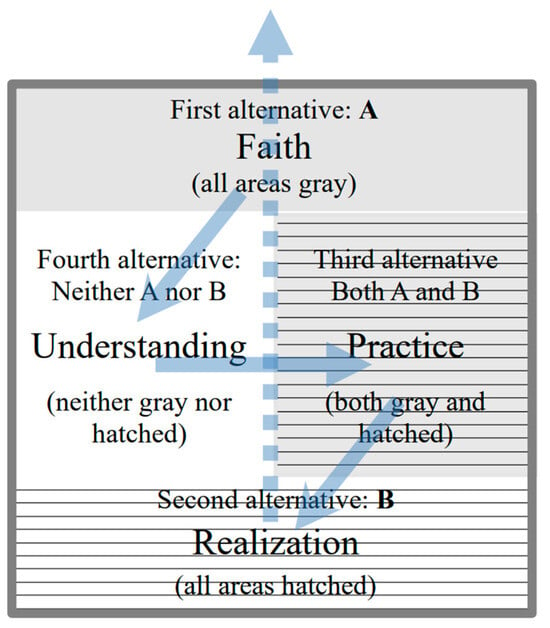
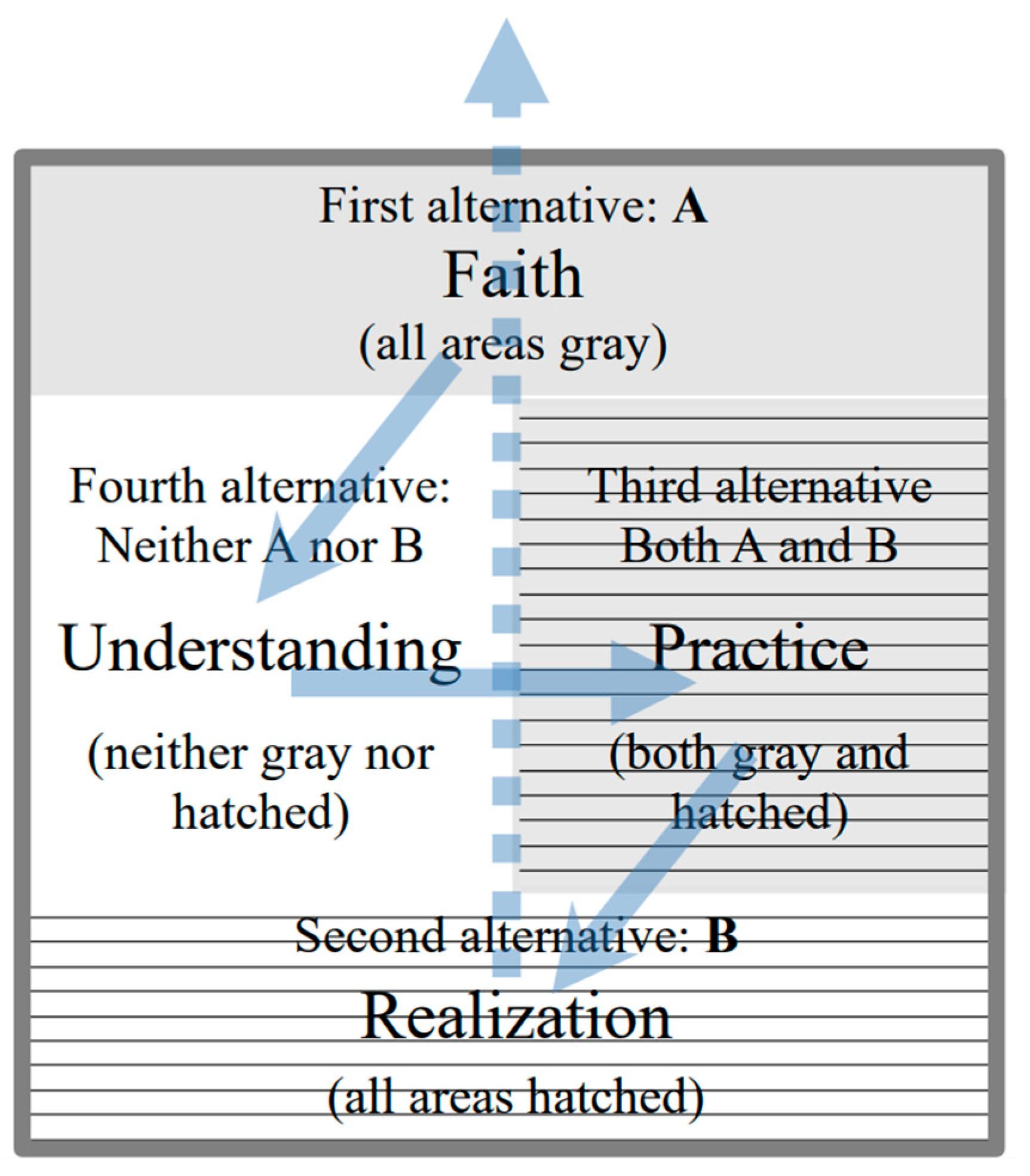
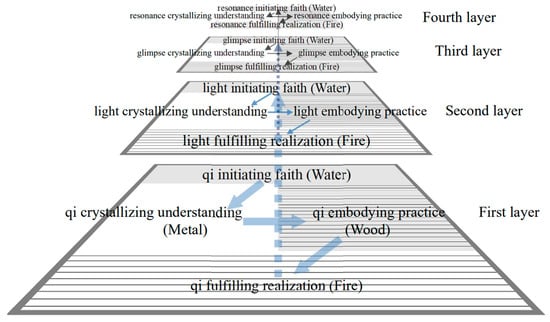
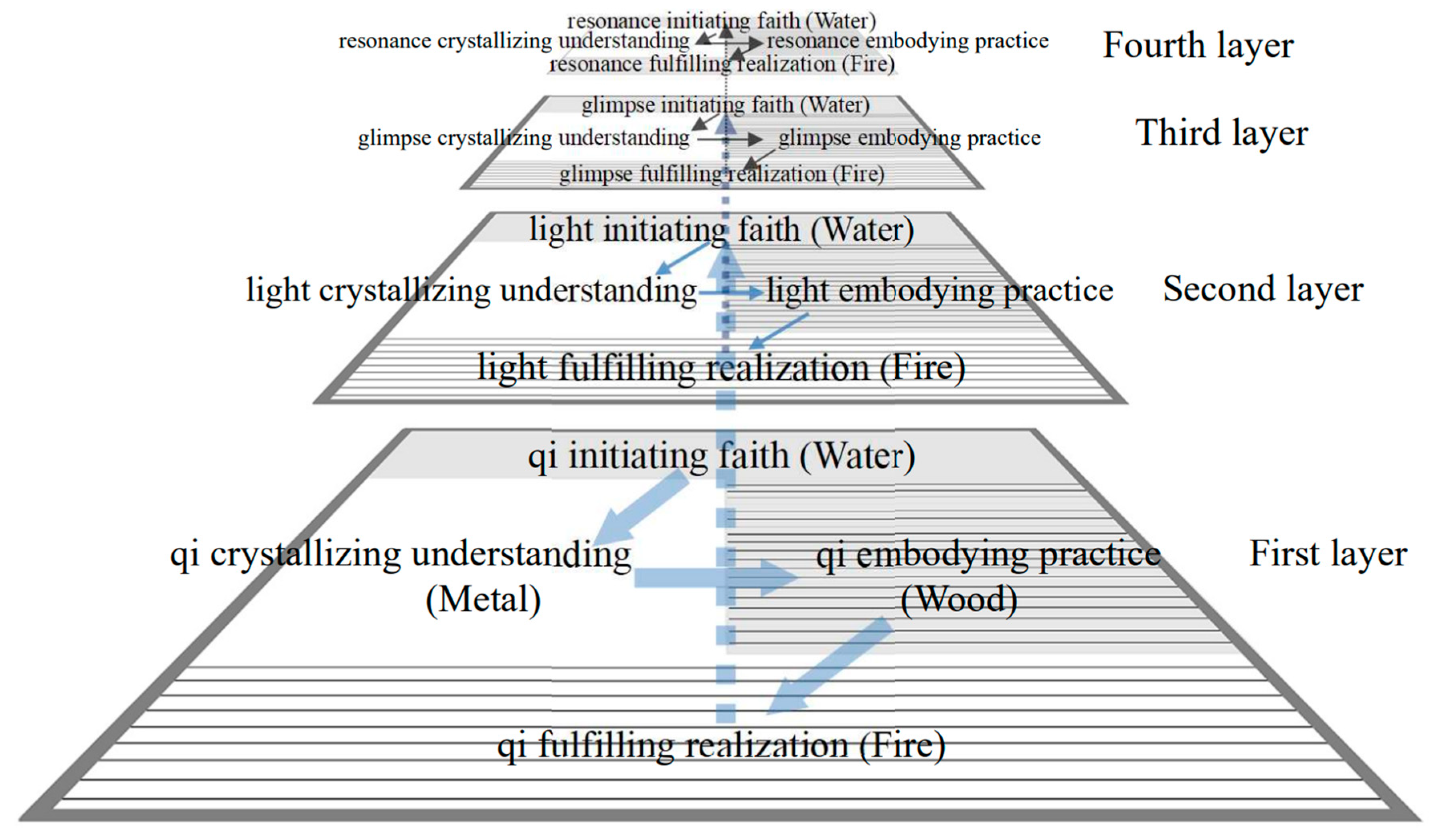
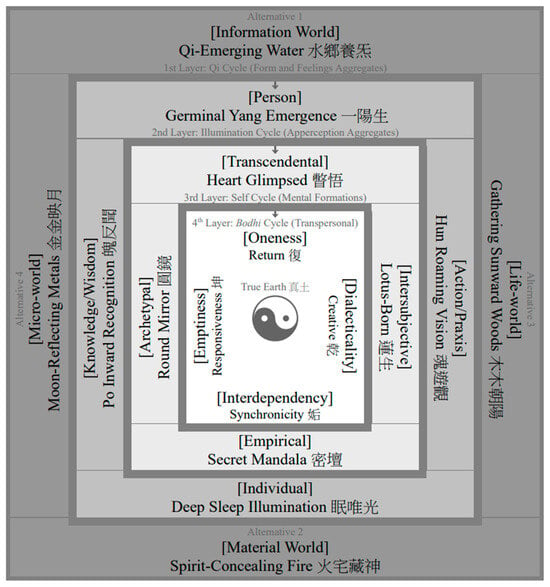
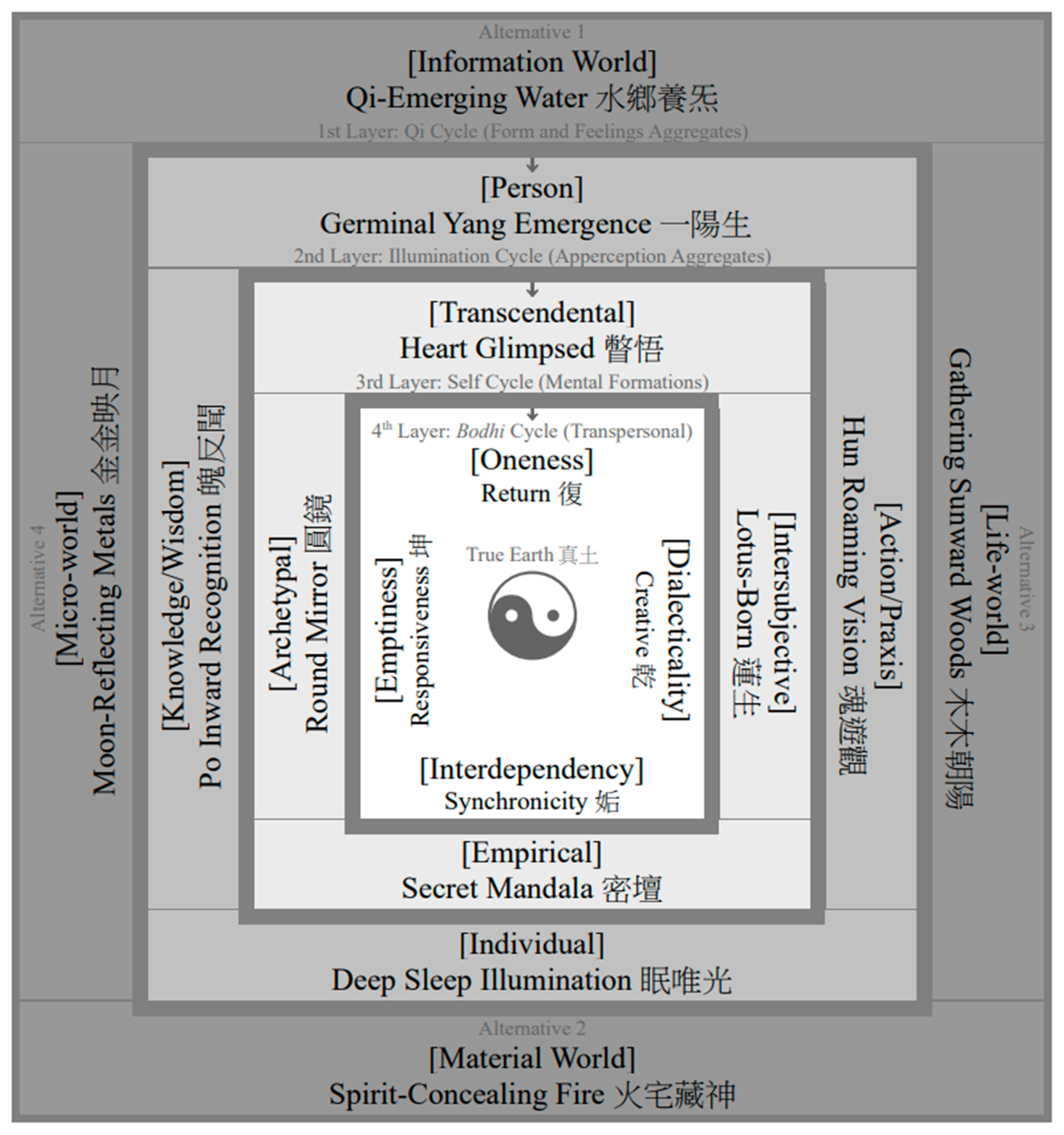
Disclaimer/Publisher’s Note: The statements, opinions and data contained in all publications are solely those of the individual author(s) and contributor(s) and not of MDPI and/or the editor(s). MDPI and/or the editor(s) disclaim responsibility for any injury to people or property resulting from any ideas, methods, instructions or products referred to in the content. |
© 2026 by the author. Licensee MDPI, Basel, Switzerland. This article is an open access article distributed under the terms and conditions of the Creative Commons Attribution (CC BY) license.