


Abstract
Longmeizi 龍眉子 was an inheritor of the Southern Lineage of Daoism 道教南宗 under Weng Baoguang 翁葆光. By tracing the historical documentation of Longmeizi’s Daoist lineage, it becomes evident that the narrative details were continuously enriched through textual accumulation. By tracing and analyzing the formative history of documents related to Longmeizi’s Daoist lineage, it is evident that in the process of forming this Daoist lineage, lineage identity 宗派認同 was continuously solidified and even “labeled 標籤化” within these layered texts. The transmission genealogy between patriarchs across generations gradually became clear, definite, and verifiable. After Longmeizi compiled the Jinye Huandan Yinzheng Tu 金液還丹印證圖 (Illustrations of the Return of the Liquified Gold to the Cinnabar Field) from the Jiading period (1208–1224) of the Southern Song Dynasty to the beginning of the Yuan Dynasty, this book was initially transmitted within the Daoist lineage: Longmeizi → Bai Yuchan 白玉蟾 → Wang Jinchan 王金蟾. By the end of the Yuan Dynasty, a literatus named Yuanyangzi Lin Jing 元阳子林静 from Wuxing 吴兴 had also read this book. During the Ming and Qing dynasties, the mode of transmission for the Jinye Huandan Yinzheng Tu shifted from being primarily transmitted orally within Daoist circles to being primarily disseminated through the printing and circulation of books. This led to the emergence of many different versions and commentaries of the Jinye Huandan Yinzheng Tu. Through the compilation and printing of book series, the Jinye Huandan Yinzheng Tu gained broad circulation during the Ming and Qing dynasties. Its annotators, publishers, and readers spanned various identities and social classes, while its geographic reach extended to the Central Plains (Zhongyuan 中原), Southwest China, and Jiangnan regions. By examining the textual circulation history of the Jinye Huandan Yinzheng Tu, it can be observed that the development of the book printing industry during the Ming and Qing periods, particularly the flourishing of series publications, facilitated a shift in the primary mode of transmission for Daoist texts and even in the nature of the texts themselves. On the other hand, the case study of the Jinye huandan yinzheng tu is an example that illustrates the diversity and richness in the methods of Daoist cultural transmission and their development during the Ming and Qing dynasties.
1. Introduction
Longmeizi (12–13th century), active during the Jiading period, was an inheritor of Weng Baoguang (12th century) in the Southern Lineage of Daoism. His work, Jinye Huandan Yinzheng Tu, consists of illustrations and poems arranged according to the stages of inner alchemy practice. In 1948, Meng Wentong first drew attention to the issue of Longmeizi’s Daoist lineage (see Meng 1948). Since the 1990s, scholars such as Qing Xitai, Xu Zhaoren, Zhan Shichuang, Gai Jianmin have conducted in-depth research into Longmeizi’s lineage and the philosophical connotations of the Jinye Huandan Yinzheng Tu (see Qing 1996; Z. Xu 1991; Zhan 2001; Gai 2013). Others, including Xu Yilan, Hu Chuntao, and He Zhenzhong, have analyzed the connotations and meanings of the illustrations in this text (see Y. Xu 2009; Hu 2012; He 2014).
Existing studies have primarily relied on the version of the Jinye Huandan Yinzheng Tu in the Daozang 道藏 (Daoist canon) to discuss Longmeizi’s Daoist lineage and the philosophical connotations of this text. With the emergence of new textual sources, this article focus on the following issues:
First, Longmeizi claimed in his autobiography to be a descendant of Weng Baoguang from the Southern Lineage of Daoism. How was the historical narrative of this Daoist lineage genealogy formed? Building on this, the article further analyzes how lineage identity was solidified during the formation of Daoist lineage genealogies through the transmission and evolution of texts.
Second, based on various versions of the Jinye Huandan Yinzheng Tu from the Song and Yuan dynasties to the Ming and Qing dynasties, as well as related historical materials, the article examines the textual circulation history of the Jinye Huandan Yinzheng Tu. It analyzes the transformation in the primary modes of circulation of this work during different historical periods, from the Song and Yuan dynasties to the Ming and Qing dynasties. This shift in circulation methods transformed the textual nature of the Jinye Huandan Yinzheng Tu from an esoteric alchemical canon into a publicly published and circulated book. Furthermore, the article explains how the development of book compilation and publishing, especially the flourishing of series publication, from the Song and Yuan dynasties to the Ming and Qing dynasties, contributed to significant changes in the primary circulation methods and textual nature of Daoist texts, particularly alchemical scriptures. Japanese scholar Matsushita Michinobu has pointed out that during the Southern Song Dynasty, Bai Yuchan (1134–1229) promoted the wider dissemination of alchemical knowledge through book publishing activities. This reflects Bai Yuchan’s breakthrough of the traditional notion that alchemical teachings ought to be passed down exclusively through esoteric master–disciple transmission, as well as the transformation of internal alchemy from confidential knowledge limited to master–disciple lineages into public knowledge accessible to ordinary people (Matsushita 2004). Nevertheless, the shifts in the communication of alchemical thought and in the nature of Taoist alchemical classics driven by book publication did not take place abruptly. Based on diverse versions of the Jinye Huandan Yinzheng Tu since the Song Dynasty, this article explores the long-term textual circulation history of this book. Taking textual evolution as the central clue, it elaborates and demonstrates in detail the changes in the circulation patterns and textual attributes of internal alchemy classics over an extended period of time.
In order to explore the above two closely related issues, methodologically, this article will start from Longmeizi’s own account, tracing history back layer by layer and examining historical sources step by step, thereby analyzing how Longmeizi’s “verifiable transmitter” status was gradually established through the transmission of texts. To comprehensively trace the textual circulation history of the Jinye Huandan Yinzheng Tu, this article adopts a chronological approach. It examines the esoteric transmission of the Jinye Huandan Yinzheng Tu as an esoteric alchemical canon within the Southern Lineage of Daoism during the Song and Yuan dynasties, based on the text of various prefaces and postfaces as well as relevant historical materials. Drawing on nearly all extant printed versions of the Jinye Huandan Yinzheng Tu, it discusses the history of its circulation as a publicly circulating book in China from the Ming and Qing dynasties onward. Through textual comparison, it analyzes the relationships between different versions. Ultimately, using the textual circulation history of the Jinye Huandan Yinzheng Tu as a case study, this article illustrates significant transformation in the primary modes of textual transmission of such Daoist alchemical classics from the Song and Yuan dynasties to the Ming and Qing dynasties.
2. The Historical Documentation of Longmeizi’s Daoist Lineage
Longmeizi was an inheritor of Weng Baoguang in the Southern Lineage of Daoism. The Daoist lineage of Longmeizi is recorded as Zhang Boduan 張伯端 (987?–1082) → Liu Zhenren 劉真人 (the Perefected Liu) (?–1168) → Weng Baoguang → Ruoyizi 若一子 (12th century) → Longmeizi. This direct attribution originates from the “Jinye Huandan Yinzheng Tu Houshi 金液還丹印證圖後識 (the Colophon at the End of the Illustrations of the Return of the Liquified Gold to the Cinnabar Field)” authored by Longmeizi himself. In this colophon, he records the following:
My teacher, Ruoyizi, once said: “I once heard my teacher Wumingzi, say: ‘My teacher was Liu Guangyi, also known as Shunlizi. … in the Wuwu year of the Shaoxing period (1138), Liu met Immortal Wu Zhen (Zhang Boduan) and attained the Dao, but he lacked the determination to fully realize it. … In the Wuzi year of the Qiandao period (1168), Liu achieved the Dao in the Tiger Hill. …’” I have studied the Dao for thirty years. In the Yihai year of Jiading period (1215), I once again encountered my immortal master on Tiger Hill, where he fully revealed to me the secrets of fire times in alchemy. Now, two years have passed in a flash, and I find myself still bound by the fetters of official duties, drowning in worldly affairs. Fearing that further procrastination may lead to the decline of my immortal pursuits, I am deeply apprehensive. Thus, I have composed this illustration, hoping it may serve as a guide for those who resonate with its teachings.
余師若一子嘗曰:“曾聞我師無名子翁先生云:‘吾師乃廣益順理子也。⋯⋯時在紹興戊午,劉遇悟真得其道,願力不能成。⋯⋯乾道戊子歲,成道於虎丘山中。……’”余學道三十年矣,於嘉定乙亥歲,再遇仙師,始全訣火候之秘於虎丘之上。今忽二年,顧方拘靡吏鎖,汨沒塵鞅。恐後因循,沈墜仙業。深有所懼,遂撰此圖,庶有契會焉。(Jinye Huandan Yinzheng Tu, vol. 260, p. 252)
Longmeizi recorded that in the Wuwu year of the Shaoxing period (1138), Liu Zhenren, named Liu Yongnian 劉永年, also known as Liu Guangyi 劉廣益, encountered Zhang Boduan. However, Zhang Boduan passed away in 1082, with a gap of 56 years between them. It is evident that the account of this master–disciple lineage was constructed by Weng Baoguang.
In Lin Jing’s 林靜 “Jinye Huandan Yinzheng Tu Houxu 金液還丹印證圖後序 (the Postface of the Illustrations of the Return of the Liquified Gold to the Cinnabar Field)”, this Daoist lineage is also recorded. Lin Jing records the following:
I once obtained Longmeizi’s Jinye Huandan Yinzheng Tu… However, the sequence of its transmission, as well as the identities of figures such as Longmeizi, Ruoyizi, and Wumingzi, remained unclear. … Now, upon examining the narrative from beginning to end, it becomes evident that this work belongs to Ziyang lineage. “Jinye Huandan Yinzheng Tu Houshi” states: “My teacher, Ruoyizi, studied under Wumingzi, Master Weng, who in turn was a disciple of Shunlizi, Liu Zhenren”. It appears that this Liu Zhenren was none other than the White Dragon Cave Daoist, a direct disciple of Ziyang, with Shunlizi being his alternative name. … Although Shunlizi had encountered the Dao, he lacked the determination to fully realize it. It was not until the Wuwu year of the Shaoxing period (1138) that he encountered Ziyang once again.
嘗得龍眉子《印證圖》一卷……惟授受之次,龍眉、若一、無名二三子未詳其人。⋯⋯今考諸敘事本末,則知為紫陽宗脈。其《後識》曰:“予師若一子師無名子翁先生,翁之師順理子劉真人。”蓋真人即白龍洞道人,紫陽入室之徒也,順理子迨其別號云。⋯⋯順理故雖聞道,而力未果。至紹興戊午,復遇紫陽。(Jinye Huandan Yinzheng Tu, vol. 260, pp. 252–53)
Based on the records of Longmeizi, Lin Jing also believed that the Daoist lineage of Longmeizi was Zhang Boduan → Liu Zhenren → Weng Baoguang → Ruoyizi → Longmeizi. Additionally, Lin Jing considered Liu Zhenren to be Zhang Boduan’s disciple, known as the White Dragon Cave Daoist (Bailong Dong Daoren 白龍洞道人). Wuzhen pian 悟真篇 includes Zhang Boduan’s “Song for the White Dragon Cave Daoist Liu (Zeng Bailong Dong Liu Daoren Ge 贈白龍洞劉道人歌)”, but this song does not specify who exactly “the White Dragon Cave Daoist Liu” refers to (see Daozang, vol. 2, p. 963). Fan Guangchun, drawing on Song Dynasty stone inscriptions such as the “Zhang Pingshu Zhenren Ge Ba 張平叔真人歌跋 (Postscript to the Song of Perfected Zhang Pingshu)”, has researched and confirmed that the White Dragon Cave Daoist Liu was Liu Zhongyuan 劉仲遠 (11th century). He received this song around the end of the Jiayou period (1056–1063) and passed away no later than the 18th year of the Yuanfeng period (1085) (Fan 1991).1 Moreover, Weng Baoguang studied Daoism under Liu Guangyi during the reign of Emperor Xiaozong (1162–1189), by which time the White Dragon Cave Daoist Liu had already passed away around a hundred years earlier (Fan 1991). Therefore, Shunlizi Liu Zhenren recorded by Longmeizi could not be the White Dragon Cave Daoist Liu, as believed by Lin Jing. In Lin Jing’s documentation of Longmeizi’s Daoist lineage, there is already a deviation from Longmeizi’s own account. Moreover, according to the consistent accounts of both Longmeizi and Lin Jing, Shunlizi passed away in the Wuzi year of the Qiandao period (1168) at over a hundred years of age. Tracing back to the death of Zhang Boduan in the 15th year of the Yuanfeng period (1082), Liu Yongnian would have been at most less than twenty years old at the time. Essentially, they were active in different periods. Thus, it is highly unlikely that Liu Yongnian studied Daoism directly from Zhang Boduan. This also indicates that the master–disciple relationship between Liu Yongnian and Zhang Boduan was a construct devised by Weng Baoguang.2
So, how does Weng Baoguang himself describe his Daoist lineage? In the “Wuzhen Pian Zhushu Xu 悟真篇註疏序 (Preface to the Commentary on the Wuzhen pian)”, he states the following:
My deceased teacher once said to me: “the immortal from Tiantai achieved the Dao…. In his youth, he studied alongside my ancestor at the Imperial Academy. Yet only the immortal from Tiantai did not attain official rank, as he possessed a transcendent spiritual foundation from early on. While delving into Buddhist texts, he suddenly encountered the inspiration of striking bamboo, leading to an instantaneous awakening to the unconditioned, directly transcending into the ocean of true emptiness and pure nature. In his later years, he met the Elder of Qingcheng in Chengdu and fully grasped the profound principles of the golden elixir. … During the Yuanfeng period, he propagated the Buddhist teachings alongside disciples of Liu Fengzhen. … Seven years later, disciples of Liu Fengzhen revisited Mountain Wangwu and met the immortal from Tiantai again as before”.
先子嘗謂余曰:“天台仙翁道成,……少偕我祖肄業辟雍,惟翁不第,夙挺靈根,因玩佛書,忽至擊竹有感,頓悟無生,直超真空清淨性海。晚年遇青城丈人於成都,盡得金丹妙旨,……向在元豐間,與劉奉真之徒廣宣佛法,……後七年,奉真之徒到王屋山復會仙翁如故”。(Daozang, vol. 2, pp. 911–12)
Weng Baoguang’s account was transcribed from the oral narration of “Xianzi”. Liu Ts’un-Yan believed that “Xianzi” here is a clerical error of “Fuzi 夫子”, referring to Chen Daling 陳達靈 (12th century), and that “my ancestor” in the preface denotes Chen Daling’s ancestor. Moreover, Chen Daling’s ancestor could not possibly have been a fellow student of Zhang Boduan (see T.-Y. Liu 1991). Chen Bing argued that within the Golden Elixir tradition, master–disciple relationships often follow the etiquette of father and son. Thus, “Xianzi” here likely refers to his deceased teacher, Liu Yongnian. In this case, “my ancestor” in the preface would denote Liu Yongnian’s ancestor. Additionally, Chen Daling and Weng Baoguang were peers in the Daoist study, not master and disciple. There are no instances in historical alchemical texts where a peer is respectfully addressed as “Fuzi”, and even in master–disciple relationships, this term is rarely used (B. Chen 1995). In relevant texts from the Song and Yuan periods, whether from Longmei Zi or Lin Jing, Shunlizi Liu Zhenren is consistently regarded as the figure discussed in Weng Baoguang’s narrative, not Chen Daling. Based on Chen Bing’s analysis, “Xianzi” here should not be interpreted as “Fuzi” but rather as a reference to Liu Yongnian.
Comparing Weng Baoguang’s account with those of Longmeizi and Lin Jing reveals that the latter two largely inherited the main narrative from Weng Baoguang but introduced deviations in specific details. Weng Baoguang recorded that disciples of Liu Fengzhen encountered Zhang Boduan again at Mountain Wangwu 王屋山. In Lin Jing’s account, however, this event was attributed to Liu Yongnian meeting Zhang Boduan at Mountain Wangwu. In the later text Lishi Zhenxian Tidao Tongjian 歷世真仙體道通鑑 (Comprehensive Mirror of Immortals Who Embodied the Dao through the Ages), Liu Fengzhen and the White Dragon Cave Daoist Liu were further conflated into the same figure (see Daozang, vol. 5, p. 384). The accumulative deviations in the documentary records have increasingly diverged from Weng Baoguang’s own accounts and the references to “the White Dragon Cave Daoist Liu” found in Song Dynasty stone inscriptions. Apart from the inherited and adapted narratives from the lineage of Weng Baoguang, Longmeizi, and Lin Jing, Chen Daling states the following in the “Wuzhen Pian Zhu Xu 悟真篇註序 (preface to Weng Baoguang’s Commentary on the Wuzhen pian)”:
The Immortal Wuzhen received the Dao atop Mount Qingcheng and refined the elixir in the Jing-Hu region. Through one transmission, Guangyizi emerged; through a second transmission, Wumingzi emerged.
悟真仙翁聞道於青城之上,餌丹於荊湖之間。一傳而廣益子出焉,再傳而無名子出焉。(Daozang, vol. 2, p. 911)
Chen Daling believed that Zhang Boduan transmitted his teachings to Liu Yongnian in one generation, and Liu Yongnian then passed them on to Weng Baoguang in the next. This perspective was evidently influenced by Weng Baoguang, who had invited Chen Daling to write the preface for the Wuzhen Pian Zhu 悟真篇註 (Commentary on the Wuzhen pian).
As the key figure connecting Weng Baoguang’s lineage to Zhang Boduan, how did Liu Yongnian himself narrate his own Daoist lineage and master–disciple inheritance? Longmeizi recorded that Liu Yongnian once published Peng Xiao’s 彭曉 (?–955) Zhouyi Cantongqi Fenzhang Tongzhen Yi 周易參同契分章通真義 (Real Meaning of the token for the Agreement of the Three According to the Book of Changes). In the Wuzhen Pian Zhu, a text from Liu Yongnian’s preface to his publication of Zhouyi Cantongqi Fenzhang Tongzhen Yi is included. He states the following:
In the Wuwu year of the Shaoxing period (1138), I, Yongnian, encountered a Perfected Being who personally transmitted oral instructions to me and further instructed: “Just study the Cantongqi—its teachings are entirely identical to my oral instructions”. I, Yongnian, carefully followed my teacher’s directive to study the text, and the principles became abundantly clear, leaving me without any doubts.
永年紹興戊午,嘗遇至人親授口訣,仍訓永年:“但看《參同契》,與我訣俱同”。永年謹依師旨觀閱,道理昭然,以此無惑。(Daozang, vol. 2, p. 911)
Liu Yongnian only mentioned that he received oral instructions on the elixir from a Perfected Being, but did not specify that this Perfected Being was Zhang Boduan.
Starting from the records of Longmeizi and Lin Jing in the Jinye Huandan Yinzheng Tu, and tracing back layer by layer to Weng Baoguang, Chen Daling, and finally Liu Yongnian, a clear trajectory of textual transmission and evolution can be identified. Liu Yongnian’s own account states that he received the Dao from a Perfected Being but did not identify this figure as Zhang Boduan. Weng Baoguang, in relaying Liu Yongnian’s words, enriched the narrative with details linking it to Zhang Boduan and conflated the White Dragon Cave Daoist Liu with Liu Fengzhen. It was precisely through Weng Baoguang that Liu Yongnian became associated with Zhang Boduan. Influenced by Weng Baoguang, Chen Daling affirmed the master–disciple lineage of Zhang Boduan → Liu Yongnian → Weng Baoguang. Later, Longmeizi, through oral accounts from Ruoyizi, cited Weng Baoguang’s narrative and, through layered retrospection, confirmed the Daoist lineage of Zhang Boduan → Liu Yongnian → Weng Baoguang → Ruoyizi → Longmeizi. Basing his account on Longmeizi’s narrative, Lin Jing reaffirmed the transmission lineage from Zhang Boduan to Longmeizi. However, he mistakenly identified Shunlizi Liu Zhenren as the White Dragon Cave Daoist Liu and claimed that Liu encountered Zhang Boduan again in the Wuwu year of the Shaoxing period (1138). This demonstrates that the historical narrative of Longmeizi’s Daoist lineage gradually grew richer in detail through the accumulation of textual layers, while key information such as specific figures and timelines occasionally deviated. It was precisely through this process of textual transmission and evolution that the historical narrative of the Daoist lineage was repeatedly confirmed. Through this repeatedly validated lineage, Longmeizi also came to be recognized as one of the transmitters of the “Ziyang Zongmai 紫陽宗脈 (Ziyang lineage)” across generations.
3. The Textual Circulation of the Jinye Huandan Yinzheng Tu During the Song and Yuan Periods
Just like the lineage masters Ruoyizi, Wumingzi, and Shunlizi, who also belong to the “Ziyang Zongmai”, Longmeizi was an elusive and mysterious figure akin to a “Xianshi 仙師 (immortal master)”. Details about his life and experiences are only briefly revealed in the preface he wrote for the Jinye Huandan Yinzheng Tu. From a young age, he was “devoted to the pursuit of purity and emptiness 篤志清虛” (Jinye Huandan Yinzheng Tu, vol. 260, p. 230). After more than thirty years of seeking out and learning from over a hundred Daoist masters across various regions, he finally “encountered and attained enlightenment 遇而方悟” (Jinye Huandan Yinzheng Tu, vol. 260, p. 230). After achieving the Dao, and to ensure the continuous transmission of the ultimate Dao of cultivation, he completed the Jinye Huandan Yinzheng Tu in the Wuyin year of the Jiading period (1218) (see Jinye Huandan Yinzheng Tu, vol. 260, p. 230).3
After the completion of the Jinye Huandan Yinzheng Tu, the book was printed in limited quantities and circulated narrowly, being passed down only among the masters of the Southern Lineage of Daoism. In the Jiawu year of the Duanping period (1234), Wang Jingxuan 王景玄 (13th century), also known as Wang Jinchan, from Wuning 武寧, Jiangxi, received the transmission of the Jinye Huandan Yinzheng Tu. He states the following:
This book was personally bestowed by my late teacher, Yuchan, and illustrated and described by our patriarch, Longmeizi himself. It must not be shown to the unworthy; treasure and revere it.
此圖係先師玉蟾親授,祖師龍眉子親筆圖述,非人勿視,寶而敬之。(Jinye Huandan Yinzheng Tu, vol. 260, p. 231)
The late teacher, Yuchan, refers to Bai Yuchan (1134–1229), the actual founder of the Southern Lineage of Daoism.4 The Jinye Huandan Yinzheng Tu was completed at the time when Bai Yuchan was traveling extensively in the Jiangxi region. As stated by Bai Yuchan: “in the Wuyin year of the Jiading period, Bai Yuchan of Qiongshan, carrying his sword, passed by Yulong, visited Fuchuan, and traveled through Wucheng 嘉定戊寅,瓊山白玉蟾攜劍過玉隆,訪富川,道經武城” (Daozang, vol. 4, p. 751). The Jiangxi local chronicles from the Ming and Qing periods also record that Bai Yuchan resided for thirty years on Mount Bijia 筆架山 in Linchuan 臨川 during the Jiading period.5
During his travels in Jiangxi, Bai Yuchan maintained a close association with the Jingming 淨明 (pure and clear) Daoist community at the Yulong 玉隆 Temple on the mountain west of Nanchang. He even composed “Jingyang Xu Zhenjun Zhuan 旌陽許真君傳 (Biography of the Perfected Lord Xu Jingyang)” for Xu Xun 許遜 (239–374). The poems and essays he wrote during this period were later compiled into the Yulong Ji 玉隆集 within the Xiuzhen Shishu 修真十書 (Ten Books on the Cultivation of Perfection). The complete narrative of the Chen 讖 (prophecy) by Xu Zhenjun—that 840 dixian 地仙 (terrestrial immortals) would emerge 1240 years after his ascension, known famously as the “Longsha Chen 龍沙讖”—first appeared in sources such as Xishan Xu Zhenjun Bashiwu Hua Lu 西山許真君八十五化錄 (the Record of the Eighty-Five Manifestations of Xu Zhenjun of the Mountain West) from the reign of Emperor Lizong (1224–1264) of Song and Bai Yuchan’s Jingyang Xu Zhenjun Zhuan (see Y. Zhang 2011, p. 6). As recorded by Bai Yuchan in the Jingyang Xu Zhenjun Zhuan, Xu Zhenjun said the following:
One thousand two hundred and forty years after my ascent to heaven, within the boundaries of Yuzhang and the region of the Wuling, eight hundred terrestrial immortals shall emerge. Their master will arise from Yuzhang and greatly propagate my teaching.
吾仙去後一千二百四十年間,豫章之境,五陵之內,當出地仙八百人,其師出於豫章,大揚吾教。(Daozang, vol. 4, p. 758)
The influence of the Longsha Chen is also evident in the “Jinye Huandan Yinzheng Tu Houshi” written by Longmeizi during the Jiading period (1208–1224). He states the following:
Long ago, on the day Xu Zhenjun of the Mountain West slew the serpent, he left these words: “One thousand two hundred and forty years after my ascent to heaven, within the region of the Wuling, eight hundred individuals shall attain immortality”. From the Yongjia period (307–313) of the Eastern Jin Dynasty to the Chunxi period (1174–1189) of our Song Dynasty, the number is nearing fulfillment.
昔西山许君诛蛇之日,曾留语曰:“吾升天后一千二百四十年间,五陵之内,当有八百人得仙。”自东晋永嘉迄我宋淳熙,将符其数。(Jinye Huandan Yinzheng Tu, vol. 260, p. 252)
Thus, during the Jiading period, both Longmeizi and Bai Yuchan, who were traveling in Jiangxi, adopted the local veneration of Xu Zhenjun on the Mountain West of Nanchang and the Longsha Chen. Synthesizing Bai Yuchan’s itineraries during his travels in Jiangxi in the Jiading period, the inscribed colophon by his disciple Wang Jingxuan from Wuning, Jiangxi, and the shared influence of the local veneration of Xu Zhenjun and the Longsha Chen on both Longmeizi and Bai Yuchan, it can be inferred that between the Wuyin year of the Jiading period (1218), when the Jinye Huandan Yinzheng Tu was completed, and the second year of Shaoding period (1229), when Bai Yuchan passed away, the Jinye Huandan Yinzheng Tu was transmitted in the Jiangxi region—from Longmeizi to Bai Yuchan, and then to Wang Jinchan.
It is currently known that the alchemical thought passed down by Wang Jinchan from Bai Yuchan mainly consists of the contents found in the Jinye Huandan Yinzheng Tu. Wang Jinchan’s successor was Li Daochun 李道纯 (13th century), known as Yingchanzi 莹蟾子 and also as Qing’an 清庵. As recorded by Ke Daochong 柯道冲 (14th century): “Only Li Qingan received transmission from Wang Jinchan, a disciple of Bai Yuchan, becoming a pillar of the orthodox transmission of the lineage of the Dao. and inheriting the orthodox lineage of the Dao 惟清庵李君得玉蟾白真人弟子王金蟾真人授受,為玄門宗匠,繼道統正傳” (Daozang, vol. 23, p. 889). Although Li Daochun’s works do not contain direct citations of the Jinye Huandan Yinzheng Tu, he adopted an illustrative approach in Volume 2 of his Zhonghe Ji 中和集, using both text and images to elucidate concepts such as the “golden elixir (jindan 金丹)”, “fire phases (huohou 火候)”, and “internal and external medicinal substances (neiwai eryao 內外二藥)”. In addition to their shared use of the method of illustrating alchemical practices through diagrams, Li Daochun’s works and those of Longmeizi also exhibit convergence in the specific content of alchemical thought. For example, in their interpretations of the “fire phase”, both Li Daochun and Longmeizi used the “twelve waxing and waning hexagrams (shier xiaoxi gua 十二消息卦)” to interpret the advancement, retreat, ascent, and descent of the fire phase (see Daozang, vol. 5, p. 487; Jinye Huandan Yinzheng Tu, vol. 260, pp. 242–46). Additionally, in terms of illustration, both Li Daochun and Longmeizi used a hollow circle to symbolize the primordial origin of the world that one must reverse and return to in alchemical cultivation (see Daozang, vol. 5, p. 487; Jinye Huandan Yinzheng Tu, vol. 260, pp. 242–32). Based on the transmission lineage from Longmeizi to Wang Jinchan and then to Li Daochun, as well as the similarities in methodology and ideological content between Li Daochun’s works and the Jinye Huandan Yinzheng Tu, it can be concluded that during the Song and Yuan dynasties, as an esoteric alchemical canon within the Southern Lineage of Daoism, Jinye Huandan Yinzheng Tu was transmitted from master to disciple in the Southern Lineage following the route: Longmeizi → Bai Yuchan → Wang Jinchan → Li Daochun.6
During the Song and Yuan periods, the Jinye Huandan Yinzheng Tu also circulated into the hands of Lin Jing from Wuxing, also known as Yuanyangzi. He had also studied the Dao for many years. After obtaining the Jinye Huandan Yinzheng Tu, Lin Jing remarked with emotion:
Observing the gathering and refining of medicinal substances, the nurturing and transformation of the embryonic immortal, the sequential stages of practice are like ascending steps. As for the essentials of the elixir purpose and the correspondences in the classics, upon opening the scroll, all becomes clear to the mind.
觀其採煉藥物,養蛻胎仙,工夫次第,猶階而升。於丹旨之要,經書之合,一開卷頃,了然於乎心矣。(Jinye Huandan Yinzheng Tu, vol. 260, p. 252)
The postface Lin Jing wrote for the Jinye Huandan Yinzheng Tu was signed as follows: “Written with reverence and purity by Yuanyangzi Lin Jing from Wuxing, the Daoism Historian of the Jade Terrace, in the year Jiyou, on the day when golden essence fills the cauldron, at the Taiwei xuangai dongtian, at the age of thirty-five 己酉歲金精滿鼎日,瑤台玄史元陽子吳興林靜熏潔拜書於太微玄蓋洞天,時年三十有五也” (Jinye Huandan Yinzheng Tu, vol. 260, p. 252). Based on this, Daozang tiyao 道藏提要 (the Annotated on the Bibliography of the Daoist canon), suggests that this postface was written in the 19th year of Chunyou period (1249) (see Ren 1995, p. 112), while The Taoist Canon: A Historical Companion to the Daozang merely states that this postface was composed during the Yuan dynasty (see Schipper and Verellen 2004, vol. 2, p. 833).
In the late Yuan and early Ming periods, there was a literatus named Lin Jing from Wuxing, also named Zishan 子山, also known as Yuzhai 愚齋. He was Zhao Mengfu’s 趙孟頫 (1254–1322) daughter’s son and wrote the Yuzhai ji 愚齋集, for which Song Lian 宋濂 (1310–1381) wrote a preface. This work is also recorded in the Mingshi 明史 (The History of the Ming Dynasty) (see Mingshi 1976, vol. 8, p. 2462). Lin Jing’s great-grandfather had served the Song dynasty through the military examinations (Wuju 武舉), and both his grandfather and father served the Yuan dynasty. By the late Yuan period, Lin Jing “delved even deeper into the books of the Hundred Schools, and even the mysterious teachings and secret classics of Daoism and Buddhism, he absorbed their essence 益研穷百氏之书,虽老释玄诠秘典,悉缀其芳润” (Wenxian Ji, vol. 1223, p. 408). Considering factors such as his identity as a Wuxing literatus, his fondness for reading Daoist texts, and his activity during the Yuan dynasty, the author believes that Lin Jing, who was active in the late Yuan and early Ming periods and wrote the Yuzhai ji, is the same Lin Jing, Yuanyangzi, who wrote the postface for the Jinye Huandan Yinzheng Tu. Based on his lifespan and the fact that he was 35 years old when writing the postface, the time of writing can be placed around the transition from the Yuan to the Ming dynasty, specifically in the second year of the Hongwu period of the Ming dynasty, Jiyou (1369). From the completion of the Jinye Huandan Yinzheng Tu by Longmeizi until the early Yuan dynasty, this text was transmitted successively within the lineage of Longmeizi → Bai Yuchan → Wang Jinchan in the Jiangxi region, circulating continuously for over 150 years. By the late Yuan and early Ming periods, the Wuxing literatus Lin Jing also received and transmitted this text.
4. The Publication and Circulation of the Jinye Huandan Yinzheng Tu During the Ming and Qing Dynasties
During the Ming and Qing dynasties, with the advancement of the book printing industry and the deepening influence of Daoist culture in society, the transmission of the Jinye Huandan Yinzheng Tu shifted from primarily relying on master–disciple transmission within the Daoist tradition to predominantly depending on circulation through printed publications. Correspondingly, multiple versions and diverse interpretations emerged during its circulation.
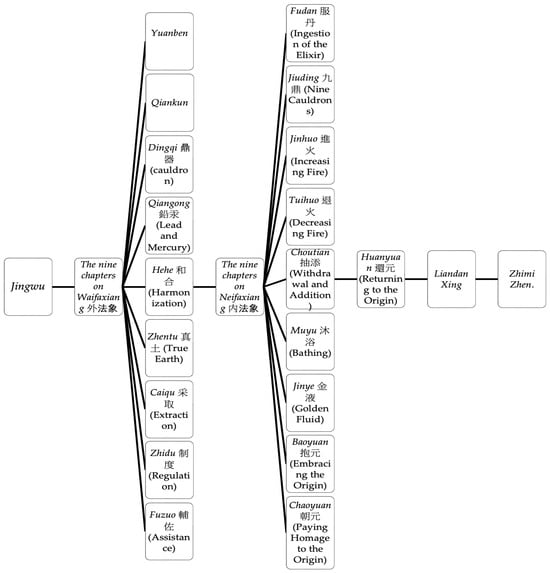
In the 4th year of the Yongle period (1406), Emperor Chengzu (1360–1424) of the Ming Dynasty ordered Zhang Yuchu 張宇初 (1359–1410) to compile and edit Daoist scriptures, marking the beginning of the compilation of the Daozang during the Ming Dynasty. After interruptions during the Hongxi period (1425) and the Xuande period (1426–1435), the entire Daozang was completed and printed in the 10th year of the Zhengtong period (1445). The Daozang version of the Jinye Huandan Yinzheng Tu includes 20 chapters of poetry and illustrations—such as “Yuanben 原本 (Original Basis)”, “Jingwu 警悟 (Awakening)”, and “Qiankun 乾坤”—as well as two essays, “Liandan Xing 煉丹行 (alchemical cultivation)” and “Zhimi Zhen 指迷箴 (Guidelines for the Perplexed)”, making a total of 22 chapters. The sequence of these 22 chapters was intentionally designed by Longmeizi to reflect the sequential stages of inner alchemical practice.7 The original sequence of these 22 chapters in the Jinye Huandan Yinzheng Tu is shown in Figure 1.
Figure 1.
The schematic diagram of Longmeizi’s original sequence of these 22 chapters in the Jinye Huandan Yinzheng Tu (Copyright of this figure belongs to the author).
However, in the Daozang version of the Jinye Huandan Yinzheng Tu, the chapter “Yuanben” precedes “Jingwu”, which contradicts Longmeizi’s original sequence. Additionally, the Daozang version contains numerous textual errors.8 Subsequently, starting from the 12th year of the Zhengtong period (1447), the Jinye Huandan Yinzheng Tu, being included in the Daozang, was distributed to various locations through multiple grants, circulating in places such as Beijing, Nanjing, Mount Longhu 龍虎山 in Jiangxi, Mount Yuntai 雲台山 in Sichuan, Mount Mao 茅山 in Jiangsu, Mount Wangwu 王屋山 in Henan, Mount Hua 華山 in Shaanxi, and Mount Lao 嶗山 in Shandong.9
With the increasingly widespread circulation of the Jinye Huandan Yinzheng Tu, the interpretations of its meaning grew more diverse, leading gradually to the emergence of various annotated versions of this text. During the Tianshun period (1457–1464), Yiyuzi 頤愚子 (15th century) composed the Jinye Huandan Yinzheng Tu Ciyun 金液還丹印證圖次韻 (Illustrations of the Return of the Liquified Gold to the Cinnabar Field with Matching Rhymes), creating 20 poems to correspond with Longmeizi’s original work. Like other Daoist masters such as Longmeizi, Yiyuzi was “diligent in study from a young age and devoted his mind to the Dao 自幼好學,留心於道” (Jinye Huandan Yinzheng Tu Ciyun, folio 4). To resolve doubts in his spiritual cultivation, he “traveled extensively to seek out worthy companions and pay respects to enlightened masters in pursuit of the ultimate Dao 復於四方訪謁良朋,參禮明師,為求至道” (Jinye Huandan Yinzheng Tu Ciyun, folio 5). Eventually, he encountered Master Yunfeng 雲峰先生 (15th century), from whom he received the authentic teachings. Master Yunfeng was a descendant of the lineage of the Perfected Qiu Changchun 丘長春真人 (1148–1227). It was this Master Yunfeng who, in the Xinsi year of the Tianshun period (1461), transmitted the Jinye Huandan Yinzheng Tu to Yiyuzi and requested him to compose poems that echoed its profound meaning. Yiyuzi thus “delving into the intended meaning of these illustrations and despite his limited ability, composed twenty poems matching the original rhymes 詳其設圖之意,不揣謭陋,次其原韻,亦成二十篇” (Jinye Huandan Yinzheng Tu Ciyun, folio 5). This marked the origin of the Jinye Huandan Yinzheng Tu Ciyun.
The Jinye Huandan Yinzheng Tu Ciyun contains four prefaces: the original preface by Longmeizi, the Ciyun Xu 次韻序 (matching rhyming preface) by Yiyuzi 頤愚子 dated in the Xinsi year of the Tianshun period (1461), A postface by an unknown author,10 and the preface by the Daoist Shousu 守素道人 dated in the Renwu year of the Tianshun period (1462). In addition to the 22 original chapters by Longmeizi and Yiyuzi’s corresponding inner alchemical poems, it also includes two essays by Yiyuzi: “Yuandao Ge 原道歌 (Song of the Original Dao)” and “Jing Bangmen Ge 警傍門歌 (Song of Warning Against Heterodox Paths)”. Notably, in Yiyuzi’s Ciyun version, the chapter “Jingwu” appears after “Qiankun”, differing from both the Daozang version and Longmeizi’s original sequence. This indicates that the version of the Jinye Huandan Yinzheng Tu he referenced was a different transmission distinct from the Daozang version in the Ming dynasty. In 1462, one year after the completion of The Jinye Huandan Yinzheng Tu Ciyun, this text was published through donated funds, prompting Yiyuzi to request his Daoist companion the Daoist Shousu to compose a preface. In his preface, the Daoist Shousu argued that the Zhouyi Cantongqi Zhu 周易參同契註 (Commentary on the Zhouyi Cantongqi) by Zhu Xi 朱熹 (1130–1200) and the “Wuzhen Pian Ba 悟真篇跋 (colophon to the Wuzhen Pian)” by Zhen Dexiu 真德秀 (1178–1235)—two “true Confucian gentlemen 真儒君子” (Jinye Huandan Yinzheng Tu Ciyun, folio 34)—demonstrated that “the theory of immortals is evident and not fabricated 神仙之說,可見而不誣矣” (Jinye Huandan Yinzheng Tu Ciyun, folio 34). Yiyuzi’s encounter with Master Yunfeng, a transmitter of the Longmen 龍門 lineage of the Quanzhen 全真 school, who imparted to him the Southern Lineage alchemical text Jinye Huandan Yinzheng Tu, illustrates that during the Ming dynasty, alongside the printing and circulation of inner alchemical texts, the Southern Lineage’s alchemical teachings spread also to Northern schools. In his postface, the Daoist Shousu used the examples of Zhu Xi and Zhen Dexiu to persuade readers of the actual existence of immortals and the viability of inner alchemical practice, further highlighting the close connection between the Southern Lineage’s alchemical tradition and Neo-Confucianism (Lixue 理學).
Besides Yiyuzi, Hanchanzi 涵蟾子 (14th century)—a transmitter of the Southern Lineage’s inner alchemy tradition active in Sizhou 思州, Guizhou (present-day Zunyi 遵義) during the Yuan and Ming dynasties—also authored the Jinye Huandan Yinzheng Tu Fawei 金液還丹印證圖發微 (Subtleties of the Illustrations of the Return of the Liquified Gold to the Cinnabar Field). This work was included in his self-compiled series Zhuzhen Xuanao Jicheng 諸真玄奧集成 (Collected Profound Mysteries of the Perfected) and Jindan Zhengli Daquan 金丹正理大全 (The Complete Compendium of the Correct Principles of the Golden Elixir). Hanchanzi’s real name remains unknown, and he was active between the late Yuan and early Ming periods, specifically after Chen Zhixu 陳致虛 (1290–?). He may have been a successor in the lineage of Chen Zhixu → Tian Zhizhai 田至齋 (14th century).11 After Hanchanzi completed the Jinye Huandan Yinzheng Tu Fawei, it was not until the 17th year of the Jiajing period (1538) that the Jinye Huandan Yinzheng Tu Fawei was published and circulated, along with the Jindan Zhengli Daquan, by the Songyue Zhuren 嵩嶽主人 of Henan’s Zhoufan 周藩 (Zhou principality). In the 19th year of the Wanli period (1591), the Jinye Huandan Yinzheng Tu Fawei was reprinted by Jinling 金陵 bookseller Yan Hezhou 閻鶴洲 (16–17th century) in the Daoshu Quanji 道書全集 (Complete Collection of Daoist Texts) (see X. Liu 2023). It continued to be reprinted and circulated into the late Ming Chongzhen period (1628–1644). Due to repeated reprints, the Jinye Huandan Yinzheng Tu Fawei gained considerable circulation during the Ming dynasty. Bibliographies such as Chaoshi Baowentang Shumu 晁氏保文堂書目 (Chao’s Baowentang Bibliography), Zunsheng Bajian 遵生八箋 (Eight Treatises on Nurturing Life), and Danshengtang Cangshu Mu 澹生堂藏書目 (Dansheng Tang Library Catalogue) all recorded the Jindan Zhengli Daquan, Daoshu Quanji, and Hanchanzi’s Fawei version of the Jinye Huandan Yinzheng Tu (See Danshengtang Cangshu Mu, p. 605; Chaoshi Baowentang Shumu, vol. 919, p. 100; Zunsheng Bajian, p. 308). Furthermore, the chapter sequence in Hanchanzi’s Jinye Huandan Yinzheng Tu Fawei corresponds with the original work by Longmeizi.
Around the 5th year of the Longqing period (1571), Lu Xixing 陸西星 (1520–1606), the patriarch of the Eastern Lineage of Daoism (Daojiao Dongpai 道教東派), also read the Jinye Huandan Yinzheng Tu. Feeling that the “old version contained illustrations and explanations, yet none captured its essential meaning 舊本有圖有解,皆不得其旨趣” (Fanghu Waishi, vol. 2, p. 473), Lu Xixing removed the illustrations and old explanations from the book. He “reorganized and corrected it, composing a separate interpretive commentary 釐而正之,別為測疏” (Fanghu Waishi, vol. 2, p. 473), resulting in the work Longmeizi Jindan Yinzheng Shi Ceshu 龍眉子金丹印證詩測疏 (Interpretive Commentary on the Golden Elixir Verification Poems of Longmeizi). This text was included in the Weizi Ji 未字集 of his Fanghu Waishi 方壺外史 (An Unofficial History from the Immortal’s Vessel).
Which specific version of the Jinye Huandan Yinzheng Tu was the “old version” that Lu Xixing had read? His Longmeizi Jindan Yinzheng Shi Ceshu comprises interpretive commentaries on twenty alchemical poems, including “Jingwu”, “Yuanben”, “Qiankun”, “Dingqi”, and others, with “Liandan Xing” appended at the end, but omitting “Zhimi Zhen”. The sequence of these alchemical poems matches the sequence found in both Hanchanzi’s Fawei version and the sequence indicated in Longmeizi’s own preface. Beyond the chapter sequence, there are also numerous textual variations between the Daozang version and Hanchanzi’s Fawei version. By collating the poetic texts common to these two versions along with Lu Xixing’s Ceshu version, the results of the textual comparison are presented in Table 1 below:
Table 1.
Textual comparison table of the Jinye Huandan Yinzheng Tu across the Daozang version, Hanchanzi’s Fawei version, and Lu Xixing’s Ceshu version.
After a detailed textual comparison of the 21 poetic chapters common to the three different versions of the Jinye Huandan Yinzheng Tu, a total of 23 textual discrepancies were identified. All 23 variants are distributed across 14 chapters of the main text. In terms of proportion, the chapters containing textual differences account for approximately 66.7% of the 21 shared poetic chapters across the three versions. Specifically, Lu Xixing’s Ceshu version and the Daozang version share only one identical character, differing at 22 other points. This large number of textual discrepancies indicates that when Lu Xixing annotated the Jinye Huandan Yinzheng Tu, the version he consulted was by no means the version contained in the Daozang. In contrast, it differs from Hanchanzi’s Fawei version in only 1 variant, sharing 22 identical readings. The Daozang version and Hanchanzi’s Fawei version differ in all 23 variants. This sharp contrast indicates that the version of the Jinye Huandan Yinzheng Tu relied upon by Hanchanzi was also definitely not the Daozang version. Furthermore, the text read by Lu Xixing is highly likely related to the version consulted by Hanchanzi. Combined with the consistent chapter sequence between Lu Xixing’s Ceshu version and Hanchanzi’s Fawei version, as well as Lu Xixing’s description that the old version which he had read “contained illustrations and explanations 有圖有解” (Fanghu Waishi, vol. 2, p. 473), it can be inferred that the “old version” of the Jinye Huandan Yinzheng Tu—containing illustrations and explanations—that Lu Xixing had read was indeed Hanchanzi’s Jinye Huandan Yinzheng Tu Fawei. The “explanations” therein refer precisely to the “Fawei” written by Hanchanzi. In the 4th year of the Wanli period (1576), Lu Xixing’s Longmeizi Jindan Yinzheng Shi Ceshu was also published together with Fanghu Waishi.12 Qi Chengye’s 祁承㸁 (1563–1628) Danshengtang Cangshu Mu records the following: “Longmeizi Jindan Yinzheng Ceshu, one volume, all by Lu Xixing 《龍眉子金丹印證測疏》一卷,俱陸西星” (Danshengtang Cangshu Mu, p. 496). The detailed list for Fanghu Waishi in the Danshengtang Cangshu Mu also includes: “Jindan Yinzheng Ceshu 《金丹印證測疏》” (Danshengtang Cangshu Mu, p. 499).
During the Qing dynasty, both Hanchanzi’s Jinye Huandan Yinzheng Tu Fawei and Lu Xixing’s Longmeizi Jindan Yinzheng Shi Ceshu continued to circulate through repeated republications of Daoist collections such as Jindan Zhengli Daquan and Fanghu Waishi. Hanchanzi’s Jinye Huandan Yinzheng Tu Fawei was also included in both the Daozang Jiyao 道藏輯要 (Essentials of the Daoist Canon) compiled during the Kangxi period (1662–1722) and the Chongkan Daozang Jiyao 重刊道藏輯要 (Reissued Essentials of the Daoist Canon) from the Guangxu period (1875–1908). Qing dynasty official and private bibliographies frequently recorded the Jinye Huandan Yinzheng Tu. For example, the Gujin Tushu Jicheng· Bowu Huibian· Shenyi Dian 古今圖書集成·博物彙編·神異典 (Catalog of the Daoist Canon included in the Complete Collection of books from Ancient and Modern Times·Miscellaneous Compendium·Divine and Extraordinary Canon) from the Kangxi period records: “the Jinye Huandan Yinzheng Tu, one volume, authored by Longmeizi, containing nine chapters on inner symbolic images and nine chapters on outer symbolic images 《金液還丹印證圖》一卷,龍眉子撰,內法象圖九章,外法象九章” (Gujin Tushu Jicheng 古今圖書集成, vol. 51, p. 62527). The Yongzheng Zhejiang Tongzhi 雍正浙江通志 (the Comprehensive Gazetteer of Zhejiang complied during the Yongzheng period) records: “Longmeizi Jindan Yinzheng Ceshu, one volume; Jindan Jiuzheng Pian, one volume; Jindan Dazhi Tu, one volume—from the Huang Family Catalog, authored by Lu Changgeng 《龍眉子金丹印證測疏》一卷,《金丹就正篇》一卷,《金丹大旨圖》一卷,黃氏書目,陸長庚撰” (Yonzheng Zhejiang Tongzhi, vol. 525, p. 494). Huang Yuji’s 黃虞稷 (1629–1691) Qianqing Tang Shumu 千頃堂書目 (Qianqingtang Bibliography) records: “Lu Changgeng, Longmeizi Jindan Yinzheng Ceshu, one volume 陸長庚,《龍眉子金丹印證測疏》一卷” (Qianqing Tang Shumu, p. 438). Mingshi 明史 (The History of the Ming Dynasty), traditionally attributed to Wan Sitong 萬斯同 (1638–1702), notes the following: “Lu Changgeng’s Longmeizi Jindan Yinzheng Ceshu, one volume 陸長庚《龍眉子金丹印證測疏》一卷” (Mingshi 2002, vol. 326, p. 447). Thus, through the compilation, publication, and circulation of Daoist collections, the Jinye Huandan Yinzheng Tu maintained its transmission throughout the Ming and Qing dynasties.
5. Conclusions
Beginning with the autobiographical account in Longmeizi’s “Jinye Huandan Yinzheng Tu Houshi” and tracing back related documents layer by layer, one can observe the historical narrative of the Daoist lineage transmission from Zhang Boduan → Liu Yongnian → Weng Baoguang → Ruoyizi → Longmeizi. Within the process of textual accumulation and layering, the storyline is continuously enriched, yet specific key information such as figures and dates occasionally exhibits deviations and forced associations. Nonetheless, it is precisely through the circulation and evolution of texts that this lineage transmission’s genealogy was repeatedly verified and substantiated. Within this genealogical narrative, Longmeizi thus became a verifiable transmitter within the generational succession of the “Ziyang Zongmai”. By tracing and analyzing the formative history of documents related to Longmeizi’s Daoist lineage, it is evident that in the process of forming this Daoist lineage, lineage identity was continuously solidified and even “labeled” within these layered texts. The transmission genealogy between patriarchs across generations gradually became clear, definite, and verifiable.
As a link in the “Ziyang Zongmai”, Longmeizi composed the Jinye Huandan Yinzheng Tu in the Wuyin year of the Jiading period (1218). From the Southern Song Jiading period (1208–1224) to the early Yuan dynasty, the Jinye Huandan Yinzheng Tu initially circulated as an esoteric inner alchemy canon transmitted privately among masters and disciples within the Longmeizi → Bai Yuchan → Wang Jinchan lineage. After over 150 years of circulation, by the late Yuan and early Ming periods, the literatus Linjing from Wuxing also received transmission of this text. During the Ming and Qing dynasties, alongside the development of book printing and the deepening influence of Daoist culture in society, the primary mode of transmission for the Jinye Huandan Yinzheng Tu shifted from the earlier Song-Yuan model dominated by master–disciple transmission within Daoist circles to one primarily reliant on the printing and circulation of books. The nature of the Jinye Huandan Yinzheng Tu also transformed from an esoteric inner alchemy canon within Daoism to a publicly circulating book widely available in Ming–Qing society. Accompanied by continuous printing, circulation, reading, and interpretation, different versions of the Jinye Huandan Yinzheng tu emerged, along with various commentaries such as Yiyuzi’s “Ciyun”, Hanchanzi’s “Fawei”, and Lu Xixing’s “Ceshu”. Through the compilation of series and the printing of books, the Jinye Huandan Yinzheng Tu continued to circulate during the Ming and Qing dynasties. Its annotators, publishers, and readers spanned various identities and social classes, including Daoist practitioners, feudal principalities (Fanfu 藩府), chieftains (Tusi 土司), literati, and booksellers. Its circulation regions included the Central Plain, Southwest China, and Jiangnan regions, and other major cities, as well as Daoist temples on sacred mountains.
By tracing and analyzing the formative history of documents related to Longmeizi’s Daoist lineage, it is evident that in the process of forming this Daoist lineage, lineage identity was continuously solidified and even “labeled” within these layered texts. The transmission genealogy between patriarchs across generations gradually became clear, definite, and verifiable. By examining the textual circulation history of the Jinye Huandan Yinzheng Tu, it can be observed that the development of the book printing industry during the Ming and Qing dynasties, particularly the flourishing of series publications, facilitated a shift in the primary mode of transmission for Daoist texts and even in the nature of the texts themselves.
Funding
This research was funded by National Social Science Fund of China, grant number: 24CZJ025.
Institutional Review Board Statement
Not applicable.
Informed Consent Statement
Not applicable.
Data Availability Statement
No new data were created or analyzed in this study. Data sharing is not applicable to this article.
Conflicts of Interest
The author declares no conflict of interest.
Notes
| 1 | Additionally, in the Lishi Zhenxian Tidao Tongjian 歷世真仙體道通鑑 (Comprehensive Mirror of Immortals Who Embodied the Dao through the Ages) Volume 49, in the biography of “Zhang Yongcheng 張用誠” it is also recorded: “His disciple, the White Dragon Cave Daoist Liu, named Fengzhen, ascended to heaven in broad daylight, he was Liu Douzi from Jiankang (其弟子白龍洞劉道人,名奉真,白日飛升,即建康府劉斗子也)” (Daozang, vol. 5, p. 384). This Liu Fengzhen and the White Dragon Cave Daoist Liu, Liu Zhongyuan, are two different individuals (Fan 1991). |
| 2 | Fan Guangchun points out that Zhang Boduan transmitted the Wuzhen pian to Wuzhenzi 悟真子, who then passed it on to Liu Yongnian. The identity of Wuzhenzi remains unverifiable, but it is certain that Liu Yongnian could not have been a contemporary of Zhang Boduan, nor could he have been Zhang Boduan’s direct disciple (Fan 1991). |
| 3 | Regarding Longmeizi’s journey in studying the Dao, the accounts in the “Preface” and “Postface” of the Jinye Huandan Yinzheng Tu corroborate each other. It is worth noting that the Daoist Canon version of the “Postface” records the year of Longmeizi’s attainment of the Dao as the “Gengzi year of the Jiading period” (Daozang, vol. 3, p. 109). However, since there was no Gengzi year during the Jiading period, Farzeen Baldrian-Hussein, in The Taoist Canon: A Historical Companion to the Daozang, suggests that “Gengzi” is likely a miswriting of “Gengchen” (Schipper and Verellen 2004, vol. 2, p. 832). According to Longmeizi’s own preface, the Jinye Huandan Yinzheng Tu was fully completed in the Wuyin year of the Jiading period (1218). If Longmeizi encountered his teacher again in the Gengchen year of the Jiading period (1220) and then compiled the Jinye Huandan Yinzheng Tu after two more years, this would contradict his own preface. Zhuzhen Xuanao Jicheng 諸真玄奧集成 in the Sikuquashu Cunmu Congshu 四庫全書存目叢書 version records the year as Yihai of the Jiading period (1215) (Jinye Huandan Yinzheng Tu, vol. 260, p. 252), and after two years, this aligns with the date given in Longmeizi’s preface, the Wuyin year of the Jiading period (1218). Therefore, I believe “Yihai year of the Jiading period (1215)” is accurate, and both the Jinye Huandan Yinzheng Tu and Longmeizi’s “Preface” and “Postface” were completed in 1218. |
| 4 | Regarding Bai Yuchan’s dates of birth and death, there are two viewpoints: one suggesting he lived to be 96 years old (1134–1229) and the other 36 years old (1194–1229). The debate centers on his birth year, while his death year is largely consistent. For the detailed examination of this issue, refer to (Gai 2013, pp. 419–67). |
| 5 | See Hongzhi Fuzhou Fuzhi 弘治撫州府志 (Gazetteer of Fuzhou Prefecture Compiled during the Hongzhi Period), In Tianyi Ge Cang Mingdai Fangzhi Xuankan Xubian 天一閣藏明代方志選刊續編 (Continuation of Selected Ming Dynasty Local Gazetteers Collected in the Tianyige Pavilion), vol. 48, p. 841. Tongzhi Linchuan Xianzhi 同治臨川縣志 (Gazetteer of Linchuan Prefecture Compiled during the Tongzhi Period), In Zhongguo Difang Zhi Jicheng: Jiangxi Fuxian Zhi Ji中國地方志集成·江西府縣志輯 (Collection of Chinese Local Gazetteers: Jiangxi Prefectural and County Gazetteers), vol. 48, p. 883. |
| 6 | See Daozang, vol. 4, pp. 487–92. For related studies on Li Daochun, refer to (Li 2010; T. Wang 2013). |
| 7 | The sequence of these chapters is personally stated by Longmeizi in the preface he wrote for the Jinye Huandan Yinzheng Tu, see Jinye Huandan Yinzheng Tu, vol. 260, p. 230. |
| 8 | For example, “Yaoxiang 爻象 (hexagram imagery)” is written as “Yaoxiang 药象 (medicine imagery)”, “Choutian 抽添 (withdrawal and addition)”as “Jintui 进退 (advance and retreat)”, and “Qi 炁 (primordial energy)” as “Qi 氣 (energy)” (Daozang, vol. 3, p. 103). |
| 9 | For the bestowal of the Daozang in the Ming Dynasty, see (G. Chen 2014, pp. 144–45). For studies on the bestowal of the Daozang to various regions during the Ming Dynasty, can refer to (G. Wang 2011, pp. 25–32; Zhao 2013, pp. 40–45; Gao 2020, pp. 38–45; Yuan 2021, pp. 131–38; Han 2023, pp. 23–27). |
| 10 | This postface differs from those found in other versions of the Jinye Huandan Yinzheng Tu, but details such as its author and date are lost. See Jinye Huandan Yinzheng Tu Ciyun, folio 32. |
| 11 | Between 1331 and 1334, Chen Zhixu traveled west from Hunan into Guizhou, where he preached the Dao to Tian Zhizhai, a member of the local Tujia 土家 chieftain family in Sizhou. For relevant research, see (Z. Zhang 2015; Y. Zhou 2019; X. Liu 2020). |
| 12 | For the publication date of Fanghu Waishi, see (Q. Zhou 2023, p. 416). |
References
Primary Sources
Chaoshi Baowentang Shumu 晁氏保文堂書目 [Chao’s Baowentang Bibliography]. 2002. In Xuxiu Siku Quanshu 續修四庫全書 [Supplement to the Complete Library of the Four Treasuries]. Shanghai 上海: Shanghai Guji Chubanshe 上海古籍出版社, vol. 919.Danshengtang Cangshu Mu 澹生堂藏書目 [Dansheng Tang Library Catalogue]. 2015. Shanghai 上海: Shanghai Guji Chubanshe 上海古籍出版社.Daozang 道藏 [Daoist Canon]. 1988. Beijing 北京: Wenwu Chubanshe 文物出版社; Shanghai 上海: Shanghai Shudian 上海書店; Tianjin 天津: Tianjin Guji Chubanshe 天津古籍出版社.Fanghu Waishi 方壺外史 [An Unofficial History from the Immortal’s Vessel]. 2021. In Xinbian Daozang Zongji·Congshu Jizhen 新編道藏總集·叢書集珍 [A New Compilation of the Daoist Canon · A Collectanea of Essential Texts]. Chengdu 成都: Bashu Shushe 巴蜀書社, vol. 2.Gujin Tushu Jicheng 古今圖書集成 [Catalog of the Daoist Canon included in the Complete Collection of books from Ancient and Modern Times]. 1985. Beijing: 北京: Zhonghua Shuju 中華書局; Chengdu 成都: Bashu Shushe 巴蜀書社.Hongzhi Fuzhou Fuzhi 弘治撫州府志 [Gazetteer of Fuzhou Prefecture Compiled during the Hongzhi Period]. 1990. In Tianyi Ge Cang Mingdai Fangzhi Xuankan Xubian 天一閣藏明代方志選刊續編 [Continuation of Selected Ming Dynasty Local Gazetteers Collected in the Tianyige Pavilion]. Shanghai 上海: Shanghai Shudian 上海書店, vol. 48.Jinye Huandan Yinzheng Tu 金液還丹印證圖. [Illustrations of the Return of the Liquified Gold to the Cinnabar Field]. 1997. In Sikuquashu Cunmu Congshu 四庫全書存目叢書 [Collectanea of Works Listed in the Catalogue but not Included in the Complete Library of the Four Treasuries]. Jinan 濟南: Qilu Shushe 齐鲁書社, vol. 260.Jinye Huandan Yinzheng Tu Ciyun 金液還丹印證圖次韻 [Illustrations of the Return of the Liquified Gold to the Cinnabar Field with Matching Rhymes]. First published in 1462 (6th year of the Tianshun period, Ming dynasty), This version preserved at National Library of China, Beijing.Qianqing Tang Shumu 千頃堂書目 [Qianqingtang Bibliography]. 1990. Shanghai 上海: Shanghai Guji Chubanshe 上海古籍出版社.Tongzhi Linchuan Xianzhi 同治臨川縣志 [Gazetteer of Linchuan County Compiled during the Tongzhi period]. 2013. In Zhongguo Difang Zhi Jicheng: Jiangxi Fuxian Zhi Ji 中國地方志集成·江西府縣志輯 [Collection of Chinese Local Gazetteers: Jiangxi Prefectural and County Gazetteers]. Nanjing 南京: Fenghuang Chubanshe 鳳凰出版社, Vol. 48.Wenxian Ji 文憲集 [Collected Works of Song Lian]. 1986. In Yingyin Wenyuan Ge Siku Quanshu 景印文淵閣四庫全書 [Facsimile Reproduction of the Complete Library of the Four Treasuries from the Wenyuan Pavilion]. Taipei 台北: Taiwan Commercial Press 台灣商務印書館, vol. 1223.Yongzheng Zhejiang Tongzhi 雍正浙江通志 [the Comprehensive Gazetteer of Zhejiang Complied during the Yongzheng period]. 1986. In Yingyin Wenyuan Ge Siku Quanshu 景印文淵閣四庫全書 [Facsimile Reproduction of the Complete Library of the Four Treasuries from the Wenyuan Pavilion]. Taipei 台北: Taiwan Commercial Press 台灣商務印書館, Vol. 525.Zunsheng Bajian 遵生八箋 [Eight Treatises on Nurturing Life]. 1992. Chengdu 成都: Bashu Shushe 巴蜀書社.Secondary Sources
- Chen, Bing 陳兵. 1995. Jindanpai Nanzong Qiantan 金丹派南宗浅探 [A Brief Exploration of the Southern Lineage of Internal Alchemy]. In Daojiao Zhidao 道教之道. Beijing 北京: Jinri Zhongguo Chubanshe 今日中国出版社, pp. 40–68. [Google Scholar]
- Chen, Guofu 陳國符. 2014. Daozang Yuanliu Kao 道藏源流考 [A Study of the Origins and Development of the Daoist Canon]. Beijing 北京: Zhonghua Shuju 中華書局. [Google Scholar]
- Fan, Guangchun 樊光春. 1991. Zhang boduan Shengping Kaobian 張伯端生平考辯 [An Examination of Zhang Boduan’s Life]. Zhongguo Daojiao 中國道教 4: 12–16. [Google Scholar]
- Gai, Jianmin 蓋建民. 2013. Daojiao Jindanpai Nanzong Kaolun: Daopai Lishi Wenxian Yu Sixiang Zonghe Yanjiu 道教金丹派南宗考論:道派、歷史、文獻與思想綜合研究 [A Comprehensive Study of the Southern Lineage of Internal Alchemy in Daoism: Lineage, History, Texts, and Thought]. Beijing 北京: Shehui Kexue Wenxian Chubanshe 社會科學文獻出版社. [Google Scholar]
- Gao, Yeqing 高葉青. 2020. Shanxi Mingban Daozang Cunyi Kao 陝西明版《道藏》存佚考 [An Examination of the Survival and Loss of the Ming Edition of the Daoist Canon in Shaanxi]. Zhongguo Daojiao 中國道教 3: 38–45. [Google Scholar]
- Han, Jishao 韓吉紹. 2023. Shandong Daxue Yu Laoshan Daozang: Jianping Daozang Kaolue Liangzhong 山東大學與嶗山《道藏》: 兼評《道藏考略》兩種 [Shandong University and the Laoshan Daoist Canon—With a Review of Two Editions of Daoist Canon Research Compendium]. Zongjiao Xue Yanjiu 宗教學研究 2: 23–27. [Google Scholar]
- He, Zhenzhong 何振中. 2014. Neidan Yixue Sixiang Yanjiu 內丹醫學思想研究 [A Study of Medical Thought in Internal Alchemy]. Chengdu 成都: Bashu Shushe 巴蜀書社. [Google Scholar]
- Hu, Chuntao 胡春濤. 2012. Laozi Bashiyi Hua Tu Yanjiu 老子八十一化圖研究 [A Study of the Illustrations of Laozi’s Eighty-One Transformations]. Chengdu 成都: Bashu Shushe 巴蜀書社. [Google Scholar]
- Li, Dahua 李大華. 2010. Li Daochun Xuean 李道純學案 [The Intellectual Biography of Li Daochun]. Jinan 濟南: Qilu Shushe 齊魯書社. [Google Scholar]
- Liu, Ts’un-Yan 柳存仁. 1991. Zhang Boduan Yu Wuzhen Pian 张伯端与《悟真篇》 [Zhang Boduan and Wuzhen Pian]. In Hefeng Tang Wenji 和风堂文集. Shanghai 上海: Shanghai Guji Chubanshe 上海古籍出版社, pp. 786–808. [Google Scholar]
- Liu, Xuetao 劉雪濤. 2020. Chen Zhixu Ru Qian Chuandao Tian Zhizhai Kaobian 陳致虛入黔傳道田至齊考辨 [An Examination of Chen Zhixu’s Journey to Guizhou to Transmit the Dao to Tian Zhizhai]. Yulin Shifan Xueyuan Xuebao (Zhexue Shehui Kexue Ban) 玉林師範學院學報(哲學社會科學版) 4: 95–102. [Google Scholar]
- Liu, Xuetao 劉雪濤. 2023. Mingdai Daojiao Nanzong Congshu Zhuzhen Xuanao Jicheng Kaolun 明代道教南宗叢書《諸真玄奧集成》考論 [A Critical Study of the Ming Dynasty Daoist Southern Lineage Collection Zhuzhen Xuanao Jicheng]. Zongjiao Xue Yanjiu 宗教學研究 5: 59–64. [Google Scholar]
- Matsushita, Michinobu 松下道信. 2004. Hakugyokusen to sono shuppan katsudō——Zenshinkyō Nanshū ni okeru shiju ishiki no kokufuku 白玉蟾とその出版活動——全真教南宗における師授意識の克服. Touhou shūkyoū 東方宗教 104: 23–42. [Google Scholar]
- Meng, Wentong 蒙文通. 1948. Chen Bixu Yu Chentuan Xuepai: Chen Jingyuan Laozi Zhuangzi Zhu Jiaoji 陳碧虛與陳摶學派: 陳景元《老子、莊子注》校記 [Chen Bixu and the Chen Tuan School: Collation Notes on Chen Jingyuan’s commentary on Laozi and Zhuangzi]. Tushu Jikan 圖書集刊 8: 44–52. [Google Scholar]
- Mingshi 明史 [The History of the Ming Dynasty]. 1976. Beijing 北京: Zhonghua Shuju 中華書局.
- Mingshi 明史 [The History of the Ming Dynasty]. 2002, In Xuxiu Siku Quanshu 續修四庫全書 [Supplement to the Complete Library of the Four Treasuries]. Shanghai 上海: Shanghai Guji Chubanshe 上海古籍出版社, vol. 326.
- Qing, Xitai 卿希泰. 1996. Zhongguo Daojiao Shi (Xiuding Ban) Disan Juan 中國道教史(修订版)第三卷 [History of Daoism in China, Volume Three, rev. ed.]. Chengdu 成都: Sichuan Renmin Chubanshe 四川人民出版社. [Google Scholar]
- Ren, Jiyu 任繼愈, ed. 1995. Daozang Tiyao (Xiuding Ban) 道藏提要(修订版) [The Annotated on the Bibliography of the Daoist canon, rev. ed.]. Beijing 北京: Zhongguo Shehui Kexue Chubanshe 中國社會科學出版社. [Google Scholar]
- Schipper, Kristofer, and Franciscus Verellen, eds. 2004. The Taoist Canon: A Historical Companion to the Daozang. Chicago: The University of Chicago Press. [Google Scholar]
- Wang, Guiping 汪桂平. 2011. Wangwu Shan Yu Daozang 王屋山與《道藏》 [Mountain Wangwu and the Daoist Canon]. Jiyuan Zhiye Jishu Xueyuan Xuebao 濟源職業技術學院學報 3: 25–29. [Google Scholar]
- Wang, Tongjiang 王彤江. 2013. Jiti Liyong Zhidao: Li Daochun Daoxue Sixiang Yanjiu 極體利用之道: 李道純道學思想研究 [The Way of Utilizing the Ultimate Reality: A Study of Li Daochun’s Daoist Thought]. Ph.D. dissertation, Suzhou University 蘇州大學, Suzhou 蘇州, China. [Google Scholar]
- Xu, Yilan 許宜蘭. 2009. Daojing Tuxiang Yanjiu 道經圖像研究 [A Study of the Illustrations in the Daoist Scripture]. Chengdu 成都: Bashu Shushe 巴蜀書社. [Google Scholar]
- Xu, Zhaoren 徐兆仁. 1991. Daojiao Yu Chaoyue 道教與超越 [Daoism and Transcendence]. Beijing 北京: Zhongguo Huaqiao Chubanshe 中國華僑出版社. [Google Scholar]
- Yuan, Chunxia 袁春霞. 2021. Sichuan Yuntai Guan Yu Liangbu Mingdai Wanli Yuci Daozang Kaoxi 四川雲台觀與兩部明代萬曆御賜《道藏》考析 [Examination of the Yuntai Temple in Sichuan and Two Sets of the Daoist Canon Bestowed by the Wanli Emperor of the Ming Dynasty]. Shijie Zongjiao Wenhua 世界宗教文化 3: 131–38. [Google Scholar]
- Zhan, Shichuang 詹石窗. 2001. Yixue Yu Daojiao Sixiang Guanxi Yanjiu 易學與道教思想關係研究 [A Study of the Relationship Between Yijing Studies and Daoist Thought]. Xiamen 厦门: Xiamen Daxue Chubanshe 厦门大学出版社. [Google Scholar]
- Zhang, Yixi 張藝曦. 2011. Feisheng Chushi De Qidai: Ming Zhongwan Qi Shiren Yu Longsha Chen 飛升出世的期待:明中晚期士人與龍沙讖 [Expectations of Transcendental Ascension: Scholars and the Longsha Prophecy in the Mid-to-Late Ming Dynasty]. Xin Shixue 新史學 1: 1–57. [Google Scholar]
- Zhang, Zehong 張澤洪. 2015. Yuanmingqing Shiqi Quanzhen Dao Zai Xinan Diqu De Chuanbo 元明清時期全真道在西南地區的傳播 [The Spread of Quanzhen Taoism in Southwest China during the Yuan, Ming, and Qing Dynasties]. Wenshizhe 文史哲 5: 42–54. [Google Scholar]
- Zhao, Weidong 趙衛東. 2013. Maoshan Qianyuan Guan Daozang Chaoben Liuchuan Shandong Kao 茅山乾元觀《道藏》抄本流傳山東考 [An Examination of the Transmission of the Maoshan Qianyuan Temple’s Handwritten Copy of the Daoist Canon to Shandong]. Zongjiao Xue Yanjiu 宗教學研究 1: 40–45. [Google Scholar]
- Zhou, Quanbin 周全彬. 2023. Lu Xixing Xiansheng Nianbiao 陆西星先生年表 [Chronology of Lu Xixing]. In Fanghu Waishi 方壺外史. Collate and punctuate by Sheng Keqi 盛克琦. Beijing 北京: Hualing Chubanshe 華齡出版社, pp. 413–19. [Google Scholar]
- Zhou, Ye 周冶. 2019. Shangyangzi Chen Zhixu Tuyi Congkao 上陽子陳致虛徒裔叢考 [A Comprehensive Study on the Disciples and Descendants of Shangyangzi Chen Zhixu]. Zongjiao Xue Yanjiu 宗教学研究 4: 58–70. [Google Scholar]

Disclaimer/Publisher’s Note: The statements, opinions and data contained in all publications are solely those of the individual author(s) and contributor(s) and not of MDPI and/or the editor(s). MDPI and/or the editor(s) disclaim responsibility for any injury to people or property resulting from any ideas, methods, instructions or products referred to in the content. |
© 2026 by the author. Licensee MDPI, Basel, Switzerland. This article is an open access article distributed under the terms and conditions of the Creative Commons Attribution (CC BY) license.