


Abstract
This article studies the unique funerary decorative and architectural programs of the Foyemiaowan tombs in Dunhuang, dating to the third and fourth centuries CE. While Dunhuang is known for its later Buddhist grottoes, its sophisticated pre-Buddhist religious landscape remains understudied. This article focuses on the elaborate screen walls constructed of painted pictorial bricks, which represent the celestial realm designed to visualize the soul’s transcendence to heaven. Based on iconographic analysis, this study discusses the highlighted decorative design of screen wall at Foyemiaowan and explains the different artistic logics behind the lavish exterior decoration of Foyemiaowan vis-à-vis the interior-focused programs of neighboring sites like Xincheng in Jiayuguan. This study situates visual and material symbols in the distinct arrangement of the whole tomb space, which together reflect local adoption and innovation of Central Plain traditions in Early Medieval Dunhuang.
1. Introduction
Dunhuang 敦煌 has long been known for its Buddhist spectacles. Located at the eastern end of the Silk Road, Dunhuang connected China to Central and South Asia and even Europe, witnessing cultural exchanges across Eurasia and the spread of Buddhism into ancient China (Hansen 2017, pp. 285–321). From the Northern Wei dynasty (386–534) to the Tang (618–907) to the Yuan (1276–1368),1 Buddhist caves were constructed, destroyed, and revived under various imperial and private sponsorships, preserving an invaluable corpus of Buddhist art and manuscripts (Rong 2013; Galambos 2020). What is less known, however, is that before the construction of the famous Buddhist caves, Dunhuang had already become a center of religious and artistic exchanges (Clydesdale 2018). As both a hub of transregional networks and a frontier of great empires, Dunhuang accommodated not only travelers from the West but also Chinese migrants and refugees from the Central Plains (Chen 2001, p. 30; Chen and Wang 2020). In Dunhuang, different ideas were localized and integrated as peoples intermingled, fostering new religious and artistic practices not seen in either the Chinese heartland or broader Eurasia.
The significance of Dunhuang is manifested not only in attracting pilgrims and travelers from around the world but also recognized by scholars. The grotto remains and Buddhist sculptures make Dunhuang a “treasure house” of Buddhist architecture and art (Ning 2017; Wu 2022; Zhou 2025). Since the discovery of the Library Cave (Mogao Cave 17) in 1900, the stunning volume of recovered manuscripts has fundamentally expanded the sources for religious studies and shed new light on Eurasian exchange networks (Rong 2025).
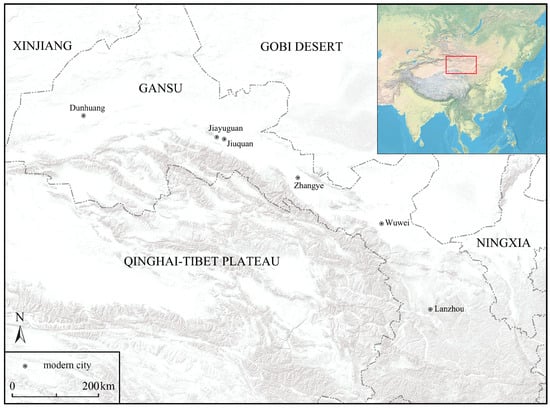
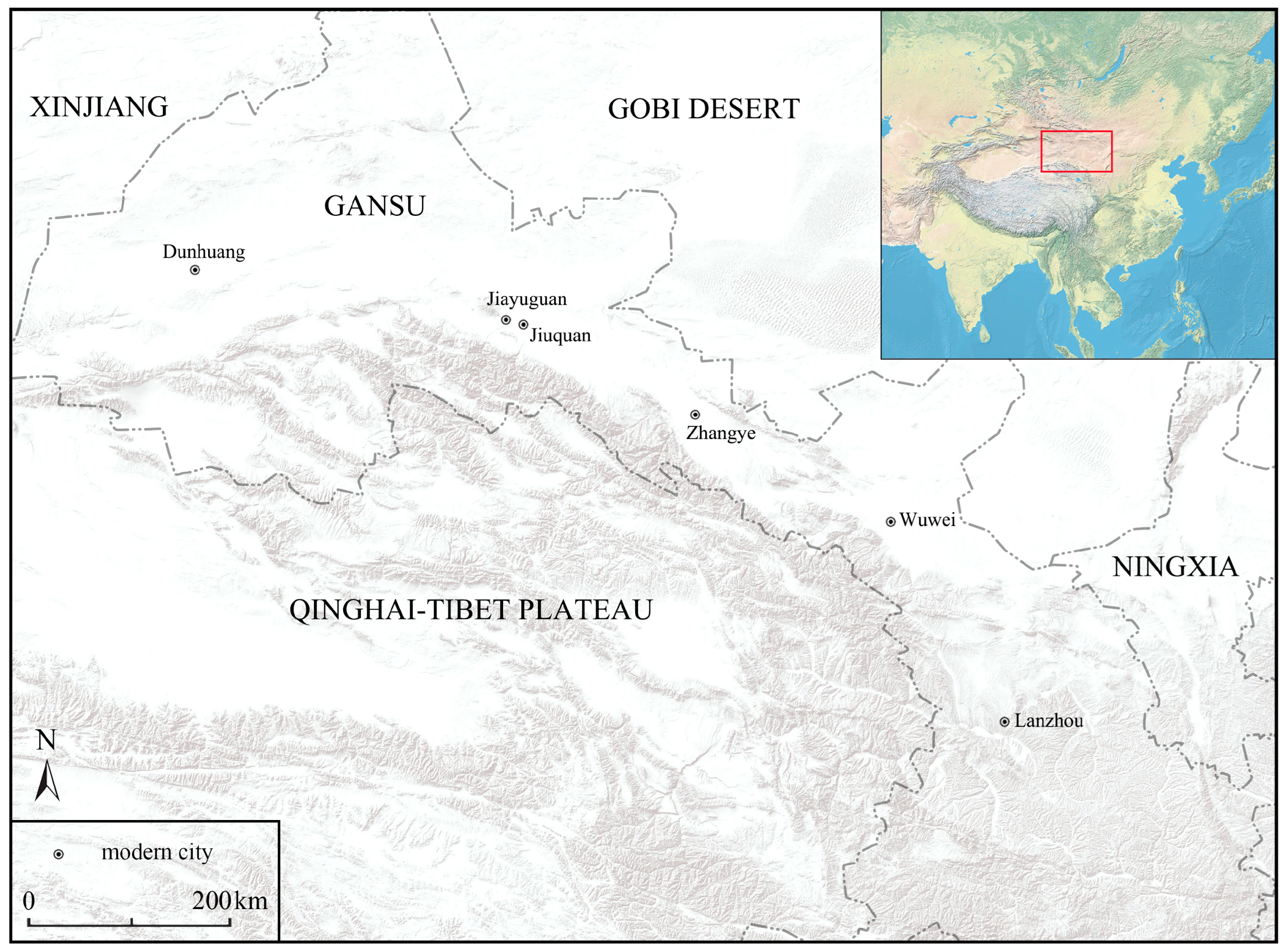
Yet, compared to the rich scholarship on Buddhist art and literature, the religious practices in Dunhuang before the wide spread of Buddhism in China remain insufficiently studied, particularly those associated with the Han Chinese. Chinese migrants first began settling in the Hexi Corridor, the narrow passage between the Gobi Desert and the Qinghai–Tibet Plateau in present-day Gansu province, during the Han dynasty (202 BCE–220) as part of state border-fortification policies (Yü 1967, pp. 147–50) (Figure 1). From the late Eastern Han onwards, an increasing number of people relocated to the region seeking refuge from famine and warfare. These migrants brought and promoted Confucian and Daoist teachings in Dunhuang, which has been recorded in both textual records and archaeological evidence (Yan 2010).
Figure 1.
The Hexi Corridor and the location of Dunhuang.
These Central Plain customs were not simply copied in the borderland but localized and adapted to local preferences, as manifested by the postmortem practices in Dunhuang during the third and fourth centuries. This article focuses on the elaborate pictorial screen walls from the Foyemiaowan 佛爺廟灣 tombs, which provide an ideal case to understand how non-Buddhist religious and artistic traditions were localized and innovated in the Hexi Corridor, the crossroads of cultural interaction in ancient Eurasia (Lin 1999, pp. 22–25; Zheng 2002, pp. 158–66).
A screen wall refers to the architectural façade made of painted and carved bricks atop the tomb entrance, a structure developed from pictorial Han tombs. Analyses of pictorial screen walls usually regard them as representing the passageway from earth to heaven of the departed soul. This study presents a different iconographic interpretation arguing that a screen wall represents heaven itself, rather than the progress of the soul’s ascent or descent to heaven. Moreover, this article does not treat the decorative/architectural program of screen wall in isolation but situates it in the whole burial space and pays attention to its connection to the interior visual and material designs. In this way, this article goes beyond traditional art historical investigation of individual objects to examine how the artistic and symbolic effects of the screen wall were represented and realized in a tomb where paintings, architecture, and objects helped construct the ritual space. It shows that the symbolic meaning of transcendence represented by the screen wall is achieved not only through visual depiction but also through its architectural construction and a decorative asymmetry between the lavish exterior screen wall and the minimal internal decoration.
In the sections that follow, this article first introduces the archaeological context of the Foyemiaowan tombs and the physical features of their screen walls. It then analyzes the decorative program of pictorial bricks on the screen wall and its ritual meaning, and discusses how the Dunhuang screen walls differ from those in other regions. Finally, it explores the role of screen wall in the context of the whole tomb space. It concludes with a discussion of how such religious practices emerged and shaped the local society in Early Medieval China.
2. The Foyemiaowan Tombs
In 1995, five tombs containing pictorial bricks were excavated at Foyemiaowan in present-day Dunhuang (Dai 1998). They date to the third and fourth centuries, adding to a total of seven pictorial tombs discovered and reported in Dunhuang from this period (Dai 1998; Xia 1955). Except for Foyemiaowan M1001, which was discovered in 1955, tombs M37, M39, M67, M91, M118, and M133 have all been scientifically excavated.
The Foyemiaowan tombs were arranged in clusters, each cluster surrounded by an enclosure that opened to the south, such as the cluster of M37, M38, M39, M40, M244, M243, and M242, and the cluster of M133, M134, M135, M137, and M138, likely indicating family cemeteries. Due to the harsh environmental conditions of Dunhuang, the aboveground parts were minimal, usually only a small mound marking the position of a tomb. In contrast, these tombs, particularly the pictorial tombs, have complex underground structures. A ramp leads to an arched tomb entrance; directly above the tomb entrance stands a screen wall, equal in width to the ramp, constructed by layering bricks. These walls are decorated with brick carvings that mimic wooden architecture and pictorial pricks depicting various natural and mythical creatures. A tunnel connects the tomb entrance to the front chamber, which houses the niche and altar.
While elements such as the aboveground enclosure, ramp, screen wall, and inner chambers are common across the Hexi Corridor, the Foyemiaowan tombs show distinct burial features absent in neighboring cities. For example, Luotuocheng 駱駝城 M1 near present-day Zhangye 張掖 has a significantly smaller front chamber than those at Foyemiaowan (Gansu and Gaotai 2003). In Jiayuguan 嘉峪關, many tombs share nearly identical subterranean layouts and dimensions with the Foyemiaowan tombs, yet the treatment and decoration of the tomb occupants’ bodies differ (Gansu et al. 1985). Furthermore, even within Dunhuang, the lavishly decorated pictorial bricks at Foyemiaowan are absent at Qijiawan 祁家灣 (Dai and Zhang 1994).
While the differences between Foyemiaowan and Qijiawan, or between Dunhuang, Jiayuguan, and Zhangye, might be viewed as regional variations in a shared burial tradition in the Hexi Corridor, the screen walls of the Foyemiaowan tombs are exceptional. Specifically, tomb M133 features nearly a hundred pictorial bricks extending from the tomb entrance all the way to the ground surface, a decorative structure not seen elsewhere. This elaborate screen wall suggests not only the potentially higher social status of the tomb occupants at Foyemiaowan but also a systematic departure in decorative logic from Jiayuguan, where pictorial bricks were primarily placed inside the chambers. In other words, the Foyemiaowan tombs manifest unique structural and artistic designs that reflect the specific religious customs in Early Medieval Dunhuang.
3. The Screen Wall: Iconography and Celestial Representation
With Dunhuang studies attracting growing attention from Chinese scholars of history, religion, and art in recent decades, the Foyemiaowan tombs have also drawn scholarly interest. Heather Clydesdale has conducted comprehensive research on burial arts in the Hexi Corridor and discussed the distinctive religious and artistic features of screen walls in the region (Clydesdale 2016, 2018, 2019); however, many scholars still assume that the pictorial screen walls are merely a variant type of those found across the Hexi Corridor and thus are usually analyzed within a broader, generalized context (Sun 2012). While this assumption is not entirely unfounded, it risks glossing over the distinctive characteristics of the pictorial walls. As a result, there is still no study focusing specifically on the Foyemiaowan tombs. Furthermore, scholarship tends to interpret the pictorial bricks as a representation of the soul’s ascent to heaven, tracking this artistic tradition back to the painted banners from Mawangdui 馬王堆. However, a closer examination of the Foyemiaowan screen walls suggests an alternative interpretation and a distinct depiction of the afterlife. It is, therefore, necessary to revisit them to better understand their roles in the unique decorative program and ritual space of Foyemiaowan tombs, and the religious meanings they symbolized.
Although archaeologists reported that all the screen walls of M37, M39, M91, M118, and M133 were undisturbed, only that of M133 is complete in terms of decoration; the upper parts of the other tombs do not exist (Dai 1998, p. 8). Nevertheless, the resemblance of the middle and lower sections across these tombs suggests that they originally shared a similar design. The following discussion focuses on the screen wall of M133 while drawing comparisons to related tombs in Dunhuang, Jiayuguan, and beyond the Heixi Corridor.
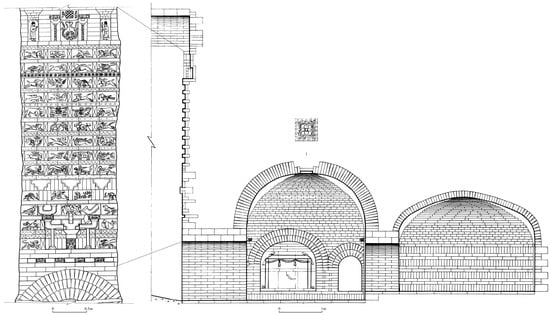
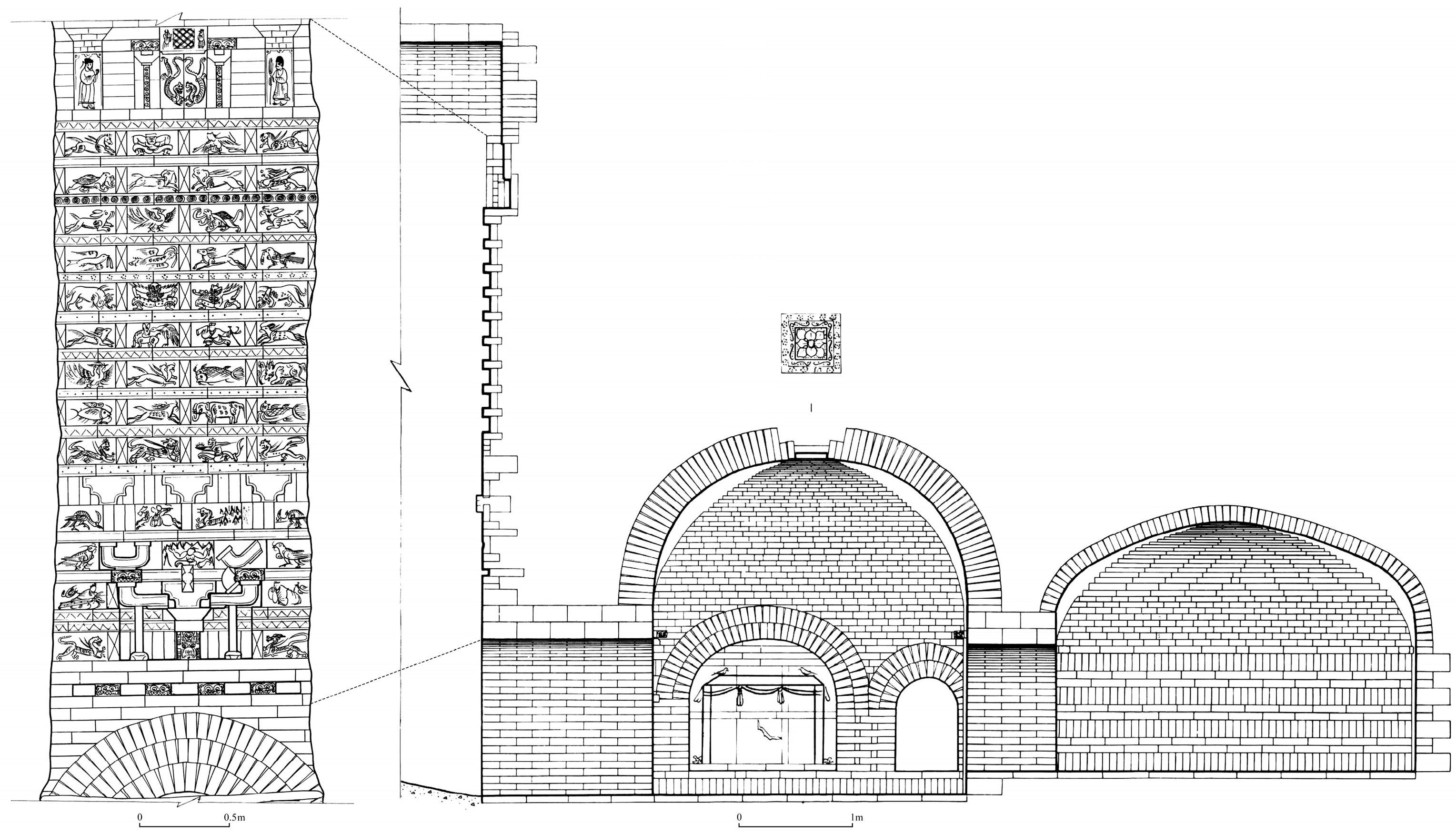
Foyemiaowan M133 is located at the northern end of the cemetery and is likely the earliest tomb in the cluster. The tomb consists of front and rear chambers; burial goods were placed in the former, while the deceased couple was rested in the latter. The presence of a brush, inkstone, and silver objects points to the husband’s status of the gentry class. M133 was constructed entirely of brick, including the entrance, the screen wall, the tunnel, the chambers, and the niches (Figure 2).
Figure 2.
Foyemiaowan M133 and its screen wall, after Dai (1998, Figures 21 & 23).
The screen wall of M133 is about seven meters tall from the tomb entrance to nearly the ground surface. It is demarcated from the entrance by four layers of plain stretchers (bricks laid on side, narrow face exposed) with four bear-face headers (bricks laid on side, short end exposed) on the second layer from the bottom. Near the top, several rows of stretchers, soldiers (bricks standing vertically, narrow face exposed), and herringbone patterns protect the structure below.2 An arch of one-tier bricks, echoing the shape of the tomb entrance, marks the top of the screen wall near the surface of the earth above.
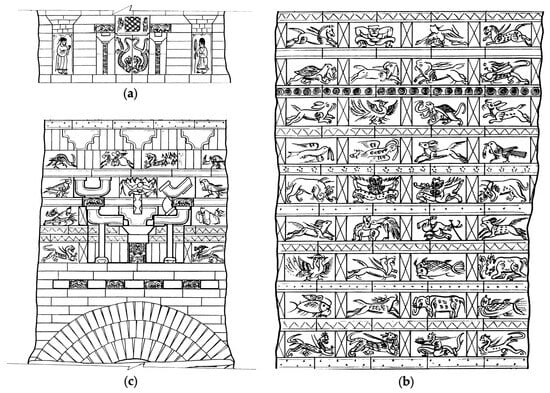
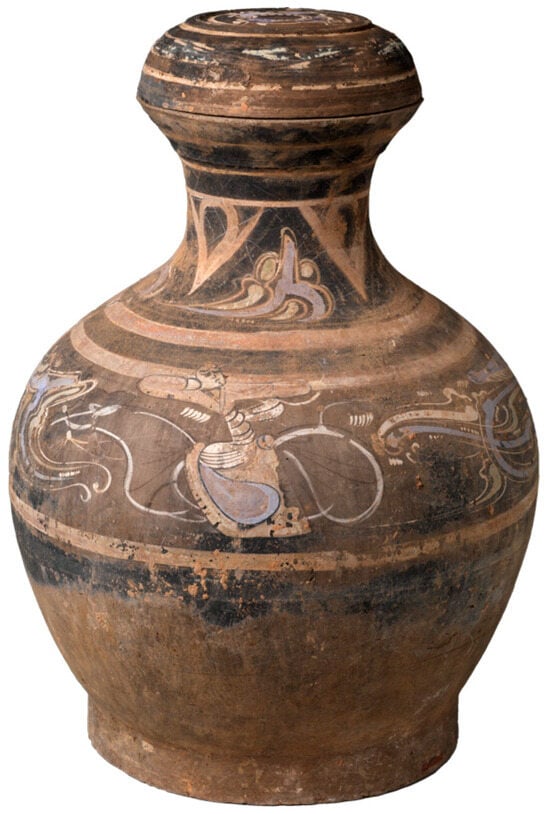
The lower section (Figure 3c) represents the terrestrial-celestial threshold of the Queen Mother of the West. While the image of the Queen Mother of the West is not present, her sheng emblem takes the central position (Clydesdale 2019, p. 299).3 The brick carvings mimicking wooden architecture refer to her palace, while the man upholding a mountain, positioned directly above the sheng, alludes to Mount Kunlun 昆仑—where the earth connects to the heaven and where the Queen Mother of the West resides (Wu 1989, pp. 117–26; Major 1993, p. 37). Other pictorial shiners in this section also indicate a celestial realm. The musician and listener, often identified as Yu Boya 俞伯牙 and Zhong Ziqi 鍾子期, should instead be viewed as immortals; the presence of flying birds around them and the prevalence of musical performance in celestial iconography support this interpretation.4 Similarly, the rider turning back to shoot a tiger is likely a personification of a constellation rather than the historical general Li Guang 李廣, a motif commonly seen on Han-era hu-jars (Figure 4). The presence of mythical birds, which also appear in M37, further manifests that this is not the human world.
Figure 3.
The screen wall of M133 in close-up view: (a) the upper section; (b) the middle section; (c) the lower section, after Dai (1998, Figure 23).
Figure 4.
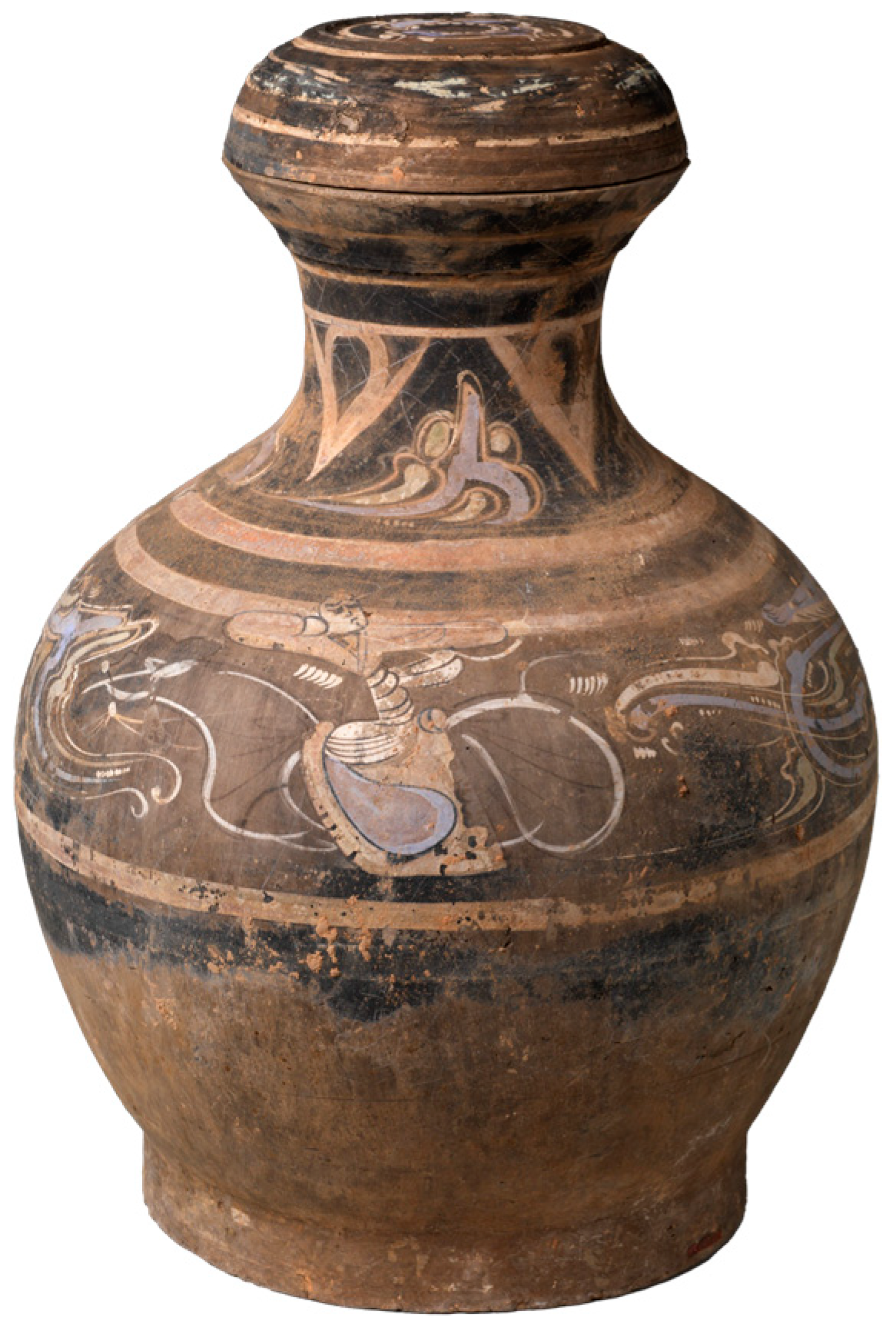
A Han-era hu-jar, the Metropolitan Museum of Art, after https://www.metmuseum.org/art/collection/search/49539 (accessed on 14 February 2026). The decoration on this jar is iconographically celestial that “the blue beast represents the star Sirius, known in China as the Heavenly Wolf, and the archer is a personification of the adjoining constellation, Bow, whose arrow always points directly at the Wolf. Their companion on the other side is the White Tiger, cosmological symbol of the West, whose domain in the nightly sky borders that of the Wolf and the Bow” (The Metropolitan Museum of Art 2026).
The middle section of the screen wall (Figure 3b) consists of pictorial bricks depicting immortals, transformed hybrids, and mythical beasts. The painted shiners are separated by stretchers with abstract patterns that function as decorative borders. On each layer, the shiners are arranged in two pairs: two in the middle and two on the sides. Some of the creatures can be identified in Chinese myths based on names written on similar pictorial bricks from other tombs, though it is difficult to pinpoint them in transmitted texts.
This middle section depicts a fantastic, infinite heavenly world within a limited space. Worldly creatures are transformed into magical hybrids, such as human-headed fish, two-headed fish and tiger, winged men, winged horses, and winged rabbits. Exotic animals like a white elephant and a parrot further heighten the unworldly nature of this realm. By juxtaposing land, sea, and sky creatures, the artisans pushed human imagination to its limits. The densely piled pictorial bricks are dazzlingly rich while the deliberate, seemingly orderless arrangement creates a sense of a dizzying, boundless celestial space that transcends human order.
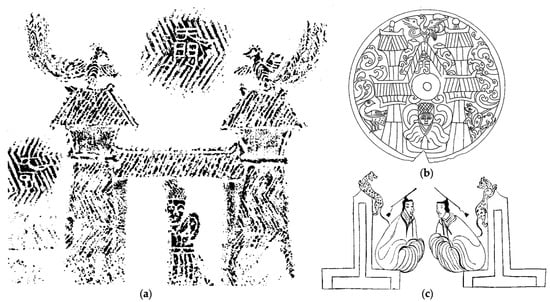
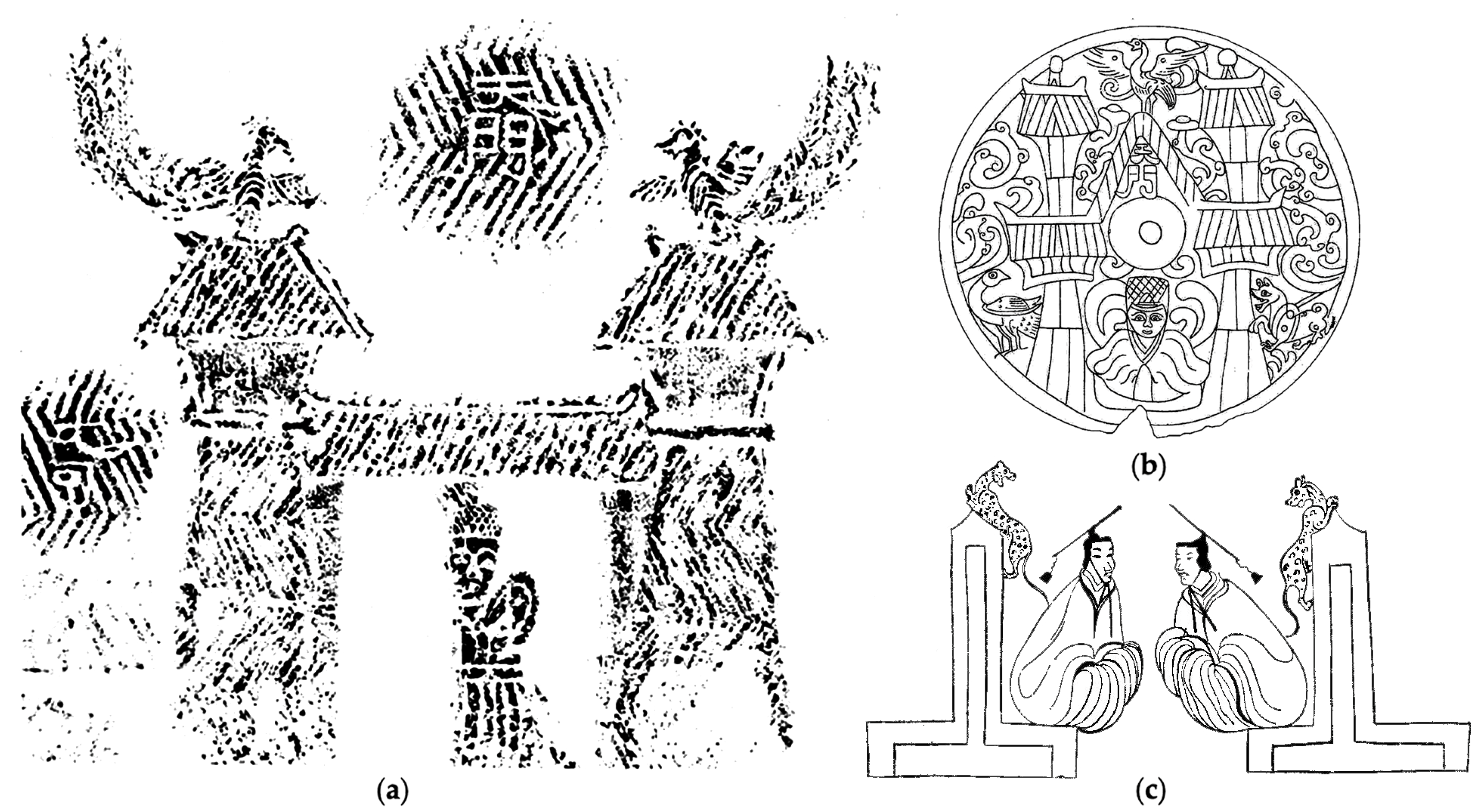
The upper section (Figure 3a) occupies the space of ten layers of stretchers. Despite being smaller than the sections below, it unequivocally represents the tianmen 天門 or celestial gate, one of the most defining elements in the depiction of heaven. This section features two pillars on the sides and a two-plank gate flanked by two columns in the center. The pillars represent the que 闕 gate-pillars, which originated in the Zhou dynasty (1045–256 BCE) and became symbols of imperial magnificence and auspiciousness since Han times. Que were further linked to the celestial gate, as evidenced by inscriptions on stone carvings from Jianyang 簡陽, Sichuan, and bronze plaques from Wushan 巫山, Chongqing. On the screen wall, the que—originally watchtowers for a palace entrance—represent the entrance to the palace of the Queen Mother of the West. Inside the que, two sailors (bricks standing vertically, large face exposed) depict two male figures wearing gowns and caps, holding a spoon and a broom respectively, who are the guardians of the celestial gate and servants of the Queen Mother of the West. Similar depictions are found on the Wushan bronze plaques and the Mawangdui banners, where officials stand or sit between two pillars, suggesting that no one could pass the narrow entrance to heaven without their permission (Figure 5).
Figure 5.
Celestial Gate on (a) a stone carving from Jianyang; (b) a bronze plaque from Wushan; (c) the painted banner from Mawangdui M1. After Gao and Gao (1996, Figure 12); Chongqing and Zhongguo (1998, Figure 2); Hunan and Zhongguo (1973, Figure 38).
While the que gate-pillars clearly represent the celestial gate, the screen wall of M133 adds another gate in the center to further elaborate this symbol. This gate has two planks painted with tigers, flanked by two columns topped with bear-headed bricks identical to those found between the tomb entrance and the screen wall. Above the gate is a rectangular panel featuring two animal-headed hybrids flanking a grid-pattern window. This gate shows a striking resemblance to the painted gables of Western Han pictorial tombs such as the one in the rear chamber of Luoyang M61, which depicts two dragons flanking a two-plank gate topped with a similar grid-pattern panel (Henan 1964). In structurally demarcating the front and rear chambers, the gate here also symbolizes the soul’s progression from the coffin in the rear chamber to pass the celestial gate to enter the heaven depicted in the front chamber (Tseng 2011, pp. 205–6). At Foyemiaowan, this combined imagery of que and gate represents the celestial gate, which leads to the immortal world of the Queen Mother of the West on Mount Kunlun.5
In short, the screen walls of the Foyemiaowan tombs, exemplified by M133, constitute a comprehensive architectural and visual representation of the celestial realm comprising heavenly phenomena, auspicious animals and immortals in Chinese tomb art (Wu 2010, pp. 34–38). Within a limited space, they express the exclusivity of the celestial gate, the grandeur of the palace of the Queen Mother of the West on Mount Kunlun, and the mythical, boundless nature of the immortal world. By vividly depicting this blessed realm, the screen wall provided a powerful visual promise of the soul’s transcendence from earth to heaven.
4. The Direction of Transcendence: Ascending or Descending?
If the screen wall depicts the soul’s transcendence, how is it represented in architectural and artistic forms? Zheng Yan suggests that the screen wall is both the gate-tower guarding the underground home of the deceased and the passageway to heaven of the soul. On the screen wall of Foyemiaowan M133, for example, the soul starts the journey of ascending from the tomb entrance at the bottom. It traverses Mount Kunlun, represented by the mountains behind the strong man and tiger in the lower section. Accompanied by the Queen Mother of the West and auspicious creatures, the soul travels through the celestial realm in the middle section to arrive at the celestial gate in the upper section, thereby completing its journey into heaven and realizing the transcendence (Zheng 2002, pp. 157–58).
In discussing the screen walls from Jiayuguan, where the que are positioned at the bottom of the screen wall just above the tomb entrance, Clydesdale proposes an inverted screen wall where “heaven is positioned near the bottom, while transitional zones with caryatids and opposing dragons are in the middle, and the terrestrial zones with plain architectural features are at the top” (Clydesdale 2016, p. 87). The screen wall was inverted so that heaven is more visible from below; the celestial gate was placed at the top to represent a soul floating upward. She interprets the celestial gate on the screen wall and the passageway to the tomb chambers as dual doors accommodating two souls, or hun and po in Chinese postmortem beliefs (Clydesdale 2019, pp. 299–300).
The first reading of an upward direction seems plausible in both the common sense that a soul “goes up” and the common depiction of celestial ascent in other funerary art such as the Mawangdui banners. However, this interpretation poses a self-contradiction that is difficult to reconcile. Since the que gate-pillars represent the entrance to heaven, logically they should be placed at the bottom of the screen wall if the direction of soul ascending is upward. How could the soul reach the celestial gate only after traversing the celestial realm? In other words, if the soul is already in heaven, there is no need for further ascent. If we read the screen wall in this way, the soul is already in the very place it is purportedly striving to reach.
The theory of an inverted position resolves the self-contradiction in reading the Foyemiaowan screen walls as an upward progression. While an inverted orientation might render heaven more tangible, the conventional upright position would better represent the separation of heaven and earth, if the two souls had separated destinations, though distinctions between the two souls might have already disappeared by this time (Wu 2010, p. 32). Moreover, even if the tomb could be reopened for additional deceased family members or mourners, the pictorial screen wall was not constructed to entertain the living. A tomb is constructed to conceal the deceased from view and the invisibility of screen wall would enhance its ritual effect.
If the screen walls of Foyemiaowan tombs do not depict a scene of the soul ascending or “descending”, how do they represent the promise of a heavenly afterlife? We argue that these screen walls represent not the soul’s ascent, but heaven itself. The artisans created a coherent decorative program to represent the entirety of the celestial realm, as evidenced by the ox- and chicken-headed hybrids and the bear-faced bricks that link the top and bottom of the screen wall. Direction is no longer a problem as the screen walls represent heaven rather than the progress of transcendence from earth to heaven. What the screen walls depict is the soul having already crossed the celestial gate to enter the celestial realm, where the Queen Mother of the West and her attendants usher the deceased into immortality.
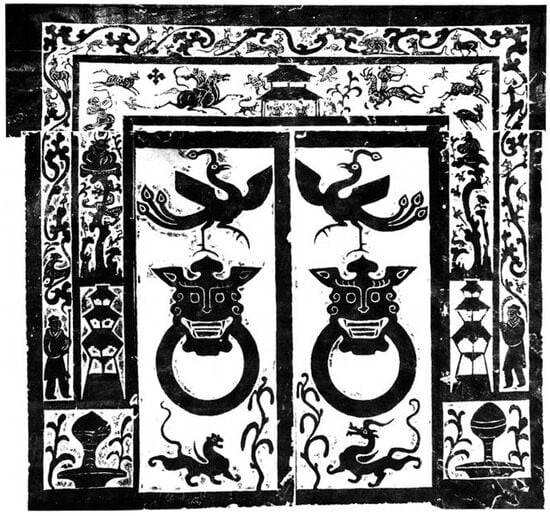
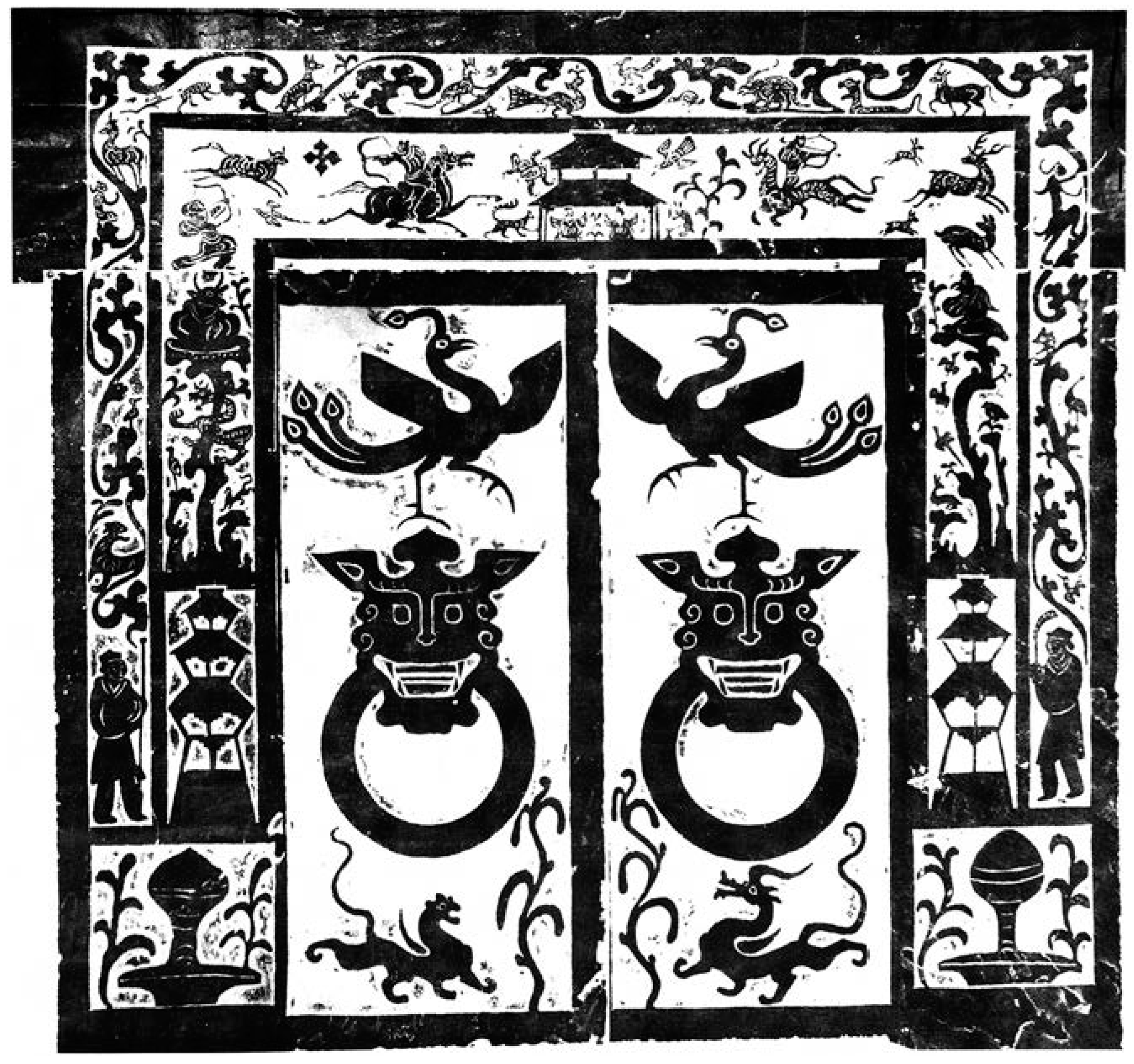
Furthermore, reading the screen wall not as a journey of ascent but as the celestial realm itself opens a space where heaven becomes immediately reachable from earth. This design is common in Early Medieval Chinese mortuary art, as artisans often integrated multiple elements into a single decorative program. For example, the painted façade of a tomb from Dangjiagou 党家沟, Shaanxi, dating to the Eastern Han dynasty, depicts que and Mount Kunlun on its posts, representing the soul’s ascent; simultaneously, the lintel above the posts depicts the deceased couple already in the celestial realm of the Queen Mother of the West (Figure 6). Tseng argues that such tombs represent both the space of transcendence to heaven and heaven itself, creating an ambiguity that “exemplifies the Han efforts to bring the realm of Heaven near” (Tseng 2011, p. 232). Similarly, the artisans of Foyemiaowan tombs used the exterior screen wall to represent the celestial realm and the interior chambers the “happy home” of the deceased, thus creating a decorative program connecting interior and exterior, heaven and earth across physical and symbolic tomb spaces.
Figure 6.
Façade of the Dangjiagou tomb, after Li et al. (1995, Figures 78–82).
5. The Screen Wall in the Ritual Space of Pictorial Tombs
The pictorial screen wall is the most elaborate decoration of the Foyemiaowan tombs and serves as the most visible burial symbol of the local elite during the third and fourth centuries. However, it does not exist in isolation from the tomb chamber as it appears; it is an integral component of a larger architectural, artistic, and ritual space. This is especially the case of the chamber tomb that dominates Chinese funerary since the second century BCE. Different from the casket tomb in a vertical pit, a chamber tomb is constructed horizontally and comprises multiple chambers resembling a house. Wu Hung defines this shift in tomb planning as from an “object-oriented” to a “space-oriented” design, an architectural innovation stimulating new art forms and techniques. While a large casket tomb sometimes is also divided into compartments, a chamber tomb extends the coffin-centered structure to a three-dimensional space for the posthumous soul (Wu 2010, pp. 20–34). A more complex decorative program was thus invented that combined architecture, paintings, and objects to represent symbolic burial spaces.
This “space-oriented” turn calls for studies of tomb not in discrete units or through individual objects, but rather through their connections within in a unified ritual space. From this perspective, a unique asymmetric decorative logic can be identified at Foyemiaowan when we combine the screen wall with interior symbolic designs and compare the decorative programs between Foyemiaowan and Xincheng.
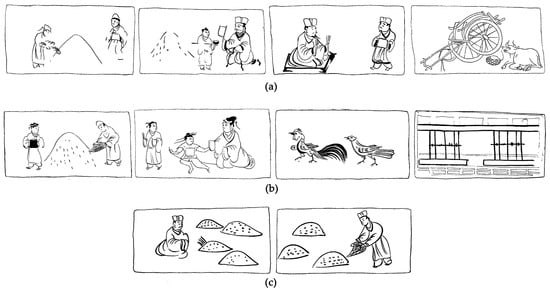
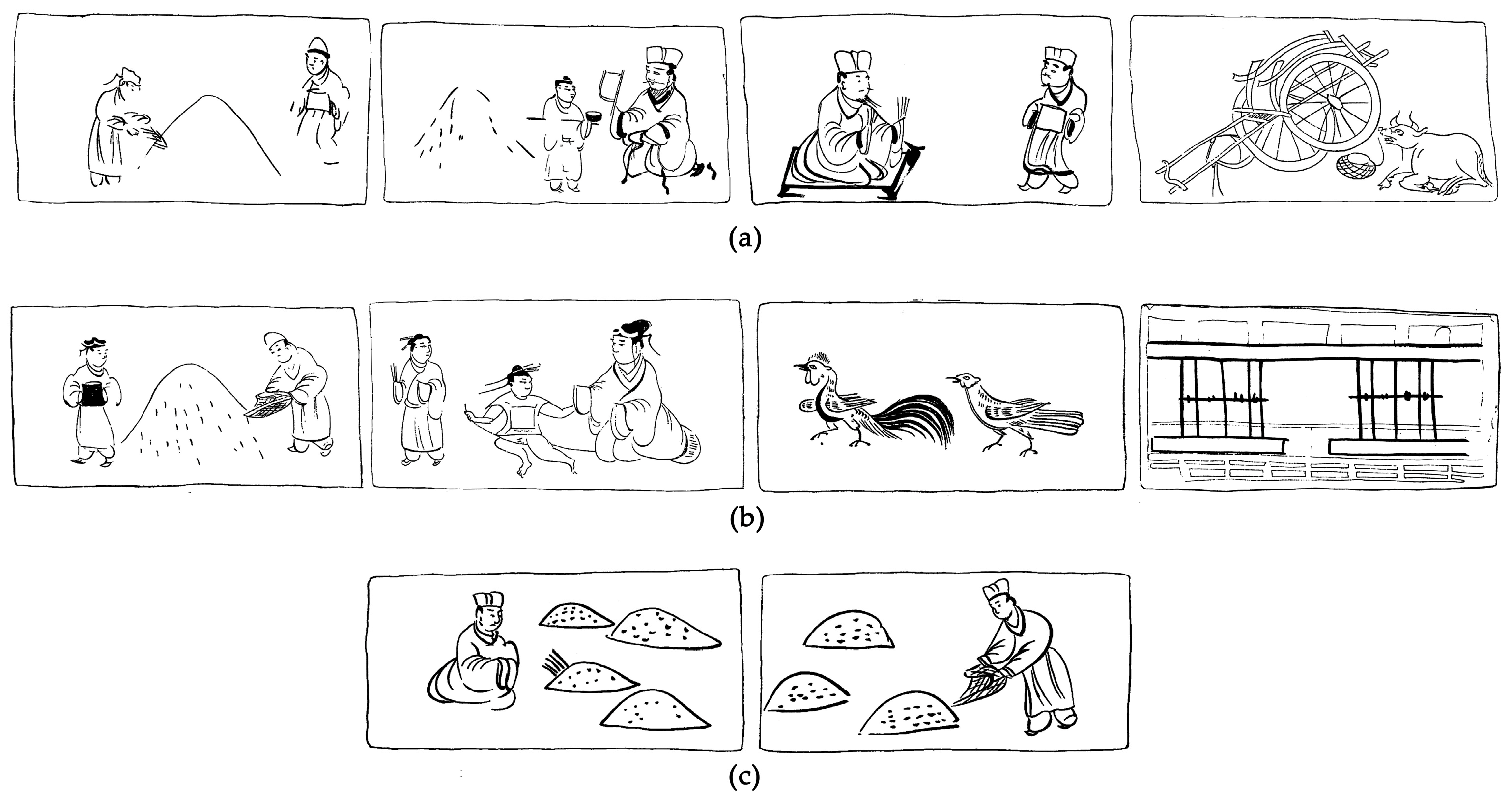
In fact, there are also pictorial bricks inside the Foyemiaowan tombs. Although few in number, they work in tandem with the screen wall to complete a coherent artistic program representing transcendence. In contrast to the lavishly decorated screen walls, M133 contains only two pictorial bricks inside the chamber, while M37 and M39 contain four each. In all three tombs, these bricks are situated on the west wall of the chamber, arranged in pairs flanking the path inside the tomb.
Each brick depicts an independent scene focusing on the motif of food and grain. The two bricks in M133 portray the piling and measuring of grain—a scene also seen in M37 and M39. M37 and M39 each feature a brick depicting a servant reporting to a master, likely the tomb occupant. The scenes of an ox cart in M37 and paired chicken in M39 also represent the transport and preparation of food (Figure 7). These pictorial bricks inside the tomb evoke the “grain tax” motif popular during the Han dynasty, as seen in the Beizhai 北寨 tomb in Yi’nan, Shandong (Shandong 2015, Figure 35). The adoption of this motif at Foyemiaowan is further manifested by the two-tiered architectural structure atop each brick: the upper tier representing a granary building and the bottom tier forming a niche that mimics the storage space.
Figure 7.
Pictorial bricks inside the tomb chambers of (a) M37; (b) M39; (c) M133. After Dai (1998, Figures 83–87).
The motif of food and grain reflects the status and wealth of the tomb occupant while signifying a hope for abundance in the arid borderlands. In addition to visual representation, this theme is reinforced by other burial objects, including miniature stoves, cookware and utensils in the side chambers, and food-offering pottery placed on the coffin. While some scholars suggest the pictorial bricks were designed to turn the tomb space into a happy postmortem home, the extreme scarcity of such scenes inside the tomb—when compared to the opulence of the exterior screen wall—suggests a different plan. We argue that this minimal internal decoration was a deliberate choice designed to direct the emphasis from mundane, material happiness toward immortality and transcendence represented by the screen wall.
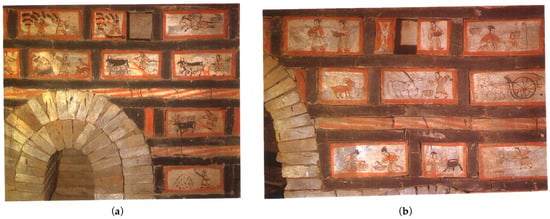
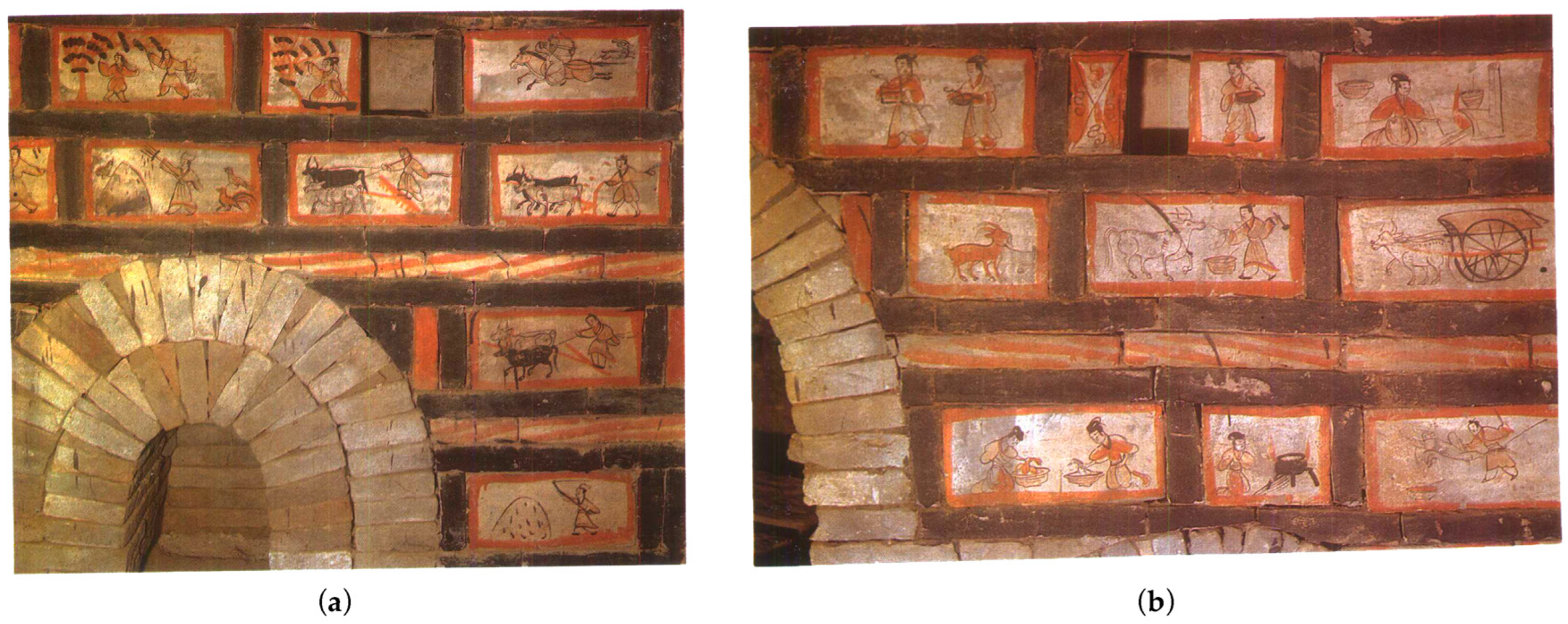
This ritualized artistic design becomes clear when comparing Foyemiaowan to the tombs in Jiayuguan. The Jiayuguan screen walls are relatively simple, with the que gate-pillars positioned at the very bottom.6 Conversely, the inner chambers of these tombs are lavishly decorated with pictorial bricks. For example, Xincheng 新城 M5 features pictorial bricks on all walls of the front chamber, depicting the banquet of the buried couple and a vast array of daily activities, some of which resemble those at Foyemiaowan (Figure 8) (Gansu et al. 1985, pp. 46–69). The decorative programs of Foyemiaowan and Xincheng are systematically different in that the former features elaborate screen walls and minimal interior decoration, while the latter chooses simple screen walls but lavish interior decoration. Thus, while the Xincheng program highlights a continuation of a wealthy earthly life in the afterlife, the Foyemiaowan program utilizes an artistic dichotomy—a visual imbalance—between the inner chamber and the exterior screen wall to emphasize the promise of the soul’s transcendence.7 The two contradictory postmortem beliefs—eternal wealth and transcendence—had already existed in burial arts in the Han dynasty and are capsulated in the pictorial tombs in the Hexi Corridor (Zheng 2002, pp. 162–63; Wu 1992).
Figure 8.
Pictorial bricks inside the front chamber of Xincheng M5: (a) south side of east wall; (b) north side of west wall. After Gansu et al. (1985, Color Plates 1 & 2).
The divergence in burial practice between the two cemeteries is further evidenced by the arrangement of ritual space inside the tomb. At Foyemiaowan, an altar for making offerings to the deceased was integral to the burial. In M133, the entire north side-chamber of the front room was dedicated as an altar space; a ceramic plate was placed on a bamboo mat, while the rear wall of the chamber features painted curtains (Dai 1998, p. 39). Both painted and physical curtains were used in the main chamber of M37. Scholars have noted that this altar consisting of curtains and bamboo mats originated from the Central Plain tradition established in the Han dynasty (Wu 2010, pp. 64–69; F. Wang 2024, p. 90). Furthermore, a set of pottery was found near the coffins in M37, suggesting that sacrifice was an integral component of the Foyemiaowan burial custom. These features aimed to pacify the soul and facilitate its transcendence. In contrast, this sacrificial focus is absent in the Xincheng tombs, where the depiction of mundane pleasures was prioritized, as shown by the carefully designed and even redesigned scenes of daily life.
Beyond its iconography, the architecture of the screen wall contributes to the representation of transcendence. At Foyemiaowan, the screen walls were originally constructed near the ground level. Increasing the height also reinforces the magnificence of the immortal land represented in the decorative program. Although Sun Yan argues that the height of a screen wall alone is sufficient to represent heaven so “decoration on the screen wall is not needed to express the potential postmortem belief” (Sun 2011, p. 79), a closer examination suggests that the pictorial decoration is indispensable for transforming the tomb into a ritual space.
Detailed archaeological records provide a nuanced view of this point. Reports of tombs excavated since the 1980s indicate that the bricks on the screen walls were simply piled against the bare Gobi soil (Dai 1998, p, 8). However, in his detailed account of the excavation of M1001, Xia Nai noted that the screen wall was not built directly against the soil but a layer of rammed earth was placed in between (Xia, p. 4). This raises a critical point: if height alone sufficed to represent heaven, why would M1001 require the added complexity of a triple-layered structure? Even if the architectural form of the screen wall signifies heaven, it is the specific pictorial program that explicitly articulates this symbolism and links the interior home of the deceased to the exterior celestial realm, creating a unified ritual space.
6. Conclusions
The screen walls of the Foyemiaowan tombs represent a pivotal moment in the religious and artistic landscape of Early Medieval Dunhuang. Through a close examination of M133 and its contemporaries, this article argues that these structures are not merely regional variants of a Hexi-Corridor style, but rather a sophisticated and unique decorative program. By prioritizing the exterior screen wall as a “celestial realm” while minimalizing the interior pictorial decoration focused on terrestrial sustenance, the Foyemiaowan tombs established a visual and ritual dichotomy between the mundane home of the deceased and the promise of transcendence. This was achieved not only through visual representation but also through the arrangement of burial goods inside the tomb. The presence of sacrificial altars and offerings at the altars and coffins in the Foyemiaowan tombs further confirms that the burial space was oriented toward transcendence.
This asymmetric rendering of space and decoration reflects a localized innovation of Central Plain traditions. Dunhuang maintained a strong Confucian tradition following the arrival of Han Chinese migrants, particularly the “great families”, during the third and fourth centuries. Consequently, many burial practices preserved Han traditions, such as the inclusion of sacrificial altars in the tomb chamber and the “grain tax” motif popular since the Eastern Han dynasty. However, these influences were adapted to suit local tastes and architectural constraints through rearranging the continuous pictorial narratives in the Central Plain into a “one motif, one brick” format.
Furthermore, the motifs of loyalty and chastity that promoted Confucian ideology, and the pavilions and chariots signifying status and wealth popular in the heartland, are rare in the Hexi Corridor (Zheng 2002, p. 166). Instead, the focus on the grain motif reflects the life-and-death concerns of a society living through profound political instability at the periphery of the empire. Even the architecture of screen wall itself, while originating in the Central Plain, gained an elongated and exaggerated form in Dunhuang. In visualizing transcendence, the screen wall served as a powerful ritual tool that pacified the soul and ensured its permanent refuge in heaven.
More importantly, recognizing the complexity of pictorial screen walls invites a re-evaluation of religious practices in Dunhuang before the ultimate triumph of Buddhism. The iconography of the Queen Mother of the West, the que gate-pillars, and the magical hybrids draw upon a Han-dynasty cultural lexicon that formed the core symbols of early Daoism—an influence further attested by the presence of inscribed jars in tombs (Jiang 1996, pp. 266–87). While religious practices in Dunhuang underwent substantial transition from the Central Plain to Buddhist traditions in Early Medieval times, the local peoples in the Hexi Corridor were open to and incorporated various cultures. Buddhist motifs such as elephant and parrot appear on the screen wall; representations of non-Buddhist creatures such as winged men and flying beasts are found in Mogao Cave 285 of the Western Wei (535–556), the earliest dated Buddhist cave in Dunhuang (Dai 2011; Dunhuang 2011, Figures 140–3). Although Buddhist art did not build upon Chinese traditions, the practice of cultural hybridity and the belief and visualization of transcendence in Dunhuang may have helped fertilize the ground for the acceptance of Buddhist afterlife ideas and their pictorial representations in Dunhuang.
The Foyemiaowan tombs remind us that Dunhuang as a “treasure house” of religion and art did not begin with a foreign religion; rather, it was the intermingling of peoples and cultures in the borderlands that created a visual language for the infinite and the divine.
Author Contributions
Writing, D.W.; project administration, X.L.; funding acquisition, D.W. & X.L. All authors have read and agreed to the published version of the manuscript.
Funding
This research was funded by the University of Macau, grant numbers SRG2024-00001-FAH & MYRG-GRG2026-00076-FAH.
Institutional Review Board Statement
Not applicable.
Informed Consent Statement
Not applicable.
Data Availability Statement
No new data were created or analyzed in this study. Data sharing is not applicable to this article.
Acknowledgments
We are grateful of the three anonymous reviewers for their helpful comments and Heather Clydesdale for reading the manuscript and providing insightful suggestions. We also thank Xian Qian from the Hubei Archaeological Museum for helping create the figures and Bu Fan for proofreading the manuscript.
Conflicts of Interest
The author declares no conflict of interest.
Notes
| 1 | Hereafter, all dates are CE unless otherwise specified. |
| 2 | The architectural terms and their definitions follow Clydesdale (2016, p. xxi). |
| 3 | In fact, the Queen Mother of the West is not depicted on any screen wall in the Hexi Corridor, though sheng emblems are found carved on the coffins of Xincheng M1 and M6. The missing image of the Queen Mother of the West herself is probably a local artistic preference, see Gansu et al. (1985, pp. 18, 23). |
| 4 | The banner from Mawangdui M1 also depicts a magical figure playing stringed instrument, see Hunan and Zhongguo (1973), Changsha Mawangdui, Figure 96. For a detailed discussion on the musician and listener, see Z. Wang (2008). |
| 5 | Heather Clydesdale has briefly discussed the artistic and ritual features of Foyemiaowan screen walls (Clydesdale 2023, pp. 10–14) with a focus on the animal iconography. It’s necessary to provide a detailed description of these features before the discussion of their ritual meanings. This article also refers to new evidence such as the Han-era jar at The Metropolitan Museum of Art. |
| 6 | Archaeologists indicate that some paintings on the Xincheng screen walls had been flaked off. Still, the pictorial bricks on the better preserved M5 and M6 are neither lavish nor carefully created as the Foyemianwan ones. |
| 7 | Combining seemingly discrete visual symbols to create a coherent decorative program in the ritual space is also seen in Luoyang M61, which depicts the celestial gate in the rear chamber where the deceased was placed and the celestial realm in the front chamber, representing the progression of the soul. In the tomb of Lou Rui 娄睿 dating to the Northern Qi dynasty (550–577), the decoration on the walls along the ramp continues into the tomb chamber, see Shanxi (1983, Figure 4). |
References
- Chen, Huaiyu, and Q. Edward Wang. 2020. Dunhuang on the Silk Road: A hub of Eurasian cultural exchange—Introduction. Chinese Studies in History 53: 187–91. [Google Scholar] [CrossRef] [Scilit]
- Chen, Yinke 陈寅恪. 2001. Sui Tang Zhidu Yuanyuan Luelungao · Tangdai Zhengzhishi Shulungao 隋唐制度渊源略论稿·唐代政治史述论稿 [Draft Outline of the Origins of Sui and Tang Institutions · Draft Political History of the Tang Dynasty]. Beijing: Sanlian Shudian. [Google Scholar]
- Chongqing Wushan Xian Wenwu Guanlisuo 重庆巫山县文物管理所, and Zhongguo shehui kexueyuan kaogu yanjiusuo Sanxia gongzuodui 中国社会科学院考古研究所三峡工作队. 1998. Chongqing Wushan xian Donghan liujin tong paishi de faxian yu yanjiu 重庆巫山县东汉鎏金铜牌饰的发现与研究 [Discovery and Research on the Gilded Bronze Plaques of the Eastern Han from Wushan County, Chongqing]. Kaogu 12: 77–87. [Google Scholar]
- Clydesdale, Heather. 2016. The Jiuquan Tombs: Re-Ordering Art and Ideas on China’s Frontier. Ph.D. dissertation, Columbia University, New York, NY, USA. [Google Scholar]
- Clydesdale, Heather. 2018. Rethinking China’s Frontier: Archaeological Finds Show the Hexi Corridor’s Rapid Emergence as a Regional Power. Humanities 7: 63. [Google Scholar] [CrossRef] [Scilit]
- Clydesdale, Heather. 2019. Buried Towers: Artistic Innovation on China’s Frontier. In Inner and Central Asian Art and Archaeology II: New Research on Central Asian Buddhist and Far Eastern Art and Archaeology. Edited by Judith A. Lerner and Annette L. Juliano. New York: Brepols Publishers, pp. 297–318. [Google Scholar]
- Clydesdale, Heather. 2023. Earthly Beasts and Heavenly Creatures: Animal Realms in Early Medieval Chinese Tombs and Cave Temples. Arts 12: 14. [Google Scholar] [CrossRef] [Scilit]
- Dai, Chunyang 戴春阳, ed. 1998. Dunhuang Foyemiaowan Xijin huaxiangzhuan Mu 敦煌佛爷庙湾西晋画像砖墓 [Pictorial Brick Tombs of the Western Jin Period at Foyemiaowan, Dunhuang]. Beijing: Wenwu Chubanshe. [Google Scholar]
- Dai, Chunyang 戴春阳. 2011. Dunhuang Xi Jin huaxiangzhuan zhong baixiang neihan bianxi 敦煌西晋画像砖中白象内涵辨析 [The connotation of White Elephant Image on the Pictorial Bricks of the Jin Dynasty]. Dunhuang Yanjiu 2: 59–69. [Google Scholar]
- Dai, Chunyang 戴春阳, and Long Zhang 张珑, eds. 1994. Dunhuang Qijiawan: Xijin Shiliuguo Muzang Fajue Baogao 敦煌祁家湾:西晋十六国墓葬发掘报告 [Qijiawan at Dunhuang: Report on the Excavation of the Tombs of the Western Jin Dynasty and Sixteen states Period]. Beijing: Wenwu Chubanshe. [Google Scholar]
- Dunhuang wenwu yanjiusuo 敦煌文物研究所. 2011. Zhongguo Shiku: Dunhuang Mogaoku 1 中国石窟:敦煌莫高窟一 [Chinese Stone Caves: Dunhuang Mogao Caves 1]. Beijing: Wenwu Chubanshe. [Google Scholar]
- Galambos, Imre. 2020. Dunhuang Manuscript Culture: End of the First Millennium. Berlin and Boston: De Gruyter. [Google Scholar] [CrossRef] [Scilit]
- Gansu Sheng Wenwudui 甘肃省文物队, Gansu Sheng Bowuguan 甘肃省博物馆, and Jiayuguan Shi Wenwu Guanlisuo 嘉峪关市文物管理所. 1985. Jiayuguan Bihua Mu Fajue Baogao 嘉峪关壁画墓发掘报告 [Report on the Excavation of the Jiayuguan Pictorial Tombs]. Beijing: Wenwu Chubanshe. [Google Scholar]
- Gansu Sheng Wenwu Kaogu Yanjiusuo 甘肃省文物考古研究所, and Gaotai Xian Bowuguan 高台县博物馆. 2003. Gansu Gaotai Xian Luotuocheng Muzang de Fajue 甘肃高台县骆驼城墓葬的发掘 [Excavation of the Luotuocheng Tombs in Gaotai County, Gansu]. Kaogu 6: 45–46. [Google Scholar]
- Gao, Wen 高文, and Chenggang Gao 高成刚, eds. 1996. Zhongguo Huaxiang Shiguan Yishu 中国画像石棺艺术 [The Art of Engraved Stone Coffins in China]. Taiyuan: Shanxi Renmin Chubanshe. [Google Scholar]
- Hansen, Valerie. 2017. The Silk Road: A New History with Documents. Oxford: Oxford University Press. [Google Scholar]
- Henan Sheng Wenhuaju Wenwu Gongzuodui 河南省文化局文物工作队. 1964. Luoyang Xihan bihua mu fajue baogao 洛阳西汉壁画墓发掘报告 [Excavations of a Western Han Tomb with Wall Paintings at Loyang]. Kaogu Xuebao 2: 107–25. [Google Scholar]
- Hunan sheng bowuguan 湖南省博物馆, and Zhongguo kexueyuan kaogu yanjiusuo 中国科学院考古研究所. 1973. Changsha Mawangdui Yihao Hanmu 长沙马王堆一号汉墓 [The Han Tomb No. 1 at Mawangdui, Changsha]. Beijing: Wenwu Chubanshe. [Google Scholar]
- Jiang, Boqin 姜伯勤. 1996. Dunhuang Yishu Zongjiao yu Liyue Wenming 敦煌艺术宗教与礼乐文明 [Dunhuang Art, Religion, and the Civilization of Ritual and Music]. Beijing: Zhongguo shehui kexue chubanshe. [Google Scholar]
- Li, Lin 李林, Lanying Kang 康兰英, and Liguang Zhao 赵力光, eds. 1995. Shanbei Handai Huaxiangshi 陕北汉代画像石 [Han Dynasty Pictorial Stones in Northern Shaanxi]. Xi’an: Shaanxi renmin chubanshe. [Google Scholar]
- Lin, Shaoxiong 林少雄. 1999. Guzhong Danqing: Hexi Zoulang Wei Jin Muzang Hua 古冢丹青: 河西走廊魏晋墓葬画 [Paintings in Ancient Tombs: Wei-Jin Tomb Murals of the Hexi Corridor]. Lanzhou: Gansu Jiaoyu Chubanshe. [Google Scholar]
- Major, John S. 1993. Heaven and Earth in Early Han Thought: Chapters Three, Four and Five of the Huainanzi. Albany: State University of New York Press. [Google Scholar]
- Ning, Qiang. 2017. Art, Religion, and Politics in Medieval China: The Dunhuang Cave of the Zhai Family. Honolulu: University of Hawaii Press. [Google Scholar]
- Rong, Xinjiang. 2013. Eighteen Lectures on Dunhuang. Leiden: Brill. [Google Scholar]
- Rong, Xinjiang. 2025. Rewriting the Silk Road: A New Chapter for Dunhuang Manuscript Studies. Journal of Chinese Humanities 11: 4–26. [Google Scholar] [CrossRef] [Scilit]
- Shandong Bowuguan 山东博物馆. 2015. Yinan Beizhai Hanmu Huaxiang 沂南北寨汉墓画像 [Pictorial Carvings of the Han Tomb at Beizhai, Yinan]. Beijing: Wenwu Chubanshe. [Google Scholar]
- Shanxi Sheng Kaogu Yanjiusuo 山西省考古研究所, and Taiyuan Shi Wenwu Guanli Weiyuanhui 太原市文物管理委员会. 1983. Taiyuan shi Beiqi Lourui mu fajue jianbao 太原市北齐娄叡墓发掘简报 [Excavation Brief on the Northern Qi Tomb of Lou Rui in Taiyuan]. Wenwu 10: 1–23. [Google Scholar]
- Sun, Yan 孙彦. 2011. Hexi Weijin Shiliuguo Bihuamu Yanjiu 河西魏晋十六国壁画墓研究 [Research on the Pictorial Tombs of the Wei-Jin and Sixteen Kingdoms in the Hexi Corridor]. Beijing: Wenwu Chubanshe. [Google Scholar]
- Sun, Yan 孙彦. 2012. Lun Hexi Zoulang Wei Jin Shiliuguo muzang zhaoqiang zhuangshi 论河西走廊魏晋十六国墓葬照墙装饰 [A Discussion of the Ornamentation on the Screen Walls in Tombs from the Wei-Jin and Sixteen Kingdoms in the Hexi Corridor]. Nanjing Yishu Xueyuan Xuebao 44: 29–33. [Google Scholar]
- The Metropolitan Museum of Art. 2026. Covered Jar (Hu). Available online: https://www.metmuseum.org/art/collection/search/49539 (accessed on 7 April 2026).
- Tseng, Lillian. 2011. Picturing Heaven in Early China. Cambridge: Harvard University Press. [Google Scholar]
- Wang, Fanghan 王方晗. 2024. Jisi, zhuanhua yu sihou jusuo: Dunhuang Foyemiaowan Xijin huaxiangzhuan mu de liyi kongjian suzao 祭祀、转化与死后居所:敦煌佛爷庙湾西晋画像砖墓的礼仪空间塑造 [Sacrifice, Transformation, and Postmortem Homeland: Constructing Ritual Space in Western-Jin Pictorial Tombs at Buddha Temple Bay, Dunhuang]. Wenshizhe 6: 101–15. [Google Scholar]
- Wang, Zhongxu 王中旭. 2008. Dunhuang Foyemiaowan mu Boya tan qin huaxiang zhi yuanyuan yu hanyi. 敦煌佛爷庙湾墓伯牙弹琴画像之渊源与含义 [The Sources and Meaning of the Image of Boya Playing the Qin in the Tomb at Foyemiaowan, Dunhuang]. Gugong Bowuyuan Yuankan 1: 93–107. [Google Scholar]
- Wu, Hung. 1989. The Wu Liang Shrine: The Ideology of Early Chinese Pictorial Art. Stanford: Stanford University Press. [Google Scholar]
- Wu, Hung. 1992. Art in a Ritual Context: Rethinking Mawangdui. Early China 17: 111–44. [Google Scholar] [CrossRef] [Scilit]
- Wu, Hung. 2010. The Art of the Yellow Springs: Understanding Chinese Tombs. Honolulu: University of Hawaii Press. [Google Scholar]
- Wu, Hung 巫鸿. 2022. Kongjian de Dunhuang: Zoujin Mogaoku 空间的敦煌:走近莫高窟 [Spatial Dunhuang: Approaching the Mogao Caves]. Beijing: Sanlian Shudian. [Google Scholar]
- Xia, Nai 夏鼐. 1955. Dunhuang kaogu manji (1) 敦煌考古漫记(一) [Archaeological Notes on Dunhuang (I)]. Kaogu Tongxun 1: 2–8. [Google Scholar]
- Yan, Tingliang 颜廷亮. 2010. Guanyu Dunhuang diqu zaoqi zongjiao wenti 关于敦煌地区早期宗教问题 [The Existing Religions in the Earlier Period of Dunhuang]. Dunhuang Yanjiu 1: 45–52. [Google Scholar]
- Yü, Ying-shih. 1967. Trade and Expansion in Han China: A Study in the Structure of Sino-Barbarian Economic Relations. Berkeley: University of California Press. [Google Scholar]
- Zheng, Yan 郑岩. 2002. Wei Jin Nanbeichao Bihua Mu Yanjiu 魏晋南北朝壁画墓研究 [Research on the Pictorial Tombs from the Wei-Jin and Northern and Southern Dynasties]. Beijing: Wenwu Chubanshe. [Google Scholar]
- Zhou, Zhenru. 2025. Dunhuang Architectural Studies, 1926–2024. Heritage 8: 101. [Google Scholar] [CrossRef] [Scilit]
Disclaimer/Publisher’s Note: The statements, opinions and data contained in all publications are solely those of the individual author(s) and contributor(s) and not of MDPI and/or the editor(s). MDPI and/or the editor(s) disclaim responsibility for any injury to people or property resulting from any ideas, methods, instructions or products referred to in the content. |
© 2026 by the authors. Licensee MDPI, Basel, Switzerland. This article is an open access article distributed under the terms and conditions of the Creative Commons Attribution (CC BY) license.