


Abstract
Generational amnesia is a common phenomenon in the religious realm. While we inherit established forms of belief, symbols, and ritual traditions, we often lack an understanding of their origins or how they came to be. In the ethnically diverse environment of Southeast Asia, certain cross-cultural connections may also disappear over time. This study seeks to highlight one goddess under the rubric of Chao Mae Thapthim—Waterfront Lady, within a Thai context. Chinese studies have regarded Waterfront Lady as a native Hainanese deity. However, this view fails to resolve the long-standing question concerning historical distribution of the belief across Hainan Island and Chinese communities in Southeast Asia. It also overlooks the internal connections between her and other goddesses referred to as Chao Mae Thapthim, such as the Heavenly Empress Mazu and some local female deities. I will begin with the discussion of the aforementioned issues and proceed to outline a probable cultural ‘worship sphere’ of Waterfront Lady in Thailand. Through this, I aim to present a case of intra-Asian religious interaction and syncretism.
1. Introduction
One persistent challenge in the study of Sino-Thai religious traditions lies in the difficulty of reconstructing the historical processes through which contemporary belief forms have emerged. The empirical traces of these developments are often fragmentary and cannot be found in any written records, making it difficult to move beyond the general observation that present situations are the result of long processes of historical sedimentation. An instance is the incense burner placed outside the temple hall, quite familiar in regions influenced by the religious culture of China’s southeastern coast, which in Taiwan is dubbed ‘Heavenly Lord Incense Burner’ (tiangong lu 天公爐) for the purpose of offering to Heaven. The Thai counterpart is typically found alongside a pavilion and marked by an inscription reading ‘Heaven and Earth Parents’ (tiandi fumu 天地父母). Although this practice has been widely adopted, its historical origins remain largely unclear.
Practitioners generally have little reason to look into the historical background of familiar religious forms, and simplified explanations or widely circulating legends often suffice. Over time, even relatively recent developments can fade from collective memory. I refer to this as ‘generational amnesia’ in religious belief, borrowing from the environmental discussion about human relationships with nature (Kahn 1999). The term originally carries a negative connotation that indicates people’s inability to perceive environmental degradation passed down from previous generations, since the condition is judged primarily through the lens of their own lived experience. The kind of forgetting in religion is natural and could even be a constructed outcome. However, for scholars, it is unfortunate in the sense that we struggle to trace some localized developments or cross-cultural connections through which such practices emerged.
Conventions in language usage are analogous to the ways religious phenomena and rituals are transmitted. As we will continue to see, the two often intertwine. In Thai, several goddesses with distinct identities, such as Heavenly Empress (Tianhou Shengmu 天后聖母 or Mazu 媽祖), Waterfront Lady (Shuiwei Shengniang 水尾聖娘) worshipped by Hainanese, and Pun Thao Ma (Bentou Ma 本頭媽), are referred to by the generic term Chao Mae Thapthim. The adoption of this appellation remains unclear. Thapthim could mean ruby, pomegranate, or broadly the color red. Some believe it derives from the fact that female deity images in temples are often adorned with red accessories and presented in auspicious, festive forms.
In light of the foregoing question, this study aims to highlight and disentangle the different identities and somewhat common characteristics subsumed under the rubric Chao Mae Thapthim. I shall start with the historical questions concerning the origin of Waterfront Lady. Although she has been recognized as a Hainanese native goddess, our examination of her cultural worship sphere in Thailand tells another story. Rather than representing the straightforward transplantation of a Hainanese tradition, the Thai evidence points to processes of interaction between migrant religious traditions and local practices. Beneath what appears as a Chinese devotional form lies a more heterogeneous constellation of tutelary beliefs shaped through local adaptation. At the same time, it helps clarify the relationship between Waterfront Lady and other deities labeled also as Chao Mae Thapthim.
Previous studies on tutelary beliefs associated with the Chinese in Southeast Asia have largely focused on Pun Thao Kong 本頭公, interpreted as a deity responsible for overseeing the local community and ensuring the well-being of residents (Juntaronanont and Mak 1994). Kataoka (2012) further indicates varied spheres of worship,1 based on the cultural characteristics he identifies in Phuket. One is the Tua Pek Kong 大伯公 or Fude Zhengshen 福德正神, who possesses a traditional Earth God image and is prevalent in Malaysia and Singapore. Another is the martial general-type Pun Thao Kong centered in Bangkok. Phuket’s practice shows a coexistence of traditions from both spheres, while the representation resembles Tua Pek Kong, the name Pun Thao Kong is more frequently adopted.
Another study on Pun Thao Kong in Thailand points out that the worship underwent a process of Sinicization over time (Amornwanitsak 2013). Existing examples suggest that it first took shape in a distinctly local form, especially in what is called chawet. The leaf-shaped or pentagonal spirit tablet was widely employed in the veneration of Thai tutelary or land spirits (Phra Phum), paralleling the Chinese worship of a locality god (Chao Thi). Initially, the Chinese also directed their worship toward chawet; over time, however, this was supplanted by the installation of Chinese deity images.
The Chinese incorporated deities of the settlement throughout the process abroad. One notable case concerns Chao Pho Khao Tok, a male spirit who serves as protector of mountain forests and the sacred Buddha footprint of Saraburi (Kataoka 2015; Amornwanitsak 2017). As Chao Pho Khao Tok was included in the Chinese worship, it came to be known under various appellations like Elder Deity of the Southern Heavenly Gate (Nantianmen Laobogong 南天門老伯公), Heaven-Responsive Great Emperor (Gantian Dadi 感天大帝), and Southern Great Emperor of Heaven (Nantian Dadi 南天大帝), and assumed two types of forms, namely those of earth deity and martial figure. The manifestation and functions of the latter then resemble Three Mountain Kings (Sanshan Guowang 三山國王) and led to confusion between the two (Amornwanitsak 2017). Overall, though Chao Pho Khao Tok is not explicitly identified as Pun Thao Kong, it should nevertheless be considered within this analytical framework. Pun Thao Kong could just be another conceptual rubric comprises various worships similar in nature, with the Chinese engagement leading the forms gradually to be Sinicized and more unified.
It is also worth noting that the Pun Thao Kong worship has been extended to include the veneration of figures associated with Muslim ancestry.2 In fact, such tutelary cults in the Southeast Asian context are oftentimes entangled with Islam. There is yet an instance, the Malay Datuk Kong, as its format of shrine derives from those of the Tua Pek Kong and Fude Zhengshen, with what lies in the heart of this belief being Malay keramat (Tong 1998). The inclusion of Datuk Kong into religious practice and subsequent Sinicization reflect a pattern among Chinese migrants: seeking protection from local deities where they settle and ultimately adopting a familiar way to worship.
In what follows, I likewise would seek to demonstrate a comparable phenomenon grounded in the goddess, whose distinctions also emerge between the religious–cultural characteristics of central, northern parts of Thailand and those of the Malay Peninsula. This regional difference has fostered a local perspective on transmission, which, in our leading case of Waterfront Lady, its potential Sinicization from the protectress Chao Mae Thapthim, along with certain connections to Muslim practices, differs significantly from the conventional view that treats her solely as a Chinese goddess.
2. The Historical Question Concerning Waterfront Lady
As an evident fact, the veneration of Waterfront Lady in Thailand is significantly more flourishing than in Hainan or other overseas regions such as Malaysia and Singapore. Historically, the Hainanese, whether involved in migration, trade, or fishing, have long depended on maritime routes and thus have developed strong traditions of sea deity worship (Song and Li 2018). It is therefore a shared and foundational practice to revere Heavenly Empress, who may be viewed as the Chinese Amphitrite, protectress of fishermen, seafarers, and travelers. Hainanese associations (huiguan 會館) across Malaysia are typically established in conjunction with Heavenly Empress temples (Franke 1998; Chen et al. 2019). In comparison, the number of temples dedicated specifically to Waterfront Lady in Hainan and the Malay Peninsula is significantly lower. As I will further demonstrate, her houses of worship are primarily located along the rivers and canals in central and upcountry Thailand (Skinner 1957; Van Roy 2017; Kuwano 2019).
In terms of the textual sources, gazetteers of Hainan have remained silent on this belief. Recorded temples include those dedicated to Heavenly Empress, a tradition that had entrenched itself since the Yuan and achieved discernible importance. Beyond this, there is the cult of fire and thunder deity, known under the names of Flame Thunder Lady (Huolei Shengniang 火雷聖娘) or Southern Lady of Heaven (Nantian Furen 南天夫人), which was later drawn into a complex relation with Waterfront Lady, as we will detail in the latter part of this article.
Suffice to say during the Ming and Qing era, Southern Lady of Heaven, on the basis of her primary functions against fire, emerged as a foundational element of local belief along Hainan’s northern and northeastern coasts. No later than the Kangxi reign (1662–1722) of the Qing, one or two shrines in Wenchang and the surrounding regions dedicated to Southern Lady of Heaven started to manifest ritual conventions that differed from practices elsewhere on the island. And her competencies were expanded to cover the protection of sea travel, thereby reproducing the functional role of Heavenly Empress.
I suggest the relevant worship of Waterfront Lady came as the cultural assemblage generated by mobility between China and the central coast of the Siamese Gulf following the relaxation of the sea ban and the official reopening of maritime trade in 1684. Though the eventual formation of this new identity drew partly from Southern Lady of Heaven, it is arguable that the main spirit was an importation from their migrant destinations abroad. Indeed, some believe that the full use of ‘Waterfront Lady’ (Shuiwei Shengniang) did not appear in Hainan until 1864, more than 20 years after the first Waterfront Lady temple had been established in Bangkok in 1841.3
It has been clarified as well that the ‘origins’ of Waterfront Lady on Hainan Island are in two separate lines (Shi and Xing 2022). One in Dingan county is closely tied to the Mo clan. The other in Wenchang is likely more influential in terms of overseas dissemination, given this coastal area makes up the majority of Hainanese abroad.
The story of Wenchang Waterfront Lady had its genesis in a miraculous driftwood event. At its core, the narrative recounts how a fisherman, after retrieving an unusual piece of wood, offered prayers for a successful catch and obtained the desired outcome. Thereafter, he experienced a manifestation of the goddess and had craftsman carve her likeness into an image.
Nevertheless, temples to Heavenly Empress and the goddesses alike in the Thai central region would also feature the basic narratives involving driftwood or floating statues.4 Materials I gathered on Chik Island of Chanthaburi relate that Chao Mae Ko Chik, the patron of the island, who bears traces of South Asian origin grounded in legend and materialized in the attire and physiognomy of her present image, first arrived in the form of a piece of floating wood. Even when situated within the wider religious milieu, it is far from exceptional. Beyond the Chinese context, this type of founding myth echoes Thai animist tradition in the worship of teak tree spirit Takhian, for which there were instances regarding a shrine being established at the shore where a drifting log came to rest.5 In other words, when we adopt local perspectives to inspect Waterfront Lady in Thailand, it becomes plausible to set aside the premise that she is merely a native Hainanese deity. This shift makes it easier to understand the development of her worship sphere in the central and northern regions as well.
It is said in 1698, two ships departed from the Chinese homeland, one headed toward Samui and landed Nakhon Si Thammarat, while the other toward the northern coast of the Gulf of Siam, marking the first historical record of Hainanese immigration (Samakhom Hainan haeng Prathet Thai 2023).6 The latter group anchored at Bang Rak, some further proceeded and settled in Sam Sen area. There, the communal center of San Qing Waterfront Lady 三清水尾聖娘廟 (hereafter the San Qing Temple), established in 1841, became the earliest known temple dedicated to the goddess.
The account then goes that the San Qing Temple was initially a gongcuo 公厝 or gongsuo 公所 (public hall, association house) serving Hainanese traders as a place for gathering as well as temporary residence. However, it appears that Guan Di 關帝 and other deities were more commonly venerated among early southern Thai Hainanese as symbols of communal cohesion. For instance, the gongsuo on Samui primarily worships Guan Di.
This is indeed reflected in the religious landscape: within the Hainanese communities located in Thailand’s portion of the Malay Peninsula, temples dedicated to Guan Di and Pun Thao Kong overwhelmingly outnumber those of Waterfront Lady. In addition to that, among the Hainanese association branches such as Surat Thani, the pattern of worship more closely resembles that of Singapore and Malaysia, possibly influenced by those regions, where Heavenly Empress tends to be the preferred deity over Waterfront Lady.
Thus, if we assume that Hainanese people from Wenchang were distributed in a broadly similar pattern between the Malay Peninsula and central-northern Thailand, it becomes difficult to explain the disproportionate prominence of Waterfront Lady worship. This discrepancy suggests that the transmission of her cult in Thailand may have followed different paths, shaped more by local religious frameworks than by direct lineage from Hainanese sources.
It should also be noted that the historical processes of Hainanese migration, for the most part, were not a one-way journey of outward relocation. Many frequently traveled back and forth between Thailand and Hainan for commercial trade. This recurrent movement fostered cross pollination of beliefs between the two places, and could then be re-exported from Hainan as if they had originated there.
Veneration of the goddess in Thailand did not just radiate from Sam Sen. A second temple appeared in Samut Sakhon (J. Lin 1980), on the southwestern outskirts of Bangkok, where river and sea meet. Adjacent to it flows the Tha Chin River, literally ‘Chinese port,’ at which migrants came ashore, indicating a close link between religious sites and travel routes. Like others categorized under Chao Mae Thapthim, Waterfront Lady is associated with the protection of waterborne travel. It was customary for people to bring goddess images aboard vessels as a means to secure safe passage (see Figure 1). Upon mooring at the shore, sites of worship would take root, ultimately culminating in the establishment of temples.
Figure 1.
Religious imagery related to boats displayed in front of the Pun Thao Ma shrine in Pathum Thani (Source: Author).
As this extension continued, another house of worship took shape in Lamphun in northern Thailand as early as the late 1850s (Samakhom Hainan haeng Prathet Thai 2023), which illustrates how it had by then traveled along river routes deep into the interior. Over time, Waterfront Lady became a representative deity of the broader Hainanese community. The practice of Hainanese Waterfront Lady belief in the Malay Peninsula likely emerged in the first half of the 1870s, if not earlier. As a result, a few temples emerged in fostering community connections.
This study, however, asserts that the primary sphere of the Waterfront Lady’s worship in Thailand is centered in the central and northern provinces. This claim is supported not only by the objective number and distribution of temples, but also by certain subjective cultural characteristics. These features, in turn, allow for a more detailed examination of the interaction with the broader category of Chao Mae Thapthim.
3. Waterfront Lady Worship Sphere and Its Negotiation with Other ‘Chao Mae Thapthim’
The worship sphere of Waterfront Lady discussed here is defined by existing temples in which she is either the principal or co-principal deity (see Table A1, Table A2, Table A3, Table A4, Table A5 and Table A6). This framework largely reflects long-standing patterns of religious preference within the specific geographic areas in Thailand. Given the criterion being relatively objective, it minimizes ambiguity and further contention.
More subjectively, temples dedicated to the goddess in central and northern Thailand tend to exhibit similar spatial arrangements, quintessentially located adjacent to rivers, canals, or at least within close proximity. Beyond their role in contributing to the sense of communitas, these locations symbolize the safeguarding of littoral, riparian residents and their activities.
Yet, it is in these cultural characteristics that the other categories under Chao Mae Thapthim largely share. As for the Pun Thao Ma temples, even though Heavenly Empress is now the primary deity worshipped within, the spatial pattern along riverbanks or waterfronts follows the Waterfront Lady. Sometimes it seems the orientation of the shrine is deliberately directed toward water. The main difference lies in how the names of the temple and the goddess are rendered in Chinese, which present them as distinct figures. This raises a crucial question: might what we are exploring be a much broader Chao Mae Thapthim worship sphere?
In terms of Waterfront Lady and Heavenly Empress, the two are frequently conflated, owing to their identical Thai designation (Bingenheimer and McBain 2024), similar iconographic representations, and overlapping functions. People either regard Waterfront Lady as a localized manifestation of the latter, or they are simply unable to clarify the relationship between them. While most Waterfront Lady statues do not wear the iconic crowns with seven, nine, or twelve beaded fringes, such exceptions do exist. Conversely, some Heavenly Empress statues may only wear simpler headdresses, such as three-strand fringe crowns or flat-topped caps.
Around Bangkok and its neighboring provinces, I have observed that Waterfront Lady is sometimes distinguishable by certain features—such as pinkish complexion and slimmer, more youthful facial shape—compared to Heavenly Empress’s more commonly round-faced, official-robed appearance. The overall discernibility between the two, however, remains low.
To add to the complexity, it is not uncommon to find two female deity statues on Waterfront Lady’s altar, with one exhibiting itself more identifiable with Heavenly Empress. The question then is whether both should be interpreted as representing the same figure, or are we instead dealing with the instances that Heavenly Empress manifests within the altar of Waterfront Lady. Clearer distinctions between the two goddesses tend to appear only in temples that were established or reconstructed relatively recently, particularly from the latter half of the twentieth century onward, where separate altars became dedicated to each. In temples such as the one in Bang Chak and Bang Khun Thian of Bangkok city, the practice of dividing altars for different Hainanese deities has become more explicit.
Interestingly enough, in a commemorative publication on Waterfront Lady issued by Thailand’s Hainanese association (Ou 1968), several articles about the legends of Heavenly Empress were included. All of this suggests that people have long sensed that Heavenly Empress occupies some place within the belief of Waterfront Lady, though they cannot quite articulate what the nature of that relationship is.
4. The Local Tutelary Goddess Hypothesis
To address the shared and entangled characteristics, I propose that the approach is to return to the very basic idea of Chao Mae Thapthim. If we step outside the confines of the Chinese religious setting, it can be understood plainly as a local form of protective goddess worship that was adopted by the early Chinese to Thailand.7 This figure might appear under alternative names such as Chao Mae Thapthim Thong (Golden Ruby) or Chao Mae Thong Kham (Golden), and both can be found in Thai inscriptions at various goddess shrines and local narratives in provinces beyond Bangkok. The adoption of these various names sometimes seems interchangeable or was employed in an arbitrary manner, or they were together worshipped in a shrine perhaps taken as different manifestations of a single godhead.8 The perspective thus offers a more coherent way to understand what Chinese communities, if not only the Taechiu, refer to as Pun Thao Ma. That is, a female deity who had dominated the locality before the arrival of the Chinese.
As for the later developed form of Waterfront Lady, as well as Heavenly Empress being the Pun Thao Ma, it likely resulted from a process of layered belief, syncretism, or what I would call a phenomenon of ‘deity substitution.’ Over time, the Chinese dialect groups gradually introduced deity images that they were familiar with and more orthodox in the belief system into existing goddess altars. Such substitution was made possible precisely because the roles of the local goddess and her Chinese counterparts are the same regarding protection for people who live by and travel along the water.
Temple surveys indicate that the worship of Chao Mae Thapthim does not necessarily involve a physical image. At present, in the outskirts of Bangkok and beyond, the spirit tablet chawet can still be spotted, some destitute of embellishment, or the objects of worship exist in even simpler symbols like floral garlands. Many of these sites thus show little sign of Sinicization. They appear local in character and may reflect some Indic influences in the use of aniconic or minimally iconic forms, the offering of garlands, with the images of Heavenly Empress or Waterfront Lady to a large extent absent. However, such worship places are nevertheless commonly accompanied by traces of Chinese communities.
Since we incline to hold Chao Mae Thapthim to be a single, integrated goddess rather than be composed of separate categories, I will here provide an overview of the spectrum of its geographical distribution, which would superimpose and overlap the previously noted presence of the Waterfront Lady worship sphere along the central Gulf of Siam and into the upcountry.
As far as the regions I reached, the coastal provinces from Ratchaburi to Chanthaburi, and northward up to Suphanburi, the cultural phenomenon of Chao Mae Thapthim worship can be described in a gradational pattern radiating outward from Bangkok. At the core of Chinese settlements in the city, the worship of Chao Mae Thapthim is highly Sinicized. Within the Hainanese community, temples dedicated to her are referred to in Chinese as ‘Waterfront Lady,’ whereas among the Taechiu she is known as Pun Thao Ma, despite the fact that in practice the cult is dominated by the veneration of Heavenly Empress. Only once one moves beyond concentrated city areas, are these Sinicized practices attenuated or absent.
So how does this gradational distribution help to explain the emergence of Waterfront Lady from the local goddess? Even though this inevitably presupposes a chronological sequence, which remains open to debate, I argue that the original worship of the tutelary deity was without a need for distinctive anthropomorphic image and instead relied on symbolic forms that facilitated the incorporation of South Asian or regional religious influences. The early Taechiu and Hainanese migrants may have adopted this form of veneration in order to seek protection at their new settlements. Whether they introduced related beliefs from their homeland in the meantime, however, cannot be determined with certainty.
Presumably due to a disconnection from the memories of the earlier Chinese arrivals, what might be sort of a ‘generational amnesia,’ and the need to accommodate the growing religious demands of the Chinese communities, the identity and imagery of the local goddess were substituted or, say, enriched by that of Heavenly Empress, who fulfilled analogous functions within the Chinese pantheon. Among the Hainanese, it is possible that for reasons of community cohesion, the distinct identity of Waterfront Lady further developed during this process. Nevertheless in its initial phase, Southern Lady of Heaven, as noted earlier, served as an intermediary form bridging the local tradition.
Several accounts gathered in my field point to the earlier forms of worship, through successive participation by Chinese communities, underwent gradual transformation. I should again mention the goddess of Chik Island, though currently she is not referred to by residents as Chao Mae Thapthim,9 the connection has been pointed out by some, and its practices provide numerous points of reference.
According to the recollections of an island elder over ninety years old, the object of worship in his childhood took the form of chawet, perhaps leaf-shaped or pentagonal as found elsewhere. This had existed long before he was born. Then, corroborated by other accounts, subsequent restorations of the worship place resulted in the old objects being ‘cast into water.’ It later came to be known as the Pun Thao Ma shrine. More recently, a large Chinese Guanyin statue has been added, standing by the shrine. The Chao Mae Ko Chik image nonetheless assumes a deeply contoured visage, with sari attire and exotic-style ornaments, which keep to the lore of its khaek origin.
In addition, documentation left by a European traveler in the first half of the nineteenth century also attests to the practice. During his embassy to Siam, Crawfurd ([1828] 1967) beheld in a Buddhist temple around the central building a series of pyramidal, spire-topped pagodas on a terrace, amid which were pentagonal lithic objects curiously evocative of a bishop’s mitre. What proves intriguing is that, despite the erstwhile ubiquity it seems, and essential to a temple, the provenance and rationale for presence have long lapsed into oblivion.
The worship objects Crawfurd encountered may have been a basic form of chawet. Within household worship of tutelary deities, though less popular in the present day, it would bear relief representations of the worthies of various kinds (see Figure 2). Those features merely painted images, or even without any, survive oftentimes in some remote shrines. From appearances, we understand that they hold the advantage in ease of materials, as is usual, wooden boards cut into shapes. Even planks of boats can be used (see Figure 3).
Figure 2.
A chawet featuring a relief of Chao Mae Thapthim in Nai Lert Park, Bangkok. The site is also known as the Phallic Shrine, notable for its numerous lingam offerings (Source: Author).
Figure 3.
At a community center in Suphan Buri, one pair of painted chawets housed in the small shrine of Pho Pu Khun Krai. Right next to it stands the spirit house of Mae Ya Thapthim (literally the grandma Thapthim). They are located in the proximity of waterfront (Source: Author).
By and large, the leaf-shaped or pentagonal forms represent an aesthetic tradition more closely associated with South Asian or Middle Eastern influences. I have noted that pentagonal stones venerated as representations of deities in indigenous practice in India. Those forms are widely employed in Thai society, appearing in architectural design as well as in religious material cultures such as amulets and boundary stones (Sanskrit and Pali sīmā) of a Buddhist monastery.
5. Deity Substitution: Cases in Transition
Within the possible trajectories of transformation, we observe that the Sinicization of the goddess may represent a subsequent introduction by the Chinese communities. Her primordial prototype corresponds to the tutelary goddess Chao Mae Thapthim. The following section will briefly present a few sites in the Bangkok peripheries where local and Chinese forms coexist, which serve as illustrative instances of a somewhat transitional state. The phenomenon termed ‘deity substitution’ in this study appears in partial, apprehended through a communal lens, such incompleteness may stem from that these localities lie outside areas of dense Chinese interaction and were weakly influenced by the popular belief culture. Of these, merely one pertains to the Hainanese Waterfront Lady. Nevertheless, even here, the representation and symbolic repertoire are more oriented toward Heavenly Empress. All remaining others that I found fall under Pun Thao Ma, which shall be brought up later.
The one dedicated to Waterfront Lady is Qiongnan Shrine (Qiongnan Gumiao 瓊南古廟), located in Talat Bang Khen community, on the border of Bangkok and Nonthaburi. It should be noted that the chawets designated as Chao Mae Thapthim were in an identical pair, each adorned with bead necklaces typically offered to female divinities (see Figure 4a). I would consider, though, that the pair of tablets ought to represent both genders, that is, male and female tutelary deities, in the Chinese wording equivalent to Pun Thao Kong and Pun Thao Ma. Elsewhere, I saw these kinds of paired objects as well, but people nowadays seem to take them as a singular figure.
Figure 4.
The inner sanctuary of the Qiongnan Shrine: (a) twin tablets of Chao Mae Thapthim; (b) main altar (Source: Author).
The close affinity between Waterfront Lady and Pun Thao Kong is kept in inherited remembrance and some devotional practices, so bespeaks her latent function as a local protective godhead. One narrative surrounding the statue at San Qing Temple recounts that it drifted downstream along the river together with a Pun Thao Kong (City Planning Department, Bangkok Metropolitan Administration 2016). The joint veneration of these two was also relatively common in the upcountry region. On occasion, this assemblage would incorporate Guan Di, forming what has been referred to as the ‘Three Saints’ (sansheng 三聖).
Aside from the chawet, the main altar of Qiongnan Shrine displays a Chinese tablet inscribed with the purported imperially bestowed title of Waterfront Lady. But the flat-topped headdress image positioned in front resembles the Heavenly Empress, with a dedicatory verse for the sea goddess attached. There are hanging banners and lanterns bearing the inscription ‘Heavenly Empress’ as well (see Figure 4b).
Within the category of Pun Thao Ma shrines, the conjunction of local forms with Sinicized expressions survives at multiple sites in Bangkok and its environs.10 Most others are thoroughly Chinese and venerate the image of Heavenly Empress outright. In broad terms, those bearing ‘Pun Thao Ma’ on shrine panels or elsewhere, whether rendered in Chinese or Thai, already signal a degree of integration with the dialect groups, for the term is the Chinese appellation for local tutelary deity. Conversely, when a worship place employs the title only as Chao Mae Thapthim without any inscriptions or signs referencing the Pun Thao belief, the shrine is inclined to be local in character.
The fusion of Thai and Chinese elements often takes the form of chawets along with Chinese images, as exemplified by the Qiongnan Shrine. The various objects and components are able to be replaced or inserted. At times we might spot on the altar, relief or statue of a Thai goddess together with the Chinese ones (see Figure 5). The attire of women hung beside the main worship object or draped over a mannequin is another salient emblem for these female divinities or spirits.
Figure 5.
Thai goddess relief preserved behind the altar of Chao Pho Sombun, Chao Mae Thapthim Shrine, Khlong Thanon, Bangkok (Source: Author).
I wish to draw particular attention here to the Bang Rak Yai shrine in Nonthaburi. This serves to further demonstrate the manner in which Sinicized images could be overlaid upon local elements. The shrine’s main altar enshrines a sole chawet, itself devoid of painted or sculpted embellishment, along with vividly colored decorations and floral offerings, evincing South Asian aesthetic (see Figure 6a). Although the shrine name, Chao Mae Thapthim and Thong Kham, ostensibly refers to two female deities, this duality is primarily indicated by the adjacent setting, where a red garment paired with another yellow one is displayed, and each then bears a Chinese female portrait. Unsurprisingly, the picture that is supposed to represent Thapthim conforms to the standard image of Heavenly Empress (see Figure 6b).
Figure 6.
The inner sanctuary of the Chao Mae Thapthim, Chao Mae Thong Kham shrine, Bang Rak Yai, Nonthaburi: (a) leaf-shaped tablet; (b) red garment and painting symbolize Chao Mae Thapthim (Source: Author).
According to the informant, around the shrine used to be a predominantly Taechiu neighborhood. The original form of the venerated goddess was akin to a piece of bone, which came to be substituted by the chawet. As to the cheongsams and portraits, are offerings from later worshippers,11 presumably to envision the goddess through a more culturally familiar frame better aligned with their needs and expectations. Eventually the local form might not last, given that people would no longer comprehend its reason. During the course of this research, the informant and other devotees were consulting Chinese groups in different places for the purpose of commissioning a statue for the goddess. This suggests decisions regarding the form of veneration would rely on coordination with actors beyond the immediate community, most likely including ritual specialists, in an attempt to gain their support. Evidence from surveys conducted at other sites indicates that this is not an isolated occurrence. Under such circumstances, practice may become subject to intervention by outside agents, and mainstream, popular religious cultures are able to expand more readily.
The expansion of Heavenly Empress devotion, moreover, is by no means a novel phenomenon. In his theory of standardization, Watson (1985) has noted how in shrines along the Guangdong–Hong Kong border, Heavenly Empress replaced the earlier local goddesses. He indicates that this was the result of intervention by the Chinese imperial state, through the promotion of officially recognized deities, and the accommodative support of local elites. This inaugurated Watson’s paradigmatic studies on cultural standardization in China, and the subsequent discussions concerning continuity and pluralism of local traditions.
The question of whether a comparable process of Chinese cultural expansion can be discerned in the Sino-Thai goddess worship warrants careful examination here. It should be pointed out that what Watson reports from the villages of the New Territories, the role of gentry is crucial. Their sponsorship in the construction of Heavenly Empress temples demonstrates compliance with the state and effects their own gentrification, through which the framework offered by state authority is realized in practice. From the perspective of local elites, Heavenly Empress represented a mainstream and socially respectable form of religious expression, whereas others entertained their own heterogeneous imaginations and interpretations of the goddess and did not necessarily act the same.
In this sense, we barely have the evidence to argue among the Chinese dialect groups in Thailand, the construction of temples dedicated to the Heavenly Empress, or the adoption of her cult by the Taechiu in place of an earlier protective goddess, was motivated by an eventual pursuit of recognition or benefits from the Chinese imperial court. Rather, it is more reasonable to assume that a widely recognized image facilitates the Chinese descendants to make sense of their own religious practice and transmit it across generations, especially given that older memories and traditions have faded over time.
In the Hainanese version, from the formal title Imperially Bestowed Southern Heaven Flame Lightning Thunder Presiding Waterfront Lady (Chici Nantian Shandian Ganying Huolei Shuiwei Shengniang 敕賜南天閃電感應火雷水尾聖娘), we know her veneration was merged or identified with the regional worship of thunder goddess, Southern Lady of Heaven, of Hainan and Guangdong Leizhou Peninsula. The appropriation of state recognition seems to have functioned as a means of rendering the cult orthodox, since the purported imperial investiture of either Waterfront Lady or Southern Lady of Heaven is nowhere found in the Ming and Qing textual sources. Partly in response to what has been articulated by Watson, this process highlights the crucial mediating role of local literati. It is said that the Hainanese literati Zhang Yuesong 張岳崧 (1773–1842), who attributed his success in attaining the jinshi degree to the protection of the goddess, inscribed her temple after returning home and compiled records of her miraculous interventions. These were then memorialized to the Jiaqing emperor (r. 1796–1820), thereby securing an official title for the goddess. In another version, it was Southern Lady of Heaven who provided the assistance and was conferred virtually the same imperial designation, despite the lack of hard evidence in both accounts.
Such practice, seemingly carried out under the guise of state authority, can be understood in scholarly discussions of Watson’s theory as a form of ‘illusion’ or ‘pseudo-standardization’ (Szonyi 1997, 2007; Sutton 2007, 2009). It gives expression to the divergence between orthodoxy as perceived by local groups and that advocated by official promoters.12 In any case, the question of whether processes of cultural standardization developed within imperial China can be extended to overseas Chinese communities and itinerant populations remains insufficiently explored in the existing scholarship.
Introducing Southern Lady of Heaven into the analysis provides a more nuanced explanatory framework for the origins of Waterfront Lady. From the foregoing discussion, it can be broadly understood that she may have been adopted by early Hainanese to Thailand as a Sinicized substitute for Chao Mae Thapthim. For migrants from Wenchang and adjacent areas, familiarity with and reliance on this cult likely far exceeded that of Heavenly Empress. It offered the Hainanese with an additional medium through which to articulate and reinforce intra-communal ties.
As for the timing of this slow procedure, indications from the gazetteers point to a period no later than the mid-eighteenth century. One compiled during the Qianlong reign (1735–1796) records a ‘Qinglan Waterfront Shrine’ (Qinglan Shuiwei Miao 清瀾水尾廟) dedicated to Southern Lady of Heaven, noting that it stood beside the port which served as a gate for maritime passage, and enjoyed a reputation for its efficacy as well as abundant incense offerings.13 More importantly, the festival of this shrine falls on the fifteenth day of the tenth lunar month, unlike the typical celebrations of the Southern Lady of Heaven, which occur in the second lunar month. The literati Xie Bao 謝寶 (1682–1742), in the inscription he composed for the temple, offers not only this observation but also attests to the goddess’s remarkable efficacy in maritime protection, alongside her retained power over fire.
When viewed in light of broader transregional cultural movements and syncretic processes, the fifteenth day of the tenth lunar month coincides with the Thai Loi Krathong festival, which is said to trace back to Sukhothai in the thirteenth century. Although this day is also associated with water in Chinese folk religion, specifically the Xia Yuan Festival, the birthday of the Water Official (Xiayuan Shuiguan 下元水官), it was later adopted as Waterfront Lady’s birthday.
Moreover, the newly emerged role (beyond the control of thunder and fire) of Southern Lady of Heaven in safeguarding sea travel coincides with Heavenly Empress, so much so that there was little intrinsic need to introduce this function anew. A more plausible explanation is that the cultural superimposition of Southern Lady of Heaven and Chao Mae Thapthim in Thailand was later transmitted back into Hainan and thus reshaped elements of the homeland tradition. The opening of the seas in 1684 can therefore be taken as a major impetus behind the intensification of such flows. In this light, the process of syncretization between the two regions was indeed sustained over a prolonged period. It remains difficult to determine, however, when Waterfront Lady emerged as a distinct figure. At the very least, no firm date can be assigned prior to the construction of the San Qing Temple in Sam Sen.
In sum, as a Sinicized substitute of the Thai tutelary deity, Waterfront Lady drew on basic elements of homeland traditions, thereby providing Hainanese with a distinctive medium for articulating communal identity within the host societies. It may nevertheless be reasonable to assume that her functions of offering maritime protection and communal guardianship were gradually absorbed into the veneration of Heavenly Empress over time, adding yet another layer of religious standardization.
6. Pork Taboo and the Cultural Flow in the Gulf of Siam Region
We now have the idea that Waterfront Lady and Heavenly Empress may essentially be the same substitution for the local goddess. There are, however, some questions concerning the Thai prototype Chao Mae Thapthim in need of further discussion. I fathom one would have in mind how to determine what is genuinely local and Thai in contrast to Chinese, given the Chinese footprints around the Gulf of Siam area are even earlier than the Thais (Skinner 1957; Purcell 1965; Bisalputra and Sng 2015). Indeed, this question is difficult to answer with certainty, for the possibility that Chao Mae Thapthim, somehow in an entangled way, came from the Chinese influence, especially from sea goddess Heavenly Empress cannot be ruled out.
A more cautious conclusion would be that, despite the available evidence indicating that the Chinese worship was brought into practice over the past few centuries, the local form seems to have more cultural connections with South Asia in light of the characteristics noted above. Nevertheless, in functional terms, owing to their shared characteristics, whether the deity is rendered in Thai or Chinese, for some individuals the figure may be conceptually integrated into a single godhead. It is reasonable to assume that transformations from Chinese to Thai imagery have also taken place, particularly in more remote localities.14
With regard to the broad cultural links, one ritual taboo in worship of Waterfront Lady worth noting is the prohibition against pork offerings (Zheng 2023).15 However, among the Pun Thao Ma shrines examined in this research, such restrictions are rarely attested. This absence is somewhat puzzling, particularly if Waterfront Lady and these local cults share a common religious foundation.
Some aspects may be elaborated upon further concerning this. Again, according to the gazetteers, the Hainanese historically exhibited deference toward a deity Ship Lord (Bozhu 舶主), construed as foreign god (fanshen 番神); as a consequence, pork taboo was observed in this practice.16 Research (Li 2017) conducted on another emblematic belief among the Hainanese has shown that the 108 Brothers (Xiongdi Gong 兄弟公) of Hainan partly originated abroad and developed through transregional dissemination. Repeated maritime movement was a key factor in its externalized origins, a characteristic that resonates to some degree with the trajectory of the Waterfront Lady cult.
It can be assumed that certain ritual features once had their back transmission, crystallized in Hainan as enduring traditions. By contrast, the Pun Thao Ma worship, rooted primarily in the Taechiu community, may have followed a different trajectory: some cultural attributes were either not adopted or perhaps underwent modifications, precluding full continuity.
The pork abstention is yet aptly illustrated through Chao Mae Ko Chik, the sole instance in Pun Thao Ma to date, and whom we made multiple references to in the discussion of Waterfront Lady thus far. Folklore recounts that the tutelary deity, as a follower of Islam, detests pigs and would cause boats carrying pigs to capsize (Juntaronanont 1990, 2004; Chantharuphan 2002). One islander even claims she could cause sudden death of a pig when it passes by.
We do not have enough evidence to support that Waterfront Lady bears a direct connection with this Pun Thao Ma. Previous research shows Taechiu and Hainanese were historically present on the island, albeit there are very few of the latter remaining.17 As far as memory of the local elder goes, the island used to be predominantly Chinese, and was mostly Taechiu. It is nonetheless plausible that some Hainanese arrived from the eighteenth century onward. Given the smaller vessels Hainanese owned and manned, their capacity for navigation was constrained, and commercial activity along the coasts of Vietnam and the eastern littoral of the Gulf of Siam represented a viable way (Skinner 1957). Chik Island, situated along this maritime corridor, likely served as the site where both Taechiu and Hainanese migrants encountered, absorbed, and reshaped local beliefs. They could then carry the resulting hybridized religious forms through continued migration, contributing to the broader diffusion and transformation.
If more could shed some light, signs do exist that the geographical distribution of Chao Mae Thapthim and its cognate manifestations are able to be brought into comparison with several other tutelary deities. The separate beliefs likewise present a northward extending trend along the rivers from the central Gulf of Siam area. Upon closer examination of this pattern, it appears that the eastern portion of the coastal region was more likely to be the transmission point. This suggests, in a sense, the local goddess cult may have diffused from Chanthaburi, Rayong, or Chonburi. However, the migrating Hainanese need not have encountered these belief elements specifically in the region. They could have also come into contact with it in Bangkok or further north, subsequently becoming foundational to the practice of this dialect group.
While only tangentially related to Waterfront Lady, it is instructive to provide a concise overview of these connected worships, followed by a discussion of the potential spread linked to Chao Mae Ko Chik. In my preliminary observation, these include the tree spirit Takhian Thong (Golden Teak Tree Goddess), as well as the male counterpart of Chao Mae Thapthim, namely the Chao Pho Dam (Black God). I suspect the latter serves as a prototype of the Pun Thao Kong belief within this sphere, whose functions encompass the protection of sea navigation and fisheries.
There are indications that Chao Pho Dam has been merged with legends of kings or local heroes, or with Ruesis, or was substituted by Chinese male deities such as Xuantian Shangdi 玄天上帝 or Three Mountain Kings. In addition, some accounts connect him with community-held lore concerning crocodiles. Takhian Thong is commonly accompanied by the veneration of large tree stumps or decayed wood, and may be endowed with different symbols than Chao Mae Thapthim, for instance, rendered in green rather than red attire. Both devotional traditions, Chao Pho Dam and Takhian Thong, exhibit a slight concentration along the eastern flank of the Gulf of Siam.
Additional, though less certain, data provide indications of the directional spread. In Bangkok’s Chinese district Sampheng, there is a so-called ‘new’ Pun Thao Ma temple, whereas research notes that the location of its former one is unknown (Juntaronanont 2004). However, there does exist an ‘old’ one (Lao Bentou Ma 老本頭媽 or Touma Gumiao 頭媽古廟) in Samut Prakan, the southeastern corner beyond Bangkok, which cannot be ruled out as a possible node in this process of diffusion.
Regarding northward transmission associated with the Chik Island goddess, notably in the Bang Rak district of Bangkok, not far from Sampheng, where the Taechiu community settled and where Hainanese and Indian Muslims also resided (Van Roy 2017), stands a Pun Thao Ma temple, retaining the Thai name San Chao Mae Phrommet instead of San Chao Mae Thapthim.
Within the compound term ‘phrommet,’ the element ‘phrom’ corresponds to the Indic concept of Brahman, or more specifically signifies Brahma, the creator deity of the Hindu pantheon. At the same time, when occurring in compound, it can form terms that denote female virginity or chastity, hence linking to the veneration of female divinity. Whereas intriguingly, the temple’s paifang additionally bears the Chinese popular name ‘Kuk Chi Ma’ 谷鳮媽, which phonetically approximates Ko Chik (Chik Island).
This temple in Bang Rak is not the only possible evidence of the northward extension of Chao Mae Ko Chik. To the north of Nonthaburi lies a Chao Mae Thong Kham shrine, known in Chinese as the ‘Holy Mother Ancient Temple’ (Shengmu Gumiao 聖母古廟), which enshrines a young woman dressed in pink with a crown ornament. The people in the Pak Khlong Talat Khun Si community of Sai Noi district, where the shrine is situated, are mainly of Taechiu origin. Recollection about the founding of this worship space is simply that during the reign of King Rama V (1868–1910), when the canal was being dug, it was held back by the breakdown of a dredging boat and equipment. The government then held an annual event each year, using a boat to invite the goddess to a ceremony at the mouth of the Khun Si Canal. And a shrine, a small structure made of cement, was later erected, and in 2004 was expanded to its current size. Further details remain unknown, but the red dot on the forehead of the goddess statue, reminiscent of the bindi or tilaka used in South Asian devotional traditions, points to an Indian root (see Figure 7b).
Figure 7.
Two female deities: (a) Chao Mae Ko Chik; (b) Chao Mae Thong Kham in the shrine of Sai Noi, Nonthaburi (Source: Author).
Taken together, scholarly attention accorded to this remains limited, and the mouth of the Tha Chin River in Samut Sakhon easily gives the impression that a large part of Chinese migrants disembarked there. However, our current pattern turns to suggest some early arrivals, Taechiu and Hainanese, followed the route sailing along the Vietnamese coastline to reach the southeastern corner beyond Bangkok, thereby aligning with the pathway along which the belief diffused. It then serves as a useful reference for subsequent investigations into the history of Chinese migration into Thailand.
With particular regard to the distribution of Taechiu in the late Ayutthaya period, Bisalputra and Sng (2015) suggest that they were predominantly settled in Chonburi and Chanthaburi areas. However, this view has also been criticized for lacking firm support in the source material (Chabrowski 2022). As a port city, Chanthaburi occupied a key position in the maritime route at the time and possessed considerable strategic importance. This was also why, when Ayutthaya was under siege by the Burmese forces and on the verge of collapse, Taksin (1734–1782) chose to lead his followers to this location— a decision that ultimately proved crucial to the eventual expulsion of the Burmese and the establishment of the Thonburi kingdom (Bisalputra and Sng 2015).
In view of the fact that Pun Thao beliefs were in close ties with the Taechiu,18 the cultural footprints of numerous tutelary deities, which reveal the intrinsic nature of ‘Pun Thao’ and are largely venerated by the Chinese communities, corroborate their historical presence in the region. As this group further dispersed, they carried the belief traditions to other parts of central Thailand and deep into the upcountry.
The strategic importance of the Siamese eastern periphery could be traced back to the Ming dynasty. Chinese navigational documents show that, after rounding the southern Vietnamese coast, vessels oriented their courses by a series of islands and coastal localities along the seaboard. Regardless of the many toponyms, their mutual spatial relations, bearings, and travel times that cannot be mapped with precision onto contemporary geography, the maritime sources converge on a preceding spot before vessels entered the Siamese port, known as Bamboo Island (Zhuyu 竹嶼).
Based on the charts appended in Wubei Zhi 武備志, which supposedly relate to the voyages of Zheng He 鄭和 (1371–1433) (Duyvendak 1933; Pelliot 1933; Fujita 1936; Mills [1937] 2007), Bamboo Island and Dashi Lan 大士闌, Xiaoshi Lan 小士闌 are arranged in a linear sequence. While Bamboo Island remains unidentified on present-day maps, some current understanding considers the latter two correspond to Kut Island and Chang Island in the waters near the Cambodian border.19 Therefore, Chik Island happens to conform to the described pattern, and allows us to infer it as Bamboo Island.
It is only fair to stress that the charts did not pursue cartographic precision but rather present the mariner’s viewpoint (Mulder 1942), whereby sites are likely enlarged or reduced in accordance with their subjective importance. Equally important is the widely shared view that both the charts and compass directions are compilations of navigational experience, whether drawn from a single voyage or a wider range of records.
A further intriguing but challenging problem would thus concern, in reading the charts and sailing directions, how the locations of Siam and its port are to be understood, given the shifts in both Chinese settlements and the Thai political centers over the centuries. Around the time during which certain navigational data were accumulated, say, the fifteenth and sixteenth centuries, Bangkok had not yet risen as an urban center, even though the Chao Phraya River channel was the primary route to Ayutthaya. At least the Wubei Zhi charts do not appear to direct the final destination in Siam toward the mouth of the Chao Phraya, but rather toward an island off the mainland. Judging from present conditions, it might also have been Sichang Island off the coast of Chonburi. In fact, the charts situate Siam along the eastern seaboard around Chonburi, Rayong, and Chanthaburi, rather than in the direction of Ayutthaya. This may better reflect the routes and settlement patterns of particular groups traveling to Siam at the time.
Discrepancies in geographical information and sailing instructions across sources likely in part arise from differing conceptions of Siam and its port, even though all texts denote the same destination Xianluo 暹羅. More difficulties are there given in contrast to the Malay Peninsula and further west, where Blagden (1909), Mills ([1937] 2007) and others have identified numerous place names. Mills even mentions that the directions were put to the test in order to prove their accuracy. For the Siamese segment, the Wubei Zhi charts offer no textual explanation. Other sailing directions from separate texts of different periods could be varied, let alone the toponyms for the most part waiting to be identified or ascertained. Consequently, it is simply a hardship to reconstruct the more precise course of the route.
To this extent, the present study can only offer a tentative interpretation based on the straightforward relationship between Bamboo Island and the Siamese port. If we take two guides of the Ming period, Studies of the Eastern and Western Seas 東西洋考 (1617) and Sailing with Favorable Winds 順風相送, which dates between Longqing (1567–1572) and Wanli reigns (1573–1620) (Duyvendak 1938), for instance, when it comes to how to enter the port from Bamboo Island, they are largely consistent.
Studies of the Eastern and Western Seas notes “[from] Bamboo Island, water is shallow measuring depth at four or five fathoms (tuo 托), take the bearings renzi 壬子 (345° and 360°)20 and qianhai 乾亥 (315° and 330°); skirt the coastal mountain which stretches to the bearing kunshen 坤申,21 to the end is Siam.” The Sailing with Favorable Winds is slightly more detailed but more or less the same in description.22 In any case, according to the sailing direction, if we assume Bamboo Island corresponds to Chik Island, then it would suggest that the port of Siam referred to here is most likely the one of Chanthaburi, rather than elsewhere.23 Aside from the compass bearings, the water depth and coastal topography are also broadly consistent with this identification.24
We tend to be curious if locals of Chik Island retain memories that might resonate with the inferences derived here from the navigational materials, taking into consideration that this locality lies close to what historically served as the maritime gateway through which Chinese migrants entered Thailand. It is said as recently as less than a century ago that the island was still largely a community of Taechiu, with Chinese commonly used in everyday life. In addition, it functioned as a crowded and active hub for fish catches and commodities, to which most vessels operating along the adjacent mainland coast would need to come. These circumstances underscore the island’s historical importance within maritime networks along the eastern Gulf of Siam. Overall, particularly prior to the eighteenth century, the pathways of Chinese mobility into Thailand and the clustering of dialect groups are inadequately captured by extant historical documentation. Traces left by religious practices therefore serve as another important point of reference, one that has largely been absent from previous scholarship.
7. Conclusions
This article begins with the historical distribution and origin questions of the deity Waterfront Lady, and identifies her cultural worship sphere in central and northern Thailand. In so doing, I laid the groundwork for exploring the broader phenomenon of the veneration of Chao Mae Thapthim in its many complex and deeply intertwined guises.
The evidence I presented suggests that many of the ‘Chinese goddess figures’ seen today in the Thai context may, in fact, be substitutions and reinterpretations of the local female deity. By foregrounding patterns of maritime movement and coastal connectivity, it highlights that such transformation cannot be understood apart from the routes through which people, objects, and ritual practices circulated. Taken into account, these deities, associated with navigation and the safeguarding of waterways, were customarily carried on ships, thus facilitating avenues for wide-ranging cross-cultural exchange.
On the other hand, when viewed as a Thai tutelary goddess, together with other related worships, there exists an even more diverse picture: one that reflects the longue durée of cultural influx and external influences upon Thai society. However, given the scarcity of historical records and the dwindling number of people with knowledge of this past, further research is expected to be challenging.
Generational amnesia, as discussed at the outset, appears particularly pronounced in Chinese communities across Southeast Asian countries like Thailand. Different generations may interpret their inherited traditions in divergent ways. Factors such as cultural assimilation and language barriers often hinder comprehension of their cultural heritage. Over time, this has created an environment unconducive to the preservation of these practices.
When visiting temples today, we often find people’s understanding diverges from what can be gleaned through texts and material evidence. On more than one occasion, I encountered caretakers who expressed genuine pleasure to meet someone capable of reading Chinese and was thus able to elucidate some aspects of the temple to them based on available inscriptions. While some worshippers continue to engage with these sites, interest has generally declined. As a result, many lesser-known community shrines have closed their doors or are only partially open to the public. Those located in more remote or less accessible areas remain quiet and forgotten, visited mainly by those soliciting lucky lottery numbers.
Urban expansion doubtless threatens the space for temples. During my survey, I found the main access way to the Maha Sawat Canal Waterfront Lady shrine to be blocked by large construction fences, forcing visitors to take a detour. This sort of cultural preservation is likely to face numerous obstacles in the future, and it requires sustained collaboration between government authorities and civil society organizations.
Funding
This research received no external funding.
Institutional Review Board Statement
Not applicable.
Informed Consent Statement
Not applicable.
Data Availability Statement
The original contributions presented in this study are included in the article. Further inquiries can be directed to the corresponding author.
Conflicts of Interest
Author declares no conflict of interest.
Appendix A
This appendix provides lists of temples belonging to Hainanese communities in Thailand, organized by region and province, with those primarily dedicated to Waterfront Lady indicated. The tables below are compiled from a recent publication by the Hainan Association of Thailand (Samakhom Hainan haeng Prathet Thai 2023). The identification of principal or co-principal deities is based on my data collection. Some adjustments have also been made to the entries.
Table A1.
Hainanese temples in the Thai central region.
Table A2.
Hainanese temples in the Thai central-west region.
Table A3.
Hainanese temples in the Thai central-east region.
Table A4.
Hainanese temples in the Thai northern region.
Table A5.
Hainanese temples in the Thai northeast region.
Table A6.
Hainanese temples in the Thai southern region.
Notes
| 1 | In the article, Kataoka employs the Japanese term saishi ken 祭祀圈 (Chinese jisi quan), which should be noted, since it coincides with the Chinese terminology previously used in studies concerning local worships in Taiwan such as the Heavenly Empress Mazu (Okada 1938; M.-R. Lin 1988a, 1988b, 1989; Chang 2008). Yet unlike the latter, the former primarily refers to cultural characteristics of ritual practices (as pointed out by Dr. Lin Yusheng of Academia Sinica), macro in scope to some extent, and thus differs from the concept of worship sphere in Taiwanese popular belief, which closely tied to community and local organizations. |
| 2 | In the examination of Phuket’s Pun Thao Kong, Kataoka (2012) notes some Chinese temples concurrently enshrine the to Muslim sacred figures, which indicates a syncretic relationship between to and Chinese earth deity worship. These to are regarded as pioneers of Phuket and therefore venerated by both Chinese and Thai communities as territorial guardian deities. However, more recent research by Lin (Y.-s. Lin 2021), focusing on a specific category known as To Sae, highlights aspects that diverge from conventional territorial spirit belief, and emphasizes more individualized interactions between devotees and the deity, including construction of worship spaces directed through votive acts and spirit mediumship, closely associated with the evolution of commercial activities and urban development. |
| 3 | The attestation is in the ‘Record of the Newly Built Waterfront Lady Bridge’ 新建水尾聖娘橋記, authored by the Qing literati Fu Chaoxuan 符朝選. Dongjiao Waterfront Lady Shrine (Dongjiao Shuiwei Shengniang Miao 東郊水尾聖娘廟), which houses this inscription, is also regarded as the ancestral temple of Waterfront Lady belief. See Zhu (1988); Shi and Xing (2022). |
| 4 | For the account of the renowned Heavenly Empress temple of Saphan Lueang, see Sinkhiri (2025). |
| 5 | From a comparative perspective, it is not difficult to observe that communities oriented toward water tend to generate similar religious dispositions. As Watson (1985) notes in his study, Sand River Mother, the tutelary deity originally worshipped by the coastal village people in New Territories, Hong Kong, was said to be a cone-shaped stone dredged up by fishing net from the sea. |
| 6 | In any case, this is likely drawn on oral memory or local records. At present, I have not been able to locate any written documentation concerning this particular voyage. Studies made merely cursory remarks on the Hainanese overseas activities prior to the nineteenth century. See Skinner (1957); Kobata (1979). |
| 7 | In one source (Broman 1999), wherein the Thai culture observer referred to Chao Mae Thapthim (Tuptim) as a tree goddess. We wonder, however, if he mixes this figure with the teak tree spirit Takhian. |
| 8 | However, the characteristic that Chao Mae Thapthim worship in close association with waterfront, such feature can be found less prominent, or absent, in certain shrines solely dedicated under the title of Chao Mae Thapthim Thong or Thong Kham. In these, they would be regarded only as patron of the community or terrestrial deity. |
| 9 | In the earlier collection of the Chao Mae Ko Chik folklore, Chantharuphan (2002) notes that her name was Khrit Maria, and in Thai she was referred to as Thapthim Thong. This version, however, appears to portray the figure who arrived on the island more explicitly as a real young Muslim woman, rather than as wood. The account I got indicates that some would call her Chao Mae Thapthim as well. ‘Thong’ here is possibly a common epithet highlighting the goddess’s elevated status, in much the same way that it is appended to the names of other tutelary deities. |
| 10 | Here I list: (1) Chao Mae Thapthim, Chao Mae Thong Kham shrine, Bang Rak Yai, Nonthaburi; (2) Chao Mae Thapthim shrine, Tha Kham, Chachoengsao; (3) Chao Mae Thapthim shrine, Pathum Thani; (4) Chao Mae Thapthim shrine, Khlong Dao Khanong, Bangkok; (5) Chao Pho Sombun, Chao Mae Thapthim shrine, Khlong Thanon, Bangkok. Notably, the last location is essentially a Pun Thao Kong Ma shrine and quite Sinicized in many ways, yet lacks inscriptions that indicate the Chinese belief. |
| 11 | In rare cases, Thai dresses were offered as well, but obviously, they were not kept by the caretaker in the shrine. |
| 12 | It is worth noting that Watson’s theory has sparked debates in Sinology concerning standardization, orthodoxy, and the continuity of local cultural traditions. From a different view of the relationship between standardization and state-led orthodoxy, Faure and Liu (2008) contend that standardization does not involve a distinction between genuine and pseudo, but is primarily a matter of participants’ self-consciousness. That is, insofar as individuals possess an awareness of orthodoxy, even their practices appear to differ from forms constructed by others, should likewise be understood as a pursuit of cultural unification. |
| 13 | This is seen in the Kangxi Wenchang County Gazetteer 康熙文昌縣志 and reiterated in the Qianlong Qiongzhou Prefectural Gazetteer 乾隆瓊州府志. As for whether Qinglan Waterfront Shrine is identical to that in Dongjiao, Wenchang, regarded as the ancestral shrine of Waterfront Lady, remains inconclusive in current scholarship (see Shi and Xing 2022; Zheng 2023). In any case, there are evident lines of continuity between the two, for instance, the Dongjiao Waterfront Lady Shrine perpetuates the motif of the ‘flying stone censer’ in its founding narrative. Although gazetteers date the flying stone censer episode to the Zhengde reign of the Ming (1506–1521), whereas in the Dongjiao account, it is merged with numinous wood story, placing instead in the late Ming, early Qing period. |
| 14 | At the Chao Mae Thong Kham shrine on Sichang Island, Chonburi, I saw an old Heavenly Empress photographic image placed beside Thai-style goddess statue. The caretaker, however, was unable to state with certainty whether in the photograph is the shrine’s former principal image of worship. It is clearer that in the early days, what was venerated here was a piece of coral. Part of the shifts may be attributable to relatively loose management, under which people would alter the objects placed on the altar willy-nilly. |
| 15 | The ritual rule is not universal, as I visited the Maha Sawat Canal shrine in Bangkok, caretaker told me that the goddess merely dislikes beef, but there is no restriction against pork offerings. However, in the more prominent or strong cohesion communal temples, this practice is observed, with goat serving as the principal offering. |
| 16 | The Zhengde Qiongtai Gazetteer 正德瓊台志 mentions a Zhaoying Temple 昭應廟, where Ship Lord was enshrined. Due to the ability of warding off disasters and repelling calamities, he was petitioned to be entitled as ‘the deity of Xinze Harbor’ and included in the state ritual canon. The Kangxi Wanzhou Gazetteer 康熙萬州志 then indicates this deity, whose shrine was designated as a foreign god temple, could not be offered pork and was worshipped by vessels traveling to and from the area. |
| 17 | The study by Chantharuphan (2002) is the only scholarly work I have identified that addresses the religious beliefs on Chik Island. It is therefore necessary to note several discrepancies between this earlier research and my more recent findings. In describing the Chinese dialect groups on the island, Chantharuphan’s data indicate that Hainanese constituted the majority, followed by Taechiu. This, however, does not reflect the present situation and the historical information I retrieved. On the contrary, it should be the Taechiu that constitutes the majority of Chinese population on the island. Meanwhile, Chantharuphan associates the worship of Pun Thao Kong and its female counterpart, as well as Chao Mae Ko Chik, with Hainanese. This likewise differs from observations in this research and current scholarship. The Pun Thao Ma shrines I surveyed were situated predominantly within Taechiu communities. The Hainanese, however, did presumably follow the Taechiu’s practice, as this article argues about Chao Mae Thapthim/ Waterfront Lady, and in light of the intercommunal dynamics between these two groups in Thailand. |
| 18 | Besides my fieldwork to support this point, in the research of Bangkok temples, Ho (1995) holds it as well that Pun Thao Kong is specifically Taechiu. |
| 19 | See for instance in the Naval Institute of Oceanographic Mapping (1988). I could not find more source material for the identification of both places so far. They are not mentioned in the compass directions either, or perhaps under different names. But if Xiaoshi Lan is taken to refer to Chang Island and Dashi Lan to Kut Island, the relative positions of the two as depicted in the Wubei Zhi charts would in fact have to be reversed in order to fit the actual geography. |
| 20 | It should be noted that the Chinese compass divides the full circle of 360° into twenty-four directions based on the Heavenly Stems, Earthly Branches, and the Eight Trigrams, each direction corresponding to 15°. In the compass directions, when a single bearing appears, as zi representing 360°, there is little ambiguity. However, in cases of double bearings, such as renzi, scholarly opinions have been less consistent. (Mills [1937] 2007) points out three possible ways of understanding such expressions: (1) first follow the initial direction and then turn to the second; (2) take the bearing as the midpoint between the two; or (3) interpret it as any direction within the range between them. In the same study, he cites the views of a nautical expert, who suggests that the practice of first steering along the initial bearing and subsequently making a correction is common and practically sound. I am inclined to adopt this interpretation here, since it fits with the present case linking our two points of interest. |
| 21 | The bearing kunshen here is slightly problematic in a comparative textual perspective, since the Chinese characters 坤申 found in different sources may alternatively be 坤身 or 崑身. Now, do these all denote the same directional reference, or do they actually convey different meanings? In any case, it can be stated with some confidence that the term here may not entirely refer to vessel’s course, for there is no expression of ‘use the bearing’ (yong zhen 用針) as elsewhere clearly indicates. It is therefore more likely to describe the orientation or trend of the coastal terrain. If treated as textual variants, kunshen designates a southwestward direction. |
| 22 | It says: “from Bamboo Island, adopt the single bearing zi, take five watches (geng 更) to the shallow, measuring depth at four or five fathoms; take the bearings renzi and qianhai, skirting the mountain which stretches southwest, to the end is Siamese port. In entering the port, use the bearings zigui 子癸 (360° and 15°), with Bamboo Island astern.” It is noted that ‘watch’ denotes a unit of voyage, representing the distance covered during one watch (2.4 h), which is 60 li 里 as suggested by the nautical texts, or 20 miles. At the same time, scholars acknowledge the precise value of a watch is difficult to determine. In light of the inevitable factors of wind and sea, the distance could vary considerably, ranging from several yards to some 10, or may up to as much as 20 miles (Mills [1937] 2007). In the nearshore conditions described here, perhaps the travel distance would be particularly limited during a single watch. |
| 23 | Although the present discussion does not attempt a detailed comparison of the different versions of sailing directions concerning the Siam route, one toponym may nevertheless deserve brief attention, the Mount Bijia, literally ‘the mountain of brush rest,’ derived from its shape. This is another place name that appears with considerable regularity in sources. Yet here question arises due to discrepancies between its position marked on the Wubei Zhi charts and the descriptions found in compass directions. In the charts, Mount Bijia seems to be located along the western periphery of the Gulf of Siam, roughly in the area of present-day Phetchaburi and Prachuap Khiri Khan provinces. In front of it, closer to the coast, is the mountain labelled Litou 犁頭. In compass directions, however, rather to show Mount Bijia and Mount Litou as landmarks encountered when sailing northward along the coasts of Vietnam and Cambodia. From this point, proceeding further north or northwest would eventually lead to Bamboo Island. The sequence is succinctly described in the Records of Tribute Missions from the Western Ocean 西洋朝貢典錄 (1520):“[From the mountain of Kunlun], after seven watches one passes the island of Zhenwang, where the water is seventeen fathoms; then one passes the mountains of Great Heng and Little Heng; then the mountain of Bijia; then Bamboo Island; and from the mountain of Great Peak one enters the harbor.” |
| 24 | For the water depth data, see Pokavanich et al. (2024). The coastal feature mentioned in the compass directions may correspond to Ko Proet, renowned for its coastal cliffs. In fact, it was likely an island in the past but mistaken for hills due to its proximity to the mainland. After passing this point, vessels sailing along the seaboard would prepare to enter the inner harbor of Chanthaburi. |
References
- Amornwanitsak, Surasit สุรสิทธิ์ อมรวณิชศักดิ์. 2013. ปุนเถ้ากง: เทพ “เจ้าที่” จีนในสังคมไทย [Bentougong: 1 The Chinese Land God in Thai Society]. In Proceedings of the 1st International Conference on Chinese Studies: Sinicization in Language, Literature, Education, and Chinese Cultural Studies. Bangkok: Chinese Program, Faculty of Humanities, University of the Thai Chamber of Commerce, pp. 35–57. [Google Scholar]
- Amornwanitsak, Surasit. 2017. เจ้าพ่อเขาตก: เทพารักษ์ไทยที่กลายเป็นเทพเจ้าจีน [Chaopho Khaotok: The Thai guardian Angel that Became a Chinese God]. Thai Journal of East Asian Studies 20. Available online: https://so02.tci-thaijo.org/index.php/easttu/article/view/82706 (accessed on 27 March 2026).
- Bingenheimer, Marcus, and Paul McBain. 2024. In the Footsteps of Wolfgang Franke: Revisiting Chinese Temples in Bangkok. The Journal of the Siam Society 112: 49–70. [Google Scholar] [CrossRef] [Scilit]
- Bisalputra, Pimpraphai, and Jeffery Sng. 2015. A History of the Thai-Chinese. Singapore: Editions Didier Millet. [Google Scholar]
- Blagden, Charles Otto. 1909. Notes on Malay History. Journal of the Straits Branch of the Royal Asiatic Society 53: 139–61. [Google Scholar]
- Broman, Barry M. 1999. Spirit Houses and Shrines of Thailand. Arts of Asia 29: 72–81. [Google Scholar]
- Chabrowski, Igor Iwo. 2022. Instrumentalization of “China” in Southeast Asia’s Global Entrepôt: Ayutthaya in the Times of the Ming and the Early Qing Dynasties. Journal of Chinese History 6: 69–91. [Google Scholar] [CrossRef] [Scilit]
- Chang, Hsun 張珣. 2008. Mazu, xinyang de zhuixun 媽祖•信仰的追尋 [Mazu, the Pursuit of Faith]. Taipei: Boyang. [Google Scholar]
- Chantharuphan, Pratthana ปรารถนา จันทรุพันธุ์. 2002. เจ้าแม่เกาะจิก: ระบบความเชื่อในชุมชนประมง [Chao Mae Ko Chik: Belief Systems in a Fishing Community]. In Thailand Science Research and Innovation (TSRI). Bangkok: Office of the National Science, Research and Innovation Council สำนักงานคณะกรรมการส่งเสริมวิทยาศาสตร์ วิจัยและนวัตกรรม, pp. 1–17. Available online: https://digital.library.tu.ac.th/tu_dc/frontend/Info/item/dc:84792# (accessed on 13 April 2026).
- Chen, Zhihui 陳智慧, Ziju Yang 楊茲舉, and Xiaohui Ding 丁曉輝. 2019. Shuiwei shengniang xinyang zai malai xiya de chuanbo ji xianzhuang水尾聖娘信仰在馬來西亞的傳播及現狀 [Spread and Current Status of the Waterfront Lady Belief in Malaysia]. Culture Journal 12: 26–34. [Google Scholar]
- City Planning Department, Bangkok Metropolitan Administration สำนักผังเมือง กรุงเทพมหานคร. 2016. ศาลเจ้้า ศรัทธา สถาน แห่ง บางกอก [Chinese Shrines: The Faith of Bangkok]. Bangkok: City Planning Department. [Google Scholar]
- Crawfurd, John. 1967. Journal of an Embassy to the Courts of Siam and Cochin China. Kuala Lumpur: Oxford University Press. First published 1828. [Google Scholar]
- Duyvendak, Jan Julius Lodewijk. 1933. Ma Huan Re-Examined. Amsterdam: N. V. Noord-Hollandsche Uitg. [Google Scholar]
- Duyvendak, Jan Julius Lodewijk. 1938. Sailing Directions of Chinese Voyages. T’oung Pao 34: 230–37. [Google Scholar]
- Faure, David W. 科大衛, and Zhi-Wei Liu 劉志偉. 2008. ‘Biaozhun hua’ haishi ‘zhengtong hua’? cong minjian xinyang yu liyi kan zhongguo wenhua de dayitong 「標準化」還是「正統化」?從民間信仰與禮儀看中國文化的大一統 [Standardization or Legitimization? Perception of the Unity of Chinese Culture from the Standpoint of Popular Beliefs]. Journal of History and Anthropology 6: 1–21. [Google Scholar]
- Franke, Wolfgang 傅吾康, ed. 1998. Taiguo huawen mingke huibian 泰國華文銘刻彙編 [Chinese Epigraphic Materials in Thailand]. Taipei: Hsinwenfeng. [Google Scholar]
- Fujita, Toyohachi 藤田豐八. 1936. Daoyi zhilue jiaozhu 島夷志略校注 [Annotated Edition of the Daoyi Zhilue]. Beiping: Wendian Ge. [Google Scholar]
- Ho, Chuimei. 1995. Chinese Temples in Bangkok: Sources of Data for 19th-Century Sino-Thai Communities. Journal of the Siam Society 83: 25–43. [Google Scholar]
- Juntaronanont, Pornpan พรพรรณ จันทโรนานนท์. 1990. ปุนเถ่ากง เทพท้องถิ่นของคนจีนในเมืองไทยแพร่หลายมากที่สุด [Pun Thao Kong: The Most Widespread Local Deity among Chinese in Thailand]. Sinlapa Watthanatham 11: 62–74. [Google Scholar]
- Juntaronanont, Pornpan 劉麗芳. 2004. Taiguo mangu bentou gong shenmiao yanjiu 泰國曼谷本頭公神廟研究 [A Study of the Pun Thao Kong Temples in Bangkok, Thailand]. In The History of Chinese in Thailand. Bangkok: Thai-Chinese Studies Center, Bangkok: Huachiew Chalermprakiet University, vol. 2, pp. 214–24. [Google Scholar]
- Juntaronanont, Pornpan, and Lau-Fong Mak 麥留芳. 1994. Mangu yu xinjiapo huaren miaoyu ji zongjiao xisu de diaocha 曼谷與新加坡華人廟宇及宗教習俗的調查 [Survey of the Temples and Religious Customs of the Chinese in Bangkok and Singapore]. Taipei: Academia Sinica. [Google Scholar]
- Kahn, Peter H. 1999. The Human Relationship with Nature: Development and Culture. Cambridge: The MIT Press. [Google Scholar]
- Kataoka, Tatsuki 片岡樹. 2012. 土地神が語るエスニシティと歴史:南タイ‧プーケットの本頭公崇拝とその周辺 [Ethnicity and History as Articulated by the Local Earth God: The Worship of Ponto-ko in Southern Thailand’s Phuket and Its Surroundings]. Nampo-Bunka 39: 97–116. [Google Scholar]
- Kataoka, Tatsuki. 2015. タイ国における中国系善堂の宗教活動—泰国義徳善堂に見る中国系宗教とタイ仏教—[Religious Activities of Chinese Philanthropic Foundations in Thailand: Chinese Religion, Thai Buddhism, and Ngi Tek Tung]. Japanese Journal of Southeast Asian Studies 52: 172–207. [Google Scholar] [CrossRef] [Scilit]
- Kobata, Atsushi 小葉田淳. 1979. 海南島史 [History of Hainan Island]. Translated by Xunzhai Zhang 張迅齋. Taipei: Xuehai. [Google Scholar]
- Kuwano, Junichi 桑野淳一. 2019. バンコク謎解き華人廟めぐり [Exploring the Mysteries of Chinese Temples in Bangkok]. Tokyo: Sairyusha. [Google Scholar]
- Li, Qingxin 李慶新. 2017. Hainan xiongdi gong xinyang jiqi zai dongnanya de chuanbo 海南兄弟公信仰及其在東南亞的傳播 [The Worship of 108 Brothers of Hainan and its Spread in the Southeast Asia]. Studies of Maritime History 10: 459–505. [Google Scholar]
- Lin, Jianxiong 林健雄, ed. 1980. Taiguo hainan huiguan sasi zhounian jinian tekan 泰國海南會館卅四週年紀念特刊 [34th Anniversary Commemorative Publication of the Hainan Association of Thailand]. Bangkok: Hainan Association of Thailand. [Google Scholar]
- Lin, Mei-Rong 林美容. 1988a. You jisi quan dao xinyang quan: Taiwan minjian shehui de diyu goucheng yu fazhan 由祭祀圈到信仰圈:臺灣民間社會的地域構成與發展 [From Ritual Sphere to Belief Sphere: The Spatial Organization and Development of Taiwanese Folk Society]. In Easays in Chinese Maritime History. Edited by Yanxian Zhang 張炎憲. Taipei: Academia Sinica, vol. 3, pp. 95–125. [Google Scholar]
- Lin, Mei-Rong. 1988b. You dili yu nianqian laikan taiwan hanren cunzhuang de mingyun gongtong ti 由地理與年籤來看台灣漢人村庄的命運共同體 [The Taiwanese Han Villages as Communities of Fate: A Perspective from Geography and Annual Divination Sticks]. The Taiwan Folkways 37: 53–81. [Google Scholar]
- Lin, Mei-Rong. 1989. Caotun zhen zhi juluo fazhan yu zongzu fazhan 草屯鎮之聚落發展與宗族發展 [Settlement and Lineage Development in Caotun Township]. In Proceedings of the 2nd International Conference on Sinology, Folklore and Culture Section. Taipei: Academia Sinica, pp. 319–48. [Google Scholar]
- Lin, Yu-sheng 林育生. 2021. Taiguo nanbu puji zhen zhaoshi To Sae xinyang chutan 泰國南部普吉鎮啅世 To Sae 信仰初探 [A Preliminary Study on To Sae Worship in Phuket Town, Southern Thailand]. Taiwan Journal of Southeast Asian Studies 16: 179–96. [Google Scholar]
- Mills, J. Vivian. 2007. Malaya in the Wu-pei-chih Charts. In Southeast Asia-China Interactions. Edited by Geoff Wade. Kuala Lumpur: The Malaysian Branch of the Royal Asiatic Society, pp. 367–408. First published 1937. [Google Scholar]
- Mulder, W. Z. 1942. The ‘Wu Pei Chih’ Charts. T’oung Pao 37: 1–14. [Google Scholar] [CrossRef] [Scilit]
- Naval Institute of Oceanographic Mapping 海軍海洋測繪硏究所. 1988. Xinbian zhenghe hanghai tuji 新編鄭和航海圖集 [A New Compilation of the Zheng He Nautical Charts]. Beijing: Renmin Jiaotong. [Google Scholar]
- Okada, Ken 岡田謙. 1938. 臺灣北部村落に於ける祭祀圏 [Ritual Sphere in Northern Taiwan Villages]. Japanese Society of Cultural Anthropology 4: 1–22. [Google Scholar]
- Ou, Yang-guang 歐揚光, ed. 1968. Shuiwei shengniang jinian tekan水尾聖娘紀念特刊 [Waterfront Lady Memorial Volume]. Bangkok: Yinghai. [Google Scholar]
- Pelliot, Paul. 1933. Les grands voyages maritimes chinois au début du XVe siècle. T’oung Pao 30: 237–452. [Google Scholar] [CrossRef] [Scilit]
- Pokavanich, Tanuspong, Vasawan Worrawatanathum, Kittipong Phattananuruch, and Sontaya Koolkalya. 2024. Seasonal Dynamics and Three-Dimensional Hydrographic Features of the Eastern Gulf of Thailand: Insights from High-Resolution Modeling and Field Measurements. Water 16: 1962. [Google Scholar] [CrossRef] [Scilit]
- Purcell, Victor. 1965. The Chinese in Southeast Asia, 2nd ed. London: Oxford University Press. [Google Scholar]
- Samakhom Hainan haeng Prathet Thai สมาคมใหหนำแห่งประเทศไทย. 2023. เข่งต่าวตงเหล่ง 瓊島鍾靈 [Qiong Island, Cradle of Spiritual Vitality]. Bangkok: Hainan Association of Thailand. [Google Scholar]
- Shi, Cang-jin 石滄金, and Han-dong Xing 邢寒冬. 2022. Shuiwei shengniang xinyang yanjiu ji ziliao huibian 水尾聖娘信仰研究及資料匯编 [Studies and Collected Materials on the Worship of Waterfront Lady]. Beijing: China Social Sciences Press. [Google Scholar]
- Sinkhiri, Natcha ณัชชา สินคีรี. 2025. เมื่อเทพไท้ถูกไล่ที่: คำบอกเล่าจากผู้ดูแลศาลเจ้าแม่ทับทิมสะพานเหลือง [Where the Divine Faces Eviction: Chao Mae Thapthim Shrine’s Struggle]. Bangkok: Nisit Sam Yan. [Google Scholar]
- Skinner, G. William. 1957. Chinese Society in Thailand: An Analytical History. Ithaca: Cornell University Press. [Google Scholar]
- Song, Ke-yu 宋可玉, and Yi-ming Li 李一鳴. 2018. Hainan haishen xinyang wenhua yanjiu 海南海神信仰文化研究 [A Study of Sea Deity Worship and Culture in Hainan]. Beijing: Intellectual Property Publishing House. [Google Scholar]
- Sutton, Donald S. 2007. Ritual, Cultural Standardization, and Orthopraxy in China, Reconsidering James L. Watson’s Ideas. Modern China 33: 3–21. [Google Scholar] [CrossRef] [Scilit]
- Sutton, Donald S. 蘇堂棟. 2009. Mingqing shiqi de wenhua yiti xing, chayi xing yu guojia——dui biaozhun hua yu zhengtong shijian de taolun zhi yanshen 明清時期的文化一體性、差異性與國家——對標準化與正統實踐的討論之延伸 [Cultural Unity, Variation and the State in Ming and Qing Times: A Contribution to the Debate on Standardization and Orthopraxy]. Journal of History and Anthropology 7: 139–63. [Google Scholar]
- Szonyi, Michael. 1997. The Illusion of Standardizing the Gods, the Cult of the Five Emperors in Late Imperial China. Journal of Asian Studies 56: 113–35. [Google Scholar] [CrossRef] [Scilit]
- Szonyi, Michael. 2007. Making Claims about Standardization and Orthopraxy in Late Imperial China: Rituals and Cults in the Fuzhou Region in Light of Watson’s Theories. Modern China 33: 47–71. [Google Scholar] [CrossRef] [Scilit]
- Tong, Cheu Hock. 1998. The Sinicization of Malay Keramats in Malaysia. Journal of the Malaysian Branch of the Royal Asiatic Society 71: 29–61. [Google Scholar]
- Van Roy, Edward. 2017. Siamese Melting Pot: Ethnic Minorities in the Making of Bangkok. Singapore: ISEAS Publishing. [Google Scholar]
- Watson, James L. 1985. Standardizing the Gods: The Promotion of T’ien Hou (‘Empress of Heaven’) Along the South China Coast, 960–1960. In Popular Culture in Late Imperial China. Edited by David Johnson, Andrew J. Nathan and Evelyn S. Rawski. Berkeley: University of California Press, pp. 292–324. [Google Scholar]
- Zheng, Xiang-peng 鄭翔鵬. 2023. Hainan ren nantian shuiwei shengniang xinyang yanjiu 海南人南天水尾聖娘信仰研究 [The Study on Hainanese Nam Hin Twee Boay Teng Niang Belief]. Master’s thesis, Institute of Chinese Studies Universiti Tunku Abdul Rahman, Kampar, Malaysia. [Google Scholar]
- Zhu, Yun-cai 朱運彩, ed. 1988. Wenchang xian wenwu zhi 文昌縣文物誌 [Wenchang County Cultural Heritage Gazetteer]. Wenchang: Wenchang Xian Zhengxie Wenshi Ziliao Yanjiu Weiyuan Hui. [Google Scholar]
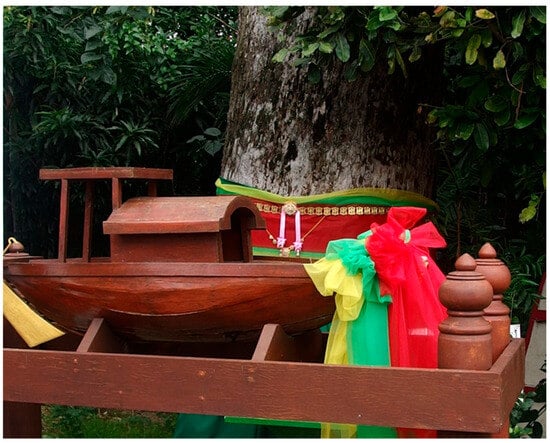
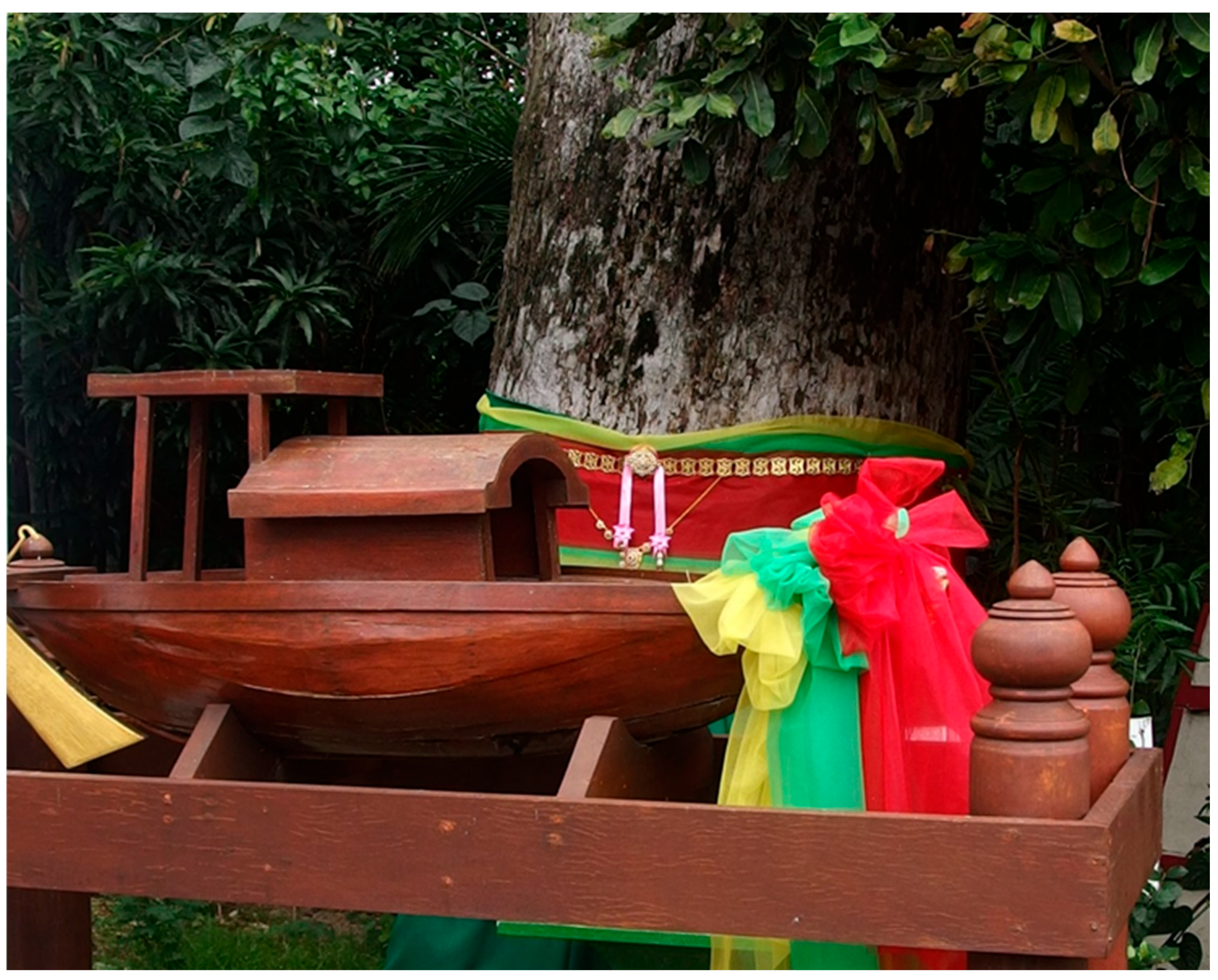
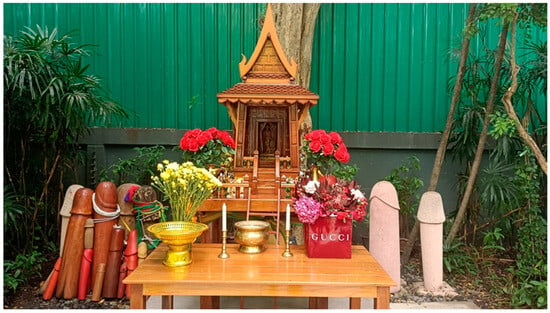
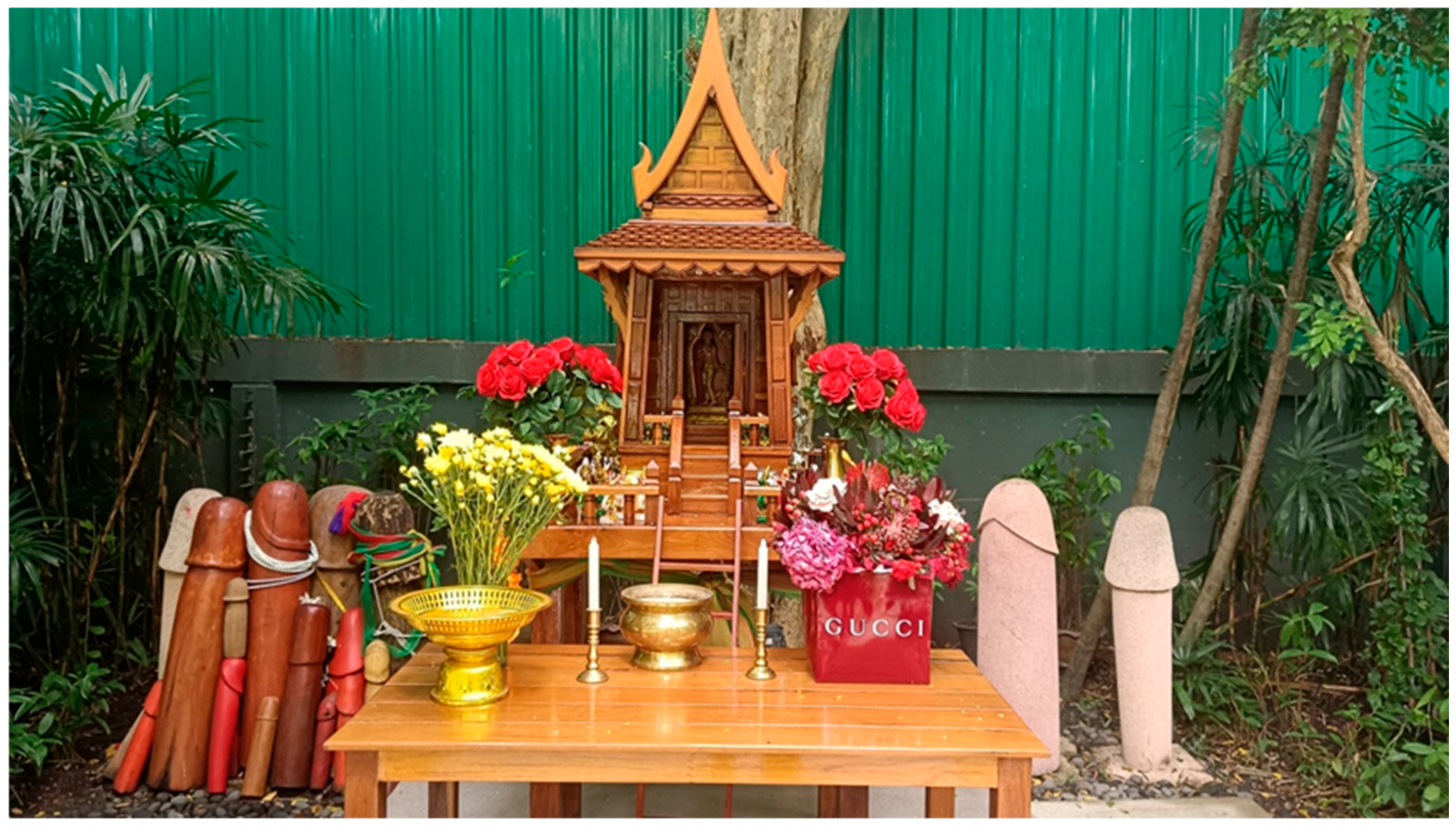
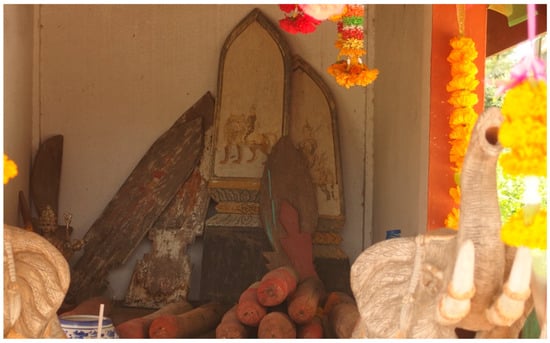
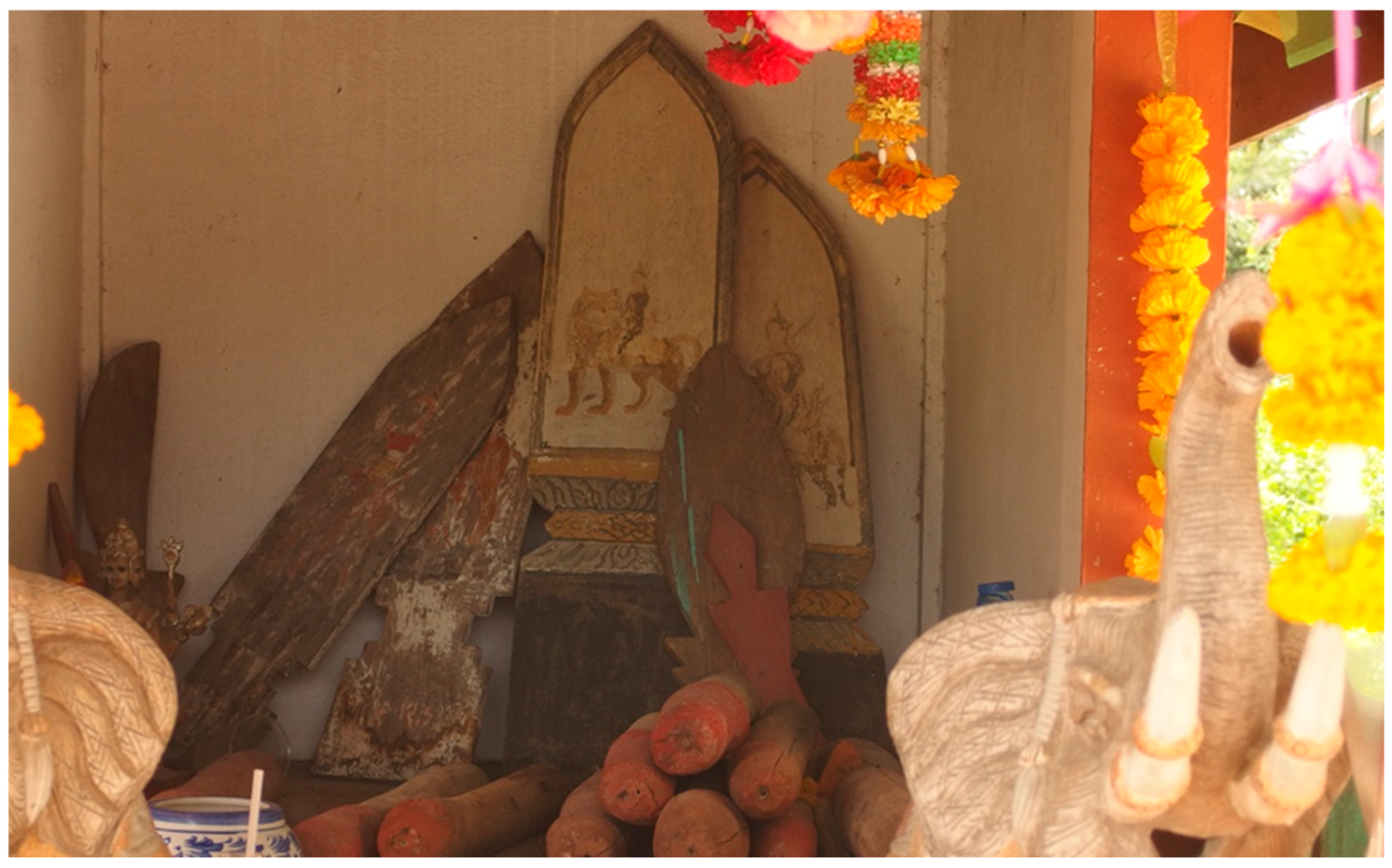
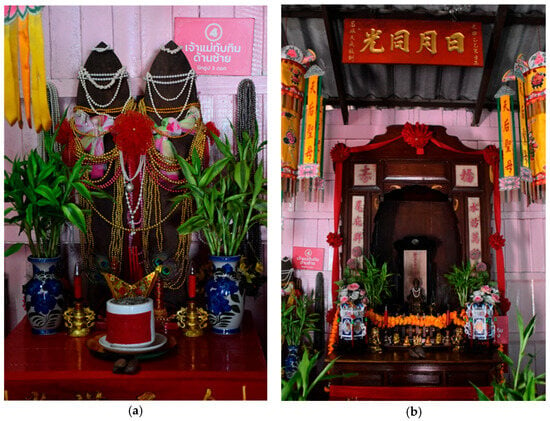
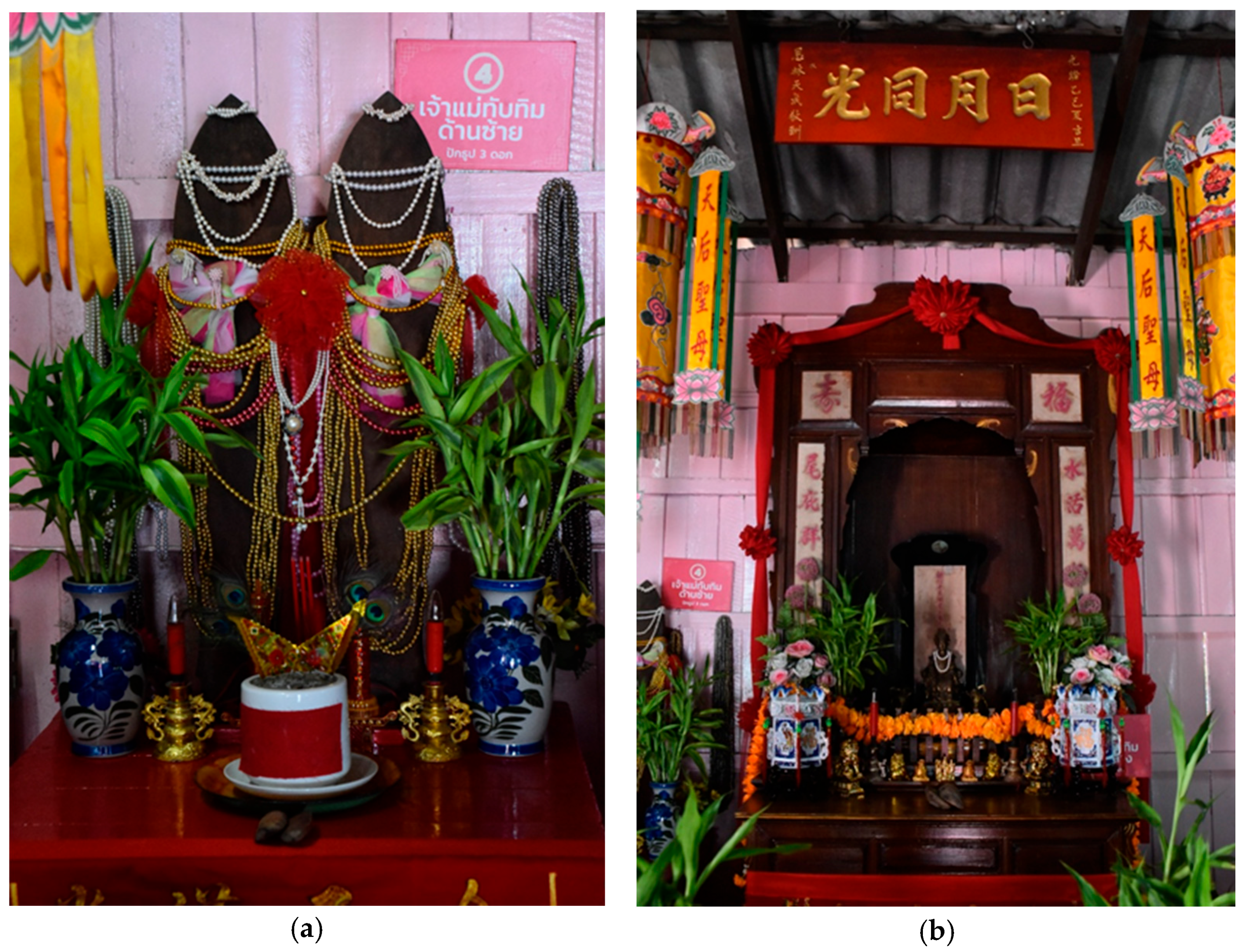
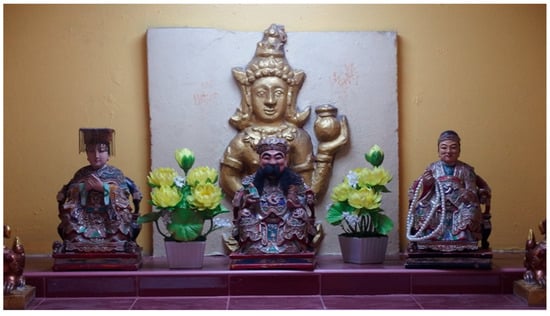
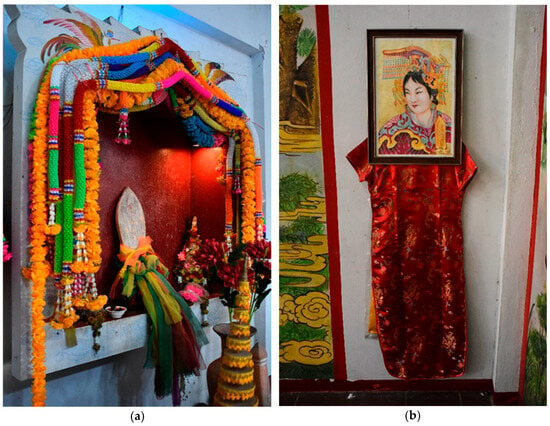
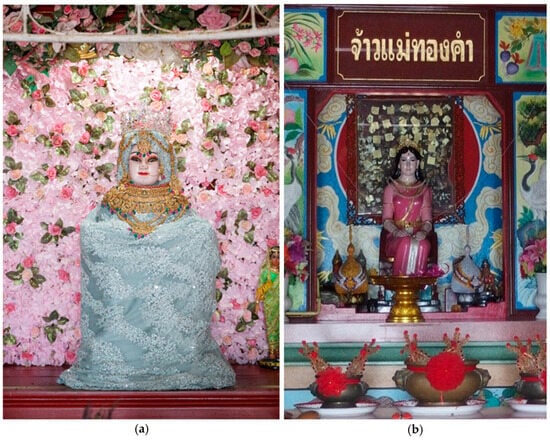
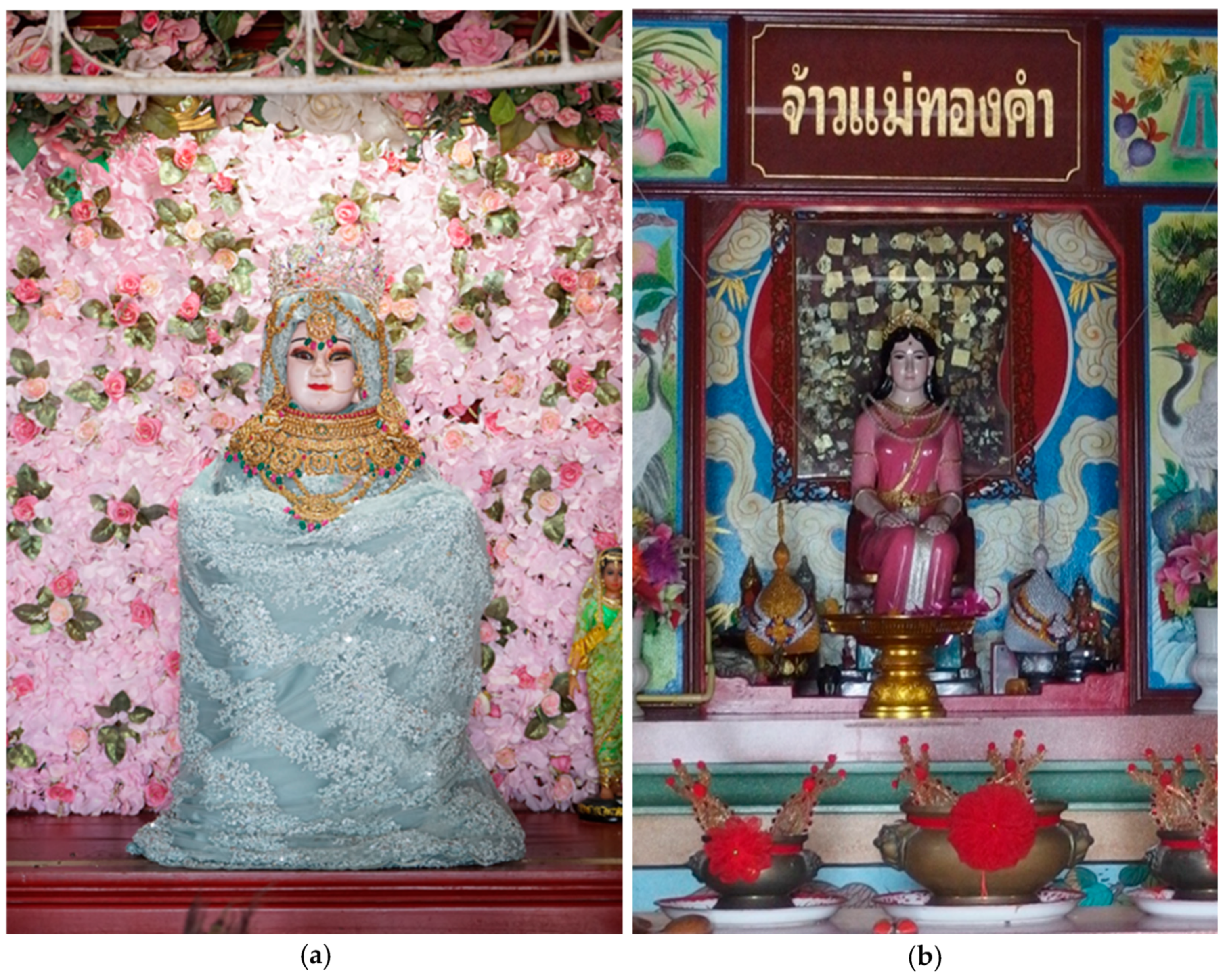
Disclaimer/Publisher’s Note: The statements, opinions and data contained in all publications are solely those of the individual author(s) and contributor(s) and not of MDPI and/or the editor(s). MDPI and/or the editor(s) disclaim responsibility for any injury to people or property resulting from any ideas, methods, instructions or products referred to in the content. |
© 2026 by the author. Licensee MDPI, Basel, Switzerland. This article is an open access article distributed under the terms and conditions of the Creative Commons Attribution (CC BY) license.