


Abstract
This article examines the painted Torah ark as a form of material religion through which early modern rural Jewish communities shaped sacred space and articulated religious belonging. Focusing on a group of wooden synagogues in rural Franconia, Bavaria, and Württemberg, decorated between 1732 and 1740 by a school of painters led by the itinerant painter Eliezer-Zusman of Brody, the study analyzes a rare shift from carved-wood or stone arks to fully representational painted structures. Drawing on visual analysis, architectural context, and comparison with Eastern European precedents, the article argues that painted ark decoration functioned simultaneously as a practical substitute for carving, a strategy for creating unified interior environments, and a means of intensifying devotional experience. The replication of compositional schemes from the Chodorów (now Khodoriv, Ukraine) synagogue in Ruthenia to Bechhofen in Bavaria demonstrates a deliberate process of artistic and religious transfer from Eastern to Central Europe. This transfer reflects both the economic limitations of small German Jewish communities and their aspiration to appropriate the visual prestige of Eastern European synagogue art. More broadly, the case highlights how painted ornament could reshape ritual space and materialize cultural mobility, contributing to wider discussions of material religion, migration, and the circulation of sacred forms in early modern Europe.
1. Introduction
In early modern Ashkenazi synagogues, the Torah ark functioned as both the liturgical and visual center of sacred space, typically articulated as a distinct carved architectural structure. Yet in the eighteenth-century prayer room of Horb am Main—constructed within a residential house, abandoned in 1866, rediscovered in 1909, and today displayed at the Israel Museum (Motschmann 1985)—its decoration relies almost entirely on paint, so that the ark’s surfaces merge with the surrounding murals and the object itself dissolves into the pictorial field. While the murals follow established Eastern European traditions of synagogue wall and ceiling painting (Orgad 2022a, 2022b), the application of paint to the Torah ark itself appears to be a local development in the German lands.
The Horb ark is one of several surviving or photographically documented examples from Franconia, Bavaria, Württemberg, and their environs. Similar arks once stood in prayer rooms housed within residential buildings in Kirchheim (Davidovich 1968; Schwierz 1988, p. 73), Colmberg (Assouline et al. 1998a, pp. 148–55), and Unterlimpurg (German 1928; Panter 2015), as well as in the medium-sized synagogue of Bechhofen (Ophir 1973, p. 284; Töplitz 1923; Assouline et al. 1998a, pp. 92–105). Their stylistic features suggest production by the same school of painters who decorated these interiors, adapting Eastern and Central European traditions to local settings (Piechotka and Piechotka 2015b; Goldman-Ida 2020; Heller 2020).
This tradition, disseminated by itinerant Jewish painters in Poland and Moravia, was introduced to southern Germany by Eliezer-Zusman of Brody (Stiefel 2014, pp. 135–38), who signed the decorations in the Bechhofen, Horb, and Kirchheim synagogues and possibly painted the Colmberg synagogue as well (Orgad 2022a, pp. 259–60), including their Torah arks. It was marked by near-complete pictorial coverage of synagogue interiors: walls dominated by inscriptions and ceilings filled with vegetal and zoomorphic ornament (Piechotka and Piechotka 2015b; Orgad 2022a). Although rural churches in the German lands were also richly decorated, their compositions and styles differed markedly and did not serve as models for synagogue painting (Kuczera 2018; Beuckers 2011).
Of the painted Torah arks, only those from Horb and Unterlimpurg survive intact. Photographs from the 1920s and 1930s document the exteriors of the Bechhofen and Kirchheim arks and the doors of the Colmberg ark (Assouline et al. 1998a, pp. 92–93; Assouline et al. 1998b). Bechhofen is the only case recorded while still in active use; the others were altered after removal, deteriorated, or dismantled. The contents of the Kirchheim synagogue were transferred to the Luitpold Museum in Würzburg in 1912 and destroyed in the Allied bombing of 1944 (Davidovich 1982), while the Unterlimpurg interior has been displayed in museums since its rediscovery in 1904 (Panter 2006).
The German painted arks correspond closely to the elaborately decorated prayer halls that surround them. Yet, unlike Eastern European precedents—where ark decoration relied primarily on carved wood, sometimes colored—no clear model exists for such intensive representational painting on the ark itself. These works may therefore be regarded as a local genre that emerged in rural German lands during the first half of the eighteenth century.
Structurally, the arks were modest: small, single-tiered, and sparsely carved, with the exception of Bechhofen. They differed both from the monumental medieval and early modern arks of larger Franconian and Bavarian cities, such as Fürth, Frankfurt am Main, Miltenberg, and Nürnberg (Ohm 2005; Paulus 2007), and from the elaborately carved multi-tiered Polish arks flanked by decorative side wings (Yaniv 2017; Piechotka and Piechotka 2015a, 2015b). Instead, they may reflect local rural traditions attested in early modern German sources that depict simple, single-tiered arks without architectural additions (Pfefferkorn 1508; Feuchtwanger-Sarig 2017; Margaritha 1530).
Their modest scale was closely tied to the precarious conditions of rural Jewish life. From the late Middle Ages onward, repeated expulsions pushed Jews from towns into the countryside, where economic opportunities were limited and religious life difficult to sustain (Rohrbacher 1997; Kaplan 2016; Battenberg 1997). Strict population caps, economic hardship, and periodic violence or confiscation of property further constrained these communities (Porzelt 2022; Stimpfig 2001; Ophir 1973; Rosenstein et al. 2011; Hamm et al. 2007; Haarscher 1997; Kaplan 2020). As a result, prayer spaces were often small and concealed within private homes, necessitating compact Torah arks.
The only painter known by name among these decorators, Eliezer-Zusman of Brody (Orgad 2022a, pp. 10–18), likely trained in Ruthenia and was well aware of the contrast between the modest German arks and the monumental carved arks of his homeland. Confronted with limited resources, he employed paint to confer visual richness and symbolic weight on otherwise simple structures.
The resulting ark decorations fulfilled functional, aesthetic, and religious roles. Paint substituted for woodcarving, visually integrated the ark with the surrounding walls and ceilings, and heightened its symbolic presence. In Horb and Bechhofen, illusionistic devices even expanded the perceived scale of the ark, creating the impression of a multi-tiered structure modeled on Polish examples, particularly the synagogue of Chodorów (now Khodoriv, Ukraine). Through these strategies, painted decoration transformed modest furnishings into compelling focal points of devotion, addressing the rural communities’ need for dignity, security, and religious belonging.
2. The Functional Tier: From Woodcarving to Painting
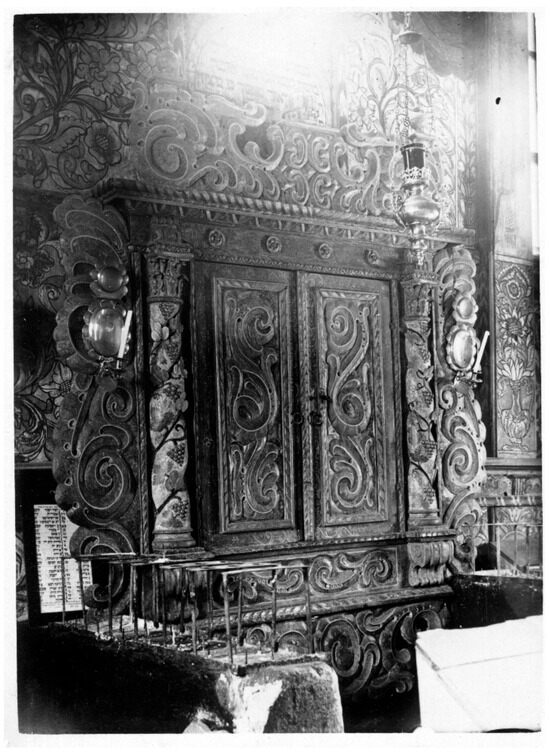
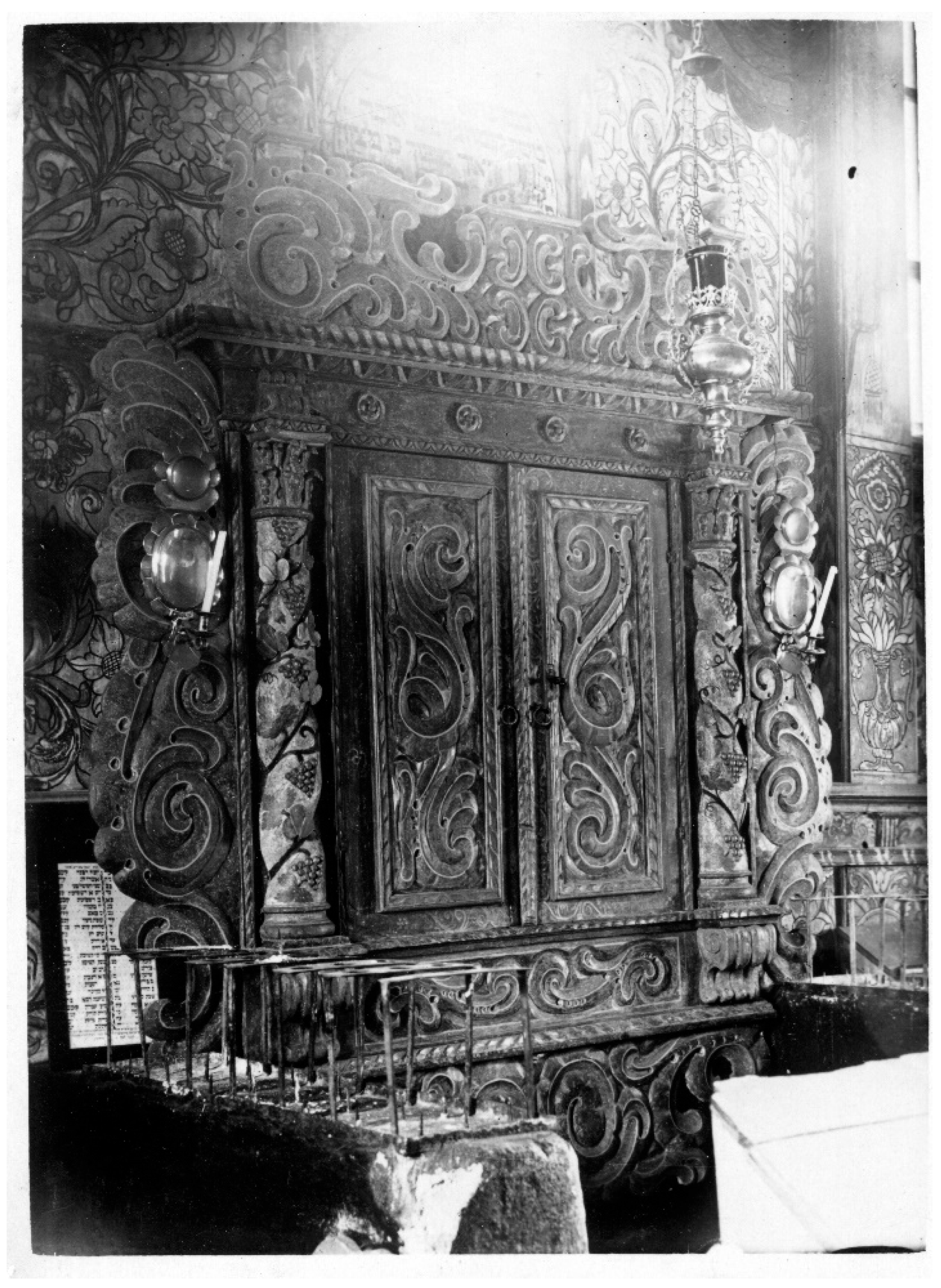
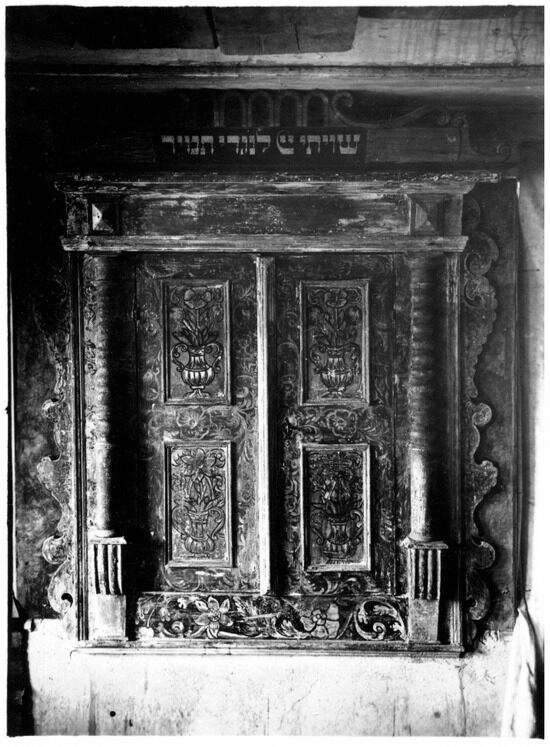
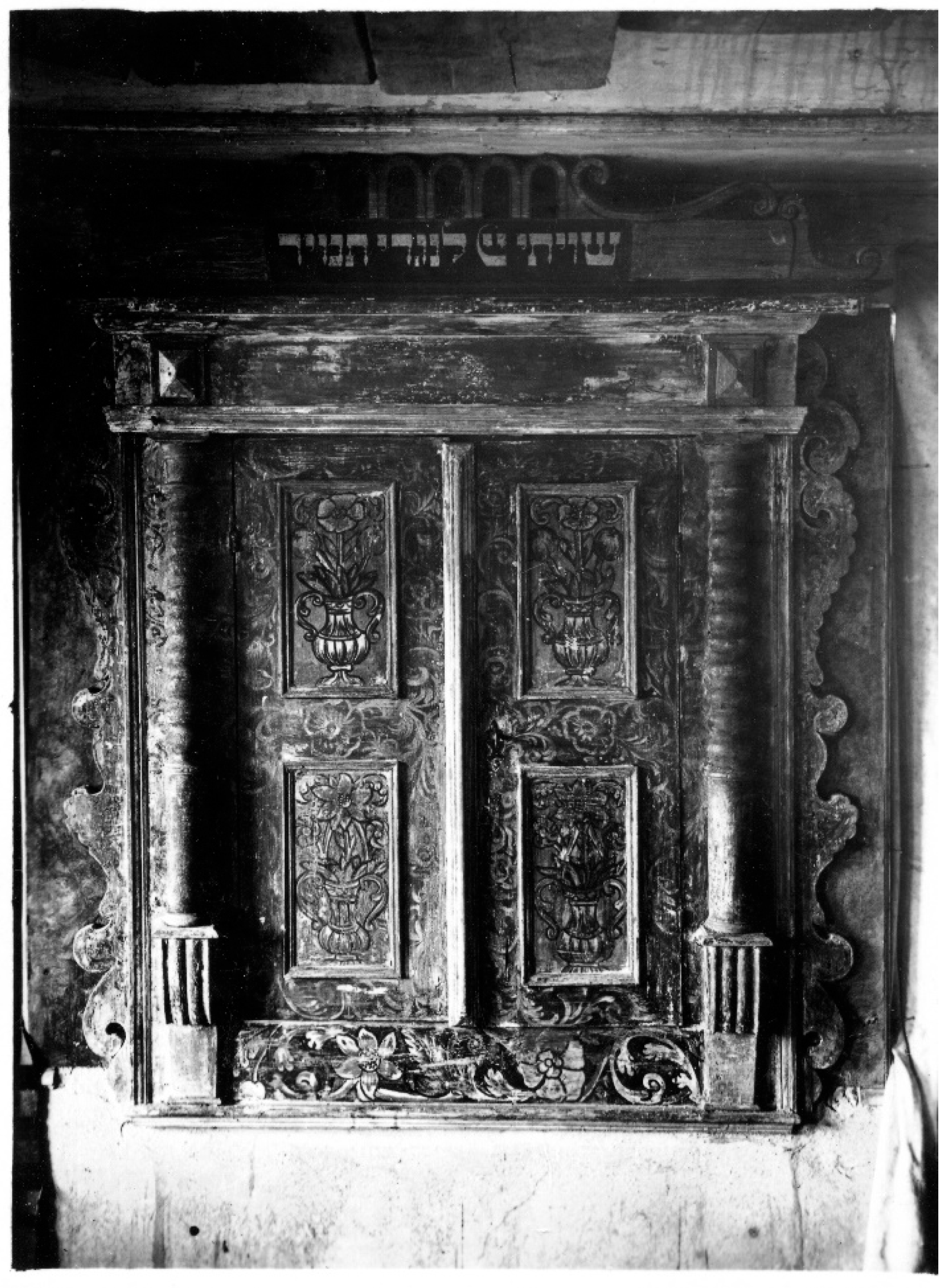
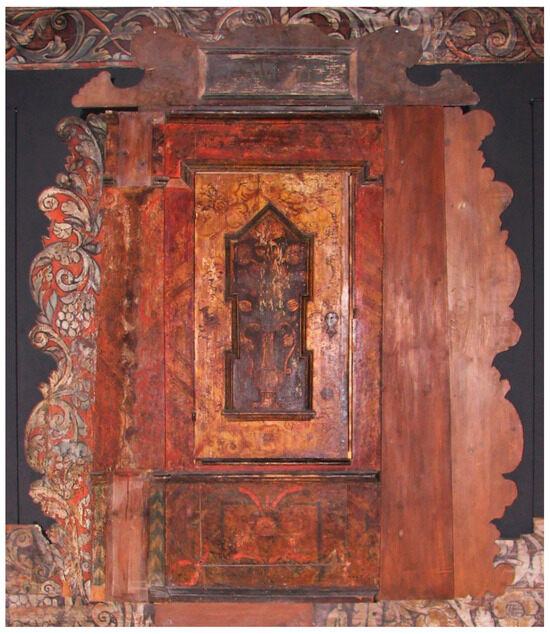
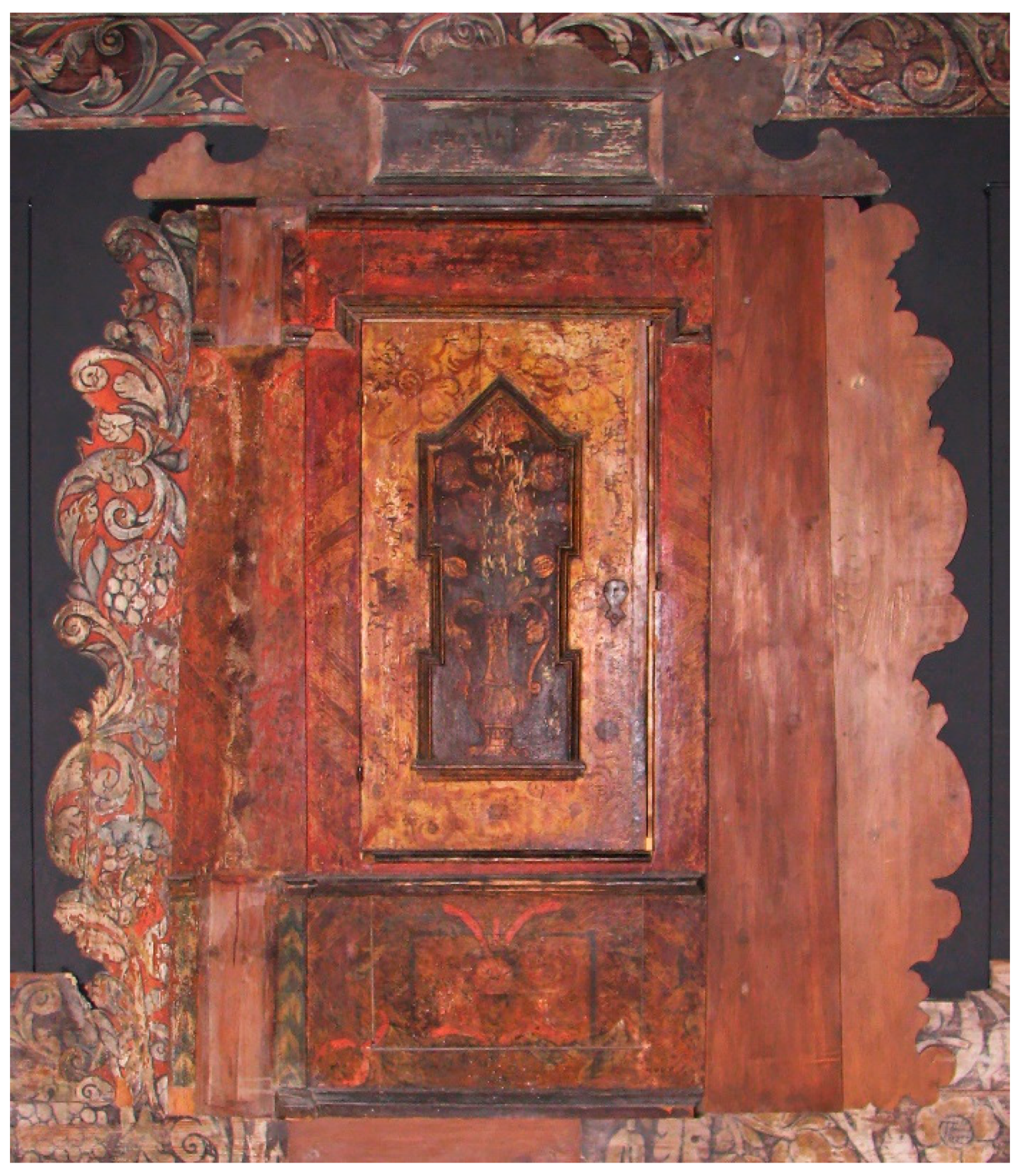
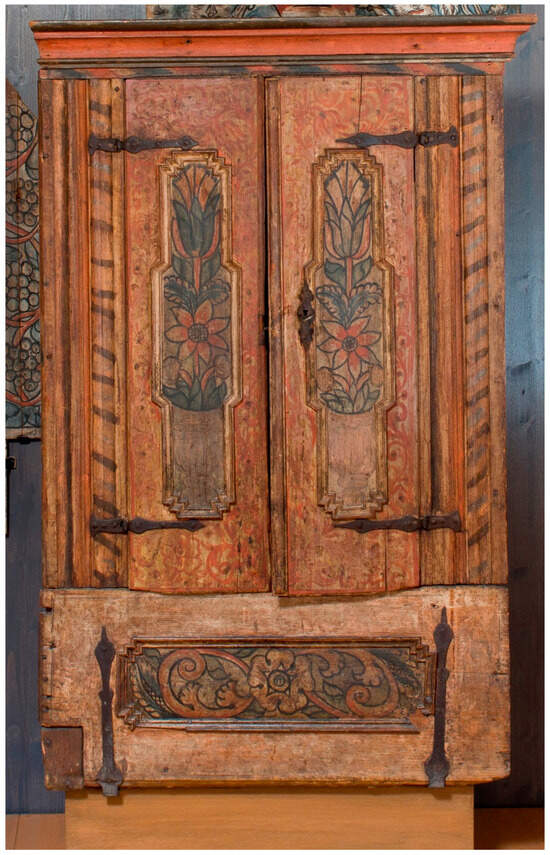
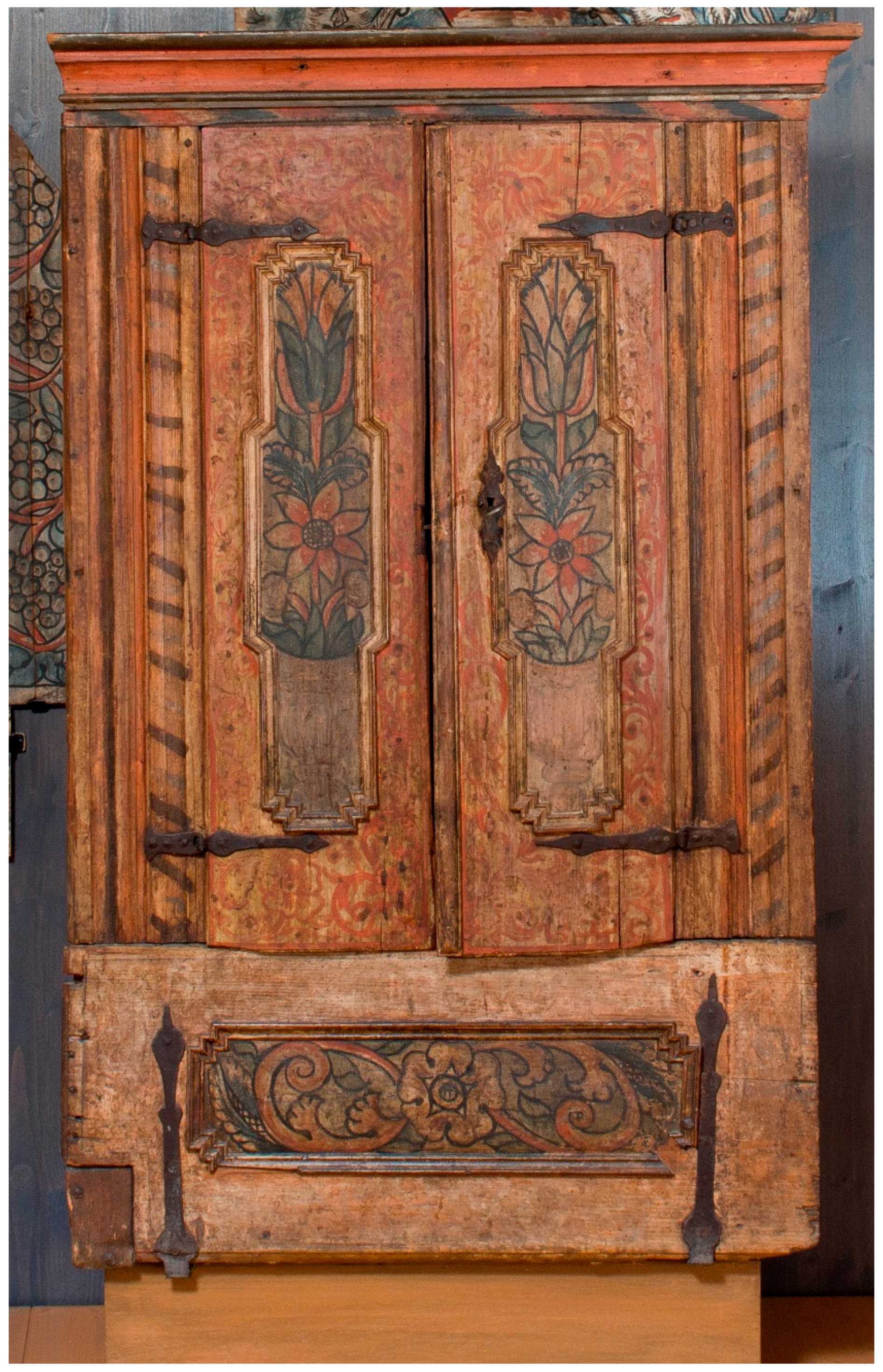
Painting on Torah arks was aimed at beautifying the plain surfaces. Therefore, the amount of painting coverage on each of the Torah arks was inversely related to the portion of woodcarving, which differed on each ark. The Bechhofen Torah ark features continuous, densely carved reliefs that cover nearly all wooden surfaces (Figure 1). In contrast, the Torah arks in Colmberg, Horb, and Unterlimpurg employ selective carving, leaving substantial portions of the structure uncarved and materially smooth (Figure 2, Figure 3 and Figure 4). The painted patterns and motifs used as a substitute for woodcarving echoed local artistic trends in furniture decoration as well as Eastern European synagogue art.
Figure 1.
Torah ark. Bechhofen, synagogue, 1684 (?). National Library of Israel, Central Archives for the History of the Jewish People, Jerusalem, Synagogue (4)—Bechhofen (Germany), ca. 1925–1932, P160-822 Harburger, Theodor—Private Collection.
Figure 2.
Torah ark. Colmberg, synagogue, 18th century. National Library of Israel, Central Archives for the History of the Jewish People, Jerusalem, Theodor Harburger 1887–1949 photographer, Tora-Schrein (Aron-ha-Kodesch)—Colmberg (Germany), ca. 1926–1932, P160-440 Harburger, Theodor—Private Collection.
Figure 3.
Torah ark (right panels reconstructed). Horb am Main, synagogue, 18th century. The Israel Museum, Jerusalem ©. The Israel Museum, Jerusalem, by Zvi Orgad, 2017.
Figure 4.
Torah ark. Unterlimpurg, synagogue, 1728 (?). Hällisch-Fränkisches Museum, Schwäbisch Hall. Courtesy of the Historischer Verein für Württembergisch Franken e.V.
The external decorative plates, particularly the side wings, most clearly illustrate the transition from a decorative system based on dense woodcarving to one defined primarily by painting. The Bechhofen Torah Ark retains the highest concentration of carved ornament, while in Colmberg and Horb, the wings remain entirely flat and uncarved. Photographic documentation of the Colmberg side wings reveals faint traces of paintings in the shape of acanthus leaves and flowers. The paintings in Horb depict acanthus leaves and grapevines. In both arks, the wings’ edges are not straight, but rather match the vegetal decoration.
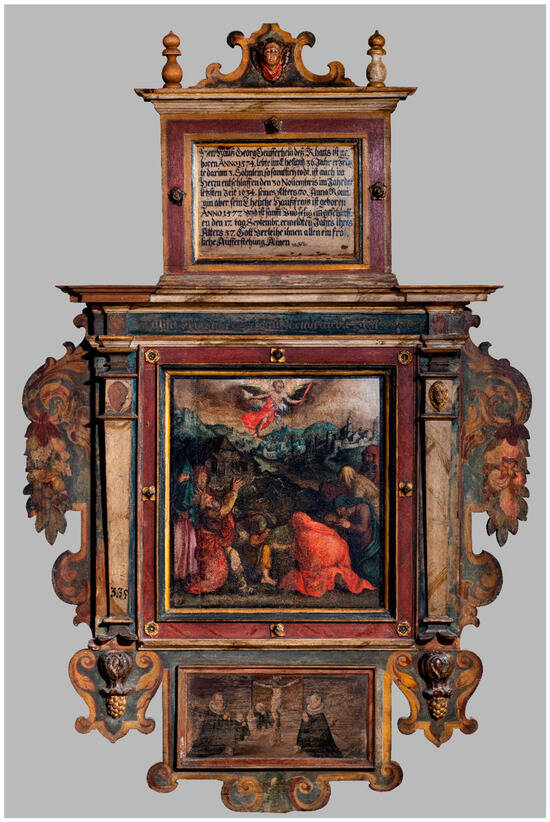
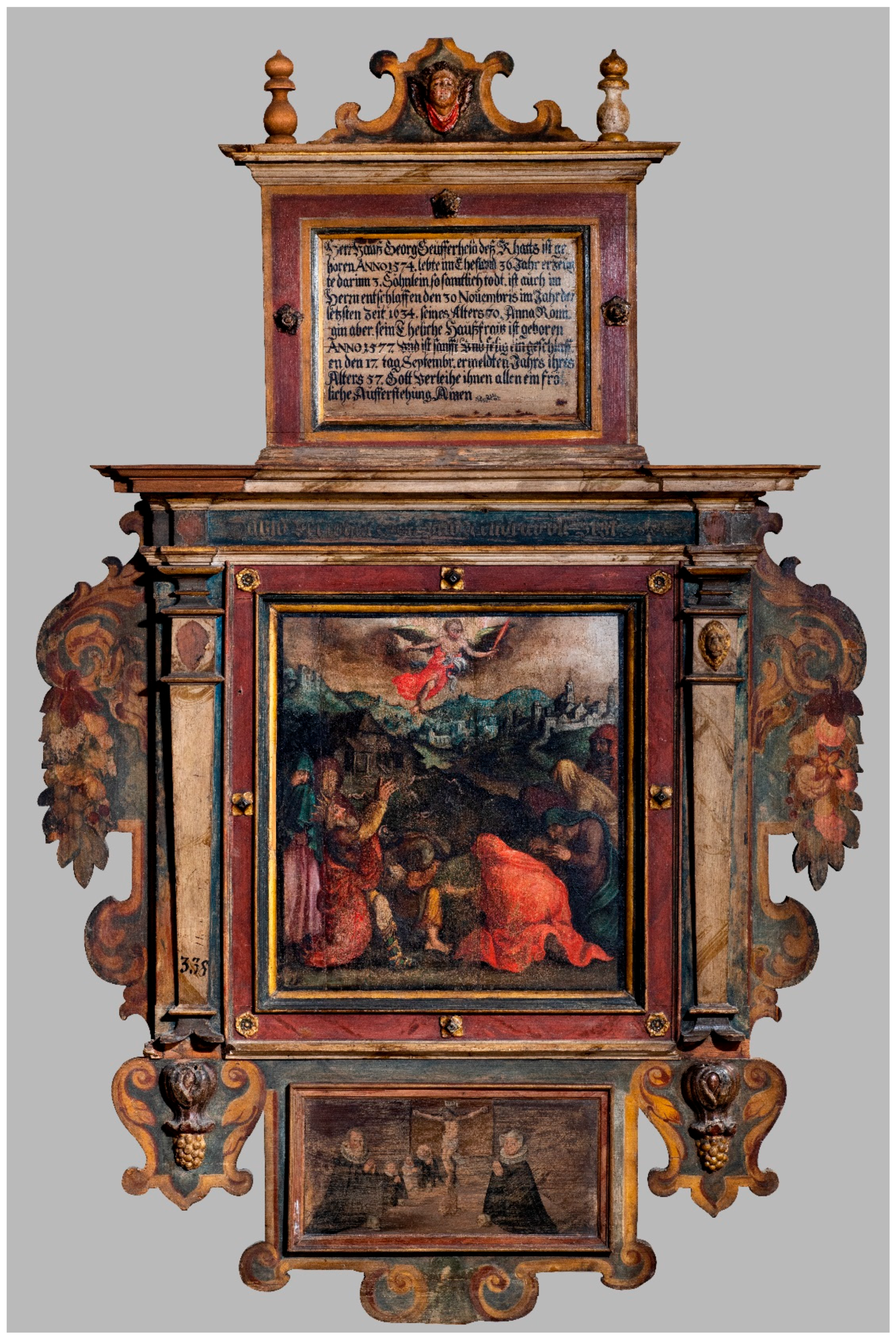
The vegetal patterns on the side wings in both synagogues were probably intended to replace woodcarvings like those on the Bechhofen Torah ark’s side wings (acanthus leaves) and engaged columns (grapevines). Another potential inspiration for the fruit/leaf combination used by Eliezer-Zusman could have been the painted schemes on the side wings of local church altarpieces and epitaph panels. In many such church furnishings, the side wings were not carved but made of plain wooden plates whose edges, as in Colmberg and Horb, were cut into vegetal shapes. Such were, for example, the side wings of the epitaph for Hans Georg Seinferheld (1574–1634; Figure 5), decorated with a combination of acanthus leaves and fruits. As in the synagogues, the paintings on this epitaph’s side wings were probably executed by the same painters who created the central image and may have functioned as a more economical alternative to woodcarving.
Figure 5.
Epitaph panel for Hans Georg Seinferheld. Unterlimpurg, 1634. Hällisch Fränkisches Museum, Inv. Nr. 3191. Courtesy of the Historischer Verein für Württembergisch Franken e.V.
3. The Aesthetic Tier: Creating a Homogenous Space
Woodcarvings dominated the doors of the Bechhofen Torah arks, leaving plain areas only near the outer borders (Figure 1). Although these areas were narrow and hardly visible, Eliezer-Zusman filled them with light-colored, delicate, curly stems, demonstrating the importance of complete coverage of the Torah ark surfaces for this painter. This trend, relying upon domestic furniture decoration on the one hand and the Eastern European synagogue decorative tradition on the other, was intended to merge the Torah ark into the wall decoration. Moreover, these dense ornamental fields echoed motifs painted on the walls and ceilings, contributing to a feeling of spatial homogeneity. Hence, they present their makers as design-aware artisans.
3.1. Influences from Domestic Furniture
Painters adopted the practices and motifs of domiciliary furniture decoration in their painting of the Torah arks. In the early modern period, decorated furniture, including cupboards, commodes, and chests, were popular among the urban bourgeoisie and aristocracy in Europe. However, painted carpentry was not reserved for the wealthy. Rustic pieces of furniture adorned with geometrical, vegetal, and zoomorphic motifs were also prevalent in the rural areas of present-day southern Germany (Gebhard 1982; Schindler and Ring 2019; Herold 1993; Bauer 1991; Wagner 1983).
Paintings also appeared on sacred furniture. For example, in late medieval and early modern Central and Eastern European parish churches, the outer side of wooden doors of eucharistic armoires sometimes featured sacred scenes and figures (Timmermann 2009, pp. 234–54). Painted doors, however, were relatively rare. As with Torah arks, the decoration of church altar structures and sacramental furnishings was typically based on relief carving or sculpture rather than on painted surfaces alone.
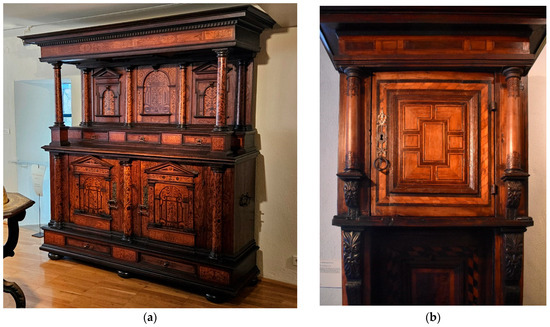
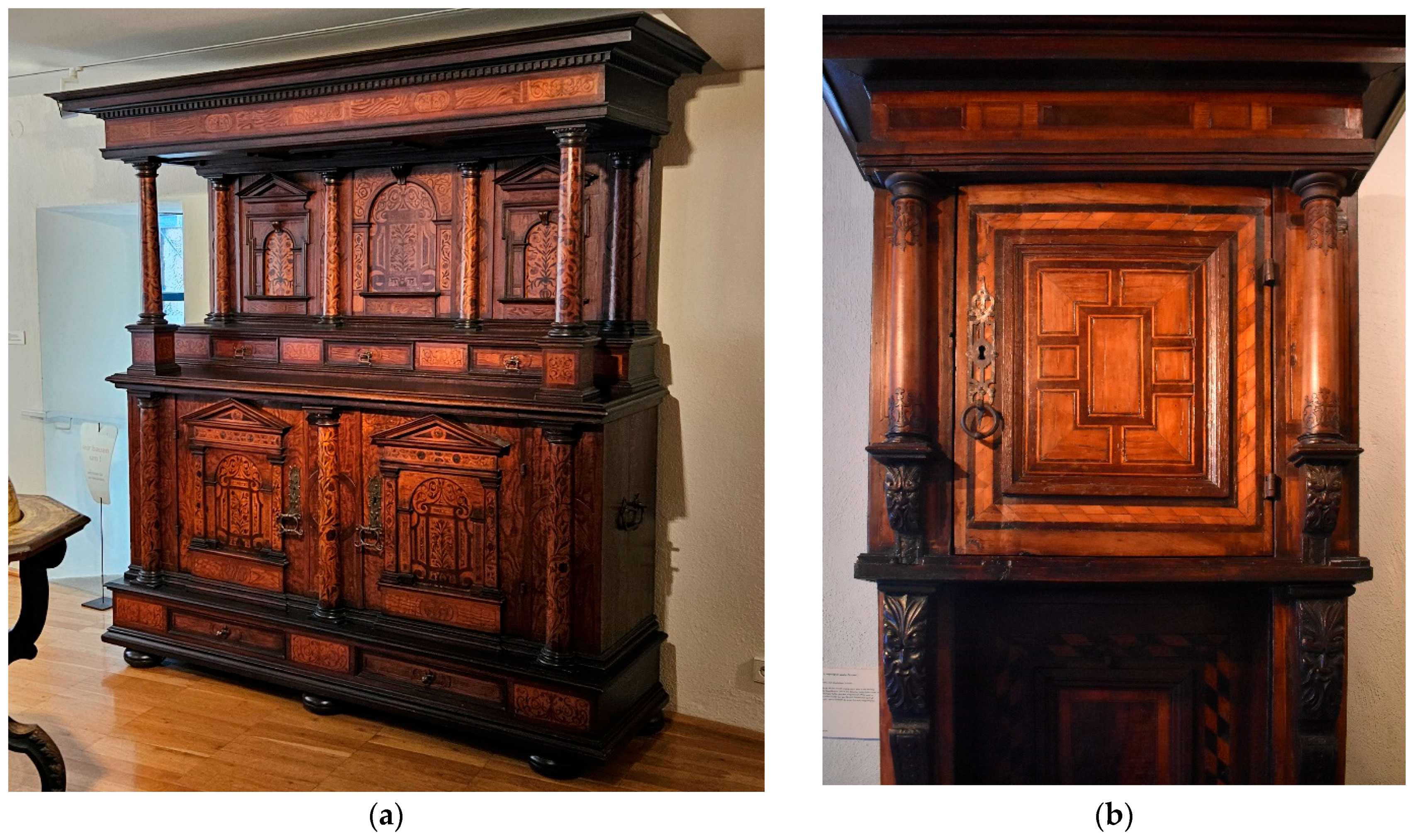
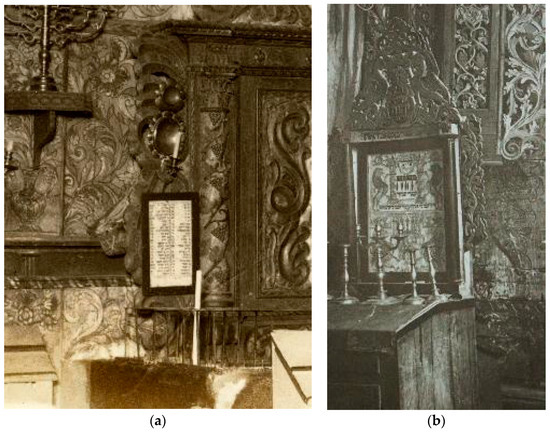
One widespread decorative style in early modern European furniture painting involved filling the areas framed by wooden borders in the center of the cupboards’ doors with dense ornamental fields of vegetal motifs (Figure 6a; Schwarze 1975, p. 228, article 654). Another common practice was applying various colored wood veneers in symmetrical order to create vegetal or geometrical patterns (Figure 6b, p. 222, article 644).
Figure 6.
(a) Buffet, Schwäbisch Hall (?), before 1600. Hällisch Fränkischen Museum Schwäbisch Hall, Inv. Nr. 1988/0187. Courtesy of the Historischer Verein für Württembergisch Franken e.V. (b) Buffet, Eltershofen castle, 1600. Hällisch Fränkischen Museum Schwäbisch Hall, Inv. Nr. 88/185. Courtesy of the Historischer Verein für Württembergisch Franken e.V.
The Torah ark painters in rural German lands similarly filled the plain surfaces. The Bechhofen synagogue painter applied light monochromatic vegetal patterns on the doors’ borders (Figure 1). In Colmberg, the painter adopted similar patterns and the same light color (Figure 2). He added two large, symmetrically situated flowers, perhaps due to the larger area he had to cover.
The wooden surface of the Horb Torah ark (Figure 3) was larger than those in Bechhofen and Colmberg, and its color is lighter. This lighter shade of wood may have been the reason the painter used a reddish color instead of white, applying the vegetal patterns around the pointed central border. The pattern combines curled stems, as in Bechhofen and Colmberg, and several flowers resembling those in Colmberg. A rhombus made of diagonal red lines was depicted around this vegetal carpet. Geometrical shapes such as these were typical of painting and veneer on early modern German furniture (see, for example, Figure 6b, around the door; Adamczyk 1988, p. 76).
3.2. Influences from Synagogue Interior Paintings
Other painted motifs on the Torah ark’s surfaces echoed the wall and ceiling paintings of its synagogue, thereby creating a unified space. In the Horb, Colmberg, and Unterlimpurg synagogues (Figure 2, Figure 3 and Figure 4), identical vegetal motifs were depicted on the walls and the Torah arks. These included, for example, six-petal round flowers, some with crossing lines in the centers, and rounded acanthus leaves. In the Kirchheim synagogue, similar acanthus leaves were depicted on the eastern wall and the lower part of the Torah ark (Figure 7).
Figure 7.
Torah ark. Kirchheim, synagogue, 1667 (?). Synagoge aus Kirchheim (3)—Würzburg (Germany), ca. 1925–1932, P160-887 Harburger, Theodor—Private Collection.
In Horb, Colmberg, and Unterlimpurg, amphorae filled with fruits and flowers were painted on the Torah ark doors’ central areas, bordered by wooden strips. Amphorae with flowers were a widespread motif in seventeenth-century southern German domestic furniture decoration (see, for example, Figure 6a; Maierbacher-Legl 1997, pp. 130–33; Bedal 2009). These amphorae may have been a further means of associating the Torah ark paintings with the murals in these synagogues. The same motif figured prominently in the Bechhofen synagogue, especially on the western wall, where seven amphorae were painted as separators between the eight text frames. In the Horb synagogue, at least two painted amphorae appeared on the western wall, between the windows (Orgad 2022a, 2022b). Another shared motif on the Torah ark and wall paintings was a decorative band of flowers and acanthus leaves. In the Colmberg synagogue, this band was painted underneath the doors on the lower part of the ark. Similar bands were documented, for example, in the Unterlimpurg prayer room’s wall paintings.
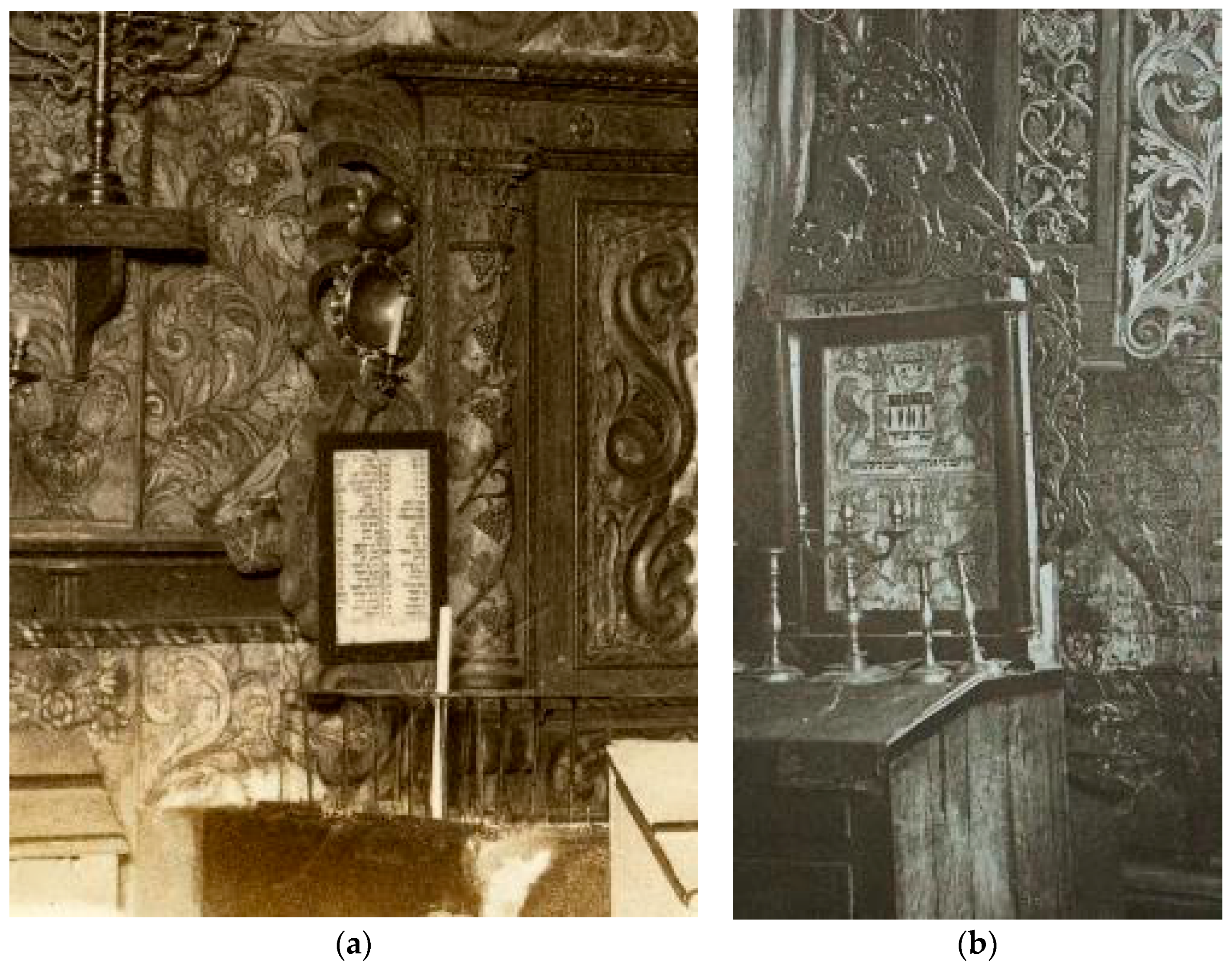
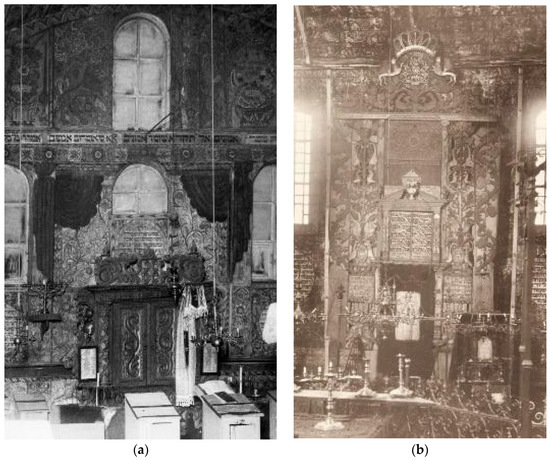
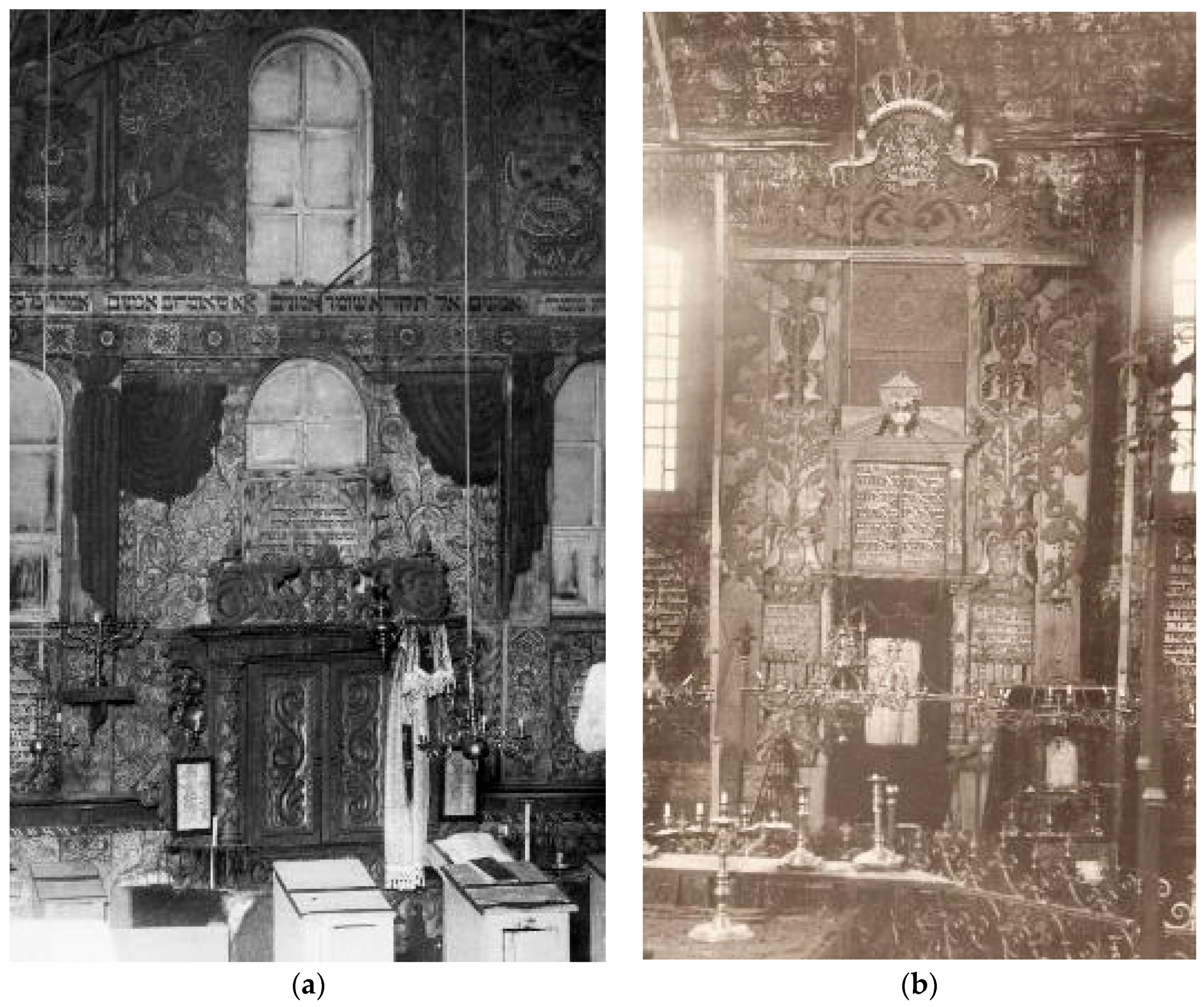
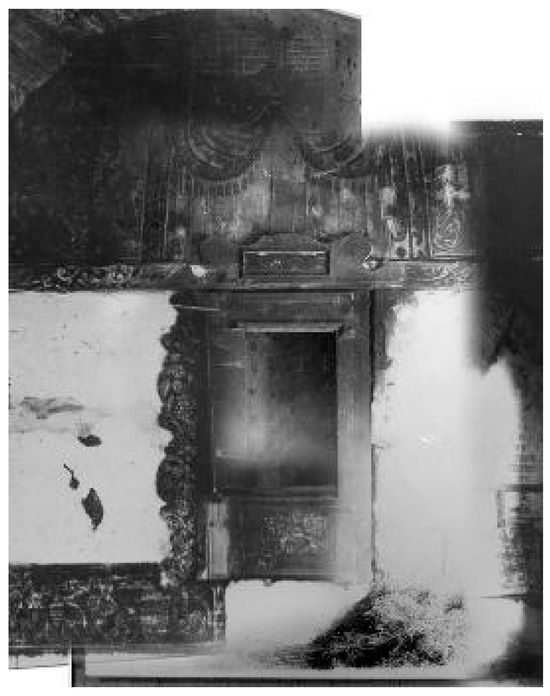
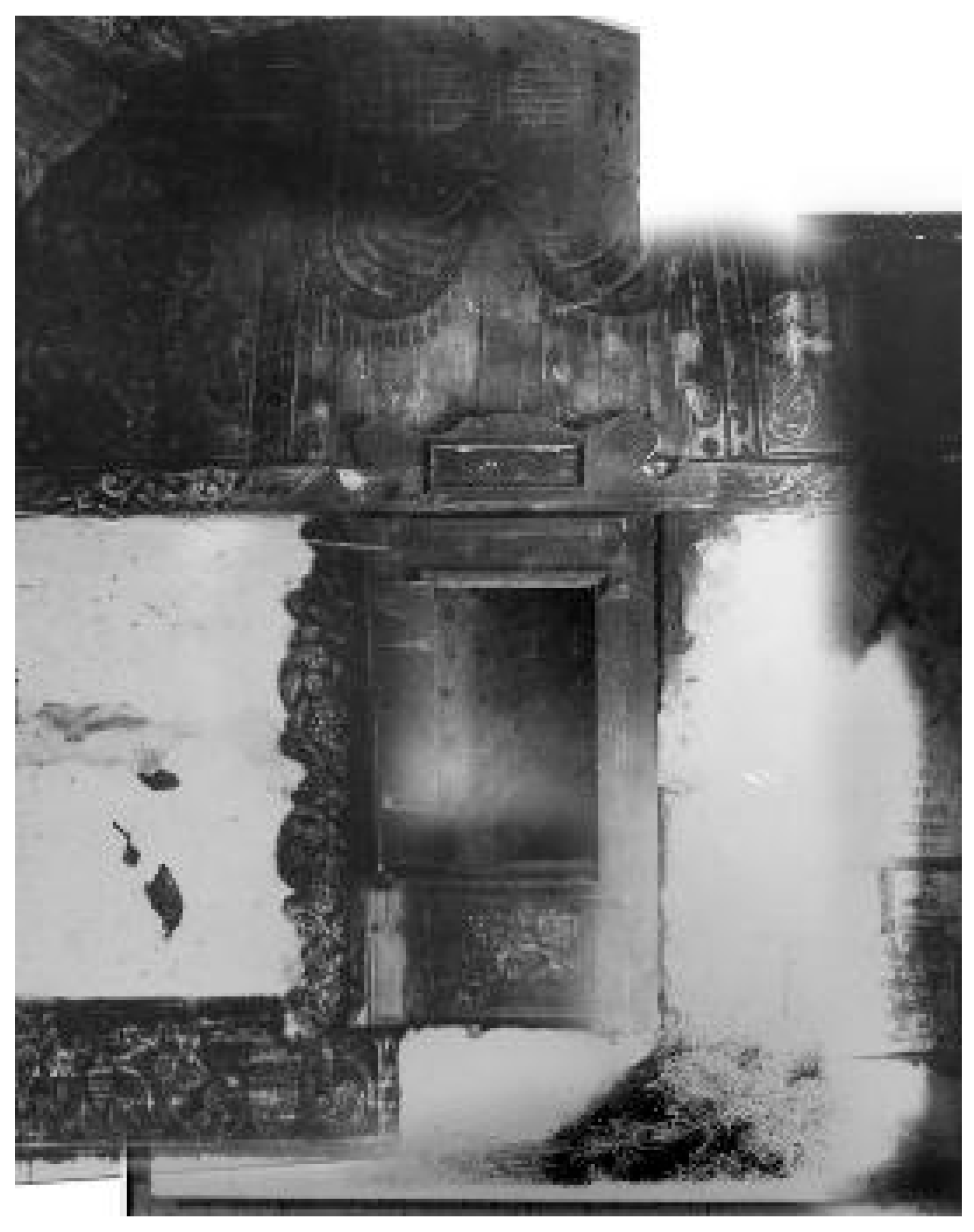
Another technique the painters used to create a unified space was to match and blend the painted patterns on each side of the ark with its woodcarvings. The peak of this approach is seen in the Bechhofen ark’s lower-left corner, where the painter designed a pattern that continues with the ark’s woodcarvings (Figure 8a). A similar effort to visually and physically connect the wall paintings to the Torah ark’s side wings has been documented in the Gwozdźiec Synagogue (Figure 8b).
Figure 8.
(a) Integration of woodcarvings and wall paintings. Bechhofen, synagogue, 1684/1732. Detail from: Synagoge (7)—Bechhofen (Germany), ca. 1925–1932, P160-825 Harburger, Theodor—Private Collection. (b) Integration of woodcarvings and wall paintings, Gwozdźiec, synagogue, 1728/29. Detail from: Gwoździec Wooden Synagogue. Alois Breyer, Altar. Tel Aviv Museum of Art/Avraham Hai.
A further example of Eliezer-Zusman’s efforts to create homogenous spaces was in coordinating the Bechhofen Torah ark’s paintings with the wall decorations (Figure 9a). The paintings on the eastern wall reached as far as the wooden decorations of the ark—both the top decoration and that on the side wings. Echoing the ceiling paintings, the wall decoration above the Torah ark unfolds in a vegetal rhythm of elongated, curling stems, interlaced with flowers, fruit, and foliage, occasionally taking on acanthus forms. By contrast, the areas near the left wing and along the lower section of the ark are dominated by dense clusters of acanthus leaves, resembling the carved wooden ornamentation.
Figure 9.
(a) Torah ark woodcarvings and wall paintings. Bechhofen synagogue, 1684/1732. Synagoge (7)—Bechhofen (Germany), ca. 1925–1932, P160-825 Harburger, Theodor—Private Collection. (b) Torah ark woodcarvings and wall paintings. Chodorów synagogue, 17th/18th centuries. Österreichische Nationalbibliothek, Vienna, Bildarchiv und Grafiksammlung (Chodorów synagogue, eastern wall, Signatur: 281322-B).
The dense paintings could conceal architectural asymmetries and irregularities. Notably, the Bechhofen Torah ark was not fully aligned with the painted cartouche and two windows above it (Figure 9a). Possibly, the ark was situated in the center of the eastern wall, which did not match the barrel vault’s peak because it was slightly shifted to the right. The painter designed the cartouche at the exact width of the windows and, therefore, was obliged to align it with them. Similarly, in Horb, the Torah ark was aligned with the painted curtains above it, while the three cartouches painted on the top of the lunette were shifted to the left (Figure 10). This deviation was caused by the roof’s inclination, which prevented the barrel vault’s builders from locating its peak above the center of the eastern wall (Orgad 2022b).
Figure 10.
Horb, synagogue, eastern wall, early eighteenth century (woodwork)/1735 (paintings). Photograph, before 1913. The Israel Museum, Jerusalem ©. The Israel Museum, Jerusalem.
As on the Bechhofen synagogue ceiling, the wall paintings above the Horb Torah ark mainly consisted of long, curly stems with flowers, fruit, and leaves—some of them in the shape of acanthus. In contrast, near the left wing and at the bottom of the ark, thick and voluminous acanthus leaf patterns, which resembled the wooden wing decoration, appear more prominently. All such matching of visual motifs attests to the painter’s attempt to meld the wall and Torah ark paintings.
4. The Religious Dimension
The elaborate paintings around the Torah ark doors were intended to highlight the Torah ark. A comparison of early eighteenth-century Torah arks in wooden synagogues in Poland (e.g., in Chodorów and Kamionka Strumiłowa) and contemporary Polish church altarpieces reveals that their makers shared aesthetic conceptions of decorative dense ornamental fields framing sanctified zones (Piechotka and Piechotka 2015b; Yaniv 2017). Thus, as in Renaissance fine art (Carrier 2008, p. 12), they highlighted the religious significance of the central object—the altar image or Torah ark doors, respectively. The underlying religious message was also achieved through distinct iconography.
The most apparent religious manifestation of the Torah ark paintings was the addition of inscriptions. In Horb, the words “Keter Torah” (Torah Crown) were painted faintly inside a designated niche above the doors. In the Chodorów synagogue, the incorporation of woodcarvings and painting appeared right above the gable, where a painted inscription of “Torah Crown” flanked a small crown (Figure 9b). In Colmberg, a verse from the Book of Psalms—Shiviti Adonai le’negdi tamid (“I have set the Lord always before me;” Psalm 16:8, Jewish Publication Society 1917)—was inscribed in the same location. However, as the style of the letters here differs from that of other texts in this synagogue, this inscription might represent a later addition. Other paintings on the Torah arks served religious purposes in more sophisticated ways: Through a visual description of the temple pillars Jachin and Boaz or an illusory monumentalization of the ark.
4.1. Painting the Jerusalem Temple: Jachin and Boaz
As with the artistic treatment of the side wings, the balance on the engaged columns between woodcarving and painting varied from one synagogue to another. The Bechhofen ark had the most elaborately crafted engaged columns (Figure 1). The painter covered them with a light color, contrasting with the dark shade of the ark, and added paintings of vine branches and tendrils in various darker shades. By emphasizing the engaged columns, the painter underscored their symbolic message as associated with Jachin and Boaz, the Jerusalem Temple’s two imposing pillars. Although the biblical text does not specify that these pillars were spiral, early modern visual culture increasingly identified spiral or twisted columns with the Temple of Solomon.
This association was partly based on a long-standing Christian tradition that spiral columns preserved in Rome, later incorporated into St. Peter’s Basilica, had originated from Jerusalem after the destruction of the Temple. Bernini’s baldachin (1623–1634), with its monumental spiral columns, further reinforced the identification of this design as related to the Temple (Ward-Perkins 1952; Yaniv 2017, pp. 53–57). This visual motif spread widely and became a key element of Jewish artistic expression, mainly through illustrated book titles. As a result, the use of spiral columns in the Bechhofen synagogue framed the Torah ark as a symbolic evocation of the Jerusalem Temple. These connotations of the Temple were reinforced by additional painted motifs on the eastern wooden lunette, including an amphora with the four species on the left and Shofars on the right.
The floral motif on synagogue pillars might have also reflected the ark’s content—the Torah, associated with the Tree of Life—Etz Haim (Proverbs 3:18). In the early modern period, domestic furnishings were frequently decorated with pairs of spiral pillars adorned with vegetal patterns (Klein and Krutisch 2015; Schwarze 1975; Dobler 1992). However, they rarely exhibited the carvings of grapevines typical of pillars on Torah arks and church altarpieces (Yaniv 2017).
On the Horb am Main Torah ark (Figure 3), a bare, unpainted area in the shape of a spiral pillar to the left of the door indicates that it was bordered by spiral engaged columns. The Colmberg Torah ark (Figure 2) had two corrugated engaged columns flanking the doors, resting on grooved bases. The only Torah ark on whose façade there is no evidence of engaged columns is in Unterlimpurg (Figure 4). Instead, two-dimensional vertical columns made of diagonal gold and silver strips flank the doors. The painter may have used this unusual technique to replace the missing physical pillars. The diagonal lines could be visually associated with the spiral engaged columns of other Torah arks. The use of gold and silver could refer to the copper of which the original Jachin and Boaz pillars are said to have been made.
4.2. Monumentalizing the Torah Ark
Religious artisans used various methods to extend the visual dimensions—and thus the prominence—of sacred furniture, such as altars and sacrament niches in churches and Torah arks in synagogues. This trend was apparent in constructing three-tiered early modern Torah arks, for example, in the Gwoździec and Kamionka Strumiłowa synagogues in Poland, which resembled contemporary local altarpieces (Yaniv 2017; Piechotka and Piechotka 2015b). Similar to church altarpieces, Torah arks tended to be free-standing pieces of furniture made especially for the synagogue, which integrated a cabinet for the Torah scrolls and its elaborate extensions (side wings, gable, etc.) that made up a significant percentage of its surface. These decorative extensions were usually made in three dimensions—sculpture or relief.
In the Chodorów synagogue (Figure 9b), a different technique was used to monumentalize the Torah ark, in which the three tiers of decorations surrounding the ark doors consisted of an assemblage of relief elements. In the center of the lower part, a smaller ark can be discerned, comprising the doors (hidden by a veil), and above it, a large relief of the Ten Commandments topped by a gable. Comprising side pillars and a gable, this ark was built in the tradition of Polish Renaissance synagogues, for example, in Pinczów, Lwów (now L’viv, Ukraine), and Zamość (Piechotka and Piechotka 2015a, pp. 106–10). Later, it was extended by an assemblage of wooden strips made as shallow reliefs of vegetal and zoomorphic motifs. A similar extension technique made of shallow relief was also used, although to a lesser extent, in Renaissance synagogues, like the sixteenth-century Great Synagogue in Zamość. However, in Chodorów, it was incorporated with paintings, the painted inscription “Torah Crown” flanking the small crown above the gable. A bigger crown topped this eclectic extension of reliefs and paintings. This composition differed from the three-crown arrangement typical of Polish arks, where the Torah crown sat atop the ark (Yaniv 2003). Hence, the Chodorów Torah ark represented a work in progress: first, the original ark was topped by a gable, and a small crown was created; later, painted inscriptions were added, and finally, decorative strips made of shallow wooden reliefs were included.
Eliezer-Zusman of Brody transferred this assemblage technique to the Bechhofen and Horb synagogues, though he used paintings alone to create the illusion of a monumentalized Torah ark. In the Bechhofen synagogue, the painter visually raised and widened the Torah ark’s area far beyond the physical dimensions of the wooden furniture, using the illusion of more space (Figure 9a). In the lowest tier, flanking the Torah ark, vegetal paintings spread over four panels—two almost identical panels on each side of the ark. The closer panels mainly contained acanthus leaves with a few flowers, forming prolongations of the carved wooden side wings. The outer panels included amphorae with flowers.
The painted amphorae on both sides of the Torah ark in Bechhofen resembled depictions of the same motif on German domestic furniture. However, they were probably more inspired by the motif arrangement on the Torah ark in the Chodorów synagogue, where the closest panels flanking the ark were adorned with leaves and flowers sprouting from amphorae, associating the Torah with the Tree of Life.
The side panels containing the amphorae defined the width of the Bechhofen Torah ark’s second and third tiers. The second tier’s lower portion included the upper wooden decoration of the Torah ark and a small arched window at its top. As commonly found in Eastern and Central Europe, the painter here added the text “And it came to pass, when the ark set forward, that Moses said […]” (Numbers 10:35, Jewish Publication Society 1917), traditionally read during the procession of taking the Torah scrolls out of the ark. The vegetal decorations flanking the cartouche containing this text consisted mainly of thin stems with leaves and fruit, with a few acanthus leaves—a combination more typical of synagogue ceiling and wall paintings. Therefore, these vegetal patterns mediated between the Torah ark’s woodcarvings and the surrounding paintings in the synagogue.
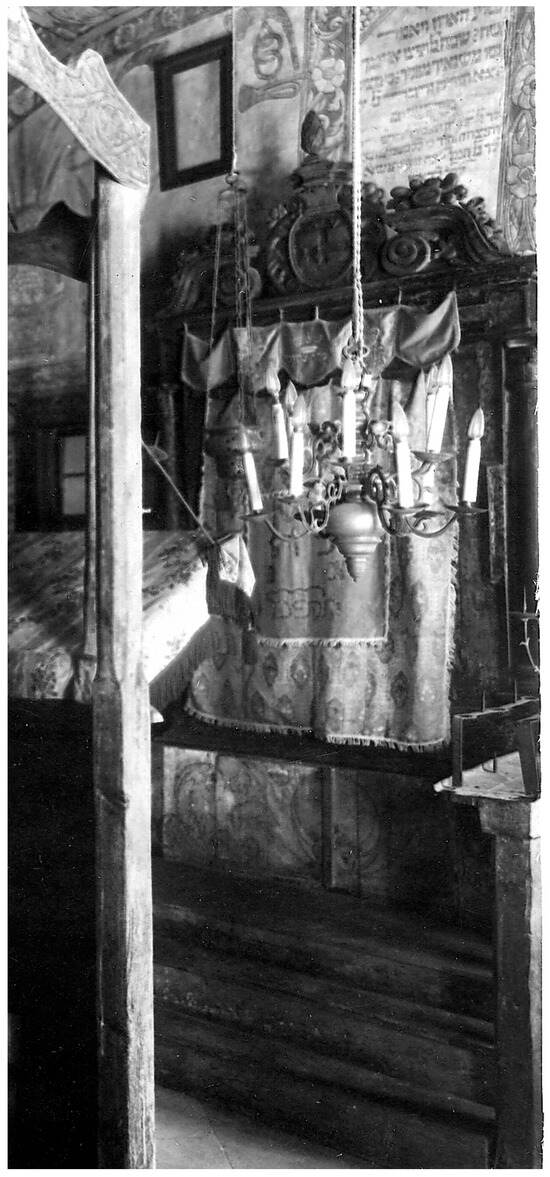
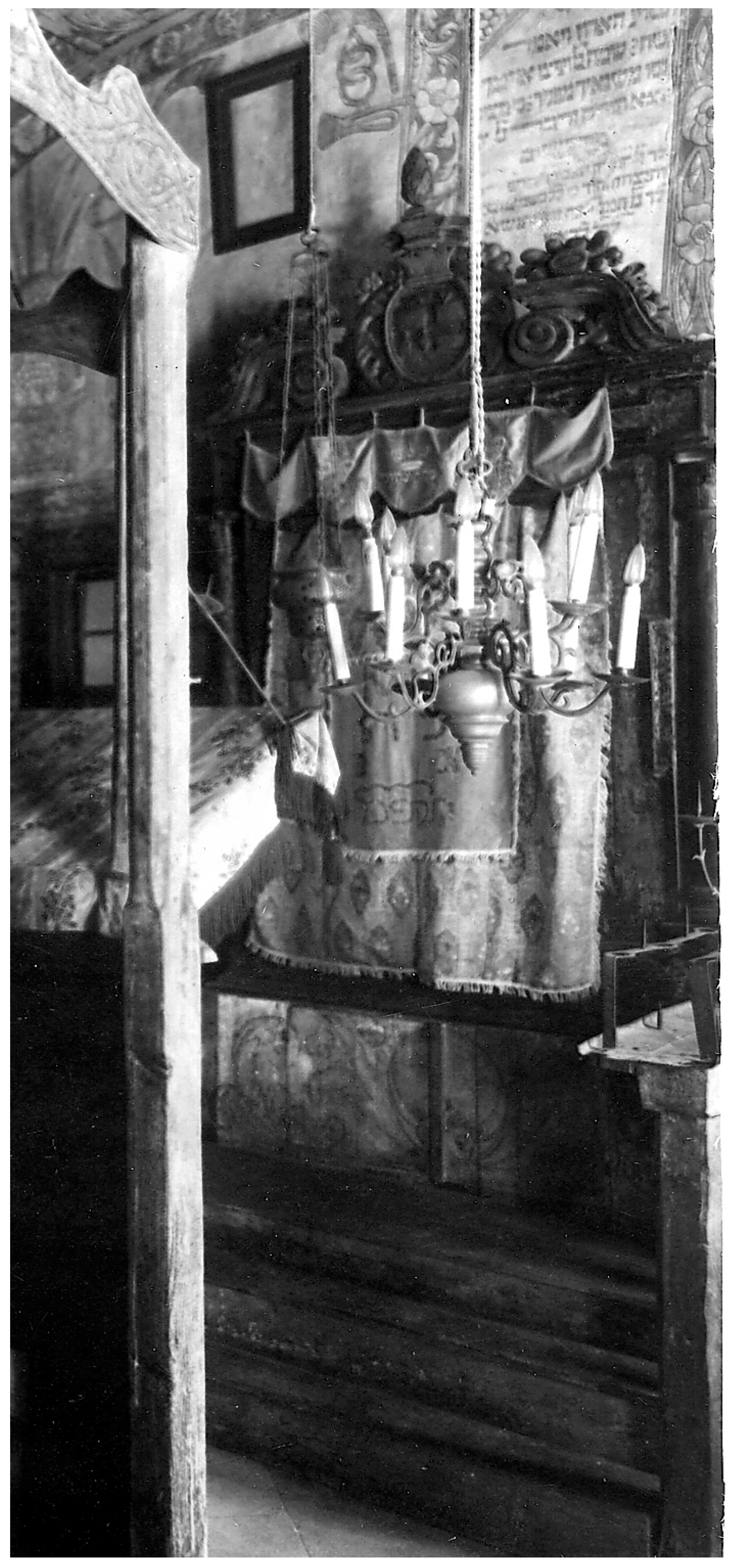
A curtain was depicted on the upper external zones of the second tier. Dating to 1732, this is one of the earliest known painted ritual curtains in Ashkenazi synagogues. The darkly colored curtain bordered the light vegetal pattern at the top to shape it into a narrow arch accompanying the arched window. Thus, the small window became the peak point of the second tier. The combination of the window and the cartouche containing an inscription underneath it in Bechhofen visually resembled the combination of the gable and the Tablets of Law beneath it in the Chodorów synagogue.
As in Chodorów, in Bechhofen the synagogue painter aspired to create a third tier. In Chodorów, this tier was formed by a horizontal decorative wooden relief with several pairs of animals—primarily birds. Above it, two griffins flank the big crown at the apex of the ark. Like similar pairs of animals flanking Torah crowns in early modern Polish synagogues, these two griffins symbolized the Holy Ark’s Cherubim (Yaniv 1999). The griffins and the crown’s lower arch were emphasized by a light color, contrasting with the dark color of the ark and other pairs of animals.
In Bechhofen, the third tier contained similar elements: A painting of a lion and tiger flanking a large arched window. While the Bechhofen arched window visually resembled the large crown in Chodorów, the lion and tiger in Bechhofen created a visual effect similar to the Chodorów griffins with their large size and prominent location. Hence, these two Torah arks were topped by a pair of heraldic animals, in contrast to many three-tiered Polish Torah arks that were topped by a double-headed eagle. This shared detail further establishes the model/copy connection between them.
Creating these motifs as purely painted extensions resembled practices in rural Christian art: In parish churches in Central Europe, perhaps to reduce expenses, paintings were sometimes used to form decorative extensions around a sacrament niche. For example, in the parish church in Dalhem, Belgium, a gable was painted above the sacrament niche and in the parish church in Zell, Germany, the sacrament niche is surrounded and topped by paintings of saints (Timmermann 2009, pp. 30, 211). However, the striking similarity between the compositions and motifs of the Chodorów and Bechhofen monumentalized Torah arks strongly suggests that Eliezer-Zusman’s source was the Torah ark in the Chodorów synagogue.
Using the same extension technique as in Bechhofen, Eliezer-Zusman created a complex symbolism in the Horb Torah ark that compensates for the lack of a third tier, perhaps because of the lower ceiling. By 1909, when the ark was rediscovered, the eastern wall’s lower paintings had been almost erased. However, adjacent to the upper part of the missing right wooden wing, faint traces of painted petals and leaves remained, indicating that, as in Bechhofen, vegetal patterns were painted on the walls to extend the ark’s width (Figure 10).
The painting of a curtain above the ark should also be understood as monumentalizing the Torah ark with murals. The curtain, its lower portion painted on the beam separating the wall from the wooden lunette above it, exceeded the width of the left wooden wing—and presumably the right one as well. As in the Bechhofen synagogue, painted three years earlier by the same painter, the curtain’s width was probably identical to that of the extension of painted panels in the lower tier. Unlike in Bechhofen, however, there was no physical architectural element above the ark, in the space framed by the curtain. Therefore, the painter could use patterns and compositions with fewer constraints. The central area beneath the curtain was filled with flowers and acanthus leaves (Figure 10)—the same motifs appearing on the wooden wings.
The painted curtains differed from those of Bechhofen. Instead of the rectangular, divided curtains in Bechhofen, static and dark, in Horb a more organic and dynamic element was painted, blending in with the surrounding paintings in both design and color. These flowing curtains, connected at their apex, where two lions flank a crown, had a curved design resembling a tent. Inside them, stems, leaves, and fruits were painted. Although, like in Bechhofen, each curtain’s top edge was divided into three round folds, in Horb, they were designed as leaves or petals. Some strings tying these petals together evolve into the shape of painted fringes. Others metamorphose into thin stems with leaves and flowers, blending into the vegetal decoration on the lunette’s upper side and the ceiling.
The symbolism of these paintings is ripe for interpretation. The tent-like curtains evoke the portable Tabernacle, the Tent of Congregation, thus portraying the Torah ark as the Holy of Holies and reflecting the well-established conception of the synagogue as a Mikdash Meʿat, a “small sanctuary” (Huberman 1979, pp. 17–18; Hubka 2003). Alternatively, blending the curtains into the lunette and ceiling’s vegetal decoration might present the Torah scrolls, kept inside the Torah ark, as the tree of life.
As is now evident, the monumentalized Torah ark in Horb am Main achieves much more than a simple reproduction of the Chodorów Torah ark’s composition. By blending its second tier’s curtains with the surrounding vegetal decoration, the painter created the illusion that the Torah ark spread across the eastern lunette and to the ceiling. We might speculate that he aimed to represent God’s dominion, embodied in the Torah, over the earthly world.
5. Discussion: The Immigration of Ruthenian Torah Ark Decorations to German Lands
The Jews who lived in the rural settlements of Bechhofen, Horb am Main, Colmberg, Unterlimpurg, and Kirchheim were descendants of Jews from larger German cities who resettled in small villages following expulsions (Stimpfig 2001). Their German roots were evident, for example, in their prayers, which reflected the western Ashkenazi rite. Nevertheless, some liturgical inscriptions in their synagogues indicate Eastern European influences (Shadmi 2011). Together with phenomena such as the imitation of three-tier Torah arks, this penetration of Eastern European inscriptions shows that the rural Jewish communities were keen to adopt Eastern European customs.
At first glance, this tendency might seem peculiar, as these small rural Jewish communities were often adjacent to larger and much more established urban Jewish communities, for example, in Fürth and Nuremberg, and in many cases were economically dependent on them (Kaplan 2020, pp. 69–70). The Jews of the big cities were also mostly descendants of established Jewish-German dynasties. It could be expected that trade ties and affinity in origin and traditions would foster identification with the urban Jewish communities and emulation of their customs—including Torah ark decoration. The preference of rural Jewish communities for Eastern European decorative traditions over German customs calls for explanation. Several reasons present themselves: the poor living conditions of the rural Jewish communities, the disdainful attitude of the urban communities towards the rural Jews, and the influence of rabbis and teachers who immigrated from Poland on rural Jews.
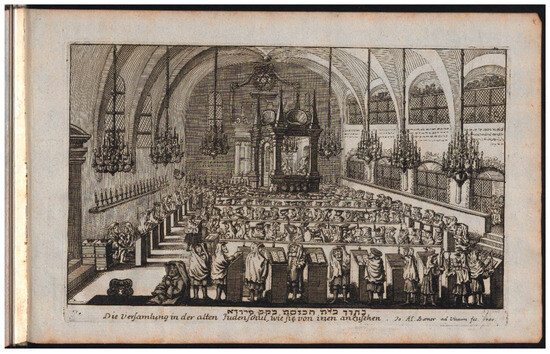
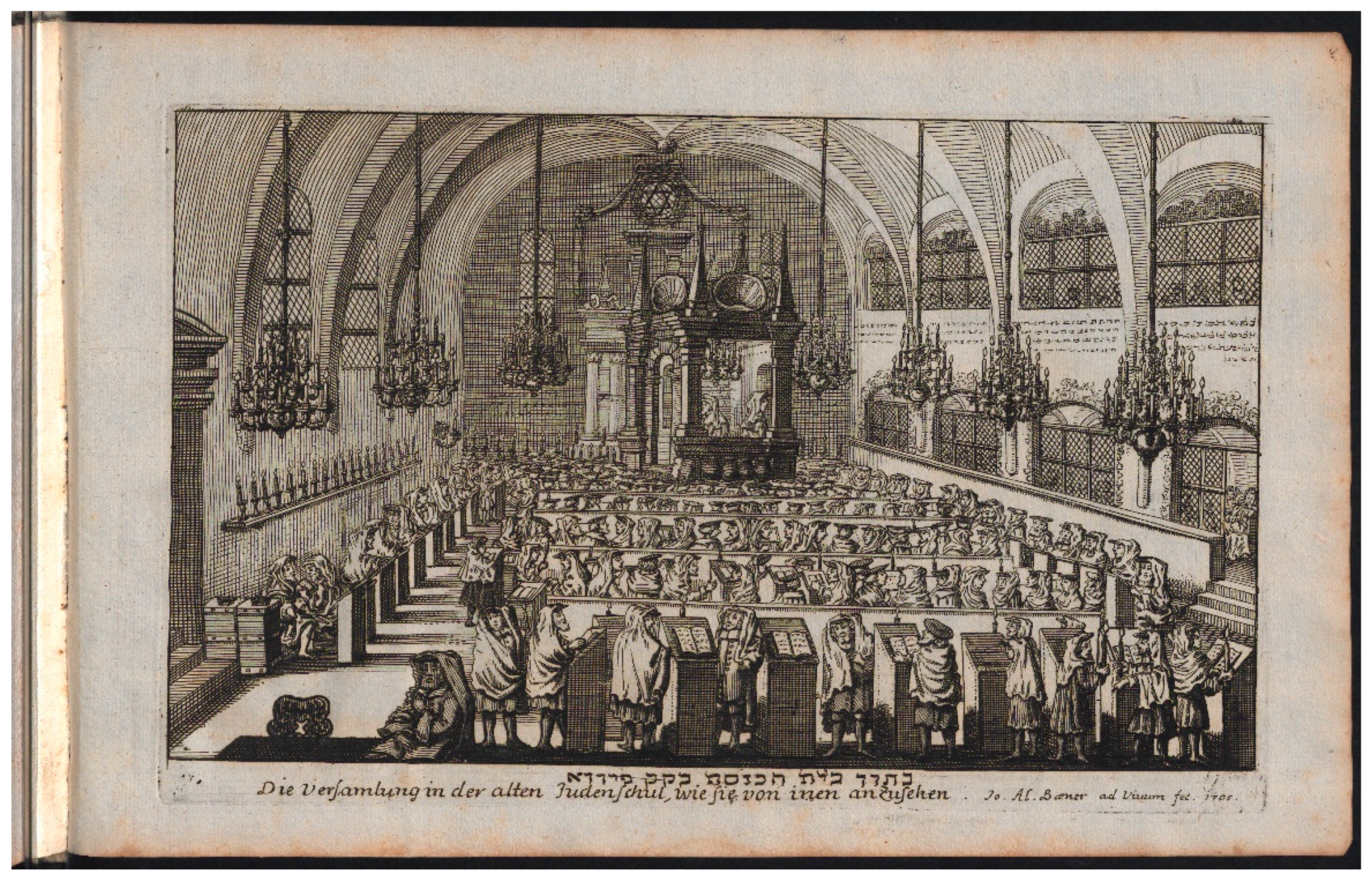
The Jews living in small villages could not manage the economic outlays required to imitate the design of urban Torah arks. In towns like Fürth and Frankfurt am Main, the Jewish communities built Torah arks whose grandeur included expensive materials, delicate craftsmanship, large dimensions, and monumental design (Figure 11; Ohm 2005, p. 11; Paulus 2007, p. 231). Crafting such Torah arks was beyond the means of small rural communities.
Figure 11.
Johann Alexander Boener, “Die Versamlung in der alten Jüdenschul…,” engraving from Kurzer Bericht von dem Alterthum und Freyheiten des freyen Hof-Markts Fürth (1705). ThULB Jena, 2 Bud.Misc.16(2).
Furthermore, rural synagogues and prayer rooms were smaller than synagogues in large cities and therefore could not house monumental Torah arks. Thus, like their rural Christian neighbors, small Jewish communities used paintings—a type of decoration they could afford—to beautify their interiors. Painting the Torah ark did not require the expensive materials and procedures needed for stone and wood carving. Painting made use of binding materials abundant in rural areas, such as animal glue and casein, enabling the hiring of the same craftsmen who decorated the synagogue interior (Orgad 2022a).
A second possible reason for rural Jews not to see the Jews of the nearby cities as role models was the disdainful attitude urban communities tended to take toward rural ones. This attitude is attested in many written sources. Urban Jews underestimated the level of education of the children of the rural communities and the level of the religious services provided there, and they tended to dismiss halachic rulings enacted in the rural areas—given, for the most part, by teachers rather than rabbis (Liberles 2005).
For example, Rabbi Yair Hayyim Bacharach, who lived in Koblenz in the seventeenth century, complained about inappropriate ritual slaughter in rural Jewish communities performed by a teacher who was not a certified Shohet (ritual slaughterer) (Kaplan 2016, p. 223). This derogatory attitude was addressed by Rabbi Haim ben Bezalel of Friedberg, who instructed that rural Jews be treated with respect when they came to pray in urban synagogues. Given this context, it is not surprising that rural Jews would not enthusiastically adopt the visual culture of their urban brethren.
Finally, many rabbis and teachers in German lands came from Eastern Europe (Liberles 2005). For example, in his memory book, Asher bar Eliezer Ha’Levi from Reichshoven, a trained mohel (ritual circumciser), ritual slaughterer, scribe, and cantor, mentioned, among his teachers in Prague, Shlomo Ephraim Luntschitz (1550–1619), who was born and educated in Poland, and Yeshayahu ben Avraham Ha-Levi Horowitz (1555–1630), who studied in Lublin (Asher bar Eliezer ha-Levi and Yona bar Simḥa Cohen 1913; Levin 2008, pp. 48–65). Among other rabbis who emigrated from Poland to German territories were Rabbi Pinḥas Kaẓenellenbogen of Podhajce, who was appointed head of Yeshiva in Fürth in 1700, and later as Rabbi of Schwabach; and Rabbi Baruch Kahana, who left Poland in 1710 and was appointed Rabbi of Fürth (Shulvass 1971, p. 78). Hence, Asher bar Eliezer, like other teachers in small villages in German lands, transferred Eastern European customs to the German-speaking space. This migration of rabbinic knowledge from east to west paved the way for the adoption of Eastern European visual culture among rural communities in German lands.
On the artistic level, Eliezer-Zusman of Brody was the first known Eastern European painter to be invited to adorn synagogues in German lands. His expressive style, which covered the rustic, unpolished surfaces with an elaborate world of flora and fauna, suited the small wooden synagogues. In his wall and ceiling paintings, Eliezer-Zusman drew on motifs prevalent throughout the Polish-Lithuanian Commonwealth, rather than on any single recognizable prototype. By contrast, a specific Torah ark—of the Chodorów synagogue—seems to have served as the model for the illusory three-tier Torah ark in the Bechhofen synagogue, and, to some extent, in Horb am Main.
Several factors might have motivated Eliezer-Zusman’s choice of the Chodorów Torah ark as a model. One is Eliezer-Zusman’s origins in Brody. Brody and Chodorów are both located in Lwów County, about 150 km from each other. Eliezer-Zusman was probably familiar with the Chodorów synagogue’s decorations, including its Torah ark. Perhaps he even visited the synagogue and copied its composition and some of its decorations, which he later applied in today’s southern Germany.
Another possible factor in the creation of painted decorations similar to the Chodorów Torah ark was the resemblance between the two Torah arks’ basic construction. Like in Bechhofen and Horb, a small cabinet stood in the heart of the three-tier Chodorów Torah ark. Around it was an assemblage of wooden strips carved in vegetal and zoomorphic motifs that expanded it to its final illusional measurements. Eliezer-Zusman employed the same system of strips and panels, but instead of carving, he used paintings to monumentalize the ark.
The emigration of the Ruthenian style to Jewish rural communities in German lands was understandable on psychological grounds. Small and fragile, despised by their urban neighbors and threatened by their Christian ones, the rural Jewish communities in Bavaria, Franconia, and Württemberg craved security and a sense of belonging. Bavaria faced periods of instability around the late 1600s and early 1700s, putting its Jewish community’s safety at risk. For instance, on Saturday, 23 May 1699, amid the famine that affected Germany, mobs attacked the Jewish neighborhoods in Burgkunstadt near Horb, looting 14 Jewish homes (Hamm et al. 2007, p. 107). In an unsafe environment, synagogues served as sanctuaries for local Jews, providing spaces in which they could feel protected and practice their religion without interference. Thanks to the interior and Torah ark paintings, the synagogue congregants transformed their plain rural surroundings into a space that welcomed them with a depiction of a thriving garden. When entering the synagogue, they could truly envision themselves in paradise or at least on the path to a heavenly future (Rodov 2006; Orgad 2022b).
In the social sphere, creating illusory multi-tiered Torah arks resembling the Ruthenian example of Chodorów connected the small Jewish communities of Bavaria, Franconia, and Württemberg to one of the largest and most vibrant Jewish centers in the Polish-Lithuanian Commonwealth. While these communities could not invite rabbis from Eastern Europe, their synagogues and wooden prayer rooms were well-suited to the adoption of Eastern European Jewish visual culture. Thus, the isolated rural Jewish communities could feel connected to a new and developing artistic style that reflected the strength and vitality of large, seemingly powerful Eastern European Jewish communities.
Ironically, the arrival of Jewish painters like Eliezer-Zusman from Eastern Europe signaled, among other things, the decline of Jewish communities there. This process began in the second half of the seventeenth century, when Poland experienced several catastrophes one after the other, including Khmelnytskyi’s Cossack rebellion (1648–1649) and the Swedish invasion (“Swedish Deluge,” 1655–1660) (Hundert 1989; Halperin 1992). All of these factors caused widespread migration from the east to the west, including to German lands, where Jewish communities’ wealth peaked in the 1720s as many jobs suitable for Jews from all social strata emerged (Shulvass 1971, pp. 51–54).
The pressures that caused Jewish migration from Poland are clearly shown in Brody, the hometown of the painter Eliezer-Zusman. From the 1690s through the early 1700s, the town faced long periods of economic instability. Repeated military levies and the passage of foreign troops placed a heavy financial strain on the town, while frequent fires, such as those in 1696 and 1715, damaged its infrastructure and commerce (Barącz 1865, pp. 72, 87). Contemporary descriptions speak of stagnation, growing debt, forced house sales, and public auctions of movable property, putting many residents at risk of ruin (Wurm 1935, pp. 12, 14). These pressures affected the entire urban population, including the Jewish community, which was deeply involved in the town’s trade and crafts. In 1708, some Jews from Brody fled the city. According to Rabbi Hirsch Auerbach, who later became a rabbi in Worms, their flight was driven by heavy taxes and the presence of informants. As Auerbach wrote, “German lands became a place of refuge for Polish Jews.” Eliezer-Zusman’s move westward can be understood within this specific historical climate of financial strain and insecurity, as he sought a safer life in the German countryside.
6. Conclusions
This study has shown that painted Torah arks in early modern rural synagogues across Bavaria, Franconia, and Württemberg were, on the one hand, economical alternatives to carved furnishings and, on the other, active elements in shaping ritual space. By applying the same pictorial techniques to walls, ceilings, and arks, painters such as Eliezer-Zusman of Brody created visually seamless interiors that unified architecture, decoration, and liturgical focus into a cohesive sacred setting. Through illusionistic expansion and symbolic motifs, humble wooden cabinets were transformed into monumental structures linked to the Jerusalem Temple and heightening devotional experience.
More broadly, these works demonstrate how material religion adapts through various means. For Jewish communities that were socially and geographically marginalized, economically disadvantaged, and often viewed by urban Jews as culturally insular, paintings provided an accessible way to engage with the esteemed visual traditions of Eastern European Jewry. The painted ark thus became a tool for religious and social identity, allowing rural congregations to negotiate their outsider status and assert their place within a larger Jewish community. In this manner, the spread of painted forms shows how sacred space reflects aspirations, mobility, and identity across cultural boundaries.
Funding
This research was supported by the Israel Science Foundation (ISF), grant no. 2872/25.
Institutional Review Board Statement
Not applicable.
Informed Consent Statement
Not applicable.
Data Availability Statement
No new data were created or analyzed in this study.
Conflicts of Interest
The author declares no conflicts of interest.
References
- Adamczyk, Raimund. 1988. Bemalte Möbel des Sechsämterlandes. Arzberg: Zweckverband Volkskundliches Gerätemuseum Arzberg-Bergnersreuth. [Google Scholar]
- Asher bar Eliezer ha-Levi, and Yona bar Simḥa Cohen. 1913. Sefer Zichronot. Edited by Moshe ben Meir Ginzburg. Berlin: L. Lamm, (In Hebrew, with German translation). [Google Scholar]
- Assouline, Hadassah, Monika Berthold-Hilperr, Sibylle Kussmaul, Denise Rein, Bernhard Purin, and Annette Weber. 1998a. Die Inventarisation jüdischer Kunst- und Kulturdenkmäler in Bayern. Fürth: Das Jüdische Museum, vol. II. [Google Scholar]
- Assouline, Hadassah, Monika Berthold-Hilperr, Sibylle Kussmaul, Denise Rein, Bernhard Purin, and Annette Weber. 1998b. Die Inventarisation jüdischer Kunst- und Kulturdenkmäler in Bayern. Fürth: Das Jüdische Museum, vol. III. [Google Scholar]
- Barącz, Sadok. 1865. Wolne miasto handlowe Brody. Lwów: Drukarnia Instytutu Stauropigiańskiego. [Google Scholar]
- Battenberg, Johannes Friedrich. 1997. Aus der Stadt auf das Land? Zur Vertreibung und Neuansiedlung der Juden im Heiligen Römischen Reich. In Jüdisches Leben auf dem Lande. Edited by Monika Richarz and Reinhard Rürup. Tübingen: Mohr Siebeck, pp. 9–35. [Google Scholar]
- Bauer, Ingolf, ed. 1991. Möbel aus Franken: Oberflächen und Hintergründe. Munich: Hirmer. [Google Scholar]
- Bedal, Konrad. 2009. Aufgemöbelt! Die schönsten Möbel aus der Sammlung des Fränkischen Freilandmuseums in Bad Windsheim: Frühe Möbel, Bunte Möbel, Braune Möbel. Unter Mitarbeit von Herbert May und Beate Partheymüller. Bad Windsheim: Fränkisches Freilandmuseum. [Google Scholar]
- Beuckers, Klaus Gereon. 2011. Die mittelalterlichen Wandmalereien zwischen Rhein, Neckar und Enz. Ubstadt-Weiher: Regionalkultur. [Google Scholar]
- Carrier, David. 2008. A World Art History and Its Objects. University Park: Penn State University Press. [Google Scholar]
- Davidovich, David. 1968. Eliezer Zusman of Brody Exhibition: Synagogue Painter in Germany in the Eighteenth Century. Tel Aviv: Muze’on ha-Aretz. (In Hebrew) [Google Scholar]
- Davidovich, David. 1982. Art and Artists in the Polish Synagogues. Tel Aviv: Hakibbutz Hameuchad. (In Hebrew) [Google Scholar]
- Dobler, Uwe. 1992. Barockmöbel: Bürgerliche Möbel aus zwei Jahrhunderten. Augsburg: Battenberg. [Google Scholar]
- Feuchtwanger-Sarig, Naomi. 2017. Synagoga veritas? Johannes Pfefferkorn and his synagogue descriptions. In Revealing the Secrets of the Jews. Edited by Jonathan Adams and Cordelia Hess. Berlin: De Gruyter, pp. 97–119. [Google Scholar]
- Gebhard, Torsten. 1982. Oberbayerische Bauernmöbel. Munich: Callwey. [Google Scholar]
- German, Wilhelm. 1928. Die Holzsynagoge in Schwäbisch Hall. Schwäbisches Heimatbuch 14: 30–35. [Google Scholar]
- Goldman-Ida, Batsheva. 2020. Synagogues in Central and Eastern Europe in the early modern period. In Jewish Religious Architecture. Edited by Steven Fine. Leiden: Brill, pp. 184–207. [Google Scholar]
- Haarscher, André-Marc. 1997. Les Juifs du comté de Hanau-Lichtenberg. Strasbourg: Société Savante d’Alsace. [Google Scholar]
- Halperin, Israel. 1992. Jewish refugees of the Thirty Years’ War in Eastern Europe. Ẓion 27: 199–215. (In Hebrew) [Google Scholar]
- Hamm, Berndt, Wolfgang Kraus, and Meier Schwarz, eds. 2007. Mehr als Steine… Synagogen-Gedenkband Bayern: Teilband 1: Oberfranken, Oberpfalz, Niederbayern, Oberbayern, Schwaben. Lindenberg im Allgäu: Josef Fink. [Google Scholar]
- Heller, Ena Giurescu. 2020. Western Ashkenazi synagogues in medieval and early modern Europe. In Jewish Religious Architecture. Edited by Steven Fine. Leiden: Brill, pp. 169–83. [Google Scholar]
- Herold, Eva. 1993. Bemalte Möbel im Coburger Land. Coburg: Mühle Bertelsdorf. [Google Scholar]
- Huberman, Ida. 1979. Painted Ceilings in Wooden Synagogues in Southeastern Poland. Master’s thesis, Tel Aviv University, Tel Aviv, Israel. [Google Scholar]
- Hubka, Thomas C. 2003. Resplendent Synagogue: Architecture and Worship in an Eighteenth-Century Polish Community. Hanover: University Press of New England. [Google Scholar]
- Hundert, Gershon David. 1989. The fading of veneration in Polish-Lithuanian Jewish communities. Bar-Ilan University Yearbook 24–25: 41–50. (In Hebrew) [Google Scholar]
- Jewish Publication Society. 1917. The Holy Scriptures According to the Masoretic Text: A New Translation with the Aid of Previous Versions and with Constant Consultation of Jewish Authorities. Philadelphia: Jewish Publication Society of America. [Google Scholar]
- Kaplan, Debra. 2016. Rural Jewry as seen through the lens of rabbinic responsa. In Juden und ländliche Gesellschaft in Europa. Edited by Sigrid Hirbodian. Wiesbaden-Erbenheim: Harrassowitz, pp. 215–30. [Google Scholar]
- Kaplan, Debra. 2020. Beyond Expulsion: Jews, Christians and Reformation Strasbourg. Stanford: Stanford University Press. [Google Scholar]
- Klein, Almuth, and Petra Krutisch. 2015. Schränke und Kommoden, 1650–1800 im Germanischen Nationalmuseum. Ostfildern: Hatje Cantz. [Google Scholar]
- Kuczera, Dietrich Christian. 2018. Die Kunst des Mittelalters in Dorfkirchen der Region Harz/Kyffhäuser. Nordhausen: Traugott Bautz. [Google Scholar]
- Levin, Leonard S. 2008. Seeing with Both Eyes: Ephraim Luntshitz and the Polish-Jewish Renaissance. Leiden: Brill. [Google Scholar]
- Liberles, Robert. 2005. On the threshold of modernity: 1618–1780. In Jewish Daily Life in Germany, 1618–1945. Edited by Marion A. Kaplan. New York: Oxford University Press, pp. 9–92. [Google Scholar]
- Maierbacher-Legl, Gerdi. 1997. Truhe und Schrank. Munich: Deutscher Kunstverlag. [Google Scholar]
- Margaritha, Antonius. 1530. Der gantz Jüdisch Glaub. Augsburg: Heinrich Steiner. [Google Scholar]
- Motschmann, Josef. 1985. 250 Jahre Synagoge von Horb am Main. Vom Main zum Jura 2: 7–33. [Google Scholar]
- Ohm, Barbara. 2005. Durch Fürth Geführt. Fürth: GH-Dr. [Google Scholar]
- Ophir, Baruch Zvi. 1973. Congregations’ Notebook: Encyclopedia of Jewish Communities—Germany, Bavaria. Jerusalem: Yad Vashem. (In Hebrew) [Google Scholar]
- Orgad, Zvi. 2022a. Eliezer-Zusman of Brody: The Early Modern Synagogue Painter and His World. Leiden: Brill. [Google Scholar]
- Orgad, Zvi. 2022b. The Horb synagogue: Retracing roots. Ars Judaica 18: 157–66. [Google Scholar] [CrossRef] [Scilit]
- Panter, Armin. 2006. Die Unterlimpurger Synagogenvertäfelung des Eliezer Sussmann. Schwäbische Heimat 3: 270–76. [Google Scholar]
- Panter, Armin. 2015. Die Haller Synagogen des Elieser Sussmann. Künzelsau: Hällisch-Fränkisches Museum. [Google Scholar]
- Paulus, Simon. 2007. Die Architektur der Synagoge im Mittelalter. Petersberg: Imhof. [Google Scholar]
- Pfefferkorn, Johannes. 1508. Ich heys ain büchlein der Iudenpeicht. Augsburg: Jörg Nadler. [Google Scholar]
- Piechotka, Kazimierz, and Maria Piechotka. 2015a. Heaven’s Gates: Masonry Synagogues. Warsaw: Polish Institute of World Art Studies. [Google Scholar]
- Piechotka, Kazimierz, and Maria Piechotka. 2015b. Heaven’s Gates: Wooden Synagogues. Warsaw: Polish Institute of World Art Studies. [Google Scholar]
- Porzelt, Christian. 2022. Ein Haus und seine Bewohner. Vom Main zum Jura 31: 87–96. [Google Scholar]
- Rodov, Ilia. 2006. The marvelous garden. In Timorah: Articles on Jewish Art. Edited by Bracha Yaniv. Ramat Gan: Bar-Ilan University, pp. 111–32. (In Hebrew) [Google Scholar]
- Rohrbacher, Stefan. 1997. The emergence of Jewish rural communities in early modern times. In Mappot… Blessed Be Who Comes. The Band of Jewish Tradition. Mappot… Gesegnet, der da kommt. Das Band jüdischer Tradition. Edited by Annette Weber, Evelyn Friedlander and Fritz Armbruster. Osnabrück: Secolo, pp. 35–41. [Google Scholar]
- Rosenstein, Uri Shraga, Shlomo Katanka, and Mordechai Doerfer. 2011. Makom Shenahagu: Minhag Bechhofen. London: Machon Moreshet Ashkenaz. (In Hebrew) [Google Scholar]
- Schindler, Thomas, and Heinrich Ring. 2019. Möbel aus Südfranken: Bestandskatalog. Heideck: Heimatkundliche Sammlung Heideck. [Google Scholar]
- Schwarze, Wolfgang. 1975. Antike deutsche Möbel. Wuppertal: Kunst und Wohnen. [Google Scholar]
- Schwierz, Israel. 1988. Steinerne Zeugnisse jüdischen Lebens in Bayern. Munich: Bayerische Landeszentrale für politische Bildungsarbeit. [Google Scholar]
- Shadmi, Tamar. 2011. Wall Inscriptions in East European Synagogues: Their Sources, Meanings, and Role in Shaping the Concept of Space and Worship. Ph.D. thesis, Bar-Ilan University, Ramat Gan, Israel. (In Hebrew) [Google Scholar]
- Shulvass, Moses Avigdor. 1971. From East to West. Detroit: Wayne State University Press. [Google Scholar]
- Stiefel, Barry L. 2014. Jews and the Renaissance of Synagogue Architecture, 1450–1730. London: Pickering and Chatto. [Google Scholar]
- Stimpfig, Karl Ernst. 2001. Die Juden in Leutershausen, Jochsberg, Colmberg und Wiedersbach. Leutershausen: Majer. [Google Scholar]
- Timmermann, Achim. 2009. Real Presence: Sacrament Houses and the Body of Christ, c. 1270–1600. Turnhout: Brepols. [Google Scholar]
- Töplitz, Erich. 1923. Wall paintings in synagogues of the 17th and 18th centuries. Rimon 3: 1–8. (In Hebrew) [Google Scholar]
- Wagner, Engelbert. 1983. Oberfränkische Bauernmöbel. Munich: Callwey. [Google Scholar]
- Ward-Perkins, John Bryan. 1952. The shrine of St. Peter and its twelve spiral columns. The Journal of Roman Studies 42: 21–33. [Google Scholar] [CrossRef] [Scilit]
- Wurm, Dawid. 1935. Z dziejów Żydostwa Brodzkiego za czasów dawnej Rzeczypospolitej Polskiej (do r. 1772). Brody: Nakładem Gminy Wyznaniowej Żydowskiej. [Google Scholar]
- Yaniv, Bracha. 1999. The cherubim on Torah ark valances. Assaph 4: 155–70. [Google Scholar]
- Yaniv, Bracha. 2003. The three crowns motif in East European Torah arks. Kenishtah 2: 67–87. (In Hebrew) [Google Scholar]
- Yaniv, Bracha. 2017. The Carved Wooden Torah Arks of Eastern Europe. Liverpool: Littman Library of Jewish Civilization. [Google Scholar]
Disclaimer/Publisher’s Note: The statements, opinions and data contained in all publications are solely those of the individual author(s) and contributor(s) and not of MDPI and/or the editor(s). MDPI and/or the editor(s) disclaim responsibility for any injury to people or property resulting from any ideas, methods, instructions or products referred to in the content. |
© 2026 by the author. Licensee MDPI, Basel, Switzerland. This article is an open access article distributed under the terms and conditions of the Creative Commons Attribution (CC BY) license.