


Abstract
This article presents a newly excavated Iron Age IIA cult room from Tel Lachish (Sanctuary BBE4) and examines its significance for the study of the organization of religious practice, situating this case within the broader corpus of Iron Age I–IIA local sanctuaries in Judah and the southern Levant. The evidence suggests that early Iron Age ritual practice was organized primarily at the level of extended kin groups, materialized in modest intramural cult rooms embedded within residential neighborhoods. These spaces reflect decentralized forms of religious authority, contrasting with the temple-centered ritual systems of the Bronze Age and with the increasing centralization of cult and religious authority in later phases of the Iron Age. By situating the Lachish evidence within a broader diachronic and regional framework, the study explores changing relationships between household ritual practices, kin-based social organization, and the development of state-level religious institutions in early Judah.
1. Introduction
Scholars have long sought to reconstruct the social structure of early Israelite society on the basis of biblical traditions, the archaeological record, and comparative historical and ethnographic evidence. Early research frequently assumed—explicitly or implicitly—that Israelite society underwent a fundamental transformation with the rise of the monarchy: from a kinship-based and relatively egalitarian society, structured around the bêt ʾāb (extended family), the mišpāḥâ (clan or lineage), and the šēbeṭ (tribe), to a centralized political system dominated by royal institutions that gradually eclipsed earlier kinship frameworks (see Vanderhooft 2009, pp. 485–86 with references).1
More recent scholarship has emphasized the persistence of kinship ties as a central organizing principle throughout the Iron Age, supported by both architectural continuity in household organization and administrative evidence for the ongoing role of clans (mišpāḥôt), as attested in the Samaria ostraca (Faust and Bunimovitz 2003; Schloen 2001, pp. 155–65; Stager 1985).
Yet these observations do not necessarily indicate social stasis. A more nuanced perspective, emerging from both archaeological and textual sources, suggests that while kinship remained foundational, its political, economic, and religious significance was increasingly renegotiated as social hierarchy deepened and centralized royal authority expanded (Faust 2012, pp. 13–23; Halpern 1996; Lehmann 2023). Within this framework, changes in the organization and spatial setting of cultic activity offer a revealing window onto shifting social dynamics, as well as the ways in which religious authority and ritual practice were structured and negotiated, and thus provide a valuable basis for assessing the broader transformations that shaped Israelite and Judahite society during the Iron Age.
The Israelite cult and its archaeological manifestations have been the subject of extensive scholarly discussion. Major studies have surveyed excavated cult places of the Iron Age southern Levant and classified them into various typological categories in an effort to reconstruct patterns of cultic organization (e.g., Alpert Nakhai 2001; Holladay 1987; Schmitt 2014; Zevit 2001). Faust (2010, 2019a) has argued, however, that such surveys disproportionately rely on exceptional cases in which buildings explicitly dedicated to cult were identified—structures that in fact represent a rare phenomenon. According to this view, the Israelite cult was more commonly practiced in modest settings, including domestic contexts as well as intramural and extramural open spaces.
While this reconstruction is highly plausible, it rests largely on negative evidence derived from sites that were extensively excavated—such as Tell Beit Mirsim, Beth-Shemesh, Tel Sheva, and Tell en-Naṣbeh—where no clearly defined cult buildings were identified (Faust 2019a, pp. 9–14). Importantly, these observations derive primarily from strata associated with the late phases of the Kingdom of Judah, mainly the late eighth century BCE. Consequently, this picture may not be fully representative of earlier stages of the Iron Age.
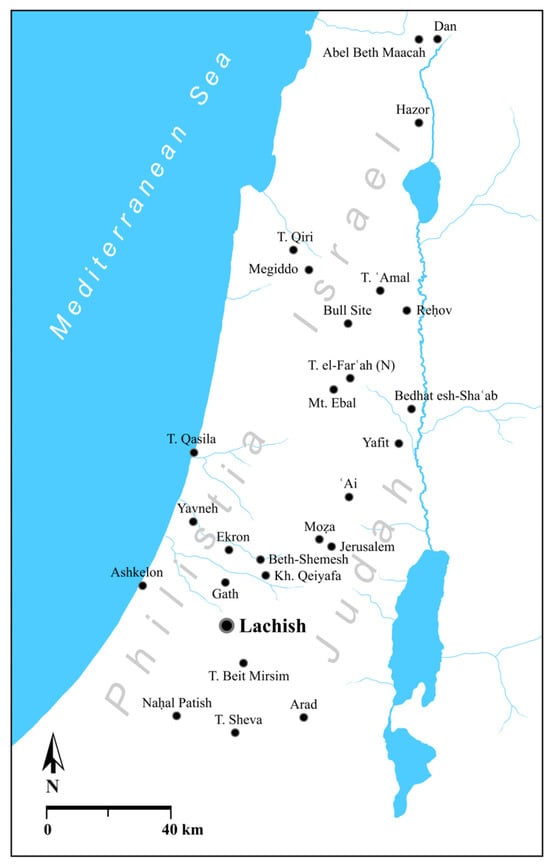
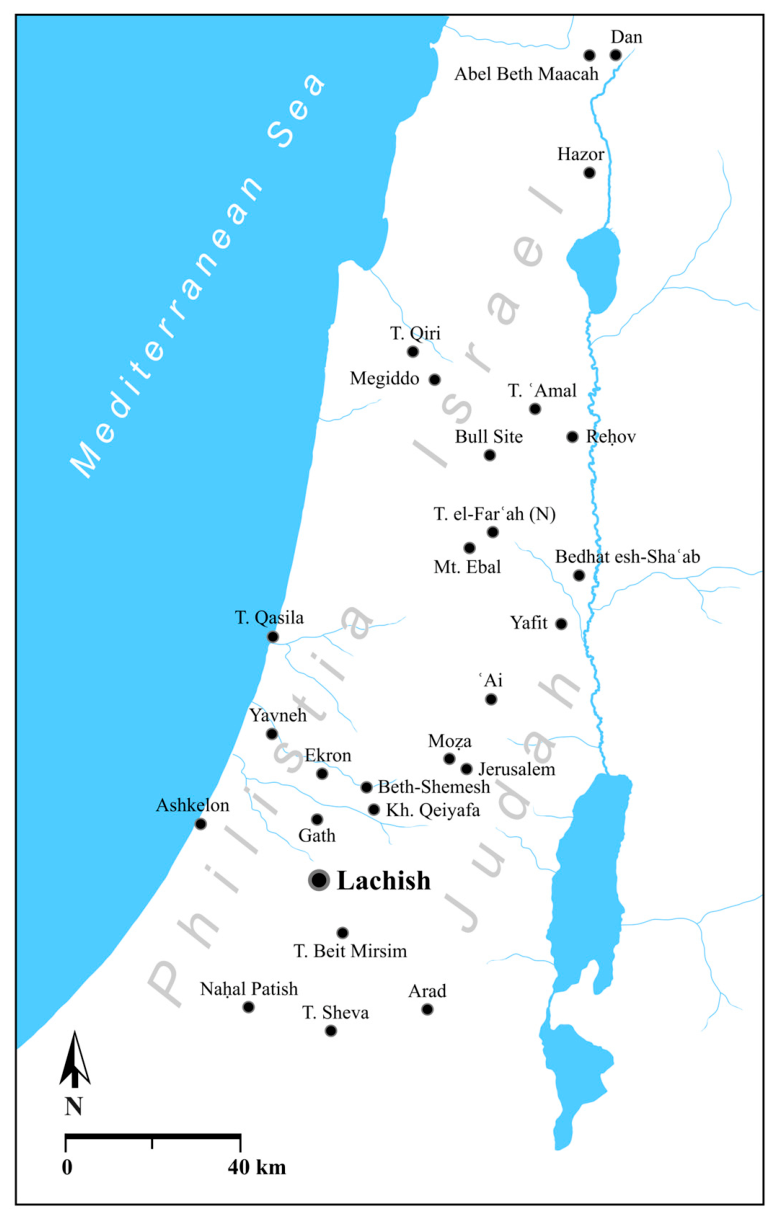
It is from this perspective that the present study introduces a recently uncovered Iron Age IIA sanctuary at Tel Lachish (Figure 1; Sanctuary BBE4). Examined alongside Sanctuary 49, excavated at the site several decades ago (Aharoni 1975, pp. 12, 26–31), as well as additional cult rooms of the same period across Judah and the southern Levant, this new context provides an opportunity to reassess the organization of cultic activity during the early stages of the Iron Age.
Figure 1.
Map of the southern Levant showing the location of Lachish and other sites mentioned in the text (drawing by the author).
By placing these Iron Age IIA sanctuaries within a broader chronological framework between the Bronze Age and the later Iron Age, the study examines how shifts in the spatial setting of ritual reflect transformations in cultic organization and changing relationships between kin-based groups, households, and emerging state institutions in the southern Levant, with particular reference to Iron Age Judah.
2. The Iron Age IIA Sanctuary BBE4 at Tel Lachish
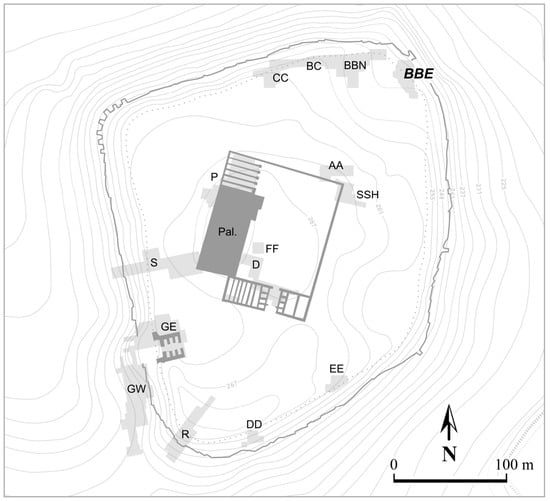
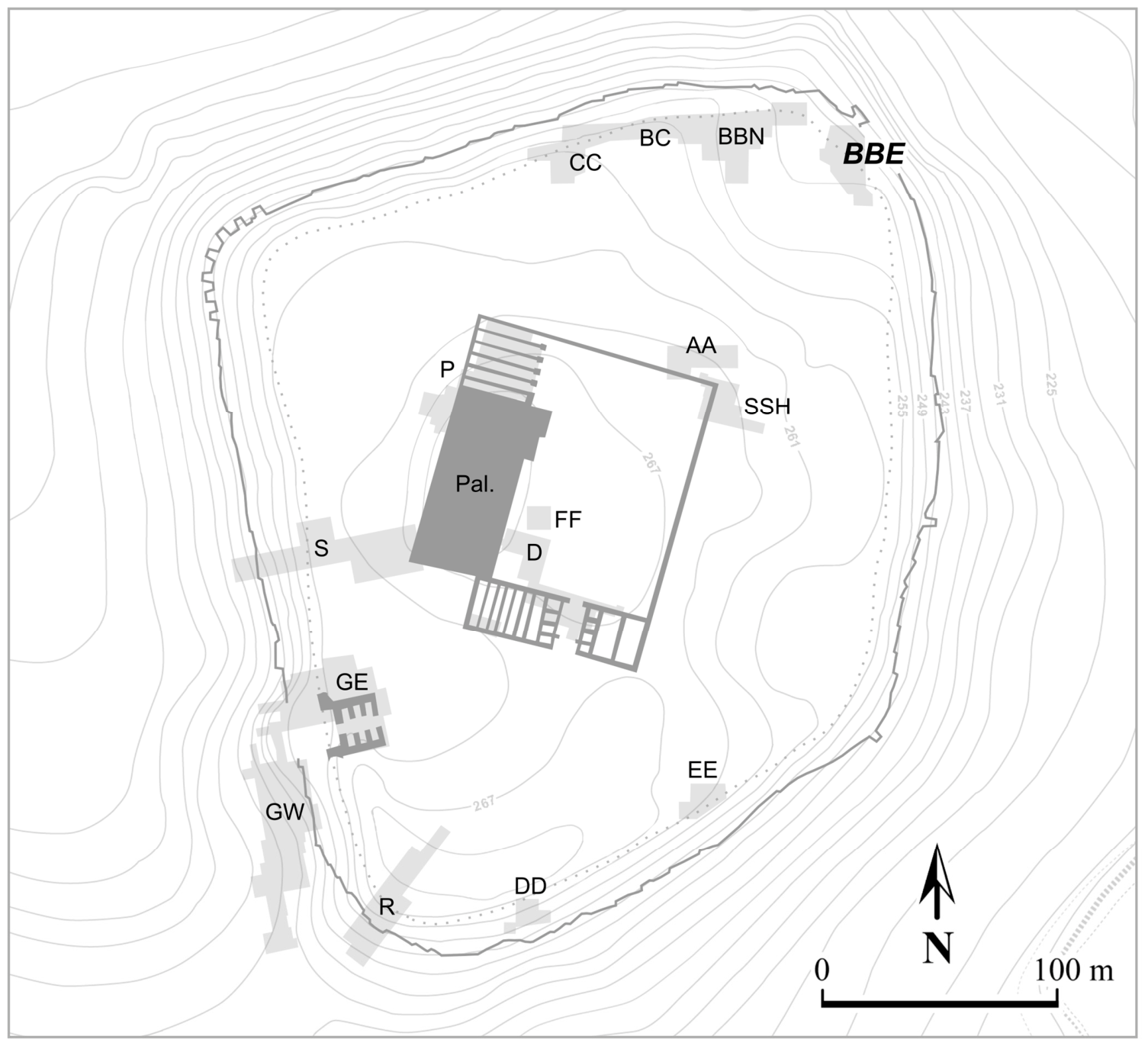
Recent excavations by the Fourth Expedition to Lachish2 revealed a small Iron Age IIA cult room in Area BBE, within local Stratum BBE4 (Figure 1, Figure 2 and Figure 3). Stratum BBE4 comprises an open area (Unit A) and an adjoining structure (Units B and C), within which cultic activity was identified, concentrated primarily in the narrow Room B. The units were constructed along a moderate northeastward slope, resulting in a height difference of approximately 50 cm between the floor of Unit A and those of Units B and C.
Figure 2.
Map of Tel Lachish showing the locations of the main excavation areas; Area BBE, where Sanctuary BBE4 was uncovered, is highlighted (drawing by the author).
Figure 3.
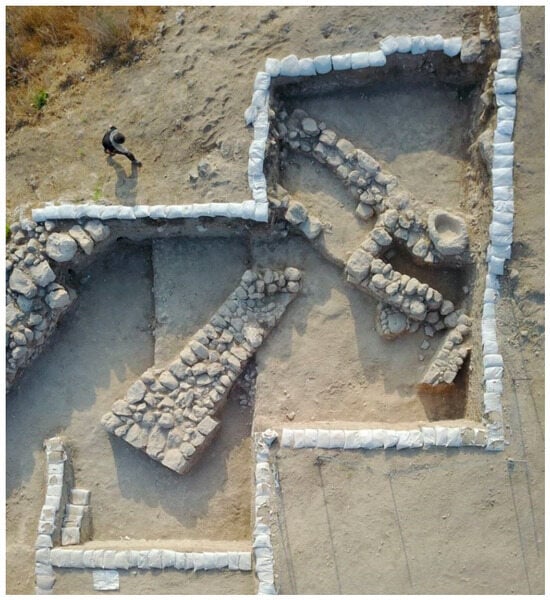
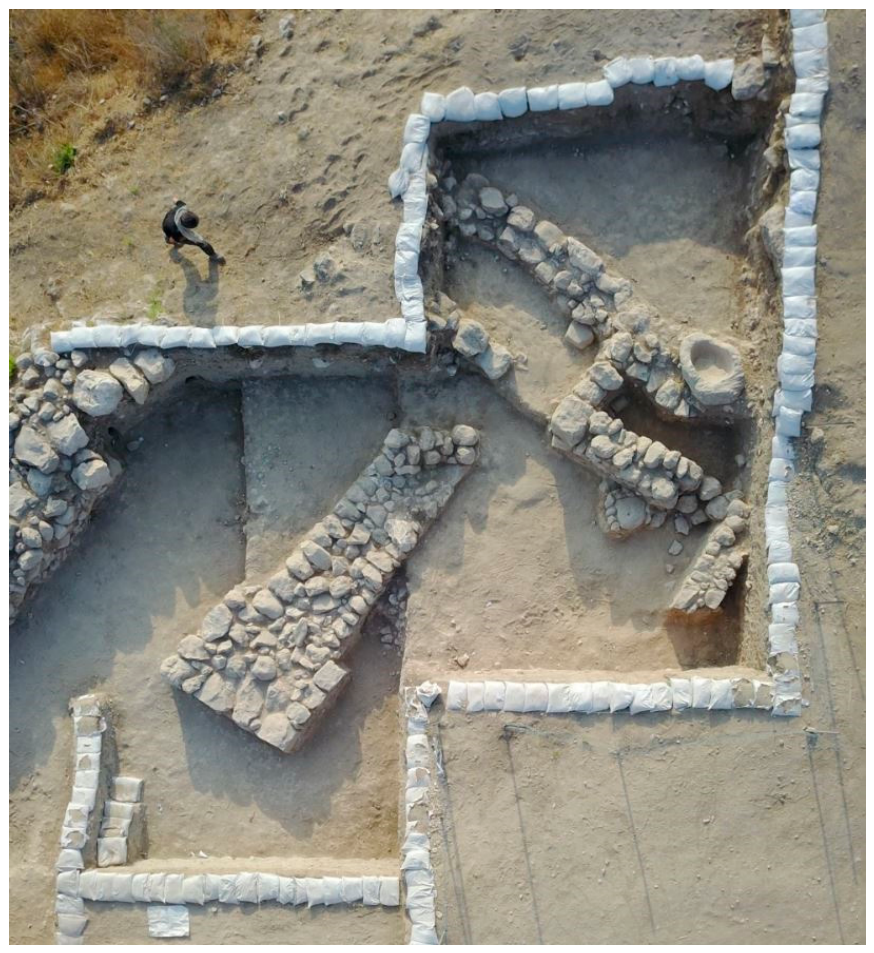
Aerial photograph of Sanctuary BBE4, visible in the upper part of the image, view to the east. The photograph was taken after the removal of Installation BB2527 and shows an earlier Iron Age IIA wall in the center of the image and the Iron Age IIC city wall on the left (photograph by E. Aladjem).
Stratum BBE4 represents the latest of three local Iron Age IIA strata exposed in Area BBE and most likely dates to the ninth century BCE. Because the wide mudbrick city wall marking the beginning of Level IV was not preserved in this area, it remains uncertain whether the stratum predates the wall and should therefore be assigned to a later phase of Level V, or whether it is contemporary with the wall and thus belongs to Level IV. The remains of Stratum BBE4 were found directly beneath the Persian-period city wall (Stratum BBE2, Level I), whose construction apparently removed any later Iron Age II deposits.
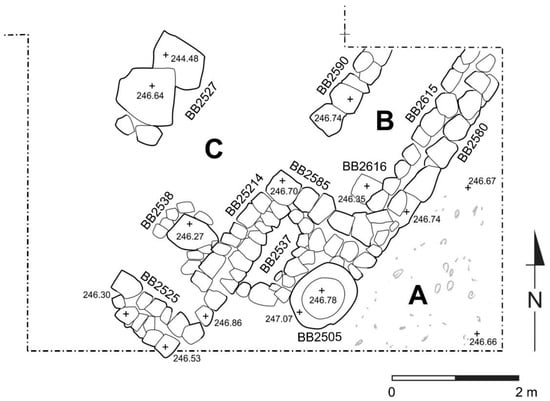
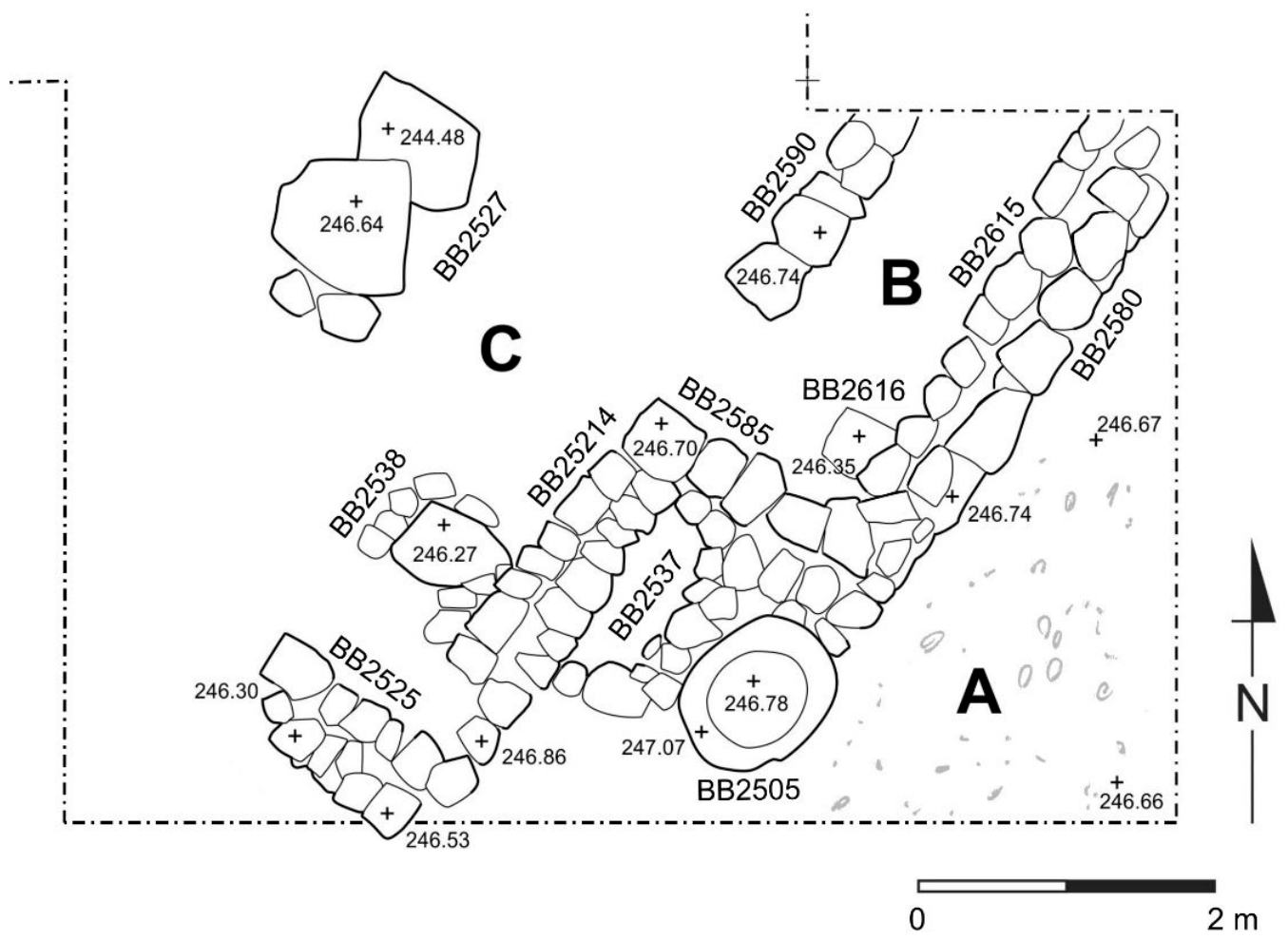
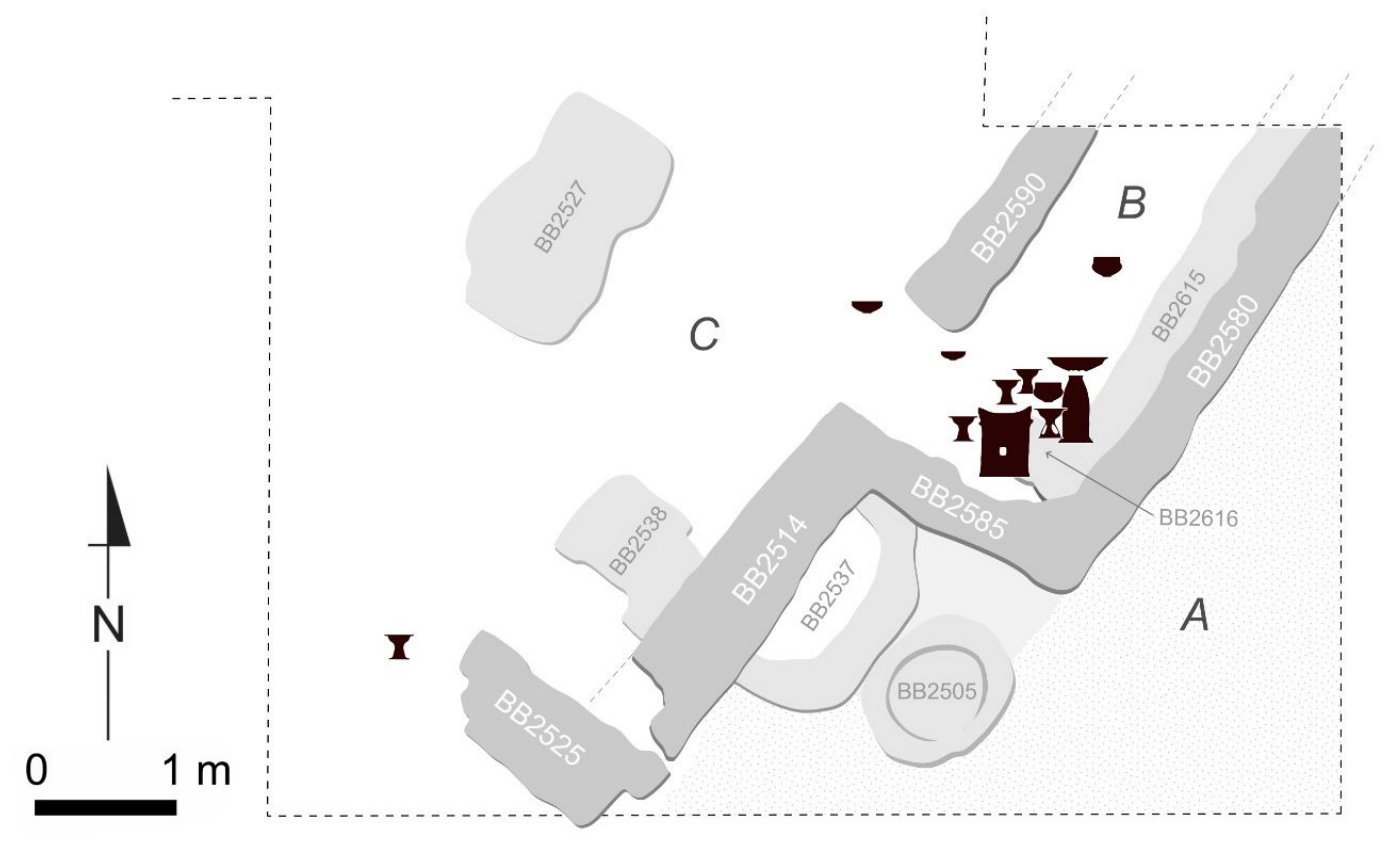
The structure was only partially exposed and consists of Units B and C, bounded on the east by the open area of Unit A, which has a cobbled and partially plastered surface (Figure 3 and Figure 4). A silo (BB2537) and a large stone basin (BB2505) were uncovered within this space, which may have functioned as a courtyard, plaza, or street. Unit C, the larger of the two rooms, likely served as the central room or inner courtyard. From Unit C, a narrow opening led into the elongated broad room of Unit B, measuring approximately 1 m in width and at least 3.5 m in length and projecting eastward beyond the building’s exterior line.
Figure 4.
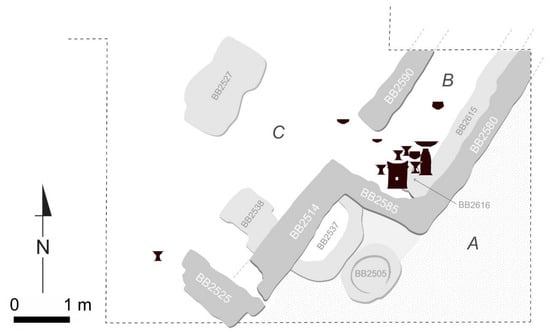
Plan of Sanctuary BBE4 (drawing by J. Rosenberg). The letters indicate architectural units: A represents an open area (courtyard, plaza, or street); B and C denote the sanctuary structure.
Two stone-built installations were uncovered in Unit C. Installation BB2538 consists of a large stone slab surrounded by smaller stones and is located beside the entrance to Unit B. Installation BB2527, positioned approximately 2 m in front of the entrance to Room B, comprises two stone slabs, the southern of which bears a shallow depression. Unit C had an earthen floor and was filled with compact sediment containing mudbrick debris, ash pockets, and concentrations of collapsed stones, particularly along Wall BB2514. Fills beneath the floor contained mixed Iron Age IIA and Late Bronze Age pottery. A rare New Kingdom diorite scarab set in a gold bezel was discovered in a fill excavated beside the western side of Installation BB2527 (Brandl et al. 2019).
Cultic activity was concentrated in Room B. Access to this narrow broad room was through an opening in its southwestern corner (Figure 4 and Figure 5). Along the eastern long wall ran a low bench or shelf (BB2615). At the foot of the bench, opposite the entrance and aligned with Installation BB2527 in Room C, stood a square stone with a flat upper surface (BB2616; c. 40 × 35 cm).
Figure 5.
Spatial distribution of restorable pottery vessels in Sanctuary BBE4 (drawing by the author).
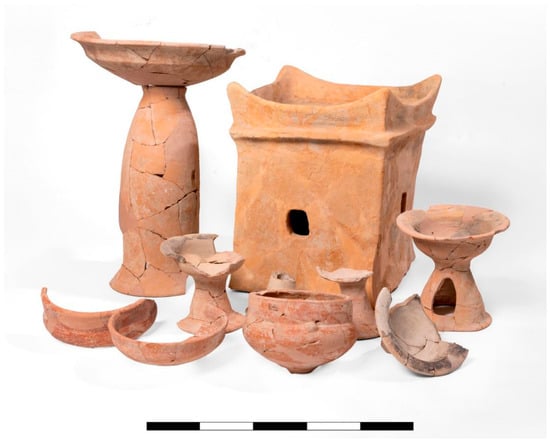
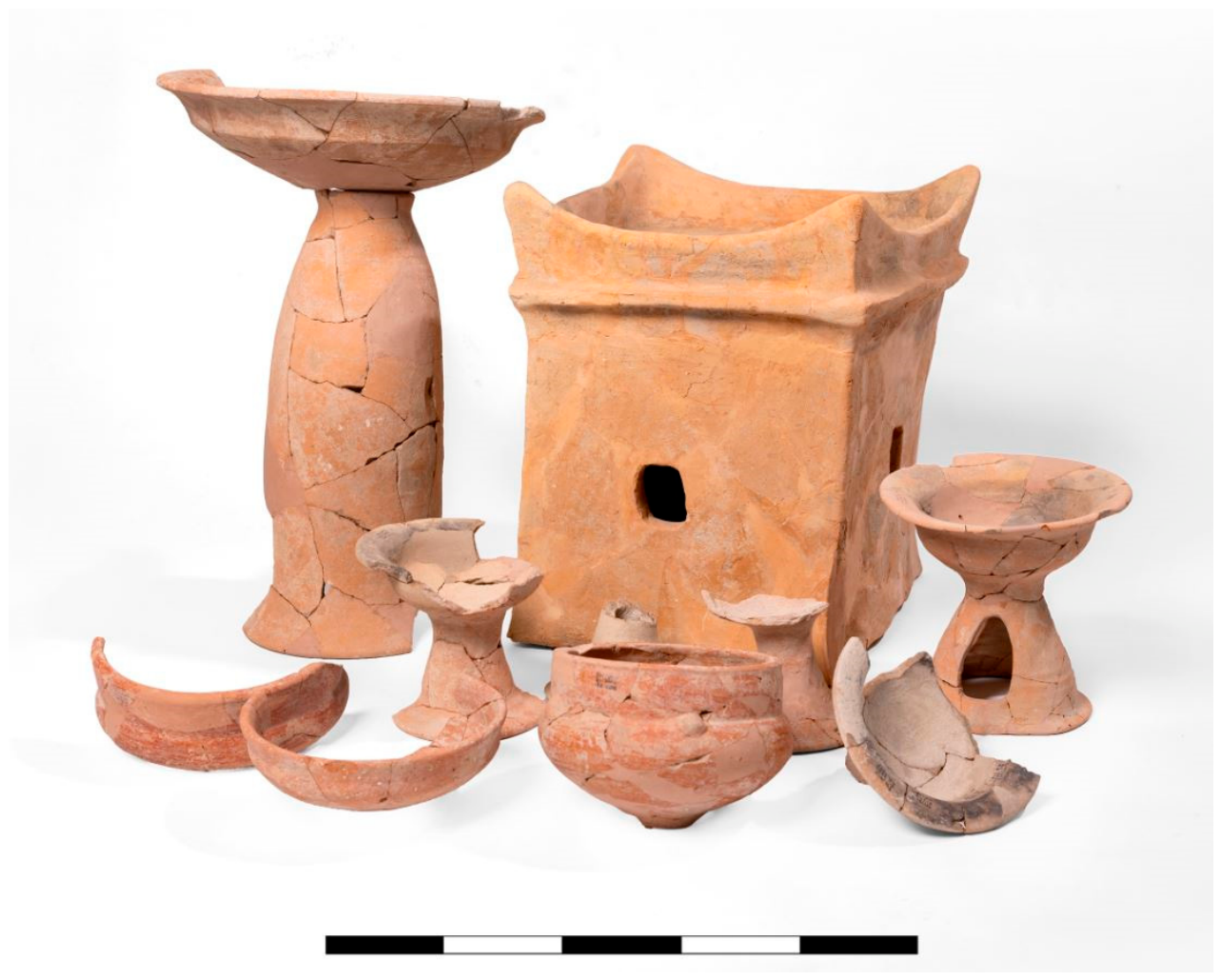
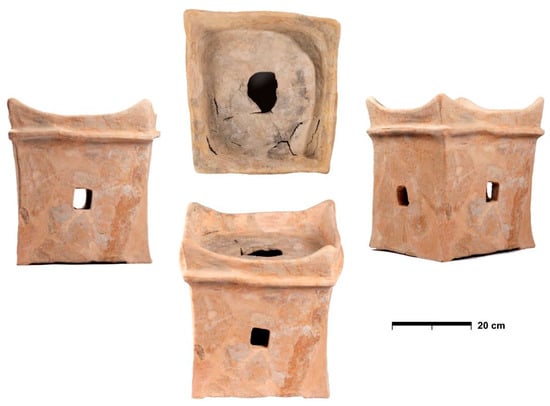
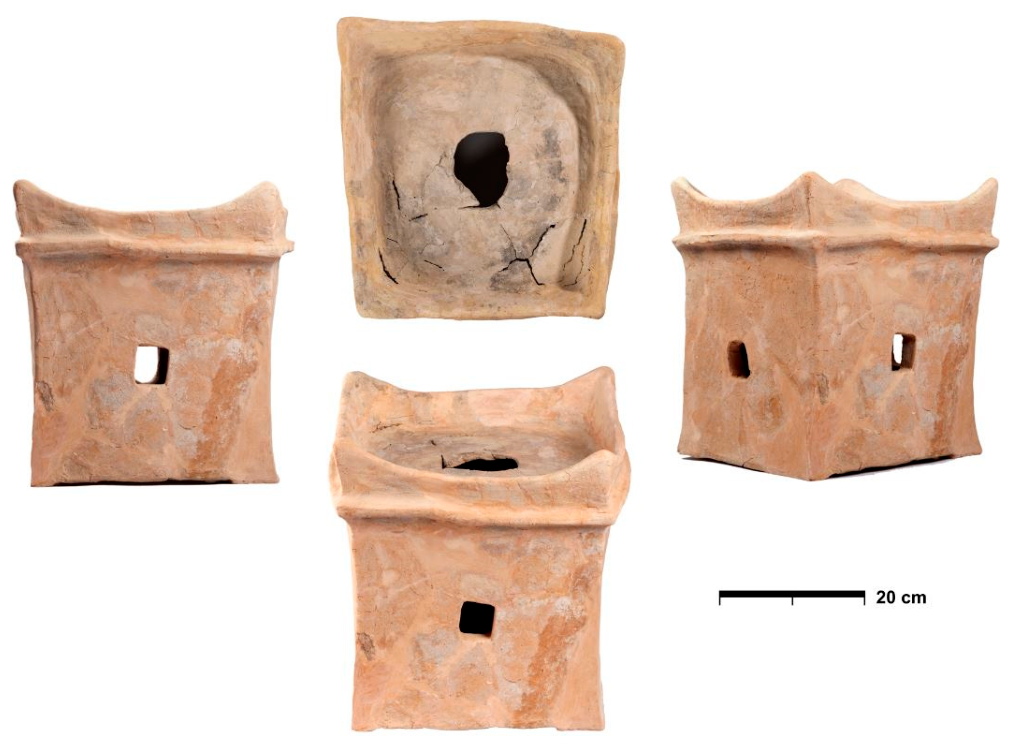
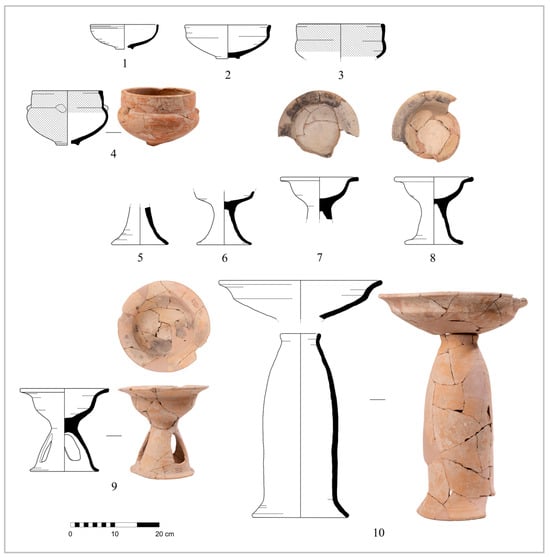
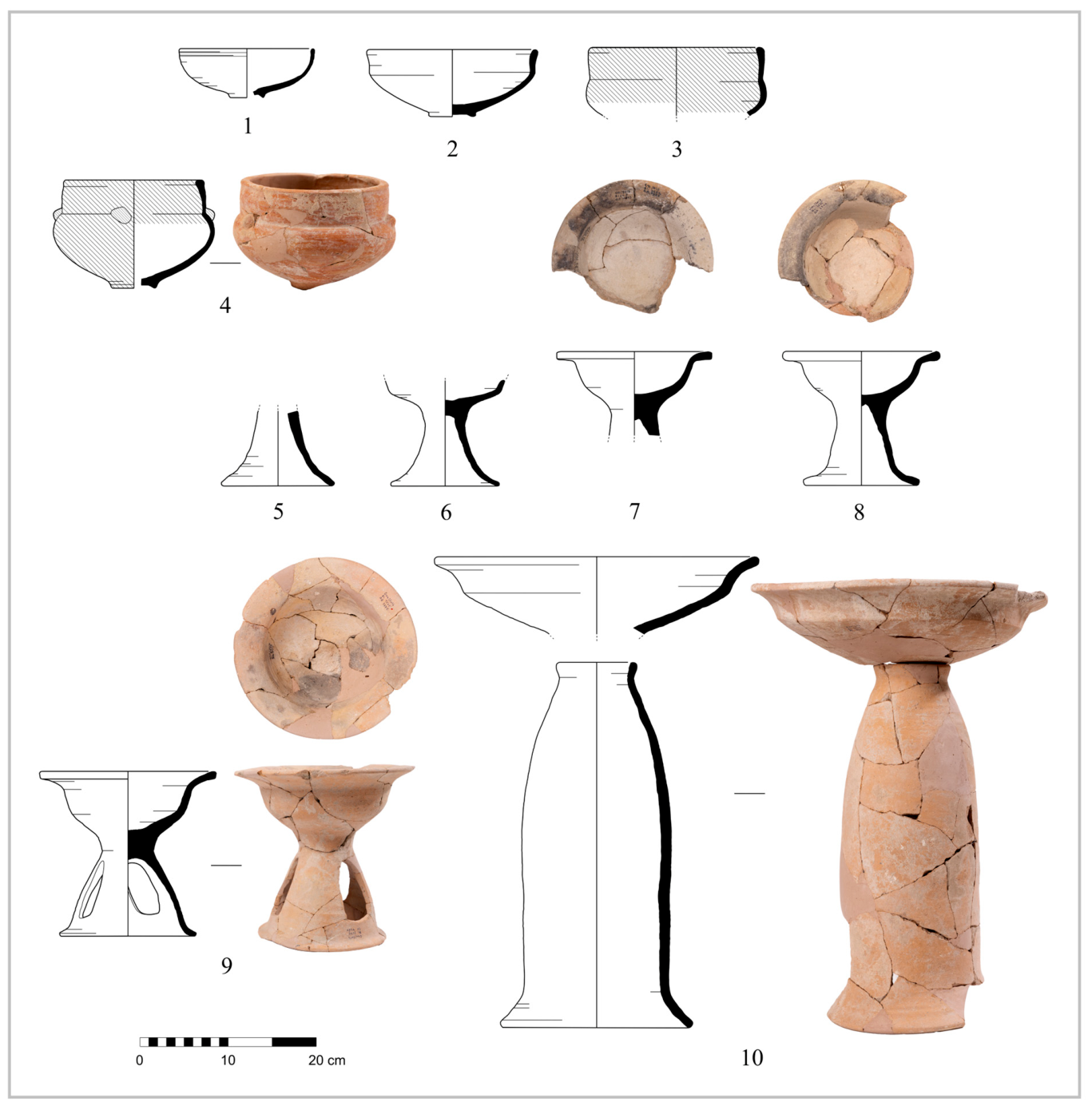
The earthen floor of Room B was covered with decayed mudbrick, stones, and pockets of ash, yielding a rich assemblage of restorable vessels (Figure 6) The most prominent item is a large rectangular four-horned clay altar (c. 30 × 33 cm; 42 cm high), found broken beside the southern wall near stone BB2616 (Figure 7). Nearby, a single two-part ceramic stand was recovered, comprising a tall cylindrical base and a large upper bowl (Figure 8: 10). In addition, two bowls and four chalices were found—one chalice with a fenestrated pedestal base and three with plain bases (Figure 8: 1, 4, 6–9). Two additional bowls were recovered in other parts of Room B, while an additional chalice was found in the southern part of Unit C (Figure 8: 2, 3, 5).
Figure 6.
Vessels uncovered in Sanctuary BBE4 (restoration by A. Elharar; photograph by T. Rogovski).
Figure 7.
Four-horned clay altar from Sanctuary BBE4 (photographs by T. Rogovski).
Figure 8.
Restored pottery vessels uncovered in Sanctuary BBE4: 1–4 bowls, 5–9 chalices, 10 a two-part stand (drawings by the Computational Archaeology Laboratory, Hebrew University of Jerusalem; photographs by T. Rogovski).
The layout of the architecture and installations, particularly the distribution of finds, suggests that the southern part of Room B may have functioned as a focal point of ritual activity centered on the clay altar (Figure 5). Given the narrow dimensions of the room, access would have been limited, suggesting that communal ceremonies involved a broader gathering in Room C, while Room B functioned as an inner, more restricted sacred locus for operating the altar and placing offerings. Access to Room B may have been rotational or restricted to a select few.
The four-horned clay altar is a large and relatively heavy installation, weighing 18.9 kg (following partial reconstruction). The concentration of its fragments indicates that it stood beside the southern wall of Room B, opposite the entrance and visible from Room C, at the time the room ceased to function and presumably also during the room’s cultic use throughout most of its occupational history. The altar shows clear traces of burning on its upper surface and on the interior of its horned parapet. Comparable clay and stone altars are commonly interpreted as incense altars; however, alternative uses—including the burning of grain offerings or small quantities of meat—have also been proposed (Gitin 2002; Haran 1978, pp. 230–34, 358; Mazar 2020a, p. 611; Zevit 2001, pp. 224–25).
The two-part stand appears to combine fixed and portable elements: the cylindrical base likely stood permanently beside the altar, whereas the upper bowl—easily carried in both hands—functioned as a portable element. The bowl shows no traces of burning, suggesting that it was used to carry liquid or dry offerings.
The five chalices are small, portable vessels. One chalice was found in Unit C, while the others were retrieved from Room B. Only the upper bowls of three chalices were preserved, all of which exhibit signs of burning, though with differing patterns. The two simple chalices with plain bases show burning on the upper interiors of their bowls and along their rims, a pattern that parallels chalices from Philistia, where residue analyses indicate the burning of plant-based oily liquids, possibly mixed with tallow, which when ignited may have vaporized hallucinogenic substances and produced a pleasant fragrance (Gadot et al. 2014). By contrast, the chalice with a fenestrated pedestal has roughly half of its interior surface blackened by soot, suggesting a different function, most likely the burning of incense rather than an oily liquid (cf. Lev. 10:1; Num. 16:17–18; 17:11; Ezek. 8:11; Haran 1978, pp. 238–39).
In sum, the spatial distribution of finds suggests that ritual activity in the sanctuary of Stratum BBE4 was concentrated in Room B, with particular focus on the pottery altar. The small size of the room further suggests that ritual practice there was probably limited to a restricted group of participants, while broader communal participation may have extended into Room C. The modest scale of the structure and its assemblage indicates that the sanctuary did not serve the entire city, which by the ninth century BCE was already a fortified urban center with a substantial palace complex. Rather, Sanctuary BBE4 most plausibly functioned as a “neighborhood shrine” serving a smaller, likely kin-based community residing within this sector of the city (cf. Halpern 1996, p. 300; Schmitt 2014, p. 271; Stager 1985, pp. 18–23).
3. Intramural Cult Rooms in the Early Iron Age (Iron I–IIA)
The newly excavated Sanctuary BBE4 at Lachish joins a broader corpus of cult rooms and small sanctuaries known in the southern Levant during the earlier phases of the Iron Age. Several of these examples derive from Judahite contexts of the Iron Age IIA and share notable similarities in plan and cultic paraphernalia.
3.1. Sanctuary 49 at Lachish
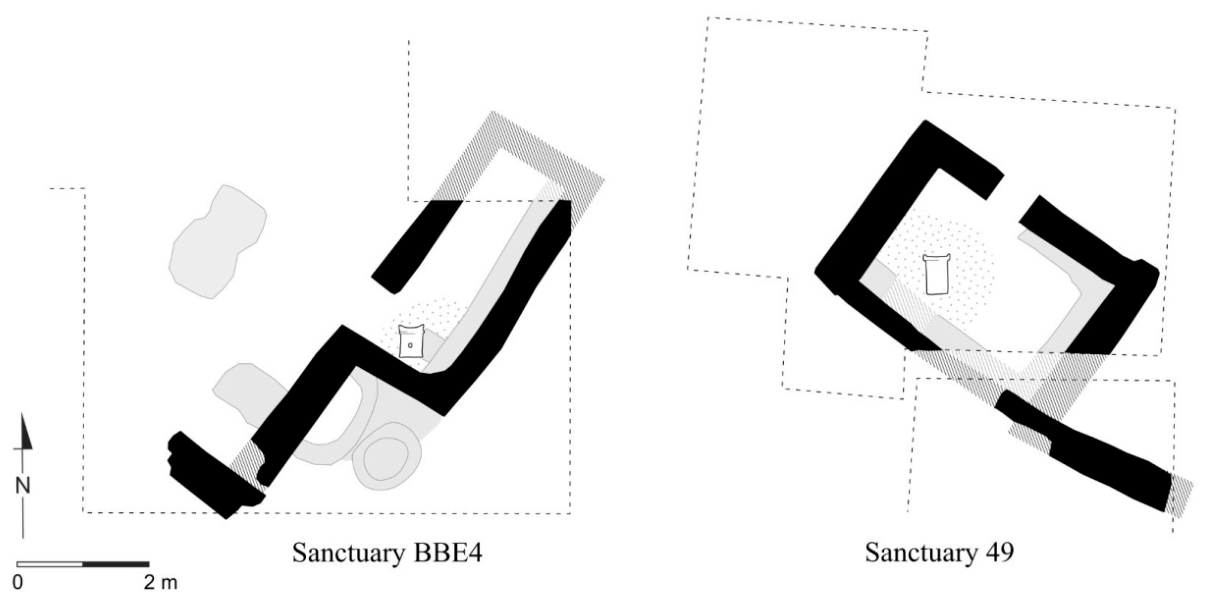
The most immediately relevant parallel to Sanctuary BBE4 is a small Iron Age IIA sanctuary (49) excavated at Lachish by Aharoni in the 1960s, adjacent to the much later Persian–Hellenistic Solar Shrine (Area SSH) (Figure 2 and Figure 9; Aharoni 1975, pp. 12, 26–31). According to Aharoni, the sanctuary comprised a small broad room (2.3 × 3.3 m) with an entrance in one of its long walls, benches along the walls, and a platform in the corner opposite the entrance. A large assemblage of cult vessels was recovered, concentrated mainly beside the corner platform. Although larger than that of Sanctuary BBE4, the assemblage is similar in composition and includes several chalices, two-part stands, and a single stone horned altar (Aharoni 1975, p. 26; see also Zevit 2001, pp. 213–17). Aharoni further reported a large stone east of the sanctuary, which he interpreted as a standing stone (maṣṣēbâ), together with charred remains identified as an ʾăšērā—an interpretation that raises significant stratigraphic difficulties (Aharoni 1975, pp. 28–29; Zukerman 2012, pp. 31–33).
Figure 9.
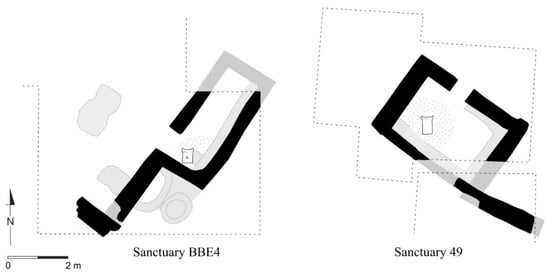
Schematic plans of Sanctuary BBE4 (left), uncovered by the Fourth Expedition in Area BBE, and Sanctuary 49 (right), uncovered by Y. Aharoni in Area SSH. The plans show the concentration areas of cultic finds (indicated by stippling) and mark the locations of the horned altars in both sanctuaries (drawing by the author).
Aharoni’s reconstruction was later challenged by Ussishkin (2004a, pp. 105–9), who argued that the walls, floor, and cultic objects did not belong to a single occupational phase and suggested that the vessels had been dumped into a pit at a later stage. A subsequent reassessment by Zukerman (2012, pp. 26–31), however, largely supported Aharoni’s conclusion that a coherent Iron Age IIA sanctuary existed at this location.
The dating of Sanctuary 49 remains debated. Aharoni assigned it to Level V, arguing that it was partially sealed by the northern wall of the palace courtyard, which he dated to Level IV (Aharoni 1975, pp. 12, 26, 41–42). Ussishkin, by contrast, dated the palace courtyard to Level III and accordingly placed the cultic assemblage in Level IV (Ussishkin 2004a, p. 109), a view later extended by Finkelstein and Silberman (2006, pp. 272–73), who proposed assigning the assemblage to Level III. Zukerman accepted the identification of the structure as a sanctuary but, following Ussishkin’s dating of the palace courtyard, suggested that it may belong to either Level V or Level IV (Zukerman 2012, p. 29).
Excavations of the Fourth Expedition in Area AA exposed the continuation of the palace courtyard wall west of Aharoni’s trench (Garfinkel et al. 2021, p. 447). Although Level III buildings in this area share the orientation of the courtyard wall—indicating contemporaneous use—the excavations did not clarify whether the construction of the wall itself should be assigned to Level IV or Level III (M.G. Hasel, pers. comm., Dec. 2025). Radiocarbon dates from Level V in Area AA indicate that the earliest Iron Age IIA occupation in this part of the site began in the late tenth century BCE and continued through the mid-ninth century BCE, until the construction of new residential buildings in the latter part of that century (Level IV). In contrast, radiocarbon evidence from areas adjacent to the city’s fortifications (Area CC, with implications also for Area BBE) indicates that Iron Age IIA occupation in those sectors began earlier in the tenth century BCE (Garfinkel et al., forthcoming). Since Sanctuary BBE4 represents the latest of three local Iron Age IIA strata in Area BBE and most likely dates to the ninth century BCE, it is reasonable to suggest that Sanctuary 49 and Sanctuary BBE4 were in use concurrently during that century, until their abandonment in the later ninth or early eighth century BCE.
Both sanctuaries share a similar basic character: modest broad rooms furnished with benches along the walls, with a horned altar forming the focal point of cultic activity, placed along one side of the room and surrounded by pottery stands and chalices. Although the broader urban contexts of the sanctuaries in Areas BBE and SSH are only partially known, their close proximity (c. 100 m apart) is noteworthy. As argued above for Sanctuary BBE4—and equally applicable to Sanctuary 49—each sanctuary likely served a particular residential quarter of the city, probably associated with different extended families (bêt ʾāb), each organized around its own neighborhood cult room (cf. Halpern 1996, pp. 302–3).
3.2. Cult Room in Jerusalem
A contemporary cult room of similar character appears to have been identified in Jerusalem, in the Givʿati Parking Lot excavations on the northwestern slope of the City of David. This small room, built against the bedrock scarp and enclosed by simple walls, yielded a rich assemblage dominated by chalices—most of which have soot on the interiors of their bowls—together with fragments of a clay altar or cult stand. The room, dated to the ninth century BCE, went out of use when it was sealed and partially cut by an eighth-century building (Room 835; Ben-Ami 2014, pp. 5, 7–8).
3.3. Cult Rooms in Northern Sites
Beyond Judah, a notable parallel to the Lachish sanctuaries is a small room (1.25 × 2.5 m) identified within an elite residence in the northern part of Megiddo, in Stratum VA–IVB of the Iron Age IIA (Locus 2081) (Albertz and Schmitt 2012, pp. 134–37; Loud 1948, p. 45). This context yielded two small stone horned altars, as well as several stands and chalices. An additional cult room of the same stratum was apparently located within a residential quarter in the eastern part of Megiddo, beneath the later eighth-century BCE Building 338 (Kleiman et al. 2016).3
Additional cult rooms or sanctuaries dating to the Iron Age I–IIA have been identified within residential quarters at several other northern sites, including Iron Age I contexts at Tel Qiri and Tel Abel Beth Maacah, as well as Iron Age IIA strata at Tell el-Farʿah (North), Hazor, Tel ʿAmal, and Tel Reḥov (Figure 1; Albertz and Schmitt 2012, pp. 76–77, 94–97, 159–64; Ben-Ami 2012, pp. 63–65; Mazar 2020b, pp. 93–95, 102, 107–10; Mumcuoglu and Garfinkel 2020; Yahalom-Mack et al. 2024; Zevit 2001, p. 241). These cult places are characterized by standing stones, libation vessels, and, in some cases, shrine models. Clay horned altars comparable to the example from Lachish BBE4 have also been attested at Tel Reḥov and Hazor (Ben-Ami 2012, pp. 63–65; Mazar 2020a, pp. 583–614).
3.4. Cult Rooms at Khirbet Qeiyafa
A particularly illuminating case is Khirbet Qeiyafa in the central Shephelah, which offers important insight into the placement of cult rooms within the settlement fabric of the early tenth century BCE (Garfinkel et al. 2018). Excavations at the site identified three modest cult rooms (C3, C10, and D100) embedded in domestic buildings along the casemate wall, within a settlement widely interpreted as an early attempt by a developing highland polity—possibly the nascent Davidic kingdom—to establish a foothold in the Shephelah (Garfinkel 2021; Garfinkel et al. 2016, 2019, 2021; Faust 2020). Two of these rooms were positioned beside the city’s gate plazas and have therefore been interpreted as serving a broad community able to assemble in these open spaces during ritual performances, whereas the third, located within a domestic building set apart from these communal areas, likely functioned as a lower-ranked cult place (Garfinkel et al. 2018, pp. 7–8, 15–53).
The cult rooms yielded built installations (benches, basins, and platforms), standing stones, and portable objects such as shrine models, indicating rituals involving libation, burning, and communal feasting (Garfinkel et al. 2018, p. 9). Although comparable in scale and intramural setting to the later sanctuaries at Lachish, the primary cultic elements at Qeiyafa—standing stones and shrine models—differ from the horned altars characteristic of later Judahite cult rooms at Lachish (and possibly also Jerusalem).
3.5. Synthesis
Taken together, these cult rooms reveal a widespread pattern of ritual activity in the southern Levant during the Iron Age I and early Iron Age IIA, in which rituals frequently took place in modest rooms embedded within residential quarters—a pattern that likely reflects a close relationship between ritual practice and the families living in their vicinity. In some cases, the cult rooms were fully integrated into domestic houses, indicating an intimate association between the cult and particular households residing in those buildings—a situation reminiscent of biblical traditions of family-based cult in pre- and early-monarchic Judah and Israel (cf. Judg. 6:25–32; 8:27; 17; 1 Sam. 16:1–13). This manner of organizing cultic activity stands in sharp contrast to the large, centralized temples and cult complexes typical of the Middle and Late Bronze Age Levant and—as will be argued below—relates to broader transformations in social and political organization during the early Iron Age.
4. Cultic Change and Social Transformation
4.1. Temple-Centered Cult in the Bronze Age Canaanite City-States
During the Middle Bronze Age, a new political landscape emerged in the southern Levant, dividing the region into small independent political entities commonly referred to as Canaanite city-states or petty kingdoms. The urban centers of these kingdoms were characterized by large-scale monumental construction—including massive fortification systems, palatial complexes, and major temples—which served as a physical expression of the power of their ruling elites (Greenberg 2019, pp. 180–265). Within this developing social and political order, temples played a central role as the primary locus of cultic activity. The principal temples of each city were typically built in direct association with the royal palace, spatially expressing the close institutional and ideological ties between political and religious authority (Susnow 2021, pp. 176–78).
The petty kingdoms persisted as the basic political framework of the local Canaanite population during the Late Bronze Age, even as Canaan came under Egyptian imperial domination. While subordinate to Egyptian authority, each polity controlled a relatively small territory—typically 10–20 km around its urban center—and was governed by a ruler operating within a hierarchical system based on patrimonial and patronage relationships among the elite (Finkelstein 1996; Pfoh 2016). As in the preceding period, the ruler appears to have held religious authority, serving as a mediator between the community and the divine realm—a role materially expressed in the location and organization of the city’s major temples and their associated ritual practices (Pfoh 2016, pp. 105–6, 161–64; Susnow 2021, pp. 187–90, 194, 205–7; Wyatt 2007). Although temples remained the primary cultic institutions in the Late Bronze Age, their architectural forms became more varied, likely reflecting differing cultic roles and hierarchical standing (Mazar 1992; Susnow 2021, pp. 178–79).
At Hazor, for example, several monumental temples with symmetrical plans have been uncovered, apparently serving as the city’s primary official cult centers: two in the upper city in Area A (Building 7050 and the Northern Temple), closely associated with the palace complex in Area M, and the other in Area H of the lower city. In addition to these major temples, a small, simple one-room sanctuary—furnished with benches along its walls and a niche containing a row of standing stones—was found on the edge of a residential quarter in Area C. This modest structure, known as the Stelae Temple, appears to have functioned as a low-ranking neighborhood shrine, unrelated to the citywide “official” cult system (Zuckerman 2012).
A comparable pattern is evident at Ugarit in the northern Levant, where extensive excavations revealed multiple temples integrated into the urban fabric. These include two monumental symmetrical temples on the acropolis—the temples of Baʿal and Dagan—as well as a smaller symmetrical temple adjacent to the palace and city gate (the Palatial or Hurrian Temple; Yon 2006, pp. 49, 106–110, 113–114). In contrast, an irregular-plan sanctuary, furnished with rows of benches along its walls and located within a residential block, appears to represent a lower-ranking, community- or family-based cult place—perhaps associated with communal sacred meals (Temple of the Rhytons; Yon 2006, pp. 82–83).
At Canaanite Lachish as well, several Late Bronze Age temples have been uncovered, attesting to the central role such institutions played in organizing the city’s cult during this period (Weissbein 2024; Weissbein et al. 2019, pp. 99–101).
These Bronze Age patterns of palace–temple-centered cult provide the essential backdrop against which the more decentralized Iron Age cultic landscape must be understood.
4.2. Decentralization and Kin-Based Cult in Iron Age I–IIA
From the twelfth century BCE—during the end of the Late Bronze Age and the early stages of the Iron Age—the long-standing political, social, and cultural system of the Levant underwent profound change. The gradual withdrawal of Egyptian imperial control destabilized the local Canaanite political framework that had operated under its hegemony for centuries, leading to the decline of Canaanite urban centers and their associated culture (Killebrew 2005, pp. 33–49; Kreimerman 2017). As the authority of the traditional ruling elites eroded, the centralized institutions through which they had organized and supervised ritual life collapsed as well. Temples—the main cultic institutions of earlier periods—disappeared from much of the southern Levantine landscape, with the notable exception of the long-lived temple at Megiddo (Mazar 1985, p. 97; Ussishkin 2018, p. 220). At Iron Age I sites that continued Canaanite cultural traditions, large temples were no longer built; instead, ritual activity shifted into smaller and more decentralized settings, such as cult rooms and cultic corners.
At the same time, new social and political formations emerged in the region. The Philistines—whose foreign ruling elite arrived from the Aegean–Cypriot sphere—established a system of city-states along the southern coastal plain during the Iron Age I.4 Their developing political order drew in part on earlier Canaanite structures and, as Ben-Shlomo (2019) has argued, incorporated certain aspects of Canaanite temple-centered cult into their public or official religion. Philistine temples of Iron Age I–IIA are known from Tel Qasila, Naḥal Patish, and Gath (Dagan et al. 2018; Mazar 2000; Nahshoni 2009). These sanctuaries recall, to some degree, the Canaanite “temples with indirect entrance and irregular plans” (Mazar 1992, pp. 177–82) of the preceding period and contain cultic paraphernalia that blend local Canaanite traditions with Aegean–Cypriot elements, as also reflected in the rich cultic assemblage from the Yavneh favissa (Kletter et al. 2010, 2015). Alongside these major temples, smaller cult rooms in Philistia—such as Building 572 at Ashkelon and Building 350 at Ekron—reflect domestic or household cult practices that preserve foreign traditions among the immigrant population (Ben-Shlomo 2014, 2019; Dothan 2002; Master and Aja 2011).
In the central highlands, this same period saw the emergence of numerous small rural settlements commonly associated with the early Israelites. These communities did not construct temples; rather, their cultic activity appears to have been organized at several interconnected levels, structured primarily around kin-based social units (Faust 2019a; Finkelstein 1988).
At the supra-village level, open-air precincts—such as Mount Ebal, the Bull Site, and the so-called “Foot-Shaped Enclosures”—likely served as regional cult centers for clusters of villages (Bar and Ben-Yosef 2021; Mazar 1982; Zertal 1987). Each village was home to one or a few extended families (bêt ʾāb) (Stager 1985, p. 22), and ritual gatherings at such extramural precincts served not only religious purposes but also reinforced social cohesion and marriage alliances among broader kin-based groups, including clans and perhaps tribes (Halpern 1996, p. 299; Lehmann 2004; 2023, p. 211).
Within the settlements themselves, evidence for the cult is limited. A notable exception is the small cult room uncovered at ʿAi (et-Tell). This narrow room (c. 8 × 3 m), integrated into the domestic quarter, contained a bench and a small platform. Finds from the room include two animal figurines and a large two-part pottery stand—a fenestrated, barrel-shaped lower stand with its matching upper bowl (Albertz and Schmitt 2012, pp. 74–76; Zevit 2001, pp. 154–56).
Taken together, the cultic practices of early Israelite highland communities appear to have been rooted primarily in family- and clan-based rituals. Such rituals could be directed toward deities as well as toward family ancestors (Halpern 1996, pp. 297–99; see Klein Cardoso 2020; Weissbein 2025), whether real or mythologized figures, as may also be implied by several pre-Deuteronomistic biblical narratives concerning early Israelite settlement—the “clan sagas” identified by Rofé (2000) (e.g., Num. 32:39, 41–42; Josh. 15:14–19).
Over the course of the Iron Age IIA, the social and political landscape of the central highlands was transformed. Many of the small Iron Age I villages were abandoned, and the population became increasingly concentrated in larger, often fortified towns (Faust 2003). This process is associated with the emergence of more complex political formations in the highlands, which gradually extended their control into the lowlands and eventually developed into the territorial kingdoms known as Israel and Judah. This expansion of the highland population—“Israelites”—into the Shephelah included an early, short-lived attempt represented by the establishment of Khirbet Qeiyafa in the early tenth century BCE, followed by the foundation of Iron Age Lachish in the later tenth century BCE (Garfinkel 2021; Faust 2020). The latter settlement subsequently developed into the regional center and military stronghold of the Kingdom of Judah in the Shephelah, continuing in this role until its destruction by the Assyrians in 701 BCE (Ussishkin 2004a, pp. 78–90).
While the construction of fortifications, gates, and palatial structures in Iron Age IIA settlements—as attested at Tel Lachish—required large-scale collective labor and thus reflects centralized royal initiative and coordination, the internal layout of these settlements suggests that kin-based organization remained highly significant (cf. Halpern 1996, pp. 297–99; Haran 1978, pp. 304–16; Lehmann 2023, p. 219). Residential quarters appear to have been arranged in housing compounds (neighborhoods) as clusters of extended families (bêt ʾāb), apparently organized around small sanctuaries such as those discussed above. These sanctuaries indicate that cultic activity remained embedded within kin-based units, with each group maintaining ritual authority within its respective quarter of the town.
Alongside the family-based cult practiced in the small sanctuaries within the settlements, cultic activity at extramural sites appears to have continued during the Iron Age IIA. Such open-air cult places are not well represented in the archaeological record, with the notable exception of the “Foot-Shaped” Enclosures. Recent studies of two such sites, Bedhat esh-Shaʿab and Yafit in the Jordan Valley, show that they were founded in the Iron Age I and continued in use into the Iron Age IIA (Bar and Ben-Yosef 2021).
A possible link between intra-settlement cult and extramural sites may be suggested by portable shrine models, which may have functioned as cult objects carried from settlements to such precincts (Weissbein 2025, pp. 36–38).
Glyptic evidence from this period provides further insight into ritual practices. A relatively common group of stamp seals depicts dancing scenes, showing several figures—perhaps representing communal ritual performances held at such cult sites (Keel 2012, pp. 324–27; Schachter 2010, pp. 150–53). Several examples of this group were also uncovered at Lachish itself (Tufnell 1953, p. 370, pl. 44:68, 69, 71–74). In addition, a number of seals depict figures—possibly dancers—beside sacred trees (Keel and Uehlinger 1998, p. 152; Schachter 2010, pp. 154–55), while a smaller group appears to show sacred trees set within fenced enclosures (Keel 2010, pp. 258–59; 2012, p. 324).
A similar impression of this decentralized, family-based cult emerges from biblical traditions relating to this period. These narratives describe ritual activities conducted within residential settings (Judg. 17; 1 Sam. 7:1) as well as at extramural locations (Judg. 6:24–32; 1 Sam. 11:15), including rites performed by extended families or clans. This pattern is evident, for example, in references to the “family sacrifice” (zevaḥ mišpāḥâ) and the “annual sacrifice” (zevaḥ hayyāmîm) of David’s clan in Bethlehem (1 Sam. 20:6, 29). Likewise, the narrative of Saul’s anointing by Samuel describes a local sacrificial event held at a bāmâ outside a settlement. This event appears to have included a built structure—a room (liškkâ)—in which the “invitees” (qĕruʾîm), possibly local dignitaries, assembled to partake in the sacrificial meal before the meat was distributed to the wider community (1 Sam. 9:6–25; Halpern 1996, pp. 297–98; Haran 1978, pp. 304–16).
Alongside the continuation of these “low-ranking,” kin-based cults, the Iron Age IIA appears to have also witnessed the renewed construction of larger, state-level cult centers featuring temples. This assessment is based primarily on biblical traditions, in which the most prominent example is the temple in Jerusalem, attributed to the reign of Solomon and thus presumably built in the mid-tenth century BCE. The biblical account situates the temple within the royal complex, adjacent to the palace (1 Kgs. 7–8; 2 Kgs. 11:11, 19)—a configuration that echoes the palace–temple relationship known from Bronze Age Levantine city-states, where the royal-sponsored cult served to provide divine legitimacy to the ruling dynasty.
Biblical tradition also recounts that the kings of Israel developed the cult centers at Dan and Bethel into major state-sponsored cult sites (1 Kgs. 12:29–30). Archaeologically, however, of these cult centers only Dan has been extensively excavated, and it may have yielded remains indicating the establishment of its cult precinct already in the Iron Age IIA, forming the nucleus of the larger cultic complex that developed there in Iron Age IIB (Biran 1994, pp. 165–83; but see Arie 2008).
In recent years, a significant temple of this period has been uncovered at Moẓa. While this temple may have functioned under the patronage of the Jerusalem monarchy, it may also represent the cultic center of a local clan whose economic growth and rising status during the Iron Age IIA—strengthened by its incorporation into the kingdom centered in nearby Jerusalem—enabled the construction of a relatively large temple in the ninth century BCE, possibly replacing an earlier and more modest sanctuary of the tenth century BCE. In that case, although the clan became integrated into the Judahite kingdom, it may have maintained its own local cultic authority (Kisilevitz and Lipschits 2020, 2025).
Taken together, the Iron Age IIA cultic landscape may be characterized by a combination of local, kin-based intramural and extramural sanctuaries alongside larger temple institutions associated with emerging Iron Age II polities. This diversity reflects a social system. in which traditional kin-based frameworks continued to play the primary role in organizing and regulating the ritual life—even as royal and state institutions gradually assumed greater influence.
It is against this background—of predominantly kin-based cult, possibly complemented by emerging royal cult centers—that later developments, including clearer evidence for cultic centralization and the rise of fully developed “state temples” in Iron Age IIB–IIC should be understood.
4.3. Cultic Centralization and “State Temples” in Iron Age IIB–IIC
In the later stages of the Iron Age (IIB–IIC), despite the extensive archaeological exposure of sites such as Tel Sheva, Tel Beit Mirsim, Beth-Shemesh, and Tell en-Naṣbeh in Judah, no unequivocal sanctuary or room dedicated exclusively to cultic activity has been identified (Faust 2019a, pp. 9–14). This absence suggests a significant decline in the presence of small neighborhood cult places within residential quarters.
Concurrently, Iron Age IIB–IIC assemblages in Judah show an increased presence of small cultic objects within domestic contexts—especially the so-called Judean pillar figurines, as well as zoomorphic figurines and model beds—relatively evenly distributed across houses within settlements, as documented, for example, at Jerusalem, Beth-Shemesh, Lachish, Tell Beit Mirsim, and Tel Sheva. This distribution pattern suggests a shift from neighborhood-based cults centered in local sanctuaries—associated with an extended kin group (bêt ʾāb)—toward more individualized, household-level ritual practices performed within the domestic spaces of nuclear families (Albertz and Schmitt 2012, pp. 45–46, 62–68, 85–87, 92–93, 116–22; Darby 2022, p. 206; Kletter 2016, pp. 1119, 1127–33; Schmitt 2014, pp. 268–69; Singer-Avitz 2016, p. 1443; Smoak 2023, pp. 421–24).
Particularly at Lachish, the Iron Age IIA cult rooms—Sanctuary BBE4 and Sanctuary 49—went out of use in the later phase of Iron Age IIA and were subsequently buried together with their cultic paraphernalia. In the case of Sanctuary 49, the stratigraphic evidence clearly connects its cancellation to the expansion of the palace courtyard, which was undertaken at the expense of an earlier residential quarter. The case of Sanctuary BBE4 is less clear, since the later Iron Age stratum above it was removed during the construction of the Persian-period city wall. Nevertheless, the undisturbed and largely restorable character of its assemblage suggests deliberate abandonment and burial in a manner broadly comparable to Sanctuary 49.
Coinciding with the apparent weakening of the extended family as the primary organizing framework for ritual practice, urban cults appear to have taken shape. This development may be reflected in the installation of the four-horned stone altar at Tel Sheva (Herzog 2016, pp. 1476–78). At Tel Lachish, it is expressed in the construction of a substantial cultic platform in front of the outer city gate (Ussishkin 2004b, p. 514) and possibly also in the installation of a small shrine within one of the chambers of the inner gate (Ganor and Kreimerman 2019; but see Ussishkin 2021).
Beyond the gate complex, some scholars have also proposed the existence of a central sanctuary within Lachish (Aharoni 1975, p. 42; Na’aman 1999, pp. 404–5). This suggestion is based primarily on the Assyrian relief depicting Sennacherib’s conquest of the city in 701 BCE, which shows large cult stands being carried away by Assyrian soldiers as booty. This interpretation, however, remains debated and ultimately unprovable (Ussishkin 2004a, p. 86; Uehlinger 2003, pp. 285–86).
Several cult-related installations at Judahite sites have been interpreted as reflecting deliberate cancellation toward the end of the eighth century BCE. The altar at Tel Sheva was dismantled, and the sanctuary in the fortress of Arad—which likely served the military garrison stationed there—was buried (Herzog 2010, pp. 173–77). It has also been suggested that the gate shrine at Lachish was desecrated (Ganor and Kreimerman 2019, pp. 228–32). These acts have frequently been linked in scholarship to the biblical tradition of Hezekiah’s cultic reform (2 Kgs. 18:4, 22; Herzog 2010; Rainey 1994; Finkelstein and Silberman 2006, pp. 279–80), which aimed to centralize worship in the royal temple of Jerusalem by abolishing local cult sites and eliminating “idolatrous” practices throughout Judah.5 If so, these actions may reflect a deliberate effort by the Judahite monarchy to elevate the Jerusalem temple to the status of a “state temple” through the suppression of other cultic loci, including urban sanctuaries and traditional extended-family cults (Halpern 1996, pp. 317–21; Kamlah 2012, p. 511; Holladay 1987, p. 268).
A comparable rise of state temples can be observed in the Kingdom of Israel, where during the Iron Age IIB the temple complex at Dan developed into a major cult center, and the entire city appears to have been designed to accommodate pilgrimage (Ilan and Greer 2021). Later, during the Iron Age IIC, a monumental temple (Temple Complex 650) was established in Philistia as well, at the center of the city of Ekron, under royal patronage, as indicated by the royal dedicatory inscription (Gitin 2012). In both Jerusalem and Dan, the temple complexes had earlier Iron Age IIA roots as royal or regional cult centers; their elevation into full state temples in the later Iron Age marks a significant step in the organization of cult in the southern Levant, as it became increasingly intertwined with state ideology and controlled by royal and priestly elites. Such centralization was likely carried out, at least in part, by force and through confrontation with lower-ranking, local community- or family-based cult places.6
This centralization of the cult paralleled other forms of administrative centralization, particularly evident in Judah. Archaeologically, this is reflected in the appearance of a standardized system of weights and measures (Kletter 1998), as well as in the distribution of royal Judahite storage jars—the lmlk jars—which served a specific role within the royal administrative system of the kingdom (Lipschits 2021, pp. 35–48, 123–27). Notably, these jars bear royal stamp impressions featuring a two- or four-winged solar symbol. It has been proposed that this emblem was associated with the deity of the Jerusalem temple (Keel 2012, pp. 330–32; Ornan 2005, pp. 231–35),7 and thus, in addition to the jars’ primary administrative function, their kingdom-wide distribution may also reflect an ideological effort to extend royal cultic authority.
Despite the increasing cultic centralization of the state, lower-rank cultic practices persisted in Judah until the final destruction of the kingdom. As noted, domestic assemblages from the Iron Age IIB through the Iron Age IIC attest well to household-level (nuclear family) ritual activity, in contrast to the neighborhood sanctuaries associated with extended families that were customary in earlier Iron Age phases.
The Hebrew Bible also suggests that “popular cults” continued, though perhaps in more marginal or esoteric forms, particularly in extramural settings at the “high places” (bāmôt), as Jeremiah vividly describes (Jer. 7:17–18, 31; 19:5; 32:35). Archaeologically, several cult caves discovered in Jerusalem may attest to forms of communal ritual activity conducted within the city alongside the official temple cult (Steiner 1990, p. 27; Schmitt 2014, p. 272). Family-based cults also appear to have continued in the form of ancestral rites associated with family tombs (Halpern 1996, p. 297).
5. Conclusions
The ninth-century BCE Sanctuary BBE4, uncovered in recent years at Lachish, joins Sanctuary 49, excavated at the site several decades earlier. The two share a similar architectural plan and cultic assemblage. The exposure of these two cult rooms suggests that during the early stages of Judahite Lachish, several small neighborhood shrines operated concurrently.
This study has argued that this pattern reflects a decentralized organization of cultic activity, in which extended families residing in adjacent residential quarters maintained their own ritual spaces and authority over cult performance. These patterns are best understood as attesting to the persistence of kin-based social organization during the initial phases of state formation in Judah.
Comparable forms of decentralized cult are widely attested across the southern Levant in the Iron Age I and early Iron Age IIA, following the collapse of the Bronze Age Canaanite city–state system and its temple-centered royal cult. More specifically, the kin-based organization evident at Iron Age IIA Lachish can be traced to earlier Iron Age I settlement patterns in the central highlands, characterized by dispersed rural villages, each likely inhabited by a single extended family (bêt ʾāb).
Over the course of the Iron Age IIA, broader kin-based groups increasingly clustered into larger, sometimes fortified settlements, both in the highlands and in the Shephelah. This process is visible at Khirbet Qeiyafa in the early tenth century BCE and later in the foundation of Lachish. The establishment of Iron Age Lachish as a fortified city already in its earliest phase suggests the initiative of a centralized political authority—the emerging kingdom of Judah. Subsequent developments, including the construction of substantial fortifications, a major gate complex, and a large palace at the site’s center, consolidated Lachish as the principal administrative and military stronghold of the kingdom in the Shephelah.
Nevertheless, throughout the Iron Age IIA, elements of kin-based social organization persisted alongside these expressions of central authority, as reflected in the continued use of decentralized neighborhood shrines. Similar patterns are observed at other sites in the southern Levant, where cultic activity was commonly embedded within residential contexts rather than concentrated in monumental temples.
In later Iron Age phases, this situation changed markedly. At Lachish, both shrines went out of use, and Sanctuary 49 was sealed beneath the expanding palace complex—offering a tangible illustration of the growing dominance of centralized authority over traditional kin-based frameworks. During this period, dedicated spaces for neighborhood or extended-family cults appear to have disappeared, while cultic objects increasingly appear dispersed within domestic contexts, indicating the rise of household-based (nuclear-family) ritual practice. At the same time, the authority of the official royal cult—centralized in major state temples, most notably the Jerusalem temple—appears to have intensified.
Taken together, these developments suggest a gradual weakening of the extended family and broader kin-based units as the primary organizing frameworks of society, alongside the growing prominence of the nuclear household and the increasing power of state-level cultic institutions and their priestly elites. The cultic transformations traced in this study are therefore not merely changes in ritual practice, but material expressions of a broader social trajectory—from decentralized kin-based communities to a fully articulated territorial state, and of the parallel reconfiguration of religious authority and ritual organization within that process.
Author Contributions
Conceptualization, I.W. and Y.G.; methodology, I.W. and Y.G.; formal analysis, I.W.; investigation, I.W. and Y.G.; resources, Y.G.; data curation, I.W. and Y.G.; writing—original draft preparation, I.W.; writing—review and editing, I.W. and Y.G.; visualization, I.W.; supervision, Y.G.; project administration, Y.G. All authors have read and agreed to the published version of the manuscript.
Funding
The excavations and the analysis of the finds from Tel Lachish were sponsored by Joseph Baruch (Joey) Silver, Aron Levy, the Roger and Susan Hertog Center for the Archaeological Study of Jerusalem and Judah, the Philip and Muriel Berman Center for Biblical Archaeology.
Institutional Review Board Statement
Not applicable.
Informed Consent Statement
Not applicable.
Data Availability Statement
The original contributions presented in this study are included in the article. Further inquiries can be directed to the corresponding author.
Conflicts of Interest
The authors declare no conflict of interest.
Notes
| 1 | For discussion of the basic social units, see (Faust 2012, pp. 8–14; Halpern 1996; Lehmann 2023; Vanderhooft 2009). |
| 2 | The Fourth Excavation at Tel Lachish was conducted between 2013 and 2017 under the co-direction of Yosef Garfinkel (Institute of Archaeology, Hebrew University of Jerusalem) and Michael G. Hasel and Martin G. Klingbeil (Institute of Archaeology, Southern Adventist University, USA) (Garfinkel et al. 2021). |
| 3 | Recent excavations have clarified the stratigraphy in the eastern residential quarter of Megiddo, demonstrating that the cultic paraphernalia previously attributed to Building 338 (Ussishkin 1989) should instead be assigned to an earlier Iron Age IIA context and are not associated with the later monumental structure (Kleiman et al. 2016, pp. 173–74). |
| 4 | The origins and social composition of the Philistines remain the subject of extensive scholarly discussion. While current research emphasizes complex processes of migration, cultural entanglement, and local integration, substantial evidence supports the presence of migrant groups with Aegean–Cypriot affiliations who became socially and politically dominant along the southern Levantine coast (Philistia), alongside a significant local Canaanite population (e.g., Bunimovitz and Lederman 2014; Faust 2019b; Killebrew 2005; Maeir 2019; Mazar 1985; Mountjoy 2018; Yasur-Landau 2010). |
| 5 | The historicity of Hezekiah’s reform remains debated. Some scholars argue that the biblical account reflects a later ideological addition rather than an eighth-century historical event (e.g., Edelman 2008; Handy 1988; Pakkala 2010). Others have reinterpreted the archaeological evidence from Arad, Tel Sheva, and the gate shrine at Lachish, proposing alternative stratigraphic analyses or different explanations for the cessation of cultic activity at these sites (e.g., Edelman 2008; Fried 2002; Handy 1988; Kleiman 2020; Na’aman 1995, 1999, 2002; Ussishkin 1988, 2021). Other scholars, however, defend the reform’s historical plausibility and interpret these remains as possible archaeological evidence for it (e.g., Finkelstein and Silberman 2006; Ganor and Kreimerman 2019; Herzog 2002, 2010). |
| 6 | See a possible echo of this tradition in the account of King Saul’s suppression of necromancy (1 Sam. 28:3, 9). |
| 7 | For a possible early depiction of the god of Jerusalem, see a ninth-century BCE seal impression from the Gihon Spring in Jerusalem (Keel 2012, p. 332). |
References
- Aharoni, Yohanan. 1975. Investigations at Lachish: The Sanctuary and the Residency (Lachish V). Monograph Series of the Institute of Archaeology 4; Tel Aviv: Tel Aviv University. [Google Scholar]
- Albertz, Rainer, and Rudiger Schmitt. 2012. Family and Household Religion in Ancient Israel and the Levant. Winona Lake: Eisenbrauns. [Google Scholar]
- Alpert Nakhai, Beth. 2001. Archaeology and the Religions of Canaan and Israel. Boston: American Schools of Oriental Research. [Google Scholar]
- Arie, Eran. 2008. Reconsidering the Iron Age II Strata at Tel Dan: Archaeological and Historical Implications. Tel Aviv 35: 6–64. [Google Scholar] [CrossRef]
- Bar, Shay, and Dror Ben-Yosef. 2021. The Dating of the “Foot-Shaped” Enclosures in the Jordan Valley. Judea and Samaria Studies 30: 5–20. [Google Scholar] [CrossRef] [Scilit]
- Ben-Ami, Doron. 2012. The Early Iron Age II (Strata X–IX). In Hazor VI: The 1990–2009 Excavations: The Iron Age. Edited by Amnon Ben-Tor, Doron Ben-Ami and Debora Sandhaus. Jerusalem: Israel Exploration Society, pp. 52–153. [Google Scholar]
- Ben-Ami, Doron. 2014. Notes on the Iron IIA Settlement in Jerusalem in Light of Excavations in the Northwest of the City of David. Tel Aviv 41: 3–19. [Google Scholar] [CrossRef] [Scilit]
- Ben-Shlomo, David. 2014. Philistine Cult and Household Religion according to the Archaeological Record. In Family and Household Religion: Toward a Synthesis of Old Testament Studies, Archaeology, Epigraphy, and Cultural Studies. Edited by Rainer Albertz, Beth Alpert Nakhai, Saul M. Olyan and Rudiger Schmitt. Winona Lake: Eisenbrauns, pp. 73–102. [Google Scholar]
- Ben-Shlomo, David. 2019. Philistine Cult and Religion According to Archaeological Evidence. Religions 10: 74. [Google Scholar] [CrossRef] [Scilit]
- Biran, Avraham. 1994. Biblical Dan. Jerusalem: Israel Exploration Society. [Google Scholar]
- Brandl, Baruch, Dov Levitte, and Yosef Garfinkel. 2019. A Diorite New Kingdom Scarab from Tel Lachish. Egypt and the Levant 29: 159–69. [Google Scholar] [CrossRef] [Scilit]
- Bunimovitz, Shlomo, and Zvi Lederman. 2014. Migration, Hybridization, and Resistance: Identity Dynamics in the Early Iron Age Southern Levant. In The Cambridge Prehistory of the Bronze and Iron Age Mediterranean. Edited by Bernard Knapp and Peter Van Dommelen. Cambridge: Cambridge University Press, pp. 252–65. [Google Scholar]
- Dagan, Amit, Maria Eniukhina, and Aren M. Maeir. 2018. Excavations in Area D of the Lower City: Philistine Cultic Remains and Other Finds. Near Eastern Archaeology 81: 28–33. [Google Scholar] [CrossRef] [Scilit]
- Darby, Erin D. 2022. Sex in the City? Judean Pillar Figurines and the Archaeology of Jerusalem. In Iron Age Terracotta Figurines from the Southern Levant in Context. Edited by Erin D. Darby and Izaak J. de Hulster. Leiden and Boston: Brill, pp. 178–214. [Google Scholar]
- Dothan, Trude. 2002. Bronze and Iron Objects with Cultic Connotations from Philistine Temple Building 350 at Ekron. Israel Exploration Journal 52: 1–27. [Google Scholar]
- Edelman, Diana. 2008. Hezekiah’s Alleged Cultic Centralization. Journal for the Study of the Old Testament 32: 395–434. [Google Scholar] [CrossRef] [Scilit]
- Faust, Avraham. 2003. Abandonment, Urbanization, Resettlement and the Formation of the Israelite State. Near Eastern Archaeology 66: 147–61. [Google Scholar] [CrossRef] [Scilit]
- Faust, Avraham. 2010. The Archaeology of the Israelite Cult: Questioning the Consensus. Bulletin of the American Schools of Oriental Research 360: 23–35. [Google Scholar] [CrossRef] [Scilit]
- Faust, Avraham. 2012. The Archaeology of Israelite Society in Iron Age II. Winona Lake: Eisenbrauns. [Google Scholar]
- Faust, Avraham. 2019a. Israelite Temples: Where Was Israelite Cult Not Practiced, and Why. Religions 10: 106. [Google Scholar] [CrossRef] [Scilit]
- Faust, Avraham. 2019b. The Inhabitants of Philistia: On the identity of the Iron I settlers in the periphery of the Philistine heartland. Palestine Exploration Quarterly 151: 105–33. [Google Scholar] [CrossRef] [Scilit]
- Faust, Avraham. 2020. Between the Highland Polity and Philistia: The United Monarchy and the Resettlement of the Shephelah in the Iron Age IIA, with a Special Focus on Tel ʿEton and Khirbet Qeiyafa. Bulletin of the American Schools of Oriental Research 383: 115–36. [Google Scholar] [CrossRef] [Scilit]
- Faust, Avraham, and Shlomo Bunimovitz. 2003. The Four Room House: Embodying Iron Age Israelite Society. Near Eastern Archaeology 66: 22–31. [Google Scholar] [CrossRef] [Scilit]
- Finkelstein, Israel. 1988. The Archaeology of the Israelite Settlement. Jerusalem: Israel Exploration Society. [Google Scholar]
- Finkelstein, Israel. 1996. The Territorial-Political System of Canaan in the Late Bronze Age. Ugarit-Forschungen 28: 221–55. [Google Scholar]
- Finkelstein, Israel, and Neil A. Silberman. 2006. Temple and Dynasty: Hezekiah, the Remaking of Judah and the Rise of the Pan-Israelite Ideology. Journal for the Study of the Old Testament 30: 259–85. [Google Scholar] [CrossRef] [Scilit]
- Fried, Lisbeth S. 2002. The High Places (Bāmôt) and the Reforms of Hezekiah and Josiah: An Archaeological Investigation. Journal of the American Oriental Society 122: 437–65. [Google Scholar] [CrossRef] [Scilit]
- Gadot, Yuval, Israel Finkelstein, Mark Iserlis, Aren M. Maeir, Pirhiya Nahshoni, and Dvory Namdar. 2014. Tracking Down Cult: Production, Function and Content of Chalices in Iron Age Philistia. Tel Aviv 41: 55–76. [Google Scholar] [CrossRef] [Scilit]
- Ganor, Saar, and Igor Kreimerman. 2019. An Eighth-Century B.C.E. Gate Shrine at Tel Lachish, Israel. Bulletin of the American Schools of Oriental Research 381: 211–35. [Google Scholar] [CrossRef] [Scilit]
- Garfinkel, Yosef. 2021. The Tenth Century BCE in Judah: Archaeology and the Biblical Tradition. Jerusalem Journal of Archaeology 1: 26–154. [Google Scholar] [CrossRef] [Scilit]
- Garfinkel, Yosef, Hoo-Goo Kang, Itamar Weissbein, Gillan Davis, Jon W. Carroll, Michael Pytlik, Jon W. Waybright, Daniel Finn-Kandel, Michael G. Hasel, and Sang-Yeup Chang. Forthcoming. Reassessing Level V at Lachish: New Archaeological Data and Radiocarbon Evidence.
- Garfinkel, Yosef, Igor Kreimerman, and Peter Zilberg. 2016. Debating Khirbet Qeiyafa: A Fortified City in Judah from the Time of King David. Jerusalem: Israel Exploration Society. [Google Scholar]
- Garfinkel, Yosef, Michael G. Hasel, Martin G. Klingbeil, Hoo-Goo Kang, Gwanghyun Choi, Sang-Yeup Chang, Soonhwa Hong, Saar Ganor, Igor Kreimerman, and Christopher Bronk Ramsey. 2019. Lachish Fortifications and State Formation in the Biblical Kingdom of Judah in Light of Radiometric Datings. Radiocarbon 61: 695–712. [Google Scholar] [CrossRef] [Scilit]
- Garfinkel, Yosef, Michael G. Hasel, Martin G. Klingbeil, Igor Kreimerman, Michael Pytlik, Jon W. Carroll, Jon W. Waybright, Hoo-Goo Kang, Gwanghyun Choi, Sang-Yeup Chang, and et al. 2021. The Canaanite and Judean Cities of Lachish, Israel: Preliminary Report of the Fourth Expedition, 2013–2017. American Journal of Archaeology 125: 419–59. [Google Scholar] [CrossRef] [Scilit]
- Garfinkel, Yosef, Saar Ganor, and Michael G. Hasel, eds. 2018. Khirbet Qeiyafa, Vol. 4: Excavation Report 2007–2013: Art, Cult, and Epigraphy. Jerusalem: Israel Exploration Society. [Google Scholar]
- Gitin, Seymour. 2002. The Four-Horned Altar and Sacred Space: An Archaeological Perspective. In Sacred Time, Sacred Place: Archaeology and the Religion of Israel. Edited by Barry M. Gittlen. Winona Lake: Eisenbrauns, pp. 95–123. [Google Scholar]
- Gitin, Seymour. 2012. Temple Complex 650 at Ekron: The Impact of Multi-Cultural Influences on Philistine Cult in the Late Iron Age. In Temple Building and Temple Cult: Architecture and Cultic Paraphernalia of Temples in the Levant (2nd–1st Mill. B.C.E.). Edited by Jens Kamlah. Wiesbaden: Harrassowitz, pp. 223–56. [Google Scholar]
- Greenberg, Raphael. 2019. The Archaeology of the Bronze Age Levant: From Urban Origins to the Demise of City-States, 3700–1000 BCE. Cambridge: Cambridge University Press. [Google Scholar]
- Halpern, Baruch. 1996. Sybil, or the Two Nations? Archaism, Alienation, and the Elite Redefinition of Traditional Culture in Judah in the Eighth–Seventh Centuries B.C.E. In The Study of the Ancient Near East in the Twenty-First Century. Edited by Jerrold S. Cooper and Glenn M. Schwartz. Winona Lake: Eisenbrauns, pp. 291–338. [Google Scholar]
- Handy, Lowell K. 1988. Hezekiah’s Unlikely Reform. Zeitschrift für die Alttestamentliche Wissenschaft 100: 111–15. [Google Scholar]
- Haran, Menahem. 1978. Temples and Temple-Service in Ancient Israel. Oxford: Clarendon Press. [Google Scholar]
- Herzog, Ze’ev. 2002. The Fortress Mound at Tel Arad: An Interim Report. Tel Aviv 29: 3–109. [Google Scholar] [CrossRef]
- Herzog, Ze’ev. 2010. Perspectives on Southern Israel’s Cult Centralization: Arad and Beer-Sheba. In One God—One Cult—One Nation: Archaeological and Biblical Perspectives. Edited by Reinhard G. Kratz and Hermann Spieckermann. Berlin: De Gruyter, pp. 169–99. [Google Scholar]
- Herzog, Ze’ev. 2016. Social, Historical and Cultural Ramifications. In Beer-Sheba III: The Early Iron IIA Enclosed Settlement and the Late Iron IIA–Iron IIB Cities. Edited by Ze’ev Herzog and Lily Singer-Avitz. Monograph Series of the Institute of Archaeology 33. Tel Aviv: Tel Aviv University, Winona Lake: Eisenbrauns, pp. 1452–85. [Google Scholar]
- Holladay, John S. 1987. Religion in Israel and Judah under the Monarchy: An Explicitly Archaeological Approach. In Ancient Israelite Religion: Essays in Honor of Frank Moore Cross. Edited by Patrick D. Miller, Paul D. Hanson and S. Dean McBride. Philadelphia: Fortress, pp. 249–99. [Google Scholar]
- Ilan, David, and Jonathan S. Greer. 2021. A Pilgrimage to Iron Age II Tel Dan. Advances in Ancient, Biblical, and Near Eastern Research 1: 143–90. [Google Scholar]
- Kamlah, Jens. 2012. Temples of the Levant: Comparative Aspects. In Temple Building and Temple Cult: Architecture and Cultic Paraphernalia of Temples in the Levant (2nd–1st Mill. B.C.E.). Edited by Jens Kamlah. Wiesbaden: Harrassowitz, pp. 507–34. [Google Scholar]
- Keel, Othmar. 2010. Corpus der Stempelsiegel-Amulette aus Palästina/Israel: Von den Anfängen bis zur Perserzeit, Katalog Band II: Von Bahan bis Tel Eton. Orbis Biblicus et Orientalis 29. Fribourg: Academic Press. Göttingenand: Vandenhoeck & Ruprecht. [Google Scholar]
- Keel, Othmar. 2012. Paraphernalia of Jerusalem Sanctuaries and Their Relation to Deities Worshiped Therein during the Iron Age IIA–C. In Temple Building and Temple Cult: Architecture and Cultic Paraphernalia of Temples in the Levant (2nd–1st Mill. B.C.E.). Edited by Jens Kamlah. Wiesbaden: Harrassowitz, pp. 317–42. [Google Scholar]
- Keel, Othmar, and Christoph Uehlinger. 1998. Gods, Goddesses and Images of God in Ancient Israel. Minneapolis: Fortress Press. [Google Scholar]
- Killebrew, Ann E. 2005. Biblical Peoples and Ethnicity: An Archaeological Study of Egyptians, Canaanites, Philistines, and Early Israel, 1300–1100 B.C.E. Archaeology and Biblical Studies 9. Atlanta: Society of Biblical Literature. [Google Scholar]
- Kisilevitz, Shua, and Oded Lipschits. 2020. Tel Moẓa: An Economic and Cultic Center from the Iron Age II (First Temple Period). In The Mega Project at Motza (Moẓa): The Neolithic and Later Occupations up to the 20th Century. Edited by Hamoudi Khalaily, Amit Re’em, Jacob Vardi and Ianir Milevski. Jerusalem: Israel Antiquities Authority, pp. 295–312. [Google Scholar]
- Kisilevitz, Shua, and Oded Lipschits. 2025. Temples beneath the Bridge on the Road Ascending to Jerusalem: The Economic and Cultic Center of Iron Age Tel Moẓa. Qadmoniot 58: 14–25. [Google Scholar]
- Kleiman, Assaf, Adam Kaplan, and Israel Finkelstein. 2016. Building 338 at Megiddo: New Evidence from the Field. Israel Exploration Journal 66: 161–76. [Google Scholar]
- Kleiman, Sabine. 2020. The Iron IIB Gate Shrine at Lachish: An Alternative Interpretation. Tel Aviv 47: 55–64. [Google Scholar] [CrossRef] [Scilit]
- Klein Cardoso, Silas. 2020. The Goddesses and Gods of Saul. Pistis & Praxis 12: 352–70. [Google Scholar]
- Kletter, Raz. 1998. Economic Keystones: The Weight System of the Kingdom of Judah. Sheffield: Sheffield Academic Press. [Google Scholar]
- Kletter, Raz. 2016. Clay Figurines. In Beer-Sheba III: The Early Iron IIA Enclosed Settlement and the Late Iron IIA–Iron IIB Cities. Edited by Ze’ev Herzog and Lily Singer-Avitz. Monograph Series of the Institute of Archaeology 33. Tel Aviv: Tel Aviv University, Winona Lake: Eisenbrauns, pp. 1075–136. [Google Scholar]
- Kletter, Raz, Irit Ziffer, and Wolfgang Zwickel. 2010. Yavneh I: The ‘Temple Hill’ Repository Pit and the Cult Stands. Orbis Biblicus et Orientalis 30. Fribourg: Academic Press. Göttingenand: Vandenhoeck & Ruprecht. [Google Scholar]
- Kletter, Raz, Irit Ziffer, and Wolfgang Zwickel. 2015. Yavneh II: The ‘Temple Hill’ Repository Pit. Orbis Biblicus et Orientalis 36. Fribourg: Academic Press. Göttingenand: Vandenhoeck & Ruprecht. [Google Scholar]
- Kreimerman, Igor. 2017. A Typology for Destruction Layers: The Late Bronze Age Southern Levant as a Case Study. In Crisis to Collapse: The Archaeology of Social Breakdown. Edited by Tim Cunningham and Jan Driessen. Louvain-la-Neuve: Presses Universitaires de Louvain, pp. 173–203. [Google Scholar]
- Lehmann, Gunnar. 2004. Reconstructing the Social Landscape of Early Israel: Marriage Alliances in a Rural Context. Tel Aviv 31: 141–93. [Google Scholar] [CrossRef]
- Lehmann, Gunnar. 2023. Ancient Israel’s Social Structures. In The Ancient Israelite World. Edited by Kyle H. Keimer and George A. Pierce. New York: Routledge, pp. 209–23. [Google Scholar]
- Lipschits, Oded. 2021. Age of Empires: The History and Administration of Judah in the 8th–2nd Centuries BCE in Light of the Storage-Jar Stamp Impressions. University Park: Eisenbrauns. [Google Scholar]
- Loud, Gordon. 1948. Megiddo II: Seasons of 1935–39. Oriental Institute Publications 62. Chicago: University of Chicago Press. [Google Scholar]
- Maeir, Aren M. 2019. Iron Age I Philistines: Entangled Identities in a Transformative Period. In The Social Archaeology of the Levant: From Prehistory to the Present. Edited by Assaf Yasur-Landau, Eric H. Cline and Yorke M. Rowan. Cambridge: Cambridge University Press, pp. 310–23. [Google Scholar]
- Master, Daniel M., and Adam J. Aja. 2011. The House Shrine of Ashkelon. Israel Exploration Journal 61: 129–45. [Google Scholar]
- Mazar, Amihai. 1982. The ‘Bull Site’: An Iron Age I Open Cult Place. Bulletin of the American Schools of Oriental Research 247: 27–42. [Google Scholar] [CrossRef] [Scilit]
- Mazar, Amihai. 1985. The Emergence of the Philistine Culture. Israel Exploration Journal 35: 95–107. [Google Scholar]
- Mazar, Amihai. 1992. Temples of the Middle and Late Bronze Ages and the Iron Age. In The Architecture of Ancient Israel: From the Prehistoric to the Persian Period. Edited by Aaron Kempinski and Ronny Reich. Jerusalem: Israel Exploration Society, pp. 161–89. [Google Scholar]
- Mazar, Amihai. 2000. The Temples and Cult of the Philistines. In The Sea Peoples and Their World: A Reassessment. Edited by Eliezer D. Oren. Philadelphia: University Museum, pp. 213–32. [Google Scholar]
- Mazar, Amihai. 2020a. Iron Age IIA Cult Objects. In Tel Reḥov: A Bronze and Iron Age City in the Beth-Shean Valley, Volume IV: Pottery Studies, Inscriptions and Figurative Art. Edited by Amihai Mazar and Nava Panitz-Cohen. Qedem 62. Jerusalem: Institute of Archaeology, Hebrew University of Jerusalem, pp. 583–640. [Google Scholar]
- Mazar, Amihai. 2020b. The Tel Reḥov Excavations: Overview and Synthesis. In Tel Reḥov: A Bronze and Iron Age City in the Beth-Shean Valley: Vol. I: Introductions, Synthesis and Excavations on the Upper Mound. Edited by Amihai Mazar and Nava Panitz-Cohen. Qedem 59. Jerusalem: Institute of Archaeology, Hebrew University of Jerusalem, pp. 69–140. [Google Scholar]
- Mountjoy, Penelope A. 2018. Decorated Pottery in Cyprus and Philistia in the 12th Century BC: Cypriot IIIC and Philistine IIIC. Vienna: Verlag der Österreichischen Akademie der Wissenschaften. [Google Scholar]
- Mumcuoglu, Madeleine, and Yosef Garfinkel. 2020. Gate Piazza and Cult at Iron Age IIA Tell el-Farʿah (North). Revue Biblique 127: 105–29. [Google Scholar]
- Na’aman, Nadav. 1995. The Debated Historicity of Hezekiah’s Reform in the Light of Historical and Archaeological Research. Zeitschrift für die Alttestamentliche Wissenschaft 107: 179–95. [Google Scholar] [CrossRef] [Scilit]
- Na’aman, Nadav. 1999. No Anthropomorphic Graven Image. Ugarit-Forschungen 31: 391–415. [Google Scholar]
- Na’aman, Nadav. 2002. The Abandonment of Cult Places in the Kingdoms of Israel and Judah as Acts of Cult Reform. Ugarit-Forschungen 34: 585–602. [Google Scholar]
- Nahshoni, Pirhiya. 2009. A Philistine Temple in the Northwestern Negev. Qadmoniot 42: 88–92. [Google Scholar]
- Ornan, Tallay. 2005. A Complex System of Religious Symbols: The Case of the Winged Disc in First-Millennium Near Eastern Imagery. In Crafts and Images in Contact: Studies on Eastern Mediterranean Minor Art of the 1st Millennium BCE. Edited by Claudia E. Suter and Christoph Uehlinger. Orbis Biblicus et Orientalis 210. Fribourg: Academic Press, Göttingenand: Vandenhoeck & Ruprecht, pp. 207–41. [Google Scholar]
- Pakkala, Juha. 2010. Why the Cult Reforms in Judah Probably Did Not Happen. In One God—One Cult—One Nation: Archaeological and Biblical Perspectives. Edited by Reinhard G. Kratz and Hermann Spieckermann. Berlin: De Gruyter, pp. 201–35. [Google Scholar]
- Pfoh, Emanuel. 2016. Syria-Palestine in the Late Bronze Age: An Anthropology of Politics and Power. London and New York: Routledge. [Google Scholar]
- Rainey, Anson F. 1994. Hezekiah’s Reform and the Altars at Beer-Sheba and Arad. In Scripture and Other Artifacts: Essays on the Bible and Archaeology in Honor of Philip J. King. Edited by Michael D. Coogan, J. Cheryl Exum and Lawrence E. Stager. Louisville: Westminster John Knox Press, pp. 333–54. [Google Scholar]
- Rofé, Alexander. 2000. Clan Sagas as a Source in Settlement Traditions. In A Wise and Discerning Mind: Essays in Honor of Burke O. Long. Edited by Saul M. Olyan and Robert C. Culley. Providence: Brown Judaic Studies, pp. 191–203. [Google Scholar]
- Schachter, Batyah. 2010. Dance in Iron Age Israel/Palestine (1200–600 B.C.): Archaeological Sources and Glyptic Art. In Proceedings of the International Conference of Near Eastern Archaeomusicology (ICONEA). Edited by Richard J. Dumbrill and Irving L. Finkel. Piscataway: Gorgias Press, pp. 143–59. [Google Scholar]
- Schloen, J. David. 2001. The House of the Father as Fact and Symbol: Patrimonialism in Ugarit and the Ancient Near East. Winona Lake: Eisenbrauns. [Google Scholar]
- Schmitt, Rudiger. 2014. A Typology of Iron Age Cult Places. In Family and Household Religion: Toward a Synthesis of Old Testament Studies, Archaeology, Epigraphy, and Cultural Studies. Edited by Rainer Albertz, Beth Alpert Nakhai, Saul M. Olyan and Rudiger Schmitt. Winona Lake: Eisenbrauns, pp. 265–86. [Google Scholar]
- Singer-Avitz, Lily. 2016. Household Activities. In Beer-Sheba III: The Early Iron IIA Enclosed Settlement and the Late Iron IIA–Iron IIB Cities. Edited by Ze’ev Herzog and Lily Singer-Avitz. Monograph Series of the Institute of Archaeology 33. Tel Aviv: Tel Aviv University, Winona Lake: Eisenbrauns, pp. 1430–51. [Google Scholar]
- Smoak, Jeremy D. 2023. Religion in the House in Ancient Israel. In The Ancient Israelite World. Edited by Kyle H. Keimer and George A. Pierce. New York: Routledge, pp. 421–33. [Google Scholar]
- Stager, Lawrence E. 1985. The Archaeology of the Family in Ancient Israel. Bulletin of the American Schools of Oriental Research 260: 1–35. [Google Scholar] [CrossRef] [Scilit]
- Steiner, Margreet L. 1990. Stratigraphical Analysis, Architecture and Objects of the Phases. In Excavations in Jerusalem 1961–1967, Vol. 2: The Iron Age Extramural Quarter on the South-East Hill. Edited by Hendricus J. Franken and Steiner. Steiner. Oxford: Oxford University Press, pp. 3–60. [Google Scholar]
- Susnow, Matthew. 2021. The Practice of Canaanite Cult: The Middle and Late Bronze Ages. Münster: Zaphon. [Google Scholar]
- Tufnell, Olga. 1953. Lachish III (Tell ed-Duweir): The Iron Age. London: Oxford University Press. [Google Scholar]
- Uehlinger, Christoph. 2003. Clio in a World of Pictures: Another Look at the Lachish Reliefs from Sennacherib’s Southwest Palace at Nineveh. In “Shut Up Like a Bird in a Cage”: The Invasion of Sennacherib in 701 BCE. Edited by Lester L. Grabbe. Sheffield: Sheffield Academic Press, pp. 221–305. [Google Scholar]
- Ussishkin, David. 1988. The Date of the Judaean Shrine at Arad. Israel Exploration Journal 38: 142–57. [Google Scholar]
- Ussishkin, David. 1989. Schumacher’s Shrine in Building 338 at Megiddo. Israel Exploration Journal 39: 149–72. [Google Scholar]
- Ussishkin, David. 2004a. A Synopsis of the Stratigraphical, Chronological and Historical Issues. In The Renewed Archaeological Excavations at Lachish (1973–1994), Vol. I. Edited by David Ussishkin. Monograph Series of the Institute of Archaeology 22. Tel Aviv: Tel Aviv University, pp. 50–119. [Google Scholar]
- Ussishkin, David. 2004b. The City-Gate Complex: A Synopsis of the Stratigraphy and Architecture. In The Renewed Archaeological Excavations at Lachish (1973–1994), Vol. II. Edited by David Ussishkin. Monograph Series of the Institute of Archaeology 22. Tel Aviv: Tel Aviv University, pp. 504–24. [Google Scholar]
- Ussishkin, David. 2018. Megiddo-Armageddon: The Story of the Canaanite and Israelite City. Jerusalem: Israel Exploration Society and Biblical Archaeology Society. [Google Scholar]
- Ussishkin, David. 2021. Was a “Gate Shrine” Built at the Level III Inner City Gate of Lachish? A Response to Ganor and Kreimerman. Bulletin of the American Schools of Oriental Research 385: 153–70. [Google Scholar] [CrossRef] [Scilit]
- Vanderhooft, David S. 2009. The Israelite Mišpāḥâ, the Priestly Writings, and Changing Valences in Israel’s Kinship Terminology. In Exploring the Longue Durée: Essays in Honor of Lawrence E. Stager. Edited by J. David Schloen. Winona Lake: Eisenbrauns, pp. 485–96. [Google Scholar]
- Weissbein, Itamar. 2024. Revisiting the Late Bronze Age Stratigraphy of Tel Lachish. Levant 56: 306–22. [Google Scholar] [CrossRef] [Scilit]
- Weissbein, Itamar. 2025. Unveiling the Obscure: Exploring the Function and Meaning of Levantine Shrine Models through an Ethnoarchaeological Lens. Bulletin of the American Society of Overseas Research 394: 25–42. [Google Scholar] [CrossRef]
- Weissbein, Itamar, Yosef Garfinkel, Michael G. Hasel, Martin G. Klingbeil, Baruch Brandl, and Hadas Misgav. 2019. The Level VI North-East Temple at Tel Lachish. Levant 51: 76–104. [Google Scholar] [CrossRef] [Scilit]
- Wyatt, Nicolas. 2007. The Religious Role of the King of Ugarit. In Ugarit at Seventy-Five. Edited by K. Lawson Younger. Winona Lake: Eisenbrauns, pp. 41–74. [Google Scholar]
- Yahalom-Mack, Naama, Matthew Susnow, Carroll Kobs, Rachel Silverman, Robert A. Mullins, and Nava Panitz-Cohen. 2024. A Unique Iron I Installation with a Double Basin and Drain from Tel Abel Beth Maacah. Tel Aviv 51: 197–216. [Google Scholar] [CrossRef] [Scilit]
- Yasur-Landau, Assaf. 2010. The Philistines and Aegean Migration at the End of the Late Bronze Age. Cambridge: Cambridge University Press. [Google Scholar]
- Yon, Marguerite. 2006. The City of Ugarit at Tell Ras Shamra. Winona Lake: Eisenbrauns. [Google Scholar]
- Zertal, Adam. 1987. An Early Iron Age Cultic Site on Mount Ebal: Excavation Seasons 1982–1987. Tel Aviv 14: 105–65. [Google Scholar] [CrossRef]
- Zevit, Ziony. 2001. The Religions of Ancient Israel: A Synthesis of Parallactic Approaches. London: Continuum. [Google Scholar]
- Zuckerman, Sharon. 2012. The Temples of Canaanite Hazor. In Temple Building and Temple Cult: Architecture and Cultic Paraphernalia of Temples in the Levant (2nd–1st Mill. B.C.E.). Edited by Jens Kamlah. Wiesbaden: Harrassowitz, pp. 99–125. [Google Scholar]
- Zukerman, Alexander. 2012. A Re-Analysis of the Iron Age IIA Cult Place at Lachish. Ancient Near Eastern Studies 49: 24–60. [Google Scholar]
Disclaimer/Publisher’s Note: The statements, opinions and data contained in all publications are solely those of the individual author(s) and contributor(s) and not of MDPI and/or the editor(s). MDPI and/or the editor(s) disclaim responsibility for any injury to people or property resulting from any ideas, methods, instructions or products referred to in the content. |
© 2026 by the authors. Licensee MDPI, Basel, Switzerland. This article is an open access article distributed under the terms and conditions of the Creative Commons Attribution (CC BY) license.