


Abstract
The representations of a Buddha flanked on either side by Brahmā and Indra from Gandhāra have long been identified as the iconography of “Entreaty to Teach,” an episode in the Buddha’s life. After he obtained enlightenment, Śākyamuni had planned to enter nirvana immediately but Brahmā and Indra persuaded the Buddha to teach the Dharma for the sake of sentient beings. This subject is quite prominent in Gandhāran Buddhist art. It appears among a group of earliest anthropomorphic representations of the Buddha. It is one of the first events singled out from the Buddha’s life to be represented with the Buddha image; this event does not glorify the Buddha, but rather contaminates his imagery somewhat. In fact, pairing Brahmā and Indra on either side of a main figure became very common later in Gandhāran, art and it also appears in other iconographies. Were these images meant only to represent the narrative of “Entreaty to Teach?” This study reassesses this well-known iconography in both visual and textual traditions. Challenging current identification in the field, the author suggests the possibility that this iconography represents an iconic image of the Buddha that is meant to glorify the Buddha by subordinating the top two Brahmanic gods as his attendants.
1. Introduction
The image of a Buddha flanked on either side by Brahmā and Indra displaying the añjali mudrā (veneration hand gesture) from Gandhāra, in today’s Pakistan and Afghanistan, first–fourth centuries, has long been identified as the narrative depiction of an episode in the Buddha’s life, “Entreaty to Teach”: after Enlightenment when the Buddha considered entering nirvāṇa, Brahmā and Indra entreat him to remain and teach the hard-won Dharma. This iconography first appeared in Gandhāra and was particularly popular in the area: it is one of the most frequently depicted subjects of the Buddha’s life. It appears among a group of images from Swat that are generally regarded as the earliest anthropomorphic representations of the Buddha. In other words, one of the first events to be represented from the Buddha’s life in early Buddhist art does not glorify the Buddha and perhaps even contaminates his image by depicting him as less compassionate than Brahmā (Rhi 1994, p. 220, fn. 60).1 The key attributes of this iconography are the two attending gods. However, in Gandhāran Buddhist art, pairing Brahmā and Indra on either side of the main figure appears in a wide range of other subjects, such as to Maiterya, and the Buddha seated on the lotus flower, which has been identified either as Amitābha Buddha or as Śākyamuni performing miracles at Sravāstī.
In addition, scholars generally classify images of the Buddha in early Buddhist art into two categories, narratives of the events in the Buddha’s life or his previous lives, and iconic scenes of the Buddha shown as a frontal Buddha image flanked by attendants/worshippers on two sides. The iconography “Entreaty to Teach,” although a narrative depiction of Śākyamuni’s life, in its overall format resembles the iconic representation of the Buddha. Furthermore, in the textual tradition, the “Entreaty to Teach” story also appears special and embodies more than just a biographical account, and in the older versions of the story, Brahma alone asks the Buddha to teach. These various issues challenge the current identification of these images. In this study, I first reassess the visual representations of Brahmā and Indra flanking the Buddha, examine their different contexts, and review the biographical accounts of the entreaty story in Buddhist texts with the aim of understanding the importance of this iconography. I believe that the iconography is far beyond just illustrating a scene from the Buddha’s life. This iconography also functions as an iconic image of the Buddha, to glorify the Buddha by subordinating the top two Brahman gods as his attendants.
2. Images Flanked by Brahmā and Indra
Brahmā and Indra entreating the Buddha to teach is a well-known story in Buddhism. The visual representation of a Buddha with the two gods on his sides largely matches the story. Therefore, Gandhāran images of a seated Budda flanked with the two gods are usually identified as entreating the Buddha to teach. Why cannot images of this iconography all just be the narrative of the entreaty story? I unfold this question and reassess this iconography from three aspects. The first is this iconography in the earliest Buddha images from Swat. The second is the implementation of the two gods in a wide range of iconographies in Gandhāran art. And the third, how such images were arranged with other images in temple decoration at that time. That contributes to an enlarged understanding of Buddhist art—that a narrative depiction can also be an iconic scene for worship.
2.1. “Bodhisattva”: The Earliest Buddha Images from Swat
Among the images commonly identified as the “Entreaty to Teach,” a number of them appear in a group of distinct images from Swat that have been recognized as the earliest anthropomorphic representation of the Buddha by van Lohuizen-de Leeuw (1981, pp. 377–400). For the total of twenty-two sculptures she noticed, most of them are iconic images, a generic scene of a seated Buddha flanked with two worshipers. Among the few narratives, at least three or four have Brahmā and Indra figures on either side of the Buddha, a number that surpasses any other narrative subjects (van Lohuizen-de Leeuw 1981, pp. 11–13, pls. 6). I found near twenty pieces of the subject in this style2 and included in Table 1 twelve of them, in which the faces of the figures are preserved. If these images truly represent the entreaty story, then this story would be the most frequently depicted subject among all events of the Buddha’s life when the Buddha was first represented in human form. This group of Buddha images show a distinguishable style. And most notable are the Buddha’s cloth and hair, which led the scholars to question the true identity of the central Buddha figure. The identity of the central figure determines whether the identification of “Entreaty to Teach” is plausible.
Table 1.
Images of Brahmā and Indra with the Dhoti-wearing Buddha from Swat.
Faccenna and Filigenzi defined the early style from Swat as the drawing style because of the linear treatment of drapery folds executed in parallel lines that resemble a drawing with little emphasis on volume.3 The drawing style is known as the Indo-Parthian style, in contrast to the classic Gandhāran sculpture of the Hellenistic style. Scholars also recognized that this style is comparable to the sculptures at Bhārhut (Taddei 1999, p. 80). In addition to the linear treatment of the drapery, the Buddhas in this group of images display several consistent characteristics. As J. E. van Lohuizen-de Leeuw pointed out, unlike the classical Gandhāran Buddha images, these Buddha images do not have wavy hair, rather the hair is gathered in a bun. Moreover, the eyes are wide open, looking at the viewers directly like those in the Mathurā style. And all these Buddha images have a moustache. The Buddha sits with his hands in the dhyāna mudra, the meditative hand gesture (van Lohuizen-de Leeuw 1981, p. 384, pls. 16–17; Faccenna 1962, pt. 2, pl. CCXVII.).4 Most remarkably, the Buddha bares his torso and with his upper garment is like a scarf hanging over his left shoulder.5 The lower garment does not cover the feet. All these show that what the Buddha wears is not the monastic monk robe, but a dhoti, or Indian man’s shawl, which is also worn by Hindu gods in Hindu art. Especially shown on those better detailed big reliefs (e.g., Table 1, nos. 2 and 3), the upper garment and the lower dhoti of the Buddha are virtually identical with those on Brahmā and Indra next to him on the same relief.
In all these cases, the Buddha sits on a simple square pedestal under a tree, on which a wreath or two often hangs (Table 1, nos. 1–4).6 And most important, the Buddha is attended by Brahmā and Indra, who are easily identifiable. Brahmā wears the hairstyle of an ascetic and Indra a royal turban. Both display the añjali mudrā paying respect to the Buddha. Because of the presence of the two deities, this iconography has been identified as Brahmā and Indra entreating the Buddha to teach. In pictorial language there is not much of a narrative in this iconography. The Buddha is shown frontally, centrally placed, and hierarchically much larger in size than the attending figures. He is not engaged with the other figures. This format closely resembles the generic scene of a Buddha flanked with two worshipers in Gandhāran Buddhist art. In typical representation of this iconography, only the two gods are depicted on the Buddha’s sides, and they are shown standing (Table 1, nos. 1–7). The three figures form a triad composition, a common convention of grouping in Buddhist art. However, adding unidentifiable identical-looking figures of gods into the background is a general trend in the development of Gandhāran depictions.7 In nos. 8, 9 and 12 (Table 1), more figures are behind Brahmā and Indra and the two primary gods are shown kneeling down on one knee.
Based on Faccenna’s dating of the drawing style at Butkara I which relied on a coin of Azes II (r. ca. 35–12 BCE) found in a relic casket (Faccenna 1974, pp. 161, 173–74), van Lohuizen-de Leeuw dates these oldest Buddha images from Swāt to the period between the late first century BCE and the early first century CE.8
Nowadays scholars can better map out the complexity and diversity of local styles and workshops in the greater Gandhāran region (Rienjang and Stewart 2018, pp. 1–6). The Swat valley and Peshawar basin constitute the two major regional schools in Gandhāran Buddhist art, and across both schools there are three artistic zones9 in which several important production centers10 can be identified by their styles (Pons 2019, pp. 3–40). Maybe not all the primitive-looking Swat finds that used to be considered the earliest Buddha images from Gandhāra are necessarily the earliest. However, the majority of them could be early, and at least several reliable archaeological discoveries at Butkara I and III (Table 1, nos. 1, 4, 511) can be dated to the earliest phase of Gandhāran Buddhist art, before the late first century CE. Most of van Lohuizen-de Leeuw’s (1981, p. 388) examples—seventeen out of twenty-two—are from Butkara I.
What most distinguishes these drawing style Buddha images from those of the classic Gandhāran ones is the Buddha’s cloth. The Buddha is shown wearing a dhoti. As scholars have pointed out, these Swat images resemble the earliest Buddha images from Mathurā with a distinctive shell-form hair knot, by which they are often referred to as the kapardin (‘shell’) type of Buddha images accordingly (van Lohuizen-de Leeuw 1949, p. 180). The kapardin Buddha figures from Mathurā are shown wearing a cloth covering only the left shoulder, and in fact quite a large number of them bare the chest. The wide-open bulging eyes of the kapardin Buddha and the linear treatment of the drapery folds are also similar. In addition, those kapardin Buddha images were inscribed as ‘bodhisattva’ until the middle of the Kaniṣka era (127–150 CE), when ‘Buddha’ or equivalent designations appeared in inscriptions (Figure 1) (van Lohuizen-de Leeuw 1949, p. 180; Schopen 1987, p. 118; Rhi 1994, p. 211–12). The bodhisattva inscription concerns two fundamental concepts in Buddhist history, the bodhisattva concept and the controversial issue of aniconism (S. L. Huntington 1985, pp. 70–73, 97–100, 113–15, 119–23; S. L. Huntington 1990, pp. 401–8; Dehejia 1992, pp. 45–66). Scherman (1929, p. 151) proposed long ago that the Mathurā ‘bodhisattva’ images represent Gautama after his renunciation and before the enlightenment, an opinion that was largely followed by other scholars (Basham 1981, pp. 30–31; Carter 1988, pp. 21–38). This simple explanation contradicts the subject matter—the entreaty story is supposed to happen after the Buddha’s enlightenment. Another opinion considers the purported prohibition of making images of the Buddha (Takata 1967, pp. 400–12; Basham 1981, p. 30). Finally, in his comprehensive study, Rhi (1994, pp. 207–25) combined both of these arguments and found further textual supports of representing Śākyamuni as bodhisattva from vinayas (monastic rules) of the Sarvāstivādin and Mahāsaṃghika schools.
Figure 1.
“Bodhisattva” Image. From Kaṭrā, Mathurā. Early second century. Sandstone. Mathurā Museum. Author’s photo.
According to the Daśabhāṇavāra-vinaya 十誦律, the vinaya of the Sarvāsitvādin school, the Buddha allowed the making of images of a bodhisattva,12 while making anthropomorphic images of the Buddha was not permitted.13 In listing all the appropriate things to worship hieratically, the author of the Mahāsaṃ-ghika-vinaya 摩訶僧祇律 named the ‘bodhisattva image,’ instead of the Buddha image.14 These passages in Buddhist texts could be the reminiscence of the presence of bodhisattva images in history before Buddha images were widely accepted. It is noteworthy that among the bodhisattva-inscribed kapardin style images, there are a number of examples connected to the Sarvastivādin school (Lüders 1912, pp. 925–26, 1421) and one to the Mahāsaṃghika (Lüders 1961, p. 157). These are exactly the two schools whose Vinayas mention bodhisattva images.
In Rhi’s interpretation, the image of the dhoti-wearing Buddha was created to represent Śākyamuni as a bodhisattva. In this regard, wearing dhoti is also an iconographic attribute and not just a stylistic feature of the early phase or certain regions. This can explain why the dhoti-Buddha image did not disappear completely when the Buddha image with the robe covering both shoulders already appeared.15 A panel of the dhoti-Buddha worshipped by Brahmā and Indra16 (Table 1, no. 11) (Khan 2019, pl. 8) was found at Shrine E at Butkara III site, which was dated to phase III (the late second–fifth centuries), when the standard Buddha images in a monastic robe became predominant.17
Recently, Rhi enhanced his argument on the “bodhisattva” images by his study on the hair of Buddha images in early Buddhist art (Rhi 2023, pp. 1–35). “Why did the Buddha not shave his head?” In early Buddhist art in Swat, Mathura, and Gandhāra, the Buddha is shown with long hair, knotted on top of his head. In his assessment, “the whole phenomenon most plausibly stems from the fact that the image of Śākyamuni Buddha was initially created as a representation of the bodhisattva, in other words, Śākyamuni in the stage prior to enlightenment.” (Rhi 2023, p. 2).
In summary, at the earliest period of the anthropomorphic representation of the Buddha there was a phase in which Śākyamuni was shown as a bodhisattva. The topknot of long hair and the dhoti on the Buddha images were meant to depict Gautama before his enlightenment. The Swat Buddha images, like the kapardin Buddha images, were created to represent the bodhisattva not only in name but also in reality. In the context of the ‘bodhisattva image,’ those Swat Buddha images are one of the earliest iconic representations of Śākyamuni invented for worship. Brahmā and Indra on either side are meant to be worshippers. Requesting the Buddha to teach is an event after the enlightenment. Identifying this group of early Buddha images from Swat as the entreaty story would conceal the nature of these images as “bodhisattva images.”
2.2. Pairing Brahmā and Indra in a Wide Range of Iconographies
The iconography of Brahmā and Indra entreating the Buddha to teach is identified primarily based on the two flanking gods and the seated Buddha in the center. However, in Gandhāran Buddhist art, pairing Brahmā and Indra in fact appears in a wide range of iconographies. The two deities can be either the primary attendants or secondary figures. As the primary attendants, they appear on reliquary caskets, flanking a standing Buddha figure, a bodhisattva Śākyamuni, Maitreya, or to symbols such as footprint and sun disk. None of these representations have been identified as the entreaty story. These images force modern scholars to rethink to what extent a Buddha image with the two gods on sides can be regarded as the entreaty narrative.
Images of a Buddha flanked by Brahmā and Indra appear as the primary decoration on two renowned reliquary caskets, the bronze Kaniṣka reliquary and the gold Bimarān reliquary. In both cases, it is clearly not narrative in context. For the Kaniṣka reliquary (ca. 127–150 CE)18, three sculptures in the round are decorated on the top, a seated Buddha with fear-not hand gesture in the center and the two gods standing on either side in añjali mudrā (Table 2, no. 1). This is exactly the representation that is normally identified as the entreaty of Brahmā and Indra such as those in Table 1. The non-narrative nature of the context is so evident that scholars generally entitle this image as the Buddha worshipped by Brahmā and Indra. The body of the casket is decorated with a Kushan monarch (Kaniṣka?) flanked by the Iranian sun god and moon god at his sides (Shenkar 2014, p. 103). Both the top figures and the figures on the body are arranged in the triad composition of a central figure attended by two gods.
Table 2.
Other Gandhāran Images with Brahmā and Indra as Attendants.
The non-narrative format also appears in the decoration on the gold reliquary casket from Bimarān (the first–third centuries)19. Here the figures are depicted on the cylinder wall of the reliquary, each framed by an arch (Table 2, no. 2). Again, the subject matter has been identified as Brahmā and Indra venerating the Buddha, not entreating the Buddha to teach. The main themes of the images on these two reliquary caskets are virtually identical. While the relics are the physical remains of the Buddha, the Buddha images on the caskets must be chosen as the representative icon of the Buddha to be decorated on the reliquary, and the relic together with the Buddha image represent the presence of the Buddha for worship. The two reliquary caskets demonstrate that in ancient Gandhāra the image of a Buddha flanked Brahmā and Indra can be an iconic representation, not the entreaty story, and modern scholars have no problem with accepting this. On the reliquary casket from Bimarān, the central Buddha is standing. If this iconography is meant to be an iconic triad, then whether the central Buddha is sitting or standing would not matter. The representation of the two gods attending a standing Buddha appears in stone sculpture as well, such as the images found at Zar Dheri site shown in Table 2, no. 3 (Koizumi 2007, pl. 11; Koizumi 2008, pl. 5b; Tōkyō Kokuritsu Hakubutsukan Pakusutan Chōsatai 2011). In these two cases, the Buddha displays abhaya mudrā.
In addition to the Buddha, the two gods also appear to attend bodhisattva figures: Śākyamuni as bodhisattva and Maitreya bodhisattva. Three images of this sort are identified as bodhisattva Śākyamuni, or Śākyamuni before enlightenment (Table 2, nos. 4–6). The main figures on the three reliefs are similar. He is shown wearing a turban crown, necklace, and dhoti with his right hand in abhaya mudrā and the left hand on his hip. The one in Table 2 no. 4 has Brahmā and Indra stand on either side in añjali mudra. Although no. 5 is damaged and no. 6 only shows Brahmā, the three images resemble each other closely. This iconography is not common in Gandhāra. Stylistically, the bodhisattva in nos. 4 and 6 has widely opened eyes, the postures of the figures are stiff, and the drapery folds are schematic. These characteristics depart sharply from the classic Gandhāran style and therefore are usually regarded as early or local features.20 The British Museum has a panel relief of the turban-wearing bodhisattva with the two gods on either side in the classic Gandhāran style (Table 2, no. 7). This bodhisattva figure is also generally identified as Śākyamuni.
The Maitreya image in Gandhāra has an unique headdress such as shown in No. 8 in Table 2, the Hashtnagar pedestal. The identification can be further confirmed by the water jar in his hand. On this pedestal, bodhisattva Maitreya, who is sitting in the center, is shown unusually attended by Brahmā and Indra on either side. This is one of the few well known Gandhāran sculptures inscribed with a date (Dobbins 1968, pp. 281–88). No. 9 in the table is the bottom panel in a series of relief panels, showing a standing Maitreya attended by the two gods. There is no particular event in Buddhist texts that can be related to these depictions. Therefore, they are generally identified as Maitreya being worshipped by the two gods.21
The two venerating gods have been depicted flanking symbols as well, such as the footprint (Table 2, no. 10) and sun disk (Table 2, no. 11). One may argue that these symbols are aniconic depictions of the Buddha and therefore they are still the entreaty story. Nonetheless, they can also simply be the gods worshipping the Buddhist symbols or the Buddha if that is what the symbols represent. At least the one with the footprint is far from being a narrative representation. The footprint is much larger than the size of the two gods, and there is completely no setting. In this composition, Brahmā and Indra are arranged to form an iconic triad rather than representing the two figures worshipping an actual footprint in a specific place and time (Quagliotti 1998, pp. 60–62). In sum, all the above cases demonstrate that in the visual tradition in Gandhāra, being attended by Brahmā and Indra does not necessarily constitute the narrative of entreating the Buddha to teach. In addition to being the principal attendants, Brahmā and Indra can also appear in other narratives and with both aniconic and iconic Buddha images.
As secondary figures not directly related to the subject of the image, the two gods mainly appear in the four types of representations: in narratives which the two gods did not participate, on the halo of iconic Buddha or bodhisattva images, attending the lotus-sitting Buddha, and flanking inside or outside a shrine arch. In Gandhāran Buddhist art, there are subjects in the Buddha’s life traditionally associated with Brahmā and Indra, such as the birth of the Buddha, bathing of the infant Buddha, and Buddha’s descent from the Trāyastriṃśa Heaven. Interestingly, I also found the two deities appearing in other narratives, of which the original stories normally do not involve them: the First Sermon, Fasting Buddha, Twin Miracle at Śrāvastī, and Dīpaṅkara Jātaka. In the First Sermon (Table 2, no. 12), the two gods stand on either side of the Buddha as secondary figures behind the monks. There are usually no attendant figures in the fasting scene; yet on one panel the two gods were depicted venerating fasting Śākyamuni, who was represented as a Buddha, just like that in the image traditionally identified as the entreaty story (Table 2, no. 13).22
The Buddha is said to have performed a number of miracles at Śrāvastī.23 On the well-known masterpiece of the twin miracles (emanating fire from the shoulders and water from the feet, then reverse, water from the shoulders and fire from the feet) in the Musée Guimet, small images of Brahmā and Indra are carved on the halo of the Buddha (Table 2, no. 14). They are shown flying in the sky, holding parasols for the Buddha. The Śrāvastī Miracles are described in many Buddhist texts, in some of which the two gods are mentioned, but they are not indispensable figures in this event. Even if Brahmā and Indra images here are part of the Śrāvastī Miracles, it is worth noting that depicting the two deities on the halo also appears in a number of other subjects—Dīpaṅkara Jātaka and generic standing and seated Buddha images. Two steles of the Dīpaṅkara Buddha show Brahmā and Indra kneeling and paying veneration to the Buddha in the air at the place near the Buddha’s shoulders, one in the Kabul Museum and the other in the MiHo Museum (Table 2, nos. 15 and 16). The Dīpaṅkara Buddha in these three pieces is depicted with flames on his shoulders similar to the iconography of the twin miracle. Tsuchiya (1999/2000, pp. 97–114) observed that the flaming shoulder is a unique stylistic feature of Buddha images of the Kāpīsī region in Afghanistan represented by monastery sites at Shotorak, Paitava and Kham Zatgar. Two meditating Buddha images with flames issuing from his shoulders from this region also have these two deities floating in the air and upholding parasols depicted on the halo (Table 2, nos. 17 and 18).
The two gods do appear on the halo of a number of Buddha images with no flames on the shoulders as well (Table 2, nos. 19–22). These images—the central Buddha either seated or standing—are certainly iconic representations. On these sculptures, Brahmā and Indra are shown on lotus flowers, not flying in the air, a different convention. As a rare case, Brahmā and Indra are depicted on the halo of a standing Maitreya image now in the Montreal Museum of Fine Arts (Table 2, no. 23). It is likely that depicting the two gods on the halo also became a regional convention, like the flaming shoulders.
The next iconography involving the two gods is a group of images in which the Buddha usually sits on a giant lotus flower, displaying dharmacakra (wheel-turning) mudrā, and two primary bodhisattvas attend him, one on each side (Table 2, no. 24) (Ingholt 1957, pls. 253–54, 294; Marshall 1960, pl. 124). Stylistically, this iconography appeared in Gandhāra in the late third to fourth centuries and only from a certain area (Rhi 1991, p. 143; Behrendt 2004, pp. 284–87). The identity of the lotus-sitting Buddha in Gandhāran Buddhist art has been very controversial. For long it was regarded as Śākyamuni performing miracles at Śravāstī,24 but in recent decades scholars have recognized the possibility of a Mahāyāna-concept of Buddha,25 and some of these images could be Amitābha Buddha.26 Regardless of who he is, the lotus-sitting Buddha is often attended by Brahmā and Indra as the secondary attendants. The two gods in this setting are usually hierarchically much smaller than the central Buddha and the primary bodhisattvas. They appear to be the Buddha’s worshippers hiding in the background, harmonious with the whole scene but also irrelevant to the main subject of the depiction.
The two gods become even more irrelevant when they were pushed further aside to the arched frame of the false gable. On the piece shown in Table 2 no. 25, the two are placed inside the arch that encloses a lotus-sitting Buddha. On three over half-meter high relief sculptures depicting the Buddha gazing at the bodhi tree, the two gods are placed outside the arch (Table 2, no. 26) (Bopearachchi 2020, vol. 2, cat. nos. 62–64). And on one piece now in a Japanese private collection, the two gods appear twice, both inside and outside the false gable (Bopearachchi 2020, vol. 2, cat. no. 166). This piece has very complicated iconography. Framed inside the false gable is a seated Buddha with fear-not mudra. Above the false gable is a standing Buddha performing the twin miracle, flanked by two bodhisattva figures.
All these examples demonstrate again that Brahmā and Indra were commonly used as worshipers in narratives and iconic representations of the Buddha and bodhisattvas in Gandhāra. The generic nature of the images of a Buddha flanked by Brahmā and Indra can be further confirmed by examining the context of these images.
2.3. Physical Contexts
With no textual or epigraphic information, the original physical context, or how the image was arranged with other images can be instrumental to detect the meanings of this iconography. In Buddhist temples in Gandhāra, the stone sculptures can be relief panels decorated on stūpas and walls, or relatively independent large steles and statues placed in niches or on altars. Those square panels of the subject under discussion belong to the former. The protruding tenons on some pieces (see, for instance, Table 1, nos. 6, 9, 11) indicate that they originally fit into the mortises of other parts to complete the whole decoration. Most Gandhāran sculptures are now scattered in museums and private collections all over the world, and their original contexts are often lost. Nonetheless, based on the limited extant information, I found mainly four types of contexts of the small square panels: first, in a series of narratives of the Buddha’s life in chronological sequence; second, among narratives with no chronological sequence; third, in an assembly of non-narratives panels; and fourth, as relatively independent sculpture. As an event of the life of the Buddha, the representations of the entreaty story supposedly appear in the first and second types of contexts.
For the first type, in general if a panel of the Buddha with Brahmā and Indra was originally placed in the sequence of the Buddha’s life, it is reasonable to interpret it as a story of the Buddha’s life. However, such cases are rare. So far, I found only two examples, the harmikā, the architecture piece on top of stūpa dome, from Shrine D at Butkara III and a votive stūpa from Buner. On the harmikā from Butkara III, the ‘Birth of the Buddha,’ the ‘Great Departure,’ ‘Brahmā and Indra Venerating the Buddha,’ and ‘Venerating a chaitya’ are decorated on the four sides respectively (Khan 2018, pl. 111). The Buner stūpa is the most intact stūpa with the richest iconographic program ever found in Gandhāra. On the fourth register from the bottom, twenty-one scenes are arranged in chronological order illustrating the life of the Buddha (Figure 2). From no. 1 “Maya’s dream” to no. 18, “Encounter with Nāga Kālika on the way to the bodhi tree,” all are detailed episodes of pre-enlightenment events. Only three panels, “Brahmā and Indra Venerating the Buddha,” “Parinirvāṇa,” and “Cremation,” conclude the post-enlightenment period of the Buddha’s life (Bopearachchi 2020, p. 75). In both cases, the panel of the ‘Brahmā and Indra Venerating the Buddha’ is the only event between the enlightenment and parinirvāṇa of the Buddha’s life.
Figure 2.
Drawing of the stūpa from Buner. Gandhāra. Second century. Drawing of stone sculpture. Private collection. (Bopearachchi 2020, II, p. 260, cat. no. 69).
In Gandhāran Buddhist art, visual representation of details of the Buddha’s life in chronological sequence are only limited to pre-enlightenment events.27 This phenomenon mirrors the Buddha’s biographical texts such as Lalitavistara, which narrates the life of Gautama Buddha from his time waiting in the Tuṣita Heaven to the first sermon. The Lalitavistara is the text that scholars often use to match up with Gandhāran representations.28 In both the image and textual traditions, there used to be a convention to treat the pre-enlightenment events and post-enlightenment events differently. The former could be arranged in chronological order to illustrate the path to enlightenment; the latter were arranged without chronological concern. The mixed arrangement of post-enlightenment events on a stūpa resembles different chapters in the Nikāyas; each is about a relatively independent teaching assembly and sometimes can often be circulated independently. The post-enlightenment events stress conversion, miracle, or certain teaching, beyond just illustrating the Buddha’s life. Their thematic nature overweighs their chronology.
The two aforementioned examples can be considered as “Brahmā and Indra entreating the Buddha to teach,” because they are arranged among other events of the Buddha’s life in chronological order. However, in both cases, the two panels are the only event representing the entire post-enlightenment period. In this regard, this subject is highly symbolic, as it encapsulates the Buddha’s entire forty-year career of being a Buddha. For such symbolic meaning, the iconic interpretation of this image can also work, that is, the image is the generic depiction of the Buddha worshipped by the two gods to represent the entire period after Śākyamuni became a Buddha. Furthermore, on the Buner stūpa, the very top lunette depicts a seated Buddha venerated by Brahmā and Indra by his sides (Figure 2) (Bopearachchi 2020, cat. no. 89, pp. 284–85). This is the second representation of this iconography on this piece. The top position, which is almost independent from the rest of the decoration, is significant and shows the special status of this iconography. Therefore, even on the Buner stūpa, the context of which supports the narrative identification, there is another example that negates this identification.
For the second type, a few images of this iconography are arranged with other narratives of the life of the Buddha with no chronological logic. Actually, scholars have found that lacking chronological logic is a general feature of the narrative sequence in Gandhāran Buddhist art (Behrendt 2009, pp. 83–93). In this type, such context by itself cannot prove an image is or is not the entreaty story. The well-known stūpa from Sikri (Figure 3), now in the Lahore Museum, is a rare example of a complete set of stūpa decorations of a variety of subjects including the story of requesting the Buddha to teach (Foucher 1903, pp. 187–88; Dar 1999/2000, pp. 19–43; Fujiwara 2007, pp. 90–119). Tatsuya Fujiwara once proposed that the thirteen panels that encircle the drum were not meant to illustrate the life of Śākyamuni but are an assembly of images with other themes to be worshipped together with the stūpa itself. He classified subjects of these panels into three groups, making donations to the Buddha, Śākyamuni before enlightenment, and the Buddha teaching the Dharma and vinaya. The entreaty story belongs to the third group.29 Unfortunately, the present sequence of the thirteen panels is a product of modern scholars’ restoration (Behrendt 2004, pp. 118–19). Nevertheless, Fujiwara’s hypothesis provided an alternative approach to the stūpa decoration—these panels including the one with the two gods can represent certain themes, not just the life of the Buddha.
Figure 3.
Votive Stūpa from Sikri. Gandhāra. Third–forth centuries. Stone. Lahore Museum. Photo courtesy of Osmund Bopearachchi.
A vertical piece with six panels in the Musée Guimet (Figure 4) is another such example. The top five panels are post-enlightenment events of the life of the Buddha, whereas the bottom panel shows standing Maitreya with Brahmā and Indra beside him. In Buddhist texts, Maitreya is not known to have an encounter with the two gods in his life. This depiction is likely a non-narrative. This piece demonstrates that in Gandhāran Buddhist art a non-narrative panel can be arranged with a series of narratives of Śākyamuni’s life.
Figure 4.
Relief of Six Panels. Gandhāra. First–third century Schist. Musée Guimet. Author’s photo.
For the third type, this iconography can be arranged in the assembly of non-narrative panels and may even be repeated more than once. Figure 5 is a section of relief panels, each of the three extant panels showing a Buddha flanked by Brahmā and Indra.30 The basic iconography of all three is the same. The Buddha sits on a platform under a tree, displaying abhaya mudrā. Brahmā and Indra, in their standard appearance in Gandhāran art, stand beside the Buddha with añjali mudrā. The three panels are mostly identical with only trivial variation at the Buddha’s seat. No other events of the Buddha’s life are depicted in such a repetitive manner among the extant images from Gandhāra. If this iconography is only meant to be a narrative of the Buddha’s life, it would be difficult to explain why it was represented three times one next the other.
Figure 5.
Three Panels of the Buddha Flanked by Brahmā and Indra. Gandhāra. Kushan dynasty. Schist. Drawing by Tianshu Zhu and Liran Ling.
Although consisting of several panels, the reliefs in Figure 4 and Figure 5 still form parts of a larger composition that should fit with other sections to complete a whole decoration. The discovery at the Zar Dheri site exemplifies a way of how those small square panels could be pieced together. Zar Dheri, which means ‘the gold mound,’ is close to Kashmir. It is said that the fourth Buddhist council was held by King Kaniṣka in this area. In 1999, archaeologists found stone tablets stored in a room of the monks’ quarters. According to the Kharoṣṭī marks on the tablets, scholars were able to reassemble them. They form the shape of two chaitya windows that originally decorated a stūpa (Figure 6 and Figure 7) although some parts are absent (Koizumi 2007, pp. 53–60; Tōkyō Kokuritsu Hakubutsukan Pakusutan Chōsatai 2011).
Figure 6.
Chaitya Window. Zar Dheri site. Kushan dynasty. Schist. Peshāwar Museum. Photo courtesy of Osmund Bopearachchi.
Figure 7.
Chaitya Window. Zar Dheri site. Kushan dynasty. Schist. Peshāwar Museum. Drawing by Tianshu Zhu and Liran Ling.
On the piece in Figure 6, a panel of a seated Buddha with Brahmā and Indra is placed in the second register (S42 in the archaeological report by Tōkyō Kokuritsu Hakubutsukan Pakusutan Chōsatai 2011). On the bottom register, figures are framed with arches and separated by pillars. Together they form the same iconography as shown in the second register—a seated Buddha in the middle, two Brahmā and Indra-like figures on the Buddha’s two sides. The arch motif resembles the decoration of the gold Bīmarān reliquary (Table 2, no. 2). On the extant part of this chaitya window, the image of a seated Buddha flanked by Brahmā and Indra repeats twice.
On the other piece in Figure 7, four panels survived and alternate with pillars on the bottom register (Koizumi 2007, pl. 5b, nos. S39, S54, S41, S26). All four panels depict the same iconography, a standing Buddha with abhaya mudrā in the center, a Brahmā with matted-hair and a crowned Indra standing on either side of the Buddha. Brahmā and Indra also display añjalī mudrā as in the iconography traditionally identified as Brahmā and Indra requesting the Buddha to teach, except one Indra figure (S39) holds a lotus in his right hand. This subject is repeated three or four times on this chaitya window.
Overall at the site, the Brahmā-Indra pair appears with a seated Buddha and a standing Buddha at the same time. The three figures can appear in one panel or be separated by arches, and this subject can be repeated several times just on one chaitya window. In such a context, it is not logical to identify this iconography only as the narrative of requesting the Buddha to teach.
Actually, pairing Brahmā and Indra with the Buddha image is a common motif at the site. Besides the two chaitya windows, the site also yielded other small panels of a Buddha attended with the two deities (Tōkyō Kokuritsu Hakubutsukan Pakusutan Chōsatai 2011, pl. 226, S125). And the main part of the two chaitya windows in Figure 6 and Figure 7 features two groups of worshippers: on one side are crowds of figures with matted hair like Brahmā and on the other side are crowds of crowned figures like Indra. They likely represent gods from the Brahmāloka (Brahmā’s heaven) and Trayastrimśa (Indra’s heaven). Gods in the two heavens are plural in Buddhist theory. In Figure 7, they venerate a stūpa, and in Figure 6, the centerpiece is missing. Just like these, sometimes in the images identified as Brahmā and Indra requesting the Buddha to teach there are other figures depicted behind the two gods (Kurita 1988–1990, vol. 2, p. 77, 2-VIII; van Lohuizen-de Leeuw 1981, pl. 33; Ingholt 1957, pl. 72–73). And the figures behind Brahmā resemble Brahmā, and the figures behind Indra resemble Indra.
The fourth type comprises independent sculptures that are usually iconic representations of the Buddha. The images on the two reliquaries typify the independent type. For the independent representation of this iconography, scholars tend to identify it as the generic depiction of the Buddha worshipped by the two gods. A few steles of this iconography are over half a meter in size, quite large, and irregular in shape, such as no. 2 in Table 1 (van Lohuizen-de Leeuw 1981, pl. 35; Luczanits 2008, p. 182, pl. 3; Kurita 1988–1990, vol. 1, p. 131, no. 257). They differ from square panels, which may be used to be decorated on a stūpa. It is possible that such large steles were originally in a shrine-like place to receive special attention or even for worship.
Overall, according to the original contexts, the images of a Buddha with Brahmā and Indra cannot all be the entreaty story. This event happened after the Buddha’s enlightenment. The post-enlightenment events in Gandhāra were not arranged in order and could be mixed with generic depictions of the Buddha. Therefore, even when it appears with events of the Buddha’s life, the subject under discussion cannot be identified exclusively as the story of entreating the Buddha to teach. In most contexts, the identification of a generic scene of a Buddha/bodhisattva venerated by the two gods would be a better fit.
3. Entreaty Story in Buddhist Tests
The challenge presented by the visual representations leads me to reexamine how the entreaty story appears in Buddhist texts. This event is known mainly in the biographical accounts of the Buddha in Nikāyas, Vinayas, and independent biographies (Table 3). Interestingly, in the textual references of the event, it is clear that it was only Brahmā who entreated the Buddha, while Indra was added as a secondary figure and only in some of the texts (Kim 1982, pp. 100–1; Anālayo 2011, pp. 12–38). What has been regarded as the solid link between the entreaty story and the visual representation of a Buddha with the two gods now becomes tricky. And according to Buddhist scholars, even the story of Brahmā’s request is a later addition absorbed into the canonical texts. The textual history of the story provokes modern scholars to pursue the significance of inventing such an event in early Buddhist history.
Table 3.
The Entreaty Story in Different Buddhist Texts.
The Pāli Nikāya texts only mention Brahmā in the entreaty story. In the Nikāyas, the main source of the story is the Ariyapariyesanā Sutta in the Majjhima Nikāya (MN 1, pp. 160–75). The Ariyapariyesanā is arguably the earliest biographical account of Śākyamuni’s life and the source on which many later Buddha biographies often explicitly draw. The story is also repeated in the Bodhirājakumāra Sutta in the Majjhima Nikāya (MN 2, p. 93), which was drawn from the Mahāsaccaka Sutta and Ariyapariyesana Sutta. It is said that soon after his awakening, Śākyamuni hesitated to teach the Dharma because it would be difficult for human beings to understand. Sahampati, the most senior of Brahmā gods, perceived the Buddha’s thought. Fearing that the world not hearing the Dharma might perish, he entreated the Buddha to teach as there are beings with dust in their eyes who are falling away because they do not hear the Dharma. Among them, there will be those who will understand the Dharma (MN 1, pp. 168–69).
In summary, it was Brahmā Sahampati who requested the Buddha to teach immediately after the Buddha’s enlightenment. This remains the core in the fabrication of the story. The Majjhima Nikāya, the second Nikāya, is generally believed to have taken shape in the third century BCE and transmitted orally until finally being put into written form in the first century BCE (Müller 1899, pp. 19–29). The entreaty story however is absent in the counterpart of the Ariyapariyesanā in the Chinese Madhyama Āgama 中阿含經 (Thinch 1991, p. 155), which is believed to be from the Sarvāstivādin school (Lü 1963, p. 242); Waldschmidt (1980, p. 136); Enomoto (1984, pp. 197–18). A similar account appears as an independent chapter, Ayacana Sutta, or the ‘Request,’ in the section Brahma-samyutta of the Samyutta Nikāya (SN 1, pp. 136–38). The equivalent chapter in the Āgama is located in the Chinese Ekottarikāgama 增壹阿含經 (T 2, no. 125: 593a–b), not the Saṃyuttāgama. According to the Mahāpadānasutta, (The great discourse on the lineage), in the Dīgha Nikāya (DN 2: 37–41, 3.2–3.9), the six past Buddhas before Gautama all hesitated to teach after enlightenment. In this text, the Buddha explained the life of the past Buddhas who were supposed to have a similar experience. In detailing the life of Vipassī Buddha, it was also Brahmā alone who entreated him to teach.
Events of the Buddha’s life are also often extracted from the Nikāyas and appear in Vinaya texts. In most Vinaya texts, it is still Brahmā who entreated the Buddha. In the Pāli Theravāda Vinaya, Brahmā Sahampati had to repeat his request three times before the Buddha consented (V 1: 6). The Dharmaguptaka-vinaya 四分律, a Vinaya of the Dharmaguptaka school, has a short biographical account of the Buddha and here it is also Brahmā only who is mentioned in the entreaty event (T vol. 22, no. 1428: 786c–787a). Dharmaguptaka is one of the early Buddhist schools and flourished in the Gandhāran region around the first century CE, and Gāndhārī is its canonical language. Of the Gandhāran Buddhist texts, the oldest extant Buddhist manuscripts are apparently dedicated to the teachers of the Dharmaguptaka school (Salomon 1999, p. 181). The current surviving Dharmaguptaka-vinaya is a Chinese translation transmitted by the Dharmaguptaka, monk Buddhayaśas from Kashmir, in the beginning of the fifth century. The Mahīśāsaka Vinaya 彌沙塞部和醯五分律 (T vol. 22, no. 1421: 103c) and the Mūlasarvāstivādin Vinaya (T vol. 23, no. 1442: 126b; Gnoli 1977, p. 129) also only have Brahmā in the narrative.31
The Mahāvastu (Great Event) is a text of the Mahāsaṅghika (Lokottaravāda) school. Including stories of jātaka, avādana and the Buddha’s life, the text functions as a historical preface to a Vinaya text. The core of the work may go back to the second century BCE, but much material was added later around the fourth century CE (J. J. Jones 1949–1956, vol. 1, p. xi). The text here reports that Brahmā at first convinced Indra to request the Buddha to teach, and the two gods had to entreat repeatedly (J. J. Jones 1949–1956, vol. 3, pp. 304–9).
In the independent biographies, it becomes common that Brahmā entreated the Buddha in the company of Indra, sometimes as well as other gods. In the Buddhacarita (Acts of the Buddha), an epic poem composed by Aśvaghoṣa in Sanskrit around the second century in the Gandhāra area, Brahma’s entreaty is mentioned only in passing. The extant Sanskrit version of the text acknowledges both Brahmā and Indra, but the Buddha has already made the decision to teach, and the gods appear just to reinforce his decision (Johnston 1936, pp. 215–16; Cowell 1894, pp. 95–103). The only Chinese version of the Buddhacarita, Fo suoxing zan 佛所行贊, which was translated in the fifth century, only mentions Brahmā (T vol. 4, no. 192: 28). For this specific part, the Chinese translation may have preserved a different edition of the text, if not an earlier one than the extant Sanskrit version. A related Chinese text called Fobenxing jing 佛本行經, which was translated by Dharmakṣema in 420 CE, also only mentions Brahmā (T vol. 4, no. 192: 79); However, another Buddhacarita-related text, the Guoqu xianzai yinguo jing 過去現在因果經 (“Sūtra on Past and Present Causes and Effects”), which was translated into Chinese by Guṇabhadra (394–468) during 435–443, states the presence of both the two gods, as well as gods of other heavens (T vol. 3, no. 189: 643a).
Alternatively, in the Lalitavistara Sūtra (The Play in Full), Brahmā is accompanied with his entourage (Lefmann 1902, pp. 394–98). The Lalitavistara Sūtra tells the life of the Buddha from the time of leaving the Tuṣita Heaven before birth until his first sermon in the Deer Park. The text is a recasting with the Mahāyāna point of view of a work from the Sarvastivādin school written in Sanskrit (Thomas 1940, pp. 239–45). P. L. Vaidya suggests that the text dates to the third century CE (Waddell 1914, pp. 661–80). The text was translated into Chinese in 308 CE, called Puyao Jing 普曜經. It repeats the same (T vol. 3, no. 186: 528a–c). However, in the later translation in the seventh century of the Tang Dynasty, Fangguang da zhuangyan jing 方廣大莊嚴經, which corresponds to twenty-seven chapters of the Lalitavistara Sūtra, Indra is included into this occasion, as well as virtually all other deities in the heavens. Nonetheless, the chapter is still entitled ‘Entreaty by Brahmā’ 大梵天王勸請品, which indicates the dominant role played by Brahmā in the event (T vol. 3, no. 178: 602c). The Lalitavistara Sūtra also has a Tibetan translation, which ascribes the entreaty action to both Brahmā and Indra (Dharmachakra Translation Committee 2013, pp. 304–10).
In addition, the Chinese Fo benxing jijing 佛本行集經, *Buddhacarita saṃgraha, which has no Sanskrit equivalence, also only records Brahmā in the event, in chapter 36 called ‘Entreaty by Brahmā’ 梵天勸請品 (T vol. 3, no. 190: 806c). This text, which was translated by Jñānagupta (闍那崛多, 523–600) in 587–591, shows the most developed form of the Buddha’s biography and is transmitted by the Dharmaguptaka school.
In summation, in the textual tradition, the original core figure of the story is Brahmā Sahampati only, and Indra’s appearance becomes common in later biographies. Even in the texts in which the two gods both appear, Indra’s role is clearly secondary, just accompanying Brahmā. In addition, the event is commonly referred as Brahmā’s Request/Entreaty. Remarkably, in the texts translated into Chinese after the beginning of the fifth century, Brahmā is accompanied not only by Indra, but also a huge entourage of gods of his heaven, as well as gods of other heavens. The Brahmā-only origin of the event remains evident even in a non-biographical Mahāyāna texts, the Chinese translation of the Saddharmapuṇḍarīka or the Lotus Sūtra. In the elaboration of the fifth-century translation of the text, the Brahmā king was accompanied by five trillion Brahmās, and the Buddha was accompanied by various deities such as Yakṣa and Nāga, however Indra was absent (T vol. 9, no. 262: 23–24; Kern 1909, p. 55, verse 114).
It is worth noting that adding Indra in these texts (Table 3) is more a question about elaboration over time rather than a doctrinal issue. Such elaboration may occur in certain regions and schools, which are also associated with languages. However, the story by itself is free from Buddhist sectarian differentiations. For example, the Pāli Nikāyas and Vinaya of the Theravāda only acknowledge Brahmā in the story; but the Nidānakathā includes Brahmā Sahampati in the company of Indra and other gods (Jayawickrama 1990, p. 108). The Nidānakathā is a long biographical account of the Buddha that serves like a preface to the Jātaka of the Theravādin tradition. The text narrates the life of the Buddha from his previous life as Sumedha up to the establishment of the Jetavana monastery by Anāthapiṇḍika. The date of this preface is unclear, but it is certainly much later than the main body of the text, and some scholars ascribe the text to Buddhaghoṣa in the fifth century (Swearer 2004, p. 177).
In the long textual tradition of Brahmā entreating the Buddha, by the fifth century, the new version of the story with Indra became widespread among texts in the Pāli, Sanskrit and Chinese traditions. Among the relevant texts known today, Buddhacarita (early second century), Mahāvastu (the second–fourth centuries), and certain versions of the Lalitavistara Sūtra (third century) are the earliest to include Indra. Importantly, all three are Sanskrit biographical texts closely associated with Gandhāran Buddhism and are often used by scholars to relate to the second to fourth centuries representations of the Buddha’s life in the area. Such a major change of involving two deities in the entreaty story in the textural history coincided with the appearance of abundant images of the two gods flanking the Buddha in Gandhāra. Both texts and visual representations seem to develop side by side in the region. Apparently, the identification of those classic Gandhāran images as the entreaty subject is supported by the texts; however, if the iconography was invented before Indra was added into this story, then it would not be “Entreaty to Teach.” This can be ascertained only with possible future evidence. So far, the earliest group of Buddha images from Swat are dated between the late first century BCE and late first century CE, which appears earlier than the above three corresponding Sanskrit texts.
Moreover, according to previous studies, the authenticity of the story of Brahmā’s Request is questionable. In the Pāli canon, the request of Brahmā appears in four places with Śākyamuni and one time with the previous Buddhas. As pointed out by D. T. Jones (2009, pp. 85–102), the way the story repeatedly appears in the Pāli Buddhist texts suggests Brahmā’s request existed prior to the compilation of the canon into the current form. The story is absent in the Chinese version of the Ariyapariyesana Sutta (Thinch 1991, p. 155; Anālayo 2012, pp. 11–38). Jones suggests that the story may not be original in the Majjhima Nikāya; the oldest versions of the story are traceable in comparison to the counterparts in the Sanskrit Mahāvastu and Lalitavistara, and the Pāli texts. In short, there are explicit parallels in a series of verses that recur almost word-for-word in Pāli and Sanskrit which are likely to be the oldest version of Brahmā’s request (D. T. Jones 2009, pp. 85–102). The story of Brahmā’s request is very likely to be a later addition to the biographical account of the Buddha (Anālayo 2011, pp. 12–38). In terms of the structure and format of the story, scholars found that the accounts of Brahmā’s entreaty throughout Pāli, Sanskrit, and Chinese works of different schools share the same basic plots (Hara 2006, pp. 172–204; Sakamoto 1992, pp. 472–74). Sakamoto (1992, pp. 471–72) believes that the basic structure of the story must have been formed before the split of the Mahāsāṃghika, Sthaviravāda, and Sarvāstivāda schools.
As aforementioned, Brahmā’s request appears in the life of Buddha Vipassin in the Dīgha Nikāya (DN II: 35–40). According to Bareau (1980, pp. 1–9), stories of past Buddhas were evidently early, and the inclusion of a slightly modified version of the story into Vipassin’s biography suggests that the story already existed by the time those stories were first compiled into the Buddhist canon, possibly before the reign of Aśoka.
An important question is why did the Buddha hesitate to teach or appear to be less compassionate than the god Brahmā? This has been a question since ancient times. For example, in the Milindapañha, a text composed around the second-century, King Milinda approached master Nāgasena with this puzzle (Horner 1964, vol. 2, p. 34; or MN, pp. 232–34). Why, when the bodhisattva had long ago made an aspiration to reach buddhahood in order to liberate others, was his mind now inclined towards inaction?
The reason, widely acknowledged in Buddhist texts, is that only after reaching awakening, does the Buddha fully realize the strength of the defilements in people’s minds and of the profundity of the Dharma. To defend the Buddha, the Buddha’s hesitation is further described as something that all Buddhas do; later he automatically accepts Brahmā’s request. However, the commentary of the Saṃyutta Nikāya reveals another reason: the Buddha wants Brahmā to entreat him to teach so that beings who venerate Brahmā would recognize the precious value of the Dharma.32
If we put these apologist reasons together the logic would be that the Buddha hesitated because it is customary for Buddhas to wait for Brahmā to request in order to increase his prestige among the believers of Brahmā. The reason Brahmā asks the Buddha to teach, therefore, is that his mere asking suggests the superiority of Buddhism to Brahmanism, the superiority of the Buddha to Brahmā, and conversion of Brahmā to Buddhism. What, then, is the real meaning and function of this story? Recognized by Buddhist scholars in previous studies, Brahmā’s request is religious propaganda within the context of a contemporary religious rivalry (D. T. Jones 2009, pp. 85–102). Indeed, scholars found that Brahmā’s cult was widespread in the northeast of India in the early Buddhist period (Bailey 1983, p. 35; Brockington 2003, pp. 116–28). Why does it have to be Brahmā who requests the Dharma from the Buddha? Brahmā, in Brahmanism, stands for the creator of all, including all beings and other gods. The Dharma, which Brahmā requested the Buddha to teach, is in the Upaniṣadic language, ‘Brahman,’ or the underlying truth of the universe. Actually, Brahmā is the one who ‘knows Brahman’ and is generally regarded as the personification of Brahman (Gombrich 1996, p. 21). The purpose of the story is not to tell the life of Śākyamuni, but to illuminate the nature of the Buddhist Dharma in relation to Brahmā and Brahmanism. Returning to the images, both the visual representations and the invention of the story of Brahmā’s request deliver the same idea—elevating the Buddha by showing him being respected and sought for Buddhist Dharma by the supreme god, who in Brahmanism knows and personifies the underlying truth of the universe.
In any case, the story of Brahmā’s entreaty stands out from other biographical events of the Buddha. Buddhologists often relate it to important concepts or aspects of Mahāyāna Buddhism. For example, Matsuda (1995, pp. 126–29) found the component of Prajñāpāramitā Sūtras in the old parts of the story of Brahmā’s entreaty in the Lalitavistara. Saitō (2011, pp. 4–6) found the plot of the Buddha surveying the world with compassion, which appears in the major three biographies of the Buddha, Vinayapiṭaka (Mahāvagga), Mahāvastu and Lalitavistara, can be related to Avalokiteśvara. Apparently, in many aspects, the story of Brahmā’s entreaty was compiled with special concerns to express the need of the Buddhist communities much more than narrating the life of the Buddha.
Brahmā’s request is also found in the Hindu epics Mahābhārata and Rāmāyaṇa. Bailey (1983, p. 35; see also Brockington 2003, p. 182; Hara 2006, pp. 172–204) interprets these stories via the concept of avatāra, the incarnation of a god who descends to re-establish Dharma when it has disappeared from the world. Brahmā represents saṁsāra as its creator and appears in order to present the dark and disordered fate of beings should the avatāra not teach. In Hindu mythology, the Buddha is an avatāra of Viṣṇu. Regardless of whether it is a Buddhist re-telling of a Hindu myth or a Hindu re-telling of a successful Buddhist story, both the Buddhist and Hindu stories confirm the special role of Brahmā and the necessity to achieve his endorsement to teach the Dharma.
4. Conclusions
The iconography of “Entreaty to Teach” is a typical example that challenges modern scholars to reassess the functions and meanings of the images of the Buddha’s life in Gandhāran Buddhist art, especially those of post-enlightenment events. Can we consider portrayals of the Buddha flanked by Brahma and Indra all just as depictions of the entreaty story? The short answer is NO. The ways in which the motif of pairing Brahmā and Indra as two attendants to a main figure appeared in Gandhāran Buddhist art—how the two gods are placed alongside the knotted haired dhoti-wearing Buddha image and in a wide range of subject matters, and how the triad appeared in different contexts—demonstrate that this iconography cannot simply be a narrative of entreating the Buddha to teach. The iconic nature of this iconography is imbedded in its visual representation and is already presented in its earliest depictions, in which Śākyamuni is shown as a “bodhisattva.” In most cases, it makes more sense if these images are generic scenes of a Buddha or a bodhisattva with worshipers, and the identification of the entreaty narrative just does not work.
Iconic representations constitute the essential part of Buddhist art, and the triad is the most basic format of the iconic groups. In the meanwhile, I cannot exclude the possibility that by the second and third centuries in Gandhāra, when Brahmā and Indra together entreating the Buddha to teach was adopted into the Buddha’s biographies, some of these images were interpretated as the entreaty story. This iconography likely embodies the dual meaning of being both iconic and narrative simultaneously, with functions as both as foci for worship and didactic storytelling. Attaching new meanings to pre-existing iconography or embodying multiple meanings has been common in the history of Buddhist art. The Gandhāran images of the entreaty story reveal that such a dual nature of an image started even in the very early period of Buddhist art. One of the sources of iconic representation comes from narratives such as the Buddha’s life. For instance, in the well-known iconography of the first sermon, as formulized in the Gupta period (ca. the fifth century) (Figure 8), the narrative elements are reduced to the base, and the stele can be used as an iconic image of the Buddha for worship. And in Christian art, the well-known iconography of Crucifixion also derives from the narrative of Christ’s life and at the same time can serve as an icon for worship.
Figure 8.
The First Sermon. Sarnath, India. Gupta, ca. the fifth century. Chuna stone. Photo courtesy of Osmund Bopearachchi.
The essential point is to understand this iconography and the content of the entreaty story both point in the same direction as a bit of religious propaganda and promotion —glorifying the Buddha by elevating him over the two supreme Brahmanical gods. The story of Brahmā’s request by itself in the textual tradition was invented to target Brahma’s followers, for the purpose of legitimating the Buddha’s teaching and elevating the Buddha over Brahmā. The status of the Buddha is confirmed through the idea that even Brahmā did not know Dharma and had to ask the Buddha for his teachings. Similarly, the visual representations of this iconography glorify the Buddha by showing the Brahmanical gods as his worshippers.
Along this line, we can better understand other subjects of the Buddha’s life in the earliest group of Buddha images, for instance in “The Four Lokapāla Offering the Buddha Begging Bowls” (van Lohuizen-de Leeuw 1981, pl. 23), and “Visit of Indra” (van Lohuizen-de Leeuw 1981, pl. 24–25)33 from Mathurā. Indra’s visit is an event in which Indra paid a visit to consult the Buddha with his doubts on causation while the Buddha was meditating in a cave on Mount Vediya in Magadha. All these images, together with the entreaty story, show the Buddha being venerated by top Brahmanical gods. They are all post-enlightenment events but represented with the image of Śākyamuni as a “bodhisattva.” These images were certainly not created to just narrate the Buddha’s life. The frontal treatment of the central figure enhances their iconic nature. Yet, all these subjects can also present references to the Buddha’s life. Biographical subject matters in the Buddha’s life can be instrumental in the creation of iconic representations of the Buddha. With such iconic value, the iconography of “Entreaty to Teach” assumed richer meanings and functions than those simply depicting an event in the Buddha’s life and can be employed in much wider contexts.
Both Indra’s visit and the entreaty story involve Brahmā and Indra, the two supreme Brahmanical gods acting as the Buddha’s worshippers. Similar to the story of Brahmā’s request, the story of Indra’s visit originally only involved Indra, but Brahmā came to be included later (e.g., Madhyamāgama T vol. 1, no. 26: 638b–638c). In Kizil central-pillar caves (fifth-seventh centuries), Indra’s visit became the main shrine image and both Indra and Brahmā are depicted (Zhu 2009, p. 498). It is by no means coincidental. In storytelling, being worshiped by two gods glorifies the Buddha better than by one god. In visual depictions, worshipers on both sides creates a balanced and iconic symmetry that is easy to grasp and suits the viewers’ worshipful eyes the best.
The generic scene of a Buddha flanked by two worshippers in such a triadic configuration is common in early Buddhist art. The aforementioned kapardin Buddha inscribed with ‘bodhisattva’ from Mathurā shown in Figure 1 is such a Buddha triad. The two figures standing on Buddha’s either side are attendants indicated by the flywhisks held in their hands. In the greater Gandhāran area, the exterior of stūpas may exhibit simple generic seated Buddha images, and sometimes these Buddha images are accompanied by a worshipper on each side (Figure 9). The worshipers can be gods or laymen and are often unidentifiable. Such a format—the iconography of a Buddha flanked by the two gods—is a part, or even the pinnacle, of these generic scenes with worshippers since Brahmā and Indra mark the highest level of worshippers.
Figure 9.
Stūpa Decoration. Hadda. Gandhāra. Kushan dynasty. Musée Guimet. Author’s photo.
It is perhaps following the iconic tradition of this iconography that Brahmā and Indra attending the Buddha on either side appeared in Chinese Buddhist art from time to time, while the narrative depiction of “Entreaty to Teach” was rarely seen in China. Recently, Yu-min Lee identified a number of Brahmā and Indra images flanking a main-shrined Buddha figure in early Chinese Buddhist art of the fifth century (Lee 2024, pp. 38–52). In the extant temples of the Ming and Qing periods, sometimes sculptures of Brahmā and Indra can be found attending the main Buddhas on the altar in the main Buddha Hall, although these images have not drawn scholarly attention. The appearances of Brahmā and Indra in Chinese art changed greatly from their Indian origins, but that is a discussion for another day.
Funding
This research was funded by University of Macau. Grant number: MYRG-GRG2024-00179-FAH.
Institutional Review Board Statement
Not applicable.
Informed Consent Statement
Not applicable.
Data Availability Statement
No new data was created in this study.
Conflicts of Interest
The author declares no conflict of interest.
Abbreviations
| DN | Dīghanikaya |
| MN | Majjhimanikaya |
| SN | Saṃyuttanikaya |
| T | Taishō shinshū daizōkyō (大正新修大藏經) [Taishō new edition of the Buddhist Canon], 1924–1935. |
| V | Vinaya Pitakam |
Notes
| 1 | Rhi Juhyung is probably the first to express the doubt of this identification. |
| 2 | In the tables of this article, I include a few pieces without provenance since they are published. However, I am aware that forgery of Gandhāran sculptures is an alarming problem, and the discussions are mainly based on the sculptures from archaeological excavations. |
| 3 | Although not all scholars accepted van Lohuizen-de Leeuw’s argument, the early appearance of the drawing style can be supported from archaeological excavations. For instance, at the Buddhist site Butkara I, the drawing style was identified (Table 1, no. 1) as the earliest style, followed by the naturalistic and stereo metric styles, based the stratigraphic sequence of the site and comparison with other sites such as Saidu Sharif I and Pānṛ (Faccenna and Filigenzi 2007, pp. 165–99). |
| 4 | In three sculptures of van Lohuizen-de Leeuw’s group, the Buddha figure raises his right hand in abhaya mudrā. |
| 5 | The panel no. 10 in Table 1 is the only exception. On this panel, the scarf is shown hanging down from both of the Buddha’s shoulders. Nonetheless, what the Buddha figure wears is clearly not the monk robe. And stylistically, the sculpture belongs to the drawing style. Therefore, I added it into this group. |
| 6 | In the study of the story of Brahmā’s entreaty in Pāli, Sanskrit, and Chinese texts, Sakamoto found four basic plots shared by different versions, and the Buddha sitting in meditation under a tree by the Nerañjarā river in Uruvelā three weeks after his enlightenment is part of the first common plot. However, the tree motif did not become an exclusive attribute of the iconography of the entreaty story in the past (Sakamoto 1992, p. 473). |
| 7 | Observed by Sir John Marshall, Gandhāran narrative reliefs in early periods show only the key figures of the event and in the later maturity period show the increasing popularity of the identical-faced gods in the background. In the meanwhile, the textual tradition of the entreaty story, there is also an increasing elaboration of the numbers of the gods attending Brahmā. Therefore, the increasing figures in the background follow the general development of Gandhāra style, which is synchronous with the elaboration in the descriptions in texts (Marshall 1960, p. 89). |
| 8 | Muhammad Farooq Swāti dates to the Mauryan period, the third century BCE, however, his opinion did not receive much support among international scholars (Swāti 1997, pp. 1–60). Rhi proposed a date of the first or second centuries CE in 1994 (Rhi 1994, p. 220) and early first century CE in his recent publication (Rhi 2023, p. 3). |
| 9 | The three artistic zones are in: 1. Jambil-Saidu zone, 2. The Middle Kalpani Valley, and 3. The Middle Gadar Valley. |
| 10 | The production centers are Butkara, Saidu Sharif, Sahrī Bāhlol, Takht-i-Bāhī, Jamalgaṛhī, Thareli, and Sikrī. In addition, two minor schools have also been identified at the Northern Passes and Kāpisā. Finally, a series of workshops of unique features can be located in each of these regions, as well as at Zar Dherī, in the Haro-Tamra zone and the lower Swat Valley zone. |
| 11 | The panels of nos. 4 and 5 in Table 1, which were discovered on Stūpa I at Butkara III, were reused from Shrine B at the site. Shrine B shows early diaper masonry and was dated to the phase I, pre-Soter Megas (ca. 80–90 CE) period, or before the late first century (Rahman 1991, pp. 152–63). |
| 12 | The original Chinese words, which mean to make a ‘菩萨侍像,’ or an ‘image of the bodhisattva as attendant’, do not make sense. Lin Li-kouang thinks they are mistake of ‘菩萨時像,’ or ‘image when the Buddha was a bodhisattva’ (Lin 1949, p. 97, n. 2). |
| 13 | The householder Anthapiṇḍada said, “Bhagavan, since it is not permitted to make an image of the Buddha’s body, I pray that the Buddha will grant that I make an image of the (attendant) bodhisattva. Is that acceptable?” The Buddha answered, “You may make an image of the bodhisattva.” Daśabhāṇavāra-vinaya (Shisong lu; T, vol. 23, no. 1435: 352a, 355a). For the English translation see Soper (1950, p. 148); Takata (1967, p. 410-II); Carter (1988, p. 26). |
| 14 | When there is a relic, one speaks of a stūpa; where there is none, of a caitya. The caityas that mark the places where the Buddha was born, where he attained the enlightenment, where he turned the wheel of the law, and where he entered the nirvana, or where there is a bodhisattva image, the caves of pratyekabuddhas, or the footprints of the Buddha, may have Buddha-flower canopies and offering paraphernalia. Mahāsaṃghika-vinaya (Mohe sengqi lu: T vol. 22, no. 1425: 498b); See also Soper (1950, p. 148); Carter (1988, p. 26). |
| 15 | A similar phenomenon can also be observed in the early bodhisattva-inscribed Buddha image from Mathurā. A sculpture of a Buddha bearing his right shoulder with the bodhisattva-inscription was found at Bodhgaya. It can be dated to 384/385 CE, thus to the Gupta period (third–sixth centuries), when representing the Buddha wearing his monastic robe covering both shoulders already became dominant (Rhi 1994, p. 223, pl. 16). |
| 16 | This relief depicts a dhoti-wearing Buddha and belongs to the drawing style, but slightly different on the hand gesture. The Buddha figure here displays abhaya mudrā. Although reusing the old sculptures was commonly practiced in Gandhāra, this is not the case. Shrine E at Butkara III is associated with partly late diaper and partly ashlar masonry and a coin of Vasudeva (190–227 CE) (Rahman 1991, p. 154). |
| 17 | Another example at Butkara III, images of the Buddha’s shoulders covered with a robe (Swāti 1997, pls. 2, 6) also appeared in Phase I, before the late first century, and on one panel the Buddha is attended by Brahmā and Indra (Khan 2018, pp. 1–94, pl. 111). For dating, in the archaeological report, Shrine B, C, D and inner chamber of A at Butkara III is dated to Phase I based on the masonry (Rahman 1991, pp. 152–63). However, Behrendt (2004, pp. 104–5) dates the site only to Phase II and III based on mainly the architectural forms, two-celled stūpa shrines. |
| 18 | The Kaniṣka reliquary was discovered in the stūpa at Shāh-jī-kī Ḍherī in 1909, the stūpa of the great Kaniṣka. A copper coin of Kaniṣka was found with the reliquary casket. Accordingly, scholars generally dated the casket to no earlier than the accession of Kaniṣka I (ca. 127–150 CE). (Foucher 1902, p. 322; Spooner 1908–1909, pp. 38–59). |
| 19 | Reported in 1841, the gold reliquary casket, which is now in the British Museum, was originally put inside an inscribed steatite vase discovered in a stūpa at Bimarān in Afghanistan in association with coins of Azes I or II (first century BCE), the date of which is too early for the images (Wilson 1841, pp. 70–71; Falk and Bennett 2009, pp. 197–215). Opinions on the date of the Bīmarān reliquary used to be divided into two groups: no earlier than the second or third centuries CE, and a date either before the Kaniṣka reliquary or no later than the first century CE (Rowland 1936, p. 399). In a recent study, Cribb (2015, pp. 26–48; 2018, pl. 176) dated the reliquary to the late first to early second centuries. |
| 20 | Table 2, no. 5 shows the relaxed posture and masculine body of the classic Gandhāran style. |
| 21 | Foucher refers to iconography of a turbaned bodhisattva meditating under a tree, with Brahmā and Indra on either side, as contamination from outdoor scenes. Zwalf identified the scene in both nos. 7 (turbaned bodhisattva) and 8 (water-jared bodhisattva) as saṃcodana (instigation), the gods urging the bodhisattva to renounce the world. The two gods flanking a bodhisattva figure is indeed not common and scholars have no consensus on the meaning of this representation (Foucher 1905, pp. 11, 222; Zwalf 1996, p. 171). |
| 22 | The fasting Buddha image in Gandhāran Buddhist art is another example of an iconography of an event of the Buddha’s life that can function as an iconic image of the Buddha for worship (Rhi 2006, pp. 125–54). |
| 23 | The Śrāvastī Miracles and their related visual representations are complicated. For a review of this issue and Buddhist texts of the event, see Zhu (2019, pp. 321–28). |
| 24 | Foucher (1905, vol. II, p. 380) identifies three types of iconographies as miracles at Śrāvastī; In addition to the representation of the body multiplication, the other two refer to the image of a Buddha emanating fire and water from his body and a preaching Buddha attended by two bodhisattva figures, all supported on lotuses. For his more general identification of the subject, see Foucher (1909, pp. 5–78); see also the English translation of his book by Thomas & Thomas (Foucher 1917, pp. 148–84). Foucher’s opinion has been largely followed in the field, see Ingholt (1957, p. 38); Marshall (1960, pp. 78, 94–96, 108); Miyaji (1971, pp. 40–60); Uno (1975, pp. 991–97); Inokuchi and Uno (1979, pp. 1–32); Nakagawa (1982, pp. 657–58); Brown (1984, pp. 79–95); Choi (1985, pp. 85–88); Kurita (1988–1990, pp. 190–203, 305–6); Karetzky (1990, pp. 71–77); Dehejia (1997, p. 192). |
| 25 | Rhi (1991) reassessed these images and related them to Mahāyāna context. |
| 26 | For Mohammed Nari stele, some scholars believe that it is the representation of Amitābha and his world, see Minamoto (1925, p. 51; 1926, p. 67–68); J. C. Huntington (1980, pp. 652–72); Bussagli (1984, p. 140); Tissot (1985, p. 166); Fussman (1987, p. 73); Harrison and Luczanits (2012, pp. 69–107); Zhu (2019, pp. 187–216). |
| 27 | Behrendt (2009, pp. 83–93) observed that most of the sets of narrative sequence revolve around the birth, life in the palace, enlightenment, and parinirvāṇa, however, repeating pattern between the first sermon and parinirvāṇa is absent, the post-enlightenment events often stress miracles and conversions. |
| 28 | For example, Bopearachchi (2020, p. 75) found that the sequence of pre-enlightenment events on the Buner stūpa corresponds to the Lalitavistara. |
| 29 | The thirteen subjects are: 1. Conversion of the Yakśa Ātavika; 2. Offering of the four bowls by the four Heavenly Kings; 3. Offering of the monkey; 4. The courtesan Āmrapālī presents the Buddha with a mango grove; 5. The first meditation; 6. Hymn of the Nāga Kālika and his wife; 7. Buddha-to-be in the Tuśita Heaven; 8. Grass cutter offers grass for the seat of the enlightenment; 9. Buddha among his monks (?); 10. The Buddha teaches gods (?); 11. Brahmā and Indra entreat the Buddha to teach; 12. Indra and Gandhāva visit the Buddha in the Indrasāla Cave; and 13. Dīpankara Jātaka (Fujiwara 2007, pp. 90–119). |
| 30 | The photo was published by Nancy Christophen at https://www.pinterest.com/pin/110901209554993205/ (accessed on 11 February 2025). |
| 31 | This is true of all Chinese and Tibetan translations and the Gilgit manuscript of the Mūlasarvāstivādin Vinaya. |
| 32 | “Also, he knew that if he inclined to living at ease, Brahmā would request him to teach, and since beings esteem Brahmā, this would instill in them a desire to hear the Dhamma.” (SN 1: 197–98; translation by Bodhi 2000, pp. 431–32). |
| 33 | There is another event depicted with the dhoti-wearing Buddha, farewell from the beloved horse, now in the Lahore Museum. However, on this piece, the drapery lines are not parallel but are quite natural. Likely, it does not belong to the group of the earliest Buddha images (Ingholt 1957, pl. 49; Rhi 1994, pl. 13). |
References
- Anālayo. 2011. Brahmā’s Invitation: The Ariyapariyesanā-sutta in the Light of its Madhyama-āgama Parallel. Journal of the Oxford Centre for Buddhist Studies 1: 12–38. [Google Scholar]
- Anālayo. 2012. Madhyama-āgama Studies. Taipei: Dharma Drum Publishing Corporation. [Google Scholar]
- Bailey, Greg. 1983. The Mythology of Brahmā. Oxford: Oxford University Press. [Google Scholar]
- Bareau, André. 1980. The Place of the Buddha Gautama in the Buddhist Religion during the Reign of Aśoka. In Buddhist Studies in Honour of Walpola Rahula. Edited by Somaratna Balasooriya, André Bareau, Richard Gombrich, Siri Gunasingha, Udaya Mallawarachchi and Edmund Perry. London: Gordon Fraser, pp. 1–9. [Google Scholar]
- Basham, Arthur L. 1981. The Evolution of the Concept of the Bodhisattva. In The Bodhisattva Doctrine in Buddhism. Edited by Leslie S. Kawamura. Waterloo: Wilfrid Laurier University Press, pp. 19–59. [Google Scholar]
- Behrendt, Kurt A. 2004. The Buddhist Architecture of Gandhāra. Leiden: Brill. [Google Scholar]
- Behrendt, Kurt A. 2009. Narrative Sequences in the Buddhist Reliefs from Gandhara. In Buddhist Stupas in South Asia—Recent Archaeological, Art-Historical, and Historical Perspectives. Edited by Jason Hawkes and Akira Shimada. Oxford: University of Oxford Press, pp. 383–92. [Google Scholar]
- Bodhi, Bhikku, trans. 2000. The Connected Discourses of the Buddha: A Translation of the Samyutta Nikaya. Boston: Wisdom. [Google Scholar]
- Bopearachchi, Osmund. 2020. When West Met East: Gandhāran Art Revisited. 2 vols. New Delhi: Manohar Publishers. [Google Scholar]
- Brockington, John. 2003. “The Sanskrit Epics”. In The Blackwell Companion to Hinduism. Edited by Gavin Flood. Oxford: Blackwell, pp. 81–91. [Google Scholar]
- Brown, Robert L. 1984. The Sravasti Miracle in the Art of India and Dvaravati. Archives of Asian Art 37: 79–95. [Google Scholar]
- Bussagli, Mario. 1984. L’Arte del Gandhāra. Turin: UTET. [Google Scholar]
- Carter, Martha. 1988. A Gandharan Bronze Buddha Statuette: Its Place in the Evolution of the Buddha Image in Gandhara. Marg 39: 21–38. [Google Scholar]
- Choi, Wan-soo 崔完秀. 1985. Pulsang yŏ’gu 불상연구. Seoul: Chisik sanŏpsa. [Google Scholar]
- Cowell, Edward B., trans. 1894. The Buddha Carita or the Life of the Buddha. Oxford: Clarendon. [Google Scholar]
- Cribb, Joe. 2015. Dating and Locating Mujatria and the Two Kharahostes. Journal of the Oriental Numismatic Society 223: 26–48. [Google Scholar]
- Cribb, Joe. 2018. The Bimaran Casket: The Problem of its Date and Significance. In Relics and Relic Worship in the Early Buddhism: India, Afghanistan, Sri Lanka and Burma. Edited by Janice Stargardt and Micheal Wills. London: British Museum Press, pp. 46–65. [Google Scholar]
- Dar, Saifur R. 1999/2000. The Sikri Sculptures: Prolegomena on an Exceptional, but Unstudied, Collection of Gandharan Art in the Lahore Museum. Silk Road Art and Archaeology 6: 19–43. [Google Scholar]
- Dehejia, Vidya. 1992. Aniconism and the Multivalence of Emblems. Ars Orientalis 21: 45–66. [Google Scholar]
- Dehejia, Vidya. 1997. Discourse in Early Buddhist Art: Visual Narrative of India. New Delhi: Munshiram Manoharlal. [Google Scholar]
- Dharmachakra Translation Committee. 2013. The Play in Full: Lalitavistara. Translated by The Dharmachakra Translation Committee under the Supervision of Chökyi Nyima Rinpoche. 84000: Translating the Words of the Buddha. Available online: https://84000.co/translation/toh95.pdf (accessed on 14 June 2025).
- Dobbins, K. Walton. 1968. Gandhāra Buddha Images with Inscribed Dates. East and West 18: 281–88. [Google Scholar]
- Enomoto, Fumio 榎本文雄. 1984. The Formation and Development of the Sarvāstivāda Scriptures. In Proceedings of the Thirty-First International Congress of Human Sciences in Asia and North Africa. Edited by Yamamoto Tatsuro 山本達郎. Tokyo: Tōhō Gakkai, pp. 281–88. [Google Scholar]
- Faccenna, Domenico. 1962. Sculptures from the Sacred Area of Butkara I (Swat, W. Pakistan). Rome: IsIAO. [Google Scholar]
- Faccenna, Domenico. 1974. Excavations of the Italian Archaeological Mission (IsMEO) in Pakistan: Some Problems of Gandharan Art and Architecture. In Central Asia in the Kushan Period: Proceedings of the International Conference on the History, Archaeology and Culture of Central Asia in the Kushan Period, Dushanbe, Tajikistan September 27–October 6, 1968. Edited by B. G. Gafuroy. Moscow: Nauka, Vol. 1, pp. 126–76. [Google Scholar]
- Faccenna, Domenico, and Anna Filigenzi. 2007. Repertorio Terminologico per la Schedatura Delle Sculture dell’arte Gandharica—Sulla Base dei Materiali Provenienti Dagli Scavi Della Missione Archeologica Italiana dell’IsIAO Nello Swat, Pakistan. Rome: IsIAO. [Google Scholar]
- Falk, Harry, and Chris Bennett. 2009. Macedonian Intercalary Months and the Era of Azes. Acta Orientalia 70: 197–215. [Google Scholar] [CrossRef] [Scilit]
- Foucher, Alfred. 1902. Notes sur la Géographie Ancienne du Gandhāra (Commentaire à un chapitre de Hiuen-tsang). Bulletin de l’École française d’Extrême-Orient 1: 322–69. [Google Scholar] [CrossRef] [Scilit]
- Foucher, Alfred. 1903. Les Bas-Reliefs du Stupa de Sikri (Gandhara). Journal Asiatique 10: 185–356. [Google Scholar]
- Foucher, Alfred. 1905. L’art Gréco-Bouddhique du Gandhâra. Paris: Imprimerie nationale. [Google Scholar]
- Foucher, Alfred. 1909. Le “Grand Miracle” du Bouddha a Çrâvastī. Journal Asiatique 13: 5–78. [Google Scholar]
- Foucher, Alfred. 1917. The Beginning of Buddhist Art and Other Essays in Indian and Central-Asian Archaeology. Translated by Frederick William Thomas, and L. A. Thomas. Paris: Paul Geuthner. [Google Scholar]
- Fujiwara, Tatsuya 藤原達也. 2007. Ganndāra ‘Butsudensu’ saikō—Iwayuru Shikuri Sutūpa o shutaishō ni ガンダーラ「仏伝図」再考― 所謂シクリ・ストゥーパを主対象に. Oriento オリエント 50: 90–119. [Google Scholar] [CrossRef] [Scilit] [PubMed]
- Fussman, Gerard. 1987. Numismatic and Epigraphic Evidence for the Chronology of Early Gandhāran Art. In Investigating Indian Art. Edited by Marianne Yaldiz. Berlin: Museum Für Indische Kunst, pp. 67–88. [Google Scholar]
- Ghose, Rajeshwari. 1998. In the Footsteps of the Buddha. Hong Kong: University of Hong Kong. [Google Scholar]
- Gnoli, Raniero, ed. 1977. The Gilgit Manuscript of the Saṅghabhedavastu, Being the 17th and Last Section of the Vinaya of the Mūlasarvāstivādin. Roma: Istituto italiano per il medio ed estremo oriente. [Google Scholar]
- Gombrich, Richard. 1996. How Buddhism Began. London: Athlone. [Google Scholar]
- Hara, Minoru 原実. 2006. Bonten kanjō no ruikei 梵天勧請の類. Kokusai Bukkyōgaku Daigakuin Daigaku Kenkyū Kiyō 国際仏教学大学院大学研究紀要 10: 172–204. [Google Scholar]
- Harrison, Paul, and Christian Luczanits. 2012. New Light on (and from) the Mohammad Nari Stele. In 2011 nendo dai ikkai kokusai shinpojiumu puroshīdingusu: Jōdokyō ni kansuru tokubetsu kokusai shinpojiumu (BARC International Symposium Series 1: Special International Symposium on Pure Land Buddhism). Edited by Katsura Shōr 桂紹隆. Kyoto: Ryukoku Dakaku Bukkyō Bunka Kenkyū Centa, pp. 69–127, 186–207. [Google Scholar]
- Härtel, H., and W. Lobo. 1986. Schätze Indischer Kunst. Berlin: Staatliche Museen Preußischer Kulturbesitz, Museum Für Indische Kunst. [Google Scholar]
- Horner, Isaline B., trans. 1964. Milinda’s Questions. 2 vols. Translation of Milindapañha. London: Pali Text Society. [Google Scholar]
- Huntington, John C. 1980. A Ganhāran Image of Amitāyus’ Sukāvatī. Annali dell’Istituto Orientale di Napoli 40: 652–72. [Google Scholar]
- Huntington, Susan L. 1985. The Art of Ancient India, Buddhist, Hindu, Jain. New York: Weatherhill. [Google Scholar]
- Huntington, Susan L. 1990. Early Buddhist Art and the Theory of Aniconism. Art Journal 49: 401–8. [Google Scholar] [CrossRef] [Scilit]
- Ingholt, Harald. 1957. Gandhāran Art in Pakistan. New York: Pantheon Books. [Google Scholar]
- Inokuchi, Taijun 井ノ口泰淳, and Motoharu Uno 宇野順治. 1979. Shoki bukkyō chōkoku ni okeru butsudenzu no tenkai 初期仏教彫刻における仏伝図の展開. Bukkyōgaku kenkyū 35: 1–32. [Google Scholar]
- Jayawickrama, Nicholas A., trans. 1990. The Story of Gotama Buddha (Jātaka-nidāna). Oxford: Pali Text Society. [Google Scholar]
- Johnston, Edward H., trans. 1936. The Buddhacarita or the Acts of the Buddha. Lahore: Panjab University. [Google Scholar]
- Jones, Dhivan Thomas. 2009. Why Did Brahmā Ask the Buddha to Teach? Buddhist Studies Review 26: 85–102. [Google Scholar] [CrossRef] [Scilit]
- Jones, John James, trans. 1949–1956. The Mahāvastu. 3 vol. London: Luzac and Co. [Google Scholar]
- Karetzky, Patricia Eichenbaum. 1990. Post-Enlightenment Miracles of the Buddha. Orientations 21: 71–77. [Google Scholar]
- Kern, Johan H. C., trans. 1909. Saddharmapuṇḍarika. Volume 21 of The Sacred Books of the East. London: Clarendon Press. [Google Scholar]
- Khan, Nasim M. 2018. Studying Buddhist Sculptures in Context (II): The Case of the Buddhist site of But Kara III-Swat, Gandhāra. Study Dedicated to Prof. Dr. Abdur Rahman. Gandhāran Studies 12: 1–94. [Google Scholar]
- Khan, Nasim M. 2019. Studying Buddhist Sculptures in Context (I): The Case of a Buddha Figure from But Kara III, Gandhāra. In Annual Report of the International Research Institute for Advanced Buddhology (ARIRIAB) at Soka University for the Academic Year 2018. Tokyo: The International Research Institute for Advanced Buddhology, Vol. XXII, pp. 347–58. [Google Scholar]
- Kim, Yong Hwan 金龍煥. 1982. Bonten kanjō nitsuite 梵天勧請について. Taishodaigaku Daigakuin kenkyuronshu 大正大學大學院研究論集 6: 93–108. [Google Scholar]
- Koizumi, Yoshihide 小泉恵英. 2007. Zāruderi iseki shutsudo sekchōgun no fukugen teki kōsatsu ザールデリー遺跡出土石彫群の復元的考察. Museum 606: 3, 5–22. [Google Scholar]
- Koizumi, Yoshihide 小泉恵英. 2008. Zar Dheri, A Buddhist Temple in Hazara Division, Pakistan. Orientations 39: 53–60. [Google Scholar]
- Kurita, Isao 栗田功. 1988–1990. Gandāra bijutsu ガンダーラ美術. 2 vols. Tokyo: Nigensha. [Google Scholar]
- Lee, Yu-min. 2024. Zhongguo zaoqi Dishi yu Fantian wei xieshi de zunxiang zuhe. Dunhuang Yanjiu 203: 38–52. [Google Scholar]
- Lefmann, Salomon. 1902. Lalit Vistara, Leben und Lehre des Çâkya-Buddha. Halle: Verlag der Buchhandlung des Waisenhauses. [Google Scholar]
- Lin, Li-kouang. 1949. L’aide-mémoire de la vraie loi (Saddharma-smṛtyupasthāna-sūtra). Paris: Adrien-Maisonneuve. [Google Scholar]
- Luczanits, Christian. 2008. Gandhara: Das Buddhistische erbe Pakistans. Mainz: Philipp von Zabern. [Google Scholar]
- Lü, Cheng. 1963. Āgama. In Encyclopedia of Buddhism. Edited by George Pieris Malalasekera. Sri Lanka: Department of Buddhist Affairs, Vol. 1, pp. 241–44. [Google Scholar]
- Lüders, Heinrich. 1912. A List of Brahmi Inscriptions from the Earliest Times to About A.D. 400 with the Exception of Those of Aśoka, Appendix to Epigraphia Indica 10. New Delhi: Superintendent Government Printing. [Google Scholar]
- Lüders, Heinrich. 1961. Inscriptions from the Mathura District. In Mathurā Inscriptions. Edited by Klaus L. Janert. Göttingen: Vandenhoeck & Ruprecht, pp. 129–80. [Google Scholar]
- Marshall, John. 1960. The Buddhist Art of Gandhāra: The Story of the Early School Its Birth, Growth and Decline. Cambridge: Department of Archaeology in Pakistan at the University. [Google Scholar]
- Matsuda, Yuko 松田祐子. 1995. Lalitavistara ni okeru Bonten kanjō Lalitavistara に於ける梵天勧請—古層部分をめぐって. Indogaku Bukkyōgaku Kenkyū y 印度學佛教學研究 43: 126–29. [Google Scholar]
- Minamoto, Toyomune 源豊宗. 1925. Shaeijō no shinben 舎衛城の神変. Bukkyō Bijutsu 佛教美術 3: 51. [Google Scholar]
- Minamoto, Toyomune 源豊宗. 1926. Jōdohen no keishiki 浄土変の形式. Bukkyō Bijutsu 7: 60–73. [Google Scholar]
- Miyaji, Akira 宮治昭. 1971. Shaeijō no shinben 舎衛城の神変. Tōkai Bukkyō 東海仏教 16: 40–60. [Google Scholar]
- Müller, F. Max. 1899. The Six Systems of Indian Philosophy. London: Longmans, Green, and Co. [Google Scholar]
- Nakagawa, Shōhō 中川正法. 1982. Shaeijōshin ben setsuwa 舎衛城神変説話. Indogaku bukkyōgaku kenkyū 30: 657–58. [Google Scholar]
- Pons, Jessie. 2019. Gandhāran Art(s): Methodologies and Preliminary Results of a Stylistic Analysis. In The Geography of Gandharan Art: Proceedings of the Second International Workshop of the Gandhara Connections Project University of Oxford, 22nd–23rd March, 2018. Edited by Wannaporn Rienjang and Peter Stewart. Oxford: Archaeopress, pp. 3–40. [Google Scholar]
- Quagliotti, Anna Maria. 1998. Buddhapadas: An Essay on the Representation of the Footprints of the Buddha with a Descriptive Catalogue of the Indian Specimens from the 2nd Century B.C. to the 4th Century A.D. Kamakura: Institute of the Silk Road Studies. [Google Scholar]
- Rahman, Abdur. 1991. Butkara III: A Preliminary Report. Ancient Pakistan 7: 152–63. [Google Scholar]
- Rhi, Juhyung. 1991. Gandhāran Images of the “Śrāvastī Miracle”: An Iconographic Reassessment. Ph.D. dissertation, University of California, Berkeley, CA, USA. [Google Scholar]
- Rhi, Juhyung. 1994. From Bodhisattva to Buddha: The Beginning of Iconic Representation in Buddhist Art. Artibus Asiae 54: 207–25. [Google Scholar] [CrossRef] [Scilit]
- Rhi, Juhyung. 2006. Some Textual Parallels for Gandharan Art: Fasting Buddhas, Lalitavistara, and Karunapundarika. Journal of the International Association of Buddhist Studies 29: 125–54. [Google Scholar]
- Rhi, Juhyung. 2023. Why Did the Buddha Not Shave Hist Head? Buddha Images in the Early Phase of Buddhist Art. Journal of the International Association of Buddhist Studies 46: 1–33. [Google Scholar]
- Rienjang, Wannaporn, and Peter Stewart, eds. 2018. Introduction. In Problems of Chronology in Gandhāran Art: Proceedings of the First International Workshop of the Gandhāra Connections Project, University of Oxford, 23rd–24th March, 2017. Oxford: Archaeopress, pp. 1–6. [Google Scholar]
- Rowland, Benjamin. 1936. A Revised Chronology of Gandhāra Sculpture. The Art Bulletin 18: 387–400. [Google Scholar] [CrossRef] [Scilit]
- Rowland, Benjamin. 1949. The Iconography of the Flame Halo. Bulletin of the Fogg Art Museum 11: 10–16. [Google Scholar]
- Saitō, Akira 斎藤明. 2011. Kannon (Kanjizai) to Bonten kanjō 観音(観自在)と梵天勧請. Tohogaku 東方学 122: 1–12. [Google Scholar]
- Sakamoto, (Gotō) Junko 阪本(後藤)純子. 1992. “Bonten kanjō” no genkei 「梵天勧請」の原型. Indogaku Bukkyōgaku Kenkyū 印度學佛教學研究 41: 474–69. [Google Scholar]
- Salomon, Richard. 1999. Ancient Buddhist Scrolls from Gandhāra. Seattle: University of Washington Press. [Google Scholar]
- Scherman, Lucian. 1929. Die Ältesten Buddhadarstellungen des Münchner Musuems für Völkerkunde. Münchener Jahrbuch der Bildenden Kunst 6: 147–66. [Google Scholar]
- Schopen, Gregory. 1987. The Inscription on the Kushan Image of Amitabha and the Character of the Early Mahayana in India. Journal of the International Association of Buddhist Studies 10: 99–138. [Google Scholar]
- Shenkar, Michael. 2014. Intangible Spirits and Graven Images: The Iconography of Deities in the Pre-Islamic Iranian World. Leiden: Brill. [Google Scholar]
- Snellgrove, David. 1978. The Image of the Buddha. Serindia Publications. [Google Scholar]
- Soper, Alexander. 1950. Early Buddhist Attitudes toward the Art of Painting. Art Bulletin 32: 147–51. [Google Scholar] [CrossRef] [Scilit]
- Spooner, David B. 1908–1909. Excavations at Shāh-ji-Dherī. Archaeological Survey of India 1: 38–59. [Google Scholar]
- Swāti, Muhammad Farooq. 1997. Special Features of the Buddhist Art in the Swat Valley. Āthāriyyāt 1: 1–60. [Google Scholar]
- Swearer, Donald. 2004. Becoming the Buddha. Princeton: Princeton University Press. [Google Scholar]
- Taddei, Maurizio. 1999. Oral Narrative, Visual Narrative, Literary Narrative in Ancient Buddhist India. In India, Tibet, China: Genesis and Aspects of Traditional Narrative. Edited by Alfredo Cadonna. Florence: L. S. Olschki, pp. 71–86. [Google Scholar]
- Takata, Osamu 高田修. 1967. Butsuzō no Kigen 仏像の起源. Tōkyō: Iwanami Shoten. [Google Scholar]
- Thinch, Minh Chau. 1991. The Chinese Madhyama Āgama and the Pāli Majjhima Nikāya. New Delhi: Motilal Banarsidass. [Google Scholar]
- Thomas, Edward J. 1940. Lalitavistara and Sarvastivada. Indian Historical Quarterly 16: 239–45. [Google Scholar]
- Tissot, Fancine. 1985. Gandhāra. Paris: J. Maissonneuve. [Google Scholar]
- Tōkyō Kokuritsu Hakubutsukan Pakusutan Chōsatai 東京国立博物館パキスタン調査隊. 2011. Zāru Deri: Pakisutan kodai Bukkyō iseki no hakkutsu chōsa ザールデリー: パキスタン古代仏教遺跡の発掘調查. Tōkyō: Tōkyō Kokuritsu Hakubutsukan. [Google Scholar]
- Tsuchiya, Haruko. 1999/2000. An Iconographical Study of the Buddhist Art of Shotorak, Paitava and Kham Zatgar. Silk Road Art and Archaeology 6: 97–114. [Google Scholar]
- Uno, Motoharu 宇野順治. 1975. Genshi kyōdan ni okeru tokushu setsuwa ni tsuite shaeijō no shinben to sandōbōkai o chūshin ni 原始教団における特殊説法について「舎衛城の神変」と「三道宝階」を中心. Indogaku Bukkyōgaku Kenkyū 23: 991–97. [Google Scholar]
- van Lohuizen-de Leeuw, Johanna E. 1949. The “Scythian” Period: An Approach to the History, Art, Epigraphy and Palaeography of North India from the 1st Century B.C. to the 3rd Century A.D. Leidon: Brill. [Google Scholar]
- van Lohuizen-de Leeuw, Johanna E. 1981. New Evidence with Regard to the Origin of the Buddha Image. In South Asian Archaeology 1979, Papers from the fifth International Conference of the Association of South Asian Archaeologists in Western Europe held in the Museum für Indische Kunst der Staatlichen Museen Preussischer Kulturbesitz Berlin. Edited by Herbert Härtel. Berlin: Museum fur Indische Kunst, pp. 377–400. [Google Scholar]
- Waddell, Laurence A. 1914. The So-Called “Mahapadana” Suttanta and the Date of the Pali Canon. The Journal of the Royal Asiatic Society of Great Britain and Ireland 46: 661–80. [Google Scholar] [CrossRef] [Scilit]
- Waldschmidt, Ernst. 1980. Central Asian Sūtra Fragments and their Relation to the Chinese Āgamas. In The Language of the Earliest Buddhist Tradition. Edited by Heinz Becher. Göttingen: Vandenhoeck and Ruprecht, pp. 370–408. [Google Scholar]
- Wilson, H. Horace. 1841. Ariana Antiqua: A Descriptive Account of the Antiquities and Coins of Afghanistan. London: East India Company. [Google Scholar]
- Zhu, Tianshu. 2009. Indra’s Visit. In Prajnadhara—Essays on Asian Art History Epigraphy and Culture in Honour of Gouriswar Bhattacharya. Edited by Gerd J. R. Mevissen and Arundhati Banerji. New Delhi: Kaveri Books, pp. 491–509. [Google Scholar]
- Zhu, Tianshu. 2019. Emanated Buddhas in the Aureole of Buddhist Images from India, Central Asia, and China. Amherst: Cambria Press. [Google Scholar]
- Zwalf, Wladimir. 1996. A Catalogue of the Gandhara Sculpture in the British Museum. London: British Museum Press. [Google Scholar]
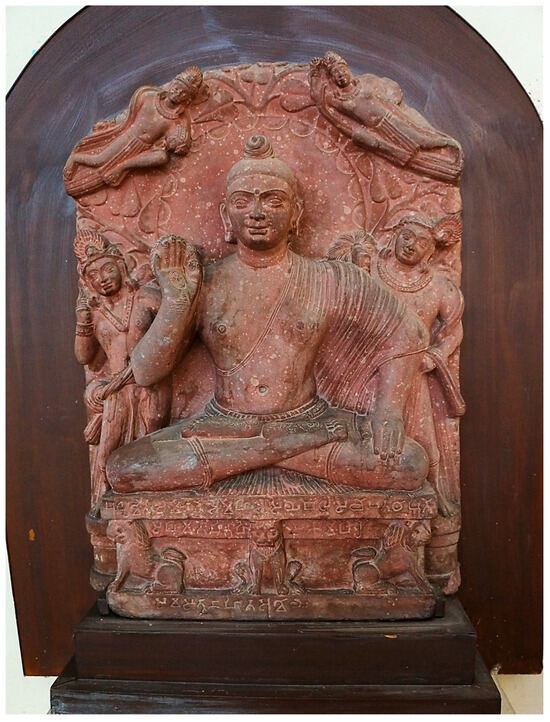
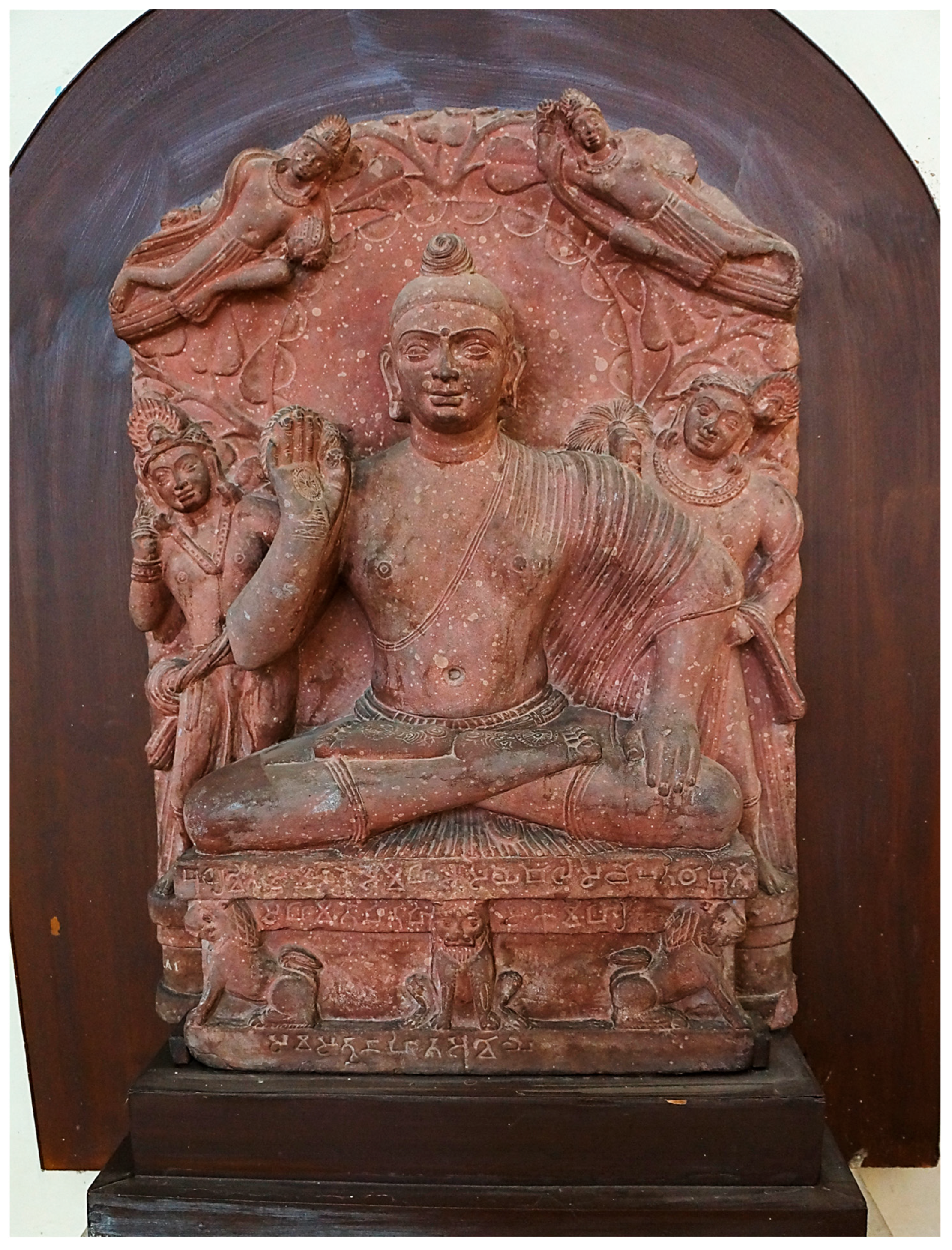
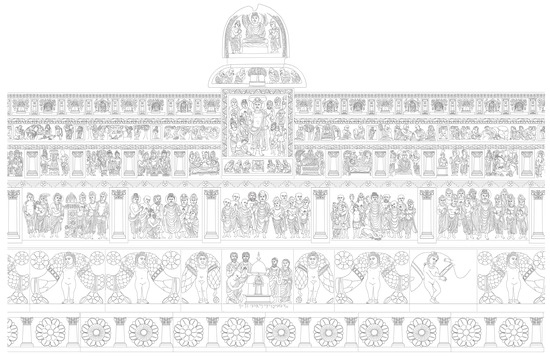
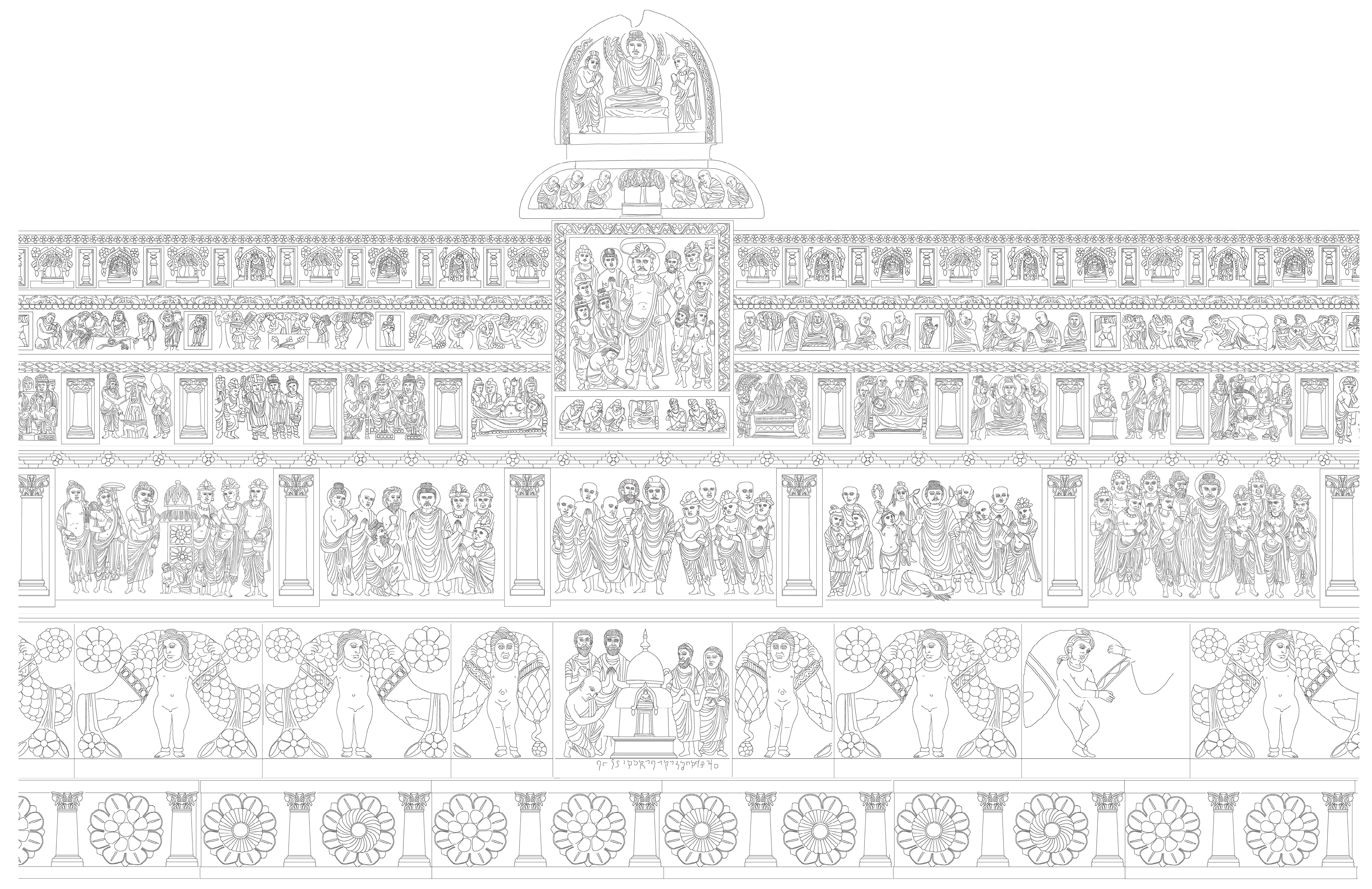
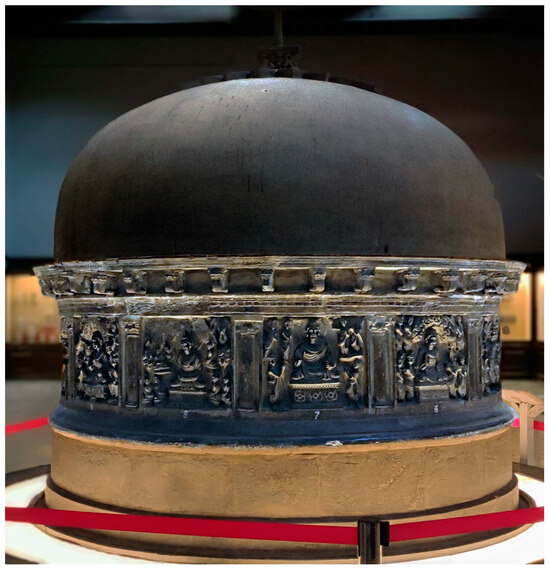
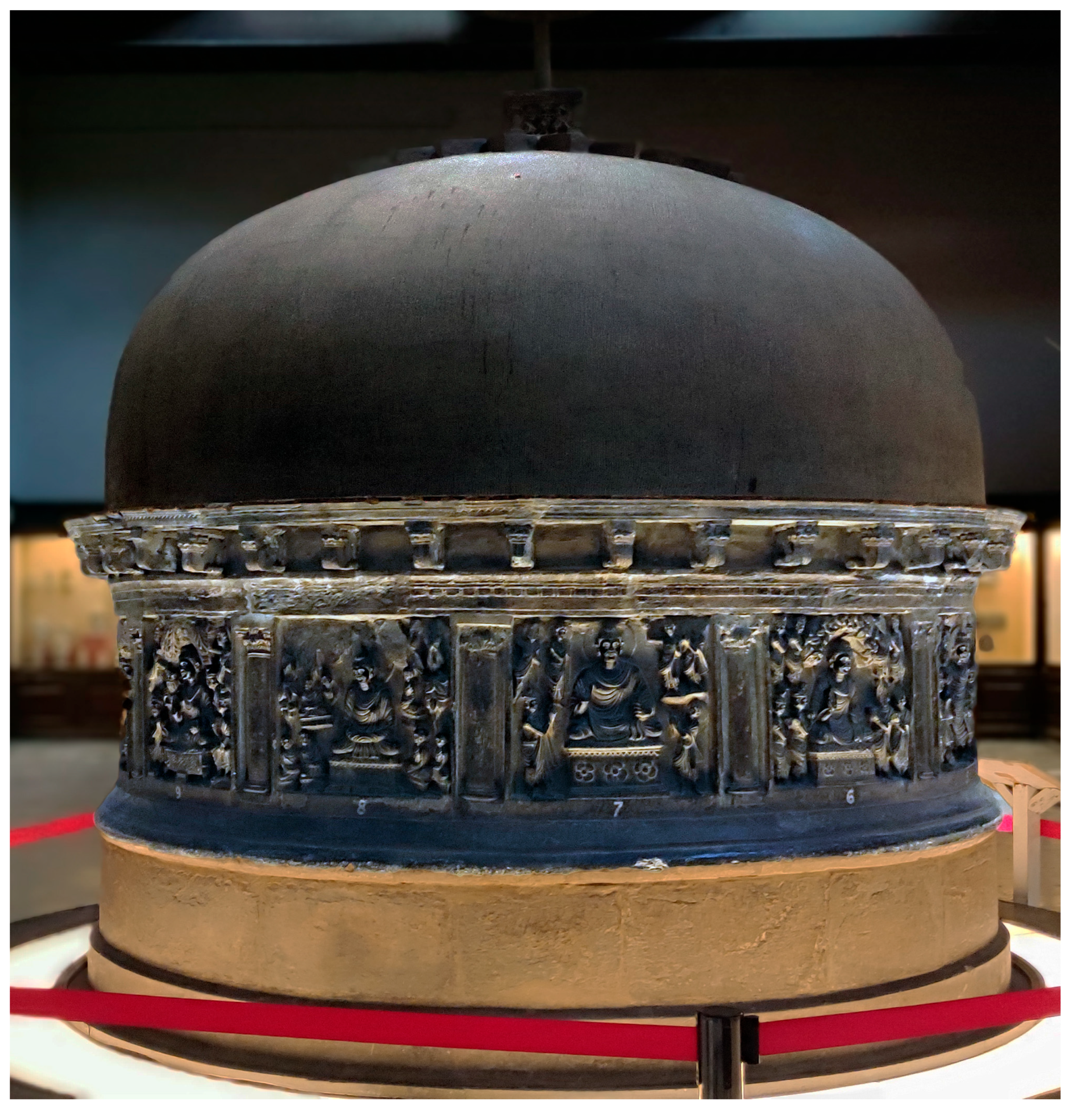
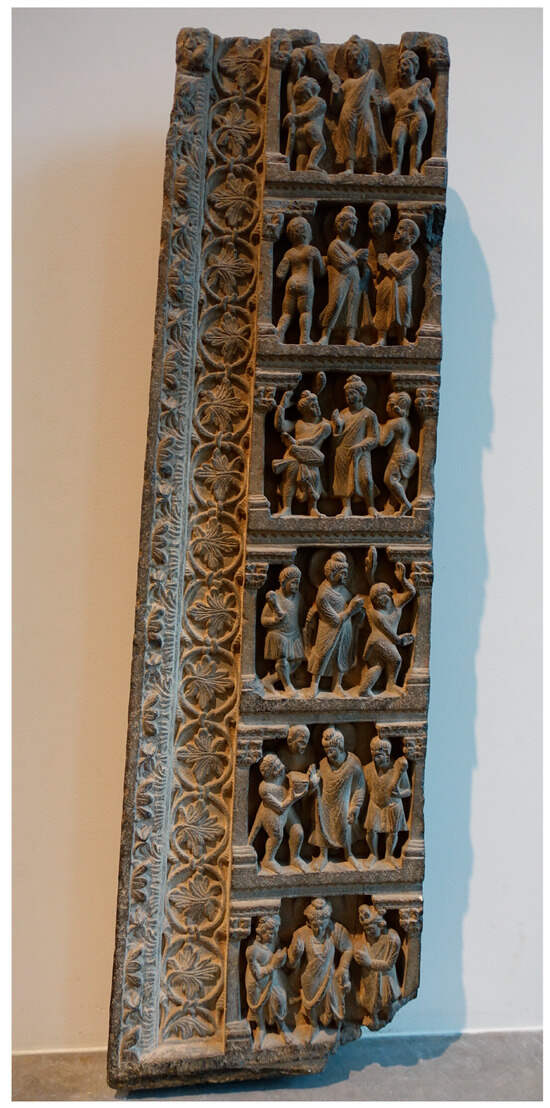
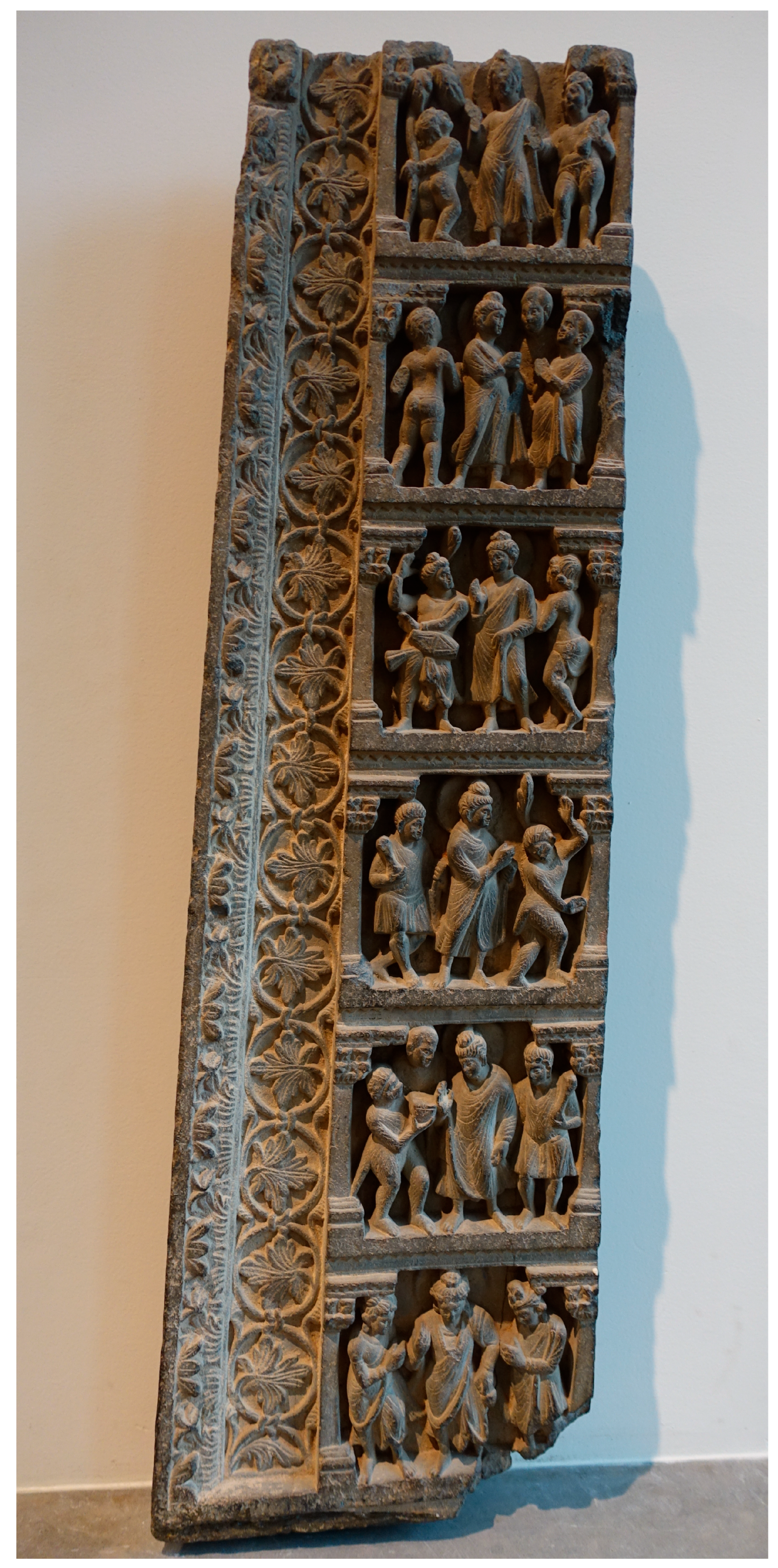
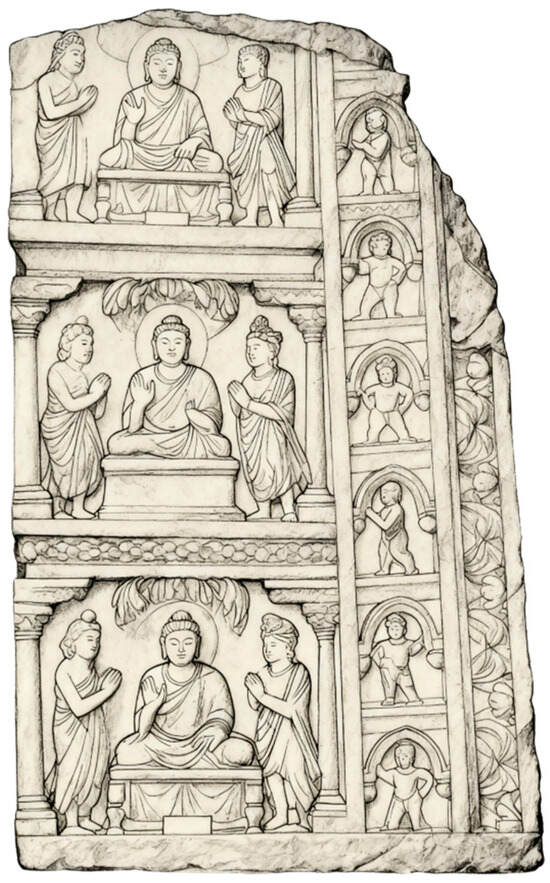
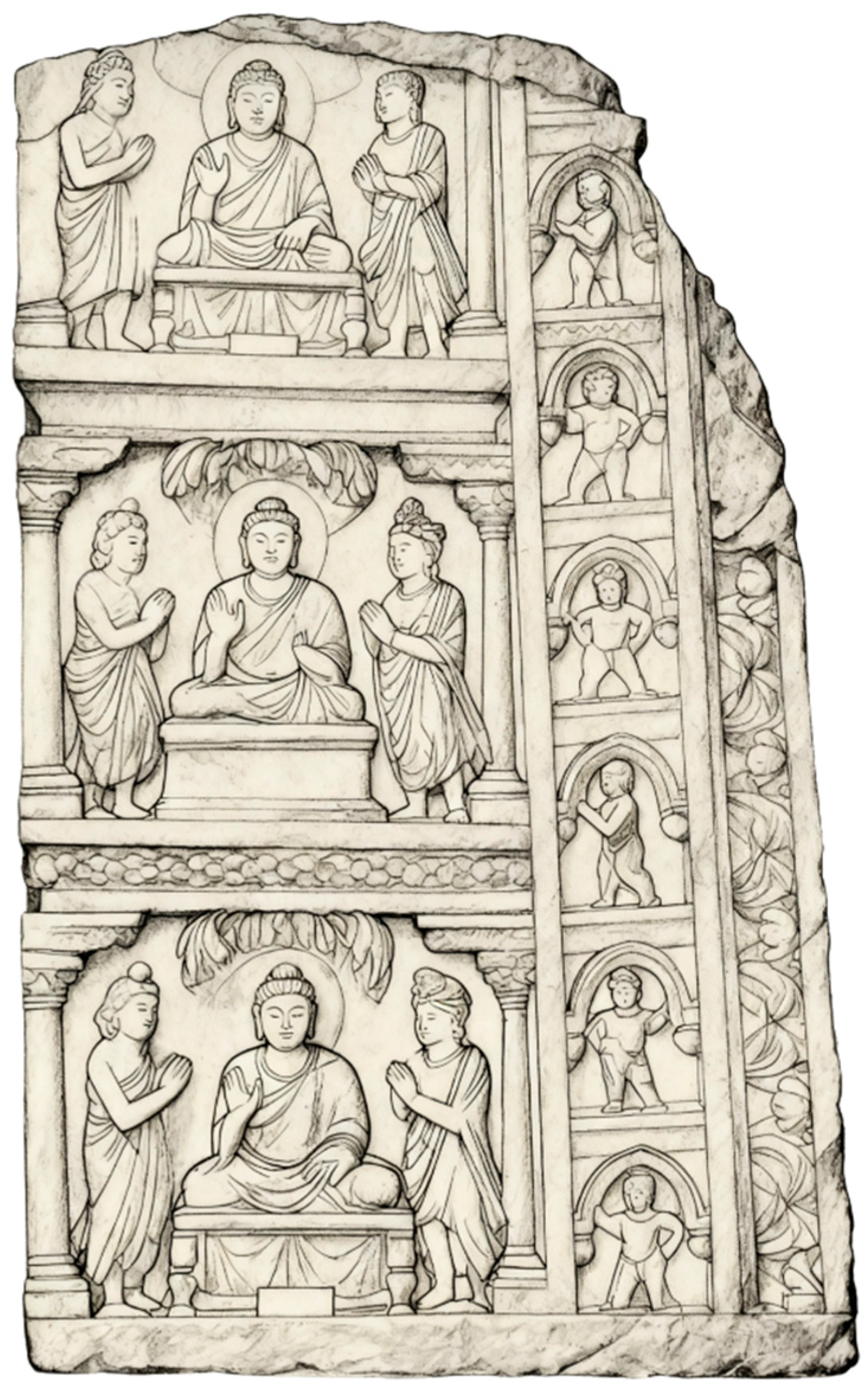
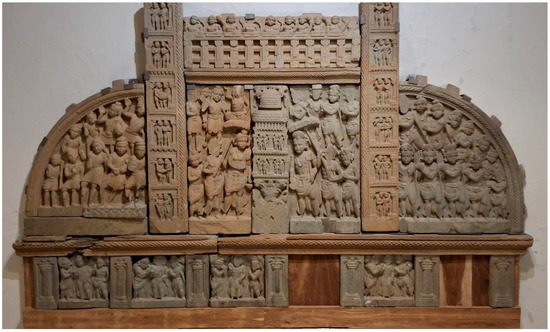
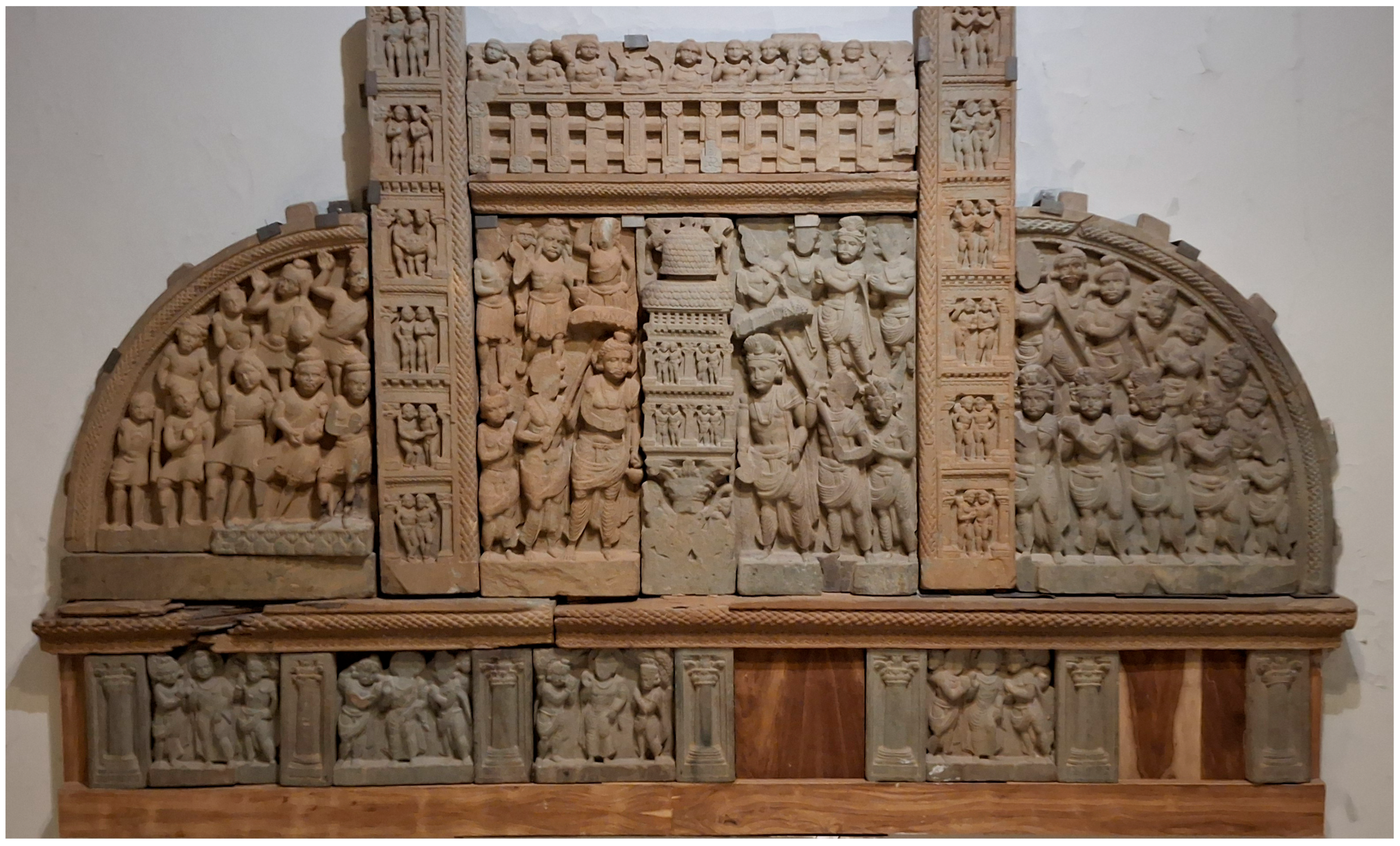
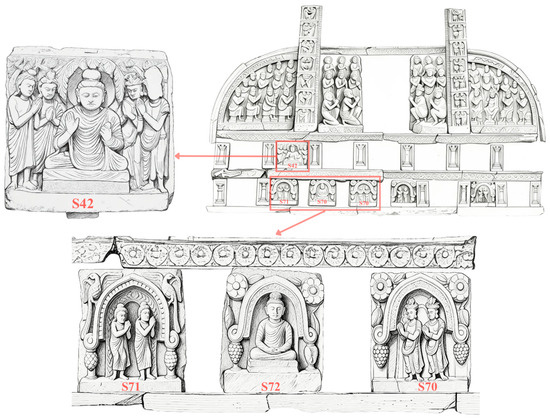
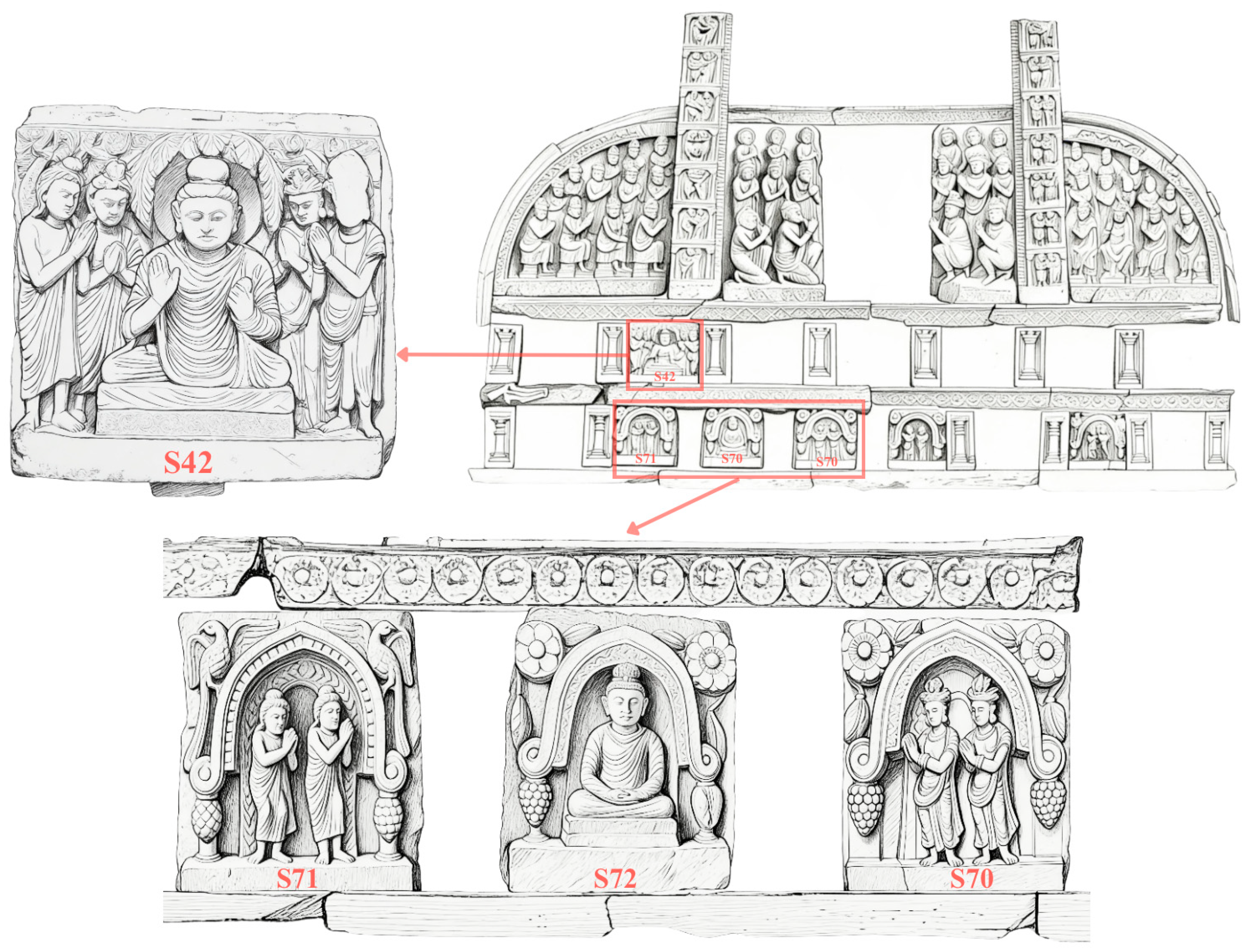
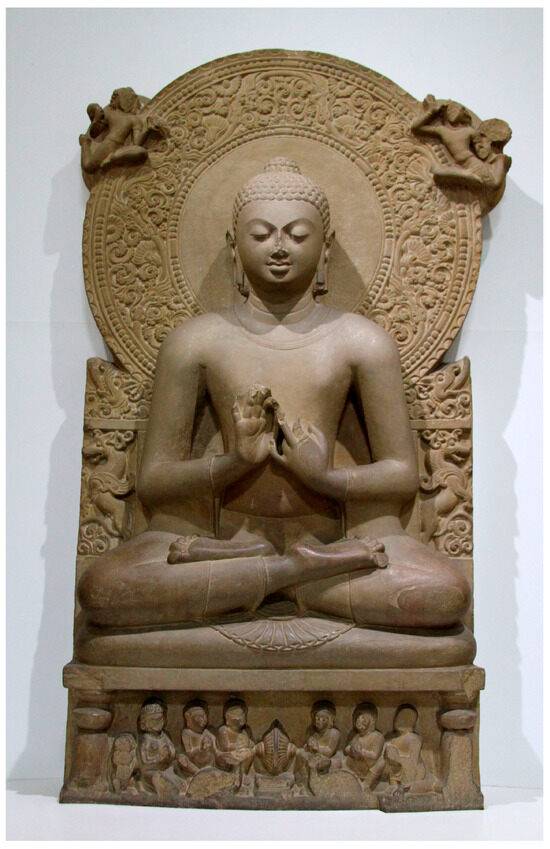
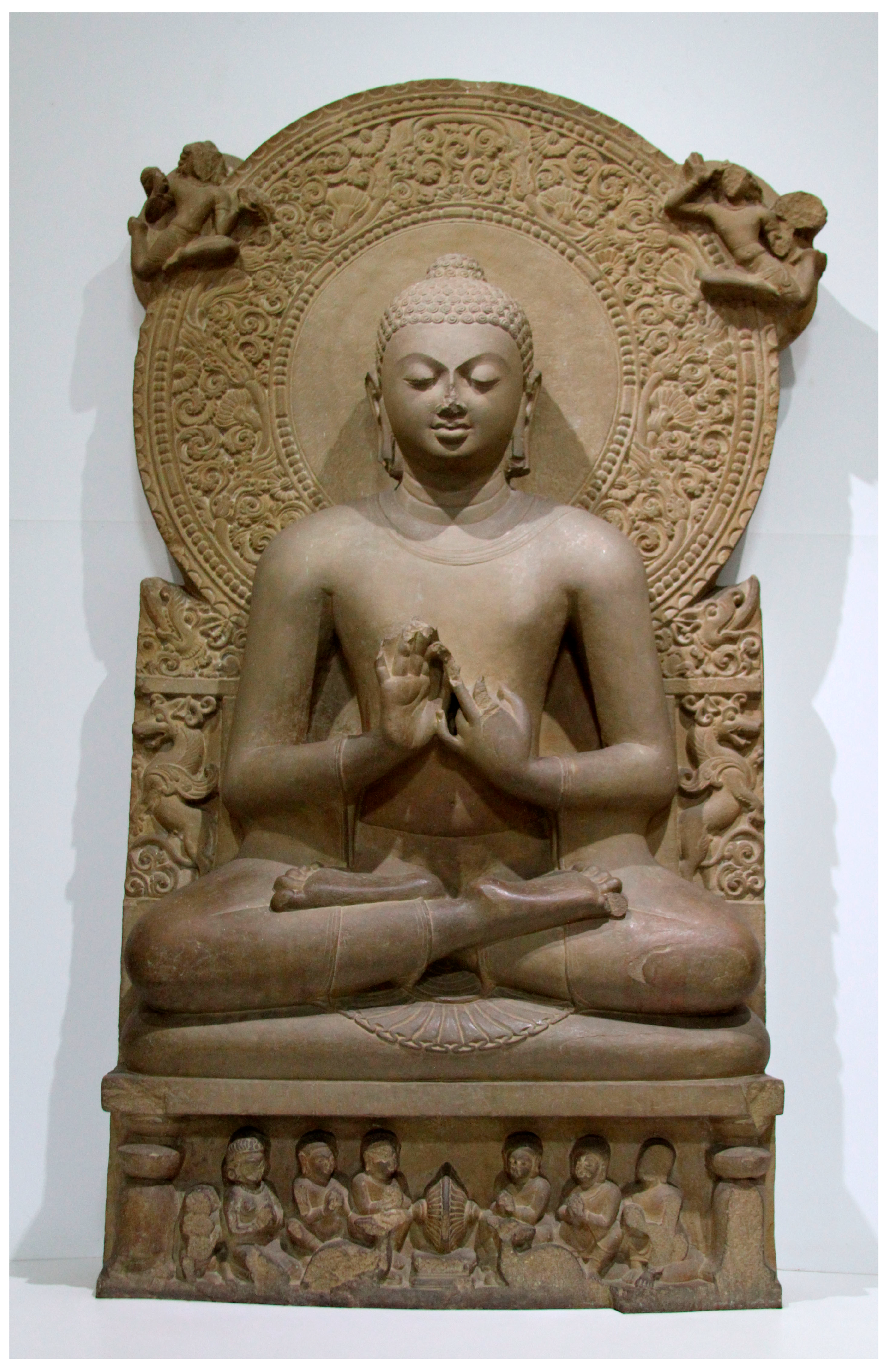
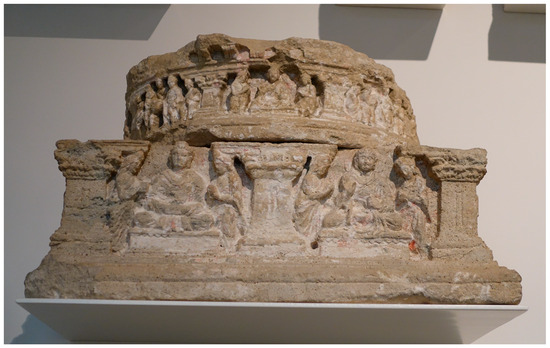
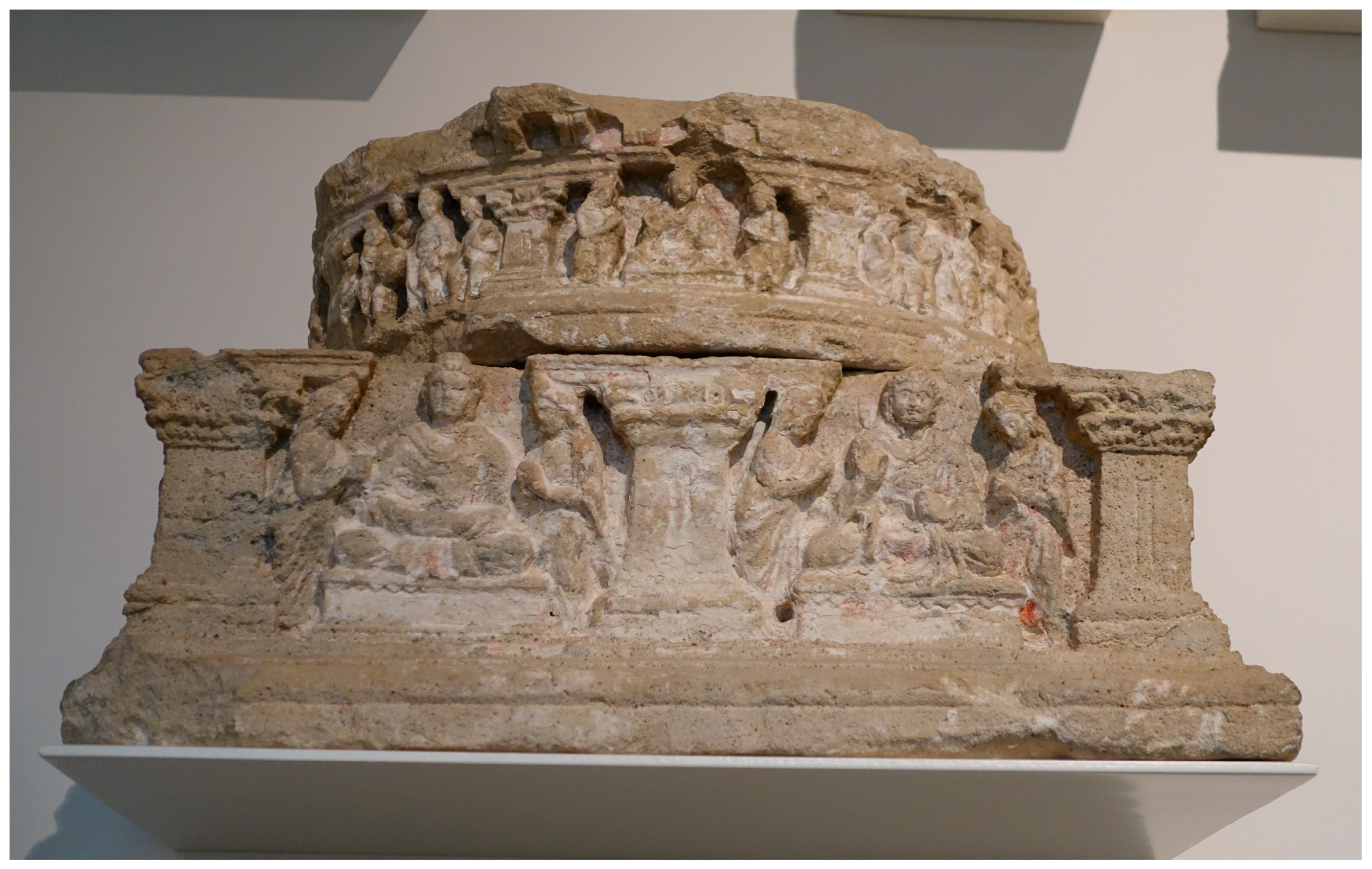

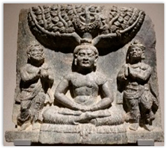
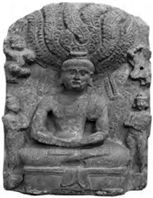
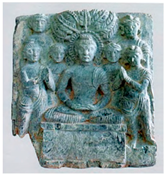
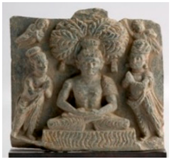
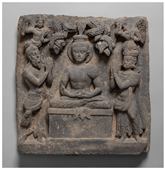
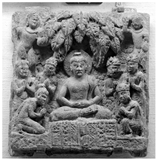
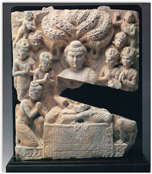
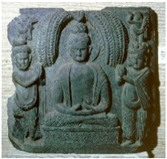
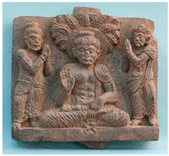
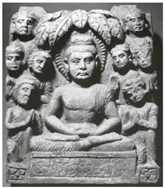
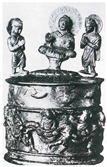
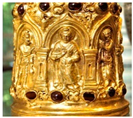
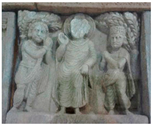
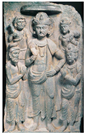
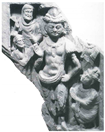
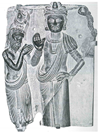
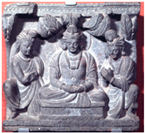
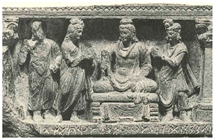
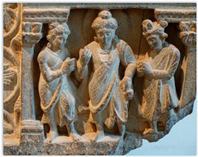
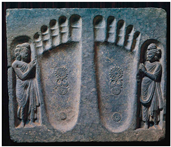
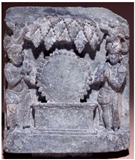
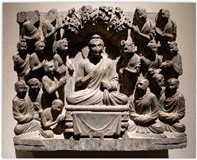
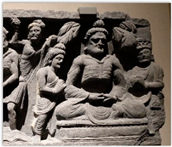
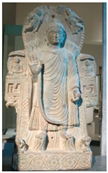
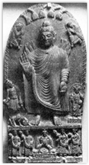
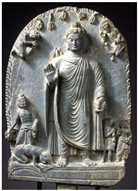
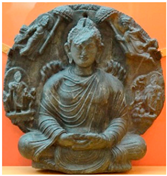
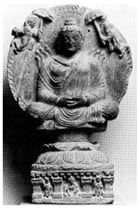
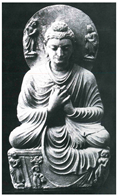
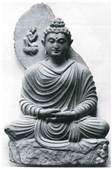
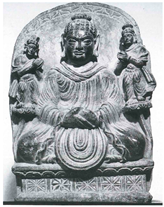
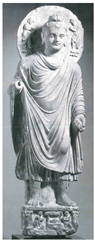
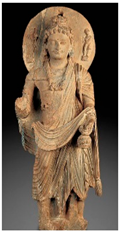
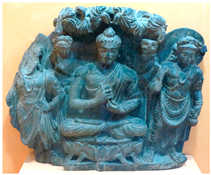
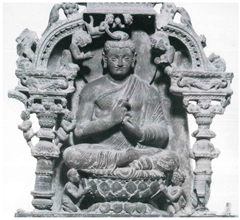
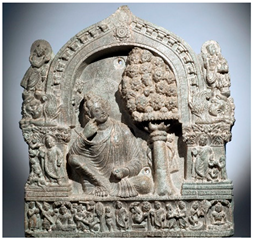
Disclaimer/Publisher’s Note: The statements, opinions and data contained in all publications are solely those of the individual author(s) and contributor(s) and not of MDPI and/or the editor(s). MDPI and/or the editor(s) disclaim responsibility for any injury to people or property resulting from any ideas, methods, instructions or products referred to in the content. |
© 2026 by the author. Licensee MDPI, Basel, Switzerland. This article is an open access article distributed under the terms and conditions of the Creative Commons Attribution (CC BY) license.