


Abstract
This study re-examines a previously undocumented mural panel in the second-story circumambulation corridor of Shalu Monastery, Tibet. Challenging conventional dating, it attributes the murals to the expansion under Grags pa rgyal mtshan (1306–1333) rather than a later period. Furthermore, their precise date likely falls after Butön Rinpoche assumed the role of abbort in 1320. The iconographic program, centered on Śākyamuni and Maitreya and flanked by the Thousand Buddhas of the Bhadrakalpa, integrates narratives of the Buddha’s life and Maitreya’s descent. The inclusion of Cakravartin ideology reflects the politico-religious ideology of the Yuan era. The analysis argues that the mural design embodies the Buddhist vision of Butön Rinpoche, synthesizing doctrines of prophecy, the integration of the Thousand Buddhas into the Vajraśekhara Maṇḍala system, kingship, etc., and establishes these murals as an influential early paradigm in Tibetan medieval art.
Founded in 1027 by lCe btsun Shes rab ‘byung gnas, Shalu Monastery is situated in Shalu Village, rGya mtsho gzhung Township, Shigatse. It flourished during the 14th century and preserves a significant collection of visual cultural heritage dating from the 11th to the 14th centuries. Given its importance in Tibetan political, religious, and art history, the monastery has attracted considerable academic attention both in China and abroad since the early twentieth century. Previous studies, drawing on historical, archeological, art historical, and linguistic approaches, have examined the monastery’s historical development, archeological features, mural styles across periods, thematic content, and specific iconographic cases.1 Since 2015, as a member of the project “Art of Shalu Monastery and the Cultural Exchange between Xizang and inland in China” led by the China Tibetology Research Center, the author has conducted multiple field investigations of the monastery’s murals. These efforts led to the identification of a previously undocumented panel mural in the western section of the second-story circumambulation corridor, which has not yet been the subject of dedicated scholarly research. By integrating textual and visual evidence, this article examines the dating, thematic content, and iconographic significance of this mural cycle, with the aim of enhancing understanding of other contemporaneous murals at Shalu Monastery.
1. Current Condition of the Murals in the Second-Story Circumambulation Corridor at Shalu Monastery
Oriented east–west, Shalu Monastery comprises a main temple and a front courtyard, forming an overall layout reminiscent of a hollow square (回 shape), while the plan of the main temple itself is cruciform (凸 shape). With the exception of the protruding eastern wing, which has three stories, the rest of the structure is two stories high. The monastery currently contains 21 chapels in total: 11 on the first floor, 9 on the second floor, and 1 on the third floor. Due to the low ceiling of the first-floor Protector Chapel, the third-floor Eastern Mandala Chapel appears visually aligned with the other second-floor chapels (Figure 1).
Figure 1.
Section drawing of Shalu Monastery. The location marked in green indicates the murals discussed in this paper. Image courtesy of the China Tibetology Research Center project team; markings and modifications by the author.
The western circumambulatory path on the second floor runs behind the chapels along the southern, western, and northern wings. It lies directly above the circumambulatory path that surrounds the first-floor Assembly Hall. Its entrance is located south of the third-floor Eastern Mandala Chapel, accessible via a descending staircase, while its exit lies between the second-floor North gZhal yas khang Chapel and the Amitāyus Chapel. The circumambulation is divided into three sections: a southern segment measuring 25 m in length and 2.4 m in width; a western segment, 42 m long and 2 m wide; and a northern segment, 24 m long and approximately 1.9 m wide (Figure 2).
Figure 2.
View of the west corridor on the second floor of Shalu Monastery. Image courtesy of the China Tibetology Research Center project team.
Professor Su Bai was the first scholar to draw attention to this mural. In 1959, a survey team led by Wang Yi, then Director of the Cultural Relics Division of the Ministry of Culture, and Professor Su Bai, an archeologist from Peking University, conducted a preliminary investigation and study of ancient architecture, palace ruins, tombs from the Tibetan period, and other surface cultural relics and historical sites in Lhasa, Lhokha, and Shigatse. Drawing on the materials gathered during this survey, Professor Su authored Archaeology of Tibetan Buddhist Monasteries, a work widely regarded as the foundational text of Tibetan historical archeology. In this volume, he offers a concise and precise account of the circumambulation path on the second floor of Shalu Monastery: “On the second floor, timber chapels in the Chinese interior style were constructed along the rear and both lateral sides. A Tibetan-style corridor encircles the exterior of these chapels and the rear of the second-story chapels of the gatehouse. The eaves at the rear of the corridor are situated midway up the chapel entrances, suggesting later modification. The corbels (tuo mu 托木) in the corridor exhibit an earlier form than those on the first floor…A circumambulation path surrounds the aforementioned chapels. Its inner walls are painted with Thousand Buddhas and Tārās, while the outer walls depict scenes from the life of Śākyamuni, most of which appear to be recent repaintings.” (Su 1996, pp. 93, 95). Writing over 45 years later, Xie Bin also briefly described the corridor’s location, timber structure, and murals, though without specifying their thematic content (Xie 2005, pp. 53–55).
The present author’s investigation confirms that murals are preserved exclusively on the inner walls of the southern and western sections of the corridor. The southern section features a recently restored set of the “Three Longevity Deities”, while the western section—the primary focus of this study—is situated directly behind the west outer wall of the West gZhal yas khang. This mural panel extends 15.5 m in length and reaches a height of 3.97 m, including a 1.15 m high dado. The composition is structurally divided by seven roof beams into six principal panels, separated by vertical borders adorned with motifs such as the Seven Jewels (Saptaratna), the Eight Auspicious Symbols, and offering goddesses. The two central panels are organized around the principal figures of Śākyamuni Buddha and Maitreya Buddha, respectively, each flanked by framed narrative scenes. The remaining four panels present the Thousand Buddhas of the Bhadrakalpa arranged in a checkered grid layout (Figure 3).
Figure 3.
Mural layout diagram of the west corridor on the second floor. Image courtesy of the China Tibetology Research Center project team.
2. Analysis of the Original Layout of the Circumambulation Corridor and the Dating of Its Murals
The expansion of Shalu Monastery was carried out under four successive sKu zhang (literally “maternal uncle”): mGon po dpal (1290–1305), Grags pa rgyal mtshan (1306–1333), Kun dga’ don grub (1333–1335), and Ye shes kun dga’ (1335–1356). By examining the successive renovation activities attributed to each patron, a general chronology of the chapels and their murals can be established.
Key historical sources for reconstructing the monastery’s development include: the 14th-century texts A Biography of the Dharma Lord, the Omniscient Translator Butön: A Handful of Flowers;2 The Genealogy of Jo bo lce Lineage of Glorious Golden Zhwa lu Temple (hereafter Genealogy of the Jo bo lce Lineage), composed around the 15th century by A mo gha si dhi; the 17th-century Myang chos ‘byung composed by Jo nang Tāranātha (1575–1634); and, slightly later, The Wonderful Shore of Faith: The History of Biographies of Noble Beings Greatly Kind to the Teaching of Glorious Shalu, compiled in 1835 by Blo gsal bstan skyong; as well as The Guide to the Glorious Golden Temple of Zhwa lu, with the Benefits of Circumambulation and Faith by bKra shis don grub, date unknown.3 Among these, Genealogy of the Jo bo lce Lineage and the Myang chos ‘byung provide the most detailed accounts.
According to these sources, the original layout of Shalu Monastery was relatively modest, consisting only of the Protector Chapel (mGon khang) on the first floor of the eastern wing and the Prajñāpāramitā Chapel (Yum mo lha khang) above it, plus the Jo bo Chapel and Hayagrīva Chapel on the first floor of the western wing. Under mGon po dpal, the Three-Doors Chapel (sGo gsum lha khang) was added to the northern wing. Through analysis of the distribution and stratigraphy of Thousand Buddha murals in the first-floor circumambulatory path, Zhai Ruopu demonstrated the existence of an irregularly shaped passage encircling the western and northern chapels (Zhai 2017, pp. 158–70).
During the tenure of Grags pa rgyal mtshan as sKu zhang, Shalu Monastery underwent its most extensive expansion. He not only strengthened the monastery’s political and religious influence—inviting Butön Rin chen grub (1290–1364) to serve as abbot—but also reconfigured its layout. He constructed the southern wing chapel (the Kangyur Chapel) on the first floor, regularized the circumambulatory path into a rectangular form, and converted the original eastern wing porch into a Protector Chapel. Although the northern wing functioned as a gate-tower, it was flanked by four principal pathways, reinforcing the axial structure and imposing greater spatial order.
This foundational layout was continued and refined by Grags pa rgyal mtshan’s son, Kun dga’ don grub, in collaboration with Butön. Kun dga’ don grub is credited with completing all the murals in the four upper-story palaces—a portrait panel on the southern wall of the Northern Palace attests to his involvement—and adding the Amitāyus (Tshe dpag med lha khang), Tengyur (brTan ‘gyur lha khang), Arhat (gNas brtan lha khang), and Sukhāvatī Chapel (bDe ldan lha khang) at the four corners of the second story.
Although no historical source explicitly confirms the completion of a full second-story circumambulation path during Kun dga’ don grub’s period, its existence by this time can be reliably deduced. By then, all second-story chapels along the southern, western, and northern wings had been completed, the glazed roof ridges had been sealed, and the architectural features of both the first-floor assembly hall and the second-story corridor exhibit notable similarities (Li 2013, p. 16).
In 1335, Ye shes kun dga’—another son of Grags pa rgyal mtshan—succeeded as sKu zhang and carried out what is regarded as the final major renovation of the monastery. While preserving the original layout, he added a second-story courtyard and an exterior wall. He also commissioned three significant artistic projects: the statues of Butön and his disciples in the East gZhal yas khang (Butön Hall), the mural of the Eight Great Stūpas on its exterior wall, and the second-story circumambulation murals discussed in this article.4
Based on textual analysis alone, the second-story circumambulation appears to have been built under Kun dga’ don grub (1333–1335), with its murals executed under Ye shes kun dga’ (1335–1356). However, incorporating on-site archeological and art-historical evidence suggests that this conventional chronology may require reconsideration.
This mural is located on the western exterior wall of the West gZhal yas khang. No painted traces survive on the adjacent northern and southern wall surfaces. Significantly, the northern exterior wall of the West gZhal yas khang also constitutes the southern wall of the Sukhāvatī Chapel at the northwestern corner of the second floor, originally forming the northern segment of the building’s outer circumambulation (Figure 4). Stylistically consistent with murals in the western section of the same corridor, these paintings can be dated to the early 14th century. Depicting the Thousand Buddhas of Akṣobhya, their composition similarly centers on a principal Buddha figure encircled by Thousand Buddhas in a checkerboard layout (Figure 5).
Figure 4.
Diagram showing the mural locations on the west and north exterior walls of the west gzhal yas khang. Image courtesy of the China Tibetology Research Center project team. The area marked by the red line indicates the Bhadrakalpika Buddhas mural; the area marked by the blue line indicates the Akṣobhya Buddhas mural.
Figure 5.
Akṣobhya Buddhas mural inside the bDe ldan lha khang and its schematic layout. Image courtesy of the China Tibetology Research Center project team.
A comparison of the architectural layouts between the first and second stories shows that both the Sukhāvatī Chapel and the Arhat Chapel are flanked by small auxiliary chambers, spatially corresponding to chambers within the bKa’ rgya byang and bKa’ rgya nub Chapels below (Figure 6). This configuration likely resulted from irregular construction during different phases of the monastery’s expansion, reflecting similar functional and contextual constraints.
Figure 6.
Corresponding small compartments on the first and second floors of Shalu Monastery. Image courtesy of the China Tibetology Research Center project team; markings and modifications by the author.
In terms of iconographic content, a clear continuity exists between the two levels. The Thousand Buddhas on the inner walls of the first-floor circumambulation include three types: Bhadrakalpika Thousand Buddhas arranged in an ‘S’-shaped pattern (late 13th to early 14th century), Thousand Buddhas of Akṣobhya, and Thousand Buddhas in the forms of the Five Tathāgatas. The latter two types were painted during the major expansion under Grags pa rgyal mtshan (1306–1333), during which portions of the earlier Bhadrakalpika figures were overpainted. The themes on the western and northern walls of the second-story circumambulation—Thousand Buddhas displaying the mudrās of the Five Tathāgatas and Thousand Buddhas of Akṣobhya—closely align with those from Grags pa rgyal mtshan’s period on the first floor, underscoring a shared iconographic tradition.
Based on Zhai Ruopu’s hypothesis concerning the early configuration of the first-floor circumambulatory path and the positional features of the surviving murals, this paper reconstructs the developmental sequence of the second-story circumambulation: initially irregular during mGon po dpal’s period, it was later remodeled into a rectangular layout under Grags pa rgyal mtshan. Following the construction of the four second-story palaces, a ‘凸’-shaped path emerged on this level, which eventually attained its current rectangular form with Kun dga’ don grub’s addition of the four corner chapels (Figure 7).
Figure 7.
Schematic diagram illustrating the development of the corridor form on the first and second floors of Shalu Monastery. The red, blue, and green colors indicate the different layouts of the circumambulation corridors in Shalu Monastery from various historical periods. Image courtesy of the China Tibetology Research Center project team; markings and modifications by the author.
Based on this analysis, the murals in the western section of the second-story circumambulation can be reassigned to the expansion period under Grags pa rgyal mtshan. If accurate, these murals predate both the extant maṇḍala murals inside the Four gZhal yas khang and the mural of the Eight Stūpas in the Eest gZhal yas khang circumambulation.
3. Analysis of the Mural Content
The murals are rendered in rich, subdued tones—primarily deep reds and dark blues—and feature a compact, densely organized composition. At the center, Śākyamuni and Maitreya are depicted using identical iconography, each measuring 2.8 m in height and 2.37 m in width. The four remaining sections are uniformly composed of Thousand Buddha motifs, arranged in a regular grid. Each section contains 9 rows and 44 columns, totaling 396 Buddha figures, all accompanied below by Tibetan verse inscriptions.
3.1. Śākyamuni Buddha
Śākyamuni Buddha is shown seated in vajraparyankāsana on an upturned lotus pedestal. The entire backing screen is set within a five-stupa niche, symbolizing the Mahabodhi Temple at Bodh Gaya. Flanking the spire and the sides of the backing screen are figures of demon armies, depicted with three heads and six arms, each brandishing weapons in an attempt to thwart the Buddha’s enlightenment. Thus, the central scene represents Śākyamuni’s Enlightenment (Figure 8).
Figure 8.
Statue of Śākyamuni subduing Māra and attaining enlightenment. Image courtesy of the China Tibetology Research Center project team.
To the left and right of Śākyamuni Buddha are six grid compartments containing depictions of stūpas and various narrative scenes (Figure 9). Below the right side of the Sumeru throne is a Tibetan inscription consisting of 17 lines, transcribed and tentatively translated as follows:5
Figure 9.
Schematic diagram of narrative scenes from the life of Śākyamuni. Drawing by the author.
1 ༄། ; ། mChod tu dga’ ba’i rgyal po nga skyes pa’i yul ni ser skya’i gnas [ces] bya’o/ rigs ni rgyal so/ /gdung ni go’u ta ma’o/ /’od ni ’dom gngo/ 2 yab ni sras gtsang ma zhes bya’o/ /yum ni sgyu ’phrul zhes bya’o/ /sras ni sgra gcan ’dzin zhes bya’o/ /rim gro pa ni kun dga’ bo zhes bya’o/ shes rab can 3 rnams kyi mchog ni nye rgyal zhes bya’o/ /rdzu ’phrul can rnams kyi mchog ni pang nas [skya]s zhes bya’o/ /’dus pa dang po ni dge slong stong nyis brgya lnga bcu’o/ /4 sku tshe’i tshad ni lo brgya’o/ /dam pa’i chos ni lo lnga stong gi bar du ni dam pa’i chos ltar snang ngo/ /sku gdung ni rgyas par ’gyuro/ /5 zhes mdo bskal pa bzang po nas gsungs shing/ sprul pa sku’i ’gro don/ lhums su ’jug dang bltam pa dang/ gzhon nu rol rtsed mdzad pa dang/ /bzo’i gnas la 6 mkhas pa dang/ /btsun mo ’khor gyi rold pa dang/ /nges ’byung zhes rga nad ’chi gsum gzigs pa tshur cad khab na bzhugs pa’i mdzad pa drug/ /dka’ ba 7 spyad pa dang/ byang chub snying por gshegs pa dang/ /bdud sde bcom dang nges par ni/ /byang chub chos kyi ’khor lo dang/ /yongs su mya ngan ’das pa’o/ /8 zhes mngon par byung ba’i mdzad pa drug ste; bcu gnyis kyis mthar phyin pa/ klu snying pos gna[s] chen po brgyad du/ mchod rten chen po brgyad la 9 bsdus nas bstod pa mdzad pa ni/ ’gro ba’i bla ma gcig pur lam pir bltam/ /ser skya’i g[ ]r gzhi ru gnas par mdzad/ /yon tan rin chen bye bas rgyan 10 [pa] yi/ /bde gshegs mchod rten rnams la phyag ’tshalo/ /ma ga dha’i byang chub shing gi drung/ /chu bo [ ]n zhes bya ba’i/ /’gram bzhugs mchod rten yon tan rgya che ba/ byang chub rten du 11 gyur la phyag ’tshalo/ /ka shi ke’i bar a na se ru/ /chos kyi ’khor lo rnam grol smad ’byung pas/ nyon mongs sgrib pa rnam par gcod mdzad pa’i/ ye shes mchod rten gzhi la phyag ’tshalo/ 12 gnyan du yod par gzhan stobs tshar bcad nas/ /mdze ta’i yul tu cho ’phrul chen po yis/ /sa gsum dgongs pa mchod tu sgrub mdzad pa/ mi stegs pham mdzad mchod rten phyag 13 ’tshalo/ /grong khyer dam pa mchog ni gsar ldan du/ /lha rnams gnas gshegs bla na med pa babs/ zhabs la tshangs dbang gcod pan gyis mchod pa’i/ /sum bcu’i lhas mchod mchod rten 14 phyag ’tshalo/ /dge ’dun d[ ] du snga gyur la/ /ston pa’i nyan thos rab ’mthun pa/ /rgyal po’i khab ni ’od ma’i tshal/ byams rdzogs mchod rten phyag ’tshalo/ /sku tshe’i ’du byed 15 btang pa las/ /slar yang sku tshe byin brlabs pa/ /rnam g.yo yangs pa can gyi ni/ /byin brlabs mchod rten phyag ’tshalo/ /[ ] gong du ’gro ba rnams/ [dge pa la] ni spyod mdzad cing/ /16 ’gran [gyad] gnas zung [phya]g gi [ ]l/ /mchod rten mya ngan ’das phyag ’tshalo/ shag thub mchod rten brgyad po dang/ phyogs bcu gzhan dang gzha[n rnams] na/ /bzhugs pa’i chos sku 17 kun la ’dud/ /zhi la rtag tu spyi phyag ’tshal/ zhes gsungs so// [ ]bzhi dge’o/.
(1) The land where the Joyful King was born is called the place of Ser-skya [Kapilavastu]. His lineage is royal. His clan is Gautama. The radiant shines for one yojana. (2) His father is called Śuddhodana. His mother is called Māyā. His son is called Rāhula; his attendant is called Ānanda. The foremost of the wise (3) is called Śāriputra. The foremost of those with supernatural powers is called Mahāmaudgalyāyana; The first assembly consisted of 1250 bhikṣus. (4) The measure of his life was 100 h; For 5000 years, the holy Dharma will appear as the holy Dharma. His bodily relics will spread widely, (5) As spoken in the Bhadrakalpika Sūtra.6 The six acts of the emanation body for the benefit of beings: entering the womb, birth, youthfully engaging in play, (6) skillful in the arts, enjoying the company of his consort and retinue, and dwelling in the palace until perceiving the three—aging, sickness, and death—which lead to renunciation. The six perfect acts: Practicing (7) austerities, Going to the seat of enlightenment, Subduing the hordes of Māra, The perfect enlightenment and the turning of the Dharma wheel, and the complete Parinirvāṇa—(8) thus, the twelve great acts are completed. Ācārya Nāgārjuna composed a praise condensing the eight great caityas (9) at the eight great site:
To the single supreme guide of beings, the treasure of the path, who resides at the foundation of the city of Ser skya (Kapilavastu)… (10) adorned with countless jewels of qualities, to the caityas of the Sugatas, I pay homage!
Near the Bodhi tree in Magadha, by the river called [Ne]rañjanā, on the bank resides the caitya of vast qualities, the support of (11) enlightenment, I pay homage!
In Kāśika, in Vārāṇasī, by turning the wheel of Dharma, bestowing liberation and excellence, cutting off entirely the defilements and obscurations, to the caitya of wisdom, I pay homage!
(12) In Śrāvastī, having utterly defeated the power of others, In the Jetavana, through the great miracle, fulfilling the supreme intention for the three worlds, to the caitya that defeated the Tīrthikas, I pay (13) homage!
In the supreme holy city of Sāṅkāśya, the Unsurpassed One descended from the abode of the gods, Brahmā and śakra offered their headdresses at his feet, to the caitya worshipped by the thirty gods, (14) I pay homage!
Where previously there was division in the Saṅgha [ ], and the śrāvaka disciples of the teacher were reconciled, in the king’s city, in the Veṇuvana, to the perfect caitya of Maitrī, I pay homage!
After giving up (15) his conditional lifetime, his lifetime was blessed again, to the caitya of blessing in Vaiśālī, I pay homage!
Where beings bound for [ ] higher states, engage in virtuous deeds, (16) in the land of the Mallas, between the pair of Śāla trees, to the caitya of Nirvāṇa, I pay homage!
To the eight caityas of Śākyamuni, and to the Dharma-kāya present in all [other] realms in the ten directions, (17) I pay homage! Constantly, I pay universal homage to the peaceful! Thus it is spoken. [ ] Four. Excellent!
The inscription references two principal themes commonly represented in depictions of the Buddha’s life: the “Twelve Great Deeds” and the “Transformations of the Eight Caityas,” with the specific narrative arrangement illustrated in Figure 7. The “Twelve Great Deeds” denote twelve key events selected from Buddha Śākyamuni ’s life to exemplify his nirmāṇakāya manifestations. The “Transformations of the Eight Caityas”7, on the other hand, constitute a visual framework integrating the Buddha’s life episodes, miraculous displays, pilgrimage culture, and stūpa veneration, rendered in an iconography designed for effective visual communication. The inscription quotes from a hymn attributed to Nāgārjuna,8 titled Aṣṭamahāśrīcaiṭyastotra (Tib. gNas chen po brgyad kyi mchod rten la bstod pa). The Tibetan canon preserves two distinct texts attributed to Nāgārjuna under this same title; the version cited here corresponds to Tōh. 1133.9 Both hymns were translated into Tibetan by the Indian translator Tilaka (or Tilakakalaśa) and the Tibetan translator Pa tshab Nyi ma grags, yet they differ considerably in content, including the names and sequence of the caityas. The same text is also cited in a black ink Tibetan inscription on the base of the “Devāvatāra stūpa” depicted in the mural of the Eight Great Stūpas, located in the third-floor stairwell of the Great Stūpa at Pelkor Chode Monastery. Its repeated quotations in the Bu ston chos ‘byung further attest to its widespread circulation in Tibet.
The eight narrative scenes within the flanking grids, together with the three scenes below the principal deity and the central scene of Śākyamuni’s Enlightenment, form a total of twelve episodes. However, this ensemble corresponds neither to the “Twelve Great Deeds” mentioned in the inscription nor to a simple combination of the “Eight Caityas” supplemented by other biographical episodes. Rather, it represents a reconfigured visual program that selectively draws from and recombines episodes from different biographical cycles to create a novel pictorial arrangement.
Textual accounts of the Buddha’s biography began to emerge soon after his Parinirvāṇa. Early Buddhist biographical narratives, such as those found in the Ariyapariyesanāsutta, the Catuṣpariṣatsūtra, and the various Vinayas—including the Mūlasarvāstivāda Vinaya and the Dharmaguptaka Vinaya—present differing accounts of the Buddha’s life and are, for the most part, incomplete in their narrative scope.10 As early as the 2nd century CE, Aśvaghoṣa composed the Buddhacarita (also known as Buddhacarita nāmamahākāvya), a five-chapter epic in verse narrating the Buddha’s life from his birth to the distribution of his relics. With the proliferation of Buddhist imagery, standardized cycles such as the “Four Scenes,” “Eight Scenes,” and “Twelve Scenes” gradually crystallized, meeting the needs of iconographic production and devotional practice, and subsequently achieved widespread dissemination. In Tibetan literature, early references to the “Twelve Great Deeds” include the Dvādaśakāranirdeśa (Tib. mDzad pa bcu gnyis bstan pa) (Tōh. 1135), a 10th-century work attributed to Nāgārjuna and translated into Tibetan in the 11th century by the Indian translator Tilaka and the Tibetan translator Pa tshab Nyi ma grags. Other significant references are found in the Myang Chos ‘byung (12th century),11 the Bka’ chems ka khol ma (Lu 2010, p. 14)—a text purportedly revealed by Atiśa—and the ‘Gro ba’i mgon po’i rtogs pa brjod mdzad pa bcu gnyis kyi chos bskor composed by Sa skya Paṇḍita Kun dga’ rgyal mtshan (1147–1216). (Grags pa rgyal mtshan 2009, p. 16) The most detailed systematic enumeration, however, is found in Butön’s Chos ‘byung. Bu ston lists the twelve acts as follows: (1) Descent from Tuṣita Heaven, (2) Entry into the Womb, (3) Birth, (4) Proficiency in Arts and Learning, (5) Marriage and Skillful Feats, (6) Renunciation, (7) Austerities, (8) Journey to the Seat of Enlightenment, (9) Subjugation of Māra and Attainment of Enlightenment, (10) Turning the Wheel of Dharma, (11) Descent from the Trāyastriṃśa Heaven, and (12) Passage into Parinirvāṇa. (Guo 1986, pp. 69–99) A comparative analysis reveals that the “Twelve Great Deeds” referenced in the inscription of this mural correspond most closely to the sequence elaborated by Butön.
The “Transformations of the Eight Caityas” (Ch. Bata bian 八塔變)12 was a widely disseminated iconographic schema that flourished from the 8th to the 14th centuries across India, Pagan, Tibet, and China’s Hexi Corridor. As Buddhist art evolved, the system of the “Eight Great Caityas”—originally commemorating the Buddha’s sacred sites—became systematically linked with eight major events from Śākyamuni’s life. By the 8th century, Indian monastic reliefs and schist sculptures began to feature a coherent visual program depicting the Buddha’s life through eight stūpas, each corresponding to a key event. This constitutes the core of the “Representations of the Eight Stūpas.”
The textual basis for this imagery is found in the Tōh. 3069, entitled ’Phags pa ’jam dpal gtsug tor dri ma med par ’od ’phro ba zhes bya ba’i gzungs dang/de bzhin gshegs pa’i gsang ba’i mdzod chen po’i gzungs las byung ba’i mchod rten brgya dang rtsa brgyad dang/mchod rten lnga bzhengs pa’i cho ga (Skt. Ārya-mañjuśrī-jñānasattvasyaparamārtha-nāma-saṅgīti-unmīlana-sādhana-ṣoḍaśacaitya-vidhi; hereafter referred to as the Establishment Ritual). The colophon indicates that this ritual was composed by Kamalaśīla (Tib. Padma’i ngang tshul, c. 740–795),13 though the Tibetan translator remains unknown.
The Establishment Ritual is, to the author’s knowledge, the only extant Tibetan text that fully corresponds to the iconography of the “Transformations of the Eight Caityas” found in visual materials. Though concise, it effectively encompasses all the miraculous narratives and locations associated with this schema. The eight caityas s and their corresponding events are recorded as follows: “The caitya at Lumbinī, the Garden of Birth; The caitya at Vajrāsana, the Site of the Attainment of Enlightenment; The caitya at Śrāvastī, the Site of the Great Miracle; The caitya at Vārāṇasī, the Site of Turning the Wheel of Dharma; The caitya at Rājagṛha, the Site of Taming the Elephant Nālāgiri; The caitya at Sāṃkāśya, the Site of the Descent from the Trāyastriṃśa Heaven; The caitya at Vaiśālī, the Site of the Monkey’s Offering of Honey; The caitya at Kuśinagarī, the Site of Parinirvāṇa. At these places where the Buddha’s bodily relics were divided into eight portions and where his great acts were performed, caityas were manifested.”14
The principal narrative episodes of the “Transformations of the Eight Caityas” were likely standardized in the Indian subcontinent before the 8th century and remained remarkably stable in later imagery. This is evidenced by the consistency seen across nearly all known examples—including Indian schist sculptures, palm-leaf manuscript illustrations (especially from the Aṣṭasāhasrikā Prajñāpāramitā), Central Tibetan thangkas, portable tsha-tsha tablets from India and Pagan, and murals from the Dunhuang region dating to the Song and Xixia periods (Figure 10). The standardized sequence is: (1) Birth under the Tree, (2) Defeat of Māra and Enlightenment, (3) First Turning of the Dharma Wheel, (4) Great Miracle at Śrāvastī, (5) Taming the Drunken Elephant, (6) Descent from the Trāyastriṃśa Heaven, (7) Monkey’s Offering of Honey, and (8) Parinirvāṇa. This consistency across diverse media, regions, and periods suggests that artists deliberately adhered to a canonical set of episodes deemed most suitable for visual representation—a schema resulting from a prolonged process of selection.15
Figure 10.
Mural of the ‘Transformations of the Eight Stūpas’ from the Xixia period in Dongqianfo Grottoes, Anxi County, Gansu Province. Photo by Jia Weiwei. Photograph by the author.
Although the iconographic sequence remained stable, the subsequent textual tradition did not maintain the systematic coherence found in Kamalaśīla’s work. Records of caitya names and corresponding events in multiple texts reveal inconsistencies, indicating that a unified system for the eight stūpas had not yet coalesced between the 10th and 12th centuries. Instead, multiple traditions appear to have coexisted and evolved in parallel. In addition to the two hymns attributed to Nāgārjuna, other relevant texts include the Aṣṭamahāsthānacaityavandanāstava (in its Tibetan version16) and the Aṣṭamahācaityanāmasūtra, both translated into Chinese by Faxian (T1864 Bada lingta fanzan 八大靈塔梵讚, T1685 foshuo bada lingta minghao jing 佛說八大靈塔名號經) Descriptions of the caityas and their events vary considerably among these sources.
Extant Tibetan literature suggests that textual materials concerning the eight great relic caityas—built after the Buddha’s parinirvāṇa and the division of his relics—and the caityas commemorating his miraculous acts emerged primarily during two periods: the 7th–9th centuries and the 10th–12th centuries. On this foundation, the system of the “Eight Great Stūpas”continued to develop in Tibetan Buddhist art, gradually maturing. This evolution led to the later frequent use of the Eight Great Stūpas—each with a distinct architectural form—replacing the earlier convention of depicting the eight relic caityas with identical shapes. Meanwhile, the “Transformations of the Eight Caityas” schema, which paired specific events with specific caityas, gradually declined as a mainstream motif in Buddhist art after the 14th century. Its prominence was soon supplanted by narratives from the Jātakamālā and related literature, which came to dominate Tibetan depictions of the Buddha’s life. Artistic representations increasingly adopted a compositional format centered on the Enlightenment scene, surrounded by a grid of narrative vignettes from both the Buddha’s life and jātaka tales.
By tracing the evolution of the “Twelve Great Deeds” and the “Trasformations of the Eight Caityas” across visual and textual sources, and re-examining the murals in the second-floor circumambulation corridor at Shalu Monastery, a clearer interpretation emerges. The painters appear to have based the mural’s iconography on Nāgārjuna’s Aṣṭamahāśrīcaiṭyastotra, cited in the inscription. Their approach of integrating biographical scenes within stūpa forms aligns with that seen in other “Transformations of the Eight Caityas” images. However, the inclusion of specific events such as “Preaching on the division of the sangha” and “Meditating on the lifespan”—absent from earlier paintings and lacking definitive narrative markers—posed a challenge. To address this, the artists resorted to a conventional composition of a central Buddha flanked by two disciples to depict these less common scenes.
3.2. Maitreya Buddha
The central figure depicts Maitreya Buddha seated in vajraparyankāsana on a multicolored lotus throne with upturned petals. He wears a monastic robe that leaves u right shoulder bare, its borders decorated with interlocking floral patterns. His right hand forms the Dharma-teaching mudrā, while his left rests in the meditation mudrā.
Flanking the central deity on both sides are eight cartouches containing narrative scenes related to Maitreya, with additional panels below the throne (Figure 11 and Figure 12). A six-line Tibetan inscription beneath the right-side cartouches reads as follows:
Figure 11.
Figure of Maitreya Buddha. Image courtesy of the China Tibetology Research Center project team.
Figure 12.
Schematic diagram of narrative scenes from the life of Maitreya Buddha. Drawing by the author.
1 ༄། ; ། De bzhin gshegs pa byams pa [skyes] pa’i yul ni rgyal po’i pho [brang] grong khyer shes bya’o// rigs ni bram ze’o// 2 ’od ni dpag [tshad] gcig go/ yab ni tshangs bzang shes bya’o/ yum ni tshangs bdag ma zhes bya’o/ /sras ni bsod nams stobs shes bya ba’o// 3 rim mgro pa ni rgya mtsho shes bya’o/ /shes rab [can] rnams kyi mchod ni ye shes ’od ces bya’o/ /rdzu ’phrul can rnams kyi mchod ni brtson ’grus 4 b[rta]n zhes bya’o/ /’dus pa dang po la ni nyan thos dgra bcom pa dung phyur phrag dgu dang bye ba phrag drug go/ /gnyis po la ni dung phyur phrag dgu dang bye 5 ba phrag bzhi’o/ /gsum pa la ni dung phyur phrag gnyis so/ /sku tshe’i tshad ni lo brgyad khri bzhi stong ngo/ /dam pa’i chos ni 6 lo brgyad khri’i bar du gnas so/ /sku gdung ni ril po gcig du ’dug go// ; [la] dge’o//.
(1) The land where the Tathāgata Maitreya will be [born] is the city called Ketumatī, the royal capital. His lineage is Brahmin. (2) His radiance measures one yojana. His father is called Śubhra. His mother is called Brahmāvatī. His son is called Sumanastejas. (3) His attendant is called Sāgara. The foremost among the wise is called Jñāna-prabha. The foremost among those with supernatural powers is (4) called Vīryavān. The first assembly consists of 96 koṭis of Śrāvaka Arhats. The second assembly consists (5) of 94 koṭis. The third assembly consists of 92 koṭis. The measure of his lifespan is 84,000 years. The holy Dharma (6) will abide for 80,000 years. His bodily relics will coalesce into a single sphere… [ ] Excellent!
This passage, likewise quoted from the Bhadrakalpika-sūtra is also cited in other works such as Ratnagotravibhāgavyākhyā (c. late 4th century-mid-5th century, A sang 2008, p. 27), Myang chos ’byung (12th century, Myang Nyi ma’od zer 1988, pp. 23–24), and the Compendium of Sa skya Doctrinal History (some texts from the 13th century, Grags pa rgyal mtshan 2009, pod 3). Based on an analysis of its pictorial narrative, the mural can be identified as depicting the Maitreya-vyākaraṇa: After abiding in Tuṣita Heaven for 5.6 billion years as a once-returner bodhisattva, Maitreya descends to the Sahā World, now transformed into a pure land—tranquil, majestic, and inhabited by beings of great merit. Human lifespans extend to 84,000 years; women marry at the age of 500; crops yield seven harvests from a single sowing; and clothing grows on trees. Maitreya is born into the household of the Brahmin Śaṅkha in Ketumatī City, and undergoes birth, renunciation, enlightenment, and teaching—paralleling the life of Śākyamuni. Witnessing Brahmins dismantling a jeweled stupa, he comprehends impermanence, renounces the world, attains enlightenment, and delivers three great teachings under the Nāgapuṣpa Tree in the Dragon Flower Garden, liberating countless beings.
Maitreya-related literature emerged early and comprises two distinct systems: the Tuṣita Heaven (Upper World) and the Descending World traditions. The Kangyur includes The Sūtra on the Ascension of the Holy Maitreya Bodhisattva to the Tuṣita Heaven (’Phags pa byang chub sems dpa’ byams pa dga’ ldan gnam du skya ba blangs pa’i mdo, Tōh.199), a varient version corresponding to the Chinese Foshuo guan Mile pusa shangsheng Doushuai tuo tian jing 佛說觀彌勒菩薩上生兜率天經 (T0452), translated by Juqu Jingsheng during the Liu-Song dynasty. A key Descending-World text, the Maitreya-vyākaraṇa (Byams pa lung bstan pa; Skt. Ārya-maitriyavyākaraṇa), was translated by Ācārya Jinamitra and the Tibetan translator Dpal brtsegs,17 and is preserved in the Beijing and Snar thang editions.
The Chinese Buddhist canon contains a richer collection of descent texts, with five principal versions currently extant: Fo shuo Mile xiasheng jing 佛說彌勒下生經, translated by Dharmarakṣa of the Western Jin dynasty; Fo shuo Mile laishi jing 佛說彌勒來時經, attributed to an anonymous translator; Fo shuo Mile xiasheng chengfo jing 佛說彌勒下生成佛經 and Fo shuo Mile dachengfo jing 佛說彌勒大乘佛經, both translated by Kumārajīva during the Later Qin dynasty; Fo shuo Mile xiasheng chengfo jing 佛說彌勒下生成佛經, translated by Yijing of the Tang dynasty. While the core narrative remains consistent across these versions, minor variations occur—for instance, Dharmarakṣa’s rendition omits the episode of the dismantled pillar, while Kumārajīva’s lacks references to clothing growing on trees and details regarding Maitreya’s birth (Li and Cai 1990, p. 302).
From the mid-Tang period onward, spurred by the patronage of Empress Wu Zetian, Maitreya devotion became increasingly widespread, with Yijing’s translation uniquely elevated to authoritative status. The Tibetan translation aligns closely with Yijing’s version and is composed entirely in regular verse. Recorded in the early Tibetan catalogue ’Phang thang ma (Xu 2013, p. 124)18 and the lexical compendium Mahāvyutpatti (Ui Hakuju 1983), it attests to the text’s translation during the Early Propagation of Tibetan Buddhism.
Although the Maitreya-vyākaraṇa was translated at an early date, its depiction in art is exceptionally rare, underscoring the significance of the mural at Shalu Monastery. In Tibetan Buddhist art, Maitreya most commonly appears as an isolated figure or within groupings such as the Buddhas of the Three Times, the Mañjuśrī–Maitreya pair, or the Śākyamuni–Avalokiteśvara–Maitreya triad. Certain thangkas present Maitreya as a large central deity surrounded by grids of buddhas, deities, or teachers—devoid of narrative content. On the rare occasions when episodes from Maitreya’s life are depicted, the emphasis lies predominantly on his pure land in Tuṣita Heaven or his previous lives. A notable example is found in the Kumbum of Pelkor Chode Monastery, where the sixteenth chapel on the first level is dedicated to Maitreya. Its walls illustrate either the Tuṣita Heaven pure land or scenes from his past existences, derived from the Maitreya-paripṛcchā-sūtra19 and the Saddharmapuṇḍarīka-sūtra20 (Figure 13).
Figure 13.
Jātaka stories of Maitreya in the Tuṣita Palace, Sixteenth Chapel, first floor of the Kumbum at Pelkor Chode Monastery. Photo by Xie Jisheng. Reproduced with permission.
By contrast, the second-floor circumambulatory path at Shalu Monastery preserves a complete pictorial cycle of Maitreya’s descent—a theme notably absent in earlier Tibetan art. Its inclusion likely reflects the growing ideological prominence of the Cakravartin concept in Tibet during the Yuan dynasty. According to Buddhist tradition, Maitreya’s descent coincides with the advent of a Cakravartin in the Sahā World. This ideal sovereign, endowed with the seven treasures and ruling the four continents, governs a realm characterized by purity, peace, agricultural abundance, and popular prosperity. The Cakravartin serves not only as a temporal ruler but also as a patron and protector of the Dharma, governing in accordance with Buddhist law and guiding sentient beings toward virtue. In Buddhist political philosophy, the Cakravartin ideal often merges with kingship, and historically, several Chinese emperors adopted the title “Wheel-Turning Sacred Monarch” (Sun 2015, pp. 43–53) to sacralize and legitimize their rule.
The Mongol-Yuan empire, having established a unified and powerful central authority, actively integrated the Buddhist concept of the Cakravartin into its ideological framework. The Imperial Preceptor ’Phags-pa constructed such an identity for Kublai Khan, systematically elaborating the interdependence between the Cakravartin and the Dharma in works such as the Shes bya rab gsal (The Treatise on the Elucidation of the Knowable,translated into Chinese by Sha lo pa as Zhang suozhi lun 彰所知论), while also shaping the Yuan emperor into a Dharma King through rituals and iconographic means. This ideology was further systematized and visualized during the era of Butön Rinchen Drub, as evidenced in the Prajñāpāramitā Chapel murals at Shalu and Butön’s Catalogue of the Tengyur. Innovatively, he prefixed the names of the lords (rigs kyi bdag po) of the Buddha and Lotus families in Kriyā Tantra with “Cakravartin…” (’khor los bsgyur ba…) (Yang 2012b, p. 188). The Seven Precious Possessions of the Cakravartin appear in a vertical panel adjacent to the Maitreya-vyākaraṇa depiction, and this motif is carefully integrated into cosmological scenes21 elsewhere in the monastery, indicating that the Cakravartin ideology was deeply embedded in Shalu’s visual program.
The juxtaposition of the Maitreya-vyākaraṇa narrative and the Cakravartin ideal in Shalu’s murals carries profound politico-religious implications. Maitreya’s descent heralds a new, purified Buddhist era, while the Cakravartin King embodies the ideal ruler of that age—a protector and upholder of the true Dharma. As a major monastery in Ü-Tsang during the Yuan period, Shalu’s mural program reflects not only the Sakya school’s recognition of Yuan authority but also how local religious forces sought to maintain favorable relations with the central court. By merging Buddhist doctrine with royal ideology, the narrative endows Yuan rule with a sacred dimension. Thus, this depiction of the Maitreya-vyākaraṇa is not only a rare surviving example of narrative sutra illustration in Tibetan art, but also visual testimony to the political and cultural ideology of Tibet under the Yuan.
3.3. The Thousand Buddhas
Four panels depicting the Thousand Buddhas are symmetrically arranged on either side of the central figures of Śākyamuni and Maitreya. Each panel follows a uniform composition: a principal Buddha seated in full lotus posture on an upturned-lotus throne, wearing a robe that leaves the right shoulder bare, flanked by six attendants—three on each side—all rendered in profile facing the central deity (Figure 14). The mudrās represented correspond to those of the Five Tathāgatas and are systermatically repeated throughout the arrangement.
Figure 14.
Detail of the Bhadrakalpika Buddhas, photo by Liao Yang. Reproduced with permission.
Beneath each small Buddha’s lotus throne, a four-line Tibetan verse inscription is preserved, each ending with a numeral indicating its sequential position. Analysis of the numbering reveals a consistent logic: using Śākyamuni and Maitreya as central reference points, the numerals ascend outward in both directions, with each of the four panels restarting its sequence from “1.” In the two northern panels, numbering begins at the top, just north of Maitreya, and proceeds in a serpentine pattern from top to bottom and south to north. Conversely, in the southern panels, numbering starts at the bottom, just south of Śākyamuni, following a parallel directional logic. For a detailed distribution, refer to the diagram below (Figure 15).
Figure 15.
Schematic diagram showing the numbering/sequence of the Bhadrakalpika Buddhas. Drawing by the author.
Due to onsite constraints, the research team was unable to transcribe all inscriptions completely, recording only a well-preserved selection from each panel. Each inscription adheres to a uniform structure, varying only in the Buddha’s name, lineage (rigs), and lifespan (sku tshe). For example, the inscription beneath the first Buddha in the penultimate row of the northernmost panel reads:
rin chen ’od ni rgyal rigs yab yum sras/rim gro pa dang mchog zung ’dus pa gsum/sku tshe bye ba chos ni □/gdung ril mchod rten cig pa de la ’dud/.
This translates as: “Buddha Ratnaprabha, of the Kṣatriya lineage, [with his] father, mother, son, attendants, the pair of foremost [disciples], and triple assembly; lifespan of a billion [years], the Dharma [abides for…]; [we] pay homage to the single stūpa containing the relic mass.”
All Buddha names derive from the Bhadrakalpika-sūtra.22 According to Bu ston’s History of Buddhism, this sūtra “details thirteen items for each Buddha: place of birth, lineage, aura, parents, sons, attendants, the foremost wise disciple, the foremost disciple with miraculous powers, the assembly of followers, lifespan, duration of the True Dharma, and the stūpa; sometimes the item ‘clan’ is added, making fourteen topics.” (Guo 1986, p. 51). Owing to limited writing space, the scribes did not quote the full sūtra text but created a condensed adaptation, uniformly formatted into quatrain verses.
A critical question remains whether Śākyamuni and Maitreya are integrated into the overall sequence of the Thousand Buddhas. Close examination reveals three additional Buddha images positioned above the four rows of narrative panels flanking the two central figures (Figure 16). These share the identical “one Buddha with six attendants” composition seen elsewhere among the Buddhas of the Bhadrakalpa, and all retain legible Tibetan inscriptions beneath their lotus thrones.
Figure 16.
Three additional Buddha images above the two central Buddhas. Image courtesy of the China Tibetology Research Center project team; markings and modifications by the author.
The inscription at location 1 (in Figure 17) is too effaced to be deciphered. However, the inscription at location 2 is well preserved:
Figure 17.
The inscription below Krakucchanda Buddha at location 2. Image courtesy of the China Tibetology Research Center project team.
gser thub bram ze’i rigs ni yab yum sras/rim gro pa dang mchog zung ’dus pa gsum/sku tshe sum khri dam chos srong gi bar/sku gdung ril po mchod □ gcig la ’dud/ gnyis/
This translates as: “Kanakamuni, of the Brahmin lineage, [with his] father, mother, son, attendants, the pair of foremost [disciples], and triple assembly; lifespan of 60,000 [years], the duration of the holy Dharma [is…]; [we] pay homage to the single reliquary stūpa containing the bodily relics. Two.”
This figure is clearly Kanakamuni, the second Buddha of the Bhadrakalpa, with the final numeral “2” confirming his sequential position. Although the inscription at location 3 is heavily effaced, the initial name Sangs rgyas ’od bsrungs remains fully legible, identifying him as Kāśyapa, the third Buddha of the Bhadrakalpa. It follows that location 1 must depict Krakucchanda (Tib: ’khor ba ’jig), the first Buddha of this kalpa.
Extending this sequence further reveals the designers’ clear intentionality. Śākyamuni and Maitreya are spatially arranged in strict accordance with the successive order of the Bhadrakalpa Buddhas—not placed outside the Thousand Buddha system, but explicitly presented as the fourth and fifth Buddhas following Kāśyapa. This compositional scheme reflects the designers’ adherence to the genealogical structure of the “Thousand Buddhas of the Bhadrakalpa.” It also illustrates the doctrinal basis in Buddhist iconography for integrating Śākyamuni and Maitreya—two pivotal Buddhas of this kalpa—into a single visual sequence, thereby constructing a complete succession of the Bhadrakalpa Buddhas.
4. Butön’s Contribution to the Thousand Buddhas Doctrine and Its Artistic Implementation
The omniscient master Butön, a scholar of profound erudition, served as abbot of Shalu Monastery for nearly four decades (1320–1356). He devoted extensive effort to the monastery’s 14th-century expansion, personally overseeing its design and execution. Scholarship has long sought to identify which surviving murals at Shalu reflect Butön’s own conceptual input.23 It is well established that the three mandala halls on the second floor, the eastern mandala hall on the third floor of the gateway structure, and the murals within their connecting galleries all embody his overarching vision (Liao 2019). This naturally raises the question of whether this panel of the Thousand Buddhas of the Bhadrakalpa should also be attributed to his artistic and doctrinal legacy?
4.1. The Prophesied Buddha ‘Pradyota’
Composed by Butön’s direct disciple, sGra tshad pa Rin chen rnam rgyal, The Biography of Butön consists of two distinct parts: the first was completed in 1355 at Sakya Monastery, and the second in 1366 at Ri phug bde chen chos kyi pho brang. The work blends hagiography with didactic narrative, reflecting the literary and pedagogical concerns of its author and period. Although the academic community has raised questions about the religious rhetoric and symbolic narratives employed in this biography, given that the main body of the text was largely completed during Butön’s lifetime (he passed away in 1364), it is inappropriate to entirely dismiss the possibility that it incorporates, to a considerable extent, Butön’s own views, or at least reflects the religious currents of his era. Its opening sections recount the master’s previous lives, noting that during one lifetime in the Bhadrakalpa, he was prophesied by siddhas, arhats, and other saints to become the seventh Buddha of this Fortunate Aeon: Buddha Pradyota (Tib. rab gsal) (Seyfort Ruegg 1966, pp. 51–52). This narrative bears considerable significance: it implies that, for Butön–or at least from the perspective of his direct disciples—he was not merely the compiler and transmitter of the concept of the Thousand Buddhas, but was himself regarded as an integral figure within this sacred lineage.
More directly revealing Butön’s own Buddhist thought is his History of Buddhism. Completed in 1322, this monumental work reflects the nascent form of his philosophical system and conceptual framework before he turned thirty. At the time, the master had just entered his second year as abbot of Shalu Monastery–a critical period coinciding with the creation of the monastery’s murals. It is highly plausible that he directly influenced the iconographic program of the paintings executed around the 1320s. Further analysis reveals that the themes adorning the western wall of the circumambulation corridor in Shalu’s West gZhal yas khang–the Life of Śākyamuni, the Descent of Maitreya, and the Thousand Buddhas of Bhadrakalpika–align strikingly with the theoretical framework and compositional intent of the History of Buddhism. This is unlikely to be mere coincidence.
The first part of the work recounts the manifestations of the Buddhas of the ten directions, focusing in particular on the complete narrative of Śākyamuni Buddha’s enlightenment, his three turnings of the Wheel of the Doctrine, and his final parinirvāṇa (Obermiller, Part I, pp. 90–100, 127–36). Moreover, Butön’s veneration for Maitreya permeates the entire treatise. In his classification of exegetical works (śāstra), Maitreya is named as the author of five fundamental treatises, ranking him alongside such giants as Nāgārjuna, Āryāsanga, and Vasubandhu (Obermiller, Part I, pp. 53–54, 56–57). Butön explicitly emphasizes that these texts are authoritative sources revered by both the Yogācāra and Mādhyamika schools. Among the five, the Ratnagotravibhāga is repeatedly cited and placed at the apex of the doctrinal hierarchy (Obermiller, Part I, p. 54). In his exposition of the path to Buddhahood, Butön draws extensively on Maitreya’s Abhisamayālaṃkāra and Sūtrālaṃkāra (Obermiller, Part I, pp. 51–52, 104–8). In his account of the Thousand Buddhas of Bhadrakalpika and the circumstances of Śākyamuni’s enlightenment, he takes special care to stress that Maitreya is Śākyamuni’s rightful heir—having received the Buddha’s personal entrustment in Tuṣita and destined to become the future Buddha (Obermiller, Part I, pp. 93, 96). As redactor of the bstan-’gyur, Butön meticulously catalogues the Tibetan translation sources and commentarial traditions of Maitreya’s works, incorporating them into the classificatory scheme of the Three Piṭakas and Four Divisions of Tantra. In so doing, he both upholds Maitreya’s sacred authority and integrates him into a transmissible system of knowledge.
The second part of the History of Buddhism centers on historical narrative, biography, the transmission of the doctrine, and eschatological prophecy. At the close of the section titled “The Rise of Buddhism and its Development in India”, after recounting the vicissitudes of the Buddhist doctrine in India and Tibet, Butön envisions himself before the throne of Maitreya in a deeply religious passage (Obermiller, Part II, p. 181):
Now the Doctrine will not abide for long,Human life is unsteady like a torch exposed to the wind,…Therefore be devoted to the Doctrine and secure its treasures!This history the monk of Çakya’s (spiritual) descentWho is in the power of this age and deprived of true concentration,Bu-ton with the large mouth and resembling a parrot, has written down.May he by the virtue of this soon come to see the countenance of the Invincible (Maitreya)!
Here, Butön regards his own historiographical labor as an offering to Maitreya, transforming the act of writing history into a vow. He further invokes various eschatological prophecies, explicitly casting Maitreya’s advent as the ultimate turning point for the revitalization of the doctrine.
Additionally, the postscript Butön composed after completing the History of Buddhism has to date received scant scholarly attention.24 In truth, it is a remarkably incisive critique of his era and a penetrating self-examination. After giving voice to his anxieties over the degenerate age (kaliyuga), the difficulties of transmitting the Dharma, and his own profound insights, Butön articulates his ultimate aspiration: he elevates his compassion for the beings of the final Dharma age into the solemn vow that “may all sufferings converge upon me”; he transmutes his frustration at being unable to tame beings into the steadfast resolve to “be reborn in Tuṣita and behold the venerable countenance of Maitreya.”
Upon further reflection, the three themes depicted in the murals on the second-floor circumambulation corridor are each structured around the pivotal figure of Cakravartin, through whom the narrative context is unfolded. As previously discussed, the rule of a Cakravartin is intrinsically linked to Maitreya’s descent. Its connection to Śākyamuni’s biography is elaborated in the Cāryanidāna (Sūtra of the Origins of the Practices), which describes Śākyamuni’s previous existence as the Bodhisattva Jātīsona—traversing celestial and human realms thirty-six times before final attainment—thereby positioning the Cakravartin as a pivotal figure bridging Jātaka literature and Buddha biography.25 As for the doctrinal correlation between the Thousand Buddhas of the Bhadrakalpa and Cakravartin theory, key evidence survives within Butön’s own writings.
Butön’s History of Buddhism (Bu ston chos ’byung), completed in 1322, offers a remarkably detailed exposition of the doctrine of the Thousand Buddhas of the Bhadrakalpa, representing a seminal synthesis within Tibetan Buddhist literature on the subject. Composed during the formative stage of his philosophical system—just two years after he assumed the abbotship of Zhalu Monastery—this work likely informed the iconographic programming and content design of the monastery’s murals executed in the 1320s.
In the Buddhist cosmology systematized by Butön, the Bhadrakalpa—situated within the broader Vivartakalpa—is prophesied to witness the advent of either one thousand or one thousand and five Buddhas, as recorded respectively in the Tathāgataguhyasūtra (Tib: De bshin gshegs pa’i gsang ba bsam gyis mi khyab par bstan pa, Tōh. 47) and the Karuṇāpuṇḍarīkasūtra (Tib: sNying rje chen po padma dkar po’i mdo, Tōh. 112). Despite variations in number, both textual accounts structurally center on the figure of the Cakravartin (Obermiller 1931, pp. 91–98). The Tathāgataguhyasūtra, for instance, opens with a Cakravartin named “Protector King” (Rakṣas) and his thousand sons engaged in devout offerings. Based on their accumulated merit and depth of bodhicitta, the Buddha bestows precise predictions (vyākaraṇa) upon each prince, foretelling their sequential attainment of Buddhahood within the Bhadrakalpa—including their respective names, pure lands, and the sentient beings they will liberate. This narrative thus reinforces both the internal hierarchy within the Thousand Buddha system and the irrevocable certainty of the prophecies.
In contrast to the horizontal framework of the Tathāgataguhyasūtra, the Karuṇāpuṇḍarīkasūtra emphasizes a temporal origin. Its narrative is set in an ancient epoch—the time of the Buddha Mahāratnakūṭa—and centers on a Cakravartin named Cakrāṅga and his lineage. Inspired by profound faith, Cakrāṅga leads his princes and retinue in making offerings and arousing bodhicitta. In response, the Buddha Mahāratnakūṭa bestows prophecies (vyākaraṇa) predicting their future attainment of Buddhahood across subsequent kalpas. Through this expanding network of prophecies, major buddhas of past, present, and future—including Amitābha, Śākyamuni, and the Thousand Buddhas of the Bhadrakalpa—are systematically integrated into a sacred Dharma lineage originating from the Cakravartin’s bloodline.
Thus, despite differences in narrative emphasis, both sūtras affirm a core doctrinal tenet: the Cakravartin and his lineage serve as the crucial karmic vessel through which the genealogy of the Thousand Buddhas unfolds. The princes and their retinues, through offerings and bodhicitta, receive prophecies to become the Buddhas of successive kalpas. The sequence, names, and Buddha-fields of these Buddhas are directly tied to the aspirational vows of the Cakravartin’s family.
Benefiting from the marital alliance between the lCe and Sa skya ’Khon clans, along with Shalu Monastery’s rising prestige, Grags pa rgyal mtshan received substantial recognition from the Yuan court. He was granted titles such as dBon sa Pacification Commissioner and Vice Commander-in-Chief, with authority symbolized by the Tiger-Head Seal, and received court patronage that facilitated the monastery’s expansion. At this juncture, Butön Rinpoche, as abbot, would inevitably have integrated political considerations into the monastery’s renovation and iconographic programs. The depiction of the cakravartin king and queen in Han Chinese attire in the Yum lha khang, as well as the mural of the dragon-and-phoenix throne—a symbol of Han imperial authority—in mGon khang, all serve to reinforce this theme (Yang 2012b). Within this context, the Cakravartin served as a pivotal conceptual bridge between transcendent Buddhist authority and temporal power. In his Catalogue of the Tengyur (bsTan ’gyur dkar chag), Butön explicitly refers to Khubilai Khan and his descendants as “Cakravartin king of Power” (sTobs kyi ’khor los bsgyur ba’i rgyal po) (Seyfort Ruegg 1966, pp. 31–32; Chandra 1971, vol. 26, fol. 407–408), dedicating the merit of the catalogue’s compilation to their health and longevity—a gesture that may be interpreted not merely as conventional benediction, but as religious sanction legitimizing Yuan rule.
Upon closer examination of the second-floor corridor murals, a significant spatial and narrative continuity emerges: the Thousand Buddhas of Akṣobhya, originally situated on the northern exterior wall of the Wes gzhal yas khang, and the Thousand Buddhas of the Bhadrakalpa on the western exterior wall form a continuous iconographic circuit. They share not only spatial continuity but also a narrative core—the Cakravartin. The pairing of Akṣobhya Buddha and the Bhadrakalpa Thousand Buddhas evokes the thematic framework of Mahāratnakūṭa Sūtra, which deals extensively with Bodhisattva practices and predictions. In its sixth chapter, The Array of the Tathāgata Akṣobhya—a version parallel to the Akṣobhya Buddha Land Sūtra—the Buddha instructs Śāriputra: “In our present Bhadrakalpa, 996 more Buddhas are yet to appear. Should any Bodhisattva wish to behold these Tathāgatas, they should vow to be reborn in the Buddha-land taught by the Tathāgata Akṣobhya.”26 This doctrinal linkage finds visual expression not only at Shalu but also in earlier iconographic heritages in Western Tibet, Ladakh, and Zangskar—subjects of substantial prior scholarship that lie beyond the scope of the present discussion.
Furthermore, the Bhadrakalpika Sūtra recounts a significant “previous life causation”: In a remote kalpa, a Dharma master named “Infinite Treasure Sound” diligently expounded the teachings. The Cakravartin king “Sound of Unconcerned Joy” dispatched his thousand sons to protect the Dharma assembly. Through the merit thus accrued, that Dharma master later became Amitābha Buddha; the Cakravartin king became Akṣobhya Buddha; and his thousand sons successively became the thousand Buddhas of the present Bhadrakalpa. This correlation resonates in Butön’s own ritual practice: in 1352, he constructed a large brick stūpa of the Mahābodhi type in hornor of his mother, approximately sixty-nine cubits in height and twenty-three in width, consecrated with dhāraṇīs, texts, three thousand images of Akṣobhya Buddha, and over a thousand images of Śākyamuni (Seyfort Ruegg 1966, p. 136).
Thus, the two mural sets in the second-floor circumambulatory path of Shalu Monastery visually embody this sacred narrative and iconographic program. The cakravartin not only unfolds the sequence and genealogy of the Thousand Buddhas but also, through his unique identity and merit, becomes the key link connecting Akṣobhya Buddha, the present Bhadrakalpa Thousand Buddhas, and Amitābha’s Western Pure Land. Above the exit of the first-floor circumambulatory path, a nine-deity maṇḍala of Akṣobhya is depicted, with a Wheel of Life painted to its right. At the exit of the second-floor path stands the Amitāyus Chapel. This layout subtly correlates the two circumambulation routes—forming not only a complete pilgrimage circuit but also reenacting, through architectural and visual narrative, the spiritual passage from saṃsāra to pure land.
In light of Butön’s writings and the compositional logic of the West gZhal yas khang circumambulation murals, it is highly probable that he utilized Shalu Monastery as a site of integrated Buddhist practice—synthesizing his personal divine identity (as “Pradyota”, the seventh Buddha of the Bhadrakalpa), the scriptural ideology of prophecy (vyākaraṇa), the political context of the Yuan Dynasty, Akṣobhya’s function of purifying obscurations, and Amitābha’s promise of rebirth in the Pure Land. The unified design of the Thousand Buddha murals along the first and second-floor corridors thus visually embodies this synthesis, expressing both the unbroken continuity of the Dharma lineage and an iconographic paradigm bridging monastic art and secular authority.
4.2. The Thousand Buddhas and the Vajraśekhara Maṇḍala Cycle
This set of the Thousand Buddhas of the Bhadrakalpa displays five distinct mudrās corresponding to those of the Five Tathāgatas—a key feature marking the integration of Thousand Buddha imagery into Vajrayāna iconography. In recent years, this topic has attracted considerable attention in Chinese scholarship, with significant advances in iconographic studies and the tracing of ritual textual sources.27
As part of the outer court of Vajraśekhara maṇḍalas, the Thousand Buddhas of the Bhadrakalpa are often depicted summarily due to spatial constraints. For instance, omitting them from the great 1037-Deity Vajradhātu Maṇḍala reduces it to the well-known 37-Deity form; the incorporation of the Sixteen Bodhisattvas of the Bhadrakalpa expands it into a 53-deity configuration.28 Building upon previous scholarship, this study introduces new iconographic and textual evidence concerning Butön’s implementation of Vajraśekhara maṇḍalas featuring the Bhadrakalpa Thousand Buddhas in medieval Central Tibet.
In his doctrinal compendium Shingonshū Kyōjigi (真言宗教時義), the Japanese Tendai patriarch Annen (c. 841–915) systematically outlines Tendai esoteric doctrines and highlights discrepancies between Chinese-translated esoteric sūtras and Indian tantric commentaries regarding the depiction of the thousand Buddhas outside the four gates of the Vajradhātu Maṇḍala. He observes: “regarding the area outside the four gates of the Vajradhātu [Maṇḍala], the three-fascicle scripture29 states, ‘All Buddhas and Bodhisattvas from the worlds of the ten directions are assembled.’ The four-fascicle scripture30 states, ‘All Buddhas and Bodhisattvas, etc., are depicted.’ In the maṇḍalas currently [used] in India, the Thousand Buddhas of the Bhadrakalpa are painted. Among them, four Buddhas have the form of Buddhas—Śākyamuni being the fourth—while the 996 Buddhas have the form of Bodhisattvas, all being Bodhisattvas on the stage of virtual enlightenment (ekakṣaṇa) who currently reside in the Tuṣita Heaven.” (T2396). This passage indicates that depicting the 996 Bhadrakalpa deities as bodhisattvas in the mandala’s outer court represents a specific Indian iconographic tradition. What Annen describes here is an Indian exegetical and artistic practice, one that he distinguishes from the more generalized descriptions found in Chinese-translated esoteric scriptures. Although Annen himself was not commenting on Tibetan Buddhist art, his observation is significant for later art historical scholarship: this very same Indian tradition—preserved in his textual account—was subsequently inherited and visually elaborated in Tibetan Buddhist mandalas. By contrast, Chinese esoteric canons maintain more generalized descriptions without such detailed differentiations.
The three major commentaries on the Sarvatathāgatatattvasaṃgraha31—namely, the Tantrārthāvatāra by Buddhaguhya (Tōh.2501), the Kośalālaṃkāra-tattvasaṃgrahaṭīkā by Śākyamitra (Tōh.2503), and the Tattvālokakari by Ānandagarbha (Tōh.2510)—all expound upon the configuration of the Thousand Buddhas of the Bhadrakalpa within the great Vajradhātu Maṇḍala. These explanations were inherited by successive generations of Tibetan translators. Butön, a pivotal figure in the transmission and systematization of Tibetan tantric exegesis, profoundly influenced the standardization of esoteric ritual and iconography. In his works such as The Ship Entering the Ocean of Yoga Tantras, A Commentary on the Vajraśekhara Maṇḍala Ornament, and A Clear Explanation of the Measurements for the Vajradhātu Maṇḍala (Chandra 1971, pod 12), he consistently draws upon these three commentaries, demonstrating his strict adherence to the classical Vajraśekhara exegetical tradition concerning the iconographic placement of the Bhadrakalpa Thousand Buddhas.
More direct evidence is preserved in the Praise to the Thousand Buddhas [Who Act as] Guests (mGron stabs kyi lha sangs rgyas stong rtsa’i bstod pa), included in the twelfth volume of the Collected Works of Bu ston. This volume comprises ritual and exegetical materials related to the Vajradhātu Maṇḍala—including commentaries, empowerment rituals (dbang), fire offerings (sbyin sreg), offering liturgies (mchod pa), treatises on iconometric measurement (thig tshul), and consecration ceremonies (rab gnas dang dbang bskur). The inclusion of the Thousand Buddhas Praise within this corpus reflects Butön’s integrated understanding of the Bhadrakalpa Thousand Buddhas as a constitutive element of the Vajradhātu Maṇḍala system. The praise is rigorously structured: beginning with Maitreya, it venerates the 996 Buddhas of the Bhadrakalpa, distributed equally among the four directions—Maitreya (byams pa) leading 248 deities in the east, Śrīgupta (dpal sbas) with 248 deities in the south, Jñānakīrti (ye shes grags pa) with 248 deities in the west, and Sumukhanetra (spyan sdug zhal) with 248 deities in the north.
Butön’s expertise in Vajraśekhara maṇḍalas informed many artistic projects of his time. His biography records that in 1355, at age sixty-six, he traveled to Sa skya Monastery and, before the throne of Sa skya Paṇḍita, constructed a colored powder maṇḍala of the Glorious Supreme Primordial Buddha (dpal mchog dang po). This maṇḍala measured thirty-six cubits in length and width, with a perimeter of 108 cubits, and its outer court contained the 996 Bhadrakalpa deities headed by Maitreya. He also commissioned a twelve-cubit Vajradhātu Maṇḍala for the Lha khang chen mo, again featuring the 999 Bhadrakalpa deities in the outer court.32 (Seyfort Ruegg 1966, pp. 141–42).
Beyond well-studied mural sites such as Tabo, Dungkar Cave 2, Shalu Monastery’s West and South gZhal yas khang and the Vajradhātu Hall at Dpal ’khor chos sde, (Figure 18) stūpas also served as important vehicles for iconographic programs. The Kīrtimukha-style “Ten-Thousand Buddha Stūpa,”33 functioning as a “divine abode” that aggregates Buddhas and Bodhisattvas, comprehensively displays the Buddhist pantheon and path stages through its spatialized structure. Such stūpas constitute humongous three-dimensional maṇḍalas incorporating numerous painted maṇḍalas, symbolically representing tantric transmission lineages akin to those in smaller two-dimensional versions.
Figure 18.
Vajradhātu Maṇḍala sculptures and Thousand Buddhas mural in Vajradhātu lha khang of the gtsug lag khang at Pelkor Chode Monastery. Photo by Xie Jisheng. Reproduced with permission.
A representative example is the Kīrtimukha-style relic stūpa commissioned by ’Bri gung ’Jig rten gsum mgon (1143–1217) for his teacher Phag mo grub pa Rdo rje rgyal po (1110–1170). Its six tiers organize the pantheon in ascending order: Protective Deities (srung ma), Offering Deities (mchod lha), Buddhas (sangs rgyas), Lower Tantra Classes (rgyud sde ’og ma), Highest Tantra Class (bla med rgyud sde), and Bka’ brgyud Lineage Masters from Vajradhara onward (rdo rje ‘chang nas bka’ brgyud bla ma) (Kah-thog Si-tu Chos kyi rgya mtsho 1972, fol. 251–253). The “Buddhas” tier arranges deities geographically: 250 Bhadrakalpa deities in bhūmisparśa-mudrā (east, Akṣobhya family); 250 in varada-mudrā (south, Ratnasaṃbhava); 250 in dhyāna-mudrā (west, Amitābha); and 250 in abhaya-mudrā (north, Amoghasiddhi). The center features Śākyamuni flanked by the Eight Great Bodhisattvas and Eight Great Wrathful Deities (vidyārājas), while the corners, pillars, and gates are populated by inner and outer offering goddesses (pūjā-devis) and gate-keeping Bodhisattvas (saṃgraha-bodhisattvas).
This configuration can be interpreted as a three-dimensional manifestation of the Vajraśekhara maṇḍala’s core structure: principal deities in the inner court surrounded by the Bhadrakalpa Thousand Buddhas in the outer court. A similar layout appears in the reliquary stūpa commissioned by sPyan snga Shes rab ’byung gnas (1187–1241) for his teacher (Drikung Kyabgon Chetsang 2002, p. 404).
In the early 14th century, Dol po pa Shes rab rgyal mtshan (1292–1361) constructed the “Great Stūpa of Liberating upon Sight” (sku ’bum mthong grol chen mo) at Jo nang.34 Its form—four tiered levels topped by a dome (bum pa) with two internal stories—influenced subsequent stūpas such as the rGyang ’bum mo che, the Ri bo che sku ’bum, and the Kīrtimukha-style Byams pa gling thos grol chen mo in Grwa nang County. Although the Jo nang stūpa’s second tier features multiple groupings of Śākyamuni with the Bhadrakalpa Thousand Buddhas, it lacks a full Vajrayāna maṇḍala configuration. By the mid-15th century, however, stūpas such as the rGyang ’bum mo che, gCung Ri bo che in Ngamring (Figure 19), the Great Bodhi Stūpa of Liberating upon Sight at Bsam gtan Monastery (Figure 20),35 and the Byams pa gling thos grol chen mo incorporated a ground-level circumambulatory path whose walls were fully painted with the Thousand Buddhas.
Figure 19.
Bhadrakalpika Buddhas mural on the ground floor corridor of gCung Ri bo che Stūpa, Ngamring County. Photo by Luo Rufei. Reproduced with permission.
Figure 20.
The niche statue of Buddha Ratnasambhava and Bhadrakalpika Buddhas mural inside the ground floor of the ‘Great Bodhi Stūpa of Liberating Upon Sight’ at Bsam gtan Monastery, Ngamring County. Photo by Luo Rufei. Reproduced with permission.
A bird’s-eye view reveals that the base level, being the widest, visually encircles the deities enshrined in the upper chapels, functioning as the outer court of the stūpa conceived as a gigantic three-dimensional maṇḍala. This layout spatially extends the Vajraśekhara maṇḍala system’s configuration, where the Bhadrakalpa Thousand Deities occupy the outer court.
Notably, the concept of positioning the Thousand Buddhas as the encircling core of the maṇḍala’s outer court was already present in Butön’s stūpa-building practice. As mentioned previoysly, his biography records that a stūpa he constructed in 1352, at age sixty-three, was consecrated with various Tathāgata relics and explicitly surrounded by a thousand images of Śākyamuni and a thousand of Akṣobhya (Seyfort Ruegg 1966, p. 137). This early example may have provided a key paradigm for later stūpa standardization.
Returning to the Shalu Monastery murals that are this article’s focus, an extended question arises: Did the tradition of painting the Bhadrakalpa Thousand Buddhas in the circumambulation corridors of dBus and gTsang monasteries originate from the cultural influence of Shalu and Butön? Currently, the earliest known example comes from the Western Himalayan cultural sphere at Tabo Monastery. Christian Luczanits has published inscriptions identifying the Thousand Buddhas painted on the inner and outer walls of its gtsug lag khang circumambulation path. These begin with the sixth Buddha of the Bhadrakalpa, Śākyamuni, and form a complete temporal sequence with the Seven Past Buddhas and Maitreya depicted on the central section of the western outer corridor wall. The thirty-two Bodhisattvas in the outer corridor represent two sets of the Sixteen Bodhisattves of the Bhadrakalpa, complementing the Dharmadhātuvāgiśvara and Vajradhātu Maṇḍalas inside the temple (Luczanits 2023). This program clearly reflects the direct influence of Rin chen bzang po’s translations of the Sarvatathāgatatattvasaṃgraha and its commentaries in that region.
In Central Tibet, the original layout and iconography of the Tibetan Empire-period monastery of Bsam yas can only be tentatively reconstructed from pre-13th century texts. Sources such as the dBa’ bzhed and lDe’u chos ’byung mention that murals in the three-story circumambulation path of the dbu rtse depicted stūpas, the Saddharmapuṇḍarīka-sūtra, the Mahāmegha-sūtra, the Lalitavistara, and others—likely a later reconstruction rather than the imperial-period original.36 Grwa thang Monastery, founded in 1081 and modeled after bSam yas’ “three-style” dbu rtse, originally featured a third-story circumambulation corridor whose inner and outer walls were painted with scenes from the Twelve Great Deeds of Śākyamuni, the Mahāmegha-sūtra, and various forms of Tārā (Si tu Chos kyi rgya mtsho 1999, pp. 123–25). This iconography likely reflects a fusion of early Mahāyāna Buddhist culture from the Hexi Corridor—associated with the “Later Diffusion” of Buddhism—and emerging Vajrayāna tantric thought. The extant 11th–12th century murals at sByan legs Monastery in Lhun grub County, though poorly preserved, show deities related to salvation such as Tārā and other goddesses, but again lack the Thousand Buddhas theme. Based on available evidence, it appears that until at least the 13th century, the Thousand Buddhes had not yet become a major mural theme in the assembly halls or circumambulation paths of Central Tibetan monasteries.
As the chief designer of the iconographic program for the newly expanded second story of Shalu Monastery, Butön—a master thoroughly versed in tantric doctrine—orchestrated a systematic arrangement of sacred spaces. On the first floor, the Three-Door Chapel and the Kagyur Chapel are symmetrically positioned to the north and south, each housing paintings of the great Vajradhātu Maṇḍala. The four gZhal yas khang Palaces on the second floor encompass nearly the full spectrum of Yoga Tantra maṇḍala iconography. It is thus reasonable to propose that the uniformly rendered Thousand Buddhas of the Bhadrakalpa along the two circumambulation corridors were conceived not as isolated elements, but as integral components forming a liturgical and symbolic unity with the Vajraśekhara maṇḍala deities within the chapels.
Monasteries in the Gyantse region, deeply influenced by Butön’s exegetical and ritual systems, continued this combinatory scheme while introducing structural innovations. For instance, the three-story Maṇḍala Chapel of the Tsula Khang at Dpal ’khor chos sde presents a synthesis of esoteric maṇḍalas of iṣṭadevatās from multiple transmission lineages, encircled by a circumambulatory path adorned with Bhadrakalpa Thousand Buddha murals. Similarly, the Dharmarāja Chapel at the southern foot of the Rgyal rtse fortress—patronized in the 14th century by Dharma King Nang chen Kun dga’ ’phags (1357–1412)—features an outer ambulatory corridor whose interior walls depict deities such as the Five Tathāgatas, while the exterior surfaces display Mañjuśrī, eleven-faced Avalokiteśvara, and others. An encompassing array of Thousand Buddhas, often rendered in the forms of the Three Protector Bodhisattvas (rigs gsum mgon po), surrounds these central figures—an arrangement also replicated in the inner circumambulation path of the Tsula Khang’s ground floor.
By the late 15th century, in major monastic centers such as Gong dkar chos sde and ’Bras spungs, the Thousand Buddhas motif began to be extensively painted inside main assembly halls or their circumambulation corridors. This shift signals a gradual dissociation from the original ritual context of the Vajraśekhara maṇḍala system, transforming the theme into a more universally applicable iconographic subject.
The integration of the Bhadrakalpa Thousand Buddhas within the Vajraśekhara maṇḍala framework exemplifies the continuity of Vajrayāna traditions in Tibet and reflects the profound synthesis achieved by masters like Butön in ritual, art, and spatial symbolism. From two-dimensional maṇḍalas to three-dimensional stūpas, and from Shalu’s circumambulation murals to Gyantse’s iconographic innovations, the Thousand Buddhas remained intrinsically linked to the Vajrayāna Buddhist visual system, evolving into a richly symbolic and functionally versatile subject within Tibetan Buddhist art.
5. Conclusions
The murals on the inner wall of the second-floor circumambulation corridor at Shalu Monastery represent a landmark of 14th-century Tibetan Buddhist art. Through systematic analysis of their chronology, subject matter, and iconographic program, this study challenges the conventional attribution to the period of Kun dga’ don grub and Ye shes kun dga’, proposing instead that they date to the expansion under Grags pa rgyal mtshan (1306–1333). Centered on Śākyamuni and Maitreya, and flanked by the Bhadrakalpa Thousand Buddhas displaying the mudrās of the Five Tathāgatas, the mural program forms a coherent representation of the Buddhist cosmos and its temporal sequence. Scenes from the Maitreyavyākaraṇa and imagery of the Cakravartin’s Seven Royal Jewels reflect the ideology of the mutual reinforcement of Dharma and kingship under Yuan-era politico-religious integration.
This iconographic design is closely linked to the Buddhist thought of Butön, allowing the murals to be more precisely dated to the period after 1320—specifically, between 1320 and 1333. He integrated the Thousand Buddhas with the Vajraśekhara maṇḍala system, synthesized the concepts of the Cakravartin, Amitābha’s Pure Land, and Akṣobhya’s purifying functions, creating a visual narrative of high symbolic and political significance. As an early paradigm for integrating the Thousand Buddhas with maṇḍalas in Tibetan art, the Shalu murals inherit the Sarvatathāgatatattvasaṃgraha tradition and profoundly influenced later Thousand Buddha iconography in stūpas and monastic circumambulatory paths. They stand as vital witnesses to the artistic and political interactions between Chinese and Tibetan Buddhist cultures in the 14th century.
The production of the murals in the second-floor circumambulation corridor of Shalu Monastery was far from a simple projection of Butön’s personal vision; rather, it emerged from close collaboration between the patrons (Grags pa rgyal mtshan and the Shalu myriarchy family), the designer (Butön), and the executors—a body of professional artisans. During his expansion campaign, Grags pa rgyal mtshan recruited artisans from Han China, Tibet, and Nepal, assembling a multi-ethnic team noted for exceptional skill and organizational efficiency. Among them, mChims bSod nams vbum, whose signature appears in the murals of the Prajñāpāramitā Chapel, has recently been identified through research (Ting ‘dzin bkra shis 2023). Born into a scholarly family in Myang stod, Ü-Tsang, that also maintained a hereditary tradition in śilpakarma (craft knowledge), he combined outstanding painting skill with managerial duties in the artisan guild. He executed seven signed murals in the Prajñāpāramitā Chapel and the Great Assembly Hall at Shalu, and later worked on murals at Pelkor Chöde Monastery. This cross-monastic, trans-regional career path shows that by the fourteenth century a stable network of professional painters was active in Ü-Tsang, whose portable skills allowed them to serve different patrons in succession.
At the same time, these artisans were not passive executors of prescribed formulae. Liao’s (2019) study of the stūpa murals in the circumambulatory of the East Shalye Chapel reveals that when faced with the iconography of the Śrīdhānyakaṭaka Stūpa—a subject for which “parallel materials are scarcely found in Tibet”—the painters avoided stereotyped forms; instead, they depicted the monastery complex, the shrines of the nakṣatras, and the pilgrim monks in a coherent narrative manner. Moreover, the murals of the Eight Great Caityas closely follow the proportional system that Butön codified in 1352. The surviving incised guidelines demonstrate that the painters accurately laid out the composition from the start using the major (cha chen) and minor (cha chung) units of measurement. This confirms that the artisans fully understood and applied the technical specifications set forth in Butön’s texts—such as the Byang chub chen po’i mchod rten gyi tshad—translating abstract measurements into a visual model suited for pilgrimage and replication.
Regarding the reception of this pictorial program, we must distinguish how different audiences apprehended it. The elite circle—including Butön, Grags pa rgyal mtshan, and the Shalu sCe family—was fully capable of correlating the scriptural triad of “Akṣobhya–Cakravartin–prophecy of the Thousand Buddhas” with the contemporary political metaphor embodied in the “Yuan court–Imperial Preceptor–stobs kyi ’khor los bsgyur ba’i rgyal po (Cakravartin of Power).” Thus, they fully decoded the complex messages about Śākyamuni’s biography, Maitreya’s descent, the Thousand Buddhas, and the Cakravartin woven into the murals. Ordinary monks and lay devotees, though not necessarily well-versed in tantric exegesis, could still, through the embodied practice of circumambulation, intuitively perceive the temporal sequence signaled by the hand gestures of the main deities, the serial arrangement of the Thousand Buddhas, and the numerical sequences in the lotus-seat inscriptions; they also found spiritual consolation in this visual pilgrimage to sacred sites.
The murals’ production and reception thus formed a meaning-network woven by multiple agents: Butön provided the overarching design, the artisans—drawing on hereditary skills—executed it precisely, and viewers of different backgrounds each extracted what they needed from the ritual act of viewing. This dynamic reveals the key mechanism by which religious and political imagery were deeply integrated in fourteenth-century Tibetan Buddhist art.
Funding
This article presents interim findings from the project Art of Shalu Monastery and the Cultural Exchange between Xizang and inland in China, supported by the China Tibetology Research Center (Principal Investigator: Xiong Wenbin 熊文彬), and the 2024 Zhejiang University “Young Peak Plan” project A Study on Esoteric Buddhist Imagery and Multi-Ethnic Cultures in the Hexi Corridor (9th–14th Centuries) (Project No. S2024037, Principal Investigator: Jia Weiwei).
Institutional Review Board Statement
Not applicable.
Informed Consent Statement
Not applicable.
Data Availability Statement
No new data were created or analyzed in this study. Further inquiries can be directed to the corresponding author.
Acknowledgments
I wish to express my sincere gratitude to Yang Hongjiao, Nor bu bkra shis, Luo Rufei, Liao Yang, and Yan Xue for their generous support in providing materials and assistance during the writing of this paper. Their expertise and kindness have been invaluable to this research. I am most grateful to the two anonymous reviewers for their thoughtful and expert engagement with my work. Their suggestions provided valuable new directions and were a genuine source of inspiration.
Conflicts of Interest
The author declares no conflicts of interest.
Abbreviations
| T | Taishō shinshū daizōkyō 大正新脩大蔵經. 1924–1932. Edited by Takakusu Junjirō 高楠順次郎 and Watanabe Kaikyoku 渡辺海旭. Tokyo: Taoshō Issaikyō Kankōkai. |
| Tōh. | A Complete Catalogur pf the Tibetan Buddhist Canons (Bkah-‘gyur and Bstan-‘gyur) 西藏大藏經總目錄, 1934, Edited by Hakaju Ui, Munetada Suzuki, Yensho Kanakura, Tokan Tada, Published by Tohoku Imperial University, Aided by Saito Gratitude Foundation Sendai Japan. |
| P | The Tibetan Tripiṭaka: Peking Edition, Kept in the Library of the Otani University, Kyoto. Edited by Daisetz T. Suzuki. Tokyo/Kyoto: Tibetan Tripiṭaka Research Institute, 1961. |
Notes
| 1 | Representative scholarship includes: Richardson (2016), Ricca and Fournier (2001), Ruan (2025), Wang (2017), Ricca and Fournier (1996), Yang (2012a), Kawasaki (2001). |
| 2 | The biography of Butön Rin chrb grub, composed by his disciple sGra tshad pa Rin chen rgyal mtshan (1318–1388), has received sustained scholarly attention. D. Seyfort Ruegg offered a detailed study of the text in the form of annotated translations and paraphrases of substantial passages (Seyfort Ruegg 1966). A complete translation of the biography was later published by van den Bogaert (1996). More recently, Leonard W. J. van der Kuijp contributed a lengthy article examining both the life of Bu ston and his Chronicle of Buddhism in India and Tibet (Kuijp 2016). |
| 3 | sKra shis don grub, dPal zha lu’i gser khang gi gnas yig dad bskor tshad phan yon bcas, date unknown. The Tibetan text and English translation are included in Tucci (1949). Its Chinese translation is: Sang zhu (1987). |
| 4 | Genealogy of the Jo bo lce Lineage (f. 39b–40a): sde gtsug lag khang gi zhabs tog cher mdzad/ sku zhang ye shes kun dga’ mi ’khrugs pa’i blos blangs dang/ steng gi skor khang gi log bris dang/ gnas brtan gyi tshon rtsi/ shar gyi chos rje bu ston yab sras kyi sku ’dra/ phyi’i log bris nang gi bde yangs/ spe’u dkar po/ gnas kyi ’bum ra’i phyi’i byang gi lcags ri/ mo dpon/ ’obs lcags ri/ lcags chung rnams bzhengs/ sku zhang ye shes kun dga’/ mched zla/ jo bo khyed ’dren dpal gyi ’jam dbyangs don yod dpal bzang po’i jo mo mdzad/. |
| 5 | All inscriptions from this mural set were transcribed on-site by ‘Brug rgyal mkhar, a member of the project “Art of Zhwa lu Monastery and Sino-Tibetan Cultural Exchange” led by the China Tibetology Research Center. His assistance is gratefully acknowledged. The numbers in the text correspond to line numbers, while the characters enclosed within square brackets [ ] represent editorial conjectures for sections where the original script is blurred or illegible, aiming to reconstruct the text. |
| 6 | This passage is excerpted from the twenty-first chapter, “The Arraying of the Thousand Buddhas” (Qian Fo Xing Li Pin 千佛兴立品), of the Bhadrakalpika Sūtra. |
| 7 | In Buddhist tradition, the “Eight Scenes” refer to the principal episodes in Śākyamuni’s life: (1) Descent from Tuṣita Heaven, (2) Entering the Mother’s Womb (on an elephant), (3) Abiding in the Womb, (4) Birth, (5) Renunciation, (6) Attainment of Enlightenment, (7) Turning the Wheel of Dharma, and (8) Parinirvāṇa. It should be noted that the scenes depicted in the “Transformations of the Eight Stūpas” do not fully align with this traditional set; see the discussion below for details. |
| 8 | This Nāgārjuna is not the renowned Mahāyāna philosopher active in India during the 2nd–3rd centuries CE, but rather the translator Nāgārjuna who lived in the 10th century and was associated with Nālandā Monastery. |
| 9 | Sanskrit: Aṣṭamahāsthāna caityastotra; Tibetan: gNas chen po brgyad kyi mchod rten la bstod pa, Tōh.1133 and 1134. For studies on these two Eulogies of the Eight Great Caityas, see: Bagchi (1941), Skorupski (2013), Nakamura (1980). The aforementioned articles provide English translations of both eulogies. |
| 10 | Drawing on relevant Sanskrit, Tibetan, and Chinese sources, supplemented by corresponding iconographic materials, Saerji explores the formation of Buddhist biographical narratives—in particular, the twelve great deeds of Śākyamuni—thereby illustrating the gradual evolution of this conceptual framework and its varied manifestations in Buddhist iconography. See Saerji (2016). |
| 11 | Myang Nyi ma’od zer (1988), p. 16. The twelve Deeds listed in this text correspond precisely to those recorded in Bu ston’s History of Buddhism; Butön likely referenced the system enumerated by Myang. The Tibetan passage reads: “dga’ ldan gnas nas ‘pho ba dang/ lhums su ‘jug dang bltams pa dang/ bzo’i gnas la mkhas pa dang/ btsun mo’i ‘khor dang rol ba dang/ nges ‘byung dka’ ba spyad pa dang/ byang chub snying por gshegs pa dang/ bdud sde ‘joms dang rdzogs pa dang/ byang chub chos kyi ‘khor lo bskor/ mya ngan ‘das par gshegs pa rnams/” |
| 12 | For studies on the imagery of the ‘Eight Stūpas Scenes’ (aṣṭamahāprātihārya), see: Xie and Chang (2011), Toyka-Fuong (1998), Huntington (1987), Parimoo (1982), Woodward (1990), Jia (2019). |
| 13 | The colophon reads: “slob dpon chen po bo dhi satwas mdzad pa rdzogs so” (Composed by the great Ācārya Bodhisattva, i.e., Kamalaśīla). Although the Derge Bstan ’gyur contains another text (Tōh. 3069) under the same title and authorship, its content differs and includes no references to the eight stūpas. According to Yar lung chos ’byung, Khri srong lde btsan invited Ācārya Śāntarakṣita and Ācārya Padmasambhava to Tibet to propagate the Dharma (Tang 2002). Kamalaśīla later accompanied his teacher Śāntarakṣita on a second journey to Tibet and presided over the famous Bsam yas debate between gradualist and simultaneous approaches to enlightenment alongside the Chinese monk Moheyan. A work on monastic discipline for bhikṣus attributed to him is listed in the Ldan dkar ma catalogue (Lalou 1953), indicating that his writings had reached Central Tibet by that time. |
| 14 | Tibetan text: “lumbi’i tshal du bltams pa dang/rdo rje’i gdan la mngon par rdzogs par byang chub pa dang/mnyan yod du cho ’phrul chen po bstan pa dang/bā rā ṇa sīr chos kyi ‘khor lo bskor ba dang/rgyal po’i khab tu glang po che nor skyong btul ba dang/lha las babs par lha yul nas gshegs pa dang/yangs pa can du spre ’us sbrang rtsi phul pa dang/gyad yul du yong su mya ngan las ’das pa chen po bstan pa dang/brgyad du bgos pa’i sku gdung gi gzugs dang/gzhan yang sangs rgyas ’dus pa chen po mdzad pas zhing khams ’di nyid mchod rten du gyur pa dang /” See ‘Phags pa kun nas sgor ‘jug pa’i ‘od zer gtsug tor dri ma med par snang ba’i gzungs bklag cing mchod rten brgya rtsa brgyad dam mchod rten lnga gdab pa’i cho ga mdo sde las btus pa (Ārya-sarvamukhapraveśa-tejorāśy-asamāla-vimala-nirbhāsā-nāma-dhāraṇī-mahāyāna-sūtra), Tōh. 3069, f. 156a. |
| 15 | For the formation and transmission history of this iconographic theme, see the author’s article: Jia (2019). |
| 16 | Tōh. 1168, gNas chen po brgyad kyi mchod rten la phyag ’tshal ba bstod pa. Sylvain Lévi reconstructed the original Sanskrit of this eulogy; see Lévi (1895). The author was the Kashmiri king Śrīharṣadeva (10th century), and the translators were the Indian paṇḍita Śrījñānamitra and the Tibetan translator Khe’u brgad Yon tan dpal. |
| 17 | P 1011, ff. 312a3–317a7 (vol. 40, p. 127); sNar thang (Narthang) Kangyur, pod sa, vol. 74, ff. 477v–483r (pp. 958–69). |
| 18 | The ’Phang thang ma Catalogue lists the Ārya-Maitreyavyākaraṇa Mahāyāna Sūtra (Tib: ’Phags pa byams pa lung bstan pa theg pa chen po’i mdo) under the “Miscellaneous Section of the Ārya Prajñāpāramitā Mahāyāna Sūtras,” comprising 100 ślokas. |
| 19 | The corresponding Chinese translations are found in the Mahāratnakūṭa Sūtra (Da Baoji Jing 大宝积经), specifically the “Assembly of the Forty-first: Maitreya’s Inquiry into the Eight Dharmas” 彌勒菩薩問八法會第四十一 and the “Assembly of the Forty-second: Maitreya’s Questions” 彌勒所問會第第四十二, T 310. |
| 20 | Inscriptions identify the mural content as follows: The eastern wall depicts the three-faced, six-armed form of Maitreya, surrounded by scenes illustrating six causal conditions from his Jātakas. […] An adjacent wall shows Maitreya in nirmāṇakāya form seated in pralambapādāsana, accompanied by four Jātaka episodes. The small east-facing wall portrays “Urban Maitreya” with two causal episodes. Above the door are two further episodes, while the southern side depicts the “Great Emanation Body Maitreya” surrounded by his eight acts. The southern wall presents Maitreya in saṃbhogakāya form seated in pralambapādāsana, and a small east-facing wall shows him standing amid various Jātaka scenes. |
| 21 | Beyond their early association with the cakravartin ideal, the Seven Royal Jewels accumulated further ritual and cosmological meanings throughout Buddhist doctrinal history. For a detailed analysis, see Jia (2023). |
| 22 | Sanskrit: Āryabhadrakalpikanāmamahāyānasūtra; Tibetan: ’Phags pa bskal pa bzang po zhes bya ba theg pa chen po’i mdo. Translated in the 9th century by Vidyākarasiṃha and dPal dbyangs, revised by sKa ba dPal brtsegs, Tōh. 94. The corresponding Chinese translation is the Xian Jie Jing 賢劫經 (Sūtra of the Bhadrakalpa). For an English translation, see: Dharma Publishing Staff (1986). |
| 23 | Regarding the murals in the Sgo gsum lha khang, for instance, Ricca and Fournier (2001) argue that the murals were completed during the period of Mgon po dpal’s construction of the chapel; Neumann (2001) dates their completion to the reign of Mgon po dpal or the early years of Grags pa rgyal mtshan’s rule; Richardson (2016) posits that the murals were executed under Butön’s guidance during Grags pa rgyal mtshan’s reign. Ruan (2025), through detailed iconographic research, suggests that the murals integrate deities from both the Vajradhātu Maṇḍala and the Durgatipariśodhana-associated Vairocana Maṇḍala, and exhibit inconsistencies between image and text, likely belonging to the period before Butön’s systematization of the mixed and numerous iconographic and textual sources at Shalu Monastery. |
| 24 | Given that Obermiller’s English translation does not include this portion, the complete text may be found in Guo (1986, pp. 448–51). |
| 25 | The sūtra recounts a past life of Śākyamuni as the Bodhisattva Mānava during the time of Buddha Dīpaṃkara. After his lifespan ended, he was reborn in Tuṣita Heaven, later descending as a dharma-ruling cakravartin. Following his death, he ascended to the Brahma Heaven, cycling between celestial and human realms thirty-six times. When the kalpa ended and the time for his Buddhahood ripened, he entered his mother’s womb riding a white elephant. See the Cāryanidāna (Sūtra of the Origins of the Practices, 修行本起经), trans. Zhu Dali 竺大力 and Kang Mengxiang 康孟詳, (Eastern Han T0184). Other Chinese translations include: Taizi Ruiying Benqi Jing 太子瑞应本起经, trans. Zhi Qian 支謙 (Wu kingdom, T0185), and Yichu Pusa Benqi Jing 异出菩萨本起经, trans. Nie Daozhen 聶道真 (Western Jin, T0188). |
| 26 | (Tang Dynasty) Bodhiruci 菩提流志 (trans.), 大寶積經 The Mahāratnakūṭa Sūtra, Volume 20, 不動如來會第六之二·菩薩眾品第四 “The Sixth Assembly on the Tathāgata Akṣobhya, Part Two: The Chapter on the Bodhisattva Assembly”, T0310, p. 152c. Tibetan translation: ’phags pa de bzhin gshegs pa mi ‘khrugs pa’i bkod pa zhes bya ba theg pa chen po’i mdo, Tōh. 50. |
| 27 | Xiong (2018) provides an archeological survey of several early Thousand Buddha mural sites in Western Tibet. Luo (2021) examines the relationship between the cave’s murals and the thousand-Buddha system of the Tibetan Bhadrakalpika Sūtra, their connection with ancient Tibetan funerary rituals from Dunhuang, and the integration of Bhadrakalpa Bodhisattvas with Esoteric Buddhist imagery, among other key issues. Liao (2024) interprets Donggar Cave 2 as an artistic structure that holistically presents an Esoteric Buddhist worldview, where the Thousand Deities of the Bhadrakalpa adorning the surrounding walls belong to the deity system of the Vajraśekhara maṇḍala cycle. |
| 28 | For detailed argumentation, see Liao (2024). |
| 29 | Refers to the Vajraśekhara Sūtra (Jin’gang ding yiqie rulai zhenshi she dasheng xianzheng dajiaowang jing 金剛頂一切如來真實攝大乘現證大教王經), translated into Chinese by Amoghavajra 不空金剛 around 753 CE, T0865. |
| 30 | Refers to the Concise Rites for Recitation from the Vajraśekhara (Jin’gang ding yujia zhong lüechu niansong jing 金剛頂瑜伽中略出念誦經), translated into Chinese by Vajrabodhi 金剛智, T0866. |
| 31 | De bzhin gshegs pa thams cad de kho na nyid bsdus pa zhes bya ba theg pa chen po’i mdo (Sarvatathāgatatattvasaṃgraha-nāma-mahāyāna-sūtra), p. 112. Translated in the 11th century by the Kashmiri paṇḍita Śraddhākaravarman and the Tibetan translator Rin chen bzang po. |
| 32 | The text refers to the principal deity of the Vajradhātu Maṇḍala as the “Great Cakravartin Vairocana,” indicating the importance Bu ston and his disciples placed on the doctrine of the Cakravartin. |
| 33 | Wang Chuanbo’s recent research, based on material remains from early Bka’ brgyud sites such as Gdan sa mthil, ’Bri gung mthil, and Rwa lung monasteries, alongside early Tibetan historical sources, clarifies the practices and conceptual evolution of the “Kīrtimukha” (bkra shis sgo bzang) stūpa concept in Tibet from the 11th to the 15th centuries through the history of reliquary stūpa construction among the Bka’ brgyud schools. See Wang (2025). |
| 34 | For studies on the iconographic program of this stūpa, refer to: Tucci (1980), Vitali (1990), Stoddard (2006), Yan (2019). |
| 35 | The monastery is located in Gad kha Township, Ngam ring County in Shigatse. It was founded by Byang sems Zla ba rgyal mtshan in the early 12th century. Apart from the “Great Stūpa of Liberating upon Sight” (mthong grol chen mo), no other early artistic remains survive at the site. |
| 36 | Shi Yangang’s master’s thesis, by souting out Tibetan texts predating the 13th century, attempts to reconstruct the architectural layout and the configuration and content of sculptures and paintings at Bsam yas Monastery during the Tibetan Imperial period. See Shi (2012). |
References
Primary Sources
A mo gha si dhi, 2006, Chos grwa chen po dpal zhwa lu gser khang gi dbag po jo bo lce’i gdung rabs, scanned at the Tibetan Buddhist Resource Center, New York, BDRC: W30349.A sang, 2008, Theg pa chen po rgyud bla ma’i bstan bcos rtsa ’grel, khreng tu’u: Si khron dpe skrun tshogs pa/Si khron mi rigs dpe skrun khang.Annen, The Meaning of the Teachings and Time in Shingon (Shingonshū kyōjigi 真言宗教時義), Fascicle 2, T2396.Blo gsal bstan skyong, 1971, dPal ldan zhwa lu pa’i bstan pa la bka’ drin che ba’i skyes bu dam pa rnams kyi rnam thar lo rgyus ngo mtshar dad pa’i ’jug ngogs, Tashi Yangphel ed., Leh: Tashigang.Grags pa rgyal mtshan, 2009, Sa skya’i chos ’byung gces bsdus, krung go’i bod rig pa dpe skrung khang, deb gsum pa.gZhon nu bsod nams, 2000, Chos rje thams cad mkhyen pa Bu ston lo tsā ba’i rnam par thar pa snyim pa’i me tog, In The Collected Writings (Gsung ’bum) of Rin chen grub, vol. 27 (sha), pp. 8–89. Lhasa: Zhol par khang.Hakuju, Ui, ed., 1983, Mahāvyutpatti (Bye brag tu rtogs par byed pa chen po), A Comparative Japanese-English Dictionary of Buddhist Terms (Bon-Zō-Kan-Wa yonshaku taikō Mahābhidhāna), Kyoto: Hōzōkan‘Jigs rten gsum mgon, 2001, “Phag mo gru pa’i gdung rten bkra shis sgo mang gi dkar chag”, In the collected works of skyob pa ‘jig rten gsum mgon, Delhi: Drikung Kagyu Ratna Shri Sungrab Nyamso Khang, pod Ca pa.Kah-thog Si-tu Chos kyi ryga mtsho, 1972, reproduced by Khams-sprul Don-brgyud-nyi-ma, An Account of a Pilgrimage to Central Tibet During The years 1918 to 1920: Being the text of Gangs ljongs dbus gstang ngas bskor lam yig nor bu zla shel gyi se mo do, Tashijong: The Sungrab Nyamso Gyunphel Parkhang.Klu grub, mDzad pa bcu gnyis kyi tshul la bstod pa, Tōh. 1135.Lu, Yajun 盧亞軍, trans. & annot., 2010, Zhu jian shi — Song zan gan bu de yi xun 柱間史:松贊干布的遺訓 A Pillar Testament: The Last Instructions of Songtsen Gampo, Beijing: China Tibetology Publishing House 中國藏學出版社.She, Wanzhi 佘万治, trans. & annot., 1994, Tāranātha, Myang chos ‘byung (The Buddhist History of Myang [River Valley]) 後藏志, Lhasa: Tibet People’s Publishing House 西藏人民出版社.Tōh.2501, rGyud kyi don la ‘jug pa.Tōh.2503, De kho na nyid bsdus pa’i rgya cher bshad pa ko sa la’i rgyan.Tōh.2510, De kho na nyid snang bar byed pa.Secondary Sources
- Bagchi, Prabodh Chandra. 1941. The Eight Great Caityas and their Cult. The Indian Historical Quarterly 17: 223–35. [Google Scholar]
- Chandra, Lokesh, ed. 1971. The Collected Works of Bu ston. pod 12 (na). Secondary. New Delhi: International Academy of Indian Culture, vol. 26. [Google Scholar]
- Dharma Publishing Staff, trans. 1986. The Fortunate Aeon: How the Thousand Buddhas Became Enlightened. Berkeley: Dharma Press. [Google Scholar]
- Drikung Kyabgon Chetsang, ed. 2002. ‘Jig rten gsum gyi mgon po’i gdung rten bkra shis sgo mang gi dkar chag dang lo rgyus. In The Collected Works (gSung’bum) of sPyan snga shes rab’ byung gnas. New Delhi: Drikung Kagyu Publications. [Google Scholar]
- Grags pa rgyal mtshan. 2009. bCod ldan ’das kyi rnam thar las ’phags pa’i mdzad pa bcu gnyis bstan tshul. In Sa skya’i Chos ’Byung Gces Bsdus. Pecing: Krung go’i bod rig pa dpe skrun khang, vol. 3. [Google Scholar]
- Guo, Heqing 郭和卿, trans. and annot. 1986. Bu ston Rin chen grub, Fojiaoshi dabaozanglun 佛教史大寶藏論 [History of Buddhism]. Beijing: The Ethnic Publishing House 民族出版社. [Google Scholar]
- Huntington, John C. 1987. Pilgrimage as Image: The Cult of the Astamahāprātihārya. Orientations 18: 56–63, 56–68. [Google Scholar]
- Jia, Weiwei 賈維維. 2019. Songxia hexi diqu batabian tuxiang de laiyuan yu liubu 宋夏河西地區”八塔變”圖像的來源與流布 [The Origin and Dissemination of the ‘Eight Stūpas Scenes’ Imagery in the Hexi Region during the Song and Xixia Periods]. Literature&Art Studies 文艺研究 8: 127–39. [Google Scholar]
- Jia, Weiwei 賈維維. 2023. Gongyi zhong de xumi shijie qizhengbao tuxiang chengzai de fojiao yuzhouguan yu yishixing 供儀中的須彌世界——七政寶圖像承載的佛教宇宙觀與儀式性 [The Sumeru World in Ritual Context: The Buddhist Cosmology and Ritualistic Dimensions Embodied in the Imagery of the Seven Royal Jewels]. Literature&Art Studies 文艺研究 4: 118–36. [Google Scholar]
- Kawasaki, Kazuo 川崎一洋. 2001. チベットにおける『理趣広経』のマンダラの伝承:シャル寺南堂の作例を中心に [The Transmission of the Prajñāpāramitā Sūtra Maṇḍala in Tibet: Focusing on the Case of the Southern Chapel of Zhwa lu Monastery]. 密教圖像 (Mikkyō Zuzō Buddhist Iconography) 20: 49–61. [Google Scholar]
- Kuijp, Leonard W. J. van der. 2016. The Lives of Bu ston Rin chen grub and the Date and Sources of His Chos ‘byung, a Chronicle of Buddhism in India and Tibet. Revue d’Etudes Tibétaines 35: 203–308. [Google Scholar]
- Lalou, Marcelle. 1953. Les textes bouddhiques au temps du roi Khri-sron-lde-bcan. Journal Asiatique 241: 313–52. [Google Scholar]
- Lévi, Sylvain. 1895. Une poésie inconnue du roi Harsa Çîlâditya. In The Art of the Xth Congress of Orientalists. Leiden: E. J. Brill, pp. 198–99. [Google Scholar]
- Li, Bin 李斌. 2013. Xizang xialusi jianzhu de xibu zuofa he shidai tezheng 西藏夏魯寺建築的細部做法和時代特徵 [Detailed Construction Methods and Period Characteristics of the Architecture of Shalu Monastery in Tibet]. Shanxi Architecture 山西建築 13: 16–17. [Google Scholar]
- Li, Yongning 李永寧, and Weitang Cai 蔡偉堂. 1990. Dunhuang bihua zhong de mile jingbian 敦煌壁畫中的彌勒經變 [The Maitreya Sūtra Illustrations in the Dunhuang Murals]. In 1987 nian dunhuang shiku yanjiu guoji taolunhui wenji shiku kaogu bian 1987 年敦煌石窟研究國際討論會文集·石窟考古編 [Proceedings of the 1987 International Conference on Dunhuang Cave Studies: Cave Archaeology]. Shenyang: Liaoning Fine Arts Publishing House 遼寧美術出版社. [Google Scholar]
- Liao, Yang 廖暘. 2019. Cong xialusi dong wulianggong huilang bihua kan budun dui zangshi fota de gongxian 從夏魯寺東無量宮迴廊壁畫看布頓對藏式佛塔的貢獻 [Buton’s Contributions to Tibetan Stupas: A Review based on the Murals in the Circumambulatory of East Abhirati Chapel, Shalu Monastery]. 民族研究 [Nationalities Research] 4: 80–94. [Google Scholar]
- Liao, Yang 廖暘. 2024. Qianfo yu shijie xizang ali zhada dongga erhao ku zai renshi 千佛與世界——西藏阿里札達東嘎2號窟再認識 [The Thousand Buddhas and the World: Reconsidering Cave 2 at Donggar, Zanda, Ngari, Tibet]. Journal of Iconology (形象史学) 32: 27–65. [Google Scholar]
- Luczanits, Christian. 2023. The Iconographic Program of a Mid-Eleventh Century Monument. In 108 Objects in Himalayan Art. Edited by Karl Debreczeny and Elena Pakhoutova. Association with Scala Arts Publishers Inc., No. 21. New York: Rubin Museum of Art. [Google Scholar]
- Luo, Rufei 駱如菲. 2021. Xizang ali dongga erhao ku xianjie pusa bihua ji xiangguan wenti yanjiu 西藏阿里東嘎2窟賢劫菩薩壁畫及相關問題研究 [A Study of the Bhadrakalpa Bodhisattva Murals in Cave 2 at Donggar, Ngari, Tibet, and Related Issues]. In Art History Research 艺术史研究. Edited by Center for Art History Research, Sun Yat-sen University 中山大學藝術史研究中心. Guangzhou: Sun Yat-sen University Press 中山大學出版社, vol. 26, pp. 217–44. [Google Scholar]
- Myang Nyi ma’od zer. 1988. Chos ‘byung me tog snying po sbrang rtsi’i bcud [The Essence of Honey: The Core of the Flower, A Religious History]. Lhasa: Bod ljongs mi dmangs dpe skrun khang. [Google Scholar]
- Nakamura, Hajime. 1980. The Aṣṭamahāsthāna caityastotra and the Chinese and Tibetan Versions of a Text similar to it. In Indianisme et Bouddhisme: Mélanges offerts à Mgr Étienne Lamotte. Louvain-la-Neuve: Université Catholique de Louvain, Institut Orientaliste, pp. 259–65. [Google Scholar]
- Neumann, Helmut F. 2001. Shalu’s Hidden Treasure: The Paintings of the Shadakshari Chapel. Orientations 32: 33–43. [Google Scholar]
- Obermiller, Eugene, trans. 1931. Bu ston Rin chen grub. In History of Buddhism by Bu-Ston. Heidelberg: Carl Winter. [Google Scholar]
- Parimoo, Ratan. 1982. Life of Buddha in Indian Sculpture: Ashta-Maha-Pratiharya: An Iconological Analysis. New Delhi: Kanak Publications. [Google Scholar]
- Ricca, Franco, and Lionel Fournier. 1996. Notes Concerning the Mgon-Khang of Zhwa-Lu. Artibus Asiae 56: 343–63. [Google Scholar] [CrossRef] [Scilit]
- Ricca, Franco, and Lionel Fournier. 2001. The Painting in the Zhwa lu sgo gsum lha khang and bSe sgo ma lha khang: Stylistic Differences. The Tibet Journal XXVI: 103–48. [Google Scholar]
- Richardson, Sarah Aoife. 2016. Painted Books for Plaster Walls: Visual Words in Fourteenth-Century Murals at the Tibetan Buddhist Temple of Shalu. Ph.D. dissertation, Department of Art, University of Toronto, Toronto, ON, Canada. [Google Scholar]
- Ruan, Li 阮麗. 2025. Xialusi sanmendian jingangjie wufo tuxaing kaoshi 夏魯寺三門殿金剛界五佛圖像考釋 [An Iconographic Analysis of the Images of the Five Vajradhātu Tathāgatas on sGo Gsum Lha Khang, the Zhwa Lu Monastery]. Journal of the Palace Museum 故宮博物院院刊 6: 23–35. [Google Scholar]
- Saerji 薩爾吉. 2016. Fozhuan xushi yanbian lvetan cong sixiang chengdao dao shier honghua shiji 佛傳敘事演變略探——從四相成道到十二宏化事跡 [A Brief Survey of the Narration of the Buddha’s life: From the Four Great Events to the Twelve Deeds]. Journal of Tibetology 藏學學刊 15: 1–21. [Google Scholar]
- Sang zhu 桑珠. 1987. Xialu shixi shi 夏魯世系史 [A History of the Zhwa lu Lineage]. In Tibetology Research 藏学研究. Beijing: Research Institute of Tibetology, Minzu University of China 中央民族學院藏學研究所, pp. 297–314. [Google Scholar]
- Seyfort Ruegg, David. 1966. The Life of Bu ston Rin po che: With the Tibetan Text of the Buston rNam thar. Rome: Is. M. E. O. [Google Scholar]
- Shi, Yangang 石岩剛. 2012. Chonggou tubo shiqi sangyesi jianzhu buju ji huasu peizhi yu neirong shisan shiji zhiqian sangyesi jianzhu suxiang bihua de zangwen wenxian yanjiu 重構吐蕃時期桑耶寺建築佈局及畫塑配置與內容——13世紀之前桑耶寺建築、塑像、壁畫的藏文文獻研究 [Reconstructing the Architectural Layout and the Configuration and Content of Sculptures and Murals at Bsam yas Monastery during the Imperial Period: A Study of Tibetan Texts from Before the 13th Century Concerning the Architecture, Statues, and Murals of Bsam yas]. Master’s thesis, Capital Normal University 首都師範大學, Beijing, China. [Google Scholar]
- Si tu Chos kyi rgya mtsho. 1999. Kaḥ thog si tu’i dbus gtsang gnas yig [Kaḥ thog si tu ‘s Guide to the Holy Places of Central Tibet]. Lhasa: Bod ljongs dpe mying dpe skrun khang. [Google Scholar]
- Skorupski, Tadeusz. 2013. Two Eulogies of the Eight Great Caityas. The Buddhist Forum. Tring: The Institute of Buddhist Studies. Berkeley: The Institute of Buddhist Studies, vol. VI, pp. 37–56. [Google Scholar]
- Stoddard, Heather. 2006. The mThong-Grod Chen-mo Stupa of Jo-nang in gTshang (Built 1330–1333). In Hanzang fojiao yishu yanjiu dierjie xizang kaogu yu yishu guoji xueshu yantaohui lunwenji 漢藏佛教藝術研究:第二屆西藏考古與藝術國際學術研討會論文集 [Studies on Sino-Tibetan Buddhist Art: Proceedings of the Second International Conference on Tibetan Archaeology and Art]. Edited by Jisheng Xie 謝繼勝, Weirong Shen 沈衛榮 and Yang Liao 廖暘. Beijing: China Tibetology Publishing House 中國藏學出版社, pp. 335–98. [Google Scholar]
- Su, Bai 宿白. 1996. Zangchuan fojiao siyuan kaogu 藏傳佛教寺院考古 [Archaeological Studies on Tibetan Buddhist Monasteries]. Beijing: Cultural Relics Publishing House 文物出版社. [Google Scholar]
- Sun, Yinggang 孫英剛. 2015. Wuzetian de qibao fojiao zhuanlunwang de tuxiang fuhao jiqi zhengzhi yihan 武則天的七寶——佛教轉輪王的圖像、符號及其政治意涵 [The Seven Treasures of Empress Wu Zetian: The Image, Symbolism, and Political Implications of the Buddhist Cakravartin]. Studies in World Religions 世界宗教研究 2: 43–53. [Google Scholar]
- Tang, Chi’an 湯池安, trans. and annot. 2002. Śākya rin chen sde. In Yar lung chos ’byung 雅礱尊者教法史. Lhasa: Tibet People’s Publishing House 西藏人民出版社. [Google Scholar]
- Ting ‘dzin bkra shis 當增札西. 2023. Xialusi yuandai bihua zuozhe qin suonanben xiangguan wenti kaozheng yi wenxian qinshi zhu gexi lishi wei zhongxin 夏魯寺元代壁畫作者欽·索南本相關問題考證——以文獻《欽氏諸格西歷史》為中心 [Textual Research on mChims bSod nams vbum the Mural Artist in Zha lu Monastery in the Yuan Dynasty: Centered on the dGe bavi bshes gnyen mchims pa rnams kyi lo rgyus yod (A History of the Scholars in mChims Family)]. China Tibetology 中國藏學 5: 11–20. [Google Scholar]
- Toyka-Fuong, Ursula. 1998. The Influence of Pala Art on 10th-century Wall-paintings of Grotto 76 in Dunhuang. In The Inner Asian International Style 12th–14th Centuries: Proceedings of the 7th Seminar of the International Association for Tibetan Studies, Graz 1995. Edited by Ernst Steinkellner. Vienna: Verlag der Österreichischen Akademie der Wissenschaften, pp. 67–96. [Google Scholar]
- Tucci, Giuseppe. 1980. Tibetan Painted Scrolls. Reprint. Kyoto: Rinsen Book Co., Ltd., vol. 1. [Google Scholar]
- van den Bogaert, Hans. 1996. A Handful of Flowers: A Brief Biography of Buton Rinchen Drub. Dharamsala: Library of Tibetan Works and Archives. [Google Scholar]
- Vitali, Robert. 1990. Early Temples of Central Tibet. London: Serindia Publications, pp. 128–33. [Google Scholar]
- Wang, Chuanbo 王傳播. 2017. Xialusi gazhuer dian shijia shuofatu yiyun kaoshi 夏魯寺甘珠爾殿 “釋迦說法圖意藴考釋” [An Interpretation of the ‘Buddha Śākyamuni Preaching the Dharma’ in the Kanjur Chapel of Zhwa lu Monastery]. China Tibetology 中國藏學 2: 140–51. [Google Scholar]
- Wang, Chuanbo 王傳播. 2025. Jixiang duomen shiyi zhi shiwu shiji xizang gaju zhupai shangshi lingta de duochong Shijian 吉祥多門: 11–15世紀西藏噶舉諸派上師靈塔的多重實踐 [Kīrtimukha: The Multiple Practices of Reliquary Stūpas for Masters of the Bka’ brgyud Schools in Tibet from the 11th to 15th Centuries]. Art Research 美术研究 3: 24–41. [Google Scholar]
- Woodward, Hiram W., Jr. 1990. The Life of the Buddha in the Pala Monastic Environment. The Journal of the Walters Art Gallery 48: 13–27. [Google Scholar]
- Xie, Bin 謝彬. 2005. Xizang xialusi jianzhu ji bihua yishu 西藏夏魯寺建築及壁畫藝術 [The Architecture and Mural Art of Shalu Monastery in Tibet]. Beijing: The Ethnic Publishing House 民族出版社. [Google Scholar]
- Xie, Jisheng 謝繼勝, and Honghong Chang 常紅紅. 2011. Mogaoku qishiliu ku batabian ji xiangguan de jige wenti shiyi zhi shisan shiji zhongguo duominzu meishu guanxishi yanjiu 莫高窟76窟《八塔變》及相關的幾個問題——11–13世紀中國多民族美術關係史研究 [The Eight Stūpas Scenes in Mogao Cave 76 and Related Issues: A Study on the History of Multi-Ethnic Art Relations in China during the 11th–13th Centuries]. In Art History Research 藝術史研究, 1st ed. Guangzhou: Sun Yat-sen University Press 中山大學出版社, vol. 13. [Google Scholar]
- Xiong, Wenbin 熊文彬. 2018. Ali baidongbo shiku qianfo shiku he yishidian qianfo bihua diaocha ji 阿里白東波石窟、千佛石窟和譯師殿千佛壁畫調查記 [Survey Report on the Thousand Buddha Murals in the White Dongpo Cave, the Thousand Buddha Cave, and the Translator’s Chapel in Ngari]. In Xizang zongpu jinian guge ciren jiabu zangxue yanjiu wenji 西藏宗譜:紀念古格·次仁加布藏學研究文集 [Tibetan Genealogies: A Festschrift for Guge Tsering Kyi’s Tibetan Studies]. Edited by Guntram Hazod and Shen Weirong 沈卫荣. Beijing: China Tibetology Publishing House 中國藏學出版社. [Google Scholar]
- Xu, Lihua 徐麗華. 2013. Zangwen pangtang mulu yanjiu 藏文《旁唐目錄》研究 [A Study of the Tibetan ‘Phang thang ma Catalogue]. Beijing: The Ethnic Publishing House 民族出版社. [Google Scholar]
- Yan, Xue 閆雪. 2019. Zangchuan fojiao juenang pai huihua yicun gaishuo 藏傳佛教覺囊派繪畫遺存概說 [A Survey of the Surviving Paintings of the Jo nang Tradition of Tibetan Buddhism]. Arts Exploration 藝術探索 33: 39–42. [Google Scholar]
- Yang, Hongjiao 楊鴻蛟. 2012a. Shiyi zhi shisi shiji xialusi boruofomu dian huisu yanjiu 11至14世紀夏魯寺般若佛母殿繪塑研究 [A Study on the Rituals of the Wall Sculptures in the Prajñāpāramitā Chapel of Zhwa lu Monastery (11th–14th Centuries]. Ph.D. dissertation, Capital Normal University, Beijing, China. [Google Scholar]
- Yang, Hongjiao 楊鴻蛟. 2012b. Xialusi boruofomu dian wenshu genben xu bihua yu zhuanlunwang guannian guanxi kao 夏魯寺般若佛母殿《文殊根本續》壁畫與轉輪王觀念關係考 [A Study of the Relationship between the Mañjuśrīmūlatantra Murals in the Prajñāpāramitā Chapel of Zhwa lu Monastery and the Concept of the Cakravartin]. China Tibetology 中国藏学 2: 188–95. [Google Scholar]
- Zhai, Ruopu 翟若普. 2017. Xialusi zaoqi huilang xintai kaozheng guanyu xialusi yiceng dadian huilang jianzhu jiegou yu bihua de diaocha 夏魯寺早期迴廊形態考證——關於夏魯寺一層大殿迴廊建築結構與壁畫的調查 [On the Early Corridor Form of Zhwalu Monastery: An Investigation of the Architecture Structure and Murals of the Main Hall’s First-floor Circumambulation Path]. China Tibetology 中国藏学 4: 158–70. [Google Scholar]
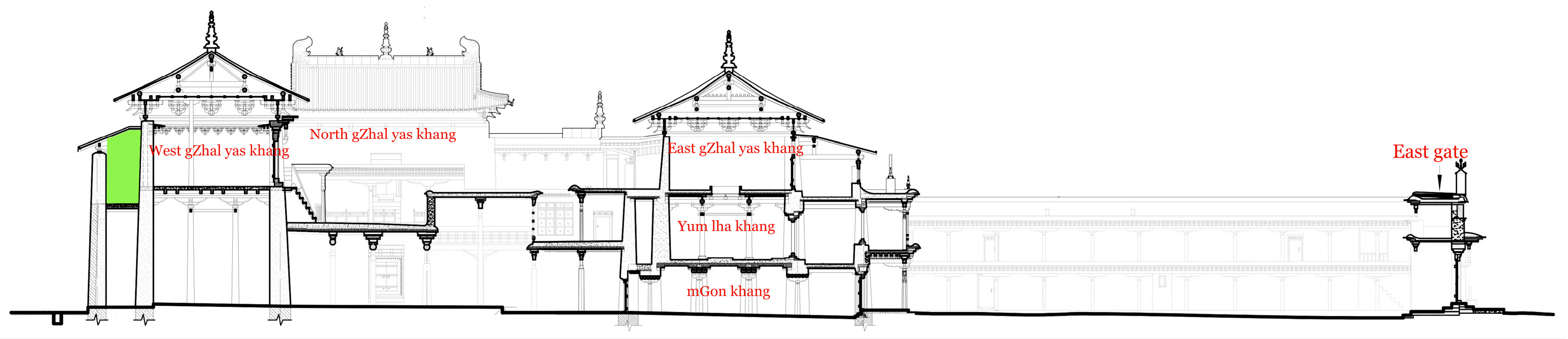
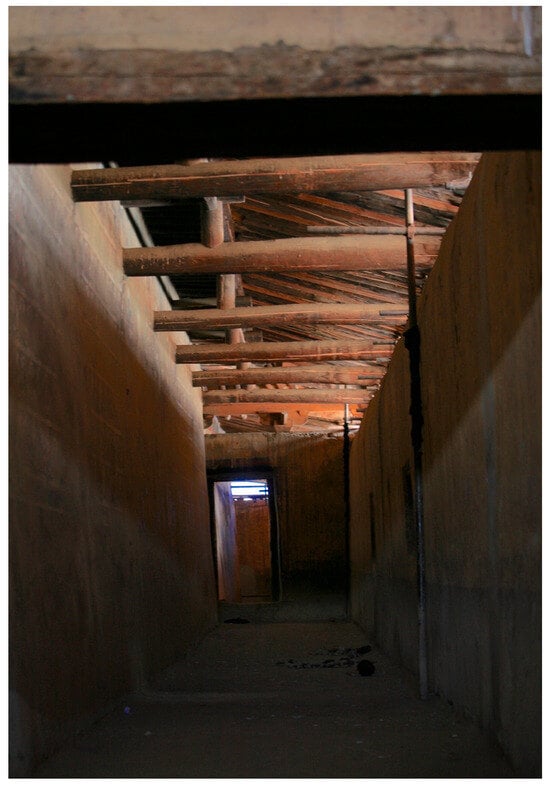
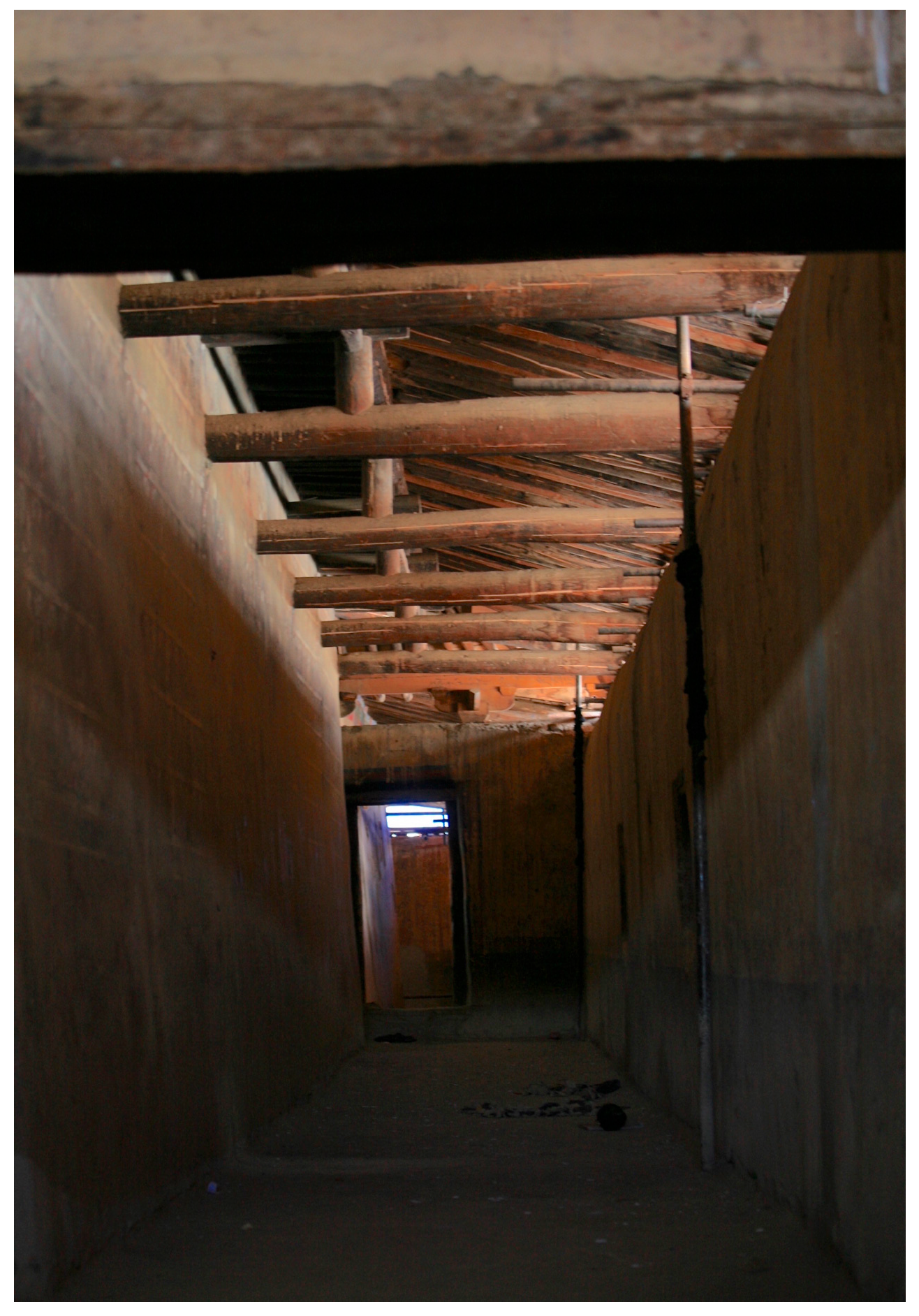


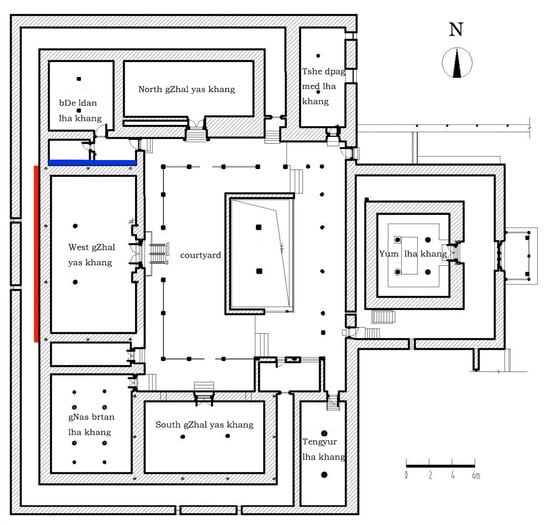
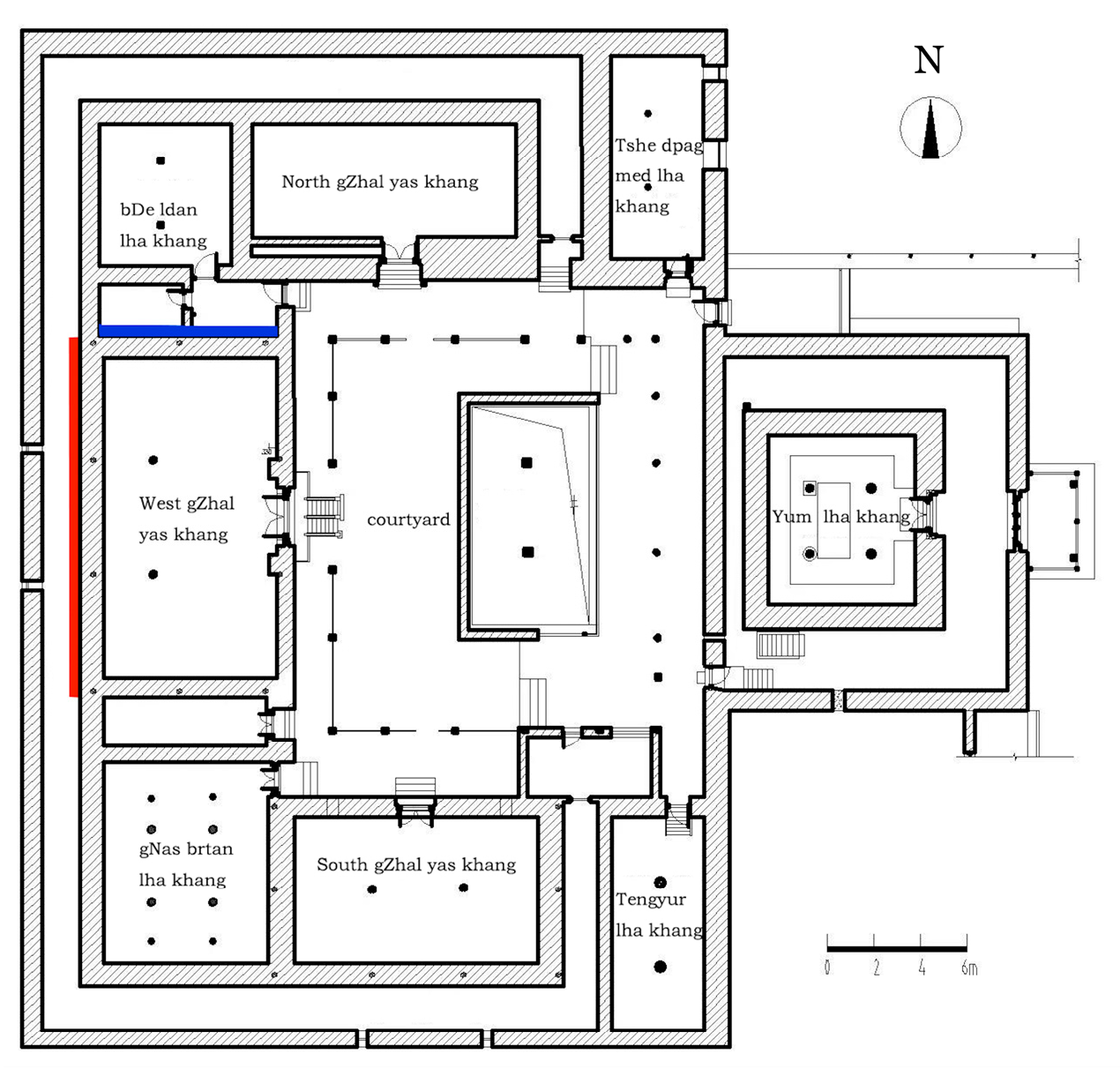
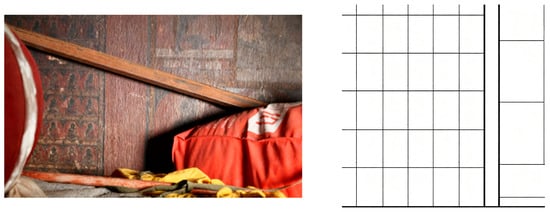
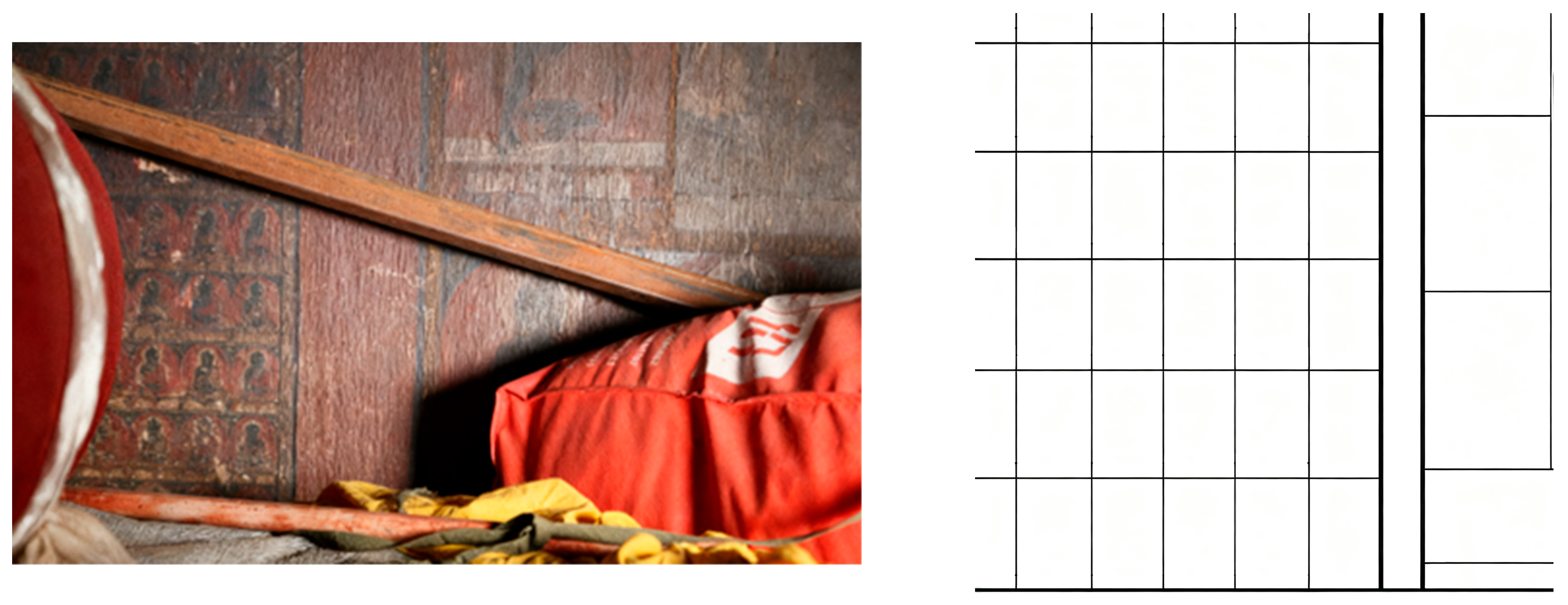
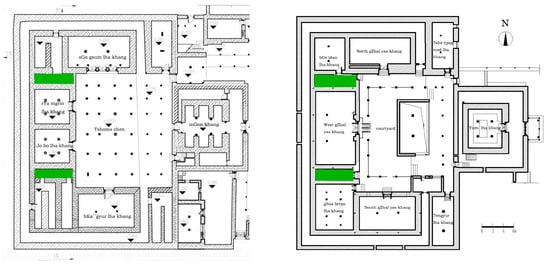
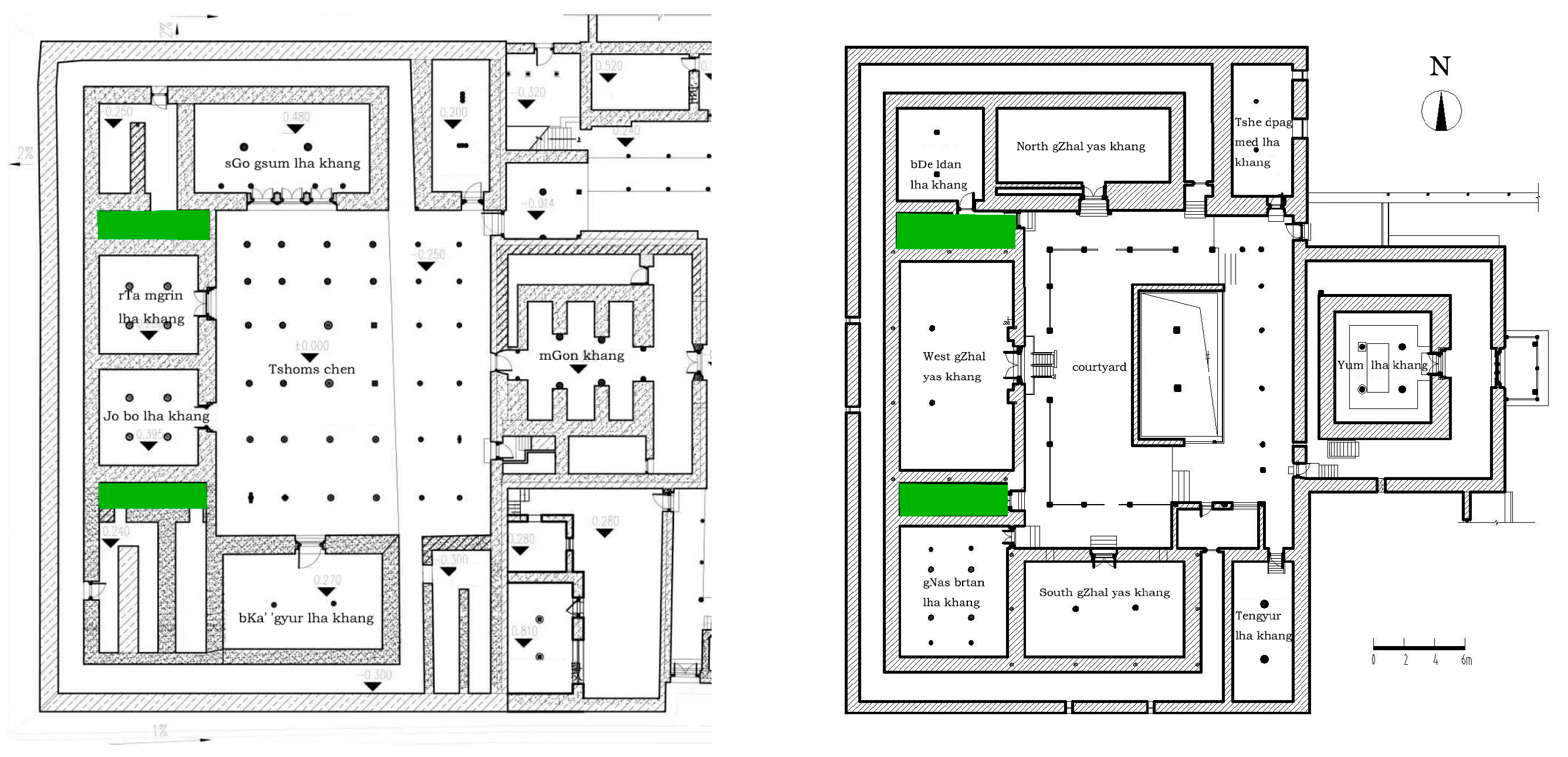
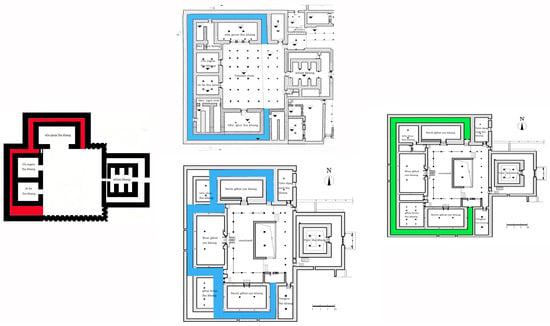
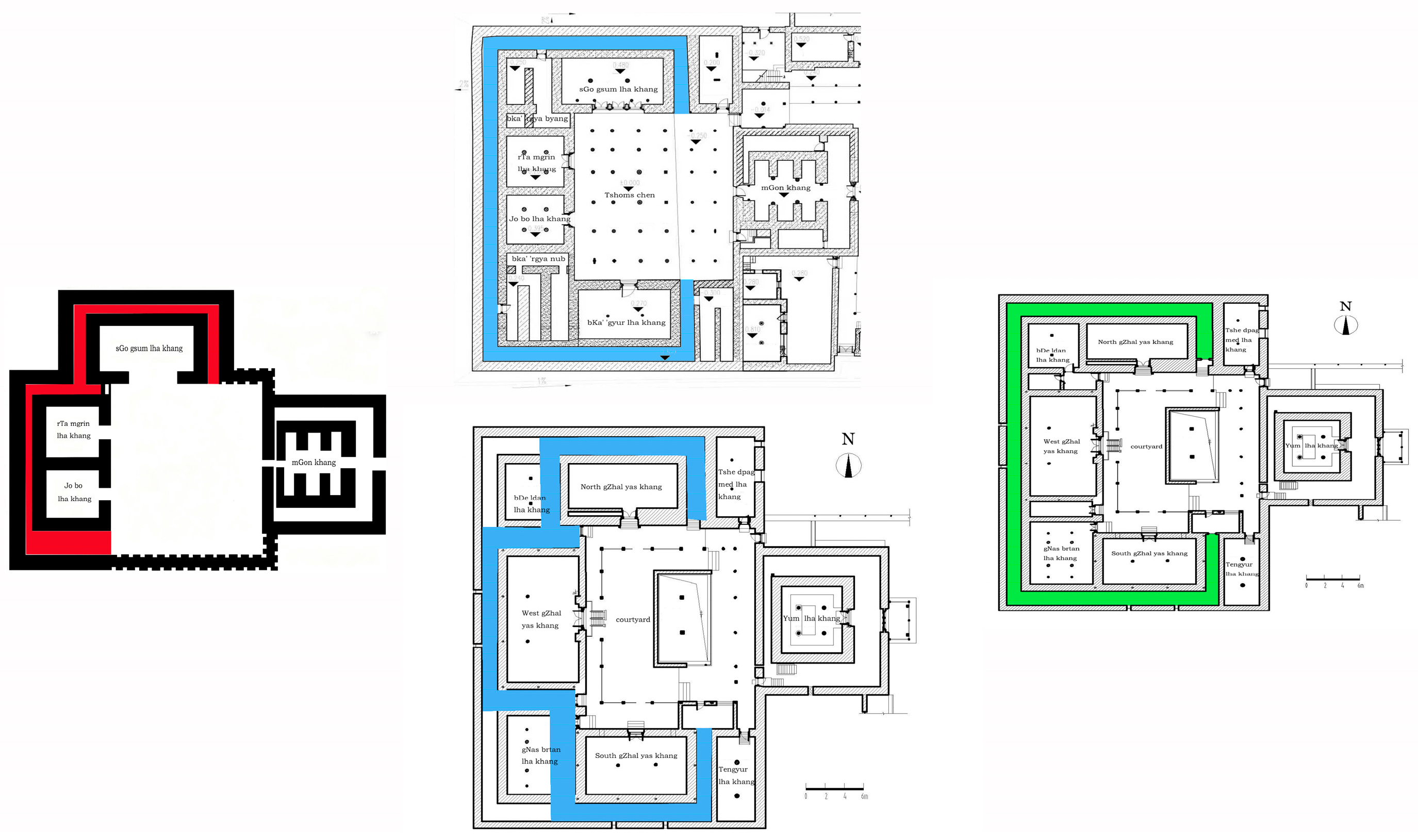
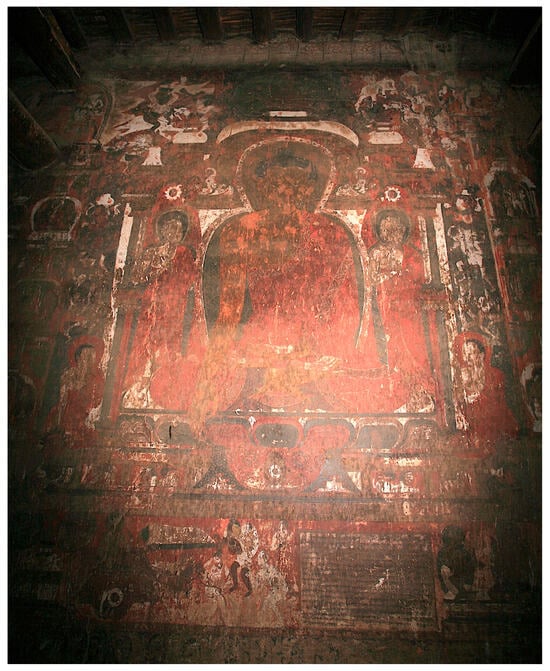
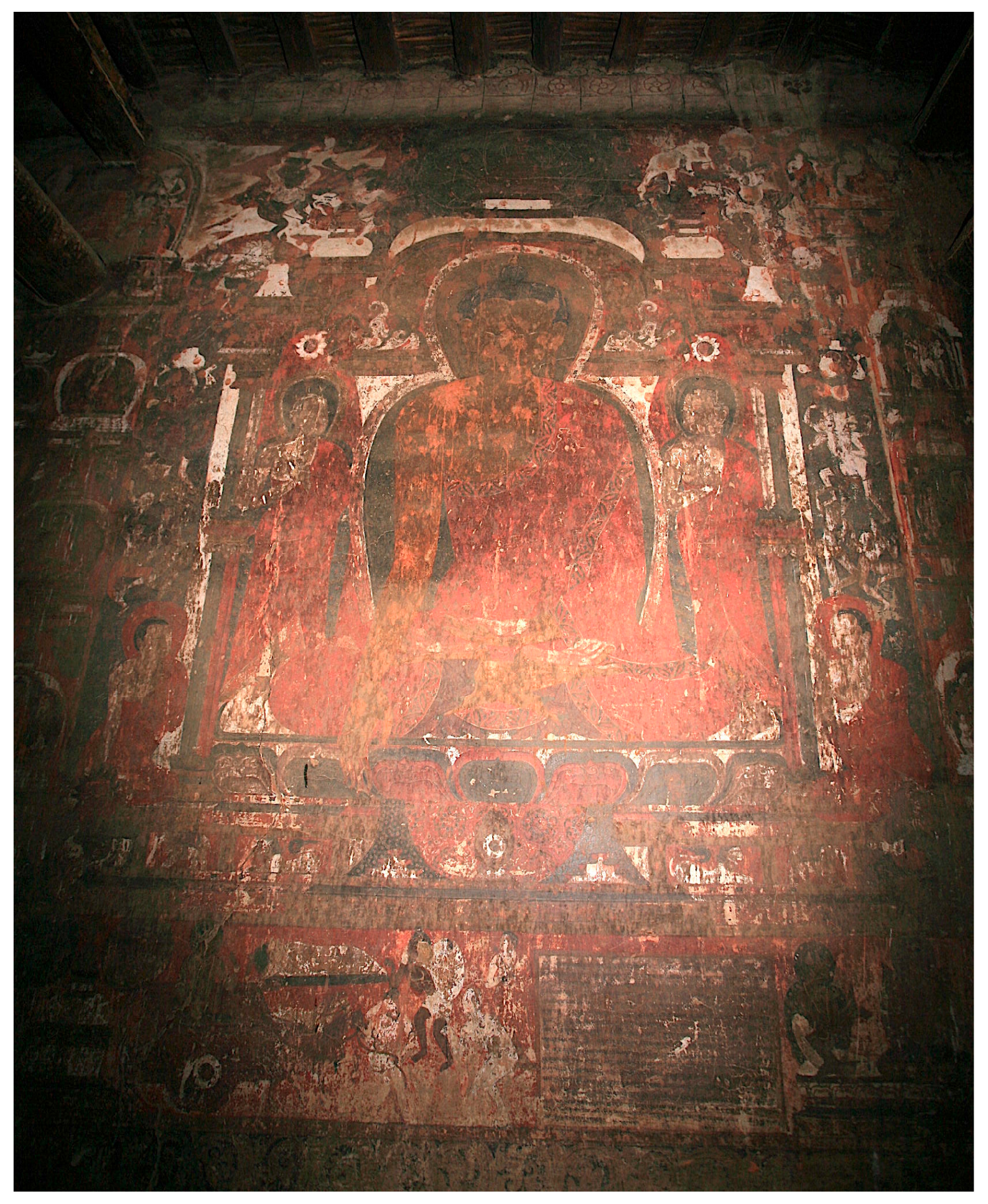
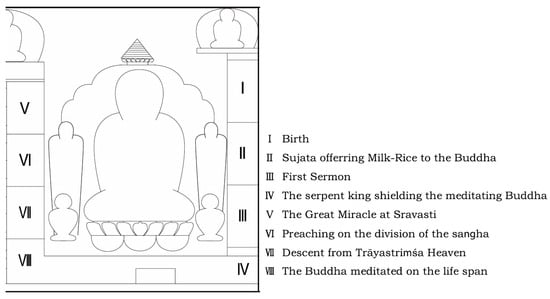
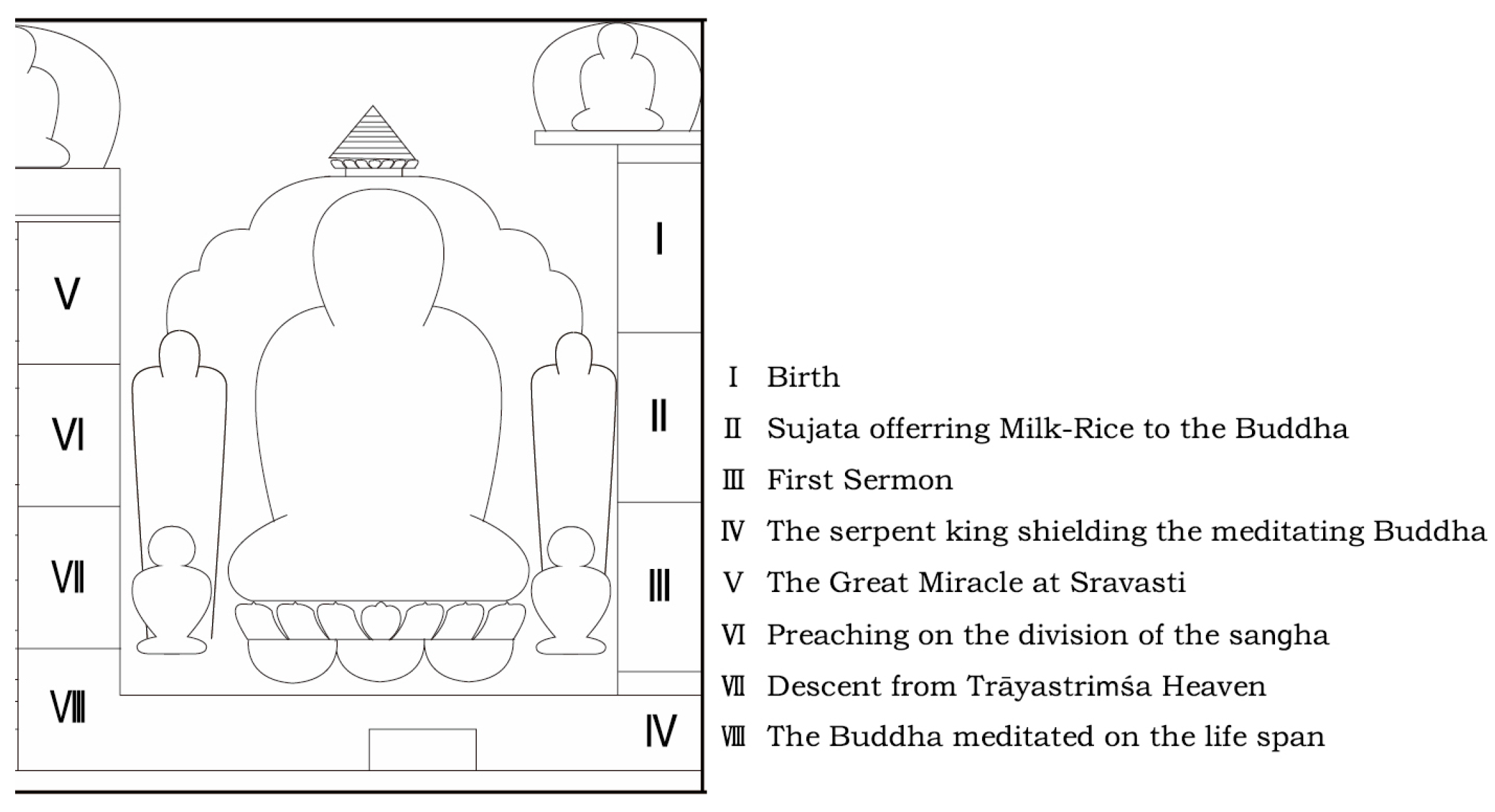
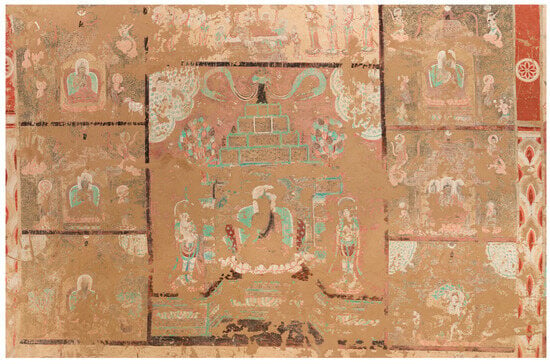
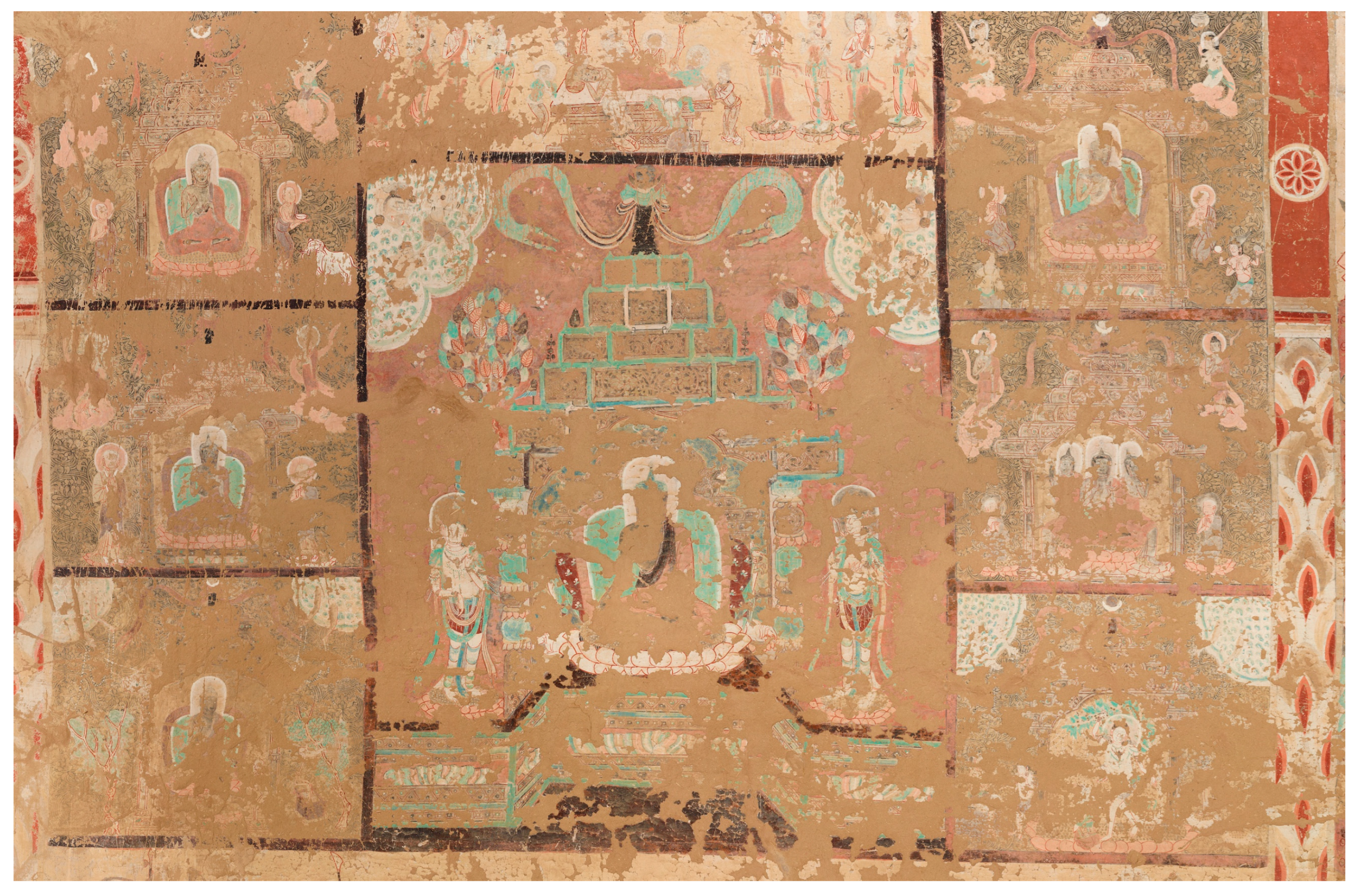
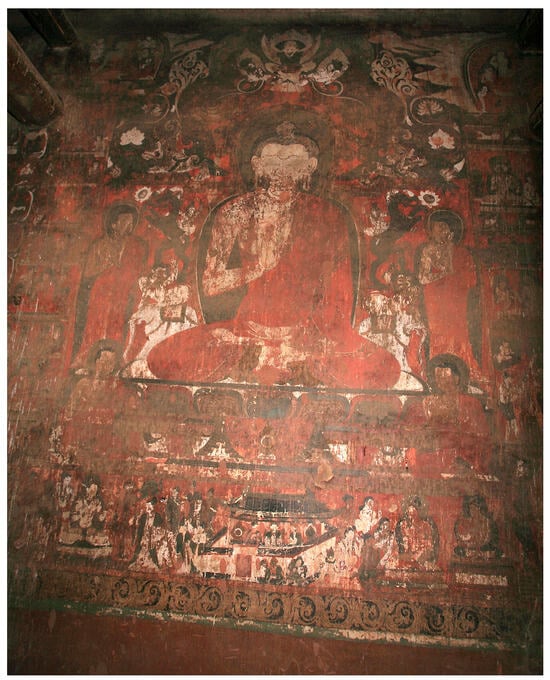
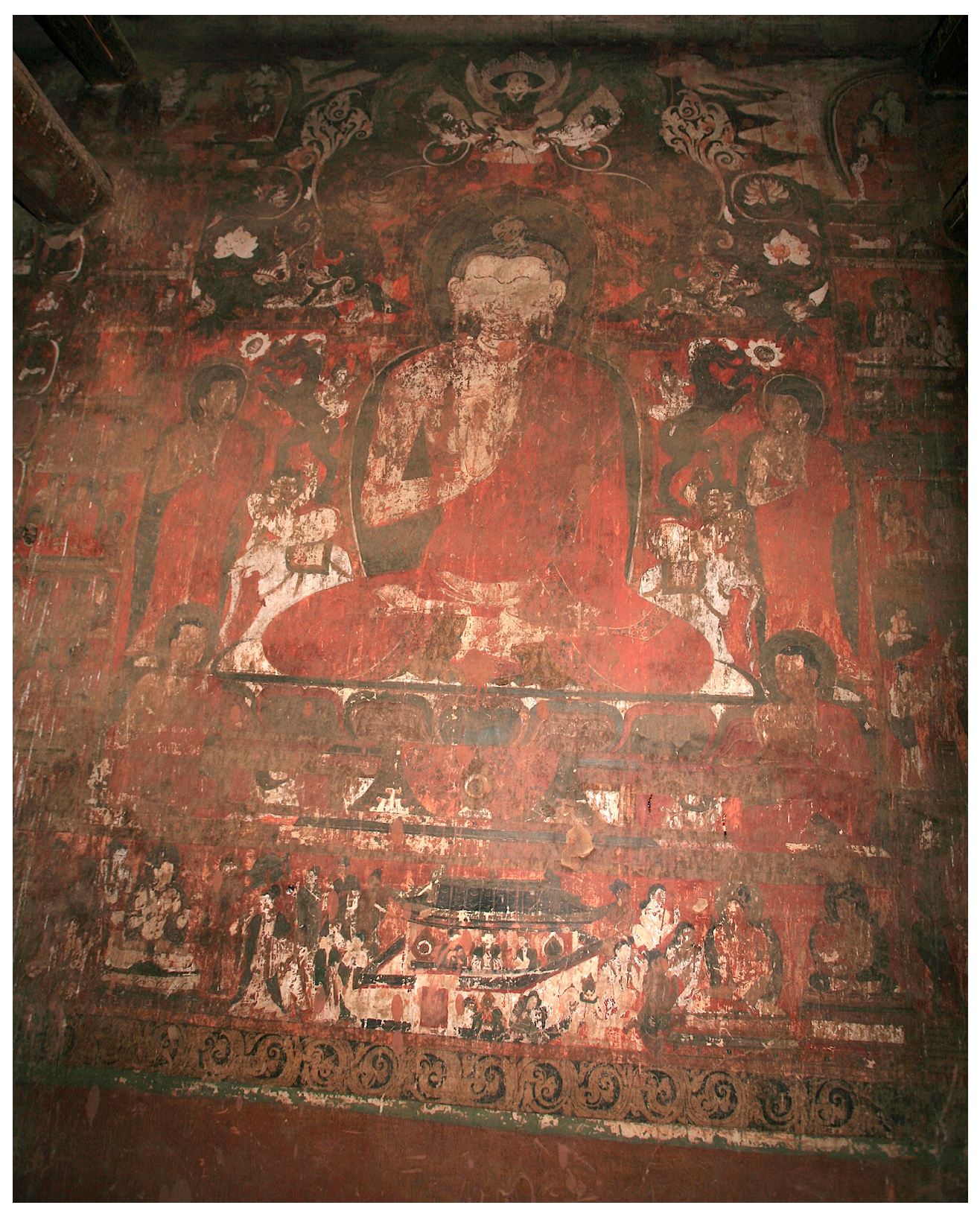
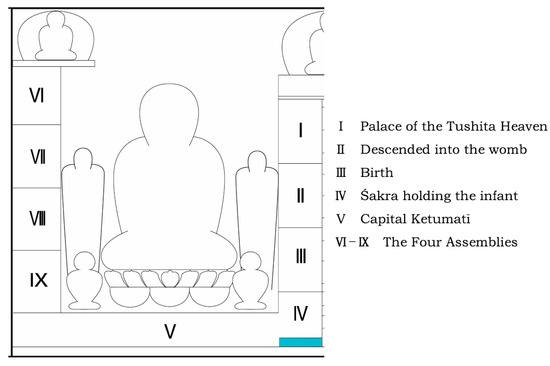
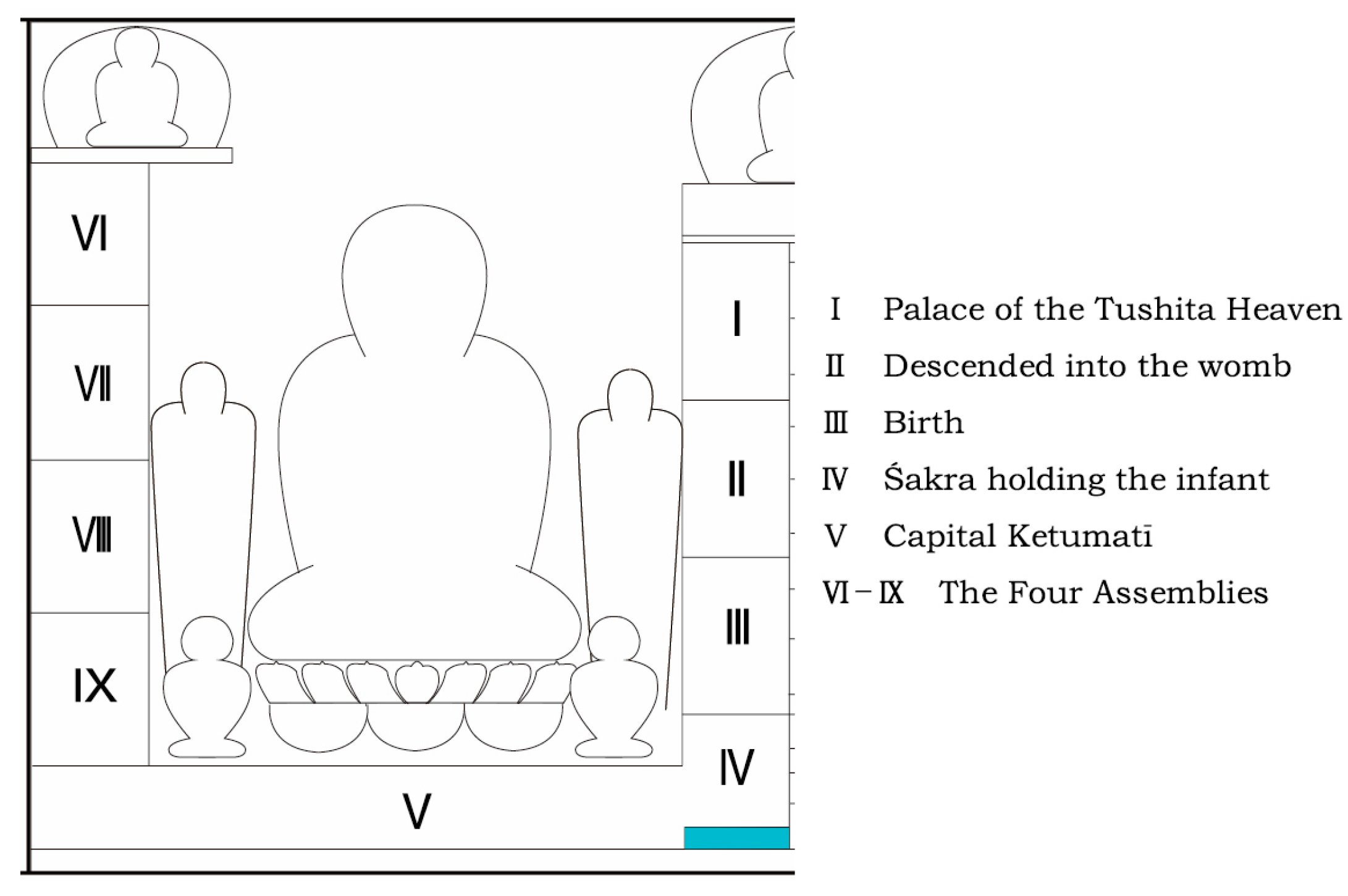
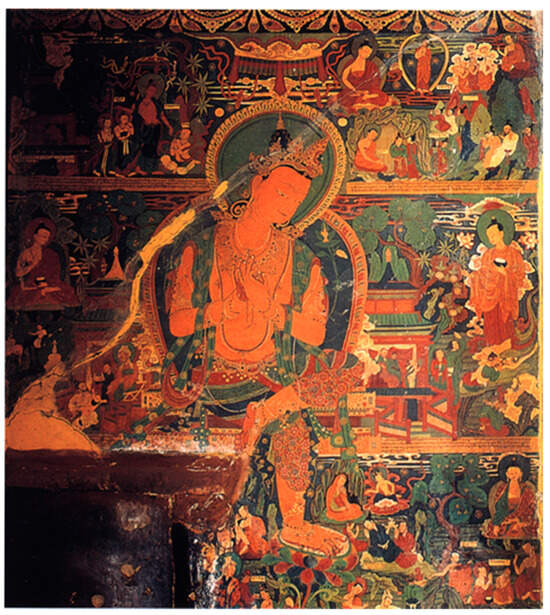
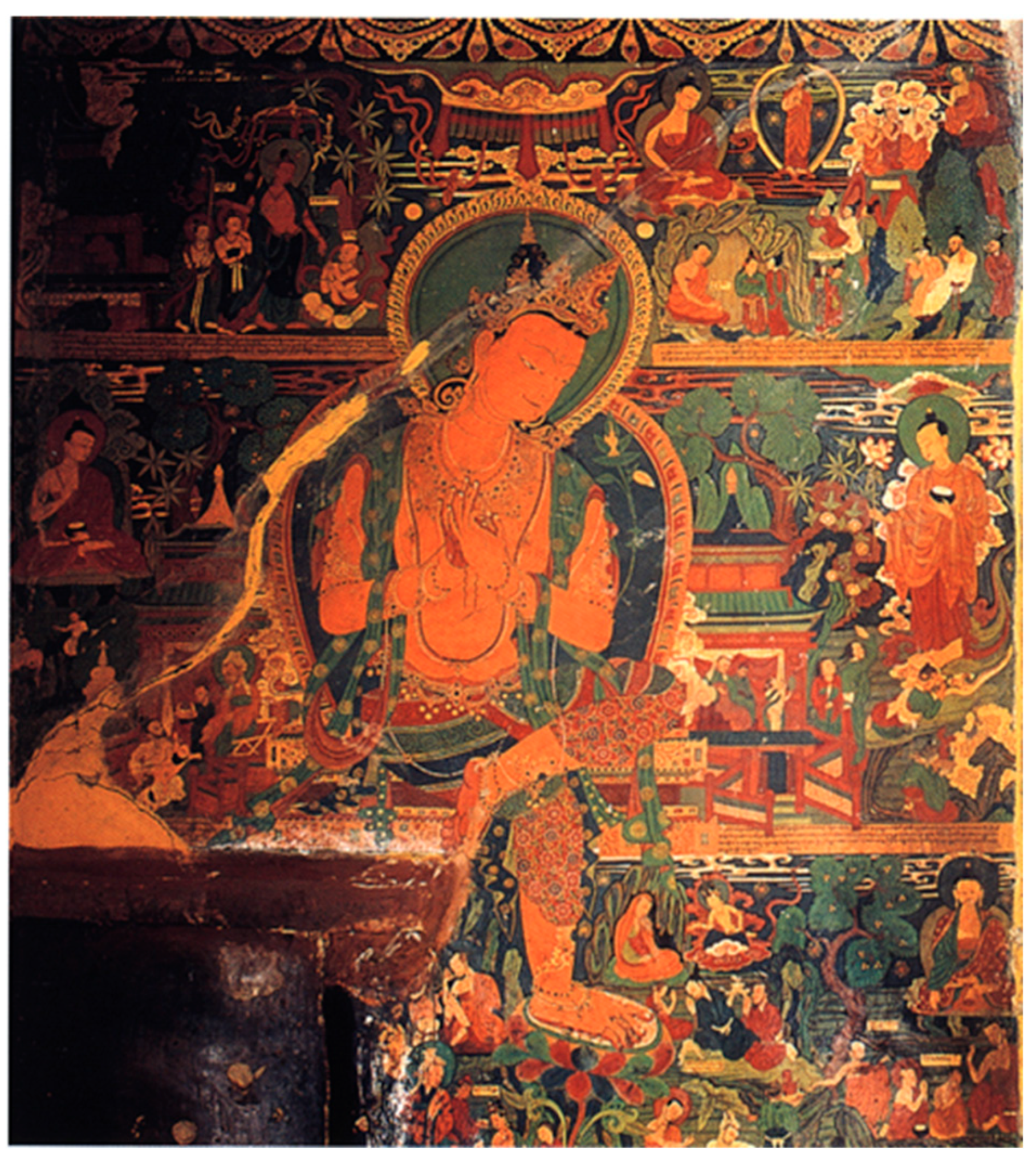
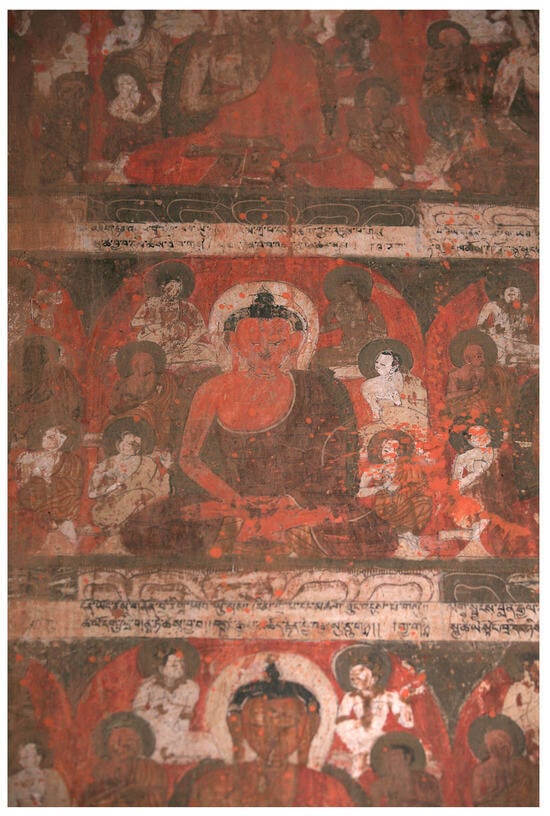
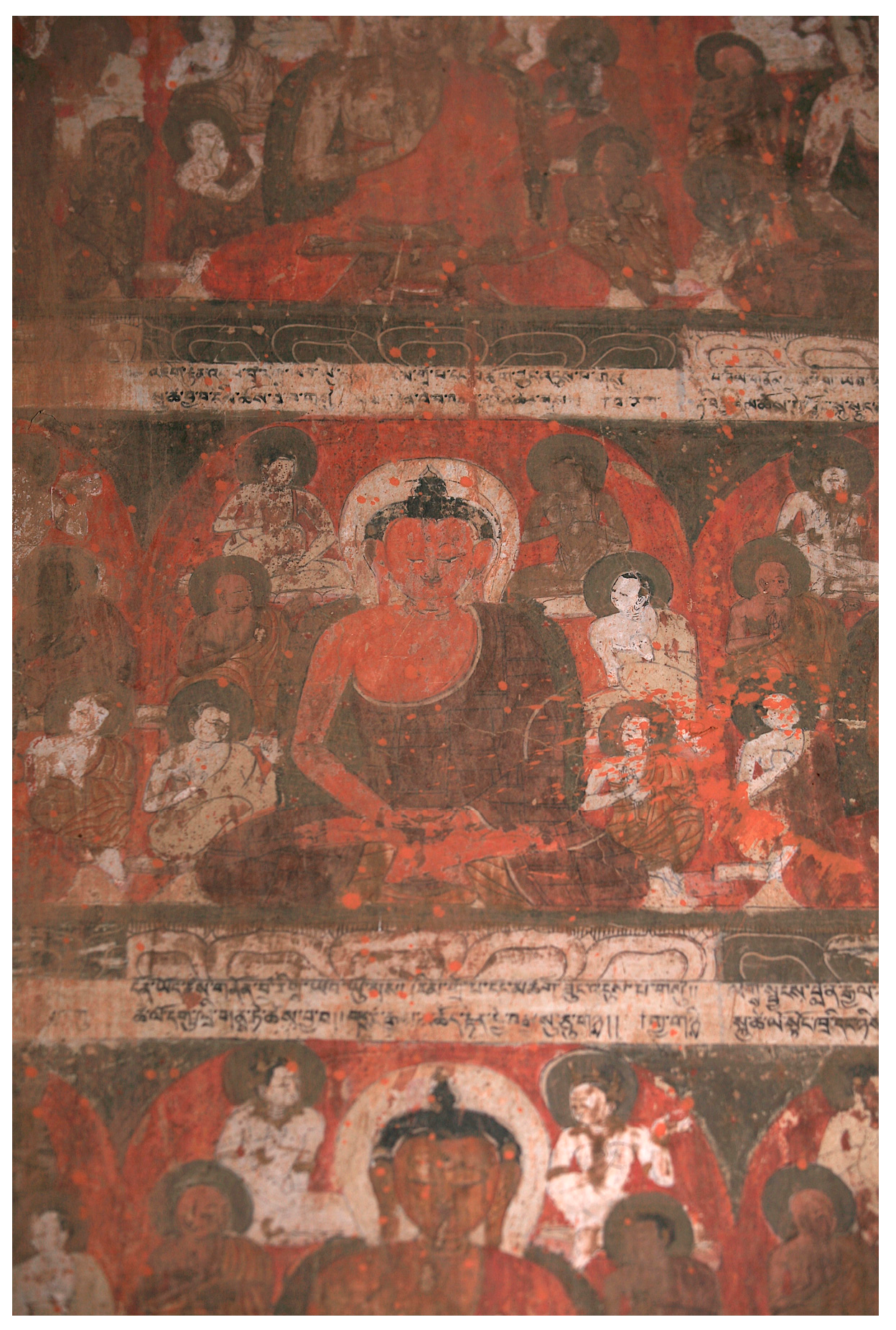
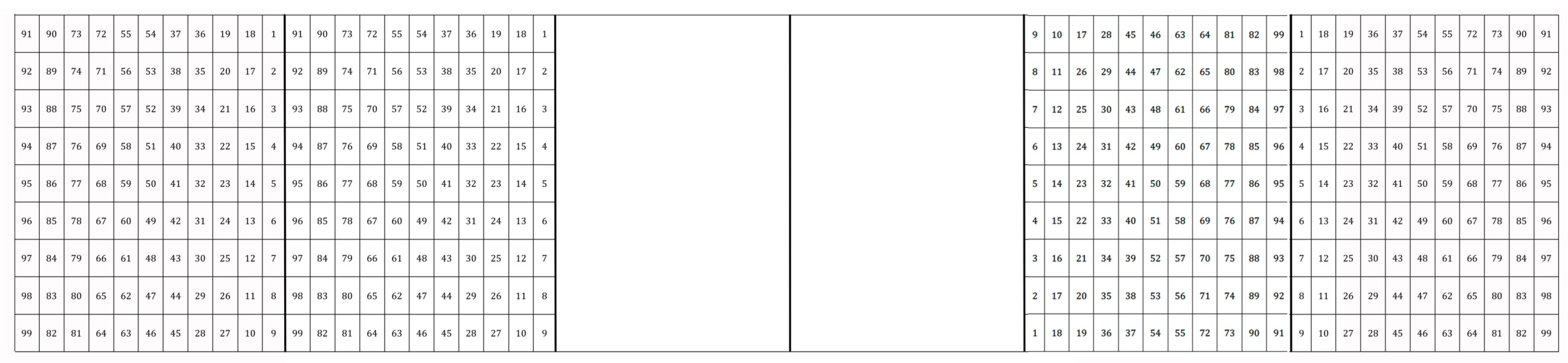
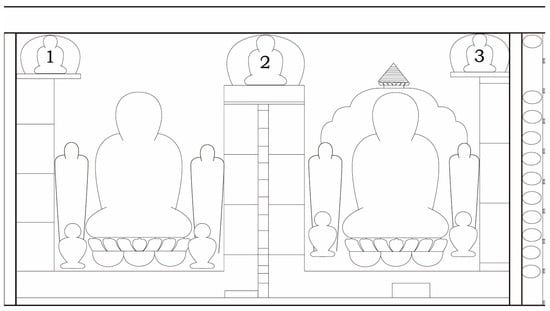
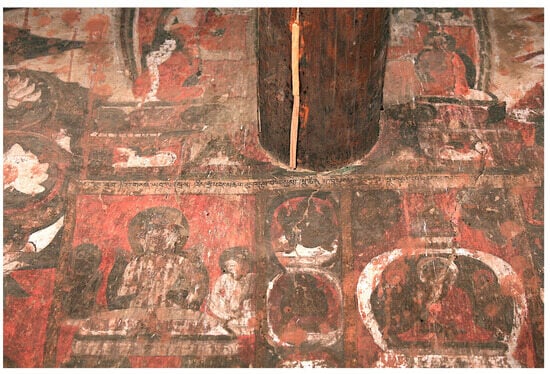
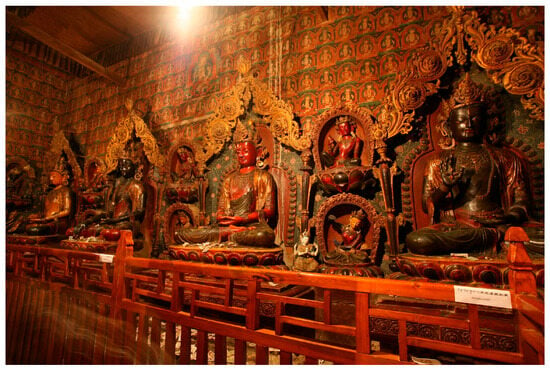
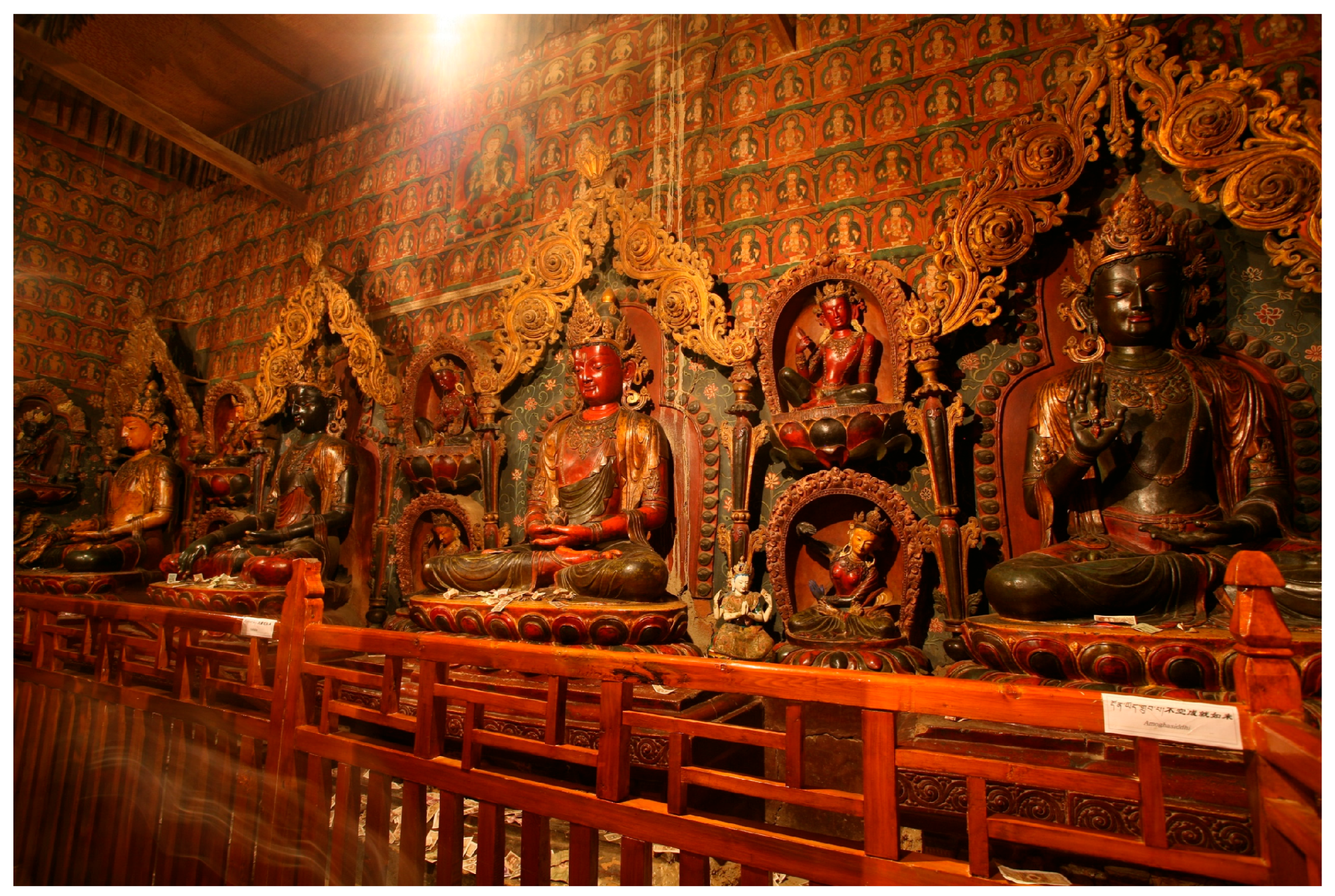
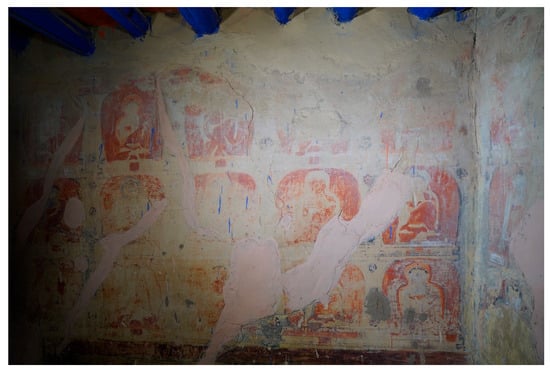
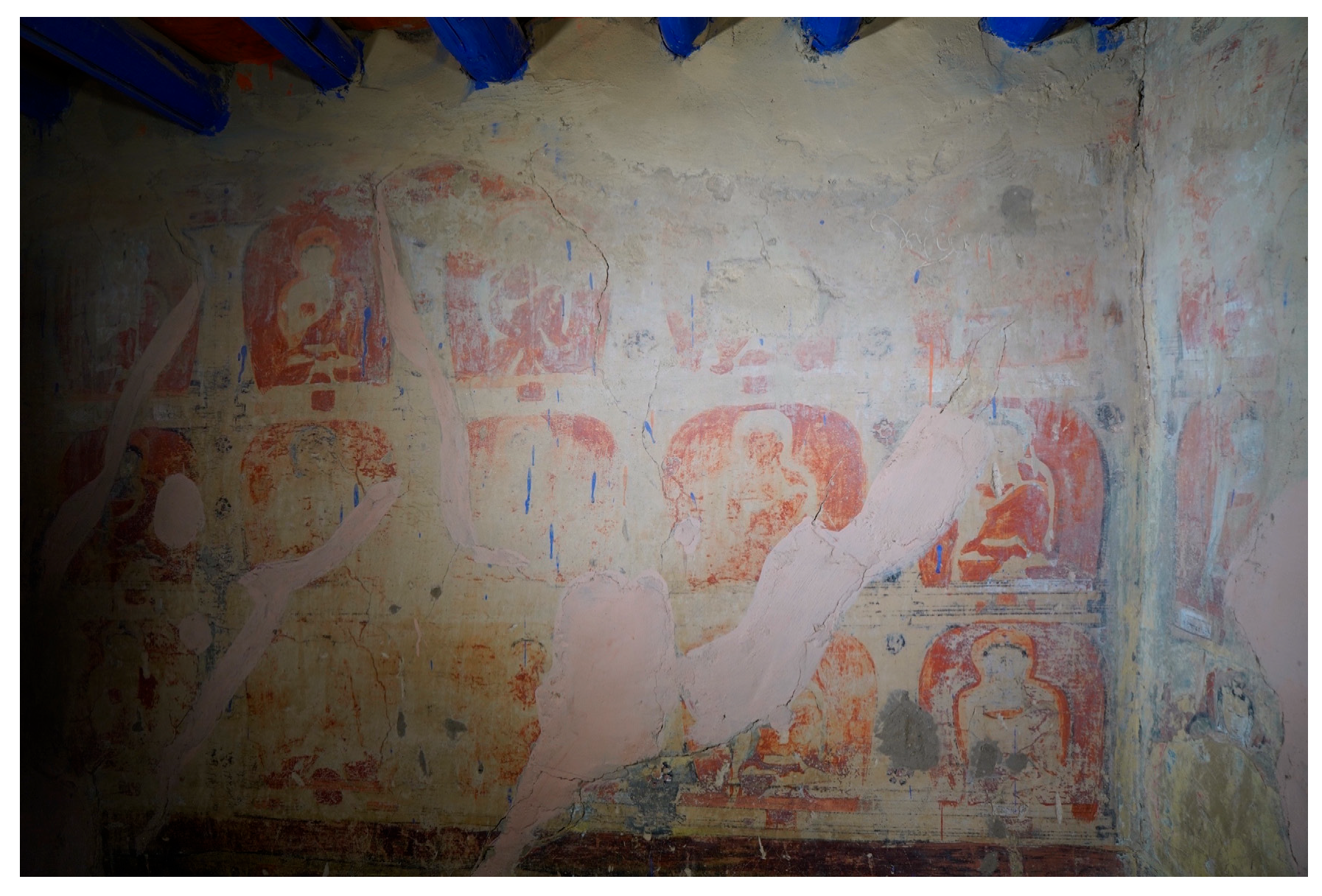
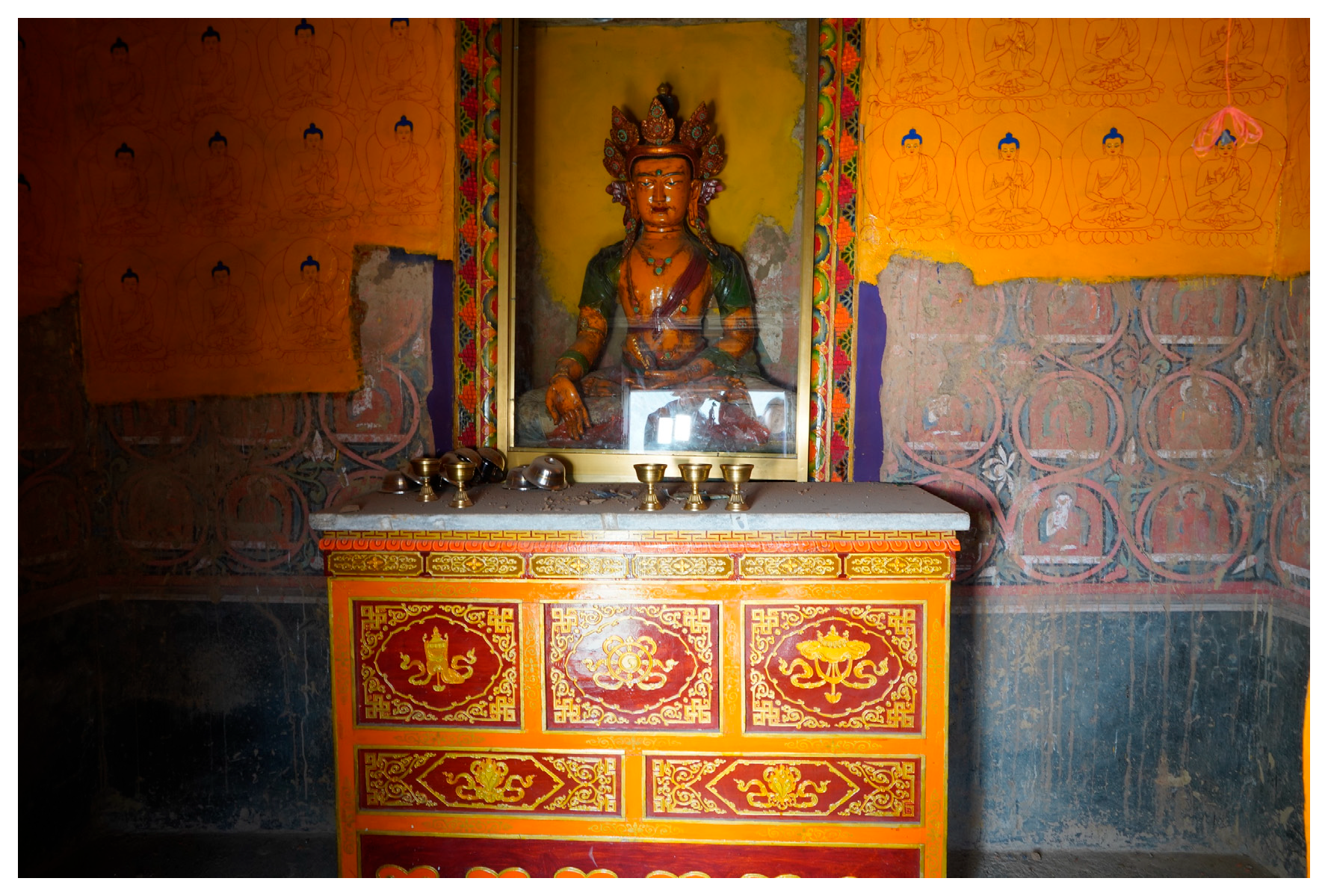
Disclaimer/Publisher’s Note: The statements, opinions and data contained in all publications are solely those of the individual author(s) and contributor(s) and not of MDPI and/or the editor(s). MDPI and/or the editor(s) disclaim responsibility for any injury to people or property resulting from any ideas, methods, instructions or products referred to in the content. |
© 2026 by the author. Licensee MDPI, Basel, Switzerland. This article is an open access article distributed under the terms and conditions of the Creative Commons Attribution (CC BY) license.