


Abstract
The article presents the first scholarly study of a silver ark preserved in the “Dudian” Museum of the Armenian Diocese of Romania, Bucharest. The object is examined through an interdisciplinary art-historical approach that integrates typological, iconographic, stylistic, and symbolic analysis. The donative inscription links the ark to pilgrimage practices, identifying it as a memorial commissioned in Constantinople in 1799 by Mahtesi Asfatur from the city of Focșani. Stylistically, the ark exemplifies the “Constantinople style”, reflecting a synthesis of Eastern and Western artistic traditions. Its church-shaped form and iconography are interpreted as a symbolic representation of the Heavenly Jerusalem.
1. Introduction1
Despite the rich Armenian heritage of metal ritual objects, scholarly attention to these items remains limited. These objects often appear in albums, rare exhibition catalogs, or isolated articles. Beyond Armenia, significant collections of Armenian ritual objects are preserved worldwide, many housed within local Armenian churches and forming the core of church museums. These include objects donated over time by believers and pilgrims, reflecting the tastes of both donors and clergy, and gradually becoming important artifacts of the church and community’s history. Among these, the collections under the patronage of the Armenian Diocese of Romania in Bucharest are particularly notable, having been systematically studied only since 2012 (Smbatyan and Vardanyan 2014; Chookaszian 2020).
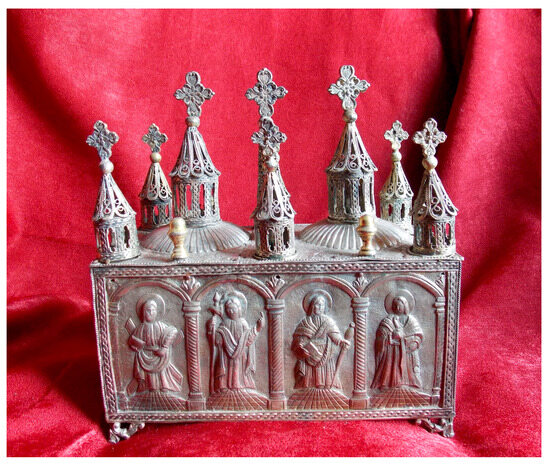
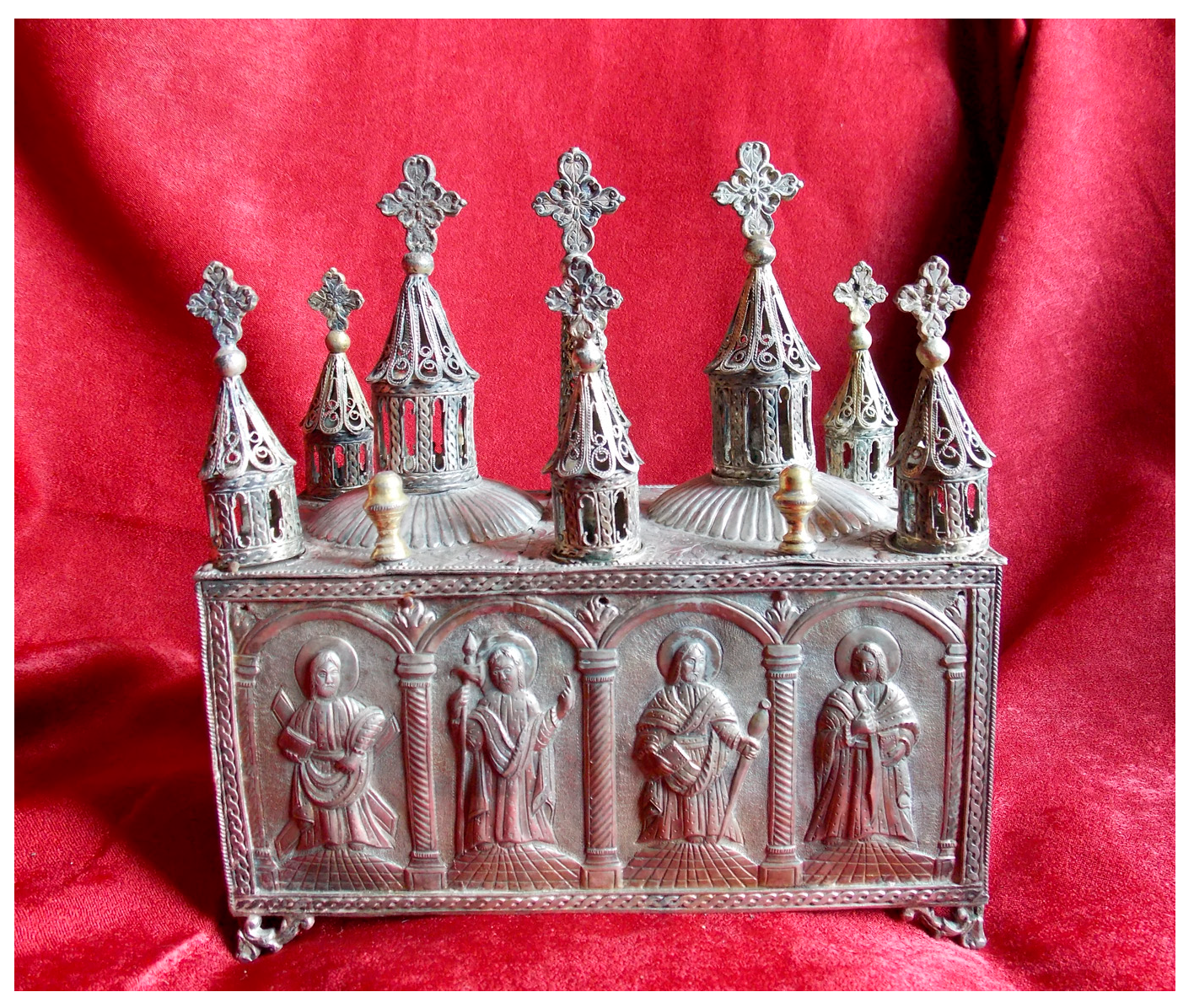
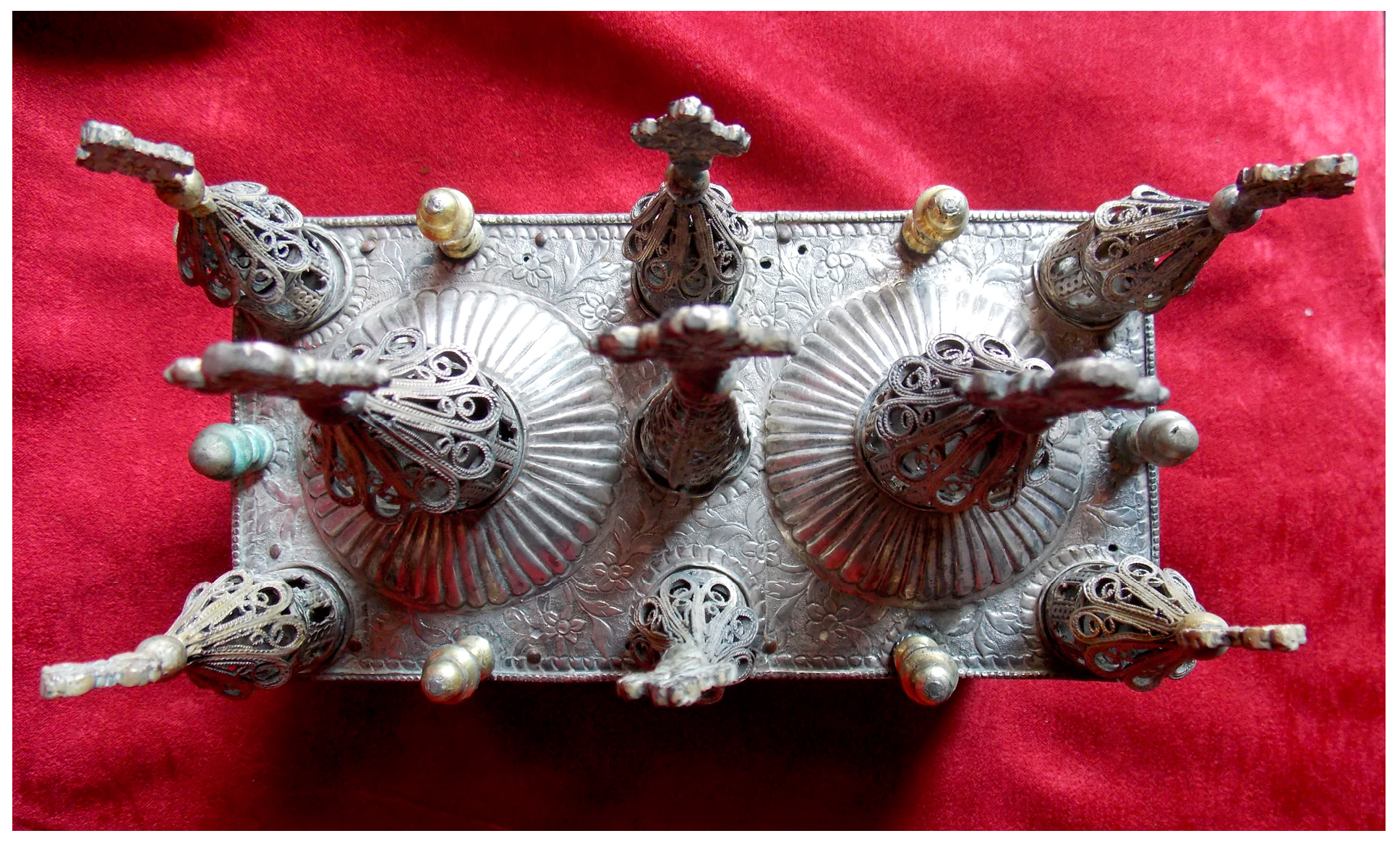
This article focuses on the silver ark preserved in the “Dudian” Museum of the Armenian Diocese of Romania. The object has not yet been the subject of scholarly study. The ark is currently exhibited as a museum object. Although its original liturgical function remains unclear, as no texts or primary sources attest to its purpose; nevertheless, the object is deeply connected with pilgrimage practices (Figure 1).
Figure 1.
Ark, Constantinople, 1799, now in the “Dudian” Museum, Bucharest, Romania. Source: Author’s own collection.
Decorative and compositional features of the ark indicate that it exemplifies the so-called “Constantinople style,” a distinctive synthesis of Eastern and Western artistic traditions developed by Armenian silversmiths in the Ottoman capital. By examining both its possible liturgical function and its stylistic characteristics, this study aims to situate the ark within the broader context of Armenian artistic production in Constantinople and its diaspora. In addition to examining its function, the article addresses the iconographic and stylistic features of the images decorating the object. The ark is also analyzed semiotically to reveal its symbolic representation of the Heavenly Jerusalem.
For the study of liturgical objects, historical and art-historical methods need to be employed in a complementary manner. The core approach of this study is a comprehensive art-historical analysis incorporating descriptive, source-critical, comparative, typological, iconographic, stylistic, technical, theological, symbolic, and interpretative methodologies and perspectives. By integrating these approaches, we are able to examine the research questions with greater depth and nuance.
2. Description of the Object
The silver ark of the “Dudian” Museum within the Romanian-Armenian Diocese remains the only known example, as no comparable objects have been recorded in other Armenian collections in the country.
The first description of the ark was provided by the ethnographer Manowel Mirakhorian in his unpublished manuscript “History (illustrated) of Focșani city and its four Armenian churches… 1650–1932” (Mirakhorian n.d., p. 41), when the object was still in the Armenian St. Mary Church of the Romanian city of Focșani2. No other studies or references exist.
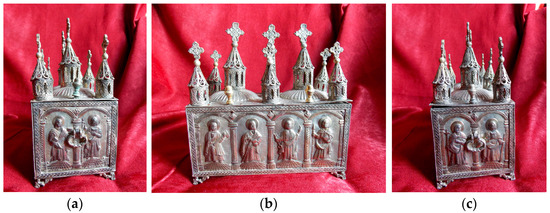
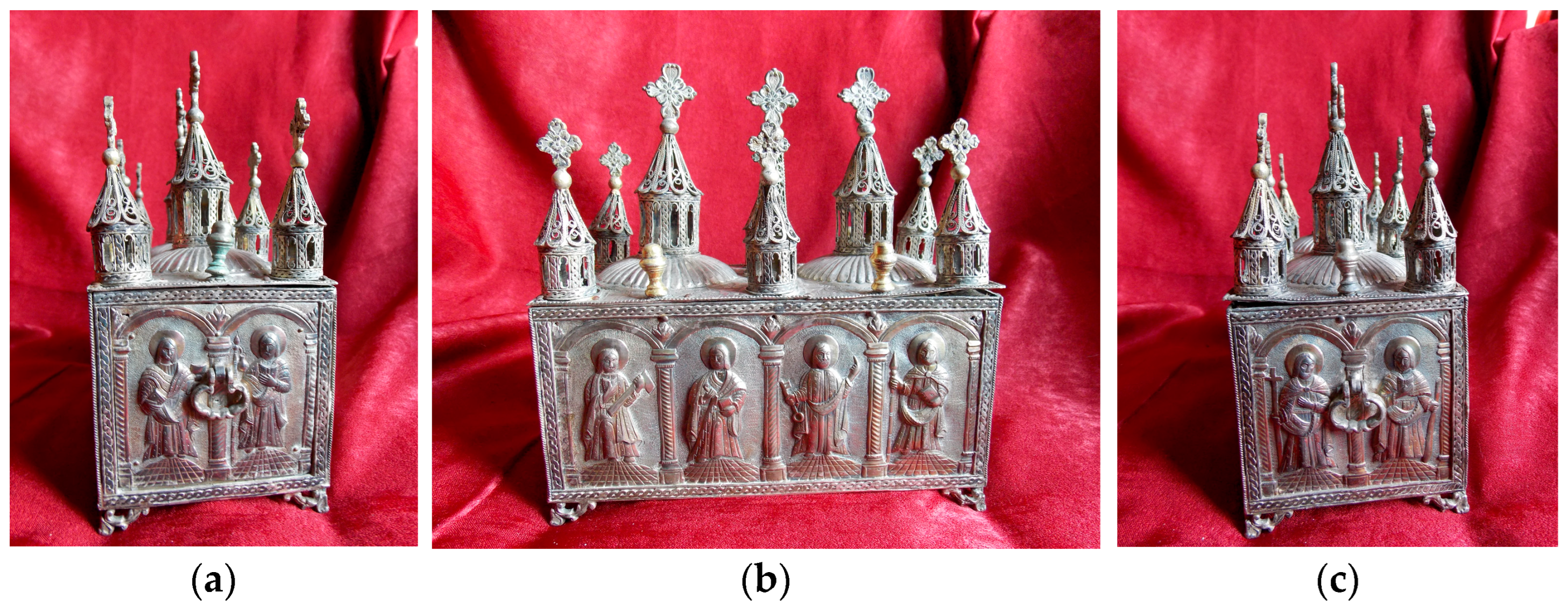
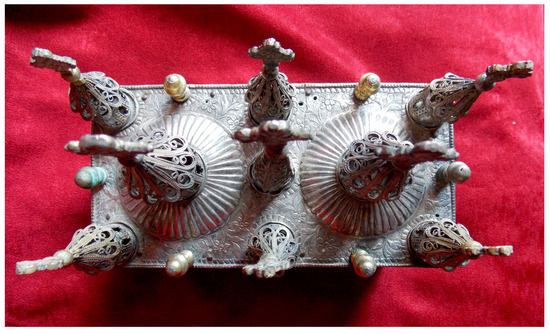
Decorations of the ark are realized through a combination of chasing and filigree techniques (Figure 2a–c). The object is a rectangular, church-shaped box resting on four stylized, branch-like legs and surmounted by three large and six smaller filigreed domes on the lid: two of the large domes are placed on a hemispherical elevation and the third, central dome of conical shape, which marks the central point of the composition, is placed just on the lid, without any elevation. All nine domes are crowned with the same type of flower-shaped crosses. The lid is non-openable and secured with six stylized large nails and additional small ones. Each side of the box is composed of a piece of silver.
Figure 2.
(a–c). The other three sides of the ark. Source: Author’s own collection.
The four sides of the ark-box are decorated with chased images of the twelve apostles: four figures on the wider sides of the rectangle and two figures on the narrower sides, which also feature handles (Figure 1 and Figure 2a–c). All sides are framed by a chased chain, one of the oldest and most widespread motifs, typical for different cultures, that also appears in Armenian miniature painting (Izmaylova 1979, pp. 71, 73, 75) and on other silver objects made in Constantinople, such as book bindings (M. Vardanyan 2017, pp. 86, 87).
3. Terminology and the Problems of Identification of the Object
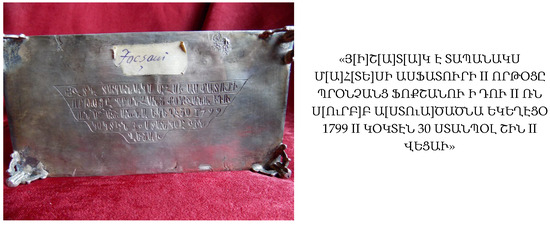
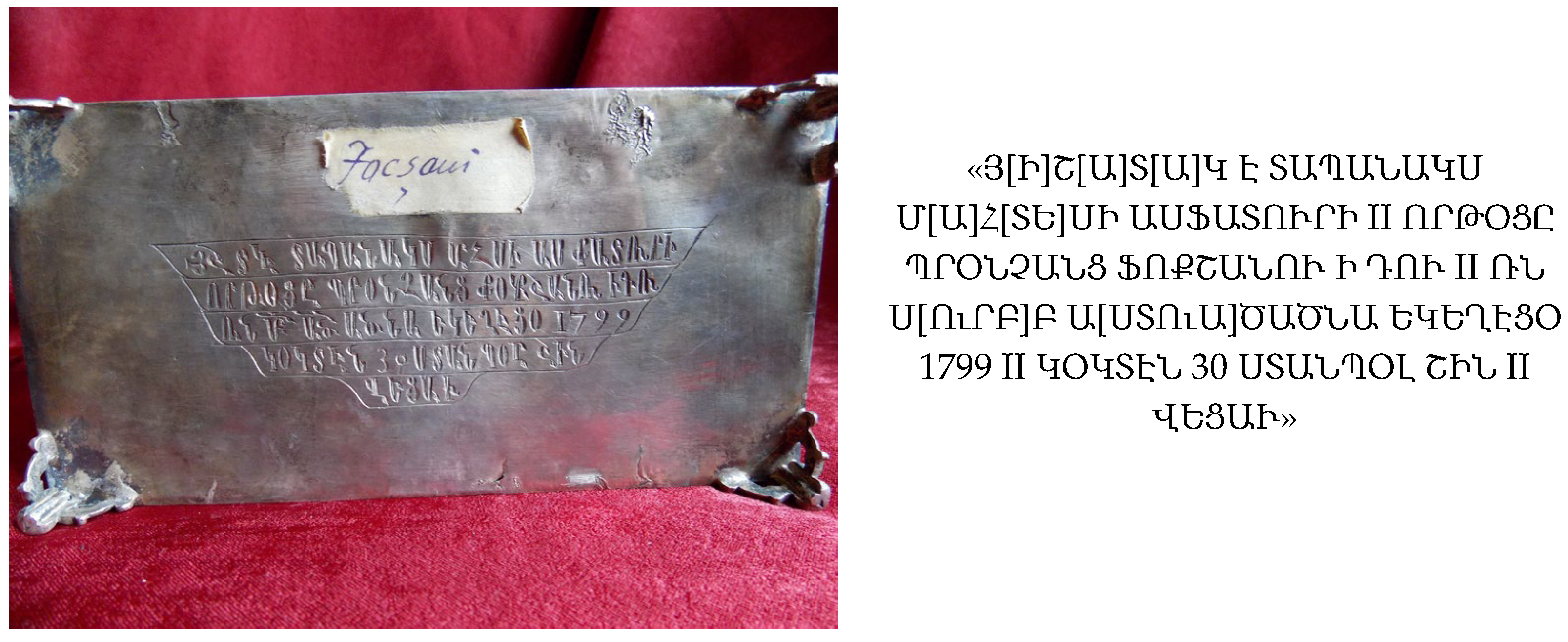
The donative inscription on the object (Figure 3) refers to it as “tapanak”, which, when translated from Armenian, means “ark”. In the Armenian Etymological Dictionary, the word “tapanak”, or its abbreviated form “tapan”, is etymologically defined as a “box,” a “ship enclosed on all four sides like a box (as in Noah’s ark)”, as well as a “coffin” (literally “chest of the dead”), a “grave,” or a “tomb” (Ačaṙyan 1979, p. 373). Ł. Ališan notes that the niche in which a body is placed is called a “tapan” (“ark”), likened to a chest, corresponding to the meaning conveyed by “tapanak” (Ališan 1910, p. 445). He further traces the root of the word to “tap” (տապ), meaning “a place for burning corpses,” drawing an analogy with the Greek usage of the term (Ališan 1910, p. 445). The Hebrew version is “tēbā”, in Persian “tabangū” (Ačaṙyan 1979, p. 373).
Archbishop M. Ormanian5 notes in his Ritual Dictionary that “arks” are small boxes, a term applied to various objects used in the Armenian Church (Ormanian 1992, p. 123). G. Ałaneancʽ6 describes the “ark or censer” as a silver box decorated with four small crosses and a candlestick on top, used to store incense—a practice inherited from the Old Covenant (Ałaneancʽ 1902, pp. 42–43). It should be noticed that in this description, the box is openable, whereas the ark under study is not. There is also mentioned a candlestick on top, absent in the object under our consideration.
An ark is a box in which special items are held—relics, incense, Eucharist for Communion, and contributions to the clergy or the church, as an altar enclosure or tabernacle (Marchese and Breu 2015, p. 131).
All of the above-mentioned functions give rise to confusion, and the function of the object under consideration therefore remains uncertain. It has not undergone X-ray examination, nor has any attempt been made to remove the metal plates; consequently, its contents remain unknown. Since the object cannot be opened in any way, the presence or absence of contents can be determined only by the two examining methods mentioned above.
It is possible that it contains relics; however, the inscription makes no mention of this. As a rule, the presence of relics is noted in donative inscriptions, although there are cases in which no mention is made of relics, yet they are visibly present. In Armenian ecclesiastical tradition, reliquaries assume a variety of forms—including triptychs, crosses, arm reliquaries, arks, and other designs. As a few examples of reliquaries have survived from the medieval period, a broader understanding of their typological varieties is provided by the references and descriptions preserved in medieval sources. The sources concerning the relics of saints preserved in Armenian churches were studied by Father V. Hatsuni (1907) and Father T. Yartmian (2000). On this basis, Hatsuni primarily concluded that they were generally box-shaped or took the form of arks. Nevertheless, the ark, by virtue of its form, is close to the principles of a reliquary.
Following the ark’s relocation from the Armenian Church of the city of Focșani to Bucharest, the ark was occasionally placed on the Holy Table of the Armenian Church of the Holy Archangels, mainly on feast days. Beyond this liturgical use, no other functions are known. The object may also be considered as a tabernacle. In this case, it could either be opened for the use of its interior space or remain unopened, with the emphasis placed solely on its exterior appearance. In any case, it is clear that the ark was intended to be placed on the Holy Table, whether it functioned as a reliquary or as a tabernacle.
Nevertheless, one point is clear: within the church, the ark in discussion and arks in the Armenian Church, regardless of whether they functioned as reliquaries or tabernacles, formed part of the most sacred space. In this respect, they can be fully compared with the Ark of the Covenant. Although Armenian arks and the Ark of the Covenant differ in purpose and symbolism, a comparison of them as sacred containers—particularly in terms of their ritual placement—reveals important common ground. The Ark of the Covenant was housed in the Holy of Holies, the most sacred space of the Temple, while Armenian arks were placed on the Holy Table, the liturgical and symbolic center of the church. In both cases, the significance of the object is inseparable from its placement within a hierarchically sanctified space, underscoring the role of sacred containers as mediators between the divine and the worshiping community.
Although the function of the object raises questions, by virtue of its form and craftsmanship, it commands special reverence and constitutes one of the sacred objects of the Armenian Church. Even today, as a museum exhibit, it is presented with particular respect, displayed separately from all other objects, under its own glass case7.
4. The Ark as Evidence of Pilgrimage and Devotion
Inscriptions on Armenian ritual objects provide not only extensive documentary information—such as the names of donors, churches, and cities—but may also play a crucial role in the attribution of objects of unknown origin. They can further reveal the symbolic meaning of an object’s provenance and articulate the depth of the donor’s faith, devotion, and humility, as well as their relationship to the Church and to belief more broadly. The ark under discussion preserves such information in its inscription (Figure 3).
Although the primary function of the object remains unclear and continues to provoke debate as to whether it should be identified as a reliquary or a tabernacle, the donative inscription makes it evident that it reached Focșani as the result of a pilgrimage to Jerusalem.
Mementos (eulogiae) brought by the faithful from the Holy Land or along pilgrimage routes, as well as votive offerings, constitute a significant portion of ecclesiastical liturgical objects. That this object was donated by a pilgrim is attested, first and foremost, by the honorific Mahtesi (or Mahdesi) mentioned in the donative inscription. The presence of this title allows the object to be directly associated with pilgrimage practices, as it denotes the completion of a pilgrimage to Jerusalem and situates the donor’s to higher devotional circle.
Y. Galpagian, in his Armenian Community in Romania, describes the route followed by pilgrims from Dobrich8 to the Holy Land: the believers departed from the church courtyard to Varna, continued by ship to Constantinople, and from there proceeded to Jerusalem (Galpagian 1979, pp. 24–25). Galpagian also notes that pilgrims brought back commemorative gifts, which they distributed generously, while the most valuable offerings were presented to the church and the school of the city or the village they lived in (Galpagian 1979, p. 25). Since Constantinople was the largest artistic center in the region, it may be assumed that pilgrims could also purchase gifts for churches there, according to their preferences. Among Armenian ritual objects in Romania, one frequently encounters items that bear dedicatory inscriptions from pilgrims and were made in Constantinople, as evidenced both by the handwriting style of the writing, makers’ marks and by stylistic analysis of the objects. The commissioning of the ark in Constantinople and its dedication to the church further situate the object within post-pilgrimage commemorative and votive traditions characteristic of Armenian ecclesiastical culture in the late eighteenth century.
Our research indicates that neither the type of object nor its selection carried a strictly symbolic meaning in the process of pilgrims’ donations. In this context, devotion is represented not through the object’s specific liturgical function but through the pilgrim’s dedicating and inscribing the object within the sacred space of the church. Pilgrims donated a wide variety of objects—crosses, chalices, icons, Gospel books enclosed in treasure bindings and others: what they were able to acquire. Judging by the quality of its workmanship, the present object represents a valuable example, attesting to the donor’s financial means. Pilgrims’ gifts thus reflect not only their economic capacity but also their artistic taste and esthetic preferences. These gifts symbolize the feelings undergone during the pilgrimage (Piatnitsky 2005, p. 103), testify to the pilgrims’ reverence and humility, and most importantly, attest to their having visited the Lord’s Tomb (Kilgore 2017, p. 53).
What unites these offerings is the presence of inscriptions of similar content, typically stating that the object was given “as a gift or memorial by Mahtesi …,” followed by the names of family members, mentions of the name of the Church to which the object was donated and the date.
The study of pilgrims’ donative inscriptions can allow researchers, even if only fragmentarily, to form a more concrete understanding of different families, the construction of genealogies, the number of individuals who undertook pilgrimages, and the value attributed by the faithful to pilgrimage practices. The donative inscription transforms the object into a memory, ensuring the continuous commemoration of the donor and his family within the ecclesiastical space—an important manifestation of Armenian devotional practice.
Unfortunately, much remains unknown, and archival sources are not always sufficiently rich to permit the reconstruction of detailed information about Mahtesi Asfatur and the Pronchants (Bronchants) family from Focşani.
5. The Characteristics, Function and Symbolic Significance of the Church-Shaped Objects
Church-shaped ritual objects have survived across Christian cultures as tabernacles for the Eucharist or reliquaries. In the Middle Ages, their functions varied: in the East, they often served as tabernacles, while in the West, they were more frequently used as reliquaries. One of the earliest examples is the ark of Saint Anastasius of Aachen, produced in Antioch in 969–970 (Kalavrezou 2022, p. 249). Psalms engraved on the object represent it as the Heavenly Jerusalem, suggesting its original function as an artophorion (Klein 2010) (Psalm 132:8, 132:13). By 1204, the ark had arrived in Aachen and was subsequently repurposed as a reliquary for St. Anastasius’ relics (Klein 2010). This demonstrates how the function of objects could change due to cultural context (Kilgore 2017, p. 13; Lafontaine-Dosogne 1982, pp. 152, 156).
Similar cases occur in medieval Christian culture, where the architectural form of an object determined its ritual use. For example, a Byzantine-origin censer preserved in San Marco Basilica in Venice, initially a secular object, was repurposed as a reliquary after 1204 due to its architectural form (Trahoulia 2008, pp. 33–40). The choice of a church-shaped design symbolically represents the physical appearance of the Christian church as a divine dwelling and as an imitation of the eternal heavenly home (Kilgore 2017, p. 13), echoing St. John’s descriptions of the Heavenly Jerusalem (Kilgore 2017, p. 25).
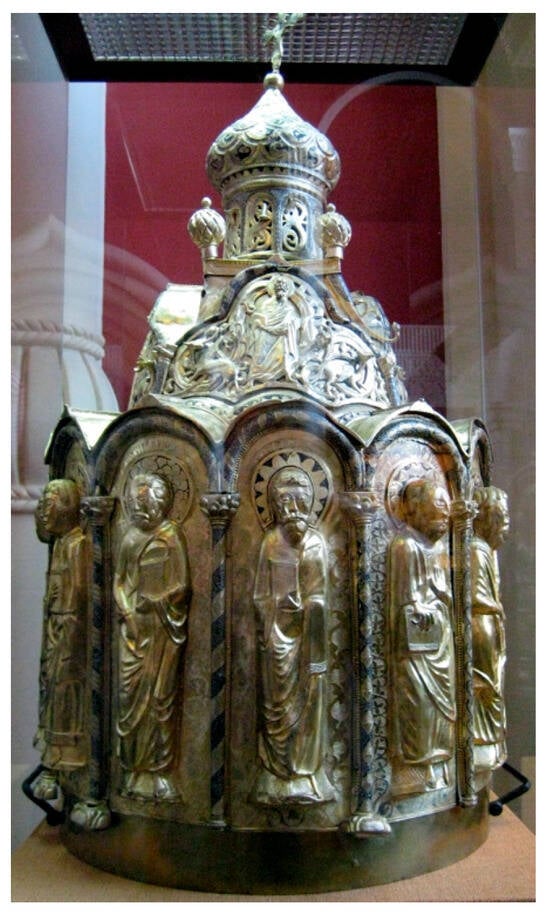
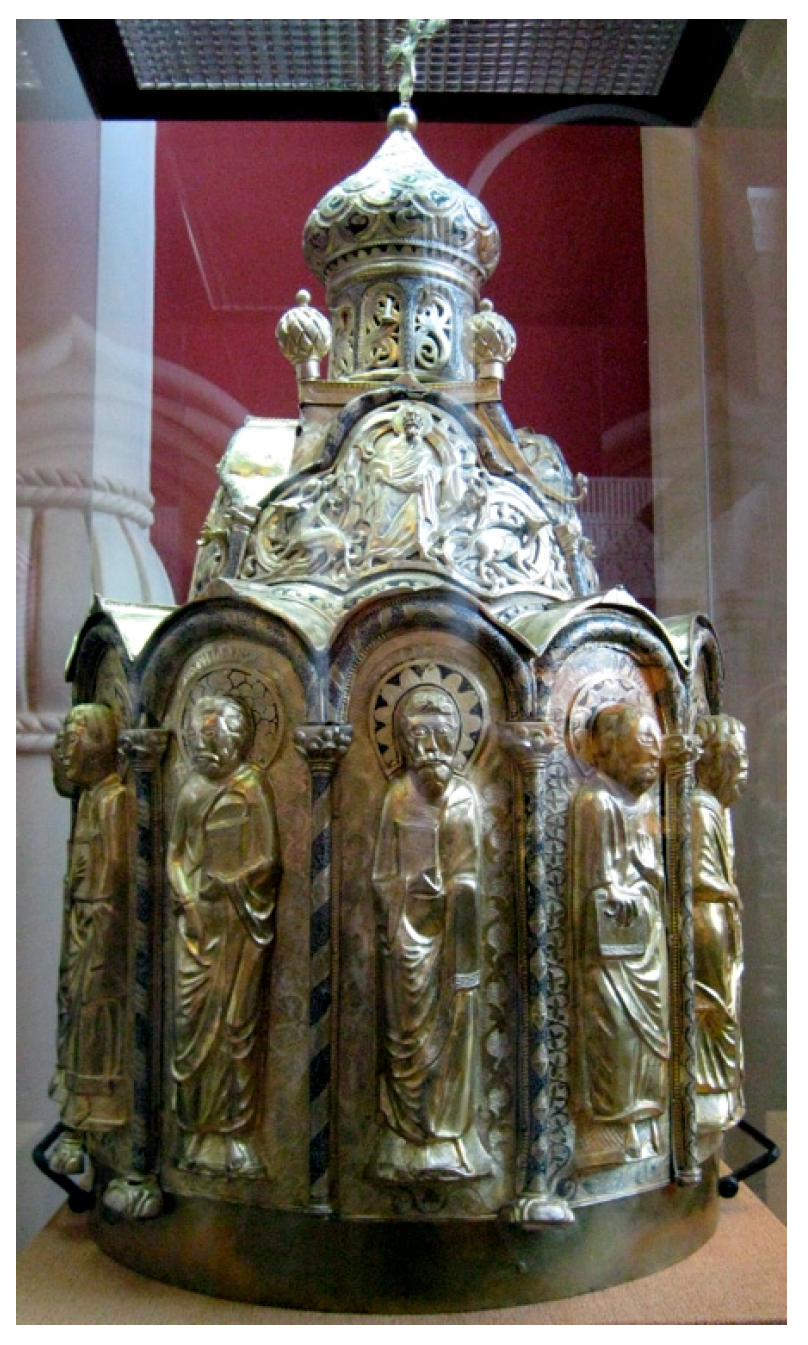
In the Russian tradition, similar objects—called Zions or Jerusalems—emphasized the idea of embodying the Heavenly Jerusalem. Zions served as communion vessels during particularly solemn services (Lidov 2014, p. 153). N. Pokrovsky suggests that the earliest examples date to the 11th century with the construction of the first cathedral in Novgorod (Pokrovskij 1912, p. 2). I. Sterligova observes that Zions are three-dimensional icons representing the Heavenly Jerusalem, often incorporating elements of the Church of the Holy Sepulcher and Solomon’s Temple, the Holy of Holies of the Old Testament (Sterligova 2016). (Figure 4).
Figure 4.
The Great Zion of the Moscow Assumption Cathedral, 1486. Source: https://ortox.ru/wiki/sion/?srsltid=AfmBOooE99OUB54TRwuveGj881Io6U74EyhXBkAMGACGcd51tYyGcklY [accessed 12 January 2026].
These objects were actively used until the 17th century, after which rectangular church-shaped tabernacles became more common (Sterligova 2016), reflecting broader trends in Eastern Christian art.
Church-shaped reliquaries in Byzantine and Eastern Orthodox tradition, in general, did not become common until the later period (Kalavrezou 2022, p. 249). The earliest example is considered to be the Moldavian (Romanian) reliquary of St. Niphon from the beginning of the 16th century, notable for its church-shaped design for housing relics (Kalavrezou 2022, p. 247).
In the Romanian tradition, such church-shaped boxes—whether tabernacles—were used to house consecrated Eucharistic elements. Local practice required that the box replicate the form of the church to which it was donated (Simion 1997, p. 40). I. Kalavrezou suggests that the idea of creating church-shaped reliquaries may have been influenced by Western models (Kalavrezou 2022, p. 247).
6. The Ark as a Symbol of the Heavenly Jerusalem
The architectural form of the ark represents the earthly model of Heavenly Jerusalem, a concept originating in the medieval West (Kilgore 2017, p. 69). The Heavenly Jerusalem, as described by Saint John in the Book of Revelation, appears repeatedly as a religious ideal throughout the medieval period (Kilgore 2017, p. 44): “And the wall of the city had twelve foundations, and in them, the twelve names of the twelve apostles of the lamb” (Revelation 21:14). The apostles, depicted under separate arches on the four sides of the ark act as “foundations”, symbolizing the gates of the Holy City.
Traditionally, the iconography of the Heavenly Jerusalem is represented as an equilateral square with three apostles on each side. However, in ritual objects, deviations occur, and rectangles may be used instead. In such cases, figures are arranged in groups differing from the standard three per side. For instance, the reliquary casket of St. Servatius in Quedlinburg (870–1200) depicts eleven apostles and Christ on the sides of a rectangle. Scholars infer the representation of the Heavenly Jerusalem based on biblical references (Gatti 2000, p. 11; Garrison 2010, pp. 19, 21; Srsic 2014, p. 5).
A discrepancy is created between the rectangular shape of the ark and the square shape of the city described in Revelation: “The city lies foursquare, its length the same as its width (Revelation 21:16)”. The study of the St. Servatius casket also points to a rectangular shape, which does not actually correspond to the text, but it is pointed out that the proportions are formed according to the 2:1:1 principle (Srsic 2014, p. 6). The same applies to the Bucharest ark: the proportions are approximately 2:1:1 (8 × 17.5 × 8.2 cm; with domes: 19 × 17.5 × 8.2 cm). Although the ark lacks the precious stones described in Revelation, the depiction of the apostles allows the composition to be interpreted as a symbol of the Heavenly Jerusalem.
The ark is rich in symbolic content. The domes likely symbolize the many churches of the Heavenly Jerusalem9 (Figure 1 and Figure 5). While three, five or seven domes are more common in representations, the silversmith exercised an artistic freedom: the nine here may reflect a design choice dictated by the surface and compositional balance of the object. The differing sizes of the domes reinforce this symbolism. According to A. Lidov, the Heavenly Jerusalem is not identified with any single temple but rather represents a city made up of temples (Lidov 2014, p. 100).
Figure 5.
Nine domes of the ark. Source: Author’s own collection.
The domes, aside from the central one, resemble tempietti depicted in the margins of Armenian manuscripts10, which similarly symbolize both the Temple of Jerusalem and the city itself (Manukyan 2012, p. 89).
The filigreed construction of the domes conveys transparency and light, key symbols of the Heavenly Jerusalem11. Light has held profound theological significance throughout Late Antiquity and the Middle Ages12, marking sanctity of an area, person, or object in Christian art and architecture (Sullivan et al. 2021, p. 83).
In Revelation, the material of the Heavenly Jerusalem is described as crystal, symbolizing literal and theological transparency (Kilgore 2017, p. 68). While the Bucharest ark does not employ precious stones or crystal, the filigree allows light to penetrate and refract, evoking the brilliance described in Revelation. The transparent construction of filigree allows light to penetrate, refract, and shine. In medieval Europe, the expression of light, color, and transparency was the Gothic architecture with its transparent details and stained glass windows (Kilgore 2017, p. 76), expressing the new image of Heavenly Jerusalem (Kilgore 2017, p. 8). This also served as a model for the arks, reliquaries, to represent Paradise and the Heavenly Jerusalem (Kilgore 2017, p. 8). And since Armenian art did not imitate Gothic art in the Western interpretation, in this case, that function was performed through the technical and artistic peculiarities allowed by the technique of filigree. Thus, by including filigree, the transmission of the idea of light and brilliance of Heavenly Jerusalem is given in a different interpretation, characteristic of Armenian art. The inclusion of domes in the structure, characteristic of Armenian architecture, reinforces the object’s distinctly Armenian outlook.
The composition of the ark develops from the bottom to top, guided by the gestures of figures pointing upward13, culminating in flower-shaped crosses crowning the domes, a common symbol of the Heavenly Jerusalem (Lexikon 1994, p. 399; Lidov 1998, p. 351; 2014, p. 113).
A. Lidov notes that a fully established and recognizable iconographic scheme of the Heavenly Jerusalem did not exist in Byzantine art (Lidov 2014, p. 115). Essentially, the same phenomenon is also observed in Armenian medieval art.
The manifestation of the Heavenly Jerusalem in Armenian architecture was first addressed by A. Ghazaryan (1994, pp. 107–20; 2009, pp. 520–43), who identified it in ritual objects derived from the church-reproducing structure of these works (A. Ghazaryan 2009, pp. 533–34).
No known examples of Armenian medieval silversmithing replicate an ark like the one in Bucharest. In post-17th-century Armenian art, church-shaped arks as tabernacles, and reliquaries frequently appear, often decorated with floral motifs (Goltz and Goltz 2000, p. 102), scenes from the life of Christ (Goltz and Goltz 2000, pp. 56–57; E. Vardanyan 2012, p. 131), or simplified church-like forms with characteristic stonework (Marchese and Breu 2015, pp. 140–41). However, the artistic decoration and symbolic integration of the Bucharest ark remain unique among Armenian examples.
7. “Constantinople Style” and Armenian Silversmithing in Constantinople
A unique synthesis of Eastern and Western artistic traditions is embodied in the so-called “Constantinople style”14. In the 17th–18th centuries, radical transformations occurred across various spheres of art in the East, giving rise to new, Western-inspired esthetic preferences. This phenomenon can be regarded as a form of cultural globalization, manifesting in the fusion of Western and local art across diverse regions. Although different countries and traditions assigned different names to this stylistic shift—such as the Brancovian style, the Bulgarian National Revival, or the “Constantinople style”, etc., they all reflect the same broader cultural process.
Founded in 1622, the Propaganda Fide program promoted missionary movements aimed at the Catholicization of Eastern communities, including those in the Ottoman Empire. The increased activity of the Catholic Church, combined with the invention of printing in the West and its dissemination in the East, facilitated the spread of Western artistic elements and new iconographic types starting in the 17th century (Faroqhi 2013b, pp. 35, 171–74; Ruiu 2014; Güngörürler and Shapiro 2023). Western books were brought to the Empire for sale or as gifts by Catholic missionaries (Merian 2013, p. 132). This transformation accelerated further with the establishment of local printing centers, which primarily employed Western iconographic templates (Evance and Merian 1994, p. 112; Olar 2024). The influence of Western art was especially prominent in Constantinople, the Empire’s cosmopolitan cultural center.
Starting in 1512 with the printing of the first Armenian book in Venice, Armenian presses started to function in cities with Armenian communities. Constantinople was among the first, establishing an Armenian press in 1567 (Korkotyan 1964, p. 2). Armenians were the second subject nation in the Ottoman Empire to adopt printing (Kharatyan 2012, p. 3).
Western-style engravings were used in the Armenian printing house in Amsterdam around 1660, where printers acquired woodcut templates from the renowned Dutch engraver Christoffel van Sichem15. The printing and widespread circulation of the first Armenian Bible, produced in Amsterdam between 1666 and 1668 by Bishop Voskan Yerevantsi, had the most far-reaching impact (Ishkhanyan 1981, p. 61). The engravings, mostly by van Sichem, became influential models not only for Armenian artists and printers in Constantinople but also for masters in other cities, notably Kayseri, renowned for its silver bindings (Merian 2013).
In addition to well-known presses, from 1686 to 1718, Catholic Armenians in Constantinople, with support from Rome’s Latin clergy, founded a secret Catholic printing house (Davtyan 1965; Ishkhanyan 1981, pp. 73–74; Kharatyan 2012, pp. 4–5).
European printed books—or at least their engravings in Armenian books—were likely available to Istanbul’s Armenian silversmiths, who may have used them as samples for clients; patrons, therefore, actively influenced esthetic decisions, shaping the outcome of their commissioned objects (F. Ghazaryan 2017, pp. 51–52). This environment fostered the gradual dissemination of new iconographic and decorative forms, giving rise to a distinct artistic style.
From around 1718 (the Tulip Period) onward, the assimilation of Western cultural elements intensified, as the Ottoman court favored the so-called “Frankish style”, characterized by Western idioms in decorative arts and reflecting a broader shift toward European esthetics (Quataert 2005, pp. 42–44; Bayburdyan 2011, pp. 360–61; Faroqhi 2013a, p. 167; 2013b, p. 193).
These trends introduced new esthetic sensibilities, ultimately giving rise to the “Constantinople style,” defined by the blending of Baroque, Rococo, and Neoclassical elements with local traditions (Marchese and Breu 2015, p. 92).
The term “Constantinople style” was first introduced into scholarly discourse by R. Marchese and M. Breu. During the period in question, Constantinople was the largest center of silversmithing and jewelry production in the region. Armenian artisans played a leading role in shaping both secular and religious art in the city, contributing to the formation of the “Constantinople style” (Marchese 2018, p. 2). Armenian silversmiths and goldsmiths were prominent in the Ottoman court and significantly influenced the Empire’s culture and economy, as evidenced by collections in museums, antique shops, and auctions worldwide.
Major centers of Armenian silver and gold production in the Ottoman Empire included Kayseri, Van, Sivas, Erzurum, etc. Hundreds of Armenian masters’ names have been documented in historical sources (Kürkman 1996; Tokat 2005; Stepanyan 2011; Marchese and Breu 2015; Kürkman 2019; Yarman 2022). Notably, Armenian goldsmiths acted as the main jewelers of the Ottoman court, as well as held leadership positions in the Sultan’s Mint, with families such as the Duzians, Zinkillins and others (Sakisian 1930, p. 14). The Duz/Duzian family, for instance, led the Mint for more than a century, from the 17th to the second half of the 19th century (Kürkman 2019, pp. 23–33). Armenian artisans were frequently honored with medals and degrees for their skill and devotion.
R. Marchese highlights the role of Ottoman Armenian elites, who, being well-educated and often trained in European schools, fostered the development of the “Constantinople style” in religious art (Marchese 2018, p. 18). Within these processes, the role of Armenian merchants was of considerable significance, as their commercial and cultural activities functioned as a vital conduit between the West and the East.
The “Constantinople style” is characterized by rich and stylized floral motifs (Marchese and Breu 2015, p. 93). Compositions are increasingly ornamented with floral designs in Baroque and later Rococo manner, framed with floral garlands formed into ribbons. Western iconographic elements appear along with new scenes. Figures and drapery are rendered more expressively, with dramatic gestures and flexible body postures. In depictions of the Crucifixion and Burial of Christ, lamentation is portrayed with heightened emotion, enhanced by dynamic gestures, bent and curved postures of the bodies.
These artistic features became hallmarks of Armenian silversmithing in Constantinople, noted for rich decoration, masterful silverwork, and high quality. Evidence from collections, museums, and auctions shows that artisans enjoyed creative freedom, allowing diverse solutions and imaginative innovation. This freedom facilitated the development of new artistic forms, as well as representing a typical manifestation of the “Constantinople style” (M. Vardanyan 2024, p. 27).
The silver ark preserved at the “Dudian” Museum exemplifies these artistic influences, serving as a presentation of the “Constantinople style.”
8. Artistic Analysis of the Ark
Although the object is not large in size, it nevertheless creates a monumental impression. The style and iconography exhibit influences characteristic of the “Constantinople style,” discussed in Section 7.
The apostles on the sides of the ark are depicted without written names, but are rendered with characteristic attributes. While this style encouraged dynamic, modeled figures, the apostles here remain somewhat conventional, with a bit not perfect symmetry. Despite this, the composition achieves perfect balance and visual harmony.
The face types are elongated with long hair, wide foreheads, large bulging eyes, and thick mustaches and beards. The generalized portrait features and slightly distorted proportions move the figures away from contemporary realism. Similar features are found on other Constantinople silver objects from the 18th–19th centuries (M. Vardanyan 2017, p. 93), forming a recognizable typology in Armenian silversmithing. Of course, only this similarity does not yet allow us to attribute the objects to the same master. However, due to its repetition in several places, it is formed as a certain type of face typical of the Armenian silversmithing of Constantinople in the 18th–19th centuries.
The apostles are depicted in deacon and priestly16 vestments typical for the Armenian Church and are shown beneath arches supported by twisted columns, on a checkered floor in linear perspective. This arrangement follows early Christian, Roman, and Byzantine traditions of depicting saints under arches. The convention of columns as dividers, with apostles or saints placed beneath arches, originates in early Christian art (Manukyan 2015, p. 307). Twisted columns and arcature orders reflect Roman triumphal architecture (A. Ghazaryan 2009, p. 522). Such depictions appear on Roman sarcophagi (Denis 1965), early Byzantine metalwork17, and 6th–7th century Asia Minor pilgrim flasks (Foskolou 2018, p. 317), etc. In Armenian art, the motif is found in reliefs (Etchmiadzin Cathedral)18 and in miniature painting (Etchmiadzin Gospel of 989, Matenadaran No. 2374; Gospel of 1018, Matenadaran No. 4804, etc.), later extending to monumental painting (Manukyan 2015, p. 307).
Saints under the arches also occurs in Byzantine reliquaries, such as the silver reliquary-casket of Trebizond (Buckton 1985, pp. 202–3; Darkevich 1975, p. 228). Although scarce surviving examples limit our ability to trace its early use in Armenian metalwork, its widespread presence in both Eastern and Western metalwork suggests continuity into the modern period. By the 17th century, depictions of saints under arches become common in Armenian artistic metalwork.
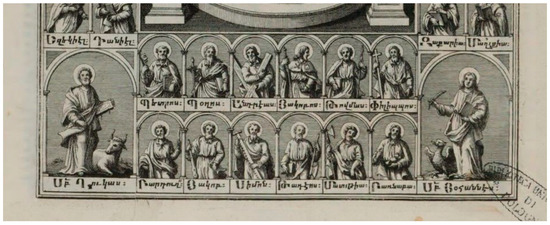
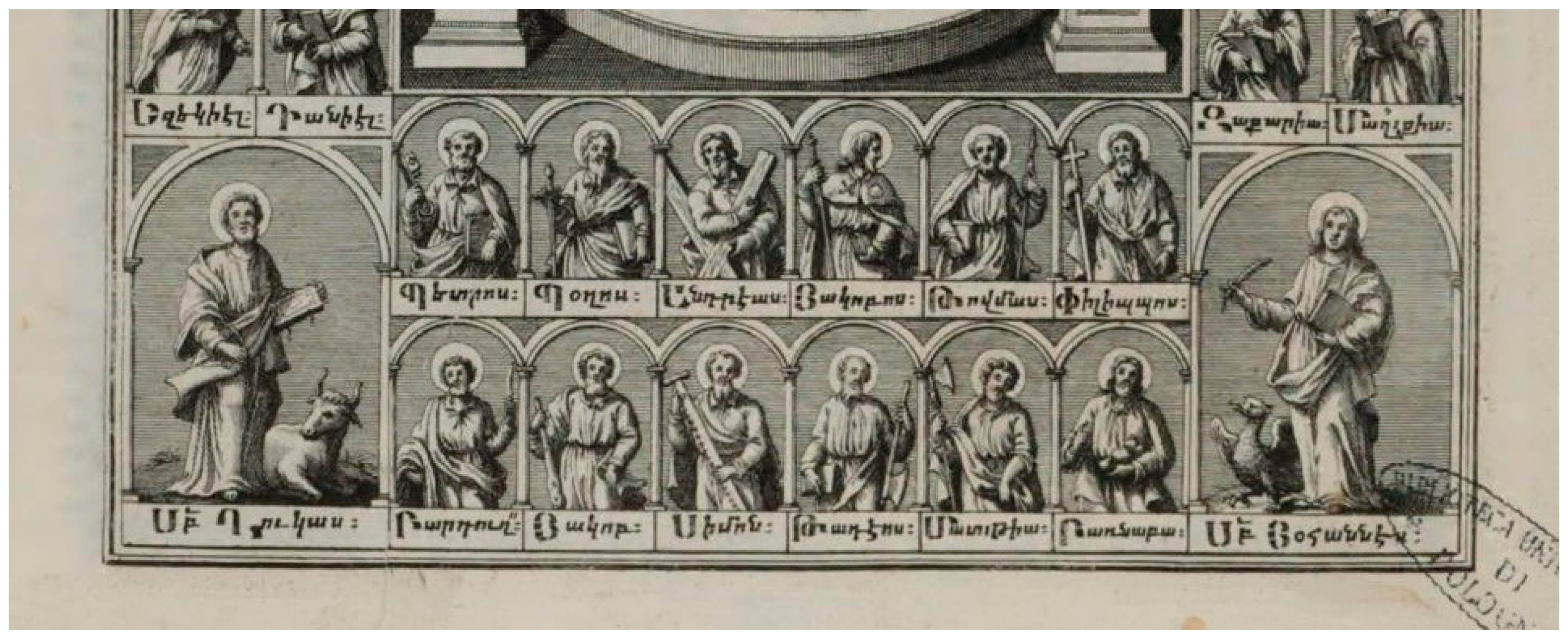
Western influence is apparent in the ark’s decoration, reflecting the broader trends of the “Constantinople style.” While no single source can be definitively identified, the master appears to have drawn selectively from Western printed books, as exemplified by the title page of a Bible printed in Antonio Bortoli’s Venice press in 1733 (Figure 6), which depicts a similar group of apostles, though in Western clothing and iconographic conventions. This comparison further confirms the fact that, during this period, silversmiths made extensive use of new iconographic models introduced through printed books, as discussed in the previous section. It should be noted that in numerous examples of printed books, we have not encountered any depiction of a structure or object resembling the model of our tabernacle.
Figure 6.
Title page of Bible, Venice: Publ. house of Antonio Bortoli, 1733. Detail. Source: https://bub.unibo.it/it/bub-digitale/frontespizi-libri-armeni/aula-vi?bid=UBO6110828 [accessed 12 January 2026].
The linear perspective created through the latticed floor is characteristic of Armenian (M. Vardanyan 2017, pp. 90–92) and Greek (Kousouni and Panagopoulou 2018, p. 87) silverwork of the period, especially in Constantinople. The composition is enhanced by contrasts between polished and matt surfaces and varying degrees of chasing. Flowing, multi-layered drapery and polka-dot decoration contribute to visual complexity. Each figure has a unique head position and hand gesture, ensuring dynamic expressiveness on each face of the box.
Though the silversmith avoided overcrowding the composition with detail, these techniques produce a balanced, expressive, and visually engaging overall effect, in line with the principles of the “Constantinople style”.
9. Conclusions
The silver ark of the “Dudian” Museum of the Armenian Diocese of Romania stands as a unique masterpiece of Armenian ecclesiastical art from late 18th-century Constantinople. It combines the artistry, devotion, and symbolic meaning. While its ritual function—whether as a reliquary or a tabernacle—remains uncertain, the ark is deeply connected with pilgrimage practices. It is a reminder of the faith and devotion of the pilgrims, demonstrating the reverence with which the gifts for the church were chosen.
The object has been examined through its inscription, form, function, symbolic meaning, devotion and artistic features. The analysis demonstrates that the object cannot be reduced to a single category: while originating as a pilgrimage memento, it was fully integrated into the liturgical context of the Armenian Church. Such objects were not foreign within Armenian ecclesiastical practice, so they were accepted and used in accordance with established ritual norms.
Providing the information about the place and date of the ark’s creation as well as about the donor, the donative inscription with its documentary value emphasizes the importance of the object.
The ark, through its structure and decoration, embodies the vision of Heavenly Jerusalem, fitting within the pan-Christian patterns of symbolic interpretation of comparable ritual objects.
Its artistic solutions reflect a synthesis of Armenian silversmithing, enriched by Western artistic influences, acting as the embodiment of the so-called “Constantinople style”.
Ultimately, the Bucharest ark stands not only as a remarkable liturgical object but also as a singular testament to the creativity, cultural vision, and artistic mastery of Armenian silversmithing and Armenian ecclesiastical art of the 18th century.
Funding
This study became possible with the support of the Diocese of Armenian Church in Romania, Ministry of Culture of RA, and State Committee of Science MES RA, in frames of the research project No. SCS 13-6E440.
Institutional Review Board Statement
Not applicable.
Informed Consent Statement
Not applicable.
Data Availability Statement
The original contributions presented in this study are included in the article. Further inquiries can be directed to the corresponding author.
Acknowledgments
- I wish to express my deepest appreciation and heartfelt gratitude to my scientific supervisor, Levon Chookaszian, and to the Head of the Armenian Diocese of Romania, Bishop Datev Hakobian, for initiating and supporting the study of the Armenian art treasures of Romania and for their constant guidance and encouragement throughout this research. I am equally grateful to all the members of the Armenian Diocese of Romania for their continued support.
- My sincere thanks go to Fr. Hovhannes Haik Azarian for always finding time for meaningful conversations on ritual objects and for generously sharing his knowledge and insight.
- I am profoundly grateful to the Union of Armenians of Romania, represented by the President Varujan Vosganian, and especially to Arsen Arzumanyan, who stood by my side throughout the research process and offered unwavering support in every matter.
- I would also like to thank Davit Ghazaryan, Arsen Harutyunyan, Haykanush Mesropyan, and Ani Avetisyan for their valuable assistance in reading and interpreting the inscription.
- My warm thanks extend to Seyranush Manukyan, Zaruhy Hakobyan, and Inesa Danielyan for their constant readiness to help, their thoughtful advice, and their encouragement.
- My special gratitude goes to Vlad Bedros for believing in me and for quietly inspiring me through his work and professional example.
- Finally, I would like to express my sincere appreciation to the editorial board of the journal and to the two academic editors of this special issue for their invitation to publish this article without charge, and for their valuable feedback, which significantly enhanced the quality of my research.
Conflicts of Interest
The author declares no conflict of interest.
Notes
| 1 | For transliterations is used the Hübschmann-Benveniste-Meillet system. |
| 2 | Scholars hold differing views regarding the formation of Armenian communities in the territory of present-day Romania. Nevertheless, the official date for the establishment of the community is generally considered to be 1401, when, by a decree of Alexander the Good, Prince of Moldavia, the creation of a diocese of the Armenian Church was permitted. There is no precise information regarding the exact period of Armenian settlement in Focșani. At present, a small Armenian community exists, and three churches remain standing: the Church of St. George (beginning of 18th century), the Church of St. Mary (18th century) and the Holy Resurrection Chapel in the Armenian cemetery (1891) (Siruni 1966, pp. 66–67). M. Mirakhorian mentions four churches, of which the oldest has not been preserved (Mirakhorian n.d., p. 2). |
| 3 | A lineage name or surname. |
| 4 | The word “Kokten” (ԿՕԿՏԷՆ), which appears in the inscription, cannot be interpreted or linked to the context of the sentence, as no such word exists. The first hypothesis was that it is the name of a month; however, this form cannot be identified with any known month name. According to the Turkologist A. J. Avetisyan, this is a case of a scribal error, which is frequently encountered, especially in foreign-language texts written in Armenian script. In her view, the correct form should be “Konten” (ԿՕՆՏԷՆ), corresponding to the Turkish word “gün” (day), while “konten” represents the Armenian dialectal transcription of the word in the ablative case. In this case, the inscription becomes much more intelligible. It should be punctuated։ «Յ[Ի]Շ[Ա]Տ[Ա]Կ Է ՏԱՊԱՆԱԿՍ Մ[Ա]Հ[ՏԵ]ՍԻ ԱՍՖԱՏՈՒՐԻ II ՈՐԹՕՑԸ ՊՐՕՆՉԱՆՑ ՖՈՔՇԱՆՈՒ, Ի ԴՈՒ II ՌՆ Ս[ՈւՐԲ]Բ Ա[ՍՏՈւԱ]ԾԱԾՆԱ ԵԿԵՂԷՑՕ 1799: II ԿՕԿՏԷՆ 30 ՍՏԱՆՊՕԼ ՇԻՆ II ՎԵՑԱՒ», and can be translated accordingly: “This ark is a memory for sons of Mahtesi Asfatur from the Pronchants of Focsani, to the Church of Saint Mary in 1799. It was created in Stanpol (=Istanbul) within 30 days.” |
| 5 | Archbishop Małachia Ormanian—An Armenian theologian, historian and philologist. From 1896 to 1908 was the Armenian Patriarch of Constantinople. |
| 6 | Fr. Giwt Ałanyants is a cultural, church and public figure, educator, writer, translator, philologist, ethnographer, historian, publisher, and editor. |
| 7 | For exhibition methods aimed at emphasizing the significance of museum objects, see: (Johnson and Macnaughton 2024). |
| 8 | During the period under discussion, up to 1878, the region of Southern Dobruja, where the city of Dobrich is located, belonged to Romania. |
| 9 | A. Lidov, describing the image of Heavenly Jerusalem with numerous domes in Byzantine miniatures, believes that it is not at all necessary that it represents or resembles any particular church. The many domes may symbolize the many churches in Jerusalem, see: (Lidov 1998, p. 351). |
| 10 | On tempietto in the margins of manuscripts, see: (Manukyan 2012, pp. 88–96). |
| 11 | On light and transparency, see: (Kilgore 2017, p. 64) |
| 12 | There are currently many studies on architecture and light, see: (Gerstel and Cothren 2017, pp. 465–78; Nicuță 2022, pp. 95–107). |
| 13 | On one side is St. Matthias, on the other side is St. Peter pointing upwards his hand gesture. |
| 14 | Personal correspondence with Prof. Ronald T. Marchese University of Minnesota, researcher of the Armenian collections of Constantinople, 2014–2020. |
| 15 | Van Sichem, known for his book engravings, also produced copies of works by famous artists such as Albrecht Dürer, Abraham Vloemaert, and Hendrick Golzius (Ishkhanyan 1981, pp. 58–59). |
| 16 | For example, the copes, which are fastened at the chest with a buckle often made of silver, are typical Armenian. The cope is the principal vestment of the priestly rank. It is a colorful and richly decorated cape-like liturgical vestment, distinguished by its brilliance and elaborate ornamentation. See: (Ormanian 1992, pp. 107–8). |
| 17 | https://www.metmuseum.org/art/collection/search/468348 [accessed 13 January 2026]. https://www.metmuseum.org/art/collection/search/466137 [accessed 13 January 2026]. |
| 18 | The busts of the apostles are depicted in round medallions under the arches resting on the twisted columns on the dome of the Holy See Etchmiadzin Cathedral. See: (A. Ghazaryan 2007, p. 77). |
References
- Ačaṙyan, Hrachʿya. 1979. Hayeren Armatakan Baṙaran [Armenian Etymological Dictionary]. Yerevan: Yerevan University Press, vol. 4. [Google Scholar]
- Ališan, Łewond. 1910. Hin Hawatk῾ Kam Het῾Anosakan Krônk῾ Hayoc. Venice: San Lazzaro. [Google Scholar]
- Ałaneancʽ, Giwt. 1902. Karg Astvacapaštowt῾ean Hayastaneayc῾ S. Ekełec῾woy (Order of Piety of Armenian Holy Church). Tbilisi: Printing House M. Martirosyanc’. [Google Scholar]
- Bayburdyan, Vahan. 2011. Ôsmanyan Kaysrowt῾Yan Patmowt῾Yown [History of the Ottoman Empire]. Yerevan: Yerevan State University Press. [Google Scholar]
- Buckton, David. 1985. The Treasury of San Marco. Catalogue. Milan: Olivetti. [Google Scholar]
- Chookaszian, Levon. 2020. On New Paths for the Exploration of the Armenian Art. L’arte Armena. Storia Critica e Nuove Prospettive Studies in Armenian and Eastern Christian Art 2020: 50–61. [Google Scholar] [CrossRef] [Scilit]
- Darkevich, Vladislav. 1975. Svetskoe iskusstvo Vizantii [Secular Art of Byzantium]. Moscow: Iskusstvo. [Google Scholar]
- Davtyan, Hakob. 1965. K․ Polsi hay-kat῾olikneri gałtni tparanə [The Secret Printing House of the Armenian Catholics of Constantinople]. Bulletin of the Academy of Sciences of the Armenian SSR: Social Sciences 1: 29–40. Available online: https://arar.sci.am/dlibra/publication/120215/edition/109420?language=en (accessed on 11 February 2026).
- Denis, Valentin. 1965. L’art D’occident des Catacombs a la fin du XVe Siècle. Bruxelles: Éditions Meddens. [Google Scholar]
- Evance, Helen, and Sylvie Merian. 1994. The Final Centuries. Armenian Manuscripts of the Diaspora. In Treasures in Heaven: Armenian Illuminated Manuscripts. Edited by Matheus Thomas and Wieck Roger. New York: Princeton University Press, pp. 104–23. [Google Scholar]
- Faroqhi, Suraiya. 2013a. Subjects of the Sultan. Culture and Daily Life in the Ottoman Empire. London and New York: I.B. Tauris. [Google Scholar]
- Faroqhi, Suraiya. 2013b. The Ottoman Empire and the World Around It. London and New York: I.B. Tauris. [Google Scholar]
- Foskolou, Vicky. 2018. “Reading” the Images on Pilgrim Mementoes (Eulogies): Their Iconography as a Source for the Cult of Saints in the Early Byzantine Period. In Für Seelenheil und Lebensglück Das Byzantinische Pilgerwesen und Seine Wurzeln. Edited by I. Eichner and D. Ariantzi. Mainz: Verlag des Römisch-Germanischen Zentralmuseums, pp. 315–25. [Google Scholar]
- Galpagian, Yovhannes. 1979. Rumanahay Gałut‛ə [Armenian Community in Romania]. Erusałem: Srboc‛ Hakobeanc‛ Press. [Google Scholar]
- Garrison, Eliza. 2010. A Curious Commission: The Reliquary of St. Servatius in Quedlinburg. Gesta 49: 17–29. [Google Scholar] [CrossRef] [Scilit]
- Gatti, Evan. 2000. Reviving the Relic: An Investigation of the Form and Function of the Reliquary of St. Servatius, Quedlinburg. ATHANOR XVIII 18: 7–15. [Google Scholar]
- Gerstel, Sharon E. J., and Michael W. Cothren. 2017. The Iconography of Light. In The Routledge Companion to Medieval Iconography. Edited by Colum Hourihane. London and New York: Routledge, pp. 465–478. [Google Scholar]
- Ghazaryan, Armen. 1994. Rotonda Voskresenija i ikonografija rannesrednevekovyx xramov Armenii [Rotunda of the Resurrection and the Iconography of Early Medieval Temples in Armenia]. In Vostočnoxristianskij Xram. Liturgija i Iskusstvo [Eastern Christian Church. Liturgy and Art]. Edited by Aleksey Lidov. Saint Petersburg: Dmitry Bulanin, pp. 107–20. [Google Scholar]
- Ghazaryan, Armen. 2007. Kafedralʹnyj sobor Surb Èčmiadzin i vostočnoxristianskoe zodčestvo IV—VII vekov [Saint Echmiadzin Cathedral and Eastern Christian architecture of the 4th-7th centuries]. Moscow: Loctus Standi. [Google Scholar]
- Ghazaryan, Armen. 2009. «Novyj Ierusalim» v prostranstvennyx koncepcijax i arxitekturnyx formax srednevekovoj Armenii [“New Jerusalem” in spatial concepts and architectural forms of medieval Armenia]. In Нoвые Иерусалимы. Иерoтoпия и икoнoграфия сакральных прoстранств. Collection of Articles. Edited by Aleksey Lidoov. Moscow: Indrik, pp. 520–43. [Google Scholar]
- Ghazaryan, Flora. 2017. Western Iconographic Influences on Armenian Silver Book Bindings from Ottoman Constantinople (Eighteenth-Nineteenth Centuries). Master’s thesis, Central European University, Budapest, Hungary. Available online: https://www.researchgate.net/publication/323382754 (accessed on 11 February 2026).
- Goltz, Herman, and Klaus Goltz. 2000. Rescued Armenian Treasures from Cilicia. Sacred Art of the Kilikia Museum Antelias, Lebanon. Wiesbaden: Reichert. [Google Scholar]
- Güngörürler, Selim, and Henry Shapiro. 2023. Catholic Missionary Activity in the Early Modern Ottoman Empire from the Perspectives of State and Convert. Journal of the Ottoman and Turkish Studies Association 10: 79–97. [Google Scholar] [CrossRef] [Scilit]
- Hatsuni, Fr․ V. 1907. Srboc῾ nšxarnerə [The relics of saints]. “Bazmavep” an Armenian Studies, Philological, and Literary Journal 45: 6–12. [Google Scholar]
- Ishkhanyan, Rafayel. 1981. Hay girk῾ə 1512–1920 [Armenian Book 1512–1920]. Yerevan: Academy of Sciences of the Armenian SSR. [Google Scholar]
- Izmaylova, Tatyana. 1979. Armjanskaja Miniatjura 11 Veka [Armenian Miniature of the 11th Century]. Moscow: Iskusstvo. [Google Scholar]
- Johnson, Charlotte, and Lindsay H. Macnaughton. 2024. Making a case for cases: The transformative power of display furniture. Museum History Journal 17: 95–107. [Google Scholar] [CrossRef] [Scilit]
- Kalavrezou, Ioli. 2022. The Reliquary of St. Niphon. Relations between Wallachia, Constantinople, and Mt. Athos. In The Land Between Two Seas. Art on the Move in the Med-Iterranean and the Black Sea 1300–1700. Edited by Alina Payne. Leiden-Boston: Brill, pp. 239–51. [Google Scholar] [CrossRef] [Scilit]
- Kharatyan, Albert. 2012. Hay gratpowt῾yownə K. Polsowm ew Zmyowr̄niayowm (1567–1860-akan t῾t῾.) [Armenian Printing in Constantinople and Smyrna (1567–1860s)]. Herald of the Socil Sciences 4: 3–11. [Google Scholar]
- Kilgore, Claire. 2017. Viewing Heaven: Rock Crystal, Reliquaries, and Transparency in Fourteenth-Century Aachen. Master’s thesis, University of Nebraska-Lincoln, Lincoln, NE, USA, May 13. Available online: https://digitalcommons.unl.edu/artstudents/121/ (accessed on 11 February 2026).
- Klein, Holger. 2010. Relics & Reliquaries. Arthophorion (Reliquary of Saint Anastasius the Persian). In Treasures of Heaven. Saints, Relics and Devotion in Medieval Europe. Edited by Klein Holger, Mann Griffith, Robinson James and Bagnoli Margarita. Baltimore: Walters Art Museum. [Google Scholar]
- Korkotyan, Qnarik. 1964. Hay tpagir grk῾ə Kostandnowpolsowm (1567–1850) [Armenian Printed Book in Constantinople (1567–1850)]. Yerevan: Republic Library after Al. Myasnikyan. [Google Scholar]
- Kousouni, Christina-Konstantina, and Adamantia Panagopoulou. 2018. Non-destructive Physi-cochemical Analysis and Conservation of Metallic Book Covers of Ecclesiastical Books from Saint Mavra and Tiomtheos Church in Zakynthos (Greece). Scientific Culture (Journal of Applied Science & Technology to Cultural Heritage Issues) 4: 85–95. [Google Scholar] [CrossRef]
- Kürkman, Garo. 1996. Ottoman Silver Mаrks. Istanbul: Mathusalem Publications. [Google Scholar]
- Kürkman, Garo. 2019. Sultan’s Jewelers in the Ottoman Palace 1853–1871. Istanbul: Korpus Yayinlari. [Google Scholar]
- Lafontaine-Dosogne, Jaqueline. 1982. Splendeur de Byzance. Catalogue. Bruxelles: Musées royaux d’Art et d’Histoire. [Google Scholar]
- Lexikon. 1994. Lexikon der Christlichen Ikonographie. Allgemeine Ikonographie. Bd. 6. Freiburg: Herder, Freiburger Graphische Betriebe. [Google Scholar]
- Lidov, Aleksey. 1998. Heavenly Jerusalem: The Byzanitine Approach. The Real and Ideal Jerusalem in Jewish, Christian, and Islamic Art: Studies in Honor of Bezalel Narkiss on the Occasion of His Seventieth Birthday. Edited by Aliza Cohen-Mushlin Bianca Kühnel. Jerusalem: Hebrew University of Jerusalem, Center for Jewish Art, pp. 340–53. [Google Scholar] [CrossRef]
- Lidov, Aleksey. 2014. Ikony. Mir Svjatyx Obrazov i v Vizantii i na Rusi [Icons. The World of Holy Images in Byzantium and Rus’]. Moscow: Feoria. [Google Scholar]
- Manukyan, Seyranush. 2012. Obraz Ierusalimskogo Xrama na poljax armjanskix Evangelij [The image of the Jerusalem Temple on the margins of the Armenian Gospels]. In Lazarev Readings: Art of Byzantium, Ancient Rus’, Western Europe. Proceedings of the Scientific Conference. Moscow: Moscow University Publishing House, pp. 88–96. [Google Scholar]
- Manukyan, Seyranush. 2015. Freski Tateva (930) [Murals of Tatev (930). In “Genesis Forest”, Collected Articles in Memory of Felix Ter-Martirosov. Yerevan: YSU Publ. House, pp. 296–325. [Google Scholar]
- Marchese, Ronald. 2018. Sociological Implications in Armenian Religious Art in the Late Ottoman Period: Data from the Armenian Churches of Constantinople During the Second Armenian Renaissance—Post 1700. Available online: https://www.researchgate.net/publication/327053118_Sociological_Implications_in_Armenian_Religious_Art_in_the_Late_Ottoman_Period_Data_From_the_Armenian_Churches_of_Constantinople_during_the_Second_Armenian_Renaissance_-_post_1700 (accessed on 11 February 2026).
- Marchese, Ronald, and Marlene Breu. 2015. Treasures of Faith. Sacred Relics and Artifacts from the Armenian Orthodox Churches of Istanbul. Istanbul: Citlembik Publications. [Google Scholar]
- Merian, Sylvie. 2013. The Armenian Silversmiths of Kesaria/Kayseri in the Sixteenth and Seventeenth centuries. In Armenian Kesaria/Kayseri and Cappadocia. Edited by Hovhannisian Richard. Costa Mesa: Mazda Publishers, pp. 117–85. [Google Scholar]
- Mirakhorian, Manowel Vantsi. n.d. Patmowt῾iwn (patkerazard) Fôk῾šan k῾ałak῾i hayoc῾ ew irianc῾ č῾ors ekełec῾iac῾… 1650–1932 [History (Illustrated) of Armenians of the City of Focsani and their Four Churches… 1650–1932]. Unpublished.
- Nicuţă, Oana-Maria. 2022. The Iconography of Light in Renaissance Painting and its Medieval Heritage. ANASTASIS IX: 95–107. [Google Scholar] [CrossRef] [Scilit]
- Olar, Ovidiu. 2024. ‘Libertà et licenza… di stampare mille heræsie et schismi:’ The Propaganda Fide and the Greek Printing Press at Constantinople (1627–1628). In Arabic-Type Books Printed in Wallachia, Istanbul, and Beyond. Berlin and Boston: De Gruyter, pp. 89–120. [Google Scholar] [CrossRef] [Scilit]
- Ormanian, Malachia Archbishop. 1992. Cisakan bar̄aran [Ritual Dictionary], Yerevan, 1992. Yerevan: Hayastan. [Google Scholar]
- Piatnitsky, Yuri. 2005. Pilgrims’ Eulogias from the Holy Land in the Hermitage Museum Collection, St. Petersburg. ECA: Eastern Christian Art in Its Late Antique and Islamic Contenxts, PEETERS Online Journals 2: 103–18. [Google Scholar]
- Pokrovskij, Nikolaj. 1912. Drevnjaja Sofijskaja riznica v Novgorode [Ancient Sophia Sacristy in Novgorod]. Moscow: Printing House of G. Lissner and D. Sobko. [Google Scholar]
- Quataert, Donald. 2005. Ottoman Empire 1700–1922. Cambridge: Cambridge University Press. [Google Scholar]
- Ruiu, Adina. 2014. Conflicting Visions of the Jesuit Missions to the Ottoman Empire, 1609–1628. Journal of Jesuit Studies 1: 260–80. [Google Scholar] [CrossRef] [Scilit]
- Sakisian, Armenak. 1930. K. Polsoy hay oskerč῾owt῾iwnə. ŽƏ-ŽT῾ dar [Armenian Jewelry of Constantinople: 18th–19th Centuries]. “Anahit” Journal of Thinking and Art 5: 9–14. [Google Scholar]
- Simion, Victor. 1997. Masterpieces of the Precious Metalwork Art in Romania (Capodopedere ale Artei metalor Preţioase din România). Bucharest: Editura Technicâ. [Google Scholar]
- Siruni, Hakob. 1966. Hay ekełec‛in rumen hołi vra [Armenian Church in Romania]. Etchmiadzin: Mayr At‛oṙ Surb Ēǰmiacin. [Google Scholar]
- Smbatyan, Nelli, and Mariam Vardanyan. 2014. Hay arvesti stełcagorcowt῾yownneri owsowmnasirowt῾yownə Ṙowminiayowm [The Study of Armenian Works of Art in Romania]. Armenological Issues 2: 241–46. [Google Scholar]
- Srsic, Elizabeth. 2014. Mapping the Heavenly Jerusalem: An Examination of the Quedlinburg Casket (c.870–1200), 2014. Austin: The University of Texas. Available online: https://www.academia.edu/20228174/Mapping_the_Heavenly_Jerusalem_An_Examination_of_the_Quedlinburg_Casket_c_870_1200_ (accessed on 11 February 2026).
- Stepanyan, Hasmik. 2011. Hayeri Nerdrowmn Ôsmanyan Kaysrowt῾Yownowm [Armenian Contribution to the Ottoman Empire]. Yerevan: Gasprint. [Google Scholar]
- Sterligova, Irina. 2016. Ierusalimy [Jerusalem]. «Naše nasledie». History, Culture, Art. Illustrated Cultural and Historical Magazine 119: 112–17. Available online: https://www.nn.media/magazine/119/159/ (accessed on 11 February 2026).
- Sullivan, Alice, Vladimir Ivanovici, and Gabriel Herea. 2021. Space, Image, Light: Toward an Understanding of Moldavian Architecture in the Fifteenth Century. Gesta 60: 81–100. [Google Scholar] [CrossRef] [Scilit]
- Tokat, Osep. 2005. Armenian Master Silversmiths. Los Angeles: Van. [Google Scholar]
- Trahoulia, Nicolette. 2008. The Scent of an Emperor: Desire and the San Marco Incense Burner. Arte Medievale 7: 33–40. [Google Scholar]
- Vardanyan, Edda. 2012. Reflets d’Arménie. Manuscrits et Art Religieux/Reflections of Armenia. Manuscripts and Religious Art. Paris: ACHCByz. [Google Scholar]
- Vardanyan, Mariam. 2017. The Collection of Silver Book Binding of the Armenian Museum in Bucharest and Their Relationship to Eastern and Western Arts. Series Byzantina XV, Studies on Byzantine and Post-Byzantine Art 15: 81–97. [Google Scholar]
- Vardanyan, Mariam. 2024. Artistic Features of Armenian Liturgical Objects. MEΘEXIS: Journal of Research in Values and Spirituality IV: 13–42. [Google Scholar] [CrossRef] [Scilit]
- Yarman, Arsen. 2022. Osmanli Döneminde Mücevher ve Ermeni Kuyumcular. 2 vols, Istanbul: Yapi Kredi Yayinlari. [Google Scholar]
- Yartmian, Fr. T. 2000. Hayastani vank῾erown ew ekełec῾inerown mêǰ pahowac sowrberow masownk῾ner ew srbazan ar̄arkaner [Relics of Saints and Sacred Objects Preserved in the Monasteries and Churches of Armenia]. “Bazmavep” an Armenian Studies, Philological, and Literary Journal 158: 128–61. [Google Scholar]
Disclaimer/Publisher’s Note: The statements, opinions and data contained in all publications are solely those of the individual author(s) and contributor(s) and not of MDPI and/or the editor(s). MDPI and/or the editor(s) disclaim responsibility for any injury to people or property resulting from any ideas, methods, instructions or products referred to in the content. |
© 2026 by the author. Licensee MDPI, Basel, Switzerland. This article is an open access article distributed under the terms and conditions of the Creative Commons Attribution (CC BY) license.