


Abstract
Research on religion and migration has shown that faith can provide displaced families with resilience, moral continuity, belonging, and transnational solidarity, while scholarship on migrant families has examined intergenerational religious transmission and changing parent–child relations. Less attention has been paid to how these processes intersect when forced displacement weakens the ordinary foundations of parental authority. Drawing on ethnographic research conducted between 2021 and 2024 with Syrian refugee parents, adolescents, and young adults in Germany, this article examines how forced displacement transforms the social function of religion within family life, including its reconfiguration as a form of parental governance. The findings show that, as displacement weakens the social, economic, and institutional foundations of parental authority, religious authority may assume a greater role in regulating children’s behaviour and preserving family values. Religious norms are selectively invoked as sacred and non-negotiable boundaries around obedience, gender, sexuality, friendships, and marriage. This process is conceptualized as the religious reconstruction of parental authority. However, intensified religious governance does not necessarily produce deeper conviction. Some young people respond through performative obedience, displaying conformity at home while concealing relationships, practices, and beliefs outside parental supervision. These parallel moral worlds preserve the appearance of family continuity while deepening secrecy, guilt, emotional distance, and mistrust. The article concludes that transnational faith supports intergenerational solidarity most effectively when it enables dialogue, mutual recognition, and young people’s moral agency rather than compulsory religious performance.
1. Introduction
1.1. Faith, Migration, and the Intimate Life of Authority
“Now we fear our children instead of them being afraid of us.”
Jameel, a Syrian refugee father of three children aged 14, 18, and 21, used these words during an interview conducted in 2022, approximately three years after his arrival in Germany. In Syria, he explained, he would never have dared to smoke in front of his own father. In Germany, however, his teenage son smoked openly, invited friends into the family home without consulting his parents, and rejected their advice. Jameel understood these encounters not merely as disagreements over adolescent behaviour, but as evidence of a deeper shift in authority.
In the social and educational environment he associated with Syria, discipline was reinforced through adult commands, hierarchical relationships, strict rules, and the expectation that schools and communities would support parental authority. In Germany, by contrast, he perceived schools and institutions as encouraging children to assert individual rights. At the same time, displacement had weakened many of the resources that had previously sustained his authority, including occupational status, economic independence, professional identity, social networks, linguistic competence, and familiarity with institutions. Parents therefore remained responsible for their children’s conduct while feeling increasingly unable to guide them through the forms of authority on which they had once relied.
Jameel’s response should not be reduced to resistance to change. As a relatively recent arrival, he was still attempting to understand, negotiate, and adapt to social and institutional expectations that differed sharply from those through which he had previously understood parenthood. His insistence that adaptation remain bounded by “our religion, beliefs, and morals” reflected an effort to preserve a recognizable moral framework while making sense of these contradictions. His account introduces the central question of this article: how does religious authority acquire new significance when displacement unsettles established understandings of parenthood and weakens the social foundations through which parental legitimacy was previously sustained?
A substantial body of scholarship has shown that religion can help displaced people interpret suffering, reconstruct continuity after rupture, sustain hope, and form communities across national borders. Religious beliefs and practices may also provide moral orientation, emotional resilience, social support, and a sense of purpose under conditions of displacement and uncertainty (Hagan and Ebaugh 2003; Levitt 2007; Schlechter et al. 2021; Pertek 2022; Engel et al. 2024). Research with young Muslim refugees in Germany, for example, has found that religiosity may support existential meaning and a sense of purpose after forced migration (Engel et al. 2024). Religious communities and transnational networks can also create obligations of care that extend beyond national membership and challenge narratives that position migrants as permanent outsiders (Connor 2010; Fiddian-Qasmiyeh 2016).
The transnational character of religion is therefore significant not only because faith travels across borders, but because it can create moral obligations that exceed citizenship, territory, and ethnic membership. Faith communities may offer migrants recognition, continuity, and solidarity across national boundaries (Hagan and Ebaugh 2003; Levitt 2007). Yet the social power of religion is not exercised only through public institutions, communities, or collective acts of hospitality. It is also produced within intimate relationships, where religious meanings are interpreted, contested, and connected to questions of authority, obligation, care, and belonging (McGuire 2008; Ammerman 2014; Bossi and Marroccoli 2022).
Research on intergenerational religious transmission has examined how parents communicate beliefs, rituals, moral values, and religious identities to their children. Migration can make this process more deliberate because parents can no longer assume that schools, neighbourhoods, relatives, or public institutions will reproduce the religious environment in which they themselves were socialized. Religious transmission is therefore not the simple movement of an unchanged tradition from one generation to another. It is shaped by minority positioning, family communication, changing social contexts, and children’s encounters with alternative moral worlds (Bossi and Marroccoli 2022; Legault-Leclair 2025). Parental socialization matters, but it does not mechanically reproduce either affiliation or conviction. Young people interpret inherited beliefs and practices through their own relationships, experiences, and social environments.
Existing scholarship has thus provided important accounts of religion as a source of resilience, continuity, belonging, and intergenerational transmission in migrant and refugee contexts (Hagan and Ebaugh 2003; Bossi and Marroccoli 2022; Legault-Leclair 2025). A related body of research has examined changing parent–child relations, family separation, accelerated youth responsibilities, and intergenerational negotiation after migration and forced displacement (Renzaho et al. 2017; El-Khani et al. 2022; Van Acker et al. 2024). Less attention, however, has been paid to how these processes intersect: specifically, how forced displacement may alter the social function of religious authority when the relational foundations of parental legitimacy become unstable.
The concern of this article is therefore not whether Syrian refugee families remain religious after migration, nor whether parents successfully transmit religious beliefs, values, and practices across generations. Rather, it asks how forced displacement reshapes what religion comes to do within family life when relations of dependence and authority have been transformed. How are religious beliefs, values, and practices mobilized when parental instructions no longer carry the legitimacy they once possessed? Who is entitled to interpret religious obligation within the family? When does faith function as a shared source of moral orientation, and when does it become a means of establishing boundaries that children are not permitted to question?
A lived-religion perspective is essential to addressing these questions. Religion is not confined to doctrine, formal worship, or institutional membership. It is practised in kitchens, bedrooms, schools, family conversations, digital spaces, intimate relationships, and everyday moral decisions. The same religious language may express devotion, care, fear, cultural memory, moral responsibility, and claims to authority. Its social meaning therefore cannot be understood separately from the relationships in which it is interpreted and enacted.
Drawing on ethnographic research conducted between 2021 and 2024 with Syrian refugee parents, adolescents, and young adults in Germany, this article examines the reconfiguration of religious authority within displaced families and the ways young people negotiate parental and religious expectations across different social settings. Its central claim is that forced displacement does not merely relocate religion across borders. It reconfigures the interdependencies through which religion acquires social force and may transform what religion is asked to do within the family.
1.2. Displacement and the Reconfiguration of Parental Power
Research on migrant families has examined intergenerational tensions through differences in the pace and direction of parents’ and children’s adaptation to the receiving society. The concept of the acculturation gap draws attention to divergences in language, social practices, values, communication, and expectations. Such differences may complicate family relationships, although they do not inevitably produce conflict. Young people may become “contested sites of culture” as they participate in the receiving society while remaining accountable to parental and familial expectations (Renzaho et al. 2017).
Forced displacement, however, reorganises family life through more than differences in cultural adaptation. It may involve exposure to war, difficult migration journeys, prolonged separation, interrupted education, legal insecurity, institutional accommodation, occupational loss, and the fragmentation of extended support networks. These experiences alter the conditions under which everyday care and family relationships can be sustained (Shapiro 2022; Drummond Johansen et al. 2025). Parents may remain legally, emotionally, and morally responsible for their children while losing many of the resources through which they had previously performed that responsibility with confidence.
Research on Syrian refugee families has documented how displacement can strain intergenerational relationships, redistribute family responsibilities, and reshape young people’s relationships with parental authority and family expectations (Sabouni 2026). Parents must guide children through educational, legal, and welfare institutions with which they may have limited familiarity, while children encounter languages, peer relationships, rights discourses, and institutional expectations beyond direct parental knowledge. Syrian refugee parents may consequently experience tensions between supporting their children’s adaptation and preserving the moral, religious, and familial continuity they consider central to responsible parenthood (Omata and Habash 2025).
Research in European reception settings further demonstrates that displacement may reduce parental agency while simultaneously increasing parental responsibility. Children often acquire linguistic and institutional competence more quickly than adults and may become translators, administrative intermediaries, and sources of practical knowledge for the family. Van Acker et al. (2024) describe this as an institutionalised form of parentification: reception structures continue to hold parents accountable for family welfare while relying upon children’s knowledge and mediation to navigate everyday institutional life.
These transformations require an understanding of power that extends beyond cultural distance. Drawing on Elias’s concept of figuration, the family can be understood as a dynamic network of interdependencies in which power is relational, unevenly distributed, and liable to shift as resources and relationships change (Elias 1978). Parental authority does not follow automatically from biological parenthood or age. It is sustained through economic provision, practical competence, institutional recognition, emotional dependence, extended kinship, gendered responsibilities, social networks, and the expectation that parents possess the knowledge required to guide their children.
Before displacement, these resources may reinforce one another. Economic provision can support parental status; familiarity with schools and institutions can strengthen parents’ capacity to advocate for children; and relatives, neighbours, and community networks may confirm parental expectations and mediate family conflict. Displacement can separate these mutually reinforcing sources of legitimacy. Qualifications may lose value, employment may become insecure, relatives may be dispersed, and parents may depend on welfare institutions whose rules and procedures they do not fully understand. At the same time, children may acquire new linguistic, educational, and institutional competencies and, in some cases, may have learned to navigate life independently during prolonged separation.
Parents can therefore remain responsible for children upon whom they increasingly depend, while young people remain emotionally and materially connected to parents whose authority they no longer experience as self-evident. This does not amount to a simple reversal in which children acquire power and parents lose it. Rather, displacement produces an unstable reconfiguration of dependencies: children may possess greater linguistic and institutional competence while continuing to depend on parents for housing, care, emotional recognition, and family belonging.
The resulting tensions cannot be adequately explained by assuming that parents remain “Syrian” while children become “German.” Such a formulation reduces changing family relations to cultural distance and obscures the material, institutional, and relational transformations through which authority is produced. What displacement unsettles is not only parents’ capacity to regulate behaviour, but the wider network of recognition, competence, dependence, and social support through which parental legitimacy had previously been sustained.
This reconfiguration provides the relational context in which religious authority may acquire new importance. When economic position, institutional competence, communal support, and everyday knowledge no longer secure parental legitimacy as they once did, sacred meanings may be called upon to carry a greater share of the moral work of defining family expectations and boundaries.
1.3. Conceptualising Religious Governance Beyond Religious Transmission
The analysis begins from an empirical paradox. In several families, religious expectations acquired greater rigidity after migration, including where parents had previously practised religion selectively or had not applied religious rules consistently across everyday life. Expectations concerning obedience, friendships, clothing, gender relations, sexuality, mobility, and marriage were increasingly presented as sacred boundaries that were not open to negotiation.
This pattern should not automatically be interpreted as religious revival. Nor can it be adequately explained through a simple opposition between a fixed religious and cultural tradition within the family and an equally uniform “liberal Germany”. Such a binary would essentialise both displaced family life and the receiving society while obscuring the changing relations of dependence through which religious expectations acquired new urgency.
The central proposition of this article is that religion may acquire greater regulatory significance when the social foundations of parental legitimacy become less secure. A rule framed as a parental preference may be challenged as outdated, culturally specific, or incompatible with a young person’s life in Germany. A rule presented as a divine obligation, however, appears to derive from an authority beyond the parent and may therefore become less open to ordinary negotiation. The movement from “I forbid this” to “God forbids this” changes the moral status of the instruction: resistance may then be interpreted not only as disobedience to a parent, but also as a breach of religious obligation.
The concept of the religious reconstruction of parental authority describes how some parents gradually come to rely more heavily on sacred norms after displacement has weakened the linguistic, economic, communal, institutional, and relational foundations of their legitimacy. This process is not necessarily conscious or strategically planned. Religious meanings may assume greater regulatory weight because they offer a source of authority that does not depend on occupational status, linguistic competence, institutional familiarity, or direct supervision.
This formulation does not imply that parents’ faith is insincere or that religious parenting is inherently coercive. Conviction and governance are not mutually exclusive. Parents may sincerely understand themselves as responsible before God for their children, regard religious guidance as an expression of care, fear the moral consequences of remaining silent, and seek to preserve continuity with a family world disrupted by displacement. The relevant analytical question is therefore not whether belief is authentic, but what relational work religious claims perform.
The concept of religious governance refers to the regulatory work performed when sacred meanings, divine obligations, and moral classifications are used to define acceptable conduct, establish family boundaries, and organise relations of obedience. It is analytically distinct from religious transmission, although the two processes frequently overlap in everyday family life. Religious transmission concerns the communication of beliefs, practices, identities, and moral traditions across generations. Religious governance concerns the ways religious authority is used to regulate conduct and determine which matters remain open to interpretation and discussion.
The same parental instruction may therefore carry several meanings simultaneously. A parent may understand it as protection, moral guidance, and faithful transmission, while a young person may experience it as an attempt to close negotiation. The distinction between transmission and governance is not intended to separate “good” from “bad” religion. Rather, it makes it possible to examine how religion may function at once as faith, care, continuity, moral orientation, and a source of authority.
Research on intergenerational transmission supports this relational understanding. Religious beliefs and practices are not transferred mechanically from one generation to another; their meanings are shaped through family communication, everyday relationships, and children’s encounters with wider social environments (Bossi and Marroccoli 2022; Legault-Leclair 2025). Young people are active interpreters rather than passive recipients. They negotiate inherited religious meanings through peers, schools, digital spaces, intimate relationships, minority positioning, and experiences of inclusion or exclusion (Allievi and Calabretta 2025). Partnership research in Germany likewise shows that religious boundaries remain meaningful among young adults, while their significance varies according to gender, religiosity, and the kind of relationship being considered (Heyne et al. 2025).
The central tension is therefore not necessarily between religious parents and secular children. Young people may continue to believe in God, value religious belonging, seek relationships they understand as morally legitimate, and experience religious guilt while rejecting parental claims to define faith on their behalf. What is contested is often not belief itself, but who possesses the legitimacy to interpret what religious obligation requires within changing family relationships.
1.4. Performative Obedience and Parallel Moral Worlds
When parental interpretations are presented as sacred and disagreement carries the risk of punishment, shame, rejection, or family rupture, open resistance may become too costly. Young people may instead manage disclosure, allowing parents access only to selected aspects of their lives while concealing relationships, practices, beliefs, or decisions that could threaten their recognition within the family.
The concept of performative obedience describes this context-dependent presentation of conformity. It refers to the ways young people may display the conduct expected of them in order to preserve family membership, avoid confrontation, manage parental fear, or protect private autonomy without necessarily internalising the religious and moral expectations they publicly enact.
Performative obedience is not equivalent to hypocrisy. Hypocrisy is a moral judgement about inconsistency between professed belief and conduct. Performative obedience is an analytical concept concerned with the relational conditions that make concealment appear necessary. It may include deliberate deception, but it can also take quieter forms: silence, selective disclosure, changing clothing before returning home, withholding the identity of a partner, avoiding religious discussion, switching languages in front of parents, or allowing family members to assume that a disputed rule is being followed.
Such practices may produce parallel moral worlds. Within the family, a young person may present obedience, modesty, loyalty, and religious respectability. Beyond parental supervision, the same person may establish intimate relationships, attend social events, use alcohol or other substances, dress differently, question inherited interpretations, or make decisions concerning education, employment, partnership, and marriage without parental knowledge. These practices vary considerably in meaning and should not be treated as morally equivalent. Their analytical connection lies in concealment: disclosure is perceived as threatening recognition as a loyal child and legitimate member of the family.
The existence of multiple identities or social worlds is not itself problematic. Young people routinely move between different linguistic, religious, familial, educational, and social settings. Parallel moral worlds become consequential when these settings cannot be brought into conversation, when recognition in one depends on concealing participation in another, and when substantial areas of life must remain chronically hidden.
This produces the central paradox examined in the article: religious governance may reinforce visible conformity while weakening the relational conditions required for meaningful religious transmission. Parents may retain reassuring signs of continuity while losing access to their children’s actual experiences. Young people may preserve family membership but become unable to disclose doubt, relationships, failure, exploitation, distress, or danger. What weakens is not necessarily faith itself, but the trust through which faith can be discussed, questioned, and reconstructed across generations.
1.5. Research Aim and Contribution
This article asks how forced displacement reshapes the meaning and use of religious authority within Syrian refugee families in Germany, and how these changes affect young people’s practices, identities, and relationships with their parents.
Three related questions guide the analysis:
How does forced displacement reconfigure the social, economic, institutional, and relational foundations of parental authority?
Under what conditions do some parents come to rely more heavily on religion as a sacred and non-negotiable basis for regulating children’s conduct?
How do young people interpret, negotiate, perform, conceal, or reconstruct the religious expectations placed upon them?
The article advances a twofold argument. First, religion may acquire greater regulatory significance after displacement not necessarily because personal faith deepens, but because other foundations of parental legitimacy become less secure. As occupational status, linguistic competence, institutional knowledge, extended-family support, and familiarity with children’s social environments weaken, sacred claims may provide an alternative source of authority.
Second, intensified religious governance does not necessarily strengthen religious conviction. Some young people respond through performative obedience, displaying conformity within the family while maintaining relationships, practices, and interpretations beyond parental knowledge. What parents experience as successful continuity may therefore coexist with concealment, guilt, emotional distance, and declining trust.
The article contributes to the sociology of religion and migration in three ways. First, it treats religion not as a stable cultural possession carried unchanged across borders, but as a relational practice whose social function may be transformed by displacement. Second, it moves beyond a sole focus on religious transmission by examining how sacred meanings become involved in changing family power relations. Third, it centres young people as active religious and moral subjects who do not simply inherit or abandon faith, but interpret, contest, perform, compartmentalise, and reconstruct it.
More broadly, the analysis highlights the ambivalent role of religion in displaced family life. Faith may provide continuity, solidarity, moral orientation, and belonging, but these possibilities depend on the relationships through which religious meanings are lived and negotiated. Where such meanings remain open to dialogue, they may support intergenerational trust and shared adaptation. Where they are presented as beyond question, visible continuity may be preserved while concealment and emotional distance deepen.
2. Materials and Methods
2.1. Research Context and Study Design
This article draws on a broader ethnographic study of changing gender relations, intergenerational dependencies, and family life among Syrian refugees in Germany. Fieldwork was conducted between late 2021 and 2024, primarily in Bonn and other urban locations in western Germany. The wider doctoral research examined how forced displacement and resettlement reshaped relationships among mothers, fathers, adolescents, and young adults, paying particular attention to changing responsibilities, authority, dependency, belonging, and the everyday reconstruction of family life. The broader dataset includes 24 narrative interviews with Syrian adolescents and young adults, 22 family focus groups or extended family discussions, individual interviews with parents, repeated home visits, informal conversations, telephone exchanges, online interactions, and ethnographic fieldnotes.
The study employed a qualitative ethnographic design because the changing role of religion within displaced families could not be understood through statements about belief or religious identification alone. Religious authority was expressed through everyday interactions: how parents described proper conduct, how children responded to prohibitions, which subjects could be discussed openly, and which parts of family life remained hidden. Ethnographic engagement enabled attention not only to what participants said, but also to domestic settings, interruptions, silence, emotional expression, language switching, and the relationships through which particular narratives became possible.
The research adopted a relational and figurational perspective. Families were approached as changing networks of interdependence rather than as collections of autonomous individuals. This orientation made it possible to examine parental authority not as a fixed possession, but as a position sustained through shifting balances of economic, linguistic, emotional, institutional, and social dependence. It also enabled comparison between family members’ interpretations of the same events. A restriction presented by a parent as care or religious protection, for example, could be experienced by a young person as surveillance, mistrust, or refusal to acknowledge the autonomy acquired during separation.
The present article offers a focused analysis of the wider ethnographic material. It examines cases in which religion became connected to parental authority, moral boundary-making, obedience, fear of familial loss, and young people’s concealment of significant areas of their lives. The analysis does not attempt to measure participants’ religiosity or establish whether forced migration generally makes Syrian refugees more or less religious. Instead, it asks how the social function of religious authority changed within particular family relationships after displacement.
2.2. Participants and Empirical Material
The broader research included Syrian parents, adolescents, and young adults who differed in gender, age, education, class background, regional origin, family structure, legal status, religious practice, migration trajectory, and length of residence in Germany. Some participants travelled with their families, whereas others arrived before their parents or remained separated from close relatives for extended periods. These differences were analytically important because prolonged separation and early institutional responsibility frequently altered young people’s relationships to dependence, obedience, and parental legitimacy.
The focal cases analysed in this article concern Muslim family relationships in which participants themselves used Islamic vocabularies—such as Qur’anic obligation, halal/haram, prayer, modesty, and hijab—to describe moral expectations and disagreement. Religious denomination was not used as a sampling criterion and was not systematically elicited; the analysis therefore does not make claims about denominational differences within Syrian Islam. Nor should these cases be taken to represent Syrian Muslim families generally.
Age and gender were treated as relational dimensions rather than as variables from which prevalence estimates could be derived. The material spans adolescents and young adults, including minors still strongly dependent on parents and adults with greater practical possibilities for independent residence, partnership, and employment. Mothers were more visible in sustained home-based fieldwork, while both sons and daughters contributed accounts of changing authority and concealment. These differences are considered interpretively below, but the focused subset is too small and purposively selected for age- or gender-stratified claims.
Participants were recruited through several routes, including community and language-learning spaces, voluntary refugee-support activities, personal referrals, Syrian social networks, and social-media groups. Some of the most sustained family relationships began when parents publicly or privately sought assistance with difficulties involving their children, schools, bureaucratic procedures, or youth-welfare institutions. Access therefore emerged through everyday relationships of trust rather than through a single formal recruitment setting.
The article draws on interviews, family conversations, and ethnographic encounters in which changing parental authority, intergenerational negotiations over family expectations, and the role of religion in everyday family life became particularly salient. Analytical attention was given to parents’ perceptions of diminished authority following displacement, children’s changing roles within schools and public institutions, the use of religious beliefs and practices in negotiating family rules and obligations, young people’s responses to parental expectations, and the emotional consequences of secrecy, concealment, and strained family relationships.
The focused analysis presented in this article is a purposively selected analytical subset of the wider ethnography. Cases entered the focused analysis when religious authority, parental legitimacy, obedience, concealment, or intergenerational negotiation became sufficiently salient and relationally documented to illuminate the article’s research question. The subset therefore contains conflict-intensive cases alongside deliberately selected contrastive families in which strong religious commitment and parental expectations coexisted with open disagreement and relational continuity. Selection was based on conceptual relevance and depth of ethnographic material, not on a predetermined religious-governance category.
This design places an important limit on claims about frequency. The broader doctoral study was not constructed as a prevalence study of ‘religious governance’, and every family in the wider dataset was not prospectively classified according to that concept. It would therefore be methodologically misleading to report a percentage of families that ‘used religious governance’ or to infer that the conflict-intensive cases were typical. Within the article, the recurrent mechanism is demonstrated through several conflict-intensive parent–youth accounts and tested against two explicitly developed contrastive family cases (the Shaaban family and Nahla’s family). The comparison supports a claim about how the mechanism can operate and what may interrupt it, not about how common it is among Syrian refugee families. Establishing prevalence requires a differently designed study with systematic family-level sampling and classification.
For orientation, the empirical presentation draws on the following focal participants or family constellations: Jameel (father; contextual opening case); Rana/Alzaher family (mother and children; prolonged separation, authority conflict, and moral boundary-making); Lina (mother; loss of educational/institutional guidance); Hasna (mother and adolescent daughter; school participation and visible religious difference); Qamar (mother; perceived conflict between parental responsibility and institutional rights); Bilal (young man; early separation, autonomy, and partial concealment); Majida (adult daughter; sacred maternal authority and reinterpretation); Dalia and sisters (young women; linguistic concealment of intimate relationships); Omar (young man; extensive concealment and loss of help-seeking); Amer (young man; privately reconstructed religious commitment and secret marriage); the Shaaban family, especially Munira and Safaa (mother–adult daughter; open disagreement and relational continuity); and Nahla’s family (mother–daughter; religious commitment with negotiated partnership choice). These cases are not independent observations of equal depth, and some are used only to illuminate one stage of the relational sequence.
Where possible, different members of the same family were interviewed separately and encountered together. This produced a relational dataset in which parents’ narratives of protection, responsibility, and cultural continuity could be examined alongside young people’s narratives of premature independence, changed identities, concealed relationships, and the risks of disclosure. The contrasting accounts were not treated as competing testimonies from which one objectively correct version had to be selected. Their differences were themselves evidence of changing authority, unequal knowledge, and the coexistence of multiple moral interpretations within the family.
Selected online interactions were also incorporated into the ethnographic material. Facebook groups used by Syrian mothers were important spaces in which parenting dilemmas were narrated and collectively interpreted. In one discussion, women responded to a mother’s request for advice by debating whether she should become stricter and invoke Qur’anic and prophetic teachings or become gentler to avoid losing her children in Germany. These exchanges were not analysed as a detached social-media corpus. They were treated as extensions of field relationships and as evidence of how refugee parents collectively negotiated religious and moral responses to altered family conditions.
Formal religious institutions were not a primary field site in the doctoral study. Mosques, imams, Qur’an teachers, and organised youth leaders were therefore not sampled systematically, and participants did not frequently describe them as mediators in the parent–child conflicts analysed here. Their relative absence from the findings should consequently be read as a boundary of the dataset rather than evidence that formal religious communities were unimportant. This is especially relevant comparatively, because clergy or appointed youth leaders may mediate intergenerational religious interpretation in other refugee settings.
2.3. Data Collection
Data were generated through narrative interviews, individual and family conversations, participant observation, home visits, telephone and WhatsApp exchanges, selected online interactions, and ethnographic fieldnotes. Narrative interviewing allowed participants to organise their accounts around events and relationships they considered significant, including life before displacement, the journey to Germany, family separation, reunification, schooling, employment, institutional encounters, religious practices, and changing expectations within the family.
Interviews with parents focused on transformations in mothering and fathering, experiences of institutional dependency, changes in family responsibilities, fears concerning children’s adaptation, and the strategies through which parents attempted to preserve moral and familial continuity. Interviews with adolescents and young adults explored separation, prematurely assumed responsibilities, school and peer relations, family conflicts, religious identification, autonomy, concealed practices, and movement across different familial and social settings.
Many encounters took place in participants’ homes. These visits provided access to dimensions of family life that formal interviews alone could not reveal: who was permitted to speak, who interrupted, who withdrew from the room, how disagreements were managed, and how family members responded to one another’s accounts. Domestic materiality also mattered. Religious images, Qur’ans, clothing, seating arrangements, closed doors, crowded rooms, mobile phones, and the movement of family members between private and shared spaces all contributed to the interpretation of how moral boundaries were lived.
Some participants preferred to meet in cafés, community centres, or other public locations because they could not speak openly in front of relatives. Bilal, for example, requested a meeting outside the family home after finding himself unable to narrate his experiences while his parents were present. Such changes in setting were not treated as logistical details alone. They indicated which accounts could be articulated within the family and which required distance from it.
The interviews were conducted primarily in Arabic, the first language shared by the researcher and participants. This allowed participants to use culturally situated expressions and religious concepts without relying on external interpreters. Recorded interviews were transcribed and translated into English by the researcher. Translation sought to preserve narrative and relational meaning rather than provide a mechanically literal rendering. Arabic terms such as haram were retained where no single English term adequately conveyed their simultaneous references to religious prohibition, moral wrongdoing, guilt, and social judgement.
Interview duration varied. Some recorded conversations lasted several hours, while relationships with selected families extended over months or, in one case, approximately one year. Repeated contact was particularly important because disclosures concerning family violence, sexuality, religious doubt, substance use, hidden relationships, and institutional conflict often emerged gradually after trust had developed.
Fieldnotes were written during or shortly after encounters. They documented the physical setting, emotional atmosphere, interruptions, silence, hesitations, changes in tone, body language, interactions between relatives, and the researcher’s own reactions. Rather than functioning only as descriptive background, these notes were analysed alongside interview transcripts. They helped identify discrepancies between formal accounts and observed interaction and made visible how authority was performed, challenged, avoided, or silently negotiated.
2.4. Data Analysis
The material was analysed through an iterative combination of reflexive thematic analysis, relational case comparison, and abductive theorising. Reflexive thematic analysis recognises that themes are not objective entities waiting to be extracted from data; they are interpretive patterns developed through sustained engagement among the dataset, the research question, and the researcher’s theoretical orientation (Braun and Clarke 2019).
Analysis began during fieldwork through case summaries, fieldnotes, analytic memos, and repeated reading of transcripts. Initial coding attended to participants’ recurring formulations, including “we have no power,” “they cannot control me,” “I am not the mother anymore,” “God forbids this,” “haram,” “they would deny me,” and “my parents know nothing about my real life.” These expressions were not treated as isolated quotations, but were examined in relation to participants’ migration histories, family positions, material dependencies, and observed relationships.
The material was subsequently organised around seven interconnected analytical domains: the weakening or reversal of parental authority; parental fears of moral, cultural, or familial loss; the growing use of religion as a source of legitimacy; the presentation of religious norms as sacred and non-negotiable; young people’s visible performances of obedience; the concealment of relationships, practices, or interpretations; and the emotional and relational consequences of secrecy.
Coding was conducted manually through close reading, annotation, thematic tables, comparative family profiles, and analytic memos. No qualitative data-analysis software was used. Manual analysis supported sustained attention to narrative sequence, contradictions within individual accounts, and relationships between the testimonies of different family members. It also enabled extended ethnographic narratives to remain connected to their relational and biographical contexts.
A relational comparison was conducted within and across families. Parents’ and children’s accounts of the same conflict were placed alongside one another to examine how care, authority, religion, autonomy, and belonging were differently understood. Cases involving explicit religious regulation were also compared with families in which religion was practised without becoming the principal language of parental authority. These contrastive cases helped identify the relational conditions under which religion became governance, rather than assuming that the presence of religion itself explained secrecy or conflict.
The analysis proceeded abductively. Abductive analysis moves between empirical surprise and theoretical explanation to generate concepts that cannot be adequately derived from existing frameworks alone (Timmermans and Tavory 2012). The concepts of the religious reconstruction of parental authority, religious governance, and performative obedience were developed through this movement between the empirical material and scholarship on lived religion, intergenerational transmission, family power, migration, and figuration. They were not predetermined coding categories imposed before fieldwork.
The article does not establish a direct causal relationship between parental religious regulation and young people’s substance use, sexual relationships, stealing, psychological distress, or other risky practices. Such experiences emerged within complex biographies involving war, family separation, loneliness, trauma, institutional instability, exclusion, and peer relationships. Their analytical relevance lies in why they were concealed, the consequences of that concealment, and what parents’ limited knowledge revealed about family trust.
2.5. Positionality and Reflexivity
The researcher’s position substantially shaped access, trust, interpretation, and ethical responsibility. As a Syrian Arabic-speaking woman with personal experience of forced displacement and resettlement in Germany, I shared linguistic, national, and biographical reference points with many participants. My position as a mother also shaped how parents and young people approached me. Mothers sometimes treated me as another mother who could understand their fears. Adolescents and young adults occasionally spoke to me as an adult who was close enough to their parents’ generation to understand family expectations, yet sufficiently outside their households to receive secrets.
Gender shaped both access and what could be known. As a woman, I had sustained access to mothers and daughters in domestic settings and was often invited into conversations about marriage, hijab, sexuality, caregiving, and maternal fear that might have unfolded differently with a male researcher. This access also created an imbalance: fathers were less consistently present in repeated home encounters, and young men sometimes preferred conversations outside the household. The analysis therefore gives greater ethnographic density to maternal authority than to paternal religious governance. I treat this not as evidence that mothers are more religiously regulatory, but as a feature of the field relations that structured the material.
This position facilitated access to homes and intimate narratives, but it did not produce automatic or complete “insider” status. Insider and outsider positions in migration research are fluid and relational rather than determined solely by shared nationality or migration background (Carling et al. 2014; Tewolde 2024). Participants differed from me, and from one another, in class, regional origin, education, religiosity, age, gender, family role, and migration history. A shared Syrian background could create familiarity, but it could also generate assumptions that I shared particular religious or moral judgements.
My position shifted across encounters. Some parents expected agreement with their concerns about German society. Some young people initially feared that I would judge their relationships or report their disclosures to their families. Women sometimes approached me simultaneously as a researcher, translator, mother, confidante, or possible mediator. These roles provided access, but also created the risk of blurred boundaries and overidentification.
Reflexive notes were therefore maintained throughout fieldwork and analysis. I documented moments when I felt protective of a participant, frustrated with a parent, shocked by a disclosure, or drawn into an advisory role. These responses were revisited analytically rather than treated as transparent evidence. Particular attention was paid to avoiding two opposing reductions: portraying parents as intentionally manipulating religion, or representing young people’s concealment as uncomplicated liberation.
Parents’ actions were interpreted within experiences of fear, displacement, moral responsibility, and weakened authority. Young people’s practices were interpreted within their continuing dependency on family, desire for recognition, experiences of exclusion, and the possible consequences of disclosure. This reflexive balance was especially important because the article addresses behaviour that participants themselves frequently classified through morally charged categories such as obedience, betrayal, sin, freedom, and respectability.
2.6. Ethical Considerations
The study involved sensitive discussions concerning family relationships, religious beliefs and practices, intergenerational conflict, intimate relationships, and experiences of forced displacement. Ethical responsibility was therefore treated as an ongoing element of the research process. Participants were informed about the aims of the study, the voluntary nature of participation, their right to decline questions or withdraw without consequence, the intended academic use of the material, and the measures taken to protect confidentiality. Informed consent was obtained before recorded interviews. Where participants were minors, age-appropriate assent and parental or legal-guardian consent were obtained in accordance with the procedures applied during the doctoral research.
All names used in the article are pseudonyms. Identifying details concerning schools, locations, migration trajectories, occupations, and family relationships were removed, generalised, or altered where necessary. Because several participants belonged to the same families and communities, particular care was taken to avoid combinations of details that could enable recognition. Information disclosed privately by one family member was not shared with another.
Given the sensitivity of disclosures within interconnected family networks, protecting participants required not only the use of pseudonyms, but also careful decisions about which accounts and combinations of details could safely be published.
3. Results
The findings reveal a relational process rather than a uniform transformation across all families. Religion did not simply become “stronger” after displacement, nor did parents uniformly become more observant. Instead, religious authority acquired greater or lesser significance within family relationships whose balances of dependency had already been disrupted. Parents described losing linguistic, institutional, economic, and communal sources of legitimacy while remaining responsible for their children’s conduct. This instability intensified fears that children were entering social worlds parents could neither fully observe nor interpret. In some families, sacred meanings then acquired greater regulatory force, while young people responded through open negotiation, private reinterpretation, selective disclosure, or visible conformity.
The analysis does not attribute substance use, intimate relationships, psychological distress, or family violence directly to parental religious regulation. Such experiences emerged within biographies shaped by war, separation, loneliness, institutional instability, exclusion, and prematurely assumed responsibility. The analytical focus is more specific: how displacement altered parental authority, how religious meanings became involved in reconstructing family boundaries, and how these processes affected openness, concealment, and intergenerational trust.
3.1. “I Am Not the Mother Anymore”: The Erosion of Parental Authority
The religious reconstruction of parental authority did not begin with religion. It emerged within family relationships in which parents increasingly felt unable to guide their children through the forms of knowledge, competence, and recognition on which they had previously relied.
Rana first came into contact with the research through an online group for Syrian mothers. Her initial account did not centre on religious rules or accusations against her children. It began with exhaustion:
“I’m very exhausted. I have two teenagers. I’m 46 years old, but anyone who sees me would think I’m over 60. I feel like parenting is tough, and every day brings new challenges. Fear has become a constant part of my life. I’ve been through so much since I was in Syria until now, and I keep telling myself I’ll endure it all for the sake of my children.”
Her message conveyed more than a request for practical advice. Rana appeared desperate to find someone who would listen without immediately judging her as either an unsuccessful mother or an obstacle to her children’s adaptation. Over the following year, our conversations often moved rapidly from one concern to another. She spoke about doctors’ appointments, official paperwork, the children’s everyday needs, and learning to drive because her husband could not manage many practical responsibilities. At times she cried, fell silent, and returned to the feeling that nobody listened.
Her language of sacrifice was followed by a plea: “Please pray that God gives me peace of mind and relief.” Religion appeared here first not as regulation, but as consolation: a language through which Rana expressed exhaustion, sought emotional recognition, and tried to endure a burden she felt largely alone in carrying.
She had expected displacement to protect her children’s lives, but she had not expected it to transform the meaning of being their mother:
“I am their mother, but now I feel as if I am their stepmother. I became the bad person in their life, and I don’t dare to say a word to them or to advise them on what to do. I am not the mother anymore; I am nothing now. I can sense that they even hate me; they treat me as their enemy now. If I tell them to do something specific, they shout at me and tell me not to interfere. So, I am very sad, and I said to myself I should withdraw from their life, but I can’t.”
Her words described more than a reduction in control. They conveyed the destabilisation of a relational identity. Before displacement, motherhood had given Rana a recognisable position within the family. She organised, advised, monitored, comforted, and interpreted the surrounding world for her children. These practices were supported by relatives, neighbours, shared expectations, and her familiarity with the social environment. In Germany, the same labour no longer produced the same recognition. Her children spent more time at school and with friends, acquired knowledge she did not possess, and increasingly experienced her involvement as interference.
Rana’s statement, “I am not the mother anymore,” captures a wider pattern in the material. Parents did not lose biological parenthood, emotional attachment, or legal responsibility. What weakened was the taken-for-granted connection between being a parent and being recognised as someone whose knowledge could organise the child’s life.
Lina expressed this transformation through the image of being unable to find her own way. In Damascus, she had followed her son’s education closely, helped him with lessons, and intervened when he struggled. In Germany, she could not understand the educational system or advocate for him without assistance:
“In Damascus, I used to teach him. I used to follow him in every step. But here I can barely walk in the streets correctly. I can’t find my own way; then how can I guide my son?”
The movement from physical navigation to parental guidance is central to Lina’s account. Her inability to “find the way” referred not only to unfamiliar streets, but also to the loss of confidence and institutional knowledge through which she had previously supported her son.
Hasna described a quieter displacement from parental participation. In Aleppo, she had followed her daughter’s schooling closely. In Germany, her thirteen-year-old daughter concealed parent meetings and, when Hasna accompanied her to school, stopped her before the entrance and asked her to return home. Hasna understood that her daughter was embarrassed by her headscarf:
“When we were in Aleppo, I used to meet her teachers almost every week and to talk to them on the telephone to ask about her in the school, but now I can’t do that anymore.”
The headscarf mattered not only as a visible religious marker, but also as part of a changed public relationship between mother and daughter. The daughter increasingly managed how the family would be perceived in the school environment, while Hasna was displaced from a space in which she had previously enacted care and authority.
Qamar articulated the contradiction between responsibility and authority more directly:
“They are not letting us discipline our own children. The influence of the wider society is stronger than parental authority, and it is pulling our children away from us. They teach them at school that they have their own rights … and when they do something wrong, they call us to discipline them.”
Her account should not be read as an objective description of German schools or children’s rights. It reveals how institutions were experienced as competing sources of legitimacy that redefined what responsible parenting meant. Parents remained accountable for children’s behaviour while feeling that the forms of discipline and authority they had previously relied upon were no longer available or socially supported.
Research on refugee families in European reception systems similarly shows that parents may remain responsible for children while losing practical agency, particularly when language barriers and institutional procedures make children indispensable mediators. This can produce institutionalised forms of parentification in which young people assume linguistic, administrative, and caregiving responsibilities that alter parent–child dependencies (Van Acker et al. 2024).
The reconfiguration of authority was especially pronounced among young people who had travelled before their parents. Bilal arrived as a child, lived in accommodation dominated by adult men, moved through unstable arrangements, learned German, and dealt with institutions before family reunification. By the time his parents arrived, he had already acquired forms of autonomy that could not simply be reversed.
When asked whether his parents objected to his late nights and lack of sleep, he laughed:
“They can’t control me. What can they do?”
When asked whether they had tried, he replied:
“They used to try to control me. But they stopped trying.”
His answer was brief, almost casual, but the history behind it was not. Bilal had been required to survive separation and institutional instability before being expected to resume the position of an obedient child.
These accounts establish the relational conditions in which religious authority later acquired greater regulatory significance. Religion did not enter an intact family hierarchy. It entered relationships in which authority had already been unsettled by lost competence, altered dependencies, prolonged separation, and reduced institutional recognition. Parents remained responsible for their children, but their legitimacy no longer rested securely on provision, knowledge, proximity, or practical guidance.
3.2. “We Have No Power over Our Children Here”: Fear and Moral Boundary-Making
By the time the conversation turned to parenting, the atmosphere in the Alzaher family’s apartment had become tense. Rana spoke with growing urgency about what she saw as her diminishing influence over her children. Her concern was no longer simply whether they would adapt to life in Germany, but whether adaptation was drawing them beyond the moral and relational boundaries of the family.
The apartment was cold and quiet, with most family members still asleep. Rana lit the old wood stove carefully and offered coffee. Her daughter entered wearing black pyjamas, avoided eye contact, and sat silently at the edge of the room. After the young woman briefly left, Rana lowered her voice and explained that her daughter was experiencing depression after being physically assaulted by her brother. A few minutes later, the daughter returned carrying a black cat. Conversation turned briefly to pets, creating a moment of ease before the interview formally began.
The scene complicates simplified accounts of “cultural conflict.” This was not a secure family defending a coherent moral tradition against an external society. It was a family marked by repeated separation and fragmented reunification. The son had been sent ahead as a child, while the daughters had remained in Turkey. Each family member arrived in Germany carrying a different history of abandonment, responsibility, fear, and resentment.
Rana repeatedly described herself as unable to repair what displacement had produced:
“No one cared … no one listened … no one was aware of the other person. Each one has his own worries and his troubles. How could I fix my own troubles while everyone around me is in trouble? I was unable to control it anymore.”
For Rana, restoring authority was inseparable from restoring a sense of order within the family. Control did not represent dominance alone. It also expressed what she understood as her maternal responsibility: to guide her children, protect them, discipline them when necessary, and establish moral and behavioural boundaries around their lives. Her efforts to reassert authority were therefore shaped by care and fear simultaneously, including the fear of failing in a maternal role that displacement had made increasingly difficult to perform.
For Rana, as for several other parents in the study, Germany was described as a moral environment where “everything is allowed.” The phrase condensed fears concerning sexuality, alcohol, drugs, intermarriage, divorce, changing clothing practices, diminishing respect, children’s rights, and intervention by schools or youth-welfare institutions. “Germany” functioned less as a factual description of the receiving society than as a moral category through which parents interpreted their declining knowledge of their children’s lives.
Parents often did not know where their children went, whom they met, what they discussed at school, or how they interpreted values encountered outside the home. They were also uncertain about the legal and institutional limits of parental intervention. This loss of knowledge intensified the sense that their authority was being weakened by forces they could neither fully understand nor influence.
The receiving society was consequently positioned outside the family’s imagined moral boundaries. Inside stood continuity, loyalty, modesty, obedience, and religious commitment; outside stood individual choice, sexual autonomy, substance use, and institutional protection from parental intervention. This opposition helped parents explain why their authority no longer appeared effective, but it also reduced a complex society—and the equally complex lives of their children—to a single threatening force.
These fears should not be dismissed as cultural prejudice alone. They emerged from real experiences of separation, reduced institutional competence, declining parental knowledge, and uncertainty about how to guide children in an unfamiliar social environment. At the same time, constructing the receiving society as a moral threat had important consequences. Ordinary disagreements could acquire existential significance when children’s choices were interpreted as evidence that the family itself was being lost.
A friendship could become a sign of moral distance; a romantic relationship could be understood as rejection of family values; and changes in clothing, socialising, or attitudes towards parental rules could be read as movement away from the family’s religious values, social traditions, and moral expectations. Parental fear thus transformed everyday differences into boundaries of belonging.
The advice Rana received from other Syrian mothers reflected this uncertainty. Some recommended greater strictness and referred to Qur’anic verses and prophetic teachings as ways of keeping children on the “right path.” Others warned that excessive control could damage the relationship and cause parents to lose their children altogether. Religion therefore did not offer one uniform response to parental insecurity. It became a contested moral resource through which different strategies of discipline, care, and family preservation were justified.
This tension prepares the next stage of the analysis. Once family expectations were presented not merely as parental preferences but as sacred obligations, disagreement could become more difficult to express within ordinary family negotiation.
3.3. “God Says No”: Sacred Authority, Religious Governance, and the Closing of Negotiation
The religious reconstruction of parental authority became visible when family expectations were presented not simply as parental preferences, but as obligations grounded in sacred authority. Under these conditions, the apparent source of a rule shifted beyond the parent–child relationship. A child was no longer asked only to comply with a mother or father; compliance became connected to religious responsibility, family belonging, and accountability before God. This altered the moral status of disagreement. Questioning a parental instruction could be interpreted not merely as intergenerational conflict, but as a breach of sacred obligation.
As shown in the preceding section, religion did not produce one uniform parenting response. It could support stricter discipline, but it could also be invoked in favour of patience, gentleness, and relational closeness. The concept of religious governance therefore does not imply that parents cynically manipulate faith or consciously adopt religion as an external instrument of control. It refers to the greater regulatory role that sacred meanings may assume when other foundations of parental influence have become less secure. Religion may remain a source of conviction, care, continuity, and moral guidance while also providing legitimacy for rules governing children’s conduct. Research on intergenerational religious transmission similarly shows that family religion is shaped through communication, interpretation, and everyday relationships rather than reproduced mechanically across generations (Bossi and Marroccoli 2022; Legault-Leclair 2025).
Majida’s retrospective narrative provides one of the clearest accounts of how this form of authority was experienced from the position of a daughter. Reflecting on her relationship with her mother, she shared:
“Now, I am rethinking everything I had learnt before. She made me rethink and reconsider all the teachings of the Quran that she used to control me with, because in the Quran the mother is sacred and children must obey her no matter what she says or what she does.”
Majida recalled being taught that refusing her mother, questioning her instructions, or prioritising her own wishes would expose her to divine punishment. Her mother, she explained, had “taught me just to obey her; otherwise I would go to hell.”
In Majida’s account, maternal authority was granted sacred legitimacy. Her mother’s instructions were not presented as one interpretation among others or as family expectations open to discussion. They appeared to derive from an authority beyond the mother herself. Disagreement could therefore be understood not simply as conflict between two family members, but as a failure to fulfil a religious obligation.
The possibility of divine punishment also extended maternal authority beyond direct supervision. The mother did not need to witness every action because God was understood to remain present where parental observation ended. Fear and moral accountability could therefore accompany Majida into private relationships, desires, and decisions outside the home. Parental regulation became embedded in her conscience and in the categories through which she evaluated herself.
Filial obedience was closely connected to recognition and belonging. To be acknowledged as a respectful daughter required acceptance of the mother’s interpretation of religious responsibility. Refusing a command therefore risked being understood not only as parental disobedience, but also as a rejection of motherhood, family loyalty, and sacred obligation.
Majida nevertheless did not resolve this tension by abandoning religion. Instead, she distinguished respect for her mother from unconditional obedience to her mother’s interpretation:
“In the Quran you are still my mother and I will respect her, but she can’t control me anymore and impose her way of thinking on me.”
Her distinction is central to the article’s argument. Majida did not reject faith or the moral significance of motherhood. She rejected the claim that religious respect required unlimited maternal authority. What was being renegotiated was therefore not belief itself, but who possessed the legitimacy to define what religious obligation required within the family.
This case clarifies the conditions under which religion becomes governance. Religious commitment, moral expectations, and parental guidance do not by themselves close negotiation. Sacred meanings acquire a more restrictive regulatory role when one interpretation is presented as final, disagreement is linked to divine punishment, and recognition as a loyal child becomes conditional upon obedience.
The pattern identified here is therefore not the general use of religion as coercion, but the growing reliance on sacred authority in relationships where linguistic, economic, institutional, and relational foundations of parental influence had become less secure. In such circumstances, religious legitimacy could carry regulatory force that no longer depended on employment, language competence, institutional knowledge, or direct supervision.
Religious language could still communicate care, continuity, and moral responsibility. Its consequences depended on whether it sustained dialogue or brought it to an end. Where sacred claims remained open to interpretation, intergenerational disagreement could remain visible within the family. Where one parental interpretation was placed beyond question, disagreement was more likely to move out of sight. The next section examines how young people responded to this closure through visible conformity, selective disclosure, and performative obedience.
3.4. Performing the “Good Child”
Parents’ increased reliance on sacred boundaries did not necessarily produce open confrontation. In several families, young people learned that challenging parental expectations openly carried emotional, relational, or moral costs. Rather than rejecting family rules directly, some responded by regulating what their parents were allowed to know.
Performative obedience was often quiet and embedded in everyday interactions. It appeared in a daughter lowering her voice, a son withholding the identity of a partner, a young woman changing how she dressed before returning home, or siblings switching languages so their parents could not understand them. It involved providing sufficient visible conformity to preserve family relationships while protecting another part of life from parental scrutiny.
Dalia described this process with striking clarity. At eighteen, she came from what she described as a very conservative family. She explained that she and all four of her sisters had boyfriends, although such relationships were prohibited according to their parents’ religious and familial expectations.
At family meals, the sisters discussed their relationships in German:
“As we sit at the table to eat together, I start chatting with my sisters about my boyfriend. Of course, we speak German, and she can’t understand a word.”
The concealment extended beyond keeping these relationships outside the home. The sisters discussed them openly in front of their mother, protected by a language she could not understand. Dalia admitted that they sometimes used obscene expressions because their mother’s exclusion made the situation amusing:
“From one side we are breaking the rules, and from the other side we are enjoying the reality that we can discuss it in front of our parents, but they can’t understand a word.”
The scene captures a profound reversal of family authority. The mother remained physically present, yet she was linguistically excluded from conversations taking place in her own home. The daughters’ command of German created a private social world within a shared domestic space. Their laughter expressed autonomy, but it also revealed the absence of a common language—both literally and relationally—through which important aspects of their lives could be discussed.
This concealment should not be interpreted simply as adolescent rebellion. Dalia and her sisters did not leave the family or openly renounce parental expectations. They continued to participate in everyday family life while carefully managing what remained visible to their parents. Performative obedience therefore enabled family membership to continue without requiring complete openness.
Visible conformity consequently became an unreliable indicator of shared understanding. Parents could observe respectful behaviour, participation in family life, and the apparent absence of prohibited relationships while remaining unaware of the negotiations through which these appearances were maintained. The issue was not only that parents knew less about their children’s lives, but that concealment had become a relational strategy for preserving family ties where honest disagreement no longer felt safe.
Performative obedience is therefore not the opposite of belonging. It is one means of preserving belonging when openness is experienced as too costly. Its consequence, however, is that family continuity may be sustained through appearance while mutual knowledge and trust gradually diminish.
3.5. “My Parents Have No Idea About My Real Life”: Parallel Moral Worlds
Omar’s account reveals the most extensive division between the life known to his family and the life he was actually living. His parents believed that he was studying at university and building the secure future for which they had sent him to Europe. In reality, he had left his studies, worked informally, collected bottles for money, used drugs, experienced profound loneliness, and entered relationships he felt unable to disclose:
“Sometimes I collect empty bottles from the train station to make some money. My parents have no idea about my real life. They think I am at the university now. I can’t imagine what would happen if they knew the truth.”
The imagined university student became the son his family needed to believe in. Omar sustained this image while living another life that was increasingly difficult to manage. Concealment protected his place within the family, but it also deepened the distance from those to whom he had once felt closest:
“I can’t talk to my mother now; our relationship is very different. We used to talk for hours. What should I tell her? I am taking drugs! I can’t tell her that. I smoke drugs to forget, to go out of this situation, but all in vain. They won’t understand this; I do things that my parents forbid. They would deny me if they knew the truth.”
Omar feared more than parental anger or punishment. He feared being denied recognition as a son. His silence preserved family membership while making the family unavailable as a source of support when he most needed it. The more serious his difficulties became, the greater the consequences of honesty appeared.
He later married a German woman without informing either family, hoping that marriage would provide the home and stability he had lacked. He believed that her parents would reject him because of his refugee background and the prejudicial associations they attached to it. He also believed that his own parents would reject the relationship because it did not conform to their expectations. Reflecting on the loneliness from which the marriage emerged, he explained:
“I want to feel that I have a home and a family to come back to by the end of the day. It hurt me very much when I came back home and opened the door and saw none waiting for me. I feel like a stray dog.”
The marriage did not reconcile the different worlds Omar inhabited. Instead, it created another relationship that could not be incorporated into either family. His search for belonging therefore produced a further layer of concealment.
Amer’s secret marriage reveals a different form of parallel moral life. He entered a relationship with a German woman but did not want to live with her outside marriage because he feared “making God angry”. After she adopted his faith, they married without informing their families. Amer believed that his parents would reject the relationship because of her age, previous marriage, nationality, and family background, while her parents would oppose their daughter’s marriage to a Syrian refugee.
Amer was not choosing between religion and freedom. He attempted to make the relationship consistent with his own religious convictions while protecting it from parental rejection. He described having engaged in practices he regarded as haram and wanting to “walk straight”, yet the marriage intended to resolve his religious guilt had itself to remain concealed.
His case demonstrates that parallel moral worlds do not arise only when young people reject religious expectations. They may also emerge when a young person continues to value faith but no longer accepts parental authority over how religious obligations should be interpreted and lived. Amer sought moral legitimacy through marriage while withholding that marriage from the people whose recognition remained important to him.
Bilal’s parallel life developed under different circumstances. His parents knew fragments of his life—late nights, alcohol, drugs, and a relationship with an older woman—but these fragments could not be brought into a sustained conversation. His mother feared losing him, while Bilal believed that his parents had forfeited the right to govern his life when he was sent away as a child. In this relationship, secrecy was not complete; instead, partial knowledge replaced trust.
Across these accounts, concealment took different forms: intimate relationships, private marriages, substance use, changed beliefs, educational withdrawal, clothing, and friendships. These practices should not be treated as morally equivalent. Their analytical connection lies in the perceived consequences of disclosure. Young people concealed them because honesty appeared to threaten recognition, belonging, emotional security, or continued family membership.
Parallel moral worlds were not only external divisions between home and life beyond parental supervision. They could also become internal moral conflicts. Majida described herself as caught between desires she associated with freedom and moral classifications she had internalised through her upbringing:
“I don’t know what I want. I don’t know if I should be free or conservative. I don’t know what I want to be. I am still frozen now.”
Although direct parental control had weakened, the moral language through which Majida had learned to evaluate herself remained powerful. Her uncertainty demonstrates that gaining autonomy does not necessarily free young people from guilt, fear, or unresolved questions about religious and familial belonging.
These accounts resist a simple interpretation based on movement between two cultures. Young people’s identities were shaped relationally through memories of family ties, experiences of separation, current institutions, intimate relationships, social exclusion, religious commitments, and imagined futures. Conflict intensified when different relationships required incompatible performances and when young people felt unable to be fully known in either world.
3.6. The Costs of Obedience as Performance
Performative obedience could preserve short-term family peace. It prevented immediate confrontation, protected parents from information they might experience as devastating, and allowed young people to remain within families whose expectations they could no longer fully accept. Its longer-term consequences, however, were relationally significant.
One consequence was the erosion of parental knowledge. Parents could observe conformity without knowing whether it reflected conviction, fear, strategic silence, or the careful management of appearances. The more effectively young people concealed their lives, the easier it became for parents to interpret visible compliance as evidence that religious and familial continuity had been preserved.
A second consequence was the restriction of help-seeking. Omar could not disclose his drug use, educational withdrawal, loneliness, or exploitation without exposing the entire life he had hidden. A relationship that had once allowed long conversations with his mother became unavailable when he most needed emotional and practical support. Concealment protected him from anticipated rejection, but it also intensified his isolation.
A third consequence was guilt without a trusted space for interpretation. Amer and Majida continued to evaluate themselves through religious categories while challenging their parents’ authority to define those categories. This did not necessarily lead to a settled or autonomous religious position. Instead, they struggled to distinguish personal conviction from fear, inherited moral expectations, and the consequences they associated with parental disapproval.
Performative obedience could also generate a self-reinforcing cycle. Parents sensed emotional distance and responded by tightening moral boundaries or increasing scrutiny. Young people interpreted greater regulation as evidence that honesty was unsafe and concealed more. Reduced parental knowledge then intensified fear and suspicion, encouraging further attempts at control. Rather than restoring stable authority, regulation could reproduce the insecurity to which it responded.
Belonging consequently became conditional upon the presentation of a recognisable moral self. Within the family, young people could feel required to perform the loyal, respectful, and religiously responsible child. Beyond the family, some encountered racialisation, religious stereotyping, or pressure to distance themselves from visible markers of migrant and family difference. They were therefore not simply moving from restriction at home to freedom outside it. Recognition in each setting could depend upon presenting a different and carefully managed version of the self.
Not every family developed these divisions. In relationships where change could be discussed without threatening family membership, young people did not necessarily need to protect autonomy through concealment. Multiple affiliations, shifting identities, and increased independence were not in themselves sufficient to create parallel moral worlds. Secrecy became more likely where altered dependencies, parental fear, sacred non-negotiability, and anticipated rejection converged.
The central paradox is therefore not that religious regulation necessarily weakened faith. It is that it could reinforce the appearance of continuity while reducing parents’ access to their children’s actual experiences. Young people remained present within the family, yet significant parts of their lives moved beyond family knowledge.
What diminished under these conditions was not necessarily religion itself. It was the shared relational space in which religious meanings, personal difficulties, doubt, and change could be discussed without placing belonging at risk.
3.7. A Contrastive Case: Faith, Disagreement, and Relational Continuity
The conflict-intensive cases show how sacred authority can contribute to concealment, but they do not demonstrate that religion itself produces parallel moral worlds. The Shaaban family offers an important contrast. Substantial disagreements over marriage, dress, gender, and autonomy remained within the family relationship because authority was negotiated rather than treated as absolute.
During the visit, the atmosphere differed from homes in which conflict was communicated through whispering, interruption, closed doors, or absent children. Munira spoke warmly about her work in a kindergarten kitchen, describing how the children ran to greet her and treated her like a grandmother. Her daughters listened without interrupting and appeared pleased by the recognition she had gained outside the home.
The family was not free from generational tension. Munira worried that Safaa, then thirty-one, remained unmarried and expected too much from a future partner. Safaa rejected the idea that any marriage was preferable to remaining single:
“I think it is better to stay single than to get married to someone who doesn’t accept my ideas. Men are very demanding; they are getting married to find someone to fulfil their needs. I am looking for a soul mate, not a husband.”
Munira responded by comparing her daughter’s generation with her own:
“In our days, we used to accept anyone our parents considered appropriate for marriage. We never argued or set conditions. We only wanted to establish a family, and we did.”
Safaa disagreed openly. Drawing on her experience supporting refugee women and witnessing domestic violence, she explained why she would not accept a marriage arranged solely according to family expectations.
Their disagreement also extended to the headscarf. Safaa considered removing it, yet she also wanted to retain it as a challenge to stereotypes that equated visible religiosity with backwardness. Munira expressed frustration and described her daughter as stubborn, but the disagreement did not lead to punishment, expulsion, or silence. What distinguished this relationship was not harmony, but the fact that disagreement remained speakable.
Safaa had also considered moving away from the family, but chose not to:
“Yes, of course. But I love my parents. I don’t want to leave them alone. My two sisters have left. They have married, and when I think that I will leave them too, I feel bad about it. I prefer to stay here. They are nice to me, and we get along with each other.”
Her autonomy did not eliminate interdependence. She remained in the family home not because departure was made impossible by sacred authority, but because affection, responsibility, and recognition continued to connect her to her parents.
The direction of guidance had also partly reversed. Safaa encouraged Munira to pursue further training and improve her employment prospects:
“I told you that you never have to stop trying.”
Munira did not reject this advice because it came from her daughter. Instead, she considered whether further training might be possible and whether she should approach her employer. Safaa’s institutional competence therefore became a family resource rather than being interpreted only as evidence of maternal decline.
The contrast with Dalia’s family is clear. Dalia and her sisters discussed intimate relationships in German precisely because their mother could not understand them. Safaa, by contrast, discussed marriage, the headscarf, women’s autonomy, her father’s unemployment, and the possibility of moving out in her mother’s presence. Neither family was free from disagreement. The difference lay in whether disagreement could be voiced without threatening recognition or belonging.
Nahla’s account offers a second, quieter contrast. Religious images and prayers formed part of the moral and material environment of her home, and she placed considerable importance on good conduct and family values. Yet she accepted her daughter’s decision to end an engagement that no longer made her happy. Nahla described marriage as a relationship of affection rather than a parental transaction and criticised families that treated daughters’ marriages as opportunities for material gain. Faith, moral guidance, and parental concern remained present, but they did not require the daughter to remain in an unwanted relationship.
These families should not be idealised. Munira openly wished Safaa would share her views on marriage and dress, while Safaa’s decision to remain at home was partly shaped by gendered caregiving responsibilities. Nevertheless, the contrastive cases show that religious commitment and strong parental expectations do not inevitably produce performative obedience. In these families, disagreement remained relationally visible.
The decisive issue is therefore not the presence of religion, but the relational form through which authority is exercised. Where sacred claims remove disagreement from negotiation, concealment becomes more likely. Where religious and familial expectations can be interpreted, challenged, and discussed, young people do not necessarily need to protect autonomy through a parallel life. Likewise, when children’s linguistic and institutional competencies are recognised as contributions to the family rather than only as threats to hierarchy, altered dependencies can be incorporated without complete relational rupture.
Faith can function as a shared moral practice rather than as governance when disagreement does not place family membership at risk. The contrastive cases therefore clarify the central argument of the article: religious authority becomes restrictive not simply when it offers moral orientation, but when one interpretation is placed beyond question and belonging becomes conditional upon obedience.
Figure 1 summarises the relational sequence identified across the conflict-intensive cases while also showing the points at which dialogue, mutual recognition, and flexible interpretation can interrupt the movement from destabilised authority to concealment.
Figure 1.
Relational sequence from forced displacement to the illusion of successful transmission. The sequence is not deterministic; dialogue, mutual recognition, and flexible interpretation can interrupt it.
4. Discussion
This article examined how forced displacement reshapes the meaning and use of religious authority within Syrian refugee families in Germany. Its central contribution is to show that displacement may transform not only the intensity of religious belief or the success of intergenerational transmission, but also the social function religion performs within family life. As economic, linguistic, institutional, and communal foundations of parental legitimacy weakened, sacred authority could assume regulatory work previously distributed across parents, relatives, schools, gendered roles, and community expectations.
This transformation should not be understood as a straightforward religious revival or as a uniform conflict between religious migrant families and the receiving society. It reflects a reconfiguration of the conditions under which religion acquires authority within intimate relationships. In some families, religious meanings became more consequential because they offered a source of legitimacy that did not depend on employment, language competence, institutional familiarity, or direct supervision.
The findings also reveal a central paradox. Intensified religious governance could reinforce visible conformity without producing deeper agreement. Some young people concealed relationships, difficulties, practices, and beliefs while presenting a version of themselves that remained recognisable to their parents. This response did not necessarily indicate secularisation or rejection of faith. Rather, young people often distinguished their own religious commitments from parental authority over how religion should be interpreted and lived. The discussion develops the implications of this finding for scholarship on family power, religious transmission, migrant youth, and transnational faith.
4.1. When Religious Authority Becomes Stronger Because Parental Authority Becomes Weaker
The article’s central theoretical contribution is the proposition that intensified religious authority may signal insecurity in parental power rather than its successful preservation. Religious conservatism within displaced families should therefore not automatically be read as evidence of a culturally intact hierarchy. The parents represented in this study were not simply reproducing an established moral order; they were attempting to sustain authority after the relationships and institutions that had previously supported it had been disrupted.
Refugee parents remained responsible for protecting, guiding, and disciplining their children while losing many of the resources through which these responsibilities had once been enacted. Occupational deskilling weakened provider identities. Limited German restricted access to schools and bureaucracies. Extended families were dispersed, and community support and observation became fragmented. Children often acquired linguistic and institutional competence more quickly than their parents, while some had already lived independently for extended periods before reunification. Parents were therefore placed in the contradictory position of remaining accountable for children upon whom they increasingly depended.
Research on Syrian refugee parenting similarly shows that resettlement can create dilemmas around protection, authority, autonomy, and children’s changing social environments. These tensions cannot be reduced to attachment to tradition; they arise through institutional encounters and changing capacities to perform parenthood (Omata and Habash 2025). Research across different stages of refuge also demonstrates that parental practices and perceptions are reshaped through conflict, flight, temporary settlement, and resettlement rather than remaining culturally fixed (El-Khani et al. 2022).
A figurational perspective clarifies these changes. Power does not reside permanently in either parents or children; it emerges through shifting balances of dependence. Before displacement, economic provision, age hierarchy, institutional familiarity, community recognition, and emotional dependence often reinforced one another. After displacement, these relations became partially uncoupled. Parents could retain emotional significance and legal responsibility while losing economic standing and institutional knowledge. Children could gain linguistic and practical competence while continuing to depend on parents for housing, care, affection, and family recognition. The family was therefore not transformed through a simple transfer of power from adults to youth. It became a more unstable figuration in which different dependencies no longer reinforced parental authority automatically.
The empirical material illustrates this instability. Hasna could no longer participate in her daughter’s school life; Qamar experienced children’s rights discourse as displacing parental guidance; and Dalia and her sisters used German to create a private conversational space within the family home. These cases show that language was not merely a tool of integration. It became a relational resource through which authority, inclusion, and secrecy were redistributed.
This analysis extends acculturation-gap research. Differences in the pace and direction of parents’ and children’s adaptation do not uniformly produce conflict; their consequences vary by domain, family relationship, and the meaning attached to those differences (Nieri et al. 2016; Harris and Chen 2023). The present findings add that cultural distance alone cannot explain why religion acquires regulatory force. The more decisive issue is whether displacement has destabilised the legitimacy of ordinary parental guidance.
Sacred authority becomes particularly consequential under these conditions because it does not depend on the resources parents have lost. A parent may be unemployed, linguistically dependent, or unfamiliar with institutions, yet still invoke divine obligation as a source of moral legitimacy. The religious reconstruction of parental authority should therefore be understood as a compensatory relational process. It is not necessarily deliberate and should not be reduced to manipulation. Parents may sincerely understand themselves as responsible before God and interpret religious boundaries as expressions of care and protection. At the same time, the growing regulatory burden placed on sacred authority is connected to the declining effectiveness of other forms of legitimacy.
Religion thus acquired greater regulatory significance not simply because parents sought to preserve the past, but because displacement weakened the social relations through which that past had previously been reproduced without requiring constant sacred justification.
4.2. From Religious Transmission to Religious Governance
Scholarship on migrant religion has understandably concentrated on intergenerational transmission: whether beliefs, practices, identities, and affiliations persist across generations, and which family or community conditions make continuity more likely. Migration can make transmission more deliberate because parents can no longer assume that schools, neighbourhoods, relatives, or public institutions will reproduce the religious environment in which they were socialised. Research also shows that transmission is shaped by changing family relationships and social contexts rather than occurring mechanically across generations (Bossi and Marroccoli 2022; Legault-Leclair 2025).
The present study extends this literature by distinguishing religious transmission from religious governance. Transmission concerns the communication of beliefs, practices, identities, memories, and moral orientations. Governance concerns the use of sacred meanings to regulate conduct, establish the boundaries of legitimate family membership, and determine which matters remain open to question.
This distinction does not separate governance from sincere faith. The same religious statement may function simultaneously as conviction, guidance, care, continuity, and regulation. When a parent describes an intimate relationship as religiously prohibited, that parent may sincerely believe that they are protecting the child, fulfilling a moral responsibility, preserving family continuity, and safeguarding the child’s future. At the same time, the statement organises authority: it defines acceptable conduct, establishes the meaning of transgression, and narrows the space for negotiation.
The relevant analytical question is therefore not whether parents genuinely believe the religious claims they invoke. Distinguishing authentic faith from instrumental religion would create a false opposition. Religious meanings always have social consequences: they orient conduct, classify actions, establish obligations, and shape relationships. What changes under displacement is the regulatory weight these meanings may be required to carry.
The findings identify three interconnected ways in which religious governance may operate. First, sacred claims can produce moral finality. A parental preference may be discussed, whereas a rule presented as divine obligation appears already decided. The movement from “I do not allow this” to “God does not allow this” can therefore recast disagreement as moral transgression rather than an ordinary feature of family negotiation.
Second, sacred authority can extend regulation beyond direct parental supervision. Parents may be unable to observe children’s conduct in schools, digital spaces, friendships, or intimate relationships, but the belief that God remains present where parents are absent relocates surveillance into the young person’s conscience and self-evaluation.
Third, religious governance can connect conduct to moral membership. Young people are not only expected to avoid prohibited acts; their behaviour may become evidence of whether they remain loyal, respectful, and recognisable members of the family. Compliance is therefore linked not only to a particular rule but also to belonging.
These mechanisms were most visible around sexuality, gender, partnership, dress, marriage, and obedience. This selectivity is important. It indicates that religious governance did not take the form of a general increase in ritual commitment. It became most intense in domains through which parents imagined the moral and intergenerational future of the family.
Research on partnership preferences among young Muslims in Germany shows that religious boundaries remain consequential, although their significance varies by gender, religiosity, and relationship type (Heyne et al. 2025). Such findings help contextualise the concerns expressed by parents in this study. The ethnographic material, however, reveals what survey-based research cannot fully capture: the relational consequences that arise when partnership expectations become conditions of recognition and continued family belonging.
The distinction between transmission and governance also contributes to scholarship on lived religion. Religion is not confined to formal worship, declared belief, or institutional participation. It is embedded in family meals, clothing, mobile phones, silences, intimate relationships, and everyday moral judgements. Young people may retain religious commitments while rejecting parental interpretations, just as parents may invoke sacred obligations while adapting other aspects of their own practice. Such tensions do not indicate the absence of religion; they are part of the relational process through which religion is lived.
Religious governance should therefore not be understood as a theological property of any one tradition or as a characteristic of a particular migrant population. It is a relational form through which sacred authority may acquire regulatory force under specific conditions of disrupted legitimacy, altered dependency, and threatened belonging. Comparable processes may occur across other religious traditions and migration contexts, although the doctrinal language and institutional arrangements through which they are expressed will differ.
4.3. Obedience Without Conviction
The second conceptual contribution concerns the distinction between visible conformity and internalised religious commitment. Across the empirical material, parents could observe signs of obedience while remaining unaware of their children’s relationships, beliefs, distress, and everyday practices. This produces the central paradox of the article: intensified religious governance may reinforce visible conformity while weakening the relational conditions required for meaningful religious transmission.
Religious socialisation is relational rather than mechanical. Parents influence children not only through rules, but also through example, shared practice, discussion, emotional closeness, consistency, and the credibility of their own religious lives. Young people interpret inherited beliefs in relation to parental conduct, peer relationships, institutional experiences, and their own moral reasoning. Research on intergenerational transmission similarly shows that children do not simply inherit a fixed package of belief from their parents (Legault-Leclair 2025).
Where questioning becomes too costly, however, disagreement may move out of sight rather than disappear. Performative obedience describes this presentation of conformity without assuming either complete rejection or complete internalisation. Young people may change how they dress before returning home, avoid discussing intimate relationships, switch languages in front of parents, participate in rituals, or allow family members to believe that contested expectations are being followed.
Such behaviour should not be reduced to hypocrisy. Hypocrisy is a moral judgement; performative obedience is a relational adaptation to conditions in which honesty is perceived as threatening. Young people may be trying to preserve housing, emotional attachment, sibling relationships, family recognition, or their place as a son or daughter. Concealment may also protect parents from information that young people believe would cause pain or provoke rejection.
The cases of Amer, Majida, and Omar show that concealment did not necessarily mark a movement from religion towards secularity. Amer sought a marriage he understood as religiously legitimate while hiding it from both families. Majida rejected unlimited maternal authority but continued to distinguish religious respect from parental control. Omar evaluated his conduct through the category of haram even while concealing practices his parents would condemn. In each case, religion remained present as conscience, identity, guilt, aspiration, and moral vocabulary.
What changed was not necessarily the presence of faith, but the location of interpretive authority. Young people increasingly separated divine obligation from parental interpretation and reconstructed religious meaning beyond the family’s knowledge. Religious commitment could therefore persist while becoming less available for intergenerational discussion.
This relocation carried significant costs. Parents lost the ability to support children because they no longer knew what was happening in their lives. Young people could not disclose relationships, substance use, educational failure, exploitation, violence, or religious doubt without exposing the broader life they had concealed. The performance intended to preserve family belonging could therefore make the family unavailable during moments of crisis.
The process could also become self-reinforcing. Insecurity in parental authority encouraged greater reliance on sacred regulation. Greater regulation made honesty appear less safe, leading to concealment and strategic conformity. Reduced parental knowledge then intensified suspicion and encouraged further regulation. Rather than restoring stable authority, the cycle could reproduce the insecurity from which it emerged.
This helps explain why intensified regulation may undermine its own aims. Parents seek to preserve moral continuity, yet the means used to secure conformity can erode the dialogue through which religious meaning becomes personally significant. The article therefore distinguishes obedience as behaviour from conviction as moral identification. The former may be produced through fear, dependency, or surveillance. The latter requires space for interpretation, doubt, and voluntary engagement. Religious transmission becomes relationally fragile when outward performance is treated as sufficient evidence that belief has been inherited.
The Illusion of Successful Transmission
A further implication of performative obedience is the illusion of successful transmission. Parents may interpret visible compliance as evidence that religious beliefs and values have been inherited. Modest clothing, participation in rituals, silence in response to prohibition, or the absence of openly acknowledged relationships may appear to confirm continuity. Young people, however, may understand the same conduct as a strategy for preserving family membership while protecting a private moral life. The same act can therefore carry different meanings: conviction for the parent and performance for the child.
This distinction matters because studies of religious transmission often rely on visible practice, declared affiliation, or reported similarity between generations. Ethnographic attention reveals that such indicators do not necessarily disclose the relational conditions through which continuity is produced. Behavioural resemblance may coexist with interpretive distance, and religious form may persist even after trust and shared understanding have weakened. The relevant question is therefore not only whether beliefs and practices cross generations, but whether their meanings remain shared and whether doubt, disagreement, and reinterpretation can be discussed without threatening belonging.
The illusion is sustained through reciprocal protection. Parents are protected from knowledge that could unsettle their sense of moral continuity, while young people are protected from confrontation, punishment, or rejection. This arrangement is nevertheless unstable. Because parents receive signs of conformity without access to the lives behind them, they may continue or intensify the forms of regulation that make honesty unsafe. Because young people preserve belonging through silence, they may lose access to family support when concealed relationships, failures, or risks become difficult to manage alone.
Visible continuity can therefore mask the erosion of the relational conditions on which meaningful transmission depends. What appears to be successful inheritance may instead reflect an increasingly fragile arrangement in which religious form remains visible while mutual knowledge, trust, and interpretive dialogue diminish.
4.4. Beyond the Acculturation-Gap Explanation
The findings cannot be adequately explained as a conflict between a coherent Syrian parental culture and an equally coherent German youth culture. Such an interpretation would simplify both generations and obscure the multiple religious, legal, institutional, transnational, and social settings through which family relationships were being reorganised.
The concept of the acculturation gap remains useful for examining differences in language, social participation, values, and orientation. However, research cautions against assuming that young people invariably adapt more quickly than parents or that parent–child differences automatically produce conflict. Their consequences depend on the domain involved, the direction of the difference, and the quality of family relationships (Nieri et al. 2016; Harris and Chen 2023).
The cases examined here point to four processes that the gap metaphor does not fully capture. The first is forced separation. Some young people spent formative periods without their parents in camps, accommodation centres, foster arrangements, or youth-welfare settings. Their autonomy was not simply the outcome of cultural adaptation; it was produced through the need to survive and navigate institutions without daily parental care.
The second process is the institutional redistribution of competence. Children often learned German more quickly and became familiar with schools, welfare offices, and legal procedures. Their increased influence therefore emerged partly from knowledge and skills on which parents themselves depended.
The third process is the loss of parental status and social recognition. Qualifications, occupational histories, provider roles, practical knowledge, and community standing often lost value after migration. Parental authority weakened not only because children encountered different values, but because adults’ capacities were no longer recognised or effective in the same ways.
The fourth process concerns unequal conditions of belonging outside the family. Young people encountered racialisation, religious stereotyping, school exclusion, and insecure social or economic futures. They were therefore not simply moving from restrictive homes into an uncomplicated sphere of freedom. The receiving society also imposed categories, expectations, and exclusions that shaped how they understood themselves and their families.
These processes redirect attention from cultural distance to changing power relations. Dalia and her sisters’ use of German at the family table was not simply evidence that they had become more culturally adapted than their mother. Language enabled them to reverse the informational hierarchy inside the home. Similarly, parents’ growing reliance on sacred authority was not simply evidence that they remained attached to the past. It provided a source of legitimacy when linguistic, institutional, economic, and communal foundations of authority had weakened.
The concept of parallel moral worlds further extends this analysis. Moving between different identities and social settings is not inherently problematic. People routinely adjust how they speak, dress, and behave across family, educational, religious, and peer environments. Parallel moral worlds emerge when participation in one setting must remain hidden from another, when disclosure threatens recognition or belonging, and when substantial areas of life cannot be brought into open conversation.
The central issue is therefore not the coexistence of Syrian, German, religious, familial, or transnational attachments. It is whether family relationships allow these attachments to be interpreted and negotiated without making belonging conditional. The problem lies less in cultural plurality than in the absence of a shared relational space in which plurality, disagreement, and change can be spoken openly.
4.5. Implications for Transnational Faith
The findings extend discussions of transnational faith by showing that its solidaristic potential must be examined not only across national borders and public communities, but also within intimate family relationships. Religious communities can provide migrants with material support, moral recognition, social networks, and forms of belonging that exceed citizenship and nationality. Yet solidarity across borders does not automatically ensure dialogue across generations. Faith may support migrants’ inclusion in wider communities while simultaneously becoming implicated in family relationships in which younger members’ interpretations remain difficult to express.
The positive potential of transnational faith therefore depends partly on the relational conditions through which it is lived. Dialogue is essential because displacement changes the institutional, legal, and social settings in which inherited teachings acquire meaning. Parents cannot assume that religious expectations will be understood identically across different generations and environments. Young people need room to ask how particular practices remain meaningful without having their questions interpreted automatically as rejection.
Mutual recognition is equally important. Parents should be understood as displaced actors attempting to sustain care, responsibility, and moral continuity amid occupational loss, institutional uncertainty, and altered family dependencies. Young people, however, must also be recognised as moral and religious subjects who interpret inherited values through their own biographies, relationships, educational experiences, and encounters with inclusion and exclusion. They are not merely vessels through which parental identities or disrupted family histories can be preserved.
Relational trust becomes especially important because parental supervision cannot extend across all the social worlds young people inhabit. Sacred prohibitions may produce conformity in contexts where parents are present, but trust determines whether young people disclose doubt, failure, exploitation, danger, or distress. Where honesty threatens family membership, religious regulation may preserve appearances while weakening the relationships through which care can be offered.
Youth agency is therefore not external to religious transmission; it is part of the process itself. Religious beliefs and practices are never inherited without interpretation. Young people translate them through changing social positions, partnerships, schooling, digital environments, discrimination, and personal moral reasoning. Research on young people’s religious identities similarly emphasises that religious belonging is actively reconstructed across multiple social settings rather than reproduced unchanged across generations. Religious boundaries may remain meaningful among young adults, but their strength and interpretation vary according to gender, religiosity, social context, and the kind of relationship involved (Heyne et al. 2025).
The distinction between shared faith and compulsory religious performance is consequently central. Shared faith provides a moral language through which family members can interpret changing lives together. Compulsory performance makes recognition conditional upon displaying predetermined forms of obedience, even where those displays do not reflect conviction or shared understanding.
This distinction also has broader implications for the relationship between religion and exclusion. Religious solidarity challenges nationalism when it expands the boundaries of moral responsibility and recognises people beyond citizenship, ethnicity, or national membership. A comparable ethic of hospitality is needed within families and religious communities themselves. Faith cannot offer a persuasive alternative to exclusion in public life while treating disagreement within intimate relationships as betrayal.
Transnational faith realises its solidaristic potential not by preventing transformation, but by enabling people to change without losing recognition, belonging, or the right to participate in the interpretation of their religious lives.
Age and gender qualify this relational mechanism. For younger adolescents, parental authority remained tied more strongly to housing, schooling, legal guardianship, and everyday supervision; concealment therefore often occurred within continuing material dependence. Older youth and adult children had greater possibilities for independent partnership, residence, and employment, yet emotional recognition and family belonging could remain powerful dependencies. Gender also shaped the domains in which conflict became visible: daughters’ accounts more often centred on dress, marriage, sexuality, and respectability, while several sons’ accounts centred on unsupervised mobility, substance use, partnership, and the autonomy acquired through early separation. These patterns are suggestive rather than comparative findings, because the focused sample was not balanced by age or gender and mothers were more accessible than fathers. They nevertheless indicate that religious governance should be analysed through gendered and age-specific dependencies rather than as a uniform parent–child process.
4.6. Limitations and Future Research
This study has several limitations that define the scope of its claims. First, it is based on qualitative ethnographic material and is not statistically representative of Syrian refugees, religious migrant families, or displaced parents in Germany. It identifies a relational mechanism within an analytically selected group of cases rather than estimating how frequently that mechanism occurs.
Second, conflict-intensive families were particularly visible within the research. Parents experiencing serious difficulties were more likely to seek assistance, participate in repeated conversations, post concerns in online groups, or discuss fears about their children. Families experiencing less conflict may have had fewer reasons to articulate religion as a parenting dilemma. Although contrastive cases were included, the findings should not be read as describing a typical Syrian refugee family.
Third, the study focuses on a particular migration history and institutional context. The experiences of Syrian refugees in Germany were shaped by asylum procedures, schools, welfare institutions, youth-protection systems, labour-market barriers, and public discourses concerning migration and religion. Comparative research is needed to examine whether similar forms of religious governance emerge under different welfare regimes, legal systems, migration trajectories, and religious traditions.
Fourth, some accounts were retrospective. Participants interpreted earlier experiences of family life, separation, migration, and resettlement through their current relationships and concerns. These narratives are valuable for understanding meaning and self-interpretation, but they cannot be treated as transparent or complete records of the past.
Fifth, the analytical distinction between religion, culture, and family tradition was not always reflected in participants’ own language. Expectations concerning marriage, gender, modesty, obedience, and family reputation were variously described as religious, Syrian, Arab, traditional, or familial. The study did not assess the theological accuracy of these classifications. Its concern was the authority produced when particular expectations were presented as sacred or beyond ordinary negotiation.
Sixth, the analysis does not establish that parental religious governance caused substance use, intimate relationships, stealing, educational disengagement, or psychological distress. These experiences developed through multiple and intersecting conditions, including war, family separation, trauma, loneliness, economic insecurity, peer relationships, institutional instability, and exclusion. The narrower claim is that anticipated moral and familial condemnation shaped whether such experiences could be disclosed.
Seventh, the concepts of the religious reconstruction of parental authority, religious governance, performative obedience, and parallel moral worlds are offered as sensitising concepts rather than universal causal laws. Their usefulness and limits should be examined across other populations, religious traditions, family structures, and migration contexts.
Longitudinal research could follow families through reunification, adolescence, leaving home, partnership formation, parenthood, and changes in legal or economic status. This would help determine whether performative obedience is temporary, whether concealed lives later become openly negotiated, and whether parents’ reliance on sacred authority changes as they gain linguistic competence, employment, social networks, and institutional familiarity.
Further comparative research should examine families in which strong religious commitment coexists with openness and trust. Such studies could identify the forms of communication, parental consistency, interpretive flexibility, and community support that enable faith to remain meaningful without making family membership conditional upon compulsory performance.
Greater attention should also be given to fathers. Mothers were more accessible in many everyday ethnographic encounters and often articulated the emotional labour involved in maintaining family continuity. Fathers’ occupational loss, altered provider roles, changing masculinities, and experiences of diminished public recognition may shape religious authority in distinct ways.
Participatory research with religiously identified young people could further explore how they distinguish faith from family tradition, religious commitment from parental interpretation, and moral agency from individualism. Such research would recognise young people not only as recipients of transmission or objects of regulation, but as active participants in shaping the future forms of transnational faith.
The study also cannot assess systematically the mediating role of formal religious communities. Mosques, imams, Qur’an teachers, and organised youth leaders were not independently sampled, even though such actors may offer young people interpretive resources distinct from parental authority and may soften, reinforce, or redirect family expectations. Comparative research should therefore examine when religious institutions create intergenerational bridges, when they align with parental regulation, and how these patterns vary across Muslim and Christian refugee communities and across local organisational contexts.
The broader theoretical implication is not that forced migration turns religion into control. Displacement reorganises the relationships through which religion acquires social force. Faith may provide care, belonging, moral continuity, and solidarity, while also carrying a heavier regulatory burden when other foundations of parental legitimacy have weakened. Whether religion supports trust or produces silence depends not only on what family members believe, but also on whether belief can be questioned, interpreted, and shared without placing belonging at risk.
5. Conclusions
This article has examined how forced displacement reshapes religion not only by carrying faith across borders, but also by transforming the intimate relationships through which religious authority is interpreted and exercised. Among the Syrian refugee families studied in Germany, displacement weakened many of the foundations that had previously sustained parental legitimacy, including occupational status, linguistic competence, institutional knowledge, extended kin support, community recognition, and familiarity with children’s social worlds. At the same time, young people acquired new forms of autonomy through schooling, language learning, institutional mediation, prolonged separation, and prematurely assumed responsibility. The result was not simply an acculturation gap, but a reconfiguration of intergenerational dependencies and of the grounds on which parental authority could continue to be recognised.
Within this altered figuration, religion could acquire greater regulatory significance. This did not necessarily mean that parents had become more deeply religious, nor that their faith was insincere. Sacred claims offered a source of legitimacy that remained available when other forms of parental influence had become less secure. A parental instruction could be questioned as culturally specific, outdated, or incompatible with life in Germany. An instruction presented as divine obligation appeared to derive from an authority beyond the parent and could therefore be placed outside ordinary negotiation. The concept of the religious reconstruction of parental authority captures this process: the growing reliance on sacred meanings to restore moral boundaries and parental legitimacy after displacement has weakened their social, economic, institutional, and relational foundations.
The analysis also demonstrates that religion itself does not inevitably produce secrecy or intergenerational rupture. Contrastive families maintained visible faith, strong moral expectations, and disagreements concerning dress, marriage, gender, and autonomy while preserving dialogue and emotional attachment. The decisive issue was the relational form through which authority was exercised. Where one religious interpretation was presented as final and disagreement threatened recognition as a loyal child or family member, young people were more likely to protect belonging through performative obedience. They displayed conformity within the family while concealing relationships, beliefs, difficulties, and practices beyond parental knowledge. Where disagreement remained speakable, changing identities and increased autonomy did not necessarily require a parallel life.
This distinction reveals the central paradox of religious governance. Sacred authority may reinforce visible obedience while weakening the trust required for meaningful religious transmission. Parents may interpret modesty, silence, ritual participation, or apparent compliance as evidence of continuity while becoming less able to understand their children’s actual experiences. Young people may retain faith, religious conscience, and attachment to family while rejecting parental control over how religious obligations should be interpreted. What weakens is therefore not necessarily religion itself, but the shared relational space in which religion can be discussed, questioned, and reconstructed across generations.
These findings complicate both celebratory and pathologising accounts of religion in migration. Faith can provide displaced families with continuity, resilience, moral orientation, belonging, and transnational solidarity. It can also carry a heavier regulatory burden when parents experience institutional uncertainty and declining relational power. Recognising this ambivalence does not diminish religion’s positive potential. It clarifies the relational conditions under which that potential can be realised.
Hospitality and solidarity must therefore be understood not only as practices extended across national or communal boundaries, but also as capacities cultivated within families. Shared faith can sustain intergenerational belonging when it permits dialogue, mutual recognition, and young people’s moral agency. Compulsory religious performance may preserve recognisable signs of continuity, but it risks producing silence, concealment, and conditional belonging.
Forced displacement does not merely transform where religion is practised. It transforms what religion is asked to do within the family. Where faith remains open to interpretation, it can offer a language through which changed lives are understood without withdrawing love, dignity, or family membership. Where it is secured through fear and compulsory performance, it may preserve the appearance of obedience while quietly eroding the trust on which both family relationships and meaningful religious continuity depend.
Funding
This research was funded by the Open Access Publishing Fund of Hochschule Fulda—University of Applied Sciences.
Institutional Review Board Statement
Formal institutional ethics approval was not issued for this doctoral ethnographic study. The research was conducted in accordance with established principles of voluntary participation, informed consent, confidentiality, data minimisation, and the protection of participants in sensitive qualitative research.
Informed Consent Statement
Informed consent was obtained from all participants involved in the study. Where participants were minors, age-appropriate assent and parental or legal-guardian consent were obtained in accordance with the procedures applied during the doctoral research.
Data Availability Statement
The qualitative data generated and analysed during this study are not publicly available because they contain sensitive and potentially identifiable information concerning interconnected family relationships. The excerpts necessary to support the analysis are included in the article. Further information may be available from the corresponding author upon reasonable request, subject to ethical, legal, and confidentiality restrictions.
Acknowledgments
The author is deeply grateful to the participants who shared their experiences and entrusted the research with sensitive accounts of family life, displacement, and belonging. This article draws on empirical material collected during the author’s doctoral research at Fulda University of Applied Sciences; the article was not included in the doctoral dissertation.
Conflicts of Interest
The author declares no conflicts of interest.
References
- Allievi, Stefano, and Andrea Calabretta. 2025. Lived Religion, Lived Citizenship: The Everyday Experiences of Young Muslims in Italy between Religion, Morality and Civic Engagement. Religions 16: 1357. [Google Scholar] [CrossRef] [Scilit]
- Ammerman, Nancy T. 2014. Finding Religion in Everyday Life. Sociology of Religion 75: 189–207. [Google Scholar] [CrossRef] [Scilit]
- Bossi, Luca, and Giulia Marroccoli. 2022. “We Are Alone”: Intergenerational Religious Transmission and the Effect of Migration in Italy. Religions 13: 293. [Google Scholar] [CrossRef] [Scilit]
- Braun, Virginia, and Victoria Clarke. 2019. Reflecting on Reflexive Thematic Analysis. Qualitative Research in Sport, Exercise and Health 11: 589–97. [Google Scholar] [CrossRef] [Scilit]
- Carling, Jørgen, Marta Bivand Erdal, and Rojan Ezzati. 2014. Beyond the Insider–Outsider Divide in Migration Research. Migration Studies 2: 36–54. [Google Scholar] [CrossRef] [Scilit]
- Connor, Phillip. 2010. Contexts of Immigrant Receptivity and Immigrant Religious Outcomes: The Case of Muslims in Western Europe. Ethnic and Racial Studies 33: 376–403. [Google Scholar] [CrossRef] [Scilit]
- Drummond Johansen, Jennifer, Sverre Varvin, and Mette Sagbakken. 2025. Family Life under Strain: The Impact of Forced Migration on Refugee Parenting in Reception Centers. Frontiers in Psychology 16: 1554692. [Google Scholar] [CrossRef] [Scilit]
- Elias, Norbert. 1978. What Is Sociology? New York: Columbia University Press. [Google Scholar]
- El-Khani, Aala, Heinz K. G. Ismail, Rachel Calam, and Kim Cartwright. 2022. Parenting in Times of Refuge: A Qualitative Investigation. Family Process 61: 972–86. [Google Scholar] [CrossRef] [Scilit]
- Engel, Daniel, Marcus Penthin, Manfred L. Pirner, and Ulrich Riegel. 2024. Religion as a Resource? The Impact of Religiosity on the Sense of Purpose in Life of Young Muslim Refugees in Germany. Refuge: Canada’s Journal on Refugees 40: 1–30. [Google Scholar] [CrossRef] [Scilit]
- Fiddian-Qasmiyeh, Elena. 2016. Refugee–Host Relations in Contexts of Overlapping Displacement. International Journal of Urban and Regional Research 40: 963–71. [Google Scholar]
- Hagan, Jacqueline, and Helen Rose Ebaugh. 2003. Calling upon the Sacred: Migrants’ Use of Religion in the Migration Process. International Migration Review 37: 1145–62. [Google Scholar] [CrossRef] [Scilit]
- Harris, Kathleen Mullan, and Ping Chen. 2023. The Acculturation Gap of Parent–Child Relationships in Immigrant Families: A National Study. Family Relations 72: 1748–72. [Google Scholar] [CrossRef] [Scilit]
- Heyne, Stefanie, Jana Kuhlemann, and Irena Kogan. 2025. Partnership Preferences in Modern Migration Societies: Religious Homophily among Young Muslims and Christians in Germany. European Journal of Population 41: 4. [Google Scholar] [CrossRef] [Scilit]
- Legault-Leclair, Jacob. 2025. The Family Transmission of Religion in Canada: An Intergenerational Approach to Religious Socialization. Studies in Religion/Sciences Religieuses 54: 216–41. [Google Scholar] [CrossRef] [Scilit]
- Levitt, Peggy. 2007. God Needs No Passport: Immigrants and the Changing American Religious Landscape. New York: The New Press. [Google Scholar]
- McGuire, Meredith B. 2008. Lived Religion: Faith and Practice in Everyday Life. Oxford: Oxford University Press. [Google Scholar]
- Nieri, Tanya, Matthew Grindal, Michele A. Adams, Jeffrey T. Cookston, William V. Fabricius, Ross D. Parke, and Delia S. Saenz. 2016. Reconsidering the “Acculturation Gap” Narrative through an Analysis of Parent–Adolescent Acculturation Differences in Mexican American Families. Journal of Family Issues 37: 1919–44. [Google Scholar] [CrossRef] [Scilit]
- Omata, Naohiko, and Dunya Habash. 2025. Parenting Dilemmas: Syrian Refugee Families Resettled in the UK. Human Organization 84: 316–27. [Google Scholar] [CrossRef] [Scilit]
- Pertek, Sandra Iman. 2022. “God Helped Us”: Resilience, Religion and Experiences of Gender-Based Violence and Trafficking among African Forced Migrant Women. Social Sciences 11: 201. [Google Scholar] [CrossRef] [Scilit]
- Renzaho, Andre M. N., Tanvir Dhingra, and Nichole Georgeou. 2017. Youth as Contested Sites of Culture: The Intergenerational Acculturation Gap amongst New Migrant Communities—Parental and Young Adult Perspectives. PLoS ONE 12: e0170700. [Google Scholar] [CrossRef] [Scilit]
- Sabouni, Shaden. 2026. Strained Family Ties among Syrian Teenage Refugees in Germany. In Translocal Lives in Times of Conflict: Understanding People’s (Im)Mobilities and (Dis)Connections Under Conditions of Violence and War. Edited by Benjamin Etzold and Marie Godin. Cham: Springer, pp. 237–49. [Google Scholar] [CrossRef] [Scilit]
- Schlechter, Patrick, Isabel M. Rodriguez, Naser Morina, Johannes Knausenberger, Paul O. Wilkinson, and Jens H. Hellmann. 2021. Psychological Distress in Refugees: The Role of Traumatic Events, Resilience, Social Support, and Support by Religious Faith. Psychiatry Research 304: 114121. [Google Scholar] [CrossRef] [Scilit]
- Shapiro, Ditte Krogh. 2022. Parental Care in Trajectories of Forced Migration: Ruptures and Changing Conditions for Family Life. Child & Family Social Work 27: 656–64. [Google Scholar] [CrossRef] [Scilit]
- Tewolde, Amanuel Isak. 2024. Re-Conceptualizing Insider/Outsider Positionalities in Migration Research as “Liquid Positionalities”: An Analytical Tool for Migration Scholars. Social Sciences 13: 30. [Google Scholar] [CrossRef] [Scilit]
- Timmermans, Stefan, and Iddo Tavory. 2012. Theory Construction in Qualitative Research: From Grounded Theory to Abductive Analysis. Sociological Theory 30: 167–86. [Google Scholar] [CrossRef] [Scilit]
- Van Acker, Kaat, Karen Fournier, and Dirk Geldof. 2024. On Declining Parental Agency and Institutionalized Forms of Parentification: Narratives of Changing Parenthood among Refugee Families and Social Workers in Collective Reception Centres. European Social Work Research 2: 150–67. [Google Scholar] [CrossRef] [Scilit]
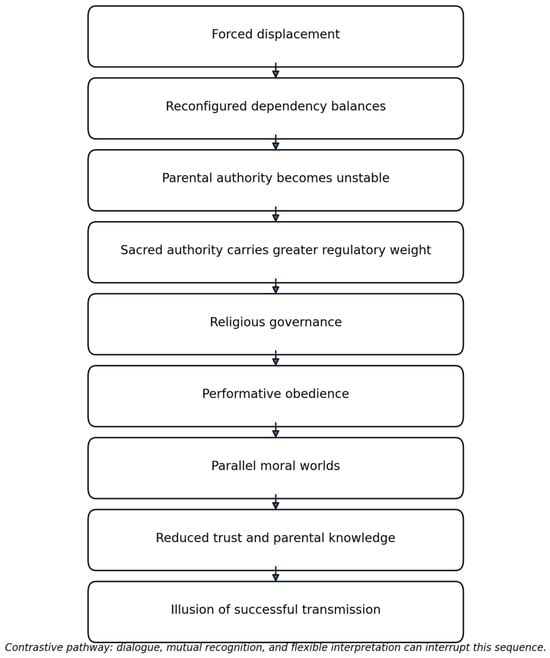
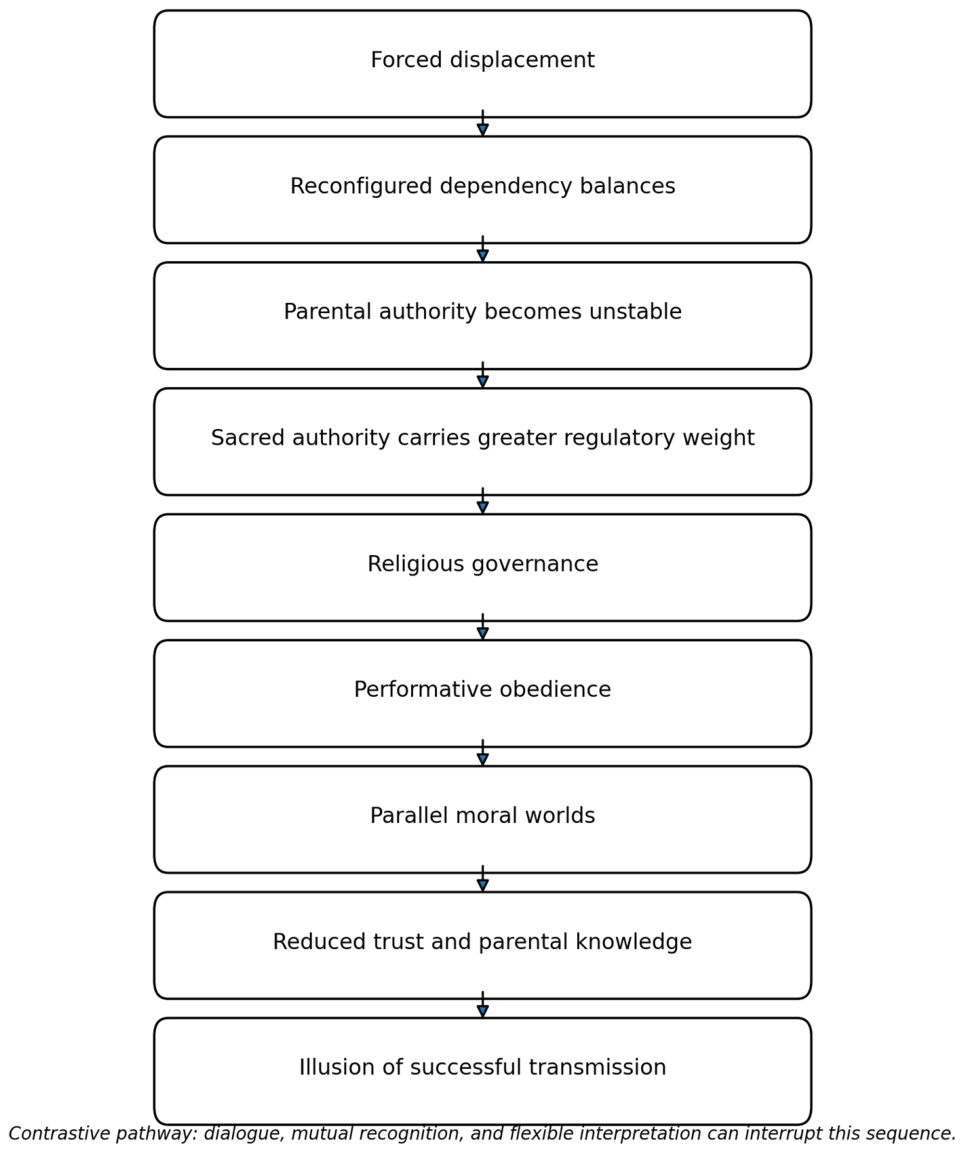
Disclaimer/Publisher’s Note: The statements, opinions and data contained in all publications are solely those of the individual author(s) and contributor(s) and not of MDPI and/or the editor(s). MDPI and/or the editor(s) disclaim responsibility for any injury to people or property resulting from any ideas, methods, instructions or products referred to in the content. |
© 2026 by the author. Licensee MDPI, Basel, Switzerland. This article is an open access article distributed under the terms and conditions of the Creative Commons Attribution (CC BY) license.