


Abstract
During the protests that began with Chile’s 2019 social uprising, attacks on Catholic churches reached a scale and intensity exceptional in Chilean political life, amid broader demands for social justice and institutional accountability. This article examines how selected damaged objects and sites came to bear witness to collective Christian suffering. Based on fieldwork, interviews, and documentary and audiovisual materials, it conceptualizes martyrologization as a selective socio-material process involving three operations: establishing evidentiary connections between material forms and violent events, interpreting damage within Christian temporalities of suffering, and extending its significance to wider Christian collectives. Catholic and civil society actors interpreted the attacks in divergent ways, including sacrilege, heritage loss, and the Church’s own responsibility. Within this contested field, Catholic media and devotional practices associated with international Catholic charity Aid to the Church in Need (ACN) linked damaged objects and sites to transnational narratives of the persecuted Church. These articulations emerged without human martyrs associated with the attacks and despite ACN’s classification of Chile as falling below its thresholds for discrimination and persecution. Bringing studies of political iconoclasm into dialogue with material religion, the article shows how claims of collective Christian vulnerability take shape amid disputes over Catholic public authority.
1. Introduction
On 20 November 2024, the Church of Veracruz in downtown Santiago was illuminated in red for Chile’s first Red Week, a global campaign for persecuted Christians organized by the Catholic charity Aid to the Church in Need (ACN), with red evoking martyrs’ blood. The church, set on fire during the protest cycle that began in October 2019, still bore visible traces of the event: blackened walls, smoke-stained surfaces, and devotional images marked by fire. A prayer vigil opened with a procession led by a “profaned” cross from Santiago’s Church of La Asunción, also attacked during the uprising. The cross was followed by portraits of Christians killed, imprisoned, or displaced in Nigeria, the Philippines, and Burkina Faso. The ceremony closed with a prayer that “the testimony of the persecuted Church” would move those present to persevere in their faith. Although one of the priests leading the service called on participants to distinguish between damage to Chilean church buildings and the lethal violence suffered by Christians abroad, the procession brought these injuries into a shared visual and devotional frame, inviting identification with a transnational Christian collective.
ACN’s framing differed from the interpretations developed in interviews conducted during my postdoctoral fieldwork on the attacks and their aftermath. Participants’ accounts revealed heterogeneous interpretations of the attacks, including sacrilege and ritual repair, political conflict, heritage loss, and the Church’s crisis of public authority. Martyrdom and religious persecution did not organize these accounts. This difference raises the article’s central question: how, and under what social conditions, do relations among actors, practices, and material forms enable selected damaged religious objects and sites to bear witness to collective Christian suffering? I conceptualize this selective transformation of damaged objects and sites into witnesses to collective Christian suffering as martyrologization.
The attacks occurred during the protest cycle that began with Chile’s estallido social on 18 October 2019. Protests triggered by a Santiago metro fare increase expanded into nationwide demands concerning inequality, political representation, and the legitimacy of state institutions (Somma 2022). The uprising involved severe police violence, damage to public infrastructure, and contestation of monuments associated with colonial history and nationalist memory (Badilla Rajevic and Wagner-Pacifici 2026). Within this wider struggle over institutional authority and public memory, downtown Catholic churches became disputed sites. Some churches were looted or set on fire; stained-glass windows were shattered, altars damaged, devotional images defaced, and pews and statues carried into the street to build barricades (Roca 2023).
Chile’s religious field has historically been shaped by the institutional influence of the Catholic Church. From Spanish colonial rule through nineteenth-century processes of republican secularization, the Church occupied a privileged position in social and political life (Valenzuela Márquez 2001; Serrano 2008). During the Pinochet dictatorship (1973–1990), Catholic actors occupied conflicting political positions: the Vicariate of Solidarity defended victims of state repression alongside human rights organizations, while the military chaplaincy maintained close ties to the regime (Ruderer and Strassner 2015). These contrasting positions with state power and civil society formed part of the Church’s political legacy after democratization in 1990. By the early twenty-first century, its institutional authority and symbolic centrality had declined, although Catholic institutions remained prominent in public and urban life (Le Foulon et al. 2021; Bellolio 2024). Revelations of clerical sexual abuse and institutional cover-ups, which attracted increasing public attention from the late 2000s onward, further undermined the Church’s legitimacy (San Martín Ramírez 2019; Schickendantz 2019). Public scrutiny intensified during Pope Francis’s 2018 visit to Chile (Parker and Pérez Valdivia 2019).
Anti-clerical graffiti on church walls during the protests gave public, material expression to critiques of the Catholic Church’s legitimacy. The messages included “Rapists”, “Silence is complicity” and “+ machi1 − priest” (Márquez et al. 2023, p. 35). The constituent process that followed the uprising opened another arena for disputes over religion’s place in public life. Debates surrounding the 2022 constitutional proposal addressed the secular character of the state, religious education, and the recognition of Indigenous worldviews, while also bringing the historical position of institutional Catholicism into question (Bellolio and Galioto 2026). Against this background, claims of Christian suffering emerged amid ongoing contestation over the Church’s public presence, responsibility for past harms, and capacity to claim victimhood.
To examine how damaged churches and devotional objects came to acquire testimonial significance after Chile’s 2019 social uprising, I bring scholarship on political iconoclasm into dialogue with studies of material religion. Attacks on images may contest institutional authority (Gamboni 1997) and engage the efficacy attributed to images and what they represent (Freedberg 1989). Their consequences are not fixed by the destructive act: defacement can heighten an image’s iconic presence (Taussig 2012), while the meaning of breaking or altering images depends on the mediations and circumstances involved (Latour 2002). These questions extend to the bodily and ritual mediation of divine presence (Meyer 2017) and the production, classification, and circulation of religious objects (Morgan 2017), particularly where religious materials and images of violence contribute to representations of injured religious communities (van Liere 2020).
Martyrological articulations emerged in Catholic media and ritual settings that brought parish memories and devotional attachments into relation with organizational accounts of Christian suffering. ACN, active in Chile since 1998, participated in these processes through its support for reconstruction and its involvement in the media productions and rituals examined here. Founded in 1947 to assist displaced Germans, the organization extended its work to Christians behind the Iron Curtain in 1952 (ACN Press Team 2019). Research on other Catholic organizations shows how support for persecuted Christians became entangled with anti-communist mobilization during the Cold War (Hänni 2017). This historical context situates advocacy for persecuted Christians within a longer history of Catholic political engagement.
Red Week brings accounts of Christian persecution into public view through visual displays and religious rituals. The campaign began in 2015, when ACN Brazil illuminated Cristo Redentor in Rio de Janeiro in red to draw attention to Christians persecuted in Iraq, and subsequently expanded internationally (ACN Press Team 2021). In Chile, its combination of damaged objects, portraits, and scriptural readings related local material injuries to the transnational figure of the persecuted Church. This devotional connection coexisted with ACN’s classification of Chile as “under observation” in its 2021 report, below the thresholds of discrimination and persecution (Aid to the Church in Need International 2021).
I propose martyrologization as a socio-material process through which damaged objects and sites are made to bear witness to collective Christian suffering. In this process, material traces attest to an injury interpreted through Christian temporalities of suffering and construed as directed against the Church or the faith. Relating that injury to a wider Christian collective extends its significance beyond the affected site. The Chilean cases show how martyrological relations can be assembled in the absence of human martyrs associated with the attacks examined here. This finding contributes to debates on the public status of religion in contexts of social crisis by examining how claims of collective Christian suffering take shape amid disputes over the Church’s public legitimacy.
2. Material Mediation, Persecution, and Martyrologization
2.1. Political Iconoclasm and the Afterlives of Damage
The term iconoclasm has a longer history rooted in Byzantine controversies over religious images, where disputes concerned the status and legitimacy of sacred representation. Here, however, I use the term to examine politically charged attacks on Catholic images, objects, and buildings in contemporary Chile. The designation itself participates in struggles over the meaning of destruction. Gamboni (1997) treats the distinction between iconoclasm and vandalism as itself a stake in these struggles. To call an act iconoclastic is to recognize it as a meaningful intervention in a symbolic order, whereas the language of vandalism has often rendered destruction senseless or illegitimate. Who names the act, and what value is attached to the object attacked, sets the boundary between them. Bantjes’s (1997) work on iconoclasm in revolutionary Mexico shows how such disputes are embedded in specific political projects. Attacks on Catholic images and churches formed part of a campaign of de-Christianization aimed at displacing Catholic symbols and practices and establishing a revolutionary civil religion. Iconoclasm was tied, in the Mexican case, to an attempt to reorganize public and religious life, although political, socioeconomic, and religious motives were often intertwined.
A further dimension of iconoclasm concerns the efficacy attributed to images and the relations through which that efficacy is sustained or transformed. Freedberg (1989) shows how iconoclasm and veneration engage the unstable relation between image and prototype, insofar as an attack on a material image may be understood as affecting what it represents. Anthropological approaches further complicate this relationship by examining how destruction affects the relations through which images acquire efficacy. For Taussig (2012) defacement can disrupt an icon’s taken-for-granted presence, making it newly visible and, at times, disturbingly animate, although destruction does not necessarily enhance iconic power. Latour’s (2002) concept of iconoclash shifts attention from the opposition between making and breaking images to the mediations through which their efficacy is produced, maintained, and transformed. Agency, then, is not a property of the damaged image alone but takes shape through relations among objects, devotional attachments, memories, and practices of preservation or transformation. Rather than locating agency in damaged objects as an intrinsic property, from this approach we can analyze how their efficacy emerges through shifting configurations of material, devotional, and institutional relations. Damage may unsettle these configurations and occasion their reassembly, through which an object’s sacred significance can be sustained, intensified, or transformed.
The religious consequences of damage depend on the relations through which images and objects mediate sacred presence. In Catholic practice, bodily and sensory engagement with authorized media makes divine presence perceptible (Meyer 2017), while Catholicism’s sacramental imagination accords material forms a distinctive role in mediating relations between human and divine beings (Mayblin et al. 2017). The significance of particular devotional images also develops historically: through repeated veneration, changes in physical appearance, and associations with events affecting a community, they may acquire meanings that exceed ecclesiastical prescriptions (Turner and Turner 2017). Damage enters these histories, but its consequences depend in part on what happens to the affected material. Repair, disposal, display, or transformation may alter an object’s uses, classification, and circulation, and with them the conditions under which traces of injury remain recognizable (Morgan 2017). These material trajectories intersect with representations of violence through which religious objects and images may evoke histories of collective suffering and belonging (van Liere 2020). Such connections are neither inherent in the material traces nor necessarily shared by those who encounter them; they are established and contested through specific practices of representation and interpretation.
2.2. From Material Damage to Martyrologization
I propose martyrologization as an analytical concept for examining the selective socio-material process through which damaged religious objects and sites are made to bear witness to collective Christian suffering. Material injury may occasion renewed devotional attention, ritual repair, or the reconfiguration of an object’s sacred significance. Such responses take shape through relations among the material conditions and trajectories of objects, religious practices, and the actors who preserve, transform, remove, or display them. Yet renewed sacred significance does not in itself constitute martyrologization. The latter involves a more specific testimonial attribution: material traces are connected to particular events and established as evidence of injury, that injury is interpreted through Christian histories of suffering and construed as directed against the Church or the faith, and its significance is extended to a wider Christian collective.
For Castelli (2004), martyrdom is produced through commemorative interpretation, as the suffering of earlier Christians is construed and transmitted in ways that allow later communities to situate themselves within a shared history. Martyrological memory thus sustains Christian identities across temporal and geographical distance. Castelli also emphasizes its testimonial dimension: through representation and commemoration, the suffering of martyrs can become testimony addressed to later Christian publics. Middleton (2014) similarly treats martyrdom as a historically contested category assembled through narrative, commemoration, and boundary-making.
The material practices through which such memories take shape also bear on relations within Christian communities. In her study of Coptic Christianity in Egypt, Heo (2018) shows how martyrs’ relics, visual representations, and ritual commemorations connect recent violence to earlier histories of martyrdom. These practices enable communal self-reflection, including the evaluation of ecclesiastical authority and demands for accountability in the aftermath of violence. Building on this attention to material mediation, the present analysis examines the extension of martyrological imaginaries to damaged religious objects and sites.
A related but distinct question concerns how damaged religious objects and sites can bear witness to Christian suffering without being assigned the status of martyrs. This testimonial capacity is relational and may be sustained, transformed, contested, or lost across settings. Analytically, martyrologization involves three operations: establishing an evidentiary relation between material form, event, and injury through Christian temporalities of suffering; interpreting that injury within Christian time and as directed against the Church or the faith; and extending it to a wider Christian collective.
Evidence, as Engelke (2008) argues, exists in relation to the claims and questions it serves rather than as a self-evident property of an object. Visible damage can help connect a present object or mark to an event; where material has been transformed or displaced, provenance and practices of attribution become more consequential. Zaprzalska’s (2023) study of a Cypriot icon shows how a claimed connection to the past can be sustained through legend and procession when material form does not establish that connection on its own. These evidentiary relations support claims about injury whose martyrological significance depends on further interpretive connections.
Christian temporalization relates present injury to liturgical, scriptural, or historical repertoires. In medieval Eucharistic devotion, imitatio Christi could involve bodily participation in Christ’s suffering (Bynum 1987). A different material articulation appears in Vincent’s (2020) account of the “martyrdom of things” during the Spanish Civil War, where smoke-blackened Christs, decapitated images, and mutilated crucifixes were incorporated into compositions evoking Calvary and situated within a Catholic history of persecution. In the analysis developed here, temporalization becomes martyrological only when the injury is also construed as directed against the Church or the faith. In the analysis developed here, temporalization becomes martyrological only when the injury is also construed as directed against the Church or the faith. Such attributed antagonism is identified in actors’ interpretations of damage, rather than inferred from attackers’ motives or assessed against the doctrinal criterion of odium fidei (“out of hatred for the faith”), a criterion concerning the persecutor’s motive in Catholic recognition of martyrdom.
Scaling occurs when a local injury is extended beyond the affected site by relating it to wider Christian institutions, publics, or collectives. Research on the mediated “persecuted Church” has shown how representations of Christian suffering generate identification and solidarity across religious publics (Elisha 2016). Lukasik’s (2021) “economy of blood” describes how the circulation of Coptic suffering produces Christian kinship within US imperial and racial hierarchies. Movement of an object across institutions or localities is one possible means of scaling, provided that discourse, representation, or ritual connect its damage to a wider Christian collective. Attribution of injury to “the Church” can also accomplish this extension when the referent demonstrably exceeds the local building or congregation.
3. Methods
This article draws on an ethnographic study conducted between 2023 and 2026 in Santiago, Talca, and Antofagasta. Informed by work on critical events and the reverberations of violence (Navaro-Yashin 2009; Navaro et al. 2021), the study examines the material and discursive afterlives of attacks on Catholic churches during the protest cycle that began with the 2019 uprising rather than reconstructing the attacks themselves. The three cities were selected because the affected churches sustained different forms of damage and their subsequent trajectories unfolded in distinct territorial, cultural, and ecclesial settings.
The corpus comprises thirty qualitative interviews, ten in each city, with participants aged twenty-five to seventy. Participants were purposively selected. Twelve participants occupied Catholic religious or institutional roles, including clergy, women religious, theologians, pastoral workers, and staff of Catholic organizations; eighteen were interviewed in professional or activist capacities, including architects, heritage specialists, academics, journalists, and feminist activists. The broader interview corpus was designed to capture competing interpretations of the attacks and their aftermath. This article, however, focuses on how Catholic actors, through devotional, ritual, and institutional practices, connected damaged religious materials to narratives of collective Christian suffering. Interviews in Santiago and Antofagasta were conducted by the author; those in Talca by a research assistant.
Interviews were combined with observations in damaged and rehabilitated churches, at Masses and other ritual events, and during heritage and cultural activities, together with press, parish, architectural, audiovisual, and institutional records covering 2019–2026. The corpus was assembled iteratively by tracing damaged objects and sites through repair, transformation, ritual use, and public commemoration. It included institutional videos, photographs, statements, reports, and the documentary Ardieron en silencio (2025), which related attacks on the churches studied here to other places and periods.
The analysis compared interviews, observations, and documentary materials to identify competing interpretations of damage, including sacrilege, heritage loss, political conflict, restoration, and ecclesiastical criticism, alongside references to martyrdom and persecution. More explicit martyrological articulations were traced primarily through public audiovisual productions, ritual events, and institutional statements. These public materials were treated as situated interpretations of damage, not as evidence of their wider reception.
All participants provided written informed consent. Research interviewees are identified by pseudonyms, with roles and locations retained where analytically necessary. Publicly attributed individuals are named only when the analysis draws on statements, publications, or events already in the public record. Unless otherwise indicated, quotations from Spanish-language interviews, field materials, and audiovisual and documentary sources were translated into English by the author.
Generative artificial intelligence was used during manuscript preparation to support language revision and to reformulate and organize selected passages. It was not utilized for data collection or the generation of empirical material. All AI-assisted text was reviewed by the author, who retains full responsibility for the analysis, interpretation, and final content of the manuscript.
4. Results
4.1. Repair and the Effacement of Damage
On 11 November 2019, at approximately 10 p.m., a group of masked individuals entered the Santuario María Auxiliadora, a Salesian sanctuary in central Talca. The church, a Neo-Gothic building whose construction began around 1911, originated as a Salesian devotional project dedicated to Mary Help of Christians. By May 1914, part of the new sanctuary was already in use, although construction remained incomplete (El culto de María Auxiliadora 1914). The building survived fires and earthquakes and was later designated an Inmueble de Conservación Histórica (Historic Conservation Property) (Ministerio de Vivienda y Urbanismo 2017).
Amid the social uprising, Salesian communications reported that the group looted the church, damaged its furniture and religious images, and forced open the tabernacle, an act they described as a profanation (Agenzia Info Salesiana 2019). Wooden pews were dragged into the surrounding streets, where they were used as barricades and burned. The parish priest recalled that the attackers had taken the “signs” from the altar: they removed the ciborium and chalice. He also described damage to the ambo, stained glass, pews, and devotional images. His account situated these objects within Catholic worship: the Eucharist as “the presence of the Lord” around which the congregation gathered, and the statues of saints as reminders of different ways of following Christ: “It may be the path of Saint Joseph, the path of Saint John Bosco, or the way of drawing closer to the Lord with the affection and love of the Virgin Mary” (Bastian, priest, Talca). Some prominent devotional images survived. The Apostolic Administrator recalled that the sanctuary’s principal Marian image escaped damage, “perhaps because it stood higher”. At the same time, a figure of Christ from a Calvary group near the entrance appeared to have been pulled but was not carried away. “It always surprised us”, he said (Gaspar, priest, Talca).
The immediate response focused on reopening the sanctuary and restoring worship. At noon on 12 November, a Mass for Peace was held in a church emptied of its pews. Salesian announcements presented the celebration as a plea for justice, dialogue, and an end to violence (Salesianos Talca 2019). The parish priest remembered the congregation standing because the pews were gone and described the liturgy as an act of reparation for an offense against a consecrated place. Reconstruction proceeded incrementally. “We have been trying to put all this back together little by little” (Bastian, priest, Talca). Images, altar furnishings, seating, stained glass, and pews were repaired or replaced, supported by community donations and assistance from Aid to the Church in Need for restoring the stained glass and seating. In his account, ACN appeared primarily as a source of material assistance; he did not mention martyrdom or persecution in his description of its role. Repair also involved the deliberate removal of visible marks and damaged material. Exterior graffiti was erased each time it appeared, the priest explained, “so as not to leave a record” (Bastian, priest, Talca). Broken images were not retained for display but were sent for appropriate disposal.
Yet profanation did not settle how the attack was interpreted. The Apostolic Administrator considered that some participants may have intended to offend the faith, while others acted “in the heat of the moment” (Gaspar, priest, Talca). In the slogan “the only church that shines is the one that burns”, tagged on some of the attacked churches, he recognized an echo of the Spanish Civil War and its association with anarchism. He treated it as an imported ideological script rather than as evidence that the attacks belonged to a continuing history of Christian persecution.
At María Auxiliadora, the attack was interpreted through profanation and ritual reparation, but repair and the effacement of visible damage worked against preserving it as material evidence.
4.2. Rehabilitation and the Selective Survival of Damage
The rehabilitation of the Parroquia de la Asunción, a late nineteenth-century church located next to Plaza de la Dignidad, as protesters renamed Plaza Baquedano, the uprising’s main site of mobilization, unfolded through successive initiatives. The church was deliberately set on fire on 18 October 2020, the first anniversary of the estallido social, causing substantial structural damage. The collapse of its spire became one of the most widely circulated images of attacks on churches during the protest cycle. Statues and pews had already been destroyed in an earlier attack on 8 November 2019. After the 2020 fire, networks of parishioners and specialists mobilized under the coordination of the Archdiocese of Santiago’s Architecture Team, clearing debris and recovering fragments of paintings from the church vault (Martínez Vial 2024).
Two initiatives shaped this process. A state-funded heritage project launched in 2024 proposed the “rehabilitation and safeguarding” of the church, reaffirming it as a Catholic space while presenting it as “a place of encounter for the whole community” of the city (Servicio Nacional del Patrimonio Cultural 2024). The reconstruction that enabled the church to reopen was subsequently carried out by an architectural office that described the work as “above all, a testament to architecture’s capacity to serve as a tool for spiritual and social reconstruction” (Infante Poblete Montt 2025). Across these initiatives, rehabilitation was articulated through Catholic continuity and civic encounter.
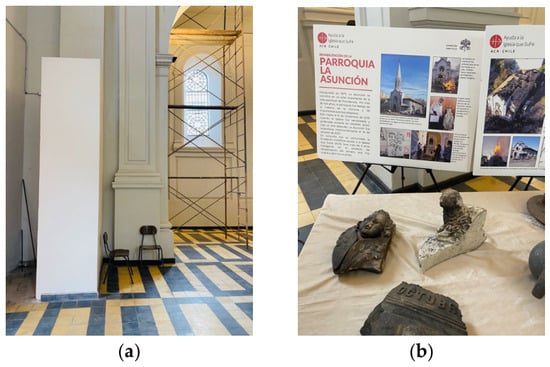
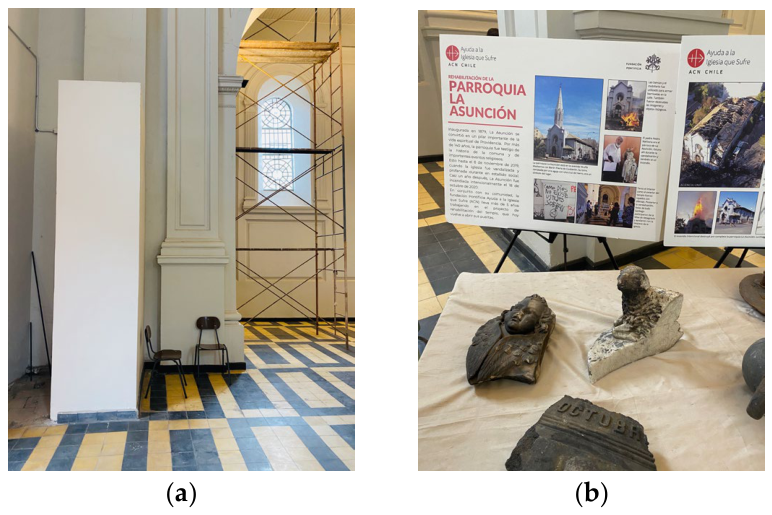
On 15 August 2025, I attended one of the first celebrations of the Feast of the Assumption of the Virgin Mary after the church reopened. The sanctuary was full, bringing together neighborhood residents and benefactors who had contributed to the reconstruction, including through a fundraising campaign organized by ACN Chile and supported by donations raised in Chile. After Mass, they shared coffee and sweets in recognition of those contributions. Work on the building was still unfinished: scaffolding rose against newly painted walls, simple chairs had replaced the former wooden pews, and some worshippers knelt directly on the tiled floor (Figure 1a). During the homily, the parish priest spoke of death, resurrection, and Mary’s assumption into heaven.
Figure 1.
Rehabilitation and retained material remain at Parroquia de la Asunción, Santiago, 15 August 2025. (a) The rehabilitated interior remained under construction, with scaffolding and temporary seating. (b) Material remains recovered after the 2020 fire were displayed near the entrance beside an ACN panel recounts the history of La Asunción Parish, inaugurated in 1879, and its importance to the local Catholic community. It describes the church as having been vandalized and desecrated during the 2019 social uprising and deliberately set on fire in October 2020. The panel also highlights ACN’s collaboration with the parish community in restoring and reopening the church. Photographs by the author.
Worship unfolded in a largely restored interior, while visible reminders of the fire were concentrated near the entrance. Two tables covered with pale cloth held objects recovered from the destruction: pieces of burned bells, metal fittings, and cherub heads. Beside them stood an ACN Chile panel documenting the destruction and reconstruction of the church (Figure 1b). After Mass, people stopped to inspect and photograph the objects.
In a lateral passage beside the main altar, where the walls had already been repainted, a damaged marble altar remained in place. Its table and figurative relief survived, but the upper structure had been torn away, exposing the brickwork. After Mass, some worshippers approached the altar and prayed before its empty niche. Unlike the recovered fragments, which had been selected and arranged for display, the altar stood at the site of its damage, amid otherwise restored surfaces. While the displayed fragments invited public remembrance of the fire, prayer before the unrepaired altar suggested the persistence of devotional relations despite visible damage.
An ACN interviewee in 2026 described remembrance in pedagogical terms: the parish should acknowledge that ‘this happened to us; we got back up from it and let us move forward’ without sustaining hatred or division (Marcia, nonprofit manager, Santiago). The same interviewee called La Asunción ‘a symbol for Catholics in Chile’, framing it through a sequence of injury, recovery, and continuation. This organizational interpretation indicates one way in which the surviving material remains of the attack could be made meaningful but does not establish how Catholic audiences received them.
In 2021, participants in Sursum Corda, a project of Pastoral Duoc UC—a technical and professional higher-education institution founded by the Pontifical Catholic University of Chile—fashioned pieces of timber recovered from the burned church into crosses (Fernández 2021). A different remnant followed another trajectory. Catholic media materials referred to a damaged crucifix, whose figure of Christ was missing one arm, as El Cristo Roto (the Broken Christ) and documented its prominent placement during the first reopening service. The same crucifix subsequently appeared in other Catholic ritual settings, including the 2024 Red Week vigil, where audiovisual materials show it being carried by parishioners. These trajectories show that the relation between damaged material and the attack could be sustained despite transformation and circulation. The burned timber retained its relation to the fire through provenance even after being fashioned into crosses, whereas the crucifix retained that relation through its visibly damaged form as it circulated through ritual settings. Transformation and circulation thus provided different material conditions for sustaining an evidentiary relation to the attack.
4.3. Placing Damage in Christian Time
Across the corpus, damaged churches and religious objects were situated within liturgical calendars, scriptural narratives, and Catholic historical memories. These Christian temporalizations informed different moral interpretations of the attacks, without necessarily producing a shared martyrological meaning. References to Christ’s Passion, resurrection, and perseverance appeared in varying combinations in the ACN video about La Asunción (ACN Chile 2021), interpretations of crosses made from its burned timber, the documentary Ardieron en silencio (El Líbero 2025), and the 2024 Red Week vigil at La Veracruz. Other interpretations emphasized encounter, ecclesial responsibility, and community recovery. Martyrological interpretations emerged when these temporal references were combined with the attribution of religious antagonism and the extension of local injury to a wider Christian collective.
4.3.1. Christian Temporalization Without Martyrologization
Christian references did not give the attacks a uniform meaning. At the Cathedral of Antofagasta, a Nativity scene installed during the 2019 crisis included a representation of the attack on the church. The parish priest explained that it placed the episode within “the reality we were living, with its lights and shadows”, into which Jesus was born to bring “joy and encounter” (Mario, priest, Antofagasta). When I introduced the language of persecution, he redirected the discussion toward ecclesial responsibility: “The challenge is always ours”, he said, adding that the Church should not organize its life around self-defense.
In a group interview in Antofagasta, a Catholic participant referred to religious images that had been decapitated during the Spanish Civil War. The damage to churches in Chile evoked accounts of popular anger toward a Church associated with those “who despised workers” (Ernesto, professor, Antofagasta). Recalling having asked why the Spanish images had not been restored, he explained: “That serves to remind us of the Church’s role toward society and toward the poorest people”. The analogy acknowledged hostility toward the Church but situated the meaning of religious damage within broader questions of ecclesiastical responsibility toward workers and the poor, rather than within a narrative of collective Christian persecution.
These cases show that Christian temporalization did not follow a single narrative sequence or produce a shared martyrological claim. The Nativity-oriented interpretation toward incarnation and encounter without construing the damage through attributed antagonism. The Spanish Civil War analogy acknowledged hostility toward the Church but redirected its moral significance toward ecclesial social accountability; it did not extend the local injury to a wider injured Christian collective.
4.3.2. La Asunción: Paschal Temporality and Material Transformation
A video released by ACN Chile in 2021 followed members of the La Asunción community through the burned interior. Parishioners moved among rubble, blackened beams, and spaces left by the destroyed dome and devotional images. One participant recalled being photographed with his mother beside an image of the Pietà; another feared dying before seeing the Eucharist celebrated there again. A parishioner carried away a fragment of the Pietà, describing it as “a painful memorial” (ACN Chile 2021). The damaged image brought devotional attachment, family memory, parish life, and the fire into relation. The clearest temporal formulation came from a participant who stated: “To resurrect, one has to live through the Passion. But here we are getting back on our feet. The Lord’s love keeps us together so that we can celebrate the Holy Eucharist”. Joined to images of parishioners walking through the ruins, the testimony placed the damaged church within a Paschal sequence of Passion and resurrection, culminating in renewed Eucharistic life. These testimonies, however, did not themselves establish how the injury extended beyond the parish community to a wider Christian collective.
A second material transformation emerged from the recovery process. Participants in the Sursum Corda project fashioned timber recovered from the burned church into crosses and distributed them among project participants and institutional actors (Fernández 2021). One pectoral cross was given to Auxiliary Bishop Alberto Lorenzelli, who subsequently presented it to Pope Francis (Comunicaciones Santiago 2021). Remade as a Christian sign, the timber remained connected to the fire through its documented provenance. Samuel Arancibia, then chaplain general of Duoc UC, described the cross as a “sign of victory” and “a response to violence through the cross of Christ”. Auxiliary Bishop Alberto Lorenzelli described it as conveying the meaning of “a Church that was burned” and a “deep wound” suffered by the Church and the Chilean people (Comunicaciones Santiago 2021). Another institutional account interpreted the cross through redemption, forgiveness, and the renewal of ecclesial life (Duoc UC 2021). Taken together, these statements cast the Church as the injured subject of the attack and framed its response through the cross of Christ. By construing the violence as an injury to the Church, these statements distinguish the interpretation of the crosses from the Nativity’s emphasis on encounter and the Spanish Civil War analogy’s orientation toward ecclesial self-examination.
The distribution of the crosses extended the collective reference of the injury beyond La Asunción. Sursum Corda participants circulated them through educational and ecclesial networks, while Catholic clerics interpreted the crosses in relation to Christ’s suffering and a wound suffered by “the Church,” rather than the parish alone. The presentation of one cross to Pope Francis, followed by coverage in transnational Catholic media, further circulated this collective reading (Comunicaciones Santiago 2021; Campisi 2021). These interpretations connected the transformed material to Christ’s suffering and to a wider ecclesial collective but did not explicitly situate the attack within a history of Christian persecution.
4.3.3. The Wounded Church in Ardieron en Silencio
Material damage from the uprising also entered retrospective accounts extending beyond the protest cycle. Released in 2025, the documentary Ardieron en silencio placed the attacks on La Asunción and Veracruz alongside church burnings in southern Chile, some preceding 2019. In that region, the burnings occurred within a broader political conflict involving the Mapuche territorial movement, disputes over land and state authority, and the militarization of Araucanía and Biobío. By presenting them as part of a broader pattern of violence affecting Catholic and Evangelical communities, the documentary brought attacks arising from distinct political conflicts into a shared narrative of threatened religious freedom (El Líbero 2025). I examine the documentary as part of the subsequent interpretation of damage from the uprising, focusing on how these associations extended its collective significance.
El Líbero, a Chilean digital outlet characterized as conservative or right-wing in media studies (Luna et al. 2022; Figueroa-Bustos 2025), gives particular attention to civilian victims of political violence in southern Chile, which it frames in relation to the “Mapuche conflict.” Columns published before the uprising had already tied church burnings to religious freedom and victims’ rights (Lepín Leonelli 2017; Navia 2018). This framing was also articulated at the documentary’s Santiago premiere, held at the Iglesia de la Veracruz. In its coverage of the event, El Líbero reported its director arguing that burning a church threatens religious freedom as well as the freedoms of worship, assembly, and expression (Lathrop 2025). The director of ACN Chile, who appears in the film, thanked the outlet for documenting what she described as a matter of national concern and linked the project to ACN’s religious-freedom work (ACN Chile 2025). So framed, otherwise distinct attacks were connected through testimonies of threatened communities, interrupted worship, and reconstruction. A priest in southern Chile recalled hostility toward people identified as Catholic, while accounts from Santiago described threats against churches and their members (El Líbero 2025). By incorporating these testimonies, the documentary connected local experiences of hostility, disrupted worship, and reconstruction to the religious-freedom framework advanced by El Líbero and ACN.
At Veracruz, Osvaldo Fernández de Castro made this relation explicit. A theologian and Vice Grand Chancellor of the Pontifical Catholic University of Chile who also serves as parish priest of Veracruz, he called the building “a wounded church”, reading its visible damage as part of a history affecting both the institution and the city. He recalled a small congregation that kept the faith despite fear, celebrating Mass in an adjoining room while the main building stayed closed; its gradual reopening accompanied what the film described as spiritual reconstruction. Fernández described the task as rebuilding “a community that is wounded, hurting, but alive” and added that material destruction could not efface “the essence of faith” (El Líbero 2025). By describing both the building and the congregation as wounded, Fernández made architectural damage a material expression of communal injury. His account situated that injury within a narrative of continued worship, perseverance, and reconstruction, without explicitly relating it to histories of Christian martyrdom or persecution.
The film extended these local accounts by portraying Catholic and Evangelical communities in different localities as part of a single affected Christian collective, with Veracruz presented as one instance of Christian life sustained amid attacks. Through the selection and juxtaposition of testimonies from distinct political contexts, the documentary framed these attacks as threats to religious freedom, while their different social and territorial circumstances receded into the background. This collective framing, however, does not establish that the communities represented shared the same understanding of the attacks.
4.3.4. Red Week and Christian Perseverance
At the Red Week prayer vigil held at Veracruz on 20 November 2024, the entrance procession was led by what organizers called “a profaned cross from the Church of La Asunción in Santiago,” followed by portraits of Christians presented as persecuted or martyred from Nigeria, the Philippines, Spain, and other countries (ACN Chile 2024). The portraits brought biographies of death, imprisonment, and displacement into a church whose blackened surfaces remained visible. The procession thus placed material damage from two Santiago churches in devotional proximity to Christians suffering elsewhere, across marked differences in geography and severity.
Organizers and participating clergy used selected scriptural readings to connect these injuries through a Christian repertoire of persecution and perseverance. One reading, from First Peter 4:14, addressed those insulted “for the name of Christ”. A testimony about seven vandalized rural chapels in southern Chile, five of them completely burned, was followed by a reading of Romans 8:35–36: “Who will separate us from the love of Christ?” The passage included references to “persecution” and to being “counted as sheep for slaughter” (ACN Chile 2024). The priest giving the testimony described the fires as attacks on the communities’ spiritual dimension as well as their infrastructure. Through this sequence, contemporary injuries were placed in temporal relation with scriptural narratives of persecution and perseverance.
Jaime Tocornal, parish priest of La Asunción, made the comparison explicit. He described the vigil as a celebration of “the faith that triumphed in them, who gave even their lives, and for us, material damage,” adding that in Chile “it did not cost anyone their life” (ACN Chile 2024). “They” had given their lives; “we” had suffered material damage. Tocornal then stated: “That is why the churches have not fallen, and that is why the Church will not fall” (ACN Chile 2024). The shift from the plural churches to the singular Church scaled the referent from damaged buildings to an ecclesial collective extending beyond any one site. A subsequent reading of the Beatitudes addressed those persecuted and calumniated because of Christ. In the closing intercessions, participants prayed for “the discriminated Church” and later asked that “the testimony of the persecuted Church” encourage those present to persevere in faith (ACN Chile 2024).
The material setting was integral to the production of this testimonial relation. Veracruz’s blackened walls and fire-marked surfaces surrounded the procession, portraits, and scriptural readings, keeping the church’s damage materially present within the ritual. The attribution of the cross to La Asunción introduced another damaged Chilean site into the ritual, while the displayed portraits represented biographies of imprisonment, displacement, and death. Together with the readings and testimonies, this arrangement positioned the damaged church and cross as material witnesses to a wider history of Christian suffering, while preserving an explicit distinction between material injury in Chile and the more severe violence experienced by Christians elsewhere.
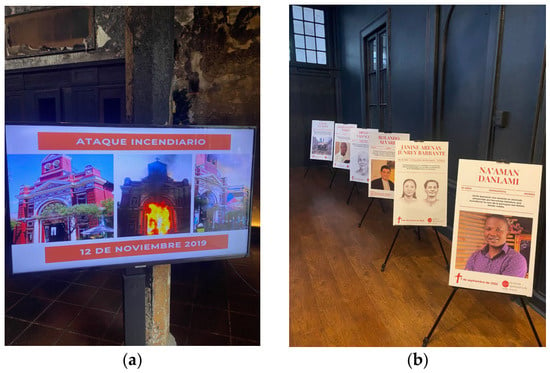
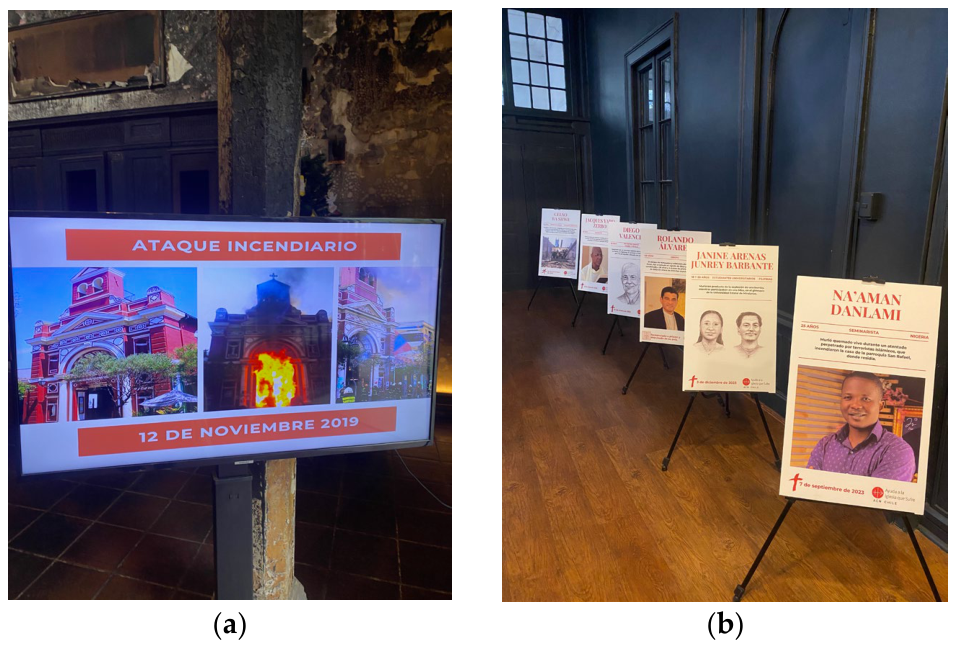
Elements of this martyrological reading remained on display after the vigil. When I photographed Veracruz on 25 December 2024, ACN’s biographical portraits were still displayed inside the fire-marked church, while a parish panel presented the building through its damage, reconstruction, and cultural activities (Figure 2). Their coexistence shows that ACN’s martyrological framing was one among several public interpretations of the damaged church, even within the same ecclesial setting.
Figure 2.
Coexisting framings at the Iglesia de la Veracruz, Santiago, 25 December 2024. (a) Parish display presenting the church’s damage, reconstruction, and cultural activities. (b) ACN display presenting Christians identified as persecuted or martyred. Photographs by the author.
Red Week marked a shift in both temporalization and scale. In a video about the fire at La Asunción Church, ACN Chile (2021), participants narrated recovery through Passion, resurrection, and renewed Eucharistic life; at Veracruz, the vigil organized injury through persecution, perseverance, and what Tocornal called the “triumph of faith”. This temporal repertoire accompanied an extension in scale, relating material damage at Santiago churches to ACN’s transnational figure of the persecuted Church. Tocornal’s distinction between lives lost elsewhere and material damage in Chile preserved differences in severity within that extension.
4.4. Enumerating Attacks and Classifying Religious-Freedom Violations
Counting changes the scale at which an attack can be seen. A damaged church becomes part of a broader pattern through decisions about what counts as an attack and which sites, periods, and territories are included. Without a unified national registry of attacks on churches, organizations in Chile assembled datasets from police, ecclesial, press, and regional sources, as well as direct verification. The reconstruction published in Ardieron en silencio, for example, identified 296 churches attacked between 2013 and 2025. This was an actor-produced count presented as comprehensive rather than an official national statistic.
The resulting figures varied because they counted different things. ACN’s 2021 Religious Freedom in the World report recorded fifty-nine churches vandalized across eight cities between October 2019 and October 2020 (Aid to the Church in Need International 2021). Ardieron en silencio identified eighty-five attacks within its longer series by delimiting the uprising cycle from 18 October 2019 to the rejection of the first constitutional proposal on 4 September 2022 (El Líbero 2025). Castro Arcos (2025), by contrast, situated attacks on religious establishments within a decade extending from 2013 to 2023 and distinguished three moments within it: burnings in the southern macro-zone, attacks surrounding Pope Francis’s 2018 visit, and those associated with the 2019 uprising. His analysis then isolated the first of these moments and counted eighty-three Catholic and Evangelical temples burned in Biobío, Araucanía, and Los Ríos between 2015 and 2023.
These series differed in period, territory, denomination, and unit of inclusion, but also in the histories they constructed. ACN concentrated on the uprising and its immediate aftermath; Ardieron en silencio situated it within a longer national pattern; and Castro Arcos examined the southern burnings as a distinct sequence shaped by debates over rural violence, interethnic conflict, and religious pluralism. The figures therefore produced different populations of damage rather than competing estimates of a single predefined set of attacks.
Enumeration and institutional classification followed different logics. Scholarship on religious freedom has examined how institutional practices define recognizable religious subjects and claims (Hurd 2015), while research on Christian persecution has shown how quantification contributes to its construction as a public problem (Philips 2025). ACN placed Chile “under observation” in 2021, below its categories of discrimination and persecution (Aid to the Church in Need International 2021). That assessment preceded the subsequently published tally of 296 churches attacked between 2013 and 2025, which therefore cannot explain the 2021 classification. In 2025, ACN again classified Chile as “under observation”, with the available evidence remaining below its thresholds for discrimination and persecution (Aid to the Church in Need International 2025). Counting assembled incidents into comparable series, while classification situated Chile within a graded framework for assessing religious freedom.
The distinction between institutional classification and ritual articulation was evident at Red Week. Although Chile remained below ACN’s threshold for persecution, the vigil connected material damage to local churches with the transnational figure of the persecuted Church through objects, scriptural readings, and testimonies. These relations preserved differences in the severity of violence while producing martyrological associations that the country-level classification did not itself establish.
Several of these practices converged again in July 2026 at the II Conversatorio Templos quemados: Fe intacta, convened by Chile’s National Office of Religious Affairs (ONAR). The forum brought together research on church burnings, the team behind Ardieron en silencio, legal expertise on religious freedom, and ACN (ACN Chile 2026). ONAR cited more than eighty temples burned in southern Chile between 2015 and 2023, referred to ACN’s classification of the country as “under observation,” and framed the attacks in terms of protecting religious freedom and places of worship. Enumeration, documentary reconstruction, and religious-freedom assessment thus became mutually relevant within a state-mediated arena, without producing an official classification of the Chilean case as persecution.
5. Conclusions
This article has examined how damaged religious objects and sites come to bear witness to collective Christian suffering. The findings show that martyrologization is a selective and contested process through which material traces of injury acquire testimonial significance within particular social, devotional, and institutional relations. Explicit martyrological articulations emerged primarily in ritual events, audiovisual productions, and institutional statements, whereas interviews documented a wider range of interpretations of damage, including sacrilege, heritage loss, political conflict, and criticism of ecclesiastical authority.
These findings extend the study of political iconoclasm beyond the destructive act by examining how subsequent practices of preservation, repair and ritual use reshape the relations sustained around damaged religious objects. Such practices could maintain devotional attachments or make material injury available for remembrance and testimony, without necessarily producing martyrological significance.
The Chilean case raises a broader question: how do actors associated with a historically influential religious institution articulate claims of collective vulnerability when its public authority and legitimacy are under scrutiny? Some representations of Christian suffering intersected with right-wing framings of political violence, victimhood, and religious freedom, while others took shape through ecclesial, devotional, and liturgical practices without explicitly invoking those framings. These interpretations emerged amid demands for social justice and institutional accountability, followed by constitutional debates over religion’s place in public life. In this context, selected damaged churches and objects were presented as evidence of Christian suffering at a time when the Church’s historical authority and social responsibility were themselves contested. The analysis documents the production and circulation of these claims, without presuming their reception by wider publics.
Within Christianity, martyrologization provides a framework for comparing how damaged churches, images, and devotional objects are connected to histories of persecution and collective endurance across different historical and political contexts. Such comparisons require attention to the actors and institutions that preserve, display, or circulate these materials, the injuries made visible through them, and the claims of collective belonging articulated through these practices. Extending this inquiry to other religious traditions would require reconstructing their own repertoires of suffering, modes of temporalization, evidentiary practices, and forms of collective belonging, rather than assuming the applicability of the Christian grammar examined here.
Funding
This work was supported by ANID FONDECYT Postdoctorado 3230349, and Vicerectoría de Investigación y Posgrado, Universidad Católica de Temuco, ProFondecyt N° 2026PF-AR-04.
Institutional Review Board Statement
The study was conducted in accordance with the Declaration of Helsinki and approved by the Ethics Committee of Universidad Católica de Temuco (CEIUCT 04005002/23).
Informed Consent Statement
Informed consent was obtained from all subjects involved in the study.
Data Availability Statement
The data supporting the findings of this study are not publicly available due to confidentiality agreements with research participants and ethical considerations regarding the protection of their identities and the sensitive nature of the fieldwork materials.
Acknowledgments
During the preparation of this manuscript/study, the author used Claude 1.52386.0 for the purposes of language revision and to reformulate and organize selected passages. The author has reviewed and edited the output and takes full responsibility for the content of this publication.
Conflicts of Interest
The authors declare no conflicts of interest.
Note
| 1 | This term refers to a Mapuche healing and ritual specialist whose roles may include diagnosing and treating illness and conducting ceremonies. |
References
- ACN Chile. 2021. Incendio en la Iglesia de La Asunción—Ayuda a la Iglesia Necesitada. YouTube Video. September 8. Available online: https://www.youtube.com/watch?v=SHcJpEAistM (accessed on 1 April 2026).
- ACN Chile. 2024. Red Week 2024: La Iglesia de la Veracruz se iluminó de rojo. YouTube Video. December 17. Available online: https://www.youtube.com/watch?v=v49T-15hScA (accessed on 5 April 2026).
- ACN Chile. 2025. 296 iglesias quemadas en Chile entre 2013 y 2025: “Ardieron en Silencio: Una década de ataques a iglesias en Chile”. October 1. Available online: https://www.acn-chile.org/una-decada-de-ataques-a-iglesias-en-chile/ (accessed on 16 April 2026).
- ACN Press Team. 2019. Aid to the Church in Need and the Miracle of Political Change. Aid to the Church in Need International. November 7. Available online: https://acninternational.org/30th-anniversary-of-the-fall-of-the-wall-aid-to-the-church-in-need-and-the-miracle-of-political-change/ (accessed on 24 April 2026).
- ACN Press Team. 2021. #Redweek: We Defend Religious Freedom from Different Countries. Aid to the Church in Need International. November 16. Available online: https://acninternational.org/redweek-we-defend-religious-freedom-from-different-countries/ (accessed on 24 April 2026).
- Agenzia Info Salesiana. 2019. Cile—Colletta per il restauro del Santuario di Maria Ausiliatrice a Talca. Available online: https://www.infoans.org/sezioni/notizie/item/9408-cile-colletta-per-il-restauro-del-santuario-di-maria-ausiliatrice-a-talca (accessed on 5 April 2026).
- Aid to the Church in Need International. 2021. Religious Freedom in the World Report 2021: Executive Summary. April. Available online: https://www.churchinneed.org/wp-content/uploads/2021/05/2021_RFR-Executive-Summary_FD.pdf (accessed on 1 September 2026).
- Aid to the Church in Need International. 2025. Religious Freedom in the World Report 2025: Executive Summary. October. Available online: https://www.churchinneed.org/wp-content/uploads/2025/10/Religious-Freedom-Report-2025.pdf (accessed on 2 September 2026).
- Ayuda a la Iglesia que Sufre (ACN Chile). 2026. ACN Chile participó en conversatorio sobre libertad religiosa y alertó por la persistencia de ataques a templos en el país. July 21. Available online: https://www.acn-chile.org/libertad-religiosa-en-chile-acn-alerta-por-ataques-a-templos/ (accessed on 30 October 2026).
- Badilla Rajevic, Manuela, and Robin Wagner-Pacifici. 2026. Cross-Temporal Protests: The Indexical Role of Monument Contestation in Times of Unrest. Social Movement Studies, 1–21. [Google Scholar] [CrossRef] [Scilit]
- Bantjes, Adrian A. 1997. Idolatry and Iconoclasm in Revolutionary Mexico: The De-Christianization Campaigns, 1929–1940. Mexican Studies/Estudios Mexicanos 13: 87–120. [Google Scholar] [CrossRef] [Scilit]
- Bellolio, Cristóbal. 2024. Cultural Secularization and Political Secularism as Mirror Processes: The Case of Chile. International Journal of Latin American Religions 8: 588–608. [Google Scholar] [CrossRef] [Scilit]
- Bellolio, Cristóbal, and Carmelo Galioto. 2026. The Secular Paradox in the “World’s Most Progressive” Constitution. Politics and Religion 19: 1–20. [Google Scholar] [CrossRef] [Scilit]
- Bynum, Caroline Walker. 1987. Holy Feast and Holy Fast: The Religious Significance of Food to Medieval Women. Berkeley: University of California Press. [Google Scholar]
- Campisi, Tiziana. 2021. Sursum corda: Iniciativa de jovens chilenos impulsiona reconstrução da Igreja da Assunção. Vatican News. September 13. Available online: https://www.vaticannews.va/pt/igreja/news/2021-09/chile-sursum-corda-jovens-projeto-reconstrucao-igreja-assuncao.html (accessed on 10 April 2026).
- Castelli, Elizabeth A. 2004. Martyrdom and Memory: Early Christian Culture Making. New York: Columbia University Press. [Google Scholar]
- Castro Arcos, Javier. 2025. Burned Temples: A Decade of Tension in the Management of Religious and Worldview Pluralism in Chile, 2013–2023. International Journal of Latin American Religions 9: 113–35. [Google Scholar] [CrossRef] [Scilit]
- Comunicaciones Santiago. 2021. Papa Francisco recibe cruz confeccionada con madera de los escombros de la parroquia La Asunción. Iglesia.cl. July 7. Available online: https://www.iglesia.cl/42640-papa-francisco-recibe-cruz-confeccionada-con-madera-de-los-escombros-de-la-parroquia-la-asuncion.html (accessed on 10 April 2026).
- Duoc UC. 2021. Papa Francisco recibe cruz regalada por la Pastoral Duoc UC. July 30. Available online: https://www.duoc.cl/?noticia_post_type=pastoral-regalo-papa-francisco (accessed on 15 April 2026).
- El culto de María Auxiliadora. 1914. El culto de María Auxiliadora: Ecos de las fiestas de mayo. Boletín Salesiano, Edición de América 29: 237–43. [Google Scholar]
- Elisha, Omri. 2016. Saved by a Martyr: Evangelical Mediation, Sanctification, and the “Persecuted Church”. Journal of the American Academy of Religion 84: 1056–80. [Google Scholar] [CrossRef] [Scilit]
- El Líbero. 2025. Ardieron en silencio: Una década de ataques a iglesias en Chile. Directed by Pía Orellana. YouTube Video. October 14. Available online: https://www.youtube.com/watch?v=p9KlGwwFu9o (accessed on 1 April 2026).
- Engelke, Matthew. 2008. The Objects of Evidence. Journal of the Royal Anthropological Institute 14: S1–S21. [Google Scholar] [CrossRef] [Scilit]
- Fernández, Maria Elena. 2021. Chile: Un grupo de jóvenes ayudan a reconstruir una Iglesia vandalizada. ACN International. September 9. Available online: https://acninternational.org/es/chile-un-grupo-de-jovenes-ayudan-a-reconstruir-una-iglesia-vandalizada/ (accessed on 11 April 2026).
- Figueroa-Bustos, Arturo. 2025. Agenda temática, uso de fuentes y calidad en medios alternativos El Ciudadano y El Líbero. Cuadernos.Info 61: 229–50. [Google Scholar] [CrossRef] [Scilit]
- Freedberg, David. 1989. The Power of Images: Studies in the History and Theory of Response. Chicago: University of Chicago Press. [Google Scholar]
- Gamboni, Dario. 1997. The Destruction of Art: Iconoclasm and Vandalism Since the French Revolution. London: Reaktion Books. [Google Scholar]
- Hänni, Adrian. 2017. Among Spies, Popes, and the Good Cyrenians: La Commission Pour L’Eglise Persécutée as a Transnational Catholic Actor in the Cold War. The Review of Faith & International Affairs 15: 48–66. [Google Scholar] [CrossRef] [Scilit]
- Heo, Angie. 2018. The Political Lives of Saints: Christian-Muslim Mediation in Egypt. Oakland: University of California Press. [Google Scholar]
- Hurd, Elizabeth Shakman. 2015. Beyond Religious Freedom: The New Global Politics of Religion. Princeton: Princeton University Press. [Google Scholar]
- Infante Poblete Montt. 2025. Instagram Post on the Rehabilitation of Parroquia La Asunción. May 24. Available online: https://www.instagram.com/p/DKCn6yYxB84/ (accessed on 10 May 2026).
- Lathrop, Santiago. 2025. El Líbero preestrena documental “Ardieron en silencio: Una década de ataques a iglesias en Chile”. El Líbero. September 30. Available online: https://ellibero.cl/sociales/el-libero-preestrena-documental-ardieron-en-silencio-una-decada-de-ataques-a-iglesias-en-chile/ (accessed on 10 April 2026).
- Latour, Bruno. 2002. What Is Iconoclash? Or Is There a World beyond the Image Wars? In Iconoclash: Beyond the Image Wars in Science, Religion, and Art. Edited by Bruno Latour and Peter Weibel. Cambridge, MA: MIT Press, pp. 14–37. [Google Scholar]
- Le Foulon, Carmen, Aldo Mascareño, and Valentina Salvatierra. 2021. ¿Chile postsecular? La necesidad de una exploración comparada. In Puntos de Referencia 579. Santiago: Centro de Estudios Públicos. [Google Scholar]
- Lepín Leonelli, Juan Pablo. 2017. ¡Ni una iglesia menos! El Líbero. July 30. Available online: https://ellibero.cl/columnas-de-opinion/ni-una-iglesia-menos/ (accessed on 10 April 2026).
- Lukasik, Candace. 2021. Economy of Blood: The Persecuted Church and the Racialization of American Copts. American Anthropologist 123: 565–77. [Google Scholar] [CrossRef] [Scilit]
- Luna, Juan Pablo, Sergio Toro, and Sebastián Valenzuela. 2022. Amplifying counter-public spheres on social media: News sharing of alternative versus traditional media after the 2019 Chilean uprising. Social Media + Society 8: 1–11. [Google Scholar] [CrossRef] [Scilit]
- Martínez Vial, Santiago. 2024. Revitalización de la parroquia de la Asunción: Intervención de la arquitectura religiosa patrimonial destruida en la «post zona cero». Anales de Arquitectura UC 6: 128–35. [Google Scholar] [CrossRef] [Scilit]
- Mayblin, Maya, Kristin Norget, and Valentina Napolitano. 2017. Introduction: The Anthropology of Catholicism. In The Anthropology of Catholicism: A Reader. Edited by Kristin Norget, Valentina Napolitano and Maya Mayblin. Oakland: University of California Press, pp. 1–30. [Google Scholar]
- Márquez, Francisca, Andrea Roca, and Javiera Bustamante. 2023. Por una antropología del paisaje de la protesta: Ruinación, iconoclasia y antropofagia en Plaza Dignidad. Mana 29: e2023005. [Google Scholar] [CrossRef] [Scilit]
- Meyer, Birgit. 2017. Catholicism and the Study of Religion. In The Anthropology of Catholicism: A Reader. Edited by Kristin Norget, Valentina Napolitano and Maya Mayblin. Oakland: University of California Press, pp. 305–15. [Google Scholar]
- Middleton, Paul. 2014. What Is Martyrdom? Mortality 19: 117–33. [Google Scholar] [CrossRef] [Scilit]
- Ministerio de Vivienda y Urbanismo. 2017. Inmuebles y Zonas de Conservación Histórica: Talca. Patrimonio Urbano. Available online: https://www.patrimoniourbano.gob.cl/inmuebles-y-zonas-patrimoniales/ (accessed on 1 April 2026).
- Morgan, David. 2017. Material Analysis and the Study of Religion. In Materiality and the Study of Religion: The Stuff of the Sacred. Edited by Tim Hutchings and Joanne McKenzie. London and New York: Routledge, pp. 14–32. [Google Scholar] [CrossRef] [Scilit]
- Navaro, Yael, Zerrin Özlem Biner, Alice von Bieberstein, and Seda Altuğ, eds. 2021. Reverberations: Violence across Time and Space. Philadelphia: University of Pennsylvania Press. [Google Scholar]
- Navaro-Yashin, Yael. 2009. Affective Spaces, Melancholic Objects: Ruination and the Production of Anthropological Knowledge. Journal of the Royal Anthropological Institute 15: 1–18. [Google Scholar] [CrossRef] [Scilit]
- Navia, Patricio. 2018. Chao ley antiterrorista, hola ley contra crímenes de odio. El Líbero. February 23. Republished by Análisis Latino. Available online: https://www.analisislatino.com/opinion/?id=10646 (accessed on 21 April 2026).
- Parker, Cristian, and José Pérez Valdivia. 2019. The Failed Visit of Francis to Chile and the Catholic Church Crisis. In Research in the Social Scientific Study of Religion. Edited by Ralph W. Hood, Jr. and Sariya Cheruvallil-Contractor. Leiden: Brill, vol. 30, pp. 394–416. [Google Scholar] [CrossRef] [Scilit] [PubMed]
- Philips, Miray. 2025. The Social Construction of Christian Persecution Through Quantification in International Religious Freedom Advocacy. Sociology of Religion 87: 575–597. [Google Scholar] [CrossRef] [Scilit]
- Roca, Andrea. 2023. Ira anticlerical en la revuelta chilena. In Ruina y escombro en Latinoamérica: De memorias y olvidos. Edited by Francisca Márquez and Eduardo Kingman Garcés. Santiago: Ediciones Universidad Alberto Hurtado, pp. 244–60. [Google Scholar]
- Ruderer, Stephan, and Veit Strassner. 2015. Recordando tiempos difíciles: La Vicaría de la Solidaridad como lugar de memoria de la Iglesia y de la sociedad chilena. Archives de Sciences Sociales des Religions 170: 37–60. [Google Scholar] [CrossRef] [Scilit]
- Salesianos Talca. 2019. Comunicaciones Salesianos Talca. 2019. Comunicado de Congregación Salesiana ante profanación de Sant. María Auxiliadora. Iglesia.cl, November 12. Available online: https://iglesia.cl/39522-comunicado-de-congregacion-salesiana-ante-profanacion-de-sant-maria-auxiliadora.html (accessed on 30 October 2026).
- San Martín Ramírez, Víctor. 2019. Crisis moral y controversia ideológica: La Iglesia chilena y la segunda ola de denuncias por abusos. Le Monde Diplomatique—Edición Chilena. April 6. Available online: https://www.lemondediplomatique.cl/crisis-moral-y-controversia-ideologica-la-iglesia-chilena-y-la-segunda-ola-de (accessed on 3 September 2026).
- Schickendantz, Carlos. 2019. Fracaso institucional de un modelo teológico-cultural de Iglesia: Factores sistémicos en la crisis de los abusos. Teología y Vida 60: 9–40. [Google Scholar] [CrossRef] [Scilit]
- Serrano, Sol. 2008. ¿Qué hacer con Dios en la República? Política y secularización en Chile (1845–1885). Santiago: Fondo de Cultura Económica. [Google Scholar]
- Servicio Nacional del Patrimonio Cultural. 2024. Convenios aprobados periodo 2024. Available online: https://ftpactiva.patrimoniocultural.gob.cl/files/ftp_tmp/Convenio%20Patrimonio%20Cultural/Convenios%20aprobados%20periodo%202024.pdf (accessed on 20 April 2026).
- Somma, Nicolás M. 2022. Social Protests, Neoliberalism and Democratic Institutions in Chile. Canadian Journal of Latin American and Caribbean Studies/Revue canadienne des études latino-américaines et caraïbes 47: 436–57. [Google Scholar] [CrossRef] [Scilit]
- Taussig, Michael. 2012. Iconoclasm Dictionary. TDR: The Drama Review 56: 10–17. [Google Scholar] [CrossRef] [Scilit]
- Turner, Victor, and Edith Turner. 2017. Excerpt from “Iconophily and Iconoclasm in Marian Pilgrimage”. In The Anthropology of Catholicism: A Reader. Edited by Kristin Norget, Valentina Napolitano and Maya Mayblin. Oakland: University of California Press, pp. 71–79. [Google Scholar]
- Valenzuela Márquez, Jaime. 2001. Las liturgias del poder: Celebraciones públicas y estrategias persuasivas en Chile colonial (1609–1709). Santiago: Centro de Investigaciones Diego Barros Arana and LOM Ediciones. [Google Scholar]
- van Liere, Lucien. 2020. The Image of Violence and the Study of Material Religion, an Introduction. Religions 11: 370. [Google Scholar] [CrossRef] [Scilit]
- Vincent, Mary. 2020. The “Martyrdom of Things”: Iconoclasm and Its Meanings in the Spanish Civil War. Transactions of the Royal Historical Society 30: 141–63. [Google Scholar] [CrossRef] [Scilit]
- Zaprzalska, Dorota. 2023. Religious Heritage Complex and Authenticity: Past and Present Assemblages of One Cypriot Icon. Religions 14: 1107. [Google Scholar] [CrossRef] [Scilit]
Disclaimer/Publisher’s Note: The statements, opinions and data contained in all publications are solely those of the individual author(s) and contributor(s) and not of MDPI and/or the editor(s). MDPI and/or the editor(s) disclaim responsibility for any injury to people or property resulting from any ideas, methods, instructions or products referred to in the content. |
© 2026 by the author. Licensee MDPI, Basel, Switzerland. This article is an open access article distributed under the terms and conditions of the Creative Commons Attribution (CC BY) license.