


Abstract
Studies of Balinese sacred dance often privilege symbolic representation over the practical coordination of ritual objects, bodies, sound, and space. This article examines Ratu Sang Hyang Widyadari, a sacred masked-dance rite offered at Pura Payogan Agung, a Hindu temple in Ketewel, Bali. The rite centres on nine consecrated masks (tapel): seven represent revered celestial female beings (widyadari) and may be worn during the dance, while two represent attendants who remain in the mask box. Observations across three successive ceremonies (2024–2025), interviews with 38 purposively selected ritual participants and expert informants, spatial mapping, and audiovisual documentation inform a hermeneutic-phenomenological analysis. The ritual sequence, from transferring the mask collection to a temporary altar through attachment, assisted removal, and return, temporarily shifts the focus of religious activity within an already consecrated courtyard. Dancers negotiate restricted vision, jaw pressure, barefoot floor contact, and musical cues, while priests, musicians, and worshippers sustain the rite through differentiated responsibilities and forms of attention. The rite thus makes an in-between: a bounded threshold in which the manifest (sakala) and nonmanifest (niskala) are brought into relation. This mediation is distributed across participants, authorised through ritual roles, and formally reversible through prescribed closure.
1. Introduction
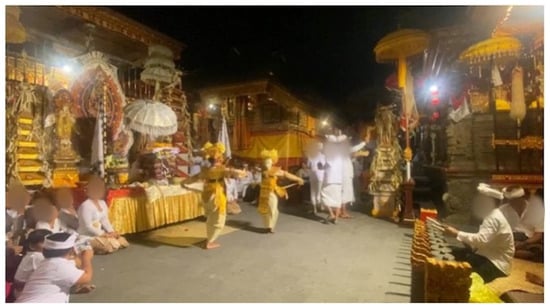
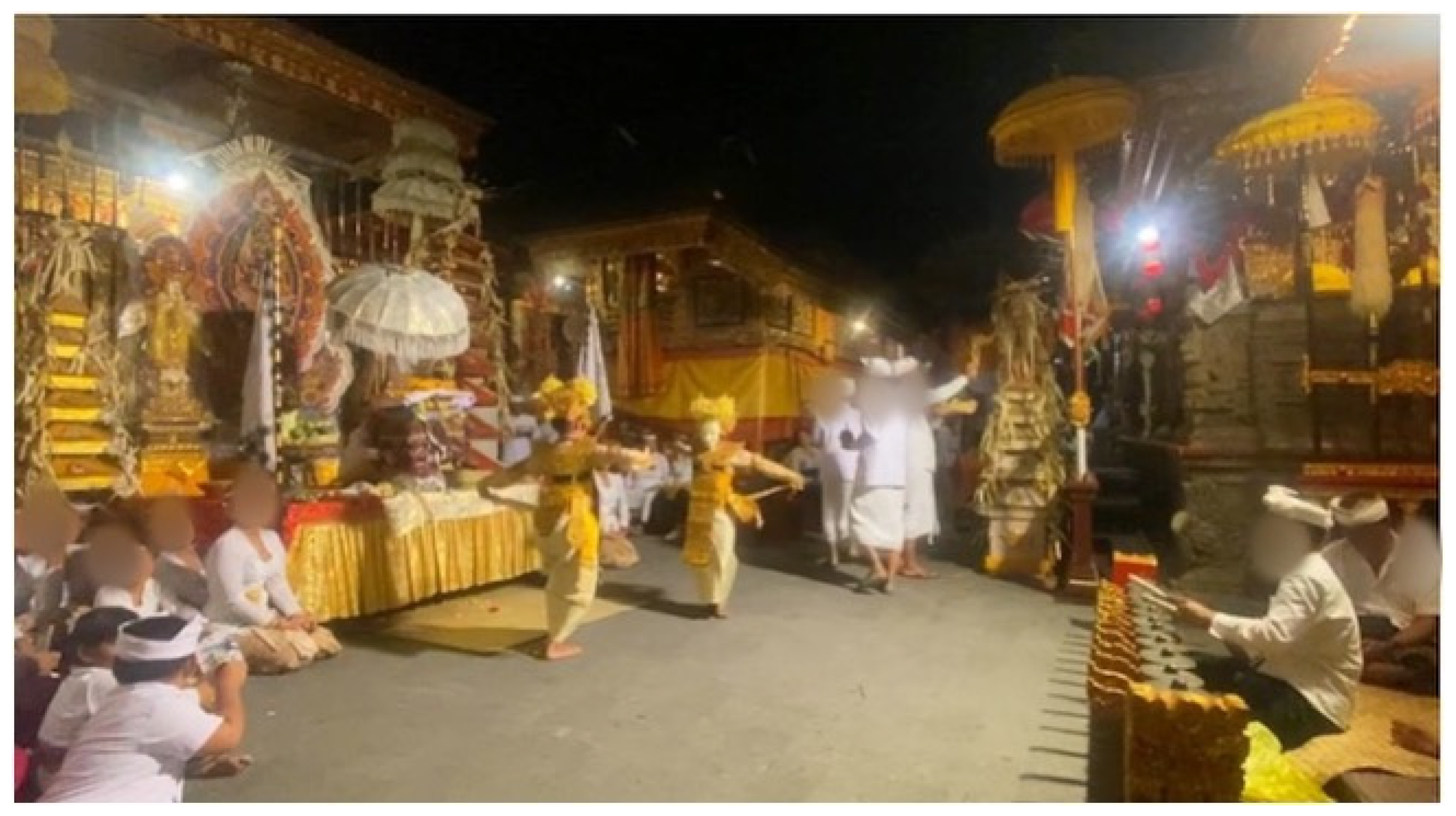
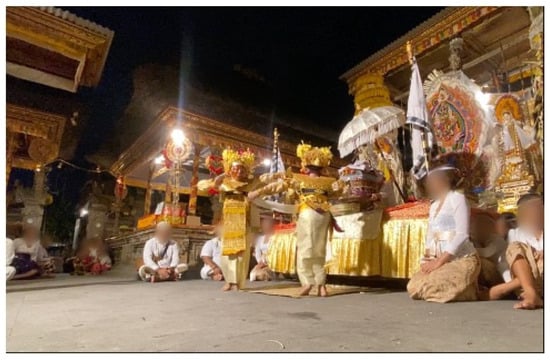
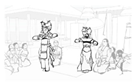
Ratu Sang Hyang Widyadari is a sacred masked-dance rite offered at Pura Payogan Agung, a Hindu temple in the customary village of Ketewel, Bali. Its name refers to revered celestial female beings (widyadari, also called dedari) whom the temple community views as being present through consecrated masks (tapel) worn by young ritual dancers. The community classifies the rite as tari wali, a sacred dance that constitutes an act of worship, within Dewa Yadnya, the category of offerings directed to God and divine manifestations. Its principal nocturnal observance takes place on Pagerwesi, a holy day in the 210-day Balinese ritual calendar associated with the worship of Ida Sang Hyang Widhi Wasa as Sang Hyang Pramesti Guru, and it is offered for the well-being of the temple community and the harmony of its relations with the divine. During the rite, a box containing the masks is carried from its shrine to a temporary altar beside the dance ground; pairs of young dancers are fitted with masks, dance a prescribed section to gamelan music, and are relieved of the masks; and the collection is finally returned to the shrine (Figure 1).
Figure 1.
The rite in the inner courtyard of Pura Payogan Agung, Ketewel. Two ritual dancers wearing sacred masks undertake the prescribed paired dance, while dancers not participating in that section, priests, musicians, and worshippers are positioned around the designated dance ground. Discernible faces have been blurred. Source: Authors’ field documentation (2024).
The rite has a significant place in accounts of the history of Legong, a classical Balinese dance genre. Agus (2006), who examines it as Sang Hyang Legong Topeng, identifies it as an inspiration for later forms of Legong; this article retains the community’s designation, Ratu Sang Hyang Widyadari, to foreground its religious significance and custodial obligations. Scholarship on Legong has traced its manuscript origins (Suarka 2015), its movement from sacred to secular contexts (Bandem 2015b), the influence of Legong Keraton on Balinese dance between 1920 and 2005 (Sudewi 2011), its revival or decline (Davies 2006), and, in Ketewel, the role of community organisation in its persistence (Indra Putra et al. 2021). Bandem and deBoer’s (1995) classification of Balinese dance into sacred (wali), ceremonial (bebali), and secular (balih-balihan) categories clarifies why the Ketewel rite must be distinguished from Legong as a performing art.
The present study shifts attention from history, choreography, and transmission to the spatial and temporal relationships established through the complete ritual sequence, from shrine custody to the masks’ return. Its operations involve different participants, objects, and locations, yet are rarely examined together. The central research question asks how sacred spatial relations are enacted, bodily experienced, and collectively recognised through coordinated ritual action, and how their temporary configuration is formally concluded.
The analysis draws on ritual studies, material religion, and phenomenology. Bell (1992) conceptualises ritualisation as a strategy that sets certain practices apart and invests them with differentiated authority, focusing on how handling and timing distinguish ritual acts from visually similar ones. Morgan (2010) argues that objects and their treatment help constitute religious life rather than merely represent belief, and Meyer (2012) emphasises the material and sensory conditions through which religious presence becomes perceptible. Csordas (1990) treats the body as the existential ground of culture, Merleau-Ponty (2005) shows that spatial orientation is lived through the moving body, and Emigh (1996) describes masked performance as a negotiation between self and other in which the performer neither disappears nor remains unchanged. Lefebvre (1991) and Tuan (2007) treat space as produced through practice and turned into place through lived orientation. The Balinese Hindu distinction between sakala, perceptible and manifest reality, and niskala, the spiritually present but nonmanifest dimension, provides the religious framework; Eiseman (2011) shows that Balinese religious life continually addresses their relation through offerings, ritual action, and the arts. The analysis distinguishes observable practice from participants’ interpretations of spiritual agency while recognising the practical consequences of those interpretations.
The temporally bounded character of these relationships invites consideration of ritual thresholds and of what this article calls the in-between. van Gennep (1960) identified a liminal phase between separation and incorporation. Turner (1969) developed liminality as a condition ‘betwixt and between’ established positions and later contrasted it with liminoid, aesthetic activity (Turner 1982), and Eliade (1987) located the temple threshold as the boundary that separates and joins two modes of being. In Ketewel, however, the transition unfolds within a courtyard that is already consecrated, and the responsibilities of priests, dancers, musicians, and worshippers remain differentiated throughout. The in-between is therefore approached not as an architectural boundary or a third realm, but as a temporary configuration of relationships established through authorised handling, bodily attachment, coordinated movement, and prescribed release. The expression also resonates with the local understanding of the widyadari as celestial beings and with the dancer’s embodied position between akasa (sky) and pertiwi (earth).
The article argues that mediation between sakala and niskala in this rite is distributed through the interdependent participation of dancers, priests, musicians, and worshippers; authorised through differentiated responsibilities for sacred objects, ritual actions, and exceptional occurrences; and formally reversible through assisted release and final return.
2. Ritual Context: Ratu Sang Hyang Widyadari at Pura Payogan Agung
2.1. Purpose, Origins, and the Sacred Masks
For the temple community, the rite is an offering rather than a story. The sacred dance does not enact a narrative (lakon), is not accompanied by a narrator, and is not primarily a technique for communicating with spirits or repelling malevolent forces. It is a Dewa Yadnya offering in which the widyadari are viewed as being present through the masks and the dancers’ bodies so that temple, community, and the divine are brought into the right relation (Sudewi 1995). This relation can be read through Tri Hita Karana, the principle of harmony with the divine, among humans, and with the environment: the offering honours the divine, gathers the community in differentiated service (ngayah), and respects the temple’s ordered space. Protection is nonetheless part of the rite’s horizon. Under the principle that ritual propriety depends on place, time, and circumstance (desa–kala–patra), temple informants report that the dance may also be offered outside the regular festival when the community seeks the averting of misfortune (penolak bala), with the same requirements concerning masks, participants, prayer, and music.
Two traditional narratives recount the rite’s origins. The Babad Dalem Sukawati, a chronicle of royal genealogies, relates that Ida Dewa Agung Anom Karna, a prince of Sukawati, saw celestial maidens dancing in colourful garments and golden headdresses during meditation (yoga samadhi); Ki Jro Bendesa Ketewel, a customary village leader, then established the masked dance in the eighteenth century, rendering the maidens’ faces as masks (Suarka 2015). The Raja Purana Tattwa Pura Payogan Agung, a temple text, relates that Ki Lampor of the Daha kingdom carved the masks at the instruction of the King of Kediri, that they were consecrated at Mount Semeru in East Java, and that they were brought as offerings to Alas Jerem, now Ketewel (Agus 2006). The link with East Java persists in corresponding sacred masks kept at Pura Mandara Giri Semeru Agung in Lumajang, which the community recognises as part of the rite’s spiritual network.
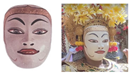
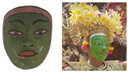
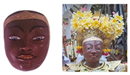
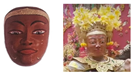
The collection comprises nine masks. Seven represent widyadari: Gagar Mayang, Aminaka, Gudita, Nilotama, Tunjung Biru, Ken Sulasih, and Supraba. They are not generic faces but named persons of a celestial household, addressed collectively as Ratu Dedari (‘Divine Celestial Maidens’). Supraba, addressed as Ratu Dedari Agung (‘Great Divine Maiden’), is the most senior, and Ken Sulasih, Ratu Dedari Alit (‘Younger Divine Maiden’), ranks next. The remaining two masks represent the maidens’ retinue: Took, a make-up attendant (juru rias), and Kentrut, an elder caretaker (emban). They are never danced but accompany the collection as flanking masks (tapel pengapit). As a household whose members occupy differentiated positions, the masks are handled, paired, stored, and danced in prescribed ways (Section 4). Whereas Bandem and Carpenter (2023) examine Balinese masks across sacred and theatrical contexts, this study focuses on the relational and custodial organisation of one collection.
2.2. Participants and Ceremonial Cycle
Four groups sustain the ceremony: dancers, priests, musicians, and worshippers. In Ketewel, young girls eligible to perform the sacred dance are also called Legong (here, ‘ritual dancers’). They undergo purification rites and remain eligible until their first menstruation. During the sacred-dance event (sesolahan), one designated pair performs the prescribed sacred dance (mesolah) in each section, while the other ritual dancers assist and accompany the proceedings. Former ritual dancers may continue as senior dancers, called Mbok Legong, who prepare and guide the ritual dancers, carry and fit the masks, assist with their removal, and transmit ritual knowledge. The Jero Mangku Gede, or chief temple priest, oversees the ceremonial order with other priests (pemangku); the Samara Pagulingan gamelan ensemble provides the prescribed music and cues; and worshippers (penyungsung) prepare offerings, pray, and participate through collective attention.
The observances follow a recurring cycle of three ceremonial scales: Karya Alit (concise), Karya Madya (expanded), and Karya Agung (fullest). The scales differ in offerings, associated activities, and number of paired dance sections rather than in degrees of sacredness: Karya Alit and Karya Madya include three regular sections, while Karya Agung adds a fourth. After Karya Agung the cycle returns to Karya Alit, so that the relationship among community, masks, and religious obligations is renewed rather than reproduced as an unchanging form.
2.3. Ritual Sites and Cosmological Orientation
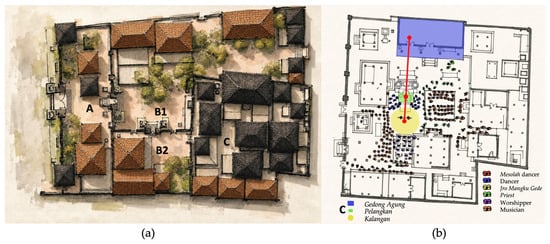
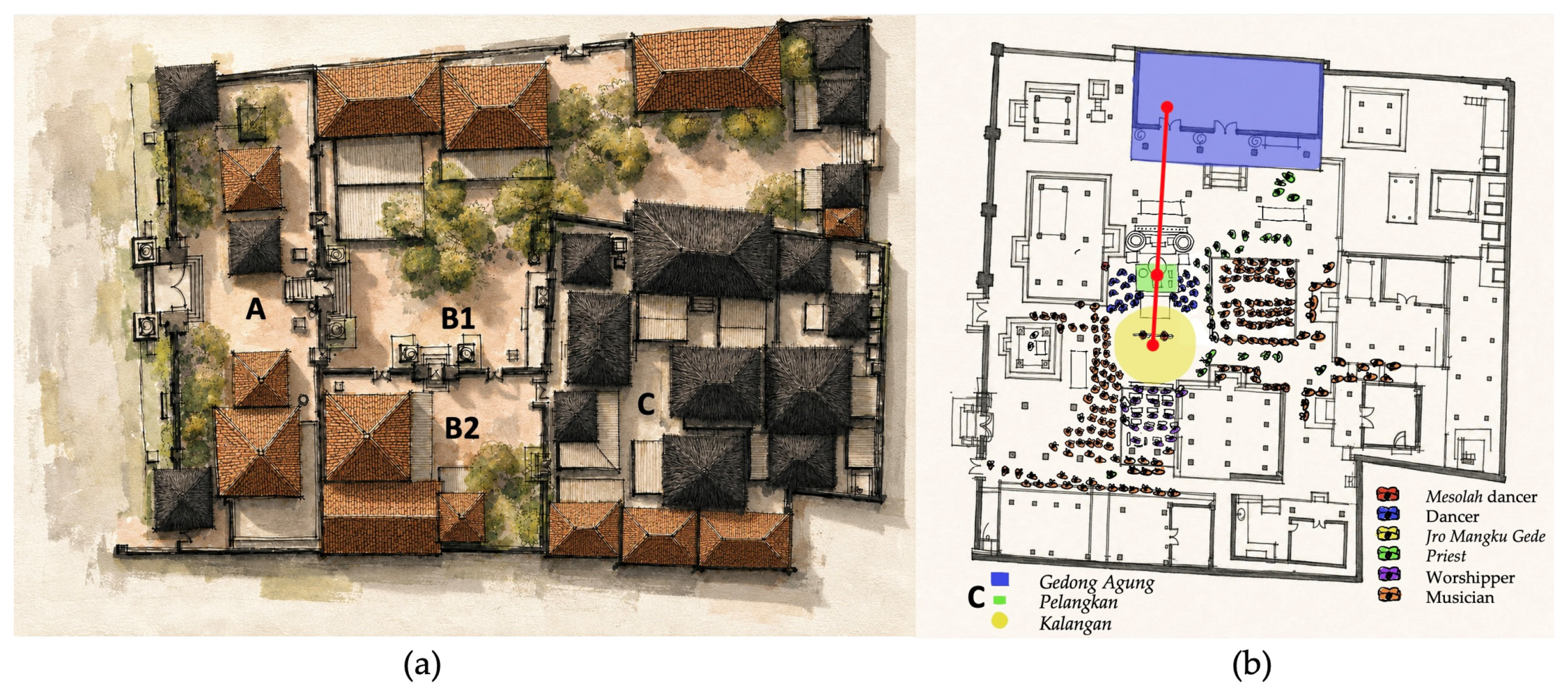
The rite connects three sites within the consecrated inner courtyard (jeroan dalem): Gedong Agung, the permanent shrine and place of custody for the masks; the pelangkan, a temporary raised altar where the mask box is placed, and masks are fitted and removed; and the kalangan, the designated open dance ground. Musicians sit in a pavilion facing the dance ground, and worshippers sit around its edges (Figure 2).
Figure 2.
Spatial organisation of Pura Payogan Agung. (a) Temple zones A (outer, nista/nistura mandala), B1–B2 (middle, madya mandala), and C (inner courtyard, utama mandala or jeroan dalem). (b) Enlarged inner-courtyard plan identifying the axis (red line) connecting the permanent shrine (Gedong Agung), temporary altar (pelangkan), and dance ground (kalangan), together with the positions of ritual dancers, priests, musicians, and worshippers. Source: Authors’ spatial mapping based on field observations (2024–2025).
These sites are ordered by cosmological orientation and physical alignment. The Balinese sacred landscape is polarised between the mountain (giri) and the sea (sagara), and orientation within it is expressed through the paired directions kaja and kelod. In much of the literature and in everyday usage, kaja is glossed as ‘mountainward’, towards Gunung Agung, and kelod as ‘seaward’ (e.g., Wassmann and Dasen 1998). Raharja (2011), however, distinguishes the sky–earth orientation associated with the Bali Aga period from the mountain–sea orientation of the Bali Mula period. Building on this distinction, the present study interprets kaja as the ritually elevated direction associated with akasa (sky) and kelod as the lower direction associated with pertiwi (earth) and what lies beneath it; the kaja side of a space is its head (ulu). The mountainward and seaward orientations may thus be understood as topographic expressions of a vertical hierarchy. This interpretation was developed through field observation and consultation with Balinese religious and customary figures, while recognising the established geographical meanings of the terms.
At Pura Payogan Agung, Gedong Agung lies north of the dance ground and forms the ritually upper pole of the courtyard so that the axis linking shrine, altar, and dance ground is one of elevation and reverence rather than merely a compass bearing. Before and immediately after the masks are fitted, the ritual dancers face Gedong Agung; then they turn south toward the worshippers as the dance begins. The community understands this reversal as marking the dancers’ transition into the embodied presence of the widyadari, as though the celestial figures had arrived from the shrine’s sacred direction.
3. Materials and Methods
3.1. Research Design and Fieldwork
The study uses a bounded qualitative case-study design, combining sequence-centred ethnographic observation with hermeneutic-phenomenological interpretation. van Manen (1990, 2016) informs the reading of situated perception and action as accounts of lived experience rather than as reports of inner states that can be verified externally; the analysis therefore does not presume that all participants shared a single altered state, but examines how the same transitions were enacted and perceived from differentiated positions. The empirical unit is the sequence linking the authorised removal of the masks from the shrine, their reception at the temporary altar, attachment, paired dancing, assisted removal, and final return.
Field observation covered three successive Pagerwesi observances—Karya Agung on 17 July 2024, Karya Alit on 12 February 2025, and Karya Madya on 10 September 2025—which together constitute one complete rotation of the ceremonial scales. Observation spanned the two days before and after each Pagerwesi and, for Karya Agung, continued until the seventh day because the dance was performed on consecutive days. Preliminary visits began in 2023, and analysis and member checking, through follow-up consultations with ritual participants on terminology, procedure, and interpretation, were completed in 2026. Fieldnotes recorded ritual roles and positions, the handling and movement of objects, musical transitions, bodily orientation, and collective posture, with attention to actions present across ceremonial scales and to departures that participants recognised as authorised. Records included expanded fieldnotes, spatial sketches, a measured site plan, photographs, audiovisual recordings, and reflexive notes. Movement was mapped from video into recurrent segments, grouped into phases by changes in orientation, trajectory, partner position, and direction (Section 4.3). No ritual action was staged, directed, or altered for research.
3.2. Interviewees and Interview Procedure
Thirty-eight interviewees were selected purposively to capture variation across ritual roles rather than statistical representativeness (Table 1). Direct participants were the evidentiary source for their own actions and experiences; expert accounts were not substituted for testimony about experiencing this rite.
Table 1.
Interview groups, number of interviewees, and evidentiary status.
Interviews were conducted face-to-face in Indonesian, with Balinese terms retained when used by interviewees, at culturally appropriate intervals following ceremonies. They ranged from open-ended conversations to semi-structured interviews; no standardised questionnaire was administered. For interviews with dancers, elicitation techniques adapted from the micro-phenomenological interview (Petitmengin 2006) helped participants recall a specific moment and describe it in sensory detail. Prompts included ‘At that moment, how did your body feel?’ and ‘How did your feet recognise the floor of the dance ground?’. Priests, musicians, and worshippers discussed their responsibilities and how they recognised transitions. Interviews were recorded with permission and transcribed, while follow-up conversations were used to clarify terminology and divergent accounts. The authors translated excerpts from Indonesian, and interviewees are identified only by broad role. Balinese and Indonesian terms are italicised and defined at first occurrence and in Appendix A.
3.3. Analysis and Triangulation
For each stage of the sequence, the analysis asked which objects and people moved, who was authorised to act, what bodily and sensory demands arose, how others recognised the transition, and what concluded it. Transcripts were divided into units of meaning, grouped into clusters of experience, and read back against the observed sequence. Participants’ interpretations of sacred presence were distinguished from observable responses to them, so that symbolism or niskala agency was not inferred from a gesture, colour, or sensation alone: where participants explained why an action was performed, that explanation is reported; otherwise, the action is described by its function in the sequence. Triangulation assessed consistency between recurrent observations and interview accounts (Tracy 2010), and divergences concerning individual experience, intensity, or meaning were retained.
3.4. Ethics, Reflexivity, and Limits
Access was obtained through customary procedures involving Desa Adat Ketewel (the customary village authority) and the chief temple priest, who permitted observation and documentation, including photography, within local restrictions. Fieldwork was undertaken in temple dress and outside restricted ritual functions, and reflexive records distinguished observed action, bodily impression, interviewee explanation, and later interpretation. Participation was voluntary, and informed consent was obtained before each interview; because the ritual dancers are minors, written consent was obtained from a parent or guardian, along with the dancer’s assent. No interviewee is named, the ritual dancers’ faces are covered by the masks, and other discernible faces in published images have been blurred. The study concerns one rite, one temple community, and one rotation; it does not support generalisation to other rituals or claims about long-term change; participants’ accounts of altered awareness cannot independently establish their causes; and customary restrictions limit the visual record.
4. Results
4.1. Ritual Form and the Reversible Outward–Return Sequence
The prescribed pairings link particular masks, choreographic positions, and musical compositions (Table 2). Six of the seven widyadari masks form three fixed pairs, each comprising complementary lanang and istri figures; although these terms ordinarily mean ‘male’ and ‘female’, here they designate the taller and the shorter figure, distinguished by the dancers’ relative heights and positions rather than by sex. The pairs are not recombined: Gagar Mayang always dances with Aminaka, Gudita with Nilotama, and Tunjung Biru with Ken Sulasih. Each pair is accompanied by its own composition from the Subandar series so that two masks, two bodies, and one piece of music form a single unit of offering, and the complementarity of the pair, which may be read as an expression of balance, remains visible as the dancers move side by side, face each other, exchange places, and turn. During Karya Agung, a fourth section brings Gudita and Nilotama back, accompanied by Subandar Agung.
Table 2.
Ritual organisation of the nine sacred masks and their relationship to the prescribed Subandar compositions. Source: Authors’ field documentation (2024–2025).
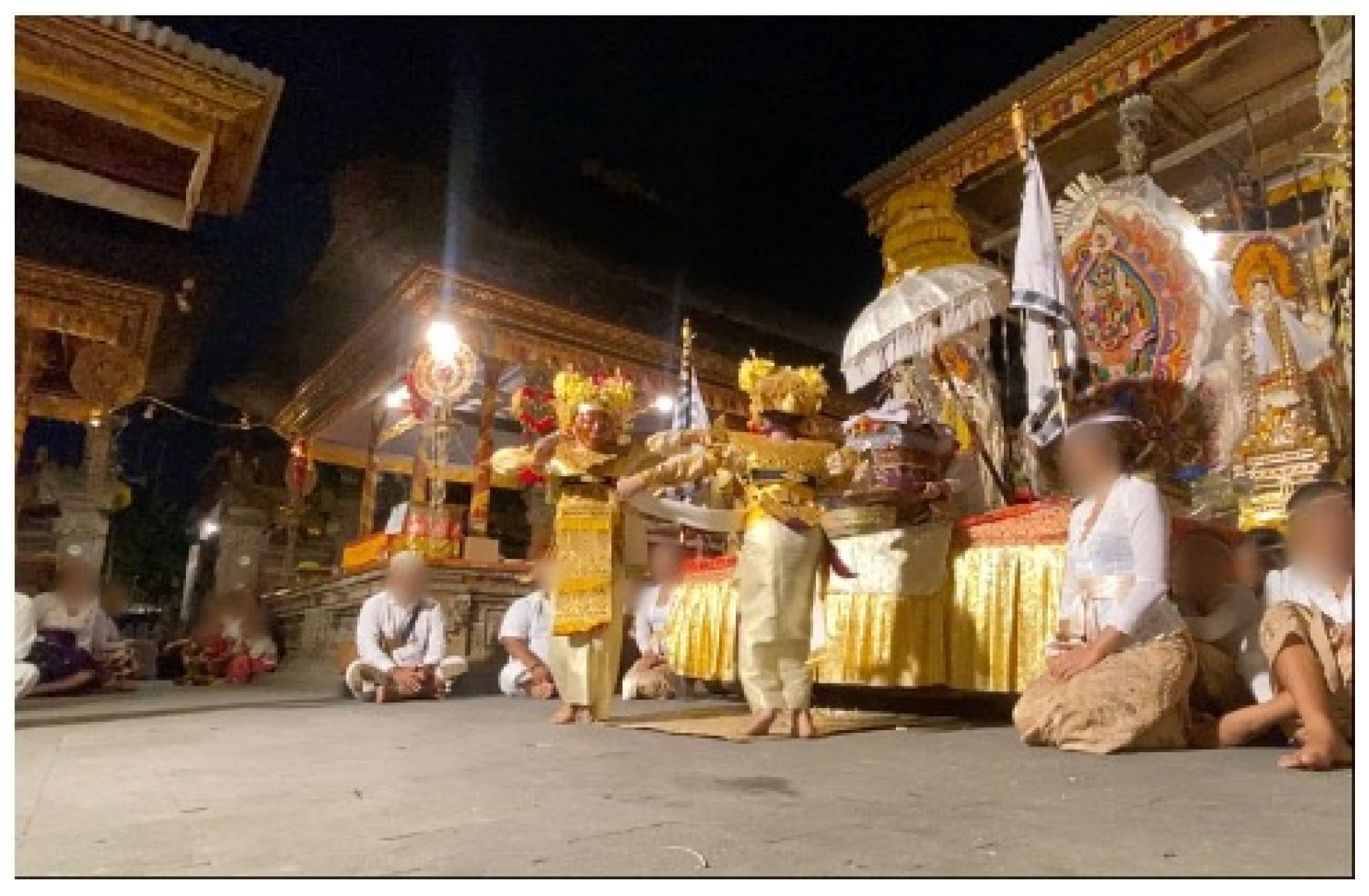
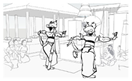
Supraba has no fixed partner or section. Participants use the term medal (‘to emerge’) when Supraba is found above the other masks in the box without any known human rearrangement, and the community interprets this as an indication from niskala that those responsible for ritual order must recognise. The senior dancer who opens the box notices it, the Jero Mangku Gede confirms it, and the musicians respond with Subandar Agung, after which Supraba may take either position in a section. This chain was also witnessed during fieldwork. During Karya Agung in July 2024, Supraba emerged in the second section: as the dancer was being fitted with the mask, the Jero Mangku Gede recognised the occurrence and signalled to the musicians’ leader, who within seconds began Subandar Agung. The pair then danced nyemah, moving along diagonal paths instead of the forward-and-back lines of the regular dance, while worshippers could be heard whispering ‘Ratu medal… Ratu medal’ (‘Ratu Dedari Agung has emerged’) (Figure 3).
Figure 3.
Paired sacred dancing during Supraba’s recognised emergence at the Karya Agung observance in July 2024. Discernible faces of unmasked participants have been blurred. Source: Authors’ field documentation (2024).
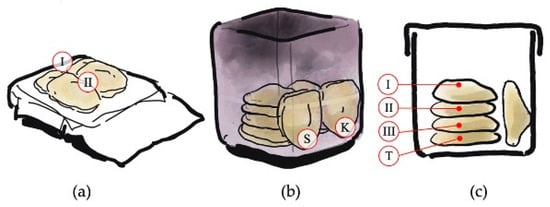
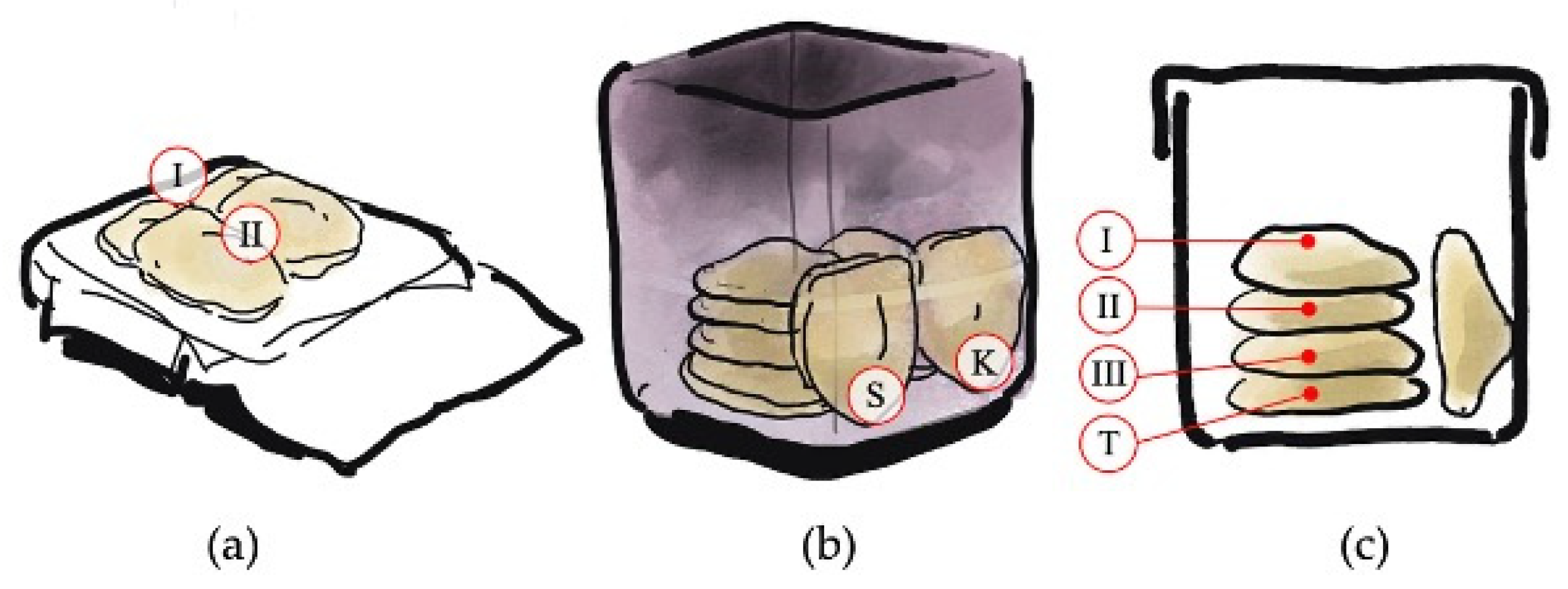
The box also records the household’s hierarchy. Took and Kentrut remain at its bottom on the temporary altar throughout so that the household is present in full even when only two of its members dance. Supraba and Ken Sulasih are stored upright, a position marking their senior standing, while the masks of the regular sections are stacked in order of use, each wrapped in white or pale-yellow cloth (Figure 4). During the dance sections, the lid serves as a temporary surface for masks already worn; only after all sections are complete are the masks restored to their storage arrangement so that the progression of ritual time is materially visible in the box itself.
Figure 4.
Arrangement of the sacred masks within the ritual storage box: (a) box lid showing the masks from sections I and II temporarily placed during the performance of section III; (b) masks inside the box, with Supraba (S) and Ken Sulasih (K) stored upright; (c) schematic of the prescribed arrangement, with the masks for sections I–III stacked in sequence and Took and Kentrut (T) at the base. Source: Authors’ illustration based on field observations and interviews (2024–2025).
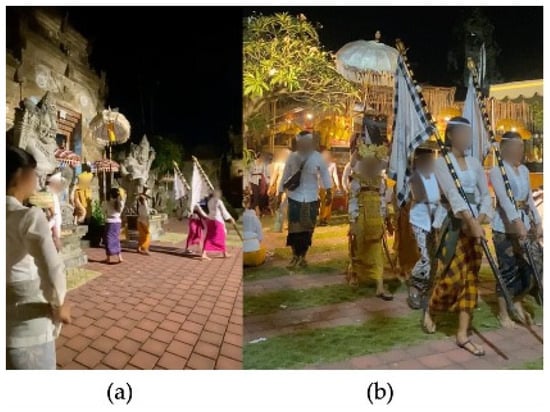
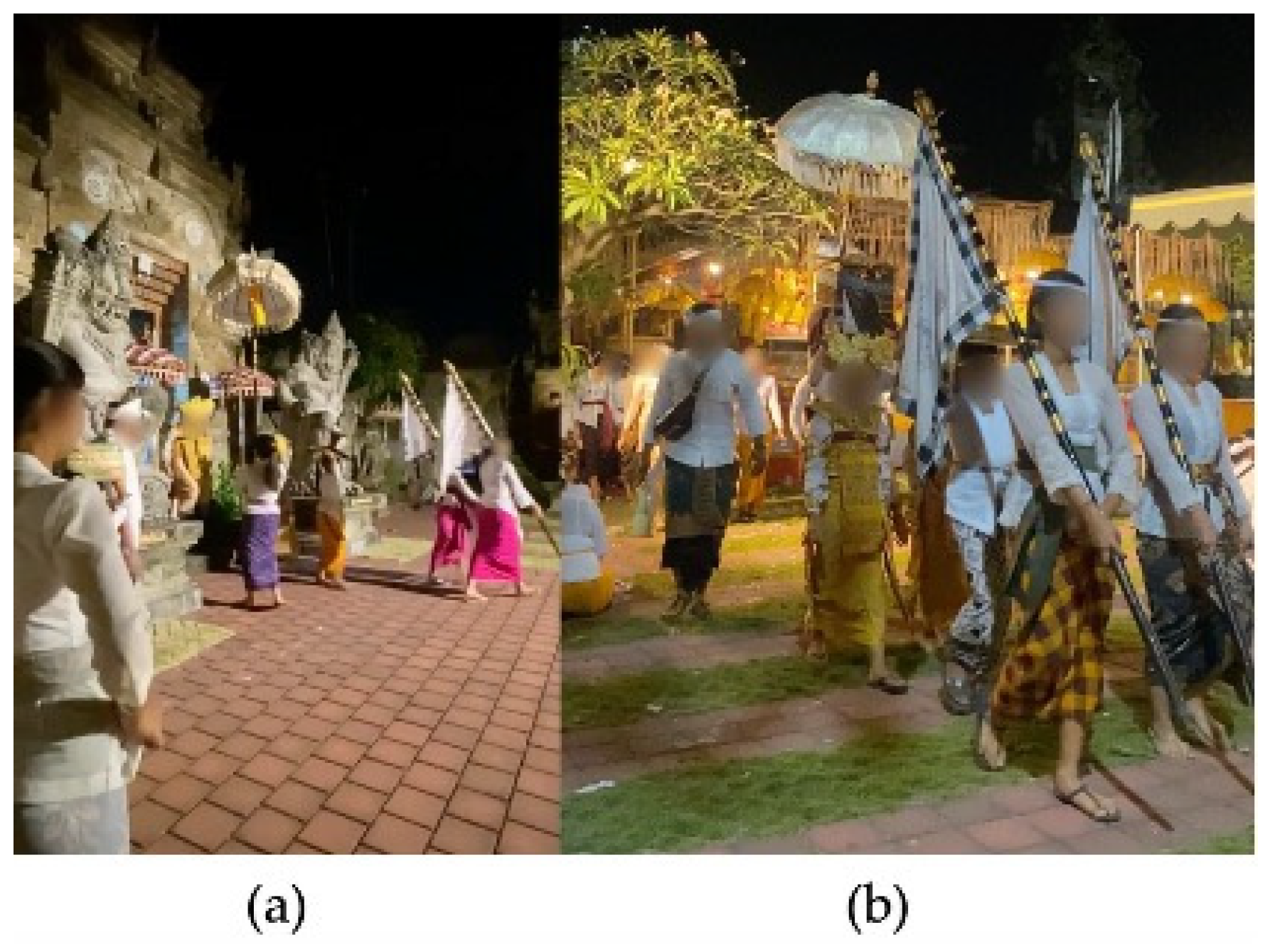
The outward-and-return sequence itself distributes responsibilities across stages, each with a recognised purpose. During preparation, worshippers arrange offerings and space, priests supervise prayer and purification, musicians ready the named pieces, and senior dancers dress the ritual dancers and set frangipani flowers in their headdresses. Senior dancers then carry the closed box from Gedong Agung to the temporary altar beneath a white ceremonial parasol (tedung), a sign of honour for the masks and, in Balinese ritual usage, of divine protection (Figure 5). The procession uses different routes: the ritual dancers about to perform and the senior dancers carrying the box pass through the central roofed gateway (candi kurung), while other dancers and worshippers use the small side gate. The movement makes the masks perceptible to those present, while their custodial relationship to the shrine remains unchanged.
Figure 5.
Procession of the mask box from Gedong Agung to the temporary altar: (a) the procession approaching the inner courtyard through the candi kurung gateway; (b) ritual dancers accompanied by senior dancers who are carrying the box and the ceremonial parasol. Discernible faces have been blurred. Source: Authors’ field documentation (2024).
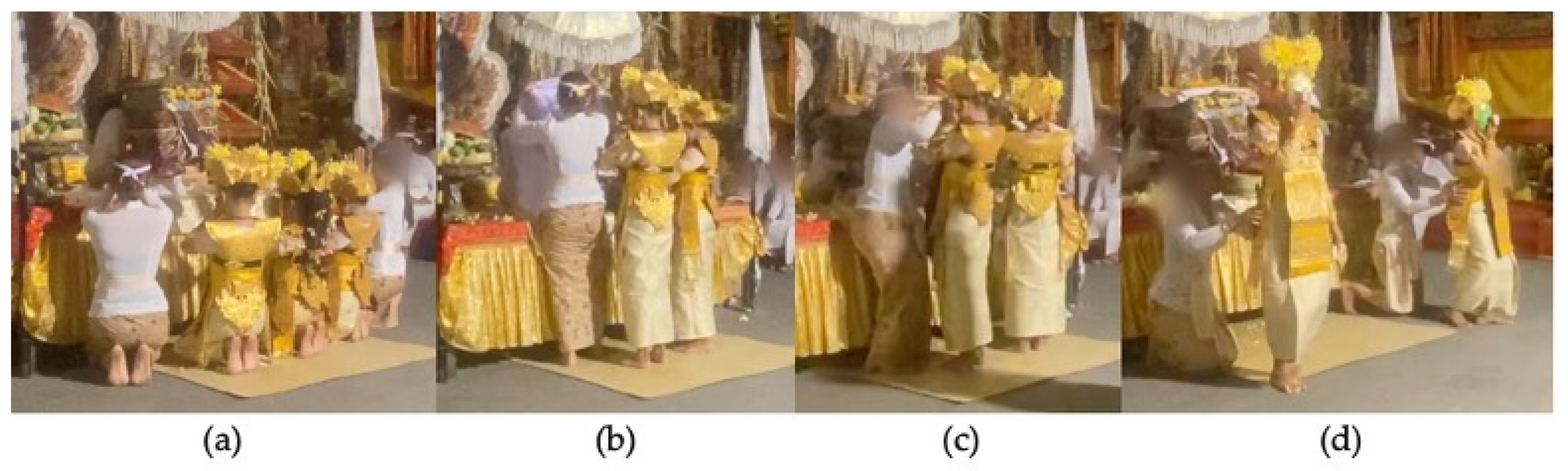
At the altar (Figure 6), the ritual dancers and senior dancers first pray (muspa) before the box for safety and a smooth performance. The masks are passed through incense smoke, and the ritual dancers pass their hands and faces through it, a purification that readies the object and body for contact. The ritual dancers also chew frangipani flowers, an act observed in every observance and confirmed by the chief priest, senior dancers, and ritual dancers as part of the same purification. Senior dancers then take the masks from the box in prescribed order, because each pair belongs to a particular section and composition, and fit them as the dancers grip the internal mouthpieces. As the chief priest explained, his responsibility includes ‘the dancing, the music, and the community’: his oversight establishes the order within which specialist competencies operate, not a role in every transfer.
Figure 6.
Prayer and mask attachment beside the temporary altar: (a) ritual dancers and senior dancers pray before the mask box; (b) purification of masks, hands, and faces with incense smoke; (c) a senior dancer hands over a mask in the prescribed order; (d) the mask is adjusted as the ritual dancer grips the mouthpiece (canggem). Discernible faces of unmasked participants have been blurred. Source: Authors’ field documentation (2024).
At the end of each section, senior dancers receive the masks from the returning pair, a procedure called nyambutin (‘to receive’), pass them through incense, and place them on the box lid. When all sections are complete, the masks are wrapped and restored to the box, and a priest presents two offerings beneath it: Banten Pejati, a complete offering that affirms the sincerity of the ceremony, and Segehan Cacah, a small offering to the natural forces (bhuta kala) that restores balance. The musicians play the closing composition (gending pekaad), the box is carried back to Gedong Agung, and priests and worshippers pray together in thanksgiving. Across the three observances, this outward-and-return sequence remained recognisable despite differences in ceremonial scale and the possibility of authorised variation.
4.2. The Face–Mask Interface: Attachment, Restricted Vision, and Assisted Release
Mask attachment involves both material adjustment and religiously significant experience. A senior dancer described fitting the mask so that it would ‘become one with us’. Two ritual dancers described a pronounced change in the sense of self: ‘When I wear it, I am no longer myself; I become part of Beliau’, using an Indonesian honorific for a revered presence, and ‘For that whole time, I am not myself any more’. Such statements need not indicate a loss of bodily awareness; they describe the body being placed in relation to a sacred presence. Other accounts differed. One former dancer stated, ‘The dancer focuses on controlling the dance. There is no trance’; another emphasised responsibility: ‘I must keep upholding the majesty of that mask’; and another senior dancer recalled no memory of the interval of dancing, although witnesses considered her movements correct. These testimonies reveal different experiences of control, self-awareness, and religious relation rather than a uniform experience of trance or possession.
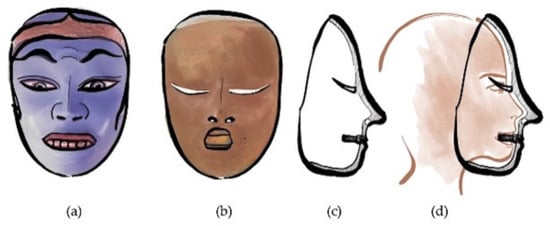
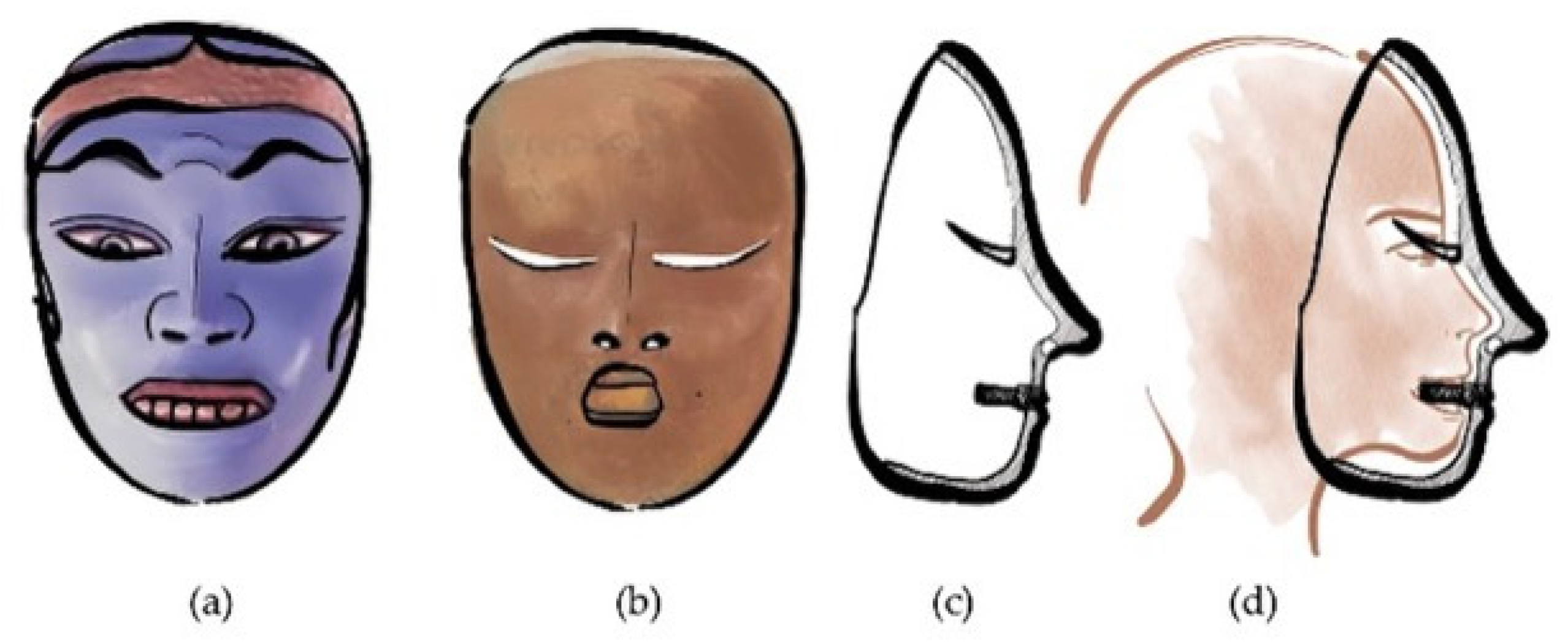
The masks restrict vision to narrow openings. A senior dancer described ‘a small gap below the eyes’; a ritual dancer recalled, ‘I can see, but only the lower part, so we cannot freely look ahead’; others said, ‘We look downwards’ and ‘One side cannot be seen at all’. Each danced mask also contains an internal mouthpiece (canggem) that the dancer grips between the teeth, an act called nyanggem (Figure 7d). It requires sustained jaw pressure and adjustments in breathing and head position, and it provides tactile feedback through which a shift of the mask can be sensed and corrected. A senior dancer stressed that ‘what matters most is the dance and the way you nyanggem’, and a ritual dancer linked breath control to devotional discipline: ‘There is breathing yoga in how you regulate the breath’.
Figure 7.
Material interface between the sacred mask and the dancer: (a) frontal surface; (b) inner surface with eye and nasal openings and the mouthpiece; (c) section through the mouthpiece; (d) mask worn with the mouthpiece gripped between the teeth. Schematic, not to scale. Source: Authors’ illustration based on field observations and dancer accounts.
Dancers therefore relied on remembered pathways, the partner’s position, musical cues, and contact between bare feet and floor, which carried meaning beyond technique. A ritual dancer explained: ‘Without footwear, it is more about touch with the ground… this body goes straight to pertiwi (the earth)’. A former dancer said of her steps, ‘In my memory, it is stored until now’; another spoke of moving ‘usually just by feeling’ (perasaan), a term that here encompasses sensitivity to foot pressure, direction, the partner’s distance, and the music as well as emotion; and one senior dancer said that through practice ‘you already seem to know your position’.
Senior dancers repeatedly emphasised the obligation to preserve the dignity of the masks and prevent them from falling, and this responsibility shaped both the ritual dancers’ self-control and the attention of the senior dancers waiting nearby. Release required coordinated control: the returning dancer approached the altar still gripping the mouthpiece under restricted vision, and a senior dancer steadied her, helped disengage the mouthpiece, and received the mask without letting it fall, ending the attachment through tactile assistance and shared responsibility for the sacred object.
4.3. Movement and Music in the Paired Dance
The paired dance is restrained and precisely coordinated rather than virtuosic. Mapping the recordings resolved it into fifteen recurrent segments, grouped here into four phases: orientation, linear movement, dynamic–circular movement, and reorientation (Table 3). The phases describe observable trajectories rather than locally named stages. Spatially, they establish the shrine-facing axis, compress movement along it, expand the dance across the open ground, and return the pair to the point of release.
Table 3.
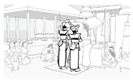
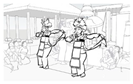
Four analytical movement phases in the prescribed paired dance, with their spatial consequences and coordination cues. Sketches: Authors’ illustration based on video documentation (2024–2025).
The Samara Pagulingan ensemble provided both the prescribed musical structure and practical cues. Because the masks limit sight, changes in tempo and the strokes of the drum, metallophones, and gong told the dancers when to begin, hold, accelerate, turn, or redirect their movement, while the musicians watched the dancers’ readiness, changes in position, and approach to the altar so that the beginning and end of each section emerged from mutual reading rather than a fixed count. Feld’s (1996) notion of acoustemology, the knowing of place through sound, describes how the music made the rite’s structure audible to everyone in the courtyard. For the musicians, this coordination also carried devotional significance. One recalled a ‘different feeling’ when the playing began and associated it with a revered presence; another described playing as service (ngayah). In their accounts, the music’s religious significance lay less in individual instruments than in its fixed relation to particular pairs of masks, its role as an offering, and its capacity to make transitions recognisable.
4.4. Multisensory Attention and Collective Recognition
Participants experienced the sensory conditions of the rite according to their responsibilities. At the altar, incense smoke, the scent and taste of frangipani, and the effort of attaching the masks came together: ritual dancers anticipated restricted vision, senior dancers attended to the masks and the wearers’ readiness, and nearby worshippers recognised the activity through its prescribed handling and order. The priests rang the hand-bell (genta) during prayers and administered holy water (tirta) and grains of rice (bija), which participants associated with purification and blessing, and worshippers took part through prayer, posture, and the singing of devotional songs (kidung). Although seated around the dance ground, the worshippers did not constitute an audience assembled to watch a performance: their attention to the masks was a devotional act directed towards the widyadari believed to be present, not an evaluation of choreography. The chief priest emphasised that ‘everyone must sit’, and a musician recalled an occasion when ‘everyone was afraid to speak’.
Some interviewees used taksu, a Balinese term for a compelling spiritual–aesthetic quality or charisma (Dibia 2012), when describing moments when masks, dancing, music, and collective attention appeared to cohere. Its use varied among participants and occasions; it referred to an experienced quality of the event, not a measurable property of a mask or dancer. Collective recognition thus depended on different but coordinated forms of sensory engagement through which changes in ritual activity were recognised and sustained across the courtyard.
5. Discussion
5.1. The In-Between as an Authorised and Reversible Threshold
The in-between becomes empirically identifiable through the relation between institution and action. Its operations have unequal ritual force: carrying a closed box, receiving a mask, gripping the mouthpiece, and authorising an exceptional pairing require different competencies, and the rite’s unity depends on the sequence in which they converge rather than on one agent. The Ketewel case thus specifies Bell’s (1992) ritualisation as a division of non-substitutable responsibilities. A musician can respond to a musical change and a senior dancer can receive a mask, but this does not imply equal authority to interpret signs. Medal shows how such authority accommodates the exceptional: an indication interpreted as spiritually significant does not license individuals to alter the ceremony, but is addressed through authorised recognition and corresponding adjustments to music and sequence. Flexibility operates within prescribed order.
van Gennep’s (1960) and Turner’s (1969, 1982) concepts are useful comparisons but require qualification. The rite establishes a bounded transition, yet the evidence does not show that temple hierarchy is suspended or that dancers acquire a new status, and the event is not an optional aesthetic spectacle of the liminoid kind. Unlike Eliade’s (1987) threshold between sacred and profane, the threshold here is one of relationships rather than of place. Its reversibility is formal rather than absolute: attachment is released, and the box returns to its shrine, but the sacred status of the masks and temple is not annulled and acquired competence is not erased. It is this governed conclusion, rather than heightened enactment alone, that gives the in-between its temporal definition, which is why closure belongs to the analytical unit.
5.2. Embodied Attachment, Restricted Perception, and Assisted Agency
Face–mask attachment links ritual materiality to bodily perception. The narrow eye openings and the mouthpiece change the practical conditions of movement, while prayer and authorised handling mark the relation as ritually consequential. Following Merleau-Ponty (2005) and Csordas (1990), these effects cannot be reduced either to visual symbolism or to private belief: what matters is how the dancer moves responsibly within a material and social configuration in which the mask must stay secure, the pairing and music must be respected, and release must be completed through the proper custodial relation. The dancers’ own words, connecting bare feet to pertiwi and breath to yoga, show that they experience this in religious terms rather than as a technique. The findings support a concept of ‘assisted agency’: ritual dancers remain accountable for securing the mask and completing their movements while relying on learned skills, musical cues, partner positioning, and the anticipated support of senior dancers. Agency here is neither wholly autonomous nor passive.
The contrasting testimonies also limit any uniform explanation of mask wearing. Accounts of no longer being oneself, deliberate control, upholding the mask’s majesty, and an unremembered interval are different forms of evidence, even when the observable dance remains competent. This differs from the trance dances documented by Belo (1960), including Sanghyang Dedari, in which entranced girls are understood to be possessed by celestial nymphs and trance itself signals efficacy. In Ketewel, the widyadari’s presence is understood as mediated by consecrated masks and their prescribed use, without requiring a demonstrable altered state in every dancer, which supports Emigh’s (1996) view of masked performance as a negotiated relation between self and other. Khanna and Reddy (2020) approach the Buddhist Cham dance as meditative practice, and Stoltenberg (2019) shows how Kathak movement can be experienced as an axis mundi connecting dancer and divine; the Ketewel accounts add that bodily discipline and personal accounts of sacred relation can coexist within one tradition without being collapsed into a single category of trance.
5.3. Sakala–Niskala as Mediated Co-Presence
The manifest–nonmanifest distinction preserves an asymmetry in the evidence. Handling, gesture, sound, and position are publicly observable; nonmanifest presence enters the study through participants’ interpretations and the actions those interpretations organise (Eiseman 2011). ‘Mediated co-presence’ thus names a religious relation with material and social consequences, not proof of a transferred invisible substance. Morgan’s (2010) material religion explains why the masks’ significance cannot be read from their faces alone: the collection is organised through differentiated custody, placement, and participation, in which pairs are fixed, Supraba’s participation depends on recognition, and Took and Kentrut take part without being worn. What the masks ‘mean’ is therefore relational: they make present a named celestial household whose members are honoured in an order that the box, the pairings, and the music all reproduce.
In Meyer’s (2012) terms, the changing compositions, the position of the box, the face–mask interface, and the attentive perimeter are material and aesthetic conditions of presence that make transitions perceptible to differently situated participants, and, as Bellia (2023) shows for ancient Greek sanctuaries, the spatial organisation of sound shapes ritual experience. Medal illustrates how an unusual material arrangement becomes religiously consequential: the sakala dimension supplies an observable condition: the position of a mask in a box; participants interpret it as an indication from niskala; and the authorised response of priests, musicians, dancers, and worshippers gives that interpretation practical consequences. Their convergence is collective without implying equal access to knowledge or identical feelings of presence.
5.4. A Moving Centre Within an Already Sacred Field
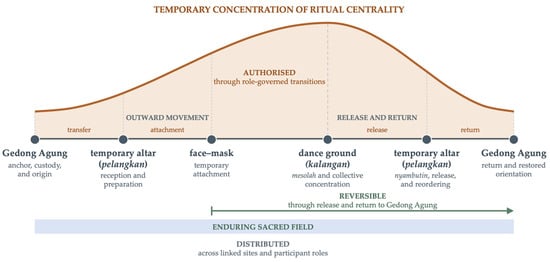
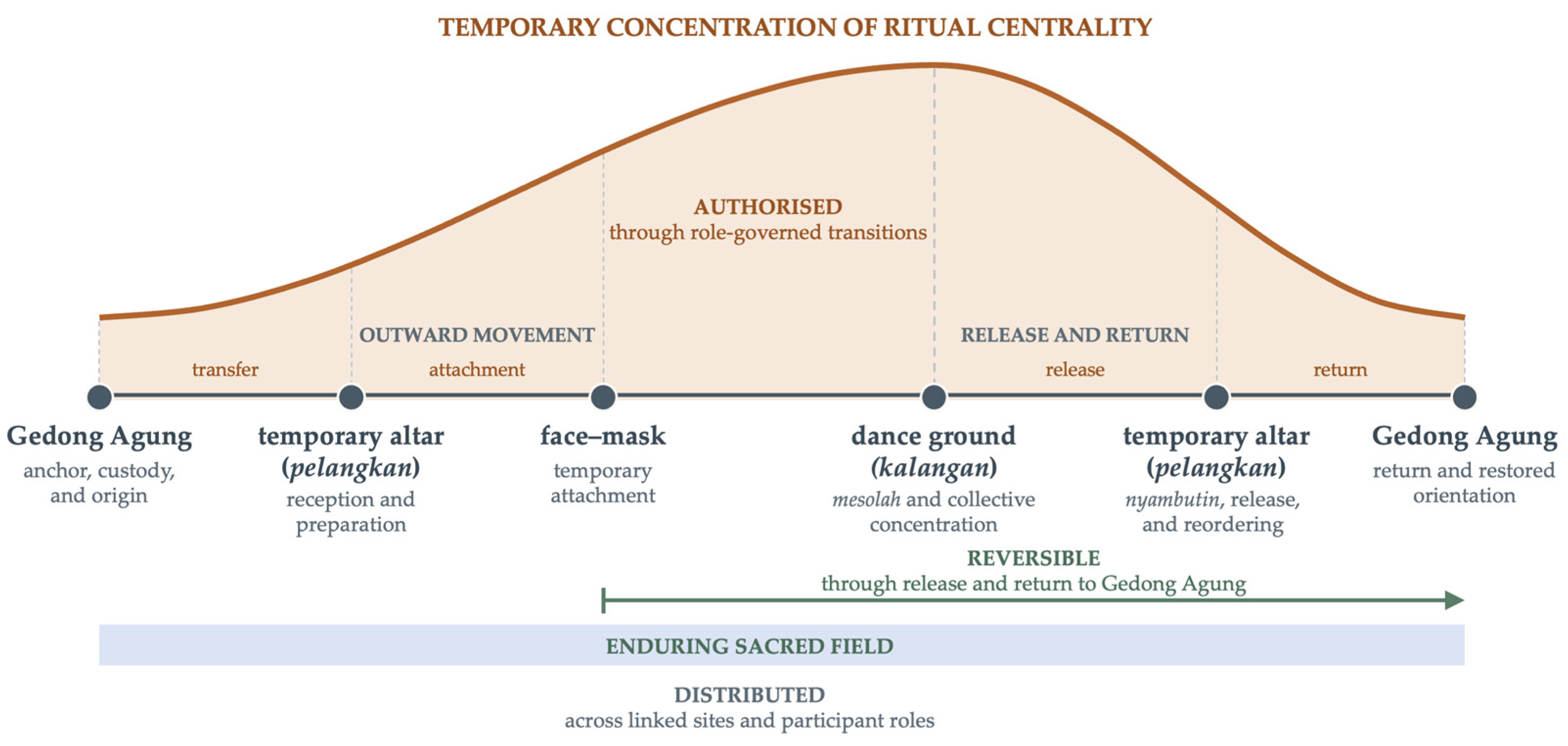
The principal spatial finding is the distinction between enduring sacredness and temporary concentrations of ritual activity (Figure 8). Gedong Agung remains the permanent place of custody, while the temporary altar accommodates reception, attachment, and release, and the dance ground becomes the principal site of movement, musical coordination, and collective participation. Because these sites remain connected within one courtyard and along the kaja axis described in Section 2.3, attention and responsibilities can shift without creating competing centres of authority. The dancers’ southward turn after the masks are fitted makes this axis bodily perceptible, and their barefoot contact with pertiwi grounds the courtyard’s horizontal orientation in the vertical relation between akasa and pertiwi, which Section 2.3 identifies as the cosmological sense of kaja and kelod. Lefebvre’s (1991) relational understanding of space and Tuan’s (2007) attention to lived orientation illuminate how this enduring framework is experienced through movement.
Figure 8.
Conceptual model of distributed, authorised, and formally reversible mediation in Ratu Sang Hyang Widyadari. The curve represents qualitative changes in the concentration of ritual activity and collective attention, from shrine custody through altar preparation, bodily attachment, sacred dancing, assisted release, and final return; its rise and fall is the in-between that the rite makes and concludes. The trajectory is analytical and does not represent the actual mask-transfer route; the continuous foundation indicates the courtyard’s enduring sacredness. Source: Authors’ analysis based on field observations and participant accounts (2026).
Greeley (2022) shows how Sufi turning can transform an indeterminate place into a space of mystical encounter. The Ketewel case presents a different condition: the courtyard is already consecrated, and the dance does not initiate its sacred status but temporarily redistributes the focus of religious activity among existing sacred locations, objects, and bodies. The comparison highlights the need to distinguish the sacralisation of place from the temporary reorganisation of action within an enduring sacred setting, which is what the language of the in-between allows.
5.5. Efficacy, Taksu, and Transmission
The findings distinguish the prescribed completion of ritual responsibilities, whether handling, musical coordination, and release follow the recognised order, from participants’ assessments of spiritual–aesthetic intensity. Taksu, as participants used it (Section 4.4), belongs to the latter: it describes how the event was experienced, not whether ritual obligations were fulfilled. Transmission likewise involves more than preserving choreography. Agus (2006) examines how the Ketewel tradition has been transmitted; the present findings specify the competencies involved: ritual dancers learn to orient themselves under restricted vision, secure the masks, follow musical cues, and anticipate assistance, and as senior dancers they turn this experience into a shared custodial and pedagogical competence. Bandem (2015a) asks whether Legong traditions can survive changing performance conditions, Indra Putra et al. (2021) locate the persistence of Legong Ratu Dedari in local organisation, and Harnish (2021) shows how religious arts in Lombok persist through negotiated participation. The present findings add that continuity depends on sustaining the responsibilities that govern mask use, authorised adjustment, and closure, renewed through each cycle of Karya Alit, Karya Madya, and Karya Agung.
6. Conclusions
Sacred spatiality in Ratu Sang Hyang Widyadari is enacted through the coordinated movement, handling, and temporary bodily attachment of consecrated masks within an already sacred temple. The ritual sequence shifts the concentration of religious activity among shrine, altar, and dance ground while preserving the shrine’s custodial significance; sacred spatiality here arises not from creating a new sacred location but from temporally organised relationships among objects, bodies, sound, and responsibilities. The rite makes an in-between: a threshold opened, inhabited, and closed according to prescribed order, within which the widyadari are understood to become present.
This mediation between sakala and niskala is distributed across interdependent participants, authorised through differentiated responsibilities, and formally reversible, since the assisted release of each pair and the return of the collection to Gedong Agung make closure integral to mediation rather than its mere end. The study thereby contributes to ritual studies, material religion, and the phenomenology of sacred space, and offers a basis for comparing how other communities authorise the movement and bodily use of sacred objects and conclude temporary ritual relationships.
Author Contributions
Conceptualization, S.K. and I.S.; methodology, S.K., I.S., and A.S.; investigation, S.K. and A.A.G.R.R.; formal analysis, S.K.; data curation, S.K.; visualization, S.K.; writing—original draft preparation, S.K.; writing—review and editing, S.K., I.S., A.S. and A.A.G.R.R.; supervision, I.S., A.S. and A.A.G.R.R.; project administration, S.K.; funding acquisition, S.K. All authors have read and agreed to the published version of the manuscript.
Funding
This research was funded by Bina Nusantara University through the Beasiswa Akademik S3 awarded to S.K., grant number PROJ241024.
Institutional Review Board Statement
No formal institutional review board approval or exemption number was issued for this non-interventional qualitative cultural study. Fieldwork, including observation and photography, was undertaken with formal and customary permission from Desa Adat Ketewel and Pura Payogan Agung, including authorisation from the Jero Mangku Gede, and with informed consent from interviewees. Access, documentation, and publication followed the cultural restrictions and safeguards described in Section 3.4.
Informed Consent Statement
Informed consent was obtained from all interviewees. For the minor interviewee, written permission for the use and publication of anonymised research data was obtained from a parent or legal guardian, together with the minor’s assent. No facially identifiable image of the minor was included in the article; the dancer’s face was fully covered by the tapel, while all other visible faces were blurred to reduce identifiability.
Data Availability Statement
The primary materials supporting the findings of this study, including interview transcripts, field notes, spatial mapping records, and audiovisual documentation, are not publicly available because they contain confidential participant information and culturally restricted material from a sacred ritual context. De-identified excerpts and analytical representations supporting the findings are included in the article. Requests for further information may be directed to the corresponding author and will be considered on a case-by-case basis, subject to participant confidentiality and authorisation from the relevant customary and temple authorities.
Acknowledgments
The authors thank Bina Nusantara University for its financial support. They also thank Desa Adat Ketewel and the dancers, priests, musicians, worshippers, and expert informants who shared their time and knowledge. The authors retain responsibility for verifying the manuscript’s prose, translations, interview-role attributions, citations, and interpretive claims against the field materials. During the preparation of this manuscript, the authors used ChatGPT https://chatgpt.com/, accessed on 10 November 2026, (OpenAI) to assist with English-language editing. Generative AI was not used to generate field data, interview responses, transcriptions, formal analysis, or photographic evidence; the authors reviewed and verified all outputs and take full responsibility for the accuracy and integrity of the published content.
Conflicts of Interest
The authors declare no conflicts of interest. The funder had no role in the design of the study; in the collection, analysis, or interpretation of the data; in the writing of the manuscript; or in the decision to publish the results.
Appendix A
Table A1 defines the Balinese and Indonesian terms used in this article. Terms are listed alphabetically; Balinese and Indonesian words are italicised in the text, while proper names of buildings and holy days are not.
Table A1.
Glossary of Balinese and Indonesian terms.
References
- Agus, I Gusti Komang Aryaprastya. 2006. Tari Sang Hyang Legong Topeng: Seni Pertunjukan Ritual dan Sakral di Desa Ketewel serta Sistem Transmisinya [The Sang Hyang Legong Topeng Dance: A Ritual and Sacred Performing Art in Ketewel Village and Its System of Transmission]. Master’s thesis, Universitas Gadjah Mada, Yogyakarta, Indonesia. [Google Scholar]
- Bandem, I Made. 2015a. Mampukah Legong Bertahan? [Can Legong Survive?]. In Tari Legong: Dari Kajian Lontar ke Panggung Masa Kini [Legong Dance: From Palm-Leaf Manuscript Studies to the Contemporary Stage]. Edited by Ayu Bulantrisna Djelantik. Denpasar: Dinas Kebudayaan Kota Denpasar, pp. 278–98. [Google Scholar]
- Bandem, I Made. 2015b. Sejarah Legong, dari Sakral Menjadi Sekular [The History of Legong: From Sacred to Secular]. In Tari Legong: Dari Kajian Lontar ke Panggung Masa Kini [Legong Dance: From Palm-Leaf Manuscript Studies to the Contemporary Stage]. Edited by Ayu Bulantrisna Djelantik. Denpasar: Dinas Kebudayaan Kota Denpasar, pp. 15–25. [Google Scholar]
- Bandem, I Made, and Bruce W. Carpenter. 2023. The Masks of Bali: Between Heaven and Hell. Singapore: Tapel Lestari. [Google Scholar]
- Bandem, I Made, and Fredrik Eugene deBoer. 1995. Balinese Dance in Transition: Kaja and Kelod, 2nd ed. Kuala Lumpur: Oxford University Press. [Google Scholar]
- Bell, Catherine. 1992. Ritual Theory, Ritual Practice. New York: Oxford University Press. [Google Scholar]
- Bellia, Angela. 2023. Listening in Sacred Spaces: The Sanctuary of Poseidonia and Selinunte’s Main Urban Sanctuary. Open Archaeology 9: 20220344. [Google Scholar] [CrossRef] [Scilit]
- Belo, Jane. 1960. Trance in Bali. New York: Columbia University Press. [Google Scholar]
- Csordas, Thomas J. 1990. Embodiment as a Paradigm for Anthropology. Ethos 18: 5–47. [Google Scholar] [CrossRef] [Scilit]
- Davies, Stephen. 2006. Balinese Legong: Revival or Decline? Asian Theatre Journal 23: 314–41. [Google Scholar] [CrossRef] [Scilit]
- Dibia, I Wayan. 2012. Taksu: In and Beyond the Arts. Denpasar: Wayan Geria Foundation. [Google Scholar]
- Eiseman, Fred B., Jr. 2011. Bali: Sekala and Niskala: Essays on Religion, Ritual, and Art. Tokyo: Tuttle Publishing. [Google Scholar]
- Eliade, Mircea. 1987. The Sacred and the Profane: The Nature of Religion. Translated by Willard R. Trask. San Diego: Harcourt Brace Jovanovich. [Google Scholar]
- Emigh, John. 1996. Masked Performance: The Play of Self and Other in Ritual and Theatre. Philadelphia: University of Pennsylvania Press. [Google Scholar]
- Feld, Steven. 1996. Waterfalls of Song: An Acoustemology of Place Resounding in Bosavi, Papua New Guinea. In Senses of Place. Edited by Steven Feld and Keith H. Basso. Santa Fe: School of American Research Press, pp. 91–135. [Google Scholar]
- Greeley, June-Ann. 2022. Sufi Turning and the Spirituality of Sacred Space. Journal for the Study of Spirituality 12: 108–19. [Google Scholar] [CrossRef] [Scilit]
- Harnish, David. 2021. Tolerance of Ambiguity: Negotiating Religion and Sustaining the Lingsar Festival and Its Performing Arts in Lombok, Indonesia. Religions 12: 626. [Google Scholar] [CrossRef] [Scilit]
- Indra Putra, I Komang, I Nyoman Suarsana, and I Ketut Kaler. 2021. Kebertahanan Seni Tari Legong Ratu Dedari terhadap Pengembangan Kesenian di Desa Ketewel [The Persistence of the Legong Ratu Dedari Dance amid Artistic Development in Ketewel Village]. Sunari Penjor: Journal of Anthropology 4: 33–40. [Google Scholar] [CrossRef] [Scilit]
- Khanna, Dipankar, and J. Shashi Kiran Reddy. 2020. Vajranṛtyam: A Phenomenological Look at the Cham or Lama Dance as a Meditative Experience. Journal of Dharma Studies 3: 175–91. [Google Scholar] [CrossRef] [Scilit]
- Lefebvre, Henri. 1991. The Production of Space. Translated by Donald Nicholson-Smith. Oxford: Blackwell. [Google Scholar]
- Merleau-Ponty, Maurice. 2005. Phenomenology of Perception. Translated by Colin Smith. London and New York: Routledge. [Google Scholar]
- Meyer, Birgit. 2012. Mediation and the Genesis of Presence: Towards a Material Approach to Religion. Utrecht: Universiteit Utrecht. [Google Scholar]
- Morgan, David. 2010. Introduction: The Matter of Belief. In Religion and Material Culture: The Matter of Belief. Edited by David Morgan. London and New York: Routledge, pp. 1–17. [Google Scholar]
- Petitmengin, Claire. 2006. Describing One’s Subjective Experience in the Second Person: An Interview Method for the Science of Consciousness. Phenomenology and the Cognitive Sciences 5: 229–69. [Google Scholar] [CrossRef] [Scilit]
- Raharja, I Gede Mugi. 2011. Falsafah dan Konsep Ruang Tradisional Bali [The Philosophy and Concepts of Traditional Balinese Space]. Denpasar: Institut Seni Indonesia Denpasar. Available online: https://isibali.ac.id/falsafah-dan-konsep-ruang-tradisional-bali/ (accessed on 22 November 2025).
- Stoltenberg, Hannah. 2019. Sacred Movement: Connecting with the Divine: Kathak as Axis Mundi. Journal of Dharma Studies 1: 303–12. [Google Scholar] [CrossRef] [Scilit]
- Suarka, I Nyoman. 2015. Menguak Asal-Usul Legong melalui Studi Pernaskahan [Uncovering the Origins of Legong through Manuscript Studies]. In Tari Legong: Dari Kajian Lontar ke Panggung Masa Kini [Legong Dance: From Palm-Leaf Manuscript Studies to the Contemporary Stage]. Edited by Ayu Bulantrisna Djelantik. Denpasar: Dinas Kebudayaan Kota Denpasar, pp. 3–13. [Google Scholar]
- Sudewi, Ni Nyoman. 1995. Topeng Legong: Tinjauan Historis dalam Konteks Sosial Budaya Masyarakat di Desa Ketewel Bali [Topeng Legong: A Historical Review in the Sociocultural Context of the Community of Ketewel Village, Bali]. Research Report. Yogyakarta: Institut Seni Indonesia Yogyakarta. [Google Scholar]
- Sudewi, Ni Nyoman. 2011. Perkembangan dan Pengaruh Legong Keraton terhadap Pertumbuhan Seni Tari di Bali pada Periode 1920–2005 [The Development and Influence of Legong Keraton on the Growth of Balinese Dance, 1920–2005]. Doctoral dissertation, Universitas Gadjah Mada, Yogyakarta, Indonesia. [Google Scholar]
- Tracy, Sarah J. 2010. Qualitative Quality: Eight “Big-Tent” Criteria for Excellent Qualitative Research. Qualitative Inquiry 16: 837–51. [Google Scholar] [CrossRef] [Scilit]
- Tuan, Yi-Fu. 2007. Space and Place: The Perspective of Experience. Minneapolis: University of Minnesota Press. [Google Scholar]
- Turner, Victor. 1969. The Ritual Process: Structure and Anti-Structure. Chicago: Aldine. [Google Scholar]
- Turner, Victor. 1982. From Ritual to Theatre: The Human Seriousness of Play. New York: PAJ Publications. [Google Scholar]
- van Gennep, Arnold. 1960. The Rites of Passage. Translated by Monika B. Vizedom, and Gabrielle L. Caffee. Chicago: University of Chicago Press. [Google Scholar]
- van Manen, Max. 1990. Researching Lived Experience: Human Science for an Action Sensitive Pedagogy. Albany: State University of New York Press. [Google Scholar]
- van Manen, Max. 2016. Phenomenology of Practice: Meaning-Giving Methods in Phenomenological Research and Writing. London and New York: Routledge. [Google Scholar]
- Wassmann, Jürg, and Pierre R. Dasen. 1998. Balinese Spatial Orientation: Some Empirical Evidence of Moderate Linguistic Relativity. Journal of the Royal Anthropological Institute 4: 689–711. [Google Scholar] [CrossRef] [Scilit]

Disclaimer/Publisher’s Note: The statements, opinions and data contained in all publications are solely those of the individual author(s) and contributor(s) and not of MDPI and/or the editor(s). MDPI and/or the editor(s) disclaim responsibility for any injury to people or property resulting from any ideas, methods, instructions or products referred to in the content. |
© 2026 by the authors. Licensee MDPI, Basel, Switzerland. This article is an open access article distributed under the terms and conditions of the Creative Commons Attribution (CC BY) license.