


Abstract
The persistent and common European Christian complaint that medieval Jews subscribed to a flawed and defective ‘carnal’ eschatology frequently appeared during thirteenth-century public disputations, when Christian authorities condemned the Jews’ Talmud in particular for its ‘carnal’ interpretation of Scriptural texts. Disagreement over the nature of the future kingdom and life to come led Christian theologians to condemn Jews for insisting that the future, messianic kingdom is an earthly and not heavenly kingdom, in which the Jews’ messiah will gather up exiles from the Twelve Tribes of Israel, rebuild the Jerusalem Temple, and prepare the resurrection of the dead. German Ashkenazi Jews from the same period, however, also pointed to a sign of the messianic era, viz., a messianic banquet in which the righteous will feast upon three eschatological beasts: Leviathan, Behemoth, and the mythical dragon-like bird, Ziz. In what follows, I will examine the role of this messianic banquet in medieval Jewish–Christian polemics, especially as a result of the Latin translation of Talmud passages that was prepared in Paris in 1245.
1. Peter the Venerable and Jewish Eschatology
It was a commonplace among twelfth- and thirteenth-century Christian theologians that the Jews had received only a ‘carnal’ law from Moses, whose defects were symbolized by the circumcision of the flesh that was demanded by the exceedingly carnal nature of the Jewish people.1 Unable to discern the spiritual meaning behind the Law, Jews were blinded by their ‘carnal’ interpretation of the Scriptures, leading them to pursue not spiritual truths but material goods (Abulafia 1992; 1998, pp. 124–35; 2002, pp. 61–85; Cohen 1986).2 Thus, the powerful abbot of Cluny Peter the Venerable (d. 1156) condemned Jews for their unwavering love for transitory, earthly things, a love which, Peter believed, was confirmed by their role as usurers. It was this same love for transitory material things, moreover, which determined their eschatological hope for the restoration of a Jewish kingdom in the Land of Israel. Thus, he remarked that since Jews,
pertinaciously aspire to earthly and perishable goods, you cast aside the celestial and eternal goods that are promised and given by Christ unremittingly to all nations, without cease, except to you. Every day others seize the kingdom of heaven, while you, taught to love always only carnal filth, await an earthly kingdom in vain.(Peter the Venerable 2013, pp. 102–3)
With their intellect blinded by their corporeal senses and desires, Peter avers, Jews wrongly imagine that the messiah will be an earthly king ruling over an earthly kingdom in the earthly Jerusalem: “Clearly, you want Christ to be a carnal king, you prefer that the kingdom of Christ be an earthly kingdom (Peter the Venerable 2013, p. 104).” Jews, Peter continues, “want Christ to be a carnal, temporal king, sitting on a raised throne in the fashion of great kings, resplendent with purple, gems, and gold, abundant with riches, subjugating his enemies with arms and men, ruling over a wider area than all the kings of the Jews or of the Gentiles. But Christ the king is not like this, nor is the kingdom of Christ said to be like this… (Peter the Venerable 2013, p. 108)”. Rather, Christ’s reign and his kingdom was not and will never be a temporal, earthly kingdom, but rather a heavenly spiritual kingdom that will endure forever (Peter the Venerable 2013, p. 117). The Jews’ errors, cautioned Abbot Joachim of Fiore (d. 1202), endanger not only the Jews themselves but also ‘Judaizing’ Christians who embrace a ‘carnal’ Christian millenarianism (Daniel 2004, pp. 20–21).
Not only is Christ’s true kingdom a spiritual kingdom, Peter the Venerable adds, but at the End Time the resurrected body will be a spiritual body, one that requires no material nourishment but will instead be nourished on spiritual goods. But, according to Peter, both Jews and Muslims misconstrue the nature of Redemption: just as Jews yearn for the restoration of earthly goods and the satisfaction of their carnal pleasures, so too Muslims believe that the future Paradise will offer food and drink for the body, viz., wine, honey, and milk, as well as sexual intercourse and other physical pleasures (Peter the Venerable 2016, pp. 42–43).3 For Abbot Peter, who was the first to introduce the word “Talmud” to medieval Latin readers, it is especially the Talmud’s ‘fables’ that are responsible for the ‘errors’ of the Jews, which they then conveyed to Muslims (Resnick 2018).
2. The Talmud, Thirteenth-Century Condemnations of the Jews’ ‘Carnal’ Eschatology, and Feasting on Leviathan at a Messianic Banquet
This Christian complaint against the Jews’ ‘carnal’ eschatology was reiterated in the thirteenth century during public disputations when Christian authorities condemned the Talmud for its ‘carnal’ interpretation of Scriptural texts (Patschovsky 1968, IIa, 4, pp. 174–75). This disagreement over the nature of the future kingdom was revisited on the third day of the Barcelona Disputation in 1263 C.E., when R. Nachmanides insisted before the Dominican Pablo Christiani that “there is no difference between this world and the days of the Messiah except deliverance from bondage to the kingdoms (Maccoby (1982), p. 131; cf. Kriegel (2012)).” This messianic kingdom remains very much an earthly kingdom, in which the Jews’ messiah will gather up the exiles from the Twelve Tribes of Israel, rebuild the Jerusalem Temple, and prepare the resurrection of the dead (Maccoby 1982, pp. 123, 132). Although the Iberian rabbi Nachmanides viewed the rebuilding of the Jerusalem Temple as the principal sign of the messianic era, German Ashkenazi Jews from the same period instead saw a messianic banquet as its principal sign. As Gutmann avers, “[Ashkenazi Jews] saw the messianic future as one in which the righteous would feast on the primeval beasts… (Gutmann 1967–1968, p. 171)” viz., three eschatological beasts: Leviathan, Behemoth, and the mythical dragon-like bird, Ziz.4 This feast of the righteous became synonymous in Ashkenaz with the messianic future. The eschatological banquet to be shared by the righteous was not only a focus of Talmudic exegesis: it was a motif reinforced by poetic compositions or piyyutim introduced to the medieval synagogue liturgy and, on occasion, even represented in tombstone inscriptions in Jewish cemeteries (Hollender 2013, pp. 226–33). Some liturgical piyyutim were also examined in Latin translation under the title Liber Krubot as part of the investigation into the Talmud in Paris in the 1240s (Cecini et al. 2026, pp. 71–91). Among them there appear references to Leviathan, Behemoth, and Ziz, which God has reserved as refreshment for the Righteous in the life to come (Cecini et al. 2026, para. 12 and 14, pp. 74–75).
Although medieval Jewish interpreters sometimes understood this feast allegorically as a form of intellectual nourishment (Orlov 2023a), medieval Christian scholastics like Albert the Great (d. 1280) tended to caricature the feast as carnal and corporeal refreshment to highlight a quite different expectation for the End Time. Already in his early work On Resurrection, Albert the Great had insisted that at our resurrection we will be endowed with a spiritual body prepared for a spiritual kingdom and that, unlike the present world, “in the [heavenly] kingdom nourishment will not be employed, nor will growth and generation occur (Albertus Magnus 1958a, 4, ques. 2, art. 3, p. 342, lns. 67–70; Albert the Great 2020, p. 294).” In On Resurrection, Albert identified seven divine gifts or dowries (dotes) conferred at the resurrection: three belonging to the blessed soul, viz., the vision of God via sight, love, and comprehension, and four dowries belonging to the resurrected, spiritual body, viz., luminosity, impassibility, subtlety, and agility (Albertus Magnus 1958a; Albert the Great 2020, p. 241, n. 1). Clearly, that spiritual body will require no carnal or corporeal refreshment. Since Albert often revised On Resurrection, its dating remains problematic. Some recent scholarship has argued that Albert began the work in the 1230s and that he may have completed a final redaction only after he returned to Cologne in 1248, whereas others would date the work to his residency in Paris, ca. 1242–45 (Albert the Great 2020, p. 9).
In his commentary on the Ecclesiastical Hierarchy of Pseudo-Dionysius the Areopagite, which he began in Paris in 1248 but completed in Cologne in 1249, Albert the Great criticizes the notion that the resurrected body will consume food or enjoy corporeal pleasures. He also criticizes the Talmud specifically, moreover, for its teaching that in the life to come the Jews will feast on geese and Leviathan: “The fourth opinion […] said that the soul will rise again with the same body, but that the body will enjoy food and other corporeal pleasures just as it does now, and that blessedness consists in this. And Papias of Hierapolis, whom the Apollinarists follow in this as well, says this, and Mohammad says this in his law too, and the Jews likewise in their Talmud [say that] they will eat geese and Leviathan in the next life (Albertus Magnus 1999, p. 148).”5 Indeed Albert, who appears to be the first Scholastic figure to quote in his own compositions the Latin translation of Talmud passages that was prepared in Paris in 1245 (Fidora 2017, p. 133; Fidora 2019, p. 236), does not suppose that Jews reject our resurrection per se but instead complains that they understand resurrection only in a ‘carnal’ sense and that this is, in fact, a Talmudic ‘heresy’. As evidence of their ‘carnal’ interpretation, as shown above, Albert remarks that Talmudic authorities say that following the resurrection, the righteous will dine in a messianic banquet on geese—whose flesh he describes as “melancholic, and indigestible” (Albertus Magnus 1920, 23.1.24(6), p. 1442, lns. 18–19)—and Leviathan (Albertus Magnus 1999, 7, p. 148). For Albert, among the Jews only Maimonides, in his Guide for the Perplexed, properly identifies Leviathan with Satan, just as Albert himself understands Leviathan to signify the devil and the evil that infected human nature (Albert the Great 2019, 1:31 and 60). There existed Christian naturalistic depictions of Leviathan as an enormous water serpent, as seen in the eleventh-century Latin text with German glosses, the Summarium Heinrici (Hildebrandt 1974, 3.14, 1:153). Nonetheless, Albert the Great, despite his devotion to Aristotelian zoology, tends to prefer highly allegorized interpretations of Leviathan and Behemoth (Perfetti 2018, pp. 88–93). In a vernacular sermon that Albert preached in Augsburg, he allegorizes Leviathan, based on Job 3.8, as “whatever shines forth in the world, such as riches, delights and honors (Schneyer 1969, p. 109, lns. 178–79),” that is, material goods. For Albert, then, this is the nature of the eschatological ‘feast’ on Leviathan, viz., the Jews’ unconquerable desire for riches and material things.
Biblical and Talmudic statements that God plays with Leviathan,6 and that in the future Leviathan will serve as food for the just, had already been subjected to Christian criticism during the Public Disputation in Paris in 1240, to which the Jewish disputants were compelled to respond (The Trial of the Talmud 2012, pp. 114–15, 124, 159, 163–64). To be sure, not only Talmudic passages but also medieval rabbinic sources maintain that the righteous will feast on Leviathan in the messianic era (Khaimovich 2020, p. 27). Albert’s older Jewish contemporary Eleazar of Worms (d. 1238) had commented that in the future the “people of truth” who follow Torah will feast upon Leviathan (Konyevsky 1978, Genesis 1:2, p. 62, quoted in Epstein 1992, p. 274), a motif also depicted visually in Ashkenazi manuscripts from about the middle of the thirteenth century (Gutmann 1971, pp. 521–26; Gutmann 1979, pp. 128–29; Khaimovich 2020, p. 23).7
Contrariwise, the apostate Nicholas Donin, whose complaints against the Talmud to Pope Gregory IX had precipitated the Parisian Public Disputation, condemned the Talmud for claiming that in the future the Jews will consume Leviathan (Cecini and de la Cruz Palma 2018, nr. 828, p. 214), just as the Latin Excerptum de Talmud (Lampurlanés Farré 2020, pp. 181, 207)—which reproduces material selected from the larger, thematic Extractiones de Talmud produced in Paris in 1245—records that God reserves a portion of Leviathan for the righteous in the world to come.8
Finally, Odo of Châteauroux, who led the commission that included Albert the Great which investigated and condemned the Talmud in Paris in 1248, delivered a sermon that same year (and just months prior to his departure for the Holy Land to preach the Crusade) under the title De conversione iudaeorum, that criticizes those Jews who, following the Talmud, say that in paradise they will eat the flesh of Leviathan, and the flesh of geese (Behrman 1999, cap. 17, p. 208). Clearly by the thirteenth century, the foods presented at the messianic banquet had become a point of dispute between Jews and Christians. In one passage in Meir ben Simon ha-Meili’s Holy War (Milḥemet Miẓvah), composed in Provence in the mid- to late thirteenth century by this halakhist from Narbonne, Meir has a priest in Paris addressing students, in what seems to be a university setting, who complains of the Jewish heresy that Leviathan will be eaten in the future.9 Was Odo of Châteauroux—or perhaps even Albert himself—the basis for this portrait? Or was Albert drawing on Odo’s sermon when in his 1248 commentary on the Ecclesiastical Hierarchy he condemned the Jewish ‘error’ that in the future the righteous will dine on geese and Leviathan? Regardless, neither Odo nor Albert, however, could have known the Talmudic sources, B.T. Baba Batra 73b and B.T. Baba Batra 75a, linking the consumption of both geese and Leviathan at a messianic banquet, before the 1245 translation of the Extractiones de Talmud (Fidora 2020, p. 59).
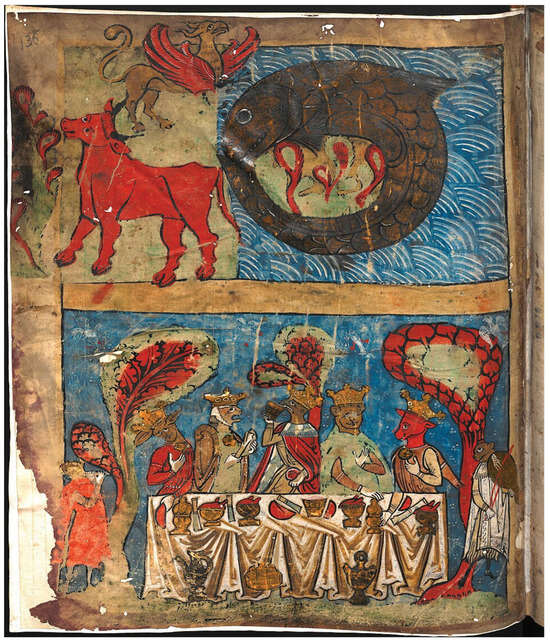
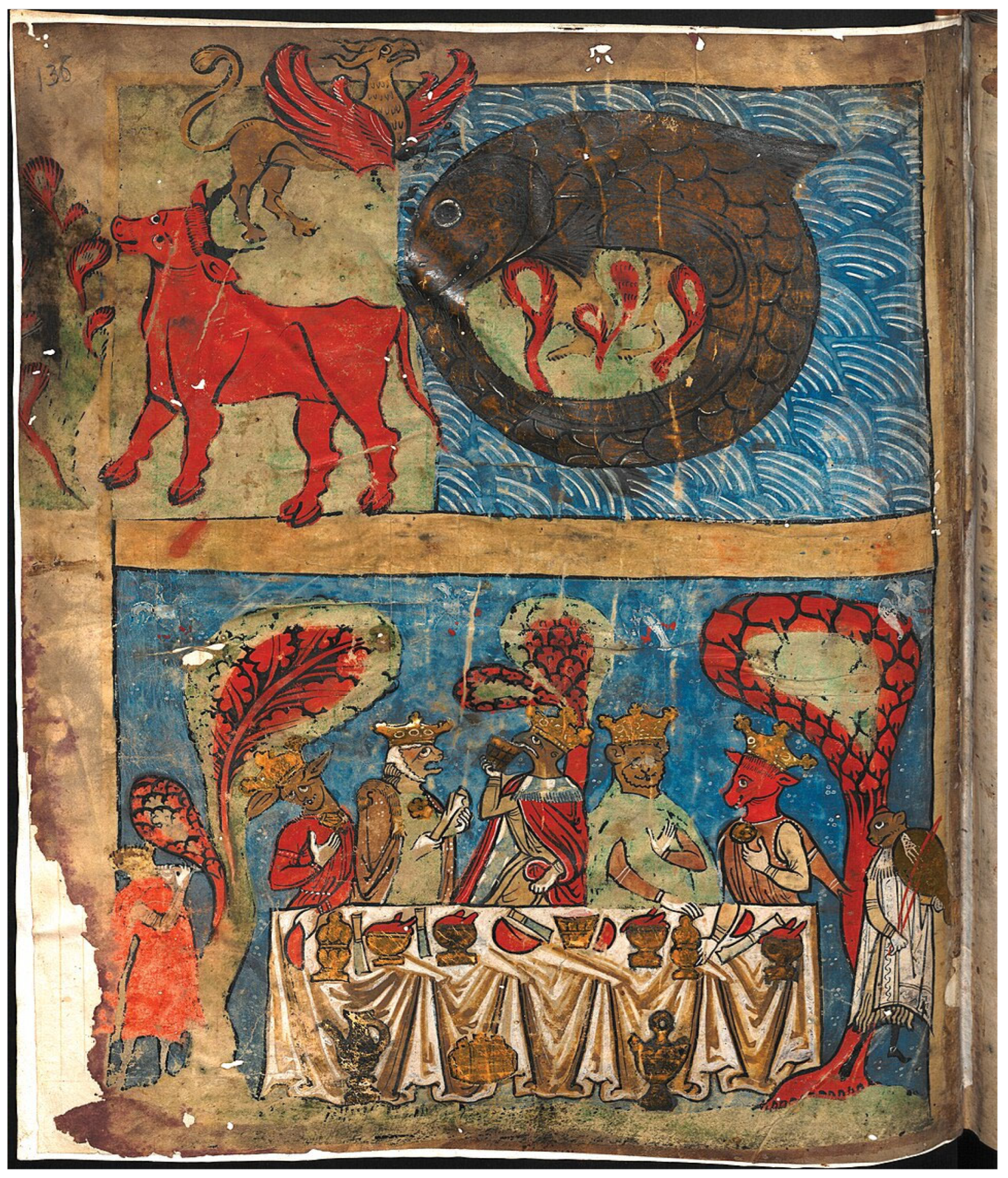
There is perhaps another source, however, showing the connection between geese and Leviathan at the messianic meal: viz., an image in the Ambrosian Bible of the eschatological banquet, shown below (Figure 1). As Eva Frojmovic has pointed out, there is a curious discordance between the text, which alludes to the eating of Leviathan, and the image accompanying it: rather than presenting the fish that symbolizes Leviathan, the banquet table instead displays a chicken or fowl. Frojmovic (2015, p. 23) suggests that substitution of the chicken or fowl, foods found on a noble’s table, was intended to indicate the courtliness of the medieval Jewish participants, but also to show “they could imagine themselves in ‘the world to come’ as part of a social order superior to any courtly society.”10 Might one suggest that the “fowl” depicted there is not a chicken but a goose, reflecting the rabbinic tradition that the righteous will consume both geese and Leviathan? Since the illustrations in the Ambrosian Bible were produced in the late 1230s “through the collaboration of a Jewish designer and professional illuminators who were trained by a master in a Christian workshop (Shalev-Eyni 2025, pp. 94, 97),”11 and likely in a Christian workshop in the diocese of Würzburg, it is possible that Albert or Odo might have encountered this illustration. Although Albert travelled to Würzburg in 1263 and resided in its Dominican priory in Würzburg between 1264–67, where his brother Henry was prior, one cannot establish with certainty that Albert had travelled to Würzburg previously. Consequently, that Albert might have encountered this illustration must remain mere conjecture, whereas the Latin translation of Talmud passages prepared in 1245 in Paris refer explicitly to the consumption of geese and Leviathan at a messianic banquet. While this image in the Ambrosian Bible might have suggested the eschatological link between geese and Leviathan, the Latin Talmud provided explicit confirmation, and Albert’s comments on geese and Leviathan in his 1248–49 commentary on the Ecclesiastical Hierarchy of Pseudo-Dionysius the Areopagite stand as a datable, diagnostic marker, therefore, of the Latin Talmud’s reception.
Figure 1.
Ambrosian Bible, Germany (1236–1238). Primordial beasts and the Feast of the Righteous, fol. 136r, Milan, Biblioteca Ambrosiana, MS B.32 INF. Leviathan (the fish), Behemoth (the ox), and Ziz (the winged creature) are depicted at the top. Below, the righteous dine at a messianic banquet. Source: Jacob ben Samuel and Joseph ben Kalonymus, Wikimedia Commons (https://commons.wikimedia.org/wiki/File:Ambrosian_Tanakh_fg1.jpg accessed on 16 November 2026). Public Domain (PD-old).
Just as Jews of medieval Ashkenaz anticipated a messianic banquet at which the righteous would feast on Leviathan and geese in a future kingdom, so too Christian responses in medieval Germany focused attention especially on this Talmudic ‘error’. That thirteenth-century Ashkenazim in particular anticipated more intensely the imminent advent of the messianic era may have contributed a greater urgency to a Christian polemical response (Resnick 2025; Yuval 1998). The Passau anonymous, for example, also addresses the Jews’ ‘deficient’ understanding of our resurrection and identifies various Talmudic ‘heresies’ as signs of the imminent advent of Antichrist (Patschovsky 1968, pp. 174–75), including the Jews’ ‘fable’ that in the future they will eat Leviathan (Niesner 2005, p. 492). An early 1270s redaction of the Passau anonymous also incorporated Albert the Great’s academic judgement against numerous heretical propositions found in his Compilation on the [Brothers of the] New Spirit. Finally, in his rather late work, Summa theologiae, pars 2 (after 1274) Albert allegorizes references to Leviathan and again condemns as a Jewish fable its consumption at the messianic banquet (Cf. Albertus Magnus (1893a, 18: cap. 6, v.3, p. 414b; 1893b, 18: cap. 5, v.13, p. 335b; 1894a, 32: pars II, tract. 4, q. 18, m. 2, art. 1, p. 229b; pars II, tract. 4, q. 40, m. 2, art. 1, part. 1, p. 491b; 1894b, 21: cap. 5, v.6–10, p. 446a; 1895, 34: tract. 4, q. 33, art. 1, pp. 516a and 517b; 1899, 24: cap. 8, v. 37–38, p. 357b, v. 44, p. 361b, and v. 44, p. 362a-b; and cap. 12, v. 30–31, p. 487b). See also Commentarii in Job (Albertus Magnus 1904, pp. 31–32, 60. 484–85, 493–97, and 500)).
3. Conclusions
Once thirteenth-century Christians became better acquainted with the Talmud via its Latin translation(s) in Paris in 1245, Christian theologians targeted in particular the Talmudic ‘error’ that Jews look forward to a messianic banquet at which the righteous will feast on Leviathan and geese. Although Albert the Great also criticizes the Talmud in his principal contribution to natural philosophy, viz., his commentary on Aristotle’s De animalibus, in which he introduced to the medieval Latin lexicon for the first time the noun Talmudists (Talmudistae),12 his criticism over several decades of Talmudic depictions of the messianic feast of the righteous seems intended to reveal the persistent ‘carnality’ of Jews and their ‘misunderstanding’ of biblical texts as well as the continuing, deleterious influence of the Talmud upon the Jews. Moreover, his linkage of the consumption of both geese and Leviathan as foods at a messianic banquet seems only to have been made possible by the 1245 Latin translation of Talmudic texts, the Extractiones de Talmud.
Funding
This research received no external funding.
Institutional Review Board Statement
Not applicable.
Informed Consent Statement
Not applicable.
Data Availability Statement
No new data were created or analyzed in this study. Data sharing is not applicable to this article.
Conflicts of Interest
The author declares no conflict of interest.
Notes
| 1 | Cf. Pseudo William of Champeaux (1854, 163: 1046B-D, 1047D). On the carnal nature of circumcision, contrasted with the eternal, spiritual and indelible character of baptism, see also Albertus Magnus (1958b, tr. 2, ques. 3). Jewish polemics, however, often turned the Christian accusation of Jewish carnality on its head, criticizing Christian theology for its ‘carnality’ and materiality, especially for the dogma of the Incarnation that would endow God with a body requiring birth, nourishment, sleep, and other corporeal acts. See especially The Polemic of Nestor the Priest (1996, 1: 68–69). |
| 2 | In the early 15th C., Vincent of Ferrer epitomizes the Christian position: that all those biblical passages that refer to carnal Israel refer to Jews; those that refer to spiritual Israel pertain to Christians. See Vincent of Ferrer (1909, 1: 29–30). |
| 3 | Arnold of Lübeck (1868, 8.8, p. 271), d. ca. 1211–1214, adds that according to Muslims in Paradise they will eat and drink as they will, and each one of them will have intercourse daily with nine virgins, in fulfillment of their desire. According to Jacques de Vitry (2008, cap. 6.31 and 6, p. 138, lns. 284–89 and pp. 130–32, lns. 163–70) for whom Muslims are a “carnal people ignorant of spiritual things” (carnalis populus spiritualium ignarus), the Muslims’ conception of Paradise is merely an extension of their present-day obedience to carnal appetite and the passions, such that in Paradise and after the resurrection of the body they will satisfy their carnal desire with many beautiful virgins and produce as many sons as they wish. |
| 4 | For the ancient and early rabbinic sources on Leviathan and for its appearance in an eschatological banquet, see Whitney (2006, pp. 127–54); and Mulder (2017). For a detailed discussion of Leviathan in both Jewish and Christian traditions, see Leviathan (2018). The earliest iconographic depiction showing Leviathan, Behemoth, and Ziz together appears in the northern French London Miscellany, British Library Add. MS 11639 (after 1278); see https://www.facsimiles.com/facsimiles/north-french-hebrew-miscellany#&gid=1&pid=9 (accessed on 16 November 2026). For discussion of the manuscript, its provenance, and its illuminations, see Offenberg (2015). |
| 5 | “Quarta opinio […] dicebat quod resurget anima cum eodem corpore, sed illud corpus utetur cibis sicut nunc et al.iis delectationibus corporalibus, et in hoc esse beatitudinem. Et hoc dicit Papias Hieroapolites, quem secuti sunt etiam in hoc Apollinaristae, et hoc etiam dicit Machumet in lege sua, et similiter iudaei in Talmuth quod comedent anseres in alia vita et Leviathan.” See Fidora (2020, p. 57) and Resnick (2002, pp. 74–77). For Albert’s remarks on the nature of Leviathan, see Albertus Magnus (1894a, 32: Pars II, tract. 10, q. 40, m. 2, art. 1, part. 1, p. 491b); (1895, 34: tract. 4, q. 33, art. 1, pp. 516a and 517b); (1899, 24: cap. 8, v. 44, p. 362a-b). For medieval rabbinic treatments of Leviathan and Behemoth, see Lehnardt (2009), and Frim (2017). For Jewish–Christian discussions, see Noegel (2015). For medieval Islamic depictions of Leviathan, see Orlov (2023b, chap. 2). |
| 6 | Cf. Ps. 104.26 [Jewish Publication Society trans.]: “Leviathan that you formed to sport with.” Also Ps. 74.14 [Jewish Publication Society trans.]: “It was You who crushed the heads of Leviathan, who left him as food for the denizens of the desert.” The Vulgate, Ps. 103.26, reads: “the sea dragon [draco] that you have formed to play therein.”; and Vulgate Ps. 73.14: “You have broken the heads of the dragon [capita draconis]: you have given him to be meat for the people of the Ethiopians.” For Talmudic discussion of Ps. 104.26, see Babylonian Talmud (hereafter, B.T.) Avodah Zarah 3b, cited in Extractiones de Talmud per ordinem sequentialem (2018, nr. 1506 and 1508, p. 416) and Extractiones de Talmud per ordinem thematicum (Cecini et al. 2021, nr. 34, p. 58 and nr. 53, p. 64). On Leviathan as a feast for the righteous, see B.T. Baba Batra 75a; Pirkei de Rabbi Eliezer (1916, 10:9, p. 70); and Ginzberg (1913, 1: 27–28) where the flesh of Leviathan will not only serve as a feast for the righteous but also from its skin God will prepare tents for the pious. This is also mentioned at Extractiones de Talmud per ordinem thematicum (Cecini et al. 2021, nr. 24, p. 176 and nr. 63, p. 326). The righteous will also feast on the flesh of Behemoth (Ginzberg 1913, 1: 30), a tradition that is also recounted in Extractiones de Talmud per ordinem sequentialem (2018, nr. 829, p. 215) and Extractiones de Talmud per ordinem thematicum (Cecini et al. 2021, nr. 2, p. 170 and 22, p. 176). For an extensive list of rabbinic passages on Leviathan, see https://www.sefaria.org/search?q=Leviathan&tab=text&tvar=1&tsort=relevance (accessed on 16 November 2026). |
| 7 | For the illumination of Leviathan and Behemoth in the Ambrosian Bible, see also Lehnardt (2009, pp. 117–18); Gutmann (1967–1968, pp. 168–69); and Borgó (2020, pp. 35–36, 46–47). For analysis of the political-messianic symbolism of the image of the eschatological banquet in the Ambrosian Bible, see Frojmovic (2015). In his commentary on Job, Albertus Magnus (1904, cap. 40, 20, p. 484) cites St. Jerome to insist that it is a [Talmudic] “fable” of the Jews that Behemoth is a huge ox or that Leviathan is a fish whose body surrounds the entire world. |
| 8 | See also Martini (1990, 6.10, pars I, p. 252). Lampurlanés Farré (2020, pp. 114–15) proposes that the Excerptum de Talmud was produced in southern Germany although its author and the precise date of composition are unknown (Lampurlanés Farré 2020, p. 78). |
| 9 | For additional evidence that the Talmudic tradition that Leviathan will be eaten in the future had become a point of dispute between Jews and Christians at the time of the Talmud controversy in the 13th C., see also Hames (2013, pp. 217–18) where Hames introduces evidence from the 13th C. Holy War (Milhemet Mizvah) by Meir ben Simon ha-Meili (of Narbonne). For discussion of this latter text—principally a dialogue between a Christian and a Jew—as a historical source for French Jewry at the middle of the thirteenth century, see Chazan (1985). |
| 10 | For this image, see also Narkiss (1969, plate 25, p. 91; https://archive.org/details/hebrewilluminate0000nark/page/91/mode/1up?q=Leviathan accessed on 16 November 2026). For the manuscript and its images, see also Gertsman (2022). |
| 11 | For Albert’s brother Henry of Lauingen, see Freed (1973). |
| 12 | Albertus Magnus (1920, 7.1.3.21, 1: 504, lns. 22–23). For the claim that Albert was the first to introduce this noun, see Fidora (2020, p. 38). |
References
- Abulafia, Anna Sapir. 1992. Jewish Carnality in Twelfth-Century Renaissance Thought. In Christianity and Judaism. Papers Read at the 1991 Summer Meeting and the 1992 Winter Meeting of the Ecclesiastical History Society. Edited by Diana Wood. Oxford: Blackwell Publishers, pp. 59–75. [Google Scholar]
- Abulafia, Anna Sapir. 1998. Christians and Jews in Dispute. Disputational Literature and the Rise of Anti-Judaism in the West (c. 1000–1150). Aldershot: Ashgate. [Google Scholar]
- Abulafia, Anna Sapir. 2002. The Intellectual and Spiritual Quest for Christ and Central Medieval Persecution of Jews. In Religious Violence Between Christians and Jews. Medieval Roots, Modern Perspectives. Edited by Anna Sapir Abulafia. New York: Palgrave, pp. 61–85. [Google Scholar]
- Albert the Great. 2019. On Job. Translated by Franklin Harkins. Fathers of the Church Medieval Continuation 19. Washington: The Catholic University of America Press. [Google Scholar]
- Albert the Great. 2020. On Resurrection. Translated by Irven M. Resnick, and Franklin T. Harkins. Fathers of the Church, Mediaeval Continuation 20. Washington: The Catholic University of America Press. [Google Scholar]
- Albertus, Magnus. 1893a. Super Baruch. In B. Alberti Magni Ratisbonensis Episcopi, Ordinis Praedicatorum, Opera omnia. Edited by Auguste Borgnet. Paris: Vivès, vol. 18. [Google Scholar]
- Albertus, Magnus. 1893b. Super Threnos. In B. Alberti Magni Ratisbonensis Episcopi, Ordinis Praedicatorum, Opera omnia. Edited by Auguste Borgnet. Paris: Vivès, vol. 18. [Google Scholar]
- Albertus, Magnus. 1894a. Summa theologiae. In B. Alberti Magni Ratisbonensis Episcopi, Ordinis Praedicatorum, Opera omnia. Edited by Auguste Borgnet. Paris: Vivès, vol. 32. [Google Scholar]
- Albertus, Magnus. 1894b. Super Marcum. In B. Alberti Magni Ratisbonensis Episcopi, Ordinis Praedicatorum, Opera omnia. Edited by Auguste Borgnet. Paris: Vivès, vol. 21. [Google Scholar]
- Albertus, Magnus. 1895. De IV coaequaevis. In B. Alberti Magni Ratisbonensis Episcopi, Ordinis Praedicatorum, Opera omnia. Edited by Auguste Borgnet. Paris: Vivès, vol. 34. [Google Scholar]
- Albertus, Magnus. 1899. Super Iohannem. In B. Alberti Magni Ratisbonensis Episcopi, Ordinis Praedicatorum, Opera omnia. Edited by Auguste Borgnet. Paris: Vivès, vol. 24. [Google Scholar]
- Albertus, Magnus. 1904. Super Job. Edited by Melchior Weiss. Freiburg im Breisgau: Herder. [Google Scholar]
- Albertus, Magnus. 1920. De Animalibus Libri XXV. Edited by Hermann Stadler. Beiträge zur Geschichte der Philosophie des Mittelalters, 16. Münster i. Westf.: Aschendorff. [Google Scholar]
- Albertus, Magnus. 1958a. De Resurrectione. Edited by Wilhelm Kübel. Editio Coloniensis 26. Münster: Aschendorff. [Google Scholar]
- Albertus, Magnus. 1958b. De Sacramentis. Edited by Albert Ohlmeyer. Editio Coloniensis 26. Münster: Aschendorff. [Google Scholar]
- Albertus, Magnus. 1999. Super Dionysium de Ecclesiastica Hierarchia. Edited by Maria Burger. Editio Coloniensis 36/2. Münster: Aschendorff. [Google Scholar]
- Arnold of Lübeck. 1868. Chronica Slavorum. Edited by Johann Martin Lappenberg. Monumenta Germaniae Historica, Scriptores rerum Germanicarum in usum scholarum separatim editi 14. Hannover: Hahn. [Google Scholar]
- Behrman, David. 1999. Volumina vilissima, A Sermon of Eudes de Châteauroux on the Jews and their Talmud. In Le brûlement du Talmud à Paris 1242–1244. Edited by Gilbert Dahan. Paris: Les Editions du Cerf, pp. 191–209. [Google Scholar]
- Borgó, András. 2020. Hybrid Bodies in Hebrew Manuscript Illuminations. In Corps Hybrides aux Frontières de L’Humain au Moyen Âge. Edited by Antonella Sciancalepore. Louvain-La-Neuve: Publications de L’Institut d’Études Mediévalés, pp. 33–61. [Google Scholar]
- Cecini, Ulisse, and Óscar de la Cruz Palma, eds. 2018. Extractiones de Talmud per ordinem sequentialem. With assistance from Eulàlia Vernet i Pons and Federico Dal Bo. Corpus Christianorum Continuatio Mediaevalis 291. Turnhout: Brepols. [Google Scholar]
- Cecini, Ulisse, Óscar de la Cruz Palma, Alexander Fidora, and Görge K. Hasselhoff, eds. 2026. The Controversy Surrounding the Talmud: Texts from the Parisian Dossier (1238–1248). In collaboration with Piero Capelli, Isaac Lampurlanés Farré, and Wout Van Bekkum. Turnhout: Brepols. [Google Scholar]
- Cecini, Ulisse, Óscar de la Cruz Palma, Alexander Fidora, and Isaac Lampurlanés Farré, eds. 2021. Extractiones de Talmud per ordinem thematicum. Corpus Christianorum Continuatio Mediaevalis 291A. Turnhout: Brepols. [Google Scholar]
- Chazan, Robert. 1985. Polemical Themes in the Milḥemet Miẓvah. In Les Juifs au Regard de L’Histoire, Mélanges en l’honneur de Bernhard Blumenkranz. Edited by Gilbert Dahan. Paris: Picard, pp. 169–84. [Google Scholar]
- Cohen, Jeremy. 1986. Scholarship and Intolerance in the Medieval Academy: The Study and Evaluation of Judaism in European Christendom. The American Historical Review 91: 592–613. [Google Scholar] [CrossRef] [Scilit]
- Daniel, E. Randolph. 2004. Abbot Joachim of Fiore and the Conversion of the Jews. In Friars and the Jews in the Middle Ages and Renaissance. Edited by Steven J. McMichael and Susan E. Myers. Leiden: Brill, pp. 1–21. [Google Scholar]
- Epstein, Marc Michael. 1992. “If Lions Could Carve Stones…”: Medieval Jewry and the Allegorization of the Animal Kingdom. A Textual and Iconographic Study. Ph.D. dissertation, Yale University, Ann Arbor, MI, USA. [Google Scholar]
- Fidora, Alexander. 2017. Albert the Great and the Latin Talmud. In Appropriation, Interpretation and Criticism: Philosophical and Theological Exchanges between the Arabic, Hebrew and Latin Intellectual Traditions. Edited by Alexander Fidora and Nicola Polloni. Barcelona and Rome: Fédération Internationale des Instituts d’Études Médiévales, pp. 121–36. [Google Scholar]
- Fidora, Alexander. 2019. The Influence of the Extractiones de Talmud on Anti-Jewish Sermons from the Thirteenth and Early Fourteenth Centuries. In The Talmud in Dispute During the High Middle Ages. Edited by Alexander Fidora and Görge Hasselhoff. Bellatera: Servei de Publicacions de la Universitat Autònoma de Barcelona, pp. 235–47. [Google Scholar]
- Fidora, Alexander. 2020. Albertus Magnus und der Talmud. Lectio Albertina 20. Münster: Aschendorff. [Google Scholar]
- Freed, John B. 1973. St. Albert’s Brother Henry of Lauingen O.P. Archivum fratrum praedicatorum 48: 63–70. [Google Scholar]
- Frim, Daniel J. 2017. Those Who Descend upon the Sea Told Me…. The Jewish Quarterly Review 107: 1–37. [Google Scholar] [CrossRef] [Scilit]
- Frojmovic, Eva. 2015. Feasting at the Lord’s Table. Images: A journal of Jewish art and visual culture 7: 5–21. Available online: https://eprints.whiterose.ac.uk/id/eprint/86484/3/Frojmovic%20%20Final%201%203%20May%202015-text%20abst%20and%20bio-RT.pdf (accessed on 16 November 2026).
- Gertsman, Elina. 2022. Animal Affinities: Monsters and Marvels in the Ambrosian Tanakh. Gesta 61: 27–55. [Google Scholar] [CrossRef] [Scilit]
- Ginzberg, Louis. 1913. The Legends of the Jews. Translated by Henrietta Szold. Philadelphia: The Jewish Publication Society of America, Vol. 1. [Google Scholar]
- Gutmann, Joseph. 1967–1968. When the Kingdom Comes: Messianic Themes in Medieval Jewish Art. Art Journal 27: 168–75. [Google Scholar] [CrossRef] [Scilit]
- Gutmann, Joseph. 1971. Leviathan, Behemoth and Ziz: Jewish Messianic Symbols in Art. In No Graven Images: Studies in Art and the Hebrew Bible. Edited by Joseph Gutmann. New York: KTAV, pp. 515–26. [Google Scholar]
- Gutmann, Joseph. 1979. Medieval Jewish Image: Controversies, Contributions, Conceptions. In Aspects of Jewish Culture in the Middle Ages. Edited by Paul E. Szarmach. Albany: SUNY Press Albany, pp. 121–50. [Google Scholar]
- Hames, Harvey J. 2013. Urinating on the Cross. Christianity as seen in the Sefer Yoseph Ha-Mekaneh (ca. 1260) and in Light of Paris 1240. In Ritus Infidelium. Miradas interconfesionales sobre las prácticas religiosas en la Edad Media. Edited by José Martínez Gásquez and John Victor Tolan. Collection de la Casa de Velázquez 138. Madrid: Casa de Velázquez, pp. 209–20. [Google Scholar]
- Hildebrandt, Reiner, ed. 1974. Summarium Heinrici. Vol. 2, Berlin: Walter de Gruyter. [Google Scholar]
- Hollender, Elizabeth. 2013. Das Mahl der Gerechten in Yotserot für Shabbat Hatan. In Die SchUM-Gemeinden Speyer, Worms, Mainz: Auf dem Weg zum Welterbe. Edited by Pia Heberer. Regensburg: Schnell + Steiner, pp. 221–33. [Google Scholar]
- Jacques, de Vitry. 2008. Histoire Orientale/Historia Orientalis. Edited and Translated by Jean Donnadieu. Turnhout: Brepols. [Google Scholar]
- Khaimovich, Boris. 2020. Leviathan: The Metamorphosis of a Medieval Image. Images 14: 20–39. [Google Scholar] [CrossRef] [Scilit]
- Konyevsky, Hayyim, ed. 1978. Perush HaRokeach Al’HaTorah. Bnei Brak: Julius Klugmann and Sons. [Google Scholar]
- Kriegel, Maurice. 2012. The Reckonings of Nahmanides and Arnold of Villanova: On the early contacts between Christian millenarianism and Jewish Messianism. Jewish History 26: 17–40. [Google Scholar] [CrossRef] [Scilit]
- Lampurlanés Farré, Isaac, ed. and trans. 2020. Excerptum de Talmud. Turnhout: Brepols. [Google Scholar]
- Lehnardt, Andreas. 2009. Leviathan und Behemoth. Mythische Urwesen in jüdischen Tradition. In Tiere und Fabelwesen im Mittelalter. Edited by Sabine Obermaier. Berlin: Walter De Gruyter, pp. 105–29. [Google Scholar]
- Leviathan. 2018. Encyclopedia of Biblical Reception. Berlin and Boston: Walter de Gruyter, vol. 16, pp. 291–310. [Google Scholar]
- Maccoby, Hyam, ed. and trans. 1982. Judaism on Trial: Jewish-Christian Disputations in the Middle Ages. London and Toronto: Associated University Presses. [Google Scholar]
- Martini, Raimund. 1990. Capistrum Iudaeorum. Edited and Translated by Adolfo Robles Sierra. Würzburg: Echter. [Google Scholar]
- Mulder, Michael. 2017. Leviathan on the menu of the messianic meal: The use of various images of Leviathan in early Jewish tradition. In Playing with Leviathan. Interpretation and Reception of Monsters from the Biblical World. Edited by Koert van Bekkum, Jaap Dekker, Henk van de Kamp and Eric Peels. Leiden and Boston: Brill, pp. 117–30. [Google Scholar]
- Narkiss, Bezalel. 1969. Hebrew Illuminated Manuscripts. Jerusalem: Keter Publishing House Ltd. [Google Scholar]
- Niesner, Manuela. 2005. ‘Wer Mit Juden Well Disputiren’. Deutschsprachige Adversus-Judaeos-Literatur des 14. Jahrhunderts. Tübingen: Max Niemeyer Verlag. [Google Scholar]
- Noegel, Scott B. 2015. Jonah and Leviathan. Inner-Biblical Allusions and the Problem with Dragons. Hen 37: 236–60. [Google Scholar]
- Offenberg, Sara. 2015. Mirroring Samson the Martyr: Reflections of Jewish-Christian Relations in the North French Hebrew Illuminated Miscellany. In Jews and Christians in Thirteenth-Century France. Edited by Elisheva Baumgarten and Judah D. Galinsky. New York: Palgrave Macmillan, pp. 203–16. [Google Scholar]
- Orlov, Andrei. 2023a. Eschatological Consumption of Leviathan and Behemoth as Revelation of the Messianic Torah. In Watering the Garden. Studies in Honor of Deirdre Dempsey. Edited by Andrei Orlov. Piscataway: Gorgias Press, pp. 239–86. [Google Scholar]
- Orlov, Andrei. 2023b. Supernal Serpent: Mysteries of Leviathan in Judaism and Christianity. Oxford: Oxford University Press. [Google Scholar]
- Patschovsky, Alexander, ed. 1968. Der Passauer Anonymus: Ein Sammelwerk über Ketzer, Juden, Antichrist aus der Mitte des 13. Jahrhunderts. Schriften der Monumenta Germaniae Historica 22. Stuttgart: Anton Hiersemann. [Google Scholar]
- Perfetti, Stefano. 2018. Biblical Exegesis and Aristotelian Naturalism: Albert the Great, Thomas Aquinas, and the Animals of the Book of Job. Aisthesis 11: 81–96. [Google Scholar] [CrossRef] [Scilit]
- Peter the Venerable. 2013. Against the Inveterate Obduracy of the Jews. Translated by Irven M. Resnick. Fathers of the Church, Mediaeval Continuation 14. Washington: The Catholic University of America Press. [Google Scholar]
- Peter the Venerable. 2016. Summa totius haeresis Saracenorum. In Writings Against the Saracens. Translated by Irven M. Resnick. Fathers of the Church, Mediaeval Continuation 16. Washington: The Catholic University of America Press. [Google Scholar]
- Pirkei de Rabbi Eliezer. 1916. Friedlander, Gerald, trans. London: Kegan Paul, Trench, Trubner & Co. Ltd. [Google Scholar]
- Pseudo William of Champeaux. 1854. Dialogus inter christianum et judaeum de fide catholica. In Patrologiae Cursus Completus, Series Latina. Edited by Jacques-Paul Migne. Paris: Ateliers Catholiques, vol. 163. [Google Scholar]
- Resnick, Irven M. 2002. Talmud, Talmudisti, and Albert the Great. Viator 33: 69–86. [Google Scholar] [CrossRef] [Scilit]
- Resnick, Irven M. 2018. Peter the Venerable on the Talmud, the Jews, and Islam. Medieval Encounters 24: 510–29. [Google Scholar] [CrossRef] [Scilit]
- Resnick, Irven M. 2025. Mongols, Apocalyptic Messianism, and Later Medieval Christian Fears of Mass Conversion to Judaism. Histories 5: 36. [Google Scholar] [CrossRef] [Scilit]
- Schneyer, Johannes Baptist. 1969. Alberts des Grossen Augsburger Predigtzyklus über den hl. Augustinus. Recherches de théologie ancienne et médiévale 36: 100–47. [Google Scholar]
- Shalev-Eyni, Sarit. 2025. The Making of the Ambrosian Bible and the Emergence of the German-Ashkenazi Variant of the Masoretic Biblical Codex. Corpus Masoreticum Working Papers 11: 80–103. [Google Scholar] [CrossRef]
- The Polemic of Nestor the Priest. 1996. Daniel J., Lasker, and Sarah Stroumsa, trans. Jerusalem: Ben-Zvi Institute for the Study of Jewish Communities in the East, vol. 1. [Google Scholar]
- The Trial of the Talmud: Paris, 1240. 2012. John, Friedman, and Jean Connell Hoff, trans. Toronto: Pontifical Institute of Mediaeval Studies. [Google Scholar]
- Vincent of Ferrer. 1909. Traité contre les Juifs (Tractatus contra Judeorum detestabilem horrendam veteremque perfidiam). In Oeuvres de Saint Vincent Ferrer. Edited by Pierre Henri Fages. 2 vols, Paris: A. Picard et fils. [Google Scholar]
- Whitney, K. William. 2006. Two Strange Beasts: Leviathan and Behemoth in Second Temple and Early Rabbinic Judaism. Harvard Semitic Monographs 63. Winona Lake: Eisenbrauns. [Google Scholar]
- Yuval, Israel Jacob. 1998. Jewish Messianic Expectations towards 1240 and Christian Reactions. In Toward the Millennium: Messianic Expectations from the Bible to Waco. Edited by Peter Schäfer and Mark Cohen. Studies in the History of Religions. vol. 77, Leiden: Brill, pp. 105–21. [Google Scholar]
Disclaimer/Publisher’s Note: The statements, opinions and data contained in all publications are solely those of the individual author(s) and contributor(s) and not of MDPI and/or the editor(s). MDPI and/or the editor(s) disclaim responsibility for any injury to people or property resulting from any ideas, methods, instructions or products referred to in the content. |
© 2026 by the author. Licensee MDPI, Basel, Switzerland. This article is an open access article distributed under the terms and conditions of the Creative Commons Attribution (CC BY) license.