


Abstract
This study examines Seongbuldo (成佛圖), a traditional Korean Buddhist board game from the Joseon Dynasty, as a historical example of religious game-based learning. Drawing on historical sources and contemporary educational theories, it analyzes how key Buddhist doctrines and values—including karma, rebirth, spiritual cultivation, compassion, and enlightenment—are embodied in the game’s board design, rules, and gameplay. The analysis further shows that Seongbuldo incorporates educational features emphasized in contemporary gamification and game-based learning, such as clearly defined goals, structured progression, immediate feedback, rewards and penalties, and a balance between competition and cooperation. However, its reliance on chance-based dice mechanics may simplify complex Buddhist doctrines, and some traditional representations require critical reinterpretation in light of contemporary educational values and inclusive pedagogy. Nevertheless, this study reconsiders Seongbuldo not merely as a traditional pastime but as a historical educational game that integrated religious education, character formation, and experiential learning, suggesting that traditional Buddhist games can serve as valuable cultural resources for contemporary character education and game-based learning.
1. Introduction
Historically, Buddhism has effectively utilized playful experiences as powerful tools for religious education and the dissemination of its teachings.
This approach was particularly prominent during Korea’s Joseon Dynasty, where traditional board games served not only as entertainment but also as vital tools for spiritual instruction and ethical development. A prime example of this tradition is Seongbuldo (成佛圖, a board game of attaining Buddhahood), a traditional Korean Buddhist board game designed explicitly to illustrate Buddhist practices and guide players through the process of enlightenment. Similarly, the board game Xuanfotu (選佛圖, Selection of Buddhas), designed by Ouyi Zhixu (蕅益智旭, 1599–1655) during the Ming Dynasty in China, embodied the principle of karma in a playful form, allowing players to experientially learn Buddhist practice and moral development (McGuire 2014). In particular, McGuire highlights that the dice used in Selection of Buddhas were imprinted with the phrase “南無阿彌陀佛 (Namo Amitābhāya Buddhāya)” instead of traditional numbers. This emphasizes the Buddhist idea that players can transform their karma through devotional recitation and reliance on the bodhisattvas.1 This structure closely parallels the doctrinal features reflected in the rules and mechanics of Seongbuldo.
Although Xuanfotu and Seongbuldo share notable structural similarities, particularly their use of dice associated with the six-character invocation of Amitābha and their representation of progress toward Buddhahood, their doctrinal organization and rules of play are not identical. In Ouyi Zhixu’s Xuanfotu, the six characters Na-mo-a-mi-tuo-fo are assigned specific ethical and doctrinal meanings, ranging from affliction and delusion to generosity, morality, meditation, and wisdom. Combinations of characters on two dice determine players’ movement through a board that encompasses stages of rebirth, Buddhist practices, Tiantai doctrinal classifications, Pure Land rebirth, and final realization (McGuire 2014, pp. 12–14). By contrast, the Korean Seongbuldo described in the historical sources examined here employs the six-character invocation Namu Amitabul to determine ascent or descent through a Buddhist cosmological and soteriological hierarchy extending from hell to Daegak (大覺, Great Enlightenment). Later Seongbuldo boards examined in this study further organize this journey through such elements as yukdo (六道, Six Paths) and sammun (三門, Three Gates). Thus, although the two games share a devotional use of Amitābha’s invocation and a common orientation toward Buddhahood, they articulate the Buddhist path through distinct doctrinal configurations and specific rules of progression.
Beyond mere entertainment, Seongbuldo functioned as an educational instrument intricately intertwining doctrinal instruction with devotional practices. Contemporary Buddhist educators increasingly advocate experiential, learner-centered approaches, emphasizing active learning and critical thinking (Jae-su Lee 2019; Regan 2021). Concurrently, modern gamification theory has evolved, placing greater emphasis on fostering moral development, empathy, and character formation through immersive, interactive experiences (Yang 2019; FitzGerald and Groff 2011). These dual aspects underscore the broader educational significance of the Seongbuldo game, particularly its potential to connect the experiential learning of Buddhist teachings and ethical values with contemporary approaches to game-based and character education.
The evolving educational landscape highlights the urgent need to reassess the educational value of traditional pedagogical games like Seongbuldo. This game has the potential to integrate experiential learning, moral development, and religious practice in ways that resonate with contemporary educational theories. However, prior research has largely focused on Seongbuldo from historical and cultural angles, leaving a notable gap in understanding its specific pedagogical mechanisms and potential applications in modern education (Song 2010, p. 252).
This paper seeks to fill that gap by systematically analyzing the pedagogical elements present in Seongbuldo, particularly how its gameplay conveys fundamental Buddhist values such as karma (karmic retribution; 業報), rebirth (saṃsāra; 輪廻), religious practice, and enlightenment (Buddhahood; 成佛). Additionally, the analysis will explore the game structure of Seongbuldo through the lens of Self-Determination Theory (SDT), which emphasizes intrinsic motivation and learner autonomy (Ryan and Deci 2020). It will also investigate the educational significance of attentional control and self-regulation fostered through rules and rituals, along with interpersonal interactions and mutual respect among participants.
Based on this analysis, the present study addresses three research questions:
First, how does Seongbuldo convey core Buddhist doctrines and values—including karma, rebirth, religious practice, and enlightenment—through its board design, rules, and gameplay?
Second, to what extent do the structural features of Seongbuldo align with the principles of contemporary game-based learning and gamification, such as goal setting, incremental progression, feedback, reward and penalty systems, and the balance between competition and cooperation?
Third, what implications do the game structure and pedagogical principles of Seongbuldo have for contemporary character education, and how might they be applied in modern educational contexts?
To comprehensively address these questions, this study examines primary historical sources from the Joseon period, including Yongjae Chonghwa (慵齋叢話, Assorted Writings of Yongjae),2 alongside contemporary scholarly research. Furthermore, Seongbuldo’s unique educational features are highlighted through comparative analysis with analogous traditional board games such as Seunggyeongdo (陞卿圖, a bureaucratic promotion game), Jongjeongdo (從政圖, a game of political advancement), and Jakseongdo (作聖圖, a Confucian ethical self-cultivation game).
This study aims to reexamine the educational significance of the traditional Buddhist game Seongbuldo by analyzing its pedagogical and philosophical structure. It discusses the game from the perspectives of contemporary game-based learning and character education. Additionally, the study seeks to provide theoretical implications for applying Buddhist ethical and religious values to modern education while exploring the potential for developing educational content rooted in traditional cultural heritage.
2. Historical Background
Seongbuldo is conventionally assigned a Goryeo origin, and the attribution proves to have a documentary basis. The Hyeonhaeng Seobang Gyeong (現行西方經), an apocryphal scripture attributed to Woncham (元旵) and dated by its own account to the first month of 12983, names the game and describes its apparatus4:
“Chalmok are what are today called saeng (栍, lots). Later, learned men examined the matter and mistakenly held that chalmok meant yunmok (輪木), a six-sided wooden rod cast to read the face that comes up. The yunmok has six faces, inscribed with nothing but the six graphs Namu Amitabul, and with these they made a Seongbuldo. Down to the present it is played for amusement, which is laughable.” (扎木者 今之栍也 其後智人叅之 誤謂扎木者輪木也 輪木六面 只書南無阿彌陁佛六字 作成佛圖 至今爲戱可笑也)(HBJ 6.864a08-11)
Three points follow. First, the name Seongbuldo (成佛圖) is attested at least two centuries before the Yongjae Chonghwa. Second, the randomizing device described here—a six-faced yunmok bearing one graph of the Amitābha invocation per face—is the device Seong Hyeon (成俔, 1439–1504) would describe in almost identical wording5, so the game’s central mechanism was already fixed in late Goryeo and the Yongjae Chonghwa is a second witness to a settled formula rather than the first description of the game. Third, the phrase 至今爲戱, “down to the present it is played for amusement,” presents Seongbuldo not as a novelty but as a pastime of long standing: 至今 marks a practice already of some duration at the time of writing, which places its formation earlier still. The passage is a hostile witness, and its evidentiary weight should be divided accordingly. It is strong evidence for what existed and weak evidence for how it came to exist. That a polemicist should denounce the game establishes that his readers knew it; that he explains its origin as a misreading of 扎木 for 輪木 is a claim internal to his own restorationist argument and one that serves it. This study therefore takes the passage as attesting the game’s form and currency in late Goryeo, while treating its account of the game’s genesis as a contemporary interpretation rather than as established fact.6
What makes the Hyeonhaeng Seobang Gyeong valuable for the present argument is not the polemical notice alone but the ritual the scripture teaches, which is itself organized on ludic principles—that is, principles grounded in play, playfulness, and game-like forms of participation. The monk Nakseo (樂西) transmits to Woncham a forty-graph gāthā and a procedure for casting lots to determine one’s place of rebirth:
“Namu Amitabul—the subtle and marvelous mantra of his original mind. The moment it reaches the ear, one is straightway reborn, and together with the host of sages sports in the ocean of the Tathāgata’s great wisdom, merit and virtue. All this is bestowed at once upon those who recite and uphold it.” (南無阿彌陁佛本心微妙眞言 才聞於耳 即往生 與諸聖衆同遊戱如來大智福德海 一時分付誦持者)(HBJ 6.861a23-b01)
The scripture then specifies the apparatus: “These forty graphs of the gāthā are written on forty lots, the graph bul (佛) alone being written twice, making forty-one lots.” (此頌四十字名 各書四十栍 唯佛字疊書兩栍 爲四十一栍 HBJ 6.861b02-03). Four features of this procedure bear directly on the later board game.
The ladder is generated by the text, not by doctrine. The forty-one stations (位) are not the forty-one grades of the bodhisattva path; they are an artifact of the gāthā’s graph order. The six graphs of the invocation 南無阿彌陁佛 mark the extremities of the ladder—bul 佛, ta 陀, mi 彌 and a 阿 carry the four highest grades of Pure Land rebirth, while mu 無 and nam 南 carry the hell realms at the foot—and the remaining thirty-four graphs, from the bon 本 to ja 者, fill the middle in unbroken sequence. Read upward from the bottom of the ladder, the six graphs of the Amitābha invocation therefore span the whole soteriological range from Avīci to Buddhahood. Table 1 sets out the correspondence. The number of forty-one is likewise mechanical rather than doctrinal: forty graphs plus the doubled bul yields forty-one lots, and the doubled bul, which the text glosses as representing the dharmakāya and nirmāṇakāya of Amitāyus (表無量壽法化二身 HBJ 6.861b11), is the only combination in the system.
Table 1.
The forty-one stations of the Hyeonhaeng Seobang Gyeong and their generation from the forty-graph gāthā 1.
The board is the assembly itself. The procedure prescribes not merely a private divi-nation but a seating order: participants take their places in the hall according to the station each has drawn (隨出栍四十一處 善惡高下之次坐之 HBJ 6.861b09-10). The scripture is explicit that worldly rank is suspended for the duration—“though they be ruler and sub-ject, father and son, master and slave, they sit according to the order of the lots drawn” (雖君臣父子奴主 從出栍之次坐之 HBJ 6.862a19-20)—and that a household slave who draws a high station is to be moved up while the master bows and says “I am not your equal” (雖我奴婢得上位者 推而上之 合掌云吾不如汝 HBJ 6.862a23-24).
The soteriological ladder is thus realized as a physical arrangement of bodies. What the later board does is not to externalize a mental scheme but to transfer a scheme already embodied in the assembly onto paper: the participant who was himself the piece comes to hold a piece instead. The system runs on two tracks with different movement rules. Of the forty-one lots, eleven constitute the Pure Land set, running from the station of Buddhahood to rebirth in the celestial palaces (淨土栍者 自佛位至宮殿受生 爲十一栍也 HBJ 6.862a06-07); the remaining thirty cover the destinies of transmigration. Movement on the two tracks is governed by opposed rules. On the Pure Land track there is advance but no retreat (淨土之法 有進無退 HBJ 6.862b11): a participant who has reached it in an earlier round no longer casts the full forty-one lots but only the eleven Pure Land lots, and cannot be returned to a lower grade. On the track of the destinies, by contrast, “the affairs of transmigration follow the round, now up, now down” (諸趣則輪廻之事隨番 或上或下 HBJ 6.862b13-14).
The boards of the six-destiny lineage preserve this division as the outer circuit of the six destinies and the inner precinct of the three gates, from which there is no falling back. Play does not end when a player wins. Those who have reached the Pure Land withdraw from casting but not from the assembly; they remain and make the vow that all who are still in the destinies may be reborn there (往淨土之人 不擲栍 但發願云 諸趣之人皆生淨土 HBJ 6.861c02-04), and the scripture designates the final round as “the transformation of the whole multitude in due order” (此順化群生也 HBJ 6.862b23). This is the same win condition as that of the surviving game, in which play continues until every participant has attained Buddhahood.
To these may be added the procedural apparatus of the assembly: four rounds with recitation quotas that descend from ten thousand repetitions to five hundred; designated officers, comprising a caster (行者), a sorter who removes the face-down lots (揀栍者), and an interpreter who reads out the passage under the graph drawn and expounds it (說意者): a method of resolution by elimination, in which the lots are cast repeatedly and the face-down ones discarded until a single inscribed lot remains; a stopping rule by which a double bul carries the caster directly to the station of Marvelous Awakening and ends his casting (更不再擲也 HBJ 6.862a19, glossed 如云佛不應更作佛 HBJ 6.862a11-12); and a penalty rule by which a participant who fails three times to obtain a determination is put outside the gate of the ritual arena for that round (須黜道場門外 HBJ 6.861c08). The scripture also supplies its own account of what the apparatus is for: it is a substitute for the karma-mirror of the king of the dead, and it is said that the practice “takes away one portion of my mirror” (奪我一分業鏡 HBJ 6.863c13).
Read against the ritual it condemns as a corruption, Woncham’s notice describes a precise operation rather than a vague degeneration. The reduction is stated in one word: the yunmok bears “nothing but” (只) the six graphs of the invocation. Those six graphs are, as shown above, exactly the graphs that mark the extremities of the ladder; the thirty-four graphs that filled its middle are dropped. Two consequences follow, and together they constitute the conversion. First, the six surviving graphs cease to designate positions and become increments: where a drawn graph had specified a station directly, thrown graphs now specifies a movement. Second, the thirty-four stations that no longer have graphs must be recorded somewhere, and they are recorded on the board. The apparatus does not become more elaborate but less: informational variety is traded for repeatability, and a single determination becomes a sequence of turns. The polarity of the system is nonetheless conserved. On the boards of the six-destiny lineage a throw of three bul carries a player directly to the Hall of Returning Light, and a throw of three nam casts him into the Haetae pit—the same two graphs that stood at the summit and the floor of the thirteenth-century ladder. Table 2 sets out the comparison.
Table 2.
The lot-casting assembly of 1298 and the two lineages of extant Seongbuldo boards 1.
Figure 1.
Seongbuldo Game Board of concentric form, setting out the fifty-two stages. Late Joseon.7
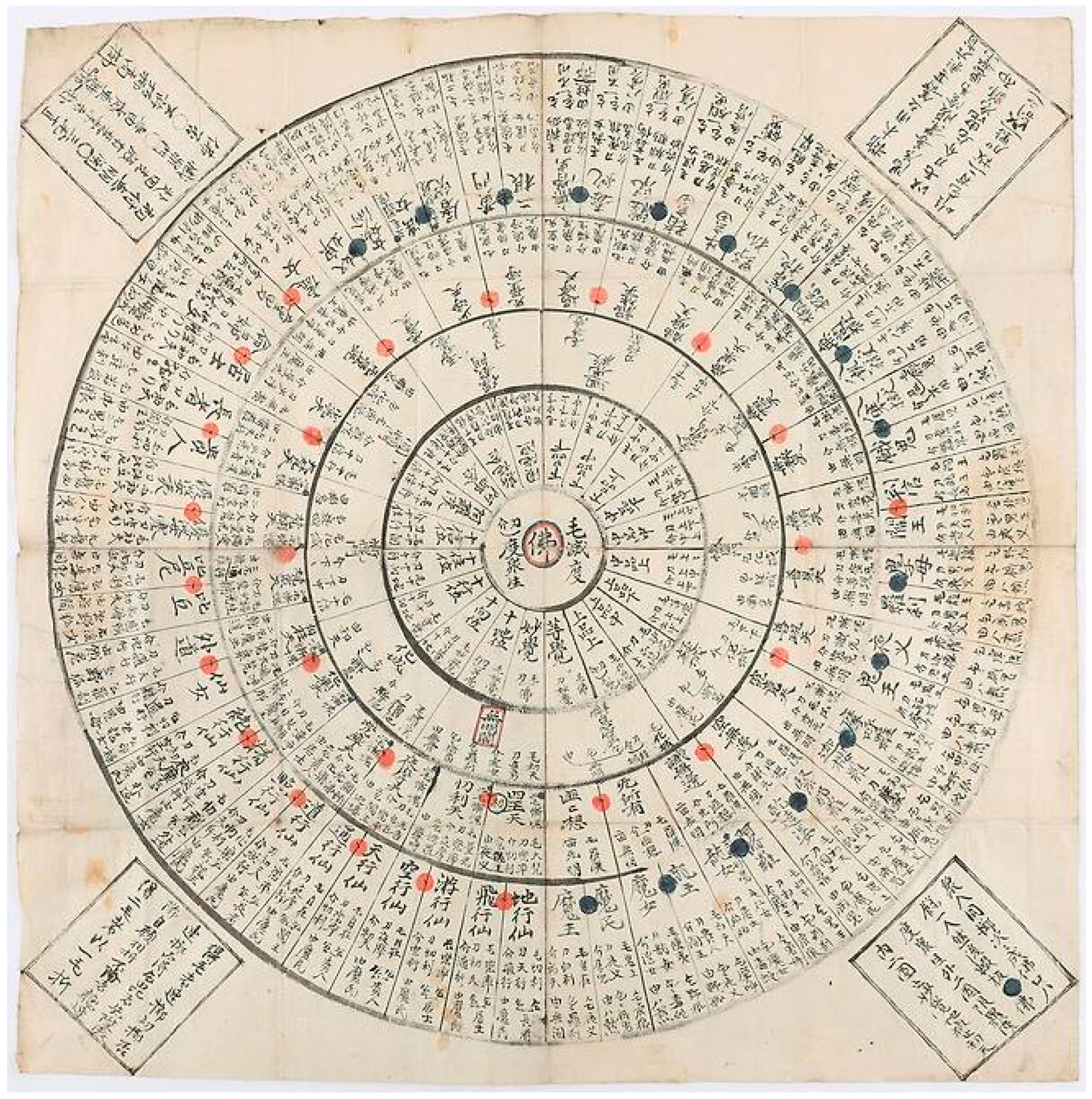
This licenses a stronger formulation of the paper’s thesis than the received account permits. Seongbuldo is not an instance of a ritual that decayed into a game. It is the change in medium of a ritual that was designed on ludic principles from the outset—one that already had a ladder of stations, a randomizer, turns, rounds, officers, a stopping rule, a penalty, and a condition of collective completion. Woncham’s own text registers the point despite itself: he objects three times to the practice being taken as play, complaining that it must not be treated as “a matter of amusement, with heads thrown together in laughter” (莫以戱事亂擲聚頭而笑 HBJ 6.862b08-09), that heterodox sorts had begun using it in drinking parties to fix the seating order (飮酒之場 行之定坐次 爲戱之 HBJ 6.863c19-20), and finally that it had been made into a Seongbuldo (至今爲戱可笑也 HBJ 6.864a11).
The second of these is the most telling, since fixing the seating order is not a misuse of the ritual but its central mechanism. What Woncham objects to is not the apparatus but the frame around it. A final irony of vocabulary deserves notice, since it names the problem this article addresses. The gāthā on which the whole system rests promises the reciter that he will “sport together with the assembly of sages in the ocean of the Tathāgata’s great wisdom, merit and virtue” (與諸聖衆同遊戱如來大智福德海 HBJ 6.861a24-b01), where 遊戱 denotes the sovereign play of buddhas and bodhisattvas. In the same text 戱 is the word for what has gone wrong. The two graphs 遊 and 戱 are themselves assigned, in the list of stations, to rebirth as a monastery slave and as a government slave. Play is at once the mode of liberation, the mark of servitude, and the name of the corruption.
The earliest Joseon witness to the game is Seong Hyeon, whose Yongjae Chonghwa records it in its tenth fascicle as an established pastime of the monastic community, and does so without evaluation of any kind. His account aligns closely with the Goryeo material: the yunmok is the same device, described in almost the same words; his ladder runs from the hells to Great Awakening (自地獄至大覺), the two termini of the forty-one stations; and the categories he names in passing, the heavens (諸天) and the various realms (諸界), correspond to stations that appear by name in the Goryeo list, among them the Station of the Heavens (諸天位), the Heaven of Long Life (長壽天), and the destiny of the immortals (仙趣).
Within Buddhist monastic circles, there exists a game known as Seongbuldo. Between the extremes of Hell and Daegak (大覺, Great Enlightenment), there are Jecheon (諸天, numerous heavenly realms) and Jegye (諸界, various worlds). A six-sided wooden rod (yunmok) is crafted, each side inscribed with one character of the chant ‘Namu Amitabul’ (南無阿彌陀佛). Players advance or regress on the board according to the character that appears when the dice is cast, determining the outcome.(Institute for the Translation of Korean Classics 2025)8
Brief as it is, the passage confirms in a Joseon setting the four features on which the present analysis rests, three of which are already present in the Goryeo rite. The game belongs to the monastic community (僧家) rather than lay entertainment; its board maps a soteriological continuum from hell to Great Enlightenment, with the heavens and the various realms arrayed between; its randomizing device is itself an act of devotion, since each face carries one syllable of the Amitābha invocation; and play terminates in a determinate win condition (決勝負). Seong Hyeon’s very incuriosity is itself evidence: two centuries after the Hyeonhaeng Seobang Gyeong denounced the game, a Confucian literatus could describe it without explanation and without objection.
In the early Joseon Dynasty, Seongbuldo, originally a Buddhist game illustrating the path to enlightenment, became widely recognized among Confucian literati, leading to significant adaptations. According to Yongjae Chonghwa, Ha Ryun (河崙, 1347–1416), a founding statesman of the Joseon Dynasty, was inspired by Seongbuldo to create a bureaucratic promotion-themed board game called Jongjeongdo (從政圖). Jongjeongdo, later also referred to as Seunggyeongdo (陞卿圖), depicted the actual bureaucratic hierarchy on its board, ranging from the junior ninth rank (從九品) to the senior first rank (正一品). Players advanced through the ranks based on their throws of the yunmok, whose six faces bore deok (德, virture), jae (才, talent), geum (勤, diligence), gam (堪, competence), yeon (軟, pliancy) and tam (貪, avarice). Virtue and talent brought promotion, pliancy and avarice dismissal (德才而升 軟貧而罷).
Following this development, the Confucian scholar Gwon Chae (權採, 1399–1438), in collaboration with his elder brother Gwon U (權遇, 1363–1419), created Jakseongdo (作聖圖), a Confucian reinterpretation of Seongbuldo. In this game, the dice were inscribed with Confucian virtues such as seong (誠, sincerity) and gyeong (敬, reverence), and negative traits such as wi (僞, deceit) and sa (肆, arrogance). The objective was to enable players to experientially internalize the Confucian path of moral cultivation toward becoming an ideal gentlemen (gunja, 君子).9
Thus, Seongbuldo, Jongjeongdo, and Jakseongdo constitute a lineage of traditional Korean board games that share a similar structural framework, namely dice-based, chance- driven progression combined with ethical instruction. While structurally similar, they are distinguished by their thematic focus: Buddhist enlightenment (成佛), bureaucratic advancement (從政), and Confucian moral self-cultivation (作聖), respectively. In summary, this lineage reveals how traditional games were adapted to different ethical systems—Buddhist, bureaucratic, and Confucian—while maintaining a shared pedagogical model that blends moral education with experiential engagement.
As shown in Table 3, although these games were primarily recreational, scholarly assessments indicate that they were intentionally designed for educational purposes.10 Specifically, Seongbuldo was crafted to instill in monks an experiential understanding of awakening and disciplined practice; Seunggyeongdo (陞卿圖) was intended to familiarize participants with the bureaucratic progression and governmental hierarchies; and Jakseongdo aimed to embed Confucian ethical cultivation within a playful context.11 The existence of these traditional board games collectively illustrates that principles similar to modern gamification—learning facilitated through structured play—were actively applied during the Joseon Dynasty.
Table 3.
Comparison of Traditional Educational Board Games in the Joseon Dynasty.
In contemporary education, there is a growing emphasis on incorporating active participation, lived experience, and critical reflection into the curriculum (Ergas 2019, pp. 251–58). From this perspective, Seongbuldo can be understood as a historical educational game that conveys the Buddhist worldview of karma, rebirth, spiritual cultivation, and enlightenment through its structure and participatory experience (McGuire 2014, pp. 7–9, 21–24). Therefore, rather than being reproduced in its original form, traditional educational games like Seongbuldo can be reinterpreted and adapted to meet contemporary educational objectives and learning environments, making them valuable cultural resources for experiential learning of Buddhist teachings and ethical values.
3. Seongbuldo: Board Layout and Gameplay
Seongbuldo is a traditional board game that uses a board, a throwing device and playing pieces to simulate a sentient being’s journey out of the cycle of rebirth (saṃsāra) toward enlightenment. Its rules and its transmission are set out in two texts carried on the boards themselves: the Gogi (古記), attributed within the tradition to Seosan Hyujeong, and the colophon (重刊記) to Yi Neunghwa’s reprint of 1915.12 Two lineages of Seongbuldo board survive, and they are laid out on different principles.
The Gogi describes a board on which the three approaches stand side by side: “This diagram has three approaches: the middle one, the five houses of Seon; the one on the right, the five graded stages of the Teaching; the one on the left, the nine grades of buddha-recitation (此圖有三門 中一門禪五宗 右一門教五位 左一門念佛九品).” Figure 2 is laid out in that manner. Figure 1 is not. It is concentric, its inner rings setting out the fifty-two stages of the Hwaeom (Ch. Huayan 華嚴) path—the ten faiths (十信), attested in the Renwang boluomi jing (仁王般若波羅蜜經); the ten abodes (十住), the ten practices (十行), the ten transferences (十廻向) and the ten stages (十地), attested in the Huayan jing (華嚴經); and equal and sublime enlightenment (等覺, 妙覺), attested in the Pusa yingluo benye jing (菩薩瓔珞本業經),13 with the grades of rebirth and the destinies, including the ranks of the immortals, arrayed in the outer rings. The two boards represent genuinely different solutions to the same problem of setting out a soteriology on a single sheet.
Figure 2.
Seongbuldo Game Board of the six destinies and three approaches, showing the yeombulmun (念佛門), gyeongjeolmun (徑截門) and wondonmun (圓頓門). Modern-era Korea.
The variation is not incidental but chronic, and the tradition says so at every stage. The Gogi exists because the older boards were inconsistent: “the old diagrams are not of one kind, and in respect of the provisional and the real, the sudden and the gradual, and the arising, the cultivation and the severing they have neither head nor tail; therefore, the sick man of Seosan cut away and supplied (古圖雖不一 而權實頓漸 生起修斷 無頭無尾 故 西山病夫 削之補之).” Reprinting the text in 1915 Yi Neunghwa made the same complaint—that the boards then transmitted in the monasteries were not alike—and reissued the Myohyangsan edition in order to bring them into agreement. He did not succeed: the colophon to the recutting of 1971 reports that the Myohyangsan text, An Jinho’s edition and the Daegaksa edition of Busan were still each unlike the others, and that the editor had once again added and removed at his own discretion. Seongbuldo is accordingly best understood not as a single fixed game but as a family of related boards, each rendering in play whichever articulation of practice its makers took to be authoritative.
The variation continues into the present, and it is not confined to the drawing of the board. A Seongbuldo game (成佛圖놀이) board issued by the Seon master Seok Unmun (釋雲門) in Bulgi 2515 (1971) is close in layout to the boards of Figure 2, but it differs from them at the decisive point: its three approaches are the yeombulmun (念佛門), the chamseonmun (參禪門, the approach of meditation) and the gangyeongmun (看經門, the approach of reading the sūtras), in place of the yeombulmun, gyeongjeolmun and wondonmun of the late-Joseon boards. The substitution is doctrinal rather than merely lexical. Gyeongjeolmun and wondonmun name a specific seventeenth-century settlement, the shortcut of ganhwa Seon set against the perfect and sudden approach of the Teaching, and they belong to the sammun suhaeng of the Cheongheo lineage; chamseonmun and gangyeongmun name instead the broad institutional divisions of modern Korean monastic training, the meditation hall and the lecture hall. A board that set out the threefold scheme of late-Joseon practice has thus been reissued, under the same title and with the same apparatus, as a board setting out the training structure of the modern order. The three approaches are accordingly not a fixed feature of Seongbuldo but the point at which each generation of boards records its own account of what practice consists of, which is the clearest single demonstration that Seongbuldo names a family of related games rather than one game, and that the family is still changing.
The account that follows is based on the board of Figure 2, for which the rules are fully preserved. The board is typically rectangular or circular, with densely arranged spaces inscribed in Chinese characters and Korean script. It is divided into two principal areas: an outer area representing the six destinies (yukdo 六道) and an inner area representing the three approaches to practice (sammun 三門).
Along the outer periphery the six destinies are set out in sequence: the hells (地獄道), the hungry ghosts (餓鬼道), the animals (畜生道), human beings (人間道), the asuras (阿修羅道), and the Devas (天上道). Each destiny comprises consecutively arranged spaces accompanied by brief texts describing its characteristics and doctrinal significance. Moving through them, players traverse the Buddhist cosmology space by space.
At the center is an inner region setting out the three approaches. On this board they are named the yeombulmun (念佛門), the approach of chanting the name of Amitābha; gyeongjeolmun (徑截門), the shortcut approach, that is, the practice of ganhwa seon (看話禪), the Seon of observing the critical phrase; and the wondonmun (圓頓門), the perfect and sudden approach. The Gogi designates the same three more plainly as Seon, the Teaching and buddha-recitation, and specifies their contents as the five houses of Seon, the five graded stages of the Teaching, and the nine grades of rebirth14; the names of gyeongjeolmun and wondonmun belong to later boards. Above all three the Gogi places the three bodies of the Buddha and, above these, “one position provisionally established, namely the position of ultimate nobility” (三身上 權立一位 即向上尊貴位也). The three are distinct routes rather than three sequential stages of a single path, each oriented toward the same destination: at the very center of the board is the final space, marked Daegak (大覺), complete and supreme enlightenment.
The three approaches were not devised for Seongbuldo. They belong to the threefold scheme of practice known as sammun suhaeng (三門修行), systematized within the Cheongheo (淸虛) lineage that developed from Hyujeong (淸虛休靜, 1520–1604) and was dominant in monastic practice in seventeenth-and eighteenth-century Joseon Buddhism.15 That the Gogi, a text of that lineage assigned to 1686, presents the diagram as consisting of exactly these three shows the classification arriving on the board as an already established framework. What the board does with it is therefore not to invent a taxonomy but to convert one: an established classification of methods, ordered by the capacities and dispositions of practitioners, is rendered as a set of spatially differentiated pathways that players enter and traverse. This is the second of the two conversions this article traces. The first, set out in Section 2, turned a ritual apparatus into a game apparatus; the second turns a soteriological taxonomy into a board topology.
The Gogi also glosses the board’s principal spaces, and the glosses show that they are diagnostic rather than decorative: “Returning Light is the foundation of attaining Buddhahood; Sloth is the root of birth and death. The Illusory City is the disease of the Lesser Vehicle; the City of Doubt is the disease of buddha-recitation. Entering the mountains is seeking oneself; cultivating merit is going outward. In the pleasures of the heavens there is a gate of shame; in the sufferings of the three evil destinies there is a gate of repentance. For those who cling to their views there is the pit of annihilationism and eternalism; for those who conceive emptiness as nothing there is entry into the destinies” (回光者 成佛之基 懈怠者 生死之本 化城者 小乘之病 疑城者 念佛之病 入山者 求自己 修福者 向外走 諸天之樂 有慚愧門 三途之苦 有懺罪門 執其見者 有斷常坑 空無想者 有入諸趣).
Each space names an error or an achievement of practice; the pleasures of the heavens are given a corrective as surely as the evil destinies are. The text sums up its own design in a sentence: “Alas—within a single sheet the four holy and the six ordinary states, the roads of ascent and descent, are spread out like stars before the eyes; it may be called an exhortation and an admonition at once” (吁 一幅中 四聖六凡 昇沈路頭 星羅目前 可謂一勸一懲也).
Play is governed by the throw of three yunmok (輪木), six-faced wooden rods engraved with the six graphs of the invocation Namu Amitabul (南無阿彌陀佛) in place of numbers, one bul face being marked in red so as to count as two.16 The Gogi opens with the procedure: “Beginning in the human destiny, reverently call to mind Namu Amitabul, chant in unison, and throw the yunmok” (初赴人趣 敬念南無阿彌陀佛 和聲擲輪木). Recitation is not decorative but enforced: “one who does not recite, though his position be high, is at once sent to the boneless worm” (不念佛者 雖位高 即送無骨蟲), and “those who do not utter Amitābha’s name but merely chant bul bul or sam-bul sam-bul all forfeit their merit” (不稱彌陀 徒唱佛佛者 唱三佛三佛者 皆削功). The result of the throw then determines movement, with certain combinations triggering special conditions.
Three identical graphs carry a player directly to an extremity of the board: “whoever obtains three bul, regardless of which destiny he is in, is at once sent to the Hall of Returning Light; those in the destinies who obtain three nam are all sent to the Cave of Sloth” (得三佛者 勿論諸趣 即送回光殿 諸趣得三南者 俱送懈怠窟). Further rules govern repeated throws: “those who obtain three bul or three ta throw the yunmok again; the bul graph marked in red counts as two bul; three mi or three a count as two ta” (三佛三陀者 再擲輪木 朱默佛字 以二佛準 三彌三阿者 以二陀準). Modern editions add penalties of their own: a player who loses his temper or engages in idle talk is sent to the jeondara (旃陀羅), and one who cheats falls into the Maengnonga (盲聾啞), the hell of blindness, deafness and muteness.17
Players move forward or back according to the throw, at first along the outer circuit of the six destinies; at an opportune moment they pass into the inner region of the three approaches, and from there toward Daegak (大覺, Great Enlightenment). Attaining Buddhahood (seongbul 成佛) is both the object of the game and its criterion of victory, and the first player to reach the Daegak wins. The game does not end there, however: play continues until all participants have reached that stage, and unless a player withdraws, all advance together to the game’s natural completion. This condition is not stated in the Gogi and is first found among the supplementary rules of modern editions, so what can be shown is a correspondence with the lot-casting assembly of 1298, in which those already reborn in the Pure Land ceased casting but remained to vow for the rest, rather than a documented continuity through the seventeenth century.18 Whatever its date, the rule makes Seongbuldo more than a contest: the game ends not when someone wins but when no one is left behind, rendering the bodhisattva ideal as a condition of play. The board and its mechanics thus amount to more than a set of rules; together they constitute an experiential simulation that sets a cosmology and a soteriology on a single sheet. The board makes visible the spatial dimension—the six destinies and the three approaches—while throwing and moving internalize a temporal dimension governed by karma. The most distinctive feature of the design is the meeting of the two: the uncontrollable outcome of the throw, standing for past karma, against the player’s own recitation at each turn, standing for present intention and practice, with the Gogi enforcing the latter by rule. The following sections analyze how these mechanics generate their educational effects and bear on the moral and spiritual formation of those who play.
4. Educational Elements in Gameplay
The Seongbuldo game is explicitly structured as an educational exercise, with its rules serving to train participants in Buddhist discipline and ethics. The gameplay regulations instill Buddhist moral precepts and etiquette. For instance, participants must respectfully hold the yunmok with both hands and chant reverently before throwing them. Careless throwing with one hand or noisy throws are strictly prohibited. Any violation results in immediate relegation to the Byeonji (邊地), representing the remote borderlands in Buddhism where moral and doctrinal education is severely compromised; in the game, this serves as a penalty space for rule infractions. Likewise, players are forbidden from chanting loudly ahead of others or repeating certain words, such as a mantra, in hopes of influencing the outcome of the throw to favor specific characters like “Na-mu” (南無) or “Bul” (佛). Any overt attempt to manipulate luck through superstitious chants, such as repeatedly shouting “Sambul, Sambul” (Three Buddhas), invalidates the entire round. (Academy of Korean Studies 2024) By mandating adherence to prescribed rituals and proper mindfulness, these regulations foster courtesy, patience, and concentration among participants.
Second, moral education was enforced through immediate penalties for misconduct during gameplay. Players caught cheating or violating rules faced instant relegation to the hell known as Maengnonga (盲聾啞), which literally translates to “blind, deaf, and mute,” representing the karmic consequence of straying into the three evil paths (三惡道). (Academy of Korean Studies 2024) Additionally, participants who expressed anger or ridiculed others were demoted to Jeontara (轉陀羅, caṇḍāla, “outcaste”), the lowest caste within the human path. (Academy of Korean Studies 2021) Players who threw the yunmok with excessive force or in a disruptive manner either forfeited their current turn entirely or were exiled to the previously mentioned Byeonji. (Academy of Korean Studies 2024) This structure of swift and impartial penalties highlighted the importance of rule adherence and self-control for participants. This gameplay enabled them to experientially grasp the Buddhist principle of karmic retribution (業報), where positive karmic fruits arise from virtuous deeds and negative karmic fruits result from immoral actions.
Thirdly, elements of cooperation and mutual care are notably emphasized in Seongbuldo. Although it is primarily a competitive board game, Seongbuldo also embodies a cooperative aspect, as the game concludes only when all participants have attained Seongbul (成佛). The first player to reach Daegak (大覺) does not exit the game; instead, they remain involved until the final player achieves Seongbul, actively assisting others in their enlightenment19 (McGuire 2014, pp. 4–8). Specifically, the first participant to reach enlightenment (Seongbul 成佛) is required by the game rules to either offer beommun (法門, “an approach to Dharma”), which may involve delivering a Dharma talk to the remaining players, who must respectfully listen and demonstrate reverence, or guiding others in their ongoing gameplay. These provisions encourage players to prioritize collective enlightenment over individual victory. Moreover, the rules explicitly prohibit discrimination based on age, gender, or social status, ensuring equitable participation for all players. Notably, if a child achieves enlightenment first, the adults are expected to respectfully bow, congratulate, and seek guidance from the younger participant. Thus, Seongbuldo serves as an educational mechanism designed to naturally cultivate virtues such as mutual respect, equality, and a cooperative spirit, even within its inherently competitive framework.
Fourth, the educational effectiveness of experiential learning and immersive participation warrants attention. As participants navigate the Seongbuldo board, they vividly experience—both physically and mentally—a symbolic journey through cycles of existence, progressing intensely from hellish realms to heavenly states. This embodied experiential learning fundamentally differs from doctrinal education acquired through textual study alone (Regan 2021, pp. 5–8). Each throw of the yunmok embodies the participant’s karmic condition, facilitating an active experience of repeated cycles of birth, aging, sickness, death, and rebirth. Recent research supports this finding, showing that in environments focused on extensive and abstract doctrines, such as mysticism or hagiology, gamification acts as an exceptional experiential learning tool that actively engages learners’ emotional dimensions (Massad 2024, p. 2). Such role-playing components effectively translate abstract Buddhist teachings into concrete, playful experiences, allowing novices and young learners to intuitively grasp Buddhist perspectives on life, karma, and cosmology (Jae-su Lee 2019, pp. 82–85).
Furthermore, the immersive quality of the gameplay significantly enhances learners’ motivation. The throwing of the yunmok provides immediate feedback, allowing participants to instantly observe the outcomes of their actions (as indicated by the graphs that come up). This prompts reflective consideration and strategic planning for subsequent moves. This clear and immediate feedback loop aligns with the principle of “immediate reinforcement” described in contemporary educational psychology, fostering an educational environment where correct behaviors are promptly reinforced and incorrect actions are swiftly identified and corrected (Christopoulos and Mystakidis 2023, pp. 1225–28; Deterding et al. 2011, pp. 10–11).
All these elements demonstrate that Seongbuldo was intentionally designed as a sophisticated educational simulation, rather than simply an amusement based on the chance of the throw. In short, Seongbuldo functioned as a “behavioral instructional manual,” seamlessly embedding educational content into gameplay. Through enjoyable competition, monks and lay Buddhists of the traditional period were able to internalize virtues such as observance of precepts, patience, cooperation, equality, and awareness of karmic consequences.
5. Gamification and the Transmission of Buddhist Principles
The structure of the Seongbuldo game clearly embodies the core values and worldview of Buddhism, allowing players to internalize the Dharma through engaging gameplay. At its foundation lies the principle of saṃsāra (輪廻), the cycle of continuous rebirth. The depiction of the Six paths (yukdo, 六道) on the outer rim of the game board vividly reflects the endless cycle of birth, death, and rebirth experienced by sentient beings. Players’ tokens circulate continuously through the paths of Hell, Hungry Ghosts, Animals, Humans, Asuras, and Devas, depending solely on the throw of the yunmok. This endless wandering continues unless players successfully break the cycle through dedicated spiritual practice; otherwise, their tokens remain trapped in the outer circuit. In this way, the game board symbolically represents the Wheel of Life and Death, instilling in participants the Buddhist teaching that without attaining liberation (mokṣa), one cannot escape cyclic existence.
Next, the doctrines of karma and karmic retribution—the principle of cause and effect—are directly reflected in the game’s outcomes. As previously noted, a player’s advancement or demotion in Seongbuldo is explicitly determined by their actions, including adherence to the rules, as well as the results of the throws. In particular, penalties for violating rules serve as a form of immediate karmic retribution. For example, acting greedily or dishonestly causes the player to immediately descend into Maengnonga (盲聾啞, blindness, deafness, and muteness) hell20, vividly illustrating the Buddhist doctrine that immoral actions committed in this life result in severe disabilities or misfortunes in subsequent rebirths.
Conversely, playing the game with sincere intention and proper mindfulness has traditionally been believed to cultivate favorable karmic potential. In fact, throws made after earnest collective chanting often appeared to yield advantageous outcomes for character progression. This implicitly conveys the religious message that accumulating devotion and merit gradually brings one closer to rebirth in paradise. In short, the Seongbuldo game embodies the core Buddhist ethical principle that virtuous individuals receive happiness, while those who commit evil experience suffering,21 effectively embedding this central moral teaching into the mechanics of gameplay.
In addition, the three approaches (sammun 三門) set out in the inner region of the board present Buddhist practice as a set of distinct routes rather than as a single graded sequence. As established in Section 3, they are the yeombulmun (念佛門), the approach of chanting the name of Amitābha; the gyeongjeolmun (徑截門), the shortcut approach, that is, the practice of ganhwa Seon (看話禪), the Seon of observing the critical phrase; and the wondonmun (圓頓門), the perfect and sudden approach of the Teaching. The Gogi designates the three more plainly as Seon, the Teaching and buddha-recitation, and assigns to them respectively the five houses of Seon, the five graded stages of the Teaching and the nine grades of rebirth (此圖有三門 中一門禪五宗 右一門教五位 左一門念佛九品); the names gyeongjeolmun and wondonmun belong to later boards. The scheme is not an invention of the game but the sammun suhaeng (三門修行) of the Cheongheo lineage, dominant in seventeenth- and eighteenth-century Joseon monastic practice, here converted from a classification of methods into a topology of pathways (National Folk Museum of Korea 2026).
This triadic structure emphasizes that liberation is accessible through more than one avenue. Players follow distinct trajectories according to the approach their piece enters: those entering the yeombulmun advance through sustained recitation of Amitābha’s name and the aspiration for rebirth in the Pure Land; those entering the gyeongjeolmun advance by the concentrated investigation of the critical phrase (hwadu 話頭) that defines ganhwa Seon; and those entering the wondonmun traverse the graded stages of the Teaching. That the three run in parallel toward the single space of Daegak (大覺) at the centre is itself a doctrinal statement, and one the Gogi makes explicitly when it places the three bodies of the Buddha above all three approaches alike.
This diversity of paths embodies the Buddhist concept of expedient means (upāya, 方便), highlighting the notion that although various routes accommodate the different capacities and dispositions of sentient beings, they ultimately lead to the same destination—enlightenment. Consequently, the game’s outcome, where all players eventually converge at the stage of Great Awakening (大覺, Daegak), (McGuire 2014, p. 2) enables participants to experientially grasp the truth of the One Vehicle (一乘, Ekayāna). (Williams 2009, pp. 149–60).
Seongbuldo promotes the foundational ideals of Buddhism, particularly equality and compassion. According to the game’s rules, all participants are considered equal Buddhist practitioners, regardless of gender, age, or social status, effectively embodying the principle of universal equality. One notable rule states that a child can attain enlightenment before an adult, which requires the elder player to show deference, thereby reinforcing the egalitarian ethos of Buddhist awakening (Ko 2024). This vividly illustrates Buddhism’s core teaching that the Buddha nature transcends distinctions of age, gender, or societal rank, affirming that enlightenment is universally accessible.
Moreover, the requirement that the game’s winner must assist all other players in reaching enlightenment evokes the spirit of the Mahayana Bodhisattva path. The first player to achieve enlightenment assumes the role of a Bodhisattva, guiding others until everyone shares in the joy of collective enlightenment (Academy of Korean Studies 2024). This interactive dynamic—where the winner delivers a dharma sermon while the others listen attentively—resembles a teacher-disciple assembly, seamlessly transforming gameplay into an opportunity for spiritual teaching and learning. Seongbuldo thus transcends mere competition, embracing a communal aspiration for collective awakening and effectively transmitting core Buddhist values of compassion and equality through interactive play. Such a structure also aligns with contemporary game-based learning theories, which emphasize collaborative participation, experiential internalization of values, and meaningful learning through shared interaction (Regan 2021, pp. 4–5).
Ultimately, Seongbuldo serves as a modeled representation for transmitting Buddhist doctrines. By condensing the expansive Buddhist cosmos—the Three Realms and Six Paths—along with the journey toward liberation into a playable board game, participants engage in an immersive experience akin to lifelong spiritual practice. This historical example of gamification has proven to be a highly effective pedagogical tool, allowing both monks and lay practitioners to internalize Buddhist teachings in a natural and enjoyable way. In the following section, we will explore the underlying game mechanics of the Seongbuldo, utilizing contemporary theories of gamification for a more detailed analytical perspective.
6. How Seongbuldo Relates to Modern Gamification Theory
The fundamental design principles of the Seongbuldo game closely align with contemporary concepts of gamification and game-based learning. Gamification is generally understood as the application of game design elements—such as points, levels, feedback, and competition—in non-game contexts to enhance engagement and motivation (Deterding et al. 2011, pp. 10–13; Christopoulos and Mystakidis 2023, pp. 1223–25). While Seongbuldo is a fully developed educational board game rather than simply a gamified activity, its incorporation of structured goals, incremental progression, competition, rewards, and feedback into traditional religious education can be seen as a historical precursor to the principles of gamification and game-based learning. The following outlines how Seongbuldo exemplifies the core principles of modern gamification.
First, Seongbuldo features clearly defined goals and a structured progression system. The ultimate objective—achieving enlightenment or Buddhahood (Seongbul)—is explicitly stated, and the pathways to this goal are systematically divided into multiple hierarchical stages. This structured approach to goal setting mirrors modern game-level design, visually reinforcing players’ sense of progress and enhancing their competence and motivation (Ryan et al. 2006, pp. 348–50). The numbering systems—such as the outer region with 50 to 107 spaces and the inner area featuring 149 spaces—act as a “progress bar,” indicating players’ current status in the overall journey. From the perspective of Self-Determination Theory (SDT), which asserts that clear structures and informational feedback fulfill the psychological need for competence (Ryan and Deci 2020, pp. 6–8), this design serves as an effective gamification mechanism to maintain players’ intrinsic motivation.
Furthermore, Seongbuldo’s design embodies modern concepts of leveling up and incremental achievement through its tiered ascension mechanism. As participants’ tokens advance from the lower realms (e.g., hell) through intermediate stages (e.g., the human realm) to higher realms (e.g., the celestial realm), they experience a heightened sense of accomplishment. This hierarchical advancement system inherently stimulates ongoing engagement, motivating players to continually strive for higher states of spiritual realization.
From the viewpoint of contemporary gamification theory, Seongbuldo exemplifies key principles from Self-Determination Theory (SDT) and experiential learning theory. SDT identifies autonomy, competence, and relatedness as essential psychological needs for fostering intrinsic motivation (Ryan and Deci 2020, pp. 1–2), which are vital for maintaining player engagement and enjoyment in gaming (Ryan et al. 2006, pp. 349–50). Seongbuldo supports autonomy through voluntary participation and player-driven decision-making, enhances competence through clear and structured progression, and fosters relatedness through communal participation and shared experiences.
In terms of its motivational framework, Seongbuldo integrates elements that stimulate both intrinsic and extrinsic motivation. Players are internally motivated by the meaningful pursuit of spiritual enlightenment, which aligns with modern gamification’s focus on meaningful experiences and intrinsic motivation (Deterding et al. 2011, pp. 10–11). The religiously significant goal of attaining Buddhahood can inspire intrinsic motivation by encouraging players to engage with both the activity and its spiritual importance. Simultaneously, the competitive aim of achieving Buddhahood before other participants, along with in-game rewards, generates motivation directed toward external outcomes such as achievement and victory. Thus, Seongbuldo presents a complex motivational structure that intertwines the intrinsically meaningful goal of spiritual cultivation with competitive systems and rewards found in contemporary game design.
Additionally, Seongbuldo features a sophisticated reward and feedback mechanism. Immediate rewards or penalties are issued based on dice roll outcomes or adherence to game rules. Favorable combinations of graphs yield tangible incentives, like additional turns, while rule violations quickly direct players to penalty zones, reflecting karmic retribution. This immediate feedback closely mirrors modern gamification techniques, where player actions are promptly reinforced through points, achievements, or items. Such clear and immediate feedback loops are crucial for enhancing learners’ moral decision-making and self-regulation (FitzGerald and Groff 2011, pp. 238–42), while also providing informational feedback that nurtures competence and intrinsic motivation in educational contexts (Yang 2019, pp. 214–20).
Contemporary gamification research emphasizes the significance of meaningful game experiences and reflection in fostering self-regulation and moral development (FitzGerald and Groff 2011, pp. 243–49). Seongbuldo’s rapid and clear feedback mechanisms enhance player engagement and facilitate a state of flow (Csikszentmihalyi 1990, pp. 54–59). Participants become deeply absorbed in the activity through immediate feedback and a balanced alignment of challenges and individual skills (Csikszentmihalyi 1990, pp. 52–55). This complete immersion in gameplay allows participants to engage in experiential learning, which can reinforce positive behaviors and help modify undesirable ones.
Moreover, Seongbuldo provides a deeply immersive experience. Its strict and complex rules demand high levels of concentration and sustained attention, enabling participants to disengage from everyday concerns and immerse themselves in a symbolic world that vividly represents Buddhist cosmology (Csikszentmihalyi 1990, pp. 52–55; McGuire 2014, pp. 18–19). This immersive experience allows players to internalize Buddhist principles and teachings naturally and intuitively, aligning closely with experiential learning and contemplative pedagogy, both of which emphasize direct participation, reflection, and meaningful integration of learning content (Regan 2021, pp. 3–5; Ergas 2019, pp. 255–56).
Third, from the perspective of narrative and meaning-making, Seongbuldo structures gameplay as a symbolic journey through saṃsāra toward Buddhahood. Contemporary gamification employs narrative contexts and storytelling to foster user engagement and meaningful learning (Christopoulos and Mystakidis 2023, p. 1225). Similarly, Seongbuldo translates the Buddhist soteriological narrative of liberation from saṃsāra and the attainment of Buddhahood into a playable structure. Each player takes on the role of an equal disciple of the Buddha and follows a symbolic journey through successive stages toward Buddhahood. As the game progresses, individual movements and chance outcomes generate different trajectories for each player, allowing the broader Buddhist narrative of liberation to be experienced through the unfolding process of gameplay. This structure encourages players to interpret the outcomes of their movements through the Buddhist concepts of karma and rebirth, prompting reflection on their doctrinal significance (McGuire 2014, pp. 7–17). Additionally, reflecting on and sharing gameplay experiences can help connect Buddhist teachings with players’ personal systems of meaning. This individualized meaning-making aligns closely with Buddhist educational approaches that facilitate an experiential understanding of suffering, saṃsāra, and liberation through narrative, as well as with contemporary narrative- and experience-based learning approaches that emphasize reflection and moral development (FitzGerald and Groff 2011, pp. 238–42).
Fourth, voluntary participation and enjoyment are another important educational feature of Seongbuldo. The game was designed as a didactic activity that conveys Buddhist teachings and practices through play while encouraging Yeombul (chanting the name of Amitābha Buddha) and religious devotion. According to Seosan Hyujeong’s Gogi (古記), obtaining a Seongbuldo board was likened to extending one’s remaining time in old age at the monastery, while encountering the game during illness was compared to grasping cool water to relieve a fever (Academy of Korean Studies 2024). This description suggests that Seongbuldo was regarded not only as a means of religious instruction but also as a source of comfort and enjoyment within monastic life. Furthermore, the uncertainty generated by the throws, competitive progression, and the possibility of unexpected advances or setbacks likely enhanced the game’s appeal and encouraged voluntary and sustained participation. Similar integrations of religious practice and enjoyment can be observed in other Buddhist board games (McGuire 2014, pp. 4, 10). These characteristics align with contemporary research on game motivation, emphasizing that enjoyment and intrinsic motivation foster voluntary participation and sustained engagement in gameplay (Ryan et al. 2006, pp. 349–50). They also correspond closely to the goals of modern gamification, which seeks to promote engagement and learning through enjoyable game elements (Christopoulos and Mystakidis 2023, pp. 1223–25).
However, the structural similarities discussed above do not imply that Seongbuldo fully embodies the principles of modern game-based learning. While its game structure conveys Buddhist teachings in a visible and participatory manner, it does not fully represent the complexity of Buddhist doctrine and practice. First, because players’ movements are determined primarily by the throw of the yunmok, the Buddhist concept of karma—emphasizing the relationship between intentional action and its consequences—may be oversimplified to a structure of chance-based ascent and descent.
Moreover, while collective participation and mastery of the game’s complex rules may support relatedness and competence to some extent, its predetermined paths and limited choices do not adequately ensure the learner autonomy emphasized in self-determination theory. Immediate feedback through rewards and penalties may facilitate understanding of the rules and encourage participation, but it also risks making the motivation for Buddhist practice dependent on external rewards and punishments. Seongbuldo should, therefore, be understood as a historical educational game that corresponds to modern game-based learning in several respects while simultaneously embodying tensions related to chance, limited autonomy, and doctrinal simplification.
7. The Potential of Seongbuldo for Contemporary Character Education
Traditional Buddhist board games like Seongbuldo present unique opportunities for contemporary education, particularly in the realm of character education. This educational approach aims to cultivate positive moral qualities and ethical conduct in students, prioritizing experiential and practical learning alongside theoretical instruction. As previously discussed, Seongbuldo game serves as an example of experiential moral education by incorporating moral values and behavioral norms into its rules and gameplay. These characteristics indicate the potential for reimagining Seongbuldo within the context of modern character education.
First, Seongbuldo provides a practical model for developing virtues through gameplay. By embedding values such as honesty, courtesy, responsibility, and compassion into its structured rules and objectives, Seongbuldo can offer participants meaningful opportunities for moral growth. Contemporary character education also emphasizes these virtues, and well-designed game-based pedagogy can enhance student engagement and motivation compared to traditional didactic methods (An 2019, pp. 207–8). However, these benefits do not arise solely from gamification; they depend on the specific game elements utilized, the quality of instructional design, and the context of their application (Landers 2014, pp. 760–62; Sailer et al. 2017, pp. 371–78).
More specifically, honesty can be cultivated through the rule-governed structure of Seongbuldo. Players are expected to follow the prescribed procedures of play without cheating or attempting to manipulate the outcome of the throw. For example, cheating results in a penalty, while chanting improperly in an attempt to obtain a favorable result invalidates the outcome of the throw (Academy of Korean Studies 2024). These rules repeatedly place participants in situations in which they must accept the outcome of play and refrain from seeking an unfair advantage. In this sense, Seongbuldo provides a concrete setting in which honesty can be practiced through adherence to shared rules rather than merely presented as an abstract moral principle.
Courtesy is likewise embedded in the conduct expected of participants during Seongbuldo gameplay. Players are expected to handle the yunmok respectfully and chant reverently, while anger and ridicule directed toward other participants are subject to penalties (Academy of Korean Studies 2021). Courtesy is also expressed through the principle that respect within the game transcends differences in age and status. Even when a younger participant attains Buddhahood before an older participant, the latter is expected to show respect and listen to the former’s Dharma teaching (Academy of Korean Studies 2024). This emphasis on respectful conduct also has parallels in the broader tradition of Buddhist board games. McGuire (2014, p. 17), for example, notes that players of the seventeenth-century Buddhist Selection of Buddhas were instructed to approach the game with a respectful mind and to throw the dice with an attitude of reverence. Thus, courtesy in Seongbuldo is enacted through concrete forms of ritual and interpersonal conduct rather than conveyed solely as an abstract moral injunction.
Responsibility can be seen most clearly in the relationship between individual achievement and the completion of the game as a group. In Seongbuldo, reaching Buddhahood does not terminate the successful player’s participation. The first participant to reach the final goal remains involved until the other participants have also completed the path and is expected to assist them in doing so (Academy of Korean Studies 2024). A similar pattern has been identified in other Buddhist board games: McGuire (2014, p. 19) notes that players who reach Buddhahood in games such as Karma Chakra and Buddha Wheel are expected to help other players do the same. From the perspective of character education, this structure provides a concrete opportunity to experience responsibility as extending beyond one’s own achievement to continued concern for the progress of others.
These features can also be adapted to contemporary classroom settings. For example, educators could simplify Seongbuldo’s rules for classroom activities. Together with their students, they might establish class rules and design the activity so that adherence allows players to advance on the board, while violations result in setbacks. This setup enables students to experience and reflect on the interplay between rule adherence, cooperation, and the consequences of their actions. Such a structure aligns well with Seongbuldo’s game mechanics, which connect compliance with progress and impose penalties for violations. However, rewards and penalties should not be viewed merely as tools for behavioral control; they should be followed by discussions that encourage students to reflect on the meaning of the rules and the impact of their choices on the community. In this way, Seongbuldo can be reinterpreted as a historical model for incorporating structured play into character education and has the potential to be developed into game-based activities for modern character education.
Second, Seongbuldo’s structured system of rewards and penalties opens the door for contemporary reinterpretation in the context of values education. Some penalties—such as “Maengnonga Hell” (盲聾啞地獄) or banishment to isolated realms like Byeonji (邊地)—may seem harsh by today’s standards. However, this structure clearly illustrates the relationship between adherence to or violation of rules and the resulting consequences within the game. In modern classrooms, this principle could be adapted in age-appropriate ways by implementing clearly defined consequences for inappropriate behavior (e.g., temporary suspension of in-game privileges or point deductions) and providing specific positive feedback for desirable behavior (e.g., praise or point awards). Game elements such as points can serve as immediate feedback linked to learners’ actions, and educational gamification has successfully used points and achievements to acknowledge classroom participation and targeted behaviors (Sailer et al. 2017, pp. 372–73; Landers 2014, p. 753). Yet, to prevent rewards and penalties from becoming mere mechanisms of control, they should be accompanied by reflective activities that prompt students to consider the meaning of the rules and the effects of their actions on others and the broader community.
Crucially, this approach should transcend mere punishment by encouraging students to cultivate moral judgment and responsibility through reflection on their choices and their consequences. While Seongbuldo participants complied with the rules to avoid disadvantages, contemporary gamified education should foster intrinsic motivation, promoting self-regulation and responsible decision-making. Ultimately, the focus should not be on the severity of penalties but on the fairness and consistency of rule enforcement—a principle mirrored in Seongbuldo’s equal application of rewards and penalties to all participants (Academy of Korean Studies 2021). In modern education, reflective activities should complement these mechanisms to help students internalize the rules autonomously.
Third, Seongbuldo can serve effectively as an educational tool for promoting cooperation and empathy. Engaging in cooperative problem-solving and shared experiences through gameplay allows students to appreciate others’ perspectives and build positive peer relationships (FitzGerald and Groff 2011, pp. 244–49). Additionally, Seongbuldo’s unique blend of competitive and cooperative elements highlights the importance of working together toward a shared goal. Incorporating teammates and common objectives into games can enhance cooperation and strengthen social connections (Sailer et al. 2017, pp. 374–78). Teachers can apply this principle by designing Seongbuldo-inspired activities where collective success is the criterion for advancement—for example, requiring all group members to complete their tasks before the group can progress. This structure encourages faster students to support their slower peers, reflecting the cooperative dynamic found in Buddhist board games, where those who achieve Buddhahood first are expected to assist others in doing the same (McGuire 2014, p. 22).
Through these cooperative structures, students naturally develop leadership, empathy, and a stronger sense of community. Furthermore, the practice in Seongbuldo—where a child who reaches Buddhahood before adults becomes a source of learning for older participants—highlights a significant educational principle. Modern classrooms can similarly cultivate a culture of peer learning by allowing students to take on the roles of tutor and learner according to their strengths, and where possible, to alternate between these roles. Well-structured peer tutoring can yield academic and social benefits for both those receiving assistance and those providing it, enabling all students to engage as valued members of the learning community (Topping 2005, pp. 635–43).
Fourth, Seongbuldo itself contains valuable historical educational content, making it highly suitable for revival and adaptation as a traditional character education program. Several temples and Buddhist organizations, such as Jogyesa Temple in Seoul, have already initiated efforts to recreate the traditional Seongbuldo game, effectively incorporating it into Buddhist children’s classes and youth retreats (Jeon 2017).
Moreover, as shown in Figure 3, Seongbuldo is currently being revived and reconfigured in the form of educational board games and experiential programs (Yu 2018). These initiatives go beyond merely reproducing a traditional game; they enable learners to engage with the values and religious worldview of traditional society through play, demonstrating the potential to combine cultural heritage preservation with educational application. Since Seongbuldo was originally developed to convey Buddhist doctrines and practices through play, an appropriately adapted version could serve as a valuable educational resource, linking doctrinal instruction with character education in Buddhist educational institutions.
Figure 3.
A Contemporary Adaptation of the Traditional Seongbuldo Game Board.
Furthermore, the inherent enjoyment and moral lessons embedded within Seongbuldo transcend religious boundaries, allowing for the development of universally applicable character education resources. For instance, by creating a modified version of the game that substitutes general ethical concepts for Buddhist terminology, we could promote wider acceptance and utilization in diverse educational settings, helping students cultivate moral virtues through engaging play.
However, the use of Seongbuldo in contemporary character education necessitates a critical reconfiguration of its traditional rules and representations. In particular, depictions that link disability, social status, or marginalized groups with negative karma or punishment should be reevaluated in light of modern human rights awareness and educational standards. Rules focused on punishment and elimination could be replaced with reflective tasks, cooperative activities, and opportunities for retrying. Such changes should not be seen as undermining the tradition, but rather as adapting its core values of compassion, community, and self-cultivation to current educational contexts. Recent scholarship also suggests that gamified pedagogy can reinterpret traditional religious content through learner-centered, experiential, and intrinsically motivating approaches within religious education (Massad 2024, p. 2). This implies that the contemporary educational application of Seongbuldo should be viewed not as a mere reproduction of tradition, but as a process of pedagogical redesign.
At the same time, the game’s complex rules should be simplified based on learners’ developmental levels, while its religious elements should be accompanied by appropriate cultural and doctrinal explanations. Digital media may enhance Seongbuldo’s accessibility and interactivity; however, reducing it to a simple quiz or reward-based game risks diluting its doctrinal complexity and reflective nature. Therefore, the contemporary adaptation of Seongbuldo requires careful and inclusive redesign, along with empirical evaluation of its educational effectiveness.
8. Conclusions
This paper provides a comprehensive analysis of Seongbuldo (成佛圖), a traditional Buddhist board game from the Joseon Dynasty. The Seongbuldo game is characterized as an educational board game designed to convey Buddhist teachings concerning karma, rebirth, the paths of Buddhist practice, and the attainment of Buddhahood through its layout, rules, and gameplay mechanics. Its ingenuity lies in the interactive embodiment of abstract Buddhist concepts—such as reincarnation, karma, and enlightenment—facilitating both experiential and embodied learning. Key educational features identified within the game include equitable rules, immediate feedback through clearly defined rewards and penalties, a harmonious integration of cooperative and competitive dynamics, and immersive engagement. Collectively, these features encouraged participants to internalize Buddhist precepts and virtues through active participation. Additionally, when examined through the lens of contemporary gamification theory, Seongbuldo showcases key design elements associated with effective gamified learning, such as clearly defined goals, progressively structured challenges, immediate and explicit feedback, richly embedded narratives, and engaging gameplay.
More fundamentally, the educational significance of Seongbuldo is grounded in the Buddhist principle of karma, according to which intentional actions have ethical consequences and contribute to the formation of the moral agent (Keown 1996, pp. 329, 335–43). This principle can also acquire experiential significance through gameplay. McGuire (2014, pp. 16–17, 22) demonstrates that Buddhist board games can encourage reflection on one’s conduct and heighten awareness of karmic cause and effect by allowing players to experience the relationship between actions and their consequences. From this perspective, Seongbuldo can be understood not merely as a system of rewards and penalties, but as a playable representation of moral causality that may encourage players to reflect on the ethical significance of their conduct. Such experiential reflection also resonates with contemporary game-based approaches to moral education, in which gameplay can heighten awareness of personal behavior and support the development of ethical reflection and conduct (FitzGerald and Groff 2011, pp. 249–50).
This study further explores Seongbuldo’s relevance to contemporary character education, emphasizing practical applications for virtue cultivation through interactive play, cooperative learning dynamics, and structured adherence to rules. By comparing it with other educationally oriented traditional games such as Seunggyeongdo and Jakseongdo, the research underscores the historical use of games as educational instruments in traditional Korean society. This comparative perspective highlights the need to broaden contemporary views of gaming beyond mere entertainment, recognizing games as powerful tools for educational and moral development. In particular, given advances in contemporary digital technology, Seongbuldo has the potential to be adapted into digital educational content.
The scholarly study of Seongbuldo can enhance both Buddhist education research and gamification studies by linking historical Buddhist culture with modern educational practices. As research in Buddhist education and gamification increasingly focuses on experiential learning and ethical development, historical games like Seongbuldo may serve as valuable yet underutilized cultural resources for enriching contemporary educational methodologies.
However, any current assessment of Seongbuldo’s educational value must consider its limitations. The game simplifies complex Buddhist concepts—such as karma, rebirth, spiritual cultivation, and the attainment of Buddhahood—by representing them through sequential movement on the game board and the outcomes of the throws. The reliance on chance for player movement creates a tension with the Buddhist doctrine of karma, which emphasizes intentional actions and their consequences. Furthermore, while predetermined pathways and limited choices may foster community participation, they may not adequately support the learner autonomy and competence valued in contemporary education. Although immediate feedback through rewards and penalties can encourage participation, it risks reducing the motivation for Buddhist practice to a system of external rewards and punishments.
To effectively use Seongbuldo in contemporary character education or digital learning, its traditional rules and representations should be critically reinterpreted rather than reproduced unchanged. Specifically, representations linking disability, social status, or marginalized groups to negative outcomes should be reexamined through the lens of contemporary human rights and inclusive education. Additionally, rules focused on punishment and elimination should be redesigned to promote reflection, collaboration, and opportunities for renewed engagement. This critical reinterpretation does not reject the traditional values of Seongbuldo; instead, it adapts its core principles—compassion, community, and self-cultivation—to fit present-day educational contexts.
Despite these limitations, Seongbuldo remains significant as a unique historical educational game that transforms Buddhist doctrine and the spiritual cultivation path into a playable format. Analyzing both its educational potential and limitations deepens our understanding of traditional Buddhist culture and helps identify cultural and ethical design principles for modern game-based learning and character education. Future research should empirically investigate Seongbuldo’s educational effectiveness while exploring ways to reinterpret and adapt the game for learners of various ages and educational contexts.
Author Contributions
Conceptualization, J.S. and H.M.; Methodology, J.S. and H.M.; Formal analysis, H.M.; Investigation, J.S. and H.M.; Resources, J.S. and H.M.; Writing—original draft, J.S.; Writing—review & editing, J.S. and H.M. All authors have read and agreed to the published version of the manuscript.
Funding
This research received no external funding.
Institutional Review Board Statement
Not applicable.
Informed Consent Statement
Not applicable.
Data Availability Statement
The original contributions presented in this study are included in the article. Further inquiries can be directed to the corresponding author.
Conflicts of Interest
The authors declare no conflict of interest.
Abbreviations
| HBJ | Hanguk bulgyo jeonseo 韓國佛敎全書 [Collected Works of Korean Buddhism]. 14 vols. Seoul: Dongguk University Chulpanbu, 1979–2004. |
| T | Taishō Shinshū Daizōkyō 大正新脩大藏經. Edited by Takakusu Junjirō 高楠順次郎 and Watanabe Kaigyoku 渡邊海旭. 100 vols. Tokyo: Taishō Issaikyō Kankōkai, 1924–1932. |
| X | Shinsan Dainihon Zokuzōkyō 新纂大日本續藏經. 90 vols. Tokyo: Kokusho Kankōkai, 1975–1989. |
Notes
| 1 | McGuire (2014, p. 8) notes that Ouyi Zhixu’s game, Selection of Buddhas, uses dice inscribed with the devotional phrase “南無阿彌陀佛” highlighting players’ ability to transform their karmic outcomes through devotional practices. This reflects a similar doctrinal mechanism found in the Korean Buddhist game Seongbuldo, which also employs dice-bearing religious inscriptions to facilitate experiential learning of Buddhist teachings. |
| 2 | Yongjae Chonghwa (慵齋叢話), vol. 10. Institute for the Translation of Korean Classics (2025), Hanguk Gojeon Jonghap DB (한국고전종합DB, Korean Classics Comprehensive Database), https://db.itkc.or.kr/ (accessed on 19 May 2025): Within monastic circles, there exists a board game known as the Seongbuldo. It illustrates the spiritual journey from hell to the state of Daekak, passing through numerous intermediary realms and heavenly worlds—numbering several dozen in total. “A six-sided wooden rod is inscribed with the six characters “Na·Mu·A·Mi·Ta·Bul”. As the die is cast, players move accordingly, either ascending or descending within the cosmological hierarchy. The outcome is determined by the player’s progression through these realms.” (僧家有成佛圖 自地獄至大覺 其間諸天諸界 無慮數十餘處 輪木六面 書南無阿彌陁佛六字 隨擲隨移 或昇或下 以占勝負). |
| 3 | The Hyeonhaeng Seobang Gyeong (現行西方經) was composed in 1298 by Woncham 元旵 (dates unknown) at Geojosa (居祖社) on Mt. Gongsan (公山) in Yeongju (永州) and records teachings he received from a monk named Nakseo (樂西). Nakseo transmits a forty-graph gāthā together with a lot-casting procedure: the forty graphs are written on forty wooden lots (栍), the graph (佛, bul) alone being written on two, making forty-one in all. Casting determines the participant’s station of rebirth, which and appointed interpreter (說意者) then expounds from the passage set under that graph. The scripture treats forty-one stations and, in addition, the non-determined (不決), of which it distinguishes three kinds. Classified as an apocryphal Buddhist scripture (僞經) of the late Goryeo period, it is unusual in recording both its author and date of composition, and it combines. Pure Land and esoteric material with divinatory practices, offering a valuable view of late Goryeo religious life. On the composition, Pure Land doctrine and apocryphal status of the scripture see Nam (2005), S.-a. Kim (2016) and Ra (2018). The Hanguk bulgyo jeonseo text of this scripture is accompanied by paratexts transmitted only in the Ssanggyesa recension—Myeongan’s (明眼) preface of 1710, Manhoe’s (萬廻) colophon of 1714, and the Hyeonhaeng beophoe yecham uisik (現行法會禮懺儀式) compiled by Myeongan. These are eighteenth-century materials and are not cited here as witnesses to the Goryeo text. On the recensions and their filiation see note 4. |
| 4 | The passage stands as main text, not as an interlinear gloss. The Hanguk bulgyo jeonseo text is based on the woodblock edition of Jeongtong 13 (1448) carved at Jikjisa (直指寺) on Mt. Hwangak (黃嶽山) in Gimsan (金山, present-day Gimcheon, North Gyeongsang), held in the Korea University Library, collated against two further recensions: the first collation text (甲本), the Singwangsa (神光寺) recension of Gajeong 35 (1556) carved in Haeju, held in the Yeungnam University Library; and the second (乙本), the Ssanggyesa (雙磎寺) recension of Ganghui gichuk (1709) carved in Hadong, held in the Dongguk University Library. The Chilbulsa (七佛寺) recension of 1531, not collated by the Hanguk bulgyo jeonseo editors, has additionally been examined for this study. In every recension examined the notice is carved in full-size graphs in a single column, without the double-column reduced script (小字雙行) reserved for commentary, and runs continuously from ‘但口傳於世彼此相傳耳’ to ‘旵云西天現行訣諸趣名目’; the reading ‘輪木六面 只書南無阿彌陀佛六字 作成佛圖 至今爲戲可笑也’ is stable throughout. The four recensions fall into two lines. The base text and the Singwangsa recension write 扎木; the Chilbulsa recension and the Ssanggyesa recension, which was recut from the Chilbulsa blocks, write 札木. The variant therefore tracks the transmission lineage rather than the passage of time and corroborates the bibliographically attested descent of the Ssanggyesa edition from the Chilbulsa. The two graphs are commonly interchanged and the sense is unaffected; 札 is in fact the more usual graph for a wooden slip, and the base text’s 扎 should not on that account be assumed to be primary. A second variant is confined to the Ssanggyesa recension, which omits 智, reading 其後人叅之 against 其後智人叅之 in other recensions; the translation follows the base text. Since the notice is transmitted in both lines and the only variants are orthographic or confined to the latest recension, it belongs to the common ancestor of the surviving tradition and cannot be an interpolation; its currency is secured by 1448 at the latest—half a century before the Yongjae Chonghwa. Translations from the Hyeonhaeng Seobang Gyeong are our own. |
| 5 | On the translation of yunmok 輪木: the device is distinguished here from the mulun 木輪 (K. mongnyun) prescribed in the Zhancha shan’e yebao jing 占察善惡業報經 (T 839), the wooden lots of jeomchal 占察 divination, which are carved with four faces and tapered at both ends so as to turn readily when cast, and which Lai (1990) accordingly renders “spinning top.” The two differ in form and in function. The mulun is thrown in graded sets to yield a diagnosis of karmic condition; the yunmok is a six-faced prism read by its uppermost face, and the Gogi has three thrown together and read as a combination (擲輪木; 三佛, 三南, 三彌, 三阿; see n. 22). The sources are consistent on the action: 輪木六面 … 隨擲隨移 in both the Hyeonhaeng Seobang Gyeong and the Yongjae Chonghwa. The earliest English description of a Korean device of this class confirms the same mechanism. Culin describes the die of the Tjyong-kyeng-to (從卿圖) as “a block of wood…about four inches long [with] five sides, slong[ing] from the middle to the pentagonal end,” its longitudinal edges notched from one to five, “rolled form the hand,” the move determined “as one of these numbers comes uppermost,” and he classes the objects as a die rather than a top (Culin 1895, p. 77, Figure 84). His further suggestion that is “a survival, and derived from the staves originally used in the similar game of Nyout” (p. 78) belongs to the evolutionary comparativism of his period and concerns hypothetical ancestry rather than mechanism: yut 윷 staves are two-faced lots read as a set of four, whereas the yunmok yields a single graph per throw. Face-count in any case varied—four in the mulun, five in Culin’s specimen, six in the yunmok—which indicates a family of rolled prismatic lots rather than a fixed implement (on variation among modern printings see further n. 8). “Six-faced wooden rod” is therefore retained, and “spinning top” is reserved for the mulun. |
| 6 | The Hanguk bulgyo jeonseo editors append a note doubting the scripture’s authenticity and Woncham’s historicity (現行西方經恐是僞經。其錄者元旵亦似假託人). The present argument does not depend on either question. Whether or not the text is apocryphal and its narrator is a literary construct, the woodblock tradition establishes that the notice of Seongbuldo was in circulation by 1448, and the notice presents the game not as a novelty but as a practice of long standing. An apocryphal text is a witness to the religious culture that produced it, and it is in that capacity that it is used here. |
| 7 | As discussed in Section 2, the textual and material records for Seongbuldo diverge considerably. The Hyeonhaeng Seobang Gyeong (現行西方經, 1298) attests a late Goryeo lot-casting practice that may lie behind the game but does not name it, while the Yongjae Chonghwa (慵齋叢話, late fifteenth century) supplies the earliest description of Seongbuldo as a board game. The subsequent appearance of analogous board games such as Jongjeongdo (從政圖) and Jakseongdo (作聖圖) indicates that the form circulated continuously from the early Joseon period onward. No board survives from the Goryeo or early Joseon period, however. The board reproduced here is thus a late witness to an older tradition and should not be assumed to reproduce the arrangement described by Seong Hyeon. |
| 8 | Yongjae Ch’onghwa (慵齋叢話), vol. 10 A board game titled Jongjeongdo was devised by Prime Minister (Jungseung) Ha Ryun. It models the hierarchical progression within the bureaucratic system, spanning from the ninth grade (九品) to the first (一品), with a clearly delineated order of official titles and titles. The game employs a six-faced wooden rod (yunmok, 輪木), each inscribed with one of six characters: virtue (德), valent (才), diligence (勤), endurance (堪), pilancy (軟), and poverty (貪). Advancement is granted through virtue, talent, or diligence, while demotiion or disqualification results from pliancy or poverty. The game’s structure mirrors the actual path of civil service advancement. 河政丞崙作從政圖 自九品至一品 有官爵次第 輪木六面 書德才勤堪軟貧六字 德才而升 軟貧而罷 一如官途. Institute for the Translation of Korean Classics (2025), https://db.itkc.or.kr/ (accessed on 19 May 2025). |
| 9 | Jakseongdoron (作聖圖論), “Sŏ” (序), preserved in Yongjae Chonghwa (慵齋叢話), vol. 10. “Chief State Councilor Ha Ryun (河崙) created Jongjeongdo (從政圖), which replicated the actual bureaucratic hierarchy ranging from the ninth to the first rank. The dice were inscribed with deok (德, virtue), jae (才, talent), geun (勤, diligence), gam (堪, capability), yeon (軟, weakness), and tam (貪, avarice), allowing players to be promoted for virtues or dismissed for flaws.””歲己亥. 先人捐館. 余尙童雉. 從仲兄採, 廬于楊之農壤縣. 僧梵琦來曰 ‘成佛圖可以破閑.’ 余因謂兄曰 ‘儒家亦有此等之圖?’ 曰 ‘無有. 我試作之.’ 於是輯庸學章句之語, 始於格致, 終於氣質, 凡五十餘目, 分爲聖人學者之等. 又作骰子二枚, 各 書誠敬僞肆四字, 以爲上下之節.” Institute for the Translation of Korean Classics (2025), https://db.itkc.or.kr/ (accessed on 19 May 2025). |
| 10 | Ryu (2010) suggests that the traditional Korean board game Seunggyeongdo (also known as Jongjeongdo) is constructed as an imaginative representation of the hierarchical order and progression within an actual bureaucratic system, thereby facilitating players’ comprehension and indirect experience of real-world administrative structures. Furthermore, he argues that the gameplay encourage participants to internalize dual identities: a goal-oriented identity, characterized by a conscious striving toward rapid advancement, and a fatalism-oriented identity, reflecting an implicit acceptance of the role of chance and inevitability embedded within bureaucratic success. |
| 11 | For Seongbuldo, see Song (2010), who emphasizes its educational significance, noting that it was specifically designed as a pedagogical tool that integrated Buddhist teachings and devotional practices into gameplay, effectively illustrating the journey towards enlightenment through structured experiential learning. For Seunggyeongdo, see Ryu (2010), who highlights how the game mirrored the bureaucratic hierarchies and career progression, thus enabling players to internalize knowledge of governmental structures and cultivate both goal-oriented and fatalistic identities associated with civil service careers. For Jakseongdo, refer to An (2019), who details how it was structured around Confucian ethical concepts such as seong (誠, sincerity) and kyeong (敬, reverence), employing gamification to encourage players’ ethical self-cultivation and facilitate the internalization of Confucian virtues in a recreational context. |
| 12 | The Gogi is not an independently transmitted work but a preface-cum-rulebook carried on the boards themselves; it opens with the rules of play and continues with a gyeol (訣) expounding the diagram. Its author styles himself “the sick man of Seosan” (西山病夫). The text as printed is assigned to the Seonjeongam edition of Myohyangsan of Ganghui 25 (1686)—more than eighty years after Hyujeong’s death in 1604—so the ascription to him is one made within the Cheongheo lineage rather than an authorial signature, and the text is cited here as a witness of the late seventeenth century. Quotations follow Bulil chulpansa bulgyeongbu (1987), where the original stands at p. 243 and a Korean translation at pp. 16–18; translations here are our own. |
| 13 | The canonical warrants for the fifty-two stages are the ten faiths, Renwang bore boluomi jing 1, T 245, 8.826b26–27; the ten abodes, Da fangguangfo huayan jing (hereafter Huayan jing) 8, T 278, 9.444c29–445a1; the ten practices, Huayan jing 11, T 278, 9.466b27–c2; the ten transferences Huayan jing 14, T 278, 9.488b26–c4; the ten stages, Huayan jing 23, T 278, 9.542c27ff.; equal enlightenment, Huayan jing 53, T 278, 9.736a; and sublime enlightenment, Pusa yingluo benye jing 1, T 1485, 24.1011b8–24. The nine grades of rebirth follow the Guan Wuliangshou jing. |
| 14 | The five houses (oga, Ch. wujia 五家) are the five lineages into which Chan/Seon divided in the late Tang and Five Dynasties period: Wiang (潙仰, Ch. Guiyang), Imje (臨濟, Ch. Linji), Chodong (曹洞, Ch. Caodong), Unmun (雲門, Ch. Yunmen) and Beoban (法眼, Ch. Fayan). Korean Seon traced itself through the Imje line, but the enumeration of the five remained the standard map of the Seon tradition in Joseon monastic literature, and it is in that capacity that it appears on the board: the Gogi assigns the five houses to the Seon approach (中一門禪五宗) as it assigns the five graded stages to the Teaching and the nine grades of rebirth to buddha-recitation, so that each of the three approaches is given a graduated interior of its own. What the design does with them is worth remarking, since the five houses are not a series. They are coordinate branches of a single tradition, not ascending grades of attainment, and setting them out as successive spaces converts a taxonomy of schools into a path to be traversed—the same operation, performed at a smaller scale, that Section 2 traces in the conversion of the lot-casting assembly into a board. Buswell’s account of play at Songgwangsa in the early 1970s reports the same arrangement in practice, with players reaching the five houses before ascending to the three bodies of the Buddha and to Daegak at the top of the board (Buswell 1992, p. 48). |
| 15 | See, Y.-t. Kim (2021); and Jong-su Lee (2026). For the institutional and educational context of late-Joseon monastic Buddhism, see Jong-su Lee (2012). On the establishment and spread of the yeombulmun in particular, see Y.-t. Kim (2015). |
| 16 | The Gogi reads 擲輪木 and 再擲輪木 throughout, with three yunmok thrown together; one bul face is marked in red and counts as two (朱默佛字 以二佛準). On the device itself see note 5. |
| 17 | These are among the supplementary rules of Bulil chulpansa bulgyeongbu (1987) and are not in the Gogi. |
| 18 | The rule is given as the eighth of the supplementary rules in Bulil chulpansa bulgyeongbu (1987): the first player to reach Daegak joins the side of whoever stands lowest in the destinies and play ends only when all have reached it. For the corresponding provision of 1298 see Section 2 (往淨土之人 不擲栍 但發願云 諸趣之人皆生淨土, HBJ 6.861c02–04). |
| 19 | According to the actual rules of Seongbuldo, the first participant to reach Daegak does not leave the game but continues playing until the final participant attains Buddhahood, helping the other players along the way. This structure is consistent with the characteristics of Buddhist board games, which emphasize communal practice and religious learning over individual competition (McGuire 2014, pp. 4–8). |
| 20 | “Maengnonga Hell” (盲聾啞地獄, literally “blind, deaf, and mute hell”) is the name given to a special space explicitly designated within the rules of the game known as Seongbuldo, used as an immediate penalty for players who commit cheating or violations. The term literally describes a state of blindness, deafness, and muteness, reflecting a concept born from a fusion of traditional Buddhist karmic theory and popular folk imagination. On actual Seongbuldo game boards, this space explicitly exists, and participants who violate the rules or resort to unethical methods immediately fall into this symbolic hell, experiencing a representation of sensory deprivation as a hellish torment. Nevertheless, the term Maengnonga Hell (盲聾啞地獄) does not explicitly appear in extant canonical Buddhist scriptures. Traditional Buddhist cosmology generally classifies hells into categories such as the Eight Hot Hells and Eight Cold Hells rather than identifying a distinct hell associated with sensory deprivation. However, Mahāyāna scriptures do associate serious moral transgressions with karmic retributions involving sensory impairment. For example, the Sutra of the Original Vows of Kṣitigarbha Bodhisattva (地藏菩薩本願經, Dizang pusa benyuan jing), in its fourth chapter (Retributions to Living Beings in Jambudvīpa, 閻浮眾生業感品第四), states,「若遇毀謗三寶者, 說盲聾瘖瘂報」 (“If [Kṣitigarbha] encounters those who slander the Three Jewels, he teaches the karmic retribution of blindness, deafness, and muteness”), explicitly presenting blindness, deafness, and muteness (mangnong-euma, 盲聾瘖瘂) as karmic consequences of unwholesome actions (T.13, no. 412, 781c). This doctrinal association suggests that the symbolic Maengnonga Hell represented in Seongbuldo reflects a popular adaptation of Buddhist karmic thought rather than an independent canonical category of hell. Similarly, folk Buddhist texts such as the Scripture for the Advance Cultivation of Rebirth with the Ten Kings (豫修十王本生經 X.1, no. 21) describe diverse forms of hellish punishment based on the severity of one’s sins, occasionally including punishments involving sensory deprivation. Viewed in this context, the notion of “Maengnonga Hell” should not be understood as a strict doctrinal category but rather as a folkloric, symbolic concept merging the Buddhist doctrine of karmic retribution with a folk understanding of sensory deprivation as punishment for moral transgressions. Within the gameplay of Seongbuldo, the concept served as a moral warning to participants, suggesting that ignorance of Buddhist teachings or unethical behavior might lead to severe karmic consequences metaphorically depicted as sensory deprivation. Thus, the concept of “Maengnonga Hell” in Seongbuldo exemplifies how Buddhist ethics were emphasized through gameplay, effectively promoting moral self-awareness and adherence to Buddhist precepts, clearly demonstrating the didactic intent inherent within the game of Seongbuldo. |
| 21 | See Dhammapada, vv. 1–2 (Yamakavagga); Acharya Buddharakkhita, trans., The Dhammapada: The Buddha’s Path of Wisdom (Kandy: Buddhist Publication Society, 1985). |
References
Primary Sources
Acharya Buddharakkhita, trans. 1985. The Dhammapada: The Buddha’s Path of Wisdom. Kandy: Buddhist Publication Society.Bulil Chulpansa Bulgyeongbu (佛日出版社編輯部). 1987. Seongbul Hapsida: Seongbuldo-reul Tonghan Bulgyo Immun 成佛합시다: 成佛圖를 通한 佛敎入門 [Let’s Attain Buddhahood: An Introduction to Buddhism through Seongbuldo]. Seungju-gun: Bulil Chulpansa (佛日出版社).Da fangguangfo huayan jing 大方廣佛華嚴經 [Buddhāvataṃsaka-sūtra]. 60 fascicles. Translated by Buddhabhadra 佛馱跋陀羅. T 278, vol. 9. In Taishō Shinshū Daizōkyō 大正新脩大藏經.Dizang pusa benyuan jing 地藏菩薩本願經 [Sūtra of the Original Vows of Kṣitigarbha Bodhisattva]. T 412, vol. 13. In Taishō Shinshū Daizōkyō 大正新脩大藏經.Foshuo yuxiu shiwang shengqi jing 佛說預修十王生七經 [Scripture of the Ten Kings]. X 21, vol. 1. In Shinsan Dainihon Zokuzōkyō 新纂大日本續藏經.Gogi 古記 [Ancient Record]. Attributed to Seosan Hyujeong 西山休靜. Seonjeongam 禪定庵 edition, Myohyangsan, Ganghui 25 (1686). Carried on the Seongbuldo board; text in Bulil chulpansa bulgyeongbu 1987, 243 (Korean translation, 16–18).Guan Wuliangshou jing 觀無量壽經 [Sūtra on the Contemplation of the Buddha of Immeasurable Life]. T 365, vol. 12. In Taishō Shinshū Daizōkyō 大正新脩大藏經.Hyeonhaeng Seobang Gyeong 現行西方經 [Scripture of the Western Quarter Now in Practice]. By Woncham 元旵. 1298; earliest extant recension, Jikjisa 直指寺 woodblock edition, Jeongtong 13 (1448). In Hanguk bulgyo jeonseo 韓國佛敎全書 [Collected Works of Korean Buddhism; cited as HBJ], vol. 6, no. 109, 855a–866c. Seoul: Dongguk University Chulpanbu, 1984.Pusa yingluo benye jing 菩薩瓔珞本業經 [Sūtra of the Original Acts that Adorn the Bodhisattva]. T 1485, vol. 24. In Taishō Shinshū Daizōkyō 大正新脩大藏經.Renwang bore boluomi jing 仁王般若波羅蜜經 [Perfection of Wisdom Sūtra for Humane Kings]. T 245, vol. 8. In Taishō Shinshū Daizōkyō 大正新脩大藏經.Seok Unmun 釋雲門. 1971. Seongbuldo nori 成佛圖놀이 [The Game of Attaining Buddhahood]. Printed board, Bulgi 2515.Yongjae Chonghwa 慵齋叢話 [Assorted Writings of Yongjae]. By Seong Hyeon 成俔 (1439–1504). Fascicle 10. In Daedong Yaseung 大東野乘. Text and Korean translation in Institute for the Translation of Korean Classics 2025.Secondary Sources
- Academy of Korean Studies. 2021. Korean Traditional Recreation—4: Religion and Traditional Recreation. Available online: https://www.aks.ac.kr/cefia/webzine/2111/focus_eng.html (accessed on 19 May 2025).
- Academy of Korean Studies. 2024. Seongbuldo nori (成佛圖놀이). Encyclopedia of Korean Culture. Last Modified 2 December 2024. Available online: https://encykorea.aks.ac.kr/Article/E0029344 (accessed on 16 July 2026).
- An, Seung-woo 안승우. 2019. Gwon Chae-ui Jakseongdoron-ui Geimjeok Teukseonggwa Inseong Gyoyukjeok Hamui 권채의 『작성도론』의 게임적 특성과 인성교육적 함의 [Implications for Humanity Education of Jakseongdoron]. Yugyo Sasang Munhwa Yeongu (유교사상문화연구) 75: 187–215. [Google Scholar]
- Buswell, Robert E., Jr. 1992. The Zen Monastic Experience: Buddhist Practice in Contemporary Korea. Princeton: Princeton University Press. [Google Scholar]
- Christopoulos, Athanasios, and Stylianos Mystakidis. 2023. Gamification in Education. Encyclopedia 3: 1223–43. [Google Scholar] [CrossRef] [Scilit]
- Csikszentmihalyi, Mihaly. 1990. Flow: The Psychology of Optimal Experience. New York: Harper & Row. [Google Scholar]
- Culin, Stewart. 1895. Korean Games, with Notes on the Corresponding Games of China and Japan. Philadelphia: University of Pennsylvania. [Google Scholar]
- Deterding, Sebastian, Dan Dixon, Rilla Khaled, and Lennart Nacke. 2011. From Game Design Elements to Gamefulness: Defining ‘Gamification’. In Proceedings of the 15th International Academic MindTrek Conference: Envisioning Future Media Environments. New York: ACM, pp. 9–15. [Google Scholar]
- Ergas, Oren. 2019. A Contemplative Turn in Education: Charting a Curricular-Pedagogical Countermovement. American Journal of Education 125: 251–80. [Google Scholar] [CrossRef] [Scilit]
- FitzGerald, Ross, and Jennifer Groff. 2011. Leveraging Digital Games for Moral Development in Education: A Practitioner’s Reflection. In Designing Games for Ethics: Models, Techniques and Frameworks. Edited by Karen Schrier and David Gibson. Hershey: IGI Global, pp. 234–51. [Google Scholar]
- Institute for the Translation of Korean Classics. 2025. Hanguk gojeon jonghap DB 한국고전종합 DB [Korean Classics Comprehensive Database]. Available online: https://db.itkc.or.kr/ (accessed on 19 May 2025).
- Jeon, Gyeong-yun 전경윤. 2017. Jogyesa eorini yeoreum bulgyo hakgyo gaemak 조계사 어린이 여름불교학교 개막 [Jogyesa Children’s Summer Buddhist School Opens]. BBS News, July 21. Available online: https://news.bbsi.co.kr/news/articleView.html?idxno=834013 (accessed on 23 July 2026).
- Keown, Damien. 1996. Karma, Character, and Consequentialism. Journal of Religious Ethics 24: 329–50. [Google Scholar]
- Kim, Su-a 김수아. 2016. Hyeonhaeng seobang gyeong e natanan jeongto sasang ui teukjing 『現行西方經』에 나타나는 정토사상의 특징 [The Doctrine of Faith in Amitābha’s Pure Land in the Hyeonhaeng Seobang Gyeong]. Hanguk Bulgyohak (한국불교학) 77: 575–606. [Google Scholar]
- Kim, Yong-tae 김용태. 2015. The Establishment of the Approach of Chanting Amitābha’s Name and the Proliferation of Pure Land Buddhism in Late Chosŏn. Journal of Korean Religions 6: 131–57. [Google Scholar] [CrossRef] [Scilit]
- Kim, Yong-tae 김용태. 2021. Joseon Bulgyo sasangsa: Yugyo ui sidae reul garojireun Bulgyojeok sayu ui jihyeong 조선불교사상사: 유교의 시대를 가로 지른 불교적 사유의 지형 [A History of Joseon Buddhist Thought: The Terrain of Buddhist Thought across the Age of Confucianism]. Seoul: Sungkyunkwan University Press. [Google Scholar]
- Ko, Min-gyu 고민규. 2024. Bucheonnimosinnalgwa nori: Yeondeung sai bulkkot ssoa ollin bam, hogi deun aideureun mulbagaji buk chimyeo gippeumeul noraehanda 부처님오신날과 놀이: 연등 사이 불꽃 쏘아 올린 밤, 호기 든 아이들은 물바가지 북 치며 기쁨을 노래한다 [Buddha’s Birthday and Play: On a Night When Fireworks Were Launched between Lotus Lanterns, Spirited Children Sang with Joy while Beating Water Dippers like Drums]. Beopbo News, May 13. Available online: https://www.beopbo.com/news/articleView.html?idxno=322700 (accessed on 23 July 2026).
- Lai, Whalen. 1990. The Chan-ch’a ching: Religion and Magic in Medieval China. In Chinese Buddhist Apocrypha. Edited by Robert E. Buswell, Jr. Honolulu: University of Hawai’i Press, pp. 175–206. [Google Scholar]
- Landers, Richard N. 2014. Developing a Theory of Gamified Learning: Linking Serious Games and Gamification of Learning. Simulation & Gaming 45: 752–68. [Google Scholar]
- Lee, Jae-su 이재수. 2019. Jeomchal beophoe-ui cheheomhyeong kontencheu gaebal jeonmang점찰법회의 체험형 콘텐츠 개발 전망 [Prospects for the Development of Experiential Content for Jeomchal Dharma Assemblies]. Jeongtohak Yeongu (정토학연구) 32: 71–106. [Google Scholar]
- Lee, Jong-su 이종수. 2012. Monastic Education and Educational Literacy in the Late Chosŏn. Journal of Korean Religions 3: 65–84. [Google Scholar]
- Lee, Jong-su 이종수. 2026. Nonjaeng euro boneun Joseon sidae Bulgyo sasangsa 논쟁으로 보는 조선시대 불교사상사 [A History of Joseon Buddhist Thought through Debates]. Seoul: Gyeongin Munhwasa. [Google Scholar]
- Massad, Alexander E. 2024. Leveling Up: Gamification Pedagogy in the Hagiological Classroom. Religions 15: 1143. [Google Scholar] [CrossRef] [Scilit]
- McGuire, Beverley Foulks. 2014. Playing with Karma: A Buddhist Board Game. Material Religion 10: 4–29. [Google Scholar] [CrossRef] [Scilit]
- Nam, Dong-sin 남동신. 2005. Yeomal-Seoncho wigyeong yeongu: Hyeonhaeng Seobang Gyeong ui bunseok eul jungsim euro 麗末鮮初 僞經 硏究 —『現行西方經』의 分析을 中心으로 [A Study of Apocrypha of the Transition Period between the Goryeo and Joseon Dynasties: The Hyŏnhaeng Sŏbang Kyŏng]. Hanguk Sasangsahak (한국사상사학) 24: 223–63. [Google Scholar]
- National Folk Museum of Korea. 2026. Seongbuldo nori (成佛圖놀이). Encyclopedia of Korean Folklore. Available online: https://folkency.nfm.go.kr/KR/topic/detail/1550 (accessed on 23 July 2026).
- Ra, Jeong-suk 라정숙. 2018. Goryeo hugi Hyeonhaeng Seobang Gyeong chansul gwa Amita jeongto sinang 고려후기 『現行西方經』 찬술과 아미타정토신앙 [The Composition of the Hyeonhaeng Seobang Gyeong and Faith in Amitābha’s Pure Land in the Late Goryeo Dynasty]. Hanguk Sasangsahak (한국사상사학) 58: 61–95. [Google Scholar]
- Regan, Julie. 2021. Experiments with Buddhist Forms of Thought, Action and Practice to Promote Significant Learning. Religions 12: 503. [Google Scholar] [CrossRef] [Scilit]
- Ryan, Richard M., and Edward L. Deci. 2020. Intrinsic and Extrinsic Motivation from a Self-Determination Theory Perspective: Definitions, Theory, Practices, and Future Directions. Contemporary Educational Psychology 61: 101860. [Google Scholar] [CrossRef] [Scilit]
- Ryan, Richard M., C. Scott Rigby, and Andrew Przybylski. 2006. The Motivational Pull of Video Games: A Self-Determination Theory Approach. Motivation and Emotion 30: 347–63. [Google Scholar] [CrossRef] [Scilit]
- Ryu, Jeong-wol 류정월. 2010. Seunggyeongdo Nori-eseo Norija-ui Jeongcheseong Hyeongseong 승경도 놀이에서 놀이자의 정체성 형성 [The Player’s Identity in Sungkyungdo 陞卿圖]. Bigyo Minsokhak (비교민속학) 42: 363–85. [Google Scholar]
- Sailer, Michael, Jan Ulrich Hense, Sarah Katharina Mayr, and Heinz Mandl. 2017. How Gamification Motivates: An Experimental Study of the Effects of Specific Game Design Elements on Psychological Need Satisfaction. Computers in Human Behavior 69: 371–80. [Google Scholar] [CrossRef] [Scilit]
- Song, Jae-yong 송재용. 2010. Yongjae Chonghwa-e natanan minsok yeongu 『용재총화』에 나타난 민속 연구. Dongyang Gojeon Yeongu (동양고전연구) 38: 229–56. [Google Scholar]
- Topping, Keith J. 2005. Trends in Peer Learning. Educational Psychology 25: 631–45. [Google Scholar] [CrossRef] [Scilit]
- Williams, Paul. 2009. Mahayana Buddhism: The Doctrinal Foundations, 2nd ed. London: Routledge. [Google Scholar]
- Yang, Seong-jin 양성진. 2019. Geimipikeisyeon-e geungeohan sinang-eul wihan nori-ui jaegaenyeom yeongu 게이미피케이션에 근거한 신앙을 위한 놀이의 재개념 연구. Gidokgyo Gyoyuk Nonchong (기독교교육논총) 59: 195–238. [Google Scholar]
- Yu, Gwon-jun 유권준. 2018. Jeulgimyeonseo bulgyo baeuneun bodeu geim Seongbuldo geim chulsi 즐기면서 불교 배우는 보드게임 <성불도 게임> 출시 [Board Game Sŏngbuldo Game Released for Learning Buddhism through Play]. Bulkwang Media, April 13. Available online: https://www.bulkwang.co.kr/news/articleView.html?idxno=32259 (accessed on 23 July 2026).
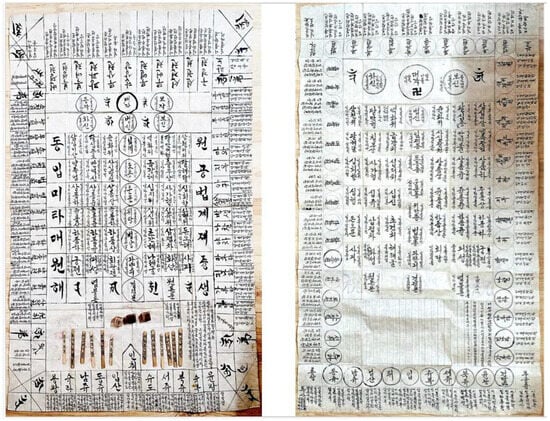
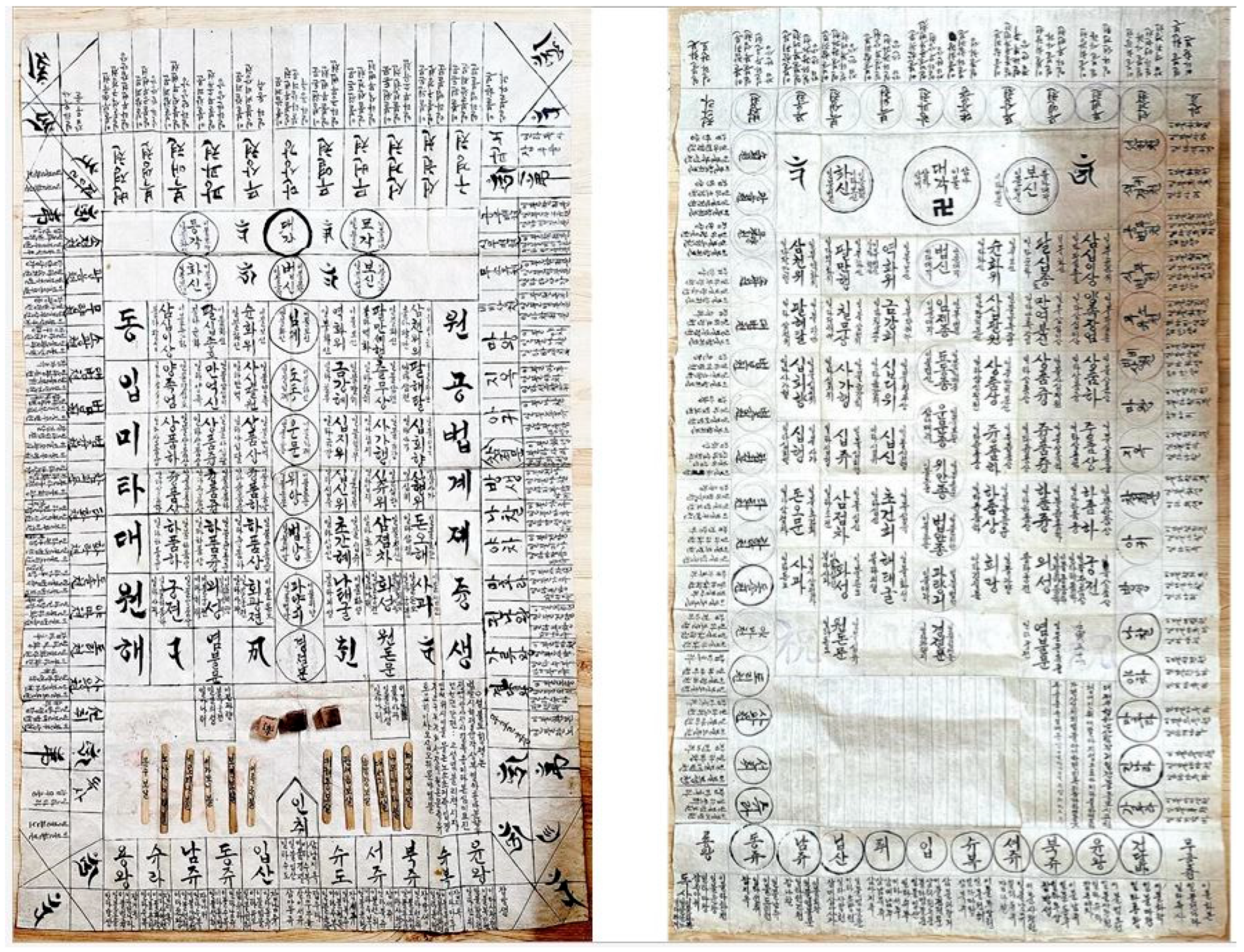
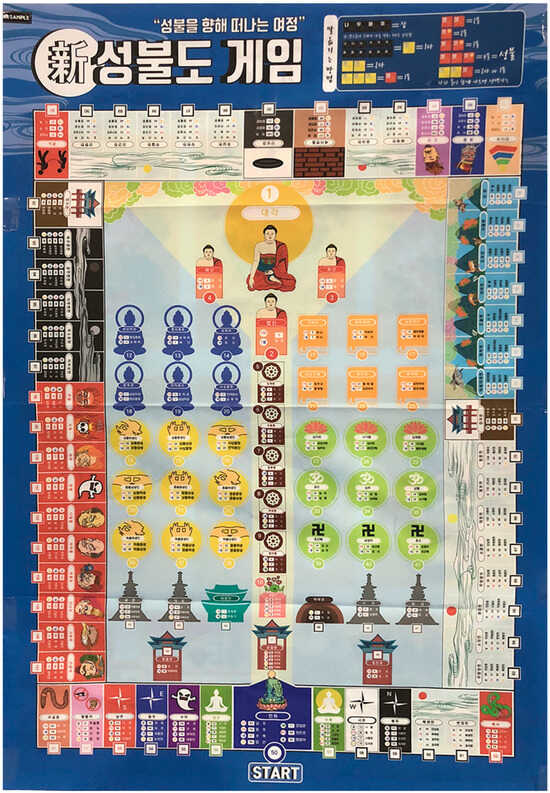
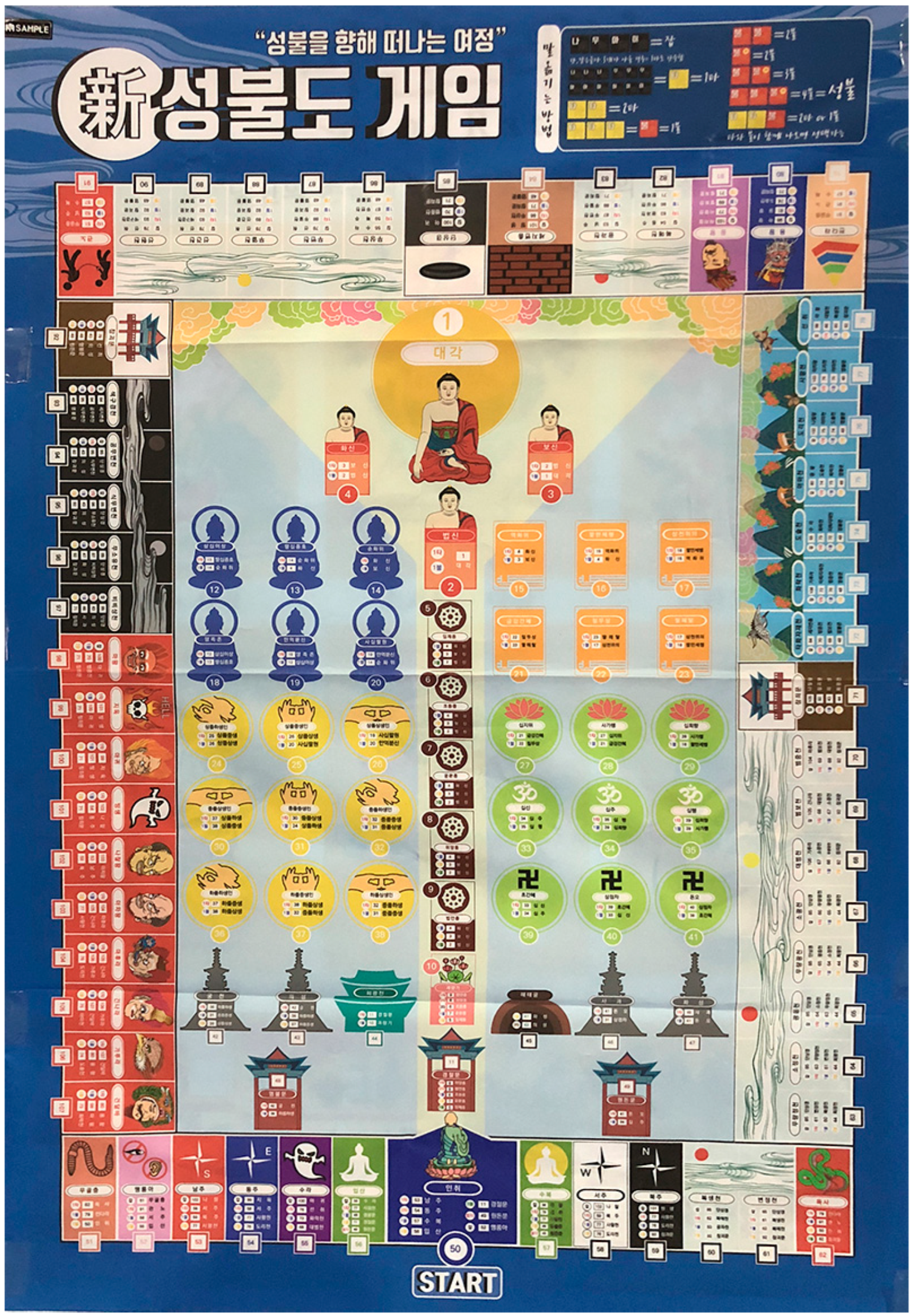

Disclaimer/Publisher’s Note: The statements, opinions and data contained in all publications are solely those of the individual author(s) and contributor(s) and not of MDPI and/or the editor(s). MDPI and/or the editor(s) disclaim responsibility for any injury to people or property resulting from any ideas, methods, instructions or products referred to in the content. |
© 2026 by the authors. Licensee MDPI, Basel, Switzerland. This article is an open access article distributed under the terms and conditions of the Creative Commons Attribution (CC BY) license.