


Abstract
With the rapid growth of the global shipping industry and the increasing availability of Automatic Identification System (AIS) data, accurate vessel trajectory prediction has become crucial for ensuring navigational safety and optimizing maritime traffic management. This paper presents a systematic review of recent advances in deep learning-based methods for vessel trajectory prediction. We provide a comprehensive analysis of mainstream models, including Convolutional Neural Networks (CNNs), Recurrent Neural Networks (RNNs) such as Long Short-Term Memory (LSTM) and Gated Recurrent Unit (GRU) networks, Sequence-to-Sequence (Seq2Seq) models, and the Transformer architecture. Their performance is compared in terms of spatio-temporal data processing capability, prediction accuracy, and computational efficiency. Furthermore, this review examines practical applications of these methods in scenarios such as collision avoidance and route optimization. Despite notable progress, several challenges remain, including data quality issues, real-time prediction capability, and model interpretability. Future research directions may focus on multi-source data fusion and the development of lightweight model designs to further improve prediction performance. This survey aims to serve as a valuable reference for researchers and contribute to ongoing innovation in vessel trajectory prediction technology.
1. Introduction
In recent years, maritime traffic density has increased rapidly, accompanied by a trend towards larger and faster vessels, leading to a significant rise in navigation risks within congested waterways [1]. Statistics indicate that over 50,000 distinct vessels traverse the oceans daily [2]. With the ongoing development of the global shipping industry, this figure is projected to continue rising.
The shipping industry plays a pivotal role in facilitating global trade, driving maritime transport and fostering economic exchange between nations through the movement of goods and passengers [3,4]. Large commercial vessels have propelled the growth of maritime trade while simultaneously introducing complexity to the maritime traffic environment. With the globalization of economic and trade activities, the need to enhance maritime efficiency and safety has become increasingly prominent. Given the intricate nature of the maritime environment, vessel navigation is influenced by factors such as weather conditions, sea states, and other vessels [5]. Consequently, vessel track prediction has emerged as a vital research domain for ensuring maritime safety and optimizing shipping operations [6].
Vessel trajectory prediction refers to the technique of forecasting a vessel’s future position and motion state using historical navigation data, holding significant importance for collision avoidance, traffic management, and autonomous navigation. Recent research indicates that techniques employed for predicting vessel trajectories primarily rely on the vessel’s motion characteristics and historical data [7,8].
Regarding the former, a vessel’s future position is forecasted through kinematic equations, which extrapolate its navigational trajectory based on its motion characteristics. However, estimating a vessel’s trajectory solely through its motion characteristics proves challenging when handling complex maritime traffic patterns.
Consequently, in recent years, the predominant approach to predicting vessel trajectories has been to utilize historical trajectory data. Vessels exhibit distinctive movement patterns during maritime navigation, with their paths often displaying similarities. By employing historical vessel trajectory data as a reference and leveraging high-precision track feature extraction, the accuracy of trajectory prediction can be significantly enhanced [7].
The Automatic Identification System (AIS) is a radio-based real-time positioning and navigation system that continuously records dynamic vessel information such as position, speed, and heading. It also captures static details, including vessel name and dimensions. AIS data provides high spatio-temporal resolution historical vessel trajectories. When combined with machine learning or traditional algorithms, it enables the modelling of vessel movement patterns, the prediction of future paths, and collision risk assessment. Owing to its high sampling rate, extensive coverage, and user-friendly operation, the AIS system has steadily surpassed other data sources to become the primary data source for vessel trajectory prediction and maritime traffic analysis [9,10].
In recent years, deep learning techniques have demonstrated significant advantages in vessel trajectory prediction due to their robust spatio-temporal feature extraction and sequence modelling capabilities. Such models effectively capture complex spatio-temporal dependencies and nonlinear dynamic characteristics in vessel behaviour, markedly enhancing prediction accuracy, generalization ability, and robustness. Compared to traditional methods (such as Kalman filtering and vessel kinematic models), deep learning techniques can autonomously learn implicit patterns from vast AIS datasets—including navigation modes, collision avoidance behaviours, and channel preferences—without relying on complex manual feature engineering or strong assumptions. Concurrently, such approaches demonstrate strong adaptability to environmental variations and behavioural characteristics across vessel types, proving applicable in diverse navigation scenarios including ports, narrow waterways, and open seas. They maintain high predictive reliability even under complex conditions such as extreme weather or data gaps. Consequently, deep learning-driven trajectory prediction technology provides robust data support and a critical technological foundation for intelligent shipping systems, maritime traffic monitoring, collision risk assessment, and navigational decision support. This holds significant importance for enhancing maritime traffic efficiency and navigational safety.
In the field of vessel trajectory prediction, a range of deep learning techniques such as Convolutional Neural Networks (CNNs), recurrent neural networks (RNNs), Long Short-Term Memory (LSTM), Gated Recurrent Unit (GRU) networks, and Sequence-to-Sequence (Seq2Seq) networks have been employed in trajectory prediction studies utilizing historical AIS data [11]. Table 1 and Table 2 present a technical comparison of deep learning model families for ship trajectory prediction, addressing computational aspects and capacity, deployment, and evaluation aspects, respectively.
Table 1.
Technical comparison of deep learning model families for ship trajectory prediction: computational aspects.
Table 2.
Technical comparison of deep learning model families for ship trajectory prediction: capacity, deployment, and evaluation aspects.
Table 1 and Table 2 summarize the main model families used for deep learning-based ship trajectory prediction from an engineering perspective. Instead of only listing qualitative advantages and limitations, we report typical computational complexity, parameter scaling behaviour, and runtime characteristics that are crucial for real-time and onboard maritime applications.
For recurrent models such as LSTM and GRUs, the per-layer computational complexity scales as O(T·h2) for sequence length, T, and hidden size, h, and the inherently sequential nature of the recurrence limits parallelism during training and inference. In contrast, convolutional models (1D CNNs) can process all time steps in parallel, yielding O(T·k·d2) complexity for kernel size, k, and feature dimension, d, which is often advantageous with GPU hardware. Transformer-based models rely on self-attention, whose naïve implementation scales as O(T2·d) in both time and memory; as a result, they can be prohibitively expensive for very long AIS sequences unless efficient attention variants are used.
We explicitly distinguish between training-time cost and inference-time cost. While training is typically carried out offline with ample computational resources, inference in shipboard systems is constrained by limited CPU/GPU capabilities, memory, and strict latency requirements. CNNs and compact GRU models tend to offer favourable latency–accuracy trade-offs for short to medium prediction horizons, whereas large LSTM models or Transformers, although powerful, may require model compression or hardware acceleration to be viable for onboard deployment.
Furthermore, Table 2 links these computational aspects with standardized error metrics such as RMSE, MAE, ADE, and FDE, as reported in the literature. However, due to heterogeneity in datasets and prediction horizons, cross-study quantitative comparisons must be interpreted with caution.
Trajectory prediction is essential for autonomous vessel control systems to make informed decisions and execute appropriate actions, and deep learning techniques have demonstrated significant practical benefits in vessel trajectory prediction [12]. The methods listed in Table 1 demonstrated excellent performance in testing; however, uncertainties remain regarding the adaptability and robustness of these techniques across varying environments. While researchers have conducted systematic reviews of certain AI-based trajectory prediction approaches, gaps persist in the literature. Further research is required within the field of vessel trajectory prediction to evaluate the strengths and weaknesses of principle-based prediction methods and to determine their specific applicable scenarios. This paper aims to systematically review existing deep learning-based vessel trajectory prediction methods, analyse their respective strengths and weaknesses, evaluate their applicability across diverse scenarios, and provide valuable references for future research. The subsequent sections are organized as follows: Section 2 outlines strategies for literature retrieval. Section 3 provides a systematic review of commonly used deep learning approaches. Section 4 summarizes the findings of this study.
2. Review Methodology
2.1. Search Strategy
This review was conducted and reported with reference to the PRISMA 2020 guidelines to improve transparency and reproducibility in the literature search, study selection, and synthesis process. No formal review protocol was registered for this study.
To ensure a systematic and reproducible review of deep learning-based ship trajectory prediction methods, we conducted a structured literature search in the following scientific databases: Web of Science Core Collection, Scopus, IEEE Xplore, ScienceDirect, and Google Scholar.
The search covered publications from January 2014 to December 2025 (the period during which deep learning-based approaches for trajectory prediction started to emerge and mature). The initial search was performed on 1 December 2025. All database searches were completed on 20 December 2025.
We limited the search to articles written in English. The following combinations of keywords were used in the title, abstract, and keywords fields:
“ship trajectory prediction” OR “vessel trajectory prediction” OR “marine traffic prediction” OR “AIS trajectory prediction”, and “deep learning” OR “neural network” OR “LSTM” OR “GRU” OR “RNN” OR “Transformer” OR “graph neural network”, and “Automatic Identification System” OR “AIS”.
Boolean operators and database-specific filters were applied where available. For example, in Scopus we used:
TITLE-ABS-KEY (“ship trajectory prediction” OR “vessel trajectory prediction” OR “marine traffic prediction” OR “AIS trajectory prediction”) AND TITLE-ABS-KEY (“deep learning” OR “neural network” OR “LSTM” OR “GRU” OR “RNN” OR “Transformer” OR “graph neural network”) AND (LIMIT-TO(LANGUAGE, “English”)) AND (PUBYEAR > 2013 AND PUBYEAR < 2024).
In addition, we manually screened the reference lists of the selected papers to identify further relevant studies that might not have been retrieved by the database queries.
The search strings were adapted slightly across databases to account for differences in indexing rules and search syntax while preserving the same core concepts. Searches were limited to English-language publications published between January 2014 and December 2025. The search was performed in the title, abstract, and keyword fields where supported by the database.
2.2. Inclusion and Exclusion Criteria
Studies were eligible for inclusion if they met all of the following criteria:
- (a)
- Topic: The study explicitly addresses ship/vessel trajectory prediction or marine traffic prediction.
- (b)
- Methodology: The study proposes, applies, or evaluates deep learning-based methods (e.g., LSTM, GRU, CNN, RNN, Transformer, GNN, hybrid deep architectures) as the main prediction model or as a core component of the model.
- (c)
- Data: The method is validated on real-world or realistic AIS or vessel movement data.
- (d)
- Publication type: Peer-reviewed journal articles and full conference papers.
- (e)
- Language: Published in English.
Studies were excluded if they met any of the following conditions:
- (a)
- Not deep learning-based: Traditional statistical models, purely physics-based models, or conventional machine learning methods without a deep learning component.
- (b)
- Not focused on trajectory prediction: Works focusing solely on trajectory clustering, anomaly detection, route planning, or collision risk assessment without an explicit predictive component.
- (c)
- Non-peer-reviewed sources: Workshop papers, extended abstracts, theses, preprints without peer review, technical reports, and non-scientific documents (e.g., blogs, white papers).
- (d)
- Insufficient methodological detail: Papers that mention deep learning or trajectory prediction but do not provide enough detail on the model or experimental setup to allow technical understanding or comparison.
- (e)
- Duplicate publications: Multiple papers reporting essentially the same method and experimental results; in such cases, we retained the most complete or latest version and excluded earlier or redundant versions.
2.3. Study Selection Process
This study selection followed a PRISMA-style workflow, the screening and eligibility assessment were conducted by the authors based on predefined criteria. The database search initially returned 6070 records. After removing 3124 duplicates using automated tools and manual checking, 2946 unique records remained.
We then conducted a title and abstract screening, during which 1433 records were excluded because they clearly did not meet the inclusion criteria (e.g., not related to ship trajectory prediction, no deep learning component, or non-technical articles). This left 1513 articles for full-text assessment.
During full-text screening, we excluded 1426 articles for the following main reasons:
- (a)
- Not deep learning-based (traditional or shallow machine learning only);
- (b)
- No explicit trajectory prediction task;
- (c)
- Insufficient methodological or experimental details;
- (d)
- Duplicated or overlapping content with another included publication.
Finally, 87 studies met all the inclusion criteria and were included in the qualitative synthesis presented in this review. A PRISMA-style flow diagram summarizing the study selection process is shown in Figure 1.
Figure 1.
PRISMA flow diagram of study selection process.
For each included study, we extracted the following information: publication year, venue, data source and scale (e.g., AIS region, time span), prediction task (short-term vs. long-term, point prediction vs. trajectory sequence prediction), deep learning architecture, input features, evaluation metrics, and main results.
To reduce bias from low-quality or non-rigorous publications, we applied the following quality considerations:
- (a)
- Only peer-reviewed journal and full conference papers were systematically included. Preprints or non-peer-reviewed reports were excluded (or, if exceptionally discussed, they were clearly labelled as such and not used in comparative conclusions).
- (b)
- Studies without a clear description of the model architecture, data preprocessing, or evaluation protocol were excluded at the full-text screening stage.
- (c)
- In cases where multiple papers described essentially the same method and experimental setting, we treated them as duplicate studies and retained only the most complete or most recent version.
While we did not perform a formal risk-of-bias assessment tool (e.g., for clinical trials), the above criteria acted as a pragmatic quality filter to increase the reliability of the synthesized evidence.
2.4. Quantitative Synthesis and Limitations
The heterogeneity of the included studies in terms of datasets, prediction horizons, input features, evaluation metrics (e.g., RMSE, MAE, MAPE, FDE, ADE), and experimental setups makes a formal meta-analysis or a unified statistical aggregation of performance indicators difficult and potentially misleading.
Therefore, we conducted a qualitative synthesis and a structured comparative analysis instead of a full quantitative meta-analysis. Where possible, we report and compare numerical performance results on similar datasets or tasks, but we refrain from computing global summary statistics across highly heterogeneous studies.
This limitation should be kept in mind when interpreting cross-study performance comparisons: the conclusions mainly indicate relative trends (e.g., LSTM vs. GRU vs. Transformer families under different conditions) rather than exact quantitative rankings.
3. Deep Learning Methods
Deep learning constitutes a subfield of machine learning. Machine learning techniques have demonstrated promising application prospects in the domain of vessel track prediction, yielding a series of significant research outcomes. However, traditional machine learning-based models and algorithms typically exhibit issues such as high computational complexity, limited generalization capabilities, and insufficient robustness. Furthermore, the predictive accuracy and applicability of machine learning methods across diverse operational scenarios remain areas requiring further enhancement.
In recent years, trajectory prediction methods based on deep learning have exhibited a pronounced trend of technological iteration: initially dominated by RNN/LSTM and CNN-based approaches (2018–2019), GNN-based methods subsequently gained prominence due to their robust interaction modelling capabilities (2020–2022); presently, Transformers maintain sustained high popularity owing to their exceptional sequence modelling abilities (2021 to present). The popularity trends of various deep learning methods over the past eight years are illustrated in Figure 2.
Figure 2.
Heatmap of popularity trends for deep learning methods.
Concurrently, deep learning offers a more effective solution for vessel track prediction. In light of this, numerous scholars have begun exploring the application of deep learning as a more capable learning methodology. The core advantage of deep learning lies in its ability to efficiently process complex and dynamically changing data, enabling it to significantly enhance performance in vessel track prediction tasks.
3.1. Convolutional Neural Networks
Convolutional Neural Networks (CNNs) are widely used in deep learning-based vessel trajectory prediction, primarily due to their ability to capture local spatial–temporal patterns in AIS data. Existing CNN-related approaches can be broadly grouped into two categories: The first type is pure CNN models, which directly map historical trajectories to future positions using convolutional encoders and decoders. Another one is hybrid architectures, which combine CNNs with temporal or attention modules such as LSTM, GRUs, Bi-LSTM, or Transformers. In these models, CNN layers act as local feature extractors, while the subsequent temporal or attention components model longer-range dependencies and complex sequence dynamics.
Across the surveyed studies, several common design patterns emerge. First, CNN front-ends are typically used to extract short-range motion motifs (e.g., small turns, accelerations, and local interactions) and compress raw AIS sequences into higher-level feature representations. Second, recurrent layers (LSTM/GRU/Bi-LSTM) or self-attention modules are then employed to aggregate these features over longer horizons, improving the modelling of route-level behaviour and long-term intent. Third, many works further enhance these hybrids with attention mechanisms or meta-optimization (e.g., improved optimizers and hyperparameter search), leading to consistent gains in prediction accuracy and robustness.
Lee et al. [12] proposed a CNN–LSTM-based framework (Figure 3) that first applies convolutional layers to encode local motion and spatial context, after which LSTM layers aggregate the encoded features over time to produce multimodal trajectory and collision-risk predictions. By explicitly quantifying COLREG rules and incorporating sea state information from Singapore’s main straits, the model injects domain knowledge and environmental factors into the learning process. The authors report that the CNN–LSTM hybrid yields efficient and accurate trajectory predictions and demonstrates robust collision-avoidance performance for both high- and low-manoeuvrability MASS configurations in complex navigation scenarios, highlighting the benefit of combining learned spatial–temporal features with rule-based priors.
Figure 3.
CNN–LSTM framework diagram.
Lu et al. [13] proposed an attention-enhanced CNN–LSTM model that further refines the hybrid design. A two-layer residual CNN first extracts spatial features from AIS trajectories; a bidirectional LSTM then captures temporal dependencies in both forward and backward directions. An attention mechanism is applied on top of the Bi-LSTM outputs to emphasize the most informative time steps, while the Ranger optimizer is used to improve convergence speed and stability. Compared with several existing models on the same dataset, the residual CNN–LSTM with attention achieves higher prediction accuracy and more stable forecasting performance, suggesting that residual connections + attention + improved optimization can substantially strengthen the baseline CNN–LSTM pattern.
To further enhance prediction accuracy, Chu et al. [14] developed a CNN–Bi-LSTM model augmented with a sparse attention mechanism. In this architecture, CNN layers extract local spatial features, Bi-LSTM layers capture long-term dependencies in both temporal directions, and sparse attention selectively focuses on the most critical historical time steps while suppressing redundant information. The authors also perform rigorous cleaning, processing, and normalization of raw AIS data to construct high-quality training sets. Experiments demonstrate that this CNN–Bi-LSTM–sparse attention model significantly outperforms traditional baselines across multiple metrics, indicating that selective attention over carefully preprocessed sequences can improve both accuracy and computational efficiency, which is crucial for high-precision intelligent navigation systems.
Based on AIS data, Bai et al. [15] investigated how meta-heuristic optimization can enhance pure CNN models. They proposed a vessel trajectory prediction approach that integrates an improved particle swarm optimization (IPSO) algorithm with a CNN. Historical AIS data from Ningbo–Zhoushan Port are used both as the training input and as a basis for optimizing the CNN’s structure and hyperparameters via IPSO. The resulting IPSO–CNN model achieves notably lower prediction errors and better trajectory fitting than comparison models, with the prediction error reduced below 0.001 and improved trajectory alignment. This work illustrates that, even for CNN-based architectures, automatic hyperparameter tuning and architecture search can yield substantial performance gains in port-scale prediction tasks.
Liu et al. [16] addressed the complex and irregular nature of vessel trajectory sequences with a CNN–GRU–attention fusion model (Figure 4). In their design, CNN layers first extract local structural patterns from raw AIS trajectories, leveraging residual connections to alleviate gradient vanishing in deeper networks. An attention mechanism then assigns different weights to segments of the input sequence, allowing the model to focus on the most informative historical observations. Finally, GRU layers process the attention-weighted feature sequences and capture long-term temporal dependencies. Extensive experiments on real-world AIS data show that this fusion model outperforms BP, LSTM, and standalone GRU baselines in terms of MAE, MSE, and RMSE (see Figure 5 for a comparison of prediction errors), underscoring the effectiveness of CNN-based local encoding + attention-driven focus + GRU-based long-range modelling in handling irregular and complex vessel motion patterns.
Figure 4.
CNN-RGRU-attention model architecture.
Figure 5.
Comparison of prediction errors with different models: (a) comparison with the BP model; (b) comparison with the LSTM model; (c) comparison with the GRU model; (d) comparison with the Bi-LSTM model.
Taken together, these CNN-related studies reveal several cross-cutting insights. First, CNN components are consistently used as efficient local spatial–temporal encoders, reducing the burden on recurrent or attention modules. Second, attention mechanisms and bidirectional or Gated Recurrent Units are effective in exploiting the resulting feature sequences, particularly in the presence of irregular sampling and noise. Third, optimization strategies such as advanced optimizers and meta-heuristic hyperparameter tuning can materially affect the final performance. These observations support the more general conclusion that hybrid CNN–temporal architectures, augmented by attention and careful optimization, offer a favourable accuracy–efficiency trade-off for vessel trajectory prediction, especially in complex and high-density maritime environments. However, most evaluations are confined to a single port region; cross-region generalization remains untested.
3.2. Recurrent Neural Networks
RNNs (Recurrent Neural Networks) constitute a specialized neural network architecture designed for processing sequential data. By transmitting historical information through hidden states, these networks acquire a capacity for “memory”. This memory mechanism enables RNNs to effectively capture temporal dependencies and contextual information within sequential data, providing a powerful tool for handling diverse datasets exhibiting time-series characteristics.
Recurrent Neural Network (RNN) is a general term encompassing RNNs, LSTM, GRUs, and other recurrent neural network models. RNNs are specifically designed to process sequential data and have found extensive application across various domains, including vessel trajectory prediction [12]. The three fundamental RNN model architectures are illustrated in Figure 6.
Figure 6.
Three fundamental RNN model architectures.
To address the issue of vessel navigation trajectories being susceptible to interference from environmental factors such as wind and waves, Zhu et al. [17] proposed a method for short-term vessel trajectory prediction based on Automatic Identification System (AIS) data and Recurrent Neural Networks (RNNs). Unlike conventional feedforward architectures, RNNs are inherently capable of capturing temporal dependencies in sequential AIS data, making them particularly suitable for modelling dynamic vessel motion patterns. Furthermore, the authors carefully preprocessed the raw AIS messages to eliminate noise and irregular sampling issues, which are common challenges in maritime data. This approach utilizes preprocessed AIS data to construct an RNN model, achieving precise prediction of vessel position information. Experimental results demonstrate the method’s practicality and effectiveness when applied to real AIS trajectory data. As shown in Table 3, it exhibits a significant advantage in prediction accuracy compared to traditional backpropagation (BP) neural networks.
Table 3.
Comparison of RMSE between BP and RNN.
3.2.1. Long Short-Term Memory
Standard Recurrent Neural Networks (RNNs) often suffer from vanishing or exploding gradients on long sequences, which limits their ability to capture long-term dependencies. Long Short-Term Memory (LSTM) networks mitigate this problem through gated memory cells that explicitly model information flow over time. Consequently, LSTM models have become one of the most widely used architectures for ship trajectory prediction, particularly when modelling complex, nonlinear vessel dynamics over medium and long horizons.
Several early studies adopt “plain” LSTM architectures that directly model AIS time series without additional spatial modules. Quan Bo et al. [18] proposed an LSTM-based vessel track prediction model that learns temporal dependencies from AIS data at Guangzhou Port. Compared with traditional backpropagation neural networks, the LSTM achieved higher and more stable multi-step prediction accuracy, especially after appropriate data normalization and hyperparameter tuning. This approach ensures that the established model adheres to practical logic, circumventing the cumbersome modelling processes associated with standard methods [19].
A recurring challenge in these works is the sensitivity of LSTM performance to architectural and training hyperparameters (e.g., number of hidden units and learning rate). To alleviate this, Qian et al. [20] introduced a GA-LSTM model in which a genetic algorithm automatically searches for suitable hyperparameters. Their results show that data-driven hyperparameter optimization can reduce position errors and improve convergence robustness, particularly in inland waterway scenarios where traffic patterns are complex.
Other studies integrate LSTM into traditional modelling frameworks. Misganaw et al. [21] proposed a hybrid ARIMA–LSTM model that decomposes AIS trajectories into linear and nonlinear components: a moving average filter and ARIMA capture linear trends, while an LSTM models nonlinear residuals such as abrupt turns or speed changes. Field trials indicate that this hybrid approach yields lower position, heading, and velocity errors than single models and can be integrated into collision risk index (CRI) simulations for real-time collision avoidance.
Across these works, a consistent pattern emerges: even simple LSTM architectures provide clear gains over traditional neural networks and purely statistical models; automatic hyperparameter search (e.g., GA and optimization heuristics) is often more effective than manual tuning; and combining LSTM with classical time-series models can improve robustness in complex manoeuvring scenarios.
For complex traffic and irregular AIS sampling, more advanced LSTM variants have been proposed. Zhang et al. [22] developed a time-aware LSTM (T-LSTM) integrated with a Generative Adversarial Network (GAN) to directly handle irregular AIS timestamps without resampling to a fixed grid. The model framework diagram is shown in Figure 7. The T-LSTM explicitly encodes time intervals between messages, while the GAN framework enhances multi-vessel prediction through adversarial training. Experiments show improved accuracy for both single-vessel and multi-vessel scenarios, along with reduced computational overhead compared with interpolation-based pipelines.
Figure 7.
T-LSTM model framework diagram.
To improve robustness against noise and non-stationary dynamics, Yao et al. [23] combined LSTM with particle swarm optimization (PSO). The PSO-LSTM adaptively tunes network hyperparameters via global search, helping the model escape local optima and improving prediction accuracy under nonlinear coupling, chaotic effects, and random noise in vessel motion data.
LSTM autoencoders have also been employed for anomaly-related tasks. Venskus et al. [24] used an LSTM autoencoder to reconstruct normal vessel trajectories and evaluate prediction zones. Deviations between predicted and actual trajectories are used to flag unusual behaviour, enabling anomalous maritime traffic detection while preserving data privacy.
These studies collectively highlight two key themes: explicitly modelling time irregularity (e.g., via T-LSTM) is preferable to naïve time-normalization when AIS sampling is highly uneven, and global optimization and probabilistic frameworks (PSO, GANs, and autoencoders) can significantly enhance LSTM robustness to noise and non-stationarity.
A second major line of work extends LSTM models with mechanisms to better capture spatio-temporal structure and multivariate correlations. Guo et al. [25] introduced a spatio-temporal LSTM (ST-LSTM) that incorporates dedicated spatial and temporal gates. After interpolating and clustering AIS trajectories, the ST-LSTM separately models spatial and temporal information, leading to predicted trajectories that closely track actual vessel paths.
Wang et al. [26] proposed the STPGL model (Figure 8), which follows an encoder–decoder architecture. A historical LSTM encoder extracts temporal attributes from a vessel’s past trajectory, while a graph attention network (GAT) interaction encoder aggregates spatial interaction features among multiple vessels. Fusing these two feature types and feeding them into an LSTM-based decoder significantly improves short-, medium-, and long-term prediction accuracy in congested waterways.
Figure 8.
Overall framework of the STPGL model.
Attention mechanisms have also been combined with LSTM to emphasize important time steps and variables. Li et al. [27] designed a model that first transforms AIS data via an encoding scheme and then applies a multi-head attribute-correlated attention mechanism to capture nonlinear relationships among variables, such as speed and heading, before feeding the attended features into an LSTM. The model framework is shown in Figure 9. Zhou et al. [28] proposed a trajectory prediction model with two attention modules (the model framework is shown in Figure 10): a Trajectory Point Correlation Attention (TPCA) module to model spatial connections and local trend variations between trajectory points, and a Time Pattern Attention (TPA) module to capture dynamic correlations among multiple variables over time. They also introduced a Great Circle Route Loss (GCRLoss) that accounts for the Earth’s curvature, improving the geographic realism of predictions.
Figure 9.
AcoAtt-LSTM model framework diagram.
Figure 10.
Prediction model framework diagram.
Yin et al. [29] further integrated multi-scale convolutions with LSTM and attention in the LMCA model (the model framework diagram is shown in Figure 11). Extended features (e.g., position increments and sine/cosine components of speed and heading) are first constructed, after which multi-scale convolutions extract local and global motion patterns. An LSTM then captures longer-term dependencies, and an attention mechanism focuses on critical time steps. Experiments show substantial reductions in mean and final displacement errors (over 50% improvement relative to a baseline) and highlight the benefits of combining feature expansion with multi-structure fusion.
Figure 11.
LMCA model framework diagram.
Together, these works indicate that separating spatial and temporal processing (e.g., via ST-LSTM and GAT + LSTM) improves the modelling of vessel interactions and route structure; attention mechanisms (temporal, spatial, and attribute-level) help focus on informative segments and variables, leading to more accurate multi-step forecasts; and domain-specific losses (e.g., great-circle distance) can materially improve alignment with real-world navigation geometry.
Beyond pure kinematics, several studies incorporate contextual information and navigational intent into LSTM-based frameworks. Mehri et al. [30] extended a generic compression algorithm with contextual data and designed a context-aware LSTM (CLSTM) that includes factors such as vessel type. Through a recursive feedback loop that combines LSTM-based forecasts with curve-fitting models, the CLSTM achieves approximately 15.7% higher prediction accuracy than a standard LSTM, along with faster convergence and reduced oscillation.
Zhao et al. [31] focused on long-term route prediction by integrating a historical intent module with a state-optimization module. The historical module models long-term navigational intent using periodic AIS patterns, providing high-level guidance for future trajectory prediction, while the state module learns high-dimensional dynamic representations (e.g., speed profiles). Their hybrid approach significantly outperforms mainstream baselines in extended-horizon prediction tasks, illustrating the importance of explicitly modelling route intent rather than only local dynamics.
In polar navigation scenarios, Liu et al. [32] proposed a KAN–LSTM model that combines Kolmogorov–Arnold Networks (KANs) with LSTM. A KAN first learns rich representations from GNSS-based navigation data, which are then fed into an LSTM model to capture temporal dependencies. Experiments on two polar sea routes show that KAN–LSTM achieves lower RMSE and ADE than competing models under GNSS outages, demonstrating improved accuracy and stability under challenging conditions. A comparison of the results of this method with those of other methods is shown in Figure 12.
Figure 12.
Comparison of prediction results from different models.
These context- and intent-aware hybrids highlight that leveraging external context (vessel type and operational patterns) and high-level intent can substantially improve long-horizon predictions, and LSTM models serve effectively as temporal backbones when enriched with context encoders or specialized feature extractors.
Rather than viewing the above works in isolation, several consistent design patterns emerge for LSTM-based ship trajectory prediction. First, feature engineering and representation matter as much as architecture. Models that use local coordinate systems, motion derivatives (e.g., speed and heading change), and extended features (e.g., sine/cosine encodings and contextual attributes) systematically report better performance and faster convergence than those using raw latitude and longitude only.
Second, hybrid architectures exploit complementary strengths. LSTM combined with classical models (e.g., ARIMA and curve fitting) separates linear trends from nonlinear residuals, benefiting both accuracy and interpretability. Similarly, LSTM paired with spatial modules such as CNNs, GATs, or multi-scale convolutions, as well as with attention mechanisms, improves the capture of local spatial patterns and long-term temporal dependencies, which is particularly crucial in dense traffic and complex waterways. Additionally, context and intent modules provide high-level semantic information that plain LSTM cannot infer from kinematics alone.
Third, handling irregular and noisy AIS data is essential. Time-aware LSTM (e.g., T-LSTM), explicit time-gap features, robust loss functions, and outlier filtering are consistently more effective than simple uniform resampling in dealing with irregular sampling intervals and measurement noise.
For engineering deployment, complexity must be balanced with benefit. While advanced hybrids such as LMCA, STPGL, and KAN–LSTM achieve notable gains in RMSE and ADE, they also increase model complexity and computational cost. For onboard real-time systems, lighter LSTM variants with carefully engineered features or modest spatial modules may offer a better accuracy–efficiency trade-off.
These patterns provide practitioners with actionable guidance: start from a reasonably sized LSTM backbone; invest in domain-aware feature representation and time-irregularity handling; and add spatial, attention, or context modules selectively only where the operational scenario justifies the additional complexity.
3.2.2. Bidirectional Long Short-Term Memory
Standard unidirectional LSTM models predict future vessel motion by propagating information forward in time. When vessels undergo abrupt manoeuvres, such as sudden course or speed changes, purely forward recurrence may not fully exploit contextual cues around these events, and prediction errors can increase. Bidirectional LSTM (Bi-LSTM) networks extend LSTM by processing sequences in both forward and backward directions and concatenating the hidden states, thereby capturing past and future temporal context within a fixed window. Although this doubles the recurrent computation and is unsuitable for strict streaming scenarios, Bi-LSTM models often achieve higher accuracy on offline or sliding-window prediction tasks.
Several studies have investigated Bi-LSTM models as direct extensions of LSTM baselines for ship trajectory prediction. Chen [33] employed a Bi-LSTM architecture to forecast vessel trajectories and analyse fluctuation trends, reporting improved alignment between predicted and actual trajectories compared with unidirectional LSTM models. Hu et al. [34] systematically compared RNN, LSTM, and Bi-LSTM models trained on AIS data, showing that Bi-LSTM achieved the lowest positional error and produced trajectories closest to ground truth.
These findings are consistent with broader sequence-modelling results [35,36], where Bi-LSTM models outperform standard LSTM models on tasks requiring global contextual awareness. In the maritime setting, this corresponds to prediction scenarios where a finite trajectory segment (historical window plus a short “future” context within the input) is available, allowing the model to leverage both preceding and subsequent information when learning motion patterns. However, this benefit comes at the cost of approximately doubled recurrent complexity and the requirement that the entire input window be available before prediction, which constrains real-time and streaming applications.
Plain Bi-LSTM models generally deliver more accurate offline trajectory predictions than unidirectional LSTM models when both past and limited future context are available in the input. They are best suited for post hoc analysis, trajectory reconstruction, and short-term forecasting within sliding windows, rather than hard real-time streaming on board.
Beyond the basic architecture, several works focus on improving Bi-LSTM training stability and generalization through advanced optimization schemes. Li et al. [37] proposed an enhanced Bi-LSTM model that integrates RAdam and Lookahead optimizers. RAdam stabilizes the adaptive learning rate in early training, while Lookahead maintains a set of slow weights to explore more global optima. Using AIS data from Tianjin Port, the RAdam–Lookahead Bi-LSTM significantly outperformed standard Bi-LSTM and other baselines in terms of trajectory prediction accuracy and convergence stability.
These optimization-enhanced Bi-LSTM variants highlight a recurring theme across LSTM-based models: training dynamics and hyperparameters strongly influence performance, and tailored optimization strategies can improve both accuracy and robustness without changing the core architecture. From an engineering perspective, such methods are attractive because they improve reliability on localized datasets with minimal architectural overhead.
To better exploit heterogeneous traffic patterns, some authors combine Bi-LSTM models with clustering-based preprocessing. Park et al. [38] used DBSCAN to identify typical vessel trajectory patterns and spectral clustering with an LCSS-based trajectory similarity measure to group similar routes. A Bi-LSTM model is then trained within each cluster to predict vessel motion. Compared with LSTM and GRU baselines, the cluster-specific Bi-LSTM models achieved the highest predictive accuracy.
This design illustrates a cross-cutting pattern where structuring the data via clustering or route segmentation before applying a sequence model can simplify the learning task and improve performance. The combination of trajectory pattern mining (DBSCAN and LCSS) and Bi-LSTM exploits the fact that traffic patterns are not homogeneous and that models tuned to specific route families can capture finer-grained manoeuvring behaviour.
Qi et al. [39] applied a Bi-LSTM model to AIS data from the Hainan-1 satellite. Their preprocessing pipeline—comprising rule-based outlier filtering, linear interpolation to smooth trajectories, and standardization—produced uniformly sampled time series that serve as input to the Bi-LSTM model. By learning both preceding and subsequent data points, the model captures context-dependent relationships in vessel motion and achieves significantly lower RMSE compared with LSTM baselines.
Gao et al. [40] proposed a hybrid repair strategy that combines cubic spline interpolation for short-range gaps with a TCN–SA–Bi-LSTM model for long-range trajectory repair (Figure 13). The model integrates a temporal convolutional network (TCN) to efficiently extract temporal features, a self-attention (SA) module to model long-range correlations, and a Bi-LSTM model to capture bidirectional dependencies. Experiments show that this approach yields higher reconstruction accuracy than traditional methods, providing a robust solution for AIS data repair in intelligent maritime systems.
Figure 13.
TCN-SABi-LSTM network architecture diagram.
These works demonstrate that Bi-LSTM models are effective tools for trajectory repair and reconstruction when AIS data exhibit gaps and irregular sampling. However, most studies rely on interpolation (linear or spline) to regularize inputs before modelling; only a few explicitly quantify interpolation error or explore time-aware architectures. From a systems engineering viewpoint, quantifying the statistical properties of AIS gaps (e.g., gap length distributions) and the sensitivity of Bi-LSTM-based repair to these properties remains an open problem.
Several studies employ Bi-LSTM-based hybrids to predict vessel motion and attitude under complex sea conditions, where nonlinear coupling, chaotic behaviour, and noise make traditional models less reliable.
Wang et al. [41] proposed a Bi-LSTM model with a Temporal Pattern Attention (TPA) mechanism for roll angle prediction. (The model framework diagram is shown in Figure 14). Bi-LSTM layers extract bidirectional temporal features from roll angle time series, while TPA dynamically assigns higher weights to time steps and patterns most relevant to the current prediction (e.g., turning segments and rapid speed changes). Experiments show that the Bi-LSTM–TPA model significantly outperforms standard LSTM and SVM baselines in MAPE, MAE, and MSE, demonstrating that attention mechanisms can enhance Bi-LSTM’s ability to focus on critical manoeuvre segments.
Figure 14.
Bi-LSTM-TPA model prediction flowchart.
Zhao et al. [42] extended this idea by integrating Bi-LSTM with self-attention to predict roll and pitch. The Bi-LSTM model captures bidirectional temporal dependencies, and self-attention emphasizes key subsequences that govern attitude changes. The model achieves lower RMSE, MAE, and MAPE than ARMA and LSTM models, underscoring the benefit of combining bidirectional recurrence with flexible attention for capturing complex ship motion dynamics.
Ping et al. [43] addressed vertical oscillation prediction under sea states 3–6 by proposing a Conv–Bi-LSTM model. Synthetic six-degrees-of-freedom motion data are generated using ITTC wave spectra and Response Amplitude Operators (RAOs). A CNN first extracts local features from the motion time series, and Bi-LSTM then models bidirectional temporal dependencies. Across multiple sea states, the Conv–Bi-LSTM significantly improves prediction accuracy over LSTM, BP neural networks, and Kalman-based models.
Capobianco et al. [44] proposed a recursive encoder–decoder architecture in which a Bi-LSTM-RNN encoder maps input trajectories into context representations, an attention mechanism aggregates successive encoder hidden states, and an LSTM decoder generates the output sequence. Multi-layer encoder/decoder structures deepen representation capacity. This design follows a general pattern in the trajectory prediction literature: a Bi-LSTM encoder + attention + LSTM decoder as a flexible framework for modelling complex manoeuvring patterns.
Across these hybrids, Bi-LSTM components excel at extracting rich temporal features, while CNN/TCN modules capture local patterns, and attention mechanisms highlight informative segments. This division of labour mirrors the CNN–LSTM and attention-based patterns observed in other parts of the literature: local spatial–temporal encoders plus bidirectional temporal aggregators offer strong performance on complex motion prediction tasks, albeit with increased computational cost and reduced suitability for strict real-time, streaming deployments.
Bi-LSTM models have also been used in higher-level behaviour prediction and collision avoidance frameworks. Gao et al. [45] developed a real-time vessel behaviour prediction model based on a Bi-LSTM-RNN, trained on Tianjin Port AIS data. The bidirectional structure strengthens the connections between historical trajectories and imminent future behaviour, while the LSTM’s gating mechanisms filter out anomalous patterns and retain common navigation behaviours. The authors highlight the potential application of this model in intelligent collision avoidance, route planning, and anomaly detection, although detailed latency measurements and hardware constraints are not fully reported.
For unmanned surface vehicles (USVs), Gao et al. [46] proposed a Seq2Seq encoder–decoder architecture using a Bi-LSTM-RNN encoder to process AIS encounter data. The encoder learns bidirectional context in vessel encounters, and the decoder generates collision avoidance actions, effectively establishing a mapping from AIS sequences to control decisions. Trained on AIS data from Zhoushan Port, the Bi-LSTM-based Seq2Seq model demonstrates promising performance in generating feasible avoidance strategies.
These applications highlight both the opportunities and challenges of using Bi-LSTM models in safety-critical maritime systems: while they can capture complex encounter dynamics and support decision-making, their bidirectional nature and computational demands require careful consideration in real-time, onboard settings.
Bi-LSTM-based models for ship trajectory and motion prediction exhibit several cross-cutting design patterns that are closely aligned with the broader issues discussed in this review. From the perspective of use cases and temporal context, Bi-LSTM models are particularly effective when both past and a limited amount of future context within a time window can be leveraged—such as in trajectory reconstruction, offline prediction, and trajectory repair. However, they are less suitable for strictly streaming scenarios where future observations are unavailable. For real-time collision avoidance, unidirectional LSTM, GRUs, or causal CNNs/TCNs, possibly combined with lightweight attention mechanisms, are generally more appropriate.
Regarding data preprocessing and AIS data characteristics, most Bi-LSTM studies perform explicit preprocessing steps, including outlier filtering, interpolation (linear or cubic spline), clustering, and standardization. While such regularization simplifies modelling, the interpolation and repair strategies introduce their own errors. Only a limited number of studies quantify these errors or relate them to AIS gap statistics, leaving a gap in rigorous analysis of the coupling between data quality and model performance.
Furthermore, hybrid architectures that combine Bi-LSTM with CNNs, TCNs, attention mechanisms, and clustering consistently improve prediction performance by leveraging complementary strengths—namely local pattern extraction, bidirectional context modelling, and selective focus on critical trajectory segments. These hybrids follow the general engineering principle that structured inputs and multi-stage designs often yield better accuracy than simply deepening a single recurrent layer. Nevertheless, in terms of generalization and deployment, most Bi-LSTM-based studies are evaluated only on local datasets (e.g., Tianjin Port, Zhoushan Port, or specific river segments), with limited cross-region or cross-dataset validation. As a result, their generalisability to other traffic environments remains largely untested. Moreover, very few studies report inference latency, hardware requirements, or model size—all of which are critical for deployment in real-world maritime systems.
Finally, regarding interpretability and safety, attention-based Bi-LSTM hybrids (e.g., Bi-LSTM with TPA or self-attention) naturally support partial interpretability: attention weights can be visualized to indicate which time steps or trajectory patterns most influence predictions or decisions. However, systematic evaluations of such interpretability tools in operational contexts—for instance, how effectively they assist human operators or meet regulatory requirements—are still lacking and represent an important direction for future research. In summary, Bi-LSTM models represent a powerful but computationally heavier extension of LSTM architectures. They are particularly well suited for offline analysis, trajectory reconstruction, and complex motion prediction when bidirectional context is available and real-time constraints are relaxed. For safety-critical, real-time deployment, careful trade-offs among accuracy, latency, interpretability, and generalization across maritime environments must be considered, consistent with broader engineering recommendations.
3.2.3. Gated Recurrent Unit
The Gated Recurrent Unit (GRU) is a simplified variant of the Recurrent Neural Network (RNN), designed to address long-term dependency issues while reducing model complexity. By merging the input and forget gates into a single update gate and removing the explicit cell state, GRUs achieve a more compact structure with fewer parameters and a lower computational cost than LSTM while maintaining comparable performance in many sequence modelling tasks [47]. These characteristics make GRUs particularly attractive for trajectory prediction scenarios where efficiency and deployability are critical. Consequently, numerous researchers favour employing GRUs to construct Recurrent Neural Networks for trajectory prediction tasks.
Several studies demonstrate that GRU-based models can achieve competitive performance with reduced computational overhead. Suo et al. [48] proposed a GRU-based trajectory prediction framework combined with DBSCAN clustering to extract dominant navigation routes (the clustering results are shown in Figure 15). After trajectory refinement and noise reduction, the GRU model was trained for real-time prediction, achieving accuracy comparable to LSTM while requiring lower computational cost. The forecast results are shown in Figure 16.
Figure 15.
DBSCAN trajectory clustering results (different coloured clusters represent distinct high-density flight paths).
Figure 16.
(a) Visualized comparison of actual and predicted vessel trajectories based on the GRU model. (b) Detailed demonstration of the GRU model’s predictive performance for actual vessel trajectories.
These findings highlight a key engineering trade-off: GRUs often provide a better balance between accuracy and efficiency, especially in real-time or resource-constrained environments such as onboard maritime systems. However, most existing studies report accuracy improvements without systematically quantifying latency, throughput, or hardware requirements, making it difficult to assess real-world deployability.
To overcome the limitations of pure recurrent models, many works integrate GRUs with complementary modules for feature extraction and representation learning.
Chen et al. [49] proposed a parallel LSTM–GRU (PLG) architecture combined with improved QuickBundles clustering (IQB), where clustering extracts navigation patterns and parallel recurrent networks capture temporal dependencies. This “feature extraction + parallel prediction” design significantly improves long-term prediction performance.
Similarly, Lin et al. [50] introduced a hierarchical temporal convolutional network combined with attention and GRU (TTAG). The model structure diagram is shown in Figure 17, in which TCN layers extract multi-scale temporal features, attention mechanisms emphasize critical trajectory segments, and GRUs model nonlinear temporal dependencies. This modular design consistently outperforms standalone models, illustrating a common pattern across the literature: decoupling feature extraction from temporal modelling improves performance more effectively than increasing recurrent depth alone.
Figure 17.
TTAG model.
Attention mechanisms are frequently integrated with GRUs to improve the model’s ability to focus on informative trajectory segments and handle high-dimensional inputs.
Zhang et al. [51] combined multi-scale CNNs, GRU with attention (GRU-AM), and autoregressive (AR) models for trajectory prediction under radar clutter. The CNN extracts spatial features, the GRU captures temporal dependencies, and attention highlights key states. A forward–backward fusion strategy further improves robustness for broken tracks.
Liu et al. [16,52] proposed CNN–GRU–attention and PSO-optimized variants (the model framework is shown in Figure 18), where convolutional layers extract spatial features, GRUs model sequential dependencies, and attention mechanisms assign adaptive weights to trajectory points. Optimization algorithms such as PSO further enhance convergence and reduce prediction error.
Figure 18.
PSO-CNN-RGRU-attention model architecture diagram.
Bi et al. [53] extended this framework by incorporating environmental variables (e.g., wind, waves, and currents) into a CNN–GRU–multi-head attention model (Figure 19). This demonstrates an important trend toward multi-source data fusion, where external factors are integrated to improve prediction robustness.
Figure 19.
CNNGRU-MHA model framework diagram.
Bidirectional GRU (Bi-GRU) models (Figure 20) extend GRUs by incorporating forward and backward temporal dependencies, similar to Bi-LSTM models.
Figure 20.
Bi-GRU neural network architecture.
Wang et al. [54] applied a Bi-GRU model to vessel berthing trajectory prediction, achieving high accuracy in port environments and demonstrating applicability to anomaly detection and collision warning tasks. Bao et al. [55] further combined a Bi-GRU with multi-head attention to capture cross-temporal correlations, significantly improving prediction accuracy (the model structure is shown in Figure 21).
Figure 21.
Schematic diagram of the MHA-Bi-GRU architecture.
Xiao et al. [56] proposed a forward–backward GRU-attention framework (Att-FB), integrating forward GRU, backward GRU, and fusion networks. This architecture enhances temporal representation by explicitly modelling bidirectional dependencies and achieves substantial accuracy improvements over baseline models.
Zhou et al. [57] introduced a WOA-optimized Bi-GRU model with dropout-based uncertainty estimation, providing one of the few attempts to quantify prediction uncertainty in vessel trajectory modelling.
These approaches indicate that bidirectional GRU structures improve accuracy by leveraging richer temporal context but at the cost of increased computation and reduced suitability for streaming scenarios.
Beyond deterministic prediction, GRUs have also been integrated with probabilistic and model-based approaches; for example, Jia et al. [58] proposed a Bayesian multi-model framework that combines GRU networks with variational Kalman filters. In this hybrid setup, the GRU extracts nonlinear temporal features, while the Kalman filter provides probabilistic state estimation and physical consistency, thereby leveraging the strengths of both data-driven learning and model-based inference to improve trajectory plausibility and robustness.
In contrast, Wei et al. [59] proposed an ensemble learning framework (LSVM, KNN, and RF) as a non-deep learning alternative, showing that classical methods can still outperform deep models in certain noisy or low-data scenarios. This highlights that model selection should depend on data quality and application constraints, rather than assuming deep learning is always superior.
Subsequently, to overcome the limitations of traditional neural networks in extracting vessel trajectory features and meeting the navigational accuracy requirements of the Shenzhen–Zhongshan Channel, Dong et al. [60] proposed an enhanced CNN-MTABi-GRU model. This model integrates a temporal attention mechanism and the Mish activation function into the CNN-Bi-GRU architecture: the CNN extracts spatial features from trajectory data, while the Bi-GRU network captures bidirectional temporal dependencies. The Mish activation function is introduced at the CNN output to achieve smoother nonlinear mapping, effectively mitigating gradient vanishing and overfitting issues. Concurrently, the temporal attention mechanism is incorporated to highlight key feature components influencing prediction accuracy. Experimental results demonstrate that the CNN-Bi-GRU baseline model outperforms CNN, Bi-GRU, CNN-LSTM, and CNN-GRU models in trajectory prediction, with particularly significant advantages in predicting vessel trajectories in deep-water channels. Comparative results for experimental trajectories are presented in Figure 22.
Figure 22.
Comparison of experimental trajectories.
GRU-based models represent an efficient and flexible class of architectures for ship trajectory prediction. Their strengths lie in reduced computational complexity, strong temporal modelling capability, and compatibility with hybrid feature extraction and attention mechanisms. These characteristics make them particularly attractive for maritime applications where both accuracy and computational efficiency are important.
However, despite these advantages, current research still lacks systematic evaluation in several critical areas. These include sensitivity to data quality, generalization across different maritime environments, adherence to real-time deployment constraints, and the use of standardized benchmarking protocols. Addressing these aspects is essential for transitioning GRU-based models from experimental studies to reliable maritime engineering applications.
3.2.4. Seq2Seq
Many maritime applications require mapping variable-length historical trajectories to variable-length future trajectories or high-level outputs (e.g., destination and ETA). Sequence-to-Sequence (Seq2Seq) models, originally developed for speech recognition and machine translation [61,62], provide a natural framework for such tasks. The model architecture is illustrated in Figure 23.
Figure 23.
Seq2Seq model.
In a typical vessel trajectory setting, an encoder–decoder architecture is adopted. The encoder, which is often based on RNNs, LSTM, GRUs, or Transformers, ingests historical AIS-derived spatio-temporal sequences—such as latitude, longitude, speed, and heading—and compresses them into latent context representations. In doing so, it captures multi-scale temporal dependencies and, in some designs, spatial correlations as well.
The decoder then autoregressively generates future positions or other outputs from these latent states. This process is frequently augmented with attention mechanisms that dynamically focus on informative portions of the input sequence, thereby enhancing the model’s ability to selectively attend to relevant temporal features during prediction.
Compared with simple one-step or multi-step recurrent predictors, Seq2Seq architectures support end-to-end sequence modelling and flexible output horizons without requiring explicit dynamic equations. However, they also introduce additional complexity and can be sensitive to data quality and model design choices.
You et al. [63] proposed a short-term vessel trajectory prediction model (ST-Seq2Seq) based on a GRU encoder–decoder structure. The model framework is shown in Figure 24A. Historical AIS trajectories from the Chongqing and Wuhan sections of the Yangtze River are encoded into context vectors using a GRU encoder to preserve temporal dependencies while mitigating gradient issues. A GRU decoder then generates 5 min ahead trajectories in an autoregressive manner. Comparative experiments show that ST-Seq2Seq outperforms LSTM-RNN and GRU-RNN baselines on short-horizon prediction and exhibits more stable performance than purely recursive one-step-ahead methods whose error accumulates rapidly. A comparison of model errors is shown in Figure 24B.
Figure 24.
(A) A Seq2Seq neural network model for real-time trajectory prediction of vessels; (B) a comparison of prediction errors.
This line of work illustrates the core advantages of Seq2Seq in maritime trajectory prediction, namely decoupling input and output sequence lengths, providing a consistent framework for multi-step prediction, and leveraging richer temporal context via encoder states. At the same time, most evaluations are conducted on localized river segments, and the extent to which such models generalize to other traffic regimes (e.g., open sea and dense ports) remains largely untested.
To cope with heterogeneous navigation patterns and improve scalability, several studies integrate Seq2Seq with trajectory clustering.
Guan et al. [64] adopted a two-stage “cluster-then-predict” strategy. First, a trajectory clustering algorithm groups AIS tracks into clusters with similar motion characteristics, substantially reducing intra-cluster variability. Then, separate Seq2Seq models are trained per cluster, each specializing in a specific route pattern. Experiments demonstrate that this divide-and-conquer approach improves both prediction accuracy and computational efficiency compared with training a single global model on all trajectories.
This design reflects a broader pattern found across the literature: Structuring the data (via clustering or route segmentation) before Seq2Seq modelling often yields larger gains than simply increasing model capacity, particularly when navigation patterns are multi-modal.
While early Seq2Seq applications to vessel trajectories focus mainly on temporal dependencies, more recent work accounts for spatial structure and heterogeneous inputs.
Zhang et al. [65] proposed the PESO model (Figure 25), a Seq2Seq architecture with parallel encoders and a vessel-oriented decoder guided by semantic location vectors (SLVs). A position encoder processes spatial information, while a navigation-state encoder captures dynamic attributes (e.g., speed and course). The decoder then uses SLVs to better model spatial relationships among trajectory points during prediction. PESO achieves superior performance in both positional accuracy and spatial correlation modelling compared with baseline models, highlighting the benefit of explicitly decomposing position and dynamic features and incorporating spatial semantics in the decoding process.
Figure 25.
PESO model framework diagram.
Wu et al. [66] integrated ConvLSTM with a Seq2Seq framework to jointly model temporal and spatial characteristics. After careful preprocessing—including kinematic outlier removal and HDBSCAN-based clustering to remove noise and group similar trajectories—the ConvLSTM-Seq2Seq model extracts spatio-temporal patterns from AIS data and delivers robust prediction performance, particularly for complex turning manoeuvres. This approach demonstrates that convolutional recurrent encoders can capture local spatial patterns while the Seq2Seq decoder handles long-term temporal generation.
Nguyen et al. [67] extended the Seq2Seq paradigm to predict destination ports and ETAs. They discretized maritime space into grid cells and used a Seq2Seq model to infer future grid sequences and arrival times from recent AIS trajectories. The system is implemented in a distributed architecture with load balancing for scalability, and an interactive interface visualizes predicted trajectories and destinations, showing clear potential for maritime surveillance and traffic management systems.
These works reinforce several design principles, namely that heterogeneous encoders combining position, state, and ConvLSTM components capture richer structure than single-channel RNN encoders, that spatial representations such as grid-based discretization and ship domain or safety level values (SLVs) can significantly improve destination and route prediction, and that trajectory clustering with noise filtering constitutes a crucial preprocessing step, especially when AIS data are noisy or irregular.
3.3. Transformer
Transformer architectures have recently attracted increasing attention in ship trajectory prediction due to their strong capability to model long-range dependencies and complex spatio-temporal interactions. Unlike Recurrent Neural Networks (RNNs), which process sequences step-by-step, Transformers rely on self-attention to relate all time steps in parallel, making them well suited for long-horizon forecasting and multi-vessel interaction modelling.
In a standard Transformer encoder, each trajectory point is embedded into a vector that combines kinematic information (e.g., latitude, longitude, speed, and heading) and, optionally, contextual attributes such as vessel type or environmental features. The self-attention mechanism then computes attention weights between every pair of time steps based on learned query, key, and value projections, enabling the model to capture long-range temporal dependencies (e.g., distant route segments and periodic patterns), cross-feature interactions (e.g., joint effects of speed, heading, and vessel type), and multi-vessel interactions when multiple trajectories are encoded jointly.
Because the model itself is permutation-invariant over the sequence dimension, positional encodings are required to inject order information. Existing maritime works typically adopt sinusoidal or learned positional encodings, and some further encode absolute timestamps or time gaps to reflect AIS sampling irregularity. In principle, such time-aware encodings allow Transformers to represent both sequence order and variable sampling intervals more explicitly than standard RNNs.
A key engineering consideration is the computational complexity of self-attention. For a sequence of length, , and embedding dimension, , naïve self-attention has
Time complexity: ;
Memory complexity: .
This quadratic dependence on can become a limiting factor for long AIS histories or high-frequency sampling, especially on resource-constrained onboard platforms. Recent generic time-series works (e.g., FEDformer, Autoformer, and Pathformer) introduce sparse, multi-scale, or linear-time attention mechanisms that reduce effective complexity and better capture local/global structure. While these techniques are not always tailored specifically to AIS, they provide architectural ideas that can be directly transferred to ship trajectory prediction.
Compared with LSTM/GRU models, Transformers offer several advantages: they naturally handle longer sequences without recurrence and can capture long-range interactions more effectively, provided sufficient data and regularization; they enable parallel processing of all time steps during training and inference, leading to higher throughput on GPUs; and when properly normalized, they tend to avoid the gradient vanishing or exploding issues that still affect deep RNNs on long sequences. However, the cost side of this trade-off must also be considered: for short sequences (tens of steps), the overhead of self-attention is modest, but for long sequences (hundreds to thousands of AIS messages), the quadratic complexity can dominate both runtime and memory, motivating the use of efficient attention mechanisms or sequence truncation.
Several studies adapt the core Transformer architecture to ship trajectory prediction on AIS data. In typical setups, the input consists of sequences of historical positions, timestamps, and kinematic attributes; the model outputs predicted future positions or full trajectory sequences.
Takahashi et al. [68] applied a Transformer-based generative model to AIS data from fishing vessels in the Pacific Ocean off Japan, encoding latitude, longitude, speed, and heading as four-hot vectors to represent navigational behaviour. Prediction quality was measured via cumulative deviation between predicted and actual tracks. Their experiments showed that the Transformer more accurately captures complex, nonlinear trajectories than traditional LSTM models, particularly for manoeuvres beyond the local temporal receptive field of RNNs.
Kang et al. [69] proposed a simplified Transformer architecture that replaces the decoder with a fully connected layer, using the encoder to extract temporal features from AIS sequences and mapping them directly to future positions. This design reduces complexity relative to full encoder–decoder models while still leveraging self-attention for long-range dependency modelling.
To exploit multi-source information, Wang et al. [70] introduced a feature-aware Transformer that fuses AIS with meteorological and vessel performance data. They first performed temporal interpolation to align heterogeneous time resolutions, constructing a unified multi-source sequence. A feature-aware module embedded within the Transformer then learned joint representations of vessel and weather features in a shared low-dimensional space. Experiments demonstrated an average prediction error within 4 km over a 6 h horizon and a 13% improvement over state-of-the-art Transformer baselines, indicating that multimodal fusion can materially enhance long-horizon forecasts.
Zhang et al. [71] addressed the nonlinear and non-stationary nature of AIS trajectories by combining a Transformer with moving-average decomposition and discrete wavelet transform (DWT). Long-term trends and residual components were separated and processed via a multi-channel architecture, with DWT used to filter and emphasize relevant frequency components. A customized reconstruction loss further improved robustness. On real AIS data, this model achieved substantial reductions in MAE and MSE, suggesting that multi-scale and frequency-domain preprocessing can align well with Transformer architectures.
Li et al. [72] further leveraged multi-head self-attention and positional encoding strategies to design a Transformer tailored to dynamic route changes and complex environmental conditions. Their model effectively captured spatio-temporal correlations in historical AIS data and demonstrated superior accuracy over traditional baselines, especially under rapidly changing navigation states.
A prominent design pattern in recent work is hybrid architectures that combine Transformers with LSTM-type modules, aiming to exploit the complementary strengths of both.
Li et al. [73] proposed a dual-layer LSTM–Transformer hybrid model that uses LSTM layers to capture sequential dynamics and the Transformer’s multi-head attention to model global dependencies. Compared with standalone LSTM or Transformer baselines, this hybrid achieved lower prediction errors and higher overall accuracy, indicating that layering local recurrent modelling and global self-attention can yield improved performance for complex vessel behaviour.
Zhong et al. [74] employed a structured LSTM (sLSTM) as a preprocessing module to enhance temporal features before feeding them into a Transformer. By extracting and augmenting temporal characteristics from raw AIS data with sLSTM, the subsequent Transformer receives “time-rich” inputs, mitigating information loss when processing long sequences. Experiments showed that this time-enhanced Transformer outperforms mainstream models in complex maritime environments.
At the trajectory-interaction level, Wang et al. [75] developed the ShipTrack-TVAE model (see Figure 26 for the model framework diagram), which integrates a Transformer architecture with a variational autoencoder (SocialVAE). The model incorporates an anti-collision mechanism by embedding vessel separation safety constraints into the loss function. Evaluations on the Qiongzhou Strait AIS dataset showed reductions of 21.85% in ADE and 17.83% in FDE compared with the original SocialVAE baseline, demonstrating that combining probabilistic latent modelling, safety-aware losses, and attention mechanisms can significantly improve both accuracy and collision-risk relevance.
Figure 26.
ShipTrack-TVAE model architecture diagram.
Gong et al. [76] proposed STGTP (Spatio-Temporal Graph Transformer with Probability). The model architecture is shown in Figure 27, which combines temporal attention, Transformer-based graph convolutions (TGConv) for spatial interactions, and Gaussian heatmaps for probabilistic trajectory representation. A Vision Transformer module further quantifies prediction uncertainty. Experiments across three maritime domains, evaluated with ADE, FDE, and Fresnel Distance (FD), showed consistent performance gains over ten baseline models, highlighting the potential of graph-structured Transformers for multi-vessel interaction and uncertainty-aware prediction.
Figure 27.
STGTP model.
These works collectively indicate that LSTM modules can serve as effective local or preprocessing encoders, providing smoothed temporal features that enhance the Transformer’s global attention. Integrating probabilistic and safety-aware components (e.g., VAE, heatmaps, collision constraints) aligns trajectory prediction with practical collision-avoidance requirements, and graph-based attention improves the modelling of vessel–vessel interactions beyond what single-sequence models can capture.
Although not always developed specifically for maritime data, several advanced Transformer variants from the broader time-series community offer architectural ideas that directly address classical Transformer limitations.
Shabani et al. [77] proposed a general multi-scale framework (illustrated in Figure 28) applicable to advanced Transformer models such as FEDformer and Autoformer. Their approach iteratively optimizes multi-scale predictions using shared weights, combined with architecture-adaptive enhancements and a specialized normalization scheme. Across multiple datasets and Transformer variants, they report improvements ranging from 5.5% to 38.5% with minimal computational overhead. This demonstrates that multi-scale decomposition and weight sharing can significantly improve both accuracy and efficiency.
Figure 28.
Scaleformer framework diagram.
Pathformer extends this idea by introducing adaptive multi-scale paths (the Pathformer model architecture is shown in Figure 29). Chen et al. [78] divide the time series into patches at multiple temporal resolutions and apply dual attention to capture global correlations and local details at the patch level. An adaptive path mechanism dynamically selects appropriate scales based on the input’s temporal characteristics. Experiments across eleven real-world datasets show that Pathformer outperforms a variety of Transformer baselines and exhibits strong generalization across transfer scenarios.
Figure 29.
Pathformer model framework diagram.
Another representative example is Crossformer, a Transformer variant designed for multidimensional time series. Chen et al. [79] introduced dimension-segment-wise embedding, a two-stage attention layer, and a hierarchical encoder–decoder to better capture cross-dimensional and local–global dependencies. Applied to AIS datasets, Crossformer-based models have been shown to outperform GRU, LSTM, and TGCN baselines in both complex manoeuvring and steady-state navigation, demonstrating strong multidimensional prediction capability and robustness.
These works illustrate that domain-informed inductive biases—such as multi-scale processing, hierarchical attention, and cross-dimensional embeddings—can mitigate fundamental limitations of vanilla Transformers (quadratic complexity, inadequate local feature capture) and are promising directions for maritime trajectory prediction.
Despite their strong performance, Transformer-based models also have important limitations for maritime deployment, including computational cost and memory footprint, as the large number of parameters and quadratic self-attention make full-scale Transformers demanding in terms of memory and compute, which can limit their use on embedded onboard hardware; data requirements, as Transformers typically require substantial training data to avoid overfitting and to fully exploit their capacity, while in many maritime settings, labelled AIS datasets with consistent quality and sufficient variety are limited; and sequence length and latency trade-offs, where longer histories can improve long-horizon prediction but increase latency and hardware demands, making efficient attention or truncated histories often necessary compromises.
However, these issues are not unique to Transformers and are closely tied to architecture scaling and application requirements. The reviewed literature suggests several mitigation strategies: designing compact Transformer variants with reduced depth and width, tailored to maritime time scales; adopting efficient attention mechanisms (e.g., sparse, local, multi-scale, or linear) to reduce complexity; leveraging hybrid architectures (e.g., LSTM + Transformer, graph Transformers, and probabilistic modules) to balance accuracy with efficiency and safety constraints; and incorporating uncertainty estimation and safety-aware losses so that predictions are not only accurate on average but also robust in rare but critical scenarios.
From an engineering standpoint, Transformers currently appear most suitable for shore-based systems (e.g., traffic management centres and fleet operations) or powerful on-board platforms, where their computational demands can be met. For resource-constrained edge devices, compact RNN/CNN models or carefully pruned/quantized Transformer variants may offer a better trade-off.
3.4. Other Deep Learning Models
Beyond the aforementioned mainstream deep learning approaches, alternative deep learning methodologies may also be employed for vessel trajectory prediction. Zhang et al. [80] applied Generative Adversarial Networks (GANs) to the field of vessel collision avoidance. Their proposed video-based early warning system comprises three principal components: trajectory anomaly detection and prediction, vessel trajectory data augmentation, and vessel positioning (as illustrated in Figure 30). Firstly, precise vessel placement is achieved through a real-time positioning method based on monograms. Secondly, to optimize historical trajectories—particularly anomalous ones—the researchers proposed employing Trajectory Generative Adversarial Networks with Multiple Classifiers (TGANs-MC) as an enhancement strategy. Finally, a dual-task network was utilized to predict vessel trajectories, enabling collision warnings and anomaly detection to alert the bridge.
Figure 30.
Framework diagram of ship alarms.
Murray and Perera [81] proposed an innovative bilinear autoencoder method for forecasting future vessel trajectories. This technique utilizes two linear autoencoders. The latent representation of historical trajectories provided by the forward linear autoencoder enables the prediction of the selected vessel’s future path. The backward linear autoencoder, conversely, furnishes a latent representation of the historical trajectory’s prior behaviour. Based on similarity metrics evaluated within the latent space of the backward linear autoencoder, latent interpolation is performed to estimate the forward latent representation of the selected vessel. This estimation is subsequently encoded, thereby generating the trajectory prediction.
With the rapid development of machine learning, data mining, and maritime IoT, spatio-temporal vessel trajectory data from hybrid satellite–ground AIS systems have become crucial for traffic situation awareness and vessel traffic services. To support safer and more efficient navigation, accurate AIS trajectory prediction is essential. Liu et al. [82] proposed a trajectory prediction framework based on spatio-temporal multi-graph convolutional networks (STMGCNs), implemented within a mobile edge computing (MEC) architecture (as shown in Figure 31). STMGCN constructs three semantic graphs—based on social forces, time of closest approach, and surrounding vessel dimensions—to capture vessel interactions from multiple perspectives. Spatio-temporal multi-graph convolutional layers jointly embed these graphs and extract features, while a self-attention temporal convolutional layer refines temporal representations with relatively low parameter complexity. The model achieves high interpretability and strong predictive performance, demonstrating superior accuracy and robustness in AIS track prediction and providing a solid technical basis for intelligent navigation and maritime traffic safety management in IoT–MEC environments.
Figure 31.
Architecture of STMGCN-based vessel trajectory prediction method. The STMGCN is mainly composed of two components, i.e., (a) STMGCL and (b) SATCL. In particular, the multigraph features are embedded into STMGCL through three multi-layer spatial-temporal graph convolutional networks (STGCNs). The SATCL consists of several residual blocks and a self-attention module.
To address the need for enhanced accuracy in predicting vessel trajectories within complex navigational waters such as inland rivers and ports, alongside the limitations of single LSTM models in extracting temporal features, Qin et al. [83] proposed an Attention-Generative Adversarial Network (AGAN) model for vessel trajectory prediction. This model enhances the extraction of critical trajectory information through attention mechanisms, utilizes pooling layers to capture relative motion data between multiple vessels, and employs collaborative prediction by integrating individual and global features. Simultaneously, leveraging the adversarial optimization properties of GANs, it continuously refines feature representations through the dynamic interaction between generator and discriminator, thereby significantly improving prediction accuracy. Experimental results demonstrate that this model outperforms traditional methods in trajectory prediction within complex waterway scenarios.
Existing prediction methods often fail to capture complex vessel–vessel interactions and spatio-temporal coupling between ships and the marine environment, limiting accuracy and adaptability. To address this, An et al. [84] proposed a spatio-temporal convolutional trajectory prediction framework based on multi-dynamic graph reasoning (DG-TSCN), as shown in Figure 32. DG-TSCN uses a multi-dynamic graph inference module to model heterogeneous vessel interactions, spatio-temporal graph convolutional networks to learn trajectory dependencies, and a temporal convolutional network to refine key temporal features. Experiments show that it significantly improves multi-vessel, multi-step prediction accuracy and robustness, providing reliable support for military surveillance and civil maritime traffic management.
Figure 32.
Overall structure of DG-TSCN.
4. Discussion
4.1. AIS Data Characteristics and Preprocessing Challenges
Automatic Identification System (AIS) data exhibit several statistical properties that pose challenges for deep learning-based trajectory prediction, and these properties must be treated explicitly rather than as generic “cleaning” or “standardization” steps.
First, sampling irregularity and latency are inherent in AISs. Update rates depend on vessel speed, transponder configuration, and communication conditions, so the time interval, Δt, between consecutive messages can range from a few seconds to several minutes. Empirical analyses show heavy-tailed Δt distributions with a non-negligible proportion of long gaps caused by sparse reporting or temporary outages. Such irregular sampling violates the fixed time-step assumption of many sequence models and can bias learning if not explicitly modelled.
Second, AIS streams are affected by packet loss, outliers, and noise. Packet loss arises from channel congestion, interference, and limited receiver coverage, leading to missing messages and occasional duplicates. Raw logs often contain physically inconsistent observations, such as unrealistically high speeds or abrupt jumps in position. These artefacts typically follow non-Gaussian error patterns and can significantly degrade model training unless they are removed or down-weighted.
Third, there are geospatial inconsistencies. AIS positions are reported in latitude–longitude coordinates, which are non-Euclidean and subject to projection distortions. Different datasets may further rely on different chart datums, spatial extents, or coordinate transforms, complicating direct cross-dataset comparison.
From a systems engineering perspective, these data quality issues directly affect model reliability, particularly in safety-critical applications. Consequently, AIS preprocessing involves concrete algorithmic choices rather than vague “cleaning” operations. Common strategies in the literature include:
Outlier detection and filtering, often via rule-based thresholds on speed or heading change, and sometimes density-based clustering (e.g., DBSCAN) to remove isolated points inconsistent with the main trajectory.
Interpolation and resampling, typically resampling trajectories to fixed time grids (e.g., 30–60 s) using linear or spline interpolation, which simplifies model input but may smooth abrupt manoeuvres and introduce interpolation errors that few studies quantify explicitly.
Normalization and coordinate transforms, such as mapping positions to local east–north frames and normalizing features to zero mean and unit variance to reduce geospatial and numerical inconsistencies.
More recent work proposes time-aware models that directly handle irregular sampling and reduce reliance on interpolation. For example, time-gap features and time-aware LSTM (T-LSTM) [27] explicitly encode the Δt between messages and have been shown to improve robustness and reduce error accumulation compared with uniform resampling. Nonetheless, systematic quantitative characterizations of AIS error distributions (e.g., gap length distributions, packet loss rates, and noise statistics) and their impact on model performance remain limited. A rigorous joint analysis of AIS data quality and model sensitivity is therefore an important direction for future research.
4.2. Evaluation Metrics and Validation Protocols Across Studies
Across the reviewed literature, a variety of evaluation metrics are used, including the Mean Absolute Error (MAE) and Root Mean Squared Error (RMSE) of predicted positions; Average Displacement Error (ADE); Final Displacement Error (FDE); angular errors for heading or course; and, in some cases, task-specific indices such as collision risk measures. However, these metrics are not standardized: different works employ different prediction horizons, sampling rates, and geographic regions and often report only a subset of the above measures. Likewise, validation protocols vary from random train–test splits at the trajectory or vessel level to temporal holdout schemes but are not always documented in detail.
This heterogeneity makes it difficult to draw strong conclusions about the absolute superiority of specific model architectures. For example, a lower RMSE on a short-horizon prediction task in one dataset cannot be directly compared with ADE or FDE values reported for longer horizons in another dataset. As a result, our review focuses on relative trends within the same study (e.g., the improvement of a hybrid model over its baseline) rather than attempting to aggregate heterogeneous metrics into a single ranking.
From an engineering point of view, these observations highlight the need for more standardized evaluation protocols, including clearly defined train–validation–test splits, temporal holdout strategies, and a common set of accuracy metrics, ideally accompanied by reports of computational cost (e.g., parameter count, FLOPs, and approximate inference time). Such standardization would substantially improve the comparability and practical relevance of future research results.
4.3. Real-Time Deployability and Edge Computing Considerations
For maritime applications such as collision avoidance, autonomous navigation, and traffic management, real-time or near-real-time inference is essential. Yet, only a minority of the reviewed studies report detailed information on latency, throughput, or hardware requirements. From the available descriptions and theoretical analysis, several patterns can be identified:
Model size and parameter count: Plain LSTM and GRU models with modest hidden sizes (e.g., 64–256 units) typically have parameter counts on the order of 104–106 and can run in real time on modern CPUs or low-power GPUs. Hybrid models with additional CNN or attention modules increase this count but may remain deployable if carefully designed. Large Transformer-based models, particularly with multiple layers and wide embeddings, can reach 107–108 parameters and may exceed the memory and compute budgets of onboard systems.
Inference latency: Recurrent models (LSTM/GRU) have inference costs that scale linearly with sequence length, T, while CNNs and Transformers can exploit more parallelism. For short histories (tens of time steps), LSTM models can achieve low latency; for longer histories, the quadratic complexity of standard self-attention may dominate runtime unless efficient attention is used.
Hardware constraints: Onboard systems (e.g., ECDIS, AIS transponders, and embedded controllers) often have limited CPU, GPU, and memory resources and must share them with other critical functions. This constrains feasible model sizes and necessitates efficient implementations.
Despite these constraints, very few studies explicitly consider model compression or edge deployment strategies (e.g., pruning, quantization, knowledge distillation) when designing ship trajectory prediction models. From a systems engineering perspective, this is a critical omission.
Based on the current evidence and theoretical analysis, we can outline several practical recommendations:
For onboard real-time collision avoidance, compact architectures (e.g., shallow CNNs, GRUs, or small hybrid models) with carefully engineered features are preferred, limiting sequence length to what is necessary for the prediction horizon.
For shore-based traffic management or offline scenario analysis, larger and more sophisticated models (e.g., Transformer-based architectures with attention to multi-vessel interactions) may be employed, where a higher computational cost is acceptable.
Future works should report measured inference latency, hardware specifications, and approximate FLOPs in addition to accuracy, enabling practitioners to assess deployability under real-world constraints.
A dedicated benchmarking of different architectures under realistic hardware and latency constraints is currently missing and represents an important direction for engineering-oriented research.
4.4. Interpretability and Explainability in Safety-Critical Maritime Systems
Ship trajectory prediction models are increasingly considered for integration into safety-critical systems such as collision avoidance and decision support tools. In these contexts, interpretability and explainability are not optional: human operators and regulators must be able to understand, at least at a high level, why a model produces a particular prediction or alert.
However, the majority of deep learning-based trajectory prediction studies treat the models as black boxes and focus solely on accuracy metrics. Only a handful of works provide interpretability-related analyses, such as visualizing attention weights or saliency maps over input trajectories. Even fewer evaluate how these interpretability tools can support human decision-making or comply with regulatory requirements.
Potential approaches to improve the interpretability of deep learning models for vessel trajectory prediction can be categorized into several complementary directions. First, attention visualization—applicable to both LSTM-based and Transformer-based models—offers an intuitive way to highlight which time steps, vessels, or spatial regions contribute most to a given prediction. Such visualizations help maritime practitioners understand model behaviour and verify its alignment with navigational intuition.
Second, saliency and gradient-based methods, such as integrated gradients, provide a quantitative means to identify influential input features or trajectory segments. These techniques can pinpoint, for example, whether the model relies heavily on recent heading changes or on vessel type information, thereby supporting model debugging and trust assessment.
Third, surrogate models—including local linear approximations or rule-based systems—offer a post hoc interpretability strategy by approximating the behaviour of a complex deep model in specific scenarios. Although inherently approximate, such surrogates can produce human-understandable explanations (e.g., decision rules) without modifying the original predictive model.
Finally, hybrid architectures that embed physically interpretable components within deep learning frameworks represent a more fundamental approach to interpretability. By incorporating kinematic models, route templates, or other domain-specific constraints, these architectures constrain predictions to be consistent with known maritime dynamics, thereby making the model’s internal reasoning more transparent and its outputs more physically plausible.
Some recent works in related domains (e.g., road traffic prediction) demonstrate that attention-based models can provide useful visual explanations by indicating which past movements and neighbouring agents influenced the forecast. Similar techniques are directly applicable to ship trajectory prediction but have not yet been systematically explored.
Given the safety-critical nature of maritime navigation, future trajectory prediction research should explicitly address interpretability by integrating explainability tools into model design and evaluation, assessing the usability of explanations for human operators, and considering regulatory implications such as the need for audit trails and justification of automated decisions.
Without such efforts, the adoption of deep learning-based trajectory prediction models in operational maritime systems may be limited, regardless of their predictive accuracy.
4.5. Practical Model Selection and Deployment Considerations
From a practitioner’s perspective, the choice of a trajectory prediction model should be guided primarily by the operational scenario and system constraints, rather than by isolated accuracy numbers reported on heterogeneous datasets. Based on the reviewed literature, several practical recommendations can be drawn.
For short-horizon, real-time onboard applications—such as collision avoidance, berthing assistance, and local anomaly detection—compact architectures with low computational overhead are generally preferable. In this context, GRU-based models and shallow CNN–RNN hybrids offer a favourable trade-off between accuracy, latency, and memory footprint, especially when combined with carefully engineered preprocessing and feature extraction. Bidirectional variants (e.g., Bi-LSTM, Bi-GRU) and heavy attention modules, while often more accurate in offline settings, are less suitable for strict streaming scenarios where future observations are unavailable and computational resources are limited.
For shore-based traffic management, long-horizon forecasting, and offline analysis, more complex architectures can be exploited to model long-range temporal dependencies and multi-vessel interactions. Attention-enhanced Bi-LSTM models, Seq2Seq encoder–decoder frameworks, and Transformer-based models are promising options in these settings, particularly when enriched with clustering, spatial encoders, or graph-based components to capture route structure and interaction patterns. In such environments, higher computational cost can be tolerated, and models can be periodically retrained or fine-tuned as new data become available.
Because existing studies rely on different AIS datasets, regions, sampling rates, prediction horizons, and evaluation metrics, a rigorous quantitative ranking of model families is not yet possible. Rather than presenting a potentially misleading comparison table, this review instead highlights qualitative trade-offs between architectures and explicitly advocates the development of public benchmark datasets with standardized splits, metrics, and protocols as an important direction for future work. Such benchmarks would enable fair, reproducible comparisons of accuracy, robustness, and efficiency across model types.
Looking ahead, we expect research on ship trajectory prediction to continue shifting from purely algorithmic innovation toward deployable, lightweight models optimized for edge and onboard maritime systems. Model compression techniques (e.g., pruning, quantization, and knowledge distillation), efficient attention mechanisms, and hardware-aware neural architecture design will be key enablers for integrating deep learning-based prediction into real-world maritime operations under strict latency and resource constraints.
5. Conclusions
The shipping industry has witnessed significant growth in recent years, while the introduction of Maritime Autonomous Surface Ships (MASS) has further complicated the maritime traffic environment. This shift presents new challenges for vessel route planning, navigational safety, and traffic management. Against this backdrop, accurate vessel trajectory prediction has become a crucial means of addressing these challenges. With the continuous advancement of artificial intelligence (AI) technology, its application value in trajectory prediction has become increasingly prominent. At the current technological frontier, utilizing deep learning to construct predictive models has become an indispensable key method for enhancing the accuracy of vessel trajectory prediction. Therefore, a systematic review of deep learning-based vessel trajectory planning methods is highly necessary.
This paper has reviewed deep learning-based methods for ship trajectory prediction, covering LSTM and GRU models, CNN and hybrid CNN–RNN architectures, spatio-temporal and attention-based variants, and more recent Transformer-based approaches. While significant progress has been made in improving prediction accuracy on localized AIS datasets, several challenges remain before these methods can be reliably deployed in real-world maritime systems.
Based on our synthesis, we highlight the following technically grounded future research directions:
- Standardized benchmarks and evaluation protocols.
- (a)
- Establish public benchmark datasets with clearly defined prediction horizons, train–validation–test splits, and metadata on traffic conditions and vessel types.
- (b)
- Adopt standardized metrics (RMSE, MAE, ADE, and FDE) and temporal holdout protocols; report both accuracy and computational cost (parameter count, FLOPs, and latency).
- Multi-source and multimodal data fusion.
- (a)
- Integrate AIS with external data such as weather forecasts, radar detections, electronic nautical charts, and bathymetric information.
- (b)
- Explore multimodal fusion architectures, e.g., combining sequence models for AIS with convolutional encoders for gridded environmental fields or graph-based encoders for traffic topology.
- (c)
- Quantitatively assess how each additional data source contributes to prediction accuracy and robustness, including under sensor failures and data gaps.
- Lightweight and deployable models.
- (a)
- Design architectures specifically for edge devices, targeting explicit constraints on parameter count (e.g., <1–5 million parameters) and inference latency (e.g., <100 ms per prediction on embedded hardware).
- (b)
- Apply model compression techniques such as pruning, quantization, and knowledge distillation to reduce model size and energy consumption while maintaining acceptable accuracy.
- (c)
- Systematically benchmark different model families (GRU, compact CNNs, and efficient Transformers) under realistic onboard hardware conditions.
- Robustness to AIS data imperfections.
- (a)
- Conduct detailed statistical analyses of AIS data quality (gap length distributions, packet loss rates, and noise characteristics) and study their impact on model performance.
- (b)
- Develop models that explicitly handle irregular sampling (e.g., time-aware RNNs and neural ODEs) and incorporate uncertainty estimates or probabilistic outputs to reflect data uncertainty.
- Generalization and domain adaptation.
- (a)
- Evaluate models across multiple regions with different traffic patterns, vessel mixes, and environmental conditions; quantify performance degradation under domain shift.
- (b)
- Investigate domain adaptation and transfer learning techniques to improve robustness when transferring models between ports, inland waterways, and open-sea routes.
- Explainable and trustworthy trajectory prediction.
- (a)
- Integrate interpretability mechanisms (attention visualization, saliency maps, surrogate models) into trajectory prediction pipelines and evaluate their usefulness for human operators.
- (b)
- Explore hybrid physics-informed and data-driven models that combine the transparency of kinematic or route-based models with the flexibility of deep learning, aiming for both high accuracy and explainability.
Addressing these directions will require close collaboration between maritime domain experts, machine learning researchers, and systems engineers. We believe that progress along these lines will not only improve the predictive performance of deep learning-based trajectory models but also enhance their robustness, deployability, and trustworthiness in real-world maritime operations.
Funding
This study did not receive any external funding.
Data Availability Statement
No new data were created or analyzed in this study.
Conflicts of Interest
The authors declare no conflict of interest.
References
- Park, S.-W.; Park, Y.-S. A Basic Study on Development of Vts Control Guideline Based on Ship’s Operator s Consciousness. J. Korean Navig. Port Res. 2016, 40, 105–111. [Google Scholar] [CrossRef] [Scilit]
- Kisialiou, Y.; Gribkovskaia, I.; Laporte, G. The Periodic Supply Vessel Planning Problem with Flexible Departure Times and Coupled Vessels. Comput. Oper. Res. 2018, 94, 52–64. [Google Scholar] [CrossRef] [Scilit]
- Yu, H.; Murray, A.T.; Fang, Z.; Liu, J.; Peng, G.; Solgi, M.; Zhang, W. Ship Path Optimization That Accounts for Geographical Traffic Characteristics to Increase Maritime Port Safety. IEEE Trans. Intell. Transp. Syst. 2022, 23, 5765–5776. [Google Scholar]
- Xiao, Z.; Fu, X.; Zhang, L.; Goh, R.S.M. Traffic Pattern Mining and Forecasting Technologies in Maritime Traffic Service Networks: A Comprehensive Survey. IEEE Trans. Intell. Transp. Syst. 2020, 21, 1796–1825. [Google Scholar] [CrossRef] [Scilit]
- Álvarez, N.G.; Adenso-Díaz, B.; Calzada-Infante, L. Maritime Traffic as a Complex Network: A Systematic Review. Netw. Spat. Econ. 2021, 21, 387–417. [Google Scholar]
- Pan, N.; Ding, Y.; Fu, J.; Wang, J.; Zheng, H. Research on Ship Arrival Law Based on Route Matching and Deep Learning. J. Phys. Conf. Ser. 2021, 1952, 022023. [Google Scholar] [CrossRef] [Scilit]
- Gao, D.-W.; Zhu, Y.-S.; Zhang, J.-F.; He, Y.-K.; Yan, K.; Yan, B.-R. A Novel MP-LSTM Method for Ship Trajectory Prediction Based on AIS Data. Ocean Eng. 2021, 228, 108956. [Google Scholar] [CrossRef] [Scilit]
- Liu, R.; Liang, M.; Nie, J.; Lim, W.Y.B.; Zhang, Y.; Guizani, M. Deep Learning-Powered Vessel Trajectory Prediction for Improving Smart Traffic Services in Maritime Internet of Things. IEEE Trans. Netw. Sci. Eng. 2022, 9, 3080–3094. [Google Scholar] [CrossRef] [Scilit]
- Guo, S.; Mou, J.; Chen, L.; Chen, P. Improved Kinematic Interpolation for AIS Trajectory Reconstruction. Ocean Eng. 2021, 234, 109256. [Google Scholar] [CrossRef] [Scilit]
- Bi, J.; Cheng, H.; Zhang, W.; Bao, K.; Wang, P. Artificial Intelligence in Ship Trajectory Prediction. J. Mar. Sci. Eng. 2024, 12, 769. [Google Scholar] [CrossRef] [Scilit]
- Li, H.; Jiao, H.; Yang, Z. Ship Trajectory Prediction Based on Machine Learning and Deep Learning: A Systematic Review and Methods Analysis. Eng. Appl. Artif. Intell. 2023, 126, 107062. [Google Scholar] [CrossRef] [Scilit]
- Lee, H.-J.; Park, D.-J. Collision Evasive Action Timing for MASS Using CNN–LSTM-Based Ship Trajectory Prediction in Restricted Area. Ocean Eng. 2024, 294, 116766. [Google Scholar] [CrossRef] [Scilit]
- Lu, B.; Lin, R.; Zou, H. A Novel CNN-LSTM Method for Ship Trajectory Prediction. In Proceedings of the 2021 IEEE 23rd Int Conf on High Performance Computing & Communications; 7th Int Conf on Data Science & Systems; 19th Int Conf on Smart City; 7th Int Conf on Dependability in Sensor, Cloud & Big Data Systems & Application (HPCC/DSS/SmartCity/DependSys); IEEE: New York, NY, USA, 2021. [Google Scholar] [CrossRef] [Scilit]
- Chu, J.; Li, B.; Yang, G. Convolutional Physics-Informed Neural Networks for Heat Flux Prediction under Noisy Data Conditions. Int. J. Heat Mass Transf. 2025, 254, 127727. [Google Scholar] [CrossRef] [Scilit]
- Bai, X.; Chen, N.; Xu, X. Research on Ship Track Prediction Based on IPSO-CNN. J. Mar. Sci. Technol. 2025, 33, 8. [Google Scholar] [CrossRef] [Scilit]
- Liu, W. Research on Offshore Vessel Trajectory Prediction Based on PSO-CNN-RGRU-Attention. Appl. Sci. 2025, 15, 3625. [Google Scholar] [CrossRef] [Scilit]
- Zhu, F. Ship Short-Term Trajectory Prediction Based on RNN. J. Phys. Conf. Ser. 2021, 2025, 012023. [Google Scholar] [CrossRef] [Scilit]
- Quan, B.; Yang, B.; Hu, K.; Guo, C.; Li, Q. A Ship Track Prediction Model Based on LSTM. Comput. Sci. 2018, 45, 126–131. [Google Scholar]
- Zhang, Z.; Ni, G.; Xu, Y. Ship Trajectory Prediction Based on LSTM Neural Network. In Proceedings of the 2020 IEEE 5th Information Technology and Mechatronics Engineering Conference (ITOEC), Chongqing, China, 12–14 June 2020. [Google Scholar]
- Qian, L.; Zheng, Y.; Li, L.; Ma, Y.; Zhou, C.; Zhang, D. A New Method of Inland Water Ship Trajectory Prediction Based on Long Short-Term Memory Network Optimized by Genetic Algorithm. Appl. Sci. 2022, 12, 4073. [Google Scholar] [CrossRef] [Scilit]
- Abebe, M.; Noh, Y.; Kang, Y.-J.; Seo, C.; Kim, D.; Seo, J. Ship Trajectory Planning for Collision Avoidance Using Hybrid ARIMA-LSTM Models. Ocean Eng. 2022, 256, 111527. [Google Scholar] [CrossRef] [Scilit]
- Zhang, J.; Wang, H.; Cui, F.; Liu, Y.; Liu, Z.; Dong, J. Research into Ship Trajectory Prediction Based on An Improved LSTM Network. J. Mar. Sci. Eng. 2023, 11, 1268. [Google Scholar] [CrossRef] [Scilit]
- Yao, Y.; Han, L.; Wang, J. LSTM-PSO: Long Short-Term Memory Ship Motion Prediction Based on Particle Swarm Optimization. In Proceedings of the 2018 IEEE CSAA Guidance, Navigation and Control Conference (GNCC), Xiamen, China, 10–12 August 2018. [Google Scholar] [CrossRef] [Scilit]
- Venskus, J.; Treigys, P.; Markevičiūtė, J. Unsupervised Marine Vessel Trajectory Prediction Using LSTM Network and Wild Bootstrapping Techniques. Nonlinear Anal. Model. Control 2021, 26, 718–737. [Google Scholar] [CrossRef] [Scilit]
- Qiang, G.; You, W. Ship Trajectory Prediction Based on ST-LSTM. In Proceedings of the 2022 14th International Conference on Signal Processing Systems, Zhenjiang, China, 18–20 November 2022. [Google Scholar] [CrossRef] [Scilit]
- Wang, S.; Li, Y.; Xing, H. A Novel Method for Ship Trajectory Prediction in Complex Scenarios Based on Spatio-Temporal Features Extraction of AIS Data. Ocean Eng. 2023, 281, 114846. [Google Scholar] [CrossRef] [Scilit]
- Li, M.; Li, B.; Qi, Z.; Li, J.; Wu, J. Enhancing Maritime Navigational Safety: Ship Trajectory Prediction Using ACoAtt-LSTM and AIS Data. ISPRS Int. J. Geo Inf. 2024, 13, 85. [Google Scholar] [CrossRef] [Scilit]
- Zhou, Y.; Guo, H.; Lu, J.; Gong, Z.; Yu, D.; Ding, L. Using LSTM with Trajectory Point Correlation and Temporal Pattern Attention for Ship Trajectory Prediction. Electronics 2024, 13, 4705. [Google Scholar] [CrossRef] [Scilit]
- Yin, J.; Yu, Z.; Wu, H. Ship Trajectory Prediction Based on LSTM Model with Multi-Scale Convolution and Attention Mechanism. Ocean Eng. 2025, 338, 122055. [Google Scholar] [CrossRef] [Scilit]
- Mehri, S.; Alesheikh, A.A.; Basiri, A. A Contextual Hybrid Model for Vessel Movement Prediction. IEEE Access 2021, 9, 45600–45613. [Google Scholar] [CrossRef] [Scilit]
- Zhao, W.; Zhang, X. Ship Trajectory Prediction with Social History LSTM. In Proceedings of the 2023 3rd International Conference on Computer, Control and Robotics (ICCCR), Shanghai, China, 24–26 March 2023. [Google Scholar] [CrossRef] [Scilit]
- Liu, W.; Shen, H.; Hu, Y.; Hsieh, T.-H.; Wang, S.; Han, B. Polar Ship Trajectory Prediction Based on Kolmogorov-Arnold Networks and LSTM. Ocean Eng. 2025, 336, 121702. [Google Scholar] [CrossRef] [Scilit]
- Chen, X.; Wei, C.; Zhou, G.; Wu, H.; Wang, Z.; Biancardo, S.A. Automatic Identification System (AIS) Data Supported Ship Trajectory Prediction and Analysis via a Deep Learning Model. J. Mar. Sci. Eng. 2022, 10, 1314. [Google Scholar] [CrossRef] [Scilit]
- Hu, Y.; Shi, G. Ship Trajectory Prediction Based on Bidirectional Long Short-Term Memory. In Proceedings of the 2023 3rd International Conference on Electronic Information Engineering and Computer Science (EIECS), Changchun, China, 22–24 September 2023. [Google Scholar] [CrossRef] [Scilit]
- Siami-Namini, S.; Tavakoli, N.; Namin, A. The Performance of LSTM and BiLSTM in Forecasting Time Series. In Proceedings of the 2019 IEEE International Conference on Big Data (Big Data), Los Angeles, CA, USA, 9–12 December 2019. [Google Scholar]
- Graves, A.; Schmidhuber, J. Framewise Phoneme Classification with Bidirectional LSTM and Other Neural Network Architectures. Neural Netw. 2005, 18, 602–610. [Google Scholar] [CrossRef] [Scilit]
- Li, W.; Lian, Y.; Liu, Y.; Shi, G. Ship Trajectory Prediction Model Based on Improved Bi-LSTM. ASCE-ASME J. Risk Uncertain. Eng. Syst. Part A Civ. Eng. 2024, 10, 04024033. [Google Scholar] [CrossRef] [Scilit]
- Park, J.; Jeong, J.-S.; Park, Y.-S. Ship Trajectory Prediction Based on Bi-LSTM Using Spectral-Clustered AIS Data. J. Mar. Sci. Eng. 2021, 9, 1037. [Google Scholar] [CrossRef] [Scilit]
- Qi, W.; Liu, Z.; Yu, H.; Zhou, S.; Zhang, W.; Guo, Y. Short-Term Vessel Trajectory Prediction Based on Bi-LSTM by Using AIS Data from the Hainan-1 Satellite. In Proceedings of the Fourth International Conference on Geoscience and Remote Sensing Mapping, Changchun, China, 4–6 November 2023. [Google Scholar] [CrossRef] [Scilit]
- Gao, Z.; Gao, J. Research on Ship Trajectory Repair Algorithm Based on AIS Data. In Proceedings of the 4th International Conference on Computer, Artificial Intelligence and Control Engineering, Hefei, China, 10–12 January 2025. [Google Scholar] [CrossRef] [Scilit]
- Wang, Y.; Wang, H.; Zou, D.; Fu, H. Ship Roll Prediction Algorithm Based on Bi-LSTM-TPA Combined Model. J. Mar. Sci. Eng. 2021, 9, 387. [Google Scholar] [CrossRef] [Scilit]
- Zhao, H.; Xia, X.; Zhang, Z.; Zhao, Y.; Yu, F. Enhancing Maritime Safety: Ship Attitude Prediction Using a Hybrid Bi-LSTM with Self-Attention Mechanism. In Proceedings of the 2023 10th International Forum on Electrical Engineering and Automation (IFEEA), Nanjing, China, 3–5 November 2023. [Google Scholar] [CrossRef] [Scilit]
- Ping, B.; Gao, W.; Zhang, Y.; Fan, S.; Wei, X. A Real-Time Prediction Method for Ship Heave Motion Using Conv-Bi-LSTM Model. In Proceedings of the 2023 IEEE International Conference on Mechatronics and Automation (ICMA), Harbin, China, 6–9 August 2023. [Google Scholar] [CrossRef] [Scilit]
- Capobianco, S.; Millefiori, L.M.; Forti, N.; Braca, P.; Willett, P. Deep Learning Methods for Vessel Trajectory Prediction Based on Recurrent Neural Networks. IEEE Trans. Aerosp. Electron. Syst. 2021, 57, 4329–4346. [Google Scholar] [CrossRef] [Scilit]
- Gao, M.; Shi, G.; Li, S. Online Prediction of Ship Behavior with Automatic Identification System Sensor Data Using Bidirectional Long Short-Term Memory Recurrent Neural Network. Sensors 2018, 18, 4211. [Google Scholar] [CrossRef] [Scilit]
- Gao, M.; Shi, G. Ship-Collision Avoidance Decision-Making Learning of Unmanned Surface Vehicles with Automatic Identification System Data Based on Encoder—Decoder Automatic-Response Neural Networks. J. Mar. Sci. Eng. 2020, 8, 754. [Google Scholar] [CrossRef] [Scilit]
- Zhong, C.; Jiang, Z.; Chu, X.; Liu, L. Inland Ship Trajectory Restoration by Recurrent Neural Network. J. Navig. 2019, 72, 1359–1377. [Google Scholar] [CrossRef] [Scilit]
- Suo, Y.; Chen, W.; Claramunt, C.; Yang, S. A Ship Trajectory Prediction Framework Based on a Recurrent Neural Network. Sensors 2020, 20, 5133. [Google Scholar] [CrossRef] [Scilit]
- Chen, X.; Yang, J. PLG-IQB: Parallel LSTM-GRU with Improved QuickBundles for Vessel Trajectory Prediction. In Proceedings of the 2024 9th International Conference on Intelligent Computing and Signal Processing (ICSP), Xi’an, China, 19–21 April 2024. [Google Scholar] [CrossRef] [Scilit]
- Lin, Z.; Yue, W.; Huang, J.; Wan, J. Ship Trajectory Prediction Based on the TTCN-Attention-GRU Model. Electronics 2023, 12, 2556. [Google Scholar] [CrossRef] [Scilit]
- Zhang, S.; Wang, L.; Zhu, M.; Chen, S.; Zhang, H.; Zeng, Z. A Bi-Directional LSTM Ship Trajectory Prediction Method Based on Attention Mechanism. In Proceedings of the 2021 IEEE 5th Advanced Information Technology, Electronic and Automation Control Conference (IAEAC), Chongqing, China, 12–14 March 2021; Volume 5, pp. 1987–1993. [Google Scholar] [CrossRef] [Scilit]
- Liu, W.; Cao, Y.; Guan, M.; Liu, L. Research on Ship Trajectory Prediction Method Based on CNN-RGRU-Attention Fusion Model. IEEE Access 2024, 12, 63950–63957. [Google Scholar] [CrossRef] [Scilit]
- Bi, J.; Gao, M.; Bao, K.; Zhang, W.; Zhang, X.; Cheng, H. A CNNGRU-MHA Method for Ship Trajectory Prediction Based on Marine Fusion Data. Ocean Eng. 2024, 310, 118701. [Google Scholar] [CrossRef] [Scilit]
- Wang, C.; Ren, H.; Li, H. Vessel Trajectory Prediction Based on AIS Data and Bidirectional GRU. In Proceedings of the 2020 International Conference on Computer Vision, Image and Deep Learning (CVIDL), Nanchang, China, 15–17 May 2020. [Google Scholar] [CrossRef] [Scilit]
- Bao, K.; Bi, J.; Gao, M.; Sun, Y.; Zhang, X.; Zhang, W. An Improved Ship Trajectory Prediction Based on AIS Data Using MHA-BiGRU. J. Mar. Sci. Eng. 2022, 10, 804. [Google Scholar] [CrossRef] [Scilit]
- Xiao, Y.; Hu, Y.; Yin, J.; Xiao, Y.; Jiang, H.; Liu, Q. Attention Mechanism-Based Forward and Backward Data-Driven Method for Ship Trajectory Prediction. In Proceedings of the 2024 5th International Conference on Computing, Networks and Internet of Things, Tokyo, Japan, 24–26 May 2024. [Google Scholar] [CrossRef] [Scilit]
- Zhou, X.; Liu, J.; Guo, M. Target Ship Trajectory Prediction Based on WOA-BIGRU. In Proceedings of the 2024 International Annual Conference on Complex Systems and Intelligent Science (CSIS-IAC), Guangzhou, China, 20–22 September 2024. [Google Scholar] [CrossRef] [Scilit]
- Jia, C.; Ma, J.; Kouw, W.M. Multiple Variational Kalman-GRU for Ship Trajectory Prediction With Uncertainty. IEEE Trans. Aerosp. Electron. Syst. 2025, 61, 3654–3667. [Google Scholar] [CrossRef] [Scilit]
- Wei, R.; Xie, X. Ensemble Model Based Ship Motion Response Data Analysis and Monitoring Prediction System. In Proceedings of the 2024 International Conference on Intelligent Algorithms for Computational Intelligence Systems (IACIS), Hassan, India, 23–24 August 2024. [Google Scholar] [CrossRef] [Scilit]
- Dong, X.; Raja, S.S.; Zhang, J.; Wang, L. Ship Trajectory Prediction Based on CNN-MTABiGRU Model. IEEE Access 2024, 12, 115306–115318. [Google Scholar] [CrossRef] [Scilit]
- Zhang, Y.; Li, D.; Wang, Y.; Fang, Y.; Xiao, W. Abstract Text Summarization with a Convolutional Seq2seq Model. Appl. Sci. 2019, 9, 1665. [Google Scholar] [CrossRef] [Scilit]
- Zhang, Y.; Xiao, W. Keyphrase Generation Based on Deep Seq2seq Model. IEEE Access 2018, 6, 46047–46057. [Google Scholar] [CrossRef] [Scilit]
- You, L.; Xiao, S.; Peng, Q.; Claramunt, C.; Han, X.; Guan, Z.; Zhang, J. ST-Seq2Seq: A Spatio-Temporal Feature-Optimized Seq2Seq Model for Short-Term Vessel Trajectory Prediction. IEEE Access 2020, 8, 218565–218574. [Google Scholar] [CrossRef] [Scilit]
- Guan, J.; Liu, J.; Mo, Q.; Yang, Q. Deep Learning Based Ship Trajectory Prediction with AIS. In Proceedings of the International Conference on Computer Graphics, Artificial Intelligence, and Data Processing, Nanchang, China, 29 November–1 December 2024. [Google Scholar] [CrossRef] [Scilit]
- Zhang, Y.; Han, Z.; Zhou, X.; Zhang, L.; Wang, L.; Zhen, E.; Wang, S.; Zhao, Z.; Guo, Z. PESO: A Seq2Seq-Based Vessel Trajectory Prediction Method with Parallel Encoders and Ship-Oriented Decoder. Appl. Sci. 2023, 13, 4307. [Google Scholar] [CrossRef] [Scilit]
- Wu, W.; Chen, P.; Chen, L.; Mou, J. Ship Trajectory Prediction: An Integrated Approach Using ConvLSTM-Based Sequence-to-Sequence Model. J. Mar. Sci. Eng. 2023, 11, 1484. [Google Scholar] [CrossRef] [Scilit]
- Nguyen, D.; Van, C.L.; Ali, M.I. Vessel Trajectory Prediction Using Sequence-to-Sequence Models over Spatial Grid. In Proceedings of the 12th ACM International Conference on DEBS, Hamilton, New Zealand, 25–29 June 2018; pp. 258–261. [Google Scholar] [CrossRef] [Scilit]
- Takahashi, K.; Zama, K.; Hiroi, N.F. Ship Trajectory Prediction Using AIS Data with TransFormer-Based AI. In Proceedings of the 2024 IEEE Conference on Artificial Intelligence (CAI), Singapore, 25–27 June 2024. [Google Scholar] [CrossRef] [Scilit]
- Kang, K.; Zhang, C.; Guo, C. Ship Trajectory Prediction Based on Transformer Model. In Proceedings of the 2022 4th International Conference on Data-Driven Optimization of Complex Systems (DOCS), Chengdu, China, 28–30 October 2022. [Google Scholar] [CrossRef] [Scilit]
- Wang, W.; Ma, X.; Liu, B. A Feature-Aware Transformer Approach for Enhanced Maritime Trajectory Prediction. In Proceedings of the International Conference Optoelectronic Information and Optical Engineering (OIOE2025), Dali, China, 28–30 March 2025. [Google Scholar] [CrossRef] [Scilit]
- Zhang, J.; Liu, J.; Li, X.; Han, B. Nonlinear and Non-Stationary Feature Processing Enhanced Network with Transformer for Ship Trajectory Prediction. In Proceedings of the 2023 International Conference on Machine Vision, Image Processing and Imaging Technology (MVIPIT), Hangzhou, China, 26–28 July 2023. [Google Scholar] [CrossRef] [Scilit]
- Li, Y.; Wang, J.; Li, T.; Fu, Z. TrAISformer: Spatio-Temporal Ship Trajectory Prediction Based on Transformer. In Proceedings of the 2024 5th International Seminar on Artificial Intelligence, Networking and Information Technology (AINIT), Nanjing, China, 29–31 March 2024. [Google Scholar] [CrossRef] [Scilit]
- Li, H.; Han, C.; Jin, R.; Wang, D.; Fu, Y.; Gao, L. Research on Offshore Ship Trajectory Prediction and Accuracy Optimization Based on Dual-Layer LSTM-Transformer Model. In Proceedings of the 2024 Cross Strait Radio Science and Wireless Technology Conference (CSRSWTC), Macau, China, 4–7 November 2024. [Google Scholar] [CrossRef] [Scilit]
- Zhong, J.; Gao, J. A Hybrid sLSTM-Transformer Network for Ship Trajectory Prediction. In Proceedings of the IEEE 2025 4th International Conference on Geographic Information and Remote Sensing Technology (GIRST 2025), Rome, Italy, 27–29 November 2025. [Google Scholar] [CrossRef] [Scilit]
- Wang, P.; Pan, M.; Liu, Z.; Li, S.; Chen, Y.; Wei, Y. Ship Trajectory Prediction in Complex Waterways Based on Transformer and Social Variational Autoencoder (SocialVAE). J. Mar. Sci. Eng. 2024, 12, 2233. [Google Scholar] [CrossRef] [Scilit]
- Gong, J.; Li, H.; Jiao, H.; Yang, Z. Uncertainty-Aware Ship Trajectory Prediction via Spatio-Temporal Graph Transformer. Transp. Res. Part E Logist. Transp. Rev. 2025, 203, 104315. [Google Scholar] [CrossRef] [Scilit]
- Shabani, A.; Abdi, A.; Meng, L.; Sylvain, T. Scaleformer: Iterative Multi-Scale Refining Transformers for Time Series Forecasting. arXiv 2022, arXiv:2206.04038. [Google Scholar] [CrossRef] [Scilit]
- Chen, P.; Zhang, Y.; Cheng, Y.; Shu, Y.; Wang, Y.; Wen, Q.; Yang, B.; Guo, C. Pathformer: Multi-Scale Transformers with Adaptive Pathways for Time Series Forecasting. arXiv 2024, arXiv:2402.05956. [Google Scholar] [CrossRef] [Scilit]
- Chen, X.; Wu, P.; Wu, Y.; Aboud, L.; Postolache, O.; Wang, Z. Ship Trajectory Prediction via a Transformer-Based Model by Considering Spatial-Temporal Dependency. Intell. Robot. 2025, 5, 562–578. [Google Scholar] [CrossRef] [Scilit]
- Zhang, B.; Xu, Z.; Zhang, J.; Wu, G. A Warning Framework for Avoiding Vessel-Bridge and Vessel-Vessel Collisions Based on Generative Adversarial and Dual-Task Networks. Comput. Civ. Infrastruct. Eng. 2021, 37, 629–649. [Google Scholar] [CrossRef] [Scilit]
- Murray, B.; Perera, L.P. A Dual Linear Autoencoder Approach for Vessel Trajectory Prediction Using Historical AIS Data. Ocean Eng. 2020, 209, 107478. [Google Scholar] [CrossRef] [Scilit]
- Liu, R.W.; Liang, M.; Nie, J.; Yuan, Y.; Xiong, Z.; Yu, H.; Guizani, N. STMGCN: Mobile Edge Computing-Empowered Vessel Trajectory Prediction Using Spatio-Temporal Multigraph Convolutional Network. IEEE Trans. Ind. Inform. 2022, 18, 7977–7987. [Google Scholar] [CrossRef] [Scilit]
- Qin, B.; Shi, G. Ship Trajectory Prediction Model Based on GAN and Attention Mechanism. In Proceedings of the 13th International Conference on the Internet of Things, Nagoya, Japan, 7–10 November 2023. [Google Scholar] [CrossRef] [Scilit]
- An, Y.; Xu, L.; Liu, H.; Liu, X.; Geng, L. Multidynamic Graph Convolutional Networks for Vessel Trajectory Prediction. ASCE-ASME J. Risk Uncertain. Eng. Syst. Part A Civ. Eng. 2025, 11, 04025018. [Google Scholar] [CrossRef] [Scilit]
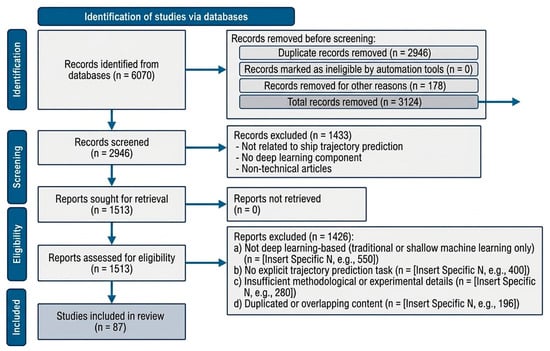
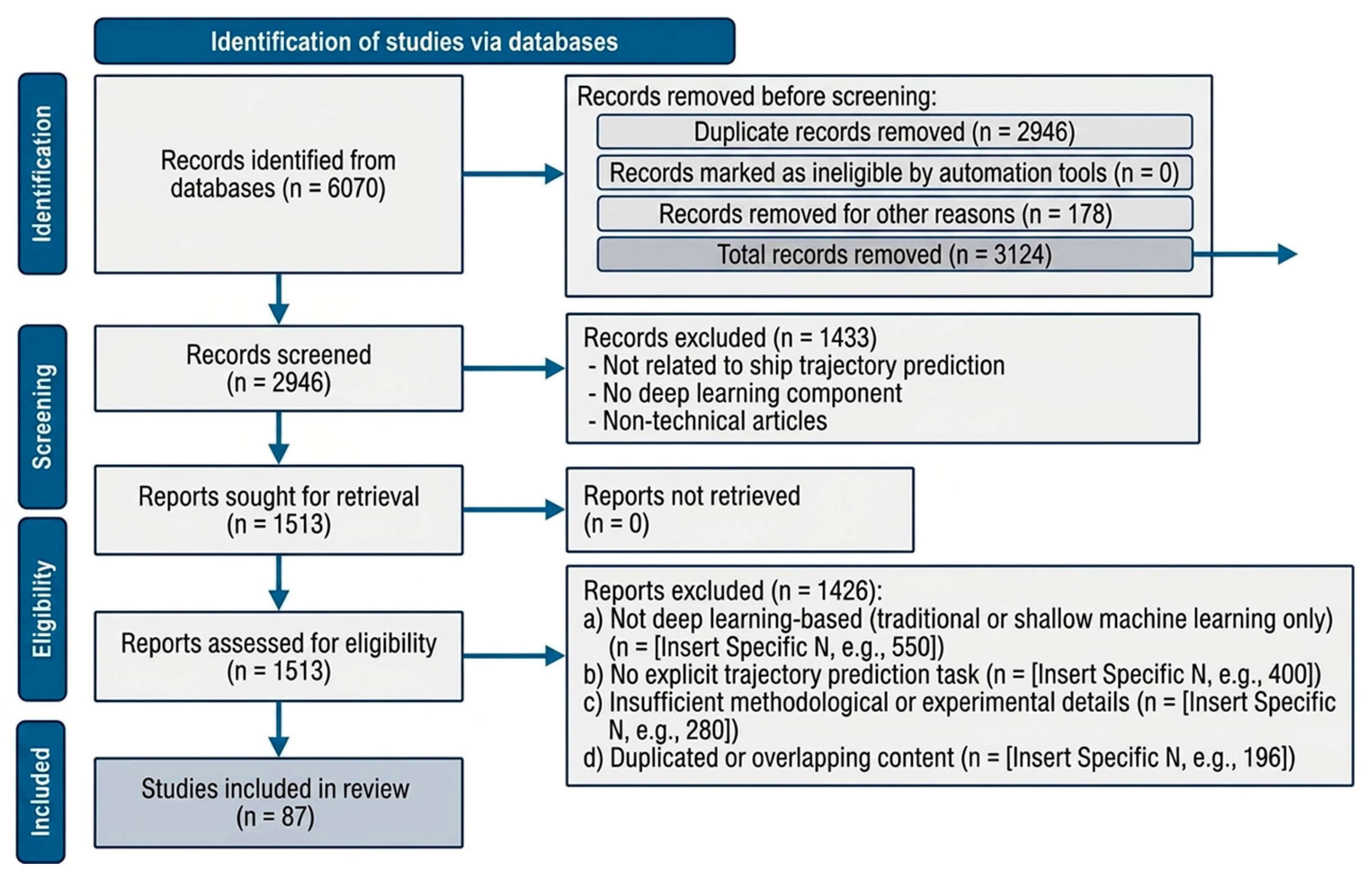
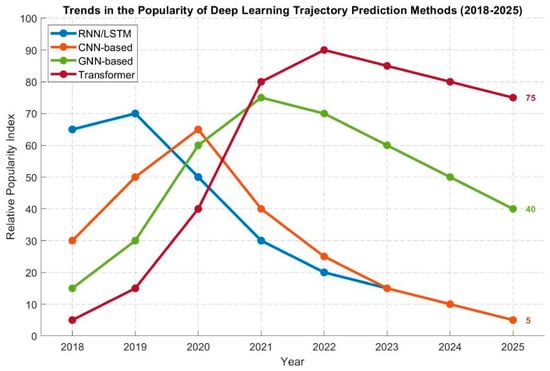
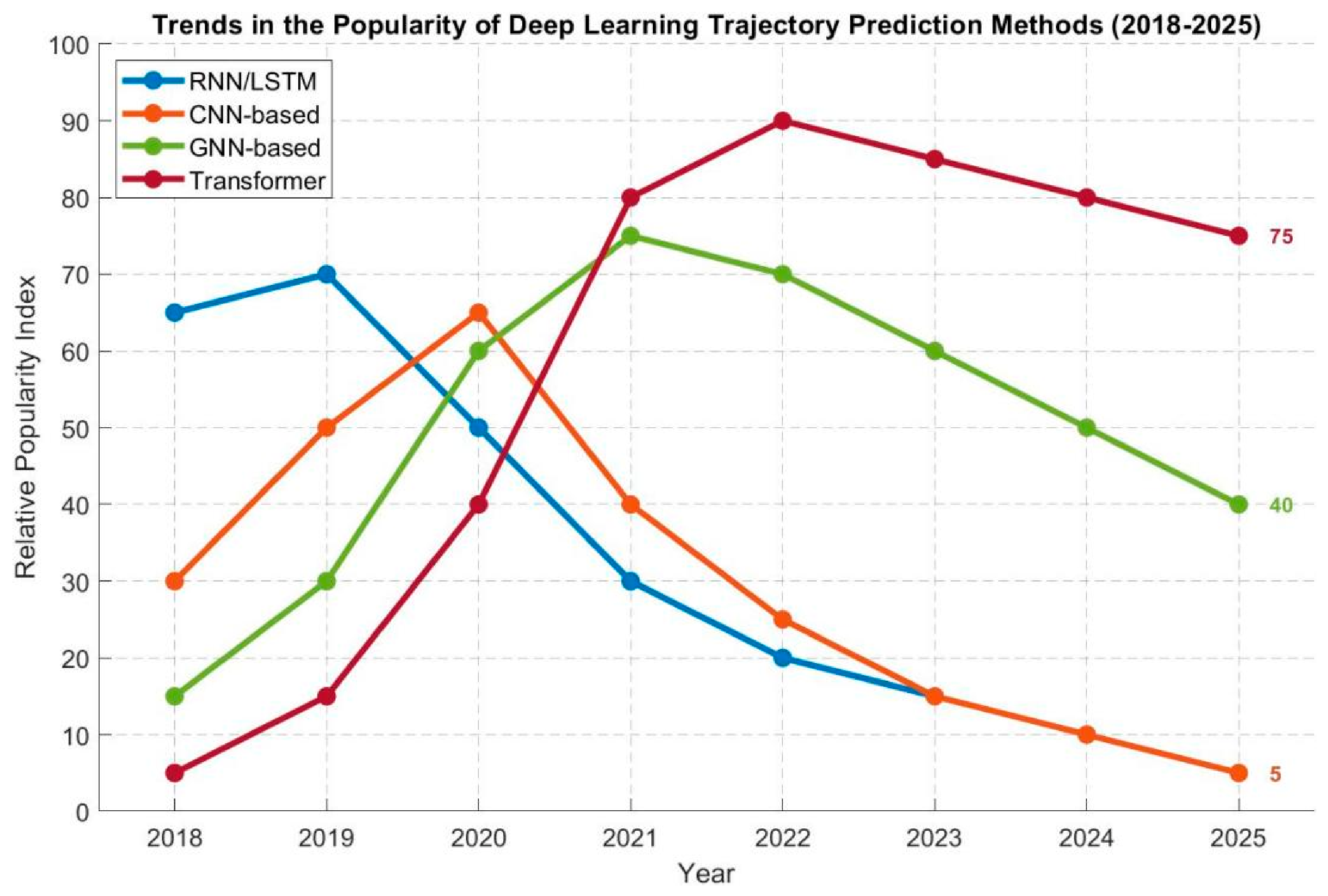
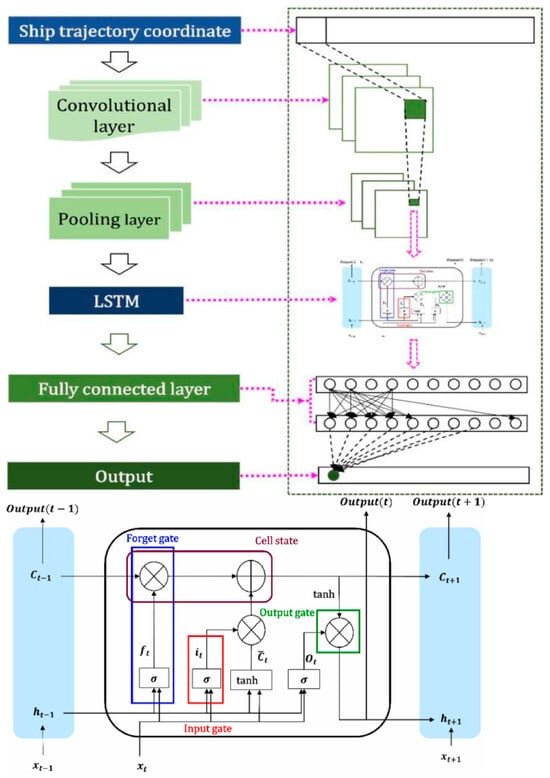
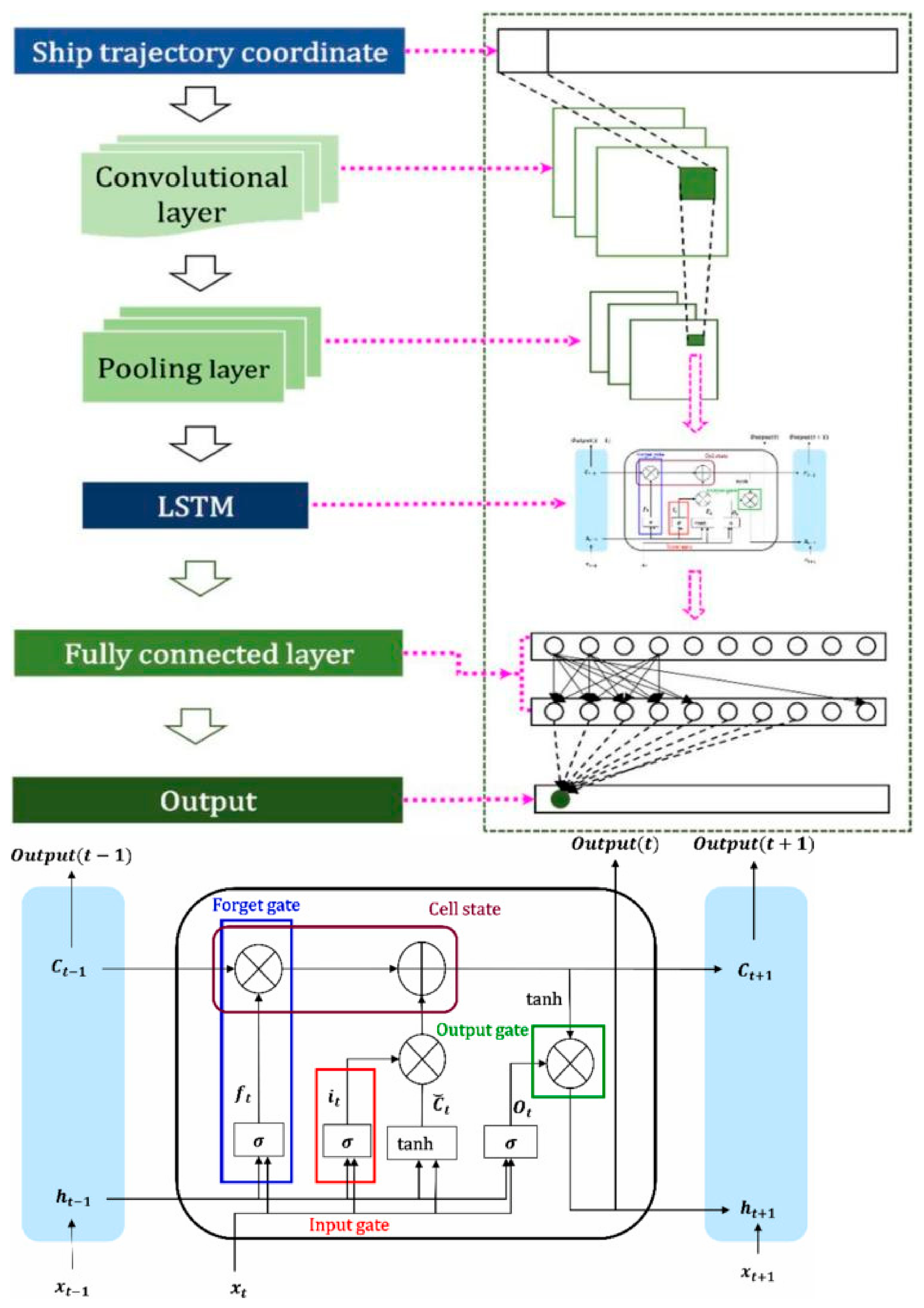
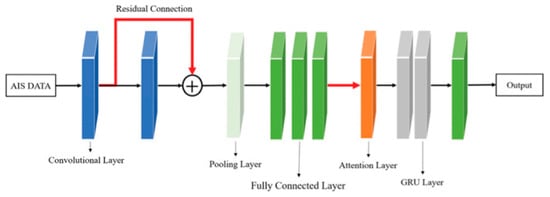
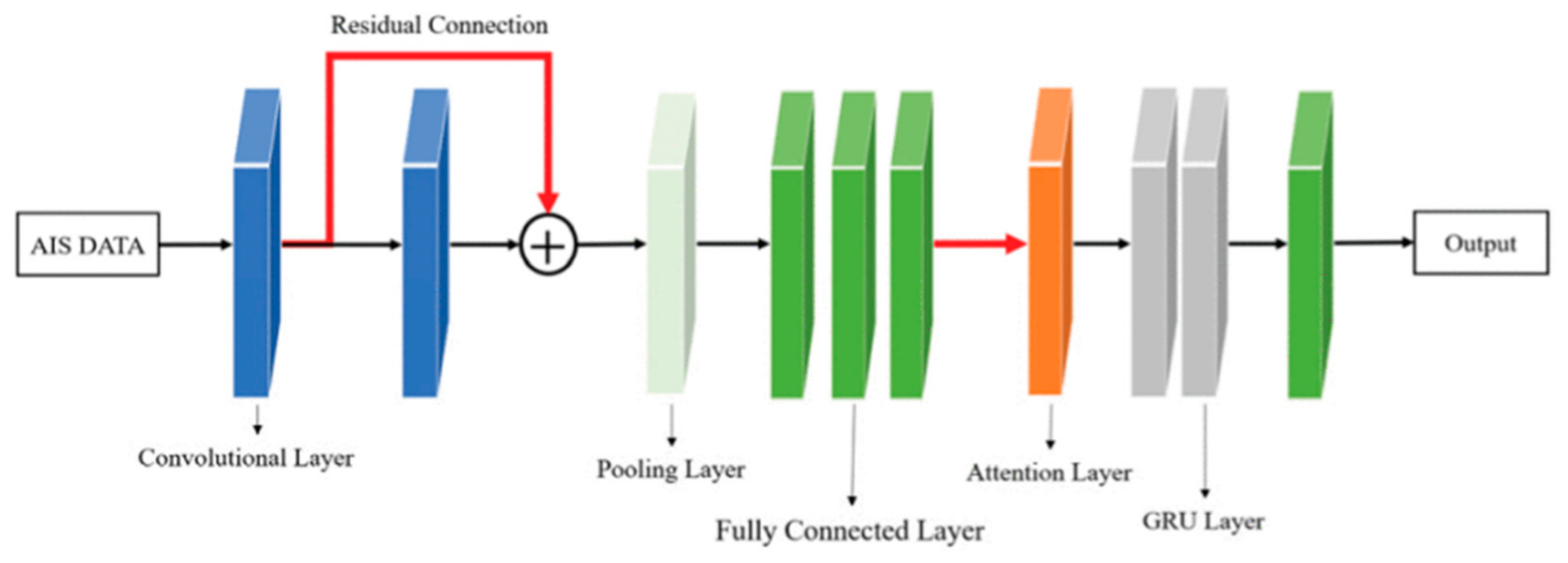
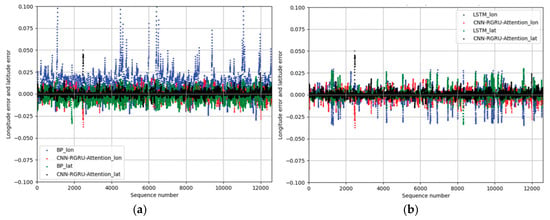
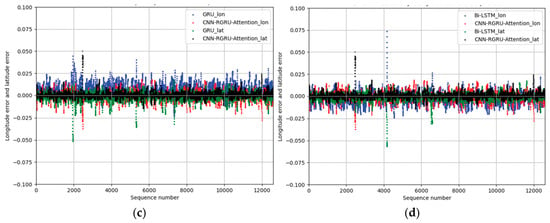
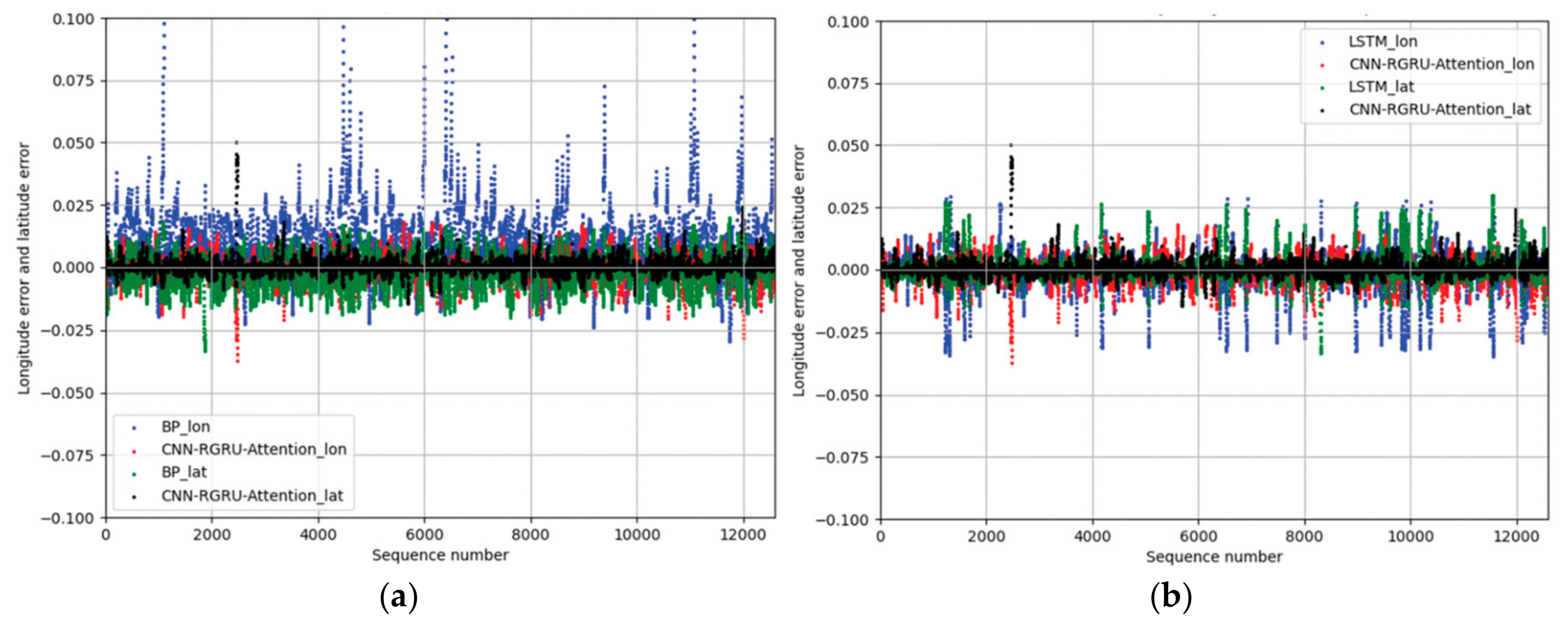
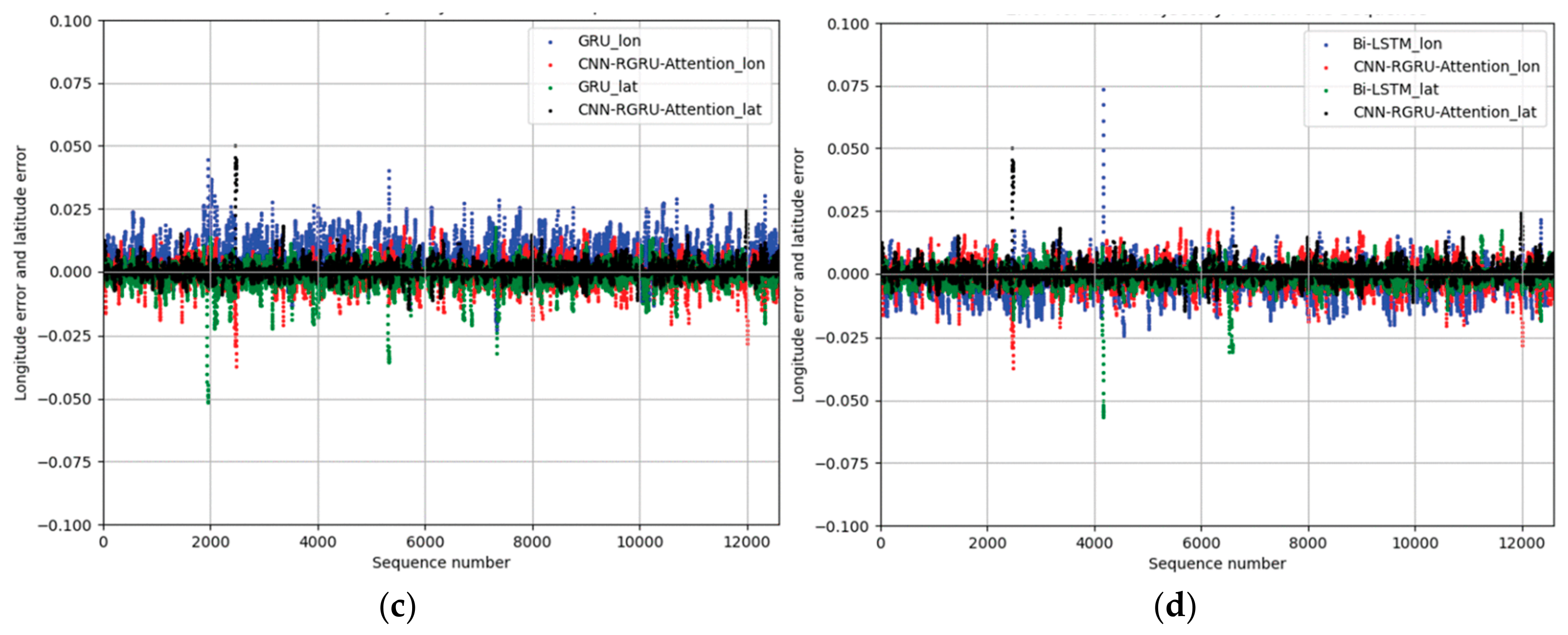
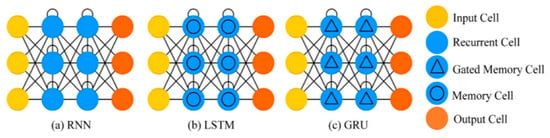
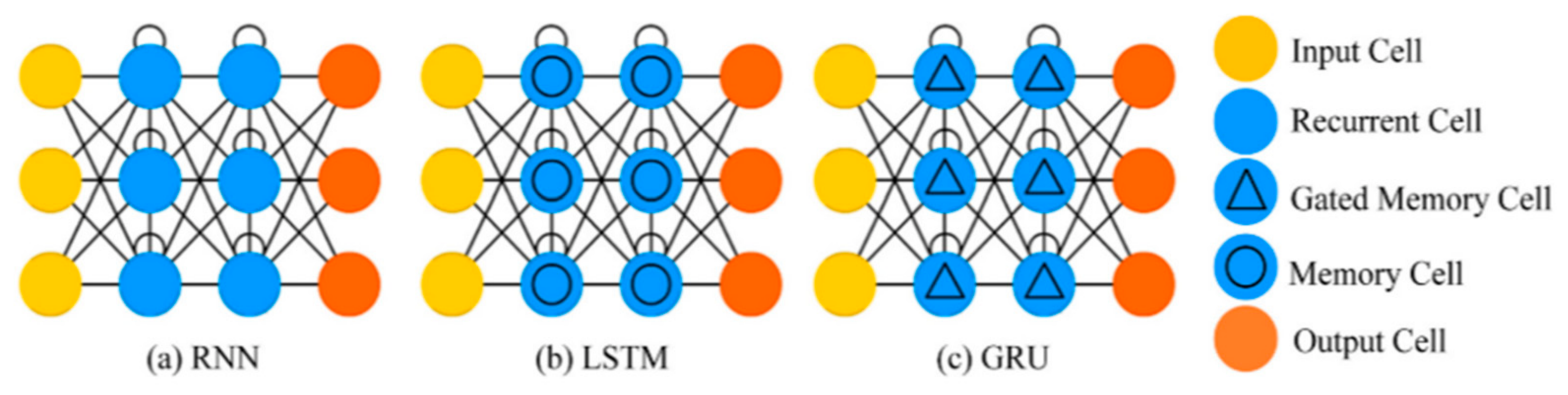
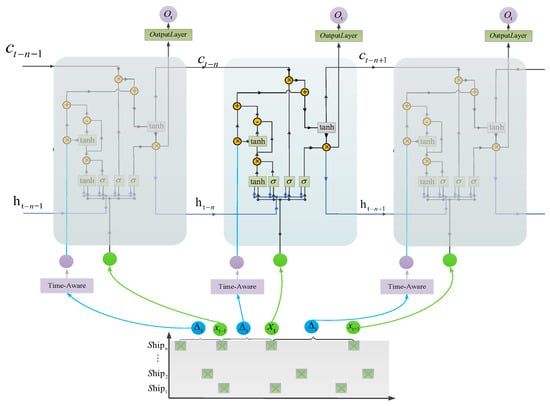
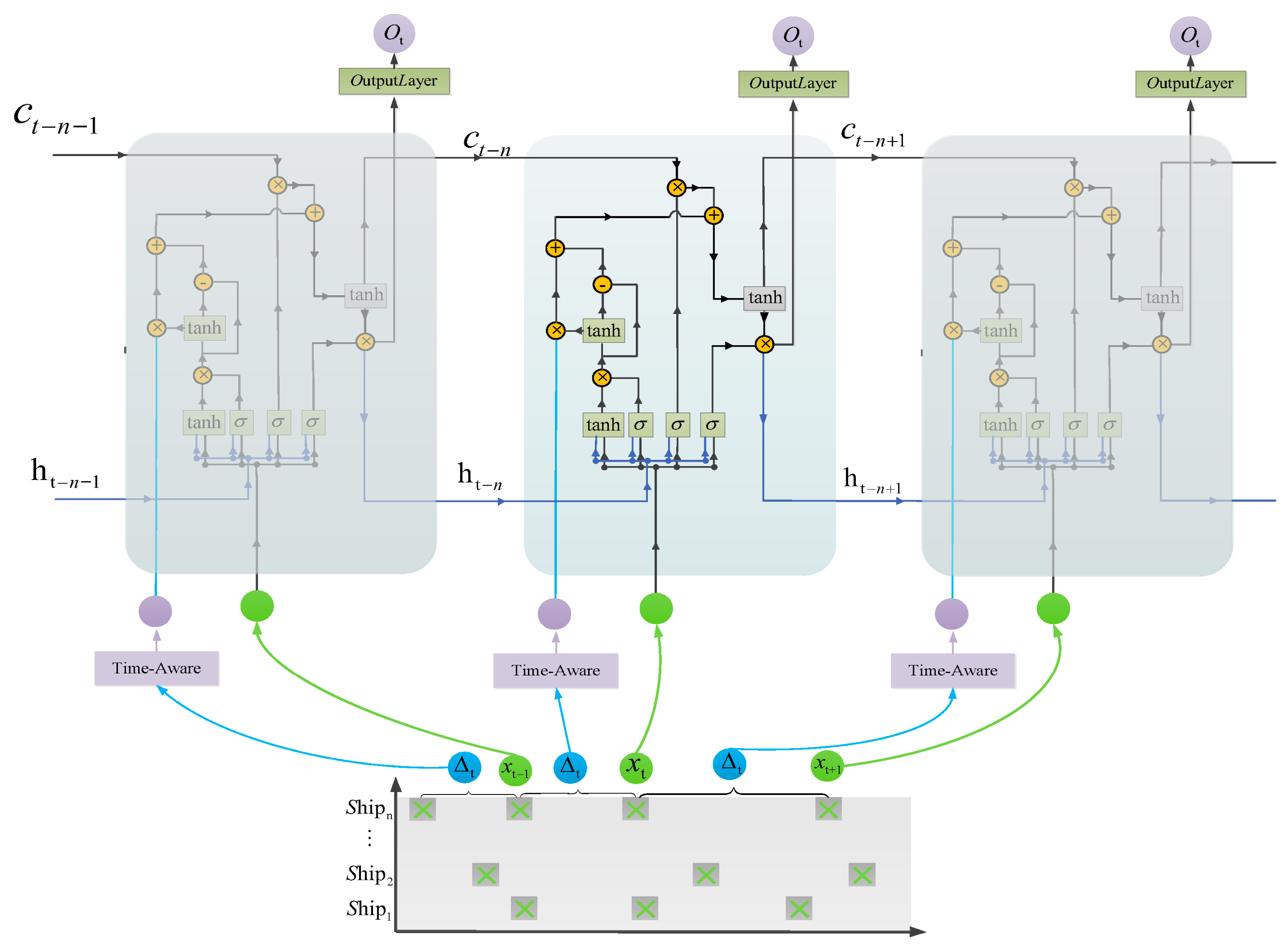
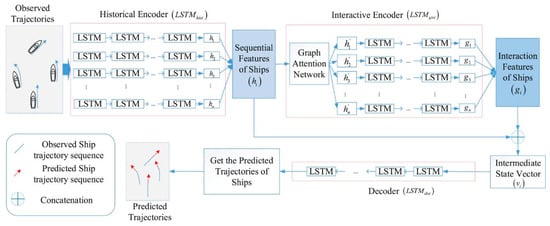
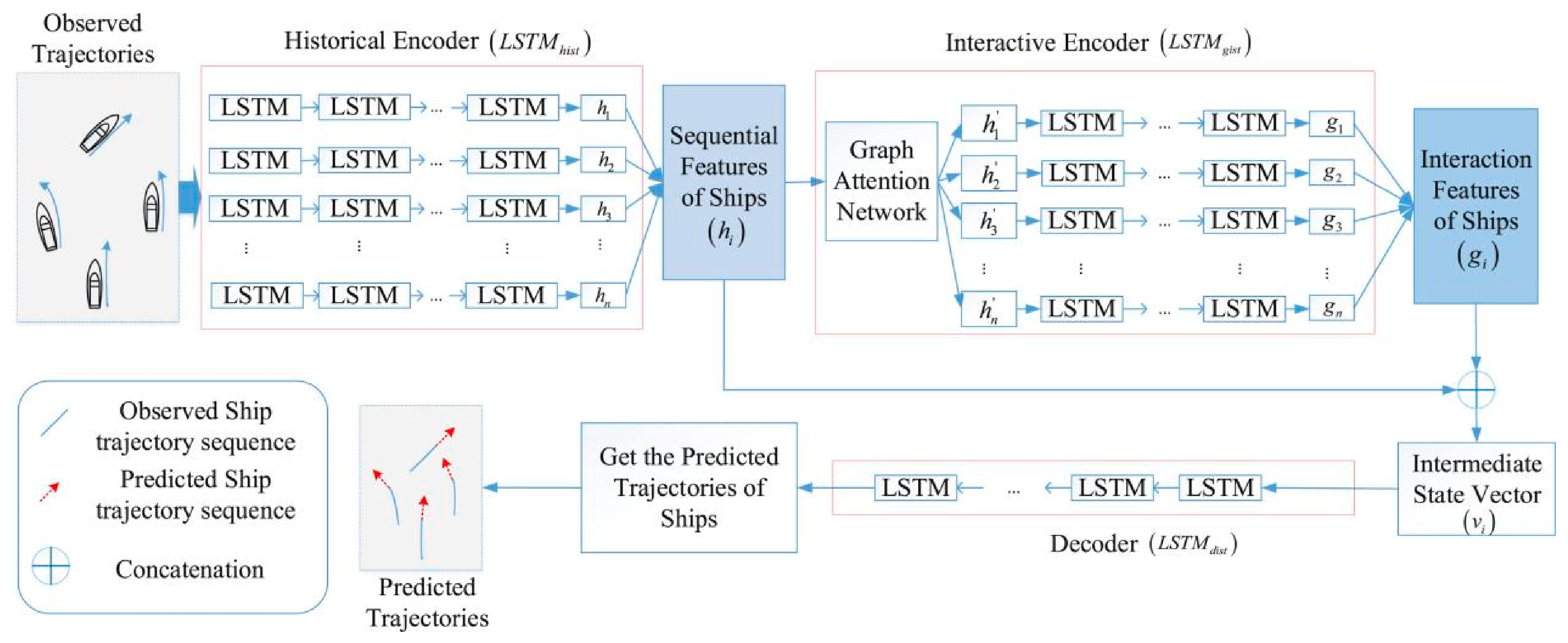
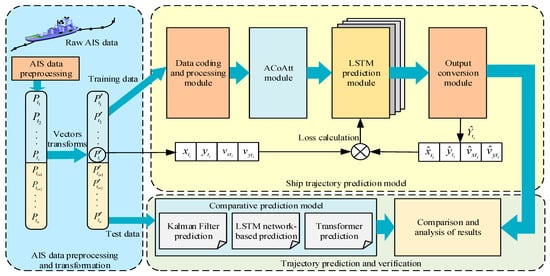
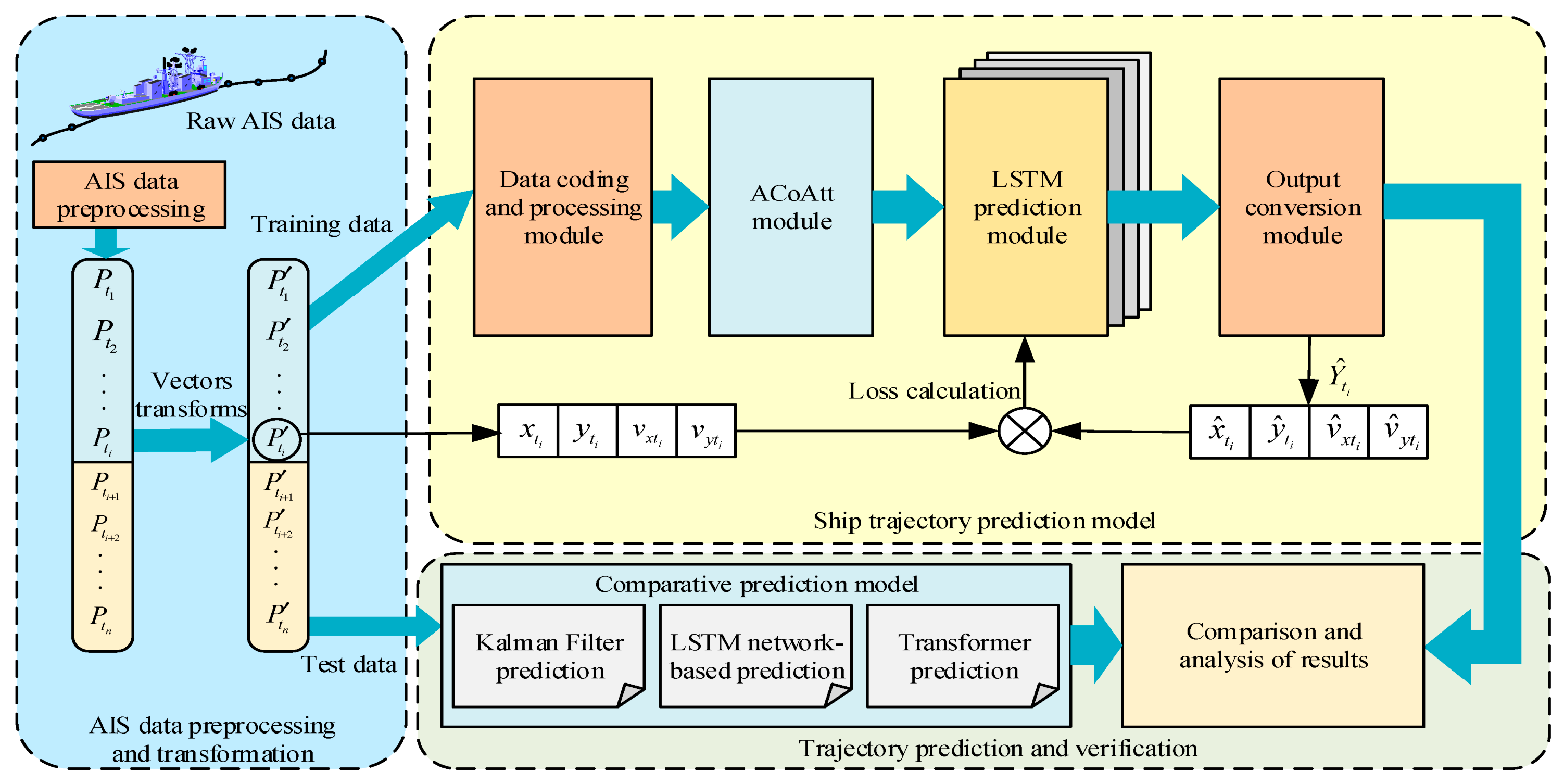
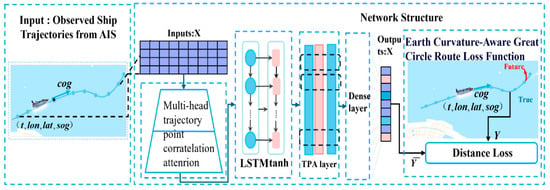
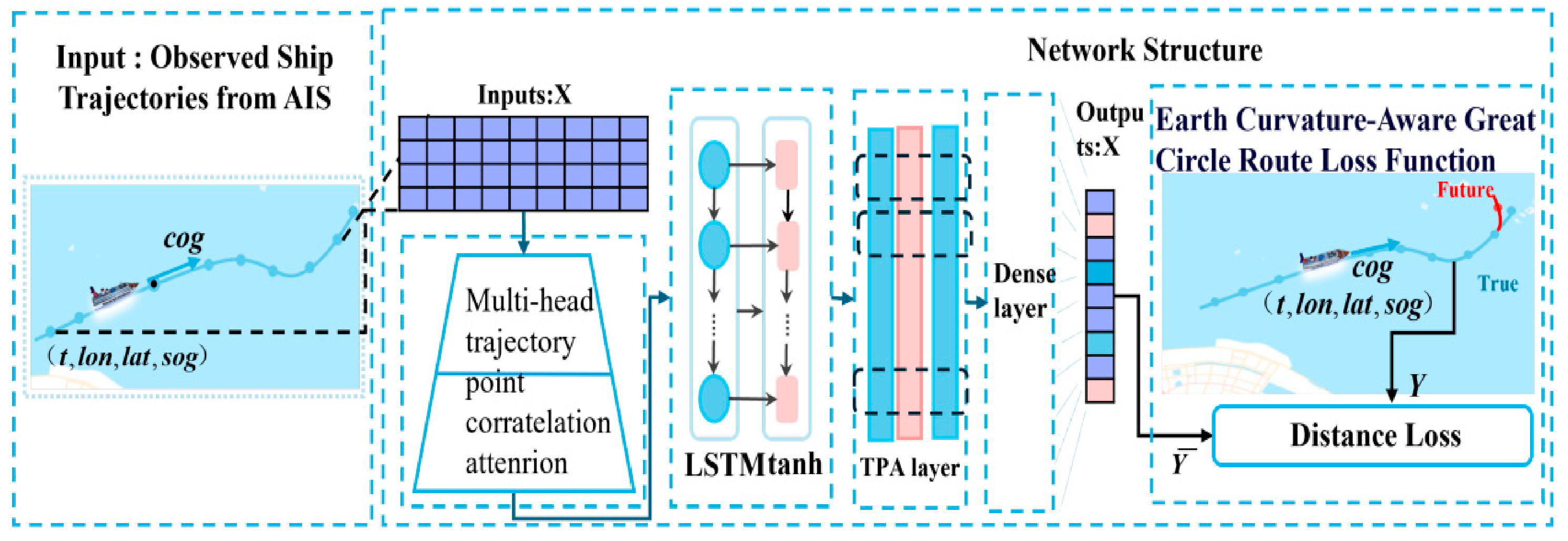
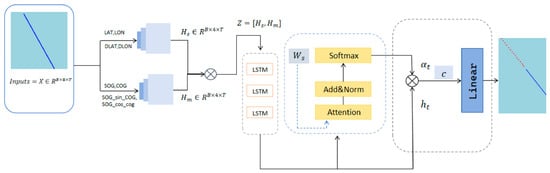
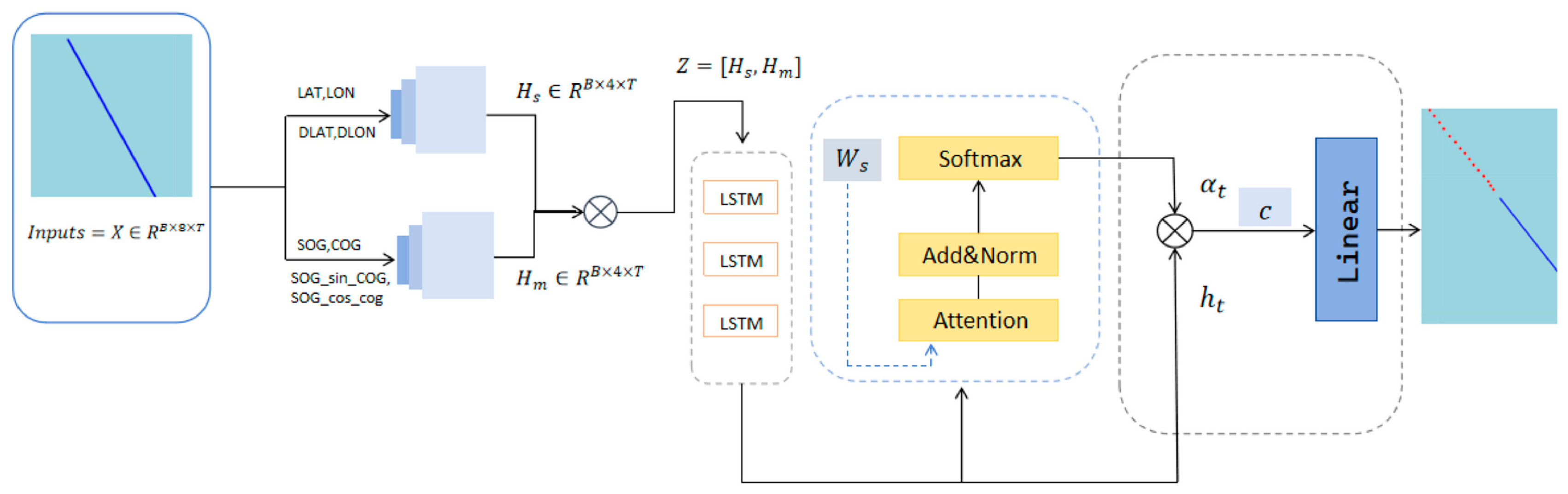
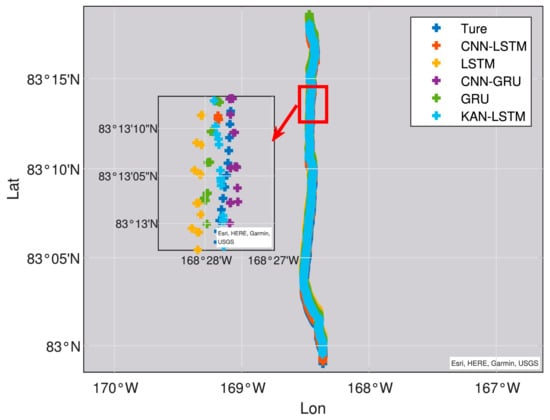
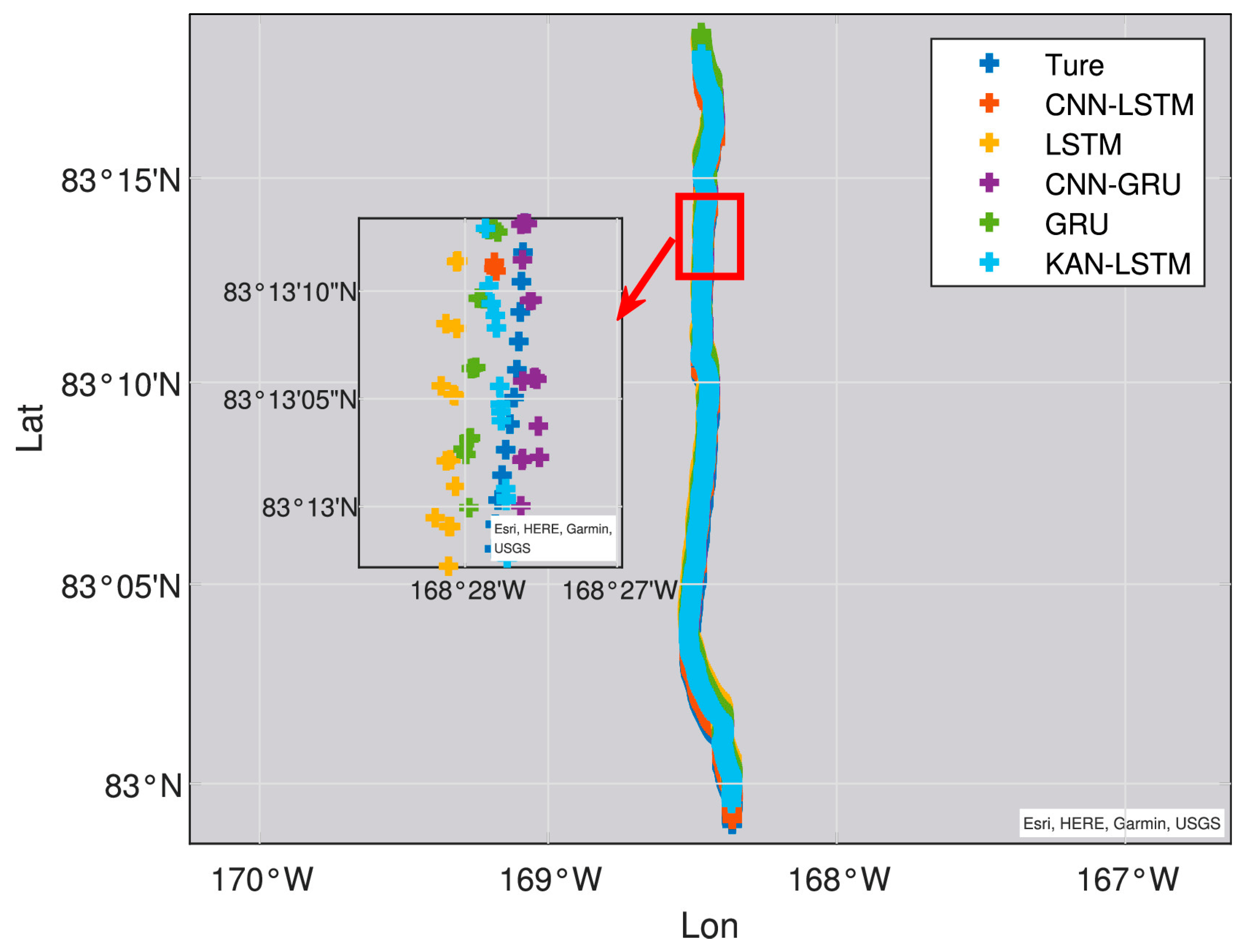
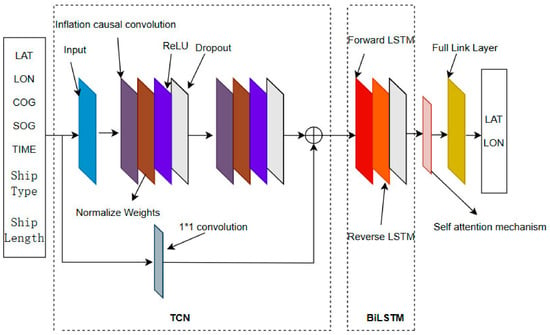
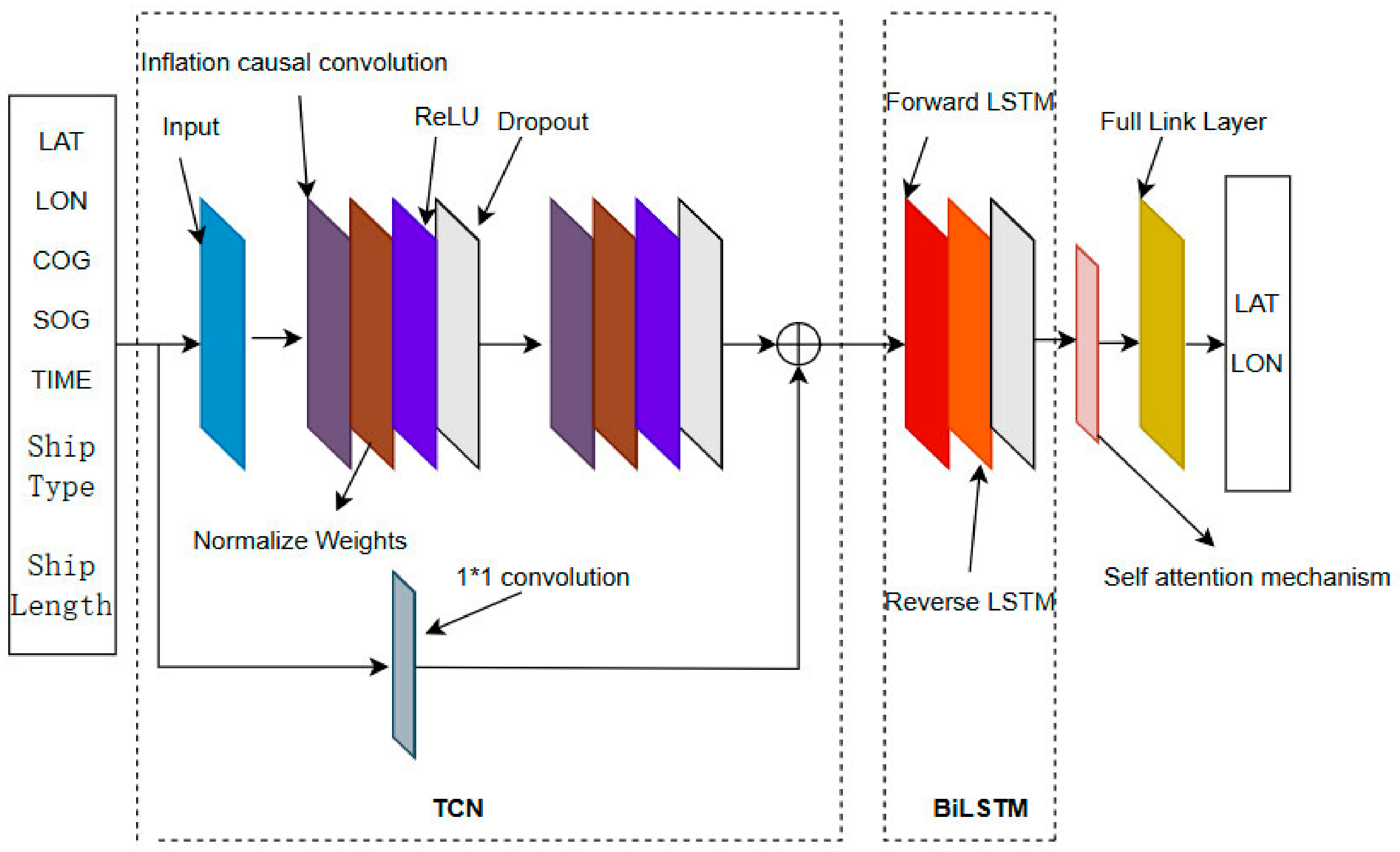
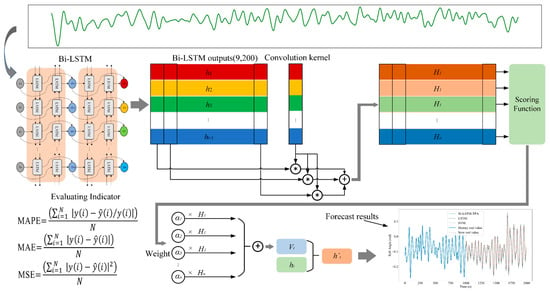
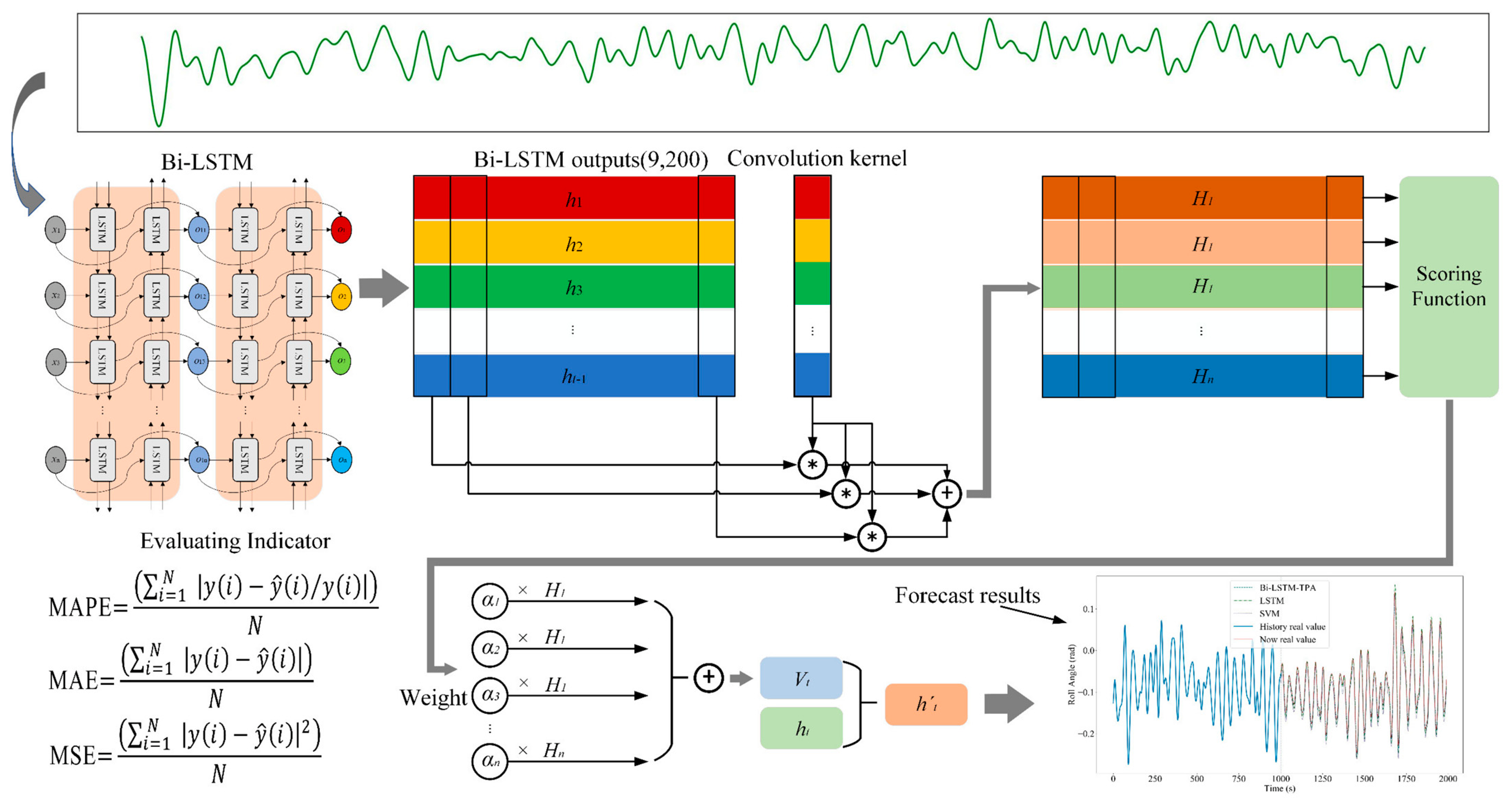
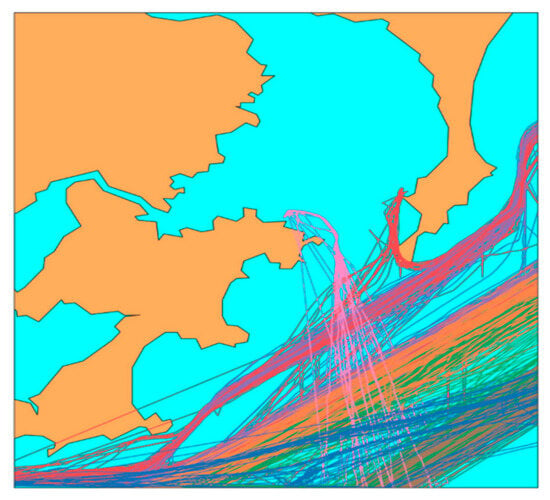
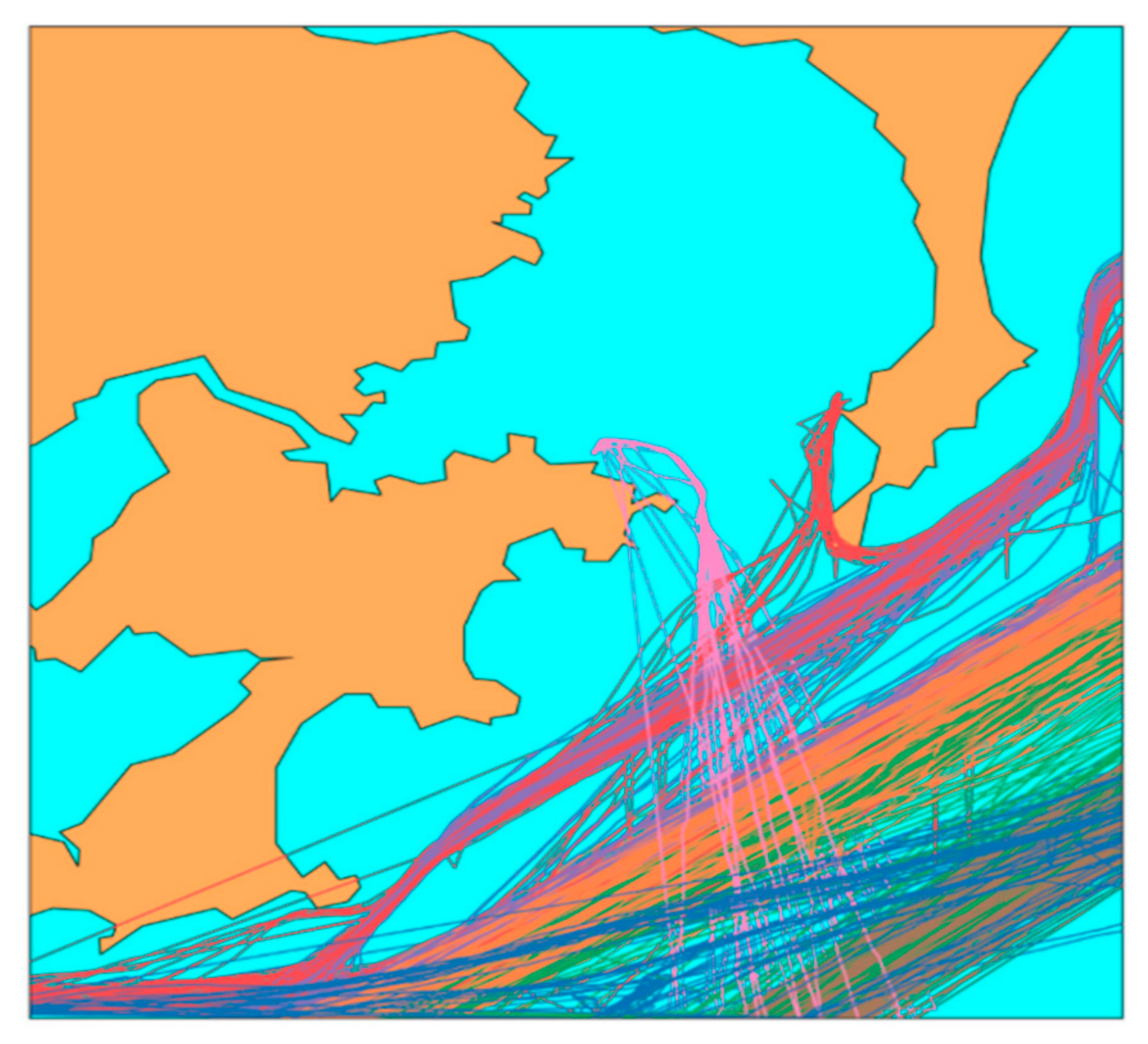
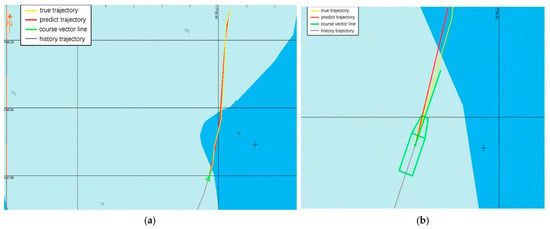
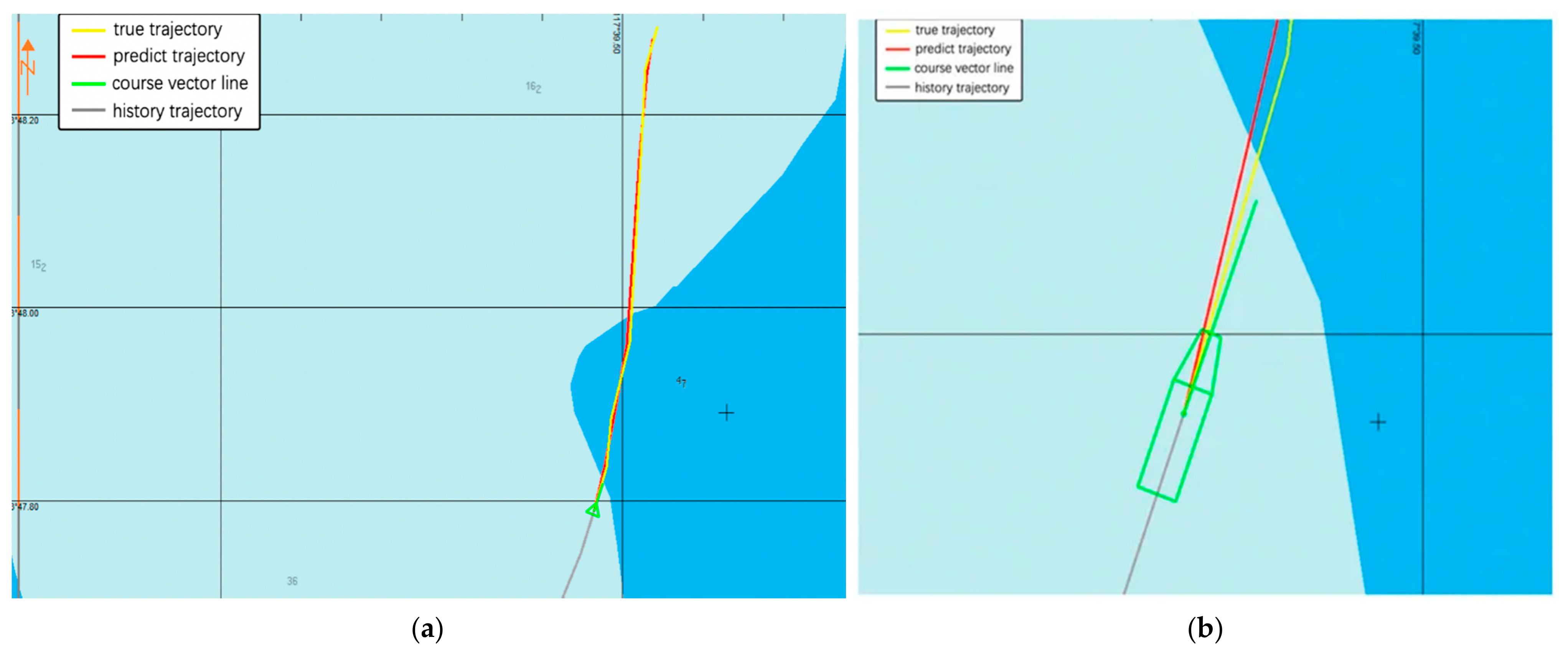
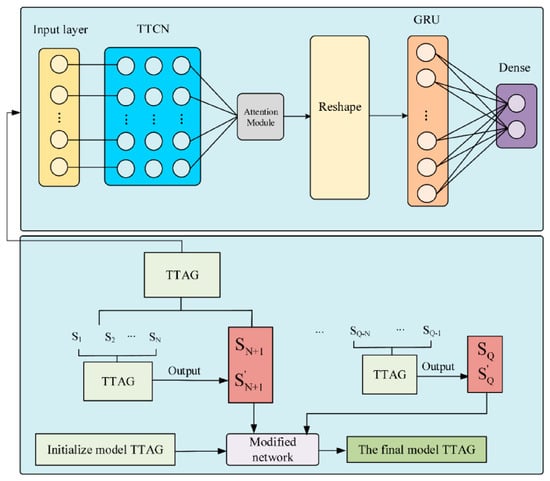
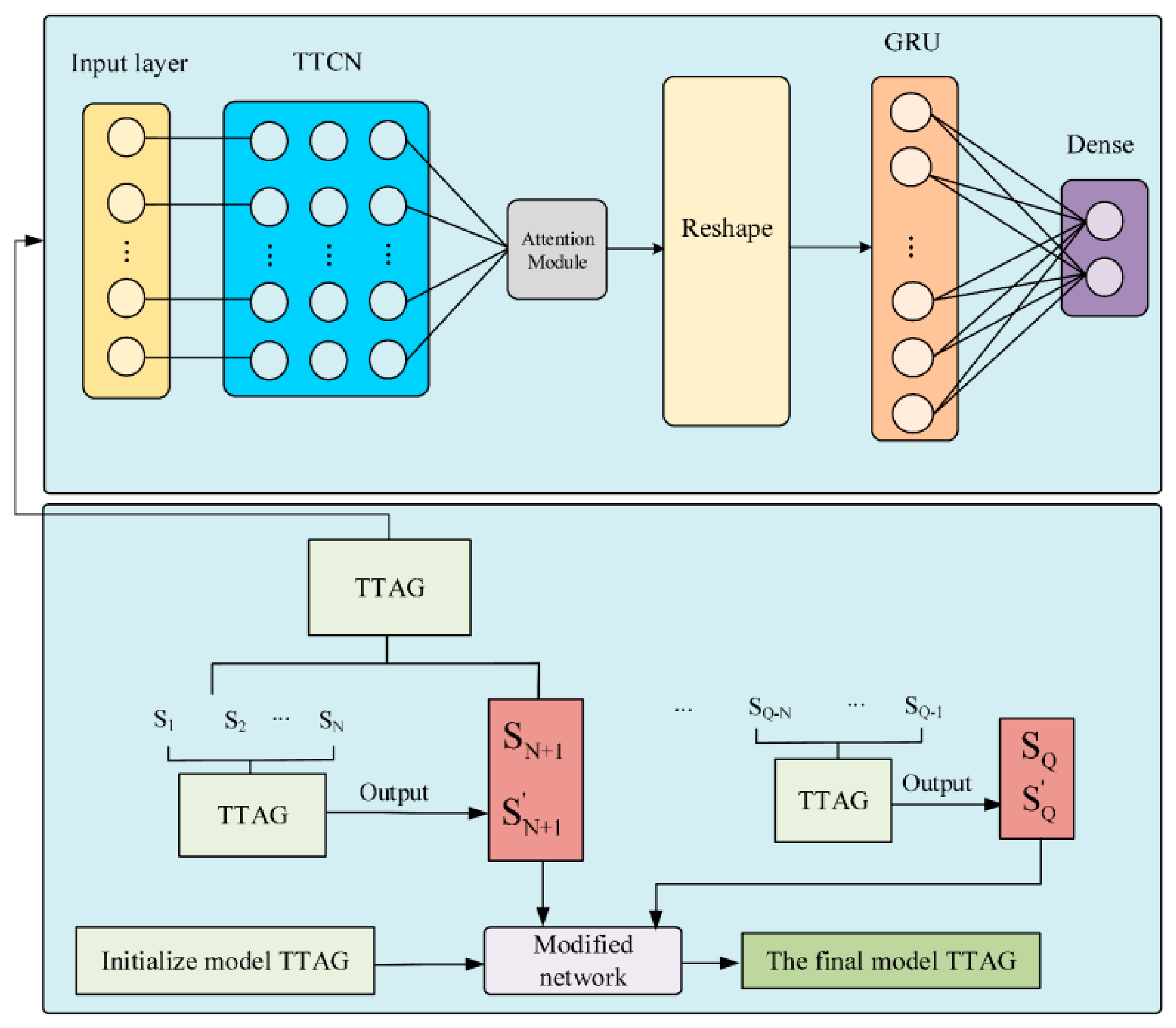
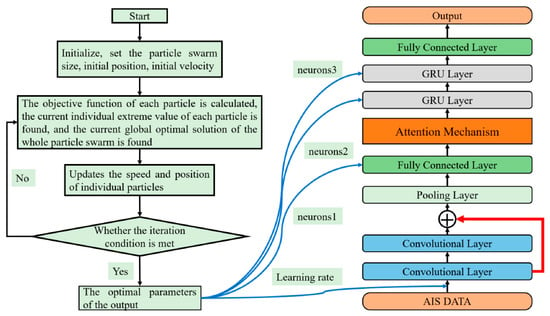
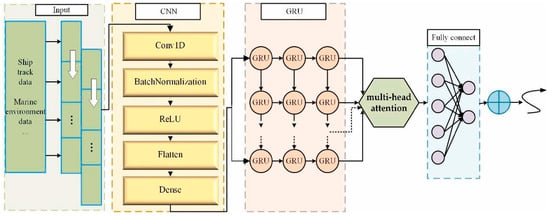
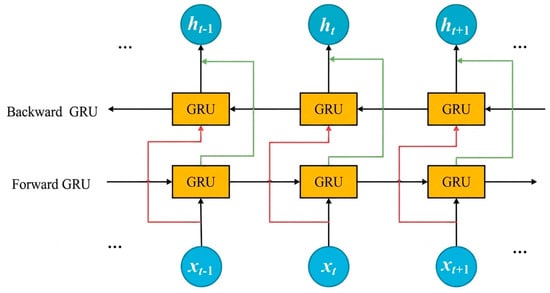
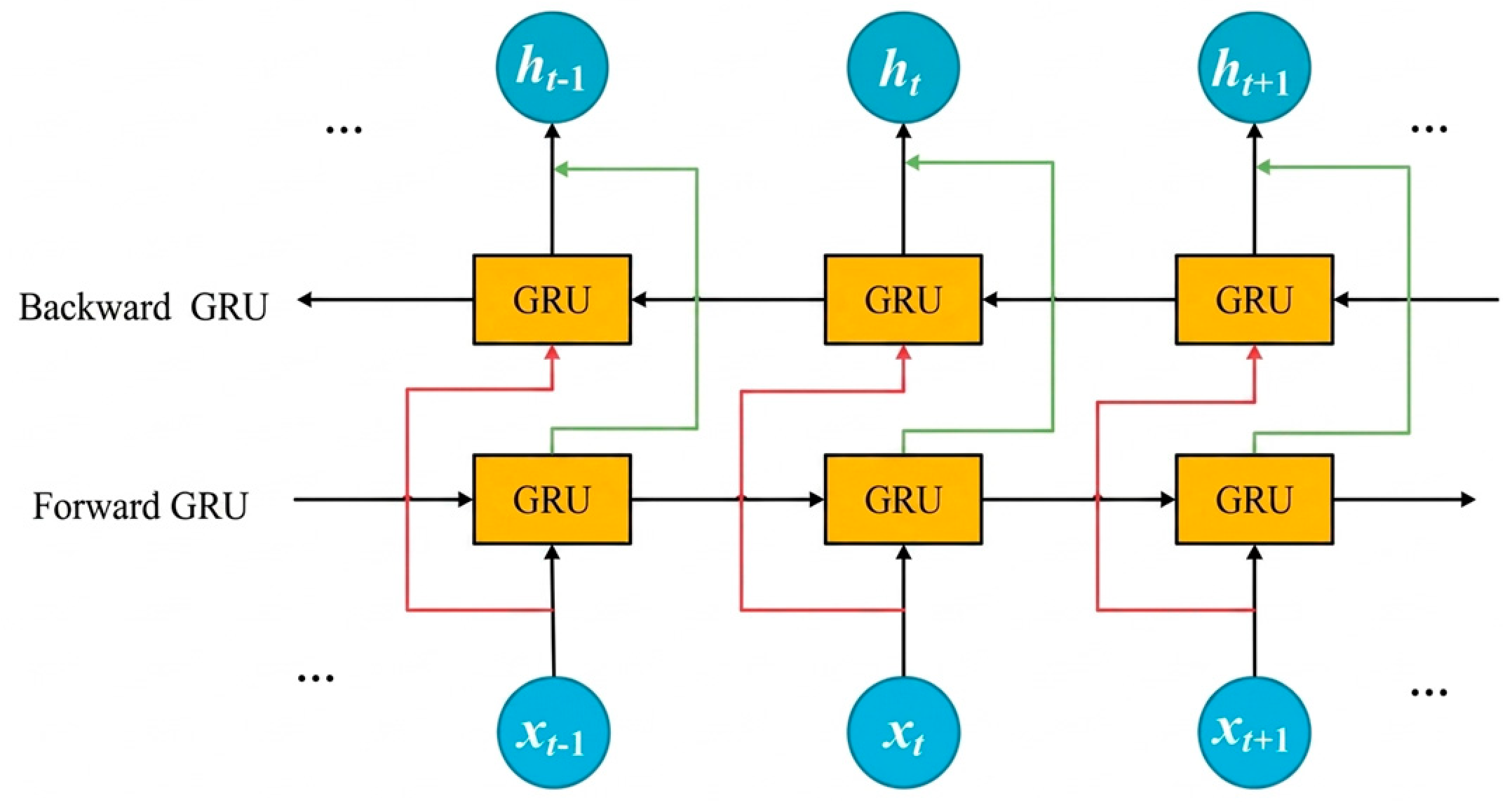
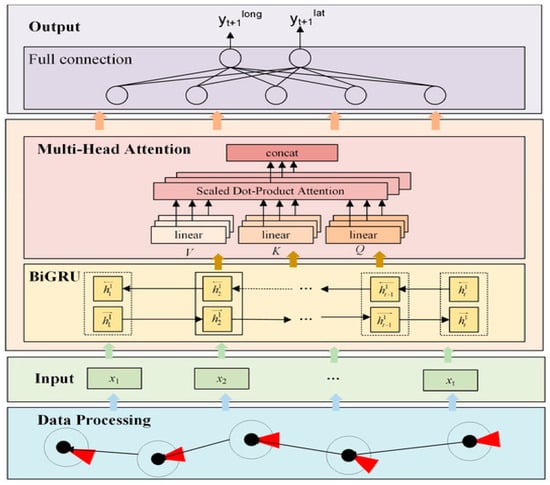
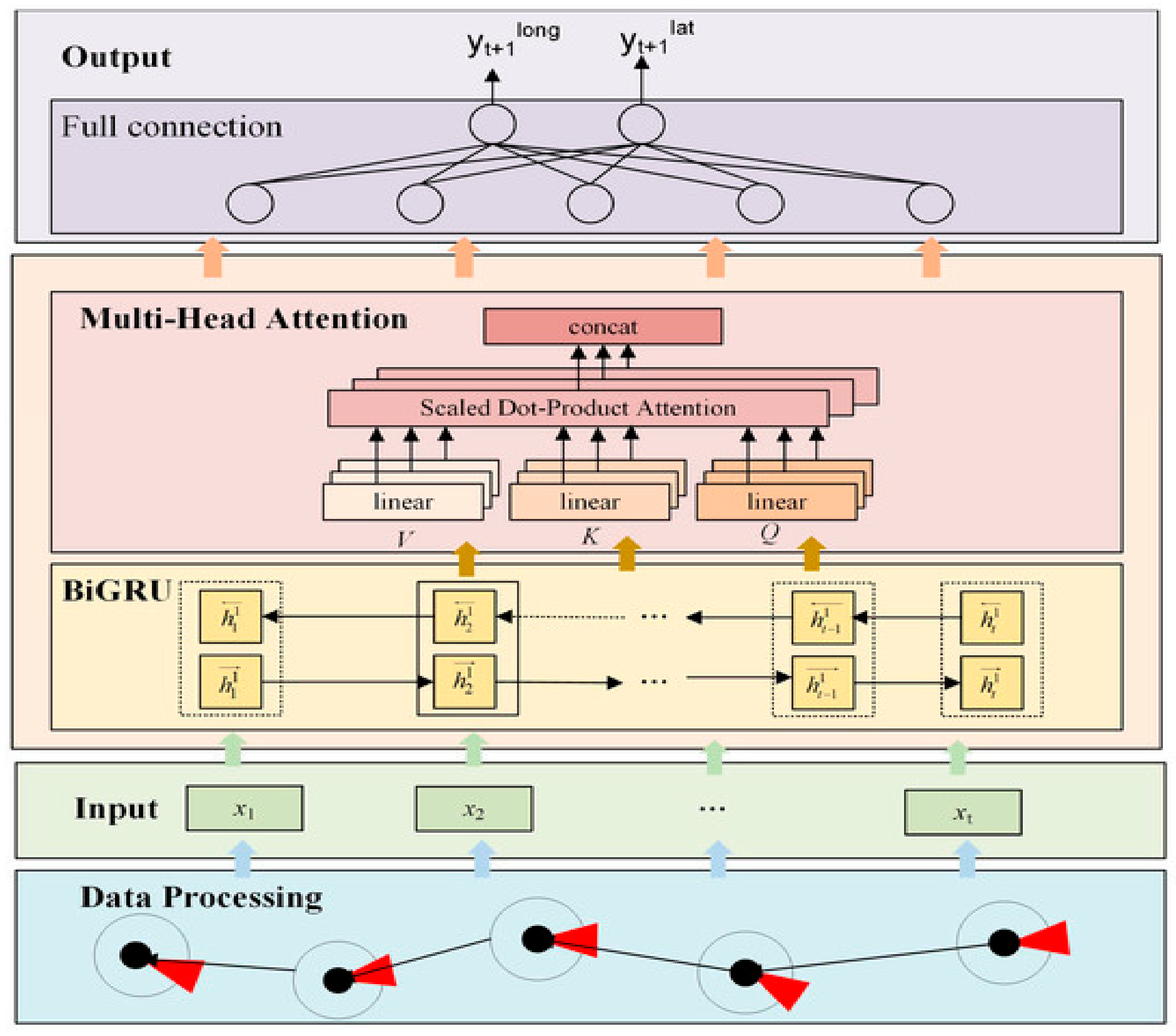
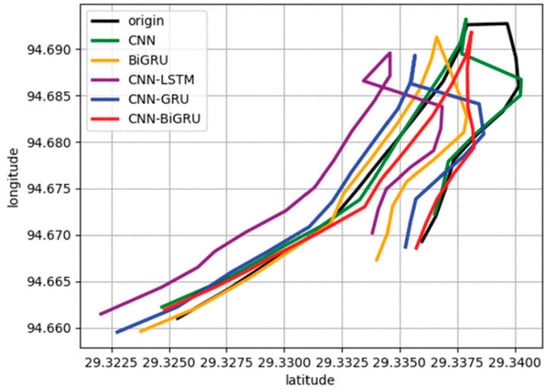
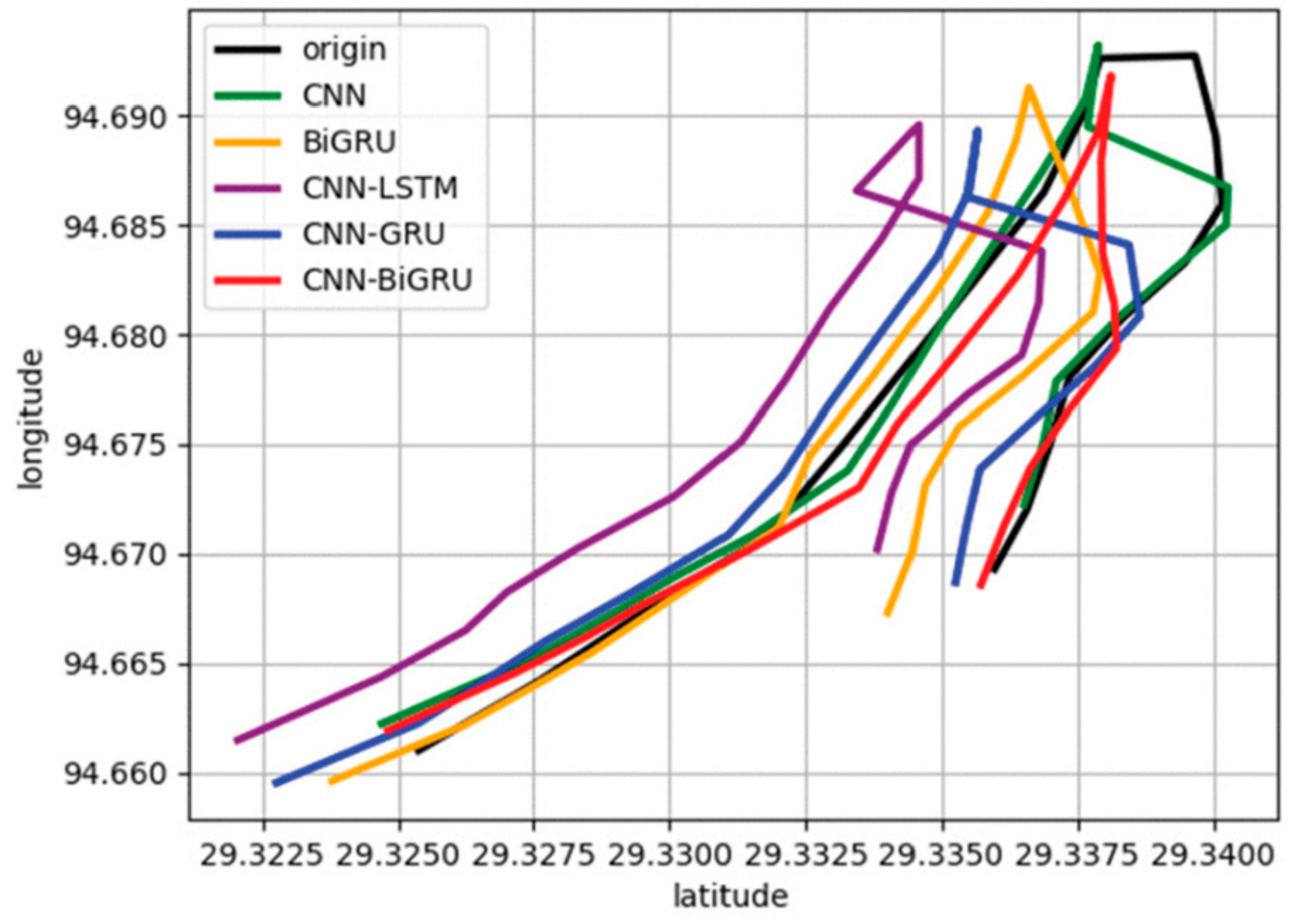
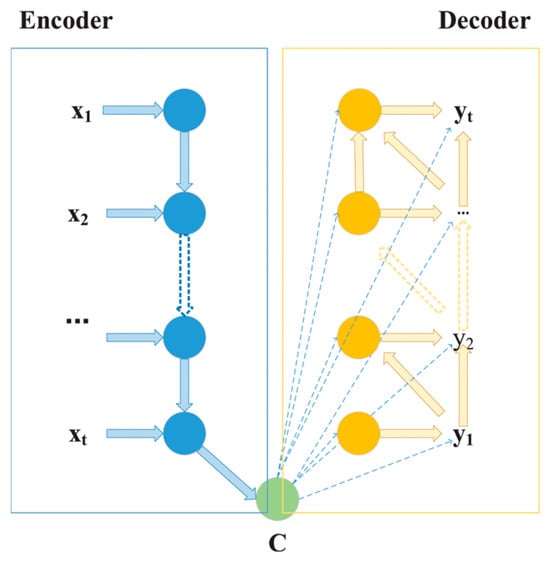
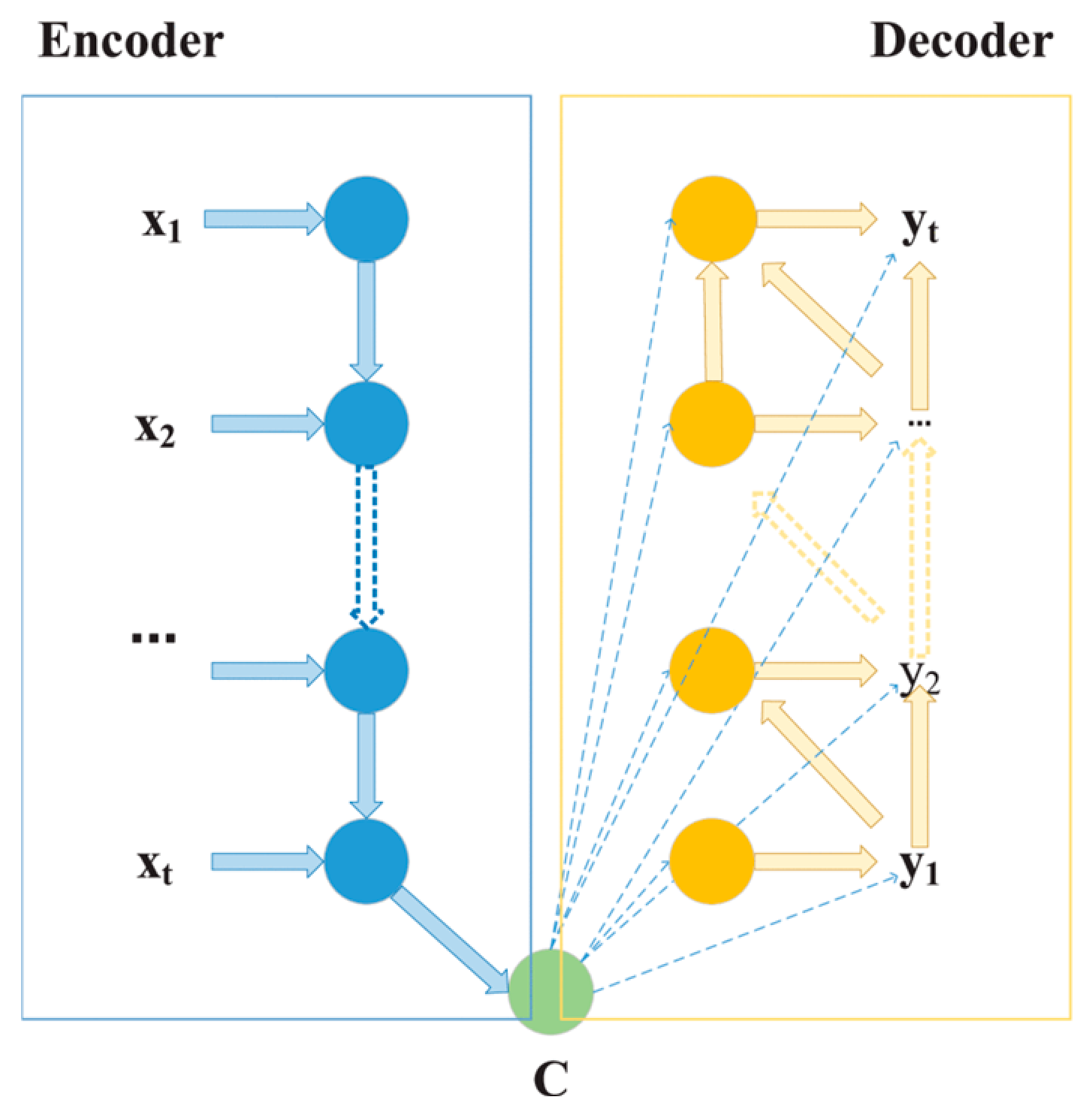
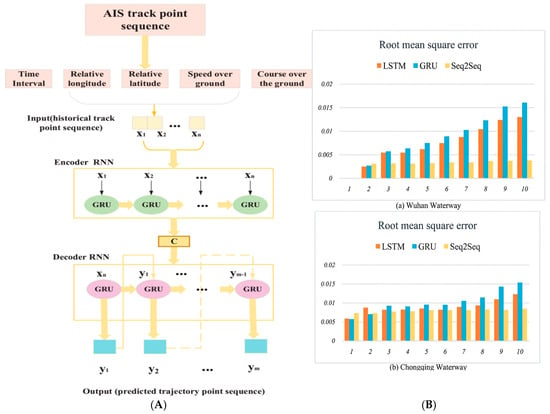
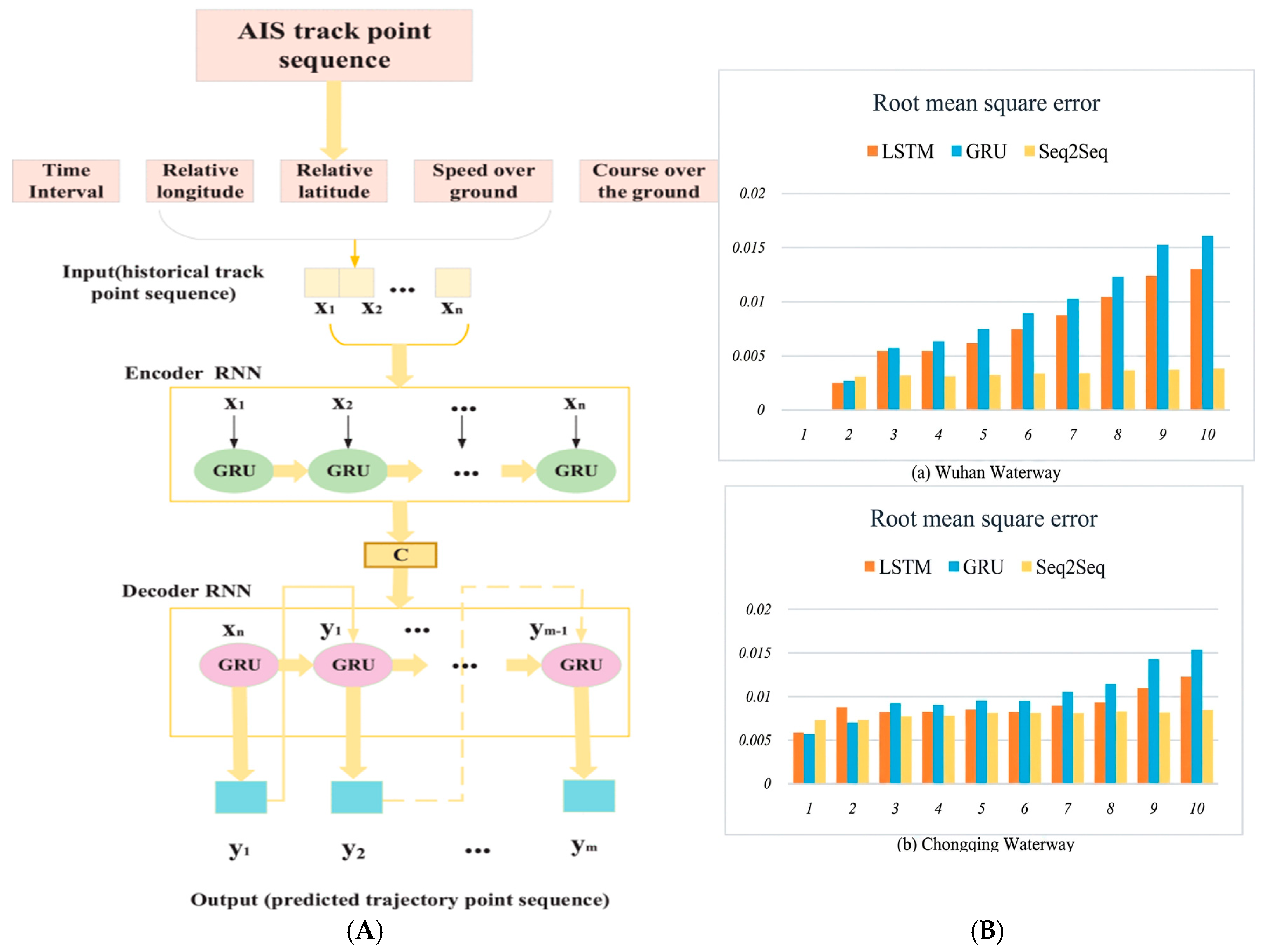
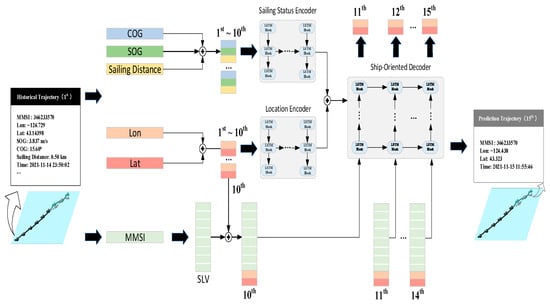
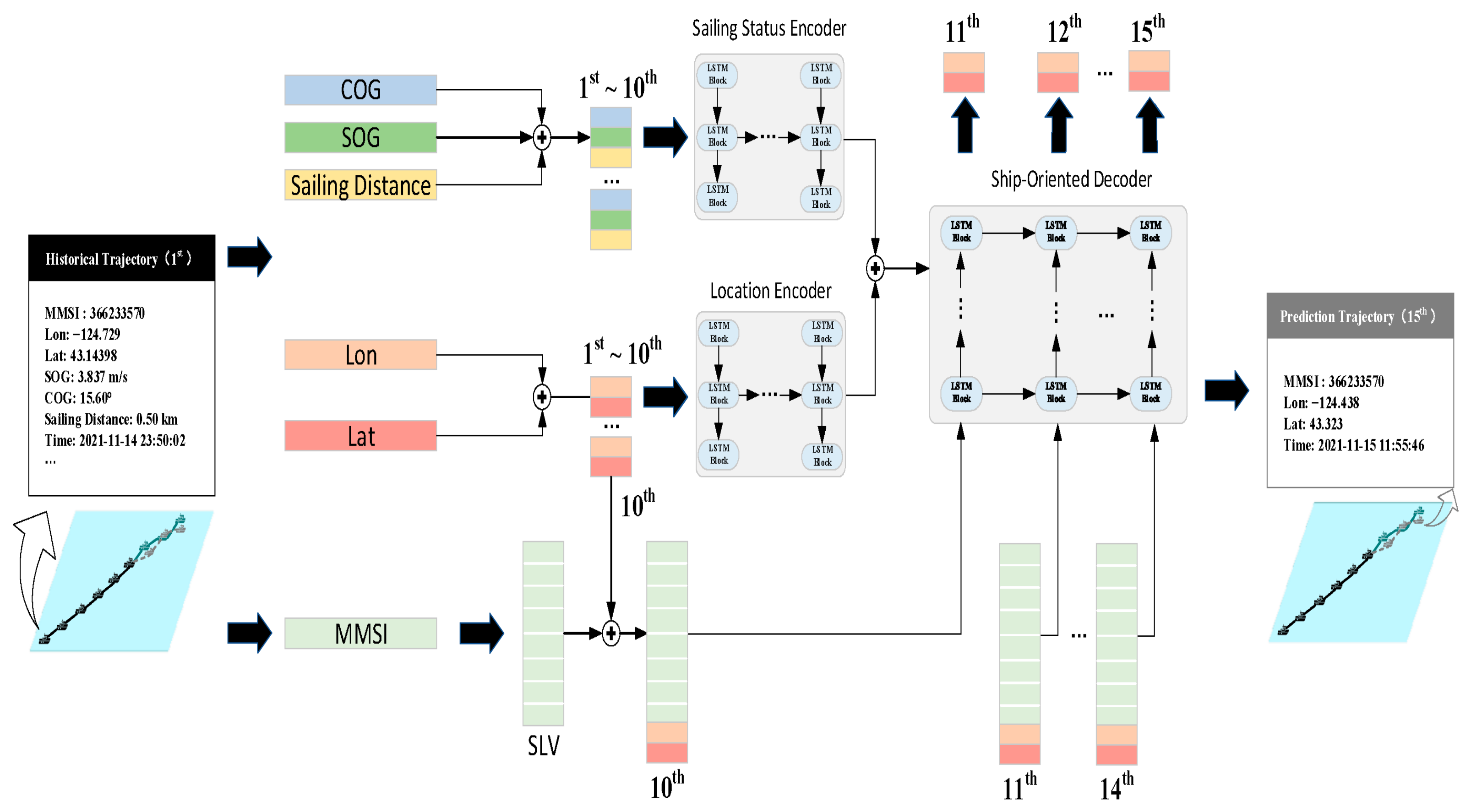
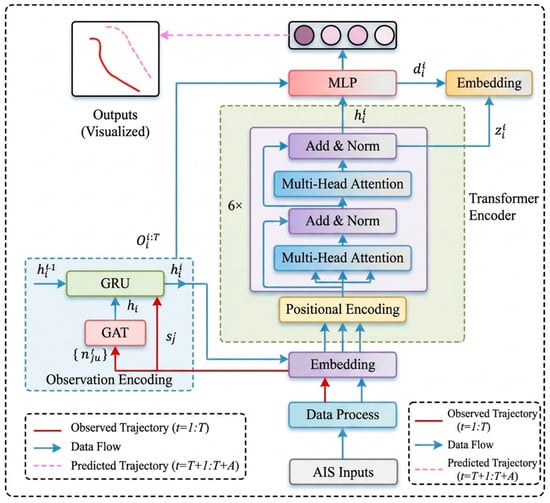
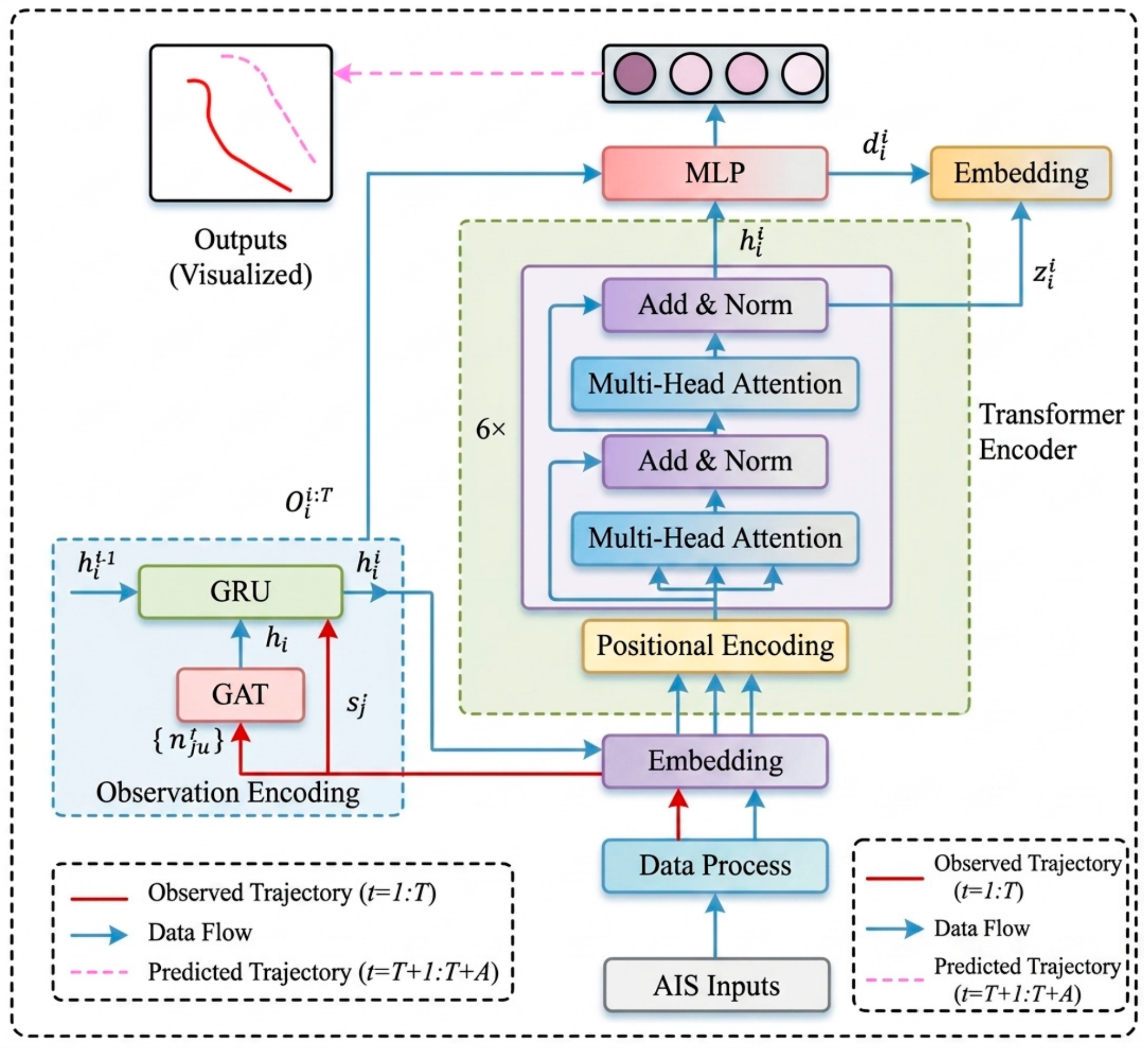
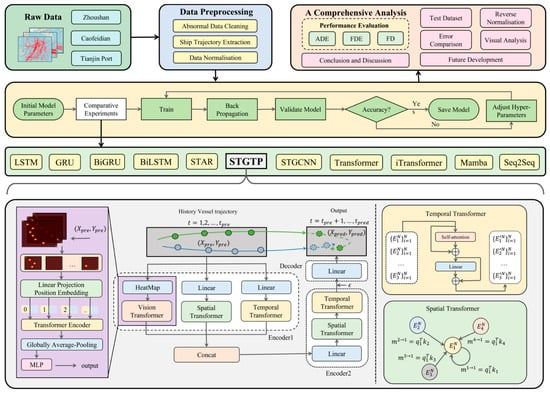
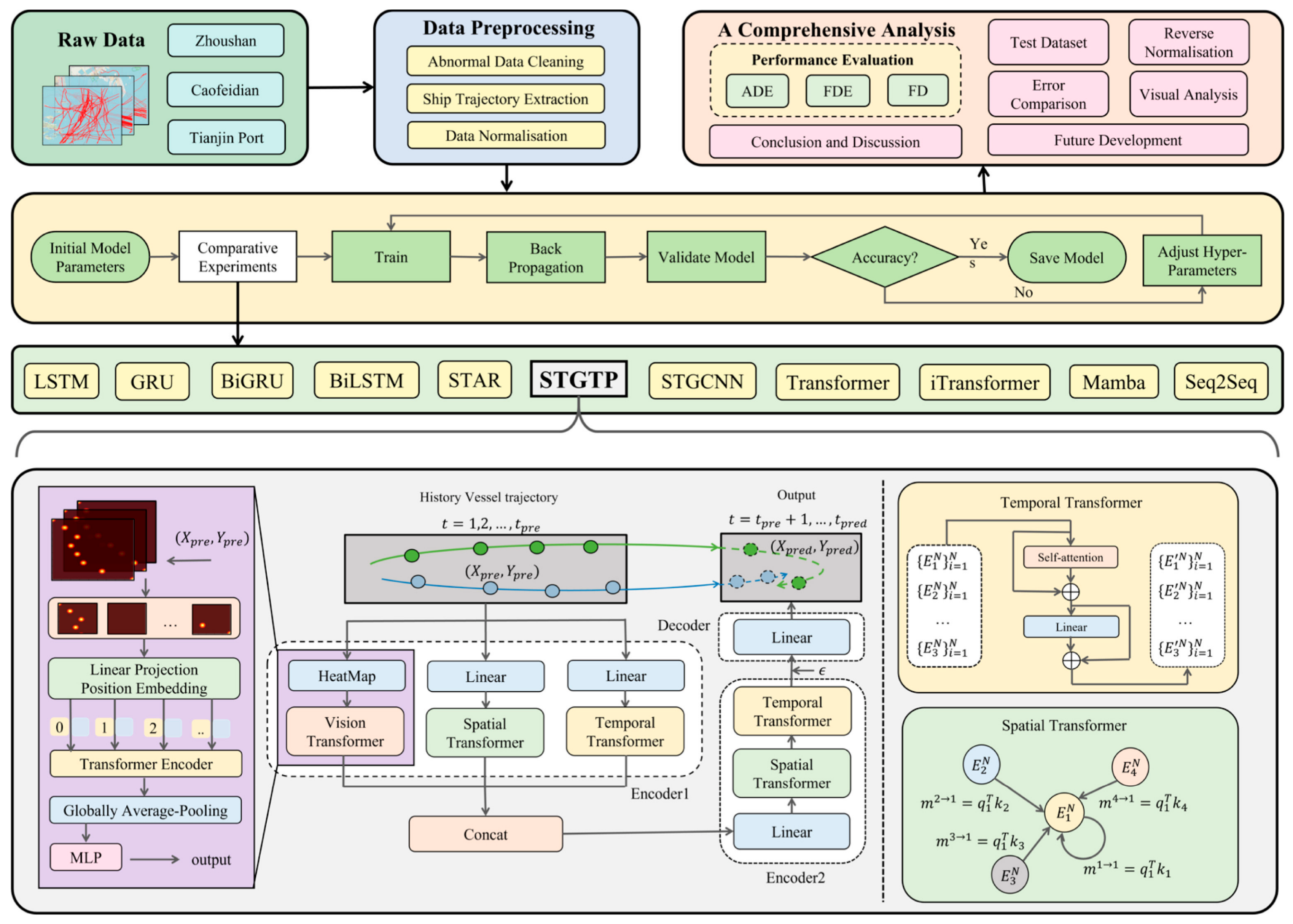
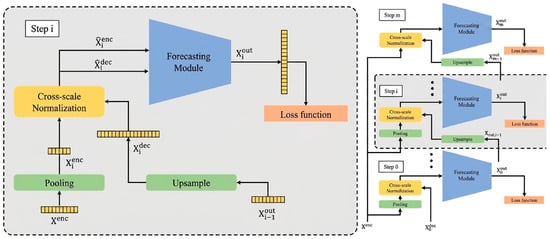
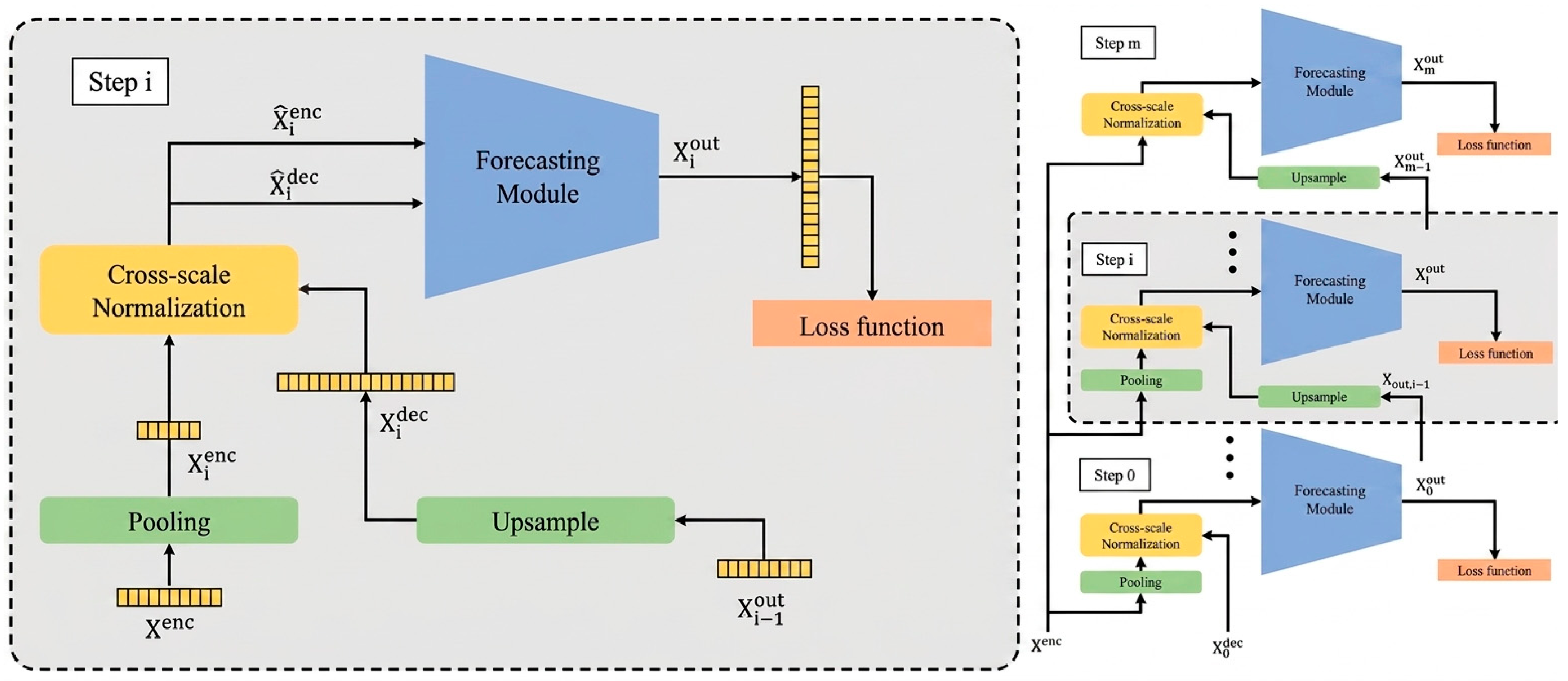
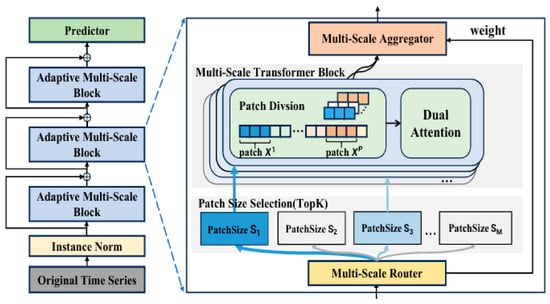
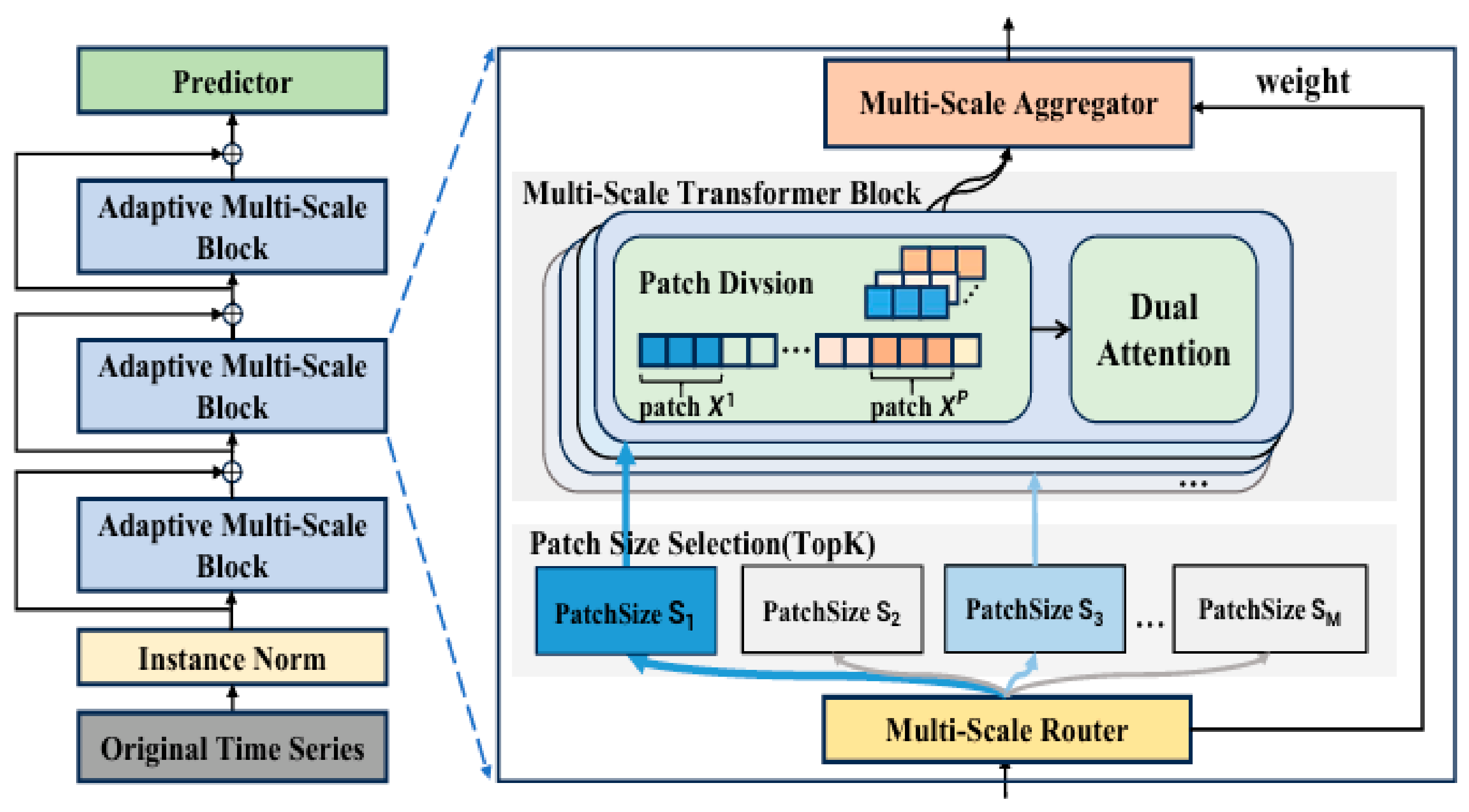
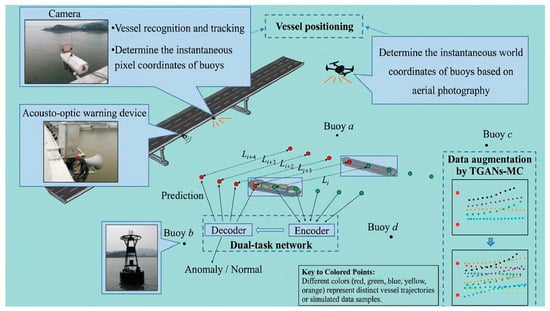
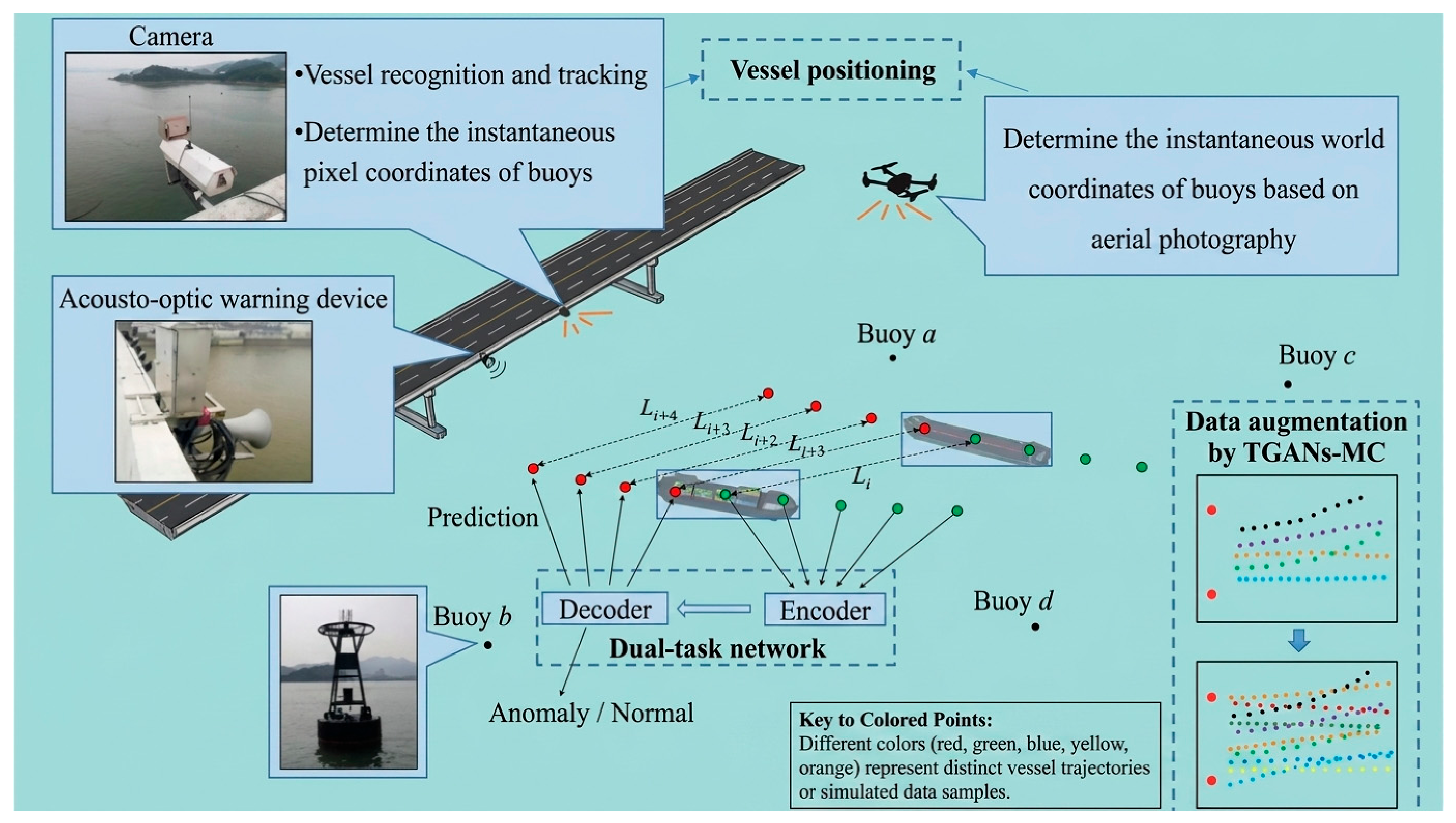
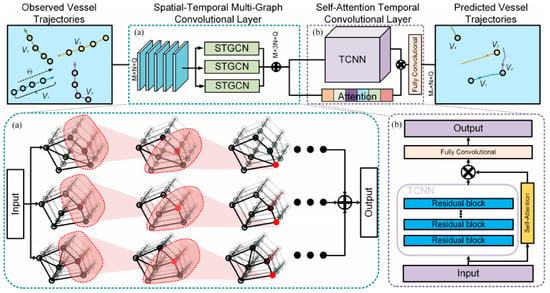
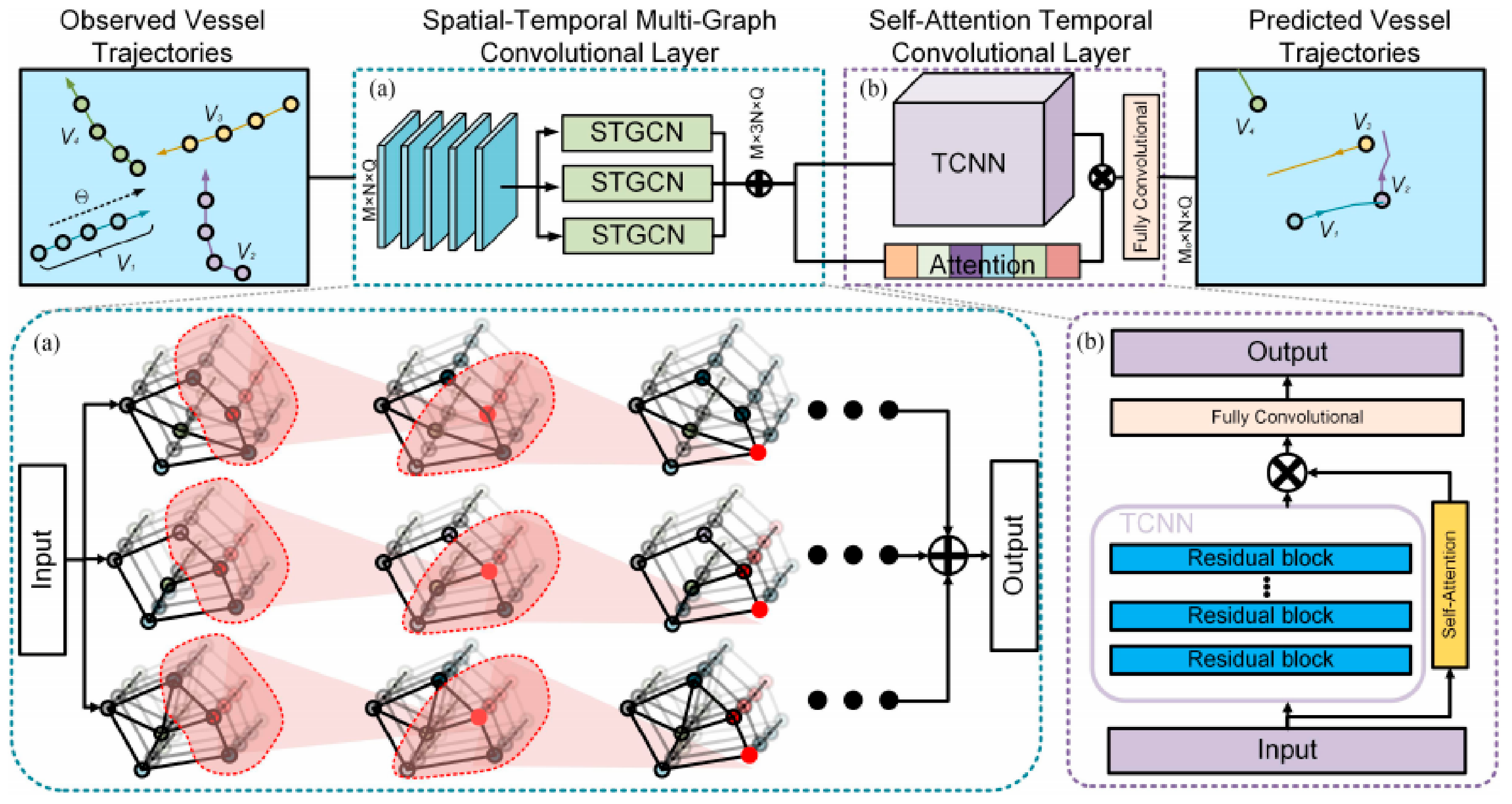
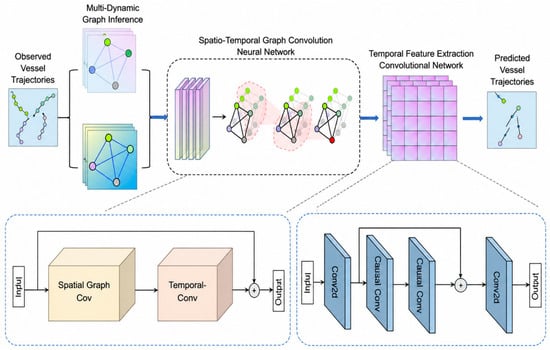

Disclaimer/Publisher’s Note: The statements, opinions and data contained in all publications are solely those of the individual author(s) and contributor(s) and not of MDPI and/or the editor(s). MDPI and/or the editor(s) disclaim responsibility for any injury to people or property resulting from any ideas, methods, instructions or products referred to in the content. |
© 2026 by the authors. Licensee MDPI, Basel, Switzerland. This article is an open access article distributed under the terms and conditions of the Creative Commons Attribution (CC BY) license.