


Abstract
A comprehensive understanding of Callovian (Middle Jurassic, Mesozoic) sedimentation and paleogeography requires examination of marine deposits of this stage across multiple geological domains on Earth. The Western Caucasus is a key region for Callovian studies in the central Northern Neotethys, but the age of its Callovian marine deposits remains uncertain. A reference section was examined, and a horizon containing foraminifers was found in the Kamennomostskaya Formation. The assemblage comprises both agglutinated and calcareous forms and is dominated by Labalina costata (Antonova, 1958). Data from other regions permit hypothesizing an Early Callovian age for the horizon based on the foraminifers. Considering recent findings of macro- and microfossils, the age of the entire Kamennomostskaya Formation can be constrained to the Early Callovian—older than previously thought. It is proposed that the Middle Callovian corresponds locally to a hiatus. This age revision facilitates a comparison between regional and global sea-level changes. Apparently, there was eustatic control over Early Callovian marine sedimentation in the Western Caucasus.
1. Introduction
A comprehensive and deep understanding of the mid-Mesozoic marine environments and ecosystems requires accumulation and regular comparison of the related geological information from many geological domains. The solution of these ambitious tasks needs a well-developed stratigraphical foundation for long-distance, inter-regional correlations. However, knowledge of mid-Mesozoic marine deposits of some large regions and particular time slices remains scarce and stratigraphically unjustified, and filling this gap remains an urgent task.
The Callovian Stage marked the end of the Middle Jurassic Epoch, and it lasted from 165.3 Ma to 161.5 Ma [1]. This time slice was characterized by the presence of giant oceans (e.g., the Neotethys Ocean between the Laurasian and Gondwanan blocks) [2], a cool climate with global mean surface temperatures of ~20 °C [3], a position of global sea level 0–50 m higher than at present (episodically, the sea level exceeded or dropped below these limits) [4], and diverse marine life [5]. Stratigraphically, this stage is known in detail [6], even if the solution for some related tasks (e.g., the establishment of the global stratotype section and point) remains in progress [7,8]. Importantly, the knowledge of Callovian marine deposits of some large regions remains insufficient. A typical example is the Western Caucasus (a western segment of the Greater Caucasus); itspaleogeographical position in the central part of the wide northern margin of the Neotethys Ocean [2] makes its geological record essential to the understanding of the development of the aforementioned margin during the Callovian. Without attention to the Western Caucasus, the presence of a large “white spot” between the European and Middle Eastern domains is unavoidable.
Callovian deposits do not crop out extensively in the Western Caucasus but constitute peculiar sedimentary packages that underline a thick Upper Jurassic–Lower Cretaceous sedimentary complex [9]. Rich assemblages of macrofossils (ammonites, bivalves, belemnites) were found in these deposits, but understanding of their age remains controversial. The aforementioned packages are represented in a reference section consisting of several outcrops (see below for more information on this section). According to Lominadze [10], Middle and Upper Callovian deposits are present in this section, and the Middle Callovian contains a peculiar assemblage of ammonites with mixed Early and Middle Callovian species. An international research group [11] found dinocysts in the upper part of the Callovian succession in the same section, and these microfossils implied a Late Bathonian–Early Callovian age. Belemnites and palynomorphs sampled in this section also indicated that Middle Callovian deposits might be older than previously thought [12]. Finally, Kiselev et al. [13] indicated the presence of Late Callovian ammonites in the layer assigned previously to the Lower–Middle Callovian package [9] (one should note that Kiselev et al. [13] dealt with the same section, but these specialists also considered some other outcrops; however, they did not indicate their exact location—nonetheless, the Callovian sedimentary succession is similar there). These lines of evidence indicatethat the outcomes of the earlier, ammonite-based biostratigraphical analyses should be taken with caution, and new, complementary biostratigraphical data from micropaleontological investigations are needed.
Foraminifers are very helpful in the studies of Jurassic marine deposits [14,15]. These microfossils were used successfully in dating Callovian deposits in several regions of the world such as the Russian Platform [16], the Arabian Plate [17], and India [18], and they were also helpful in discussions of the potential global stratotype section and point [19]. In the Western Caucasus, assemblages of Callovian foraminifers were characterized by Antonova [20], Azbel and Grigyalis [21], Gofman [22], Rostovtsev et al. [9], and Vuks [23]. These specialists reported new taxa and assemblages and carried out foraminifer-based biostratigraphical studies. However, this knowledge was accumulated in the mid-20th century, and, thus, it requires various updates. A serious challenge is that the previous works (see above for citations) established the stratigraphical distribution of foraminifers with the “old” regional ammonite-based scales. This means that the ages that can be established with foraminifers reflect in fact the ages established earlier with ammonites; i.e., the former are not independent. This knowledge may also need updates in the light of the information accumulated in the past decades in other regions of Russia and beyond (domains of Europe and Asia). For instance, new works such as those by Franz and Knott [19] and Olszewska [24] stimulate a reconsideration of what is known about Callovian foraminifers from the Western Caucasus. Moreover, a significant portion of the previously reported information was obtained from boreholes located beyond the study area (for instance, northeast of the latter— where Callovian deposits are thicker and represent deeper marine facies). This means that totally new, original information on Callovian foraminifers of the Western Caucasus is required for biostratigraphical purposes.
The objective of the present study is to report new findings of foraminifers in Callovian marine deposits cropping out in the Western Caucasus. These findings were made as a result of new field studies carried out in July 2025 and followed by in-depth laboratory investigations. The research project was targeted at tentative sampling of the most promising locality to determine the presence of microfauna and its biostratigraphical potential.
2. Geological Setting
The Western Caucasus is a part of the much larger late Cenozoic orogen known as the Greater Caucasus. In the Mesozoic, island arcs and back-arc basins evolved there, and the territory was covered by vast marginal seas of the Neotethys Ocean [25,26]. A kind of structural reorganization with some deformation took place in the Bathonian, and the Callovian marked the onset of a new phase in the regional geological evolution [27].
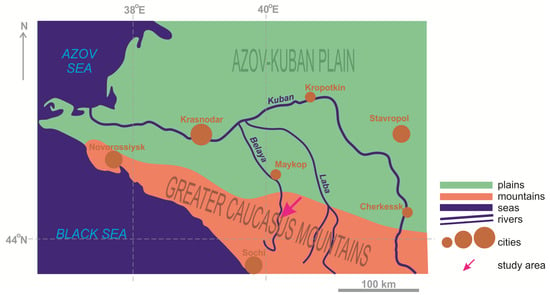
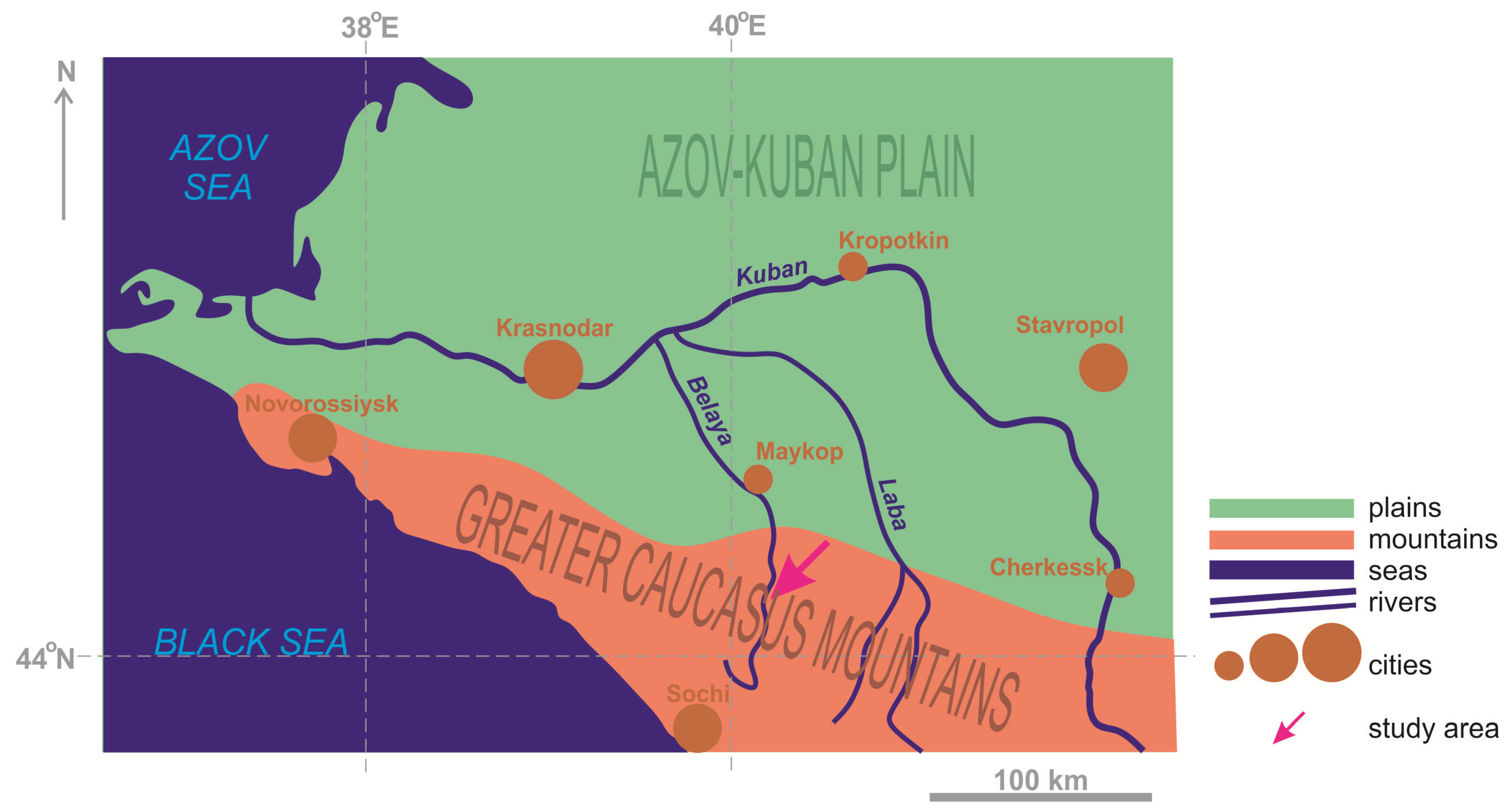
The study area corresponds to the drainage basin of the Belaya River, which stretches across the northern slope of the Western Caucasus (Figure 1). Its geological characteristics were described by Kolodyazhny et al. [28]. Generally, folded Lower Jurassic–Bathonian deposits are overlain with angular unconformity by Callovian–Upper Jurassic deposits that form a northward-dipping monocline.
Figure 1.
Geographical location of the study area.
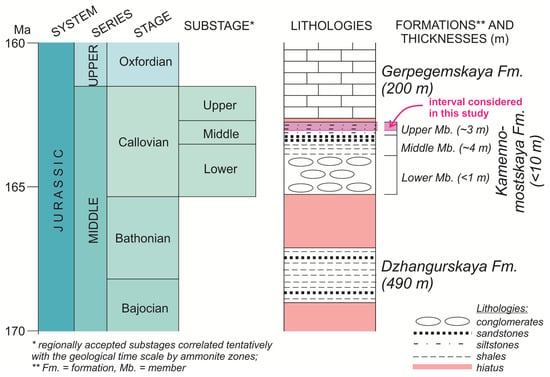
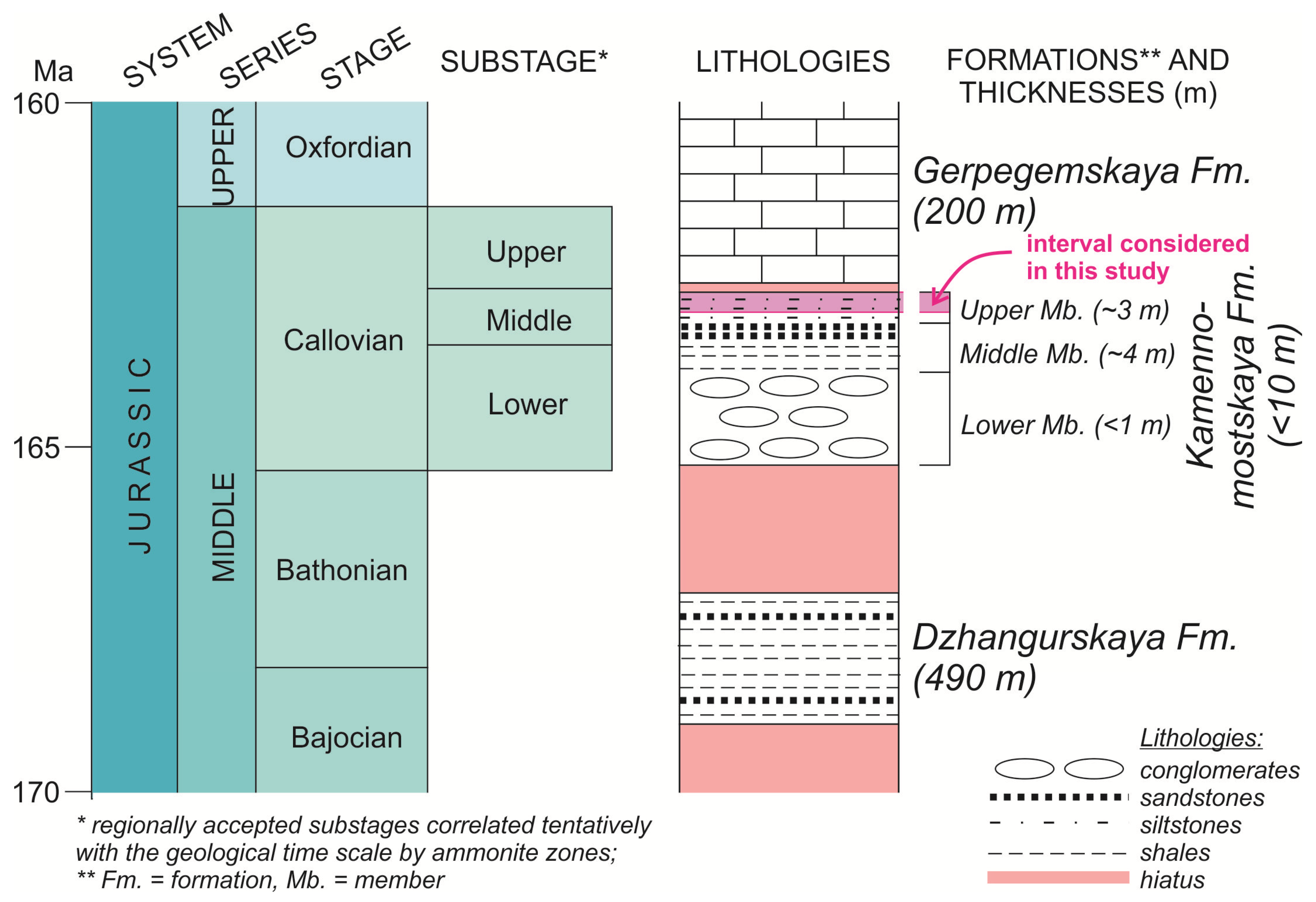
The study area is a reference area for studying Callovian sedimentary packages of the Western Caucasus in outcrops [9,12]. These deposits are subdivided into two parts (Figure 2). The lower part is the Kamennomostskaya Formation, with a thickness of <10 m. It comprises siliciclastics (conglomerates, sandstones, and siltstones). This formation is separated from the underlying deposits by the above-mentioned angular unconformity, and its top corresponds to a minor erosional surface. Although the Kamennomostskaya Formation is not thick, it can be subdivided into three distinct members (Figure 2). Macrofossils are concentrated in the Middle Member [9,10]. The upper part of the Callovian deposits comprises the basal layers of the Gerpegemskaya Formation (Late Callovian–mid-Kimmeridgian), which encompasses thick deposits of a large carbonate platform. As evidenced by the presence of marine macro- and microinvertebrate fossils, Callovian deposits of the study area are shallowmarine; they formed at the beginning of a long-term sedimentation cycle that culminated in the growth of a giant Late Jurassic carbonate platform [12].
Figure 2.
Stratigraphical outline of the considered Callovian deposits in the reference section. The geologic time scale follows the developments of the International Commission on Stratigraphy [1,6]. Regional stratigraphy follows Rostovtsev et al. [9] with modifications and updates.
In the Western Caucasus, the Callovian Stage is traditionally subdivided into three substages (Lower, Middle, and Upper Callovian—Figure 2). Each of them is understood in terms of an ammonite-based zonation. The Lower Callovian corresponds to the M. macrocephalus Zone and S. calloviense Zone, the Middle Callovian corresponds to the K. jason Zone and E. coronatum Zone, and the Upper Callovian corresponds to the P. athleta Zone and the Q. lamberti Zone [9]. Although the aforementioned ammonite zones were defined regionally, they can be brought into correspondence with the internationally accepted geologic time scale [1,6]. The Early Callovian was significantly longer than the other two substages (Figure 2). Taking into account that the local presence of the Lower Callovian has been questioned [10], only about half of the Callovian may be present in the study area.
Following the scheme presented by Rostovtsev et al. [9], the Lower Member is attributed (only very provisionally) to the Lower Callovian, although Lominadze [10] noted that the Lower Callovian deposits are absent and that the Middle and Upper Members constitute the Middle Callovian interval (Figure 2). The basal layers of the Gerpegemskaya Formation are assigned to the Upper Callovian unequivocally [9]. Nonetheless, this stratigraphical interpretation needs corrections, which are provided in the present work.
3. Materials and Methods
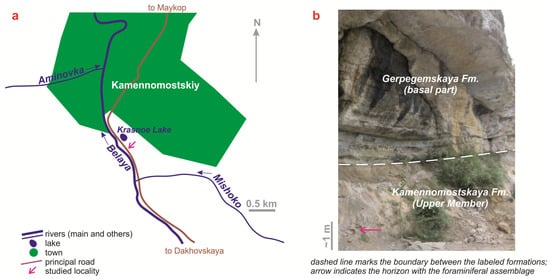
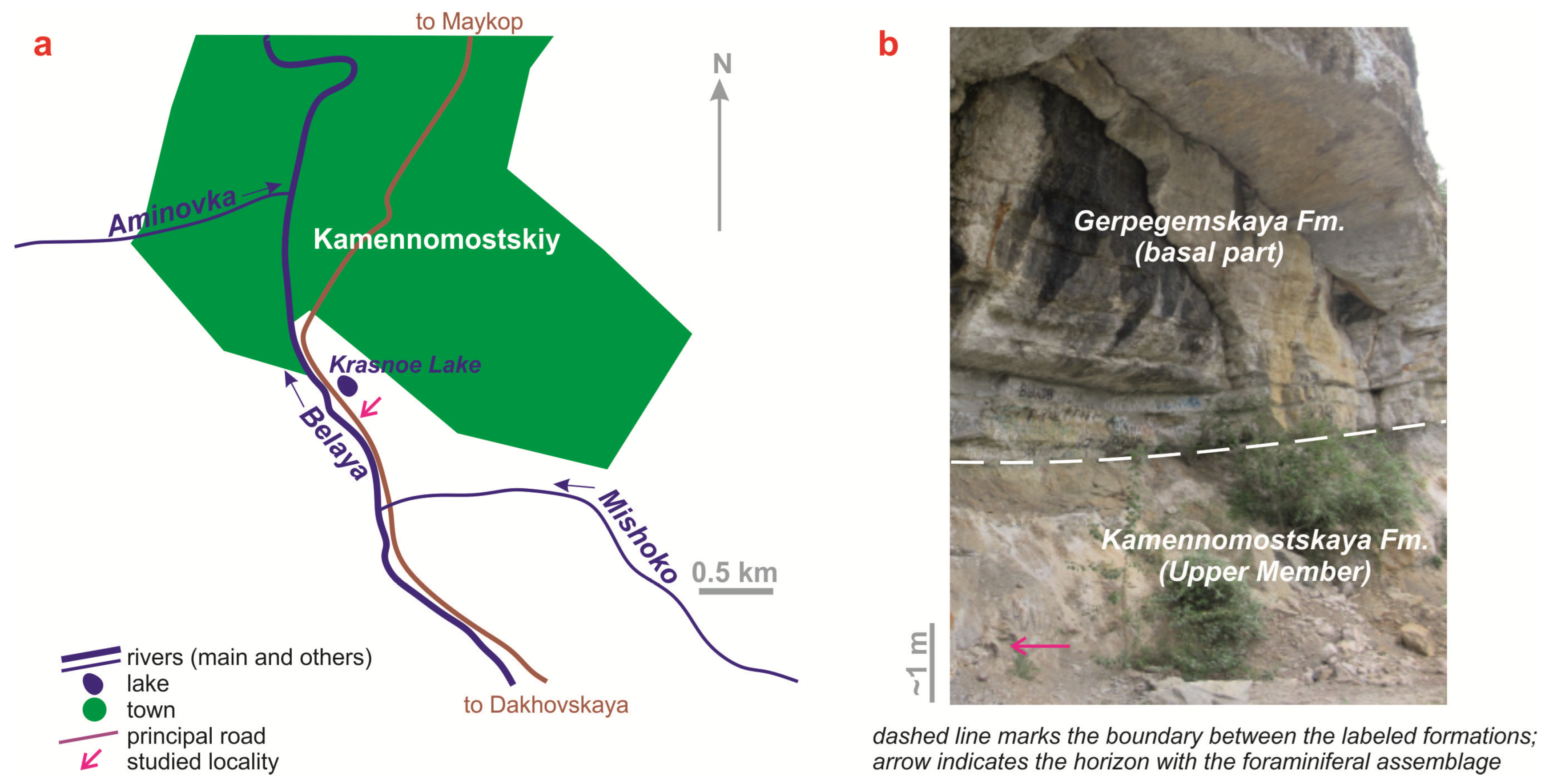
In the study area, Callovian deposits are exposed in a large road cutting near the northern entrance to the Khadzhokh Canyon, south of Kamennomostsky town in the Republic of Adygeya (Figure 3a). There, iron-rich, yellowish-grey siltstones of the Upper Member of the Kamennomostskaya Formation are overlain by carbonates of the Gerpegemskaya Formation (Figure 3b). A visible thickness of the former reaches 2 m, and that of the latter exceeds several dozens of meters. This section has been of utmost importance in the studies of the Callovian stratigraphy in the Western Caucasus. Particularly, it is this section where Gaetani et al. [11] found dinocysts and challenged the conventional age of deposits. Lithologically, this section seems to be promising for search of foraminifers, although these microfossils were apparently not reported from there earlier.
Figure 3.
Location (a) and general view (b) of the examined locality.
During the field works, it was decided to focus on the locality (a part of the reference section—Figure 3a) where the Upper Member crops out almost completely and where its relation to the Gerpegem Formation is well visible (Figure 3b). This locality was visited and sampled.
Initially, the samples promising for micropaleontological investigations were processed in the Trofimuk Institute of Petroleum Geology and Geophysics, Russian Academy of Sciences, Siberian Branch (Novosibirsk, Russia), as follows. The 200 g samples were broken into fragments and then boiled in water to achieve complete disaggregation. Pieces that did not disintegrate during boiling were subsequently treated by repeated saturation with a melted sodium hyposulfite solution, followed by crystallization upon cooling, until they loosened. The fully disaggregated material was washed in running water through a sieve with a 56 μm mesh size. The washed residue was dried at room temperature. The dried residue was examined, and foraminiferal tests were picked using Stemi 2000-C stereomicroscope (Carl Zeiss, Oberkochen, Germany). Examination of the samples proved the presence of foraminifers in one horizon (~5 cm in thickness) in the lower part of the member (Figure 3b). One sample represents this assemblage. Images of foraminifers were obtained with Carl Zeiss Discovery V12 light microscope equipped with AxioCam MRc5 camera (Carl Zeiss, Oberkochen, Germany).
The found foraminifers were identified as carefully as possible. For the purposes of identification, the previous regional works such as [29] and the modern syntheses of the knowledge such as [24,30] were used. The materials collected by the author during the previous studies in the East Caucasus [31] were also useful. The specimens were stored in the curated collection of the Trofimuk Institute of Petroleum Geology and Geophysics, Russian Academy of Sciences, Siberian Branch (Novosibirsk, Russia). Subsequent analytical procedures included counting of the number of specimens belonging to each identified taxa and biostratigraphical application.
4. Results
4.1. Foraminiferal Assemblage
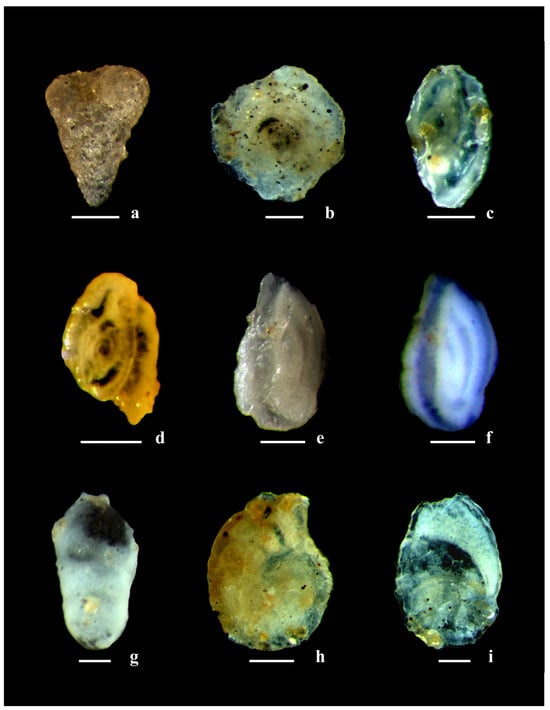
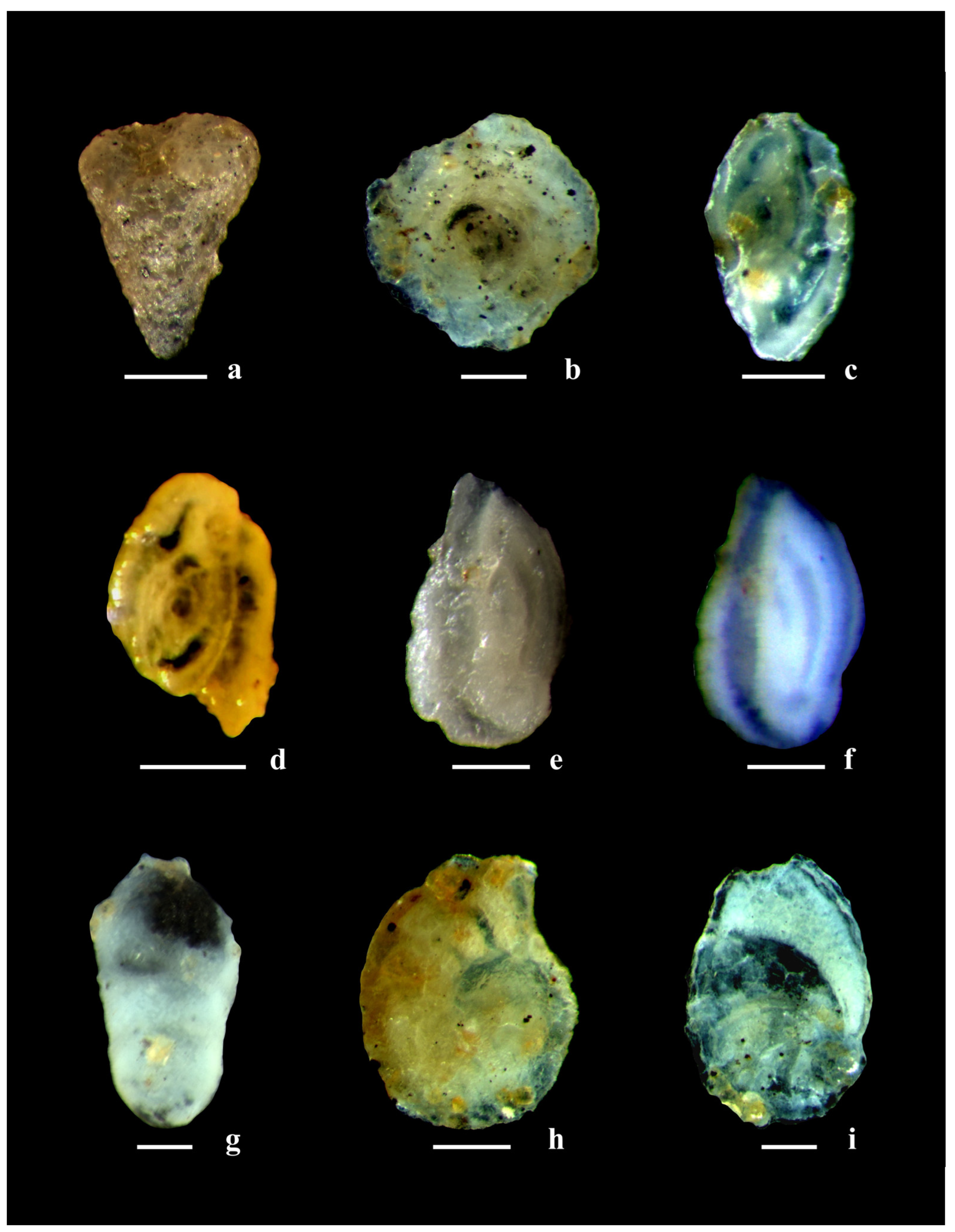
The horizon of the Kamennomostskaya Formation considered in the present study (Figure 3b) bears a rather diverse and stratigraphically informative assemblage of foraminifers (Figure 4). Their tests demonstrate either poor or moderate preservation, but taxa can be identified with certainty in many cases. Both agglutinated and calcareous foraminifers were recorded, and the latter prevailed in the assemblage.
Figure 4.
Characteristic foraminifers found in the Upper Member of the Kamennomostskaya Formation: (a)—Protomarssonella doneziana (Dain, 1958) (IPGG SB RAS, No. KM-25/1), (b)—Spirillina sp. (IPGG SB RAS, No. KM-25/2), (c,d)—Ophthalmidium ex gr. areniforme (E. Bykova, 1948) (IPGG SB RAS, No. KM-25/3, KM-25/4), (e,f)—Labalina costata (Antonova, 1958) (IPGG SB RAS, No. KM-25/5, (f)—the same specimen in glycerin), (g)—Pseudonodosaria ex gr. terqeumi (Mjatliuk, 1959) (IPGG SB RAS, No. KM-25/7), (h)—Lenticulina uhligi (Wisniowski, 1890) (IPGG SB RAS, No. KM-25/8), (i)—Planularia tricarinella (Reuss, 1863) (IPGG SB RAS, No. KM-25/9). Scale bar in all images is equal to 100 μm.
The composition of the foraminiferal assemblage is as follows: Hyperammina sp. (4 specimens), Trochammina sp. (2 specimens), Protomarssonella doneziana (Dain, 1958) (7 specimens), Spirillina sp. (4 specimens), Vinelloidea ex gr. oolithica (E. Bykova, 1952) (2 specimens), Ophthalmidium ex gr. areniforme (E. Bykova, 1948) (2 specimens), O. spp. (5 specimens), Labalina costata (Antonova, 1958) (25 specimens), Pseudonodosaria ex gr. terqeumi (Mjatliuk, 1959) (1 specimen), Nodosaria sp. (1 specimen), Lenticulina uhligi (Wisniowski, 1890) (2 specimens), L. spp. (3 specimens), Astacolus sp. (1 specimen), and Planularia tricarinella (Reuss, 1863) (2 specimens). The most characteristic taxa are shown in Figure 4. As evidenced by the number of specimens, the entire foraminiferal assemblage is dominated by representatives of L. costata (Antonova, 1958).
Two taxonomic remarks are necessary. First, L. costata (Antonova, 1958) is a species, with highly-complex taxonomic interpretations. Initially, it was assigned to the genus Palaeomiliolina [29]. Further changes in its taxonomic treatment were characterized by Clerc [30] who fixed its present name as L. costata (Antonova, 1958). This view is shared by the local geologists working in the Greater Caucasus [9]. According to the World Foraminifera Database (WFD) [32], L. costata (Antonova, 1958) is an accepted, valid taxon. Gavrilov et al. [31] mentioned it as Quinqueloculina canevi (Kaptarenko, 1963), and more material is necessary to realize similarities/differences between specimens of apparently the same taxon figuring in the different works under the different names (see Clerc [30]). This task is left for further investigation, and the opinion of Clerc [30] and WFD [32] is followed in this work. Second, Marssonella doneziana Dain, 1958 is another species with a complex taxonomic context. In WFD [33], it is accepted as Protomarssonella doneziana (Dain, 1958) following the opinion of Olszewska [24]. This name is usedin the present work.
L. costata (Antonova, 1958) dominates the assemblage, and, thus, deserves to be formally described. The taxonomic description provided below is based on previous descriptions of this species by Antonova [29] and Clerc [30], but it takes into account the micropaleontological materials used in this study. The history of taxonomic reconsiderations is given in a very abridged form to avoid duplication of the extensive revision proposed by Clerc [30] who also provided an appropriate diagnosis of this species.
| Order FORAMINIFERIDA Eichwald, 1830 |
| Suborder MILIOLINA Delage et Herouard, 1896 |
| Superfamily MILIOLACEA Ehrenberg, 1839 |
| Family HAUERINIDAE Schwager, 1876 |
| Subfamily HAUERININAE Schwager, 1876 |
| Genus Labalina Azbel, 1988 |
| Labalina costata (Antonova, 1958) |
| Figure 4e,f |
1958 Palaeomiliolina costata Antonova.—Antonova, p. 916, Figure 1, e–z.
2005 Labalina costata (Antonova).—Clerc, p. 74, pl. 9, Figures 4–19; pl. 10, Figures 1–23; pl. 25, Figures 1–11, pl. 33, Figures 3–6.
2015 Quinqueloculina canevi (Kaptarenko).—Gavrilov et al., pl. XXX, Figure 9.
Description. The test is an elongatedoval or diamondwith a rounded shape. It is triangular or irregularly polyhedral in cross-section. The test’s peripheral margin is angular or pointed. The chambers have a triangular cross-section. Four chambers are visible on the convex side, and two or three on the flat side. In flattened forms, four chambers are visible on both sides. The aperture is at the end of the apertural neck, which often breaks, revealing a slit-like opening of the upper chamber.
Remarks. A highly variable species. The test shape and degree of flattening depend on the type of coiling and the number of chambers. The angularity of the test is often smoothed out due to poor preservation.
Occurrence. Bajocian–Callovian of Europe and southwestern Russia.
Sources. Antonova [29], Azbel [21], Clerc [34], Delage et Herouard [35], Eichwald [36], Gavrilov et al. [31], Schwager [37].
4.2. Biostratigraphical Evidence
The Beds with Labalina costata were proposed by Antonova [20] as a particular biostratigraphical unit of the Western Caucasus and attributed to the Middle–Upper Callovian. In the second half of the 20th century, this unit was included into the regional stratigraphical schemes with a Middle Callovian age [38,39]. However, the validity of these developments, made several decades ago, may be questioned.
Three lines of evidence are as follows. First, Clerc [30] indicated that L. costata (Antonova, 1958) is common in the Lower Callovian of the Jura Mountains, as well as in older strata (the stratigraphical range of this taxon is Bajocian–Callovian). Second, this species was found in the Lower Callovian of the Lesser Caucasus [21]. Third, the taxonomical reconsideration of the previous findings in the Russian Platform [30] coupled with the subsequent ammonite-based developments [40] imply that L. costata (Antonova, 1958) occur there in the Lower Callovian. These lines of evidence imply that the abundance of L. costata (Antonova, 1958) in the considered horizon of the Kamennomostskaya Formation does not necessary signify its Middle Callovian age as proposed earlier [9,38,39]. Moreover, the presence of L. costata (Antonova, 1958) characterizes Lower Callovian deposits of the East Caucasus, and the age of these deposits was proven by new studies of ammonites [31]. This echoes the situation in part of the Russian Platform (see above). This means that the Early Callovian age of the considered horizon can be hypothesized.
The other taxa of the established foraminiferal assemblage (see above), which are not in open nomenclature, are less informative. L. uhligi (Wisniowski, 1890) is known from the Bathonian–Callovian [21]. P. tricarinella (Reuss, 1863) is known from the Middle Callovian in several regions, where the Early Callovian was either marked by a regression or absence of foraminifers [41,42]. More importantly, the noted species was reported from the Bajocian strata of the other region [19] and the Lower Callovian strata of the East Caucasus [31]. P. doneziana (Dain, 1958) is known from the Middle–Upper Callovian and overlying deposits [21,24,39], but the lowermost occurrence of this species remains uncertain due to the ongoing reconsideration of the Callovian biostratigraphy in the different areas of the Greater Caucasus, where it was found.
Generally, the new micropaleontological data match the idea that the age of the considered interval of the Kamennomostskaya Formation may be redefined. Although rather hypothetic, this idea appears to be realistic when compared to the other fresh paleontological information from the study area (see below). The poor-to-moderate preservation of foraminiferal tests might have resulted either from preservation in siltstones (tests were damaged by small, but hard clastic particles and post-depositional processes) or from action of waves. Nonetheless, tests were unlikely to have been reworked from older strata, as evidenced by their similar view and, often, the presence of full tests (note that the underlying rocks are relatively hard sandstones, and removal of fossils from themwould result in their significant breaking). This is why foraminifers can be used in discussions of the age of the considered deposits.
5. Discussion
5.1. Summarized Biostratigraphical Evidence
Foraminifers found in the Upper Member of the Kamennomostskaya Formation in the considered locality indicate, hypothetically, the Early Callovian age for these deposits. This is in agreement with the stratigraphical interpretations of dinocysts sampled in the same locality at a slightly higher level by Gaetani et al. [11]. Moreover, the hypothetical foraminifer-based age makes reasonable an Early Callovian age proposed for the Middle Member regarding belemnites and palynomorphs [12]. The latter were sampled in the same reference section. A coherence of the propositions made by Dzyuba et al. [12], Gaetani et al. [11], and in the present study proves their validity and makes the Early Callovian age realistic.
Principally, the interpretation presented above implies that the age established earlier on the highlypeculiar and mixed assemblages of ammonites for the Middle Member [9,10] may need reconsideration. Apparently, the previous identifications of ammonite species and the related biostratigraphical interpretations should be repeated with new material collected from the section, and positions of ammonite shells in the rocks need accurate documentation to realize whether they result from condensation processes and/or transportation and re-working. At least, the other groups of fossils provide coherent and fresh lines of evidence and imply the Early Callovian age. As stated above, this coherence itself is convincing and indicates that marine siliciclastics of the Middle Member of the Kamennomostskaya Formation is older by 1–2 Ma than thought initially, which is a true correction taking into account the duration of the Callovian Stage [1]. Additionally, one should note the fresh work by Kiselev et al. [13] who argued the presence of typical Late Callovian ammonites in the upper horizons of the Upper Member of the Kamennomostskaya Formation (these ammonites are typical to the uppermost Callovian), as well as a continuous transition from Callovian to Oxfordian deposits.
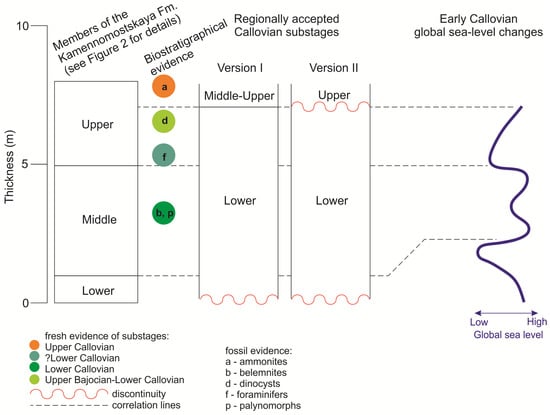
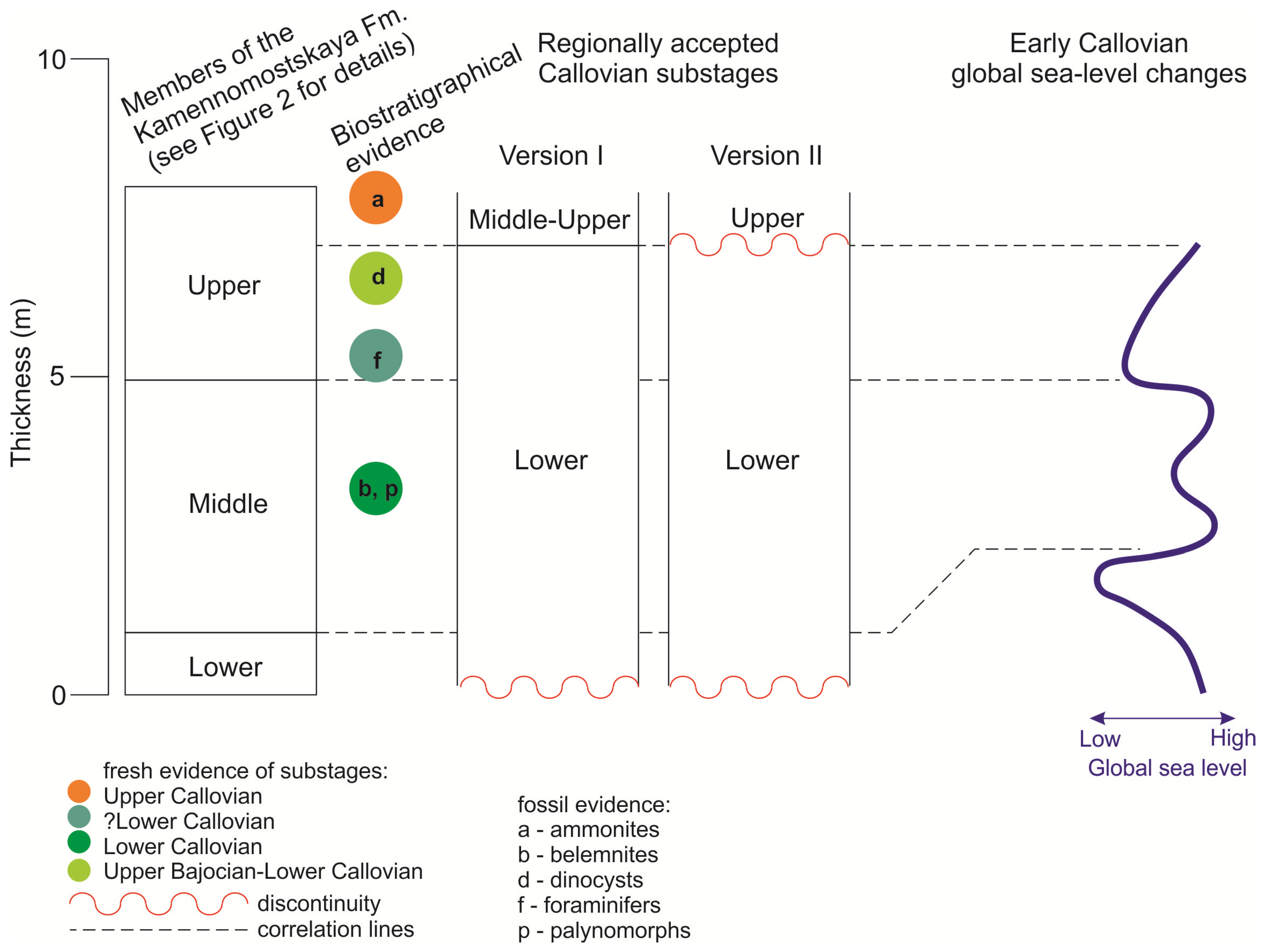
Comparing the lines of evidence from the present and previous studies permits proposition of two versions of the local Callovian stratigraphy (Figure 5). According to the first version, all members of the Kamennomostskaya Formation are Lower Callovian, except for the upper part of the Upper Member, which comprises the Middle Callovian and a part of the Upper Callovian. In this version, there is a stratigraphical continuity from the Lower Callovian to Upper Callovian–Oxfordian deposits. This version looks less realistic because of two reasons. First, it appears that the Middle Callovian and the lower part of the Upper Callovian are very condensed in this case, although the relative deposits do not exhibit fundamental lithological differences from the under- and overlying strata. Second, the previous regional works indicated a discontinuity near the bottom of the Gerpegemskaya Formation [9]. A surface, which can hypothetically be related to this discontinuity is visible in the section (Figure 3b). It is reflected by a color change ~0.5 m below the upper boundary of the Kamennomostskaya Formation. A more realistic second version implies that the Middle Callovian does not exist in the section and it corresponds approximately to a hiatus marked by the above-mentioned discontinuity (Figure 5). This version also means that the Upper Member is not a single unit, and its uppermost part can be replaced to the Gerpegemskaya Formation.
Figure 5.
The proposed stratigraphical corrections of the age of the Kamennomostskaya Formation and the global sea-level changes. The global sea-level changes are shown according to Haq [2018] [4]. Fossil evidence: a—based on [13], b—based on [12], d—based on Gaetani et al. [11], f—this study, p—based on [12].
5.2. Regional Versus Global Sea-Level Changes
The Callovian deposits of the Western Caucasus accumulated in a marine basin and, thus, it is interesting to relate the regional sea-level changes evidenced by sedimentary packages (Figure 2) and the global sea-level changes [4] in the light of the proposed age correction (Figure 5). Conglomerates of the Lower Member of the Kamennomostskaya Formation mark the onset of a regional sea-level rise after a major erosive episode. The latter was linked to the regional tectonic processes [27], but a steady sea-level rise became possible together with a sharp global sea-level rise in the beginning of the Early Callovian (Figure 5). Shales and sandstones of the Middle Member with abundant marine macroinvertebrates such as ammonites and belemnites indicate a temporary culmination of the regional sea-level rise in the Middle Callovian, which coincided with the global sea-level highstand marked by two peaks and a small drop between them (Figure 5). About two thirds of the Upper Member with marine microfossils formed when the global sea level rose again (Figure 5). The proposed correspondence of the regional and global sea-level changes implies a prevalence of an eustatic (not tectonic) control over the regional sedimentation.
Of interest are also the global sea-level changes in the second half of the Callovian. According to the eustatic reconstruction by Haq [4], the global sea level experienced two minima in the Middle Callovian–early Late Callovian, when it dropped to the present position and even lower. Indeed, these fluctuations could disrupt marine sedimentation in shallow-water settings, and this interpretation matches well the second version of the local Callovian stratigraphy (Figure 5). The supposed discontinuity in the upper part of the Upper Member can easily be explained by a temporary interruption of the local sedimentation caused by the eustatic mechanism. These interpretations echo the information from the Paris Basin, where a lengthy interval in the mid-Callovian was marked by a hiatus [43], and the Betic Cordillera, where sedimentation was interrupted after the Early Callovian [44]. Differences from some other domains (the Atlantic margin of Morocco [45], the Arabian Plate [46] and the Gissar in Central Asia [47]) can be explained by a globally varying interplay between eustasy, regional tectonics (also in the form of mantle-driven dynamic topography [48,49]), and sediment supply. Hypothetically, the relative tectonic stability (post-rift, thermal subsidence of a platform) in the Western Caucasus after the Late Bathonian structural reorganization [27] strengthened the eustatic control over the local sedimentation.
6. Conclusions
This paper reports foraminifers from Callovian marine deposits of the Western Caucasus, where they were found in the Upper Member of the Kamennomostskaya Formation. To the authors’ knowledge, this is the first report of foraminifers from the reference section of this formation. Three principal conclusions are as follows. First, the foraminiferal assemblage is dominated by Labalina costata (Antonova, 1958). Second, new findings of foraminifers together with the other fresh lines of paleontological evidence imply that a significant part of the Kamennomostskaya Formation is older than thought initially and the Middle Callovian may correspond to a hiatus. Third, the regional and global sea-level change can be brought in correspondence after the proposed stratigraphical corrections, and the eustatic control over the Callovian sedimentation in the Western Caucasus is proposed.
The international importance of this study is determined by a provision of novel information on Callovian foraminifers from an important region representing the central part of the Northern Neotethys. The present investigation is definitely tentative. Nonetheless, even the available material contributes to the age correction of Callovian marine deposits. The tasks for further studies of the Callovian in the Western Caucasus include accumulation of data on foraminifers, in-depth revision and biostratigraphical reinterpretation of the information on ammonites (with new collections and detailed field examination of taphonomical patterns), and checking the age of the lowermost horizons of the Kamennomostskaya Formation, a Bathonian age of which cannot be excluded. Attention should also be paid to ostracods, poorly-preserved shells of which were noted together with foraminifers in the examined sample; it became impossible to identify them in this study, but a special research project may permit to document an assemblage of these microfossils and to offer their stratigraphical and/or paleoenvironmental interpretations. More generally, the Western Caucasus deserves to be better considered in the correlations of the Callovian deposits across the Northern Neotethys.
Author Contributions
Conceptualization, D.A.R. and L.A.G.; methodology, L.A.G.; investigation, D.A.R. and L.A.G.; curation of microfossil specimens, L.A.G.; writing—original draft preparation, D.A.R. and L.A.G. All authors have read and agreed to the published version of the manuscript.
Funding
A part of this work was carried out under the project FWZZ-2026-0033 of the Trofimuk Institute of Petroleum Geology and Geophysics, Russian Academy of Sciences, Siberian Branch (L.A. Glinskikh).
Institutional Review Board Statement
Not applicable.
Informed Consent Statement
Not applicable.
Data Availability Statement
Data are contained within the article.
Acknowledgments
The authors thank N. V. Ruban (Russia) for her assistance during field studies, as well as A. V. Yadrenkin (IPGG SB RAS, Russia) for his help in photographing foraminifers.
Conflicts of Interest
The authors declare no conflicts of interest. The funders had no role in the design of the study; in the collection, analyses, or interpretation of data; in the writing of the manuscript; or in the decision to publish the results.
References
- International Commission on Stratigraphy. Available online: https://stratigraphy.org/ (accessed on 5 January 2026).
- Scotese, C.R. An Atlas of Phanerozoic Paleogeographic Maps: The Seas Come In and the Seas Go Out. Annu. Rev. Earth Planet. Sci. 2021, 49, 679–728. [Google Scholar] [CrossRef] [Scilit]
- Judd, E.J.; Tierney, J.E.; Lunt, D.J.; Montanez, I.P.; Huber, B.T.; Wing, S.L.; Valdes, P.J. A 485-million-year history of Earth’s surface temperature. Science 2024, 385, 1316. [Google Scholar] [CrossRef] [Scilit] [PubMed]
- Haq, B.U. Jurassic Sea-Level Variations: A Reappraisal. GSA Today 2018, 28, 4–10. [Google Scholar] [CrossRef] [Scilit]
- The Paleobiology Database. Available online: https://paleobiodb.org/ (accessed on 5 January 2026).
- Gradstein, F.M.; Ogg, J.G.; Schmitz, M.D.; Ogg, G.M. (Eds.) Geologic Time Scale 2020; Elsevier: Amsterdam, The Netherlands, 2020. [Google Scholar]
- Mönnig, E.; Dietl, G. The systematics of the ammonite genus Kepplerites (upper Bathonian and basal Callovian, Middle Jurassic) and the proposed basal boundary stratotype (GSSP) of the Callovian Stage. Neues Jahrb. Geol. Palaontol. Abh. 2017, 286, 235–287. [Google Scholar] [CrossRef] [Scilit]
- Silva, R.L.; Alsen, P. Stable carbon isotope chemostratigraphy of the base of the Callovian in Greenland. Gondwana Res. 2024, 136, 84–91. [Google Scholar] [CrossRef] [Scilit]
- Rostovtsev, K.O.; Agaev, V.B.; Azarian, N.R.; Babaev, R.G.; Besnosov, N.V.; Hassanov, N.A.; Zesashvili, V.I.; Lomize, M.G.; Paitschadze, T.A.; Panov, D.I.; et al. Jurassic of the Caucasus; Nauka: St. Petersburg, Russia, 1992. (In Russian) [Google Scholar]
- Lominadze, T.A. Callovian ammonitids of the Caucasus; Metsniereba: Tbilisi, Georgia, 1982. (In Russian) [Google Scholar]
- Gaetani, M.; Garzanti, E.; Poline, R.; Kiricko, Y.; Korsakhov, S.; Cirilli, S.; Nicora, A.; Rettori, R.; Larghi, C.; Bucefalo Palliani, R. Stratigraphic evidence for Cimmerian events in NW Caucasus (Russia). Bull. Société Géologique Fr. 2005, 176, 283–299. [Google Scholar] [CrossRef] [Scilit]
- Dzyuba, O.S.; Goryacheva, A.A.; Ruban, D.A.; Gnezdilova, V.V.; Zayats, P.P. New data on Callovian (Middle Jurassic) balamnites and palynomorphs from the Northern Caucasus, southwest Russia. Geologos 2016, 22, 49–59. [Google Scholar] [CrossRef] [Scilit]
- Kiselev, D.; Rogov, M.; Glinskikh, L.; Guzhikov, A.; Pimenov, M.; Mikhailov, A.; Dzyuba, O.; Matveev, A.; Tesakova, E. Integrated stratigraphy of the reference sections for the Callovian-Oxfordian boundary in European Russia. Vol. Jurassica 2013, 9, 59–96. [Google Scholar]
- Gradstein, F.M.; Waskowska, A.; Glinskikh, L.A. The First 40 Million Years of Planktonic Foraminifera. Geosciences 2021, 11, 85. [Google Scholar] [CrossRef] [Scilit]
- Jain, S.; Abdelhady, A.A. Paleobiogeography of the Middle Jurassic (Bathonian-Callovian) benthic foraminifera. Mar. Micropaleontol. 2020, 161, 101922. [Google Scholar] [CrossRef] [Scilit]
- Palechek, T.N.; Ustinova, M.A. Jurassic Radiolarians and Foraminifers from Vorobyovy Gory in Moscow. Stratigr. Geol. Correl. 2020, 28, 281–299. [Google Scholar] [CrossRef] [Scilit]
- Hughes, G.W. A new thin-section based micropaleontological biozonation for the Saudi Arabian Jurassic carbonates. Micropaleontology 2018, 64, 331–364. [Google Scholar] [CrossRef] [Scilit]
- Talib, A.; Faisal, S.M.S. A preliminary note on the occurrence of foraminifera in the Middle to Upper Jurassic sediments of Fakirwari, Kutch Mainland, Gujarat. J. Geol. Soc. India 2006, 68, 963–966. [Google Scholar] [CrossRef] [Scilit]
- Franz, M.; Knott, S.D. Foraminifera from the Callovian GSSP candidate section of Albstadt-Pfeffingen (Middle Jurassic, Southern Germany). Neues Jahrb. Geol. Palaontol. Abh. 2012, 264, 263–282. [Google Scholar] [CrossRef] [Scilit]
- Antonova, Z.A. Subdivision of the section of Jurassic deposits of the Laba River basin by the fauna of foraminifers. Proc. VNIIGNI 1958, 12, 213–234. (In Russian) [Google Scholar]
- Azbel, A.Y.; Grigyalis, A.A. (Eds.) A Practical Guide to Microfauna of USSR, Vol. 5, Foraminifers of the Mesozoic; Nedra: Leningrad, Russia, 1991. (In Russian) [Google Scholar]
- Gofman, E.A. Foraminifers from the Jurassic of the Northern Caucasus; Nauka: Moscow, Russia, 1967. (In Russian) [Google Scholar]
- Vuks, V.J. Middle-Late Jurassic Foraminifers of the Western Caucasus: Evolution of Foraminiferal Assemblages and Some Environmental Aspects. Paleontol. J. 2013, 47, 1163–1169. [Google Scholar] [CrossRef] [Scilit]
- Olszewska, B. Microfossils of the Upper Jurassic–Lower Cretaceous formations of the Lublin Upland (SE Poland) based on thin section studies. Pol. Geol. Inst. Spec. Pap. 2010, 26, 1–56. [Google Scholar]
- Adamia, S.; Alania, V.; Chabukiani, A.; Kutelia, Z.; Sadradze, N. Great Caucasus (Cavcasioni): A long-lived North-Tethyan back-arc basin. Turk. J. Earth Sci. 2011, 20, 611–628. [Google Scholar] [CrossRef] [Scilit]
- Golonka, J. Plate tectonic evolution of the southern margin of Eurasia in the Mesozoic and Cenozoic. Tectonophysics 2004, 381, 235–273. [Google Scholar] [CrossRef] [Scilit]
- Saintot, A.; Brunet, M.-F.; Yakovlev, F.; Sebrier, M.; Stephenson, R.; Ershov, A.; Chalot-Prat, F.; McCann, T. The Mesozoic-Cenozoic tectonic evolution of the Greater Caucasus. Geol. Soc. Mem. 2006, 32, 277–289. [Google Scholar] [CrossRef] [Scilit]
- Kolodyazhny, S.Y.; Kuznetsov, N.B.; Makhinya, E.I.; Shalaeva, E.A.; Dantsova, K.I.; Romanyuk, T.V.; Antipov, M.P.; Parfenov, G.E. Tectono-Gravitational Detachments in the Alpine Cover of the Northern Slope of the Greater Caucasus and Western Pre-Caucasus Basin (Adygean Segment). Geotectonics 2024, 58, 611–638. [Google Scholar] [CrossRef] [Scilit]
- Clerc, C. Les Miliolina (Foraminiferes porcelanes) du Dogger du Jura meridional (France): Systematique, stratigraphie et paleoenvironnement. In Terre & Environnement; Éditions de l’Université de Genève: Genève, Switzerland, 2005; Volume 56, pp. 1–250. [Google Scholar]
- Hayward, B.W.; Le Coze, F.; Vachard, D.; Gross, O. World Foraminifera Database. Labalina costata (Antonova, 1958). Available online: https://marinespecies.org/foraminifera/aphia.php?p=taxdetails&id=1059514 (accessed on 27 February 2026).
- Gavrilov, Y.O.; Zakharov, V.A.; Rogov, M.A.; Gulyaev, D.B.; Ippolitov, A.P.; Schepetova, E.V.; Glinskikh, L.A.; Desai, B.T. Jurassic Deposits of the Central Part of Mountainous Dagestan; Cherkashin, V.I., Ed.; Alef: Makhachkala, Russia, 2015; pp. 81–105. (In Russian) [Google Scholar]
- Hayward, B.W.; Le Coze, F.; Vachard, D.; Gross, O. World Foraminifera Database. Protomarssonella doneziana (Dain, 1958). Available online: https://www.marinespecies.org/Foraminifera/aphia.php?p=taxdetails&id=1559522 (accessed on 27 February 2026).
- Antonova, Z.A. On the question of the evolution of certain representatives of miliolids by example of their development in the Jurassic time in the basin of the Laba River. Doklady Akademii Nauk SSSR 1958, 5, 913–916. (In Russian) [Google Scholar]
- Azbel, A.Y. Upper Jurassic miliolids of the European part of the USSR and Western Kazakhstan. Classification, ecology and stratigraphy of the Miliolina (Foraminifera). In Proceedings of the Zoological Institute of the Akademy of Sciences of the USSR; Mikhalevich, V.I., Ed.; Nauka: Moscow, Russia, 1988; Volume 184, pp. 11–43. (In Russian) [Google Scholar]
- Delage, Y.; Hérouard, E. Traité de Zoologie Concrète. Tome I. La Cellule et les Protozoaires; Schleicher Frères: Paris, France, 1896. [Google Scholar]
- Ehrenberg, C.G. Die Bildung der Europäischen, Libyschen und Arabischen Kreidefelsen und des Kreidemergels aus Mikroskopischen Organismen; Druckerei der Königlichen Akademie der Wissenschaften: Berlin, Germany, 1839. [Google Scholar]
- Schwager, C. Saggio di una classificazione dei foraminiferi avuto riguardo alle loro famiglie naturali. Bolletino Reg. Com. Geol. D’italia 1876, 7, 475–485. [Google Scholar]
- Decision of the 2nd Interdepartmental Regional Stratigraphical Meeting on the Mesozoic of the Caucasus (Jurassic); VSEGEI: Leningrad, Russia, 1984. (In Russian)
- Makar’eva, S.F. Foraminifers from Jurassic deposits of the North-Eastern Caucasus and their stratigraphical importance. In Trudy SevKavNII; Nauka: Moscow, Russia, 1971; Volume 16, pp. 1–103. (In Russian) [Google Scholar]
- Kiselev, D.N. Ammonites and infrazonal stratigraphy of the Boreal and Subboreal Bathonian and Callovian. In Proceedings of the Geological Institute of the Russian Academy of Sciences; Nauka: Moscow, Russia, 2022; Volume 628, pp. 1–667. (In Russian) [Google Scholar]
- Bhalla, S.N.; Talib, A.; Gaur, K.N.; Wasim, S.M.; Singh, Y.P. A synthesis of foraminiferal researches on Jurassic sediments of Kutch Basin, India. J. Palaeontol. Soc. India 2019, 64, 129–142. [Google Scholar] [CrossRef] [Scilit]
- Smolen, J.; Iwanczuk, J. Foraminiferal biostratigraphy of the Middle and Upper Jurassic of the Polish Lowlands: The state of the art. Geol. Q. 2018, 62, 257–286. [Google Scholar] [CrossRef] [Scilit]
- Collin, P.-Y.; Courville, P. Sedimentation and palaeogeography of the eastern part of the Paris Basin (France) at the Middle–Upper Jurassic boundary. Comptes Rendus Geosci. 2006, 338, 824–833. [Google Scholar] [CrossRef] [Scilit]
- Sandoval, J. Ammonite assemblages and chronostratigraphy of the uppermost Bajocian-Callovian (Middle Jurassic) of the Murcia Region (Betic Cordillera, south-eastern Spain). Proc. Geol. Assoc. 2016, 127, 230–246. [Google Scholar] [CrossRef] [Scilit]
- Duval-Arnould, A.; Bulot, L.; Masrour, M.; Simmons, M.; Bonnot, A.; Charton, R.; Redfern, J.; Schröder, S. A new sedimentary and biostratigraphic framework for the Callovian-Oxfordian transition on the Atlantic margin of Morocco. J. Afr. Earth Sci. 2024, 210, 105164. [Google Scholar] [CrossRef] [Scilit]
- Messaoud, J.H.; Alsaihati, S.H.M.; Ben Chaabane, N.B.; Razin, P.; van Buchem, F. A synthesis of biostratigraphic, isotope-stratigraphic, and paleoenvironmental records from the Callovian (Middle Jurassic) carbonate succession of Saudi Arabia and its global implications. Earth-Sci. Rev. 2026, 273, 105530. [Google Scholar] [CrossRef] [Scilit]
- Carmeille, M.; Bourillot, R.; Brunet, M.-F.; Pellenard, P.; Fürsich, F.T.; Schnyder, J.; Barrier, E.; Blanpied, C.; Sidorova, I. Architecture and sedimentary evolution of the southwestern Gissar carbonate platform (Uzbekistan) during the Middle–Late Jurassic. Mar. Pet. Geol. 2018, 97, 437–465. [Google Scholar] [CrossRef] [Scilit]
- Conrad, C.P.; Husson, L. Influence of dynamic topography on sea level and its rate of change. Lithosphere 2009, 1, 110–120. [Google Scholar] [CrossRef] [Scilit]
- Vilacís, B.; Brown, H.; Bunge, H.-P.; Carena, S.; Hayek, J.N.; Stotz, I.L.; Wang, Z.R.; Friedrich, A.M. Dynamic topography and the planform of mantle convection since the Jurassic inferred from global continental hiatus maps. Proc. R. Soc. A Math. Phys. Eng. Sci. 2024, 480, 20240311. [Google Scholar] [CrossRef] [Scilit]
Disclaimer/Publisher’s Note: The statements, opinions and data contained in all publications are solely those of the individual author(s) and contributor(s) and not of MDPI and/or the editor(s). MDPI and/or the editor(s) disclaim responsibility for any injury to people or property resulting from any ideas, methods, instructions or products referred to in the content. |
© 2026 by the authors. Licensee MDPI, Basel, Switzerland. This article is an open access article distributed under the terms and conditions of the Creative Commons Attribution (CC BY) license.