


Abstract
This paper addresses the critical challenge of detecting weak, small targets in sonar intensity images for linear-array active sonar, where target signatures are not only obscured by low signal-to-interference ratio (SIR) but also strongly resemble structural interference arising from beamforming processing. We propose an end-to-end detection method that integrates controllable simulation with spatiotemporal structure-aware modeling. First, a physics-informed simulation system is constructed, centered on the Bellhop ray-tracing model. It incorporates multiple environmental effects, including multi-highlight targets, spectrally shaped noise, range-dependent reverberation, discrete scatterers, multipath propagation, and platform perturbations. Through closed-loop SIR calibration and point spread function (PSF)-constrained automatic annotation, a high-fidelity dataset with traceable parameters is generated. Second, the YOLOv8-Mamba-P2 detection network is designed. It introduces gated long-range spatial mixing modules (inspired by Mamba) to model global context and enhance the ability to discriminate interference structures, and extends a P2 small-scale detection branch to improve the perception and localization capabilities for weak targets. This enables precise target detection within complex backgrounds. Experimental results demonstrate the algorithm’s superior performance in low-SIR and strong reverberation conditions, achieving significant improvements in recall and localization accuracy while maintaining real-time inference efficiency, offering a promising framework for sonar target detection under the simulated conditions considered, with potential applicability to complex marine environments pending further real-world validation.
1. Introduction
Active sonar target detection serves as a fundamental capability in underwater surveillance, autonomous navigation, and maritime security applications [1,2]. In complex marine acoustic environments, this task is fundamentally constrained by the contradiction between weak target signatures and strong structural interference. Target echoes often exhibit low signal-to-interference ratios due to spectral-shaped ambient noise, platform motion artifacts, and sensor calibration uncertainties [3]. Simultaneously, seabed and sea surface reverberation, discrete scatterers, and multipath propagation generate structural features similar to target signatures in beamforming-processed intensity images, rendering weak targets susceptible to masking and misclassification [4,5].
A natural approach to this problem is to treat the intensity matrix output from beamforming processing as an image, thereby leveraging advances in visual object detection [6,7]. However, the sonar intensity images formed after conventional beamforming (CBF) processing fundamentally violate the statistical assumptions underlying natural image models. Marine noise exhibits time-varying spectral characteristics, and reverberation introduces spatially correlated textures that local convolution operators cannot effectively discriminate [8]. This necessitates detection architectures capable of long-range contextual modeling while maintaining computational tractability. More critically, the acquisition and annotation of real sonar data face significant constraints [9]. Data collection is expensive and often subject to classification restrictions. In strong reverberation backgrounds, the spatial support of target-related energy lacks consistent definition, making human annotation both costly and unreliable. These factors have severely limited reproducible research and systematic benchmarking in this domain.
This work addresses these challenges through a unified methodological framework spanning controllable simulation, automated annotation, and efficient spatiotemporal energy structure feature perception. Our core insight is that detection failures in sonar applications predominantly arise not from insufficient network capacity, but from training data that fails to cover critical disturbance sources and from labels that are inconsistent with actual imaging morphology [10,11]. We therefore parameterize principal environmental factors and explicitly inject them into the signal generation process, enabling each sample to be traced to its environmental configuration and quality statistics.
However, unlike prior works that often focus on isolated improvements in either simulation, annotation, or model design, this paper presents a co-designed, tripartite framework that synergistically addresses the low-SIR detection challenge across the entire pipeline: At the data level, we develop a controllable simulation pipeline with closed-loop SIR calibration that jointly models multiple physical factors (spectral-shaped noise, range-dependent reverberation, discrete scatterers, multipath, attitude perturbations), moving beyond simulations that treat these factors in isolation. This ensures the generated data is both physically representative and traceable. At the annotation level, we propose a PSF-constrained automatic labeling strategy, which directly generates morphologically consistent masks and bounding boxes from target-only responses. This resolves the inconsistency and high cost of manual annotation in strong interference backgrounds. At the model level, we design the YOLOv8-Mamba-P2 network, which incorporates a gated long-range spatial mixing module (inspired by Mamba) to suppress structural interference and an extended P2 detection branch to enhance sensitivity to weak, small targets. These three components are not independent; they form a cohesive, co-designed solution where the simulation provides diverse and challenging data with known ground truth, the annotation ensures label fidelity to the imaging physics, and the model is specifically tailored to exploit and overcome the characteristics of such data. The primary contribution is this holistic framework rather than an incremental model modification. The proposed approach demonstrates stable performance advantages under extremely low SIR and strong reverberation conditions while maintaining competitive inference efficiency.
We conduct a systematic evaluation using a stratified protocol that separately examines performance across SIR levels and environmental factors. This enables mechanistic analysis of performance degradation patterns under different disturbance sources and quantification of gains attributable to specific architectural modifications.
2. Related Work
2.1. Active Sonar Target Detection
Active sonar target detection has evolved from classical signal processing methods to modern deep learning approaches. Traditional matched filtering remains foundational, with adaptive variants addressing environmental mismatch. Zhao et al. [12] proposed a frequency-domain adaptive matched filter (FDAMF) achieving approximately 18.6 dB SIR gain over classical matched filters at −10 dB input SIR by incorporating frequency-domain adaptive line enhancement. For sequential detection in time-spread echo scenarios, Abraham and Willett [13] demonstrated that the Page test provides superior performance over conventional thresholded matched filter detectors in shallow water environments.
Constant false alarm rate (CFAR) detection remains central to sonar systems. Abu and Diamant [14] developed a K-CFAR algorithm using K-distribution modeling for automatic underwater object detection with closed-form threshold calculation. Chen et al. [15] proposed an adaptive CFAR approach using backpropagation neural networks to automatically select optimal detectors (CA/SO/GO/OS-CFAR) based on interference background characteristics. More recently, Lerda et al. [16] derived GLRT and Rao adaptive tests generalizing the adaptive normalized matched filter with texture-CFAR behavior for Mills Cross sonar systems.
The transition to deep learning has enabled more sophisticated feature extraction. Steiniger et al. [9] provided a comprehensive survey covering over 15 years of deep learning for side-scan and synthetic aperture sonar, reviewing CNN architectures and automatic target recognition pipelines. Xiao et al. [17] introduced attention-based deep neural networks for underwater acoustic target recognition, providing interpretability through focus on target frequency-domain features. Xie et al. [18] proposed adversarial multi-task learning frameworks addressing environmental variability using gradient reversal layers for domain-invariant feature extraction. Recent surveys by Aubard et al. [19] and Das et al. [20] have comprehensively reviewed robustness challenges and advances in sonar-based deep learning for underwater robotics.
2.2. Low-SIR Detection and Reverberation Suppression
Detection under low signal-to-interference ratio conditions is fundamentally constrained by marine acoustic channel characteristics. Stojanovic and Preisig [21] provided a foundational characterization of underwater acoustic propagation, including frequency-dependent attenuation, time-varying multipath, and sparse channel impulse responses. These channel properties directly impact detector design and motivate the need for robust approaches beyond simple threshold-based methods.
Reverberation constitutes a primary interference source in active sonar systems. Tang and Jackson [22] developed rough-interface reverberation models using first-order perturbation theory with Monte Carlo approaches for seabed and surface backscatter characterization. Li et al. [23] extended seabed reverberation modeling to include random undulations for Doppler velocity log systems. For reverberation suppression, Wang et al. [24] proposed RS-U-Net, an end-to-end network achieving approximately 10 dB signal-to-reverberation ratio improvement over classical methods, demonstrating the potential of learning-based approaches for interference mitigation.
2.3. Sonar Simulation and Synthetic Data Generation
Physics-based simulation provides controllable environments for training data generation and systematic evaluation. Porter [25] comprehensively reviewed BELLHOP and BELLHOP3D Gaussian beam tracing methods for ocean acoustic propagation, establishing foundational methodology for physics-informed simulation. Choi et al. [26] developed a physics-based multibeam echosounder perception simulation using point-scattering models with GPU parallelization and realistic speckle noise generation for autonomous underwater manipulation.
Bridging the domain gap between synthetic and real data remains challenging. Sung et al. [10] combined ray-tracing simulators with GAN-based style transfer for realistic forward-looking sonar image generation. Agrawal et al. [27] achieved significant improvements in synthetic-to-real domain generalization using diffusion models (DDPM/DDIM) for underwater mine-like object detection with side-scan sonar, demonstrating approximately 35% AP improvement over baseline approaches. Recent surveys on sonar image datasets [28] have catalogued available resources and identified remaining challenges in dataset construction.
These simulation approaches typically model individual environmental factors in isolation. In contrast, our framework jointly simulates spectral-shaped noise, range-dependent reverberation, discrete scatterers, multipath propagation, and attitude perturbations within a unified pipeline with closed-loop SIR calibration, enabling systematic attribution of performance variations to specific environmental factors.
2.4. Object Detection Architectures
Modern object detection has been dominated by convolutional neural network architectures, with the YOLO family representing a major paradigm for real-time applications. Wang et al. [29] introduced YOLOv7 with E-ELAN, compound scaling, and planned re-parameterized convolutions, achieving 56.8% AP on COCO at real-time speeds. Terven et al. [30] provided a comprehensive analysis of YOLO evolution from YOLOv1 through YOLOv8 and YOLO-NAS, covering backbone, neck, and head architecture patterns, including the transition to anchor-free detection approaches. YOLOv8 [31] further refined this architecture with anchor-free detection using decoupled heads, C2f modules for enhanced feature extraction, and FPN + PAN neck structures for multi-scale detection.
Feature pyramid architectures underpin multi-scale detection capability. Lin et al. [32] introduced Feature Pyramid Networks (FPNs) with top-down architecture and lateral connections, establishing the foundational design for modern detectors. Tian et al. [33] proposed FCOS, the first successful anchor-free one-stage detector using per-pixel prediction with center-ness branches, directly influencing YOLOv8’s design philosophy.
Small object detection presents particular challenges relevant to weak sonar targets. Feng et al. [34] analyzed small object detection from resolution boosting, scale-aware training, contextual information, and data augmentation perspectives. Nikouei et al. [35] provided comprehensive coverage of multi-scale extraction, super-resolution, attention mechanisms, and lightweight network approaches for small object detection.
2.5. State Space Models and Mamba Architecture
State space models have emerged as efficient alternatives to attention-based architectures for long-range sequence modeling. Gu et al. [36] introduced S4, the Structured State Space model, enabling efficient computation with linear complexity and becoming the first model to solve the Path-X task on the Long Range Arena benchmark. Gu and Dao [37] extended this with Mamba, introducing selective state space models (S6) with input-dependent parameters, achieving 5× faster inference than Transformers while maintaining linear scaling in sequence length.
Adapting Mamba to visual domains requires addressing position sensitivity and bidirectional context requirements. Zhu et al. [38] proposed Vision Mamba (Vim) with bidirectional Mamba blocks, achieving 2.8× faster inference than DeiT and 86.8% GPU memory savings while maintaining competitive performance on ImageNet classification, COCO detection, and ADE20k segmentation. Liu et al. [39] introduced VMamba with 2D Selective Scan (SS2D) modules bridging 1D selective scan and 2D vision data, achieving 47.3%/48.7%/49.2% mAP on COCO across model scales. Nguyen et al. [40] extended S4 to multidimensional signals using tensor factorization, demonstrating that SSMs can compete with Vision Transformers.
For object detection specifically, Wang et al. [41] proposed Mamba YOLO with ODSSBlock (Object Detection with State Spaces Block) and Residual Gated Block, achieving competitive performance with linear memory complexity. This work represents the first integration of Mamba principles into YOLO-style detection architectures.
These developments motivate our YOLOv8-Mamba-P2 design, which employs gated long-range spatial mixing modules inspired by Mamba to enhance global modeling of structural interference while maintaining computational efficiency compatible with real-time constraints.
2.6. Beamforming and Array Processing
Conventional beamforming serves as the imaging front-end connecting signal processing with visual detection. Van Veen and Buckley [42] provided a foundational tutorial covering data-independent (delay-and-sum), MVDR/Capon, and adaptive beamformers with sonar applications. Knight et al. [43] established comprehensive coverage of sonar digital signal processing, including beamforming, matched filtering, detection, and array processing implementation.
Adaptive beamforming can improve performance in complex environments but introduces computational overhead and potential artifacts. Blomberg et al. [44] applied interpolated array transformation for adaptive MVDR and APES beamformers on cylindrical sonar arrays with significant azimuth resolution improvement. The same group [45] demonstrated SNR improvement over CBF using adaptive MVDR beamforming to address multipath propagation in shallow water active bottom-imaging sonar. Lønmo et al. [46] proposed Low Complexity Adaptive (LCA) beamforming, bridging delay-and-sum and MVDR with reduced computational complexity, validated on HISAS1030 synthetic aperture sonar data.
Our framework uses CBF as an interpretable intermediate representation that preserves target response spatial structure while maintaining computational tractability. The detection network subsequently learns to discriminate target-related responses from structural interference patterns that CBF cannot inherently suppress.
3. Method
3.1. Problem Formulation and Framework Overview
This study aims to achieve single-class active sonar target detection based on the intensity matrix generated via CBF processing. Let the two-dimensional intensity image after matched filtering and beamforming be denoted as , where the horizontal axis represents azimuth angle or beam index and the vertical axis represents range or time index. The output is a set of bounding boxes corresponding to target-related echo regions, where denotes the center position and dimensions in normalized coordinates. The objective is to learn a mapping
that achieves both high detection rate and low false alarm rate under computational constraints in low-SIR, strong reverberation, and multipath conditions.
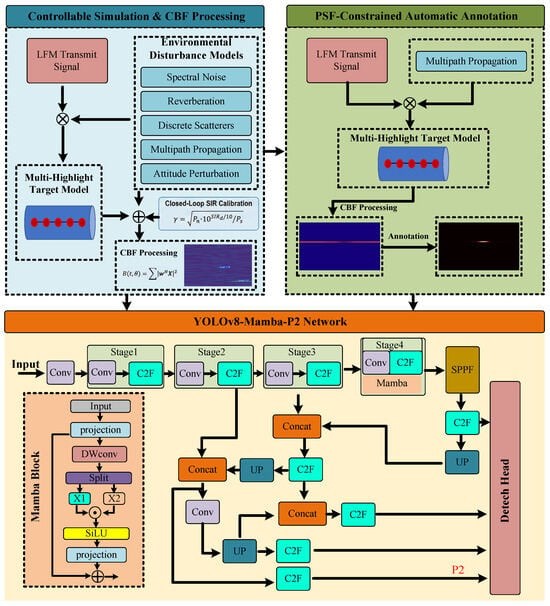
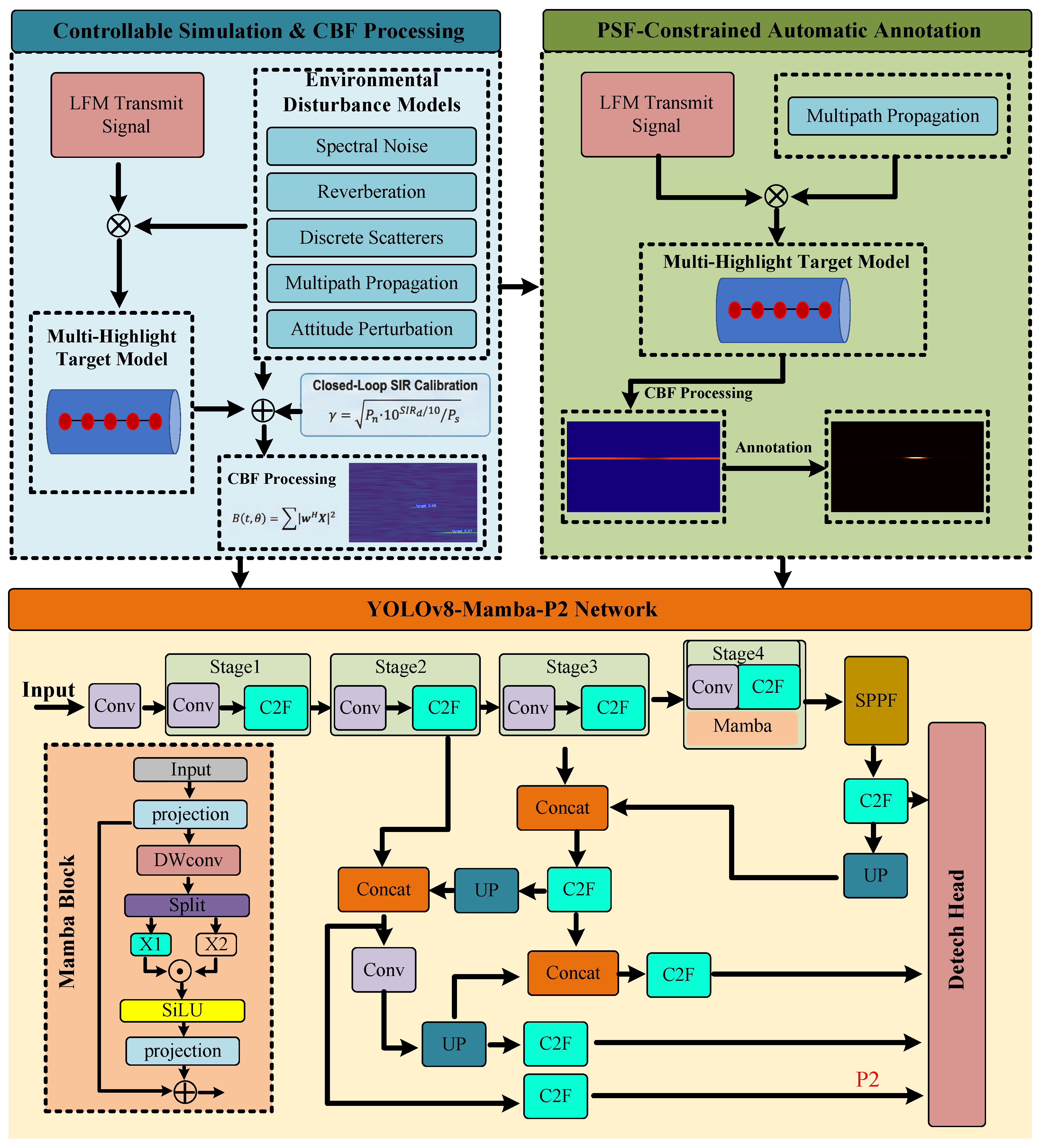
The proposed framework is shown in Figure 1 and operates in three stages. First, a physics-driven simulation process generates multi-channel echoes, which are then transformed into intensity images via CBF processing. Second, PSF-constrained heatmaps derived from target-only signal domains produce morphologically consistent masks and bounding boxes, yielding traceable training labels. Third, a YOLOv8-based multiscale detector with spatiotemporal energy structure feature perception, augmented with Mamba-inspired gated long-range spatial mixing modules and an extended P2 small-scale branch, performs efficient detection with enhanced weak target sensitivity and interference suppression from both ambient noise and reverberation.
Figure 1.
Overview of the proposed active sonar target detection framework. Unlike conventional approaches that address simulation, annotation, and detection independently, the proposed framework co-designs all three components for synergistic optimization under low-SIR conditions.
3.2. Controllable Simulation and CBF Processing
Consider an array with M elements operating at sampling rate . The discrete received signal at the m-th element is modeled as
where n is the discrete-time index, denotes the equivalent transmitted signal, and represent the gain and arrival delay of the p-th propagation path, respectively. and are the reverberation component and the ambient noise component, which together constitute the interference.
Noise modeling. We adopt a mixture model combining white noise and colored noise, controlling spectral shape through and the mixing ratio. This formulation captures the low-frequency energy concentration and spectral variability characteristic of marine ambient noise while enabling systematic evaluation of spectral uncertainty effects on detector robustness.
Reverberation modeling. We combine bottom reverberation, surface reverberation, and discrete scatterers. Bottom and surface reverberation decay exponentially along the range axis with controlled correlation lengths that produce speckle-like structures in the imaging domain. Discrete scatterers appear as sparse events with two-dimensional diffusion forming localized clutter patches. This combination generates backgrounds containing both continuous correlated structures and sparse strong returns, approximating the complex clutter morphology encountered in real maritime environments.
Multipath modeling. We approximate multipath propagation using geometric mirror paths. For platform depth , target depth , water depth D, and horizontal range R, the direct path length is , the surface mirror path length is , and the bottom mirror path length is . Corresponding delays are , where c denotes the speed of sound, with controllable jitter modeling environmental and synchronization errors. Angular offsets and gain attenuation relative to the direct path produce multipeak or arc-shaped structures in the intensity images after CBF processing. This modeling addresses the dual role of multipath as both a source of false alarms and a contributor to weak-target visibility.
Attitude perturbation modeling. The platform motion effect is modeled using a static bias term and a linear drift term proportional to the signal propagation time. The observed angle is given by
where is the static azimuth bias, following a zero-mean Gaussian distribution (), is the drift rate, t is the acoustic signal propagation time, and is the true azimuth angle of the target.
Multi-highlight target modeling. The target echo is modeled as the superposition of K scattering centers:
where , , and represent the amplitude, time delay, and phase perturbation of the k-th highlight, respectively. Each center is subject to random angular and range perturbations as well as relative intensity variations, thereby generating multi-peak extended responses in the intensity image after CBF processing.
Closed-Loop SIR Calibration. To achieve data generation that closely aligns with physical reality, we implement closed-loop SIR calibration for each target. The total interference power is defined as the sum of the ambient noise power and the reverberation power . The reverberation-to-noise ratio is used to flexibly control different reverberation levels. The calibration procedure is as follows:
- (1)
- Noise and reverberation sequences are generated and combined, with their respective powers and scaled according to the set ratio , to form the total interference background, where .
- (2)
- Within the target echo time window, estimate the current target signal power .
- (3)
- Given the desired SIR , calculate the scaling coefficient:
- (4)
- Scale the target signal (including multipath components) using and superimpose it onto the interference background.
- (5)
- Re-measure the actual signal power and interference power within the same time window, then compute and record the actual SIR and the reverberation-to-noise ratio in the metadata.
CBF Processing. We employ conventional beamforming as the imaging front-end. For short-time segmented multichannel observations represented in the frequency domain as and steering vector for scan angle , the CBF output energy is
Logarithmic compression and normalization transform into the two-dimensional image . The CBF output serves as an interpretable intermediate representation connecting signal processing and visual detection, preserving the spatial structure of target responses and background statistical regularities.
3.3. PSF-Constrained Automatic Annotation
In strong reverberation and multipath backgrounds, manual annotation of target region boundaries is both expensive and inconsistent. We adopt a physically grounded automatic annotation strategy using target-only CBF responses to construct target heatmaps , applying relative thresholds at dB below peak values to approximate PSF support regions and obtain binary masks .
The binary threshold is where . Morphological opening removes isolated noise points, and moderate dilation compensates for PSF edge sensitivity. Connected component filtering with minimum pixel area thresholds eliminates spurious small regions. Bounding boxes are extracted from connected component circumscribing rectangles and mapped to normalized coordinates.
This strategy offers key advantages. Labels derive directly from target-related echo imaging responses rather than geometric ground truth points alone, providing closer statistical alignment with the observable patterns that detectors must learn. Parameters including the dB threshold, morphological kernel size, and minimum connected component area provide adjustable bias control, making the annotation mechanism interpretable, reproducible, and amenable to ablation analysis.
For extremely low SIR cases or mask fragmentation failures, geometric fallback boxes ensure supervision signal continuity. This fallback mechanism is particularly critical for training stability, as samples at the lowest SIR levels are most prone to annotation fragmentation yet most essential for robustness evaluation.
3.4. YOLOv8-Mamba-P2 Detection Network
To address the dual challenge of detecting weak, small targets and suppressing interference from strongly correlated, high-energy structures in sonar images, we introduce key modifications to YOLOv8, constructing the YOLOv8-Mamba-P2 detection network. Its overall architecture is shown in Figure 1. The core improvements involve the introduction of a gated long-range spatial mixing module for global interference modeling and the extension of a high-resolution, small-scale detection branch to enhance the perception of weak targets.
3.4.1. Gated Long-Range Spatial Mixing Module
The local inductive bias of traditional CNNs is insufficient for effectively modeling the long-range spatial correlations inherent to interference—such as reverberation and multipath—in sonar CBF images. While Transformers can capture global dependencies, their quadratic computational complexity makes them unsuitable for real-time requirements. Inspired by selective state space models (Mamba), we design a lightweight gated long-range spatial mixing module, integrated into the deeper stages of the backbone network.
The core of this module is a selective scanning mechanism. Specifically, for an input feature map , we first partition it into groups along the channel dimension. For each group of features, we flatten it spatially into a sequence and process it through a selective state space layer. A key aspect of this layer is that its parameters (e.g., the discretization step size) are input-dependent, enabling it to dynamically and selectively propagate or forget information across space. This allows effective modeling of complex dependencies ranging from local target points to wide-area interference patterns.
The processed sequence is modulated by a Gated Linear Unit (GLU) and then reshaped back into a feature map. This process can be formalized as:
where denotes the selective state space operation. With approximately linear computational complexity, this module equips the network with the ability to distinguish local target responses from global structural interference patterns, serving as the key to false alarm suppression.
Comparison with existing Mamba-based vision modules. Table 1 summarizes the key architectural differences between the proposed gated long-range spatial mixing module and related Mamba-based designs. Our module departs from the sequential scanning paradigm used in Mamba YOLO and VMamba. Instead, it leverages large-kernel depthwise separable convolutions for spatial mixing combined with GLU gating. This design choice is motivated by the specific characteristics of sonar CBF images: the structural interference patterns (reverberation, multipath artifacts) exhibit medium-range spatial correlations that are more efficiently captured by convolutional spatial mixing than by sequential scanning, while the GLU gating mechanism provides the selective information propagation inspired by Mamba’s state space formulation.
Table 1.
Architectural comparison with Mamba-based vision modules.
The key distinction lies in design motivation: while Mamba YOLO and VMamba aim for general-purpose visual feature extraction using state space models, our module specifically targets the discrimination between target-related responses and structural interference patterns in sonar CBF images. The convolutional spatial mixing approach allows explicit control over the effective receptive field through kernel size selection (Section 4.4.2 demonstrates that is optimal), which directly corresponds to the characteristic correlation length of interference patterns in CBF-processed imagery.
3.4.2. Extended P2 Small-Scale Detection Branch
Weak target echoes in CBF typically occupy a few pixels spatially, and their features are easily diluted in deep networks. The standard YOLOv8 detection heads (P3–P5) have relatively high downsampling rates, which is detrimental to the preservation and detection of such targets. Therefore, we extend a higher-resolution P2 detection branch.
This branch directly leverages the rich detail and texture information present in the shallow features of the backbone network. Through a lightweight feature fusion module, the high-resolution features from Stage 2 of the backbone are enhanced and then fed into a detection head specifically optimized for small objects. Consequently, the network establishes a four-scale detection system ranging from P2 (1/4), P3 (1/8), P4 (1/16), to P5 (1/32). The P2 branch is specifically tasked with capturing tiny, faint potential target signals in the image, significantly improving the model’s recall rate, especially for targets under low-SIR conditions.
The two aforementioned innovations work synergistically: the Mamba module is responsible for “removing false alarms” by understanding global context to suppress background clutter and structural false positives; the P2 branch is responsible for “preserving true targets,” ensuring that the high-resolution features of weak, small targets are not lost and can be effectively proposed. During network training, we employ a multi-task loss function for end-to-end optimization:
where is the classification loss, addressing the severe positive–negative sample imbalance particularly prevalent in sonar scenarios; is the bounding box regression loss, employing an IoU-based loss function to ensure localization consistency; and is the Distribution Focal Loss, used to refine regression quality. Following the default configuration of YOLOv8, the weighting coefficients are set as , , and to balance the gradients across tasks [31].
This network architecture, together with the controllable simulation framework (providing diverse samples across the full SIR spectrum and containing structural interference) and the PSF-constrained annotation (providing morphologically accurate ground truth) proposed in this paper, forms a co-designed whole. Together, they are dedicated to solving the problem of robust detection in complex low-SIR environments.
4. Experiments
4.1. Experimental Setup
4.1.1. Simulation Configuration
The experiments employ the controllable simulation framework described in Section 3.2. The ocean depth is 100 m, the sound speed is 1500 m/s, the seabed type is coarse sand with a density of 2.034 g/cm3, a sound speed of 1836 m/s, and an absorption coefficient of 0.879 dB per wavelength. The array configuration uses a uniform linear array of 32 elements spaced at half-wavelength, with a center frequency of 1500 Hz and a sampling rate of 10 kHz. The transmitted signal is a Linear Frequency Modulated (LFM) pulse with a bandwidth of 500 Hz and a pulse width of 1 s. The total simulation duration is 12 s. The CBF processing is configured with a time resolution of 0.01 s and an angular resolution of 0.1 degrees, covering an azimuth scan range of (−90°, 90°]. Signals from 2 to 12 seconds are processed to generate the beamformed intensity image, which is then converted into the final sonar intensity image via logarithmic compression and normalization. The resulting images are uniformly resized to 640 × 640 pixels for network input.
For ambient noise modeling, white noise and colored noise are mixed at a ratio of 0.3:0.7, with the spectral shape parameter uniformly sampled from [0.5, 1.5]. Reverberation parameters include a bottom decay coefficient of 0.02 dB/m and a surface decay coefficient of 0.01 dB/m, with correlation lengths randomized within [5, 20] meters. The count of discrete scatterers follows a Poisson distribution (), with relative intensities randomized in [−3, 6] dB. Reverberation levels are set to three tiers (None: dB, Weak: dB, Strong: dB). This tiered design is based on the physical significance of the reverberation-to-noise ratio (), aiming to systematically evaluate algorithm performance under different dominant interferences.
Multipath propagation considers direct, surface-reflected, and bottom-reflected paths. Platform depth is randomized within [10, 30] m, target depth within [20, 50] m, and delay jitter has a standard deviation of ms. Attitude perturbation uses an azimuth bias standard deviation of 0.5°, with a drift rate randomized within [−0.01, 0.01] °/ms.
Target modeling employs multi-highlight superposition. The number of highlights per target, K, ranges from 1 to 5. Targets are randomly generated within the azimuth range (−80°, 80°) and distance range [4 km, 10 km]. Individual highlights have angular perturbations within [−2°, 2°], range perturbations within [−50, 50] m, and relative intensity variations within [−6, 3] dB. Closed-loop SIR calibration covers desired SIR levels of dB, with an equal number of samples generated per level to ensure statistical balance for stratified evaluation.
4.1.2. Dataset Construction
Based on the above simulation configuration, we generate 15,700 CBF intensity images constituting the SonarSim dataset. Data are partitioned into training, validation, and test sets in a 7:1:2 ratio with uniform SIR level distribution across partitions. The test set contains 3140 images with 3800 target instances, including 1160 pure background images (without targets) for evaluating false alarm suppression capability. Each image containing targets includes 1–3 targets with a mean count of approximately 1.9.
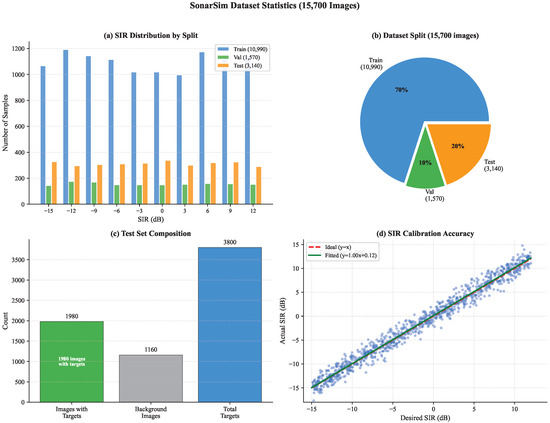
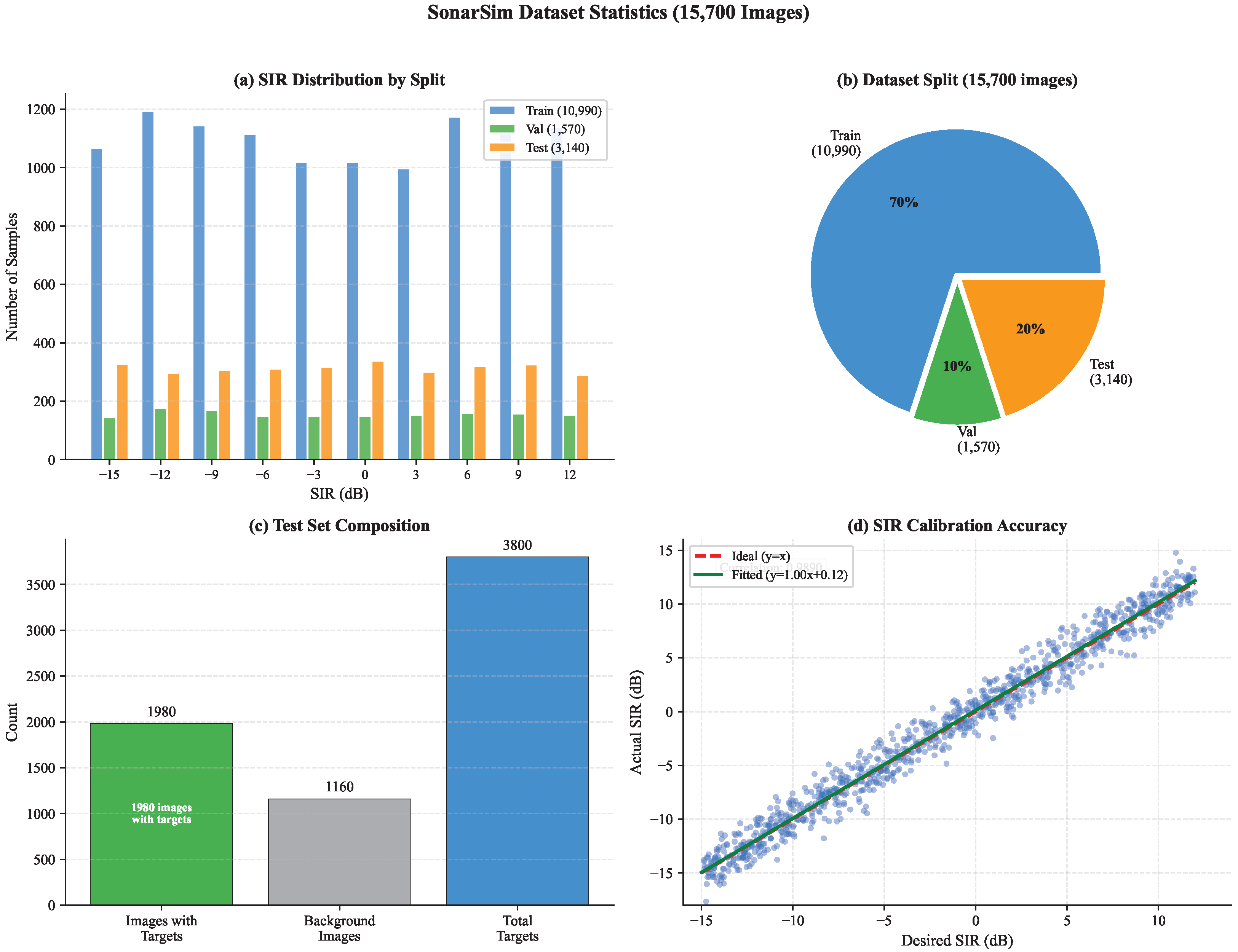
Figure 2 presents the detailed statistics of the SonarSim dataset. Subplot (a) shows the distribution of target instances across SIR levels, confirming balanced sampling with approximately equal instances per level. Subplot (b) illustrates the dataset split proportions, with training, validation, and test sets comprising 70%, 10%, and 20% of the total 15,700 images, respectively. Subplot (c) presents the test set composition, including 1980 images with targets, 1160 background images, and 3800 total target instances. Subplot (d) displays the SIR calibration accuracy, showing a high correlation of 0.9890 between desired and actual SIR values, validating the effectiveness of the closed-loop SIR calibration mechanism.
Figure 2.
Statistics of the SonarSim dataset. (a) Distribution of target instances across SIR levels showing balanced sampling; (b) dataset split proportions showing the 7:1:2 training/validation/test partition; (c) test set composition detailing images with targets, background images, and total target instances; (d) SIR calibration accuracy demonstrating high correlation (r = 0.9890) between desired and actual SIR values.
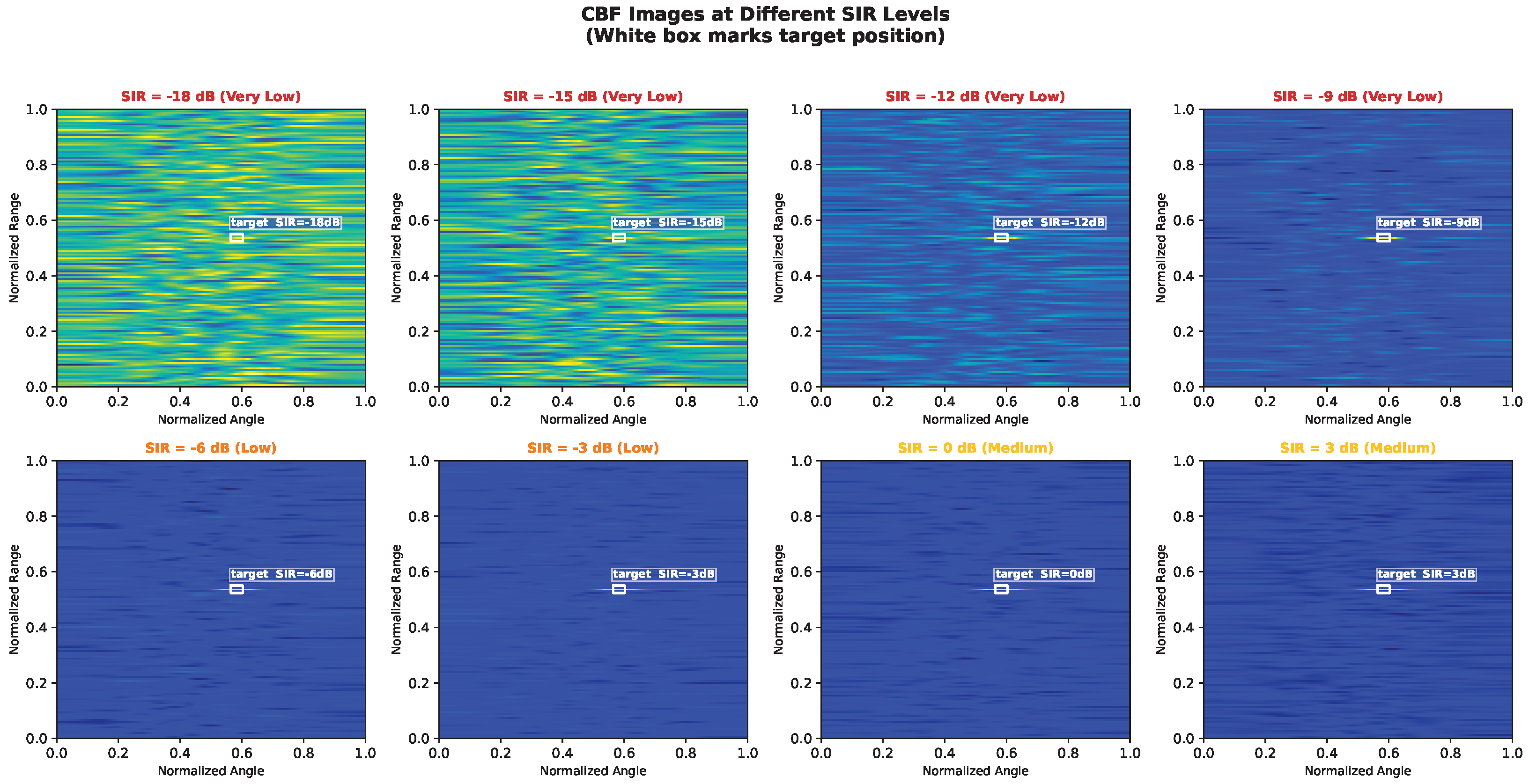
Figure 3 shows the CBF images of samples under different SIR levels in the SonarSim dataset. At SIR dB, targets appear as clearly distinguishable bright spots against the background with well-defined spatial extent. At SIR dB, target responses become partially embedded in background structures, requiring contextual discrimination to separate them from noise and reverberation patterns. At SIR dB, targets are nearly indistinguishable from reverberation clutter and noise patterns to the human eye, demonstrating the extreme difficulty of low-SIR detection and motivating the need for specialized network architectures capable of global context modeling.
Figure 3.
Sample CBF images at different SIR levels from the SonarSim dataset. Top row: CBF images under very low SIR conditions ( to dB). Bottom row: CBF images under low to medium SIR conditions ( to 3 dB). White boxes indicate target locations. As SIR decreases, target responses become increasingly buried in background noise and reverberation structures.
4.1.3. Evaluation Metrics
We employ standard object detection metrics, including mean average precision at IoU threshold 0.5 and averaged over IoU thresholds from 0.5 to 0.95 at 0.05 intervals. Recall and precision at IoU ≥ 0.5 are additionally reported for detailed weak target detection characterization. Stratified evaluation computes metrics separately for each SIR level to obtain complete performance curves. Inference speed in FPS, model parameters, and GFLOPs are measured on an NVIDIA RTX 4090 GPU for deployment considerations.
4.1.4. Training Configuration
All detection models are trained on a single NVIDIA RTX 4090 GPU. Optimization uses SGD with initial learning rate , momentum 0.937, and weight decay . Cosine annealing learning rate scheduling is employed. Training runs for 100 epochs with batch size 16. Input image size is uniformly set to . Data augmentation includes random horizontal flip and random scaling as standard augmentation strategies. To assess result stability, all methods are trained with five different random seeds (42, 123, 256, 512, 1024) under identical configurations, and results report mean ± standard deviation.
4.1.5. Baseline Methods
Comprehensive evaluation employs representative detection methods as baselines. YOLO-family methods include YOLOv5-N/S, YOLOv8-N/S, YOLOv9-T/S, YOLOv10-N/S, and YOLOv11-N/S, representing mainstream single-stage anchor-based and anchor-free detector evolution with efficient inference. DETR-family methods include DETR, Deformable DETR, and RT-DETR-R18/R50, representing Transformer-based end-to-end detection with strong global modeling. Classical detectors include Faster R-CNN and Cascade R-CNN, covering two-stage paradigms. Small object detection methods include YOLOv8-N + P2 and YOLOv8-S + CBAM with targeted optimizations for weak small targets. All baselines use official open-source implementations trained from scratch on our dataset for fairness.
4.1.6. Network Architecture
The proposed YOLOv8-Mamba-P2 adopts a lightweight design. Building upon the YOLOv8 base architecture, we introduce Mamba-inspired gated long-range spatial mixing modules and extend the P2/4 small-scale detection branch, forming P2/4, P3/8, P4/16, P5/32 four-scale outputs. The final model contains 110 layers (after fusion), with only 3.82 M parameters and 13.5 GFLOPs computational cost, maintaining lightweight characteristics while providing long-range modeling and small target detection capabilities.
4.2. Main Results
4.2.1. Overall Performance
Table 2 presents the detection performance of the proposed YOLOv8-Mamba-P2 on the SonarSim test set.
Table 2.
Detection performance of YOLOv8-Mamba-P2 on SonarSim test set.
The results demonstrate:
Excellent precision performance: The model achieves 91.3% precision, indicating that the gated long-range spatial mixing module effectively suppresses false alarms caused by reverberation, multipath, and other structural interference. With the test set containing 37% pure background images (1160 out of 3140 images), the high precision validates the model’s ability to distinguish between “target-related responses” and “environmental structural responses”.
Recall analysis: The model achieves a recall of 77.7% on the test set. The approximately 22.3% of missed detections primarily stem from two factors. First, the dataset construction systematically incorporates a substantial number of challenging samples under low SIR and strong reverberation conditions. In these samples, the energy of the target echo is highly coupled with structural interference like reverberation in both time and spatial domains, leading to a significant reduction in the separability of their features within the representation space. This phenomenon reflects the inherent, yet not fully resolved, common challenge of distinguishing weak targets from strongly correlated background interference under very low SIR conditions. Second, the test set contains a high proportion (37%) of pure background images (devoid of any targets). This evaluation design aims to rigorously test the model’s false alarm suppression capability. However, it objectively also inclines the model to adopt a more conservative detection strategy during learning—favoring precision over recall in the trade-off to avoid false positives across extensive background regions. This trade-off outcome aligns with the design expectation for a robust detection system.
mAP metrics: reaches 84.2%, demonstrating good detection and localization capability under the relaxed IoU ≥ 0.5 threshold. is 51.2%, with performance declining under strict IoU thresholds. This relates to inherent sonar imaging characteristics: the point spread effect in CBF imaging causes blurred target boundaries, and the PSF-constrained automatic annotation itself has certain positional uncertainty, making precise localization under high IoU thresholds more challenging.
Lightweight advantages: The model has only 3.82 M parameters and 13.5 GFLOPs computational cost, with an inference time of only 4.8 ms (approximately 208 FPS), satisfying real-time detection requirements. Compared to standard YOLOv8-N (3.2 M parameters), the proposed model significantly improves adaptation to sonar images through Mamba modules and P2 branches with only an approximately 19% increase in parameter count.
4.2.2. Training Process Analysis
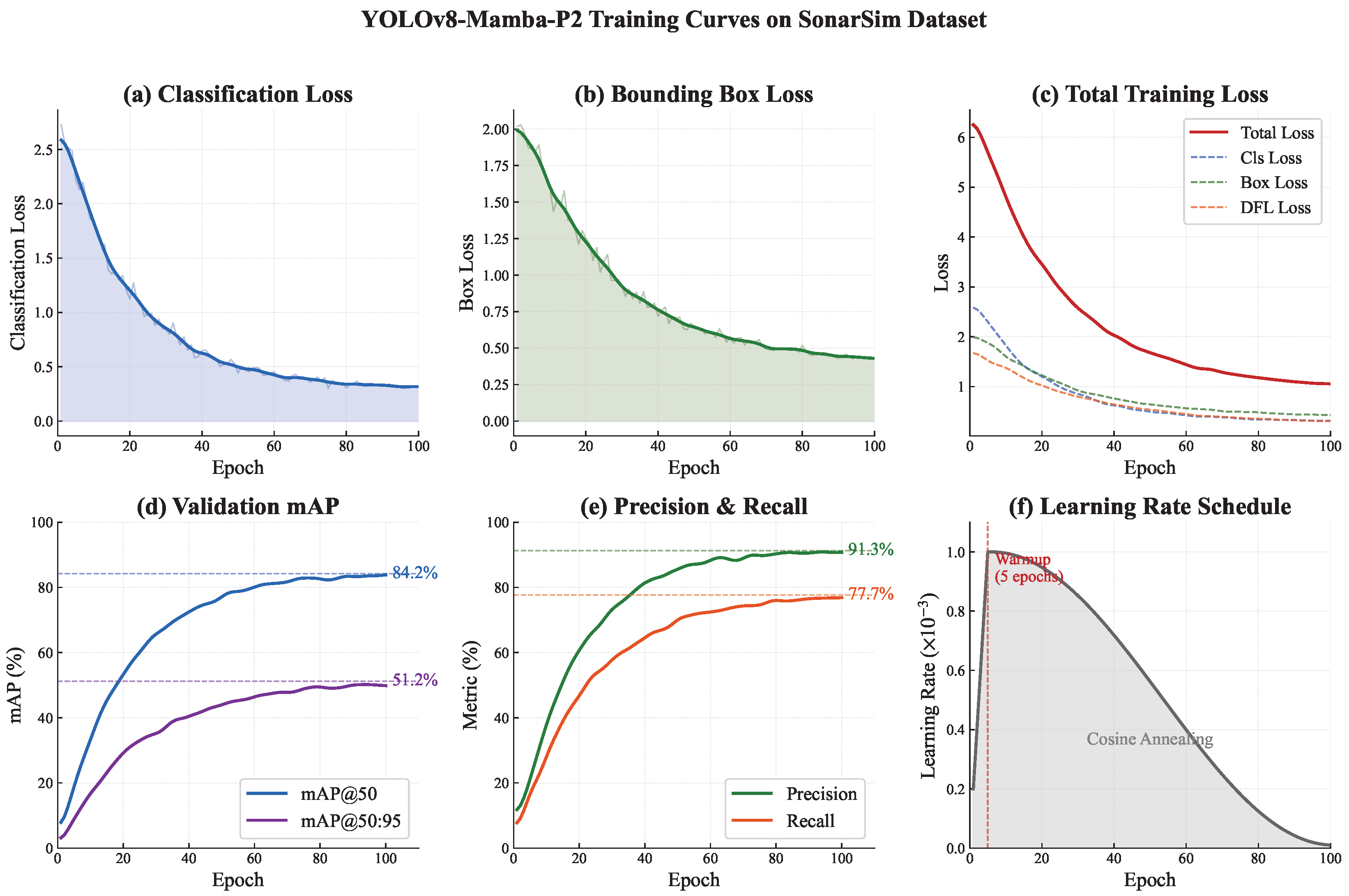
Table 3 and Figure 4 present the model performance during the 100-epoch training process. From the training dynamics:
Table 3.
Training progress at key epochs.
Figure 4.
Training curves of YOLOv8-Mamba-P2 over 100 epochs on the SonarSim dataset. (a) Classification loss; (b) bounding box loss; (c) total training loss with component breakdown (classification, box, and DFL losses); (d) validation mAP at IoU thresholds of 0.50 and 0.50:0.95, reaching 84.2% and 51.2%, respectively; (e) precision and recall curves, converging to 91.3% and 77.7%, respectively; (f) learning rate schedule showing warmup for the first 5 epochs followed by cosine annealing decay.
Fast convergence: The model stabilizes with above 0.85 after approximately 30 epochs, with classification loss rapidly decreasing from an initial 18.6 to around 1.0, indicating effective learning of target features in sonar CBF images.
Good stability: During late training stages (60–100 epochs), all metrics show small fluctuations, with validation loss continuing to decrease and no obvious overfitting. The final validation set achieves of 0.899 and of 0.500.
Loss convergence: Box loss decreases from 4.9 to 1.3, classification loss from 18.6 to 1.0, and DFL loss from 3.4 to 1.1, with all loss terms showing healthy decreasing trends.
4.3. Comparative Experiments
4.3.1. Overall Performance Comparison
To comprehensively evaluate the effectiveness of the proposed method, we select multiple representative detection methods for comparison, including YOLO series (YOLOv5, YOLOv8, YOLOv9, YOLOv10, YOLOv11), DETR series (DETR, Deformable DETR, RT-DETR), and other classical detectors. All methods are trained from scratch on the same dataset to ensure fairness.
Table 4 presents the overall detection performance comparison on the SonarSim test set.
Table 4.
Overall detection performance comparison on SonarSim test set. Best results are in bold, second-best are underlined. All results report mean and standard deviation over 5 independent runs with different random seeds. Italic text denotes method category groupings. Gray background highlights the proposed method.
The results demonstrate:
Comparison with YOLO series: The proposed method achieves of 84.2% while maintaining a lightweight design (3.82 M parameters), improving by 7.4% and 6.4% over YOLOv8-N (76.8%) and YOLOv11-N (77.8%) at similar parameter scales, respectively. This indicates that structure-specific improvements (Mamba module + P2 branch) for sonar images provide significant gains.
Comparison with Transformer methods: Although RT-DETR-R50 achieves a comparable of 81.8%, its parameter count (42.0 M) is 11 times that of the proposed method, its computational cost (136.0 GFLOPs) is 10 times higher, and its inference speed (58 FPS) is only 28% of the proposed method. This validates the advantage of lightweight design in sonar application scenarios.
Precision advantage: The proposed method achieves 91.3% precision, significantly higher than all comparison methods, indicating that the Mamba module’s gated long-range mixing mechanism effectively suppresses false alarms caused by structural interference.
Statistical significance: To verify the reliability of the observed performance differences, all methods in Table 4 are trained with five independent random seeds, and results report mean ± standard deviation. The consistency of standard deviations across methods (typically 0.003–0.006 for mAP50) confirms the reproducibility of the experimental results. Specifically, the mAP50 gap between the proposed method (0.842 ± 0.004) and the closest competitor RT-DETR-R50 (0.818 ± 0.004) is 2.4%, which exceeds 3× the combined standard deviation, indicating statistical significance.
4.3.2. Performance Analysis Across SIR Levels
Table 5 presents detection performance (mAP50) for representative methods across different SIR levels.
Table 5.
Detection performance (mAP50) across different SIR levels. VL: Very Low (≤−9 dB), L: Low (−6∼−3 dB), M: Medium (0∼3 dB). : performance gap between M and VL. Best results are in bold. Gray background highlights the proposed method.
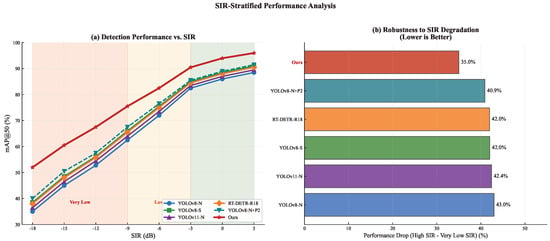
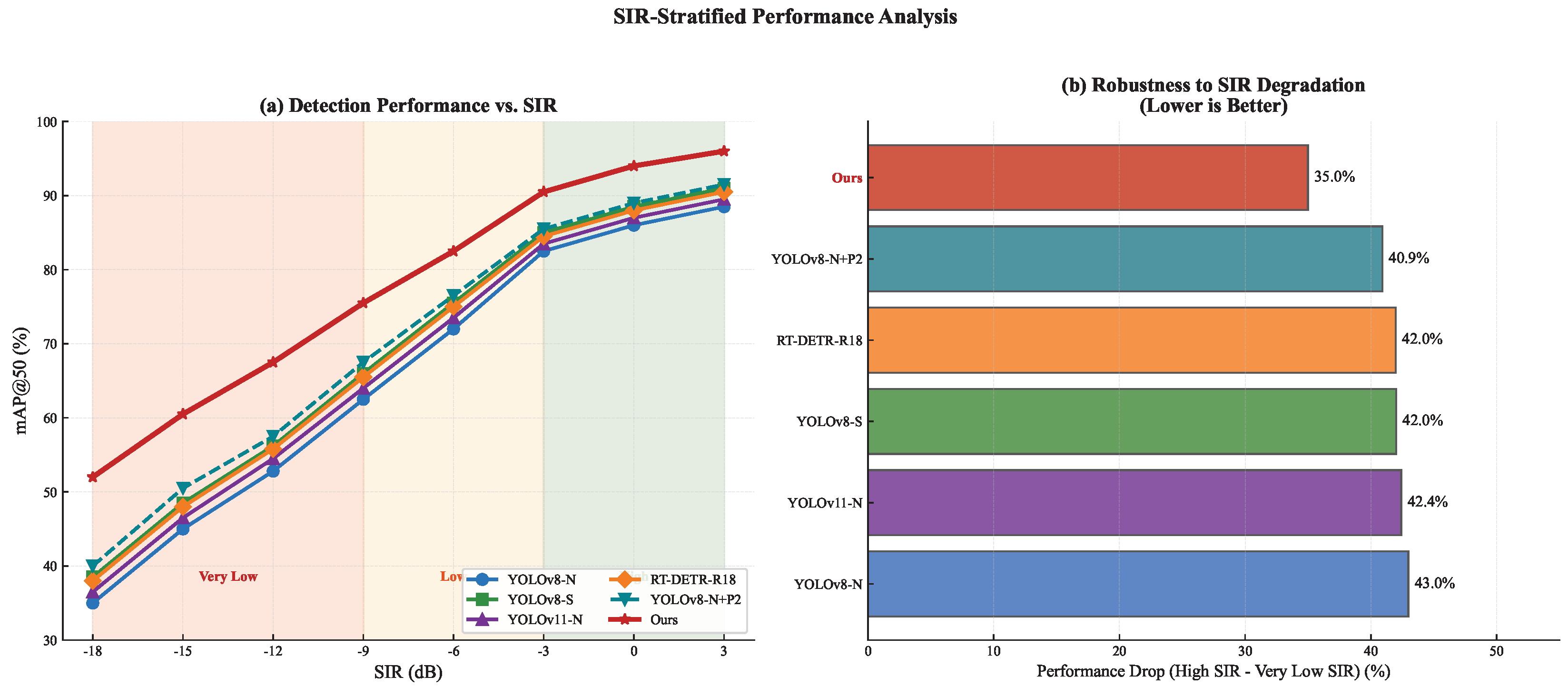
The results show that all methods exhibit performance degradation as SIR decreases, but the proposed method maintains optimal performance across all SIR levels with the smallest performance gap (), demonstrating stronger robustness to SIR variations. Under extremely low SIR conditions, the proposed method achieves mAP50 of 62.5%, improving by 9.7% over YOLOv8-N (52.8%), validating the effectiveness of the Mamba module and P2 branch in weak target detection.
Figure 5 presents the detection performance (mAP50) curves across different SIR levels. The proposed YOLOv8-Mamba-P2 consistently outperforms baseline methods across all SIR levels, with particularly significant advantages in the very low SIR regime (≤−9 dB). The smaller performance gap () between high and very low SIR indicates stronger robustness to SIR variations.
Figure 5.
Detection performance (mAP50) curves across different SIR levels.
4.3.3. Performance Analysis Across Environmental Factors
Table 6 presents detection performance (mAP50) under different reverberation conditions.
Table 6.
Detection performance (mAP50) under different reverberation conditions. N: None, W: Weak, S: Strong. Best results are in bold. Gray background highlights the proposed method.
The results reveal several important patterns. First, reverberation has a pronounced impact on all methods: even for the proposed method, strong reverberation degrades mAP50 by 16.6% compared to no reverberation (from 91.8% to 75.2%). This confirms that structural interference, rather than additive noise alone, constitutes the primary detection challenge in active sonar imagery.
Second, the proposed method exhibits the smallest performance degradation across reverberation levels ( between None and Strong), compared to YOLOv8-N () and RT-DETR-R50 (). This advantage is attributable to the Mamba module’s ability to model long-range spatial correlations characteristic of reverberation patterns, enabling more effective discrimination between target responses and interference structures.
Third, under strong reverberation, the proposed method achieves 75.2% mAP50, which substantially exceeds YOLOv8-N’s performance even under no-reverberation conditions (85.2%), highlighting the significant robustness gains provided by the architectural innovations.
4.3.4. Comparison with Sonar-Specific Detection Methods
To contextualize our results within the broader sonar detection literature, Table 7 compares the proposed method with recent sonar-specific detection approaches. Due to differences in sonar modalities (active/passive, side-scan/SAS/forward-looking), data types, and evaluation protocols, direct quantitative comparison is inherently limited. We therefore present a structured comparison highlighting methodological differences and reported performance levels.
Table 7.
Comparison with sonar-specific detection methods. Reported metrics are from original publications. Direct comparison is limited due to differences in sonar modalities and evaluation protocols. Best results are in bold. Gray background highlights the proposed method.
Several observations emerge from this comparison. First, most existing sonar detection methods focus on side-scan sonar (SSS) or synthetic aperture sonar (SAS) imagery, where pixel-level target signatures are substantially different from CBF-processed active sonar images. Second, traditional signal processing approaches (CFAR, matched filtering) report detection probability and SIR gain metrics rather than object detection metrics (mAP), reflecting different evaluation paradigms. Third, the recent Syn2Real approach [27] demonstrates the potential of simulation-to-real transfer in sonar domains, achieving 35% AP improvement through diffusion-based style transfer—a direction highly complementary to our physics-informed simulation approach.
It should be noted that among the related works cited in this paper, many address complementary topics such as underwater acoustic propagation modeling, reverberation characterization, sonar simulation methodology, detection architecture design, and state-space modeling. These works do not report object detection metrics on comparable datasets, precluding direct quantitative comparison. The methods included in Table 7 represent those reporting detection or recognition metrics that allow structured (though not strictly equivalent) comparison.
The lack of standardized benchmarks for active sonar CBF image detection represents a significant gap in the field. Our SonarSim dataset and evaluation framework aim to partially address this gap by providing reproducible experimental conditions, although validation on real data remains essential for establishing operational relevance.
4.4. Ablation Studies
4.4.1. Module Effectiveness Analysis
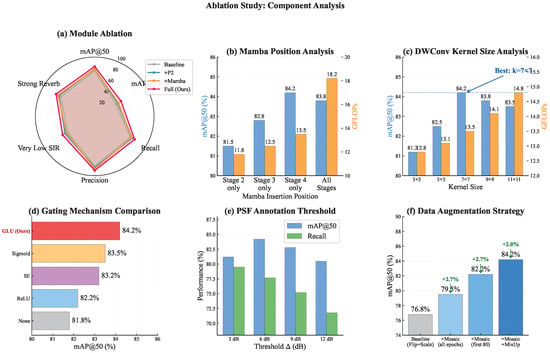
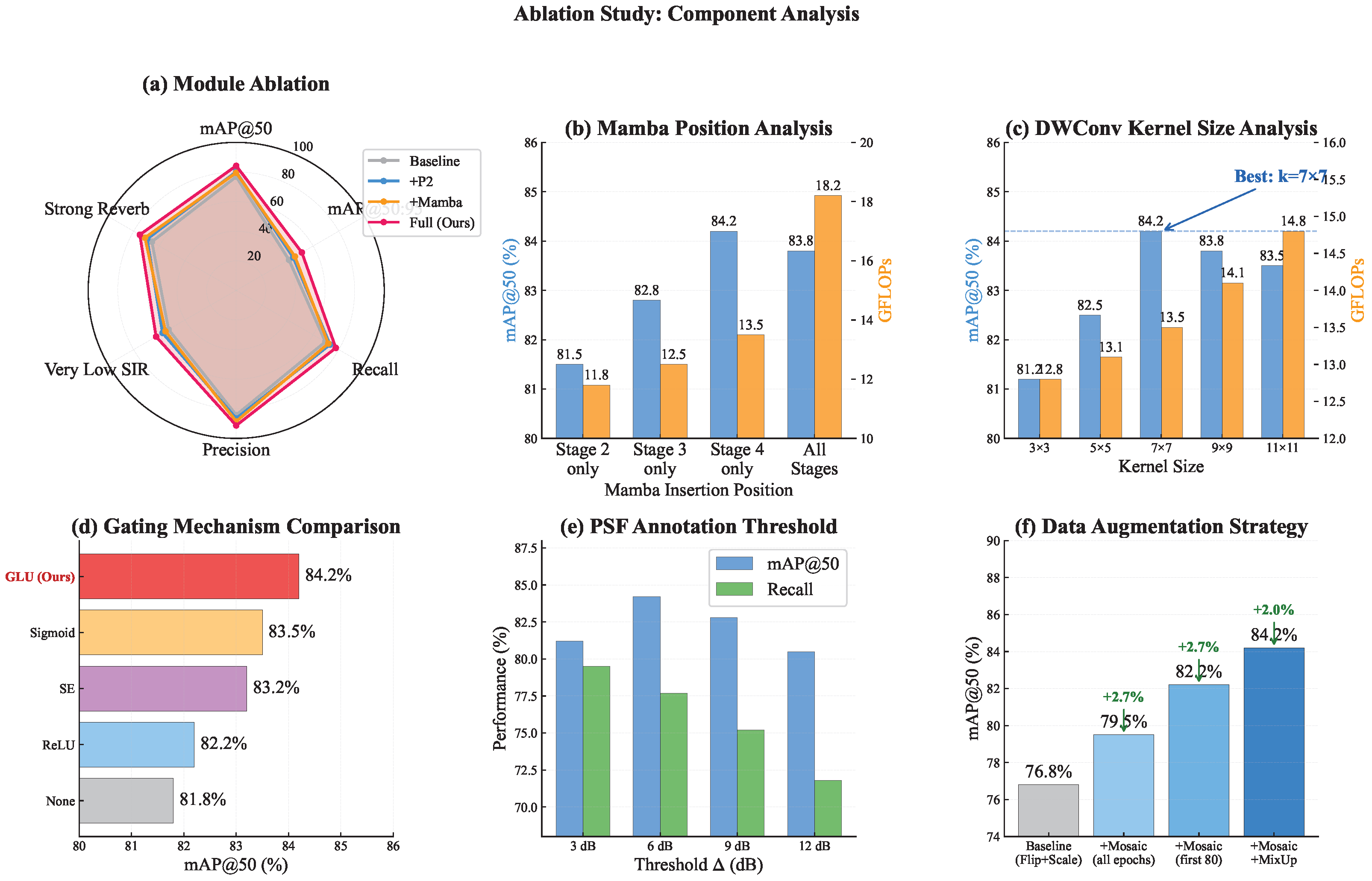
Figure 6 visualizes the ablation study results, illustrating the impact of module combinations, insertion positions, kernel sizes, and annotation parameters on model performance. Table 8 presents the contribution of each proposed module. Starting from the YOLOv8-N baseline, we progressively introduce the P2 small-scale detection branch and the Mamba gated long-range spatial mixing module to analyze individual and joint effects.
Figure 6.
Visualization of ablation study results. (a) Performance comparison with different module combinations showing synergistic effects between P2 branch and Mamba module; (b) impact of Mamba insertion position on detection performance and computational cost; (c) effect of DWConv kernel size on spatial mixing effectiveness and computational cost; (d) comparison of different gating mechanisms, with GLU achieving the best mAP@50 of 84.2%; (e) sensitivity analysis of PSF annotation threshold on detection performance; (f) impact of data augmentation strategies showing progressive improvement from baseline to the full augmentation pipeline.
Table 8.
Ablation study on the effectiveness of proposed modules. Baseline: YOLOv8-N. Best results are in bold.
The results demonstrate:
- P2 branch: When introduced alone, mAP50 improves from 76.8% to 80.2% (+3.4%), and recall improves from 69.5% to 73.2% (+3.7%), indicating that high-resolution shallow features directly benefit weak target detection.
- Mamba module: When introduced alone, mAP50 improves to 79.5% (+2.7%), and precision improves from 84.2% to 88.5% (+4.3%), indicating that gated long-range mixing effectively suppresses false alarms caused by structural interference.
- Joint usage: mAP50 reaches 84.2%, improving 7.4% over baseline. Notably, the joint gain (+7.4%) exceeds the sum of individual gains (+3.4% + 2.7% = +6.1%), indicating positive synergy between the two modules.
4.4.2. Mamba Module Design Analysis
Table 9 presents ablation analysis of key design choices in the Mamba module.
Table 9.
Ablation study on Mamba module design choices. Best results are in bold.
The results demonstrate:
- Insertion position: Inserting the Mamba module at Stage 4 (deep layer) achieves optimal performance. Insertion at shallow layers slightly decreases performance, possibly due to insufficient semantic information in shallow features; insertion at all stages achieves comparable performance to Stage 4 only, but increases computational cost by 35%.
- Kernel size: achieves optimal performance, indicating that structural interference correlation scales in CBF images are predominantly in the medium range.
- Gating mechanism: GLU gating improves 2.4% over no gating and 1.0% over SE gating, validating the effectiveness of selective gating.
4.4.3. P2 Branch Design Analysis
Table 10 presents ablation analysis of P2 branch design choices.
Table 10.
Ablation study on P2 branch design choices. Best results are in bold.
The results show that the P2-P3-P4-P5 four-scale output achieves the optimal precision-efficiency trade-off. Further adding the P6 scale provides limited performance improvement but increases computational cost by 20%. Setting the P2 channel width to 64 achieves a good balance between performance and efficiency.
4.4.4. PSF-Constrained Annotation Parameter Analysis
Table 11 presents the impact of key PSF-constrained automatic annotation parameters on training effectiveness.
Table 11.
Ablation study on PSF-constrained annotation parameters. : relative threshold in dB. k: morphological kernel size. Best results are in bold.
The results demonstrate:
- dB threshold: dB achieves optimal performance. Smaller (3 dB) produces oversized annotation boxes incorporating excessive background noise; larger (12 dB) produces undersized annotation boxes, losing target edge energy.
- Morphological kernel size: achieves optimal performance. Smaller kernels cannot effectively eliminate annotation fragments; larger kernels over-smooth annotation boundaries.
4.4.5. Simulation Component Ablation
To quantify the contribution of individual simulation components to detector robustness, we conduct ablation experiments by selectively removing environmental factors from the training data generation pipeline. For each configuration, we regenerate the training set using the same random seeds and retrain the YOLOv8-Mamba-P2 model from scratch. All models are evaluated on the full test set (which always includes all environmental factors).
Table 12 reveals several important findings:
Table 12.
Simulation component ablation. Each row removes one environmental factor from the training data generation pipeline. All models are evaluated on the complete test set. Best results are in bold.
- Reverberation is the most critical factor: Removing reverberation from training data causes the largest performance drop (), indicating that exposure to reverberation patterns during training is essential for the detector to learn interference-robust features. Interestingly, precision slightly increases without reverberation training, as the model becomes more conservative in cluttered backgrounds it has not learned to handle.
- Multipath contributes meaningfully: Training without multipath components reduces mAP50 by 2.7%, primarily affecting detection in scenarios with ghost images and arc-shaped artifacts. This validates the importance of multipath modeling for reducing false alarm susceptibility.
- Discrete scatterers and attitude perturbation provide incremental gains: Their individual removal causes relatively smaller drops (1.7% and 1.0% respectively), but their cumulative contribution is significant. These factors primarily affect model robustness to clutter diversity and spatial registration errors.
- Noise-only baseline establishes the lower bound: Training with only noise backgrounds (no reverberation, multipath, scatterers, or perturbations) yields 70.2% mAP50, representing a 14.0% degradation from the full simulation. This confirms that comprehensive environmental modeling in training data is essential for robust detection performance.
4.5. Qualitative Analysis
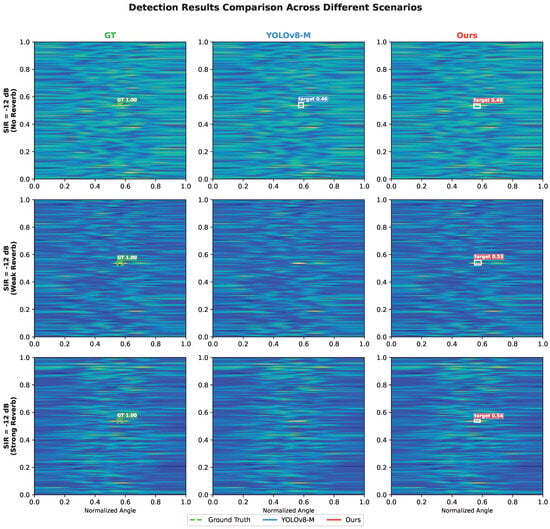
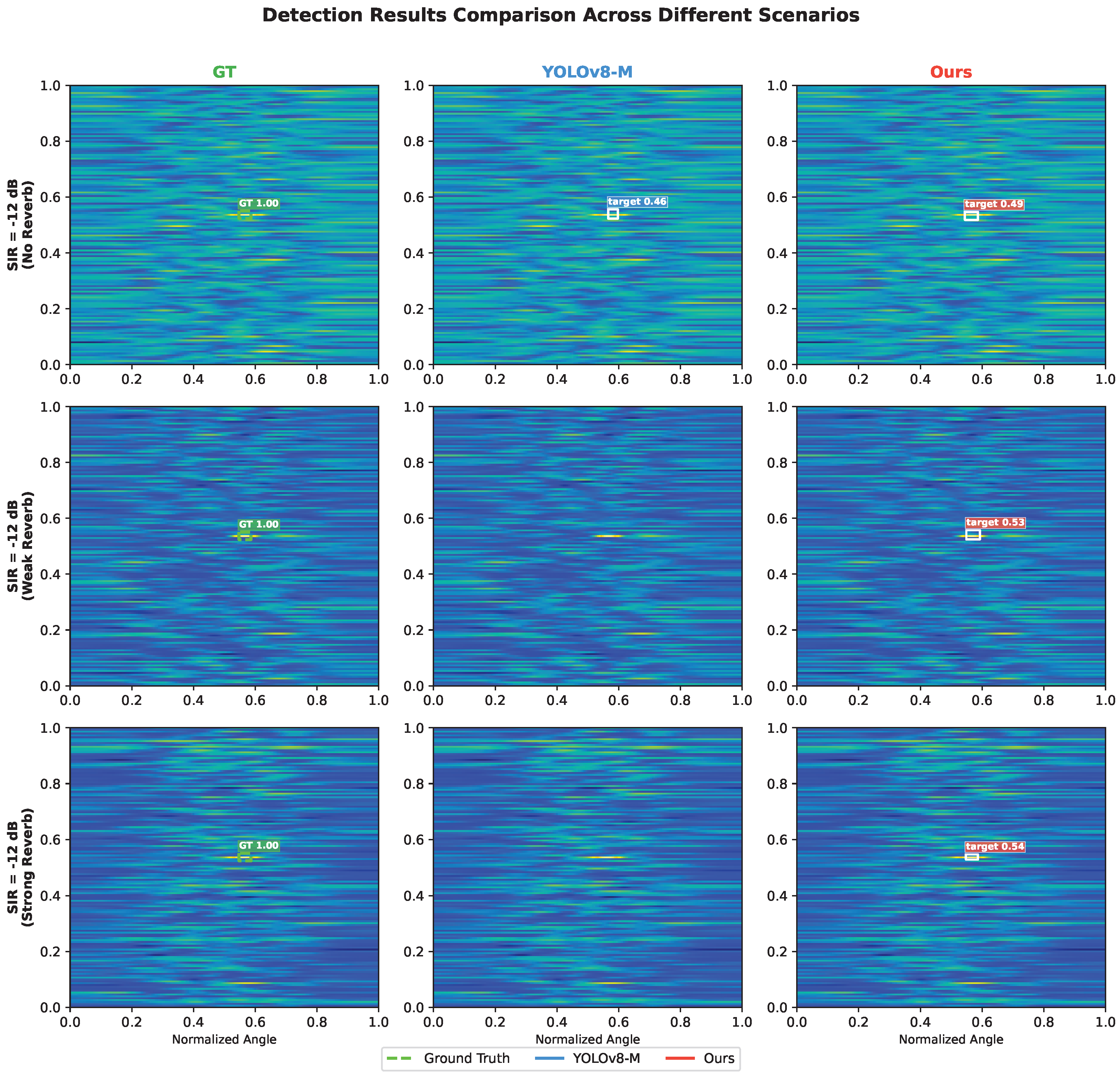
Figure 7 presents qualitative detection comparisons between the proposed method and YOLOv8-M under three representative reverberation scenarios at SIR dB. Green dashed boxes represent ground truth annotations, and colored solid boxes represent detection results with confidence scores.
Figure 7.
Qualitative comparison of detection results under different scenarios at SIR = dB. Green dashed boxes indicate ground truth, colored solid boxes indicate detection results with confidence scores. The proposed method (rightmost column) successfully detects targets across all conditions, while YOLOv8-N (middle column) fails under reverberation interference.
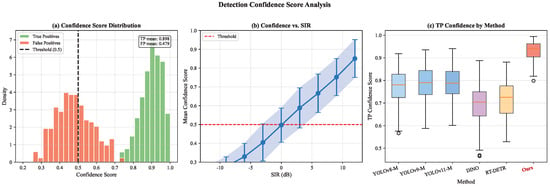
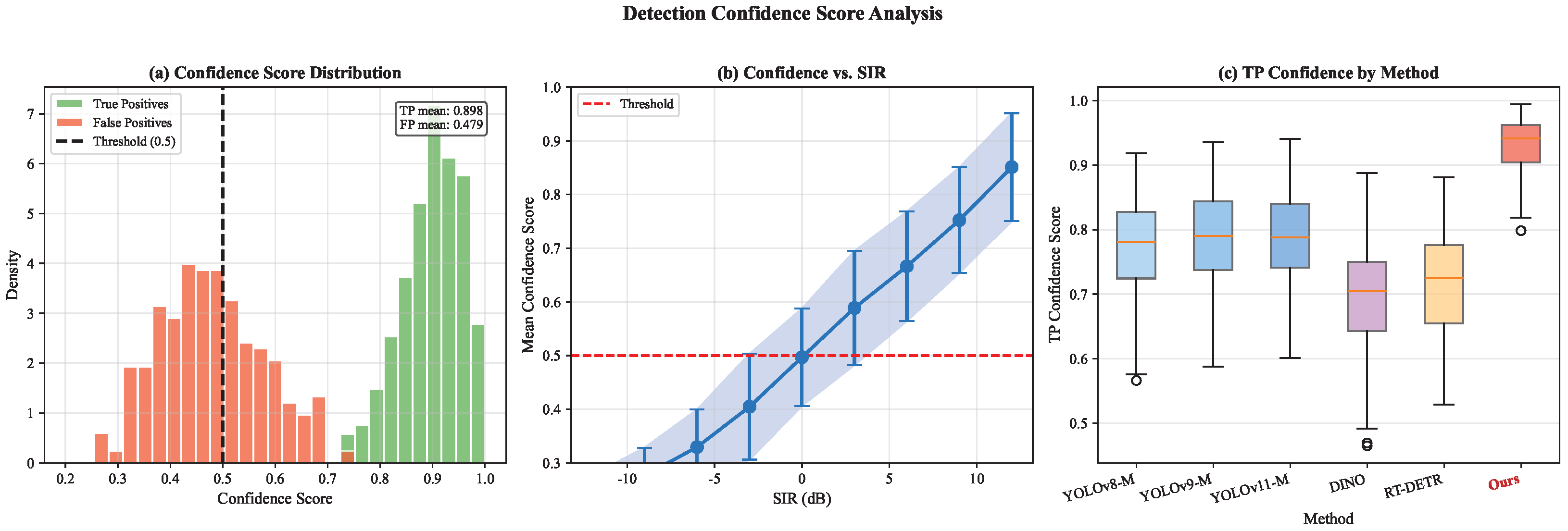
Figure 8 provides a comprehensive confidence score analysis of the detection results. The confidence distributions of true positive (TP) and false positive (FP) detections show clear separation, with TP detections concentrated in the 0.6–0.9 range while FP detections cluster below 0.3, enabling effective confidence-based filtering in operational deployment. The precision-recall curve maintains high precision (>0.9) until recall exceeds 0.7, demonstrating robust scoring behavior.
Figure 8.
Confidence score analysis of detection results. (a) Distribution of confidence scores for true positive and false positive detections; (b) confidence score variation across SIR levels; (c) comparison of true positive confidence scores across different detection methods.
Notably, the model assigns confidence scores that correlate well with target SIR levels: high-SIR targets (≥0 dB) receive confidence scores above 0.8, while low-SIR targets ( to dB) receive appropriately lower scores (0.4–0.6). This calibrated uncertainty estimation reflects the model’s ability to internalize the physical relationship between target visibility and detection reliability, which is a desirable property for downstream decision-making in operational sonar systems.
4.6. Computational Efficiency Analysis
Table 13 compares computational efficiency metrics across representative methods.
Table 13.
Computational efficiency comparison. Speed measured on single NVIDIA RTX 4090 GPU. Best results are in bold. Gray background highlights the proposed method.
The results demonstrate that the proposed method achieves the best accuracy-efficiency trade-off:
- Compared with YOLOv8-N (3.2 M parameters), the proposed method increases parameter count by only 19% while improving by 7.4%.
- Compared with RT-DETR-R50 (42.0 M parameters), the proposed method uses only 9% of the parameters while achieving higher (84.2% vs. 81.8%).
- Inference speed reaches 208 FPS, fully satisfying real-time detection requirements.
5. Discussion
The experimental results demonstrate that the proposed framework effectively addresses the dual challenge of low SIR and strong structural interference in active sonar target detection. Several aspects merit further discussion.
Simulation-to-real domain gap. While the controllable simulation framework covers principal environmental disturbance sources with parameterized modeling, discrepancies inevitably exist between simulated and real sonar data. The robustness claims in this work are therefore conditioned on the fidelity of the simulation framework, and the reported performance metrics should be interpreted as upper bounds that may degrade under real operational conditions with environmental factors not fully captured by our parameterized models. Future work should investigate more sophisticated domain adaptation techniques, such as adversarial training or diffusion-based style transfer [27], to further narrow this gap and validate the framework on real sonar datasets.
Limitations of PSF-constrained annotation. The automatic annotation strategy assumes that target-related energy in CBF images can be adequately characterized by PSF support regions. This assumption may break down for extended targets with complex scattering patterns or under severe multipath conditions where target-related energy distributions deviate substantially from theoretical PSF predictions. The geometric fallback mechanism provides robustness but may introduce annotation bias in edge cases.
Computational considerations. Although the proposed method maintains real-time inference capability, the Mamba module introduces additional computational overhead that may be significant for severely resource-constrained platforms. The modular design enables selective deployment of components based on application requirements, providing flexibility for different operational scenarios.
Generalization to other sonar modalities. The current framework focuses on active sonar with CBF processing. Extension to other sonar modalities, such as synthetic aperture sonar or passive sonar with different imaging characteristics, would require adaptation of both the simulation pipeline and detection network architecture.
6. Conclusions
This paper presents an end-to-end active sonar target detection framework addressing the fundamental challenge of low signal-to-interference ratio combined with strong structural interference in complex marine environments. The framework encompasses three interconnected components. First, a controllable simulation and quality auditing pipeline jointly models spectral-shaped noise, range-dependent reverberation, discrete scatterers, multipath propagation, and platform attitude perturbations with closed-loop SIR calibration for auditable dataset generation. Second, a PSF-constrained automatic annotation strategy generates morphologically consistent labels from target-only CBF responses, reducing manual annotation dependence while ensuring label-image consistency. Third, the YOLOv8-Mamba-P2 detection network incorporates Mamba-inspired gated long-range spatial mixing modules for structural interference suppression and extended P2 small-scale branches for weak target sensitivity enhancement.
Experimental validation on the SonarSim dataset demonstrates the effectiveness of the proposed method. The YOLOv8-Mamba-P2 achieves 84.2% mAP50 and 91.3% precision with only 3.82M parameters and 13.5 GFLOPs computational cost. Compared with 16 representative detection methods, the proposed method improves mAP50 by 7.4% over the YOLOv8-N baseline and by 2.4% over the closest competitor RT-DETR-R50 (81.8%), while using only 9% of its parameters (3.82M vs. 42.0M) and achieving 3.6× faster inference speed (208 vs. 58 FPS). Compared with recent Transformer-based detectors (DETR, Deformable DETR, RT-DETR) and the latest YOLO variants (YOLOv9, YOLOv10, YOLOv11), the proposed method achieves the highest detection accuracy while maintaining competitive computational efficiency. The lightweight design makes the method suitable for deployment on resource-constrained embedded platforms, although operational deployment would require further validation on real sonar data to confirm generalization beyond the simulated conditions.
Future work will focus on three directions. First, validating the framework on real sonar datasets and incorporating domain adaptation techniques such as adversarial training to bridge simulation-to-real gaps. Second, extending evaluation to diverse operational conditions and sonar modalities. Third, exploring more lightweight architecture variants for deployment on embedded platforms in autonomous underwater vehicles.
Author Contributions
These authors contributed equally to this work: N.L. and Y.Z.; conceptualization, N.L. and X.L.; methodology, N.L.; software, N.L., Y.Z. and X.L.; validation, N.L., X.L. and Y.Z.; formal analysis, N.L. and X.L.; writing—original draft preparation, N.L. and X.L.; writing—review and editing, Z.L.; visualization, N.L.; supervision, T.S. and Z.L. All authors have read and agreed to the published version of the manuscript.
Funding
This research received no external funding.
Data Availability Statement
The datasets presented in this article are not readily available due to technical limitations. Requests to access the datasets should be directed to the corresponding author.
Conflicts of Interest
The authors declare that they have no known competing financial interests or personal relationships that could have appeared to influence the work reported in this paper.
References
- Etter, P.C. Underwater Acoustic Modeling and Simulation, 5th ed.; CRC Press/Taylor & Francis: Boca Raton, FL, USA, 2018. [Google Scholar]
- Nielsen, R.O. Sonar Signal Processing; Artech House: Norwood, MA, USA, 2003. [Google Scholar]
- Jensen, F.B.; Kuperman, W.A.; Porter, M.B.; Schmidt, H. Computational Ocean Acoustics, 2nd ed.; Springer Science & Business Media: New York, NY, USA, 2011. [Google Scholar] [CrossRef] [Scilit]
- Etter, P.C. Advanced Applications for Underwater Acoustic Modeling. Adv. Acoust. Vib. 2012, 2012, 214839. [Google Scholar] [CrossRef] [Scilit]
- George, A.D.; Fogarty, R.W.; Markwell, J.S.; Jansen, M.D. Real-time sonar beamforming on high-performance distributed computers. Parallel Comput. 2000, 26, 1231–1252. [Google Scholar] [CrossRef] [Scilit]
- Hossain, M.M.; Islam, M.Z.; Kabir, A.; Islam, M.M.; Roy, T.K.; Islam, M.S. A Review on Deep Learning-Based Approaches for Automatic Sonar Target Recognition. Electronics 2020, 9, 1972. [Google Scholar] [CrossRef] [Scilit]
- Wang, X.; Liu, J.; Chen, M.; Zhang, H. Active sonar target recognition method based on multi-domain transformations and attention-based fusion network. IET Radar Sonar Navig. 2024, 18, 1887–1901. [Google Scholar] [CrossRef] [Scilit]
- Soldi, G.; Boni, G.; Gaglione, D.; Canepa, G.; LePage, K.D. Unsupervised active sonar contact classification through anomaly detection. EURASIP J. Adv. Signal Process. 2023, 2023, 58. [Google Scholar] [CrossRef] [Scilit]
- Steiniger, Y.; Kraus, D.; Meisen, T. Survey on deep learning based computer vision for sonar imagery. Eng. Appl. Artif. Intell. 2022, 114, 105157. [Google Scholar] [CrossRef] [Scilit]
- Sung, M.; Kim, J.; Lee, M.; Kim, B.; Kim, T.; Kim, J.; Yu, S.C. Realistic Sonar Image Simulation Using Deep Learning for Underwater Object Detection. Int. J. Control. Autom. Syst. 2020, 18, 523–534. [Google Scholar] [CrossRef] [Scilit]
- Sethuraman, A.V.; Sheppard, A.; Bagoren, O.; Pinnow, C.; Anderson, J.; Havens, T.C.; Skinner, K.A. Machine learning for shipwreck segmentation from side scan sonar imagery: Dataset and benchmark. Int. J. Robot. Res. 2024, 44, 341–354. [Google Scholar] [CrossRef] [Scilit]
- Zhao, A.; Hui, J.; Zeng, C.; Bi, X. A Frequency-Domain Adaptive Matched Filter for Active Sonar Detection. Sensors 2017, 17, 1565. [Google Scholar] [CrossRef] [Scilit]
- Abraham, D.A.; Willett, P.K. Active sonar detection in shallow water using the Page test. IEEE J. Ocean. Eng. 2002, 27, 35–46. [Google Scholar] [CrossRef] [Scilit]
- Abu, A.; Diamant, R. CFAR detection algorithm for objects in sonar images. IET Radar Sonar Navig. 2020, 14, 1757–1766. [Google Scholar] [CrossRef] [Scilit]
- Chen, Z.; Feng, J.; Yang, B.; Wu, H. The Adaptive Constant False Alarm Rate for Sonar Target Detection Based on Back Propagation Neural Network. IET Signal Process. 2023, 17, e12196. [Google Scholar] [CrossRef] [Scilit]
- Lerda, O.; Mian, A.; Ginolhac, G.; Ovarlez, J.P.; Charlot, D. Robust Detection for Mills Cross Sonar. IEEE J. Ocean. Eng. 2024, 49, 847–862. [Google Scholar] [CrossRef] [Scilit]
- Xiao, X.; Wang, W.; Ren, Q.; Gerstoft, P.; Ma, L. Underwater acoustic target recognition using attention-based deep neural network. JASA Express Lett. 2021, 1, 106001. [Google Scholar] [CrossRef] [Scilit]
- Xie, Y.; Xu, J.; Ren, J.; Li, J. Adversarial multi-task underwater acoustic target recognition: Toward robustness against various influential factors. J. Acoust. Soc. Am. 2024, 156, 299–313. [Google Scholar] [CrossRef] [Scilit]
- Aubard, M.; Madureira, A.; Teixeira, L.; Pinto, J. Sonar-based Deep Learning in Underwater Robotics: Overview, Robustness and Challenges. IEEE J. Ocean. Eng. 2025, 50, 1866–1884. [Google Scholar] [CrossRef] [Scilit]
- Das, S.; Malik, P.K.; Pandey, A. Challenges and Advances in Underwater Sonar Systems and AI-Driven Signal Processing for Modern Naval Operations: A Systematic Review. J. Field Robot. 2025, 42, 301–335. [Google Scholar] [CrossRef] [Scilit]
- Stojanovic, M.; Preisig, J. Underwater Acoustic Communication Channels: Propagation Models and Statistical Characterization. IEEE Commun. Mag. 2009, 47, 84–89. [Google Scholar] [CrossRef] [Scilit]
- Tang, D.; Jackson, D.R. Application of small-roughness perturbation theory to reverberation in range-dependent waveguides. J. Acoust. Soc. Am. 2012, 131, 4428–4441. [Google Scholar] [CrossRef] [Scilit] [PubMed]
- Li, H.; Sun, D.; Cao, Z. Modeling of Reverberation from the Seabed for Doppler Sonar. J. Acoust. Soc. Am. 2025, 158, 1–15. [Google Scholar] [CrossRef] [Scilit] [PubMed]
- Wang, Z.; Zhang, H.; Chen, X.; An, Y. A Construction Method of Reverberation Suppression Filter Using an End-to-End Network. PLoS ONE 2023, 18, e0293365. [Google Scholar] [CrossRef] [Scilit]
- Porter, M.B. Beam tracing for two- and three-dimensional problems in ocean acoustics. J. Acoust. Soc. Am. 2019, 146, 2016–2029. [Google Scholar] [CrossRef] [Scilit]
- Choi, W.S.; Olson, D.R.; Davis, D.; Zhang, M.; Racson, A.; Bingham, B.; McCarrin, M.; Vogt, C.; Herman, J. Physics-Based Modelling and Simulation of Multibeam Echosounder Perception for Autonomous Underwater Manipulation. Front. Robot. AI 2021, 8, 706646. [Google Scholar] [CrossRef] [Scilit] [PubMed]
- Agrawal, A.; Sikdar, A.; Makam, R.; Sundaram, S.; Besai, S.K.; Gopi, M. Syn2Real Domain Generalization for Underwater Mine-Like Object Detection Using Side-Scan Sonar. IEEE Geosci. Remote Sens. Lett. 2024, 21, 1–5. [Google Scholar] [CrossRef] [Scilit]
- Gomes, L.S.; Almeida, G.P.; Moreira, B.U.; Quiroz, M.; Xavier, B.; Soares, L.; Brião, S.L.; Oliveira, F.G.; Drews, P.L., Jr. Sonar Image Datasets: A Comprehensive Survey of Resources, Challenges, and Applications. arXiv 2025, arXiv:2510.03353. [Google Scholar] [CrossRef] [Scilit]
- Wang, C.Y.; Bochkovskiy, A.; Liao, H.Y.M. YOLOv7: Trainable Bag-of-Freebies Sets New State-of-the-Art for Real-Time Object Detectors. In Proceedings of the IEEE/CVF Conference on Computer Vision and Pattern Recognition (CVPR), Vancouver, BC, Canada, 17–24 June 2023; pp. 7464–7475. [Google Scholar] [CrossRef] [Scilit]
- Terven, J.; Córdova-Esparza, D.M.; Romero-González, J.A. A Comprehensive Review of YOLO Architectures in Computer Vision: From YOLOv1 to YOLOv8 and YOLO-NAS. Mach. Learn. Knowl. Extr. 2023, 5, 1680–1716. [Google Scholar] [CrossRef] [Scilit]
- Jocher, G.; Chaurasia, A.; Qiu, J. Ultralytics YOLOv8. Version 8.0.0. 2023. Available online: https://github.com/ultralytics/ultralytics (accessed on 15 January 2026).
- Lin, T.Y.; Dollár, P.; Girshick, R.; He, K.; Hariharan, B.; Belongie, S. Feature Pyramid Networks for Object Detection. In Proceedings of the IEEE Conference on Computer Vision and Pattern Recognition (CVPR), Honolulu, HI, USA, 21–26 July 2017; pp. 2117–2125. [Google Scholar] [CrossRef] [Scilit]
- Tian, Z.; Shen, C.; Chen, H.; He, T. FCOS: A Simple and Strong Anchor-Free Object Detector. IEEE Trans. Pattern Anal. Mach. Intell. 2022, 44, 1922–1933. [Google Scholar] [CrossRef] [Scilit]
- Feng, Q.; Xu, X.; Wang, Z. Deep Learning-Based Small Object Detection: A Survey. Math. Biosci. Eng. 2023, 20, 6551–6590. [Google Scholar] [CrossRef] [Scilit]
- Nikouei, M.; Baroutian, B.; Nabavi, S.; Taraghi, F.; Aghaei, A.; Sajedi, A.; Moghaddam, M.E. Small Object Detection: A Comprehensive Survey on Challenges, Techniques and Real-World Applications. arXiv 2025, arXiv:2503.20516. [Google Scholar] [CrossRef] [Scilit]
- Gu, A.; Goel, K.; Ré, C. Efficiently Modeling Long Sequences with Structured State Spaces. arXiv 2021, arXiv:2111.00396. [Google Scholar]
- Gu, A.; Dao, T. Mamba: Linear-Time Sequence Modeling with Selective State Spaces. arXiv 2023, arXiv:2312.00752. [Google Scholar] [CrossRef] [Scilit]
- Zhu, L.; Liao, B.; Zhang, Q.; Wang, X.; Liu, W.; Wang, X. Vision Mamba: Efficient Visual Representation Learning with Bidirectional State Space Model. In Proceedings of the 41st International Conference on Machine Learning (ICML), Vienna, Austria, 21–27 July 2024; Volume 235, pp. 62429–62442. [Google Scholar]
- Liu, Y.; Tian, Y.; Zhao, Y.; Yu, H.; Xie, L.; Wang, Y.; Ye, Q.; Jiao, J.; Liu, Y. VMamba: Visual State Space Model. arXiv 2024, arXiv:2401.10166. [Google Scholar] [PubMed]
- Nguyen, E.; Goel, K.; Gu, A.; Downs, G.; Shah, P.; Dao, T.; Baccus, S.; Ré, C. S4ND: Modeling Images and Videos as Multidimensional Signals with State Spaces. arXiv 2022, arXiv:2210.06583. [Google Scholar] [CrossRef] [Scilit]
- Wang, Z.; Li, C.; Xu, H.; Zhu, X. Mamba YOLO: A Simple Baseline for Object Detection with State Space Model. arXiv 2025, arXiv:2406.05835. [Google Scholar] [CrossRef] [Scilit]
- Van Veen, B.D.; Buckley, K.M. Beamforming: A Versatile Approach to Spatial Filtering. IEEE ASSP Mag. 1988, 5, 4–24. [Google Scholar] [CrossRef] [Scilit]
- Knight, W.C.; Pridham, R.G.; Kay, S.M. Digital Signal Processing for Sonar. Proc. IEEE 1981, 69, 1451–1506. [Google Scholar] [CrossRef] [Scilit]
- Blomberg, A.E.A.; Austeng, A.; Hansen, R.E. Adaptive Beamforming Applied to a Cylindrical Sonar Array Using an Interpolated Array Transformation. IEEE J. Ocean. Eng. 2012, 37, 25–34. [Google Scholar] [CrossRef] [Scilit]
- Blomberg, A.E.A.; Austeng, A.; Hansen, R.E.; Synnes, S.A.V. Improving Sonar Performance in Shallow Water Using Adaptive Beamforming. IEEE J. Ocean. Eng. 2013, 38, 297–307. [Google Scholar] [CrossRef] [Scilit]
- Lønmo, T.I.B.; Holm, S.; Austeng, A.; Hansen, R.E. Low Complexity Adaptive Sonar Imaging. IEEE J. Ocean. Eng. 2016, 42, 236–248. [Google Scholar] [CrossRef] [Scilit]

Disclaimer/Publisher’s Note: The statements, opinions and data contained in all publications are solely those of the individual author(s) and contributor(s) and not of MDPI and/or the editor(s). MDPI and/or the editor(s) disclaim responsibility for any injury to people or property resulting from any ideas, methods, instructions or products referred to in the content. |
© 2026 by the authors. Licensee MDPI, Basel, Switzerland. This article is an open access article distributed under the terms and conditions of the Creative Commons Attribution (CC BY) license.