


Abstract
Several shale oil intervals, including those in offshore China, were deposited in paralic lacustrine basins that experienced marine incursions. Marine incursions could be either favorable or unfavorable for the accumulation of organic matter (OM) and shale oil. However, the influence and specific mechanisms of seawater on OM accumulation require further in-depth investigation. During the deposition of the Triassic Chang 7 Member in the Ordos Basin, seawater from the Paleo-Tethys Ocean intruded into the basin. Taking this interval as a case study, this paper employs comprehensive analyses to reveal the influence of marine incursion on water column conditions and OM accumulation. Under humid climatic conditions, the water body was fresh to brackish, characterized by high productivity and oxic–dysoxic conditions. The OM is primarily derived from algae, and its accumulation was jointly controlled by primary productivity, redox conditions, and terrigenous input. OM accumulation is controlled by fluctuations in the relative water level (RWL) associated with third-order sequences. During the period of high RWL, seawater incursions enhanced water column productivity and reduced conditions by increasing nutrient supply and salinity, resulting in the highest OM content. During the early and late periods of the RWL, as seawater receded, OM production declined while consumption and dilution increased, resulting in a gradual decrease in its content. The RWL fluctuations at the fourth-order scale also significantly influence OM accumulation. These results can enhance the understanding of OM accumulation in paralic lacustrine basins with a history of seawater incursion. While promoting shale oil exploration in the Ordos Basin, they can also serve as a research analog for shale oil exploration in basins with similar geological backgrounds, such as the Bohai Bay Basin.
1. Introduction
Worldwide, multiple organic-rich mudrock successions have become exploration targets for shale oil and gas [1,2]. In offshore areas of China, several basins host shale oil resources, including the Bohai Bay Basin, the Pearl River Mouth Basin, and the Beibu Gulf Basin [3,4,5]. Taking the Bohai Sea area as an example, the shale oil resource potential exceeds 1.5 billion tons [6]. The three main shale oil intervals are all Paleogene lacustrine mudrock intervals, namely, the third member of the Shahejie Formation (Es3), the first member of the Shahejie Formation (Es1), and the third member of the Dongying Formation (Od). During the deposition of these three intervals, the Bohai Bay Basin was a paralic lacustrine basin (coastal lacustrine basin) that experienced marine incursions [7,8]. Similar examples also include the first member of the Upper Cretaceous Qingshankou Formation (K2Qn1) in the Songliao Basin and the seventh member of the Middle-Upper Triassic Yanchang Formation (Chang 7 Member) in the Ordos Basin, both of which are also enriched in shale oil [9,10,11,12,13,14].
Marine incursions had a significant impact on the accumulation of organic matter of mudrock successions in such paralic lake basins, thereby influencing the enrichment of shale oil. Seawater can input nutrients to enhance the productivity of the surface water in the lake and can also strengthen the reducing conditions of the bottom water by increasing water salinity and stratification. Consequently, seawater incursion is favorable for the accumulation of organic matter and the development of shale oil, such as in the K2Qn1 [9,10,11,12]. However, marine incursions do not always favor the development of organic-rich mudrocks. Taking the lower sub-member of the Es3 as an example, the upper section is a favorable shale oil interval with high organic matter content, whereas the lower section is not. This is because the moderate marine incursion in the upper section created a brackish water environment that was most conducive to organic matter production and preservation. In contrast, the excessively strong marine incursion and high salinity in the lower section were detrimental to organic matter production and accumulation [7,8]. In summary, the impact of marine incursion on the accumulation of organic matter and shale oil can be both favorable and unfavorable, requiring a specific analysis based on water column characteristics.
The organic matter in mudrocks constitutes the material basis for hydrocarbon generation and provides storage space for hydrocarbons. Its content governs the physical properties and hydrocarbon potential of reservoirs [15,16,17,18]. Identifying organic-rich mudrock intervals is the core of shale oil exploration. Elucidating the processes governing organic matter accumulation is essential for understanding the formation of organic-rich intervals and assessing resource reserves. The final preserved amount of organic matter in mudrocks constitutes only a small fraction of the original production, with the majority being lost due to degradation (e.g., the sequential consumption of oxygen, nitrate, iron-manganese oxides, and sulfate) [19,20]. The accumulation of organic matter is regulated by multiple factors, including primary productivity, bottom-water oxygen content, nutrient supply, terrestrial clastic input rate, and the intensity of degradation processes, such as bacterial sulfate reduction [21,22]. These factors can be further generalized as a complex nonlinear dynamic balance among organic matter production, destruction, and dilution [15,23,24]. To understand the organic matter accumulation mechanisms in a sedimentary basin, it is essential to conduct a comprehensive analysis that integrates the geological setting, sedimentary environment, and water column conditions.
The Chang 7 Member in the Ordos Basin is a critical interval for shale oil exploration, demonstrating significant shale oil resource potential. For instance, the cumulative oil production from the risk exploration well LY1H in the southwestern part of the basin has exceeded 10,000 tons over more than 800 days [25]. Recent high-precision geochronological data indicate that the base of the Chang 7 Member corresponds to the Ladinian [13,26,27,28]. During this period, comparative analysis of lacustrine and global sea-level curves suggests the occurrence of marine incursions into the Ordos Basin (a paralic lacustrine basin) [13,14]. The ingress of seawater from the Paleo-Tethys Ocean into the lacustrine basin from the southwest is further supported by evidence from paleontological and sulfur isotopic studies [29,30,31,32].
The Chang 7 Member is enriched in organic matter [33]. According to some studies, correlation analyses between paleoenvironmental proxies and TOC have proposed that paleoproductivity and redox conditions were the dominant factors governing organic matter accumulation in this interval [34,35,36]. In contrast, other researchers emphasize sedimentation rate as a key controlling factor [37]. Using different geochemical proxies, some scholars suggest that the redox conditions of the Chang 7 Member were anoxic–euxinic, while others propose that they were oxic with intermittent dysoxic [37,38,39,40]. In summary, there remains ongoing debate regarding the water conditions and the key governing factors of organic matter accumulation in the Chang 7 Member. Under the influence of marine incursions, further research is essential to elucidate the mechanisms governing water column evolution and organic matter accumulation.
This study investigates the Chang 7 Member by integrating sedimentological analysis with organic and elemental geochemical data to achieve three primary objectives: (1) Reconstruct the paleoclimate and water column conditions of different periods based on sequence stratigraphic divisions; (2) clarify the influence of depositional environments and the relative water level (RWL) fluctuations on organic matter enrichment; and (3) reveal how marine incursion altered the basin’s water column conditions and thereby controlled organic matter accumulation. These findings can enhance the understanding of organic matter accumulation in paralic lacustrine basins with a marine incursion background. While promoting shale oil exploration in the Ordos Basin, they also provide a research example for shale oil exploration in basins with similar backgrounds, such as the Bohai Bay Basin.
2. Geological Setting
The Ordos Basin is a significant oil- and gas-bearing basin covering an area of approximately 320,000 km2, located at the platform margin of the North China Paleocontinent (Figure 1A) [41]. As a typical multi-cycle superimposed basin, its evolution has been shaped by the North China Craton basement and its responses to the tectonic dynamics of surrounding plates, including the Paleo-Asian Ocean, in the Tethyan tectonic domain. This evolution progressed from stable marine deposition in the Paleozoic to the development of a large inland lacustrine basin in the Mesozoic and further to peripheral rift systems in the Cenozoic [42].
Figure 1.
(A) Maps showing the position of the Ordos Basin in the northeastern China Plate (modified after [41]). (B) Stratigraphy, depositional environment, and sequence characteristics of Yanchang Formation (modified after [35,43,44]). (C) Paleogeographic map during the Chang 73 periods (modified after [33]), with the study area indicated by the red box.
The Middle to Late Triassic Yanchang Formation is composed of a suite of fluvial–lacustrine–deltaic sediments. According to the sedimentary cycle, the Yanchang Formation can be divided into 10 members, Chang 10–Chang 1, from bottom to top. The Chang 7 Member was formed during the maximum flooding period of the lake basin [40]. According to previous research, the Yanchang Formation is divided into one second-order sequence, which comprises five third-order sequences (SQ1 to SQ5) [43,44].
Among them, the base boundary of the third sequence (SQ3) is SB3 (middle of the Chang 8 Member), and its top boundary is SB4 (middle-lower part of the Chang 6 Member). The middle part of SQ3 corresponds to the Chang 7 Member (Figure 2A). In outcrop sections, both interfaces are characterized by distinct erosional surfaces (Figure 2B,C). The organic-rich mudrocks in the lower part of the Chang 7 Member correspond to the maximum flooding surface of SQ3.
Figure 2.
(A) Stratigraphic and sequence division of the Yanchang Formation as revealed by seismic reflection. (B) Outcrops showing SB3 are located in the upper part of the Chang 8 Member and appear as the lower mudstone cut from the sandstone of the delta front. (C) Outcrops showing SB4 are located in the lower part of the Chang 6 Member and appear as the lower mudstone cut from the sandstone of the delta front.
From bottom to top, the Chang 7 Member can be subdivided into three sub-units: Chang 73, Chang 72, and Chang 71. The total thickness of the Chang 7 Member is approximately 80–120 m. The subduction of the South China Block beneath the Qinling Orogenic Belt and the North China Block led to melting. These deep-seated melts, carrying heat, ascended, resulting in continental crust extension, basin subsidence, and frequent volcanic and hydrothermal activities [45,46,47]. According to the latest data, the ages obtained for the base of the Chang 7 Member are 240.85 ± 0.033 Ma to 241.36 ± 0.12 Ma (TIMS U-Pb) and 238.3 ± 2.3 Ma to 241.8 ± 2.5 Ma (SHRIMP U-Pb) [13,26,27,28], which equate to the early Ladinian.
Multiple lines of evidence suggest that the Ordos Basin was connected to the Paleo-Tethys Ocean during the early Ladinian. First, the lake-level fluctuations and negative carbon isotope excursions are consistent with those observed in contemporary marine environments [13,14]. Second, the presence of marine fossils, such as coelacanth remains, in the Yanchang Formation indicates that water masses from the Tethys Ocean entered the basin through a passage in the southwestern Ordos Basin [29,30]. Third, using the contemporaneous seawater sulfate δ34S value (15.5 ± 0.4‰) as a reference, the sulfur isotopic fractionation in well Y56 ranges from 6.1‰ to 12.9‰, which is higher than that of the strata subject to seawater incursion in the Songliao Basin (4.6‰). This high degree of fractionation is related to the increased supply of sulfate during the marine transgression [31,32]. Fourth, elements such as molybdenum (Mo) and uranium (U) are enriched in the Chang 7 Member, with concentrations significantly higher than those in modern large lakes, suggesting a likely seawater origin [14,34].
3. Data and Methods
The cores from Y66, Y56, and H269 form the basis for sequence division and organic matter enrichment studies in this paper (Figure 1C). A total of 319 m of core were observed and described, with 101 samples collected for analysis.
3.1. Thin Sections
A total of 101 samples were made into thin sections and observed using an Olympus BX51 polarized light microscope.
3.2. X-Ray Diffraction Analysis
Whole-rock X-ray diffraction (XRD) analysis was conducted on 19 samples using an Empyrean X-ray diffractometer, following the SY/T 5163-2010 standard [48]. The XRD and elemental analyses were performed at the Laboratory of the Hebei Provincial Institute of Regional Geology and Mineral Resources Exploration.
Mineralogical data are plotted on a ternary diagram with quartz + feldspar, carbonate, and clay minerals as the three end-members (Figure 3A) [49,50].
Figure 3.
(A) Mineral composition of fine-grained sedimentary rocks from the Chang 7 Member in the study area. The ternary diagram base map was adapted from references [49,50]. (B) Diagrams for determining the kerogen types of the shale samples. Tmax vs. HI.
3.3. Total Organic Carbon and Rock-Eval Pyrolysis Analysis
A total of 18 samples from Well Y66 were analyzed for total organic carbon (TOC) content and subjected to Rock-Eval Pyrolysis.
The determinations of total organic carbon (TOC) content and rock pyrolysis were conducted in accordance with the standards GB/T19145-2003 [51] and GB/T18602-2012 [52], respectively. The samples were crushed to below 80 mesh and then treated with an excess of dilute hydrochloric acid (prepared at a 1:7 volume ratio) to ensure complete reaction. The samples were rinsed with distilled water to remove excess acid and subsequently dried in a drying oven. Organic carbon content was measured using a LECO CS230 carbon-sulfur analyzer. Pyrolysis analysis was performed using an OGE-IV rock pyrolysis analyzer. Both experiments were conducted at the National Key Laboratory of Petroleum Resources and Engineering, China University of Petroleum (Beijing).
The free hydrocarbon content (S1), pyrolyzable hydrocarbon content (S2), and maximum pyrolysis temperature (Tmax) were determined based on Rock-Eval pyrolysis experiments [53]. The Hydrogen Index (HI) is defined as HI = (S2/TOC) × 100. This study utilizes the cross-plot of Tmax versus the Hydrogen Index (HI) to determine kerogen types (Figure 3B).
3.4. Element Geochemical Analysis
This study analyzed 18 samples collected from well Y66 for major and trace element concentrations. Major elements were determined by X-ray fluorescence spectrometry (GB/T 14506.28-2010) [54] using an AxiosMAX fluorescence spectrometer. Trace and rare earth elements were determined by inductively coupled plasma mass spectrometry (GB/T 14506.30-2010) [55] using an X SERIES2 instrument. Major and trace element analyses were conducted at the Laboratory of the Hebei Provincial Institute of Regional Geology and Mineral Resources Exploration.
In the following text, we conducted statistical analysis on the geochemical indicators of elements, and the resulting boxplot was generated using Origin software (Version: OriginPro 2024).
3.5. Integrated Prediction Error Filter Analysis
The INPEFA (integrated prediction error filter analysis) curve is effective at highlighting subtle variation trends in original well-log curves that are difficult to observe visually. Therefore, it is frequently applied in high-resolution sequence identification [56,57]. The method involves processing the Gamma Ray (GR) log with Maximum Entropy Spectral Analysis (MESA) to obtain an estimated value. The Prediction Error Filter Analysis (PEFA) curve is then derived by subtracting this estimated value from the actual measured log curve. Finally, integrating the PEFA curve yields the more trend-prominent INPEFA curve [58]. The above calculation was performed using CycloLog software (Version: CycloLog 2010).
4. Results
4.1. Lithofacies and Sedimentary Processes
Some scholars specializing in fine-grained sedimentology propose naming fine-grained sedimentary rocks using a root term based on texture (grain size), which is modified by description of bedding, composition, and grain origin [49,50]. This scheme facilitates the understanding of rock genesis and has been widely applied in studies across multiple basins [59,60,61,62]. The bioturbation index was determined based on criteria established in previous studies [63]. Based on this scheme, the mudrocks in the Chang 7 Member can be divided into six lithofacies [44].
4.1.1. Parallel Laminated Fine Mudstone (LF-1)
Lithofacies1 (LF-1) is expressed as a black, continuous, planar parallel, laminated, argillaceous fine mudstone to argillaceous–siliceous fine mudstone. The laminae are mainly planar parallel laminae, which are made up of light and dark parts. The dark laminae consist of a mixture of organic matter and clay (Figure 4A,B). The light laminae are composed of clay minerals mixed with minor amounts of terrigenous silt particles (Figure 4C). Additional components of LF-1 include scattered fish scales, fish bones, and Tasmanite (Figure 4D,E). In addition, common to abundant organo-mineralic aggregates (OMAs), framboidal pyrite and phosphate nodules are observed in LF-1 (Figure 4F). The bioturbation index (BI) is 0.
Figure 4.
Photographs showing lithofacies 1, lithofacies 2, and lithofacies 3 of the Chang 7 Member, Ordos Basin. (A) Thin section showing parallel laminae. Y66, 2306.8 m, LF-1. (B) Photomicrograph showing parallel alternating light and dark laminae. The yellow dashed box indicates the field of view shown in Figure 4C. PPL (plane-polarized light), Y66, 2306.8 m, LF-1. (C) Enlarged view of Figure 4B showing the light laminae containing detrital quartz grains, feldspar grains, and organo-mineralic aggregates (OMAs, yellow arrow), which are scattered in the clay matrix. PPL, well Y66, 2306.8 m, LF-1. (D) Isolated fish bone in matrix. PPL and XPL (cross-polarized light), H269, 2530.8 m, LF-1. (E) Scattered fish scale and Tasmanite cyst. The fish scale and Tasmanite cyst are filled with collophane and apatite crystals. PPL, H269, 2530.8 m, LF-1. (F) Scattered phosphate nodule (red arrow) and OMA (yellow arrow). OMA may contain the following silty particles and pyrite. PPL, H269, 2530.8 m, LF-1. (G) Thin section of lithofacies 2 (modified after [44]). H269, 2528.5 m, LF-2. (H) Photomicrograph showing scattered collophane nodules (red dashed line) and OMAs (yellow arrow). The maximum diameter of phosphate nodules is more than 500 μm. PPL, H269, 2528.5, LF-2. (I) Overview image of the thin section. The yellow dashed box indicates the field of view shown in Figure 4J. H269, 2528.5 m, LF-3. (J) Enlarged view of Figure 4I showing an erosional scour between two beds (yellow dashed line). The size and number of silt grains above the scour surface exceed those of the underlying layer. The organo-mineralic aggregates (OMAs) below the scouring surface show small discontinuous thin wavy laminae (red arrow), whereas the OMA above the scouring surface shows a larger granular shape (yellow arrow). PPL, H269, 2528.5 m, LF-3. (K) A bioclast, possibly a Tasmanite cyst. XPL, H269, 2517.5 m, LF-3.
XRD data show that LF-1 is dominated by clay minerals and siliceous minerals, with contents ranging from 43.0 to 55.3% (48.7% on average) and 36.1 to 50.3% (44.2% on average), respectively (Figure 3A).
LF-1 is interpreted to be the product of suspended settlement in the semi-deep to deep lake with an overall low detrital input. The dark organic-rich laminae and light silt-bearing clayey laminae result from seasonal variations in sediment supply in the lacustrine basin (Figure 4A–C). Siliciclastic sediments and clay minerals are transported into the lake by wind and rivers as suspended loads. Subsequently, they are distributed throughout the lake by the wind. In spring and winter, an influx of sediment-laden water enters the deep lakes and eventually settles down to the floor to form silt-bearing laminae. In summer, most of the organic materials were produced in the surface water and then settled down to the bottom of the lake, forming organic-rich laminae [64]. The absence of bioturbation and the presence of floating bioclasts suggest deposition in a quiet water column (Figure 4D–F), resulting from suspension settling in a semi-deep to deep lake (away from the lake basin margin).
4.1.2. Phosphatic Fine Mudstone (LF-2)
Lithofacies 2 (LF-2) is a black, discontinuous, planar parallel, laminated, phosphatic fine mudstone. Phosphate minerals exist in the form of collophane nodules, which are mostly brown or dark brown ellipsoidal. In some samples, scattered collophane nodules, organo-mineralic aggregates, and clay clasts are observed and aligned into a variably hash bed (Figure 4G,H).
XRD analysis reveals that lithofacies 2 consists predominantly of clay minerals and siliceous minerals, with contents ranging from 44.7 to 52.2% (average 47.9%) and 41.9 to 51.8% (average 47.1%), respectively (Figure 3A).
Lithofacies 2 is a product of suspension settling in a deep-water environment. The development of phosphate nodules in LF-2 records a deposition pause, reflecting the starvation of terrigenous input, slow net sediment accumulation rates, and high organic flux to the floor [65]. Phosphate nodules formed as a result of early diagenesis and organic matter degradation [66,67]. In surface waters, phosphorus (P) is assimilated by organisms to produce organic phosphorus, which subsequently sinks to the floor. The degradation of organic matter occurs below the interface between sediment and water, and this process releases some elements such as C, N, and P. Phosphorus released by organic matter degradation is easily enriched in pore water and forms authigenic phosphate in the early diagenetic stage.
4.1.3. Massive to Faintly Laminated Medium-Fine Mudstone (LF-3)
Lithofacies 3 (LF-3) is a grayish-black, discontinuous, massive to faintly wavy parallel, laminated, siliceous–argillaceous or siliceous–argillaceous medium to fine mudstone with a scour surface, a bioturbation layer, and silt lag (Figure 4I). In LF-3, a stacked succession of silt-bearing thin beds can be observed. The individual bed exhibits an erosional scour at its base, with an overlying a discontinuous silt lag. The organo-mineralic aggregates (OMAs) below the scouring surface show small discontinuous thin wavy laminae (red arrow), whereas the OMA above the scouring surface shows a larger granular shape (yellow arrow) (Figure 4J). Additionally, fragmented bioclasts are observed, likely representing Tasmanite cysts. The bioturbation index (BI) ranges from 0 to 1.
XRD data show that LF-3 is dominated by clay minerals and siliceous minerals, with contents ranging from 44.6 to 54.3% (47.6% on average) and 36.8 to 46.5% (41.7% on average), respectively (Figure 3A).
LF-3 can be formed in two environments: the semi-deep to deep lacustrine zone with weak bottom currents or the shallow lacustrine zone with turbulent water. The presence of scoured surfaces, lag silt, and fragmented Tasmanite fragments indicates that LF-3 is not a suspension deposit, and its hydrodynamic energy is stronger than that of LF-1 and LF-2. During storm events, wind-driven bottom currents transport silty sediments from shallow lacustrine zones to deep lacustrine zones below the wave base [68].
4.1.4. Current Ripple Cross-Laminated Coarse to Medium Mudstone (LF-4)
Lithofacies 4 (LF-4) is gray to grayish-black, discontinuous, wavy parallel and wavy nonparallel laminated, siliceous coarse to medium mudstone (Figure 5A). LF-4 is characterized by abundant scour surfaces, current ripples, and silty lenses (Figure 5A,B). Early diagenetic calcite cements the detrital quartz and feldspar grains within the silty lenses, preserving their depositional fabric. In some lenses, disarticulated fish bones are also observed (Figure 5C). The bioturbation index ranges from 0 to 1. Bio-deformational features (Bd) and fugichnia traces (Fu) can be observed (Figure 5B). The identification of bioturbation types was informed by reference [69].
Figure 5.
Photographs showing lithofacies 4, lithofacies 5, and lithofacies 6 of the Chang 7 Member, Ordos Basin. (A) Image of the thin section showing discontinuous lenses (white arrow) and low-angle cross-laminated silt-rich beds (yellow arrow). H269, 2515.6 m, LF-4. (B) Image showing a low-angle cross-laminated silt-rich bed (yellow arrow) and the discontinuous bedding due to disruption by bioturbation. The lithofacies 4 contains bio-deformational (Bd) feature, fugichnia traces (Fu), and Planolites (Pl). H269, 2302.1 m, LF-4. (C) Photomicrograph showing a silt lens consisting of angular to subangular detrital feldspar, quartz, and mica. The lens also contains a phosphate fish bone particle. PPL, H269, 2515.6 m, LF-4. (D) Hand-sample image of the lithofacies 5 showing erosional scours, current ripples, and bioturbation. Bioturbation includes Diplichnites (Di) and Planolites (Pl). Synaeresis cracks (Sc) can be observed. Y66, 2292.3 m, LF-5. (E) Hand-sample image of the lithofacies 4 showing erosional scours, wave ripples, and current ripples with arcuate scalloped topography (yellow arrows). Ichnofossils include Planerites (Pl) and fugichnia traces (Fu). Y66, 2277.0 m, LF-5. (F) Hand-sample image of the lithofacies 4 showing erosional scours, current ripples, and wave ripples. Y66, 2290.2 m, LF-5. (G) Photomicrograph showing a broken Tasmanite cyst. Y66, 2300.4 m, LF-5. (H) Hand-sample image of thin-layered tuff. Thin-layer tuff is generally gray to brown. H269, 2510.2 m, LF-6. (I) Photomicrograph showing the vitrics grains is scattered and undirected. The white dashed box indicates the field of view shown in Figure 5J. XPL, well H269, 2504.6 m, LF-6. (J) Enlarged view of Figure 5I showing that the vitric grains are not completely optically extinct (yellow arrow), probably due to corrosion deformation into microcrystalline quartz. XPL, well H269, 2504.6 m, LF-6. (K) Photomicrograph showing the interface between tuff and mudstone. Tuff is dominated by microcrystalline quartz and contains abundant calcite cements. XPL, well H269, 2536.8 m, LF-6.
XRD data show that LF-4 is dominated by clay minerals and siliceous minerals, with contents ranging from 36.1 to 64.3% (47.3% on average) and 27.1 to 50.1% (37.5% on average), respectively (Figure 3A).
The LF-4 is interpreted to be a product of wind-induced bottom currents in a distal setting. Scour surfaces, current ripples, and silty lenses are direct evidence of bottom currents (Figure 5A,B). The carbonate cement within the silty lenses precipitated from pore waters (Figure 5C). The increase in bioturbation intensity (BI = 0–2) indicates enhanced benthic activity and higher oxygen levels in the bottom water compared to lithofacies 1–3.
4.1.5. Wavy Ripple Cross-Laminated Coarse Mudstone Interbedded Fine Mudstone (LF-5)
Lithofacies 5 (LF-5) is light gray to gray, continuous to discontinuous, curved–nonparallel–laminated calcareous coarse mudstone to sandy mudstone. In lithofacies 5, scour surfaces and wavy ripples with low-angle cross-lamination are common (Figure 5D–F). Silt-sized particles consist of terrigenous quartz, feldspar, lithic fragments, and mica, along with a minor amount of Tasmanite fragments (Figure 5G). LF-5 contains bio-deformational structure (Bd) and Synaeresis cracks (Sc), as well as a suite of ichnofossils, including Diplichnites (Di), Planolites (Pl), and fugichnia traces (Fu) (Figure 5D,E). The bioturbation index generally ranges from 0 to 2.
The LF-5 is interpreted as recording a pro-delta depositional setting, resulting from the combined effects of traction currents and wave reworking. The presence of erosional scours, wave ripples, and current ripples with arcuate scalloped topography indicates extensive wave reworking in the pro-delta to shallow lake (Figure 5D–F). Multiple episodes of bioturbation have disrupted the original sedimentary bedding, indicating active benthic organisms in the bottom water.
4.1.6. Massive to Thin-Layered Muddy Tuff/Tuff (LF-6)
Massive to laminated argillaceous tuff/tuff, which occurs as individual thin layers ranging from 0.2 to 2.5 cm thick in mudstone successions, is generally gray to brown (Figure 5H). Typical vitreous structures can be observed on thin-section photomicrographs. Lithofacies 6 (LF-6) is mainly composed of volcanic particles, such as vitrics and lithic grains (Figure 5I,J). Vitrics exhibit elongated and chicken bone-like shapes. The interface between tuff and organic-rich mudstone is sharp (Figure 5K).
XRD data show that LF-6 is dominated by clay minerals and siliceous minerals, with with contents ranging from 53.7 to 61.3% (56.3% on average) and 38.7 to 46.0% (42.9% on average), respectively (Figure 3A).
LF-6 is the product of volcanic events. Based on its intermediate-acidic composition, the tuff of the Chang 7 Member is interpreted as the product of Plinian volcanic events, similar to the Somma-Vesuvius volcano in southern Italy [45,70]. The eruption is characterized by a large amount of gas and pumice and high eruption energy. Pyroclastic materials consist of fine-grained volcanic lapilli and ash, which are often carried and dispersed by the wind and deposited kilometers or even thousands of kilometers away from the volcano. They may then return to the ground under gravity. When these volcanic materials fell into the lake, they gradually settled down to the bottom of the lake, forming thin layers of tuff.
4.2. High-Resolution Sequence Division
Based on lithofacies description and interpretation, the stacking patterns of lithofacies reflect cyclic changes. The trend variations of the INPEFA curve indicate sedimentary cycles at different scales. A positive trend generally signifies increasing humidity and rising water levels, while a negative trend indicates increasing aridity and falling water levels. By integrating vertical lithofacies variations with the INPEFA curve, this study divides the Chang 7 Member into three fourth-order sequences (Figure 6).
Figure 6.
Sequence stratigraphic division of the Chang 7 Member at well Y66. The fluctuations of RWL at third-order scales and fourth-order scales. Abbreviations: fMs (fine mudstone), mMs (medium mudstone), cMs (coarse mudstone), sMs (sandy mudstone), mSs (muddy sandstone), Ss (sandstone).
Within fourth-order sequences, in the transgressive systems tract (TST), lithofacies generally fine upward, accompanied by an increase in GR and INPEFA values (Figure 6). For example, in the TST of PSS2 (Parasequence Set 2), the lithofacies transition from deltaic sandstones to LF-1 and LF-3. The sedimentary process shifts from traction currents at the delta front to suspension deposition and weak bottom currents in semi-deep to deep lacustrine settings.
In the regressive systems tract (RST), lithofacies coarsen upward, accompanied by a decrease in GR and INPEFA log values (Figure 6). For instance, in the RST of PSS1, the succession evolves upward from LF-1 and LF-2 into LF-3 and LF-4, followed by a transition to LF-5, and ultimately to deltaic sandstones. The corresponding sedimentary process transitions from suspension settling to bottom currents in deep to semi-deep lacustrine, and finally to traction currents pro-delta and delta front.
4.3. Organic Geochemical Characteristics
The TOC at well Y66 ranges from 0.72 to 9.57% (average 4.17%). Specifically, the TOC of PSS1 ranges from 1.68 to 9.57% (average 5.60%). For PSS2, TOC is 2.42–3.98% (average 2.93%), and for PSS3, it is 0.72–3.50% (average 1.83%) (Figure 7A).
Figure 7.
Box plot showing TOC and paleoenvironment proxies of the Chang 7 Member. (A) TOC. (B,C) Paleoclimate proxy C-value and Sr/Cu. (D) Paleosalinity proxy Sr/Ba. (E–G) Productivity proxies P/Ti, Ni/Al, and Cu/Al. (H–J) Redox condition proxies V/Cr, Ni/Co, and U/Th. (K,L) Terrigenous input proxies Ti/Al and Zr/Al.
The HI of well Y66 ranges from 137.52 to 432.25 mg HC/g TOC (average 286.66 mg HC/g TOC).
In detail, the HI of PSS1 is between 137.52 HC/g TOC and 431.25 mg HC/g TOC (average 286.66 mg HC/g TOC). The HI of PSS2 is 137.52–278.82 mg HC/g TOC (average 214.91 mg HC/g TOC). The HI of PSS3 is 167.87–304.47 mg HC/g TOC (average 232.53 mg HC/g TOC).
The Tmax of well Y66 is between 442 °C and 448 °C (average 445 °C). The Tmax of PSS1 is 442–448 °C (average 445 °C). The Tmax of PSS2 is between 436 °C and 447 °C (average 442 °C). The Tmax of PSS3 is 441–449 °C (average 444 °C).
The cross-plot of the Tmax versus the Hydrogen Index (HI) shows that two samples are classified as Type I kerogen, 11 samples as Type II1 kerogen, and five samples as Type II2 kerogen (Figure 3B).
4.4. Major and Trace Element Geochemistry
Hydrochemical conditions influence the abundance of major and trace elements in sediments by affecting their geochemical behavior. Using specific elemental ratios to infer environmental characteristics during the depositional period is a common approach in paleoclimate and paleoenvironmental research [34,35,36,37,38,39,40,71,72,73,74,75,76]. This study employs ratios of select major and trace elements to reconstruct climatic and hydrological conditions during the depositional period. The quantitative indicator P/Ti and the qualitative indicators Ni/Al and Cu/Al ratios are employed to reconstruct the primary productivity of surface waters. The V/Cr, Ni/Co, and U/Th ratios are applied to indicate the redox conditions of bottom waters. The C-value and the Sr/Cu ratio serve as two quantitative indicators used to reflect paleoclimate conditions. The salinity of the water body is assessed using the Sr/Ba ratio. The Ti/Al and Zr/Al ratios are used qualitatively to reflect the level of terrigenous input (Figure 7). The principles and interpretations underlying the application of these indicators will be discussed in detail in Section 5.1 of this paper.
5. Discussion
5.1. Depositional Environment Analysis
This study focuses on sedimentary environmental analysis, including paleoclimate, paleosalinity, paleoproductivity, paleoredox conditions, and terrigenous input. These climatic and water conditions directly or intermittently influenced the enrichment of organic matter.
5.1.1. Paleoclimate
Under humid climatic conditions, with ample rainfall, chemical weathering is intense. Some iron-group elements (Fe, Mn) and transition metal elements (Cr, Ni, V, and Co) are less soluble and mobile, becoming enriched in sediments. In contrast, alkali and alkaline earth metal elements (Ca, Mg, Sr, Ba, K, and Na) are highly soluble in water, resulting in relatively lower concentrations in sediments. Under arid climatic conditions, these two groups of elements exhibit opposite geochemical behaviors and enrichment characteristics. Therefore, the composite index C-value, which incorporates the above elements, is used to reflect paleoclimate conditions [37,71,72]. The C-value is defined as follows:
C-value = Σ (Fe + Mn + Cr + Ni + V + Co)/Σ (Ca + Mg + Sr + Ba + K + Na).
The empirical interpretation criteria for the C-value are: >0.8 (humid), 0.6–0.8 (semi-humid), 0.4–0.6 (semi-arid to semi-humid), 0.2–0.4 (semi-arid), and <0.2 (arid).
For the Chang 7 Member, the C-values are 0.67–1.63 (average 0.93), indicating a semi-humid to humid paleoclimate during the depositional period. In the fourth-order sequence PSS1, C-values are 0.67–1.63 (average 1.03). For PSS2, C-values range from 0.82 to 1.07 (average 0.98). For PSS3, C-values range from 0.78–0.95 (average 0.84) (Figure 7B). This reflects a decrease in humidity from the bottom upward.
Strontium (Sr) is primarily hosted in carbonate minerals (calcite, aragonite) and evaporite minerals (celestite, gypsum). Under arid conditions, intense evaporation leads to the substantial precipitation of carbonate and evaporite minerals, resulting in the enrichment of Sr. Copper (Cu) is a chalcophile and redox-sensitive element that readily complexes with organic matter and precipitates as sulfides under reducing conditions. The enrichment of Cu typically reflects relatively humid climatic conditions. Based on the differential mobilities of Sr and Cu, the Sr/Cu ratio is an effective paleoclimate indicator [41,44]. An Sr/Cu ratio between 1.3 and 5.0 indicates a warm and humid climate, a ratio between 5 and 10 suggests a semi-humid climate, and a ratio greater than 10 signifies an arid climate.
The Sr/Cu ratios are between 3.13 and 12.36 (average 7.23), indicating a humid to semi-humid paleoclimate. For PSS1, PSS2, and PSS3, the Sr/Cu ratios range from 3.13 to 12.36 (average 6.85), 5.88 to 11.29 (average 8.14), and 5.89 to 8.42 (average 7.26), respectively (Figure 7C). From the bottom upward, the humidity of the climate shows a decreasing trend.
5.1.2. Paleosalinity
In freshwater environments, sulfate ion (SO42−) concentrations are typically low. Ba2+ primarily precipitates as the highly insoluble mineral barite (BaSO4), leading to its significant enrichment in sediments. In contrast, Sr2+ behaves more conservatively in water bodies, with relatively limited efficiency in its deposition and enrichment [8]. Therefore, an increase in the Sr/Ba ratio in sediments generally indicates elevated salinity in paleo-water bodies [34,37]. It is important to note that strontium (Sr) tends to substitute for Ca2+ in the CaCO3 crystal lattice, meaning carbonate minerals often contain relatively high levels of Sr, which can alter the signal from the clay fraction [8]. However, the overall carbonate content in the Chang 7 Member is very low, with CaO content generally below 2%. Furthermore, no significant positive correlation is observed between CaO and either Sr or the Sr/Ba ratio (Figure 8A,B). Therefore, the Sr/Ba ratios are independent of carbonate content. They can serve as reliable proxies for paleosalinity.
Figure 8.
(A) Cross-plot of Sr versus CaO at well Y66. (B) Cross-plot of Sr/Ba versus CaO at well Y66. (C) Regular steranes ternary plot in saturated hydrocarbons of the Chang 7 Member in the study area. The data was from reference [73]. (D) Cross-plot of Pr/nC17 and Ph/nC18 of the Chang 7 Member in the study area. The data was from reference [73]. (E) Cross-plot of δ34Spy and fractionation of the Chang 7 mudrocks at well Y66. The data was from reference [32].
The Sr/Ba ratios of the Chang 7 Member range from 0.31 to 0.76 (average 0.50) (Figure 7D). In addition, we have compiled previously reported Sr/Ba ratio data from multiple sources. First, the Sr/Ba ratios of 21 samples from well H269 in the study area range from 0.29 to 0.91 (average 0.51) [44]. Second, the Sr/Ba ratios of 15 samples from well JH4 in the southern part of the basin range from 0.16 to 0.63 (average 0.25) [34]. Third, the Sr/Ba ratios of 49 samples from well ZK903 in the southern part of the basin range from 0.20 to 0.70 (average 0.39) [35]. Fourth, the Sr/Ba ratios of 25 samples from the south-central part of the basin (including 16 samples from well C75 and nine samples from the Tangnihe outcrop section) range from 0.11 to 0.39 (average 0.22) [36]. Fifth, the Sr/Ba ratios of 24 samples from an outcrop section in the southern part of the basin range from 0.11 to 0.47 (average 0.29) [37].
In the current literature, two sets of criteria exist for paleosalinity discrimination. The first defines Sr/Ba < 0.5 as freshwater, 0.5–1.0 as brackish water, and >1.0 as saline water [35,37]. The second defines Sr/Ba < 0.2 as freshwater, 0.2–0.5 as brackish water, and >0.5 as marine water [8,34,36]. Based on the Sr/Ba ratio data from this study and these previously reported Sr/Ba ratios, regardless of which of the above criteria is adopted, the water body is interpreted as freshwater to brackish water.
In addition, the above judgment regarding salinity is also supported by other evidence. First, the B/Ga ratios of 24 samples from an outcrop section in the southern part of the basin range from 0.24 to 3.22 (average 1.43), indicating a freshwater to brackish water environment [37]. Compared with the Sr/Ba ratio, the B/Ga ratio is considered more reliable and accurate for assessing paleosalinity [8]. Second, the gammacerane/C30 hopane ratios of 36 samples from 15 wells in the central part of the basin are between 0.02 and 0.24 (average 0.13), showing a freshwater to brackish water condition [36]. Third, C26/C28-20S-TAS ratios of 0.20–0.45 and 0.45–0.94 correspond to freshwater and brackish water, respectively. The C26/C28-20S-TAS ratios of the 36 samples are 0.24 to 0.62 (average 0.39), showing a freshwater to brackish water environment [36].
The Sr/Ba ratios for PSS1, PSS2, and PSS3 are 0.41–0.76 (average 0.55), 0.31–0.67 (average 0.49), and 0.31–0.50 (average 0.40), respectively (Figure 7D). From bottom to top, the water salinity decreases, transitioning from brackish to freshwater conditions.
5.1.3. Primary Productivity
Phosphorus (P) is an essential nutrient for plankton (algae, bacteria), forming vital biological substances, such as DNA and ATP. Organisms assimilate dissolved phosphorus from the water column, and upon death, settle into sediments. Consequently, the P concentration in water controls the level of primary productivity. Nickel (Ni) and copper (Cu) are transition metal elements that, in aquatic environments, readily bind with compounds like porphyrins within plankton [74]. Aluminum (Al) and titanium (Ti) are typical detrital inert elements, often used to account for the effects of terrestrial dilution. Therefore, this study employs the quantitative indicator P/Ti and the qualitative indicators Ni/Al and Cu/Al to assess the productivity levels of the Chang 7 Member [34,37].
The P/Ti ratios are between 0.20 and 0.55 (average 0.30). In addition, we have compiled P/Ti ratio data for the Chang 7 Member from multiple published sources. First, the P/Ti ratios of 21 samples from well H269 in the study area range from 0.18 to 3.62 (average 0.75) [44]. Second, the P/Ti ratios of 15 samples from well JH4 in the southern part of the basin range from 0.11 to 1.82 (average 0.42) [34]. Third, the P/Ti ratios of 31 samples from well ZK903 in the southern part of the basin range from 0.21 to 1.76 (average 0.46) [35].
The P/Ti ratio can be used to qualitatively assess paleoproductivity levels, primarily based on two reference shale intervals from central Japan. Among these, the Ubara shale represents high productivity, with an average P/Ti ratio of 0.79 ± 1.63. The Gujo-Hachiman shale represents moderate productivity, with an average P/Ti ratio of 0.17 ± 0.23. The data from this study, along with the compiled data, show that the P/Ti ratios of the Chang 7 Member are higher than those of the Gujo-Hachiman shale and close to those of the Ubara shale [44,75]. Therefore, productivity is considered to be at a high level.
The Ni/Al ratios in the Chang 7 Member range from 3.84 to 7.98 ppm/% (average 5.44 ppm/%). The Ni/Al ratios for PSS1, PSS2, and PSS3 range from 3.84 to 7.98 ppm/% (average 5.73 ppm/%), 4.48 to 6.15 ppm/% (average 5.29 ppm/%), and 3.86 to 6.61 ppm/% (average 4.85 ppm/%), respectively (Figure 7F). From the bottom upwards, the productivity level shows a declining trend.
The Cu/Al ratios in the Chang 7 Member range from 3.99 to 11.66 ppm/% (average 6.05 ppm/%). The Cu/Al ratios for PSS1, PSS2, and PSS3 range from 3.99 to 11.66 ppm/% (average 6.67 ppm/%), 4.33 to 6.31 ppm/% (average 5.25 ppm/%), and 4.50 to 6.28 ppm/% (average 5.32 ppm/%), respectively (Figure 7G). Overall, from the bottom upwards, productivity exhibits a declining trend.
5.1.4. Redox Conditions
Under oxidizing conditions, vanadium (V) exists in the V5+ state as soluble vanadate ions (VO43−). Under reducing conditions, it is present as V4+ or V3+, with its solubility drastically decreasing, leading to precipitation and enrichment in sediments. Chromium (Cr) exists as Cr6+ under oxidizing conditions, forming soluble chromate ions (CrO42−). Under reducing conditions, it is reduced to Cr3+ and becomes enriched in sediments. Nickel (Ni) in anoxic environments is readily complexed by organic matter, resulting in its enrichment in sediments. Cobalt (Co) in oxidizing environments tends to be adsorbed by iron–manganese oxides/hydroxides, leading to its enrichment. Under oxidizing conditions, uranium (U) exists as U6+ in the form of soluble uranyl ions (UO22+). Under reducing conditions, it is reduced to U4+ and precipitates rapidly. Thorium (Th) exclusively exists in the Th4+ state, is extremely stable chemically, and is primarily hosted within detrital terrigenous minerals [74].
This study employs V/Cr, Ni/Co, and U/Th ratios to reconstruct the redox conditions of the bottom water [76]. V/Cr values < 2.00, 2.00–4.25, and >4.25 indicate oxic, dysoxic, and anoxic environments, respectively. Ni/Co values < 5.00, 5.00–7.00, and >7.00 indicate oxic, dysoxic, and anoxic environments, respectively. U/Th values < 0.75, 0.75–1.25, and >1.25 are the corresponding thresholds for indicating oxic, dysoxic, and anoxic environments, respectively.
At well Y66, the V/Cr ratios of the Chang 7 Member range from 0.90 to 3.06 (average 1.74), and the U/Th ratios range from 0.21 to 0.76 (average 0.38), showing oxic to dysoxic water conditions. The Ni/Co ratios are between 1.46 and 2.67 (average 2.08), suggesting oxic conditions.
Analytical results from 21 samples from well H269 in the study area show that the V/Cr ratios are 1.65 to 3.21 (average 2.21), U/Th ratios are 0.22 to 1.31 (average 0.59), and DOPT values are between 0.01 and 0.56 (average 0.18). All three proxies indicate oxic–dysoxic redox conditions for the Chang 7 Member. The Ni/Co ratios from well H269 (1.44–4.45, average 2.11) indicate oxic water conditions [44].
Integrating the data from wells Y66 and H269 in the study area, the Ni/Co ratio appears to be an anomalous proxy that cannot accurately reflect the redox conditions. Therefore, during the depositional period of the Chang 7 Member, the bottom water conditions were oxic to dysoxic.
The V/Cr ratios for sub-members PSS1, PSS2, and PSS3 range from 1.41 to 3.06 (average 1.97), 0.90 to 1.88 (average 1.41), and 1.11 to 1.85 (average 1.50), respectively (Figure 7H). The Ni/Co ratios for PSS1, PSS2, and PSS3 range from 1.84 to 2.67 (average 2.23), 1.71 to 2.33 (average 2.00), and 1.46 to 2.11 (average 1.82), respectively (Figure 7I). The U/Th ratios for PSS1, PSS2, and PSS3 are 0.24 to 0.76 (average 0.45), 0.24 to 0.39 (average 0.30), and 0.21 to 0.36 (average 0.26), respectively (Figure 7J). Upward, the oxygenation level of the water body increases, as reflected by all three proxies.
5.1.5. Terrigenous Input
Aluminum (Al) is primarily hosted in clay minerals (such as illite, kaolinite, and montmorillonite). Due to its stable chemical properties and minimal influence from diagenesis, Al is commonly used as a reference element for terrigenous input. Titanium (Ti) is mainly present in clay minerals and heavy minerals (including rutile, ilmenite, and sphene). Zirconium (Zr) predominantly occurs in zircon (ZrSiO4) and, to a lesser extent, in clay minerals. After appropriate correction, the Ti/Al and Zr/Al ratios are employed as qualitative indicators of terrigenous input levels [34,37].
The terrigenous input indicators, Ti/Al and Zr/Al ratios, range from 0.04 to 0.07 (average 0.05) and 9.40 to 19.30 ppm/% (average 13.96 ppm/%), respectively. For the fourth-order sequences PSS1, PSS2, and PSS3, the Ti/Al ratios are 0.04 to 0.07 (average 0.05), 0.05 to 0.06 (average 0.05), and 0.05 to 0.06 (average 0.06), respectively (Figure 7K). The Zr/Al ratios for PSS1, PSS2, and PSS3 range from 9.40 to 18.13 ppm/% (average 13.46 ppm/%), 10.97 to 19.03 ppm/% (average 14.80 ppm/%), and 11.72 to 16.38 ppm/% (average 14.39 ppm/%), respectively (Figure 7L). These two indicators collectively suggest an increasing trend in terrigenous input from the bottom (PSS1) to the top (PSS3) of the sequence.
5.2. Controlling Factors of Organic Matter Accumulation
The accumulation of organic matter is controlled by complex, nonlinear interactions of three main variables: rates of production, destruction, and dilution [15,23,24,44].
5.2.1. Production
The kerogen is predominantly Type I and Type II1, with minor Type II2, indicating that the organic matter is primarily derived from algae (Figure 3B). This finding is consistent with previously reported evidence from organic geochemistry. A total of 21 samples from the Yanchi–Dingbian area (the study area of this paper), including three from well Y66, were analyzed for saturated hydrocarbon biomarkers (Figure 1C) [73]. First, a cross-plot of the ratios of pristane (Pr) and phytane (Ph) to n-alkanes (nC17 and nC18) indicates that the organic matter originates from mixed sources, with algae being the primary contributor (Figure 8C). Second, a ternary diagram based on the relative contents of regular steranes shows that the composition of organic matter sources is dominated by aquatic plants and algae (Figure 8D).
The accumulation of organic matter in the Chang 7 Member is influenced by paleoproductivity. Firstly, there is a clear positive correlation between paleoproductivity indicators (P/Ti, Ni/Al, Cu/Al) and TOC, with correlation coefficients of 0.29, 0.26, and 0.59, respectively (Figure 9A–C). Secondly, from PSS1 to PSS2 and further to PSS3, TOC content shows a declining trend, while the paleoproductivity indicators (P/Ti, Ni/Al, Cu/Al) exhibit a synchronous decrease (Figure 7A,E–G).
Figure 9.
(A–C) Cross-plot of TOC versus productivity indicators at well Y66. (D–F) Cross-plot of productivity proxies versus paleoclimate indicators at well Y66. (G–I) Cross-plot of redox conditions versus productivity indicators at well Y66. (J,K) Cross-plot of TOC versus detrital input indicators at well Y66.
High paleoproductivity in the water column established a crucial material foundation for the accumulation of organic matter in sediments. The elevated paleoproductivity observed in the Chang 7 Member is associated with seawater incursion and volcanic-hydrothermal activity. First, seawater incursion into the lake basin could have introduced substantial nutrients. Second, during the early Ladinian stage, the Ordos Basin transitioned into an extensional tectonic setting, characterized by frequent volcanic and hydrothermal events. Volcanic ash settling from the atmosphere into the lake water contained significant amounts of elements, such as P and Fe, while hydrothermal fluids ascending along faults to the lake floor were rich in various nutrient elements. The influx of nutrients from marine incursion and volcanic activity led to algal blooms and a significant increase in productivity within the water column [34,35,44,45].
5.2.2. Destruction
First, there is a clear positive correlation between the paleoredox indicators (V/Cr, Ni/Co, and U/Th) and TOC, with correlation coefficients of 0.48, 0.55, and 0.81, respectively (Figure 9D–F). Second, from PSS1 to PSS2 and further to PSS3, the TOC content exhibits a declining trend, while the bottom water transitions from dysoxic to oxic conditions. Since organic matter is more prone to microbial degradation and consumption under oxic conditions, dysoxic environments are more favorable for organic matter preservation.
The dysoxic conditions of the bottom water are associated with paleoproductivity, marine incursion, and hydrothermal activity. First, there is a relatively clear positive correlation between redox condition indicators (V/Cr, Ni/Co, U/Th) and the paleoproductivity indicator P/Ti. The correlation coefficients are 0.16, 0.14, and 0.13, respectively (Figure 9G–I). This indicates that higher paleoproductivity corresponds to stronger reducing conditions in the bottom water. This relationship exists because the high productivity led to a substantial accumulation of organic matter in the bottom water. During microbial decomposition, this organic matter consumes oxygen, thereby promoting reducing conditions at the sediment–water interface. Thus, productivity significantly enhanced the reducing nature of the bottom water.
Second, seawater is rich in reducing elements such as sulfur. During seawater incursion events, the increased input of these elements undoubtedly promoted the development of more reducing conditions in the water column. Additionally, during the Chang 7 depositional period, hydrothermal fluids vented on the lake floor, enriching the bottom waters with reducing elements [35,46].
Third, seawater incursion increased water depth and also raised salinity, which likely promoted water column stratification. This stratification impeded oxygen exchange between the bottom water and the surface water, thereby contributing to the intensification of the bottom water.
5.2.3. Dilution
Terrigenous input of silty detritus exerts a dilutive effect on the enrichment of organic matter. A clear negative correlation exists between TOC and the terrigenous input indicator Zr/Al, with a correlation coefficient of 0.41. TOC also shows a certain negative correlation with the Ti/Al ratio (Figure 9J,K). This indicates that as terrigenous input increases, organic matter is diluted and degraded, making it less prone to enrichment.
In summary, the accumulation of organic matter in the Chang 7 Member is jointly controlled by productivity, redox conditions, and terrigenous input.
5.3. Effect of Marine Incursion on Organic Matter Accumulation
There is a clear synchronous trend between organic matter content and RWL fluctuations at the third-order scale (Figure 10). The RWL fluctuations at the third-order scale were directly controlled by the early Ladinian marine incursion. During this period, the changes in the lake level were synchronous with sea-level changes recorded in the stratigraphy of the western Tethyan domain (such as the maximum flooding surfaces of third-order cycles in the Southern Alps region) [13,14]. Marine incursion leads to an increase in salinity, and the salinity indicators in the Chang 7 Member show a positive correlation with TOC (Figure 11A).
Figure 10.
Evolution of redox conditions, productivity, and terrestrial input at well Y66. A total of 56 TOC data points are presented in the figure, of which 18 samples were analyzed in this study. The remaining 38 samples were collected from reference [77]. Abbreviations: fMs (fine mudstone), mMs (medium mudstone), cMs (coarse mudstone), sMs (sandy mudstone), mSs (muddy sandstone), Ss (sandstone).
Figure 11.
(A) Cross-plot of TOC and salinity proxies of the Chang 7 Member. (B–D) Cross-plot of productivity proxies and salinity proxies of the Chang 7 Member. (E–G) Cross-plot of redox conditions and salinity proxies of the Chang 7 Member.
Using the δ34S values of contemporaneous seawater sulfate (15.5 ± 0.4‰) as a baseline, the sulfur isotopic fractionation values from well Y56 range from 6.1‰ to 12.9‰, which are higher than those of the strata subject to seawater incursion in the Songliao Basin (4.6‰) [9,31,32]. Higher fractionation values indicate a more sufficient supply of seawater-derived sulfate. Based on this, it is inferred that seawater intruded during the periods of high RWL at third-order scales. In the early stage of the relative fall of the RWL, connectivity between the seawater and the basin persisted. By the late stage of RWL fall, seawater had completely retreated from the basin (Figure 8E) [32].
5.3.1. Period of High RWL
During the period of high RWL at third-order scales (corresponding to the deposition of the fourth-order sequence PSS1), the organic matter content is at its highest. The TOC ranges from 1.68% to 9.57%, with an average value of 5.60%. This is primarily attributed to three factors.
First, the influx of seawater brought abundant nutrients into the lacustrine basin, leading to high paleoproductivity in the water column. A positive correlation exists between paleosalinity and productivity indicators, indicating that seawater incursion simultaneously elevated both salinity and productivity (Figure 11B–D). Concurrently, frequent volcanic–hydrothermal activity during this period further enhanced paleoproductivity. This high paleoproductivity provided the essential material foundation for organic matter enrichment (Figure 7E–G).
Second, seawater incursion resulted in brackish water conditions, with Sr/Ba ratios ranging from 0.41 to 0.76 (average 0.55). The increase in salinity and water depth promoted water column stratification (Figure 7D). Enhanced stratification restricted exchange between surface and bottom waters, thereby strengthening the reducing conditions in the bottom waters. Moreover, the introduction of reducing elements, such as sulfur from seawater, contributed to dysoxic conditions at the bottom, which favored the preservation of organic matter (Figure 7H–J). The positive correlation between paleosalinity and redox indicators illustrates the role of high-salinity seawater incursion in promoting relatively enhanced bottom-water reducing conditions (Figure 11E–G).
Third, as water depth increased, semi-deep to deep lacustrine sediments (lithofacies 1–4) were deposited (Figure 6). Terrigenous input remained at relatively low levels overall, resulting in minimal dilution of organic matter (Figure 7K,L).
In summary, during the period of high RWL at the third-order scale, seawater intruded into the Ordos Basin. Organic matter was produced in large quantities while being minimally consumed and diluted, resulting in the maximum accumulation of organic matter during this period (Figure 12A).
Figure 12.
A model of organic matter enrichment under marine incursion conditions in the Ordos Basin. (A) Corresponds to the period of high RWL, characterized by large-scale seawater incursion. (B) Corresponds to the early stage of RWL fall, during which seawater connectivity still exists. (C) Corresponds to the late stage of RWL fall, marked by the retreat of seawater from the basin.
5.3.2. Early Period of RWL Fall
During the early period of RWL fall at the third-order scale (corresponding to the deposition of the fourth-order sequence PSS2), organic matter was moderately accumulated, with TOC ranging from 2.42% to 3.98% and averaging 2.93%.
First, during this period, seawater connectivity with the basin may have persisted, but sea-level fall led to reduced connectivity and a decline in the supply of marine nutrients. Concurrently, volcanic activity weakened relatively, resulting in a decrease in paleoproductivity within the water column (Figure 7E–G) [35].
Second, decreased water depth and salinity shifted the water body to freshwater-brackish conditions, with Sr/Ba ratios ranging from 0.41 to 0.76 (average 0.55). Water column stratification was less pronounced than during the period of high RWL (Figure 7D). Concurrently, the supply of reducing elements declined, leading to increased oxygen levels in the bottom waters and a shift to oxic conditions (Figure 7H–J).
Third, with the progradation of deltas, the influx of terrigenous silt increased, thereby enhancing the dilution of organic matter (Figure 7K,L).
During this period, seawater gradually retreated from the basin. Compared to the period of high RWL, the production of organic matter decreased, while its consumption and dilution increased, resulting in a relatively lower degree of organic matter accumulation (Figure 12B).
5.3.3. Late Period of RWL Fall
During the late stage of RWL fall, corresponding to the deposition of the fourth-order sequence PSS3, organic matter content was relatively low, ranging from 0.72% to 3.50%, with an average of 1.83%.
First, during this period, seawater likely completely withdrew from the basin, leading to the lowest paleoproductivity in the water column (Figure 7E–G). Organic matter production was minimal, which was unfavorable for organic matter enrichment. Second, water depth and salinity decreased to their lowest levels, resulting in the weakest water column stratification (Figure 7D). This promoted increased oxygen levels in the bottom waters. With the reduction in reducing elements reaching its lowest point, oxygen content in the bottom waters further increased, transitioning to an oxic environment that was unfavorable for the preservation of organic matter (Figure 7H–J). Third, as water shallowing progressed, delta-front sandstones and prodelta mudstones were deposited. Terrestrial input reached its maximum, which was not conducive to organic matter enrichment (Figure 7K,L).
During this period, as the relative water level continued to fall, seawater may have completely retreated from the basin. Organic matter production was low, while its consumption and dilution were substantial, leading to a limited organic matter accumulation (Figure 12C).
5.4. Effect of RWL Fluctuation at Fourth-Order Scales on Organic Matter Accumulation
Within the fourth-order sequences, organic matter content is controlled by RWL fluctuations.
Taking PSS1 as an example, the organic matter content increases upwards during RWL rise. Concurrently, paleoproductivity increases, while the reducing conditions of the bottom water diminish. The redox conditions shift from oxic to suboxic. Terrigenous input indicators, in contrast, show a decreasing trend upwards. In other words, increased organic matter production, improved preservation conditions, and reduced dilution all favor the enrichment of organic matter (Figure 10).
Conversely, during RWL fall, the organic matter content decreases. Multiple indicators show a decrease in both productivity and bottom-water reducing conditions, accompanied by enhanced terrigenous input. That is, decreased organic matter production, poorer preservation conditions, and increased dilution collectively lead to reduced organic matter enrichment (Figure 10).
Within PSS2 and PSS3, the enrichment of organic matter exhibits a similar relationship with relative RWL fluctuations (Figure 10). In summary, RWL fluctuations at fourth-order scales control the enrichment of organic matter by regulating its production, preservation, and dilution.
The conceptual model in this paper discusses how seawater incursion and RWL fluctuations influence the production, preservation, and dilution of organic matter at the third-order scales (Figure 12). The PSS1 contains 10 sample points, which can generally reflect the influence of RWL at fourth-order scales on water conditions and organic matter accumulation (Figure 10). A more detailed investigation into the effects of marine incursion on water conditions at the fourth-order sequence scale will require additional data points, and this will be an important focus of our future research.
6. Conclusions
High-precision geochronological data indicate that the mudrocks of the Chang 7 Member were deposited during the early Ladinian. Multiple lines of evidence, including paleontological and isotopic data, suggest the occurrence of marine incursions during this period. The marine incursion had a profound impact on the enrichment of organic matter.
(1) Based on lithofacies interpretations and trend analysis of the INPEFA curve, the Chang 7 Member corresponds to three fourth-order sequences. The paleoclimate was semi-humid to humid, and the water body ranged from freshwater to brackish. Overall, paleoproductivity was relatively high in the Chang 7 Member, while the bottom water conditions were oxic to dysoxic.
(2) Algae were the primary source of organic matter (OM) in the Chang 7 Member. Correlation analysis between total organic carbon (TOC) and geochemical indicators shows that the accumulation of organic matter is jointly controlled by productivity, redox conditions, and terrigenous input. High productivity serves as the material foundation for organic matter enrichment, while dysoxic conditions are more conducive to its accumulation. Terrigenous input primarily functions as a diluting factor.
(3) The accumulation of OM is controlled by fluctuations in the relative water level (RWL) associated with third-order sequences. The RWL fluctuations at the third-order scale are primarily linked to marine incursion. During the period of high RWL, seawater incursion, accompanied by intense volcanic–hydrothermal activity, supplied nutrients that led to increased productivity. The resulting rise in water depth and salinity due to seawater influx contributed to a relative enhancement of reducing conditions in the water column. With large quantities of organic matter being produced but minimal consumption and dilution, organic matter reached its highest enrichment during this period. During the early and late stages of the RWL fall at third-order scales, as seawater receded, both productivity and reducing conditions declined. Concurrently, enhanced terrigenous input led to a gradual decrease in the degree of organic matter enrichment.
(4) When the RWL rises corresponding to fourth-order sequences, organic matter production increases while consumption and dilution decrease, making organic matter more prone to enrichment. Conversely, when the RWL falls in the fourth-order scale, organic matter enrichment becomes less favorable. However, assessing the precise impact of marine incursion on water conditions at the fourth-order sequence scale requires higher-resolution data. This will be a key objective of future research.
This study reveals that marine incursion influences organic matter production, consumption, dilution, and final accumulation by altering water column conditions. These findings underscore the critical role of marine incursion in organic matter accumulation within paralic lacustrine basins. This understanding not only advances shale oil exploration in the Ordos Basin but also holds broader implications for analogous basins, including the Bohai Bay Basin.
Author Contributions
Conceptualization, M.Z.; Methodology, M.Z.; Data curation, M.Z., X.Z. (Xinping Zhou) and X.L.; Writing—original draft, M.Z.; Writing—review & editing, M.Z., X.Z. (Xiaomin Zhu), W.J., X.Z. (Xinping Zhou), H.C. and M.M.; Visualization, M.Z., L.Y. and X.L.; Supervision, X.Z. (Xiaomin Zhu) All authors have read and agreed to the published version of the manuscript.
Funding
This work was supported by the National Natural Science Foundation of China (Grant No. 42488101 42172158) and the Strategic Cooperation Science and Technology Special Project between China National Petroleum Corporation and China University of Petroleum (Beijing) (No. ZLZX2020-02). Wenming Ji is also funded by the Shandong Province Taishan Scholar Program (tsqnz20221120).
Data Availability Statement
The raw data supporting the conclusions of this article will be made available by the authors on request.
Conflicts of Interest
Lei Ye and Xinping Zhou were employed by the Exploration & Development Research Institute of PetroChina Changqing Oilfield Company. The remaining authors declare that the research was conducted in the absence of any commercial or financial relationships that could be construed as potential conflicts of interest.
References
- Sun, L.D.; Liu, H.; Zhu, R.K.; Cui, B.W.; Lei, Z.D.; Meng, S.W.; Tang, J.Z. Ten noteworthy issues on shale oil revolution in China. Acta Pet. Sin. 2023, 44, 2007–2019, (In Chinese with English abstract). [Google Scholar]
- Guo, X.S.; Zhao, P.R.; Zhang, Y.; Shen, B.J.; Li, Q.W.; Li, P.; Li, X.; Qian, K.R.; Cai, S.J.; Ma, X.X.; et al. Current status, challenges, and future trends of the classification and grading evaluation of lacustrine shale oil in China. Oil Gas Geol. 2025, 46, 1745–1761, (In Chinese with English abstract). [Google Scholar]
- Mi, L.J.; Zhang, G.C.; Liu, Z.F.; Chen, Y.; Bai, Z. Discussion on the development mechanism of lacustrine high-quality source rocks in oil-rich sags in offshore China. Acta Pet. Sin. 2023, 4, 405–419, 509, (In Chinese with English abstract). [Google Scholar]
- Xu, C.G.; Zhou, J.X.; Yang, H.F.; Ye, T. New fields, new types and resource potentials of oi lgas exploration in Bohai Sea. Acta Pet. Sin. 2024, 45, 163–182, (In Chinese with English abstract). [Google Scholar]
- Hong, Z.Q.; Meng, M.M.; Yuan, B.; Ma, C.L.; Wang, Q.M.; Deng, K.; Bao, J.W.; Yuan, M.L. Nanopore structure characterization of lacustrine and marine shales: Comparison between small angle neutron scattering and nitrogen adsorption methods. Int. J. Hydrog. Energy 2026, 208, 153565. [Google Scholar] [CrossRef] [Scilit]
- Mi, L.J.; Xv, J.Y.; Li, W. Shale oil resource potential in the Bohai Sea area. Oil Gas Geol. 2023, 44, 1366–1377, (In Chinese with English abstract). [Google Scholar]
- Wei, W.; Algeo, T.J.; Lu, Y.B.; Lu, Y.C.; Liu, H.M.; Zhang, S.P.; Li, P.; Zhang, J.Y.; Chen, L. Identifying marine incursions into the Paleogene Bohai Bay Basin lake system in northeastern China. Int. J. Coal Geol. 2018, 200, 1–17. [Google Scholar] [CrossRef] [Scilit]
- Wei, W.; Algeo, T.J. Elemental proxies for paleosalinity analysis of ancient shales and mudrocks. Geochim. Cosmochim. Acta 2020, 287, 341–366. [Google Scholar] [CrossRef] [Scilit]
- Huang, Y.J.; Yang, G.S.; Gu, J.; Wang, P.K.; Huang, Q.H.; Feng, Z.H.; Feng, L.J. Marine incursion events in the Late Cretaceous Songliao Basin: Constraints from sulfur geochemistry records. Palaeogeogr. Palaeoclimatol. Palaeoecol. 2013, 385, 152–161. [Google Scholar] [CrossRef] [Scilit]
- Xu, J.J.; Liu, Z.J.; Bechtel, A.; Sachsenhofer, R.F.; Jia, J.L.; Meng, Q.T.; Sun, P.C. Organic matter accumulation in the Upper Cretaceous Qingshankou and Nenjiang Formations, Songliao Basin (NE China): Implications from high-resolution geochemical analysis. Mar. Pet. Geol. 2019, 102, 187–201. [Google Scholar] [CrossRef] [Scilit]
- Zhu, X.M.; Cao, J.; Xia, L.W.; Bian, L.Z.; Liu, J.C.; Zhang, R.J. Links between marine incursions, lacustrine anoxia and organic matter enrichment in the Upper Cretaceous Qingshankou Formation, Songliao Basin, China. Mar. Pet. Geol. 2023, 158, 106536. [Google Scholar] [CrossRef] [Scilit]
- Chen, R.Q.; Bai, X.; Huang, C.Z.; Wu, X.; Fei Shang, F. How marine incursions affect the sedimentary environment and the quality of source rocks in the Upper Cretaceous Songliao Basin, NE China. Mar. Pet. Geol. 2024, 170, 107140. [Google Scholar] [CrossRef] [Scilit]
- Jin, X.; Baranyi, V.; Caggiati, M.; Franceschi, M.; Wall, C.J.; Liu, G.; Liu, G.L.; Schmitz, M.D.; Gianolla, P.; Ogg, J.G.; et al. Middle Triassic lake deepening in the Ordos Basin of North China linked with global sea-level rise. Glob. Planet. Change 2021, 207, 103670. [Google Scholar] [CrossRef]
- Bian, L.B.; Wang, X.M.; Chappaz, A.; Xiong, Z.Y.; Ye, M.Z.; Zhang, S.C.; Zhao, W.Z. Elemental-organic geochemical evidence for the lacustrine metalimnetic oxygen minimum dynamics in the Mid-Late Triassic Chang 7 shales. Earth Planet. Sci. Lett. 2025, 651, 119153. [Google Scholar] [CrossRef] [Scilit]
- Ji, W.M.; Hao, F.; Song, Y.; Tian, J.; Meng, M.M.; Huang, H.X. Organic geochemical and mineralogical characterization of the lower Silurian Longmaxi shale in the southeastern Chongqing area of China: Implications for organic matter accumulation. Int. J. Coal Geol. 2020, 220, 103412. [Google Scholar] [CrossRef] [Scilit]
- Lu, M.; Duan, G.Q.; Zhang, T.X.; Liu, N.H.; Song, Y.X.; Zhang, Z.Z.; Qiao, J.Q.; Wang, Z.Y.; Fang, Z.L.; Luo, Q.Y. Influences of paleoclimatic changes on organic matter enrichment mechanisms in freshwater and saline lacustrine oil shales in China: A machine learning approach. Earth-Sci. Rev. 2025, 262, 105061. [Google Scholar] [CrossRef] [Scilit]
- Meng, M.M.; Peng, J.C.; Ge, H.K.; Ji, W.M.; Li, X.M.; Wang, Q.Y. Rock fabric of lacustrine shale and its influence on residual oil distribution in the Upper Cretaceous Qingshankou Formation, Songliao Basin. Energy Fuels 2023, 37, 7151–7160. [Google Scholar] [CrossRef] [Scilit]
- Hong, Z.Q.; Meng, M.M.; Deng, K.; Bao, J.W.; Wang, Q.Y.; Liu, X.C. A quick method for appraising pore connectivity and ultimate imbibed porosity in shale reservoirs. J. Mar. Sci. Eng. 2025, 13, 174. [Google Scholar] [CrossRef] [Scilit]
- Canfield, D.E.; Thamdrup, B. Towards a consistent classification scheme for geochemical environments, or, why we wish the term ‘suboxic’ would go away. Geobiology 2009, 7, 385–392. [Google Scholar] [CrossRef] [Scilit]
- Arndt, S.; Jørgensen, B.B.; LaRowe, D.E.; Middelburg, J.J.; Pancost, R.; Regnier, P. Quantifying the degradation of organic matter in marine sediments: A review and synthesis. Earth-Sci. Rev. 2013, 123, 53–86. [Google Scholar] [CrossRef] [Scilit]
- Zeng, S.; Wang, J.; Fu, X.; Chen, W.; Feng, X.; Wang, D.; Song, C.; Wang, Z. Geochemical characteristics, redox conditions, and organic matter accumulation of marine oil shale from the Changliang Mountain area, northern Tibet, China. Mar. Pet. Geol. 2015, 64, 203–221. [Google Scholar] [CrossRef] [Scilit]
- Doner, Z.; Kumral, M.; Demirel, I.H.; Hu, Q.H. Geochemical characteristics of the Silurian shales from the central Taurides, southern Turkey: Organic matter accumulation, preservation and depositional environment modeling. Mar. Pet. Geol. 2019, 102, 155–175. [Google Scholar] [CrossRef] [Scilit]
- Bohacs, K.M.; Grabowski, G.J.; Carroll, A.R.; Mankiewicz, P.J.; Miskell-Gerhardt, K.; Schwalbach, J.R.; Wegner, M.B.; Simo, J.A. Production, destruction, and dilution—The many paths to source-rock development. In The Deposition of Organic-Carbon-Rich Sediments: Models, Mechanisms, and Consequences; Harris, N.B., Ed.; SEPM Special Publication: Tulsa, OK, USA, 2005; Volume 82, pp. 61–101. [Google Scholar]
- Passey, Q.R.; Bohacs, K.M.; Esch, W.L.; Klimentidis, R.E.; Sinha, S. From Oil-Prone Source Rock to Gas-Producing Shale Reservoir–Geologic and Petrophysical Characterization of Unconventional Shale Gas Reservoirs. In Proceedings of the International Oil and Gas Conference and Exhibition in China, Beijing, China, 8–10 June 2010. [Google Scholar]
- Liu, X.Y.; Liu, J.Y.; Wang, X.J.; Guo, Q.H.; Lv, Q.Q.; Yang, Z.; Zhang, Y.; Zhang, Z.Y.; Zhang, W.X. Mechanisms of fine-grained sedimentation and reservoir characteristics of shale oil in continental freshwater lacustrine basin: A case study from Chang 73 sub–member of Triassic Yanchang Formation in southwestern Ordos Basin, NW China. Pet. Explor. Dev. 2025, 52, 84–98. [Google Scholar] [CrossRef] [Scilit]
- Zhu, R.K.; Cui, J.W.; Deng, S.H.; Luo, Z.; Lu, Y.Z.; Qiu, Z. High-precision dating and geological significance of chang 7 tuff zircon of the Triassic Yanchang formation, ordos basin in central China. Acta Geol. Sin. (Engl. Ed.) 2019, 93, 1823–1834. [Google Scholar] [CrossRef]
- Cui, J.W.; Zhu, R.K.; Zhang, Z.Y.; Jahandar, R.; Li, Y. High Resolution ID-TIMS Redefines the Distribution and Age of the Main Mesozoic Lacustrine Hydrocarbon Source Rocks in the Ordos Basin, China. Acta Geol. Sin. (Engl. Ed.) 2023, 97, 581–588. [Google Scholar] [CrossRef] [Scilit]
- Liu, G.L.; Ma, S.; Zhang, Z.Y.; Mao, Z.G.; Han, T.Y.; Shi, Z.Q. U-Pb ages of tuff from the Triassic Yanchang Formation in the Ordos Basin: Constraints on palaeoclimate and tectonics. Mar. Pet. Geol. 2023, 150, 106128. [Google Scholar] [CrossRef] [Scilit]
- Su, D.Z. A new palaeoniscoid fish from the Yanchang Group of North Shaanxi and its biostratigraphic significance. Vertebr. Palasiat. 1984, 22, 1421, (In Chinese with English abstract). [Google Scholar]
- Liu, G.B.; Zhu, Z.X.; Zhang, X.L.; Ai, F. A coelacanthid fossil from Huachi area, Gansu province. Geol. J. China Univ. 1999, 4, 474–480, (In Chinese with English abstract). [Google Scholar]
- Wang, C.; Wang, Q.X.; Chen, G.J.; He, L.; Xu, Y.; Chen, L.Y.; Chen, D.F. Petrographic and geochemical characteristics of the lacustrine black shales from the upper Triassic Yanchang Formation of the Ordos Basin, China: Implications for the organic matter accumulation. Mar. Pet. Geol. 2017, 86, 52–65. [Google Scholar] [CrossRef] [Scilit]
- Chen, R.Q.; Liu, G.D.; Shang, F.; Cao, Y.S. Variations in hydrocarbon generating potential of the Chang 7 shale: Evidence from pyrite morphology and sulfur isotope. J. Pet. Sci. Eng. 2020, 195, 107747. [Google Scholar] [CrossRef] [Scilit]
- Fu, J.H.; Li, S.X.; Niu, X.B.; Deng, X.Q.; Zhou, X.P. Geological characteristics and exploration of shale oil in Chang 7 Member of Triassic Yanchang Formation, Ordos Basin, NW China. Pet. Explor. Dev. 2020, 475, 870–883. [Google Scholar]
- Li, Q.; Wu, S.H.; Xia, D.L.; You, X.L.; Zhang, H.M.; Lu, H. Major and trace element geochemistry of the lacustrine organic-rich shales from the Upper Triassic Chang 7 Member in the southwestern Ordos Basin, China: Implications for paleoenvironment and organic matter accumulation. Mar. Pet. Geol. 2020, 111, 852–867. [Google Scholar] [CrossRef] [Scilit]
- Zhang, K.; Liu, R.; Liu, Z.J. Sedimentary sequence evolution and organic matter accumulation characteristics of the Chang 8-Chang 7 members in the Upper Triassic Yanchang Formation, southwest Ordos Basin, central China. J. Pet. Sci. Eng. 2021, 196, 107751. [Google Scholar] [CrossRef] [Scilit]
- Zheng, R.H.; Zeng, W.R.; Li, Z.P.; Chen, X.; Man, K.X.; Zhang, Z.H.; Wang, G.L.; Shi, S.B. Differential enrichment mechanisms of organic matter in the Chang 7 Member mudstone and shale in Ordos Basin, China: Constraints from organic geochemistry and element geochemistry. Palaeogeogr. Palaeoclimatol. Palaeoecol. 2022, 601, 111126. [Google Scholar] [CrossRef] [Scilit]
- Yang, Y.Y.; Liu, Y.Q.; Zhou, D.W.; Jiao, X.; Cao, Q.; Meng, Z.Y.; Zhao, M.R. Lithotypes, organic matter and paleoenvironment characteristics in the Chang73 submember of the Triassic Yanchang Formation, Ordos Basin, China: Implications for organic matter accumulation and favourable target lithotype. J. Pet. Sci. Eng. 2022, 216, 110691. [Google Scholar] [CrossRef] [Scilit]
- Yuan, W.; Liu, G.D.; Stebbins, A.; Xu, L.M.; Niu, X.B.; Luo, W.B.; Li, C.Z. Reconstruction of redox conditions during deposition of organic-rich shales of the upper Triassic Yanchang Formation, Ordos Basin, China. Palaeogeogr. Palaeoclimatol. Palaeoecol. 2017, 486, 158–170. [Google Scholar] [CrossRef] [Scilit]
- Chen, G.; Gang, W.Z.; Liu, Y.Z.; Wang, N.; Jiang, C.; Sun, J.B. Organic matter enrichment of the Late Triassic Yanchang Formation (Ordos Basin, China) under dysoxic to oxic conditions: Insights from pyrite framboid size distributions. J. Asian Earth Sci. 2019, 170, 106–117. [Google Scholar] [CrossRef] [Scilit]
- Liu, H.L.; Qiu, Z.; Zou, C.N.; Fu, J.H.; Zhang, W.Z.; Tao, H.F.; Li, S.X.; Zhou, S.W.; Wang, L.; Chen, Z.Q. Environmental changes in the Middle Triassic lacustrine basin (Ordos, North China): Implication for biotic recovery of freshwater ecosystem following the Permian-Triassic mass extinction. Glob. Planet. Change 2021, 204, 103559. [Google Scholar] [CrossRef] [Scilit]
- Meng, Q.R.; Wu, G.L.; Fan, L.G.; Wei, H.H. Tectonic evolution of early Mesozoic sedimentary basins in the North China block. Earth Sci. Rev. 2019, 190, 416–438. [Google Scholar] [CrossRef] [Scilit]
- Liu, C.Y.; Wang, J.Q.; Qiu, X.W.; Zhang, D.D.; Zhao, J.F.; Zhao, H.G.; Deng, Y. Geodynamic environment and tectonic attributes of the hydrocarbon-rich sag in Yanchang Period of Middle-Late Triassic, Ordos Basin. Acta Petrol. Sin. 2020, 36, 1913–1930, (In Chinese with English abstract). [Google Scholar]
- Zhang, T.S.; Hu, S.Y.; Bu, Q.U.; Bai, B.; Tao, S.Z.; Chen, Y.Y.; Pan, Z.J.; Lin, S.H.; Pang, Z.L.; Xu, W.L.; et al. Effects of lacustrine depositional sequences on organic matter enrichment in the Chang 7 Shale, Ordos Basin, China. Mar. Pet. Geol. 2021, 124, 104778. [Google Scholar] [CrossRef] [Scilit]
- Zhang, M.Z.; Zhu, X.M.; Ji, W.M.; Lin, X.Y.; Ye, L. Effect of sedimentary environment on mudrock lithofacies and organic matter enrichment in a freshwater lacustrine basin: Insight from the Triassic Chang 7 Member in the Ordos Basin, China. Sustainability 2025, 17, 10248. [Google Scholar] [CrossRef] [Scilit]
- Zhang, W.Z.; Yang, H.; Peng, P.A. The influence of late Triassic volcanism on the development of Chang 7 high grade hydrocarbon source rock in Ordos Basin. Geochemica 2009, 386, 573–582, (In Chinese with English abstract). [Google Scholar]
- Zhang, W.Z.; Yang, H.; Xie, L.Q.; Yang, Y.H. Lake-bottom hydrothermal activities and their influences on the high-quality source rock development: A case from Chang7source rocks in Ordos Basin. Pet. Explor. Dev. 2010, 37, 424–428, (In Chinese with English abstract). [Google Scholar]
- Zhang, J.Q.; Qiu, Z.; Li, S.T.; Gao, S.L.; Guo, R.L.; Ma, X.F.; Qiu, J.L.; Li, S.X.; Tao, H.F.; Chen, J.L.; et al. Linking environmental changes and organic matter enrichment in the middle part of the Yanchang Formation (Ordos Basin, China) to the rollback of an oceanic slab in the eastern Paleo-Tethys. Sediment. Geol. 2023, 455, 106480. [Google Scholar] [CrossRef] [Scilit]
- SY/T 5163-2010; Analysis Method for Clay Minerals Andordinary Non—Clay Minerals in Sedimentary Rocksby the X-ray Diffraction. Petroleum Industry Press: Beijing, China, 2010.
- Lazar, O.R.; Bohacs, K.M.; Macquaker, J.H.S.; Schieber, J.; Demko, T.M. Capturing key attributes of fine-grained sedimentary rocks in outcrops, cores, and thin sections: Nomenclature and description guidelines. J. Sediment. Res. 2015, 85, 230–246. [Google Scholar] [CrossRef] [Scilit]
- Lazar, O.R.; Bohacs, K.M.; Macquaker, J.H.S.; Demko, T.M. Mudstone nomenclature. In Sequence Stratigraphy: Applications to Fine-Grained Rocks; Bohacs, K.M., Lazar, O.R., Eds.; AAPG Memoir: Tulsa, OK, USA, 2005; Volume 126, pp. 21–34. [Google Scholar]
- GB/T 19145-2003; Determination of Total Organic Carbon in Sedimentary Rock. Standards Press of China: Beijing, China, 2003.
- GB/T 18602-2012; Rock Pyrolysis Analysis. Standards Press of China: Beijing, China, 2012.
- Espitalié, J.; Madec, M.; Tissot, B.; Mennig, J.; Leplat, P. Source Rock Characterization Method for Petroleum Exploration. In Proceedings of the Offshore Technology Conference, Houston, TX, USA, 2–5 May 1977; pp. 29–35. [Google Scholar]
- GB/T 14506.28-2010; Methods for Chemical Analysis of Silicate Rocks—Part 28: Determination of Sixteen Major and Minor Elements Content. Standards Press of China: Beijing, China, 2010.
- GB/T 14506.30-2010; Methods for Chemical Analysis of Silicate Rocks—Part 30: Determination of Forty-Four Elements Content. Standards Press of China: Beijing, China, 2010.
- Hao, L.W.; Wang, Q.; Tao, H.F.; Li, X.Y.; Ma, D.X.; Ji, H.J. Geochemistry of Oligocene Huagang Formation clastic rocks, Xihu Sag, the East China Sea Shelf Basin: Provenance, source weathering, and tectonic setting. Geol. J. 2018, 53, 397–411. [Google Scholar] [CrossRef] [Scilit]
- Shi, H.C.; Xian, B.Z.; Liu, Y.C.; Yu, Z.Y.; Zhao, L.; Geng, J.Y.; Tain, R.H.; Wu, Q.R.; Liu, L.; Shuai, Y.Y.; et al. High-frequency sequence patterns in lacustrine basins: Insights from delta-hyperpycnal flow systems in the Middle Jurassic shale interval, Sichuan Basin, China. Sediment. Geol. 2025, 487, 106948. [Google Scholar] [CrossRef] [Scilit]
- Nio, S.D.; Brouwer, J.; Smith, D. Spectral trend attribute analysis: Applications in the stratigraphic analysis of wireline logs. First Break 2005, 23, 71–75. [Google Scholar] [CrossRef] [Scilit]
- Knapp, L.J.; McMillan, J.M.; Harris, N.B. A depositional model for organic-rich Duvernay Formation mudstones. Sediment. Geol. 2017, 347, 160–182. [Google Scholar] [CrossRef] [Scilit]
- Li, Z.Y.; Schieber, J. Application of sequence stratigraphic concepts to the Upper Cretaceous Tununk Shale Member of the Mancos Shale Formation, south-central Utah: Parasequence styles in shelfal mudstone strata. Sedimentology 2020, 67, 118–151. [Google Scholar] [CrossRef] [Scilit]
- Shaw, D.J.; Harris, N.B. Facies and systems tracts at high-resolution in an organic-rich mudstone: The Duvernay Formation, Kaybob area, Alberta, Canada. Sediment. Geol. 2022, 436, 106157. [Google Scholar] [CrossRef] [Scilit]
- Wang, M.Q.; Li, Z.Y.; Zhang, Y.Y. Transport and depositional processes of mud in lacustrine environments: From sediment plumes to hyperpycnal flows. Mar. Pet. Geol. 2024, 170, 107150. [Google Scholar] [CrossRef] [Scilit]
- Taylor, A.M.; Goldring, R. Description and analysis of bioturbation and ichnofabric. J. Geol. Soc. 1993, 150, 141–148. [Google Scholar] [CrossRef] [Scilit]
- Nichols, G. Sedimentology and Stratigraphy; Wiley–Blackwell: Chichester, UK, 2009; pp. 151–157. [Google Scholar]
- Bohacs, K.M.; Lazar, O.R.; Demko, T.M. Parasequences. In Sequence Stratigraphy: Applications to Fine-Grained Rocks; Bohacs, K.M., Lazar, O.R., Eds.; AAPG Memoir: Tulsa, OK, USA, 2022; Volume 126, pp. 107–148. [Google Scholar]
- Föllmi, K.B. The phosphorus cycle, phosphogenesis and marine phosphate-rich deposits. Earth-Sci. Rev. 1996, 40, 55–124. [Google Scholar] [CrossRef] [Scilit]
- Kraal, P.; Dijkstra, N.; Behrends, S.T.; Slomp, C.P. Phosphorus burial in sediments of the sulfidic deep Black Sea: Key roles for adsorption by calcium carbonate and apatite authigenesis. Geochim. Cosmochim. Acta 2017, 204, 140–158. [Google Scholar] [CrossRef] [Scilit]
- Nutz, A.; Schuster, M.; Ghienne, J.F.; Roquin, C.; Hay, M.B.; Retif, F.; Certain, R.; Robin, N.; Raynal, O.; Cousineau, P.A.; et al. Wind-driven bottom currents and related sedimentary bodies in Lake Saint-Jean Québec, Canada. GSA Bull. 2015, 127, 1194–1208. [Google Scholar]
- Buatois, L.A.; Mángano, M.G. Ichnology: Organism-Substrate Interactions in Space and Time; Cambridge University Press: New York, NY, USA, 2011; pp. 206–212. [Google Scholar]
- Scarpati, C.; Perrotta, A.; De Simone, G.F. Impact of explosive volcanic eruptions around Vesuvius: A story of resilience in Roman time. Bull. Volcanol. 2016, 78, 21. [Google Scholar] [CrossRef] [Scilit]
- Zhao, Z.Y.; Zhao, J.H.; Wang, H.J.; Liao, J.D.; Liu, C.M. Distribution characteristics and applications of trace elements in Junggar basin. Nat. Gas Explor. Dev. 2007, 30, 30–32, (In Chinese with English abstract). [Google Scholar]
- Li, W.W.; Tan, X.F.; Jiang, W.; Dong, X.W.; Wang, D.F.; Luo, L.; Wang, J.; Liu, J.P.; Yan, X.Q.; Huang, C. Organic matter accumulation and carbon sequestration in the Paleocene-Eocene Thermal Maximum: Insights from the Kongdian Formation in Cangdong Sag, Bohai Bay Basin. J. Asian Earth Sci. 2025, 288, 106606. [Google Scholar] [CrossRef] [Scilit]
- Xi, S.L.; Gang, W.Z.; Yang, Q.Y.; Chen, G.; Liu, Y.Z.; Wang, N.; Liu, L. Organic Geochemistry and Sedimentary Paleoenvironment of Chang 7 Source Rocks in Yanchi–Dingbian Area, Ordos Basin. Geoscience 2019, 33, 890–901. [Google Scholar]
- Tribovillard, N.; Algeo, T.W.; Lyons, T.; Riboulleau, A. Trace metals as paleoredox and paleo-productivity proxies: An update. Chem. Geol. 2006, 232, 12–32. [Google Scholar] [CrossRef] [Scilit]
- Algeo, T.J.; Kuwahara, K.; Sano, H.; Bates, S.; Lyons, T.; Elswick, E.; Maynard, J.B. Spatial variation in sediment fluxes, redox conditions, and productivity in the Permian-Triassic Panthalassic Ocean. Palaeogeogr. Palaeoclimatol. Palaeoecol. 2011, 308, 65–83. [Google Scholar] [CrossRef] [Scilit]
- Jones, B.; Manning, D.A.C. Comparison of geochemical indices used for the interpretation of palaeoredox conditions in ancient mudstones. Chem. Geol. 1994, 111, 111–129. [Google Scholar] [CrossRef] [Scilit]
- Liu, Q.; Yuan, X.J.; Lin, S.H.; Guo, H.; Cheng, D.W. Depositional environment and characteristic comparison between lacustrine mudstone and shale: A case study from the chang 7 Member of the Yanchang Formation, Ordos Basin. Oil Gas Geol. 2018, 39, 531–540, (In Chinese with English abstract). [Google Scholar]
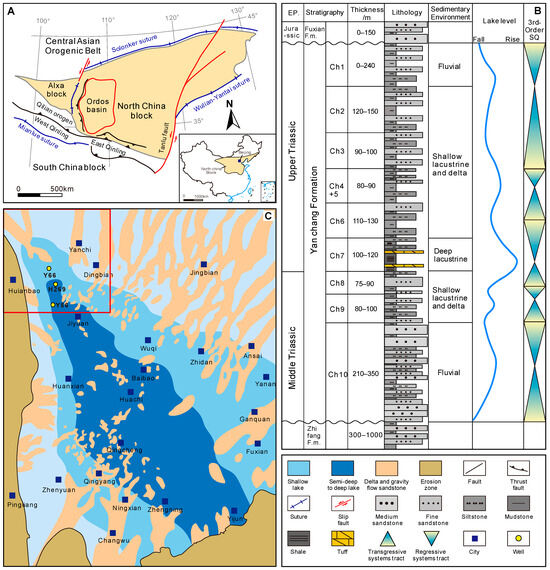
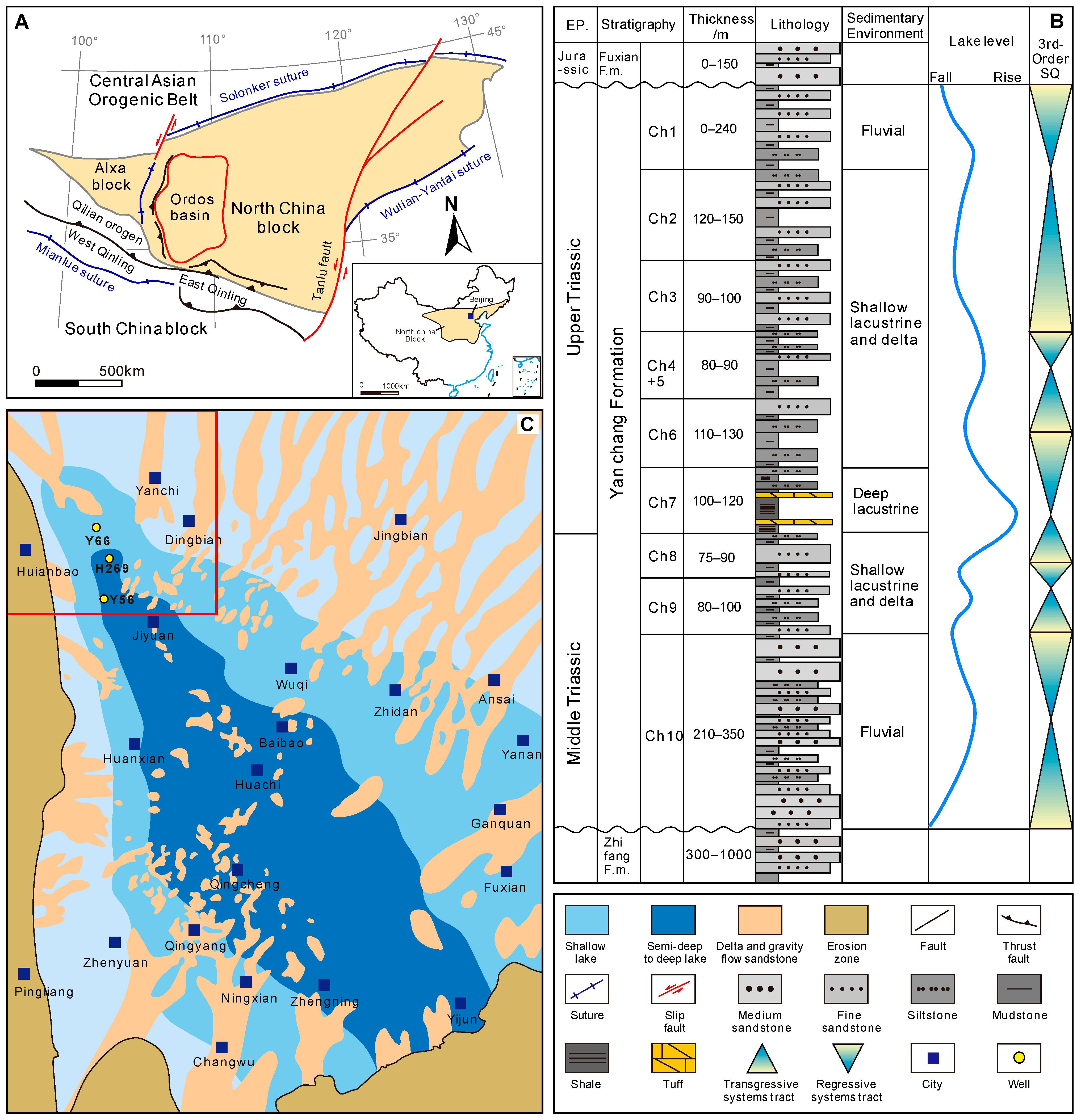
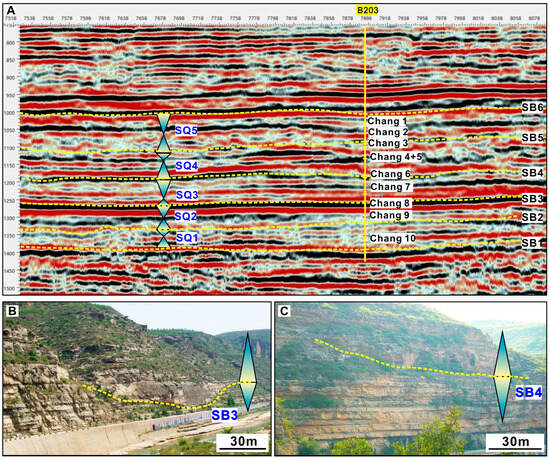
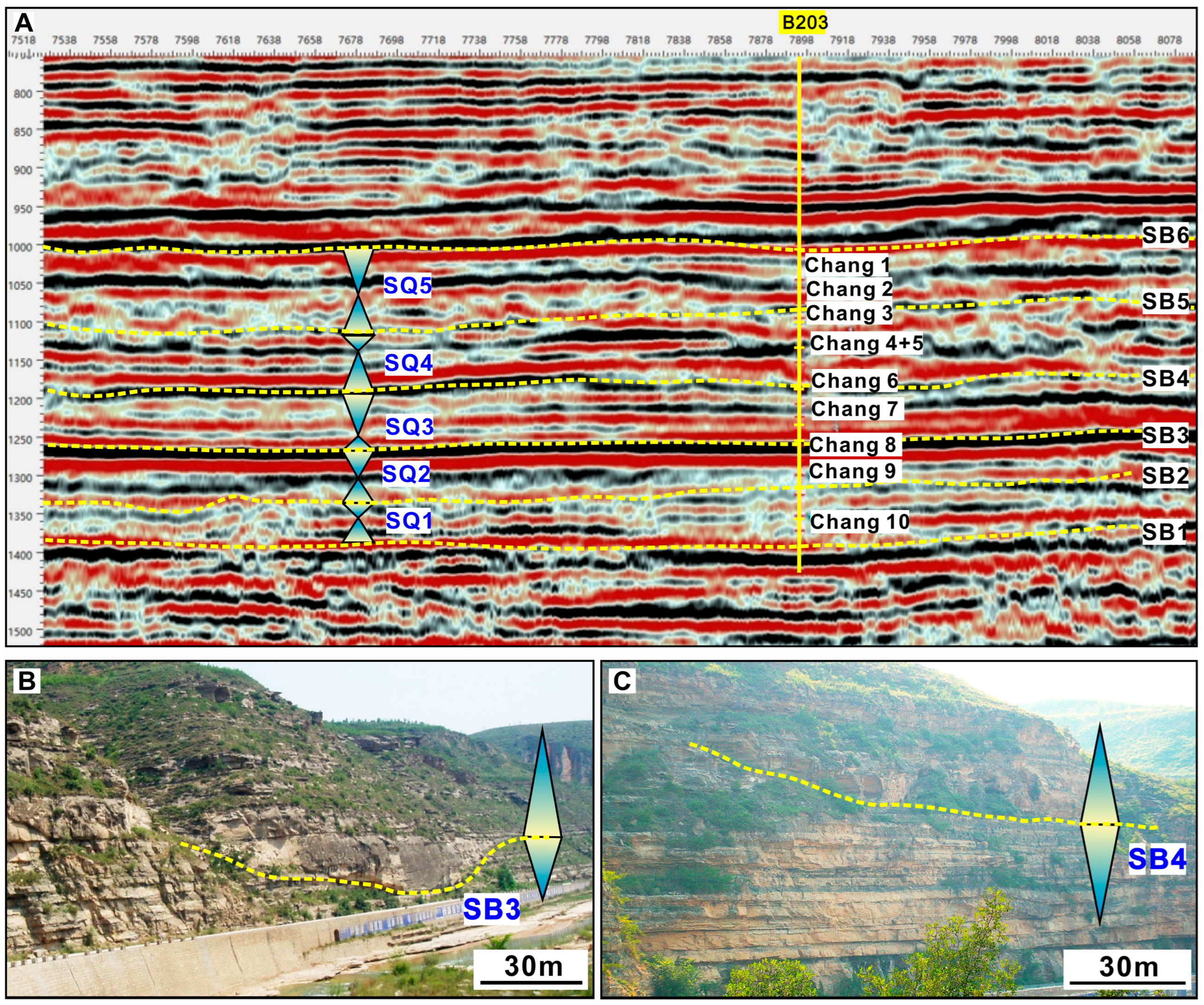
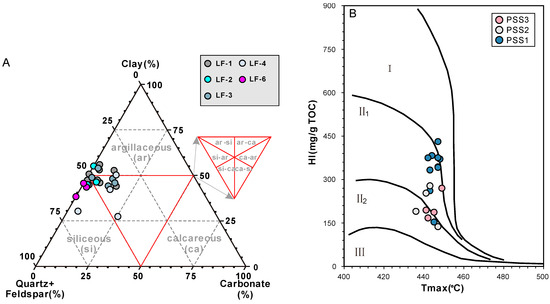
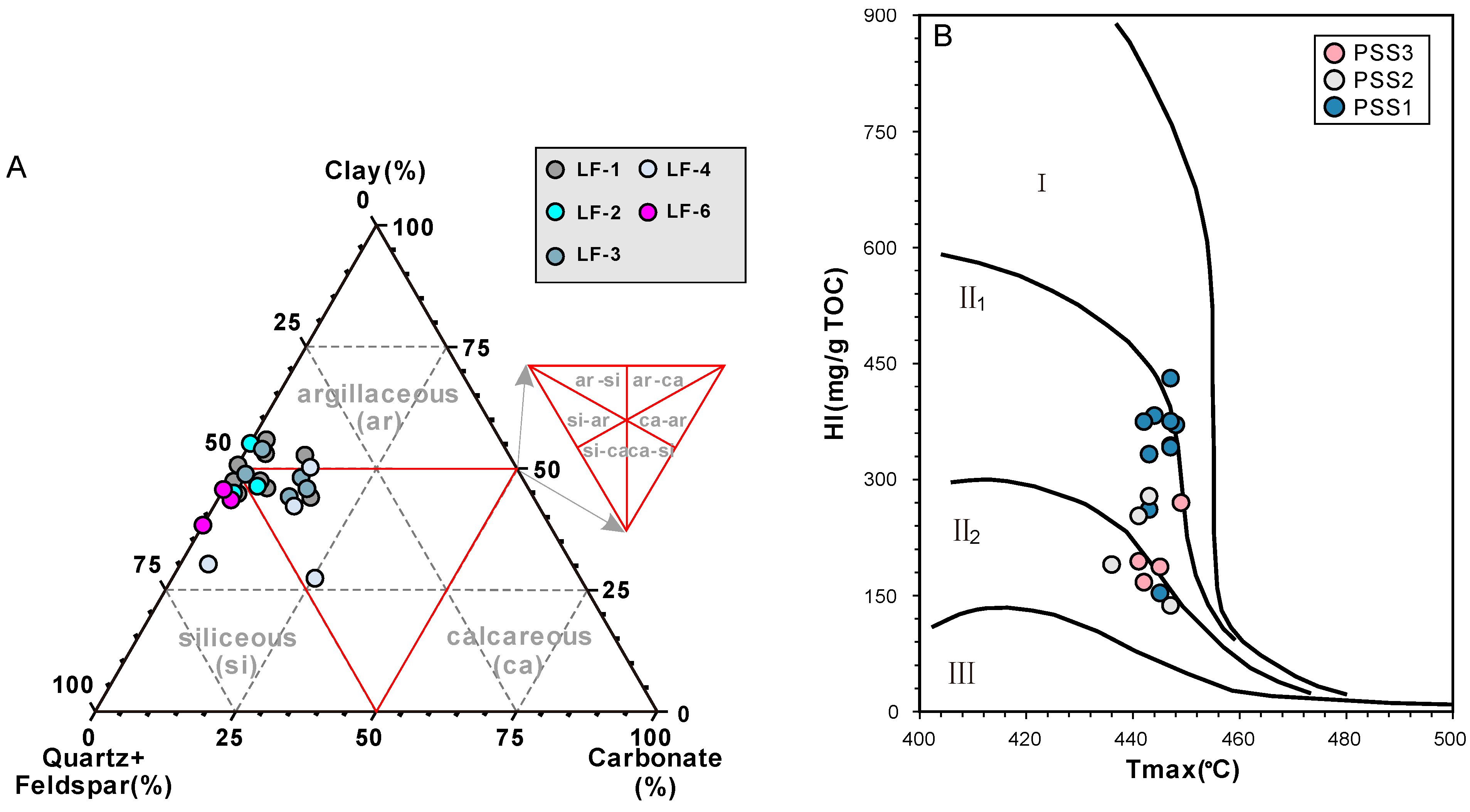
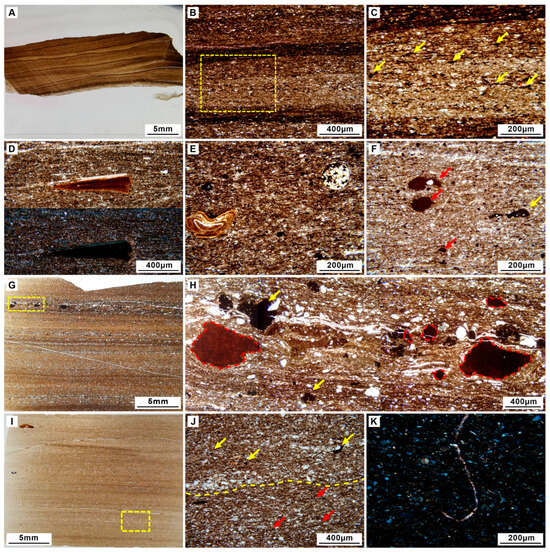
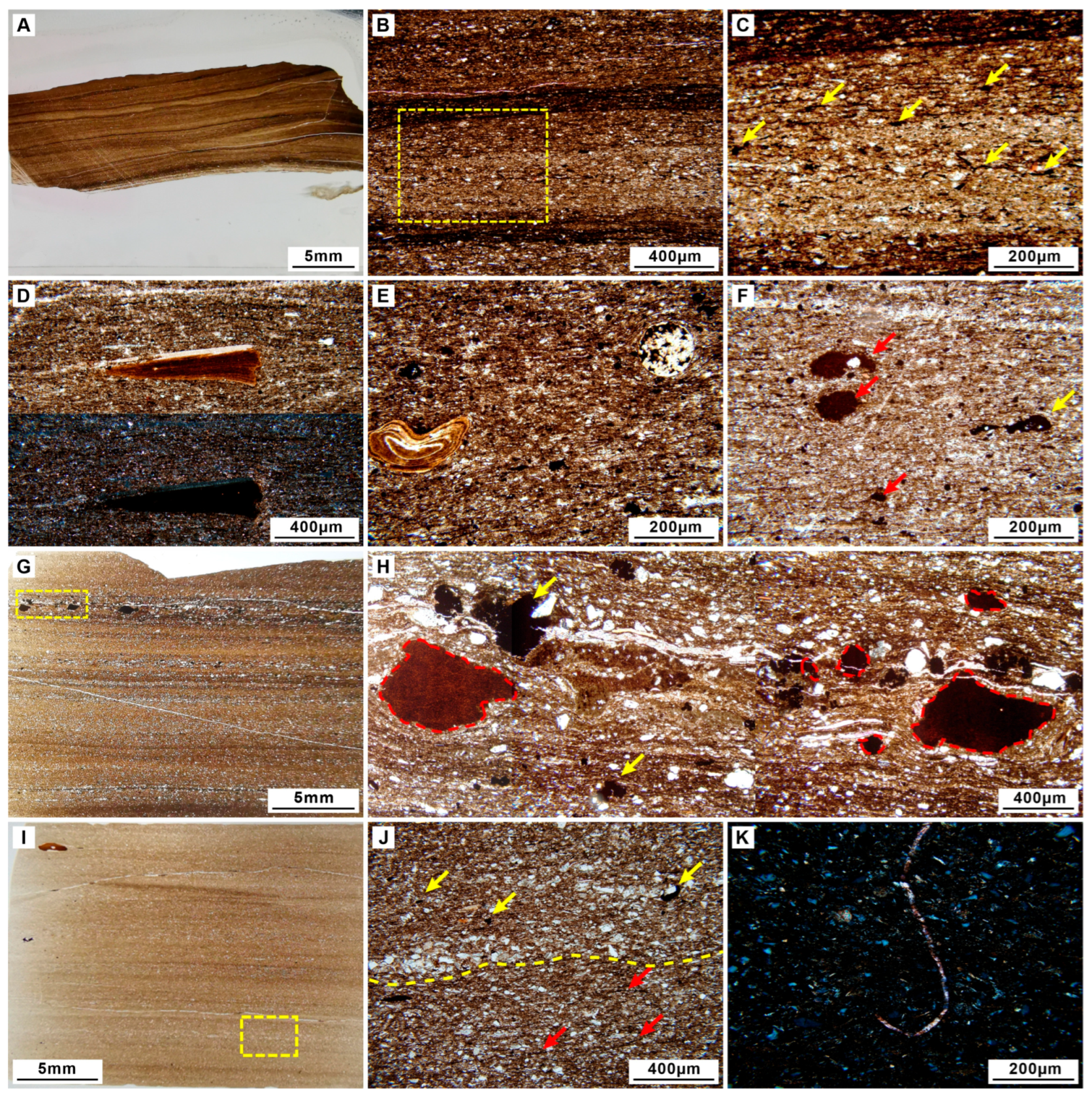
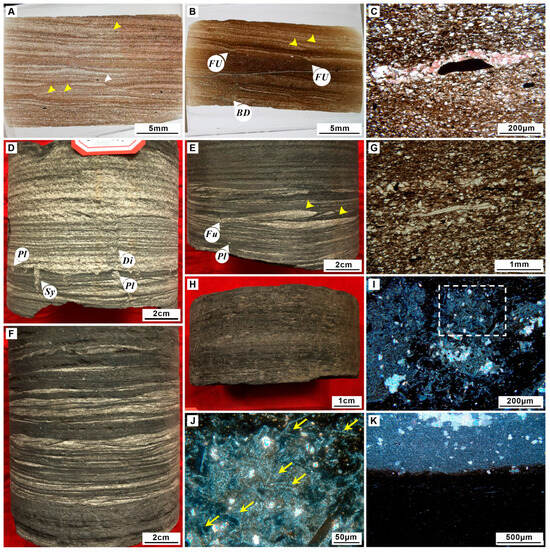
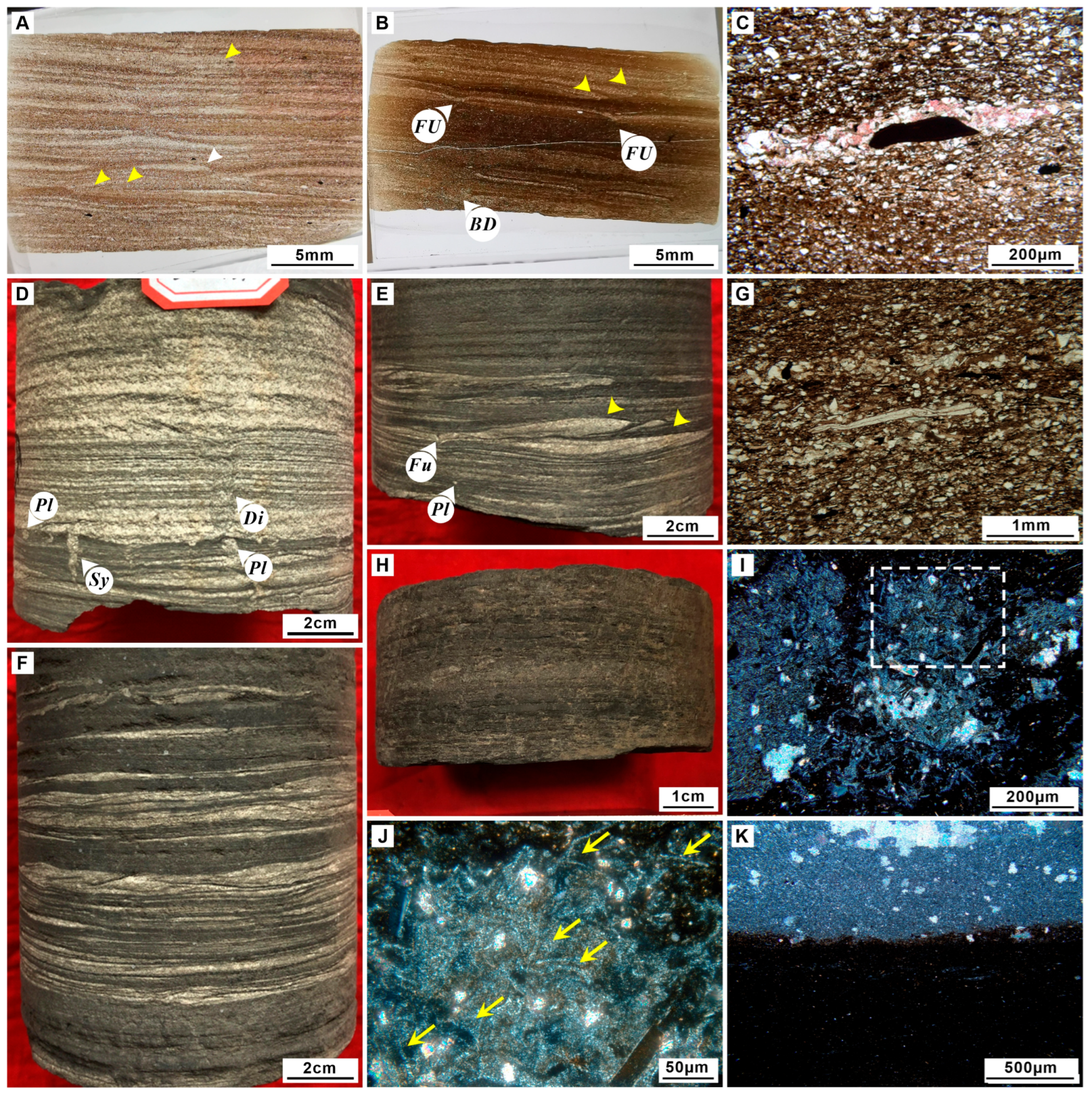
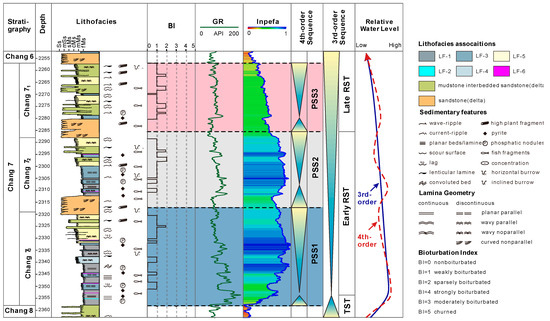
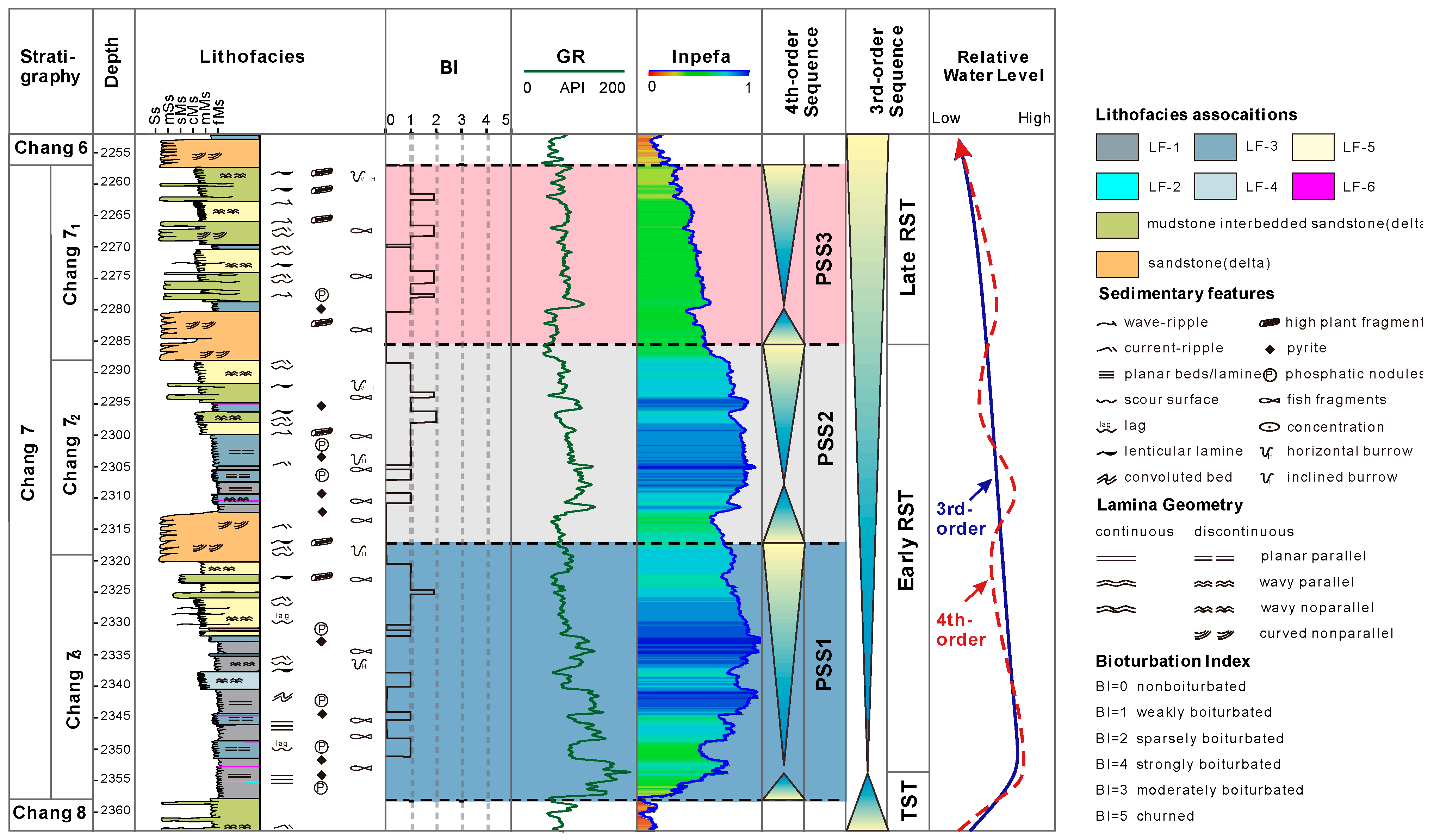
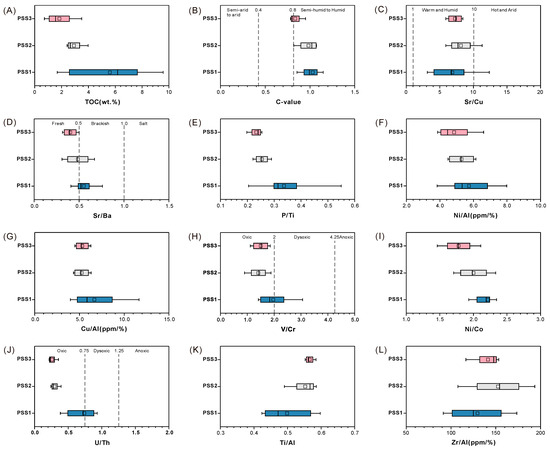
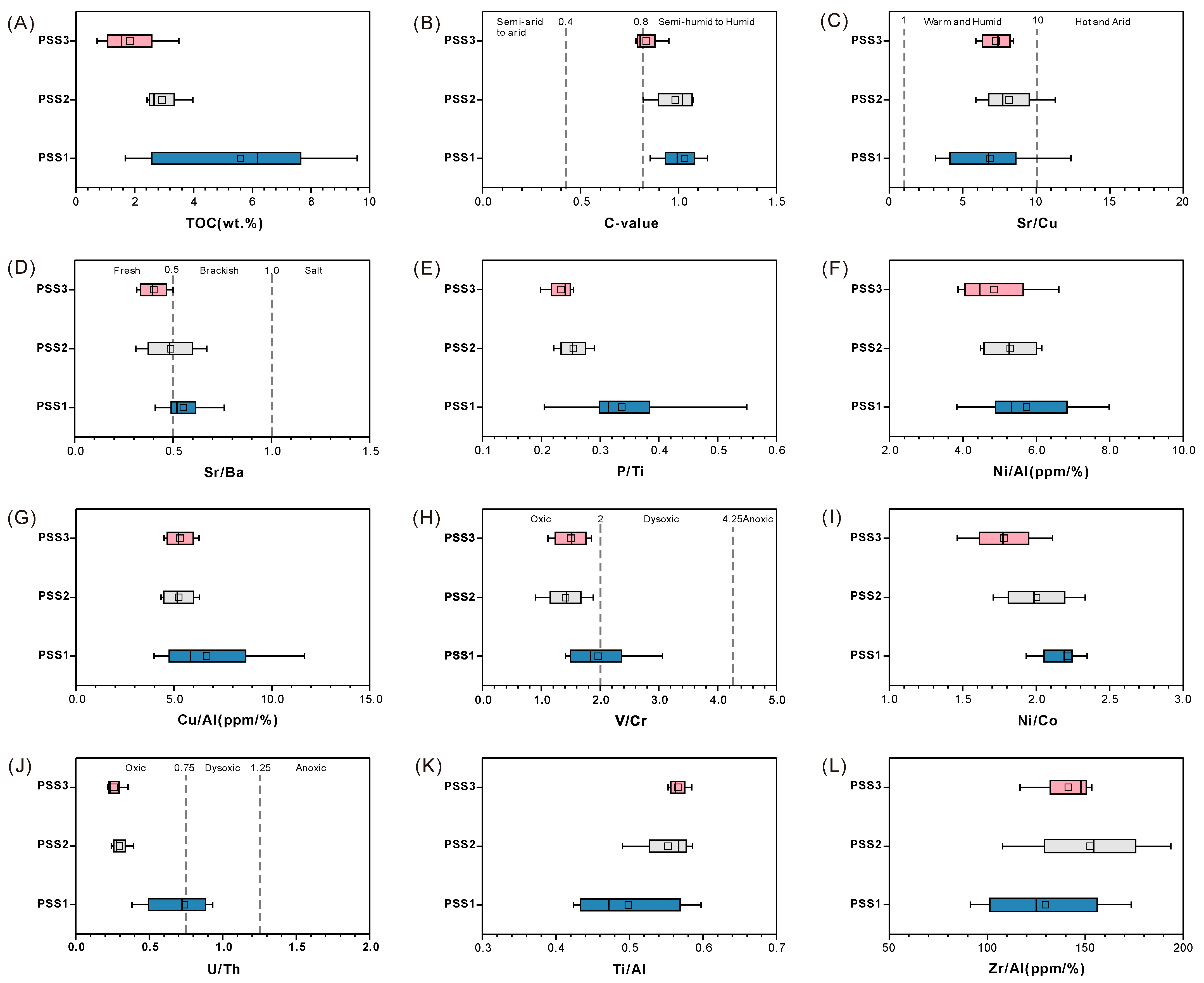
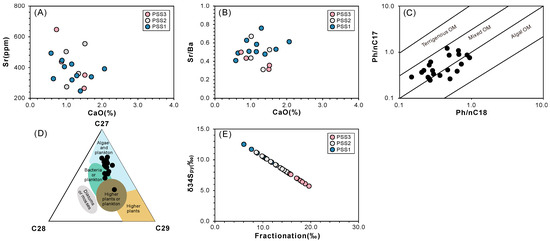
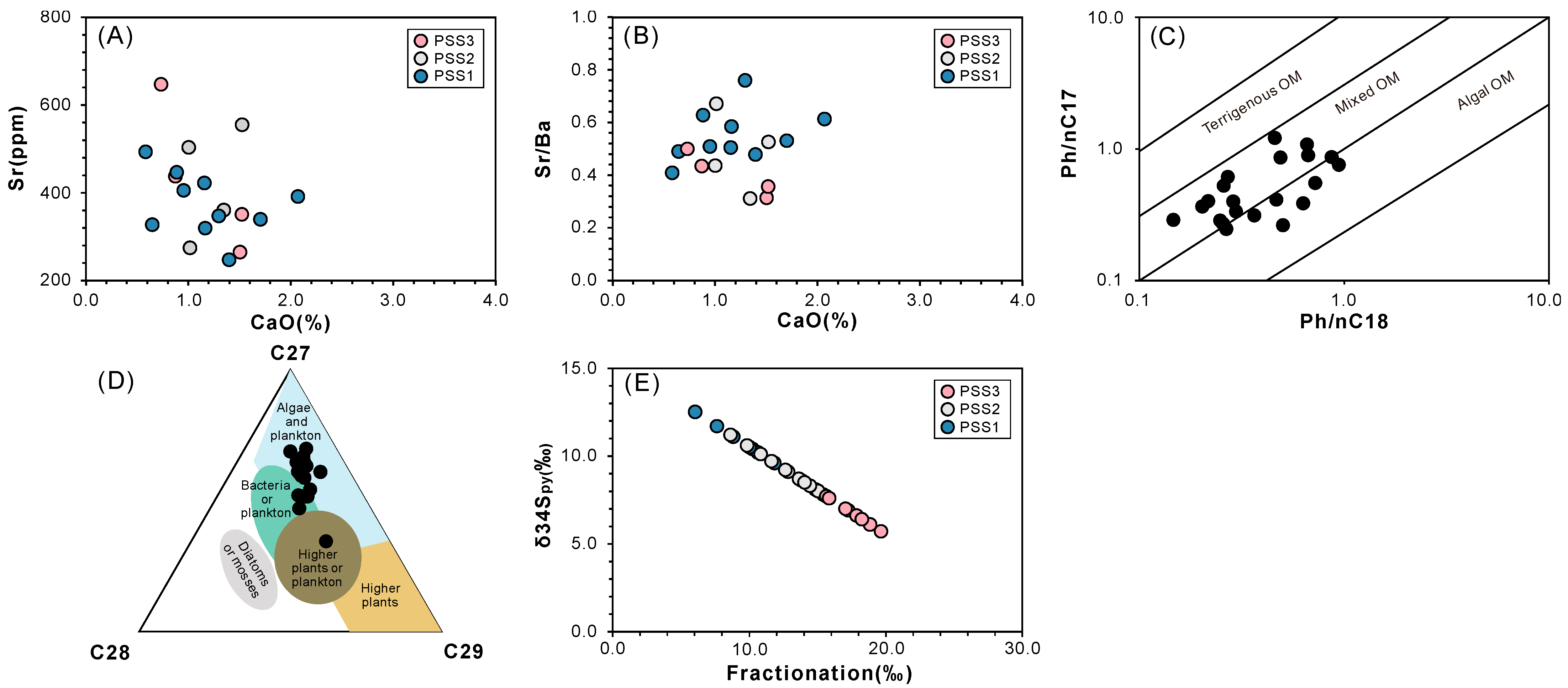
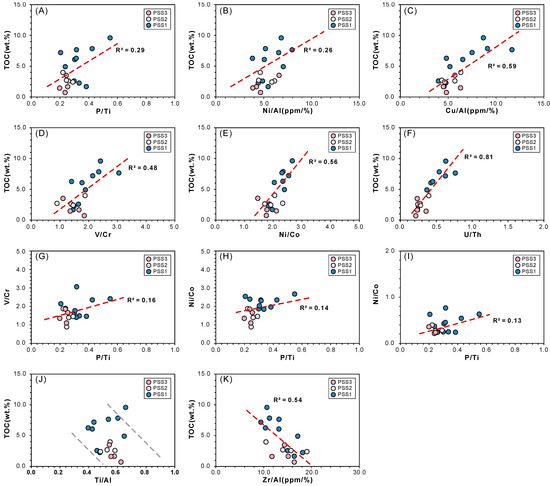
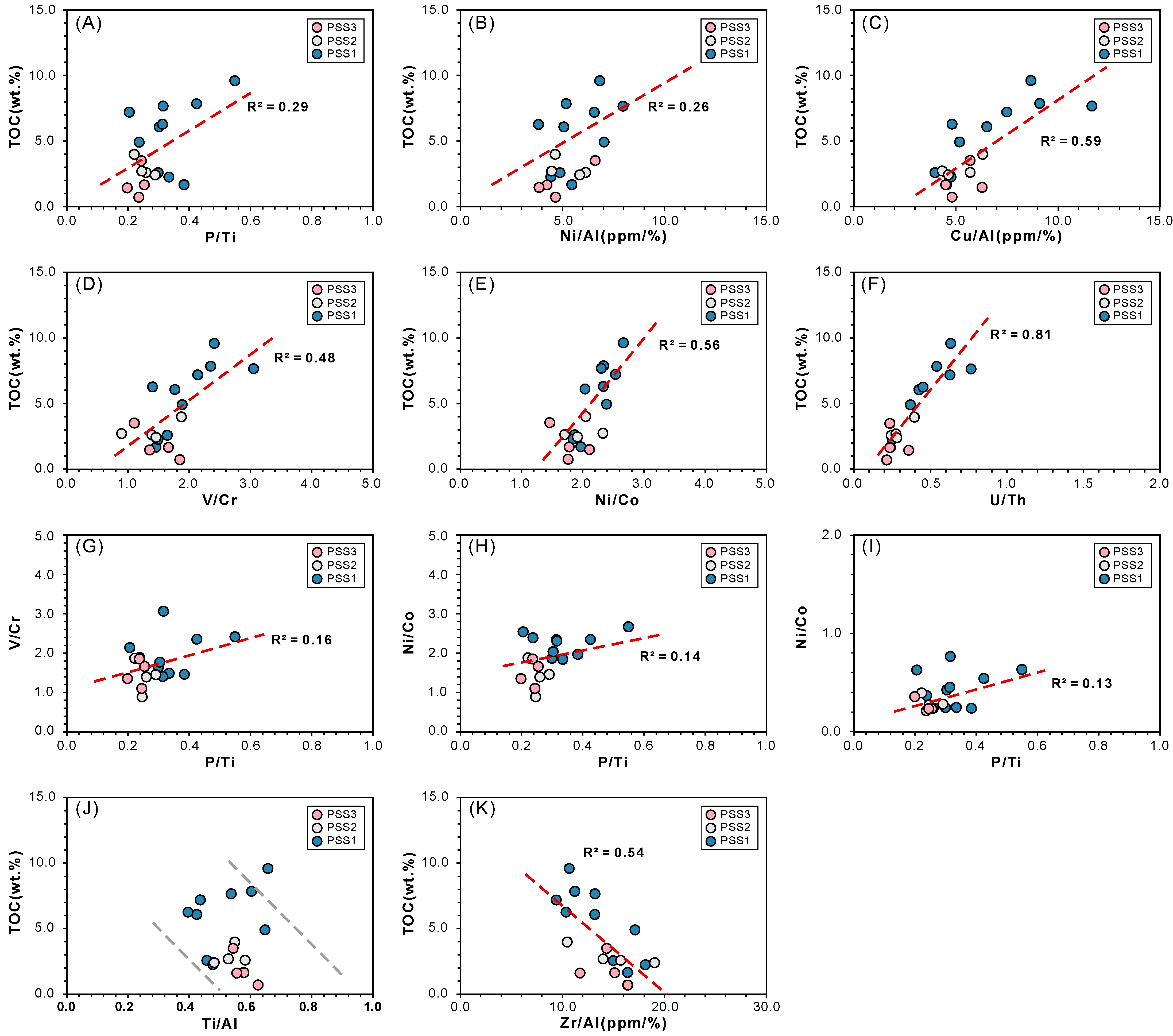
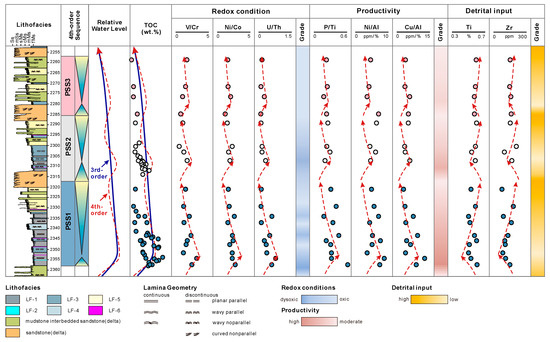
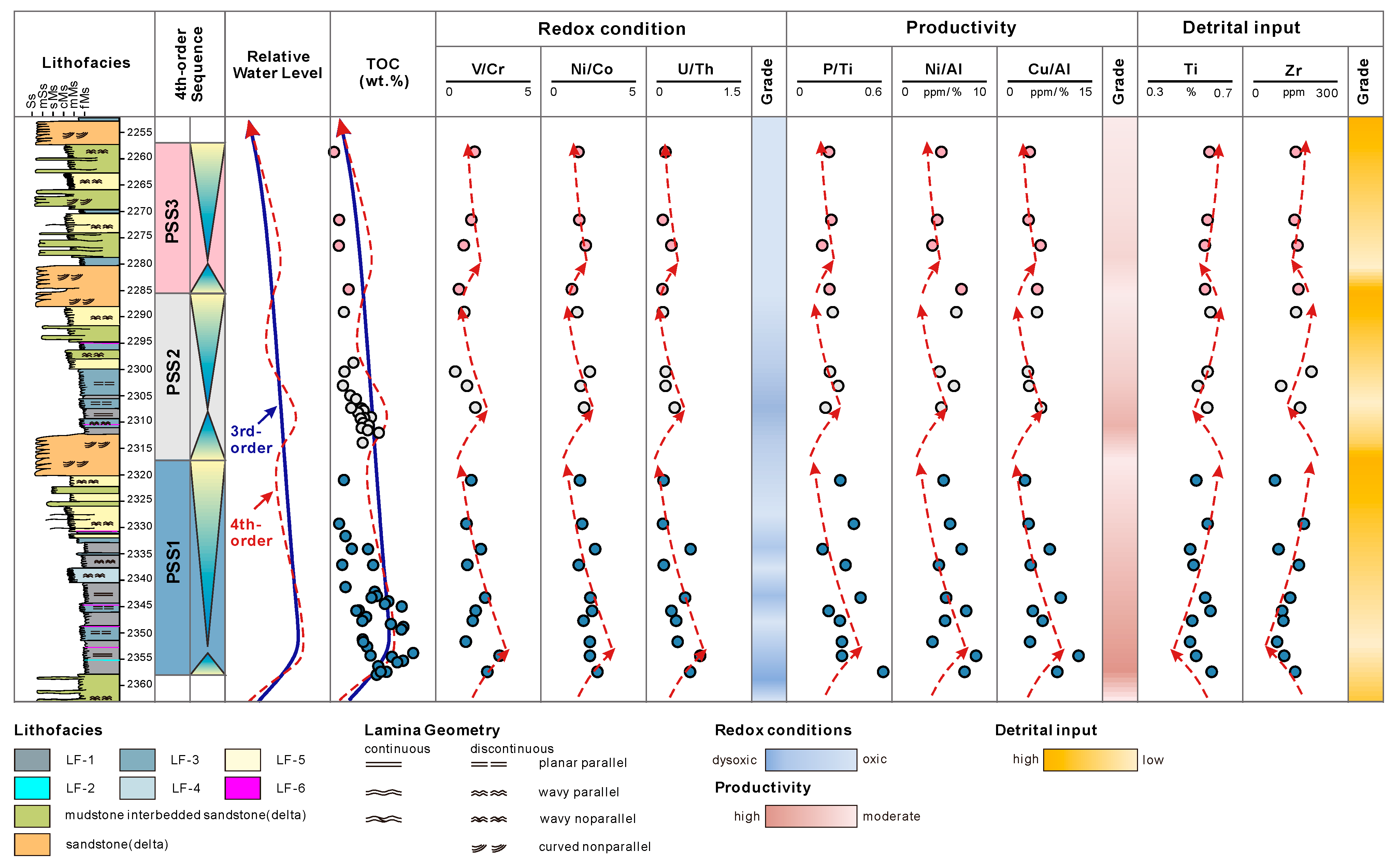
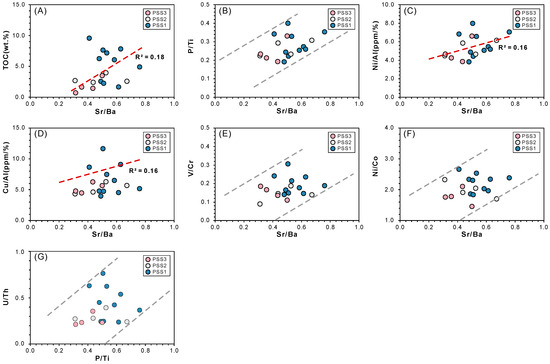
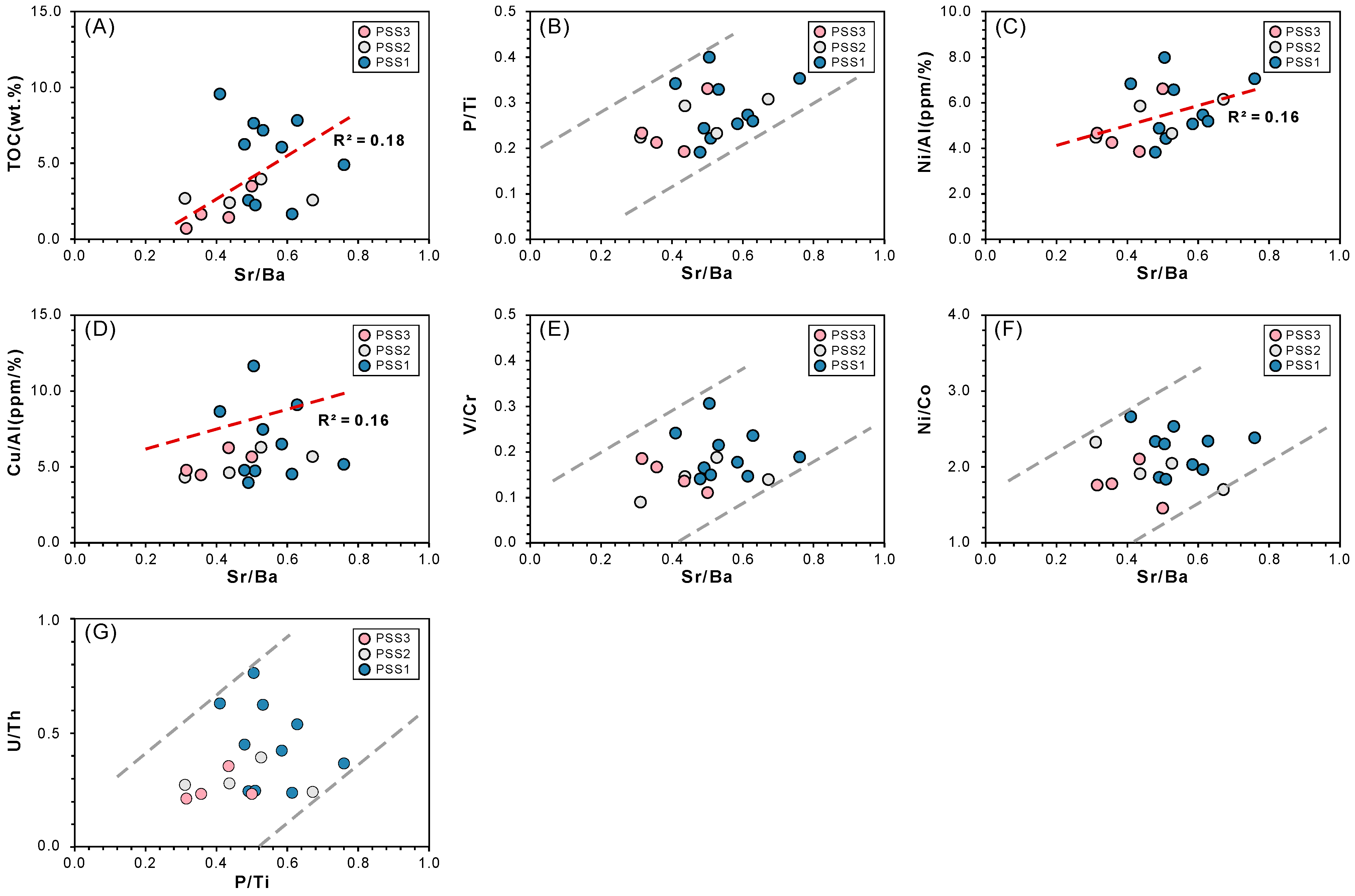
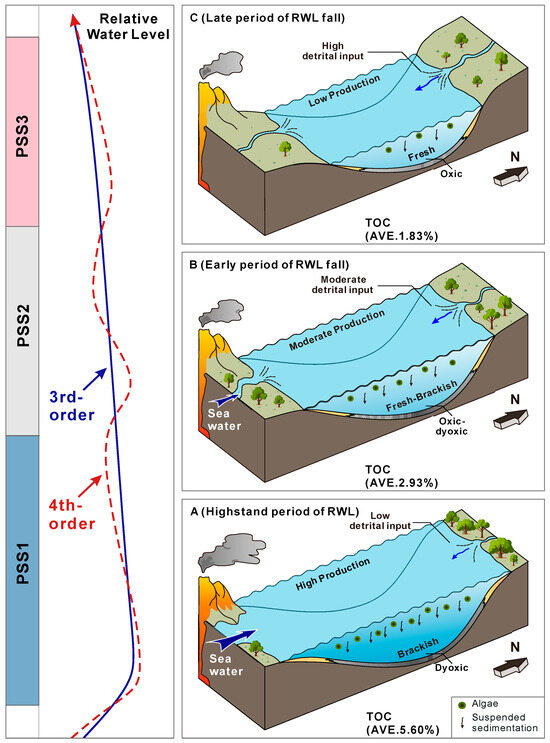
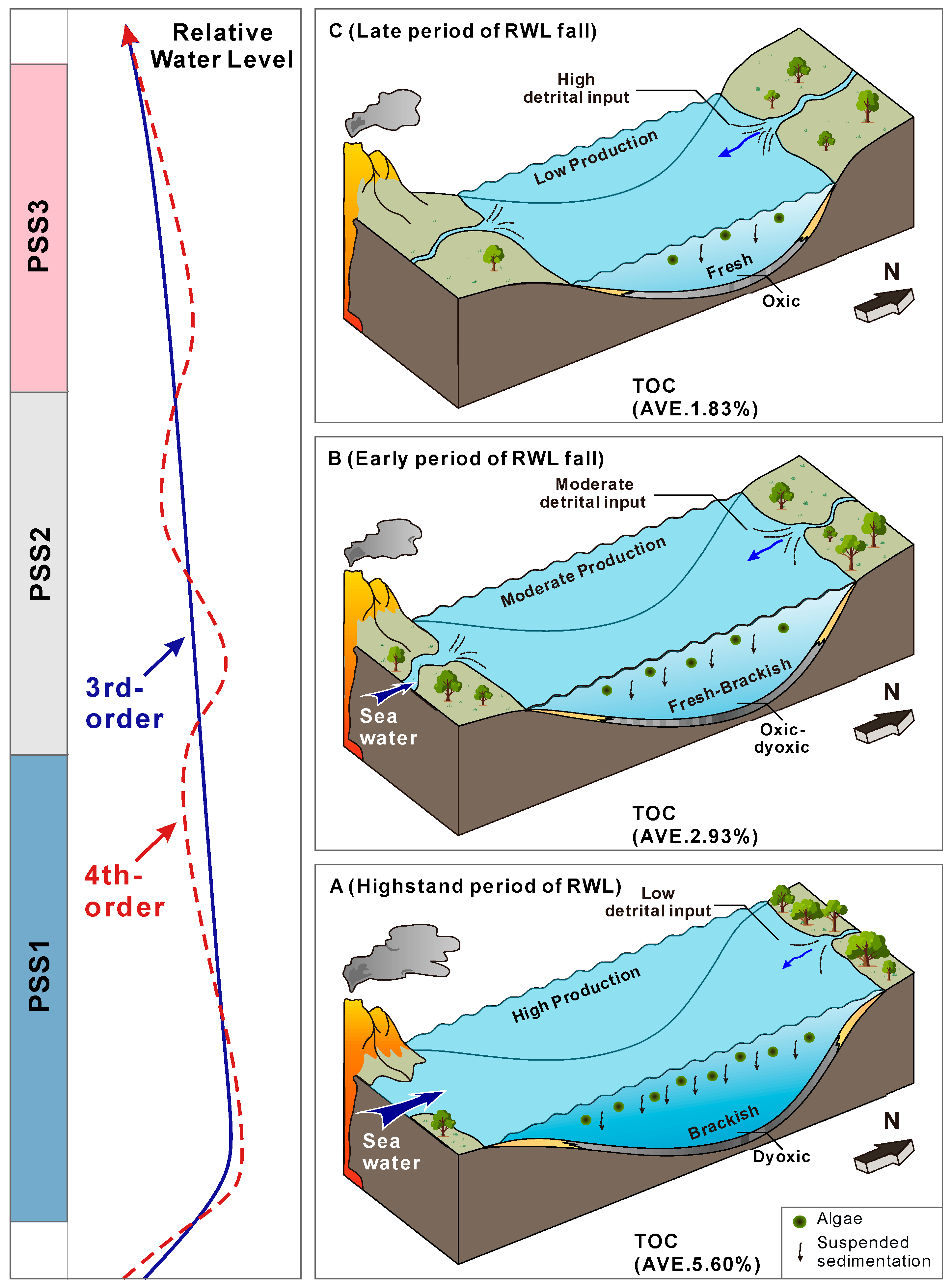
Disclaimer/Publisher’s Note: The statements, opinions and data contained in all publications are solely those of the individual author(s) and contributor(s) and not of MDPI and/or the editor(s). MDPI and/or the editor(s) disclaim responsibility for any injury to people or property resulting from any ideas, methods, instructions or products referred to in the content. |
© 2026 by the authors. Licensee MDPI, Basel, Switzerland. This article is an open access article distributed under the terms and conditions of the Creative Commons Attribution (CC BY) license.