


Abstract
As offshore wind power development advances into deeper waters, tension leg platform (TLP) floating wind turbines stand out for their excellent motion performance, lightweight structure design, and minimal seabed footprint. This paper reviews the advancements in TLP technology, covering structural configurations, dynamic characteristics and control strategies. Particular emphasis is given to analyzing dynamic response under combined environmental loads, including nonlinear motions induced by higher-order wave forces and parametric excitations, as well as the multiphysics coupling mechanisms involving aerodynamics, hydrodynamics, servo control, and structural dynamics. The review concludes by outlining future trends in platform scaling, intelligent operation and maintenance, and multi-energy integration. Overall, this review provides strategic insights for further research and engineering applications of TLP floating wind turbines.
1. Introduction
The global demand for energy transition is driving offshore wind development from shallow nearshore waters to deep-sea areas. When water depth exceeds approximately 50 m, the economics of fixed-bottom foundations decrease significantly, making floating wind turbines the mainstream technological pathway [1]. Among various floating foundation types, TLPs have become a focal point for research and industrial applications due to their excellent motion performance and wide adaptability to varying water depths.
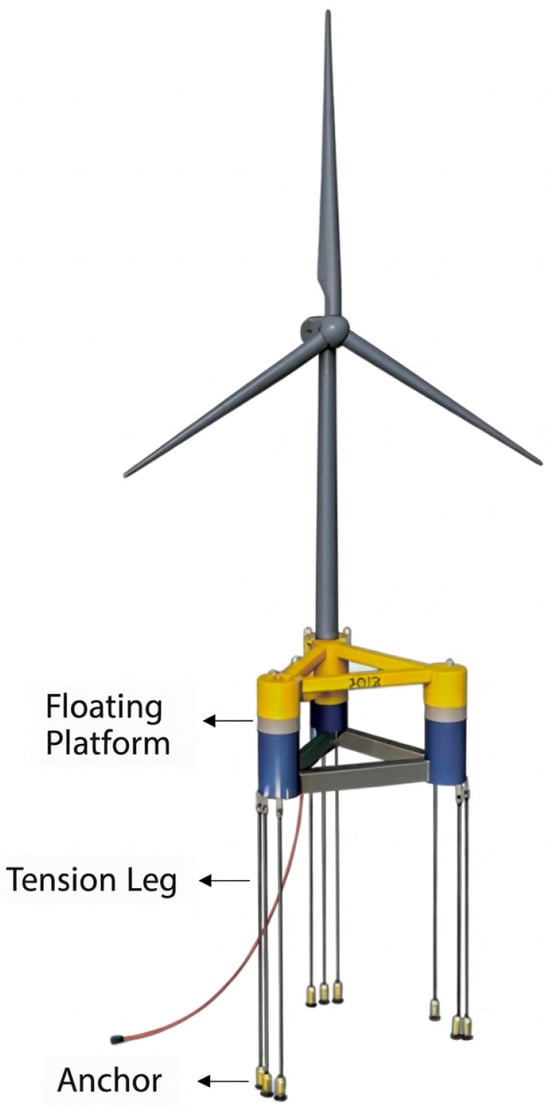
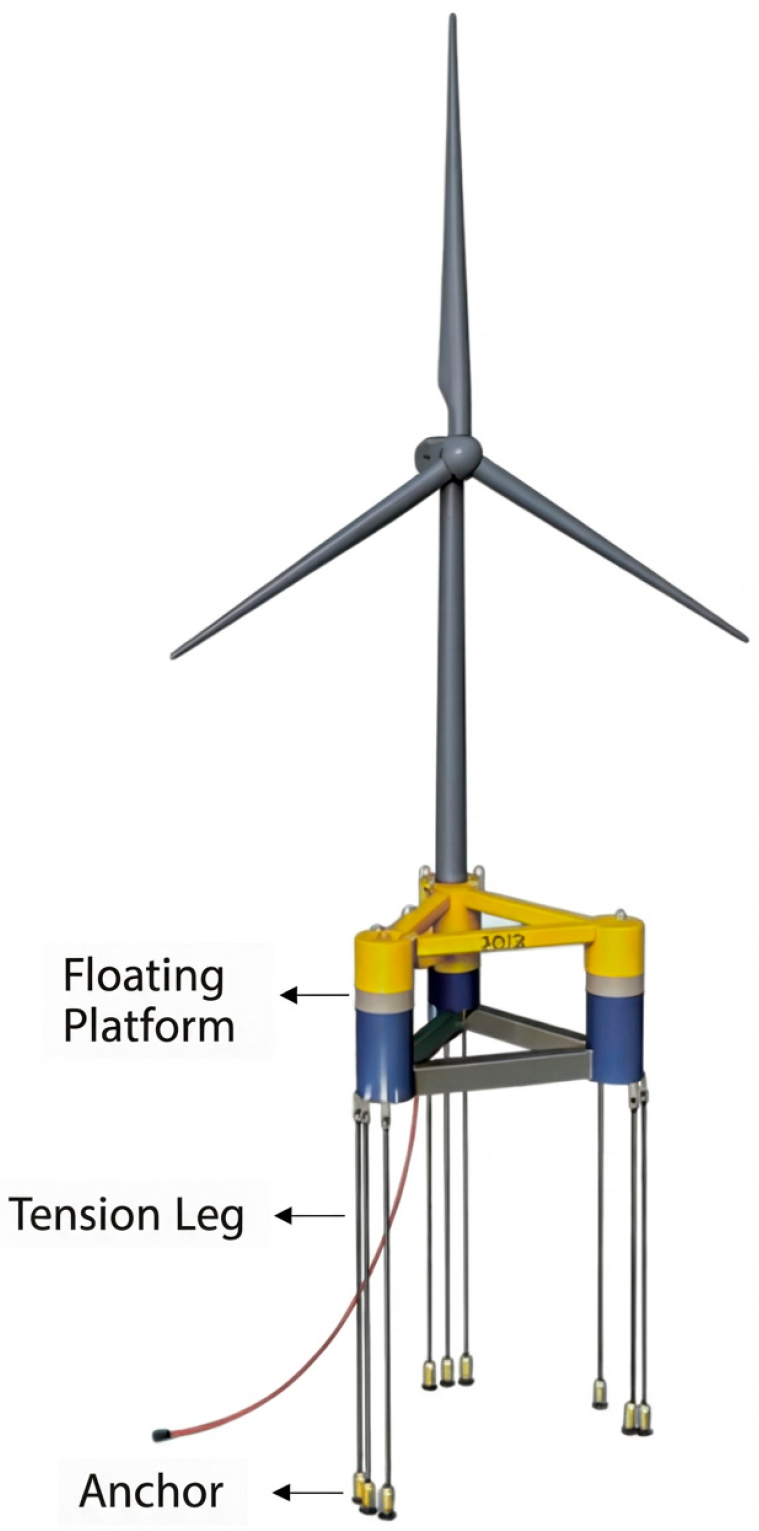
The main structure of a TLP consists of three parts: the floating platform, the tension leg system, and the anchoring foundation (an example shown in Figure 1). The floating platform, typically composed of multiple vertical buoys or columns, provides buoyancy to support the entire platform and the wind turbine generator. The tension legs are high-strength tendons subjected to pretension, anchoring the platform to the seabed. The anchoring foundation, employing forms such as gravity anchors, suction anchors, or pile foundations, provides anchorage points for the tension legs, withstands tensile forces from the platform, and transfers them to the seabed.
Figure 1.
An example of structural components of a TLP.
TLPs achieve vertical rigid constraint and horizontal compliance through the balance between the buoyancy of the floaters and the pretension of the tension legs. Their motion characteristics include suppressed heave, roll, and pitch motions (except under high-order nonlinear wave loads), while surge, sway, and yaw motions retain compliance, adapting to environmental loads through the elastic deformation of the tendons. The design and installation of the TLP system require strict control over the arrangement accuracy and pretension magnitude of the tension legs to avoid dynamic instability caused by initial deviations.
The unique rigid–flexible coupling of the TLP’s pretensioned mooring system confers a distinct advantage in floating wind turbines: significantly enhanced motion stability compared to semi-submersible or Spar platforms, resulting in minimal nacelle movement. In terms of structural weight, TLPs rely on pretension rather than ballast for stability, resulting in lower material usage for the platform itself and offering significant weight-saving potential. For example, the PelaStar TLP developed by Glosten can reduce the total mass of the turbine tower and floating platform by 35%, with potential for 50% weight reduction after future optimization [2]. Furthermore, TLPs use a vertical tensioned mooring system, with a seabed footprint much smaller than traditional catenary systems. Studies show that under 100 m water depth conditions, its seabed occupancy area can be reduced to 1/1000 of traditional layouts, facilitating high-density wind farm arrangement and overall cost control [3]. A small footprint implies less impact on the underwater environment. TLPs also offer wide water depth adaptability, covering ranges from 50 m to over 2000 m, making them suitable for mid-to-far offshore wind energy development. Their structures possess good scalability, capable of accommodating turbines from the current 8–15 MW to larger capacities in the future, providing flexible solutions for large-scale development.
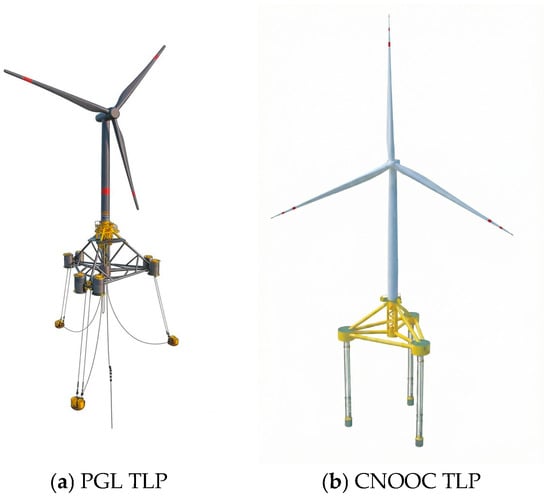
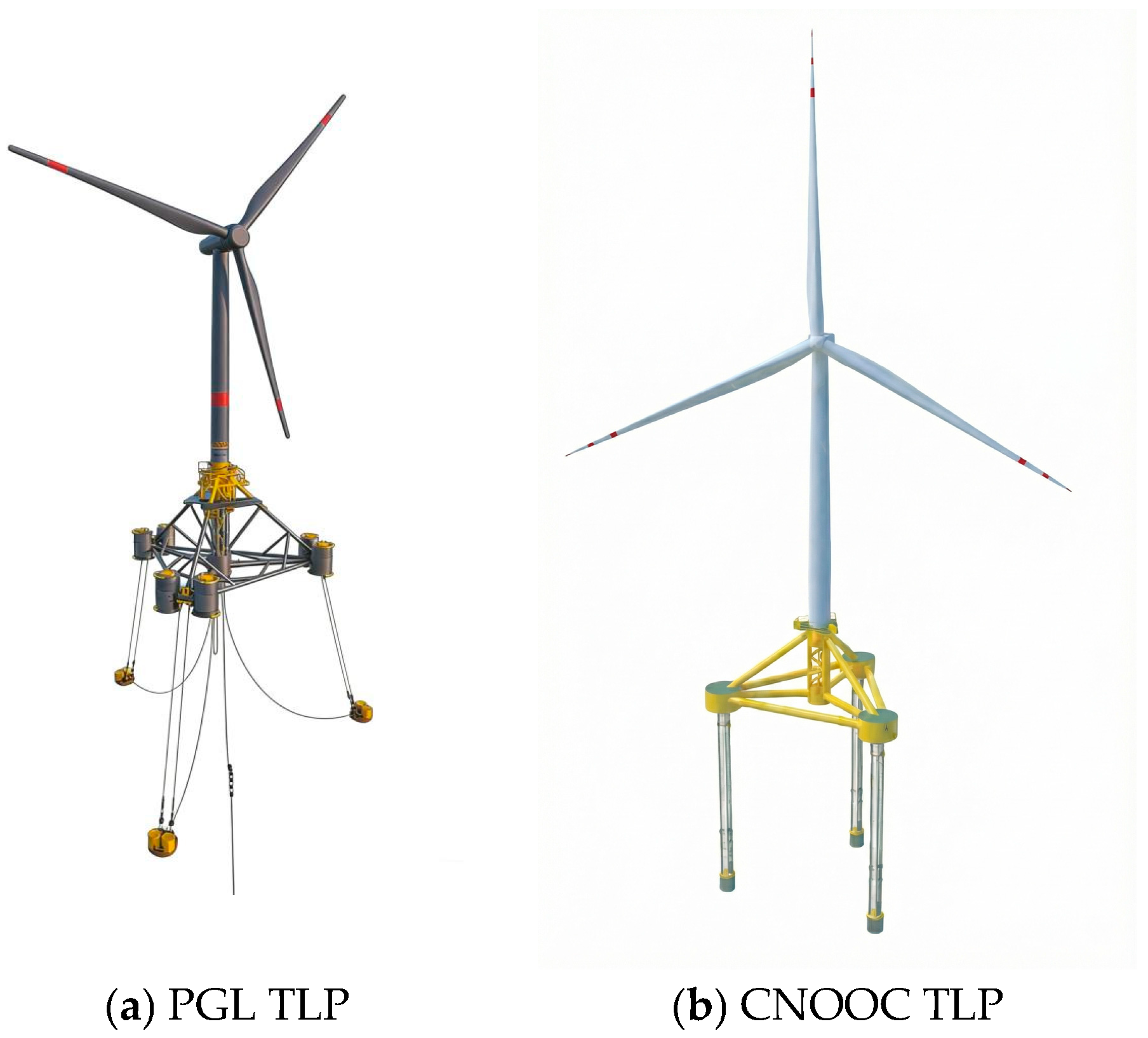
In November 2024, the world’s first TLP floating wind project—Provence Grand Large (PGL, as shown in Figure 2a)—was successfully connected to the grid in France, marking the entry of TLP technology into the engineering demonstration stage [4]. In China, CNOOC’s domestically designed 16 MW TLP floating wind power platform project has started construction (Figure 2b) [5]. While the structural configuration and dynamic characteristics of TLP floating wind turbines are relatively suitable for waters exceeding 45 m—such as those off China, the US, and Europe [6], their commercialization and large-scale deployment are still in the early stages. The challenges lie in transport, installation, and dynamic performance. Specifically, the installation process is complex and highly sensitive to seabed conditions, involving high-precision operations such as anchor foundation positioning, tendon pretensioning, and the particularly risky phase of platform docking [7], placing stringent demands on construction equipment and technology, with schedules susceptible to marine environmental impacts. During the wet tow phase, the platform lacks tension leg constraints and has insufficient self-stability, often requiring external stability support or the adoption of self-stabilizing variant designs. More importantly, TLPs are sensitive to high-frequency dynamic loads, leading to dynamic tension amplification and fatigue risks in the tension leg system. To avoid resonance, the platform’s natural frequencies must be optimized away from the dominant frequencies of the environmental loads through careful design and dynamic analysis. During operation, blade pitch control actions can either dampen or amplify platform motions depending on control law tuning, making controller–structure interaction a central determinant of global stability margins.
Figure 2.
Representative engineering applications of TLP floating wind turbines.
These complexities underscore the necessity for a systematic review of the nonlinear dynamic response and control of TLP floating wind turbines, which this paper aims to provide as a reference for future technological development. Although TLPs possess distinct global stiffness characteristics, the local hydrodynamic nonlinearities—stemming from fluid–structure interactions and variable wetted surfaces—share fundamental physical mechanisms with semi-submersible and shallow-draft platforms. Consequently, recent findings from these floater concepts offer critical, transferable insights. For instance, analyses of wave spectral properties have elucidated the mechanisms governing impulsive snap loads and low-frequency drift [8], while research on geometry-induced nonlinearities has identified complex instability modes, including period-doubling bifurcations [9]. Methodologically, advances such as harmonic separation techniques for isolating super-harmonic forcing [10] and homotopy perturbation frameworks for solving nonlinear equations [11] provide robust analytical tools directly applicable to the hydrodynamic refinement of TLPs.
2. TLP Configurations Design and Dynamic Implications
The overall design and optimization of TLP wind turbines are closely dependent on the target water depth and marine environmental conditions. The core of its design lies in balancing buoyancy, stability, and hydrodynamic loads.
2.1. Floating Platform
To meet the needs of different application scenarios, researchers have developed various TLP configurations, featuring configurations such as mono-column, multi-column, and truss-type designs [12]. The pursuit of optimal performance, cost-effectiveness, and installation feasibility has driven the evolution of TLP configurations from traditional oil and gas designs towards concepts specialized for floating wind turbines. These structural innovations directly influence the system’s mass distribution, hydrodynamic characteristics (added mass, damping and wave excitation, etc.), and restoring stiffness, thereby fundamentally altering its dynamic response. This section classifies and critiques prevailing TLP floating wind turbine concepts, with a particular emphasis on their design philosophy and inherent dynamic characteristics (as summarized in Table 1).
Table 1.
Comparison of TLP configurations for floating wind turbines.
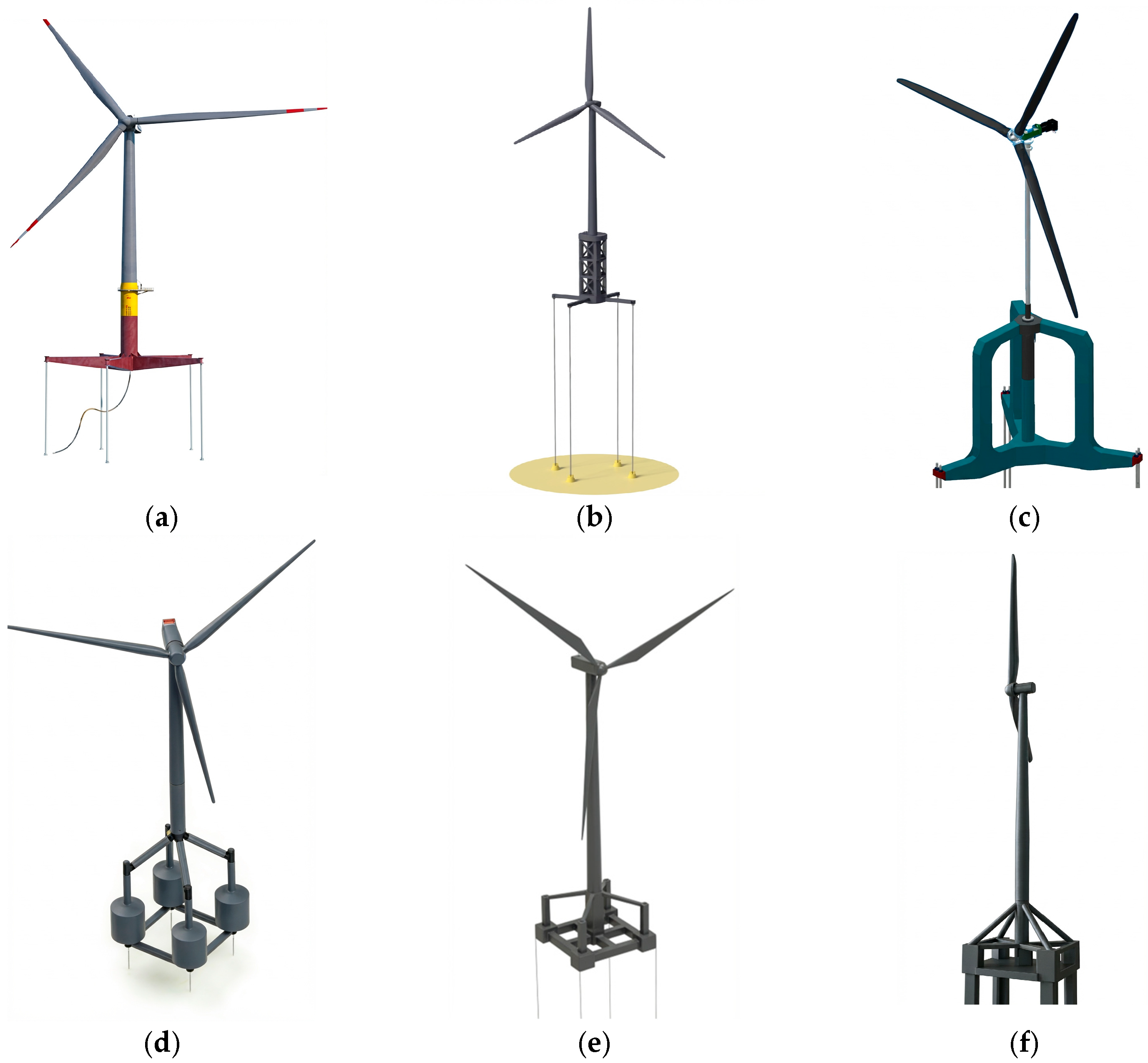
Mono-column TLP features a central column providing primary buoyancy, connected to several radial extended arms for tendon attachment. This concentrated buoyancy and mass can lead to favorable inertial properties. The extended arms provide a large fairlead radius, enhancing pitch and roll stiffness. However, the centralized structure may also lead to significant stress concentration at the tower base [13]. Moreover, the small waterplane area results in limited hydrostatic stability, making the platform susceptible to large-angle tilting during wet tow without auxiliary stabilizers [14], which economically constrains large-scale application. To address this limitation, research has shifted towards enhancing integrated wet towing (turbine + floater) and rapid installation capabilities. For instance, the PelaStar TLP (Figure 3a) achieves excellent motion performance and cost-efficient transport/installation with a concise design, characterized by a five-arm central column structure and the pioneering use of light-weight synthetic tendons to simplify the mooring system [15]. The MIT/NREL TLP (Figure 3b) employs cylindrical columns with a bottom concrete ballast design and is moored by four pairs of vertically arranged tension legs. This platform has the potential for self-stable transport and rapid offshore installation, enabling integrated wet towing by adjusting heave ballast during transit, thus avoiding offshore turbine installation operations [16].
Multi-column TLP employs multiple perimeter columns (typically three or four) connected by pontoons. The distributed buoyancy provides inherent hydrostatic stability, simplifying towing and installation. The load path is more dispersed, potentially reducing stress at the tower connection. The additional waterplane area of the columns contributes to initial pitch and roll restoring stiffness. The design aims to synergistically optimize motion performance, weight, and economy. For example, the WindStar TLP (Figure 3c) achieved a lighter platform compared to the MIT/NREL design through parametric comparative analysis and demonstrated good motion characteristics under extreme sea states [13,17]. The GICON®-TLP (Figure 3d) evolved from an initial three-leg structure to a square truss/shell structure, increasing the number of buoys and anchor points to enhance stability redundancy. It employs gravity anchors and integrated towing strategies [18,19], showing potential for reducing the Levelized Cost of Energy (LCOE) [20]. The CENTEC-TLP (Figure 3e) was optimized in its waterplane design to suit shallow-draft ports and harbors [21,22,23,24,25,26]. It should be noted, however, that the multiple slender columns introduce more complex wave scattering. The natural frequencies in surge and sway may be lower compared to a more compact single-column design.
Truss-type TLP utilizes a space-frame structure, often with minimized waterplane area to reduce wave loads. A prominent example is the TLP used in the PGL project (Figure 2). The small waterplane area leads to a significant reduction in first-order wave loads. This structural type is inherently lightweight and cost-effective to fabricate. However, the slender brace members are highly susceptible to wave slamming and VIV, which are critical for fatigue analysis. The structural flexibility of the truss work can lead to hydroelastic effects, making the global dynamic response more complex to model accurately than a rigid-body platform. The Submerged TLP (STLP) (Figure 3f) addresses some of these challenges by maintaining a large waterplane area during transport to ensure stability, then submerging to an optimal position to improve the hydrodynamic performance during operation. This design achieves a balance between self-stable wet towing and satisfactory operational performance [27,28].
Figure 3.
Different TLP wind turbine configurations. (a) Pelastar TLP [2]; (b) MIT/NREL TLP [16]; (c) WindStar TLP [17]; (d) Gicon®-TLP [20]; (e) CENTEC-TLP [24]; (f) STLP [27].
2.2. Tension Leg System
The tension leg system is the core ensuring the platform’s motion performance and safety. Crucially, it is also the primary source of many of the system’s defining nonlinear dynamic behaviors. The key to its design lies in the optimal determination of parameters such as the number of tendons, diameter, length, and pretension, requiring comprehensive consideration of marine environmental loads and turbine operational requirements to ensure minimal horizontal displacement and the avoidance of tendon slackness or excessive tension. Simultaneously, the material composition of the tension legs has undergone a significant evolution, shifting from the rigid steel pipes traditionally employed in the oil and gas sector to more compliant materials for FOWT applications. Recent studies [13,14,21,29,30] have extensively explored the use of flexible wires or polyester ropes. This transition from rigid to flexible tendons fundamentally alters the system’s dynamic characteristics; while rigid pipes strictly limit the floater’s motion, flexible lines introduce complex hydro-elastic coupling effects. Consequently, this shift necessitates sophisticated time-domain numerical modeling to accurately capture the interaction between the mooring system and the platform’s response, moving beyond simple rigid-body assumptions. Specifically regarding advanced materials, Leenders et al. [31] investigated the feasibility of parallel wound HMPE tendons. Their study emphasized the necessity of using a constitutive model that accounts for viscoelasticity and creep evolution to accurately predict the long-term hull draft and mooring integrity compared to traditional steel components. In terms of configuration innovation, as seen in the PGL TLP and studied by Jia et al. [32] inclined tendons provide restoring forces in both horizontal and vertical directions. This geometry can improve the platform’s positioning capability and dampen certain modes of motion, but it also introduces coupling between surge-heave and pitch motions that must be carefully analyzed. Complementing this, Qu et al. [33] provided quantitative insights into this geometry through numerical and experimental analysis. They demonstrated that increasing the tendon inclination angle significantly reduces tension fluctuations and tower base bending moments, albeit at the cost of increased static tension requirements to maintain stability. Addressing the economic needs of large-scale wind farm development, shared anchoring systems are gradually gaining attention. Research by Ramachandran et al. [34] suggests that multiple TLPs can share a single large anchoring foundation, thereby reducing the number of anchor points and installation workload, lowering overall costs. Regarding the anchoring foundation, particularly for suction caissons in soft clay, Ke et al. [35] conducted model tests under sustained and cyclic loadings. Their findings highlighted that internal suction pressure contributes significantly to uplift resistance, and they established a semi-logarithmic correlation between cyclic uplift capacity and the number of cycles to failure, providing a data-driven basis for storm-resistant design. Such studies, often based on systems engineering and cost modeling methods, reflect the development trend of tension leg system design from single-platform optimization towards farm-level intensive arrangement, providing important ideas for large-scale development.
2.3. Design Requirements and Standards
The design of a TLP wind turbine in the industry is governed by a comprehensive set of standards and guidelines, which define the fundamental requirements for safety, reliability, and performance throughout its lifecycle. The structural design process is fundamentally centered on verifying the system’s integrity against predefined limit states. These include: Ultimate Limit State (ULS), Fatigue Limit State (FLS), Accidental Limit State (ALS) and Serviceability (SLS)—under site-specific metocean and operational scenarios. Despite differences in structure and scope, DNV-ST-0119 [36], API RP 2T [37], the ABS Guide for Building and Classing Floating Offshore Wind Turbines [38], and IEC 61400-3-2 [39] share several fundamental requirements. All four standards consistently recognize that a TLP’s global stability derives primarily from its tendon system rather than hydrostatic restoring forces, thereby necessitating strict control of tendon pretension, minimum tension margins, and weight/center-of-gravity management. They further mandate coupled aero-hydro-servo-mooring simulations to capture nonlinear interactions among turbine controls, floater response, environmental loading, and tendon dynamics. Across all documents, the treatment of high-frequency loads—such as ringing and springing—is highlighted as essential for accurate extreme-load and fatigue assessment, while full-life tendon fatigue analysis and ALS evaluations, including single-tendon or anchor failure scenarios, are uniformly required.
However, the four standards diverge considerably in methodological depth and emphasis. API RP 2T provides the most comprehensive engineering guidance on tendon sizing, pretensioning strategy, installation procedures, and construction practices, reflecting its origin in oil-and-gas TLP applications. In contrast, DNVGL-ST-0119 offers a certification-oriented framework tailored to floating wind, with explicit requirements for intact and damaged stability, tendon performance envelopes, and consequence-class-dependent fatigue design factors. The ABS FOWT Guide blends API’s practical engineering detail with class-society compliance requirements, offering clear definitions of fatigue design factors, proof-load testing procedures, and shared-anchor considerations. IEC 61400-3-2 distinguishes itself by embedding TLPs within a wind-turbine-specific design load case (DLC) framework, emphasizing control-system coupling, probabilistic robustness assessments, and simulation-quality criteria rather than prescribing fixed safety factors.
Due to the structural characteristics of TLPs, some specific design standards and requirements are distinguished from those of other floating platforms. Table 2 highlights the design constraints and verification requirements imposed on TLP systems.
Table 2.
Distinctive requirements for TLPs across four major standards.
2.4. Critical Design Considerations
The dynamic response of a TLP floating wind turbine depends heavily on the deterministic selection and optimization of its key design parameters. Ensuring system stability, structural integrity, and power generation efficiency requires a thorough understanding of the interplay between these parameters and the resultant global dynamic behavior.
The tendon system is the primary source of vertical stiffness, and its pretension directly shapes the natural frequencies of the heave, pitch, and surge modes. Its calibration is paramount to maintaining positive tendon tension under extreme environmental conditions, thereby mitigating the risk of slackness and the severe snap loads during tendon re-tensioning events [40]. However, excessive pretension elevates mean stress levels, shifts eigenfrequencies toward energetic wave bands, and amplifies fatigue–critical dynamic tension. The geometric configuration of the tendons, variations in their inclination angles, and their interaction with both soft and rigid connectors also represent critical design considerations. Conditions involving large deflection angles and platform settlement may induce localized high stress at connection points, necessitating control through coupled numerical simulations and detailed local strength assessments.
The structural characteristics of the platform also have a significant impact on the overall performance of the TLP floating wind turbine. The platform displacement and mass distribution define the system’s inertial characteristics. The displacement provides the requisite buoyancy, while the strategic allocation of mass and ballast determines the center of gravity and mass moments of inertia. A lowered center of gravity enhances static stability, whereas increased mass moments of inertia prolong the natural periods in rotational degrees of freedom. While this can be advantageous for avoiding wave-frequency resonance, it risks convergence with the turbine’s operational excitation frequencies.
Consequently, the design process necessitates an iterative optimization framework, typically supported by high-fidelity numerical modeling. The objective is to converge upon a balanced design that minimizes platform motions and structural loads while adhering to the stringent constraints of the frequency map. The successful navigation of this initial design phase is a critical prerequisite for addressing the complex nonlinear dynamic challenges that form the focus of subsequent analytical discourse. For example, Lee et al. [41] established a multi-objective optimization framework combining orthogonal experimental design and hydrodynamic analysis in AQWA, achieving weighted optimization of indicators such as displacement, nacelle acceleration, and tendon tension. With the introduction of advanced technologies like machine learning, parametric optimization research for TLP configurations has transitioned from single-parameter adjustment to multi-objective, system-level collaborative design. The deep integration of parametric analysis, intelligent optimization algorithms, and structural innovation has significantly improved the overall performance and economy of the platforms.
3. Dynamic Characteristics of TLP Wind Turbines
The TLP floating wind turbine is a coupled system combining TLP technology with ultra-large wind turbine structures. Its dynamic characteristics are significantly different from other floating platform types due to the unique design of the tension leg system. This system provides nonlinear restoring stiffness through pretensioned vertical mooring lines, exhibiting excellent heave motion suppression capability under extreme sea states, but also facing special challenges such as dynamic tension snap loads in tendons, parametric vibrations, and fatigue damage. While subject to the same environmental loads as other floating concepts, the TLP’s dynamic response is uniquely characterized by the intense nonlinear coupling between its highly constrained tension leg system and the aero-hydro-structural excitations. This section systematically reviews the inherent system coupling mechanisms and nonlinear problems, as well as the overall dynamic response under environmental loads.
3.1. System Coupling Mechanisms and Nonlinear Effects
3.1.1. Strong Coupling of Aerodynamic-Hydrodynamic-Servo-Structural
Accurate prediction of aerodynamic loads is the foundation of coupled dynamic analysis for floating wind turbines. Commonly used aerodynamic models range from engineering-level methods to high-fidelity simulations. Blade Element Momentum (BEM) theory and its correction models, such as tip loss corrections [42], dynamic stall [43], skewed wake [44], and dynamic inflow corrections [45], remains the industry standard due to its efficiency but relies on steady-state assumptions. To account for dynamic inflow and skewed wake effects, corrections such as the Generalized Dynamic Wake (GDW) model are often applied. However, for TLP systems characterized by specific motion frequencies, these simplified models may struggle to capture complex interaction phenomena, necessitating the use of higher-fidelity approaches like Free Vortex Wake (FVW) or CFD.
The dynamic interaction between aerodynamic loads and platform motion significantly influences the performance of TLP systems. While BEM theory is computationally efficient, research indicates it has limitations in capturing the unsteady effects induced by floating platform motions. Xu et al. [46] utilized the Free Vortex Wake (FVW) method to demonstrate that platform surge and pitch motions cause wake distortion, leading to a significant redistribution of aerodynamic loads along the blade span. This necessity for high-fidelity modeling was further supported by Sant and Cuschieri [47], whose comparative analysis highlighted that simplified aerodynamic models might underestimate the transient loads resulting from large-amplitude platform oscillations.
Furthermore, accurate aerodynamic modeling is not only about thrust prediction but is crucial for capturing aerodynamic damping, which governs the global motion and structural loads. Wang et al. [48] highlighted this by conducting integrated aero-hydro-servo-elastic simulations, revealing that aerodynamic damping is a decisive factor in limiting the tension variability in TLP tendons; neglecting this coupling leads to overly conservative or inaccurate fatigue life estimates. To balance computational efficiency and fidelity in capturing these damping effects, Guo et al. [49] proposed a limited coupled model with a data-driven damping correction. By integrating Rayleigh damping to emulate global RNA dynamics, this approach accurately predicts platform motions and tendon loads under operational and parked conditions at a fraction of the computational cost of fully coupled models. Finally, the interaction creates complex feedback loops that challenge control system design. Aoki et al. [50] observed that standard blade pitch control strategies, if designed without accounting for the platform’s natural frequencies, can induce “negative damping” phenomena, inadvertently amplifying platform pitch motions and threatening system stability.
3.1.2. Structural Flexibility and Rigid-Flexible Coupling Effects
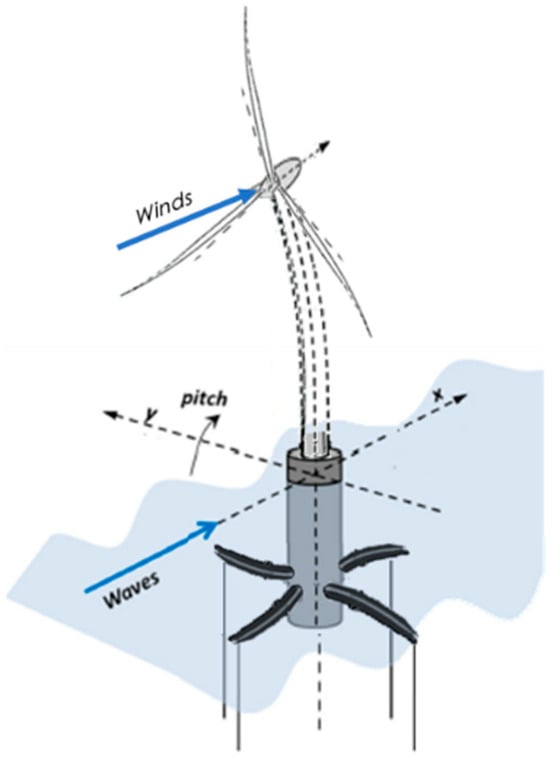
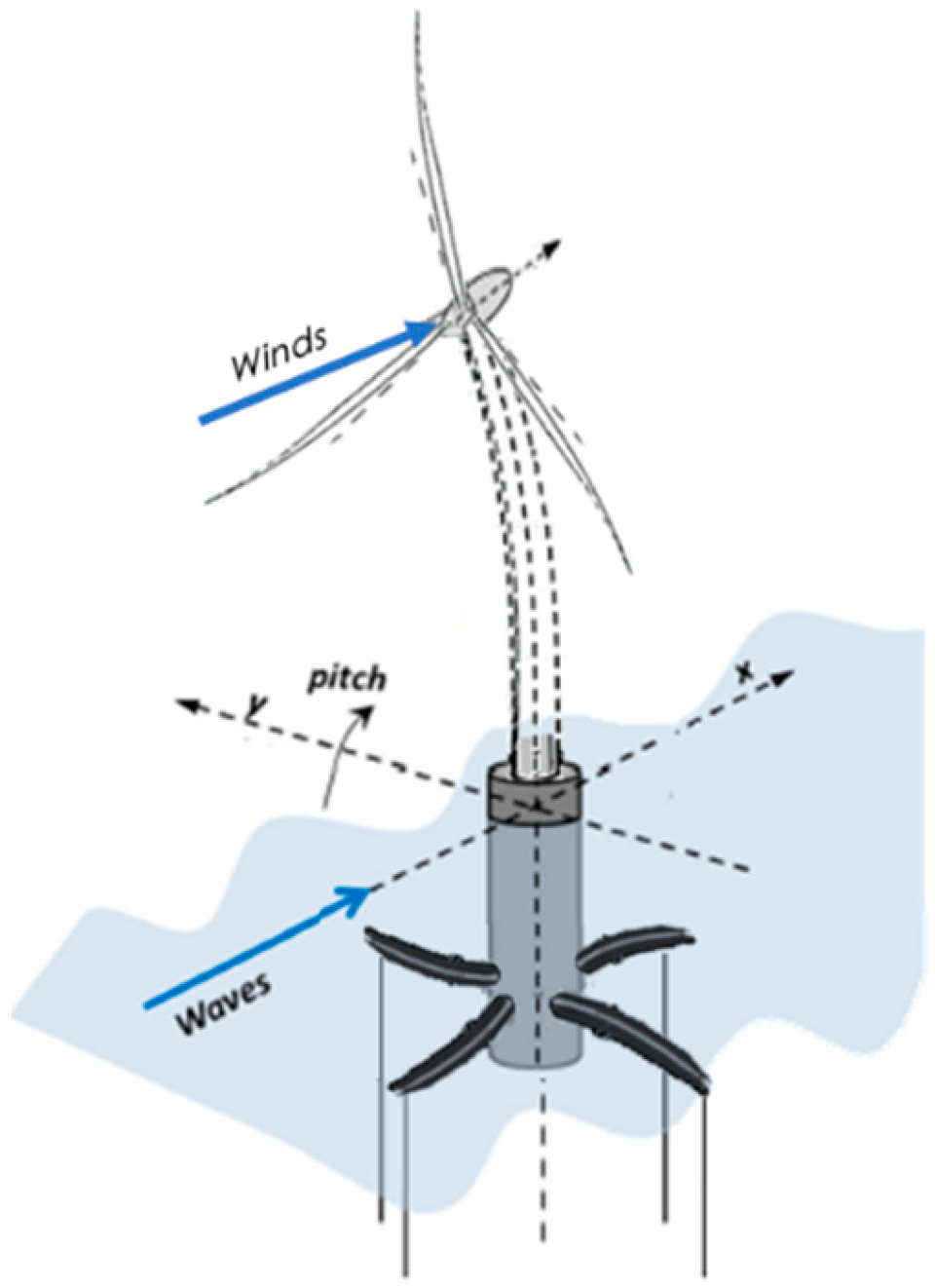
The dynamic response of a TLP floating wind turbine is governed by the coupling between the platform’s rigid-body motions and the elastic deformations of the tower and blades, as illustrated in Figure 4. This rigid-flexible interaction becomes increasingly pronounced with the trend toward larger turbine capacities, where increased structural dimensions lower the natural frequencies of the flexible components. Given the relatively short natural periods of TLPs in pitch and roll, there exists a significant risk of resonance where these modes coincide with the first tower bending frequency, presenting a critical challenge in the system design.
Figure 4.
Schematic of rigid–flexible coupling in a TLP wind turbine.
Substantial research has been dedicated to quantifying the impact of this coupling. Roald et al. [51] analyzed and demonstrated a significant coupling effect between tower flexibility and platform pitch, which affects the system’s second-order response under sum-frequency wave excitation. Vita et al. [15] used multi-software coupled simulation methods to verify the important influence of tower flexibility on tendon tension and tower base bending moment. Gueydon et al. [52] found that ignoring tower flexibility underestimates the dynamic amplification effect of second-order wave forces on the system. To mitigate these effects, design optimization strategies have been proposed. Kim et al. [30] proposed optimization suggestions for the platform’s natural pitch frequency, indicating it should be controlled within the 0.2–0.3 Hz range to avoid the rotor 3P frequency band (0.8–1.0 Hz) and the typical wave frequency band (0.05–0.2 Hz), thereby effectively reducing fatigue damage. This study also found that reducing the tower rotational inertia (e.g., by optimizing mass distribution) could improve system dynamic performance, but its potential impact on overall stability needs comprehensive consideration regarding ultimate limit states.
Furthermore, the flexibility of the submerged hull itself has been shown to significantly influence global dynamics. Silva de Souza and Bachynski [53] evaluated the effects of modeling the TLP pontoons as flexible beams. Their results indicated that hull flexibility can alter the system’s natural periods substantially, with the heave period increasing by approximately 40% and additional pitch modes emerging. A critical finding was that, despite inducing larger platform motions, pontoon flexibility led to a redistribution of internal loads, resulting in a reduction in predicted short-term fatigue damage at the tower base and tendons by 12.7% and 7.3%, respectively. This finding underscores that a conventional rigid-body hull assumption may yield non-conservative fatigue life predictions for certain structural components. Expanding on this, Ran and Bachynski-Polić [54] developed a fully coupled aero-hydro-servo-elastic model treating columns and pontoons as flexible bodies. Their results suggest that while full flexibility amplifies heave motion, standard rigid-body assumptions might paradoxically yield overly conservative fatigue life predictions for towers and tendons. Additionally, Ucar et al. [55] clarified that blade root fatigue is predominantly driven by platform pitch amplitude, whereas tower base fatigue correlates more strongly with the tower’s own stiffness characteristics.
Evidence from widely adopted floating concepts further corroborates the universality of hydro-elastic coupling. Investigations into 15 MW Semi-submersible and Spar platforms indicate that incorporating hull flexibility—via methods such as Discrete-Module-Beam modeling—can shift the tower bending natural frequencies by approximately 0.1 Hz, thereby amplifying tower-base moments and nacelle accelerations [56,57]. At a more granular level, accounting for Local Joint Flexibilities (LJF) has proven essential; neglecting these deformations in pontoon connections can mask fatigue damage by up to 80% [58]. Consequently, these cross-platform findings underscore that for ultra-large FOWTs, rigid-body assumptions are insufficient for accurate fatigue and ultimate load assessment.
Current research confirms that rigid-flexible coupling, involving both the tower/blades and the hull, is a fundamental aspect of TLP floating wind turbine dynamics. Accurate prediction of system response and fatigue life necessitates the use of coupled simulation tools capable of capturing these interactions throughout the design process.
3.2. Environmental Loads and Dynamic Response Analysis
This section focuses on the global motion response characteristics of the platform under environmental loads such as wind, waves, and currents, with the core being the accurate prediction of high-frequency wave forces and control of nonlinear motions.
3.2.1. Higher-Order Wave Loads and Structural Response
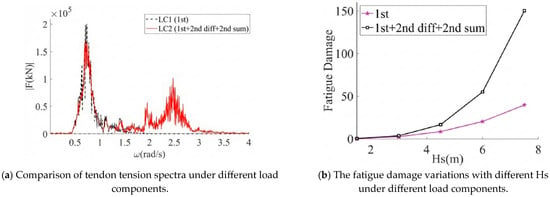
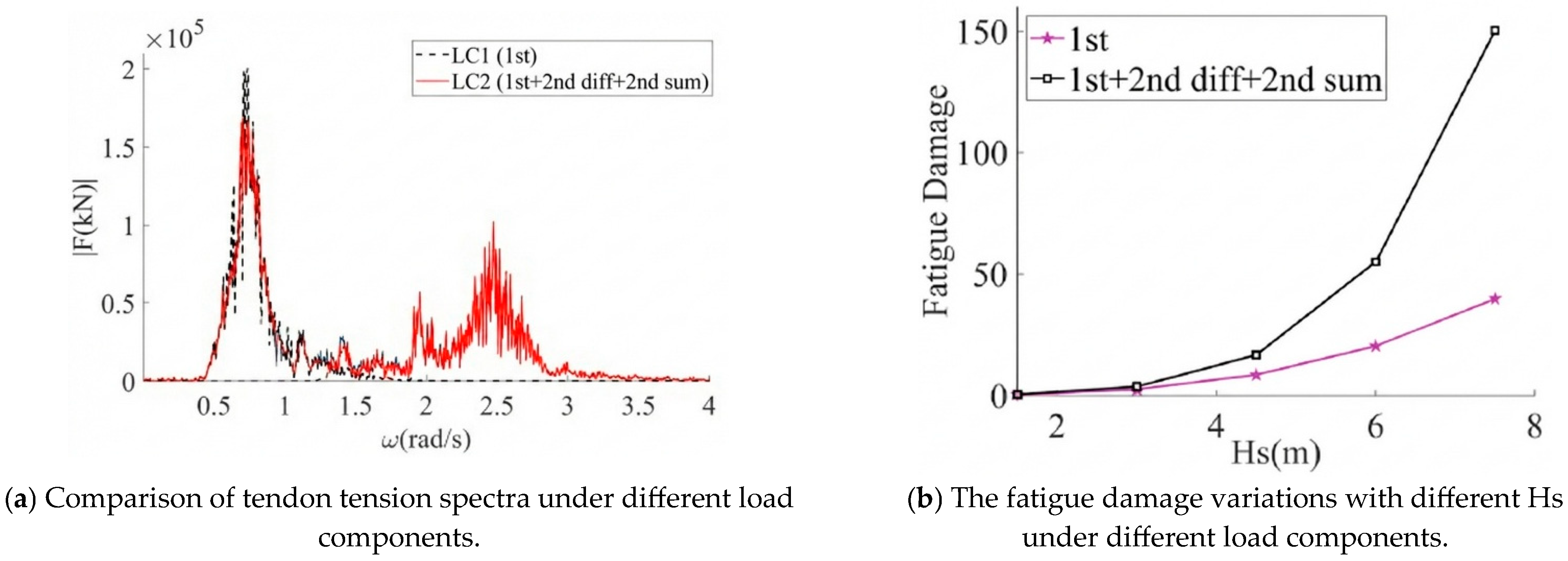
Although the TLP design effectively avoids resonance with first-order wave forces, it is particularly sensitive to second harmonic and even higher-harmonic wave forces. These high-frequency wave forces can induce steady-state structural resonance phenomena (springing) and transient nonlinear responses (ringing). As compared in Figure 5, the higher-order wave loads are the main causes of fatigue damage in the mooring system [59]. Ringing also contributes significantly to the extreme responses of the structures. In the preliminary design phase, potential flow theory-based methods, including Boundary Element Methods (BEM) and engineering models (e.g., the FNV and Rainey approaches), are indispensable for their computational efficiency in screening large numbers of sea states. Potential-flow methods are efficient for screening sea states but cannot fully capture strong nonlinear wave–structure interactions. To overcome the limitations of potential flow theory regarding nonlinear effects, Computational Fluid Dynamics (CFD) serves as a high-fidelity alternative. All numerical models, including potential-flow based and CFD models, need systematic validation and calibration against model tests. Scale effects should also be assessed to ensure the simulation results can be extrapolated to full-scale applications where the Reynolds numbers are very different than model scales. Nematbakhsh et al. [60] conducted a direct comparison between a CFD model and a potential flow theory-based model (SIMO-RIFLEX) for a TLP wind turbine. Their study confirmed good agreement in linear responses under small to medium waves but revealed that the CFD model, by accounting for nonlinear effects such as instantaneous hull position and exact free surface integration, predicted a notably larger mean surge drift. Rongé et al. [61] evaluated the fidelity of various engineering approaches, including potential flow BEM and extended strip-theory formulations (Rainey and FNV models), by benchmarking them against high-fidelity CFD simulations to determine second- and third-order hydrodynamic loads. The comparative analysis reveals that while potential flow methods accurately capture second-order effects, strip-theory approaches are limited by poor high-frequency phase prediction and require the inclusion of viscous drag terms to adequately approximate the significant third-order heave loads arising from submerged structural components. Ren et al. [62] further found that the vertical response caused by sum-frequency wave forces strongly depends on the wave direction angle, with this effect being particularly prominent under mixed sea states with different storm-swelling directions, providing important guidance for tension leg design. Mohseni and Guedes Soares [63] conducted CFD research on the CENTEC-TLP, showing that wave scattering caused by cylindrical structures generates secondary load cycles, an effect that is an important reason for the significant second-order harmonic components in the surge force. Furthermore, viscous effects cannot be ignored in high sea states. Viscous drag on the surfaces of pontoons and tension legs excites high-frequency excitation, and its influence is proportional to the square of the wave height in large amplitude motion, leading to a cubic relationship between platform mean displacement and wave height. Shen et al. [40] based on the coupled dynamic analysis code CRAFT, found that viscous drag can induce high-frequency pitch resonance at specific wave periods (approximately three times the natural pitch period), causing snap phenomena in the tendons, significantly increasing extreme loads, and making the tension distribution non-Gaussian. These studies highlight the importance of considering both potential flow and viscous effects, as well as structural details, in accurate load prediction.
Figure 5.
Influence of second-order wave excitation (difference- and sum-frequency components) on (a) tendon load spectra and (b) fatigue damage. (Adapted from ref. [59]).
Recent fully coupled basin tests for TLP floating wind turbine indicate that high-frequency responses can be dominated by rotor harmonics interacting with platform natural modes (especially roll, and occasionally heave). The presence of current was shown to amplify 1P/3P components and increase rotational unsteadiness, while extreme waves tend to attenuate these high-frequency peaks and shift the response toward wave-frequency dominance. These observations provide critical experimental evidence for validating higher-order coupled models in multidirectional wind–wave–current environments [64].
Despite its fidelity, CFD cannot replace engineering tools for global response analysis due to the computational intractability of stochastic sea states. This constraint dictates reliance on reduced-order methods to identify critical events. Furthermore, the conservatism of approximations like FNV theory—specifically their overestimation of third-order harmonics—is strategically retained in engineering practice to compensate for unresolved physical complexities.
3.2.2. Nonlinear Motions and Extreme Conditions
The coupling of geometric stiffness and material nonlinearity in TLP pretensioned tendons can trigger complex phenomena such as parametric resonance. Esber and Kosleck [65] provided a rigorous mathematical formulation for this mechanism, deriving a general nonlinear stiffness matrix via the virtual work principle. Their analysis of a 10 MW wind turbine platform confirmed that neglecting the off-diagonal coupling terms—a common simplification in engineering models—leads to significant inaccuracies in predicting the platform’s large-amplitude equilibrium position and dynamic response. Recent studies highlight the risks of parametric resonance. For example, internal resonance between pitch and heave modes can transfer energy and induce instability [66]. This mechanism was further elaborated by Su et al. [67], who identified multi-frequency resonance phenomena in the heave response, and pointed out that higher harmonic resonance may induce amplitude jumps, which is significant for structural fatigue warning. In summary, the design should avoid excitation frequencies close to the natural pitch frequency, especially when the heave frequency is a multiple of it. Active control or damping devices can be considered to suppress nonlinear oscillations.
Under extreme conditions, strongly nonlinear phenomena such as wave breaking and green water impact become more prominent. Ha et al. [68] simulated the dynamic response of a 15 MW TLP wind turbine under extreme wave conditions in the Ulsan sea area of Korea based on CFD. The results showed significant coupling between surge and heave motions, with heave primarily caused by platform set-down induced by surge; springing originates from wave sum-frequency components, while ringing is excited by wave impact impulsive forces; green water impact under focused waves significantly alters platform motion and tendon tension distribution, and whipping-induced pitch resonance further amplifies the tension response. For such strongly nonlinear fluid–structure interaction problems, meshless methods like Smoothed Particle Hydrodynamics (SPH) have advantages in simulating large deformation problems such as wave breaking and structural impact, as they are not limited by mesh distortion. Wang and Chuang [69] experimentally validated the effectiveness of SPH in simulating breaking wave impact on a TLP wind turbine. Tagliafierro et al. [70] compared SPH results with FAST software results, showing that SPH outperforms traditional potential flow methods in particularly in high-precision simulation under extreme loads.
Beyond hydrodynamic loads, seismic excitations pose a unique threat to TLP integrity. James et al. [71] performed a seismic vulnerability assessment, identifying that acceleration amplification at the nacelle and tendon snap loads are primary failure modes under near-field pulse-like ground motions. This was corroborated by Kim et al. [72], who found a critical trade-off in tendon material selection: rigid tendons limit pitch but are prone to buckling under vertical seismic accelerations. Yu et al. [73] further highlighted that aerodynamic damping plays a significant role in mitigating seismic responses during operation compared to emergency shutdown scenarios.
Tendon failure under extreme sea states is an important risk source for TLP wind turbines. Wu et al. [74] and Ren et al. [75] simulated single tendon failure conditions using the coupled aero-hydro-servo-elastic numerical simulations based on FAST, finding that tendon breakage leads to significant transient variations in platform motion (particularly pitch and roll) and a drastic redistribution of tension to adjacent lines. Furthermore, Ren et al. [76] validated the dynamic response patterns of TLPs after tendon rupture through model tests, filling a gap in experimental data in this field. Xu et al. [77] pointed out that the snap tension in adjacent mooring lines, triggered by a single line failure under extreme conditions, can approach the breaking strength of the chain and acts as the primary catalyst for a progressive failure mechanism, which is exacerbated by its coupling with the out-of-plane loading that dramatically reduces the anchor capacity. In terms of tendon reliability under wave loads, Wu et al. [78] analyzed coupled lateral-axial responses under irregular waves, demonstrating that increasing initial pretension is critical for improving reliability against parametric vibrations. Yang et al. [79] validated the system’s robustness through typhoon-resistant design simulations, confirming stability under 500-year return period conditions. Similarly, regarding structural geometry optimization for such extreme environments, Zhu et al. [80] applied Continuous Wavelet Transform (CWT) to analyze the transient dynamics of a compact hexagonal TLP. Their results verified that this specific topology maintains superior stability in the South China Sea, with tendon tensions remaining well within safety limits even under extreme 11.4 m wave heights.
A snap load occurs when a mooring line that has become slack due to platform movement is once again tightened under extreme condition [81]. This kind of load is highly nonlinear and impactive. Boo et al. [29] addresses the risk of tendon snap loads in a TLP supporting a VAWT by ensuring through time-domain simulations that minimum tendon tensions remain positive under extreme conditions, in compliance with ABS design standards to prevent slack-induced dynamic amplifications. Current research on tendon fatigue under extreme sea conditions like typhoons is still primarily based on numerical simulation, with publicly available experimental validation being relatively scarce, necessitating enhanced full-scale or large-scale tests to improve the reliability of conclusions. Table 3 summarizes these nonlinear phenomena, identifying their physical drivers and the associated mitigation strategies.
Table 3.
Summary of key nonlinear response phenomena, physical drivers, and mitigation strategies for TLP floating wind turbines.
3.3. Motion Control and Condition Monitoring
3.3.1. Motion Control Strategies
To suppress high-frequency vibrations of TLPs, passive control devices such as Tuned Mass Dampers (TMD), Tuned Liquid Dampers (TLD), and Tuned Liquid Column Dampers (TLCD) have been introduced into marine engineering. Among them, TLDs perform excellently in controlling minor structural vibrations of wind turbines due to their simple structure, low maintenance cost, and no need for external energy. Jaksic et al. [82] experimentally compared three configurations of Multiple Tuned Liquid Column Dampers (MTLCD), confirming their effectiveness in suppressing TLP motion and reducing tendon tension. Park et al. [83] developed an orthogonal TLCD, with simulation results demonstrating significant effects in reducing platform fore-aft and side-to-side fatigue and extreme loads. Compared to traditional TLCDs, the Tuned Liquid Mass Column Damper (TLMCD) has stronger control capabilities for pitch and roll motions [84]. Cui et al. [85] designed four TLMCD configurations, systematically studying their coupling effects with the TLP system, and found that TLMCDs can effectively dissipate energy and significantly improve the platform’s dynamic response performance in waves. Beyond extra damping devices, optimizing the hull geometry offers an integrated solution. For instance, Tian et al. [86] demonstrated that “column steps” can passively mitigate flow-induced motions by disrupting vortex shedding coherence. Similarly, Shi et al. [87] found that employing porous outer structural members significantly increases viscous damping, effectively suppressing surge motions at resonant frequencies.
For active control, strategies must account for the strong aero-hydro-servo coupling. For TLP-type floaters, which exhibit relatively high stiffness in heave, pitch, and roll but remain susceptible to wind-induced excitations and negative damping effects, tailored control strategies are essential. The primary objectives include maintaining platform stability under combined wind-wave disturbances, reducing fatigue loads on critical components such as blades and tendons, and ensuring consistent power output. Several control strategies have been specifically developed or adapted for TLP floating wind turbines. Disturbance Accommodating Control (DAC) has been implemented to estimate and cancel wind-induced disturbances [88]. To address periodic loads, Zhang et al. [89,90] pioneered a combined approach where Collective Pitch Control (CPC) regulates generator speed and power, while an Individual Pitch Control (IPC)-based Trailing Edge Flap (TEF) system actively mitigates blade root moments. This hybrid methodology effectively reduces fatigue damage equivalent loads (DELs) and improves critical platform dynamics, such as fore-aft pitching and yawing motions, under normal turbulence and sea state conditions.
However, traditional PID-based strategies may lack robustness against complex nonlinearities and extreme faults. Recent research has thus shifted towards intelligent and adaptive algorithms tailored for FOWTs. Martynowicz et al. [91] demonstrated the efficacy of semi-active Magneto-Rheological Tuned Vibration Absorbers (MR-TVA) in reducing tower vibrations under wind-wave misalignment. In the realm of robust active control, Sang et al. [92] introduced a Nonlinear Extended State Observer (NESO) to compensate for wave disturbances in real-time, enhancing pitch control performance. For extreme failure scenarios, Wang et al. [93] designed an active hydraulic tensioner system with fuzzy-PID control, which specifically targets the suppression of platform instability following a tendon rupture event.
3.3.2. Condition Monitoring
During long-term operation, floating wind turbine structures may accumulate damage; therefore, developing structural health monitoring (SHM) systems is crucial. It is important to note that SHM for TLPs does not exist in isolation; it builds upon methodologies established for widely adopted semi-submersible and spar concepts, particularly regarding data acquisition architectures and signal processing algorithms. However, the specific monitoring objectives diverge due to the platform’s mechanics. While semi-submersible monitoring often targets catenary mooring fatigue and global drift, TLP strategies must prioritize high-frequency tendon tension anomalies (e.g., ringing and snap loads), as highlighted by the cross-platform fatigue comparisons in Ucar et al. [55].
Data-driven strategies leverage algorithms to map response patterns to damage states. For instance, evolutionary algorithms have proven effective in identifying tendon stiffness reduction by minimizing the error between measured and simulated responses. Ettefagh et al. [94] used Genetic Algorithms (GA), Artificial Immune Systems (AIS), Particle Swarm Optimization (PSO), and Artificial Bee Colony (ABC) algorithms to identify damage type, location, and extent by optimizing the difference between measured and simulated responses, with the ABC algorithm having the highest success rate in identifying tendon stiffness and nacelle spring damage. Similarly, fuzzy logic systems can handle the uncertainty in measurement data, though distinguishing damage from the inherently nonlinear TLP dynamics remains challenging [95].
Physics-based methods offer greater transparency. Chung et al. [96] demonstrated that real-time tendon tension could be inverted using Euler-Bernoulli beam theory combined with inclinometer data. While this approach avoids the “black box” nature of machine learning, it relies heavily on the accuracy of the underlying physical model, which may degrade under extreme nonlinear events.
4. Future Development Trends
Propelling TLP technology toward commercial maturity and unlocking its deep-water potential necessitates a focused assault on pivotal research frontiers.
- Fully coupled elastic modeling: as turbines scale beyond 15 MW, the flexibility of the structure becomes critical. Future tools must better integrate hydro-elastic and aero-elastic effects to achieve high predictive accuracy for these inherently nonlinear interactions, especially considering the structural flexibility of various components. This requires advanced numerical solvers and experimental validation campaigns to build confidence in these new models.
- Advanced control strategies: passive control may be insufficient for complex sea states. Active and semi-active control methods, potentially combined with machine learning, should be explored to reduce loads and improve stability. This is essential for mitigating peak loads, reducing fatigue, and optimizing power capture across varying sea states.
- Efficient design and digital twins: there is a need to move beyond time-consuming high-fidelity simulations for every design iteration. Surrogate models and digital twin technologies can accelerate the design process and enable real-time structural health monitoring. These tools will facilitate rapid design iterations and enable predictive maintenance, thereby reducing operational costs.
- Multi-functional integration: TLPs offer a stable foundation for hybridizing wind with wave energy devices, such as heaving buoys [97], Oscillating Water Column devices (OWC) [98], and tapered point absorbers [99,100]. Furthermore, the platforms can support additional functions like seawater desalination or offshore hydrogen production. This requires careful consideration of additional nonlinear interactions introduced by wave energy converters and their impact on the TLP’s primary nonlinear dynamics.
- Farm-level dynamics and interactions: as projects scale to commercial arrays, the complex interactions between closely spaced units remain underexplored. Future research must focus on wake-induced turbulence and hydrodynamic coupling to optimize farm-level energy yield and ensure collective structural reliability.
- Experimental validation of extreme failure modes: numerical capabilities for simulating tendon failure and extreme wave interactions have advanced significantly, yet experimental validation for these transient, nonlinear events lags behind. Existing basin tests primarily address operational conditions, rarely reproducing catastrophic scenarios—such as tendon rupture or seismic buckling—due to scaling complexities and testing risks. Future research must therefore prioritize physical testing of these limit states to calibrate safety factors and validate the efficacy of fault-tolerant control systems.
5. Conclusions
This review has critically examined the nonlinear dynamics governing TLP floating wind turbines. While TLPs offer superior motion characteristics, they are inherently sensitive to high-order excitations and complex physical interactions. The primary research gaps and nonlinear challenges that define the current technical landscape are summarized as follows:
- High-order Hydrodynamics and Fatigue: The prediction of high-frequency resonant responses, such as springing and ringing, remains a persistent challenge. These phenomena, driven by sum-frequency wave loads and viscous effects, act as dominant drivers for tendon fatigue damage but are often underestimated by standard engineering models.
- Coupled Parametric Instabilities: The geometric nonlinearity of the tendon system, when coupled with aerodynamic “negative damping,” creates a susceptibility to parametric resonance. Accurate capture of these instabilities requires rigorous modeling of the time-varying stiffness matrix and its coupling terms.
- Validation of Extreme and Accidental States: There is a critical scarcity of experimental data for transient, catastrophic events. The dynamics of tendon rupture, snap loads, and seismic buckling involve highly nonlinear fluid–structure interactions that are difficult to replicate in basin tests, leaving numerical safety factors insufficiently calibrated.
- Full-System Elasticity: As turbines scale beyond 15 MW, the traditional rigid-body assumption for the hull becomes invalid. Neglecting the hydro-elastic coupling of the columns and pontoons has been shown to potentially yield non-conservative fatigue predictions, necessitating fully flexible multi-body modeling.
Future TLP development necessitates the integration of control strategies and condition monitoring within a unified digital-twin framework. By assimilating real-time data—such as tendon tension and motion history—into high-fidelity models, intelligent algorithms can dynamically adapt to structural degradation and environmental loads. This closed-loop approach facilitates proactive lifecycle management, moving beyond passive maintenance to predictive operation, thereby ensuring system longevity and reducing the Levelized Cost of Energy (LCOE).
Author Contributions
Conceptualization, J.L., G.C. and Y.J.; investigation, G.C., M.T.; writing—original draft preparation, J.L. and L.Y.; writing—review and editing, J.L. and L.Y.; visualization, J.L. and L.Y.; supervision, Y.J. and M.T.; funding acquisition, J.L., Y.J. and M.T. All authors have read and agreed to the published version of the manuscript.
Funding
This research was funded by the National Natural Science Foundation of China (W2411038), the Fundamental Research Funds for the Central Universities (01723216, DUT25GF111), the Key Project for Industrial Technological Innovation in Liaoning Province: “Jie Bang Gua Shuai” Project “Research and Design of 40 Knots High Speed Passenger—Cargo Ship”.
Data Availability Statement
No new data were created or analyzed in this study.
Conflicts of Interest
Author Guibin Chen was employed by the company PowerChina Zhongnan Engineering Corporation Limited. The remaining authors declare that the research was conducted in the absence of any commercial or financial relationships that could be construed as a potential conflict of interest.
References
- Cruz, J.; Atcheson, M. Floating Offshore Wind Energy. The Next Generation of Wind Energy; Springer: Cham, Germany, 2016. [Google Scholar]
- Buljan, A. GE, Glosten Present 12 MW Floating Wind Turbine Concept. Available online: https://www.offshorewind.biz/2021/05/25/ge-glosten-present-12-mw-floating-wind-turbine-concept/ (accessed on 28 January 2026).
- MODEC Obtained AiP for TLP Type Floating Offshore Wind Turbine from Class NK. Available online: https://www.modec.com/news/2024/20240521_pr_FOW_AiP.html (accessed on 28 January 2026).
- Memija, A. French Floating Wind Pilot Project Starts Delivering Power to Grid. 2024. Available online: https://www.offshorewind.biz/2024/11/20/french-floating-wind-pilot-project-starts-delivering-power-to-grid/ (accessed on 28 January 2026).
- COOEC Construction Commenced for TLP Wind Power Platform. Available online: https://www.cnoocengineering.com/english/Media/CompanyNewsTwo/202503/t20250303_113586.html (accessed on 28 January 2026).
- Bachynski, E.E. Design and Dynamic Analysis of Tension Leg Platform Wind Turbines. Ph.D. Thesis, Norwegian Univeisity of Science and Technology, Trondheim, Norway, 2014. [Google Scholar]
- Liu, S.; Guo, X.; Yang, Y.; Wang, H.; Wei, S.; Ren, N.; Chen, C. Dynamic Response Analysis of a Novel Tension-Leg Dual-Module Offshore Wind Turbine System During Both Installation and Removal Processes. J. Mar. Sci. Eng. 2025, 13, 888. [Google Scholar] [CrossRef] [Scilit]
- Alkarem, Y.R.; Ozbahceci, B.O. A Complemental Analysis of Wave Irregularity Effect on the Hydrodynamic Responses of Offshore Wind Turbines with the Semi-Submersible Platform. Appl. Ocean Res. 2021, 113, 102757. [Google Scholar] [CrossRef] [Scilit]
- Terrero-Gonzalez, A.; Dai, S.; Papadopoulos, J.; Neilson, R.D.; Kapitaniak, M. Nonlinear Analysis of Hydrodynamics of a Shallow-Draft Floating Wind Turbine. Nonlinear Dyn. 2025, 113, 4511–4529. [Google Scholar] [CrossRef] [Scilit]
- Lynggård Hansen, C.; Bredmose, H.; Vincent, M.; Steffensen, S.E.; Pegalajar-Jurado, A.; Jensen, B.; Dixen, M. Resonant Response of a Flexible Semi-Submersible Floating Structure: Experimental Analysis and Second-Order Modelling. J. Fluid Mech. 2024, 982, A7. [Google Scholar] [CrossRef] [Scilit]
- Tabeshpour, M.R.; Shoghi, R. Perturbation Nonlinear Response of Tension Leg Platform under Regular Wave Excitation. J. Mar. Sci. Technol. 2018, 23, 132–140. [Google Scholar] [CrossRef] [Scilit]
- Wang, Y.; Yao, T.; Zhao, Y.; Jiang, Z. Review of Tension Leg Platform Floating Wind Turbines: Concepts, Design Methods, and Future Development Trends. Ocean Eng. 2025, 324, 120587. [Google Scholar] [CrossRef] [Scilit]
- Zhao, Y.; Yang, J.; He, Y. Preliminary Design of a Multi-Column TLP Foundation for a 5-MW Offshore Wind Turbine. Energies 2012, 5, 3874–3891. [Google Scholar] [CrossRef] [Scilit]
- Oguz, E.; Clelland, D.; Day, A.H.; Incecik, A.; López, J.A.; Sánchez, G.; Almeria, G.G. Experimental and Numerical Analysis of a TLP Floating Offshore Wind Turbine. Ocean Eng. 2018, 147, 591–605. [Google Scholar] [CrossRef] [Scilit]
- Vita, L.; Ramachandran, G.K.V.; Krieger, A.; Kvittem, M.I.; Merino, D.; Cross-Whiter, J.; Ackers, B.B. Comparison of Numerical Models and Verification Against Experimental Data, Using Pelastar TLP Concept. In Proceedings of the International Conference on Offshore Mechanics and Arctic Engineering, St. John’s, NL, Canada, 31 May–5 June 2015; American Society of Mechanical Engineers: St. John’s, NL, Canada, 2015; Volume 9, p. V009T09A047. [Google Scholar]
- Matha, D. Model Development and Loads Analysis of an Offshore Wind Turbine on a Tension Leg Platform with a Comparison to Other Floating Turbine Concepts: April 2009; National Renewable Energy Lab. (NREL): Golden, CO, USA, 2010; p. NREL/SR-500-45891.
- Han, Z.; Zhao, Y.; Su, J.; He, Y.; Xu, Y.; Wu, F.; Jiang, Z. On the Hydrodynamic Responses of a Multi-Column TLP Floating Offshore Wind Turbine Model. Ocean Eng. 2022, 253, 111262. [Google Scholar] [CrossRef] [Scilit]
- Adam, F.; Myland, T.; Schuldt, B.; Großmann, J.; Dahlhaus, F. Evaluation of Internal Force Superposition on a TLP for Wind Turbines. Renew. Energy 2014, 71, 271–275. [Google Scholar] [CrossRef] [Scilit]
- Hartmann, H.; Walia, D.; Adam, F.; Ritschel, U.; Großmann, J. One Step Installation of a TLP Substructure: Requirements, Assumptions, Issues; American Society of Mechanical Engineers: Trondheim, Norway, 2017; p. V010T09A066. [Google Scholar]
- Kausche, M.; Adam, F.; Dahlhaus, F.; Großmann, J. Floating Offshore Wind—Economic and Ecological Challenges of a TLP Solution. Renew. Energy 2018, 126, 270–280. [Google Scholar] [CrossRef] [Scilit]
- Uzunoglu, E.; Guedes Soares, C. A System for the Hydrodynamic Design of Tension Leg Platforms of Floating Wind Turbines. Ocean Eng. 2019, 171, 78–92. [Google Scholar] [CrossRef] [Scilit]
- Uzunoglu, E.; Guedes Soares, C. Hydrodynamic Design of a Free-Float Capable Tension Leg Platform for a 10 MW Wind Turbine. Ocean Eng. 2020, 197, 106888. [Google Scholar] [CrossRef] [Scilit]
- Mas-Soler, J.; Uzunoglu, E.; Bulian, G.; Guedes Soares, C.; Souto-Iglesias, A. An Experimental Study on Transporting a Free-Float Capable Tension Leg Platform for a 10 MW Wind Turbine in Waves. Renew. Energy 2021, 179, 2158–2173. [Google Scholar] [CrossRef] [Scilit]
- Hmedi, M.; Uzunoglu, E.; Medina-Manuel, A.; Mas-Soler, J.; Vittori, F.; Pires, O.; Azcona, J.; Souto-Iglesias, A.; Guedes Soares, C. Experimental Analysis of CENTEC-TLP Self-Stable Platform with a 10 MW Turbine. J. Mar. Sci. Eng. 2022, 10, 1910. [Google Scholar] [CrossRef] [Scilit]
- Díaz, H.; Guedes Soares, C. Approach for Installation and Logistics of a Floating Offshore Wind Farm. J. Mar. Sci. Eng. 2022, 11, 53. [Google Scholar] [CrossRef] [Scilit]
- Hmedi, M.; Uzunoglu, E.; Zeng, C.; Gaspar, J.F.; Guedes Soares, C. Experimental Challenges and Modelling Approaches of Floating Wind Turbines. J. Mar. Sci. Eng. 2023, 11, 2048. [Google Scholar] [CrossRef] [Scilit]
- Han, Y.; Le, C.; Ding, H.; Cheng, Z.; Zhang, P. Stability and Dynamic Response Analysis of a Submerged Tension Leg Platform for Offshore Wind Turbines. Ocean Eng. 2017, 129, 68–82. [Google Scholar] [CrossRef] [Scilit]
- Han, Y.; Le, C.; Zhang, P.; Dang, L.; Fan, Q. Stochastic Analysis of Short-Term Structural Responses and Fatigue Damages of a Submerged Tension Leg Platform Wind Turbine in Wind and Waves. China Ocean Eng. 2021, 35, 566–577. [Google Scholar] [CrossRef] [Scilit]
- Boo, S.Y.; Shelley, S.A.; Griffith, D.T.; Escalera Mendoza, A.S. Responses of a Modular Floating Wind TLP of MarsVAWT Supporting a 10 MW Vertical Axis Wind Turbine. Wind 2023, 3, 513–544. [Google Scholar] [CrossRef] [Scilit]
- Kim, D.; Bae, Y.H.; Park, S. Design Strategy for Resonance Avoidance to Improve the Performance of Tension Leg Platform-Type Floating Offshore Wind Turbines. Ocean Eng. 2024, 306, 118080. [Google Scholar] [CrossRef] [Scilit]
- Leenders, K.; Kanters, M.; Rajasooriya, T. Numerical Implementation and Feasibility of DYNEEMA® HMPE Tendons for Floating Offshore Wind Tension Leg Platforms and the Effect of Viscoelasticity. Ocean Eng. 2025, 342, 122988. [Google Scholar] [CrossRef] [Scilit]
- Jia, Z.; Wu, H.; Chen, H.; Li, W.; Li, X.; Lian, J.; He, S.; Zhang, X.; Zhao, Q. Hydrodynamic Response and Tension Leg Failure Performance Analysis of Floating Offshore Wind Turbine with Inclined Tension Legs. Energies 2022, 15, 8584. [Google Scholar] [CrossRef] [Scilit]
- Qu, D.; Gong, W.; Sun, T.; Chen, Q.; Wang, D.; Wang, J. Tendon Inclination Effect on the Dynamic Response and Power Performance of Tension Leg Platform Floating Offshore Wind Turbine. Ocean Eng. 2026, 346, 123792. [Google Scholar] [CrossRef] [Scilit]
- Chitteth Ramachandran, R.; Desmond, C.; Judge, F.; Serraris, J.-J.; Murphy, J. Floating Wind Turbines: Marine Operations Challenges and Opportunities. Wind Energ. Sci. 2022, 7, 903–924. [Google Scholar] [CrossRef] [Scilit]
- Ke, L.; Tan, R.; Gu, Y.; Zhou, Z.; Xu, Z.; Gao, Y. Experimental Investigation of Dynamic Uplift Response of Suction Caissons in Soft Clay for TLP Floating Offshore Wind Turbines under Sustained and Cyclic Loading. Soil Dyn. Earthq. Eng. 2026, 201, 109971. [Google Scholar] [CrossRef] [Scilit]
- DNV-ST-0119; Floating Wind Turbine Structures. DNV: Oslo, Norway, 2021.
- API RP 2T; Recommended Practice for Planning, Designing and Constructing Tension Leg Platforms. American Petroleum Institute: Washington, DC, USA, 2010.
- ABS. Guide for Building and Classing Floating Offshore Wind Turbines; The American Bureau of Shipping: Houston, TX, USA, 2020. [Google Scholar]
- IEC 61400-3-2; Design Requirements for Floating Offshore Wind Turbines. International Electrotechnical Commission: Geneva, Switzerland, 2025.
- Shen, M.; Hu, Z.; Liu, G. Dynamic Response and Viscous Effect Analysis of a TLP-Type Floating Wind Turbine Using a Coupled Aero-Hydro-Mooring Dynamic Code. Renew. Energy 2016, 99, 800–812. [Google Scholar] [CrossRef] [Scilit]
- Lee, J.; Shin, S.; Kim, S.; Kraus, A.; Lee, J. An Optimal Sub-Structure for a TLP-Type Wind Turbine Based on Neuro-Response Surface Method. J. Mar. Sci. Technol. 2015, 20, 604–616. [Google Scholar] [CrossRef] [Scilit]
- Prandtl, L. Applications of Modern Hydrodynamics to Aeronautics. 1921. Available online: https://ntrs.nasa.gov/citations/19930091180 (accessed on 28 January 2026).
- Leishman, J.G.; Beddoes, T.S. A Semi-Empirical Model for Dynamic Stall. J. Am. Helicopter Soc. 1989, 34, 3–17. [Google Scholar] [CrossRef] [Scilit]
- Glauert, H. Airplane Propellers. In Aerodynamic Theory: A General Review of Progress Under a Grant of the Guggenheim Fund for the Promotion of Aeronautics; Durand, W.F., Ed.; Springer: Berlin/Heidelberg, Germany, 1935; pp. 169–360. [Google Scholar]
- Suzuki, A. Application of Dynamic Inflow Theory to Wind Turbine Rotors. Ph.D. Thesis, The University of Utah, Salt Lake City, UT, USA, 2000. [Google Scholar]
- Xu, B.F.; Wang, T.G.; Yuan, Y.; Cao, J.F. Unsteady Aerodynamic Analysis for Offshore Floating Wind Turbines under Different Wind Conditions. Philos. Trans. R. Soc. A 2015, 373, 20140080. [Google Scholar] [CrossRef] [Scilit] [PubMed]
- Sant, T.; Cuschieri, K. Comparing Three Aerodynamic Models for Predicting the Thrust and Power Characteristics of a Yawed Floating Wind Turbine Rotor. J. Sol. Energy Eng. 2016, 138, 031004. [Google Scholar] [CrossRef] [Scilit]
- Wang, T.; Jin, H.; Wu, X. Coupled Dynamic Analysis of a Tension Leg Platform Floating Offshore Wind Turbine. J. Offshore Mech. Arct. Eng. 2020, 142, 011901. [Google Scholar] [CrossRef] [Scilit]
- Guo, J.; Liu, M.; Jia, Y.; Li, S.; Yang, C.; Zhu, S. Evaluation of Limited Coupled Numerical Models with Damping Correction for TLP Floating Offshore Wind Turbine. Mar. Struct. 2026, 106, 103954. [Google Scholar] [CrossRef] [Scilit]
- Aoki, M.; Srinivasamurthy, S.; Iijima, K.; Hara, N.; Ikoma, T.; Nihei, Y. Experimental Investigation of Negative Damping Effects for a TLP Type Offshore Wind Turbine. In Proceedings of the International Conference on Offshore Mechanics and Arctic Engineering, Madrid, Spain, 17 June 2018; American Society of Mechanical Engineers: Madrid, Spain, 2018; Volume 10, p. V010T09A070. [Google Scholar]
- Roald, L.; Jonkman, J.; Robertson, A.; Chokani, N. The Effect of Second-Order Hydrodynamics on Floating Offshore Wind Turbines. Energy Procedia 2013, 35, 253–264. [Google Scholar] [CrossRef] [Scilit]
- Gueydon, S.; Wuillaume, P.-Y.; Jonkman, J.; Robertson, A.; Platt, A. Comparison of Second-Order Loads on a Tension-Leg Platform for Wind Turbines. In Proceedings of the Twenty-fifth (2015) International Ocean and Polar Engineering Conference, Kona, HI, USA, 21–26 June 2015. [Google Scholar]
- Silva De Souza, C.E.; Bachynski, E.E. Effects of Hull Flexibility on the Structural Dynamics of a Tension Leg Platform Floating Wind Turbine. J. Offshore Mech. Arct. Eng. 2020, 142, 011903. [Google Scholar] [CrossRef] [Scilit]
- Ran, X.; Bachynski-Polić, E.E. Time-Domain Simulation, Fatigue and Extreme Responses for a Fully Flexible TLP Floating Wind Turbine. Mar. Struct. 2025, 101, 103778. [Google Scholar] [CrossRef] [Scilit]
- Ucar, M.; Hmedi, M.; Uzunoglu, E.; Oguz, E. Fatigue Load Evaluation of Multiple Floating Wind Turbine Systems. Ocean Eng. 2025, 330, 121101. [Google Scholar] [CrossRef] [Scilit]
- Li, H.; Gao, Z.; Bachynski-Polić, E.E.; Zhao, Y.; Fiskvik, S. Effect of Floater Flexibility on Global Dynamic Responses of a 15-MW Semi-Submersible Floating Wind Turbine. Ocean Eng. 2023, 286, 115584. [Google Scholar] [CrossRef] [Scilit]
- Lee, I.; Kim, M.; Jin, C. Impact of Hull Flexibility on the Global Performance of a 15 MW Concrete-Spar Floating Offshore Wind Turbine. Mar. Struct. 2025, 100, 103724. [Google Scholar] [CrossRef] [Scilit]
- Dike, O.P.; Vaziri, V.; Kapitaniak, M. Effect of Members and Local Joints Flexibilities on the Dynamic and Fatigue Response of Semi-Submersible Platforms for Floating Offshore Wind Turbines. Mar. Struct. 2026, 107, 103993. [Google Scholar] [CrossRef] [Scilit]
- He, C.; Sun, T.; Zhang, Z.; Liu, H.; Wang, C.; Wang, J. Numerical Investigation on the Second-Order Sum-Frequency Wave Forces Induced Mooring Fatigue of a 15 MW TLP FOWT. Ocean Eng. 2025, 322, 120463. [Google Scholar] [CrossRef] [Scilit]
- Nematbakhsh, A.; Bachynski, E.E.; Gao, Z.; Moan, T. Comparison of Wave Load Effects on a TLP Wind Turbine by Using Computational Fluid Dynamics and Potential Flow Theory Approaches. Appl. Ocean Res. 2015, 53, 142–154. [Google Scholar] [CrossRef] [Scilit]
- Rongé, É.; Peyrard, C.; Venugopal, V.; Xiao, Q.; Johanning, L.; Benoit, M. Evaluation of Second and Third-Order Numerical Wave-Loading Models for Floating Offshore Wind TLPs. Ocean Eng. 2023, 288, 116064. [Google Scholar] [CrossRef] [Scilit]
- Ren, Z.; Teng, B.; Cong, L. Time-Domain Simulation of Sum-Frequency Hydrodynamic Performance of a TLP-Type Floating Wind Turbine in Multidirectional Seas. Appl. Ocean Res. 2023, 135, 103565. [Google Scholar] [CrossRef] [Scilit]
- Mohseni, M.; Guedes Soares, C. CFD Analysis of Wave Loading on a 10 MW TLP-Type Offshore Floating Wind Turbine in Regular Waves. Ocean Eng. 2024, 301, 117540. [Google Scholar] [CrossRef] [Scilit]
- Guo, J.; Liu, M.; Pan, X.; Ye, Q.; Su, L.; Chen, W. Experimental Study of Motion and Load Responses of a TLP FOWT under Combined Wind, Wave, and Current Conditions. Ocean Eng. 2026, 347, 124043. [Google Scholar] [CrossRef] [Scilit]
- Esber, G.; Kosleck, S. The General Nonlinear Stiffness Matrix of Taut Mooring Systems and Suspension Systems of Cable-Connected Floater-Keel Platforms. J. Comput. Nonlinear Dyn. 2025, 20, 121005. [Google Scholar] [CrossRef] [Scilit]
- Ghozlane, M.; Najar, F. Nonlinear Analysis of a Floating Offshore Wind Turbine with Internal Resonances. Nonlinear Dyn. 2024, 112, 1729–1757. [Google Scholar] [CrossRef] [Scilit]
- Su, O.; Li, Y.; Li, G.; Cui, Y.; Li, H.; Wang, B.; Meng, H.; Li, Y.; Liang, J. Nonlinear Harmonic Resonant Behaviors and Bifurcation in a Two Degree-of-Freedom Duffing Oscillator Coupled System of Tension Leg Platform Type Floating Offshore Wind Turbine. Chaos Solitons Fractals 2024, 189, 115656. [Google Scholar] [CrossRef] [Scilit]
- Ha, Y.-J.; Kim, K.-H.; Park, J.-Y. CFD Study of the Non-Linear Physical Phenomena of the TLP of a 15-MW-Class FOWT under Extreme Waves. J. Mar. Sci. Eng. 2023, 11, 1915. [Google Scholar] [CrossRef] [Scilit]
- Wang, S.; Chuang, W.-L. Dynamic Analysis of Breaking Wave Impact on a Floating Offshore Wind Turbine via Smoothed Particle Hydrodynamics. Mar. Struct. 2025, 100, 103731. [Google Scholar] [CrossRef] [Scilit]
- Tagliafierro, B.; Karimirad, M.; Martínez-Estévez, I.; Domínguez, J.M.; Viccione, G.; Crespo, A.J.C. Numerical Assessment of a Tension-Leg Platform Wind Turbine in Intermediate Water Using the Smoothed Particle Hydrodynamics Method. Energies 2022, 15, 3993. [Google Scholar] [CrossRef] [Scilit]
- James, M.; Haldar, S.; Bhattacharya, S. Seismic Vulnerability and Performance Assessment of Floating Offshore Wind Turbines Considering Soil-Structure Interaction. Eng. Struct. 2026, 348, 121815. [Google Scholar] [CrossRef] [Scilit]
- Kim, S.M.; Park, S.; Chung, W.C. Study on Dynamic Behavior of 15 MW TLP FOWT under Earthquake and Mooring Line Broken. Ocean Eng. 2025, 340, 122430. [Google Scholar] [CrossRef] [Scilit]
- Yu, W.; Wang, P.; Zhao, M.; Qiu, X.; Du, X. Research on the Dynamic Response of TLP Floating Offshore Wind Turbine Based on Aerodynamic-Hydrodynamic-Servo-Elastic-Earthquake Coupling Method. Ocean Eng. 2025, 342, 123028. [Google Scholar] [CrossRef] [Scilit]
- Wu, H.; Zhao, Y.; He, Y.; Shao, Y.; Mao, W.; Han, Z.; Huang, C.; Gu, X.; Jiang, Z. Transient Response of a TLP-Type Floating Offshore Wind Turbine under Tendon Failure Conditions. Ocean Eng. 2021, 220, 108486. [Google Scholar] [CrossRef] [Scilit]
- Ren, Y.; Venugopal, V.; Shi, W. Dynamic Analysis of a Multi-Column TLP Floating Offshore Wind Turbine with Tendon Failure Scenarios. Ocean Eng. 2022, 245, 110472. [Google Scholar] [CrossRef] [Scilit]
- Ren, Y.; Shi, W.; Venugopal, V.; Zhang, L.; Li, X. Experimental Study of Tendon Failure Analysis for a TLP Floating Offshore Wind Turbine. Appl. Energy 2024, 358, 122633. [Google Scholar] [CrossRef] [Scilit]
- Xu, H.; Rui, S.; Shen, K.; Guo, Z. Investigations on the Mooring Safety Considering the Coupling Effect of the Mooring Line Snap Tension and Anchor Out-of-Plane Loading. Appl. Ocean Res. 2023, 141, 103753. [Google Scholar] [CrossRef] [Scilit]
- Wu, Q.; Du, Y.; Luo, X.; Sun, T.; Lin, H. Coupled Vibration Response Analysis of Tension Leg Platform Tendon Under Irregular Ocean Wave Action. J. Mar. Sci. Eng. 2025, 13, 1836. [Google Scholar] [CrossRef] [Scilit]
- Yang, X.; Zhang, Y.; Yan, S.; Yu, W.; Lu, S.; Wang, H.; Shi, W. Study on Motion Performance and Mooring Tension Response of 16 MW Tension Leg Platform Floating Wind Turbine Under Extreme Environmental Conditions. J. Mar. Sci. Eng. 2025, 13, 2063. [Google Scholar] [CrossRef] [Scilit]
- Zhu, R.; Lai, Z.; Li, C.; Qian, H.; Yuan, H.; Xie, Y.; Sun, K. Hydrodynamic Performance and Motion Response of a Novel Deep-Water TLP Floating Offshore Wind Turbine. J. Mar. Sci. Eng. 2025, 13, 2131. [Google Scholar] [CrossRef] [Scilit]
- Borg, M.; Collu, M. Offshore Floating Vertical Axis Wind Turbines, Dynamics Modelling State of the Art. Part III: Hydrodynamics and Coupled Modelling Approaches. Renew. Sustain. Energy Rev. 2015, 46, 296–310. [Google Scholar] [CrossRef] [Scilit]
- Jaksic, V.; Wright, C.S.; Murphy, J.; Afeef, C.; Ali, S.F.; Mandic, D.P.; Pakrashi, V. Dynamic Response Mitigation of Floating Wind Turbine Platforms Using Tuned Liquid Column Dampers. Phil. Trans. R. Soc. A 2015, 373, 20140079. [Google Scholar] [CrossRef] [Scilit]
- Park, S.; Glade, M.; Lackner, M.A. Multi-Objective Optimization of Orthogonal TLCDs for Reducing Fatigue and Extreme Loads of a Floating Offshore Wind Turbine. Eng. Struct. 2020, 209, 110260. [Google Scholar] [CrossRef] [Scilit]
- Coudurier, C.; Lepreux, O.; Petit, N. Modelling of a Tuned Liquid Multi-Column Damper. Application to Floating Wind Turbine for Improved Robustness against Wave Incidence. Ocean Eng. 2018, 165, 277–292. [Google Scholar] [CrossRef] [Scilit]
- Cui, F.; Chen, S.; Hao, H.; Han, C.; Ni, R.; Zhuo, Y. Assessment of Hydrodynamic Performance and Motion Suppression of Tension Leg Floating Platform Based on Tuned Liquid Multi-Column Damper. J. Mar. Sci. Eng. 2024, 12, 328. [Google Scholar] [CrossRef] [Scilit]
- Tian, C.; Liu, M.; Xiao, L.; Wei, H. Investigation for the Effect of the Column Step on the Flow-Induced Motion of a TLP. Mar. Struct. 2023, 90, 103400. [Google Scholar] [CrossRef] [Scilit]
- Shi, W.; Zeng, Y.; Lin, Z.; Xiao, Q.; Michailides, C.; Hu, Z.; Li, X. CFD Numerical Simulation of Wave Interaction for a TLP Floating Offshore Wind Turbine with Porous Structural Members. Ocean Eng. 2025, 328, 121029. [Google Scholar] [CrossRef] [Scilit]
- Namik, H.; Stol, K. Performance Analysis of Individual Blade Pitch Control of Offshore Wind Turbines on Two Floating Platforms. Mechatronics 2011, 21, 691–703. [Google Scholar] [CrossRef] [Scilit]
- Zhang, M.; Yang, H.; Xu, J. Numerical Investigation of Azimuth Dependent Smart Rotor Control on a Large-Scale Offshore Wind Turbine. Renew. Energy 2017, 105, 248–256. [Google Scholar] [CrossRef] [Scilit]
- Zhang, M.; Li, X.; Xu, J. Smart Control of Fatigue Loads on a Floating Wind Turbine with a Tension-Leg-Platform. Renew. Energy 2019, 134, 745–756. [Google Scholar] [CrossRef] [Scilit]
- Martynowicz, P.; Ślimak, P.; Katsaounis, G.M. TLP-Supported NREL 5MW Floating Offshore Wind Turbine Tower Vibration Reduction Under Aligned and Misaligned Wind-Wave Excitations. Energies 2025, 18, 2092. [Google Scholar] [CrossRef] [Scilit]
- Sang, Y.; Dai, Z.; Ren, Y.; Wu, Q.; Xue, H.; Wang, Y. Neso-Based Nonlinear Proportional-Integral Pitch Control of the Tlp-Based Floating Offshore Wind Turbine. Energy 2025, 333, 137073. [Google Scholar] [CrossRef] [Scilit]
- Wang, J.; Liu, X.; Chai, J.; Wang, Y.; Jin, X.; He, Z.; Cai, W.; Guo, R. Numerical and Experimental Investigation on Active Hydraulic Tensioner System for a TLP under Tether Fails Condition. Mar. Struct. 2025, 99, 103693. [Google Scholar] [CrossRef] [Scilit]
- Ettefagh, M.M. Damage Identification of a TLP Floating Wind Turbine by Meta-Heuristic Algorithms. China Ocean Eng. 2015, 29, 891–902. [Google Scholar] [CrossRef] [Scilit]
- Jamalkia, A.; Ettefagh, M.M.; Mojtahedi, A. Damage Detection of TLP and Spar Floating Wind Turbine Using Dynamic Response of the Structure. Ocean Eng. 2016, 125, 191–202. [Google Scholar] [CrossRef] [Scilit]
- Chung, W.C.; Pestana, G.R.; Kim, M. Structural Health Monitoring for TLP-FOWT (Floating Offshore Wind Turbine) Tendon Using Sensors. Appl. Ocean Res. 2021, 113, 102740. [Google Scholar] [CrossRef] [Scilit]
- Ren, N.; Ma, Z.; Shan, B.; Ning, D.; Ou, J. Experimental and Numerical Study of Dynamic Responses of a New Combined TLP Type Floating Wind Turbine and a Wave Energy Converter under Operational Conditions. Renew. Energy 2020, 151, 966–974. [Google Scholar] [CrossRef] [Scilit]
- Konispoliatis, D.N.; Katsaounis, G.M.; Manolas, D.I.; Soukissian, T.H.; Polyzos, S.; Mazarakos, T.P.; Voutsinas, S.G.; Mavrakos, S.A. REFOS: A Renewable Energy Multi-Purpose Floating Offshore System. Energies 2021, 14, 3126. [Google Scholar] [CrossRef] [Scilit]
- Rony, J.S.; Karmakar, D. Hydrodynamic Response Analysis of a Hybrid TLP and Heaving-Buoy Wave Energy Converter with PTO Damping. Renew. Energy 2024, 226, 120380. [Google Scholar] [CrossRef] [Scilit]
- Rony, J.S.; Karmakar, D. Performance of a Hybrid TLP Floating Wind Turbine Combined with Arrays of Heaving Point Absorbers. Ocean Eng. 2023, 282, 114939. [Google Scholar] [CrossRef] [Scilit]

Disclaimer/Publisher’s Note: The statements, opinions and data contained in all publications are solely those of the individual author(s) and contributor(s) and not of MDPI and/or the editor(s). MDPI and/or the editor(s) disclaim responsibility for any injury to people or property resulting from any ideas, methods, instructions or products referred to in the content. |
© 2026 by the authors. Licensee MDPI, Basel, Switzerland. This article is an open access article distributed under the terms and conditions of the Creative Commons Attribution (CC BY) license.