


Abstract
The understory of giant kelp forests supports high levels of marine biodiversity, including macroalgae, invertebrates, and fish. These communities thrive in the sheltered and shaded microhabitats formed by the dominant canopy species. Despite their importance, studies of these communities have been fragmented, examining the invertebrates, macroalgae, and fish separately. In this study, we investigated the understory community as a single ecological unit in Macrocystis pyrifera kelp forests. Sampling was conducted across six sites in Bahía Inútil (Tierra del Fuego). The macroalgae and invertebrates were quantified via scuba-diving-obtained photoquadrats (n = 240), while fish assemblages were surveyed via in situ visual transects. The understory community comprised a total of 108 taxa, including 32 macroalgae, 67 invertebrates, and 9 fish species. Macroalgae yielded 37% of the total coverage, dominated primarily by Lithothamnion spp. Invertebrates accounted for 10%, with Pseudechinus magellanicus and Arbacia dufresnii proving most abundant. A similarity network analysis revealed a hierarchical organization dominated by a few highly related species. This similarity network includes Anasterias antarctica, Epizoanthus fiordicus, Eurypodius latreillei, Fissurellidea patagonica, Tonicia calbucensis and Trachytedania sp. These species accounted for the greatest number of associations within the network, suggesting that they are key to the structure of the understory. Overall, our findings highlight the high level of benthic biodiversity within the M. pyrifera forests of Bahía Inútil. These insights are crucial for informing future management and conservation plans for the area.
1. Introduction
The marine understory of kelp forests constitutes a three-dimensional underwater habitat in which abiotic factors such as light [1,2], hydrodynamics [3,4], and sedimentation [5,6] have been modified by the kelp forest structures themselves. These modifications facilitate the adaptation of communities to the distinctive factors of the understory [7,8], which are often characterized by high levels of biodiversity and productivity [9,10].
Analogous to terrestrial forests, where numerous species coexist in the understory habitat, the giant kelp forest (GKF) understory community consists of metacommunities of benthic macroalgae, benthic invertebrates, and fish [11,12,13]. These communities have been extensively studied through observational and experimental research [14]. For instance, sublittoral macroalgae have been the focus of numerous biodiversity assessments [15,16,17], while population dynamic studies have highlighted their spatial variability [4,18]. Furthermore, experimental manipulations have targeted understory ecology to resolve questions surrounding community resilience [11,19]. Collectively, this scientific background underscores the ecological significance of understory macroalgae, driven by their high taxonomic richness and substantial contribution to primary production inside the GKF.
Similarly, research on understory benthic invertebrates has focused on their spatial distribution, temporal dynamics [20], biodiversity [21], and functional morphology [22]. In addition, studies have examined populations of key species, such as herbivorous sea urchins [23]. The fish community in the water column of the understory has also been extensively studied. This community features a highly diverse fish fauna that uses these habitats as feeding and recruitment areas [24,25,26,27]. However, the complexity of this community has led scientific studies to adopt a fragmented approach, focusing on each stratum—macroalgae, invertebrates, or fish—separately. To date, very few studies have integrated these components to assess understory communities as a cohesive ecological unit [27,28].
In the context of climate change, GKF communities of Macrocystis pyrifera in the Magallanes region have exhibited temporal and spatial persistence [29]. This persistence likely extends to the associated understory [9], which benefits from the stability of the system—a system capable of both sustaining high biodiversity and coping effectively with environmental changes [9]. However, studies of understory communities in the Magellan region are scarce and limited to either macroalgae, invertebrates, or fishes. For example, the results of studies on the biodiversity of macroalgae in the understory are highly heterogeneous, ranging from 5 to 58 species [30]. In contrast, within the invertebrate community, biodiversity in the understory can reach up to 147 species [31] and 144 among the holdfast of M. pyrifera [32]. Meanwhile, studies on understory fish are limited. This fish community ranges from 18 to 25 species [33,34].
Numerous experimental studies were conducted in GKFs in the 1980s. Ojeda and Santelices [35] investigated the impacts of frond removal. Castilla [36] provided the first comprehensive description of food webs in M. pyrifera forests in Puerto Toro. This food web is dominated by the apex predator Cosmasterias lurida, with fish mostly consuming bottom-dwelling detritivores and small crustaceans. Herbivorous consumers comprised four sea urchin species and various gastropods, which primarily grazed on M. pyrifera and Lessonia macroalgae. Adami and Gordillo [30] reported similar results in M. pyrifera forests in the Beagle Channel. Consequently, GKFs are key seascape elements in the Magallanes region, and their distribution is not continuous along the coast, primarily due to the influence of abiotic factors, such as depth, the presence of a rocky substrate, and its topography [9]. Therefore, one of the scientific gaps that remains unexplored is understanding how these forests are ecologically connected or whether they develop independently of one another.
From a conservation perspective, the Magallanes region currently has marine conservation areas that present significant challenges in terms of effective management and implementation. Only in the last decade have GKFs been recognized as conservation targets, and they are currently under significant pressure from both climate change and anthropogenic activities [37,38], primarily related to intensive salmon aquaculture and habitat degradation due to industrial activity [31,39]. However, there is evidence that the GKFs in the Magellan region remain undisturbed [40]. Therefore, the understory community can be considered a key indicator of potential future changes.
In this context, understanding the ecology of the understory community supported by GKFs holds significant value for both scientists and decision-makers. To address these challenges, we have established three primary objectives: (1) to characterize the understory benthic (including macroalgae and invertebrates) and fish communities associated with M. pyrifera forests, and (2) to evaluate the relationships between environmental variables and benthic and fish communities.
2. Materials and Methods
2.1. Study Area
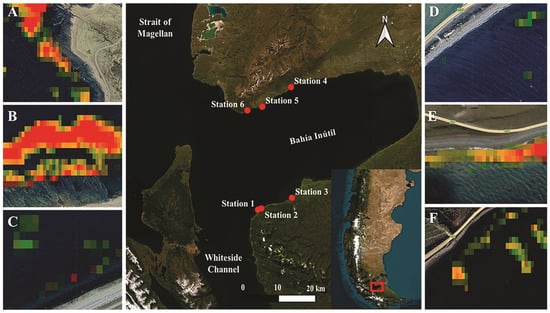
This study was conducted in Bahía Inútil (53°30′ S, 69°30′ W), a 4776 km2 bay, located on the northwestern coast of Tierra del Fuego Island, with maximum depths reaching 200 m (Figure 1). The water column exhibits salinities of 30–31 psu and mean temperatures ranging from 6.5 to 8 °C during the winter and summer seasons, respectively [41,42]. The seabed consists mainly of mud–silt–sand sediments in the deeper areas [43], and gravel and rock in the shallow margins [44]. The bay is influenced by water masses from the Pacific and Atlantic oceans, as well as by glacial meltwater from the Cordillera Darwin [42].
Figure 1.
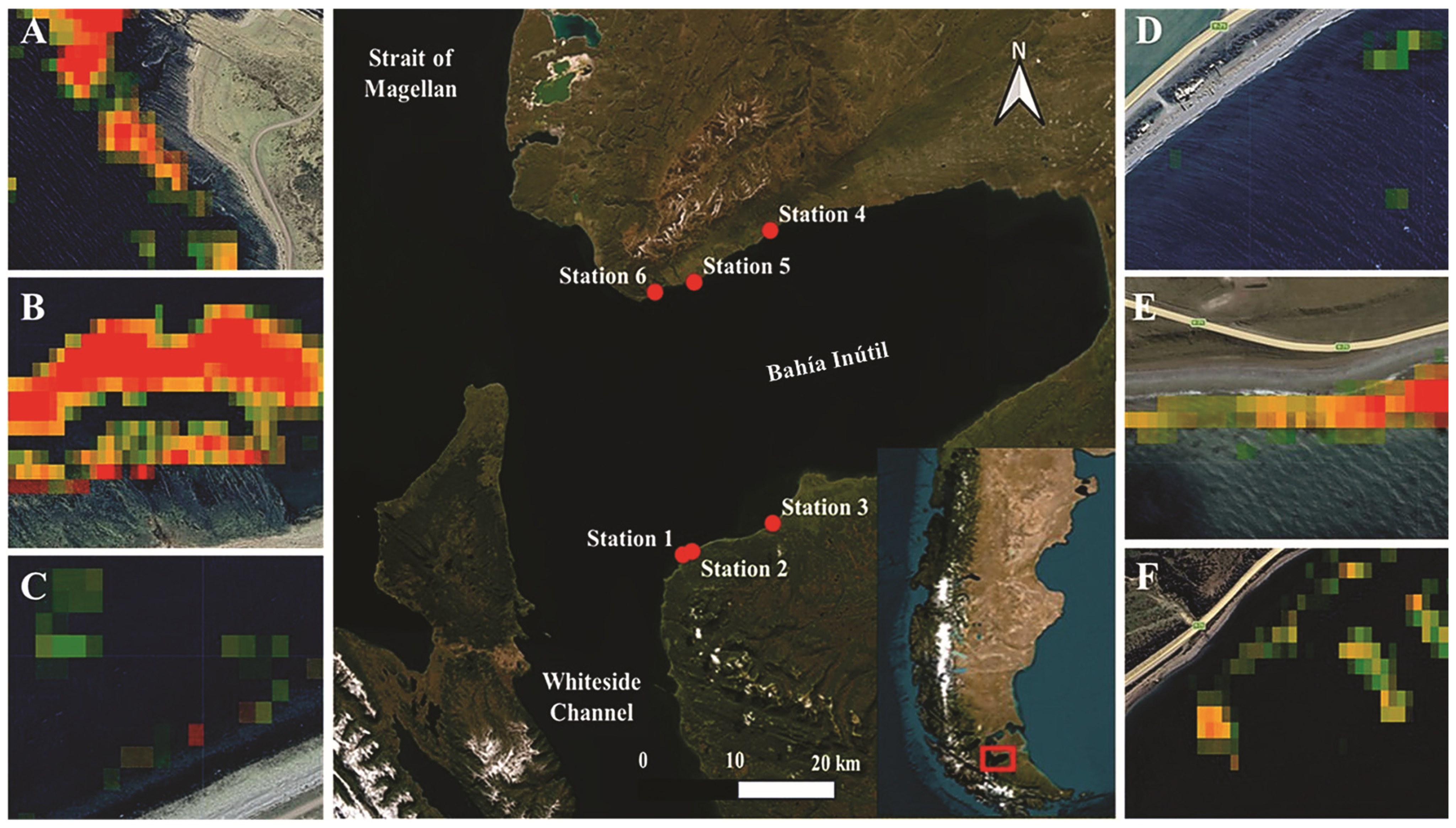
Location of sampling stations in Bahía Inútil, Tierra del Fuego, Chile. (A–F) Inset panels showing Stations 1 through 6, respectively. The side panels show the forest density (Kernel Density) at each sampling station. Sentinel-2 L1C images, averaged between 2015 and 2019. KD is rescaled to 0–255; pixel size: 10 m. Red (KD 11 or higher): dense M. pyrifera canopy throughout the study period; yellow (KD 6–10): Canopies of medium density and/or less permanent canopies; green (KD 1–5): low-density or less permanent canopies. Aerial scale 50 m [29]. Satellite images were obtained from ESRI Satellite in QGIS (version 3.40.3).
M. pyrifera forests in Bahía Inútil are distributed primarily along the southern and northern coasts. The density and extension of M. pyrifera forests exhibit a geographic gradient, with higher density and larger forest area at the bay’s entrance, and a decrease in both density and area observed as one moves farther into the bay. Conversely, M. pyrifera is absent on the eastern coast of the bay (Figure 1).
2.2. Sampling Design and Field Work
Six sampling stations in the GKFs were established, three on the north coast and three on the south coast, at coastal areas spaced approximately 35 km apart. At each sampling station, two transects parallel to the shoreline were laid out using a guide rope. Each transect measured 25 m in length by 2 m in width (50 m2 area), separated by a distance of 10 m. The transects were situated at depths ranging from 3 to 8.5 m (mean = 4.9 ± 1.72 m). Twenty photoquadrats (0.06 m2 each) were sampled randomly and independently for each transect (N = 240, equivalent to 15 m2 of area). Sampling was conducted by a team of SCUBA divers. The expedition, organized and funded by Rewilding Chile, took place between 25 and 28 March 2025 during the austral autumn.
The photoquadrats were captured using an Olympus OM SYSTEM TG-7 camera (OM Digital Solutions Corporation, Long Thanh City, Vietnam), equipped with an Ikelite underwater housing (Ikelite Underwater Systems, Indianapolis, IN, USA) and two Inon D-200 strobes (INON Inc., Kamakura, Japan), at a resolution of 12 megapixels. A rigid quadrat frame was mounted directly to the camera housing and wrapped in non-reflective black tape to eliminate metallic glare. The images were post-processed in Adobe Photoshop (version 21.2.11) to correct lighting and shadow errors.
For fish assessments, a diver visually quantified all individuals within a 1 m belt on either side of the 25 m transect line at each station. Since most fish species are benthic and cryptic, the transects were conducted at a depth of 0.5 to 1 m above the seafloor, at a uniformly slow swimming speed of 2 m min−1, and in areas with rocks and crevices, the seafloor was inspected in detail to check for the presence of fish [45]. Additionally, the density of M. pyrifera per m2 was determined by counting the plants to characterize kelp forest substrate structure (Table 1).
Table 1.
Location of sampling sites (1 to 3 southern coast; 4 to 6 northern coast) and environmental data, including depth, number of plants of M. pyrifera per square meter, type of substrate.
2.3. Image Analysis
The photoquadrats were analyzed manually using the open-access web platform CoralNet (version 1.0 (accessed on 7 November 2025)) [46], to catalog and calculate the percentage of coverage. In each photoquadrat, 100 points were distributed in a 10-row-by-10-column matrix. Organisms present in all photographs were identified to the lowest possible taxonomic level. Taxonomic identifications were performed using regional literature for invertebrates [47,48], macroalgae [49,50,51,52,53], and fish [54]. Additionally, the uninhabited substrate was classified into four categories through visual analysis: bedrock, sand, gravel, and biogenic substrate. The latter is defined as substrate consisting of Cirripedia skeletons and Mollusca shell fragments.
2.4. Data Analysis
The abundance of each taxa was determined using the coverage percentage data, which were obtained from the photoquadrats. These percentages were transformed using the arcsine transformation [55]:
to minimize the influence of extreme values (rare and/or very abundant species) when evaluating differences in coverage percentage. The taxonomic composition of the invertebrates and macroalgae was evaluated across both coastal sectors (northern vs. southern coast of Bahía Inútil). An analysis was conducted using the Bray–Curtis similarity index and 9999 permutations with PAST v.5.3 software [56]. The non-metric multidimensional scaling (nMDS) was performed based on station means (averages of 40 photoquadrats). Then, significant differences among transects by coastal sites were studied with PERMANOVA.
2.4.1. Analysis of Understory Diversity
At the same time, rarefaction–extrapolation curves were plotted, showing an increase in the number of detected species as sampling effort increased, with a 95% confidence interval, 50 bootstrap, and the following settings: q = 0 for species richness (S), q = 1 for Shannon diversity (H), and q = 2 for Simpson’s diversity (D) [57,58]. The analysis was carried out by means of the online software iNEXT (online version (accessed on 20 March 2026)) [59,60]. The settings used to run the rarefaction–extrapolation analyses were based on those recommended by the iNEXT software.
β-diversity is a proxy of species turnover, which was calculated based on the Cody index [61]:
where g(H) is the total gain in species along the gradient and l(H) is the total loss of species. This index was calculated using PAST v.5.3 software [56].
2.4.2. Network Analysis of the Similarity and Co-Occurrence of Key Species
To identify potential key species and their co-occurrence patterns between understory communities, a similarity analysis was conducted between the coastal northern and southern communities. This analysis included macroalgae and invertebrate taxa. The co-occurrence matrix in R-mode used Pearson’s correlation as the similarity index. Correlation relationships were generated for each pair of understory taxa, provided that both taxa were present.
The co-occurrence matrix was rendered graphically as a circular network, in which the taxa were represented by nodes and the co-occurrence relationships by edges connecting the nodes [62,63]. Co-occurrence relationships were included if they occurred in all forest replicates. A zero percent cutoff represents a fully connected (complete) network with edges between all pairs of nodes, whereas a fifty percent cutoff shows only edges between nodes with more than 50% similarity. The cut-off level was set at 100% to ensure only the strongest relationships were included in the network. Species with the highest number of relationships (edges) are defined as key species in the co-occurrence network. This analysis was performed using PAST v.5.3 software [56].
2.4.3. Relationship Between the Understory Community and Environmental Factors
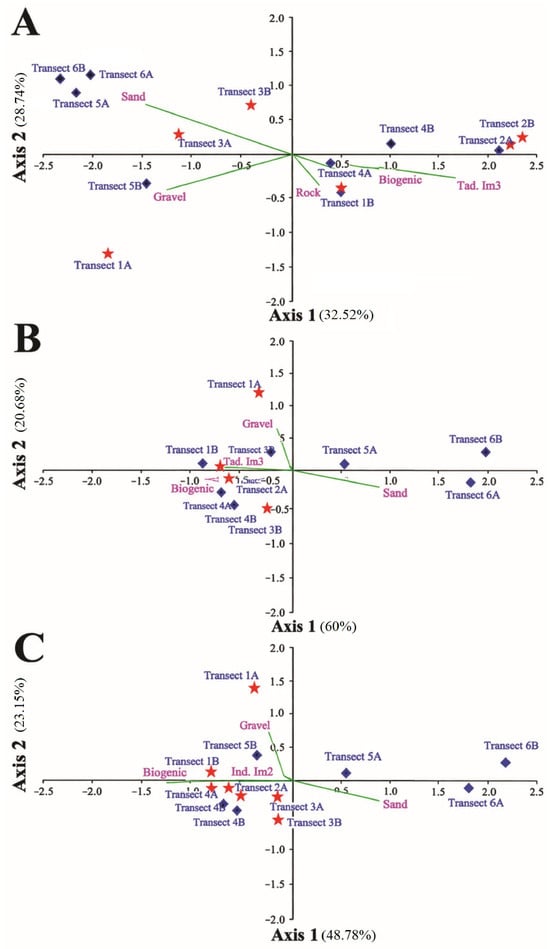
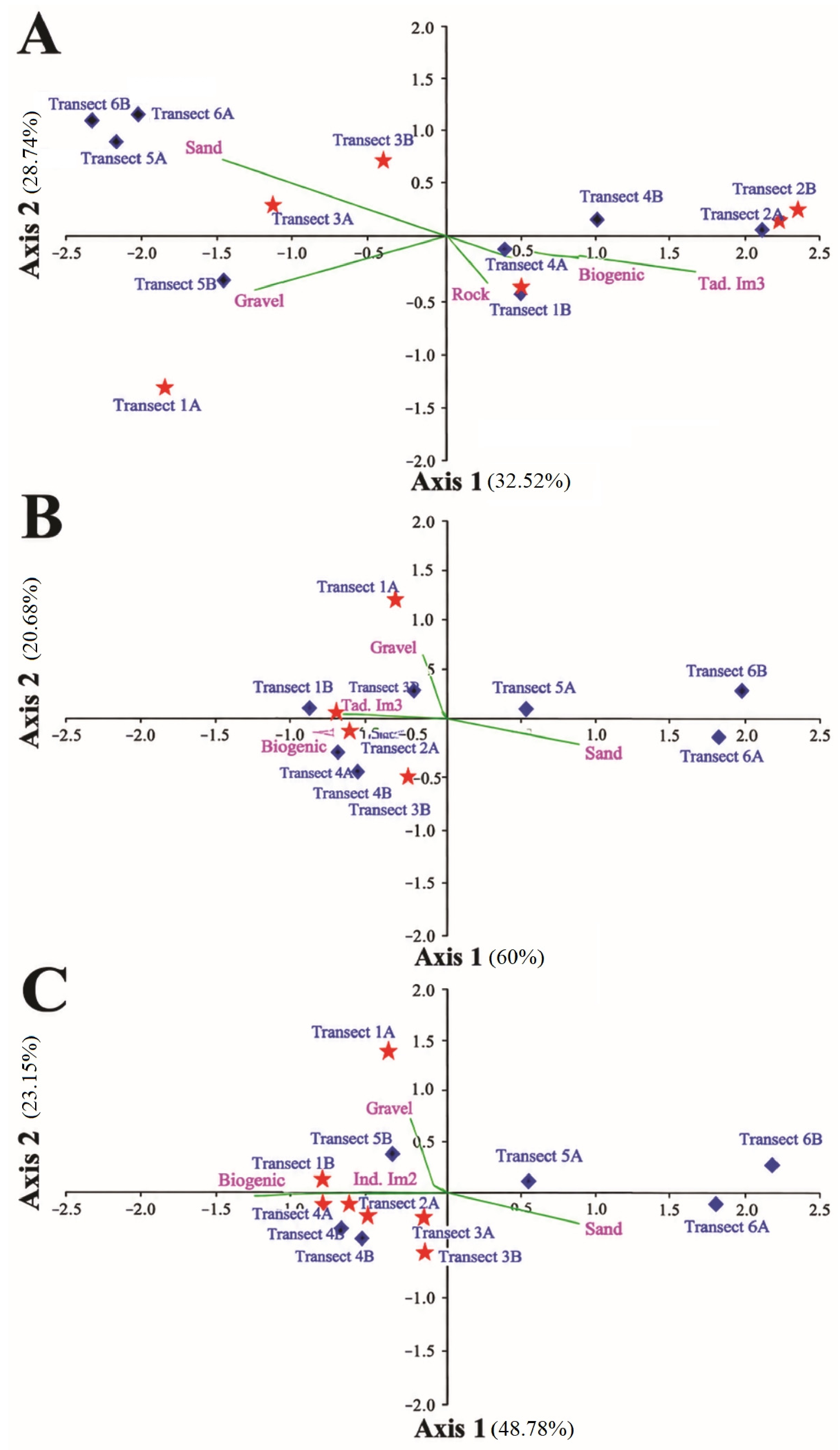
The relationship between variations in benthic organism cover and environmental factors (substrate type: bedrock, gravel, sand, and biogenic substrate; and M. pyrifera density) was analyzed. We used partitioning approaches with canonical correspondence analysis (CCA) [64]: first, we performed CCA on both the invertebrate and macroalgae communities; second, we performed CCA on the invertebrates and macroalgae separately. The CCA results were plotted on two-dimensional graphs, with transects represented by circles and environmental variables by vectors.
3. Results
3.1. Taxonomic Composition of the Understory Communities of the GKFs
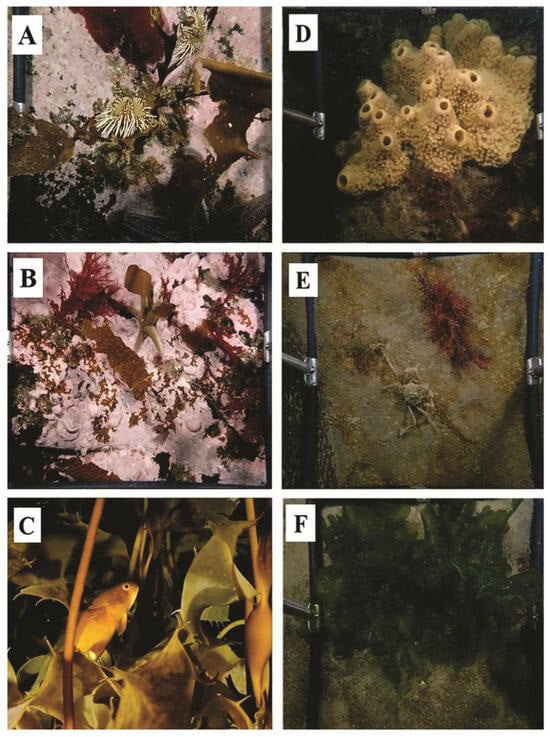
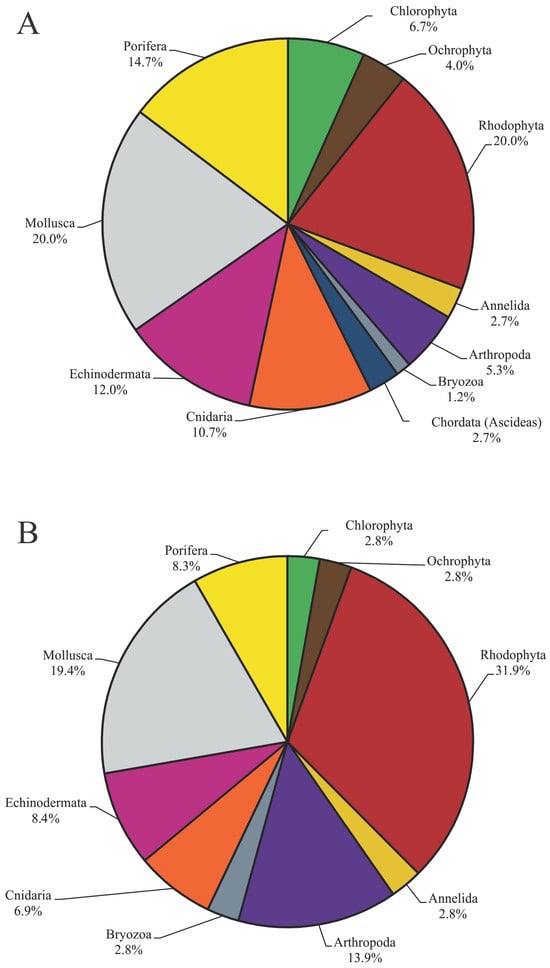
A total of 108 taxa were identified and analyzed during the study, based on 240 photoquadrats and the fish census. In terms of species numbers, the macroalgae were dominated by Rhodophyta, with 24 taxa accounting for 22.2%, followed by Ochrophyta and Chlorophyta, with four taxa each (Figure 2). Furthermore, the most dominant invertebrate group was Mollusca (22 taxa, 20.4%), followed by Porifera (11, 10.2%), Arthropoda (10, 9.3%), Echinodermata (9, 8.3%), Cnidaria (9, 8.3%), Annelida (Polychaeta) (2, 1.9%), Chordata (Ascidians) (2, 1.9%), and Bryozoa (2, 1.9%). Nine fish species (9, 8.3%) were recorded within the understory, with Patagonotothen squamiceps being the most abundant (Supplementary Table S1).
Figure 2.
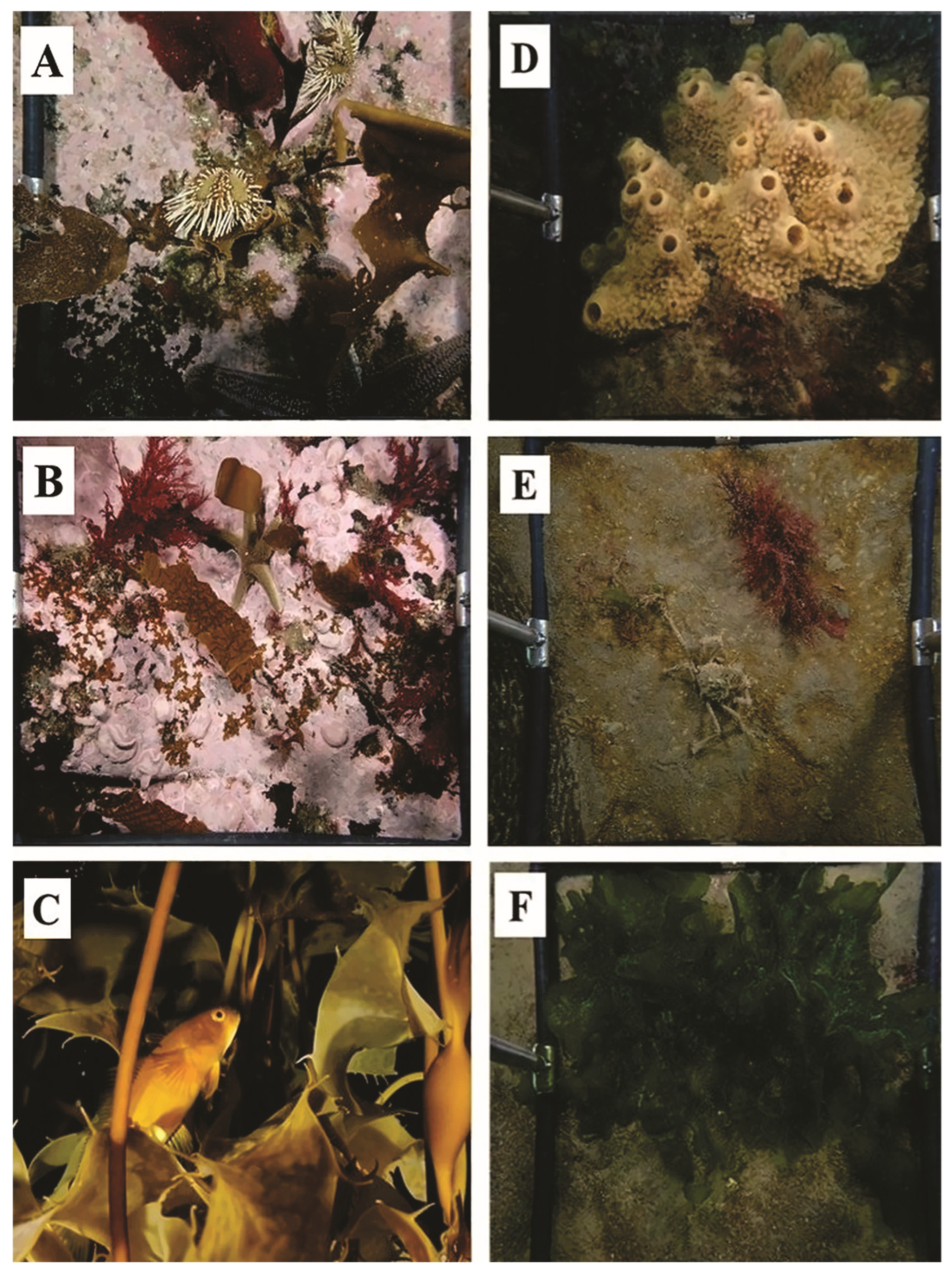
Examples of invertebrate species, macroalgae and fish photographed during research in the understory of M. pyrifera forests in Bahía Inútil, across various sampling stations. Arbacia dufresnii (A), Anasterias antarctica (B), Paranotothenia magellanica (C), Mycale magellanica (D), Eurypodius latreillii (E) and Ulva lactuca macroalga (F). Photographs: Fundación Rewilding Chile.
Along the southern coast (Figure 3A), the red macroalgae (Rhodophyta) group showed the greatest diversity within the macroalgae, with 15 species accounting for 20.0%. This was followed by Mollusca with 15 species, accounting for 20.0%; Porifera with 11 species, accounting for 14.7%; and Echinodermata with 9 species, accounting for 12.0%. Ochrophyta and Chlorophyta comprised five (6.7%) and three (4.0%) species, respectively. In the invertebrates, Cnidaria and Arthropoda comprised 10.7% and 5.3%, respectively. The remaining taxa reached less than 6.7%.
Figure 3.
The community structure of M. pyrifera forests in Bahía Inútil is based on the species richness of the understory on the southern (A) and northern (B) coasts.
Along the northern coast (Figure 3B), the macroalgae exhibited the greatest biodiversity of red macroalgae (Rhodophyta), with 23 species recorded, accounting for 31.9% of the total. Within the invertebrates, Mollusca were represented by 14 species (19.4%) and arthropods by 10 species (13.9%). Other invertebrates include Porifera and Echinodermata, accounted for 8.4%, with six species in each group, as well as Cnidaria, with five species, accounting for 6.9%. The least diverse groups of invertebrates were Bryozoa and Annelida, with two species each (2.8%), and in macroalgae were Chlorophyta and Ochrophyta, with two species in each group and accounting for 2.8% each.
3.2. Abundance of Invertebrates and Macroalgae Species
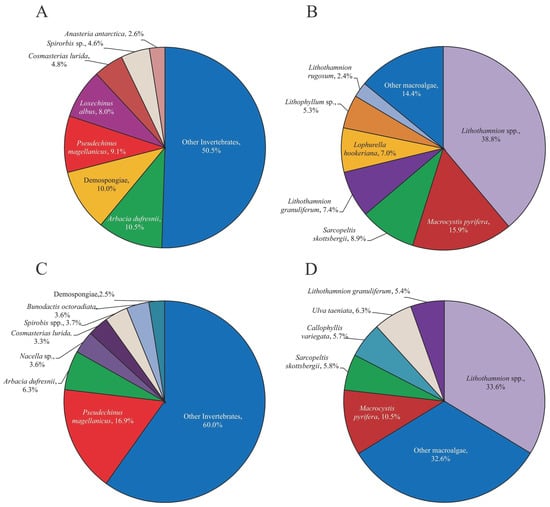
Based on percentage cover, the dominant zoobenthic taxa along the southern coast were the echinoid species Arbacia dufresnii (10.5%), Pseudechinus magellanicus (9.1%), Loxechinus albus (8.0%), and demosponges (10.0%). Smaller proportions were recorded for C. lurida (4.8%), Spirorbis sp. (4.6%), and Anasterias antarctica (2.6%). The ‘other invertebrates’ group accounted for 50.5% (see Figure 4A).
Figure 4.
Abundance values of understory species in M. pyrifera forests in Bahía Inútil. The southern coast stations (A,B) and the northern coast stations (C,D). Details of the total abundance analyses are available in the Supplementary Materials, Table S2.
Along the northern coast, excluding the ‘other invertebrates’ category (60.0%), the benthic invertebrate species with the second-highest coverage was P. magellanicus (16.9%), followed by A. dufresnii (6.3%). The remaining taxa exhibited comparable abundances, including Spirorbis sp. (3.7%), Bunodactis octoradiata (3.6%), Nacella sp. (3.6%), C. lurida (3.3%), and Demospongiae (2.5%) (see Figure 4C).
Macroalgae composition also exhibited variations between coastal sectors. Along the southern coast, coralline algae of the Lithothamnion genus dominated, covering 38.8% of the area. This was followed by ‘other macroalgae’ (14.4%), small M. pyrifera (15.9%), Sarcopeltis skottsbergii (8.9%), Lithothamnion granuliferum (7.4%), Lophurella hookeriana (7.0%), Lithophyllum sp. (5.3%), and Lithothamnion rugosum (2.4%) (see Figure 4B).
Along the northern coast, Lithothamnion spp. and the ‘other macroalgae’ group represented 33.6% and 32.6%, respectively, while M. pyrifera coverage fell to 10.5%. The remaining species were Callophyllis variegata (5.7%), S. skottsbergii (5.8%), Ulva taeniata (6.3%), and L. granuliferum (5.4%) (see Figure 4D).
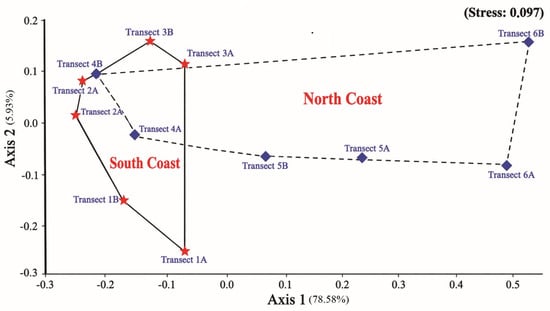
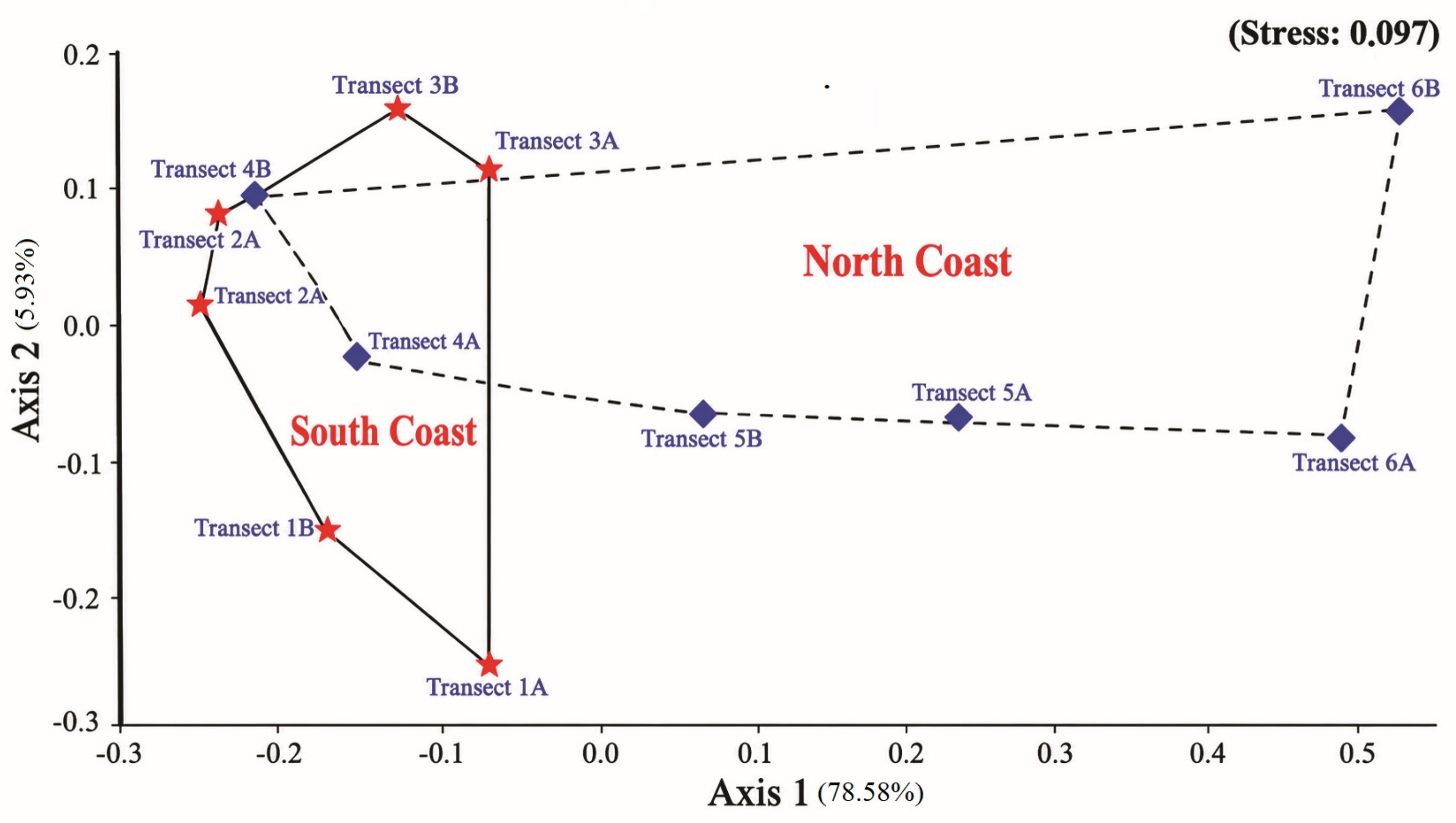
Despite variations in the dominant species, the overall benthic composition showed no statistically significant differentiation between the two coasts. This result was supported by PERMANOVA (p = 0.117) and subsequent non-metric multidimensional scaling (nMDS) (stress = 0.097), which revealed a high degree of overlap between the northern and southern benthic communities (see Figure 5).
Figure 5.
Non-metric multidimensional scaling (nMDS) analysis of transects sampled within M. pyrifera forests in Bahía Inútil. Transects were taken from different coastal sites (southern and northern coasts). The solid line shows the convex hull for the southern coast, and the dotted line shows the convex hull for the northern coast.
3.3. Diversity of Macroalgae and Invertebrates
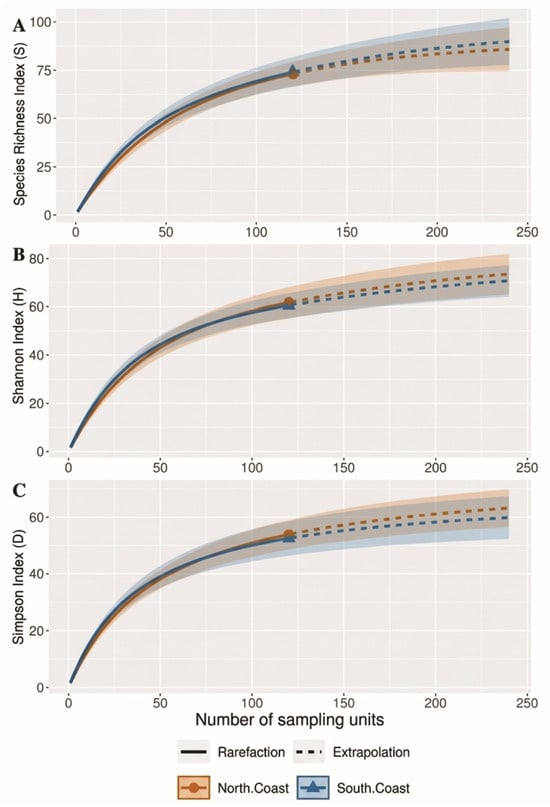
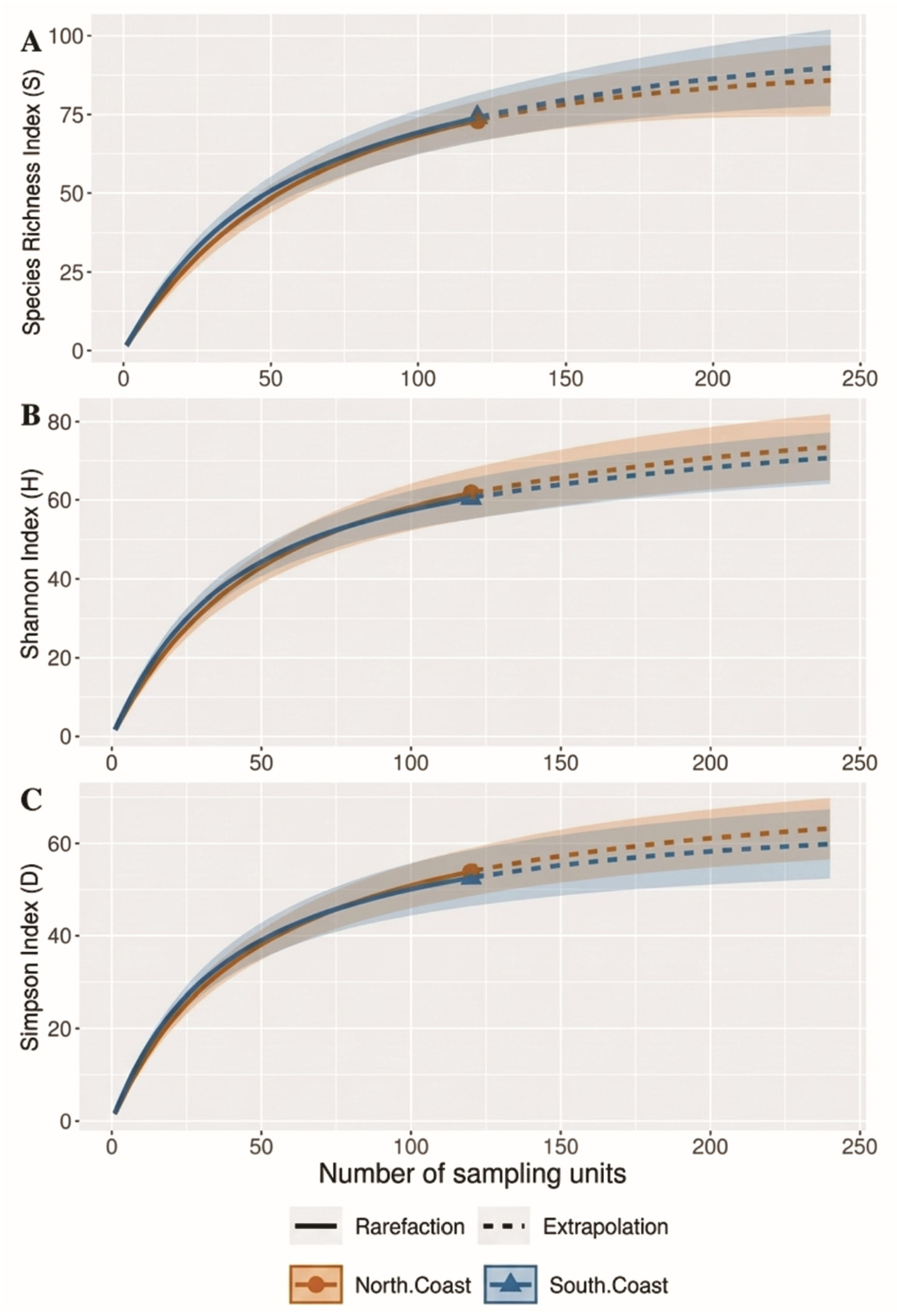
Analysis of the rarefaction–extrapolation curves using three diversity metrics (species richness (S), Shannon (H), and Simpson (D)) revealed consistent patterns across the coastal sites studied (Figure 6A–C). Both coasts showed a marked increase in diversity during the first 50 sampling units, gradually stabilizing as the sampling effort increased. The northern coast exhibited slightly higher diversity than the southern coast across all three metrics assessed, although the differences were moderate. Extrapolations up to 240 units suggested that both sites could see a marginal increase in diversity, with estimates ranging from 85 to 90 species (species richness) and more than 70 species present at both coastal sites according to the Shannon and Simpson indices. Simpson diversity indices showed curves that trended towards an asymptote more clearly than species richness, indicating that the sampling effort had adequately captured the structure of the benthic community. Overlapping confidence bands mean no difference between both coasts. However, the absence of a clear asymptote in species richness suggested the presence of undetected species at both sites. In all cases, the confidence intervals widened in the extrapolated area, reflecting uncertainty in the projections beyond the observed sampling (Figure 6A–C).
Figure 6.
The rarefaction-extrapolation curve for samples within a M. pyrifera forests in Bahía Inútil. The shaded areas correspond to the 95% confidence intervals for the richness estimate.
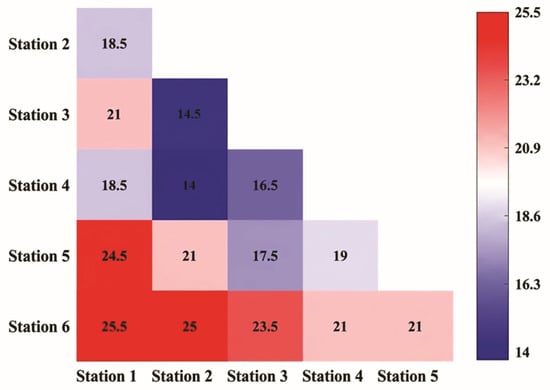
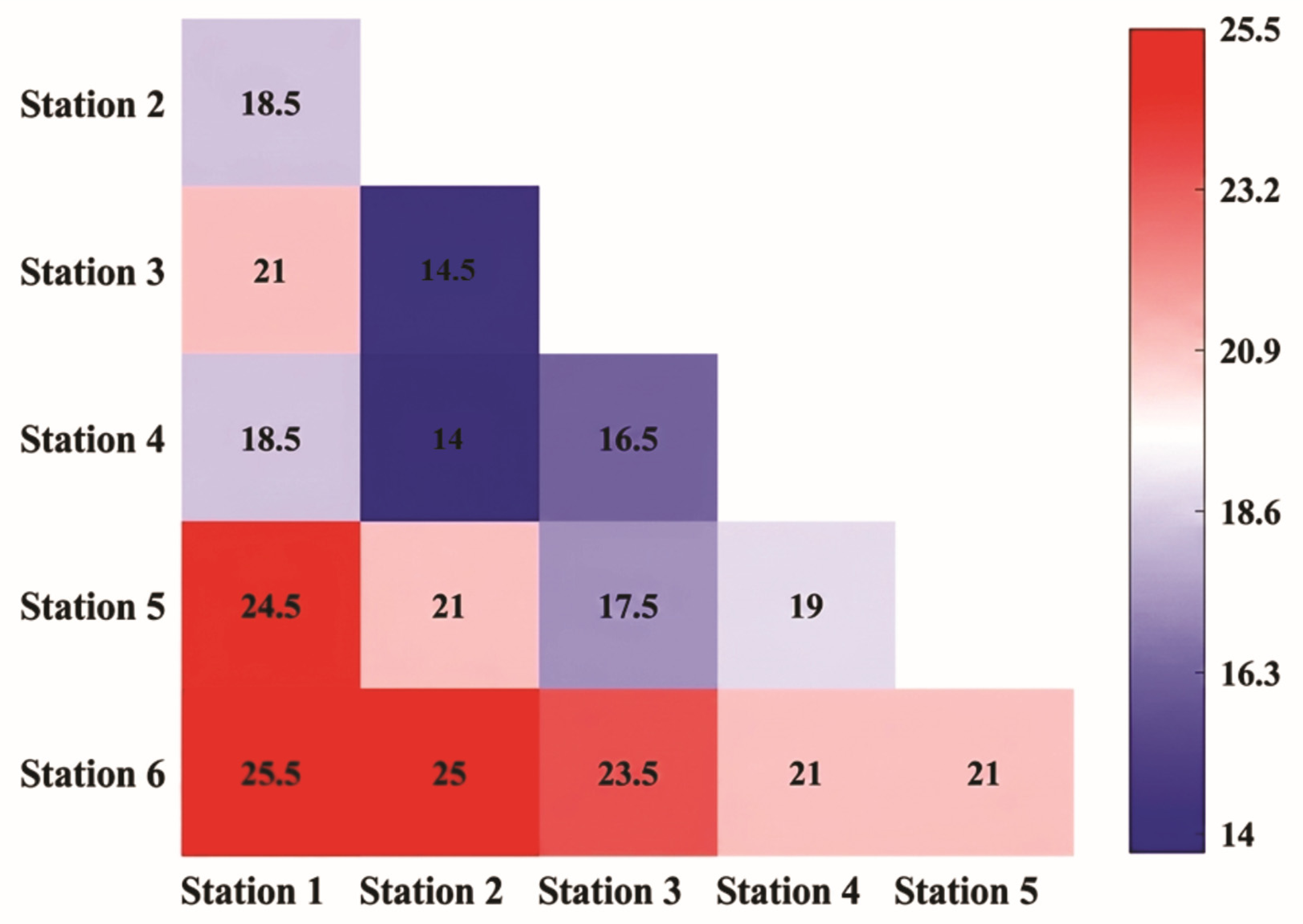
Based on the Cody index of β-diversity (β = 89.5; Figure 7), there is moderate species turnover between the understory communities on the north and south coasts of the sampled sites.
Figure 7.
Comparison matrix of β-diversity indices contrasting the six stations in the dataset.
Along the south coast, comparisons between stations revealed β-diversity values ranging from 14.5 to 21.0, indicating moderate species turnover. In contrast, species turnover was slightly higher along the northern coast, with values ranging from 19.0 to 21.0 between Stations 6–4 and 6–5 (21) (Figure 7).
3.4. Similarity Network Among Understory Species
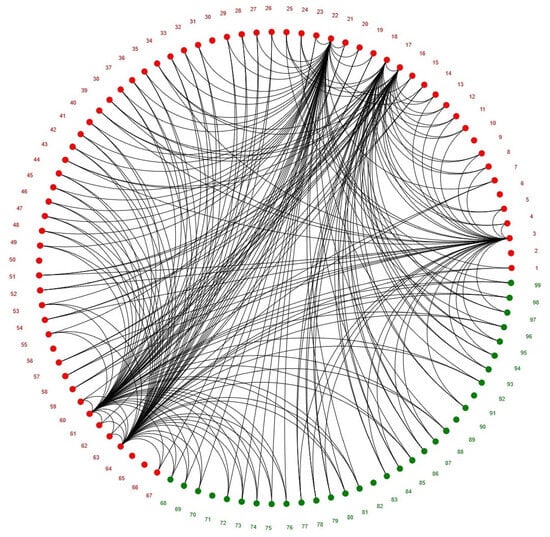
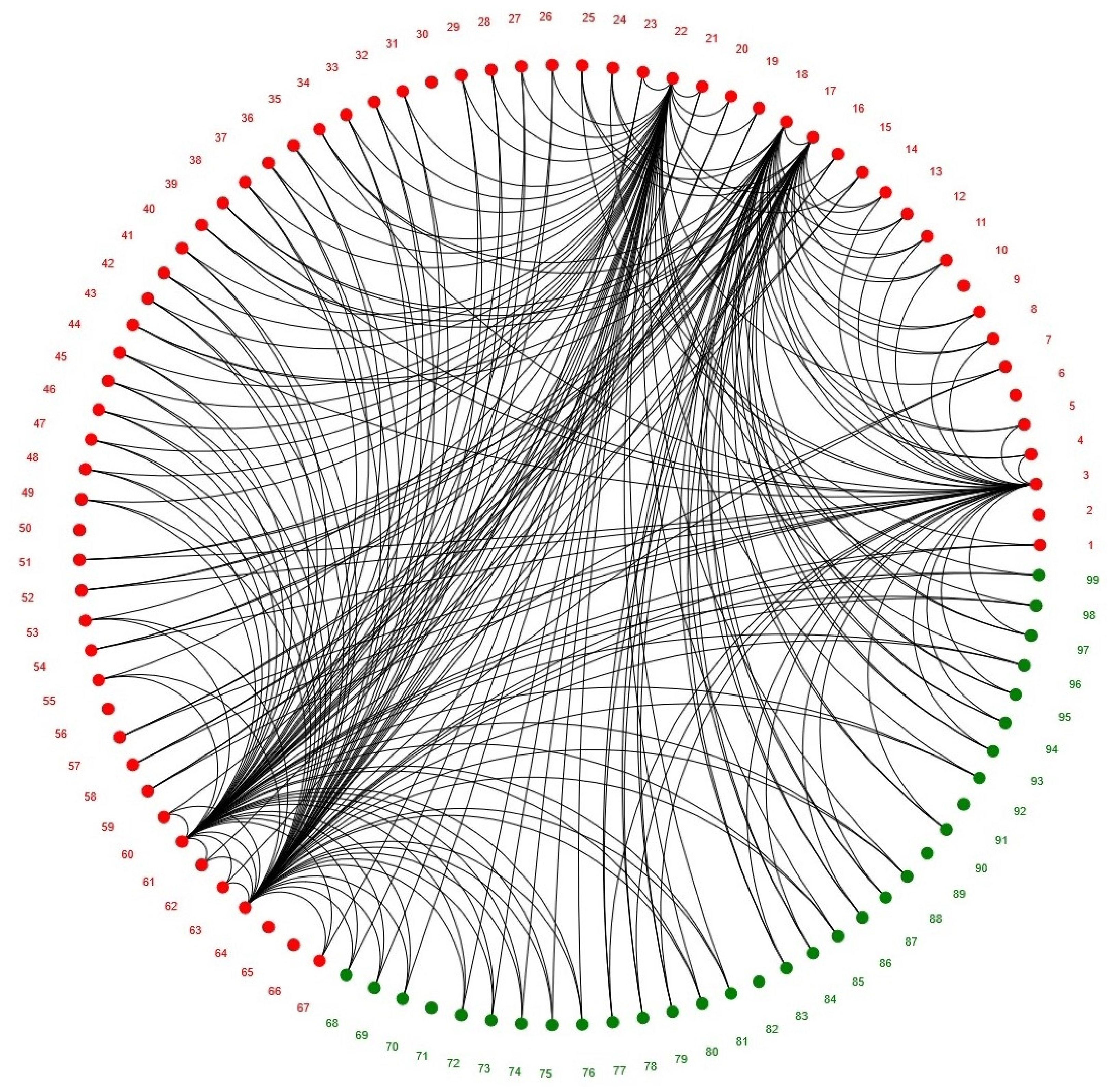
The network shows that the understories of the northern and southern coast are similarly structured and dominated by just six species that are highly connected. These six species account for a large proportion of the connections, while most other species have few. This indicates a hierarchical structure in which some species act as central nodes (hubs). This suggests that both forests are highly consistent in their composition around these species, which are likely to characterize the habitat. The species with the highest number of connections are A. antarctica (3), Epizoanthus fiordicus (17), Eurypodius latreillei (18), Fissurellidea patagonica (22), Tonicia calbucensis (61), and Trachytedania sp. (64). A. antarctica appears as one of the most connected nodes (Figure 8). As a generalist benthic predator, its presence is usually associated with well-developed communities. E. fiordicus, which follows closely behind, also exhibits numerous connections, suggesting that it shares habitat requirements with many understory species. E. latreillei maintains the relationships, which is consistent with its use of refuges amongst macroalgae and complex substrates. F. patagonica likely reflects stable rocky areas where numerous other species also establish themselves. T. calbucensis, an herbivorous chiton, is usually found on surfaces covered by encrusting algae and macroalgae, serving as a good indicator of well-preserved rocky habitats. The sponge Trachytedania sp. is a sessile organism that increases the structural complexity of the habitat and frequently coexists with a vast diversity of invertebrates acting as network-structuring species as they co-occur frequently with numerous other species within the system.
Figure 8.
Circular correlation networks based on the Pearson correlation index. The cut-off level was set at 100%, node numbers correspond to taxa, and IDs are as reported in Supplementary Materials, Table S1. Nodes are ordered by macroalgae (green) and invertebrate (red) groups.
3.5. Relationship Among Macroalgae, Invertebrates and Environmental Variables
In general, the density of M. pyrifera varied among stations, with the highest values recorded at Station 2, where a density of 0.50 ind./m2 was reached. Station 1 showed intermediate values of 0.26–0.28 ind./m2, while Stations 3 and 4 presented densities of approximately 0.20–0.38 and 0.20–0.28 ind./m2, respectively. The lowest densities were observed at Stations 5 and 6, with a minimum value of 0.12 ind./m2 at Station 5 (Table 1).
In terms of substrate composition, Stations 1 and 3 exhibited a relatively balanced combination of gravel, sand, biogenic material, and rock. In contrast, Stations 2 and 4 showed a greater predominance of sand and rock, respectively, while Stations 5 and 6 were characterized by a significant proportion of biogenic material and gravel. Station 6 stood out for having a high proportion of sand, reaching 71–72%, together with a low proportion of biogenic material (Table 1).
Canonical correspondence analysis included invertebrates (Figure 9A), which showed that the two axes accounted for 61.26% of the total variance. The vector of the M. pyrifera density is one of the most important factors, mainly associated with transects along the southern coast (transects 1B, 2A, and 2B, and to a lesser extent, 4B). This suggests that the invertebrates respond strongly to greater organism abundance or aggregation on more complex and biogenic substrates. Furthermore, the biogenic vector showed a similar trend to density, indicating that the presence of biological structures probably favors habitat heterogeneity and the occurrence of zoobenthic species. In contrast, the transects along the north coast (5A, 6A, and 6B) were primarily associated with the sand vector, reflecting fauna associated with softer, more homogeneous substrates.
Figure 9.
Canonical correspondence analysis. Relationship between macroalgal communities and environmental variables within the M. pyrifera forests of Bahía Inútil. The vectors represent environmental variables, and the transects are represented as circles. Red stars: southern coast stations. Blue diamonds: northern coast stations. (A) Invertebrate community, (B) macroalgae communities, and (C) benthic communities of invertebrates and macroalgae.
By contrast, the CCA includes macroalgae (Figure 9B), which showed that the two axes accounted for 80.86% of the total variance. The macroalgae exhibit a more pronounced response to the composition of the physical substrate. The sand vector clearly distinguishes transects 5A, 6A, and 6B, indicating that the macroalgae species in these areas are associated with sandy substrate. Conversely, the bedrock and biogenic vectors are clustered around the transects on the southern coast and in the intermediate sectors. This suggests that macroalgae components depend more on hard or structurally complex surfaces for attachment and development. Unlike the invertebrates, M. pyrifera has a weaker and more localized influence on the macroalgae, suggesting that macroalgae abundance does not influence the distribution of macroalgae species as much as it does for fauna.
Another important difference lies in the spatial distribution of the transects. In the invertebrates, the separation between the northern and southern coasts is clearer and more systematic along axis 1, reflecting a more distinct community response to the environmental gradient. In the macroalgae, spatial differentiation also exists, but several transects remain closer to the origin, proposing a less pronounced response or greater tolerance of environmental variation.
Overall, both analyses suggest that sedimentary and structural gradients influence the ecological organization of the M. pyrifera understory, albeit with different effects on each biological component. The invertebrates appear to respond primarily to structural complexity and M. pyrifera density, while the macroalgae are more strongly influenced by the substrate available for colonization and attachment.
Canonical correspondence analysis, which includes both macroalgae and invertebrates together, showed that the two axes accounted for 71.93% of the total variance (Figure 9C). Axis 1 was correlated with sand; the communities in transects 6A and 6B were associated with this substrate. Concurrently, the communities in transects 5A and 5B showed an affinity for sites where gravel predominated. Meanwhile, the M. pyrifera (ind./m2) variable had a shorter vector, indicating a relatively minor influence on species arrangement.
4. Discussion
Our findings demonstrate that the understory communities associated with M. pyrifera in Bahía Inútil are highly diverse and structurally complex. This is consistent with descriptions of kelp forests as three-dimensional ecosystems that can modify physical environmental conditions and generate diverse microhabitats for numerous species [7,9,10]. Our results also support the proposal by Foster [11] and Edgar et al. [12] that the understory is composed of multiple closely related functional groups. This research is an integrative and analytical study of the Bahía Inútil area that demonstrates the importance of the understory as a key habitat within kelp forests.
4.1. Species Richness and Biodiversity of the Understory
The GKF understory supported 108 taxa. This diversity is consistent with previous observations of M. pyrifera forests in Patagonia, where macroalgae exhibit high spatial heterogeneity [30], while benthic invertebrates can exceed 140 species [31,32]. The presence of nine fish species also highlights the role of the understory as a refuge and feeding ground for ichthyofauna, as described in previous studies [24,25,26,34]. Although the northern coast exhibited slightly greater species richness than the southern coast, PERMANOVA and nMDS analyses revealed a high degree of similarity in the composition of both communities. These results suggest that the ecological processes structuring both forests are comparable, which is consistent with the spatial and temporal persistence observed for M. pyrifera forests in Patagonia [29].
Regarding biodiversity, as measured by rarefaction curves, the sampling effort adequately represented the dominant species in the community, particularly according to the Shannon and Simpson indices. However, the absence of a clear asymptote for species richness suggests that some rare species remained unobserved. This may be due to the sampling methods employed and the subsequent analytical techniques used. Our results only considered specimens larger than 1 mm. For the coverage calculation, we only studied organisms found at the sampling points. This methodological bias can affect the presence of cryptic species; in fact, recent studies have described 58 species of macroalgae [65], combining underwater photography and manual collection to document more cryptic species in the sublittoral zone of Bahía Inútil.
4.2. Network of Ecological Interactions in the GKF Understory
One of the main contributions of this study is the analysis of similarity networks. The observed structure revealed a hierarchical organization dominated by a few highly related species, including A. antarctica, E. fiordicus, E. latreillei, F. patagonica, T. calbucensis and Trachytedania sp. These species accounted for the greatest number of associations within the network, suggesting that they are key to the structure of the understory. A similar network was described by an investigation in the understory of M. pyrifera of Puerto Toro where the trophic web showed trophic relationships among invertebrates and macroalgae. The web was capped by the trophic generalist starfish, C. lurida, and four species of sea urchins were present in the community [36]. The M. pyrifera forest is described as a habitat in which various interactions occur, including habitation, competition, commensalism, and trophic interactions. Therefore, it is worth noting that our analysis was exploratory, taking all possible relationships into account. In this context, our network includes sedentary species of anemones and sponges as key taxa in the understory hub. These key taxa played a role in organizing the community, as they are involved in the majority of associations with other species. Furthermore, the integration of invertebrates and macroalgae reflects the fact that the Macrocystis forest’s physical complexity favors a highly interconnected community.
While connections between zoobenthic species predominate, there are also multiple links to macroalgae. The presence of relationships between the two groups suggest strong coupling between primary producers and benthic consumers. This indicates that the understory functions as an integrated ecological system where macroalgae provide shelter and a substrate on which benthic invertebrates can feed. Conversely, the absence of clearly distinct modules indicates that species from both forests exhibit similar distribution patterns, supporting the notion that both understories possess a comparable ecological composition.
Importantly, Pearson’s correlation reflects patterns of co-occurrence and spatial similarity rather than direct ecological interactions or trophic relationships. Consequently, these species should be interpreted as indicators of shared habitats and the community’s spatial organization. As established, the three-dimensional understory habitat is not only used for feeding, but also supports other ecological relationships, such as habitat provision, competition, and commensalism [66,67].
The observed relationships between the macroalgae and the invertebrates demonstrate that the understory functions as an integrated ecological system. This is consistent with the argument of Villegas et al. [27] that the various biological components of the kelp forest should be analyzed as an interdependent community, rather than in isolation. They asserted that the physical structure provided by M. pyrifera simultaneously favors the establishment of macroalgae and invertebrates.
4.3. Factors Driving the GKF Understory Community
Canonical correspondence analysis identified substrate type as the main factor influencing the distribution of benthic communities, while the density of M. pyrifera had a lesser effect. These results are consistent with previous studies showing that the composition of understory communities is determined by the availability of rocky substrate, sedimentation, and physical complexity [4,5,6]. Furthermore, biogenic substrates increase environmental heterogeneity and favor the settlement of numerous sessile organisms.
Our results support the hypothesis that M. pyrifera forests are stable, highly connected systems where structural habitat complexity allows diverse, functionally integrated communities to thrive. In light of the mounting threats posed by climate change and human activities [37], conserving these forests necessitates safeguarding the entire network of associated organisms. In this context, the highly connected species identified in this study could be used as ecological indicators in long-term monitoring programs.
4.4. The Role of the GKF in Bahía Inútil
Comparing the epifauna community of the GKFs to the surrounding soft-bottom epifauna of Bahía Inútil highlights the role of kelp forests in enhancing the biodiversity and ecological complexity of coastal ecosystems. While the understory supported a total of 108 taxa, including macroalgae, invertebrates, and fish species, the soft-bottom epifauna was represented by just 61 taxa, all of which were invertebrates [68]. This difference demonstrates that Macrocystis forests provide a greater diversity of ecological niches by generating a three-dimensional structure that favors the establishment of sessile, mobile, and fish species [28].
The elevated biodiversity observed in the understory was mainly due to the high diversity of macroalgae, particularly Rhodophyta. This is due to the protection offered by the GKF and the availability of a hard substrate. This structural complexity is a defining characteristic of founder species, which can modify the physical environment and increase local biodiversity [10,69]. By contrast, the epifauna of the surrounding soft-bottom areas of Bahía Inútil comprised a community dominated by just a few species, such as Grimothea gregaria and Zygochlamys patagonica, reflecting the lower structural complexity of the habitat.
Furthermore, the restriction of fish observations to the understory suggests that Macrocystis forests serve as refuges, feeding grounds, and areas for recruitment for numerous species. Previous studies have demonstrated that kelp forests enhance the abundance and diversity of fish and invertebrates by mitigating predation risk and augmenting resource availability [9,24,70]. Therefore, the understory not only represents a diverse benthic community, but also plays a key role in maintaining ecological relationships between different trophic levels.
Collectively, these findings demonstrate that conserving M. pyrifera kelp forests should be a priority to protect Bahía Inútil. The importance of these forests goes beyond the conservation of a dominant species, as they provide an essential habitat that supports a high proportion of benthic and fish biodiversity, promoting ecological processes that are fundamental to the ecosystem. Therefore, any management strategy aimed at preserving the ecological integrity of Bahía Inútil should prioritize the conservation of Macrocystis forests, given their role as an ecosystem engineer and one of the main reservoirs of biodiversity in Patagonia fjords and channels.
Supplementary Materials
The following supporting information can be downloaded at: https://www.mdpi.com/article/10.3390/jmse14232269/s1.
Author Contributions
D.P., Formal analysis, research, and original draft. A.M., Conceptualization, project management, methodology, supervision, and draft—review & editing. M.P., Investigation, review & editing. J.K., Investigation and review. M.H., Conceptualization, fundraising, investigation, resources, supervision, and draft—review & editing. All authors have read and agreed to the published version of the manuscript.
Funding
This work was made possible by Rewilding Chile, a Chilean non-profit financially supported by an extensive philanthropic network.
Data Availability Statement
The original contributions presented in this study are included in the article and Supplementary Materials. Further inquiries can be directed to the corresponding authors.
Acknowledgments
We greatly appreciate the in situ logistical support of Rewilding Chile during our fieldwork in Bahia Inútil, especially E. Davis. We would like to thank P. Rivadeneira and his research assistant for identifying the starfish, and L. Novoa for helping to identify the sponges.
Conflicts of Interest
The authors declare no conflicts of interest.
Abbreviations
GKF, giant kelp forest, nMDS, non-metric multidimensional scaling, CCA, canonical correspondence analysis, KD, kelp density, iNEXT, interpolation and extrapolation, PAST, Paleontological Statistics.
References
- Gerard, V.A. The light environment in a giant kelp forest: Influence of Macrocystis pyrifera on spatial and temporal variability. Mar. Biol. 1984, 84, 189–195. [Google Scholar] [CrossRef] [Scilit]
- Irving, A.D.; Connell, S.D.; Elsdon, T.S. Effects of kelp canopies on bleaching and photosynthetic activity of encrusting coralline algae. J. Exp. Mar. Biol. Ecol. 2004, 310, 1–12. [Google Scholar] [CrossRef] [Scilit]
- Duggins, D.O.; Eckman, J.E.; Sewell, A.T. Ecology of understory kelp environments. II. Effects of kelps on recruitment of benthic invertebrates. J. Exp. Mar. Biol. Ecol. 1990, 143, 27–45. [Google Scholar] [CrossRef] [Scilit]
- Connell, S.D. The monopolization of understory habitat by subtidal encrusting coralline algae: A test of the combined effects of canopy-mediated light and sedimentation. Mar. Ecol. 2003, 24, 61–71. [Google Scholar] [CrossRef] [Scilit]
- Eckman, J.E.; Duggins, D.O.; Sewell, A.T. Ecology of understory kelp environments. I. Effects of kelps on flow and particle transport near the bottom. J. Exp. Mar. Biol. Ecol. 1989, 129, 173–187. [Google Scholar] [CrossRef] [Scilit]
- Wernberg, T.; Kendrick, G.A.; Toohey, B.D. Modification of the physical environment by an Ecklonia radiata (Laminariales) canopy and implications for associated foliose algae. Aquat. Ecol. 2005, 39, 391–407. [Google Scholar] [CrossRef] [Scilit]
- Dayton, P.K.; Tegner, M.J.; Parnell, P.E.; Edwards, P.B. Temporal and spatial patterns of disturbance and recovery in a kelp forest community. Ecol. Monogr. 1992, 62, 421–445. [Google Scholar] [CrossRef] [Scilit]
- Clark, R.P.; Edwards, M.S.; Foster, M.S. Effects of shade from multiple kelp canopies on an understory algal assemblage. Mar. Ecol. Prog. Ser. 2004, 267, 107–119. [Google Scholar] [CrossRef] [Scilit]
- Steneck, R.S.; Graham, M.H.; Bourque, B.J.; Corbett, D.; Erlandson, J.M.; Estes, J.A.; Tegner, M.J. Kelp forest ecosystems: Biodiversity, stability, resilience and future. Environ. Conserv. 2002, 29, 436–459. [Google Scholar] [CrossRef] [Scilit]
- Graham, M. Effects of local deforestation on the diversity and structure of Southern California giant kelp forest food webs. Ecosystems 2004, 7, 341–357. [Google Scholar] [CrossRef] [Scilit]
- Foster, M.S. Regulation of algal community development in a Macrocystis pyrifera forest. Mar. Biol. 1975, 32, 331–342. [Google Scholar] [CrossRef] [Scilit]
- Edgar, G.J.; Barrett, N.S.; Morton, A.J.; Samson, C.R. Effects of algal canopy clearance on plant, fish and macroinvertebrate communities on eastern Tasmanian reefs. J. Exp. Mar. Biol. Ecol. 2004, 312, 67–87. [Google Scholar] [CrossRef] [Scilit]
- Estes, J.A.; Danner, E.M.; Doak, D.F.; Konar, B.; Springer, A.M.; Steinberg, P.D.; Tinker, M.T.; Williams, T.M. Complex trophic interactions in kelp forest ecosystems. Bull. Mar. Sci. 2004, 74, 621–638. [Google Scholar]
- Pérez-Matus, A.; Pledger, S.; Díaz, F.J.; Ferry, L.A.; Vásquez, J.A. Plasticity in feeding selectivity and trophic structure of kelp forest associated fishes from northern Chile. Rev. Chil. Hist. Nat. 2012, 85, 29–48. [Google Scholar] [CrossRef] [Scilit]
- Desmond, M.J.; Suárez-Jiménez, R.; Nelson, W.A.; Hepburn, C.D. Epifaunal community structure within southern New Zealand kelp forests. Mar. Ecol. Prog. Ser. 2018, 596, 71–81. [Google Scholar] [CrossRef] [Scilit]
- Smale, D.A. Impacts of ocean warming on kelp forest ecosystems. New Phytol. 2020, 225, 1447–1454. [Google Scholar] [CrossRef] [Scilit] [PubMed]
- Piñeiro-Corbeira, C.; Barrientos, S.; Provera, I.; García, M.; Díaz-Tapia, P.; Peña, V.; Bárbara, V.; Barreiro, R. Kelp forests collapse reduces understorey seaweed β-diversity. Ann. Bot. 2024, 133, 93–104. [Google Scholar] [CrossRef] [Scilit] [PubMed]
- Edwards, M.S. Effects of long-term kelp canopy exclusion on the abundance of the annual alga Desmarestia ligulata (Light F.). J. Exp. Mar. Biol. Ecol. 1998, 228, 309–326. [Google Scholar] [CrossRef] [Scilit]
- Lamy, T.; Wang, S.; Renard, D.; Lafferty, K.D.; Reed, D.C.; Miller, R.J. Species insurance trumps spatial insurance in stabilizing biomass of a marine macroalgal metacommunity. Ecology 2019, 100, e02719. [Google Scholar] [CrossRef] [Scilit] [PubMed]
- Winkler, N.S.; Pérez-Matus, A.; Villena, Á.A.; Thiel, M. Seasonal variation in epifaunal communities associated with giant kelp (Macrocystis pyrifera) at an upwelling-dominated site. Austral Ecol. 2017, 42, 132–144. [Google Scholar] [CrossRef] [Scilit]
- Velasco-Charpentier, C.; Pizarro-Mora, F.; Navarro, N.P.; Valdivia, N. Disentangling the links between habitat complexity and biodiversity in a kelp-dominated subantarctic community. Ecol. Evol. 2021, 11, 1214–1224. [Google Scholar] [CrossRef] [Scilit] [PubMed]
- Cárdenas, C.A.; Montiel, A. Coexistence in cold waters: Animal forests in seaweed-dominated habitats in southern high-latitudes. In Marine Animal Forests; Rossi, S., Bramanti, L., Gori, A., Orejas, C., Eds.; Springer: Cham, Switzerland, 2017. [Google Scholar] [CrossRef] [Scilit]
- Harrold, C.; Reed, D.C. Food availability, sea urchin (Strongylocentrotus franciscanus) grazing and kelp forest community structure. Ecology 1985, 66, 1160–1169. [Google Scholar] [CrossRef] [Scilit]
- Carr, M.H. Effects of macroalgal dynamics on recruitment of a temperate reef fish. Ecology 1994, 75, 1320–1333. [Google Scholar] [CrossRef] [Scilit] [PubMed]
- Anderson, T.W. Role of macroalgal structure in the distribution and abundance of a temperate reef fish. Mar. Ecol. Prog. Ser. 1994, 113, 279–290. [Google Scholar] [CrossRef] [Scilit]
- Villegas, M.J.; Laudien, J.; Sielfeld, W.; Arntz, W.E. Macrocystis integrifolia and Lessonia trabeculata (Laminariales; Phaeophyceae) kelp habitat structures and associated macrobenthic community off northern Chile. Helgol. Mar. Res. 2008, 62, 33–43. [Google Scholar] [CrossRef] [Scilit]
- Villegas, M.; Laudien, J.; Sielfeld, W.; Arntz, W. Effect of foresting barren ground with Macrocystis pyrifera (Linnaeus) C. Agardh on the occurrence of coastal fishes off northern Chile. J. Appl. Phycol. 2019, 31, 2145–2157. [Google Scholar] [CrossRef] [Scilit]
- Hüne, M.; Palacios, M.; Rodríguez-Stepke, B.; Poblete, J.; Landaeta, M.F.; Camilla-Vivar, A.; Segovia-Jara, T.; Osman, D.; Álvarez, J.; Garrido, I. Structure and spatio-temporal dynamics of marine communities associated with the kelp forests at Cape Froward, Strait of Magellan. Diversity 2026, 18, 472. [Google Scholar] [CrossRef] [Scilit]
- Mora-Soto, A.; Palacios, M.; Macaya, E.C.; Gómez, I.; Huovinen, P.; Pérez-Matus, A.; Young, M.; Golding, N.; Toro, M.; Yaqub, M.; et al. A high-resolution global map of giant kelp (Macrocystis pyrifera) forests and intertidal green algae (Ulvophyceae) with Sentinel-2 imagery. Remote Sens. 2020, 12, 694. [Google Scholar] [CrossRef] [Scilit]
- Adami, M.L.; Gordillo, S. Structure and dynamics of the biota associated with Macrocystis pyrifera (Phaeophyta) from the Beagle Channel, Tierra del Fuego. Sci. Mar. 1999, 63, 183–191. [Google Scholar] [CrossRef] [Scilit]
- Friedlander, A.M.; Ballesteros, E.; Goodell, W.; Hüne, M.; Muñoz, A.; Salinas de León, P.; Velasco-Charpentier, C.; Sala, E. Marine communities of the newly created Kawesqar National Reserve, Chile: From glaciers to the Pacific Ocean. PLoS ONE 2021, 16, e0249413. [Google Scholar] [CrossRef] [Scilit] [PubMed]
- Ríos, C.; Arntz, W.E.; Gerdes, D.; Mutschke, E.; Montiel, A. Spatial and temporal variability of the benthic assemblages associated to the holdfasts of the kelp Macrocystis pyrifera in the Straits of Magellan, Chile. Polar Biol. 2008, 31, 89–100. [Google Scholar] [CrossRef] [Scilit]
- Moreno, C.A.; Jara, H.F. Ecological studies on fish fauna associated with Macrocystis pyrifera belts in the south of Fueguian Islands, Chile. Mar. Ecol. Prog. Ser. 1984, 15, 99–107. [Google Scholar] [CrossRef] [Scilit]
- Hüne, M.; Friedlander, A.M.; Ballesteros, E.; Caselle, J.E.; Sala, E. Assemblage structure and spatial diversity patterns of kelp forest-associated fishes in Southern Patagonia. PLoS ONE 2021, 16, e0257662. [Google Scholar] [CrossRef] [Scilit] [PubMed]
- Ojeda, F.; Santelices, B. Invertebrate communities in holdfasts of the kelp Macrocystis pyrifera from Southern Chile. Mar. Ecol. Prog. Ser. 1984, 16, 65–73. [Google Scholar] [CrossRef] [Scilit]
- Castilla, J.C. Food webs and functional aspects of the kelp, Macrocystis pyrifera, community in the Beagle Channel, Chile. In Antarctic Nutrient Cycles and Food Webs; Siegfried, W.R., Condy, P.R., Laws, R.M., Eds.; Springer: Berlin/Heidelberg, Germany, 1985; pp. 407–414. [Google Scholar]
- Arafeh-Dalmau, N.; Olguín, C.; Earle, S.; Bello, M.; Lagger, C.; Mora-Soto, A.; Pantano, C.; Palacios, M.; Barbosa, R.V.; Fica-Rojas, E.; et al. Protect kelp forests. Science 2024, 386, 629. [Google Scholar] [CrossRef] [Scilit] [PubMed]
- Eger, A.M.; Baum, J.K.; Campbell, T.; Gil, B.C.; Earp, H.S.; Falace, A.; Freiwald, J.; Hamilton, S.; Lonhart, S.I.; Rootsaert, K.; et al. Creating a global kelp forest conservation fundraising target. Biol. Conserv. 2026, 313, 111573. [Google Scholar] [CrossRef] [Scilit]
- Martínez-Harms, M.J.; Larraín-Barrios, B.; Verde Arregoitía, L.; Gelcich, S.; Tecklin, D. Spatial assessment of risks faced by marine protected areas in Chilean Patagonia. Ecol. Soc. 2024, 29, 40. [Google Scholar] [CrossRef] [Scilit]
- Mora-Soto, A.; Capsey, A.; Friedlander, A.M.; Palacios, M.; Brewin, P.E.; Golding, N.; Day, J.C.; Macias-Fauria, M. One of the least disturbed marine coastal ecosystems on Earth: Spatial and temporal persistence of Darwin’s sub-Antarctic giant kelp forests. J. Biogeogr. 2021, 48, 2562–2577. [Google Scholar] [CrossRef] [Scilit]
- Aracena, C.; Kilian, R.; Lange, C.B.; Bertrand, S.; Lamy, F.; Arz, H.W.; De Pol-Holz, R.; Baeza, O.; Pantoja, S.; Kissel, C. Holocene variations in productivity associated with changes in glacier activity and freshwater flux in the central basin of the Strait of Magellan. Palaeogeogr. Palaeoclimatol. Palaeoecol. 2015, 436, 112–122. [Google Scholar] [CrossRef] [Scilit]
- Vargas, C.A.; Cuevas, L.A.; Silva, N.; González, H.E.; De Pol-Holz, R.; Narváez, D.A. Influence of glacier melting and river discharges on the nutrient distribution and DIC recycling in the southern Chilean Patagonia. J. Geophys. Res. Biogeosci. 2018, 123, 256–270. [Google Scholar] [CrossRef] [Scilit]
- Gorny, M. Sublittoral benthic communities in the Chilean fjord region. In The Magellan-Antarctic Connection: Links and Frontiers at High Latitudes; Arntz, W.E., Lovrich, G.A., Thatje, S., Eds.; Spanish National Research Council (CSIC): Madrid, Spain, 2005; Volume 69, pp. 241–251. [Google Scholar]
- Valdenegro, A.; Silva, N. Caracterización física y química de la zona de canales y fiordos australes de Chile entre el Estrecho de Magallanes y Cabo de Hornos (CIMAR 3 Fiordo). Cienc. Tecnol. Mar 2003, 26, 19–60. [Google Scholar]
- Hüne, M.; Palacios, M.; Davis, E. Spatio-temporal variation of fish assemblages in giant kelp forests Macrocystis pyrifera in the Tierra del Fuego Archipelago, southern Patagonia. Mar. Biol. 2026, 173, 162. [Google Scholar] [CrossRef] [Scilit]
- Beijbom, O.; Edmunds, P.J.; Roelfsema, C.; Smith, J.; Kline, D.I.; Neal, B.; Dunlap, M.J.; Moriarty, V.; Fan, T.Y.; Tan, C.J.; et al. Towards automated annotation of benthic survey images: Variability of human experts and operational modes of automation. PLoS ONE 2015, 10, e0130312. [Google Scholar] [CrossRef] [Scilit] [PubMed]
- Häussermann, V.; Försterra, G. Fauna Marina Bentónica de la Patagonia Chilena; Nature in Focus: Santiago, Chile, 2009; pp. 1–1000. [Google Scholar]
- Forcelli, D.O. Moluscos Magallánicos: Guía de los Moluscos de la Patagonia y del Sur de Chile; Vázquez Mazzini Editores: Buenos Aires, Argentina, 2000; 200p. [Google Scholar]
- Adams, N.M. Seaweeds of New Zealand: An Illustrated Guide; Canterbury University Press: Christchurch, New Zealand, 1994; 360p. [Google Scholar]
- Mendoza, M.L.; Molina, S.; Ventura, P. Rhodophyta: Orden Corallinales. In Flora Criptogámica de Tierra del Fuego; Guarrera, S.A., Gamundí de Amos, I., Matteri, C.M., Eds.; Consejo Nacional de Investigaciones Científicas y Técnicas (CONICET): Buenos Aires, Argentina, 1996; Volume 8, pp. 1–72. [Google Scholar]
- Ramírez, M.E. Flora marina bentónica de la Región de Magallanes, Chile. An. Inst. Patagon. 2010, 38, 5–18. [Google Scholar] [CrossRef] [Scilit]
- Boraso, A.L. Elementos para el Estudio de las Macroalgas de Argentina; Universitaria de la Patagonia: Comodoro Rivadavia, Argentina, 2013. [Google Scholar]
- Jofre, J.; Dubrasquet, H.; Ramírez, M.E.; Navarro, N.P.; Macaya, E.C. Guía de Macroalgas Subantárticas: Región de Magallanes y Antártica Chilena/Subantarctic Macroalgae Guide: Magallanes and Chilean Antarctic Region; Universidad Austral de Chile: Valdivia, Chile; University of Magallanes: Punta Arenas, Chile, 2021; 160p. [Google Scholar]
- Reyes, P.; Hüne, M. Peces del Sur de Chile, 1st ed.; Ocho Libros Editores: Santiago, Chile, 2012; 500p. [Google Scholar]
- Sokal, R.R.; Rohlf, F.J. Biometry: The Principles and Practice of Statistics in Biological Research, 3rd ed.; W.H. Freeman and Company: New York, NY, USA, 1995; 899p. [Google Scholar]
- Hammer, Ø.; Harper, D.A.T.; Ryan, P.D. PAST: Paleontological statistics software package for education and data analysis. Palaeontol. Electron. 2001, 4, 9. [Google Scholar]
- Gotelli, N.J.; Colwell, R.K. Quantifying biodiversity: Procedures and pitfalls in the measurement and comparison of species richness. Ecol. Lett. 2001, 4, 379–391. [Google Scholar] [CrossRef] [Scilit]
- Chao, A.; Gotelli, N.J.; Hsieh, T.C.; Sander, E.L.; Ma, K.H.; Colwell, R.K.; Ellison, A.M. Rarefaction and extrapolation with Hill numbers: A framework for sampling and estimation in species diversity studies. Ecol. Monogr. 2014, 84, 45–67. [Google Scholar] [CrossRef] [Scilit]
- Chao, A.; Ma, K.H.; Hsieh, T.C. iNEXT (iNterpolation and EXTrapolation) Online: Software for Interpolation and Extrapolation of Species Diversity; Wiley: Hoboken, NJ, USA, 2016. [Google Scholar] [CrossRef]
- Bevilacqua, S.; Boero, F.; De Leo, F.; Guarnieri, G.; Mačić, V.; Benedetti-Cecchi, L.; Terlizzi, A.; Fraschetti, S. β-diversity reveals ecological connectivity patterns underlying marine community recovery: Implications for conservation. Ecol. Appl. 2023, 33, e2867. [Google Scholar] [CrossRef] [Scilit] [PubMed]
- Cody, M.L. Towards a theory of continental species diversities: Bird distributions over Mediterranean habitat gradients. In Ecology and Evolution of Communities; Cody, M.L., Diamond, J.M., Eds.; Belknap Press of Harvard University Press: Cambridge, MA, USA, 1975; pp. 214–257. [Google Scholar]
- Bascompte, J.; Jordano, P. Plant-animal mutualistic networks: The architecture of biodiversity. Annu. Rev. Ecol. Evol. Syst. 2007, 38, 567–593. [Google Scholar] [CrossRef] [Scilit]
- Fruchterman, T.M.J.; Reingold, E.M. Graph drawing by force-directed placement. Softw. Pract. Exp. 1991, 21, 1129–1164. [Google Scholar] [CrossRef] [Scilit]
- Ter Braak, C.J.F. Canonical correspondence analysis: A new eigenvector technique for multivariate direct gradient analysis. Ecology 1986, 67, 1167–1179. [Google Scholar] [CrossRef] [Scilit]
- Kaminsky, J.; Palacios, M.; Rodríguez, M.; Hüne, M. Sub-Antarctic subtidal and intertidal macroalgae in rocky ecosystems of Inútil Bay. Biodivers. Data J. 2026, 14, e118337. [Google Scholar] [CrossRef] [Scilit] [PubMed]
- Underwood, A.J. Competition and interactions between plants and animals in marine benthos. In Plant-Animal Interactions in the Marine Benthos; John, D.M., Hawkins, S.J., Price, J.H., Eds.; The Systematics Association Special Volume No. 46; Clarendon Press: Oxford, UK, 1992; pp. 443–475. [Google Scholar]
- Williams, G.A.; Seed, R. Interactions between macrofaunal epiphytes and their host algae. In Plant-Animal Interactions in the Marine Benthos; John, D.M., Hawkins, S.J., Price, J.H., Eds.; The Systematics Association Special Volume No. 46; Clarendon Press: Oxford, UK, 1992; pp. 289–311. [Google Scholar]
- Rodríguez-Stepke, B.; Montiel, A.; Poblete, J.; Landaeta, M.F.; Pérez, D.; Pérez-Schultheiss, J.; Skamiotis, K.; Garrido, I.; Orrego, F.S.; Hüne, M. Marine biodiversity in Inútil Bay (Tierra del Fuego): Patterns of zooplanktonic and benthic assemblages. Diversity 2025, 17, 763. [Google Scholar] [CrossRef] [Scilit]
- Dayton, P.K. The structure and regulation of some South American kelp communities. Ecol. Monogr. 1985, 55, 447–468. [Google Scholar] [CrossRef] [Scilit]
- Teagle, H.; Hawkins, S.J.; Moore, P.J.; Smale, D.A. The role of kelp species as biogenic habitat formers in coastal marine ecosystems. J. Exp. Mar. Biol. Ecol. 2017, 492, 81–98. [Google Scholar] [CrossRef] [Scilit]

Disclaimer/Publisher’s Note: The statements, opinions and data contained in all publications are solely those of the individual author(s) and contributor(s) and not of MDPI and/or the editor(s). MDPI and/or the editor(s) disclaim responsibility for any injury to people or property resulting from any ideas, methods, instructions or products referred to in the content. |
© 2026 by the authors. Licensee MDPI, Basel, Switzerland. This article is an open access article distributed under the terms and conditions of the Creative Commons Attribution (CC BY) license.