


Abstract
Longline fisheries harvest high-value pelagic and demersal species but remain labor-intensive and require reliable monitoring of catches, bycatch, and fishing effort. This technology-oriented narrative review synthesizes 71 sources on mechanization, automation, electronic monitoring (EM), artificial intelligence (AI), and prospective smart fisheries. Evidence is distinguished by source type, application setting, and operational maturity. Mechanized hauling, baiting, and integrated autoline systems support fishing operations, whereas EM provides records for catch verification and management. Computer vision studies demonstrate catch-event detection, species classification, and selected compliance-monitoring tasks, but reported performance remains specific to the datasets and validation conditions. Commercial availability, experimental performance, and conceptual feasibility are therefore assessed separately. Edge AI, integrated intelligent reporting, digital twins, and generative AI remain emerging or prospective for longline fisheries in the reviewed evidence. The synthesis identifies camera visibility, cross-vessel generalization, rare-species detection, interoperability, and data governance as key constraints. A practical development pathway combines established equipment and EM with externally validated AI, expert review, and feedback to subsequent vessel operations. Increased fishing efficiency alone does not establish sustainability; environmental and management outcomes require separate evaluation.
1. Introduction
Longline fisheries use a mainline with multiple branch lines and hooks. Løkkeborg [1] examines North Atlantic longline fisheries through seabird-mitigation experiments; the ICCAT manual [2] describes pelagic longline gear and operating practices; and FAO [3] identifies tunas and swordfish as targets of industrial tuna longlining. The FAO technical guidelines by Brothers et al. [4] distinguish pelagic and demersal fisheries and document their seabird interactions. Polet and Depestele [5] compare fuel use and seabed impacts among selected North Sea gears; this regional assessment does not establish that every longline fishery has lower environmental impacts than every trawl fishery. Selectivity also depends on the gear and species considered. Bigelow et al. [6] measured actual gear depth and demonstrated shoaling relative to catenary predictions, identifying a limitation of nominal fishing-depth control. Ferrari and Kotas [7] found lower pelagic-stingray catches with 18/0 circle hooks than with 9/0 J-hooks in southwestern Atlantic trials. In Icelandic trials, Ingólfsson et al. [8] found that larger bait increased size selectivity for most tested species but reduced haddock catch by weight by 57%; increasing hook size reduced capture efficiency with only minor effects on size selectivity, while Lima et al. [9] found that circle hooks reduced loggerhead turtle bycatch but also reduced swordfish catches and increased blue shark catches in their Azorean trial. These findings show species-specific trade-offs rather than a universal sustainability benefit.
Longline fishing includes bait preparation, baiting, setting, soaking, hauling, catch retrieval, and storage. Crew requirements vary substantially among artisanal, industrial pelagic, and mechanized demersal fleets, so a single crew-size range cannot represent all longline fisheries. The ICCAT manual [2] describes variation in vessel and gear configurations, while Gil [10] describes labor-intensive gear handling and its mechanization. The scale and configuration of each fishery must therefore be specified when assessing labor savings.
Mechanization has addressed distinct operational constraints. Sakai [11] compared an inverter-controlled electric line hauler with hydraulic drive and reported 24% energy savings at a line tension of 800 N and a line speed of 0.6 m/s; this is a test-condition result rather than a fleet-wide fuel-saving estimate. Robertson et al. [12] found that a line setter did not increase the overall sink rate of integrated-weight longlines, although sinking began closer to the stern. Robertson et al. [13] reported times to 2 m depth of 5.8 s for tight mainline and 9.9–11.0 s for the tested loose-setting treatments. Robertson et al. [14] found that hydrodynamically shaped 5 kg steel weights could match or exceed the shallow sink rate of the tested 8 kg rock weights in Spanish-system toothfish gear. These results concern the tested configurations and do not establish a universal seabird-mitigation effect. Ward and Hindmarsh [15] place equipment and gear changes in the historical context of fishing power and catchability. Accordingly, controlled deployment, energy efficiency, and bycatch mitigation require separate performance measures.
Beyond mechanizing physical gear handling, digital technologies also extend the observation and verification of fishing operations. Needle et al. [16] concluded from Scottish demersal-vessel applications that remote EM could support discard estimation and activity mapping, but that scientific analysis capacity could become a constraint. Emery et al. [17] found closer EM–logbook agreement for retained than discarded catches, and van Helmond et al. [18] documented 100 trials and 12 fully operational EM programs at the time of their review. Interviews with Chinese tuna-longline managers and skippers led Shen and Song [19] to identify data confidentiality and costs as implementation concerns and to prioritize agreed standards, procedures, and data fields. Lu et al. [20] report an SVM fishing-status accuracy of 95.74% for their AIS dataset. Saqib et al. [21] report event-detection average precision of 81.0% and average recall of 74.5%, whereas Acharya et al. [22] report bird-scaring-line detection precision of 0.87. These results concern distinct tasks and evaluation units; the observation coverage and validation design determine their applicability.
These developments link two application orientations: improving fishing operations and improving the information available for management. Their integration offers a pathway toward smart longline fisheries, but the presence of automated equipment or digital records alone does not demonstrate autonomous operation or sustainable exploitation.
Previous syntheses identify specific limitations and trade-offs. Gilman et al. [23] found insufficient information to quantify the economic scale of cetacean depredation or its population-level consequences, while Hamer et al. [24] reported mixed results for acoustic and physical mitigation and the need for further testing. Løkkeborg et al. [25] linked bait performance to feeding behavior and bait properties, as discussed in Section 3.1. In a meta-analysis of 40 publications covering 59 experiments, Santos et al. [26] found that circle hooks reduced sea-turtle retention but also reduced swordfish retention; fish bait lowered turtle retention but increased at-haulback mortality for blue shark and shortfin mako. Dell’Apa et al. [27] concluded that climate-related shifts in species distribution could misalign existing spatial and temporal management measures, and recommended species-specific climate responses in assessments. Ward and Hindmarsh [15] relate historical gear changes to fishing power and catchability. Building on these contributions, the present review follows the operational workflow and compares mechanical equipment, monitoring systems, and analytical methods, distinguishing tested performance from equipment descriptions and proposed integration.
Evidence on automation, EM, and AI is distributed across scientific publications, institutional reports, patents, and manufacturer documents. Individual domains have advanced at different rates and in different fisheries. A useful synthesis must therefore distinguish commercial deployment from independent performance evaluation and identify when a proposed application is extrapolated from another fishery or sector.
This review examines technological change across the longline workflow and compares application orientation with operational maturity. Scientific studies provide empirical or synthesis evidence, institutional reports provide operational context and selected field evaluations, and patents and commercial materials document designs and product configurations. The review uses these distinctions to identify demonstrated capabilities, transfer limitations, and research priorities for integration.
2. Materials and Methods
This technology-oriented review was based on a structured literature search and qualitative synthesis of studies relating to longline fishing operations, automation, electronic monitoring (EM), and artificial intelligence (AI). Literature searches were conducted from January to July 2026, and Figure 1 summarizes the search records and the 71 sources included in the final synthesis.
Figure 1.
Literature-search and evidence-selection process. The documented Web of Science inventory and supplementary search routes resulted in 71 sources for qualitative synthesis; detailed counts and selection criteria are reported in Section 2.
The Web of Science Core Collection was used as the principal academic database, while Google Scholar was used as a supplementary tool to identify recent studies, cited references, and the relevant gray literature. Patents, technical reports, and equipment information were additionally identified through Google Patents, domestic patent databases, WIPO PATENTSCOPE, institutional websites, and manufacturer sources. Materials identified through these supplementary searches were assessed using the same topical criteria applied to the database records. Patent and manufacturer documents were used to describe technical configurations and commercial availability rather than as independent evidence of operational performance.
The principal Web of Science Topic search expression was TS = ((“longline fishery” OR “longline fisheries” OR “longline fishing”) AND (automation OR “electronic monitoring” OR sensor OR robotics OR autonomous OR “artificial intelligence” OR “computer vision” OR “smart fisheries”)). Additional searches included the terms “line hauler”, “automatic baiting”, “mechanized longline”, “line shooter”, and “deck automation”. The principal Web of Science search covered publications from 1990 to 2026. Supplementary searches for historical technical developments and patents were not restricted by a lower publication-year limit and consequently included relevant materials from the 1980s. Eligible document types comprised journal articles, conference papers, institutional and technical reports, patents, and commercial documents, including Korean-language patent materials (Table 1). Supplementary searches were conducted across these document types using English and Korean terms where appropriate.
Table 1.
Literature databases, patent repositories, and technical document sources used to identify evidence on longline mechanization, automation, and monitoring, with their search roles and recorded search information.
The initial Web of Science search produced 1248 records from 29 export files. After 303 duplicate records had been removed, 945 unique records were screened for relevance to fisheries, longline operations, automation, EM, and AI-assisted technologies. Of these, 383 records were retained for detailed relevance assessment, while 562 records were excluded during the initial screening because they were unrelated to capture fisheries or longline operations, focused primarily on aquaculture, or lacked sufficient technological relevance. A separate set of 417 records was subsequently organized according to reading priority and manuscript section. Additional scientific papers, technical reports, patents, and commercial documents were identified through supplementary searching and citation tracking. The final qualitative synthesis included 71 sources that provided substantive information on longline fishing processes, automation equipment, operational applications, monitoring technologies, or prospective intelligent-fishery systems. Initial classifications were treated as provisional, and records were reconsidered when full-source review or citation tracking established direct relevance.
The final evidence base comprised 55 scientific publications, nine institutional or technical sources, four patents, and three commercial documents, giving a total of 71 sources. Scientific publications provided the main evidence for experimental performance and observed outcomes, while institutional sources supplied operational descriptions and selected evaluations. Patents were used to describe proposed mechanisms, and commercial documents were used to confirm equipment configurations and availability. The contribution, application context, and limitation of each source are summarized in Supplementary Table S1.
Because the evidence base included scientific studies, institutional reports, patents, and commercial documents, the sources were assessed according to criteria appropriate to each document type rather than by applying a single appraisal instrument. Scientific studies were examined for methodological description, data or sample information, validation procedures, and reported outcomes. Institutional reports were assessed with regard to the issuing organization, methodological transparency, traceability, and operational evidence. Patents and commercial documents were used only to describe technical design, system configuration, or product availability and were not regarded as independent evidence of performance. The reading-priority scores recorded during screening were used to indicate topical relevance rather than methodological quality. The resulting comparison of technology maturity, evidence basis, and application orientation is presented in Section 6.
3. Mechanization and Automation Technologies
Automation technologies in longline fisheries have been developed to reduce labor requirements, improve operational safety, and enhance operational efficiency. Longline fishing consists of a series of sequential operations, including baiting, setting, soaking, hauling, catch retrieval, and storage, with each stage influencing the overall efficiency of fishing operations [2] (Table 2).
Mechanization assists repetitive baiting, setting, hauling, and gear storage, while integrated automation connects these operations. Gil [10] provides a technical description of bait cutting, hook baiting, line setting, hauling, and storage in mechanized longline operations. Fenaughty [28] describes how hooks, snoods, the backbone, and magazine storage are linked through an autoline operating cycle. The Mustad Autoline catalog [29] complements these operational descriptions by identifying commercially offered modules and configurations. Taken together, these sources establish the functions and arrangement of system components, but they do not constitute a controlled comparison of whole-system labor or efficiency outcomes.
Table 2.
Mechanization and automation technologies for baiting, line setting, hauling, hook handling, and gear storage in longline fisheries, with their primary functions and supporting sources.
3.1. Baiting Automation
Manual preparation and attachment of bait can create a substantial repetitive workload, although hook numbers and working practices vary among target species, fleets, and fishing methods. Brothers [30] reproduces a historical test-machine report describing mechanized throwing of already-baited hooks. This documents a deployment mechanism rather than automatic bait attachment, and its operating examples and projected economic benefits should not be treated as contemporary fleet-wide measurements. Bait attachment and baited-hook throwing are therefore evaluated as separate operations.
Historical automatic baiting designs include Gill’s patent for an Automatic Fishline Baiting Machine [31] (Table 3), which documents an early mechanical concept without providing an independent operational performance trial. Gil [10] later described an integrated process in which bait is cut and attached to hooks during setting. Lee’s published patent application [32] discloses a further mechanism that guides moving hooks and inserts bait automatically. These sources trace changes in system design, while operational reliability and commercial performance require evidence beyond patent disclosure.
Table 3.
Baiting methods and automation approaches in longline fisheries, including manual handling, mechanical and precision baiting, integrated autoline modules, patent-level devices, and related bait research.
Baiting performance depends on the interaction between machine operation and bait properties. Løkkeborg et al. [25] synthesize how odor, visibility, texture, and strength affect bait attractiveness and retention. In European hake trials, Sistiaga et al. [33] found that four of six alternative baits significantly reduced catch efficiency by 32–90% relative to whole sardine, whereas the estimated 2.12% reduction for chopped herring was not statistically significant. These fishery trials inform the selection of bait that can withstand handling and remain attractive, but they did not test automatic attachment success. Technology evaluations should therefore report mechanical attachment and retention separately from species-specific catch outcomes.
Overall, the reviewed evidence indicates that baiting-machine development should evaluate bait consistency, mechanical strength, hook retention, and target-species attractiveness as linked but distinct requirements [25,33]. Sensors or machine vision may eventually identify missing or poorly positioned bait, but this function has not been validated under the commercial longline conditions represented in the cited sources. Future trials should therefore report attachment failures, handling damage, bait retention, and catch performance under clearly defined vessel, gear, and bait conditions.
3.2. Line Setting Technologies
Line setting determines how the mainline, branch lines, floats, and baited hooks are deployed and thereby influences fishing depth, gear geometry, and subsequent retrieval. The ICCAT manual [2] documents the diversity of pelagic longline configurations and operating practices, indicating that setting duration and hook numbers vary among fisheries. Ward and Hindmarsh [15] place these configurations in a historical context of deeper deployment and increasing fishing power. From an engineering perspective, setting technologies should therefore be compared in terms of deployment consistency, handling safety, and control of gear geometry rather than by assuming one standard operating pattern (Table 4).
Table 4.
Line-setting approaches and gear configurations in longline fisheries, with their functions in mainline deployment, tension and slack control, sink-rate management, and seabird bycatch mitigation.
Powered setting devices regulate mainline payout and the amount of tension or slack relative to vessel movement. The terms line setter and line shooter are used inconsistently across sources; in this review, line setter denotes equipment that assists controlled deployment, whereas line shooter denotes equipment used primarily to regulate payout and slack. This is a practical distinction for comparing functions, not a universal equipment taxonomy. Robertson et al. [12] found that a setter did not increase the overall sink rate of integrated-weight autoline gear, although sinking began closer to the stern. For pelagic gear, Robertson et al. [13] found that loose setting with a shooter reduced initial sinking under the tested propeller-turbulence conditions, whereas tighter mainline conditions produced faster sinking. Controlled payout therefore does not by itself guarantee a faster sink rate or lower seabird mortality.
Underwater setting aims to reduce seabird access to bait. Løkkeborg [1] evaluated mitigation evidence from North Atlantic trials and found the clearest reduction with bird-scaring lines. O’Toole and Molloy [34] found that device-deployed baited branch lines were deeper than hand-thrown lines 100 m astern, while sinking patterns remained variable; this physical result does not by itself quantify seabird mortality reduction. Goad et al. [35] developed two bottom-longline setter designs during 13 trips on three snapper vessels. Their report describes deployment at approximately 7–10 m, fragile-bait losses, and a tension-related catch-rate trade-off, and identifies further development needs. Underwater setters should consequently be classified by the tested gear and deployment conditions.
Setting performance depends on the gear configuration, vessel speed, propeller turbulence, sea conditions, and weighting. Tension and depth measurements could support feedback control of payout, but the cited trials do not establish a commercially validated adaptive system that maintains target depth across these conditions. Evaluation should distinguish the behavior of the deployed gear from the setting device’s nominal operating speed.
3.3. Hook Handling Technologies
Hook handling encompasses the separation, sorting, and storage of recovered hooks, snoods or branch lines, and the mainline or backbone in preparation for the next fishing operation. In traditional longline fisheries, catch removal, snood untwisting, and the organization and storage of hooks and lines were performed largely by hand. Lee et al. [36] reported that conventional longline gear handling required manual untwisting, recoiling, and rebaiting, resulting in substantial labor, time, and material requirements.
Hook separation extends mechanized hauling to subsequent gear handling (Table 5). Gil [10] describes de-hooking, cleaning, untwisting, and guiding recovered hooks into storage. In an early experimental study, Lee and Ku [37] reported splitting rates of 94.2% for the Alaska pollock-type hook and 96.2% for the flounder-type hook (Paralichthys olivaceus, termed “halibut” in the source’s English abstract) at a hauling speed of 24 m/min and a magnetic flux density of 482 gauss. Their study identified higher speed and lower magnetic flux density as contributors to unsuccessful separation. Lee et al. [36] subsequently compared numerical hook-motion solutions with observed motion and found approximate agreement. Their model indicated that separation became more difficult when the hook width-to-length ratio exceeded 0.6. These results support geometry- and speed-dependent separator design, rather than universal performance specifications.
Table 5.
Hook handling, separation, and storage technologies in longline fisheries, with their main characteristics and supporting experimental, numerical, commercial, and patent evidence.
Fenaughty [28] describes magazines and a combination hauler that guide recovered hooks into storage while retaining the connected gear arrangement. Mustad Autoline [29] lists HookSeparator, HookCleaner, and MagPacker modules; Martak’s product documents separately describe a hook separator [38] and magazine storage [39]. These are configuration and availability claims, without an independently standardized comparison of throughput or failure rate. Jiang et al. [40] disclose a semi-automatic hairtail-longline separation device with winding, guide, and shaking components and a manual inspection station. Oh [41] discloses hook-transfer, line-transfer, and magazine-based organization. The two patents support design descriptions, not evidence of unattended commercial operation.
The reviewed separators primarily guide and organize recovered gear. Their reported separation performance does not establish an ability to diagnose hook wear or deformation. Machine-vision inspection, automated rejection of damaged hooks, and condition-based maintenance are potential extensions, but they remain prospective because the cited longline studies do not validate these functions. Further field trials would need to define detectable damage, inspection accuracy, false-rejection rates, and maintenance outcomes under commercial operating conditions.
3.4. Integrated Autoline Systems
Autoline systems are integrated automation platforms designed to connect baiting, setting, hauling, hook handling, and line storage into a continuous operational workflow rather than a series of independent tasks. Gil [10] described the mechanization of longline fisheries as developing around automated baiting, hauling systems, and line handling technologies that function as a unified system.
Fenaughty [28] describes an autoline cycle in which the stored hooks and backbone pass through the baiting machine during setting; the hauler and combi subsequently recover the gear, return hooks to magazines, and coil the backbone below the storage system. The hooks, snoods, and backbone remain connected for subsequent sets. The defining feature is the linkage of baiting, setting, hauling, and storage in a repeatable gear-handling cycle.
The Mustad Autoline catalog [29] describes hydraulic, coastal, and electric configurations with AutoBaiter, HookSeparator, HookCleaner, MagPacker, and control modules. Its operational data and capacity specifications are manufacturer-reported and configuration-dependent. The catalog establishes the availability of integrated equipment, but does not provide an independent trial demonstrating the performance of every configuration or the effectiveness of AI-based autonomous control.
Evidence for individual components should be distinguished from evidence for an integrated autoline system. Baiju et al. [42] describe hydraulic deck machinery installed on F.V. Sagar Harita, a multipurpose fishing vessel; this source informs the engineering design and operation of hydraulic equipment but does not evaluate a complete autoline workflow. By contrast, Larsen and Rindahl [43] compared a hauling-well technique with conventional hauling on a Norwegian autoliner using 99 two-hour observation series. They reported catch increases of 2.3% for cod, 6.2% for haddock, and 8.8% for Greenland halibut, together with reduced gaffing requirements. These results support the tested retrieval method under the reported vessel and fishery conditions, rather than every autoline configuration. Vessel layout, installation cost, component compatibility, and operator intervention therefore remain important implementation constraints. Machine-vision gear inspection and condition-based maintenance are identified here as research directions, not as demonstrated longline applications.
3.5. Comparative Assessment and Future Perspective
Mechanization and integrated gear handling are established in some commercial longline fleets, but their benefits depend on the fishery and equipment configuration. Table 6 summarizes operational advantages and constraints as qualitative synthesis judgments. Independent evidence is strongest when a specific component, comparator, and outcome are measured, as in the hauling and setting studies; manufacturer specifications alone cannot establish comparative safety, profitability, or sustainability.
Table 6.
Qualitative synthesis of operational advantages, limitations, research gaps, and future development directions for mechanization and automation technologies in longline fisheries.
The reviewed operational descriptions and manufacturer catalog emphasize coordinated gear handling, with hydraulic and electric configurations [10,28,29]. They do not establish the extent of EM, sensor, or AI integration across commercial fleets. Integration claims should therefore be tied to a named configuration and demonstrated function; neither the presence of programmable control nor commercial availability establishes autonomous decision-making.
The next integration step is to connect equipment operation with reliable monitoring and expert interpretation. This is an application pathway, not evidence that fisheries pass through a uniform sequence of maturity stages. EM contributes observation and verification functions that differ from those of baiters, setters, and haulers.
4. Advances in EM Technology
EM supplements fishery-dependent records by using synchronized cameras, position data, and activity sensors to document selected operations and catches. Van Helmond et al. [18] review the development and deployment of these systems across fisheries. Bartholomew et al. [44] evaluated camera coverage and catch visibility in a Peruvian small-scale gillnet fishery. That study provides evidence from another capture-fishery setting with comparable monitoring problems, but it is not a direct validation of longline EM. EM performance in a longline fishery must therefore be evaluated against the relevant monitoring objectives, vessel layout, catch-handling process, and observer requirements.
Van Helmond et al. [18] describe two distinct early applications: a 1999 British Columbia Area A crab-pot trial used video to verify trap limits and catch handling, whereas a 2002 Alaska Pacific halibut longline trial examined fishing effort and seabird-mitigation monitoring. The crab-pot example is included as historical evidence of the development of EM functions, not as a longline trial. In the longline context, Ames et al. [45] separately evaluated whether video could document seabird-avoidance devices and mortality in Pacific halibut operations. Together, these examples show that the events observable by EM depend on the gear, camera placement, and monitoring objective.
These early trials showed that selected fishing and compliance events could be documented using video and sensor records when the relevant activity was within camera coverage. EM subsequently developed into operational programs. Van Helmond et al. [18] reported that the British Columbia groundfish hook-and-line and trap program introduced in 2006 covered approximately 200 vessels, and their review identified 100 trials and 12 fully operational programs worldwide. These figures describe the program status reported at the time of that review and are used here as historical benchmarks rather than estimates of present-day global coverage.
The functions of EM depend on the data required. Emery et al. [17] demonstrate the use of EM to assess logbook congruence, while van Helmond et al. [18] discuss integration with other monitoring approaches. Camera records can be reviewed again, but they do not provide physical biological samples or information on events outside the recorded field of view. Hybrid programs can combine EM records with observer and port-sampling data.
4.1. EM Components
A typical EM system combines cameras, onboard GPS, activity sensors, a control unit, and data storage with software for subsequent review [18] (Table 7). Synchronized timestamps allow video, position, and machinery-activity records to be examined together. Review software supports event identification and annotation after recording; however, the completeness and accuracy of the resulting dataset still depend on camera coverage, sensor operation, event definitions, and review procedures.
Camera coverage should be designed for the specific monitoring objective. In a pilot pelagic-longline system, Gilman et al. [46] found that many discarded-catch fields were poorly recorded and recommended better coverage alongside the hauling station, improved lighting, and crew cooperation in presenting released animals. Their broader review [47] examines how camera geometry and handling affect EM functionality. Neidig et al. [48] evaluated an integrated underwater camera in a Gulf of Mexico bottom-longline reef-fish vessel using 68 gear retrievals from eight trips. The additional view improved identification and assessment of large sharks released near the vessel. This supports a vessel-specific visibility improvement rather than replacing deck cameras.
A typical EM installation combines onboard GPS with video and activity sensors, including hydraulic-pressure or winch-rotation sensors, as described by van Helmond et al. [18]. A change in hydraulic pressure can indicate activation of hauling or setting machinery, while repeated winch rotation can help identify the start, duration, and end of candidate gear-handling events. These signals do not identify catch by themselves; they are used to direct reviewers to relevant video segments and must be interpreted according to the vessel’s machinery and the program’s event definitions. AIS and VMS are separate vessel-tracking sources that may be integrated when timestamps and access conditions permit, rather than mandatory components of every EM installation. Lu et al. [20] demonstrate AIS-based fishing-status estimation, which complements but does not directly observe catches.
System reliability and visibility are distinct requirements. Gilman et al. [46] identify the consequences of incomplete views for recorded data fields, while their functionality review [47] considers hardware, sensor integration, and data-quality improvements. Van Helmond et al. [18] discuss program implementation and operational constraints. The practical implication is that reliable power, storage, inspection, and synchronized timestamps are prerequisites for interpretable records; installing equipment alone does not guarantee complete monitoring.
Table 7.
Components of electronic monitoring systems for longline fisheries and their functions in recording fishing operations, integrating and storing video and sensor data, and supporting review and auditing.
4.2. Image-Based Monitoring
Image-based EM records allow repeated review of visible catch and handling events. Ames et al. [50] evaluate video-derived catch composition against observer information in multispecies longlining. Gilman et al. [46] compare specific observer and EM data fields in a pelagic-longline pilot, and Brown et al. [49] compare EM, logbook, and observer catch records across western Pacific fleets. These studies support distinct uses—catch comparison, data-field assessment, and reporting verification—while also identifying missing or uncertain observations.
In the Alaska longline comparison, Ames et al. [50] found that video reviewers recorded fewer fish than observers in 7 of 17 species categories in the 2002 trial. Agreement improved after changes to camera configuration in 2004, with observers recording fewer individuals in some categories, illustrating that neither method provides an error-free reference. In the pelagic-longline pilot, Gilman et al. [46] reported relatively complete records for retained catch but substantially poorer documentation of discards; Table 1 of that study records species for 92 of 215 discards (42.8%), length for 2 (0.9%), at-vessel condition for 121 (56.3%), and release condition for 103 (47.9%). These pooled proportions are calculated from recorded and unrecorded counts; they are distinct from the study’s per-set summaries and model estimates. The abstract reports approximately 43%, 1%, 57%, and 48%, respectively. These missing observations supported the recommendation to extend camera coverage beside the hauling station. The two studies therefore demonstrate fishery- and field-specific visibility constraints rather than equal observability of all species and handling outcomes.
The effectiveness of image-based monitoring depends not only on camera installation but also on camera placement, field of view, lighting, image quality, visual obstructions, catch presentation, and review procedures [47]. In longline fisheries, the extent to which retained or discarded catches remain visible within the camera’s field of view directly affects the accuracy of species identification, length estimation, and release-condition assessment [46].
Automated analysis must distinguish detecting a catch event from identifying the species and estimating its size. Saqib et al. [21] evaluate a detection-tracking-classification pipeline, whereas Qiao et al. [51] evaluate extraction of catch-event video segments. Manual-camera validation also varies by setting: Bartholomew et al. [44] reported detection above 90% for nine of twelve elasmobranch taxa in a Peruvian gillnet fishery, but only 50% for sea turtles and 80% for cetaceans. Here, adjacent-fishery evidence means evidence from another capture-fishery method that faces similar camera-visibility and taxon-identification problems. These rates illustrate taxon-specific limitations but should not be transferred directly to longline EM.
Brown et al. [49] found that western Pacific longline logbooks under-reported some retained catches by up to threefold and omitted many discards observed in EM records; EM catch-rate estimates were comparable to observer estimates for many categories. Emery et al. [17] found higher agreement for retained than discarded catches in Australian longline and gillnet fisheries. In the longline fishery, logbooks reported more protected-species interactions than EM for groups other than seabirds, emphasizing that incomplete camera coverage can also limit EM. These comparisons show how independent records can reveal reporting discrepancies, rather than establishing that any single source is error-free.
Length estimation requires a valid scale and suitable views. Hsieh et al. [52] used projective correction of handheld deck photographs of tuna and reported an estimation error of 4.5 ± 4.4% (mean ± standard deviation) in their validation. Nielsen et al. [53] developed morphometric equations for partially occluded Atlantic cod, using seven selected parameters to describe 127 occlusion scenarios; this is a morphometric proof of concept, not an end-to-end longline video detector. Neidig et al. [48] address underwater visibility of released sharks, while Kilpatrick et al. [54] successfully recorded demersal-gear interactions with benthic habitats during commercial operations in the Southern Ocean using an autonomous gear-mounted camera. This demonstrated direct observation of gear–habitat contact, not a quantified fleet-wide habitat-impact reduction. These sources concern different measurement and observation tasks.
AI can prioritize footage for human review, but performance measures must be interpreted according to the prediction unit. For three test trips, Qiao et al. [51] reported temporal precision of 100%, 99.93%, and 99.98% and temporal recall of 62.92%, 65.61%, and 62.32%. Thus, the method retrieved catch-related segments with very few false-positive intervals while covering a smaller proportion of the full annotated event duration. Saqib et al. [21] reported fish-detection mAP of 87.0% at an intersection-over-union threshold of 0.5, event-detection average precision of 81.0% and average recall of 74.5%, cropped-image top-1 species accuracy of 91.11%, and event-level species accuracy of 89.05%. Mei et al. [55] evaluated hierarchical video-based species classification, which is a separate task from event retrieval. Because these studies measure different outputs—time intervals, detections, cropped images, events, and taxonomic labels—the reported values should be compared within each task rather than ranked as one overall accuracy scale.
4.3. Limitations and Future Perspectives of EM
EM can increase the spatial and temporal coverage of fishery monitoring, but the extent of this increase depends on program design, camera coverage, and the monitoring objectives. EM cannot replace all functions performed by onboard observers. Its principal limitations relate to camera visibility, the volume of video data, hardware reliability, data management, biological sampling constraints, and institutional acceptance. Consequently, EM performance should be evaluated according to specific monitoring objectives and data requirements, including catch verification, discard monitoring, documentation of protected-species interactions, and biological sampling [18,47].
Incomplete visibility directly limits EM interpretation. The discarded-catch counts reported by Gilman et al. [46] and summarized in Section 4.2 demonstrate missing species, length, and condition records; they measure data-field completeness, not species-classification accuracy. The authors linked these gaps to handling and release locations relative to camera coverage. Neidig et al. [48] evaluated an added underwater camera to improve observation of large sharks released alongside or below a bottom-longline vessel. These findings support evaluating visibility at the actual handling and release locations.
EM cannot directly collect biological samples such as otoliths, tissue, stomach contents, or genetic material. It may also be unable to determine sex, reproductive maturity, subtle injuries, or the precise cause of death reliably when the relevant features are not visible or when complementary biological sampling is unavailable. Therefore, EM is most effective when incorporated into hybrid monitoring systems, in which it provides catch verification and fishing-activity records while onboard observers or port sampling programs collect biological samples [18,46].
Future EM improvements should be measured against required data fields and the cost of obtaining reliable reviewed records. Gilman et al. [47] identify opportunities for greater functionality, while Qiao et al. [51] demonstrate automated selection of catch-event segments. We therefore propose a human-in-the-loop workflow: AI prioritizes candidate events, reviewers assess uncertain observations, and a sample of AI-negative footage is also audited to estimate missed events. This is a synthesis recommendation rather than a finding that all reviewed studies tested the same workflow.
To maximize the value of EM data for fishery management, standardized definitions and review criteria are needed for fishing events, retained and discarded catches, protected-species interactions, video quality, species-identification confidence, and review rates [18,47]. In addition, data ownership, access rights, data retention policies, privacy protection, auditability, and stakeholder acceptance should be considered fundamental components of EM program design [18].
5. AI in Longline Fisheries
Fishery AI includes predictive and recognition methods for datasets that differ in biological scale, spatial and temporal resolution, sensor type, and data format. Kühn et al. [56] review machine-learning applications ranging from genomic and stock-recruitment data to species distributions and ecosystem-scale prediction. Haque and Al Jufaili [57] examine how fishery data are prepared, modeled, validated, and translated into management information, while Wing and Woodward [58] discuss the collaboration among fishers, scientists, managers, and technology developers required for practical AI applications. These studies define a broad field encompassing stock assessment, species and biometric analysis, image and acoustic interpretation, aquaculture, and management support; they do not show that every application has been deployed in longline fisheries.
Within this broader field, conventional machine-learning methods remain relevant to fishery prediction tasks. Artificial neural networks, decision trees, random forests, and support vector machines have been applied to modeling stock-recruitment relationships, predicting species distributions, classifying fishing activity, forecasting fishing grounds, and predicting productivity from environmental variables [56]. Although these methods can represent nonlinear relationships and interactions, their performance depends on feature construction, data quality, dataset representativeness, and robustness under operational conditions [56,57].
Advances in digital sensors and computing technologies have expanded AI applications to large-scale, multimodal datasets. Information from AIS and VMS vessel-position records, EM video, acoustic sensors, satellite imagery, environmental DNA (eDNA), genomic datasets, aquaculture sensors, and environmental monitoring systems now enables AI to analyze images, audio, time-series data, and spatial information in addition to conventional tabular datasets [56,57]. The adoption of deep learning and computer vision has supported automated species identification, object detection, fish counting, length estimation, and catch documentation with learned image representations [59,60].
Smart-fishery reviews extend the analysis from individual prediction tasks to connected monitoring and decision systems. Honarmand Ebrahimi et al. [61] identify a continuing gap between sustainability claims and demonstrated outcomes, whereas Saba et al. [62] review AI, machine learning, and Internet-of-Things applications across fisheries and aquaculture. These reviews define broader development directions rather than evidence of commercially deployed smart longline systems. Generalization remains a central constraint: Kühn et al. [56] describe variation in data scales and application contexts, Haque and Al Jufaili [57] emphasize data preparation and validation, and Khokher et al. [63] report practical problems with camera placement, image quality, connectivity, workflow integration, and user participation during deployment on commercial fishing vessels. Fernandes-Salvador et al. [64] propose a trustworthy-AI framework based on data governance, scientific robustness, and socioeconomic viability; it provides evaluation principles rather than evidence of an operational longline management system.
5.1. Computer Vision for Longline Fisheries
Computer vision in longline EM addresses several distinct tasks (Table 8). Qiao et al. [51] extract catch-event video segments; Saqib et al. [21] combine detection, tracking, counting, and species classification; and Acharya et al. [22] detect bird-scaring lines. Length-estimation methods require additional geometric or morphometric information and are considered separately below. Progress in one task does not establish performance across the entire EM workflow.
Table 8.
Computer vision applications relevant to longline fisheries: methods, reported results, and evaluation scope for catch-event detection, fish detection and species classification, tuna-length estimation, and bird-scaring-line detection. Metrics and test units differ; values are not a common performance ranking.
Longline imagery is affected by short visibility, crew or gear occlusion, and vessel-specific handling. Saqib et al. [21] link detections across frames to count events, Qiao et al. [51] apply temporal filtering to extract relevant segments, and Mei et al. [55] use hierarchical video classification to address deformation and self-occlusion. The studies therefore contribute complementary temporal and classification methods, rather than interchangeable solutions to one task.
The detection metrics summarized in Section 4.2 demonstrate technical feasibility within the evaluated datasets but do not establish transferability across fleets. Because a catch event may be missed before species classification is attempted, event recall and species-classification accuracy should be reported separately. Expert review therefore remains necessary to resolve uncertain observations and to assess false-negative events under operational conditions, consistent with the monitoring limitations discussed by Gilman et al. [47].
Mei et al. [55] found that hierarchical video-based inference outperformed flat classification in their experimental comparisons. Flat classification assigns each image directly to one label at a fixed taxonomic level, whereas hierarchical inference can retain a broader group-level identification when evidence is insufficient for a reliable species-level label. Hsieh et al. [52] demonstrate calibrated tuna length measurement from deck photographs, whereas Nielsen et al. [53] derived cod morphometric equations intended to support length estimation when only some anatomical features are visible in monitoring video; their study did not validate an automated video-measurement pipeline. In landing settings, Álvarez-Ellacuría et al. [59] estimated the mean length of European hake in auction boxes from images and reported a root-mean-square deviation of 1.9 cm over mean lengths of 20–40 cm. Palmer et al. [60] combined fish-box imagery with recorded box weight to estimate dolphinfish numbers and mean fork length at auction; validation against measurements from 83 boxes gave a box-mean length root-mean-square deviation of 2.4 cm. The landing studies show how controlled views and auxiliary weight data can support measurement, but they do not validate the same performance on moving, partially occluded fish during longline hauling.
Acharya et al. [22] evaluated Faster R-CNN detection of bird-scaring lines using footage from three tuna longliners under varied light and weather conditions and reported detection precision of 0.87. Their comparisons show the value of training data spanning multiple vessels. Detection of a line in an image is nevertheless different from confirming its continuous, correctly configured use or measuring a reduction in seabird mortality.
We therefore recommend that cross-vessel validation exclude all observations from the test vessel during model training and parameter tuning, and that trip-level separation also be used to prevent information leakage between adjacent video frames. External validation should include different camera arrangements, light conditions, fishing areas, seasons, gear types, and species compositions. Acharya et al. [22] provide direct evidence that vessel diversity influences model development, whereas Khokher et al. [63] describe the practical importance of controlled camera installation. Following the validation principles proposed by Fernandes-Salvador et al. [64], we recommend reporting event-level recall, species-specific precision and recall, false-negative rates for protected taxa, calibration, and uncertainty in addition to aggregate accuracy. Rare-species observations require expert verification and targeted sampling because high average performance does not ensure reliable detection of uncommon events. Domain adaptation and active learning may improve transferability, but each model update should be evaluated using an independent retained dataset before operational use.
5.2. Integration of AI, EM, and Sensor Data
Effective integration requires different records to be linked to the same fishing event. Van Helmond et al. [18] described synchronized video and sensor infrastructure, while Gilman et al. [46] identified observer data fields that remained incomplete in a pilot EM system. Lim and Jung [65] proposed the integration of EM, electronic reporting, and VMS within an intelligent reporting framework; because this framework was conceptual, it was considered as a model for future integration rather than as a validated operational platform.
Video, onboard GPS, and activity sensors can be linked by timestamps and event identifiers. AIS, VMS, electronic logbooks, landing records, and environmental products can then supply complementary information where coverage and access allow. Different sampling intervals, clock errors, missing records, and inconsistent definitions can prevent reliable matching. A common platform should retain provenance and uncertainty for each observation rather than interpreting synchronized records as automatically agreeing. This is the proposed integration requirement underlying Figure 2.
Figure 2.
Proposed feedback architecture for smart longline fisheries. Vessel operations generate video, positional, and machinery-activity records that can be integrated for task-specific AI analysis and expert verification. The resulting decision support provides feedback for subsequent operations, camera placement, reporting procedures, and model evaluation. Established EM components, experimentally evaluated AI applications, and prospective forms of integration are distinguished, while management authorities, vessel operators, researchers, and technology providers retain responsibility for data access and decision-making.
The analytical functions also differ by data source. Saqib et al. [21] infer catch events and species from video; Lu et al. [20] estimate longline fishing status from AIS. Du et al. [66] combine AIS time–frequency features and trajectory images to identify vessel operation types, reporting mean accuracy of 92.23% and F1 of 92.18% for three gear classes—gillnetting, purse seining, and trawling—in the East China Sea; this is adjacent-fishery methodological evidence rather than longline EM validation. Han et al. [67] combine remote-sensing and spatiotemporal features for bigeye tuna habitat prediction and report improved validation performance relative to single-source models. Habitat prediction, activity inference, and observed catch verification remain separate outputs with different ground truth.
Emery et al. [68] compared five years of EM and logbook catch records in the Australian Eastern Tuna and Billfish Fishery. Agreement was higher for retained than discarded catches, higher for protected-species groups than individual species, and variable among vessels. Some vessels omitted bycatch and discards seen by EM reviewers. This finding supports the use of monitoring results for targeted feedback and follow-up review of reporting practices and illustrates how a monitoring-to-operation feedback loop could be implemented.
Future systems may combine these functions, although technological integration should be distinguished from operational deployment. Lv et al. [69] reviewed digital-twin applications across marine industries, while Chen et al. [70] evaluated a digital-twin and reinforcement-learning framework in a simulated fishery-management setting using data from the East China Sea. Chen et al. reported a 31.9% improvement in the composite simulation reward when digital-twin integration was added to the PPO agent, compared with PPO without that integration; this is a model-defined reward outcome, not measured stock recovery at sea. Neither study demonstrates the operation of a digital twin aboard a commercial longline vessel. Similarly, Song et al. [71] reported improved species-identification and biomass-estimation performance relative to baseline multimodal models and text-only retrieval-augmented methods in their image benchmarks. These comparisons support further testing of information interfaces, rather than demonstrating reliable regulatory decisions or transfer to longline EM. Human responsibility, traceable source material, and independent verification therefore remain essential.
6. Future Perspectives for Smart Longline Fisheries
The comparative synthesis distinguishes production-oriented technologies from information-oriented technologies (Table 9). Line haulers, baiting machines, and storage systems act directly on fishing operations, whereas EM improves the observability and verification of catch and reporting information. AI provides selected analytical functions, but integrated intelligent reporting and autonomous feedback remain less mature in the reviewed longline literature. Accordingly, Figure 2 presents a proposed feedback architecture in which expert-reviewed information is returned to subsequent vessel operations and data collection, rather than depicting an autonomous system that has already been validated across fleets.
Table 9.
Qualitative comparison of mechanization, electronic monitoring, artificial intelligence, and emerging smart-fishery technologies relevant to longline fisheries by operational maturity, evidence basis, application orientation, and limits of inference.
Near-term development should therefore focus on addressing current limitations in camera coverage, data consistency, cross-vessel model transfer, rare-species detection, and equipment reliability. Progress toward more accurate and accountable smart longline fisheries will depend on validated task-specific models, human review of uncertain cases, traceable data integration, and field evaluation across vessels and operating conditions.
Operational and sustainability outcomes should be evaluated using different indicators. Equipment trials should report throughput, bait loss, downtime, energy consumption per unit of work, operator workload, and safety observations, whereas monitoring trials should report event recall, species-level errors, data completeness, review time, and agreement with independent reference observations. Management evaluation should additionally examine improvements in reporting, bycatch outcomes, and changes in fishing mortality. These indicators correspond to the different outcomes examined by Sakai [11], Gilman et al. [46], and Emery et al. [68]. Improvements in catching efficiency alone cannot be regarded as evidence of sustainability unless fishing effort and mortality remain subject to appropriate management.
Development priorities vary according to operational maturity. Established equipment and EM systems require reliable interfaces, maintenance procedures, and data-quality controls, whereas AI applications require external validation and assessment of long-term operational costs. Edge AI should be evaluated in relation to onboard processing time, power demand, storage requirements, and the consequences of selecting only part of the video record for transmission. Digital twins [69], simulation-based management models [70], and retrieval-augmented generative models [71] require further field evaluation, grounded outputs, and procedures for detecting erroneous species identifications or rule interpretations before they can support integrated longline operations.
External validation is required before the AI applications reviewed in Section 5.1 can be incorporated into operational decision-support systems. Each validated software release should retain its evaluation dataset, documented error rates, and audit trail, and substantial changes in camera configuration or vessel workflow should lead to renewed assessment.
The proposed feedback process must preserve human responsibility and accountability. Corrected labels and identified reporting discrepancies can be used to improve data collection and model development, but changes in operational rules and management decisions should remain under human authorization. Wing and Woodward [58] emphasized collaboration and shared understanding among managers, developers, and fishers, while Fernandes-Salvador et al. [64] identified governance and scientific robustness as requirements for trustworthy AI. Practical implementation therefore depends on clear ownership, controlled access, data-retention policies, interoperable definitions of events and species, auditable decisions, and continued monitoring of model performance. Table 9 summarizes the operational maturity, evidence basis, and application orientation of the reviewed technologies.
7. Conclusions
Mechanization, EM, and AI provide different but complementary capabilities for longline fisheries. Integrated gear handling is commercially established in some fleets, EM supports catch observation and reporting verification, and AI studies demonstrate selected analytical tasks under defined experimental and operational conditions. The reviewed technologies span different levels of operational maturity, ranging from established commercial systems and research- or pilot-stage applications to conceptual integration and prospective technologies. These qualitative categories do not represent formal technology-readiness-level scores and should be interpreted separately from the strength and independence of the supporting evidence.
In the near term, reliable mechanical equipment and EM systems can be combined with externally validated AI, expert review, and feedback to subsequent vessel operations. Edge AI, digital twins, and generative interfaces remain prospective components of integrated longline systems and require evaluation using operational, environmental, and management outcomes. Transparent data governance and clear allocation of responsibility will be necessary if these technologies are to support sustainable longline fisheries.
Supplementary Materials
The following supporting information can be downloaded at: https://www.mdpi.com/article/10.3390/jmse14191852/s1, Table S1: Source contributions and limits for the 71 cited references [1,2,3,4,5,6,7,8,9,10,11,12,13,14,15,16,17,18,19,20,21,22,23,24,25,26,27,28,29,30,31,32,33,34,35,36,37,38,39,40,41,42,43,44,45,46,47,48,49,50,51,52,53,54,55,56,57,58,59,60,61,62,63,64,65,66,67,68,69,70,71].
Author Contributions
Conceptualization, I.K. and J.L.; methodology, I.K.; investigation, I.K.; writing—original draft preparation, I.K., B.-K.H. and J.L.; writing—review and editing, I.K., B.-K.H. and J.L.; funding acquisition, J.L. All authors have read and agreed to the published version of the manuscript.
Funding
This research and the APC were supported by the Korea Institute of Marine Science & Technology Promotion (KIMST), funded by the Ministry of Oceans and Fisheries (RS-2025-02306822).
Institutional Review Board Statement
Not applicable.
Informed Consent Statement
Not applicable.
Data Availability Statement
The source-level evidence inventory is provided in Supplementary Table S1. No new data were created or analyzed in this study. Data sharing is not applicable to this article.
Acknowledgments
During the preparation of this manuscript, the authors used OpenAI ChatGPT (GPT-5.5) to assist with English-language editing, and the generation and refinement of graphical icons in Figure 1 and Figure 2. The authors reviewed and edited all outputs and take full responsibility for the content of this publication.
Conflicts of Interest
The authors declare no conflicts of interest.
Abbreviations
The following abbreviations are used in this manuscript:
| AI | Artificial Intelligence |
| AIS | Automatic Identification System |
| eDNA | Environmental DNA |
| EM | Electronic Monitoring |
| GPS | Global Positioning System |
| VMS | Vessel Monitoring System |
| WIPO | World Intellectual Property Organization |
References
- Løkkeborg, S. Review and evaluation of three mitigation measures: Bird-scaring line, underwater setting and line shooter, to reduce seabird bycatch in the North Atlantic longline fishery. Fish. Res. 2003, 60, 11–16. [Google Scholar] [CrossRef] [Scilit]
- Domingo, A.; Báez, J.C.; Forselledo, R.; Jiménez, S. Longline. In ICCAT Manual; International Commission for the Conservation of Atlantic Tunas: Madrid, Spain, 2025; Available online: https://iccat.int/Documents/SCRS/Manual/CH3/CHAP_3_1_2_LL_ENG.pdf (accessed on 27 September 2026).
- FAO (Food and Agriculture Organization of the United Nations). Fishing Techniques: Industrial Tuna Longlining. In Fisheries and Aquaculture; FAO: Rome, Italy, 2026; Available online: http://www.fao.org/fishery/fishtech/1010/en (accessed on 8 April 2026).
- Brothers, N.P.; Cooper, J.; Løkkeborg, S. The Incidental Catch of Seabirds by Longline Fisheries: Worldwide Review and Technical Guidelines for Mitigation; FAO Fisheries Circular No. 937; Food and Agriculture Organization of the United Nations: Rome, Italy, 1999; p. 100. [Google Scholar]
- Polet, H.; Depestele, J. Impact Assessment of the Effects of a Selected Range of Fishing Gears in the North Sea; ILVO (Institute for Agricultural and Fisheries Research): Oostende, Belgium, 2010. [Google Scholar]
- Bigelow, K.; Musyl, M.K.; Poisson, F.; Kleiber, P. Pelagic longline gear depth and shoaling. Fish. Res. 2006, 77, 173–183. [Google Scholar] [CrossRef] [Scilit]
- Ferrari, L.D.; Kotas, J.E. Hook selectivity as a mitigating measure in the catches of the stingray Pteroplatytrygon violacea (Bonaparte, 1832) (Elasmobranchii, Dasyatidae). J. Appl. Ichthyol. 2013, 29, 769–774. [Google Scholar] [CrossRef] [Scilit]
- Ingólfsson, Ó.A.; Einarsson, H.A.; Løkkeborg, S. The effects of hook and bait sizes on size selectivity and capture efficiency in Icelandic longline fisheries. Fish. Res. 2017, 191, 10–16. [Google Scholar] [CrossRef] [Scilit]
- Lima, F.D.; Parra, H.; Alves, R.B.; Santos, M.A.R.; Bjorndal, K.A.; Bolten, A.B.; Vandeperre, F. Effects of gear modifications in a North Atlantic pelagic longline fishery: A multiyear study. PLoS ONE 2023, 18, e0292727. [Google Scholar] [CrossRef] [Scilit] [PubMed]
- Gil, J.C. Longline Fisheries with Special Emphasis on Bait Size and Fisheries in DPR of Korea; Final Project; UNU Fisheries Training Programme: Reykjavík, Iceland, 2005. [Google Scholar]
- Sakai, H. Effect of Energy Saving of Electric Motor Driven Line Hauler Using Inverter. Fish. Sci. 1995, 61, 931–936. [Google Scholar] [CrossRef] [Scilit]
- Robertson, G.; Williamson, J.; McNeill, M.; Candy, S.G.; Smith, N. Autoliners and Seabird By-Catch: Do Line Setters Increase the Sink Rate of Integrated Weight Longlines? CCAMLR Sci. 2008, 15, 107–114. [Google Scholar]
- Robertson, G.; Candy, S.G.; Wienecke, B. Effect of line shooter and mainline tension on the sink rates of pelagic longlines and implications for seabird interactions. Aquat. Conserv. Mar. Freshw. Ecosyst. 2010, 20, 419–427. [Google Scholar] [CrossRef] [Scilit][Green Version]
- Robertson, G.; Moreno, C.A.; Gutiérrez, E.; Candy, S.G.; Melvin, E.F.; Seco Pon, J.P. Line weights of constant mass (and sink rates) for Spanish-system Patagonian toothfish longline vessels. CCAMLR Sci. 2008, 15, 93–106. [Google Scholar]
- Ward, P.; Hindmarsh, S. An overview of historical changes in the fishing gear and practices of pelagic longliners, with particular reference to Japan’s Pacific fleet. Rev. Fish Biol. Fish. 2007, 17, 501–516. [Google Scholar] [CrossRef] [Scilit]
- Needle, C.L.; Dinsdale, R.; Buch, T.B.; Catarino, R.M.D.; Drewery, J.; Butler, N. Scottish science applications of Remote Electronic Monitoring. ICES J. Mar. Sci. 2015, 72, 1214–1229. [Google Scholar] [CrossRef] [Scilit]
- Emery, T.J.; Noriega, R.; Williams, A.J.; Larcombe, J. Measuring congruence between electronic monitoring and logbook data in Australian Commonwealth longline and gillnet fisheries. Ocean Coast. Manag. 2019, 168, 307–321. [Google Scholar] [CrossRef] [Scilit]
- van Helmond, A.T.M.; Mortensen, L.O.; Plet-Hansen, K.S.; Ulrich, C.; Needle, C.L.; Oesterwind, D.; Kindt-Larsen, L.; Catchpole, T.; Mangi, S.; Zimmermann, C.; et al. Electronic monitoring in fisheries: Lessons from global experiences and future opportunities. Fish Fish. 2020, 21, 162–189. [Google Scholar] [CrossRef] [Scilit]
- Shen, H.; Song, L. Bridging the Gap between Electronic Monitoring Policy and Practice: From the Perspective of Chinese Tuna Longliners. Fishes 2024, 9, 384. [Google Scholar] [CrossRef] [Scilit]
- Lu, Z.; Song, L.; Jiang, K. Status Identification in Support of Fishing Effort Estimation for Tuna Longliners in Waters near the Marshall Islands Based on AIS Data. Fishes 2024, 9, 66. [Google Scholar] [CrossRef] [Scilit]
- Saqib, M.; Khokher, M.R.; Yuan, X.; Yan, B.; Bearham, D.; Devine, C.; Untiedt, C.; Cannard, T.; Maguire, K.; Tuck, G.N.; et al. Fishing Event Detection and Species Classification Using Computer Vision and Artificial Intelligence for Electronic Monitoring. Fish. Res. 2024, 280, 107141. [Google Scholar] [CrossRef] [Scilit]
- Acharya, D.; Saqib, M.; Devine, C.; Untiedt, C.; Little, L.R.; Wang, D.; Tuck, G.N. Using Deep Learning to Automate the Detection of Bird Scaring Lines on Fishing Vessels. Biol. Conserv. 2024, 296, 110713. [Google Scholar] [CrossRef] [Scilit]
- Gilman, E.; Brothers, N.; McPherson, G.; Dalzell, P. A Review of Cetacean Interactions with Longline Gear. J. Cetacean Res. Manag. 2006, 8, 215–223. [Google Scholar] [CrossRef] [Scilit]
- Hamer, D.J.; Childerhouse, S.J.; Gales, N.J. Odontocete Bycatch and Depredation in Longline Fisheries: A Review of Available Literature and of Potential Solutions. Mar. Mamm. Sci. 2012, 28, E345–E374. [Google Scholar] [CrossRef] [Scilit]
- Løkkeborg, S.; Siikavuopio, S.I.; Humborstad, O.-B.; Utne-Palm, A.C.; Ferter, K. Towards More Efficient Longline Fisheries: Fish Feeding Behaviour, Bait Characteristics and Development of Alternative Baits. Rev. Fish Biol. Fish. 2014, 24, 985–1003. [Google Scholar] [CrossRef] [Scilit]
- Santos, C.C.; Rosa, D.; Gonçalves, J.M.S.; Coelho, R. A Review of Reported Effects of Pelagic Longline Fishing Gear Configurations on Target, Bycatch and Vulnerable Species. Aquat. Conserv. Mar. Freshw. Ecosyst. 2024, 34, e4027. [Google Scholar] [CrossRef] [Scilit]
- Dell’Apa, A.; Boenish, R.; Fujita, R.; Kleisner, K. Effects of Climate Change and Variability on Large Pelagic Fish in the Northwest Atlantic Ocean: Implications for Improving Climate Resilient Management for Pelagic Longline Fisheries. Front. Mar. Sci. 2023, 10, 1206911. [Google Scholar] [CrossRef] [Scilit]
- Fenaughty, J.M. The Autoline System—An Updated Descriptive Review of the Method with Recommendations to Clarify CCAMLR Conservation Measures Regulating Longline Fisheries Within the Convention Area; WG-FSA-08/60; Commission for the Conservation of Antarctic Marine Living Resources (CCAMLR): Hobart, Australia, 2008. [Google Scholar]
- Mustad Autoline AS. Smart Technology and Equipment for Longlining and Fish Processing; Product Catalogue; Mustad Autoline AS: Gjøvik, Norway, 2026; Available online: https://mustadautoline.com/wp-content/uploads/2026/06/2026-Catalog-Mustad-Autoline-small.pdf (accessed on 27 September 2026).
- Brothers, N. A Mechanised Bait Throwing Device for Longline Fisheries: Performance Assessment of a Test Machine. In Proceedings of the Eighth Meeting of the Seabird Bycatch Working Group (SBWG8), Wellington, New Zealand, 4–6 September 2017; SBWG8 Inf 31; Agreement on the Conservation of Albatrosses and Petrels (ACAP): Hobart, Australia, 2017. [Google Scholar]
- Gill, B. Automatic Fishline Baiting Machine. Canadian Patent CA1135057A, 9 November 1982. [Google Scholar]
- Lee, H. Automatic Baiting Apparatus for Longline Fishing. Korean Patent Application Publication KR 10-2024-0141371 A, 27 September 2024. [Google Scholar]
- Sistiaga, M.; Herrmann, B.; Rindahl, L.; Tatone, I. Effect of Bait Type and Bait Size on Catch Efficiency in the European Hake (Merluccius merluccius) Longline Fishery. Mar. Coast. Fish. 2018, 10, 12–23. [Google Scholar] [CrossRef] [Scilit]
- O’Toole, D.; Molloy, J. Preliminary Performance Assessment of an Underwater Line Setting Device for Pelagic Longline Fishing. N. Z. J. Mar. Freshw. Res. 2000, 34, 455–461. [Google Scholar] [CrossRef] [Scilit]
- Goad, D.; Kellian, D.; Kiddie, B. Development of Underwater Line Setters for Bottom Longlines; Final Report BCBC2018-01; Prepared for the Department of Conservation; Vita Maris: Wellington, New Zealand, 2020. [Google Scholar]
- Lee, C.W.; Igarashi, S.; Mikami, T.; Yamashita, N. Studies on the Mechanization of Longline Gear. III. A Mechanical Analysis of Hook Separation. Nippon Suisan Gakkaishi 1990, 56, 1797–1801. [Google Scholar] [CrossRef] [Scilit]
- Lee, C.W.; Ku, K.-S. Automation of Longline—Magnetic Splitting Machine for Hooks—I. Bull. Korean Fish. Soc. 1986, 19, 93–99. [Google Scholar]
- Martak Industrial. Catch Linetech™ Hook Separator. Available online: https://martakindustrial.com/product/catch-linetech-hook-separator/ (accessed on 10 September 2026).
- Martak Industrial. Catch Linetech™ Automatic Magazine Storage. Available online: https://martakindustrial.com/product/catch-linetech-automatic-magazine-storage/ (accessed on 10 September 2026).
- Jiang, R.; Chen, F.; Zhu, W.; Li, D.; Wang, Z.; Zhu, K.; Zhou, Y.; Xu, K.; Ling, T.; Li, P.; et al. Hook Separation Device for Hairtail Longline Fishing. Chinese Patent CN114885914B, 26 May 2023. [Google Scholar]
- Oh, J. Fishing Hook Automatic Organizing Device. Korean Patent KR102725522B1, 1 November 2024. [Google Scholar]
- Baiju, M.V.; Vipinkumar, V.; Naik, A.; Jang, B.; Sivaprasad, K. Application of Hydraulics in Fishing Vessel Deck Equipment: Case Study of F.V. Sagar Harita. Fish. Technol. 2020, 57, 200–205. Available online: https://epubs.icar.org.in/index.php/FT/article/view/103008 (accessed on 27 September 2026).
- Larsen, R.B.; Rindahl, L. Improved Catch on Cod (Gadus morhua), Haddock (Melanogrammus aeglefinus) and Greenland Halibut (Reinhardtius hippoglossoides) with a New Hauling Technique in the Norwegian Mechanized Bottom Longline Fishery. Fish. Res. 2008, 94, 160–165. [Google Scholar] [CrossRef] [Scilit]
- Bartholomew, D.C.; Mangel, J.C.; Alfaro-Shigueto, J.; Pingo, S.; Jimenez, A.; Godley, B.J. Remote Electronic Monitoring as a Potential Alternative to On-Board Observers in Small-Scale Fisheries. Biol. Conserv. 2018, 219, 35–45. [Google Scholar] [CrossRef] [Scilit]
- Ames, R.T.; Williams, G.H.; Fitzgerald, S.M. Using Digital Video Monitoring Systems in Fisheries: Application for Monitoring Compliance of Seabird Avoidance Devices and Seabird Mortality in Pacific Halibut Longline Fisheries; NOAA Technical Memorandum NMFS-AFSC-152; U.S. Department of Commerce, National Oceanic and Atmospheric Administration, National Marine Fisheries Service, Alaska Fisheries Science Center: Seattle, WA, USA, 2005; 93p.
- Gilman, E.; De Ramón Castejón, V.; Loganimoce, E.; Chaloupka, M. Capability of a Pilot Fisheries Electronic Monitoring System to Meet Scientific and Compliance Monitoring Objectives. Mar. Policy 2020, 113, 103792. [Google Scholar] [CrossRef] [Scilit]
- Gilman, E.; Legorburu, G.; Fedoruk, A.; Heberer, C.; Zimring, M.; Barkai, A. Increasing the Functionalities and Accuracy of Fisheries Electronic Monitoring Systems. Aquat. Conserv. Mar. Freshw. Ecosyst. 2019, 29, 901–926. [Google Scholar] [CrossRef] [Scilit]
- Neidig, C.; Lee, M.; Patrick, G.; Schloesser, R. Employing an Innovative Underwater Camera to Improve Electronic Monitoring in the Commercial Gulf of Mexico Reef Fish Fishery. PLoS ONE 2024, 19, e0298588. [Google Scholar] [CrossRef] [Scilit] [PubMed]
- Brown, C.J.; Desbiens, A.; Campbell, M.D.; Game, E.T.; Gilman, E.; Hamilton, R.J.; Heberer, C.; Itano, D.; Pollock, K. Electronic Monitoring for Improved Accountability in Western Pacific Tuna Longline Fisheries. Mar. Policy 2021, 132, 104664. [Google Scholar] [CrossRef] [Scilit]
- Ames, R.T.; Leaman, B.M.; Ames, K.L. Evaluation of Video Technology for Monitoring of Multispecies Longline Catches. N. Am. J. Fish. Manag. 2007, 27, 955–964. [Google Scholar] [CrossRef] [Scilit]
- Qiao, M.; Wang, D.; Tuck, G.N.; Little, L.R.; Punt, A.E.; Gerner, M. Deep Learning Methods Applied to Electronic Monitoring Data: Automated Catch Event Detection for Longline Fishing. ICES J. Mar. Sci. 2021, 78, 25–35. [Google Scholar] [CrossRef] [Scilit]
- Hsieh, C.-L.; Chang, H.-Y.; Chen, F.-H.; Liou, J.-H.; Chang, S.-K.; Lin, T.-T. A Simple and Effective Digital Imaging Approach for Tuna Fish Length Measurement Compatible with Fishing Operations. Comput. Electron. Agric. 2011, 75, 44–51. [Google Scholar] [CrossRef] [Scilit]
- Nielsen, M.M.; Veiga-Malta, T.; Storr-Paulsen, M.; Machado, L.S.; Feekings, J. Using Morphometric Relationships for Total Length Prediction of Atlantic Cod (Gadus morhua) in Electronic Monitoring Videos. Fish. Res. 2026, 293, 107633. [Google Scholar] [CrossRef] [Scilit]
- Kilpatrick, R.; Ewing, G.; Lamb, T.; Welsford, D.; Constable, A. Autonomous Video Camera System for Monitoring Impacts to Benthic Habitats from Demersal Fishing Gear, Including Longlines. Deep-Sea Res. Part I Oceanogr. Res. Pap. 2011, 58, 486–491. [Google Scholar] [CrossRef] [Scilit]
- Mei, J.; Hwang, J.-N.; Romain, S.; Rose, C.; Moore, B.; Magrane, K. Video-Based Hierarchical Species Classification for Longline Fishing Monitoring. In Pattern Recognition. ICPR International Workshops and Challenges; Del Bimbo, A., Cucchiara, R., Sclaroff, S., Farinella, G.M., Mei, T., Bertini, M., Escalante, H.J., Vezzani, R., Eds.; Lecture Notes in Computer Science; Springer: Cham, Switzerland, 2021; Volume 12662, pp. 422–433. [Google Scholar] [CrossRef] [Scilit]
- Kühn, B.; Cayetano, A.; Fincham, J.I.; Moustahfid, H.; Sokolova, M.; Trifonova, N.; Watson, J.T.; Fernandes-Salvador, J.A.; Uusitalo, L. Machine Learning Applications for Fisheries—At Scales from Genomics to Ecosystems. Rev. Fish. Sci. Aquac. 2025, 33, 334–357. [Google Scholar] [CrossRef] [Scilit]
- Haque, S.A.; Al Jufaili, S.M. Applications of Artificial Intelligence in Fisheries: From Data to Decisions. Big Data Cogn. Comput. 2026, 10, 19. [Google Scholar] [CrossRef] [Scilit]
- Wing, K.; Woodward, B. Advancing Artificial Intelligence in Fisheries Requires Novel Cross-Sector Collaborations. ICES J. Mar. Sci. 2024, 81, 1912–1919. [Google Scholar] [CrossRef] [Scilit]
- Álvarez-Ellacuría, A.; Palmer, M.; Catalán, I.A.; Lisani, J.-L. Image-Based, Unsupervised Estimation of Fish Size from Commercial Landings Using Deep Learning. ICES J. Mar. Sci. 2020, 77, 1330–1339. [Google Scholar] [CrossRef] [Scilit]
- Palmer, M.; Álvarez-Ellacuría, A.; Moltó, V.; Catalán, I.A. Automatic, Operational, High-Resolution Monitoring of Fish Length and Catch Numbers from Landings Using Deep Learning. Fish. Res. 2022, 246, 106166. [Google Scholar] [CrossRef] [Scilit]
- Honarmand Ebrahimi, S.; Ossewaarde, M.; Need, A. Smart Fishery: A Systematic Review and Research Agenda for Sustainable Fisheries in the Age of AI. Sustainability 2021, 13, 6037. [Google Scholar] [CrossRef] [Scilit]
- Saba, S.U.; Ibrahim, F.; Priti, S.I.; Pervej, R.; Alo, A.P.; Hasan, M.; Habib, M.T. A Critical Review on the Application and Innovation in Smart Fisheries. Eng. Rep. 2026, 8, e70608. [Google Scholar] [CrossRef] [Scilit]
- Khokher, M.R.; Little, L.R.; Tuck, G.N.; Smith, D.V.; Qiao, M.; Devine, C.; O’Neill, H.; Pogonoski, J.J.; Arangio, R.; Wang, D. Early Lessons in Deploying Cameras and Artificial Intelligence Technology for Fisheries Catch Monitoring: Where Machine Learning Meets Commercial Fishing. Can. J. Fish. Aquat. Sci. 2022, 79, 257–266. [Google Scholar] [CrossRef] [Scilit]
- Fernandes-Salvador, J.A.; Borja, A.; Anabitarte, A.; Granado, I.; Lekunberri, X.; Sagarminaga, Y.; Canals, O.; Lanzen, A.; Azhar, M.; Kotta, J.; et al. Towards Trustworthy Artificial Intelligence for Marine Research, Fisheries and Environmental Management. Fish Fish. 2026, 27, 248–263. [Google Scholar] [CrossRef] [Scilit]
- Lim, S.-S.; Jung, B.-K. Conceptual Design of the Intelligent Electronic Monitoring and Reporting Model for Combating Global Illegal, Unreported, and Unregulated Fishing. Fishes 2025, 10, 435. [Google Scholar] [CrossRef] [Scilit]
- Du, Y.; Bao, X.; Yang, Z.; Fan, Z.; Huang, D.; He, Q. A Deep Learning Model for Fishing Vessel Operation Type Identification via Multi-Modal AIS Data Fusion. Ocean Eng. 2025, 342, 123014. [Google Scholar] [CrossRef] [Scilit]
- Han, Y.; Wang, X.; He, H.; Wang, J.; Zhang, Y. Habitat Prediction of Bigeye Tuna Based on Multi-Feature Fusion of Heterogenous Remote-Sensing Data. J. Mar. Sci. Eng. 2024, 12, 1294. [Google Scholar] [CrossRef] [Scilit]
- Emery, T.J.; Noriega, R.; Parsa, M.; Bromhead, D.; Timmiss, T. The Capability of Electronic Monitoring to Measure Logbook Reporting Performance and Improve Data for Scientific Analyses. Fish. Res. 2025, 291, 107518. [Google Scholar] [CrossRef] [Scilit]
- Lv, Z.; Lv, H.; Fridenfalk, M. Digital Twins in the Marine Industry. Electronics 2023, 12, 2025. [Google Scholar] [CrossRef] [Scilit]
- Chen, Y.; Ke, L.; Hu, J. Integrating Digital Twin Technology with Deep Reinforcement Learning for Sustainable Marine Fishery Resource Management. Sci. Rep. 2026, 16, 25618. [Google Scholar] [CrossRef] [Scilit] [PubMed]
- Song, Y.; Lv, C.; Zhu, K. FMRAG: Retrieval-Augmented Multimodal Large Language Models for Fisheries Intelligence. Front. Mar. Sci. 2026, 13, 1801835. [Google Scholar] [CrossRef] [Scilit]
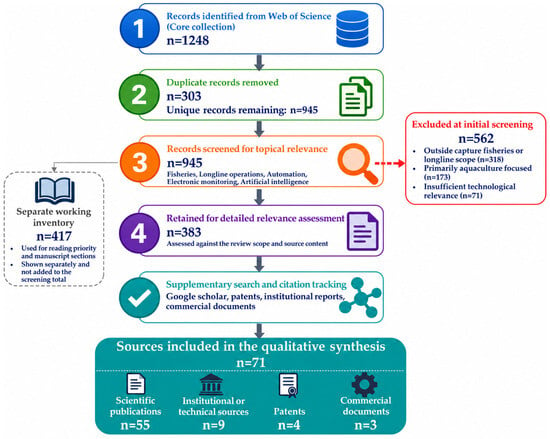
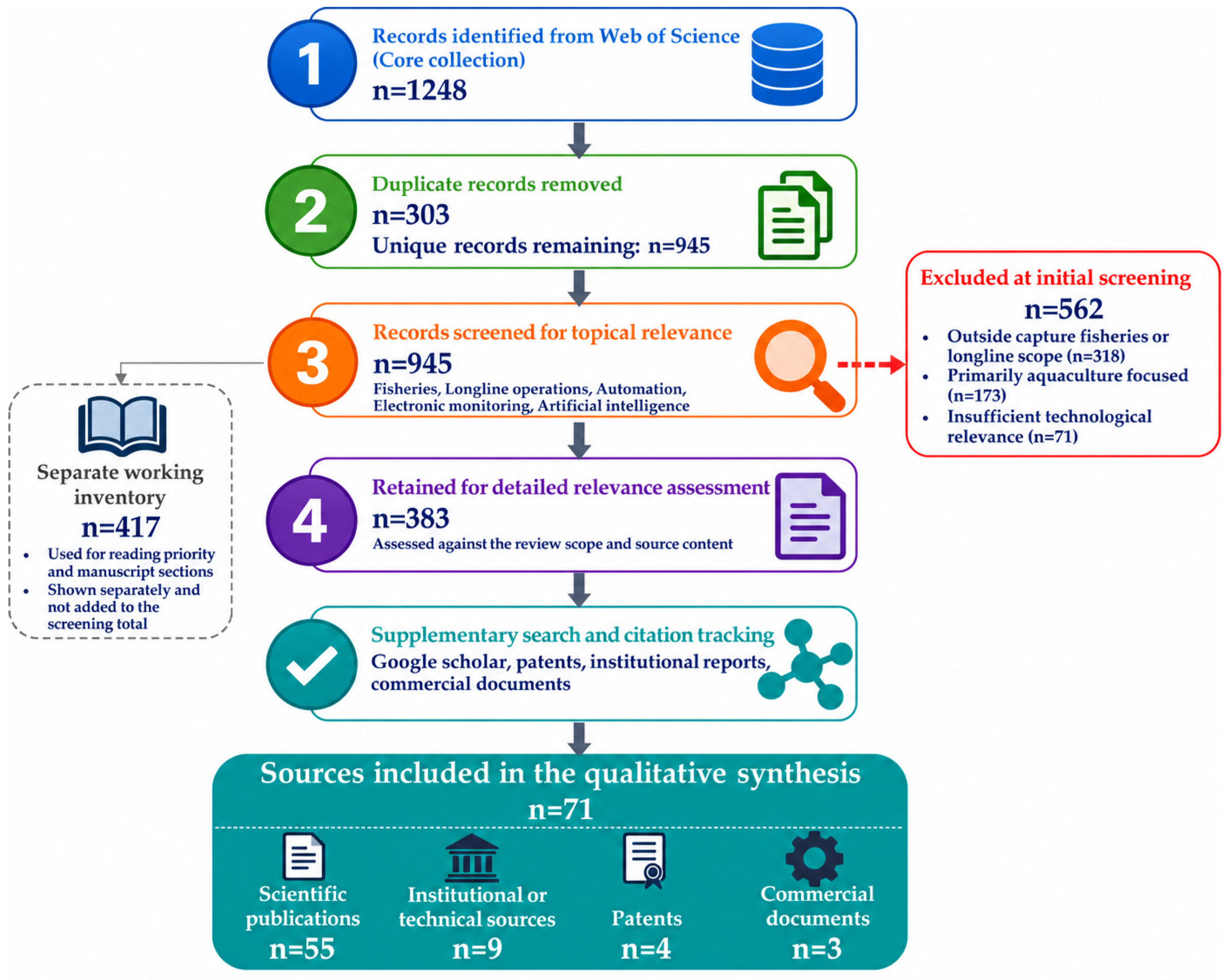
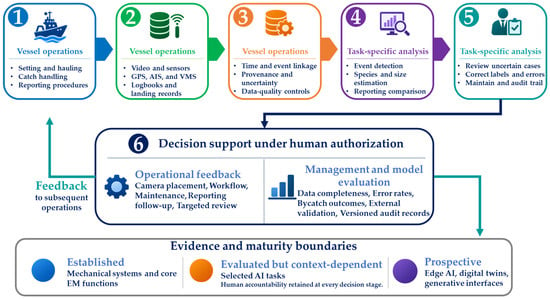
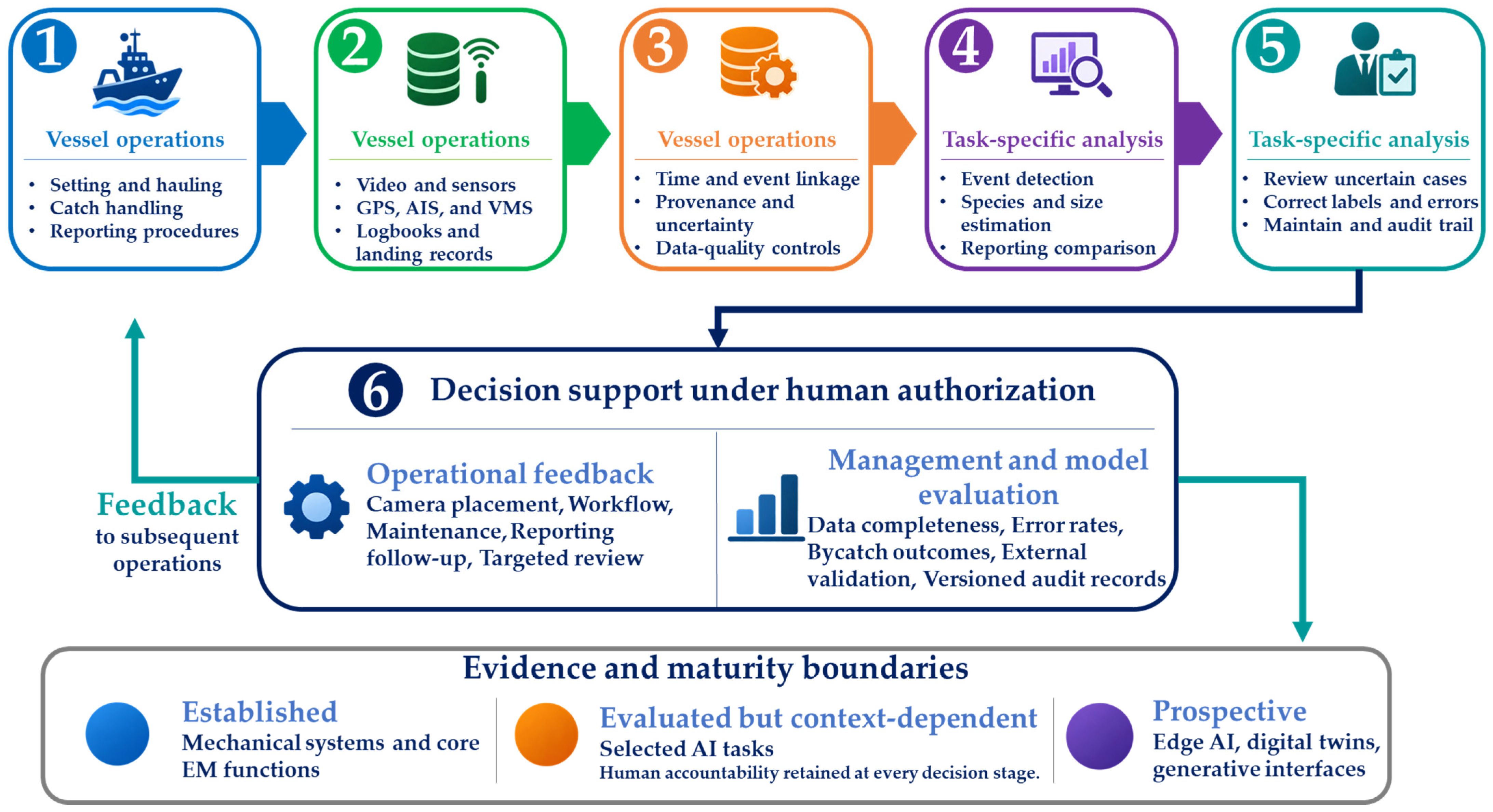

Disclaimer/Publisher’s Note: The statements, opinions and data contained in all publications are solely those of the individual author(s) and contributor(s) and not of MDPI and/or the editor(s). MDPI and/or the editor(s) disclaim responsibility for any injury to people or property resulting from any ideas, methods, instructions or products referred to in the content. |
© 2026 by the authors. Licensee MDPI, Basel, Switzerland. This article is an open access article distributed under the terms and conditions of the Creative Commons Attribution (CC BY) license.