


Abstract
Negative plant–soil feedback (NPSF) drives yield decline in monocropping systems, yet how intraspecific competition modulates NPSF across planting densities remains unclear. We conducted a two-stage plant–soil feedback experiment using five crops (Triticum aestivum L., Zea mays L., Solanum lycopersicum L., Cucumis sativus L., and Panax notoginseng (Burkill) F.H. Chen) with contrasting NPSF intensities under four planting densities (30 × 30 to 8 × 8 cm). Crops with stronger NPSF (P. notoginseng) showed pronounced density-dependent biomass reductions, whereas those with moderate (S. lycopersicum, C. sativus) or low (Z. mays, T. aestivum) NPSF were largely density-insensitive. Given its sensitivity, P. notoginseng was used to explore mechanisms. High-density planting (8 × 8 cm) intensified NPSF, reducing seedling survival by 88.54% and biomass by 56.08% compared with low-density controls (30 × 30 cm). Microbiome profiling showed enrichment of pathogenic Fusarium spp. and depletion of beneficial Humicola spp. under high density. Metabolomic analysis identified linoleic acid and oleamide as key root exudates upregulated under high-density stress, which selectively stimulated Fusarium growth as preferred carbon sources. Collectively, these results reveal a density-dependent feedback in which intensified competition reshapes root exudation, promotes pathogen proliferation, and suppresses beneficial taxa, thereby amplifying NPSF. This provides mechanistic insights into microbially mediated NPSF under density stress and highlights the importance of optimizing planting density to sustain crop productivity.
1. Introduction
Plant–soil feedback (PSF) refers to a process whereby plants modify soil properties and biotic communities through root exudation, litter inputs, and resource uptake, thereby influencing the performance of subsequent plants [1,2]. In agricultural systems, PSF frequently becomes negative (negative PSF, NPSF), in which plant-induced shifts in soil communities suppress conspecific growth and contribute to yield decline under continuous monocropping [3,4]. Although monocropping improves operational efficiency and scalability [5], productivity often declines across successive cycles, consistent with intensified NPSF [6,7]. Previous studies have attributed NPSF to soil legacy effects (e.g., pathogen accumulation) and host genetic determinants [8,9]. However, whether and how intraspecific competition driven by planting density modulates NPSF remains insufficiently resolved.
Planting density is a key agronomic factor that directly controls the intensity of intraspecific competition for light, nutrients, and water in monocultures [10,11]. Increased density can alter carbon allocation and root physiology, thereby changing both the quantity and composition of root exudates—major chemical mediators of rhizosphere microbial assembly and function [12]. Metabolomics studies further indicate that competitive environments can reshape belowground chemical phenotypes; for example, competition can shift benzoxazinoid pools (aglycones vs. glycosides) and increase phenolic compounds with putative allelopathic activity in rye [13]. Because exudate profiles are highly plastic and stress responsive [14,15], density-driven exudate remodeling may steer rhizosphere community trajectories by enriching pathogens and/or constraining beneficial taxa, potentially intensifying NPSF [1]. Consistent with this view, mechanistic studies in disease systems (e.g., tomato–Ralstonia solanacearum (Smith)) show that host-dependent variation in exudate composition can coincide with microbiome restructuring and contrasting disease outcomes [16]. Nevertheless, direct evidence that links planting density to exudate chemistry, microbial shifts, and PSF outcomes in a single causal framework remains limited, particularly across crops differing in intrinsic susceptibility to NPSF.
To address these gaps, we implemented a two-stage PSF framework across five economically important crops spanning a gradient of NPSF susceptibility: low (Triticum aestivum L. and Zea mays L.), moderate (Solanum lycopersicum L. and Cucumis sativus L.), and high (Panax notoginseng (Burkill) F.H. Chen) [3,17,18,19,20]. We manipulated competition intensity using a planting density gradient (30 × 30 to 8 × 8 cm spacing) and quantified density-dependent NPSF by evaluating the effects of conditioned soils on subsequent plant growth.
Given its pronounced NPSF susceptibility and high economic value, we further used P. notoginseng as a model to interrogate chemical and microbial mechanisms underlying the density–NPSF relationship. We integrated rhizosphere microbiome profiling (16S rRNA and ITS amplicon sequencing) with untargeted metabolomics of root exudates. Specifically, we aimed to (i) quantify density-associated shifts in rhizosphere community composition, with emphasis on putative pathogens and beneficial taxa; (ii) identify exudate metabolites responsive to density stress; and (iii) test the bioactivity of candidate metabolites against representative microbial groups using in vitro assays. Together, this approach was designed to resolve how planting density remodels exudate chemistry, restructures the rhizosphere microbiome, and ultimately exacerbates NPSF in P. notoginseng monoculture systems.
2. Materials and Methods
2.1. Experimental Design
The experiment was conducted over two consecutive years (2022, 2023) in a greenhouse near Kunming, Yunnan Province, China (103.29° E, 25.51° N). Natural soil was collected from the 0–20 cm layer in Xundian County (Kunming), air-dried at room temperature, homogenized, and passed through a 2 mm sieve to remove roots, plant debris, and stones. The processed soil was then transferred to plastic basins (65 cm × 40 cm × 18 cm) for use in the plant–soil feedback (PSF) experiment. The physical and chemical properties of the experiment soil are as follows: pH 6.16, electrical conductivity (EC) 55.18 μs/cm, soil organic matter (SOM) 23.76 g/kg, dissolved organic C (DOC) 113.76 mg/kg, total C (TC) 14.48 g/kg, total nitrogen (TN) 1.11 g/kg, total phosphorus (TP) 1.23 g/kg, total potassium (TK) 11.92 g/kg, available nitrogen (AN) 84.04 mg/kg, and available phosphorus (AP) 2.53 mg/kg.
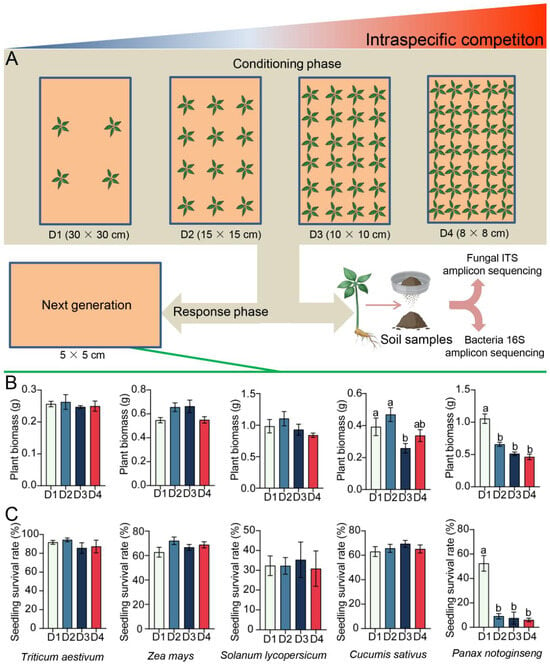
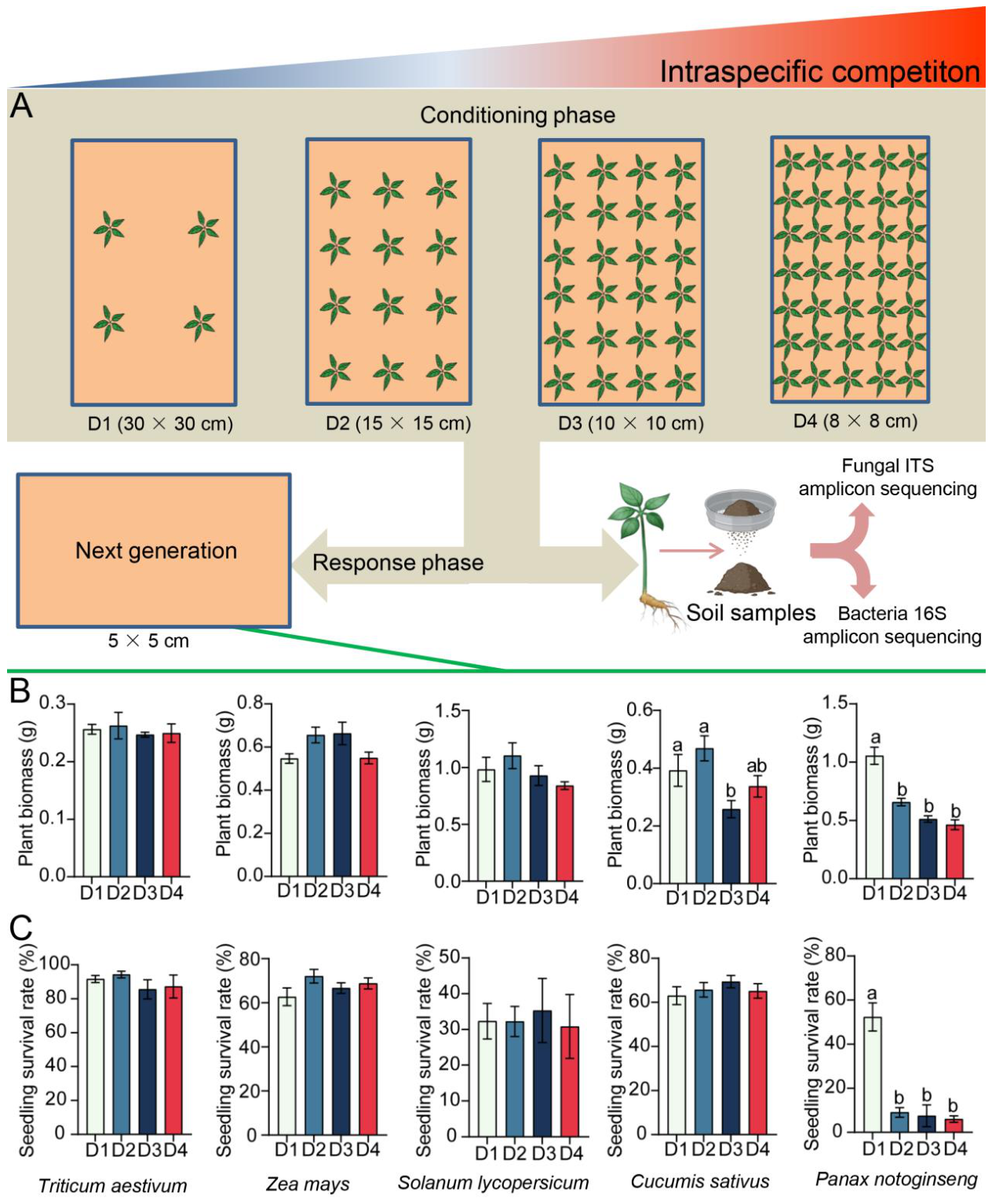
A two-phase PSF design (conditioning phase and response phase) was used to test whether planting density modulates negative plant–soil feedback (NPSF) across crops differing in inherent NPSF susceptibility. During the conditioning phase (year 1), five crop species were grown: T. aestivum and Z. mays (low NPSF), S. lycopersicum and C. sativus (moderate NPSF), and P. notoginseng (high NPSF). For each species, plants were established at four spacings: 30 cm × 30 cm (D1), 15 cm × 15 cm (D2), 10 cm × 10 cm (D3), and 8 cm × 8 cm (D4), and maintained for 12 months (Figure 1A). The spacing levels were designed to encompass the reported optimal density ranges for specific crops, capturing both near-optimal conditions and scenarios of high competitive stress [10,21,22,23,24]. Each spacing treatment included six replicate basins, and each basin was treated as an independent biological replicate. Each basin contained only one crop species during the conditioning phase, with 4 (D1), 12 (D2), 24 (D3) and 35 (D4) plants grown per basin under identical soil preparation and cultivation conditions to ensure independence among replicates. Treatments were randomly assigned to basins within a completely randomized block design, and basin positions were periodically rotated to minimize potential positional effects within the greenhouse. All basins were maintained under controlled greenhouse conditions at 25 °C (day)/18 °C (night) with a constant relative humidity of 70%. Lighting was provided by T5 fluorescent lamps at an intensity of 15,000 lux, which corresponds to an estimated PAR of approximately 200 µmol m−2 s−1, with consistent watering regimes applied throughout the experiment (Figure 1A). At the end of the conditioning phase, rhizosphere soil was collected for use in the assessment of biomass and seedling survival rate in the subsequent P. notoginseng, and another portion was stored at −80 °C for microbial analysis.
Figure 1.
Effects of crop densities on biomass and seedling survival in the subsequent crop cycle. (A) Experimental design showing four planting densities (D1 to D4) for Triticum aestivum L., Zea mays L., Solanum lycopersicum L., Cucumis sativus L. and Panax notoginseng (Burkill) F.H. Chen. D1, D2, D3, and D4 represent plant (within-row) × row spacings of 30 × 30 cm, 15 × 15 cm, 10 × 10 cm, and 8 × 8 cm, respectively. (B) Plant biomass across density treatments. (C) Seedling survival across density treatments. Data are means ± SE from three biological replicates (n = 3). Different letters indicate significant differences among treatments (one-way ANOVA followed by Duncan’s multiple range test, p < 0.05).
During the response phase (year 2), each basin was replanted with the same set of five species, with seeds sown at a standardized spacing of 5 × 5 cm to minimize density differences among response plants (Figure 1A). Prior to sowing, seeds were surface-sterilized in 3% (v/v) sodium hypochlorite for 3 min and rinsed five times with sterile distilled water. Seedling survival was assessed 6 months after emergence. Total aboveground and belowground biomass were determined at harvest.
2.2. Microbial Analysis of Rhizosphere Soil
Total DNA was extracted from 0.5 g rhizosphere soil of P. notoginseng using the PowerSoil DNA Isolation Kit (MoBio Laboratories, Carlsbad, CA, USA) according to the manufacturer’s instructions. For fungal community profiling, the rRNA internal transcribed spacer (ITS) region was amplified using primers ITS5-1737F (5′-GGAAGTAAAAGTCGTAACAAGG-3′) and ITS2-2043R (5′-GCTGCGTTCTTCATCGATGC-3′) [25]. For bacterial community profiling, the V3–V4 region of the 16S rRNA gene was amplified with primers 341F (5′-GCTACGGGNGGCWGCAG-3′) and 805R (5′-GACTACHVGGGTATCTAATCC-3′) [26]. PCR amplification was performed in 25 μL reactions containing 2.5 μL of 10× Ex Taq buffer, 2.0 μL of dNTPs (2.5 mM), 1.0 μL of template DNA, 1.0 μL of each primer, 0.5 μL of TaKaRa Ex Taq polymerase, and nuclease-free water to volume. Thermal cycling conditions comprised an initial denaturation at 95 °C for 2 min; followed by 25 cycles of denaturation at 95 °C for 30 s, annealing at 55 °C for 30 s, and extension at 72 °C for 30 s; and a final extension at 72 °C for 7 min. Amplicons were purified using the OMEGA DNA purification kit and sequenced on an Illumina NovaSeq platform (MetWare, Wuhan, China).
Raw reads were demultiplexed and converted to FASTQ format using CASAVA, and barcode and primer sequences were trimmed. Paired-end reads were merged using FLASH with a minimum overlap of 10 bp and a maximum mismatch rate of 10% within the overlap region [27]. Quality filtering was performed in QIIME, and chimeras were detected and removed using UCHIME in USEARCH. High-quality reads were clustered into operational taxonomic units (OTUs) at 97% sequence similarity using UCLUST [28]. After removal of singletons and OTUs assigned to neither bacteria nor fungi, taxonomic annotation was performed against SILVA (bacteria) and UNITE (fungi). The ITS and 16S rRNA gene sequence data are available in the NCBI Sequence Read Archive under BioProject accession numbers PRJNA1085066 (ITS) and PRJNA1085099 (16S rRNA).
2.3. Pathogen Isolation and Pathogenicity Testing
Pathogens were isolated from P. notoginseng rhizosphere soil by homogenizing 5 g of soil in 45 mL of sterile water, followed by plating serial dilutions (10−1–10−2) on potato dextrose agar and incubation at 25 °C in the dark. Pure cultures were obtained by hyphal tip subculturing [3]. Genomic DNA was extracted using the CTAB method, and the ITS region was amplified with primers ITS1/ITS4. PCR products were sequenced, and taxonomic identities were assigned by BLASTn analysis (≥97% sequence similarity). Phylogenetic analysis was performed in MEGA 12 using the neighbor-joining method with 1000 bootstrap replicates. For pathogenicity assessment, mycelial plugs (5 mm in diameter) from purified cultures were inoculated onto the roots of one-year-old P. notoginseng. The inoculated plants were incubated in darkness at 25 °C with 50% relative humidity to observe disease development and confirm pathogenicity.
2.4. Inhibitory Effect of Humicola on the Root Rot Pathogen Fusarium solani
To assess the antagonistic activity of Humicola against the root rot pathogen Fusarium, we performed a dual-culture assay using F. solani (FS), which was isolated from rhizosphere soil, and Humicola (provided by the Ministry Engineering Center of Resource-Saving Fertilizers, Nanjing Agricultural University). Both strains were maintained on potato dextrose agar (PDA). For each plate, a 5 mm mycelial plug of FS was excised using a sterile cork borer and placed at the center of PDA plate. Four 5 mm plugs of Humicola were placed equidistantly around the central FS plug, each positioned 25 mm from the plate center. Control plates contained only FS on PDA. Each treatment was replicated four times. Plates were incubated at 25 °C in the dark for 6 d, and FS radial growth was determined by measuring colony radius.
The growth inhibition rate was calculated as follows:
Growth inhibition (%) = (Radial growth of control − Radial growth of treatment)/Radial growth of control × 100
2.5. Root Exudate Collection and GC-MS Analysis
To simulate intraspecific competition across planting densities, root exudates of P. notoginseng were collected using a modified hydroponic incubation method [29]. For mixed-density treatments, two, four, eight, or twelve healthy seedlings were transferred into sterile 220 mL tissue-culture bottles containing 60 mL of sterile water. Bottles were wrapped with aluminum foil to maintain darkness and agitated on a rotary shaker (40 rpm) for 3 h to collect root exudates.
To control for potential effects of root contact and to standardize total exudate volume across density treatments, single-seedling controls were prepared by placing individual seedlings in separate sterile 15 mL centrifuge tubes and incubating them under identical conditions. Exudates solutions from single-seedling tubes were pooled to obtain the same total volume as that collected from the corresponding mixed-density treatment (two, four, eight, or twelve seedlings). Each treatment comprised four biological replicates.
Root exudates were processed as described by Zhang et al. [15]. Briefly, exudate solutions were filtered through a 0.45 μm membrane to remove debris. Filtrate were extracted with ethyl acetate at a 1:3 (exudate: ethyl acetate, v/v) ratio. The organic phase was collected, concentrated to dryness by rotary evaporation and reconstituted in 1 mL HPLC-grade methanol. Extracts were transferred to enzyme-free centrifuge tubes, spiked with ribitol (10 μL, 2 g/L) as an internal standard, and vacuum-dried.
Derivatization was performed following Hu et al. [30]. After derivatization, an 80 µL aliquot of the supernatant was transferred to GC-MS vials for analysis. Metabolites were analyzed using a Shimadzu QP2010 Ultra GC-MS (Shimadzu, Corporation, Kyoto, Japan) equipped with an SH-Rxi-5Sil MS capillary column (Shimadzu Corporation, Kyoto, Japan; 30.0 m × 0.25 mm × 0.25 μm). The analysis was performed with a column pressure of 49.5 kPa and a constant flow rate of 1 mL/min. A 1 µL sample was injected in splitless mode at 250 °C. The oven temperature was programmed from 40 °C (2 min) to 80 °C at 3 °C/min, then to 260 °C at 5 °C/min, and held for 30 min. The ion source and interface temperatures were set at 230 °C and 250 °C, respectively. Helium (99.999%) was used as the carrier gas. Mass spectra were acquired in electron impact (EI) mode at 70 eV over an m/z range of 50–500. Compounds were identified using the NIST14 library, and relative abundances were calculated based on peak areas and normalized with MetaboAnalyst 4.0. Differential metabolites were screened using VIP > 1 and |log2FC| > 1.5 [31].
2.6. Effects of Oleamide and Linoleic Acid in Root Exudates on Fusarium
To assess the ability of the pathogen to utilize root exudate-derived compounds as C sources, FS was grown on a defined C-free basal medium supplemented with oleamide or linoleic acid as the sole C source, following Fernández et al. with modifications [32]. For the preparation of media containing oleamide or linoleic acid, stock solutions of each compound were first prepared by dissolving them in dimethyl sulfoxide (DMSO) at a ratio of 1:1000 (v/w). To ensure sterility, these stock solutions were filtered through a 0.22 μm organic membrane filter. The sterile filtrates were then aseptically added to the autoclaved basal medium after it had cooled to 55–60 °C. The medium was thoroughly shaken to ensure homogeneity. Final concentrations of 0, 25, 50, 100, and 200 µg mL−1 for each compound were achieved by adding appropriate volumes of the stock solution. The basal medium contained (per liter): 3.0 g NaNO3, 1.0 g K2HPO4, 0.5 g KCl, 0.5 g MgSO4·7H2O, 0.01 g FeSO4·7H2O, and 15 g agar. For the control treatment (0 µg mL−1), an equivalent volume of sterile distilled water was added to the medium instead of the compound solutions to serve as a C-free control. Plates (9 cm diameter) were inoculated with FS and incubated at 28 °C under in darkness. Colony growth was evaluated by measuring the mean colony diameter along two perpendicular axes when colonies reached approximately 75% of the plate diameter. Five biological replicates were included per treatment.
2.7. Statistical Analyses
Differences in plant biomass, seedling survival rates, and microbial community composition were assessed using analysis of variance (ANOVA), while correlations between these variables were evaluated via Spearman’s rank correlation coefficient (SPSS 20.0; SPSS Inc.). For microbial community analyses, relative abundances of bacterial and fungi genera were used to calculate Spearman’s correlation coefficients (r), with results visualized as column charts generated in GraphPad Prism (v8.0). Principal coordinate analysis (PCoA) based on Bray–Curtis dissimilarity matrices was conducted using the online platform MicrobiomeAnalyst (https://www.microbiomeanalyst.ca/, accessed 1 June 2023). Metabolite profiling was visualized through heatmaps generated in MetaboAnalyst (http://www.metaboanalyst.ca/faces/home.xhtml, accessed 1 May 2024). Clustered correlation heatmaps and redundancy analysis (RDA) were performed using the OmicStudio platform (https://www.omicstudio.cn/tool, accessed 1 May 2024). Co-occurrence network analysis was conducted using Gephi v0.9.6 to identify interconnections between microbial taxa. To evaluate the robustness of our microbial community analyses, we implemented validation approaches using R (v4.3.0) [33]. Finally, differences in plant physiological indicators across treatments were analyzed using one-way ANOVA, and correlations between metabolites and microbial taxa were assessed using Spearman’s coefficients.
3. Results
3.1. High-Density Planting Exacerbates NPSF in a P. notoginseng System
We conducted a two-phase plant–soil feedback experiment using five crop species representing a gradient of negative plant–soil feedback (NPSF) strength to test whether intraspecific competition modulates NPSF. In the response phase, biomass in conditioned soil decreased significantly with increasing planting density for P. notoginseng, consistent with its strong NPSF phenotype (Figure 1B,C). Solanum lycopersicum and C. sativus, which exhibited moderate NPSF, showed modest biomass reductions at higher densities (D3 and D4) compared with the lowest density (D1). By contrast, Z. mays and T. aestivum, which showed weak NPSF, exhibited no significant biomass differences among density treatments (Figure 1B). Seedling survival in conditioned soil did not differ among density treatments for the four non-P. notoginseng species (Figure 1C). In contrast, P. notoginseng seedling survival decreased significantly with increasing density (Figure 1C). Based on these results, P. notoginseng was selected for subsequent analyses.
3.2. Planting Density Affects Microbial Communities in P. notoginseng Rhizosphere
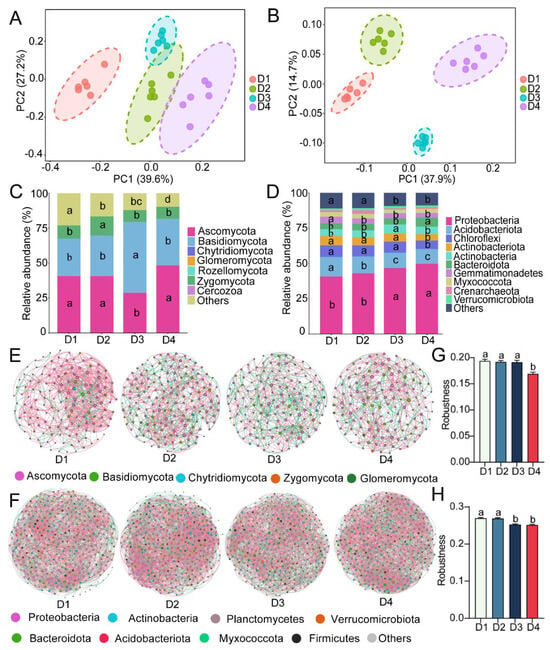
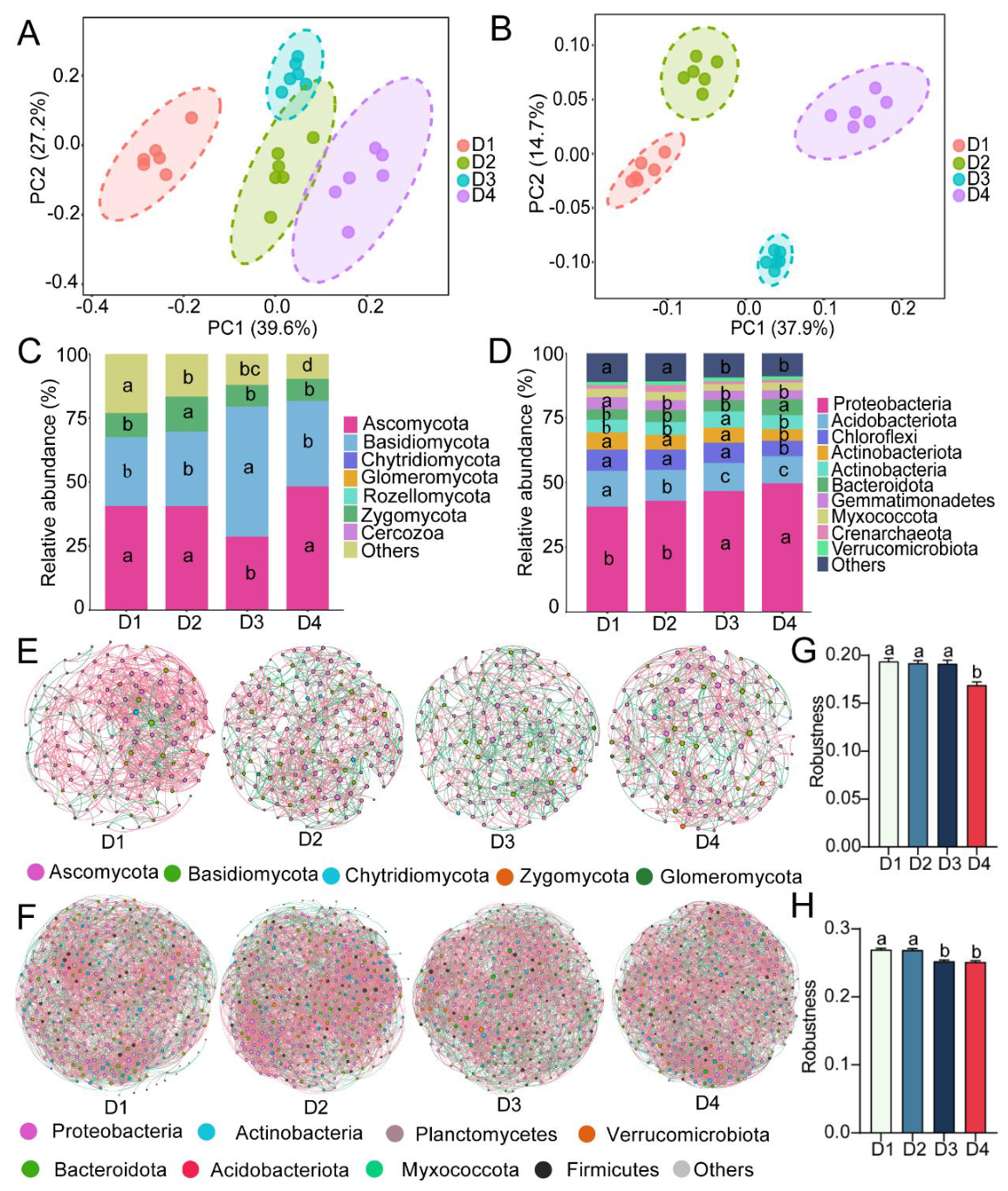
The rhizosphere soil from four planting densities was selected to characterize changes in microbial abundance and community structure using MiSeq sequencing analysis. A total of 85834 fungal OTUs and 61026 bacterial OTUs were obtained. The diversity (Shannon and Simpson indices) and richness (Chao1 and ACE) of fungi and bacteria showed a trend of initially increasing and then decreasing with increasing planting density (Tables S1 and S2). The PCoA results demonstrated a significant change in the rhizosphere microbiome with increasing plant density, and PC1 and PC2 explained 39.6% and 27.2% of the change in fungal community structure, respectively (Adonis, R2 = 0.679, p < 0.001). In bacterial communities, PC1 and PC2 explained 37.9% and 14.7%, respectively (Adonis, R2 = 0.737, p < 0.001) (Figure 2A,B).
Figure 2.
Effects of crop densities on rhizospheric microbiomes. D1, D2, D3, and D4 represent plant spacings of 30 cm × 30 cm, 15 cm × 15 cm, 10 cm × 10 cm, and 8 cm × 8 cm respectively. (A,B) Changes in rhizosphere fungal and bacterial community composition under different planting densities, respectively. (C,D) Relative abundances of fungi (C) and bacteria (D) at the phylum level under different planting densities, respectively. (E,F) Networks of co-occurring fungal (E) and bacterial (F) operational taxonomic units (OTUs) across four density (D1 to D4) conditions. Only Spearman’s correlation coefficients (r > 0.6 or r < −0.6) are shown. The nodes are colored according to phyla. Red edges represent positive correlations, and green edges represent negative correlations. Node size is directly proportional to the number of related genera. (G,H) Network robustness of (G) fungi and (H) bacteria, quantified as the proportion of nodes remaining connected after random removal of 50% of nodes. Points represent means, and error bars denote standard deviations based on 100 simulation replicates. Different letters indicate statistically significant differences among different treatments (p < 0.05; n = 6).
The increase in planting density altered the composition of fungi and bacteria at the phylum level. At the phylum level for fungi, a total of seven phyla were detected, with the relative abundance of dominant phyla (Ascomycota, Basidiomycota, and Zygomycota) accounting for over 80%. Moreover, as the planting density increased, the relative abundance of dominant phyla also increased. The relative abundance of Ascomycota did not show significant differences among D1, D2, and D4 treatments but significantly decreased in the D3 treatment. However, the relative abundance of Basidiomycota showed no significant differences among D1, D2, and D4 treatments but significantly increased in the D3 treatment (Figure 2C). A total of 42 phyla were detected in bacterial phyla. The relative abundance of Proteobacteria and Bacteroidota in the top 10 dominant phyla showed an increasing trend with increasing planting density, while the relative abundance of Acidobacteriota, Chloroflexi, Actinobacteriota and Gemmatimonadetes decreased with increasing planting density (Figure 2D).
The complexity of fungal networks varied greatly among different density treatments, and the complexity of networks in different treatments decreased with increasing planting density. Low-density planting (D1) had the highest network topology data (edges = 905, average degree = 12.746, average weighting degree = 25.493, network diameter = 9, path length = 3.333) (Table S3). The phyla Ascomycota and Basidiomycota had the highest number of nodes in all networks. The phyla Proteobacteria, Bacteroidetes, and Actinobacteria presented the highest number of correlations in all networks. However, there was no significant difference in the network topology parameters of bacteria among treatments (Table S4). No common fungal and bacterial genera were found in the top 10 dominant bacterial genera in each microbial network (Figure 2E,F). Planting density significantly affected rhizosphere microbial robustness, but fungi and bacteria exhibited different response signatures. Fungal robustness declined significantly only at the highest density (D4) (Figure 2G) and was accompanied by pronounced density-associated shifts in fungal network topology (Figure 2A). In contrast, bacterial robustness decreased from medium density (D3) onward (Figure 2H), yet core bacterial network topology parameters did not differ significantly among treatments (Figure 2B), suggesting that bacterial responses were less consistently reflected by network structural metrics within the present framework.
3.3. Microbial Composition Under Various Planting Densities
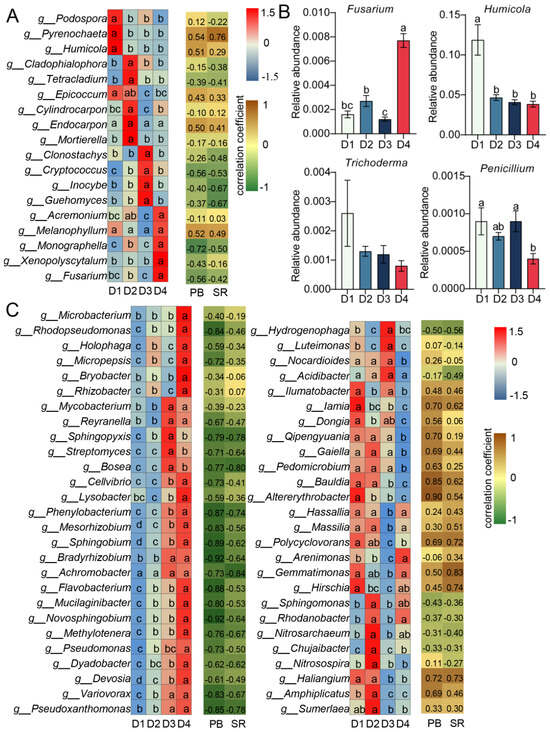
To identify taxa underlying density-associated community divergence, we performed LEfSe analysis and detected significant differences in rhizosphere microbial biomarkers among the four planting densities (D1–D4) (Figure S1). Fungal taxa showing significant compositional shifts were primarily affiliated with Ascomycota and Basidiomycota. Biomarkers were detected across multiple taxonomic ranks, including three phyla, seven classes, fourteen orders, twenty-two families, and twenty-four genera (Figure S1A). At the genus level, 18 fungal genera with LDA scores > 3 were visualized using a relative abundance heatmap (Figure 3A). The relative abundances of Podospora, Pyrenochaeta, and Humicola decreased with increasing planting density, whereas Acremonium, Melanophyllum, Monographella, Xenopolyscytalum, and Fusarium were enriched at the highest density (D4) (Figure 3A). Several genera commonly regarded as beneficial or antagonistic to pathogens (e.g., Humicola, Trichoderma, and Penicillium) declined significantly with increasing density (Figure 3B). Consistent with these patterns, Spearman correlation analyses showed that Humicola was positively correlated with plant biomass (PB; r = 0.51) and seedling survival rate (SR; r = 0.29), whereas Fusarium and Monographella were negatively correlated with both PB and SR (Figure 3A). These results suggest that higher planting density may promote the enrichment of potential pathogenic fungi while reducing putatively beneficial taxa, potentially contributing to reduced performance of the subsequent crop.
Figure 3.
Genus-level biomarkers associated with planting density and their relationships with plant performance. (A,C) Heatmaps showing the relative abundances of LEfSe-identified fungal (A) and bacterial (C) biomarkers across four planting densities, with taxa selected by LDA > 3 and p < 0.05. Associations with plant biomass (PB) and seedling survival rate (SR) were assessed using Spearman correlation. (B) Relative abundances of the pathogenic fungus Fusarium and beneficial fungi (Trichoderma, Penicillium, and Humicola) in rhizosphere soil. D1, D2, D3, and D4 correspond to plant spacings of 30 cm × 30 cm, 15 cm × 15 cm, 10 cm × 10 cm, and 8 cm × 8 cm, respectively. Different letters indicate significant differences among treatments (p < 0.05; one-way ANOVA followed by Duncan’s multiple range test; n = 6).
Bacterial taxa exhibiting density-associated shifts were mainly distributed within Proteobacteria, Actinobacteriota, Acidobacteriota, and Bacteroidota. In total, biomarkers were identified across nine phyla, ten classes, twenty-six orders, forty families, and fifty-three genera (Figure S1B). At the genus level, 53 bacterial genera with LDA scores > 3 were identified, among which Microbacterium, Rhodopseudomonas, Holophaga, Micropepsis, and Bryobacter displayed pronounced abundance shifts across densities and were negatively correlated with PB and SR (Figure 3C).
3.4. Intraspecific Competition Alters Root Exudates Secretion
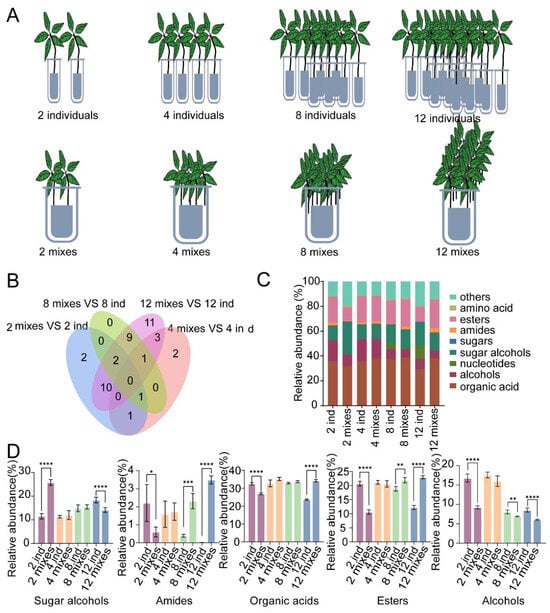
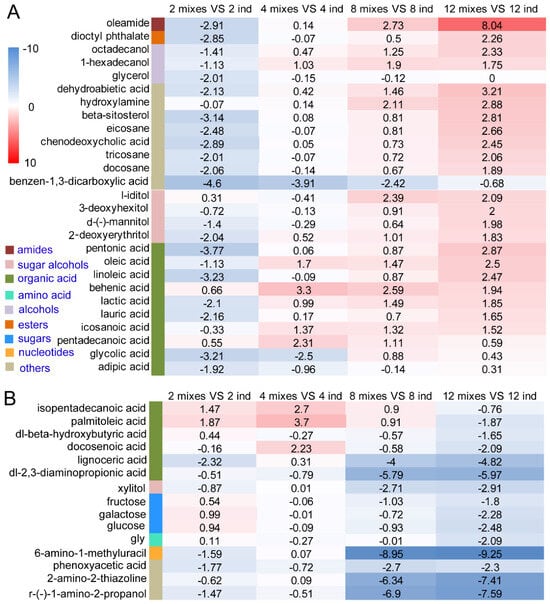
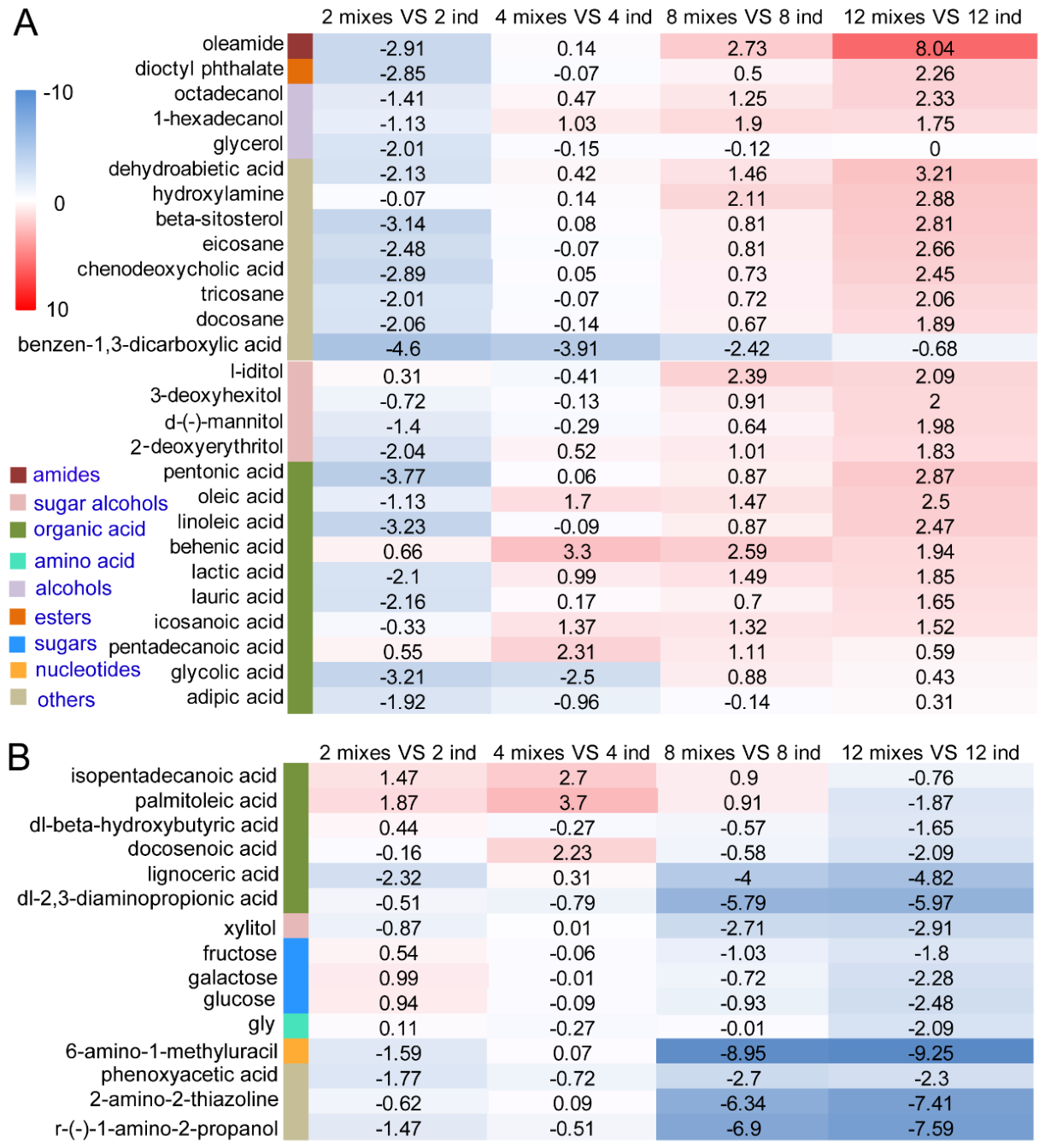
A total of 135 metabolites were detected in the root exudates of P. notoginseng across four pairwise comparisons (mixtures vs. individuals). In total, sixteen, eight, thirteen, and thirty-six differential metabolites were identified in the two, four, eight, and twelve plant comparisons, respectively. Overall, the number of differential metabolites increased with plant number, indicating that stronger intraspecific competition was associated with larger shifts in exudate composition (Figure 4A,B).
Figure 4.
Experimental scheme and Venn diagram under different levels of competition. (A) The experimental design for root exudate collection consisted of a mixed group and an individual group, and each group was designed with four competition levels (two, four, eight, and twelve plants). (B) Venn diagram of metabolites with significant differences at the four competition levels. (C) Bar chart showing the relative abundance of root exudates in different treatments. (D) Changes in root exudate composition (sugar alcohols, amines, organic acids, lipids, and alcohols) between individual (ind) and mixed (mixes) cultivation systems across different planting densities. Differential analysis was performed using an unpaired t-test (n = 4). * indicates a significant difference between two treatments, * p < 0.05, ** p < 0.01, *** p < 0.001, **** p < 0.0001.
Based on the Venn diagram, no differential metabolites were shared among all four comparisons (Figure 4B). The 12-mixture vs. 12-individual comparison yielded 11 unique differential metabolites, including glycine, octadecanol, 3-deoxyhexitol, D-(-)-mannitol, fructose, galactose, glucose, icosanoic acid, DL-β-hydroxybutyric acid, lactic acid, and 2-deoxyerythritol (Figure 4B). Glycerol and adipic acid were uniquely detected as differential metabolites in the 2-mixture vs. 2-individual comparison, whereas isopentadecanoic acid and pentadecanoic acid were unique to the 4-mixture vs. 4-individual comparison (Figure 4B).
OPLS-DA further indicated that root exudate metabolite profiles varied across competition levels (Figure S2). Chemical class annotation showed that metabolites were mainly assigned to organic acids, alcohols, nucleotides, sugar alcohols, sugars, amides, esters, amino acids, and others (Figure 4C). Across all treatments, organic acids, esters, sugar alcohols, amides and alcohols were the dominant categories, collectively accounting for >80% of total abundance. Compared with the individual treatments, the relative abundances of organic acids, amides, and esters increased, whereas sugar alcohols decreased in the mixture treatments. Separate analyses of metabolic changes in root exudates under mixed and monoculture conditions across four planting densities revealed that the metabolite differences between the 2-mixture and 2-individual treatments were markedly distinct from those observed at the other three planting densities. In contrast, these four classes of compounds showed no significant changes between the 4-mixture and 4-individual treatments. However, when the planting density was increased to eight and twelve, compared with the 8-individual and 12-individual groups, the 8-mixture and 12-mixture groups exhibited significant upregulation of amines and esters. Additionally, under the 12-mixture treatment, organic acids were significantly upregulated, while sugar alcohols were downregulated (Figure 4D). At the same planting density, alcohols in root exudates were consistently more abundant in individual than in mixture (Figure 4D).
Differential metabolite analysis further supported these trends (Figure 4D). In the 2-plant comparison, most significantly differential metabolites were downregulated in mixtures relative to individual controls, including mainly organic acids (e.g., glycolic, lauric, pentonic, lignoceric, linoleic, and adipic acids), sugar alcohols (3-deoxyhexitol, mannitol, and 2-deoxyerythritol), amides (oleamide), and alcohols (octadecanol, hexadecanol, and glycerol) (Figure 5A). In contrast, only sugars (fructose, galactose, and glucose) and a few organic acids (isopentadecanoic, palmitoleic, and DL-β-hydroxybutyric acids) were upregulated (Figure 5B).
Figure 5.
Differentially abundant metabolites in root exudates under varying competition intensities. A total of 42 metabolites with significant differences in treatments with two, four, eight and twelve plants. The values represent Log2FC (mixes/ind) values. (A) Differential metabolites shifting from downregulation to gradual upregulation with increasing planting density. (B) Differential metabolites shifting from upregulation to gradual downregulation with increasing planting density.
However, this pattern reversed with increasing planting density. In the 4-, 8-, and 12-plant treatments, the compounds that were downregulated in the 2-plant mixtures—particularly organic acids, amides, and sugar alcohols—became consistently upregulated compared with individual plantings, with their log2FC values increasing progressively with density (Figure 5A). Overall, these results indicate a density-dependent metabolic shift under mixed planting. Specifically, increasing planting density was associated with reduced sugar alcohols and elevated amines, organic acids, and esters, a pattern closely linked to NPSF. This shift is likely driven by the accumulation of Fusarium and the concurrent suppression of beneficial microbes under high-density conditions, thereby representing key determinants of the observed effects.
3.5. Relationship Between Rhizospheric Microbes and Root Exudates
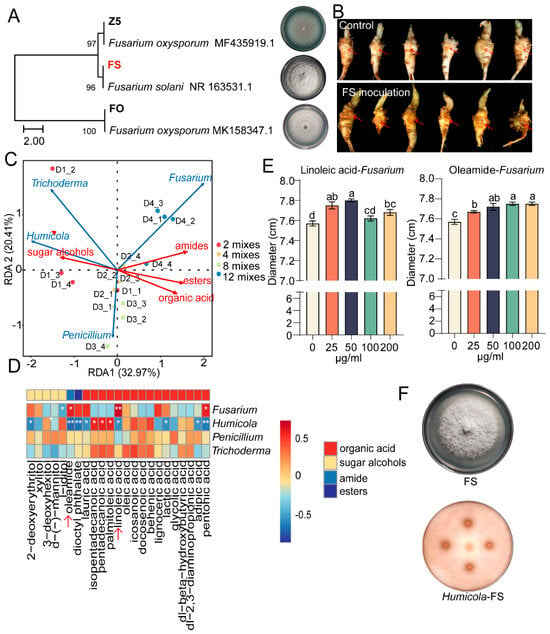
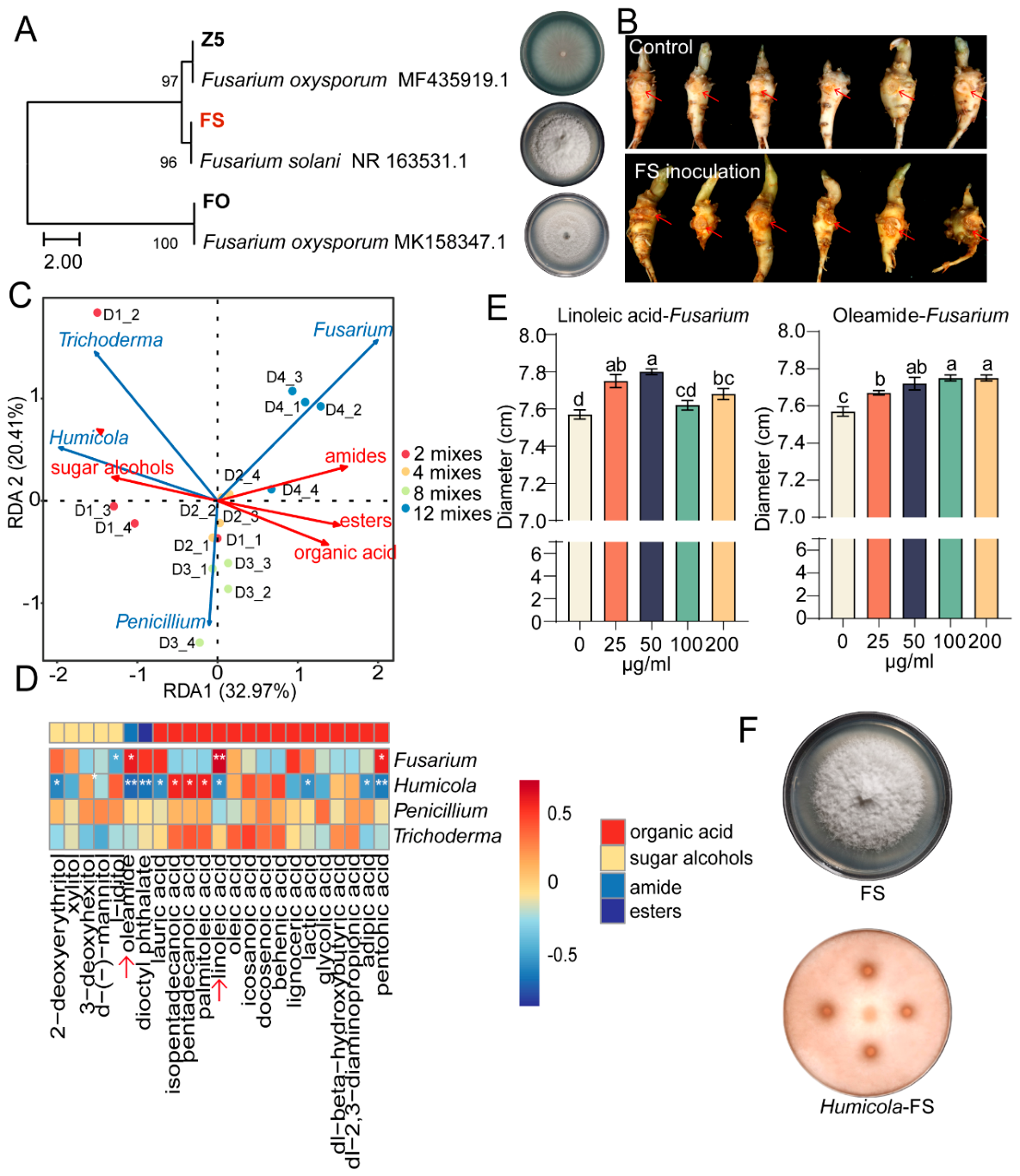
To identify the key pathogen driving negative feedback, we isolated and identified three Fusarium strains from the rhizosphere soil of P. notoginseng (Figure 6A). In vitro pathogenicity assays confirmed one strain, identified as Fusarium solani (FS), as highly virulent (Figure 6B).
Figure 6.
Relationship between microorganisms and root exudates. (A) Phylogenetic tree of Fusarium pathogens isolated from rhizosphere soil. (B) In vitro pathogenicity assay of the pathogens. (C) Redundancy analysis of fungi (blue arrows) and root exudates (red arrows). (D) Clustered heatmaps of significant correlations between four fungal genera and significantly differential metabolites in sugar alcohols and organic acids. * represents Spearman’s correlation coefficient (r > 0.5 or r < −0.5) with p < 0.05, and ** represents Spearman’s correlation coefficient (r > 0.5 or r < −0.5) with p < 0.01. (E) Growth results of Fusarium with oleamide and linoleic acid as the sole carbon sources in the medium. (F) PDA plate antifungal test of Humicola against Fusarium solani (FS). Bars represent mean ± standard error; Different letters denote significant differences between treatments (p ≤ 0.05, one-way ANOVA and Duncan’s test; n = 5).
We then investigated the relationships between root exudate composition and key fungal genera using redundancy analysis (RDA). The first two RDA axes collectively explained 45.43% of the total variation in fungal community composition (RDA1 = 27.73%, RDA2 = 17.70%). The analysis revealed that the relative abundance of Fusarium was positively associated with the proportions of amides, esters, and organic acids in the root exudates. Conversely, putatively beneficial fungi, including Trichoderma, Penicillium, and Humicola, were positively associated with sugar alcohols and showed negative associations with Fusarium (Figure 6C).
Building on this, correlation analysis at the compound level showed that oleamide (an amide) and linoleic acid (an organic acid) were significantly and positively correlated with the abundance of Fusarium (Figure 6D). This strong association led us to hypothesize that these two specific exudates, which were upregulated under high-density competition (as shown in Figure 5A), might directly promote the proliferation of this pathogen. To test this hypothesis, we conducted an in vitro C source utilization assay. F. solani demonstrated robust growth when either oleamide or linoleic acid was supplied as the sole C source. Furthermore, both compounds significantly stimulated the mycelial growth of F. solani in a dose-dependent manner, with significant promotion observed at concentrations of 25 μg/mL and above (Figure 6E). These results provide direct experimental evidence that P. notoginseng roots, under high-density stress, secrete specific metabolites that serve as preferential C sources for its key pathogen. Finally, to explore the negative association observed between Fusarium and Humicola in the RDA, we performed an in vitro antagonism assay. Humicola sp. strongly inhibited the growth of F. solani, achieving an inhibition rate of 65.56% (Figure 6F), suggesting a protective role for this beneficial fungus.
4. Discussion
High-density monoculture is widely used to maximize yield in modern cropping systems. However, it can also deteriorate soil health, impair key soil functions, and ultimately constrain plant growth and productivity [34,35]. In this study, increasing planting density of P. notoginseng was associated with pronounced shifts in root exudate composition and the rhizosphere microbial community. Notably, high-density intraspecific interactions were accompanied by elevated proportions of organic acids in root exudates and a concomitant restructuring of the rhizosphere microbiome, characterized by reduced abundances of putatively beneficial taxa and enrichment of host-associated pathogens. These changes are consistent with an intensification of negative plant–soil feedback (NPSF). These results have practical implications for P. notoginseng cultivation. Although a spacing of 15 cm × 15 cm is commonly used in production to maximize economic returns [10], such a high density may impose substantial costs on soil health and long-term productivity. Our findings suggest that reducing planting density relative to current practice could help maintain soil function and support more sustainable cultivation.
4.1. High-Intensity Intraspecific Interactions Exacerbate NPSF by Altering the Rhizosphere Microbial Communities
In our cross-species comparison, replanting T. aestivum, Z. mays, and S. lycopersicum did not substantially increase NPSF, as indicated by survival rate and biomass; under high-density planting, only C. sativus showed a modest reduction in biomass (Figure 1B). In contrast, when P. notoginseng seedlings were replanted into soils previously cultivated with P. notoginseng, both survival and biomass declined significantly with increasing planting density (Figure 1B,C). Together, these results indicate that high-density planting can amplify continuous cropping constraints in systems characterized by strong NPSF.
This pattern is broadly consistent with previous studies. For crops with relatively weak NPSF, such as T. aestivum and Z. mays, yield often peaks under higher planting density [36,37]. For crops with moderate NPSF, such as S. lycopersicum and C. sativus, higher density can also increase yield, although quality traits (e.g., fruit size and sweetness in tomato) may decline [38,39]. In addition to yield effects, higher plant density may increase resource-use efficiency and has been linked to changes in soil nitrogen cycling, including nitrate reduction, nitrate respiration, and denitrification [40,41]. In P. notoginseng production, spacings of (10–15) × (12–20) cm are commonly adopted, largely based on yield and economic considerations [10]. However, unlike the other crops examined here, P. notoginseng did not show improved performance at very high density (e.g., spacings tighter than 10 cm × 10 cm). Collectively, these findings suggest that while crops with weak NPSF may benefit from higher planting densities, crops with strong NPSF require moderated densities to sustain performance and reduce soil degradation risks.
Our results further indicate that planting density is an important determinant of the rhizosphere microbiome. In line with previous work [26,42], overall community richness/complexity tended to increase with planting density. Importantly, the density-dependent amplification of NPSF in P. notoginseng was associated primarily with shifts in the rhizosphere fungal community. Fungal communities showed stronger associations with NPSF-related plant performance than bacterial communities (Figure 2A–D), and fungal network attributes changed more markedly with increasing planting density (Figure 2E,F). Consistent with these patterns, fungal α-diversity (Simpson and Shannon indices) increased significantly with planting density (Tables S1 and S2), supporting the view that intraspecific competition can be a key driver of soil fungal community dynamics [43].
Taxonomic changes further supported this interpretation. With increasing intraspecific competition, the relative abundances of four fungal phyla and eight bacterial phyla shifted significantly (Figure S2C,D). Ascomycota was most abundant in the D4 treatment, consistent with the fact that many major soilborne pathogens of P. notoginseng (e.g., Ilyonectria and Fusarium) belong to Ascomycota [44]. At the genus level, the relative abundances of root rot pathogens (Fusarium and Monographella) increased with planting density and were negatively correlated with seedling survival and biomass (Figure 3A). This agrees with evidence that NPSF in P. notoginseng is closely linked to the accumulation of soilborne fungal pathogens, particularly Fusarium and Ilyonectria [4,45,46]. Similarly, Dong et al. [47] reported that prolonged continuous cropping increased Fusarium abundance and the fungi-to-bacteria ratio. By contrast, putatively antagonistic fungi (Penicillium, Trichoderma, and Humicola) declined as planting density increased (Figure 3B). Supporting a role of planting density, Liang et al. [48] found that lower-density tree plantings reduced pathogen abundance and increased seedling survival. In our study, reducing planting density (relative to the 15 cm × 15 cm practice) was associated with lower Fusarium accumulation and increased enrichment of the beneficial genus Humicola (Figure 3A). Taken together, these results suggest that intensified intraspecific competition reshapes the rhizosphere microbiome toward pathogen enrichment and suppression of beneficial taxa, thereby exacerbating NPSF.
4.2. High-Intensity Intraspecific Interactions Enhance Organic Acid Secretion
Root exudates mainly comprise amino acids, sugars, organic acids, and diverse secondary metabolites [49]. Panax notoginseng is a perennial medicinal plant whose root exudates can accumulate in the rhizosphere and serve as substrates for a wide range of microorganisms [50]. Exudate composition is shaped by plant developmental stage and identity, as well as by biotic and abiotic stresses [50,51], and can also be influenced by neighboring plants [52]. In addition, exudate responses often become stronger as intraspecific interactions intensify [53].
In our study, stronger intraspecific interactions were associated with a larger number of significantly differential metabolites (Figure 4B). Across treatments, organic acids represented the largest fraction of P. notoginseng root exudates, followed by alcohols, esters, and sugar alcohols (Figure 4C). Notably, the relative abundance of organic acids increased with the intensity of intraspecific competition (Figure 4C,D). Organic acids are major exudate constituents and include intermediates of the tricarboxylic acid (TCA) cycle [54]. Functionally, they can chelate metals and provide readily available C sources for microorganisms [55,56,57]. Accordingly, organic acids may facilitate microbial colonization and/or alter rhizosphere pH, thereby influencing microbial diversity, activity, and function [54,58,59]. Consistent with this framework, continuous cropping of ginseng and tea has been associated with soil acidification (lower pH) and concurrent declines in beneficial microbial communities [60,61]. High-intensity intraspecific interactions can be viewed as a form of competitive stress. In line with this, we observed higher organic acid levels in P. notoginseng root exudates under higher planting density (Figure 4C), suggesting that intensified competition may promote organic acid secretion. However, soil/rhizosphere pH was not measured in this study; therefore, whether organic acid accumulation translated into measurable pH shifts—and how any such shifts subsequently influence microbial community assembly and NPSF—remains to be determined. Another noteworthy point is that, in this study, we employed a hydroponic approach to investigate the effects of different planting densities on root exudates. Hydroponic collection systems offer clear methodological advantages for root exudate metabolomics. By eliminating the complex background of soil matrices—such as organic matter, humic substances, and diverse microbial communities—hydroponics significantly reduces analytical interference and improves the detection sensitivity of low-abundance metabolites. In addition, it minimizes selective adsorption, microbial degradation, and enzymatic transformation of exudates that commonly occur in soil, thereby better preserving the authentic chemical profile of root-secreted compounds [62,63].
4.3. High-Intensity Intraspecific Competition Enriches Pathogens via Root Exudates
Plant root exudates can provide nutrients that sustain microbial growth in the rhizosphere, and they can also contribute to plant defense by shaping rhizosphere microbial communities [64]. Increasing evidence indicates that competitive environments modify root exudation patterns and thereby drive shifts in rhizosphere microbial assemblages [53]. Agronomic practices (e.g., diversification or intercropping) can further alter plant population structure, nutrient acquisition, and soil microbiota [65]. For example, in a Solanum lycopersicum–Allium cepa L. intercropping system, taxifolin released by A. cepa altered the chemical composition of tomato root exudates and indirectly affected colonization by beneficial Bacillus in the tomato rhizosphere [66]. Despite these advances, accurately quantifying in situ concentrations of specific exudates in soil under natural growth conditions remains challenging [67].
In our study, RDA indicated that variation in organic acids and amides in P. notoginseng root exudates was strongly associated with the abundance of root rot pathogens (Figure 6A). This pattern is consistent with the broader view that low-molecular-weight compounds in exudates can be disproportionate drivers of microbial community composition and activity, even when present in complex mixtures [68]. Our results confirmed that organic acids and amides, including linoleic acid and oleamide, could serve as C sources for soilborne pathogens like Fusarium; in particular, they could stimulate the growth of Fusarium at concentrations exceeding 25 μg/mL (Figure 6C). This indicates a correlation between the abundance of pathogenic fungi in rhizosphere soil and the secretion of amides and linoleic acid. Amides, phenols, and organic acids (fatty acids) in plant root metabolites have the effect of stimulating microbial growth [69,70]. Additionally, Xue et al. [71] found that fatty acids can promote the growth and spore production of Metarhizium rileyi, while Luginbuehl et al. found that arbuscular mycorrhizal can use fatty acids secreted by plants as a C source [72]. Although the regulatory mechanisms underlying Humicola dynamics were not investigated in detail here, this will be a focus of future work.
Humicola has been proposed as a beneficial rhizosphere taxon [73]. In our study, Humicola exhibited strong inhibitory activity against Fusarium (Figure 6D). In addition to direct antagonism, pathogen suppression can also arise from competitive exclusion driven by niche overlap between resident beneficial fungi and pathogens. Niche overlap has been proposed as an important mechanism underlying rhizosphere-mediated pathogen suppression [74], and higher similarity in resource utilization between a pathogen and root-stimulated resident fungi has been reported to correlate with stronger pathogen suppression [73].
5. Conclusions
Density-dependent intraspecific competition is a major driver of negative plant–soil feedback (NPSF) in P. notoginseng, initiating a mechanistic cascade that links plant metabolic responses to shifts in the rhizosphere microbiome. Under high planting density, plants exhibit marked changes in root exudate composition, including the accumulation of linoleic acid and oleamide. These metabolites likely function as selective C sources that promote the growth of the soilborne pathogen Fusarium while coinciding with a reduction in potentially beneficial taxa. Together, these results indicate that crowding can unintentionally steer rhizosphere conditions toward a pathogen-favoring state, thereby providing a chemically grounded link between competitive stress and increased disease susceptibility.
From an ecological perspective, our findings highlight density-dependent metabolic plasticity as a key regulatory axis in trait-mediated plant–soil feedback, showing that competition can modulate disease risk by altering the chemical environment of the rhizosphere. From an applied perspective, planting density emerges as a manageable lever for disease suppression in P. notoginseng cultivation. Specifically, wider spacing (e.g., ≥15 cm × 15 cm) may help limit the accumulation of pathogen-promoting exudates, constrain the proliferation of deleterious microbes, and ultimately reduce NPSF intensity. This density-optimization strategy provides a practical avenue to balance productivity with the long-term soil health required for sustainable continuous cropping systems.
Supplementary Materials
The following supporting information can be downloaded at: https://www.mdpi.com/article/10.3390/agriculture16090930/s1.
Author Contributions
J.Z.: Writing—Review and Editing, Writing—Original Draft, Validation, Data Curation, and Formal Analysis. M.W.: Writing—Review and Editing, Data Curation, and Formal Analysis. C.C.: Investigation and Validation. C.Y.: Writing—Review and Editing and Data Curation. S.Z. (Shijun Zhong): Investigation, Software, Validation, and Data Curation. L.D.: Investigation and Validation. L.L.: Methodology and Data Curation. H.L.: Investigation, Visualization, and Software. S.Z. (Shusheng Zhu): Conceptualization, Funding Acquisition, Project Administration, Resources, and Supervision. M.Y.: Conceptualization, Funding Acquisition, Methodology, Supervision, Writing—Review and Editing, and Writing—Original Draft. All authors have read and agreed to the published version of the manuscript.
Funding
This work was supported by the Yunnan Provincial Basic Research Special Project (202401AS070090), the Forestry and Grassland Joint Program Key Project of Yunnan Province (202404CB090009), and the Yunnan Academician Expert Workstation (202405AF140070), all funded by the Yunnan Provincial Department of Science and Technology; the Forestry and Grassland Joint Program Key Project was jointly supported by the Yunnan Provincial Forestry and Grassland Administration.
Data Availability Statement
The original contributions presented in this study are included in the article/Supplementary Material. Further inquiries can be directed to the corresponding authors.
Conflicts of Interest
The authors declare that they have no conflicts of interest.
References
- Luo, L.; Wang, L.; Deng, L.; Mei, X.; Liu, Y.; Huang, H.; Du, F.; Zhu, S.; Yang, M. Enrichment of Burkholderia in the rhizosphere by autotoxic ginsenosides to alleviate negative plant-soil feedback. Microbiol. Spectr. 2021, 9, e140021. [Google Scholar] [CrossRef] [Scilit]
- Chu, Q.; Feng, W.; Tian, Y.; Zhang, L.; Kang, F.; Zhao, Y.; Yuan, W.; Hou, D.; Shi, L.; Guo, J.; et al. Soil microbial community contributes more to plant-soil feedback and plant-plant interactions than root traits under warming and drought. Plant Soil 2025, 512, 7–21. [Google Scholar] [CrossRef] [Scilit]
- Luo, L.; Guo, C.; Wang, L.; Zhang, J.; Deng, L.; Luo, K.; Huang, H.; Liu, Y.; Mei, X.; Zhu, S.; et al. Negative plant-soil feedback driven by re-assemblage of the rhizosphere microbiome with the growth of Panax notoginseng. Front. Microbiol. 2019, 10, 1597. [Google Scholar] [CrossRef] [Scilit]
- Yang, M.; Yuan, Y.; Huang, H.; Ye, C.; Guo, C.; Xu, Y.; Wang, W.; He, X.; Liu, Y.; Zhu, S. Steaming combined with biochar application eliminates negative plant-soil feedback for sanqi cultivation. Soil Tillage Res. 2019, 189, 189–198. [Google Scholar] [CrossRef] [Scilit]
- Kaur, S.; Bedi, M.; Singh, S.; Kour, N.; Bhatti, S.S.; Bhatia, A.; Kumar, M.; Kumar, R. Monoculture of crops: A challenge in attaining food security. Advances in food security and sustainability environmental challenges in attaining food security. Adv. Food Secur. Sustain. 2024, 9, 197–213. [Google Scholar]
- Wei, W.; Yang, M.; Liu, Y.; Huang, H.; Ye, C.; Zheng, J.; Guo, C.; Hao, M.; He, X.; Zhu, S. Fertilizer n application rate impacts plant-soil feedback in a sanqi production system. Sci. Total Environ. 2018, 633, 796–807. [Google Scholar] [CrossRef] [Scilit] [PubMed]
- Anand, G.; Rajeshkumar, K.C. Challenges and threats posed by plant pathogenic fungi on agricultural productivity and economy. In Fungal Diversity, Ecology and Control Management; Rajpal, V.R., Singh, I., Navi, S.S., Eds.; Springer Nature: Singapore, 2022; pp. 483–493. [Google Scholar]
- Blandino, M.; Reyneri, A.; Vanara, F. Effect of plant density on toxigenic fungal infection and mycotoxin contamination of maize kernels. Field Crops Res. 2008, 106, 234–241. [Google Scholar] [CrossRef] [Scilit]
- Guo, D.; Liu, Z.; Raaijmakers, J.M.; Xu, Y.; Yang, J.; Erb, M.; Zhang, J.; Zhu, Y.G.; Xu, J.; Hu, L. Linalool-triggered plant-soil feedback drives defense adaptation in dense maize plantings. Science 2025, 389, eadv6675. [Google Scholar] [CrossRef] [Scilit] [PubMed]
- Liu, H.; Gu, H.; Ye, C.; Guo, C.; Zhu, Y.; Huang, H.; Liu, Y.; He, X.; Yang, M.; Zhu, S. Planting density affects Panax notoginseng growth and ginsenoside accumulation by balancing primary and secondary metabolism. Front. Plant Sci. 2021, 12, 628294. [Google Scholar] [CrossRef] [Scilit] [PubMed]
- Golan, G.; Weiner, J.; Zhao, Y.; Schnurbusch, T. Agroecological genetics of biomass allocation in wheat uncovers genotype interactions with canopy shade and plant size. New Phytol. 2024, 242, 107–120. [Google Scholar] [CrossRef] [Scilit]
- Yuan, J.; Zhao, J.; Wen, T.; Zhao, M.; Li, R.; Goossens, P.; Huang, Q.; Bai, Y.; Vivanco, J.M.; Kowalchuk, G.A.; et al. Root exudates drive the soil-borne legacy of aboveground pathogen infection. Microbiome 2018, 6, 156. [Google Scholar] [CrossRef] [Scilit] [PubMed]
- Hazrati, H.; Kudsk, P.; Ding, L.; Uthe, H.; Fomsgaard, I.S. Integrated LC–MS and GC–MS-based metabolomics reveal the effects of plant competition on the rye metabolome. J. Agric. Food Chem. 2022, 70, 3056–3066. [Google Scholar] [CrossRef] [Scilit]
- Fang, H.; Guo, C.; Mei, X.; Hao, M.; Zhang, J.; Luo, L.; Liu, H.; Liu, Y.; Huang, H.; He, X.; et al. Light stress elicits soilborne disease suppression mediated by root-secreted flavonoids in Panax notoginseng. Hortic. Res. 2024, 11, uhae213. [Google Scholar] [CrossRef] [Scilit] [PubMed]
- Zhang, J.; Ye, C.; Luo, L.; Su, Y.; Zhao, C.; He, Y.; Luan, W.; Yang, T.; Zhang, R.; Chen, B.; et al. Leaf-herbivory induced trade-off: Aboveground defense sacrifices root flavonoids to enrich microbes for dual resistance. Agric. Ecosyst. Environ. 2025, 394, 109900. [Google Scholar] [CrossRef] [Scilit]
- Liu, C.; Geng, H.Y.; Li, W.X.; Li, Y.Y.; Lu, Y.S.; Xie, K.Z.; Sun, L.L.; Zhang, J.X.; Peng, H.L.; Shi, C.H.; et al. Innate root exudates contributed to contrasting coping strategies in response to Ralstonia solanacearum in resistant and susceptible tomato cultivars. J. Agric. Food Chem. 2023, 71, 20092–20104. [Google Scholar] [CrossRef] [Scilit]
- Seifert, C.A.; Roberts, M.J.; Lobell, D.B. Continuous corn and soybean yield penalties across hundreds of thousands of fields. Agron. J. 2017, 109, 541–548. [Google Scholar] [CrossRef] [Scilit]
- Ahmad, P.; Iqbal, J.; Zhang, Q.; Chen, D.; Wei, H.; Saleem, M. Continuous cropping alters multiple biotic and abiotic indicators of soil health. Soil Syst. 2020, 4, 59. [Google Scholar]
- Sun, Y.Y.; Jiang, G.Y.; Liu, J.G.; Zhang, W.; Tang, Z.M. Effects of continuous cropping tomato for processing on soil enzyme activities and microbial flora. Acta Ecol. Sin. 2010, 30, 3599–3607. [Google Scholar]
- Xiao, X.; Cheng, Z.; Lv, J.; Xie, J.; Ma, N.; Yu, J. A green garlic (Allium sativum L.) Based intercropping system reduces the strain of continuous monocropping in cucumber (Cucumis sativus L.) By adjusting the micro-ecological environment of soil. PeerJ 2019, 7, e7267. [Google Scholar] [CrossRef] [Scilit]
- Van Roekel, R.J.; Coulter, J.A. Agronomic responses of corn to planting date and plant density. Agron. J. 2011, 103, 1414–1422. [Google Scholar] [CrossRef] [Scilit]
- Li, B.; Li, Y.Y.; Wu, H.M.; Zhang, F.F.; Li, C.J.; Li, X.X.; Lambers, H.; Li, L. Root exudates drive interspecific facilitation by enhancing nodulation and N2 fixation. Proc. Natl. Acad. Sci. USA 2016, 113, 6496–6501. [Google Scholar] [CrossRef] [Scilit]
- Cardoso, F.B.; Martinez, H.E.P.; Silva, D.J.H.D.; Milagres, C.D.C.; Barbosa, J.G. Yield and quality of tomato grown in a hydroponic system, with different planting densities and number of bunches per plant. Pesqui. Agropecu. Trop. 2018, 48, 340–349. [Google Scholar] [CrossRef] [Scilit]
- Dhillon, N.S.; Sharma, P.; Sharma, K.D.; Kumar, P. Effect of plant density and shoot pruning on yield and quality of polyhouse grown cucumber. Environ. Ecol. 2017, 35, 3023–3026. [Google Scholar]
- Huang, Y.; Kuang, Z.; Wang, W.; Cao, L.; Cao, L.X. Exploring potential bacterial and fungal biocontrol agents transmitted from seeds to sprouts of wheat. Biol. Control 2016, 98, 27–33. [Google Scholar] [CrossRef] [Scilit]
- Cavalieri, A.; Bak, F.; Garcia-Lemos, A.M.; Weiner, J.; Nicolaisen, M.H.; Nybroe, O. Effects of intra-and interspecific plant density on rhizosphere bacterial communities. Front. Microbiol. 2020, 11, 1045. [Google Scholar] [CrossRef] [Scilit]
- Wang, S.; Cheng, J.; Li, T.; Liao, Y. Response of soil fungal communities to continuous cropping of flue-cured tobacco. Sci. Rep. 2020, 10, 19911. [Google Scholar] [CrossRef] [Scilit] [PubMed]
- Edgar, R.C.; Haas, B.J.; Clemente, J.C.; Quince, C.; Knight, R. UCHIME improves sensitivity and speed of chimera detection. Bioinformatics 2011, 27, 2194–2200. [Google Scholar] [CrossRef] [Scilit]
- Jin, X.; Guo, L.; Jin, B.; Zhu, S.; Mei, X.; Wu, J.; Liu, T.; He, X. Inhibitory mechanism of 6-pentyl-2H-pyran-2-one secreted by Trichoderma atroviride T2 against Cylindrocarpon destructans. Pestic. Biochem. Physiol. 2020, 170, 104683. [Google Scholar] [CrossRef] [Scilit] [PubMed]
- Hu, Z.; Dai, T.; Li, L.; Liu, P.; Liu, X. Use of GC–MS based metabolic fingerprinting for fast exploration of fungicide modes of action. BMC Microbiol. 2019, 19, 141. [Google Scholar] [CrossRef] [Scilit]
- Zhang, H.; Yang, Y.; Mei, X.; Li, Y.; Wu, J.; Li, Y.; Wang, H.; Huang, H.; Yang, M.; He, X.; et al. Phenolic acids released in maize rhizosphere during maize-soybean intercropping inhibit phytophthora blight of soybean. Front. Plant Sci. 2020, 11, 886. [Google Scholar] [CrossRef] [Scilit]
- Fernández, M.; Matilla, M.A.; Ortega, Á.; Krell, T. Metabolic value chemoattractants are preferentially recognized at broad ligand range chemoreceptor of Pseudomonas putida kt2440. Front. Microbiol. 2017, 8, 990. [Google Scholar] [CrossRef] [Scilit] [PubMed]
- Yuan, M.M.; Guo, X.; Wu, L.W.; Zhang, Y.; Xiao, N.J.; Ning, D.L.; Shi, Z.; Zhou, X.S.; Wu, L.Y.; Yang, Y.F.; et al. Climate warming enhances microbial network complexity and stability. Nat. Clim. Change 2021, 11, 343–348. [Google Scholar] [CrossRef] [Scilit]
- Puerta, V.L.; Pereira, E.I.; Wittwer, R.; Van Der Heijden, M.; Six, J. Improvement of soil structure through organic crop management, conservation tillage and grass-clover ley. Soil Tillage Res. 2018, 180, 1–9. [Google Scholar] [CrossRef] [Scilit]
- Stefan, L.; Hartmann, M.; Engbersen, N.; Six, J.; Schöb, C. Positive effects of crop diversity on productivity driven by changes in soil microbial composition. Front. Microbiol. 2021, 12, 660749. [Google Scholar] [CrossRef] [Scilit] [PubMed]
- Lashkari, M.; Madani, H.; Ardakani, M.R.; Golzardi, F.; Zargari, K. Effect of plant density on yield and yield components of different corn (Zea mays L.) Hybrids. Am. Eurasian J. Agric. Environ. Sci. 2011, 10, 450–457. [Google Scholar]
- Bhatta, M.; Eskridge, K.M.; Rose, D.J.; Santra, D.K.; Baenziger, P.S.; Regassa, T. Seeding rate, genotype, and topdressed nitrogen effects on yield and agronomic characteristics of winter wheat. Crop Sci. 2017, 57, 951–963. [Google Scholar] [CrossRef] [Scilit]
- Parks, S.; Spohr, L.; Olesen, T.; Jarvis, J. The effect of environmental control and plant density on cucumber crop performance in Australian conditions. Fruits 2019, 74, 65–72. [Google Scholar] [CrossRef] [Scilit]
- Karpe, M.; Marcelis, L.F.; Heuvelink, E. Dynamic plant spacing in tomato results in high yields while mitigating the reduction in fruit quality associated with high planting densities. Front. Plant Sci. 2024, 15, 1386950. [Google Scholar] [CrossRef] [Scilit]
- Bastos, L.M.; Carciochi, W.; Lollato, R.P.; Jaenisch, B.R.; Rezende, C.R.; Schwalbert, R.; Vara Prasad, P.V.; Zhang, G.; Fritz, A.K.; Foster, C.; et al. Winter wheat yield response to plant density as a function of yield environment and tillering potential: A review and field studies. Front. Plant Sci. 2020, 11, 54. [Google Scholar] [CrossRef] [Scilit]
- Zhang, Y.; Lin, J.; Chen, S.; Lu, H.; Liao, C. The influence of the genotype and planting density on the structure and composition of root and rhizosphere microbial communities in maize. Microorganisms 2023, 11, 2443. [Google Scholar] [CrossRef] [Scilit]
- Khan, S.; Anwar, S.; Kuai, J.; Noman, A.; Shahid, M.; Din, M.; Ali, A.; Zhou, G. Alteration in yield and oil quality traits of winter rapeseed by lodging at different planting density and nitrogen rates. Sci. Rep. 2018, 8, 634. [Google Scholar] [CrossRef] [Scilit]
- Farooq, T.H.; Kumar, U.; Shakoor, A.; Albasher, G.; Alkahtani, S.; Rizwana, H.; Tayyab, M.; Dobaria, J.; Hussain, M.I.; Wu, P. Influence of intraspecific competition stress on soil fungal diversity and composition in relation to tree growth and soil fertility in sub-tropical soils under chinese fir monoculture. Sustainability 2021, 13, 10688. [Google Scholar] [CrossRef] [Scilit]
- Guo, C.; Yang, M.; Jiang, B.; Ye, C.; Luo, L.; Liu, Y.; Huang, H.; Mei, X.; Zhu, Y.; Deng, W.; et al. Moisture controls the suppression of Panax notoginseng root rot disease by indigenous bacterial communities. mSystems 2022, 7, e418–e422. [Google Scholar] [CrossRef] [Scilit]
- Huang, L.F.; Song, L.X.; Xia, X.J.; Mao, W.H.; Shi, K.; Zhou, Y.H.; Yu, J.Q. Plant-soil feedbacks and soil sickness: From mechanisms to application in agriculture. J. Chem. Ecol. 2013, 39, 232–242. [Google Scholar] [CrossRef] [Scilit]
- Yang, M.; Zhang, X.; Xu, Y.; Mei, X.; Jiang, B.; Liao, J.; Yin, Z.; Zheng, J.; Zhao, Z.; Fan, L.; et al. Autotoxic ginsenosides in the rhizosphere contribute to the replant failure of Panax notoginseng. PLoS ONE 2015, 10, e118555. [Google Scholar] [CrossRef] [Scilit]
- Dong, L.; Xu, J.; Feng, G.; Li, X.; Chen, S. Soil bacterial and fungal community dynamics in relation to Panax notoginseng death rate in a continuous cropping system. Sci. Rep. 2016, 6, 31802. [Google Scholar] [CrossRef] [Scilit]
- Liang, M.; Liu, X.; Gilbert, G.S.; Zheng, Y.; Luo, S.; Huang, F.; Yu, S. Adult trees cause density-dependent mortality in conspecific seedlings by regulating the frequency of pathogenic soil fungi. Ecol. Lett. 2016, 19, 1448–1456. [Google Scholar] [CrossRef] [Scilit] [PubMed]
- Ma, W.; Tang, S.; Dengzeng, Z.; Zhang, D.; Zhang, T.; Ma, X. Root exudates contribute to belowground ecosystem hotspots: A review. Front. Microbiol. 2022, 13, 937940. [Google Scholar] [CrossRef] [Scilit] [PubMed]
- Ding, X.; Yang, M.; Huang, H.; Chuan, Y.; He, X.; Li, C.; Zhu, Y.; Zhu, S. Priming maize resistance by its neighbors: Activating 1, 4-benzoxazine-3-ones synthesis and defense gene expression to alleviate leaf disease. Front. Plant Sci. 2015, 6, 830. [Google Scholar] [CrossRef] [Scilit]
- Luo, L.F.; Yang, L.; Yan, Z.X.; Jiang, B.B.; Li, S.; Huang, H.C.; Liu, Y.X.; Zhu, S.S.; Yang, M. Ginsenosides in root exudates of Panax notoginseng drive the change of soil microbiota through carbon source different utilization. Plant Soil 2020, 455, 139–153. [Google Scholar] [CrossRef] [Scilit]
- Babikova, Z.; Gilbert, L.; Bruce, T.J.; Birkett, M.; Caulfield, J.C.; Woodcock, C.; Pickett, J.A.; Johnson, D. Underground signals carried through common mycelial networks warn neighbouring plants of aphid attack. Ecol. Lett. 2013, 16, 835–843. [Google Scholar] [CrossRef] [Scilit]
- Ulbrich, T.C.; Rivas-Ubach, A.; Tiemann, L.K.; Friesen, M.L.; Evans, S.E. Plant root exudates and rhizosphere bacterial communities shift with neighbor context. Soil Biol. Biochem. 2022, 172, 108753. [Google Scholar] [CrossRef] [Scilit]
- Wen, T.; Yuan, J.; He, X.; Lin, Y.; Huang, Q.; Shen, Q. Enrichment of beneficial cucumber rhizosphere microbes mediated by organic acid secretion. Hortic. Res. 2020, 7, 154. [Google Scholar] [CrossRef] [Scilit]
- Etesami, H.; Jeong, B.R. Biodissolution of silica by rhizospheric silicate-solubilizing bacteria. In Silicon and Nano-Silicon in Environmental Stress Management and Crop Quality Improvement; Academic Press: Amsterdam, The Netherlands, 2022; pp. 265–276. [Google Scholar]
- Panchal, P.; Miller, A.J.; Giri, J. Organic acids: Versatile stress-response roles in plants. J. Exp. Bot. 2021, 72, 4038–4052. [Google Scholar] [CrossRef] [Scilit] [PubMed]
- Khan, E.A.; Yadav, S.; Yadav, M.; Ahmed, H.M. Role of low molecular organic acids in regulating physiological and molecular aspects of plants under abiotic stress. In The Role of Growth Regulators and Phytohormones in Overcoming Environmental Stress; Academic Press: Amsterdam, The Netherlands, 2023; pp. 289–315. [Google Scholar]
- Ding, X.; Liu, K.; Yan, Q.; Liu, X.; Chen, N.; Wang, G.; He, S. Sugar and organic acid availability modulate soil diazotroph community assembly and species co-occurrence patterns on the Tibetan plateau. Appl. Microbiol. Biotechnol. 2021, 105, 8545–8560. [Google Scholar] [CrossRef] [Scilit]
- Bi, B.; Yuan, Y.; Zhang, H.; Wu, Z.; Wang, Y.; Han, F. Rhizosphere soil metabolites mediated microbial community changes of Pinus sylvestris var. mongolica across stand ages in the mu us desert. Appl. Soil Ecol. 2022, 169, 104222. [Google Scholar] [CrossRef] [Scilit]
- Dong, L.; Xu, J.; Li, Y.; Fang, H.; Niu, W.; Li, X.; Zhang, Y.; Ding, W.; Chen, S. Manipulation of microbial community in the rhizosphere alleviates the replanting issues in Panax ginseng. Soil Biol. Biochem. 2018, 125, 64–74. [Google Scholar] [CrossRef] [Scilit]
- Arafat, Y.; Ud Din, I.; Tayyab, M.; Jiang, Y.; Chen, T.; Cai, Z.; Zhao, H.; Lin, X.; Lin, W.; Lin, S. Soil sickness in aged tea plantation is associated with a shift in microbial communities as a result of plant polyphenol accumulation in the tea gardens. Front. Plant Sci. 2020, 11, 601. [Google Scholar] [CrossRef] [Scilit]
- Vives-Peris, V.; De Ollas, C.; Gómez-Cadenas, A.; Pérez-Clemente, R.M. Root exudates: From plant to rhizosphere and beyond. Plant Cell Rep. 2020, 39, 3–17. [Google Scholar] [CrossRef] [Scilit]
- Salem, M.A.; Wang, J.Y.; Al-Babili, S. Metabolomics of plant root exudates: From sample preparation to data analysis. Front. Plant Sci. 2022, 13, 1062982. [Google Scholar] [CrossRef] [Scilit] [PubMed]
- Gu, Y.; Wang, X.; Yang, T.; Friman, V.P.; Geisen, S.; Wei, Z.; Xu, Y.; Jousset, A.; Shen, Q. Chemical structure predicts the effect of plant-derived low-molecular weight compounds on soil microbiome structure and pathogen suppression. Funct. Ecol. 2020, 34, 2158–2169. [Google Scholar] [CrossRef] [Scilit]
- Ma, Z.; Guan, Z.; Liu, Q.; Hu, Y.; Liu, L.; Wang, B.; Huang, L.; Li, H.; Yang, Y.; Han, M.; et al. Obstacles in continuous cropping: Mechanisms and control measures. Adv. Agron. 2023, 179, 205–256. [Google Scholar]
- Zhou, X.; Zhang, J.; u Rahman, M.K.; Gao, D.; Wei, Z.; Wu, F.; Dini-Andreote, F. Interspecific plant interaction via root exudates structures the disease suppressiveness of rhizosphere microbiomes. Mol. Plant 2023, 16, 849–864. [Google Scholar] [CrossRef] [Scilit]
- Oburger, E.; Jones, D.L. Sampling root exudates–mission impossible? Rhizosphere 2018, 6, 116–133. [Google Scholar] [CrossRef] [Scilit]
- Haichar, F.E.Z.; Marol, C.; Berge, O.; Rangel-Castro, J.I.; Prosser, J.I.; Balesdent, J.; Heulin, T.; Achouak, W. Plant host habitat and root exudates shape soil bacterial community structure. ISME J. 2008, 2, 1221–1230. [Google Scholar] [CrossRef] [Scilit] [PubMed]
- Faure, D.; Vereecke, D.; Leveau, J.H. Molecular communication in the rhizosphere. Plant Soil 2009, 321, 279–303. [Google Scholar] [CrossRef] [Scilit]
- Zhao, L.; Zhang, H.; White, J.C.; Chen, X.; Li, H.; Qu, X.; Ji, R. Metabolomics reveals that engineered nanomaterial exposure in soil alters both soil rhizosphere metabolite profiles and maize metabolic pathways. Environ. Sci. Nano 2019, 6, 1716–1727. [Google Scholar] [CrossRef] [Scilit]
- Xue, R.; Du, G.; Chen, C.; Chen, B.; Peng, Y. Oleic acid improves the conidial production and quality of Metarhizium rileyi as a biocontrol agent. Biocontrol Sci. Technol. 2023, 33, 758–771. [Google Scholar] [CrossRef] [Scilit]
- Luginbuehl, L.H.; van Erp, H.; Cheeld, H.; Mysore, K.S.; Wen, J.; Oldroyd, G.E.; Eastmond, P.J. Plants export 2-monopalmitin and supply both fatty acyl and glyceryl moieties to arbuscular mycorrhizal fungi. bioRxiv 2021. [Google Scholar] [CrossRef] [Scilit]
- Tao, C.; Wang, Z.; Liu, S.; Lv, N.; Deng, X.; Xiong, W.; Shen, Z.; Zhang, N.; Geisen, S.; Li, R.; et al. Additive fungal interactions drive biocontrol of Fusarium wilt disease. New Phytol. 2023, 238, 1198–1214. [Google Scholar] [CrossRef] [Scilit]
- Liu, S.; Tao, C.; Zhang, L.; Wang, Z.; Xiong, W.; Xiang, D.; Sheng, O.; Wang, J.; Li, R.; Shen, Z.; et al. Plant pathogen resistance is mediated by recruitment of specific rhizosphere fungi. ISME J. 2023, 17, 931–942. [Google Scholar] [CrossRef] [Scilit] [PubMed]
Disclaimer/Publisher’s Note: The statements, opinions and data contained in all publications are solely those of the individual author(s) and contributor(s) and not of MDPI and/or the editor(s). MDPI and/or the editor(s) disclaim responsibility for any injury to people or property resulting from any ideas, methods, instructions or products referred to in the content. |
© 2026 by the authors. Licensee MDPI, Basel, Switzerland. This article is an open access article distributed under the terms and conditions of the Creative Commons Attribution (CC BY) license.