


Abstract
The remediation of large-areas of Cd-contaminated soil, especially agricultural land, remains a major global challenge. Phytoremediation using hyperaccumulators is an effective method for treating Cd-contaminated soils; however, its long-term effectiveness over successive growing seasons has been insufficiently investigated. This study evaluated the sustained phytoremediation capacity of the farmland weed Bidens pilosa L., a known Cd hyperaccumulator, in a three-year pot experiment using contaminated agricultural soil from the Shenyang Zhangshi Irrigation Area (2.08 mg/kg Cd). Two harvest regimes were compared: short-term (harvest at the flowering stage, 70 days) and long-term (harvest at the fruit maturity stage, 108 days). The results showed that although higher total Cd accumulation per harvest was obtained in long-term treatments, short-term experiments resulted in a 14.7% higher net removal rate per day (NR) due to their shorter growth cycle (64.8% of the long-term period). Soil extractable Cd concentrations decreased by an average of 31.2% over three consecutive years of phytoremediation, reducing environmental risk but also limiting subsequent Cd uptake by plants. These findings demonstrate that optimizing harvest timing can substantially improve remediation efficiency per unit of time without the need for soil quality improvement measures. The short growing season characteristic of weeds found in agricultural areas is a practical advantage of phytoremediation.
1. Introduction
Anthropogenic activities, such as mining, manufacturing, smelting, etc., have caused heavy metal accumulation in soils, which has become a serious global environmental problem [1,2,3]. Cd is of particular concern due to its high mobility and toxicity [4]. In the Shenyang Zhangshi Irrigation Area (SZIA) in China, approximately 30 years of sewage irrigation resulted in substantial Cd contamination, with reported concentrations ranging from 0 to 7.57 mg/kg [5]. This level of contamination makes the arable soils of SZIA a suitable model for long-term reclamation studies [6,7].
Phytoremediation, a non-conventional reclamation technique, has gained new interest in recent years as a cost-effective and environmentally sustainable method [8,9]. Other bioremediation methods, particularly microbial remediation, have also been extensively studied for their ability to reduce the mobility and bioavailability of heavy metals in contaminated soil [10]. Microbial remediation is mainly dependent on the mechanisms such as biosorption, bioprecipitation, and biomineralization, which transform highly bioavailable metal fractions into more stable forms, thereby reducing environmental risk [11]. However, a clear distinction must be made between immobilization and removal. Although microbial remediation can effectively decrease the bioavailability and toxicity of heavy metals, it does not physically remove them from the soil matrix [12]. As a result, total concentration remains largely unchanged, and the long-term stability of immobilized metals may be compromised by changes in environmental conditions (e.g., pH, redox potential, organic matter decomposition) over time. In contrast, phytoremediation using hyperaccumulators, specifically phytoextraction, allows for the permanent removal of heavy metals from contaminated sites [13,14]. Hyperaccumulators are plant species that tolerate and accumulate very high concentrations of toxic metals, including Cd [15]. In recent decades, only a limited number of such species have been identified, e.g., Sedum alfredii Hance [16], Alcea aucheri [17], and Solanum nigrum L. [18], reflecting the strict criteria required for classification as a hyperaccumulator. While these studies successfully demonstrated hyperaccumulation properties based on tissue metal concentrations and bioconcentration factors, they did not quantify the percentage of metals removed from soil. Conventional indicators such as bioconcentration factor (BCF) and translocation factor (TF) confirm hyperaccumulator status but do not account for the time required to achieve metal removal, limiting their utility for comparing remediation efficiency across different growth cycles or harvest strategies. To address this limitation, the present study introduces systematic removal rate indicators (RR and NR) to evaluate phytoremediation efficiency under controlled conditions, enabling a more meaningful assessment of actual remediation potential. Bidens pilosa L., identified as a Cd hyperaccumulator in a screening of 29 weed species (18 families) [19], demonstrates high remediating potential of Cd-contaminated soils, and subsequent studies have examined various aspects of its performance [20,21]. However, these studies were based on relatively short-term experiments; thus, it remains unclear whether continuous remediation affects prolonged efficiency and soil Cd dynamics. Therefore, the present study evaluated the sustained phytoremediation capacity of B. pilosa in successive remediation cycles.
Numerous studies have proposed methods to increase the effectiveness of phytoremediation, including the application of soil chelators such as polyaspartic acid to modify the rhizospheric environment [22], application of selenium to increase the expression of genes responsible for remediation [23], incorporation of biochar and fulvic acid to enhance Cd and Zn accumulation [24], and application of an electric field to enhance phytoextraction [25]. However, these approaches alter soil ecology and may cause unintended side effects. In contrast, farmland weeds are characterized by a short growth period from seedling emergence to flowering, as a result of prolonged competition with crops for water and light [18]. In particular, harvesting the hyperaccumulator Solanum nigrum at the flowering stage has been reported to result in particularly high Cd phytoremediation efficiency [18]. Therefore, the present study investigated whether optimizing harvest timing during plant growth, without modifying the soil ecological environment, can improve phytoremediation efficiency. To further assess practical applicability, a three-year continuous pot experiment was conducted to evaluate the effects of long (harvest at fruit maturity) and short (harvest at flowering) growth cycles on the efficiency of sustained soil reclamation by B. pilosa. We hypothesized that these two phytoremediation modes would differ significantly in Cd phytoextraction efficiency, with the short-term approach resulting in a higher net removal rate per day (NR) owing to its shorter growth duration. Furthermore, we hypothesized that continuous phytoremediation over three consecutive years would progressively reduce soil extractable Cd concentrations, thereby influencing the long-term sustainability of Cd uptake by B. pilosa.
2. Materials and Methods
2.1. Soil Samples
Soil samples were collected from two locations in Shenyang, Liaoning, China. Contaminated soil was obtained from the SZIA region (123°03′ E and 41°40′ N) and was classified as posing a moderate contamination risk [26]. Control soil (CK) was collected from an uncontaminated field (123°41′ E and 41°31′ N) [27]. T Both samples were taken from the topsoil layer (0–20 cm) and were the meadow-burozem type, with highly similar physicochemical properties (Table 1). Soil samples were sieved through a 1 mm mesh and homogenized. Subsequently, 1 kg soil samples (DW) were transferred into pots [27]. Basic physicochemical properties were determined using conventional analytical methods [27] and are presented in Table 1.
Table 1.
Basic physicochemical properties of soil samples.
2.2. Seed Collection and Experimental Design
B. pilosa seeds were collected from uncontaminated farmland in Shilihe town (123°41′ E and 41°31′ N), Sujiatun district, Shenyang, China, and air dried at full maturity in autumn [27]. In spring, the seeds were transferred to a seedling tray for germination, and 4 uniform disease-free seedlings (4–5 cm shoot height) were transported into each plastic pot (φ = 20 cm, H = 15 cm). This planting density was selected to approximate agronomically realistic conditions while avoiding excessive intraspecific competition that could limit individual plant growth. Each treatment was performed in triplicate, and all pots were placed in a plastic-covered shed to exclude precipitation, while maintaining ambient outdoor temperature and light conditions. Soil moisture was maintained at approximately 80% of water-holding capacity by daily supplementation with tap water [28]. The phytoremediation pot experiments were conducted continuously for 3 years.
Phytoremediation efficiency was compared between 2 growth phases, referred to as two phytoremediation modes. In the short-term treatments (harvest at the flowering stage), B. pilosa plants were grown in Cd-contaminated agricultural soil for 70 days until approximately 70% of plants began flowering, after which the biomass was harvested. Similarly, in the long-term treatments (harvest at the fruit maturity stage), plants were harvested when the fruiting rate reached approximately 70%. Control treatments, conducted in uncontaminated soil, included Control 1 (CK1, short-term treatment in year 1) and Control 2 (CK2, long-term treatment in year 1). Potting soil from the first year of the experimental harvest was left fallow until April of the second year and then replanted. The same experimental design was applied in years 2 and 3. The detailed experimental design was shown in Table 2. The three-year experimental period was designed to evaluate the sustainability of B. pilosa phytoremediation performance under continuous cropping, addressing a key limitation of previous single-season studies. Long-term experiments are essential for understanding how progressive depletion of bioavailable metal fractions affects plant uptake over time and for assessing the practical feasibility of multi-year remediation strategies.
Table 2.
Summary of experimental design and treatment conditions.
2.3. Sample Analysis
Collected B. pilosa roots were immersed in 20 mM HCl to remove surface-adhering metals and then rinsed thoroughly with deionized water [29]. Subsequently, plant material was separated into roots and shoots. Samples were dried at 105 °C for 5 min to inactivate plant enzymes, and then at 75 °C for 48 h until constant weight. The dried plant material and air-dried soil samples were finely ground and sieved through a 0.3 mm sieve.
Basic soil properties and background trace metal concentrations were determined using standard methods [30]. Total Cd concentrations in soil and plant samples were measured after digestion in a boiling mixture of nitric and perchloric acids (87% HNO3/13% HClO4) [27]. Plant-available Cd in soil was extracted with 1 mol/L MgCl2. This single extraction procedure was selected because it targets the exchangeable Cd fraction, which is generally considered to represent the most readily bioavailable pool for plant uptake [31]. Cd concentrations were obtained using flame atomic absorption spectrophotometry (FAAS, WFX-120A, with a 1.3 nm spectral bandwidth) and verified against standard reference material GBW07405 (GSS-5) for quality assurance and quality control. Soil pH was measured in a 1:2.5 (w/v) soil-to-water suspension using a pH meter equipped with a glass electrode (PHS-3B, PHS-3B, Manufacturer named Shanghai Puzhen Biological Technology Co., Ltd., in Shanghai, China) [24].
2.4. Data Analysis
The enrichment factor (EF), translocation factor (TF), Cd removal rate (RR), and net removal rate per day (NR) [32] were calculated using the following Equations (1)–(4), respectively:
where Cdshoot, Cdroot, and Cdsoil denote Cd concentrations in roots, shoots, and soil (mg/kg), respectively, Cdp represents the amount of Cd accumulated in plant biomass, and Cds denotes the initial Cd content in soil (mg/pot), C represents days of cultivation.
Microsoft Excel 2021, SPSS 17.0 and DPS V9.01 were used to calculate means, standard deviations (SD) and to perform statistical analyses based on triplicate measurements for each treatment [33]. One-way analysis of variance (ANOVA) was applied to test for overall differences between treatment means. When ANOVA indicated significant effects (p < 0.05), post hoc multiple comparisons were conducted using Duncan’s multiple range test [27], which is widely employed in agricultural and phytoremediation studies due to its appropriate balance between sensitivity and Type I error control. For all analyses, the significance level was set at p < 0.05.
3. Results
3.1. B. pilosa Biomass and Cd Accumulation per Year
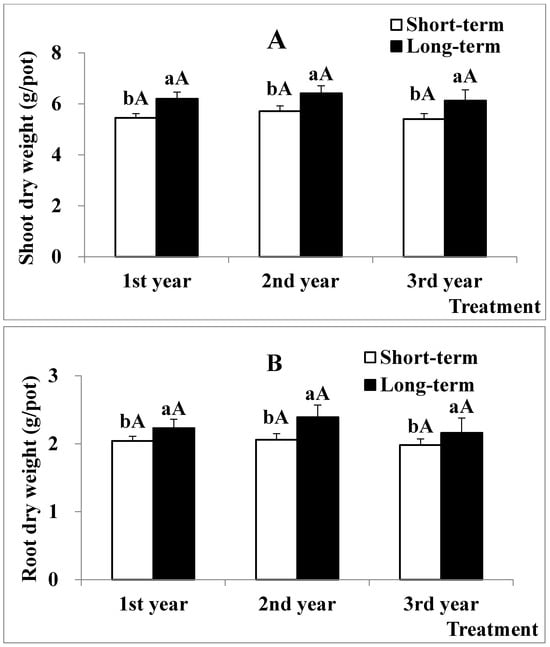
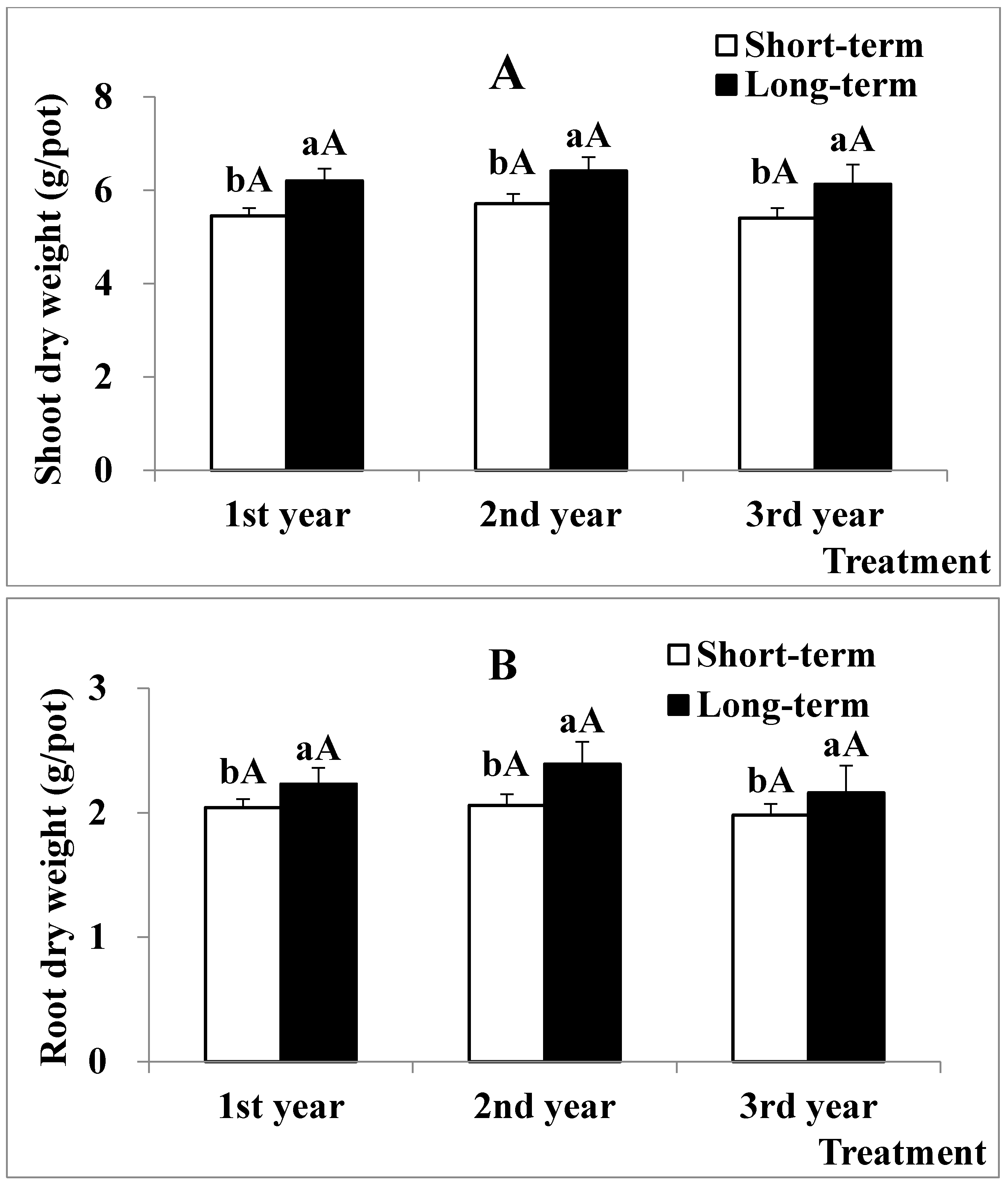
Biomass is an important indicator of plant tolerance to metal stress. In the present study, no significant differences were observed in shoot biomass between S1 (5.45 g/pot), S2 (5.71 g/pot), S3 (5.40 g/pot), and CK1 (5.50 g/pot), as well as between L1 (6.20 g/pot), L2 (6.41 g/pot), L3 (6.13 g/pot) and CK2 (6.22 g/pot), demonstrating high tolerance of B. pilosa to Cd contamination (Figure 1A). Shoot biomass was similar in successive years, with slightly higher values in S2 and L2, likely due to more favorable weather conditions in the second year. The cultivation period in the short-term treatments was 35.2% shorter than that in the long-term experiments, resulting in an 11.6% lower shoot biomass in S1–S3 than in L1–L3 (p < 0.05). Root biomass showed little variation between years and cultivation regimes and was, on average, 63.7% lower than shoot biomass (Figure 1B).
Figure 1.
Dry weight of shoots (A) and roots (B) of B. pilosa in individual years (Means between different treatments in the same year marked with the same lowercase letter are not significantly different at p < 0.05, and means within the same treatment between different years marked with the same uppercase letter are not significantly different at p < 0.05. Error bars indicate standard deviation).
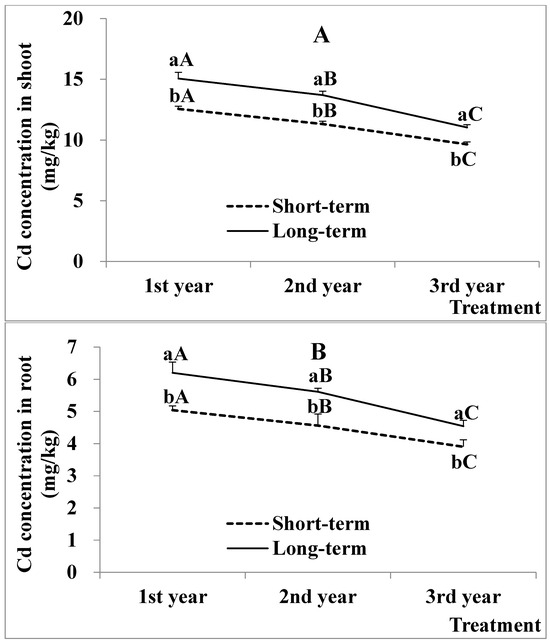
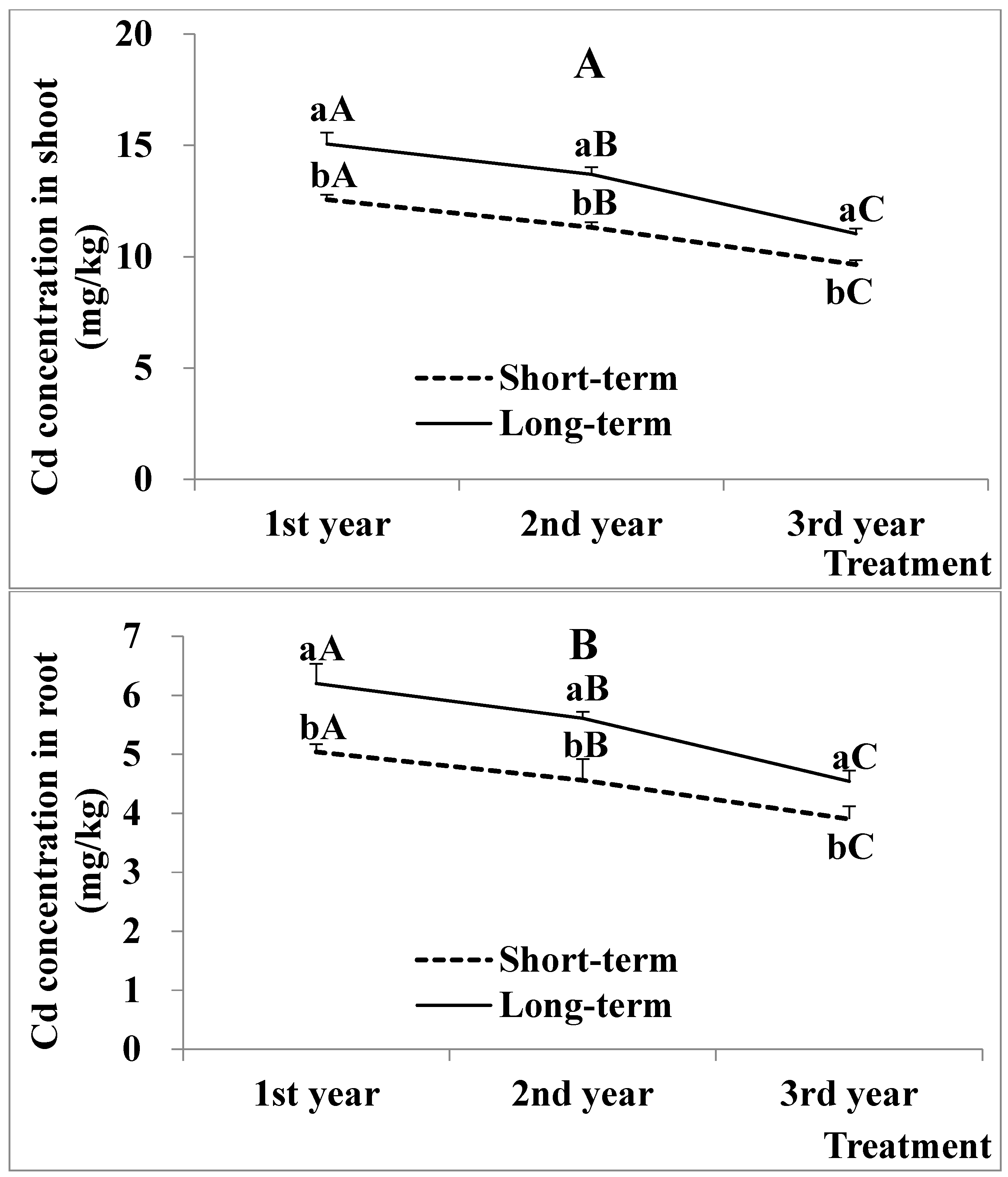
Conversely, Cd phytoremediation by B. pilosa was significantly affected by successive years and cultivation regimes (Figure 2A). The growth period in the short-term experiment was 35.2% shorter than in the long-term regime, resulting in an average 15.7% lower shoot Cd concentration in S1–S3 (12.56–9.65 mg/kg) compared to L1–L3 (15.06–11.03 mg/kg; p < 0.05). After continuous phytoremediation, shoot Cd concentrations in S3 and L3 declined by 23.2% and 26.8% (p < 0.05), respectively, indicating a progressive reduction in Cd uptake by B. pilosa. The average Cd concentration in the roots of B. pilosa was 59.3% lower than in the shoots, but showed a highly similar trend under different conditions in successive years and cultivation regimes (Figure 2B).
Figure 2.
Cd concentration trends in shoots (A) and roots (B) of B. pilosa in individual years (Means in the same year marked with the same lowercase letter are not significantly different at p < 0.05 and means within the same treatments marked with the same uppercase letter are not significantly different at p < 0.05. Error bars indicate standard deviation).
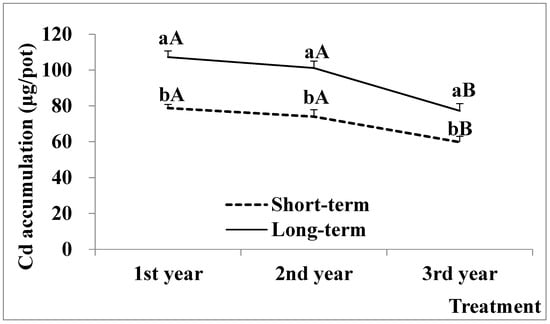
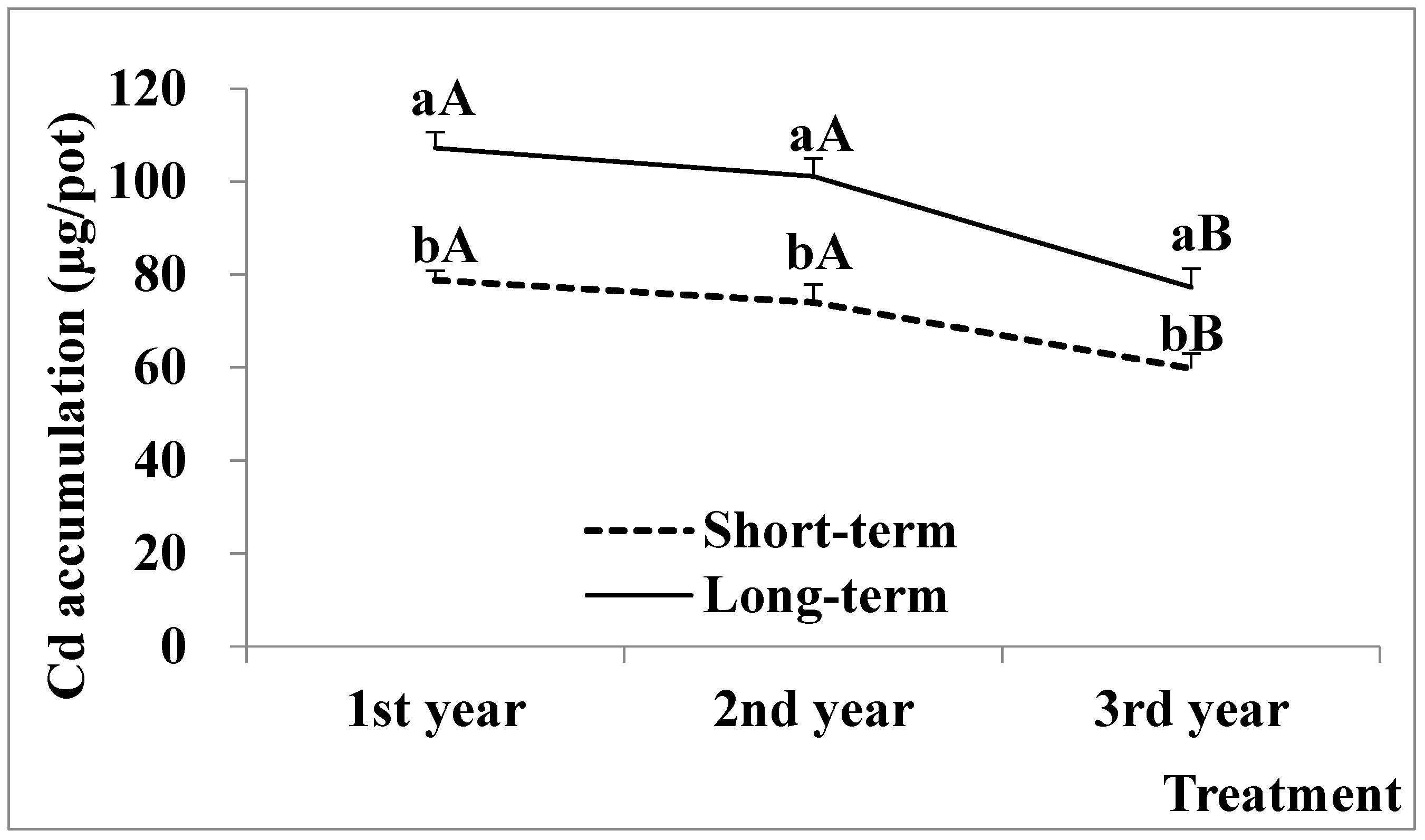
The pattern of Cd accumulation (Figure 3) was similar to that of Cd concentrations in shoots and roots (Figure 2). Cd accumulation in the short-term growth treatments was on average 25.6% lower than in the long-term experiments (p < 0.05). Compared with the first year, Cd accumulation in S3 and L3 declined by 24.2% and 27.9%, respectively. However, this apparent downward trend did not apply to all treatments, as Cd accumulation in S2 and L2 was on average only 5.9% lower than in S1 and L1, and did not differ significantly (p < 0.05). Overall, Cd accumulation was influenced by continuous phytoremediation and harvest time. Within the same year, long-term cultivation treatments resulted in higher Cd accumulation compared to short-term treatments. Additionally, for the same harvest regime, Cd accumulation generally decreased over successive years.
Figure 3.
Cd accumulation trends in B. pilosa in individual years (Means between different treatments in the same year marked with the same lowercase letter are not significantly different at p < 0.05, and means within the same treatment across years marked with the same uppercase letter are not significantly different at p < 0.05. Error bars indicate standard deviation).
3.2. Soil Parameters per Year
Soil pH and extractable Cd concentration are key factors determining Cd phytoremediation by hyperaccumulators [34]. Cultivation regimes and successive years had no significant effect on soil pH during sustained phytoremediation. In all treatments, pH remained stable within a narrow, slightly acidic range (6.51–6.56), with no significant differences observed (p > 0.05).
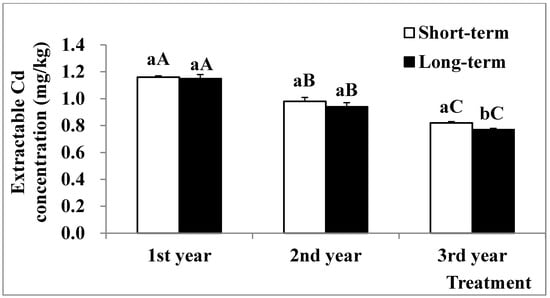
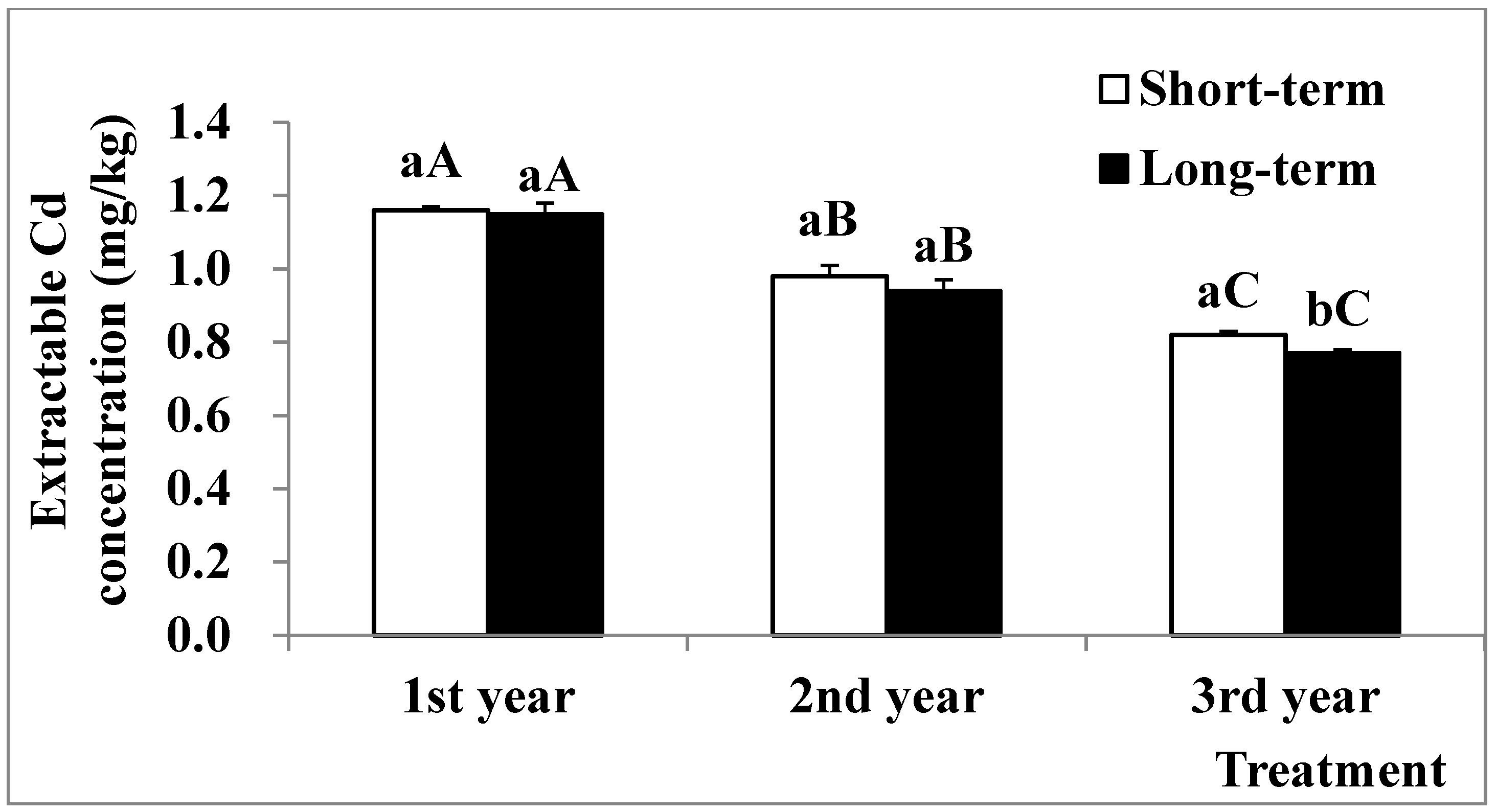
In contrast, extractable Cd concentrations in SZIA agricultural soil were significantly influenced by continuous phytoremediation (Figure 4). After three years, extractable Cd levels in S3 and L3 declined by 29.3% and 33.0%, respectively, relative to S1 and L1, indicating a substantial reduction in soil Cd bioavailability and associated environmental risk. Although extractable Cd concentrations were similar in S1 and L1, differences in cumulative Cd uptake between harvest regimes resulted in a 6.1% lower Cd level in L3 compared to S3. These trends closely matched those observed for Cd concentrations in plant tissues, indicating a strong dependence of Cd uptake by B. pilosa on soil Cd bioavailability (Figure 2 and Figure 4). The marked decline in Cd accumulation in the third year was therefore primarily attributable to depletion of the extractable Cd pool.
Figure 4.
Concentrations of soil extractable Cd during successive years of B. pilosa cultivation (Means within the same year marked with the same lowercase letter are not significantly different at p < 0.05, and means within the same treatment across different years marked with the same uppercase letter are not significantly different at p < 0.05. Error bars indicate standard deviation).
In parallel with the decline in extractable Cd, and the resulting reduction in phytoextraction, total soil Cd concentrations also showed a significant downward trend, with 26.9% and 30.5% decreases in S3 and L3 compared to S1 and L1, respectively (Figure 3 and Figure 4 and Table 3). A comparison of the two harvest groups showed that soil Cd levels in S1–S3 (0.078–0.057 mg/kg) were on average 25% lower than in L1–L3 (0.105–0.073 mg/kg) reflecting differences in cultivation time. The Cd removal rate (RR) showed the same trend during continuous phytoremediation. Relative to the first year, RR in S3 and L3 decreased by 18.4% and 20.0%, respectively, and was on average 26.4% lower in S1–S3 (3.80–3.10%) than in L1–L3 (5.16–4.13%). At these remediation rates, total soil Cd concentrations in S3 and L3 were reduced by 10.1% and 13.5%, respectively, relative to the baseline value.
Table 3.
Cd concentrations, Cd reductions and Cd removal rate in individual years.
3.3. EF, TF and NR of B. pilosa per Year
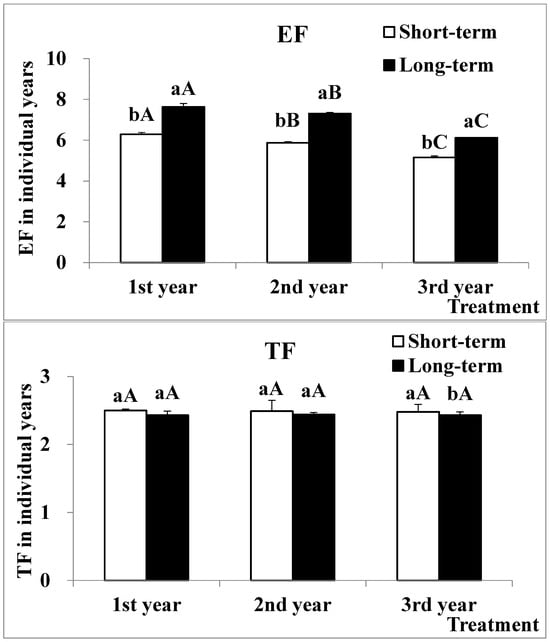
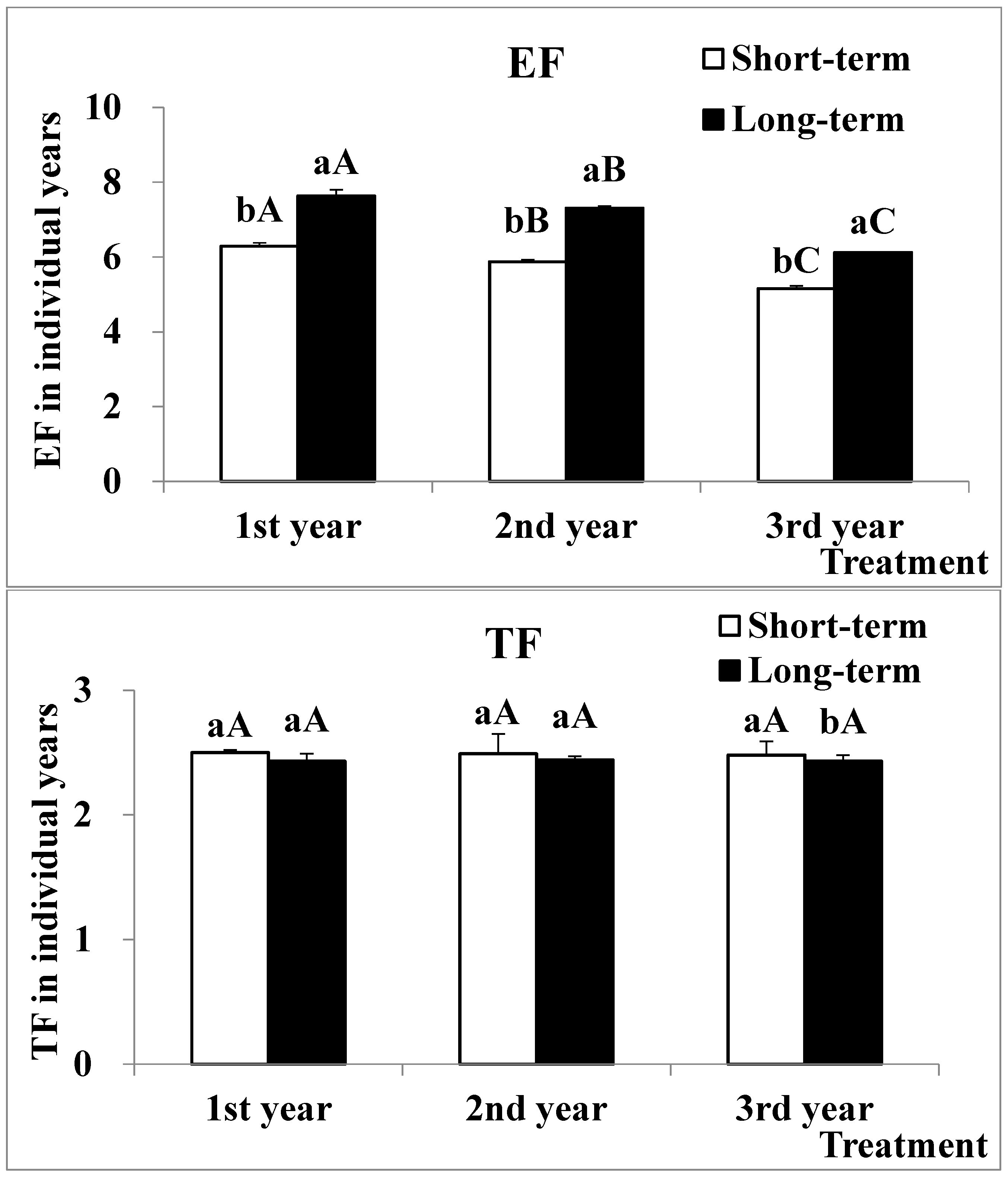
The translocation factor (TF) and enrichment factor (EF) are very important indicators of hyperaccumulation capacity. During the entire remediation process, both indices were above 1, confirming the hyperaccumulation properties of B. pilosa. Generally, the effect of cultivation time in successive years on the EF value closely followed the pattern observed for Cd concentrations in plant tissues (Figure 2 and Figure 5). Under the two harvest regimes, the EF values in S1–S3 (6.29–5.15) were, on average, 17.8% lower than in L1–L3 (7.63–6.12), reflecting shorter growth period (by 35.2%) in the short-term treatments. After 3 years of phytoremediation, the EF values in S3 and L3 decreased by an average of 19.0%, mainly due to depletion of the extractable Cd pool. In contrast, the TF was not significantly different in any treatments, fluctuating within a narrow range of 2.41–2.52 (Figure 5).
Figure 5.
EF and TF of B. pilosa in individual years (Means within the same year followed by the same lowercase letter are not significantly different at p < 0.05 and means within the same treatment in different years marked with the same uppercase letter are not significantly different at p < 0.05. Error bars indicate standard deviation).
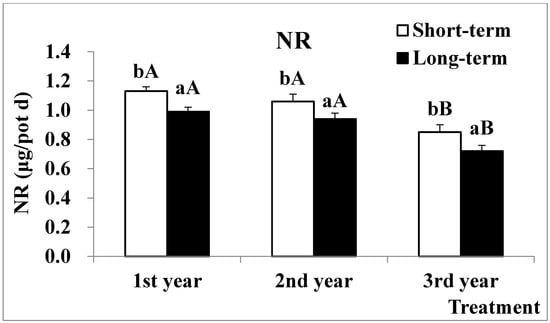
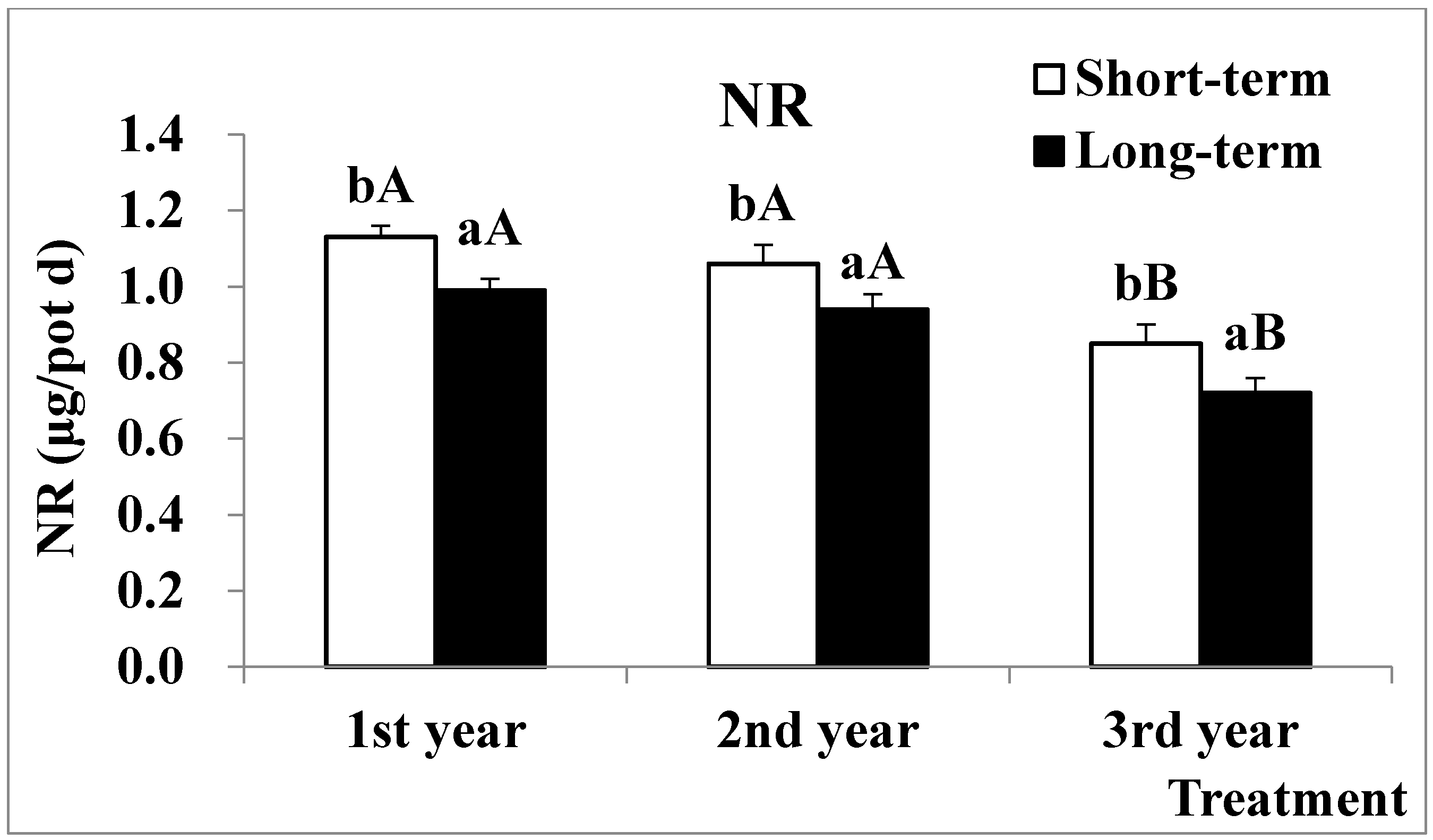
To provide a more comprehensive assessment of phytoremediation potential, the net removal rate per day (NR) was introduced (Figure 6). In contrast to total Cd accumulation, NR was higher under the short-term regime, with S1–S3 values (1.13–0.85 μg/pot d) averaging 14.7% above those in L1–L3 (0.99–0.72 μg/pot d). This indicated that a shorter growth cycle improved unit-time remediation efficiency. Over successive years, NR declined significantly, decreasing by 24.8% in S3 and 27.3% in L3 relative to S1 and L1, respectively, reflecting progressive depletion of bioavailable Cd. Overall, higher daily reclamation efficiency was obtained in the short-term regime, and therefore it represents a more practical strategy for sustained phytoremediation.
Figure 6.
NR of B. pilosa in individual years (Means in the same year marked with the same lowercase letter are not significantly different at p < 0.05 and means within the same treatment across different years marked with the same uppercase letter are not significantly different at p < 0.05. Error bars indicate standard deviation).
4. Discussion
The ubiquitous presence of Cd in agricultural soil poses a considerable risk to ecological environment and threatens human safety [35,36]. Although phytoremediation is a cost-effective “green technology” that plays a crucial role in the reclamation of metal-contaminated soil and improvement of environmental conditions [37], many studies in recent decades have focused mainly on enhancing biomass and Cd accumulation. Examples include Cd phytoremediation using Medicago sativa L. (alfalfa) with biochar addition [38], or the evaluation of phytoremediation potential of several Cd (hyper)accumulators in Cd-contaminated soils [39]. Typically, these studies used biomass and Cd concentration as the primary determinants of phytoremediation efficiency, and did not consider temporal factors. In contrast, the present study focused on the continuous remediation of Cd-contaminated agricultural soils by B. pilosa over three consecutive years and proposed a new concept of the net removal rate (NR) to more comprehensively assess the phytoextraction potential.
The biomass of B. pilosa was unaffected throughout the experiment, indicating a high level of Cd tolerance in SZIA arable soil. This finding is consistent with multiple previous studies investigating tolerance of B. pilosa to this heavy metal [19]. In addition, both the enrichment factor (EF) and translocation factor (TF) values were >1 during the entire growing period, demonstrating further hyperaccumulator characteristics. These results indicate that B. pilosa is a suitable species for sustained soil reclamation. Throughout the trial, biomass, Cd concentration, and accumulation of B. pilosa were higher in the long-term treatments than in the short-term experiments, which also led to a faster reduction in soil Cd levels in the former objects (Figure 1, Figure 2 and Figure 3, Table 3). The main reason for this phenomenon was that the growth time of the short-term treatments was 35.2% shorter compared to the long-term experiments. However, considering the required costs and time, the NR for the short-term treatment was significantly higher compared to the long-term experiments (an average of 14.7%), also proving that shorter cultivation period was more practical for improving phytoremediation efficiency. This effect may primarily result from the more rapid uptake of elements, including heavy metals, during the vegetative phase as compared to the reproductive phase. Significant interannual differences in phytoremediation efficiency were also observed. After three years of sustained phytoremediation, total soil Cd concentrations in the short-term and long-term treatments were reduced by 10.1% and 13.5%, respectively, relative to the initial baseline value (2.08 mg/kg). While these reductions are modest compared to studies using artificially spiked soils with higher Cd concentrations, they represent meaningful progress toward risk reduction for mildly contaminated agricultural soils under realistic conditions [20,39]. The 31.2% reduction in extractable Cd is particularly significant, as it directly mitigates the most ecologically relevant fraction. Simultaneously, this reduction contributed to a 26.1% decline in NR. This outcome can be attributed to the central role of extractable soil Cd, which strongly affects plant Cd uptake and accumulation [40,41]. Beyond the direct depletion of bioavailable Cd, other soil processes may have contributed to the observed decline in remediation efficiency. Soil microbial communities, which play a crucial role in mediating metal bioavailability and plant uptake [42], may have been affected by repeated cropping and continuous Cd exposure. Studies have shown that long-term phytoremediation can reshape microbial community structure and function, potentially altering Cd mobilization and immobilization processes in the rhizosphere [43]. Additionally, repeated cropping of B. pilosa may have influenced rhizosphere chemistry through continuous root exudation. Root exudates such as low-molecular-weight organic acids can modify metal solubility and availability [44]. Over three years of continuous planting, changes in exudation patterns or accumulation of specific organic compounds could have affected Cd bioavailability in ways that complement the simple depletion mechanism.
In summary, improving the efficiency of phytoremediation by shortening the growth cycle is a suitable solution in terms of practical application, as this cultivation system allows for multiple harvests per year. However, the reduction in extractable Cd levels using continuous phytoremediation may limit its effectiveness. At the same time, since short-term cultivation had the advantages of faster consumption and higher yield, it could ensure safe production by rotating hyperaccumulators and low-accumulation crops, while simultaneously remediating the soil [45,46].
In the context of the most widespread and problematic Cd-contaminated agriculture soils, we demonstrated the sustained remediation potential of B. pilosa under two cultivation regimes. Nevertheless, several limitations should be acknowledged. First, root growth was restricted to a limited soil volume (φ = 20 cm, H = 15 cm), which may either underestimate field uptake, where unrestricted roots access larger soil volumes, or overestimate it due to concentrated root growth along pot walls. Conversely, certain advantages of field conditions such as larger rooting volume and beneficial microbial associations could enhance per-plant uptake in ways that partially compensate for these limitations [47,48]. Second, the soil was sieved and homogenized, thereby eliminating the natural heterogeneity of field soils, where uneven Cd distribution often results in lower overall uptake by plants than predicted by studies using homogenized soil. In actual agricultural fields, Cd distribution is typically patchy due to historical irrigation patterns, tillage practices, and varying soil properties, meaning that plant roots may not encounter uniformly bioavailable Cd [49]. Third, while the applied net cover protected against precipitation, it also eliminated natural environmental variability (rainfall, temperature fluctuations) that could influence plant growth and metal uptake in complex interacting mechanisms [50]. These environmental factors can affect plant growth rates, transpiration-driven metal uptake, and the timing of phenological stages such as flowering and fruiting. Fourth, the sieving process may have disrupted beneficial microbial communities (e.g., mycorrhizal fungi) that could improve metal bioavailability under field conditions. Field soils contain diverse microbial communities that can enhance metal mobilization and plant tolerance, potentially increasing remediation efficiency beyond levels observed in pots. Given these factors, the absolute removal rates observed in our pot study (3.10–5.16% per cycle) should not be directly extrapolated to field conditions without adjustment. However, the relative differences between harvest modes (flowering vs. fruit maturity) and the temporal trends (declining uptake over three years) are likely robust across scales, as they reflect fundamental plant physiological responses rather than pot-specific artifacts. Therefore, further research on sustainable in situ phytoextraction should be conducted. In particular, the plant development from the seedling to flowering stage is short for almost all weeds found in agricultural areas, as confirmed by the hyperaccumulator S. nigrum, and exploiting this trait is important for improving phytoremediation efficiency [18]. This observation also indicates the potential to identify additional hyperaccumulators among farmland weeds, given that more than 20,000 weed species occur in agricultural systems, whereas B. pilosa was identified from only 29 species representing 18 families [19].
5. Conclusions
This three-year study has demonstrated that harvest timing significantly influences the phytoremediation efficiency of the Cd hyperaccumulator B. pilosa in contaminated farmland soil. Harvesting at the flowering stage resulted in a 14.7% higher net removal rate per day (NR) compared to harvesting at the fruit maturity stage, despite lower total Cd accumulation per harvest. This advantage stemmed from the shorter growth cycle, (by 35.2%) compared to the long-term period, and from faster metal uptake during the vegetative phase. These findings demonstrate that optimizing agronomic practices, such as harvest timing, can substantially improve unit-time remediation efficiency without the need for soil amendments. The progressive decline in both plant Cd uptake and soil extractable Cd concentrations over the three-year period, with an average reduction of 31.2%, revealed a key dynamic of sustained phytoremediation. As the most bioavailable Cd fraction was depleted, removal rates naturally decreased over time. This finding indicates that phytoremediation is most effective in the initial years and that long-term strategies must account for diminishing returns. From a practical perspective, harvesting at the flowering stage offers flexible implementation options for managing mildly Cd-contaminated agricultural soils. These include conducting multiple harvests per year to accelerate remediation, applying chelating agents to improve Cd bioavailability when required, or introducing rotation with low-accumulating crops to maintain safe agricultural production during remediation. More broadly, this study highlighted the value of screening farmland weeds as potential hyperaccumulators, as their inherently short vegetative growth phases can be utilized to improve phytoremediation effectiveness. Field-scale validation is still required to confirm these findings under real-practice conditions and to develop practical guidelines for farmers and land managers.
Author Contributions
Data curation: X.D.; Formal analysis: X.D.; Investigation: X.D.; Writing—original draft: X.D.; Conceptualization: H.D. and S.W.; Validation: H.D.; Writing-review and editing: H.D., L.S. and S.W.; Project administration: S.W.; Supervision: S.W. All authors have read and agreed to the published version of the manuscript.
Funding
This research received no external funding.
Data Availability Statement
The datasets used or analyzed during the current study are available from the corresponding author on reasonable request.
Acknowledgments
This work was supported by Sanqin Talents, Shaanxi Provincial First-class Team “Contaminated Soil Remediation and Resource Utilization Innovation Team at Shaanxi University of Technology”, the project of the National Natural Science Foundation of China (32471703), the Young Scientists Fund of the National Natural Science Foundation of China (52400251), Shaanxi Province City-University co-construction Project (SXZJ-2301), Qin Chuangyuan “Scientists + Engineers” Team Construction in Shaanxi Province(2024QCY-KXJ-104), Shaanxi University of Technology’s Provincial and Ministerial-Level Science and Technology Award Cultivation Program(SLGSJPY03), Talent Start-up Funds of Shaanxi University of Technology (X20240015, X20240034), Key Research and Development Project in Shaanxi Province (2024NC-ZDCYL-04-10,2025NC-YBXM-255),Foreign Experts Burean of China (S20240182, 2025WZ-YBXM-29,2025WZ-YBXM-19),Qinba Bioremediation and Resource Development Research Innovation and Introduction Base (2025YZ-YIPT-41; 2026ZY1-YZPT-38), Shaanxi University of Technology Bioremediation and Selenium Resource Development and Utilization Technology Innovation Team; Shaanxi University Youth Innovation Team (No. 2022-94). and the program financed by the Minister of Science of Poland under the ‘Regional Excellence Initiative’ for the years 2024–2027.
Conflicts of Interest
The authors declare that they have no known competing financial interests or personal relationships that could have appeared to influence the work reported in this paper.
References
- Cao, C.; Zhang, Q.; Ma, Z.; Wang, X.; Chen, H.; Wang, J. Fractionation and mobility risks of heavy metals and metalloids in wastewater-irrigated agricultural soils from greenhouses and fields in Gansu, China. Geoderma 2018, 328, 1–9. [Google Scholar] [CrossRef] [Scilit]
- Huang, B.; Guo, Z.; Xiao, X.; Zeng, P.; Peng, C. Changes in chemical fractions and ecological risk prediction of heavy metals in estuarine sediments of Chunfeng Lake estuary, China. Mar. Pollut. Bull. 2019, 138, 575–583. [Google Scholar] [CrossRef] [Scilit]
- Zeng, P.; Guo, Z.; Xiao, X.; Peng, C. Dynamic response of enzymatic activity and microbial community structure in metal(loid)-contaminated soil with tree-herb intercropping. Geoderma 2019, 345, 5–16. [Google Scholar] [CrossRef] [Scilit]
- Rossini-Oliva, S.; Abreu, M.M.; Leidi, E.O. A review of hazardous elements tolerance in a metallophyte model species: Erica andevalensis. Geoderma 2018, 319, 43–51. [Google Scholar] [CrossRef] [Scilit]
- Sun, L.; Yang, X.; Wang, W.; Ma, L.; Chen, S. Spatial distribution of Cd and Cu in soils in Shenyang Zhangshi Irrigation Area (SZIA), China. J. Zhejiang Univ. Sci. B Biomed. Biotechnol. 2008, 9, 271–278. [Google Scholar] [CrossRef] [Scilit] [PubMed]
- Li, P.; Wang, X.; Allinson, G.; Li, X.; Xiong, X. Risk assessment of heavy metals in soil previously irrigated with industrial wastewater in Shenyang, China. J. Hazard. Mater. 2009, 161, 516–521. [Google Scholar] [CrossRef] [Scilit]
- Zhang, Y.; Zhang, X.; Zhang, H.; He, Q.; Zhou, Q.; Su, Z.; Zhang, C. Responses of Soil Bacteria to Long-Term and Short-Term Cadmium Stress as Revealed by Microbial Community Analysis. Bull. Environ. Contam. Toxicol. 2009, 82, 367–372. [Google Scholar] [CrossRef] [Scilit]
- Pouresmaieli, M.; Ataei, M.; Forouzandeh, P.; Azizollahi, P.; Mahmoudifard, M. Recent progress on sustainable phytoremediation of heavy metals from soil. J. Environ. Chem. Eng. 2022, 10, 108482. [Google Scholar] [CrossRef] [Scilit]
- Ullah, S.; Liu, Q.; Wang, S.; Jan, A.U.; Sharif, H.M.A.; Ditta, A.; Wang, G.; Cheng, H. Sources, impacts, factors affecting Cr uptake in plants, and mechanisms behind phytoremediation of Cr-contaminated soils. Sci. Total Environ. 2023, 899, 165726. [Google Scholar] [CrossRef] [Scilit]
- Xiao, L.; Feng, L.X.; Chen, X.F.; Yao, J.H.; Li, Y.Y.; Feng, X.J. Screening and Characteristics of Cadmium-Tolerant Microorganisms in Soil Remediation. Bull. Environ. Contam. Toxicol. 2025, 114, 35. [Google Scholar] [CrossRef] [Scilit]
- Zhao, C.C.; Yao, J.; Knudsen, T.S.; Hu, W.K.; Cao, Y. Combined modified montmorillonite and microbial consortium enhanced the remediation effect of As and Cd-contaminated soil in a smelting area. J. Clean. Prod. 2025, 501, 145329. [Google Scholar] [CrossRef] [Scilit]
- Huang, H.Y.; Jia, M.H.; Peng, D.H.; Zhang, Y.M.; Zheng, X.; Li, Y.L.; Feng, S.; Liu, J.X.; Xu, H.; Liu, H.K. Polyethylene microplastics interfere with MICP-based cadmium remediation: A dual-system evaluation of microbial performance and environmental response. J. Hazard. Mater. 2025, 497, 139541. [Google Scholar] [CrossRef] [Scilit] [PubMed]
- Remigio, A.C.; Chaney, R.L.; Baker, A.J.M.; Edraki, M.; Erskine, P.D.; Echevarria, G.; van der Ent, A. Phytoextraction of high value elements and contaminants from mining and mineral wastes: Opportunities and limitations. Plant Soil 2020, 449, 11–37. [Google Scholar] [CrossRef] [Scilit]
- Zhang, L.D.; Liu, X.; Wei, M.Y.; Guo, Z.J.; Zhao, Z.Z.; Gao, C.H.; Li, J.; Xu, J.X.; Shen, Z.J.; Zheng, H.L. Ammonium has stronger Cd detoxification ability than nitrate by reducing Cd influx and increasing Cd fixation in Solanum nigrum L. J. Hazard. Mater. 2022, 425, 127947. [Google Scholar] [CrossRef] [Scilit]
- Xu, L.; Tian, S.; Hu, Y.; Ge, J.; Zhao, J.; Lu, L. Cadmium contributes to heat tolerance of a hyperaccumulator plant species Sedum alfredii. J. Hazard. Mater. 2023, 441, 129840. [Google Scholar] [CrossRef] [Scilit]
- Zhou, X.; Shi, A.; Rensing, C.; Yang, J.; Ni, W.; Xing, S.; Yang, W. Wood vinegar facilitated growth and Cd/Zn phytoextraction of Sedum alfredii Hance by improving rhizosphere chemical properties and regulating bacterial community. Environ. Pollut. 2022, 305, 119266. [Google Scholar] [CrossRef] [Scilit]
- Ravanbakhsh, M.; Ronaghi, A.M.; Taghavi, S.M.; Jousset, A. Screening for the next generation heavy metal hyperaccumulators for dryland decontamination. J. Environ. Chem. Eng. 2016, 4, 2350–2355. [Google Scholar] [CrossRef] [Scilit]
- Wei, S.H.; Zhou, Q.X.; Koval, P.V. Flowering stage characteristics of cadmium hyperaccumulator Solanum nigrum L. and their significance to phytoremediation. Sci. Total Environ. 2006, 369, 441–446. [Google Scholar] [CrossRef] [Scilit]
- Wei, S.; Zhou, Q. Screen of Chinese weed species for cadmium tolerance and accumulation characteristics. Int. J. Phytoremediat. 2008, 10, 584–597. [Google Scholar] [CrossRef] [Scilit]
- Manori, S.; Shah, V.; Soni, V.; Dutta, K.; Daverey, A. Phytoremediation of cadmium-contaminated soil by Bidens pilosa L.: Impact of pine needle biochar amendment. Environ. Sci. Pollut. Res. 2021, 28, 58872–58884. [Google Scholar] [CrossRef] [Scilit]
- Wang, S.; Dai, H.; Ji, D.; Cui, S.; Jiang, C.; Skuza, L.; Li, L.; Grzebelus, D.; Wei, S. Influencing Factors of Bidens pilosa L. Hyperaccumulating Cadmium Explored by the Real-Time Uptake of Cd2+ Influx around Root Apexes under Different Exogenous Nutrient Ion Levels. Toxics 2023, 11, 227. [Google Scholar] [CrossRef] [Scilit] [PubMed]
- Li, X.; Tian, L.; Li, B.; Chen, H.; Zhao, G.; Qin, X.; Liu, Y.; Yang, Y.; Xu, J. Polyaspartic acid enhances the Cd phytoextraction efficiency of Bidens pilosa by remolding the rhizospheric environment and reprogramming plant metabolism. Chemosphere 2022, 307, 136068. [Google Scholar] [CrossRef] [Scilit] [PubMed]
- Dai, Z.H.; Peng, Y.J.; Ding, S.; Chen, J.Y.; He, S.X.; Hu, C.Y.; Cao, Y.D.; Guan, X.; Ma, L.Q. Selenium Increased Arsenic Accumulation by Upregulating the Expression of Genes Responsible for Arsenic Reduction, Translocation, and Sequestration in Arsenic Hyperaccumulator Pteris vittata. Environ. Sci. Technol. 2022, 56, 14146–14153. [Google Scholar] [CrossRef] [Scilit] [PubMed]
- Zhang, Y.; Gong, J.; Cao, W.; Qin, M.; Song, B. Influence of biochar and fulvic acid on the ryegrass-based phytoremediation of sediments contaminated with multiple heavy metals. J. Environ. Chem. Eng. 2023, 11, 109446. [Google Scholar] [CrossRef] [Scilit]
- Yuan, L.; Guo, P.; Guo, S.; Wang, J.; Huang, Y. Influence of electrical fields enhanced phytoremediation of multi-metal contaminated soil on soil parameters and plants uptake in different soil sections. Environ. Res. 2021, 198, 111290. [Google Scholar] [CrossRef] [Scilit]
- GB15618-2018; Soil Environmental Quality Risk Control Standard for Soil Contamination of Agricultural Land. National standard of China. China Environment Publishing Group: Beijing, China, 2018.
- Dou, X.; Dai, H.; Twardowska, I.; Wei, S. Hyperaccumulation of Cd by Rorippa globosa (Turcz.) Thell. from soil enriched with different Cd compounds, and impact of soil amendment with glutathione (GSH) on the hyperaccumulation efficiency. Environ. Pollut. 2019, 255, 113270. [Google Scholar] [CrossRef] [Scilit]
- Yang, W.; Dai, H.; Dou, X.; Zhang, Q.; Wei, S. Effect and mechanism of commonly used four nitrogen fertilizers and three organic fertilizers on Solanum nigrum L. hyperaccumulating Cd. Environ. Sci. Pollut. Res. 2019, 26, 12940–12947. [Google Scholar] [CrossRef] [Scilit]
- Lan, J.; Zhang, S.; Lin, H.; Li, T.; Xu, X.; Li, Y.; Jia, Y.; Gong, G. Efficiency of biodegradable EDDS, NTA and APAM on enhancing the phytoextraction of cadmium by Siegesbeckia orientalis L. grown in Cd-contaminated soils. Chemosphere 2013, 91, 1362–1367. [Google Scholar] [CrossRef] [Scilit]
- Jones, J.B. Laboratory Guide for Conducting Soil Tests and Plant Analysis; CRC Press: Boca Raton, FL, USA; Taylor & Francis Group: Boca Raton, FL, USA, 2001. [Google Scholar]
- Tessier, A.; Campbell, P.G.C.; Bisson, M. Sequential Extraction Procedure for the Speciation of Particulate Trace-Metals. Anal. Chem. 1979, 51, 844–851. [Google Scholar] [CrossRef] [Scilit]
- Dou, X.; Dai, H.; Skuza, L.; Wei, S. Strong accumulation capacity of hyperaccumulator Solanum nigrum L. for low or insoluble Cd compounds in soil and its implication for phytoremediation. Chemosphere 2020, 260, 127564. [Google Scholar] [CrossRef] [Scilit]
- Tang, Q.Y.; Zhang, C.X. Data Processing System (DPS) software with experimental design, statistical analysis and data mining developed for use in entomological research. Insect Sci. 2013, 20, 254–260. [Google Scholar] [CrossRef] [Scilit] [PubMed]
- Zhang, Z.; Zhong, J.S.; Guo, X.Z.; Xu, C.; Huang, D.Y.; Liu, J.; Chen, X.S. Differential effects of pH on cadmium accumulation in Artemisia argyi growing in low and moderately cadmium-contaminated paddy soils. Chem. Biol. Technol. Agric. 2024, 11, 158. [Google Scholar] [CrossRef] [Scilit]
- Zang, F.; Wang, S.; Nan, Z.; Ma, J.; Zhang, Q.; Chen, Y.; Li, Y. Accumulation, spatio-temporal distribution, and risk assessment of heavy metals in the soil-corn system around a polymetallic mining area from the Loess Plateau, northwest China. Geoderma 2017, 305, 188–196. [Google Scholar] [CrossRef] [Scilit]
- Xu, M.; Zhao, Z.; Song, Y.; Li, J.; You, Y.; Li, J. Evaluation of ferrihydrite-humic acid coprecipitate as amendment to remediate a Cd- and Pb-contaminated soil. Geoderma 2020, 361, 114131. [Google Scholar] [CrossRef] [Scilit]
- Baruah, N.; Gogoi, N.; Farooq, M. Influence of biochar and organic soil amendments on bioavailability and immobilization of copper and lead to common cocklebur in acidic sandy loam soil. J. Environ. Chem. Eng. 2020, 8, 104480. [Google Scholar] [CrossRef] [Scilit]
- Zhang, M.; Wang, J.; Bai, S.H.; Zhang, Y.; Teng, Y.; Xu, Z. Assisted phytoremediation of a co-contaminated soil with biochar amendment: Contaminant removals and bacterial community properties. Geoderma 2019, 348, 115–123. [Google Scholar] [CrossRef] [Scilit]
- Huang, R.; Dong, M.; Mao, P.; Zhuang, P.; Paz-Ferreiro, J.; Li, Y.; Li, Y.; Hu, X.; Netherway, P.; Li, Z. Evaluation of phytoremediation potential of five Cd (hyper)accumulators in two Cd contaminated soils. Sci. Total Environ. 2020, 721, 137581. [Google Scholar] [CrossRef] [Scilit]
- Liang, T.; Zhou, G.; Chang, D.; Wang, Y.; Gao, S.; Nie, J.; Liao, Y.; Lu, Y.; Zou, C.; Cao, W. Co-incorporation of Chinese milk vetch (Astragalus sinicus L.), rice straw, and biochar strengthens the mitigation of Cd uptake by rice (Oryza sativa L.). Sci. Total Environ. 2022, 850, 158060. [Google Scholar] [CrossRef] [Scilit]
- Lu, H.l.; Li, K.W.; Nkoh, J.N.; Shi, Y.; He, X.; Hong, Z.; Xu, R.K. Effects of the increases in soil pH and pH buffering capacity induced by crop residue biochars on available Cd contents in acidic paddy soils. Chemosphere 2022, 301, 134674. [Google Scholar] [CrossRef] [Scilit]
- Qiu, G.Y.; Zhu, M.; Meng, J.; Luo, Y.; Di, H.J.; Xu, J.M.; Brookes, P.C. Changes in soil microbial biomass C, ATP and microbial ATP concentrations due to increasing soil Cd levels in Chinese paddy soils growing rice (Oryza sativa). Plant Soil 2019, 436, 1–12. [Google Scholar] [CrossRef] [Scilit]
- Cheng, Z.Y.; Shi, J.C.; He, Y.; Wu, L.S.; Xu, J.M. Assembly of root-associated bacterial community in cadmium contaminated soil following five-year consecutive application of soil amendments: Evidences for improved soil health. J. Hazard. Mater. 2022, 426, 128095. [Google Scholar] [CrossRef] [Scilit]
- Chiang, P.N.; Chiu, C.Y.; Wang, M.K.; Chen, B.T. Low-Molecular-Weight Organic Acids Exuded by Millet (Setaria italica (L.) Beauv.) Roots and Their Effect on the Remediation of Cadmium-Contaminated Soil. Soil Sci. 2011, 176, 33–38. [Google Scholar] [CrossRef] [Scilit]
- Li, X.; Zhu, Y.; Zhu, J.; Wang, P.; Tang, C.; Liu, Z. Remediation and Micro-Ecological Regulation of Cadmium and Arsenic Co-Contaminated Soils by Rotation of High-Biomass Crops and Sedum alfredii Hance. Sustainability 2022, 14, 5717. [Google Scholar] [CrossRef] [Scilit]
- Warke, M.; Sarkar, D.; Zhang, Z.; Neve, S.; Datta, R. Human health risk mitigation from arsenic in rice by crop rotation with a hyperaccumulator plant. Environ. Sci. Pollut. Res. 2023, 30, 12030–12040. [Google Scholar] [CrossRef] [Scilit]
- Liu, Z.; Chen, B.; Wang, L.A.; Urbanovich, O.; Nagorskaya, L.; Li, X.; Tang, L. A review on phytoremediation of mercury contaminated soils. J. Hazard. Mater. 2020, 400, 123138. [Google Scholar] [CrossRef] [Scilit]
- Liang, X.; Li, Y.; Tang, S.; Shi, X.; Zhou, N.; Liu, K.; Ma, J.; Yu, F.; Li, Y. Mechanism underlying how a chitosan-based phosphorus adsorbent alleviates cadmium-induced oxidative stress in Bidens pilosa L. and its impact on soil microbial communities. Chemosphere 2022, 295, 133943. [Google Scholar] [CrossRef] [Scilit]
- Qi, S.; Li, X.; Luo, J.; Han, R.; Chen, Q.; Shen, D.; Shentu, J. Soil heterogeneity influence on the distribution of heavy metals in soil during acid rain infiltration: Experimental and numerical modeling. J. Environ. Manag. 2022, 322, 116144. [Google Scholar] [CrossRef] [Scilit]
- Zha, Y.; Zhao, B.; Qiu, J.; Li, X. Integrated transcriptomic and metabolomic analyses of pak choi Brassica pekinensis (Lour.) Rupr response to combined stress of acid rain and cadmium-containing atmospheric fine particulate matter. Front. Environ. Sci. 2022, 10, 1020308. [Google Scholar] [CrossRef] [Scilit]

Disclaimer/Publisher’s Note: The statements, opinions and data contained in all publications are solely those of the individual author(s) and contributor(s) and not of MDPI and/or the editor(s). MDPI and/or the editor(s) disclaim responsibility for any injury to people or property resulting from any ideas, methods, instructions or products referred to in the content. |
© 2026 by the authors. Licensee MDPI, Basel, Switzerland. This article is an open access article distributed under the terms and conditions of the Creative Commons Attribution (CC BY) license.