


Abstract
Sustainable indoor growing management requires biological alternatives that protect against pathogens, preserve fruit quality and minimise chemical inputs in strawberries. We compared the impacts of a four-strain Bacillus consortium (BacMix) and chemical fungicides on two cultivars (cv. Elsanta and cv. Sonsation) by evaluating the metabolite outcomes—the free amino acids (FAAs) in the leaves and the sugars in the fruits. Furthermore, the descriptive shotgun metagenomics provides a functional context for these biochemical traits. The BacMix increased the total FAAs in the leaves and stabilised the fruit sugar profiles, maintaining moderate–high sucrose with controlled glucose and fructose. The chemically treated plants showed significant reductions in both FAAs and sugars. The metagenomic data showed BacMix-related shifts in the microbial functional potential in the leaves, but the biological agent did not affect diversity. An increased representation of genes involved in amino acid biosynthesis (aminoacyl tRNA pathway) and secondary metabolite biosynthesis was observed, along with changes in the relative CAZy signals. The direction of these metagenomic trends aligned with the metabolite outcomes, suggesting that BacMix influences the endophytic microbiome in a way that supports nitrogen-related metabolism and carbohydrate stability during the vegetation period. The cultivar-independent metabolic improvements emphasise the benefits of BacMix and highlight microbiome-based interventions as promising tools for sustainable, chemical-reduced strawberry production.
1. Introduction
The strawberry (Fragaria × ananassa) is a high-value horticultural crop whose yield and fruit quality are strongly constrained by agrotechnology; plant physiology; metabolic regulation; and microbial interaction among the metagenomes of the plant, rhizosphere, and soil. Disease management in strawberry production relies on repeated fungicide applications, but concerns over fungicide resistance, environmental impacts, and consumer preferences continue to drive the development of sustainable biological alternatives [1,2,3].
Among the bacterial biocontrol agents (BCAs), Bacillus spp. have attracted extensive interest due to their ability to form endospores, colonise plant tissues as endophytes, and synthesise a wide spectrum of antimicrobial and plant-modulating secondary metabolites [4,5,6,7,8,9]. Beyond single-strain inoculants, recent analyses have emphasised that multi-strain Bacillus consortia frequently outperform individual strains by providing complementary enzymatic activities, broader antagonistic spectra, and greater stability under variable environmental conditions [10,11,12,13]. Multi-strain BCAs can therefore achieve more consistent disease suppression across soil types and hosts [6,9,14,15,16], and large-scale agronomic experience highlights their potential as multifunctional bioinputs supporting regenerative agriculture [15,17,18]. A systematic review confirms that products containing multiple Bacillus strains are more effective and often outperform single strains, promoting plant growth and reducing disease incidence across diverse crops [10,19].
Increasingly, it is recognised that microbial inoculants do more than directly suppress pathogens. They can reshape plant–microbiome interactions through resource competition, metabolite exchange, and immune modulation, thereby influencing the host physiology and metabolic outcomes [18,20]. This perspective aligns with emerging work positioning plant metabolites as key determinants of microbiome assembly. Recent reviews describe roots and other plant organs that recruit, shape, and stabilise beneficial microbial communities through secreted metabolites and nutrient composition [21]. Moreover, integrated microbiome–metabolome analyses demonstrate that specialised plant metabolites can correlate with, and even drive, distinct microbial community configurations in roots and rhizosphere soils [22]. Together, these findings show the need to investigate microbial functional traits with plant metabolic phenotypes when evaluating biocontrol systems.
In strawberries, some metabolic traits (particularly the FAAs in the leaves and the fruit sugar composition) are indicators and critical for growth, stress responses, and flavour quality [13,23,24,25,26,27,28,29]. Recent genetic studies have highlighted the sensitivity of strawberry fruit quality to metabolic regulation, further reinforcing the importance of understanding how beneficial microbes interact with plant metabolism [10,13,30].
The microbial communities associated with leaves also contribute to carbon turnover through carbohydrate-active enzymes (CAZymes), which affect cell wall dynamics, sugar conjugation, and carbohydrate availability [31,32,33,34,35]. CAZy-encoded enzymes are central to fruit softening and may indirectly affect pathogen susceptibility and postharvest quality. Most strawberry studies about microbiome changes, amino acid metabolism, or sugar profiles have been conducted in isolation, leaving the relationship between the microbial functional potential and plant metabolic outcomes unclear [36,37,38,39]. The multi-omics evidence has increasingly shown that metabolite and microbiome interactions underlie major agronomic traits, from nutrient uptake to product quality [21,22].
Shotgun metagenomics offers the ability to explore microbial functional traits at a high resolution, but treatment-level analyses of plant tissues often involve pooled samples, especially when the goal is to obtain a representative functional profile rather than to assess the statistical variation among biological replicates. Samples pooling remains suitable for exploratory, hypothesis-generating functional profiling, provided that replicated biochemical or physiological measurements form the main inferential basis [40].
The aim of this study is to evaluate the watering effect of a four-strain Bacillus consortium (BacMix) on commercial strawberry varieties’ (cvs. Elsanta and Sonsation) plant metabolic outcomes—the free amino acid accumulation in the leaves and the sugar composition in the fruits—and analyse the changes in the descriptive shotgun metagenomic profiling of leaf samples. In this paper, we provide the metabolite results, linking them to the functional signatures in the plant microbiota in the BCA treatments. Our findings contribute to an emerging framework in which watering with a multi-strain Bacillus consortium, the plant metabolic responses, and the functional potential of plant endophytes are considered interrelated components promoting sustainable strawberry production.
2. Materials and Methods
2.1. Plant Material and Experimental Design
The study was conducted under greenhouse conditions, and plant material was collected for analysis in 2024 at LAMMC IH (Lithuanian Research Centre for Agriculture and Forestry Institute of Horticulture). The research and data analysis were carried out in 2025. Two strawberry (Fragaria × ananassa Duch.) cultivars, Elsanta and Sonsation (frigo plants), were cultivated in 2024 under controlled greenhouse conditions, following the general approach [3].
Cv. Elsanta is a widely cultivated Dutch strawberry. It is characterised by firm, glossy, bright-red conical berries, excellent shelf life, high transportability, and consistently high yields. Its plants produce medium-sized, moderately vigorous bushes with few runners, and good resistance to several leaf spot diseases, but show susceptibility to drought, low temperatures, and powdery mildew, making controlled moisture and protected environments particularly important for optimal performance.
Cv. Sonsation (also known regionally as Sensation) is a modern Dutch cultivar released by Flevo Berry in 2016 and bred as an alternative to Sonata. It forms tall, compact plants with strong foliage, producing glossy, medium-red, aromatic berries, notable for their excellent flavour, high fruit set, and superior picking ease due to the flower trusses positioned at leaf height. Its plants show good tolerance to Phytophthora and foliar diseases, with a strong yield potential above that of cvs. Elsanta and Sonata, and suitability for open-field, greenhouse, hydroponic, and tunnel cultivation, including year-round production.
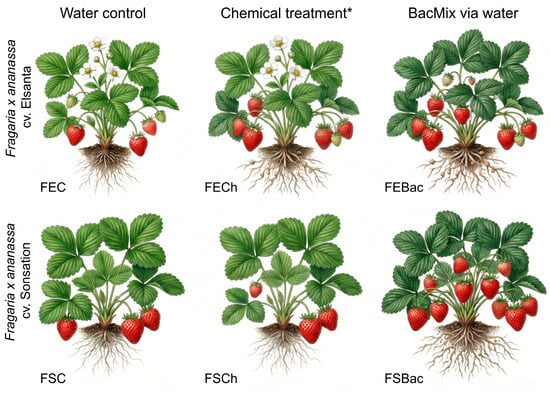
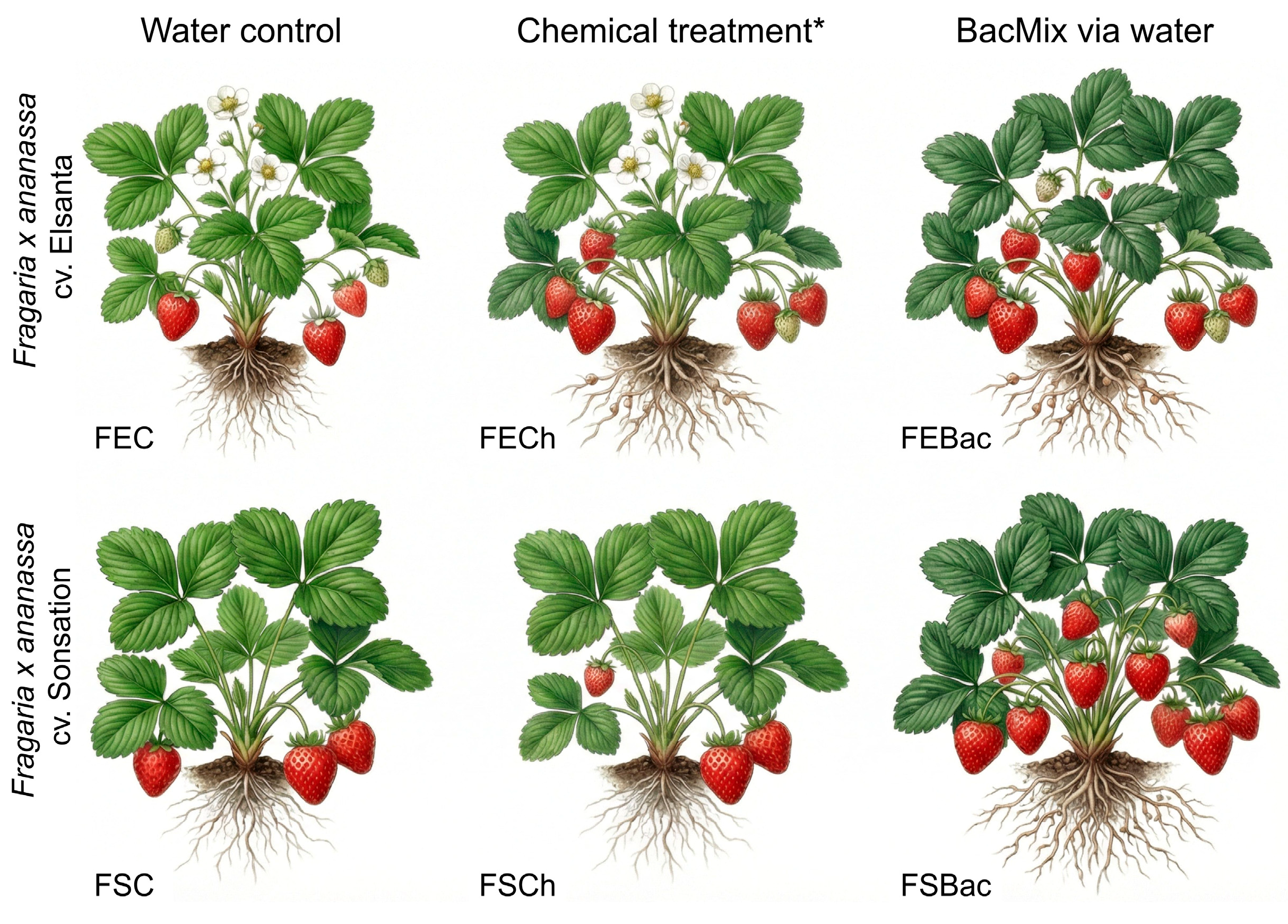
The experiment employed a randomised block design with three biological replicates per treatment (3 treatments per cultivar)—the treatment groups are shown in Figure 1.
Figure 1.
Treatment groups in experimental design. * boscalid 267 g·L−1 + pyraclostrobin 37 g·L−1 and cyprodinil 375 g·L−1 + fludioxonil 250 g·L−1. Abbreviations for samples: FEC—Fragaria cv. Elsanta control; FECh—Fragaria cv. Elsanta chemical fungicide treated; FEBac—Fragaria cv. Elsanta BacMix treated; FSC—Fragaria cv. Sonsation control; FSCh—Fragaria cv. Sonsation chemical fungicide treated; FSBac—Fragaria cv. Sonsation BacMix treated.
BacMix was applied to the root zone by watering three times during the growing season, at equal 10-day intervals (200 mL per pot).
The chemical treatments were applied every 10 days, a total of four times (two times with boscalid 267 g·L−1 + pyraclostrobin 37 g·L−1 and two times with cyprodinil 375 g·L−1 + fludioxonil 250 g·L−1).
The greenhouse conditions were maintained as per standard practice [3].
Samples, according to Biologische Bundesanstalt, Bundessortenamt and Chemical industry scale (BBCH), from all the treatments (FEC, FECh, FEBac, FSC, FSCh, and ESBac) were used for the free amino acids and sugar profiling analyses (Section 2.3 and Section 2.4). Samples from the FEC, FEBac, FSC, and FSBac treatments were collected for the metagenome analysis (described in Section 2.5).
2.2. Bacterial Strains and BacMix Preparation
Endophytic strains of Bacillus halotolerans (Bil-LT1_1, Bil-LT1_2) and B. velezensis (Cran-LT1_8, Ling-NOR4_15) were isolated from tissues of wild Vaccinium spp. and characterised for their antifungal activity and genomic features [41]. These strains, showing strong antagonism against Botrytis cinerea and other plant phytopathogens, were combined to create multi-strain consortium—BacMix [3,41].
Each strain was grown separately in Lysogeny Broth (LB) medium (Liofilchem, Roseto degli Abruzzi, Italy) at 28 °C and 200 rpm for 24–48 h, until an OD600 ≈ 1.0 was achieved. The cells were then harvested by centrifugation at 5000× g for 10 min, washed, and resuspended in sterile distilled water. Equal volumes of each strain suspension (Bil-LT1_1, Bil-LT1_2, Cran-LT1_8, and Ling-NOR4_15) were pooled to obtain BacMix at a final concentration of 3.3 × 10⁶ CFU·mL−1. Bacillus-based biocontrol agents typically require bacterial densities in the range of 106–108 CFU·mL−1 [19]. Thus 3.3 × 10⁶ CFU·mL−1 is a concentration that is biologically effective for disease suppression and safe for repeated watering applications in strawberries.
2.3. Free Amino Acid Analysis in Strawberry Leaves
Composite leaf samples (5 leaves from a plant in 3 replicates) were collected at the full flowering stage BBCH 65 (full flowering, when the secondary (B) and tertiary (C) flowers are open, and the first petals are beginning to fall). The samples from each plant were homogenised, and 1 g of homogenised material was used for each replicate. The free amino acids (FAAs) were quantified using gas chromatography with flame ionisation detection (GC–FID) on an Agilent 6890N system (Agilent Technologies, Santa Clara, CA, USA). The sample preparation involved ion-exchange solid-phase extraction followed by chloroformate derivatisation using EZ: faast reagents (Phenomenex, Torrance, CA, USA), according to the manufacturer’s instructions.
The free amino acids (FAAs) were assigned according to the IUPAC–IUBMB (Joint Commission on Biochemical Nomenclature)-recommended three-letter nomenclature system, which is universally used in biochemical and plant metabolomics studies. The targeted amino acids included Asp, Ala, Gly, Val, Leu, Ile, Thr, Ser, Pro, Asn, Met, Glu, Phe, Lys, His, Arg, Tyr, Trp, and Cys. DL-Norvaline (NVAL) served as the internal standard. Calibration was performed using certified amino acid standards. The methodological details are described by V. Starkute and colleagues [42].
2.4. Sugar Profiling in Strawberry Fruits
Ripe fruit samples (5 fruits from one plant in 3 replicates) were collected during the main harvest stage BBCH 87 (most fruits had developed their cultivar-specific colour, and a larger proportion were ready for picking) from multiple positions within each plot, with five independent replicates per treatment. For the analysis, 3.0 g of homogenised fruit tissue from the plant for each replicate was diluted with ~70 mL of distilled/deionised water and incubated at 60 °C for 15 min. Clarification was performed by adding 2.5 mL Carrez I (85 mM K4[Fe(CN)6]·3H2O) and 2.5 mL Carrez II (250 mM ZnSO4·7H2O), then adjusting the volume to 100 mL with distilled/deionised water. After 15 min, the samples were filtered through filter paper and a 0.22 µm nylon syringe filter.
The sugars were quantified by Ultra-Performance Liquid Chromatography (UPLC) on a Shimadzu LC-20AD system (Shimadzu Corp., Kyoto, Japan) equipped with an ELSD-LTII detector. Separation was achieved on a YMC-Pack Polyamine II column (250 × 4.6 mm, 5 µm; YMC Co., Ltd., Kyoto, Japan) at 28 °C using acetonitrile:water (75:25, v/v) as the mobile phase at 1.2 mL·min−1, with an injection volume of 20 µL. The limit of quantification (LOQ) for the individual sugars was 0.01 g per 100 g fresh weight. A 2 mg·mL−1 mixed sugar standard (Sigma-Aldrich, Schnelldorf, Germany) was used for calibration.
The individual sugar concentrations obtained by the HPLC analysis were used for the calculation of the sweetness index (SI), considering that fructose is 2.30 times sweeter than glucose and sucrose is 1.35 times sweeter than glucose: SI = (1.00 (glucose)) + (2.30 (fructose)) + (1.35 (sucrose)) [43].
2.5. DNA Extraction and Shotgun Metagenome Sequencing
For the DNA extraction, pooled composite leaf samples were prepared for the treatments (FEC, FEBac, FSC and FSBac) by combining the leaves collected from three individual plants at stage BBCH 65 (same time as for the FAA analysis). From each plant, five fully developed leaves were taken. To target the endophytic microbiota, surface sterilisation was performed before DNA extraction, which involved treating the samples with 70% ethanol for 30 s, followed by 1–2% NaOCl solution for 2 min, and then rinsing three times with sterile water and draining. The samples were immediately frozen in liquid nitrogen and thoroughly homogenised by grinding. From this homogenised mixture, a subsample of 0.2 g was used for DNA extraction.
The total DNA was extracted using a DNeasy Plant Mini Kit (QIAGEN, Hilden, Germany) according to the manufacturer’s protocol. The quantity and purity of the DNA were assessed using NanoDrop spectrophotometry and Qubit fluorometry with a 1xdsDNA HS Assay Kit (Invitrogen, OR, USA).
The library construction, quality control, and sequencing were performed by Novogene Co., Ltd. (Cambridge, UK) using their standard metagenomic workflow. Because each treatment was represented by one pooled leaf sample (no biological replication at the DNA sequencing stage), the metagenomic dataset reflects a treatment-level composite profile rather than plant-to-plant variability. Briefly, 1 µg of high-quality DNA per sample was used as the input for library construction. Indexed paired-end libraries (~350 bp inserts) were prepared following Illumina TruSeq DNA protocols and sequenced on an Illumina NovaSeq 6000 platform (150 bp PE reads; target 6–10 Gb per sample).
Descriptions of Biosamples and Sequence Read Archives (SRAs) are available for free access in the NCBI database—BioProject PRJNA1416671.
2.6. Bioinformatics and Statistical Analyses
The pre-processing involved quality filtering and removal of host reads using the strawberry reference genome through Bowtie2 v2.2.4. Alignment of unigenes with the Micro_NR database, which contains sequences from bacteria, fungi, archaea, and viruses extracted from the NR database of NCBI, was performed using DIAMOND software version 2.1.6 (https://github.com/bbuchfink/diamond/ accessed on 6 January 2025). The alignment utilised the blastp algorithm with a parameter setting of 1 × 10⁻⁵.
The bioinformatic processing followed the original workflow, described as follows: quality filtering, host read removal using the strawberry reference genome and Bowtie2 v2.2.4, taxonomic classification using Kraken2 followed by Bracken for abundance adjustment, and functional annotation using DIAMOND v2.1.6 against the KEGG (http://www.kegg.jp/kegg/ accessed on 6 January 2025) and CAZy (http://www.cazy.org accessed on 6 January 2025) databases. All the metagenomic outputs are presented as treatment-level descriptive indicators only, with no p value-based comparisons.
The data visualisation for the Spearman correlation, boxplots, heatmaps, Bray–Curtis clustering trees, alpha diversity (Shannon and Simpson indices), and taxonomic ordination/clustering analyses was performed using the R package version 2.15.3. The radar plots were created using the ggplot2 package, with the mean values displayed as polygons and the standard deviations shaded.
For the univariate comparisons, an ANOVA followed by Tukey’s HSD post hoc test was applied, with a significance level set at p < 0.05. The results are presented as the mean ± standard error (SE).
Importantly, due to the pooled sampling design, all the metagenomic analyses (taxonomic, functional, and CAZy profiling) were performed and interpreted descriptively, without statistical inference between the treatments. This approach was chosen to obtain a representative functional and taxonomic signature for each treatment while avoiding overinterpretation of unreplicated sequencing data. Thus, the shotgun metagenomic results were used solely to provide contextual mechanistic insights supporting the replicated metabolite findings.
3. Results
3.1. Plant Protection Measurement of Induced Responses in Metaboloc Traits
3.1.1. Free Amino Acid Synthesis in Leaves
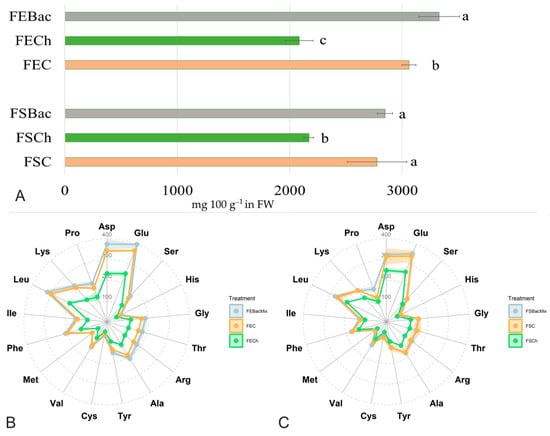
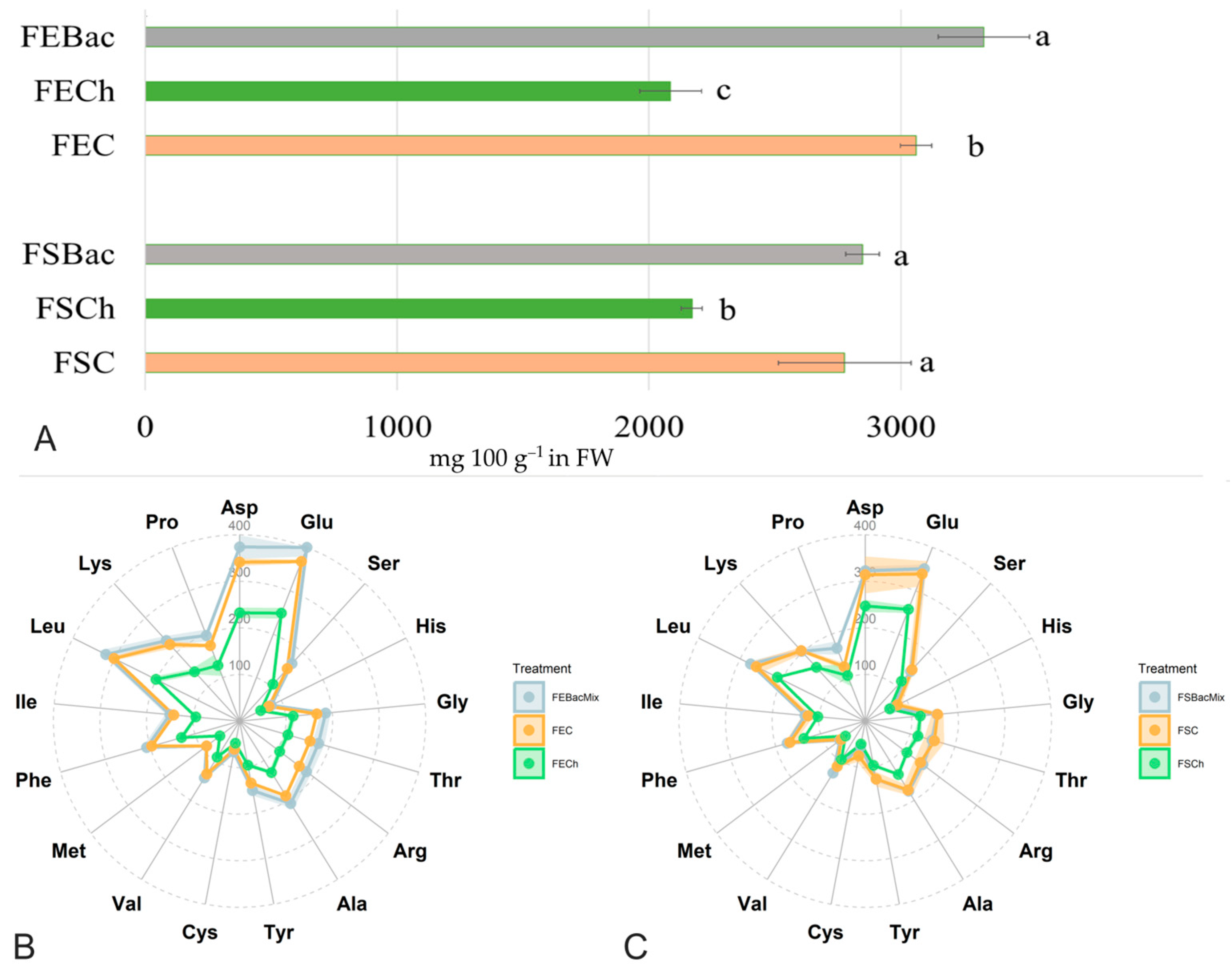
To assess the impact of BacMix treatment on the metabolic composition of strawberry leaves, we quantified total the FAAs and analysed the individual amino acid distributions across both cultivars (Figure 2). Panel A in Figure 2 reveals marked differences in the total FAA content among the treatments. BacMix watering led to higher accumulations of total FAAs in both strawberry cultivars—FEBac (3329.88 mg 100 g−1) and FSBac (2848.01 mg 100 g−1)—suggesting that BacMix enhanced the microbial function potential. The plants protected with chemical fungicide yielded the significantly lowest values (cv. Elsanta and cv. Sonsation, 2086.13 and 2169.93 mg 100 g−1, respectively). The control plants demonstrated intermediate FAA accumulation in both cultivars, but statistically significant differences were not found in cv. Sonsation. The ranking of treatments was consistent across both cultivars, indicating that the observed metabolic effects of BacMix are reproducible, do not harm the plants in terms of FAA synthesis, and even have a positive effect on some individual molecules.
Figure 2.
Total free amino acids (A) and their changes in leaves of cv. Elsanta (B) and cv. Sonsation (C). Abbreviations for the samples are as follows: FEBac—Fragaria cv. Elsanta BacMix treated; FECh—Fragaria cv. Elsanta chemical fungicide treated; FEC—Fragaria cv. Elsanta control; FSBac—Fragaria cv. Sonsation BacMix treated; FSCh—Fragaria cv. Sonsation chemical fungicide treated; FSC—Fragaria cv. Sonsation control. Values represent mean ± SE. Different letters denote significant differences according to ANOVA (p < 0.05).
Radar panels B and C in Figure 2, Figures S1 and S2 offer a detailed examination of the amino acid profiles for cvs. Elsanta and Sonsation, respectively. In both cultivars, Glu and Asp were the most abundant FAAs (from 402.30 to 248.38 mg 100 g−1 and 373.58 to 232.59 mg 100 g−1, respectively). Met, Cys, and His accumulated in the lowest quantity in the strawberry leaves. The BacMix-treated plants had significantly enhanced biosynthesis of Val and Pro and suppressed Cys in leaves of cv. Sonsation. Influence of BacMix on remodelling of FAA composition in cv. Elsanta was broader; Glu, Ser, Gly, Thr, Arg, Ala, Tyr, and Pro accumulated in greater abundance in comparison to the control plants. Conversely, the chemical fungicides suppressed the synthesis of nearly all amino acids in both cultivars, suggesting a negative impact on primary metabolism in plants. The overall shape and distribution of the radar plots remained comparable between the cultivars, reinforcing the finding that the plants have a specific preference for the strawberry composition of FAAs. However, plant protection measures can induce parallel metabolic shifts regardless of genotype, and the biological protection (BacMix) in this case is clearly a better choice than chemical fungicides.
3.1.2. Sugars Accumulation in Fruits
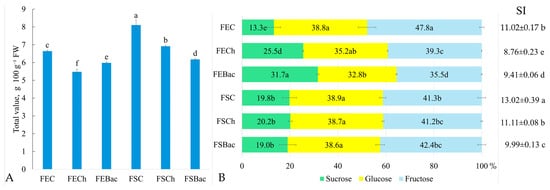
The accumulated sugar contents in the fresh weight, their profiles, and sweetness indexes are shown in Figure 3. The highest total sugars accumulated in the control variants of cv. Sonsation, at 8.10 g 100 g−1, and cv. Elsanta, at 6.6 g 100 g−1. When using plant protection products in both cases (chemical fungicides and BacMix), the quantity of sugars in the strawberry fruits decreased. The average sugar in the fruits of the cv. Elsanta with the FECh treatment was 5.48 g 100 g−1, and with the FEBac it was 5.98 g 100 g−1, which is 10.7 and 2.4% less than in the controls, respectively. The average sugar in the fruits of the cv. Sonsation decreased by 14.59% (the set amount was 6.92 g 100 g−1) with the FECh treatment and by 23.73% (the set amount was 6.18 g 100 g−1) with the FEBac treatment.
Figure 3.
Accumulated sugars (A), their composition (B), and sweetness index (SI) of strawberry fruits under different treatments (FEBac—Fragaria cv. Elsanta BacMix treated; FECh—Fragaria cv. Elsanta chemical fungicide treated; FEC—Fragaria cv. Elsanta control; FSBac—Fragaria cv. Sonsation BacMix treated; FSCh—Fragaria cv. Sonsation chemical fungicide treated; FSC—Fragaria cv. Sonsation control). Values represent mean ± SE. Different letters indicate statistically significant differences (p < 0.05). Columns represent mean values of total accumulated sugar (g/100 g FW); LSD0.05 = 0.24. Stacked bars denote sugar composition (%); differences within each sugar group are shown with distinct letters indicating significant differences according to ANOVA (p < 0.05); LSD0.05 = 4.30 (sucrose), LSD0.05 = 3.30 (glucose), LSD0.05 = 2.07 (fructose). SI—sweetness index; LSD0.05 = 0.34.
Changes in the amounts of sugars (sucrose, glucose, and fructose) directly and measurably affected the strawberry flavour, sweetness perception, and different intensities (Figure 3B). The sugar content profiling of ripe fruits of both cultivars subjected to the different treatments showed that the main sugar in the fruits was fructose (from 47.8 to 35.5 g 100 g−1). Sucrose accumulated in low concentrations, ranging from 13.3 to 31.7 g−1.
Both used protection measures had a low impact on the sugar balance in the cv. Sonsation fruits. In this cultivar, the sugar balance remained stable among the treatments, at about 1:2:2 (sucrose/glucose/fructose), which indicates the genetic stability of metabolism in this cultivar, and appropriately selected agroclimatic conditions. This balance of sugars has a bright, fresh, and sweet taste. Despite the maintained sugar ratio, the SI of fruits changed from 13.2 to 11.11 when applying chemical protection measures and to 9.99 when using biological protection.
BacMix, as well as the chemical protection, changed the sugar ratio in the fruits of the cv. Elsanta. The ratio of sucrose, glucose, and fructose in the control fruits of cv. Elsanta was nearly 1:3:4, which indicates the very sweet taste of this variety. The ratio of sugars changed to 1:4:1.5 and 1:1:1 with the FECh and FEBac treatments, respectively. The chemical fungicides may have impacted fructose reduction and the proposed biocontrol (BacMix) modelled balance in the sugar profile of fruit of cv. Elsanta. Accordingly, the sweetness index changed from 11.02 in the control to 8.76 in the fruits obtained after chemical treatment. A moderate SI (9.41) was found for the fruits of BacMix-treated plants.
3.2. Treatment-Level Shotgun Metagenomic Summary of Strawberry Leaf Microbiome
3.2.1. Sequencing Quality and Microbiota Assembly Analysis
The shotgun metagenomic sequencing produced between 6.31 and 8.73 Gb of raw reads across the samples, indicating consistent sequencing depth among the different treatments (Table 1).
Table 1.
Summary of sequencing quality and assembly statistics for strawberry leaf metagenomes under various treatment conditions.
After quality filtering, the amount of clean data remained high, ranging from 6.24 to 8.64 Gb. The Q20 values exceeded 96.8%, and the Q30 values exceeded 91.6%. The GC content was stable across the treatments, ranging from 39.45 to 39.81%, suggesting that the BacMix treatment did not introduce any compositional bias during sequencing. The effective read retention ranged from 97.06% to 99.01%, confirming that the majority of reads passed both quality and host-removal filters.
The assembly statistics showed longer total contig lengths (496.8–516.2 Mb) and slightly higher N50 values in the BacMix-treated samples compared with the controls (458.0–483.0 Mb). Furthermore, the predicted open reading frames (ORFs) ranged from 363,911 to 375,844 in the treated sample versus 340,533 to 355,801 ORFs in the control, showing an increased recovery of coding potential.
The sequencing quality parameters and ORF counts confirm that the dataset was suitable for downstream descriptive profiling. Importantly, these differences in the assembly and ORF metrics reflect technical properties of metagenomic read recovery from pooled samples rather than biological replication across plants.
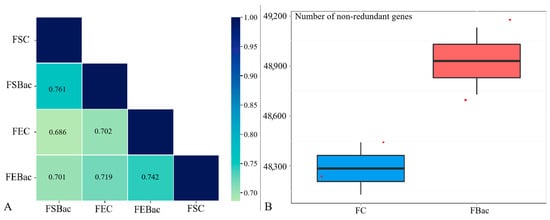
To assess the general reproducibility and overall genomic richness, a Spearman’s correlation analysis and non-redundant gene counts were conducted (Figure 4A,B). The correlation coefficients showed moderate similarity among the treatment groups (0.686–0.761), with slightly higher gene richness in both BacMix-treated samples than in the controls. The non-redundant genes in the pooled DNA samples were counted: 481,270 in the FEC, 487,288 in the FEBac, 484,411 in the FSC, and 491,317 in the FSBac. These patterns were interpreted as treatment-level tendencies rather than meaningful biological variations. We found that the BacMix treatment enhanced the diversity of genetic functions identifiable in the metagenomes of strawberry leaves. Their value lies in providing a consistent baseline for descriptive community- and function-level analyses.
Figure 4.
Spearman’s correlation analysis (p = 0.333) conducted across treatment groups (n = 4) (A), and distribution of predicted gene counts across two treatment groups in box plot (B). On X-axis, group information is shown; Y-axis represents number of genes. Abbreviations for samples are as follows: FEC—Fragaria cv. Elsanta control; FEBac—Fragaria cv. Elsanta BacMix treated; FSC—Fragaria cv. Sonsation control; FSBac—Fragaria cv. Sonsation BacMix treated; FC—grouped data of control samples; FBac—grouped data of BacMix-treated samples.
Overall, the sequencing quality indicators confirmed that the metagenomic data were of high technical quality and suitable for descriptive evaluation of microbial taxonomic and functional trends. Because of our chosen pooling sample collection strategy, they were used only to confirm the integrity of the data set and to provide contextual interpretation along with the replicated metabolic results.
3.2.2. Microbiome Diversity
The metagenomic sequencing of pooled leaf samples from the control and BacMix-treated samples provided an overview of community-level tendencies rather than statistically testable differences. The alpha diversity indices (ACE, Chao1, Shannon, Simpson, and observed species count) were highly similar across the controls and BacMix-treated plants in both strawberry cultivars (see Table 2), indicating that the BacMix application did not alter the within-sample richness or evenness. A very rich and evenly distributed diversity of organisms was observed, with no dominant taxa in leaf samples of either strawberry variety (indices: Shannon > 7.3 and Simpson > 0.97). Although several taxa in the Venn diagram showed subtle differences in the alpha diversity (Figure S1), no single species significantly appeared and emerged as dominant following the BacMix application.
Table 2.
Alpha diversity indices of strawberry leaf microbiota under controls and BacMix treatments. Taxonomic identification was performed using Micro_NR database.
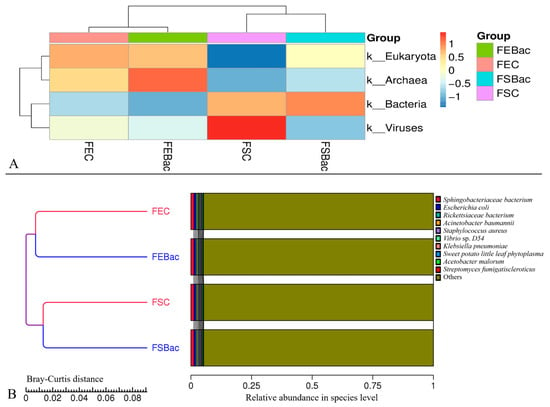
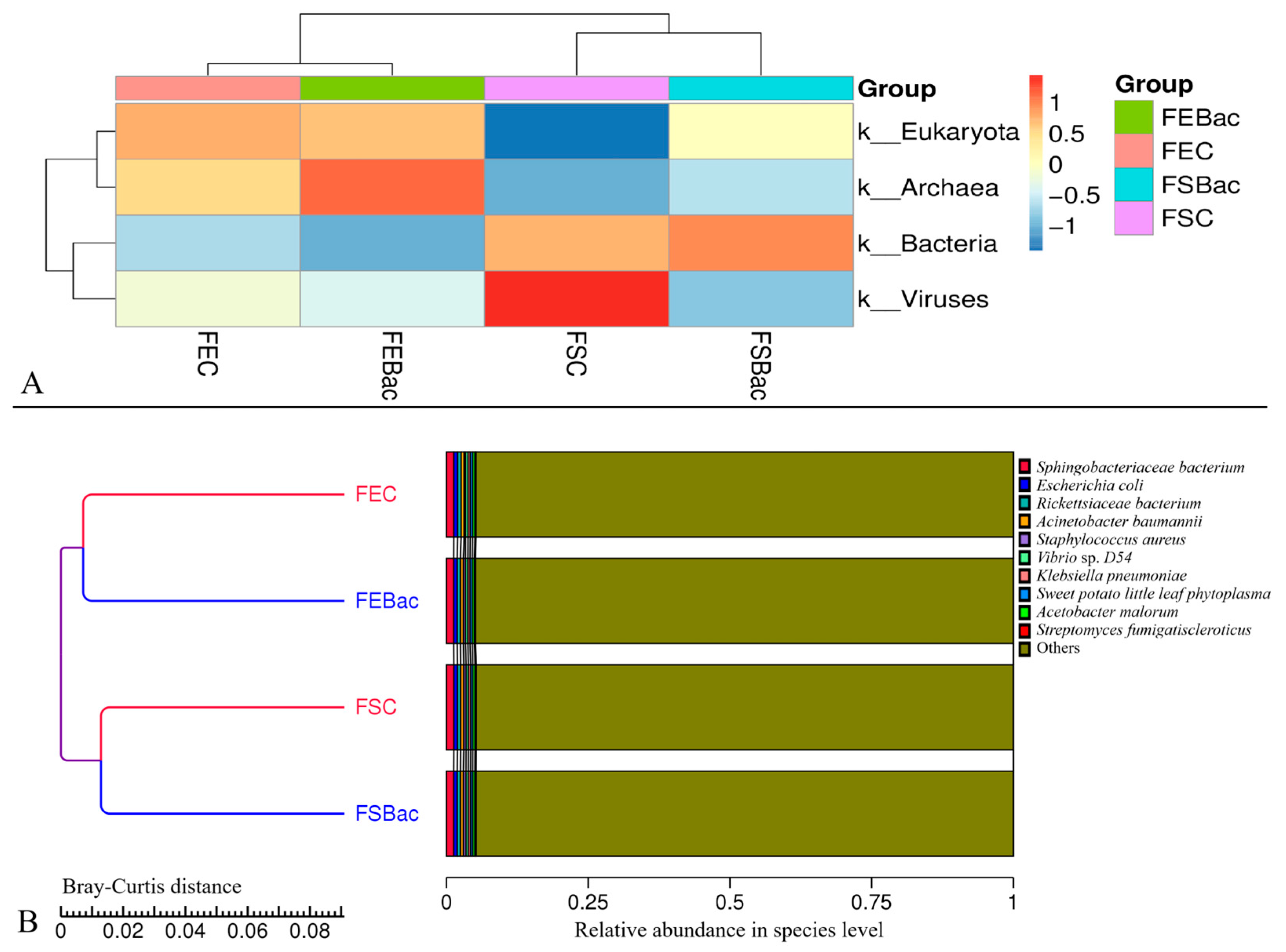
In contrast, the beta diversity patterns showed clearer treatment-associated separation. The hierarchical clustering heatmap (Figure 5A) revealed that the BacMix-treated samples (FEBac, FSBac) grouped more closely with each other than with their respective controls, whereas both control samples (FEC, FSC) formed a separate cluster. We assume that the BacMix treatment influenced the relative structure of microbial communities at the whole-community level, producing a more similar community signature across the cultivars than observed in the untreated plants. The Bray–Curtis clustering likewise distinguished the BacMix treatments from the controls (Figure 5B), reinforcing the presence of treatment-linked structural tendencies in the microbial assemblage.
Figure 5.
Taxonomic profiles of leaf endophytic microbiomes in clustering heatmap according to gene relative abundance data at kingdom level (A) and in Bray–Curtis clustering tree (B). Abbreviations for samples: FEC—Fragaria cv. Elsanta control; FEBac—Fragaria cv. Elsanta BacMix treated; FSC—Fragaria cv. Sonsation control; FSBac—Fragaria cv. Sonsation BacMix treated. Relative abundance based on pooled shotgun metagenomic sequencing for each treatment.
Assessment of taxonomic contributions across kingdoms showed a relative increase in bacterial signatures and a corresponding decrease in the eukaryotic and viral components in the BacMix samples. The control plants without additional processing showed a difference in these distributions, consistent with initial endophytic complexity. The dominance of the “Others” category at the species level in all the samples suggests that the strawberry leaf microbiome is composed of many low-abundance taxa whose proportional changes, rather than major changes in species turnover, contribute to community-level restructuring. This is clearly shown in Table S3 (sheets A, B, C, and D), where all the taxonomic compositions from kingdom to species level are disclosed. Although we used Vaccinium spp. leaf endophytic bacteria for the strawberry plants watering, none of the four Bacillus strains were found in the metagenome of BacMix-treated leaves (neither B. halotolerans nor B. velezensis was identified), which indicates their possible action only in the rhizosphere, and failed inoculation into the leaves.
3.2.3. Functional Gene Summaries
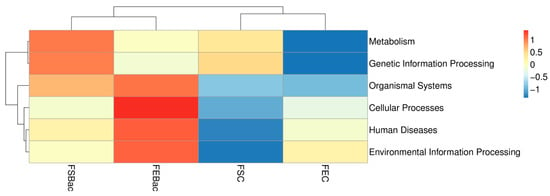
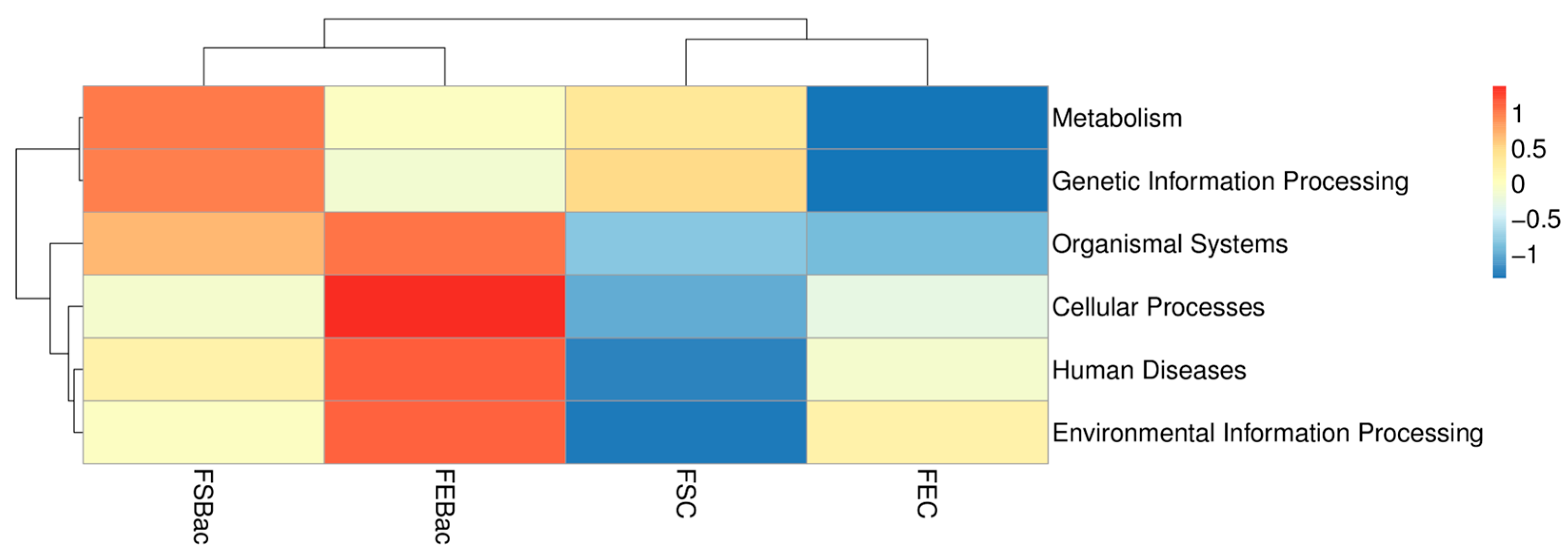
To characterise the functional restructuring of the strawberry leaf microbiome following the BacMix treatment, we preliminarily compared the functional gene categories across treatments using KEGG-based annotations and mPATH pathway statistics. Shotgun metagenomic sequencing was performed on one pooled leaf sample per treatment, so the data only allows us to make assumptions about the changes in functional pathways and provide insights for future research. A clustered heat map of the main functional pathways by gene abundance according to the KEGG-based annotation is displayed in Figure 6. The analysis showed trends of higher activity in all the functional pathways in the BacMix-treated plant leaves of both cultivars. In the pathway-level entries shown for Aminoacyl tRNA Biosynthesis (map00970), eighteen synthesis genes were activated by the BacMix biological protection (Figure S2).
Figure 6.
Treatment-level patterns in KEGG functional categories. Abbreviations for samples: FEC—Fragaria cv. Elsanta control; FEBac—Fragaria cv. Elsanta BacMix treated; FSC—Fragaria cv. Sonsation control; FSBac—Fragaria cv. Sonsation BacMix treated. Metagenomic values are not statistically compared due to pooled sample design.
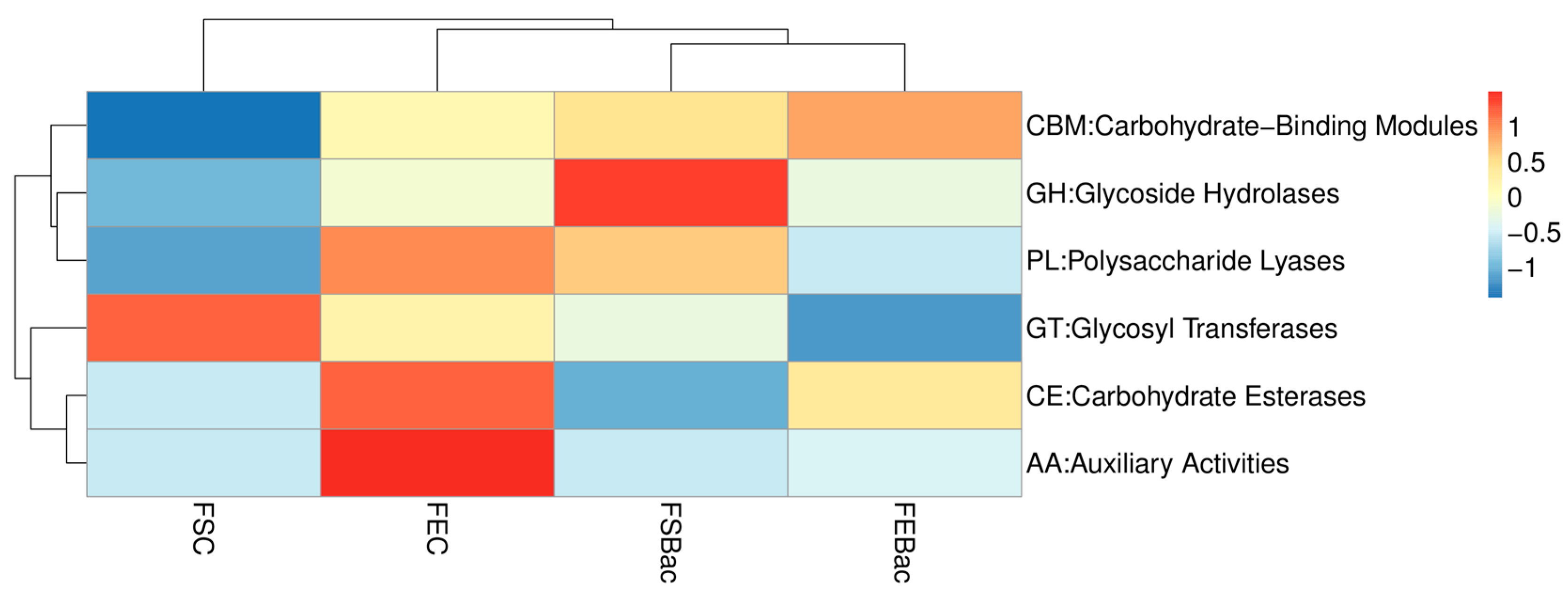
The CAZy class summaries (Figure 7) show the treatment-level distributions of glycosyltransferases (GTs), glycoside hydrolases (GHs), polysaccharide lyases (PLs), auxiliary activities (AAs), carbohydrate-binding modules (CBMs), and carbohydrate esterases (CEs) derived from the pooled metagenomes of leaves. To further investigate how the BacMix affected the microbial carbohydrate-active functions in the strawberry leaves, we analysed the abundance of major classes of carbohydrate-active enzymes (CAZys) across the different treatments (Figure 5). The clustering heatmap revealed differences between the BacMix-treated samples (FEBac and FSBac). We noticed that BacMix suppressed or activated functional modules in the CAZys, even though the patterns were different in both strawberry varieties.
Figure 7.
Treatment-level patterns in CAZy classes. Abbreviations for samples: FEC—Fragaria cv. Elsanta control; FEBac—Fragaria cv. Elsanta BacMix treated; FSC—Fragaria cv. Sonsation control; FSBac—Fragaria cv. Sonsation BacMix treated. Metagenomic values are not statistically compared due to pooled sample design.
4. Discussion
4.1. Relevance to Biological Control and Sustainable Strawberry Management
The strawberry cvs. Elsanta and Sonsation have high commercial relevance due to their strong market acceptance, fruit quality, and intensive production potential, making them valuable models for evaluating sustainable cultivation strategies. Moreover, both cultivars respond strongly to environmental and microbial factors: cv. Elsanta’s performance is highly influenced by irrigation and climatic conditions, as it is sensitive to drought and frost [44,45,46,47,48]. Cv. Sonsation is a relatively new commercial cultivar (released in 2016) and has been documented primarily in breeder and industry technical sources rather than peer-reviewed studies; thus, scientific research on its physiological or metabolic responses remains practically unavailable. This cultivar is noted for maintaining good fruit quality under challenging environmental conditions and for its tolerance to several diseases, making it a strong candidate for evaluating biological control agents in indoor gardening.
The biocontrol advantages of Bacillus spp. are well established, but the wide range in the genetic potential of newly isolated strains requires confirmatory studies on their potential for use [9,15]. B. halotolerans and B. velezensis, as individual strains or their consortia, are recognised as relevant species for plant stress suppression and biocontrol. Multiple recent studies have highlighted the protective and plant-modulating capabilities of B. velezensis and B. halotolerans across diverse crops, driven by their production of antimicrobial lipopeptides, plant hormone analogues, and stress-alleviating compounds [8,11,19,22]. For strawberries, specifically, Bacillus species have shown strong biocontrol efficiency against root rot pathogens and have been reported to stabilise plant nutrient metabolism [11,39].
Our proposed BacMix is a consortium of two B. halotolerans (Bil-LT1_1, Bil-LT1_2) and two B. velezensis (Cran-LT1_8, Ling-NOR4_15) isolates (endophytes of Vaccinium spp. leaves), and is distinguished by its antimicrobial activity and genetic potential for plant growth promotion [41,49]. The antifungal and yield-improving potential of these bacterial strains on cv. Elsanta has already been studied and proven [3]. The BacMix chosen in this research shows that multi-strain Bacillus consortia outperform individual strains by providing broader antagonistic spectra, more stable colonisation, and more consistent metabolic effects [11,17,19].
4.2. BacMix-Induced Enhancement of Amino Acid Metabolism
Osmoregulatory amino acids (Asp, Glu, Ser, Ala, Arg, Pro, and others) are dominant in strawberry leaves and their levels increase significantly in response to salt, alkaline, or oxidative stress [50]. The predominance of Asp, Glu, Leu, and Lys in both strawberry cvs. Elsanta and Sonsation align with their central roles in nitrogen assimilation and stress-responsive pathways. Their accumulation is associated with osmotic protection, ion balance, membrane stabilisation, and enhanced antioxidant responses [50,51,52]. In our study, the BacMix application positively affected FAA synthesis processes. There was a consistently increased total FAA content in the leaves of both strawberry cultivars, and for cv. Elsanta, the increase was statistically significant. The direct yield relationships in strawberries are less well documented than the stress relationships. However, the scientific results show that plants with higher FAA levels exhibit better growth and higher biomass accumulation, which is indirectly related to higher yield [51]. In other, more deeply studied cultivated plants, FAAs are the main form of nitrogen transport. They improve chlorophyll synthesis, photosynthesis, and N-use efficiency; therefore, they are directly related to yield formation [29]. Conversely, the chemical fungicides in this study strongly and negatively affected FAA synthesis, and all amino acid levels in the profiles significantly decreased. We argue that chemical protection negatively affects the development, growth, and stress response of both varieties in our study.
In addition, we observed a significant increase in Pro in the BacMix-treated strawberry plants. Proline has been identified as an essential stress biomarker and protective molecule [53]. The increase in proline with the biocontrol confirms the greater potential of biological protection measures as stress buffers for plants in controlled outdoor conditions.
According to the essential changes in the FAA profiles (Glu, Ser, Gly, Thr, Arg, Ala, Tyr and Pro), cv. Elsanta appeared to be more sensitive than cv. Sonsation to environmental stressors, and the BacMix application had a significant positive effect on plant growth. It is known that increased levels of these FAAs are associated with better ion balance and leaf functionality, which stabilise photosynthesis under stress [50,53].
The positive effect of biological agents on FAA synthesis has been observed in several studies. A higher total FAA content in AMF-mycorrhized (arbuscular mycorrhizal fungus) strawberry plants has been established, and those plants showed better salt tolerance and lower Na+ content in their leaves and roots [51]. Positive effects on bacterial measures have also been observed. This is consistent with the mechanisms of action of Bacillus spp., which can modulate plant nitrogen transport pathways through phytohormone production, improved nutrient uptake, and metabolic signalling [22,54]. Furthermore, multi-species consortia are often more effective at activating such host responses due to complementary metabolic functions [19]. Our findings are in line with recent reports showing that Bacillus strains can upregulate amino acid biosynthesis genes and associated precursor pathways, which are essential for secondary metabolite formation and plant growth promotion [11,14], particularly in closed soil conditions.
4.3. Sugar Modulation and Cultivar-Dependent Metabolic Stability
The strawberry fruit sugar profiles were highly variable between the cultivars, consistent with published evidence showing that glucose, fructose, and sucrose proportions differ significantly among strawberry genotypes, reflecting inherent cultivar-specific metabolic plasticity [43,55]. The total sugars across different genotypes range from approximately 4 to 15 g 100 g−1 in fresh strawberry fruits. The sweetness index (SI) allows for an objective assessment of varietal differences and fruit quality and is a more reliable indicator than the total sugar content; among 25 cultivars, the SI varied from ~6 to ~15 relative units [43]. In this context, the cvs. Sonsation and Elsanta accumulated an average amount of sugars (6.6 and 8.1 g 100 g−1, respectively), and their levels decreased upon application of both plant protection methods; the SI decreased in parallel.
These metabolic effects mirror the evidence from other studies showing that biological treatments, including Bacillus spp. and other beneficial microbes, can affect carbohydrate metabolism and postharvest quality traits in strawberries [56,57]. Furthermore, interactions between the rhizosphere microbiota and plant sugar metabolism have been increasingly recognised as important drivers of fruit quality outcomes [10,12,13,30].
It is noteworthy that the 1:2:2 ratio (sucrose:glucose:fructose) in the cv. Sonsation fruits remained highly stable across treatments, consistent with observations that this cultivar maintains strong metabolic homeostasis under changing environmental or microbial conditions. By contrast, the cv. Elsanta displayed treatment-related shifts in sugar accumulation. In the control samples, fructose accounted for nearly half of the total sugar. Higher sucrose accumulation in fruits of BacMix-treated plants partially restored the perceived sweetness, as sucrose is sweeter than glucose. Sucrose dominance typically signals lower invertase activity (less breakdown into glucose and fructose) and an altered expression of sugar metabolism genes [12,30,55]. We infer that the Bacillus consortium enhanced carbohydrate transport and enhanced the microbial functional potential in the BacMix-treated cv. Elsanta plants.
Accordingly, our sugar profile results support the concept that microbial inoculants influence not only pathogen suppression but also the harvest parameters and metabolic traits critical for sensory fruit quality, which depend on the plant genotype.
4.4. Microbiome Structural and Functional Responses to BacMix
The shotgun metagenomic sequencing revealed that the bioprotection measures did not alter the alpha diversity, a pattern consistent with reports where microbiome interventions in strawberries modified specific taxa or community structures without significantly changing the within-sample richness or evenness [58,59]. We obtained metagenomic data supporting these studies, showing that the alpha diversity metrics remained unchanged under different plant protection treatments. The metagenomic data revealed that the BacMix intervention in the soil did not significantly alter the alpha diversity in leaves but did show tendencies toward changes in the beta diversity, independent of cultivar. The changes in the beta diversity suggest that, while the overall taxon richness was preserved, the relative abundance of microbial communities and functional gene categories shifted after the BacMix application. Such treatment-associated restructuring of the microbial community mirrors recent findings that introduced beneficial microbes can modify host-associated microbiomes at the community level, even if the specific taxa do not become dominant. This is consistent with previous work showing that microbial inoculants can persist more effectively in roots than leaves [58].
In our analysis, none of the four BacMix strains were detected in the leaf metagenomes. The absence of microorganisms from the BacMix in the metagenome indicates that the observed functional shifts stemmed not from direct colonisation but from indirect effects, such as altered plant metabolism, root–shoot signalling, or systemic immune modulation. Similar systemic effects were recently described for B. velezensis strains that translocated from the roots to aerial tissues and induced defence-related enzyme activity [11].
At the functional level, the microbiota in the BacMix-treated leaves showed higher representation of genes associated with amino acid biosynthesis and CAZy classes, indicating modulation of nitrogen assimilation and cell wall-related carbohydrate turnover. The changes in the CAZymes are consistent with altered carbohydrate turnover and cell wall remodelling, processes that can influence sugar stability and pathogen susceptibility. The increased abundance of functional pathways related to enhanced microbial functional potential is in line with the trends reported in other multi-omics studies, where Bacillus spp. stimulated host–microbiome metabolic coupling [22,60].
Similarly, the metagenomic pathway analyses in this study revealed enhanced representation of aminoacyl-tRNA biosynthesis genes in the BacMix-treated leaves. This trend supports active translational and functional potential within the microbiome.
The metabolite patterns observed here—enhanced FAAs and modulated sugar profiles—reflect improved physiological resilience, consistent with the systemic resistance mechanisms described in biocontrol using Bacillus spp. [22]. This mechanistic coherence between the plant metabolic data and functional microbiome signatures suggests that BacMix influences the host metabolism not only directly, but also indirectly through modulation of endophytic microbial function. Taken together, these results indicate that BacMix acts as a metabolic and microbiome-level modulator, enhancing host physiological resilience through coordinated shifts in leaf microbial function and plant primary metabolism.
4.5. Study Limitations and Future Perspectives
In this study, the BacMix consortium induced parallel biochemical responses in FAAs of leaves and sugars in the fruits, as well as patterns of functional changes in the microbiota, demonstrating effects that were independent of the cultivar used. This consistency is promising for practical biocontrol applications, as microbiome-related traits are more likely to be effective across different strawberry genotypes when supported by externally applied multi-strain Bacillus consortia [61,62,63,64].
However, several limitations need to be addressed. While the biochemical results are robust due to biological replication, the metagenomic analysis is based on pooled samples and provides only descriptive trends at the treatment level. This design is appropriate for an exploratory mechanistic context but does not allow for statistical inference of microbiome differences. The relevant directions of BacMix action in the plants are shown, and future studies should incorporate replication at the sequencing level, metatranscriptomic validation of functional signals, and absolute quantification of microbial load.
Moreover, expanding the cultivar diversity and performing multisession trials will be essential to determine the reproducibility and agronomic relevance of BacMix-induced metabolic modulation. Integration of fruit sensory evaluation, targeted metabolomics (including organic acids, phenolics, and volatiles), and tracking of rhizosphere–leaf microbial translocation would further strengthen the mechanistic understanding of BacMix effects.
5. Conclusions
The responses of strawberry cvs. Elsanta and Sonsation to bioprotection and chemical plant protection measures demonstrated clear cultivar-dependent differences in the metabolic and physiological plasticity. The metabolite-level outcomes (free amino acids in leaves and sugars in fruits) and metagenome analysis highlight the potential of multi-strain Bacillus spp. to support physiologically beneficial and quality-related processes in strawberry production.
Bioprotection with BacMix was a better choice than chemical fungicides for maintaining the plant metabolic quality of cvs. Elsanta and Sonsation under greenhouse conditions. Application of a multi-strain Bacillus consortium (BacMix) induced consistent, cultivar-independent improvements in the key metabolic traits of strawberry plants. BacMix watering applied three times up to flowering increased the pool of free amino acids in the strawberry leaves. The cv. Sonsation showed a more stable response to stress and the cv. Elsanta responded more strongly to the applied protection measures. Both protection methods (biological and chemical) reduced the fruit sugars and sweetness index; however, the BacMix partially mitigated this effect. Notably, BacMix stabilised the sugar composition in the cv. Elsanta fruits, particularly preserving a higher level of sucrose.
The shotgun metagenomic profiling of pooled leaf samples provided descriptive, treatment-level functional signatures. These data indicated taxonomic stability of leaf endophytes, while the BacMix strains (B. velezensis and B. halotolerans) used for root watering did not migrate into the leaves. Enrichment of functional gene categories was associated with amino acid biosynthesis, translation, and secondary metabolite pathways, with directional changes in the carbohydrate-active enzyme (CAZy) classes. These tendencies aligned with the observed metabolic shifts, suggesting that BacMix may modulate leaf endophytic microbiome function and beta diversity patterns, supporting higher amino acid availability and a more balanced carbohydrate status in the cultivar more susceptible to environmental stress, i.e., cv. Elsanta.
Supplementary Materials
The following supporting information can be downloaded at: https://www.mdpi.com/article/10.3390/agriculture16060662/s1, Figure S1: Overlap of detected features across treatments (FSC, FSBac, FEC, and FEBac) in Venn diagram and list of species; Figure S2: Differentially abundant genes involved in aminoacyl-tRNA biosynthesis (map00970) between control (FC) and BacMix treatment (FBac); Table S1: Free amino acids (FAAs) accumulated in strawberry cv. Elsanta, mg 100 g−1 in FW; Table S2: Free amino acids (FAAs) accumulated in strawberry cv. Sonsation, mg 100 g−1 in FW; Table S3: (A–D): Abundance of genes and identified species with linear nomenclature in FSC, FSBac, FEC and FEBac treatments.
Author Contributions
Conceptualisation, I.M. and N.R.; methodology, I.M. and N.R.; software, E.M. and D.Č.; validation, I.M., L.T. and N.R.; formal analysis, I.M.; investigation, I.M.; data curation, I.M.; writing—original draft preparation, all authors; writing—review and editing, all authors; visualisation, I.M. and E.M. All authors have read and agreed to the published version of the manuscript.
Funding
This research received no external funding.
Data Availability Statement
The original contributions presented in this study are included in the article/Supplementary Materials. Further inquiries can be directed to the corresponding author.
Conflicts of Interest
The authors declare no conflicts of interest.
References
- Yong, D.; Li, Y.; Gong, K.; Yu, Y.; Zhao, S.; Duan, Q.; Ren, C.; Li, A.; Fu, J.; Ni, J.; et al. Biocontrol of strawberry gray mold caused by Botrytis cinerea with the termite associated Streptomyces sp. sdu1201 and actinomycin D. Front. Microbiol. 2022, 13, 1051730. [Google Scholar] [CrossRef] [Scilit]
- Rodríguez Coy, L.; Garcia Ceron, D.; Mattner, S.W.; Gardiner, D.M.; Gendall, A.R. Integrated Assays and Microscopy to Study the Botrytis cinerea–Strawberry Interaction Reveal Tissue-Specific Stomatal Penetration. Horticulturae 2025, 11, 954. [Google Scholar] [CrossRef] [Scilit]
- Rasiukevičiūtė, N.; Morkeliūnė, A.; Mažeikienė, I.; Lanauskas, J.; Valiuškaitė, A. Alternative Plant Protection Strategies Using Bacteria and Thyme to Improve Strawberry (cv. Elsanta) Yield and Quality. Plants 2025, 14, 1827. [Google Scholar] [CrossRef] [Scilit]
- Yim, G.; Wang, H.H.; Davies, J. Antibiotics as Signalling Molecules. Philos. Trans. R. Soc. Lond. B Biol. Sci. 2007, 362, 1195–1200. [Google Scholar] [CrossRef] [Scilit]
- Cruz, A.F.; Barka, G.D.; Sylla, J.; Reineke, A. Biocontrol of strawberry fruit infected by Botrytis cinerea: Effects on the microbial communities on fruit assessed by next-generation sequencing. J. Phytopathol. 2018, 166, 608–617. [Google Scholar] [CrossRef] [Scilit]
- Vahidinasab, M.; Adiek, I.; Hosseini, B.; Akintayo, S.O.; Abrishanchi, B.; Pfannstiel, J.; Henkel, M.; Lilge, L.; Voegele, R.T.; Hausmann, R. Characterization of Bacillus velezensis UTB96, Demonstrating Improved Lipopeptide Production Compared to the Strain B. velezensis FZB42. Microorganisms 2022, 10, 2225. [Google Scholar] [CrossRef] [Scilit] [PubMed]
- Chen, M.; Deng, Y.; Zheng, M.; Xiao, R.; Wang, X.; Liu, B.; He, J.; Wang, J. Lipopeptides from Bacillus velezensis induced apoptosis-like cell death in the pathogenic fungus Fusarium concentricum. J. Appl. Microbiol. 2024, 135, lxae048. [Google Scholar] [CrossRef] [Scilit] [PubMed]
- Rafanomezantsoa, P.; El-Hasan, A.; Voegele, R.T. Potential of Bacillus halotolerans in Mitigating Biotic and Abiotic Stresses: A Comprehensive Review. Stresses 2025, 5, 24. [Google Scholar] [CrossRef] [Scilit]
- Gayithri, M.; Singh, S.; Pradhan, B.; Boorla, V.; Chand, S. Multifunctional Roles of Bacillus spp. in Sustainable Agriculture: Advances in Biocontrol, Omics, and Ecological Applications. Microb. Ecol. 2026, 89, 55. [Google Scholar] [CrossRef] [Scilit]
- Mei, C.; Amaradasa, B.S.; Chretien, R.L.; Liu, D.; Snead, G.; Samtani, J.B.; Lowman, S. Potential Application of Endophytic Bacteria in Strawberry Production. Horticulturae 2021, 7, 504. [Google Scholar] [CrossRef] [Scilit]
- Ning, J.; Ning, T.; Jin, L.; Li, Q.; Niu, Y.; Chen, Z.; Han, C.; Tang, Y.; Deng, C.; Xie, Y.; et al. Biocontrol effects of Bacillus velezensis and Bacillus subtilis against strawberry root rot caused by Neopestalotiopsis clavispora. Front. Microbiol. 2025, 16, 1683291. [Google Scholar] [CrossRef] [Scilit] [PubMed]
- Kwak, M.J.; Pandey, S.; Zhai, Y.; Choi, B.; Sutthanonkul, T.; Lee, W.S.; Jeong, K.C. Understanding the Impact of Soil Microbiome on Strawberry Growth and Nutritional Profiles. Front. Microbiol. 2025, 16, 1654776. [Google Scholar] [CrossRef] [Scilit]
- Sen, A.; Saji, J.; Faseela, P.; Zhang, C.; Mohanan, S.; Xia, Y. Exploring the Functional Roles of Endophytic Bacteria in Plant Stress Tolerance for Sustainable Agriculture: Diversity, Mechanisms, Applications, and Challenges. Plants 2026, 15, 206. [Google Scholar] [CrossRef] [Scilit]
- Wang, Y.; Sun, Z.; Zhao, Q.; Yang, X.; Li, Y.; Zhou, H.; Zhao, M.; Zheng, H. Whole-genome analysis revealed the growth-promoting and biological control mechanism of the endophytic bacterial strain Bacillus halotolerans Q2H2, with strong antagonistic activity in potato plants. Front. Microbiol. 2024, 14, 1287921. [Google Scholar] [CrossRef] [Scilit]
- Vasques, N.C.; Nogueira, M.A.; Hungria, M. Increasing Application of Multifunctional Bacillus for Biocontrol of Pests and Diseases and Plant Growth Promotion: Lessons from Brazil. Agronomy 2024, 14, 1654. [Google Scholar] [CrossRef] [Scilit]
- Rakhalaru, P.; Mampholo, B.M.; Mamphogoro, T.P.; Thantsha, M.S. Endophytic and Epiphytic Microorganisms as Biocontrol Agents: Mechanisms, Applications, and Metagenomic Approaches in Tomato Cultivation. Molecules 2025, 30, 3816. [Google Scholar] [CrossRef] [Scilit]
- Keshmirshekan, A.; de Souza Mesquita, L.M.; Ventura, S.P.M. Biocontrol manufacturing and agricultural applications of Bacillus velezensis. Trends Biotechnol. 2024, 42, 986–1001. [Google Scholar] [CrossRef] [Scilit] [PubMed]
- Compant, S.; Samad, A.; Faist, H.; Sessitsch, A.A. A review on the plant microbiome: Ecology, functions, and emerging trends in microbial application. J. Adv. Res. 2019, 19, 29–37. [Google Scholar] [CrossRef] [Scilit] [PubMed]
- Serrão, C.P.; Ortega, J.C.G.; Rodrigues, P.C.; de Souza, C.R.B. Bacillus species as tools for biocontrol of plant diseases: A meta-analysis of twenty-two years of research, 2000–2021. World J. Microbiol. Biotechnol. 2024, 40, 110. [Google Scholar] [CrossRef] [Scilit]
- Berg, G.; Rybakova, D.; Fischer, D.; Cernava, T.; Vergès, M.-C.C.; Charles, T.; Chen, X.; Cocolin, L.; Eversole, K.; Corral, G.H.; et al. Microbiome definition re-visited: Old concepts and new challenges. Microbiome 2020, 8, 103. [Google Scholar] [CrossRef] [Scilit]
- Uribe-Acosta, M.; Pascale, A.; Zhou, J.; Stringlis, I.A.; Pieterse, C.M.J. Roots: Metabolic architects of beneficial microbiome assembly. Plant Physiol. 2025, 199, kiaf349. [Google Scholar] [CrossRef] [Scilit]
- Zhang, N.; Wang, Z.; Shao, J.; Xu, Z.; Liu, Y.; Xun, W.; Miao, Y.; Shen, Q.; Zhang, R. Biocontrol mechanisms of Bacillus: Improving efficiency of green agriculture. Microbiol. Biotechnol. 2023, 16, 2250–2263. [Google Scholar] [CrossRef] [Scilit] [PubMed]
- Lemoine, R.; La Camera, S.; Atanassova, R.; Dédaldéchamp, F.; Allario, T.; Pourtau, N.; Bonnemain, J.-L.; Laloi, M.; Coutos-Thévenot, P.; Maurousset, L.; et al. Source-to-sink transport of sugar and regulation by environmental factors. Front. Plant Sci. 2013, 4, 272. [Google Scholar] [CrossRef] [Scilit]
- Jia, H.; Wang, Y.; Sun, M.; Li, B.; Han, Y.; Zhao, Y.; Li, X.; Ding, N.; Li, C.; Ji, W.; et al. Sucrose functions as a signal involved in the regulation of strawberry fruit development and ripening. New Phytol. 2013, 198, 453–465. [Google Scholar] [CrossRef] [Scilit]
- Julius, B.T.; Leach, K.A.; Tran, T.M.; Mertz, R.A.; Braun, D.M. Sugar Transporters in Plants: New Insights and Discoveries. Plant Cell Physiol. 2017, 58, 1442–1460. [Google Scholar] [CrossRef] [Scilit] [PubMed]
- Li, J.; Wu, L.; Foster, R.; Ruan, Y. Molecular regulation of sucrose catabolism and sugar transport for development, defence and phloem function. J. Integr. Plant Biol. 2017, 59, 322–335. [Google Scholar] [CrossRef] [Scilit] [PubMed]
- Durán Soria, S.; Pott, D.M.; Osorio, S.; Vallarino, J.G. Sugar Signaling During Fruit Ripening. Front. Plant Sci. 2020, 11, 564917. [Google Scholar] [CrossRef] [Scilit]
- Li, G.; Zhao, Y. The critical roles of three sugar-related proteins (HXK, SnRK1, TOR) in regulating plant growth and stress responses. Hortic. Res. 2024, 11, uhae099. [Google Scholar] [CrossRef] [Scilit]
- Henderson, B.C.R.; Sanderson, J.M.; Fowles, A. A review of the foliar application of individual amino acids as biostimulants in plants. Discov. Agric. 2025, 3, 69. [Google Scholar] [CrossRef] [Scilit]
- LeBlanc, N.R.; Harrigian, F.C.; Hernandez, S.G.; Salgado-Salazar, C.; Eriksen, R.L. Endophytic Agrobacterium sp. from Strawberry Roots Suppresses Host Plant Growth. Phytobiomes J. 2025, 9, 369–375. [Google Scholar] [CrossRef] [Scilit]
- Goulao, L.F.; Oliveira, C.M. Cell wall modifications during fruit ripening: When a fruit is not the fruit. Trends Food Sci. Technol. 2008, 19, 4–25. [Google Scholar] [CrossRef] [Scilit]
- Forlani, S.; Masiero, S.; Mizzotti, C. Fruit ripening: The role of hormones, cell wall modifications, and their relationship with pathogens. J. Exp. Bot. 2019, 70, 2993–3006. [Google Scholar] [CrossRef] [Scilit] [PubMed]
- Wilson, A.E.; Tian, L. Phylogenomic analysis of UDP-dependent glycosyltransferases provides insights into the evolutionary landscape of glycosylation in plant metabolism. Plant J. 2019, 100, 1273–1288. [Google Scholar] [CrossRef] [Scilit]
- Gharabli, H.; Welner, D.H. The sugar donor specificity of plant family 1 glycosyltransferases. Front. Bioeng. Biotechnol. 2024, 12, 1396268. [Google Scholar] [CrossRef] [Scilit] [PubMed]
- Lu, H.; Yu, Q.; Li, M. Strawberry Fruit Softening Driven by Cell Wall Metabolism, Gene Expression, Enzyme Activity, and Phytohormone Dynamics. Horticulturae 2025, 11, 1533. [Google Scholar] [CrossRef] [Scilit]
- Adeleke, B.S.; Muller, D.; Babalola, O.O. A metagenomic lens into endosphere microbial communities, promises, and discoveries. Lett. Appl. Microbiol. 2023, 76, ovac030. [Google Scholar] [CrossRef] [Scilit]
- Tenea, G.N.; Reyes, P. Bacterial community changes in strawberry fruits (Fragaria × ananassa variety “Monterey”) from farm field to retail market stands, an indicator of postharvest contamination. Front. Microbiol. 2024, 15, 1348316. [Google Scholar] [CrossRef] [Scilit]
- Wu, M.; Zhao, P.; Liu, L.; Zhao, Q.; Li, Q.; Li, L.; Xu, J. The organic manure-improved yield and quality in strawberries is attributed to metabolic reprogramming to increase amino acids, sugar/acid ratio, flavonoids and phenolic volatiles. Plant Soil 2024, 504, 679–697. [Google Scholar] [CrossRef] [Scilit]
- Yang, H.; Zhang, X.; Yan, Z.; Wang, Y.; Wang, Q.; Lu, B.; Chen, J.; Wu, X. Diversity and Function of Strawberry Endophytic Bacterial Communities Associated with Host Genotype and Niche. Curr. Microbiol. 2025, 82, 244. [Google Scholar] [CrossRef] [Scilit]
- Nwachukwu, B.C.; Babalola, O.O. Metagenomics: A Tool for Exploring Key Microbiome with the Potentials for Improving Sustainable Agriculture. Front. Sustain. Food Syst. 2022, 6, 886987. [Google Scholar] [CrossRef] [Scilit]
- Mažeikienė, I.; Frercks, B.; Kurgonaitė, M.; Rasiukevičiūtė, N.; Mačionienė, I. Genomic Insights into Vaccinium spp. Endophytes B. halotolerans and B. velezensis and Their Antimicrobial Potential. Int. J. Mol. Sci. 2025, 26, 6677. [Google Scholar] [CrossRef] [Scilit] [PubMed]
- Starkute, V.; Bartkiene, E.; Bartkevics, V.; Rusko, J.; Zadeike, D.; Juodeikiene, G. Amino Acids in Lupinus angustifolius seeds after solid state and submerged fermentations. J. Food Sci. Technol. 2016, 53, 4141–4148. [Google Scholar] [CrossRef] [Scilit]
- Milosavljević, D.; Maksimović, V.; Milivojević, J.; Djekić, I.; Wolf, B.; Zuber, J.; Vogt, C.; Dragišić Maksimović, J. Sugars in 25 Strawberry Cultivars: Qualitative and Quantitative Evaluation. Plants 2023, 12, 2238. [Google Scholar] [CrossRef] [Scilit]
- Skupień, K.; Oszmiański, J. Comparison of Six Strawberry Cultivars (Fragaria × ananassa Duch.) grown in northwest Poland. Eur. Food Res. Technol. 2004, 219, 66–70. [Google Scholar] [CrossRef] [Scilit]
- Klamkowski, K.; Treder, W. Response to Drought Stress of Three Strawberry Cultivars. J. Fruit Ornam. Plant Res. 2008, 16, 179–188. [Google Scholar]
- Chaiwong, S.; Bishop, C. The changes of physical properties in ‘Elsanta’ strawberries from the winter and summer cultivations after vibration tests. Aust. J. Crop Sci. 2020, 14, P7718. [Google Scholar] [CrossRef] [Scilit]
- Prasad, R.; Lisiecka, J.; Kleiber, T. Morphological and Yield Parameters, Dry Matter Distribution, Nutrients Uptake, and Distribution in Strawberry (Fragaria × ananassa Duch.) cv. ‘Elsanta’ as Influenced by Spent Mushroom Substrates and Planting Season. Agronomy 2022, 12, 854. [Google Scholar] [CrossRef] [Scilit]
- Janssens, P.H.; Vandendriessche, H.; Boonen, M.; Bylemans, D.; Melis, P.; Van Delm, T.; Vendel, I.; Hertog, M.; Elsen, A.; Vandendriessche, H. Limited irrigation of field-grown strawberry (Fragaria × ananassa cv. ‘Elsanta’) in a temperate climate: Effects on yield and quality. Eur. J. Hortic. Sci. 2024, 89, 1. [Google Scholar] [CrossRef] [Scilit] [PubMed]
- Mažeikienė, I.; Frercks, B.; Burokienė, D.; Mačiulionienė, I.; Šalaševičienė, A. Endophytic Community Composition and Genetic-Enzymatic Features of Cultivable Bacteria in Vaccinium myrtillus L. in Forests of the Baltic-Nordic Region. Forests 2021, 12, 1647. [Google Scholar] [CrossRef] [Scilit]
- Turhan, E.; Eris, A. Changes of Growth, Amino Acids, and Ionic Composition in Strawberry Plants under Salt Stress Conditions. Commun. Soil Sci. Plant Anal. 2009, 40, 3280–3294. [Google Scholar] [CrossRef] [Scilit]
- Haque, S.I.; Matsubara, Y. Relationship between salt tolerance and free amino acid content in mycorrhizal strawberry plants. J. JSATM 2018, 25, 43–50. [Google Scholar]
- Liu, W.; Liang, W.; Jia, Y.; Chen, H.; Wang, G.; Gou, H.; Shi, Y.; Fan, X.; Zhang, Y. The Effects of γ-Aminobutyric Acid on the Growth and Physiology of Strawberry Seedlings under Alkaline Salt Stress. Russ. J. Plant Physiol. 2025, 72, 40. [Google Scholar] [CrossRef] [Scilit]
- Meena, M.; Divyanshu, K.; Kumar, S.; Swapnil, P.; Zehra, A.; Shukla, V.; Yadav, M.; Upadhya, R.S. Regulation of L-proline biosynthesis, signal transduction, transport, accumulation and its vital role in plants during variable environmental conditions. Heliyon 2019, 5, e02952. [Google Scholar] [CrossRef] [Scilit]
- Patani, A.; Patel, M.; Islam, S.; Yadav, V.K.; Prajapati, D.; Yadav, A.N.; Sahoo, D.K.; Patel, A. Recent advances in Bacillus-mediated plant growth enhancement: A paradigm shift in redefining crop resilience. World J. Microbiol. Biotechnol. 2024, 40, 77. [Google Scholar] [CrossRef] [Scilit]
- Lee, J.; Kim, H.-B.; Noh, Y.-H.; Min, S.R.; Lee, H.-S.; Jung, J.; Park, K.-H.; Kim, D.-S.; Nam, M.-H.; Kim, T.I.; et al. Sugar content and expression of sugar metabolism-related gene in strawberry fruits from various cultivars. J. Plant Biotechnol. 2018, 45, 90–101. [Google Scholar] [CrossRef] [Scilit]
- Sretenović, M.; Tamaš, N.; Zec, G.; Stojanoski, M.; Tešić, N.; Miletić, N.; Djordjević, B. Productivity, biocontrol and postharvest fruit quality of strawberry cultivar ‘Clery’ using plant growth promoting microorganisms. Cogent Food Agric. 2024, 10, 2310896. [Google Scholar] [CrossRef] [Scilit]
- Jiang, L.; Yan, H.; Yin, Y.; Dong, R.; Wu, C. Use of Bacillus velezensis JNS-1 from vermicompost against strawberry root rot. Front. Microbiol. 2025, 16, 1566949. [Google Scholar] [CrossRef] [Scilit]
- Xu, X.; Deakin, G.; Fagg, G.; Passey, T. The effects of introduced biocontrol microbes on root and flower surface microbiomes of strawberry grown in coir substrate in a polythene tunnel. J. Appl. Microbiol. 2025, 136, lxaf074. [Google Scholar] [CrossRef] [Scilit] [PubMed]
- Mathew, S.A.; Fuchs, B.; Nissinen, R.; Helander, M.; Puigbò, P.; Saikkonen, K.; Muola, A. Glyphosate-based herbicide use affects individual microbial taxa in strawberry endosphere but not the microbial community composition. J. Appl. Microbiol. 2023, 134, lxad006. [Google Scholar] [CrossRef] [Scilit] [PubMed]
- Wang, X.; An, J.; Guo, C.; Tian, J.; Shen, R.; Zhao, P. Integrated multi-omics and phenotypic validations reveal biocontrol mechanisms of Bacillus velezensis XM18-5 against potato common scab. Front. Microbiol. 2026, 17, 1748645. [Google Scholar] [CrossRef] [Scilit] [PubMed]
- Araujo, A.S.F.; Pereira, A.P.A.; de Medeiros, E.V.; Mendes, L.W. Plant–microbe interactions: Plants modulating their defenses. Trends Plant Sci. 2025, 30, 806–808. [Google Scholar] [CrossRef] [Scilit] [PubMed]
- Santoyo, G.; Guzmán-Guzmán, P.; Parra-Cota, F.I.; Santos-Villalobos, S.d.l.; Orozco-Mosqueda, M.d.C.; Glick, B.R. Plant Growth Stimulation by Microbial Consortia. Agronomy 2021, 11, 219. [Google Scholar] [CrossRef] [Scilit]
- Maciag, T.; Kozieł, E.; Rusin, P.; Otulak-Kozieł, K.; Jafra, S.; Czajkowski, R. Microbial Consortia for Plant Protection against Diseases: More than the Sum of Its Parts. Int. J. Mol. Sci. 2023, 24, 12227. [Google Scholar] [CrossRef] [Scilit]
- Meddich, A. Biostimulants for Resilient Agriculture—Improving Plant Tolerance to Abiotic Stress: A Concise Review. Gesunde Pflanz. 2023, 75, 709–727. [Google Scholar] [CrossRef] [Scilit]

Disclaimer/Publisher’s Note: The statements, opinions and data contained in all publications are solely those of the individual author(s) and contributor(s) and not of MDPI and/or the editor(s). MDPI and/or the editor(s) disclaim responsibility for any injury to people or property resulting from any ideas, methods, instructions or products referred to in the content. |
© 2026 by the authors. Licensee MDPI, Basel, Switzerland. This article is an open access article distributed under the terms and conditions of the Creative Commons Attribution (CC BY) license.