


Abstract
Alternative forages, such as plantain (Plantago lanceolata) and chicory (Cichorium intybus), show potential to improve ruminant nutrition while reducing environmental impacts; however, their influence on rumen function remains insufficiently defined. Using eight RUSITEC fermenters (two vessels per treatment per run, across two independent runs; n = 4 fermenter replicates per treatment overall), plantain (PL), chicory (CHI), a plantain–chicory mixture (PCH), and a grass-based sward (GBS) were incubated for a 10-day adaptation period followed by a 5-day sampling period to assess nutrient digestibility, fermentation, methane (CH4) production, and microbial composition. PL resulted in the lowest CH4 emissions (4.13%) and ammonia nitrogen (NH3–N; 5.92 mg/day), whereas CHI achieved the highest dry matter digestibility (77.2%) but also the highest CH4 emissions (5.55%). PCH presented intermediate CH4 levels (4.52%), showing efficient nutrient use, while GBS and CHI achieved the highest NDF disappearance (NDFomd: 49.0% and 50.9%, respectively). Bacterial diversity (Shannon index) was lower in PL (1.71) than in CHI (4.25) and GBS (4.23), with PCH being intermediate (3.47). These findings support PL and PCH as promising dietary options to enhance rumen efficiency and reduce methane and nitrogen emissions. In vivo validation is recommended.
1. Introduction
Modern grazing systems predominantly rely on temperate grasslands, such as those dominated by ryegrass (Lolium perenne) and white clover (Trifolium repens), to meet livestock nutritional demands [1]. However, climate change has reduced forage quality and growth rates in these pastures, challenging their ability to sustain livestock nutrition [2]. Alternative forages, such as ribwort plantain (Plantago lanceolata) and chicory (Cichorium intybus), offer resilience to water deficits, maintaining high dry matter (DM) yields and nutritional value during warmer seasons [3,4,5,6]. These species not only enhance resource use efficiency but also reduce the environmental impact of ruminant production through improved forage quality and the presence of bioactive secondary compounds, such as aucubin, catalpol, and acteoside in plantain and sesquiterpene lactones in chicory [7,8,9]. These compounds exhibit antimicrobial, antioxidant, and anti-inflammatory properties that have been associated in the literature with reduced methane (CH4) emissions and altered nitrogen metabolism in the rumen through mechanisms that are not limited to—and in several cases are distinct from—inhibition of biohydrogenation, which chiefly affects ruminal fatty acid metabolism [7,9,10,11,12,13].
Recent studies suggest that incorporating plantain and chicory into ruminant diets can modify ruminal fermentation, improve nutrient uptake, and decrease CH4 emissions [14,15,16]. These forages are also associated with increased polyunsaturated fatty acid content in milk and meat compared to ryegrass-based diets [16,17,18,19]. Chicory enhances DM and organic matter (OM) digestibility, while plantain reduces ammonia nitrogen (NH3-N) production, indicating improved protein metabolism and reduced nitrogen excretion [3,11,15,20,21,22]. While the individual nutritional and secondary metabolite profiles of plantain and chicory and their separate effects on digestibility, nitrogen metabolism, or methane emissions have each been documented to some extent in isolation, data directly comparing their combined effects as a mixed sward—together with the associated shifts in the rumen microbial community measured concurrently with fermentation and CH4 output—remain scarce. The rumen simulation technique (RUSITEC) offers a powerful tool to address these knowledge gaps, allowing controlled and reproducible evaluation of fermentation processes, nutrient degradation, and gas production while maintaining a stable ruminal microbial ecosystem. RUSITEC was selected because it allows simultaneous, replicated, and reproducible assessment of fermentation kinetics, gas/CH4 production, and microbial community composition under standardized conditions, enabling direct, controlled comparison of individual forages and their mixture that is difficult to achieve given the greater inter-animal variability inherent to in vivo trials. A grass-based sward was selected as the reference treatment because perennial ryegrass is the most widely used species in Chilean pastures [23], providing a practical benchmark against which the nutritional and fermentation performance of the alternative forages can be evaluated under comparable management. Unlike plantain and chicory, grass-based swards are not characterized by the bioactive secondary compounds described above [7,8,9], which provides a basis for the contrasting fermentation and methane responses evaluated here. To our knowledge, few studies have evaluated plantain and chicory both individually and as a binary mixture against a conventional grass-based sward under controlled in vitro conditions, and fewer still have combined fermentation and CH4 output with rumen bacterial community composition. Therefore, this study aimed to evaluate whether plantain, chicory, and a plantain–chicory mixture differ from a grass-based pasture in nutrient digestibility, ruminal fermentation parameters, enteric CH4 production, and rumen bacterial community composition using the RUSITEC system.
2. Materials and Methods
This experiment was conducted at the Livestock Systems and Nutrition Laboratory, Universidad de Concepción, Chillán, Chile. All procedures involving donor cows were certified by the Ethics and Animal Welfare Committee of the Universidad de Concepción (N° CBE28-2019, approved on 29 May 2019).
Data collection and analysis for this study were conducted between November 2018 and June 2019.
2.1. Forage Collection and Treatments
Four pasture treatments were evaluated: plantain (Plantago lanceolata, cv. Ceres Tonic, PL), chicory (Cichorium intybus, cv. Choice, CHI), a mixture of plantain and chicory (30% PL and 70% CHI, PCH), and a grass-based permanent sward (GBS) comprising perennial ryegrass (Lolium perenne, cv. Rohan, 39.7%), cocksfoot (Dactylis glomerata, cv. Safin, 26.8%), white clover (Trifolium repens, cv. Weka, 16.7%), brome (Bromus valdivianus, cv. Póker, 11.2%), and tall fescue (Festuca arundinacea, cv. Kora, 5.34%). The 30:70 proportion in PCH corresponds to the natural proportion of the two species in the sward at the time of harvest, when chicory had become the dominant species. The establishment and management of the field trial in which the plantain–chicory mixture and the grass-based sward were grown are described in [24]. Plantain and chicory were obtained from the plots containing the plantain–chicory mixture by collecting each species separately. Four forage samples were collected for each pasture evaluated in November 2018, at a vegetative to pre-flowering stage, at the Sheep Unit of the Austral Agricultural Experimental Station, Universidad Austral de Chile, Valdivia, Chile, at a cutting height of 5 cm. The swards had been grazed by lambs and allowed to regrow before cutting so the harvested material was regrowth and not a first cut. Samples were freeze-dried within 24 h of harvest and ground through a 4 mm screen using a Wiley mill (Arthur H. Thomas, Philadelphia, PA, USA). Subsequently, the four forage samples from each pasture were pooled and stored at room temperature in sealed bags until their use in the RUSITEC incubation trial, at which time 10 g of each forage sample was placed in a nylon bag (100 mm × 200 mm, 50 μm pore size; ANKOM Technology Corporation, New York, NY, USA). The chemical composition of the forages is presented in Table 1.
Table 1.
Chemical composition (mean ± standard deviation) of the different forage treatments used in RUSITEC.
2.2. Experimental Design and RUSITEC Apparatus
A randomized complete block design was used, with four pasture treatments tested in duplicate across two independent runs using the RUSITEC system [25]. The RUSITEC system (Universidad de Concepción, Chile) consisted of eight 1 L polycarbonate fermenter vessels maintained at 39 °C in a water bath with constant vertical agitation. Treatments were randomly assigned to vessels within each run, with two vessels assigned per treatment in each run, giving four fermenter replicates per treatment in total across the two runs; the fermenter, nested within run, served as the experimental unit for all treatment comparisons. Each run included a 10-day adaptation period followed by a 5-day sampling period. Artificial saliva [26] was infused through an input port, fermentation effluent was collected in 1 L Erlenmeyer flasks, and gases were collected in 2 L vinyl bags.
2.3. Incubation Procedure
Rumen fluid and digesta were collected 2 h post-feeding through the ruminal cannula of two Aberdeen Angus cows fed a diet of 25% dry matter commercial concentrate (14% crude protein; COPEVAL, Libertador Bernardo O’Higgins, Chile), 75% DM clover/ryegrass hay, and a vitamin/mineral block (Veterquimica, Metropolitan Region, Chile). Ruminal digesta was filtered through four layers of cheesecloth, pooled and transported to the laboratory in pre-warmed (39 °C) containers. Each fermenter was filled with 800 mL of ruminal fluid and 200 mL of modified McDougall’s buffer (containing 1 g/L (NH4)2 SO4) [27] and was flushed with CO2 to maintain anaerobiosis. Initially, each fermenter received one nylon bag with 40 g of rumen solid digesta and another with 10 g of forage. After 24 h, the digesta bag was replaced with a new 10 g forage bag. Subsequently, one forage bag was replaced daily, ensuring a 48 h incubation period per bag. Artificial saliva was infused at a 3% per hour dilution rate using a peristaltic pump (Gilson, Middleton, WI, USA). During daily bag exchanges, fermenters were flushed with CO2 to maintain an anaerobic environment, and effluent was collected in flasks containing sodium azide (1 g/L) to halt fermentation.
2.4. Nutrient Disappearance and Chemical Analysis
From days 11 to 15, one forage bag was removed daily from each fermenter after 48 h of incubation. Bags were individually rinsed with cold distilled water until the rinse water was clear and then oven-dried at 55 °C for 48 h (Universal Oven UN55, Memmert, Schwabach, Germany). Residual dry matter was determined separately for each bag and sampling day. For chemical characterization of the residual material, residues from three sampling days were pooled within each fermenter and experimental run, ground through a 1 mm screen (Wiley Mill, Philadelphia, PA, USA), and analyzed for DM, crude protein (CP) and ash according to AOAC methods 930.15, 990.03, and 942.05, respectively [28]. Organic matter (OM) was calculated as 100 minus ash. Neutral detergent fiber (NDF) was determined according to Van Soest et al. [29], and acid detergent fiber (ADF) according to AOAC method 973.18 [28]. Hemicellulose (HE) was calculated as NDF minus ADF. Metabolizable energy (ME) was estimated using local regression based on digestible organic matter content (DOMD) from the two-stage rumen fluid–pepsin method [30,31]. The chemical composition obtained from each fermenter-specific composite residue was used together with the daily amount of residual dry matter to estimate the residual amount of OM, CP, NDF, ADF, and hemicellulose for each sampling day. Nutrient disappearance was calculated daily as the difference between the amount of each nutrient initially incubated and the corresponding amount remaining after 48 h of incubation, expressed relative to the amount initially incubated.
2.5. Gas and CH4 Sample Collection
Total gas production was measured daily via water displacement [32]. A 15 mL gas sample was collected from each bag’s septum using a 21G needle syringe and stored in vacuum-sealed exetainers (Labco Ltd., Ceredigion, UK) for methane analysis; this aliquot was added back to the total gas volume recorded by water displacement so that daily total gas production corresponded to the sum of the sampled aliquot and the remaining gas volume, and sampling did not reduce the total gas volume used for methane calculations. Methane concentration in the collected samples was determined via gas chromatography (Agilent Technologies 7890, GS-CarbonPLOT column, 30 m × 0.32 mm × 3 μm; helium carrier gas, 27 cm/s; oven 35 °C; injector 185 °C; detector 150 °C). Methane production was calculated from the CH4 proportion determined by gas chromatography and the total daily gas volume as follows:
where 16.04 g/mol is the molecular weight of methane and 22.4 L/mol is the molar gas volume at standard temperature and pressure (used as the conversion factor). Gas volumes were not additionally corrected for the actual ambient temperature or atmospheric pressure at the time of measurement; because all fermenters were measured under the same laboratory conditions and the same conversion factor was applied consistently across treatments, this does not affect the relative comparison among treatments, although it may slightly influence the absolute methane values expressed in mg/day. Effluent pH was measured daily during bag exchanges (Orion Star A121, Thermo Scientific, Massachusetts, MA, USA).
CH4 (mg/d) = [V gas (L/d) × (CH4/100)] × (16.04 g/mol/22.4 L/mol) × 1000
2.6. Ruminal Fermentation Parameters
For volatile fatty acid (VFA) analysis, 1.5 mL effluent subsamples were preserved with 200 µL of 10% sulfuric acid and stored at −20 °C. For ammonia nitrogen (NH3-N), 1.5 mL subsamples were preserved with 150 µL of trichloroacetic acid. VFA concentrations were quantified via gas chromatography (Agilent Technologies 7890, Santa Clara, CA, USA), and NH3-N was analyzed spectrophotometrically (Merck Spectroquant Pharo 300, Darmstadt, Germany) [27]. VFA and NH3-N production were calculated by multiplying concentrations (mmol/L and mg/L, respectively) by daily effluent volume (L/d).
2.7. DNA Isolation and Sequencing
Fermentation fluid for DNA extraction was collected directly from the fermenter vessel contents on day 15 (final sampling day), immediately after the morning bag exchange, and was frozen at −80 °C until DNA extraction. DNA was extracted from fermentation fluid samples using a QIAamp DNA Mini Kit (QIAGEN, Hilden, Germany) and submitted to the Integrated Microbiome Resource (IMR), Dalhousie University, Canada. The V6–V8 region of the 16S rRNA gene was amplified using primers B969F (5′-ACGCGHNRAACCTTACC-3′) and BA1406R (5′-ACGGGCRGTGWGTRCAA-3′). Amplicons were sequenced on an Illumina MiSeq platform (2 × 300 bp paired-end reads).
2.8. Bioinformatic and Microbiome Analysis
Raw paired-end reads targeting the bacterial 16S rRNA gene V6–V8 region were processed using QIIME2 (v2023.9; [33]). Sequence quality control and denoising were performed with the DADA2 plugin (v2023.9; [34]), which included removing the first 30 bases to remove primer sequences and low-quality 5′ ends, and truncating forward and reverse reads at 280 and 250 bases, respectively. Subsequently, paired-end reads were merged, denoised, and filtered to remove chimeric and PhiX sequences, leading to the inference of amplicon sequence variants (ASVs). Taxonomic classification of the resulting ASVs was conducted using a naïve Bayes classifier trained on full-length 16S rRNA gene sequences from the SILVA reference database (v138; [35]). For phylogenetic analyses, a tree was constructed by aligning ASV sequences with MAFFT (v7.520; [36]) and inferring an approximate maximum-likelihood tree with FastTree (v2.1.11; [37]).
Before diversity analyses, ASVs with a total frequency below 10 reads across all samples were removed. Alpha diversity was assessed using observed ASVs, Shannon’s diversity index, Pielou’s evenness, and Faith’s phylogenetic diversity via QIIME2’s core-metrics-phylogenetic pipeline. For alpha diversity calculations only, samples were rarefied to 23,716 reads, corresponding to the smallest library in the filtered table, so that all 16 samples (n = 4 per treatment) were retained. Differences in alpha diversity indices among treatments were tested with the Kruskal–Wallis test followed by Dunn’s post hoc test with Benjamini–Hochberg false discovery rate (FDR) correction [38,39]. Beta diversity was evaluated on non-rarefied data by principal coordinate analysis (PCoA) of robust Aitchison distances, which account for the compositional nature of microbiome data by applying a robust centered log-ratio (rCLR) transformation [40,41]. Differences in microbial community composition among treatments were tested using permutational multivariate analysis of variance (PERMANOVA, 999 permutations) applied to the robust Aitchison distance matrix using the adonis2 function in the vegan R package (v2.6-6; [42]) within R software (v4.3.2; [43]).
Putative microbial biomarkers and taxa associated with treatments were identified using LEfSe (v1.1.2; [44]), which combines non-parametric statistical testing with linear discriminant analysis (Kruskal–Wallis and pairwise Wilcoxon tests; p < 0.05; LDA score > 2.0). In parallel, differential abundance analysis was conducted using a zero-inflated Gaussian mixture model (ZIGMM) implemented in the metagenomeSeq R package (v1.42.0: [45]), with cumulative-sum scaling (CSS) normalization, to identify genera exhibiting statistically significant abundance differences among treatments. Log2 fold changes (log2FC) are reported as the focal treatment relative to each comparison treatment so that positive values indicate higher abundance in the focal treatment.
2.9. Statistical Analysis
Data normality and homoscedasticity were assessed with the Shapiro–Wilk and Levene tests, respectively. In all analyses, the fermenter was the experimental unit. Daily nutrient disappearance (DM, OM, CP, NDF, ADF, and hemicellulose), pH, NH3–N, individual and total VFAs, total gas, and CH4, all determined for each of the five sampling days, were analyzed with a mixed model in Stata (version 16; statistical software, College Station, TX, USA), including treatment, sampling day, and their interaction as fixed effects, and run and fermenter(run) as random effects. Sampling day was modeled as a repeated measure, and for each variable, the covariance structure with the lowest Akaike’s information criterion (AIC) was selected among seven candidate structures (autoregressive, banded, compound symmetry, heterogeneous autoregressive, heterogeneous compound symmetry, Toeplitz, and unstructured [46]; denominator degrees of freedom were estimated by the Kenward–Roger method). No significant treatment × sampling day interaction was found for any variable. Treatment least-squares means were separated using Tukey’s adjustment. Significance was declared at p < 0.05 and a tendency at 0.05 ≤ p < 0.10.
3. Results
3.1. Nutrient Disappearance
Forage type significantly influenced nutrient disappearance in the RUSITEC system (Table 2). CHI exhibited the highest in vitro DM digestibility (IVDMd; 77.2%) and organic matter disappearance (OMd; 75.8%), followed by PL (71.3% and 69.9%), PCH (72.0% and 70.7%), and GBS (67.7% and 66.5%) (p = 0.001). Crude protein disappearance (CPd) was highest in GBS (75.7%) and CHI (68.9%) and lowest in PL (54.7%), with PCH being intermediate (64.4%); CHI was not significantly different from GBS or PCH (p < 0.001). Neutral detergent fiber disappearance (NDFomd) was highest in CHI (50.9%) and GBS (49.0%), intermediate in PCH (46.3%, which was not significantly different from either CHI/GBS or PL), and lowest in PL (40.0%; p = 0.003). Acid detergent fiber disappearance (ADFomd) was highest in GBS (42.6%) and lowest in PL (34.0%), with CHI and PCH being intermediate and not significantly different from either extreme (p = 0.032). Hemicellulose disappearance (HEd) was significantly greater in CHI (61.8%) than in PL (51.2%), with PCH (57.2%) and GBS (56.6%) showing intermediate values (p = 0.002).
Table 2.
Effects of different forage types on nutrient disappearance in the rumen simulation technique.
3.2. Fermentation Characteristics
Forage type did not affect effluent volume or pH in the RUSITEC fermenters (p > 0.05), with pH values ranging from 6.93 to 7.00 (Table 3). However, forage type significantly influenced NH3-N production (p < 0.01). PL exhibited the lowest NH3-N production (5.92 mg/d), and GBS showed the highest (25.0 mg/d). CHI (18.9 mg/d) was intermediate and significantly lower than GBS, while PCH (22.5 mg/d) was intermediate and not significantly different from either CHI or GBS. Total VFA production was unaffected by forage type (p = 0.737), averaging 28.7–32.2 mmol/d across treatments. Significant differences were observed in the VFA profile among treatments. The PCH treatment resulted in the highest acetate proportion (60.2%; p < 0.05), whereas propionate proportions were highest in PL (34.5%) and lowest in CHI (26.0%; p < 0.001). The acetate-to-propionate (A:P) ratio was lowest in PL (1.60) and highest in CHI (2.27; p < 0.001). No significant differences were observed in isobutyrate, valerate, or caproate proportions (p > 0.05); the butyrate proportion tended to differ among treatments (p = 0.054), with the numerically highest value in CHI, followed by GBS, PCH, and PL. Notably, 2- and 3-methylbutyrate proportions were higher in CHI (0.55%) compared to those in other treatments (0.11–0.15%; p < 0.001).
Table 3.
Effects of different forage types on fermentation characteristics measured in the rumen simulation technique.
3.3. Total Gas and Methane Production
The effects of forage type on total gas and CH4 production are presented in Table 4. Total gas production did not differ significantly among treatments (p = 0.135), ranging from 1.58 L (PCH) to 1.78 L (CHI). CH4 content, expressed as a percentage of total gas, varied significantly (p = 0.022), with PL exhibiting the lowest proportion at 4.13% and CHI the highest at 5.55%. Absolute CH4 production (mg) was greater in CHI (70.7 mg), followed by GBS (52.1 mg), whereas PCH (49.1 mg) and PL (47.9 mg) exhibited lower values. Similarly, CH4 yield per gram of OM incubated was highest in CHI (8.93 mg/g OM), while the remaining forages produced lower amounts. CH4 yield per gram of OM digested (mg CH4/g OMd) showed a tendency toward significance (p = 0.066), with CHI exhibiting the highest value (11.7 mg/g OMd).
Table 4.
Effects of different forage types on gas and methane production in a RUSITEC.
3.4. Metabarcoding Analyses
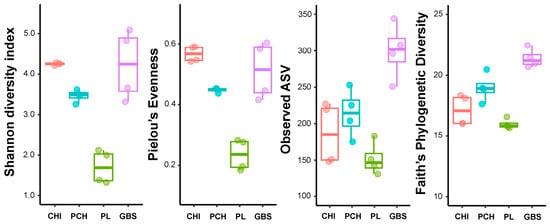
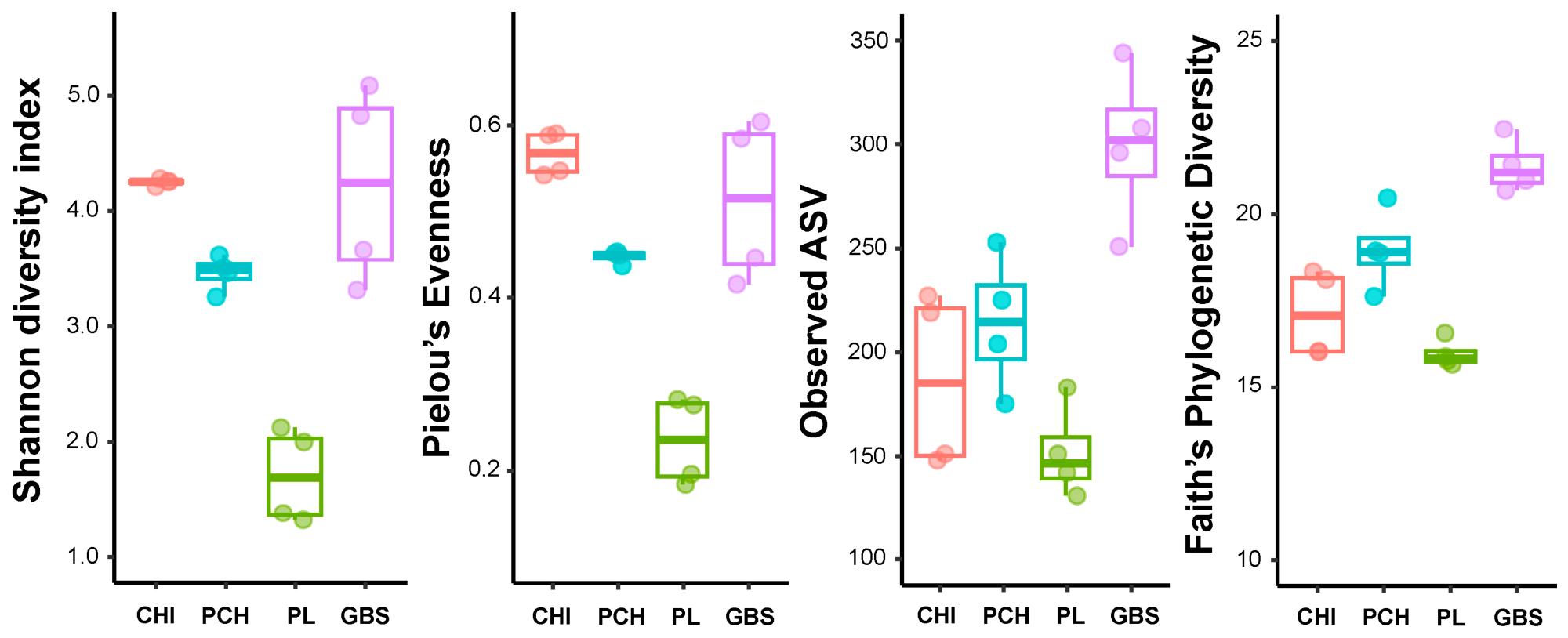
Metabarcoding of fermentation fluid samples (n = 4 per treatment) generated 1.07 million raw reads. After quality filtering and denoising with the DADA2 algorithm, 632,773 high-quality reads were retained, with an average of 39,548 reads per sample (range: 23,806–55,555; Supplementary Table S1). After removal of low-frequency ASVs (<10 reads in total), 762 ASVs and 630,513 reads were retained, and the smallest library (23,716 reads) was used as the rarefaction depth for alpha diversity analyses (Supplementary Table S2). Shannon diversity and Pielou’s evenness differed among treatments (Kruskal–Wallis, H = 11.32, p = 0.010, and H = 10.48, p = 0.015, respectively; Supplementary Table S2). Both indices were lowest in PL (Shannon: 1.71 ± 0.41; evenness: 0.235 ± 0.051). Dunn’s post hoc test with Benjamini–Hochberg FDR correction showed that Shannon diversity was significantly lower in PL than in CHI (4.25 ± 0.03) and GBS (4.23 ± 0.87) (FDR-adjusted p = 0.018 for both), whereas evenness was significantly lower in PL than in CHI (0.567 ± 0.026; FDR-adjusted p = 0.011), with only a tendency for GBS (0.513 ± 0.095; FDR-adjusted p = 0.064). PCH (Shannon: 3.47 ± 0.15; evenness: 0.448 ± 0.008) was intermediate and did not differ significantly from any other treatment. Observed ASVs (H = 10.61, p = 0.014) and Faith’s phylogenetic diversity (H = 12.79, p = 0.005) also differed among treatments, being highest in GBS (299.8 ± 38.4 ASVs; 21.39 ± 0.78) and lowest in PL (151.8 ± 22.4 ASVs; 15.98 ± 0.40), with GBS being significantly higher than PL for both indices (FDR-adjusted p = 0.010 and 0.004, respectively) and CHI and PCH being intermediate (Figure 1; Supplementary Table S2).
Figure 1.
Alpha diversity indices of rumen microbial communities across different forage treatments in the RUSITEC system. Boxplots represent Shannon’s diversity index, Pielou’s evenness, observed ASVs, and Faith’s phylogenetic diversity. Each point represents one fermenter (n = 4 per treatment); indices were calculated after rarefaction to 23,716 reads per sample. PL: plantain; CHI: chicory; PCH: plantain–chicory mixture; GBS: grass-based sward.
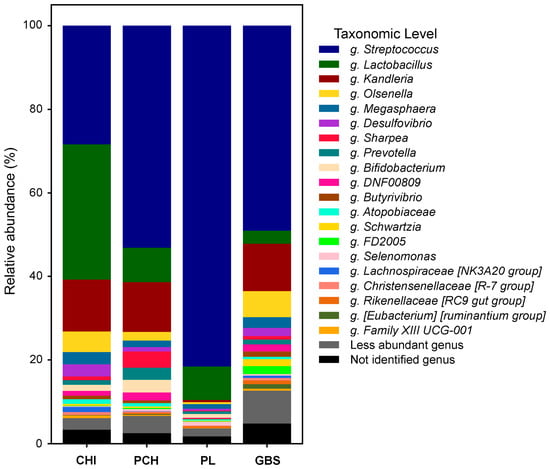
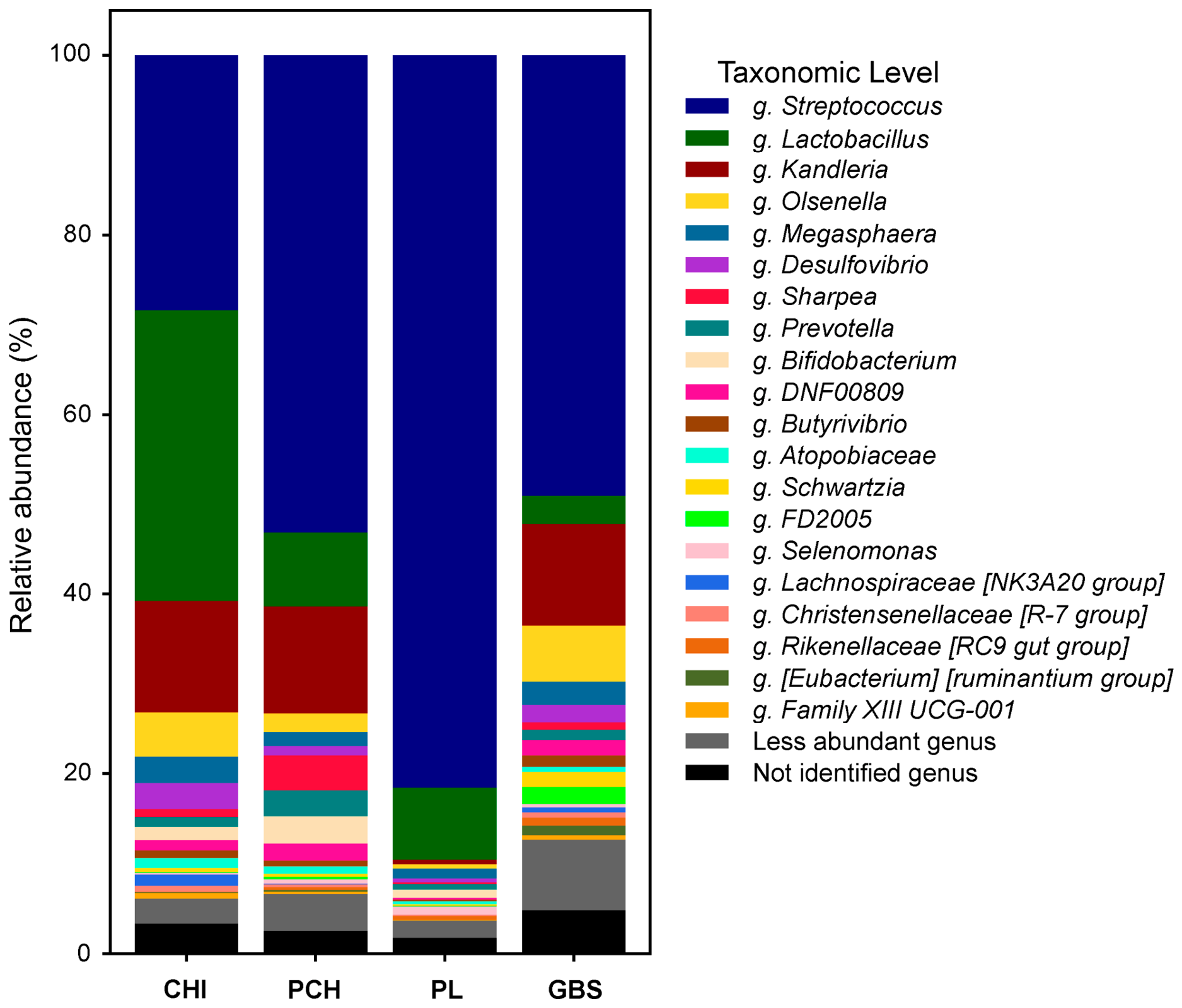
At the genus level, Streptococcus dominated in PL (81.6 ± 7.7%), followed by lower abundances in PCH (53.1 ± 5.9%), CHI (28.5 ± 8.7%), and GBS (49.1 ± 12.8%). Lactobacillus was abundant in CHI (32.4 ± 1.7%) but represented less than 10% in other treatments. Kandleria was present at similar levels in CHI (12.4 ± 8.5%), PCH (11.8 ± 8.6%), and GBS (11.4 ± 4.1%), while Olsenella showed a higher relative abundance in GBS (6.2 ± 0.9%) compared with that in other forages. Other genera detected at lower relative abundances included Megasphaera (1.1–2.9%) and Bifidobacterium (1–2%), showing a variable distribution among treatments (Figure 2).
Figure 2.
Relative abundance (%) of the main bacterial genera detected in the fermentation fluid across different forage treatments in the RUSITEC system. Bars show treatment means (n = 4 fermenters per treatment), with less abundant genera grouped together; variability (mean ± SD) of the differentially abundant genera is reported in Supplementary Table S3. PL: plantain; CHI: chicory; PCH: plantain–chicory mixture; GBS: grass-based sward.
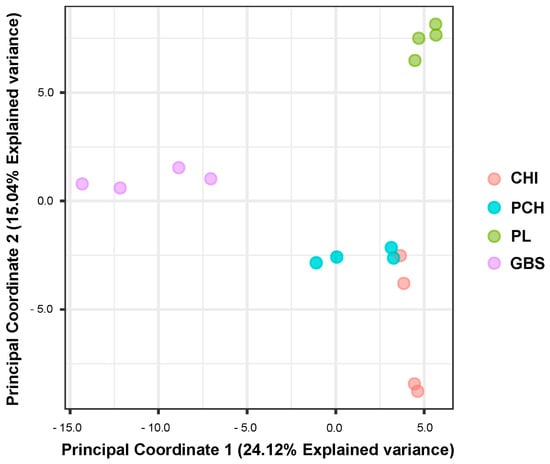
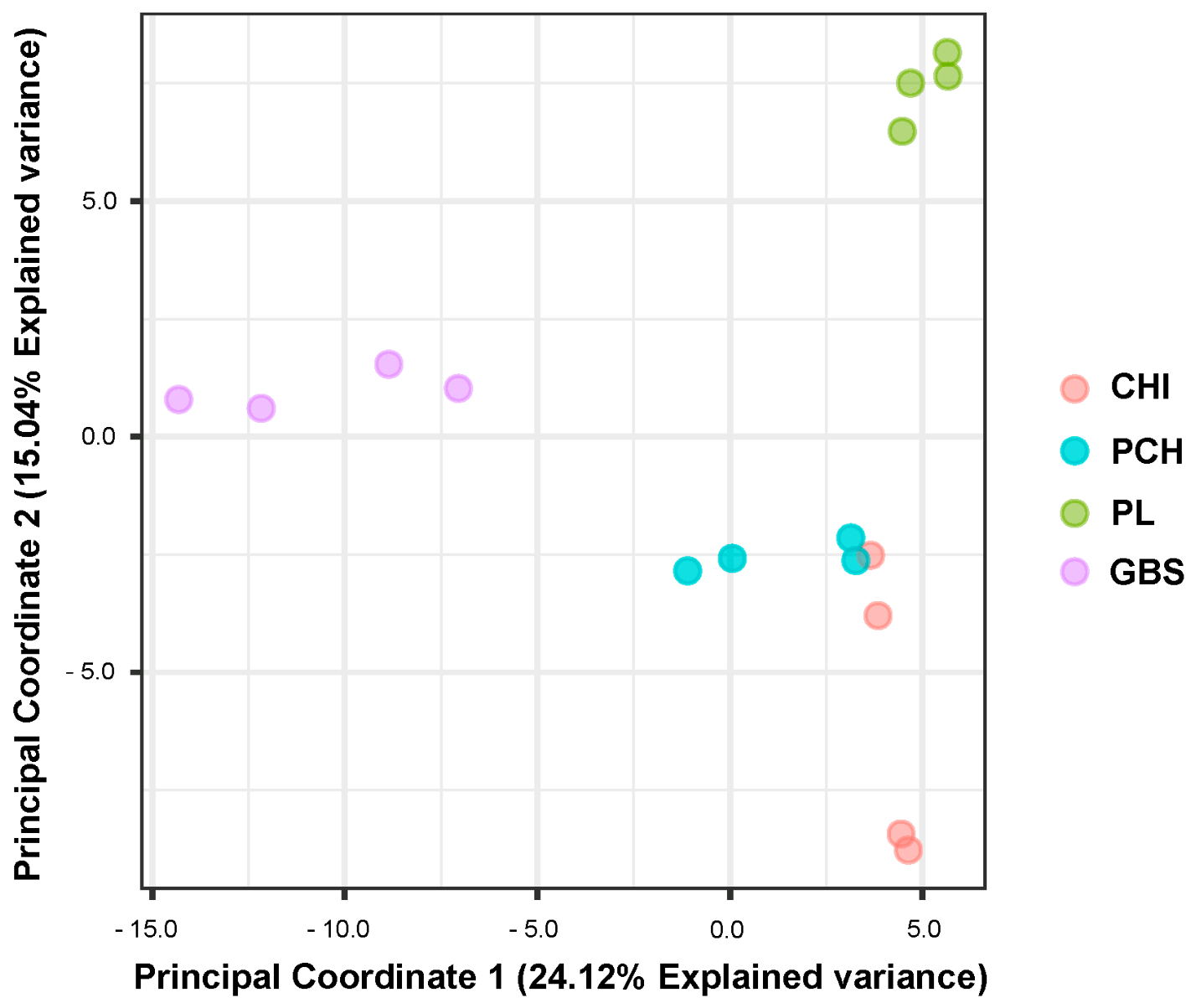
Beta diversity analysis, visualized by principal coordinate analysis (PCoA) of robust Aitchison distances, revealed distinct microbial community structures across treatments (Figure 3). The first two principal coordinates explained 24.12% and 15.04% of the total variance, respectively, indicating separation among treatment groups. PERMANOVA confirmed significant differences in microbial composition among treatments (p < 0.001, F = 3.74, R2 = 0.48).
Figure 3.
Principal coordinate analysis (PCoA) of rumen microbial communities across different forage treatments based on robust Aitchison distances. Each point represents one fermenter (n = 4 per treatment). PL: plantain; CHI: chicory; PCH: plantainchicory mixture; GBS: grass-based sward.
The LEfSe analysis identified distinct microbial communities among the four forage treatments in the RUSITEC experiment (Supplementary Table S3). Streptococcus (LDA: 5.43) and Selenomonas (LDA: 3.55) were enriched in the PL treatment. The CHI treatment exhibited higher relative abundances of Lactobacillus (LDA: 5.16), Kandleria (LDA: 4.77), and Desulfovibrio (LDA: 4.09). In the PCH treatment, Sharpea (LDA: 4.25) and Bifidobacterium (LDA: 4.19) were the most differentially abundant taxa. The GBS treatment was enriched in fibrolytic genera, including Olsenella (LDA: 4.46), Butyrivibrio (LDA: 3.74), and Ruminococcus (LDA: 3.51).
The zero-inflated Gaussian mixture model (ZIGMM) analysis, applied to genus-level microbial data using the metagenomeSeq package, also detected significant differences in taxa abundance among forage treatments. In the PL treatment, Streptococcus (log2FC: 1.11 vs. PCH, 2.18 vs. CHI, 1.86 vs. GBS; padj < 0.05) and Selenomonas (log2FC: 1.13 vs. PCH, 2.73 vs. CHI, 1.52 vs. GBS; padj < 0.05) were significantly enriched. The CHI treatment showed higher relative abundances of Lactobacillus (log2FC: 1.72 vs. PL, 3.65 vs. GBS, 1.91 vs. PCH; padj < 0.01) and Desulfovibrio (log2FC: 2.21 vs. PL, 1.59 vs. GBS; padj < 0.05). In PCH, Sharpea (log2FC: 4.32 vs. PL, 2.60 vs. GBS; padj < 0.001) and Bifidobacterium (log2FC: 1.48 vs. PL, 8.96 vs. GBS; padj < 0.05) were significantly enriched. The GBS treatment exhibited higher abundances of Olsenella (log2FC: 2.39 vs. PL; padj < 0.01) and Rikenellaceae [RC9 gut group] (log2FC: 1.40 vs. PCH, 4.31 vs. CHI; padj < 0.05).
4. Discussion
The present study shows that forage type was associated with differences in in vitro nutrient disappearance, fermentation patterns, and ruminal bacterial community composition, indicating that plantain (Plantago lanceolata) and chicory (Cichorium intybus) elicited distinct responses in rumen function relative to a grass-based sward. These differences are consistent with the contrasting chemical composition and fiber degradability of the forages and may also involve secondary metabolites reported for these species, which were not analyzed here.
4.1. Nutrient Disappearance and Fermentation Dynamics
Chicory exhibited the greatest in vitro dry matter disappearance (IVDMd; 77.2%) and organic matter disappearance (OMd; 75.8%), consistent with its low structural fiber content (NDF 23.1% and ADF 12.2% of DM, Table 1) and with the higher soluble sugar content reported for vegetative chicory relative to perennial ryegrass (111 vs. 74 g/kgDM) [3,9] These compositional traits may enhance microbial accessibility and degradation efficiency, as previously demonstrated in both in vitro and in vivo trials [3,47]. The elevated CP disappearance observed in CHI and GBS suggests active proteolysis and microbial assimilation of nitrogenous substrates under these conditions, and the high NH3-N observed in GBS likely reflects the rapid degradation of soluble nitrogen in ryegrass, leading to ammonia accumulation [48,49]. In contrast, the lower CP disappearance and NH3-N concentration detected in PL (54.7% and 5.92 mg/d, respectively) point to a reduced rate of protein degradation and ammonia formation. Plantain is known to contain phenolic glycosides, such as aucubin and acteoside, previously reported to suppress proteolytic and deaminating bacteria [7,11,50]. Although these compounds were not quantified in the forage batches used in this study, their documented effects offer a plausible, though unconfirmed, explanation for the lower NH3-N observed in PL. Aucubin may bind free amino acids or inhibit microbial deamination, whereas acteoside could enhance microbial protein synthesis by providing fermentable carbon substrates [7,11]. These combined effects could reduce ruminal ammonia accumulation, which may in turn limit subsequent urinary nitrogen losses, a trend consistently reported in grazing studies with Plantago species [15,51,52]. Because microbial protein synthesis and total nitrogen flows were not measured here, whether this reflects genuinely improved nitrogen use efficiency or simply reduced proteolytic activity cannot be determined from the present data.
The low NDFomd observed in PL (40.0%) could also reflect an influence of plantain secondary metabolites on fibrolytic microbes, as acteoside- and aucubin-containing extracts have been reported to reduce fiber-degrading bacteria in vitro [50]; this possibility was not tested in the present study. This contrasts with the higher fiber disappearance in CHI and GBS, which is consistent with more extensive fibrolytic fermentation. Collectively, these results suggest that CHI and GBS promote greater nutrient degradability and microbial fermentation intensity.
Differences in volatile fatty acid (VFA) profiles further illustrate the metabolic specialization induced by each forage type. The dominance of acetate in PCH (60.2%) and the higher propionate proportion in PL (34.5%) suggest distinct hydrogen utilization pathways. CHI also showed a high acetate proportion (57.6%), consistent with its greater digestibility. The lower acetate-to-propionate (A:P) ratio in PL (1.60) indicates a shift toward glucogenic fermentation, which likely contributes to reduced CH4 production due to the role of propionate as a competitive hydrogen sink [53]. Conversely, the higher A:P ratio in CHI (2.27) suggests a fermentation pattern favoring acetate production, associated with rapid carbohydrate degradation and greater hydrogen release, which may favor methanogenesis. Despite these compositional and metabolic shifts, total VFA production and pH remained stable across treatments, indicating that forage type primarily modified fermentation end-product proportions rather than total fermentative capacity, consistent with observations by [18].
4.2. Methane Production and Fermentation Efficiency
Methane production differed markedly among forage types. CHI exhibited the highest CH4 output (70.7 mg, 8.93 mg/g OM; 5.55% of total gas), followed by GBS and PCH, whereas PL showed the lowest values (47.9 mg, 6.06 mg/g OM; 4.13%). These differences reflect both fermentation stoichiometry and substrate composition. The greater CH4 production in CHI is consistent with its higher digestibility (IVDMd = 77.2%), which increases hydrogen release during carbohydrate fermentation and is expected to increase substrate availability for methanogens [54]. In contrast, the reduced CH4 emissions from PL correspond to its lower acetate-to-propionate ratio and higher propionate formation, which act as hydrogen sinks and reduce the availability of reducing equivalents for methanogenesis [54,55]. This in vitro response also mirrors in vivo observations, where cows fed plantain produced less CH4 than those fed ryegrass, an effect largely attributed to the lower dry matter digestibility of PL [13]. The convergence of in vitro and in vivo evidence underscores the central role of substrate degradability in regulating rumen hydrogen dynamics and methanogenic potential.
The methane-mitigating effect of PL also agrees with reports attributing lower CH4 production in Plantago spp. to iridoid glycosides such as aucubin and acteoside, which have been proposed to alter hydrogen flow through modified bacterial fermentation pathways [11,13], because archaeal community data were not generated in this study, a direct effect on methanogen metabolism cannot be confirmed and remains speculative. Intermediate CH4 values observed in PCH suggest partial mitigation when both forages are combined, possibly reflecting additive effects between plant secondary metabolites and structural carbohydrates on hydrogen balance. Although CH4 yield per digested OM only tended to differ (p = 0.066), this supports the concept that substrate degradability and hydrogen disposal pathways jointly determine methanogenic efficiency [56,57].
Interestingly, total gas production did not differ among treatments (p = 0.135), indicating that the variation in CH4 output is primarily related to differences in gas composition rather than total fermentation intensity. This finding reinforces the importance of microbial routing of reducing power toward alternative sinks such as propionate, microbial biomass, or reductive acetogenesis, processes favored in PL and PCH fermentations [53,58]. Collectively, these results demonstrate the potential of PL as a functional forage for mitigating enteric CH4 emissions, while the high digestibility of CHI, although nutritionally advantageous, may enhance hydrogen release and counteract its mitigation potential, partially diverging from previous reports [47].
4.3. Rumen Microbial Composition/Ruminal Microbiota Diversity
Alpha diversity patterns indicated that forage type influenced rumen bacterial diversity, evenness and richness. CHI and GBS exhibited greater Shannon diversity than PL, CHI also showed greater evenness, and GBS harbored the richest and most phylogenetically diverse community, whereas PCH was intermediate, suggesting that these forages supported more diverse and evenly structured bacterial consortia than PL (Supplementary Table S2). Greater alpha diversity has been associated with enhanced fermentation stability and metabolic redundancy [59], which may contribute to the observed variation in fermentation profiles among treatments. Beta diversity analysis (PCoA of robust Aitchison distances) further demonstrated distinct community clustering across forages, with PL clearly separated from CHI, PCH, and GBS, as confirmed by PERMANOVA (p < 0.001, R2 = 0.48; Figure 3).
Compositional analyses revealed marked taxonomic shifts that reflected forage-specific microbial adaptations. Plantago lanceolata (PL) was dominated by Streptococcus (81.6%) with enrichment of Selenomonas. Selenomonas is associated with the succinate–propionate pathways, a net hydrogen sink consistent with the higher propionate proportion and lower A: P ratio observed in PL [58,60]. Streptococcus, in contrast, is primarily a lactate producer [61]; its overwhelming dominance likely reflects rapid fermentation of soluble substrates rather than a direct role in hydrogen disposal, and the subsequent fate of lactate (e.g., conversion to propionate by lactate-utilizing bacteria) may contribute to the observed VFA profile. CHI was enriched in Lactobacillus and Desulfovibrio (LDA scores: 5.16 and 4.09). Although the higher digestibility and acetate proportion of CHI are consistent with greater hydrogen availability and methane output, the enrichment of Lactobacillus is typical of rapid carbohydrate fermentation [62], whereas the hydrogenotrophic sulfate reducer Desulfovibrio would be expected to compete with methanogens for hydrogen [58]; its role under these conditions remains unclear and warrants targeted functional study. PCH exhibited enrichment in Sharpea and Bifidobacterium, associated with moderate hydrogen fluxes and balanced acetate-to-propionate ratios, while GBS was characterized by fibrolytic taxa such as Olsenella, Butyrivibrio, and Ruminococcus, reflecting its enhanced fiber digestibility [63].
Together, these findings highlight that forage composition shapes rumen microbial community structure and function, with plausible downstream effects on fermentation efficiency and methanogenic potential. The differential enrichment of fermentative and fibrolytic taxa across forages underscores the importance of plant-derived substrates and secondary metabolites as selective forces modulating rumen microbial ecology [64,65].
4.4. Integrative Interpretation and Implications
Collectively, these results demonstrate that Plantago lanceolata and Cichorium intybus were associated with distinct rumen microbial and fermentative responses, including differences in methane output and nitrogen metabolism. In PL, lower CH4 emissions were observed together with a pattern consistent with reduced proteolytic activity, which may be related to plantain bioactive compounds [13,50], although these were not quantified here, whereas CHI showed extensive substrate degradation and higher digestibility, possibly involving acetogenic fermentation. The intermediate responses observed in PCH may reflect the combined contribution of both forages; however, this study was not designed to test synergistic effects, so whether moderated fermentation intensity and balanced microbial consortia could benefit both nutrient utilization and environmental performance remains to be determined. Because only one plantain-to-chicory ratio (30:70) was evaluated, it is possible that this proportion attenuated the methane-mitigating effect of plantain; testing alternative ratios would be needed to address this.
From a practical perspective, these in vitro findings suggest that P. lanceolata could contribute to lower CH4 emissions and ruminal ammonia accumulation, which, if confirmed in vivo, could reduce greenhouse gas and potentially nitrogen excretion losses [13,52]. Conversely, C. intybus, with its high digestibility and extensive fermentability, appears suitable for improving nutrient uptake but may not be ideal for methane mitigation when used as the sole forage. The intermediate fermentation and CH4 yield observed in PCH suggest it may be suitable for mixed diets, in line with a previous in vivo study reporting higher milk protein content in ewes grazing PCH pastures [24], although a direct link cannot be established from our data. Ryegrass (GBS) remains a reliable reference forage for fiber digestion but lacks the functional attributes of the other species. Finally, although the RUSITEC system provides controlled insight into ruminal processes, in vivo validation remains essential, particularly to capture the influence of secondary metabolites, seasonal variation in forage chemistry, and potential long-term microbial adaptations. In addition, the 5-day sampling period, although standard for RUSITEC incubation [66], captures short-term responses and does not reflect longer-term dietary adaptation; the absence of animal performance and product-quality data and the lack of quantification of forage secondary metabolites also limit extrapolation to grazing animals and should be addressed in future in vivo trials. Furthermore, because this study characterized only the bacterial community (16S rRNA V6–V8 region) and did not include archaeal-specific data (e.g., methanogen-targeted qPCR or archaeal 16S sequencing), the mechanistic links proposed here between specific bacterial taxa and methanogenesis remain associative rather than causal and should be confirmed with direct measurements of methanogen abundance and activity in future work.
Future work integrating metatranscriptomic and metabolomic approaches could further elucidate the functional mechanisms underlying these microbial shifts and their persistence under grazing conditions.
5. Conclusions
In this RUSITEC study, Plantago lanceolata and Cichorium intybus differed in ruminal fermentation, CH4 production, and bacterial community composition. P. lanceolata was associated with lower CH4 emissions, whereas C. intybus was associated with greater nutrient disappearance and higher CH4 production. The plantain–chicory mixture (PCH) showed intermediate responses, suggesting a potential complementarity between the two forages that warrants further evaluation. These in vitro findings suggest that plantain and chicory may be of interest as forage options for CH4 mitigation strategies.
Future in vitro studies should quantify the secondary metabolite profile of the forages and screen alternative plantain–chicory ratios and different concentrations of these compounds and their interactions, while in vivo grazing studies should validate these effects and explore seasonal variability, with the aim of optimizing methane mitigation without compromising nutrient utilization.
Supplementary Materials
The following supporting information can be downloaded at https://www.mdpi.com/article/10.3390/agriculture16202267/s1, Table S1: Sequence read processing summary for all fermentation fluid samples across forage treatments; Table S2: Alpha diversity indices of rumen microbial communities across forage treatments; Table S3: Results of the linear discriminant analysis effect size (LEfSe) analysis identifying differentially abundant bacterial genera among forage treatments in the RUSITEC experiment.
Author Contributions
Conceptualization, R.R.-P. and D.A.; data curation, R.R.-P., G.L. and J.Á.-S.; investigation, R.R.-P., J.Á.-S. and D.A.; methodology, R.R.-P., M.D.-M.d.l.P., N.V.A., S.T.S.-O. and S.B.; project administration, R.R.-P. and J.Á.-S.; supervision, R.R.-P. and J.Á.-S.; visualization, R.R.-P., K.I.T., G.L. and S.B.; writing—original draft, R.R.-P., K.I.T., G.L., N.V.A., M.D.-M.d.l.P., S.T.S.-O. and S.B.; writing—review and editing, K.I.T., G.L. and S.B.; formal analysis, G.L. and N.V.A.; funding acquisition, S.B. All authors have read and agreed to the published version of the manuscript.
Funding
This research was funded by CONICYT-PCHA Doctorado Nacional 2015 Scholarship grant number 21151023. The APC was funded by Universidad Austral de Chile.
Institutional Review Board Statement
All procedures involving donor cows were certified by the Ethics and Animal Welfare Committee of the Universidad de Concepción (N° CBE28-2019, approved on 29 May 2019).
Data Availability Statement
The data presented in this study are openly available in Bioproject at https://dataview.ncbi.nlm.nih.gov/object/PRJNA1529836(accessed on 15 September 2026), accession PRJNA1529836 (BioSamples SAMN63619956–SAMN63619971).
Acknowledgments
The authors acknowledge the supercomputing infrastructure of Soroban (SATREPS MACH—JPM/JSA1705) at Centro de Modelación y Computación Científica at Universidad de La Frontera, and R. Rodríguez acknowledges financial support from the CONICYT-PCHA Doctorado Nacional 2015 Scholarship (Grant No. 21151023) received during her doctoral studies. The authors used Gemini version 2.0 to assist with translation from Spanish to English and subsequent language editing.
Conflicts of Interest
The authors declare that the research was conducted in the absence of any commercial or financial relationships that could be construed as a potential conflict of interest.
References
- Alonso, M.F.; Sube, A.; Aguirre, C.; Dec, D.; Balocchi, O. Rendimiento y calidad de praderas de Lolium perenne L. bajo riego en la Zona Sur de Chile. agrosur 2016, 44, 19–27. [Google Scholar] [CrossRef] [Scilit]
- Dumont, B.; Andueza, D.; Niderkorn, V.; Lüscher, A.; Porqueddu, C.; Picon-Cochard, C. A Meta-Analysis of Climate Change Effects on Forage Quality in Grasslands: Specificities of Mountain and Mediterranean Areas. Grass Forage Sci. 2015, 70, 239–254. [Google Scholar] [CrossRef] [Scilit]
- Barry, T.N. The Feeding Value of Chicory (Cichorium Intybus) for Ruminant Livestock. J. Agric. Sci. 1998, 131, 251–257. [Google Scholar] [CrossRef] [Scilit]
- Sanderson, M.A.; Labreveux, M.; Hall, M.H.; Elwinger, G.F. Nutritive Value of Chicory and English Plantain Forage. Crop Sci. 2003, 43, 1797–1804. [Google Scholar] [CrossRef] [Scilit]
- Lee, J.M.; Hemmingson, N.R.; Minnee, E.M.K.; Clark, C.E.F. Management Strategies for Chicory (Cichorium Intybus) and Plantain (Plantago Lanceolata): Impact on Dry Matter Yield, Nutritive Characteristics and Plant Density. Crop Pasture Sci. 2015, 66, 168–183. [Google Scholar] [CrossRef] [Scilit]
- Cranston, L.M.; Kenyon, P.R.; Morris, S.T.; Lopez-Villalobos, N.; Kemp, P.D. Morphological and Physiological Responses of Plantain (Plantago Lanceolata) and Chicory (Cichorium Intybus) to Water Stress and Defoliation Frequency. J. Agron. Crop Sci. 2016, 202, 13–24. [Google Scholar] [CrossRef] [Scilit]
- Stewart, A.V. Plantain (Plantago Lanceolata)–a Potential Pasture Species. Proc. N. Z. Grassl. Assoc. 1996, 58, 77–86. [Google Scholar] [CrossRef] [Scilit]
- Rumball, W.; Keogh, R.G.; Lane, G.E.; Miller, J.E.; Claydon, R.B. ‘Grasslands Lancelot’ Plantain (Plantago Lanceolata L.). N. Z. J. Agric. Res. 1997, 40, 373–377. [Google Scholar] [CrossRef] [Scilit]
- Li, G.; Kemp, P.D. Forage Chicory (Cichorium Intybus L.): A Review of Its Agronomy and Animal Production. In Advances in Agronomy; Elsevier: Amsterdam, The Netherlands, 2005; Volume 88, pp. 187–222. ISBN 978-0-12-000786-8. [Google Scholar]
- Tamura, Y.; Nishibe, S. Changes in the Concentrations of Bioactive Compounds in Plantain Leaves. J. Agric. Food Chem. 2002, 50, 2514–2518. [Google Scholar] [CrossRef] [Scilit]
- Navarrete, S.; Kemp, P.D.; Pain, S.J.; Back, P.J. Bioactive Compounds, Aucubin and Acteoside, in Plantain (Plantago Lanceolata L.) and Their Effect on in Vitro Rumen Fermentation. Anim. Feed Sci. Technol. 2016, 222, 158–167. [Google Scholar] [CrossRef] [Scilit]
- Elgersma, A. Grazing Increases the Unsaturated Fatty Acid Concentration of Milk from Grass-fed Cows: A Review of the Contributing Factors, Challenges and Future Perspectives. Euro J. Lipid Sci. Tech 2015, 117, 1345–1369. [Google Scholar] [CrossRef] [Scilit]
- Della Rosa, M.M.; Sandoval, E.; Luo, D.; Pacheco, D.; Jonker, A. Effect of Feeding Fresh Forage Plantain (Plantago Lanceolata) or Ryegrass-Based Pasture on Methane Emissions, Total-Tract Digestibility, and Rumen Fermentation of Nonlactating Dairy Cows. J. Dairy Sci. 2022, 105, 6628–6638. [Google Scholar] [CrossRef] [Scilit]
- Kara, K.; Ozkaya, S.; Baytok, E.; Guclu, B.K.; Aktug, E.; Erbas, S. Effect of Phenological Stage on Nutrient Composition, in Vitro Fermentation and Gas Production Kinetics of Plantago Lanceolata Herbage. Vet. Med. 2018, 63, 251–260. [Google Scholar] [CrossRef] [Scilit]
- Khan, A.S.; Finn, J.A.; Menezes, A.B.D.; Kirwan, S.F.; Waters, S.M.; Krol, D.J. Effects of Multispecies and Monoculture Forages on Nutrient Digestibility and Fermentation Responses Using an in Vitro Rumen Simulation Technique (RUSITEC). Anim.-Open Space 2023, 2, 100052. [Google Scholar] [CrossRef] [Scilit]
- Muir, S.K.; Ward, G.N.; Jacobs, J.L. Herbage Intake and Milk Production of Late-Lactation Dairy Cows Offered a Second-Year Chicory Crop during Summer. J. Dairy Sci. 2015, 98, 8825–8835. [Google Scholar] [CrossRef] [Scilit]
- De Brito, G.F.; Ponnampalam, E.N.; Hopkins, D.L. The Effect of Extensive Feeding Systems on Growth Rate, Carcass Traits, and Meat Quality of Finishing Lambs. Comp. Rev. Food Sci. Food Safe 2017, 16, 23–38. [Google Scholar] [CrossRef] [Scilit]
- Mangwe, M.; Bryant, R.; Gregorini, P. Rumen Fermentation and Fatty Acid Composition of Milk of Mid Lactating Dairy Cows Grazing Chicory and Ryegrass. Animals 2020, 10, 169. [Google Scholar] [CrossRef] [Scilit]
- Rodríguez, R.; Alomar, D.; Morales, R. Milk and Meat Fatty Acids from Sheep Fed a Plantain–Chicory Mixture or a Grass-Based Permanent Sward. Animal 2020, 14, 1102–1109. [Google Scholar] [CrossRef] [Scilit]
- Box, L.A.; Edwards, G.R.; Bryant, R.H. Diurnal Changes in the Nutritive Composition of Four Forage Species at High and Low N Fertiliser. J. NZ Grassl. 2017, 79, 111–118. [Google Scholar] [CrossRef] [Scilit]
- Luo, J.; Balvert, S.F.; Wise, B.; Welten, B.; Ledgard, S.F.; De Klein, C.A.M.; Lindsey, S.; Judge, A. Using Alternative Forage Species to Reduce Emissions of the Greenhouse Gas Nitrous Oxide from Cattle Urine Deposited onto Soil. Sci. Total Environ. 2018, 610–611, 1271–1280. [Google Scholar] [CrossRef] [Scilit]
- Navarrete, S.; Rodriguez, M.; Horne, D.; Hanly, J.; Hedley, M.; Kemp, P. Nitrogen Excretion by Dairy Cows Grazing Plantain (Plantago Lanceolata) Based Pastures during the Lactating Season. Animals 2022, 12, 469. [Google Scholar] [CrossRef] [Scilit]
- Moscoso, C.J.; Ortega-Klose, F.; Acuña, A. Are Chilean Pasture Seed End-Users Adopting New Species? Trends and Joinpoint Regression Analysis of the Last 19 Years of Seed Imports. Agriculture 2021, 11, 552. [Google Scholar] [CrossRef] [Scilit]
- Rodríguez, R.; Suazo, C.; Balocchi, O.; Alomar, D. Milk Production and Quality from Ewes Grazing a Plantain-Chicory Mixture or a Grass-Based Permanent Sward. Small Rumin. Res. 2019, 170, 91–96. [Google Scholar] [CrossRef] [Scilit]
- Czerkawski, J.W.; Breckenridge, G. Design and Development of a Long-Term Rumen Simulation Technique (Rusitec). Br. J. Nutr. 1977, 38, 371–384. [Google Scholar] [CrossRef] [Scilit]
- McDougall, E.I. Studies on Ruminant Saliva. 1. The Composition and Output of Sheep’s Saliva. Biochem. J. 1948, 43, 99–109. [Google Scholar] [CrossRef] [Scilit]
- Avila-Stagno, J.; Chaves, A.V.; Jr, G.O.R.; Ungerfeld, E.M.; McAllister, T.A. Inclusion of Glycerol in Forage Diets Increases Methane Production in a Rumen Simulation Technique System. Br. J. Nutr. 2014, 111, 829–835. [Google Scholar] [CrossRef] [Scilit]
- Official Methods of Analysis, 16th ed.; Association of Official Analytical Chemist AOAC: Gaithersburg, MD, USA, 1996.
- Van Soest, P.J.; Robertson, J.B.; Lewis, B.A. Methods for Dietary Fiber, Neutral Detergent Fiber, and Nonstarch Polysaccharides in Relation to Animal Nutrition. J. Dairy Sci. 1991, 74, 3583–3597. [Google Scholar] [CrossRef] [Scilit]
- Tilley, J.M.A.; Terry, R.A. A Two-Stage Technique for the in Vitro Digestion of Forage Crops. Grass Forage Sci. 1963, 18, 104–111. [Google Scholar] [CrossRef] [Scilit]
- Garrido, O.; Mann, E. Composición Química, Digestibilidad Y Valor Energético de Una Pradera Permanente de Pastoreo a Través Del Año. Memoria de Título; Universidad Austral de Chile, Facultad de Ciencias Agrarias: Valdivia, Chile, 1981. [Google Scholar]
- Soliva, C.; Hess, H. Measuring Methane Emission of Ruminants by In Vitro and In Vivo Techniques. In Measuring Methane Production From Ruminants; Springer: Dordrecht, The Netherlands, 2007. [Google Scholar]
- Bolyen, E.; Rideout, J.R.; Dillon, M.R.; Bokulich, N.A.; Abnet, C.C.; Al-Ghalith, G.A.; Alexander, H.; Alm, E.J.; Arumugam, M.; Asnicar, F.; et al. Reproducible, Interactive, Scalable and Extensible Microbiome Data Science Using QIIME 2. Nat. Biotechnol. 2019, 37, 852–857, Correction in Nat. Biotechnol. 2019, 37, 1091. https://doi.org/10.1038/s41587-019-0252-6. [Google Scholar] [CrossRef] [Scilit]
- Callahan, B.J.; McMurdie, P.J.; Rosen, M.J.; Han, A.W.; Johnson, A.J.A.; Holmes, S.P. DADA2: High-Resolution Sample Inference from Illumina Amplicon Data. Nat. Methods 2016, 13, 581–583. [Google Scholar] [CrossRef] [Scilit]
- Quast, C.; Pruesse, E.; Yilmaz, P.; Gerken, J.; Schweer, T.; Yarza, P.; Peplies, J.; Glöckner, F.O. The SILVA Ribosomal RNA Gene Database Project: Improved Data Processing and Web-Based Tools. Nucleic Acids Res. 2012, 41, D590–D596. [Google Scholar] [CrossRef] [Scilit]
- Katoh, K.; Standley, D.M. MAFFT Multiple Sequence Alignment Software Version 7: Improvements in Performance and Usability. Mol. Biol. Evol. 2013, 30, 772–780. [Google Scholar] [CrossRef] [Scilit]
- Price, M.N.; Dehal, P.S.; Arkin, A.P. FastTree 2–Approximately Maximum-Likelihood Trees for Large Alignments. PLoS ONE 2010, 5, e9490. [Google Scholar] [CrossRef] [Scilit]
- Dunn, O.J. Multiple Comparisons Using Rank Sums. Technometrics 1964, 6, 241–252. [Google Scholar] [CrossRef]
- Benjamini, Y.; Hochberg, Y. Controlling the False Discovery Rate: A Practical and Powerful Approach to Multiple Testing. J. R. Stat. Soc. Ser. B Stat. Methodol. 1995, 57, 289–300. [Google Scholar] [CrossRef] [Scilit]
- Aitchison, J. The Statistical Analysis of Compositional Data. J. R. Stat. Soc. Ser. B (Methodol.) 1982, 44, 139–177. [Google Scholar] [CrossRef] [Scilit]
- Martino, C.; Morton, J.T.; Marotz, C.A.; Thompson, L.R.; Tripathi, A.; Knight, R.; Zengler, K. A Novel Sparse Compositional Technique Reveals Microbial Perturbations. mSystems 2019, 4, 1110-1128. [Google Scholar] [CrossRef] [Scilit]
- Oksanen, J.; Blanchet, F.G.; Friendly, M.; Kindt, R.; Legendre, P.; McGlinn, D.; Minchin, P.R.; O’Hara, R.B.; Simpson, G.L.; Solymos, P. Vegan: Community Ecology Package (R Package Version 2.6-6) 2020. Available online: https://cran.r-project.org/package=vegan (accessed on 15 September 2026).
- R Core Team. R: A Language and Environment for Statistical Computing; R Foundation for Statistical Computing: Vienna, Austria, 2023. [Google Scholar]
- Segata, N.; Izard, J.; Waldron, L.; Gevers, D.; Miropolsky, L.; Garrett, W.S.; Huttenhower, C. Metagenomic Biomarker Discovery and Explanation. Genome Biol. 2011, 12, R60. [Google Scholar] [CrossRef] [Scilit]
- Paulson, J.N.; Stine, O.C.; Bravo, H.C.; Pop, M. Differential Abundance Analysis for Microbial Marker-Gene Surveys. Nat. Methods 2013, 10, 1200–1202. [Google Scholar] [CrossRef] [Scilit]
- Ribeiro, G.O.; Gonçalves, L.C.; Pereira, L.G.R.; Chaves, A.V.; Wang, Y.; Beauchemin, K.A.; McAllister, T.A. Effect of Fibrolytic Enzymes Added to a Andropogon Gayanus Grass Silage-Concentrate Diet on Rumen Fermentation in Batch Cultures and the Artificial Rumen (Rusitec). Animal 2015, 9, 1153–1162. [Google Scholar] [CrossRef] [Scilit]
- Waghorn, W.C.; Tavendale, M.H.; Woodfield, D.R. Methanogenesis from Forages Fed to Sheep. Proc. N. Z. Grassl. Assoc. 2002, 64, 5. [Google Scholar] [CrossRef] [Scilit]
- Garrett, K.; Beck, M.R.; Marshall, C.J.; Logan, C.M.; Maxwell, T.M.R.; Greer, A.W.; Gregorini, P. Effects of Incorporating Plantain, Chicory, and Alfalfa into a Ryegrass-Based Diet on in Vitro Gas Production and Fermentation Characteristics. Appl. Anim. Sci. 2021, 37, 367–376. [Google Scholar] [CrossRef] [Scilit]
- Edwards, G.R.; Parsons, A.J.; Rasmussen, S.; Bryant, R.H. High Sugar Ryegrasses for Livestock Systems in New Zealand. ProNZG 2007, 69, 161–171. [Google Scholar] [CrossRef] [Scilit]
- Sivanandarajah, K.; Donaghy, D.; Kemp, P.; Navarrete, S.; Horne, D.; Ramilan, T.; Molano, G.; Pacheco, D. Effects of Plantain (Plantago Lanceolata L.) Metabolites Aucubin, Acteoside, and Catalpol on Methane Emissions In Vitro. J. Agric. Food Chem. 2025, 73, 12132–12145. [Google Scholar] [CrossRef] [Scilit]
- Minnée, E.; Bryant, R.; Chapman, D.; Gregorini, P. Simulating the Intake and Nitrogen Excretion from Cows Grazing Forages Fertilised with Increasing Rates of Nitrogen. N. Z. J. Anim. Sci. Prod. 2018, 78, 141–145. [Google Scholar]
- Pinxterhuis, J.B.; Judson, H.G.; Peterson, M.E.; Navarrete, S.; Minnée, E.; Dodd, M.B.; Davis, S.R. Implementing Plantain (Plantago Lanceolata) to Mitigate the Impact of Grazing Ruminants on Nitrogen Losses to the Environment: A Review. Grass Forage Sci. 2024, 79, 144–157. [Google Scholar] [CrossRef] [Scilit]
- Ungerfeld, E.M. Shifts in Metabolic Hydrogen Sinks in the Methanogenesis-Inhibited Ruminal Fermentation: A Meta-Analysis. Front. Microbiol. 2015, 6. Erratum in Front. Microbiol. 2015, 6, 538. https://doi.org/10.3389/fmicb.2015.00538. [Google Scholar] [CrossRef] [Scilit]
- Moss, A.R.; Jouany, J.-P.; Newbold, J. Methane Production by Ruminants:Its Contribution to Global Warming. Ann. Zootech. 2000, 49, 231–253. [Google Scholar] [CrossRef] [Scilit]
- Wang, K.; Nan, X.; Chu, K.; Tong, J.; Yang, L.; Zheng, S.; Zhao, G.; Jiang, L.; Xiong, B. Shifts of Hydrogen Metabolism From Methanogenesis to Propionate Production in Response to Replacement of Forage Fiber With Non-Forage Fiber Sources in Diets in Vitro. Front. Microbiol. 2018, 9, 2764. [Google Scholar] [CrossRef] [Scilit]
- Janssen, P.H. Influence of Hydrogen on Rumen Methane Formation and Fermentation Balances through Microbial Growth Kinetics and Fermentation Thermodynamics. Anim. Feed Sci. Technol. 2010, 160, 1–22. [Google Scholar] [CrossRef] [Scilit]
- Guyader, J.; Ungerfeld, E.M.; Beauchemin, K.A. Redirection of Metabolic Hydrogen by Inhibiting Methanogenesis in the Rumen Simulation Technique (RUSITEC). Front. Microbiol. 2017, 8, 393. [Google Scholar] [CrossRef] [Scilit]
- Ungerfeld, E.M. Metabolic Hydrogen Flows in Rumen Fermentation: Principles and Possibilities of Interventions. Front. Microbiol. 2020, 11, 589. [Google Scholar] [CrossRef] [Scilit]
- Li, F.; Li, C.; Chen, Y.; Liu, J.; Zhang, C.; Irving, B.; Fitzsimmons, C.; Plastow, G.; Guan, L. Host Genetics Influence the Rumen Microbiota and Heritable Rumen Microbial Features Associate with Feed Efficiency in Cattle. Microbiome 2019, 7, 92. [Google Scholar] [CrossRef] [Scilit]
- Hook, S.E.; Wright, A.-D.G.; McBride, B.W. Methanogens: Methane Producers of the Rumen and Mitigation Strategies. Archaea 2010, 2010, 945785. [Google Scholar] [CrossRef] [Scilit]
- Nagaraja, T.G.; Titgemeyer, E.C. Ruminal Acidosis in Beef Cattle: The Current Microbiological and Nutritional Outlook. J. Dairy Sci. 2007, 90, E17–E38. [Google Scholar] [CrossRef] [Scilit]
- Petri, R.M.; Schwaiger, T.; Penner, G.B.; Beauchemin, K.A.; Forster, R.J.; McKinnon, J.J.; McAllister, T.A. Characterization of the Core Rumen Microbiome in Cattle during Transition from Forage to Concentrate as Well as during and after an Acidotic Challenge. PLoS ONE 2013, 8, e83424. [Google Scholar] [CrossRef] [Scilit]
- Krause, D.O.; Denman, S.E.; Mackie, R.I.; Morrison, M.; Rae, A.L.; Attwood, G.T.; McSweeney, C.S. Opportunities to Improve Fiber Degradation in the Rumen: Microbiology, Ecology, and Genomics. FEMS Microbiol. Rev. 2003, 27, 663–693. [Google Scholar] [CrossRef] [Scilit]
- Huws, S.A.; Creevey, C.J.; Oyama, L.B.; Mizrahi, I.; Denman, S.E.; Popova, M.; Muñoz-Tamayo, R.; Forano, E.; Waters, S.M.; Hess, M.; et al. Addressing Global Ruminant Agricultural Challenges Through Understanding the Rumen Microbiome: Past, Present, and Future. Front. Microbiol. 2018, 9, 2161. [Google Scholar] [CrossRef] [Scilit]
- Martinez-Fernandez, G.; Denman, S.E.; Yang, C.; Cheung, J.; Mitsumori, M.; McSweeney, C.S. Methane Inhibition Alters the Microbial Community, Hydrogen Flow, and Fermentation Response in the Rumen of Cattle. Front. Microbiol. 2016, 7, 1122. [Google Scholar] [CrossRef] [Scilit]
- Vera, N.; Suescun-Ospina, S.; Gutiérrez-Gómez, C.; Williams, P.; Fuentealba, C.; Allende, R.; Ávila-Stagno, J. Influence of Forage-to-Concentrate Ratio on the Effects of a Radiata Pine Bark Extract on Methane Production and Fermentation Using the Rumen Simulation Technique. animal 2025, 19, 101406. [Google Scholar] [CrossRef] [Scilit]

Disclaimer/Publisher’s Note: The statements, opinions and data contained in all publications are solely those of the individual author(s) and contributor(s) and not of MDPI and/or the editor(s). MDPI and/or the editor(s) disclaim responsibility for any injury to people or property resulting from any ideas, methods, instructions or products referred to in the content. |
© 2026 by the authors. Licensee MDPI, Basel, Switzerland. This article is an open access article distributed under the terms and conditions of the Creative Commons Attribution (CC BY) license.