


Abstract
Climate change severely constrains Angolan smallholder farming, where a conventional agricultural model dependent on two rainy seasons narrows the window of opportunity for maize production and thereby threatens the food security of farming communities. The study proposes a transition towards agroecology and sustainable water management as a response to these constraints. The objective is to evaluate the effects of three agroecological practices and six water-harvesting techniques on maize dry weight per sample and soil moisture content (VWC%). The research followed a participatory design involving ten communities in Cuanza Sul and Benguela, providing novel evidence from the understudied Angolan context. Field monitoring spanned consecutive growing seasons (2023–2026), with data analysed using linear mixed-effects models (LMMs). The results suggest that the integration of agroecological practices and water-harvesting techniques enhances maize production capacity by facilitating soil water infiltration and nutrient availability. Statistically significant increases in maize dry weight per sample and soil moisture were localised to specific sites, while exploratory positive trends emerge in other communities. Gaps in longitudinal data continuity and missing data for other indicators restricted the models to these two variables. Overall, the findings indicate that the adoption of innovations has the potential to enhance the Angolan agroecosystem in the context of climate change.
1. Introduction
Sub-Saharan Africa (SSA) is among the regions most vulnerable to the climate crisis, with rain-fed agriculture accounting for 90–95% of cultivated land [1]. Although maize demand is projected to increase by 233% by 2050, the current average yield, approximately 2 t/ha, remains five times below the region’s biophysical potential [2]. This substantial ‘yield gap’ is driven by soil degradation, extreme rainfall variability, and frequent droughts and dry spells, which can cause total crop failures every ten years [3]. In this context, effective agrosystem management through water-harvesting techniques and the adoption of production practices centred on agroecology are not only sustainability strategies but necessities for ensuring food security and the socio-economic stability of farming communities [4].
Addressing these constraints requires a transition from a conventional agricultural model towards agrosystems that foster knowledge and techniques centred on agroecology [5]. Productivity gains are maximised when agroecological practices—such as crop diversification, integrated livestock farming and the use of organic fertilisers—are implemented in conjunction with water-harvesting techniques. These techniques influence soil structure, increase water-holding capacity and enhance nutrient availability for crops [6,7]. Regional research across Sub-Saharan Africa (SSA) demonstrates that adopting novel agronomic practices, focused on sowing density, pest management and soil fertility, can enhance maize yields while significantly reducing the need to expand cultivated areas, a development that is not without consequence for natural ecosystems [2]. Yield gap analyses in SSA indicate that narrowing the gap between current and attainable maize yields through improved crop management practices and more efficient input use is a more sustainable pathway than agricultural land expansion [8,9]. At the global scale, a meta-analysis found that intercropping practices targeting soil nutrition and plant density can increase maize productivity by an average of 4.5%, with particularly pronounced effects reported in SSA [10]. Evidence from semi-arid SSA [11] and East Africa [12] further confirms that combining techniques such as crop rotation, organic manure application, and mulching can simultaneously increase maize yields and enhance the resilience of smallholder farming systems to climatic variability.
The adoption of water harvesting within the agrosystem highlights the importance of novel agronomic practices focused on agroecology in order to mitigate climate shocks by converting surface runoff into a productive resource [3,13]. Techniques such as sand dams, infiltration pits, and trash lines improve soil moisture, enhance root penetration, and allow crops to survive prolonged droughts [7,14]. According to Mwenge Kahinda [3], the implementation of water harvesting techniques combined with the application of both organic and inorganic nutrients provides supplementary irrigation and offers a strategic solution capable of fully bridging the yield gap in semi-arid contexts, thereby stabilising production even during years with variable rainfall.
However, these documented benefits must be contextualised alongside critical socio-economic factors within farming communities, including the considerable workload required for the construction and maintenance of infrastructure, and the necessity for smallholder farmers to understand deeply the long-term sustainability of these techniques.
More broadly, the technical effectiveness of these innovations is closely tied to the body of knowledge, social structure, economic and productive dimension, and territorial context of the agrosystem into which they are integrated [15]. Introducing these innovations is essential for enhancing local food production dynamics and increasing ‘biotechnical’ autonomy under climate change constraints [16]. Ecological integration models become strategically sustainable when participatory approaches and ‘transition arenas’ facilitate the merging of local and scientific knowledge into context-tailored solutions [15].
Despite the urgent need to foster agroecological transitions among smallholder farmers in Sub-Saharan Africa, significant knowledge gaps remain. In particular, the combined effects of agroecological practices and water management techniques on soil moisture dynamics and crop yields remain poorly understood, particularly in Angola, where empirical field-based evidence is limited. While the potential of agroecological practices and water-harvesting techniques to enhance climate resilience has been examined separately, their interactive effects have not been thoroughly investigated.
This study addresses these gaps by evaluating empirical, field-verified evidence across ten rural communities. Statistical analyses were restricted to soil moisture content and maize dry weight per sample, the two indicators with sufficiently continuous data series throughout the study period. Three conditions are compared: a conventional management (PL), standalone agroecological practices (AE), and agroecological practices integrated with water harvesting techniques (AW). Two hypotheses have been tested: (i) integrated agroecological practices and water harvesting techniques (AW) yield significantly higher crop biomass and soil volumetric water content (VWC%) than standalone agroecological practices (AEs) or the conventional management baseline (PL); and (ii) the agronomic efficacy of these integrated practices varies across local community agrosystems under varying seasonal conditions. By testing these hypotheses, this research clarifies how linking water management to agroecology enhances water-use productivity, regenerates natural capital, and supports food sovereignty in rural communities [5,14,17].
2. Materials and Methods
2.1. Study Area
The study was conducted in the Angola Highlands, in the central region of the country, spanning latitudes 10°55′ and 13°07′ S and a longitude range of 14°12′ to 15°21′ E, across the provinces of Cuanza Sul and Benguela. This elevated plateau region, ranging from 1000 to 2500 metres in altitude, is characterised by a temperate tropical climate with mean annual rainfall of 1250–1500 mm and an average temperature of 20 °C. According to the Köppen–Geiger classification, the climate shifts from hot semi-arid in Benguela to subtropical highland in Cuanza Sul [18], reflecting the territory’s environmental heterogeneity.
Agriculture is the predominant economic activity for the rural population, organised around two distinct cropping seasons synchronised with the rainfall calendar. The first season, spanning from September to February, is dedicated to the cultivation of maize, beans, and pumpkins, while the second season, from March to June, focuses on producing groundnuts, sweet potatoes and cassava [19]. Alongside these, traditional staple food, including sorghum and millet, remains integral to local food systems [20].
The National Institute of Statistics reports that 91% of agricultural land is managed by smallholder farmers, whose traditional production systems are highly vulnerable to climate change, which affects their productive capacity [21].
To capture this spatial and socio-agricultural diversity, the experiment was implemented in 10 farming communities across six municipalities: Wako Kungo, Seles, Ebo and Conde in Cuanza Sul, and Ganda and Cubal in Benguela. Each community represented a different level of exposure to climate change and its impact on local production capacity. Researchers assessed exposure through a participatory diagnostic in each community using the Climate Vulnerability and Capacity Analysis (CVCA) methodology. This framework integrated specific participatory tools, including historical timelines, community resource mapping, and hazard and strategic solution mapping. These tools allowed exposure to be evaluated based on the community’s historical memory of extreme climatic events (e.g., recurrent droughts and dry spells), local perceptions of shifting seasonal rainfall patterns, and the spatial distribution of critical agricultural resources.
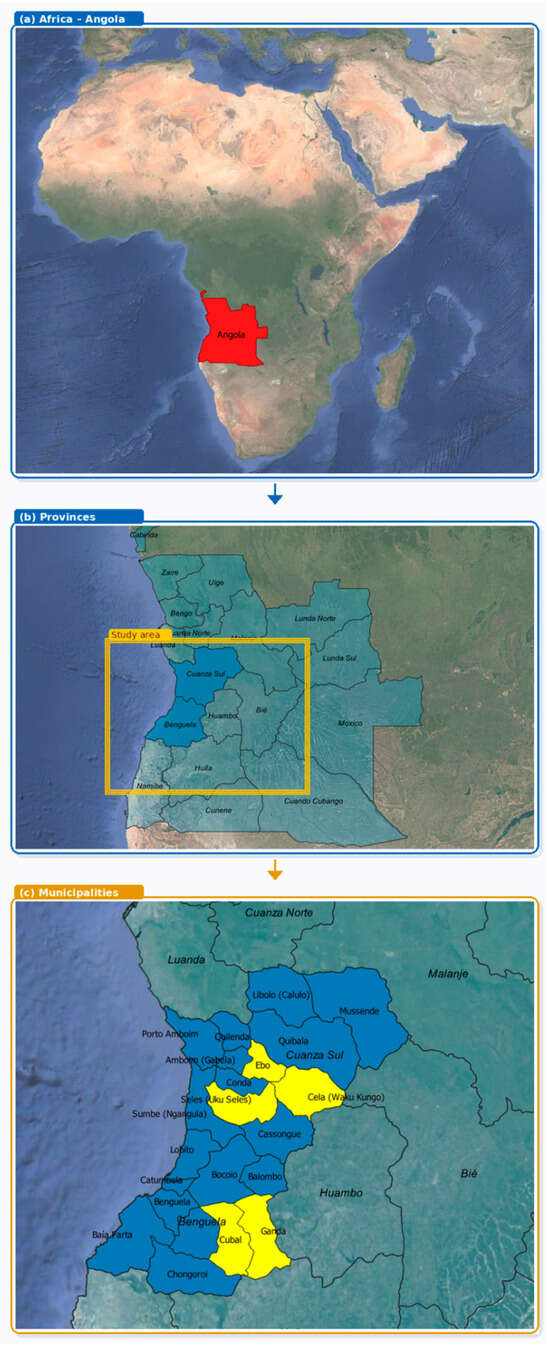
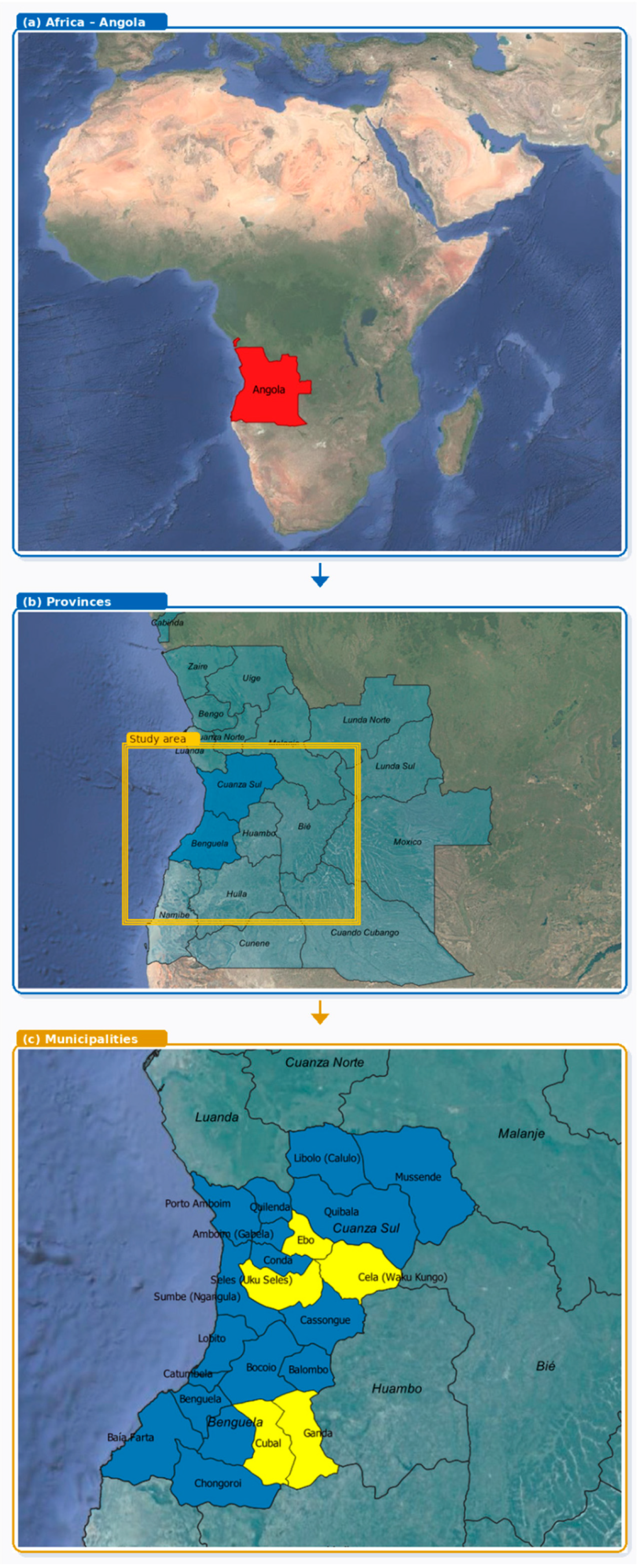
The selection of farming communities was not based on a probabilistic sampling design; the sites were identified through a participatory reflection process in collaboration with local authorities. Despite the absence of random sampling, the selected communities are representative of Angolan family farming according to the institutional criteria defined by the Ministry of Agriculture and Forestry, which classify smallholder farmers according to agricultural production purpose: (i) household consumption only, and (ii) household livelihood with surplus allocated for sale. Therefore, the selected sites reflect the structural characteristics, production constraints and management typologies of smallholder farming systems across Cuanza Sul and Benguela. Figure 1 illustrates the province where the ten participating farming communities are located.
Figure 1.
Provinces of Cuanza Sul and Benguela (Angola) and the municipalities in which the study had been implemented.
On average, fifteen farmers from each community (approximately 50% female) participated through the Farm Field School (FFS) approach developed by the Food and Agriculture Organization (FAO). Farmers held a co-responsible role in the research, contributing both agricultural management and field observations, which researchers analysed and elaborated on alongside them during FFS sessions. Each group of farmers assumed responsibility for the agronomic management of their own experimental field, with technical support from the local agricultural extension service.
2.2. Experimental Design and Sampling
Experimental plots were established in each community and served as the formal statistical units for all quantitative modelling and hypothesis testing. Plot sizes varied according to spatial availability, ranging from 40 m2 in two experimental fields to 80–100 m2 in the remaining eight fields. Within each experimental field, all plots were uniform in size and shape, with a buffer of 1.5 to 2 m between plots. Each plot was used to evaluate the effectiveness of technological innovations in agroecology and water harvesting, which were identified through participatory action research carried out during the initial phase of the RE-FARM project.
Three treatments were implemented: (i) agroecological practices alone (AE), (ii) agroecological practices combined with water-harvesting techniques (AW), and (iii) a control treatment (PL), in which crops were managed using conventional local farming techniques. The control treatment was consistent across all communities and was characterised by traditional hole-sowing of maize or beans, no manure or fertiliser inputs, and no pest and disease management measures. Local agricultural practices were formalised within the research framework as the PL treatment.
The selection and definition of the AE and AW treatments were conducted through a participatory decision-making process, which was carried out by each community. It is essential to emphasise that the AW treatment incorporates the same agroecological practice as AE, combined with a site-specific water-harvesting technique, for each individual community. The experimental configuration was devised with the specific purpose of assessing the additive effect and potential synergy of water harvesting in enhancing the performance of the selected agroecological practices. AE and AW therefore represent designs that have been tailored to the specific needs of the community, rather than uniform interventions across all sites. The contribution of water harvesting is isolated by comparing AE and AW within each community.
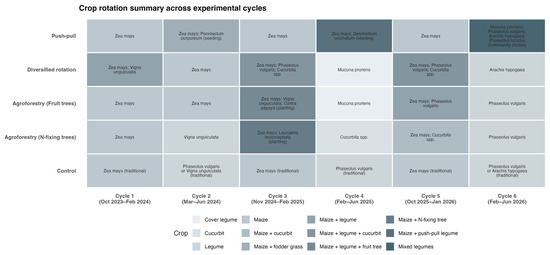
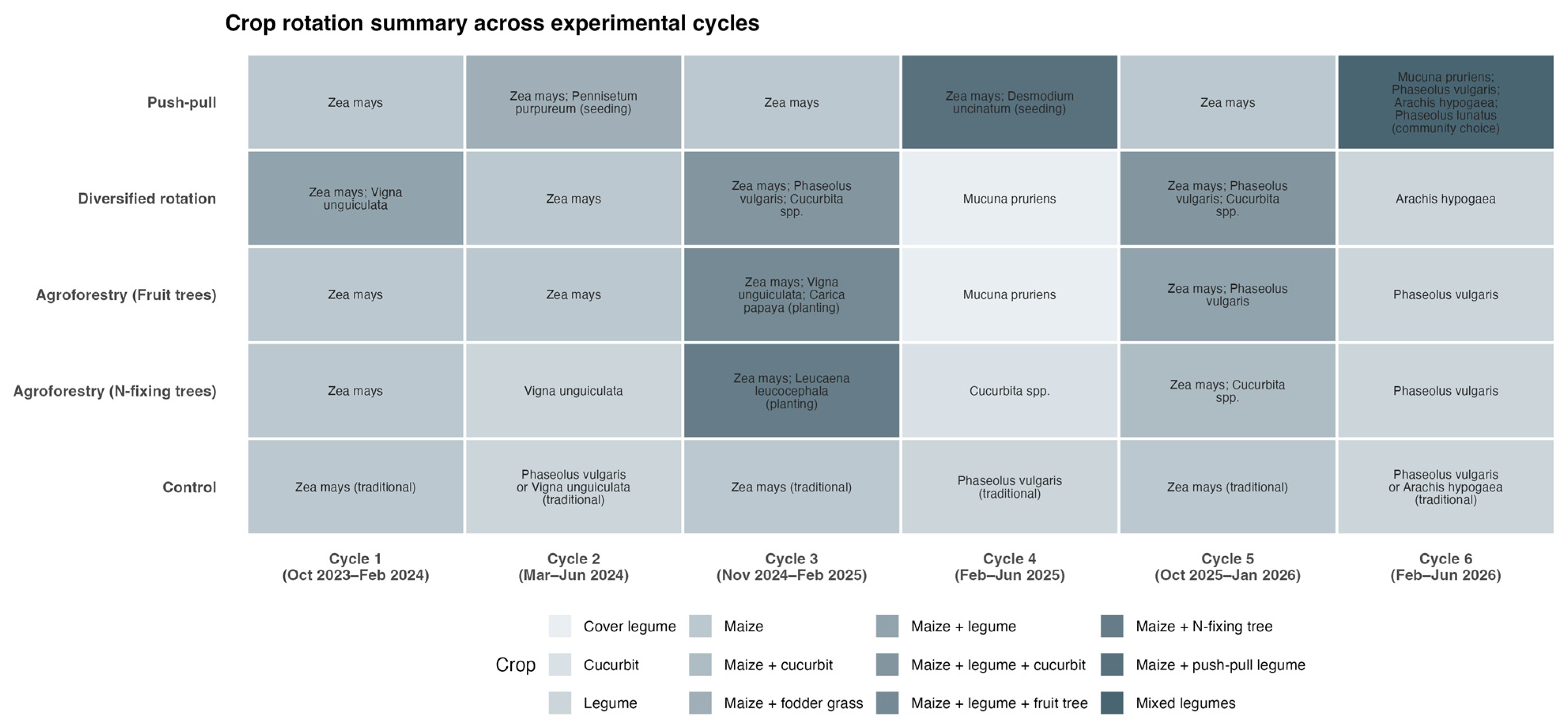
Table 1 provides a detailed description of the innovations studied for each experimental field. The experimental design focused on the main food crops cultivated in the region and was aligned with Angola’s rain-fed agricultural calendar. Each field was configured using a Latin square design, with 27 plots, providing nine replicates for each treatment. Plots were randomised in the sequence AW-AE-PL-AE-PL-AW-PL-AW-AE to prevent treatment repetition along rows and replicate repetition along columns, thereby controlling for row and column variability in addition to the treatment effect. Fields were managed over six agricultural seasons between 2023 and 2026. Details of the agricultural seasons and the crops grown are presented in Figure 2 and Table S1.
Table 1.
Innovation technologies tested in each experimental field.
Figure 2.
Sowing calendar per each agricultural seasons and agroecology practice.
Two deviations from the original design occurred during the trial. First, after the third agricultural season, the number of plots was reduced from 27 to nine, due to challenges faced by the community in managing key agronomic practices, such as fertilisation, weeding, and pest management. This reduction was implemented by retaining a single complete 3 × 3 Latin square per experimental field, comprising the three treatments (AW, AE, PL) with three replications arranged in columns, thereby preserving the Latin square structure and balanced treatment representation. Second, experimental activities at the Tinguita field were discontinued in December 2024 at the explicit request of the farming community and were relocated to the neighbouring community of Muika.
2.3. Local Agroclimatic Context
Agroclimatic parameters were characterised to provide context for field conditions across the experimental sites.
2.3.1. Climatic Data and Irrigation
Monthly precipitation data for each province were obtained from the ERA5 Agrometeorological Indicators (ERA5-Land reanalysis, Copernicus Climate Change Service, Perugia, Italy), covering the four years of the project (see Table S2). All experimental plots were strictly rain-fed, with no supplementary irrigation applied, relying exclusively on local seasonal rainfall patterns.
2.3.2. Crops and Planting Density
Maize (Zea mays L.) and bean (Phaseolus spp. or Vigna unguiculata) were sown using local open-pollinated varieties commonly cultivated by smallholders in each community. Two sowing density criteria were implemented: an experimental spacing of 80 × 30 cm with three seeds per hole, and a local traditional spacing of 7–10 seeds per hole with variable spacing along and between rows. For bean, sowing density followed the maize spacing when grown in diversified rotation. When cultivated as the main crop, bean was sown at a density of 50 × 25 cm. Detailed seasonal crop rotation schemes and specific varieties are reported in Table S1 (Supplementary Materials).
2.3.3. Soil Texture and Topography
Soil texture across the experimental sites ranged from sandy loam to sandy clay loam, loamy sand and sandy clay, with clay texture recorded in only one community, as illustrated in Figure S1 (Supplementary Materials). Plots were established on flat to gently sloping arable land selected by local farming communities to represent typical agricultural fields.
2.4. Scientific Indicators and Data Collection
The validity of the technological innovations examined in this study was evaluated using a series of scientific indicators, established during the experimental design phase and a pre-defined data collection plan.
2.4.1. Soil Indicators
Soil samples were obtained using the spade test [22] on an annual basis, with three samples collected per plot. The samples collected were taken to the laboratory, where a homogeneous sample was prepared for each plot and sent to the laboratory for analysis of the following physico-chemical parameters: (a) pH; (b) total organic carbon; (c) organic matter (OM); (d) P2O5; (d) K2O; (e) Ca; (f) Mg; (g) Na; (h) soil texture; (j) cation exchange capacity; and (k) soil acidity.
Soil penetrance resistance data were collected using a Fieldscout SC900 soil compaction meter (Ecosearch S.r.l., Perugia, Italy). Four measurement points were selected within each plot, with four measurements recorded at each point (N/S/E/W). Penetrometry measurement sessions (0–80 cm) were conducted once per agricultural season.
Soil moisture was measured using a Fieldscout TDR 150 soil moisture meter (Ecosearch S.r.l., Perugia, Italy). The data were collected through the process of sampling the plots, with measurements being taken on alternate plots. Eight to ten soil moisture observations were collected at random within each plot. Soil moisture measurements were conducted monthly, except during the dry season months (June–August), when the dry surface crust precludes instrument insertion.
2.4.2. Crop Pests
The presence of Spodoptera frugiperda on Zea mays was monitored during the period between flowering and ear maturation for each maize production cycle. Data were collected weekly by randomly selecting sampling points within each plot, with the procedure repeated three times per plot. At each sampling point, a 2-metre section of the selected maize row was examined, assessing approximately seven maize plants per section. Ears were inspected by carefully parting the husk leaves to check for the presence of S. frugiperda larvae. The number of larvae detected on each cob was recorded.
2.4.3. Earthworm Abundance
Earthworm presence was assessed by collecting three soil samples per plot using a spade. Each sample consisted of a soil block of approximately 30 × 30 × 30 cm from which all the earthworms were manually collected and counted [23]. Sampling was carried out once during each agricultural season.
2.4.4. Weeds
Weed abundance and species composition were assessed once during each agricultural season. Sampling was conducted by placing a 50 × 50 cm quadrat at three randomly selected locations within each plot. All the weeds within each quadrat were collected and identified at the species level, using botanical apps and local knowledge. The collected samples were classified and counted by species, subsequently dried in an oven at 60 °C, and then weighed to determine biomass.
2.4.5. Yield Total and Dry Weight per Sample
Crop yield was measured at each harvest. Two types of data were collected: (i) dry weight per sample, and (ii) total yield.
Samples were collected from three random points within each plot by harvesting all the fruit from plants along a two-metre linear segment. Fresh weight was recorded first, after which samples were oven-dried at 60° C. Cob length and grain number were also recorded. The same method was used for beans, except that pods were not measured. The total yield for each crop was calculated by weighing the entire harvest (fresh weight only) from each plot.
2.4.6. Monitoring Protocol
The baseline monitoring protocol encompassed growing Seasons 1 to 6 across all parameters, but realised coverage differed by indicator. Volumetric water content (VWC%) was monitored throughout all project phases (Seasons 1 to 6), while soil physico-chemical analyses were performed annually (Seasons 1, 3, and 5). Dry weight of the samples was recorded in all seasons, though not in all experimental fields or for all crops per season (e.g., bean sampling was not executed in the field, thus restricting the indicator to the maize crop). Remaining indicators followed variable sampling schedules due to operational constraints at the field level. Total fresh weight (kg) was monitored across seasons but not in all experimental fields (agricultural Season 2 yielded no harvestable dataset). Penetrometry measurements (kPa) were confined to Seasons 1 to 3, and Spodoptera frugiperda larvae counts were recorded during the cob maturation period of Season 3. Although the incorporation of weed dynamics and earthworm population counts were included as secondary metrics in the initial protocol, these did not result in standardised time-series datasets. Analysis was therefore restricted to soil moisture and maize dry weight per sample, the two indicators with sufficient longitudinal continuity.
2.5. Statistical Analysis and Data Treatment
Statistical analyses focused on two indicators: soil moisture and maize dry weight per sample. Models were fitted independently for each experimental field to account for site-specific baseline environmental conditions. Although plot size varied between fields, it was constant within each field; since treatment comparisons were made only within fields, plot size was not included as a covariate. This per-community strategy was adopted deliberately rather than fitting a single model with a community × treatment interaction. The objective of this participatory research was to evaluate the site-specific efficacy and local adaptability of each agroecological and water-harvesting practice within its own community context, rather than to compare outcomes across communities whose treatment composition differed.
2.5.1. Soil Moisture
The analysis of soil moisture was conducted using a single pooled weighted linear mixed-effects model. In this model, treatment and community (each one corresponding to one experimental field), as well as their interaction, were considered as fixed effects. In the field, eight spatially randomised subsamples were collected per plot during each sampling occasion in order to account for micro-spatial variability across the experimental area. In the subsequent analysis, measurements were aggregated at the primary treatment level (AW, AE, PL), thereby obviating spatial pseudo-replication. In order to accommodate variations in sample size and the reduction in plots over time, observations were weighted inversely to the number of available measurements per group (weights = 1/n obs), thereby ensuring balanced precision across treatments throughout the study. As soil moisture measurements were collected on disparate specific dates across communities, a monthly progressive index was created to group sampling dates into common temporal categories at a monthly resolution. This index was included as a random intercept in the mixed-effects model, allowing the model to account for seasonal and inter-annual variability not explained by the fixed effects, thereby isolating treatment effects and enabling robust comparisons across treatments. The estimation of marginal means (emmeans) was extracted for treatment contrasts within each community using emmeans (~TRT|COMMUNITY), and Tukey’s HSD adjustment was employed to perform pairwise comparisons, thereby identifying significant differences in soil moisture among treatments and communities.
2.5.2. Maize Dry Weight
The dry weight of maize sample was analysed for each experimental plot replicate (TRTx.1, TRTx.2, TRTx.3) of each treatment (PL, AE, AW) within each experimental field. In each replicate, three spatial subsamples (REP 1, REP 2, and REP 3) were collected. Each subsample consisted of linear segments of maize rows 2 metres in length, enabling the capture of variability within the plot. Linear models (LM) were fitted separately for each community in order to evaluate the effect of treatment (TRT), taking into account harvesting date (DATE), plot replicates and spatial subsampling within them. Missing observations (NA) were removed prior to model fitting. The estimation of marginal means (emmeans) was calculated for each treatment level, and Tukey’s HSD adjustment was employed for multiple comparisons. For the dry weight per sample analysis, the sampling dates were organised into specific periods (e.g., DATE13 and DATE23), beginning with the harvest from the first growing season (February 2024 = DATE 0). The categorical DATE variable, together with the treatment variable (TRT), was included as a fixed effect in linear models fitted separately for each community. The specific dates included in each categorical DATE level varied slightly between communities due to differences in sampling schedules. Consequently, DATE coefficients cannot be compared directly across communities and should only be interpreted as the relative effects of sampling early versus late within each community-specific model.
2.5.3. Model Diagnostics and Software
All analyses were performed using the R statistical software version 4.5.2 [24] and the following packages: lme4 [25] for linear mixed-effects modelling, lmerTest [26] for significance testing via Satterthwaite’s degree-of-freedom approximation, car [27] for Levene’s test of homogeneity of variance, and emmeans [28] for estimation of marginal means and pairwise comparisons. Prior to the final statistical analysis, a formal assessment of the model assumptions was conducted for both linear models (LMs) and linear mixed-effects models (LMMs). Although the Shapiro–Wilk test indicated significant deviations from normality in the residuals (p < 0.05), LMMs were retained as the appropriate analytical framework due to their intrinsic ability to model hierarchical clustering and repeated measurements over time. Homogeneity of variance across treatments was confirmed using Levene’s test (p > 0.05). The normality and homoscedasticity of the model residuals were then subjected to further visual assessment through diagnostic plots (fitted values versus residuals and normal Q–Q plots) to ensure no extreme pattern violated model estimation. These models have been shown to be robust to moderate deviations from normality in large weighted datasets (w = 1/n_obs), while ensuring that the homoscedastic variance structure observed across experimental groups is appropriately accounted for. The separate models were fitted independently for each community, rather than a single model with a community x treatment interaction term. This analytical approach was deliberately adopted because the primary objective of this participatory research was to evaluate the site-specific efficacy and local adaptability of each agroecological and water-harvesting practice within a community context, rather than to compare outcomes across communities with different management approaches.
3. Results
This section presents results for two quantitative indicators: maize dry weight per sample and soil moisture values. Although a broader set of indicators was monitored (see Section 2.3 for details), several parameters experienced logistical constraints, resulting in irregular sampling timelines across growing seasons and experimental fields. The statistical rigour of the analysis of results is ensured through a data selection protocol, which excludes indicators with incomplete datasets from the modelling conducted. The data presented for the maize dry weight per sample indicator refer to the experimental fields with two sets of recorded yield observations. Growing seasons were standardised.
Yield analysis was limited to experimental fields with at least two complete harvest seasons, to maintain statistical balance and model reliability. Across the monitored network, some communities experienced seasonal crop failures or unharvestable yields due to localised adverse climatic events such as those in Muika, Tchisselehã, and Dala Mbir. This resulted in maize dry weight being documented for a single growing season. Consequently, these data were excluded from the formal modelling. Table 2 provides a comprehensive overview of the harvest seasons available for each community and their inclusion status in the final statistical analysis.
Table 2.
Harvest seasons available for each community and inclusion status in the statistical analysis.
3.1. Maize Dry Weight per Sample
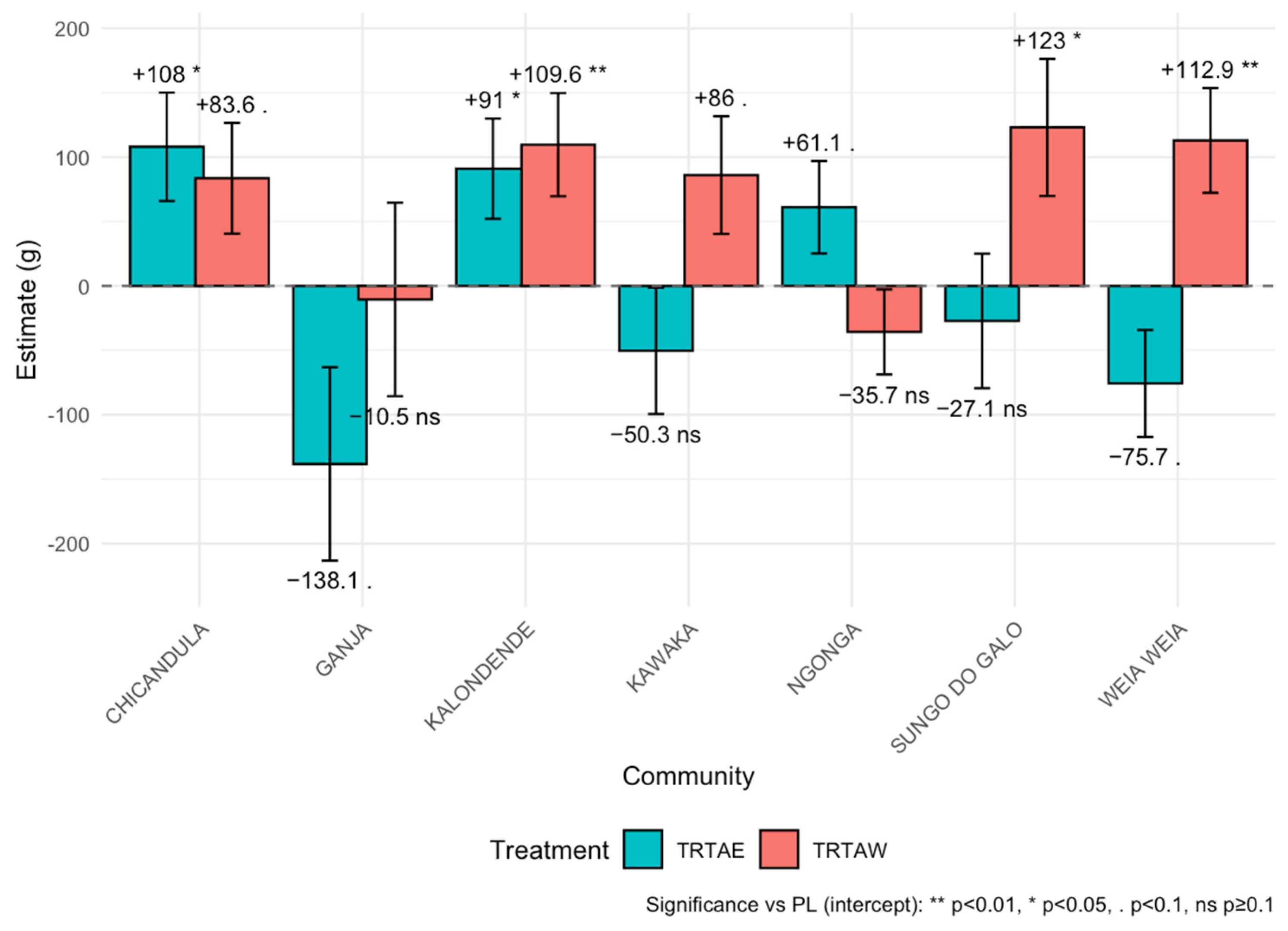
The overall trend in the effects of agroecological practices, and of agroecological practices combined with water-harvesting techniques, on maize dry weight per sample varied across the experimental fields. The agroecological practices treatment (AE) produced a positive effect on maize dry weight in three of the seven communities analysed: a significant increase in Chicandula (+108 g, SE 42.1, p = 0.01), a significant increase in Kalondende (+91 g, p = 0.02), and a non-significant trend in Ngonga (+61 g). In contrast, in the remaining four communities—Ganja, Weia Weia, Sungo do Galo, and Kawaca—AE showed negative deviations relative to the control treatment (PL). Contrary to initial expectations, these negative effects approached marginal significance in Ganja (p = 0.06) and Weia Weia (p = 0.07).
Agroecological practices combined with water-harvesting techniques treatment (AW) show a more favourable trend, with positive effects on maize dry weight in five of the seven communities. Significant increases were observed in Kalondende (+109.6 g, p < 0.01) and Weia Weia (+112.9 g, p < 0.01). Analysis of multi-seasonal dynamics indicated favourable trends in dry weight increase for four communities. Significant multi-season weight increases were observed in Sungo do Galo (+271.5 g, p < 0.001), Kalondende (+257.7 g, p < 0.001), and Kawaca (+331 g, p < 0.001). In contrast, Weia Weia, Ngonga and Ganja exhibited progressive seasonal declines over time. A comprehensive synthesis of community-specific outcomes is presented in Table 3.
Table 3.
Treatment effects (AE and AW relative to PL) and multi-season temporal trends in maize dry weight per sample across the seven experimental fields.
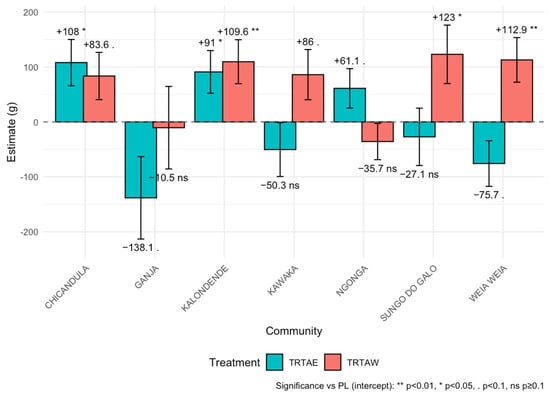
The results of the general linear model analysis applied to each experimental field are shown in Table 4 and Figure 3.
Table 4.
Expected dry weight (in grams) of samples collected for maize production during the first three harvest seasons.
Figure 3.
Linear model coefficients for dry weight per sample expressed as estimated deviations (in grams) relative to the control (PL), with 95% confidence intervals.
The coefficients indicate the effects on the maize dry weight per samples (in grams) across treatments and the interaction with growing seasons (DATE coefficient) for each treatment. These estimates represent differences in maize dry weight per sample. The results of post hoc analysis using Tukey’s HSD are shown in Figure 4.
Figure 4.
Estimated marginal means (EMMs) of maize dry weight derived from the post hoc analysis. Different letters above bars indicate statistically significant differences (p < 0.05) among treatments within each community, based on Tukey’s HSD post hoc test. Letters above bars indicate estimated marginal means ranked in descending order (a = highest); bars sharing the same letter do not differ significantly.
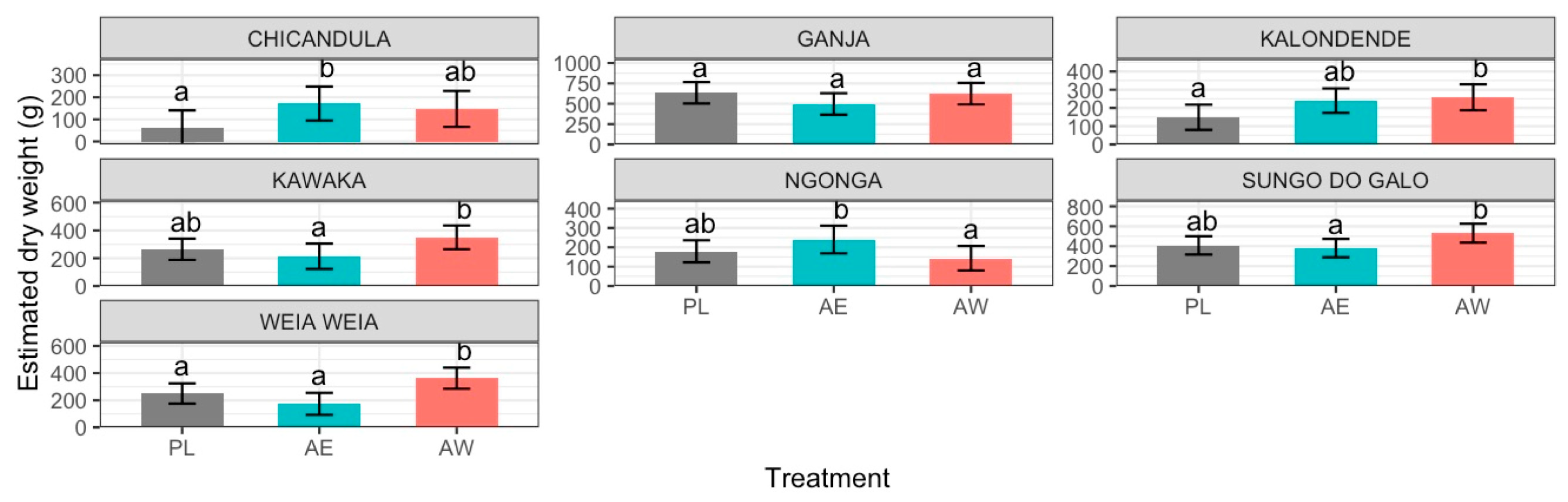
In the Chicandula experimental field, the AE treatment resulted in a significant increase of 108 g per sample compared to the control PL treatment (p = 0.015). The AW treatment observed an increase of 83.59 g in dry weight, indicating a non-significant marginal trend (p = 0.06). A thorough analysis of samples collected across the seasons showed no significant differences in maize dry weight, despite an average increase of 14.93 g.
In the Ganja experimental field, maize dry weight per sample was higher under the control treatment (PL), with AE measuring −138.14 g per sampled cob and AW measuring −10.52 g per sampled cob. Pairwise comparisons of estimated marginal means indicated that the AW treatment yielded a higher maize dry weight per sample (+127.63 g) compared to the AE treatment, although this difference was not statistically significant (p > 0.05). The difference in maize dry weight between the two seasons analysed (DATE 0 and DATE13) was −212.38 g in the second season.
The Kalondende experimental field recorded a highly significant result for the AW treatment, with a yield of +109.63 g of maize per sample. The AE treatment also observed a significant increase (+91 g, p = 0.024). A progressive improvement in weight yield was recorded over two agricultural seasons, with an average increase of +257.72 g in the subsequent agricultural season (DATE23).
At the Kawaca field, the AE treatment resulted in a reduction of 50.33 g of maize per sample compared to the PL treatment. The AW treatment showed a marginally higher dry weight per sample, though this was not statistically significant. The comparison of marginal means between AE and AW was significant, with −136.38 g in favour of AW (p = 0.025).
The Ngonga experimental field exhibited a downward trend in dry weight per sample across agricultural seasons, ranging from −121.96 g (DATE13, p < 0.001) to −140.84 g (DATE24, p < 0.001). While the individual effects of AE (+61.10 g) and AW (−35.70 g) treatments demonstrate no significant differences in dry weight, a comparison of the estimated marginal means for AE and AW reveals a significant difference (p = 0.03), with AE showing a dry matter yield 96.80 g higher than AW.
In the Sungo do Galo experimental field, the AW treatment resulted in a substantial increase in maize dry weight per sample (+123.02 g). Across growing seasons, a highly significant positive trend was observed (p < 0.01), with a maize dry weight per sample of +271.50 g.
At the Weia Weia experimental field, the AW treatment showed a highly significant increase in maize dry weight per sample (+112.91 g, p < 0.01). The AE treatment showed a non-significant trend, with a reduction in maize dry weight per sample of −75.70 g (p = 0.071).
Across growing seasons, there were highly significant losses in maize dry weight per sample (p < 0.01). Comparison of estimated marginal means showed a statistically significant reduction in maize dry weight for the PL treatment compared to AW (−112.91 g, p < 0.05), while the reduction for the AE treatment compared to AW was highly significant (−188.62 g, p < 0.01).
3.2. Soil Moisture
The analysis of soil moisture (VWC%) was performed through the application of a linear mixed-effects model with treatment (TRT), community (COMMUNITY) and their interaction as fixed effects, based on observations collected between April 2024 and December 2025. Although the experimental network consistently operated across 10 core fields, this dataset includes 11 communities to account for historical observations from the initial site before its operational replacement.
The effects of agroecological practices and agroecological practices combined with water-harvesting techniques on soil moisture (VWC%) varied across the experimental fields analysed.
For agroecological practices alone (AE), both highly significant and statistically significant effects were observed across three communities: Ngonga (+1.75 pp, p < 0.001), Tchisselehã (+2.09 pp, p < 0.001) and Dala Mbir (+1.20 pp, p < 0.05), with a marginally significant effect in Sungo do Galo (+0.85 pp, p = 0.05). Four communities—Chicandula (+0.24 pp), Muika (0.03 pp), Weia Weia (+0.42 pp) and Kawaca (+0.50 pp)—exhibited non-significant positive deviations from the control treatment (PL). Conversely, Tinguita, Kalondende and Ganja showed no positive effects of AE on soil moisture. Tinguita (−3.63 pp, p < 0.001) and Kalondende (−0.87 pp, p = 0.02) recorded highly significant and statistically significant decreases in AE relative to PL, respectively.
Agroecological practices combined with water-harvesting techniques (AW) demonstrated a balanced trend. Positive effects on soil moisture were observed in three communities (Ngonga, p < 0.05; Kawaca, p < 0.05; and Tchisselehã, p < 0.001) while non-significant positive trends were observed in Dala Mbir and Sungo do Galo. Conversely, five communities (Chicandula, Muika, Kalondende, Ganja and Tinguita) showed no positive effects of AW treatment on soil moisture. Notably, contrary to initial expectations, Chicandula (p < 0.001), Tinguita (p < 0.001) and Kalondende (p < 0.001) recorded highly significant increase in PL relative to AW. Overall, a direct comparison between AW and AE indicates slightly more positive effects of AE on soil moisture in seven of the eleven communities analysed. Community-specific results are summarised in Table 5 and detailed below.
Table 5.
Treatments effects on soil moisture content (VWC%), measured across the monitored seasons and experimental communities.
Figure 5 illustrates the outcomes of treatment interactions for each experimental plot, as demonstrated by a comparison of the estimated marginal means of soil moisture (VWC%) for each treatment (Table 6).
Table 6.
Estimated marginal means of soil moisture value by treatment per experimental field, derived from the linear mixed-effects model (LMM).
Figure 5.
Percentage of soil moisture (VWC%) compared between treatments on estimated marginals means calculated by linear mixed-effects model. The values indicate how much each treatment deviates from the PL intercept.
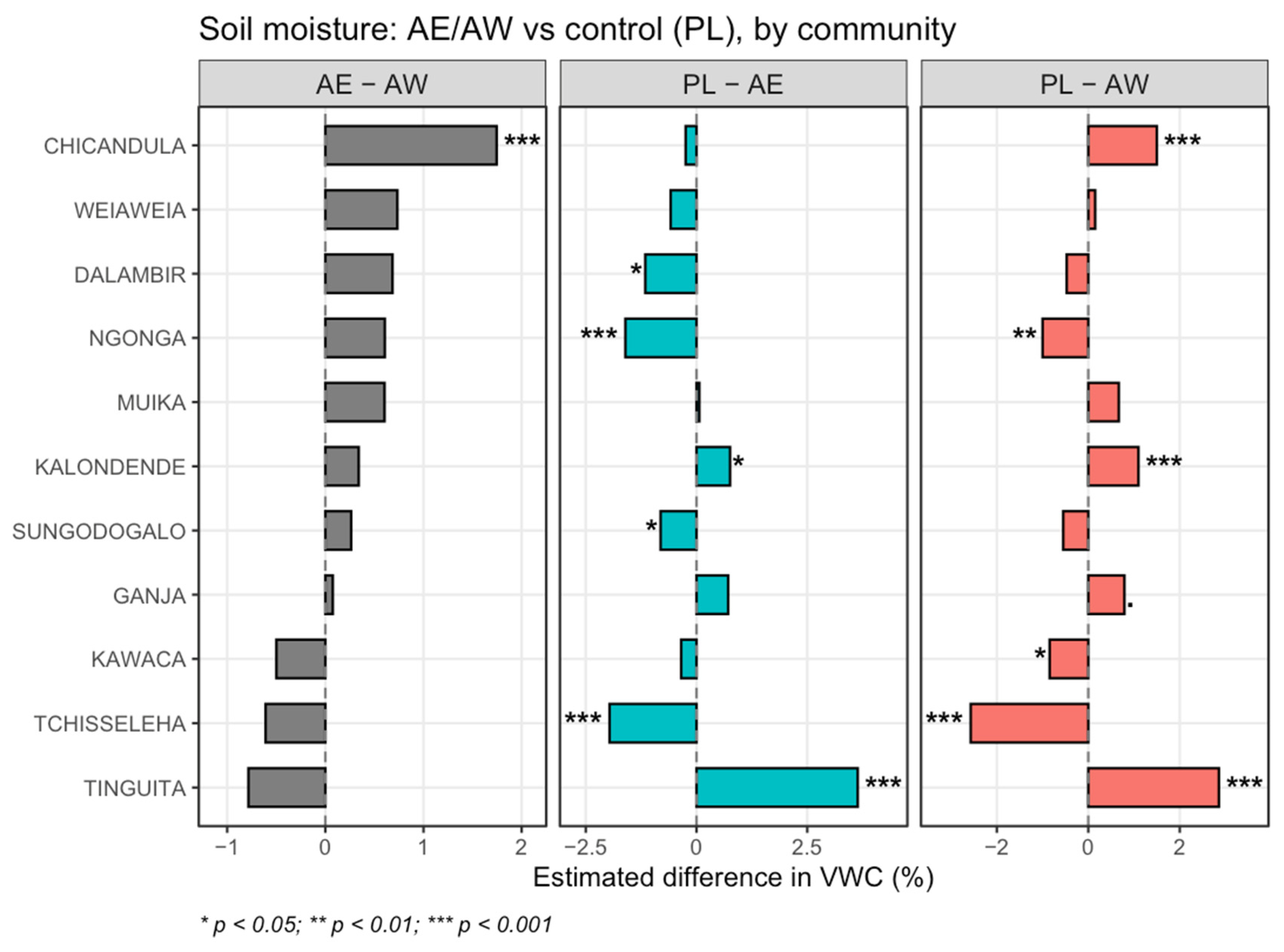
Results by province are presented below. In the Cuanza Sul province, soil moisture analyses revealed variation depending on the experimental plots.
The AE treatment in the Ngonga field showed highly significant effect, resulting in a 1.75% increase in soil moisture compared to PL (p < 0.001) over the period under consideration. The AW treatment showed a 0.92% increase (p < 0.05). Comparison between AE and AW treatments indicate that AE increased soil moisture by 0.82%. In the Dala Mbir field, the AE treatment showed a significant upward trend in soil moisture of 1.20% compared to PL (p < 0.05), while the AW treatment showed a 0.42% increase relative to PL. The AE treatment increased soil moisture by 0.77% compared to AW treatment. In the Kawaca field, the AW treatment recorded a significant increase in soil moisture of 0.97% (p < 0.05), while the AE treatment showed a non-significant change of 0.50%. The effects of the AE (+0.86%) and AW (+0.55%) treatments at the Sungo do Galo field showed non-significant increases in soil moisture. No changes in soil moisture were observed in Ganja in response to the experimental treatments, while Weia Weia showed a slight increase of 0.42% for the AE treatment.
In the Benguela province, soil moisture data revealed varying effects across experimental fields. In Tinguita, the AW treatment exhibited positive effect over time, with a 0.79% increase compared to AE. Conversely, comparison between PL and AE showed a 3.64% increase in soil moisture in favour of PL (p < 0.001) and a 2.8% increase in favour of PL compared to AW (p < 0.001); both results were highly statistically significant. In Tchisselehã, AE resulted in a 2.09% increase in soil moisture compared to PL (p < 0.001), while AW showed a 2.71% increase (p < 0.001). A comparison of AE with AW indicated a 0.62% increase in soil moisture for AW.
In the Kalondende field, the PL treatment resulted in increased soil moisture, with a highly significant increase of 1.07% compared to AW (p < 0.001) and a statistically significant increase of 0.87% compared to AE (p < 0.05). In the Chicandula field, soil moisture (VWC%) was statistically significant higher under the PL compared to AW (+1.50%; p < 0.001). The AE treatment improved soil moisture by 1.75% (p < 0.001) compared to AW. At Muika field, AE treatment increased soil moisture by 0.88% compared to AW, while PL treatment increased it by 0.85% relative to AW. Comparison between PL and AE showed a 0.03% increase in soil moisture in favour of PL.
4. Discussion
To evaluate the empirical performance of ecological innovations, this study focused on two core indicators: maize dry weight per sample and soil moisture (VWC%). The remaining indicators defined in the research protocol (weeds, earthworm count, soil penetration resistance, soil analysis data and total productivity) did not yield a dataset complete enough for robust statistical modelling and will be addressed in a subsequent study.
Two characteristics of the dataset influence the subsequent interpretation. First, maize productivity, as measured by using dry weight per sample, was analysed for only seven of the eleven monitored locations. The four excluded fields (Muika, Tinguita, Tchisselehã and Dala Mbir) provided data for a single growing season only, which limits the capacity to accurately evaluate the impact of treatments over time.
Interpretation of field performance requires a clear distinction between statistically significant results (p < 0.05) and exploratory trends. Statistically significant increases in dry weight were observed at specific experimental sites such as Kalondende and Weia Weia under AW. In contrast, other fields have shown increasing trends that remain descriptive and non-significant. These trends establish a benchmark for assessing the agrosystem’s potential capacity to enhance its resilience to climate change. However, they also highlight the critical role of the local context in determining the effectiveness of different agroecological practices and water-harvesting techniques.
4.1. Effects of Agroecological Practices on Maize Productivity and Soil Moisture Dynamics
The findings of this study indicate a consistent trend in the capacity of agroecological practices to influence Angolan agroecosystems and enhance their resilience to climate change. The adoption of three agroecological practices—agroforestry, diversified crop rotation, and the push–pull system—was associated with increased maize dry weight per sampled unit in several communities. However, rigorous statistical interpretation showed that these trends did not reach the threshold for statistical significance required to confirm robust treatment effects. Rather, they represent plausible directional trends towards improved soil processes, such as surface mulching, weed suppression via push–pull, and biological nitrogen fixation through agroforestry and diversified rotation, which are likely to influence maize productivity over time [29,30]. Enhanced soil nutrient availability, resulting from the accumulation of organic matter due to these agroecological practices adopted, further suggests a gradual trajectory towards improved crop yields [6].
Regarding the effects of these practices on soil moisture, the results suggest potential for modifying soil conditions to improve water retention capacity for crops. In Ngonga and Sungo do Galo communities, the agroforestry component of the AE treatment was linked to improved soil moisture values, attributed to surface mulching with pruning residues. This practice is known to affect soil physico-chemical properties including structure, water retention, nitrogen content, and organic carbon [31]. In Dala Mbir, mulching by Desmodium uncinatum within the push–pull system contributed to reducing evapotranspiration and maintaining soil moisture at levels favourable for crop development, consistent with findings reported by [32]. The establishment of Pennisetum purpureum perpendicular to surface runoff further enhanced water infiltration into the soil profile.
Although the observed effects on soil moisture in AE plots of Chicandula, Kawaca, and Weia Weia were not statistically significant, they indicate an emerging impact on soil structure and organic matter content, leading to improved water retention capacity. These trends suggest that the agroecological practices adopted are progressively enhancing the biophysical conditions of the soil, with direct implications for the long-term resilience of the agrosystem to climatic variability [29].
4.2. Effects of Combined Agroecological Practices and Water-Harvesting Techniques on Maize Productivity and Soil Moisture Dynamics
The agrosystems in the studied communities exhibited markedly different response capacities when agroecological practices were combined with water-harvesting techniques, as reflected in both maize dry weight per sample and soil moisture content.
The integration of these two categories of innovation demonstrated key potential to improve crop productivity, as evidenced by their combined influence on maize yield, consistent with findings reported by Nyagumbo [33] and Ndayisaba [32]. Enhanced soil nutrient availability, resulting from organic matter inputs attributable to the agroecological practices adopted [6], further contributed to observed yield improvements. However, productivity increases were not consistent across agricultural seasons, partly due to drought events occurring during the study period that affected the agronomic management of the experimental fields. Despite this variability, the observed yield increases suggest that integrating agroecological practices and water-harvesting techniques progressively improved water availability for maize plants, positively affecting soil structure, nutrient mineralisation, and root development, ultimately exerting a direct influence on crop production [6,34].
Regarding soil moisture, the results reflect the geographical and geomorphological variability of the experimental sites. In the Tchisselehã, Ngonga, and Kawaca communities, the AW treatment indicates that water-harvesting techniques improve soil moisture content, thereby supporting agricultural production and plant resilience to climatic stresses, consistent with Ndlovu [35]. Positive trends in soil moisture were also identified in the Sungo do Galo and Dala Mbir fields, suggesting the potential for improved water availability under the AW treatment. However, these trends require further statistical validation through site-specific studies before definitive conclusions can be made.
The heterogeneity of results across communities suggests that the combined integration of both technologies (AW) holds potential to enhance water infiltration and soil water retention, underscoring the importance of promoting and scaling up both categories of techniques within regional agrosystems [36]. However, this study does not allow for direct comparison of the water retention capacity of individual water-harvesting techniques across experimental fields due to confounding parameters such as slope gradient, soil texture and structure, and the agronomic management of adjacent plots, which require further investigation.
The implementation of the terrace bund with ditch microcatchment technique combined with diversified crop rotation was associated with improved soil moisture in the Tchisselehã field. Conversely, the AW treatment in the Kalondende field did not yield comparable results to the control (PL). The effectiveness of the combined agroecological practices and water-harvesting techniques in enhancing infiltration and soil water retention is influenced by field position, plot-level agronomic management, and local microclimatic conditions. This is evidenced by the difference in mean soil moisture values between the two sites, with AW plots in Tchisselehã recording approximately 17% lower volumetric water content than those in Kalondende, highlighting the influence of site-specific factors on treatment responses. However, the current analysis evaluates the impact of the treatment using a combination of two technologies relative to traditional farming practices alone. The incremental contribution of water-harvesting techniques can be better identified through further research involving data collection over multiple growing seasons, which would enable valid comparisons between AE and AW treatments and isolate the specific effects of water harvesting on maize dry weight and soil moisture content.
While previous studies in Southeast Africa have documented the effects of water-harvesting techniques and agroecological practices in homogeneous local agrosystems (e.g., Nyagumbo, [33], Kugedera, [6], Mkiza, [7]), this study’s contribution lies in evaluating these interventions across heterogeneous community agrosystems. By examining the impact of combining these innovations in diverse smallholder farming scenarios in Angola, the study contributes to the existing literature by demonstrating how local agrosystem diversity, including geomorphology, farmers’ agronomic capabilities, and soil structure, can influence expected outcomes. These findings underscore the need for realistic benchmarks and context-specific planning.
4.3. Generalisability and Limitations
The results contribute to an understanding of how the proposed innovations interact with local agroecosystems and generate incremental changes with the potential to enhance their resilience to climate change. Further investigation through longitudinal data modelling across multiple growing seasons remains necessary to verify whether the adoption of these innovations exhibits a discernible temporal trend and to more precisely quantify their effect on maize dry weight. The present study documents a reduction in maize dry weight per sample between seasons in several communities, a pattern the authors attribute to changes in precipitation regimes, including drought cycles, dry spells, and a progressive shortening of the rainy season.
The absence of complete datasets for several indicators limits the interpretability of the impact of the proposed innovations. The inability to access full datasets for each community and across growing seasons for these parameters constrains the comparative analysis of treatments and reduces opportunities for cross-community comparison, particularly in cases where the same innovations are tested under differing geomorphological conditions.
A significant limitation arose from modifications to the experimental design, which reduced the number of replicates relative to the original structure. This affected the variability in the number of observations between the initial and subsequent phases of the research, with consequent implications for the statistical models used in the analysis. This unequal sampling structure was partially addressed through the inclusion of a random intercept for sampling date in the mixed-effects model and through the weighting of observations by the number of underlying measurements; however, residual imbalances may have affected the precision of community-specific estimates. In certain cases, plot modifications or replacements introduced discontinuities in the longitudinal dataset, limiting the comparability of results across growing seasons for the affected communities. Future studies should prioritise standardised replication at the design level to improve the precision of treatment effect estimates. The participatory nature of the research led to replacement effects in the experimental fields, which were partially mitigated through participatory site selection and the involvement of a territorially adjacent community. However, the socio-productive differences and geomorphological characteristics between the two communities inevitably constrain the comparability of results across agricultural seasons.
However, the geomorphological heterogeneity of the experimental fields introduces additional complexity in the interpretation of results. In certain cases, the control treatment (PL) yielded higher maize dry weight per sample than the experimental treatments, an outcome that may be attributable to the influence of field slope on water availability through soil capillarity or the lateral translocation of nutrients applied in the AE and AW treatments: it is a hypothesis that could not be tested in the present study due to the absence of systematic slope measurements, and which is therefore proposed as a priority for future investigation. In some instances, it is hypothesised that reduced evapotranspiration associated with the proximity of agricultural plots to trees on community-owned land may have constituted an additional confounding factor; systematic measurement of tree cover and canopy characteristics would be required to test this hypothesis.
The diverse environmental conditions across experimental fields and the heterogeneity of existing smallholder farming contexts resulted in substantial variability across study sites. This environmental heterogeneity constituted an uncontrollable source of variation and contributed to high variability in maize dry weight per sample and soil moisture outcomes, limiting the capacity to isolate treatment effects from local contextual factors. Future research should incorporate standardised characterisation of production context parameters—including smallholder farming conditions and geomorphological attributes—to improve the interpretability of treatment effects across different agrosystems.
These questions remain open for investigation in subsequent studies and are corroborated by the results from the Chicandula, Kalondende, and Tinguita fields, where the PL treatment recorded significantly higher soil moisture values than the AW treatment. In the specific case of the Tinguita PL plots, it remains an untested hypothesis whether irrigation practices conducted by farmers on adjacent lands may have influenced the soil moisture data, reinforcing the well-documented observation that agronomic management decisions and farm-level factors can introduce systematic deviations from adopted experimental protocols [37].
The implementation of an experimental design within smallholder farming systems in Angola revealed the presence of interfering agronomic management factors arising from agricultural practices on lands adjacent to the experimental plots. Specifically, irrigation activities conducted by the Tinguita community on neighbouring plots and differential surface runoff dynamics in Chicandula and Kalondende may have systematically influenced soil moisture measurements in the control (PL) plots, independently of the treatments applied. This category of confounding is a recognised limitation in comparable research contexts [37] and cannot be fully controlled without altering the ecological reality of the local agroecosystem.
In the Chicandula and Kalondende fields, local geomorphological characteristics and soil compaction—as identified by Tamer [38]—may have conditioned surface runoff dynamics, differentially affecting infiltration rates between PL and AW plots.
The inability to access agroclimatic parameters—including local precipitation records and temperature data—due to institutional constraints precluded the inclusion of climatic covariates in the statistical models, limiting the capacity to interpret treatment effects in relation to the specific climatic conditions of each agricultural area. As a result, temporal variability is captured solely through the sequential structure of observations, restricting the possibility of analysing treatment effects as a function of climatic influences. Given the occurrence of delayed rainy season onset, dry spells, drought events, and irregular rainfall distribution during the study period, the integration of climatic covariates in future modelling efforts would substantially enhance the capacity to isolate treatment effects from background environmental variability [21].
A comparison of soil moisture between the AE and AW treatments reveals that a significant proportion of the experimental fields recorded higher volumetric water content in plots under exclusively agroecological management. These results give rise to a series of hypotheses regarding the extent to which the position of AE plots relative to AW plots may have influenced observed soil moisture values. Contrary to the initial assumptions of the study, these findings suggest several methodological considerations relevant to the design of similar experiments. Specifically, parameters such as the presence of micro-topographic gradients, impermeable subsurface layers, and the position of individual plots within the experimental design relative to the geomorphological variability of the field may have contributed to the soil moisture improvements observed in AE plots—improvements that were initially attributed to the implementation of water-harvesting techniques. These factors warrant explicit consideration in the design of future field trials.
While acknowledging these limitations, the study generates a body of findings that addresses the challenges of building climate-resilient agrosystems in the arid and semi-arid environments of Sub-Saharan Africa. The evidence gathered provides an empirical foundation for future research on the integration of agroecological innovations and water-harvesting techniques within smallholder farming systems in Angola and comparable agrosystems across Sub-Saharan Africa. The heterogeneity of the findings reflects the diverse reality of smallholder farming in Angola and, rather than undermining the validity of the study, highlights the importance of context-specific scientific enquiry when evaluating the scalability and transferability of agroecological transitions.
5. Conclusions
In a family farming agrosystem in Angola, the integration of technological innovations—encompassing a combination of agroecological practices and water-harvesting techniques—demonstrates localised potential to enhance soil moisture content (VWC%) and maize dry weight per sample under adverse climatic conditions. In alignment with the primary objective of this study—to evaluate pathways for increasing productivity and improving soil moisture—the empirical evidence highlights context-specific performance across the community site.
In this context, the data collected by the different communities, both statistically robust and exploratory descriptive trends, indicate increased yields per maize sample and positive variations in soil moisture content due to the combination of innovations or agroecological practices alone. Rather than exhibiting uniform regional efficacy, the findings indicate that agrosystem variability influences the ability of both intervention models to drive changes in the agronomic context. The implementation of agroecological practices, either alone or alongside water-harvesting techniques, has been associated with localised improvements in maize productivity. These improvements are consistent with expected contributions from enhanced soil structure and organic matter content—attributable to the agroecological component—and potentially from increased soil water availability where water-harvesting techniques were additionally applied, though the relative contribution of each component cannot be fully isolated without direct AE versus AW comparison. Although the empirical indicators analysed do not indicate a universally optimal technology, the preliminary evidence highlights specific innovations or combinations of innovations with promising potential for Angolan agriculture. Across the 11 communities and their agricultural systems, statistically significant effects (p < 0.05) were observed on maize dry yield and soil moisture in five communities for the treatment involving the implementation of agroecological practices alone, whilst in two other communities, statistically significant (p < 0.05) negative responses were observed in relation to soil moisture. The integration of agroecological practices and water-harvesting techniques produced statistically significant positive effects in three communities for maize dry weight (p < 0.05) and in two communities for soil moisture (p < 0.05). In contrast, three other communities demonstrated statistically significant negative effects on soil moisture (p < 0.05). These findings provide a foundation for local agricultural extension services to support other smallholder farming communities, tailoring practice selection to site-specific contexts. Among the innovations tested, the push–pull technique showed exploratory benefits for maize dry weight, associated with weed control and reduced surface evapotranspiration under Desmodium uncinatum cover in specific locations. Similarly, the agroforestry system showed context-dependent potential to preserve soil moisture through canopy management and pruning residue mulching. Regarding integrated technological innovations, the inclusion of terrace bunds with ditch microcatchments appeared to have site-specific effectiveness in enhancing soil moisture content while offering technical characteristics that facilitate local dissemination among farmers. These findings open an avenue for further research aimed at isolating the specific contribution of water-harvesting techniques.
Nevertheless, these preliminary indicators suggest the potential for long-term enhancement of structural production factors, such as soil and water availability, benefitting local food production. This study constitutes the initial phase in developing a deeper understanding of how these innovations operate within the Angolan smallholder farming context. Three priorities are identified for subsequent work: (i) continuous soil water monitoring at multiple depths with measurement standardised relative to rainfall events, so that water availability can be related to crop demand rather than sampled at a point in time; (ii) systematic characterisation of slope, soil texture and adjacent-plot management, so that site conditions mediating treatment response can be identified rather than inferred; and (iii) integration of field-level climatic covariates with evaluated treatment effects against drought cycles and dry spells. Of the two indicators examined, maize dry weight per sample provides a clearer reflection of the impact of innovations, while soil moisture offers essential information for assessing structural changes in soil dynamics and the Angolan agrosystem.
Supplementary Materials
The following supporting information can be downloaded at: https://www.mdpi.com/article/10.3390/agriculture16202234/s1, Table S1: Summary of agricultural season led per each experimental field (named by community’s name). Table S2: Average monthly rainfall dataset per Department, elaborated by ERA5 Agrometereological indicators. Figure S1: Distribution of soil texture classes across the ten experimental communities. Each slice represents a soil texture category (Sandy loam, Sandy clay loam, Loamy sand, Sandy clay), with community names related. Table S3: Estimated marginal means of maize dry weight per sample by treatment per each experimental field, derived from the Linear Model.
Author Contributions
F.A.: Conceptualisation, formal analysis, visualisation, validation, writing—original draft. E.C.: Visualisation, validation, writing—original draft. M.S.: Conceptualization, methodology. F.O.: Writing—review and editing. F.P.: Conceptualization, writing—review and editing. A.T.P.d.C.: Investigation. F.N.: Investigation. A.N.: Investigation. P.F.C.: Investigation. S.D.J.A.: Investigation. G.C.P.: Supervision. E.B.: Supervision, funding acquisition. All authors have read and agreed to the published version of the manuscript.
Funding
This publication has been produced within the framework of the RE-FARM project (Research on agroecological innovations for increasing resilience to climate change in Cuanza Sul and Benguela), financed by the European Union under the DeSIRA initiative (FOOD/2021/429-168) and implemented by Università degli Studi di Firenze (UNIFI), in partnership with COSPE and Centro Nacional de Investigação Científica (CNIC).
Data Availability Statement
The data presented in this study are available on request from the corresponding author. The data are not publicly available due to the lack of a public repository for this dataset.
Conflicts of Interest
The authors declare no conflicto of interest.
References
- Lekarkar, K.; Nkwasa, A.; Villani, L.; van Griensven, A. Localizing agricultural impacts of 21st century climate pathways in data scarce catchments: A case study of the Nyando catchment, Kenya. Agric. Water Manag. 2024, 294, 108696. [Google Scholar] [CrossRef] [Scilit]
- Aramburu-Merlos, F.; Tenorio, F.A.M.; Mashingaidze, N.; Sananka, A.; Aston, S.; Ojeda, J.J.; Grassini, P. Adopting yield-improving practices to meet maize demand in Sub-Saharan Africa without cropland expansion. Nat. Commun. 2024, 15, 4492. [Google Scholar] [CrossRef] [Scilit] [PubMed]
- Mwenge Kahinda, J.; Rockström, J.; Taigbenu, A.E.; Dimes, J. Rainwater harvesting to enhance water productivity of rainfed agriculture in the semi-arid Zimbabwe. Phys. Chem. Earth Parts A/B/C 2007, 32, 1068–1073. [Google Scholar] [CrossRef] [Scilit]
- Sachet, E.; Mertz, O.; Le Coq, J.-F.; Cruz-Garcia, G.S.; Francesconi, W.; Bonin, M.; Quintero, M. Agroecological transitions: A systematic review of research approaches and prospects for participatory action methods. Front. Sustain. Food Syst. 2021, 5, 709401. [Google Scholar] [CrossRef] [Scilit]
- Magrini, M.B.; Martin, G.; Magne, M.; Duru, M.; Couix, N.; Hazard, L.; Plumecocq, G. Agroecological transition from farms to territorialised agri-food systems: Issues and drivers. In Agroecological Transitions: From Theory to Practice in Local Participatory Design; Bergez, J.-E., Audouin, E., Therond, O., Eds.; Springer: Berlin/Heidelberg, Germany, 2019; pp. 69–98. [Google Scholar] [CrossRef] [Scilit]
- Kugedera, A.T.; Kokerai, L.K. Effects of infield rainwater harvesting methods and organic manure in improving soil chemical properties and maize production in low rainfall area of Zimbabwe. Cogent Food Agric. 2025, 11, 2450088. [Google Scholar] [CrossRef] [Scilit]
- Mkiza, M.; Mucheru-Muna, M.; Nyawira, S.; Mutambu, D.; Mwangi, O.; Bolo, P.; Kinyua, M.; Kihara, J. Farming practices and their effect on soil moisture and penetration resistance: Impact on maize yields in rainfed agriculture. Agrosyst. Geosci. Environ. 2026, 9, e70334. [Google Scholar] [CrossRef] [Scilit]
- Vasco Silva, J.; Baudron, F.; Ngoma, H.; Nyagumbo, I.; Simutowe, E.; Kalala, K.; Habeenzu, M.; Mphatso, M.; Thierfelder, C. Narrowing maize yield gaps across smallholder farming systems in Zambia: What interventions, where, and for whom? Agron. Sustain. Dev. 2023, 43, 26. [Google Scholar] [CrossRef] [Scilit]
- Alemu, M.; Berihun, D.; Lokossou, J.C.; Yismaw, B. Productivity and efficiency heterogeneity among maize smallholder farmers in Ethiopia. Cogent Food Agric. 2024, 10, 2300191. [Google Scholar] [CrossRef] [Scilit]
- Xu, H.; Hu, J.; Luo, G.; Wang, Y.; Zhang, Y.; Rong, X.; Peng, J.; Liao, C. Intercropping-driven maize yield gain depending on regional environments, planting conditions, and production managements: A global-scale evidence. Eur. J. Agron. 2025, 168, 127622. [Google Scholar] [CrossRef] [Scilit]
- Nyamayevu, D.; Nyagumbo, I.; Chipindu, L.; Li, R.; Liang, W. Crop diversification and reduced tillage for improved grain and nutritional yields in rain-fed maize-based cropping systems of semi-arid Malawi. Exp. Agric. 2025, 61, e1. [Google Scholar] [CrossRef] [Scilit]
- Dusingizimana, P.; Devkota, K.P.; Cherif, M.; Nduwumuremyi, A. Conservation agriculture for closing maize yield gap and enhancing climate resilience in semi-arid Eastern Rwanda. Farming Syst. 2025, 3, 100151. [Google Scholar] [CrossRef] [Scilit]
- Anschütz, J.; Kome, A.; Nederlof, M.; de Neef, R.; van de Ven, T. Water Harvesting and Soil Moisture Retention (Agrodok 13); Agromisa Foundation: Wageningen, The Netherlands, 2005; Available online: https://hdl.handle.net/10568/73081 (accessed on 11 May 2023).
- Piemontese, L.; Castelli, G.; Limones, N.; Grazio, A.; Bresci, E. Large-scale siting of sand dams: A participatory approach and application in Angolan drylands. Land Degrad. Dev. 2023, 34, 844–858. [Google Scholar] [CrossRef] [Scilit]
- Bergez, J.-E.; Audouin, E.; Therond, O. (Eds.) Agroecological Transitions: From Theory to Practice in Local Participatory Design; Springer International Publishing: Berlin/Heidelberg, Germany, 2019. [Google Scholar] [CrossRef] [Scilit]
- Magne, M.-A.; Martin, G.; Moraine, M.; Ryschawy, J.; Thenard, V.; Triboulet, P.; Choisis, J.-P. An integrated approach to livestock farming systems’ autonomy to design and manage agroecological transition at the farm and territorial levels. In Agroecological Transitions: From Theory to Practice in Local Participatory Design; Bergez, J.-E., Audouin, E., Therond, O., Eds.; Springer: Berlin/Heidelberg, Germany, 2019; pp. 45–68. [Google Scholar] [CrossRef] [Scilit]
- Pacheco, A. Harvesting rainwater: An adaptation strategy for peace and the climate crisis. In International Rainwater Catchment Systems Experiences; IWA Publishing: London, UK, 2020; pp. 83–94. [Google Scholar] [CrossRef] [Scilit] [PubMed]
- World Bank Group. Angola—Köppen-Geiger Climate Classification. Climate Change Knowledge Portal. Available online: https://climateknowledgeportal.worldbank.org/country/angola (accessed on 15 June 2026).
- Kamutali, A.; Henriques, P.D.; Lucas, M.R.; Marta-Costa, A. Family farming systems of Angola: Definition, analysis and refinement. In Agribusiness Innovation and Contextual Evolution, Volume I; Galati, A., Fiore, M., Thrassou, A., Vrontis, D., Eds.; Palgrave Macmillan: London, UK, 2024; pp. 23–48. [Google Scholar] [CrossRef] [Scilit]
- Vereist, L.; Kenefick, E. Angola: Comprehensive Food Security and Vulnerability Analysis (CFSVA); United Nations World Food Programme: Rome, Italy, 2005. [Google Scholar]
- Correia, C.D.N.; Fonseca, A.; Amraoui, M.; Pereira, C.A.; Santos, J.A. Long-term climate trends in Southern Angola and possible implications in agriculture. Climate 2025, 13, 173. [Google Scholar] [CrossRef] [Scilit]
- Pantani, O.-L.; Ferretti, L.; Santoni, M.; Massenzio, S.; D’Acqui, L.P.; Pacini, G.C. Assessment of the impact of conventional and organic agroecosystems management options and conservation tillage on soil fertility at the Montepaldi Long Term Experiment, Tuscany. Eur. J. Agron. 2022, 140, 126575. [Google Scholar] [CrossRef] [Scilit]
- Ball, B.C.; Guimarães, R.M.L.; Cloy, J.M.; Hargreaves, P.R.; Shepherd, T.G.; McKenzie, B.M. Visual soil evaluation: A summary of some applications and potential developments for agriculture. Soil Tillage Res. 2017, 173, 114–124. [Google Scholar] [CrossRef] [Scilit]
- R Core Team. R: A Language and Environment for Statistical Computing; R Foundation for Statistical Computing: Vienna, Austria, 2025. [Google Scholar]
- Bates, D.; Mächler, M.; Bolker, B.; Walker, S. Fitting linear mixed-effects models using lme4. J. Stat. Softw. 2015, 67, 1–48. [Google Scholar]
- Kuznetsova, A.; Brockhoff, P.B.; Christensen, R.H.B. LmerTest package: Tests in linear mixed effects models. J. Stat. Softw. 2017, 82, 1–26. [Google Scholar] [CrossRef] [Scilit]
- Fox, J.; Weisberg, S. An R Companion to Applied Regression, 3rd ed.; Sage: Thousand Oaks, CA, USA, 2019. [Google Scholar]
- Lenth, R.V. Emmeans: Estimated Marginal Means, Aka Least-Squares Means; R Package; R Foundation for Statistical Computing: Vienna, Austria, 2021. [Google Scholar]
- Buleti, S.I.; Kuyah, S.; Olagoke, A.; Gichua, M.; Were, S.; Chidawanyika, F.; Martin, E.A. Farmers’ perceived pathways for further intensification of push-pull systems in Western Kenya. Front. Sustain. Food Syst. 2023, 7, 1191038. [Google Scholar] [CrossRef] [Scilit]
- Njiru, L.; Yegon, J.; Mwithiga, G.; Micheni, A.; Gitari, N.; Mairura, F. Restoring soil nutrient stocks using local inputs, tillage and sorghum-green gram intercropping strategies for drylands in Eastern Kenya. Heliyon 2023, 9, e20926. [Google Scholar] [CrossRef] [Scilit] [PubMed]
- Kugedera, A.T.; Mandumbu, R.; Nyamadzawo, G. Compatibility of Leucaena leucocephala biomass and cattle manure combination under rainwater harvesting on sorghum (Sorghum bicolor (L.) Moench) productivity in semi-arid region of Zimbabwe. J. Plant Nutr. 2023, 46, 1580–1600. [Google Scholar] [CrossRef] [Scilit]
- Ndayisaba, P.C.; Kuyah, S.; Midega, C.A.O.; Mwangi, P.N.; Khan, Z.R. Push-pull technology improves maize grain yield and total aboveground biomass in maize-based systems in Western Kenya. Field Crops Res. 2020, 256, 107911. [Google Scholar] [CrossRef] [Scilit]
- Nyagumbo, I.; Nyamadzawo, G.; Madembo, C. Effects of three in-field water harvesting technologies on soil water content and maize yields in a semi-arid region of Zimbabwe. Agric. Water Manag. 2019, 216, 206–213. [Google Scholar] [CrossRef] [Scilit]
- Murungu, F.S.; Chiduza, C.; Muchaonyerwa, P.; Mnkeni, P.N.S. Mulch effects on soil moisture and nitrogen, weed growth and irrigated maize productivity in a warm-temperate climate of South Africa. Soil Tillage Res. 2011, 112, 58–65. [Google Scholar] [CrossRef] [Scilit]
- Ndlovu, S.; Mathe, B.; Phiri, K.; Nyathi, D. Factoring water harvesting into climate change adaptation: Endogenous responses by smallholder farmers in Gwanda district, Zimbabwe. Cogent Soc. Sci. 2020, 6, 1784652. [Google Scholar] [CrossRef] [Scilit]
- Tefera, M.L.; Seddaiu, G.; Carletti, A. Traditional in situ water harvesting practices and agricultural sustainability in Sub-Saharan Africa—A meta-analysis. Sustainability 2024, 16, 6427. [Google Scholar] [CrossRef] [Scilit]
- Eldon, J.; Baird, G.; Sidibeh, S.; Dobasin, D.; Rapaport, P.; Cheng, W.; Shennan, C. On-farm trials identify adaptive management options for rainfed agriculture in West Africa. Agric. Syst. 2020, 182, 102819. [Google Scholar] [CrossRef] [Scilit]
- Tamer, M.; Adego, E.; Abiyu, A. Understanding rainfall runoff dynamics across various land uses and landscape positions in North Western Ethiopia. Sci. Rep. 2025, 15, 15287. [Google Scholar] [CrossRef] [Scilit] [PubMed]

Disclaimer/Publisher’s Note: The statements, opinions and data contained in all publications are solely those of the individual author(s) and contributor(s) and not of MDPI and/or the editor(s). MDPI and/or the editor(s) disclaim responsibility for any injury to people or property resulting from any ideas, methods, instructions or products referred to in the content. |
© 2026 by the authors. Licensee MDPI, Basel, Switzerland. This article is an open access article distributed under the terms and conditions of the Creative Commons Attribution (CC BY) license.