


Abstract
The management of spent mushroom substrate (SMS) from the cultivation of the button mushroom Agaricus bisporus poses a significant environmental challenge in Poland. This study analyzed the effect of applying SMS on the phosphorus and calcium content in Festulolium braunii plants, their uptake and use efficiency, as well as the increase in the concentration of these elements in the soil. Treatments involving no fertilization and mineral fertilization with NPK alone were compared with treatments where SMS was applied at rates of 3, 4.5, and 6 Mg ha−1 D.M. in combination with NPK mineral fertilization. The following experimental treatments were established: 0 (control), NPK, NPK + SMS1, NPK + SMS2, and NPK + SMS3. All SMS application rates resulted in a 24–29% increase in plant P content and a 35–48% increase in P uptake compared to NPK fertilization alone. SMS application did not affect plant Ca content compared to NPK; however, increased Ca uptake was observed at rates of 4.5 and 6 Mg ha−1, and the 6.0 Mg ha−1 rate improved the Ca:P ratio. The combined application of SMS and NPK in all analyzed treatments significantly increased the phosphorus use efficiency index compared to NPK fertilization alone. The highest values for P and Ca utilization were recorded with the application of SMS at a rate of 4.5 Mg ha−1. Furthermore, increasing the share of SMS in the fertilizer combination significantly increased the P (by 50–200%) and Ca (by 167–400%) content in the soil after two years of the study.
1. Introduction
Global edible white mushroom (Agaricus bisporus) production is estimated to grow by 5.8% in the years 2025–2034 (CAGR, Compound Annual Growth Rate), reaching a value of >US $74 billion [1]. Much spent mushroom substrate (SMS) is produced with disposal problems [2,3]. The European Green Deal strategy promotes the use of waste from the agri-food industry as a fertilizer to close energy and matter cycles of agricultural ecosystems [4,5,6]. Poland is the largest mushroom producer in Europe and the third largest in the world, with an annual production of 350–375 thousand tons of mushrooms, but has operational and legal challenges in the disposal of 1.5 to 1.8 million Mg of SMS [7,8,9]. Each kilogram of harvested mushrooms generates about 5 kg of SMS [10], which is rich in organic matter [11,12,13,14,15,16] and in macronutrients, including P and Ca [12,17,18,19,20,21,22], and micronutrients [12,23]. Its heavy metal content is lower than the limits for land application [24]. Its low C:N ratio and near-neutral pH make it an excellent natural soil conditioner and a source of nutrients for plants [25,26]. The P in SMS originates mainly from organic components and mineral additives used during the substrate preparation stage. Velusami et al. [27] and Jankowski et al. [28] reported that a ton of SMS fresh matter contains, on average, 2.5 to 4.5 kg of P and 15 to 30 kg of Ca, with the latter originating from peat as CaCO3 or gypsum, with the CaCO3 neutralizing SMS pH [29]. Agronomically efficient land application of SMS avoids eutrophication [30]. Festulolium is the test crop in this research. It was developed by hybridization of Festuca pratensis and Lolium multiflorum [31,32,33], giving a forage crop that has high and good quality yield like Lolium multiflorum [34,35] and resistance to stressful environmental conditions like Festuca pratensis [33,36,37,38]. It has a deep and extensive root system, efficiently utilizing soil resources.
The most recent research on Festulolium braunii is dominated by the influence of mineral fertilization [39], slurry, and biological preparations [40,41,42] on the yield and nutritional value of this species. However, there is a clear deficit of research assessing the effectiveness of using mushroom substrate in the cultivation of this grass [43]. Research on the effect of SMS applications on the P and Ca balance of forage grass crops is justified to fill major information gaps. Multi-cutting Festulolium has high P and Ca uptake and removal in harvests. Application of P and Ca is often needed to prevent deficiencies and imbalances. Better information is needed on SMS application rates in relation to NPK fertilizers to optimize P and Ca management while reducing the risk of its negative effects on the natural environment.
The aim of the research was to assess the effect of the combined use of mushroom substrate and mineral fertilizers (NPK) on the P and Ca concentration, uptake and use efficiency by Festulolium braunii, and their accumulation in the soil.
At the beginning, the following research hypotheses were adopted:
- •
- Integrated organic–mineral fertilization (SMS+NPK) compared to mineral fertilization alone (NPK) increases the concentration, uptake, and utilization of P and Ca by Festulolium braunii biomass as well as increases their accumulation in the soil;
- •
- Increasing the proportion of SMS in the fertilizer combination increases the concentration, uptake, and utilization efficiency of P and Ca in the grass biomass, and increases their accumulation in the soil.
2. Materials and Methods
2.1. Field Experiment
The two-year experiment was conducted in 2017 and 2018 at the University of Siedlce in eastern Poland (52°10′ N, 22°17′ E, 155 m a.s.l.) on loamy sand soil [44] belonging to the order of anthropogenic soils, of the cultured-earth type and of the hortisol subtype [45]. The physicochemical properties of the soil are presented in Table 1.
Table 1.
Selected physicochemical properties of the soil.
Measured in KCl 1 M L−1, soil pH of 6.7 was mildly acidic. The C:N ratio was around 10:1, and the soil content of available P (170.0 mg kg−1 DM) and Mg (84.0 mg kg−1 DM) was high, while the content of K (114.0 mg kg−1 DM) was moderate.
The plot size was 6 m2. The experiment had five treatments and three replications in a completely randomized design. The SMS was obtained from a modern, large-scale mushroom farm with a 15 cm substrate layer and a 5 cm casing layer. Cereal straw and chicken manure were used for the substrate, and peat moss and gypsum for the casing layer. The SMS water content was 70%. The SMS contained (g kg−1, D.M.) 8.53 P, 20 Ca, 355 C, and 25.1 N. The C:N ratio was 14:1 and was measured in KCl 1 M L−1. The pH was 6.8. The source of calcium in the substrate was gypsum, which explains the lack of effect on soil pH after its application. The following research plots were created: 0—control; NPK; NPK + SMS1; NPK + SMS2; NPK + SMS3 (Table 2). The SMS was applied in the autumn of 2016 at 0, 3, 4.5 and 6 Mg ha−1 D.M. The doses were established on the basis of organic N application limits specified in the Nitrates Directive [3]. Mineral fertilizers were applied each year. P was applied at 60 kg ha−1 each spring as Ca(H2PO4)2, i.e., triple superphosphate (TSP), which contained 200 g kg−1 P and 150 g kg−1 Ca. (Table 1). N was applied as ammonium nitrate [NH4NO3] at 180, 105, 68, and 30 kg N ha−1 on treatments: NPK, SMS1, SMS2, and SMS3, respectively. K was applied as potassium sulfate [K2SO4] at a dose of 150 kg K ha−1. The annual N and K applications were in three equal parts throughout the spring and summer.
Table 2.
Total amounts of P, Ca, N, and K (kg ha−1) introduced into the soil from mineral fertilizers and SMS.
Festulolium cv. Sulino was sown in autumn of 2016 at 35 kg ha−1. Data were collected during two full production years (2017–2018). Soil inputs of P, Ca, N, and K from SMS and TSP are presented in Table 2.
2.2. Meteorological Conditions
Data on weather conditions (Table 3) were obtained from the Hydrological and Meteorological Station in Siedlce (Institute of Meteorology and Water Management, National Research Institute in Warsaw).
Table 3.
Monthly rainfall (mm) and mean monthly air temperatures (°C).
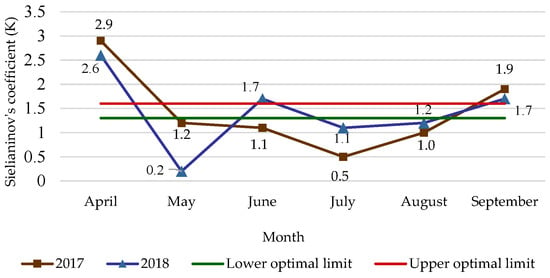
To assess the effect of temporal variability of weather conditions on plant growth and development, Sielianinov’s hydrothermal coefficient (Figure 1) was calculated [46]. Its values are based on total monthly rainfall (P) and the monthly sum of daily mean air temperatures (Σt), calculated using the formula K = P/0.1Σt [47].
Figure 1.
Sielianinov’s hydrothermal coefficient (K).
Values are rated as K ≤ 0.4 extremely dry (ed), 0.4 < K ≤ 0.7 severely dry (sd), 0.7 < K ≤ 1.0 dry (d), 1.0 < K ≤ 1.3 moderately dry (md), 1.3 < K ≤ 1.6 optimal (o), 1.6 < K ≤ 2.0 moderately wet (mw), 2.0 < K ≤ 2.5 wet (w), 2.5 < K ≤ 3.0 severely wet (sw), K > 3.0 extremely wet (ew).
2.3. Sample Preparation, Laboratory Measurements, and Calculations
Over the two-year experiment, grass was harvested three times per growing period. Collected biomass samples (0.5 kg) were air-dried, oven-dried at 105 °C, and ground into homogeneous samples for chemical analysis.
Baseline topsoil samples (0–25 cm) were collected prior to the experiment, air-dried, and passed through a 2 mm sieve for physicochemical profiling. Similarly, spent mushroom substrate (SMS) samples were dried at 105 °C to a constant weight and ground in an agate mill.
In samples of plant material, soil, and organic material (SMS), the following were determined:
- •
- Total P concentration (Pc), by the vanadium-molybdenum colorimetric method using the GENESYS 10 UV spectrophotometer (Thermo Scientific, Waltham, MA, USA) after mineralization of samples in a mixture of nitric and perchloric acids, i.e., HNO3 and HClO4, in 1:1 proportion (Avantor, Gdańsk, Poland) on the VELP Scientifica mineralizer (VELP, Usmate, Italy);
- •
- Total Ca concentration (Cac), after mineralization of samples with a mixture of nitric and perchloric acids, i.e., HNO3 and HClO4, in 1:1 proportions (Avantor, Gdańsk, Poland) on the VELP Scientifica mineralizer (VELP, Usmate, Italy), by atomic absorption spectrometry (ASA) using the Thermo Scientific spectrometer (Thermo Scientific, Waltham, MA, USA) with Merck standards.
The following were also determined in soil and SMS samples:
- •
- pH in KCl 1 M L−1 (Stanlab, Lublin, Poland), by the potentiometric method [48] using the FiveEasy Plus FP20 apparatus (Mettler Toledo, Warsaw, Poland);
- •
- Total C concentration (Cc), with the CHNS/O 2400 Series II elemental analyzer (PerkinElmer Inc., Norwalk, CT, USA);
- •
- Total N concentration (Nc), by the Kjeldahl method, after mineralization in concentrated sulfuric acid (Avantor, Gdańsk, Poland) with the Gerhardt mineralizer (Gerhardt, Königswinter, Germany), distillation on the VELP Scientifica UDK 149 apparatus (Velp, Usmate, Italy), and titration using the TITRONIC Basic burette (Brand, Wertheim, Germany) [49].
The following were additionally determined in soil samples:
- •
- The concentration of available forms of P and K, by the Egner–Riehm method, using a Ca lactate solution with a concentration of 0.0275 M L−1 (Avantor, Gdańsk, Poland) as extractant, with measurements taken by atomic absorption spectrometry (ASA) using the Varian Spectra AA220 spectrometer (Markham, ON, Canada) with Merck standards [48];
- •
- Available Mg concentration in a 0.025 M L−1 CaCl2 solution (Avantor, Gdańsk, Poland), using the Schachtschabel method and measurements taken by atomic absorption spectrometry (AAS), using the Varian Spectra AA20 spectrometer (Markham, ON, Canada) with Merck standards [48].
Using the data on grass yield (Y) from the publication by Wiśniewska-Kadżajan and Malinowska [50] and the results of determinations of phosphorus and calcium content obtained in this work, calculations were carried out according to the following formulas:
Ca:P ratio in grass:
where
Ca:P = Cac/Pc,
Cac—concentration of Ca in grass (g kg−1 DM);
Pc—concentration of P in grass (g kg−1 DM).
Uptake of P by grass (Pup):
where
Pup = Y · Pc (kg P ha−1),
Pup—uptake of P by grass yield (kg P ha−1);
Y—grass dry matter yield (Mg ha−1) [45];
Pc—concentration of P in grass dry matter (g kg−1 DM).
Use efficiency of P introduced to the soil, in relation to the control plot (PUE):
where
PUE = (Pup_P − Pup_P0)/Pd × 100% (%),
Pup _P—uptake of P by grass fertilized with P (kg P ha−1);
Pup_P0—uptake of P by grass on the control plot (kg P ha−1);
Pd—total amount of P applied to the soil with SMS and NPK (kg P ha−1).
Uptake of Ca by grass (Caup):
where
Caup = Y · Cac (kg Ca ha−1),
Caup—uptake of Ca by grass yield (kg ha−1);
Y—grass dry matter yield (Mg ha−1) [45];
Cac—concentration of Ca in grass dry matter (g kg−1 DM).
Use efficiency of Ca introduced to the soil in relation to the control plot (CaUE):
where
CaUE = (Caup_Ca − Caup _Ca0)/Cad × 100% (%),
Caup_Ca—uptake of Ca by grass fertilized with Ca (kg Ca ha−1);
Caup_Ca0—uptake of Ca by grass on the control plot (kg Ca ha−1);
Cad—total amount of Ca applied to the soil with SMS and NPK (kg Ca ha−1).
Increase in soil P content relative to the control treatment (0) ∆SPC (Soil Phosphorus Content Change):
where
∆SPC = SPCtreatment − SPCcontrol
∆SPC—change (increase) in soil P content due to fertilization (g kg−1);
SPCtreatment—mean soil P content in the fertilized treatment (g kg−1);
SPCcontrol—mean soil P content in the control treatment (g kg−1).
Increase in soil Ca content relative to the control treatment ∆SCaC (Soil Calcium Content Change):
where
∆SCaC = SCaCtreatment − SCaCcontrol
∆SCaC—change (increase) in soil Ca content due to fertilization (g kg−1);
SCaCtreatment—mean soil Ca content in the fertilized treatment (g kg−1);
SCaCcontrol—mean soil Ca content in the control treatment (g kg−1).
The experiment involved three variables: fertilizer treatment (5 levels), years (2 growing periods), and harvest cuts (3 per year). Data relating to the plant concentration and uptake of P and Ca and the Ca:P ratio were statistically processed using three-factor analysis of variance. A two-factor analysis of variance was used to evaluate total uptake (sum of cuts) (Pup and Caup) and utilization efficiency (PUE and CaUE) of P and Ca over the two-year study period, while a one-factor analysis was conducted for P and Ca concentration (∆SPC, ∆SCaC) in the soil after the experiment concluded. Statistical analysis of the results was performed with MS Excel. The significance of the effect of experimental factors on parameters was verified using the Fisher–Snedecor test. Tukey’s test was used to determine the least significant difference (LSD0.05) and to assess differences between means. Since no statistically significant interactions between the experimental factors were detected (p > 0.05), the main effects were presented and evaluated independently using Tukey’s test (LSD0.05). Correlations between selected parameters were assessed by linear correlation analysis (p = 0.05) using Statistica 13.1.336.0 PL (StatSoft Inc., Tulsa, OK, USA).
3. Results
Mineral and organic treatments significantly influenced the value of the tested parameters in the cultivated grass (Table 4).
Table 4.
Content (g kg−1) and uptake (kg ha−1) of P and Ca (mean values ± SD) by Festulolium braunii and the Ca:P ratio, depending on the fertilizer treatments.
Applying NPK alone or combined with spent mushroom substrate (SMS) significantly increased P content in Festulolium. Compared to NPK alone, combining NPK with SMS increased P content by 29% at the highest dose (SMS3), 27% at the lowest dose (SMS1), and 24% at the medium dose (SMS2). While the NPK + SMS combinations outperformed NPK alone, the differences between the three individual SMS doses were not statistically significant. Both NPK alone and all NPK + SMS combinations significantly increased Ca content compared to the control. However, adding SMS to the NPK did not yield a statistically significant difference compared to using NPK alone. Treatments significantly influenced the Ca:P ratio, with the highest ratio observed in the control plot. All variants of mineral (NPK) and mineral–organic (NPK + SMS) fertilizers reduced this ratio. The lowest ratio was found in the NPK-only treatment, which was 19% lower than the control. Adding SMS (SMS1, SMS2, SMS3) increased the ratio by 8%, 12%, and 16%, respectively, compared to NPK alone, though these increases were not statistically significant.
Nutrient uptake by Festulolium was significantly influenced by the treatments. Mineral–organic treatments (NPK + SMS) significantly increased P uptake compared to both the control and NPK-only treatments. The medium dose SMS (NPK + SMS2) produced the highest increase, yielding 48% more uptake than NPK alone. No statistically significant differences were found between the different SMS doses. NPK alone significantly increased Ca uptake compared to the control. Furthermore, combining NPK with the medium (SMS2) and highest (SMS3) doses of SMS significantly boosted Ca uptake by 22% and 18%, respectively, compared to using NPK alone.
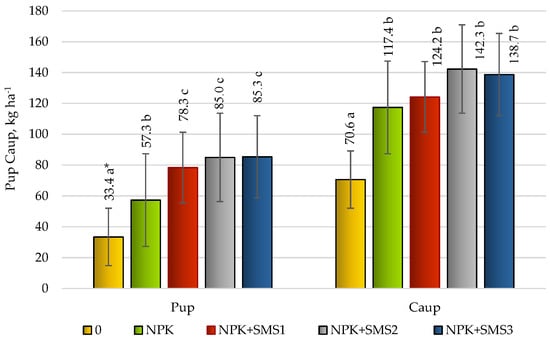
The two-year total uptake of P and Ca by Festulolium significantly varied depending on the treatment (Figure 2). While the mineral fertilizer (NPK) alone increased both P and Ca uptake compared to the control plants, the addition of spent mushroom substrate (SMS) yielded even greater results. Specifically, all three organic–mineral variants (NPK + SMS1, NPK + SMS2, and NPK + SMS3) significantly increased Ca uptake compared to the control and boosted P uptake by 37%, 48%, and 49% relative to both the control and the standalone mineral NPK treatment.
Figure 2.
Festulolium braunii two-year total P and Ca uptake (kg ha−1) depending on the fertilizer treatments (mean values ± SD). 0—control, no fertilizers; NPK—P, Ca, N, K applied in mineral fertilizers each year; NPK +SMS1—P, Ca, N, K applied in mineral fertilizers each year + SMS only in first year; NPK + SMS2—P, Ca, N, K applied in mineral fertilizers each year + SMS only in first year; NPK +SMS3—P, Ca, N, K applied in mineral fertilizers each year + SMS only in first year; LSD0.05 for two-year: Pup—11.1, Caup—35.9; * mean values above the bars marked with the different lowercase letters a, b, c differ significantly at p ≤ 0.05.
Subsequent harvests of Festulolium showed a significant decline in P content and uptake, alongside an increase in Ca content and a rising Ca:P ratio (Table 5).
Table 5.
Concentration (g kg−1) and uptake (kg ha−1) of P and Ca (mean values ± SD) by Festulolium braunii and the Ca:P ratio, depending on the harvests.
Specifically, P concentration was highest in the first harvest, decreasing by 10% in the second and 17% in the third. Consequently, P uptake also declined, dropping slightly in the second harvest and significantly by 25% in the third compared to the first. Conversely, Ca content significantly increased by 13% in the third harvest, driving a clear upward trend that raised the Ca:P ratio by 38% compared to the initial harvest.
Ca uptake by grass varied significantly depending on the year of research (Table 6).
Table 6.
Concentration (g kg−1) and uptake (kg ha−1) of P and Ca (mean values and ±SD) by Festulolium braunii as well as the Ca:P ratio depending on the years.
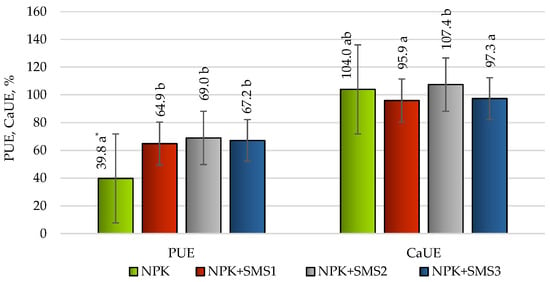
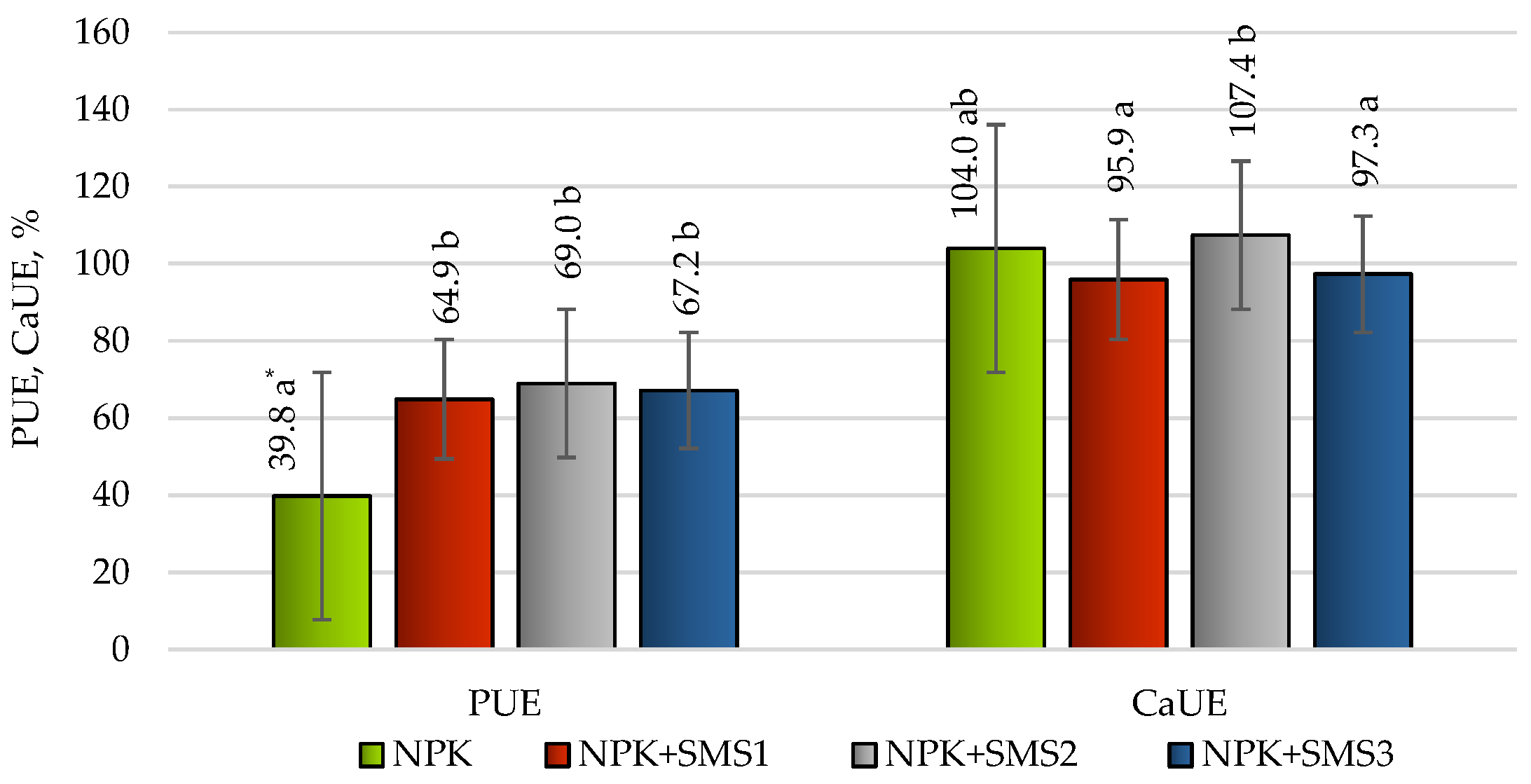
A significantly higher value of Ca intake (by 10%) was recorded in the second year of the experiment compared to the first year. Perhaps this is related to hydrothermal conditions, which were slightly more favorable in the second year of research, especially in the summer months, than in the first year (Figure 1). Over a two-year period, the phosphorus use efficiency (PUE) and calcium use efficiency (CaUE) of the plants calculated in relation to the control plot (0) varied significantly by treatment (Figure 3).
Figure 3.
Festulolium braunii two-year total P (PUE) and Ca (CaUE) use efficiency (%) in relation to the control plot (mean values ± SD). 0—control, no fertilizers; NPK—P, Ca, N, K applied in mineral fertilizers each year; NPK +SMS1—P, Ca, N, K applied in mineral fertilizers each year + SMS only in first year; NPK + SMS2—P, Ca, N, K applied in mineral fertilizers each year + SMS only in first year; NPK +SMS3—P, Ca, N, K applied in mineral fertilizers each year + SMS only in first year; LSD0.05 for two-year: PUE—9.2, CaUE—8.2; * mean values above the bars marked with the different lowercase letters a, b differ significantly at p ≤ 0.05.
Statistically significant differences depending on the applied fertilization were recorded for cumulative PUE (2-year total). The combined application of mineral fertilization (NPK) with SMS, regardless of its variant (SMS1, SMS2, SMS3), led to a significant increase in PUE compared to the application of NPK alone. Cumulative PUE for the NPK-only treatment was 39.8%. Incorporating SMS into the fertilizer combination caused a significant increase in PUE to 64.9% (NPK + SMS1), 69.0% (NPK + SMS2), and 67.2% (NPK + SMS3). Differences between the individual spent mushroom substrate variants (SMS1, SMS2, SMS3) over the two-year period were not statistically significant.
The highest level of total CaUE was recorded in the treatment where NPK fertilization was combined with SMS at the medium dose (SMS2). This result was significantly higher than the CaUE from the remaining SMS-amended treatments, namely NPK + SMS1 and NPK + SMS3, and was similar to the value from the treatment fertilized only with NPK.
The effect of different fertilization treatments on the accumulation of phosphorus (∆SPC) and calcium (∆SCaC) in the soil after two years of the experiment is presented in Table 7.
Table 7.
Increase in P and Ca content (g kg−1) in soil after two years of the experiment (mean values and ±SD).
Application of SMS combined with NPK significantly increased phosphorus (∆SPC) and calcium (∆SCaC) concentration in the soil after two years of the experiment. All observed differences between treatments were statistically significant. The highest accumulation of both nutrients was recorded in the NPK + SMS3 treatment. Compared to the object fertilized with NPK alone, the ∆SPC parameter increased by 50.0%, 100.0%, and 200.0% for NPK + SMS1, NPK + SMS2, and NPK + SMS3, respectively. A substantially stronger effect was observed for ∆SCaC, where the addition of SMS resulted in increases of approximately 167% (SMS1), 267% (SMS2), and 400% (SMS3) relative to the NPK treatment.
Linear correlation analysis (Table 8) showed significant (p < 0.05) relationships between soil properties and Festulolium features. Within soil parameters, a strong, positive correlation was found between ∆SPC and ∆SCaC (r = 0.85), which indicates that their accumulation in the soil is concurrent. The amount of yield (Y) was significantly related only to the efficiency of P use (PUE, r = 0.63). In turn, the P content in the plant determined most of the physiological features; it was strongly positively correlated with Ca concentration (r = 0.82), P uptake (r = 0.96), Ca uptake (r = 0.87), and PUE index (r = 0.69). Higher P concentration decreased the Ca:P ratio (r = −0.92), which resulted in a negative correlation of this parameter with the uptake of both components (Pup, r = −0.84; Caup, r = −0.64). The concentration of Ca in the biomass strongly stimulated the quantitative uptake of P and Ca (Pup, r = 0.86; Caup, r = 0.95), as well as higher PUE (r = 0.72). The uptake rates themselves (Pup and Caup) were also positively associated with PUE (r = 0.67 and r = 0.65, respectively).
Table 8.
Linear correlation coefficients between some Festulolium braunii and soil parameters.
4. Discussion
P is a vital macronutrient for plants, driving energy management and root system development [51]. In forage grasses, optimal P concentration typically ranges between 2.0 and 4.0 g kg−1, though it rarely exceeds 2.5 g kg−1 in most scenarios [52,53]. Specifically, values below 1.0–1.2 g kg−1 DM signify a severe P deficiency [54]. In comparison, Ca concentration in grasses varies more widely from 1.0 to 6.0 g kg−1, heavily influenced by seasonal temperature and moisture [55].
The observed plant P concentration (2.45–3.17 g kg−1) (Table 4) was typical and fell within the standard range of 2.0–3.6 g kg−1 [48]. Compared to NPK, SMS increased plant P concentration by 24–29% across all doses. This increase highlights a metabolic synergism between P and Ca that remained unaffected by external conditions. The organic matter in SMS not only supplied extra P but also enhanced its availability by improving soil moisture retention, a mechanism supported by Kumar and Chugh [56]. However, plant P concentration did not vary significantly with higher SMS doses. This was likely because the excess P was tightly bound by the organic fractions of the soil sorption complex, restricting its release into the soil solution for plant uptake.
Grass Ca concentration from fertilized plots was high, averaging approximately 5.0 g kg−1 (Table 4). A significant increase in Festulolium Ca concentration following triple superphosphate (TSP) application aligns with Marschner [51], who notes that P enhances root uptake of Ca cations. Interestingly, despite introducing substantial Ca into the soil with SMS, plant Ca levels did not exceed those on mineral-fertilized plots. The lack of significant differences between the NPK-only and the NPK + SMS treatments indicates that triple superphosphate (TSP) was the primary driver of Ca concentration, a trend corroborated by Jordan et al. [12]. Additionally, Ca concentrations increased in successive harvests (Table 5). This pattern matches the findings of Whitehead [55], who attributes rising Ca levels in later cuts to slower plant growth rates (which prevent nutrient dilution) and higher temperatures that stimulate Ca transport through the xylem. Unlike Ca, P concentration decreased in successive harvests (Table 5). This significant reduction likely stemmed from limited P availability caused by worsening hydrothermal conditions during the summer months (Figure 1).
Despite these divergent seasonal trends, a strong correlation between P and Ca levels (r = 0.82) indicates that their accumulation within plant tissues remained directly proportional (Table 8). This positive relationship confirms that, under the conditions of this experiment, antagonism between these two macronutrients likely did not occur.
The Ca:P ratio is a key indicator of forage quality for ruminants, with an optimal range between 1.7:1 and 2.6:1 (averaging 2:1); deviations can impair absorption, where low ratios cause bone decalcification and high ratios restrict P uptake [57,58,59]. The highest ratio (above 2.5) occurred in control plants during the third harvest (Table 4). Fertilization significantly altered these proportions. NPK reduced the ratio by 19% compared to the control due to intensive P uptake. Conversely, applying SMS had a stabilizing effect, releasing Ca and increasing the Ca:P ratio by 8–16% compared to NPK alone. This indicates that organo-mineral treatments help maintain optimal nutritional standards for livestock [18]. Additionally, the Ca:P ratio increased by 38% between the first and second cuts (Table 5), confirming that Festulolium accumulates Ca while losing P in successive harvests. This relationship is a result of plant maturation documented by Whitehead [50] and Pirhofer-Walzl et al. [60]. A negative correlation between the Ca:P ratio and P content (r = −0.92) confirms that shifting P concentrations, rather than Ca, primarily drove these ratio dynamics (Table 8).
All organo-mineral treatments significantly increased plant P uptake by 35–48% compared to NPK alone, demonstrating a clear synergy between mineral fertilizers and organic matter (Table 4). However, cumulative two-year P uptake did not increase significantly with increasing doses of spent mushroom substrate (SMS) (Figure 2). Probably, the lowest SMS dose used could fully cover the plants’ demand for phosphorus. Pan et al. [61] noted that integrated organo-mineral applications improve soil P availability by minimizing its depletion. Similarly, SMS applications increased Ca uptake by the grass (Table 4). As highlighted by Aiduang et al. [22], SMS is rich in Ca because chalk or gypsum is commonly added during production, making it an excellent fertilizer for stabilizing grass Ca concentration. However, this effect does not necessarily exceed that of mineral fertilizers. Jordan et al. [12] point out that Ca in mushroom substrate is often bound in carbonate forms, which can limit its availability for plant uptake compared to TSP. Both NPK and SMS enriched the soil with Ca, stimulating intensive plant uptake (Figure 2). This effect likely results from the direct supply of nutrients and the improvement of the soil’s sorption properties following the introduction of organic matter.
However, despite introducing significant Ca with gypsum from the manufacturing process, the two-year cumulative Ca uptake from SMS was not significantly higher than from triple superphosphate (TSP) alone. This aligns with Medina et al. [18], who classify SMS as a slow-release fertilizer, suggesting that the highly soluble mineral TSP was the primary driver of early Ca uptake by the grass biomass.
A unique feature of SMS is its organic matter content, which enhances soil enzymatic activity [62]. Microorganisms secrete acids and phosphatases that release mineral P locked within this organic matter. Consequently, SMS proves more effective than purely mineral P fertilizers by combining direct nutrient supply with the mobilization of existing soil resources. Integrating chemical and organic fertilizers effectively leverages the advantages of both, yielding significant synergistic effects that increase soil P content and overall use efficiency [63,64,65,66].
Additionally, significant negative correlations were observed between the Ca:P ratio and the uptake of both nutrients (Table 8). This relationship was stronger for P (r = −0.84) than for Ca (r = −0.64), indicating that a more pronounced increase in P uptake was the primary driver reducing the Ca:P ratio. Higher Ca uptake in the second year of the study (Table 6), with stable concentrations, may be the result of more favorable hydrothermal conditions and stronger plant development. In the second year of use, grasses have a deeper and more branched root system, allowing them to more effectively absorb water and calcium, even from deeper layers of the soil profile.
The use of SMS at all rates significantly increased PUE over two years compared to NPK fertilization alone (Figure 3). This confirms that organic amendments such as SMS act as slow-release fertilizers, limiting phosphorus fixation in the soil [20,67,68]. In turn, the use of the lowest and highest SMS rates in the fertilizer combination resulted in a decrease in the CaUE index compared to the medium SMS rate. The highest CaUE value at the average SMS dose in the fertilizer combination may result from optimizing the calcium supply and improving soil properties. In turn, the decrease in effectiveness at the lowest dose results from insufficient yield stimulation [50], and at the highest dose it may be the result of soil oversaturation with calcium and cationic competition. In the first year of application, only 20–40% of the total phosphorus contained in SMS is used, and the rest is stored in the soil for a long time [20,69]. Consequently, in soils with critically low baseline P, relying heavily on SMS rather than highly soluble mineral fertilizers like NPK may result in lower crop yields. This pattern aligns with Prasad and Shivay [29], who state that high-dose calcium fertilization builds a stable nutrient pool in the soil from which plants can absorb both Ca and P, even under conditions favoring precipitation into calcium salts. Nonetheless, monitoring soil pH remains essential when planning such treatments, as pH dictates whether Ca will facilitate P uptake or temporarily block it as less soluble salts. On the other hand, SMS also increases soil buffering capacity, which supports long-term pH stability [70].
The accumulation of Ca in the soil occurred more clearly and dynamically in response to the increase in the share of SMS in the fertilizer combination compared to the accumulation of P. The stimulating effect of this component on the soil content of both macronutrients is confirmed in the works of Shi et al. [71], Igual et al. [72], and Ma et al. [16].
Statistical analysis revealed that fertilizer efficiency was tightly linked to both biomass accumulation and tissue nutrient levels (Table 8). A significant correlation between yield and PUE (r = 0.63) indicates that higher productivity depends heavily on the plant’s capacity to convert absorbed nutrients into yield. Furthermore, PUE correlated strongly with both plant P (r = 0.69) and Ca (r = 0.72) contents, confirming that elevated tissue concentrations of these elements are prerequisites for achieving high overall fertilizer use efficiency.
Integrated organo-mineral fertilization combining spent mushroom substrate (SMS) with NPK enhances P and Ca management in Festulolium braunii cultivation, though the observed benefits depend on the specific parameter evaluated and the applied SMS rate. The addition of SMS significantly increased plant P content, P uptake, and P use efficiency, as well as soil P and Ca levels, compared to NPK fertilization alone. However, plant Ca concentration did not differ significantly between NPK and NPK + SMS treatments, and the highest Ca use efficiency was achieved at the medium SMS dose (4.5 Mg ha−1 D.M.), indicating that increasing SMS application rates does not provide a universal advantage across all agronomic parameters.
Numerous scientific studies confirm that combining organic and mineral fertilization significantly improves the yield and quality of various plant species—including wheat, maize, alfalfa, and cocksfoot—while enhancing soil fertility and supporting sustainable development goals [71,73,74,75,76,77,78,79,80]. Nevertheless, determining the impact of combined application of spent mushroom substrate (SMS) and mineral fertilizers (NPK) on phosphorus (P) and calcium (Ca) management in Festulolium braunii cultivation still requires further research. It is necessary to verify these relationships under different soil conditions and in other forage grass species. Future studies should focus on evaluating the chemical forms of P, the dynamics of Ca release from SMS, and the effect of varying SMS doses on soil biological activity. In light of these findings, agricultural advisory programs should emphasize precise dosage of organic fertilizers, as excessive nutrient input does not always translate to higher uptake efficiency or better utilization by plants.
5. Conclusions
The conducted research demonstrated that integrated organo-mineral fertilization using spent mushroom substrate (SMS) combined with mineral fertilization (NPK) significantly improves P and Ca management in Festulolium cultivation and stimulates their accumulation in the soil compared to the exclusive application of mineral fertilizers. The introduction of SMS, regardless of the dose, significantly increased the concentration and uptake of P by grass biomass, and raised its use efficiency (PUE) index from 39.8% to 64.9–69.0%. Although the addition of the substrate did not increase the Ca concentration in the plant beyond the level obtained after NPK application alone, it contributed to a higher Ca uptake and improved the Ca:P ratio. Increasing the share of SMS in the fertilizer combination induced a successive, linear increase in the accumulation of both macronutrients in the soil, with the highest Ca use efficiency (CaUE) achieved at a medium substrate dose (4.5 Mg ha−1 D.M.).
In summary, combining SMS with mineral fertilization constitutes a highly effective and ecologically justified agrotechnical practice, allowing for the optimization of plant nutrition and the enrichment of soil resources; however, increasing the waste doses above the medium level does not translate into a proportional increase in nutrient uptake and utilization by the grass.
Author Contributions
Conceptualization, B.W.-K.; methodology, B.W.-K.; software, A.W.; validation, B.W.-K. and A.W.; formal analysis, B.W.-K. and A.W.; investigation, B.W.-K.; resources, B.W.-K. and A.W.; data curation, A.W. and B.W.-K.; writing—original draft preparation, B.W.-K. and A.W.; writing—review and editing, B.W.-K. and A.W.; visualization, B.W.-K. and A.W.; supervision, A.W.; project administration, B.W.-K. and A.W. All authors have read and agreed to the published version of the manuscript.
Funding
This research received no external funding.
Institutional Review Board Statement
Not applicable.
Data Availability Statement
The original contributions presented in this study are included in the article. Further inquiries can be directed to the corresponding author.
Conflicts of Interest
The authors declare no conflicts of interest.
Abbreviations
The following abbreviations are used in this manuscript:
| Cac | Calcium concentration |
| Caup | Calcium uptake |
| CaUE | Calcium use efficiency |
| Pc | Phosphorus concentration |
| Pup | Phosphorus uptake |
| PUE | Phosphorus use efficiency |
| SMS | Spent mushroom substrate |
| ∆SCaC | Soil calcium content change |
| ∆SPC | Soil phosphorus content change |
| TSP | Triple superphosphate |
| Y | Yield |
References
- Fresh Mushroom Market Size, Share, Trends & Analysis, 2025–2034, Market Data Forecast, 2026 Telangana, India. Available online: https://www.marketdataforecast.com/market-reports/fresh-mushroom-market (accessed on 26 March 2026).
- Waste Act. Waste act dated 14th December 2012. J. Laws Pol. 2013, 21. Available online: https://isap.sejm.gov.pl/isap.nsf/download.xsp/WDU20130000021/U/D20130021Lj.pdf (accessed on 26 March 2026).
- Council Directive of 12 December 1991 Concerning the Protection of Waters Against Pollution Caused by Nitrates 393 from Agricultural Sources (91/676/EWG) (Dz. U. UE L of 31 December 1991). Available online: https://sip.lex.pl/akty-prawne/dziennikiUE/dyrektywa-91-676-ewg-dotyczaca-ochrony-wod-przed-zanieczyszczeniami-67456932 (accessed on 26 March 2026).
- European Commission. Farm to Fork Strategy for a Fair, Healthy and Environmentally Friendly Food System. 2020. Available online: https://food.ec.europa.eu/system/files/2020-05/f2f_action-plan_2020_strategy-info_en.pdf (accessed on 26 March 2026).
- Zied, D.C.; Sánchez, J.E.; Noble, R.; Pardo-Giménez, A. Use of Spent Mushroom Substrate in New Mushroom Crops to Promote the Transition towards A Circular Economy. Agronomy 2020, 10, 1239. [Google Scholar] [CrossRef] [Scilit]
- Yagüe, M.R.; González-Pérez, J.A.; Almendros, G.; Lobo, M.C. Assessing the Potential Agronomic Value of spent Mushroom Substrates: Evaluating Their Suitability to Contribute to Soil Carbon Storage. Sustainability 2025, 17, 7335. [Google Scholar] [CrossRef] [Scilit]
- Baptista, F.; Almeida, M.; Paie-Ribeiro, J.; Barros, A.N.; Rodrigues, M. Unlocking the potential of spent mushroom substrate (SMS) for enhanced agricultural sustainability: From environmental benefits to poultry nutrition. Life 2023, 3, 1948. [Google Scholar] [CrossRef] [Scilit] [PubMed]
- Eurostat 2023. Available online: https://ec.europa.eu/eurostat/comext/newxtweb/ (accessed on 20 February 2026).
- GUS 2023. Available online: https://stat.gov.pl/obszary-tematyczne/roczniki-statystyczne/roczniki-statystyczne/rocznik-statystyczny-rzeczypospolitej-polskiej-2025,2,25.html (accessed on 20 October 2025).
- Finney, K.N.; Ryu, C.; Sharifi, V.N.; Swithenbank, J. The reuse of pent mushroom compost and coal tailings for energy recovery: Comparison of thermal treatment technologies. Bioresour. Technol. 2009, 100, 310–315. [Google Scholar] [CrossRef] [Scilit] [PubMed]
- Herrero-Hernandez, E.; Andrades, M.S.; Rodriguez-Cruz, M.S.; Schanchez-Martin, M.J. Effect of spent mushroom substrate applied to vineyard soil on the behavior of copper-based fungicide residues. J. Environ. Manag. 2011, 92, 1849–1857. [Google Scholar] [CrossRef] [Scilit] [PubMed]
- Jordan, S.N.; Mullen, G.J.; Murphy, M.C. Composition variability of spent mushroom compost in Ireland. Bioreosur. Technol. 2008, 99, 411–418. [Google Scholar] [CrossRef] [Scilit] [PubMed]
- Peregrina, F.; Larrieta, C.; Colina, M.; Mariscal-Sancho, I.; Martín, I.; Martínez-Vidaurre, J.M.; García-Escudero, E. Spent mushroom substrates influence soil quality and nitrogen availability in a semiarid vineyard soil. Soil Sci. Soc. Am. J. 2012, 76, 1655–1666. [Google Scholar] [CrossRef] [Scilit]
- Wang, A.; Zou, D.; O’Connor, P.; Chen, B.; Zou, J.; Zhou, Y.; Wang, H.; Zhang, M. Assistant effects of spent mushroom substrate and its derived biochar on soil phytoremediation. J. Soils Sediments 2023, 23, 1641–1653. [Google Scholar] [CrossRef] [Scilit]
- He, J.; Zheng, G.; Liu, Z.; Guo, Z.; Zhang, W.; Li, Y.; Zhou, Y.; Xu, H. Replacing traditional nursery soil with spent mushroom substrate improves rice seedling quality and soil substrate properties. Environ. Sci. Pollut. Res. 2024, 31, 39625–39636. [Google Scholar] [CrossRef] [Scilit] [PubMed]
- Ma, X.; Yan, S.; Wang, M. Spent mushroom substrate: A review on present and future of green applications. J. Environ. Manag. 2025, 373, 123970. [Google Scholar] [CrossRef] [Scilit] [PubMed]
- Andrews, A.; Singh, S.; Ishani Chandhrapati, A.; Kumar, Y.V. Utilization of spent mushroom substrate: A review. Pharma Innov. J. 2021, 10, 1017–1021. [Google Scholar]
- Medina, E.; Paredes, C.; Bustamante, M.A.; Moral, R.; Moreno-Caselles, J. Relationships between soil physico-chemical, chemical and biological properties in a soil amended with spent mushroom substrate. Geoderma 2012, 173–174, 152–161. [Google Scholar] [CrossRef] [Scilit]
- Alves, L.d.S.; Caitano, C.E.C.; Ferrari, S.; Vieira Júnior, W.G.; Heinrichs, R.; de Almeida Moreira, B.R.; Pardo-Giménez, A.; Zied, D.C. Application of Spent Sun Mushroom Substrate in Substitution of Synthetic Fertilizers at Maize Topdressing. Agronomy 2022, 12, 2884. [Google Scholar] [CrossRef] [Scilit]
- Ravlikovsky, A.; Pinheiro, M.N.C.; Dinca, L.; Crisan, V.; Symochko, L. Valorization of Spent Mushroom Substrate: Establishing the Foundation for Waste-Free Production. Recycling 2024, 9, 44. [Google Scholar] [CrossRef] [Scilit]
- Domínguez-Gutiérrez, M.R.; Gaitán-Hernández, I.; Moctezuma-Pérez, I.; Barois, I.; Domínguez, J. Composting and Vermicomposting of Spent Mushroom Substrate to Produce Organic Fertilizer. Emir. J. Food Agric. 2022, 34, 3. [Google Scholar] [CrossRef] [Scilit]
- Aiduang, W.; Jatuwong, K.; Kiatsiriroat, T.; Kamopas, W.; Tiyayon, P.; Jawana, R.; Xayyavong, O.; Lumyong, S. Spent Mushroom Substrate-Derived Biochar and Its Applications in Modern Agricultural Systems: An Extensive Overview. Life 2025, 15, 317. [Google Scholar] [CrossRef] [Scilit] [PubMed]
- Jasińska, A. Spent mushroom compost (SMC)—Retrieved added value product closing loop in agricultural production. Acta Agrar. Debreceniensis 2018, 150, 185–202. [Google Scholar] [CrossRef] [Scilit] [PubMed]
- Kalembasa, D.; Becher, M. Speciation of carbon and selected metals in spent mushroom substrates. J. Elem. 2012, 3, 409–419. [Google Scholar] [CrossRef] [Scilit]
- Priadi, D.; Saskiawan, I. The utilization of spent oyster mushroom substrates into compost and its effect on the growth of Indian mustard (Brassica juncea (L.) Czern.) in the screenhouse. Int. J. Agric. Technol. 2018, 14, 351–362. Available online: https://li04.tci-thaijo.org/index.php/IJAT/article/view/5953 (accessed on 26 March 2026).
- Khalil, S.; Panda, P.; Ghadamgahi, F.; Barreiro, A.; Rosberg, A.K.; Karlsson, M.; Vetukuri, R.R. Microbial potential of spent mushroom compost and oyster substrate in horticulture: Diversity, function, and sustainable plant growth solutions. J. Environ. Manag. 2024, 357, 120654. [Google Scholar] [CrossRef] [Scilit] [PubMed]
- Velusami, B.; Jordan, S.N.; Currant, T.; Grogan, H. Fertiliser characteristics of stored spent mushroom substrate as a sustainable source of nutrients and organic matter for tillage, grassland and agricultural soils. Ir. J. Agric. Food Res. 2021, 60, 1–11. [Google Scholar] [CrossRef] [Scilit]
- Jankowski, K.; Malinowska, E.; Sosnowski, J.; Wiśniewska-Kadżajan, B.; Kaczorek, A. Effects of Spent Mushroom Substrate and Slurry on Nutritional Value of Grass and Medicago X Varia T. Martyn Mixtures. Int. J. Agric. Biol. Eng. 2018, 11, 61–66. [Google Scholar] [CrossRef] [Scilit]
- Prasad, R.; Shivay, Y.S. Calcium as a Plant Nutrient. Int. J. Bioresour. Stress Manag. 2020, 11, i–iii. [Google Scholar] [CrossRef] [Scilit]
- Kwiatkowska, E.; Joniec, J. Effects of Agricultural Management of Spent Mushroom Waste on Phytotoxicity and Microbiological Transformations of C, P, and S in Soil and Their Consequences for the Greenhouse Effect. Int. J. Environ. Res. Public Health 2022, 19, 12915. [Google Scholar] [CrossRef] [Scilit] [PubMed]
- Thomas, H.; Humphreys, M.O. Progress and potential of interspecific hybrids of Lolium and Festuca. J. Agric. Sci. 1991, 117, 1–8. [Google Scholar] [CrossRef] [Scilit]
- Thomas, H.M.; Morgan, W.G.; Humphreys, M.W. Designing grasses with a future—Combining the attributes of Lolium and Festuca. Euphytica 2003, 133, 19–26. [Google Scholar] [CrossRef] [Scilit]
- Østrem, L.; Volden, B.; Larsen, A. Morphology, dry matter yield and phenological characters at different maturity stages of × Festulolium compared with other grass species. Acta Agric. Scand. Sect. B Soil Plant Sci. 2013, 63, 531–542. [Google Scholar] [CrossRef] [Scilit]
- Østrem, L.; Larsen, A. Winter survival, yield performance and forage quality of Festulolium cvs. for Norwegian farming. Grassl. Sci. Eur. 2008, 13, 293–295. [Google Scholar]
- Gutmane, I.; Adamovics, A. Influence of nitrogen fertilization rates on Festulolium and Lolium × boucheanum forage yield and persistency. Grassl. Sci. Eur. 2009, 14, 336–338. [Google Scholar]
- Touno, E.; Shingu, H.; Kushibiki, S.; Shinoda, M.; Oshibe, A. Changes in feeding characteristics of the first crop with advancing growth in Festulolium (Festulolium braunii) cultivars. Jap. J. Grassl. Sci. 2006, 52, 176–182. [Google Scholar]
- Šimkūnas, A.; Valašinaite, S.; Mažeika, V. Peculiarities of various Festulolium braunii cultivars development and overwintering. LŽŪU Moksl. Darb. 2009, 85, 35–38. [Google Scholar]
- Staniak, M.; Harasim, E. Changes in nutritive value of alfalfa (Medicago × varia T. Martyn) and Festulolium (Festulolium braunii (K. Richt) A. Camus) under drought stress. J. Agron. Crop Sci. 2018, 204, 456–466. [Google Scholar] [CrossRef] [Scilit]
- Olszewska, M. Leaf greenness (Spad) and yield of Festulolium braunii (K. Richt.) A. Camus grown in mixtures with legumes depending on multiple nitrogen rates. Pol. J. Nat. Sci. 2008, 23, 310–325. [Google Scholar] [CrossRef] [Scilit]
- Malinowska, E.; Jankowski, K.; Kania, P.; Gałecka, M. The Effect on Tytanit Foliar Application on the Yield and Nutritional Value of Festulolium braunii. Agronomy 2020, 10, 848. [Google Scholar] [CrossRef] [Scilit]
- Wiśniewska-Kadżajan, B.; Jankowski, K. Effects of the interaction between slurry, soil conditioners, and mineral NPK fertilizers on selected nutritional parameters of Festulolium braunii (K. Richt.) A. Camus. Agron. Res. 2020, 18, 1573–1583. [Google Scholar] [CrossRef]
- Malinowska, E.; Wiśniewska-Kadżajan, B. Effects of Tytanit and Nitrogen on Cellulose and Hemicellulose Content of Festulolium braunii and on Its Digestibility. Agronomy 2022, 12, 1547. [Google Scholar] [CrossRef] [Scilit]
- Wiśniewska-Kadżajan, B.; Sienkiewicz, S.; Wysokiński, A.; Krzebietke, S.J.; Nogalska, A. Yield and Nitrogen Management of Festulolium braunii (K. Richt.) A. Camus Treated with Spent Mushroom Substrate and Mineral Fertilizers. Appl. Sci. 2026, 16, 2500. [Google Scholar] [CrossRef] [Scilit]
- Polish Soil Science Society, Commission on the Origins of Soil Classification and Cartography; Wrocław University of Environmental and Life Sciences Publishing House, Polish Soil Science Society, Wrocław–Warsaw, 2019, 1–292. Available online: http://www.ejpau.media.pl/PDFy/systematyka-gleb-polski-wyd%206.pdf (accessed on 26 March 2026).
- IUSS Working Group WRB. World Reference Base for Soil Resources. International Soil Classification System for Naming Soils and Creating Legends for Soil Maps, 4th ed.; The International Union of Soil Sciences (IUSS): Vienna, Austria, 2022; Volume 234, Available online: https://files.isric.org/public/documents/WRB_fourth_edition_2022-12-18.pdf (accessed on 26 March 2026).
- Bac, S.; Koźmiński, C.; Rojek, M. Agrometeorology; PWN: Warsaw, Poland, 1993; pp. 32–33. (In Polish) [Google Scholar]
- Skowera, B.; Puła, J. Pluviometric extreme conditions in spring season in Poland in the years 1971–2000. Acta Agrophys. 2004, 3, 171–177. (In Polish) [Google Scholar]
- Kabała, C.; Karczewska, A. Methodology of Laboratory Analyses of Soils and Plants; Wrocław University of Environmental and Life Sciences: Wrocław, Poland, 2019; pp. 4–51. Available online: http://www.up.wroc.pl/~kabala (accessed on 26 March 2026).
- Nelson, D.W.; Sommers, L.E. Determination of total nitrogen in plant material. Agron. J. 1973, 65, 109–111. [Google Scholar] [CrossRef] [Scilit]
- Wiśniewska-Kadżajan, B.; Malinowska, E. The Effects of Spent Mushroom Substrate on the Yield and Nutritional Value of Festulolium braunii (K. Richt.) A. Camus. Agriculture 2022, 12, 1537. [Google Scholar] [CrossRef] [Scilit]
- Marschner, P. Marschner’s Mineral Nutrition of Higher Plants; Elsevier Ltd.: Amsterdam, The Netherlands, 2025; Volume 651, Available online: https://shop.elsevier.com/books/marschners-mineral-nutrition-of-higher-plants/marschner/978-0-12-384905-2 (accessed on 26 March 2026).
- Bailey, J.; Cushnahan, A.; Beattie, J. The diagnosis and recommendation integrated system (DRIS) for diagnosing the nutrient status of grassland swards: II. Model calibration and validation. Plant Soil 1997, 197, 137–147. [Google Scholar] [CrossRef] [Scilit]
- Fujita, Y.; de Ruiter, P.C.; Wassen, M.J.; Heil, W.G. Time-dependent, species-specific effects of N:P stoichiometry on grassland plant growth. Plant Soil 2010, 334, 99–112. [Google Scholar] [CrossRef] [Scilit]
- Karn, J.F. Phosphorus nutrition of grazing cattle: A rewiev. Anim. Feed Sci. Technol. 2001, 89, 133–153. [Google Scholar] [CrossRef] [Scilit]
- Whitehead, D.C. Nutrient Elements in Grassland: Soil-Plant-Animal Relationships; CABI: Wallingford, UK, 2000; pp. 1–14. [Google Scholar] [CrossRef] [Scilit]
- Kumar, S.; Chugh, R.K. Impact of Spent Mushroom Substrate Enriched with Trichoderma harzianum on Damping off Disease in Chilli and Tomato. Int. J. Econ. Plants 2022, 9, 264–270. [Google Scholar] [CrossRef] [Scilit]
- National Research Council. Nutrient Requirements of Dairy Cattle: Seventh Revised Edition; The National Academies Press: Washington, DC, USA, 2001. [Google Scholar] [CrossRef] [Scilit] [PubMed]
- Suttle, N.F. Mineral Nutrition of Livestock, 4th ed.; CABI: Wallingford, UK, 2010; Available online: http://www.ucv.ve/fileadmin/user_upload/facultad_agronomia/Producion_Animal/Minerals_in_Animal_Nutrition.pdf (accessed on 26 March 2026).
- National Academies of Sciences, Engineering, and Medicine. Nutrient Requirements of Dairy Cattle: Eighth Revised Edition; The National Academies Press: Washington, DC, USA, 2021. [Google Scholar] [CrossRef] [Scilit] [PubMed]
- Pirhofer-Walzl, K.; Søegaard, K.; Høgh-Jensen, H.; Eriksen, J.; Sanderson, M.A.; Rasmussen, J. Forage herbs improve mineral composition of grassland herbage. Grass Forage Sci. 2011, 66, 415–423. [Google Scholar] [CrossRef] [Scilit]
- Pan, C.X.; Deng, T.F.; Zhang, L.; Ge, L.J.; Li, L.Q.; Yang, L.S.; Yang, X.S. Epimedium Herbal Residue as a Bulking Agent for Lignite and Spent Mushroom Substrate Co-composting. Waste Biomass Valorization 2023, 14, 2547–2555. [Google Scholar] [CrossRef] [Scilit]
- Joniec, J.; Kwiatkowska, E.; Kwiatkowski, C.A. Assessment of the Effects of Soil Fertilization with Spent Mushroom Substrate in the Context of Microbial Nitrogen Transformations and the Potential Risk of Exacerbating the Greenhouse Effect. Agriculture 2022, 12, 1190. [Google Scholar] [CrossRef] [Scilit]
- Serra, A.P.; Marchetti, M.E.; Dupas, E.; Carducci, C.E.; Francisco da Silva, E.; Pinheiro, E.R. Phosphorus Forage Production. In New Perspectives in Forage Crops; IntechOpen: Rijeka, Croatia, 2018; Volume 6. [Google Scholar] [CrossRef] [Scilit]
- Rigo, A.Z.; Corrêa, J.C.; Mafra, A.L.; Hent, P.; Grohskopf, M.A.; Gatibon, L.C.; Bedendo, G. Phosphorus fractions in soil with organic and mineral fertilization in integrated crop-livestock system. Rev. Bras. Cienc. Solo 2019, 43, e0180130. [Google Scholar] [CrossRef] [Scilit]
- Ngan, N.M.; Riddech, N. Use of Spent Mushroom Substrate as an Inoculant Carrier and an Organic Fertilizer and Their Impacts on Roselle Growth (Hibiscus sabdariffa L.) and Soil Quality. Waste Biomass Valorization 2021, 12, 3801–3811. [Google Scholar] [CrossRef] [Scilit]
- Selhorst, B.S.; Schlindwein, J.A.; Peternella, W.S. Study of Organic and Inorganic Forms of Phosphorus in the Soil under Management Systems and Cropping Successions. Open Access Libr. J. 2024, 11, e11318. [Google Scholar] [CrossRef]
- Roy, S.; Barman, S.; Chakraborty, U.; Chakraborty, B. Evaluation of spent mushroom substrate as biofertilizer for growth improvement of Capsicum annuum L. J. Appl. Biol. Biotechnol. 2015, 3, 22–27. [Google Scholar] [CrossRef] [Scilit]
- Kwiatkowski, C.A.; Harasim, E.; Yakimovich, A.; Kołodziej, B.; Tomczyńska-Mleko, M. Evaluation of spent mushroom substrate, mineral NPK fertilization and manure fertilization on chamomile (Chamomila recutita L. Rausch) yield and raw material quality. Acta Sci. Pol. Hort. Cult. 2018, 17, 3–16. [Google Scholar] [CrossRef] [Scilit]
- Kwiatkowski, C.A.; Harasim, E. The Effect of Fertilization with Spent Mushroom Substrate and Traditional Methods of Fertilization of Common Thyme (Thymus vulgaris L.) on Yield Quality and Antioxidant Properties of Herbal Material. Agronomy 2021, 11, 329. [Google Scholar] [CrossRef] [Scilit]
- Gupta, G.; Maurya, S.; Jha, P.N.; Chauhan, P.S. Valorization of Spent Mushroom Substrate (SMS) as a sustainable approach to remediation of xenobiotic compounds in groundwater—A comprehensive review. Groundw. Sustain. Dev. 2024, 26, 101290. [Google Scholar] [CrossRef] [Scilit]
- Shi, Y.; Cui, X.; Zhang, Y.; Liu, M. The addition of spent oyster mushroom substrates has positive effects on alfalfa growth and soil available nutrients. Grass Res. 2023, 3, 19. [Google Scholar] [CrossRef] [Scilit]
- Igual, J.M.; Andrades, M.S.; Frade, C.; Carpio, M.J.; Marín-Benito, J.M.; Rodríguez-Cruz, M.S.; Valverde, A. Impacts of spent mushroom substrate amendment and season on microbial communities in a semiarid vineyard soil. Appl. Soil Ecol. 2024, 203, 105689. [Google Scholar] [CrossRef] [Scilit]
- Li, S.; Wu, J.; Wang, X.; Ma, L. Economic and Environmental Sustainability of Maize-Wheat Rotation Mineral Fertilizers with Manure in the North China Plain. J. Clean. Prod. 2020, 271, 122683. [Google Scholar] [CrossRef] [Scilit]
- Amadou, I.; Faucon, M.P.; Houben, D. Role of soil minerals on organic phosphorus availability and phosphorus uptake by plants. Geoderma 2022, 428, 116125. [Google Scholar] [CrossRef] [Scilit]
- Genç Lermi, A.; Erkovan, H.I.; Koç, A. Determination of Combined Effects of Organic and Mineral Fertilizer on Forage Yield and Quality of Annual Ryegrass. Agronomy 2023, 13, 2935. [Google Scholar] [CrossRef] [Scilit]
- Ma, G.; Cheng, S.; He, W.; Dong, Y.; Qi, S.; Tu, N.; Tao, W. Effects of Organic Cumand Inorganic Fertilizers on Soil Nutrient Conditions in Rice Fields with Varying Soil Fertility. Land 2023, 12, 1026. [Google Scholar] [CrossRef] [Scilit]
- Malinowska, E.; Wiśniewska-Kadżajan, B.; Ostaszewska, U.; Horaczek, T. The effects of various organic materials on Dactylis glomerata yield and content of selected macroelements. J. Ecol. Eng. 2023, 24, 108–118. [Google Scholar] [CrossRef] [Scilit] [PubMed]
- Lu, E.; Li, C.; Geng, Y.; Liang, T.; Zhang, J. Effects of Long-Term Fertilization on Phosphorus Form and Availability in Black Soil. Appl. Sci. 2024, 14, 11673. [Google Scholar] [CrossRef] [Scilit]
- Wiśniewska-Kadżajan, B.; Malinowska, E. Evaluation of forage grasses yield, and nitrogen use efficiency in response to combined application of spent mushroom substrate and mineral nitrogen. Agronomy 2024, 14, 2680. [Google Scholar] [CrossRef] [Scilit]
- Zhu, C.; Tingting Song, T.; Li, H. The research progresses on the transformation of soil phosphorus and environmental effects under long-term fertilization in farmland. Geogr. Res. Bull. 2025, 4, 651–671. [Google Scholar] [CrossRef] [PubMed]

Disclaimer/Publisher’s Note: The statements, opinions and data contained in all publications are solely those of the individual author(s) and contributor(s) and not of MDPI and/or the editor(s). MDPI and/or the editor(s) disclaim responsibility for any injury to people or property resulting from any ideas, methods, instructions or products referred to in the content. |
© 2026 by the authors. Licensee MDPI, Basel, Switzerland. This article is an open access article distributed under the terms and conditions of the Creative Commons Attribution (CC BY) license.