


Abstract
In light of the evident water scarcity and the challenges posed by climate change, this study aimed to evaluate the physiological, phenological, and productive responses of the potato crop (var. Superchola) under water deficit conditions, with the goal of optimizing water use in Tungurahua Province, Ecuador. Crop tolerance to water stress was assessed using drainage lysimeters under a completely randomized block design with three treatments and three replications: 100% ETo, 75% ETo, and 50% ETo. Soil and climatic parameters were characterized, and the crop coefficient (Kc) was calculated and adjusted for each phenological stage. The results showed that, although the full irrigation treatment (100% ETo) yielded the highest production, the application of a moderate water deficit (75% ETo) achieved a 16.2% water saving without significantly affecting crop yield or development. The maximum Kc value recorded was 1.22 during the maximum crop development stage.
1. Introduction
Potato (Solanum tuberosum L.) is considered one of the most important food crops worldwide due to its adaptability and nutritional value. In Ecuador—particularly in the Sierra region—this tuber is a staple food and represents one of the main sources of income for small- and medium-scale farmers [1]. Within this context, Tungurahua Province stands out as one of the principal production areas, with the Superchola variety notable for its high yield and strong market demand. However, increasing climate variability and declining water availability pose serious threats to the sustainability of potato production. It is projected that by the mid- to late 21st century, precipitation in páramo ecosystems could decrease by 7% to 10%, leading to an annual water deficit of 200 to 600 mm. This is compounded by rising temperatures, which could reduce potato yields by up to 97% [2]; temperatures above 25–30 °C during the day and warm nights (>20 °C) are critical for this crop [3].
Given these challenges, efficient water management has become a top priority. However, in Tungurahua, there is a lack of precise information regarding the water requirements of potato crops throughout their different phenological stages, limiting effective water demands estimation and irrigation planning. Drainage lysimeters have emerged as key tools for determining the crop coefficient (Kc), a fundamental parameter for accurately estimating crop water needs.
Climate change has altered rainfall and temperature patterns, jeopardizing water security in agriculture [3,4]; the agricultural sector consumes 70% of water. In this region, water scarcity during critical growth stages negatively impacts yield and quality, directly affecting the sustainability of production systems. Although studies have examined the effects of water deficit on potato crops, knowledge gaps remain regarding the specific response of the Superchola variety under Tungurahua’s agroclimatic conditions [4].
Research conducted under water-limited conditions has reported constraints in vegetative growth, tuberization, and water use efficiency [5]. In particular, the flowering and tuber-formation stages are highly sensitive to water stress [4]. Therefore, determining the Kc value of local potato varieties, under prevailing soil and climate conditions, at each phenological stage, is essential for optimizing irrigation and sustaining crop productivity [6,7].
The crop coefficient (Kc) is calculated as the ratio between crop evapotranspiration (ETc) and reference evapotranspiration (ETo), allowing for adaptation to local conditions [8]. In Andean regions such as Tungurahua, the use of drainage lysimeters, in combination with soil moisture sensors and weather stations, enables accurate estimations that account for the area’s complex climate and topography [9].
Despite the availability of these methodologies, their application to varieties such as Superchola and in typical highland production systems of Tungurahua remains limited. Therefore, this study aimed to evaluate the tolerance and performance of Solanum tuberosum var. Superchola under water deficit conditions using drainage lysimeters, in order to generate local data that contribute to irrigation optimization in high-altitude agricultural systems.
2. Materials and Methods
This study was conducted at the Faculty of Agricultural Sciences of the Technical University of Ambato, located in Cevallos Canton, Tungurahua Province (Ecuador) in the year 2024–2025, at an altitude of 2.865 m above sea level. The study area is characterized by a temperate Andean climate, with an average annual temperature ranging from 12 to 15 °C, average precipitation between 600 and 1.200 mm/year, and relative humidity between 60% and 80% [10]. The soil has a loamy-sandy texture and an organic matter (OM) content ranging from 1.96% to 2.88%, according to the soil analysis performed (Table 1).
Table 1.
Physicochemical characteristics determined through soil analysis.
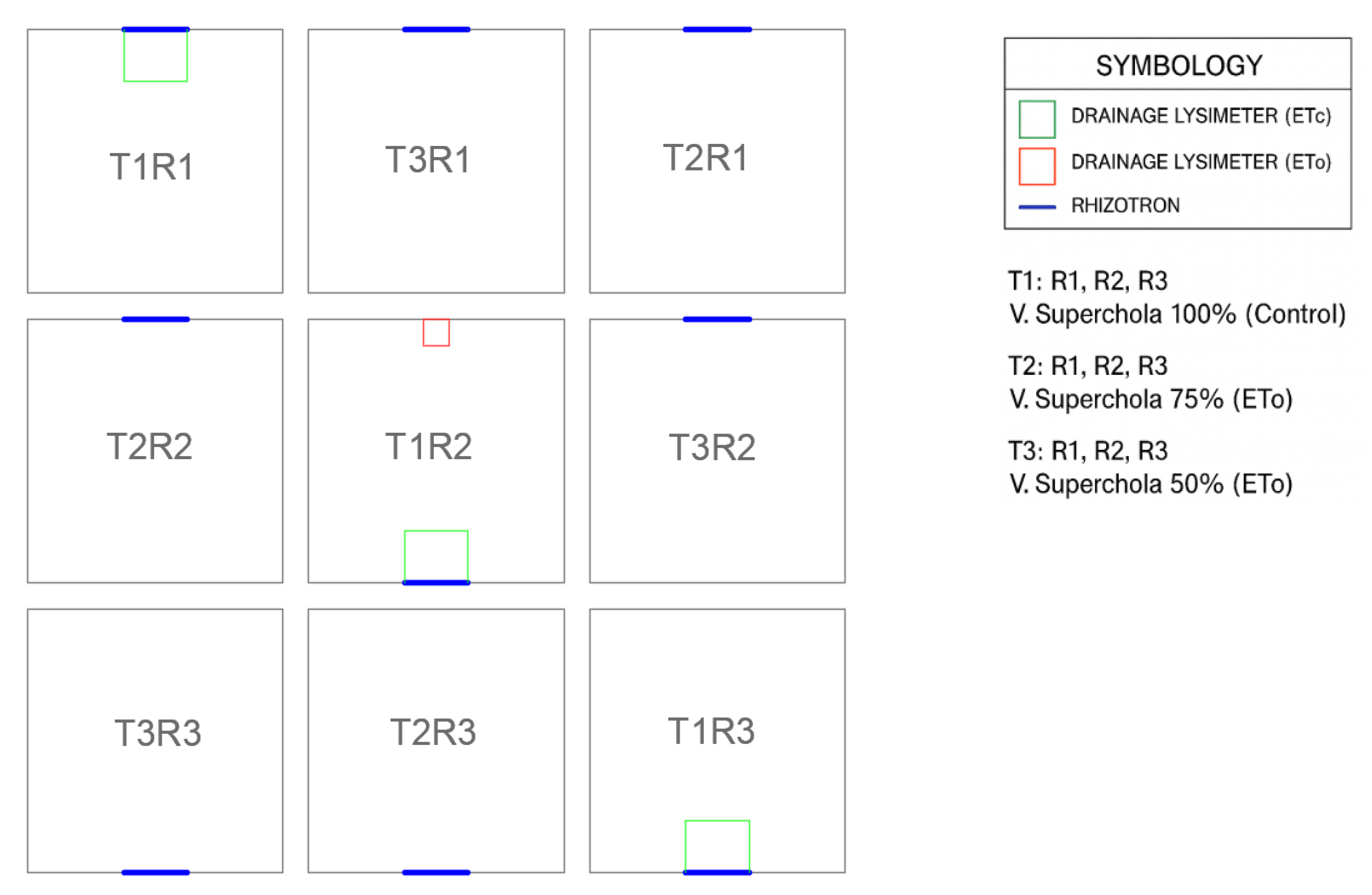
The plant material used in the research was potato tubers of the Superchola variety, which has a medium to long cycle with periods ranging from 5 to 6 months [11,12]. A completely randomized block design was used with three irrigation treatments (T1: 100%, T2: 75%, and T3: 50% of reference evapotranspiration (ETo)) and three replications for each treatment as follows: T1 (100% Eto) = T1R1, T1R2, T1R3; T2 (75% Eto) = T2R1, T2R2, T2R3 and T3 (50% Eto) = T3R1, T3R2, T3R3, each plot (repetition) covered an area of 99 m2. The planting density was 1 m between rows and 0.5 m between plants. Irrigation was applied using a drip system with emitters delivering 2.2 L·h−1, spaced 0.2 m apart. Irrigation events were triggered when soil moisture dropped to between 50% and 70% of field capacity (FC). Additionally, rhizotrons measuring 1.10 m wide by 0.50 m long and a 0.5 cm grid were installed in each plot to observe root growth (Figure 1).
Figure 1.
Layout of the experimental site.
Fertilization was carried out in two phases: during the initial stage (0–50 days after planting), a complete NPK formula was applied, followed by a micronutrient supplement during the vegetative growth period (50–100 days after planting) (Table 2).
Table 2.
Sources and doses of fertilizer applied during the experimental trial.
Climatic conditions were monitored using a portable weather station (Davis Vantage Pro-2), which was synchronized with the official INAMHI station (M0258 Querochaca–UTA), thereby ensuring the reliability of the recorded climatic data. During the trial period, the average temperature recorded was 12.99 °C, relative humidity averaged 81.29%, precipitation averaged 49.61 mm, evaporation was 66.14 mm, and the average wind speed was 2.91 m s−1.
Soil moisture was determined using the gravimetric method at a depth of 0–15 cm. Samples were oven-dried at 105 °C for 24 h, and the corresponding equation was used to calculate the soil moisture content (Equation (1)) [13]. Additionally, tensiometers were installed at a depth of 30 cm to verify water availability in the rhizosphere. The permanent wilting point (PWP) was defined when soil moisture content reached values between 10 and 20 bars and was estimated based on changes in soil moisture from 24 to 72 h after an irrigation or precipitation event.
where: = weight of the fresh soil and = weight of the dry soil
Bulk density (Bd) of the soil was determined using the core (cylinder) method under non-compacted conditions (Equation (2)).
where: = weight of the oven-dried soil and = volume of the soil
Phenological and biophysical variables were recorded following the methodology [14], identifying the start and end of each growth stage. The parameters evaluated included emergence rate, plant height, root depth, and the occurrence of tuberization, flowering, and senescence (Table 3).
Table 3.
Biophysical and phenological parameters evaluated in the potato crop, var. Superchola.
In addition, physiological parameters were recorded, including relative water content (RWC) in leaves, stomatal conductance using a porometer, and leaf chlorophyll content through SPAD readings taken at the beginning of flowering, considering this to be the critical period of water demand (Table 4).
Table 4.
Physiological indicators evaluated in the potato crop var. Superchola during the beginning of the flowering stage.
Physiological assessments were carried out at the beginning of flowering, considering this to be the critical period of water demand.
The irrigation regime was established based on crop evapotranspiration (ETc) calculated from reference evapotranspiration (ETo) and the crop coefficient (Kc) experimentally using lysimetry for the treatment without water deficit. Three irrigation treatments were evaluated, defined as 100%, 75%, and 50% replacements of ETc, which represented conditions of full irrigation, moderate water deficit, and severe water deficit, respectively, as follows:
Crop evapotranspiration (ETc) was determined using drainage lysimeters planted with grass maintained at a height of from 10 to 12 cm. The calculation followed the equation established by FAO (2008) [11] (Equation (4)):
where ETc = crop evapotranspiration (mm), ETo = reference evapotranspiration (mm), and Kc = crop coefficient.
Similarly, reference evapotranspiration (ETo) was determined based on evaporation measured from a standard Class A evaporation pan, adjusted using the pan coefficient (Kp) (Equation (5)).
where ETo = reference evapotranspiration (mm), Ev = pan evaporation (mm), and Kp = pan coefficient.
The pan coefficient (Kp) was determined following the recommendations of FAO-56, considering the average wind speed, relative humidity, and conditions of the Class A tank environment. Under the agroclimatic conditions of the Cevallos city, a value of Kp = 0.72 was adopted, consistent with agricultural environments of moderate humidity and average wind.
The volume of water to be replenished in the drainage lysimeter to restore the soil water balance was calculated using the following equation:
where Va = volume of water to be applied (L), ETc = crop evapotranspiration (mm/day), ND = number of days between irrigation events, L = irrigated area (m2), and c = conversion factor to liters.
The crop coefficient (Kc) for each phenological stage was calculated based on the ETc/ETo ratio. For Treatment 1 (100% ETo), Kc was determined following FAO guidelines, using the following equation:
Treatment T1 (100% ETc) received a total replenishment of 370.25 mm of water throughout the crop cycle, equivalent to 370.25 m3 in the 1000 m2 experimental area. Treatment T2 (75% ETc) received a total of 277.69 mm (277.69 m3), while treatment T3 (50% ETc) received a total of 185.14 mm (185.14 m3). These volumes were accumulated by phenological stages (initial, vegetative development, tuberization, and final stage), ensuring a differentiated and controlled application of water resources throughout the crop cycle.
For yield evaluation, measurements included tuber dry matter, production per plant, and total yield per plot (Table 5).
Table 5.
Yield parameters evaluated in potato crop var. Superchola.
Following the methodology described by Masarirambi et al. (2012) [17], harvested tubers were classified into three yield categories based on their equatorial diameter, using a digital Vernier caliper (Table 6).
Table 6.
Yield categories evaluated in potato crop var. Superchola.
The data were subjected to analysis of variance (ANOVA) to determine statistically significant differences among treatments. For variables showing significance, Tukey’s post hoc test was applied at a 5% significance level (p < 0.05). Statistical analyses were performed using Minitab 18.1 LLC software.
3. Results
3.1. Phenological Development of the Crop
During the emergence stage, no statistically significant differences were observed between full irrigation (100% ETo) and moderate deficit (75% ETo), with emergence rates of 97.5% and 94.9%, respectively. However, a considerable reduction was observed under severe water deficit (50% ETo), with an emergence rate of 92.3%.
At the flowering stage, plants subjected to severe deficit (50% ETo) flowered earlier (108.7 days) compared to those under full irrigation (114.3 days). Tuber initiation also occurred earlier under both moderate (75% ETo) and severe (50% ETo) deficit conditions—at 95.7 and 97.0 days, respectively.
Senescence was likewise accelerated under severe water deficit, occurring at 178 days, compared to 186.7 days under full irrigation (100% ETo) (Table 7).
Table 7.
Effect of water deficit on biophysical and phenological variables of potato crop var. Superchola.
Regarding root depth, at 45 days, the highest value was recorded in the full irrigation treatment (25.3 cm). At 80 and 86 days, both the full irrigation (100% ETo) and moderate deficit (75% ETo) treatments showed the greatest root depths (42.3 cm and 38.3 cm, and 45 cm and 43.3 cm, respectively), in contrast to the severe deficit (50% ETo) treatment.
Plant height at 60 and 80 days was greatest under full irrigation, with values of 21.5 cm and 38.3 cm, respectively. However, by 100 days, the highest plant heights were observed in the full irrigation and moderate deficit treatments (64 cm and 58.5 cm, respectively), whereas the severe deficit treatment (50% ETo) resulted in significantly shorter plants (49.7 cm) (Table 7).
3.2. Physiological Response of the Crop
Chlorophyll content measurements showed that, both before and after irrigation, the full irrigation treatment (100% ETo) recorded the highest SPAD values (28.93 and 33.53, respectively), whereas the severe deficit treatment (50% ETo) exhibited significantly lower chlorophyll indices.
Regarding stomatal conductance, before irrigation, the highest values were observed in the 100% ETo and 75% ETo treatments, with measurements of 146.92 and 146.37 mmol·m−2·s−1, respectively. After irrigation, only the full irrigation treatment (100% ETo) maintained the highest stomatal conductance, reaching 396.3 mmol·m−2·s−1.
As for relative water content (RWC), the 100% ETo treatment again recorded the highest values—50.2% before irrigation and 56.34% after irrigation—while the severe deficit treatment (50% ETo) showed considerably lower values, with 39.14% and 45.45%, respectively (Table 8).
Table 8.
Effect of water deficit on physiological parameters of potato var. Superchola during the onset of the flowering stage.
3.3. Yield Parameters and Categories
As for dry leaf matter, a progressive decrease was observed as water stress intensified. The 100% ETo treatment had the highest value at 17.1%, while 50% ETo treatment had a value of 13.9%. In root dry matter, the 100% ETo treatment (29.4%) statistically outperformed the deficit treatments, which showed values of 23.8% and 20.9% for 75% and 50% ETo, respectively. For the tuber dry matter variable, reducing irrigation to 50% ETo caused a significant decrease, reaching a value of 22.6% (Table 9).
Table 9.
Effect of water deficit on yield parameters of potato crop var. Superchola.
Yield per plant decreased dramatically under water-restricted conditions, while the optimal treatment (100% ETo) reached 2.08 kg/plant and the 75% and 50% ETo treatments showed significant reductions, with means of 1.72 and 1.56 kg/plant, respectively. Regarding total yield (kg), the 100% ETo treatment obtained the maximum yield of 230.98 kg. In contrast, reducing water supply to 75% and 50% of ETo resulted in significant yield losses, falling to 169.2 kg and 134.17 kg, respectively (Table 9).
In total yield (kg), 50.08 kg, 41.7 ± 1.70, and 28.5 ± 5.5 were recorded, with p = 0.028. These patterns reveal progressive declines in production as the severity of water deficiency increases, being more pronounced for the smaller size fractions and in the total yield sum; Furthermore, the statistically significant effect observed in the non-commercial category (<30 mm) and in total yield supports the negative influence of water reduction on the harvest, especially in smaller sizes (Table 10).
Table 10.
Effect of water deficit on yield categories of potato crop var. Superchola.
3.4. Crop Coefficient (Kc)
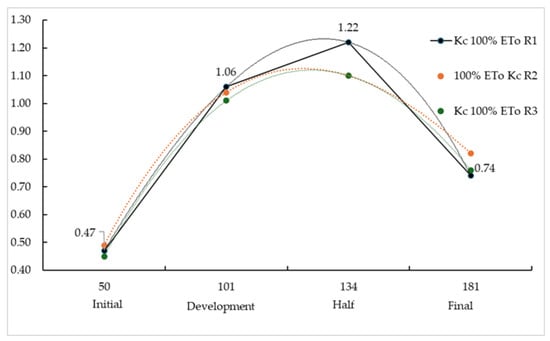
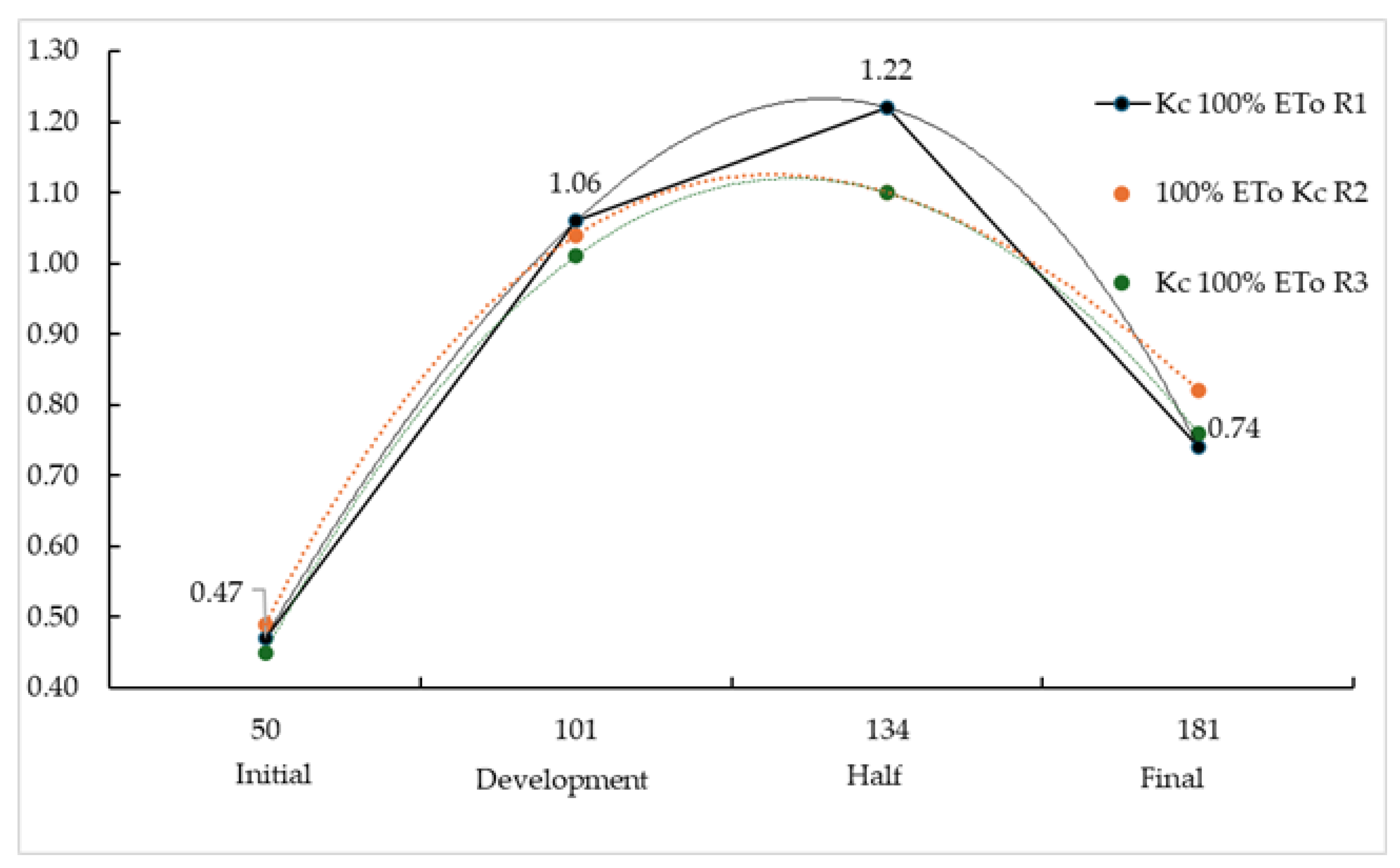
The crop coefficient (Kc) for Solanum tuberosum var. Superchola under full irrigation conditions (100% ETo) ranged from 0.47 during the initial stage (0–50 days) to 1.06 during vegetative development (51–100 days), 1.22 during the mid-season stage (101–134 days), and 0.74 during the late stage (135–181 days) (Figure 2).
Figure 2.
Crop coefficient (Kc) for potato crop var. Superchola at different phenological stages under 100% ETo irrigation conditions.
3.5. Water Consumption
Analysis of the treatments shows that, while cumulative reference evapotranspiration (ET0) remained constant (47.62 mm), crop evapotranspiration (ETc) decreased proportionally with the reduction in irrigation, reaching 40.19 mm, 30.14 mm, and 20.10 mm for the 100%, 75%, and 50% ETc treatments, respectively. The irrigation depth applied and the total volume were also reduced proportionally (408.3 mm/40.42 m3, 306.2 mm/30.31 m3, and 204.15 mm/20.21 m3), demonstrating the implementation of controlled water deficit. Tuber production decreased with lower water availability, from 230.98 kg (23.33 t/ha) under full irrigation to 134.14 kg (13.55 t/ha) under severe deficit, while water efficiency (WUE) increased in treatments with less irrigation (5.72, 5.58, and 6.64 kg/m3, respectively), indicating that, although production decreases under water stress, the use of the resource is more efficient. These results show that moderate and severe deficit irrigation allows for the optimization of water efficiency at the cost of a proportional reduction in production (Table 11).
Table 11.
Components of water consumption, irrigation, yield, and water use efficiency (WUE) of Solanum tuberosum L. var. Superchola under different irrigation regimes during the complete crop cycle.
4. Discussion
The results of this study demonstrate that water deficit significantly alters the phenology, physiology, and yield of the potato crop Solanum tuberosum var. Superchola. Processes such as emergence were not significantly affected up to a threshold of 75% of reference evapotranspiration (ETo), suggesting that during the initial growth phase, the crop can establish adequately despite a mild deficit, likely because tuber imbibition can continue under moderate soil moisture conditions [18,19]. However, a severe deficit corresponding to 50% ETo caused a significant reduction in emergence, given that the decrease in soil water potential limits water uptake, delaying or even inhibiting germination [20,21].
The shortening of the crop cycle observed under severe water deficit (50% ETo)—with senescence occurring 8.7 days earlier and flowering 5.6 days earlier compared to full irrigation—is consistent with the drought escape mechanism. This phenomenon allows the plant to complete its reproductive cycle before water stress becomes lethal [22,23]. The significant decrease in Relative Water Content (RWC) observed in the 50% ETo treatment (45.45%) after irrigation, compared to 56.34% under 100% ETo, acted as a stress signal that triggered the synthesis of abscisic acid (ABA), a key hormone involved in accelerating leaf senescence and tuber maturation [24,25].
In the study area, located at 2865 m above sea level, the average temperature was 12.99 °C, which delays heat accumulation and prolongs the duration of the vegetative cycle compared to lower-altitude regions with higher temperatures. In addition, studies on water management have shown that severe water deficit can accelerate senescence and shorten the duration of the cycle due to reduced transpiration and interruption of vegetative growth [26,27]. Therefore, the observation that senescence occurred at 178 days under severe deficit, compared to 187 days under full irrigation, is consistent with the physiology of potatoes under conditions of water stress and high altitude, and reflects the interaction between variety, climate, and irrigation management.
The significant reduction in the duration of the phenological cycle observed in the severe deficit treatment (50% ETo), which reached senescence at 178 days compared to 186.7 days in the 100% ETo treatment, confirms the activation of drought escape mechanisms characteristic of genotypes sensitive to water availability. This shortening responds to hormonal signaling mediated by abscisic acid, which induces early maturation to ensure reproduction before water collapse, a phenomenon widely documented in solanaceous crops under terminal stress [28]. However, this survival strategy comes at a high agronomic cost, as cycle shortening drastically reduces the radiation interception phase and the duration of the green leaf area (LAD), variables that are linearly correlated with biomass accumulation in tubers [29].
Physiologically, the reduction in plant height and dry biomass was not an isolated event, but a direct consequence of limitations in gas exchange. Our findings show a drastic drop in stomatal conductance after irrigation under severe 50% ETo deficit (275.3 mmol·m−2·s−1 vs. 396.3 mmol· m−2·s−1 in the treatment with 100% ETo). This stomatal limitation, imposed to conserve CRA, inevitably restricts CO2 entry, reducing the net carbon assimilation rate necessary for cell expansion and vegetative growth [30,31]. In addition, the significant decrease in the chlorophyll index (SPAD), which fell from 33.53 in plants with 100% ETo to 29.47 under severe 50% ETo stress, indicates not only a lower photosynthetic capacity, but also oxidative damage to the photosynthetic apparatus or accelerated remobilization of nitrogen to the tubers due to induced senescence [32].
The drop in total yield from 230.98 kg under full irrigation (100% ETo) to 134.17 kg under severe deficit (50% ETo), representing a loss of 41.9%, confirms that, although the plant attempted to compensate through escape mechanisms, the lack of water during the tuber filling stage (tuberization) was decisive. By limiting the time available for the translocation of photoassimilates during the critical filling stage, the plant sacrifices yield potential and commercial size, as evidenced by the reduction in total yield to 134.17 kg in the severe stress treatment 50% ETo. This coincides with recent findings that maintaining the canopy green for longer is the most important physiological determinant for maximizing yield in water-limited environments [33,34]. This is also evidenced by the lower dry matter in leaves and tubers under severe stress, with values of 22.6 kg and 13.9 kg, respectively, compared to 100% ETo irrigation, which recorded values of 17.1 kg and 26.8 kg for the same variable, preventing the tubers from reaching their maximum size potential [35,36].
We observed an increase in Water Use Efficiency (WUE) under severe deficit (6.64 kg/m3) compared to full irrigation (5.72 kg/m3). This result is consistent with the literature, which suggests that plants under stress optimize each unit of water transpired [37]. However, this increased efficiency has an unacceptable “yield cost” for commercial production. On the other hand, it is evident that the 75% ETo treatment represents a tolerance point. In this research, although there was a reduction in total yield compared to 100% ETo, the drop was not as precipitous as in 50% ETo. This suggests that a moderate 75% ETo deficit could be a viable strategy when water costs are very high, but to maximize profitability, the crop requires water replacement close to 100% of ETo [38,39].
5. Conclusions
The research determined that severe water deficit (50% ETo) in Solanum tuberosum var. Superchola triggers a phenotypic plasticity response that can accelerate tuberization and senescence and reduce conductance and chlorophyll index, despite maximizing Water Use Efficiency (6.64 kg/m3), drastically compromising biomass accumulation and reducing total yield.
The moderate deficit treatment (75% ETo) emerged as a critical threshold where water optimization begins to significantly affect productivity. Local crop coefficients (Kc) were obtained (from 0.47 to 1.22).
It is recommended to determine the financial viability of deficit irrigation, analyzing whether water savings compensate for the decline in physical yield, and to replicate the experimental design in various agroecological zones to calibrate the robustness of the proposed Kc coefficients.
Author Contributions
Conceptualization, M.K.L.M. and C.J.C.U.; methodology, M.K.L.M. and J.E.L.T.; software, M.K.L.M.; validation, C.J.C.U. and J.E.L.T.; formal analysis, M.K.L.M.; investigation, M.K.L.M.; writing—original draft preparation, M.K.L.M.; writing—review and editing, C.J.C.U.; visualization, J.E.L.T.; supervision, C.J.C.U. All authors have read and agreed to the published version of the manuscript.
Funding
This research received no external funding.
Institutional Review Board Statement
Not applicable.
Data Availability Statement
All data generated or analyzed during this study are included in the article. Any further inquiries may be directed to the corresponding author.
Conflicts of Interest
The authors declare no conflicts of interest.
References
- Figueroa, W. Efecto del cambio climático en la producción de papa en la región Puno, 2000–2022. Rev. Investig. 2024, 13, 68–76. [Google Scholar] [CrossRef] [Scilit]
- Racines, M.; Cuesta, X.; Montero, B.; Cuasapaz, P.; Panchi, N.; Benavidez, H. In Proceedings of the Décimo Congreso Ecuatoriano de la Papa—2023, San Gabriel, CA, USA, 29–30 June 2023; Cuesta, X., Racines, M., Montero, B., Cuasapaz, P., Panchi, N., Benavides, H., Eds.; Universidad Politécnica Estatal del Carchi: San Gabriel, Ecuador, 2023; pp. 28–30. [Google Scholar]
- Raymundo, R.; Asseng, S.; Cammarano, D.; Quiroz, R. Potato, sweet potato, and yam models for climate change: A review. Field Crops Res. 2014, 166, 173–185. [Google Scholar] [CrossRef] [Scilit]
- IPCC. Sixth Assessment Report. In Intergovernmental Panel on Climate Change; IPCC: Geneva, Switzerland, 2021. [Google Scholar]
- Peña, R.F.; León Ruiz, J.E.; Parra León, V.J. Estudio de evaluación agronómica en el cultivo de papa (Solanum spp.) con tolerancia al déficit hídrico—Ecuador. Rev. Investig. Agroproducción Sustentable 2019, 3, 37. [Google Scholar] [CrossRef] [Scilit]
- Pino, M.T.; Park, E.; Chen, T.; Ramírez, D.; Quiroz, R.; Gónzales, S.; Gutiérrez, R.; Aguayo, F.; Paulina, R. In Estrés Hídrico y Térmico en Papas: Avances y Protocolos. 2016, pp. 1–148. Available online: https://biblioteca.inia.cl/server/api/core/bitstreams/c5af8e10-f38d-4be4-9170-2067db702740/content (accessed on 3 March 2024).
- Patricio, M.L.; Juan, I.F. Métodos de riego [en línea]. Temuco: Boletín INIA—Instituto de Investigaciones Agropecuarias. no. 194. 2009. Available online: https://hdl.handle.net/20.500.14001/7314 (accessed on 3 March 2024).
- Zuñiga, J.; Morales, C.; Estrada, M. Cultivo de la papa y sus condiciones climáticas. Gestión Ingenio Soc. 2017, 2, 140–152. [Google Scholar]
- Pereira, L.S.; Allen, R.G.; Smith, M.; Raes, D. Crop evapotranspiration estimation with FAO56: Past and future. Agric. Water Manag. 2015, 147, 4–20. [Google Scholar] [CrossRef] [Scilit]
- Instituto Nacional de Meteorología e Hidrología [INAMHI]. Boleín de Precipitación y Temperatura; INAMHI: Quito, Ecuador, 2022. [Google Scholar]
- FAO. Crop Evapotranspiration: Guidelines for Computing Crop Water Requirements; FAO Irrigation and Drainage Paper 56; FAO: Rome, Italy, 2008. [Google Scholar]
- Pérez, W.; Flores, F.; Villacís, G. Caracterización agronómica y fenológica de variedades locales de papa en la región andina del Ecuador. Rev. Cienc. Agric. 2020, 17, 45–56. [Google Scholar]
- Enciso, J.; Porte, D.; Périés, X. Uso de Sensores de Humedad del Suelo para Eficientizar el Riego (B-6194S); Texas A&M University: College Station, TX, USA, 2007. [Google Scholar]
- Cuesta, X.; Rivadeneira, J.; Monteros, C. Programa Nacional de Raíces y Tubérculos–Papa; Instituto Nacional de Investigaciones Agropecuarias (INIAP): Quito, Ecuador, 2015; Available online: https://repositorio.iniap.gob.ec/server/api/core/bitstreams/6aa0ee8c-0f0e-4383-87dd-dd06b8ed677d/content (accessed on 15 January 2025).
- Smart, R.E.; Bingham, G.E. Rapid analysis of relative water content in plant leaves. Plant Physiol. 1974, 53, 258–260. [Google Scholar] [CrossRef] [Scilit]
- Calderón, J. Medición de la conductancia estomática en cultivos agrícolas. Agric. Water Manag. 2013, 121, 12–20. [Google Scholar]
- Masarirambi, M.T.; Mandisodza, F.C.; Mashingaidze, A.B.; Bhebhe, E. Influence of Plant Population on Growth and Yield of Potato (Solanum tuberosum L.) Varieties in Harare, Zimbabwe. Int. J. Agric. For. 2012, 2, 154–159. [Google Scholar] [CrossRef] [Scilit]
- Bonierbale, M.H.; de Forbes, S.; Bastos, A. Procedimientos para Pruebas de Evaluación Estándar de Clones Avanzados de Papa: Guía para Cooperadores Internacionales; Centro Internacional de la Papa (CIP): Lima, Peru, 2010. [Google Scholar]
- Kramer, P.J.; Boyer, J.S. Water Relations of Plants and Soils; Academic Press: Cambridge, MA, USA, 1995. [Google Scholar]
- Passioura, J.B. Increasing crop productivity when water is scarce—From breeding to field management. Agric. Water Manag. 2006, 80, 176–196. [Google Scholar] [CrossRef] [Scilit]
- Ahmed, I.M.; Dai, H.; Zheng, W.; Cao, F.; Zhang, G.; Sun, D.; Wang, F.; Wu, F.; Li, X.; Liu, X.; et al. Seed germination and early seedling development under water stress in potato. Plant Physiol. Biochem. 2020, 148, 416–425. [Google Scholar]
- Levitt, J. Responses of Plants to Environmental Stresses. Volume II: Water, Radiation, Salt, and Other Stresses; Academic Press: Cambridge, MA, USA, 1980. [Google Scholar]
- Sadras, V.O.; Milroy, S.P. Soil-water thresholds for the responses of leaf expansion and gas exchange: A review. Field Crops Res. 1996, 47, 253–266. [Google Scholar] [CrossRef] [Scilit]
- Aliche, E.B.; Oortwijn, M.; Theeuwen, T.P.; Bachem, C.W.; Visser, R.G.; van der Linden, C.G. Drought response in field grown potatoes and the relevance of greenhouse assessments for crops. Environ. Exp. Bot. 2020, 171, 103945. [Google Scholar] [CrossRef] [Scilit]
- Zhang, J.; Jia, W.; Yang, J.; Ismail, A.M. Role of ABA in integrating plant responses to drought and salt stresses. Field Crops Res. 2006, 97, 111–119. [Google Scholar] [CrossRef] [Scilit]
- Cutler, S.R.; Rodriguez, P.L.; Finkelstein, R.R.; Abrams, S.R. Abscisic acid: Emergence of a core signaling network. Annu. Rev. Plant Biol. 2010, 61, 651–679. [Google Scholar] [CrossRef] [Scilit]
- Karam, F.; Amacha, N.; Fahed, S.; El Asmar, T.; Domínguez, A. Response of Potato to Full and Deficit Irrigation under Semiarid Climate: Agronomic and Economic Implications. Agric. Water Manag. 2014, 134, 126–136. [Google Scholar]
- Li, S.; Kupriyanovich, Y.; Wagg, C.; Zheng, F.; Hann, S. Water Deficit Duration Affects Potato Plant Growth, Yield and Tuber Quality. Agriculture 2023, 13, 2007. [Google Scholar] [CrossRef] [Scilit]
- Monneveux, P.; Ramírez, D.A.; Pino, M.T. Drought tolerance in potato (Solanum tuberosum L.): Can we learn from drought tolerance research in cereals? Plant Sci. 2013, 205, 76–86. [Google Scholar] [CrossRef] [Scilit]
- Jefferies, R.A.; Lawson, H.M. A key for the stages of development of potato (Solanum tuberosum). Ann. Appl. Biol. 1991, 119, 387–401. [Google Scholar] [CrossRef] [Scilit]
- Flexas, J.; Bota, J.; Loreto, F.; Cornic, G.; Sharkey, T.D. Diffusive and metabolic limitations to photosynthesis under drought and salinity in C3 plants. Plant Biol. 2004, 6, 269–279. [Google Scholar] [CrossRef] [Scilit]
- Zhang, P.; Yang, X.; Manevski, K.; Li, S.; Wei, Z.; Andersen, M.N.; Liu, F. Physiological and Growth Responses of Potato (Solanum tuberosum L.) to Air Temperature and Relative Humidity under Soil Water Deficits. Plants 2022, 11, 1126. [Google Scholar] [CrossRef] [Scilit]
- Plich, J.; Bogucka-Kocka, A.; Tatarczuch, M. The relationship between chlorophyll fluorescence parameters and drought tolerance in potato (Solanum tuberosum L.). Photosynthetica 2020, 58, 1162–1171. [Google Scholar] [CrossRef] [Scilit]
- Soltys-Kalina, D.; Plich, J.; Strzelczyk-Żyta, D.; Śliwka, J.; Marczewski, W. The effect of drought stress on the leaf relative water content and tuber yield of a half-sib family of ‘Katahdin’-derived potato cultivars. Breed. Sci. 2016, 66, 328–331. [Google Scholar] [CrossRef] [Scilit]
- Daryanto, S.; Wang, L.; Jacinthe, P.A. Global synthesis of drought effects on potato (Solanum tuberosum L.) yield and quality. PLoS ONE 2017, 12, e0175468. [Google Scholar] [CrossRef] [Scilit]
- Stark, J.C.; Love, S.L.; King, B.A.; Marshall, J.M. Potato Production Systems; Springer International Publishing: Berlin/Heidelberg, Germany, 2018. [Google Scholar] [CrossRef] [Scilit]
- Obidiegwu, J.E.; Bryan, G.J.; Jones, H.G.; Prashar, A. Coping with drought: Stress and adaptive responses in potato and perspectives for improvement. Front. Plant Sci. 2015, 6, 542. [Google Scholar] [CrossRef] [Scilit] [PubMed]
- Zarazúa-Villaseñor, P.; Ruiz-Nieto, J.E.; Reta-Sánchez, D.G. Water use efficiency and yield of potato under different irrigation regimes in semi-arid conditions. Rev. Fitotec. Mex. 2020, 43, 399–406. [Google Scholar] [CrossRef] [Scilit]
- Ierna, A.; Mauromicale, G. Potato growth, yield and water productivity response to different irrigation and fertilization regimes. Agric. Water Manag. 2018, 201, 21–26. [Google Scholar] [CrossRef] [Scilit]

Disclaimer/Publisher’s Note: The statements, opinions and data contained in all publications are solely those of the individual author(s) and contributor(s) and not of MDPI and/or the editor(s). MDPI and/or the editor(s) disclaim responsibility for any injury to people or property resulting from any ideas, methods, instructions or products referred to in the content. |
© 2026 by the authors. Licensee MDPI, Basel, Switzerland. This article is an open access article distributed under the terms and conditions of the Creative Commons Attribution (CC BY) license.