


Abstract
Agroathelia (syn. Sclerotium) is a global soil-borne pathogen with a broad host range, causing significant agricultural losses in diverse crops. However, genomic and population genetic resources of this genus remain limited. To develop genome-based molecular tools, we newly sequenced two Korean isolates (A. rolfsii KACC 93004P and A. delphinii KACC 93031P) and compared them with the reference genome of A. rolfsii GP3. Comparative genome analysis identified 723 polymorphic simple sequence repeat (SSR) loci, from which 14 were selected and validated across 34 Korean isolates representing multiple host plants. Genetic diversity was assessed using the number of alleles (NA), observed heterozygosity (Ho), unbiased expected heterozygosity (He), and polymorphic information content (PIC). Most SSRs were moderately to highly informative (PIC = 0.341 to 0.541 in A. rolfsii; 0.367 to 0.612 when including A. delphinii). Unweighted pair group method with arithmetic mean (UPGMA) clustering based on SSR allele profiles clearly separated the two species and revealed a distinct intraspecific structure within A. rolfsii. Principal coordinates analysis (PCoA) also revealed clear species-level separation, while A. rolfsii isolates were partitioned into two intraspecific clusters with one divergent isolate, indicating structured genetic variation without a host-associated population structure. The developed SSR markers provide useful tools for studying genetic diversity, population structure, and epidemiology of Agroathelia species and isolates.
1. Introduction
Agroathelia (syn. Sclerotium; Atheliaceae) is a globally distributed soil-borne fungal pathogen responsible for southern blight and stem rot on diverse host plants [1,2,3,4,5]. This fungus is characterized by the formation of dense, compact structures known as sclerotia that enable survival under adverse conditions and serve as infection propagules in subsequent cropping cycles. Among the described species, A. rolfsii and A. delphinii are the most widespread, infecting numerous crops across tropical and temperate regions. They initiate infection in the rhizosphere and cause root rot, stem canker, southern blight, and plant collapse under favorable conditions.
In the Republic of Korea, this pathogen is of considerable agricultural importance, affecting a broad range of economically valuable crops. It has been reported from diverse host plants, including emergency food crops, fruit trees, and medicinal plants, highlighting its expanding host range and potential threat to food security and agricultural sustainability. Notably, recent studies have documented its occurrence on Ipomoea batatas [6] in the Republic of Korea. In addition, the pathogen has been detected in apple nursery trees [7], where research efforts have focused on selecting and developing effective fungicides to manage disease outbreaks. Beyond food crops, infections have also been reported in medicinal and leafy vegetable species such as Leonurus japonicus [8], Vigna angularis [9], and Brassica juncea [10], indicating a continuous expansion of host associations within Korean agroecosystems.
The genus has a dikaryotic life cycle typical of basidiomycetes, and its heterokaryotic nature gives rise to distinct mycelial compatibility groups, which represent underlying genetic variation within populations [11,12,13,14,15,16,17]. However, it remains unclear whether such variability is primarily related to pathogenicity, host specificity, or geographic origin. To assess the genetic diversity or population structure of Agroathelia, several molecular approaches, including RAPD, ISSR, RFLP, AFLP, and ITS sequencing, have been employed [18,19,20,21,22,23,24]. Nevertheless, the dikaryotic nature of the fungus often complicates molecular analyses and limits the resolution of these conventional tools.
Genome-wide simple sequence repeat (SSR) markers have proven highly effective for resolving population structure, species delimitation, and host-associated differentiation in diverse fungi. SSR-based studies have revealed geographic differentiation in Schizophyllum commune [25], Diplodia pinea [26], and Fusarium spp. [27]; population structure in Phytophthora colocasiae [28] and Venturia inaequalis [29]; and host–pathogen interactions in Trichoderma virens [30], Puccinia striiformis f. sp. tritici [31], Puccinia triticina [32], Zymoseptoria tritici [33], and Colletotrichum falcatum [34]. In addition, SSR markers have also been successfully applied for species delimitation in Verticillium spp. [35] and for cultivar differentiation in edible mushrooms, including Agaricus bisporus [36,37], Flammulina velutipes [38,39], and Lentinula edodes [40].
Despite the agricultural importance of the Agroathelia genus, genome-based population studies remain limited. Previous genome analyses of A. rolfsii have focused on identifying pathogenicity-related genes [41], assessing genetic variation using single-nucleotide polymorphisms (SNPs) [42], and developing expressed sequence tag (EST)-derived SSR markers from Chinese isolates [43]. However, genomic SSR markers applicable to Agroathelia populations have not yet been available, and SSR-based assessments remain scarce compared to other fungal taxa. This gap highlights the need for genetic markers that can be applied across isolates from diverse host plants and geographic regions.
In this study, we have sequenced two representative Korean isolates, A. rolfsii KACC 93004P and A. delphinii KACC 93031P, and compared their genomes with the A. rolfsii GP3 reference assembly. Polymorphic SSR loci were identified through comparative genome analysis, from which 14 SSR markers were selected and validated across Korean isolates. These genome-derived SSR markers were used to evaluate genetic diversity, species-level differentiation, and intraspecific structuring within Agroathelia, providing a foundational resource for future population genetic and epidemiological studies.
2. Materials and Methods
2.1. Fungal Isolates and Genomic DNA Extraction
A total of thirty-four A. rolfsii isolates and three A. delphinii isolates were sourced from the Korean Agricultural Culture Collection (KACC; Rural Development Administration, Wanju, Republic of Korea), as previously listed by Lee and Choi [44]. All isolates were cultured on potato dextrose agar (PDA; Difco, Detroit, MI, USA) and incubated at 25 °C for five days under the dark condition. Total genomic DNA was extracted from actively growing mycelia using the NucleoSpin Plant II Kit (Macherey-Nagel, Düren, Germany). DNA quantity and quality were determined using a Qubit Fluorometer (Thermo Fisher Scientific, Waltham, MA, USA) with the Qubit 1X dsDNA High Sensitivity Kit (Thermo Fisher Scientific), and only high-quality DNA was used for genome sequencing and SSR genotyping.
2.2. Library Preparation, Sequencing, and Read Quality Filtering
Whole-genome sequence data for A. rolfsii isolate KACC 93004P and A. delphinii KACC 93031P were generated at Phyzen (Seongnam-si, Republic of Korea). Genomic DNA was used to construct sequencing libraries, targeting on average insert size of approximately 350 bp, with the TruSeq DNA PCR-Free kit (Illumina, San Diego, CA, USA). The resulting libraries were sequenced on the Illumina HiSeqX platform to produce paired-end (PE) read sets. To ensure data quality prior to downstream analyses, raw reads were processed using Trimmomatic (version 0.39, [45]) to remove adapter-derived sequences, trim low-quality base calls (Q < 20), and discard reads shorter than 50 bp.
2.3. Read Alignment and Post-Processing
Quality-filtered reads from both Korean isolates were aligned to the A. rolfsii GP3 reference genome (GenBank assembly: GCA_018343915.1, Genome assembly: ASM1834391v1, BioProject: PRJNA635225, [41]) using the Burrows-Wheeler Aligner (BWA) v0.7.17 [46] with the MEM algorithm. Unmapped reads and secondary alignments were removed using Bamtools v2.4.1 [47]. Samtools v1.11 [48] was subsequently used for read sorting, mate information correction, and duplicate marking. The processed alignment files were retained as high-confidence binary alignment map (BAM) datasets for downstream analyses, variant calling and SSR motif identification. Read preprocessing and mapping statistics, including the proportions of trimmed bases (Tb/Rb) and mapped reads (Br/Tr).
2.4. Variant Calling and Filtering
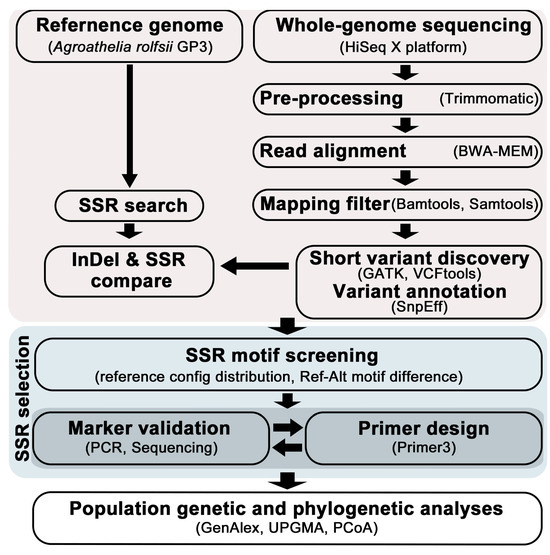
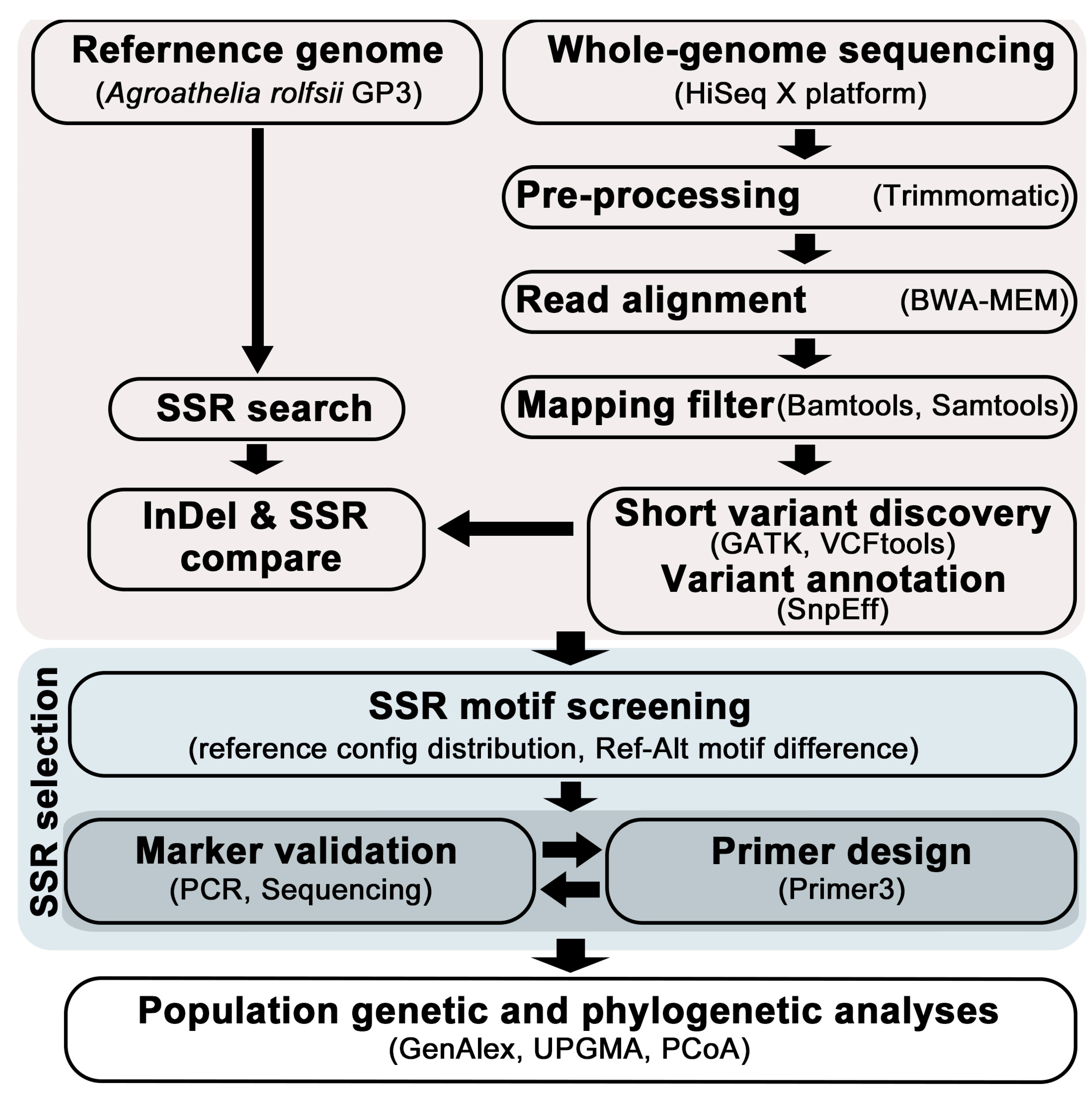
Genomic variants were identified using the Genome Analysis Toolkit (GATK) v4.2 [49]. To obtain a high-confidence variant set, a multi-step filtering strategy was applied: (1) multi-alleles were excluded; (2) a hard filter was applied to eliminate false-positive variant calls, including thresholds of quality depth (QD) < 2.0, Fisher strand (FS) > 60.0, mapping quality (MQ) < 40.0, mapping quality rank-sum test (MQRankSum) < −12.5, and read position rank-sum test (ReadPosRankSum) < −8.0 for SNPs, and QD < 2.0, FS > 200.0, and ReadPosRankSum < −20.0 for insertion–deletion (InDels); (3) only variants with a complete genotype call rate (1.0) across all samples were retained; (4) variants with identical genotypes across all samples were removed. Additional quality based on allele depth (AD) and alternative allele ratio was applied to ensure robust genotype confidence. The overall workflow, from read alignment to SSR motif identification, is presented in Figure 1.
Figure 1.
Workflow illustrating the genome sequencing, read processing, variant calling, and genome-guided SSR marker development pipeline for two Korean isolates of Agroathelia (syn. Sclerotium) species.
2.5. Identification of SSR Motifs and Development of PCR Primers
SSR motifs were identified across the genome assemblies of the two Korean isolates (KACC 93004P, KACC 93031P) and the A. rolfsii GP3 reference genome. Minimum repeat thresholds were set at ≥5 for dinucleotides, ≥4 for trinucleotides, and ≥3 for four or more nucleotides. For InDel-associated loci, primer pairs were designed in Primer3 [50], using approximately 500 bp of flanking sequence on each side, targeting amplicon size of 100–250 bp with primer length of 18–26 bp (optimal 22 bp), melting temperature of 55–62 °C (optimal 58 °C), and a maximum GC content of 59%.
PCR amplification was performed in a total reaction volume of 25 μL, including AccuPower PCR Premix (Bioneer, Daejeon, Republic of Korea), 1 μL of genomic DNA (1 ng/μL), 0.4 μM of each primer, 1 μL of bovine serum albumin (0.8 μg/μL; Biosesang, Seongnam, Republic of Korea), and nuclease-free water (Sigma-Aldrich; Merck, St. Louis, MO, USA). Thermal cycling conditions comprised an initial denaturation at 95 °C for 5 min, followed by 36 cycles of 95 °C for 40 s, 55 °C for 40 s, 72 °C for 50 s, and a final elongation at 72 °C for 5 min. PCR amplicons were visualized by electrophoresis and sequenced by Macrogen (Daejeon, Republic of Korea).
2.6. Characterization and Selection of Polymorphic SSR Markers
Comparative genomic analysis among the three genome sequences identified 723 polymorphic SSR loci associated with InDel variations. The selection of candidate SSR markers was filtered using four criteria: (1) a difference of ≥2 repeat units in motif repeat number between the reference genome and each analyzed isolates; (2) broad distribution across contigs; (3) reliable PCR performance; (4) confirmed polymorphism by initial screening. Ninety-five loci were tested across a subset of isolates, and fourteen SSR markers demonstrating robust amplification, reproducible allele patterns, and clear polymorphism were selected for full validation and downstream genetic analyses.
2.7. Fragment Analysis and Allele Scoring
Fragment analysis of the 14 selected SSR loci was carried out on 34 isolates at Phyzen and Macrogen by capillary electrophoresis using a ABI 3730xl DNA Analyzer (Thermo Fisher Scientific). Fluorescently labeled PCR products were separated using the DS-33 dye set and sized with the GeneScan 500 LIZ Size Standard (Thermo Fisher Scientific). Electropherograms were interpreted with GeneMapper™ v5.0 (Thermo Fisher Scientific), and allele sizes were called based on reproducible peak profiles. All allele assignments were manually verified to ensure consistency among runs and across all isolates.
2.8. Genetic Diversity Analysis
The raw allele-size data obtained from fragment analysis were scored as codominant genotypes and analyzed in GenAlEx v6.5 b2 [51]. Genetic diversity was quantified using standard indices, including the number of alleles (NA), observed heterozygosity (Ho), and unbiased expected heterozygosity (He). Marker informativeness was assessed by estimating the polymorphic information content (PIC) in Cervus v3.07 [52]. Following Botstein et al. [53], PIC values were classified as highly informative (>0.5), moderately informative (0.25 < PIC ≤ 0.5), or lowly informative (<0.25). These measurements were used to assess the utility and discriminatory power of each SSR locus for population-level analyses.
2.9. Clustering and Phylogenetic Analyses
Genetic distances among isolates were computed using pairwise codominant genotypic distances based on allelic differences across the 14 SSR loci. A dendrogram was constructed using the unweighted pair group method with arithmetic mean (UPGMA) in MEGA 12 [54] using these distance values. The robustness of inferred groupings was evaluated through 1000 bootstrap replicates.
2.10. Principal Coordinates Analysis
Principal coordinates analysis (PCoA) was performed in GenAlEx with the codominant genotypic distance matrix derived from all 34 isolates. Ordination was conducted with the covariance-standardized method to ensure balanced contributions from all loci regardless of allele range or variance. The first two principal coordinates were used to represent the major proportion of genetic variation. To explore potential host-associated genetic structuring, isolates were assigned to host plant species, as grouping factors in the ordination plot. Because of uneven sample sizes among host categories, host-related patterns were interpreted qualitatively.
3. Results
3.1. Preprocessing and Read Alignment
Whole-genome sequencing of Agroathelia rolfsii KACC 93004P and A. delphinii KACC 93031P generated 2.76 Gb and 2.82 Gb of high-quality reads, respectively (Table 1). These datasets represent the first genome sequences reported for Korean Agroathelia isolates. The raw genome sequencing data were deposited in the Sequence Read Archive (NCBI SRA) database in FASTQ format with BioSample SAMN50912537 and SAMN50912538 with SRA study SRP616151 (SRR35216484, SRR35216485) under BioProject PRJNA1313866.
Table 1.
Summary of whole-genome sequencing results for Agroathelia (syn. Sclerotium) rolfsii KACC 93004P and A. delphinii KACC 93031P using the Illumina HiSeq X platform.
The GC content of A. rolfsii was 47%, with Phred quality scores of 95.3% at Q20 and 89.7% at Q30, whereas A. delphinii exhibited a GC content of 50.7% and slightly lower scores of 93.6% (Q20) and 86.6% (Q30). The total number of raw sequencing reads was 18,237,332 for A. rolfsii and 18,679,070 for A. delphinii. After quality trimming, removal of low-quality reads, and exclusion of multi-mapped reads, 9,495,410 (63.80%) and 8,414,682 (60.85%) of the trimmed reads were retained as best-hit reads, respectively (Table 2).
Table 2.
Read preprocessing, mapping, and reference coverage statistics for Agroathelia (syn. Sclerotium) rolfsii KACC 93004P and A. delphinii KACC 93031P.
Mapping A. rolfsii KACC 93004P reads to the A. rolfsii GP3 reference genome revealed coverage of 97.36% at ≥1×, 93.77% at ≥10×, and 85.50% at ≥20×, with an average sequencing depth of 34.99×. In contrast, A. delphinii KACC 93031P showed lower coverage of 80.88%, 63.72%, and 51.07% at the same thresholds, with a similar average depth of 35.07× (Table 3).
Table 3.
Genomic mapping coverage of Agroathelia (syn. Sclerotium) rolfsii KACC 93004P and A. delphinii KACC 93031P against the A. rolfsii GP3 reference genome.
3.2. Variant Discovery
Comparison of the two Korean genomes with the reference genome identified 2,405,477 raw variants, of which 1,676,676 high-confidence variants were retained after filtering. In A. rolfsii KACC 93004P, 400,596 variants were detected, comprising 55,248 homozygous and 345,348 heterozygous sites, with 356,385 SNPs and 44,214 InDels. In A. delphinii KACC 93031P, 1,378,238 variants were identified, including 723,040 homozygous and 655,198 heterozygous variants, with 1,194,738 SNPs and 183,500 InDels (Table 4).
Table 4.
Summary of SNP and InDel variants detected in Agroathelia (syn. Sclerotium) rolfsii KACC 93004P and A. delphinii KACC 93031P in comparison with the A. rolfsii GP3 reference genome.
3.3. SSR Motif Discovery and Distribution
Comparative genome analysis of A. rolfsii KACC 93004P, A. delphinii KACC 93031P, and the A. rolfsii GP3 reference genome identified a total of 7954 SSR motifs. These comprised 1861 di-, 3128 tri-, 1793 tetra-, 630 penta-, 473 hexa-, and 69 motifs longer than hexa-nucleotides. Trinucleotide repeats were the most abundant motif class, accounting for approximately 39% of all SSRs, followed by di- and tetra-nucleotide motifs.
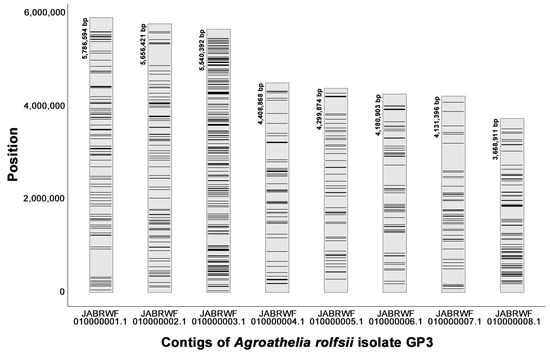
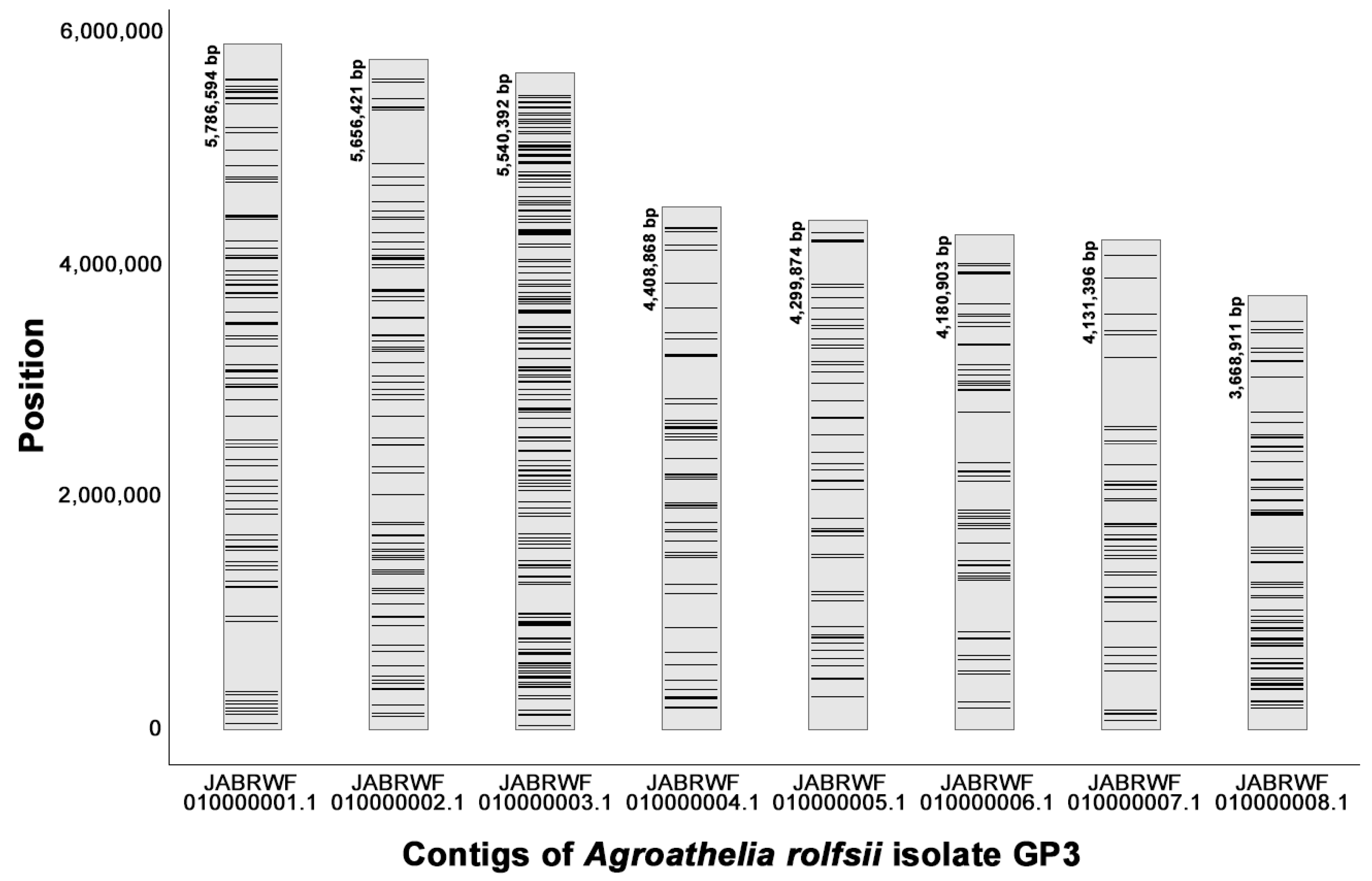
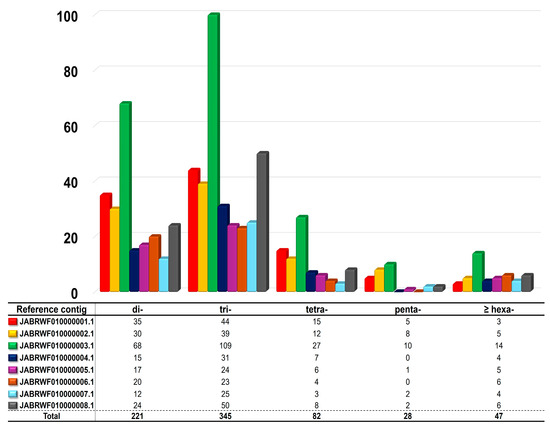
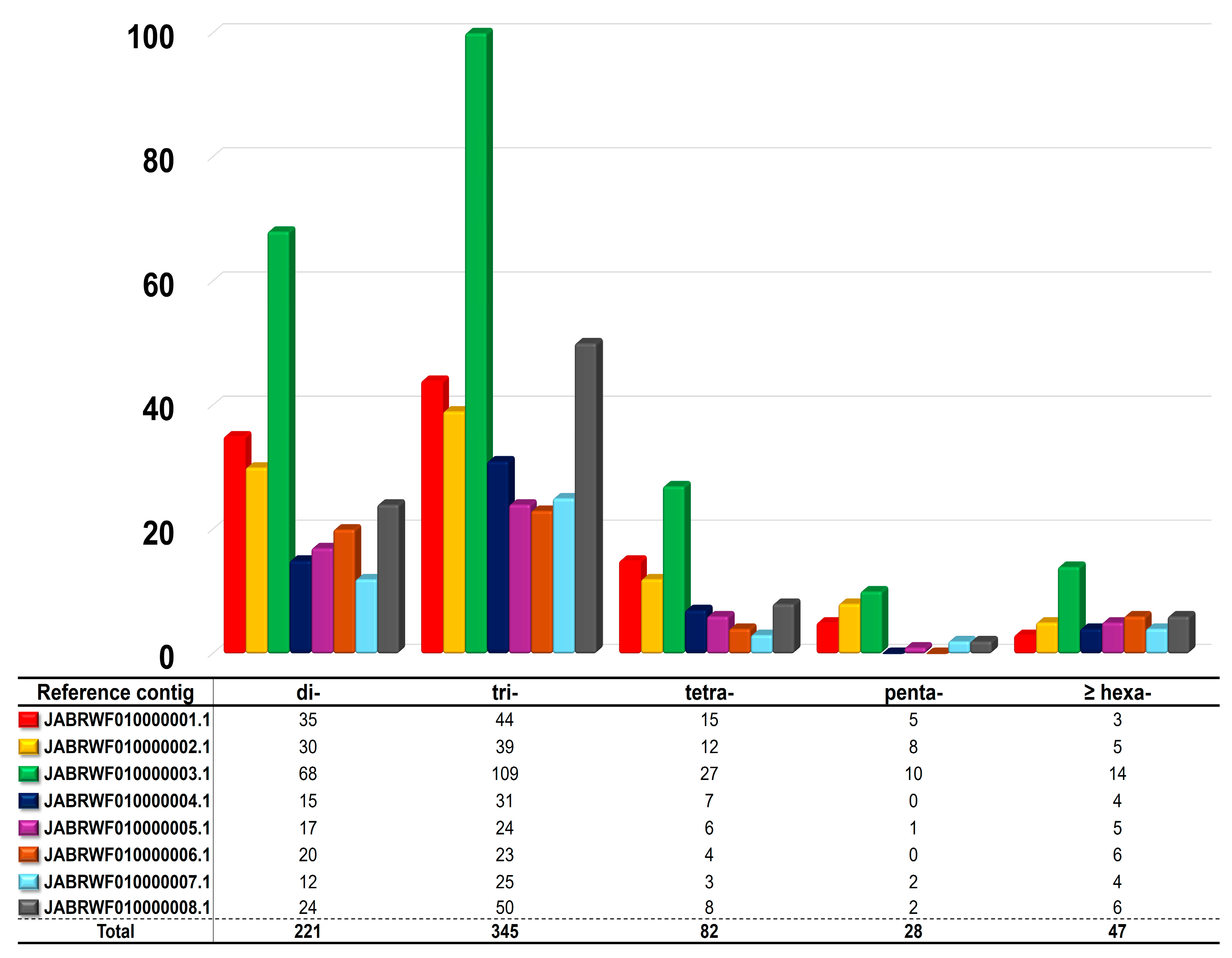
After remapping InDel variants to genomic SSR regions, 723 polymorphic SSR loci were retained as candidate sites for marker development (Figure 2). These loci were broadly and evenly distributed across the major contigs of the A. rolfsii GP3 reference genome (Figure 3). They included 221 di-, 345 tri-, 82 tetra-, 28 penta-, 41 hexa-, and 6 higher-order motifs.
Figure 2.
Genome-wide distribution of polymorphic SSR loci identified from comparative genome analysis of Agroathelia species. A total of 723 polymorphic SSR loci associated with InDel variations were identified by comparing the genomes of A. rolfsii KACC 93004P, A. delphinii KACC 93031P, and the A. rolfsii GP3 reference genome. Each vertical bar represents a contig of the A. rolfsii GP3, and horizontal lines indicate the physical positions of individual polymorphic SSR loci along each contig. The distribution shows that polymorphic SSR loci are broadly and evenly dispersed across the primary contigs.
Figure 3.
Distribution and composition of 723 polymorphic SSR motifs identified across eight contigs of the Agroathelia (syn. Sclerotium) rolfsii GP3 reference genome.
3.4. Marker Selection and Polymorphism
From the 723 polymorphic SSR loci, 95 candidates were initially selected by PCR test in a small subset of isolates. Based on amplification consistency, primer quality, and confirmed polymorphism, 14 SSR markers were chosen for full validation across all 34 isolates (Table 5 and Table S1).
Table 5.
Characteristics and genetic diversity parameters of 14 selected SSR markers developed from comparative genome analysis of Agroathelia (syn. Sclerotium) rolfsii KACC 93004P, A. delphinii KACC 93031P, and the A. rolfsii GP3 reference genome.
Genetic diversity analysis using these 14 markers revealed 2–7 alleles per locus. The loci JAB40-422 and JAB55-595 exhibited the highest allelic richness (NA = 5) within A. rolfsii, but JAB55-595 showed the highest overall NA (7 alleles) when A. delphinii isolates were included, due to the presence of two additional alleles in this species. The PIC values for A. rolfsii ranged from 0.341 (JAB11-188) to 0.541 (JAB40-422) and from 0.367 to 0.612 when A. delphinii was included. Among them, JAB13-194, JAB40-422, and JAB79-680 were classified as highly informative (PIC > 0.5) in A. rolfsii, while JAB49-530 was additionally highly informative in the combined dataset.
3.5. Genetic Clustering and PCoA Ordination
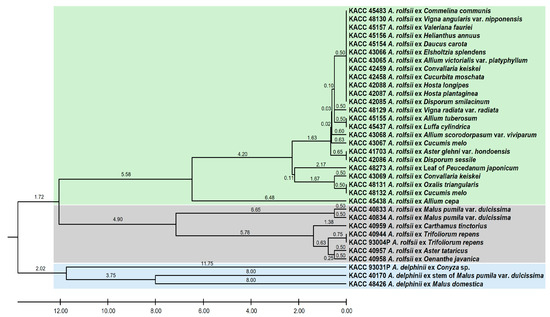
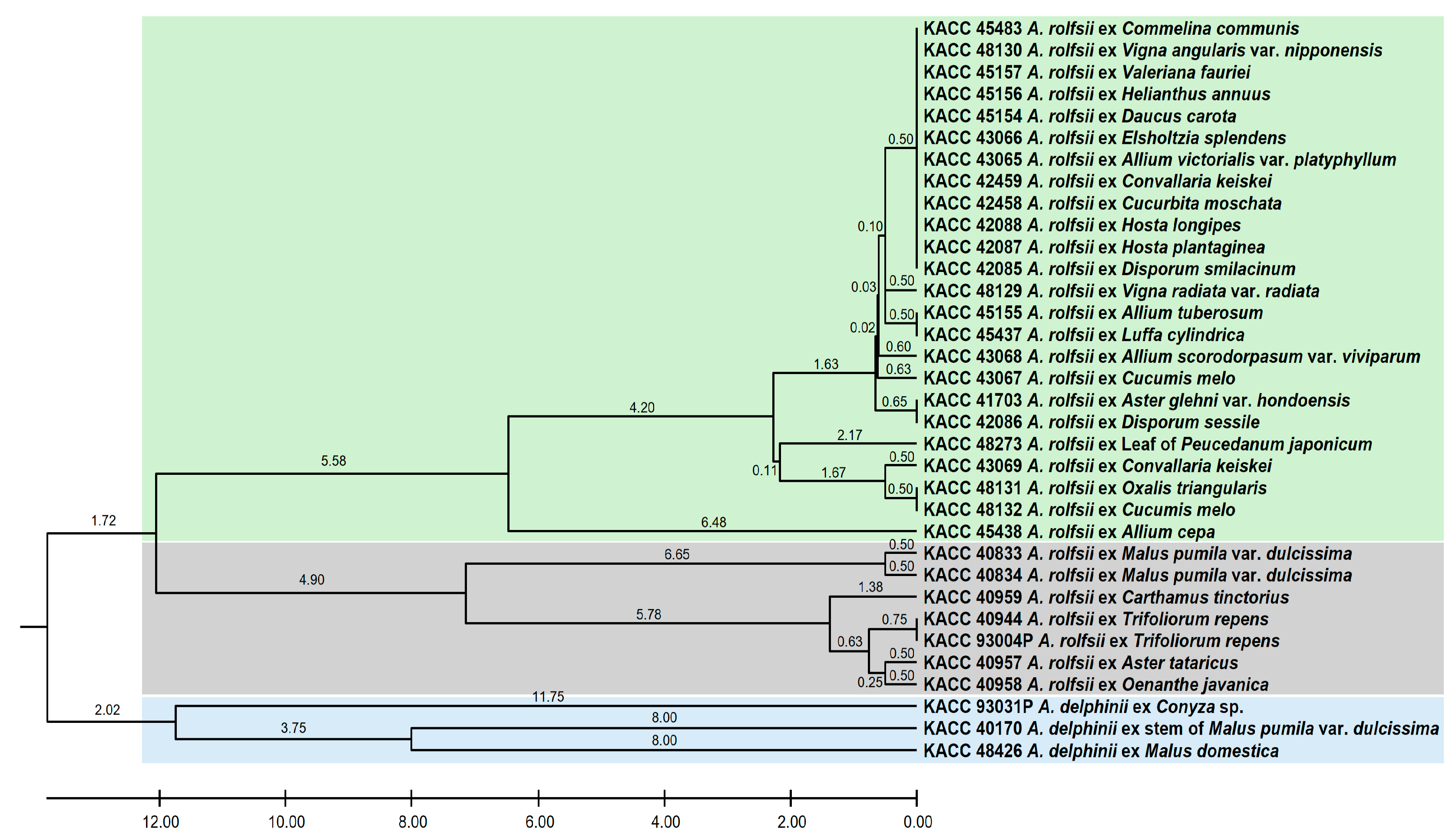
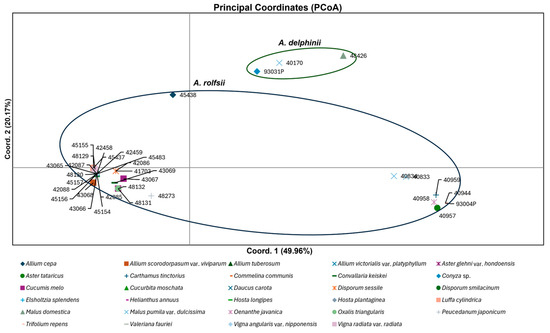
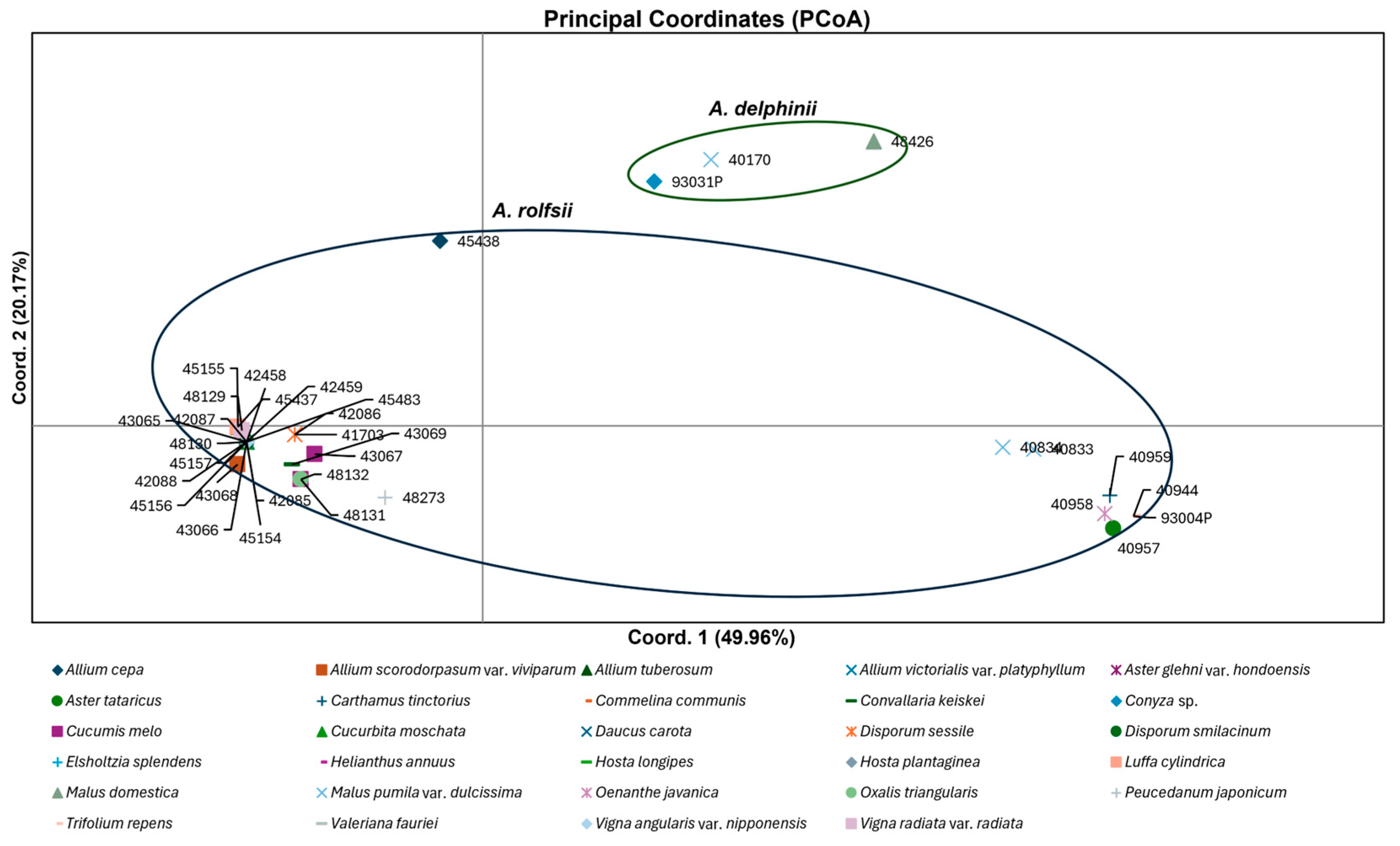
UPGMA clustering based on SSR-derived genetic distances clearly separated A. rolfsii and A. delphinii (Figure 4). Within A. rolfsii, two major subclusters were recognized, and several isolates showed longer branch lengths, representing additional lineage divergences within Korean populations. PCoA results (Figure 5) were consistent with the UPGMA tree. PC1 (49.96% of variation) separated the two species, while PC2 (20.17%) revealed intraspecific structuring within A. rolfsii. The A. rolfsii isolates formed two main genetic clusters, and one isolate (KACC 45438) was positioned separately, supporting the presence of distinct lineages. When host plant species were mapped onto the ordination, the clusters showed only partial correspondence with host origin, and no clear host-associated grouping was observed.
Figure 4.
UPGMA dendrogram showing genetic relationships among 34 Korean isolates of Agroathelia (syn. Sclerotium) based on genetic distance derived from 14 SSR markers. Branch lengths represent relative genetic distances calculated as pairwise codominant genotypic distances from SSR allele size data. Numerical values at branches correspond to the estimated genetic distance at each node. Branch support was assessed with 1000 bootstrap replicates.
Figure 5.
Principal Coordinates Analysis (PCoA) based on codominant genotypic distances among 34 Korean isolates of Agroathelia (syn. Sclerotium) derived from 14 SSR loci. Each point represents an individual isolate positioned along the first two principal coordinates. The first axis (Coord. 1) explains 49.96% of the total genetic variation, while the second axis (Coord. 2) explains an additional 20.17%, together accounting for 70.13% of the overall SSR-based genetic variation. Symbols and colors indicate host plant origins, and species-level groupings (A. rolfsii and A. delphinii) are outlined using 95% confidence ellipses. Axis labels denote the corresponding principal coordinates, and isolate IDs (KACC numbers) are shown to allow comparison with the UPGMA dendrogram.
4. Discussion
Agroathelia is a soil-borne plant pathogen affecting a wide host range. In the Republic of Korea, A. rolfsii and A. delphinii have become increasingly problematic in recent years [4,8,9,10,55,56,57]. Despite their global relevance, genomic resources and high-resolution molecular tools for this genus have remained limited. The present study provided the first genome sequences of Korean Agroathelia isolates and developed a robust set of 14 genome-derived SSR markers that can be applied to assess intra- and interspecific variation. Previous whole-genome analyses of A. rolfsii have mainly focused on isolates from different host plants in other regions, including MR10 causing stem rot on groundnut in India [58], GP3 and ZY affecting peanut in China [41], CB1 from Macleaya cordata in China [59], and F20A (CCF1) from Cannabis sativa in Italy [60]. In addition, A. delphinii isolate (SD from Dendrobium officinale) has recently been sequenced [61]. The addition of Korean isolates thus expands the genomic diversity of the genus and provides an important basis for comparative and population-level studies in East Asia.
Whole-genome comparison between our isolates and the A. rolfsii GP3 reference showed high mapping coverage for A. rolfsii KACC 93004P, but considerably lower coverage for A. delphinii KACC 93031P, reflecting clear genetic separation between the two species. Such interspecific differentiation aligns with previous phylogenetic studies based on ITS and RPB2 sequences, which consistently support species-level distinction between A. rolfsii and A. delphinii [13,24,44,62].
The 14 SSR markers displayed moderate to high levels of informativeness, with PIC values ranging from 0.341 to0.541 in A. rolfsii and from 0.367 to0.612 when A. delphinii was included. Several loci (JAB13-194, JAB40-422, JAB79-680, and additionally JAB49-530 in the combined dataset) exhibited PIC values above 0.5, reflecting relatively higher discriminatory capacity for distinguishing Agroathelia isolates. Compared with EST-SSR markers previously developed for A. rolfsii by [43], the slightly lower PIC values observed in our genomic SSRs likely reflect the smaller sample size examined and the broader genomic origins of the loci, which include both coding and non-coding regions. Nevertheless, the markers provided consistent multilocus profiles and robust resolution for species-level discrimination between A. rolfsii and A. delphinii and genetic diversity within A. rolfsii populations.
Both UPGMA clustering and PCoA ordination clearly separated A. rolfsii and A. delphinii, reflecting strong species-level divergence. Within A. rolfsii, the two analyses consistently resolved two major intraspecific clusters, accompanied by one divergent isolate. This pattern indicates that multiple genetic lineages coexist within Korean A. rolfsii populations. The presence of structured intraspecific variation is consistent with earlier studies employing ITS phylogeny, RAPD, ISSR, RFLP, and AFLP markers, which also reported considerable genetic diversity within A. rolfsii [13,20,22,63,64]. Similarly, a recent SNP-based study has provided high population diversity and genetic subdivision of A. rolfsii in Uganda [42], suggesting that such genetic structuring may be widespread across regions.
Host association overlaid onto the UPGMA and PCoA results showed no evidence of host-associated clustering among A. rolfsii isolates. Isolates from diverse host plants were intermingled across both genetic clusters, and host origin did not correspond to lineage boundaries. This lack of host specialization aligns with the wide host range reported for the species and indicates that Korean populations likely consist of generalist lineages capable of infecting multiple plants.
The biological basis of the observed intraspecific structure may relate to the predominantly asexual and heterokaryotic life cycle of Agroathelia. Sexual reproduction has rarely been observed in nature, and gene flow among isolates appears limited [12,13,42,65]. Population-level genetic diversity therefore has to arise primarily through clonal propagation, somatic mutation, and the accumulation of divergence among mycelial compatibility groups [13,41,66]. In organisms with such reproductive biology, SSR markers are particularly useful for resolving subtle genetic differences and tracing local lineage diversification [27,67,68].
This study expands the genomic resources available for Agroathelia and demonstrates the effectiveness of genome-guided SSR markers for resolving both species-level divergence and intraspecific population structure. These findings enhance understanding of biology, ecology, and epidemiology of Agroathelia species in agricultural systems.
5. Conclusions
This study delivers the first genome sequences for Korean A. rolfsii and A. delphinii isolates and establishes fourteen robust SSR markers capable of detecting both interspecific divergence and intraspecific population structure. The markers exhibited moderate to high polymorphism and produced consistent patterns across UPGMA and PCoA analyses, revealing distinct species boundaries and multiple genetic lineages within Korean A. rolfsii populations. The absence of a host-associated structure suggests that lineage diversification is likely driven by clonal propagation and somatic mutation rather than host specialization under current sampling.
The genomic resources and SSR markers developed here provide powerful tools for population genetic, epidemiological, and evolutionary studies of Agroathelia. These markers also offer practical utility for pathogen monitoring by enabling the tracking of population dynamics and the identification of potential sources of inoculum in agricultural fields, thereby supporting improved disease monitoring and management strategies.
Supplementary Materials
The following supporting information can be downloaded at: https://www.mdpi.com/article/10.3390/agriculture16020167/s1, Table S1: Allele profiles of thirty-four Agroathelia isolates genotyped with fourteen polymorphic SSR markers. Each isolate is shown with its species designation (A. rolfsii or A. delphinii) followed by allele sizes (in base pairs) for all SSR loci (JAB11-188 to JAB79-680). For each locus, two columns represent the two alleles detected per isolate. “N/A” indicates missing data or failed amplification.
Author Contributions
Y.-J.C. conceived the study, secured funding, supervised the project, and coordinated resources. D.J.L. performed the experimental work, conducted formal analyses, developed analytical pipelines, and prepared data visualizations. Methodology and validation were carried out by D.J.L. and Y.-J.C. The original draft was written by D.J.L., and the manuscript was reviewed and edited by Y.-J.C. All authors have read and agreed to the published version of the manuscript.
Funding
This research was funded by the Korea Institute of Planning and Evaluation for Technology in Food, Agriculture and Forestry (IPET) through the Agricultural Machinery/Equipment Localization Technology Development Program of the Ministry of Agriculture, Food and Rural Affairs (MAFRA) (grant no. 321056-05), and by the Basic Science Research Program of the National Research Foundation of Korea (NRF) of the Ministry of Education (RS-2024-00415209).
Institutional Review Board Statement
Not applicable.
Informed Consent Statement
Not applicable.
Data Availability Statement
The original raw genome sequencing data presented in this study are openly available in the NCBI Sequence Read Archive (SRA) under BioProject PRJNA1313866 and SRA accession SRP616151. The datasets can be accessed via Experiment accessions SRX30320301 and SRX30320302, and Run accessions SRR35216485 and SRR35216484, respectively, at: https://www.ncbi.nlm.nih.gov/bioproject/PRJNA1313866 (accessed on 2 September 2025).
Conflicts of Interest
The authors declare no conflicts of interest.
Abbreviations
The following abbreviations are used in this manuscript:
| AD | Allele depth |
| AFLP | Amplified fragment length polymorphism |
| EST | Expressed sequence tag |
| FS | Fisher strand |
| He | Unbiased expected heterozygosity |
| Ho | Observed heterozygosity |
| InDel | Insertion and deletion |
| ISSR | Inter-simple sequence repeat |
| ITS | Internal transcribed spacer |
| KACC | Korean agricultural culture collection |
| MQ | Mapping quality |
| MQRankSum | Mapping quality rank-sum test |
| NA | Number of alleles |
| PCR | Polymerase chain reaction |
| PE | Paired end |
| PIC | Polymorphic information content |
| QD | Quality depth |
| RAPD | Random amplified polymorphic DNA |
| ReadPosRankSum | Read position rank-sum test |
| RFLP | Restriction fragment length polymorphism |
| RPB2 | DNA-directed RNA polymerase II subunit |
| SNP | Single-nucleotide polymorphism |
| SSR | Simple sequence repeat |
| Tm | Melting temperature |
| UPGMA | Unweighted pair group method with arithmetic mean |
| PCoA | Principal coordinates analysis |
References
- Prasad, R.D.; Naik, M.K. Advances in plant diseases caused by Sclerotium rolfsii and their management. In Advances in Soil Borne Plant Diseases; Naik, M.K., Rani, G.D., Eds.; New India Publishing Agency: New Delhi, India, 2008; pp. 89–127. [Google Scholar]
- Punja, Z.K. The biology, ecology, and control of Sclerotium rolfsii. Annu. Rev. Phytopathol. 1985, 23, 97–127. [Google Scholar] [CrossRef]
- Aycock, R. Stem rot and other diseases caused by Sclerotium rolfsii. Tech. Bul. 1966, 175, 1–202. [Google Scholar]
- Choi, J.; Kim, S.-H.; Choi, Y.-J.; Kim, G.H.; Yoon, J.-Y.; Park, B.-Y.; Kong, H.G.; Kim, S.; Park, S.; Back, C.-G.; et al. Yearly update of the list of plant diseases in Korea (6.2 Edition, 2024). Res. Plant Dis. 2024, 30, 103–113. [Google Scholar] [CrossRef] [Scilit]
- Farr, D.F.; Rossman, A.Y. Fungal Databases. U.S. National Fungus Collections, Agricultural Research Service, U.S. Department of Agriculture (USDA). Available online: https://fungi.ars.usda.gov/ (accessed on 1 September 2025).
- Paul, N.C.; Hwang, E.-J.; Nam, S.-S.; Lee, H.-U.; Lee, J.-S.; Yu, G.-D.; Kang, Y.-G.; Lee, K.-B.; Go, S.; Yang, J.-W. Phylogenetic placement and morphological characterization of Sclerotium rolfsii (Teleomorph: Athelia rolfsii) associated with blight disease of Ipomoea batatas in Korea. Mycobiology 2017, 45, 129–138. [Google Scholar] [CrossRef] [Scilit]
- Choi, J.-S.; Choi, J.-W.; Lim, S.-K.; Kim, H.-D.; Lee, S.-R.; Kang, I.-K.; Lee, S.-Y.; Jung, H.-Y. Selection of fungicides for controlling southern blight on apple nursery trees and development of a spray program. Korean J. Pestic. Sci. 2025, 29, 64–70. [Google Scholar] [CrossRef] [Scilit]
- Choi, O.H.; Lee, Y.Y.; Noh, H.E.; Kim, J.W. Sclerotium rot of oriental motherwort caused by Athelia rolfsii. J. Agric. Life Sci. 2025, 59, 9–13. [Google Scholar] [CrossRef] [Scilit]
- Choi, O.H.; Noh, H.E.; Lee, Y.Y.; Kang, D.W.; Han, I.Y.; Kim, J.W. First report of southern blight caused by Athelia rolfsii on small red bean in Korea. J. Agric. Life Sci. 2024, 58, 21–27. [Google Scholar] [CrossRef] [Scilit]
- Son, D.Y.; Choi, O.H.; Noh, H.E.; Lee, Y.Y.; Kim, J.W. First report of southern blight caused by Athelia rolfsii on Korean red mustard in Korea. J. Agric. Life Sci. 2025, 59, 21–26. [Google Scholar]
- Le, C.N.; Mendes, R.; Kruijt, M.; Raaijmakers, J.M. Genetic and phenotypic diversity of Sclerotium rolfsii in groundnut fields in central Vietnam. Plant Dis. 2012, 96, 389–397. [Google Scholar] [CrossRef] [Scilit]
- Punja, Z.K.; Sun, L.-J. Genetic diversity among mycelial compatibility groups of Sclerotium rolfsii (teleomorph Athelia rolfsii) and S. delphinii. Mycol. Res. 2001, 105, 537–546. [Google Scholar] [CrossRef] [Scilit]
- Harlton, C.; Levesque, C.; Punja, Z. Genetic diversity in Sclerotium (Athelia) rolfsii and related species. Phytopathology 1995, 85, 1269–1281. [Google Scholar] [CrossRef] [Scilit]
- Okabe, I.; Matsumoto, N. Population structure of Sclerotium rolfsii in peanut fields. Mycoscience 2000, 41, 145–148. [Google Scholar] [CrossRef] [Scilit]
- Xie, C.; Huang, C.-H.; Vallad, G.E. Mycelial compatibility and pathogenic diversity among Sclerotium rolfsii isolates in the southern United States. Plant Dis. 2014, 98, 1685–1694. [Google Scholar] [CrossRef] [Scilit] [PubMed]
- Remesal, E.; Jordán-Ramírez, R.; Jiménez-Díaz, R.M.; Navas-Cortés, J.A. Pathogenic diversity of Sclerotium rolfsii populations infecting sugar beet crops from Mediterranean-type climate regions. IOBC WPRS Bull. 2011, 71, 109–112. [Google Scholar]
- Dinesh, K.; Sinha, B.; Savan, A.K. Morphological variability and mycelial compatibility of Sclerotium rolfsii. Indian J. Plant Prot. 2021, 49, 182–189. [Google Scholar]
- Dinesh, K.; Sinha, B.; Ravikumar, M.R.; Savani, A.K. Genetic diversity analysis of Sclerotium rolfsii employing ITS, ISSR and RAPD markers. Indian Phytopathol. 2022, 75, 259–265. [Google Scholar] [CrossRef] [Scilit]
- Jebaraj, M.D.J.; Aiyanathan, E.; Sevugapperumal, N. Virulence and genetic diversity of Sclerotium rolfsii Sacc., infecting groundnut using nuclear (RAPD & ISSR) markers. J. Environ. Biol. 2017, 38, 147–159. [Google Scholar] [CrossRef] [Scilit]
- Gawande, S.; Borkar, S.; Chimote, V.; Sharma, A. Determination of genetic diversity in Sclerotium rolfsii and Sclerotium delphinii by using RAPD and ISSR markers. Vegetos 2013, 26, 39–44. [Google Scholar] [CrossRef] [Scilit]
- Meena, P.N.; Meena, A.K.; Ram, C. Morphological and molecular diversity in Sclerotium rolfsii Sacc., infecting groundnut (Arachis hypogaea L.). Discov. Agric. 2023, 1, 3. [Google Scholar] [CrossRef] [Scilit]
- Prasad, S.D.; Basha, S.T.; Reddy, N.P.G.E. Molecular variability among the isolates of Sclerotium rolfsii causing stem rot of groundnut by RAPD, ITS-PCR and RFLP. EurAsian J. Biosci. 2010, 4, 80–87. [Google Scholar] [CrossRef] [Scilit]
- Okabe, I.; Arakawa, M.; Matsumoto, N. ITS polymorphism within a single strain of Sclerotium rolfsii. Mycoscience 2001, 42, 107–113. [Google Scholar] [CrossRef] [Scilit]
- Okabe, I.; Matsumoto, N. Phylogenetic relationship of Sclerotium rolfsii (teleomorph Athelia rolfsii) and S. delphinii based on ITS sequences. Mycol. Res. 2003, 107, 164–168. [Google Scholar] [CrossRef] [Scilit]
- Boiko, S.M. Identification of novel SSR markers for predicting the geographic origin of fungus Schizophyllum commune Fr. Fungal Biol. 2022, 126, 764–774. [Google Scholar] [CrossRef] [Scilit]
- Burgess, T.I.; Wingfield, M.J.; Wingfield, B.D. Global distribution of Diplodia pinea genotypes revealed using simple sequence repeat (SSR) markers. Australas. Plant Pathol. 2004, 33, 513–519. [Google Scholar] [CrossRef] [Scilit]
- Liu, J.X.; Cai, Y.N.; Jiang, W.Y.; Li, Y.G.; Zhang, Q.F.; Pan, H.Y. Population structure and genetic diversity of fungi causing rice seedling blight in Northeast China based on microsatellite markers. Plant Dis. 2019, 104, 868–874. [Google Scholar] [CrossRef] [Scilit]
- Zhang, J.; Hieno, A.; Otsubo, K.; Feng, W.; Kageyama, K. Population genetic analysis of Phytophthora colocasiae from taro in Japan using SSR markers. J. Fungi 2023, 9, 391. [Google Scholar] [CrossRef] [Scilit]
- Mansoor, S.; Ahmed, N.; Sharma, V.; Jan, S.; Nabi, S.U.; Mir, J.I.; Mir, M.A.; Masoodi, K.Z. Elucidating genetic variability and population structure in Venturia inaequalis associated with apple scab diseaseusing SSR markers. PLoS ONE 2019, 14, e0224300. [Google Scholar] [CrossRef] [Scilit] [PubMed]
- Geistlinger, J.; Zwanzig, J.; Heckendorff, S.; Schellenberg, I. SSR markers for Trichoderma virens: Their evaluation and application to identify and quantify root-endophytic strains. Diversity 2015, 7, 360–384. [Google Scholar] [CrossRef] [Scilit]
- Luo, H.; Wang, X.; Zhan, G.; Wei, G.; Zhou, X.; Zhao, J.; Huang, L.; Kang, Z. Genome-wide analysis of simple sequence repeats and efficient development of polymorphic ssr markers based on whole genome re-sequencing of multiple isolates of the wheat stripe rust fungus. PLoS ONE 2015, 10, e0130362. [Google Scholar] [CrossRef] [Scilit]
- Savadi, S.; Prasad, P.; Sharma, K.; Rathore, R.; Bhardwaj, S.C.; Gangwar, O.P.; Khan, H.; Kumar, S.; Jain, N.; Gupta, P.K. Development of novel transcriptome-based SSR markers in Puccinia triticina and their potential application in genetic diversity studies. Trop. Plant Pathol. 2020, 45, 499–510. [Google Scholar] [CrossRef] [Scilit]
- Gautier, A.; Marcel, T.C.; Confais, J.; Crane, C.; Kema, G.; Suffert, F.; Walker, A.-S. Development of a rapid multiplex SSR genotyping method to study populations of the fungal plant pathogen Zymoseptoria tritici. BMC Res. Notes 2014, 7, 373. [Google Scholar] [CrossRef] [Scilit]
- Prasanth, C.N.; Viswanathan, R.; Malathi, P.; Sundar, A.R. Development and characterization of genomic SSR marker for virulent strain-specific Colletotrichum falcatum infecting sugarcane. 3 Biotech 2021, 11, 20. [Google Scholar] [CrossRef] [Scilit]
- Jeseničnik, T.; Kaurin, A.; Grgič, Z.; Radišek, S.; Jakše, J.; Štajner, N. Novel identification of the collection of pathogenic fungal species Verticillium with the development of species-specific SSR markers. Pathogens 2023, 12, 535. [Google Scholar] [CrossRef] [Scilit]
- Lee, H.-Y.; Raveendar, S.; An, H.; Oh, Y.-L.; Jang, K.-Y.; Kong, W.-S.; Ryu, H.; So, Y.-S.; Chung, J.-W. Development of polymorphic simple sequence repeat markers using high-throughput sequencing in button mushroom (Agaricus bisporus). Mycobiology 2018, 46, 421–428. [Google Scholar] [CrossRef] [Scilit]
- An, H.; Jo, I.-H.; Oh, Y.-L.; Jang, K.-Y.; Kong, W.-S.; Sung, J.-K.; So, Y.-S.; Chung, J.-W. Molecular characterization of 170 new gDNA-SSR markers for genetic diversity in button mushroom (Agaricus bisporus). Mycobiology 2019, 47, 527–532. [Google Scholar] [CrossRef] [Scilit]
- Zhang, R.; Hu, D.; Zhang, J.; Zuo, X.; Jiang, R.; Wang, H.; Ng, T.B. Development and characterization of simple sequence repeat (SSR) markers for the mushroom Flammulina velutipes. J. Biosci. Bioeng. 2010, 110, 273–275. [Google Scholar] [CrossRef] [Scilit] [PubMed]
- Liu, X.B.; Feng, B.; Li, J.; Yan, C.; Yang, Z.L. Genetic diversity and breeding history of winter mushroom (Flammulina velutipes) in China uncovered by genomic SSR markers. Gene 2016, 591, 227–235. [Google Scholar] [CrossRef] [Scilit] [PubMed]
- Lee, H.-Y.; Moon, S.; Shim, D.; Hong, C.P.; Lee, Y.; Koo, C.-D.; Chung, J.-W.; Ryu, H. Development of 44 novel polymorphic SSR markers for determination of shiitake mushroom (Lentinula edodes) cultivars. Genes 2017, 8, 109. [Google Scholar] [CrossRef] [Scilit] [PubMed]
- Yan, L.; Wang, Z.; Song, W.; Fan, P.; Kang, Y.; Lei, Y.; Wan, L.; Huai, D.; Chen, Y.; Wang, X.; et al. Genome sequencing and comparative genomic analysis of highly and weakly aggressive strains of Sclerotium rolfsii, the causal agent of peanut stem rot. BMC Genom. 2021, 22, 276. [Google Scholar] [CrossRef] [Scilit]
- Erima, S.; Nyine, M.; Ssemakula, M.O.; Tusiime, G.; Ahkunov, E.; Akhunova, A.; Yunusbaev, U.; Adjei, E.A.; Mukasa, S.B.; Otim, M.H.; et al. Pathogenic and genetic diversity of Sclerotium rolfsii, the causal agent of southern blight of common bean in Uganda. J. Fungi 2026, 12, 18. [Google Scholar] [CrossRef] [Scilit]
- Wang, F.; Tang, T.; Mao, T.; Duan, Y.; Guo, X.; You, J. Development of EST-SSR primers and genetic diversity analysis of the southern blight pathogen Sclerotium rolfsii using transcriptome data. Front. Microbiol. 2023, 14, 1152865. [Google Scholar] [CrossRef] [Scilit]
- Lee, D.J.; Choi, Y.-J. Development of a novel multiplex TaqMan probe qPCR assay distinguishing dikaryotic ITS rDNA types of Sclerotium rolfsii (=Agroathelia rolfsii) and S. delphinii. Plant Dis. 2025, 109, 1404–1414. [Google Scholar] [CrossRef] [Scilit] [PubMed]
- Bolger, A.M.; Lohse, M.; Usadel, B. Trimmomatic: A flexible trimmer for Illumina sequence data. Bioinformatics 2014, 30, 2114–2120. [Google Scholar] [CrossRef] [Scilit]
- Li, H.; Durbin, R. Fast and accurate short read alignment with Burrows–Wheeler transform. Bioinformatics 2009, 25, 1754–1760. [Google Scholar] [CrossRef] [Scilit] [PubMed]
- Barnett, D.W.; Garrison, E.K.; Quinlan, A.R.; Strömberg, M.P.; Marth, G.T. BamTools: A C++ API and toolkit for analyzing and managing BAM files. Bioinformatics 2011, 27, 1691–1692. [Google Scholar] [CrossRef] [Scilit] [PubMed]
- Li, H.; Handsaker, B.; Wysoker, A.; Fennell, T.; Ruan, J.; Homer, N.; Marth, G.; Abecasis, G.; Durbin, R.; Genome Project Data Processing, S. The sequence alignment/map format and SAMtools. Bioinformatics 2009, 25, 2078–2079. [Google Scholar] [CrossRef] [Scilit]
- McKenna, A.; Hanna, M.; Banks, E.; Sivachenko, A.; Cibulskis, K.; Kernytsky, A.; Garimella, K.; Altshuler, D.; Gabriel, S.; Daly, M.; et al. The genome analysis toolkit: A mapreduce framework for analyzing next-generation DNA sequencing data. Genome Res. 2010, 20, 1297–1303. [Google Scholar] [CrossRef] [Scilit]
- Untergasser, A.; Cutcutache, I.; Koressaar, T.; Ye, J.; Faircloth, B.C.; Remm, M.; Rozen, S.G. Primer3—New capabilities and interfaces. Nucleic Acids Res. 2012, 40, e115. [Google Scholar] [CrossRef] [Scilit]
- Peakall, R.; Smouse, P.E. GenAlEx 6.5: Genetic analysis in excel. Population genetic software for teaching and research—An update. Bioinformatics 2012, 28, 2537–2539. [Google Scholar] [CrossRef] [Scilit]
- Kalinowski, S.; Taper, M.; Marshall, T. Revising how the computer program CERVUS accommodates genotyping error increases success in paternity assignment. Mol. Ecol. 2007, 16, 1099–1106. [Google Scholar] [CrossRef] [Scilit]
- Botstein, D.; White, R.L.; Skolnick, M.; Davis, R.W. Construction of a genetic linkage map in man using restriction fragment length polymorphisms. Am. J. Hum. Genet. 1980, 32, 314. [Google Scholar]
- Kumar, S.; Stecher, G.; Suleski, M.; Sanderford, M.; Sharma, S.; Tamura, K. MEGA12: Molecular evolutionary genetic analysis version 12 for adaptive and green computing. Mol. Biol. Evol. 2024, 41, msae263. [Google Scholar] [CrossRef] [Scilit] [PubMed]
- Kang, D.W.; Lee, Y.; Choi, O.; Kang, B.; Kim, J. First report of sclerotium rot caused by Athelia rolfsii on christmas kalanchoe in South Korea. Plant Dis. 2022, 106, 3217. [Google Scholar] [CrossRef] [Scilit]
- Kwon, J.-H.; Kang, D.-W.; Lee, Y.; Kang, B.; Choi, O.; Son, D.; Kim, J. First report of sclerotium rot in sword bean caused by Athelia rolfsii. Australas. Plant Dis. Notes 2022, 17, 22. [Google Scholar] [CrossRef] [Scilit]
- Jeon, C.; Kim, D.; Kwak, Y. First report of southern blight caused by Sclerotium rolfsii on Amaranthus mangostanus and fungicides selection. Korean J. Pestic. Sci. 2020, 24, 1–6. [Google Scholar] [CrossRef] [Scilit]
- Iquebal, M.A.; Tomar, R.S.; Parakhia, M.V.; Singla, D.; Jaiswal, S.; Rathod, V.M.; Padhiyar, S.M.; Kumar, N.; Rai, A.; Kumar, D. Draft whole genome sequence of groundnut stem rot fungus Athelia rolfsii revealing genetic architect of its pathogenicity and virulence. Sci. Rep. 2017, 7, 5299. [Google Scholar] [CrossRef] [Scilit] [PubMed]
- Wang, F.; Wang, X.; Tang, T.; Duan, Y.; Mao, T.; Guo, X.; Wang, Q.; You, J. De Novo RNA sequencing and transcriptome analysis of Sclerotium rolfsii gene expression during sclerotium development. Genes 2023, 14, 2170. [Google Scholar] [CrossRef] [Scilit]
- D’Angelo, D.; Sorrentino, R.; Nkomo, T.; Zhou, X.; Vaghefi, N.; Sonnekus, B.; Bose, T.; Cerrato, D.; Cozzolino, L.; Creux, N.; et al. IMA GENOME—F20 A draft genome assembly of Agroathelia rolfsii, Ceratobasidium papillatum, Pyrenopeziza brassicae, Neopestalotiopsis macadamiae, Sphaerellopsis filum and genomic resources for Colletotrichum spaethianum and Colletotrichum fructicola. IMA Fungus 2025, 16, e141732. [Google Scholar] [CrossRef] [Scilit]
- Chen, Y.-J.; Liu, Q.; Zhang, Y.-J.; Jiang, Z.-L.; Fu, H.-L.; Wu, H.; Liu, M.-J.; Jiang, J.-H.; Li, L.-D. Whole-genome sequence of Sclerotium delphinii, a pathogenic fungus of Dendrobium officinale southern blight. Genomics 2024, 116, 110932. [Google Scholar] [CrossRef] [Scilit]
- Lee, D.J.; Choi, Y.-J. High-resolution melting analysis for differentiation of Sclerotium (=Agroathelia) rolfsii, S. delphinii, and two intraspecific groups of S. rolfsii. Mycobiology 2025, 53, 761–769. [Google Scholar] [CrossRef] [Scilit]
- Cilliers, A.; Herselman, L.; Pretorius, Z. Genetic variability within and among mycelial compatibility groups of Sclerotium rolfsii in South Africa. Phytopathology 2000, 90, 1026–1031. [Google Scholar] [CrossRef] [Scilit]
- Sultana, N.A.; Islam, M.S.; Islam, S.M.A.; Alam, M.M.; Alam, K.M. Molecular characterization and phylogenetic analysis of Sclerotium rolfsii isolates from sunflowers affected by collar rot disease in the southern coastal region of Bangladesh. Eur. J. Ecol. Biol. Agric. 2025, 2, 28–37. [Google Scholar] [CrossRef] [Scilit]
- Mehri, Z.; Khodaparast, S.A.; Aalami, A.; Mousanejad, S.; Masigol, H.; Grossart, H.P. Population genetics and gene sequence analysis of Athelia rolfsii collected from Northern Iran. Mycol. Iran. 2020, 7, 195–203. [Google Scholar] [CrossRef]
- Punja, Z.K.; Grogan, R. Basidiocarp induction, nuclear condition, variability and heterokaryon incompatibility in Athelia (Sclerotium) rolfsii. Phytopathology 1983, 73, 1273–1278. [Google Scholar] [CrossRef] [Scilit]
- Sun, Q.; Liu, J.; Huang, C.; Liu, X.; Gao, J.; Li, L.; Luo, Y.; Ma, Z. Clonal expansion and dispersal pathways of Puccinia polysora in China. Phytopathology® 2022, 113, 21–30. [Google Scholar] [CrossRef] [Scilit] [PubMed]
- Rodriguez-Algaba, J.; Hovmøller, M.S.; Villegas, D.; Cantero-Martínez, C.; Jin, Y.; Justesen, A.F. Two Indigenous Berberis species from Spain were confirmed as alternate hosts of the yellow rust fungus Puccinia striiformis f. sp. tritici. Plant Dis. 2021, 105, 2281–2285. [Google Scholar] [CrossRef] [Scilit]

Disclaimer/Publisher’s Note: The statements, opinions and data contained in all publications are solely those of the individual author(s) and contributor(s) and not of MDPI and/or the editor(s). MDPI and/or the editor(s) disclaim responsibility for any injury to people or property resulting from any ideas, methods, instructions or products referred to in the content. |
© 2026 by the authors. Licensee MDPI, Basel, Switzerland. This article is an open access article distributed under the terms and conditions of the Creative Commons Attribution (CC BY) license.