Article

Effects of Post-Wheat Sequential Green Manure Cropping on Soil Water Balance and Potato Productivity in a Loess Plateau Rotation System

1
College of Agronomy, Gansu Agricultural University, Lanzhou 730070, China
2
Institute of Dryland Farming, Gansu Academy of Agricultural Sciences, Lanzhou 730070, China
3
Key Laboratory of High Water Utilization on Dryland of Gansu Province, Lanzhou 730070, China
4
Key Laboratory of Low-Carbon Green Agriculture in Northwestern China, Ministry of Agriculture and Rural Affairs, Lanzhou 730070, China
*
Authors to whom correspondence should be addressed.
Agriculture 2026, 16(15), 1690; https://doi.org/10.3390/agriculture16151690
Submission received: 1 July 2026 / Revised: 27 July 2026 / Accepted: 4 August 2026 / Published: 6 August 2026

Abstract

The Loess Plateau is a typical dryland agricultural region where water scarcity constrains crop production. Plastic film mulching is widely used to mitigate this limitation, but its long-term application has caused soil degradation and environmental pollution, highlighting the need for sustainable alternatives. This study evaluated the effects of post-wheat sequential green manure cropping—common vetch (CV) and winter rape (CR)—on soil water balance, potato yield, water use efficiency (WUE), and economic returns within a winter wheat-potato rotation system. A field experiment (2019–2023) was conducted on the Loess Plateau, comparing CV, CR, plastic film mulching (PM), and no mulching (NM). Soil water content (0–200 cm), evapotranspiration (ET), tuber yield, WUE, and economic performance were measured. Although CV and CR depleted soil water in the 0–100 cm layer during their growth, subsequent fallow precipitation (86 mm) and low soil water loss replenished the deficit, resulting in comparable soil water storage at potato sowing among CV, CR, and NM (518.8, 508.8, and 518.9 mm, respectively). Over the full rotation cycle, a positive soil water balance (63.1–147.5 mm) was maintained across all treatments, indicating no detectable net depletion within the measured 0–200 cm profile over the four potato seasons. Potato tuber yield increased by 61.7% (CV), 52.4% (CR), and 74.8% (PM) relative to NM. The WUE of CV (73.5 kg ha−1 mm−1) and CR (71.5 kg ha−1 mm−1) was comparable to that of PM (74.2 kg ha−1 mm−1) and significantly higher than that of NM (46.1 kg ha−1 mm−1). Net incomes under CV and CR did not differ significantly from PM, while their input costs were lower. Collectively, the integrated system combining post-wheat sequential green manure cropping—particularly with common vetch—and straw mulching represents a technically feasible, economically viable, and environmentally beneficial alternative to plastic film mulching, contributing to sustainable dryland agriculture on the Loess Plateau and analogous semi-arid regions.

1. Introduction

The Loess Plateau in China represents a typical dryland agricultural region with approximately 25 million hectares of rainfed cropland [1], where water scarcity acts as the primary constraint on crop production. Across the Loess Plateau, annual precipitation varies widely from 150 to 800 mm depending on location, reflecting substantial spatial heterogeneity. Regionally, more than 60% of annual rainfall occurs during the summer months (June–September), with high inter-annual variability that frequently induces seasonal droughts during critical crop growth stages [2,3]. In the traditional winter wheat-potato rotation system, winter wheat is harvested in mid-July, followed by a 7–8-month fallow period until potato sowing in the subsequent spring (April–May). Although summer-autumn precipitation accounts for over 60% of annual rainfall over the fallow period, the absence of effective ground cover leads to substantial water loss via evaporation and runoff, resulting in low precipitation storage efficiency (typically <30%) [4]. Consequently, improving water capture and storage during the fallow period is essential for sustainable dryland farming on the Loess Plateau.
Plastic film mulching has been widely adopted on the Loess Plateau to enhance crop yields by suppressing evaporation and warming the soil [5,6,7]. However, its prolonged use has generated serious ecological and environmental concerns that threaten agricultural sustainability. It accelerates soil organic matter decomposition and reduces soil organic carbon stocks by raising soil temperature [8,9]. Residual plastic film accumulates in the soil, damaging pore structure, impeding water infiltration and root growth, and reducing crop yields [10,11]. Long-term mulching also over-depletes deep soil water (100–200 cm), forming a dry soil layer and weakening soil water regulation [12,13]. Accordingly, sustainable alternatives to plastic film mulching are urgently required to simultaneously improve crop productivity, water conservation, and soil health.
Cover crops—plants grown primarily to protect soil from erosion, improve soil physical properties, and increase soil organic matter and fertility—and green manure—cover crops that are incorporated into the soil while still green to add nutrients and organic matter—are well acknowledged as conservation practices that provide multiple ecosystem services, including reducing erosion, enhancing soil organic carbon, improving nutrient cycling, and increasing water infiltration [14,15,16]. In this study, the two terms are used functionally interchangeably, as the cover crops were left on the soil surface as protective mulch rather than being incorporated. The sequential cropping practice employed here refers to sowing cover crops immediately after winter wheat harvest in mid-July, allowing them to establish during the summer-autumn fallow period before being terminated in early November. This distinguishes sequential cropping from relay cropping, where the second crop is sown before the first is harvested, resulting in an overlapping growth period. When terminated and left as surface mulch, cover crops reduce soil evaporation and moderate soil temperature, thereby conserving soil moisture for subsequent cash crops [17,18]. Moreover, leguminous cover crops such as hairy vetch and common vetch can fix atmospheric nitrogen, potentially reducing fertilizer requirements and improving crop yields [19,20,21]. However, in semi-arid and water-limited environments, cover crops also consume soil water during growth, raising concerns about water competition with the following cash crop [4,22]. The net effect of cover cropping on soil water and crop yield is highly site-specific and depends on climate, soil type, cover crop species, termination timing, and residue management [2,23,24,25].
Existing studies have reported contradictory outcomes. In the semi-arid Texas High Plains, cover crops reduced soil water before termination, but spring precipitation and irrigation replenished the deficit, and no-till with cover crops increased soil water storage during cotton growth [26]. A 7-year study in the U.S. Midwest reported that winter rye increased field capacity (by 10–11%) and plant-available water (by 21–22%) without compromising maize or soybean yields [17]. Conversely, cover crops reduced subsequent wheat yield by up to 31% in dry years in the Central Great Plains due to soil water depletion [4,27]. A global meta-analysis by Garba et al. [23] concluded that cover cropping reduced dryland crop yield by 7% on average, ranging from –12% in temperate dry climates to +15% in tropical drylands, with a break-even annual precipitation of approximately 700 mm. Similarly, cover crops reduced precipitation storage efficiency by 33% and whole-profile soil water storage by 13%, but increased surface soil water (0–30 cm) by 6% and water use efficiency by 5% [2].
Despite extensive research on cover crops in maize-soybean and wheat-fallow systems, limited information is available on the effects of sequential green manure cropping after winter wheat on soil water dynamics and potato yield in a wheat-potato rotation system on the Loess Plateau. Potato, a drought-sensitive crop, relies heavily on soil moisture during tuber bulking [28], making it critical to assess whether green manure can be integrated without yield penalty and how it compares with plastic film mulching—a widely adopted practice. Furthermore, economic profitability is a key determinant of farmer adoption, yet few studies have directly compared the net income and output-input ratio of green manure versus plastic film in dryland potato production. Direct comparisons of water balance and economic returns between these systems are particularly scarce on the Loess Plateau. Thus, our study provides novel evidence on whether sequential green manure cropping can serve as a sustainable alternative to plastic film, focusing on depletion-recharge dynamics and the trade-off between water consumption and yield enhancement.
To address these knowledge gaps, we conducted a field experiment (2019–2023) on the Loess Plateau, China. The specific objectives were: (1) to quantify the effects of post-wheat sequential green manure cropping (common vetch, CV; winter rape, CR) on soil water storage, evapotranspiration, and water balance in the 0–200 cm soil profile; (2) to evaluate the impacts of these green manure practices on potato tuber yield, water use efficiency (WUE), and economic returns relative to plastic film mulching (PM); and (3) to identify suitable green manure management strategies for sustainable dryland farming in the region. The findings will provide a scientific basis for promoting green manure-based mulching as a viable alternative to plastic film on the Loess Plateau and in other semi-arid regions with similar agroecological conditions, thereby contributing to the transition towards more sustainable and environmentally friendly dryland agriculture.

2. Materials and Methods

2.1. Site Description

A field experiment was conducted from July 2019 to September 2023 in Panan (35°15′ N, 106°12′ E), Zhuanglang County, Gansu Province, China. The study site is located in the central Loess Plateau at an altitude of 1567 m and has a temperate, semi-arid continental monsoon climate. During the winter half of the year (October to April), precipitation is scarce—accounting for less than 25% of the annual total at our site—and temperatures are low, resulting in dry and cold conditions that are insufficient to meet the water requirements of most crops without reliance on stored soil moisture from previous seasons. The meteorological data are obtained from automatic weather stations, which are within 10 km of the experimental field. In contrast, the summer half of the year (May to September) receives more precipitation but is characterized by uneven distribution and frequent droughts, hail, and flash floods. The four-year precipitation record captures both a wet year (2020) and three near-normal years (2021–2023), providing a representative range of climatic conditions typical of the semi-arid Loess Plateau. The field capacity and permanent wilting point in the 0–100 cm soil layer were 24.8% and 7.01%, respectively. Soil properties and nutrient conditions in the topsoil before the experiment in 2019 are shown in Table 1.

2.2. Experimental Design and Crop Management

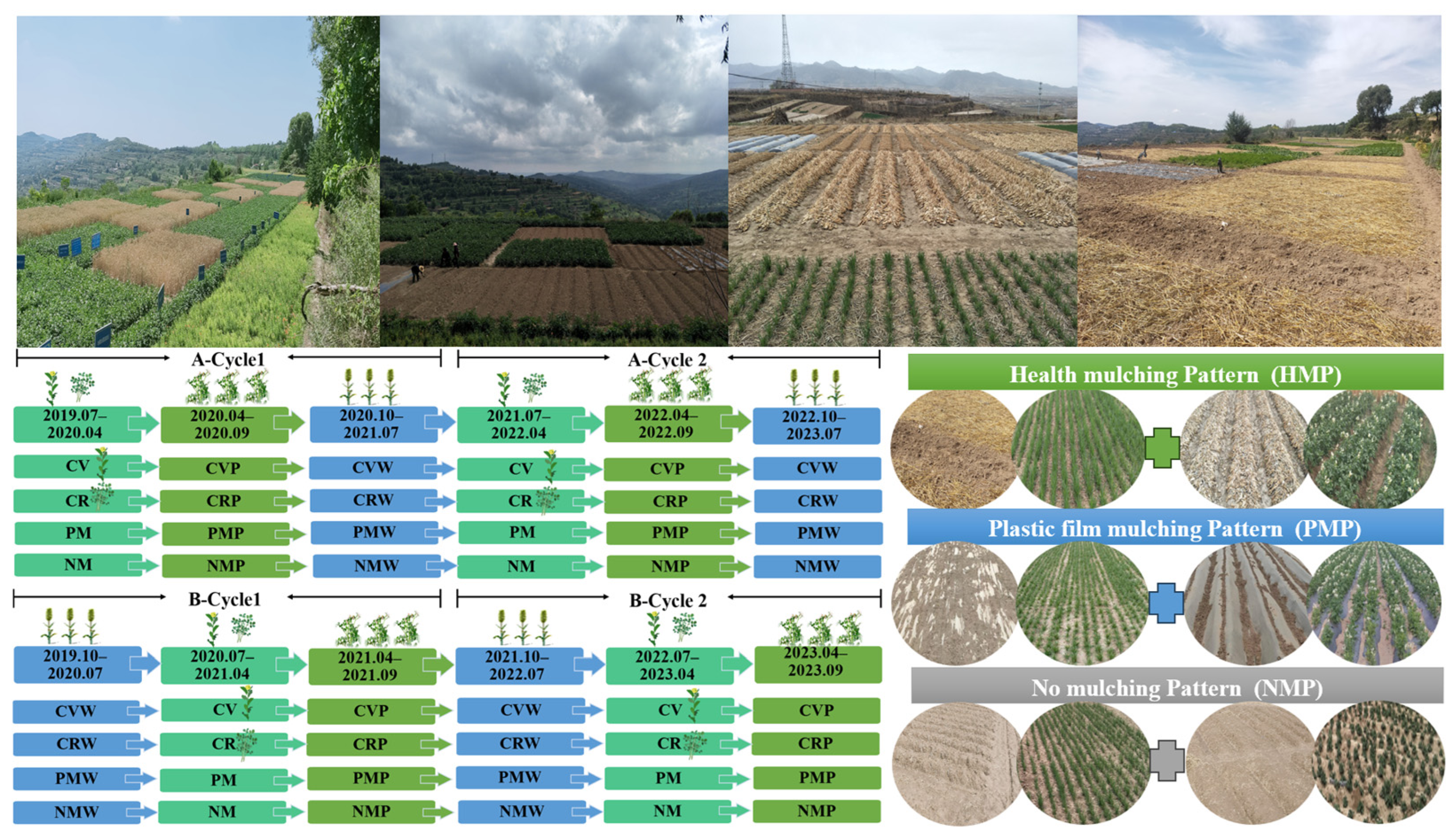
A winter wheat-potato rotation system was used in this study. Because the full rotation cycle (winter wheat → fallow → potato) spans two growing seasons, a single sequence would require multiple years to obtain data for both phases under each treatment. To ensure that data for both phases of the rotation—winter wheat and potato—were collected in every year of the four-year experimental period, two parallel rotation sequences were maintained simultaneously: Cycle A (fallow period → potato → winter wheat) and Cycle B (winter wheat → fallow period → potato), as illustrated in Figure 1.
Each rotation sequence was implemented as an independent randomized complete block design with four treatments and three replications, giving 12 plots per sequence and 24 plots in total. Within each sequence, treatments were randomly assigned to plots within each block using a random number table, with rerandomization performed independently for each sequence. The two sequences occupied separate adjacent field areas with comparable soil properties (Table 1), and blocks were not shared between them. The experimental unit was the individual plot (10 m × 6 m = 60 m2). The same plots were measured repeatedly over the study period (2019–2023), with treatment allocation fixed throughout.
The four treatments were as follows: (1) Winter rape cover (CR): Winter wheat was grown with wheat straw mulching. After wheat harvest, the soil was rotary-tilled and ridges were formed (15 cm high, 60 cm wide, with 20 cm furrows). Winter rape was sown on the ridge surface using a spot seeder, allowed to naturally senesce in early November, and left on the soil surface as mulch. Potato was sown the following spring. (2) Common vetch cover (CV): Same as CR, but with common vetch as the cover crop. (3) Plastic film mulching (PM): During the winter wheat season, white plastic film was applied to conserve moisture and increase soil temperature. After wheat harvest in mid-July, the old film was removed, and the ridged surface was covered with black plastic film for the entire fallow period until potato sowing. Small holes (1.0 cm diameter) were punched at 30 cm intervals on the ridges to allow rainfall infiltration. (4) No mulching (NM): No mulching was applied throughout the rotation cycle. After wheat harvest, the soil was prepared for ridging, and potatoes were sown directly after the fallow period (Figure 1). All crops were established using conventional rotary tillage to a depth of 15 cm before sowing. Potatoes were grown on ridges (0.6 m wide, 0.15 m high). For winter wheat, plastic film or straw was applied directly on the field surface, with straw applied at 2500 kg ha−1. Winter wheat and potatoes were sown using specialized hill-drop planters.
Common vetch and winter rape, selected as cover crops for their high leaf area index and ground cover, were planted using a precision spot seeder. Crop varieties, planting dates, fertilization practices, and tillage details are summarized in Table 2. For winter wheat and cover crops, fertilizers were applied to the soil surface before sowing and incorporated by rotary tillage. For potatoes, fertilizer was applied during sowing into the ridges by machine. Weeding was performed manually during the growing season, while no weeding occurred during the fallow period.

2.3. Measurements and Methods

2.3.1. Soil Sampling and Analysis

Soil samples were collected at 20 cm intervals from 0 to 200 cm depth at key growth stages of winter wheat and potato. For potato, sampling occurred at sowing (late April), flowering (mid-June), tuber bulking (mid-July), and maturity (late September); for winter wheat, at sowing (late September), jointing (mid-April), anthesis (late May), and maturity (mid-July). Within each plot, one soil core (5 cm diameter) was collected from each depth interval using a stainless steel auger. All cores were taken from the ridge top (where potato plants were located), midway between two plants within the row, to ensure spatial consistency. To avoid resampling previously disturbed soil, sampling positions were offset by approximately 20–30 cm from previous points, while maintaining the same relative position to the marked reference points. These permanently marked positions served as references throughout the experimental period to ensure temporal comparability. Fresh samples were weighed and dried at 105 °C for 24 h to determine gravimetric soil water content. Soil water storage (SWS) and soil water balance (SWB) were calculated using the following equations [3]:
S M   % = M 1 M 2 M 2 × 100 %
S W S   m m = i = 1 n S M i × D i × H i / 10
SWB   m m = Input Output
where M1 (g) is the weight of wet soil and M2 (g) is the weight of dry soil, D i (g cm−3) is the soil bulk density, H i (cm) is the sampling thickness (20 cm), S M i (%) is the soil water content in the i th soil level of each treatment, ( i = 1, 2, 3, …, n, n = 10). Input is the precipitation of the growing season and fallow period; Output is the sum of ET during the growing season and soil water loss during the fallow period. The soil bulk density was determined with a cutting ring (5 cm in diameter and 5 cm in height) at every 20 cm in the 0–100 cm soil layer, and the bulk density of the deep soil layers (100–200) were considered the same as the values for the 80–100 cm layer because only small variations have been reported for deep soil layers [29].

2.3.2. Crop Yield and Water Use Efficiency

Three random quadrats of 9.0 m2 were selected to measure the tuber yield of potato at maturity for each cropping system. The water use efficiency (WUE) was calculated by the following equations:
E T   m m = Δ S W S + P + I + C D R
W U E k g   h a 1   m m 1 = T u b e r   y i e l d E T
where ET (mm) is total evapotranspiration during the growing season; ΔSWS (mm) is the difference in the soil water storage at a soil depth of 0–200 cm from the beginning to the end of each growing season; P (mm) is precipitation during the growing season; I is irrigation (0 under rain-fed conditions); C is capillary rise to the root zone; D is drainage from the root zone; and R is runoff. In this experiment, surface runoff was considered negligible because water flow was prevented by border dikes around each plot. Since groundwater was at a depth of 38–40 m, capillary rise and drainage from the root zone were also considered negligible [30].

2.3.3. Potato-Phase Partial Budget Analysis

Economic analysis was conducted as a partial budget for the potato phase of the winter wheat-potato rotation. Total revenue was calculated as tuber yield multiplied by a constant potato price of 1.0 Yuan kg−1, as inter-annual price variation in the study region was minimal. Input costs included seeds (potato and green manure), fertilizers, plastic film, labor, fuel, herbicides, and mechanized operations, all recorded for each treatment. Net income was determined as total income minus total input, and the output-input ratio was calculated as total income divided by total input [31]. For wheat straw used as mulch, no purchase cost was incurred as it was produced from the preceding wheat crop; its opportunity cost was considered negligible. For the PM treatment, plastic film removal and disposal costs were included. Winter wheat revenue and costs were excluded, as the study focused on the fallow period and subsequent potato crop—the most water-sensitive phase of the rotation.

2.4. Statistical Analysis

All statistical analyses were performed using IBM SPSS Statistics (version 20.0). One-way ANOVA was used to assess treatment effects on tuber yield, water use efficiency, evapotranspiration, soil water balance, and economic returns, while two-way ANOVA was used to evaluate the effects of mulching practice, experimental year, and their interaction. For the ANOVA, data from the two sequences were combined by year and treatment; to account for repeated measurements on the same plots over years and the presence of two independent sequences, sequence was included as a random factor, and plot was treated as a random effect nested within sequence and block. Subsamples (soil cores or yield quadrats) were averaged to a plot mean prior to analysis and were not treated as independent replicates. The two sequences were not pooled as independent observations; they provided replicated observations of the same rotation phase in each year, ensuring annual data for both wheat and potato without artificially inflating degrees of freedom. Treatment differences were considered significant at p < 0.05, and figures were generated using Origin (version Pro 2019, OriginLab Corp., Northampton, MA, USA).

3. Results

3.1. Characteristics of Precipitation

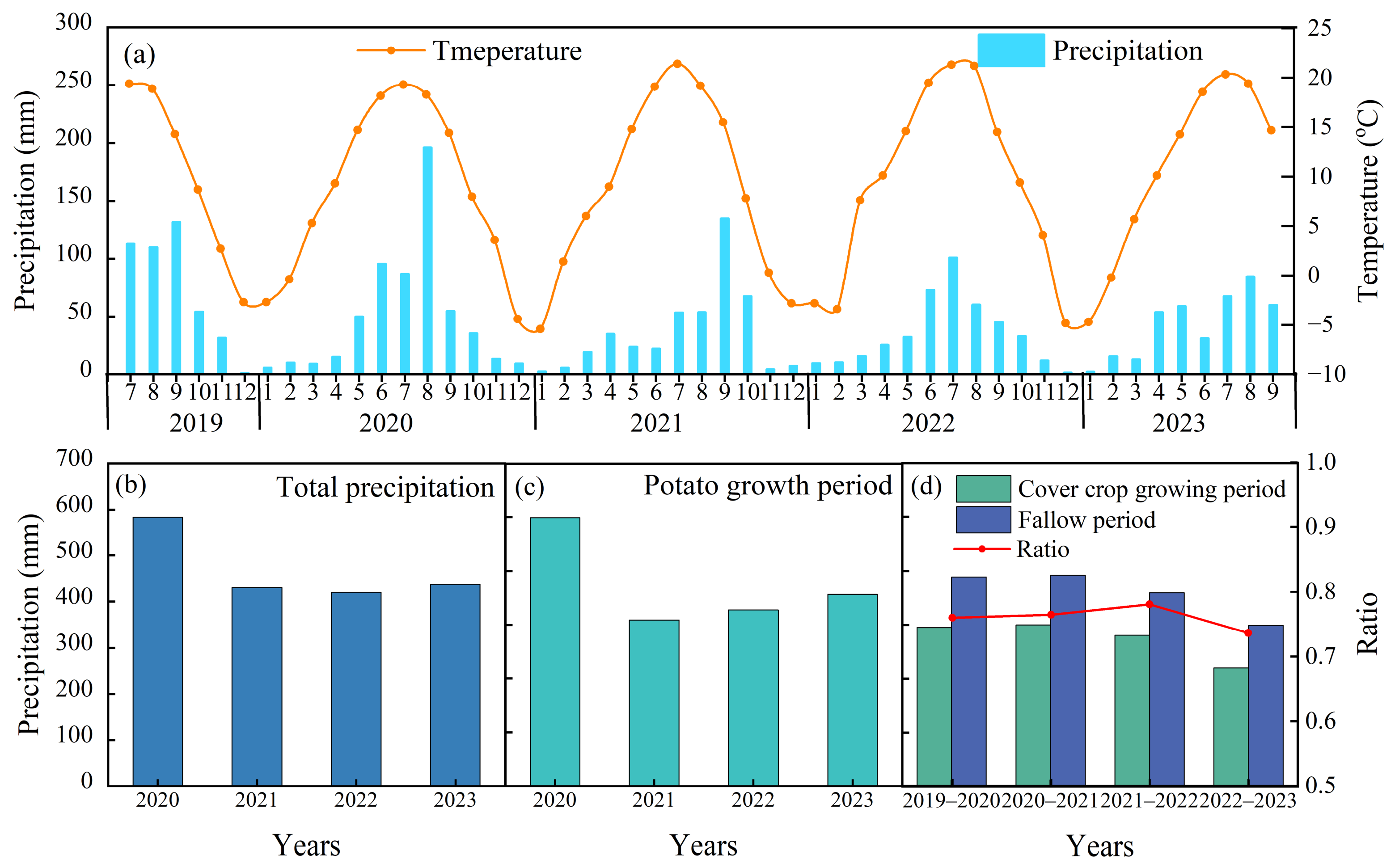
Precipitation in the study area was unevenly distributed throughout the year, with over 60% of the annual total concentrated between June and September (Figure 2). From 2020 to 2023, the mean annual precipitation was 468 mm, and the mean annual temperature was 8.8 °C. The average precipitation during the potato growing season was 373 mm, accounting for 79% of the annual total. Moreover, the rainfall predominantly occurred in the later stage of potato growth (from the tuber expansion period to the maturity period). From 2019 to 2023, the average precipitation during the main cover crop growing period (late July to early November) was 274 mm, whereas the average total precipitation during the subsequent fallow period (early November to the following April) was 86 mm. The mean ratio of precipitation during the cover crop growing period to that of the entire fallow period was 0.75, with relatively low inter-annual variation.

3.2. Potato Yield and Economic Profit

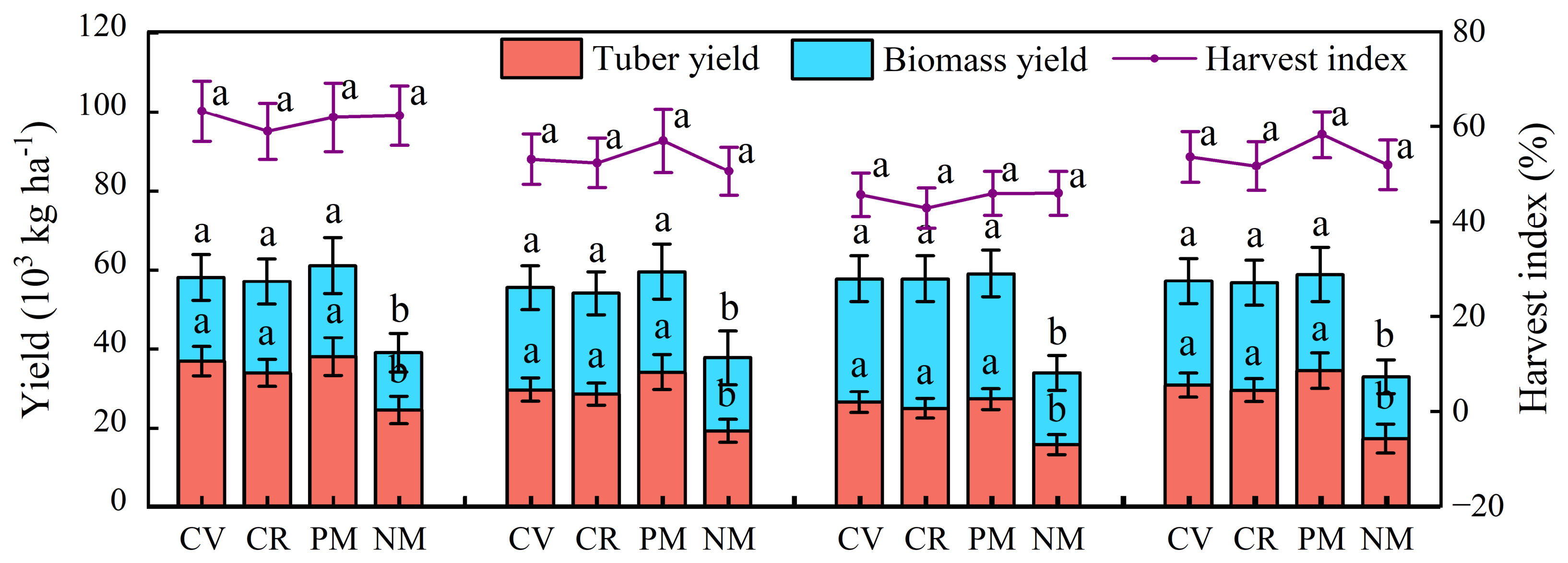
Potato yield (tuber and biomass yield) was significantly affected by the mulching practices (p < 0.05) (Figure 3). Compared with no mulching (NM), the mean tuber yield under CV, CR, and PM increased by 61.7%, 52.4%, and 74.8%, respectively. Similarly, biomass yield under the three mulching practices increased by 58.9%, 56.9%, and 65.8%, respectively, relative to NM. Harvest index was not significantly affected by mulching practice alone, but showed significant variation among years (p < 0.05). Among the mulching treatments, PM had the highest harvest index (55.79%), followed by CV (53.89%) and CR (51.49%), all of which were comparable to NM (52.69%). Across years, the harvest index was highest in 2020 (61.63%) and lowest in 2022 (45.06%), reflecting the influence of inter-annual climatic variability on dry matter partitioning.
Economic returns were significantly influenced by mulching practice and experimental year (p < 0.05) (Table 3). All mulching treatments incurred higher input costs than NM, particularly PM (16,098 vs. 11,098 Yuan ha−1 for NM), but these additional costs were offset by higher tuber yields. Net income and output-input ratio varied significantly among treatments, with no significant differences detected among CV, CR, and PM (net income: 17,588, 15,864, and 17,227 Yuan ha−1, respectively; output-input ratio: 2.33, 2.20, and 2.07). All mulching treatments produced significantly higher net income and output-input ratios than NM. These results indicate that sequential cropping of green manure (CV and CR) during the fallow period achieved economic returns equivalent to those of plastic film mulching (PM), while requiring lower input costs.

3.3. Dynamics of Soil Moisture

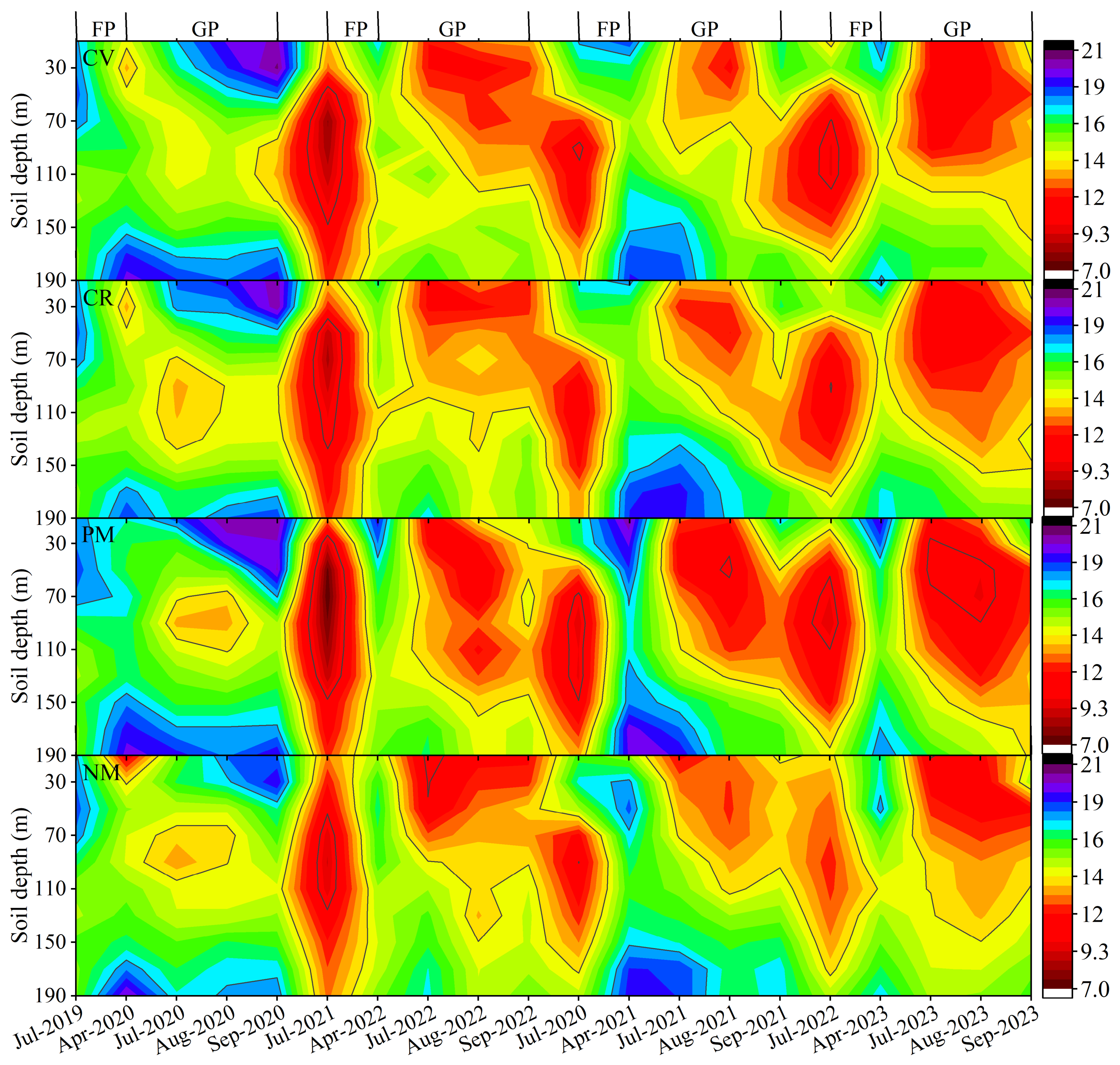
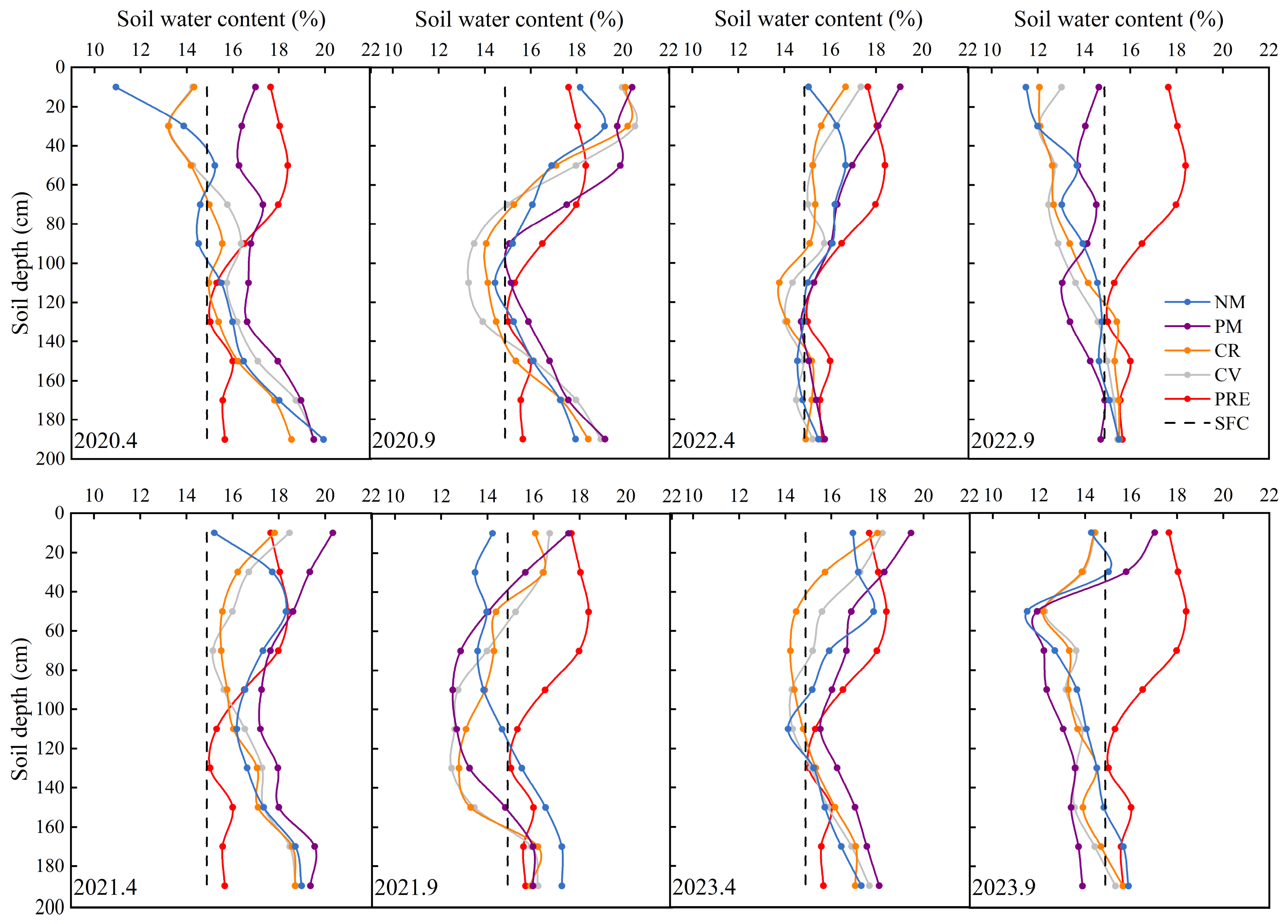
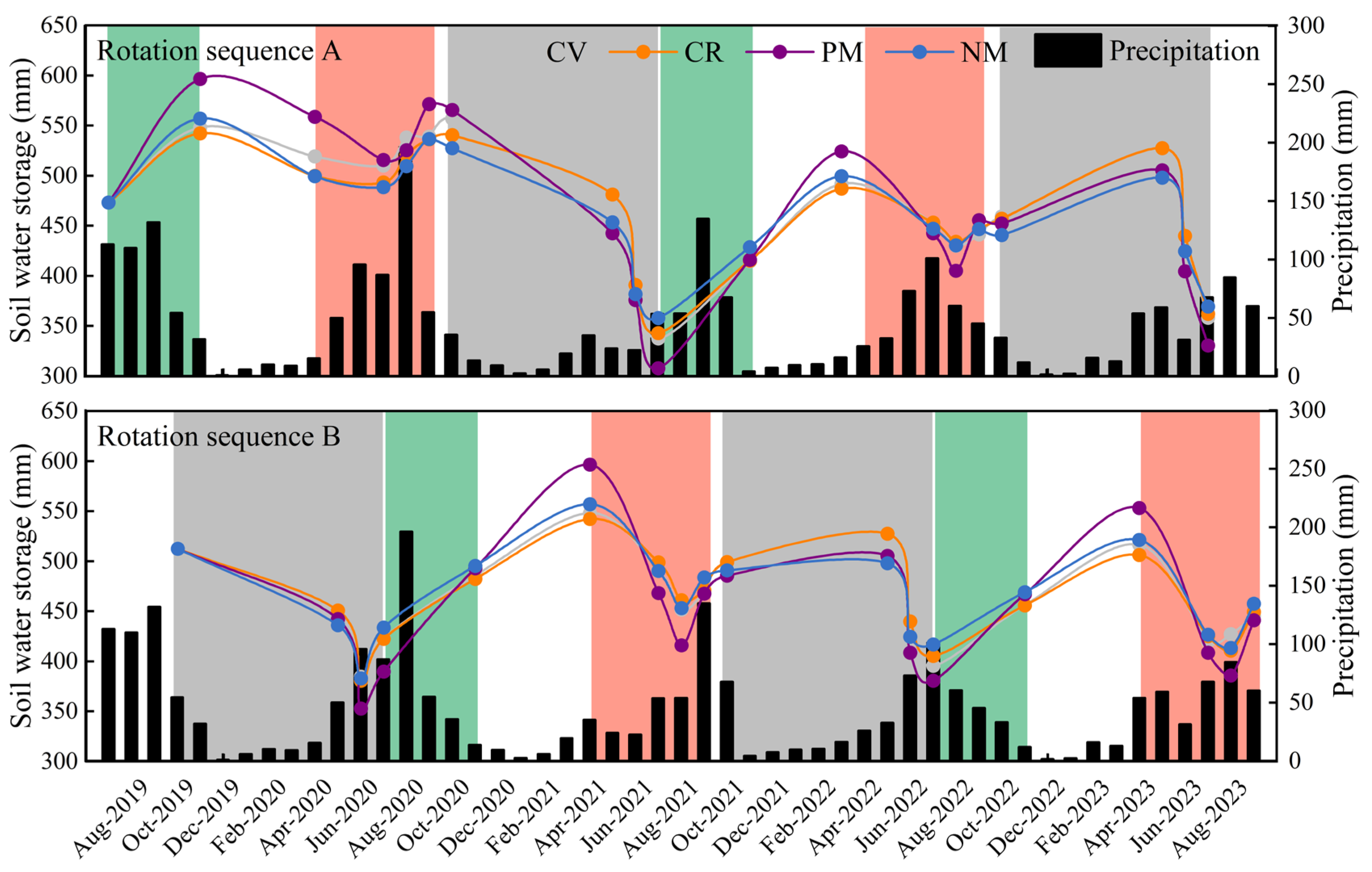
Based on the vertical distribution of soil water content in the 0–200 cm layer (Figure 4), distinct spatiotemporal patterns were identified. Spatially, water content varied markedly with depth: the surface layer (0–100 cm) was highly dynamic due to precipitation and evaporation, while deeper layers (100–200 cm) showed treatment-specific differences reflecting water use strategies. Temporally, water content was higher at sowing (April) than at harvest (September), indicating substantial depletion during crop growth (Figure 5). Among mulching treatments, PM, CV, and CR maintained higher water content in the 0–100 cm layer than NM, particularly at sowing, suggesting improved water conservation during fallow. These spatial and temporal patterns in soil water content were further reflected in the dynamics of soil water storage. As shown in the time series of soil water storage and monthly total precipitation (Figure 6), soil water storage in the 0–200 cm layer fluctuated considerably over time, closely tracking precipitation events. During the potato growing seasons (pink-shaded periods), soil water storage declined markedly from planting to harvest, reflecting substantial crop water consumption. Together, these results highlight the combined influence of precipitation variability, cropping sequence, and mulching management on soil water availability.

3.4. Evapotranspiration During Potato Growth Period and Water Use Efficiency

Based on the variance analysis of evapotranspiration (ET) and water use efficiency (WUE) (Table 4), both parameters were significantly affected by mulching practice and experimental year (p < 0.05), with a significant interaction for ET. Among treatments, PM achieved the highest ET (447.4 mm), followed by CV (418.3 mm), while CR (405.9 mm) and NM (411.2 mm) were comparable. Compared with no mulching (NM), the WUE under CV, CR, and PM increased by 59.4%, 54.9%, and 60.9%, respectively. Across years, ET peaked in 2020 (472.4 mm) and was lowest in 2022 (380.9 mm). WUE was significantly higher in 2020 (70.66 kg ha−1 mm−1) and 2021 (69.51 kg ha−1 mm−1) than in 2022 and 2023. The significant interaction for ET indicates that the effect of mulching on evapotranspiration varied by year.

3.5. Soil Water Balance

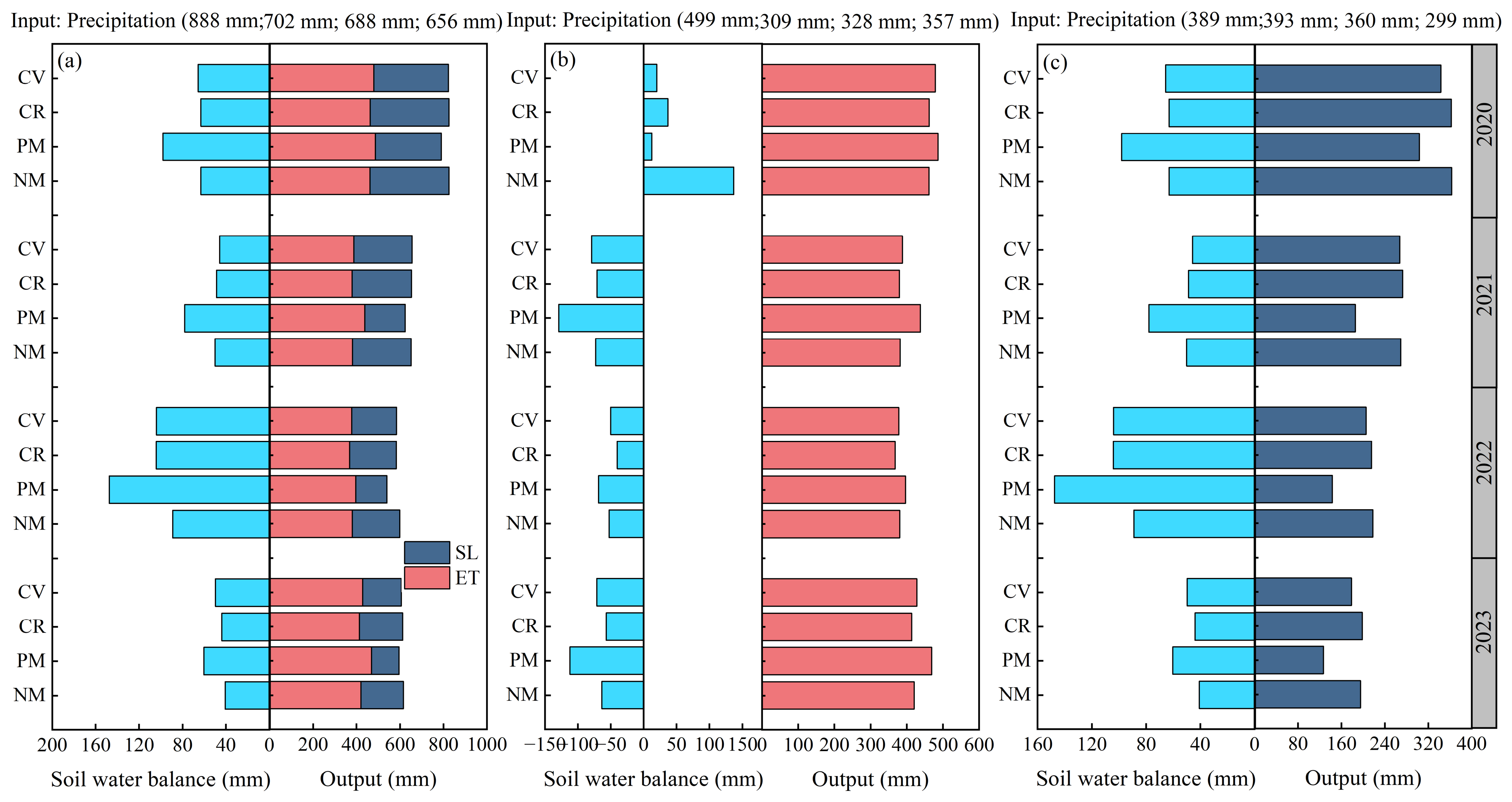
The soil water balance under different mulching practices (2019–2023) is shown in Figure 7. Over the full rotation cycle (potato growing season and fallow period), soil water balance was positive across treatments (63.1–147.5 mm). Evapotranspiration (ET) and soil water loss (SL) accounted for 64.3% and 35.7% of output, respectively. During the potato growing season, soil water balance was positive only in 2020 (12.5–137.0 mm); from 2021 to 2023, a consistent deficit occurred in the 0–200 cm soil layer (40.2–129.0 mm). In contrast, the fallow period maintained a positive soil water balance across all years and treatments, ranging from 26.1 to 216.2 mm. Plastic film mulching (PM) caused the highest seasonal depletion but also the greatest recharge, while green manure treatments (CV, CR) showed moderate deficits and substantial recovery. Overall, no excessive soil water depletion was detected within the measured 0–200 cm profile over the four observed seasons. The main deficit occurred during potato growth, while the fallow period replenished soil water storage within the measured depth.

4. Discussion

4.1. Soil Water Dynamics Under Green Manure: Depletion-Recharge Trade-Offs

Our results demonstrated that sequential green manure cropping (CV and CR) significantly reduced soil water content in the 0–100 cm soil layer during their growth period (July–November), with the greatest depletion occurring in the driest year (2023) (Figure 4 and Figure 5). This finding is consistent with studies in other semi-arid regions where cover crops actively transpire water, leading to lower soil water at termination [4,27]. For example, in the Texas Rolling Plains, cover crops reduced stored soil water by 22–26% at termination [18], and this reduction was closely related to cover crop biomass at the termination stage [20].
After termination in early November, the subsequent fallow period (November–April) received an average of 86 mm of precipitation, 25% of which fell after green manure termination. This rainfall, combined with reduced soil evaporation due to cover crop residues, substantially replenished the soil water deficit by crop sowing [18]. No significant differences in soil water content at sowing were observed among CV, CR, and NM in most years (Table 4). Soil water balance analysis (Figure 7) further showed a positive balance over the full rotation cycle (63.1–147.5 mm) for all treatments, indicating net water storage. During the potato growing season, however, a consistent deficit occurred in the 0–200 cm soil layer from 2021 to 2023 (40.2–129.0 mm). In contrast, the fallow period maintained a positive balance across all years and treatments (26.1–216.2 mm). PM caused the highest seasonal depletion but also the greatest recharge, while CV and CR showed moderate deficits and substantial recovery. These results suggest that, within the measured profile and over the four observed seasons, no net depletion was detected under green manure, provided that fallow precipitation was adequate [18,27].
It should be noted that the mechanism of reduced evaporation is inferred from the presence of cover crop residues rather than directly quantified [25,32,33]. Additionally, quantitative cover crop biomass data were not collected, limiting our ability to link depletion magnitude to cover crop growth. Nevertheless, our conclusions regarding the depletion-recharge pattern are supported by repeated direct measurements of soil water, evapotranspiration, and crop yield over four seasons, and the observed pattern is consistent with findings from studies that included biomass measurements [18,20,27]. Several other indicators relevant to the underlying mechanisms were not measured; consequently, the mechanistic interpretations offered are hypotheses informed by the broader literature, rather than experimentally validated conclusions.

4.2. Effects of Green Manure on Potato Productivity and Economic Benefits

Potato tuber yield was significantly increased by all mulching treatments compared with NM, with increases of 61.7% for CV, 52.4% for CR, and 74.8% for PM (Figure 3). Tuber yield under PM (33,325 kg ha−1) was statistically higher than under CV (30,832 kg ha−1) and CR (29,058 kg ha−1), indicating that while green manure treatments improved yield substantially over the control, plastic film mulching remained the most effective for agronomic productivity. However, no significant differences in net income were detected among CV (17,588 Yuan ha−1), CR (15,864 Yuan ha−1), and PM (17,227 Yuan ha−1), reflecting the lower input costs of green manure systems (CV: 13,244; CR: 13,194; PM: 16,098 Yuan ha−1). The output-input ratio followed a similar pattern, with CV (2.33) and CR (2.20) outperforming PM (2.07). These results indicate that while plastic film mulching produces the highest absolute yield, green manure-based systems achieve comparable economic returns due to reduced production costs, making them a financially attractive alternative.
Water use efficiency (WUE) of CV (73.5 kg ha−1 mm−1) and CR (71.5 kg ha−1 mm−1) was not significantly different from PM (74.2 kg ha−1 mm−1) but was substantially higher than NM (46.1 kg ha−1 mm−1) (Table 4), representing increases of 59.4%, 54.9%, and 60.9%, respectively. This improvement in WUE under green manure treatments can be attributed to reduced soil evaporation and increased plant-available water during critical growth stages, as documented in previous studies [17]. Descriptively, ET was higher under mulching treatments (CV: 418.3 mm; CR: 405.9 mm; PM: 447.4 mm) compared with NM (411.2 mm), and this higher ET was associated with greater tuber yield. However, the relationship between ET and soil water balance is complex; water-balance outcomes varied considerably by treatment and year. We refrain from making causal claims regarding whether higher ET ‘compromised’ soil water balance, as a formal treatment-specific analysis with uncertainty quantification was not conducted. The observed patterns indicate that, under the conditions of this experiment, the higher ET associated with mulching treatments did not result in detectable net depletion within the measured 0–200 cm profile, but this observation requires further validation with longer-term data.
The positive yield response to green manure can be attributed to several potential mechanisms, though only the water-conserving effect is directly supported by our soil water measurements (Figure 4, Figure 5 and Figure 6; Table 4). The other proposed mechanisms—nitrogen fixation and soil structure improvement—were not measured and are discussed as inferences from established knowledge and previous literature [14,25,32,33]. It is important to recognize that the treatments represent integrated management systems rather than isolated green-manure effects. The CV and CR treatments combined wheat-straw mulch during the wheat phase with sequential green manure during the fallow period. Without a control treatment with straw mulch but no cover crop, the isolated effect of green manure cannot be definitively separated from other system components. The economic analysis is a partial budget for the potato phase; winter wheat revenue and costs were not included, as the primary focus is on the fallow period and subsequent potato crop. A full-rotation assessment would require inclusion of wheat yields and costs, which is recommended for future studies.

4.3. Feasibility of Green Manure as a Substitute for Plastic Film Mulching

Our results support the feasibility of using green manure (CV and CR) as an alternative to plastic film mulching in semi-arid winter wheat-potato rotation systems. From the water balance perspective, green manure treatments achieved a positive soil water balance over the full rotation cycle and did not cause long-term soil water depletion within the measured profile, as fallow-season precipitation effectively recharged the water consumed by cover crops. In contrast, plastic film mulching, while highly effective in increasing yield, does not contribute to soil organic matter improvement and leaves persistent plastic residues that gradually degrade soil hydraulic properties [9,10,13]. Economically, CV and CR produced net incomes and output-input ratios comparable to PM (Table 3), indicating that farmers can achieve similar economic returns without the high input costs and plastic pollution associated with PM. The higher WUE of green manure treatments further enhances their economic viability under rainfed conditions. Environmentally, green manure avoids the negative effects of long-term plastic mulching, including soil organic carbon decline and deep soil water depletion, while adding organic matter and improving soil structure. It should be emphasized that the benefits observed under CV and CR are attributable to integrated management packages (straw mulch during wheat phase + sequential green manure during fallow period), rather than to green manure alone. Therefore, post-wheat sequential green manure cropping represents a technically feasible and economically viable alternative to plastic film mulching for rainfed potato production on the Loess Plateau, with clear environmental benefits in terms of avoiding plastic residues and maintaining a positive soil water balance. To ensure successful adoption, cover crops should be sown from late July to early August and terminated in early November. Future research should optimize species mixtures and termination dates to maximize the trade-off among water conservation, yield enhancement, and soil carbon sequestration.
Nevertheless, several caveats warrant consideration when extrapolating these findings. First, the experiment was conducted at a single site, limiting generalizability to other semi-arid regions. Second, only two green manure species were tested; other species, cultivars, or mixtures could produce different trade-offs between water consumption and potato productivity. Meteorological data were obtained from stations within 10 km. Localized plot-scale variability may not be fully captured, but the four-year duration (309–499 mm annual precipitation) supports robust assessment across diverse conditions. Third, although the four-year study period included both wet and normal years, longer-term (>10 years) observations are needed to assess cumulative effects on deep soil water recharge, system resilience under extreme droughts, and soil organic carbon sequestration. Fourth, we did not directly measure soil biological indicators (e.g., microbial biomass carbon, enzyme activities), soil organic carbon fractions, or greenhouse gas (CO2, N2O, CH4) fluxes. Consequently, the environmental advantages we attribute to green manure—such as improved soil quality and reduced global warming potential—are inferred from the avoidance of plastic film residues and the maintenance of a positive soil water balance, rather than from direct biogeochemical evidence. Future multi-site, long-term studies incorporating these indicators are essential to fully validate the environmental performance of sequential green manure cropping relative to plastic film mulching.
Finally, as mentioned earlier, the treatments represent integrated management systems rather than isolated experimental factors. The absence of a control treatment with straw mulch but no cover crop means that the specific contribution of green manure alone cannot be fully disentangled from other system components. Our conclusions should therefore be interpreted as comparisons among whole management packages rather than as isolated green-manure effects. Furthermore, our findings are derived from a single site with a specific soil type, rainfall regime (mean annual 468 mm), and management practices. While the depletion-recharge pattern observed here may be relevant to other semi-arid regions with similar agroecological conditions, direct extrapolation to regions with different rainfall patterns, temperature regimes, soil types, or market conditions requires caution. Multi-site validation is needed to confirm the generalizability of these results.

5. Conclusions

In this four-year, single-site experiment on the Loess Plateau, sequential green manure cropping (CV and CR) after winter wheat reduced soil water in the 0–100 cm layer during growth, but fallow precipitation and reduced evaporation replenished the deficit by potato sowing in most years, with a positive soil water balance (63.1–147.5 mm) over the rotation cycle indicating no detectable net depletion within the measured 0–200 cm profile. Compared with NM, CV and CR increased tuber yield and achieved WUE comparable to PM and substantially higher than NM, with similar net income and output-input ratios but lower input costs, supporting post-wheat sequential green manure cropping—particularly with common vetch—as a technically feasible and economically viable alternative to plastic film mulching. However, mechanistic interpretations regarding nitrogen fixation, soil structure improvement, and evaporation reduction are inferred from literature and require further validation, and the single-site, four-year design with only two species and without direct measurements of soil carbon or greenhouse gas emissions limits the generalizability of environmental claims, underscoring the need for longer-term, multi-site studies incorporating biogeochemical indicators.

Author Contributions

Conceptualization, Y.Z., H.H. and J.Y.; Methodology, Y.Z., H.H. and J.Y.; Software, Y.Z.; Formal analysis, Y.Z. and J.Y.; Investigation, Y.Z. and J.Y.; Data curation, Y.Z.; Writing—original draft, Y.Z., H.H. and J.Y.; Writing—review & editing, Y.Z., H.H. and J.Y. All authors have read and agreed to the published version of the manuscript.

Funding

This research was funded by the Research Initiation Program for Publicly Recruited Ph.D. Students at Gansu Agricultural University (GAU-KYQD-2023-13), Gansu Provincial Science and Technology Program (24JRRA731 and 23JRRA1340), and Basic Research Program of Gansu Academy of Agricultural Sciences (2026GAAS22-7).

Data Availability Statement

The original contributions presented in this study are included in the article. Further inquiries can be directed to the corresponding authors.

Acknowledgments

We thank the Zhuanglang experimental station staff for field trial support and lab technicians for soil analysis assistance.

Conflicts of Interest

The authors declare no conflicts of interest.

References

  1. Zhang, S.; Sadras, V.; Chen, X.; Zhang, F. Water use efficiency of dryland maize in the Loess Plateau of China in response to crop management. Field Crop. Res. 2014, 163, 55–63. [Google Scholar] [CrossRef]
  2. Wang, J.; Zhang, S.; Sainju, U.M.; Ghimire, R.; Zhao, F. A meta-analysis on cover crop impact on soil water storage, succeeding crop yield, and water-use efficiency. Agric. Water Manag. 2021, 256, 107085. [Google Scholar] [CrossRef]
  3. Zhang, Y.; Yin, J.; Guo, Z.; Li, J.; Wang, R. Simulation of soil water balance and crop productivity of long-term continuous maize cropping under high planting density in rainfed agroecosystems. Agric. For. Meteorol. 2022, 312, 108740. [Google Scholar] [CrossRef]
  4. Nielsen, D.C.; Lyon, D.J.; Hergert, G.W.; Higgins, R.K.; Holman, J.D. Cover Crop Biomass Production and Water Use in the Central Great Plains. Agron. J. 2015, 107, 2047–2058. [Google Scholar] [CrossRef]
  5. Wang, J.-B.; Xie, J.-H.; Li, L.-L.; Adingo, S. Review on the fully mulched ridge–furrow system for sustainable maize production on the semi-arid Loess Plateau. J. Integr. Agric. 2023, 22, 1277–1290. [Google Scholar] [CrossRef]
  6. Huang, T.; Wu, Q.; Yuan, Y.; Zhang, X.; Sun, R.; Hao, R.; Yang, X.; Li, C.; Qin, X.; Song, F.; et al. Effects of plastic film mulching on yield, water use efficiency, and nitrogen use efficiency of different crops in China: A meta-analysis. Field Crop. Res. 2024, 312, 109407. [Google Scholar] [CrossRef]
  7. Han, L.; Li, Y.; Zhu, J.; Zhou, Z.; Zhao, W.; Yang, Y.; Zhang, W.; Zhang, X.; Zhang, F. Long-term plastic film mulching increased maize yield and water use efficiency. Field Crop. Res. 2025, 333, 110105. [Google Scholar] [CrossRef]
  8. Li, Y.; Hou, Y.; Hou, Q.; Long, M.; Yang, Y.; Wang, Z.; Liao, Y. Long-term plastic mulching decreases rhizoplane soil carbon sequestration by decreasing microbial anabolism. Sci. Total Environ. 2023, 868, 161713. [Google Scholar] [CrossRef] [PubMed]
  9. Wang, L.; Guo, S.; Ge, T.; Mancl, K.M.; Hijri, M.; Iseri, Y.; Lee, S.-J.; Feng, S.; Ji, H.; Sun, D.; et al. Plastic mulch productivity-sustainability tradeoffs and pathways toward an eco-friendly framework: Insights from a global meta-analysis. Nat. Commun. 2026, 17, 1924. [Google Scholar] [CrossRef] [PubMed]
  10. Gao, H.; Yan, C.; Liu, Q.; Ding, W.; Chen, B.; Li, Z. Effects of plastic mulching and plastic residue on agricultural production: A meta-analysis. Sci. Total Environ. 2019, 651, 484–492. [Google Scholar] [CrossRef] [PubMed]
  11. Zhang, M.-M.; Dang, P.-F.; Li, Y.-Z.; Qin, X.-L.; Siddique, K.H. Better tillage selection before ridge—Furrow film mulch can facilitate root proliferation, and increase nitrogen accumulation, translocation and grain yield of maize in a semiarid area. J. Integr. Agric. 2023, 22, 1658–1670. [Google Scholar] [CrossRef]
  12. Liu, C.; Jin, S.; Zhou, L.; Jia, Y.; Li, F.; Xiong, Y.; Li, X. Effects of plastic film mulch and tillage on maize productivity and soil parameters. Eur. J. Agron. 2009, 31, 241–249. [Google Scholar]
  13. Xie, J.; Wang, L.; Li, L.; Coulter, J.A.; Chai, Q.; Zhang, R.; Luo, Z.; Carberry, P.; Rao, K. Subsoiling increases grain yield, water use efficiency, and economic return of maize under a fully mulched ridge-furrow system in a semiarid environment in China. Soil Tillage Res. 2020, 199, 104584. [Google Scholar] [CrossRef]
  14. Adetunji, A.T.; Ncube, B.; Mulidzi, R.; Lewu, F.B. Management impact and benefit of cover crops on soil quality: A review. Soil Tillage Res. 2020, 204, 104717. [Google Scholar] [CrossRef]
  15. Lamichhane, J.R.; Alletto, L. Ecosystem services of cover crops: A research roadmap. Trends Plant Sci. 2022, 27, 758–768. [Google Scholar] [CrossRef] [PubMed]
  16. Xue, S.; Liu, J.; Fu, Y.; Zhu, P.; Zhang, D.; Gao, Y.; Wang, Z.; Huang, D.; Wang, X. Green manure in dryland agriculture: Greater benefits for soil properties than for wheat yield. Field Crop. Res. 2026, 342, 110446. [Google Scholar] [CrossRef]
  17. Basche, A.D.; Kaspar, T.C.; Archontoulis, S.V.; Jaynes, D.B.; Sauer, T.J.; Parkin, T.B.; Miguez, F.E. Soil water improvements with the long-term use of a winter rye cover crop. Agric. Water Manag. 2016, 172, 40–50. [Google Scholar] [CrossRef]
  18. Mubvumba, P.; DeLaune, P.B.; Hons, F.M. Soil water dynamics under a warm-season cover crop mixture in continuous wheat. Soil Tillage Res. 2021, 206, 104823. [Google Scholar] [CrossRef]
  19. Lewis, K.L.; Burke, J.A.; Keeling, W.S.; McCallister, D.M.; DeLaune, P.B.; Keeling, J.W. Soil benefits and yield limitations of cover crop use in Texas High Plains cotton. Agron. J. 2018, 110, 1616–1623. [Google Scholar] [CrossRef]
  20. DeLaune, P.; Mubvumba, P. Winter cover crop production and water use in Southern Great Plains cotton. Agron. J. 2020, 112, 1943–1951. [Google Scholar] [CrossRef]
  21. Rose, T.J.; Parvin, S.; McInnes, J.; van Zwieten, L.; Gibson, A.J.; Kearney, L.J.; Rose, M.T. Summer cover crop and temporary legume-cereal intercrop effects on soil microbial indicators, soil water and cash crop yields in a semi-arid environment. Field Crop. Res. 2024, 312, 109384. [Google Scholar] [CrossRef]
  22. Mitchell, J.; Shrestha, A.; Irmak, S. Trade-offs between winter cover crop production and soil water depletion in the San Joaquin Valley, California. J. Soil Water Conserv. 2015, 70, 430–440. [Google Scholar] [CrossRef]
  23. Garba, I.I.; Bell, L.W.; Williams, A. Cover crop legacy impacts on soil water and nitrogen dynamics, and on subsequent crop yields in drylands: A meta-analysis. Agron. Sustain. Dev. 2022, 42, 34. [Google Scholar] [CrossRef]
  24. Qiu, T.; Shi, Y.; Peñuelas, J.; Liu, J.; Cui, Q.; Sardans, J.; Zhou, F.; Xia, L.; Yan, W.; Zhao, S.; et al. Optimizing cover crop practices as a sustainable solution for global agroecosystem services. Nat. Commun. 2024, 15, 10617. [Google Scholar] [CrossRef] [PubMed]
  25. Yan, F.; Arthur, E. Cover crops alter soil physicochemical properties: A global meta-analysis. Geoderma 2025, 460, 117436. [Google Scholar] [CrossRef]
  26. Burke, J.A.; Lewis, K.L.; Ritchie, G.L.; DeLaune, P.B.; Keeling, J.W.; Acosta-Martinez, V.; Moore, J.M.; McLendon, T. Net positive soil water content following cover crops with no tillage in irrigated semi-arid cotton production. Soil Tillage Res. 2021, 208, 104869. [Google Scholar] [CrossRef]
  27. Holman, J.D.; Assefa, Y.; Obour, A.K. Cover-crop water use and productivity in the high plains wheat–fallow crop rotation. Crop Sci. 2021, 61, 1374–1385. [Google Scholar] [CrossRef]
  28. Wang, F.-X.; Wu, X.-X.; Shock, C.C.; Chu, L.-Y.; Gu, X.-X.; Xue, X. Effects of drip irrigation regimes on potato tuber yield and quality under plastic mulch in arid Northwestern China. Field Crop. Res. 2011, 122, 78–84. [Google Scholar] [CrossRef]
  29. Zhang, Y.; Wang, S.; Wang, H.; Ning, F.; Zhang, Y.; Dong, Z.; Wen, P.; Wang, R.; Wang, X.; Li, J. The effects of rotating conservation tillage with conventional tillage on soil properties and grain yields in winter wheat-spring maize rotations. Agric. For. Meteorol. 2018, 263, 107–117. [Google Scholar] [CrossRef]
  30. Peng, Z.; Wang, L.; Xie, J.; Li, L.; Coulter, J.A.; Zhang, R.; Luo, Z.; Cai, L.; Carberry, P.; Whitbread, A. Conservation tillage increases yield and precipitation use efficiency of wheat on the semi-arid Loess Plateau of China. Agric. Water Manag. 2020, 231, 106024. [Google Scholar] [CrossRef]
  31. Sun, T.; Feng, X.; Lal, R.; Cao, T.; Guo, J.; Deng, A.; Zheng, C.; Zhang, J.; Song, Z.; Zhang, W. Crop diversification practice faces a tradeoff between increasing productivity and reducing carbon footprints. Agric. Ecosyst. Environ. 2021, 321, 107614. [Google Scholar] [CrossRef]
  32. Steele, M.; Coale, F.; Hill, R. Winter Annual Cover Crop Impacts on No-Till Soil Physical Properties and Organic Matter. Soil Sci. Soc. Am. J. 2012, 76, 2164–2173. [Google Scholar] [CrossRef]
  33. Blanco-Canqui, H.; Shaver, T.M.; Lindquist, J.L.; Shapiro, C.A.; Elmore, R.W.; Francis, C.A.; Hergert, G.W. Cover Crops and Ecosystem Services: Insights from Studies in Temperate Soils. Agron. J. 2015, 107, 2449–2474. [Google Scholar] [CrossRef]
Figure 1. The details of the cropping winter wheat-potato rotation system arrangement. Note: A-cycle, fallow period-potato-winter wheat cropping rotation sequence; B-cycle, winter wheat-fallow period-potato cropping rotation sequence; CV, planting common vetch and mulching in fallow period; CR, planting winter rape and mulching in fallow period; PM, plastic film mulching in winter fallow period; NM, no mulching in fallow period. CVP, CRP, PMP, NMP, the potato growing season of the winter wheat-potato rotation system under different treatments; CVW, CRW, PMW, NMW, the winter wheat growing season of the winter wheat-potato rotation system under different treatments.
Agriculture 16 01690 g001
Figure 2. Monthly precipitation and average temperature at the experimental site during 2019–2023 (a), total precipitation of each experimental year (b), precipitation of the potato growth period (c), and precipitation of the cover crop growing period and fallow period, ratio of growing season rainfall of cover crops to total fallow season rainfall (d).
Agriculture 16 01690 g002
Figure 3. Potato yield and harvest index under different mulching practices. CV, common vetch cover; CR, winter rape cover; PM, plastic film mulching; NM, no mulching. Different letters following the means in the various treatments represent significant differences at p < 0.05 (LSD).
Agriculture 16 01690 g003
Figure 4. Vertical distribution of soil water content in the 0–200 cm soil layer under different mulching practices. CV, common vetch cover; CR, winter rape cover; PM, plastic film mulching; NM, no mulching; FP, fallow period; GP, growing period.
Agriculture 16 01690 g004
Figure 5. Vertical distribution of the soil water content in sowing and harvest stage under different mulching practices in the 0–200 cm soil layer. CV, common vetch cover; CR, winter rape cover; PM, plastic film mulching; NM, no mulching; SFC, stable field capacity (defined as 60% of the field capacity); PRE, before the experiment (June of 2019).
Agriculture 16 01690 g005
Figure 6. Soil water storage in the 0–200 cm soil layer under different mulching practices. CV, common vetch cover; CR, winter rape cover; PM, plastic film mulching; NM, no mulching. The gray areas represent the winter wheat growth period, green areas represent the green manure growth period, and pink areas represent the potato growth period.
Agriculture 16 01690 g006
Figure 7. Soil water balance in the 0–200 cm soil layer under different mulching practices. Note: (a) soil water balance in full rotation cycle; (b) soil water balance in growing season of potato; (c) soil water balance in fallow period; CV, common vetch cover; CR, winter rape cover; PM, plastic film mulching; NM, no mulching; ET, evapotranspiration; SL, soil water loss. Soil water balance = Input − Output.
Agriculture 16 01690 g007
Table 1. Basic physical and chemical properties of the topsoil in 2019.
Soil Depth (cm)Bulk Density
(g cm−3)
pHOrganic Matter
(g kg−1)
Total N
(g kg−1)
Available N (mg kg−1)Available P (mg kg−1)Available K (mg kg−1)
0–201.318.713.370.7954.7921.12176.97
Table 2. Information on crop varieties, planting and fertilization.
CropCultivar NameVarietyFertilizationSeeding
Density
(plants ha−1)
Row Spacing
(m)
Pure N
(kg ha−1)
P2O5
(kg ha−1)
K2O
(kg ha−1)
Main-cropWinter wheatLanda211150120753 million0.2
Main-cropPotatoLongshu790606060 thousand0.4
Non-Legum cover cropWinter rape
(Brassica rapa L.)
Longyou15630.9 million0.05
legume cover cropCommon vetch
(Vicia sativa L.)
Lanjian15631.5 million0.05
Note: Seeding density refers to the target number of seeds sown per unit area at planting (based on seed weight and germination rate), not the actual plant population counted after germination or at harvest. Scientific names: Brassica rapa L. (winter rape), Vicia sativa L. (common vetch).
Table 3. Variance analysis of economic benefit of potato phase partial under different mulching practices.
TreatmentInput Costs (Yuan ha−1)Total
Input
(Yuan ha−1)
Total
Income
(Yuan ha−1)
Net
Income
(Yuan ha−1)
Output-Input
Ratio
SeedFertilizerPlastic FilmPesticideLabor
PotatoGreen
Manure
Mulching practices (MP)
CV570063019140200480013,24430,832 b17,588 a2.33 a
CR570058019140200480013,19429,058 b15,864 a2.20 ab
PM57000179810000760016,09833,325 a17,227 a2.07 b
NM57000179800360011,09819,063 c7965 b1.72 c
Experimental year (EY)
202057003031856250100520013,40933,185 a19,777 a2.47 a
20215700221184231375530013,45027,748 b14,339 b2.05 b
20225700131182339144542513,51423,466 c10,057 c1.74 c
20235700163183023855488112,86727,880 b14,472 b2.06 b
Source of variation
MP (df = 3) 56.56 ***29.61 ***18.91 **
EY (df = 3) 22.89 ***22.89 ***24.29 ***
MP*EY (df = 9) 0.48 ns0.48 ns0.54 ns
Note: CV, common vetch cover; CR, winter rape cover; PM, plastic film mulching; NM, No mulching. The price of potatoes is 1.0 Yuan kg−1. Different letters following the means in the various treatments represent significant differences at p < 0.05 (LSD). Asterisks indicate the significance of the corresponding model effect (**, p < 0.01; ***, p < 0.001; ns, no significant (p > 0.05)).
Table 4. Variance analysis of evapotranspiration and water use efficiency of potato phase partial under different mulching practices.
TreatmentSWSs
(mm)
SWSm
(mm)
Precipitation (mm)ET
(mm)
WUE
(kg ha−1 mm−1)
Mulching practices (MP)
CV518.8 ± 23.2 ab473.7 ± 45.2 a373.1418.3 ± 45.9 b73.51 ± 3.4 a
CR508.8 ± 23.6 b475.8 ± 41.8 a373.1405.9 ± 42.2 c71.45 ± 3.2 a
PM558.1 ± 29.8 a483.7 ± 59.4 a373.1447.4 ± 39.3 a74.21 ± 4.4 a
NM518.9 ± 27.1 ab481.0 ± 40.0 a373.1411.2 ± 38.4 c46.12 ± 6.2 b
Experimental year (EY)
2020519.2 ± 27.9 ab545.7 ± 17.1 a498.9472.4 ± 12.3 a70.66 ± 11.7 a
2021560.8 ± 24.5 a472.7 ± 7.4 b308.9397.0 ± 27.5 c69.51 ± 13.0 a
2022500.4 ± 16.5 b447.6 ± 5.8 b327.9380.9 ± 11.8 c61.55 ± 13.7 b
2023524.2 ± 20.2 ab448.2 ± 7.1 b356.7432.7 ± 7.1 b64.11 ± 15.6 b
Source of variation
MP (df = 3)10.05 *0.11 ns 89.84 ***60.93 ***
EY (df = 3)2.76 ns11.14 *** 434.28 ***5.80 **
MP*EY (df = 9)0.06 ns0.15 ns 6.39 ***0.29 ns
Note: CV, common vetch cover; CR, winter rape cover; PM, plastic film mulching; NM, no mulching; SWSs and SWSm, soil water storage in the 0–200 cm soil layer at sowing and harvest; ET, evapotranspiration; WUE, water use efficiency. Different letters following the means in the various treatments represent significant differences at p < 0.05 (LSD). Asterisks indicate the significance of the corresponding model effect (*, p < 0.05; **, p < 0.01; ***, p < 0.001; ns, no significant (p > 0.05)).
Disclaimer/Publisher’s Note: The statements, opinions and data contained in all publications are solely those of the individual author(s) and contributor(s) and not of MDPI and/or the editor(s). MDPI and/or the editor(s) disclaim responsibility for any injury to people or property resulting from any ideas, methods, instructions or products referred to in the content.