


Abstract
As an information-guided environmental regulation method that can effectively improve farming practices, environmental training is widely used in the agricultural field. However, evidence on whether and how such training improves the green production efficiency of livestock farmers remains limited. This study investigates the effect of environmental training on the green production efficiency of hog farmers by explicitly accounting for spatial spillovers and exploring technology adoption as a mechanism pathway. Specifically, green production efficiency is first measured using the Super-SBM DEA model, and the spatial Durbin model is then employed to estimate both the direct effect and spatial spillover effect of training. The results of survey data from 371 hog farmers in China show that participation in training significantly enhances the green production efficiency of farmers, with positive spillover effects from neighboring farmers’ participation in training. Further mechanism analysis indicates that training promotes the adoption of clean production technologies, which in turn enhances green production efficiency. The positive effect of training is more pronounced among large-scale and better-educated farmers. Therefore, these findings suggest that policies should strengthen environmental protection training, promote the diffusion of clean production technologies, make better use of the demonstration households mechanism, and customize strategies to support the green transformation of hog farming.
1. Introduction
As the world’s largest pork producer and consumer, China faces a pressing challenge in its hog industry: balancing economic performance with ecological sustainability [1,2,3]. Despite industrial advancements, the utilization rate of livestock manure remains suboptimal, with nitrogen and phosphorus losses often exceeding those from industrial wastewater [4]. Currently, the comprehensive manure utilization rate in China is only 75% [5]. To ensure both a stable meat supply for residents and the prevention of environmental degradation from livestock breeding activities, greater attention should be paid to the comprehensive efficiency of green breeding practices [6,7].
Information-based environmental regulation, particularly environmental training, is emerging as a potential solution to this challenge [8]. Distinguished from traditional economic incentive instruments (e.g., subsidies and tax reductions) and command-and-control approaches (e.g., fines and operational restrictions) [9], this regulation achieves environmental protection goals through non-mandatory instruments such as education and guidance. An increasing number of studies have confirmed that training is closely related to changes in farmers’ production practices and the effectiveness of environmental management. For example, evidence from Malawi shows that on-farm training effectively enhanced farmers’ opportunities for natural resource management [10]. In the studies on farmers in Africa [11] and Indonesia [12], scholars have also drawn positive research conclusions that training is conducive to improving farmers’ output and productivity. Meanwhile, the role of technology in this process has also been noted [13,14]. Several studies pointed out that training and extension programs can improve green production practices through cleaner production technologies such as sustainable land management [15] and ecological organic agriculture [16].
Existing research has primarily focused on the direct impact of training on the participating farmers themselves, while overlooking its secondary information-dissemination function. As a mode of information transmission, training not only occurs between trainers and trainees but may also facilitate the flow and diffusion of information within the farming community, among the trainees and other farmers [17,18]. Ignoring such spillover effects may therefore underestimate the overall contribution of environmental training to green transformation. Moreover, existing evidence is still concentrated mainly on crop production [17,19], while little is known about whether environmental training can improve the green production efficiency (GPE) of hog farmers under the dual pressures of production growth and pollution reduction [20]. This gap is especially important in China, where the effects of environmental training may depend not only on formal extension efforts but also on whether policy and technical information diffuse through local farmer networks.
To address these gaps, this study advances the literature in two theoretical dimensions. First, while existing crop-focused studies [17,19] have documented spatial spillovers of training, whether and how such spillovers occur in livestock farming remain unknown. The concentrated and locally acute nature of livestock pollution, combined with hog farmers’ discrete technology adoption decisions, may fundamentally alter the drivers of spatial spillovers. Therefore, we explicitly model the spatial spillover effect of environmental training on green production efficiency in hog production. Second, rather than treating training as a black box, we identify clean production technology adoption as the mediating mechanism, thereby shifting the analytical focus from “whether training works” to “how it works” to identify the transmission path.
This study adopts a synergized methodological framework, including the Super-SBM model, the spatial Durbin model (SDM), and mechanism analysis, that provides distinct advantages over conventional approaches to examine the impact of training on the green production efficiency of livestock farmers. Based on this, the main contributions of this study are as follows:
Firstly, by estimating both the direct effect and spatial spillover effect of environmental training, we offer new evidence that training improves the GPE of not only participating farmers but also neighboring farmers.
Secondly, we integrate a mechanism analysis to identify clean production technology adoption as a critical transmission path, shifting the focus from whether training is effective to the specific mechanism of how it facilitates.
Thirdly, the research results can not only fill the current research gap but also provide practical implications for designing farmer training programs that strengthen local information diffusion and support cleaner hog production.
The remainder of this paper is organized as follows. Section 2 presents our theoretical framework and hypotheses. Section 3 details the research design, including the data sources and the specific models used for analysis. Section 4 reports the empirical results and heterogeneity analysis. Section 5 discusses the findings, limitations and their policy implications, and Section 6 concludes the paper.
2. Theoretical Mechanisms and Research Hypotheses
2.1. The Impact of Environmental Training on Green Production Efficiency in Livestock Farming
The mechanism through which environmental training impacts livestock farmers’ GPE can be understood through two complementary theoretical lenses: public goods theory and human capital theory. These perspectives jointly explain why training affects GPE through both institutional knowledge dissemination and individual capability enhancement.
On the one hand, from the perspective of public goods theory, environmental training is a top-down extension approach that disseminates knowledge on green livestock breeding and production to farmers [21,22]. In China, agriculture-related training programs are primarily organized by the government and thus possess public good characteristics [23]. As an effective means of knowledge dissemination [24], environmental training plays a significant role in enhancing livestock farmers’ awareness and capacity regarding the resource utilization of livestock manure and pollution prevention [8]. In essence, the public provision of training lowers the knowledge acquisition cost for farmers, making green production more accessible than it would be through private learning alone. This not only mitigates pollution from hog farming by reducing undesirable outputs but also enhances agricultural output value indirectly through resource recycling.
On the other hand, from the perspective of human capital theory, participation in training can enhance farmers’ human capital, which serves as a key driver for livestock farmers to engage in green production [25]. Generally, farmers traditionally accumulate human capital through formal education and physical health, which are largely determined over the long term [26]. Therefore, given that farmers’ formal education is relatively fixed and their physical condition is difficult to improve substantially in the short run, short-term training serves as a crucial alternative channel for enhancing their human capital [27]. Short-term training can partially compensate for a lack of formal education, allowing farmers with limited schooling to achieve substantial gains through such programs. Furthermore, the enhancement of human capital can improve farmers’ production and management capabilities [28], thereby further promoting GPE.
Hypothesis 1:
Participation in environmental training has a positive effect on livestock farmers’ GPE.
2.2. Spatial Spillover Effects of Environmental Training
The positive spillover effects that trained livestock farmers exert on their neighbors are theoretically grounded in social learning and the diffusion of innovations. These theories explain, respectively, the behavioral motivation for knowledge transmission and the spatial-diffusion process through which such knowledge propagates across farming communities. The training spillover effect arises from the social interactions of trained farmers [19] and depends on geographic and administrative proximity, with closer neighbors benefiting more substantially. Unlike the top-down delivery of training, farmer-to-farmer learning operates horizontally, enabling knowledge and information to flow laterally within local agricultural communities [29,30].
In promoting changes in traditional farming practices and encouraging participation in sustainable natural resource management, the role of social learning among farmers has been increasingly recognized in the academic literature [31,32]. Social learning theory suggests that socioeconomic agents observe the behaviors of others, transform these observations into cognition, and subsequently replicate behaviors that align with their own interests. Cognition is fundamentally shaped by the sociocultural context and ongoing interactions among social participants [33,34]. Accordingly, participation in knowledge exchange activities can strengthen interactions among various actors, disseminate the potential benefits of pro-environmental behaviors, and thereby improve farming operations by optimizing input-output structure and reducing environmental emissions, ultimately improving GPE.
According to the Diffusion of Innovations theory [35], the widespread adoption of new behaviors and technologies that improve GPE is a gradual process. In rural areas, innovation diffusion occurs through social learning and social participation, which are geographically bounded and network-centered. Farmers within the same region can share knowledge and skills, and trained farmers transmit information to those around them, thereby facilitating the diffusion of training content. Through demonstration effects and the formation of collective action [36], production practices conducive to higher GPE are gradually learned and replicated by neighboring farmers.
Hypothesis 2:
Trained farmers exert a driving and demonstrative effect on neighboring farmers; that is, the impact of environmental training on GPE exhibits spatial spillover effects.
2.3. Mechanisms Through Which Environmental Training Affects Green Production Efficiency
In terms of the influencing mechanism, environmental training primarily affects livestock farmers’ GPE by promoting the adoption of clean production technologies.
First, training serves as a channel of knowledge transfer and skill enhancement. In terms of form, training can provide complementary advantages and effectively address the “last-mile” problem of agricultural technology diffusion [37]. In terms of content, government-organized environmental training in the livestock sector covers practices related to manure utilization in sustainable farming, efficient use of resources and inputs, and methods to mitigate negative environmental impacts [38,39]. Through such training, farmers acquire knowledge on the effective management of resources, which in turn can increase their willingness to adopt clean production technologies [8].
Second, technology adoption contributes to efficiency improvement [40]. Enhancing agricultural productivity and mitigating the environmental damage caused by agricultural inputs constitute two dimensions of GPE improvement [41,42]. From the perspective of input costs, technological progress can enhance productivity and reduce production costs, consistent with the agricultural treadmill theory [43]. On the output side, clean production technologies in hog farming can improve animal housing conditions, strengthen disease prevention, raise the quality of market hogs, and increase productivity [44]. At the same time, such technologies help reduce pollutant emissions from farming activities and enhance the effective recycling of manure in crop-livestock systems.
Hypothesis 3:
Environmental training affects GPE by promoting the adoption of clean production technologies.
3. Research Design
3.1. Data Source
The data used in the following empirical study were collected from a survey of hog farmers in Jiangsu in 2022. The selection of Jiangsu Province as the sampling location is mainly based on the following advantages. First, industrial advantages. Jiangsu boasts a well-developed livestock and poultry industry in China. Among the 586 major livestock and poultry counties in China released by the Ministry of Agriculture and Rural Affairs in 2017, Jiangsu accounts for 26, representing a relatively large number. Second, policy advantages. As one of China’s first pilot provinces to promote the resource utilization of livestock and poultry manure, Jiangsu Province enjoys greater policy support for the treatment of breeding waste. Conducting a study on GPE using the Jiangsu sample is of both practical and typical significance.
In accordance with the consistency principle of efficiency measurement, all samples selected in this study are hog farmers. To ensure the representativeness and objectivity of the survey data, a combined stratified and random sampling method was adopted, with sampling conducted in nine counties of Jiangsu Province: Tongshan, Suining, Dongtai, Dafeng, Funing, Guannan, Guanyun, Donghai, and Shuyang. Considering the large population in Tongshan and Suining, more samples were collected in these two areas. A total of 389 questionnaires were collected. After excluding samples with missing values and obvious logical errors, 371 valid samples were finally selected, resulting in a questionnaire effective rate of 95.4%. The detailed distribution of valid samples is presented in Table 1. The data quality fully meets the requirements for subsequent analysis.
Table 1.
Sample distribution.
3.2. Model Scheme
3.2.1. SBM-DEA
Green production efficiency is not directly observable and needs to be measured by jointly considering resource inputs, desirable outputs, and environmental costs. Since hog production generates both economic output and undesirable pollution emissions, a conventional efficiency measure that ignores undesirable outputs may overestimate actual production performance. Therefore, this study adopts the Super-SBM DEA model with undesirable outputs to evaluate farmers’ GPE. Compared with conventional radial DEA models, this approach incorporates input and output slacks and allows efficient decision-making units to be further ranked. The model is specified as follows:
where E represents efficiency, x represents input, y represents desirable output, z represents undesirable output, sx, sy, sz are their slacks, respectively.
3.2.2. Spatial Autocorrelation
After measuring farmers’ GPE, it is necessary to examine whether the key variables exhibit spatial dependence. This step is important because the existence of spatial autocorrelation provides preliminary evidence for using spatial econometric models and for testing the spillover effect proposed in Hypothesis 2. In this study, Moran’s I [45] and Geary’s C [46] are used to test the spatial autocorrelation of GPE and environmental training. The spatial weight matrix used in the tests is defined in Section 3.2.4. The two statistics are calculated as follows:
where xi represents the observed value of the i-th sample, xj represents the observed value of the j-th sample, and wij is the n × n spatial weight matrix. Moran’s I ranges from −1 to 1. A positive I value indicates positive spatial autocorrelation among samples, meaning that attribute values are similar in adjacent regions. A negative I value indicates negative spatial autocorrelation, meaning that attribute values differ between adjacent regions. A value close to zero suggests no significant spatial correlation in attribute values. As a complementary measure, Geary’s C is defined as:
where each letter has the same meaning as in Equation (2). The Geary’s C statistic ranges from 0 to 2. A value of C close to 0 indicates positive spatial autocorrelation among samples. A value close to 2 indicates negative spatial autocorrelation. A value of 1 suggests a random distribution among samples with no spatial autocorrelation.
3.2.3. Spatial Econometric Model
The primary types of spatial econometric models consist of the spatial error model (SEM), spatial lag model (SLM), and SDM. The SEM places emphasis on the interaction among spatial stochastic error terms, while the SLM focuses primarily on the interaction of spatial lag terms. In comparison with the SEM and SLM, the SDM integrates the characteristics of these two models and thus possesses greater advantages [47]. This study estimates the effect of training on the GPE by SDM, with the model specified as follows:
where Y represents GPE, the dependent variable, lN is an n × 1 column vector associated with the constant term α to be estimated, C is a series of independent variables, W is the spatial weight matrix, ρ is the spatial autoregressive coefficient, and the significance of ρ is a prerequisite for further spatial effect estimation, β and θ are the coefficients of the independent variables and their spatial lag terms, respectively. ϵ is the vector of random error terms.
3.2.4. Spatial Weight Matrix
The adjacency matrix is constructed based on the administrative territorial relationships of farmers. Environmental protection training constitutes a vital component of information-guided environmental regulation. Typically, county-level governments serve as the pivotal tier in China’s national governance system, and the implementation of agricultural policies—including livestock environmental regulations—is largely carried out with the county as the fundamental operational unit. The “Regulation on the Prevention and Control of Pollution from Large-scale Breeding of Livestock and Poultry” also explicitly stipulates that the agricultural and rural authorities of people’s governments at or above the county level are the primary departments responsible for the comprehensive utilization of livestock and poultry farming waste. In the Chinese agricultural extension system, the county also serves as the most fundamental level [3,23]. Accordingly, this study posits that hog farmers within the same county administrative region share closer ties, both geographically and in terms of policy implementation. Based on the above, the spatial weight matrix is as follows:
3.2.5. Spatial Spillover Effect Decomposition
The SDM can capture the spatial correlation of GPE among hog farmers. However, the actual magnitude of its spatial spillover effects cannot be directly reflected by the estimated coefficients of the model. Therefore, it is necessary to further decompose the spatial spillover effects into the direct effect (DE), indirect effect (IE), and total effect (TE) of independent variables. Following the methodology proposed by classic research [48], this study adopts the partial differential approach to calculate the above effects. First, the model is expressed in matrix form:
where I denotes the identity matrix, and R represents the vector containing the intercept and error terms. The matrix of partial derivatives of the expected value of Y with respect to the m-th X across units 1 to N is presented as follows:
where the mean of the sum of elements along the main diagonal of the right matrix represents the direct effect, while the mean of the sum of off-diagonal elements in each row or column corresponds to the indirect effect.
3.2.6. Propensity Score Matching
Propensity score matching (PSM) estimates the counterfactual outcomes of treated individuals in the absence of intervention [49]. This method effectively addresses sample selection bias and mitigates the confounding effects caused by individual heterogeneity [50]. Generally, environmental training is not fully exogenous. Farmers with strong environmental awareness tend to participate in training more frequently and adopt greener and more efficient production practices, which leads to the self-selection problem. Accordingly, PSM is used to resolve this issue.
First, the following Probit model is adopted to calculate the conditional probability of training participation for each farmer, which is defined as the propensity score.
where T = 1 indicates that farmers participate in the training, corresponding to the treatment group; T = 0 represents non-participation in training, corresponding to the control group. X1 to Xn denote a set of control variables.
Secondly, the treatment group and control group are matched based on their respective propensity scores. After matching, the average treatment effect on the treated (ATT) is estimated to identify the impact of training on farmers’ GPE. The formula is presented below:
where y1 refers to the GPE of the treated farmer, and y0 represents the GPE of the controlled farmer. E[y1|T = 1] is the average observed outcome of the treatment group after receiving the intervention, which can be directly obtained in practice. E[y0|T = 1] denotes the average counterfactual outcome of the treatment group in the absence of intervention, as estimated via propensity scores.
3.3. Variables
3.3.1. Dependent Variable
The dependent variable is GPE, which is calculated using the Super-SBM DEA model introduced in Section 3.2.1. Table 2 shows the needed evaluation indexes. The inputs for GPE are considered from three aspects: land, labor, and capital. Capital input comprises two components: material inputs such as feed and vaccines, and resource inputs such as water and electricity, both measured by their associated costs.
Table 2.
Evaluation indexes of hog farmers’ GPE.
The desirable output is represented by weight. It is common to measure the desirable output of a livestock farming decision-making unit with the number of slaughtered animals. But this single output variable fails to account for differences in output quality resulting from variations and farming practices among units, ultimately leading to bias in the measurement of the expected output variable. Therefore, the desirable output in this study is characterized by the total weight, calculated as the product of the number of slaughtered hogs and the average weight per hog.
Undesirable outputs are the harmful parts generated by livestock breeding to the environment, including air pollution, water pollution, and land pollution, and are represented by nitrogen emissions. Air pollution is measured by the amount of ammonia nitrogen volatilized during manure treatment:
where PN represents the nitrogen content of manure emitted by each hog, and the data is sourced from the “Manual of Emission and Generation Coefficients of Agricultural Pollution Sources in China”, b is the proportion of manure treated by farmers, M is the number of hog; ρ is the proportion of purified manure from industrial processes; π is the proportion of manure treated by anaerobic fermentation, ha is the ammonia nitrogen volatilization rate of manure in aerobic fermentation process [51], and set its value to 6%. Water pollution is then calculated from the nitrogen loss during field application:
where l represents the loss rate of nitrogen from manure applied to fields and set its value to 15% [51]. Finally, land pollution is measured as the residual nitrogen load after deducting crop nitrogen uptake:
where QNf represents the amount of nitrogen fixation in land that absorbs manure, k represents the types of crops grown on the land, PCk is the unit yield of crop k, Sk is the planting area of crop k, qNk represents the nitrogen absorption amount per 100 kg of crop k produced, based on the “Technical Guidelines for Calculating Land Capacity for Livestock and Poultry Manure”.
3.3.2. Independent Variable
The core independent variable is environmental protection training, which is measured by the number of training sessions that farmers have attended in the past three years.
3.3.3. Mechanism Variable
The adoption of clean production technology is selected as the mediator variable and measured by the number of technologies adopted. With reference to the technical application requirements outlined in the “Technical Guidelines for the Construction of Manure Treatment Facilities in Livestock and Poultry Farms (Households)” jointly issued by the Ministry of Agriculture and Rural Affairs and the Ministry of Ecology and Environment of China, the clean production technologies defined in this study for hog farming mainly include: biogas technology, solid–liquid separation and fermentation technology, fermentation bed technology, probiotic feed, separate drainage of rainwater and wastewater, automatic feeding technology, automatic cleaning technology, disease prevention technology, and digital monitoring technology.
3.3.4. Control Variable
The control variables encompass two aspects: the farmers’ own characteristics and the farming environmental conditions. The former includes gender, family population, the number of farming laborers, and household social capital. The latter covers the hog sales market, geographical conditions, and infrastructure conditions. All control variables are logarithmically transformed to eliminate scale effects. Table 3 shows the definition and statistical description of variables.
Table 3.
The variables’ definition and statistical description.
4. Empirical Results
4.1. Baseline Regression Analysis
Table 4 shows the results of the spatial autocorrelation tests, including the calculated Moran’s I and Geary’s C indices for the dependent variable, GPE, and the main independent variable, training. The results demonstrate significant spatial correlation in both GPE and training participation of hog farmers, which supports the use of spatial econometric models for further analysis.
Table 4.
Spatial autocorrelation test of dependent variable and core independent variable.
The Lagrange multiplier (LM) test was employed for model selection to determine the appropriate type of spatial econometric model. The LM test results (Table 5) show that two of the three tests for spatial error rejected the null hypothesis of “no spatial autocorrelation,” and both tests for spatial lag rejected the null hypothesis of “no spatial lag term.” These results confirm the necessity of spatial econometric analysis and support the use of the SDM.
Table 5.
The LM test result.
Table 6 reports the estimation results of the spatial econometric model analyzing the impact of training on GPE. For the core independent variable, the coefficient for training is positive and statistically significant at the 1% level (0.012), indicating that each additional training session increases a farmer’s efficiency by 0.012. This result supports Hypothesis 1. Likewise, the coefficient for the spatial lag term of training (W × training) is also positive and significant at the 1% level, indicating that training participation by neighboring farmers promotes the GPE of the focal farmer. This aligns with the prior theoretical expectation, and Hypothesis 2 is validated.
Table 6.
The result of the Spatial Durbin Model estimation.
Concerning the control variables, factors such as gender, social capital, sales market conditions, geographical condition and transportation infrastructure significantly influence efficiency changes. The positive coefficient for gender suggests that male is associated with higher efficiency. This may be because efficient green production requires substantial energy and physical effort, and men typically have a physiological advantage in labor-intensive tasks. Social capital positively promotes GPE, likely because farmers with higher social capital gain more informational advantages, which may include effective information for improving GPE or help in accessing relevant resources. The coefficient for the sales market is significantly positive. This variable reflects farmers’ perception and expectation of the hog market. A positive perception may correlate with higher economic output for that year. According to the efficiency definition, with similar inputs, these farmers have higher output, hence higher efficiency. The coefficient of geographical conditions is negative, indicating that the GPE of farmers in non-plain areas is higher. This might be because in plain areas, more field crops are grown, which rely more on fertilizers, while crops grown in non-plain areas require more manure. Therefore, the possibility of livestock breeding green production is greater. The coefficient for infrastructure is significantly negative, implying that better village infrastructure and transportation are associated with lower GPE. Based on the logic of the crowding-out effect of public goods on private investment, a possible explanation is that the public pollution control facilities such as village-level sewage pipelines and roads have led to the phenomenon of farmers engaging in environmentally friendly “free-riding” behavior. Farmers have reduced their internal green investments such as biogas tanks and manure application to farmland, and instead rely on external sewage channels to shift the environmental costs, resulting in the failure to achieve an increase in their GPE. It should be noted that the spatial weight matrix is row-standardized. Based on the results of the model’s operation, the value of rho falls within the acceptable range.
4.2. Effect Decomposition
This section further decomposes the effect of training on GPE. The effect decomposition results reported in Table 7 indicate that Training has statistically significant effects on GPE across all three dimensions. Specifically, the direct effect is positive and significant at the 5% level, suggesting that environmental training contributes to the improvement of GPE. This result is consistent with the aforementioned analysis. In addition, the indirect effect (spatial spillover effect) of Training is positive and highly significant at the 1% level, indicating that increases in training in one farmer generate substantial positive spillovers to neighboring farmers. This indicates the robustness of the spatial spillover effects of environmental training. Finally, the total effect of Training is also positive and significant at the 1% level. As the aggregate of direct and indirect effects, the total effect captures the overall influence of training. The results further confirm that training plays a crucial role in promoting GPE at both the farmer’s and neighboring farmer’s levels. Overall, these findings robustly support the research hypothesis and reinforce the conclusions of the baseline analysis.
Table 7.
The effect decomposition result of the estimation coefficients.
4.3. Treatment of Self-Selection Bias
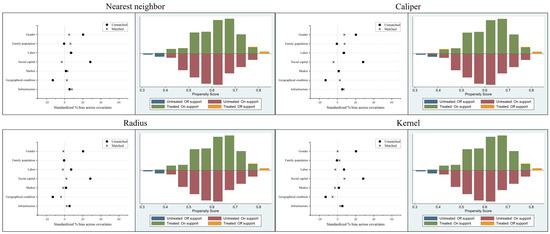
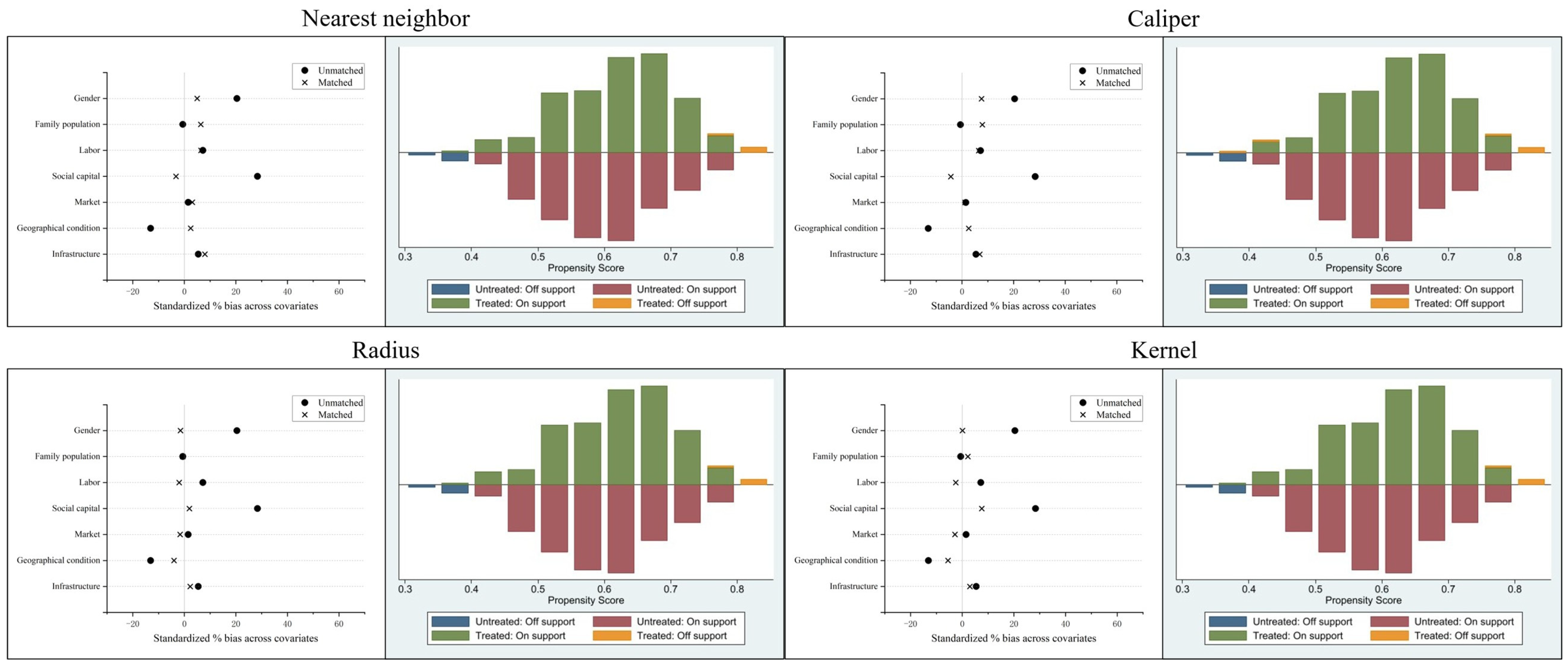
The results of the propensity score matching analysis are presented in Table 8, which examines the ATT of environmental training on the GPE. Four matching methods were employed to ensure the robustness of the results: nearest-neighbor matching, caliper matching, radius matching, and kernel matching. To ensure the validity of the matching, balance tests and common support tests were conducted, and the results are shown in Figure 1. In all the matching methods, the deviation of the control variables after matching was significantly reduced, and the absolute values were all below 10%. Moreover, the vast majority of the observed samples were within the value range, indicating that the sample loss was relatively small. In summary, the matching quality meets the requirements.
Table 8.
Average treatment effect of propensity score matching.
Figure 1.
Standardized deviation and Common support of propensity scores.
Across all four methods, consistent positive and statistically significant ATT estimates are observed, all exceeding the conventional threshold for statistical significance at the 1% level. These results indicate that farmers who participated in environmental training exhibit significantly higher GPE levels compared to their matched counterparts who did not receive training. Specifically, the GPE of trained farmers is approximately 0.131–0.167 higher than that of their untreated peers after accounting for self-selection bias. These results indicate that after addressing self-selection bias, training still exerts a robust positive effect on improving farmers’ GPE.
4.4. Mechanism Analysis
To further examine the underlying mechanism through which environmental training affects GPE, this part focuses on the role of clean production technology adoption. A stepwise regression approach is employed to provide evidence on the transmission channel, and the results are reported in Table 9.
Table 9.
The result of mechanism analysis.
First, Model 1 and Model 2 show that environmental training has a consistently positive and statistically significant effect on GPE. The estimated coefficients remain stable at approximately 0.008 and are significant at the 5% level across specifications. Notably, Model 2 builds on Model 1 by introducing additional control variables. This sequential inclusion of control variables is designed to examine the robustness of the estimated relationships across different model specifications.
Second, Models 3 and 4 follow the same strategy, where Model 4 adds control variables based on Model 3. The results show that environmental training significantly increases the adoption of clean production technologies, with coefficients of 0.016 and 0.013, both significant at the 1% level, which indicates that participation in training is conducive to promoting the adoption of technology. The consistency of the estimates before and after adding control variables further confirms the robustness of this relationship.
Third, the association between technology adoption and GPE is investigated. The results from Models 5 and 6 indicate that clean production technology adoption has a positive and statistically significant effect on GPE, with coefficients of 0.087 and 0.071, respectively. Model 6 introduces additional control variables relative to Model 5, and the effect of technology remains statistically significant. This suggests that clean production technologies contribute to improved efficiency, and the relationship is robust to alternative model specifications.
Finally, when technology adoption is included in the GPE regression, the coefficient of environmental training remains positive and statistically significant. These results suggest that technology adoption plays an important role in explaining the relationship between environmental training and GPE and provide supportive evidence for Hypothesis 3.
4.5. Heterogeneity Analysis
Heterogeneity analysis considered differences in farmers’ operational scale and education level. Multiple linear regression models were used, incorporating the spatial lag term of training (W × training) to examine differences in the spatial spillover effect across farmer groups. For the education-level grouping, which reduced sample size (99 observations), the bootstrap method (with 2000 replications) was applied to test the stability of the estimate for the core variable W × training.
First, the difference in the spatial spillover effect of training between small-scale and large-scale farms was examined (group regression results in Table 10). It is common practice to measure the scale based on slaughter volume. However, following the African swine fever epidemic, the slaughter volume of individual farmers has fluctuated drastically across different breeding cycles. As a result, measuring breeding scale by slaughter volume may lead to biases when conducting cross-sectional data analysis. The land scale might be a favorable alternative measurement indicator. Obtaining official approval for livestock pens in rural areas is difficult and costly. Once land leveling, pen construction and equipment installation are completed, the scale of a farm is largely fixed and unlikely to expand or shrink in the short term. Therefore, this section differentiates farmers into distinct groups according to land area when examining disparities in farmer scale. The Chinese unit “mu” is the standard land area measure used in official agricultural surveys and statistical yearbooks. This study adopts 1 mu (667 m2) as the scale threshold. There are 182 small-scale samples and 189 large-scale samples, which enables meaningful inter-group comparisons under a relatively balanced condition. The coefficient for W × training is negative and insignificant for the small-scale farmer group but positive and significant for the large-scale farmer group. This suggests that greater training participation by neighbors promotes GPE improvement for large-scale farmers. A possible reason is that larger operational scale correlates with more standardized, industrial-like production models, making these farmers more susceptible to regulation, more willing to operate normatively, and more attentive to manure resource utilization. They are likely more sensitive to related information and thus better able to acquire and apply beneficial green production technologies from their neighbors’ training.
Table 10.
Analysis result based on heterogeneity of land scale.
Next, the difference based on farmers’ education level was analyzed. According to the Compulsory Education Law of the People’s Republic of China, a nine-year compulsory education system is implemented nationwide. In this context, completion of compulsory education serves as a benchmark for judging whether citizens possess basic learning capacities and human capital endowments. Accordingly, this study takes nine years of schooling as the threshold to categorize farm households into distinct groups. Farmers were divided into a group that did not complete compulsory education (lower education) and a group that completed compulsory education (higher education). Results (Table 11) show that the coefficient for W × training is insignificant for the lower education group but positive and significant for the higher education group. This implies that well-educated farmers are more easily influenced by their peers, likely because they possess stronger learning capabilities and are more adept at acquiring beneficial information from their surroundings.
Table 11.
Analysis result based on heterogeneity of education level.
5. Discussion
The present study investigated the effects of environmental training on hog farmers’ GPE, and focused on analyzing the spatial spillover effects from training, as well as the mechanism role of technology adoption in the influencing process.
5.1. Supplement to Previous Literature
Numerous studies have confirmed the positive effect of training on the trainees themselves [52,53,54]. In contrast to prior research, the present study not only examines the direct benefits of training for participants but also places particular emphasis on its spillover effects on surrounding individuals. Moreover, it employs spatial econometric models to empirically validate the existence of such spatial spillover effects.
In the theoretical analysis section, this study draws on theories such as social learning and innovation diffusion to explain the spatial spillover effects of training. Although some existing research has applied these theories to examine the influence of social networks on farmers’ green production [25], the underlying mechanisms differ from those explored here. Such studies generally imply that individuals with stronger social networks may have greater access to information or receive more information sharing from peers. Yet, how much of that information is actually related to green production remains unclear. As a result, findings from that line of research often resemble a black box. In contrast, by adopting a spatial spillover perspective, this study opens that black box. It demonstrates that training does generate spillover effects, that it is indeed training-related information on green production that drives these effects, and that mutual influence exists within farming communities.
In addition, spatial econometric models have been widely applied in regional economics research [55,56], yet remain relatively underexplored in studies of individual units. A key challenge lies in constructing an appropriate spatial weight matrix. In regional economics, such matrices are typically based on geographical distance to capture spatial adjacency between regions. This study innovatively constructs a farmer-level spatial weight matrix with economic relevance, thereby offering a novel perspective and methodological approach for future research on inter-individual linkages.
5.2. Heterogeneity in Spatial Spillover Effects
The heterogeneous results show that training only has a significant spillover effect among large-scale farmers and those with a high level of education. For small-scale and less-educated groups, the null effect does not necessarily imply a lack of information access. Rather, it suggests a systematic failure to absorb and translate external knowledge into practice [57]. First, financial capacity and risk perception play a critical role. Large-scale farmers, operating under stricter environmental regulations and facing higher compliance costs, perceive manure management as a production necessity rather than an optional practice [58]. They are more willing to invest in infrastructure, such as storage facilities, and absorb the corresponding costs, whereas smallholders often view such investments as financially risky [59]. Even if they obtain green production knowledge via neighbors’ training spillover, they cannot afford the upfront input cost of matching green production behaviors, which inhibits the conversion of spillover information into actual green production efficiency improvement. Second, technical knowledge and learning capability differentiate the two groups. Our education-level results corroborate this. Compulsory education completion marks a threshold for basic learning and knowledge-acquisition abilities [60], which are essential for understanding application guidelines, interpreting testing results, and adapting generic recommendations to local conditions. Even if they receive instruction from the trained neighbors, farmers with lower educational levels may still be unable to correctly interpret or replicate the technical specifications [61]. Third, there are disparities in accessing agricultural extension services. Agricultural extension stations prioritize extension guidance, on-site technical debugging, and follow-up consulting services for large-scale and highly educated farmers, who actively take the initiative to connect with extension staff [62], while small-scale and less-educated farmers lack relatively timely after-spillover technical guidance. Once encountering operational difficulties in imitating peer green practices, they will abandon imitation directly. Collectively, these multi-dimensional barriers jointly weaken the spatial training spillover effects for disadvantaged farmer subgroups. Correspondingly, targeted differentiated extension policies are required rather than unified training arrangements for all livestock farmers.
5.3. Limitations and Future Research
Despite the valuable findings, this study has several limitations that should be acknowledged, which also point to directions for future research.
First, the empirical analysis is based on the survey data from Jiangsu Province, China. While Jiangsu is a representative major livestock-producing region, the generalizability of conclusions to other provinces or countries requires further validation. Therefore, the findings should be interpreted as primarily reflecting the context of Jiangsu Province. Future research should extend the analysis to broader geographic regions.
Second, this study adopts a county-level spatial weight matrix to capture spatial dependence among farmers. This specification is consistent with administrative and policy implementation structures in China. However, the knowledge spillovers and farmer-to-farmer interactions may also depend on physical distance, social networks, common suppliers, or shared training experiences. Future research could explore the spillover effects of training or policies by using alternative spatial weight matrices based on geographical distance or economic-social linkages.
Third, the measurement of environmental training can only partially assess the extent to which hog farmers have received training. Future research could incorporate a wider range of measurement indicators to characterize the quality of environmental training by considering factors such as training duration, course content, and post-training technical support, and to distinguish the effectiveness differences among various training formats.
Fourth, this study focuses exclusively on nitrogen emissions as the environmental outcome indicator, due to data availability and its recognized importance in manure management from hog farming. However, other pollutants, such as phosphorus and chemical oxygen demand, also contribute to the environmental externalities of livestock production. Future research with more comprehensive pollutant data could provide a more holistic assessment.
Fifth, clean production technology adoption is measured as a simple count of adopted technologies. This approach is consistent with existing empirical studies. In practice, however, these technologies vary in terms of investment cost, technological sophistication, and potential environmental impact. Future research could further improve the measurement by constructing a weighted index of technology adoption, where weights are assigned according to environmental effectiveness, implementation cost, or technological complexity.
Overall, although these limitations should be considered when interpreting the results, they do not affect the validity of the main conclusions. Future research should address the above limitations through larger-scale, multi-region surveys and more refined measurements.
5.4. Policy Implications for Enhancing Green Production
This study has identified the role of training and its spatial spillover effects, and also the mechanism of clean production technology. Based on this, the following policy recommendations can be made:
First, greater emphasis should be placed on post-training follow-up and continuous technical support. Rather than treating training as a one-off intervention, agricultural extension systems should establish long-term support mechanisms, such as on-site technical guidance, periodic field visits, and remote consultation services. This would help improve the conversion of training knowledge into actual adoption of clean production technologies and strengthen implementation effectiveness.
Second, peer learning and demonstration mechanisms should be further strengthened to enhance knowledge diffusion. Trained farmers can serve as local demonstration units and share practical experience with surrounding households through farm visits, cooperative-based learning groups, or community interactions. Providing targeted technical assistance or incentives to these demonstration farmers can further enhance their role in facilitating the spatial spillover of environmental training effects.
Third, environmental training programs should be expanded while adopting a differentiated design across farmer types. In particular, smallholders and low-educated farmers often face constraints in access and learning capacity, whereas large-scale farmers have a stronger demand for systematic and technology-oriented guidance. Therefore, extension agencies should develop tiered training modules tailored to farmers’ scale, education, and production conditions.
Fourth, digital extension tools should be integrated into environmental training and dissemination systems. Mobile-based platforms, online learning modules, and digital advisory services can be used to extend training coverage, provide real-time technical support, and improve information accessibility for geographically dispersed farmers. This can complement traditional extension approaches and further enhance the efficiency and reach of environmental training programs.
6. Conclusions
This study collected data from hog farmers from a developed agricultural province in China. It investigated the effect of environmental training on GPE by using the spatial Dubin model, which yields the following conclusions: (1) Training can promote farmers’ improvement of their own GPE. (2) The impact of training on farmers’ GPE exhibits a spatial spillover effect. That is, training received by neighboring farmers can promote the GPE improvement of the focal farmer. This indicates that farmers receiving training can set a positive example and provide motivation for surrounding farmers. (3) Clean production technology adoption plays a mechanism role in the process of training, affecting GPE. Specifically, training promotes technology adoption, which ultimately enhances GPE. (4) Heterogeneity analysis shows that, compared to small-scale hog farmers, large-scale farmers are more susceptible to the influence of their neighbors’ training participation. In other words, large-scale farmers are more likely to learn from others and be motivated by their training. A comparison of farmers with different educational backgrounds indicates that the GPE of highly educated farmers is more susceptible to the influence of training received by their neighboring farmers.
Author Contributions
Conceptualization, X.B.; methodology, X.B. and L.A.; formal analysis, X.B.; writing—original draft preparation, X.B.; writing—review and editing, W.Z. and L.A.; supervision, W.Z. All authors have read and agreed to the published version of the manuscript.
Funding
This research was supported by China Agriculture Research System of MOF and MARA (CARS-10) and The National Natural Science Foundation of China (42071221).
Institutional Review Board Statement
Not applicable.
Data Availability Statement
Dataset available on request from the authors.
Conflicts of Interest
The authors declare no conflicts of interest.
References
- Twumasi, M.A.; Asante, I.O.; Essilfie, G.; Ntim-Amo, G.; Modzi, S.K.; Jiang, Y. Household income improvement among Ghanaian livestock farmers: Does climate change adaptation strategies matter? Environ. Dev. 2022, 44, 100737. [Google Scholar] [CrossRef] [Scilit]
- Jiang, G.; Hu, H.; Wang, Y. How do livestock environmental regulations promote the vertical integration of the livestock industry chain? Evidence from Chinese-listed livestock enterprises. J. Clean. Prod. 2023, 413, 137508. [Google Scholar] [CrossRef] [Scilit]
- Jin, Y.; Hu, Y.; Pray, C.; Hu, R. Impact of government science and technology policies with a focus on biotechnology research on commercial agricultural innovation in China. China Agric. Econ. Rev. 2017, 9, 438–452. [Google Scholar] [CrossRef] [Scilit]
- Smith, L.; Inman, A.; Lai, X.; Zhang, H.; Meng, F.; Zhou, J.; Burke, S.; Rahn, C.; Siciliano, G.; Haygarth, P.M.; et al. Mitigation of diffuse water pollution from agriculture in England and China, and the scope for policy transfer. Land Use Policy 2017, 61, 208–219. [Google Scholar] [CrossRef] [Scilit]
- Wu, Z.; Liang, H.; Liu, Z.; Du, H.; He, L.; Xie, Z.; Zhu, J.; Zheng, B.; Wan, W. Nitrogen dilemma in Chinese crop-livestock systems: Assessing mitigation potential and exploring optimization pathways from the perspectives of utilization efficiency and pollution hotspots. Agric. Syst. 2026, 233, 104642. [Google Scholar] [CrossRef] [Scilit]
- Ikram, M. Assessing Food Security and Environmental Sustainability in North Africa: A Composite Indicator Approach Using Data Envelopment Analysis. Sustainability 2025, 17, 6017. [Google Scholar] [CrossRef] [Scilit]
- Gao, Q.; Chen, H.Y.; Zhao, M.; Zeng, M. Research on the Impact and Spillover Effect of Green Agricultural Reform Policy Pilot on Governmental Environmental Protection Behaviors Based on Quasi-Natural Experiments of China’s Two Provinces from 2012 to 2020. Sustainability 2023, 15, 2665. [Google Scholar]
- Indrarosa, D.; Mariyono, J.; Santoso, S.I.; Sutaryo, S. The effectiveness of community based eco-farm waste management training on enhancing farmers’ environmental awareness: The role of government support and sustainability attitudes. Clean. Waste Syst. 2025, 12, 100394. [Google Scholar] [CrossRef] [Scilit]
- Zeng, Y.; He, K.; Zhang, J.; Li, P. Impacts of environmental regulation perceptions on farmers’ intentions to adopt multiple smart hog breeding technologies: Evidence from rural Hubei, China. J. Clean. Prod. 2024, 469, 143223. [Google Scholar]
- van den Berg, H.; Ketelaar, J.W.; Dicke, M.; Fredrix, M. Is the farmer field school still relevant? Case studies from Malawi and Indonesia. NJAS-Wagening. J. Life Sci. 2020, 92, 100329. [Google Scholar] [CrossRef] [Scilit]
- Abdulai, A.; Huffman, W. The adoption and impact of soil and water conservation technology: An endogenous switching regression application. Land Econ. 2014, 90, 26–43. [Google Scholar]
- Mariyono, J.; Waskito, J.; Suwandi; Tabrani; Kuntariningsih, A.; Latifah, E.; Suswati, E. Farmer field school: Non-formal education to enhance livelihoods of Indonesian farmer communities. Community Dev. 2021, 52, 153–168. [Google Scholar] [CrossRef] [Scilit]
- Nakano, Y.; Tsusaka, T.W.; Aida, T.; Pede, V.O. Is farmer-to-farmer extension effective? The impact of training on technology adoption and rice farming productivity in Tanzania. World Dev. 2018, 105, 336–351. [Google Scholar]
- Wang, H.; Chen, B.; Huang, Z. Agricultural technology extension reform and productivity growth: Evidence from rural China. J. Rural Stud. 2026, 123, 104064. [Google Scholar] [CrossRef] [Scilit]
- Dosso, F.; Gouroubera, M.W.; Idrissou, L.; Moumouni-Mousa, I. The combination of extension approaches strengthens farmers’ innovativeness in sustainable land management: F. Dosso et al. Environ. Dev. Sustain. 2024, 26, 10043–10062. [Google Scholar]
- Zoundji, G.C.; Okry, F.; Van Mele, P.; Bentley, J.W.; Kwame Sackey, C. The potential of farmer training video for supporting agroecological vegetable production in Benin. Cogent Food Agric. 2024, 10, 2358607. [Google Scholar] [CrossRef] [Scilit]
- Kansanga, M.M.; Kerr, R.B.; Lupafya, E.; Dakishoni, L.; Luginaah, I. Does participatory farmer-to-farmer training improve the adoption of sustainable land management practices? Land Use Policy 2021, 108, 105477. [Google Scholar] [CrossRef] [Scilit]
- Chen, P.; Gao, J.; Zhang, M.; Wu, D. New-type professional farmers: How to make use of different types of social capital to engage in agriculture specialization. J. Rural Stud. 2025, 114, 103545. [Google Scholar] [CrossRef] [Scilit]
- Mgendi, G.; Mao, S.; Qiao, F. Does agricultural training and demonstration matter in technology adoption? The empirical evidence from small rice farmers in Tanzania. Technol. Soc. 2022, 70, 102024. [Google Scholar] [CrossRef] [Scilit]
- Wang, S.; Wang, Y.; Cao, Y.; Cai, Q.; Li, J.; Liu, Y. Direct and indirect effects of zoonosis intervention on pro-environmental behaviors among livestock farmers. Prev. Vet. Med. 2026, 249, 106793. [Google Scholar] [CrossRef] [Scilit] [PubMed]
- Anderson, J.R.; Feder, G. Agricultural extension: Good intentions and hard realities. World Bank. Res. Obs. 2004, 19, 41–60. [Google Scholar] [CrossRef] [Scilit]
- Feder, G.; Slade, R. The impact of agricultural extension: The training and visit system in India. World Bank. Res. Obs. 1986, 1, 139–161. [Google Scholar] [CrossRef] [Scilit]
- Li, F.; Ren, J.; Li, Z.; Qian, L.; Yin, C. Revealing the role of farmer-to-farmer extension in promoting sustainable agricultural practices in China: A case of rice-green manure rotation system diffusion. J. Clean. Prod. 2024, 485, 144365. [Google Scholar]
- Haryanto, T.; Wisnu Wardana, W.; Basconcillo, J.A.Q. Does sending farmers back to school increase technical efficiency of maize production? Impact assessment of a farmer field school programme in Indonesia. Econ. Res.-Ekon. Istraž. 2023, 36, 2218469. [Google Scholar] [CrossRef] [Scilit]
- Gong, S.; Jiang, L.; Yu, Z. Can digital human capital promote farmers’ willingness to engage in green production? Exploring the role of online learning and social networks. Behav. Sci. 2025, 15, 227. [Google Scholar] [CrossRef] [Scilit] [PubMed]
- Schultz, T.P. Human capital, schooling and health. Econ. Hum. Biol. 2003, 1, 207–221. [Google Scholar] [CrossRef] [Scilit] [PubMed]
- Lajçi, R.; Berisha, G. Human capital for intrapreneurship: Examining the impact of formal and informal training. J. Enterprising Communities People Places Glob. Econ. 2025, 19, 1342–1365. [Google Scholar] [CrossRef] [Scilit]
- To-The, N.; Tiet-Tong, T.; Nguyen-Anh, T.; Nguyen-The, P. Impact of human capital and risk preferences on farmers’ decisions towards sustainable farming practices: A meta analysis. J. Environ. Manag. 2025, 392, 126752. [Google Scholar] [CrossRef] [Scilit]
- Guzmán, G.I.; López, D.; Román, L.; Alonso, A.M. Participatory action research in agroecology: Building local organic food networks in Spain. Agroecol. Sustain. Food Syst. 2013, 37, 127–146. [Google Scholar]
- Sutherland, L.A.; Marchand, F. On-farm demonstration: Enabling peer-to-peer learning. J. Agric. Educ. Ext. 2021, 27, 573–590. [Google Scholar]
- Rodela, R. Social learning and natural resource management: The emergence of three research perspectives. Ecol. Soc. 2011, 16, 30. [Google Scholar] [CrossRef] [Scilit]
- Stone, G.D. Towards a general theory of agricultural knowledge production: Environmental, social, and didactic learning. Cult. Agric. Food Environ. 2016, 38, 5–17. [Google Scholar] [CrossRef] [Scilit]
- Dougill, A.J.; Fraser, E.; Holden, J.; Hubacek, K.; Prell, C.; Reed, M.; Stagl, S.; Stringer, L. Learning from doing participatory rural research: Lessons from the Peak District National Park. J. Agric. Econ. 2006, 57, 259–275. [Google Scholar] [CrossRef] [Scilit]
- Jacobson, W. Learning, culture, and learning culture. Adult Educ. Q. 1996, 47, 15–28. [Google Scholar] [CrossRef] [Scilit]
- Serra-Coch, G.; Andris, C.; Hecher, M.A.; Binder, C.R. Circumstantial proximity for innovation-diffusion: Which socio-spatial contexts foster information exchanges on energy technologies? Technol. Forecast. Soc. Change 2026, 222, 124402. [Google Scholar]
- Muro, M.; Jeffrey, P. A critical review of the theory and application of social learning in participatory natural resource management processes. J. Environ. Plan. Manag. 2008, 51, 325–344. [Google Scholar] [CrossRef] [Scilit]
- Charatsari, C.; Fragkoulis, I.; Lioutas, E.D. Farmers’ motives, goals, values, and participation in agricultural training programs: Uncovering the links in short food supply chains. J. Rural Stud. 2025, 119, 103719. [Google Scholar] [CrossRef] [Scilit]
- He, Z.; Jia, Y.; Ji, Y. Analysis of influencing factors and mechanism of farmers’ green production behaviors in China. Int. J. Environ. Res. Public Health 2023, 20, 961. [Google Scholar] [CrossRef] [Scilit] [PubMed]
- Xiang, W.; Gao, J. Do not be anticlimactic: Farmers’ behavior in the sustainable application of green agricultural technology—A perceived value and government support perspective. Agriculture 2023, 13, 247. [Google Scholar] [CrossRef] [Scilit]
- Bi, X.; Wen, B.; Zou, W. The role of internet development in China’s grain production: Specific path and dialectical perspective. Agriculture 2022, 12, 377. [Google Scholar] [CrossRef] [Scilit]
- Wang, S.; Qiu, S.; Ge, S.; Liu, J.; Peng, Z. Benchmarking Toronto wastewater treatment plants using DEA window and Tobit regression analysis with a dynamic efficiency perspective. Environ. Sci. Pollut. Res. 2018, 25, 32649–32659. [Google Scholar] [CrossRef] [Scilit]
- Zhang, Y.; Zhang, H.; Fu, Y.; Wang, L.; Wang, T. Effects of industrial agglomeration and environmental regulation on urban ecological efficiency: Evidence from 269 cities in China. Environ. Sci. Pollut. Res. 2021, 28, 66389–66408. [Google Scholar] [CrossRef] [Scilit]
- Qing, C.; Zhou, W.; Song, J.; Deng, X.; Xu, D. Impact of outsourced machinery services on farmers’ green production behavior: Evidence from Chinese rice farmers. J. Environ. Manag. 2023, 327, 116843. [Google Scholar]
- Tetteh Anang, B.; Alhassan, H.; Danso-Abbeam, G. Estimating technology adoption and technical efficiency in smallholder maize production: A double bootstrap DEA approach. Cogent Food Agric. 2020, 6, 1833421. [Google Scholar] [CrossRef] [Scilit]
- Moran, P.A. Notes on continuous stochastic phenomena. Biometrika 1950, 37, 17–23. [Google Scholar] [CrossRef] [Scilit] [PubMed]
- Geary, R.C. The contiguity ratio and statistical mapping. J. R. Stat. Soc. Ser. Stat. 1954, 5, 115–146. [Google Scholar] [CrossRef] [Scilit]
- Huang, D.; Xu, G.; Li, C.; Yang, S. Effects of high-tech industrial agglomeration and innovation on regional economic development in China: Evidence from spatial-temporal analysis and Spatial Durbin Model. Econ. Anal. Policy 2025, 86, 692–712. [Google Scholar]
- Elhorst, J.P. Spatial Econometrics: From Cross-Sectional Data to Spatial Panels; Springer: Berlin/Heidelberg, Germany, 2014. [Google Scholar]
- Rosenbaum, P.R.; Rubin, D.B. Reducing bias in observational studies using subclassification on the propensity score. J. Am. Stat. Assoc. 1984, 79, 516–524. [Google Scholar] [CrossRef] [Scilit]
- Liang, H.; Meng, Y. Impact of direct payments and non-financial support on smallholder income from environmentally friendly agriculture in Tohoku region, Japan. J. Environ. Manag. 2024, 351, 119698. [Google Scholar]
- Wang, M.; Li, P.; Ma, X. The influence of scale structure adjustment on the high-quality development of animal husbandry and its path optimization: An analysis from the perspective of pig breeding scale. China Rural. Econ. 2022, 38, 12–35. (In Chinese) [Google Scholar]
- Okoye, M.C.; Yao, L.; Mante, D.A.; Hui, X. Assessing the impact of technical and vocational education and training on career choice intentions: The mediating role of general skills and competencies and the moderating role of learning environment. Acta Psychol. 2026, 264, 106313. [Google Scholar] [CrossRef] [Scilit]
- Wang, X.; Li, S.; Bai, X.; Gómez, J.A.; Liu, T.; Liu, J. Effect of government regulation on promotion of soil restoration practices among farmers in the Loess plateau: Unveiling the role of green ecological cognition. Int. Soil Water Conserv. Res. 2025, 13, 979–991. [Google Scholar] [CrossRef] [Scilit]
- Wang, X.; Zhao, X. The moderating effect of training, subsidies and propaganda on the relationship between psychological factors and farmers’ willingness to reduce chemical fertilizer application: Evidence from dryland farming areas of China. Agric. Syst. 2025, 224, 104257. [Google Scholar] [CrossRef] [Scilit]
- Shi, H.; Goulias, K.G. Understanding the zero-emission vehicle market spatial diffusion and its determinants from 2019 to 2022 using spatial econometric models. Energy 2024, 313, 133607. [Google Scholar] [CrossRef] [Scilit]
- Venkadavarahan, M.; Joji, M.S.; Marisamynathan, S. Development of spatial econometric models for estimating the bicycle sharing trip activity. Sustain. Cities Soc. 2023, 98, 104861. [Google Scholar] [CrossRef] [Scilit]
- Kiwelu, J.E.M.; Ngulube, P. Leveraging research-based knowledge translation via rural libraries to improve maize postharvest practices in Uganda. S. Afr. J. Inf. Manag. 2026, 28, a2041. [Google Scholar] [CrossRef] [Scilit]
- Osei, E.; Kan, E.; Jafri, S.H.; Lovell, A.; Henson, L.; Wellmann, K.; Muir, J.; Spencer, J.; Liu, Z. Economics of Conventional Dairy Manure Management in North Central Texas. Agriculture 2025, 15, 2472. [Google Scholar] [CrossRef] [Scilit]
- Wang, Q.; Gui, L.; Meng, Q.; Wang, H.; Hu, J. Rural credit and new technology adoption among family farms: Evidence from two demonstration areas in China. Humanit. Soc. Sci. Commun. 2025, 12, 1109. [Google Scholar] [CrossRef] [Scilit]
- Shi, X. Education on the cheap: The long-run effects of a free compulsory education reform in rural China. J. Dev. Econ. 2012, 99, 459–473. [Google Scholar]
- Qing, H.; Lu, W. Explaining education-based difference in systematic processing of COVID-19 information: Insights into global recovery from infodemic. Inf. Process. Manag. 2022, 59, 102989. [Google Scholar] [CrossRef] [Scilit]
- Zhang, J.; Xie, S.; Li, X.; Xia, X. Adoption of green production technologies by farmers through traditional and digital agro-technology promotion—An example of physical versus biological control technologies. J. Environ. Manag. 2024, 370, 122813. [Google Scholar]

Disclaimer/Publisher’s Note: The statements, opinions and data contained in all publications are solely those of the individual author(s) and contributor(s) and not of MDPI and/or the editor(s). MDPI and/or the editor(s) disclaim responsibility for any injury to people or property resulting from any ideas, methods, instructions or products referred to in the content. |
© 2026 by the authors. Licensee MDPI, Basel, Switzerland. This article is an open access article distributed under the terms and conditions of the Creative Commons Attribution (CC BY) license.