


Abstract
Background: Venous catheter placement is the most common invasive procedure performed in hospitals. Despite their widespread use and importance in healthcare, these devices can cause complications such as catheter-associated bloodstream infections (CABSIs). Although several studies have investigated potential risk factors, including sociodemographic, medical history, and clinical variables, the results remain inconsistent and inconclusive. Objectives: The aim of this study was to identify independent risk factors for CABSIs and to develop and validate a predictive model for CABSIs in patients with midline catheters, centrally inserted central catheters (CICCs), and peripherally inserted central catheters (PICCs). Methods: We conducted an observational cohort follow-up study including hospitalized patients with a CICC, PICC, or midline catheter between January 2016 and March 2022. Devices were randomly assigned to derivation (n = 6036) and validation (n = 1549) cohorts. Candidate predictors with p < 0.25 in univariate analysis entered a multivariable logistic regression model, and final variables were selected by backward stepwise regression. Performance in the validation cohort was assessed by calibration and discrimination using the Hosmer–Lemeshow test and AUC. Results: The prevalence of CABSIs in the derivation cohort was 1.8%. Independent risk factors for CABSIs included tracheostomy, a history of bacteremia within 3 months before catheter placement, the presence of a synchronous central catheter, active oncohematological disease, and having received total parenteral nutrition (TPN). The presence of these five variables increased the probability of CABSIs to 42.1%. The final model demonstrated good predictive performance with an area under the curve (AUC) of 0.73 in the derivation cohort and 0.77 in the validation cohort. Decision curve analysis showed that the predictive model offered a greater net clinical benefit than the “treat-all” or “treat-none” strategies among threshold probabilities between 0.5% and 5%. Conclusions: The model can help identify high-risk patients, guide risk-based clinical decisions, reduce unnecessary catheter use, and support infection prevention and antimicrobial stewardship.
1. Introduction
Vascular devices are an essential component of modern healthcare and represent the most commonly performed invasive procedures in hospitals. In Spain, a study reported that 76.57% of hospitalized patients had a peripheral venous device (PVD), while 12.34% had a central venous device (CVD) [1]. In the United States, more than 330 million PVDs and 5 million CVDs are inserted annually [2,3]. Despite their high prevalence, vascular devices can lead to complications, some of which can be severe or even fatal [4,5,6,7].
One of the most common complications, with a significant impact on the comorbidity of patients with vascular devices, is catheter-associated bloodstream infection (CABSI). The Spanish National Prevalence Study of Nosocomial Infections (EPINE) has reported that 16.23% of nosocomial infections are due to CABSI [1], with a mortality rate of 9.4% [6]. In the USA, approximately 30,100 CABSI episodes occur annually among critically ill patients [5], with attributable mortality ranging from 12% to 25% [7]. Given the severity of this issue and the known pathogenesis of CABSIs, numerous preventive strategies have been established to standardize the insertion, management, and care of vascular devices, as outlined by various national and international scientific societies [5,7,8]. In addition, the Association for Professionals in Infection Control and Epidemiology (APIC, 2015) has stated that most CLABSIs can be prevented through the implementation of evidence-based strategies currently available to healthcare professionals [4]. Identifying risk factors would allow tailored monitoring, care, and maintenance protocols, as well as the incorporation of technology and new devices to reduce individual patient risk. Numerous studies have investigated risk factors for CABSIs across different patient populations, including general hospitalized, ICU, surgical, and oncology patients [9,10,11]. However, findings have been heterogeneous and have not allowed consistent identification of independent predictors [9,12,13,14]. In addition, to our knowledge, no predictive tool has been developed to estimate CABSI risk before catheter insertion in patients with midline catheters, CICCs, and PICCs. Therefore, this study aimed to identify independent risk factors for CABSIs and to develop and validate a predictive model in this population.
2. Methods
2.1. Study Design, Setting and Patient Sample
This was a cohort follow-up study that included all hospitalized patients aged 18 years or older with a CICC, PICC or midline catheter between January 2016 and March 2022. The length of follow-up for each patient was defined from catheter insertion until removal. This study was performed in a university hospital in Barcelona, Spain.
This study was conducted and reported in accordance with the STROBE (Strengthening the Reporting of Observational Studies in Epidemiology) guidelines for cohort studies. All catheters implanted in this study were from BD (Becton, Dickinson and Company, Franklin Lakes, NJ, USA) or ARROW (Teleflex Incorporated, Morrisville, NC, USA).
2.2. Inclusion and Exclusion Criteria
The inclusion criteria were patients 18 years of age who had a CICC, PICC, or midline catheter between January 2016 and March 2022. The exclusion criteria included patients with a CICC, PICC, or midline catheter for less than 24 h and outpatients. Patients hospitalized in 2020 were also excluded due to the COVID-19 pandemic because the exceptional context of the COVID-19 pandemic may have affected the completeness and comparability of clinical records and the consistency of usual venous catheter care processes.
2.3. Catheter Insertion Procedure
All venous catheters were monitored until withdrawal. The insertion, maintenance, and withdrawal procedures for the venous catheters included in the study were performed according to the protocols of our institution, which are based on the guidelines of the Centers for Disease Control and Prevention/National Healthcare Safety Network (CDC/NHSN) and the Infusion Nursing Society (INS) [15]. PICCs and midline catheters were inserted by the Vascular Access Team (VAT) at our center, composed of qualified nurses with expertise in vascular access. The type of catheter inserted was chosen based on clinical recommendations and guidelines [15]. PICCs and midline catheters were inserted at the patient’s bedside. For CICC insertion, the procedure was performed in the ICU, medical anesthesia, or general surgery department in a critical care bay or operating room. All catheters were inserted under ultrasound guidance, and the position was confirmed by the professional performing the procedure. Nursing staff responsible for the patient managed the maintenance and care of the venous catheters, as well as their withdrawal, following institutional protocols.
2.4. Variables and Data Collection
Data were obtained from electronic clinical records through the IMAS (IMASIS) hospital information system. Variables were collected in a database designed for this purpose and accessible only to study investigators. Follow-up and registry of the variables were conducted by the VAT.
Collected variables included sociodemographic data, patient history, the Charlson comorbidity index adjusted for age [16], analytical data (complete blood count, biochemical parameters, and inflammation: C-reactive protein [CRP] and procalcitonin), unit of hospitalization at catheter placement, and whether the patient was admitted for specific care (hemodialysis, emergency surgical intervention, ICU/resuscitation (ICU/RES), invasive mechanical ventilation, or septic shock during catheter use). In addition, variables related to pharmacotherapy administered on the day of catheter placement, days of catheter dwell time, and the days from admission to catheter insertion were collected. The following catheter-related variables were also gathered: type of catheter implanted, characteristics of the catheter and its insertion, patient history related to catheters, analytical parameters on the day of catheter insertion, and the microorganism causing CABSI.
The same predefined variables, outcome definitions, and data collection criteria were applied consistently throughout the entire study period.
2.5. Definitions and Measurement Tools
The main study variable was the presence of CABSI after catheter insertion. The CABSI definition used in this study, as described by the INS in 2021 [15], included midline catheters, which are usually excluded from the definition of central line-associated bloodstream infection (CLABSI). CABSI was defined according to the criteria established by the CDC/NHSN [17].
All implanted PICCs were made of third-generation power-injection polyurethane. A PICC is defined as a venous catheter inserted peripherally with the distal point in the lower third of the superior vena cava (SVC) [15]. The CICCs were made of second-generation polyurethane impregnated with an antimicrobial. A CICC is defined as a catheter inserted in a central vein, with the distal point in the SVC [15]. A midline catheter made of second-generation polyurethane is a peripheral venous catheter with a length of 8–25 cm, with the distal point placed at the level of the axilla [15,18].
2.6. Ethical Considerations
Informed consent was waived due to the retrospective nature of data collection and the use of anonymized clinical data. Although the data were obtained from pre-existing clinical records, the study was designed as the follow-up of a cohort to assess the occurrence of CLABSIs over time. Data corresponding to the period from January 2016 to March 2022 were collected retrospectively from existing clinical records. The study was conducted in accordance with the ethical principles of the Declaration of Helsinki and was approved by the Clinical Research Ethics Committee of the Hospital del Mar Medical Research Institute (CEIC2018/8113/I), with approval granted on 21 September 2018.
2.7. Statistical Analysis
The unit of analysis was the catheter. To develop a predictive model for CABSIs, the total sample size was randomly divided into a derivation cohort comprising 80% of the patients (n = 6036) and a validation cohort comprising 20% of the patients (n = 1549). All analyses and the predictive model were performed using the derivation cohort, and the predictive model was subsequently internally validated in a randomly split validation cohort. The characteristics of the catheters and the patients in the study cohorts were compared.
Qualitative variables are expressed as absolute frequencies and percentages, while quantitative variables are expressed as the mean and standard deviation. The Kolmogorov–Smirnov test was used to evaluate the normality of the distributions.
Several indices, such as the neutrophil-to-lymphocyte ratio (NLCR), were calculated [17]. The variables of interest were compared based on the presence of CABSIs. For quantitative variables, the Student t-test was performed. The chi-square test (or Fisher’s exact test for frequencies < 5) was used to compare categorical variables.
Variables with a p-value < 0.25 in the univariate analysis were considered for inclusion in the multivariable model, following recommended strategies to avoid excluding potentially important predictors [19]. To reduce the risk of overfitting, the number of predictors included in the final model was restricted according to the number of events. The final selection of variables was made using backward regression (likelihood ratio) (Pin < 0.05; Pout > 0.10) [19]. The multiple imputation method was used for missing data. The data are expressed as odds ratios (ORs), 95% confidence intervals (CIs) and p values.
The β coefficients from the final multivariable model were used to derive the weighted score. Each coefficient was divided by the smallest coefficient in the model and rounded to the nearest integer to assign points proportional to the strength of association. In addition, a simplified non-weighted score was created by assigning one point to each predictor.
The Hosmer–Lemeshow goodness-of-fit test evaluated the overall fit of the model. Receiver operating characteristic (ROC) curves were developed to calculate the predictive power of the final model. The combination of predictors in the final model was used to calculate the probability of CABSIs. A final score was developed based on previously published and validated risk assessment tools [12]. Cut-off values were assigned to create a tool with a point system from 0 to 15, with individual points reflecting the relative magnitude of the regression coefficients in the model. The final model was validated using the validation cohort.
Missing data were handled using multiple imputation. The proportion of missing data was low (<5%) for most variables, although the number of lumens showed slightly higher levels of missingness (5.7% in the derivation cohort and 6.4% in the validation cohort), and serum albumin presented a higher proportion of missing data (66% in both cohorts). Five imputed datasets were generated using regression-based models appropriate for each variable type (logistic regression for categorical variables and linear regression for continuous variables). Plausible ranges were defined for continuous variables to ensure realistic imputations. As results were consistent across imputations, analyses were conducted on one representative imputed dataset. A p value < 0.05 was considered statistically significant for all tests. The R Studio (V4.3) statistical package was used for the analyses.
3. Results
3.1. Descriptive Statistics
A total of 7585 venous catheters were inserted: 6036 in the derivation cohort and 1549 in the validation cohort. There were no significant differences between the two cohorts except in history of cerebrovascular disease, catheter length, length of hospital stay prior to catheter insertion, and procalcitonin values; overall, both cohorts were comparable (Table 1 and Table 2). Of the catheters inserted, 1.8% developed CABSIs according to CDC/NHSN criteria.
Table 1.
Categorical variables by cohort. Descriptive statistics. Total study population.
Table 2.
Patient and catheter characteristics according to the presence of CABSIs. Derivation cohort.
The mean age of the patients in the derivation cohort was 71 (SD, 16) years, and 59% of the catheters were implanted in men. Catheter insertion took place in a conventional hospitalization unit in 58.9% of the patients. The most common antecedent was oncological disease in 31.4% of the patients, followed by diabetes mellitus in 29.5%. CABSIs had occurred within 3 months prior to the insertion of a new catheter in 15.2% of the patients.
The mean length of hospitalization until venous catheter insertion was 10.91 (SD, 28.89) days and the mean dwell time was 6.30 (SD, 9.24) days. Venous catheter insertions were most frequent in the fall (27.1% of all insertion).
The most frequently administered pharmacotherapy was TPN, used in 20% of catheters. The mean number of catheter manipulations within a 24 h period was 13 (SD, 13.89).
The most frequently used venous catheter was a CICC in 49.1% of insertions. In 5.6% of insertions, a synchronous central catheter was present, and 40.3% of patients had a history of another venous catheter (CICC, PICC or midline catheter) during the same hospital admission. The mean number of short peripheral lines placed prior to catheter insertion was 1.73 (SD, 2.56).
With respect to laboratory parameters at the time of insertion, mean values were as follows: albumin 3.08 (0.71) g/dL, eosinophils 0.13 (0.22) u/µL, leukocytes 12.11(7.9) u/µL, NLCR 11.67 (15.52), neutrophils 11.84 (15.55) u/µL, CRP 10.60 (11.77) mg/dL and procalcitonin 13.28 (45.59) ng/mL (Table S1).
3.2. Risk Factors for the Presence of CABSI (Derivation Cohort)
In the validation cohort, CABSI (N = 1549) was observed in 29 patients (1.8%). Bivariate analysis showed that patients who developed CABSI more frequently experienced bacteremia in the previous three months (33.6% vs. 14.9%, p < 0.001), and had a history of active oncohematological disease (10.3% vs. 4.7%, p = 0.008). Patients with CABSIs were also more frequently receiving hemodialysis (10.3% vs. 3.5%, p = 0.002) and invasive mechanical ventilation (24.3% vs. 11.9%, p > 0.001), and had a tracheostomy (19.6% vs. 10.3%, p = 0.002). In this group, both the length of hospital stay prior to catheter insertion (37.49 vs. 10.43, p < 0.001) and catheter dwell time (18.84 vs. 8.84 days, p = 0.004) were also longer. Among pharmacological therapies, peripheral parenteral nutrition (6.5% vs. 2.6%, p = 0.025), TPN (55.1% vs. 19.4%, p < 0.001), and parenteral serum therapy (27.1% vs. 19.4%, p = 0.048) were more frequent in the CABSI group.
Regarding catheter characteristics, patients with CABSIs had a greater number of lumens implanted (2.69 vs. 2.34, p = 0.002) and longer catheter lengths (30.49 vs. 27.17 cm, p = 0.005). They were also more likely to have a synchronous central catheter (18.7% vs. 5.3%, p < 0.001), a central catheter during the same hospital stay (59.8% vs. 40.0%, p < 0.001) and a higher number of peripheral lines implanted prior to the insertion of a CICC, PICC, or midline catheter (3.31 vs. 1.7, p < 0.001).
In regard to analytical parameters, only albumin levels were significantly higher in the NO CABSI group (3.08 vs. 2.7 g/dL, p = 0.001) (Table S2).
3.3. Prognostic Equation for CABSIs
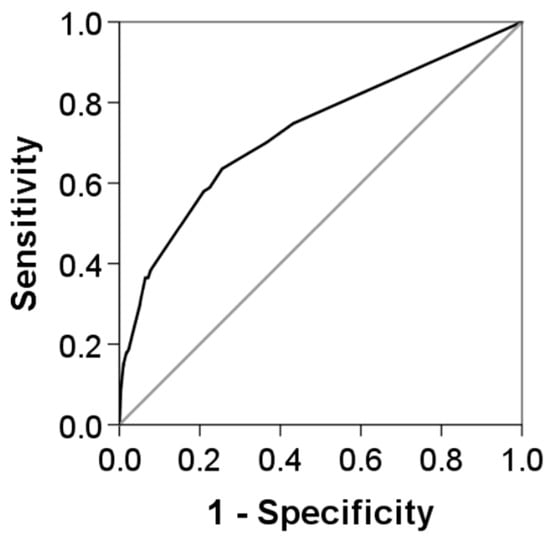
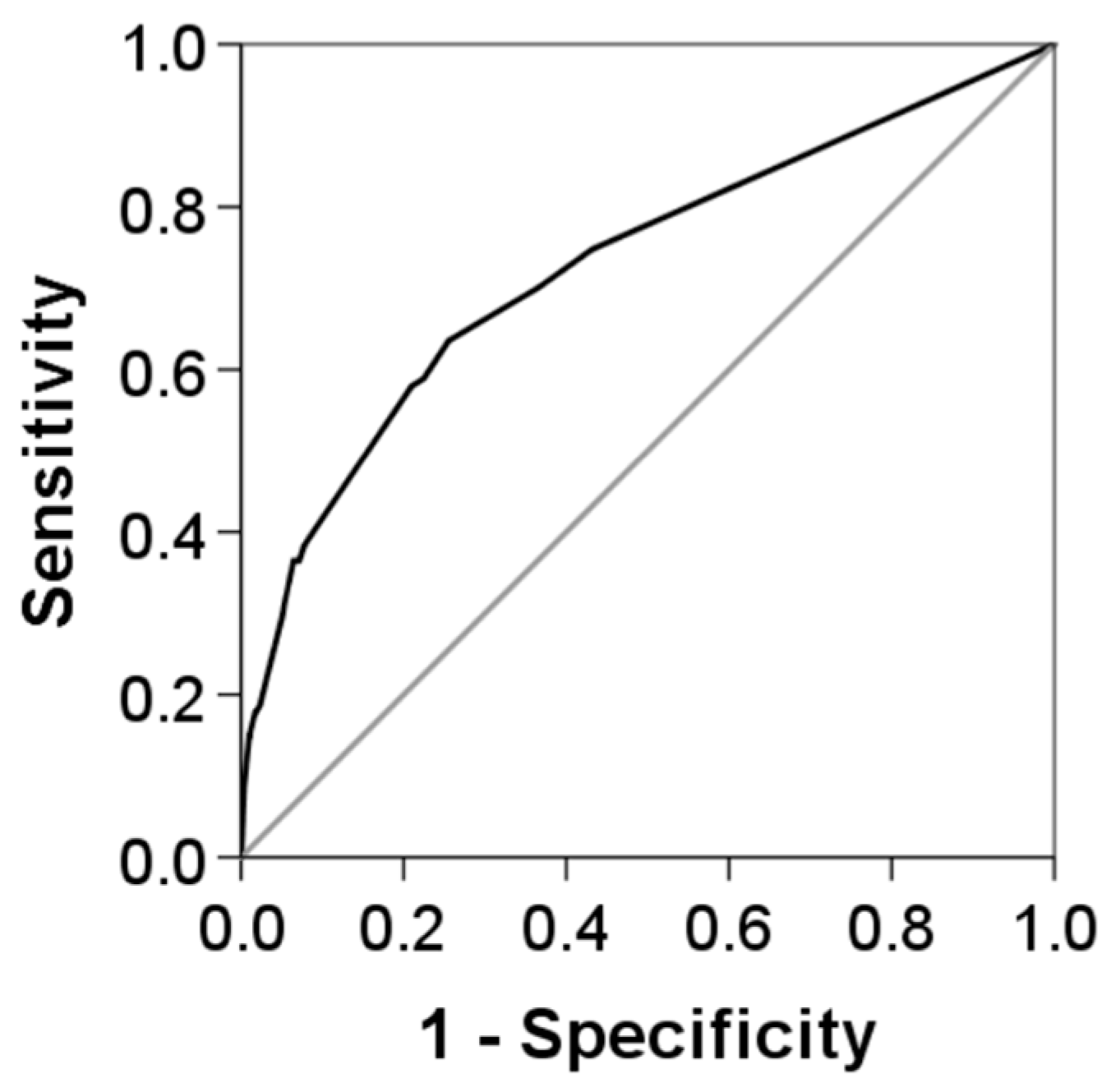
The final logistic regression model identified five factors independently associated with CABSIs: tracheostomy (OR 1.85, 95% CI 1.12–3.06, p = 0.017), bacteremia within 3 months prior to catheter insertion (OR 2.20, 95% CI 1.43–3.37, p < 0.001), the presence of a synchronous catheter (OR 2.25, 95% CI 1.32–3.85, p = 0.003), active oncohematological disease (OR 2.56, 95% CI 1.33–4.92, p = 0.005), and receipt of TPN (OR 4.47, 95% CI 3.00–6.64, p < 0.001). The weighted score derived from this model assigned the highest value to TPN (15 points). This final model obtained good goodness-of-fit with the Hosmer–Lemeshow test (p = 0.735) and a strong predictive ability for CABSIs (AUC = 0.73, 95% CI 0.67–0.78) (Table 3 and Table 4, and Figure 1). Based on the final model’s risk estimates, the (negative predictive value) NPV ranged from 99.2% to 98.8%, whereas the PPV ranged from 3% to 9%.
Table 3.
Univariate logistic regression analysis of variables associated with catheter-associated bloodstream infection (CABSI) a.
Table 4.
Logistic regression analysis of variables associated with catheter-associated bloodstream infection (CABSI) a.
Figure 1.
Predictive performance of the final multivariate model for the presence of CABSIs in the derivation cohort.
The prognostic equation estimated that the probability of CABSIs was 0.7% in patients with none of the identified risk factors. Among patients with only one risk factor, the probabilities were 1.3% for tracheostomy, 1.5% for bacteremia within 3 months prior to catheter insertion, 1.5% for a synchronous central catheter, 1.7% for active oncohematological disease, and 3% for TPN. Finally, the probability of CABSIs in patients with all five risk factors was 42.1%. The probabilities for developing CABSIs with all the combinations of factors are shown in Appendix A.
3.4. Validation of the Prognostic Equation
Among the 1549 patients included in the validation cohort, the frequency of CABSIs was 1.9% (n = 29). Multivariate analysis of this cohort identified the following as predictors of the development of CABSIs: having had bacteremia within a period of <3 months before catheter insertion (OR 2.53, 95% CI 1.10–5.85, p = 0.029), active oncohematological disease (OR 3.78, 95% CI 1.05–13.58, p = 0.041) and TPN (OR 5.53, 95% CI 2.49–12.30, p < 0.001). Tracheostomy was almost significant (OR 2.39, 95% CI 0.94–6.12, p = 0.06) and the only factor that was not related to CABSIs was having a synchronic central catheter (OR 1.78, 95% CI 0.62–5.09, p = 0.283).
This validation model obtained a good goodness-of-fit (Hosmer–Lemeshow test, p = 0.669) and an elevated predictive power for CABSIs (AUC = 0.77, 95% CI 0.68–0.87) (Table 5).
Table 5.
Validation of the predictive model for CABSIs. Validation cohort (N = 1549).
3.5. Decision Curve Analysis (DCA)
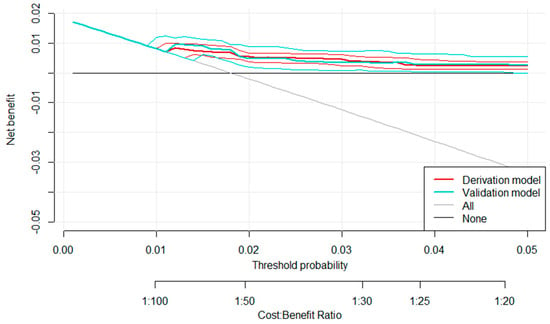
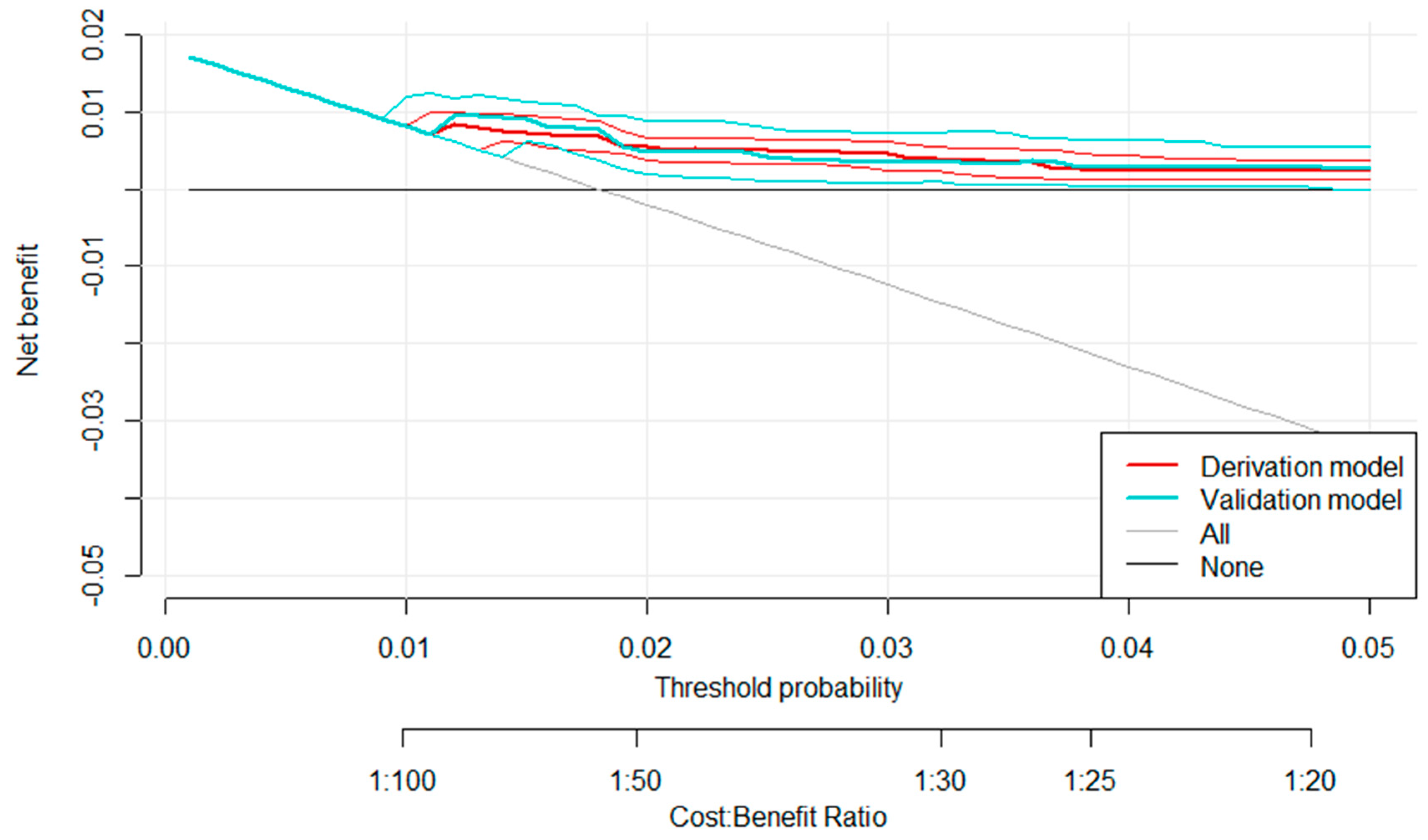
The decision curve analysis (DCA) demonstrated that both the derivation and validation models provided a higher net benefit than the “treat-all” and “treat-none” strategies across a range of threshold probabilities between 0.5% and 5%. The curves for the derivation and validation cohorts overlapped closely, indicating consistent model performance and potential clinical usefulness for guiding catheter-related infection prevention decisions (Figure 2).
Figure 2.
Decision curve analysis (DCA) comparing the derivation and validation models.
3.6. Microbiology
The most prevalent microorganisms identified were Gram-positive bacteria, with Staphylococcus epidermidis constituting 44.2%, followed by S. aureus at 10.9%. Gram-negative bacteria were the second most numerous, with Pseudomonas aeruginosa and Klebsiella spp. constituting 8% and 6.5%, respectively. Lastly, the only fungi present were Candida spp. at 10.1% (Table 6).
Table 6.
Microbiological results of the total number of catheter-associated bloodstream infections (CABSIs).
4. Discussion
In the present study, a predictive model of CABSIs was developed in a large homogeneous sample of patients with midline catheters, CICC, and PICC. The results showed that 1.8% of the cases developed CABSIs, and the following independent risk factors were identified: TPN, active oncohematological disease, bacteremia within a period of less than 3 months before the insertion of a new catheter, the use of a synchronous central catheter, and the presence of tracheostomy. In addition, the coexistence of the five factors increased the probability of developing CABSIs to 42.1%. This predictive model is a tool that can be used to calculate the probability of developing CABSIs based on different combinations of these five risk factors (Appendix A). Given the low incidence of CLABSIs (1.8%), the model achieved a very high negative predictive value (98.8–99.2%) over thresholds between 1% and 5%, indicating excellent ability to rule out patients at low risk of infection. Although the positive predictive value was modest (3–9%), this is expected in low-prevalence outcomes. The model therefore provides clinical utility primarily as a rule-out tool, helping to identify patients unlikely to develop CLABSIs, which is particularly relevant in settings with limited resources.
Regarding the independent risk factors in our cohort, TPN had the greatest impact on the development of CABSIs. Previous studies and a recent meta-analysis also identified TPN as an independent factor for CABSIs [12]. The increased risk of CABSIs associated with TPN is related to higher dextrose serum concentrations, which promote microorganism proliferation [20,21,22]. Catheter dwell time and TPN, as well as the quality of catheter manipulation by health professionals, also impact the development of infection [15,23].
Similar to the results of previous studies, our predictive model identified active oncohematological disease as an independent risk factor for CABSIs [12]. Patients with this condition undergo chemotherapy, which can weaken the immune system and has been recognized as a risk factor in other studies [21]. Although a systematic review and meta-analysis did not explicitly classify it as a risk factor, oncohematological disease is associated with immune system compromise and chemotherapy, both of which have been reported as risk factors [24].
The presence of bacteremia within 3 months prior to the insertion of a new venous PICC, CICC, or midline catheter has been associated with the risk of developing CABSIs. This is related to the presence of residual microorganisms that facilitate catheter colonization by hematogenous spread [4]. Catheter-associated infections may recur in up to 41.5% of patients who have had CABSIs, particularly in those with fungal infections and ICU stays [22]. In our predictive model, the presence of a synchronous central catheter was also associated with the risk of CABSIs, especially in patients on hemodialysis and those requiring intensive care. Patients receiving hemodialysis have various risk factors, such as vascular access for renal replacement therapy, immune compromise, antibiotic resistance, comorbidities such as diabetes, and nasal colonization by S. aureus [25,26]. Critically ill patients often require more than one central venous catheter due to extensive pharmacotherapy and monitoring of hemodynamic parameters. Having two or more catheter insertion sites and increasing the number of lumens heightens the risk of CABSIs [24,27]. While tracheostomy was not statistically significant in the validation cohort, it remained clinically relevant and warrants further investigation. Previous studies suggest a potential link between CABSIs and tracheostomy. Biologically, tracheostomy may increase CABSI risk by promoting bacterial colonization in the upper airway, increasing secretion burden and manipulation, and indicating a higher severity of illness that necessitates prolonged hospitalization and invasive care. However, the limited sample size and observational designs of existing studies have prevented tracheostomy from being established as a definitive risk factor [23,28].
A predictive tool was developed from these risk factors. This calculator effectively identifies patients at higher risk for CABSIs, facilitating the implementation of preventive strategies to reduce potential infectious complications. The tool also allows personalization of surveillance and follow-up protocols to meet individual patients’ needs, thereby optimizing clinical resources and improving healthcare quality. DCA further demonstrated that both the derivation and validation models provided a greater net clinical benefit than the “treat-all” and “treat-none” strategies over a range of threshold probabilities between 0.5% and 5%. This supports the clinical applicability and consistency of the model, confirming its potential to guide real-world decision-making in catheter-related infection prevention. This personalization not only enhances patient prognosis but also leads to more efficient and proactive clinical risk management. In addition, the development of CABSIs significantly impacts hospital costs, with reported expenses of up to €18,000 per episode [29].
Beyond its predictive value, this tool can be integrated into electronic records to generate real-time alerts, assisting clinical teams in determining the appropriate type of line and the optimal timing of insertion based on each patient’s individual risk. This approach not only measures risk but also directly translates into specific actions within the clinical workflow and the preventive strategy of the infection control team. Importantly, the development of CABSIs is multifactorial, with some factors being preventable. Therefore, the use of various strategies, sometimes simultaneously, is essential to reduce the risk of CABSIs. A critical aspect in this context is promoting a centralized model for vascular access management through VATs. Several prospective studies have confirmed the efficacy of VATs in reducing catheter-related complications and their economic benefits [30,31,32,33,34]. This low prevalence may be partly related to the involvement of the VAT in catheter insertion and management; however, given the absence of a comparator group, this finding should be interpreted as a potential contributing factor rather than a causal explanation.
The microbiological profile observed in our cohort was characterized by a predominance of Gram-positive microorganisms, particularly Staphylococcus epidermidis, which is consistent with the pathogenesis of catheter-related bloodstream infections and the role of skin colonization in catheter contamination [23]. Gram-negative bacilli and Candida spp. were also identified, supporting the clinical relevance of host-related factors, severity of illness, and exposure to invasive procedures or parenteral nutrition in this population [12,20,21,22].
One recommended strategy for reducing infections related to the management of venous catheters is to implement or strengthen control policies that encourage early catheter withdrawal or avoid inserting non-essential venous catheters [15]. Collaboration with antibiotic optimization programs would facilitate early withdrawal of endovenous devices in patients eligible for oral antibiotic treatment, based on bioavailability, oral tolerance, and good clinical progress [27]. Increasing adherence among professionals to established protocols would improve venous catheter management and care. In this context, a phenomenological study found that resource limitations and the lack of intuitive procedures contribute to low adherence [35]. Therefore, qualitative studies are needed for an in-depth exploration of the causes related to low adherence to institutional protocols among professionals.
Other more specific strategies that can be applied to prevent CABSIs of endoluminal origin include the use of antiseptic solutions such as taurolidine [15,36], venous catheters impregnated with antimicrobials [37,38], and passive disinfection with disinfectant caps to enhance adherence to bioconnector disinfection [15,39]. Chlorhexidine-impregnated dressings can also be used to protect the insertion site and prevent CABSIs of extraluminal origin [15].
As a main strategy, it is recommended to develop integrated bundles that implement these strategies and evaluate their efficacy and efficiency in randomized clinical trials. These bundles can be tailored to the risks associated with different devices, interventions, and management models, supported by strong scientific evidence, to prevent CABSIs. In addition, this approach would facilitate the implementation of educational resources to improve adherence to evidence-based practices among professionals.
The development of future pathogen identification lines and consideration of associated microbiota would optimize the predictive model, enhancing its accuracy in identifying specific risks and personalizing interventions. This would also offer valuable insights for nursing research, guiding studies on infection prevention and patient care strategies. Such research would improve the adaptation of the model to distinct clinical settings, patient populations, and epidemiological scenarios, promoting more effective prevention strategies tailored to the particular needs of each context.
5. Limitations
The overall incidence of CLABSIs in our cohort was 1.8%, consistent with previously reported rates. Although the total sample was large, the low number of events may have limited the statistical power to detect modest associations and could affect model calibration. To reduce potential overfitting, the number of predictors included in the final model was restricted, and internal validation using an independent cohort showed acceptable calibration and discrimination. In addition, the exclusion of patients admitted in 2020 may limit the temporal generalizability of the findings and represents a potential source of selection bias. This predictive model was developed at a single center, and its performance may vary in hospitals without a VAT or other specialized infrastructure; therefore, external validation in diverse populations will be necessary in future studies. Nevertheless, the model was internally validated with a randomly selected cohort. The loss of some data, due to reliance on other professionals for recording variables in electronic medical records, may also have affected the analysis; these missing values were processed using a statistically robust imputation method, described in detail in the Methods Section. Although multiple imputation was performed, the main analyses were based on a single imputed dataset rather than on pooled estimates using Rubin’s rules, which may have underestimated variability. However, results were consistent across imputations, supporting the robustness of the findings. Furthermore, an important confounding variable, repeated among the different objectives of this work, is the quality of manipulation and handling of venous devices. However, our institution has a periodic training program, designated care leaders in each hospitalization unit, and a VAT that routinely reinforces proper management of venous devices. In addition, this study is confined to the setting of venous devices; therefore, its findings should be interpreted with caution and cannot be directly generalized to all cases of CLABSI or to other clinical contexts unrelated to venous access.
Despite the limitations mentioned above, this study identified factors related to CABSIs by robust statistical methods. The validation of the model and the development of a user-friendly prognostic calculator contribute positively to clinical outcomes. It is important to note that the causes of CABSIs are multifactorial, and the prognostic calculator developed in this study can identify patients at risk for CABSIs before venous catheter insertion.
6. Conclusions
This study identified five factors independently associated with the development of CABSIs and enabled the development of a prognostic model with potential clinical utility for estimating risk before catheter insertion. The presence of total parenteral nutrition, active hematologic malignancy, bacteremia within the three months prior to catheter insertion, the concurrent use of another central venous catheter, and tracheostomy was associated with a relevant increase in the risk of CABSIs. Based on these findings, the developed tool may help stratify risk on an individual basis and support preventive decision-making, including the optimization of device selection, the timing of insertion, the intensity of care, and the implementation of preventive measures tailored to each patient’s clinical profile. In addition, decision curve analysis supported the clinical utility of the model by showing a net benefit across a clinically relevant range of threshold probabilities. This approach may also reinforce the role of vascular access teams in the prevention of catheter-related infections and in improving patient safety. External studies will be needed to confirm the validity and applicability of the model in other clinical settings.
7. Summary Box
7.1. What Problem Did the Study Address?
- The existing literature has identified evidence of various precursor risk factors of CABSIs, but the findings are heterogeneous and inconclusive. Moreover, these studies did not include midline catheters, which have gained increasing clinical relevance in recent years.
- Investigation of CABSI risk factors supports the development of evidence-based insertion protocols and care strategies, equipping healthcare professionals with targeted guidelines to prevent CABSIs and reduce associated morbidity, mortality, length of hospital stay, and healthcare costs.
- By identifying independent risk factors and developing a predictive model, this study allows the design of personalized care plans for vulnerable patients while improving the efficiency of hospital resource use.
- The inclusion of decision curve analysis (DCA) demonstrated that both the derivation and validation models provided a higher net clinical benefit than the “treat-all” and “treat-none” strategies at threshold probabilities ranging from 0.5% to 5%. The overlapping curves between the derivation and validation cohorts confirmed consistent model performance and its potential clinical applicability in guiding catheter-related infection prevention strategies.
7.2. What Were the Main Findings?
Five variables were independently associated with CABSIs: tracheostomy (1.5% probability), bacteremia within <3 months before catheter insertion (1.5%), the presence of a synchronous central-line catheter (1.5%), active oncohematological disease (1.7%), and receipt of TPN (3%). The probability of CABSIs in the absence of these factors was 0.7%, while the presence of all five factors increased the risk to 41.2%. The predictive model demonstrated strong performance (AUC 0.73 in the derivation cohort; 0.77 in the validation cohort) and underwent internal validation using a split-sample approach. DCA confirmed its robustness and clinical usefulness, supporting its potential to improve decision-making in catheter-related infection prevention.
7.3. Where and on Whom Will the Research Have an Impact?
The study is relevant to all patients with central venous or midline catheters, as venous access remains the most frequently performed invasive technique in hospitals. By incorporating DCA into model validation, the model provides clinicians with a practical, evidence-based framework to weigh the benefits and risks of preventive interventions. Its application has the potential to optimize patient outcomes and enhance healthcare resource utilization.
Supplementary Materials
The following supporting information can be downloaded at: https://www.mdpi.com/article/10.3390/jcm15093243/s1, Table S1. Categorical variables by cohort. Descriptive statistics. Total study population; Table S2. Patient and catheter characteristics according to the presence of CABSI. Derivation cohort.
Author Contributions
Conceptualization: E.L.-C., A.T. and C.E. Data curation: E.L.-C., A.T. and C.E. Formal Analysis: C.E. Investigation: E.L.-C., A.T., C.E., A.C.-C., D.G.-S., C.M.-H. and I.G.-A. Methodology: E.L.-C., A.T. and C.E. Project Administration: E.L.-C., A.T. and C.E. Resources: L.L.-P. and R.T.-R. Software: L.L.-P. and D.G.-F. Supervision: A.T. and C.E. Visualization: I.G.-A. and R.T.-R. Writing—Original Draft: E.L.-C., A.T., C.E., A.C.-C., D.G.-S., C.M.-H., D.G.-F. and I.G.-A. Writing—Review and Editing: A.T., C.E., L.L.-P. and R.T.-R. All authors have read and agreed to the published version of the manuscript.
Funding
The funding reference for the grant from Becton Dickinson S.A. given to the doctoral thesis project of ELC is MS01702-2019-02-12/FIMIM 12773. Only the doctoral thesis project of ELC was the receptor of this grant through the Grupo de Investigacion de Cuidados Enfermeros (GRECs) of the Instituto Municipal de Investigación Médica (IMIM). The URL of Becton Dickinson S.A. is https://www.bd.com/es-es. Becton Dickinson S.A. has had no role in the design of the study, data collection or analysis or in the preparation of the manuscript and will not know the results until publication. The authors declare no conflicts of interest.
Institutional Review Board Statement
The study was conducted in accordance with the ethical principles of the Declaration of Helsinki and was approved by the Clinical Research Ethics Committee of the Hospital del Mar Research Institute (CEIC2018/8113/I) on 21 September 2018.
Informed Consent Statement
Patient consent was waived by the Ethics Committee due to the retrospective nature of the study, which involved the analysis of a large sample size using previously collected data, and because no changes were made to standard clinical practice. The study posed no additional risk to participants, and confidentiality and data protection regulations were strictly observed.
Data Availability Statement
The data presented in this study are not publicly available due to privacy and ethical restrictions, as they contain sensitive information from human participants. Access to the data may be considered upon reasonable request to the corresponding author and subject to approval by the relevant Ethics Committee.
Conflicts of Interest
The authors declare no conflicts of interest.
Appendix A. Table of Probability of Developing CABSI Based on the Presence of the Different Risk Factors
| Bacteraemia < 3 Months | Synchronic Central Catheter | Total Parenteral Nutrition | Active Haematological Neoplastic Disease | Tracheostomy | PROBABILITY OF CABSI % |
| NO | NO | NO | NO | NO | 0.69% |
| NO | NO | NO | NO | YES | 1.27% |
| YES | NO | NO | NO | NO | 1.50% |
| NO | YES | NO | NO | NO | 1.54% |
| NO | NO | NO | YES | NO | 1.74% |
| NO | NO | YES | NO | NO | 3.00% |
| YES | NO | NO | NO | YES | 2.74% |
| NO | YES | NO | NO | YES | 2.81% |
| YES | YES | NO | NO | NO | 2.81% |
| NO | NO | NO | YES | YES | 3.18% |
| YES | NO | NO | YES | NO | 3.75% |
| NO | YES | NO | YES | NO | 3.85% |
| NO | NO | YES | NO | YES | 5.42% |
| YES | NO | YES | NO | NO | 6.37% |
| NO | YES | YES | NO | NO | 6.53% |
| NO | NO | YES | YES | NO | 7.34% |
| YES | YES | NO | NO | YES | 5.97% |
| YES | NO | NO | YES | YES | 6.73% |
| NO | YES | NO | YES | YES | 6.89% |
| YES | YES | NO | YES | NO | 8.08% |
| YES | NO | YES | NO | YES | 11.17% |
| NO | YES | YES | NO | YES | 11.44% |
| NO | NO | YES | YES | YES | 12.79% |
| YES | YES | YES | NO | NO | 13.30% |
| YES | NO | YES | YES | NO | 14.83% |
| NO | YES | YES | YES | NO | 15.16% |
| YES | YES | YES | YES | YES | 13.99% |
| YES | YES | YES | NO | YES | 22.10% |
| YES | NO | YES | YES | YES | 24.36% |
| NO | YES | YES | YES | YES | 24.84% |
| YES | YES | YES | YES | NO | 28.19% |
| YES | YES | YES | YES | YES | 42.07% |
References
- Sociedad Española de Medicina Preventiva, Salud Pública e Higiene (SEMPSPH). Estudio EPINE-EPPS nº 31: Informe España 2021; SEMPSPH: Madrid, Spain, 2021. [Google Scholar]
- Hadaway, L. Short peripheral intravenous catheters and infections. J. Infus. Nurs. 2012, 35, 230–240. [Google Scholar] [CrossRef] [Scilit]
- Younes, H.K.; Lu, T. Vascular Complications of Central Venous Access and Their Management in Adults. UpToDate. 2022. Available online: https://www.uptodate.com/contents/vascular-complications-of-central-venous-access-and-their-management-in-adults (accessed on 22 November 2023).
- Association for Professionals in Infection Control and Epidemiology. Guide to Preventing Central Line-Associated Bloodstream Infections. 2015. Available online: https://apic.org/Resource_/TinyMceFileManager/2015/APIC_CLABSI_WEB.pdf (accessed on 22 November 2023).
- Centers for Disease Control and Prevention (CDC), National Center for Emerging and Zoonotic Infectious Diseases (NCEZID), Division of Healthcare Quality Promotion (DHQP). National Healthcare Safety Network (NHSN) Patient Safety Component Manual; CDC: Atlanta, GA, USA, 2023. Available online: https://www.cdc.gov/nhsn (accessed on 22 November 2023).
- Olaechea, P.M.; Álvarez-Lerma, F.; Palomar, M.; Insausti, J.; López-Pueyo, M.J.; Martínez-Pellús, A.; Cantón, M.L.; Grupo ENVIN-HELICS. Impacto de la bacteriemia primaria y relacionada con catéter intravascular causada por Staphylococcus coagulasa negativo en pacientes críticos. Med. Intensiv. 2011, 35, 217–225. [Google Scholar] [CrossRef] [Scilit] [PubMed]
- Agency for Healthcare Research and Quality. Infections Avoided, Excess Costs Averted, and Changes in Mortality Rate. 2023. Available online: https://www.ahrq.gov/hai/cusp/clabsi-final-companion/clabsicomp4c.html (accessed on 25 November 2023).
- Ministerio de Sanidad. Protocolo BZ: Versión 2022. Madrid: Ministerio de Sanidad. 2021. Available online: https://seguridaddelpaciente.sanidad.gob.es/proyectos/financiacionEstudios/colaboracionSSCC/semicyuc/docs/Protocolo_BZ_version_2022_REWDEF.pdf (accessed on 25 November 2023).
- Chopra, V.; Ratz, D.; Kuhn, L.; Lopus, T.; Chenoweth, C.; Krein, S. PICC-associated bloodstream infections: Prevalence, patterns, and predictors. Am. J. Med. 2014, 127, 319–328. [Google Scholar] [CrossRef] [Scilit]
- Jackson, S.S.; Leekha, S.; Magder, L.S.; Pineles, L.; Anderson, D.J.; Trick, W.E.; Woeltje, K.F.; Kaye, K.S.; Stafford, K.; Thom, K.; et al. The effect of adding comorbidities to current CDC central-line–associated bloodstream infection risk-adjustment methodology. Infect. Control Hosp. Epidemiol. 2017, 38, 1019–1024. [Google Scholar] [CrossRef] [Scilit] [PubMed]
- Bouzad, C.; Duron, S.; Bousquet, A.; Arnaud, F.X.; Valbousquet, L.; Weber-Donat, G.; Teriitehau, C.; Baccialone, J.; Potet, J. Peripherally inserted central catheter-related infections in a cohort of hospitalized adult patients. Cardiovasc. Intervent Radiol. 2016, 39, 385–393. [Google Scholar] [CrossRef] [Scilit]
- Herc, E.; Patel, P.; Washer, L.L.; Conlon, A.; Flanders, S.A.; Chopra, V. A model to predict central-line-associated bloodstream infection among patients with peripherally inserted central catheters: The MPC score. Infect. Control Hosp. Epidemiol. 2017, 38, 1155–1166. [Google Scholar] [CrossRef] [Scilit]
- Baxi, S.M.; Shuman, E.K.; Scipione, C.A.; Chen, B.; Sharma, A.; Rasanathan, J.J.; Chenoweth, C.E. Impact of postplacement adjustment of peripherally inserted central catheters on the risk of bloodstream infection and venous thrombus formation. Infect. Control Hosp. Epidemiol. 2013, 34, 785–792. [Google Scholar] [CrossRef] [Scilit]
- Garnacho-Montero, J.; Aldabó-Pallás, T.; Palomar-Martínez, M.; Vallés, J.; Almirante, B.; Garcés, R.; Grill, F.; Pujol, M.; Arenas-Giménez, C.; Mesalles, E.; et al. Risk factors and prognosis of catheter-related bloodstream infection in critically ill patients: A multicenter study. Intensive Care Med. 2008, 34, 2185–2193. [Google Scholar] [CrossRef] [Scilit]
- Gorski, L.A.; Hadaway, L.; Hagle, M.E.; Broadhurst, D.; Clare, S.; Kleidon, T.; Meyer, B.M.; Nickel, B.; Rowley, S.; Sharpe, E.; et al. Infusion therapy standards of practice. J. Infus. Nurs. 2020, 44, S1–S224. [Google Scholar] [CrossRef] [Scilit]
- Charlson, M.E.; Pompei, P.; Ales, K.L.; MacKenzie, C.R. A new method of classifying prognostic comorbidity in longitudinal studies: Development and validation. J. Chronic Dis. 1987, 40, 373–383. [Google Scholar] [CrossRef] [Scilit] [PubMed]
- Horan, T.C.; Andrus, M.; Dudeck, M.A. CDC/NHSN surveillance definition of health care-associated infection and criteria for specific types of infections in the acute care setting. Am. J. Infect. Control 2008, 36, 309–332. [Google Scholar] [CrossRef] [Scilit]
- Scoppettuolo, G.; Pittiruti, M. Manual GAVECELT Sobre Catéteres PICC y Midlin, 18th ed.; Edra: Roma, Italy, 2018. [Google Scholar]
- Hosmer, D.W.; Lemeshow, S. Applied Logistic Regression; John Wiley & Sons: Hoboken, NJ, USA, 2004; pp. 1–392. [Google Scholar]
- McClave, S.A.; Taylor, B.E.; Martindale, R.G.; Warren, M.M.; Johnson, D.R.; Braunschweig, C. Guidelines for the provision and assessment of nutrition support therapy in the adult critically ill patient: SCCM and ASPEN. JPEN J. Parenter. Enteral Nutr. 2016, 40, 159–211. [Google Scholar] [CrossRef] [Scilit] [PubMed]
- Ocón Bretón, M.J.; Mañas Martínez, A.B.; Medrano Navarro, A.L.; García García, B.; Gimeno Orna, J.A. Risk factors for catheter-related bloodstream infection in non-critical patients with total parenteral nutrition. Nutr. Hosp. 2013, 28, 878–883. [Google Scholar] [PubMed]
- Yilmaz, G.; Koksal, I.; Aydin, K.; Caylan, R.; Sucu, N.; Aksoy, F. Risk factors of catheter-related bloodstream infections in parenteral nutrition catheterization. JPEN J. Parenter. Enteral Nutr. 2007, 31, 284–287. [Google Scholar] [CrossRef] [Scilit]
- O’Grady, N.P.; Alexander, M.; Dellinger, E.P.; Gerberding, J.L.; Heard, S.O.; Maki, D.G.; Masur, H.; McCormick, R.D.; Mermel, L.A.; Pearson, M.L.; et al. Guidelines for the prevention of intravascular catheter-related infections. Am. J. Infect. Control 2002, 30, 476–489. [Google Scholar] [CrossRef] [Scilit]
- Lafuente Cabrero, E.; Terradas Robledo, R.; Civit Cuñado, A.; García Sardelli, D.; Hidalgo López, C.; Giro Formatger, D.; Lacueva Perez, L.; Esquinas López, C.; Tortosa Moreno, A. Risk factors of catheter-associated bloodstream infection: Systematic review and meta-analysis. PLoS ONE 2023, 18, e0282290. [Google Scholar] [CrossRef] [Scilit]
- Katneni, R.; Hedayati, S.S. Central venous catheter-related bacteremia in chronic hemodialysis patients: Epidemiology and evidence-based management. Nat. Clin. Pract. Nephrol. 2007, 3, 256–266. [Google Scholar] [CrossRef] [Scilit] [PubMed]
- Collins, A.J.; Foley, R.N.; Gilbertson, D.T.; Chen, S.C. United States Renal Data System public health surveillance of chronic kidney disease and end-stage renal disease. Kidney Int. Suppl. 2015, 5, 2–7. [Google Scholar] [CrossRef] [Scilit]
- Rodriguez-Bano, J.; Paño-Pardo, J.R.; Alvarez-Rocha, L.; Asensio, A.; Calbo, E.; Cercenado, E.; Cisneros, J.M.; Cobo, J.; Delgado, O.; Garnacho-Montero, J.; et al. Programs for optimizing the use of antibiotics (PROA) in Spanish hospitals: GEIH-SEIMC, SEFH and SEMPSPH consensus document. Farm Hosp. 2012, 36, 33-e1. [Google Scholar] [CrossRef] [Scilit]
- Lorente, L.; Jiménez, A.; Martín, M.M.; Palmero, S.; Jiménez, J.J.; Mora, M.L. Lower incidence of catheter-related bloodstream infection in subclavian venous access in the presence of tracheostomy than in femoral venous access: Prospective observational study. Clin. Microbiol. Infect. 2011, 17, 870–872. [Google Scholar] [CrossRef] [Scilit]
- Riu, M.; Terradas, R.; Sala, M.; Comas, M.; Knobel, H.; Grau, S.; Cots, F. Costs associated with nosocomial bacteraemias in a university hospital. Enferm. Infecc. Microbiol. Clin. 2012, 30, 137–142. [Google Scholar] [CrossRef] [Scilit]
- Corcuera Martínez, M.I.; Aldonza Torres, M.; Díez Revilla, A.M.; Maali Centeno, S.; Mañeru Oria, A.; Elizari Roncal, I.; Ibarra Marín, B.; Casado del Olmo, M.I.; Escobedo Romero, R.; Ferraz Torres, M. Impact assessment following implementation of a vascular access team. J. Vasc. Access 2022, 23, 135–144. [Google Scholar] [CrossRef] [Scilit]
- Carr, P.J.; Higgins, N.S.; Cooke, M.L.; Mihala, G.; Rickard, C.M. Vascular access specialist teams for device insertion and prevention of failure. Cochrane Database Syst. Rev. 2018, 3, CD011429. [Google Scholar] [CrossRef] [Scilit] [PubMed]
- Centers for Disease Control and Prevention (CDC). Recommendations|BSI|Guidelines Library|Infection Control. 2023. Available online: https://www.cdc.gov/infectioncontrol/guidelines/bsi/recommendations.html (accessed on 25 November 2023).
- Ricou Ríos, L.; Esposito Català, C.; Pons Calsapeu, A.; Adroher Mas, C.; Andrés Martínez, I.; Nuño Ruiz, I.; Castellà Creus, M.; Castellà Fàbregas, L.; García Quesada, M.J.; Estrada Cuxart, O.; et al. Implementation of a vascular access specialist team in a tertiary hospital: A cost-benefit analysis. Cost Eff. Resour. Alloc. 2023, 21, 67. [Google Scholar] [CrossRef] [Scilit] [PubMed]
- Comas, M.; Domingo, L.; Jansana, A.; Lafuente, E.; Civit, A.; García-Pérez, L.; de la Vega, C.L.; Cots, F.; Sala, M.; Castells, X. Cost-effectiveness analysis of peripherally inserted central catheters versus central venous catheters for in-hospital parenteral nutrition. J. Patient Saf. 2022, 18, E1109–E1115. [Google Scholar] [CrossRef] [Scilit] [PubMed]
- Jeffery, A.D.; Pickler, R.H. Barriers to nurses’ adherence to central venous catheter guidelines. J. Nurs. Adm. 2014, 44, 429–435. [Google Scholar] [CrossRef] [Scilit]
- Van Den Bosch, C.H.; Jeremiasse, B.; Van Der Bruggen, J.T.; Frakking, F.N.; Loeffen, Y.G.; Van De Ven, C.P.; van der Steeg, A.F.; Fiocco, M.F.; van de Wetering, M.D.; Wijnen, M.H. The efficacy of taurolidine-containing lock solutions for the prevention of central-venous-catheter-related bloodstream infections: A systematic review and meta-analysis. J. Hosp. Infect. 2022, 123, 143–155. [Google Scholar] [CrossRef] [Scilit]
- Ullman, A.J.; Paterson, R.S.; Schults, J.A.; Kleidon, T.M.; August, D.; O’Malley, M.; Horowitz, J.; Rickard, C.M.; Paje, D.; Chopra, V. Do antimicrobial and antithrombogenic peripherally inserted central catheter (PICC) materials prevent catheter complications? An analysis of 42,562 hospitalized medical patients. Infect. Control. Hosp. Epidemiol. 2022, 43, 427–434. [Google Scholar] [CrossRef] [Scilit]
- Calò, F.; Retamar, P.; Martínez Pérez-Crespo, P.M.; Lanz-García, J.; Sousa, A.; Goikoetxea, J.; Reguera-Iglesias, J.M.; León, E.; Armiñanzas, C.; Mantecón, M.A.; et al. Catheter-related bloodstream infections: Predictive factors for Gram-negative bacteria aetiology and 30-day mortality in a multicentre prospective cohort. J. Antimicrob. Chemother. 2020, 75, 3056–3061. [Google Scholar] [CrossRef] [Scilit]
- Shelly, M.; Greene, L.; Brown, L.; Romig, S.; Pettis, A.M. Alcohol-impregnated disinfectant caps reduce the rate of central-line associated bloodstream infections and nosocomial bacteremia. Open Forum Infect. Dis. 2014, 1, S248. [Google Scholar] [CrossRef] [Scilit]

Disclaimer/Publisher’s Note: The statements, opinions and data contained in all publications are solely those of the individual author(s) and contributor(s) and not of MDPI and/or the editor(s). MDPI and/or the editor(s) disclaim responsibility for any injury to people or property resulting from any ideas, methods, instructions or products referred to in the content. |
© 2026 by the authors. Licensee MDPI, Basel, Switzerland. This article is an open access article distributed under the terms and conditions of the Creative Commons Attribution (CC BY) license.