Is Maxillomandibular Advancement Possible in Skeletal Class III Patients? A Scoping Review

 , ,
, ,
Abstract
1. Introduction
2. Materials and Methods
2.1. Research Question
- Identify the surgical techniques and approaches used in MMA for this patient group.
- Examine the clinical considerations influencing treatment selection.
2.2. Search Strategy
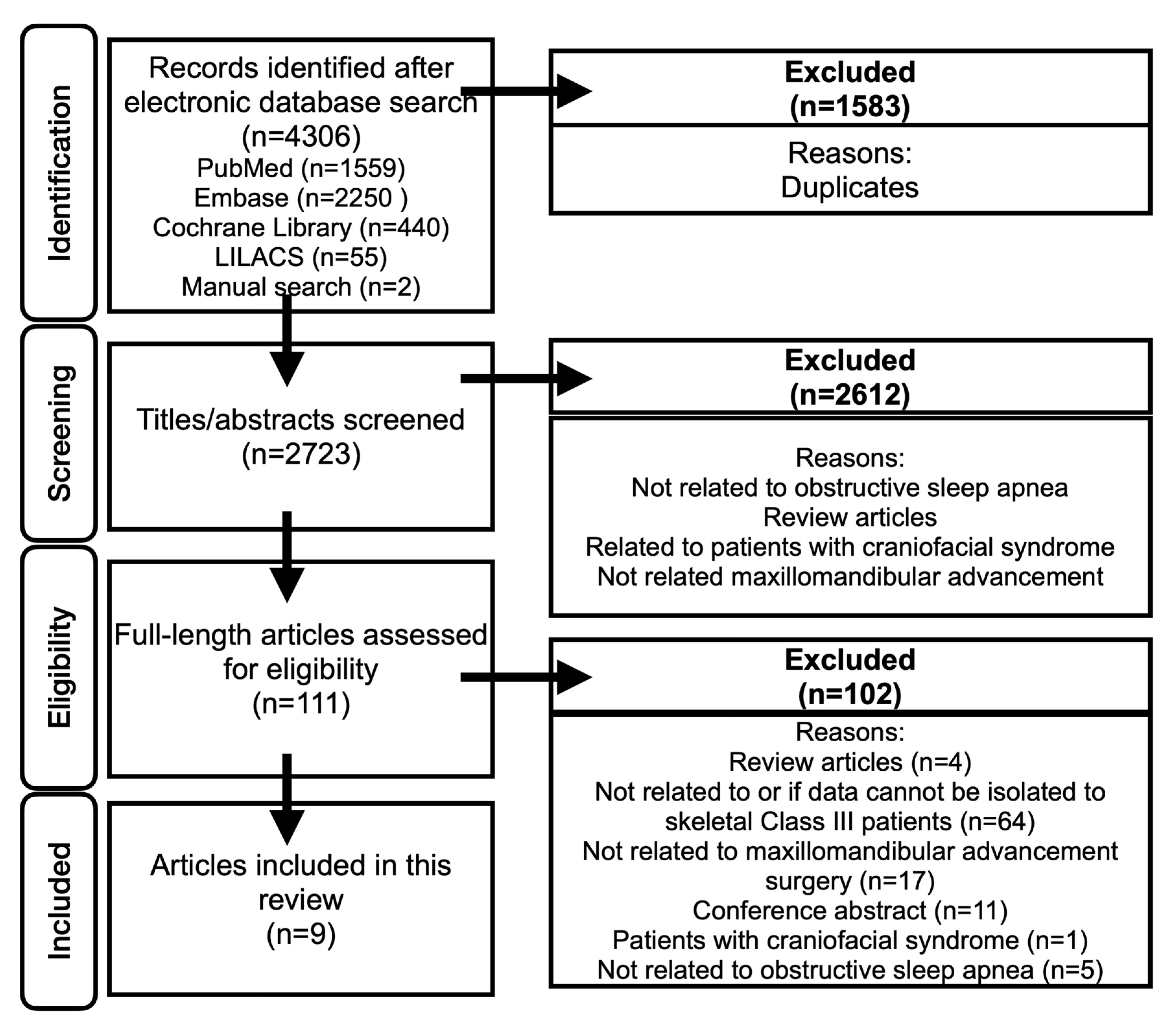
2.3. Study Selection
- Primary research articles
- Patients with skeletal Class III deformities (ANB angle < 2°)
- Use of MMA or skeletal advancement surgery specifically for the treatment of OSA
- Patients diagnosed with OSA
- Review articles
- Absence of skeletal Class III patients with OSA
- Inability to isolate data specific to Class III patients
- No skeletal advancement or MMA performed
- Lack of full-text availability
- Presence of craniofacial syndromes
2.4. Data Extraction
2.5. Analysis and Synthesis of Results
3. Results
3.1. Patient Demographics
3.2. Methodological Analysis
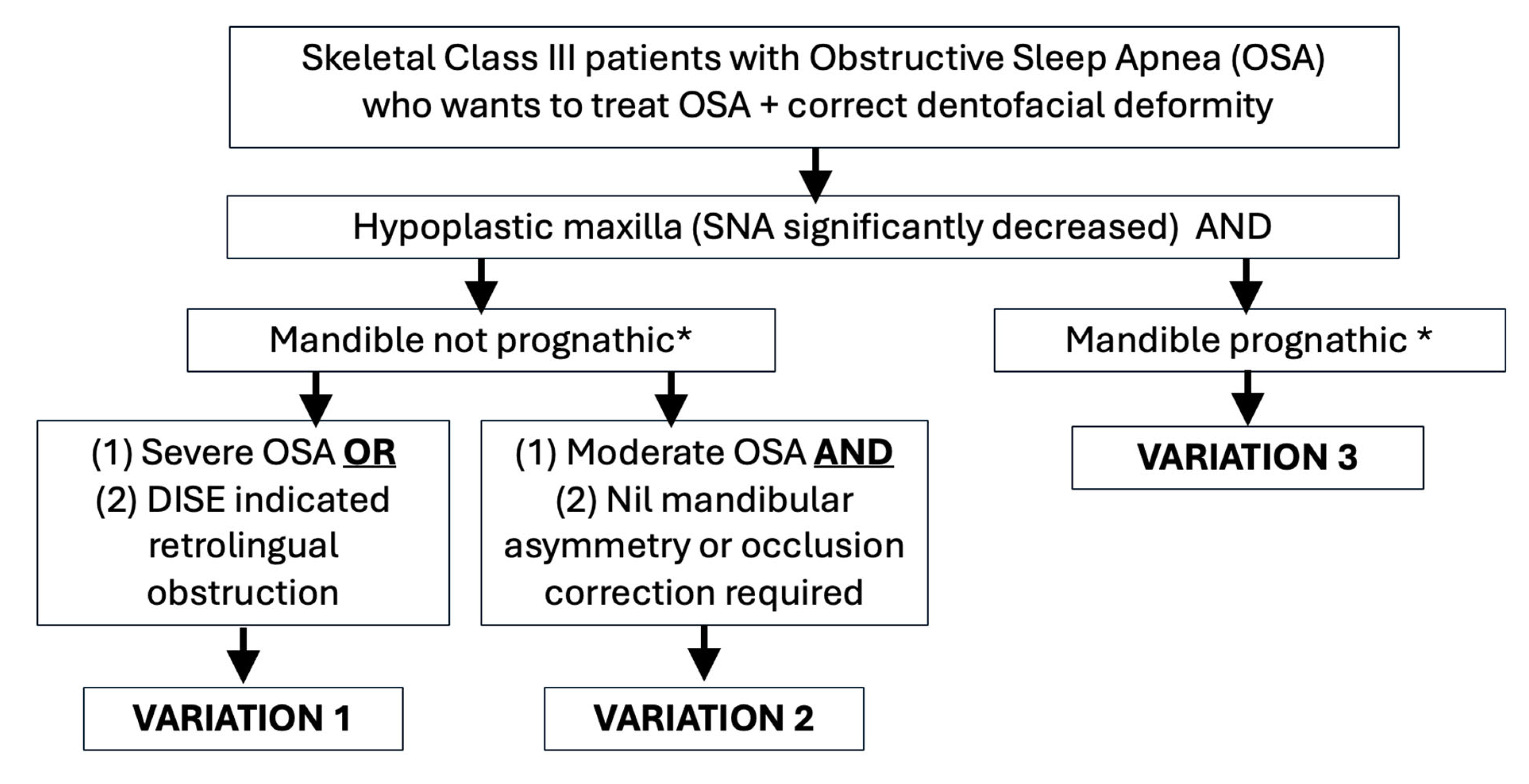
3.3. Description of the Variations of MMA
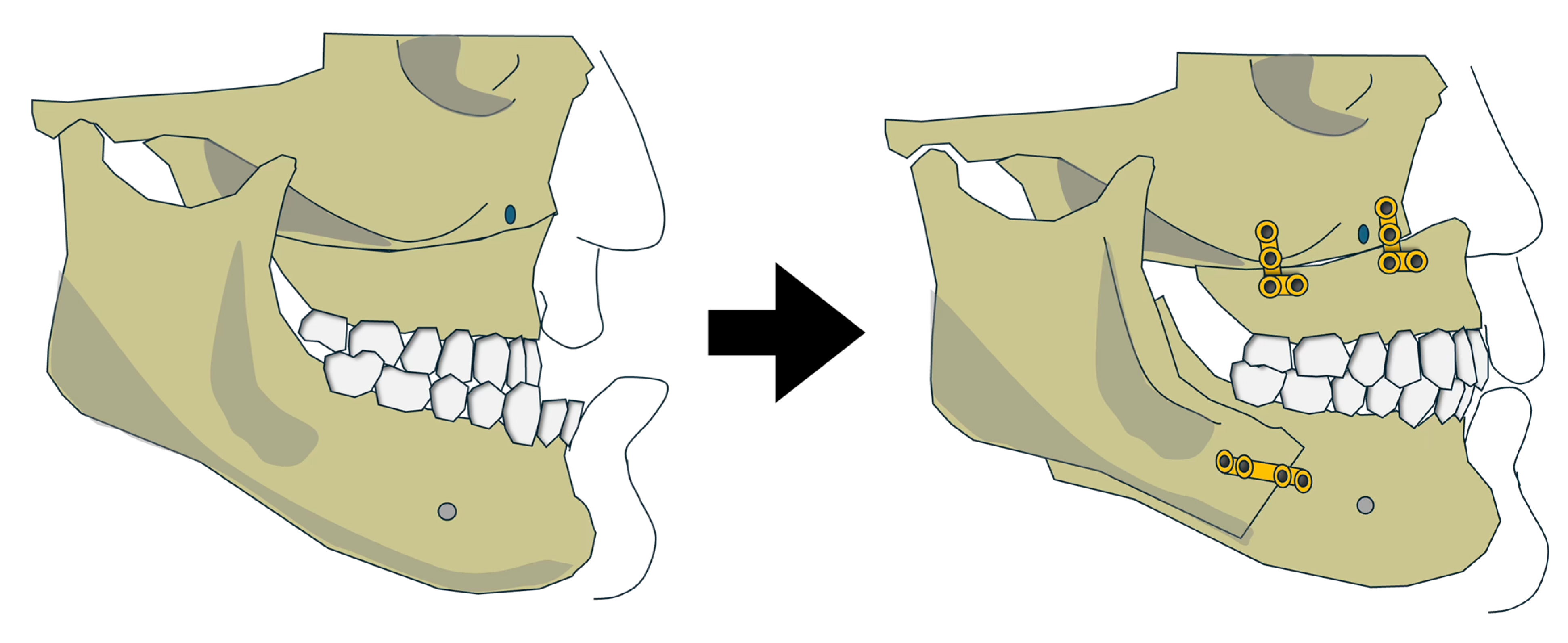
3.3.1. Variation 1: Maxillary and Mandibular Advancement
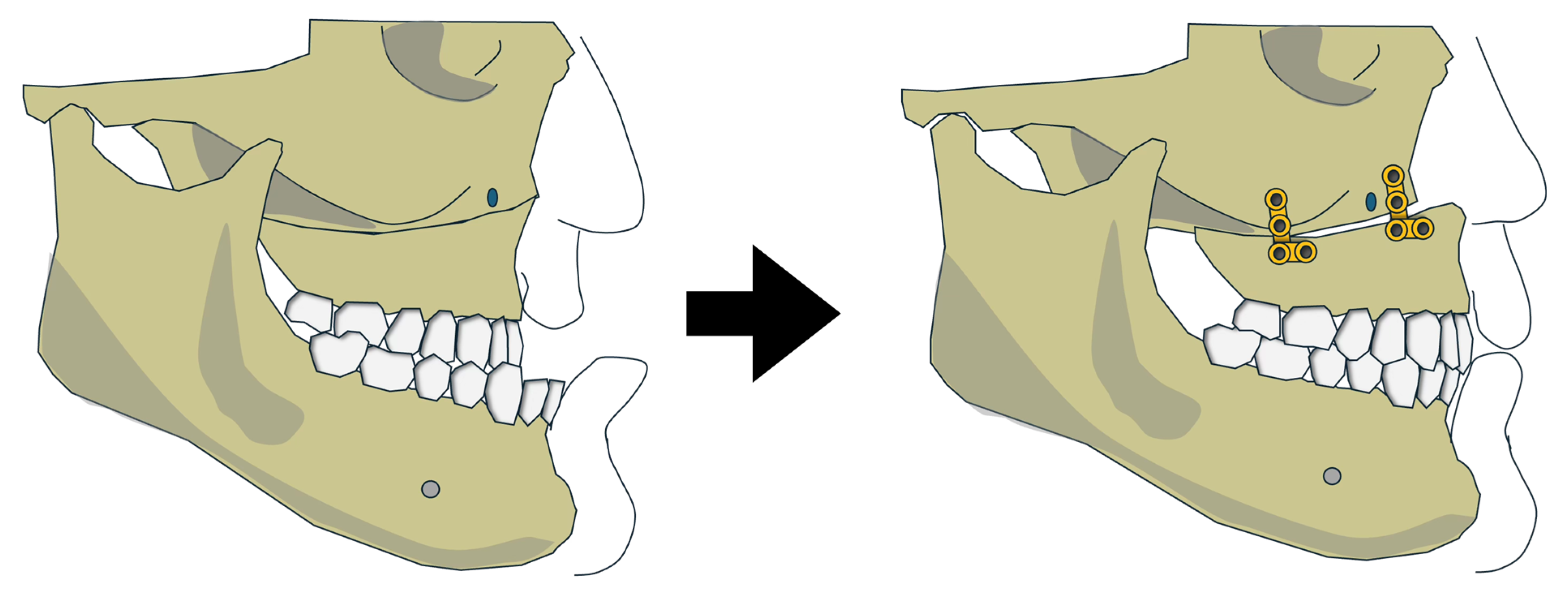
3.3.2. Variation 2: Maxillary Advancement with Mandible Auto-Rotation
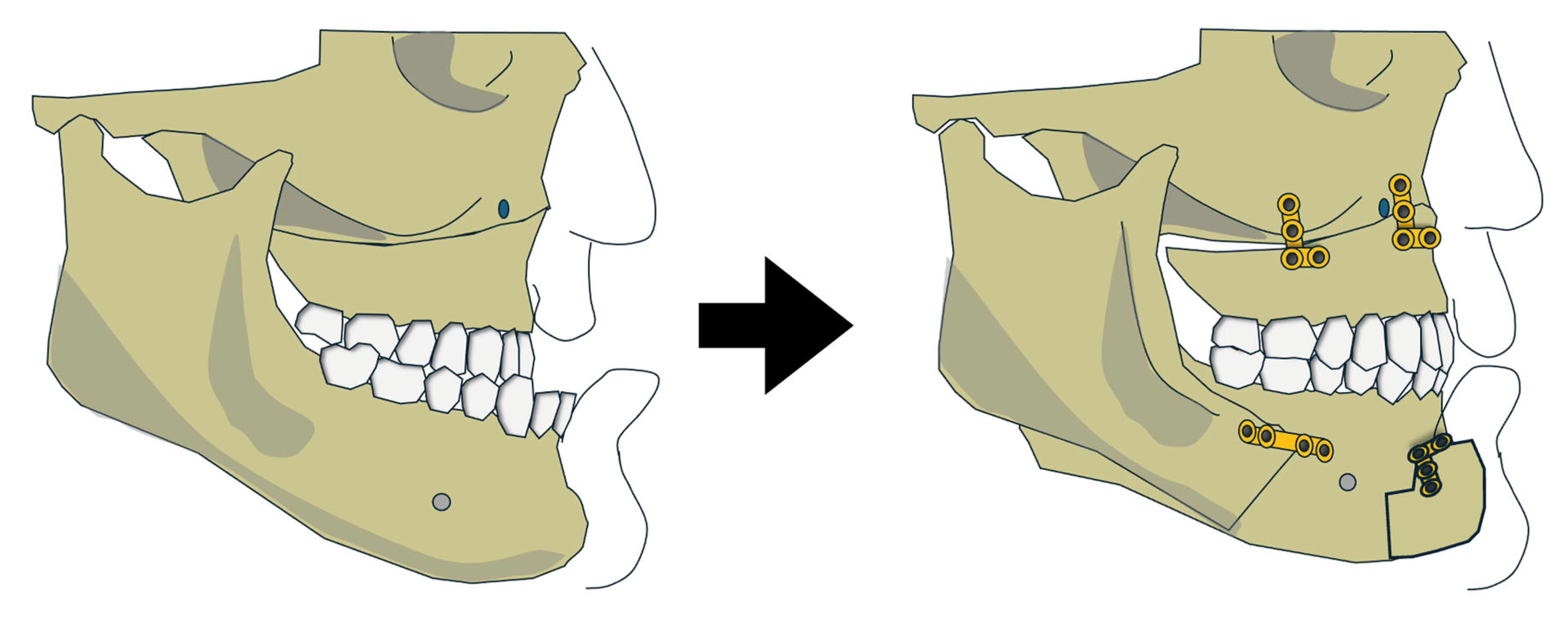
3.3.3. Variation 3: Maxillary Advancement and Mandibular Setback
3.4. Comparisons Between Variations
4. Discussion
4.1. Variation 1: Bimaxillary Advancement
4.2. Variation 2: Isolated Maxillary Advancement with Mandibular Auto-Rotation
4.3. Variation 3: Maxillary Advancement with Mandibular Setback
Supplementary Materials
Author Contributions
Funding
Institutional Review Board Statement
Informed Consent Statement
Data Availability Statement
Conflicts of Interest
References
- Liu, S.Y.; Awad, M.; Riley, R.; Capasso, R. The Role of the Revised Stanford Protocol in Today’s Precision Medicine. Sleep Med. Clin. 2019, 14, 99–107. [Google Scholar] [CrossRef] [PubMed]
- Quah, B.; Sng, T.J.H.; Yong, C.W.; Wen Wong, R.C. Orthognathic Surgery for Obstructive Sleep Apnea. Oral Maxillofac. Surg. Clin. N. Am. 2023, 35, 49–59. [Google Scholar] [CrossRef]
- Zaghi, S.; Holty, J.E.; Certal, V.; Abdullatif, J.; Guilleminault, C.; Powell, N.B.; Riley, R.W.; Camacho, M. Maxillomandibular Advancement for Treatment of Obstructive Sleep Apnea: A Meta-analysis. JAMA Otolaryngol. Head Neck Surg. 2016, 142, 58–66. [Google Scholar] [CrossRef]
- Yong, C.W.; Ng, W.H.; Quah, B.; Sng, T.J.H.; Loy, R.C.H.; Wong, R.C.W. Modified maxillomandibular advancement surgery for the treatment of obstructive sleep apnoea: A scoping review. Int. J. Oral Maxillofac. Surg. 2024, 53, 36–44. [Google Scholar] [CrossRef]
- Yong, C.W.; Quah, B.; Colpani, J.T.; Lee, F.K.F.; Loh, E.E.; Wong, R.C.W. Effectiveness of mandibular advancement devices in obstructive sleep apnea therapy for East Asian patients: A systematic review and meta-analysis. J. Clin. Sleep Med. 2025, 21, 1261–1271. [Google Scholar] [CrossRef] [PubMed]
- Leung, Y.Y.; Leung, J.K.C.; Li, A.T.C.; Teo, N.E.Z.; Leung, K.P.Y.; Au, S.W.; Li, D.T.S.; Su, Y.X. Accuracy and safety of in-house surgeon-designed three-dimensional-printed patient-specific implants for wafer-less Le Fort I osteotomy. Clin. Oral Investig. 2023, 27, 705–713. [Google Scholar] [CrossRef]
- Leung, Y.Y.; Wan, J.C.C.; Fu, H.L.; Chen, W.C.; Chung, J.H.Z. Segmental mandibular advancement for moderate-to-severe obstructive sleep apnoea: A pilot study. Int. J. Oral Maxillofac. Surg. 2023, 52, 956–963. [Google Scholar] [CrossRef]
- Lee, C.K.J.; Yong, C.W.; Saigo, L.; Ren, Y.J.; Chew, M.T. Virtual surgical planning in orthognathic surgery: A dental hospital’s 10-year experience. Oral Maxillofac. Surg. 2024, 28, 729–738. [Google Scholar] [CrossRef] [PubMed]
- Kaewja, T.; Sonsuwan, N.; Tripuwabhrut, K. Obstructive Sleep Apnea Prevalence, Upper Airway Dimensions, and Sleep Parameters in Skeletal Class III Malocclusion Patients Undergoing Orthognathic Surgery with Different Vertical Skeletal Patterns. Thai J. Orthod. 2024, 14, 6–16. [Google Scholar]
- Kim, S.J.; Ahn, H.W.; Hwang, K.J.; Kim, S.W. Respiratory and sleep characteristics based on frequency distribution of craniofacial skeletal patterns in Korean adult patients with obstructive sleep apnea. PLoS ONE 2020, 15, e0236284. [Google Scholar] [CrossRef]
- Chen, F.; Terada, K.; Hua, Y.; Saito, I. Effects of bimaxillary surgery and mandibular setback surgery on pharyngeal airway measurements in patients with Class III skeletal deformities. Am. J. Orthod. Dentofac. Orthop. 2007, 131, 372–377. [Google Scholar] [CrossRef]
- Sher, A.E.; Schechtman, K.B.; Piccirillo, J.F. The efficacy of surgical modifications of the upper airway in adults with obstructive sleep apnea syndrome. Sleep 1996, 19, 156–177. [Google Scholar] [CrossRef]
- Arksey, H.; O’Malley, L. Scoping studies: Towards a methodological framework. Int. J. Soc. Res. Methodol. 2005, 8, 19–32. [Google Scholar] [CrossRef]
- Peters, M.D.; Godfrey, C.M.; McInerney, P.; Soares, C.B.; Khalil, H.; Parker, D. The Joanna Briggs Institute Reviewers’ Manual 2015: Methodology for JBI Scoping Reviews; The Joanna Briggs Institute: Adelaide, Australia, 2015. [Google Scholar]
- Tricco, A.C.; Lillie, E.; Zarin, W.; O’Brien, K.K.; Colquhoun, H.; Levac, D.; Moher, D.; Peters, M.D.; Horsley, T.; Weeks, L. PRISMA extension for scoping reviews (PRISMA-ScR): Checklist and explanation. Ann. Intern. Med. 2018, 169, 467–473. [Google Scholar] [CrossRef]
- Rossi, D.S.; Romano, M.; Sweed, A.H.; Baj, A.; Gianni, A.B.; Beltramini, G.A. Use of CAD-CAM technology to improve orthognathic surgery outcomes in patients with severe obstructive sleep apnoea syndrome. J. Craniomaxillofac Surg. 2019, 47, 1331–1337. [Google Scholar] [CrossRef]
- Ronchi, P.; Novelli, G.; Colombo, L.; Valsecchi, S.; Oldani, A.; Zucconi, M.; Paddeu, A. Effectiveness of maxillo-mandibular advancement in obstructive sleep apnea patients with and without skeletal anomalies. Int. J. Oral Maxillofac. Surg. 2010, 39, 541–547. [Google Scholar] [CrossRef] [PubMed]
- Brevi, B.C.; Toma, L.; Pau, M.; Sesenna, E. Counterclockwise rotation of the occlusal plane in the treatment of obstructive sleep apnea syndrome. J. Oral Maxillofac. Surg. 2011, 69, 917–923. [Google Scholar] [CrossRef] [PubMed]
- AlSaty, G.; Burns, M.; Ngan, P. Effects of maxillomandibular advancement surgery on a skeletal Class III patient with obstructive sleep apnea: A case report. APOS Trends Orthod. 2021, 11, 161–168. [Google Scholar] [CrossRef]
- Li, K.K.; Powell, N.B.; Riley, R.W.; Zonato, A.; Gervacio, L.; Guilleminault, C. Morbidly obese patients with severe obstructive sleep apnea: Is airway reconstructive surgery a viable treatment option? Laryngoscope 2000, 110, 982–987. [Google Scholar] [CrossRef] [PubMed]
- Hoshijima, M.; Honjo, T.; Moritani, N.; Iida, S.; Yamashiro, T.; Kamioka, H. Maxillary Advancement for Unilateral Crossbite in a Patient with Sleep Apnea Syndrome. Acta Med. Okayama 2015, 69, 177–182. [Google Scholar] [CrossRef]
- Ishida, T.; Manabe, A.; Yang, S.S.; Watakabe, K.; Abe, Y.; Ono, T. An orthodontic-orthognathic patient with obstructive sleep apnea treated with Le Fort I osteotomy advancement and alar cinch suture combined with a muco-musculo-periosteal V-Y closure to minimize nose deformity. Angle Orthod. 2019, 89, 946–952. [Google Scholar] [CrossRef]
- Abdelwahab, M.; Taheri, N.; Eltahir, L.; Erdogan, C.; Lee, K.; Liu, S.Y. Maxillomandibular Advancement Efficacy in Obstructive Sleep Apnea Patients With Class 2 Versus 3 Dentofacial Deformity. Otolaryngol. Head Neck Surg. 2023, 169, 1366–1373. [Google Scholar] [CrossRef]
- Lu, C.; Chen, Y.; Tseng, Y. A Case of Class III Malocclusion with Obstructive Sleep Apnea Treated by Orthodontic Treatment Combined Two-jaw Orthognathic Surgery. Taiwan. J. Orthod. 2024, 35, 193–203. [Google Scholar] [CrossRef]
- Ngan, P.; Hägg, U.; Yiu, C.; Merwin, D.; Wei, S.H. Cephalometric comparisons of Chinese and Caucasian surgical Class III patients. Int. J. Adult Orthodon Orthognath. Surg. 1997, 12, 177–188. [Google Scholar]
- Rosário, H.D.; de Oliveira, B.G.; Pompeo, D.D.; de Freitas, P.H.; Paranhos, L.R. Surgical Maxillary Advancement Increases Upper Airway Volume in Skeletal Class III Patients: A Cone Beam Computed Tomography-Based Study. J. Clin. Sleep Med. 2016, 12, 1527–1533. [Google Scholar] [CrossRef]
- Steegman, R.; Hogeveen, F.; Schoeman, A.; Ren, Y. Cone beam computed tomography volumetric airway changes after orthognathic surgery: A systematic review. Int. J. Oral Maxillofac. Surg. 2023, 52, 60–71. [Google Scholar] [CrossRef]
- Eckert, D.J.; White, D.P.; Jordan, A.S.; Malhotra, A.; Wellman, A. Defining phenotypic causes of obstructive sleep apnea. Identification of novel therapeutic targets. Am. J. Respir. Crit. Care Med. 2013, 188, 996–1004. [Google Scholar] [CrossRef] [PubMed]
- Gandedkar, N.H.; Chng, C.K.; Por, Y.C.; Yeow, V.K.L.; Ow, A.T.C.; Seah, T.E. Influence of Bimaxillary Surgery on Pharyngeal Airway in Class III Deformities and Effect on Sleep Apnea: A STOP-BANG Questionnaire and Cone-Beam Computed Tomography Study. J. Oral Maxillofac. Surg. 2017, 75, 2411–2421. [Google Scholar] [CrossRef] [PubMed]
- Hassing, G.J.; The, V.; Shaheen, E.; Politis, C.; de Llano-Pérula, M.C. Long-term three-dimensional effects of orthognathic surgery on the pharyngeal airways: A prospective study in 128 healthy patients. Clin. Oral Investig. 2022, 26, 3131–3139. [Google Scholar] [CrossRef]
- Grinberg, N.; Whitefield, S.; Kleinman, S.; Ianculovici, C.; Feldman, S.; Peleg, O. Posterior airway compromise following orthognathic surgery in skeletal class III patient—A systematic review and meta-analysis. Sleep Med. 2025, 129, 192–199. [Google Scholar] [CrossRef] [PubMed]
- Khan, S.; Sutton, S.R.; Nguyen, S.A.; Rinn, A.M.; Capasso, R.; Lal, C.; Rakha, A.; Huja, S.S.; Tremont, T.J.; Abdelwahab, M. Outcomes of maxillomandibular advancement (MMA) by dentofacial class: A systematic review and meta-analysis. Br. J. Oral Maxillofac. Surg. 2025, 63, 83–90. [Google Scholar] [CrossRef] [PubMed]
- Sutherland, K.; Lee, R.W.W.; Chan, T.O.; Ng, S.; Hui, D.S.; Cistulli, P.A. Craniofacial Phenotyping in Chinese and Caucasian Patients With Sleep Apnea: Influence of Ethnicity and Sex. J. Clin. Sleep Med. 2018, 14, 1143–1151. [Google Scholar] [CrossRef] [PubMed]
- Ma, Y.; Yu, M.; Gao, X. Role of craniofacial phenotypes in the response to oral appliance therapy for obstructive sleep apnea. J. Oral Rehabil. 2023, 50, 308–317. [Google Scholar] [CrossRef]
- Lee, K.J.C.; Tan, S.L.; Low, H.Y.A.; Chen, L.J.; Yong, C.W.; Chew, M.T. Accuracy of 3-dimensional soft tissue prediction for orthognathic surgery in a Chinese population. J. Stomatol. Oral Maxillofac. Surg. 2022, 123, 551–555. [Google Scholar] [CrossRef]
- Lee, K.J.C.; Yong, C.W.; Li, H.; Lai, W.M.C.; Chew, M.T.; Ren, Y. Accuracy of bone-borne versus tooth-bone-borne orthognathic surgical guides: A systematic review and meta-analysis. J. Dent. 2025, 161, 105940. [Google Scholar] [CrossRef]
- Barrera, J.E. Virtual surgical planning improves surgical outcome measures in obstructive sleep apnea surgery. Laryngoscope 2014, 124, 1259–1266. [Google Scholar] [CrossRef]
- Benito Anguita, M.; Khayat, S.; López Martín, S.; Bravo Quelle, N.; Navarro Cuéllar, I.; López López, A.; Cebrián Carretero, J.L.; Del Castillo Pardo de Vera, J.L.; Montes Fernández-Micheltorena, P.; Tousidonis Rial, M.; et al. Virtual Guided and Customized Orthognathic Surgery in Patients with Obstructive Sleep Apnea Syndrome: Accuracy and Clinical Outcomes. J. Clin. Med. 2025, 14, 3780. [Google Scholar] [CrossRef] [PubMed]
- Ogisawa, S.; Shinozuka, K.; Aoki, J.; Yanagawa, K.; Himejima, A.; Nakamura, R.; Yamagata, K.; Sato, T.; Suzuki, M.; Tanuma, T.; et al. Computational fluid dynamics analysis for the preoperative prediction of airway changes after maxillomandibular advancement surgery. J. Oral Sci. 2019, 61, 398–405. [Google Scholar] [CrossRef]
- Kongsong, W.; Waite, P.D.; Sittitavornwong, S.; Schibler, M.; Alshahrani, F. The correlation of maxillomandibular advancement and airway volume change in obstructive sleep apnea using cone beam computed tomography. Int. J. Oral Maxillofac. Surg. 2021, 50, 940–947. [Google Scholar] [CrossRef]



| Author & Year | Study Type | Sample Size | Mean Age (Years) | Gender | BMI (kg/m2) | SNA, SNB and Surgical Movements |
|---|---|---|---|---|---|---|
| Variation 1: Maxillary and mandibular advancement | ||||||
| Rossi et al. 2019 (Patient 6) [16] | Retrospective Cohort | 1 | 47 | M | 30 | SNA: 75.9° → 81.6°, (Dx + 5.7°) SNB 79.3° → 84.9°, (Dx + 5.6°) Maxilla advancement not noted in mm, Mandible advancement 13.2 mm |
| Ronchi et al. 2010 (Patients No. 5 from group 1, No. 5 and 6 from group 2) [17] | Retrospective Cohort | 3 | 26 | M | 24 | SNA: 73° → 89°, (Dx + 16°) SNB 79° →85°, (Dx + 6°) |
| 62 | M | 27.1 | SNA: 80° → 85°, (Dx + 5°) SNB 80° → 84°, (Dx + 4°) | |||
| 54 | M | 31 | SNA: 82° → 91°, (Dx + 9°) SNB 82 → 88, (Dx + 6°) | |||
| Brevi et al. 2011 (Patients No. 1, 6) [18] | Retrospective Cohort | 2 | 67 | M | 25.7 | SNA 79° → 86°, (Dx + 7°) SNB 84° → 88° (Dx + 4°) Movements not recorded in mm |
| 45 | M | 30 | SNA 75° → 85°, (Dx + 10°) SNB 78° → 82°, (Dx + 4°) | |||
| Alsaty et al. 2021 [19] | Case Report | 1 | 55 | M | 25.6 | SNA 78.5° → 83.7°,(Dx + 5.2°) SNB 78.8° →81.3°, (Dx + 2.5°) Maxilla advancement 9 mm, Mandible advancement 5 mm |
| Li et al. 2000 (Patients No. 7, 13, 21) [20] | Retrospective Cohort | 3 | 47 | F | 56.0 | SNA 83° → 96°, (Dx + 13°) SNB 83° → 88° (Dx + 5°) |
| 17 | M | 41.5 | SNA 83° → 88°, (Dx + 5°) SNB 84° → 87°, (Dx + 3°) | |||
| 48 | M | 42.1 | SNA 81° → 96° (Dx + 15°) SNB 82°→ 93° (Dx + 11°) | |||
| Variation 2: Maxillary advancement with mandible auto-rotation | ||||||
| Hoshijima et al. 2015 [21] | Case Report | 1 | 44 | M | NA | SNA 80.5° → 84.5°, (Dx + 4.0°) SNB 80.5° → 82.0°, (Dx + 1.5°) 3.0 mm forward at ANS |
| Ishida et al. 2019 [22] | Case Report | 1 | 23 | M | 18.6 | SNA 74.6° → 77.8° (Dx + 3.2°), SNB 77.1° → 77.1° (Dx 0) 4.5 mm forward at ANS |
| Variation 3: Maxillary advancement and mandibular setback | ||||||
| Abdelwahab et al. 2023 [23] | Retrospective Cohort | 14 | 33.9 ± 10.2 | 13 M, 1 F | 26.9 ± 3.7 | Post-op SNA 80.69° Post-op SNB 82.72° Surgical movements not defined |
| Lu et al. 2024 [24] | Case Report | 1 | 24 | 1 M | 21.7 | SNA 86.1° → 88.6°(Dx + 2.5°), SNB 88.6° → 88.1°(Dx − 0.5°), Maxilla advancement 4 mm & counterclockwise rotation of 5°, mandible setback 4 mm & counterclockwise rotation of 6.5°, genioplasty advancement 7 mm |
| Author & Year | AHI/RDI (Events/h) | ESS | ODI (Events/h) | PAS (mm) | Complications | ||||||||
|---|---|---|---|---|---|---|---|---|---|---|---|---|---|
| Pre | Post | Dx | Pre | Post | Dx | Pre | Post | Dx | Pre | Post | Dx | ||
| Variation 1: Maxillary and mandibular advancement | |||||||||||||
| Rossi et al. 2019 [16] | 33.5 | 11.9 | −21.6 (64.48%) | NA | NA | NA | NA | NA | NA | 9.21 | 16.5 | +7.29 | Nil |
| Brevi et al. 2011 [18] | 24.2 | 7 | −17.7 (73.14%) | 8 | 8 | 0 | 32 | 5 | −28 | 7 | 10 | +3 | NA |
| 87 | 14 | −73 (83.90%) | 13 | 0 | −13 | 84 | 9 | −75 | 8 | 15 | +7 | NA | |
| Ronchi et al. 2010 [17] | 70 | 1 | −69 (98.57%) | 16 | 0 | −16 | NA | NA | NA | 8 | 14 | +6 | Worsened aesthetics |
| 60 | 15 | −45 (75%) | 13 | 1 | −12 | NA | NA | NA | 4 | 10 | +6 | NA | |
| 71 | 10 | −61 (85.92%) | 12 | 2 | −10 | NA | NA | NA | 5 | 12 | +7 | NA | |
| Alsaty et al. 2021 [19] | 21.2 | 0.7 | −20.5 (96.70%) | 12 | 3 | −9 | NA | NA | NA | NA | NA | NA | Nil |
| Li et al. 2000 [20] | 44 ^ | 1 ^ | −43 (97.72%) | NA | NA | NA | NA | NA | NA | 5 | 9 | +4 | Re-operation due to insufficient fixation |
| 90 ^ | 9 ^ | −81 (90%) | NA | NA | NA | NA | NA | NA | 3 | 8 | +5 | Nil | |
| 77 ^ | 10 ^ | −67 (87.01%) | NA | NA | NA | NA | NA | NA | 9 | 13 | +4 | Removal of mandibular implants due to localized irritation | |
| Variation 2: Maxillary advancement with mandible auto-rotation | |||||||||||||
| Hoshijima et al. 2015 [21] | 18.8 | 7.6 | 11.2 (59.6%) | NA | NA | NA | NA | NA | NA | NA | NA | NA | NA |
| Ishida et al. 2019 [22] | 15.3 | 2.8 | 12.5 (81.70%) | NA | NA | NA | NA | NA | NA | NA | NA | NA | NA |
| Variation 3: Maxillary advancement and mandibular setback | |||||||||||||
| Abdelwahab et al. 2023 [23] | 37.17 ± 35.77 | 11.81 ± 15.74 | 25.36 (68.23%) p = 0.41 | 10.23 ± 4.38 | 4.22 ± 3.07 | 6.01 p = 0.006 | 11.43 ± 11.40 | 5.44 ± 7.96 | 5.99 p = 0.828 | NA | NA | NA | Nil |
| Lu et al. 2024 [24] | 22.8 | 10.1 | 12.7 (55.7%) | NA | NA | NA | NA | NA | NA | NA | NA | NA | Nil |
Disclaimer/Publisher’s Note: The statements, opinions and data contained in all publications are solely those of the individual author(s) and contributor(s) and not of MDPI and/or the editor(s). MDPI and/or the editor(s) disclaim responsibility for any injury to people or property resulting from any ideas, methods, instructions or products referred to in the content. |
© 2026 by the authors. Licensee MDPI, Basel, Switzerland. This article is an open access article distributed under the terms and conditions of the Creative Commons Attribution (CC BY) license.
Share and Cite
Lee, C.K.J.; Hor, J.K.L.; Song, Y.L.; Wong, R.C.W.; Cheong, C.S.J.; Yong, C.W. Is Maxillomandibular Advancement Possible in Skeletal Class III Patients? A Scoping Review. J. Clin. Med. 2026, 15, 935. https://doi.org/10.3390/jcm15030935
Lee CKJ, Hor JKL, Song YL, Wong RCW, Cheong CSJ, Yong CW. Is Maxillomandibular Advancement Possible in Skeletal Class III Patients? A Scoping Review. Journal of Clinical Medicine. 2026; 15(3):935. https://doi.org/10.3390/jcm15030935
Chicago/Turabian StyleLee, Cheryl Ker Jia, Jocelyn Kang Li Hor, Yi Lin Song, Raymond Chung Wen Wong, Crystal Shuk Jin Cheong, and Chee Weng Yong. 2026. "Is Maxillomandibular Advancement Possible in Skeletal Class III Patients? A Scoping Review" Journal of Clinical Medicine 15, no. 3: 935. https://doi.org/10.3390/jcm15030935
APA StyleLee, C. K. J., Hor, J. K. L., Song, Y. L., Wong, R. C. W., Cheong, C. S. J., & Yong, C. W. (2026). Is Maxillomandibular Advancement Possible in Skeletal Class III Patients? A Scoping Review. Journal of Clinical Medicine, 15(3), 935. https://doi.org/10.3390/jcm15030935