


Abstract
Background: Residual disability may persist in patients with inflammatory bowel disease (IBD) despite clinical and objective remission. We assessed patient-reported disability using the IBD-Disk in patients receiving advanced therapy and explored potential clinical and nutritional correlates. Methods: In this prospective observational study, 201 patients receiving advanced therapy completed the 10-item IBD-Disk. Clinical remission was assessed using the Harvey–Bradshaw Index or partial Mayo score, while endoscopic and biochemical remission were evaluated using available recent assessments. Moderate-to-severe disability was defined as an IBD-Disk score ≥ 40. Exploratory analyses investigated potential correlates of disability and subsequent symptom recurrence. Results: Among 166 patients in clinical remission, 41 (24.7%) had an IBD-Disk score of ≥40, compared with 25/35 (71.4%) without clinical remission (p < 0.001). Of 76 patients achieving deep remission, 16 (21.1%; 95% CI 13.4–31.5%) reported moderate-to-severe disability. Energy, joint pain, sleep, and body image were the most frequently affected domains. In exploratory analyses, anemia in the overall cohort and folate deficiency among patients in clinical remission were associated with disability after false-discovery-rate adjustment (q = 0.016 and q = 0.024, respectively). Subsequent symptom recurrence was numerically more frequent among patients in clinical remission with baseline IBD-Disk ≥ 40 than <40 (14.6% vs. 7.2%; p = 0.206), without reaching statistical significance. Conclusions: A substantial proportion of patients receiving advanced therapy experience residual disability despite clinical and deep remission. The IBD-Disk may help identify unmet patient-centered needs and prompt individualized assessment of non-inflammatory contributors to disability, rather than automatic escalation of therapy. These findings support a multidimensional approach to IBD care and warrant confirmation in larger prospective cohorts.
1. Introduction
Inflammatory bowel disease (IBD) can impair physical, psychological, and social functioning despite increasingly effective advanced anti-inflammatory therapies. Treat-to-target strategies emphasize objective inflammatory control, but restoration of patient-reported functioning and quality of life remains an important, distinct goal [1,2].
Fatigue, sleep disturbance, joint pain, emotional distress, sexual difficulties [3,4,5,6], and restrictions in daily activities may persist in patients considered clinically quiescent. Physician-assessed disease activity therefore may not fully capture the patient’s burden [7,8,9].
The IBD Disability Index was developed to measure limitations in functioning and participation [10,11]. In its shorter patient-completed visual adaptation, the IBD-Disk assesses ten domains on 0–10 scales and has been validated internationally, including in Italy [12,13,14,15]. A total score ≥ 40 has been used to indicate moderate-to-severe disability [15,16].
A meta-analysis reported moderate-to-severe disability in a substantial proportion of patients with inactive IBD [16]. Patients receiving advanced therapies may have additional cumulative disease burden, previous surgery, or persistent non-inflammatory symptoms. These factors make patient-centered assessment particularly relevant even after inflammatory targets and clinical remission are achieved.
We assessed residual IBD-Disk disability in adults receiving advanced therapy, focusing on clinical and deep remission. Secondary analyses described affected domains and explored clinical, nutritional, and disease-history correlates. Subsequent symptom recurrence was evaluated as an exploratory, hypothesis-generating outcome.
2. Materials and Methods
2.1. Study Design and Population
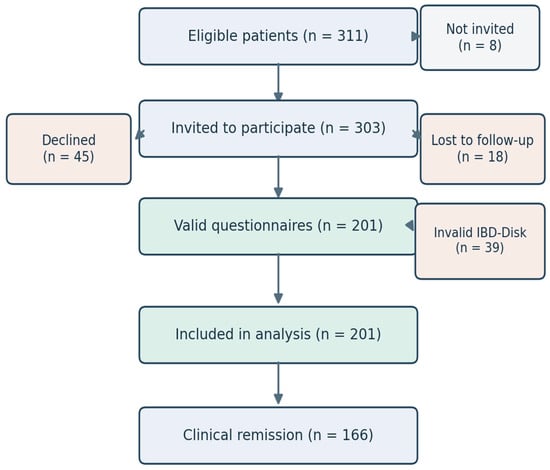
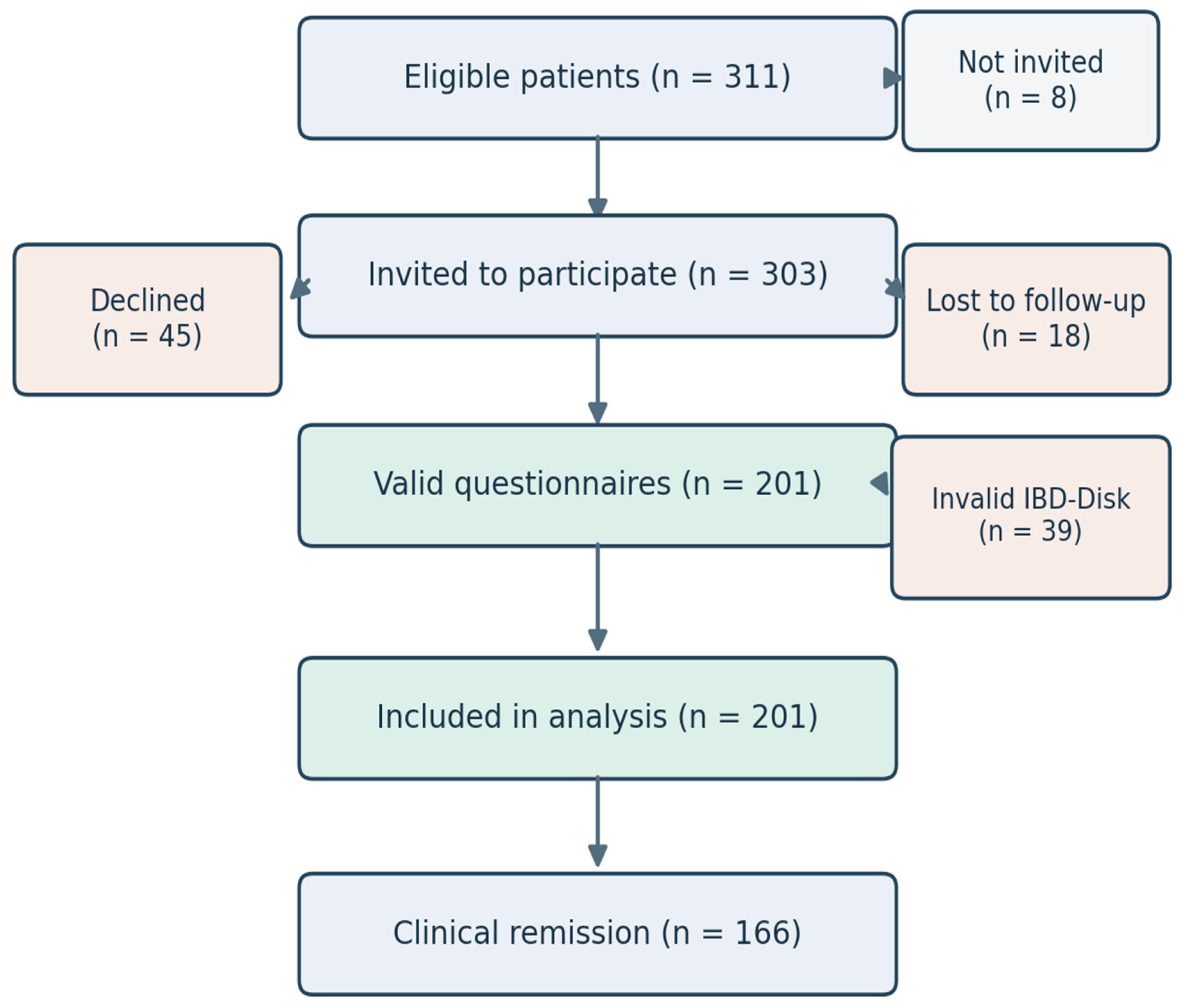
This prospective observational assessment was conducted at the IBD outpatient clinic of IRCCS Policlinico San Donato, Italy. Adults with established CD or UC receiving advanced therapy for at least six months completed the Italian IBD-Disk during routine care. Therapies included anti-TNF agents, vedolizumab, ustekinumab, selective IL-23 inhibitors, JAK inhibitors, and etrasimod. Recruitment began on 30 January 2025 under PROVACI (ethics approval CET 510-2024, 29 January 2025); the analysis dataset was closed in June 2026. Of 311 eligible patients, 303 were invited to participate; 8 were not invited. Among those invited, 45 declined, 18 were lost to follow-up, and 39 were excluded because the IBD-Disk questionnaire was incomplete or invalid, leaving 201 patients for analysis (Figure 1).
Figure 1.
Patient recruitment and inclusion flowchart.
2.2. Clinical and Objective Disease Assessment
Demographic and disease variables included sex, age, IBD subtype, age at diagnosis, treatment-line number, current treatment and administration route, previous intestinal surgery, anemia, iron deficiency, nutritional deficits, and weight loss when recorded. Approximate disease duration was age at assessment minus age at diagnosis. Clinical remission was defined as HBI < 5 in CD or partial Mayo < 3 with no item > 1 in UC [1,17,18]. The available dataset displayed the individual activity-index values, but for the purpose of the analysis, categorical remission labels were used. No participant was receiving concomitant azathioprine, methotrexate, or systemic corticosteroids at IBD-Disk completion; 11 patients with UC were receiving oral beclomethasone. None had an ostomy. A new treatment line was defined as a switch to an advanced therapy with a different mechanism of action.
The median interval between endoscopy and IBD-Disk completion was 3.5 months (range, 1–6 months), and that between biomarker assessment and IBD-Disk completion was 1.5 months (range, 1–3 months). Endoscopic findings were included only when the examination had been performed within the six months preceding IBD-Disk completion. Endoscopic remission was defined as a Mayo endoscopic subscore of 0 in UC and the absence of ulcers in CD; in postoperative CD, a Rutgeerts score of i0 or i1 was considered remission [1,18]. C-reactive protein (CRP) and/or fecal calprotectin results were included only if obtained within the three months preceding or following questionnaire completion. Biochemical remission was defined as normalization of the available marker (CRP < 5 mg/L and/or fecal calprotectin < 200 µg/g) [1,18]. Deep remission required clinical, endoscopic, and biochemical remission concurrently. Endoscopic and biochemical analyses were restricted to patients with the corresponding recorded assessment.
2.3. Disability Assessment
Disability was assessed using the validated Italian IBD-Disk [12,15], which measures abdominal pain, regulating defecation, interpersonal interactions, education and work, sleep, energy, emotions, body image, sexual function, and joint pain. Each item was scored 0–10; the sum of the ten items yields a standard total score from 0 to 100. A total score ≥ 40 was used to identify moderate-to-severe disability [15,16]. For descriptive analysis, an individual item score ≥ 5 was considered a relevant limitation. An additional item concerning dietary limitations was recorded and analyzed separately; it did not contribute to the standard IBD-Disk total. A dietary domain has also been explored in an Italian modified IBD-Disk [15].
2.4. Outcomes and Statistical Analysis
The primary outcome was IBD-Disk ≥ 40 in clinical remission. Secondary outcomes included deep-remission disability and individual domains. Exploratory associations with anemia, iron deficiency (ferritin < 30 ng/mL in remission or <100 ng/mL in active disease), nutritional deficits, weight loss, and prior surgery were assessed in available cases, with denominators reported for each comparison (Tables S2 and S3). Continuous outcomes were compared using Mann–Whitney tests and proportions using Fisher’s exact tests where appropriate. For each prespecified seven-comparison exploratory item and population, raw p-values, Benjamini–Hochberg false-discovery-rate adjusted q-values, and Bonferroni-adjusted p-values are reported. Missing values were not imputed. The clinical-remission logistic model (41 events) was considered exploratory and susceptible to overfitting. Subsequent clinical symptom recurrence, assessed during September–October 2026 routine visits, was compared by baseline IBD-Disk ≥ 40 versus <40 with Fisher’s exact test and unadjusted odds ratios; the interval since questionnaire completion was not uniform and was not modeled. All tests were two-sided.
3. Results
3.1. Cohort Characteristics
The cohort comprised 201 patients, including 125 with CD (62.2%) and 76 with UC (37.8%; Table S1). The median age at questionnaire completion was 46 years (interquartile range [IQR], 34–60), and 86 patients (42.8%) were female. All patients were receiving advanced therapy. Clinical remission was recorded in 166/201 (82.6%). Endoscopic data were available in 173/201 (86.1%), biochemical status in 175/201 (87.1%), and both in 152/201 (75.6%). The median standard IBD-Disk score was 26 (IQR, 10–45), and 66/201 (32.8%) scored ≥ 40 (Table 1).
Table 1.
Baseline clinical characteristics, treatment, and laboratory findings of the study cohort.
3.2. Disability Despite Clinical and Objective Remission
In clinical remission, 41/166 patients (24.7%) had an IBD-Disk score ≥ 40, compared with 25/35 (71.4%) without clinical remission (Fisher exact p < 0.001). Median total scores were 22 (IQR, 8.25–39) and 45 (IQR, 32.5–59.5), respectively (Mann–Whitney p < 0.001). Among patients with endoscopic data, residual disability ≥ 40 occurred in 20/88 (22.7%) with endoscopic remission and 33/85 (38.8%) without it (Fisher exact p = 0.032). Among patients with biochemical data, the corresponding proportions were 31/114 (27.2%) and 23/61 (37.7%; p = 0.171) (Table 2).
Table 2.
IBD-Disk disability according to clinical, endoscopic, and biochemical status.
Seventy-six patients met all three criteria for deep remission. Their median IBD-Disk score was 18.5 (IQR, 5.75–33.5), yet 16/76 (21.1%; Wilson 95% CI, 13.4–31.5%) scored ≥ 40 and 47/76 (61.8%) reported at least one standard domain ≥ 5. Within deep remission, the proportions scoring ≥ 5 were highest for energy (27/76, 35.5%), joint pain (25/76, 32.9%), sleep (22/76, 28.9%), and body image (22/76, 28.9%). Among patients in clinical remission with both objective assessments available, the ≥40 rate was 16/76 (21.1%) in deep remission versus 13/57 (22.8%) in those who did not meet both objective targets (Fisher exact p = 0.834). The comparison is exploratory and does not show a difference in disability between these groups.
3.3. Domain-Level Limitations and Subgroup Comparisons
Among patients in clinical remission, the most frequent standard items with scores ≥ 5 were energy (72/166, 43.4%), sleep (61/166, 36.7%), joint pain (57/166, 34.3%), and body image (55/166, 33.1%). The exploratory dietary limitations item scored ≥ 5 in 35/166 (21.1%) patients in clinical remission, compared with 16/35 (45.7%) without remission (Table 3; Fisher exact p = 0.0047).
Table 3.
IBD-Disk domains and exploratory dietary item reaching a score of at least 5.
In unadjusted comparisons of administration routes, IBD-Disk ≥ 40 occurred in 37/103 (35.9%) patients receiving subcutaneous and 22/76 (28.9%) receiving intravenous therapy (Fisher exact p = 0.340). Among patients in clinical remission, the corresponding frequencies were 19/80 (23.8%) and 15/65 (23.1%; p = 1.000). These comparisons do not establish equivalence or account for treatment selection.
Supplementary Table S1 shows that patients with UC were older at diagnosis than those with CD (34.6 ± 12.4 vs. 30.7 ± 12.0 years; unadjusted p = 0.027), while treatment distributions and prior intestinal surgery differed substantially between IBD subtypes. These descriptive differences should not be interpreted as independent predictors of disability.
In deep remission, an IBD-Disk total ≥ 40 occurred in 8/28 patients with UC (28.6%) and 8/48 with CD (16.7%; Fisher exact p = 0.252). Median total scores were 17 (IQR, 9.25–45.25) and 19.5 (IQR, 5–31.5), respectively (Mann–Whitney p = 0.682). Across the full cohort, no item-score difference between UC and CD persisted after adjustment for multiple comparisons. Women had higher abdominal-pain scores than men (mean 3.33 vs. 1.98; Benjamini–Hochberg q = 0.005) and higher emotion scores (mean 4.08 vs. 2.93; q = 0.037). No item difference by sex or IBD subtype remained significant after multiplicity adjustment in the clinical-remission subgroup. Detailed demographic, clinical, and IBD-Disk comparisons between Crohn’s disease and ulcerative colitis are reported in Supplementary Table S1.
3.4. Exploratory Associations, Multivariable Model, and Follow-Up
In the exploratory model among 166 patients in clinical remission (41 disability events), each additional recorded treatment line was associated with greater odds of IBD-Disk ≥ 40 (OR 1.87, 95% CI 1.07–3.26; p = 0.028), whereas approximate disease duration showed an inverse adjusted association per decade (OR 0.56, 95% CI 0.34–0.94; p = 0.027). These estimates are hypothesis-generating because the number of events limits multivariable adjustment, residual confounding is possible, and model diagnostics could not be fully verified from the available analysis data.
Among patients in clinical remission, folate deficiency was associated with IBD-Disk ≥ 40 (16/38 versus 17/100; FDR q = 0.024; Table S2). In the full cohort, anemia was associated with disability (17/29 versus 48/169; FDR q = 0.016). No energy/fatigue comparison retained significance after FDR correction (Table S3). At the September–October 2026 follow-up, symptom recurrence among initially clinically remitted patients was numerically more frequent with baseline IBD-Disk ≥ 40 than <40 (6/41 [14.6%] versus 9/125 [7.2%]; Fisher p = 0.206; Table S4).
4. Discussion
Approximately one quarter of patients in clinical remission and one fifth in deep remission reported moderate-to-severe disability. Energy, joint pain, sleep, and body image were prominent limitations, indicating that control of intestinal inflammation does not necessarily restore daily functioning.
The recently published STRIDE-III recommendations explicitly identify disability, fatigue, and quality of life as patient-centered targets, supporting a holistic approach to IBD care [18]. An elevated IBD-Disk score should not, by itself, prompt escalation of anti-inflammatory treatment. Instead, it should trigger individualized evaluation of residual inflammation and other potential contributors, including psychological distress, extraintestinal manifestations, anemia, nutritional deficiencies, functional symptoms, cumulative disease burden, and consequences of previous surgery. Anxiety and depression were not systematically measured in this cohort.
Consistent with ECCO guidance on persistent fatigue and extraintestinal symptoms [19], the exploratory laboratory analyses support the value of this broader assessment but require caution. In the overall cohort, anemia was associated with IBD-Disk ≥ 40 after FDR correction (Table S2); in clinical remission, folate deficiency remained associated with disability after FDR correction. Associations with the energy/fatigue domain did not survive FDR correction (Table S3). Iron deficiency was common, including in patients without anemia, but no consistent positive association with disability was established. Missing laboratory values, especially vitamin D, limit inference.
In patients initially in clinical remission, subsequent symptom recurrence was observed in 6/41 (14.6%) with baseline IBD-Disk ≥ 40 and 9/125 (7.2%) with scores < 40 (unadjusted OR 2.21, 95% CI 0.74–6.64; Fisher p = 0.206; Table S4). The corresponding deep-remission comparison was 3/16 versus 4/60 (OR 3.23, 95% CI 0.64–16.23; p = 0.157). Neither comparison was statistically significant. These findings raise a prospective research hypothesis rather than establishing prognostic value, especially given the small number of events and variable time to reassessment.
Dietary limitations were recorded through a single exploratory item, not a food diary; the types of dietary restrictions cannot be described. The item was excluded from the validated ten-domain total. The UC–CD comparisons summarized in Table S1 did not identify robust domain-level differences after multiplicity correction; sex differences were limited to selected domains and should be interpreted in light of multiple testing. Treatment-line associations may reflect prior disease burden and treatment selection rather than a direct effect of therapy. Disability did not differ significantly between intravenous and subcutaneous treatment routes in unadjusted comparisons; confounding by indication and limited subgroup sizes preclude causal interpretation.
Limitations include the single-center advanced-therapy cohort (n = 201), absence of a non-advanced-therapy comparator or pretreatment IBD-Disk, and incomplete objective assessments. Endoscopy and biomarkers were obtained within the specified six- and three-month windows, respectively; reasons for missing assessments were not consistently captured. Available-case subgroup analyses were smaller, some laboratory measures were sparse, and many nominal associations were attenuated by multiplicity adjustment. The 41 disability events in clinical remission limit multivariable inference. Systematic measures of anxiety, depression, IBS-like symptoms, sarcopenia, and other potential confounders were unavailable. Symptom recurrence was assessed at routine follow-up with heterogeneous intervals, without adjudicated inflammatory relapse. These factors limit causal and prognostic interpretation and generalizability beyond specialist-treated populations.
5. Conclusions
Substantial disability persists in a subset of patients with IBD despite clinical and objective remission. IBD-Disk assessment may identify unmet patient-centered needs and prompt multidimensional evaluation, rather than automatic escalation of anti-inflammatory treatment. Exploratory nutritional and subsequent-recurrence associations warrant confirmation in larger prospective cohorts with standardized follow-up.
Supplementary Materials
The following supporting information can be downloaded at: https://www.mdpi.com/article/10.3390/jcm15239338/s1, Tables S1–S4 (IBD subtype comparisons; exploratory associations with disability and energy/fatigue; subsequent clinical recurrence) are provided in a separate supplementary file, Table S1: UC versus CD; Table S2: IBD-Disk ≥40; Table S3: Energy/fatigue; Table S4: Subsequent symptom recurrence.
Author Contributions
Conceptualization, V.A., A.C. and M.L.A.; methodology, A.C., A.B. and O.R.S.; formal analysis, A.C. and V.A.; data curation, O.R.S. and A.B.; writing—original draft preparation, V.A.; writing—review and editing, M.L.A., A.C., S.C., O.R.S., A.B., J.F., P.B., M.M., M.G., G.D. and V.A. All authors have read and agreed to the published version of the manuscript.
Funding
This research received no external funding.
Institutional Review Board Statement
The study was approved under the PROVACI protocol by the Territorial Ethics Committee Lombardia 1, Milan, Italy (CET 510-2024; 29 January 2025).
Informed Consent Statement
Informed consent was obtained from all participants involved in the study.
Data Availability Statement
The research dataset may be requested from the authors for bona fide collaborative research, subject to applicable ethical and data-protection requirements.
Acknowledgments
The authors are grateful to all nurses of the Endoscopy Unit and outpatient clinic for their daily support. During preparation of this manuscript, the authors used ChatGPT-5 (OpenAI) to assist with drafting and English-language editing, exploratory statistical calculations, and presentation of the findings. The authors reviewed and verified the analyses and edited the output, and take full responsibility for the content of the manuscript.
Conflicts of Interest
The authors declare no conflicts of interest related to this study.
References
- Turner, D.; Ricciuto, A.; Lewis, A.; D’aMico, F.; Dhaliwal, J.; Griffiths, A.M.; Bettenworth, D.; Sandborn, W.J.; Sands, B.E.; Reinisch, W.; et al. STRIDE-II: An update on the Selecting Therapeutic Targets in Inflammatory Bowel Disease (STRIDE) initiative of the IOIBD: Determining therapeutic goals for treat-to-target strategies in IBD. Gastroenterology 2021, 160, 1570–1583. [Google Scholar] [CrossRef] [Scilit]
- Le Berre, C.; Peyrin-Biroulet, L.; Sandborn, W.J.; Colombel, J.-F.; Rubin, D.; Chowers, Y.; Reinisch, W.; Schreiber, S.; Allez, M.; D’hAens, G.; et al. Selecting end points for disease-modification trials in inflammatory bowel disease: The SPIRIT consensus from the IOIBD. Gastroenterology 2021, 160, 1452–1460.e21. [Google Scholar] [CrossRef] [Scilit]
- D’Silva, A.; Fox, D.E.; Nasser, Y.; Vallance, J.K.; Quinn, R.R.; Ronksley, P.E.; Raman, M. Prevalence and risk factors for fatigue in adults with inflammatory bowel disease: A systematic review with meta-analysis. Clin. Gastroenterol. Hepatol. 2022, 20, 995–1009.e7. [Google Scholar] [CrossRef] [Scilit]
- Xu, T.Y.; Zhang, Y.; Zhao, S.L. Association of poor sleep quality with adverse outcomes in patients with inflammatory bowel disease: A systematic review and meta-analysis. J. Dig. Dis. 2024, 25, 664–673. [Google Scholar] [CrossRef] [Scilit]
- Beese, S.E.; Harris, I.M.; Dretzke, J.; Moore, D. Body image dissatisfaction in patients with inflammatory bowel disease: A systematic review. BMJ Open Gastroenterol. 2019, 6, e000255. [Google Scholar] [CrossRef] [Scilit]
- Zhao, S.; Wang, J.; Liu, Y.; Luo, L.; Zhu, Z.; Li, E.; Luo, J.; Zhao, Z. Inflammatory bowel diseases were associated with risk of sexual dysfunction in both sexes: A meta-analysis. Inflamm. Bowel Dis. 2019, 25, 699–707. [Google Scholar] [CrossRef] [Scilit]
- Fan, Z.; Li, R.; Zhang, X.; Chen, M.; Cao, Q.; Fan, Y.; Xiao, F.; Wang, Y.; Zhu, L.; Guo, H.; et al. Different perceptions on the diagnosis and treatment of Crohn’s disease between patients and gastroenterologists: A multicenter retrospective study. Ther. Adv. Gastroenterol. 2025, 18, 1–16. [Google Scholar] [CrossRef] [Scilit]
- Amiot, A.; Ahres, A.; Stefanescu, C.; Meyer, A.; Nachury, M.; Nancey, S.; Richard, N.; Allez, M.; Altwegg, R.; Laharie, D.; et al. Association of bowel urgency, disease activity and disability in patients with inflammatory bowel disease: A cross-sectional study from the GETAID. Clin. Res. Hepatol. Gastroenterol. 2026, 50, 102861. [Google Scholar] [CrossRef] [Scilit]
- Nardone, O.M.; Calabrese, G.; La Mantia, A.; Caso, R.; Testa, A.; Castiglione, F. Insights into disability and psycho-social care of patients with inflammatory bowel disease. Front. Med. 2024, 11, 1416054. [Google Scholar] [CrossRef] [Scilit]
- Peyrin-Biroulet, L.; Cieza, A.; Sandborn, W.J.; Coenen, M.; Chowers, Y.; Hibi, T.; Kostanjsek, N.; Stucki, G.; Colombel, J.-F.; the International Programme to Develop New Indexes for Crohn’s Disease (IPNIC) group. Development of the first disability index for inflammatory bowel disease based on the International Classification of Functioning, Disability and Health. Gut 2012, 61, 241–247. [Google Scholar] [CrossRef] [Scilit]
- Gower-Rousseau, C.; Sarter, H.; Savoye, G.; Tavernier, N.; Fumery, M.; Sandborn, W.J.; Feagan, B.G.; Duhamel, A.; Guillon-Dellac, N.; Colombel, J.-F.; et al. Validation of the Inflammatory Bowel Disease Disability Index in a population-based cohort. Gut 2017, 66, 588–596. [Google Scholar] [CrossRef] [Scilit]
- Ghosh, S.; Louis, E.; Beaugerie, L.; Bossuyt, P.; Bouguen, G.; Bourreille, A.; Ferrante, M.; Franchimont, D.; Frost, K.; Hebuterne, X.; et al. Development of the IBD Disk: A visual self-administered tool for assessing disability in inflammatory bowel diseases. Inflamm. Bowel Dis. 2017, 23, 333–340. [Google Scholar] [CrossRef] [Scilit]
- Le Berre, C.; Flamant, M.; Bouguen, G.; Siproudhis, L.; Dewitte, M.; Dib, N.; Cesbron-Metivier, E.; Goronflot, T.; Hanf, M.; Gourraud, P.-A.; et al. VALIDation of the IBD-Disk instrument for assessing disability in inflammatory bowel diseases in a French cohort: The VALIDate study. J. Crohns Colitis 2020, 14, 1512–1523. [Google Scholar] [CrossRef] [Scilit]
- Sharma, N.; Savelkoul, E.; Disney, B.; Shah, A.; De Silva, S.; Pattni, S.; Iacucci, M.; Cooney, R.; Ghosh, S. A multicenter study of patient acceptability of the IBD Disk tool and patient-reported disabilities. Dig. Dis. Sci. 2022, 67, 457–462. [Google Scholar] [CrossRef] [Scilit]
- Nardone, O.M.; Bruzzese, D.; Allocca, M.; Calabrese, G.; Caprioli, F.; Danese, S.; Fantini, M.C.; Onali, S.; Orlando, A.; Rispo, A.; et al. Italian validation of the IBD-Disk tool for the assessment of disability in inflammatory bowel diseases: A cross-sectional multicenter study. Dig. Liver Dis. 2025, 57, 753–761. [Google Scholar] [CrossRef] [Scilit]
- Nardone, O.M.; Calabrese, G.; Ford, A.C.; Castiglione, F.; Savarino, E.V.; Jairath, V.; Yuan, Y.; Danese, S.; Parigi, T.L.; Barberio, B. Prevalence of disability in inflammatory bowel disease: A systematic review and meta-analysis. Inflamm. Bowel Dis. 2026, 32, 1256–1267. [Google Scholar] [CrossRef] [Scilit]
- Moran, G.W.; Gordon, M.; Sinopoulou, V.; Radford, S.J.; Darie, A.-M.; Vuyyuru, S.K.; Alrubaiy, L.; Arebi, N.; Blackwell, J.; Butler, T.D.; et al. British Society of Gastroenterology guidelines on inflammatory bowel disease in adults: 2025. Gut 2025, 74, s1–s101. [Google Scholar] [CrossRef] [Scilit]
- Turner, D.; Ricciuto, A.; Bar-Asher, S.Y.; Vuyyuru, S.K.; Solitano, V.; Bock, N.; Estevinho, M.M.; Yuan, Y.; Iacucci, M.; Rieder, F.; et al. Updated treatment targets in inflammatory bowel disease (STRIDE-III): An initiative of the International Organization for the Study of IBD. Lancet Gastroenterol. Hepatol. 2026. published online. [Google Scholar] [CrossRef] [Scilit]
- Gordon, H.; Burisch, J.; Ellul, P.; Karmiris, K.; Katsanos, K.; Allocca, M.; Bamias, G.; Acosta, M.B.-D.; Braithwaite, T.; Greuter, T.; et al. ECCO Guidelines on Extraintestinal Manifestations in Inflammatory Bowel Disease. J. Crohns Colitis 2024, 18, 1–37. [Google Scholar] [CrossRef] [Scilit]

Disclaimer/Publisher’s Note: The statements, opinions and data contained in all publications are solely those of the individual author(s) and contributor(s) and not of MDPI and/or the editor(s). MDPI and/or the editor(s) disclaim responsibility for any injury to people or property resulting from any ideas, methods, instructions or products referred to in the content. |
© 2026 by the authors. Licensee MDPI, Basel, Switzerland. This article is an open access article distributed under the terms and conditions of the Creative Commons Attribution (CC BY) license.