


Abstract
Background/Objectives: To evaluate the expert-perceived quality, usefulness and readability of responses generated by ChatGPT-4, Microsoft Copilot and Google Gemini to common questions about primary herpetic gingivostomatitis (PHGS). Methods: In this time-specific expert-rating assessment, ten questions were entered on 9 April 2026 into the free public interface of each model (one response per question and model; 30 fixed responses). Twelve experts in Oral Medicine and Paediatric Dentistry rated the responses blindly using the Quality Assessment of Medical Artificial Intelligence (QAMAI) instrument and a four-point usefulness scale; the total QAMAI score was the primary outcome. Readability was assessed with the Flesch Reading Ease and Flesch–Kincaid Grade Level (FKG). Results: All three models received high ratings. Gemini obtained higher descriptive scores (mean total QAMAI 28.5, versus 27.2 for Copilot and 25.9 for ChatGPT), but most between-model differences were not significant after false discovery rate correction, and inter-rater reliability was low (single-rater intraclass correlation ≤ 0.20). All responses required a high reading level (mean FKG 11.1–13.5). Conclusions: All three models provided acceptable responses, but between-model differences are exploratory. Expert-perceived quality does not establish clinical accuracy, safety or suitability for caregivers, and these single-time-point findings cannot be generalised to stable model performance.
1. Introduction
The most common clinical manifestation of primary infection with the herpes simplex virus (HSV-1 and HSV-2) is primary herpetic gingivostomatitis (PHGS), with herpes simplex virus type 1 (HSV-1) being the main pathogen responsible for infections worldwide [1,2]. There are two recognised age groups in which PHGS most commonly occurs: children aged between 6 months and 5 years, and young adults [3].
Primary infections with herpes simplex virus type 1 (HSV-1) in children, beyond the neonatal period, may be asymptomatic. However, in 13–30% of children and adolescents, primary HSV-1 infection is symptomatic, and the most common specific clinical manifestation is primary herpetic gingivostomatitis (PHGS), which consists of clustered vesicles, 1–2 mm in diameter, which rupture rapidly, giving rise to painful erosive lesions that usually resolve within 10–14 days without leaving a scar [3,4,5,6,7].
This gingivostomatitis is usually accompanied by general prodromal signs and symptoms such as fever, chills, nausea, loss of appetite, lethargy, irritability, general malaise and headache [8].
In children, prodromal symptoms are usually the only signs of primary HSV-1 infection and can sometimes be so mild that parents fail to recognise them. Only 10–12% of PHGS cases in children present with severe forms of disseminated herpes infection, herpes encephalitis or herpes eye disease with keratitis or retinal involvement [6,7]. Young children with oral lesions may have difficulty eating and drinking, putting them at risk of dehydration and, in some cases, requiring hospitalisation [9]. The diagnosis is usually clinical, but as the patients are very young, they are often unable to express their discomfort; given the serious consequences mentioned above, it is extremely important that parents know how to identify the signs and symptoms and anticipate possible complications.
Recently, large language models (LLMs) based on artificial intelligence (AI) have emerged as increasingly important tools in the healthcare sector, particularly in the provision of online medical information. This utility stems from their ability to integrate large volumes of data, automate reasoning processes and generate responses with characteristics similar to human language [10,11,12].
In this context, its application in dentistry and oral medicine has attracted growing interest. Recent literature shows that AI has been progressively integrated into dentistry and oral medicine, with applications primarily in the diagnosis of orofacial diseases, image analysis and treatment planning [10,13,14]. Beyond technical performance, the adoption of AI by health professionals and students depends on their AI knowledge, ethical awareness, educational background and practical experience, which has implications for training design and implementation readiness [15].
Among the most widely used large AI language models are ChatGPT (OpenAI), Microsoft Copilot and Gemini (Google). These large language models (LLMs) differ in how they retrieve and process information: ChatGPT excels at the synthesis and contextual structuring of complex data; Gemini at the integration of multimodal and up-to-date information; and Microsoft Copilot at the contextual retrieval of data in real time within digital environments, which helps to facilitate decision-making as a support tool [16,17].
Previous studies have evaluated the performance of large language models in different areas of dentistry, including diagnostic reasoning, patient education, oral mucosal diseases and responses to frequently asked clinical questions. These investigations have shown that LLMs can generate generally relevant and understandable information; however, their performance varies according to the clinical topic, model version, prompt design and evaluation method. Persistent concerns include incomplete information, inaccurate or unverifiable references, inadequate readability and the omission of clinically important warning signs [18,19].
In the case of PHGS, information is more frequently sought by parents or caregivers than by healthcare professionals. Therefore, it is essential to determine whether the information provided by large language models is accurate, complete, and clinically appropriate. Inaccurate, incomplete, or excessively reassuring responses may delay appropriate medical care, lead to inappropriate management, or fail to identify warning signs, thereby increasing the risk of complications such as dehydration, which can be particularly serious in young children.
Consequently, the present study aimed to compare the usefulness, accuracy, clarity, relevance, completeness, source provision and readability of the responses generated by these three LLMs (ChatGPT, Microsoft Copilot and Google Gemini) to frequently asked questions about PHGS. Several recent studies have evaluated these same models using FAQ-based approaches in oral medicine [18,20], but, to our knowledge, none has focused on primary herpetic gingivostomatitis, a paediatric condition for which information is mainly sought by parents and carers. By identifying their strengths and limitations, this study seeks to clarify their potential role in patient and caregiver education while emphasising the need for professional supervision in clinically sensitive situations.
2. Materials and Methods
The study was designed and reported according to the METRICS framework [21] for the evaluation of large language models in healthcare and follows the relevant recommendations of the STROBE statement for cross-sectional studies [22]. This study was based exclusively on the analysis of publicly available content found online; therefore, approval from an Ethics Committee was not required, as no identifiable patient data or personal information was used.
2.1. Study Design and AI Models
A comparative, observational, cross-sectional study was conducted, using a blind assessment and randomised order of responses, in which 12 assessors (7 experts in Oral Medicine and 5 in Paediatric Dentistry) evaluated the responses generated by three LLMs: ChatGPT, Copilot and Gemini. Each platform was accessed through its free public web interface using the default model available at the time of data collection (9 April 2026). Specifically, the free standard version of each platform was used, as these are the versions accessible to most of the population: ChatGPT (ChatGPT-4, default model; chatgpt.com), Microsoft Copilot (free standard version, which does not follow a numerical version nomenclature visible to the user; copilot.microsoft.com) and Google Gemini (free version available at the time of the search, “Gemini 3 Flash”; gemini.google.com). All platforms were accessed through their web user interface (no API) using Google Chrome in incognito mode. The data were generated in Murcia (Spain), and the ten questions were entered consecutively in each platform, without restarting the session between questions. The accounts used were newly created, with no previous interaction history. No web search option was activated by the user. No paid subscription was used. The model labels given above are those displayed in each interface on the date of data collection; because the underlying backend model of these commercial interfaces cannot be independently verified and may be updated without notice, the study evaluated the public interfaces as available on 9 April 2026 rather than specific, verified model versions. The exact time of access was not recorded. For each of the 10 clinical questions, three responses—one per model—were assessed against six characteristics. This is a time-specific expert-rating assessment of 30 fixed outputs (10 questions × 3 models, one response per question and model) collected on a single date; the 12 assessors rated the same 30 texts, so the 360 ratings are repeated measurements of these outputs and not independent observations of model performance. Variability between repeated generations and changes in the models over time were not evaluated, and inference is restricted to the outputs collected on 9 April 2026. To ensure that this study was structured, comparable and reproducible, the METRICS methodological guide (Model, Evaluation; Timing/Transparency; Range/Randomisation; Individual Factors; Count; Specificity of Prompts/Language) was used, which supports the rigour, transparency and reproducibility of studies evaluating artificial intelligence (AI) models in the healthcare sector. The methodological content of the METRICS framework is provided in the Document S1.
The selection was based on their current widespread adoption and their established use as generative AI tools in clinical and information-searching environments.
2.2. Selection of Questions
On 28 March 2026, an online search was conducted to identify questions commonly asked online relating to childhood herpetic gingivostomatitis, using the “Also Asked” (https://alsoasked.com/) and “Answer the Public” (https://answerthepublic.com/) tools. These platforms allow the most common queries on the web to be visualised based on specific search terms. In this study, the keywords “childhood herpetic gingivostomatitis” and “primary herpetic gingivostomatitis” were used. The tools returned the questions in Spanish, and they were translated into English for the study; all 93 questions retrieved, with their English translation and selection status, are provided in Table S1.
Three researchers with expertise in oral medicine and paediatric dentistry (PPL, NPG and JARR) reviewed and analysed the set of questions compiled. Those that were duplicates or considered redundant were excluded. No predefined inclusion or exclusion criteria were applied. To make the selection transparent, the reasons for exclusion were made explicit retrospectively and are given for each question in Table S1: (i) exact duplicates (n = 38); (ii) questions redundant with, or wording variants of, a retained question (n = 29); (iii) questions about a different condition, such as bacterial gingivostomatitis (n = 7); (iv) ancillary topics outside the principal information domains, such as age of onset or school attendance (n = 7); and (v) questions on triggers of recurrent outbreaks (n = 3), which were covered by the author-added recurrence question. The selection flow was therefore: 93 questions retrieved, 55 unique questions after removal of exact duplicates, and 9 questions selected; one further question (Q10, recurrence) was added by the authors and is identified as such in Table S1. The free versions of the tools used did not provide search-volume or ranking information, so the questions could not be ordered by frequency. The final set should therefore be regarded as a clinically curated set of questions informed by public search queries rather than as the most frequently asked public questions. The remaining questions were considered repetitive or to add little relevant information, and the final set of ten questions was agreed by consensus among the authors, to cover the principal information domains frequently asked by carers or relatives of paediatric patients. These domains included disease definition, symptoms, transmission, treatment, prevention and recurrence. The ten questions were: Q1, “What causes herpetic gingivostomatitis?”; Q2, “How serious is gingivostomatitis?”; Q3, “How is herpetic gingivostomatitis transmitted in children?”; Q4, “Can adults suffer from herpetic gingivostomatitis?”; Q5, “What are the recommendations for preventing herpetic gingivostomatitis?”; Q6, “How long does herpetic gingivostomatitis last?”; Q7, “How to cure herpetic gingivostomatitis?”; Q8, “What is the drug of choice for gingivostomatitis?”; Q9, “From what age can acyclovir cream be used?”; and Q10, “Can herpetic gingivostomatitis recur?” (added by the authors).
2.3. Compilation of Responses
Each of the selected questions was entered consecutively into ChatGPT, Microsoft Copilot and Google Gemini AI. All questions and responses were in English. To minimise personalisation bias, new, anonymous accounts were used in incognito mode. All accounts were newly created for the study and had no previous conversation history or personal data. The same prompt was used for all models to ensure a standardised comparison: “Please act as a specialist in oral medicine and/or paediatric dentistry and provide an answer to this question that is as comprehensive and accurate as possible, taking into account the most recent guidelines and available scientific evidence, and citing the references used”. This prompt was adapted from the protocol described in the validation study of the Quality Assessment of Medical AI (QAMAI) tool [19]. The responses were collected on 9 April 2026 (one response per question and model) and archived for subsequent analysis (Table S2).
2.4. Evaluation of the Responses
The full set of responses generated by the various language models was evaluated by 12 dentists specialising in Oral Medicine and/or Paediatric Dentistry, who held teaching posts at various Spanish universities (the University of Murcia, Rey Juan Carlos University and the University of the Basque Country) and at the National University of Córdoba (Argentina). To ensure a blind and randomised evaluation, the reviewers were sent a questionnaire via Google Forms, ensuring at all times that the AI model responsible for each response remained unidentified. The responses of the three models were copied into the form with an identical design and format, so that the formatting or style of the text did not reveal the platform of origin. The authors who took part in the selection of the questions (PPL, NPG and JARR) did not act as assessors in any case. The authors shuffled the order in which the responses of the different models were presented in the questionnaire at random. The questionnaire sent to the assessors, including the standardised instruction given to the models, is provided as Document S2. The evaluators analysed the responses in accordance with a standardised protocol for assessing their quality and usefulness, as described below. Readability was not rated by the assessors; it was calculated with the Flesch Reading Ease (FRE) and Flesch–Kincaid Grade Level (FKG) indices (Section 2.7).
2.5. Assessment of Usefulness
The usefulness of the responses was assessed using a 4-point Likert-type ordinal scale, adapted from previous studies on the evaluation of language models in the healthcare sector [17]. This global rating was retained alongside the QAMAI to capture an overall clinical judgement of each response and to allow comparison with previous studies using the same scale [17]; it was analysed as a secondary outcome. The two measures were related but not redundant (Spearman’s ρ = 0.66 between usefulness and total QAMAI score across the 360 ratings and across the 30 responses).
This scale enabled the responses to be classified according to their perceived accuracy, comprehensiveness and clinical relevance. The categories were defined as follows:
- •
- Score 4: Very useful; provides comprehensive and correct information, similar in quality to that provided by a medical professional.
- •
- Score 3: Useful; provides correct information but lacks vital details.
- •
- Score 2: Partially useful; provides some correct information but also some unreliable or incorrect information.
- •
- Score 1: Not useful; provides incorrect or unreliable information.
2.6. Quality Assessment
The quality of the responses was assessed using the validated tool QAMAI. This tool measures the following parameters:
- •
- Accuracy: the information provided is accurate and up to date.
- •
- Clarity: the answer is clear and comprehensible in terms of language and scientific terminology.
- •
- Relevance: the information provided is relevant and directly answers the question posed.
- •
- Completeness: the response adequately covers all aspects of the question and provides sufficient information, including areas of uncertainty.
- •
- Provision of sources and references: the response provides reliable sources and references to support the health information presented (as perceived by the assessors; the authors did not verify the existence, bibliographic accuracy, claim support or retraction status of each citation, and it was not recorded whether the assessors did so).
- •
- Usefulness: the response is useful for meeting the user’s health information needs.
Each item can be rated using five possible values: 1, Strongly disagree; 2, Disagree; 3, Neutral; 4, Agree; and 5, Strongly agree. Accordingly, the total score for each response, assessed across the six dimensions (accuracy, clarity, relevance, completeness, provision of sources and references, and meeting users’ needs), may range from 6 to 30, with 30 representing the highest possible quality. The QAMAI accuracy and currency item is an expert-perceived rating and was not compared with a prespecified clinical reference standard. Perceived quality was therefore the only outcome assessed; factual correctness, critical omissions, excessive reassurance, medication or dose advice, delayed-referral risk and potential harm were not independently coded by clinicians against prespecified guidelines.
2.7. Assessment of Readability
Readability was calculated on 2 July 2026 with the free version of Readable.com (https://readable.com/readability) accessed on 15 April 2026, which applies the standard Flesch Reading Ease and Flesch–Kincaid Grade Level formulas. Before analysis, URLs and references were removed from each response, so that only the answer itself was analysed; the remaining text, including headings and list items, was analysed as continuous text; the full responses are provided in Table S2. Two tools were used to assess the readability of the responses obtained:
- •
- The Flesch Reading Ease index (FRE) (https://readable.com/readability) accessed on 15 April 2026. The FRE is a widely used tool for estimating the difficulty of understanding English texts [23].
The score ranges from 0 to 100, so higher values indicate easier reading and comprehension. In this context, scores between 0 and 10 correspond to extremely difficult texts, whereas values between 90 and 100 reflect very easy texts, understandable even by people with a low educational level.
- •
- Flesch–Kincaid Grade Level (FKG). This is a widely used readability formula for estimating the level of education required to understand a text, based on average sentence length and lexical complexity. This metric generates scores equivalent to educational levels in the US system; for example, a value of 9 indicates that approximately nine years of schooling are required for adequate comprehension. Lower scores suggest greater ease of comprehension for students at that level or, for advanced readers, a lighter reading load. The index focuses primarily on sentence length and produces values ranging from 0 to 18, where 18 corresponds to the highest level of difficulty [24].
2.8. Statistical Analysis
Descriptive statistics included frequencies and percentages for categorical variables and mean (SD) and median (IQR) for ordinal or continuous variables. Differences between assessor specialties were analysed using the Mann–Whitney U test, with Cliff’s delta as the effect size and Benjamini–Hochberg adjustment for multiple comparisons. For this comparison (Table 1), the unit of analysis was the assessor: for each assessor and criterion, the mean of the 30 ratings (10 questions × 3 models) was calculated, so that the sample sizes were 7 and 5 assessors. In the question- and model-specific tables, each cell summarises the 12 ratings of a single response; these ratings are repeated measurements of the same text and not independent observations, so the number of independent units is 30 outputs and rating counts should not be read as sample sizes. Differences between AI models were analysed using the Friedman test, followed, when the global test was significant, by pairwise Wilcoxon signed-rank tests with Bonferroni correction within each question and criterion. The global Friedman p-values were additionally adjusted across all comparisons using the Benjamini–Hochberg FDR procedure. Statistical significance was set at p < 0.05. These paired tests account for each assessor rating all three models for each question, but they do not fully model the crossed dependence among assessors, questions and outputs; hierarchical ordinal models were not fitted because, with only ten questions and marked ceiling effects, their variance components would have been poorly estimated. The total QAMAI score was designated as the primary outcome, and the comparisons between Gemini and each of the other two models as the primary comparisons; usefulness and the individual QAMAI criteria were secondary outcomes, and all question-specific comparisons are considered exploratory. The FDR adjustment was applied across all 81 global tests (all questions and outcomes), which is more conservative for the primary outcome than an adjustment restricted to it. All analyses were performed using R software (version 4.6.0).
Table 1.
Usefulness and QAMAI criteria Oral Medicine and Paediatric Dentistry assessors.
Inter-rater reliability was assessed considering each question–model combination as the unit of analysis and the 12 assessors as raters. The two-way random-effects intraclass correlation coefficients for absolute agreement were calculated for a single rater, ICC(2, 1), and for the mean of the 12 raters, ICC(2, k), with 95% confidence intervals, together with ordinal Krippendorff’s alpha. Each criterion and the total QAMAI score were analysed separately. Because ICC values are sensitive to restricted range and ceiling effects, the conventional thresholds (below 0.50 poor, 0.50–0.75 moderate, 0.75–0.90 good, above 0.90 excellent) were used only as an orientative guide.
3. Results
3.1. Results of the Questions
The search tools generated 93 questions. After removing redundancies and duplicates, 9 remained. None of the questions retrieved asked directly whether the disease can recur, despite its clinical relevance and the fact that it is a common concern. Therefore, the authors incorporated an additional question on recurrence, to ensure that this important aspect was represented in the final set of questions. Finally, a set of 10 questions was considered sufficient to cover the principal information domains related to PHGS.
3.2. Scores by Assessor Specialty
Overall, Oral Medicine assessors tended to assign slightly higher scores than Paediatric Dentistry assessors across all evaluated criteria (Table 1). However, after adjustment for multiple comparisons, no statistically significant differences were observed between assessor specialties (all adjusted p values > 0.05). Although large effect sizes were observed for some domains, particularly sources and references and meeting needs, these differences did not remain statistically significant after Benjamini–Hochberg correction.
3.3. Inter-Rater Reliability
Inter-rater agreement was low for most criteria (Table 2). The average-measures ICC(2, k) of the 12 assessors ranged from 0 for clarity and comprehensibility to 0.75 for sources and references, and was 0.53 (95% CI 0.29–0.72) for the total QAMAI score. Agreement reached the moderate range only for accuracy and currency (0.55), the total QAMAI score (0.53) and sources and references (0.75, at the threshold for good); for the remaining criteria it was poor (below 0.50). Single-rater ICC(2, 1) values were 0.20 or lower for all criteria (0.09 for the total QAMAI score). Ordinal Krippendorff’s alpha for the total QAMAI score was 0.09 (range −0.03 to 0.17 across criteria). These results indicate appreciable heterogeneity among assessors, especially when strict ordinal agreement is required. The aggregated scores should therefore be interpreted as trends of the expert panel rather than as perfectly interchangeable judgements of individual assessors. Average-measures ICC values in the moderate range or better support summarising scores as the panel mean for the criteria concerned, whereas between-model comparisons for criteria with poor reliability should be regarded as exploratory. Several sources of this heterogeneity were identified. First, assessor severity differed markedly: the mean total QAMAI score given by each assessor to the 30 responses ranged from 23.6 to 30.0, and one assessor gave the maximum score to all 30 responses. Second, there was a pronounced ceiling effect, with 40.6% of total QAMAI scores at the maximum of 30, which reduces between-response variance and therefore ICC values. The proportion of maximum ratings by model and criterion is shown in Table S3; it ranged from 32.5% (ChatGPT, sources and references) to 82.5% (Gemini, sources and references), and 67.5% of total QAMAI ratings for Gemini were at the maximum of 30. Third, the two specialties differed in how much they discriminated between models: mean total QAMAI scores were 27.5, 28.0 and 28.5 for ChatGPT, Copilot and Gemini among Oral Medicine assessors, and 23.7, 26.0 and 28.5 among Paediatric Dentistry assessors.
Table 2.
Inter-rater reliability by criterion and total QAMAI score (12 assessors; 30 question–model units per criterion).
3.4. Scores by AI Model
Figure 1 presents the average scores obtained by each AI model across all questions and evaluation criteria. Overall, Gemini achieved the highest descriptive scores across most domains among the 30 responses evaluated, followed by Copilot and ChatGPT. Although Gemini achieved the highest mean scores, the absolute difference between models was generally small. The largest differences were observed for sources and references, accuracy and currency, and completeness, where Gemini descriptively achieved the highest mean scores. By contrast, usefulness scores were similar across the three models, with only minor descriptive differences. Given the low inter-rater reliability for most criteria (Section 3.3), these descriptive differences should be interpreted as exploratory trends.
Figure 1.
Heatmap of average scores relative to the theoretical maximum, by AI model and question. Darker green indicates higher scores, whereas the numerical values represent the observed mean score. Medians and interquartile ranges are reported in Table 3, Table 4, Table 5, Table 6, Table 7, Table 8, Table 9 and Table 10, the proportion of maximum ratings in Table S3 and between-model differences in the total QAMAI score with 95% confidence intervals in Section 3.6.7.
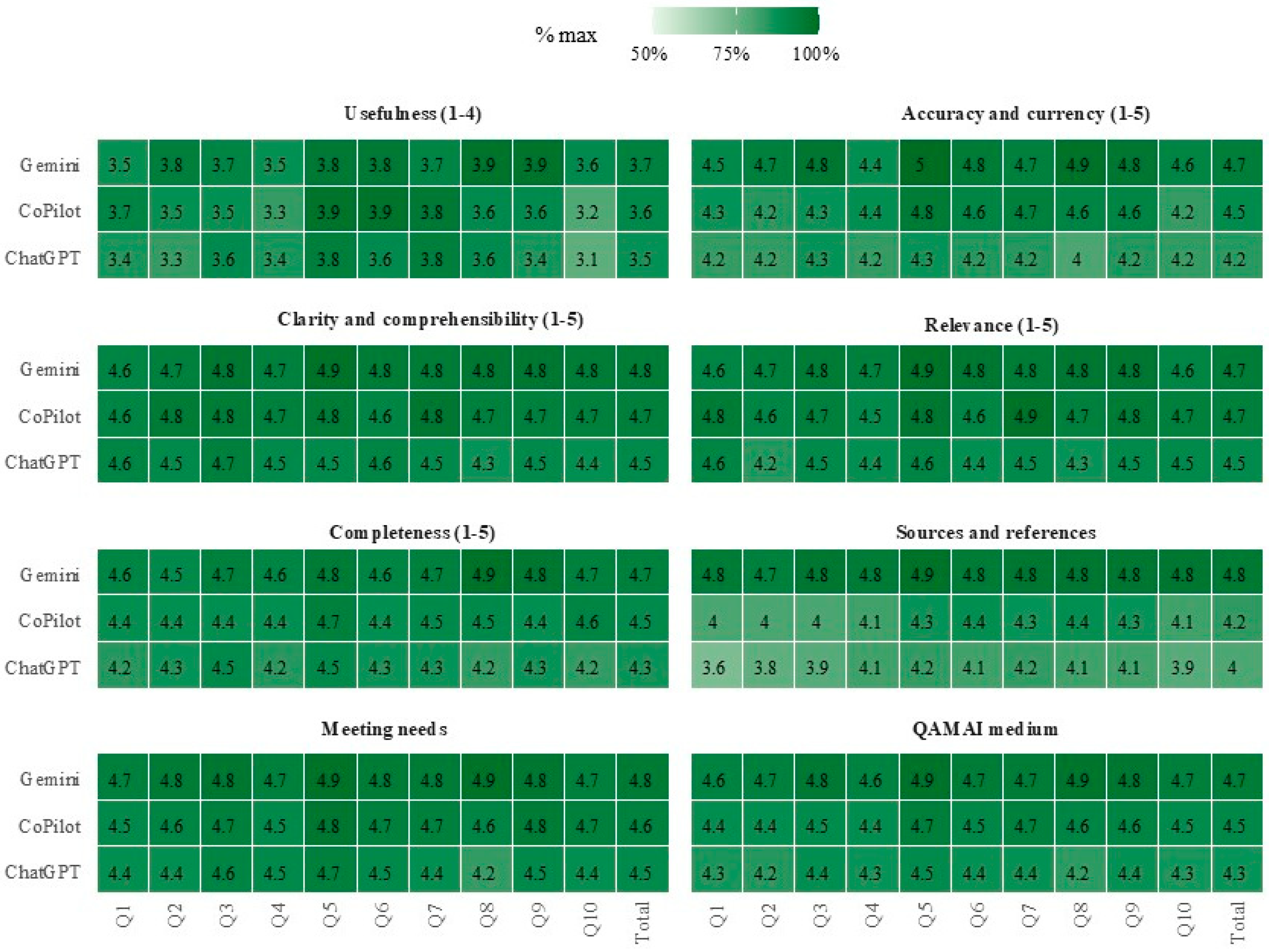
Table 3.
Usefulness of each AI language model.
Table 4.
QAMAI results by question and AI model—Accuracy and currency.
Table 5.
QAMAI results by question and AI model—Clarity and comprehensibility.
Table 6.
QAMAI results by question and AI model—Relevance.
Table 7.
QAMAI results by question and AI model—Completeness.
Table 8.
QAMAI results by question and AI model—Sources and references.
Table 9.
QAMAI results by question and AI model—Meeting needs.
Table 10.
QAMAI results by question and AI model—Total QAMAI.
3.5. Differences Between AI Models
Usefulness
Table 3 presents the usefulness scores obtained by each AI model. Across all 360 ratings, which are repeated measurements of 30 fixed outputs rather than independent observations (10 questions × 3 models × 12 assessors), 241 (66.9%) were rated as very useful (score 4), 95 (26.4%) as useful but lacking vital information (score 3), 24 (6.7%) as partially useful (score 2), and none as not useful (score 1). Two usefulness ratings (both for ChatGPT, questions Q5 and Q7, from two different Paediatric Dentistry assessors) contained two selected categories (scores 3 and 4) because these two items of the form had been configured by error as multiple-choice rather than single-choice; all other items were single-choice. The two assessors were contacted and both confirmed that their intended rating was 4, which was the value used in the analysis. Median usefulness scores were generally high across all three models. Descriptively, Gemini showed the highest median scores and less variability across questions than ChatGPT and Copilot. Statistically significant differences were observed only for questions Q9 (“From what age can acyclovir cream be used?”) and Q10 (“Can herpetic gingivostomatitis recur?”), although these differences did not remain statistically significant after correction for multiple comparisons.
3.6. QAMAI Criteria
3.6.1. Accuracy and Currency
Perceived accuracy scores were consistently high across the three AI models, with Gemini achieving the highest median values across all questions (Table 4). Before adjustment for multiple comparisons, significant differences were observed for questions Q3, Q5, Q8 and Q9. However, none of these differences remained statistically significant after FDR correction. For all the QAMAI criteria reported in Section 3.6, the low inter-rater reliability (Section 3.3) means that between-model comparisons in the criteria with average-measures ICC(2, k) below 0.50 (clarity and comprehensibility, relevance, completeness and meeting needs) are exploratory, and the ordering of the models in these criteria should not be read as a ranking.
3.6.2. Clarity and Comprehensibility
Clarity and comprehensibility scores were consistently high across all three AI models, with median values of 5 for almost all questions (Table 5). An overall difference was observed for question Q8 before adjustment for multiple comparisons. However, this overall difference did not remain statistically significant after FDR correction. Inter-rater reliability for this criterion was near zero (ICC(2, k) = 0; Section 3.3), so this result should be interpreted with particular caution.
3.6.3. Relevance
Relevance scores were consistently high across all three AI models, with Gemini achieving the highest descriptive scores (Table 6). An overall difference was observed for question Q8 before adjustment for multiple comparisons. However, this overall difference did not remain statistically significant after FDR correction.
3.6.4. Completeness
Completeness scores were consistently high across all three AI models, with Gemini achieving the highest descriptive scores (Table 7). Overall differences were observed for questions Q8, Q9 and Q10 before adjustment for multiple comparisons. However, this overall difference did not remain statistically significant after FDR correction.
3.6.5. Sources and References
The greatest differences between AI models were observed in the sources and references domain (Table 8). Descriptively, Gemini achieved the highest scores across all questions. Overall differences between models were observed for all 10 questions. After FDR correction of the global tests, differences remained significant for Q1 (FDR-adjusted p = 0.046), Q3 (FDR-adjusted p = 0.021) and Q10 (FDR-adjusted p = 0.025). In the Bonferroni-adjusted post hoc comparisons, ChatGPT versus Gemini was significant for Q1 (adjusted p = 0.030) and Q3 (adjusted p = 0.035), and Copilot versus Gemini for Q1 (adjusted p = 0.044), with Gemini achieving the highest scores. Sources and references was the criterion with the highest inter-rater agreement (ICC(2, k) = 0.75; Section 3.3), so the panel’s scoring of the differences for this domain is the most consistent of those reported. These scores reflect the assessors’ overall impression of the references provided, and it was not recorded whether they checked the citations individually. The scores do not indicate that the citations were verified as existing, correctly cited or supportive of the claims made, and they therefore do not show greater citation accuracy or stronger evidentiary support for Gemini.
3.6.6. Meeting Needs
Meeting needs scores were consistently high across all three AI models, with Gemini achieving the highest descriptive scores (Table 9). An overall difference was observed for question Q8 before adjustment for multiple comparisons. However, this overall difference did not remain statistically significant after FDR correction.
3.6.7. Total QAMAI
Gemini achieved the highest descriptive total QAMAI scores across all questions, followed by Copilot and ChatGPT (Table 10). Overall differences between AI models were observed for questions Q3, Q6, Q8 and Q9. After FDR correction of the global tests, differences remained significant only for Q3 and Q8. In the Bonferroni-adjusted post hoc comparisons, ChatGPT versus Gemini was significant for Q3 (adjusted p = 0.017) and Q8 (adjusted p = 0.027), and Copilot versus Gemini for Q3 (adjusted p = 0.025), with Gemini achieving the highest scores. The total QAMAI score was the primary outcome; the results for usefulness and for the individual QAMAI criteria (Section 3.5, Section 3.6.1, Section 3.6.2, Section 3.6.3, Section 3.6.4, Section 3.6.5 and Section 3.6.6) are secondary and exploratory. The mean total QAMAI score was 2.5 points higher for Gemini than for ChatGPT (95% CI 0.8–4.5), 1.3 points higher for Gemini than for Copilot (95% CI 0.2–2.4) and 1.2 points higher for Copilot than for ChatGPT (95% CI 0.2–2.5) (confidence intervals obtained by a two-way cluster bootstrap with 5000 resamples of assessors and questions, to account for the clustering of ratings), corresponding to 5–10% of the range of the scale; these differences were small in absolute terms. Excluding the author-added question (Q10), the differences were virtually unchanged (Gemini versus ChatGPT 2.5 points, 95% CI 0.8–4.6; Gemini versus Copilot 1.3 points, 95% CI 0.3–2.4; Copilot versus ChatGPT 1.2 points, 95% CI 0.2–2.6). As an illustrative example of the responses and their assessment, for Q8 (“What is the drug of choice for gingivostomatitis?”), the ChatGPT response identified acyclovir as the drug of choice and listed its indications and alternatives without dosing information (mean total QAMAI 25.1, range 14–30), whereas the Gemini response additionally gave weight-based paediatric and adult dosing regimens, the 48–72-h treatment window and a caution on topical lidocaine in young children (mean 29.3, range 24–30). The Gemini response, however, also referred to a “2026 clinical consensus” and included references without author information, which were not verified, illustrating that high expert-perceived scores do not guarantee verified accuracy or citation integrity. The full texts of all responses are provided in Table S2.
3.7. Readability
Readability results (Table 11) showed that the responses generated by the three LLMs showed low FRE scores, indicating that the information was generally difficult to read. Although readability varied across individual questions, no model consistently produced easier-to-read responses.
Table 11.
FRE and FKG scores.
The FKG indicated that all responses required at least a secondary-school reading level. ChatGPT and Copilot generated responses with similar reading grade levels, whereas Gemini consistently produced the highest FKG scores, suggesting that its responses required a higher educational level for optimal comprehension. Excluding URLs and references, mean response length was 180 words for ChatGPT (range 120–242), 250 for Copilot (123–393) and 385 for Gemini (333–448), and the mean number of references per response was 5.0, 5.1 and 3.8, respectively. Across the 30 responses, longer responses received higher mean completeness (Spearman’s ρ = 0.80) and sources and references scores (ρ = 0.70), whereas the number of references was inversely related to these scores (ρ = −0.66 and −0.62); these associations largely reflect between-model differences, but response length may have influenced perceived completeness and source quality. These readability results are descriptive and were not compared statistically between models.
4. Discussion
This study evaluated the quality of the responses generated by three artificial intelligence language models—ChatGPT, Gemini and Microsoft Copilot—to questions relating to herpetic gingivostomatitis. Overall, Gemini achieved the highest descriptive scores in the 30 responses collected on 9 April 2026, particularly in the domains of overall quality, clinical utility, relevance, perceived accuracy and perceived provision of sources. However, most between-model differences were not statistically significant after correction for multiple comparisons. Therefore, the data support broadly comparable performance of the three models, with some domain- and question-specific descriptive differences, rather than a consistent superiority of Gemini; the descriptive ranking of the models should be distinguished from inferential evidence of superiority. This interpretation is reinforced by the low inter-rater reliability observed (single-rater ICC(2, 1) of 0.09 and ordinal Krippendorff’s alpha of 0.09 for the total QAMAI score), which shows considerable disagreement among experts evaluating exactly the same responses; under these circumstances, small differences in mean scores between models may not represent stable or reproducible model-level differences. These findings are clinically relevant because of the growing use of large language models (LLMs) by patients, students and healthcare professionals to obtain medical and dental information. In this context, herpetic gingivostomatitis represents an ideal clinical topic for evaluating these systems, as it is a common infectious condition in oral medicine where the information provided must be accurate, understandable, clinically sound and adequately supported by scientific sources. It should be regarded as an information support tool and not as a substitute for professional judgement. Importantly, these ratings reflect expert-perceived quality and should not be equated with verified clinical accuracy or safety.
Gemini’s higher descriptive scores in our study are consistent with recent research in oral medicine, which has observed this model’s competitive performance in tasks centred on patient information. In this regard, Benito López et al. evaluated ChatGPT-4, Gemini and Copilot in generating information on burning mouth syndrome using open-ended frequently asked questions, usefulness scores, QAMAI and readability metrics. Although they found no statistically significant differences—noting that all three models produced moderately useful responses in terms of overall performance—Gemini achieved the highest scores for overall quality, particularly in terms of relevance, comprehensiveness and the provision of sources [18]. This parallel suggests that Gemini may perform particularly well when the task involves answering open-ended questions in oral medicine relating to clinical information or health education. In our study, this advantage could be explained by a greater ability to structure contextualised responses, maintain clinical relevance and provide information more closely aligned with the QAMAI assessment criteria.
The available evidence also suggests that the performance of these models should not be assessed solely on the basis of overall metrics, but by taking into account the type of clinical decision involved. Suga et al. evaluated ChatGPT-4o, Gemini Advanced 1.5 Pro and Claude 3.5 Sonnet in the diagnosis of burning mouth syndrome using 100 clinical case studies. ChatGPT and Claude achieved a diagnostic accuracy of 99%, whilst Gemini achieved 89%, with significant differences between the models [19]. Although all models performed well, Gemini’s errors included inappropriate alternative diagnoses or incorrect diagnostic combinations. This finding contrasts in part with our own, in which Gemini was the highest-rated model. The difference is likely due to the fact that our study did not assess autonomous diagnosis using complex clinical case studies, but rather informative responses to questions about herpetic gingivostomatitis. Therefore, Gemini may perform excellently in health education or information synthesis tasks whilst not necessarily being the most accurate model in differential diagnostic reasoning scenarios.
Model and domain dependence was also demonstrated by Künzle and Paris [25] in questions on restorative dentistry and endodontics, where ChatGPT-4o and ChatGPT-4.0 achieved higher accuracy rates than Gemini 1.0 and ChatGPT-3.5, with significant differences in accuracy observed between models. These results contrast in part with our own and suggest that there is no universally superior model for all areas of dentistry. Gemini’s advantage in herpetic gingivostomatitis may be related to the nature of the questions assessed, which were likely more focused on general clinical information, health education and the synthesis of recommendations, as opposed to highly specific examination tasks or technical reasoning. Therefore, the results should be interpreted as valid for the scenario assessed and should not be automatically extrapolated to other fields of dentistry. The available studies also indicate that the quality of responses should not be reduced solely to accuracy. In oral lichen planus, Polizzi et al. found that ChatGPT-4o, Gemini 2.0 Flash Experimental and Copilot provided generally accurate and relevant responses, with QAMAI scores ranging from good to very good; however, they identified persistent limitations in completeness, inconsistent references and sub-optimal readability, with texts that often required a university-level education; in other words, the readability of the responses was not always suitable for the general public [20]. This point is important for interpreting our analysis: the fact that Gemini achieves a higher overall score does not mean that its responses are automatically suitable for all patients. A high accuracy or relevance score does not necessarily imply that the response is optimal from a communicative point of view, nor that the sources cited are sufficient, up to date or verifiable.
In herpetic gingivostomatitis, an overly technical explanation could make it difficult for parents, carers or patients without a healthcare background to understand. Therefore, in addition to accuracy and relevance, future evaluations should incorporate metrics relating to readability in English, suitability for the level of health literacy, and the clarity of practical instructions. In particular, because all responses required a relatively high reading level, a high QAMAI score does not establish that the responses are suitable for patient or caregiver education without adaptation. Public-facing health information is recommended to be written at a sixth- to eighth-grade reading level [26], whereas the mean FKG values observed were 11.2 for ChatGPT, 11.1 for Copilot and 13.5 for Gemini (Table 11); none of the models therefore produced material adequately adapted to the health literacy of parents and caregivers, and the model with the highest expert-rated quality required the highest reading level. Explicitly asking LLMs to use plain language can improve readability [26], and future studies should assess whether it does so without sacrificing accuracy. The potential clinical utility of LLMs must also be weighed against the risk of errors, omissions or automation biases. In the differential diagnosis of oral lesions, Abou-Bakr et al. observed that ChatGPT-5 and ChatGPT-4o performed similarly to experts when considering broad Top-3 or Top-5 diagnostic lists, but fell short of specialists in terms of Top-1 accuracy; this led the authors to recommend supervised, non-determinative use [27]. Similarly, a multimodal study of oral epithelial dysplasia showed good binary discrimination, but lower reliability in more abstract morphological domains and in grading, with a tendency towards undergrading [28]. Although our study does not assess histopathological or imaging findings, these results reinforce a key point: LLMs can support initial guidance and education, but should not be relied upon to make independent diagnostic or therapeutic decisions, particularly where there are warning signs, immunosuppression, dehydration, ocular involvement, severe pain, persistent fever or diagnostic uncertainty.
The variability between models observed in our study is also reflected in the recent literature in paediatric dentistry, although the best-performing model differed. Raj et al. compared nine language models in clinical paediatric dentistry questions and found that ChatGPT-4o achieved the highest overall score on the Modified Global Quality Scale, whilst other models, including Gemini 2.0 and Gemini 2.5, achieved intermediate scores [29]. This difference from our results suggests that there is no universally superior model; rather, performance depends on the clinical area, the type of question, the specific version of the model, the language, the prompt format, the metric used and the profile of the evaluators. Thus, Gemini’s higher descriptive scores in herpetic gingivostomatitis should be interpreted as a finding specific to the context evaluated, rather than as a conclusion that can be generalised to all dental scenarios.
By contrast, Alkabazi and Tassoker reported very high accuracy, with no significant differences between ChatGPT-4, Copilot, Gemini and DeepSeek on case-based multiple-choice questions in oral medicine. All models achieved high overall accuracy, equal to or greater than 97.4%, with no statistically significant differences between them, although Copilot numerically achieved the highest score [30]. This study offers two key insights for interpreting our findings. Firstly, it confirms that current models can achieve high levels of performance on structured questions in oral medicine. Secondly, it demonstrates that small descriptive differences between models do not always translate into statistically significant superiority. Therefore, in our study, Gemini’s higher descriptive scores should be discussed by considering both the magnitude of the difference and its potential statistical significance whilst avoiding extrapolating beyond the data obtained.
For their part, Eroğlu et al. found no significant differences in the overall accuracy of endodontic decisions in patients with systemic diseases between ChatGPT-5.1, Gemini 2.5 Pro, Gemini 2.5 Flash and ChatGPT-3.5, although they noted greater variability in Gemini 2.5 Flash [31]. This heterogeneity underscores the need to evaluate each model within its specific clinical context, using representative questions and validated criteria, rather than assuming equivalence between platforms. A strength of this study is the use of multidimensional evaluation domains, such as total QAMAI, utility, relevance, accuracy and sources. This approach is in line with current recommendations not to evaluate LLMs solely on the basis of correct answers, but rather on their informational value, safety, transparency and applicability. In the case of Gemini, the highest score in the ‘sources’ domain may be particularly relevant, as one of the recurring criticisms of LLMs is the generation of incomplete, irrelevant or non-existent references. However, even when a model provides sources, these must be verified by an expert user, as the presence of citations does not guarantee their relevance or that they correctly support the statement made. Hassanein et al. analysed the performance of ChatGPT-5.2 on histopathological images of oral epithelial dysplasia and observed a sensitivity of 87.0% and a specificity of 89.0% for binary classification, but a progressive decline in performance as morphological complexity increased, particularly regarding high-risk cytological criteria and dysplasia grading [28]. Although our study focuses on textual responses regarding an infectious oral disease rather than histopathological interpretation, these results highlight a common principle: models may perform adequately in general or information-screening tasks, but their reliability diminishes when specialised reasoning, nuanced interpretation or decision-making with clinically relevant consequences is required. This boundary should be made explicit: the present study assessed health-information generation in a highly standardised, text-only setting and did not evaluate diagnostic capability, multimodal reasoning or clinical decision-making. Real clinical diagnosis integrates heterogeneous sources such as imaging, laboratory results, physiological measurements and clinical text, and multimodal AI systems address a considerably more complex problem, with additional challenges related to generalisability, missing modalities, interpretability, fairness, distribution shift and external validation [32]. Good performance on textual responses to frequently asked questions should therefore not be conflated with broader clinical competence.
The review by Yücekaya and Albayrak on endodontics highlights precisely how strategies such as retrieval-augmented generation can reduce the risk of hallucinations by grounding findings in current guidelines and literature, but it also emphasises ethical and medico-legal challenges, such as confidentiality, bias, professional liability and informed consent [33]. From a clinical perspective, the results from this single time point (30 responses collected on 9 April 2026) suggest that Gemini could be a useful tool for drafting preliminary responses, educational materials or patient-facing summaries on herpetic gingivostomatitis. Its responses could help explain the viral nature of the condition, its self-limiting course, supportive measures, the importance of maintaining hydration and pain relief, and the need to seek medical advice if signs of severity arise. The safe implementation of these tools will also require AI literacy and ethics training for dental professionals and students [15]. However, AI-generated responses should undergo professional review before being incorporated into clinical materials, particularly if they include pharmacological recommendations, indications for antivirals, dosages, duration of treatment or referral criteria. Even greater caution is warranted in paediatric patients, immunocompromised patients, pregnant women or patients with comorbidities.
When these tools are used directly by patients and caregivers, without professional mediation, their impact is ambivalent. On the one hand, they offer immediate, free and round-the-clock access to information, which may help parents understand the self-limiting course of PHGS, reduce anxiety and recognise the need for hydration and pain control. On the other hand, the responses evaluated here required a high reading level, may contain unverified references or specific drug doses, and are delivered with a confident tone that can foster excessive trust; caregivers may therefore misinterpret the information, self-medicate, be falsely reassured or delay seeking care when warning signs such as dehydration, ocular involvement or persistent fever are present. Clinicians should therefore ask families whether they use these tools, help them interpret the information obtained and emphasise the warning signs that require prompt medical assessment, so that generative AI complements rather than replaces professional advice.
This study has limitations that must be taken into account. The most important limitation is the low inter-rater reliability: single-rater ICC(2, 1) values were 0.20 or lower for every criterion and 0.09 for the total QAMAI score, and ordinal Krippendorff’s alpha for the total QAMAI score was also 0.09, indicating considerable disagreement among experts evaluating exactly the same responses. This disagreement appears to reflect differences in assessor severity, a marked ceiling effect and differences between specialties (Section 3.3), together with the absence of assessor training and calibration. Across criteria, 51–70% of ratings were at the maximum and 82–96% at the maximum or one point below, with negatively skewed distributions (Table S3). This ceiling effect, an inherent limitation of the measurement scales rather than a data error, means that assessors were mostly choosing between “good” and “very good” (no response was rated as not useful), so that minor preferences translate into apparent disagreement and most dimensions lack discriminative power; consistently, sources and references, the dimension with the least pronounced ceiling effect, showed the highest reliability. The QAMAI may therefore have limited discriminatory resolution for comparing contemporary high-performing foundation models. Consequently, small differences in mean scores between models may not represent stable or reproducible model-level differences, and they should not be interpreted as such. Among the other limitations, firstly, the performance of LLMs may change with non-transparent model updates, meaning that the results represent a snapshot in time. Specifically, only one response was generated for each question and model, and the 12 assessors rated these same 30 texts; the 360 ratings are therefore repeated measurements of 30 fixed outputs and not independent observations of model performance. Increasing the number of assessors does not capture stochastic variability between generations or service changes over time, which were not evaluated. Inference is therefore restricted to the 30 outputs collected on 9 April 2026, and this study should be read as a time-specific expert-rating assessment, not as evidence of stable performance or general superiority of any model. Future studies should generate multiple independent responses for every model–question pair across separate sessions and time points and analyse the question–run–rater hierarchy. Because these models are general-purpose foundation models whose outputs depend on prompting, context, model configuration and interaction conditions, their evaluation requires broader and repeated testing than that of conventional task-specific algorithms [34]; a single output should therefore not be taken to represent the general performance of the corresponding model. Secondly, the wording of the questions, the language used, the level of detail in the prompt and the presence or absence of citation instructions can substantially alter the response. In particular, all prompts and responses were in English, although the questions were retrieved in Spanish and translated, and many of the families who would use this information, such as those in Spain and Argentina, would query these tools in other languages. Chatbot performance may differ by language: in a cross-language evaluation of AI-generated dermatology descriptions, English outputs achieved the highest accuracy, completeness and readability, whereas non-English outputs presented greater challenges and terminology mismatches [35]. The present findings may therefore not apply to queries in other languages, and this language barrier may particularly affect non-English-speaking caregivers. Thirdly, although the QAMAI allows for a structured quality assessment, the evaluation retains a subjective component dependent on the assessors. In particular, the QAMAI accuracy and currency item is an expert-perceived rating and cannot replace a verifiable clinical reference standard: no prespecified guidelines or systematic evidence were used to define key facts, acceptable answer boundaries or mandatory red flags for each question, and independent clinicians did not code factual errors or hallucinations, critical omissions, excessive reassurance, inappropriate medication or dose advice, delayed-referral risk or potential harm severity. Perceived quality, factual correctness and clinical safety are distinct outcomes, and only the first was assessed here; future studies should evaluate them separately against a prespecified clinical reference standard. Clinical safety, in particular, should be assessed as a separate outcome with a predefined checklist covering at least dehydration and inability to maintain oral intake; indications for urgent medical evaluation; ocular or neurological warning signs; the appropriate indication, timing, dosage and duration of antiviral therapy; analgesia and supportive care; infection-control advice; and high-risk populations such as immunocompromised children, because errors in these areas carry greater clinical consequences for children with PHGS than minor omissions in the description of the disease. Clinical adoption requires such safety assessment, robust validation and professional oversight rather than performance metrics alone [36]. Readability was assessed only with formula-based indices (FRE and FKG), which do not capture health-literacy demands, the actionability of instructions or actual caregiver comprehension; future studies should incorporate instruments such as the Patient Education Materials Assessment Tool (PEMAT) and comprehension testing with caregivers. The total QAMAI score was designated as the primary outcome during the revision of the manuscript rather than prespecified, no formal sample-size calculation was performed, and ten questions provide limited precision. The question-specific Friedman and Wilcoxon tests do not fully model the crossed dependence among assessors, questions and outputs; future studies with repeated generations should use hierarchical ordinal models (for example, cumulative-link mixed models) with question, rater and run levels. Regarding blinding and rating reliability, the assessors were not asked to guess which model had produced each response, so the success of blinding was not formally tested, and formal assessor training, anchor examples and a calibration session were not carried out. In addition, intra-rater (test–retest) reliability was not assessed. Future studies should rescore a random 10–20% of responses after an interval of about three weeks to estimate intra-rater reliability, and should precede formal scoring with a scoring manual with anchor examples, a joint pilot scoring of a few responses with item-by-item resolution of discrepancies and an independent trial scoring, with arbitration of discrepant ratings by a blinded third assessor. Because single-rater agreement was low for all criteria, between-model comparisons for the criteria with poor average-measures reliability (usefulness, clarity and comprehensibility, relevance, completeness and meeting needs) are exploratory and should not be read as rankings. Likewise, the sources and references score reflects the assessors’ overall impression. It was not recorded whether the assessors verified the citations individually, and the authors did not audit the existence, bibliographic accuracy, claim support or retraction status of the references generated by the models, so possible hallucinated (fabricated) references were not identified; Gemini’s higher score in this domain should therefore not be interpreted as greater citation accuracy or stronger evidentiary support. A systematic citation audit (for example, through DOI, PMID or publisher records) is needed in future studies. Another limitation is that only one standardised prompt was evaluated. Although this approach improved comparability across models, LLM responses are known to be sensitive to prompt wording and context. Different prompt formulations may have influenced response quality and should be explored in future studies. In particular, the specialist-oriented prompt, which asked the models to act as a specialist in oral medicine and/or paediatric dentistry, to take into account the most recent guidelines and to cite the references used, does not represent the way most parents or caregivers would query an AI chatbot. Such a prompt is likely to have generated more detailed, technical and citation-heavy responses than a natural caregiver query, which may partly explain both the high QAMAI scores and the poor readability results. The present study therefore primarily evaluates expert-oriented AI-generated health information rather than real-world caregiver information seeking, and future studies should compare at least a professional prompt with a natural patient or caregiver prompt. The ten questions analysed represent only a limited sample of the queries that parents may formulate, were selected by consensus without predefined criteria or independent screening, their coverage was not validated against caregiver input, clinical consultation data or an independent question set, and inter-rater agreement was low for most criteria (Section 3.3), which limits the precision of individual ratings. Finally, the comparison between ChatGPT, Gemini and Copilot does not necessarily reflect the performance of future versions or of configurations with access to verified bibliographic databases. In addition, the free public versions were evaluated as accessed through their default web interfaces; Copilot and Gemini may retain platform-level retrieval or citation functions that users cannot fully control, so equivalent information access across the three products cannot be assumed, and public product names do not guarantee identification of the underlying model build. Exact response times and screenshots were not recorded, so the date of collection and the archived responses (Table S2) are the only record of the runs. Because all questions were entered consecutively without restarting the session, earlier questions may have influenced later responses. Overall, our results suggest that Gemini obtained the highest descriptive scores for answering questions about herpetic gingivostomatitis, particularly for overall quality, usefulness, relevance, perceived accuracy and perceived quality of sources. However, published evidence in dentistry and oral medicine demonstrates that the performance of LLMs is context-dependent and that all models have limitations regarding completeness, readability, citation accuracy and clinical safety. Therefore, in the responses evaluated here Gemini obtained the highest descriptive scores, but whether this holds for other generations, model versions or dates cannot be inferred from the present design; any integration into oral medicine must be carried out with specific validation, professional supervision and a clear statement that its responses do not replace individualised clinical assessment. Accordingly, the present study should be regarded as an early-stage evaluation and not as evidence that one commercial LLM is clinically preferable. Strong performance in controlled evaluations should not be equated with readiness for clinical implementation, which requires external validation, transparency, fairness assessment and workflow-level evaluation [36].
5. Conclusions
The main conclusions of this study are that the three models evaluated (ChatGPT, Copilot and Gemini) achieved high overall perceived-quality scores when answering questions about herpetic gingivostomatitis. However, differences between models were mostly small and uncertain after correction for multiple comparisons. Gemini obtained higher descriptive scores in the 30 responses collected on 9 April 2026 across most of the criteria evaluated, particularly in terms of perceived sources and references, perceived accuracy, completeness and mean QAMAI; however, most dimensions showed no statistically significant differences after FDR correction, and inter-rater reliability was generally low, so these between-model results are exploratory only and do not establish a ranking.
High Likert ratings reflect expert-perceived quality and should not be equated with clinical accuracy, safety or readiness for use without professional supervision. Because all responses required a relatively high reading level, high QAMAI scores do not establish suitability for patient or caregiver education without adaptation. These findings should be interpreted with caution: the sample size was limited and inter-rater agreement was low for most criteria, and only some differences between models reached statistical significance after adjustments for multiplicity. In short, the three models showed broadly comparable performance, and this early-stage evaluation does not show that any commercial LLM is clinically preferable. Because only one response per question and model was evaluated at a single time point, these findings describe a time-specific assessment of 30 fixed outputs and cannot be taken as evidence of stable performance or general superiority of any model; repeated generations are needed to examine variability between runs and over time.
Supplementary Materials
The following supporting information can be downloaded at: https://www.mdpi.com/article/10.3390/jcm15239293/s1. Document S1: METRICS checklist; Document S2: Evaluator questionnaire (Google Forms) with the standardised instruction given to the models, the QAMAI items and the usefulness scale; Table S1: All candidate questions retrieved and their selection status; Table S2: Archived responses of the three LLMs, with word count and readability indices; Table S3: Score distribution and proportion of maximum ratings by criterion and AI model.
Author Contributions
Conceptualization, J.A.R.-R. and M.P.P.-L.; Methodology, J.A.R.-R., N.P.-G. and M.P.P.-L.; Validation, F.J.R.-L. and R.A.M.; Formal analysis, C.J.T.-C.; Investigation, J.A.R.-R., N.P.-G., R.A.M. and C.J.T.-C.; Resources, R.A.M.; Data curation, N.P.-G. and C.J.T.-C.; Writing—original draft, J.A.R.-R.; Writing—review and editing, M.P.P.-L., F.J.R.-L., R.A.M. and C.J.T.-C.; Visualization, J.A.R.-R.; Supervision, M.P.P.-L. and F.J.R.-L.; Project administration, M.P.P.-L. All authors have read and agreed to the published version of the manuscript.
Funding
This research received no external funding.
Institutional Review Board Statement
Ethical review and approval were waived for this study since the research did not include human participants or animal subjects. As no personal data protection or ethical concerns were raised, no ethics committee approval or institutional approval was obtained.
Informed Consent Statement
Patient consent was waived since the research did not include human participants or animal subjects. Written informed consent has not been obtained from the patient(s) to publish this paper since no patients were involved in the study.
Data Availability Statement
The questions, the full responses of the three models, the readability indices and the aggregated results are provided in the article and its Supplementary Materials. The de-identified individual ratings of the assessors are available from the corresponding author on reasonable request.
Acknowledgments
ChatGPT-4 (OpenAI), Microsoft Copilot (Microsoft), and Google Gemini (Google) were used as the artificial intelligence systems evaluated in this study.
Conflicts of Interest
The authors declare no conflicts of interest.
References
- Whitley, R.J.; Roizman, B. Herpes simplex virus infections. Lancet 2001, 357, 1513–1518. [Google Scholar] [CrossRef] [Scilit] [PubMed]
- Abdel-Naby Awad, O.G.; Hamad, A.H. Honey can help in herpes simplex gingivostomatitis in children: Prospective randomized double blind placebo controlled clinical trial. Am. J. Otolaryngol. 2018, 39, 759–763. [Google Scholar] [CrossRef] [Scilit] [PubMed]
- Coppola, N.; Cantile, T.; Adamo, D.; Canfora, F.; Baldares, S.; Riccitiello, F.; Musella, G.; Mignogna, M.D.; Leuci, S. Supportive care and antiviral treatments in primary herpetic gingivostomatitis: A systematic review. Clin. Oral Investig. 2023, 27, 6333–6344. [Google Scholar] [CrossRef] [Scilit] [PubMed]
- Yaung, J.; Park, S.H.; Al Khalifah, S. A Cross-Sectional Analysis of Oil Pulling on YouTube Shorts. Dent. J. 2025, 13, 330. [Google Scholar] [CrossRef] [Scilit] [PubMed]
- Petti, S.; Lodi, G. The controversial natural history of oral herpes simplex virus type 1 infection. Oral Dis. 2019, 25, 1850–1865. [Google Scholar] [CrossRef] [Scilit] [PubMed]
- Bardellini, E.; Amadori, F.; Veneri, F.; Conti, G.; Paderno, A.; Majorana, A. Adolescents and primary herpetic gingivostomatitis: An Italian overview. Ir. J. Med. Sci. 2022, 191, 801–805. [Google Scholar] [CrossRef] [Scilit] [PubMed]
- Karpierz, K.; Kuchar, E.P. An Infant with Seborrhoeic Dermatitis and Eczema Herpeticum Complicated by a Generalized Infection. Cureus 2021, 13, e16818. [Google Scholar] [CrossRef] [Scilit] [PubMed]
- Chauvin, P.J.; Ajar, A.H. Acute herpetic gingivostomatitis in adults: A review of 13 cases, including diagnosis and management. J. Can. Dent. Assoc. 2002, 68, 247–251. [Google Scholar] [PubMed]
- Mckinney, R.; Snyder, D.; Zito, P.M. Herpetic Gingivoestomatitis; StatPearls: Tampa, FL, USA; St. Petersburg, FL, USA, 2023. [Google Scholar]
- Mirfendereski, P.; Kerr, A.R. Artificial Intelligence and Its Applications in Oral Medicine—Part 1. Dent. Clin. N. Am. 2026, 70, 361–377. [Google Scholar] [CrossRef] [Scilit] [PubMed]
- Pal, A.; Wangmo, T.; Bharadia, T.; Ahmed-Richards, M.; Bhanderi, M.B.; Kachhadiya, R.; Allemann, S.S.; Elger, B.S. Generative AI/LLMs for Plain Language Medical Information for Patients, Caregivers and General Public: Opportunities, Risks and Ethics. Patient Prefer. Adherence 2025, 19, 2227–2249. [Google Scholar] [CrossRef] [Scilit] [PubMed]
- Yu, H.; Fan, L.; Li, L.; Zhou, J.; Ma, Z.; Xian, L.; Hua, W.; He, S.; Jin, M.; Zhang, Y.; et al. Large Language Models in Biomedical and Health Informatics: A Review with Bibliometric Analysis. J. Healthc. Inform. Res. 2024, 8, 658–711. [Google Scholar] [CrossRef] [Scilit] [PubMed]
- Mallineni, S.K.; Sethi, M.; Punugoti, D.; Kotha, S.B.; Alkhayal, Z.; Mubaraki, S.; Almotawah, F.N.; Kotha, S.L.; Sajja, R.; Nettam, V.; et al. Artificial Intelligence in Dentistry: A Descriptive Review. Bioengineering 2024, 11, 1267. [Google Scholar] [CrossRef] [Scilit] [PubMed]
- Alotaibi, S.; Deligianni, E. AI in oral medicine: Is the future already here? A literature review. Br. Dent. J. 2024, 237, 765–770. [Google Scholar] [CrossRef] [Scilit] [PubMed]
- Du, J.; Zhu, L.; Min, X.; Chang, X.; Qi, W.; Wei, T.; Wei, S.; Zhang, X.; Huang, J.; Tao, X.; et al. A study on promoting AI learning and usage behaviors among health management students from the perspective of the “knowledge-belief-action” model. Front. Public Health 2026, 14, 1747362. [Google Scholar] [CrossRef] [Scilit] [PubMed]
- Yigit, Y.; Ozbek, A.E.; Dogru, B.; Gunay, S.; AlKahlout, B. Evaluating large language models for renal colic imaging recommendations: A comparative analysis of Gemini, copilot, and ChatGPT-4.0. Int. J. Emerg. Med. 2025, 18, 123. [Google Scholar] [CrossRef] [Scilit] [PubMed]
- Khosravi, M.; Izadi, R.; Aghamaleki Sarvestani, M.; Bouzarjomehri, H.; Ahmadi Marzaleh, M.; Ravangard, R. Performance of artificial intelligence large language models (Copilot and Gemini) compared to human experts in healthcare policy making: A mixed-methods cross-sectional study. Health Inform. J. 2025, 31, 14604582251381269. [Google Scholar] [CrossRef] [Scilit]
- Benito López, P.; Adamo, D.; Caponio, V.C.A.; González-Serrano, J.; Dos Santos Silva, A.R.; de Pedro Herráez, M.; Albuquerque, R.; Jornet, M.P.L.; Brailo, V.; Farag, A.; et al. Can Large Artificial Intelligence-Based Linguistic Models Help to Obtain Information About Burning Mouth Syndrome? Oral Dis. 2026, 32, 1149–1160. [Google Scholar] [CrossRef] [Scilit] [PubMed]
- Suga, T.; Uehara, O.; Abiko, Y.; Toyofuku, A. Evaluating Large Language Models for Burning Mouth Syndrome Diagnosis. J. Pain Res. 2025, 18, 1387–1405. [Google Scholar] [CrossRef] [Scilit] [PubMed]
- Polizzi, A.; Isola, G.; Caponio, V.C.A.; Santos-Silva, A.R.; González-Serrano, J.; Albuquerque, R.; Brailo, V.; Farag, A.M.; López Jornet, M.P.; Robledo Sierra, J.; et al. Quality and Readability of Large Language Models’ Responses to Oral Lichen Planus Patients’ FAQs. Oral Dis. 2026, 32, 2748–2760. [Google Scholar] [CrossRef] [Scilit] [PubMed]
- Sallam, M.; Barakat, M.; Sallam, M. A Preliminary Checklist (METRICS) to Standardize the Design and Reporting of Studies on Generative Artificial Intelligence-Based Models in Health Care Education and Practice: Development Study Involving a Literature Review. Interact. J. Med. Res. 2024, 13, e54704. [Google Scholar] [CrossRef] [Scilit] [PubMed]
- von Elm, E.; Altman, D.G.; Egger, M.; Pocock, S.J.; Gøtzsche, P.C.; Vandenbroucke, J.P.; Initiative, S. Strengthening the reporting of observational studies in epidemiology (STROBE) statement: Guidelines for reporting observational studies. BMJ 2007, 335, 806–808. [Google Scholar] [CrossRef] [Scilit] [PubMed]
- Flesch, R. A new readability yardstick. J. Appl. Psychol. 1948, 32, 221–233. [Google Scholar] [CrossRef] [Scilit] [PubMed]
- Kincaid, J.P.; Fishburne, R.P., Jr.; Rogers, R.L.; Chissom, B.S. Derivation of New Readability Formulas (Automated Readability Index, Fog Count and Flesch Reading Ease Formula) for Navy Enlisted Personnel; Naval Technical Training Command, Research Branch: Millington, TN, USA, 1975. [Google Scholar]
- Künzle, P.; Paris, S. Performance of large language artificial intelligence models on solving restorative dentistry and endodontics student assessments. Clin. Oral Investig. 2024, 28, 575. [Google Scholar] [CrossRef] [Scilit] [PubMed]
- Will, J.; Gupta, M.; Zaretsky, J.; Dowlath, A.; Testa, P.; Feldman, J. Enhancing the Readability of Online Patient Education Materials Using Large Language Models: Cross-Sectional Study. J. Med. Internet Res. 2025, 27, e69955. [Google Scholar] [CrossRef] [Scilit] [PubMed]
- Abou-Bakr, A.; El Barbary, A.; Hassanein, F.E.A. ChatGPT-5 vs oral medicine experts for rank-based differential diagnosis of oral lesions: A prospective, biopsy-validated comparison. Odontology 2026, 114, 1743–1756. [Google Scholar] [CrossRef] [Scilit] [PubMed]
- Hassanein, F.E.A.; Hassan, M.T.; Jahngir, M.; Javed, M.; Abou-Bakr, A. Abstraction-dependent diagnostic performance of a multimodal foundation model in oral epithelial dysplasia. Odontology 2026. online ahead of print. [Google Scholar] [CrossRef] [Scilit] [PubMed]
- Raj, M.; Ravindran, V.; Arthanari, A. Assessing the Utility of Large Language Models in Guiding Dental Practitioners on Pediatric Patient Care: A Comparative AI Study. J. Clin. Exp. Dent. 2025, 17, e1099–e1107. [Google Scholar] [CrossRef] [Scilit] [PubMed]
- Alkabazi, M.; Tassoker, M. Comparative performance of AI models on case-based oral medicine questions across Bloom’s taxonomy levels and subtopics. Odontology 2026. online ahead of print. [Google Scholar] [CrossRef] [Scilit]
- Eroğlu, A.; Eraslan Akyüz, İ.; Yılmaz, E.; Düzgün, S. Clinical decision accuracy in endodontic treatment of patients with systemic diseases: A comparative analysis using different artificial intelligence models. Odontology 2026. online ahead of print. [Google Scholar] [CrossRef] [Scilit]
- Nawaz, A.; Edinat, A.; Rana, M.R.R.; Ali, T.; Mustafa, G.; Tahir, S.; Lee, S.W. The role of multimodality in clinical disease diagnosis: Advances, challenges, and opportunities. Front. Public Health 2026, 14, 1788454. [Google Scholar] [CrossRef] [Scilit] [PubMed]
- Yücekaya, F.; Albayrak, F. Large language models and generative artificial intelligence in endodontics: A scoping review. Odontology 2026. online ahead of print. [Google Scholar] [CrossRef] [Scilit] [PubMed]
- Ali, M.U.; Zafar, A.; Kim, S.; Kim, K.S.; Lee, S.W. From task-specific to foundation models: A paradigm shift in medical vision-language analysis. Comput. Sci. Rev. 2026, 59, 100831. [Google Scholar] [CrossRef] [Scilit]
- Karampinis, E.; Zoumpourli, C.M.; Kontogianni, C.; Arkoumanis, T.; Koumaki, D.; Mantzaris, D.; Filippakis, K.; Papadopoulou, M.M.; Theofili, M.; Enechukwu, N.A.; et al. Dermatology “AI Babylon”: Cross-Language Evaluation of AI-Crafted Dermatology Descriptions. Medicina 2026, 62, 227. [Google Scholar] [CrossRef] [Scilit] [PubMed]
- Noori, G.H.; Bibi, S.; Lee, S.W. Artificial Intelligence in Healthcare Practice: Validation, Fairness, and Regulatory Challenges: A Systematic Review. Inq. J. Health Care Organ. Provis. Financ. 2026, 63, 469580261478793. [Google Scholar] [CrossRef] [Scilit] [PubMed]

Disclaimer/Publisher’s Note: The statements, opinions and data contained in all publications are solely those of the individual author(s) and contributor(s) and not of MDPI and/or the editor(s). MDPI and/or the editor(s) disclaim responsibility for any injury to people or property resulting from any ideas, methods, instructions or products referred to in the content. |
© 2026 by the authors. Licensee MDPI, Basel, Switzerland. This article is an open access article distributed under the terms and conditions of the Creative Commons Attribution (CC BY) license.