


Abstract
Background/Objectives: Both C-reactive protein (CRP) and ferritin are routinely measured to assess inflammation. Although they may reflect partially independent pathways of the inflammatory response, clinicians often treat them as conveying similar information. We examined whether ferritin is associated with in-hospital mortality among patients presenting with similar CRP concentrations, using an iso-CRPinemia model. Methods: In this historical cohort study, adults admitted to an internal medicine department at a tertiary medical center from 2 May 2021 to 28 February 2026 were eligible if ferritin and CRP were measured together upon admission; patients with malignancies were excluded. Low-ferritin patients (ferritin < 100 µg/L) were matched 1:1 with high-ferritin patients (ferritin ≥ 500 µg/L) for CRP, age, sex, Charlson Comorbidity Index, and acute diagnosis category; patients with intermediate concentrations were excluded. Results: Of 19,701 available patients, 7214 met the inclusion criteria; 545 matched pairs were established. Median CRP was approximately 65.5 mg/L in both groups. In-hospital mortality was more than doubled in the high-ferritin group compared with the low-ferritin group (9.7% versus 4.0%; odds ratio 2.55, 95% confidence interval 1.49–4.52; p = 0.001). Mortality was higher at more extreme ferritin thresholds, reaching 23.8% versus 2.4% at a ferritin concentration ≥ 2000 µg/L (p = 0.016), despite similar serum CRP concentrations. The association persisted after adjustment for clinical and laboratory variables not included in the matching. Conclusions: Among inpatients with comparable CRP levels under the iso-CRPinemic model, higher ferritin levels were associated with increased in-hospital mortality. The two markers should therefore not be treated as interchangeable measures of inflammatory severity.
1. Introduction
Multiple lines of evidence suggest that both C-reactive protein (CRP) and serum ferritin are useful biomarkers for detecting inflammation and assessing its severity [1]. Although they respond to similar stimuli, such as interleukin-1, interleukin-6, and tumor necrosis factor [2], serum ferritin appears to rise primarily during hyperferritinemic syndromes and may respond to interleukin-18, serving as a marker of macrophage activation [3]. Therefore, these two inflammatory biomarkers may reflect, at least in certain clinical scenarios, distinct pathways of the inflammatory response [4]. This potential divergence may have significant clinical importance, as elevation in either of these markers is frequently interpreted as indicating an intensified inflammatory process, although they may not always carry the same prognostic implications. In fact, we recently introduced a model of iso-CRPinemia, comparing patients with similar CRP but different serum ferritin concentrations. We showed that, despite similar CRP concentrations, mortality rates differed significantly between patients with normal versus elevated serum ferritin levels [5]. However, this study was limited in size, and included patients with extreme CRP values in a single department. We believe that further research using a larger cohort in a less selected population is necessary to confirm the association between mortality and serum ferritin in the context of iso-CRPinemia.
2. Methods
2.1. Study Design and Setting
This was a historical cohort study conducted at Tel Aviv Sourasky University Medical Center, a tertiary, university-affiliated, 1500-bed hospital in central Israel. The study included adults admitted to the internal medicine departments from 2 May 2021 to 28 February 2026. It was approved by the Institutional Review Board of Tel Aviv Sourasky Medical Center (approval number TLV-0240-26). Informed consent was waived due to the retrospective, de-identified nature of the data.
2.2. Participants
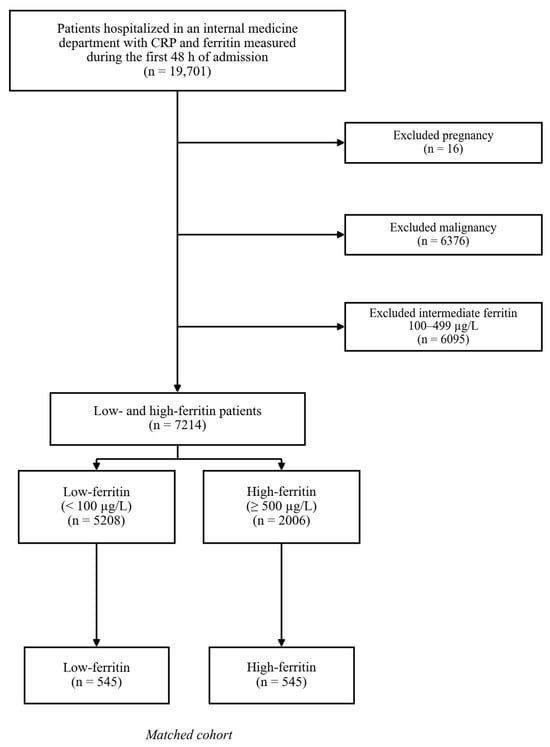
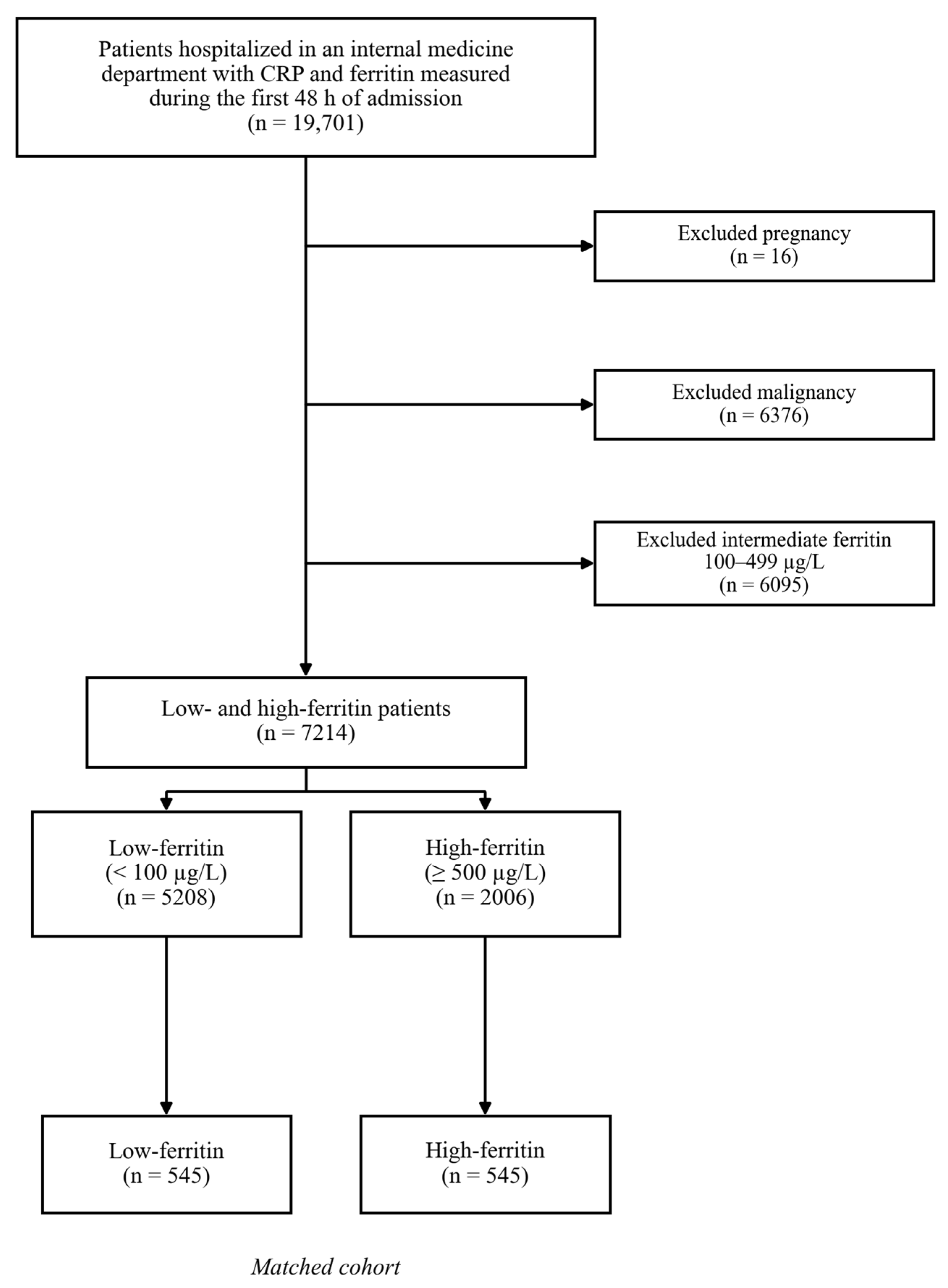
Patients were eligible if they met all of the following inclusion criteria: (1) age 18 years or above; (2) admitted to one of the internal medicine departments during the study period; (3) first serum ferritin measured within 48 h of admission; (4) serum CRP measured within ±6 h of the ferritin test. Patients with solid or hematological malignancies were excluded, identified by ICD-9-CM codes listed in Appendix A. Pregnant women were also excluded. Patients were divided into two groups based on their admission serum ferritin concentrations: the low-ferritin group (<100 µg/L) and the high-ferritin group (≥500 µg/L). Patients with intermediate ferritin concentrations (100–499 µg/L) were excluded. We then matched each low-ferritin patient 1:1, without replacement, to a high-ferritin patient using SPSS’s fuzzy-matching command. Pairs were required to agree exactly on sex and on the acute-diagnosis category, and to fall within the following calipers: ln(CRP) ± 0.1, age ± 3 years, and age-adjusted Charlson Comorbidity Index ± 1 [6,7]. When several high-ferritin patients were eligible, the closest one was selected. Patients were processed in file order. Patients left without an eligible partner were excluded from the matched analyses. The patient selection process is illustrated in Figure 1.
Figure 1.
Patient selection flow diagram. CRP, C-reactive protein.
2.3. Data Source
Clinical data were extracted from the hospital’s electronic health records using the MDClone platform (https://mdclone.com), which enables extraction of authentic raw electronic health record data under strict privacy safeguards and has been used and validated in previous studies [8,9,10].
2.4. Variables
Baseline characteristics were recorded at admission. Demographic and anthropometric variables included age, sex, and body mass index (BMI) calculated as weight in kilograms divided by height in meters squared, with height and weight measured by the admitting registered nursing staff. Functional status was assessed using the Norton scale score [11], evaluated by nurses upon admission. Admission acuity was documented as placement in an intermediate care unit within the internal medicine department. Comorbidity burden was summarized with the age-adjusted Charlson Comorbidity Index and its individual components (diabetes mellitus, congestive heart failure, chronic obstructive pulmonary disease, chronic kidney disease (CKD), cerebrovascular disease, ischemic heart disease, dementia, peripheral vascular disease, liver disease, and peptic ulcer disease), derived from ICD-9-CM diagnosis codes. Laboratory variables included the complete blood count (white blood cells, neutrophils, lymphocytes, hemoglobin, and platelets), serum albumin, creatinine, CRP, serum iron, transferrin, and transferrin saturation. Estimated glomerular filtration rate (eGFR) was calculated from admission creatinine using the race-free 2021 CKD-EPI creatinine equation [12]. Ferritin was the first value within 48 h of admission. All other blood tests (CRP, complete blood count, chemistry panel, and iron studies) were measured within ±6 h of serum ferritin collection. Ferritin concentrations were measured on the ADVIA Centaur XP system (Siemens Healthineers, Tarrytown, NY, USA) using a two-site sandwich chemiluminometric immunoassay, employing an acridinium ester-labeled polyclonal anti-ferritin antibody and a monoclonal anti-ferritin antibody bound to paramagnetic particles. Serum was used as the accepted specimen type. The analytical measuring range was 0.5–1650 µg/L; samples exceeding the upper limit were automatically diluted with Multi-Diluent 1 and reanalyzed, with results corrected for the dilution factor. The minimum detectable concentration was 0.5 µg/L, and no clinically relevant high-dose hook effect was observed within the evaluated range. Calibration used the ADVIA Centaur Calibrator C, based on a two-point calibration and a lot-specific Master Curve. Three levels of quality control were analyzed daily. The concentration of a wide range of C-reactive protein (wrCRP) was measured on the ADVIA 2400 Chemistry System (Siemens Healthineers, Tarrytown, NY, USA) using a latex-enhanced immunoturbidimetric assay. The analytical measuring range was 0.012–156 mg/L, extended to 624 mg/L by an automatic rerun protocol. The system was calibrated with manufacturer-provided calibrators, with metrological traceability to IRMM CRM-470. From 26 October 2025, CRP was measured on Cobas c 503/703 Chemistry Systems (Roche Diagnostics, Mannheim, Germany) using the Tina-quant C-Reactive Protein IV (CRP4) particle-enhanced immunoturbidimetric assay. The analytical measuring range was 0.6–350 mg/L, extended to 700 mg/L by automatic 1:2 dilution. Calibration was performed with Calibrator f.a.s. Proteins. The assay was standardized against ERM-DA474/IFCC, which is metrologically traceable to ERM-DA470 (formerly CRM-470), thereby providing a common reference framework for the two methods. Before the transition from Siemens to Roche, a method comparison was performed on 210 paired patient samples. Deming regression (Roche versus Siemens, assuming equal error variances) yielded a slope of 1.062, an intercept of −2.94 mg/L, and a Pearson correlation coefficient of 0.985. Admission diagnoses were classified into clinical categories according to ICD-9-CM codes by consensus of two internal medicine specialists (Y. S. and S. B.) before matching: infectious, cardiovascular, neurological, pulmonary, gastrointestinal, renal/metabolic, hematologic, and autoimmune; diagnoses outside these categories were grouped as “other”. Length of stay was presented in days, accounting from admission to either discharge (survivors) or death (non-survivors). All-cause in-hospital mortality served as the study outcome.
2.5. Statistical Analysis
Continuous variables were assessed for normality visually using Q-Q plots and histograms. Variables that followed a normal distribution were summarized as mean (standard deviation, SD) and compared with the paired t-test; those that did not follow a normal distribution were summarized as median [interquartile range, IQR] and compared with the Wilcoxon test. Categorical variables were summarized as number (%) and analyzed with McNemar’s test. In-hospital mortality was compared within pairs with McNemar’s test. The matched-pair odds ratio (OR) was calculated as the ratio of discordant pairs with an exact 95% confidence interval (CI). Balance was assessed with standardized mean differences before and after matching. Several sensitivity analyses were conducted: (i) higher ferritin thresholds (≥1000, ≥1500 and ≥2000 µg/L) were examined within the original matched pairs, without re-matching, p-values for these four comparisons were Bonferroni-adjusted; (ii) conditional logistic regression was used to adjust for variables not included in the matching: intermediate care unit admission, Norton score, diabetes, chronic kidney disease, cerebrovascular disease and liver disease (model 1); intermediate care unit admission, albumin, eGFR, lymphocyte count, liver disease and diabetes (model 2); and all of these variables (model 3). A fourth model added transferrin saturation to the variables of model 1 (model 4). All analyses used available data without imputation. The correlation between ferritin and CRP was assessed with Spearman’s correlation coefficient. Analyses were conducted using IBM SPSS Statistics version 31 (IBM Corp., Armonk, NY, USA) and WinPepi (PAIRSetc, version 3.59). A two-tailed p value < 0.05 was considered statistically significant.
3. Results
3.1. Study Population
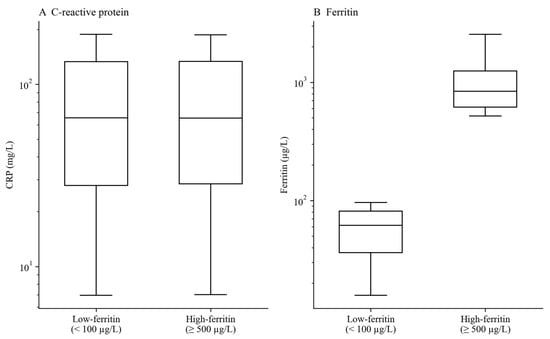
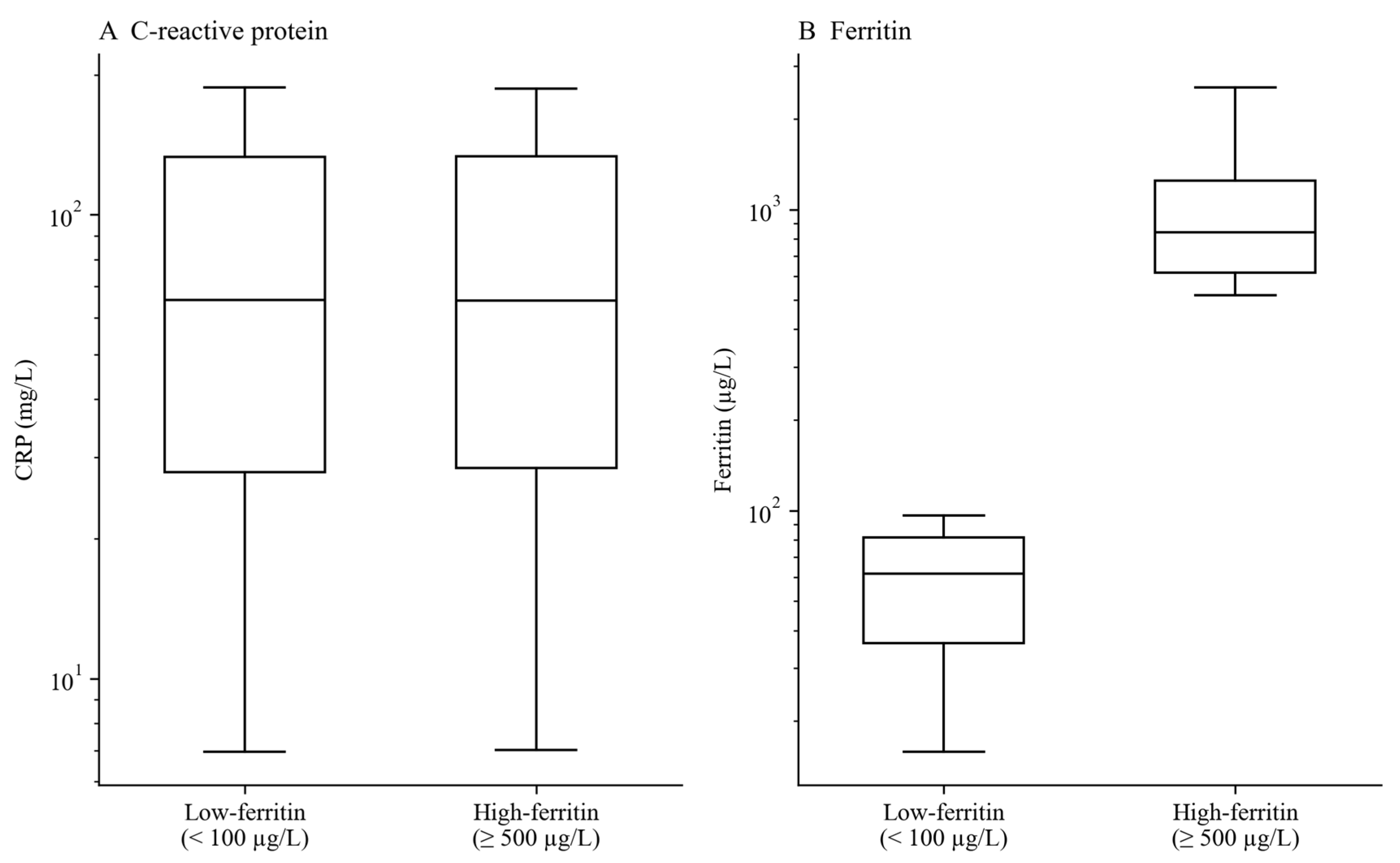
During the study period, 19,701 patients had both ferritin and CRP measured within 48 h of hospital admission. A total of 7214 patients met the inclusion criteria; 5208 were classified as low-ferritin patients and 2006 as high-ferritin patients. Of these, 545 low-ferritin patients (10.5%) and 545 high-ferritin patients (27.2%) were matched into a 1:1 cohort of 1090 patients, as illustrated in Figure 1; unmatched patients were not further analyzed. Most baseline characteristics were similar between the two matched groups (Table 1, Supplementary Table S1). The mean age was approximately 74.0 years (SD 16.1), and 48.3% were female. The most common diagnosis was infectious disease, followed by cardiovascular and neurological diagnoses (47.3%, 15.2%, and 7.9%, respectively). Some baseline characteristics remained imbalanced. Diabetes and cerebrovascular disease were more prevalent in the low-ferritin group (p < 0.001, p = 0.002, respectively), whereas CKD and liver disease were more prevalent in the high-ferritin group (p = 0.003, p = 0.014, respectively). Admission to an intermediate care unit was more frequent in the high-ferritin group (18.3% versus 8.1%, p < 0.001). The median CRP concentration was approximately 65.5 mg/L. Ferritin concentrations were measured at a median of 15.1 h [IQR 9.8–20.3] after admission, and CRP was predominantly obtained at the same time as ferritin measurement (median 0.0 h, IQR 0.0–0.0). Baseline characteristics for both groups are shown in Table 1 and Figure 2. Missing values per variable are shown in Supplementary Table S2.
Table 1.
Baseline Characteristics of Low-ferritin and High-ferritin Patients.
Figure 2.
(A) Serum CRP concentrations in the low- and high-ferritin groups (B) serum ferritin concentrations in the low- and high-ferritin groups.
3.2. Association Between Ferritin Category and In-Hospital Mortality
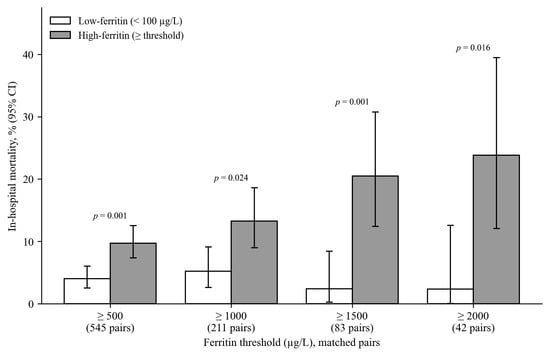
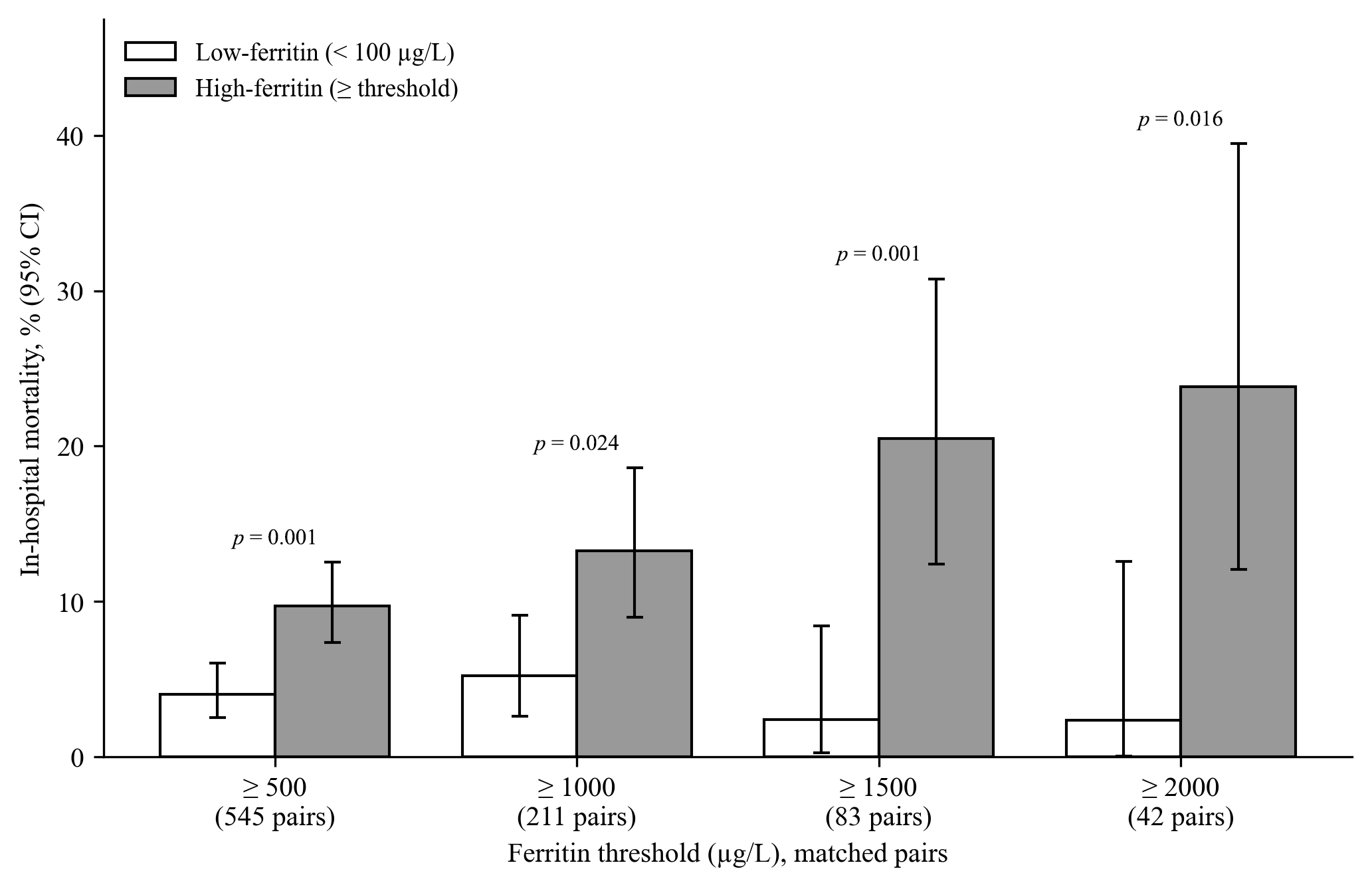
Compared with patients with low serum ferritin levels, those with high serum ferritin levels had significantly higher in-hospital mortality (4.0% versus 9.7%; OR 2.55, 95% CI 1.49–4.52; p = 0.001; Table 2). In-hospital death of the high-ferritin patient alone occurred in 51 pairs, while in-hospital death of the low-ferritin patient alone occurred in 20 pairs. In two pairs, both patients died during hospitalization, and in 472 pairs, both were alive at discharge. Sensitivity analysis comparing low-ferritin patients with those meeting more extreme ferritin thresholds, within the original matched pairs, also showed elevated in-hospital mortality rates that differed significantly from those with low serum ferritin levels (5.2% versus 13.3%, p = 0.024 at ≥1000 µg/L; 2.4% versus 20.5%, p = 0.001 at ≥1500 µg/L; 2.4% versus 23.8%, p = 0.016 at ≥2000 µg/L; Table 2, Figure 3, Supplementary Table S3). As a further sensitivity analysis, the association between ferritin and in-hospital mortality was tested with conditional logistic regression adjusting for variables not included in the matching. The association persisted in all four models: adjusted odds ratio (aOR) 3.03, 95% CI 1.39–6.62, p = 0.005 (model 1, 507 pairs); aOR 2.00, 95% CI 1.01–3.97, p = 0.046 (model 2, 449 pairs); aOR 3.14, 95% CI 1.18–8.38, p = 0.022 (model 3, 417 pairs); aOR 3.58, 95% CI 1.14–11.22, p = 0.028 (model 4, 382 pairs). The models are detailed in Supplementary Table S4.
Table 2.
In-Hospital Mortality by Ferritin Threshold in the iso-CRPinemic Model.
Figure 3.
In-hospital mortality by ferritin threshold.
3.3. Correlation Between Ferritin and CRP
Among all patients eligible for matching (n = 7214), ferritin and CRP were moderately correlated (Spearman’s ρ = 0.55, 95% CI 0.53–0.57, p < 0.001).
4. Discussion
It is well known that CRP and serum ferritin show a moderate correlation across various diseases or conditions in clinical medicine, a pattern similarly observed in the present cohort (Spearman’s ρ = 0.55). Given this moderate correlation [13], it is reasonable to assume that in specific clinical scenarios, there may also be disparities between the biomarkers, with one low while the other is relatively high, and vice versa. Such discrepancies have been documented, for instance, in patients with particular types of hemophagocytic lymphohistiocytosis [14], bacterial infections [15], as well as in a canine model [16]. This potential divergence between these two commonly used biomarkers might be particularly intriguing, as it opens the possibility of exploring situations where one biomarker is elevated while the other is not. We believe that such exploration could pave the way for novel studies that shed more light on the mechanisms underlying low- versus high-ferritinemic responses in specific diseases or disorders. Such an understanding could also have prognostic and therapeutic implications, as demonstrated in patients with sepsis who show varying degrees of hyperferritinemia [17,18].
Both CRP and ferritin have been shown to possess pro- and anti-inflammatory activities [19,20], and it is well established that they are not merely innocuous biomarkers of inflammation [21,22]. However, since both increase in response to various inflammatory stimuli [23,24], it can be difficult to determine the overall contribution of each to the severity of the inflammatory response and, consequently, to patients’ prognosis. These are not necessarily purely theoretical questions, as the inflammatory pathways involved may differ, raising the question of which pathway predominates in each medical condition. We propose that identifying a specific and potentially dominant pathway may facilitate the development of more targeted therapeutic strategies, although this remains a relatively underexplored field. For instance, administering an anti-interleukin-1 treatment to patients with hyperferritinemic sepsis might influence inflammatory pathways, even though sepsis patients also tend to have elevated CRP concentrations. Nonetheless, focusing on a particular inflammatory pathway might open new avenues for clinical research. This is the reason we recently introduced the so-called iso-CRPinemic model [25], which aims to isolate CRP from other clinical and laboratory variables.
The iso-CRPinemic model represents an innovative, exploratory approach. It outlines a scenario in which two patients present with an acute infection or inflammation and have similar, if not identical, CRP concentrations in their peripheral blood. At this stage, clinicians are able to assess the similarities and differences between these matched counterparts across additional clinical and laboratory parameters. In a prior study employing this tool within a small cohort of 39 pairs of patients admitted to one of our internal medicine departments, patients’ CRP and ferritin were measured concurrently. Among patients with comparable CRP concentrations, those with markedly elevated serum ferritin concentrations had significantly higher mortality rates [5].
The present study further explores the iso-CRPinemic model to confirm our previous limited observations, in a much larger cohort of over 1000 patients across a wide range of CRP, highlighting the potential usefulness of the iso-CRPinemic model in more common clinical situations encountered in daily practice. Our current study aimed to ensure that this association of elevated ferritin with in-hospital mortality was not a unique finding in a specific department that routinely measures both CRP and serum ferritin in all admitted patients. In contrast, the reason for obtaining serum ferritin upon admission in the current cohort remains unknown, which may introduce a bias toward more severe medical conditions. However, the current study produced results similar to those observed in various clinical settings [5,15,26]. This finding was reinforced by the persistence of the association after further adjustment for variables not matched in the primary analysis, suggesting that we are likely dealing with a more widespread phenomenon. The broader view of differences between two inflammatory response phenotypes at presentation across various diseases in real-world, everyday situations supports this conclusion. As for the indication for a serum ferritin test, we can only assume it was obtained as part of an anemia workup for most patients. This raises the possibility of an alternative explanation for the observed low-ferritinemic inflammatory phenotype, namely, a more profound iron deficiency rather than a true divergence in inflammatory response. Nevertheless, in the current cohort, hemoglobin concentrations were comparable between the two groups (11.1 versus 10.9 g/dL, p = 0.122), and a regression model further adjusting for transferrin saturation did not weaken the association. Therefore, a more profound iron deficiency within the low-ferritin group is unlikely to explain mortality rates that are more than 50% lower than those of the high-ferritin matched counterparts. The value of our approach lies in demonstrating that, above certain CRP and ferritin concentrations, one can detect differences in mortality rates during hospitalization.
Previous studies investigating ferritin as a prognostic marker have focused primarily on relatively narrow, selected conditions, particularly patients with sepsis or critical illness [27,28]. More recently, a broader cohort of inpatients with ferritin concentrations of at least 500 µg/L demonstrated that a decrease in ferritin levels a week after the first measurement was associated with a more favorable prognosis [29]. These cohorts did not exclude patients with malignancy, in whom ferritin may be elevated for reasons other than inflammation, and none accounted for CRP. The present study suggests that ferritin measurement may have a role early in the course of admission among patients with similar CRP concentrations.
The present study has several limitations, primarily its retrospective, single-center design and the fact that it provides only a single “snapshot” rather than a full longitudinal analysis of the two biomarkers that evolve over time. To the best of our knowledge, the concept of examining an iso-CRPinemic model is innovative and should be explored further with additional data points throughout the progression of the inflammatory response. Another limitation is that the study relies solely on electronic medical records and does not review individual medical charts, which is not feasible in large cohorts. The indication for ferritin testing was not recorded, and these patients may differ from other inpatients who lack this measurement. However, a previous smaller cohort of patients in a department that measures ferritin in all admitted patients found similar results [5], which argues against selection bias as the sole explanation. Moreover, to our knowledge, in most internal medicine departments ferritin, unlike CRP, is requested selectively and not in every admitted patient, and other large cohorts were likewise limited to patients in whom it had been measured [27,28,29]; the present cohort reflects this practice, and its findings apply to patients in whom ferritin is requested. Several measures were taken to minimize bias: patients were matched on age, sex, CRP, chronic comorbidities, and acute diagnoses, followed by four conditional regression models to adjust for additional clinically relevant variables. However, residual confounding cannot be excluded. Low ferritin may partly reflect iron deficiency, although iron indices are difficult to interpret during inflammation. Pairs in which both patients were iron replete by laboratory criteria [30] were too few for a separate analysis, and an adjustment including transferrin saturation did not change the association. Given the moderate correlation between ferritin and CRP, we sought to investigate the role of ferritin outside of the defined intermediate range (100–499 µg/L); this study design may limit the generalizability of our findings. Finally, patients with malignancies were excluded. These findings therefore do not extend to them, and their inclusion might have altered the results.
Despite the limitations mentioned above, we believe our approach of dissecting these two readily available biomarkers may reveal early prognostic signals at presentation in certain patients. It is needless to emphasize that further studies are required before we can recommend a comprehensive approach involving the simultaneous assessment of both biomarkers at presentation.
5. Conclusions
Among hospitalized patients matched for CRP, higher ferritin was associated with increased in-hospital mortality. This association persisted after adjustment for additional clinical and laboratory variables. The two markers should therefore not be treated as interchangeable measures of inflammatory severity. Whether measuring both at admission improves early risk stratification should be tested prospectively.
Supplementary Materials
The following supporting information can be downloaded at: https://www.mdpi.com/article/10.3390/jcm15239281/s1, Table S1: Standardized mean differences before and after matching; Table S2: Missing values per variable among the matched patients; Table S3: In-hospital mortality, discordant pairs and matched-pair odds ratios by ferritin threshold; Table S4: Conditional logistic regression models for in-hospital mortality, adjusting for variables not included in the matching.
Author Contributions
Conceptualization, Y.S. and S.B.; methodology, T.Z.-B. and I.G.; formal analysis, Y.S., T.Z.-B. and S.B.; investigation, H.Y., N.L. and O.A.; data curation, Y.S.; resources, I.G.; validation, I.G.; writing—original draft, Y.S.; writing—review and editing, T.Z.-B., H.Y., N.L., I.G., S.B., A.W. and O.A.; supervision, S.B. and A.W. All authors have read and agreed to the published version of the manuscript.
Funding
This study was supported in part by the Dalya & Arye Prashkovsky grant for medical research, fund number 51706.2, Association of Friends of Tel Aviv Sourasky University Medical Center.
Institutional Review Board Statement
This study was conducted in accordance with the principles of the Declaration of Helsinki. The study was approved by the Institutional Review Board of the Tel Aviv Sourasky Medical Center on 16 April 2026 (approval number TLV-0240-26).
Informed Consent Statement
The Institutional Review Board waived the requirement for informed consent owing to the retrospective nature of the study and the use of de-identified data.
Data Availability Statement
The data supporting the findings of this study are not publicly available due to institutional privacy restrictions, but can be obtained from the corresponding author upon request.
Conflicts of Interest
The authors declare no conflicts of interest. The funders had no role in the design of the study, in the collection, analyses, or interpretation of data, in the writing of the manuscript, or in the decision to publish the results.
Abbreviations
| aOR | adjusted odds ratio |
| BMI | body mass index |
| CHF | congestive heart failure |
| CI | confidence interval |
| CKD | chronic kidney disease |
| CKD-EPI | Chronic Kidney Disease Epidemiology Collaboration |
| COPD | chronic obstructive pulmonary disease |
| CRM | certified reference material |
| CRP | C-reactive protein |
| eGFR | estimated glomerular filtration rate |
| ERM | European Reference Material |
| ICD-9-CM | International Classification of Diseases, Ninth Revision, Clinical Modification |
| IFCC | International Federation of Clinical Chemistry and Laboratory Medicine |
| IHD | ischemic heart disease |
| IQR | interquartile range |
| IRMM | Institute for Reference Materials and Measurements |
| LOS | length of stay |
| MI | myocardial infarction |
| OR | odds ratio |
| PVD | peripheral vascular disease |
| SD | standard deviation |
| TSAT | transferrin saturation |
| WBC | white blood cell count |
| wrCRP | wide-range C-reactive protein |
Appendix A. ICD-9-CM Codes Used to Identify Malignancy
| ICD-9-CM | Category |
| 140–149 | Malignant neoplasm of lip, oral cavity, and pharynx |
| 150–159 | Malignant neoplasm of digestive organs and peritoneum |
| 160–165 | Malignant neoplasm of respiratory and intrathoracic organs |
| 170–173 | Malignant neoplasm of bone, connective tissue, and skin |
| 174–176 | Malignant neoplasm of breast and Kaposi’s sarcoma |
| 179–189 | Malignant neoplasm of genitourinary organs |
| 190–195 | Malignant neoplasm of other and ill-defined sites |
| 196–199 | Secondary and unspecified malignant neoplasm |
| 200–208 | Malignant neoplasm of lymphatic and hematopoietic tissue |
| 209.0–209.3 | Malignant carcinoid and neuroendocrine tumors |
| 238.4, 238.6, 238.71–238.79 | Polycythemia vera, essential thrombocythemia, myelodysplastic syndrome, and other neoplasms of uncertain behavior of plasma cells and lymphatic/hematopoietic tissue |
| 289.83 | Myelofibrosis |
| V10 | Personal history of malignant neoplasm |
| Malignancy was identified from any of these ICD-9-CM codes. Code descriptions follow the International Classification of Diseases, Ninth Revision, Clinical Modification (National Center for Health Statistics, Centers for Disease Control and Prevention). |
References
- Taylor, M.D.; Allada, V.; Moritz, M.L.; Nowalk, A.J.; Sindhi, R.; Aneja, R.K.; Torok, K.; Morowitz, M.J.; Michaels, M.; Carcillo, J.A. Use of C-Reactive Protein and Ferritin Biomarkers in Daily Pediatric Practice. Pediatr. Rev. 2020, 41, 172–183. [Google Scholar] [CrossRef] [Scilit] [PubMed]
- Kernan, K.F.; Carcillo, J.A. Hyperferritinemia and inflammation. Int. Immunol. 2017, 29, 401–409. [Google Scholar] [CrossRef] [Scilit] [PubMed]
- Mehta, P.; Samanta, R.J.; Wick, K.; Coll, R.C.; Mawhinney, T.; McAleavey, P.G.; Boyle, A.J.; Conlon, J.; Shankar-Hari, M.; Rogers, A.; et al. Elevated ferritin, mediated by IL-18 is associated with systemic inflammation and mortality in acute respiratory distress syndrome (ARDS). Thorax 2024, 79, 227–235. [Google Scholar] [CrossRef] [Scilit] [PubMed]
- Slaats, J.; Ten Oever, J.; van de Veerdonk, F.L.; Netea, M.G. IL-1β/IL-6/CRP and IL-18/ferritin: Distinct Inflammatory Programs in Infections. PLoS Pathog. 2016, 12, e1005973. [Google Scholar] [CrossRef] [Scilit] [PubMed]
- Beit Yaakov, S.; Argov, O.; Rogowski, O.; Klechevski, C.; Perlman, S.; Shtark, M.; Ziv Baran, T.; Berliner, S.; Wasserman, A. Normoferritinemic Versus Hyperferritinemic Inflammation in Patients Admitted to the Department of Internal Medicine. J. Clin. Med. 2026, 15, 2646. [Google Scholar] [CrossRef] [Scilit] [PubMed]
- Charlson, M.E.; Pompei, P.; Ales, K.L.; MacKenzie, C.R. A new method of classifying prognostic comorbidity in longitudinal studies: Development and validation. J. Chronic Dis. 1987, 40, 373–383. [Google Scholar] [CrossRef] [Scilit] [PubMed]
- Charlson, M.; Szatrowski, T.P.; Peterson, J.; Gold, J. Validation of a combined comorbidity index. J. Clin. Epidemiol. 1994, 47, 1245–1251. [Google Scholar] [CrossRef] [Scilit] [PubMed]
- Reiner Benaim, A.; Almog, R.; Gorelik, Y.; Hochberg, I.; Nassar, L.; Mashiach, T.; Khamaisi, M.; Lurie, Y.; Azzam, Z.S.; Khoury, J.; et al. Analyzing Medical Research Results Based on Synthetic Data and Their Relation to Real Data Results: Systematic Comparison From Five Observational Studies. JMIR Med. Inform. 2020, 8, e16492. [Google Scholar] [CrossRef] [Scilit] [PubMed]
- Foraker, R.E.; Yu, S.C.; Gupta, A.; Michelson, A.P.; Pineda Soto, J.A.; Colvin, R.; Loh, F.; Kollef, M.H.; Maddox, T.; Evanoff, B.; et al. Spot the difference: Comparing results of analyses from real patient data and synthetic derivatives. JAMIA Open 2020, 3, 557–566. [Google Scholar] [CrossRef] [Scilit] [PubMed]
- Feigin, E.; Feigin, L.; Ingbir, M.; Ben-Bassat, O.K.; Shepshelovich, D. Rate of Correction and All-Cause Mortality in Patients With Severe Hypernatremia. JAMA Netw. Open 2023, 6, e2335415. [Google Scholar] [CrossRef] [Scilit] [PubMed]
- Norton, D.; McLaren, R.; Exton-Smith, A.N. An Investigation of Geriatric Nursing Problems in Hospital; National Corporation for the Care of Old People: London, UK, 1962. [Google Scholar]
- Inker, L.A.; Eneanya, N.D.; Coresh, J.; Tighiouart, H.; Wang, D.; Sang, Y.; Crews, D.C.; Doria, A.; Estrella, M.M.; Froissart, M.; et al. New Creatinine- and Cystatin C–Based Equations to Estimate GFR without Race. N. Engl. J. Med. 2021, 385, 1737–1749. [Google Scholar] [CrossRef] [Scilit] [PubMed]
- Schober, P.; Boer, C.; Schwarte, L.A. Correlation Coefficients: Appropriate Use and Interpretation. Anesth. Analg. 2018, 126, 1763–1768. [Google Scholar] [CrossRef] [Scilit] [PubMed]
- De Matteis, A.; Colucci, M.; Rossi, M.N.; Caiello, I.; Merli, P.; Tumino, N.; Bertaina, V.; Pardeo, M.; Bracaglia, C.; Locatelli, F.; et al. Expansion of CD4dimCD8+ T cells characterizes macrophage activation syndrome and other secondary HLH. Blood 2022, 140, 262–273. [Google Scholar] [CrossRef] [Scilit] [PubMed]
- Levinson, T.; Feigin, E.; Berliner, S.; Shenhar-Tsarfaty, S.; Shapira, I.; Rogowski, O.; Zeltzer, D.; Goldiner, I.; Shtark, M.; Katz Shalhav, M.; et al. Normoferremia in Patients with Acute Bacterial Infections—A Hitherto Unexplored Field of the Dichotomy between CRP and Ferritin Expression in Patients with Hyper Inflammation and Failure to Increase Ferritin. Int. J. Mol. Sci. 2023, 24, 11350. [Google Scholar] [CrossRef] [Scilit] [PubMed]
- Ceron, J.J.; Pardo-Marin, L.; Wdowiak, A.; Zoia, A.; Wochnik, M.; Szczubiał, M.; Bochniarz, M.; Tecles, F.; Martinez-Subiela, S.; Tvarijonaviciute, A.; et al. Divergences between serum C-reactive protein and ferritin concentrations in canine pyometra. BMC Vet. Res. 2023, 19, 78. [Google Scholar] [CrossRef] [Scilit] [PubMed]
- Giamarellos-Bourboulis, E.J.; Kotsaki, A.; Kotsamidi, I.; Efthymiou, A.; Koutsoukou, V.; Ehler, J.; Paridou, A.; Frantzeskaki, F.; Müller, M.C.A.; Pickkers, P.; et al. Precision Immunotherapy to Improve Sepsis Outcomes: The ImmunoSep Randomized Clinical Trial. JAMA 2026, 335, 775–786. [Google Scholar] [CrossRef] [Scilit] [PubMed]
- Shakoory, B.; Carcillo, J.A.; Chatham, W.W.; Amdur, R.L.; Zhao, H.; Dinarello, C.A.; Cron, R.Q.; Opal, S.M. Interleukin-1 Receptor Blockade Is Associated With Reduced Mortality in Sepsis Patients With Features of Macrophage Activation Syndrome: Reanalysis of a Prior Phase III Trial. Crit. Care Med. 2016, 44, 275–281. [Google Scholar] [CrossRef] [Scilit] [PubMed]
- Agrawal, A.; Wu, Y. Editorial: Biology of C-reactive protein. Front. Immunol. 2024, 15, 1445001. [Google Scholar] [CrossRef] [Scilit] [PubMed]
- Plays, M.; Müller, S.; Rodriguez, R. Chemistry and biology of ferritin. Metallomics 2021, 13, mfab021. [Google Scholar] [CrossRef] [Scilit] [PubMed]
- Jia, J.; Wang, M.; Meng, J.; Ma, Y.; Wang, Y.; Miao, N.; Teng, J.; Zhu, D.; Shi, H.; Sun, Y.; et al. Ferritin triggers neutrophil extracellular trap-mediated cytokine storm through Msr1 contributing to adult-onset Still’s disease pathogenesis. Nat. Commun. 2022, 13, 6804. [Google Scholar] [CrossRef] [Scilit] [PubMed]
- Yao, Z.; Zhang, Y.; Wu, H. Regulation of C-reactive protein conformation in inflammation. Inflamm. Res. 2019, 68, 815–823. [Google Scholar] [CrossRef] [Scilit] [PubMed]
- Cullis, J.O.; Fitzsimons, E.J.; Griffiths, W.J.; Tsochatzis, E.; Thomas, D.W. Investigation and management of a raised serum ferritin. Br. J. Haematol. 2018, 181, 331–340. [Google Scholar] [CrossRef] [Scilit] [PubMed]
- Kushner, I. C-reactive protein—My perspective on its first half century, 1930–1982. Front. Immunol. 2023, 14, 1150103. [Google Scholar] [CrossRef] [Scilit] [PubMed]
- Matatyahu, N.S.; Wasserman, A.; Witztum, T.; Adler, A.; Berliner, S.; Rogowski, O.; Ziv-Baran, T.; Zeltser, D.; Shalhav, M.K.; Mina, Y.; et al. Early signaling of inflammatory bursts by using estimated C-reactive Protein velocity (eCRPv): A model of acute meningitis and iso-CRPinemia. BMC Infect. Dis. 2026, 26, 640. [Google Scholar] [CrossRef] [Scilit] [PubMed]
- Brzezinski, R.Y.; Wasserman, A.; Sasson, N.; Stark, M.; Goldiner, I.; Rogowski, O.; Berliner, S.; Argov, O. An Exploratory Analysis of Routine Ferritin Measurement Upon Admission and the Prognostic Implications of Low-Grade Ferritinemia During Inflammation. Am. J. Med. 2024, 137, 865–871.e1. [Google Scholar] [CrossRef] [Scilit] [PubMed]
- He, L.; Guo, C.; Su, Y.; Ding, N. The relationship between serum ferritin level and clinical outcomes in sepsis based on a large public database. Sci. Rep. 2023, 13, 8677. [Google Scholar] [CrossRef] [Scilit] [PubMed]
- Fang, Y.-P.; Zhang, H.-J.; Guo, Z.; Ren, C.-H.; Zhang, Y.-F.; Liu, Q.; Wang, Z.; Zhang, X. Effect of Serum Ferritin on the Prognosis of Patients with Sepsis: Data from the MIMIC-IV Database. Emerg. Med. Int. 2022, 2022, 2104755. [Google Scholar] [CrossRef] [Scilit] [PubMed]
- Brunetta, E.; del Moro, L.; Menon, V.; Selmi, C.F. The day-7 prognostic divergence: Ferritin trajectories separate survivors from non-survivors in a decade-long cohort of 9746 hospitalised adults. Front. Med. 2026, 13, 1952601. [Google Scholar] [CrossRef] [Scilit] [PubMed]
- Auerbach, M.; DeLoughery, T.G.; Tirnauer, J.S. Iron Deficiency in Adults: A Review. JAMA 2025, 333, 1813–1823. [Google Scholar] [CrossRef] [Scilit] [PubMed]

Disclaimer/Publisher’s Note: The statements, opinions and data contained in all publications are solely those of the individual author(s) and contributor(s) and not of MDPI and/or the editor(s). MDPI and/or the editor(s) disclaim responsibility for any injury to people or property resulting from any ideas, methods, instructions or products referred to in the content. |
© 2026 by the authors. Licensee MDPI, Basel, Switzerland. This article is an open access article distributed under the terms and conditions of the Creative Commons Attribution (CC BY) license.