


Abstract
Background: Biportal endoscopic decompression for lumbar spinal stenosis (LSS) may facilitate rapid recovery, yet early minimal clinically important difference (MCID) achievement across pathology-relevant patient-reported outcome measures (PROMs) here remains insufficiently characterized. Accordingly, this study evaluates early (six-week) MCID achievement and associated factors following biportal endoscopic decompression for LSS to supplement surgeon comprehension and patient expectation-setting. Methods: A prospectively maintained, single-center/surgeon database was retrospectively queried (2021–2026) for adult patients undergoing biportal endoscopic decompression without fusion for LSS-only indications. Cases were excluded based on factors such as missing data, complicating etiologies/procedures, or insufficient follow-up. The primary outcome was literature-anchored MCID achievement, defined as an improvement of ≥2 points in the visual analog scale (VAS)-back and VAS-leg PROMs, and ≥14.9 points in the Oswestry Disability Index (ODI). Statistics included paired comparisons, exploratory multivariable logistic regressions with odds ratios (ORs), sensitivity analyses, and subgroup examinations. Results: Ninety-nine patients were included (mean age = 70.0 ± 10.0 years; body mass index [BMI] = 27.2 ± 5.1 kg/m2; follow-up = 6 ± 0 weeks; 53.5% male). VAS-back improved from 6.1 ± 2.8 to 2.0 ± 2.1, VAS-leg from 6.9 ± 2.4 to 1.4 ± 2.1, and ODI from 42.9 ± 18.6 to 21.5 ± 15.1 (all p < 0.001). Six-week MCID achievement rates were 78.8%, 88.9%, and 63.6%, respectively, with significant pairwise differences (all corrected p < 0.05). Best-case/worst-case exclusion sensitivity analyses yielded achievement ranges of 60.3–83.3% for VAS-back, 67.3–90.4% for VAS-leg, and 46.2–71.8% for ODI. Higher preoperative VAS-back (odds ratio [OR] = 1.810) and ODI (OR = 1.183) were associated with respective MCID achievement. Male sex increased (OR = 4.727) and higher BMI decreased (OR = 0.859) odds of ODI-MCID achievement (both corrected p < 0.05), though findings were statistically limited. In the subgroup with postoperative radiculitis (23.2%), which is known to affect recovery and its perception, lower six-week ODI-MCID achievement was observed (43.5% versus 69.7%, p = 0.022). Conclusions: Biportal endoscopic decompression for LSS was associated with substantial six-week MCID achievement rates, with the highest achievement rate observed for VAS-leg. While baseline symptom severity was associated with MCID achievement, these relationships warrant cautious interpretation given the use of absolute change thresholds. These findings may help to inform patient counseling and early postoperative expectation-setting.
1. Introduction
Lumbar spinal stenosis (LSS) is a leading cause of pain-related disability worldwide, affecting approximately 8–11% of individuals over the age of 60 and representing more than 100 million cases globally [1,2,3]. Despite initial nonoperative management, many patients experience persistent neurogenic claudication, radicular leg pain, axial back pain, and/or progressive disability that ultimately necessitates surgery [4,5]. Among operative options, lumbar laminectomy or unilateral laminotomy for bilateral decompression (ULBD) remain mainstays of LSS decompression, with approximately 600,000 lumbar laminectomies performed annually in the United States alone [2,5,6]. Together, these trends reflect both the growing burden of degenerative spinal pathology and the expanding role of surgical management [6].
Alongside increasing surgical volume for LSS, endoscopic approaches, particularly biportal techniques, have emerged as a unique class of minimally invasive alternatives associated with reduced iatrogenic soft-tissue injury, favorable perioperative profiles, and potential benefits during early postoperative recovery [7,8,9,10]. Assessments of recovery-related outcomes after such surgeries commonly rely on patient-reported outcome measures (PROMs), which are especially relevant in symptom-driven conditions such as LSS. Among the most frequently collected PROMs are the Visual Analog Scale (VAS) for back and leg pain, and the Oswestry Disability Index (ODI) questionnaire, each of which captures different portions of the principal symptom domains of pain and functional disability relevant to LSS and other similar conditions.
Although raw PROMs allow for the assessment of pre-to-postoperative changes, clinical interpretability is more commonly evaluated using minimal clinically important difference (MCID) thresholds and transformations [1,6,11]. Within the lumbar spine literature, most MCID-centered investigations have focused on traditional, non-endoscopic techniques, often also emphasizing longer-term follow-up intervals. However, several recent studies have demonstrated that clinically meaningful improvement may occur earlier in the recovery course, with some cohorts reporting notable MCID achievement rates in commonly collected PROMs as early as six weeks following lumbar decompression [11,12,13].
In relation to this, a handful of studies examining endoscopic spine surgeries have also begun to evaluate MCID-related outcomes. For example, one endoscopic-focused study reported ODI-MCID achievement rates of approximately 27–49% at six months (defined as 30% improvement from baseline) following discectomies and decompressions, with MCID achievement stratified and analyzed across various subgroups [14]. However, investigations such as the aforementioned example often emphasize later postoperative timepoints for analyses and frequently pool distinct procedures and/or indications. Given that MCID benchmarks are often procedure- and indication-specific, the applicability and translatability of the available evidence base are inherently limited when extrapolating to biportal techniques, for example, alongside other more-homogeneous cohorts [14]. Therefore, early MCID achievement following biportal endoscopic decompression for LSS remains insufficiently characterized, even as this unique minimally invasive approach gains wider adoption.
To address this gap, the present study evaluates early MCID achievement in VAS-back, VAS-leg, and ODI PROM domains at six-week follow-up after biportal endoscopic decompression in an LSS-only cohort to supplement surgeon comprehension and inform patient care. Given the unique minimally invasive nature of this approach, we hypothesized that a substantial proportion of patients would achieve clinically meaningful improvements by the six-week postoperative timepoint.
2. Methods
2.1. Study Design and Patient Population
This study is a retrospective analysis of prospectively maintained data sourced from a single-physician database at a large tertiary academic medical center. The database was maintained by a fellowship-trained orthopaedic spine surgeon specializing in biportal endoscopic techniques and with more than 10 years of post-fellowship experience. Institutional review board (IRB) approval was obtained under a protocol for evaluating outcomes following endoscopic spine surgery (IRB protocol #5073), from which the present study cohort was subsequently derived. Periodic internal review of the database ensured standardized entry, variable definitions, and terminological consistency. From this setting, all adult patients (≥18 years) who underwent biportal endoscopic spine surgery between 27 October 2021 and 6 August 2026 were identified to establish the initial patient population.
2.2. Variables and Timeline
Data integrity and variable consistency were independently verified by separate authors prior to statistical analyses. Clinical outcomes were assessed through routine postoperative follow-up, direct patient contact, and patient-initiated communication, while demographic, perioperative, and other clinical data were obtained through chart review. Baseline patient demographics were recorded, including age, sex, and body mass index (BMI), as well as individual comorbidities such as diabetes mellitus and congestive heart failure, alongside the composite 5-Item Modified Frailty Index (mFI-5) endpoint. Surgical characteristics included levels involved, procedure type, operative time, and intraoperative complications, among others. Postoperative radiculitis was defined as new or worsening radicular symptoms occurring within two weeks following surgery. All patients identified with postoperative radiculitis were prescribed an oral methylprednisolone taper (Medrol Dosepak), while no patients without radiculitis received this treatment. Symptom severity was not assessed using a standardized grading system, as postoperative radiculitis has generally been characterized as self-limited and transient in prior literature [15].
PROMs, including VAS-back, VAS-leg, and ODI, were collected prospectively at standardized perioperative visits. Six-week PROM outcomes were evaluated to characterize early clinical results while avoiding the acute postoperative recovery period. This timepoint was intentionally selected to capture the early, yet plausibly clinically meaningful recovery course following biportal endoscopic decompression for LSS. The selected follow-up also aligns with prior LSS literature, in which six weeks has been established as one of the earliest meaningful PROM assessment timepoints and falls within a period that has been colloquially described as representing “early” responders [13,16,17,18].
2.3. Patient-Reported Outcomes and MCID Criteria
The primary outcome of this study was the achievement of MCID for VAS-back, VAS-leg, and ODI. Secondary outcomes reported included postoperative PROM scores, magnitude of score improvement from baseline (delta), and binary classification of clinical improvement. MCID thresholds were defined as improvements of ≥2 points in both VAS-back and VAS-leg, and ≥14.9 points in ODI, consistent with anchor-based receiver operating characteristic (ROC) analyses reported by Nakarai et al. (2021) in a large LSS decompression-only cohort study where a substantial proportion of patients were treated endoscopically [19]. Importantly, these PROM thresholds were selected based on their clinical applicability to the present population and can be further contextualized within the existing, relevant literature. For example, Cha et al. (2022) utilized lower MCID thresholds of 1.2 points for VAS-back, 1.6 points for VAS-leg, and 12.8 points for ODI following minimally invasive lumbar decompression, while Lewandrowski et al. (2020) reported higher MCID estimates of 2.5–3.5 points for VAS pain and approximately 14–17 points for ODI following transforaminal endoscopic decompression for foraminal and lateral recess stenosis [20,21]. Even though these studies differ in surgical technique, patient population, and MCID methodology, the thresholds selected from Nakarai et al. (2021) fall near the midpoint of the relatively narrow range reported in the existing literature here, supporting this anchor’s use as a representative, centered, and clinically relevant benchmark for the present analysis [19].
2.4. Statistical Methods
Statistical analyses were performed using RStudio version 2026.01.0+392 (R Foundation for Statistical Computing, Vienna, Austria), Microsoft Excel for Microsoft 365 Apps for Enterprise version 2511 (Redmond, WA, USA: Microsoft Corporation), and the IBM Statistical Package for the Social Sciences (SPSS) version 31.0 (Armonk, NY, USA: IBM Corporation). Means and standard deviations (SDs) were used to describe continuous variables, while quantities (N) and percentages (%) were used for their binary or categorical counterparts. Changes in PROM score significance pre-to-postoperatively were determined per-patient using paired two-tailed t-tests. To compare MCID achievement rates across PROM domains, Cochran’s Q testing was performed, followed by post hoc pairwise McNemar’s tests to determine granularity, with Benjamini–Hochberg correction applied to account for repeated comparisons.
To assess potential selection bias associated with incomplete PROM- or other outcome-related data, baseline demographics, clinical characteristics, and MCID achievement rates were compared between patients included in the final analytic cohort and those excluded during cohort refinement. These comparisons were performed using available data for each variable. To further assess the potential impact of such missing data on the primary findings, best-case (100% of missing cases achieved respective PROM-MCID) and worst-case (0% of missing cases achieved respective PROM-MCID) sensitivity analyses were performed for six-week MCID achievement across VAS-back, VAS-leg, and ODI to establish the range of possible achievement rates under these extreme assumptions.
An exploratory subgroup analysis was additionally performed to compare baseline demographics and clinical characteristics, preoperative and six-week postoperative PROM scores, and six-week MCID achievement for VAS-back, VAS-leg, and ODI between patients with and without postoperative radiculitis, given the potential influence of radicular symptoms and their medical management on recovery and PROM-based outcomes [22,23]. Postoperative Medrol Dosepak exposure coincided with radiculitis status in the study cohort, precluding separate evaluation of its independent association with MCID achievement. For all juxtapositions of data, continuous variables were compared using independent two-tailed t-tests, while categorical variables were compared using chi-square or Fisher’s exact tests, where appropriate.
Exploratory multivariable logistic regression was initially performed for all three primary outcomes, utilizing odds ratios (ORs) and 95% confidence intervals (CIs) to characterize potential associations [12,19,24]. However, the VAS-leg MCID regression was omitted due to the low number of patients who failed to achieve MCID (n = 11), which increased the risk of overfitting and estimate instability despite mitigatory measures taken. Multivariable regression analyses were therefore limited to VAS-back and ODI MCID achievement. Since regression model stability largely depends on event quantity per outcome, global covariate inclusion was considered inappropriate. Preliminary bivariate screening was thus performed, and variables meeting a p < 0.250 threshold were then selected for relaxed multivariable regression to limit the number of candidate covariates considered [25,26]. Additional subsequent screenings were then performed to assess for potential reverse causation, temporality, and multicollinearity (favoring grouped endpoints) [27]. Potential variables for regression included baseline demographics, operative characteristics, and the preoperative value of the PROM-of-interest, adapted from prior, relevant literature [28]. Because multivariable regression analyses evaluated associations across two clinically defined PROM-MCID outcomes, multiplicity adjustment was applied to each family’s initial multivariable significance measures using the Benjamini–Hochberg correction, with ensuing interpretations guided primarily by effect estimates and confidence intervals. Model goodness-of-fit was then assessed using the Hosmer–Lemeshow test.
All measures of significance in this study were determined based on two-sided p-values, with significance set at terminal p < 0.05.
3. Results
3.1. Cohort Refinement Process
A total of 358 patients were identified from the initial database query, with sequential exclusions made based on diagnosis, missing or unavailable data, procedure type, and follow-up requirements. Following cohort refinement, the final analytic population consisted of 99 patients. A complete breakdown of the cohort selection and inclusion/exclusion process, with step-specific counts, is provided in Supplemental Table S1.
To assess potential selection bias, baseline characteristics were compared between the final analytic cohort (n = 99) and patients removed during exclusion steps 5 and 6 of the cohort refinement process due to missing PROM- or other outcome-related data (n = 57). Most evaluated baseline characteristics were similar between groups, including age, BMI, diabetes mellitus, preoperative VAS-back, and preoperative ODI. However, included patients demonstrated significantly higher preoperative VAS-leg scores compared with excluded patients (6.9 ± 2.4 versus 6.0 ± 2.3, p = 0.043). Preoperative VAS-leg data were available for 45/57 excluded patients (78.9%). Additional comparisons of available six-week postoperative VAS-back, VAS-leg, and ODI scores, as well as corresponding MCID achievement rates, are presented in Supplemental Table S2.
3.2. Cohort Baseline and Operative Characteristics
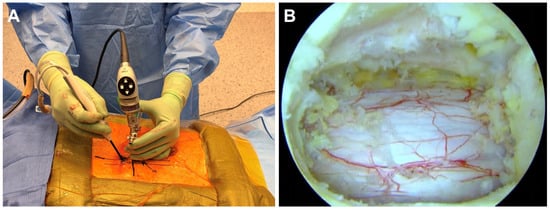
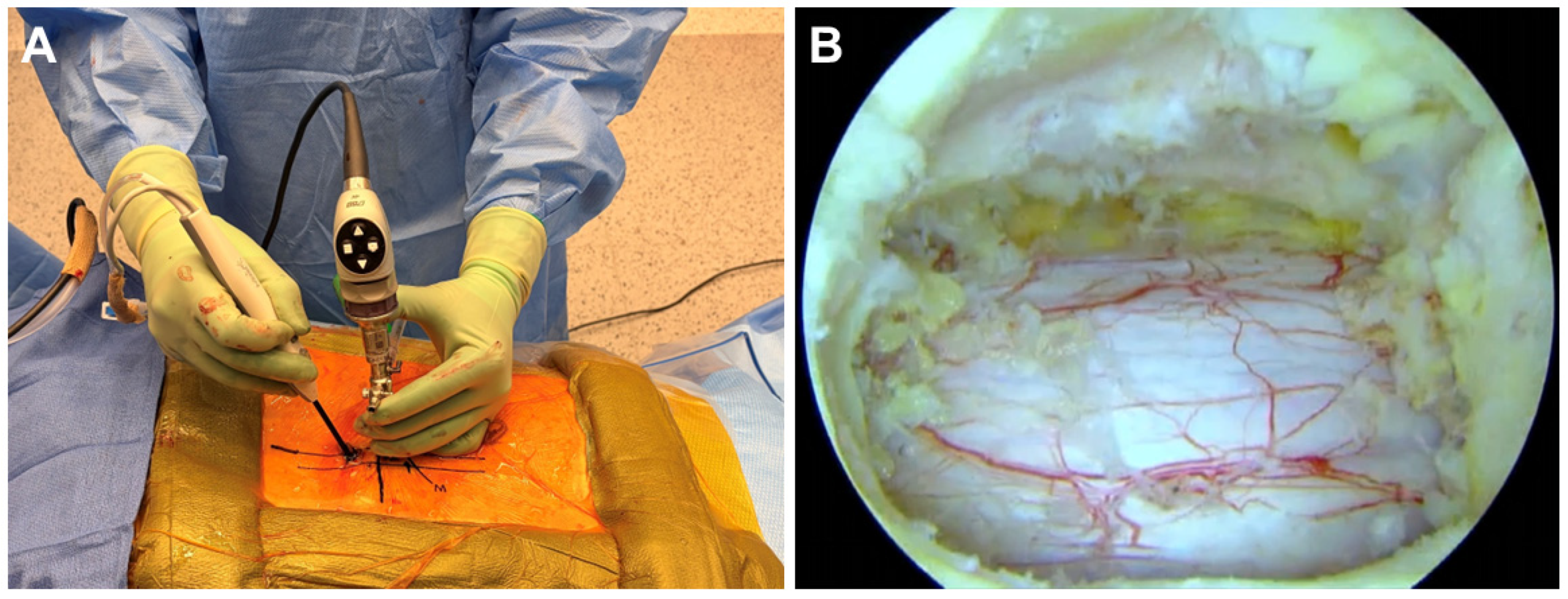
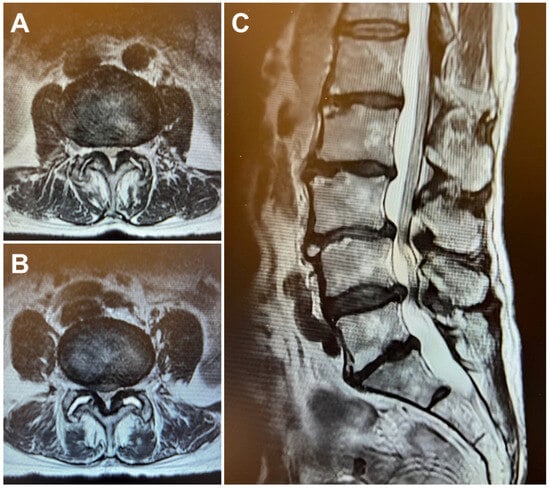
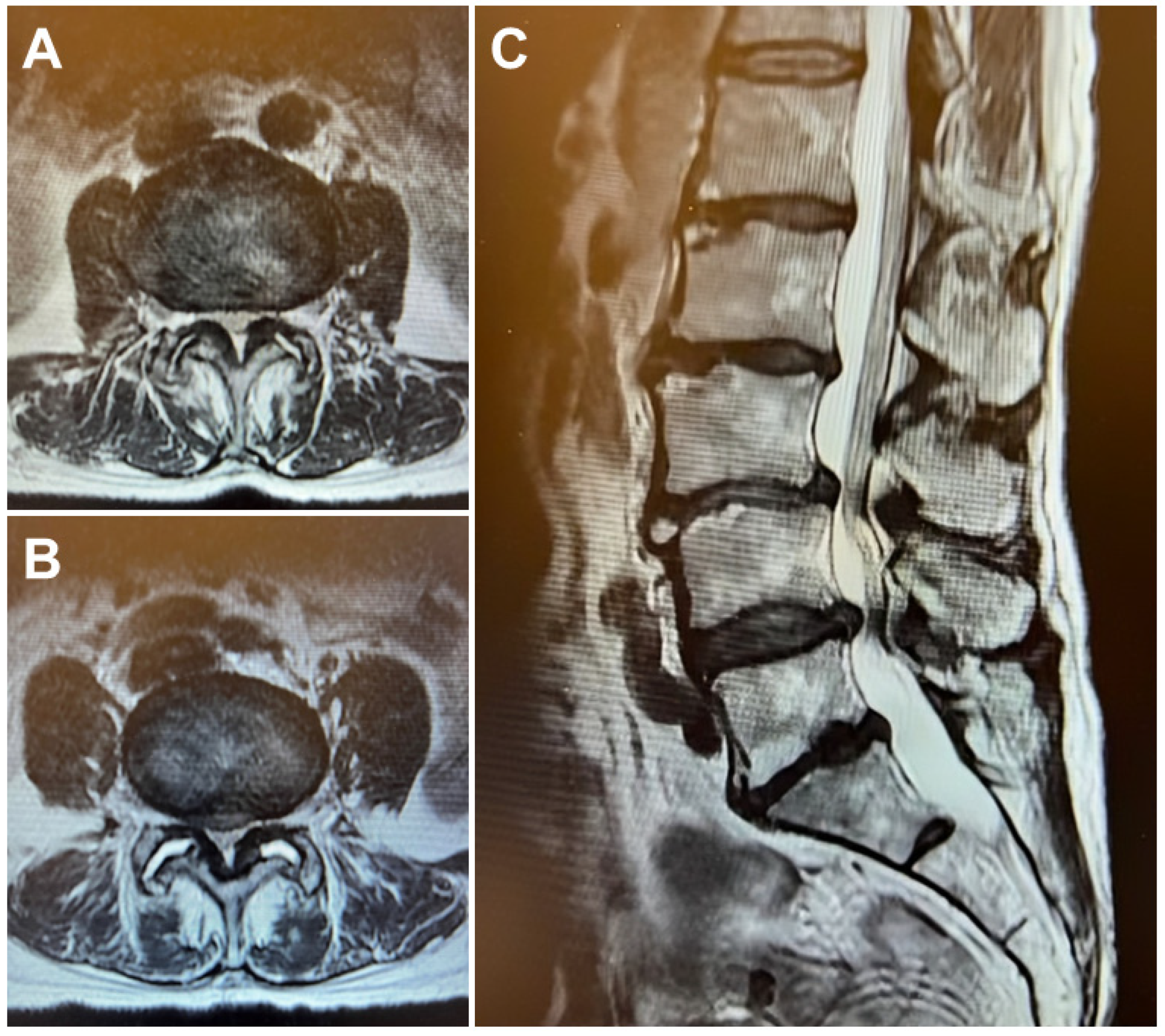
Patients (n = 99; mean age = 70.0 ± 10.0 years; BMI = 27.2 ± 5.1 kg/m2; 53.5% male; follow-up = 6.0 ± 0 weeks; Table 1) had a mean mFI-5 of 0.9 ± 0.9 points, with hypertension requiring medication (60.6%) and diabetes mellitus (23.2%) being the most common individual comorbidities. Patients most commonly underwent laminotomy with lateral recess decompression (58.6%), followed by ULBD (39.4%; Figure 1). Single-level decompressions accounted for 61.6% of cases, most frequently at L4–5 (62.3%), while multi-level procedures accounted for 38.4% and were predominantly 2-level (81.6%; Table 1; Figure 2). Most patients were treated in the outpatient setting (89.9%), 95.0% received intraoperative tranexamic acid, and the mean operative time was 116.1 ± 48.2 min (Table 1).
Table 1.
Baseline and operative characteristics of the present cohort. SD, standard deviation.
Figure 1.
Intraoperative images demonstrating (A) fellowship-trained orthopaedic spine surgeon hand positioning during biportal endoscopic decompression and (B) endoscopic view following unilateral laminotomy for bilateral decompression (ULBD) for lumbar spinal stenosis.
Figure 2.
Preoperative lumbar spine magnetic resonance imaging (MRI) demonstrating multi-level lumbar spinal stenosis, including (A) axial stenosis at L3–4, (B) axial stenosis at L4–5, and (C) sagittal view of the lumbar spinal canal narrowing.
3.3. Perioperative Treatment, Outcomes, and PROMs
Erector spinae blocks were utilized in 15 (15.2%) patients, while perioperative Toradol was given to 61 (61.6%; Table 2). Six intraoperative complications occurred, all of which were incidental durotomies that were addressed during surgery and resolved without postoperative sequelae. Through active postoperative surveillance and patient inquiry regarding radicular symptoms, 23 patients (23.2%) were identified with postoperative radiculitis, all of whom experienced symptom resolution with conservative management, including treatment with a Medrol Dosepak. This treatment was prescribed exclusively to patients who developed postoperative radiculitis. Furthermore, three (3.0%) revision surgeries were performed for persistent symptoms due to pathology at levels different from the original operations, necessitating additional decompressions.
Table 2.
Perioperative treatment-, complication-, and PROM-related findings. SD, standard deviation. MCID, minimal clinically important difference. VAS, visual analog scale. ODI, Oswestry Disability Index.
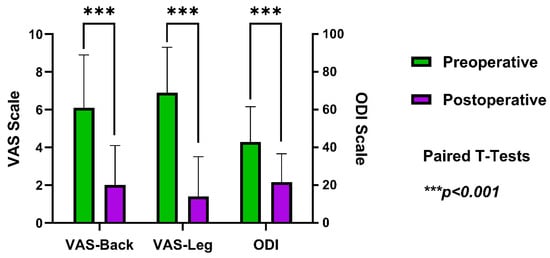
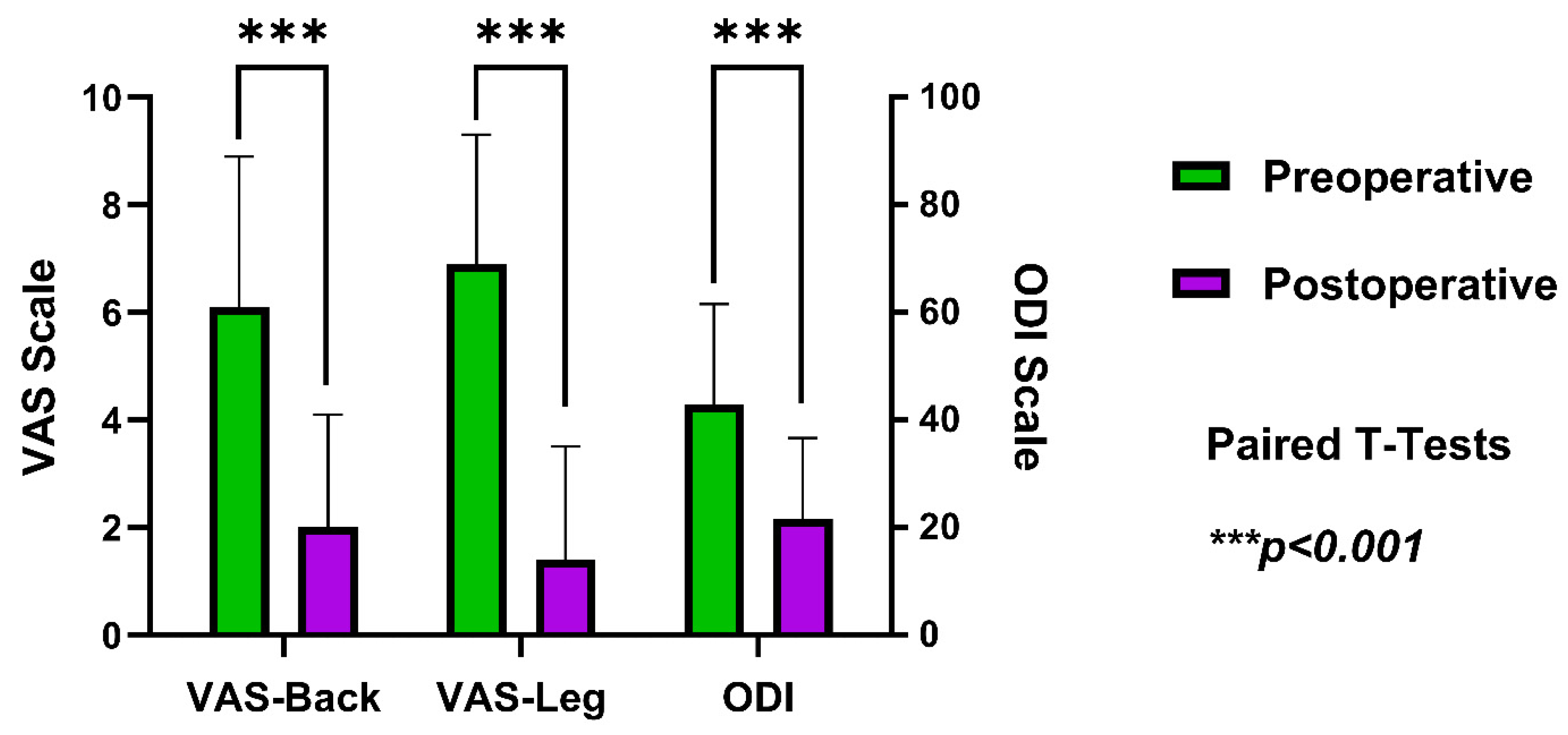
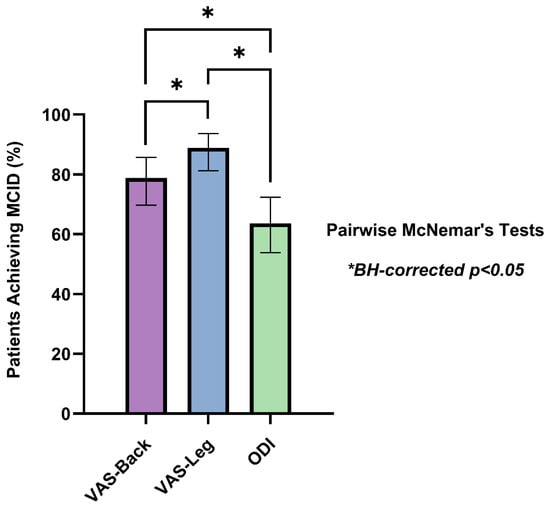
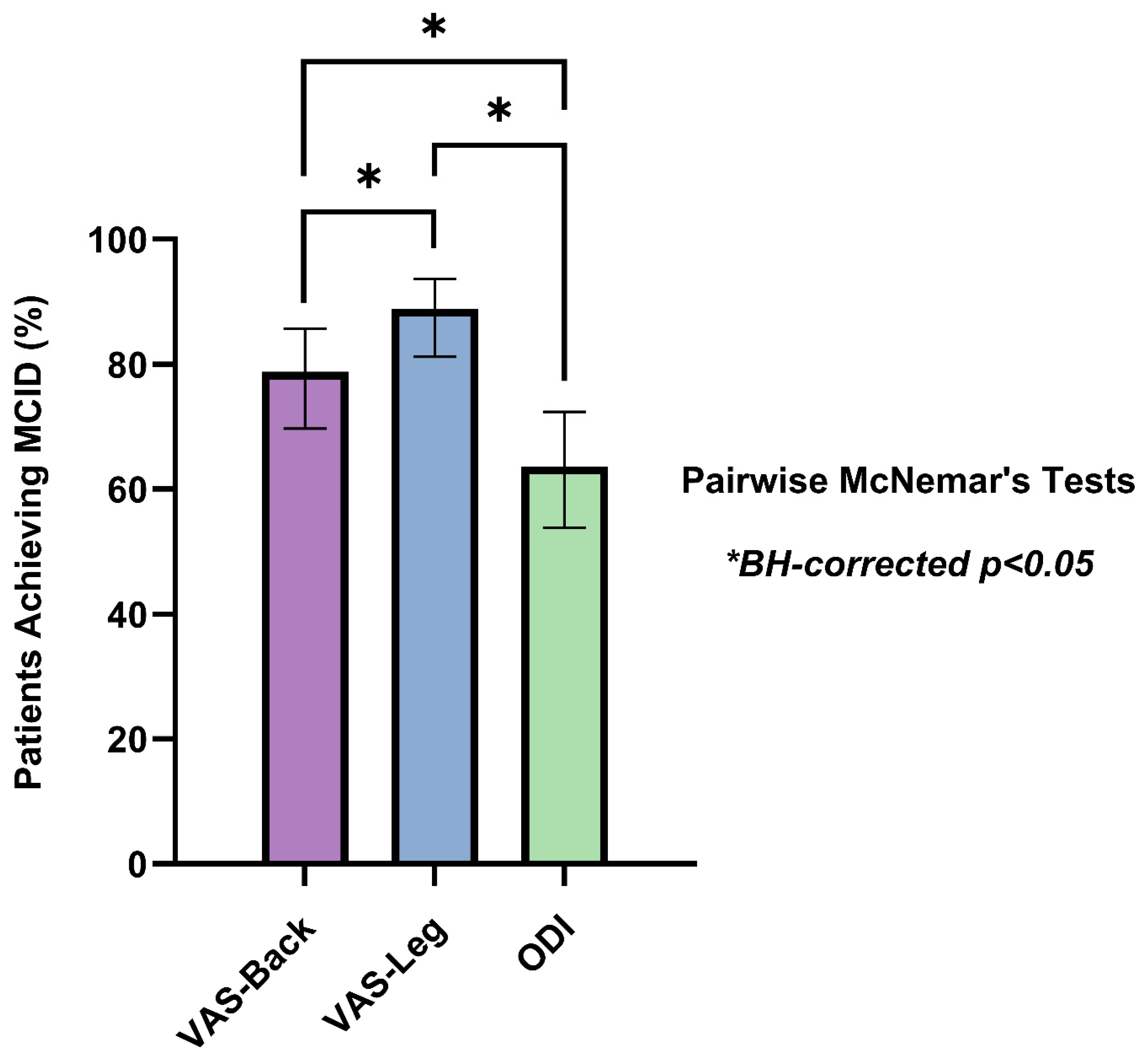
Regarding PROMs, early significant improvements were observed across all domains measured. VAS-back improved from 6.1 ± 2.8 preoperatively to 2.0 ± 2.1 postoperatively (p < 0.001), with 85.9% of patients demonstrating improvement and 78.8% achieving MCID (Table 2; Figure 3). VAS-leg improved from 6.9 ± 2.4 to 1.4 ± 2.1 (p < 0.001), with 92.9% of patients demonstrating improvement and 88.9% achieving MCID. ODI improved from 42.9 ± 18.6 to 21.5 ± 15.1 (p < 0.001), with 78.8% demonstrating improvement and 63.6% achieving MCID (Table 2). Early MCID achievement differed significantly across PROMs (Cochran’s Q = 21.111, p < 0.001), and pairwise McNemar’s testing showed higher MCID achievement rates for VAS-leg compared with VAS-back (p = 0.041; corrected p = 0.041) and ODI (p < 0.001; corrected p = 0.003), and for VAS-back compared with ODI (p = 0.028; corrected p = 0.041) (Figure 4).
Figure 3.
Preoperative and postoperative PROM scores of visual analog scale (VAS)-back, VAS-leg, and Oswestry Disability Index (ODI) at six-week follow-up after biportal endoscopic decompression for LSS. Error bars represent standard deviations. All comparisons were statistically significant (*** p < 0.001).
Figure 4.
Minimal clinically important difference (MCID) achievement percentages across PROMs for visual analog scale (VAS)-back, VAS-leg, and Oswestry Disability Index (ODI) at six weeks postoperatively following biportal endoscopic decompression for LSS. Error bars represent 95% confidence intervals. Pairwise McNemar’s tests with Benjamini–Hochberg (BH) correction showed significant differences between all groups (* p < 0.05).
Best-case and worst-case sensitivity analyses were additionally performed to evaluate the potential influence of missing six-week PROM data on MCID achievement. All 57 patients excluded from the primary analyses during cohort refinement exclusion steps 5 and 6 were included in these sensitivity analyses, as each lacked at least one required variable for the planned PROM- and other outcome-related investigations (although some retained complete preoperative and six-week postoperative paired measurements for select, individual PROMs). Across the summated 156 patients evaluated, estimated MCID achievement ranged from 60.3% to 83.3% for VAS-back, 67.3% to 90.4% for VAS-leg, and 46.2% to 71.8% for ODI under worst-case and best-case assumptions, respectively.
3.4. PROM-MCID Exploratory Multivariable Logistic Regressions
Preliminary bivariate screening identified preoperative VAS-back, erector spinae block given, and operative time as candidate variables associated with achieving VAS-back-MCID (p < 0.250). In the exploratory multivariable model, only preoperative VAS-back reached and maintained significance following Benjamini–Hochberg multiplicity correction (OR = 1.810; p < 0.001; corrected p = 0.003; Table 3). Regression model fit was deemed adequate here (Hosmer–Lemeshow χ2 = 11.234, degrees-of-freedom = 8, p = 0.189).
Table 3.
Exploratory multivariable logistic regression results for associations between postoperative patient-reported outcome measure (PROM) and minimal clinically important difference (MCID) achievement in visual analog scale (VAS)-back and Oswestry Disability Index (ODI). Corrected p-values < 0.05 are bolded to exemplify significance.
Lastly, regarding ODI-MCID, preliminary bivariate analysis identified preoperative ODI, BMI, and male sex as candidate variables. All three remaining variables of preoperative ODI (OR = 1.183; p < 0.001; corrected p = 0.003; Table 3), BMI (OR = 0.859; p = 0.020; corrected p = 0.030), and male sex (OR = 4.727; p = 0.022; corrected p = 0.030) showed significant associations in the multivariable model and following multiplicity correction. Hosmer–Lemeshow testing here also helped to determine that model calibration was adequate (χ2 = 6.731, degrees-of-freedom = 8, p = 0.566). A complete visualization of the aforementioned results in this sub-section is provided in Table 3.
3.5. Subgroup Analysis of Postoperative Radiculitis and MCID Achievement
An exploratory subgroup analysis was performed comparing patients with postoperative radiculitis (n = 23) versus those without (n = 76; Table 4). Patients with postoperative radiculitis were significantly older (73.8 ± 6.1 versus 68.9 ± 10.6 years, p = 0.007), while preoperative VAS-back, VAS-leg, and ODI scores did not differ significantly between groups. At six weeks, patients with postoperative radiculitis demonstrated significantly higher VAS-leg scores (2.6 ± 2.7 versus 1.1 ± 1.8, p = 0.017) and ODI scores (28.0 ± 18.4 versus 19.5 ± 13.5, p = 0.048), while VAS-back scores did not differ significantly (2.5 ± 2.5 versus 1.8 ± 1.9, p = 0.228). MCID achievement rates for VAS-back (82.6% versus 77.6%, p = 0.774) and VAS-leg (82.6% versus 90.8%, p = 0.275) were similar between groups. However, patients with postoperative radiculitis demonstrated lower ODI-MCID achievement (43.5% versus 69.7%, p = 0.022). All patients with postoperative radiculitis were prescribed a Medrol Dosepak, precluding differentiation of the independent associations of radiculitis and corticosteroid treatment with early outcomes.
Table 4.
Baseline characteristics, preoperative and six-week postoperative patient-reported outcome measures (PROMs), and minimal clinically important difference (MCID) achievement according to postoperative radiculitis status. Values are presented as mean (SD) or N (%). BMI, body mass index; ODI, Oswestry Disability Index; VAS, visual analog scale.
4. Discussion
The present study evaluated early (six-week) PROM- and MCID-related outcomes following biportal endoscopic decompression without fusion for LSS-only indications, identifying significant pre-to-postoperative improvements across VAS-back, VAS-leg, and ODI domains. Encouragingly, relatively high rates of early MCID achievement were observed across VAS-back (78.8%; sensitivity range = [60.3–83.3%]), VAS-leg (88.9%; sensitivity range = [67.3–90.4%]), and ODI (63.6%; sensitivity range = [46.2–71.8%]), indicating that a substantial proportion of patients achieved clinically meaningful improvement by six weeks postoperatively, consistent with our hypothesis pertaining to this unique minimally invasive approach. Prior literature on non-endoscopic decompression has similarly reported meaningful PROM improvements as early as three months postoperatively, with mean reductions of approximately 4 points in VAS-leg and 2.6 points in VAS-back [29]. Comparative studies examining biportal endoscopic and microscopic decompression have additionally demonstrated significant postoperative improvements in pain and disability [30,31]. Despite these findings, differences in patient populations, surgical techniques, and follow-up intervals preclude direct conclusions regarding the relative effectiveness or speed of recovery associated with biportal endoscopic decompression. Future comparative studies, such as those evaluating open versus endoscopic approaches, are needed to further elucidate differences in clinical outcomes and postoperative recovery.
More specifically, the present study’s MCID-related findings can be further contextualized within the relevant literature. In the non-endoscopic lumbar decompression study by Nie et al. (2023), MCID values of 2.1 for VAS-back, 2.8 for VAS-leg, and 14.9 for ODI were utilized, with achievement rates of 16.0%, 14.3%, and 10.5% within 12 weeks, respectively [11]. Similarly, a national registry analysis of more than 8,000 patients undergoing non-endoscopic surgery for LSS reported that approximately 55–69% achieved ODI-MCID and 59–60% achieved MCID for back or leg pain at 12-month follow-up [32]. Within the endoscopic literature, Leyendecker et al. (2024) evaluated uniportal endoscopic lumbar decompressions and discectomies at the 12-week timepoint using relatively lower MCID thresholds (VAS-back ≥1.2; VAS-leg ≥1.6; ODI improvement ≥30%) and reported MCID achievement rates of 44.8–59.3% for VAS-back, 55.9–72.8% for VAS-leg, and 56.6–58.0% for ODI [14]. These studies demonstrate variability in reported MCID achievement across lumbar decompression approaches and follow-up intervals, providing additional context for the early improvements observed presently. Our findings should therefore be interpreted as evidence of early clinically meaningful improvement following biportal endoscopic decompression rather than comparative superiority or accelerated recovery relative to other surgical approaches.
Consistent with patterns reported in both prior endoscopic and non-endoscopic literature, the present analysis demonstrated significant differences in PROM-MCID achievement rates, with VAS-leg achieving the highest rate, followed by VAS-back and ODI at the six-week postoperative timepoint. Clinically, this finding suggests that radicular leg pain may be particularly responsive to biportal endoscopic decompression, plausibly reflecting direct neural decompression. In contrast, early improvements in axial back pain and functional disability may be influenced by additional factors, including postoperative rehabilitation and baseline physical conditioning [33]. However, differences in MCID achievement across PROM domains may also reflect variations in baseline symptom severity and MCID thresholds, and a single postoperative assessment cannot establish distinct temporal recovery trajectories.
In addition to evaluating early MCID achievement, exploratory multivariable regression analyses identified associations between baseline symptom severity and postoperative outcomes, with higher preoperative VAS-back and ODI scores associated with increased odds of achieving their respective MCIDs. However, these findings should be interpreted in the context of the absolute change thresholds used to define MCIDs, as patients with lower baseline symptom scores have inherently less opportunity to achieve a predetermined magnitude of improvement [34,35]. These associations may partly reflect mathematical constraints and regression to the mean rather than independent prognostic relationships. Thus, MCID achievement should be considered alongside baseline symptom severity and residual postoperative symptom burden when evaluating early recovery and counseling patients regarding postoperative expectations.
Beyond baseline PROM severity, increasing BMI was associated with lower odds of ODI-MCID achievement, while male sex was associated with greater odds in the exploratory multivariable model. Prior literature has similarly associated obesity with reduced ODI-MCID achievement following lumbar decompression, while sex-related differences in postoperative ODI scores and MCID achievement have also been reported following minimally invasive lumbar decompression [36,37]. However, these findings remain exploratory given the limited sample size, potential for residual confounding, and uncertainty surrounding the effect estimates, as evidenced by the particularly wide confidence interval associated with male sex. Larger studies with more comprehensive adjustment for potential confounders are warranted to determine whether these associations persist.
Of particular note, postoperative radiculitis was observed in 23.2% of the present cohort, falling within the previously reported, literature-backed 5.1–36.2% range following lumbar decompression and/or fusion [15]. Importantly, radiculitis was actively assessed during postoperative follow-up, potentially increasing its detection relative to studies relying on patient-initiated reporting only. In the exploratory subgroup analysis, patients with postoperative radiculitis demonstrated higher six-week VAS-leg and ODI scores and lower ODI-MCID achievement compared with those without radiculitis, while VAS-back scores and MCID achievement for VAS-back and VAS-leg did not differ significantly between groups. These findings suggest that postoperative radiculitis may be associated with reduced perception and transformation in early functional improvement, though the observational nature of the present analysis precludes causal inference. Additionally, the interpretation of these findings is further limited by the small radiculitis subgroup and the complete overlap between postoperative radiculitis and Medrol Dosepak administration, precluding differentiation of their potential associations with early postoperative outcomes and continued investigation in the present study.
Limitations
This study provides insights into early MCID achievement following biportal endoscopic decompression without fusion for LSS; however, several limitations warrant consideration. First, the retrospective, single-surgeon, single-center design may limit generalizability and introduce selection bias and unmeasured confounding. Although comparisons between included and excluded patients and best-case/worst-case sensitivity analyses were performed, residual selection bias remains possible, particularly given differences in baseline symptom severity and uncertainty surrounding missing postoperative outcomes. Documentation variability and incomplete capture of complications, particularly those occurring outside the treating institution or follow-up period, also remain possible despite efforts to ensure comprehensive data collection.
Second, the relatively small sample size and limited number of patients not achieving MCID may have restricted statistical power and regression model stability, particularly for VAS-leg, which was excluded from multivariable modeling. Preliminary bivariate screening was employed to limit candidate variables; nevertheless, overfitting remains possible, and associations involving baseline symptom severity, BMI, and sex should be considered exploratory. Furthermore, associations between baseline PROM severity and MCID achievement may partly reflect mathematical constraints inherent to absolute change thresholds. Notably, the high rate of intraoperative tranexamic acid utilization reflects a literature-supported institutional practice aimed at minimizing blood loss; however, TXA was not associated with PROM-MCID achievement on preliminary screening and was therefore excluded from subsequent analyses [38,39]. The exploratory postoperative radiculitis subgroup analysis was additionally limited by its small sample size, potential baseline differences, and concurrent Medrol Dosepak treatment, precluding evaluation of independent associations here. The absence of standardized symptom severity scores and precise symptom durations further limited characterization of postoperative radiculitis, which has generally been described as a transient, self-limited condition in the existing literature [15].
Third, the six-week follow-up was intentionally selected to characterize early postoperative improvement, consistent with prior lumbar decompression studies demonstrating measurable changes in pain and functional outcomes at this interval [18,40]. While prior studies have reported substantial early PROM improvements, with MCID achievement rates approaching 90% by approximately eight weeks, achievement at six weeks may not reflect sustained clinical benefit or long-term recovery [16,35,41]. Additionally, the MCID thresholds utilized were derived from prior lumbar decompression literature rather than independently validated in the present biportal endoscopic cohort. As achievement rates may vary according to the selected thresholds, future studies should establish procedure-specific benchmarks using larger cohorts.
Finally, comparisons with existing literature are limited by heterogeneous surgical procedures, including decompressions with or without fusion and discectomies, as well as differing pathologies, such as LSS with or without disc herniation. The absence of a contemporaneous comparator group further precludes conclusions regarding the relative effectiveness or speed of recovery following biportal endoscopic decompression compared with uniportal endoscopic or non-endoscopic approaches. Nonetheless, the present study contributes additional evidence regarding six-week clinically meaningful improvement following biportal endoscopic decompression for LSS. Future prospective studies incorporating larger cohorts, comparator groups, MCID derivations, and multi-year follow-up should further characterize recovery trajectories, identify patient-related contributors, establish the timing of PROM plateaus, and examine relationships between MCID achievement and additional outcomes, including patient satisfaction.
5. Conclusions
In this study, early MCID-related outcomes in VAS-back, VAS-leg, and ODI were evaluated following biportal endoscopic decompression without fusion in patients with LSS. All PROMs demonstrated significant pre-to-postoperative improvements, with relatively high MCID achievement rates and sensitivity ranges at six weeks. VAS-leg demonstrated the highest MCID achievement rate, followed by VAS-back and ODI, reflecting differences across PROM domains at this early postoperative timepoint rather than establishing a temporal sequence of recovery. Exploratory multivariable analyses identified associations between baseline PROM severity and MCID achievement for VAS-back and ODI; however, these findings may partly reflect mathematical constraints inherent to absolute change thresholds. Interestingly, higher BMI was associated with decreased odds of ODI-MCID achievement, while male sex was associated with increased odds, but such associations warrant cautious interpretation given the limited sample size and statistical constraints. Exploratory subgroup analysis also demonstrated lower six-week ODI-MCID achievement among patients with postoperative radiculitis, though these findings remain subject to potential confounding. Nonetheless, the present study provides additional evidence of early clinically meaningful improvement following biportal endoscopic decompression for LSS that may help inform patient counseling and postoperative expectation-setting. Future prospective studies incorporating larger samples, MCID derivations, comparator groups, and longer-term follow-up are warranted to evaluate the durability of improvement and further characterize postoperative recovery.
Declaration of Generative AI and AI-Assisted Technologies
During the composition of this research, the authors used Grammarly AI (Version 14.1347.0) and ChatGPT (GPT-6, OpenAI) to enhance conciseness and meet structural limitations while preserving the intended syntax, flow, diction, and, most importantly, content. Following the utilization of these tools, the authors comprehensively reviewed and subsequently revised the work as deemed necessary, allowing them to take complete responsibility for the published content.
Supplementary Materials
The following supporting information can be downloaded at: https://www.mdpi.com/article/10.3390/jcm15228873/s1, Supplemental Table S1. Cohort refinement process according to sequential eligibility and data-completeness criteria. VAS, visual analog scale; ODI, Oswestry Disability Index; Supplemental Table S2. Baseline and clinical characteristics of included and excluded patients. Values are presented as mean (SD) or N (%) unless otherwise indicated. The excluded group comprises 23 patients removed for incomplete perioperative data and 34 removed for incomplete paired six-week PROM data after clinical eligibility exclusions. Sample size and percentage reporting for preoperative and six-week postoperative PROM scores varied according to data availability. MCID achievement was calculated only among patients with available paired preoperative and six-week postoperative PROM scores; missing outcomes were not classified as MCID non-achievement in these comparisons. mFI-5, 5-item Modified Frailty Index; VAS, visual analog scale; ODI, Oswestry Disability Index; PROM, patient-reported outcome measure.
Author Contributions
S.Y.: conceptualization, data curation, formal analysis, investigation, methodology, visualization, writing—original draft, writing—review and editing. H.-J.E.H.: conceptualization, data curation, formal analysis, investigation, methodology, visualization, writing—original draft, writing—review and editing. C.G.: investigation, data curation, formal analysis, writing—original draft, writing—review and editing. J.D.: investigation, methodology, visualization, writing—original draft, writing—review and editing. R.L.: formal analysis, investigation, methodology, visualization, writing—original draft, writing—review and editing. A.H.: investigation, data curation, formal analysis, writing—original draft, writing—review and editing. A.B.: investigation, data curation, formal analysis, writing—original draft, writing—review and editing. S.B.: formal analysis, investigation, methodology, validation, writing—review and editing. V.C.: writing—reviewing and editing, resources, visualization, supervision, project administration. N.N.B.: writing—reviewing and editing, resources, visualization, supervision, project administration. Y.-P.L.: writing—reviewing and editing, resources, visualization, supervision, project administration. E.S.M.: writing—reviewing and editing, resources, visualization, supervision, project administration. H.-H.W.: writing—reviewing and editing, resources, visualization, supervision, project administration. S.Z.H.: writing—reviewing and editing, resources, visualization, supervision, project administration. D.Y.P.: conceptualization, investigation, methodology, writing—reviewing and editing, resources, visualization, supervision, project administration. All authors have read and agreed to the published version of the manuscript.
Funding
This research received no external funding.
Institutional Review Board Statement
This study analyzed prospectively collected data under an IRB-approved protocol for the evaluation of outcomes following endoscopic spine surgery (IRB protocol #5073, 2 October 2024).
Informed Consent Statement
Informed consent was obtained from all subjects involved in the study.
Data Availability Statement
The data supporting the findings of this study are not publicly available due to patient privacy and confidentiality restrictions.
Acknowledgments
The authors have no additional acknowledgements to declare. During the composition of this research, the authors used Grammarly AI (Version 14.1347.0) and ChatGPT (GPT-6, OpenAI) to enhance conciseness and meet structural limitations while preserving the intended syntax, flow, diction, and, most importantly, content. Following the utilization of these tools, the authors comprehensively reviewed and subsequently revised the work as deemed necessary, allowing them to take complete responsibility for the published content.
Conflicts of Interest
The authors declare no conflicts of interest.
References
- Chung, A.S.; Copay, A.G.; Olmscheid, N.; Campbell, D.; Walker, J.B.; Chutkan, N. Minimum Clinically Important Difference: Current Trends in the Spine Literature. Spine 2017, 42, 1096–1105. [Google Scholar] [CrossRef] [Scilit] [PubMed]
- Deyo, R.A.; Mirza, S.K.; Martin, B.I.; Kreuter, W.; Goodman, D.C.; Jarvik, J.G. Trends, major medical complications, and charges associated with surgery for lumbar spinal stenosis in older adults. JAMA 2010, 303, 1259–1265. [Google Scholar] [CrossRef] [Scilit] [PubMed]
- Ishimoto, Y.; Yoshimura, N.; Muraki, S.; Yamada, H.; Nagata, K.; Hashizume, H.; Takiguchi, N.; Minamide, A.; Oka, H.; Kawaguchi, H.; et al. Prevalence of symptomatic lumbar spinal stenosis and its association with physical performance in a population-based cohort in Japan: The Wakayama Spine Study. Osteoarthr. Cartil. 2012, 20, 1103–1108. [Google Scholar] [CrossRef] [Scilit] [PubMed]
- Weinstein, J.N.; Lurie, J.D.; Olson, P.R.; Bronner, K.K.; Fisher, E.S. United States’ trends and regional variations in lumbar spine surgery: 1992-2003. Spine 2006, 31, 2707–2714. [Google Scholar] [CrossRef] [Scilit] [PubMed]
- Weinstein, J.N.; Tosteson, T.D.; Lurie, J.D.; Tosteson, A.; Blood, E.; Herkowitz, H.; Cammisa, F.; Albert, T.; Boden, S.D.; Hilibrand, A.; et al. Surgical versus nonoperative treatment for lumbar spinal stenosis four-year results of the Spine Patient Outcomes Research Trial. Spine 2010, 35, 1329–1338. [Google Scholar] [CrossRef] [Scilit] [PubMed]
- Lewandrowski, K.U.; Yeung, A.; Lorio, M.P.; Yang, H.; Ramírez León, J.F.; Sánchez, J.A.S.; Fiorelli, R.K.A.; Lim, K.T.; Moyano, J.; Dowling, A. Personalized Interventional Surgery of the Lumbar Spine: A Perspective on Minimally Invasive and Neuroendoscopic Decompression for Spinal Stenosis. J. Pers. Med. 2023, 13, 710. [Google Scholar] [CrossRef] [Scilit] [PubMed]
- Phan, K.; Mobbs, R.J. Minimally Invasive Versus Open Laminectomy for Lumbar Stenosis: A Systematic Review and Meta-Analysis. Spine 2016, 41, E91–E100. [Google Scholar] [CrossRef] [Scilit] [PubMed]
- Thomé, C.; Zevgaridis, D.; Leheta, O.; Bäzner, H.; Pöckler-Schöniger, C.; Wöhrle, J.; Schmiedek, P. Outcome after less-invasive decompression of lumbar spinal stenosis: A randomized comparison of unilateral laminotomy, bilateral laminotomy, and laminectomy. J. Neurosurg. Spine 2005, 3, 129–141. [Google Scholar] [CrossRef] [Scilit] [PubMed]
- McGrath, L.B.; White-Dzuro, G.A.; Hofstetter, C.P. Comparison of clinical outcomes following minimally invasive or lumbar endoscopic unilateral laminotomy for bilateral decompression. J. Neurosurg. Spine 2019, 30, 491–499. [Google Scholar] [CrossRef] [Scilit] [PubMed]
- Kaen, A.; Park, M.K.; Son, S.K. Clinical outcomes of uniportal compared with biportal endoscopic decompression for the treatment of lumbar spinal stenosis: A systematic review and meta-analysis. Eur. Spine J. 2023, 32, 2717–2725. [Google Scholar] [CrossRef] [Scilit] [PubMed]
- Nie, J.W.; Federico, V.P.; Hartman, T.J.; Zheng, E.; Oyetayo, O.O.; MacGregor, K.R.; Massel, D.H.; Sayari, A.J.; Singh, K. Time to achievement of minimum clinically important difference after lumbar decompression. Acta Neurochir. 2023, 165, 2625–2631. [Google Scholar] [CrossRef] [Scilit] [PubMed]
- Parker, S.L.; Mendenhall, S.K.; Shau, D.N.; Adogwa, O.; Anderson, W.N.; Devin, C.J.; McGirt, M.J. Minimum clinically important difference in pain, disability, and quality of life after neural decompression and fusion for same-level recurrent lumbar stenosis: Understanding clinical versus statistical significance. J. Neurosurg. Spine 2012, 16, 471–478. [Google Scholar] [CrossRef] [Scilit] [PubMed]
- Sunderland, G.; Foster, M.; Dheerendra, S.; Pillay, R. Patient-Reported Outcomes Following Lumbar Decompression Surgery: A Review of 2699 Cases. Glob. Spine J. 2021, 11, 172–179. [Google Scholar] [CrossRef] [Scilit] [PubMed]
- Leyendecker, J.; Prasse, T.; Rückels, P.; Köster, M.; Rumswinkel, L.; Schunk, V.; Marossa, I.; Eysel, P.; Bredow, J.; Hofstetter, C.P.; et al. Full-endoscopic spine-surgery in the elderly and patients with comorbidities. Sci. Rep. 2024, 14, 29188. [Google Scholar] [CrossRef] [Scilit] [PubMed]
- Goldman, S.N.; Xavier, J.; Rothchild, E.; Song, H.; Hui, A.T.; Parker-Fong, K.; Schwartz, R.; Schlumprecht, A.; Akioyamen, N.O.; Gelfand, Y.; et al. Establishing a Common Term and Definition for Non-Structural Postoperative Radicular Pain Following Lumbar Decompression: A Scoping Review. HSS J. 2025, 21, 211–221. [Google Scholar] [CrossRef] [Scilit]
- Calek, A.K.; Hochreiter, B.; Buckland, A.J. Reassessing the minimum 2-year follow-up standard after lumbar decompression surgery: A 2-month follow-up seems to be an acceptable minimum. Spine J. 2024, 24, 1244–1252. [Google Scholar] [CrossRef] [Scilit] [PubMed]
- Parker, S.L.; Asher, A.L.; Godil, S.S.; Devin, C.J.; McGirt, M.J. Patient-reported outcomes 3 months after spine surgery: Is it an accurate predictor of 12-month outcome in real-world registry platforms? Neurosurg. Focus. 2015, 39, E17. [Google Scholar] [CrossRef] [Scilit] [PubMed]
- Wolf, J.C.; Kaul, A.; Anwar, F.N.; Roca, A.M.; Khosla, I.; Loya, A.C.; Medakkar, S.S.; Federico, V.P.; Sayari, A.J.; Lopez, G.D.; et al. Do Six-Week Postoperative Patient-Reported Outcomes Predict Long-Term Clinical Outcomes Following Lumbar Decompression? World Neurosurg. 2024, 185, e900–e906. [Google Scholar] [CrossRef] [Scilit] [PubMed]
- Nakarai, H.; Kato, S.; Kawamura, N.; Higashikawa, A.; Takeshita, Y.; Fukushima, M.; Ono, T.; Hara, N.; Azuma, S.; Tanaka, S.; et al. Minimal clinically important difference in patients who underwent decompression alone for lumbar degenerative disease. Spine J. 2022, 22, 549–560. [Google Scholar] [CrossRef] [Scilit] [PubMed]
- Cha, E.D.K.; Lynch, C.P.; Geoghegan, C.E.; Jadczak, C.N.; Mohan, S.; Singh, K. Risk Factors for Failing to Reach a Minimal Clinically Important Difference Following Minimally Invasive Lumbar Decompression. Int. J. Spine Surg. 2022, 16, 51–61. [Google Scholar] [CrossRef] [Scilit] [PubMed]
- Lewandrowski, K.U.; De Carvalho, P.S.T.; De Carvalho, P., Jr.; Yeung, A. Minimal Clinically Important Difference in Patient-Reported Outcome Measures with the Transforaminal Endoscopic Decompression for Lateral Recess and Foraminal Stenosis. Int. J. Spine Surg. 2020, 14, 254–266. [Google Scholar] [CrossRef] [Scilit] [PubMed]
- Massel, D.H.; Mayo, B.C.; Patel, D.V.; Bohl, D.D.; Louie, P.K.; Lopez, G.D.; Singh, K. Improvements in Back and Leg Pain After Minimally Invasive Lumbar Decompression. HSS J. 2020, 16, 62–71. [Google Scholar] [CrossRef] [Scilit] [PubMed]
- Park, D.Y.; Olson, T.E.; Upfill-Brown, A.; Adejuyigbe, B.; Shah, A.A.; Sheppard, W.L.; Park, C.W.; Heo, D.H. Biportal Endoscopic Approach for Lumbar Degenerative Disease in the Ambulatory Outpatient vs Inpatient Setting: A Comparative Study. Int. J. Spine Surg. 2023, 17, 858–865. [Google Scholar] [CrossRef] [Scilit] [PubMed]
- Copay, A.G.; Glassman, S.D.; Subach, B.R.; Berven, S.; Schuler, T.C.; Carreon, L.Y. Minimum clinically important difference in lumbar spine surgery patients: A choice of methods using the Oswestry Disability Index, Medical Outcomes Study questionnaire Short Form 36, and pain scales. Spine J. 2008, 8, 968–974. [Google Scholar] [CrossRef] [Scilit] [PubMed]
- Bursac, Z.; Gauss, C.H.; Williams, D.K.; Hosmer, D.W. Purposeful selection of variables in logistic regression. Source Code Biol. Med. 2008, 3, 17. [Google Scholar] [CrossRef] [Scilit] [PubMed]
- Vittinghoff, E.; McCulloch, C.E. Relaxing the rule of ten events per variable in logistic and Cox regression. Am. J. Epidemiol. 2007, 165, 710–718. [Google Scholar] [CrossRef] [Scilit] [PubMed]
- Peduzzi, P.; Concato, J.; Kemper, E.; Holford, T.R.; Feinstein, A.R. A simulation study of the number of events per variable in logistic regression analysis. J. Clin. Epidemiol. 1996, 49, 1373–1379. [Google Scholar] [CrossRef] [Scilit] [PubMed]
- Barghi, A.; Gowd, A.; Beck, E.; Brown, M.; Miller, E.M.; Knio, Z.; Jamison, M.; O’Gara, T. Rates of achieving meaningful outcomes after undergoing minimally-invasive far lateral tubular decompression. BMC Musculoskelet. Disord. 2025, 26, 362. [Google Scholar] [CrossRef] [Scilit] [PubMed]
- Austevoll, I.M.; Hermansen, E.; Fagerland, M.W.; Storheim, K.; Brox, J.I.; Solberg, T.; Rekeland, F.; Franssen, E.; Weber, C.; Brisby, H.; et al. Decompression with or without Fusion in Degenerative Lumbar Spondylolisthesis. N. Engl. J. Med. 2021, 385, 526–538. [Google Scholar] [CrossRef] [Scilit] [PubMed]
- Min, W.K.; Kim, J.E.; Choi, D.J.; Park, E.J.; Heo, J. Clinical and radiological outcomes between biportal endoscopic decompression and microscopic decompression in lumbar spinal stenosis. J. Orthop. Sci. 2020, 25, 371–378. [Google Scholar] [CrossRef] [Scilit] [PubMed]
- Park, S.M.; Park, J.; Jang, H.S.; Heo, Y.W.; Han, H.; Kim, H.J.; Chang, B.S.; Lee, C.K.; Yeom, J.S. Biportal endoscopic versus microscopic lumbar decompressive laminectomy in patients with spinal stenosis: A randomized controlled trial. Spine J. 2020, 20, 156–165. [Google Scholar] [CrossRef] [Scilit] [PubMed]
- Hatakka, J.; Laaksonen, I.; Kostensalo, J.; Mäkelä, K.T.; Salo, H.; Pernaa, K. 1-year results of lumbar spinal stenosis surgery in Finland: A national FinSpine register study. Acta Orthop. 2025, 96, 154–160. [Google Scholar] [CrossRef] [Scilit] [PubMed]
- McGregor, A.H.; Probyn, K.; Cro, S.; Doré, C.J.; Burton, A.K.; Balagué, F.; Pincus, T.; Fairbank, J. Rehabilitation following surgery for lumbar spinal stenosis. Cochrane Database Syst. Rev. 2013, 2013, CD009644. [Google Scholar] [CrossRef] [Scilit] [PubMed]
- Anwar, F.N.; Roca, A.M.; Khosla, I.; Loya, A.C.; Medakkar, S.S.; Kaul, A.; Wolf, J.C.; Federico, V.P.; Sayari, A.J.; Lopez, G.D.; et al. Impact of preoperative back pain severity on PROMIS outcomes following minimally invasive lumbar decompression. Eur. Spine J. 2024, 33, 4262–4269. [Google Scholar] [CrossRef] [Scilit] [PubMed]
- Omran, K.; Schwarzkopf, R. How Should We Define Meaningful Improvement? A Commentary on Minimal Clinically Important Difference Assessment for Hip Disability and Osteoarthritis Outcome Score for Joint Replacement and Knee Injury and Osteoarthritis Outcome Score for Joint Replacement in Total Joint Arthroplasty. J. Arthroplast. 2025, 40, 545–549. [Google Scholar] [CrossRef] [Scilit] [PubMed]
- Giannadakis, C.; Nerland, U.S.; Solheim, O.; Jakola, A.S.; Gulati, M.; Weber, C.; Nygaard, Ø.P.; Solberg, T.K.; Gulati, S. Does Obesity Affect Outcomes After Decompressive Surgery for Lumbar Spinal Stenosis? A Multicenter, Observational, Registry-Based Study. World Neurosurg. 2015, 84, 1227–1234. [Google Scholar] [CrossRef] [Scilit] [PubMed]
- Nolte, M.T.; Jenkins, N.W.; Parrish, J.M.; Mohan, S.; Geoghegan, C.E.; Jadczak, C.N.; Hrynewycz, N.M.; Singh, K. The Influence of Sex on Clinical Outcomes in Minimally Invasive Lumbar Decompression. Int. J. Spine Surg. 2021, 15, 763–769. [Google Scholar] [CrossRef] [Scilit] [PubMed]
- Lotan, R.; Lengenova, S.; Rijini, N.; Hershkovich, O. Intravenous Tranexamic Acid Reduces Blood Loss in Multilevel Spine Surgeries. J. AM. Acad. Orthop. Surg. 2023, 31, e226–e230. [Google Scholar] [CrossRef] [Scilit] [PubMed]
- Yang, B.; Li, H.; Wang, D.; He, X.; Zhang, C.; Yang, P. Systematic review and meta-analysis of perioperative intravenous tranexamic acid use in spinal surgery. PLoS ONE 2013, 8, e55436. [Google Scholar] [CrossRef] [Scilit] [PubMed]
- Olson, T.E.; Upfill-Brown, A.; Adejuyigbe, B.; Bhatia, N.; Lee, Y.P.; Hashmi, S.; Wu, H.H.; Bow, H.; Park, C.W.; Heo, D.H.; et al. Does obesity and varying body mass index affect the clinical outcomes and safety of biportal endoscopic lumbar decompression? A comparative cohort study. Acta Neurochir. 2024, 166, 246. [Google Scholar] [CrossRef] [Scilit] [PubMed]
- Katz, J.N.; Zimmerman, Z.E.; Mass, H.; Makhni, M.C. Diagnosis and Management of Lumbar Spinal Stenosis: A Review. JAMA 2022, 327, 1688–1699. [Google Scholar] [CrossRef] [Scilit] [PubMed]

Disclaimer/Publisher’s Note: The statements, opinions and data contained in all publications are solely those of the individual author(s) and contributor(s) and not of MDPI and/or the editor(s). MDPI and/or the editor(s) disclaim responsibility for any injury to people or property resulting from any ideas, methods, instructions or products referred to in the content. |
© 2026 by the authors. Licensee MDPI, Basel, Switzerland. This article is an open access article distributed under the terms and conditions of the Creative Commons Attribution (CC BY) license.