


Abstract
Background/Objectives: Prevention of the first diabetic foot ulcer and subsequent ulcer recurrence is a key priority in diabetes care. Foot orthoses are used to redistribute plantar pressure and protect high-risk areas; however, their effectiveness in preventing ulceration remains uncertain. This systematic review aimed to evaluate the effectiveness of foot orthoses in modifying plantar pressure and preventing first or recurrent diabetic foot ulcers. Methods: A systematic review was conducted following the Preferred Reporting Items for Systematic Reviews and Meta-Analyses (PRISMA) methodology. PubMed, Web of Science, and Embase were searched. Studies were selected according to predefined eligibility criteria related to publication type, language, patient characteristics, and the use of foot orthoses. Methodological quality and risk of bias were assessed using Joanna Briggs Institute critical appraisal tools. Results: The search identified 963 records. After screening and full-text assessment, 12 articles met the inclusion criteria; one additional article was identified and included subsequently, resulting in 13 studies. Overall, foot orthoses reduced plantar pressure, particularly beneath the metatarsal heads. However, the available evidence directly assessing the prevention of first or recurrent diabetic foot ulceration was limited. Conclusions: Foot orthoses may contribute to diabetic foot ulcer prevention by reducing plantar pressure in high-risk areas. Nevertheless, further well-designed longitudinal studies are needed to determine whether these biomechanical improvements translate into a reduction in ulcer incidence and recurrence.
1. Introduction
The development of a diabetic foot ulcer (DFU) can lead to lower limb amputation, with risk increasing when diabetic neuropathy coexists with peripheral vascular disease [1]. The 5-year mortality rate following diabetic foot amputation also exceeds that of several cancers, including prostate and breast cancer [2]. This condition produces substantial direct costs related to healthcare, hospitalisation and surgery, as well as indirect costs, because patients with lesions experience reduced productivity and diminished quality of life [3]. Prevention strategies and multidisciplinary management are essential to limit expenditure and major complications [4]. Through comprehensive foot care, therapeutic footwear, pressure control and temperature monitoring, the incidence of DFUs could be reduced by 75% [5,6].
Risk factors for the development and recurrence of DFUs include male sex, smoking history, living alone, history of plantar ulcer, diabetic retinopathy, diabetic nephropathy, diabetic peripheral neuropathy, foot deformity and peripheral arterial disease [4]. Although DFUs have multifactorial aetiology, deformity from motor neuropathy exposes specific regions of the foot to elevated plantar pressure, notably the metatarsal heads and toes, increasing ulcer susceptibility [7,8,9]. Lobmann et al. [10] demonstrated an association between neuropathy severity and increased pressures.
Non-enzymatic glycosylation of structural proteins such as collagen reduces elasticity in joint capsules, ligaments and tendons, limiting joint range of motion, particularly at the ankle, and promoting higher plantar pressure [11,12]. These pressures damage blood vessels, limit nutrient supply and produce tissue ischaemia, culminating in ulceration [13]. When assessing pressure between foot and footwear, a maximum threshold of 200 kPa is considered indicative of increased ulceration risk, although some patients ulcerate below this threshold [14,15]. At the foot–ground interface, pressures >700 kPa show high specificity and sensitivity in identifying individuals who are at greatest risk [16], although Veves et al. [17] reported even higher predictive values (1026 kPa). Given the central role of plantar pressure in ulcer pathogenesis, its assessment is essential, particularly in patients with diabetes and previous lesions, with emphasis on reducing both pressure magnitude and exposure time [18,19].
Therapeutic footwear and foot orthoses are used to prevent ulceration or re-ulceration by reducing high pressures on vulnerable areas [20]. To be effective, these devices must achieve either a 30% reduction in plantar pressure relative to barefoot or footwear-only conditions or a maximum pressure <200 kPa [21]. Ulbrecht et al. [22] demonstrated that the use of custom-made orthoses (tailored to the foot’s morphology and guided by its pressure profiles) significantly reduces the recurrence of ulcers in the metatarsal region, showing greater efficacy than standard devices. Elgohary et al. [23] similarly found that foot orthoses reduce maximum plantar pressure and the pressure–time integral in patients with ulcers, indicating substantial benefit for preventing re-ulceration.
The aim of this review is to assess the effectiveness of foot orthoses in modifying plantar pressure and preventing first or recurrent ulceration. Secondarily, we examine the types of orthoses (customised or non-customised), commonly used materials and footwear employed in combination with orthoses for ulcer prevention.
2. Materials and Methods
2.1. Literature Search
This systematic review examined the use of foot orthoses in people with diabetesrelated foot disease, focusing on ulcer development and the modification of plantar pressure, given its role as a key risk factor. Following the Preferred Reporting Items for Systematic Review and Meta-Analysis PRISMA guidelines [24]. The PRISMA 2020 checklist has been included in the Supplementary Materials (Table S1). The review was not registered and any protocol was not prepared. Two research questions were formulated: Are foot orthoses effective in preventing first ulcers or re-ulceration in patients with diabetes-related foot disease? Are foot orthoses effective in reducing plantar pressure and thereby preventing ulcer onset in patients with diabetes-related foot disease? These questions were structured using the PICO format (population, intervention, control and outcomes), as presented in Table 1.
Table 1.
PICO question.
To conduct the review, the PubMed, Embase and Web of Science databases were searched using the terms “foot insoles,” “plantar insoles,” “insol*,” “foot orthoses,” “plantar orthoses,” “orthos*,” “diabetic foot,” “diabet*,” “ulcer” and “wound.” Boolean operators “AND” and “OR” were applied, as outlined in the search strategy shown in Table 2. RefWorks (EndNote fusion) was used as the reference management tool.
Table 2.
Search strategy in the different databases.
2.2. Inclusion and Exclusion Criteria
Articles in Spanish or English were included regardless of publication year. Eligible studies compared two groups of patients with diabetes and neuropathy without ulcerative lesions at baseline, or assessed the same group under different conditions, provided that at least one condition involved orthotics and another did not, independent of footwear type. Studies comparing different models of custom-made shoe insoles or inserts were also included.
The selected studies had to assess pressure reduction immediately after application of the foot orthosis, as well as prospectively in the control group. The occurrence of ulceration was only assessed prospectively.
2.3. Data Abstraction
Two reviewers independently extracted data, summarised in Table 3 (author and year, study type, aim, sample, intervention, study variables and results).
Table 3.
Description of items.
3. Results
3.1. Study Selection
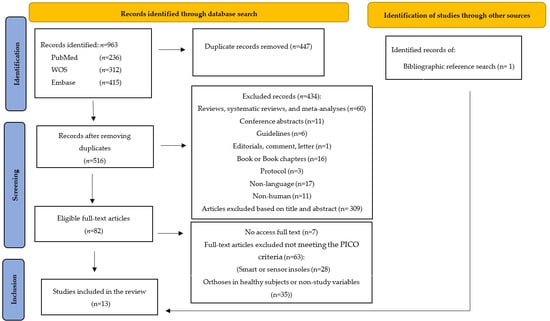
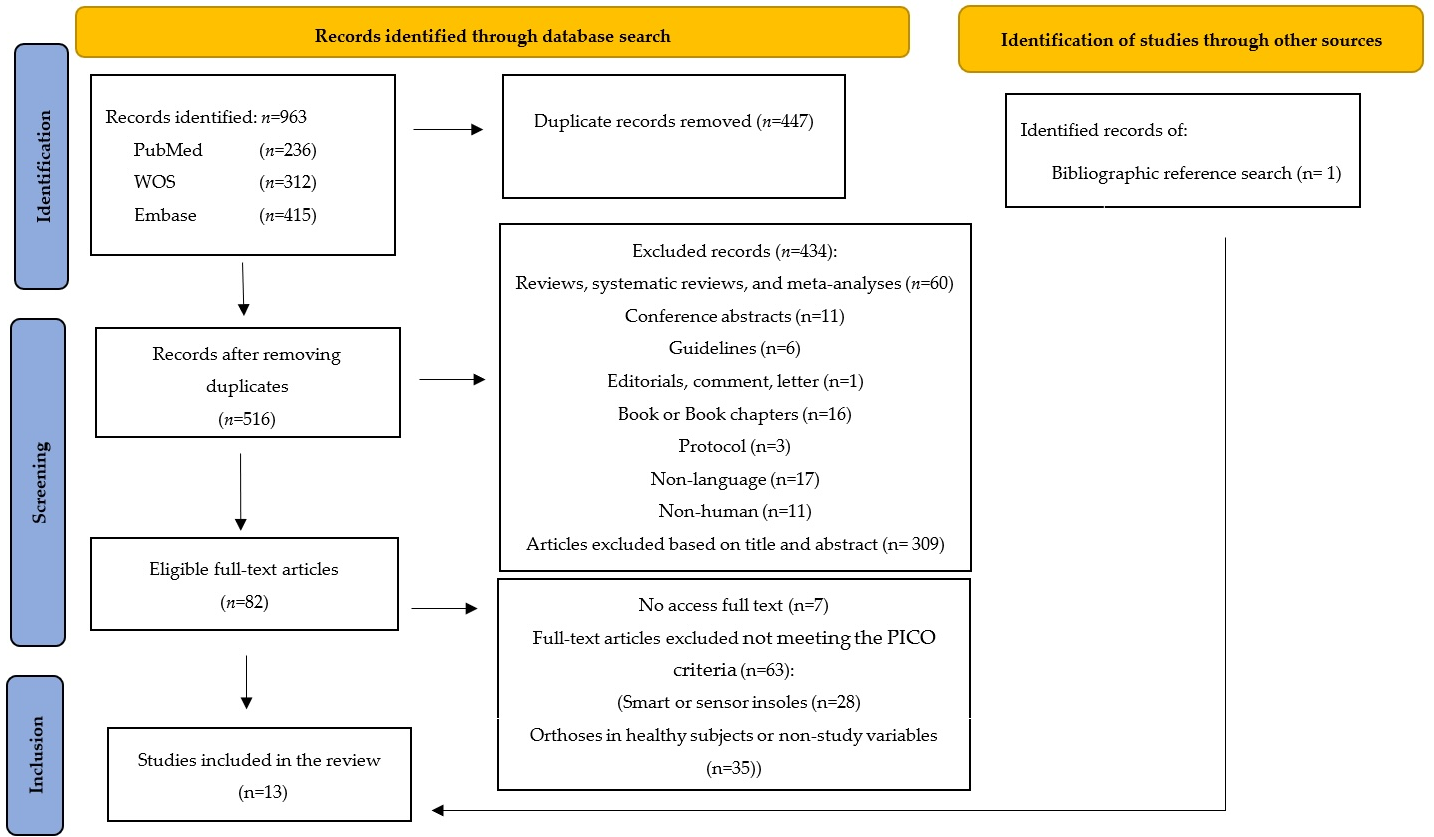
The database search yielded 963 articles. After removing duplicates (n = 447), 516 references were screened. Eleven were excluded for involving animal experimentation, 17 for being written in languages outside the review criteria and 97 for not meeting the required article format (11 conference abstracts, 60 reviews or meta-analyses, 6 guidelines, 1 editorial, 16 book chapters and 3 protocols). Of the remaining 391 articles, title and abstract screening excluded 309, leaving 82 full-text articles for assessment. Of these 82 papers, 7 were excluded because the full text was unavailable and 63 were rejected because they did not meet the PICO criteria. One additional article, identified through reference search, was included. A total of 13 studies were therefore incorporated into this review, as summarised in Figure 1 and Table 3.
Figure 1.
PRISMA flow diagram of the literature search and study selection.
3.2. Study Characteristics
Four studies were >20 years old [27,29,32,34], three were 10–20 years old [25,31,35] and four were <10 years old [26,28,30,33]. Only three studies were published within the last 5 years [33,36,37]. All studies analysed variables related to plantar pressure [25,26,27,28,29,30,31,32,33,34,35,36,37]. Among the thirteen included studies, only two were prospective [29,32], and only Viswanathan et al. [29] assessed ulceration or re-ulceration. Regarding the orthotic devices evaluated, nine studies used customised foot orthoses [25,28,30,31,32,34,35,36,37], whereas four used insoles or non-customised orthoses [26,27,29,33]. Most studies specified the materials used in orthosis manufacture [25,28,29,30,31,32,34,35,36,37], and two evaluated stiffness or cushioning properties [26,32,36,37]. Ten studies incorporated custom-made or therapeutic footwear [25,26,27,28,29,31,32,33,34,35], which provided additional depth to accommodate orthoses appropriately.
3.3. Methodological Quality Assessment
To critically assess the quality of the articles, Joanna Briggs Institute (JBI critical appraisal tool) questionnaires were used. These structured questionnaires assess the internal and external validity of studies to determine whether their findings are reliable, focusing on the methodology, data collection, analysis and bias control [38]. Different questionnaires exist according to study design; for this review, which included repeated measures studies, randomised or otherwise, the appraisal tools for randomised clinical trials [39] and quasi-experimental studies [40] were applied.
Quality was determined by the number of affirmative responses in the appraisal, classifying studies as low quality or at high risk of bias (less than 50% affirmative responses), moderate quality or at moderate risk of bias (50–70% affirmative responses) and high quality or at low risk of bias (>70% affirmative responses) [41].
None of the studies selected for review were excluded based on this assessment. Most received five to seven favourable responses (55–77%), indicating moderate quality [25,26,27,29,31,32,33,34,35], whereas four studies exceeded 70% and were classified as high quality [28,30,36,37].
4. Discussion
The objective of this review was to assess the effectiveness of foot orthoses in modifying plantar pressure and preventing first or recurrent ulceration. Most included studies focused on changes in plantar pressure and related variables following the use of foot orthoses [25,27,28,30,31,32,34,35,36,37], while only one conducted long-term follow-up to evaluate ulceration or re-ulceration [29].
4.1. Plantar Pressure Modification
Overall, the use of foot orthoses, either alone or in combination with therapeutic or custom-made footwear, has been shown to reduce plantar pressures [25,27,28,30,31,32,34,35,36,37]. Arts et al. [25] demonstrated that feet with deformities showed higher plantar pressures in both barefoot and shod conditions, particularly in patients with claw toes or prominent metatarsal heads. However, these feet achieved greater percentage reductions in pressure (50–76%) when wearing therapeutic footwear and custom foot orthoses were used, with even larger reductions in areas with prior ulceration (85%, 539 kPa). Raspovic et al. [27] mirrored these findings, although their participant values varied widely (6–93%).
With longer follow-up (1 year), Lobmann et al. [32] observed that plantar pressure decreased after 2 weeks of orthosis use and remained lower at 1 year, although only the 2-week and 6-month reductions were statistically significant (32% and 28%, respectively, p ≤ 0.001). Despite the absence of statistical significance at 1 year, pressure was still reduced compared with the baseline (380.8 ± 190 kPa vs. 474.7 ± 183 kPa). The diminishing effect over time may reflect material fatigue, supporting the need for regular review of orthotic devices in high-risk patients.
One of the clearest areas of pressure reduction is the metatarsal heads [25,28,30,31,34,35,36,37], which bear substantial load during walking and have limited contact surface at propulsion. Muller et al. [31] attributed this immediate reduction to an approximate 30% increase in contact area produced by the orthosis, resulting in a 16–24% pressure decrease. Ashry et al. [34] further noted that this reduction was effective in both non-amputated feet and feet with first-toe amputation. Dynamic studies also demonstrated instant reductions in plantar pressure during ramp and stair negotiation [30], tasks performed routinely by many patients.
Another commonly reported variable, the pressure–time integral, also decreased with orthosis use [27,31]. This immediately noticeable reduction may help protect feet at high risk of ulceration, although it remains unclear whether the improvement is primarily due to decreased pressure magnitude or reduced load duration [27].
4.2. Appearance of the First Ulcer or Re-Ulceration Prevention
Although many studies reported that foot orthoses reduce pressure in areas that are at high risk of injury [27,28,30,31,35] and may therefore prevent first ulcer development or reduce re-ulceration risk, only Viswanathan et al. [29] directly assessed ulcer onset or absence after 9 months of device use [29]. Their study compared four groups of participants with diabetes: three used therapeutic sandals with different foot orthoses, and one group used their own footwear. Those without orthotic intervention demonstrated a substantially higher proportion of lesions than those with orthoses (33% vs. 4% and 3%, respectively). These findings suggest that appropriate foot orthoses reduce plantar pressure at the metatarsal heads over time and lower ulceration risk and that failure to use them leads to ineffective load distribution and increased tissue tension, which may hinder healing when injury is present.
4.3. Orthosis Types Used
Many of the articles in this study used custom-made foot orthoses [25,28,30,31,32,34,35,36,37], commonly manufactured from phenolic foam moulds [28,30,31] or 3D scan modelling [36,37]. Although the type of orthosis was not the primary focus in most studies [25,26,28,29,30,33], several examined the role of additional components such as retrocapital bars and internal longitudinal arches in reducing plantar pressure [28,31,34,35].
The retrocapital bar is the most frequently studied element. Zwaferink et al. [28] demonstrated a statistically significant reduction in pressure (p < 0.001) at the first, second and third metatarsal heads when this element was incorporated. Supporting these findings, Muller et al. [31] reported reductions of 15–20% at the metatarsal heads when the retrocapital bar was applied compared with its absence. Lott et al. [35] similarly documented a statistically significant reduction of 42 kPa at the second metatarsal head (p < 0.001) when the retrocapital bar was used.
Although their results were not statistically significant, Ashry et al. [34] reported pressure reductions of 48.5 kPa at the first metatarsal head and 16.28 kPa across the remaining metatarsal heads when comparing the use and non-use of this element within the plantar orthosis. They concluded, however, that despite its widespread use, the component may not consistently reduce plantar pressure. Redistribution of load towards other metatarsal regions, such as the diaphysis, may partly explain why retrocapital elements decrease pressure at the heads. Variability across studies that support its effectiveness [28,31,35] and those that do not [34] is likely influenced by differences in the element’s shape, size, placement or material.
4.4. Materials
Although many of the selected articles describe the materials used in the foot orthoses under investigation [25,27,28,29,30,31,32,34,35,36,37], only four examined the direct relationship between material properties and plantar pressure reduction [26,33,36,37]. In Chatzistergos et al. [26]’s earlier study, fourteen participants walked with six 3D-printed polyurethane insoles that differed only in density (10–20% in 2% intervals). Selecting the optimal stiffness for each patient produced a 46% pressure reduction compared with the control condition (no material), with optimal stiffness correlating with body mass index; higher values required stiffer materials.
Years later, Chatzistergos et al. [33] reaffirmed these findings, showing that higher plantar loads require stiffer materials to achieve effective offloading, with reductions ranging from 28% to 50% depending on anatomical location. The findings of previous studies [26,33] underscores the importance of personalised material selection to maximise offloading in patients at risk of ulceration.
As demonstrated by Ning et al. [37], 3D-printed materials (utilising resin or thermoplastic polyurethane) have been shown to exhibit a greater reduction in forces when compared to conventional materials (EVA or PORON® polyurethane foam).
The remaining selected articles reported the materials used in their orthoses but did not analyse pressure-related variables in relation to these materials. Commonly used base materials included cork, ethyl vinyl acetate and Plastazote [25,28,31,32,34,35], while Plastazote, leather and PPT were frequently employed as lining materials [25,28].
4.5. Footwear
Although not the primary focus of this review, the footwear used in the selected studies was also considered. Most studies employed therapeutic footwear for diabetic feet, designed with extra depth to accommodate the plantar orthosis [25,26,27,28,31,32,33,34]. In some cases, this footwear alone effectively reduced plantar pressure. Lott et al. [35] reported that therapeutic footwear reduced pressure at the second metatarsal head by 9 kPa (p < 0.001) compared with barefoot walking, although a greater reduction occurred when a plantar orthosis with a retrocapital element was added (174 kPa, p < 0.004). These findings are consistent with Muller et al. [31], who also observed the greatest pressure reduction in this region when footwear and orthosis were combined (p < 0.001). This attenuation is likely due to load redistribution towards more proximal areas of the foot, thereby reducing strain on the plantar metatarsal heads and lowering ulceration risk.
Analysing the findings of Zwafernik et al. [28], it can be observed that, although not part of their original objective, participants in the control condition without foot orthoses wore either sports shoes or non-therapeutic footwear. Lower plantar pressures were consistently recorded with the sports shoe across all metatarsal heads (sports shoe: M1 227 kPa, M2-M3 198 kPa, M4-M5 133 kPa vs non-therapeutic footwear: M1 281 kPa, M2-M3 302 kPa, M4-M5 161 kPa, p < 0.05). The cushioning capacity of sports footwear likely contributed to these reduced pressures, contrasting with non-therapeutic footwear, which lacks pressure-relieving features and therefore does not attenuate load effectively.
Arts et al. [25] reported that the pressure relief achieved with custom-made footwear and personalised orthotics was less effective in patients whose plantar pressure at the foot–shoe interface was <200 kPa, a threshold commonly used to indicate ulceration risk.
5. Limitations, Clinical Implications, and Future Lines of Research
When formulating the research question, systematic reviews published within the past decade were considered [42,43,44]. Although this is a well-studied field, the present review differs from earlier work by focusing specifically on the use or non-use of foot orthoses in the onset of first ulcers or re-ulceration, as well as their capacity to reduce plantar pressure, irrespective of whether the devices were custom-made or prefabricated. Other offloading interventions, adherence or cost-effectiveness were not examined [42,43]. In contrast to the review by Collings et al. [44], this study concentrated solely on foot orthoses and their potential modifications. While footwear and the combination of orthoses with footwear were mentioned, alterations to shoe soles aimed at reducing pressure were not analysed. As defined in the PICO question, comparisons were limited to the presence or absence of foot orthoses and did not include evaluations of orthoses or footwear against other offloading devices [42,44]. This focus applied regardless of ulceration risk in the participants [20], whether or not they had previously had ulceration or amputation, and all included studies involved patients with diabetes and neuropathy.
The main limitations of this review were the absence of longitudinal studies that assessed ulcer or pressure reduction onset in relation to the application or non-application of orthotic treatment, or following prolonged use. Assigning orthoses to the intervention group and withholding them from controls presents an ethical challenge, which partly explains the scarcity of such studies, although further research of this type would be valuable. Another limitation relates to the publication dates of the included articles, as most were >10 years old, and their methodological quality was generally moderate, with only two demonstrating a high-quality, low-risk-of-bias profile [28,30], while the remainder fell within the moderate range [25,26,27,29,31,32,33,34,35]. Considering these constraints, future research should focus on high-quality studies evaluating the effectiveness of well-designed foot orthoses in patients with diabetes-related foot disease.
The results of this review support the use of foot orthoses as part of a preventive strategy against foot ulcers in people with diabetes, particularly those at higher risk, due to the reduction in plantar pressure they provide. They should be considered as an additional component of a comprehensive care plan for diabetes-related foot disease, alongside other elements such as regular foot assessments, therapeutic footwear, patient and carer education, and management of other risk factors.
In clinical practice, orthoses should be customised according to factors such as foot morphology, deformities, plantar pressure distribution, ulcer history, footwear and patient compliance, rather than being regarded as an isolated intervention.
Professional prescription of foot orthoses for high-risk patients should be standard practice in multidisciplinary programmes for preventing complications associated with diabetic foot syndrome. More robust future research conducted through prospective randomised studies with longer follow-up periods would provide more reliable evidence regarding their efficacy in the primary prevention of ulcers, as well as subsequent recurrences. Studies focusing on treatment adherence, cost-effectiveness, and implementation in settings such as primary care and/or multidisciplinary environments would greatly contribute to demonstrating the efficacy of this treatment.
6. Conclusions
In general, foot orthoses demonstrate clear effectiveness in reducing plantar pressure particularly in the metatarsal region and, based on the single study that assessed clinical outcomes, in preventing ulcer onset. However, further research is required to confirm these findings. Most orthoses in the reviewed studies were fabricated from semi-weightbearing phenolic foam moulds. In many cases, retrocapital elements were incorporated, producing substantial reductions in metatarsal head pressures. Across the studies, orthoses were predominantly made from thermoformable materials such as polyethylene foam, Plastazote or cork, with 35° ShA hardness being the most frequently reported. Therapeutic footwear was the most common footwear type used, as its increased depth accommodates orthotic devices appropriately.
Supplementary Materials
The following supporting information can be downloaded at https://www.mdpi.com/article/10.3390/jcm15218740/s1. Table S1: PRISMA_2020_checklist.
Author Contributions
M.I.-R.: Conceptualisation, methodology, investigation, writing—original draft, writing—review and editing. I.J.-R. and R.A.-D.: Methodology, investigation, writing—original draft, writing—review and editing. E.S.-S.: Writing—review and editing. E.G.-M., A.T.-G. and J.L.L.-M.: Supervision and writing—review and editing. All authors have read and agreed to the published version of the manuscript.
Funding
This work received no external funding.
Data Availability Statement
No new data were created or analyzed in this study. Data sharing is not applicable to this article.
Acknowledgments
During the preparation of this work, the authors used Chat GPT, GPT-6 (Open AI) to improve the quality of the English writing. Following its use, the authors reviewed and edited the content as required and take full responsibility for the final published version.
Conflicts of Interest
The authors declare no conflicts of interest.
References
- Malyar, N.M.; Freisinger, E.; Meyborg, M.; Lüders, F.; Gebauer, K.; Reinecke, H.; Lawall, H. Amputations and mortality in in-hospital treated patients with peripheral artery disease and diabetic foot syndrome. J. Diabetes Complicat. 2016, 30, 1117–1122. [Google Scholar] [CrossRef] [Scilit]
- Armstrong, D.G.; Worbel, J.; Robbins, J.M. Guest editorial: Are diabetes-related wounds and amputations worse than cancer. Int. Wound J. 2007, 4, 286–287. [Google Scholar] [CrossRef] [Scilit]
- Waibel, F.W.A.; Uçkay, I.; Soldevila-Boixader, L.; Sydler, C.; Gariani, K. Current knowledge of morbidities and direct costs related to diabetic foot disorders: A literature review. Front. Endocrinol. 2024, 14, 1323315. [Google Scholar] [CrossRef] [Scilit]
- Nieto-Gil, P.; Ortega-Avila, A.B.; Pardo-Rios, M.; Cobo-Najar, M.; Blasco-Garcia, C.; Gijon-Nogueron, G. Hospitalisation cost of patients with diabetic foot ulcers in Valencia (Spain) in the period 2009–2013: A retrospective descriptive analysis. Int. J. Environ. Res. Public Health 2018, 15, 1831. [Google Scholar] [CrossRef] [Scilit]
- Bus, S.A.; van Netten, J.J. A shift in priority in diabetic foot care and research: 75% of foot ulcers are preventable. Diabetes Metab. Res. Rev. 2016, 32, 195–200. [Google Scholar] [CrossRef] [Scilit]
- van Netten, J.J.; Price, P.E.; Lavery, L.A.; Monteiro-Soares, M.; Rasmussen, A.; Jubiz, Y.; Bus, S.A.; on behalf of the International Working Group on the Diabetic Foot (IWGDF). Prevention of foot ulcers in the at-risk patient with diabetes: A systematic review. Diabetes Metab. Res. Rev. 2016, 32, 84–98. [Google Scholar] [CrossRef] [Scilit]
- Bus, S.A.; Maas, M.; de Lange, A.; Michels, R.P.J.; Levi, M. Elevated plantar pressures in neuropathic diabetic patients with claw/hammer toe deformity. J. Biomech. 2005, 38, 1918–1925. [Google Scholar] [CrossRef] [Scilit]
- Lung, C.W.; Hsiao-Wecksler, E.T.; Burns, S.; Lin, F.; Jan, Y.K. Quantifying dynamic changes in plantar pressure gradient in diabetics with peripheral neuropathy. Front. Bioeng. Biotechnol. 2016, 4, 54. [Google Scholar] [CrossRef] [Scilit]
- Ledoux, W.R.; Shofer, J.B.; Cowley, M.S.; Ahroni, J.H.; Cohen, V.; Boyko, E.J. Diabetic foot ulcer incidence in relation to plantar pressure magnitude and measurement location. J. Diabetes Complicat. 2013, 27, 621–626. [Google Scholar] [CrossRef] [Scilit]
- Lobmann, R.; Kasten, G.; Kasten, U.; Lehnert, H. Association of increased plantar pressures with peripheral sensorimotor and peripheral autonomic neuropathy in type 2 diabetic patients. Diabetes Nutr. Metab. 2002, 15, 165–168. [Google Scholar]
- Searle, A.; Spink, M.J.; Chuter, V.H. Prevalence of ankle equinus and correlation with foot plantar pressures in people with diabetes. Clin. Biomech. 2018, 60, 39–44. [Google Scholar] [CrossRef] [Scilit]
- Francia, P.; Anichini, R.; Seghieri, G.; De Bellis, A.; Gulisano, M. History, prevalence and assessment of limited joint mobility, from stiff hand syndrome to diabetic foot ulcer prevention: A narrative review of the literature. Curr. Diabetes Rev. 2018, 14, 411–426. [Google Scholar] [CrossRef] [Scilit]
- Frykberg, R.G.; Lavery, L.A.; Pham, H.; Harvey, C.; Harkless, L.; Veves, A. Role of neuropathy and high foot pressures in diabetic foot ulceration. Diabetes Care 1998, 21, 1714–1719. [Google Scholar] [CrossRef] [Scilit]
- Owings, T.M.; Apelqvist, J.; Stenström, A.; Becker, M.; Bus, S.A.; Kalpen, A.; Ulbrecht, J.S.; Cavanagh, P.R. Plantar pressures in diabetic patients with foot ulcers which have remained healed. Diabet. Med. 2009, 26, 1141–1146. [Google Scholar] [CrossRef] [Scilit]
- Bus, S.A.; Sacco, I.C.N.; Monteiro-Soares, M.; Raspovic, A.; Paton, J.; Rasmussen, A.; Lavery, L.A.; van Netten, J.J. Guidelines on the prevention of foot ulcers in persons with diabetes (IWGDF 2023 update). Diabetes Metab. Res. Rev. 2024, 40, e3651. [Google Scholar] [CrossRef] [Scilit]
- Armstrong, D.G.; Peters, E.J.; Athanasiou, K.A.; Lavery, L.A. Is there a critical level of plantar foot pressure to identify patients at risk for neuropathic foot ulceration. J. Foot Ankle Surg. 1998, 37, 303–307. [Google Scholar] [CrossRef] [Scilit]
- Veves, A.; Murray, H.J.; Young, M.J.; Boulton, A.J. The risk of foot ulceration in diabetic patients with high foot pressure: A prospective study. Diabetologia 1992, 35, 660–663. [Google Scholar] [CrossRef] [Scilit]
- Bartolo, E.; Giacomozzi, C.; Coppini, D.V.; Gatt, A. The pressure time integral: An underused, clinically significant parameter as a determinant of neuropathic ulceration in diabetes. Gait Posture 2023, 100, 210–215. [Google Scholar] [CrossRef] [Scilit]
- Fernando, M.E.; Crowther, R.G.; Pappas, E.; Lazzarini, P.A.; Cunningham, M.; Sangla, K.S.; Buttner, P.; Golledge, J. Plantar pressure in diabetic peripheral neuropathy patients with active foot ulceration, previous ulceration and no history of ulceration: A meta-analysis of observational studies. PLoS ONE 2014, 9, e99050. [Google Scholar] [CrossRef] [Scilit]
- Ahmed, S.; Barwick, A.; Butterworth, P.; Nancarrow, S. Footwear and insole design features that reduce neuropathic plantar forefoot ulcer risk in people with diabetes: A systematic literature review. J. Foot Ankle Res. 2020, 13, 30. [Google Scholar] [CrossRef] [Scilit]
- Armstrong, E.J.; Armstrong, D.G. Critical limb ischemia. Vasc. Med. 2021, 26, 228–231. [Google Scholar] [CrossRef] [Scilit]
- Ulbrecht, J.S.; Hurley, T.; Mauger, D.T.; Cavanagh, P.R. Prevention of recurrent foot ulcers with plantar pressure-based in-shoe orthoses: The CareFUL prevention multicenter randomized controlled trial. Diabetes Care 2014, 37, 1982–1989. [Google Scholar] [CrossRef] [Scilit]
- Elgohary, H.M.; Allam, I.; Tolba, A.M.N.; Ali, F.; Alwhaibi, R.M.; Zakaria, H.M.; Ragab, W.M.; Elbalawy, Y. Effect of foot insole on plantar pressure distribution in patients with neuropathic diabetic foot ulcer: A prospective, randomized, double-blinded, controlled clinical trial. Medicina 2024, 60, 2066. [Google Scholar] [CrossRef] [Scilit]
- Page, M.J.; McKenzie, J.E.; Bossuyt, P.M.; Boutron, I.; Hoffmann, T.C.; Mulrow, C.D.; Shamseer, L.; Tetzlaff, J.M.; Akl, E.A.; Brennan, S.E.; et al. The PRISMA 2020 statement: An updated guideline for reporting systematic reviews. BMJ 2021, 372, n71. [Google Scholar] [CrossRef] [Scilit] [PubMed]
- Arts, M.L.J.; Waaijman, R.; de Haart, M.; Keukenkamp, R.; Nollet, F.; Bus, S.A. Offloading effect of therapeutic footwear in patients with diabetic neuropathy at high risk for plantar foot ulceration. Diabet. Med. 2012, 29, 1534–1541. [Google Scholar] [CrossRef] [Scilit]
- Chatzistergos, P.E.; Gatt, A.; Formosa, C.; Farrugia, K.; Chockalingam, N. Optimised cushioning in diabetic footwear can significantly enhance their capacity to reduce plantar pressure. Gait Posture 2020, 79, 244–250. [Google Scholar] [CrossRef] [Scilit]
- Raspovic, A.; Newcombe, L.; Lloyd, J.; Dalton, E. Effect of customized insoles on vertical plantar pressures in sites of previous neuropathic ulceration in the diabetic foot. Foot 2000, 10, 133–138. [Google Scholar] [CrossRef] [Scilit]
- Zwaferink, J.B.J.; Custers, W.; Paardekooper, I.; Berendsen, H.A.; Bus, S.A. Optimizing footwear for the diabetic foot: Data-driven custom-made footwear concepts and their effect on pressure relief to prevent diabetic foot ulceration. PLoS ONE 2020, 15, e0224010. [Google Scholar] [CrossRef] [Scilit]
- Viswanathan, V.; Madhavan, S.; Gnanasundaram, S.; Gopalakrishna, G.; Das, B.N.; Rajasekar, S.; Ramachandran, A. Effectiveness of different types of footwear insoles for the diabetic neuropathic foot: A follow-up study. Diabetes Care 2004, 27, 474–477. [Google Scholar] [CrossRef] [Scilit]
- Nouman, M.; Leelasamran, W.; Chatpun, S. Effectiveness of total contact orthosis for plantar pressure redistribution in neuropathic diabetic patients during different walking activities. Foot Ankle Int. 2017, 38, 901–908. [Google Scholar] [CrossRef] [Scilit]
- Mueller, M.J.; Lott, D.J.; Hastings, M.K.; Commean, P.K.; Smith, K.E.; Pilgram, T.K. Efficacy and mechanism of orthotic devices to unload metatarsal heads in people with diabetes and a history of plantar ulcers. Phys. Ther. 2006, 86, 833–842. [Google Scholar] [CrossRef] [Scilit]
- Lobmann, R.; Kayser, R.; Kasten, G.; Kasten, U.; Kluge, K.; Neumann, W.; Lehnert, H. Effects of preventative footwear on foot pressure as determined by pedobarography in diabetic patients: A prospective study. Diabet. Med. 2001, 18, 314–319. [Google Scholar] [CrossRef] [Scilit]
- Chatzistergos, P.E.; Gatt, A.; Formosa, C.; Sinclair, J.K.; Chockalingam, N. Effective and clinically relevant optimisation of cushioning stiffness to maximise the offloading capacity of diabetic footwear. Diabetes Res. Clin. Pract. 2023, 204, 110914. [Google Scholar] [CrossRef] [Scilit]
- Ashry, H.R.; Lavery, L.A.; Murdoch, D.P.; Frolich, M.; Lavery, D.C. Effectiveness of diabetic insoles to reduce foot pressures. J. Foot Ankle Surg. 1997, 36, 268–271. [Google Scholar] [CrossRef] [Scilit]
- Lott, D.J.; Hastings, M.K.; Commean, P.K.; Smith, K.E.; Mueller, M.J. Effect of footwear and orthotic devices on stress reduction and soft tissue strain of the neuropathic foot. Clin. Biomech. 2007, 22, 352–359. [Google Scholar] [CrossRef] [Scilit]
- Zhang, L.Y.; Yick, K.L.; Yip, J.; Ng, S.P. AI-Enhanced Modular Material Selection for Patient-Specific Diabetic Insoles via Silicone Molding. Hum. Factors 2026, 68, 1325–1340. [Google Scholar] [CrossRef] [Scilit]
- Ning, K.; Kwan, M.Y.; Yick, K.L. Design, mechanical evaluation, and wear trial of 3D printed insole for plantar off-loading in older adults with diabetes. Gait Posture 2026, 125, 110102. [Google Scholar] [CrossRef] [Scilit]
- JBI Critical Appraisal Tools. Available online: https://jbi.global/critical-appraisal-tools (accessed on 16 May 2025).
- Barker, T.H.; Stone, J.C.; Sears, K.; Klugar, M.; Tufanaru, C.; Leonardi-Bee, J.; Aromataris, E.; Munn, Z. The revised JBI critical appraisal tool for the assessment of risk of bias for randomized controlled trials. JBI Evid. Synth. 2023, 21, 494–506. [Google Scholar] [CrossRef] [Scilit] [PubMed]
- Tufanaru, C.; Munn, Z.; Aromataris, E.; Campbell, J.; Hopp, L. Chapter 3: Systematic reviews of effectiveness. In JBI Evidence Synthesis Handbook; Aromataris, E., Munn, Z., Eds.; JBI: North Adelaide, SA, Australia, 2020. [Google Scholar]
- Islam, M.A.; Ahmed, S.; Sultana, S.; Alam, S.S.; Hossan, T.; Gouda, W.; Alsaqabi, F.; Hassan, R.; Kotyla, P.J. Vitamin D status in patients with primary antiphospholipid syndrome (PAPS): A systematic review and meta-analysis. Antibodies 2024, 13, 22. [Google Scholar] [CrossRef] [Scilit]
- Jones, A.W.; Makanjuola, A.; Bray, N.; Prior, Y.; Parker, D.; Nester, C.; Tang, J.; Jiang, L. The efficacy of custom-made offloading devices for diabetic foot ulcer prevention: A systematic review. Diabetol. Metab. Syndr. 2024, 16, 172. [Google Scholar] [CrossRef] [Scilit]
- van Netten, J.J.; Raspovic, A.; Lavery, L.A.; Monteiro-Soares, M.; Paton, J.; Rasmussen, A.; Sacco, I.C.N.; Bus, S.A. Prevention of foot ulcers in persons with diabetes at risk of ulceration: A systematic review and meta-analysis. Diabetes Metab. Res. Rev. 2024, 40, e3652. [Google Scholar] [CrossRef] [Scilit]
- Collings, R.; Freeman, J.; Latour, J.M.; Paton, J. Footwear and insole design features for offloading the diabetic at risk foot: A systematic review and meta-analyses. Endocrinol. Diabetes Metab. 2020, 4, e00132. [Google Scholar] [CrossRef] [Scilit]

Disclaimer/Publisher’s Note: The statements, opinions and data contained in all publications are solely those of the individual author(s) and contributor(s) and not of MDPI and/or the editor(s). MDPI and/or the editor(s) disclaim responsibility for any injury to people or property resulting from any ideas, methods, instructions or products referred to in the content. |
© 2026 by the authors. Licensee MDPI, Basel, Switzerland. This article is an open access article distributed under the terms and conditions of the Creative Commons Attribution (CC BY) license.