


Abstract
Perioperative bleeding after frozen elephant trunk (FET) surgery is reported using heterogeneous endpoints. This structured narrative review examines bleeding sources, measurement and haemostatic management, prioritising recent literature while retaining established landmark definitions. Twelve primary FET clinical publications are tabulated, with technical reports and wider cardiac-surgery evidence providing context. Re-exploration, postoperative drainage, estimated blood loss, transfusion and fabric oozing describe related but distinct phenomena. Established classifications, particularly the Universal Definition of Perioperative Bleeding (UDPB), provide a severity-reporting reference and should not be displaced by a new FET scale. We propose six parallel reporting domains: procedural context; bleeding measurement; haemostatic status; verified source; treatment exposure; and outcomes.. The study-level mapping shows that published FET reports often permit extraction of drainage, re-exploration or treatment exposure, whereas haemostatic status and a directly verified bleeding source are rarely recoverable from published reports. The dataset therefore makes these information gaps explicit and supports prospective evaluation; it does not infer an anatomical source from laboratory findings, drainage or treatment. The proposed reporting dataset is not a validated severity scale or treatment algorithm.
1. Introduction
The frozen elephant trunk (FET) technique is an established option for selected patients with complex aortic arch disease extending into the proximal descending thoracic aorta [1,2,3,4,5]. Its wider use has paralleled advances in hybrid prosthesis design, surgical technique, cerebral and distal perfusion, and perioperative care. Nevertheless, FET remains a demanding operation, often involving prolonged cardiopulmonary bypass (CPB), hypothermic circulatory arrest, extensive tissue dissection, large vascular anastomoses, and implantation of a hybrid prosthesis. Together, these features create a haemostatic setting in which systemic coagulopathy and local sources of bleeding may coexist [6,7].
Cardiac surgery already has bleeding classifications: UDPB, the European Multicenter Study on Coronary Artery Bypass Grafting (E-CABG) classification, and the Bleeding Academic Research Consortium (BARC) definitions [8,9,10]. The problem in FET is their inconsistent adoption and incomplete component reporting, not the absence of definitions. FET series instead often emphasise re-exploration, drainage, transfusion or prosthesis-related oozing [1,6,11,12,13,14,15,16]. These measures should be interpreted separately before comparison or aggregation.
Systemic coagulopathy, surgical or anastomotic bleeding, and prosthetic fabric oozing may coexist [7,17,18,19,20,21,22,23]. Their relative contribution cannot be inferred from total drainage or factor administration alone. This matters to anaesthesiologists and surgeons deciding whether a functional haemostatic deficit, a local source, or both require attention. Evolving hybrid devices also differ in construction and implantation technique, although device descriptions do not themselves establish bleeding causality [24,25].
We therefore examine how FET bleeding is measured and managed and propose an operational dataset that complements established severity reporting. Its FET-specific contribution is procedural and prosthetic source attribution, rather than a separate severity scale. Direct FET evidence is distinguished throughout from evidence extrapolated from wider cardiac surgery.
From the perioperative perspective, this distinction changes the question asked of each observation: how much fluid or estimated blood has been lost, what haemostatic function is impaired, which source has been observed, and what response has been delivered? A patient receiving concentrates after prolonged bypass is not thereby shown to have fabric bleeding. Conversely, an anastomotic source found at re-exploration does not exclude an accompanying systemic deficit. Reporting these observations separately makes the clinical reasoning inspectable without claiming that the domains establish causality.
2. Methods
2.1. Review Design and Literature Search
This study was designed as a structured narrative review. References were managed using Zotero (Digital Scholar, Vienna, VA, USA), and the literature screening process was conducted using Rayyan (Rayyan Systems, Inc., Cambridge, MA, USA). We searched PubMed/MEDLINE, Scopus, and Web of Science for publications addressing perioperative bleeding, coagulopathy, transfusion strategies, coagulation monitoring, and graft-related bleeding in patients undergoing FET surgery. Reference lists of relevant studies and reviews were also screened manually. The literature search was last updated on 23 October 2026.
Search concepts were combined using controlled vocabulary and free-text terms, including “frozen elephant trunk”, “FET”, “aortic arch surgery”, “haemostasis”, “coagulopathy”, “postoperative bleeding”, “blood loss”, “transfusion”, “patient blood management”, “viscoelastic haemostatic assay”, “VHA”, “thromboelastography”, “TEG”, “rotational thromboelastometry”, “ROTEM”, “fibrinogen”, “prothrombin complex concentrate”, “PCC”, “recombinant factor VIIa”, “graft oozing”, and “prosthetic graft bleeding”. Search terms were combined using the Boolean operators AND and OR to identify relevant publications.
Recent evidence published during the six years preceding the final search was prioritised. Older studies were retained for landmark definitions, FET background and mechanistic context. Eligible publications concerned adult FET bleeding, its measurement, monitoring or treatment; contextual arch/dissection and cardiac-surgery evidence was included when relevant. Publications without a relevant haemostatic endpoint or mechanistic contribution were excluded. All authors contributed to the identification, selection and critical appraisal of the literature and to the interpretation of the findings.
The search also included hypothermic circulatory arrest (HCA), deep HCA (DHCA), moderate HCA (MHCA), and viscoelastic testing (VET). Titles, abstracts and relevant full texts informed purposive selection for the narrative synthesis. The documented PubMed strategies and their retrieval counts are provided in Supplementary Table S1; these counts describe the two documented searches rather than the total retrieval across all databases. Supplementary Table S2 identifies the cited publications and their roles. The review did not use an exhaustive systematic screening process.
The review remains narrative: no pooled effect, formal risk-of-bias grading or systematic-review flow is claimed. Reporting was prepared with attention to the six domains of the Scale for the Assessment of Narrative Review Articles (SANRA), a critical appraisal instrument rather than a reporting guideline [26]. Table S2 distinguishes the 12 primary FET clinical publications tabulated from background studies, technical reports, definitions and contextual evidence.
2.2. Evidence Synthesis and Development of the Proposal
We extracted study design, population/prosthesis, reported endpoint, collection window, haemostatic assessment, treatment and outcomes. Heterogeneity in definitions, case mix and management precluded meaningful pooling. The reporting domains were developed through interpretative synthesis of these measurement and attribution problems, rather than statistical derivation, formal consensus or external validation. Their proposed time points and verification rules are research specifications, not thresholds established by the included studies.
Evidence was interpreted by design and directness. FET clinical cohorts describe associations and local practice; before-and-after protocols cannot isolate individual components. Technical reports describe feasibility or unusual observations, whereas perfused-graft experiments address permeability under specified conditions. Randomised cardiac/arch studies and professional guidance inform management context but do not provide FET-specific validation. Table S2 makes these roles explicit rather than assigning a numerical evidence grade unsupported by formal appraisal.
3. Sources of Bleeding in the FET Setting
3.1. Systemic Haemostatic Abnormalities and Procedural Context
FET combines several recognised drivers of acquired perioperative coagulopathy. CPB and haemodilution reduce circulating coagulation factors and platelets; hypothermia impairs platelet function and enzymatic coagulation; extensive tissue injury and contact with artificial surfaces activate coagulation and fibrinolytic pathways; and prolonged operative duration may amplify these disturbances [7,21,22,23,27,28]. Acute aortic dissection may add consumptive and fibrinolytic abnormalities [21,22]. The resulting phenotype may include impaired clot initiation, reduced clot firmness, fibrinogen deficiency, platelet dysfunction, residual heparin effect, and hyperfibrinolysis. These abnormalities are potentially amenable to mechanism-directed haemostatic treatment.
Interpretation should additionally account for urgency, redo surgery, preoperative anaemia, antiplatelet/anticoagulant exposure and concomitant root or valve procedures. Xiao et al. directly studied dual antiplatelet therapy in total arch replacement with FET; the observational findings differed between unmatched and matched analyses and do not justify assuming absence of bleeding risk [29]. Concomitant procedures may prolong bypass and add surgical surfaces. Severe aortic stenosis can involve acquired von Willebrand syndrome, providing a specific reason to record valve pathology rather than assume a uniform haemostatic baseline [30].
Concomitant procedures were recorded in some source studies: Xie’s operative tables distinguish Bentall, valve-sparing and other root procedures [16]. Such information should be extracted alongside bleeding outcomes, not treated as an unmeasured universal characteristic of FET. Recording antithrombotic agent, last administration and emergency presentation is likewise more informative than a single yes/no exposure. Where these covariates or their timing are not available, their absence from the extracted dataset limits adjustment and should not be replaced by assumptions.
3.2. Surgical or Anastomotic Bleeding
Not all bleeding after FET is coagulopathic. Surgical sources may persist despite correction of systemic haemostatic abnormalities, particularly in the setting of extensive dissection, friable aortic tissue, complex arch reconstruction, and difficult distal anastomoses. Emergency surgery for acute dissection and greater procedural complexity may further increase this risk. In this setting, escalating blood components or coagulation-factor concentrates without reassessing the operative field may increase treatment exposure without addressing the principal source of bleeding [21,22,31].
3.3. Prosthesis-Related Oozing
Clinical reports described E-vita OPEN NEO fabric oozing [17,18]. Tan and Bashir investigated a perfused-graft model, whereas Jakob et al. assessed permeability under specified heparinised in vitro conditions [19,20]. These experimental settings should be described separately rather than treated as interchangeable. Moreover, Jakob’s Essen cohort had 24 h drainage of 1022.1 ± 461.9 mL despite limited in vitro permeability. This illustrates that total drainage is not a clinical measure of fabric permeability; case mix, surgical bleeding, coagulopathy and non-blood fluid can contribute. The Essen and Seoul cohorts reported in that article must also be distinguished [20].
For source documentation, the operative record should identify the prosthesis and configuration, the anatomical site, whether the observation concerns fabric or a suture line, anticoagulation status, temperature and the response to local or systemic measures. A statement that no excessive oozing was observed is different from a protocol measuring permeability. Experimental pressure, blood preparation, equilibration and observation duration should accompany laboratory findings [19,20]. These descriptors help explain apparently discordant reports without implying that differences between experiments establish a clinical ranking of devices.
4. Measurement and Existing Bleeding Definitions
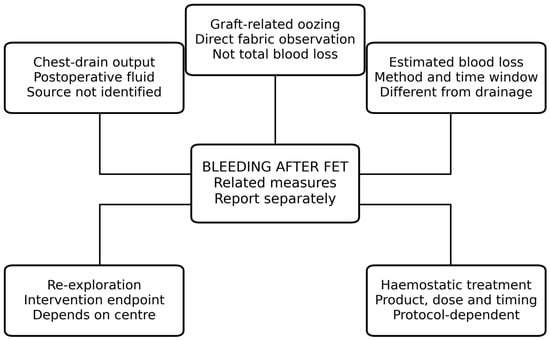
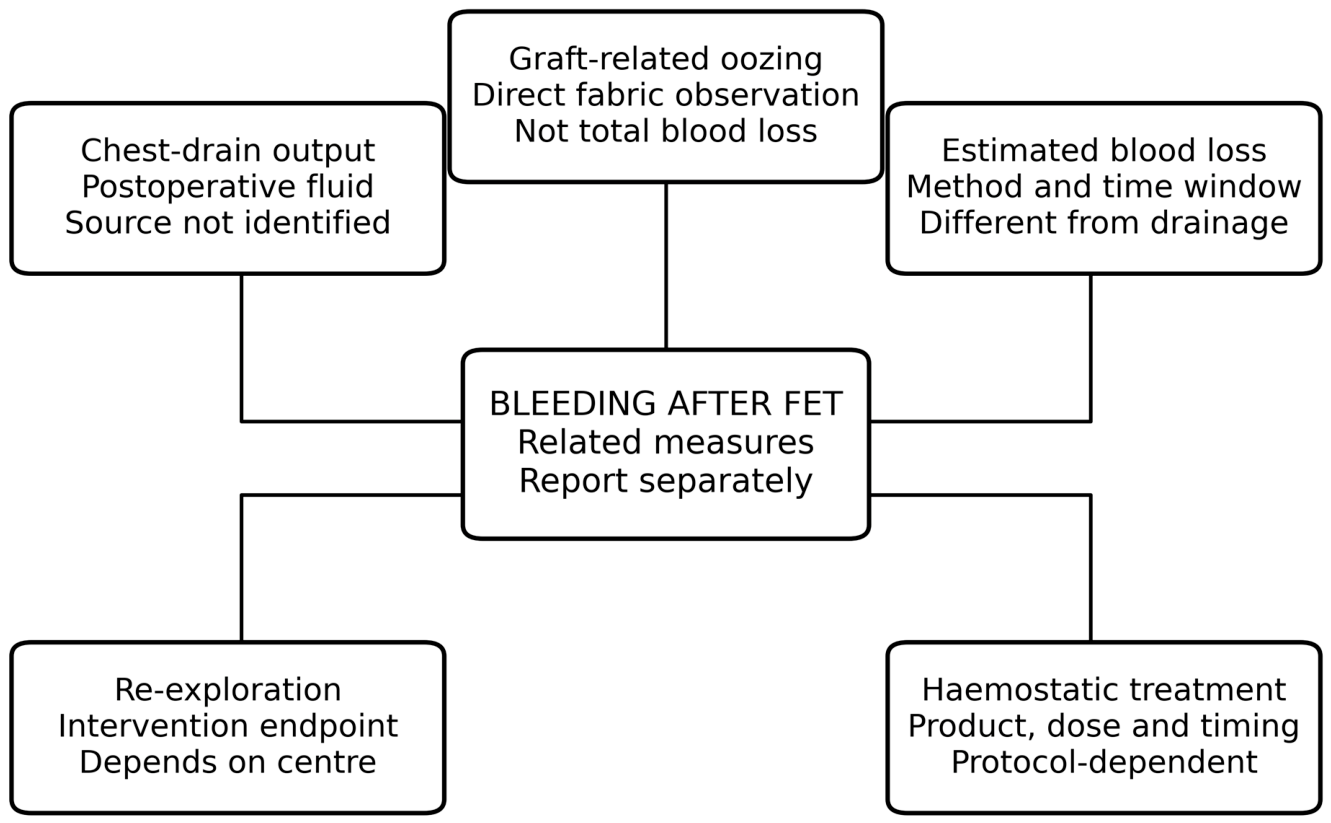
UDPB grades adult cardiac-surgery bleeding from class 0 to 4 using chest-tube loss over 12 h, transfusion and consequential interventions [8]. E-CABG emphasises treatment exposure/reoperation, while BARC includes a CABG-related category and was not developed as an FET-specific mechanistic instrument [9,10]. We recommend reporting UDPB with its original rules and individual components, supplemented by the source and procedural domains below. Incomplete retrospective data may prevent reconstruction, but non-reporting does not establish that UDPB is unsuitable for FET. Reasons for non-adoption in individual series cannot be inferred reliably. Figure 1 summarises complementary endpoints and their interpretative limitations.
Figure 1.
Complementary bleeding endpoints after FET and the limitations of each measurement. Connecting lines indicate association with the central reporting problem, not equivalence between endpoints or a causal pathway. Established severity definitions should be reported alongside these observations. FET, frozen elephant trunk.
UDPB itself incorporates treatment and intervention components; it is not a treatment-independent measure of blood loss [8]. Reporting the overall class together with raw drainage, product doses, re-exploration and delayed closure therefore preserves comparability while allowing readers to inspect why the class was assigned. We do not propose altering UDPB thresholds or substituting a 24 h volume for its 12 h component. Additional 24 h measurements are supplementary descriptors. Similarly, a BARC or E-CABG label should be accompanied by its definition and applicable setting rather than treated as interchangeable with another classification.
4.1. Re-Exploration
Re-exploration is an important but threshold-dependent event. Rates include approximately 13% in the International E-vita Open Registry and a pooled 7% in the Bashir review [1,6]. The selected contemporary series also report re-exploration/re-thoracotomy, as summarised in Table 1 [11,12,13,15,16,20]. Jakob’s Essen rate was 5.4%; Xie’s unweighted FET group had 15/431 events (3.5%), while its weighted estimate was 3.9% [16,20]. Kozlov reported 0/19 versus 4/26 (15%) for E-vita Open Plus versus MedEng, without a statistically significant difference (p = 0.126) [15]. This small comparison cannot establish device effects or institutional decision thresholds.
4.2. Drainage and Estimated Blood Loss
Table 1 preserves the reported measurement and collection period rather than equating 24 h drainage, day-of-surgery drainage and postoperative day 1. Postoperative drain output should not be equated with blood loss. As a clinical interpretative consideration, drainage may include non-blood fluid, and fluid balance may be altered in circulatory dysfunction. The cited FET cohorts report drainage outcomes but do not quantify the proportion attributable to non-blood fluid [11,12]. Xie’s blood-loss values require explicit distinction between unweighted and weighted analyses [16]. Demal reported first-24 h loss in primary and redo FET, whereas Kozlov’s postoperative volume requires a separately specified collection interval before harmonisation [14,15]. For future studies, record absolute volumes, body size, the clock origin and the method used to estimate blood volume; any drainage-to-blood-volume ratio remains a drainage descriptor, not a measured fraction of circulating blood lost.
A prospective collection protocol should distinguish blood suctioned before closure, cell-salvage processing and postoperative drain contents, avoiding double counting. Cumulative windows should share an explicit origin and identify periods of drain obstruction, washout or re-exploration that affect interpretation. If output is expressed relative to estimated blood volume, the estimation equation and patient measurements should be retained. This normalisation may aid description across body sizes, but does not remove the non-blood component of drainage or justify labelling the result as a percentage of circulating blood lost.
No validated FET-specific drainage threshold permitting greater postoperative losses on the basis of presumed prosthetic oozing was identified in the reviewed evidence. Haemodynamic stability should be considered alongside the rate and cumulative volume of drainage, haemoglobin trajectory, transfusion requirements and assessment for tamponade or ongoing surgical bleeding [27]. Postoperative drainage alone cannot verify fabric oozing. A suspected prosthetic contribution should be documented as such, rather than used to reclassify high drainage as acceptable or to defer an otherwise indicated surgical assessment.
4.3. Treatment Exposure and Graft Observations
Transfusion and factor doses reflect treatment intensity as well as bleeding. Product thresholds, preoperative haemoglobin, haemodilution, test availability, staffing, blood-bank resources and product costs can influence exposure [27,32,33]. These influences are plausible explanations for centre variation, not quantified primary determinants established in FET. Observed fabric oozing should be recorded separately from drainage and re-exploration [13,17,18,19,20]. Broader device coverage is provided by the Thoraflex comparison of Bojko et al., which reports intraoperative transfusion and re-exploration separately; its observational design does not establish equivalence between devices [34].
Table 1.
Bleeding endpoints and collection periods in representative FET publications.
5. Haemostatic Assessment
5.1. Conventional Coagulation Tests and Clinical Assessment
Clinical assessment and conventional tests, including the full blood count, prothrombin time/international normalised ratio (PT/INR), activated partial thromboplastin time (aPTT) and fibrinogen, should be interpreted with temperature, ionised calcium, acid–base status and anticoagulation history [7,27]. Neither conventional nor viscoelastic abnormalities alone identify an anatomical bleeding source; standard assays also do not fully assess antiplatelet effects or von Willebrand factor abnormalities. In a closed chest, source attribution remains provisional until direct verification.
5.2. Viscoelastic Haemostatic Assays
Rotational thromboelastometry (ROTEM) and thromboelastography (TEG) provide whole-blood functional information on clot initiation, clot firmness and fibrinolysis [7]. These findings complement clinical assessment and conventional laboratory tests, but do not independently establish the anatomical source of bleeding.
Monaco et al. compared 19 conventional-protocol and 21 ROTEM-era elective FET patients. The published reduction in overall allogeneic blood products was 40%; plasma and platelet exposure decreased, without significant differences in red-cell transfusion, blood loss, reoperation or mortality [32]. Because monitoring changed together with the replacement strategy, including greater use of factor concentrates, the test’s independent effect cannot be isolated. The principal limitation is this confounded before-and-after design, rather than sample size alone. Table 2 distinguishes direct FET management evidence from contextual guidance.
Wider cardiac-surgery trials and guidelines support test-guided haemostatic management, but their trigger values cannot be assumed to have prospective FET-specific validation [27,33,35,36,37]. We identified no prospectively validated FET-specific trigger algorithm in the sources reviewed; the recent FET anaesthetic review is also contextual rather than validation evidence [38].
Table 2.
Design and interpretation of selected haemostatic management evidence.
6. Perioperative Haemostatic Management and Reporting
Preventive and supportive care must be distinguished from rescue factor administration. Tranexamic acid (TXA), red-cell salvage and appropriate heparin monitoring/reversal are established elements of cardiac-surgery blood conservation [33]. In FET, arrest temperature serves organ protection; haemostatic assessment after bypass should document rewarming and the actual core temperature rather than prescribe one arrest-temperature target for all patients. Residual heparin, excessive protamine, hypocalcaemia and acid–base abnormalities require consideration alongside bleeding and laboratory results [27].
The temporal sequence should be documented: assessment during rewarming; evaluation after protamine; deficit-directed replacement with reassessment; and ongoing surgical review. Low fibrinogen should be corrected before considering prothrombin complex concentrate (PCC) for coagulopathic bleeding, because hypofibrinogenaemia itself prolongs clot formation [27]. Platelets, plasma or concentrates should address the documented deficit and clinical bleeding, not an isolated number. Factor XIII (FXIII) testing may be relevant in selected unexplained cases, but routine supplementation with normal concentrations is unsupported. Suspected von Willebrand dysfunction requires specific assessment rather than empirical universal replacement [27,30]. This is a contextual sequence, not a validated FET dosing algorithm.
A verified anastomotic source requires surgical haemostasis; persistent bleeding warrants renewed assessment even when tests improve. Directly observed graft oozing requires device-aware inspection and differentiation from suture-hole bleeding. Local techniques and graft priming have been described, but the technical reports and experimental concerns do not establish routine BioGlue priming as a general solution [17,18,19,20]. Systemic correction and source control may proceed concurrently; urgent surgical assessment should not await completion of a rigid factor sequence. The dose, timing, indication and result preceding each intervention should be recorded.
The evidence for fibrinogen in arch surgery also requires restraint. A prospective cohort under moderate HCA reported favourable associations in patients with low fibrinogen, whereas a prematurely terminated randomised trial under deep HCA did not demonstrate reduced blood loss or transfusion [40,41]. These are contextual arch-surgery data and do not independently validate a universal FET strategy.
7. Operational Reporting Domains
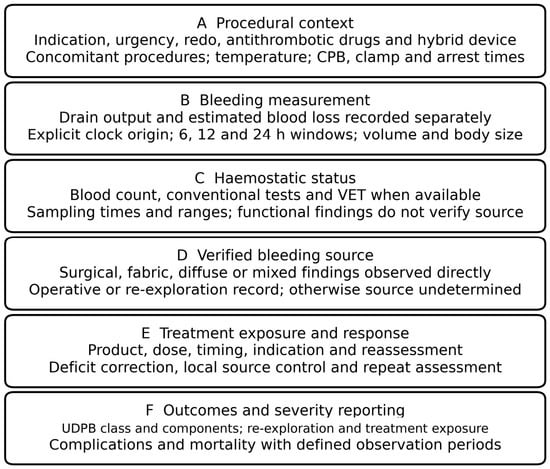
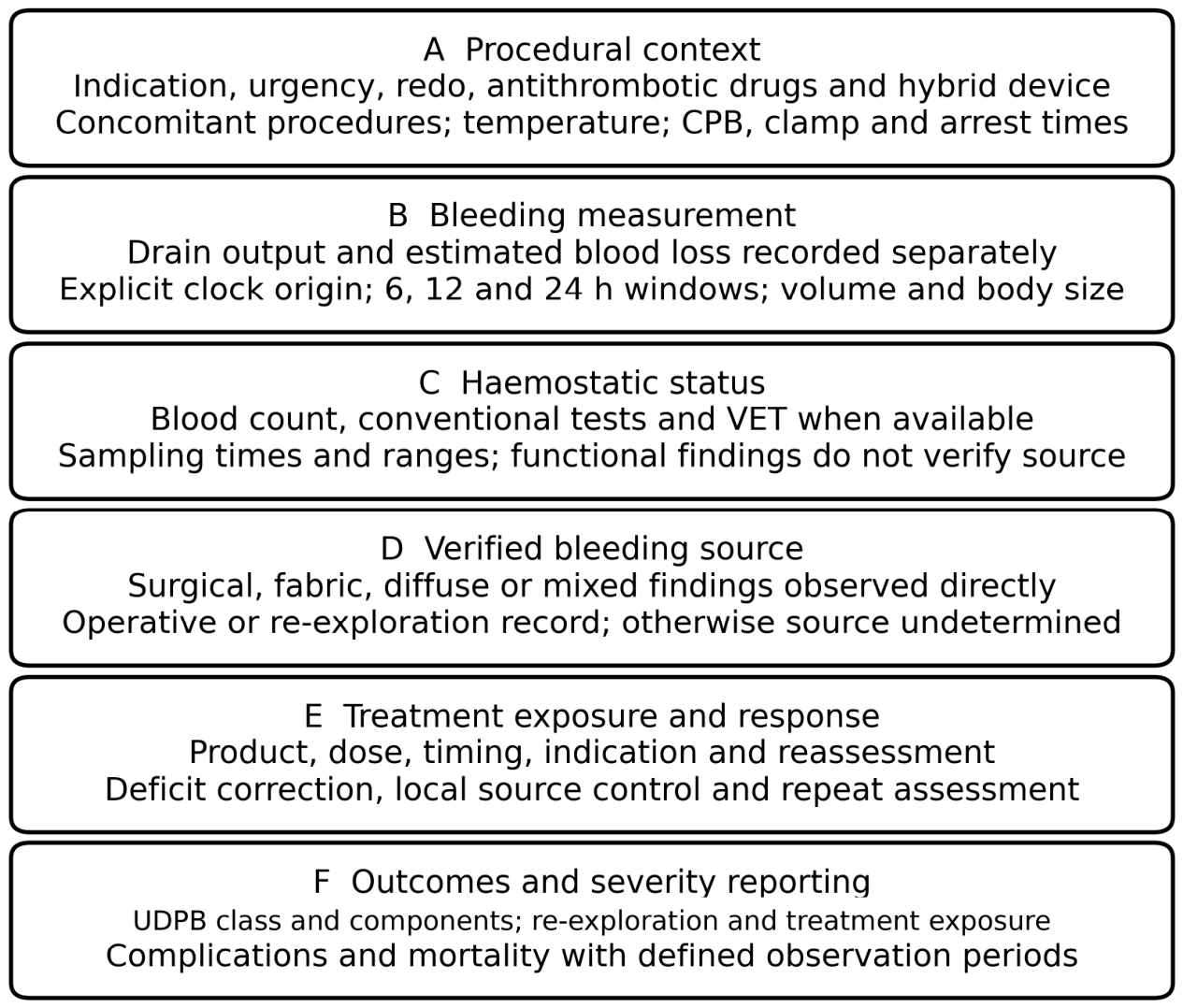
The proposal comprises six parallel domains, not a linear sequence. Figure 2 summarises their relationship to established severity reporting; Table 3 supplies operational fields, verification rules and proposed collection points. Timing is standardised to chest closure for future drainage reporting, while the time of intensive-care arrival is retained separately. The source field allows mixed findings and an undetermined category. The same patient may have a verified local source and a functional deficit without either explaining all observed loss.
Figure 2.
Six parallel domains for FET bleeding reporting. The domains are complementary collection fields rather than consecutive diagnostic or treatment stages. Operational definitions are provided in Table 3. FET, frozen elephant trunk; CPB, cardiopulmonary bypass; VET, viscoelastic testing; UDPB, Universal Definition of Perioperative Bleeding.
Table 3.
Proposed operational dataset for FET bleeding research.
The study-level map in Supplementary Table S3 applies the reporting domains descriptively to the clinical publications in Table 1 and Table 2. It shows that measurement and treatment exposure are more often extractable than haemostatic status or a directly verified bleeding source. A published drainage value or treatment total does not permit retrospective assignment of an unobserved source. The map identifies what can be extracted rather than treating absent detail as a normal result or reconstructing patient-level UDPB grades from cohort averages. Prospective testing should assess interobserver agreement, data completeness and added explanatory value beyond UDPB.
For example, a report providing a 24 h drainage volume and aggregate transfusion totals can populate measurement and exposure fields only partially if their clock origins differ. It cannot establish the source or recover serial test results. In contrast, an intraoperative note explicitly describing fabric oozing can populate the source field, but does not quantify total postoperative blood loss. The purpose of the retrospective map is to expose these information boundaries. Missing verification remains missing, rather than becoming a negative observation or evidence against a source.
8. Discussion
8.1. Heterogeneity Is the Central Problem
The useful FET-specific addition is the joint recording of prosthesis, arch/dissection context and directly verified fabric oozing alongside established severity components. It does not follow that six reporting domains are unique to FET; most apply to other complex cardiac operations. Their purpose here is to make explicit the FET variables that otherwise remain obscured when drainage, re-exploration and treatment are presented as interchangeable “bleeding” outcomes.
8.2. Bleeding Severity Is Not the Same as Treatment Intensity
Unequal access to VET platforms, trained personnel and rapid laboratory support, together with product availability and costs, may modify treatment exposure at similar measured bleeding. Monaco reported lower local transfusion costs after the bundled protocol change, but this before-and-after result is not a transferable economic effect estimate [32]. Future multicentre work should record these resource characteristics alongside treatment thresholds; comparisons should not interpret lower factor or plasma use automatically as lower biological bleeding severity.
Treatment studies should also retain safety outcomes and their observation periods. Reduced transfusion alone does not establish benefit if re-exploration, thrombotic events or organ dysfunction are incompletely captured. Conversely, an unchanged mortality rate in a small cohort cannot demonstrate safety equivalence. Recording these outcomes separately allows later studies to evaluate the balance between source control, correction of functional deficits and treatment exposure, rather than selecting one favourable endpoint as a summary of the entire postoperative course.
8.3. VHA Is Promising, but FET-Specific Validation Remains Limited
Viscoelastic haemostatic assays (VHAs) provide functional information that can support targeted haemostatic treatment. In the Monaco study, however, monitoring was introduced alongside changes in the replacement protocol, so the observed reduction in allogeneic products cannot be attributed to ROTEM alone [32]. Broader cardiac-surgery evidence supports test-guided management, but does not establish the performance of particular triggers in FET [27,35,36,37]. The implication is to evaluate VHAs within a defined care pathway, recording the preceding deficit, treatment and reassessment. Future prospective studies should distinguish monitoring effects from protocol effects and assess bleeding, treatment exposure and safety outcomes together.
8.4. Prosthesis-Related Oozing Should Be Reported as a Distinct Phenotype
Directly observed fabric oozing should remain a separate source descriptor [13,17,18,19,20]. Neither drainage volume nor treatment intensity establishes this phenotype; unverified sources remain undetermined.
8.5. Future Research Implications
Future validation should first test whether different observers assign the same verified-source category from operative records, including mixed and undetermined categories. It should then assess whether the additional fields explain variation in drainage or exposure after accounting for case mix and an established severity classification. Demonstrating that the dataset can be completed is not equivalent to demonstrating prognostic utility, treatment benefit or fair device comparison. A prospective multicentre design with prespecified collection procedures is needed to distinguish these separate validation questions.
8.6. Limitations
Limitations include purposive narrative selection, no formal risk-of-bias appraisal, heterogeneous endpoint definitions and incomplete source verification. Much direct device evidence concerns the E-vita family; adding non-E-vita studies improves breadth but does not remove selection or confounding [14,15,16,34]. Clinical series and their subsequent summaries may overlap and are not independent observations. Experimental permeability, technical reports and uncontrolled cohorts support different claims and should not be assigned equal evidential weight. The proposed domains and collection times need feasibility testing and prospective validation before claims of improved outcomes or device comparability are made.
9. Conclusions
FET studies should use an established cardiac-surgery severity definition, report its components and collection windows, and add procedural context and verified bleeding-source information. Graft-related oozing should be documented when directly observed; postoperative drainage alone cannot establish it. The proposed parallel dataset separates these observations from haemostatic treatment exposure and provides an operational basis for prospective evaluation, without introducing another severity scale or claiming a validated therapeutic algorithm.
Supplementary Materials
The following supporting information can be downloaded at https://www.mdpi.com/article/10.3390/jcm15218689/s1: Table S1, Documented PubMed search strategies; Table S2, Cited evidence and its role in the narrative synthesis; Table S3, Study-level reporting map for the clinical publications in Table 1 and Table 2 of the revised manuscript. References [1,2,3,4,5,6,7,8,9,10,11,12,13,14,15,16,17,18,19,20,21,22,23,24,25,26,27,28,29,30,31,32,33,34,35,36,37,38,39,40,41] are cited in the Supplementary Materials.
Author Contributions
Conceptualisation, R.E.S., A.R.M. and A.L.; methodology, R.E.S., A.R.M. and A.L.; investigation, literature identification, selection, critical appraisal and interpretation, all authors; writing—original draft preparation, R.E.S.; writing—review and editing, M.I.B., A.-R.C., A.P.-C., P.D., A.R.M. and A.L.; visualisation, R.E.S. and A.R.M.; supervision, A.R.M. and A.L. All authors have read and agreed to the published version of the manuscript.
Funding
This research received no external funding. Internal funding: We would like to acknowledge “VICTOR BABES” UNIVERSITY OF MEDICINE AND PHARMACY TIMISOARA for their support in covering the costs of publication for this research paper.
Institutional Review Board Statement
Not applicable.
Informed Consent Statement
Not applicable.
Data Availability Statement
No new data were created or analysed in this study. Data sharing is not applicable to this article.
Acknowledgments
During manuscript preparation and revision, the authors used ChatGPT (OpenAI, GPT-6) for language editing, organisation, literature-verification assistance and preparation of conceptual graphics. The authors reviewed and edited the outputs and take responsibility for the framework, interpretation, references and final content. No generative AI was used to create or analyse original patient data. The intellectual content of the framework and the clinical interpretation are the authors’ own; AI assistance was used to support presentation and editing.
Conflicts of Interest
The authors declare no conflicts of interest.
References
- Tsagakis, K.; Pacini, D.; Grabenwöger, M.; Borger, M.A.; Goebel, N.; Hemmer, W.; Santos, A.L.; Sioris, T.; Widenka, K.; Risteski, P.; et al. Results of frozen elephant trunk from the international E-vita Open registry. Ann. Cardiothorac. Surg. 2020, 9, 178–188. [Google Scholar] [CrossRef] [Scilit] [PubMed]
- Shrestha, M.; Bachet, J.; Bavaria, J.; Carrel, T.P.; De Paulis, R.; Di Bartolomeo, R.; Etz, C.D.; Grabenwöger, M.; Grimm, M.; Haverich, A.; et al. Current status and recommendations for use of the frozen elephant trunk technique: A position paper by the Vascular Domain of EACTS. Eur. J. Cardiothorac. Surg. 2015, 47, 759–769. [Google Scholar] [CrossRef] [Scilit] [PubMed]
- Di Bartolomeo, R.; Di Marco, L.; Armaro, A.; Marsilli, D.; Leone, A.; Pilato, E.; Pacini, D. Treatment of complex disease of the thoracic aorta: The frozen elephant trunk technique with the E-vita open prosthesis. Eur. J. Cardiothorac. Surg. 2009, 35, 671–676. [Google Scholar] [CrossRef] [Scilit] [PubMed]
- Leontyev, S.; Tsagakis, K.; Pacini, D.; Di Bartolomeo, R.; Mohr, F.W.; Weiss, G.; Grabenwoeger, M.; Mascaro, J.G.; Iafrancesco, M.; Franke, U.F.; et al. Impact of clinical factors and surgical techniques on early outcome of patients treated with frozen elephant trunk technique by using EVITA open stent-graft: Results of a multicentre study. Eur. J. Cardiothorac. Surg. 2016, 49, 660–666. [Google Scholar] [CrossRef] [Scilit] [PubMed]
- Kayali, F.; Chikhal, R.; Agbobu, T.; Jubouri, M.; Patel, R.; Chen, E.P.; Mohammed, I.; Bashir, M. Evidence-based frozen elephant trunk practice: A narrative review. Cardiovasc. Diagn. Ther. 2023, 13, 1104–1117. [Google Scholar] [CrossRef] [Scilit] [PubMed]
- Bashir, M.; Abo Aljadayel, H.; Mousavizadeh, M.; Daliri, M.; Rezaei, Y.; Tan, S.Z.; Mohammed, I.; Hosseini, S. Correlation of coagulopathy and frozen elephant trunk use in aortic arch surgery: A systematic review and meta-analysis. J. Card. Surg. 2021, 36, 4699–4714. [Google Scholar] [CrossRef] [Scilit] [PubMed]
- Agarwal, S.; Abdelmotieleb, M. Viscoelastic testing in cardiac surgery. Transfusion 2020, 60, S52–S60. [Google Scholar] [CrossRef] [Scilit] [PubMed]
- Dyke, C.; Aronson, S.; Dietrich, W.; Hofmann, A.; Karkouti, K.; Levi, M.; Murphy, G.J.; Sellke, F.W.; Shore-Lesserson, L.; von Heymann, C.; et al. Universal definition of perioperative bleeding in adult cardiac surgery. J. Thorac. Cardiovasc. Surg. 2014, 147, 1458–1463.e1. [Google Scholar] [CrossRef] [Scilit] [PubMed]
- Biancari, F.; Ruggieri, V.G.; Perrotti, A.; Svenarud, P.; Dalén, M.; Onorati, F.; Faggian, G.; Santarpino, G.; Maselli, D.; Dominici, C.; et al. European Multicenter Study on Coronary Artery Bypass Grafting (E-CABG registry): Study Protocol for a Prospective Clinical Registry and Proposal of Classification of Postoperative Complications. J. Cardiothorac. Surg. 2015, 10, 90. [Google Scholar] [CrossRef] [Scilit] [PubMed]
- Mehran, R.; Rao, S.V.; Bhatt, D.L.; Gibson, C.M.; Caixeta, A.; Eikelboom, J.; Kaul, S.; Wiviott, S.D.; Menon, V.; Nikolsky, E.; et al. Standardized bleeding definitions for cardiovascular clinical trials: A consensus report from the Bleeding Academic Research Consortium. Circulation 2011, 123, 2736–2747. [Google Scholar] [CrossRef] [Scilit] [PubMed]
- El-Sayed Ahmad, A.; Silaschi, M.; Borger, M.; Seidiramool, V.; Hamiko, M.; Leontyev, S.; Zierer, A.; Doss, M.; Etz, C.D.; Benedikt, P.; et al. The Frozen Elephant Technique Using a Novel Hybrid Prosthesis for Extensive Aortic Arch Disease: A Multicentre Study. Adv. Ther. 2023, 40, 1104–1113. [Google Scholar] [CrossRef] [Scilit] [PubMed]
- Kim, C.H.; Kim, T.-H.; Lee, H.; Kim, M.S.; Heo, W.; Yoo, K.-J.; Cho, B.-K.; Song, S.-W. One-year outcomes of total arch replacement and frozen elephant trunk using the E-vita Open NEO. Eur. J. Cardiothorac. Surg. 2024, 65, ezae017. [Google Scholar] [CrossRef] [Scilit] [PubMed]
- Tsagakis, K.; Kempfert, J.; Zierer, A.; Martens, A.; Dohle, D.-S.; Castiglioni, A.; Wong, R.H.-L.; Widenka, K.; Liakopoulos, O.; Borger, M.A.; et al. E-vita OPEN NEO in the treatment of acute or chronic aortic pathologies: First interim results of the NEOS study. Eur. J. Cardiothorac. Surg. 2024, 65, ezae206. [Google Scholar] [CrossRef] [Scilit] [PubMed]
- Demal, T.J.; Bax, L.; Brickwedel, J.; Kölbel, T.; Vettorazzi, E.; Sitzmann, F.; Reichenspurner, H.; Detter, C. Outcome of the frozen elephant trunk procedure as a redo operation. Interact. Cardiovasc. Thorac. Surg. 2021, 33, 85–92. [Google Scholar] [CrossRef] [Scilit] [PubMed]
- Kozlov, B.; Panfilov, D.; Lukinov, V. Frozen Elephant Trunk for Aortic Dissection Using Different Hybrid Grafts: Preliminary Results from a Prospective Study. J. Pers. Med. 2023, 13, 784. [Google Scholar] [CrossRef] [Scilit] [PubMed]
- Xie, E.; Wu, J.; Qiu, J.; Dai, L.; Qiu, J.; Luo, Q.; Jiang, W.; Cao, F.; Zhao, R.; Fan, S.; et al. Early Outcomes of Three Total Arch Replacement Strategies for DeBakey Type I Aortic Dissection. Front. Cardiovasc. Med. 2021, 8, 638420. [Google Scholar] [CrossRef] [Scilit] [PubMed]
- Ho, J.Y.K.; Lim, K.; Fujikawa, T.; Wong, R.H.L. Pre-emptive BioGlue priming of the branched Evita Open NEO hybrid prosthesis: Tackling excessive oozing. Eur. J. Cardiothorac. Surg. 2022, 61, 728–729. [Google Scholar] [CrossRef] [Scilit] [PubMed]
- Czerny, M.; Beyersdorf, F.; Murana, G.; Pacini, D. Excessive oozing through the fabric of the branched Cryolife-Jotec Evita Open NEO hybrid prosthesis. Eur. J. Cardiothorac. Surg. 2021, 60, 423–424. [Google Scholar] [CrossRef] [Scilit] [PubMed]
- Tan, S.Z.C.P.; Bashir, M. Prevention versus cure: Is BioGlue priming the optimal strategy against E-Vita NEO graft oozing? J. Card. Surg. 2022, 37, 555–560. [Google Scholar] [CrossRef] [Scilit] [PubMed]
- Jakob, H.; Leins, T.; Avci-Adali, M.; Schlensak, C.; Wendt, D.; Mehta, Y.; Thielmann, M.; Görlinger, K.; Song, S.-W.; Tsagakis, K. Standardized in vitro bleeding tests in a non-coated novel hybrid prosthesis for frozen elephant trunk demonstrates minimal oozing during full heparinization, supported by clinical data. Front. Cardiovasc. Med. 2023, 10, 1303816. [Google Scholar] [CrossRef] [Scilit] [PubMed]
- Zindovic, I.; Sjögren, J.; Bjursten, H.; Ingemansson, R.; Ingimarsson, J.; Larsson, M.; Svensson, P.J.; Strandberg, K.; Wierup, P.; Nozohoor, S. The Coagulopathy of Acute Type A Aortic Dissection: A Prospective, Observational Study. J. Cardiothorac. Vasc. Anesth. 2019, 33, 2746–2754. [Google Scholar] [CrossRef] [Scilit] [PubMed]
- Arima, D.; Suematsu, Y.; Yamada, R.; Matsumoto, R.; Kurahashi, K.; Nishi, S.; Yoshimoto, A. Relationship of acute type A aortic dissection and disseminated intravascular coagulation. J. Vasc. Surg. 2022, 75, 1553–1560.e1. [Google Scholar] [CrossRef] [Scilit] [PubMed]
- Gao, Z.; Pei, X.; He, C.; Wang, Y.; Lu, J.; Jin, M.; Cheng, W. Oxygenation impairment in patients with acute aortic dissection is associated with disorders of coagulation and fibrinolysis: A prospective observational study. J. Thorac. Dis. 2019, 11, 1190–1201. [Google Scholar] [CrossRef] [Scilit] [PubMed]
- Jakob, H.; Idhrees, M.; Bashir, M. From E-VITA open plus to E-VITA NEO and E-NOVIA. J. Card. Surg. 2021, 36, 1814–1817. [Google Scholar] [CrossRef] [Scilit] [PubMed]
- Rorris, F.-P.; Antonopoulos, C.N.; Gissis, I.; Tsagakis, K.; Kokotsakis, J. E-Vita OPEN NEO Hybrid Stent Graft: A New Frontier for Total Arch Replacement. Ann. Vasc. Surg. 2022, 84, 211–217. [Google Scholar] [CrossRef] [Scilit] [PubMed]
- Baethge, C.; Goldbeck-Wood, S.; Mertens, S. SANRA—A scale for the quality assessment of narrative review articles. Res. Integr. Peer Rev. 2019, 4, 5. [Google Scholar] [CrossRef] [Scilit] [PubMed]
- Casselman, F.P.A.; Lance, M.D.; Ahmed, A.; Ascari, A.; Blanco-Morillo, J.; Bolliger, D.; Eid, M.; Erdoes, G.; Haumann, R.G.; Jeppsson, A.; et al. 2024 EACTS/EACTAIC Guidelines on patient blood management in adult cardiac surgery in collaboration with EBCP. Eur. J. Cardiothorac. Surg. 2025, 67, ezae352. [Google Scholar] [CrossRef] [Scilit] [PubMed]
- Abbasciano, R.G.; Koulouroudias, M.; Chad, T.; Mohamed, W.; Leeman, I.; Pellowe, C.; Kunst, G.; Klein, A.; Murphy, G.J. Role of Hypothermia in Adult Cardiac Surgery Patients: A Systematic Review and Meta-analysis. J. Cardiothorac. Vasc. Anesth. 2022, 36, 1883–1890. [Google Scholar] [CrossRef] [Scilit] [PubMed]
- Xiao, F.-C.; Ma, W.-G.; Ge, Y.-P.; Zhu, J.-M.; Sun, L.-Z. Does preoperative dual antiplatelet therapy affect bleeding and mortality after total arch repair for acute type A dissection? Interact. Cardiovasc. Thorac. Surg. 2022, 34, 120–127. [Google Scholar] [CrossRef] [Scilit] [PubMed]
- Vincentelli, A.; Susen, S.; Le Tourneau, T.; Six, I.; Fabre, O.; Juthier, F.; Bauters, A.; Decoene, C.; Goudemand, J.; Prat, A.; et al. Acquired von Willebrand Syndrome in Aortic Stenosis. N. Engl. J. Med. 2003, 349, 343–349. [Google Scholar] [CrossRef] [Scilit] [PubMed]
- Pfeiffer, P.; Buchholz, V.; Probst, C.; Ghazy, A.; Rissel, R.; Griesinger, J.; Treede, H.; Dohle, D.-S. Transfusion and coagulation management in acute type A aortic dissection. Arch. Cardiovasc. Dis. 2025, 118, 365–373. [Google Scholar] [CrossRef] [Scilit] [PubMed]
- Monaco, F.; Nardelli, P.; Denaro, G.; De Luca, M.; Franco, A.; Bertoglio, L.; Castiglioni, A.; Zangrillo, A. First experience with a ROTEM-enhanced transfusion algorithm in patients undergoing aortic arch replacement with frozen elephant trunk technique. A theranostic approach to patient blood management. J. Clin. Anesth. 2020, 66, 109910. [Google Scholar] [CrossRef] [Scilit] [PubMed]
- Tibi, P.; McClure, R.S.; Huang, J.; Baker, R.A.; Fitzgerald, D.; Mazer, C.D.; Stone, M.; Chu, D.; Stammers, A.H.; Dickinson, T.; et al. STS/SCA/AmSECT/SABM Update to the Clinical Practice Guidelines on Patient Blood Management. Ann. Thorac. Surg. 2021, 112, 981–1004. [Google Scholar] [CrossRef] [Scilit] [PubMed]
- Bojko, M.M.; Oslund, W.; Kirsch, M.J.; Carroll, A.M.; Longo, E.; Clothier, J.S.; Okonkwo, K.; Rajeev, N.; Dhanekula, A.; McCarthy, F.; et al. Commercial hybrid graft versus traditional arch replacement with frozen elephant trunk: A multi-institutional comparison. JTCVS Open 2025, 23, 19–33. [Google Scholar] [CrossRef] [Scilit] [PubMed]
- Hanke, A.A.; Herold, U.; Dirkmann, D.; Tsagakis, K.; Jakob, H.; Görlinger, K. Thromboelastometry Based Early Goal-Directed Coagulation Management Reduces Blood Transfusion Requirements, Adverse Events, and Costs in Acute Type A Aortic Dissection: A Pilot Study. Transfus. Med. Hemother. 2012, 39, 121–128. [Google Scholar] [CrossRef] [Scilit] [PubMed]
- Shore-Lesserson, L.; Manspeizer, H.E.; DePerio, M.; Francis, S.; Vela-Cantos, F.; Ergin, M.A. Thromboelastography-Guided Transfusion Algorithm Reduces Transfusions in Complex Cardiac Surgery. Anesth. Analg. 1999, 88, 312–319. [Google Scholar] [CrossRef] [Scilit] [PubMed]
- Haensig, M.; Kempfert, J.; Kempfert, P.-M.; Girdauskas, E.; Borger, M.A.; Lehmann, S. Thrombelastometry guided blood-component therapy after cardiac surgery: A randomized study. BMC Anesthesiol. 2019, 19, 201. [Google Scholar] [CrossRef] [Scilit] [PubMed]
- Torre, D.E.; Pirri, C. Aortic Arch and Frozen Elephant Trunk Surgery: Anesthetic Challenges and Strategies for Organ Protection. J. Clin. Med. 2026, 15, 877. [Google Scholar] [CrossRef] [Scilit] [PubMed]
- Doll, I.; Salewski, C.; Vöhringer, L.; Baumgaertner, M.; Nemeth, A.; Schlensak, C.; Radwan, M. Early and 3-Year Outcomes of Frozen Elephant Trunk Procedure with Evolving E-vita Hybrid Grafts: A Retrospective Single-Centre Cohort Study over 11 Years. J. Cardiovasc. Dev. Dis. 2025, 12, 368. [Google Scholar] [CrossRef] [Scilit] [PubMed]
- Guan, X.; Li, L.; Lu, X.; Gong, M.; Li, H.; Liu, Y.; Jiang, W.; Lan, F.; Wang, X.; Zhang, H. Safety and efficacy of fibrinogen concentrate in aortic arch surgery involving moderate hypothermic circulatory arrest. J. Thromb. Thrombolysis 2023, 55, 67–73. [Google Scholar] [CrossRef] [Scilit] [PubMed]
- Vlot, E.A.; Hackeng, C.M.; Aper, S.J.A.; Sonker, U.; Heijmen, R.H.; van Dongen, E.P.A.; Noordzij, P.G. Does Intraoperative Fibrinogen Affect Blood Loss or Transfusion Practice After Aortic Arch Surgery: A Prematurely Ended Randomized Trial. Clin. Appl. Thromb. Hemost. 2022, 28, 10760296221144042. [Google Scholar] [CrossRef] [Scilit] [PubMed]

Disclaimer/Publisher’s Note: The statements, opinions and data contained in all publications are solely those of the individual author(s) and contributor(s) and not of MDPI and/or the editor(s). MDPI and/or the editor(s) disclaim responsibility for any injury to people or property resulting from any ideas, methods, instructions or products referred to in the content. |
© 2026 by the authors. Licensee MDPI, Basel, Switzerland. This article is an open access article distributed under the terms and conditions of the Creative Commons Attribution (CC BY) license.