


Abstract
Background: Inflammatory bowel disease (IBD), including Crohn’s disease (CD) and ulcerative colitis (UC), is a chronic condition driven by complex interactions among genetic, microbial, immunological, and environmental factors that substantially affect patients’ lives and increase the risk of colorectal cancer (CRC). Biobanks support IBD research by providing access to human biospecimens and associated data. This study aimed to describe the workflow and infrastructure of the Kyungpook National University Hospital (KNUH) Biobank, summarize the clinical characteristics of participants and the collection and distribution of biospecimens, and outline future development priorities. Methods: This descriptive report summarizes the collection and distribution activities of the KNUH Biobank from 1 July 2021 to 31 December 2025, including biospecimens collected at Kyungpook National University Chilgok Hospital and incorporated into its collection. Biospecimens and associated clinical and epidemiological data were collected from consenting participants, processed, and stored according to standard operating procedures. Bioresource distribution required formal application and committee approval. Results: The disease-focused collection comprised 1307 participants: 471 with CD (36.0%), 376 with UC (28.8%), 35 with other non-infective gastroenteritis and colitis (2.7%), and 425 with CRC (32.5%). Of these, the mean age at diagnosis was 37.7 years (SD, 23.1), and 849 participants (65.0%) were male. A total of 9577 biospecimen vials were collected from these 1307 participants, excluding the bottom-up collection. Additionally, excluding the bottom-up collection, 2400 vials were distributed through 34 approved applications during the reporting period. Conclusions: This report describes the operational framework and collection and distribution activities of the KNUH Biobank. Future priorities include improving clinical data completeness, establishing systematic longitudinal follow-up, and evaluating resource utilization and operational sustainability.
1. Introduction
Inflammatory bowel disease (IBD) is a chronic disorder characterized by complex interactions between the gut microbiota and host immune responses; nevertheless, its etiology remains elusive [1,2,3]. The clinical manifestations of IBD vary according to the severity and anatomical location of inflammation [4]. Its symptoms range from mild to severe, with the clinical course being typically characterized by alternating periods of active disease and remission [5]. These clinical characteristics profoundly impair the quality of life of patients with IBD [6].
IBD can be classified into two primary subtypes: Crohn’s disease (CD) and ulcerative colitis (UC). Extensive CD or UC involving the majority of the colorectum is associated with a significantly increased risk of colorectal cancer (CRC) [7]. IBD-associated carcinogenesis is hypothesized to be driven by chronic sustained inflammation within the colorectum, intertwined with a combination of genetic, immunological, infectious, and environmental factors [8]. Both CD and UC are characterized by immune system dysregulation, and the exact mechanisms underlying their pathogenesis have not been fully elucidated. Their onset is widely thought to arise from a complex multifactorial interplay among genetic susceptibility, host microbiota, immunological pathways, and environmental factors that disrupt mucosal homeostasis [4,9].
Genetic susceptibility contributes to the development of both CD and UC [10], and a family history of IBD is an established risk factor [11]. Both CD and UC are chronic diseases associated with substantial morbidity, and patients with colonic involvement have an increased risk of CRC [7,12]. NOD2 (CARD15) [13], IBD5 [14], IL-23 receptor gene [15], and ATG16L1 [16] play a role in CD development [17], whereas Th17 signaling plays a pivotal role in IBD pathogenesis, a link further supported by polymorphisms in the IL-23 receptor and other constituent molecules of the Th17 pathway [15]. The high genetic association in IBD development provides an important direction for developing personalized approaches to IBD diagnosis and treatment.
Advancing research to elucidate IBD pathogenesis and identify novel therapeutic targets has the potential to improve clinical outcomes significantly. Accurately predicting individual disease trajectories and formulating personalized therapeutic strategies depend on the establishment of relationships between biomarkers and clinical phenotypes, which can be achieved by integrating prospective patient data (e.g., disease activity, complications, treatments) with biorepository and multi-omics datasets [18,19]. Therefore, to advance and facilitate large-scale well-structured IBD research, we established an IBD- and CRC-specific biobank at the Kyungpook National University Hospital (KNUH) in collaboration with three other hospitals, which intimately entwined the collection of clinical and epidemiological data, pathological and radiological images, and biological specimens. This biobank was established as an integrated resource to investigate the biological link between intestinal inflammation and CRC. In particular, the mechanistic connection between chronic mucosal inflammation in IBD and colitis-associated cancer provides a clear scientific rationale for encompassing both disease entities within a single biobank [12,20,21]. This integrated framework facilitates the systematic acquisition of diverse biospecimens across the spectrum of inflammatory and neoplastic diseases, thereby fostering translational research into inflammation-driven carcinogenesis and comparative biomarker discovery.
The present study aimed (i) to outline the workflow and information technology infrastructure of the KNUH Biobank within the Korea Biobank Network (KBN), (ii) to describe for the first time the clinical characteristics of the cohorts collected to date, and (iii) to present plans for future expansion and application to advance IBD research by investigators facing challenges in acquiring human biospecimens.
2. Materials and Methods
2.1. Korea Biobank Project
The National Biobank of Korea (https://biobank.nih.go.kr, accessed on 5 December 2025) has promoted the Korea Biobank Project since 2008 [22], which collects and manages human bioresources that would be highly useful for future healthcare research and development (R&D), including genome-based precision medicine, and distributes bioresources to researchers in the Republic of Korea, thereby facilitating healthcare research and relevant industry development. The KBN has been expending ongoing efforts to standardize and develop domestic biobanks. Various types of biorepositories, such as population-based, disease-oriented, and tissue biobanks, have been reported [23]. As a national fourth phase project, the KBN operated 10 specialized biobank networks (subnetworks) from 2021 to 2025, which were strategically selected to advance disease-specific biobanking for the future according to the changing healthcare R&D environment and research needs and characterized human resource projects for each disease group by linking high-value clinical and epidemiological data [24]. IBD was selected as one of ten disease areas supported by the specialized biobank network. KBN support provides infrastructure for biospecimen collection and management to support IBD biobanking and research. Integrating human biospecimens accrued through this initiative with detailed clinical data would facilitate large-scale investigations into the etiology, prevention, diagnosis, and treatment of IBD. This initiative sought to standardize the acquisition of human bioresources, as well as clinical and epidemiological data, by establishing a systematic network comprising regional hub banks and affiliated partner banks. The KNUH Biobank oversees the base center of the IBD-specific biobank network unit, as well as three other biobanks (namely, Keimyung University Dongsan Hospital, Gyeongsang National University Hospital, and Inje University Busan Paik Hospital), which each collect and store bioresources and manage the data. This IBD-specific biobank network obtains high-value bioresources related to IBD, colorectal dysplasia, and CRC, including comprehensive big data encompassing clinical, epidemiological, and imaging information (endoscopy, magnetic resonance imaging [MRI], computed tomography [CT], digital pathological slide scans, etc.). The present report focuses on the KNUH Biobank collection, including biospecimens collected at Kyungpook National University Chilgok Hospital (KNUCH) and incorporated into that collection, and does not constitute a network-wide analysis of the participating biobanks.
2.2. KNUH Biobank
The KNUH Biobank has continuously participated in the KBN project since its inception in the first phase. This report focuses exclusively on biospecimens and associated data collected during a specific period of the fourth phase, spanning from 1 July 2021 to 31 December 2025. Subsequent participation in the fifth phase is being carried forward by other investigators and remains beyond the scope of this study. Its primary objective is to collect, store, and distribute biospecimens and associated clinical and epidemiological data from patients and healthy controls, while linking these resources for research use. Participants were recruited from clinical departments at two affiliated academic hospitals: Kyungpook National University Hospital (KNUH) and KNUCH in Daegu, Republic of Korea. Written informed consent for the collection and storage of clinical information and biospecimens was obtained from all participants whose biospecimens were deposited in the KNUH Biobank. Participant enrollment and informed consent were conducted prospectively during routine clinical practice. Patients who voluntarily agreed to participate provided written informed consent prior to biospecimen collection. Following acquisition and banking, no participants withdrew consent. Because participant enrollment was embedded within routine outpatient and inpatient clinical workflows and was based on voluntary opt-in participation, a screening log for individuals approached who declined was not formally tracked; consequently, exact recruitment and consent rates could not be determined.
2.3. Informed Consent
In accordance with the Enforcement Rules of the Bioethics and Safety Act and related guidelines in the Republic of Korea, the KNUH Biobank obtains informed consent for the following activities from participants after they have received a full explanation: (i) the KNUH Biobank provides secure collection, long-term storage, high-throughput analysis, and strategic distribution of double-pseudonymized deep clinical, epidemiological, and imaging data and biological specimens; (ii) these assets are made available to academic, non-academic, and commercial research entities worldwide; and (iii) this infrastructure enables the seamless linkage of biobank research inputs with routine real-world clinical data. By providing informed consent, participants authorized the use of their double-pseudonymized data and biospecimens for research within the scope of their consent and subject to the applicable review and approval procedures. Participants could withdraw their consent at any time without providing a reason. Under the biobank’s procedures, data and biospecimens would be deleted and discarded if consent were withdrawn. In accordance with Article 36 (“Deliberation on Human Material Research”) under the Bioethics and Safety Act of the Republic of Korea, the research plan for the fourth-phase project was reviewed and approved by the Institutional Review Boards (IRBs) of KNUH (approval no. 2021-05-051) and KNUCH (approval no. 2021-06-029). Biospecimen collection at each hospital commenced only after approval by its respective IRB: 1 July 2021 for KNUH, and 23 September 2021 for KNUCH. The reporting period ended on 31 December 2025. This study was conducted in strict accordance with the ethical principles embodied in the Declaration of Helsinki. Written informed consent was obtained from all participants before sample collection and data acquisition.
2.4. Patient Selection and Biospecimen Collection
The fourth phase of the KBN project began on 31 March 2021. The present report includes only data and biospecimens collected from 1 July 2021 to 31 December 2025. Standardized IBD-related clinical and epidemiological data and biospecimens—including serum, fresh-frozen tissue specimens (including colonic biopsy), and stool samples—were obtained. Diagnoses of CD and UC were established by the treating clinicians based on clinical findings and relevant investigations, including histopathological findings. The Korean Standard Classification of Diseases (KCD) codes were used to classify and record these clinical diagnoses rather than as standalone diagnostic criteria. The IBD cohort comprised patients diagnosed with CD (KCD code: K50) or UC (KCD code: K51). Patients with clinically suspected but unconfirmed IBD at initial presentation were also eligible for biospecimen collection. Biospecimen collection was not restricted to a predefined disease stage or treatment status. Disease phenotype classification and treatment status at sampling were not systematically captured in the dataset used for this report. These cases were prospectively registered under other non-infective gastroenteritis and colitis (Other GE/colitis, KCD code: K52), capturing the diagnostic ambiguity inherent to early-stage disease rather than a definitive IBD diagnosis. While Other GE/colitis was retained as an independent diagnostic classification, the resulting biospecimen inventories (including blood samples) were aggregated across the Crohn’s disease, ulcerative colitis, and Other GE/colitis cohorts. For this report, the CRC cohort comprised patients diagnosed with CRC (KCD codes: C18–C20). Although colorectal dysplasia was included in the broader network’s collection scope, patients with dysplasia alone were not included in the present analysis. The biobank comprised an IBD-related collection, including patients registered with CD, UC, or K52, and a separate CRC cohort. Additionally, the bottom-up collection primarily comprised biospecimens and associated clinical data from patients with conditions other than IBD, Other GE/colitis, or CRC encountered during routine clinical care and individuals attending the hospital for health check-ups who had neither IBD nor cancer. The latter were designated as healthy controls for this biobank. All participants provided written informed consent before biospecimen collection.
2.5. Patient Privacy and Data Pseudonymization
In accordance with Article 44 (“Obligations of Human Material Banks”) under the Bioethics and Safety Act of the Republic of Korea, guidelines on personal information protection, including schemes for human material anonymization, have been established for the biobank, as prescribed by the Ministry of Health and Welfare. Information related to human bioresources, except for identification information, is managed separately from human bioresources. An information protection system has been devised to protect the providers’ personal identification information against leakage by filtering necessary information when inquiring about clinical and epidemiological data. Clinical and epidemiological data underwent double pseudonymization. Hospital patient identifiers were first replaced with study identifiers, which were subsequently replaced with biobank identifiers (bCODEs) when the data were loaded into the KBN common data model.
2.6. Procedures for Bioresource Collection: Processing and Storage
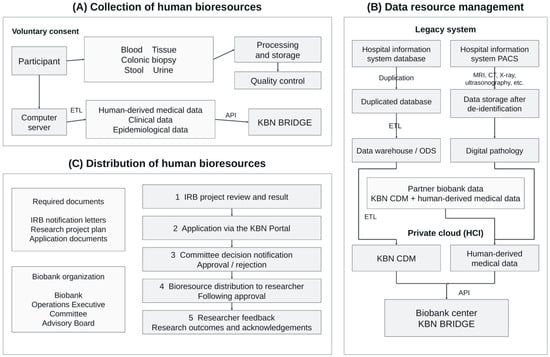
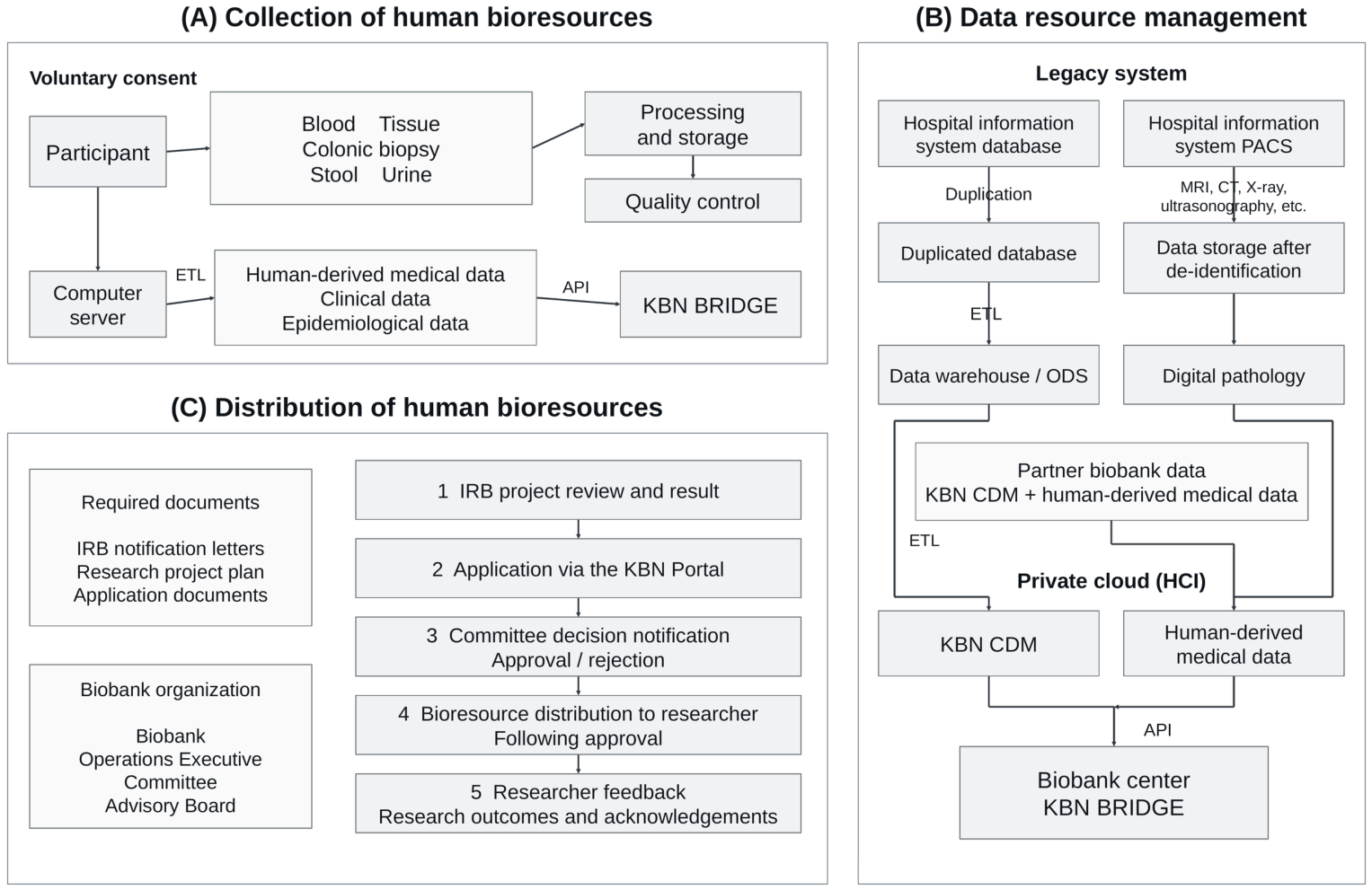
Human bioresource collection (Figure 1A) was processed as follows. Residual biospecimens were collected during medical procedures to acquire biological resources for the KNUH Biobank. The samples were placed in sterile vials with appropriate buffers and were shipped under strictly controlled and monitored conditions (e.g., sample type and storage). Upon arrival at the biobank, the samples were labeled with biobank identifiers (bCODEs) and stored. An aliquoting procedure was implemented to reduce freeze–thaw cycles of samples, create backups, and facilitate easier sharing of samples without thawing [23]. Standard operating procedures (SOP) for biospecimen processing and quality control were developed with reference to International Society for Biological and Environmental Repositories (ISBER) Best Practices, KS J ISO 20387, and the KBN SOPs issued by the National Biobank of Korea [25]. The processing methods are shown according to the type of resources collected in the biobank in Table 1.
Figure 1.
Schematic operating flowchart of an inflammatory bowel disease-specific biobank. (A) Collection of human bioresources. (B) Data resource management. (C) Distribution of human bioresources. The IBD-specific biobank network unit (base bank and partner biobank) collects and manages human bioresources and related data resources and supports the distribution of bioresources. Biological samples such as blood, tissue, and stool are systematically collected from IBD patients, and samples are processed and stored for future research. Clinical and epidemiological data associated with each biological sample, as well as medical imaging data, are also safely managed. The data are stored in a de-identified and searchable database (Korea Biobank Network) to protect patient privacy and facilitate research. Researchers can request and receive samples for their research. The distribution process involves reviewing the research proposal, shipping the samples to researchers, and providing feedback on the results of using human bioresources. ETL, Extract, transform, load; API, application programming interface; KBN, Korea biobank network; BRIDGE, Biobank research information and digital image exchange; PACS, picture archiving and communication system; MRI, magnetic resonance imaging; CT, computed tomography; ODS, operational data store; CDM, common data model; HCI, hyperconverged infrastructure; IRB, institutional review board.
Table 1.
Sample processing and storage conditions for bioresources in the biobank.
For assays requiring subsampling, participants contributing each specimen type were randomly selected, and their biospecimens underwent quality control (QC) testing. The planned inspection ratios indicate the minimum proportion of participants contributing each specimen type whose biospecimens were designated for inspection. Acceptance criteria were applied according to specimen type and the relevant assay: an absorbance ratio at 260 and 280 nm (A260/A280) of 1.6–2.0 for DNA purity, an RNA integrity number (RIN) of ≥4 for RNA integrity, the absence of visible hemolysis in applicable blood-derived specimens, and the absence of detectable target-specific bands following polymerase chain reaction (PCR) testing for bacterial and mycoplasma contamination. Histopathologic examination was performed to assess tissue adequacy using mirror-image hematoxylin and eosin (H&E)-stained sections for fresh-frozen tissue specimens. For pre-analytical quality control, the standardized processing and storage conditions for each specimen type are summarized in Table 1. Available pre-analytical information was recorded using Standard PREanalytical Code (SPREC)-based fields v.3.0 [26]. Warm and cold ischemia times were not captured in the recording system used for this collection. Routine QC records were compiled, and the resulting quality metrics across specimen types are described in the Results Section.
2.7. Collection of Clinical, Epidemiological, and Medical Imaging Data
The KNUH Biobank collects standardized multidimensional clinical data encompassing baseline demographic characteristics, medical history, diagnostic information, and prescription records. This database integrates laboratory test results, human-derived medical imaging data (including endoscopy, MRI, and CT), and clinical observations recorded during routine care. The clinical, epidemiological, and medical imaging data of patients were processed as follows (Figure 1B): (i) clinical and epidemiological data were extracted from the hospital’s integrated medical information system to collect human bioresource-related information; (ii) a replica database was created using Oracle Active Data Guard (Oracle Corp., Austin, TX, USA) to centralize the clinical and epidemiological data; (iii) the replicated data were transferred to the data warehouse Operational Data Store (ODS) and subsequently converted to fit the table definition document structure of the KBN common data model provided by the KBN central network; (iv) they were stored in a private cloud (HCI) and transmitted to the KBN Biobank Research Information and Digital Image Exchange (KBN BRIDGE) through an application programming interface.
In addition to the 88 common clinical items defined by the KBN common data model, the IBD-specific biobank developed a data collection framework comprising 111 supplementary clinical and epidemiological items. Together, these items covered participant demographics, diagnoses, family history, physical examination findings, and previous and current treatments. Inclusion in the framework did not imply that every item was available for every participant. Medical imaging data were downloaded from the hospital’s picture archiving and communication system (PACS), de-identified, and stored on a biobank server (HCI). Data records were tracked using a management ledger to reduce identification and linkage errors. Standardized clinical and epidemiological data were managed through the KBN central platform to support access for academic and industrial research, subject to applicable consent and formal application and approval procedures.
2.8. Management of Digital Pathological Image Data
Tissue specimens collected for patient diagnosis were processed into routine formalin-fixed paraffin-embedded tissue blocks and were subsequently sectioned and used to generate H&E-stained slides. Representative slides were selected and scanned using Aperio GT 450 (Leica Biosystems, Vista, CA, USA). Scanned digital pathological images were de-identified using Whole-Slide Image DeIdentifier v2 (Humintec, Suwon-si, Republic of Korea) for Aperio GT 450, linked to the corresponding bCODEs, and stored.
2.9. Procedures for Bioresource Distribution
The distribution of collected human bioresources was processed according to the procedure shown in Figure 1C. Researchers were required to obtain approval of their research plans from the relevant institutional review board before applying for bioresources. After the researcher had prepared the necessary documents (IRB notification letters, research project plans, and application documents) and applied through the KBN portal, the biobank decided on the distribution through the Operations Executive Committee. For reporting purposes, one distribution case was defined as one approved application for bioresource distribution, regardless of the number of donors or biospecimens included in that application. Bioresources were distributed to researchers in response to approved deliberations and shipped to researchers in accordance with our SOP (e.g., temperature and time during transportation). Research outcomes (papers, patents, etc.) using distributed resources were tracked to monitor bioresource utilization.
2.10. Statistical Analysis
Descriptive statistics were used to summarize participant characteristics and quality control results. Continuous variables were presented as mean ± standard deviation (SD) or median with interquartile range (IQR), as appropriate. Categorical variables were presented as counts and percentages. Denominators for percentages are specified in the table footnotes. Data availability was calculated relative to the relevant participant group, whereas category percentages were calculated among participants with available data unless otherwise specified. Analyses were conducted using SPSS software (version 18.0; IBM Corp., Armonk, NY, USA).
3. Results
3.1. State of Biospecimen Processing, Storage, and Management
The annual collection status of biospecimens during the reporting period is summarized in Table 2. A total of 1307 participants contributed biospecimens during the reporting period. Of the 1307 participants, 847 had IBD (CD: n = 471, 55.6%; UC: n = 376, 44.4%), 35 had Other GE/colitis, and 425 had CRC. Through the bottom-up approach, biospecimens were collected from 15,608 participants, including patients with conditions other than IBD or CRC and healthy controls. Biospecimens from the 1307 participants were organized into matched sets comprising available specimen types from the same participant, such as blood, buffy coat, serum, stool, and tissue, to facilitate their use in diverse research applications (Table 3). Biospecimens failing to meet the required quality standards were subject to exclusion and disposal in accordance with the biobank’s SOPs.
Table 2.
Number of participants by collection category in the biobank, 2021–2025.
Table 3.
Matched biospecimen sets from 1307 participants in the biobank, 2021–2025.
Quality control results are summarized by specimen type in Table 4, including the actual inspection proportions, test results, and pass counts and rates for the predefined acceptance criteria. Visual inspection was performed on specimens from all participants who contributed plasma, serum, or urine, with pass rates ranging from 83.9% to 96.9%. Failure rates upon visual inspection were 13.6% for plasma and 16.1% for serum, primarily attributable to hemolysis and lipemia. DNA purity acceptance rates were 95.8% to 96.0% for whole blood and buffy coat specimens, with median A260/A280 ratios ranging from 1.86 to 1.87. Tissue RNA exhibited a median RIN of 7.4 (interquartile range [IQR], 7.0–8.0), and 97.5% of tested samples met the acceptance criterion of RIN ≥ 4. No bacterial or mycoplasma contamination was detected in any of the samples tested by PCR.
Table 4.
Quality control inspection methods, inspection ratios, and results for bioresources in the biobank.
3.2. State of Clinical and Epidemiological Data Management
The demographic, clinical, and epidemiological characteristics of the participants are summarized in Table 5. The disease-focused collection comprised 1307 participants: 847 with IBD (471 with CD and 376 with UC), 35 with Other GE/colitis, and 425 with CRC. Overall, 849 participants (65.0%) were male, and all were of Asian ethnicity. The mean age at diagnosis was 37.7 ± 23.1 years overall and 19.3 ± 11.1 years for CD, 16.8 ± 10.2 years for Other GE/colitis, 37.1 ± 18.0 years for UC, and 63.7 ± 11.0 years for CRC.
Table 5.
Demographic characteristics from clinical and epidemiological data of inflammatory bowel disease, other noninfective gastroenteritis and colitis, and colorectal cancer participants collected with bioresources in the biobank from 2021 to 2025.
Data on smoking status and body mass index (BMI) were available for 60.6% (n = 792) and 34.6% (n = 452) of participants, respectively, with availability differing by cohort (Table 5). Among those with documented smoking status, 88.4% (n = 700) were never-smokers. Alcohol consumption history was recorded for 612 participants (46.8%), of whom 383 (62.6%) reported a history of alcohol consumption. The corresponding proportions were 97.0% (319/329) in CRC, 55.2% (48/87) in UC, and 8.2% (16/195) in CD. Among participants with CD, disease activity scores were available for 411 (87.3%): pediatric Crohn’s disease activity index (PCDAI) scores for 360 participants younger than 18 years and Crohn’s disease activity index (CDAI) scores for 51 participants aged 18 years or older. These represented 76.4% and 10.8% of all 471 participants with CD, respectively. Nancy histological index scores for participants with UC [27] were recorded alongside biospecimen collection but are not reported here because the data were incomplete.
3.3. Collection and Provision of Medical Imaging and Digital Pathological Data
For the reporting period, the KNUH Biobank was utilized to manage various medical imaging data and biospecimens from participants. Medical imaging modalities included endoscopy, X-ray, CT, MRI, and ultrasonography, when available. Medical imaging and digital pathology data, when available, were collected and linked to biospecimens and associated clinical and epidemiological data from the same participants. No participants contributed imaging data alone. In the case of digital pathology, H&E-stained slides produced for diagnosis were scanned separately and stored as .svs files, enabling researchers who need them to use them as resources. All collected imaging data were de-identified by removing personally identifiable information before storage and distribution. Efforts were made to enhance the research value of human bioresources through the integrated collection and management of these diverse data. Among the 1307 enrolled participants, multi-modal diagnostic data were widely available: endoscopy was documented in 589 participants, digital pathology in 463, MRI in 308, and CT in 280, whereas X-ray and ultrasonography data were available for 43 and 22 participants, respectively. Individual participants could contribute data to more than one modality (Table 6).
Table 6.
Availability of medical imaging and digital pathology data among 1307 participants, 2021–2025.
3.4. State of Bioresource Distribution
During the reporting period, the KNUH Biobank distributed 12,774 vials through 109 approved distribution applications. Annual distribution volumes fluctuated, ranging from 1040 to 4111 vials (Table 7). Various bioresources (blood, fresh frozen tissue, and stool), medical and pathological images, and clinical and epidemiological data were distributed based on researcher demand for specific research projects. Specifically, for IBD- and CRC-related bioresources, the number of distributions was four in 2021, six in 2022, ten in 2023, seven in 2024, and seven at the end of 2025. During the same period, the total distribution of bottom-up collection bioresources was 75. The number of approved distribution applications decreased from 10 in 2023 to 7 in 2024. Only IBD-related biospecimens were distributed in 2021 and 2022, whereas both IBD- and CRC-related biospecimens were distributed during 2023–2025.
Table 7.
Annual bioresource distribution by approved applications and vials, 2021–2025.
Biomarker development was the most frequently represented research topic among approved distribution applications (n = 37). Other topics included diagnostic technology development, functional studies of disease-related genes and proteins, disease model development, and targeted therapeutic development (Table 8). Research outputs from studies using bioresources distributed by the KNUH Biobank, including those from the bottom-up collection, have been reported [28,29,30,31,32,33,34,35,36,37]. The biobank routinely tracks these scholarly outputs to monitor bioresource utilization.
Table 8.
Research topics utilizing bioresources and types of bioresources distributed in the biobank.
4. Discussion
The KNUH Biobank was established to collect and link biospecimens with clinical, epidemiological, and imaging data to support research on IBD and CRC. The KNUH Biobank aims to support translational gastrointestinal research by collecting biospecimens and associated data from patients with IBD, CRC, and other conditions, as well as healthy controls. This study describes its operational framework and collection and distribution activities within the KBN. Ongoing efforts focus on improving resource availability, data completeness, and quality management to support future studies of disease mechanisms and potential diagnostic and therapeutic approaches.
Although historically characterized as a disease prevalent in industrialized Western nations, the incidence and prevalence of IBD have increased rapidly in the Republic of Korea over the past few decades. In 2020, the Korean Association for the Study of Intestinal Diseases (KASID) published an IBD official fact sheet using the National Health Insurance Service database to delineate these epidemiological trends [38,39]. According to the KASID 2020 fact sheet, the total number of patients with IBD expanded substantially from 2010 to 2019; specifically, CD cases increased from 7700 to 18,463, whereas UC cases increased from 16,136 to 37,439 [39]. These data represent 2.4-fold and 2.3-fold increases in the respective cohorts over the 10-year period [39]. Regionally, the prevalence of CD in Daegu was the highest in the country at 48.4 per 100,000 individuals, and the prevalence of UC also reached a remarkably high level at 70.7 per 100,000 individuals [39]. These regional disease burdens provided a rationale for establishing an IBD-focused biobank with a complementary CRC collection to support comparative research on inflammation-associated carcinogenesis. During the fourth phase of the KBN project, the KNUH Biobank participated in a disease-specific network supporting the standardized collection of biospecimens and associated clinical and epidemiological data. The present report describes the collection and distribution activities of the KNUH Biobank from 1 July 2021 to 31 December 2025, including biospecimens collected at KNUCH and incorporated into the KNUH Biobank collection. The disease-focused collection comprised 1307 participants: 471 with CD, 376 with UC, 35 registered with Other GE/colitis, and 425 with CRC. Thus, 847 participants had CD or UC, while participants registered with non-infective gastroenteritis and colitis were reported separately. CRC was included as a distinct disease cohort rather than a control group. Associated clinical and epidemiological information was collected, although data completeness varied across individual variables. Where available, medical imaging and digital pathology data were linked to biospecimens from the same participants. While these integrated resources provide a platform to investigate correlations between clinical phenotypes and tissue-level findings, associations with disease progression and therapeutic response were beyond the scope of the present report. As part of the bottom-up collection, specimens were additionally gathered from participants with other conditions as well as individuals undergoing routine health check-ups who had neither IBD nor cancer, with the latter designated as healthy controls.
Biobanks play a pivotal role in promoting practical research utilization by collecting resources and facilitating their accessibility to researchers. In the KNUH biobank, the number of approved applications for IBD- and CRC-related bioresources increased from four in 2021 to ten in 2023, followed by seven in both 2024 and 2025. The KBN encourages biobanks to promote their collections to researchers to increase awareness of available resources and encourage applications for bioresource access. Interestingly, approved distribution applications at KNUH biobank also included research involving machine learning and deep learning (Table 8). Linking biospecimens with medical imaging, digital pathology, and clinical data may support such research. However, the suitability of these resources for specific artificial intelligence (AI) applications and their effects on model performance were not evaluated in this study. This report provides an overview of the establishment, operational framework, and biospecimen collection activities of the KNUH Biobank.
Recent advancements in AI, big data, and information technology have revolutionized the use of biospecimens [40]. Biobanks may support machine learning and deep learning research by providing access to biospecimens and associated clinical and imaging data. Notably, even in the absence of physical biological samples, pairing high-quality medical and digital imaging data with clinical and epidemiological data, as well as genetic and molecular data, may offer substantial research value for the advancement of AI technology, specifically for the development and refinement of image analysis algorithms [41,42,43]. For instance, a previous study developed a deep learning model using stool photographs to predict endoscopic mucosal inflammation in patients with UC [44]. The accumulation and analysis of large-scale datasets may support the development and validation of AI models across healthcare and life sciences [45]. When physical biospecimens are difficult to obtain, existing digital data can provide resources for AI-driven research without requiring additional specimen collection [43,46]. Accordingly, the fifth phase of the KBN project, which began on March 1, 2026, places greater emphasis on collecting medical imaging, digital pathology, and genetic and molecular data while continuing biospecimen collection.
KBN promotes the standardization and infrastructural development of biobanks across the Republic of Korea through competitive proposal evaluations and partial funding for operational and research expenditures. Illustrating the tangible outcomes of this initiative, the Korea Oral Biobank Network established and published standardized operating procedures for collecting, processing, and preserving oral biospecimens [47]. A KBN working group developed consensus definitions for subcategories of normal controls to support the selection of appropriate blood samples for research [48]. Concurrently, several studies highlight the development of training methodologies in compliance with ISO 20387, ensuring rigorous quality control and institutional standardization [49]. While these ongoing efforts continue, several challenges remain to optimize the role of biobanks. One significant issue is the standardization of data and sample collection across different institutions. As biobanks expand, ensuring the consistency and quality of samples and data is crucial for maintaining the integrity of research findings [50]. Furthermore, it is paramount to address ethical considerations pertaining to patient consent, data privacy, and the utilization of samples in research. Balancing research access with the protection of participants’ rights, privacy, and consent is an important consideration in the ethical and sustainable operation of biobanks [51,52].
Several limitations of this study warrant consideration. First, participant enrollment during routine clinical care relied on voluntary informed consent, which may have introduced selection and participation biases. Second, our findings represent a unified biobank collection across two affiliated academic hospitals within a single geographic region, potentially limiting generalizability to broader demographic settings. Third, although the collection supports IBD research, the available sample sizes may limit analyses of specific disease subgroups and phenotypes. Fourth, clinical data completeness varied across variables: smoking status, alcohol consumption history, and body mass index were available for 60.6%, 46.8%, and 34.6% of participants, respectively. This missingness restricted detailed cohort characterization and may introduce bias if participants with available data differ from those with missing data. The availability of PCDAI and CDAI scores was reported relative to all participants with CD rather than the respective age-eligible populations, limiting interpretation of age-specific data completeness. Additionally, BMI was presented using the same fixed categories across all ages; these categories should not be interpreted as pediatric weight-status classifications. Furthermore, the lack of systematic longitudinal follow-up precludes evaluating dynamic changes in disease activity, therapeutic regimens, or long-term clinical outcomes. In addition, healthy controls were included in the bottom-up collection, but their number and clinical characteristics were not reported separately. Finally, operating costs, cost-effectiveness, and long-term financial sustainability were not assessed.
5. Conclusions
In conclusion, this report describes the operational framework, biospecimen acquisition, and distribution profile of the KNUH Biobank during the specified reporting period. By integrating high-quality biospecimens and multi-modal clinical data from participants with IBD, CRC, and non-IBD conditions alongside healthy controls, this bioresource provides a valuable platform for translational research. Future efforts should prioritize establishing systematic longitudinal follow-up cohorts, enhancing clinical data completeness, and maintaining rigorous standardization and quality assurance. Furthermore, comprehensive evaluations of bioresource utilization patterns and operational sustainability will be essential to maximize the long-term scientific impact of the biobank.
Author Contributions
Conceptualization: Y.-J.K. and A.N.S.; Data curation: Y.-J.K., M.J., J.-H.L., D.K., E.J.K., E.S.K., B.K. and S.Y.P.; Formal analysis: Y.-J.K. and J.-H.L.; Funding acquisition: A.N.S.; Investigation: Y.-J.K. and J.-H.L.; Methodology: Y.-J.K., M.J., J.-H.L., D.K. and E.J.K.; Project administration: H.-R.J., J.-H.S., E.-Y.K., M.-H.H. and A.N.S.; Resources: E.S.K., B.K. and S.Y.P.; Software: J.-H.L.; Supervision: H.-R.J., J.-H.S., E.-Y.K., M.-H.H. and A.N.S.; Validation: Y.-J.K.; Visualization: Y.-J.K.; Writing—original draft: Y.-J.K. and A.N.S.; Writing—review & editing: Y.-J.K. and A.N.S. All authors have read and agreed to the published version of the manuscript.
Funding
This research was supported by the Korea National Institute of Health (KNIH) research project (project No. 2024-ER0506-01) and the matching funds from Kyungpook National University Hospital and Kyungpook National University Chilgok Hospital.
Institutional Review Board Statement
The study protocol was independently reviewed and approved by the Institutional Review Board (IRB) of each participating hospital (protocol code 2021-05-051 and 1 July 2021 of approval for KNUH and protocol code 2021-06-029 and 23 September 2021 for KNUCH) for commencing research on the fourth phase project. Although KNUH and KNUCH are geographically separated tertiary hospitals, they belong to the same corporate entity and operate under a unified biobank governance. Biospecimen acquisition protocols, standard operating procedures, and quality management were standardized across both campuses, with independent IRB approval obtained from each site.
Informed Consent Statement
Written informed consent was obtained from all participants before sample collection and data acquisition.
Data Availability Statement
Access to the data and biospecimens is available upon reasonable request, subject to formal application and approval by the KNUH Biobank team currently conducting the fifth phase of the project under a distinct team of investigators.
Conflicts of Interest
The authors declare no conflicts of interest.
Abbreviations
The following abbreviations are used in this manuscript:
| AI | Artificial intelligence |
| API | Application programming interface |
| BMI | Body mass index |
| BRIDGE | Biobank Research Information and Digital Image Exchange |
| CD | Crohn’s disease |
| CDAI | Crohn’s disease activity index |
| CDM | Common data model |
| CRC | Colorectal cancer |
| CT | Computed tomography |
| ETL | Extract, transform, load |
| H&E | Hematoxylin and eosin |
| HCI | Hyperconverged infrastructure |
| IBD | Inflammatory bowel disease |
| IRB | Institutional review board |
| ISBER | International Society for Biological and Environmental Repositories |
| KASID | Korean Association for the Study of Intestinal Diseases |
| KBN | Korea Biobank Network |
| KCD | Korean Standard Classification of Diseases |
| KNIH | Korea National Institute of Health |
| KNUCH | Kyungpook National University Chilgok Hospital |
| KNUH | Kyungpook National University Hospital |
| MRI | Magnetic resonance imaging |
| ODS | Operational data store |
| Other GE/colitis | Other non-infective gastroenteritis and colitis |
| PACS | Picture archiving and communication system |
| PCDAI | Pediatric Crohn’s disease activity index |
| PCR | Polymerase chain reaction |
| QC | Quality control |
| RIN | RNA integrity number |
| SOP | Standard operating procedure |
| SPREC | Standard PREanalytical Code |
| UC | Ulcerative colitis |
References
- Abraham, B.P.; Ahmed, T.; Ali, T. Inflammatory Bowel Disease: Pathophysiology and Current Therapeutic Approaches. Handb. Exp. Pharmacol. 2017, 239, 115–146. [Google Scholar] [CrossRef] [Scilit]
- Zhang, M.; Sun, K.; Wu, Y.; Yang, Y.; Tso, P.; Wu, Z. Interactions between Intestinal Microbiota and Host Immune Response in Inflammatory Bowel Disease. Front. Immunol. 2017, 8, 942. [Google Scholar] [CrossRef] [Scilit]
- Plichta, D.R.; Graham, D.B.; Subramanian, S.; Xavier, R.J. Therapeutic Opportunities in Inflammatory Bowel Disease: Mechanistic Dissection of Host-Microbiome Relationships. Cell 2019, 178, 1041–1056. [Google Scholar] [CrossRef] [Scilit]
- Bernstein, C.N.; Eliakim, A.; Fedail, S.; Fried, M.; Gearry, R.; Goh, K.L.; Hamid, S.; Khan, A.G.; Khalif, I.; Ng, S.C.; et al. World Gastroenterology Organisation Global Guidelines Inflammatory Bowel Disease: Update August 2015. J. Clin. Gastroenterol. 2016, 50, 803–818. [Google Scholar] [CrossRef] [Scilit]
- Hunter Gibble, T.; Sweeney, C.; Wolin, D.; McSorley, D.; Wang, J.; Moses, R.; Dubinsky, M. Evaluation of the Symptoms and Clinical Characteristics of Crohn’s Disease and Ulcerative Colitis That Affect Healthcare Providers’ Treatment Choices. Crohns Colitis 360 2024, 6, otae053. [Google Scholar] [CrossRef] [Scilit]
- Habibi, F.; Habibi, M.E.; Gharavinia, A.; Mahdavi, S.B.; Akbarpour, M.J.; Baghaei, A.; Emami, M.H. Quality of life in inflammatory bowel disease patients: A cross-sectional study. J. Res. Med. Sci. 2017, 22, 104. [Google Scholar] [CrossRef] [Scilit]
- Bernstein, C.N.; Blanchard, J.F.; Kliewer, E.; Wajda, A. Cancer risk in patients with inflammatory bowel disease: A population-based study. Cancer 2001, 91, 854–862. [Google Scholar] [CrossRef] [Scilit]
- Hisamatsu, T.; Miyoshi, J.; Oguri, N.; Morikubo, H.; Saito, D.; Hayashi, A.; Omori, T.; Matsuura, M. Inflammation-Associated Carcinogenesis in Inflammatory Bowel Disease: Clinical Features and Molecular Mechanisms. Cells 2025, 14, 567. [Google Scholar] [CrossRef] [Scilit]
- Diez-Martin, E.; Hernandez-Suarez, L.; Muñoz-Villafranca, C.; Martin-Souto, L.; Astigarraga, E.; Ramirez-Garcia, A.; Barreda-Gómez, G. Inflammatory Bowel Disease: A Comprehensive Analysis of Molecular Bases, Predictive Biomarkers, Diagnostic Methods, and Therapeutic Options. Int. J. Mol. Sci. 2024, 25, 7062. [Google Scholar] [CrossRef] [Scilit]
- Liu, J.Z.; van Sommeren, S.; Huang, H.; Ng, S.C.; Alberts, R.; Takahashi, A.; Ripke, S.; Lee, J.C.; Jostins, L.; Shah, T.; et al. Association analyses identify 38 susceptibility loci for inflammatory bowel disease and highlight shared genetic risk across populations. Nat. Genet. 2015, 47, 979–986. [Google Scholar] [CrossRef] [Scilit]
- Kim, H.J.; Shah, S.C.; Hann, H.J.; Kazmi, S.Z.; Kang, T.; Lee, J.H.; Kim, K.B.; Kang, M.J.; Ahn, H.S. Familial Risk of Inflammatory Bowel Disease: A Population-Based Cohort Study in South Korea. Clin. Gastroenterol. Hepatol. 2021, 19, 2128–2137.e15. [Google Scholar] [CrossRef] [Scilit]
- Ullman, T.A.; Itzkowitz, S.H. Intestinal inflammation and cancer. Gastroenterology 2011, 140, 1807–1816. [Google Scholar] [CrossRef] [Scilit]
- Cho, J.H.; Abraham, C. Inflammatory bowel disease genetics: Nod2. Annu. Rev. Med. 2007, 58, 401–416. [Google Scholar] [CrossRef] [Scilit]
- Silverberg, M.S.; Duerr, R.H.; Brant, S.R.; Bromfield, G.; Datta, L.W.; Jani, N.; Kane, S.V.; Rotter, J.I.; Philip Schumm, L.; Hillary Steinhart, A.; et al. Refined genomic localization and ethnic differences observed for the IBD5 association with Crohn’s disease. Eur. J. Hum. Genet. 2007, 15, 328–335. [Google Scholar] [CrossRef] [Scilit]
- Duerr, R.H.; Taylor, K.D.; Brant, S.R.; Rioux, J.D.; Silverberg, M.S.; Daly, M.J.; Steinhart, A.H.; Abraham, C.; Regueiro, M.; Griffiths, A.; et al. A genome-wide association study identifies IL23R as an inflammatory bowel disease gene. Science 2006, 314, 1461–1463. [Google Scholar] [CrossRef] [Scilit]
- Hampe, J.; Franke, A.; Rosenstiel, P.; Till, A.; Teuber, M.; Huse, K.; Albrecht, M.; Mayr, G.; De La Vega, F.M.; Briggs, J.; et al. A genome-wide association scan of nonsynonymous SNPs identifies a susceptibility variant for Crohn disease in ATG16L1. Nat. Genet. 2007, 39, 207–211. [Google Scholar] [CrossRef] [Scilit]
- Xavier, R.J.; Podolsky, D.K. Unravelling the pathogenesis of inflammatory bowel disease. Nature 2007, 448, 427–434. [Google Scholar] [CrossRef] [Scilit]
- Charbit-Henrion, F.; Parlato, M.; Malamut, G.; Ruemmele, F.; Cerf-Bensussan, N. Intestinal immunoregulation: Lessons from human mendelian diseases. Mucosal Immunol. 2021, 14, 1017–1037. [Google Scholar] [CrossRef] [Scilit]
- Spekhorst, L.M.; Imhann, F.; Festen, E.A.M.; van Bodegraven, A.A.; de Boer, N.K.H.; Bouma, G.; Fidder, H.H.; D’Haens, G.; Hoentjen, F.; Hommes, D.W.; et al. Cohort profile: Design and first results of the Dutch IBD Biobank: A prospective, nationwide biobank of patients with inflammatory bowel disease. BMJ Open 2017, 7, e016695. [Google Scholar] [CrossRef] [Scilit]
- Terzić, J.; Grivennikov, S.; Karin, E.; Karin, M. Inflammation and colon cancer. Gastroenterology 2010, 138, 2101–2114.e5. [Google Scholar] [CrossRef] [Scilit]
- Baker, K.T.; Salk, J.J.; Brentnall, T.A.; Risques, R.A. Precancer in ulcerative colitis: The role of the field effect and its clinical implications. Carcinogenesis 2018, 39, 11–20. [Google Scholar] [CrossRef] [Scilit]
- Cho, S.Y.; Hong, E.J.; Nam, J.M.; Han, B.; Chu, C.; Park, O. Opening of the national biobank of Korea as the infrastructure of future biomedical science in Korea. Osong Public Health Res. Perspect. 2012, 3, 177–184. [Google Scholar] [CrossRef] [Scilit]
- Paskal, W.; Paskal, A.M.; Dębski, T.; Gryziak, M.; Jaworowski, J. Aspects of Modern Biobank Activity—Comprehensive Review. Pathol. Oncol. Res. 2018, 24, 771–785. [Google Scholar] [CrossRef] [Scilit]
- Kim, Y.H.; Cha, H.R.; Lee, J.E.; Cha, S.E.; Choi, Y.J. Introduction to the human disease resource search and distribution platform through the Korea Biobank Network portal. J. Korean Med. Assoc. 2021, 64, 57–65. [Google Scholar] [CrossRef] [Scilit]
- International Society for Biological and Environmental Repositories. ISBER Best Practices: Recommendations for Repositories, 4th ed.; ISBER: Vancouver, BC, Canada, 2018. [Google Scholar]
- Betsou, F.; Bilbao, R.; Case, J.; Chuaqui, R.; Clements, J.A.; De Souza, Y.; De Wilde, A.; Geiger, J.; Grizzle, W.; Guadagni, F.; et al. Standard PREanalytical Code Version 3.0. Biopreserv. Biobank. 2018, 16, 9–12. [Google Scholar] [CrossRef] [Scilit]
- Kirchgesner, J.; Svrcek, M.; Le Gall, G.; Landman, C.; Dray, X.; Bourrier, A.; Nion-Larmurier, I.; Hoyeau, N.; Sokol, H.; Seksik, P.; et al. Nancy Index Scores of Chronic Inflammatory Bowel Disease Activity Associate With Development of Colorectal Neoplasia. Clin. Gastroenterol. Hepatol. 2020, 18, 150–157.e1. [Google Scholar] [CrossRef] [Scilit]
- Park, S.H.; Won, S.Y.; Kim, Y.C. Identification of a disease-associated germline mutation (A64T) of the ring finger protein 186 gene (RNF186) in Korean patients with ulcerative colitis. Genes Dis. 2025, 12, 101438. [Google Scholar] [CrossRef] [Scilit]
- Choi, S.H.; Choi, J.E.; Hong, M.J.; Lee, J.H.; Kang, H.G.; Do, S.K.; Lee, W.K.; Park, J.E.; Lee, Y.H.; Seo, H.; et al. AKT1 Functional Polymorphism (rs2494750) Influences Clinical Outcomes in Patients With Advanced Lung Cancer Treated With EGFR Inhibitors. J. Korean Med. Sci. 2025, 40, e184. [Google Scholar] [CrossRef] [Scilit]
- Kim, M.; Kim, S.; Yang, W.; Sim, J. Determination of nitrite and nitrate in postmortem whole blood samples of 10 sodium nitrite poisoning cases: The importance of nitrate in determining nitrite poisoning. Forensic Sci. Int. 2022, 335, 111279. [Google Scholar] [CrossRef] [Scilit]
- Supianto, M.; Lee, S.H.; Jhung, S.H.; Mohammad, H.B.; Vu, H.M.; Kim, M.S.; Song, W.Y.; Kim, T.Y.; Lee, H.J. Fluorescent paper strip immunoassay with carbon nanodots@silica for determination of human serum amyloid A1. Mikrochim Acta 2021, 188, 386. [Google Scholar] [CrossRef] [Scilit]
- Yoo, S.S.; Lee, S.; Choi, J.E.; Hong, M.J.; Do, S.K.; Lee, J.H.; Lee, W.K.; Park, J.E.; Lee, Y.H.; Choi, S.H.; et al. Promoter-Specific Variants in NeuroD1 and H3K4me3 Coincident Regions and Clinical Outcomes of Small Cell Lung Cancer. J. Korean Med. Sci. 2023, 38, e381. [Google Scholar] [CrossRef] [Scilit]
- Lee, J.H.; Park, J.E.; Hong, M.J.; Choi, J.E.; Kang, H.G.; Do, S.K.; Lee, S.; Jeong, J.Y.; Shin, K.M.; Do, Y.W.; et al. Genetic variants in key necroptosis regulators predict prognosis of non-small cell lung cancer after surgical resection. Thorac. Cancer 2023, 14, 2678–2686. [Google Scholar] [CrossRef] [Scilit]
- Nam, H.; Hong, S.S.; Jung, K.H.; Kang, S.; Park, M.S.; Kang, S.; Kim, H.S.; Mai, V.H.; Kim, J.; Lee, H.; et al. A Serum Marker for Early Pancreatic Cancer With a Possible Link to Diabetes. J. Natl. Cancer Inst. 2022, 114, 228–234. [Google Scholar] [CrossRef] [Scilit]
- Byun, Y.J.; Kang, H.W.; Piao, X.M.; Zheng, C.M.; Moon, S.K.; Choi, Y.H.; Kim, W.T.; Lee, S.C.; Yun, S.J.; Kim, W.J. Expression of hsv1-miR-H18 and hsv2-miR-H9 as a field defect marker for detecting prostate cancer. Prostate Int. 2022, 10, 1–6. [Google Scholar] [CrossRef] [Scilit]
- Kang, H.W.; Byun, Y.J.; Moon, S.M.; Kim, K.; Piao, X.M.; Zheng, C.M.; Moon, S.K.; Choi, Y.H.; Kim, W.T.; Kim, Y.J.; et al. Urinary hsv2-miR-H9 to hsa-miR-3659 ratio is an effective marker for discriminating prostate cancer from benign prostate hyperplasia in patients within the prostate-specific antigen grey zone. Investig. Clin. Urol. 2022, 63, 238–244. [Google Scholar] [CrossRef] [Scilit]
- Choi, J.E.; Jeon, H.S.; Wee, H.J.; Lee, J.Y.; Lee, W.K.; Lee, S.Y.; Yoo, S.S.; Choi, S.H.; Kim, D.S.; Park, J.Y. Epigenetic and genetic inactivation of tumor suppressor miR-135a in non-small-cell lung cancer. Thorac. Cancer 2023, 14, 1012–1020. [Google Scholar] [CrossRef] [Scilit]
- Lee, J.W.; Eun, C.S. Inflammatory bowel disease in Korea: Epidemiology and pathophysiology. Korean J. Intern. Med. 2022, 37, 885–894. [Google Scholar] [CrossRef] [Scilit]
- Korean Association for the Study of Intestinal Diseases. Inflammatory Bowel Disease Fact Sheet in Korea; Korean Association for the Study of Intestinal Diseases: Seoul, Republic of Korea, 2020; Available online: https://www.kasid.org/academic/ibd (accessed on 1 September 2026).
- Coppola, L.; Cianflone, A.; Grimaldi, A.M.; Incoronato, M.; Bevilacqua, P.; Messina, F.; Baselice, S.; Soricelli, A.; Mirabelli, P.; Salvatore, M. Biobanking in health care: Evolution and future directions. J. Transl. Med. 2019, 17, 172. [Google Scholar] [CrossRef] [Scilit]
- Bera, K.; Schalper, K.A.; Rimm, D.L.; Velcheti, V.; Madabhushi, A. Artificial intelligence in digital pathology—New tools for diagnosis and precision oncology. Nat. Rev. Clin. Oncol. 2019, 16, 703–715. [Google Scholar] [CrossRef] [Scilit]
- Lipkova, J.; Chen, R.J.; Chen, B.; Lu, M.Y.; Barbieri, M.; Shao, D.; Vaidya, A.J.; Chen, C.; Zhuang, L.; Williamson, D.F.K.; et al. Artificial intelligence for multimodal data integration in oncology. Cancer Cell 2022, 40, 1095–1110. [Google Scholar] [CrossRef] [Scilit]
- Acosta, J.N.; Falcone, G.J.; Rajpurkar, P.; Topol, E.J. Multimodal biomedical AI. Nat. Med. 2022, 28, 1773–1784. [Google Scholar] [CrossRef] [Scilit]
- Lee, J.W.; Woo, D.; Kim, K.O.; Kim, E.S.; Kim, S.K.; Lee, H.S.; Kang, B.; Lee, Y.J.; Kim, J.; Jang, B.I.; et al. Deep Learning Model Using Stool Pictures for Predicting Endoscopic Mucosal Inflammation in Patients With Ulcerative Colitis. Am. J. Gastroenterol. 2025, 120, 213–224. [Google Scholar] [CrossRef] [Scilit]
- Rajpurkar, P.; Chen, E.; Banerjee, O.; Topol, E.J. AI in health and medicine. Nat. Med. 2022, 28, 31–38. [Google Scholar] [CrossRef] [Scilit]
- Bonizzi, G.; Zattoni, L.; Fusco, N. Biobanking in the digital pathology era. Oncol. Res. 2021, 29, 229–233. [Google Scholar] [CrossRef] [Scilit]
- Cho, Y.D.; Cho, E.S.; Song, J.S.; Kim, Y.Y.; Hwang, I.; Kim, S.Y. Standard operating procedures for the collection, processing, and storage of oral biospecimens at the Korea Oral Biobank Network. J. Periodontal Implant Sci. 2023, 53, 336–346. [Google Scholar] [CrossRef] [Scilit]
- Han, J.E.; Park, M.K.; Jin, J.H.; Lee, J.A.; Park, G.; Park, J.S.; Bae, H.I.; Yun, S.J.; Seo, A.N.; Han, M.H.; et al. Consensus Definition of Blood Samples from the Subcategorized Normal Controls in the Korea Biobank Network. J. Clin. Med. 2023, 12, 3080. [Google Scholar] [CrossRef] [Scilit]
- Kim, J.O.; Kim, C.; Song, S.; Shin, E.; Song, J.S.; Roh, M.S.; Kim, D.C.; Kim, H.K.; Kim, J.M.; Choi, Y.J. Professional biobanking education in Korea based on ISO 20387. J. Pathol. Transl. Med. 2025, 59, 11–25. [Google Scholar] [CrossRef] [Scilit]
- Snapes, E.; Simeon-Dubach, D. ISBER Best Practices for Repositories, Moving Toward the Fifth Edition. Biopreserv. Biobank. 2022, 20, 107–108. [Google Scholar] [CrossRef] [Scilit]
- Hansson, M.G. Ethics and biobanks. Br. J. Cancer 2009, 100, 8–12. [Google Scholar] [CrossRef] [Scilit]
- Heeney, C.; Kerr, S.M. Balancing the local and the universal in maintaining ethical access to a genomics biobank. BMC Med. Ethics 2017, 18, 80. [Google Scholar] [CrossRef] [Scilit]

Disclaimer/Publisher’s Note: The statements, opinions and data contained in all publications are solely those of the individual author(s) and contributor(s) and not of MDPI and/or the editor(s). MDPI and/or the editor(s) disclaim responsibility for any injury to people or property resulting from any ideas, methods, instructions or products referred to in the content. |
© 2026 by the authors. Licensee MDPI, Basel, Switzerland. This article is an open access article distributed under the terms and conditions of the Creative Commons Attribution (CC BY) license.