


Abstract
Background/Objectives: Primary-prevention implantable cardioverter-defibrillator (ICD) selection remains dominated by left ventricular ejection fraction and clinical heart failure markers, which incompletely distinguish between patients who will experience ventricular arrhythmia and those whose prognosis is limited by competing non-arrhythmic mortality. The Magneto-SCD trial recently reported novel rotation-based magnetocardiography (MCG) indices associated with future appropriate ICD therapies. This substudy explores whether MCG Rotation Score provides incremental information in primary-prevention ICD recipients, particularly beyond NYHA status and MADIT-arrhythmic and non-arrhythmic risk scores. Methods: We included all Magneto-SCD trial participants with a primary-prevention indication with non-missing follow-up/MCG Rotation Score data. The full primary-prevention cohort comprised 54 participants; the post-MI subgroup comprised 28. The primary endpoint was time to first appropriate ICD therapy. Death without prior therapy was used as a pragmatic competing endpoint and not assumed to represent adjudicated non-arrhythmic death. Appropriate shock was a secondary endpoint. Two-year cumulative incidence functions were estimated using Aalen–Johansen methods. Cause-specific Cox models assessed Rotation Score alone and after addition to MADIT-derived scores; nested likelihood-ratio tests evaluated model fit. Results: Of 104 participants, 90 had analysable MCG data and 65 had a primary-prevention ICD indication; after exclusions for missing patients, 54 patients remained (mean age 63.8 ± 13.2 yrs, 45(83.3%) male). Appropriate ICD therapies occurred in 10 (18.5%), including appropriate ICD shock in eight (14.8%); 10 patients (18.5%) died without prior therapy. The median follow-up was 1211.5 days (IQR 793.5–1396.0). Each SD increase in Rotation Score was associated with appropriate ICD therapy with HR 1.64 (95% CI 0.93–2.87; p = 0.086), appropriate ICD shock with HR 2.07 (95% CI 1.15–3.72; p = 0.015), death without prior therapy with HR 1.08 (95% CI 0.54–2.17; p = 0.824), and death without prior ICD shock with HR 0.95 (95% CI 0.48–1.90; p = 0.890). Adding Rotation Score did not significantly improve the primary therapy model beyond MADIT components (LRT p = 0.065) or MADIT benefit score (LRT p = 0.109). Model fit improved for the secondary appropriate ICD shock endpoint when Rotation Score was added to MADIT components (LRT p = 0.016), based on eight shock events. Conclusions: Rotation Score showed an association pattern more closely aligned with arrhythmic endpoints, particularly appropriate ICD shock, than with death without prior therapy. Incremental prognostic value for the primary endpoint was not established. These findings are hypothesis-generating and require confirmation in adequately powered, prospectively designed and externally validated cohorts before any role in clinical risk stratification or ICD decision-making can be determined.
1. Introduction
Sudden cardiac death (SCD) is a major public health problem and is commonly mediated by ventricular tachyarrhythmias (VA) in patients with structural heart disease [1,2]. Implantable cardioverter-defibrillators (ICDs) reduce arrhythmic death in selected high-risk populations, but contemporary primary-prevention candidates selection remains imperfect [2,3,4,5]. Left ventricular ejection fraction (LVEF) is clinically important, yet it does not directly measure the electrophysiological substrate supporting sustained re-entry or ventricular fibrillation.
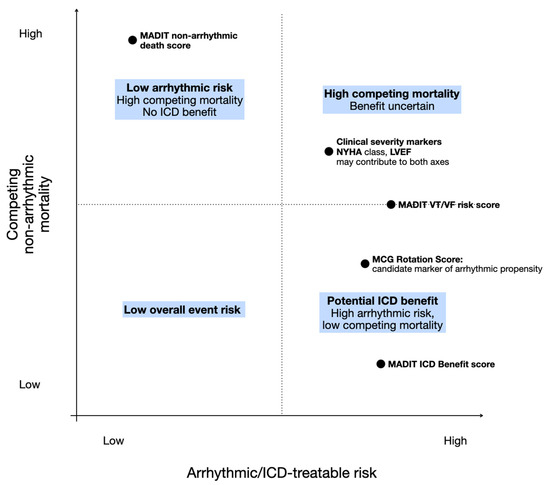
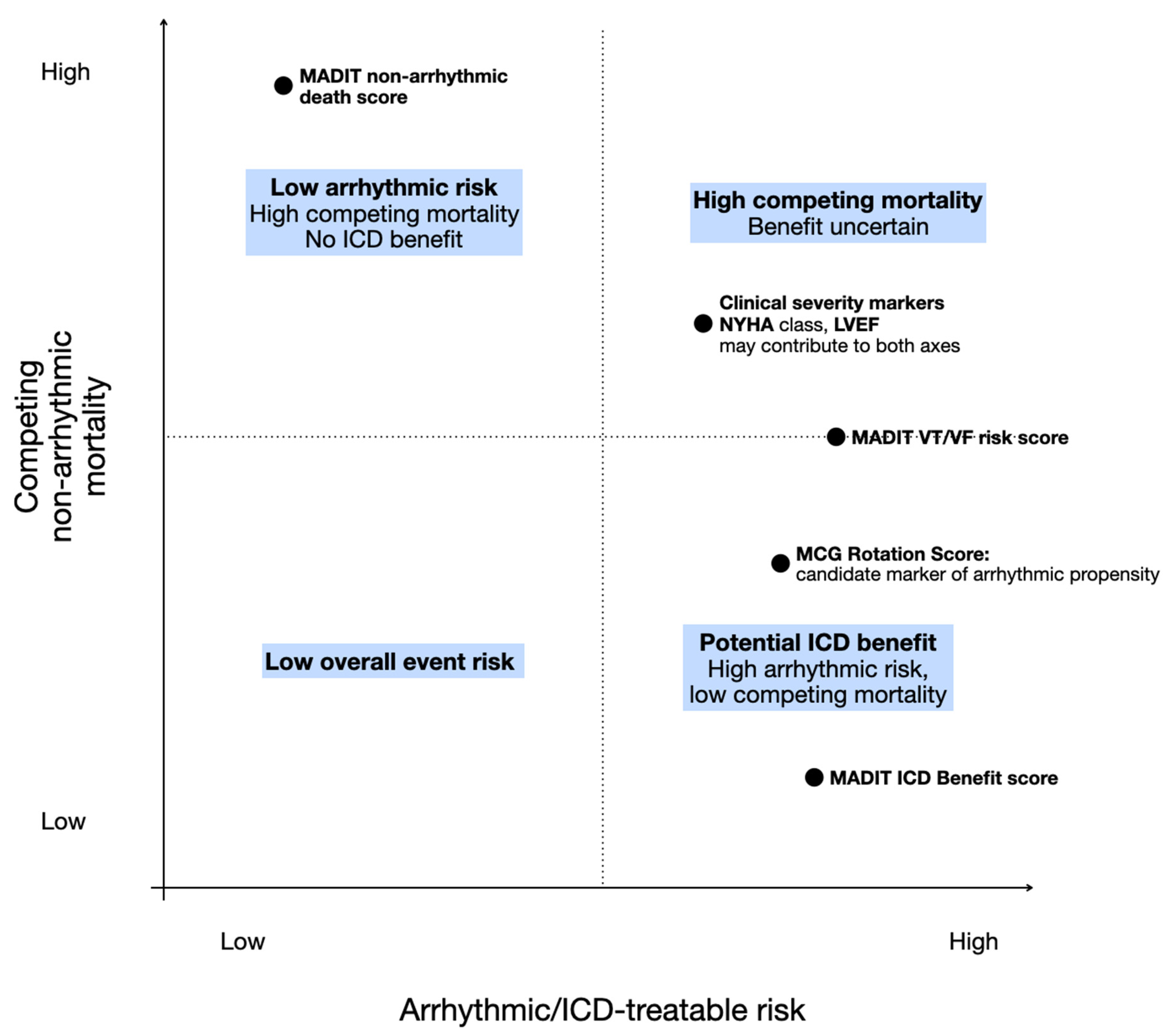
ICD benefit depends on the consideration of ICD-treatable arrhythmic risk and the risk of death from non-arrhythmic mechanisms. The MADIT-ICD benefit score formalised these domains by combining a ventricular tachycardia/ventricular fibrillation (VT/VF) risk score with a non-arrhythmic death score [6]. Figure 1 presents this established two-axis framework; the possible contribution of MCG Rotation Score is shown only as the study hypothesis tested subsequently, not as an observed result or calibrated clinical position. Contemporary reassessment of primary-prevention ICD selection further highlights the limitations of LVEF-only selection [7,8].
Figure 1.
Proposed two-axis framework for ICD risk stratification. MCG Rotation Score is hypothesised to contribute preferentially to the arrhythmic/therapy-risk axis, whereas clinical severity markers such as NYHA class and LVEF may contribute to both arrhythmic and competing-mortality risk. The MADIT non-arrhythmic death score is expected to align more strongly with the competing-mortality axis. Potential ICD benefit is greatest when arrhythmic risk is high and competing non-arrhythmic mortality is low.
Magnetocardiography (MCG) is a contactless technique that records the biomagnetic field generated by cardiac electrical activity. Magnetic fields are less distorted by intervening tissue conductivity than surface voltage measurements; MCG may preserve electrophysiological information that is attenuated or spatially blurred on the body-surface electrocardiogram (ECG) as well as represent tangential components and electrical vortex currents [9,10]. Historically, clinical MCG was constrained by cryogenic sensors and magnetically shielded rooms. The Magneto-SCD trial utilised a portable, room-temperature, unshielded MCG system, enabling viable acquisition in routine clinical environments [11,12].
The Magneto-SCD trial evaluated established and novel MCG parameters in de novo ICD and cardiac resynchronisation therapy defibrillator (CRT-D) recipients. Two novel MCG parameters (Rotation Score and Angular Dynamics) were developed that quantify temporal re-orientation of the dominant MCG dipole during ventricular depolarisation [13]. In the main trial, rotation-based indices were associated with subsequent appropriate ICD therapies, particularly shocks, suggesting that they may capture conduction heterogeneity or an arrhythmogenic substrate not fully reflected by LVEF or conventional clinical markers [14]. The clinical value of such a marker would be greatest in the primary-prevention setting, where the patient has not yet declared arrhythmic risk through prior sustained VA. To limit multiplicity and model complexity in this sparse-event substudy, Rotation Score was selected as the single representative MCG exposure. We examined whether it was associated preferentially with arrhythmic endpoints and whether it showed possible information beyond MADIT-derived risk constructs. The post-MI subgroup was included for conceptual comparison with contemporary PROFID-EHRA questions.
2. Materials and Methods
2.1. Study Design and Population
This was a secondary analysis of the prospective, multicentre, observational Magneto-SCD study [11,12,13,14], which recruited adults undergoing de novo ICD or CRT-D implantation at five UK hospitals between September 2019 and November 2021. ICD or CRT-D selection was made by the treating team according to clinical indications for defibrillation and cardiac resynchronisation; device type was not randomised by the study. The present analysis was restricted to primary-prevention indications and with recorded follow-up and a non-missing Rotation Score modelling. The trial was registered with ClinicalTrials.gov (NCT04352816). The study was approved by the York and Humber Regional Ethics Committee (19/YH/0143; approval date: 17 July 2019).
Two analysis groups were prespecified: The full primary-prevention cohort included all eligible ICD/CRT-D recipients. The post-MI subgroup additionally required documented prior MI at least 3 months prior to entry into the main study. The full cohort addressed the general primary-prevention question; the post-MI subgroup provided only a descriptive, conceptually relevant comparison with the population being assessed in the contemporary PROFID-EHRA study, while recognising that the present dataset was not designed as a PROFID replication cohort [8].
2.2. Magnetocardiography Acquisition and Rotation Score
MCG acquisition and processing followed the Magneto-SCD protocol [11]. Recordings were obtained using a portable, room-temperature, unshielded device (VitalScan, Creavo Medical Technologies, Coventry, UK). Recordings were performed with participants in the supine position in routine hospital clinical settings. Data underwent quality assessment, including signal-to-noise review and visual inspection; recordings with excessive environmental interference or an unclear cardiac signal were excluded from the parent analysable MCG cohort.
During the QRS interval, sequential magnetic field maps were generated. At each timepoint, the positive and negative pole centroids were identified, and the dominant dipole orientation was defined from the negative to the positive pole. Rotation Score was calculated as the cumulative absolute change in dipole angle between consecutive timepoints, weighted by instantaneous MCG amplitude to reduce the influence of very low-amplitude frames [13]. Higher values therefore indicate greater temporal re-orientation of the dominant magnetic dipole during ventricular depolarisation. Rotation Score was analysed continuously and hazard ratios (HR) were expressed per standard deviation (SD) increase. Rotation Score was selected as the primary MCG exposure because its performance was broadly similar to Angular Dynamics in the parent analysis, while reducing multiplicity and over-parameterisation in this small-event substudy.
2.3. Comparator Variables and Risk Constructs
Clinical covariates included age, LVEF, NYHA class, and ischaemic aetiology. NYHA status was reconstructed retrospectively from clinical documentation and dichotomised as NYHA < 2 versus NYHA ≥ 2 because exact separation of class II from class III was not reliable for all participants. In this dataset, NYHA ≥ 2 therefore represented documented class II or III; no NYHA IV participant was identified in the cohort (in keeping with current guidelines). LVEF was treated as a percentage. NYHA class was dichotomised as NYHA >2 versus NYHA < 2. MADIT-derived scores available in the dataset were used as comparator constructs: the VT/VF score, the non-arrhythmic death score, and the ICD benefit score. For modelling, the ICD-benefit score was scaled as benefit10 = benefit score/10. The principal incremental-value question was whether Rotation Score added information beyond the MADIT-derived arrhythmic and competing-mortality component scores.
2.4. Endpoints
The primary endpoint was time to first appropriate ICD therapy, defined as anti-tachycardia pacing (ATP) or ICD shock, judged appropriate according to device interrogation and clinical adjudication in the parent study. Participants without appropriate therapy were followed to death or last recorded follow-up. Death without prior therapy was treated as a pragmatic competing endpoint; it was not classified as adjudicated non-arrhythmic death. For participants who died without prior therapy, event time was the recorded interval derived from implant and death dates. Participants alive without therapy at last follow-up were censored.
A secondary endpoint examined appropriate ICD shock as a more specific but less frequent arrhythmic proxy than any device therapy. ICD shock events required an appropriate ICD shock status and a valid time from implant to appropriate ICD shock. Death without prior shock was handled analogously to the primary analysis as a competing event.
2.5. Statistical Analysis
Details of the statistics used in the Magneto-SCD trial have been reported [11,14]. Descriptive analyses reported cohort derivation, variable-specific missingness, median follow-up with interquartile range and maximum follow-up, appropriate ICD therapy, appropriate ICD shock, ATP and competing-event counts. Aalen–Johansen cumulative incidence functions (CIFs) were estimated for appropriate ICD therapy and death without prior therapy and summarised at two years (730 days). Exploratory strata were cohort-specific rank-based tertiles of Rotation Score and MADIT-derived scores in the full cohort and Rotation Score tertiles and NYHA < 2 versus NYHA ≥ 2 in the post-MI subgroup.
Cause-specific Cox models were fitted separately for the event of interest and the competing event. Cause-specific hazards were selected because the principal objective was to examine aetiological associations with the instantaneous event rate among participants who were still event-free; Aalen–Johansen methods were used to present absolute cumulative incidence. Fine-Gray subdistribution models were not used as the primary regression approach because this small exploratory analysis was not designed to estimate a treatment-decision subdistribution effect [15]. Rotation Score was modelled per SD on a linear scale; restricted cubic splines were not fitted because only 8–10 events were available for the principal models. Proportional-hazards assumptions were assessed using scaled Schoenfeld residuals.
Prespecified full-cohort models included Rotation Score alone, MADIT benefit score with and without Rotation Score, and the MADIT VT/VF and non-arrhythmic death component scores with and without Rotation Score. Clinical multivariable models were considered exploratory and were not emphasised when unstable. Nested likelihood-ratio tests compared models with and without Rotation Score. Apparent C-index and two-year calibration were explored using 500 bootstrap resamples, but NRI, IDI and decision-curve analysis were not undertaken because of sparse events and the absence of an externally validated clinical threshold.
Analyses were performed in RStudio (2025.09.2+418; RStudio Inc., Boston, MA, USA) using the survival package for cause-specific Cox models and custom R functions for Aalen–Johansen cumulative-incidence estimation and bootstrap validation.
3. Results
3.1. Cohort Outcomes
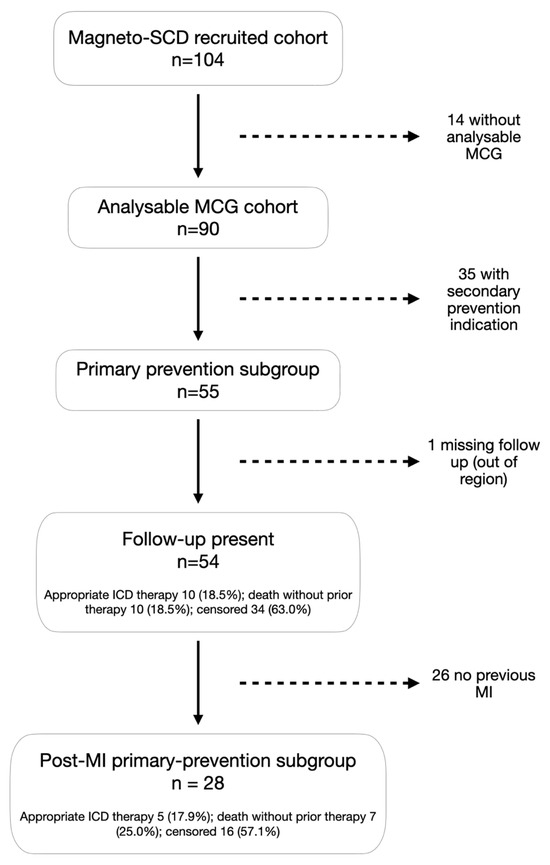
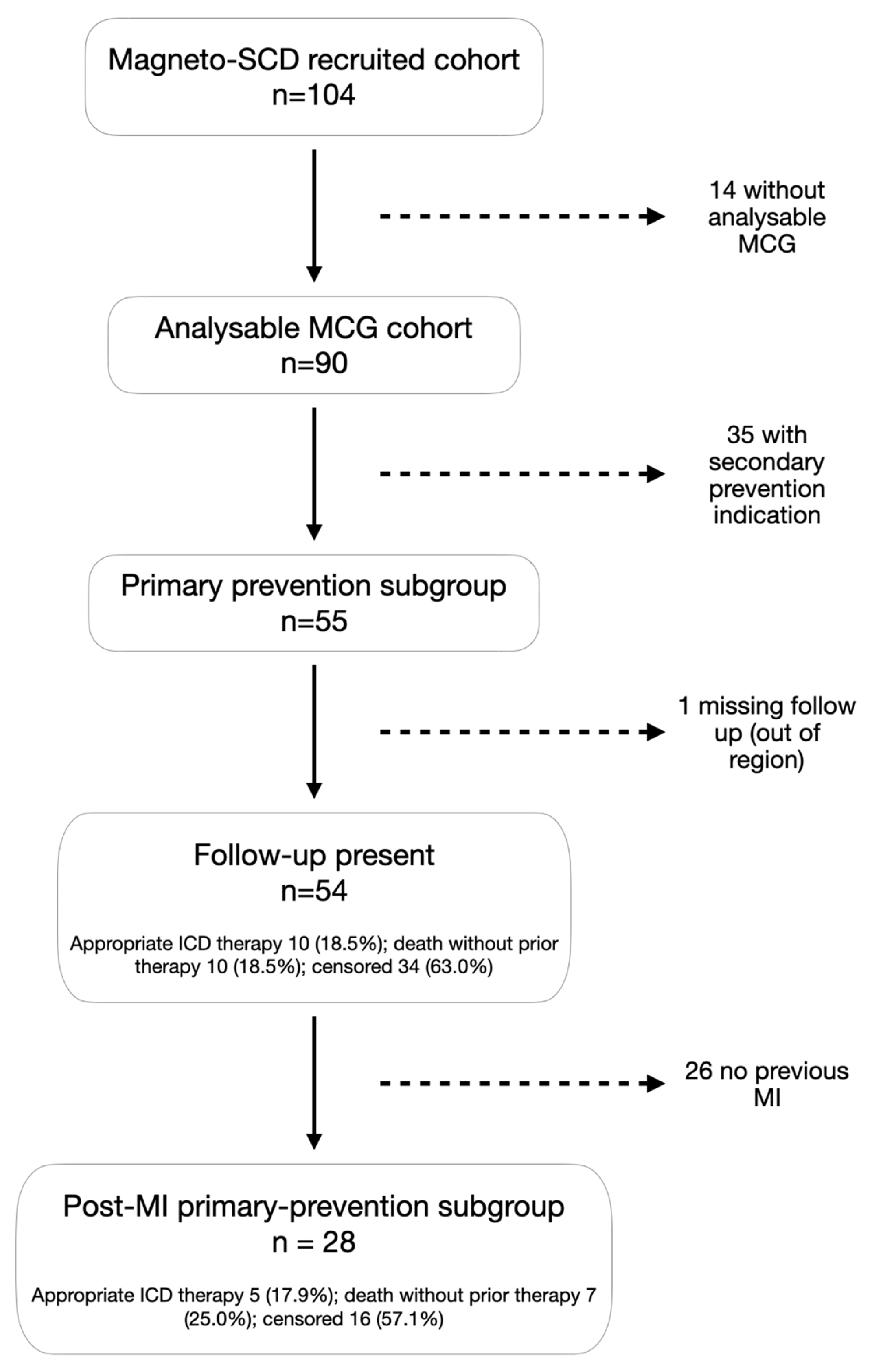
The Magneto-SCD study recruited 104 participants, of whom 90 had analysable MCG data [14]. Sixty-five participants in the recruited cohort had a primary-prevention indication. After restriction to participants with non-missing Rotation Score data and required risk-stratification variables, 54 primary-prevention ICD/CRT-D recipients were identified; mean age was 63.8 ± 13.2 yrs and 45 (83.3%) were males. Of these, 10 (18.5%) experienced appropriate ICD therapy, 10 (18.5%) died without prior therapy, and 34 (63.0%) were censored alive without prior therapy. The post-MI subgroup included 28 participants, of whom five (17.9%) experienced appropriate ICD therapy, seven (25.0%) died without prior therapy, and 16 (57.1%) were censored. Median follow-up was 1211.5 days (IQR 793.5–1396.0; maximum 2069) in the full cohort and 1256.0 days (IQR 822.8–1489.5; maximum 2069) in the post-MI subgroup. The cohort derivation and event accounting are summarised in Figure 2. Baseline patient characteristics are reported in Table S1.
Figure 2.
Study flow diagram. Flow from the recruited Magneto-SCD cohort to the analysable MCG cohort, primary-prevention cohort, Cohort A, and prior-MI Cohort B, with event accounting for appropriate ICD therapy, death without prior therapy, and censoring.
3.2. Two-Year Competing-Risk Estimates
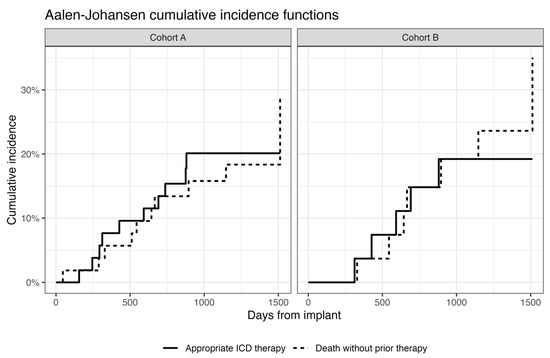
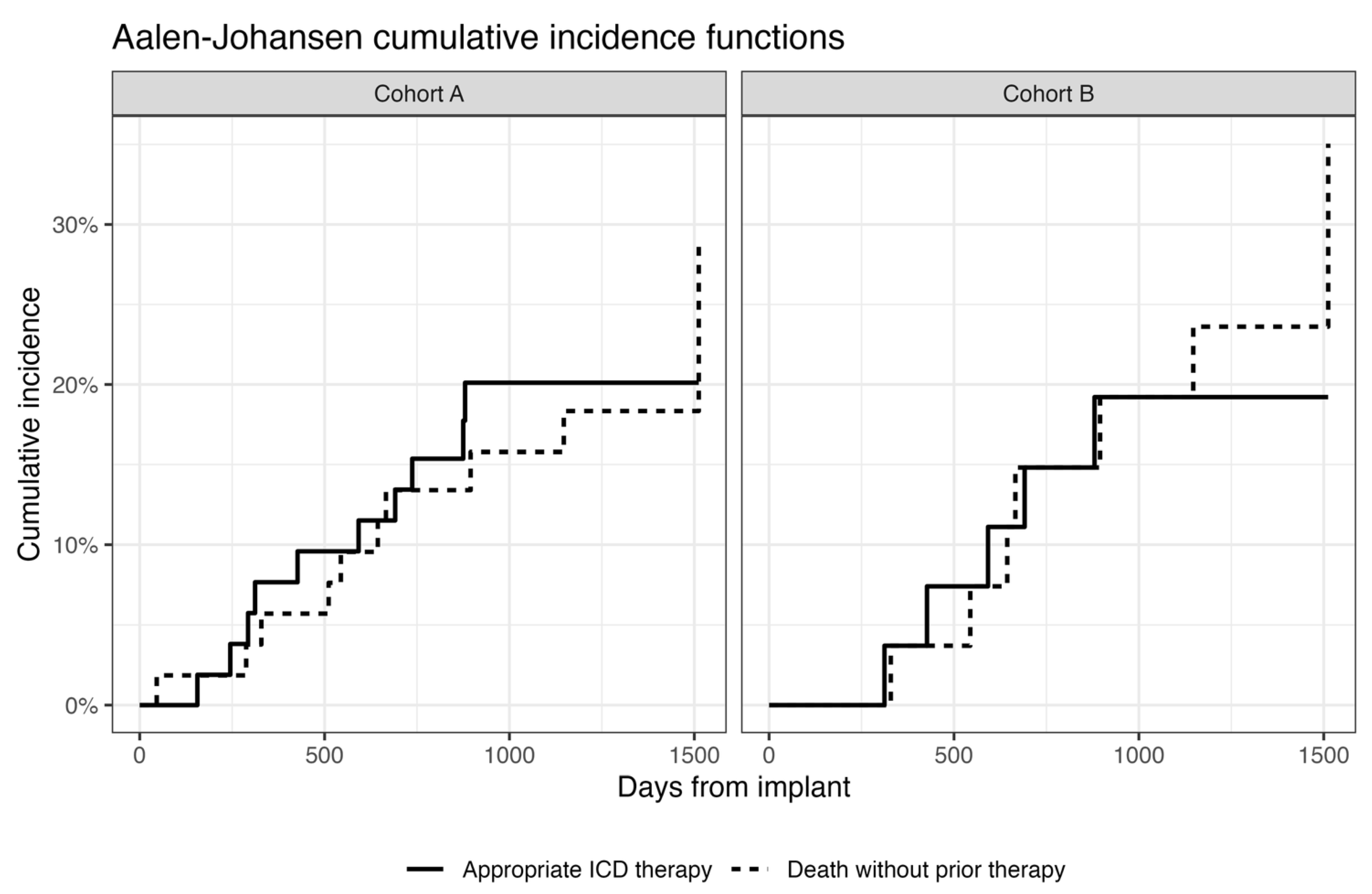
At two years, the cumulative incidences of appropriate ICD therapy and death without prior therapy were each 0.134 in the full primary-prevention cohort, with event-free survival 0.732 (Figure 3; Table 1). Corresponding CIF estimates in the post-MI subgroup were each approximately 0.148, with event-free survival of approximately 0.704. In the five post-MI participants with NYHA < 2, no endpoint occurred by two years (Table S5). Given the very small NYHA < 2 denominator and a later therapy event in that group, this was treated as a descriptive observation that may reflect chance rather than evidence of reliable risk separation.
Figure 3.
Aalen–Johansen cumulative incidence functions for appropriate ICD therapy and death without prior therapy. Curves show competing-risk estimates for Cohort A and Cohort B, with death without prior therapy treated as a competing event for appropriate ICD therapy.
Table 1.
Two-year Aalen–Johansen cumulative incidence estimates.
3.3. NYHA Status, Rotation Score and Post-MI Competing Risk
In the post-MI subgroup, NYHA status and Rotation Score showed different endpoint patterns. All seven deaths without prior therapy among participants with available NYHA classification occurred in those with NYHA ≥ 2, but the NYHA coefficient was not reliably estimable because the NYHA < 2 stratum contained no such deaths. Over complete follow-up, one NYHA < 2 participant experienced appropriate ICD therapy and shock. When Rotation Score was split at the post-MI median (391.1) for description only, all four appropriate ICD shocks occurred in the above-median group, whereas deaths without prior therapy occurred in both Rotation groups (Tables S2 and S5). These subgroup patterns are hypothesis-generating and are not validated thresholds.
3.4. Rotation Score and Cause-Specific Risk of Therapy Versus Competing Death
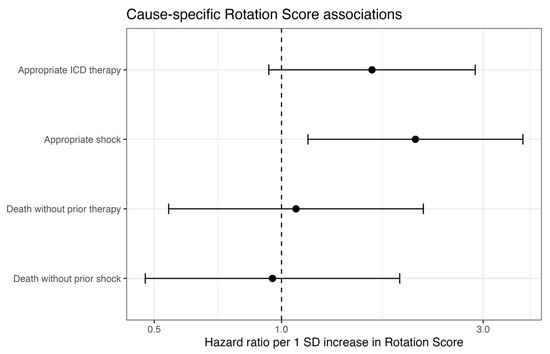
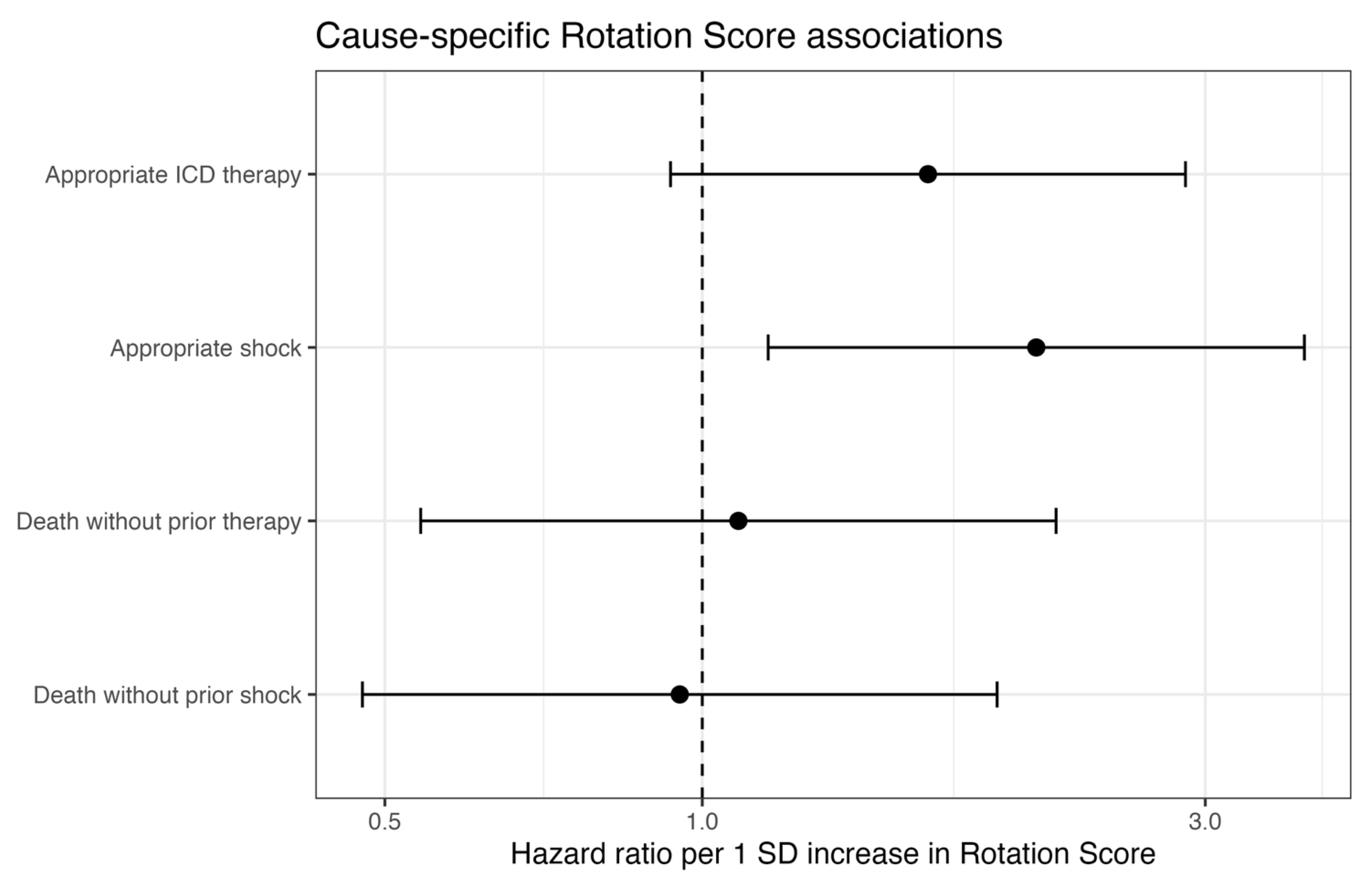
In the full primary-prevention cohort, each SD increase in Rotation Score was associated with a higher hazard of appropriate ICD therapy, although this did not reach statistical significance (HR 1.64, 95% CI 0.93–2.87; p = 0.086). The association was stronger when appropriate shock was used as the arrhythmic endpoint, HR 2.07, 95% CI 1.15–3.72. Corresponding associations were close to null for death without prior therapy (HR 1.08, 95% CI 0.54–2.17; p = 0.824) and death without prior ICD shock (HR 0.95, 95% CI 0.48–1.90; p = 0.890) (Table 2; Figure 4). Schoenfeld residual tests provided no evidence of proportional-hazards violations in the four Rotation-only models or the corresponding MADIT-components-plus-Rotation models, although the diagnostics had limited power because of sparse events (all global or relevant term-specific p ≥ 0.504; Table S6).
Table 2.
Cause-specific Cox model summary for Rotation Score in Cohort A.
Figure 4.
Cause-specific hazard ratios for Rotation Score in Cohort A. Hazard ratios are shown per 1 SD increase in Rotation Score for appropriate ICD therapy, appropriate shock, death without prior therapy, and death without prior shock. Models are cause-specific Cox models.
3.5. Rotation Score Added to MADIT-Derived Risk Constructs
When Rotation Score was added to the VT/VF score and non-arrhythmic death score component model for appropriate ICD therapy, its coefficient was HR 1.80, 95% CI 1.01–3.21 (Table 3). However, the nested likelihood-ratio comparison did not meet the threshold for improved primary-endpoint model fit (LRT p = 0.065). The comparison with the MADIT benefit score was also non-significant (LRT p = 0.109). For death-without-therapy, adding Rotation Score did not improve model fit beyond MADIT components (LRT p = 0.790) or MADIT benefit score (LRT p = 0.992) (Table 3).
Table 3.
Nested model comparisons after adding Rotation Score to MADIT-derived constructs in the full primary-prevention cohort.
For the secondary appropriate ICD shock endpoint, Rotation Score in the MADIT-component model had HR 2.25 (95% CI 1.21–4.16), and the nested model comparison was statistically significant (LRT p = 0.016). No model-fit difference was observed for death without prior ICD shock (Rotation HR 0.97, 95% CI 0.48–2.00; LRT p = 0.942). Because these analyses were based on only eight shock events, they may be sensitive to influential observations and do not establish clinical incremental value. (Table 3 and Table S3).
3.6. Two-Year Prediction Modelling
Exploratory two-year prediction models showed numerically higher apparent and optimism-corrected discrimination for some MADIT models containing Rotation Score (Table S4). However, event counts were low and several fitted models showed convergence warnings or calibration instability and bootstrap optimism correction could not compensate for inadequate event numbers. Prediction metrics were therefore retained as supplementary hypothesis-generating analyses rather than evidence of a clinically usable prediction model.
4. Discussion
4.1. Principal Findings
This exploratory substudy identified an association pattern in which Rotation Score was more strongly related to appropriate ICD shock than to the broader appropriate ICD therapy endpoint, while showing no association with death without prior therapy or death without prior ICD shock. The primary-endpoint likelihood-ratio comparisons beyond MADIT-derived models were non-significant; only the secondary appropriate ICD shock comparison reached statistical significance. Accordingly, the findings support a possible arrhythmia-related signal but do not establish incremental prediction, clinical utility, or a role in ICD selection.
These findings are conceptually important because they suggest that Rotation Score may not simply be a marker of advanced global illness, heart failure severity, or frailty. A marker that increases both therapy risk and competing death risk, such as LVEF, may not aid ICD selection, because high arrhythmic risk may be offset by high non-arrhythmic mortality. By contrast, a marker preferentially associated with ICD-treatable VA could complement clinical scores designed to balance arrhythmic and non-arrhythmic risk. In this exploratory dataset, Rotation Score appeared to have its greatest effect on the arrhythmic/therapy axis. Importantly, death without prior therapy is only a pragmatic competing endpoint and cannot be equated with adjudicated non-arrhythmic death. Appropriate ICD therapy is also an imperfect surrogate for sudden death prevented because programming, ATP and spontaneous arrhythmia termination influence whether an episode is recorded and treated. Real-world remote-monitoring literature similarly illustrates the dependence of device-detected events on surveillance and programming [16].
4.2. Relationship to MADIT, PROFID-EHRA and CONTEMP-ICD Frameworks
The MADIT-ICD benefit score separates predicted VT/VF risk from predicted non-arrhythmic mortality risk, recognising that ICD benefit is greatest when arrhythmic risk is high and competing mortality is low [6]. The present analysis used this logic not to replace MADIT-derived scores, but to test whether a contactless MCG biomarker might add substrate information to the arrhythmic side of the equation. The absence of a Rotation Score signal for death without therapy is notable because it suggests that Rotation Score may measure a different biological domain than clinical variables such as age, diabetes, NYHA class, renal dysfunction, or body habitus, which often reflect competing mortality burden.
The post-MI subgroup was included because PROFID-EHRA is reassessing prophylactic ICD implantation after MI under contemporary therapy [8]. A central premise of this framework is that symptomatic heart-failure severity, reflected by NYHA ≥ 2 status, may identify patients with higher competing non-arrhythmic mortality, in whom the incremental benefit of ICD implantation may be attenuated because a greater proportion of adverse outcomes may not be preventable by defibrillation. The present subgroup was far smaller, NYHA status was reconstructed retrospectively and only five therapy events occurred. Its NYHA findings should therefore be regarded as descriptive and potentially attributable to chance, not as replication, validation or evidence for withholding or implanting an ICD.
The CONTEMP-ICD concept similarly reflects the need to re-evaluate primary-prevention ICD therapy under contemporary heart failure treatment, especially among patients with lower predicted arrhythmic risk relative to non-arrhythmic mortality [7]. The present two-axis analysis is therefore aligned with the direction of the field: future ICD selection will likely require markers that clarify which patients are at highest risk of shockable arrhythmia, which patients are primarily at risk of non-arrhythmic death, and which patients have a favourable balance for ICD implantation.
MCG should also be considered within the wider landscape of multimodality sudden-death risk assessment rather than only against LVEF and MADIT scores. Candidate approaches include CMR late gadolinium enhancement, scar burden and heterogeneity, global longitudinal strain, ECG markers such as QRS fragmentation and T-wave alternans, biomarkers, and programmed ventricular stimulation in selected populations. PRESERVE EF illustrates a combined non-invasive and electrophysiological strategy after MI [17], while DANISH and CMR studies emphasise the limitations of relying on LVEF alone [18,19,20].
4.3. Biological Plausibility
Rotation Score quantifies cumulative re-orientation of the dominant magnetic dipole during ventricular depolarisation [13]. A stable, homogeneous activation sequence would be expected to produce a more consistent dipole trajectory, whereas scar, fibrosis, conduction slowing, wavefront fragmentation, or functional block could plausibly generate greater temporal re-orientation. In patients with cardiomyopathy or prior MI, such abnormalities may reflect channels and barriers capable of supporting re-entry. The stronger association with appropriate ICD shock is physiologically compatible with this hypothesis. This interpretation remains inferential, particularly in the context of sparse events, programming differences or influential observations. The study did not include systematic scar imaging, electroanatomic mapping, or invasive electrophysiological validation. Future studies should determine whether Rotation Score correlates with late gadolinium enhancement burden, scar border-zone heterogeneity, conduction-channel metrics, ventricular electrogram fractionation, or inducibility. Such mechanistic validation would help establish whether Rotation Score is a direct marker of substrate complexity or an indirect correlate of other electrophysiological or structural abnormalities.
4.4. Clinical Implications
No Rotation Score threshold can currently be recommended, and no current data can establish that withholding an ICD at a low value would be safe. Before clinical application, Rotation Score would need reproducibility testing, external validation, calibration, discrimination beyond established markers, reclassification and decision-curve analyses, and evidence that its use changes decisions or outcomes. If externally validated, the MCG Rotation Score could have several potential clinical applications. First, it could support shared decision-making in borderline primary-prevention ICD candidates by providing a non-invasive measure of VA risk propensity. Second, it could complement MADIT-derived or other competing-risk models by supplying electrophysiological substrate information rather than only clinical comorbidity data. Third, it could help refine risk stratification in post-MI and cardiomyopathy populations undergoing reassessment in contemporary trials. The potential role of MCG may also be studied within temporary protection strategies using a wearable cardioverter-defibrillator (WCD). In recent MI, newly diagnosed cardiomyopathy, myocarditis or another potentially reversible substrate, arrhythmic risk may be transient and permanent ICD implantation may be premature. A WCD can provide temporary protection while guideline-directed therapy, ventricular function and long-term candidacy are reassessed. Future studies could evaluate Rotation Score alongside WCD-derived arrhythmic and adherence data, imaging, biomarkers and clinical variables [21,22]. Finally, because the parent Magneto-SCD study [14] used a portable unshielded device, the workflow may be more compatible with routine hospital practice than earlier shielded-room MCG systems.
The potential clinical utility of improved arrhythmic risk stratification should also be considered in relation to the procedural and long-term risks of ICD implantation. Cardiac implantable electronic device infection is among the most serious complications and may require complete system extraction, prolonged antibiotic therapy and delayed reimplantation. Therefore, the decision to implant an ICD should balance not only arrhythmic risk and competing mortality, but also patient-specific procedural and infectious risk. Contemporary prevention relies on careful pre-procedural risk assessment, optimisation of modifiable factors, systemic antibiotic prophylaxis, meticulous sterile technique, prevention of pocket haematoma and selective use of adjunctive antibacterial strategies in high-risk patients [23,24].
4.5. Strengths
The current study has several strengths. It uses a real-world cohort to focus on a clinically highly relevant primary-prevention ICD population, where risk stratification has the greatest unmet need. It uses time-to-event and competing-risk methods rather than relying solely on binary event status. It evaluates both a broad ICD therapy endpoint and a more specific ICD shock endpoint. It also explicitly tests whether Rotation Score adds to established MADIT-derived constructs and whether any incremental information is endpoint-specific. Finally, the analysis is grounded in a prospective multicentre MCG cohort using a portable device in routine clinical settings.
4.6. Limitations
The dominant limitation is event scarcity: the full primary-prevention cohort included only 10 appropriate ICD therapy events, 10 deaths without prior therapy and only eight appropriate ICD shocks; the post-MI subgroup contained five therapy events. Multivariable coefficients, likelihood-ratio tests, subgroup comparisons and bootstrap estimates are consequently unstable and vulnerable to separation, overfitting and influential observations. Several clinical risk-stratification variables were not prespecified in the original Magneto-SCD study design and were reconstructed after trial completion from clinical records.
Endpoint classification also limits interpretation. Appropriate ICD therapy is influenced by detection zones, ATP algorithms, programming changes and adjudication, while appropriate ICD shock is more specific but much less frequent. Programming was not standardised centrally and some ATP occurred below 180 beats/min. Death without prior therapy is not equivalent to non-arrhythmic death: unwitnessed arrhythmic death, terminal device deactivation or incomplete peri-terminal interrogation could lead to misclassification. The revised analysis uses documented implant-to-death timing for all recorded deaths and does not substitute last follow-up as an event date, but cause of death was not centrally adjudicated.
The analysis was performed in a single study cohort without external validation. Several risk variables, particularly NYHA status and MADIT components, were reconstructed retrospectively and contained missing or unclassifiable values. Exact NYHA II versus III separation was unavailable, and the post-MI subgroup was too small for reliable subgroup inference. Recruitment occurred during the COVID-19 era, which may have altered referral patterns, implantation practice, follow-up and competing mortality. The parent study was also under-recruited because of the pandemic, a time-limited CE mark for the device, and non-analysable scans due to environmental magnetic interference, which may have introduced selection bias. Test–retest, operator, site and processing-pipeline reproducibility were not systematically assessed.
4.7. Future Directions
Future studies should prospectively validate Rotation Score in adequately powered primary-prevention cohorts with standardised device programming, central adjudication of arrhythmia and cause of death, contemporary therapy documentation and independent external validation. Comparative analyses should evaluate incremental value beyond LVEF, NYHA class, CMR scar characteristics, ECG/Vectorcardiographic markers, biomarkers and competing-risk models such as the MADIT-ICD benefit score. Validation should assess non-linearity, calibration, discrimination, reclassification, decision curves, thresholds and whether the Rotation Score changes treatment recommendations or patient outcomes. Mechanistic studies should link MCG-rotation metrics to structural scar architecture and invasive electrophysiology, while implementation studies should quantify reproducibility, acquisition failure rates and environmental noise effects.
5. Conclusions
In this exploratory primary-prevention Magneto-SCD substudy, Rotation Score was associated with appropriate ICD shock and showed a weaker, non-significant association with the broader appropriate ICD therapy endpoint, while showing no association with death without prior therapy. Adding Rotation Score did not significantly improve primary-endpoint model fit beyond the evaluated MADIT-derived models; a model-fit signal was observed only for the secondary shock endpoint and was based on eight events. These findings suggest that Rotation Score may provide information related to ventricular arrhythmic propensity that is not fully captured by the evaluated clinical scores. Larger, prospectively designed and externally validated studies are required to determine whether this association improves clinical risk stratification or ICD decision-making.
Supplementary Materials
The following supporting information can be downloaded at: https://www.mdpi.com/article/10.3390/jcm15186985/s1, Table S1. Baseline characteristics of Cohort A and Cohort B. Values are mean ± SD or n/N (%); Table S2. Event counts by prespecified strata; Table S3. Compact cause-specific Cox model outputs. Hazard ratios are shown as HR (95% CI). Rotation Score is expressed per 1 SD increase. Benefit score is per 10-point increase. Warnings indicate sparse-data convergence or separation issues; Table S4. Bootstrap optimism-corrected prediction validation for 2-year appropriate ICD therapy in Cohort A; Table S5. PROFID-aligned Cohort B: NYHA status and Rotation Score as complementary markers of competing risk and arrhythmic risk; Table S6. Schoenfeld residual tests of the proportional-hazards assumption for prespecified Cohort A cause-specific Cox models.
Author Contributions
Conceptualisation, T.L. and F.O.; methodology, T.L., H.H., A.M., P.K.K. and F.O.; software/formal analysis, T.L.; investigation, T.L., H.H., N.C., T.H., S.S., R.B., D.W., V.G.L. and S.P.; resources, F.O. and T.L.; data curation, T.L. and H.H.; writing—original draft preparation, T.L. and F.O.; writing—review and editing, all authors; supervision, F.O.; project administration, T.L., H.H. and F.O.; funding acquisition, F.O. All authors have read and agreed to the published version of the manuscript.
Funding
Creavo Medical Technologies Limited provided a research grant but had no direct involvement in the study. T.L. was supported by an Abbott Medical fellowship, HH by a Medtronic Ltd. fellowship, NC by a Boston Scientific fellowship.
Institutional Review Board Statement
The original study was conducted in accordance with the Declaration of Helsinki and approved by the York and Humber Regional Ethics Committee (protocol code 19/YH/0143; approval date: 17 July 2019). Additional ethical review and approval were waived for the present secondary analysis because it used previously collected and de-identified data.
Informed Consent Statement
Written informed consent was obtained from all subjects involved in the study.
Data Availability Statement
De-identified data supporting the findings of this study may be available from the corresponding author upon reasonable request, subject to institutional governance, ethics approvals, and data-sharing agreements.
Acknowledgments
The authors thank Ceri Jones, Guy Smallman, Nigel Edwards, Abeesh Panicker, Donna McDonell, Bridgette Smith, and the UHCW Institute for Cardiometabolic Medicine for their support of the Magneto-SCD study.
Conflicts of Interest
The authors declare that this study received funding from Creavo Medical Technologies Limited and Medtronic Ltd. The funder was not involved in the study design, collection, analysis, interpretation of data, the writing of this article or the decision to submit it for publication.
Abbreviations
| ATP | Anti-tachycardia pacing |
| CRT-D | Cardiac resynchronisation therapy- defibrillator |
| CI | Confidence interval |
| CIFs | Cumulative incidence functions |
| ECG | Electrocardiogram |
| HR | Hazard ratio |
| ICD | Implantable cardioverter-defibrillator |
| LVEF | Left ventricular ejection fraction |
| MCG | Magnetocardiography |
| MI | Myocardial infarction |
| NYHA | New York Heart Association |
| SD | Standard deviation |
| SCD | Sudden cardiac death |
| VCG | Vectorcardiography |
| VA | Ventricular arrhythmia |
| VT | Ventricular tachycardia |
| VF | Ventricular fibrillation |
References
- Tfelt-Hansen, J.; Garcia, R.; Albert, C.; Merino, J.; Krahn, A.; Marijon, E.; Basso, C.; Wilde, A.A.M.; Haugaa, K.H. Risk stratification of sudden cardiac death: A review. EP Eur. 2023, 25, euad203. [Google Scholar] [CrossRef] [Scilit]
- Zeppenfeld, K.; Tfelt-Hansen, J.; de Riva, M.; Winkel, B.G.; Behr, E.R.; A Blom, N.; Charron, P.; Corrado, D.; Dagres, N.; de Chillou, C.; et al. 2022 ESC Guidelines for the management of patients with ventricular arrhythmias and the prevention of sudden cardiac death. Eur. Heart J. 2022, 43, 3997–4126. [Google Scholar] [CrossRef] [Scilit]
- Moss, A.J.; Zareba, W.; Hall, W.J.; Klein, H.; Wilber, D.J.; Cannom, D.S.; Daubert, J.P.; Higgins, S.L.; Brown, M.W.; Andrews, M.L. Prophylactic implantation of a defibrillator in patients with myocardial infarction and reduced ejection fraction. N. Engl. J. Med. 2002, 346, 877–883. [Google Scholar] [CrossRef] [Scilit]
- Bardy, G.H.; Lee, K.L.; Mark, D.B.; Poole, J.E.; Packer, D.L.; Boineau, R.; Domanski, M.; Troutman, C.; Anderson, J.; Johnson, G.; et al. Amiodarone or an implantable cardioverter-defibrillator for congestive heart failure. N. Engl. J. Med. 2005, 352, 225–237. [Google Scholar] [CrossRef] [Scilit]
- Dagres, N.; Hindricks, G. Risk stratification after myocardial infarction: Is left ventricular ejection fraction enough to prevent sudden cardiac death? Eur. Heart J. 2013, 34, 1964–1971. [Google Scholar] [CrossRef] [Scilit]
- Younis, A.; Goldberger, J.J.; Kutyifa, V.; Zareba, W.; Polonsky, B.; Klein, H.; Aktas, M.K.; Huang, D.; Daubert, J.; Estes, M.; et al. Predicted benefit of an implantable cardioverter-defibrillator: The MADIT-ICD benefit score. Eur. Heart J. 2021, 42, 1676–1684. [Google Scholar] [CrossRef] [Scilit]
- Goldenberg, I.; Zareba, W.; Ezekowitz, J.A.; Albert, C.; Alexis, J.D.; Anderson, L.; Behr, E.R.; Daubert, J.; Di Palo, K.E.; Ellenbogen, K.A.; et al. Rationale and design of the comparative effectiveness of ICD vs non-ICD therapy in contemporary heart failure patients at a low risk for arrhythmic death (CONTEMP-ICD) trial. Am. Heart J. 2026, 291, 162–174. [Google Scholar] [CrossRef] [Scilit]
- Dagres, N.; Gale, C.P.; Nadarajah, R.; Boveda, S.; Merino, J.L.; Nielsen, J.C.; Kirchhof, P.; Kutyifa, V.; Táborský, M.; Thiele, H.; et al. PRevention Of sudden cardiac death aFter myocardial Infarction by Defibrillator implantation: Design and rationale of the PROFID EHRA randomized clinical trial. Am. Heart J. 2026, 291, 37–43. [Google Scholar] [CrossRef] [Scilit]
- Tavarozzi, I.; Comani, S.; Del Gratta, C.; Di Luzio, S.; Romani, G.L.; Gallina, S.; Zimarino, M.; Brisinda, D.; Fenici, R.; De Caterina, R. Magnetocardiography: Current status and perspectives. Part II: Clinical applications. Ital. Heart J. 2002, 3, 151–165. [Google Scholar]
- Mooney, J.W.; Ghasemi-Roudsari, S.; Banham, E.R.; Symonds, C.; Pawlowski, N.; Varcoe, B.T.H. A portable diagnostic device for cardiac magnetic field mapping. Biomed. Phys. Eng. Express 2017, 3, 015008. [Google Scholar] [CrossRef] [Scilit]
- Lachlan, T.; He, H.; Sharma, K.; Khan, J.N.; Rajappan, K.; Morley-Davies, A.; Patwala, A.; Randeva, H.; Osman, F. MAGNETO cardiography parameters to predict future sudden cardiac death (MAGNETO-SCD) or ventricular events from implantable cardioverter defibrillators: Study protocol, design and rationale. BMJ Open 2020, 10, e038804. [Google Scholar] [CrossRef] [Scilit]
- Lachlan, T.; He, H.; Miller, A.; Chandan, N.; Siddiqui, S.; Beadle, R.; Wilson, D.; Petkar, S.; Randeva, H.; Osman, F. Feasibility of novel unshielded portable magnetocardiography: Insights from the prospective multicenter MAGNETO-SCD trial. Heart Rhythm 2023, 20, 475–477. [Google Scholar] [CrossRef] [Scilit]
- Lachlan, T.; He, H.; Miller, A.; Chandan, N.; Siddiqui, S.; Beadle, R.; Wilson, D.; Petkar, S.; Kimani, P.K.; Ng, G.A.; et al. Discovery of Novel Magnetocardiography Parameters Predicting Future ICD Therapies: Insights From the Magneto-SCD Study. Circ. Arrhythmia Electrophysiol. 2026, 19, e014998. [Google Scholar] [CrossRef] [Scilit]
- Lachlan, T.; He, H.; Miller, A.; Chandan, N.; Siddiqui, S.; Beadle, R.; Wilson, D.; Petkar, S.; Kimani, P.K.; Ng, G.A.; et al. MAGNETOcardiography Parameters to Predict Sudden Cardiac Death (MAGNETO-SCD) or Ventricular Events From Implantable Cardioverter Defibrillators. JACC Clin. Electrophysiol. 2026, in press. [Google Scholar] [CrossRef] [Scilit]
- Fine, J.P.; Gray, R.J. A proportional hazards model for the subdistribution of a competing risk. J. Am. Stat. Assoc. 1999, 94, 496–509. [Google Scholar] [CrossRef]
- Dyrbuś, M.; Pyka, Ł.; Kurek, A.; Niedziela, J.T.; Adamowicz-Czoch, E.; Ostręga, M.; Sokoła, K.; Pres, D.; Gąsior, M.; Tajstra, M. Alert Transmissions From Remote Monitoring of Patients With Cardiac Implantable Devices. JACC Clin. Electrophysiol. 2023, 9, 2163–2165. [Google Scholar] [CrossRef] [Scilit]
- Gatzoulis, K.A.; Tsiachris, D.; Arsenos, P.; Antoniou, C.-K.; Dilaveris, P.; Sideris, S.; Kanoupakis, E.; Simantirakis, E.; Korantzopoulos, P.; Goudevenos, I.; et al. Arrhythmic risk stratification in post-myocardial infarction patients with preserved ejection fraction: The PRESERVE EF study. Eur. Heart J. 2019, 40, 2940–2949. [Google Scholar] [CrossRef] [Scilit]
- Køber, L.; Thune, J.J.; Nielsen, J.C.; Haarbo, J.; Videbæk, L.; Korup, E.; Jensen, G.; Hildebrandt, P.; Steffensen, F.H.; Bruun, N.E.; et al. Defibrillator Implantation in Patients with Nonischemic Systolic Heart Failure. N. Engl. J. Med. 2016, 375, 1221–1230. [Google Scholar] [CrossRef] [Scilit]
- Di Marco, A.; Anguera, I.; Schmitt, M.; Klem, I.; Neilan, T.G.; White, J.A.; Sramko, M.; Masci, P.G.; Barison, A.; Mckenna, P.; et al. Late Gadolinium Enhancement and the Risk for Ventricular Arrhythmias or Sudden Death in Dilated Cardiomyopathy: Systematic Review and Meta-Analysis. JACC Heart Fail. 2017, 5, 28–38. [Google Scholar] [CrossRef] [Scilit]
- Halliday, B.P.; Gulati, A.; Ali, A.; Guha, K.; Newsome, S.; Arzanauskaite, M.; Vassiliou, V.S.; Lota, A.; Izgi, C.; Tayal, U.; et al. Association Between Midwall Late Gadolinium Enhancement and Sudden Cardiac Death in Patients With Dilated Cardiomyopathy and Mild and Moderate Left Ventricular Systolic Dysfunction. Circulation 2017, 135, 2106–2115. [Google Scholar] [CrossRef] [Scilit]
- Matteucci, A.; Bonanni, M.; Sgarra, L.; Pignalberi, C.; Aquilani, S.; Di Fusco, S.A.; Mariani, M.V.; Pierucci, N.; Lavalle, C.; Fedele, S.; et al. Wearable cardioverter defibrillator for transient arrhythmic risk and sudden cardiac death prevention: A systematic review and updated meta-analysis. Open Heart 2025, 12, e003648. [Google Scholar] [CrossRef] [Scilit]
- Matteucci, A.; Pignalberi, C.; Di Fusco, S.A.; Aiello, A.; Aquilani, S.; Nardi, F.; Colivicchi, F. Appropriate use of wearable defibrillators with multiparametric evaluation to avoid unnecessary defibrillator implantation. Open Heart 2024, 11, e002787. [Google Scholar] [CrossRef] [Scilit]
- Matteucci, A.; Bonanni, M.; Massaro, G.; Chiricolo, G.; Stifano, G.; Forleo, G.B.; Biondi-Zoccai, G.; Sangiorgi, G. Treatment with gentamicin-impregnated collagen sponges in reducing infection of implantable cardiac devices: 10-year analysis with propensity score matching. Rev. Port. Cardiol. 2023, 42, 711–717. [Google Scholar] [CrossRef] [Scilit]
- Matteucci, A.; Pignalberi, C.; Pandozi, C.; Magris, B.; Meo, A.; Russo, M.; Galeazzi, M.; Schiaffini, G.; Aquilani, S.; Di Fusco, S.A.; et al. Prevention and Risk Assessment of Cardiac Device Infections in Clinical Practice. J. Clin. Med. 2024, 13, 2707. [Google Scholar] [CrossRef] [Scilit]

Disclaimer/Publisher’s Note: The statements, opinions and data contained in all publications are solely those of the individual author(s) and contributor(s) and not of MDPI and/or the editor(s). MDPI and/or the editor(s) disclaim responsibility for any injury to people or property resulting from any ideas, methods, instructions or products referred to in the content. |
© 2026 by the authors. Licensee MDPI, Basel, Switzerland. This article is an open access article distributed under the terms and conditions of the Creative Commons Attribution (CC BY) license.