


Abstract
Background: Gastrointestinal (GI) diseases contribute substantially to healthcare utilization and chronic disease burden through recurrent symptoms, ongoing specialist care, and diagnostic evaluation. However, disparities related to race, ethnicity, and immigration status may arise at multiple points along the GI care continuum, and their association with access, diagnosis, treatment, and outcomes remains incompletely characterized. This scoping review synthesizes evidence on these differences in GI healthcare delivery. Methods: MEDLINE and Embase were searched from 1 January 2000 to 17 June 2025, with supplementary grey literature searches of relevant GI, liver, surgical, and endoscopic society websites. Findings were synthesized thematically due to heterogeneity in study design, populations, outcomes, and reporting. Results: Seventy-four studies were included across various GI diseases, including inflammatory bowel disease, hepatobiliary disease, esophageal disorders, and liver transplantation. Differences in care were reported across multiple care stages, including specialist access; diagnostic and treatment delays; use of medical, procedural, and surgical therapies; emergency care reliance; and transplant access and outcomes. Findings were, however, heterogeneous, with some studies reporting no differences or higher utilization among minority groups. Conclusions: Racial, ethnic, and immigration-related differences are reported across GI care pathways. Future research should identify modifiable factors that may lead to practice-changing interventions that will improve timely, equitable, longitudinal care.
1. Introduction
Gastrointestinal (GI) diseases encompass a broad spectrum of disorders affecting the digestive tract, as well as other accessory organs such as the liver and biliary system. These conditions include disorders of the gut–brain interaction, functional GI disorders such as irritable bowel syndrome (IBS), as well as structural or inflammatory diseases including inflammatory bowel disease (IBD), hepatobiliary diseases, and esophageal disorders [1]. The diagnosis and management of GI diseases are often complex and require multidisciplinary care with treatment strategies ranging from medical therapy to endoscopic and surgical interventions [1]. Consequently, GI diseases represent a major source of healthcare utilization and burden.
The healthcare burden associated with GI diseases is substantial and continues to increase. In the United States, GI conditions contribute significantly to healthcare utilization, with approximately 14.5 million emergency department visits and 2.9 million hospital admissions annually [2]. Globally, non-malignant digestive diseases represent a growing chronic disease burden, accounting for a substantial proportion of non-communicable diseases and contributing significantly to disability-adjusted life years (DALYs) [3]. Delayed diagnosis further exacerbates this burden, increasing the risk of malignancy and negatively impacting quality of life [4]. As such, understanding factors that influence access to timely diagnosis and care—particularly across racial, ethnic, and socioeconomically diverse populations—remains critical.
Despite recent advances, disparities in GI healthcare delivery and outcomes remain a concern, driven by the intersection between race, ethnicity, and key social determinants of health [5,6,7]. These non-clinical determinants represent up to 80% of modifiable influences that occur outside of direct clinical care [8]. Across multiple GI conditions, studies have demonstrated that minority populations experience lower rates of therapy utilization and vaccination, longer wait times, and worse overall outcomes [6,9,10,11,12,13,14]. However, the existing literature remains limited and heterogeneous, with some studies identifying significant disparities in care and outcomes, while others report inconsistent or negligible differences [6,15,16,17,18,19]. Accordingly, a clearer synthesis of the impact of race, ethnicity, and social determinants of health on GI disease outcomes is needed to better define the scope and drivers of these disparities.
We aimed to systematically examine racial and ethnic disparities in GI healthcare delivery. Specifically, we aimed to characterize differences in healthcare utilization, access to care, treatment patterns, and clinical outcomes with respect to race, ethnicity, and immigration status.
2. Materials and Methods
2.1. Search Strategy
This scoping review was conducted in accordance with the Preferred Reporting Items for Systematic Reviews and Meta-Analyses extension for Scoping Reviews (PRISMA-ScR) guidelines [20]. A comprehensive literature search was conducted in MEDLINE (via Ovid) and Embase from 1 January 2000 to 17 June 2025. The search strategy incorporated both controlled vocabulary (MeSH and Emtree terms) and free-text keywords related to racial, ethnic, or immigrant status, combined with terms for GI diseases. The disease types included in the search were as follows: gastrointestinal, liver, hepatobiliary, esophageal and peritoneal disease, as well as abdominal pain. Additional search terms addressed access to care and healthcare disparities, including wait times, time to treatment, and door-to-treatment time. Grey literature searches were conducted within the same time frame using PubMed and ProQuest, as well as relevant governmental, national, and international organizational websites.
2.2. Eligibility Criteria and Screening
We included English-language studies if they were primary research studies, included patients over the age of 18, examined GI diseases, focused on minority populations (e.g., racial, ethnic, immigrant populations), and reported at least one a priori-determined outcome related to access to care, such as wait time, time to diagnosis, time to treatment, healthcare utilization, therapy utilization, or mortality. Population characteristics were classified as follows: immigration status referred to nativity or citizenship relative to the study location, whereas race and ethnicity were used to describe participant groups when referring to racial and cultural origin.
Exclusion criteria included case reports, editorials, and review articles; studies with fewer than 10 patients; pediatric-only populations; non-human studies; qualitative studies; and studies focused exclusively on malignancies to reduce heterogeneity, given the distinct diagnostic and treatment pathways associated with cancer care.
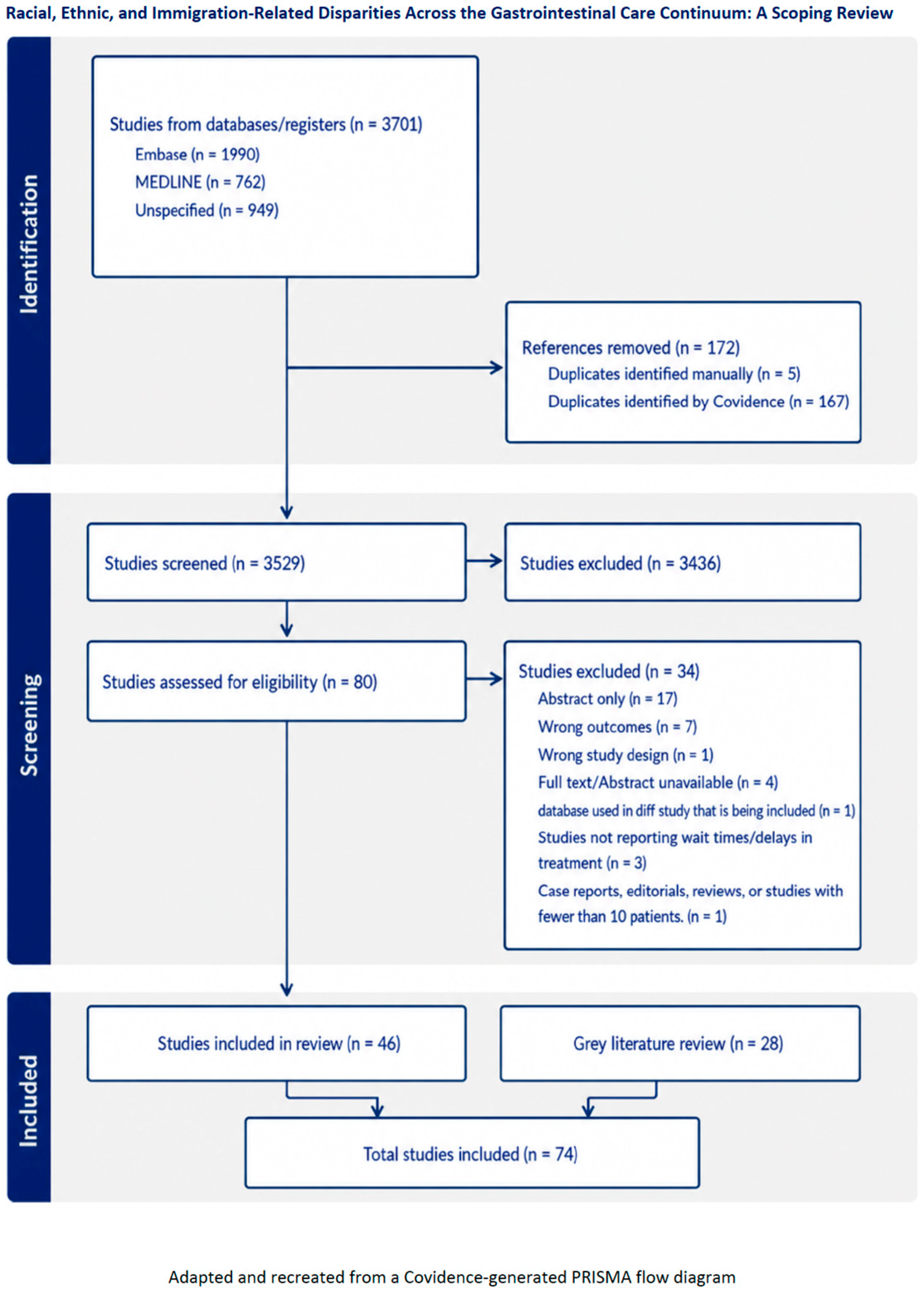
Three independent reviewers (R.T., M.B., H.T.) screened studies in duplicate, starting with title and abstract review followed by full-text review. Discrepancies were resolved by majority consensus, with final adjudication by the principal investigator when required (P.T.). A total of 3529 studies underwent title and abstract screening; 80 progressed to full-text review, and 46 met inclusion criteria and were included for data extraction. The review was supplemented by grey-literature searches of relevant gastroenterology, hepatology, surgical, and endoscopic society websites, resulting in 28 additional papers included for data extraction. A total of 74 papers were included in this scoping review; 61 (82.4%) of which were peer-reviewed full-text journal articles, 12 (16.2%) were conference abstracts, and one (1.4%) was a full-text dissertation identified through the grey-literature search. The study screening process is presented in a PRISMA-ScR flow diagram (Figure A1).
2.3. Outcomes and Data Extraction
Data extraction was performed independently by three reviewers (R.T., M.B., H.T.). Extracted variables included study characteristics (year, study continent, and sample size), population demographics (race, ethnicity, immigrant status), GI disease type, reported outcomes, and statistical measures (including odds ratios (OR), hazard ratios (HR), confidence intervals (CI), and p-values).
Data extraction occurred in two phases. In the first phase, studies were categorized descriptively by disease type and demographic characteristics, including specifications of the populations studied. In the second phase, extracted outcomes were analyzed according to emergent themes, including healthcare utilization, time to treatment, time to diagnosis, therapy utilization, mortality, and social determinants of health. Studies were organized by both disease category and thematic grouping.
2.4. Data Analysis/Themes
Given the heterogeneity in definitions of access-related outcomes, measurement approaches, statistical reporting, and population sizes, formal quantitative synthesis and meta-analysis were not performed. This was determined a priori. Accordingly, findings were synthesized using a scoping review framework. Studies were grouped based on both disease type and outcome measured. Broad thematic categories were developed to accommodate variation in reporting and included therapy utilization, treatment delay, time to treatment, outpatient services, healthcare utilization, socioeconomic and social determinants of health factors, diagnostic utilization, and mortality. Themes were intentionally broad to capture patterns of disparities across diverse GI conditions and their associated outcomes in racial, ethnic, and immigrant populations.
3. Results
A total of 74 studies were included in this study (Table 1). The largest number of studies examined inflammatory bowel disease (n = 24) and liver transplantation (n = 23), followed by hepatitis (n = 16), biliary disease (n = 4), esophageal disorders (n = 2), disorders of the gut–brain interaction (DGBI) (n = 4), and acute GI disease (n = 2). One study examined two disease categories; therefore, the disease-specific counts are not mutually exclusive. Most studies were conducted in the United States and used retrospective cohort designs, although prospective cohort, cross-sectional, and mixed-methods studies were also included. The populations most commonly compared included White, Black, Hispanic, Asian, Indigenous, and immigrant populations.
Table 1.
Summary of study characteristics included in this scoping review.
3.1. Inflammatory Bowel Diseases (IBD)
3.1.1. Therapy Utilization
Fifteen studies evaluated racial and ethnic differences in the utilization of IBD therapies, including medical, surgical, and supportive interventions. When examining therapy utilization, Black patients were less likely than White patients to receive conventional therapies (e.g., thiopurines, amino salicylates, methotrexate), less likely to receive advanced biologics, less likely to receive prolonged steroid therapy, and less likely to receive early disease-modifying therapy within 6 months of diagnosis, with differences persisting up to 10 years [22,24,28,60,64,67,77,85]. Similarly, Hispanic, Asian and South Asian patients demonstrated lower claims for both conventional and advanced therapies, including reduced steroids, immunomodulators, and biologic utilization [28,40,77]. In contrast, some studies reported higher utilization among racial and ethnic groups, with Black patients more likely to receive immunomodulators, anti-TNF therapy, combination therapy, and prednisone, and Hispanic patients demonstrating similar or higher biologic use compared with White patients [24,25,44,49]. Only two studies found no significant differences in therapy use across racial/ethnic groups [54,93].
When examining procedural and surgical interventions, Black, Hispanic, and Asian patients were less likely to undergo colectomy, bowel resection, or abdominal surgery compared to White patients [22,60,66]. Other studies demonstrated that Black and Asian patients were more likely to undergo endoscopic procedures and non-elective procedures/surgeries, and Hispanic patients were more likely to undergo specific surgical procedures such as Abdominoperineal Resection (APR), Lower Anterior Resection (LAR), and Hartmann operations [60,64,85]. One study found no consistent differences in endoscopic utilization [93].
3.1.2. Time to Diagnosis or Treatment
Eight studies evaluated racial and ethnic differences in time to diagnosis and time to treatment across multiple stages of care. When examining time to treatment and authorization, Black patients had longer median time to initiation of both conventional and advanced therapies, and longer time to authorization compared with White patients, with some evidence also suggesting longer time to diagnosis [21,28,29,71]. Hispanic and Asian patients similarly demonstrated delays in treatment initiation, particularly for advanced therapies compared to White patients [28]. Across groups, delays to treatment were most pronounced among Black patients compared with Hispanic and Asian patients [21].
In contrast, some studies reported earlier or equivalent treatment timelines, with Black patients more likely to initiate anti-TNF monotherapy earlier than White patients, though no differences were observed for immunomodulator or combination therapies [25]. Other studies found no significant racial or ethnic differences in time to first biologic infusion, time to diagnosis, or time from diagnosis to surgery [33,63,71].
When examining immigrant status, overall time to diagnosis did not differ significantly between immigrants and non-immigrants with IBD [26]. However, subgroup analyses demonstrated longer time to diagnosis among patients with ulcerative colitis from Latin America or the Caribbean compared to non-immigrant individuals [26].
3.1.3. Healthcare Utilization
Twelve studies evaluated racial and ethnic differences in healthcare utilization among patients with IBD. When examining healthcare utilization and hospitalization outcomes, Black patients had significantly more IBD-related ED visits, higher emergency medical service use, greater hospitalization rates, increased inpatient service use prior to diagnosis, higher readmission rates, more non-elective procedures, greater odds of an extended hospital length of stay, and increased all-cause mortality, with differences observed both early and up to 10 years following diagnosis compared with White patients [22,42,49,60,77,85]. Immigrants and Asian patients similarly demonstrated increased ED visits and persistently higher hospitalization rates at long-term follow-up [26,60]. Hispanic patients were also more likely to undergo emergency surgery and had higher odds of readmission compared with White patients [64].
Other studies demonstrated no significant differences in hospitalization rates or ED utilization between racial and ethnic groups [67,69], while others demonstrated lower ED visits and hospital admissions among Hispanic patients compared with White patients or no significant differences in clinic visits, ED visits, or hospitalizations despite a longer length of stay [44,49]. Similarly, some studies reported no differences in length of stay between Black, Hispanic, and Asian patients compared to White patients [85,93].
When assessing patient-reported outcomes and quality of life, patients from racial and ethnic groups reported more uncontrolled symptoms and lower quality of life across multiple domains [78]. However, in the same study, access to medications, clinicians, and understandable explanations did not differ across racial and ethnic groups.
3.1.4. Outpatient Services and Linkage to Care
Five studies evaluated racial and ethnic differences in outpatient services and linkage to IBD care. When examining linkage to gastroenterology care and specialist access, Black patients were less likely to see a gastroenterologist at least once per year, less likely to be followed by an IBD subspecialist, less likely to report an IBD specialist as their primary provider, and more likely to report difficulty obtaining specialist referrals and concerns regarding healthcare-related costs [67]. Asian patients were similarly less likely to have seen a gastroenterologist, including among older adults [77]. Patients from racial and ethnic groups in general also reported greater difficulty accessing IBD specialists, more frequent reliance on emergency department services, and poorer access to emotional and community support [78].
One study reported no differences in outpatient visit frequency, with Black and White patients having similar numbers of IBD-related ambulatory visits over a 12-month period [67], while another demonstrated longer follow-up duration among Black patients compared with White patients [25]. In contrast to reduced access observed in other groups, Canadian immigrant populations demonstrated higher outpatient healthcare utilization, including more IBD-specific and IBD-related visits, and were more likely to see a gastroenterologist, with greater specialist involvement associated with a reduced likelihood of surgery [26].
3.1.5. Mortality/Morbidity
Only one study reported death and morbidity in IBD patients, with results showing that Black patients were at significantly increased risk of death and serious morbidity compared to White patients [64].
Table 2 summarizes the results of studies exploring racial and ethnic differences in the management of inflammatory bowel disease.
Table 2.
Racial and ethnic differences in the management of inflammatory bowel disease (IBD).
3.2. Hepatobiliary Disease
3.2.1. Time to Treatment
Three studies evaluated racial and ethnic differences in time to treatment for biliary disease. Black patients were more likely to experience longer total adjusted wait times and longer times to surgery for both elective and non-elective cholecystectomies, while Hispanic patients similarly experienced longer wait times, including higher odds of delays beyond 90 days and longer overall time to surgery [70,79,80]. In contrast, White patients consistently had the shortest wait times across both elective and non-elective procedures for symptomatic cholelithiasis [79,80].
3.2.2. Healthcare Utilization
Four studies evaluated racial and ethnic differences in healthcare utilization among patients with biliary disease, including emergency department (ED) utilization, readmissions, hospital length of stay, and perioperative outcomes. When examining ED utilization and hospitalization outcomes, Black patients were more likely to undergo unplanned reintubation, remain hospitalized beyond 30 days, have longer overall and postoperative lengths of stay, experience longer intervals between discharge and readmission, have lower rates of intraoperative cholangiography, be more likely to undergo emergent procedures, have longer operative times, and have higher odds of requiring additional ED visits for both non-elective and elective cholecystectomy [70,79,80]. Black and Hispanic patients were also more likely to have repeat ED visits prior to non-elective cholecystectomy compared with White patients [79,80].
Other studies found no significant differences in reoperation or unplanned readmission rates between Black and White patients with acute cholecystitis [70], while others demonstrated that White patients accounted for the majority of hospitalizations for primary biliary cholangitis (PBC), with all racial and ethnic groups experiencing increasing hospitalization rates for PBC over time [43].
3.2.3. Mortality/Morbidity
With respect to biliary-disease-specific mortality, there were inconsistent effects observed, with one study demonstrating no difference in morbidity or mortality between Black and White patients [70], whereas another demonstrated significantly higher in-hospital mortality in Black patients with PBC compared to White individuals [43].
Table A1 summarizes the results of studies exploring racial and ethnic differences in the management of hepatobiliary disease.
3.3. Disorders of the Gut–Brain Interaction (DGBI)
Four studies evaluated racial and ethnic differences in care delivery and outcomes among patients with disorders of the gut–brain interaction (Table 3). Hispanic, Black, and Asian patients with IBS were significantly less likely to receive gastroenterology consultation despite higher rates of primary care utilization and were less likely to report that their symptoms were adequately addressed [56,81]. Non-White patients also reported more severe abdominal pain yet were less likely to receive analgesia or opioids, experienced longer wait times to treatment, and demonstrated a higher likelihood of delayed clinical assessment compared with White patients [61,82]. Finally, Hispanic, Black, and Asian patients were more likely to undergo gastroenterology-related procedures, including colonoscopies and upper endoscopies, compared with White patients [81].
Table 3.
Racial and ethnic differences in the management of disorders of the gut–brain interaction (DGBI).
3.4. Esophageal Disorders
Two studies evaluated racial and ethnic differences in outcomes among patients with esophageal disorders, including treatment delay and treatment utilization [41,92]. Black, Hispanic, and other ethnic patients were more likely to delay care for self-reported dysphagia, primarily due to longer wait times to see a gastroenterologist rather than cost-related barriers [92]. South Asian patients with achalasia were also more likely to undergo surgical procedures such as Peroral Endoscopic Myotomy (POEM) and Heller’s myotomy, and less likely to receive Botulinum toxin therapy compared with White patients, with no observed differences in pneumatic dilatation [40].
Table A2 summarizes the results of studies exploring racial and ethnic differences in the management of esophageal disorders.
3.5. Acute Gastrointestinal Diseases
Two studies examined the role of race in the time to diagnosis for acute appendicitis and general GI disease. White patients were more likely to present with private insurance compared to non-White patients, and this led to significant delays in diagnosis and longer lengths of hospital stays for the latter group presenting with acute appendicitis [27]. Similarly, Hispanic patients, compared with non-Hispanic individuals, had longer wait times in the ED for acute GI diseases characterized by conditions such as acute pancreatitis, cholecystitis, diverticulitis, and upper GI hemorrhage [82].
Table A3 summarizes the results of studies exploring racial and ethnic differences in the management of acute gastrointestinal diseases.
3.6. Hepatitis
3.6.1. Therapy Utilization
Nine studies evaluated racial, ethnic, and immigration-related differences in hepatitis therapy utilization. Immigrant, Black, Hispanic, and Asian patients were less likely to receive antiviral therapy, including lower overall treatment rates, lower treatment initiation, lower rates of treatment-related monitoring and longer delays from linkage to care to treatment initiation [39,46,50,62,90]. These differences persisted across treatment eras and despite overall increases in treatment uptake over time, with lower odds of treatment observed among Hispanic and Black patients in both pre- and post-DAA periods and longer time to treatment initiation among African American patients compared with White patients [46,50]. Additionally, geographic variation was observed, with Asian patients in Western regions less likely to receive nucleos(t)ide analogues compared with Asian patients in Eastern regions, while no regional differences were observed among non-Asian patients [52].
Other studies demonstrated no significant differences in treatment initiation or treatment types across racial, ethnic, or immigrant groups [36]. There was also no association found between duration of residence and treatment initiation, and no overall differences in treatment rates by ethnicity [45,52]. Additionally, some groups demonstrated higher treatment uptake, with Asians and Native Americans more likely to receive treatment compared with White patients [13].
3.6.2. Diagnostic Utilization
Eight studies evaluated racial, ethnic, and immigration-related differences in diagnostic utilization among patients with hepatitis. Immigrant, Black and Asian patients were less likely to receive an adequate diagnostic evaluation, including routine laboratory monitoring, DNA quantification, and liver biopsies, compared with non-immigrant or non-racial patients [52,62,88,90].
Other studies demonstrated higher diagnostic utilization among immigrant populations, including greater use of FibroScan compared with Canadian-born patients [36], as well as higher rates of testing among foreign-born Asian/Pacific Islander individuals compared with U.S.-born counterparts [48].
3.6.3. Healthcare Utilization
Two studies evaluated racial and ethnic differences in healthcare utilization among patients with hepatitis, with findings demonstrating variation in utilization patterns across groups. Hispanic patients had higher total hospital costs compared with both White and Black patients, while Black patients demonstrated lower inpatient utilization, including lower costs and fewer procedures; untreated individuals also had higher proportions of emergency encounters compared with treated patients [39,59].
Other studies demonstrated that White patients had longer lengths of stay and higher numbers of inpatient procedures compared with Black patients, while utilization patterns between White and Hispanic patients were similar for certain measures [59].
3.6.4. Linkage to Care
Six studies evaluated racial, ethnic, and immigration-related differences in linkage to care and follow-up among patients with hepatitis. Black patients were less likely to achieve linkage to care compared with non-African or Asian patients. Immigrant patients were more likely to be lost to follow-up within the first year, and untreated individuals were less likely to have specialty care involvement [39,53,86,90].
Other studies demonstrated higher linkage to care among Asian patients compared with non-Asian patients, while others found no significant differences in linkage or retention to care across racial and ethnic groups, no long-term differences in follow-up between immigrant and non-immigrant populations, and earlier presentation to care among foreign-born individuals compared with non-immigrant populations [30,46,86,90].
3.6.5. Mortality
Two studies evaluated racial and ethnic differences in mortality outcomes, particularly among patients with hepatitis. Black patients had the highest probability of waitlist mortality compared with other racial groups across multiple time points [31]. Asian patients had lower waitlist mortality compared with White patients when all-cause deaths were considered [31,59].
Table 4 summarizes the results of studies exploring racial and ethnic differences in the management of hepatitis.
Table 4.
Racial and ethnic differences in the management of hepatitis.
3.7. Liver Transplantation
3.7.1. Diagnostic and Therapy Utilization
Two studies identified differences in diagnostic and therapeutic interventions related to liver transplantation. Black patients with cirrhosis were significantly less likely to receive screening for varices, and Black, Asian, and Hispanic patients were all less likely to undergo endoscopic variceal screening within six months of diagnosis compared with White patients [73]. Additionally, Black patients had a significantly lower likelihood of receiving a Trans-jugular Intrahepatic Portosystemic Shunt (TIPS) [84].
3.7.2. Treatment Delay and Time to Therapy
In two studies, Hispanic, Black, and multiracial patients experienced longer delays to referral [34,37], while non-Hispanic ethnicity was significantly more protective of time to diagnosis than Hispanic ethnicity prior to adjustment, after which this was no longer significant [37]. After adjustment, the time to cirrhosis diagnosis was significantly greater for multiracial patients [37].
3.7.3. Healthcare Utilization
Two studies investigated the association between healthcare utilization, in the context of liver transplantation, and race, ethnicity, and immigration status. Black patients experienced shorter stays in hospital but lower rejection rates for liver transplantation compared to White patients [83]. Conversely, Indo-Asian patients had longer hospital stays [74]. Black patients also had significantly fewer platelet transfusions, though no differences existed for other blood products [83].
3.7.4. Outpatient Services
Two studies investigated differences in outpatient services related to liver transplantation, where follow-up was similar between Black and White patients [83]. Hispanic patients had decreased chances of being referred to palliative care [76].
3.7.5. Rate of Transplantation
Twenty-one studies evaluated racial and ethnic differences in liver transplantation, including rates of transplantation, waitlisting, and waitlist outcomes. Hispanic, Black, Native American, and First Nations patients were less likely to receive liver transplantation compared to White patients, including lower transplant-to-listing ratios, lower overall likelihood of transplantation, lower likelihood of living-donor liver transplant, lower waitlisting rates, and higher risk of waitlist removal due to deterioration or death, while White patients had the highest transplant volumes and were overrepresented on waitlists relative to the general population [32,35,38,47,51,57,58,68,72,87,91]. Differences in access were evident early in the care pathway, with patients from racial and ethnic groups underrepresented in waitlisting and more likely to be denied listing for psychosocial reasons, despite some groups comprising a higher proportion of transplant recipients relative to their waitlist representation [38,91]. These differences were further exacerbated during the COVID-19 pandemic, with the same patients experiencing higher waitlist inactivation and reduced transplant rates compared with White patients [55].
Some studies demonstrated no significant differences in transplant rates across racial and ethnic groups [32,51,83,89], while others reported higher transplant-to-listing ratios among Black patients compared with other groups [75,87].
3.7.6. Mortality
Sixteen studies evaluated racial and ethnic differences in mortality associated with liver transplantation, including waitlist mortality, listing-to-death ratios, and post-transplant survival, with findings demonstrating variation across groups. First Nations, Hispanic, and Black patients had higher mortality across the transplant pathway, including higher waitlist mortality, lower listing-to-death ratios, and greater likelihood of death or clinical deterioration prior to transplant, with Black patients also experiencing increased waitlist removal due to death during the COVID-19 pandemic [23,32,35,51,55,72]. Once discharged from hospital following liver transplantation, Black patients were found to have the shortest survival, although this was not true for non-transplanted patients [84].
Other studies demonstrated lower waitlist mortality among Black patients and no differences in waitlist mortality among Hispanic patients compared with White patients [57,65], while others reported higher listing-to-death ratios and improved post-transplant survival among Asian and Hispanic patients compared with White patients [51,75,87], no differences in post-transplant mortality between racial groups, and shorter post-transplant survival among White patients compared to Black patients [74,83].
Table 5 summarizes the results of studies exploring racial and ethnic differences in access to and outcomes of liver transplantation.
Table 5.
Racial and ethnic differences in access to and outcomes of liver transplantation.
4. Discussion
The diagnosis and management of chronic GI disorders necessitate early detection, proper specialist consultation, and long-term follow-up. This review suggests that racial, ethnic, and immigration-related differences occur across the GI care continuum, rather than being limited to a single disease or outcome (Table 1). In particular, the strongest evidence of these differences existed in the context of therapeutic service utilization [31,73], delays in accessing treatment [20,46,56,61,66,71,78,79,90], high utilization of acute care [22,48,62,67,69,70,78,79], and transplantation services (Table 5), with minority patients more frequently experiencing lower use of and access to resources in these domains and greater reliance on emergency or inpatient care. Smaller bodies of evidence also suggested delays in specialist evaluation [28,69,85], symptom management [56], and diagnostic assessment [56,61]. Across studies, these findings highlight important inequities in healthcare utilization patterns, health system structures and the broader structural contexts associated with race, ethnicity, and immigration status [94].
The findings of this study suggest that the earliest differences appear to occur prior to entry into specialist care. Although findings were heterogeneous, several studies identified early pathway differences in outpatient access and linkage to care [28,69,74,85], diagnostic utilization [27,31,45,50,90], and time to diagnosis across several GI diseases [20,41,63]. Collectively, the included studies suggest that racial and ethnic populations experience reduced specialist access, greater referral barriers, delayed diagnostic evaluation, and fragmented linkage to longitudinal care. Similar differences were reported among immigrants, defined by nativity and citizenship relative to the study location, which may reflect differences in how individuals are perceived or treated within healthcare systems outside their country of origin [27,63,90,95,96,97,98]. Taken together, such inequities in GI outcomes may be shaped by delays and barriers early in the care pathway, such as lower gastroenterology or subspecialist involvement, incomplete diagnostic workup, longer referral times, and longer ED wait times [34,41,84]. These early barriers may be exacerbated by issues related to patients’ access to interpreter services, difficulties in using referral processes, diagnostic testing delays due to systemic biases, availability of appointments, and providers’ lack of awareness of relevant disease screening guidelines [95,96,97,98].
Additionally, several studies identified treatment-stage differences in time to treatment [20,21,70,71,78,79], therapy utilization [21,22,24,25,40,44,49,54,60,64,66,71,77,85,93], and procedural or surgical care across GI diseases [22,27,28,34,35]. Racial, ethnic, and immigrant populations experienced lower access to therapeutic interventions [27,31,73], likely shaped by limited access to disease-modifying medications, procedural interventions, surgical management, and transplant-related care. These treatment-stage differences may continue to reflect similar barriers in early care pathways, such as insurance restrictions, authorization processes, language and communication barriers, health literacy, and patient trust, in addition to a greater emphasis on inequitable access to subspecialty care [94,99]. For example, a recent study suggested that when minority patients have access to appropriate specialty care and disease-specific therapy, previously observed disparities in treatment, such as medication use and surgery utilization, may be reduced or no longer observed [24]. Assumptions about treatment acceptability and limited culturally adapted services may also contribute to disparities in treatment stages [100].
When early access and treatment barriers are not addressed, differences then become visible through patterns of healthcare utilization, which may serve as a downstream marker of delayed or fragmented GI care. While also heterogeneous, several studies revealed that racial, ethnic, and immigrant populations experienced greater reliance on acute, emergency, non-elective, and inpatient services instead of planned outpatient management [24,26,40,63,64,67,70,78,79,85]. Increased healthcare utilization may reflect a shift from preventive, longitudinal, and elective care toward crisis-driven care, driven by upstream barriers related to disease burden, inadequate symptom control, and social determinants of health [101]. Other mechanisms underlying these utilization patterns were not consistently evaluated in the included studies. However, broader literature suggests that there may also be components of stigma, cultural differences, discomfort addressing psychosocial contributors to symptoms, communication barriers, and clinician uncertainty, which can contribute to delayed diagnosis, incorrect management, repeated referrals, or greater reliance on downstream care [102,103,104]. Components of systemic, overt, and unconscious racism likely also contribute to disparities in the quality of and access to healthcare [105]. The most severe consequences of these accumulated barriers are seen in advanced-outcome differences, including higher waitlist mortality and shorter post-transplant survival (Table 5). These findings may reflect both more advanced disease at listing or transplant and social or structural barriers to timely transplant access [106,107].
The presented pathway-based interpretation has important clinical and policy implications. The findings of this review suggest that new interventions should target specific points where differences repeatedly appeared. Proposed strategies for clinical and policy improvements should align with broader access recommendations emphasizing telemedicine, community outreach, patient navigation, workforce and procedural capacity investment, and transparent auditing of access and outcomes to reduce differences in GI care [108]. Culturally safe and language-concordant care training may also improve clinician attitudes and knowledge, as well as patient satisfaction and treatment adherence [109,110]. Future research should also move beyond describing disparities to identifying why they occur at specific transition points in the care pathway. Prospective, multicenter studies and disease registries may be particularly useful for clarifying these mechanisms, but should also further investigate how to isolate the implications of race, ethnicity, and immigration status from other social determinants of health and their respective contributions to health outcomes [6]. Immigrant status also requires more careful study, as immigrant populations differ by country of origin, reason for migration, duration of residence, and documentation status.
This study has several strengths and limitations. It examines differences across a broad range of GI conditions and evaluates multiple clinically meaningful stages of care, allowing patterns to be identified beyond a single disease area or stage of the care pathway. Another strength is the inclusion of race, ethnicity, and immigration-related variables, which allowed this review to capture differences affecting multiple historically marginalized populations. The systematic search strategy, duplicate screening process, and thematic synthesis strengthen the comprehensiveness and reproducibility of the review. However, conference abstracts comprised 16.2% of included studies. Compared with peer-reviewed, full-text publications, the abstracts offered limited information on study design and analytic methods. This limited our ability to assess methodological quality, adjustment for confounders, and evaluate the robustness of the reported findings. In addition, reported results may have been subsequently modified, expanded, or not published as full articles, potentially contributing to selective publication and outcome-reporting bias. Furthermore, our interpretation was limited by heterogeneity in study design, healthcare setting, and outcome definitions. Furthermore, many studies were observational or retrospective, restricting causal interpretation and leaving the results vulnerable to confounding factors such as socioeconomic status and disease severity.
Overall, this study demonstrates that marginalized populations experience differences in healthcare access along the GI care pathways. Inequities in access and outcomes are not isolated to a particular disease but reflect broader structural barriers to care that shape how patients enter, move through, and benefit from GI-related healthcare. Future efforts should focus on identifying modifiable barriers, improving culturally safe care, and developing interventions to support timely, equitable, and longitudinal care for marginalized populations.
Author Contributions
Conceptualization, R.T. and P.T.; methodology, R.T.; data curation, R.T., M.B. and H.-K.R.T.; writing—original draft preparation, R.T., M.B. and H.-K.R.T.; writing—review and editing, R.T., M.B., H.-K.R.T. and P.T.; supervision, P.T. All authors have read and agreed to the published version of the manuscript.
Funding
This research received no external funding.
Institutional Review Board Statement
Not applicable.
Informed Consent Statement
Not applicable.
Data Availability Statement
The original contributions presented in this study are included in the article/Appendix A. Further inquiries can be directed to the corresponding author.
Conflicts of Interest
P.T.—Advisory boards (Takeda, J+J, Abbvie); Speaker fees (Takeda, J+J, Abbvie, Pendopharm, Ferring, Avir pharma).
Abbreviations
The following abbreviations are used in this manuscript:
| APR | Abdominoperineal resection |
| DAA | Direct-acting antiviral |
| DALYs | Disability-adjusted life years |
| DGBI | Disorders of gut–brain interaction |
| DNA | Deoxyribonucleic acid |
| GI | Gastrointestinal |
| HBV | Hepatitis B virus |
| HCV | Hepatitis C virus |
| IBD | Inflammatory bowel disease |
| IBS | Irritable bowel syndrome |
| LAR | Lower anterior resection |
| LDLT | Living-donor liver transplantation |
| LDR | Listing-to-death ratio |
| LOS | Length of stay |
| PBC | Primary biliary cholangitis |
| POEM | Peroral endoscopic myotomy |
| THC | Total hospital costs |
| TIPS | Trans-jugular intrahepatic portosystemic shunt |
| TNF | Tumor necrosis factor |
Appendix A
Appendix A.1
Figure A1.
PRISMA-ScR flow diagram of the study screening process and inclusion.
Appendix A.2
Table A1.
Racial and ethnic differences in the management of hepatobiliary disease.
Appendix A.3
Table A2.
Racial and ethnic differences in the management of esophageal disorders.
Appendix A.4
Table A3.
Racial and ethnic differences in the management of acute gastrointestinal disease.
References
- Jabłońska, B.; Mrowiec, S. Gastrointestinal Disease: New Diagnostic and Therapeutic Approaches. Biomedicines 2023, 11, 1420. [Google Scholar] [CrossRef] [Scilit] [PubMed]
- Peery, A.F.; Murphy, C.C.; Anderson, C.; Jensen, E.T.; Deutsch-Link, S.; Egberg, M.D.; Lund, J.L.; Subramaniam, D.; Dellon, E.S.; Sperber, A.D.; et al. Burden and Cost of Gastrointestinal, Liver, and Pancreatic Diseases in the United States: Update 2024. Gastroenterology 2025, 168, 1000–1024. [Google Scholar] [CrossRef] [Scilit] [PubMed]
- Wang, R.; Li, Z.; Liu, S.; Zhang, D. Global, regional, and national burden of 10 digestive diseases in 204 countries and territories from 1990 to 2019. Front. Public Health 2023, 11, 1061453. [Google Scholar] [CrossRef] [Scilit] [PubMed]
- Lv, H.; Li, H.-Y.; Zhang, H.-N.; Liu, Y. Delayed diagnosis in inflammatory bowel disease: Time to consider solutions. World J. Gastroenterol. 2024, 30, 3954–3958. [Google Scholar] [CrossRef] [Scilit] [PubMed]
- Anyane-Yeboa, A.; Quezada, S.; Rubin, D.T.; Balzora, S. The Impact of the Social Determinants of Health on Disparities in Inflammatory Bowel Disease. Clin. Gastroenterol. Hepatol. 2022, 20, 2427–2434. [Google Scholar] [CrossRef] [Scilit] [PubMed]
- Sewell, J.L.; Velayos, F.S. Systematic Review: The Role of Race and Socioeconomic Factors on IBD Healthcare Delivery and Effectiveness. Inflamm. Bowel Dis. 2013, 19, 627–643. [Google Scholar] [CrossRef] [Scilit] [PubMed]
- Pandit, A.U.; Tomasino, K.N.; Omprakash, T.A.; Epstein, D.E. Cultural considerations in gastroenterology: Barriers to care and a call for humility and action. Transl. Gastroenterol. Hepatol. 2024, 9, 74. [Google Scholar] [CrossRef] [Scilit] [PubMed]
- Hood, C.M.; Gennuso, K.P.; Swain, G.R.; Catlin, B.B. County Health Rankings. Am. J. Prev. Med. 2016, 50, 129–135. [Google Scholar] [CrossRef] [Scilit] [PubMed]
- Denniston, M.M.; Jiles, R.B.; Drobeniuc, J.; Klevens, R.M.; Ward, J.W.; McQuillan, G.M.; Holmberg, S.D. Chronic Hepatitis C Virus Infection in the United States, National Health and Nutrition Examination Survey 2003 to 2010. Ann. Intern. Med. 2014, 160, 293–300. [Google Scholar] [CrossRef] [Scilit] [PubMed]
- Kardashian, A.; Serper, M.; Terrault, N.; Nephew, L.D. Health disparities in chronic liver disease. Hepatology 2023, 77, 1382–1403. [Google Scholar] [CrossRef] [Scilit] [PubMed]
- Luo, W.; Portelli Tremont, J.N.; Shinde, S.V.; Agala, C.B.; Udekwu, P.O.; Charles, A. Racial disparities in the management of gallstone pancreatitis: Deviations from standard of care. Am. J. Surg. 2025, 247, 116461. [Google Scholar] [CrossRef] [Scilit] [PubMed]
- Best, M.J.; McFarland, E.G.; Thakkar, S.C.; Srikumaran, U. Racial Disparities in the Use of Surgical Procedures in the US. JAMA Surg. 2021, 156, 274. [Google Scholar] [CrossRef] [Scilit] [PubMed]
- Wong, R.J.; Jain, M.K.; Therapondos, G.; Shiffman, M.L.; Kshirsagar, O.; Clark, C.; Thamer, M. Race/ethnicity and insurance status disparities in access to direct acting antivirals for hepatitis C virus treatment. Am. J. Gastroenterol. 2018, 113, 1329–1338. [Google Scholar] [CrossRef] [Scilit] [PubMed]
- Sempokuya, T.; Warner, J.; Azawi, M.; Nogimura, A.; Wong, L.L. Current status of disparity in liver disease. World J. Hepatol. 2022, 14, 1940–1952. [Google Scholar] [CrossRef] [Scilit] [PubMed]
- Booth, A.; Ford, W.; Brennan, E.; Magwood, G.; Forster, E.; Curran, T. Towards Equitable Surgical Management of Inflammatory Bowel Disease: A Systematic Review of Disparities in Surgery for Inflammatory Bowel Disease. Inflamm. Bowel Dis. 2022, 28, 1405–1419. [Google Scholar] [CrossRef] [Scilit] [PubMed]
- Galoosian, A.; Rezapour, M.; Liu, B.; Bhuket, T.; Wong, R.J. Race/Ethnicity-specific Disparities in In-Hospital Mortality and Hospital Charges Among Inflammatory Bowel Disease-related Hospitalizations in the United States. J. Clin. Gastroenterol. 2020, 54, e63–e72. [Google Scholar] [CrossRef] [Scilit] [PubMed]
- Klein, S.; Sivasailam, B.; Alizadeh, M.; Malter, L.; Axelrad, J.E. Disparities in Outcomes for Patients with Inflammatory Bowel Disease at a Private vs Public Hospital in New York City. Inflamm. Bowel Dis. 2025, 31, 3370–3378. [Google Scholar] [CrossRef] [Scilit] [PubMed]
- Tandon, P.; Chhibba, T.; Natt, N.; Singh Brar, G.; Malhi, G.; Nguyen, G.C. Significant Racial and Ethnic Disparities Exist in Health Care Utilization in Inflammatory Bowel Disease: A Systematic Review and Meta-analysis. Inflamm. Bowel Dis. 2024, 30, 470–481. [Google Scholar] [CrossRef] [Scilit] [PubMed]
- Venkateswaran, N.; Sultan, K. Racial and ethnic disparities in clinical presentation, management, and outcomes of patients with inflammatory bowel disease: A narrative review. Transl. Gastroenterol. Hepatol. 2024, 9, 28. [Google Scholar] [CrossRef] [Scilit] [PubMed]
- Tricco, A.C.; Lillie, E.; Zarin, W.; O’Brien, K.K.; Colquhoun, H.; Levac, D.; Moher, D.; Peters, M.D.J.; Horsley, T.; Weeks, L.; et al. PRISMA Extension for Scoping Reviews (PRISMA-ScR): Checklist and Explanation. Ann. Intern. Med. 2018, 169, 467–473. [Google Scholar] [CrossRef] [Scilit] [PubMed]
- Abadir, A.; Troia, A.; Said, H.; Tarugu, S.; Billingsley, B.C.; Sairam, N.; Minchenberg, S.B.; Owings, A.H.; Parker, A.M.; Brousse, B.; et al. Factors Associated with Delays in Initiating Biologic Therapy in Patients with Inflammatory Bowel Disease. Dig. Dis. Sci. 2024, 69, 2796–2803. [Google Scholar] [CrossRef] [Scilit] [PubMed]
- Alchirazi, K.A.; Mohammed, A.; Eltelbany, A.; Albakri, A.A.; Alkhayyat, M.; Abu-Shawer, O.; Regueiro, M. Racial Disparities in Utilization of Medications in Inflammatory Bowel Disease Patients. Am. J. Gastroenterol. 2022, 117, e758–e759. [Google Scholar] [CrossRef] [Scilit]
- Ayuk-Arrey, A.-T.; Nephew, L.; Caicedo, J.C.; Ross-Driscoll, K. Racial and ethnic disparities in liver transplant access vary within and across transplant referral regions. Liver Transpl. 2025, 31, 857–869. [Google Scholar] [CrossRef] [Scilit] [PubMed]
- Barnes, E.L.; Kochar, B.; Long, M.D.; Pekow, J.; Ananthakrishnan, A.; Anyane-Yeboa, A.; Martin, C.; Galanko, J.; Herfarth, H.H.; Kappelman, M.D.; et al. Lack of Difference in Treatment Patterns and Clinical Outcomes Between Black and White Patients with Inflammatory Bowel Disease. Inflamm. Bowel Dis. 2018, 24, 2634–2640. [Google Scholar] [CrossRef] [Scilit] [PubMed]
- Barnes, E.L.; Bauer, C.M.; Sandler, R.S.; Kappelman, M.D.; Long, M.D. Black and White Patients with Inflammatory Bowel Disease Show Similar Biologic Use Patterns with Medicaid Insurance. Inflamm. Bowel Dis. 2021, 27, 364–370. [Google Scholar] [CrossRef] [Scilit] [PubMed]
- Benchimol, E.I.; Manuel, D.G.; Mojaverian, N.; Mack, D.R.; Nguyen, G.C.; To, T.; Guttmann, A. Health Services Utilization, Specialist Care, and Time to Diagnosis with Inflammatory Bowel Disease in Immigrants to Ontario, Canada: A Population-Based Cohort Study. Inflamm. Bowel Dis. 2016, 22, 2482–2490. [Google Scholar] [CrossRef] [Scilit] [PubMed]
- Bickell, N.A.; Hwang, U.; Anderson, R.M.; Rojas, M.; Barsky, C.L. What Affects Time to Care in Emergency Room Appendicitis Patients? Med. Care 2008, 46, 417–422. [Google Scholar] [CrossRef] [Scilit] [PubMed]
- Branchcomb, T.; Paul, D.; Teng, C.-C.; Bocage, C.; Grabner, M.; Head, M. Su1025 Treatment patterns and health disparitis in newly diagnosed patients with ulcerative colitis in the United States. Gastroenterology 2024, 166, S-642–S-643. [Google Scholar] [CrossRef] [Scilit]
- Buadu, M.A.; Khalili, H.; Narain-Blackwell, M.C.; Anyane-Yeboa, A.; Warner, E.T. Su1018 Undestanding barriers to care and utilization amongst diverse individuals with inflammatory bowel disease. Gastroenterology 2024, 166, S-639. [Google Scholar] [CrossRef] [Scilit]
- Buti, M.; Picchio, C.; Lens, S.; Gomez, M.R.; Andrade, R.J.; Arenas Ruiz-Tapiador, J.I.; Cabezas, J.; Crespo, J.; Calleja Panero, J.L.; Guerra, M.H.; et al. Description of HBV-infected persons presenting late to specialist care in 10 Spanish centres: A retrospective registry review. J. Hepatol. 2020, 73, S796–S797. [Google Scholar] [CrossRef] [Scilit]
- Bzowej, N.; Han, S.; Degertekin, B.; Keeffe, E.B.; Emre, S.; Brown, R.; Reddy, R.; Lok, A.S. Liver transplantation outcomes among Caucasians, Asian Americans, and African Americans with hepatitis B. Liver Transpl. 2009, 15, 1010–1020. [Google Scholar] [CrossRef] [Scilit] [PubMed]
- Chahal, D.; Marquez, V.; Hussaini, T.; Kim, P.; Chung, S.W.; Segedi, M.; Chartier-Plante, S.; Scudamore, C.H.; Erb, S.R.; Salh, B.; et al. End stage liver disease etiology & transplantation referral outcomes of major ethnic groups in British Columbia, Canada: A cohort study. Medicine 2021, 100, e27436. [Google Scholar] [CrossRef] [Scilit] [PubMed]
- Chandradevan, R.; Nulu, C.; Garten, B.; Gopu, G.; Naushad, A.; Yerraguntla, S.; Temple, M.; Moazzami, B.; Sifuentes, H. S1246 Decade-Long Analysis of Crohn’s Disease and Ulcerative Colitis: Disease Burden, Phenotypic Differences, and Ethnographic Insights in a Tertiary Care Center. Am. J. Gastroenterol. 2024, 119, S886. [Google Scholar] [CrossRef] [Scilit]
- Chatterjee, R.; Goli, K.; Huang, C.-S.; Rogers, J.; Rich, N.E.; Goss, J.A.; Cholankeril, G.T.; Kanwal, F.; Lee, T.-H. Tu1021 Delays in liver transplant evaluation among Hispanic patients. Gastroenterology 2023, 164, S-966–S-967. [Google Scholar] [CrossRef] [Scilit]
- Cholankeril, G.; Gonzalez, H.C.; Satapathy, S.K.; Gonzalez, S.A.; Hu, M.; Khan, M.A.; Yoo, E.R.; Li, A.A.; Kim, D.; Nair, S.; et al. Increased Waitlist Mortality and Lower Rate for Liver Transplantation in Hispanic Patients with Primary Biliary Cholangitis. Clin. Gastroenterol. Hepatol. 2018, 16, 965–973.e2. [Google Scholar] [CrossRef] [Scilit] [PubMed]
- Cooper, C.L.; Thavorn, K.; Damian, E.; Corsi, D.J. Hepatitis C Virus Infection Outcomes Among Immigrants to Canada: A Retrospective Cohort Analysis. Ann. Hepatol. 2017, 16, 720–726. [Google Scholar] [CrossRef] [Scilit] [PubMed]
- Cuomo, R.E. Health disparities in time to diagnosis and survival post-diagnosis of cirrhosis in individuals with alcohol use disorder: A retrospective cohort study. Alcohol 2024, 121, 141–146. [Google Scholar] [CrossRef] [Scilit] [PubMed]
- Deutsch-Link, S.; Bittermann, T.; Nephew, L.; Ross-Driscoll, K.; Weinberg, E.M.; Weinrieb, R.M.; Olthoff, K.M.; Addis, S.; Serper, M. Racial and ethnic disparities in psychosocial evaluation and liver transplant waitlisting. Am. J. Transplant. 2023, 23, 776–785. [Google Scholar] [CrossRef] [Scilit] [PubMed]
- Elnaiem, A.D.; Chukka, A.B.; So-Armah, C.M.; Arbour, M.E.; Huang, C.-C.; Solomon, D.A.; Malishchak, L.E.; Yarbrough, C.G. Racial and Sociodemographic Disparities in Hepatitis C Treatment at an Urban Academic Medical Center, 2018–2023. Open Forum Infect. Dis. 2025, 12, ofaf312. [Google Scholar] [CrossRef] [Scilit] [PubMed]
- Farrukh, A.; Mayberry, J.F. Apparent discrimination in the provision of biologic therapy to patients with Crohn’s disease according to ethnicity. Public Health 2015, 129, 460–464. [Google Scholar] [CrossRef] [Scilit] [PubMed]
- Farrukh, A.; Mayberry, J.F. Original observational study on disparate treatments for achalasia experienced by patients of white British and South Asian ethnicity. Ann. Esophagus 2021, 4, 25. [Google Scholar] [CrossRef] [Scilit]
- Frieder, J.S.; Montorfano, L.; De Stefano, F.; Ortiz Gomez, C.; Ferri, F.; Liang, H.; Gilshtein, H.; Rosenthal, R.J.; Wexner, S.D.; Sharp, S.P. A National Inpatient Sample Analysis of Racial Disparities After Segmental Colectomy for Inflammatory Colorectal Diseases. Am. Surg. 2023, 89, 5131–5139. [Google Scholar] [CrossRef] [Scilit] [PubMed]
- Galoosian, A.; Hanlon, C.; Tana, M.; Cheung, R.; Wong, R.J. Race/Ethnicity and Insurance-Specific Disparities in In-Hospital Mortality Among Adults with Primary Biliary Cholangitis: Analysis of 2007–2014 National Inpatient Sample. Dig. Dis. Sci. 2020, 65, 406–415. [Google Scholar] [CrossRef] [Scilit] [PubMed]
- Garcia, G.D.; Burstiner, L.S.; Rai, O.; Reddy, A.; Qadir, N.A.; Kronen, T.; Stachler, L.; Nava, M.S.; Stemboroski, L.N. S1421 Demographics, Complications, and Healthcare Utilization of Ethnically Hispanic vs Non-Hispanic Patients with Inflammatory Bowel Disease. Am. J. Gastroenterol. 2024, 119, S1018. [Google Scholar] [CrossRef] [Scilit]
- Giordano, C.; Druyts, E.F.; Garber, G.; Cooper, C. Evaluation of immigration status, race and language barriers on chronic hepatitis C virus infection management and treatment outcomes. Eur. J. Gastroenterol. Hepatol. 2009, 21, 963–968. [Google Scholar] [CrossRef] [Scilit] [PubMed]
- Gomes, C.; Ginzberg, D.; Wong, R.J. Delays and gaps in progressing through the hepatitis C virus cascade of care: An underserved safety-net hospital experience. J. Transl. Intern. Med. 2020, 8, 261–267. [Google Scholar] [CrossRef] [Scilit] [PubMed]
- Goyes, D.; Danford, C.J.; Nsubuga, J.P.; Bonder, A. Waitlist mortality and transplant free survival in Hispanic patients listed for liver transplant using the UNOS database. Ann. Hepatol. 2021, 23, 100304. [Google Scholar] [CrossRef] [Scilit] [PubMed]
- Hu, D.J.; Xing, J.; Tohme, R.A.; Liao, Y.; Pollack, H.; Ward, J.W.; Holmberg, S.D. Hepatitis B Testing And Access To Care Among Racial And Ethnic Minorities in Selected Communities Across the United States, 2009–2010. Hepatology 2013, 58, 856–862. [Google Scholar] [CrossRef] [Scilit] [PubMed]
- Hussain, F.S.; Potlach, T.; Chi, X.; Gurka, M.J.; Hall, J.; Setya, A.; Chaudhry, N.A.; Pham, A.; Damas, O.M.; Kerman, D.; et al. Healthcare Utilization and Geographic Distribution of Advanced Therapy in Minority Race and Ethnic Groups with Inflammatory Bowel Disease. Inflamm. Bowel Dis. 2025, 31, 344–350. [Google Scholar] [CrossRef] [Scilit] [PubMed]
- Jiang, X.; Song, H.J.; Chang, C.-Y.; Wilson, D.; Guo, J.; Lo-Ciganic, W.-H.; Park, H. Disparities in Access to Hepatitis C Treatment Among Arizona Medicaid Beneficiaries with Chronic Hepatitis C. Med. Care 2023, 61, 81–86. [Google Scholar] [CrossRef] [Scilit] [PubMed]
- Kaplan, A.; Wahid, N.; Fortune, B.E.; Verna, E.; Halazun, K.; Samstein, B.; Brown, R.S.; Rosenblatt, R. Black patients and women have reduced access to liver transplantation for alcohol-associated liver disease. Liver Transpl. 2023, 29, 259–267. [Google Scholar] [CrossRef] [Scilit] [PubMed]
- Kudaravalli, S.; Huang, D.Q.; Yeh, M.-L.; Trinh, L.; Tsai, P.C.; Hsu, Y.-C.; Kam, L.Y.; Nguyen, V.H.; Ogawa, E.; Lee, D.H.; et al. Sex and ethnic disparities in hepatitis B evaluation and treatment across the world. J. Hepatol. 2024, 81, 33–41. [Google Scholar] [CrossRef] [Scilit] [PubMed]
- Le, D.; Ciceron, A.C.; Pan, J.; Juon, H.-S.; Berg, C.J.; Nguyen, T.A.; Le, H.C.; Yang, Y.T. Linkage-to-Care Following Community-Based HBV and HCV Screening Among Immigrants from the Washington–Baltimore Metropolitan Area, 2016–2019. J. Immigr. Minor. Health 2022, 24, 1137–1144. [Google Scholar] [CrossRef] [Scilit] [PubMed]
- Lin, K.K.; Sewell, J.L. The Effects of Race and Socioeconomic Status on Immunomodulator and Anti-Tumor Necrosis Factor Use among Ambulatory Patients with Inflammatory Bowel Disease in the United States. Am. J. Gastroenterol. 2013, 108, 1824–1830. [Google Scholar] [CrossRef] [Scilit] [PubMed]
- MacConmara, M.; Wang, B.; Patel, M.S.; Hwang, C.S.; DeGregorio, L.; Shah, J.; Hanish, S.I.; Desai, D.; Lynch, R.; Tanriover, B.; et al. Liver Transplantation in the Time of a Pandemic: A Widening of the Racial and Socioeconomic Health Care Gap During COVID-19. Ann. Surg. 2021, 274, 427–433. [Google Scholar] [CrossRef] [Scilit] [PubMed]
- Martinez, N.; Keller, M.; Kadariya, J.; Xu, H.; Shin, A.S. Mo1019 The effect of race on irritable bowel syndromw (IBS) prevalnce, IBS-associated health outcomes, and IBS-associated healthcare access or satisfaction in United States adults. Gastroenterology 2023, 164, S-733. [Google Scholar] [CrossRef] [Scilit]
- Mathur, A.K.; Schaubel, D.E.; Gong, Q.; Guidinger, M.K.; Merion, R.M. Racial and ethnic disparities in access to liver transplantation. Liver Transpl. 2010, 16, 1033–1040. [Google Scholar] [CrossRef] [Scilit] [PubMed]
- Mathur, A.K.; Ashby, V.B.; Fuller, D.S.; Zhang, M.; Merion, R.M.; Leichtman, A.; Kalbfleisch, J. Variation in Access to the Liver Transplant Waiting List in the United States. Transplantation 2014, 98, 94–99. [Google Scholar] [CrossRef] [Scilit] [PubMed]
- May, F.P.; Rolston, V.S.; Tapper, E.B.; Lakshmanan, A.; Saab, S.; Sundaram, V. The impact of race and ethnicity on mortality and healthcare utilization in alcoholic hepatitis: A cross-sectional study. BMC Gastroenterol. 2016, 16, 129. [Google Scholar] [CrossRef] [Scilit] [PubMed]
- McFalls, C.; Chaaban, L.; Melia, J. Black Race is Associated with Decreased Exposure to Advanced Therapies and Worse Outcomes in Individuals with Ulcerative Colitis. Aliment. Pharmacol. Ther. 2025, 61, 513–523. [Google Scholar] [CrossRef] [Scilit] [PubMed]
- Mills, A.M.; Shofer, F.S.; Boulis, A.K.; Holena, D.N.; Abbuhl, S.B. Racial disparity in analgesic treatment for ED patients with abdominal or back pain. Am. J. Emerg. Med. 2011, 29, 752–756. [Google Scholar] [CrossRef] [Scilit] [PubMed]
- Miquel, M.; Pardo, A.; Forné, M.; Martínez-Alpin, G.; Rodríguez-Castellano, A.; Casas, M.; Rosinach, M.; Roget, M.; Dalmau, B.; Temiño, R.; et al. Current trends in access to treatment for hepatitis B in immigrants vs non-immigrants. Gastroenterol. Rep. 2020, 8, 362–366. [Google Scholar] [CrossRef] [Scilit] [PubMed]
- Misra, R.; Limdi, J.; Cooney, R.; Sakuma, S.; Brookes, M.; Fogden, E.; Pattni, S.; Sharma, N.; Iqbal, T.; Munkholm, P.; et al. Ethnic differences in inflammatory bowel disease: Results from the United Kingdom inception epidemiology study. World J. Gastroenterol. 2019, 25, 6145–6157. [Google Scholar] [CrossRef] [Scilit] [PubMed]
- Montgomery, S.R.; Butler, P.D.; Wirtalla, C.J.; Collier, K.T.; Hoffman, R.L.; Aarons, C.B.; Damrauer, S.M.; Kelz, R.R. Racial disparities in surgical outcomes of patients with Inflammatory Bowel Disease. Am. J. Surg. 2018, 215, 1046–1050. [Google Scholar] [CrossRef] [Scilit] [PubMed]
- Mustian, M.N.; Shelton, B.A.; MacLennan, P.A.; Reed, R.D.; White, J.A.; Eckhoff, D.E.; Locke, J.E.; Allman, R.M.; Gray, S.H. Ethnic and Age Disparities in Outcomes Among Liver Transplant Waitlist Candidates. Transplantation 2019, 103, 1425–1432. [Google Scholar] [CrossRef] [Scilit] [PubMed]
- Nguyen, G.C.; Bayless, T.M.; Powe, N.R.; LaVeist, T.A.; Brant, S.R. Race and health insurance are predictors of hospitalized Crohn’s disease patients undergoing bowel resection. Inflamm. Bowel Dis. 2007, 13, 1408–1416. [Google Scholar] [CrossRef] [Scilit] [PubMed]
- Nguyen, G.C.; LaVeist, T.A.; Harris, M.L.; Wang, M.-H.; Datta, L.W.; Brant, S.R. Racial Disparities in Utilization of Specialist Care and Medications in Inflammatory Bowel Disease. Am. J. Gastroenterol. 2010, 105, 2202–2208. [Google Scholar] [CrossRef] [Scilit] [PubMed]
- Nobel, Y.R.; Forde, K.A.; Wood, L.; Cartiera, K.; Munoz-Abraham, A.S.; Yoo, P.S.; Abt, P.L.; Goldberg, D.S. Racial and ethnic disparities in access to and utilization of living donor liver transplants. Liver Transpl. 2015, 21, 904–913. [Google Scholar] [CrossRef] [Scilit] [PubMed]
- Odufalu, F.-D.; Sewell, J.L.; Rudrapatna, V.; Somsouk, M.; Mahadevan, U. Assessing the Impact of COVID-19 on IBD Outcomes Among Vulnerable Patient Populations in a Large Metropolitan Center. Inflamm. Bowel Dis. 2024, 30, 29–37. [Google Scholar] [CrossRef] [Scilit] [PubMed]
- Porras Fimbres, D.C.; Nussbaum, D.P.; Mosca, P.J. Racial disparities in time to laparoscopic cholecystectomy for acute cholecystitis. Am. J. Surg. 2023, 226, 261–270. [Google Scholar] [CrossRef] [Scilit] [PubMed]
- Rao, V.; Dharia, I.; Gibilisco, J.; Kirelik, D.; Baumgartner, S.; Negreira, K.; Chawla, K.; Dave, J.; Kallus, S.; Belfaqeeh, O.A.; et al. Delay in prior authorization of biologic therapy: Another possible cause of healthcare disparity in IBD patients. J. Natl. Med. Assoc. 2024, 116, 13–15. [Google Scholar] [CrossRef] [Scilit] [PubMed]
- Reid, A.E.; Resnick, M.; Chang, Y.; Buerstatte, N.; Weissman, J.S. Disparity in use of orthotopic liver transplantation among blacks and whites. Liver Transpl. 2004, 10, 834–841. [Google Scholar] [CrossRef] [Scilit] [PubMed]
- Robinson, A.; Tavakoli, H.; Liu, B.; Bhuket, T.; Cheung, R.; Wong, R.J. African-Americans with Cirrhosis Are Less Likely to Receive Endoscopic Variceal Screening Within One Year of Cirrhosis Diagnosis. J. Racial Ethn. Health Disparities 2018, 5, 860–866. [Google Scholar] [CrossRef] [Scilit] [PubMed]
- Rocha, C.; Perera, M.T.; Roberts, K.; Bonney, G.; Gunson, B.; Nightingale, P.; Bramhall, S.R.; Isaac, J.; Muiesan, P.; Mirza, D.F. Outcomes After Liver Transplantation of Patients with Indo-Asian Ethnicity. Transplantation 2015, 99, 860–866. [Google Scholar] [CrossRef] [Scilit] [PubMed]
- Rosenblatt, R.; Wahid, N.; Halazun, K.J.; Kaplan, A.; Jesudian, A.; Lucero, C.; Lee, J.; Dove, L.; Fox, A.; Verna, E.; et al. Black Patients Have Unequal Access to Listing for Liver Transplantation in the United States. Hepatology 2021, 74, 1523–1532. [Google Scholar] [CrossRef] [Scilit] [PubMed]
- Rush, B.; Walley, K.R.; Celi, L.A.; Rajoriya, N.; Brahmania, M. Palliative care access for hospitalized patients with end-stage liver disease across the United States. Hepatology 2017, 66, 1585–1591. [Google Scholar] [CrossRef] [Scilit] [PubMed]
- Segura, A.; Brensinger, C.; Pate, V.; Siddique, S.M.; Parlett, L.; Hurtado-Lorenzo, A.; Kappelman, M.D.; Lewis, J.D. Association of Race and Ethnicity with Healthcare Utilization for Inflammatory Bowel Disease in the United States: A Retrospective Cohort Study. Am. J. Gastroenterol. 2025, 121, 195–204. [Google Scholar] [CrossRef] [Scilit] [PubMed]
- Shah, S.; Shillington, A.C.; Kabagambe, E.K.; Deering, K.L.; Babin, S.; Capelouto, J.; Pulliam, C.; Patel, A.; LaChappelle, B.; Liu, J. Racial and Ethnic Disparities in Patients with Inflammatory Bowel Disease: An Online Survey. Inflamm. Bowel Dis. 2024, 30, 1467–1474. [Google Scholar] [CrossRef] [Scilit] [PubMed]
- Shenoy, R.; Jackson, N.; Zingmond, D.S.; Maggard Gibbons, M.A.; Russell, M.M. Delays in Care for Patients with Symptomatic Cholelithiasis: Differences By Race/Ethnicity. J. Am. Coll. Surg. 2021, 233, S128–S129. [Google Scholar] [CrossRef] [Scilit]
- Shenoy, R.; Kirkland, P.; Jackson, N.J.; DeVirgilio, M.; Zingmond, D.; Maggard-Gibbons, M.; Russell, M.M. Delay to Surgery for Patients with Symptomatic Cholelithiasis: Retrospective Analysis of an Administrative California Database after Discharge from the Emergency Department. J. Am. Coll. Surg. 2022, 235, 581–591. [Google Scholar] [CrossRef] [Scilit] [PubMed]
- Silvernale, C.; Kuo, B.; Staller, K. Racial disparity in healthcare utilization among patients with Irritable Bowel Syndrome: Results from a multicenter cohort. Neurogastroenterol. Motil. 2021, 33, e14039. [Google Scholar] [CrossRef] [Scilit] [PubMed]
- Simons-Linares, C.R.; Romero-Marrero, C.; Lopez, R.; Chahal, P.; Vargo, J.J. Sa1014—Are There Disparities in Emergency Department Wait Times for Acute Gastrointestinal Diseases? Analysis from the National Hospital Ambulatory Medical Care Survey, 1997–2014. Gastroenterology 2018, 154, S-226. [Google Scholar] [CrossRef] [Scilit]
- Smith, A.A.; Darden, M.; Al-Qurayshi, Z.; Paramesh, A.S.; Killackey, M.; Kandil, E.; Parker, G.; Balart, L.; Friedlander, P.; Buell, J.F. Liver transplantation in New Orleans: Parity in a world of disparity? HPB 2017, 19, 793–798. [Google Scholar] [CrossRef] [Scilit] [PubMed][Green Version]
- Solano, Q.P.; Chen, X.; Parikh, N.D.; Tapper, E.B. Racial and Ethnic Disparities in Outcomes After the Development of Ascites: A National Cohort Study. Dig. Dis. Sci. 2024, 69, 3214–3219. [Google Scholar] [CrossRef] [Scilit] [PubMed]
- Syal, G.; Murphy, S.J.; Duarte-Rojo, A. Racial Disparities in Readmission Rates, Procedures and Complications among Adults with Inflammatory Bowel Diseases. Gastroenterology 2017, 152, S372–S373. [Google Scholar] [CrossRef] [Scilit]
- Tang, E.; Liu, B.; Bhuket, T.; Wong, R.J. Low Rates of Linkage and Retention Into Care Among Patients with Chronic HBV Infection. Clin. Gastroenterol. Hepatol. 2019, 17, 1909–1911. [Google Scholar] [CrossRef] [Scilit] [PubMed]
- Thuluvath, P.J.; Amjad, W.; Zhang, T. Liver transplant waitlist removal, transplantation rates and post-transplant survival in Hispanics. PLoS ONE 2020, 15, e0244744. [Google Scholar] [CrossRef] [Scilit] [PubMed]
- Trooskin, S.B. Hepatitis C in Minority Populations: The Identification of Barriers to Screening and Testing in Primary Health Care Settings; Rutgers The State University of New Jersey: Newark, NJ, USA, 2005. [Google Scholar]
- Volk, M.L.; Choi, H.; Warren, G.J.W.; Sonnenday, C.J.; Marrero, J.A.; Heisler, M. Geographic Variation in Organ Availability Is Responsible for Disparities in Liver Transplantation between Hispanics and Caucasians. Am. J. Transplant. 2009, 9, 2113–2118. [Google Scholar] [CrossRef] [Scilit] [PubMed]
- Voulgaris, T.; Vlachogiannakos, J.; Ioannidou, P.; Papageorgiou, M.-V.; Zampeli, E.; Karagiannakis, D.; Georgiou, A.; Papazoglou, A.; Karamanolis, G.; Papatheodoridis, G.V. Adherence to follow-up and treatment recommendations in Greek and immigrant patients with chronic hepatitis B in Greece. Eur. J. Gastroenterol. Hepatol. 2017, 29, 264–270. [Google Scholar] [CrossRef] [Scilit] [PubMed]
- Warren, C.; Carpenter, A.-M.; Neal, D.; Andreoni, K.; Sarosi, G.; Zarrinpar, A. Racial Disparity in Liver Transplantation Listing. J. Am. Coll. Surg. 2021, 232, 526–534. [Google Scholar] [CrossRef] [Scilit] [PubMed]
- Zheng, M.; Zhou, S.; Hur, K.; Chambers, T.; O’Dell, K.; Johns, M. Disparities in the prevalence of self-reported dysphagia and treatment among U.S. adults. Am. J. Otolaryngol. 2023, 44, 103774. [Google Scholar] [CrossRef] [Scilit] [PubMed]
- Ziv, Y.; Levine, I.; Martinez, N.; Hentz, R.; Sultan, K. S132 Disparity of Care Is Not Observed Across Racial and Ethnic Groups During Hospitalization for Inflammatory Bowel Disease. Am. J. Gastroenterol. 2022, 117, S34. [Google Scholar] [CrossRef] [Scilit]
- Youssef, M.; Tandon, P.; Jones, T.; Srikanth, V.; Targownik, L. Key Themes in the Care of Inflammatory Bowel Diseases Among Immigrant Populations: A Systematic Review. Dig. Dis. Sci. 2025, 70, 1016–1033. [Google Scholar] [CrossRef] [Scilit] [PubMed]
- Kalich, A.; Heinemann, L.; Ghahari, S. A Scoping Review of Immigrant Experience of Health Care Access Barriers in Canada. J. Immigr. Minor. Health 2016, 18, 697–709. [Google Scholar] [CrossRef] [Scilit] [PubMed]
- Clarke, J. Difficulty Accessing Health Care Services in Canada. 2016. Available online: http://oaresource.library.carleton.ca/wcl/2016/20161221/82-624-x2016001-6-eng.pdf (accessed on 21 May 2026).
- Fitzgerald, S.; Chao, J.; Feferman, Y.; Perumalswami, P.; Sarpel, U. Hepatitis B and Hepatocellular Carcinoma Screening Practices in Chinese and African Immigrant-Rich Neighborhoods in New York City. J. Racial Ethn. Health Disparities 2017, 4, 928–935. [Google Scholar] [CrossRef] [Scilit] [PubMed]
- Bajgain, B.B.; Bajgain, K.T.; Badal, S.; Aghajafari, F.; Jackson, J.; Santana, M.-J. Patient-Reported Experiences in Accessing Primary Healthcare among Immigrant Population in Canada: A Rapid Literature Review. Int. J. Environ. Res. Public Health 2020, 17, 8724. [Google Scholar] [CrossRef] [Scilit] [PubMed]
- Barnes, E.L.; Loftus, E.V.; Kappelman, M.D. Effects of Race and Ethnicity on Diagnosis and Management of Inflammatory Bowel Diseases. Gastroenterology 2021, 160, 677–689. [Google Scholar] [CrossRef] [Scilit] [PubMed]
- Newman-Booth, A.; Fairhurst, E.; Vasant, D.H. Racial Disparities in the Diagnosis and Management Between Secondary Care Ethnic Minority and White British Patients with Irritable Bowel Syndrome. Neurogastroenterol. Motil. 2026, 38, e70272. [Google Scholar] [CrossRef] [Scilit] [PubMed]
- Lattimer, L.D.N.; Chandler, M.B.; Borum, M.L. Hispanics and Inflammatory Bowel Disease. Inflamm. Bowel Dis. 2015, 21, 1214–1218. [Google Scholar] [CrossRef] [Scilit] [PubMed]
- Wise, J. Racial health inequality is stark and requires concerted action, says review. BMJ 2022, 376, o382. [Google Scholar] [CrossRef] [Scilit] [PubMed]
- Simons, J.; Shajee, U.; Palsson, O.; Simren, M.; Sperber, A.D.; Törnblom, H.; Whitehead, W.; Aziz, I. Disorders of gut-brain interaction: Highly prevalent and burdensome yet under-taught within medical education. United Eur. Gastroenterol. J. 2022, 10, 736–744. [Google Scholar] [CrossRef] [Scilit] [PubMed]
- Sasegbon, A.; Vasant, D.H. Understanding racial disparities in the care of patients with irritable bowel syndrome: The need for a unified approach. Neurogastroenterol. Motil. 2021, 33, e14152. [Google Scholar] [CrossRef] [Scilit] [PubMed]
- Ramsoondar, N.; Anawati, A.; Cameron, E. Racism as a determinant of health and health care: Rapid evidence narrative from the SAFE for Health Institutions project. Can. Fam. Physician 2023, 69, 594–598. [Google Scholar] [CrossRef] [Scilit] [PubMed]
- Ross, K.; Patzer, R.E.; Goldberg, D.S.; Lynch, R.J. Sociodemographic Determinants of Waitlist and Posttransplant Survival Among End-Stage Liver Disease Patients. Am. J. Transplant. 2017, 17, 2879–2889. [Google Scholar] [CrossRef] [Scilit] [PubMed]
- Kim, W.R.; Mannalithara, A.; Kwo, P.Y.; Bonham, C.A.; Kwong, A. Mortality in patients with end-stage liver disease above model for end-stage liver disease 3.0 of 40. Hepatology 2023, 77, 851–861. [Google Scholar] [CrossRef] [Scilit] [PubMed]
- Gandhi, D.; Hasan, F.; Yagnik, K.; Ali, H.; Chaudhary, M.Y.N.; Karki, Y.; Dahiya, D.S. Disparities in Access to Gastrointestinal Care in the United States. Dig. Dis. Sci. 2026, 71, 3805–3817. [Google Scholar] [CrossRef] [Scilit] [PubMed]
- Vella, E.; White, V.M.; Livingston, P. Does cultural competence training for health professionals impact culturally and linguistically diverse patient outcomes? A systematic review of the literature. Nurse Educ. Today 2022, 118, 105500. [Google Scholar] [CrossRef] [Scilit] [PubMed]
- Maleku, A.; Aguirre, R.T.P. Culturally Competent Health Care from the Immigrant Lens: A Qualitative Interpretive Meta-Synthesis (QIMS). Soc. Work Public Health 2014, 29, 561–580. [Google Scholar] [CrossRef] [Scilit] [PubMed]

Disclaimer/Publisher’s Note: The statements, opinions and data contained in all publications are solely those of the individual author(s) and contributor(s) and not of MDPI and/or the editor(s). MDPI and/or the editor(s) disclaim responsibility for any injury to people or property resulting from any ideas, methods, instructions or products referred to in the content. |
© 2026 by the authors. Licensee MDPI, Basel, Switzerland. This article is an open access article distributed under the terms and conditions of the Creative Commons Attribution (CC BY) license.