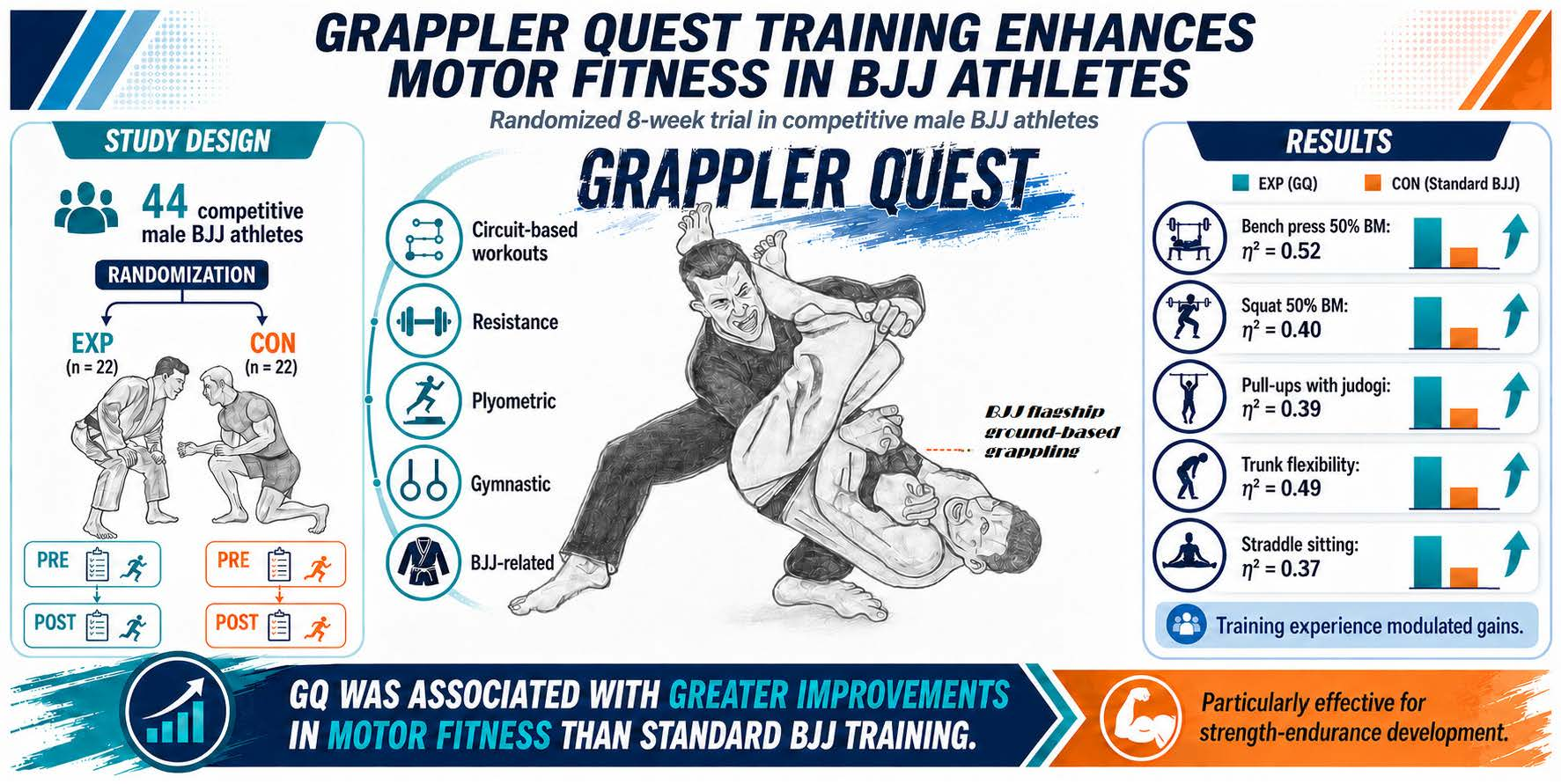
The Effect of the Experimental Training Program ‘Grappler Quest’ on the Motor Fitness of Brazilian Jiu-Jitsu Athletes






Featured Application
Abstract
1. Introduction
2. Materials and Methods
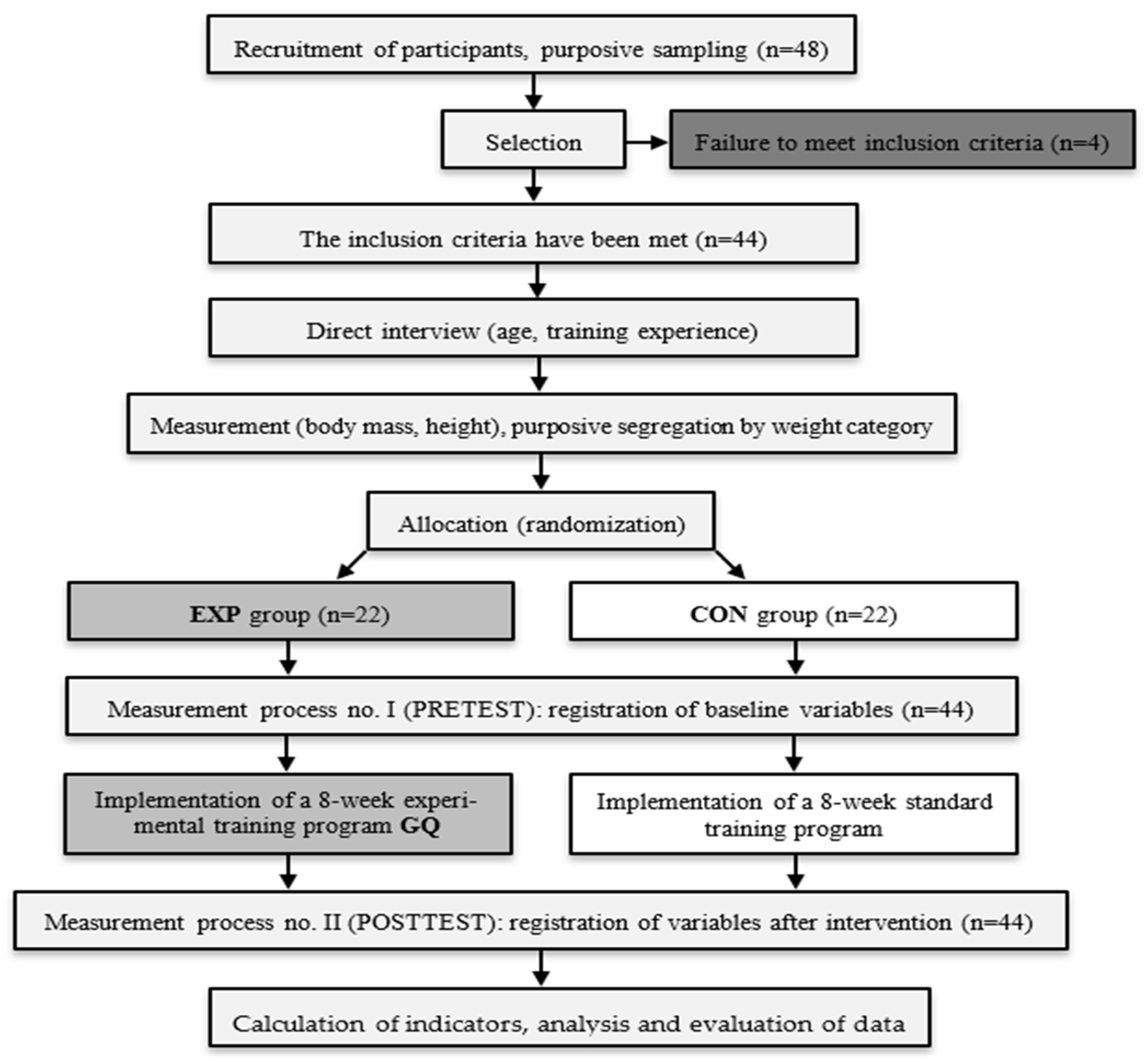
2.1. Study Design
2.2. Participant Characteristics
2.3. Characteristics of the Experimental Intervention
2.4. Characteristics of the Experimental GQ Training Program
2.5. Characteristics of the Standard Training Program for the CON Group
2.6. Measurements of Subjective Exercise Intensity Indices
2.7. Measurement of Objective Indicators of Internal Training Load—Post-Intervention Assessment
2.8. Motor Fitness Measurements
- Strength assessments
- Static handgrip strength measurement (assessment: maximal isometric handgrip strength). Standing with feet slightly apart, the participant held the dynamometer firmly in the fingers, with the arm along the torso, ensuring the device did not contact the body. A brief maximal grip effort was performed while the other arm remained relaxed. The best value from two maximal attempts with the dominant hand (HGSmax) was recorded using a dynamometer (MG 4800, Charder, Taichung, Taiwan), accurate to 1 kg [43].
- Barbell bench press, 1 repetition maximum (1-RM; assessment: maximal dynamic strength of the upper body, i.e., pectoralis major, triceps brachii, anterior deltoids, trunk stabilisers).
- Barbell back squat, 1 repetition maximum (1-RM; assessment: maximal dynamic strength of the lower body, i.e., quadriceps, gluteals, hamstrings, trunk stabilisers).
- Strength endurance assessments
- 4.
- Pull-ups on a judogi (assessment: strength endurance of the arm and back muscles). Hanging from a judogi placed over a pull-up bar, the participant performed the maximum number of pull-ups (from full arm extension to maximal elbow flexion). The test was performed once [45]. This test is specific to Judo and BJJ.
- 5.
- Bent-arm hang on a judogi (assessment: functional strength/isometric muscle endurance). The test involves hanging from a kimono suspended on a bar, with arms maximally flexed at the elbows, maintaining the position for as long as possible. The stopwatch starts when the participant begins hanging independently. The time measurement continues until the elbows extend beyond 90 degrees. The test is performed once. Hanging time is recorded with an accuracy of 0.1 s [45]. This trial is specific to Judo and BJJ.
- 6.
- Straight-arm hang on a judogi (assessment: functional strength/isometric muscle endurance). The participant maintained a dead-hang position with elbows extended for as long as possible. The stopwatch stopped when the grip failed. Recorded with 0.1-s precision. Specific to Judo and BJJ.
- 7.
- Sit-ups (assessment: strength endurance of the abdominal muscles). The participant lay on a mat with feet 30 cm apart and knees bent at a 90-degree angle. Hands were clasped behind the neck, and a partner held the participant’s feet. At the start signal, the participant sat up, touched the knees with elbows, and returned to the starting position. The duration was 30 s, and the result was the number of repetitions completed [43].
- 8.
- Back extensions (assessment: strength endurance of back extensor muscles). The participant lies prone on a mat with hands clasped behind the neck. Upon signal, they lift their torso and legs off the ground, arching the back by engaging the back muscles, then return to the starting position as quickly as possible. This movement is repeated as many times as possible within 30 s. The examiner counts the number of repetitions performed. For example, 18 correctly executed repetitions yield a score of 18. The test is performed once [43].
- 9.
- 10.
- Speed and power assessments
- 11.
- 10 × 5 m shuttle run (assessment: speed, agility, and running endurance). Participants sprinted between two lines spaced 5 m apart, crossing each line with both feet, repeated 10 times. Time recorded to the nearest 0.1 s [43].
- 12.
- Standing long jump (assessment: explosive lower-limb strength). The participant stands with feet slightly apart behind the start line, bends the knees, swings the arms backwards, and then jumps forward as far as possible, landing on both feet while maintaining an upright position. The test is performed twice, and the longest jump is recorded. The distance is measured to the nearest heel mark to the nearest centimetre. A measuring tape, a firm surface, and two connected gymnastics mats are used [43].
- Coordination assessments
- 13.
- Flamingo balance test (assessment: static balance). The participant stands on a bar measuring 50 cm in length,4 cm in height, and 3 cm in width. The participant holds the free leg bent at the knee, grasping the foot. The goal is to maintain balance for as long as possible. The measurement ends when the participant loses balance, releases the leg, or touches the ground. A preparatory trial is allowed before the measurement. Time is recorded with an accuracy of 0.01 s [43]. Test according to Żak’s modification [47].
- 14.
- Simple reaction time to visual stimulus. The test is conducted using a computer keyboard. Active keys: “Enter” on the right for the right hand and “Shift” on the left for the left hand. The participant rests their hand on the table next to the keyboard, with the thumb or index finger on the active key. When a bright square appears in the centre of the screen, the participant must press the key as quickly as possible. The test consists of 11 irregularly timed stimuli. The faster the reaction, the better the score. The examiner demonstrates the task, provides instructions and explanations, then the participant performs a practice trial with 5 stimuli before proceeding to the main test with 11 stimuli [48].
- Flexibility assessments
- 15.
- Forward trunk flexion, sit-and-reach (assessment: trunk flexibility). The test is conducted as a seated reach movement, with the range measured in cm beyond foot level. While sitting, the participant extends their arms forward as far as possible, reaching forward, with legs extended. A ruler slides along the surface of a box with a pre-prepared scale. The better of two attempts is recorded. If the participant reaches 10 cm beyond the toes, the score of 10 is awarded. The box measures 40 cm in length, 45 cm in width, and 35 cm in height, with a scaled top extending 25 cm beyond its front edge, serving as a footrest. The surface features a 65 cm-long scale, with a ruler aligned perpendicularly to the box’s axis for forward reach measurement [43].
- 16.
- Maximal straddle sitting position (assessment: hip joint flexibility). Participants performed a maximal straddle sit facing a wall, with feet touching it and knees extended. The distance from the pubic symphysis to the wall was measured in centimetres [49].
- Session 1—Strength assessment. Order: bench press 1-RM → squat 1-RM → handgrip dynamometry. Recovery before next session: 46 h.
- Session 2—Strength endurance assessment, Part 1. Tests: bench press 50% BM → squat 50% BM → sit-ups → bent-arm hang on judogi. Recovery before next session: 22 h.
- Session 3—Coordination and speed assessment. Tests: flamingo balance → reaction time → standing long jump → shuttle run. Recovery before next session: 22 h.
- Session 4—Strength endurance assessment, Part 2. Tests: pull-ups → back extensions → straight-arm hang on judogi.
2.9. Motor Indicators
2.10. Statistical Analysis
3. Results
3.1. Baseline Characteristics
3.2. Post-Intervention Results: ANCOVA Analysis
3.3. Intra-Group Analysis: Pre- and Post-Intervention Comparisons
3.4. Correlation Analysis Between Training Experience and Training Effects in the EXP Group
3.5. Between-Group Comparison of Subjective Internal Load (RPE)
3.6. Between-Group Comparison of Heart-Rate Responses During the Reconstructed Post-Intervention Training Block
4. Discussion
Limitations of the Study
5. Conclusions
Practical Implications
Supplementary Materials
Author Contributions
Funding
Institutional Review Board Statement
Informed Consent Statement
Data Availability Statement
Conflicts of Interest
Appendix A

| Measurement | Group EXP (n = 22) | Group CON (n = 22) | d | p | dC | ||||||||
|---|---|---|---|---|---|---|---|---|---|---|---|---|---|
| ± sd | Me | Min | Max | CV% | ± sd | Me | Min | Max | CV% | ||||
| Static handgrip strength [kG] | |||||||||||||
| I pre-test | 48.7 ± 10.0 | 46.1 | 33.9 | 68.2 | 20.5 | 49.7 ± 9.9 | 47.5 | 35.9 | 71.3 | 20.0 | −1.0 | 0.744 | 0.10 |
| II post-test | 51.3 ± 8.5 | 49.3 | 38.2 | 69.0 | 16.5 | 50.1 ± 9.3 | 49.4 | 35.6 | 70.2 | 18.6 | 1.2 | 0.661 | 0.13 |
| RSSH [dq] | |||||||||||||
| I pre-test | 0.6 ± 0.2 | 0.6 | 0.4 | 1.0 | 30.3 | 0.7 ± 0.2 | 0.6 | 0.4 | 1.0 | 28.5 | −0.1 | 0.565 | 0.50 M |
| II post-test | 0.7 ± 0.2 | 0.7 | 0.4 | 1.0 | 26.7 | 0.7 ± 0.2 | 0.6 | 0.4 | 1.0 | 27.0 | 0.0 | 0.715 | 0.00 |
| Bench press 1RM [kg] | |||||||||||||
| I pre-test | 88.1 ± 14.3 | 85.0 | 71.0 | 130.0 | 16.3 | 88.8 ± 14.4 | 86.5 | 72.0 | 135.0 | 16.2 | −0.7 | 0.796 | 0.05 |
| II post-test | 93.3 ± 13.7 | 90.0 | 72.0 | 136.0 | 14.7 | 90.1 ± 14.8 | 88.0 | 72.0 | 138.0 | 16.4 | 3.2 | 0.405 | 0.22 |
| RSBP [dq] | |||||||||||||
| I pre-test | 1.1 ± 0.1 | 1.1 | 0.9 | 1.5 | 12.7 | 1.2 ± 0.2 | 1.1 | 0.9 | 1.4 | 13.9 | −0.1 | 0.644 | 0.67 S |
| II post-test | 1.2 ± 0.1 | 1.2 | 1.0 | 1.5 | 9.9 | 1.2 ± 0.2 | 1.1 | 0.9 | 1.5 | 14.1 | 0.0 | 0.390 | 0.00 |
| Squat 1RM [kg] | |||||||||||||
| I pre-test | 107.4 ± 22.5 | 100.0 | 80.0 | 160.0 | 21.0 | 109.3 ± 22.7 | 102.5 | 86.0 | 165.0 | 20.7 | −1.9 | 0.664 | 0.08 |
| II post-test | 111.7 ± 20.9 | 103.0 | 88.0 | 160.0 | 18.7 | 110.1 ± 22.8 | 102.5 | 85.0 | 165.0 | 20.7 | 1.6 | 0549 | 0.07 |
| RSS [dq] | |||||||||||||
| I pre-test | 1.4 ± 0.2 | 1.4 | 1.0 | 1.7 | 13.1 | 1.4 ± 0.2 | 1.5 | 1.1 | 1.7 | 13.9 | 0.0 | 0.501 | 0.00 |
| II post-test | 1.4 ± 0.2 | 1.5 | 1.2 | 1.7 | 10.4 | 1.4 ± 0.2 | 1.5 | 1.1 | 1.7 | 14.6 | 0.0 | 0.760 | 0.00 |
| Pull ups in judogi [lp] | |||||||||||||
| I pre-test | 13.4 ± 5.1 | 12.5 | 6.0 | 26.0 | 38.4 | 14.1 ± 4.8 | 13.5 | 8.0 | 25.0 | 33.9 | −0.7 | 0.650 | 0.14 |
| II post-test | 15.3 ± 4.6 | 15.5 | 8.0 | 27.0 | 30.0 | 14.1 ± 4.4 | 13.5 | 8.0 | 24.0 | 31.1 | 1.2 | 0.406 | 0.27 |
| RSPU [dq] | |||||||||||||
| I pre-test | 0.2 ± 0.1 | 0.2 | 0.1 | 0.4 | 44.7 | 0.2 ± 0.1 | 0.2 | 0.1 | 0.4 | 39.4 | 0.0 | 0.665 | 0.00 |
| II post-test | 0.2 ± 0.1 | 0.2 | 0.1 | 0.4 | 35.8 | 0.2 ± 0.1 | 0.2 | 0.1 | 0.3 | 37.8 | 0.0 | 0.526 | 0.00 |
| Flexed-arm hang in judogi [s] | |||||||||||||
| I pre-test | 40.2 ± 9.8 | 40.0 | 25.1 | 60.6 | 24.5 | 41.1 ± 12.9 | 43.3 | 26.1 | 71.1 | 31.4 | −0.9 | 0.888 | 0.08 |
| II post-test | 44.1 ± 9.5 | 45.6 | 28.0 | 64.1 | 21.6 | 41.9 ± 12.5 | 43.2 | 27.1 | 69.1 | 29.8 | 2.2 | 0.518 | 0.20 |
| RSH1 [dq] | |||||||||||||
| I pre-test | 0.5 ± 0.1 | 0.5 | 0.3 | 0.8 | 25.2 | 0.5 ± 0.2 | 0.6 | 0.3 | 0.9 | 34.7 | 0.0 | 0.661 | 0.00 |
| II post-test | 0.6 ± 0.1 | 0.5 | 0.4 | 0.8 | 21.0 | 0.6 ± 0.2 | 0.5 | 0.3 | 0.9 | 33.1 | 0.0 | 0.654 | 0.00 |
| Straight-arm hang in judogi [s] | |||||||||||||
| I pre-test | 51.7 ± 13.1 | 50.3 | 32.4 | 78.0 | 25.4 | 52.1 ± 13.4 | 50.9 | 33.0 | 81.2 | 25.7 | −0.4 | 0.921 | 0.03 |
| II post-test | 56.6 ± 11.6 | 56.6 | 37.4 | 82.1 | 20.5 | 53.3 ± 12.5 | 51.7 | 35.0 | 82.4 | 23.5 | 3.3 | 0.362 | 0.27 |
| RSH2 [dq] | |||||||||||||
| I pre-test | 0.7 ± 0.2 | 0.7 | 0.4 | 1.3 | 33.7 | 0.7 ± 0.2 | 0.6 | 0.4 | 1.3 | 33.2 | 0.0 | 0.842 | 0.00 |
| II post-test | 0.7 ± 0.2 | 0.7 | 0.5 | 1.4 | 27.8 | 0.7 ± 0.2 | 0.7 | 0.5 | 1.3 | 31.8 | 0.0 | 0.296 | 0.00 |
| Sit-ups [reps in 30 s] | |||||||||||||
| I pre-test | 32.1 ± 3.7 | 32.5 | 26.0 | 38.0 | 11.5 | 32.9 ± 4.4 | 33.5 | 22.0 | 39.0 | 13.5 | −0.8 | 0.318 | 0.20 |
| II post-test | 33.1 ± 3.6 | 33.5 | 27.0 | 38.0 | 10.8 | 33.5 ± 4.2 | 34.0 | 23.0 | 40.0 | 12.7 | −0.4 | 0.731 | 0.10 |
| Back extensions [reps in 30 s] | |||||||||||||
| I pre-test | 49.3 ± 6.0 | 50.0 | 36.0 | 57.0 | 12.1 | 49.7 ± 5.4 | 50.0 | 38.0 | 56.0 | 10.8 | −0.4 | 0.769 | 0.07 |
| II post-test | 50.1 ± 5.9 | 51.0 | 37.0 | 57.0 | 11.8 | 49.9 ± 4.9 | 51.0 | 39.0 | 55.0 | 9.8 | 0.2 | 0.734 | 0.04 |
| Bench press 50% BM [reps] | |||||||||||||
| I pre-test | 38.4 ± 4.1 | 38.0 | 30.0 | 45.0 | 10.7 | 39.1 ± 4.3 | 39.5 | 29.0 | 45.0 | 11.1 | −0.7 | 0.593 | 0.17 |
| II post-test | 40.3 ± 3.3 | 40.0 | 32.0 | 45.0 | 8.3 | 39.1 ± 4.1 | 39.5 | 30.0 | 44.0 | 10.4 | 1.2 | 0.318 | 0.32 |
| Squat 50% BM [reps] | |||||||||||||
| I pre-test | 41.0 ± 6.1 | 40.0 | 31.0 | 52.0 | 15.0 | 41.6 ± 5.0 | 41.0 | 32.0 | 49.0 | 12.0 | −0.6 | 0.707 | 0.11 |
| II post-test | 43.5±5.6 | 43.5 | 33.0 | 53.0 | 12.8 | 41.6 ± 4.8 | 40.5 | 33.0 | 49.0 | 11.5 | 1.9 | 0.239 | 0.37 M |
| Shuttle run 10 × 5 m [s] | |||||||||||||
| I pre-test | 20.0 ± 1.2 | 19.5 | 18.5 | 22.3 | 5.8 | 20.3 ± 1.2 | 19.9 | 19.0 | 22.5 | 6.0 | −0.3 | 0.392 | 0.25 |
| II post-test | 19.9 ± 1.0 | 19.8 | 18.6 | 22.3 | 5.0 | 20.4 ± 1.2 | 20.1 | 19.0 | 22.5 | 5.8 | −0.5 | 0.127 | 0.45 M |
| Standing long jump [cm] | |||||||||||||
| I pre-test | 228.8 ± 13.0 | 232.0 | 209.0 | 258.0 | 5.7 | 230.0 ± 11.1 | 229.5 | 208.0 | 256.0 | 4.8 | −1.2 | 0.747 | 0.10 |
| II post-test | 230.3 ± 12.2 | 233.0 | 212.0 | 256.0 | 5.3 | 230.3 ± 9.2 | 229.0 | 210.0 | 254.0 | 4.0 | 0.0 | 0.989 | 0.00 |
| Static balance [s] | |||||||||||||
| I pre-test | 14.2 ± 10.6 | 10.2 | 3.6 | 35.4 | 74.3 | 12.2 ± 9.3 | 8.3 | 2.8 | 32.1 | 75.7 | 2.0 | 0.467 | 0.20 |
| II post-test | 18.8 ± 13.0 | 11.0 | 5.1 | 42.3 | 69.0 | 12.8 ± 8.9 | 9.1 | 4.1 | 35.2 | 69.6 | 6.0 | 0.064 | 0.55 M |
| Simple reaction time [s] | |||||||||||||
| I pre-test | 0.23 ± 0.02 | 0.2 | 0.2 | 0.3 | 8.4 | 0.25 ± 0.01 | 0.3 | 0.2 | 0.3 | 5.5 | 0.02 | 0.003 * | 1.33 S |
| II post-test | 0.23 ± 0.02 | 0.2 | 0.2 | 0.3 | 8.7 | 0.24 ± 0.01 | 0.2 | 0.2 | 0.3 | 5.2 | 0.01 | 0.002 * | 0.67 S |
| Trunk flexibility [cm] | |||||||||||||
| I pre-test | 28.7 ± 6.6 | 26.5 | 18.0 | 40.0 | 23.0 | 27.2 ± 5.9 | 28.0 | 15.0 | 38.0 | 21.8 | 1.5 | 0.432 | 0.24 |
| II post-test | 31.5 ± 6.6 | 30.0 | 21.0 | 42.0 | 21.1 | 27.5 ± 6.1 | 27.5 | 15.0 | 39.0 | 22.2 | 4.0 | 0.043 * | 0.63 M |
| Maximal straddle sitting position [cm] | |||||||||||||
| I pre-test | 48.6 ± 3.6 | 49.0 | 43.0 | 55.0 | 7.4 | 49.1 ± 4.0 | 47.0 | 44.0 | 58.0 | 8.1 | −0.5 | 0.879 | 0.13 |
| II post-test | 45.7 ± 4.1 | 46.0 | 39.0 | 57.0 | 8.9 | 48.6 ± 4.0 | 47.0 | 44.0 | 56.0 | 8.3 | −2.9 | 0.049 * | 0.72 S |
| Variables | p (ANCOVA; Unadjusted) | q (BH-FDR) | FDR-Significant (q < 0.05) |
|---|---|---|---|
| Static handgrip strength [kG] | <0.001 ** | ≤0.0015 | Yes |
| RSSH [dq] | <0.001 ** | ≤0.0015 | Yes |
| Bench press 1RM [kg] | <0.001 ** | ≤0.0015 | Yes |
| RSBP [dq] | <0.001 ** | ≤0.0015 | Yes |
| Squat 1RM [kg] | <0.001 ** | ≤0.0015 | Yes |
| RSS [dq] | <0.01 * | ≤0.0129 | Yes |
| Pull ups in judogi [reps] | <0.001 ** | ≤0.0015 | Yes |
| RSPU [dq] | <0.01 * | ≤0.0129 | Yes |
| Flexed-arm hang in judogi [s] | <0.001 ** | ≤0.0015 | Yes |
| RSH1 [dq] | <0.001 ** | ≤0.0015 | Yes |
| Straight-arm hang in judogi [s] | <0.001 ** | ≤0.0015 | Yes |
| RSH2 [dq] | <0.001 ** | ≤0.0015 | Yes |
| Sit-ups [reps in 30 s] | 0.32 | 0.3352 | No |
| Back extensions [reps in 30 s] | 0.09 | 0.1042 | No |
| Bench press 50% BM [reps] | <0.001 ** | ≤0.0015 | Yes |
| Squat 50% BM [reps] | <0.001 ** | ≤0.0015 | Yes |
| Shuttle run 10 × 5 m [s] | 0.03 * | 0.0367 | Yes |
| Standing long jump [cm] | 0.14 | 0.1540 | No |
| Static balance [s] | <0.001 * | ≤0.0015 | Yes |
| Simple reaction time [s] | 0.97 | 0.9700 | No |
| Trunk flexibility [cm] | <0.001 * | ≤0.0015 | Yes |
| Maximal straddle sitting position [cm] | <0.001 * | ≤0.0015 | Yes |
References
- Andreato, L.V.; Follmer, B.; Celidonio, C.L.; da Silva Honorato, A. Brazilian Jiu-Jitsu combat among different categories: Time-motion and physiology. A systematic review. Strength Cond. J. 2016, 38, 44–54. [Google Scholar] [CrossRef]
- Spanias, C.; Kirk, C.; Øvretveit, K. Position before submission? Techniques and tactics in competitive no-gi Brazilian jiu-jitsu. Rev. Artes Marciales Asiáticas 2022, 17, 130–139. [Google Scholar] [CrossRef]
- de Carvalho, G.N.; Ferreira, A.; Pérez, D.V.; Teixeira, F.G.; de Albuquerque, M.C.; Muñoz, E.A.; Ciro José Brito, C.J.; Miarka, B. Session rating of perceived exertion as an assessment tool for internal training load in Brazilian jiu-jitsu: A systematic review and meta-analysis. Retos Nuevas Tend. Educ. Física Deporte Recreación 2025, 64, 788–797. [Google Scholar]
- Andreato, L.V.; Lara, F.J.D.; Andrade, A.; Branco, B.H.M. Physical and physiological profiles of Brazilian jiu-jitsu athletes: A systematic review. Sports Med.-Open 2017, 3, 9. [Google Scholar] [CrossRef] [PubMed]
- Wąsacz, W. Brazilian jiu-jitsu gi vs nogi—A comparative analysis of the motor fitness level of athletes specializing in different fighting formats. J. Kinesiol. Exerc. Sci. 2025, 36, 1–10. [Google Scholar] [CrossRef]
- Wąsacz, W. The level of special fitness among Brazilian Jiu-Jitsu practitioners, Gi formula, takedown zone–analysis of the effectiveness of SJFT flow across disciplines. Arch. Tour. Hosp. Sport Sci. 2023, 8, 31–42. [Google Scholar] [CrossRef]
- Wąsacz, W.; Rydzik, Ł.; Šimenko, J.; Kędra, A.; Błach, W.; Ambroży, T. The Development of the Special Brazilian Jiu-Jitsu Fitness Test: Takedown Zone (SBJJFT-TZ), Gi Formula. Appl. Sci. 2024, 14, 4711. [Google Scholar] [CrossRef]
- Andreato, L.V.; Leite, A.E.; Ladeia, G.F.; Follmer, B.; de Paula Ramos, S.; Coswig, V.S.; Andrade, A.; Branco, B.H.M. Aerobic and anaerobic performance of lower-and upper-body in Brazilian jiu-jitsu athletes. Sci. Sports 2022, 37, 145.e1–145.e8. [Google Scholar] [CrossRef]
- Miletić, T.; Kajmović, H. Effects of judo rule change on the effectiveness of floor techniques in competitors. In Proceedings Book; University of Zagreb Faculty of Kinesiology: Zagreb, Croatia, 2024; Volume 155. [Google Scholar]
- Brito, C.J.; Marques, L.T.; Merino-Muñoz, P.; Bustamante-Garrido, A.; Araya-Ibacache, M.; de Toledo Nóbrega, O.; Miarka, B.; Aedo-Muñoz, E.A. Is isometric mid-thigh pull associated with the competitive performance of striking high-level athletes? Retos 2024, 60, 527–533. [Google Scholar] [CrossRef]
- Piepiora, P.A. The Health Effects of Karate Training: A Review of 21st Century Research. Healthcare 2025, 13, 118. [Google Scholar] [CrossRef] [PubMed]
- Kużdżał, A.; Clemente, F.M.; Kawczyński, A.; Ryszkiel, I.; Trybulski, R. Comparing The Effects of Compression Contrast Therapy and Dry Needling on Muscle Functionality, Pressure Pain Threshold, and Perfusion after Isometric Fatigue in Forearm Muscles of Combat Sports Athletes: A Single-Blind Randomized Controlled Trial. J. Sports Sci. Med. 2024, 23, 548–558. [Google Scholar] [CrossRef]
- Duarte, J.; Fett, C. Teacher Training in Martial Arts and Combat Sports: Innovative Educational Models. Int. Martial Arts Cult. J. 2025, 3, 29–32. [Google Scholar] [CrossRef]
- Naji, N.H.; Kamil, N.A. The effect of neural control exercisesin improving motor performance in handball players. Int. J. Adv. Res. Educ. Lit. 2025, 11, 74–77. [Google Scholar] [CrossRef]
- López Rodríguez, A.; Cancela-Carral, J.M. Influence of Immersive Virtual Coordination Training on Launch Accuracy: Randomized Controlled Trial. Appl. Sci. 2025, 15, 3269. [Google Scholar] [CrossRef]
- Franchini, E.; Cormack, S.; Takito, M.Y. Effects of high-intensity interval training on olympic combat sports athletes’ performance and physiological adaptation: A systematic review. J. Strength Cond. Res. 2019, 33, 242–252. [Google Scholar] [CrossRef] [PubMed]
- Grabowski, H.; Olszówka, P. Wykłady z Metodologii Badań Empirycznych: Dla Studentów Turystyki i Rekreacji; Impuls: Kraków, Poland, 2013. [Google Scholar]
- Pustomelnik, O. Key aspects of training and improving techniques and tactics in mixed martial arts (MMA): A literature review. Health Technol. 2025, 3, 37–45. [Google Scholar] [CrossRef]
- Tropin, Y.; Podrigalo, L.; Romanenko, V.; Kovalenko, Y.; Boychenko, N.; Podrihalo, O.; Volodchenko, O. Using static-dynamic exercises to improve strength performance in elite Brazilian jiu-jitsu athletes. J. Phys. Educ. Sport 2024, 24, 1152–1161. [Google Scholar] [CrossRef]
- Błach, W.; Wąsacz, W.; Rydzik, Ł.; Ambroży, T. In search of motor efficiency in grappling sports: A comparative analysis of judo and Brazilian jiu–jitsu (BJJ) athletes. Appl. Res. Judo 2023, 99, 99–108. [Google Scholar]
- Wąsacz, W.; Sobiło-Rydzik, E.; Niewczas, M.; Król, P.; Malliaropoulos, N. In search of muscular fitness and its relation to training experience and sports performance of athletes of modern combat sports such as mixed martial arts (MMA) and Brazilian jiu-jitsu (BJJ). J. Kinesiol. Exerc. Sci. 2023, 33, 10–21. [Google Scholar] [CrossRef]
- Wąsacz, W.; Rydzik, Ł.; Ouergui, I.; Koteja, A.; Ambroży, D.; Ambroży, T.; Ruzbarsky, P.; Rzepko, M. Comparison of the Physical Fitness Profile of Muay Thai and Brazilian Jiu-Jitsu Athletes with Reference to Training Experience. Int. J. Environ. Res. Public Health 2022, 19, 8451. [Google Scholar] [CrossRef] [PubMed]
- Da Costa, L.O.F.; Soto, D.S.; Brito, C.J.; Muñoz, E.A.; Miarka, B. Dynamic strength and muscle power in elite and non-elite Brazilian jiu-jitsu (BJJ) athletes: A systematic review with meta-analysis. Retos Nuevas Tend. Educ. Física Deporte Recreación 2024, 52, 291–303. [Google Scholar] [CrossRef]
- Andreato, L.V.; de Moraes, S.F.; de Moraes Gomes, T.L.; Esteves, J.D.C.; Andreato, T.V.; Franchini, E. Estimated aerobic power, muscular strength and flexibility in elite Brazilian Jiu-Jitsu athletes. Sci. Sports 2011, 26, 329–337. [Google Scholar] [CrossRef]
- Marinho, B.F.; Andreato, L.V.; Follmer, B.; Franchini, E. Comparison of body composition and physical fitness in elite and non-elite Brazilian jiu-jitsu athletes. Sci. Sports 2016, 31, 129–134. [Google Scholar] [CrossRef]
- Ribeiro, R.L.; Silva, J.I.O.; Dantas, M.G.B.; Menezes, E.S.; Arruda, A.C.P.; Schwingel, P.A. High-intensity interval training applied in Brazilian Jiu-jitsu is more effective to improve athletic performance and body composition. J. Combat Sports Martial Arts 2015, 6, 1–5. [Google Scholar]
- Ambroży, T. Struktura Treningu ju-Jitsu; Wydawnictwo COS: Warszawa, Poland, 2008. [Google Scholar]
- Ambroży, T. W Poszukiwaniu Możliwości Szkolenia Obwodowego z Prozdrowotną Aktywnością Fizyczną; Annales Medicina, Wydawnictwo UMCS: Lublin, Poland, 2007; pp. 55–60. [Google Scholar]
- World Health Organization (WHO). International Clinical Trials Registry Platform (ICTRP): What Is a Clinical Trial? Available online: https://www.who.int/tools/clinical-trials-registry-platform/about/glossary (accessed on 20 December 2025).
- Mesquida, C.; Murphy, J.; Lakens, D.; Warne, J. Publication bias, statistical power and reporting practices in the Journal of Sports Sciences: Potential barriers to replicability. J. Sports Sci. 2023, 41, 1507–1517. [Google Scholar] [CrossRef] [PubMed]
- Perugini, M.; Gallucci, M.; Costantini, G. A Practical Primer To Power Analysis for Simple Experimental Designs. Int. Rev. Soc. Psychol. 2018, 31, 20. [Google Scholar] [CrossRef]
- Faul, F.; Erdfelder, E.; Lang, A.G.; Buchner, A. G* Power 3: A flexible statistical power analysis program for the social, behavioral, and biomedical sciences. Behav. Res. Methods 2007, 39, 175–191. [Google Scholar] [CrossRef] [PubMed]
- Abt, G.; Boreham, C.; Davison, G.; Jackson, R.; Jobson, S.; Wallace, E.; Williams, M. Sample size estimation revisited. J. Sports Sci. 2025, 43, 2511–2516. [Google Scholar] [CrossRef] [PubMed]
- International Brazilian Jiu-Jitsu Federation (IBJJF). Available online: https://ibjjf.com/books-videos (accessed on 10 September 2023).
- Pilch, T.; Bauman, T. Zasady Badań Pedagogicznych: Strategie Ilościowe i Jakościowe, 1st ed.; Wydawnictwo Akademickie ŻAK: Warszawa, Poland, 2010. [Google Scholar]
- Babbie, E. The Practice of Social Research, 15th ed.; Cengage Learning: Belmont, CA, USA, 2020. [Google Scholar]
- Ribeiro, S.; Howell, K. Brazylijskie Jiu-Jitsu—Od Białego do Czarnego Pasa; Wydawnictwo Galaktyka: Łódź, Poland, 2021. [Google Scholar]
- Lorenço-Lima, L.; Souza-Junior, T.P.; Okuyama, A.R.; Mcanulty, S.R.; Utter, A.C.; Monteiro, T.S.; Barquilha, G.; Bortolon, J.R.; Geraldo, T.P.; Hirabara, S.M. Characterization of Brazilian Jiu-Jitsu training effects on the physical fitness of men and women. J. Phys. Educ. Sport 2020, 20, 2990–2995. [Google Scholar] [CrossRef]
- Branco, B.H.M.; Andreato, L.V.; Mendes, A.A.; Gilio, G.R.; Andrade, A.; Júnior, N.N. Effects of a Brazilian jiu-jitsu training session on physiological, biochemical, hormonal and perceptive responses. Arch. Budo Sci. Martial Arts Extrem. Sports 2016, 12, 145–156. [Google Scholar]
- Sharkey, B.J.; Gaskill, S. Fizjologia Sportu Dla Trenerów; Centralny Ośrodek Sportu: Warszawa, Poland, 2013. [Google Scholar]
- Foster, C.; Florhaug, J.A.; Franklin, J.; Gottschall, L.; Hrovatin, L.A.; Parker, S.; Doleshal, P.; Dodge, C. A new approach to monitoring exercise training. J. Strength Cond. Res. 2001, 15, 109–115. [Google Scholar] [CrossRef] [PubMed]
- Ambroży, T.; Rydzik, Ł. Obciążenia Treningowe i Startowe w Sporcie; POLIHYMNIA: Kraków, Poland, 2026. [Google Scholar]
- Grabowski, H.; Szopa, J. ‘Eurofit’—Europejski Test Sprawności Fizycznej. 1989. Available online: http://repozytorium.awf.krakow.pl/xmlui/handle/20.500.12053/981 (accessed on 2 May 2024).
- Brown, L.E.; Weir, J.P. ASEP procedures recommendation I: Accurate assessment of muscular strength and power. J. Exerc. Physiol. 2001, 4, 1–21. [Google Scholar]
- Franchini, E.; Miarka, B.; Matheus, L.; Del Vecchio, F.B. Endurance in judogi grip strength tests: Comparison between elite and non-elite judo players. Arch. Budo 2011, 7, 1–4. [Google Scholar]
- Talaga, J. Sprawność Fizyczna Ogólna-Testy; Zysk i S-ka: Poznań, Poland, 2004. [Google Scholar]
- Żak, S. Zdolności Kondycyjne i Koordynacyjne Dzieci i Młodzieży z Populacji Wielkomiejskiej na tle Wybranych Uwarunkowań Somatycznych i Aktywności Ruchowej; Wydawnictwo Monograficzne/AWF Kraków: Kraków, Poland, 1991; p. 43. [Google Scholar]
- Klocek, T.; Spieszny, M.; Szczepanik, M. Komputerowe Testy Zdolności Koordynacyjnych; Centralny Ośrodek Sportu: Warszawa, Poland, 2002. [Google Scholar]
- Krawczyk, M.; Ozimek, M.; Pociecha, M.; Gabryś, T. Morfofunkcjonalne Uwarunkowania Wyników Sportowych we Wspinaczce na czas i Boulderingu; Wydawnictwa Państwowej Wyższej Szkoły Zawodowej w Tarnowie: Tarnów, Poland, 2019. [Google Scholar]
- Szopa, J.; Mleczko, E.; Żak, S. Podstawy Antropomotoryki; WN PWN: Warszawa–Kraków, Poland, 2000. [Google Scholar]
- Józefacka, N.; Kołek, M.F.; Arciszewska-Leszczuk, A.; Iwankowski, P. Metodologia i Statystyka: Przewodnik Naukowego Turysty—Tom 1; WN PWN: Warszawa, Poland, 2023. [Google Scholar]
- Dzakiyyah, D.M.N.; Widiyanto. Training for Martial Arts Athletes: Efforts to Increase Leg Muscle Strength: A Literature Review. Int. J. Multidiscip. Res. Anal. 2025, 8, 1770–1777. [Google Scholar] [CrossRef]
- Johnson, L.D.; Sarinukul, C.; Rittirod, T.; Konharn, K. Effects of applying sports liniment with massage on muscular relative strength of hip flexion and knee extension among male Muay Thai athletes: A randomised control trial. Rev. Artes Marciales Asiat. 2024, 19, 104–114. [Google Scholar] [CrossRef]
- Johnson, L.D.; Konharn, K.; Rittirod, T.; Chatchawan, U.; Hunsawang, T.; Buranruk, O.; Rosenberg, M. The short effect of sports liniment on muscular physiological responses and physical performance among male Muay Thai fighters: Case study. J. Assoc. Med. Sci. 2025, 58, 12–21. [Google Scholar] [CrossRef]
- Pearce, P.Z. Prehabilitation: Preparing young athletes for sports. Curr. Sports Med. Rep. 2006, 5, 155–160. [Google Scholar] [PubMed]
- Hübscher, M.; Zech, A.; Pfeifer, K.; Hänsel, F.; Vogt, L.; Banzer, W. Neuromuscular training for sports injury prevention: A systematic review. Med. Sci. Sports Exerc. 2010, 42, 413–421. [Google Scholar] [CrossRef] [PubMed]
- Emery, C.A.; Roy, T.O.; Whittaker, J.L.; Nettel-Aguirre, A.; Van Mechelen, W. Neuromuscular training injury prevention strategies in youth sport: A systematic review and meta-analysis. Br. J. Sports Med. 2015, 49, 865–870. [Google Scholar] [CrossRef] [PubMed]
- Zech, A.; Hubscher, M.; Vogt, L.; Banzer, W.; Hansel, F.; Pfeifer, K. Neuromuscular Training for Rehabilitation of Sports Injuries: A Systematic Review. Med. Sci. Sports Exerc. 2009, 41, 1831–1841. [Google Scholar] [CrossRef] [PubMed]
- Wąsacz, W.; Rydzik, Ł.; Kryst, Ł.; Spieszny, M.; Jaworski, J.; Ambroży, T. The Impact of the Experimental ‘Grappler Quest’ Training on the Structural Profile of Brazilian Jiu-Jitsu Athletes—A Randomized Controlled Trial. Appl. Sci. 2025, 15, 10048. [Google Scholar] [CrossRef]
- Franchini, E.; Branco, B.M.; Agostinho, M.F.; Calmet, M.; Candau, R. Influence of linear and undulating strength periodization on physical fitness, physiological, and performance responses to simulated judo matches. J. Strength Cond. Res. 2015, 29, 358–367. [Google Scholar] [CrossRef] [PubMed]
- Franchini, E.; Del Vecchio, F.B.; Julio, U.F.; Matheus, L.; Candau, R. Specificity of performance adaptations to a periodized judo training program. Rev. Andal. Med. Deporte 2015, 8, 67–72. [Google Scholar] [CrossRef]
- Stojanovic, B.; Ostojic, S.; Patrik, D.; Milosevic, Z. Adattamenti fisiologici ad un periodo di allenamento di 8 settimane pre-agonistico in judokas d’elite di sesso femminile. Med. Dello Sport 2009, 62, 415–424. [Google Scholar]
- Finlay, M. A Four Week Contrast Training Programme Enhances Punch Performance and Physical Qualities in Senior Elite Amateur Boxers: A Physical Preparation Case Study for an International Tournament. Int. J. Strength Cond. 2025, 5, 1–12. [Google Scholar] [CrossRef]
- Loturco, I.; Bishop, C.; Ramirez-Campillo, R.; Romano, F.; Alves, M.; Pereira, L.A.; McGuigan, M. Optimum power loads for elite boxers: Case study with the Brazilian national olympic team. Sports 2018, 6, 95. [Google Scholar] [CrossRef] [PubMed]
- Kim, K.J.; Lee, S.B.; Park, S. Effects of boxing-specific training on physical fitness and punch power in Korean national boxers. Exerc. Sci. 2018, 27, 296–302. [Google Scholar] [CrossRef]
- Yazdani, S.; Aminaei, M.; Amirseifadini, M. Effects of plyometric and cluster resistance training on explosive power and maximum strength in karate players. Int. J. Appl. Exerc. Physiol. 2017, 6, 21–30. [Google Scholar] [CrossRef]
- Özbay, S.; Akbulut, T.; Cinar, V. Crossfit trainings as an alternative approach to prevent the performance loss during the rest of the end of season in elite wrestlers. Челoвек. Спoрт. Медицина 2019, 19, 51–57. [Google Scholar]
- Ambroży, T.; Rydzik, Ł.; Kwiatkowski, A.; Spieszny, M.; Ambroży, D.; Rejman, A.; Koteja, A.; Jaszczur-Nowicki, J.; Duda, H.; Czarny, W. Effect of CrossFit Training on Physical Fitness of Kickboxers. Int. J. Environ. Res. Public Health 2022, 19, 4526. [Google Scholar] [CrossRef] [PubMed]
- Ambroży, T.; Nowak, M.; Mucha, D.; Chwała, W.; Piwowarski, J.; Sieber, L. The influence of an original training programme on the general physical fitness of ju-jitsu trainees. Ido Mov. Cult. J. Martial Arts Anthropol. 2014, 14, 69–76. [Google Scholar] [CrossRef]
- Nagla, E. Effect of swiss ball exercises on some physical and physiological variables and their relationship with kata performance level. J. Phys. Educ. Sport/Citius Altius Fortius 2011, 11, 45–52. [Google Scholar]
- Pal, S.; Yadav, J.; Sindhu, B.; Kalra, S. Effect of Plyometrics and Pilates Training on Dynamic Balance and Core Strength of Karate Players. J. Clin. Diagn. Res. 2021, 15, 160–164. [Google Scholar] [CrossRef]
- Kędziorek, J.; Błażkiewicz, M.; Wąsik, J.; Szopa, J.; Sołdacka, A. Reaction Time and Postural Control Under Dual-Task Conditions in Brazilian Jiu-Jitsu Athletes. Appl. Sci. 2025, 15, 3877. [Google Scholar] [CrossRef]
- Eken, Ö.; Özkol, M.Z.; Varol, S.R. Acute effects of different stretching and warm-up protocols on some anaerobic motoric tests, flexibility and balance in junior male judokas. Pedagog. Phys. Cult. Sports 2020, 24, 169–174. [Google Scholar]
- Saraiva, A.R.; Reis, V.M.; Costa, P.B.; Bentes, C.M.; e Silva, G.V.C.; Novaes, J.S. Chronic effects of different resistance training exercise orders on flexibility in elite judo athletes. J. Hum. Kinet. 2014, 40, 129–137. [Google Scholar] [CrossRef] [PubMed]
- Fatouros, I.G.; Kambas, A.; Katrabasas, I.; Leontsini, D.; Chatzinikolaou, A.; Jamurtas, A.Z.; Douroudos, I.; Aggelousis, N.; Taxildaris, K. Resistance training and detraining effects on flexibility performance in the elderly are intensity-dependent. J. Strength Cond. Res. 2006, 20, 634–642. [Google Scholar] [CrossRef] [PubMed]
- Slimani, M.; Davis, P.; Franchini, E.; Moalla, W. Rating of perceived exertion for quantification of training and combat loads during combat sport-specific activities: A short review. J. Strength Cond. Res. 2017, 31, 2889–2902. [Google Scholar] [CrossRef] [PubMed]
- Ouergui, I.; Ardigò, L.P.; Selmi, O.; Levitt, D.E.; Chtourou, H.; Bouassida, A.; Bouhlel, E.; Franchini, E. Changes in perceived exertion, well-being, and recovery during specific judo training: Impact of training period and exercise modality. Front. Physiol. 2020, 11, 931. [Google Scholar] [CrossRef] [PubMed]

| Variables | Group EXP (n = 22); ± sd | Group CON (n = 22); ± sd | p-Value |
|---|---|---|---|
| Age [years] | 26.02 ± 3.24 | 25.59 ± 3.25 | 0.597 |
| Body height [cm] | 177.34 ± 6.33 | 176.90 ± 6.22 | 0.819 |
| Body mass [kg] | 78.79 ± 12.05 | 77.88 ± 9.86 | 0.879 |
| BMI [kg/m2] | 24.98 ± 3.04 | 24.86 ± 2.71 | 0.894 |
| Training experience [years] | 7.50 ± 2.67 | 7.64 ± 2.79 | 0.879 |
| Experimental Training Program Based on the Circuit Method | |
|---|---|
| Parameter | Value/Description |
| Number of exercise circuits | 3 |
| Number of exercises per circuit | 5 |
| Repetitions/Duration per exercise | Circuit I: 8 to 15 reps/Circuit II and III: 30 s |
| % of maximum load | Up to 50% of body mass |
| Exercise tempo | Circuit I: 2-1-2-1/Circuit II and III: fast-paced |
| Rest time between circuits | 180 s |
| I Strength–Endurance Circuit | II Functional Circuit | III Specialized Circuit |
|---|---|---|
| Pull-ups on a suspended gi to full elbow flexion and extension | Wall roll 1 | BJJ Burpees 5 across the length of the training hall |
| Classic squat combined with a medicine ball throw over the head and then catching it | Knee-on-belly 2 with side-to-side switching (R-L) on a training bag | Sit-up from the back position into a kimura setup 6 |
| Trunk twists with a plate held in hands, elbows bent at chest height | Minimum forward and backward rolls on a gymnastic ball (or other exercises that are not a technical barrier, e.g., handstands, clean and press, rolls, etc.) | Isometric hold of steel maces at a 90-degree elbow angle |
| Deadlift with kettlebells, pulling the weight up to the clavicle line (hands close to the torso) | BJJ floor climb 3 forward and backward across the training hall | Stable standing on a gymnastic ball with feet or knees, no hands used for support |
| Deep push-ups on parallel bars | Gymnastic exercise set 4 across the training hall with fluid motion | Jump over a rope (1-m height) followed by crawling under it |
| Variables | Group CON Adjusted Post (95% CI) | Group EXP Adjusted Post (95% CI) | F (df1, df2) | p | η2 |
|---|---|---|---|---|---|
| Static handgrip strength [kG] | 49.68 (49.16–50.20) | 51.74 (51.22–52.27) | 31.66 (1, 41) | <0.001 ** | 0.44 S |
| RSSH [dq] | 0.65 (0.64–0.66) | 0.69 (0.68–0.69) | 28.89 (1, 41) | <0.001 ** | 0.33 S |
| Bench press 1RM [kg] | 89.74 (88.33–91.15) | 93.67 (92.26–95.08) | 15.87 (1, 41) | <0.001 ** | 0.28 S |
| RSBP [dq] | 1.16 (1.14–1.17) | 1.21 (1.19–1.23) | 17.24 (1, 41) | <0.001 ** | 0.30 S |
| Squat 1RM [kg] | 109.22 (107.89–110.55) | 112.60 (111.27–113.93) | 13.13 (1, 41) | <0.001 ** | 0.24 S |
| RSS [dq] | 1.40 (1.38–1.42) | 1.45 (1.43–1.47) | 13.18 (1, 41) | <0.01 * | 0.24 S |
| Pull ups in judogi [reps] | 13.84 (13.35–14.32) | 15.57 (15.08–16.06) | 25.8 (1, 41) | <0.001 ** | 0.39 S |
| RSPU [dq] | 0.19 (0.16–0.22) | 0.20 (0.17–0.23) | 9.58 (1, 41) | <0.01 * | 0.19 S |
| Flexed-arm hang in judogi [s] | 41.53 (40.54–42.51) | 44.53 (43.41–45.51) | 18.92 (1, 41) | <0.001 ** | 0.32 S |
| RSH1 [dq] | 0.54 (0.52–0.55) | 0.58 (0.57–0.59) | 19.89 (1, 41) | <0.001 ** | 0.33 S |
| Straight-arm hang in judogi [s] | 53.1 (52.01–54.18) | 56.8 (55.72–57.89) | 30.87 (1, 41) | <0.001 ** | 0.43 S |
| RSH2 [dq] | 0.70 (0.68–0.71) | 0.75 (0.73–0.76) | 22.19 (1, 41) | <0.001 ** | 0.35 S |
| Sit-ups [reps in 30 s] | 33.1 (32.57–33.64) | 33.49 (32.95–34.02) | 1.02 (1, 41) | 0.32 | 0.12 M |
| Back extensions [reps in 30 s] | 49.7 (49.2–50.2) | 50.3 (49.8–50.8) | 3.01 (1, 41) | 0.09 | 0.07 M |
| Bench press 50% BM [reps] | 38.84 (38.48–39.21) | 40.57 (40.29–40.93) | 27.34 (1, 41) | <0.001 ** | 0.52 S |
| Squat 50% BM [reps] | 41.35 (40.87–42.01) | 43.78 (43.12–44.44) | 27.7 (1, 41) | <0.001 ** | 0.40 S |
| Shuttle run 10 × 5 m [s] | 20.28 (20.11–20.45) | 20.02 (19.85–20.19) | 4.97 (1, 41) | 0.03 * | 0.11 M |
| Standing long jump [cm] | 229.76 (228.73–230.78) | 230.84 (229.81–231.87) | 2.24 (1, 41) | 0.14 | 0.05 |
| Static balance [s] | 13.82 (12.3–15.34) | 17.76 (16.24–19.28) | 13.64 (1, 41) | <0.001 * | 0.25 S |
| Simple reaction time [s] | 0.24 (0.23–0.24) | 0.24 (0.23–0.24) | 0.002 (1, 41) | 0.97 | 0.00 |
| Trunk flexibility [cm] | 28.25 (27.67–28.82) | 30.75 (30.18–31.33) | 38.88 (1, 41) | <0.001 * | 0.49 S |
| Maximal straddle sitting position [cm] | 48.39 (47.68–49.1) | 45.93 (45.22–46.64) | 24.58 (1, 41) | <0.001 * | 0.37 S |
| Variables | Measurement | Group EXP (n = 22) | Group CON (n = 22) | ||||||||
|---|---|---|---|---|---|---|---|---|---|---|---|
| Mean | SD | CV% | p | dC | Mean | SD | CV% | p | dC | ||
| Static handgrip strength [kG] | I pre-test | 48.66 | 9.95 | 20.45 | <0.001 ** | 0.29 | 49.65 | 9.93 | 20.01 | 0.125 | 0.05 |
| II post-test | 51.30 | 8.48 | 16.53 | 50.12 | 9.32 | 18.59 | |||||
| RSSH [dq] | I pre-test | 0.64 | 0.19 | 30.30 | <0.001 ** | 0.22 | 0.65 | 0.19 | 28.48 | 0.149 | 0.05 |
| II post-test | 0.68 | 0.18 | 26.68 | 0.66 | 0.18 | 26.95 | |||||
| Bench press 1RM [kg] | I pre-test | 88.09 | 14.34 | 16.28 | <0.001 ** | 0.37 M | 88.82 | 14.39 | 16.21 | 0.006 * | 0.09 |
| II post-test | 93.32 | 13.72 | 14.71 | 90.09 | 14.77 | 16.40 | |||||
| RSBP [dq] | I pre-test | 1.13 | 0.14 | 12.71 | <0.001 ** | 0.54 M | 1.15 | 0.16 | 13.93 | 0.001 * | 0.13 |
| II post-test | 1.20 | 0.12 | 9.93 | 1.17 | 0.16 | 14.14 | |||||
| Squat 1RM [kg] | I pre-test | 107.41 | 22.53 | 20.98 | 0.001 * | 0.20 | 109.32 | 22.66 | 20.73 | 0.287 | 0.04 |
| II post-test | 111.68 | 20.86 | 18.68 | 110.14 | 22.84 | 20.74 | |||||
| RSS [dq] | I pre-test | 1.36 | 0.18 | 13.06 | <0.001 ** | 0.42 M | 1.40 | 0.20 | 13.92 | 0.123 | 0.10 |
| II post-test | 1.43 | 0.15 | 10.35 | 1.42 | 0.21 | 14.55 | |||||
| Pull ups in judogi [reps] | I pre-test | 13.36 | 5.13 | 38.40 | <0.001 ** | 0.39 M | 14.05 | 4.77 | 33.93 | 0.628 | 0.02 |
| II post-test | 15.27 | 4.58 | 29.98 | 14.14 | 4.40 | 31.13 | |||||
| RSPU [dq] | I pre-test | 0.18 | 0.08 | 44.72 | <0.001 ** | 0.27 | 0.19 | 0.07 | 39.37 | 0.454 | 0.00 |
| II post-test | 0.20 | 0.07 | 35.76 | 0.19 | 0.07 | 37.80 | |||||
| Flexed-arm hang in judogi [s] | I pre-test | 40.21 | 9.83 | 24.45 | <0.001 ** | 0.40 M | 41.07 | 12.91 | 31.43 | 0.022 * | 0.07 |
| II post-test | 44.12 | 9.53 | 21.59 | 41.94 | 12.49 | 29.79 | |||||
| RSH1 [dq] | I pre-test | 0.52 | 0.13 | 25.23 | <0.001 ** | 0.40 M | 0.54 | 0.19 | 34.69 | 0.024 * | 0.05 |
| II post-test | 0.57 | 0.12 | 20.95 | 0.55 | 0.18 | 33.14 | |||||
| Straight-arm hang in judogi [s] | I pre-test | 51.72 | 13.14 | 25.40 | <0.001 ** | 0.40 M | 52.12 | 13.38 | 25.67 | 0.008 * | 0.09 |
| II post-test | 56.63 | 11.61 | 20.50 | 53.27 | 12.51 | 23.48 | |||||
| RSH2 [dq] | I pre-test | 0.67 | 0.23 | 33.68 | <0.001 ** | 0.32 | 0.68 | 0.23 | 33.16 | 0.002 * | 0.09 |
| II post-test | 0.74 | 0.21 | 27.80 | 0.70 | 0.22 | 31.76 | |||||
| Sit-ups [reps in 30 s] | I pre-test | 32.05 | 3.67 | 11.45 | 0.001 * | 0.29 | 32.91 | 4.44 | 13.49 | 0.049 * | 0.14 |
| II post-test | 33.09 | 3.58 | 10.83 | 33.50 | 4.24 | 12.66 | |||||
| Back extensions [reps in 30 s] | I pre-test | 49.27 | 5.95 | 12.07 | 0.005 * | 0.14 | 49.73 | 5.36 | 10.77 | 0.433 | 0.04 |
| II post-test | 50.09 | 5.90 | 11.79 | 49.91 | 4.90 | 9.81 | |||||
| Bench press 50% BM [reps] | I pre-test | 38.36 | 4.09 | 10.66 | <0.001 ** | 0.51 M | 39.05 | 4.31 | 11.05 | 0.687 | 0.02 |
| II post-test | 40.27 | 3.34 | 8.30 | 39.14 | 4.06 | 10.38 | |||||
| Squat 50% BM [reps] | I pre-test | 40.95 | 6.12 | 14.95 | <0.001 ** | 0.44 M | 41.59 | 4.98 | 11.98 | 0.892 | 0.01 |
| II post-test | 43.50 | 5.55 | 12.77 | 41.64 | 4.77 | 11.45 | |||||
| Shuttle run 10 × 5 m [s] | I pre-test | 19.99 | 1.16 | 5.81 | 0.559 | 0.10 | 20.31 | 1.22 | 5.99 | 0.445 | 0.09 |
| II post-test | 19.88 | 1.00 | 5.81 | 20.42 | 1.19 | 5.84 | |||||
| Standing long jump [cm] | I pre-test | 228.77 | 13.02 | 5.69 | 0.001 * | 0.12 | 229.95 | 11.05 | 4.80 | 0.671 | 0.03 |
| II post-test | 230.32 | 12.24 | 5.31 | 230.27 | 9.22 | 4.00 | |||||
| Static balance [s] | I pre-test | 14.22 | 10.57 | 74.30 | <0.001 ** | 0.39 M | 12.24 | 9.26 | 75.69 | 0.168 | 0.06 |
| II post-test | 18.81 | 12.97 | 68.96 | 12.77 | 8.88 | 69.55 | |||||
| Simple reaction time [s] | I pre-test | 0.23 | 0.02 | 8.43 | 0.514 | 0.00 | 0.25 | 0.01 | 5.45 | 0.208 | 1.00 S |
| II post-test | 0.23 | 0.02 | 8.72 | 0.24 | 0.01 | 5.21 | |||||
| Trunk flexibility [cm] | I pre-test | 28.68 | 6.61 | 23.04 | <0.001 ** | 0.43 M | 27.18 | 5.93 | 21.80 | 0.246 | 0.05 |
| II post-test | 31.50 | 6.64 | 21.08 | 27.50 | 6.09 | 22.15 | |||||
| Maximal straddle sitting position [cm] | I pre-test | 48.64 | 3.58 | 7.36 | <0.001 ** | 0.76 S | 49.05 | 3.97 | 8.09 | 0.078 | 0.12 |
| II post-test | 45.73 | 4.06 | 8.88 | 48.59 | 4.02 | 8.27 | |||||
| Variables | Group EXP (n = 22) | |
|---|---|---|
| rs | p | |
| Static handgrip strength [kG] | −0.79 | <0.001 ** |
| RSSH [dq] | −0.75 | <0.001 ** |
| Bench press 1RM [kg] | −0.68 | 0.001 * |
| RSBP [dq] | −0.70 | <0.001 ** |
| Squat 1RM [kg] | −0.45 | 0.037 * |
| RSS [dq] | −0.46 | 0.030 * |
| Pull ups in judogi [reps] | −0.76 | <0.001 ** |
| RSPU [dq] | −0.74 | <0.001 ** |
| Flexed-arm hang in judogi [s] | −0.74 | <0.001 ** |
| RSH1 [dq] | −0.73 | <0.001 ** |
| Straight-arm hang in judogi [s] | −0.83 | <0.001 ** |
| RSH2 [dq] | −0.82 | <0.001 ** |
| Sit-ups [reps in 30 s] | −0.76 | <0.001 ** |
| Back extensions [reps in 30 s] | −0.47 | 0.027 * |
| Bench press 50% BM [reps] | −0.77 | <0.001 ** |
| Squat 50% BM [reps] | −0.72 | <0.001 ** |
| Shuttle run 10 × 5 m [s] | 0.25 | 0.311 |
| Standing long jump [cm] | −0.77 | <0.001 ** |
| Static balance [s] | 0.53 | 0.012 * |
| Simple reaction time [s] | 0.23 | 0.321 |
| Trunk flexibility [cm] | 0.50 | 0.018 * |
| Maximal straddle sitting position [cm] | −0.48 | 0.021 * |
Disclaimer/Publisher’s Note: The statements, opinions and data contained in all publications are solely those of the individual author(s) and contributor(s) and not of MDPI and/or the editor(s). MDPI and/or the editor(s) disclaim responsibility for any injury to people or property resulting from any ideas, methods, instructions or products referred to in the content. |
© 2026 by the authors. Licensee MDPI, Basel, Switzerland. This article is an open access article distributed under the terms and conditions of the Creative Commons Attribution (CC BY) license.
Share and Cite
Wąsacz, W.; Rydzik, Ł.; Pałka, T.; Ostrowski, P.; Ambroży, T. The Effect of the Experimental Training Program ‘Grappler Quest’ on the Motor Fitness of Brazilian Jiu-Jitsu Athletes. J. Clin. Med. 2026, 15, 5176. https://doi.org/10.3390/jcm15135176
Wąsacz W, Rydzik Ł, Pałka T, Ostrowski P, Ambroży T. The Effect of the Experimental Training Program ‘Grappler Quest’ on the Motor Fitness of Brazilian Jiu-Jitsu Athletes. Journal of Clinical Medicine. 2026; 15(13):5176. https://doi.org/10.3390/jcm15135176
Chicago/Turabian StyleWąsacz, Wojciech, Łukasz Rydzik, Tomasz Pałka, Paweł Ostrowski, and Tadeusz Ambroży. 2026. "The Effect of the Experimental Training Program ‘Grappler Quest’ on the Motor Fitness of Brazilian Jiu-Jitsu Athletes" Journal of Clinical Medicine 15, no. 13: 5176. https://doi.org/10.3390/jcm15135176
APA StyleWąsacz, W., Rydzik, Ł., Pałka, T., Ostrowski, P., & Ambroży, T. (2026). The Effect of the Experimental Training Program ‘Grappler Quest’ on the Motor Fitness of Brazilian Jiu-Jitsu Athletes. Journal of Clinical Medicine, 15(13), 5176. https://doi.org/10.3390/jcm15135176