


Abstract
Background: Complex Regional Pain Syndrome (CRPS) is a chronic pain condition that usually affects a limb following injury or surgery and is characterized by severe pain accompanied by sensory, motor, autonomic, and trophic disturbances. Methods: This systematic review aimed to synthesize the available evidence on the effectiveness of physical exercise and neurocognitive interventions grounded in cognitive–behavioral therapy (CBT) principles for the management of CRPS. A comprehensive search was conducted in Medline (via Ovid), LILACS, ScienceDirect, PEDro, OTseeker, and the Cochrane Central Register of Controlled Trials (CENTRAL). Eligible studies included clinical trials, cohort studies, and cross-sectional studies, whereas case reports, pediatric populations, and animal studies were excluded. Fifteen studies met the inclusion criteria. Results: The findings indicated that aerobic exercise was consistently associated with pain reduction and functional improvement. Neurocognitive interventions informed by CBT principles, such as mirror therapy and graded exposure, also demonstrated efficacy in decreasing pain and enhancing functional independence. Most studies supported the effectiveness of these approaches in the management of CRPS. Overall, both physical exercise and neurocognitive interventions grounded in CBT principles produced positive effects on pain modulation, physical function, and daily activity performance. Conclusions: These findings highlight the therapeutic potential of combining physical and psychologically informed interventions for the treatment of CRPS.
1. Introduction
Complex Regional Pain Syndrome (CRPS) is a chronic condition characterized by severe and persistent pain that may affect one or more extremities [1]. The worldwide incidence of CRPS is unknown; however, some epidemiological studies report an incidence rate ranging from 5.46 to 26.2 cases per 100,000 persons per year [2,3]. CRPS occurs most frequently in adults between 40 and 70 years of age; women are more affected than men at a ratio of 3:1, and in children, girls are more frequently affected than boys at a ratio of 9:1 [4]. In adults, the upper extremities are usually more affected than the lower extremities [5], whereas in children, the lower extremities are typically more affected than the upper extremities [6].
The pathogenesis of CRPS is multifactorial, most commonly associated with fractures or surgery, but it can also occur after spinal cord, nerve, or ligament injury, and in some cases spontaneously. Peripheral sensitization, autonomic nervous system dysregulation, and immune dysfunction are thought to contribute to the development of CRPS [7]. It is classified into two types: type I (reflex sympathetic dystrophy) occurs without confirmed peripheral nerve injury, and type II (causalgia) occurs in the presence of such injury [8]. The main symptoms include allodynia or hyperalgesia disproportionate to the precipitating event, as well as skin changes, sudomotor dysfunction, or edema [9].
The treatment of CRPS is multidisciplinary and includes pharmacological management, sympathetic nerve blocks, psychotherapy, occupational therapy, physiotherapy, and complementary therapies [10]. Among these strategies, clinical guidelines highlight physiotherapy as a key approach to controlling pain and disability. This includes therapeutic exercise and techniques based on neurocognitive rehabilitation (such as mirror therapy or graded motor imagery), which integrate cognitive and behavioral principles to address maladaptive pain perception and motor function [11,12,13]. While these are informed by psychological approaches, they do not constitute formal Cognitive–Behavioral Therapy (CBT) as delivered by mental health professionals.
CBT is a structured, time-limited intervention aimed at improving emotional and functional status by identifying and modifying maladaptive thoughts and behaviors [14]. Although traditionally based on techniques such as cognitive restructuring, thought records, and behavioral exposure, in the context of CRPS, complementary interventions have emerged. While not directly derived from CBT, these methods share cognitive and behavioral principles and are integrated into a comprehensive therapeutic approach. This review therefore also considers techniques such as mirror therapy [15], graded motor imagery [16,17], prism adaptation [18,19], virtual reality-mediated interventions [20], and pain exposure physical therapy [17,21], as well as any intervention grounded in cognitive–behavioral principles, due to their utility in modifying pain perception, movement patterns, and coping strategies.
Physical exercise, on the other hand, has proven to be an effective and safe therapeutic tool in the management of CRPS. Clinical guidelines recommend it as a fundamental component of the multimodal approach. Various studies indicate that interventions such as progressive mobilization, aerobic exercise, and aquatic therapy can help reduce pain, improve physical function, and decrease edema in patients with CRPS type I [22]. Although further research is needed to determine optimal protocols, current evidence strongly supports the inclusion of exercise as a key element of rehabilitation.
Despite the range of available interventions, evidence on the rehabilitative treatment of CRPS remains limited. It is still unclear which strategies are most effective in reducing pain and disability, or whether their combination with conventional therapies yields superior outcomes. Therefore, the purpose of this review is to examine the effectiveness of physical exercise and neurocognitive interventions informed by cognitive and behavioral principles in the treatment of patients with CRPS, in order to support evidence-based clinical decision-making.
2. Materials and Methods
This systematic review was conducted in accordance with the PRISMA 2020 guidelines [23], as detailed in the Supplementary Materials. The protocol was registered in the Prospective International Register of Systematic Reviews (PROSPERO) under registration number CRD4202020209914.
2.1. Selection Criteria
The following research question (RQ) was established:
- Population: adult patients (≥18 years) diagnosed with complex regional pain syndrome.
- Intervention: physical exercise and cognitive–behavioral interventions.
- Comparison: Conventional therapy or usual care, including hydrotherapy, early stimulation (e.g., TENS), physical modalities, occupational therapy, and facilitation techniques, without neurocognitive elements.
- Outcomes: Pain: Measured using the Numerical Rating Scale (NRS), Visual Analog Scale (VAS), or McGill Pain Questionnaire.; Physical function: Assessed through passive range of motion (via goniometry) and strength (using a hand dynamometer); and Functional Outcomes or Disability Related to Daily Activities: Evaluated using instruments such as the Patient-Rated Wrist/Hand Evaluation (PRWHE), QuickDASH, the 5-item version of the EQ-5D (EQ-5D-5L), the Oswestry Low Back Pain Disability Questionnaire, and the Roland-Morris Disability Questionnaire.
Included studies:
We included experimental, quasi-experimental, cohort, case–control, and cross-sectional designs involving adult patients diagnosed with CRPS type I or II, associated with neurological or musculoskeletal conditions.
Exclusion criteria:
We excluded case reports, studies involving pediatric populations or animal models, and research focused exclusively on pharmacological or surgical interventions without including physical exercise or cognitive–behavioral therapy.
2.2. Source of Information and Strategy Search
A comprehensive literature search was conducted using Medical Subject Headings (MeSH), DeCS terms, and related keywords. The following databases were searched from their inception to 31 December 2024: MEDLINE (via Ovid), ScienceDirect, LILACS, PEDro, OTseeker, and the Cochrane Central Register of Controlled Trials (CENTRAL). No language or publication date restrictions were applied. The search strategy included terms such as “Complex Regional Pain Syndromes”, “Physical Therapy”, “Cognitive-Behavioral Therapy”, “Physical Therapy Modalities”, “Exercise”, “Mirror Therapy”, “Motor Imagery”, “Range of Motion, Articular”, “Activities of Daily Living”, and “Motor Function”, applied to titles and abstracts. The complete search strategy is available in the PROSPERO protocol and detailed in Appendix A.
2.3. Selection of Articles
The study selection process began with a calibration phase to ensure consistency between reviewers during screening. References were managed using EndNote, and a manual filtering process was conducted in Microsoft Excel. Two reviewers independently screened titles and abstracts, followed by full-text review according to pre-defined inclusion and exclusion criteria. Disagreements were resolved through consensus; if unresolved, a third reviewer acted as arbiter. A pilot calibration phase was conducted to ensure consistency. Data were independently extracted from the included studies by the same reviewers using a standardized extraction form.
2.4. Process for Collecting Information
Two expert physiotherapist reviewers independently extracted data from each study using a standardized Excel matrix. The extracted information included study design, geographic location, authors and year of publication, title, objectives, methodology, sample size and participant age, CRPS type, inclusion and exclusion criteria, number of participants, description of the intervention and comparison groups, and outcomes related to pain and functional performance or disability in daily activities, along with the corresponding measurement instruments.
2.5. Article Quality Rating and Risk of Bias
The PEDro scale [24] was used to assess methodological quality of randomized controlled trials, and the MINORS tool was applied to non-randomized studies. The results of these evaluations were summarized narratively and visualized using figures that illustrate the fulfilment of each item from the PEDro and MINORS scales. High risk of bias related to allocation and blinding was noted across several studies and is discussed in the results and limitations.
For randomized trials, the PEDro scale evaluates criteria such as randomization, allocation concealment, baseline comparability, blinding of participants, therapists, and assessors, outcome data completeness (≥85% for at least one key outcome), intention-to-treat analysis, between-group statistical comparisons, and reporting of point estimates and measures of variability. Studies scoring 6 or higher on the PEDro scale were included in the review.
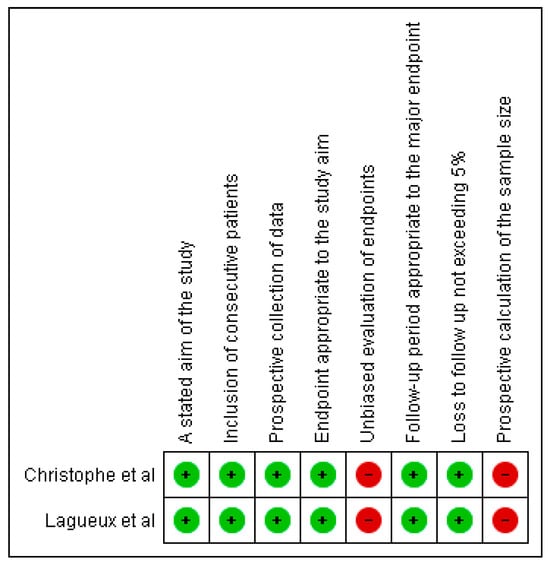
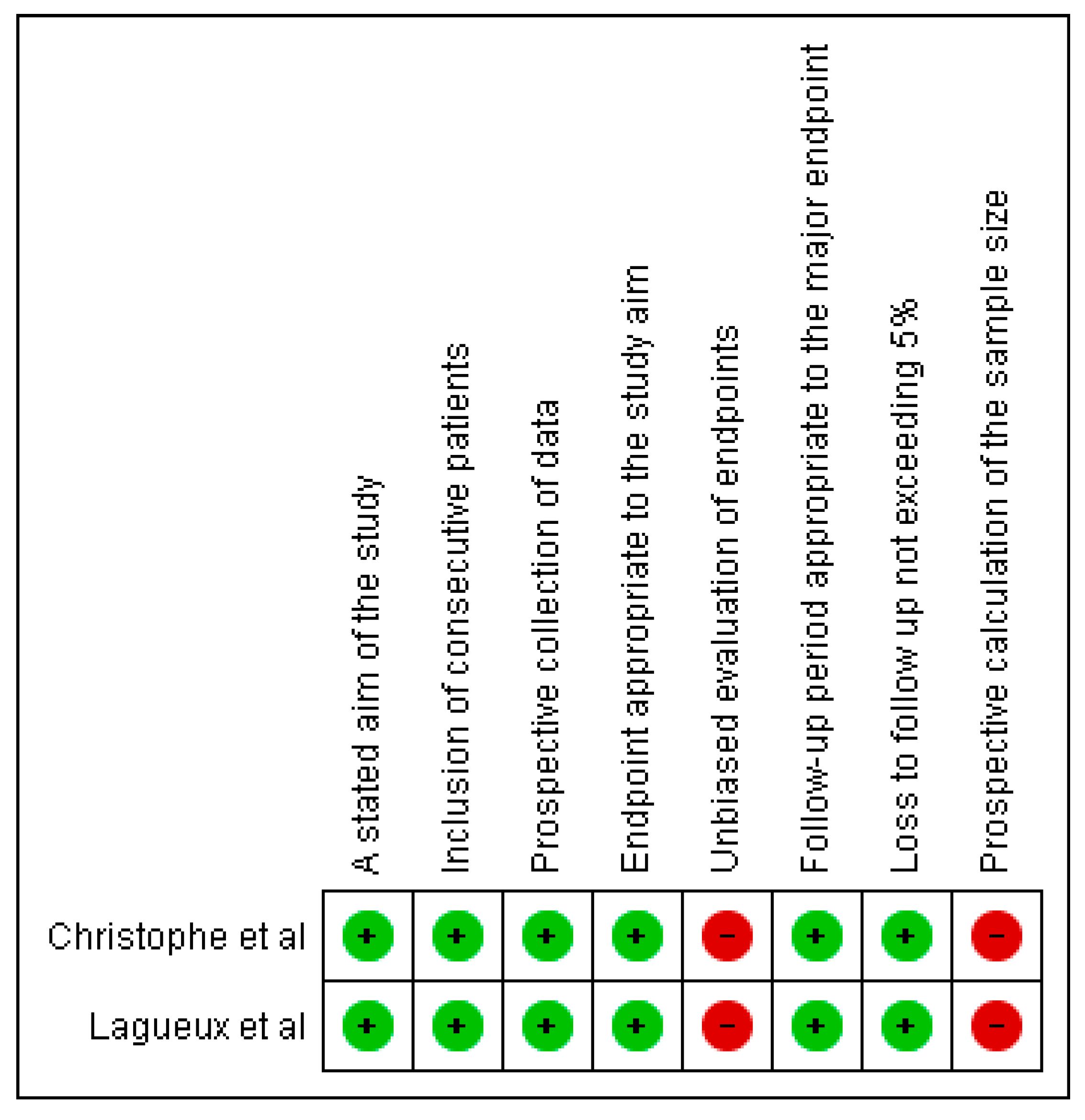
For observational and non-randomized studies, methodological quality and risk of bias were assessed independently and blindly using the MINORS (Methodological Index for Non-Randomized Studies) scale. This tool evaluates elements such as a clearly stated objective, inclusion of consecutive patients, prospective data collection, appropriate analysis, reporting of data loss, and baseline equivalence between groups. A minimum score of 11 on the MINORS scale [25] was required for study inclusion.
2.6. Data Analysis and Results Synthesis
Quantitative data were extracted for descriptive analysis. Due to the high heterogeneity in interventions (e.g., Mirror Therapy, GMI, Prism Adaptation) and outcomes, the results are synthesized narratively and grouped by type of intervention to aid interpretation. A meta-analysis was not conducted due to substantial clinical and methodological heterogeneity, as well as variability in the assessment methods, which prevented a reliable and objective synthesis of the results.
3. Results
3.1. Selection of Studies
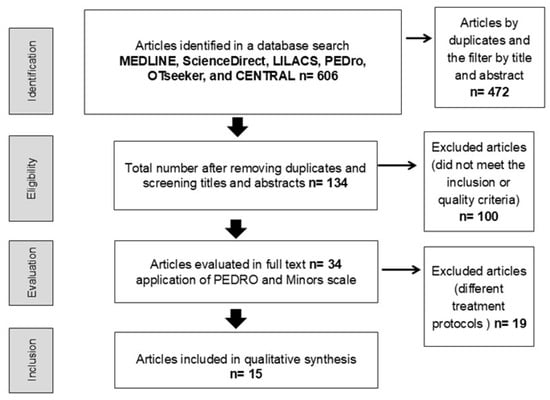
The initial search identified a total of 606 studies. After removing duplicates, 317 studies were screened, and 34 were selected for full-text review. Nineteen studies were excluded because they involved treatment protocols unrelated to the intervention or outcome of interest (see Appendix B for a complete list of excluded studies and reasons). The remaining 15 studies were included in this review: Moseley et al., 2004 [26], Moseley et al., 2006 [27], Cacchio et al., 2009 [28], Lagueux et al., 2012 [29], Pervane et al., 2015 [30], Barnhoorn et al., 2015 [31], Topcuoglu et al., 2015 [32], Barnhoorn et al., 2015 [33], Christophe et al., 2016 [34], Hollander et al., 2016 [35], Schmid et al., 2017 [36], and Halicka et al., 2021 [19], Machač et al., 2024 [37], Lewis et al., 2021 [38], Saha et al., 2021 [39] (see Figure 1).
Figure 1.
PRISMA 2020 flow diagram illustrating the study selection process, adapted from the official PRISMA template (www.prisma-statement.org accessed on 10 March 2025).
3.2. Characteristics of Excluded Studies
Excluded articles were not related to the intervention or outcome of interest. Additionally, letters to the editor, systematic reviews/narratives, pharmacologic intervention protocols, animal studies, and studies with pediatric populations were excluded.
3.3. Characteristics of the Included Studies
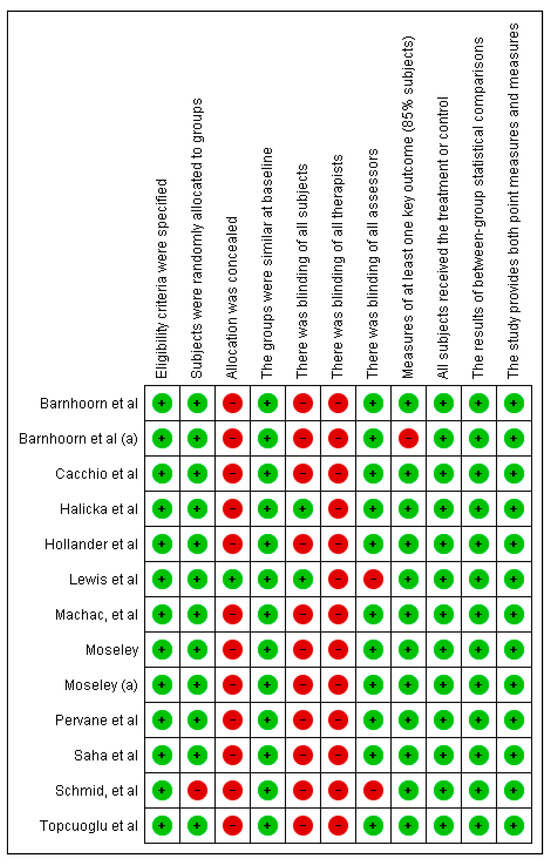
The 15 studies included in this review were published between 2004 and 2024. All studies included participants of both sexes, with sample sizes ranging from seven participants [29,34] to 56 participants [31]. Four studies evaluated interventions in stroke patients [28,30,32,39]. One study [26] focused on adults with wrist fractures, while the remaining studies did not specify the type of injury or the underlying causes associated with the occurrence of CRPS (Figure 2 and Figure 3).
Figure 2.
Methodological quality assessment of randomized controlled trials using the PEDro scale. Green circles (+) indicate that the criterion was fulfilled, while red circles (−) indicate that it was not fulfilled. References: Moseley et al., 2004 [26]; Moseley et al., 2006 [27]; Cacchio et al., 2009 [28]; Pervane et al., 2015 [30]; Barnhoorn et al., 2015 [31]; Topcuoglu et al., 2015 [32]; Barnhoorn et al., 2015 [33]; Hollander et al., 2016 [35]; Schmid et al., 2017 [36]; Halicka et al., 2021 [19]; Machač et al., 2024 [37]; Lewis et al., 2021 [38]; Saha et al., 2021 [39].
Figure 3.
Methodological quality assessment of non-randomized studies using the MINORS tool. Green circles (+) indicate that the criterion was fulfilled, while red circles (−) indicate that it was not fulfilled. References: Christophe et al., 2016 [34]; Lagueux et al., 2012 [29].
Regarding the condition evaluated, three studies included patients with CRPS affecting both upper and lower extremities [31,33,35]. Eleven studies exclusively involved patients with upper extremity CRPS, while only one study [34] included patients with both CRPS types (type I and II). Geographically, most studies were conducted in Europe (12/15), with the remaining studies conducted in North America (1/15), Australia (1/15), and India (1/15) (Table 1).
Table 1.
General characteristics of the included studies.
Quality and risk of bias assessment (PEDro and MINORS).
3.4. Studies Included and Type of Intervention
Thirteen of the 15 selected studies were randomized controlled trials (RCTs). Nine of these reported follow-up data after the intervention [19,26,27,28,33,35,38,39]. The remaining two studies were a pilot study [36], an intervention study [34], and a pretest–posttest study [29], all with no comparison group. The interventions evaluated in these studies included aerobic exercise [32]; motor imagery [26,27,29]; prism adaptation [19,34,35]; pain exposure therapy [33,35]; sensorimotor training [36]; and mirror therapy [28,30,37,39]. Only one study [38] involved visual manipulation using virtual reality (Table 2).
Table 2.
Outcome measures in pain, physical function and activities of daily living of the included studies.
To enhance interpretability, interventions were categorized into subgroups: (1) Mirror Therapy, (2) Graded Motor Imagery, (3) Prism Adaptation, (4) Pain Exposure Therapy, (5) Sensorimotor Training, and (6) Aerobic Exercise. This structure allows comparison of effects within and across modalities (Table 3, Table 4 and Table 5).
Table 3.
Pain reduction in CRPS by intervention.
Table 4.
Physical function.
Table 5.
Activities of daily living.
Certainty analysis: The GRADE analysis showed that mirror therapy (MT) and pain exposure physical therapy (PEPT) reached a moderate level of certainty across pain, physical function, and activities of daily living outcomes. MT, supported by four RCTs, demonstrated consistent improvements in pain reduction, functional performance, and daily activity measures. PEPT, evaluated in three RCTs, also showed beneficial effects on range of motion and disability, with some variability in strength outcomes. In contrast, graded motor imagery (GMI), prism adaptation, virtual reality, aerobic exercise, and sensorimotor training were supported by single or small pilot studies, with methodological limitations and imprecision, leading to low or very low certainty ratings.
3.5. Effects of Physical Exercise on Pain, Physical Function, and Functional Outcomes
Only one included study specifically evaluated the effects of physical exercise in patients with CRPS [32]. This study implemented a four-week aerobic exercise program combined with conventional therapy, conducted five times per week in 30 min sessions. The intervention group showed significant post-treatment reductions in pain, hyperalgesia, and tenderness in the wrist and metacarpophalangeal joints, along with decreased movement-related pain throughout the day compared to the control group. Although no significant differences were observed in physical function as measured by the Brunnstrom stages of the upper limb and hand, the intervention group demonstrated significantly higher scores on the Functional Independence Measure (FIM), including both motor and cognitive domains (Table 2).
3.6. Effects of Neurocognitive Interventions Informed by CBT Principles on Pain
All 15 included studies assessed pain levels pre- and post-intervention using various validated scales. The most frequently used was the Visual Analogue Scale (VAS) (n = 10), followed by the Neuropathic Pain Scale (n = 4) and the Pain Inventory Index (n = 1). Overall, most studies reported significant reductions in pain following the intervention, with statistically significant differences compared to control groups in all but two studies [19,33].
One study observed a reduction in pain in patients with CRPS affecting both upper and lower limbs after pain exposure physical therapy; however, intention-to-treat analysis revealed no significant differences between groups [31]. In contrast, ref. [35] reported a statistically significant reduction in pain intensity immediately post-intervention and at 6-month follow-up in a cohort receiving pain exposure therapy compared to conventional care. Sensorimotor training also yielded positive results. One study [36] implemented a two-week protocol involving a Braille-like haptic task in various training modes and found that pain reduction correlated with the total training duration.
Three studies evaluated graded motor imagery in patients with upper limb CRPS. Refs. [26,27] found a significant reduction in pain compared to conventional therapy, with the most notable improvement occurring during the mirror movement phase. These effects persisted from 6 weeks to 6 months post-treatment. Similarly, ref. [29], despite lacking a control group, reported significant pain reductions, especially during the later phases of therapy involving mirror movements of the unaffected limb.
Mirror therapy interventions demonstrated consistent benefits. Ref. [37] found a significant pain reduction (p < 0.001) in CRPS type I patients, sustained up to one-month post-intervention. Refs. [28,30] also demonstrated that the combination of mirror therapy with conventional therapy produced significant pain improvement in patients with upper limb CRPS, with a treatment duration of four weeks. Both studies reported significant pain reductions and observed lasting pain reduction for up to six months. Ref. [39] showed that mirror therapy led to a significant pain reduction from 6.07 ± 1.58 to 3.93 ± 1.39 (p < 0.05) on the Numerical Pain Rating Scale (NPRS), with more pronounced effects than in the control group.
Regarding visual-perceptual interventions, ref. [19] found no significant pain reduction using prism adaptation therapy. In contrast, ref. [34] reported a 36% decrease in baseline pain following the same intervention. Ref. [38] demonstrated a significant pain reduction using virtual reality visual illusions (p = 0.037), while the control group showed no change (p > 0.05), suggesting that visual-based interventions may offer innovative pain management strategies for CRPS (Table 2).
3.7. Effects of Neurocognitive Interventions Informed by CBT Principles on Physical Function
Studies evaluated the impact of cognitive–behavioral interventions on physical function. Refs. [28,30] reported significant improvements in motor function in post-stroke CRPS patients following mirror therapy. Functional gains were measured using the Fugl–Meyer Assessment in the former and the Wolf Motor Function Test in the latter. Ref. [31] found a significant increase in active range of motion following pain exposure therapy compared to controls. Although muscle strength improved progressively in the intervention group, the between-group difference was not statistically significant. Ref. [29] reported improved grip strength in the affected limb during the acute phase of graded motor imagery therapy (Table 2).
3.8. Effects of Neurocognitive Interventions Informed by CBT Principles on Functional Outcomes or Disability Related to Daily Activities
Eight studies reported outcomes related to functional outcomes or disability associated with daily activities [28,29,30,31,33,34,35,39]. Mirror therapy appeared particularly beneficial. Refs. [30,39] found significant improvements in FIM motor scores following mirror therapy in patients with upper limb CRPS. Similarly, ref. [28] observed significant improvement in the Motor Activity Log (MAL) score. In all cases, mirror therapy contributed to enhanced functional independence.
Three studies examined pain exposure therapy in relation to disability associated with daily activities. Ref. [31] found no significant differences in EQ-5D index scores between groups, while another study by the same authors [33] reported a significant reduction in disability on the Pain Disability Index. Ref. [35] observed reductions in upper and lower extremity disability at six-month follow-up, measured via the Radboud Ability Questionnaire and the Ability to Walk Questionnaire, respectively. Results for other interventions were mixed. Ref. [29] reported no significant change in perceived upper limb function on the Disabilities of the Arm, Shoulder, and Hand (DASH) questionnaire. In contrast, ref. [34] reported a 10-point improvement on the Sickness Impact Profile (SIP) following prism adaptation therapy, suggesting potential for functional gains in daily living activities.
4. Discussion
This systematic review indicates that CBT-informed neurocognitive interventions—especially mirror therapy and graded motor imagery (GMI)—and, to a lesser extent, aerobic exercise, may reduce pain and improve physical function and daily activities in patients with CRPS when added to conventional care. Mirror therapy showed the most consistent benefits in upper-limb CRPS [28,30]. Evidence for aerobic exercise is preliminary and requires further study.
GMI may reduce pain when integrated with standard care; however, effects on physical function and daily activities remain uncertain, with only one study assessing these outcomes [28].
Findings for prism adaptation and pain exposure therapy were mixed. Some trials reported pain reductions, whereas others found no clear differences versus controls [19,31,33,34]. Two studies of pain exposure therapy reported improvements in disability [31,33], suggesting functional benefits. Prior literature aligns with these results. Smart et al. (2022) reviewed electrotherapy, cortically directed rehabilitation, electroacupuncture, and exposure-based therapies, noting that most studies were small and at high risk of bias; no intervention—including multimodal physical therapy—showed clear superiority for pain or disability [13].
Harden et al. (2022) likewise reported predominantly low-to-moderate methodological quality, largely due to small samples inherent to the rarity of CRPS, but highlighted positive effects of strengthening, body-awareness training, sensorimotor re-education, massage, and myofascial release [40]. In our review, mirror therapy emerged as the most consistently beneficial neurocognitive approach for upper-limb CRPS, whereas evidence for aerobic exercise—although compatible with previous reports—remains preliminary [41,42].
Evidence from Méndez et al. (2021) supports pain reductions following mirror therapy and motor imagery [43]. Schubert et al. (2021) found GMI particularly effective in acute CRPS, with associated improvements in cortical representation [44]. These findings support integrating CBT-informed neurocognitive rehabilitation into CRPS management.
CRPS requires multidisciplinary care due to its complex and persistent symptomatology. Reviews by Johnson et al. (2022) and Kraft et al. (2021) show that pain and motor dysfunction frequently persist long-term; 51–89% of patients continue to experience symptoms beyond 12 months, contributing to substantial disability [45,46].
The certainty of evidence (GRADE) ranged from very low to moderate, depending on intervention and outcome. Mirror therapy achieved moderate certainty for pain and functional improvement, limited by small samples and potential publication bias. Certainty for GMI was very low due to risk of bias, heterogeneity, and imprecision from small samples. Prism adaptation and virtual reality showed promising but low-certainty effects. Aerobic exercise and sensorimotor training were supported by very-low-certainty evidence. Overall, effects trend favorably toward neurocognitive interventions and exercise, but higher-quality studies are needed to strengthen confidence.
4.1. Strengths and Limitations
This review synthesizes evidence on physical exercise and CBT-informed neurocognitive interventions—mirror therapy and GMI—delivered by physical therapists for individuals with CRPS. These approaches, when added to conventional therapy, show potential for clinical implementation; however, more high-quality trials are required to confirm effectiveness.
Limitations include the small number of CRPS-specific studies, methodological heterogeneity in populations and protocols, and high risk of bias related to randomization, allocation concealment, and blinding. Outcome measures varied widely (e.g., VAS, NRS, DASH, WMFT, EQ-5D), preventing meaningful pooling. Intervention protocols differed in duration, frequency, content, and co-interventions, further limiting meta-analysis and risking misleading estimates. We therefore used a narrative synthesis with GRADE tables to appraise the evidence. These factors reduce confidence in current estimates and underscore the need for rigorous trials with standardized outcomes and clearer reporting.
Most studies did not report sufficient data (means, standard deviations, or adjusted estimates) to calculate standardized effect sizes with 95% confidence intervals. As a result, outcomes were often limited to p-values or mean changes, hampering cross-study comparisons. Future trials should consistently report standardized effect sizes and confidence intervals to improve comparability and clinical interpretation.
Formal subgroup or moderator analyses were not feasible due to few studies per category and inconsistent reporting of intervention duration, provider characteristics, and patient subgroups (e.g., post-stroke vs. post-fracture). Although mirror therapy appeared more consistent in upper-limb CRPS and GMI was mainly applied in post-stroke populations, the evidence is insufficient to draw firm conclusions. Standardized reporting is needed to enable stratified analyses and provide clearer clinical guidance.
Training is another gap. Few studies described how therapists were prepared to deliver GMI, mirror therapy, or pain exposure therapy. Future research should standardize training protocols and evaluate how therapist competence influences outcomes.
Finally, interdisciplinary collaboration is essential. Combining physiotherapy with explicit psychoeducation and mental-health support may enhance adherence and address the biopsychosocial complexity of CRPS.
4.2. Research Priorities
Future work should address methodological gaps through adequately powered, multicenter randomized controlled trials with long-term follow-up. Direct head-to-head comparisons among neurocognitive interventions (e.g., mirror therapy, GMI, prism adaptation, exposure therapy) and versus conventional physiotherapy are needed to determine relative efficacy. Factorial designs combining modalities (e.g., aerobic exercise plus mirror therapy) should explore potential synergy. Trials should incorporate mechanistic outcomes—quantitative sensory testing, neuroimaging, and psychological assessments (e.g., fear-avoidance, catastrophizing)—to link clinical change with underlying processes. Protocols should be standardized (at least ~12 weeks, two sessions per week) to improve comparability and inform guidelines.
4.3. Public Health Significance
CRPS imposes a substantial burden on patients and health systems. Non-pharmacological guidelines increasingly recognize the role of physical exercise as a modulatory intervention for this population. Future studies should adopt standardized outcomes: pain (Visual Analogue Scale), motor function (Fugl–Meyer Assessment or Wolf Motor Function Test), strength (dynamometry), and activities of daily living (DASH, Functional Independence Measure). Protocols should last ≥12 weeks with at least two sessions per week, and include well-defined control groups to support robust, generalizable recommendations.
5. Conclusions
Physical exercise and CBT-informed neurocognitive interventions show potential benefits for pain, physical function, and daily activities in CRPS. The evidence base remains limited, heterogeneous, and methodologically variable, highlighting the need for high-quality, multidisciplinary trials.
Supplementary Materials
The following supporting information can be downloaded at: https://www.mdpi.com/article/10.3390/jcm14196820/s1, PRISMA 2020 Checklist. Ref. [23] is cited in the Supplementary Materials.
Author Contributions
L.T.O.-M.: Conceptualization; formal analysis; investigation; resources; validation; visualization; writing—review and editing. M.F.S.-O.: Conceptualization; formal analysis; investigation; resources; validation; visualization; writing—review and editing. M.A.M.-O.: Conceptualization; formal analysis; investigation; resources; validation; visualization; writing—review and editing. J.F.G.-G.: Investigation; resources; validation; visualization; writing—review and editing. G.P.R.-T.: Investigation; resources; validation; visualization; writing—review and editing. D.S.Q.-L.: Conceptualization; formal analysis; investigation; resources; validation; visualization; writing—review and editing. All authors have read and agreed to the published version of the manuscript.
Funding
This research has been funded by the General Directorate of Investigations of Universidad Santiago de Cali under call No. DGI 01-2025.
Institutional Review Board Statement
Not applicable.
Informed Consent Statement
Not applicable.
Data Availability Statement
Data exchange not applicable—no new data generated.
Conflicts of Interest
Author G.P.R.-T. was employed by Clínica de Occidente; however, this does not imply any commercial or financial relationships. The remaining authors declare that the research was conducted in the absence of any commercial or financial relationships that could be construed as a potential conflict of interest.
Appendix A
Table A1.
Combination of search terms.
Appendix B
Table A2.
Excluded studies.
References
- Shim, H.; Rose, J.; Halle, S.; Shekane, P. Complex regional pain syndrome: A narrative review for the practising clinician. Br. J. Anaesth. 2019, 123, e424–e433. [Google Scholar] [CrossRef] [Scilit]
- de Mos, M.; de Bruijn, A.G.J.; Huygen, F.J.P.M.; Dieleman, J.P.; Stricker, C.h.B.H.; Sturkenboom, M.C.J.M. The incidence of complex regional pain syndrome: A population-based study. Pain 2007, 129, 12–20. [Google Scholar] [CrossRef] [Scilit]
- Sandroni, P.; Benrud-Larson, L.M.; McClelland, R.L.; Low, P.A. Complex regional pain syndrome type I: Incidence and prevalence in Olmsted county, a population-based study. Pain 2003, 103, 199–207. [Google Scholar] [CrossRef] [Scilit]
- Ott, S.; Maihöfner, C. Signs and Symptoms in 1,043 Patients with Complex Regional Pain Syndrome. J. Pain 2018, 19, 599–611. [Google Scholar] [CrossRef] [Scilit] [PubMed]
- Goh, E.L.; Chidambaram, S.; Ma, D. Complex regional pain syndrome: A recent update. Burn. Trauma 2017, 5, 2. [Google Scholar] [CrossRef] [Scilit]
- Rodríguez-López, M.J.; Fernández-Baena, M.; Yáñez-Santos, J.A. Complex regional pain syndrome in children: Treatment possibilities. J. Span. Pain Soc. 2014, 21, 138–145. [Google Scholar] [CrossRef] [Scilit]
- Hernández-Porras, B.C.; Plancarte-Sánchez, R.; Alarcón-Barrios, S.; Sámano-García, M. Complex regional pain syndrome: A review. Cir. Cir. 2017, 85, 366–374. [Google Scholar] [CrossRef] [Scilit] [PubMed]
- Misidou, C.; Papagoras, C. Complex Regional Pain Syndrome: An update. Mediterr. J. Rheumatol. 2019, 30, 16–25. [Google Scholar] [CrossRef] [Scilit]
- Zangrandi, A.; Allen Demers, F.; Schneider, C. Complex Regional Pain Syndrome. A Comprehensive Review on Neuroplastic Changes Supporting the Use of Non-invasive Neurostimulation in Clinical Settings. Front. Pain Res. 2021, 2, 732343. [Google Scholar] [CrossRef] [Scilit]
- Forouzanfar, T.; Köke, A.J.A.; van Kleef, M.; Weber, W.E.J. Treatment of complex regional pain syndrome type I. Eur. J. Pain 2002, 6, 105–122. [Google Scholar] [CrossRef] [Scilit]
- Smith, T.O. How effective is physiotherapy in the treatment of complex regional pain syndrome type I? A review of the literature. Musculoskelet. Care 2005, 3, 181–200. [Google Scholar] [CrossRef] [Scilit]
- Lee, B.H.; Scharff, L.; Sethna, N.F.; McCarthy, C.F.; Scott-Sutherland, J.; Shea, A.M.; Sullivan, P.; Meier, P.; Zurakowski, D.; Masek, B.J.; et al. Physical therapy and cognitive-behavioral treatment for complex regional pain syndromes. J. Pediatr. 2002, 141, 135–140. [Google Scholar] [CrossRef] [Scilit]
- Smart, K.M.; Wand, B.M.; O’Connell, N.E. Physiotherapy for pain and disability in adults with complex regional pain syndrome (CRPS) types I and II. Cochrane Database Syst. Rev. 2016, 2016, CD010853. [Google Scholar] [CrossRef] [Scilit] [PubMed]
- Fenn, K.; Byrne, M. The key principles of cognitive behavioural therapy. InnovAiT Educ. Inspir. Gen. Pract. 2013, 6, 579–585. [Google Scholar] [CrossRef] [Scilit]
- Al Sayegh SAl Filén, T.; Johansson, M.; Sandström, S.; Stiewe, G.; Butler, S. Mirror therapy for Complex Regional Pain Syndrome (CRPS)-A literature review and an illustrative case report. Scand. J. Pain 2013, 4, 200–207. [Google Scholar] [CrossRef] [Scilit]
- Donati, D.; Boccolari, P.; Giorgi, F.; Berti, L.; Platano, D.; Tedeschi, R. Breaking the Cycle of Pain: The Role of Graded Motor Imagery and Mirror Therapy in Complex Regional Pain Syndrome. Biomedicines 2024, 12, 2140. [Google Scholar] [CrossRef] [Scilit]
- Barnhoorn, K.J.; Oostendorp, R.A.B.; van Dongen, R.T.M.; Klomp, F.P.; Samwel, H.; van der Wilt, G.J.; Adang, E.; Groenewoud, H.; van de Meent, H.; Frölke, J.P.M. The effectiveness and cost evaluation of pain exposure physical therapy and conventional therapy in patients with complex regional pain syndrome type 1. Rationale and design of a randomized controlled trial. BMC Musculoskelet Disord. 2012, 13, 58. [Google Scholar] [CrossRef] [Scilit] [PubMed]
- Halicka, M.; Vittersø, A.D.; Proulx, M.J.; Bultitude, J.H. Pain reduction by inducing sensory-motor adaptation in Complex Regional Pain Syndrome (CRPS PRISMA): Protocol for a double-blind randomized controlled trial. BMC Neurol. 2020, 20, 62. [Google Scholar] [CrossRef] [Scilit]
- Halicka, M.; Vittersø, A.D.; McCullough, H.; Goebel, A.; Heelas, L.; Proulx, M.J.; Bultitude, J.H. Prism adaptation treatment for upper-limb complex regional pain syndrome: A double-blind randomized controlled trial. Pain 2021, 162, 471–489. [Google Scholar] [CrossRef] [Scilit]
- Donegan, T.; Ryan, B.E.; Sanchez-Vives, M.V.; Świdrak, J. Altered bodily perceptions in chronic neuropathic pain conditions and implications for treatment using immersive virtual reality. Front. Hum. Neurosci. 2022, 16, 1024910. [Google Scholar] [CrossRef] [Scilit]
- den Hollander, M.; Heijnders, N.; de Jong, J.R.; Vlaeyen, J.W.S.; Smeets, R.J.E.M.; Goossens, M.E.J.B. In Vivo Exposure Versus Pain-Contingent Physical Therapy in Complex Regional Pain Syndrome Type I: A Cost-Effectiveness Analysis. Int. J. Technol. Assess. Health Care 2018, 34, 400–409. [Google Scholar] [CrossRef] [Scilit]
- Li, T.S.; Wang, R.; Su, X.; Wang, X.Q. Effect and mechanisms of exercise for complex regional pain syndrome. Front. Mol. Neurosci. 2023, 16, 1167166. [Google Scholar] [CrossRef] [Scilit]
- Page, M.J.; McKenzie, J.E.; Bossuyt, P.M.; Boutron, I.; Hoffmann, T.C.; Mulrow, C.D.; Shamseer, L.; Tetzlaff, J.M.; Akl, E.A.; Brennan, S.E.; et al. The PRISMA 2020 statement: An updated guideline for reporting systematic reviews. BMJ 2021, 372, n71. [Google Scholar] [CrossRef] [Scilit]
- Maher, C.G.; Sherrington, C.; Herbert, R.D.; Moseley, A.M.; Elkins, M. Reliability of the PEDro scale for rating quality of randomized controlled trials. Phys. Ther. 2003, 83, 713–721. [Google Scholar] [CrossRef] [Scilit] [PubMed]
- Slim, K.; Nini, E.; Forestier, D.; Kwiatkowski, F.; Panis, Y.; Chipponi, J. Methodological index for non-randomized studies (minors): Development and validation of a new instrument. ANZ J. Surg. 2003, 73, 712–716. [Google Scholar] [CrossRef] [Scilit] [PubMed]
- Moseley, L.G. Graded motor imagery is effective for long-standing complex regional pain syndrome: A randomised controlled trial. Pain 2004, 108, 192–198. [Google Scholar] [CrossRef] [Scilit] [PubMed]
- Moseley, G.L. Graded motor imagery for pathologic pain. Neurology 2006, 67, 2129–2134. [Google Scholar] [CrossRef] [Scilit] [PubMed]
- Cacchio, A.; De Blasis, E.; De Blasis, V.; Santilli, V.; Spacca, G. Mirror Therapy in Complex Regional Pain Syndrome Type 1 of the Upper Limb in Stroke Patients. Neurorehabil. Neural Repair 2009, 23, 792–799. [Google Scholar] [CrossRef] [Scilit]
- Lagueux, E.; Charest, J.; Lefrançois-Caron, E.; Mauger, M.E.; Mercier, E.; Savard, K.; Tousignant-Laflamme, Y. Modified graded motor imagery for complex regional pain syndrome type 1 of the upper extremity in the acute phase. Int. J. Rehabil. Res. 2012, 35, 138–145. [Google Scholar] [CrossRef] [Scilit]
- Pervane Vural, S.; Nakipoglu Yuzer, G.F.; Sezgin Ozcan, D.; Demir Ozbudak, S.; Ozgirgin, N. Effects of Mirror Therapy in Stroke Patients with Complex Regional Pain Syndrome Type 1: A Randomized Controlled Study. Arch. Phys. Med. Rehabil. 2016, 97, 575–581. [Google Scholar] [CrossRef] [Scilit]
- Barnhoorn, K.J.; Staal, J.B.; van Dongen, R.T.; Frölke, J.P.; Klomp, F.P.; van de Meent, H.; Samwel, H.; Nijhuis-van der Sanden, M.W. Are Pain-Related Fears Mediators for Reducing Disability and Pain in Patients with Complex Regional Pain Syndrome Type 1? An Explorative Analysis on Pain Exposure Physical Therapy. PLoS ONE 2015, 10, e0123008. [Google Scholar] [CrossRef] [Scilit]
- Topcuoglu, A.; Gokkaya, N.K.O.; Ucan, H.; Karakuş, D. The effect of upper-extremity aerobic exercise on complex regional pain syndrome type I: A randomized controlled study on subacute stroke. Top. Stroke Rehabil. 2015, 22, 253–261. [Google Scholar] [CrossRef] [Scilit]
- Barnhoorn, K.J.; van de Meent, H.; van Dongen, R.T.M.; Klomp, F.P.; Groenewoud, H.; Samwel, H.; der Sanden, M.W.G.N.-V.; Frölke, J.P.M.; Staal, J.B. Pain exposure physical therapy (PEPT) compared to conventional treatment in complex regional pain syndrome type 1: A randomised controlled trial. BMJ Open 2015, 5, e008283. [Google Scholar] [CrossRef] [Scilit]
- Christophe, L.; Chabanat, E.; Delporte, L.; Revol, P.; Volckmann, P.; Jacquin-Courtois, S.; Rossetti, Y. Prisms to Shift Pain Away: Pathophysiological and Therapeutic Exploration of CRPS with Prism Adaptation. Neural. Plast. 2016, 2016, 1694256. [Google Scholar] [CrossRef] [Scilit]
- den Hollander, M.; Goossens, M.; de Jong, J.; Ruijgrok, J.; Oosterhof, J.; Onghena, P.; Smeets, R.; Vlaeyen, J.W.S. Expose or protect? A randomized controlled trial of exposure in vivo vs pain-contingent treatment as usual in patients with complex regional pain syndrome type 1. Pain 2016, 157, 2318–2329. [Google Scholar] [CrossRef] [Scilit]
- Schmid, A.C.; Schwarz, A.; Gustin, S.M.; Greenspan, J.D.; Hummel, F.C.; Birbaumer, N. Pain reduction due to novel sensory-motor training in Complex Regional Pain Syndrome I—A pilot study. Scand. J. Pain 2017, 15, 30–37. [Google Scholar] [CrossRef] [Scilit] [PubMed]
- Machač, S.; Chasáková, L.; Kakawand, S.; Kozák, J.; Štěpánek, L.; Vejvalka, J.; Kolář, P.; Černý, R. Mirror visual feedback as therapeutic modality in unilateral upper extremity complex regional pain syndrome type I: Randomized controlled trial. Eur. J. Phys. Rehabil. Med. 2024, 60, 280–291. [Google Scholar] [CrossRef] [Scilit]
- Lewis, J.S.; Newport, R.; Taylor, G.; Smith, M.; McCabe, C.S. Visual illusions modulate body perception disturbance and pain in Complex Regional Pain Syndrome: A randomized trial. Eur. J. Pain 2021, 25, 1551–1563. [Google Scholar] [CrossRef] [Scilit]
- Saha, S.; Sur, M.; Ray Chaudhuri, G.; Agarwal, S. Effects of mirror therapy on oedema, pain and functional activities in patients with poststroke shoulder-hand syndrome: A randomized controlled trial. Physiother. Res. Int. 2021, 26, e1902. [Google Scholar] [CrossRef] [Scilit] [PubMed]
- Harden, R.N.; McCabe, C.S.; Goebel, A.; Massey, M.; Suvar, T.; Grieve, S.; Bruehl, S. Complex Regional Pain Syndrome: Practical Diagnostic and Treatment Guidelines, 5th Edition. Pain Med. 2022, 23 (Suppl. S1), S1–S53. [Google Scholar] [CrossRef] [Scilit] [PubMed]
- Duong, S.; Bravo, D.; Todd, K.J.; Finlayson, R.J.; Tran, D.Q. Treatment of complex regional pain syndrome: An updated systematic review and narrative synthesis. Can. J. Anesth./J. Can. D’anesthésie 2018, 65, 658–684. [Google Scholar] [CrossRef] [Scilit] [PubMed]
- Garcia-Correa, H.R.; Sanchez-Montoya, L.J.; Daza-Arana, J.E.; Ordoñez-Mora, L.T. Aerobic Physical Exercise for Pain Intensity, Aerobic Capacity, and Quality of Life in Patients with Chronic Pain: A Systematic Review and Meta-Analysis. J. Phys. Act. Health 2021, 18, 1126–1142. [Google Scholar] [CrossRef] [Scilit]
- Méndez-Rebolledo, G.; Gatica-Rojas, V.; Torres-Cueco, R.; Albornoz-Verdugo, M.; Guzmán-Muñoz, E. Update on the effects of graded motor imagery and mirror therapy on complex regional pain syndrome type 1: A systematic review. J. Back Musculoskelet. Rehabil. 2017, 30, 441–449. [Google Scholar] [CrossRef] [Scilit]
- Schubert, C. Therapie des komplexen regionalen Schmerzsyndroms im Handbereich aus Sicht der Physiotherapie. Unfallchirurg 2021, 124, 456–464. [Google Scholar] [CrossRef] [Scilit]
- Johnson, S.; Cowell, F.; Gillespie, S.; Goebel, A. Complex regional pain syndrome what is the outcome?—A systematic review of the course and impact of CRPS at 12 months from symptom onset and beyond. Eur. J. Pain 2022, 26, 1203–1220. [Google Scholar] [CrossRef] [Scilit]
- Kraft, E.; Storz, C.; Ranker, A. Physikalische Therapie in der Behandlung des komplexen regionalen Schmerzsyndroms. Der Schmerz 2021, 35, 363–372. [Google Scholar] [CrossRef] [Scilit]
- van de Vusse, A.C.; Stomp-van den Berg, S.G.; Kessels, A.H.; Weber, W.E. Randomised controlled trial of gabapentin in Complex Regional Pain Syndrome type 1 [ISRCTN84121379]. BMC Neurol. 2004, 4, 13. [Google Scholar] [CrossRef] [Scilit]
- Wang, A.T.; Wang, E.J.; Smith, T.J.; Razzak, R.; Christo, P.J. Scrambler Therapy for Patients with Complex Regional Pain Syndrome: A Case Series. J. Palliat. Med. 2023, 26, 1302–1306. [Google Scholar] [CrossRef] [Scilit] [PubMed]
- Sigtermans, M.J.; van Hilten, J.J.; Bauer, M.C.R.; Arbous, S.M.; Marinus, J.; Sarton, E.Y.; Dahan, A. Ketamine produces effective and long-term pain relief in patients with Complex Regional Pain Syndrome Type 1. Pain 2009, 145, 304–311. [Google Scholar] [CrossRef] [Scilit] [PubMed]
- Goebel, A.; Baranowski, A.; Maurer, K.; Ghiai, A.; McCabe, C.; Ambler, G. Intravenous Immunoglobulin Treatment of the Complex Regional Pain Syndrome. Ann. Intern. Med. 2010, 152, 152–158. [Google Scholar] [CrossRef] [Scilit]
- Chevreau, M.; Romand, X.; Gaudin, P.; Juvin, R.; Baillet, A. Bisphosphonates for treatment of Complex Regional Pain Syndrome type 1: A systematic literature review and meta-analysis of randomized controlled trials versus placebo. Jt. Bone Spine 2017, 84, 393–399. [Google Scholar] [CrossRef] [Scilit]
- Bernardy, K.; Wicking, M.; Michelka, R.; Schwarzer, A. Kognitive Verhaltenstherapie beim komplexen regionalen Schmerzsyndrom. Der Schmerz 2025, 39, 67–77. [Google Scholar] [CrossRef] [Scilit]
- Sherry, D.D.; Wallace, C.A.; Kelley, C.; Kidder, M.; Sapp, L. Short- and Long-term Outcomes of Children with Complex Regional Pain Syndrome Type I Treated with Exercise Therapy. Clin. J. Pain 1999, 15, 218–223. [Google Scholar] [CrossRef] [Scilit]
- Weissmann, R.; Uziel, Y. Pediatric complex regional pain syndrome: A review. Pediatr. Rheumatol. 2016, 14, 29. [Google Scholar] [CrossRef] [Scilit]
- Sobeeh, M.G.; Hassan, K.A.; da Silva, A.G.; Youssef, E.F.; Fayaz, N.A.; Mohammed, M.M. Pain mechanisms in complex regional pain syndrome: A systematic review and meta-analysis of quantitative sensory testing outcomes. J. Orthop. Surg. Res. 2023, 18, 2. [Google Scholar] [CrossRef] [Scilit] [PubMed]
- Storz, C.; Kraft, E. Ergotherapie bei komplexem regionalem Schmerzsyndrom. Der Schmerz 2021, 35, 285–293. [Google Scholar] [CrossRef] [Scilit] [PubMed]
- Moretti, A.; Palomba, A.; Paoletta, M.; Liguori, S.; Toro, G.; Iolascon, G. Complex Regional Pain Syndrome in Athletes: Scoping Review. Medicina 2021, 57, 1262. [Google Scholar] [CrossRef] [Scilit]
- Kavka, T. Harmful or safe? Exposure and pain provocation during physiotherapy of complex regional pain syndrome I: A narrative review. J. Back Musculoskelet. Rehabil. 2023, 36, 565–576. [Google Scholar] [CrossRef] [Scilit]
- Altas, E.U.; Onat, Ş.Ş.; Konak, H.E.; Polat, C.S. Post-stroke complex regional pain syndrome and related factors: Experiences from a tertiary rehabilitation center. J. Stroke Cerebrovasc. Dis. 2020, 29, 104995. [Google Scholar] [CrossRef] [Scilit] [PubMed]
- Mouraux, D.; Lenoir, C.; Tuna, T.; Brassinne, E.; Sobczak, S. The long-term effect of complex regional pain syndrome type 1 on disability and quality of life after foot injury. Disabil. Rehabil. 2021, 43, 967–975. [Google Scholar] [CrossRef] [Scilit]
- Batalla, M.A.P.; Lewis, J.S. Cognitive Multisensory Rehabilitation, a novel approach for Complex Regional Pain Syndrome: Case series. Physiother. Theory Pract. 2025, 41, 1109–1123. [Google Scholar] [CrossRef] [Scilit] [PubMed]
- Shafiee, E.; MacDermid, J.; Packham, T.; Walton, D.; Grewal, R.; Farzad, M. The Effectiveness of Rehabilitation Interventions on Pain and Disability for Complex Regional Pain Syndrome. Clin. J. Pain 2023, 39, 91–105. [Google Scholar] [CrossRef] [Scilit] [PubMed]
- Oral, A.; Ilieva, E.M.; Küçükdeveci, A.A.; Varela, E.; Valero, R.; Berteanu, M.; Christodoulou, N. Generalised and regional soft tissue pain syndromes. The role of physical and rehabilitation medicine physicians. The European perspective based on the best evidence. A paper by the UEMS-PRM Section Professional Practice Committee. Eur. J. Phys. Rehabil. Med. 2013, 49, 535–549. [Google Scholar] [PubMed]

Disclaimer/Publisher’s Note: The statements, opinions and data contained in all publications are solely those of the individual author(s) and contributor(s) and not of MDPI and/or the editor(s). MDPI and/or the editor(s) disclaim responsibility for any injury to people or property resulting from any ideas, methods, instructions or products referred to in the content. |
© 2025 by the authors. Licensee MDPI, Basel, Switzerland. This article is an open access article distributed under the terms and conditions of the Creative Commons Attribution (CC BY) license (https://creativecommons.org/licenses/by/4.0/).