Article

Haemodynamic Parameters Underlying the Relationship between Sarcopenia and Blood Pressure Recovery on Standing

1
Discipline of Medical Gerontology, School of Medicine, Trinity College Dublin, D02 R590 Dublin, Ireland
2
Falls and Syncope Unit (FASU), Mercer’s Institute for Successful Ageing, St James’s Hospital, D08 KC95 Dublin, Ireland
*
Author to whom correspondence should be addressed.
J. Clin. Med. 2024, 13(1), 18; https://doi.org/10.3390/jcm13010018
Submission received: 9 November 2023 / Revised: 12 December 2023 / Accepted: 15 December 2023 / Published: 19 December 2023
(This article belongs to the Section Cardiovascular Medicine)

Abstract

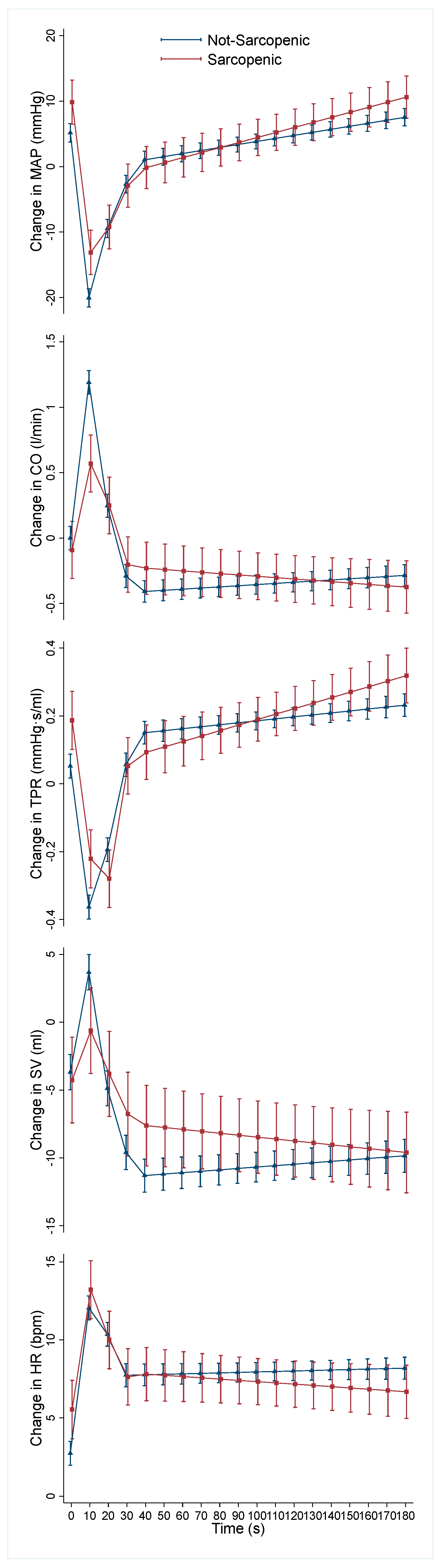
Background: Sarcopenia, delayed blood pressure (BP) recovery following standing, and orthostatic hypotension (OH) pose significant clinical challenges associated with ageing. While prior studies have established a link between sarcopenia and impaired BP recovery and OH, the underlying haemodynamic mechanisms remain unclear. Methods: We enrolled 107 participants aged 50 and above from a falls and syncope clinic, conducting an active stand test with continuous non-invasive haemodynamic measurements. Hand grip strength and five-chair stand time were evaluated, and muscle mass was estimated using bioelectrical impedance analysis. Participants were categorised as non-sarcopenic or sarcopenic. Employing mixed-effects linear regression, we modelled the effect of sarcopenia on mean arterial pressure and heart rate after standing, as well as Modelflow®-derived parameters such as cardiac output, total peripheral resistance, and stroke volume, while adjusting for potential confounders. Results: Sarcopenia was associated with diminished recovery of mean arterial pressure during the 10–20 s period post-standing (β −0.67, p < 0.001). It also resulted in a reduced ascent to peak (0–10 s) and recovery from peak (10–20 s) of cardiac output (β −0.05, p < 0.001; β 0.06, p < 0.001). Furthermore, sarcopenia was associated with attenuated recovery (10–20 s) of total peripheral resistance from nadir (β −0.02, p < 0.001) and diminished recovery from peak (10–20 s) of stroke volume (β 0.54, p < 0.001). Notably, heart rate did not exhibit a significant association with sarcopenia status at any time interval post-standing. Conclusion: The compromised BP recovery observed in sarcopenia appears to be driven by an initial reduction in the peak of cardiac output, followed by attenuated recovery of cardiac output from its peak and total peripheral resistance from its nadir. This cardiac output finding seems to be influenced by stroke volume rather than heart rate. Possible mechanisms for these findings include cardio-sarcopenia, the impact of sarcopenia on the autonomic nervous system, and/or the skeletal muscle pump.
Keywords: sarcopenia; delayed blood pressure recovery; orthostatic hypotension; orthostatic haemodynamics; orthostasis sarcopenia; delayed blood pressure recovery; orthostatic hypotension; orthostatic haemodynamics; orthostasis