


Abstract
Preclinical studies have shown that volatile anesthetics may have beneficial effects on injured lungs, and pilot clinical data support improved arterial oxygenation, attenuated inflammation, and decreased lung epithelial injury in patients with acute respiratory distress syndrome (ARDS) receiving inhaled sevoflurane compared to intravenous midazolam. Whether sevoflurane is effective in improving clinical outcomes among patients with ARDS is unknown, and the benefits and risks of inhaled sedation in ARDS require further evaluation. Here, we describe the SESAR (Sevoflurane for Sedation in ARDS) trial designed to address this question. SESAR is a two-arm, investigator-initiated, multicenter, prospective, randomized, stratified, parallel-group clinical trial with blinded outcome assessment designed to test the efficacy of sedation with sevoflurane compared to intravenous propofol in patients with moderate to severe ARDS. The primary outcome is the number of days alive and off the ventilator at 28 days, considering death as a competing event, and the key secondary outcome is 90 day survival. The planned enrollment is 700 adult participants at 37 French academic and non-academic centers. Safety and long-term outcomes will be evaluated, and biomarker measurements will help better understand mechanisms of action. The trial is funded by the French Ministry of Health, the European Society of Anaesthesiology, and Sedana Medical.
1. Introduction
Volatile anesthetics such as isoflurane or sevoflurane have long been used to provide general anesthesia in the operating room; however, inhaled sedation is emerging as an option to provide intensive care unit (ICU) sedation and a phase III multicenter randomized controlled trial found that isoflurane is non-inferior to propofol in maintaining targeted sedation levels in critically ill adult patients [1,2,3,4,5]. Preclinical studies have shown that inhaled sevoflurane improves gas exchange [6,7,8], reduces alveolar edema [8], and attenuates pulmonary and systemic inflammation [9,10] in experimental models of acute respiratory distress syndrome (ARDS).
In addition to their potential effects on mechanisms relevant to ARDS [11], findings from clinical studies in critically ill patients suggest that volatile anesthetics may provide superior awakening and extubation times in comparison with intravenous sedatives such as propofol and benzodiazepines [12,13]. In a previous pilot randomized controlled trial of patients with moderate to severe ARDS, inhaled sevoflurane, compared to intravenous midazolam, improved oxygenation and decreased inflammation and lung epithelial injury, as assessed by plasma and an alveolar soluble receptor for advanced glycation end-products (sRAGE), interleukin (IL)-1β, IL-6, IL-8, and tumor necrosis factor (TNF)-α [14]. In this study and others [15,16,17], sevoflurane inhalation through dedicated devices was well tolerated, with no major adverse effects [18]. This pilot trial was underpowered to evaluate mortality or other major clinical outcomes. Given the number of ICU patients with ARDS receiving sedation and the overall burden of ARDS on healthcare, especially since the coronavirus disease 2019 (COVID-19) pandemic, improving clinical outcomes through sedative choice would have important implications globally.
The phase III multicenter clinical trial, SESAR (Sevoflurane for Sedation in ARDS), was designed to examine the efficacy and safety of a strategy of inhaled sevoflurane sedation compared with a strategy of current intravenous sedation practice using propofol in patients with ARDS.
2. Materials and Methods
The complete trial protocol, as currently approved, is provided in Supplementary Material File S1.
2.1. Objectives
We hypothesize that a strategy of inhaled sedation with sevoflurane may be more effective than current intravenous sedation practice in improving clinical outcomes in ARDS. We investigate our hypotheses through the following objectives:
- To examine the efficacy of inhaled sevoflurane versus intravenous propofol in improving a composite outcome of mortality and time off the ventilator at 28 days in ARDS.
- To evaluate the safety of inhaled sevoflurane in ARDS (clinical adverse events), to describe its effects on the duration of mechanical ventilation, organ dysfunction, the use of rescue procedures, ICU-acquired delirium, major clinical and long-term outcomes, and healthcare-related costs during ICU and hospital stay.
- To investigate the physiological and biological mechanisms of protection by inhaled sevoflurane in ARDS, if any, and their potential roles in heterogeneity of treatment effects.
2.2. Trial Design
The SESAR trial is an investigator-initiated, two-arm, parallel-group, randomized controlled trial with a blinded outcome assessment. The primary endpoint is the number of days alive and off the ventilator at 28 days (ventilator-free days through day 28, VFD28), thereby considering death as a competing event. The planned enrollment is 700 adult participants at 37 French clinical sites. The trial protocol was approved by an ethics committee (Comité de Protection des Personnes Ile-de-France 2, approval number 18.09.21.60651-RIPH1) and the French Medicine Agency (Agence Nationale de Sécurité du Médicament et des Produits de Santé, approval number MEDMSANAT-2019-09-00248). The trial has been designed in accordance with the Standard Protocol Items: Recommendations for Interventional Trials guidelines (Supplementary Material File S2).
2.3. Eligibility Criteria and Exclusions
Adult patients under invasive mechanical ventilation with ARDS [19] and a PaO2/FiO2 <150 mmHg under a positive end-expiratory pressure (PEEP) ≥8 cmH2O are enrolled, such as in the ARDS et Curarisation Systematique and Reevaluation of Systemic Early Neuromuscular Blockade trials [20,21]. A SpO2/FiO2 that is equivalent to a PaO2/FiO2 <150 mmHg can be used when an arterial blood gas is not available [22]. Exclusion criteria include known pregnancy, suspected or proven intracranial hypertension, persistent bronchopleural fistula despite chest tube drainage, long QT syndrome at risk of arrhythmic events, a medical history of malignant hyperthermia, liver disease attributed to previous exposure to volatile anesthetics, hypersensitivity or anaphylactic reaction to sevoflurane, propofol or cisatracurium, current treatment with sevoflurane or extracorporeal membrane oxygenation (ECMO) at enrollment, enrollment in another interventional trial with direct impact on sedation or mechanical ventilation, or if their tidal volume of 6 mL/kg predicted body weight (PBW) is below 200 mL (as recommended by the manufacturer of the device used to deliver inhaled sevoflurane in the trial). As oxygenation may improve during the 24 h enrollment window, an exclusion criterion is a PaO2/FiO2 >200 mmHg (if available) after meeting inclusion criteria and before randomization. Full eligibility criteria are listed in Table 1.
Table 1.
Inclusion and exclusion criteria.
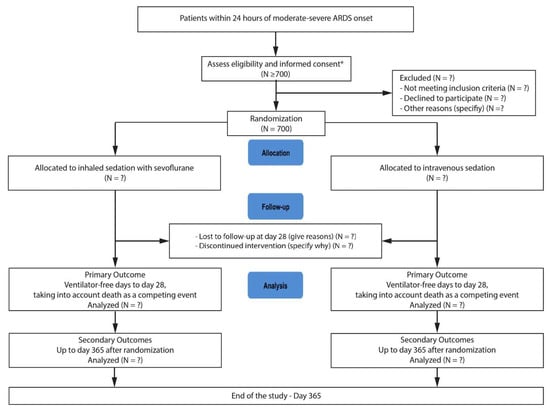
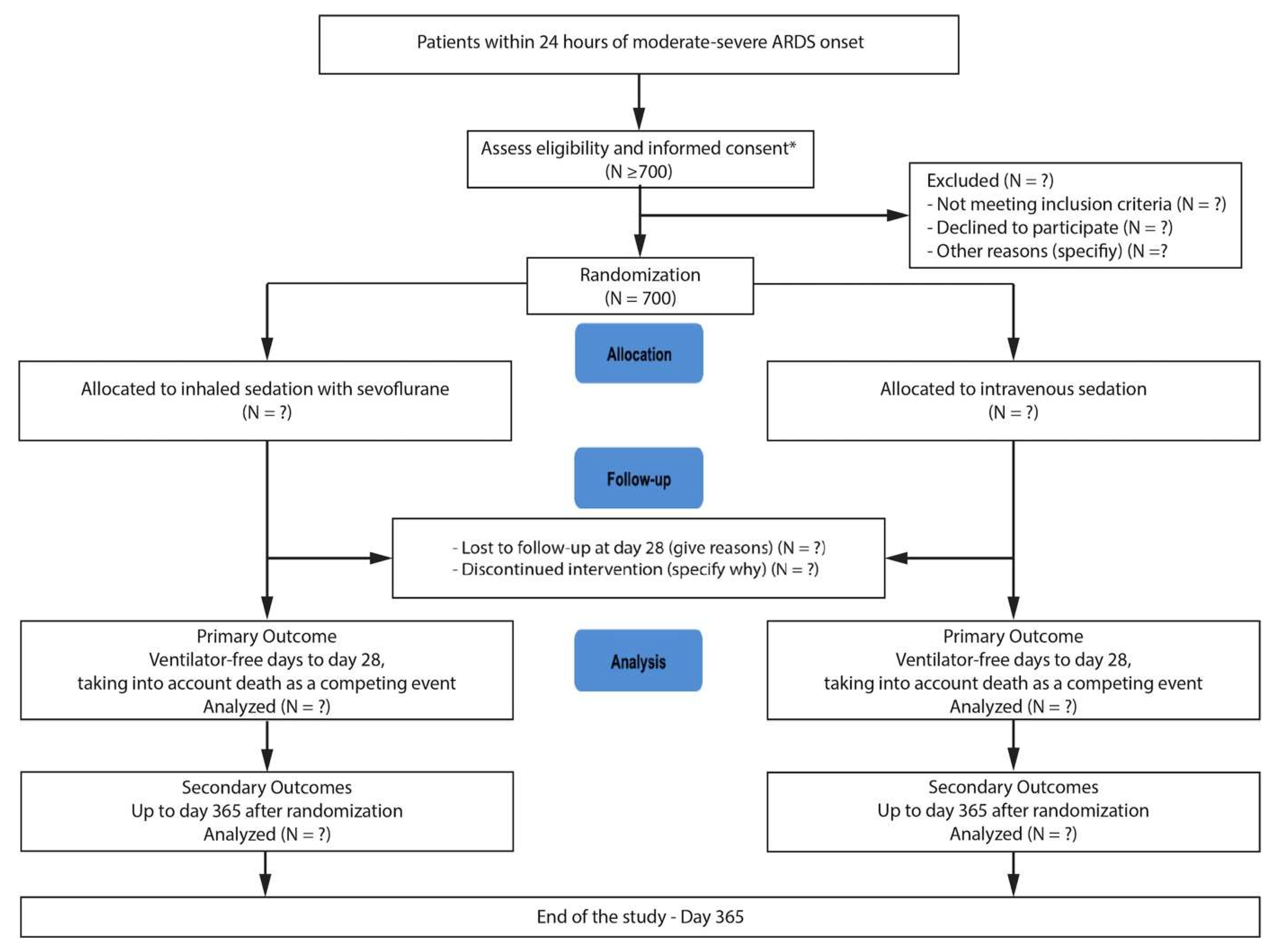
Due to eligibility criteria, patients will not be able to provide informed consent at enrollment and the study protocol provides for a waiver of informed consent from the patient. In case the patient’s legally authorized representative cannot be reached during the 24 h time window for enrollment, the investigator can include the patient using an emergent consent procedure and deferred informed consent will be obtained as soon as possible from the participants. The CONSORT diagram of the SESAR trial is provided in Figure 1.
Figure 1.
CONSORT diagram of the SESAR trial. * Because, in emergency situations, sedation and ventilation must be initiated as early as possible, the study protocol provides for a waiver of informed consent from the patient. The consent from the patient’s next of kin will therefore be sought actively during the 24 h enrollment time window. In case the patient’s next of kin cannot be reached in a timely manner, the investigator will decide to include the patient in the study using an emergent consent procedure. Deferred informed consent will be obtained from participants for potential continuation of the research.
2.4. Randomization
All patients were randomized online (CSOnline, Clinsight) by local investigators within 24 h of meeting inclusion criteria on a 1:1 ratio for the two study arms. The randomization sequence was generated by minimization and stratified by the study center, the degree of ARDS severity (PaO2/FiO2 < 100 mmHg), the suspicion or presence of COVID-19, and the presence of shock (defined as intravenous infusion of vasoactive drugs) at enrollment.
2.5. Treatment Arms, Administration, and Standardization of Care
2.5.1. Interventions
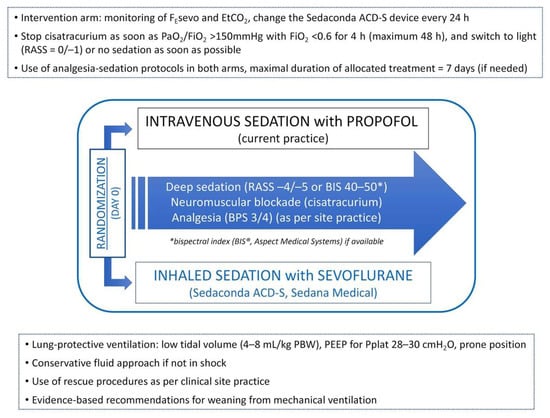
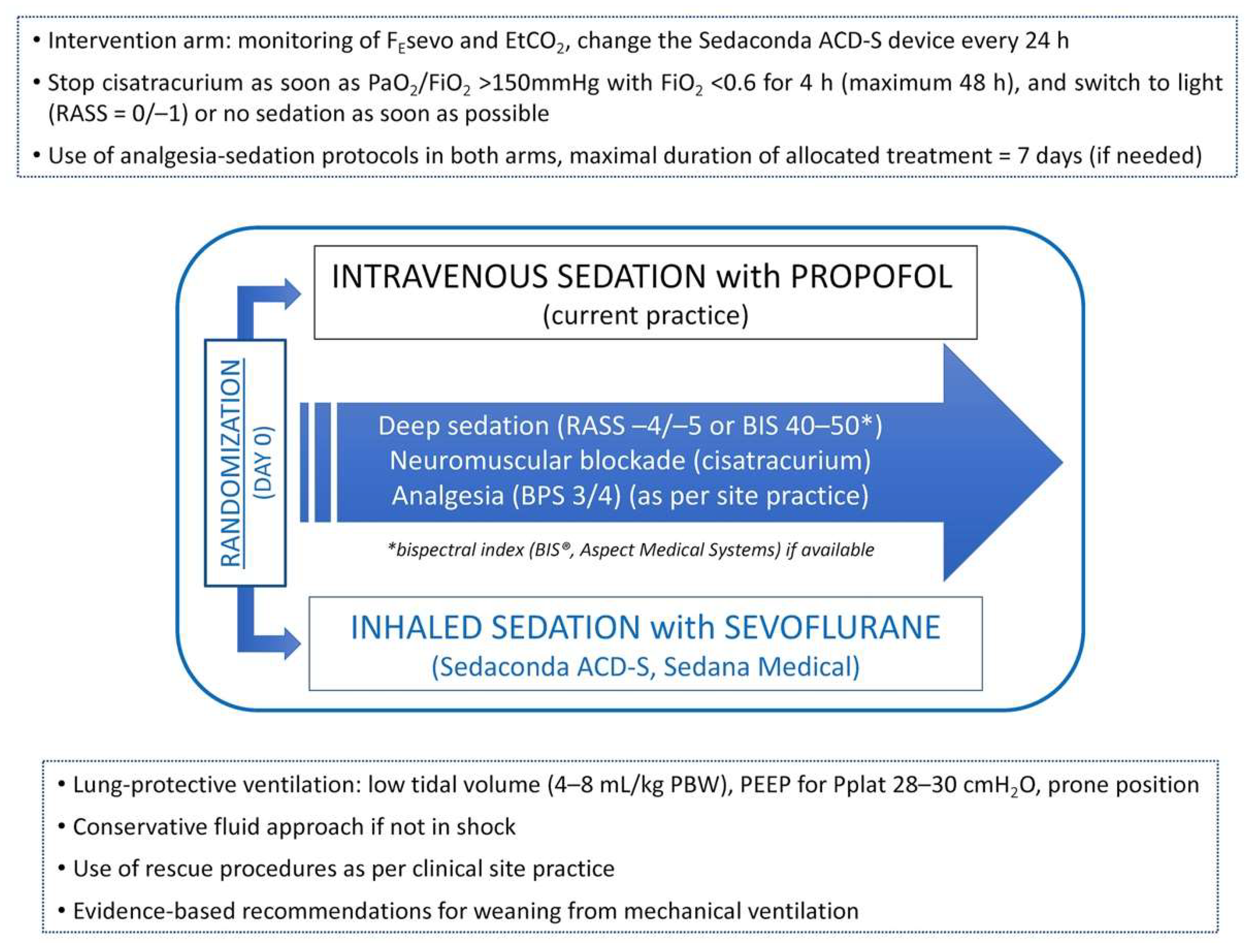
Study interventions are summarized in Figure 2.
Figure 2.
Summary of interventions within the SESAR trial. Definition of abbreviations: SESAR = sevoflurane for sedation in ARDS; ARDS = acute respiratory distress syndrome; RASS = Richmond agitation-sedation scale; BPS = behavioral pain scale; PBW = predicted body weight; PEEP = positive end-expiratory pressure; Pplat = inspiratory plateau pressure.
2.5.2. Study Arms: Intervention—Inhaled Sedation with Sevoflurane
Sevoflurane is vaporized via the miniaturized Anesthesia Conserving Device (Sedaconda ACD-S, Sedana Medical, Danderyd, Sweden), which is placed between the endotracheal tube and the Y-piece of the ventilator breathing circuit. The residual expired gas is scavenged following the manufacturer’s instructions using an active carbon filter (Flurabsorb, Sedana Medical, Danderyd, Sweden) [1]. As recommended by the manufacturer, Sedaconda ACD is replaced every 24 h and removed from the breathing circuit as soon as inhaled sedation is interrupted and for spontaneous breathing trials. Sevoflurane administration is interrupted, and the Sedaconda ACD-S removed from the breathing circuit, if severe acidemia (pH < 7.15) is present, in the absence of metabolic acidosis and despite tidal volume and/or respiratory rate increase, or if malignant hyperthermia or a bronchopleural fistula that is persistent despite drainage (to limit room exposure) develops. In these situations, sedation is switched to a strategy of intravenous propofol.
2.5.3. Study Arms: Control—Intravenous Sedation with Propofol
Propofol is administered via continuous intravenous infusion, as routinely used in participating ICUs. Propofol is interrupted if propofol-related infusion syndrome develops; in these cases, management and the choice of sedative agent(s) is as per the treating clinicians.
2.5.4. Common Strategies for Both Groups
Upon randomization, deep sedation is protocolized (Richmond Agitation-Sedation Scale (RASS) −4 to −5) and combined with the neuromuscular blockade (continuous infusion of cisatracurium besylate for a maximum of 48 h) in both groups. The neuromuscular blockade is continued until PaO2/FiO2 exceeds 150 mmHg for 4 h with FiO2 < 0.6 [21,23,24]; then, light sedation is targeted (RASS 0 to −1), with prompt sedation interruption whenever possible. In both arms, patients receive the allocated sedation strategy from randomization until sedation can be interrupted or until day 7, whichever occurs first. When sedation is required again within 7 days after randomization, the sedative agent to use is based on the randomization arm; after day 7, decisions on sedation are as per the treating clinicians. If the bispectral index (BIS®, Aspect Medical Systems Inc., Norwood, MA, USA) is available, the level of sedation under the neuromuscular blockade can be titrated and monitored using the BIS®, with a targeted value of 40–50 [14]. Pain management is conducted as per clinical teams, within a strategy of analgesia-first sedation, including frequent pain assessment with the behavioral pain scale (BPS); opioids agents, if needed, are those routinely used in participating centers.
Lung-protective ventilation is used in both arms [25]. Using volume-controlled ventilation, tidal volume is set at 6 mL/kg (+/− 2 mL/kg) of PBW [26], and PEEP is kept as high as possible without increasing the inspiratory plateau pressure above 28–30 cmH2O [27]. We allow deviation from the high PEEP strategy if there is clinical concern that the use of high PEEP may be worsening oxygenation, if hypotension and/or high inspiratory plateau pressure (>30 cmH2O) are present despite further tidal volume reduction and/or respiratory rate increase, if a study participant develops a pneumothorax, is at high risk for barotrauma, or as per the treating clinicians. Instrumental dead space of the respiratory circuit is reduced to the minimum in both arms. Whenever possible, we recommend sites to wait at least 12 h before proning for more than 12 h/day, one or multiple times as per the treating clinicians [23,26]. Fluid management during shock is unrestricted; however, in patients not in shock, a conservative fluid approach is recommended (Supplementary Material File S3) [28]. If PaO2 ≥ 55 mmHg or SpO2 ≥ 88% with FiO2 of 1 cannot be maintained, clinicians may employ rescue procedures, chosen according to the practice at the clinical site, such as recruitment maneuvers, nitric oxide, ECMO, or neuromuscular blockade use after 48 h from randomization. Evidence-based recommendations for weaning from mechanical ventilation will be applied in both groups (Supplementary Material File S4). All participating centers have existing protocols and order sets for routine sedation management, glucose control, septic shock resuscitation, deep venous thrombosis prophylaxis, and other aspects of background care.
2.5.5. Standardization and Adherence
Although all participating critical care professionals are certified and allowed to manage ICU sedation, their previous use and expertise level of inhaled sevoflurane may vary [4]. An educational program is conducted prior to patient recruitment to ensure that all participating centers have sufficient training to ensure patient safety and reach study goals through online-based theoretical presentations and online and on-site practical training. The study sponsor (CHU Clermont-Ferrand) safeguards data quality monitoring via web-based data collection, monthly query reports, site visits, and structured data collection training. A steering committee supervises the trial.
2.6. Patient Timeline, Assessments, and Measures
Patients are assessed as described in the Time-Events schedule (Supplementary Material File S5). Long-term outcomes are assessed on days 90 and 365 (Supplementary Material File S6). It is not technically possible to mask the assigned sedation strategy to the treating clinicians, due to the nature of the intervention requiring specific equipment. However, patients are followed up by members of the research staff from each site who are unaware of the group allocation. Study data are collected into the electronic case report form (CSOnline, Clinsight, Paris, France) by trained research staff blinded to the allocation group.
2.7. Trial Outcome Measures
The trial outcome measures are summarized in Table 2.
Table 2.
SESAR trial outcome measures.
2.7.1. Primary Outcome
The primary outcome is the number of days alive and off invasive mechanical ventilation at 28 days (ventilator-free days at 28 days, VFD28), considering death as a competing event. VFD28 are defined as the number of days from the time of initiating unassisted breathing to day 28 after randomization, assuming survival for at least two consecutive calendar days after initiating unassisted breathing and continued unassisted breathing to day 28. A period of assisted breathing lasting less than 24 h and for the purpose of a surgical procedure does not count against the VFD calculation, and VFDs are zero if a patient dies prior to day 28.
2.7.2. Key Secondary Outcomes
The key secondary outcome is 90 day survival.
2.7.3. Secondary Outcomes
Other secondary outcomes are all-location, all-cause mortality at 7, 14, and 28 days, and all-cause hospital 28 day mortality.
2.7.4. Exploratory Outcomes
Exploratory outcomes are VFD7, VFD14, organ failure-free days through day 7 [evaluating Sepsis-related Organ Failure Assessment (SOFA) scores [29]], ICU-free and hospital-free days through day 28, respiratory physiological measures (oxygenation index, PaO2/FiO2, PaCO2, arterial pH, PEEP, inspiratory plateau pressure, static compliance of the respiratory system, and ventilatory ratio, as defined as [minute ventilation (mL/min) × arterial PaCO2 (mmHg)]/[predicted body weight × 100 × 37.5] [30]), use of rescue procedures for refractory hypoxemia through day 28, ICU-acquired delirium through day 7 or ICU discharge or death (whichever comes first), long-term outcomes at 3 and 12 months (disability, health-related quality of life, self-rated health, pain-interference, post-traumatic stress-like symptoms, cognitive function, subsequent return to work, healthcare use, and location of residence), and healthcare-related costs during ICU stay and stay (secondary analysis). Instruments for ICU-acquired delirium and long-term outcome assessment are detailed in Supplementary Material File S6.
2.7.5. Exploratory Biological Outcomes
Exploratory biological outcomes are changes over time in plasma biomarkers including IL-8, soluble tumor necrosis factor-receptor 1, bicarbonate (hyperinflammatory ARDS phenotype [31]), IL-6 (ventilator-induced lung injury [25,32]), angiopoietin 2 (endothelial activation [33,34]), and sRAGE (alveolar epithelial injury [35,36]), in urine biomarkers including tissue inhibitor of metalloproteinase 2 and insulin-like growth factor binding protein 7 (acute kidney injury [37]), in plasma total fluoride and hexafluoroisopropanol (sevoflurane metabolism), in total protein within undiluted pulmonary edema fluid (alveolar fluid clearance [36]), in biomarker measurements in the fluid from heat moisture exchanger filters (control group) or Sedaconda ACD-S devices (intervention group) [38,39] and in the bronchoalveolar lavage fluid, and genetic analyses (Table 2).
2.7.6. Safety Outcomes
Safety outcomes are hemodynamic (mean arterial pressure, dose of infused norepinephrine or other vasopressor, serum lactate level) and renal function (KDIGO criteria [40]) measures through day 7 and development of severe hypercapnic acidosis with arterial pH < 7.15 (Sedaconda ACD-S device), supraventricular tachycardia or new onset atrial fibrillation during the ICU stay, malignant hyperthermia (sevoflurane), propofol-related infusion syndrome (propofol), and bronchopleural fistula that is persistent despite drainage (to limit room exposure to sevoflurane) through day 7.
2.8. Laboratory Evaluations
In addition to laboratory studies obtained as per routine clinical care, plasma and urine samples will be collected, when available, at study entry and on days 1, 2, 4, 6, and 14 or ICU discharge (whichever occurs first) to investigate the biological effects of inhaled sevoflurane in ARDS. We will also collect whole blood samples at study entry and on day 2 for RNA and DNA studies. In selected centers, undiluted pulmonary edema fluid samples will be collected at study entry and 24 h later in 50 patients from each group; bronchoalveolar lavage fluid will be sampled in 25 intubated patients within 48 h from study entry and between day 4 and day 6; fluid from heat moisture exchanger filters and Sedaconda ACD-S devices will be collected at 24 h in 30 patients from each group.
2.8.1. Safety Data
Serious and unexpected adverse events, such as unexpected deaths (i.e., not related to the progression of the primary disease or to limitation of care), severe hypercapnic acidosis that may be related to the intervention (arterial pH < 7.15, in the absence of metabolic acidosis and despite further tidal volume and/or respiratory rate increase) or the development of malignant hyperthermia, propofol-related infusion syndrome or bronchopleural fistula persistent despite drainage, will be reported to the sponsor by the investigators.
2.8.2. Data and Safety Monitoring
Interim safety reports are performed by the sponsor to the independent data monitoring and safety committee (DMSC), consisting of two clinician-scientists and a methodologist-biostatistician, each time 40 patients are enrolled [14], including blinded variables on randomization-stratification variables (site, severe ARDS, COVID-19, and shock at enrollment), serious and unexpected adverse events, and the rates and causes of death at day 28. An interim analysis is preplanned on data from 350 patients (175 by group), with symmetric group sequential flexible stopping boundaries [41]. Recommendations for continuing, pausing, or stopping the study will be made by the DMSC to the steering committee for superiority of either active or control, or potential safety reasons. The observation of differences in serious adverse events between the two groups allows unblinding of the group allocations if deemed necessary by the DMSC.
2.8.3. Statistical Considerations
The statistical analysis plan is provided in Supplementary Material File S7. A two-sided p value < 0.05 will be considered for significance of all analyses, except for interim analysis. The primary analysis will be performed using an intention-to-treat (ITT) principle. Then, we will perform per-protocol and subgroup analyses on the primary and secondary outcomes (Table 3). The primary endpoint (VFD28) will be analyzed using a mixture of generalized gamma distributions to concatenate the overall frequency and distribution of the times [42]. Multivariable adjustments will be performed in (1) a first model including only the randomization-stratification variables and center as random-effect; (2) a second model with covariates from the first model and covariates with clinically relevant relationships with the outcome and significant in univariate analyses (p < 0.10). The key secondary outcome of day 90 survival will be evaluated using the Kaplan–Meier approach and compared using the log-rank test (univariate analysis); multivariable adjustments will be conducted using the same two models described above. Because of the potential for type I error due to multiple comparisons, findings for analyses of other secondary endpoints will be interpreted as exploratory.
Table 3.
SESAR trial populations for primary, key secondary, secondary, and subgroup analyses.
2.8.4. Sample-Size Justification
Total enrollment will target 700 patients (350 by group). The trial is designed with >80% power to detect a difference of 2 days alive and off ventilation at day 28 (primary outcome of VFD28), with standard deviation of 8 [43,44] and two-sided type I error of 5%. For this calculation, we assumed the variability of VFD28 would follow the properties of ROSE [21], the Esophageal Pressure-guided Ventilation-2 (EPVent-2) trial [45], and a pilot study of inhaled sevoflurane in ARDS [14], with 28 day mortality around 30–35% [21,24,45].
3. Discussion
The SESAR trial was designed to investigate the efficacy and safety of inhaled sevoflurane compared with intravenous propofol in patients with ARDS. The trial uses prognostic enrichment by enrolling the most severe patients (i.e., with a PaO2/FiO2 <150 mmHg) and, therefore, a greater probability of experiencing worse clinical outcomes [46,47]. The protocol implies strict adherence to evidence-based guidelines for analgesia-sedation and ventilation in ARDS, including recommendations on the ABCDEF bundle for ICU liberation and avoidance of benzodiazepines [48,49], and on lung-protective ventilation with low tidal volume and PEEP, prone position, and conservative fluid therapy unless the patient is in shock [27,50,51]. Based on the recent Severe ARDS: Generating Evidence (SAGE) Study, a multicenter, observational cohort study of 2466 mechanically ventilated adult patients with ARDS and PaO2/FiO2 < 150 mmHg on PEEP > 5 cmH2O in the United States, only adherence to early lung protective ventilation was associated with lower mortality [52]. The SESAR protocol stresses the use of lower tidal volumes (4 to 8 mL/kg PBW), and data monitoring has been developed to reveal whether higher tidal volumes are applied.
Early deep sedation will be targeted and associated with a systematic neuromuscular blockade in the trial, which is debatable [18,20,21]. However, this overall trial strategy has been chosen to avoid the substantial center-to-center variability that exists in ARDS management, while ensuring implementation of underused evidence-based interventions such as lung-protective ventilation and prone position [52]. In both study arms, deep sedation followed by a neuromuscular blockade will be initiated to reduce the risk of patient–ventilator asynchrony and patient self-inflicted lung injury [53]. This initial strategy will be switched for a lighter or no-sedation strategy as soon as oxygenation improves, thus better personalizing sedation and the neuromuscular blockade [24]. After this period, priority will be given to respiratory drive control and patient–ventilator synchrony to avoid the unnecessary use of medications such as sedatives, opioids, and neuromuscular blocking agents (paralysis over 48 h after randomization will be considered a rescue therapy) [18]. PEEP will be individually titrated based on plateau pressure, regardless of its effect on oxygenation in contrast to the PEEP/FiO2 scales used in other studies [32,54].
The trial will evaluate VFD28 as a primary, patient-centered outcome measure that represents the number of days alive and free of invasive mechanical ventilation calculated over 28 days. This endpoint, designed to assign benefit to early liberation from mechanical ventilation while considering death as a competitive risk, has been approved by the US Food and Drug Administration for licensing and is a clinically relevant outcome for phase III ARDS trials enrolling more than 500 patients [46]. Longer-term outcomes will also be evaluated in the trial, as there is an increased recognition of the significant long-term consequences of ARDS [55,56].
The precise pathways to lung-protective effects of sevoflurane, as observed in preclinical models and a pilot clinical trial [3,11,14], are largely unknown. The most commonly proposed mechanism is through the preservation of alveolar-epithelial integrity [57] and a reduction in pro-inflammatory cytokine release [6,7,9,10,14,58]. The SESAR trial includes the rigorous and sequential collection of plasma, alveolar, and urine samples that will be used to better characterize the effects of sevoflurane on major pathophysiological features of ARDS, in addition to assess renal laboratory markers and levels of sevoflurane metabolites. The results will also inform whether specific ARDS phenotypes might better benefit from inhaled sevoflurane, and which clinico-biological features and/or natural histories may be capable of predicting therapeutic response, and not just prognosis [59,60,61,62].
Although routinely used in some countries, inhaled sedation practice may largely vary among ICUs [2,4]. Volatile anesthetics use for ICU sedation requires specific training and specialized equipment, and some specific settings have also been suggested to increase viral protection in COVID-19 patients while ensuring safety to healthcare workers [63]. Sevoflurane is a well-known trigger to malignant hyperthermia in genetically predisposed patients, a syndrome that requires early intervention with the immediate change of the ventilator circuit and dantrolene infusion. However, this condition remains rare (1/50,000–100,000) in comparison to propofol infusion syndrome, which affects up to 1% of ICU patients [64]. The trial includes the remote and on-site training of all clinical teams to ensure strict adherence to the intended use and safety of inhaled sedation. Because we lack a cost-effectiveness analysis that takes into account any beneficial clinical outcomes such as faster awakening, extubation times, and lengths of ICU stay [65,66], the trial will also explore cost-effectiveness of sevoflurane compared with current practices.
SESAR is a randomized multicenter trial of inhaled sevoflurane in patients with ARDS. If the trial results demonstrate that sevoflurane increases VFD28 (primary endpoint) or 90 day survival (key secondary endpoint), compared with the current practice of intravenous propofol, increased use of inhaled ICU sedation should be considered. Better understanding of how sevoflurane may target major biological features of lung alveolar injury and their contributions to heterogeneity of the treatment effect will enhance the interpretation of trial results and inform future efforts in the early treatment of ARDS.
Supplementary Materials
The following are available online at https://www.mdpi.com/article/10.3390/jcm11102796/s1, Supplementary Material File S1. Complete protocol of the Sevoflurane for Sedation in ARDS (SESAR) trial (version 9, approved on February 10, 2022); Supplementary Material File S2. Standard Protocol Items: Recommendations for Interventional Trials (SPIRIT) Checklist SPIRIT 2013: Recommended items to address in a clinical trial protocol and related documents; Supplementary Material File S3. Conservative fluid management approach; Supplementary Material File S4. Protocol for weaning from mechanical ventilation; Supplementary Material File S5. Time-Events Schedule; Supplementary Material File S6. Instruments and questionnaires for ICU-acquired delirium and long-term outcome assessment. A. Confusion Assessment Method for the ICU (CAM-ICU), B. Katz Activities of Daily Living (ADL), C. Short Form-36 (SF-36), D. Self-rated Health, E. Pain Interference, F. Post-Traumatic Stress Symptoms (PTSS)-14, G. Hospital Anxiety and Depression Scale, H. Alzheimer’s Disease 8 (AD8). Supplementary Material File S7. Statistical Analysis Plan.
Author Contributions
M.J. takes responsibility for the content of the manuscript. R.B., D.M., L.R., M.G., C.Q., V.S., J.A.B., L.B.W., C.G.H., P.P.P., E.W.E., E.F., B.P., J.-M.C. and M.J. were involved in the conception, hypotheses delineation, design of the study, and the preparation of patient recruitment and data capture, in writing the article and in its revision prior to submission. All other authors were involved in the design of the study, the preparation of patient recruitment and data capture, and in the revision of the article prior to submission. Members of the SESAR Collaborative Group are involved in the conduct of the study, including patient recruitment and data capture. All authors have read and agreed to the published version of the manuscript.
Funding
Supported by research grants from the French Ministry of Health (“Programme Hospitalier de Recherche Clinique National 2018”) and the European Society of Anaesthesiology and Intensive Care, and Sedana Medical (Danderyd, Sweden). The clinical trial was registered with www.clinicaltrials.gov (NCT04235608) (accessed on 13 March 2022).
Institutional Review Board Statement
“The trial protocol was constructed in accordance with the Declaration of Helsinki and approved by the Institutional Review Board “Comité de Protection des Personnes Ile-de-France 2” (protocol code RBHP 2018 JABAUDON version 9 approved under number 18.09.21.60651-RIPH1 on 10 February 2022).
Informed Consent Statement
Due to eligibility criteria, patients will not be able to provide informed consent at enrollment in the SESAR trial, and the study protocol provides for a waiver of informed consent from the patient. In case the patient’s legally authorized representative cannot be reached during the 24 h time window for enrollment, the investigator can include the patient using an emergent consent procedure and deferred informed consent will be obtained as soon as possible from the participants.
Acknowledgments
The authors thank the patients, their families, and all the healthcare workers directly or indirectly involved in the trial, as well as the clinical investigators, coordinators, and contributors who have participated in at least one of the following: critical review of the study proposal, data collection, care of study patients, and writing and/or technical editing of the manuscript. SESAR Collaborative Group: Marc Gainnier, Jeremy Bourenne, Béatrice Cresta, Aurélie Larosa, Lionel Velly, Pierre Siméone, Didier Sanchez, Imane Inal, Marine Challier, Valentine Verdier, Bénédicte Deluca-Bosc (Assistance Publique-Hôpitaux de Marseille, Marseille); Jean-Michel Constantin, Antoine Monsel, Cyril Quemeneur, Fanny Charbonnier, Sandrine Ndingamondze, Christophe Quesnel, Marc Garnier, Christophe Gutton, Souad Fellous, Fabienne Fieux, Léa Satre Buisson, Nicolas Hantala, Virginie Lemiale, Elie Azoulay, Michael Darmon, Igor Theodose, Isabelle Madeleine (Assistance Publique-Hôpitaux de Paris, Paris); Christophe Vinsonneau, Sabine Janowski, Maryline Houdre, Sarah Tollot, Catherine Senis, Dominique Descamps (Hospital of Béthune, Béthune); Pierre-Marie Bertrand, Marine Agullo (Hospital of Cannes, Cannes); Mehran Monchi, Arezki Agher, Eric Stoll, Maryse Camus (Hospital of Melun-Sénart, Melun); Joël Cousson, Bruno Mourvillier, Eric Marquis, Amandine Farget, Mélanie Gaillard, Sandy Aerts, Philippe Benoit (University Hospital of Reims, Reims); François Legay, Catherine Bellot, Nathalie Kerneur, Valéry Bourbonneux, Laurent Pleven, Aude Davy (Hospital of Saint-Brieuc, Saint-Brieuc); Julien Maizel, Yoann Zerbib, Rayan Braik, Kahina Zid, Sophie Boddaert, Yves-Edouard Herpe (University Hospital of Amiens, Amiens); Sigismond Lasocki, Viviane Cassisa, Emma Blanchet, Anne Sylvie Lebreton, Valérie Daniel, Arnaud Geslin (University Hospital of Angers, Angers); Erwan L’Her, Pierre Bailly, Isabelle Ledu, Hélène Fortin-Prunier, Amandine Tapon, Axelle Cornillet, Patricia Dias, Elsa Menanteau (University Hospital of Brest, Brest); Belaid Bouhemad, Nicolas Nowobilski, Vivien Berthoud, Hasni Si-Abdelkader, Jean-Pierre Quenot, Pascal Andreu, Audrey Massard, Solene Villot, Samantha Lima Pinheiro, Jean-Baptiste Roudaut (University Hospital of Dijon, Dijon); Samir Jaber, Gérald Chanques, Audrey De Jong, Albert Prades, Fouad Belafia, Julie Carr, Moussa Cisse, Matthieu Conseil, Jean-Marc Delay, Laurie Ducros, Marion Monnin, Bruno Souche, Julien Boudjemaa, Laurent Cachia, Lydia Gonzales, Marie Gonzales-Amargier, Jeanne Boyer, Erika Miquel, Delphine Rosant, Nathalie Coux, Boris Jung, Kada Klouche, Claudine Gniadek, Philippe Corne, Vincent Brunot, Romaric Larcher, Matthieu Amalric, Sonia Machado, Noémie Besnard, Laura Platon, Delphine Daubin, Audrey Castet (University Hospital of Montpellier, Montpellier); Antoine Roquilly, Karim Asehnoune, Clément Prouteau, Delphine Flattres Du Chaussoy, Cécilia Lebel, Julien Lorber, Pierre-Joachim Mahe, Laurence Flet, Amélie Trichot, Dominique Demeure dit Latte, Yannick Hourmant (University Hospital of Nantes, Nantes); Carole Ichai, Jean-Christophe Orban, Hervé Quintard, Christelle Boczek, Justine Bellegarde, Aminata Diop, Barthélémy Fallet (University Hospital of Nice, Nice); Stéphanie Bulyez, Jean-Yves Lefrant, Claire Roger, Laurent Muller, Sophie Lloret, Audrey Ambert, Loubna Elotmani, Mathieu Expert, Caroline Maury, Virginie Viviez, Jullian Elodie, Céline Loiseau, Christian Maillard (University Hospital of Nîmes, Nîmes); Claire Dahyot-Fizelier, Nadia Imzi, Christelle Plumereau, Sabrina Seguin, Isabelle Princet, Arnaud W. Thille, Jean-Pierre Frat, René Robert, Rémy Coudroy, Anne Veinstein, Carole Guignon, Céline Delétage, Nacira Benhamouche, Delphine Chatellier, Damien Marie, Florence Boissier (University Hospital of Poitiers, Poitiers); Thomas Lebouvier, Philippe Seguin, Sophie Caradec (University Hospital of Rennes, Rennes); Julien Pottecher, Eric Noll, Pierre Diemunsch, Alexandre Debaene, ThienNga Chamaraux-Tran, Habiba Moussa, Stéphane Hecketsweiler, Arnaud Romoli, Alain Meyer, Nadia Dhif, Magdalena Szczot, Alban Pellegrino, Anne Hutt, Magdalena Szczot, Sarah Lang (University Hospitals of Strasbourg, Strasbourg); Alexandre Lautrette, Nathanael Eisenmann, Ghislaine Niezgodzki, Rodolphe Hilaire, Régine Chevrier, Sonia Rucart (Jean Perrin Comprehensive Cancer Center, Clermont-Ferrand); Roland Amathieu, Thierry Lazard, Gabriel Lejour, Emmanuelle Guillot, Claire Lhommet (Diaconesses-La Croix Simon Hospital, Paris); Caroline Varillon, Cyril Fayolle, Sébastien Beague, Raphael Krouchi, Valentin Vergriete, Thomas Queruau, François Beze, Solange Tombelle (Hospital of Dunkerque, Dunkerque); Arthur Durand, Saad Nseir, Sylvie Brice, Claire Delcourte, Amélie Cerf, Laure Mariller (University Hospital of Lille, Lille); Julien Lorber, Maud Jonas, Céline Chevalier, Servane Vastral (Hospital of Saint-Nazaire, Saint-Nazaire); Julio Badie, Laurent Faivre, Elodie Bouvier, Charlotte Bourgoin, Isabelle Roussez, Pascale Dussert (Hôpital Nord de Franche Comté, Belfort); Fabien Lambiotte, Mohamed Ali Benbali, Hanane Fodil, Justine Lemtiri, Chaouki Bouras, Hedi Dhaouadi, Nabil El Beki (Hospital of Valenciennes, Valenciennes); Delphine Bregeaud, Stéphanie Violette (Hospital of Saintes, Saintes); Aziz Berrouba, Romain Blanchon, Elodie Protesti, Gwladys M’Boungou, Eric Gerardin (Hospital of Martigues, Martigues); Alexandre Conia, Pierre Kalfon, Bénédicte Mauchien (Hospital of Chartres, Chartres); Martine Ferrandière, Charlène Piat (University Hospital of Tours, Tours); Matthieu Jabaudon, Raiko Blondonnet, Benjamin Rieu, Thierry Gillart, Thomas Costille, Jean-Baptiste Joffredo, Sébastien Perbet, Margaux Coudray, Loris Giordanetto, Russel Chabanne, Marc Begard, Camille Boissy, Romain Grobost, Thibaud Cammas, Bernard Cosserant, Pierre-Antoine Pioche, Katia Levrier, Thomas Godet, Jules Audard, Gauthier Arpajou, Lucie Aupetitgendre, Sophie Cayot, Renaud Guérin, Camille Verlhac, Benoit Baietto, Bertille Paquette, Ugo Schiff, Périne Vidal, Yann Charade, Emilien Chauve, Marion Tourgon, Sylvie Cosserant, Nathalie Bourguignon, Lucile Borao, Dominique Morand, Lise Bernard, Damien Bouvier, Laurence Roszyk, Vincent Sapin, François Thouy, Bertrand Souweine, Claire Dupuis, Mireille Adda-Pernot, Marine Bereiziat, Frederic Duee (CHU Clermont-Ferrand, Clermont-Ferrand); Charlotte Leclaire, Cécile Saint-Béat, Ruoyang Zhai, Woodys Lenga Ma Bonda, Layline Soudjain, Corinne Belville, Loic Blanchon (Université Clermont Auvergne, Clermont-Ferrand).
Conflicts of Interest
M.J. is a principal investigator of the ISCA study (ClinicalTrials.gov Identifier: NCT04383730), with grants from Sedana Medical; J.-M.C. and M.J. received fees from Sedana Medical for participation in a scientific advisory panel in 2019; M.J. received fees from Sedana Medical for participation in seminars in 2019, 2020, and 2021; M.J. received consulting fees in 2020 and 2021, and fees for participation in a scientific advisory panel in 2021, from Abbvie. Neither Sedana Medical nor Abbvie have any influence on the study design, collection, analysis, interpretation of data, and writing. The other authors have nothing to disclose. All authors have read and agreed to the published version of the manuscript.
References
- Soukup, J.; Schärff, K.; Kubosch, K.; Pohl, C.; Bomplitz, M.; Kompardt, J. State of the Art: Sedation Concepts with Volatile Anesthetics in Critically Ill Patients. J. Crit. Care 2009, 24, 535–544. [Google Scholar] [CrossRef] [Scilit] [PubMed]
- DAS-Taskforce 2015; Baron, R.; Binder, A.; Biniek, R.; Braune, S.; Buerkle, H.; Dall, P.; Demirakca, S.; Eckardt, R.; Eggers, V.; et al. Evidence and consensus based guideline for the management of delirium, analgesia, and sedation in intensive care medicine. Revision 2015 (DAS-Guideline 2015)-short version. Ger. Med. Sci. 2015, 13, 19. [Google Scholar]
- Jerath, A.; Parotto, M.; Wasowicz, M.; Ferguson, N.D. Volatile Anesthetics. Is a New Player Emerging in Critical Care Sedation? Am. J. Respir. Crit. Care Med. 2016, 193, 1202–1212. [Google Scholar] [CrossRef] [Scilit] [PubMed]
- Blondonnet, R.; Quinson, A.; Lambert, C.; Audard, J.; Godet, T.; Zhai, R.; Pereira, B.; Futier, E.; Bazin, J.-E.; Constantin, J.-M.; et al. Use of Volatile Agents for Sedation in the Intensive Care Unit: A National Survey in France. PLoS ONE 2021, 16, e0249889. [Google Scholar] [CrossRef] [Scilit] [PubMed]
- Meiser, A.; Volk, T.; Wallenborn, J.; Guenther, U.; Becher, T.; Bracht, H.; Schwarzkopf, K.; Knafelj, R.; Faltlhauser, A.; Thal, S.C.; et al. Inhaled Isoflurane via the Anaesthetic Conserving Device versus Propofol for Sedation of Invasively Ventilated Patients in Intensive Care Units in Germany and Slovenia: An Open-Label, Phase 3, Randomised Controlled, Non-Inferiority Trial. Lancet Respir. Med. 2021, 9, 1231–1240. [Google Scholar] [CrossRef] [Scilit]
- Ferrando, C.; Aguilar, G.; Piqueras, L.; Soro, M.; Moreno, J.; Belda, F.J. Sevoflurane, but Not Propofol, Reduces the Lung Inflammatory Response and Improves Oxygenation in an Acute Respiratory Distress Syndrome Model: A Randomised Laboratory Study. Eur. J. Anaesthesiol. 2013, 30, 455–463. [Google Scholar] [CrossRef] [Scilit]
- Voigtsberger, S.; Lachmann, R.A.; Leutert, A.C.; Schläpfer, M.; Booy, C.; Reyes, L.; Urner, M.; Schild, J.; Schimmer, R.C.; Beck-Schimmer, B. Sevoflurane Ameliorates Gas Exchange and Attenuates Lung Damage in Experimental Lipopolysaccharide-Induced Lung Injury. Anesthesiology 2009, 111, 1238–1248. [Google Scholar] [CrossRef] [Scilit]
- Schläpfer, M.; Leutert, A.C.; Voigtsberger, S.; Lachmann, R.A.; Booy, C.; Beck-Schimmer, B. Sevoflurane Reduces Severity of Acute Lung Injury Possibly by Impairing Formation of Alveolar Oedema. Clin. Exp. Immunol. 2012, 168, 125–134. [Google Scholar] [CrossRef] [Scilit]
- Suter, D.; Spahn, D.R.; Blumenthal, S.; Reyes, L.; Booy, C.; Z’graggen, B.R.; Beck-Schimmer, B. The Immunomodulatory Effect of Sevoflurane in Endotoxin-Injured Alveolar Epithelial Cells. Anesth. Analg. 2007, 104, 638–645. [Google Scholar] [CrossRef] [Scilit]
- Steurer, M.; Schläpfer, M.; Steurer, M.; Z’graggen, B.R.; Booy, C.; Reyes, L.; Spahn, D.R.; Beck-Schimmer, B. The Volatile Anaesthetic Sevoflurane Attenuates Lipopolysaccharide-Induced Injury in Alveolar Macrophages. Clin. Exp. Immunol. 2009, 155, 224–230. [Google Scholar] [CrossRef] [Scilit]
- O’Gara, B.; Talmor, D. Lung Protective Properties of the Volatile Anesthetics. Intensive Care Med. 2016, 42, 1487–1489. [Google Scholar] [CrossRef] [Scilit] [PubMed]
- Mesnil, M.; Capdevila, X.; Bringuier, S.; Trine, P.-O.; Falquet, Y.; Charbit, J.; Roustan, J.-P.; Chanques, G.; Jaber, S. Long-Term Sedation in Intensive Care Unit: A Randomized Comparison between Inhaled Sevoflurane and Intravenous Propofol or Midazolam. Intensive Care Med. 2011, 37, 933–941. [Google Scholar] [CrossRef] [Scilit] [PubMed]
- Jerath, A.; Panckhurst, J.; Parotto, M.; Lightfoot, N.; Wasowicz, M.; Ferguson, N.D.; Steel, A.; Beattie, W.S. Safety and efficacy of volatile anesthetic agents compared with standard intravenous midazolam/propofol sedation in ventilated critical care patients: A meta-analysis and systematic review of prospective trials. Anesth. Analg. 2017, 124, 1190–1199. [Google Scholar] [CrossRef] [Scilit] [PubMed]
- Jabaudon, M.; Boucher, P.; Imhoff, E.; Chabanne, R.; Faure, J.-S.; Roszyk, L.; Thibault, S.; Blondonnet, R.; Clairefond, G.; Guérin, R.; et al. Sevoflurane for Sedation in Acute Respiratory Distress Syndrome. A Randomized Controlled Pilot Study. Am. J. Respir. Crit. Care Med. 2017, 195, 792–800. [Google Scholar] [CrossRef] [Scilit]
- Bourdeaux, D.; Sautou-Miranda, V.; Montagner, A.; Perbet, S.; Constantin, J.M.; Bazin, J.-E.; Chopineau, J. Simple Assay of Plasma Sevoflurane and Its Metabolite Hexafluoroisopropanol by Headspace GC–MS. J. Chromatogr. B 2010, 878, 45–50. [Google Scholar] [CrossRef] [Scilit]
- Chabanne, R.; Perbet, S.; Futier, E.; Ben Said, N.A.; Jaber, S.; Bazin, J.-E.; Pereira, B.; Constantin, J.-M. Impact of the Anesthetic Conserving Device on Respiratory Parameters and Work of Breathing in Critically Ill Patients under Light Sedation with Sevoflurane. Anesthesiology 2014, 121, 808–816. [Google Scholar] [CrossRef] [Scilit]
- Perbet, S.; Bourdeaux, D.; Sautou, V.; Pereira, B.; Chabanne, R.; Constantin, J.M.; Chopineau, J.; Bazin, J.E. A Pharmacokinetic Study of 48-Hour Sevoflurane Inhalation Using a Disposable Delivery System (AnaConDa®) in ICU Patients. Minerva Anestesiol. 2014, 80, 655–665. [Google Scholar]
- Chanques, G.; Constantin, J.-M.; Devlin, J.W.; Ely, E.W.; Fraser, G.L.; Gélinas, C.; Girard, T.D.; Guérin, C.; Jabaudon, M.; Jaber, S.; et al. Analgesia and Sedation in Patients with ARDS. Intensive Care Med. 2020, 46, 2342–2356. [Google Scholar] [CrossRef] [Scilit]
- ARDS Definition Task Force; Ranieri, V.M.; Rubenfeld, G.D.; Thompson, B.T.; Ferguson, N.D.; Caldwell, E.; Fan, E.; Camporota, L.; Slutsky, A.S. Acute Respiratory Distress Syndrome: The Berlin Definition. JAMA 2012, 307, 2526–2533. [Google Scholar]
- Papazian, L.; Forel, J.-M.; Gacouin, A.; Penot-Ragon, C.; Perrin, G.; Loundou, A.; Jaber, S.; Arnal, J.-M.; Perez, D.; Seghboyan, J.-M.; et al. Neuromuscular Blockers in Early Acute Respiratory Distress Syndrome. N. Engl. J. Med. 2010, 363, 1107–1116. [Google Scholar] [CrossRef] [Scilit]
- National Heart, Lung, and Blood Institute PETAL Clinical Trials Network; Moss, M.; Huang, D.T.; Brower, R.G.; Ferguson, N.D.; Ginde, A.A.; Gong, M.N.; Grissom, C.K.; Gundel, S.; Hayden, D.; et al. Early Neuromuscular Blockade in the Acute Respiratory Distress Syndrome. N. Engl. J. Med. 2019, 380, 1997–2008. [Google Scholar] [PubMed]
- Rice, T.W.; Wheeler, A.P.; Bernard, G.R.; Hayden, D.L.; Schoenfeld, D.A.; Ware, L.B. National Institutes of Health, National Heart, Lung, and Blood Institute ARDS Network. Comparison of the SpO2/FIO2 Ratio and the PaO2/FIO2 ratio in patients with acute lung injury or ARDS. Chest 2007, 132, 410–417. [Google Scholar] [CrossRef] [Scilit] [PubMed]
- Guérin, C.; Reignier, J.; Richard, J.-C.; Beuret, P.; Gacouin, A.; Boulain, T.; Mercier, E.; Badet, M.; Mercat, A.; Baudin, O.; et al. Prone Positioning in Severe Acute Respiratory Distress Syndrome. N. Engl. J. Med. 2013, 368, 2159–2168. [Google Scholar] [CrossRef] [Scilit] [PubMed]
- Constantin, J.-M.; Jabaudon, M.; Lefrant, J.-Y.; Jaber, S.; Quenot, J.-P.; Langeron, O.; Ferrandière, M.; Grelon, F.; Seguin, P.; Ichai, C.; et al. Personalised Mechanical Ventilation Tailored to Lung Morphology versus Low Positive End-Expiratory Pressure for Patients with Acute Respiratory Distress Syndrome in France (the LIVE Study): A Multicentre, Single-Blind, Randomised Controlled Trial. Lancet Respir. Med. 2019, 7, 870–880. [Google Scholar] [CrossRef] [Scilit]
- Acute Respiratory Distress Syndrome Network; Brower, R.G.; Matthay, M.A.; Morris, A.; Schoenfeld, D.; Thompson, B.T.; Wheeler, A. Ventilation with Lower Tidal Volumes as Compared with Traditional Tidal Volumes for Acute Lung Injury and the Acute Respiratory Distress Syndrome. N. Engl. J. Med. 2000, 342, 1301–1308. [Google Scholar]
- Fan, E.; Del Sorbo, L.; Goligher, E.C.; Hodgson, C.L.; Munshi, L.; Walkey, A.J.; Adhikari, N.K.J.; Amato, M.B.P.; Branson, R.; Brower, R.G.; et al. An Official American Thoracic Society/European Society of Intensive Care Medicine/Society of Critical Care Medicine Clinical Practice Guideline: Mechanical Ventilation in Adult Patients with Acute Respiratory Distress Syndrome. Am. J. Respir. Crit. Care Med. 2017, 195, 1253–1263. [Google Scholar] [CrossRef] [Scilit]
- Mercat, A.; Richard, J.-C.M.; Vielle, B.; Jaber, S.; Osman, D.; Diehl, J.-L.; Lefrant, J.-Y.; Prat, G.; Richecoeur, J.; Nieszkowska, A.; et al. Positive End-Expiratory Pressure Setting in Adults with Acute Lung Injury and Acute Respiratory Distress Syndrome: A Randomized Controlled Trial. JAMA 2008, 299, 646–655. [Google Scholar] [CrossRef] [Scilit]
- Grissom, C.K.F.; Hirshberg, E.L.M.S.; Dickerson, J.B.M.; Brown, S.M.M.S.; Lanspa, M.J.M.S.; Liu, K.D.; Schoenfeld, D.; Tidswell, M.; Hite, R.D.; Rock, P.; et al. Fluid management with a simplified conservative protocol for the acute respiratory distress syndrome*. Crit. Care Med. 2015, 43, 288–295. [Google Scholar] [CrossRef] [Scilit]
- Vincent, J.L.; Moreno, R.; Takala, J.; Willatts, S.; De Mendonça, A.; Bruining, H.; Reinhart, C.K.; Suter, P.M.; Thijs, L.G. The SOFA (Sepsis-Related Organ Failure Assessment) Score to Describe Organ Dysfunction/failure. On Behalf of the Working Group on Sepsis-Related Problems of the European Society of Intensive Care Medicine. Intensive Care Med. 1996, 22, 707–710. [Google Scholar] [CrossRef]
- Sinha, P.; Calfee, C.S.; Beitler, J.R.; Soni, N.; Ho, K.; Matthay, M.A.; Kallet, R.H. Physiologic Analysis and Clinical Performance of the Ventilatory Ratio in Acute Respiratory Distress Syndrome. Am. J. Respir. Crit. Care Med. 2019, 199, 333–341. [Google Scholar] [CrossRef] [Scilit]
- Famous, K.R.; Delucchi, K.; Ware, L.B.; Kangelaris, K.N.; Liu, K.D.; Thompson, B.T.; Calfee, C.S. ARDS Network Acute Respiratory Distress Syndrome Subphenotypes Respond Differently to Randomized Fluid Management Strategy. Am. J. Respir. Crit. Care Med. 2017, 195, 331–338. [Google Scholar] [CrossRef] [Scilit] [PubMed]
- Huang, D.T.; Angus, D.C.; Moss, M.; Thompson, B.T.; Ferguson, N.D.; Ginde, A.; Gong, M.N.; Gundel, S.; Hayden, D.L.; Hite, R.D.; et al. Design and Rationale of the Reevaluation of Systemic Early Neuromuscular Blockade Trial for Acute Respiratory Distress Syndrome. Ann. Am. Thorac. Soc. 2017, 14, 124–133. [Google Scholar] [CrossRef] [Scilit] [PubMed]
- Calfee, C.S.; Gallagher, D.; Abbott, J.; Thompson, B.T.; Matthay, M.A. NHLBI ARDS Network Plasma Angiopoietin-2 in Clinical Acute Lung Injury: Prognostic and Pathogenetic Significance. Crit. Care Med. 2012, 40, 1731–1737. [Google Scholar] [CrossRef] [Scilit] [PubMed]
- Calfee, C.S.; Janz, D.R.; Bernard, G.R.; May, A.K.; Kangelaris, K.N.; Matthay, M.A.; Ware, L.B. Distinct molecular phenotypes of direct vs indirect ARDS in single-center and multicenter studies. Chest 2015, 147, 1539–1548. [Google Scholar] [CrossRef] [Scilit] [PubMed]
- Uchida, T.; Shirasawa, M.; Ware, L.B.; Kojima, K.; Hata, Y.; Makita, K.; Mednick, G.; Matthay, Z.A.; Matthay, M.A. Receptor for Advanced Glycation End-Products Is a Marker of Type I Cell Injury in Acute Lung Injury. Am. J. Respir. Crit. Care Med. 2006, 173, 1008–1015. [Google Scholar] [CrossRef] [Scilit]
- Jabaudon, M.; Blondonnet, R.; Roszyk, L.; Bouvier, D.; Audard, J.; Clairefond, G.; Fournier, M.; Marceau, G.; Déchelotte, P.; Pereira, B.; et al. Soluble Receptor for Advanced Glycation End-Products Predicts Impaired Alveolar Fluid Clearance in Acute Respiratory Distress Syndrome. Am. J. Respir. Crit. Care Med. 2015, 192, 191–199. [Google Scholar] [CrossRef] [Scilit]
- Vijayan, A.; Faubel, S.; Askenazi, D.J.; Cerda, J.; Fissell, W.H.; Heung, M.; Humphreys, B.D.; Koyner, J.L.; Liu, K.D.; Mour, G.; et al. Clinical Use of the Urine Biomarker [TIMP-2] × [IGFBP7] for Acute Kidney Injury Risk Assessment. Am. J. Kidney Dis. 2016, 68, 19–28. [Google Scholar] [CrossRef] [Scilit]
- McNeil, J.B.; Shaver, C.M.; Kerchberger, V.E.; Russell, D.W.; Grove, B.S.; Warren, M.A.; Wickersham, N.E.; Ware, L.B.; McDonald, W.H.; Bastarache, J.A. Novel Method for Noninvasive Sampling of the Distal Airspace in Acute Respiratory Distress Syndrome. Am. J. Respir. Crit. Care Med. 2018, 197, 1027–1035. [Google Scholar] [CrossRef] [Scilit]
- Tronche, P.-A.; Lalande, R.; Blondonnet, R.; Roszyk, L.; Zhai, R.; Morand, D.; Pereira, B.; Sapin, V.; Malinovsky, J.-M.; Mourvillier, B.; et al. Assessment of a Novel Method for Non-Invasive Sampling of the Distal Airspace in Acute Respiratory Distress Syndrome Patients Receiving Inhaled Sedation with Sevoflurane: The ANAISS Study Protocol. medRxiv 2020. [Google Scholar] [CrossRef] [Scilit]
- Khwaja, A. KDIGO Clinical Practice Guidelines for Acute Kidney Injury. Nephron Clin. Pract. 2012, 120, c179–c184. [Google Scholar] [CrossRef] [Scilit]
- Gordon Lan, K.K.; DeMets, D.L. Discrete sequential boundaries for clinical trials. Biometrika 1983, 70, 659–663. [Google Scholar] [CrossRef] [Scilit]
- Checkley, W.; Brower, R.G.; Muñoz, A.; NIH Acute Respiratory Distress Syndrome Network Investigators. Inference for Mutually Exclusive Competing Events through a Mixture of Generalized Gamma Distributions. Epidemiology 2010, 21, 557–565. [Google Scholar] [CrossRef] [Scilit] [PubMed]
- Wan, X.; Wang, W.; Liu, J.; Tong, T. Estimating the Sample Mean and Standard Deviation from the Sample Size, Median, Range and/or Interquartile Range. BMC Med. Res. Methodol. 2014, 14, 135. [Google Scholar] [CrossRef] [Scilit] [PubMed]
- Hozo, S.P.; Djulbegovic, B.; Hozo, I. Estimating the Mean and Variance from the Median, Range, and the Size of a Sample. BMC Med. Res. Methodol. 2005, 5, 13. [Google Scholar] [CrossRef] [Scilit] [PubMed]
- Beitler, J.R.; Sarge, T.; Banner-Goodspeed, V.M.; Gong, M.N.; Cook, D.; Novack, V.; Loring, S.H.; Talmor, D.; EPVent-2 Study Group. Effect of Titrating Positive End-Expiratory Pressure (PEEP) with an esophageal pressure-guided strategy vs an empirical high PEEP-Fio2 strategy on death and days free from mechanical ventilation among patients with acute respiratory distress syndrome: A randomized clinical trial. JAMA 2019, 321, 846–857. [Google Scholar] [PubMed]
- Matthay, M.A.; McAuley, D.F.; Ware, L.B. Clinical trials in acute respiratory distress syndrome: Challenges and opportunities. Lancet Respir. Med. 2017, 5, 524–534. [Google Scholar] [CrossRef] [Scilit]
- Ware, L.B.; Matthay, M.A.; Mebazaa, A. Designing an ARDS Trial for 2020 and beyond: Focus on Enrichment Strategies. Intensive Care Med. 2020, 46, 2153–2156. [Google Scholar] [CrossRef] [Scilit]
- Ely, E.W. The ABCDEF Bundle: Science and Philosophy of How ICU Liberation Serves Patients and Families. Crit. Care Med. 2017, 45, 321–330. [Google Scholar] [CrossRef] [Scilit]
- Devlin, J.W.; Skrobik, Y.; Gélinas, C.; Needham, D.M.; Slooter, A.J.C.; Pandharipande, P.P.; Watson, P.L.; Weinhouse, G.L.; Nunnally, M.E.; Rochwerg, B.; et al. Clinical Practice Guidelines for the Prevention and Management of Pain, Agitation/Sedation, Delirium, Immobility, and Sleep Disruption in Adult Patients in the ICU. Crit. Care Med. 2018, 46, e825–e873. [Google Scholar] [CrossRef] [Scilit]
- National Heart, Lung, and Blood Institute Acute Respiratory Distress Syndrome (ARDS) Clinical Trials Network; Wiedemann, H.P.; Wheeler, A.P.; Bernard, G.R.; Thompson, B.T.; Hayden, D.; de Boisblanc, B.; Connors, A.F.; Hite, R.D.; Harabin, A.L. Comparison of two fluid-management strategies in acute lung injury. N. Engl. J. Med. 2006, 354, 2564–2575. [Google Scholar] [CrossRef] [Scilit]
- Vignon, P.; Evrard, B.; Asfar, P.; Busana, M.; Calfee, C.S.; Coppola, S.; Demiselle, J.; Geri, G.; Jozwiak, M.; Martin, G.S.; et al. Fluid Administration and Monitoring in ARDS: Which Management? Intensive Care Med. 2020, 46, 2252–2264. [Google Scholar] [CrossRef] [Scilit] [PubMed]
- Qadir, N.; Bartz, R.R.; Cooter, M.L.; Hough, C.L.; Lanspa, M.J.; Banner-Goodspeed, V.M.; Chen, J.-T.; Giovanni, S.; Gomaa, D.; Sjoding, M.W.; et al. Variation in Early Management Practices in Moderate-to-Severe ARDS in the United States: The Severe ARDS: Generating Evidence Study. Chest 2021, 160, 1304–1315. [Google Scholar] [CrossRef] [Scilit] [PubMed]
- Hraiech, S.; Yoshida, T.; Annane, D.; Duggal, A.; Fanelli, V.; Gacouin, A.; Heunks, L.; Jaber, S.; Sottile, P.D.; Papazian, L. Myorelaxants in ARDS Patients. Intensive Care Med. 2020, 46, 2357–2372. [Google Scholar] [CrossRef] [Scilit]
- Brower, R.G.; Lanken, P.N.; MacIntyre, N.; Matthay, M.A.; Morris, A.; Ancukiewicz, M.; Schoenfeld, D.; Thompson, B.T.; National Heart, Lung, and Blood Institute ARDS Clinical Trials Network. Higher versus lower positive end-expiratory pressures in patients with the acute respiratory distress syndrome. N. Engl. J. Med. 2004, 351, 327–336. [Google Scholar] [PubMed]
- Herridge, M.S.; Moss, M.; Hough, C.L.; Hopkins, R.O.; Rice, T.W.; Bienvenu, O.J.; Azoulay, E. Recovery and Outcomes after the Acute Respiratory Distress Syndrome (ARDS) in Patients and Their Family Caregivers. Intensive Care Med. 2016, 42, 725–738. [Google Scholar] [CrossRef] [Scilit] [PubMed]
- Matthay, M.A.; Zemans, R.L.; Zimmerman, G.A.; Arabi, Y.M.; Beitler, J.R.; Mercat, A.; Herridge, M.; Randolph, A.G.; Calfee, C.S. Acute Respiratory Distress Syndrome. Nat. Rev. Dis. Primers 2019, 5, 18. [Google Scholar] [CrossRef] [Scilit]
- Englert, J.A.; Macias, A.A.; Amador-Munoz, D.; Pinilla Vera, M.; Isabelle, C.; Guan, J.; Magaoay, B.; Suarez Velandia, M.; Coronata, A.; Lee, A.; et al. Isoflurane Ameliorates Acute Lung Injury by Preserving Epithelial Tight Junction Integrity. Anesthesiology 2015, 123, 377–388. [Google Scholar] [CrossRef] [Scilit]
- Watanabe, K.; Iwahara, C.; Nakayama, H.; Iwabuchi, K.; Matsukawa, T.; Yokoyama, K.; Yamaguchi, K.; Kamiyama, Y.; Inada, E. Sevoflurane Suppresses Tumour Necrosis Factor-α-Induced Inflammatory Responses in Small Airway Epithelial Cells after Anoxia/reoxygenation. Br. J. Anaesth. 2013, 110, 637–645. [Google Scholar] [CrossRef] [Scilit]
- Beitler, J.R.; Goligher, E.C.; Schmidt, M.; Spieth, P.M.; Zanella, A.; Martin-Loeches, I.; Calfee, C.S.; Cavalcanti, A.B.; ARDSne(x)t Investigators. Personalized medicine for ARDS: The 2035 research agenda. Intensive Care Med. 2016, 42, 756–767. [Google Scholar] [CrossRef] [Scilit]
- Jabaudon, M.; Blondonnet, R.; Audard, J.; Fournet, M.; Godet, T.; Sapin, V.; Constantin, J.-M. Recent Directions in Personalised Acute Respiratory Distress Syndrome Medicine. Anaesth. Crit. Care Pain Med. 2018, 37, 251–258. [Google Scholar] [CrossRef] [Scilit]
- Sinha, P.; Calfee, C.S. Phenotypes in Acute Respiratory Distress Syndrome: Moving towards Precision Medicine. Curr. Opin. Crit. Care 2019, 25, 12–20. [Google Scholar] [CrossRef] [Scilit] [PubMed]
- Matthay, M.A.; Arabi, Y.M.; Siegel, E.R.; Ware, L.B.; Bos, L.D.J.; Sinha, P.; Beitler, J.R.; Wick, K.D.; Curley, M.A.Q.; Constantin, J.-M.; et al. Phenotypes and Personalized Medicine in the Acute Respiratory Distress Syndrome. Intensive Care Med. 2020, 46, 2136–2152. [Google Scholar] [CrossRef] [Scilit] [PubMed]
- Jerath, A.; Ferguson, N.D.; Cuthbertson, B. Inhalational Volatile-Based Sedation for COVID-19 Pneumonia and ARDS. Intensive Care Med. 2020, 46, 1563–1566. [Google Scholar] [CrossRef] [Scilit] [PubMed]
- Roberts, R.J.; Barletta, J.F.; Fong, J.J.; Schumaker, G.; Kuper, P.J.; Papadopoulos, S.; Yogaratnam, D.; Kendall, E.; Xamplas, R.; Gerlach, A.T.; et al. Incidence of Propofol-Related Infusion Syndrome in Critically Ill Adults: A Prospective, Multicenter Study. Crit. Care 2009, 13, R169. [Google Scholar] [CrossRef] [Scilit]
- L’her, E.; Dy, L.; Pili, R.; Prat, G.; Tonnelier, J.-M.; Lefevre, M.; Renault, A.; Boles, J.-M. Feasibility and Potential Cost/benefit of Routine Isoflurane Sedation Using an Anesthetic-Conserving Device: A Prospective Observational Study. Respir. Care 2008, 53, 1295–1303. [Google Scholar]
- Röhm, K.D.; Wolf, M.W.; Schöllhorn, T.; Schellhaass, A.; Boldt, J.; Piper, S.N. Short-Term Sevoflurane Sedation Using the Anaesthetic Conserving Device after Cardiothoracic Surgery. Intensive Care Med. 2008, 34, 1683–1689. [Google Scholar] [CrossRef] [Scilit]

Publisher’s Note: MDPI stays neutral with regard to jurisdictional claims in published maps and institutional affiliations. |
© 2022 by the authors. Licensee MDPI, Basel, Switzerland. This article is an open access article distributed under the terms and conditions of the Creative Commons Attribution (CC BY) license (https://creativecommons.org/licenses/by/4.0/).