


Abstract
Background: The role of oral antibiotic prophylaxis (OAP) and mechanical bowel preparation (MBP) in the prevention of surgical site infection (SSI) after colorectal surgery is still controversial. The aim of this study was to analyze the effect of a bundle including both measures in a National Infection Surveillance Network in Catalonia. Methods: Pragmatic cohort study to assess the effect of OAP and MBP in reducing SSI rate in 65 hospitals, comparing baseline phase (BP: 2007–2015) with implementation phase (IP: 2016–2019). To compare the results, a logistic regression model was established. Results: Out of 34,421 colorectal operations, 5180 had SSIs (15.05%). Overall SSI rate decreased from 18.81% to 11.10% in BP and IP, respectively (OR 0.539, CI95 0.507–0.573, p < 0.0001). Information about bundle implementation was complete in 61.7% of cases. In a univariate analysis, OAP and MBP were independent factors in decreasing overall SSI, with OR 0.555, CI95 0.483–0.638, and OR 0.686, CI95 0.589–0.798, respectively; and similarly, organ/space SSI (O/S-SSI) (OR 0.592, CI95 0.494–0.710, and OR 0.771, CI95 0.630–0.944, respectively). However, only OAP retained its protective effect at both levels at multivariate analyses. Conclusions: oral antibiotic prophylaxis decreased the rates of SSI and O/S-SSI in a large series of elective colorectal surgery.
1. Introduction
Surgical site infections (SSI) are among the most common healthcare-related infections [1,2], and the most frequent postoperative complication. Due to the clean-contaminated nature of the procedure, rates of SSI after colorectal surgery are the highest among abdominal elective procedures, exceeding 20% in incidence studies with 30-day postoperative follow-up [3,4,5,6].
SSIs are associated with increased morbidity and mortality, and place considerable financial strain on healthcare systems, with increased consumption of antibiotics and prolonged length of hospital stays [7,8]. Organ/space SSI (O/S-SSI) in colorectal surgery triples hospital stay and is associated with a 23% rate of readmissions, 60% of reoperations and 29% need for intensive care [8].
About half of SSIs are thought to be avoidable [9], and numerous measures have been proposed for their prevention. Among them, some are exclusive to colorectal surgery, namely mechanical bowel preparation (MBP) and oral antibiotic prophylaxis (OAP). Nevertheless, the beginning of the 21st century saw a decline in the use of mechanical and oral bowel preparation (MOABP) after several studies compared MBP against non-preparation [10,11], and demonstrated that omitting MBP did not increase complications in colon and rectal surgery. In the United States, several surveys have documented the progressive reduction of the MOABP rate from 88% in 1990 to 36% in 2010 [12,13,14,15]. In Spain, a 2018 survey showed that MBP was used 95% of the time in rectal surgery, 59% in left colectomy and 28% in surgery of the right colon [16].
Several meta-analyses have shown that isolated mechanical bowel preparation is not an effective measure in decreasing the rate of infection [17,18,19,20,21,22]. On the contrary, data on oral antibiotics combined with MBP generated by randomized studies [23,24,25,26], meta-analyses [27,28,29,30,31,32], and observational studies [4,33,34] suggest that the combination of OAP with MBP plays a crucial role in reducing the risk of superficial, deep and organ/space SSI, as well as suture dehiscence, postoperative ileus, readmissions and mortality, without being associated with an increased risk of C. difficile infection [35].
In summary, there is still much debate about whether antibiotics should be administered only systemically or through a combination of oral and intravenous therapies before colorectal surgery [36,37,38].
To further understand the impact of the inclusion of OAP and MBP in a bundle of care, we analyzed a large series of elective colorectal procedures collected by a national infection surveillance network from 2011 to 2019.
2. Materials and Methods
This is a pragmatic prospective cohort study from VINCat, a voluntary network of 65 hospitals in Catalonia, Spain, that collect data on elective colorectal surgery for the purpose of quality improvement. The VINCat database is a nationally validated, outcomes-based program which aims to measure and improve healthcare-associated infections. Inclusion criteria were elective colorectal procedures wound class 2 (clean-contaminated) and 3 (contaminated). Prospective surveillance was performed by the Infection Control Team of each hospital to ensure appropriate data collection. Active mandatory post-discharge surveillance was performed up to day 30 post surgery by a multimodal approach including electronic review of clinical records (primary and secondary care), checking readmissions, checking emergency visits, and reviewing microbiological and radiological data.
In January 2016, a SSI reduction bundle was recommended to all hospitals in the network. The measures of the bundle were systemic antibiotic prophylaxis, mechanical bowel preparation, oral antibiotic prophylaxis, laparoscopic surgery, maintenance of normothermia, and use of a double-ring plastic wound edge retractor (Table 1). The oral antibiotics and recommended doses were neomycin 1 g, combined with metronidazole 500 mg (in 3 doses on the eve of surgery, 3 hours after the end of MBP).
Table 1.
Measures included in the VINCat colorectal bundle.
To assess the effect of OAP and MBP in reducing SSI rate, the study matches two sequential time phases: a baseline phase (BP), from 2011 to 2015, before the bundle was introduced; and the bundle implementation phase (IP), from 2016 to 2019, during which the bundle was rolled out and increasingly embraced. Compliance with individual bundle elements was calculated in the IP group.
The primary outcome variable was the development of a SSI within 30 days of operation. The definitions of the Centers for Disease Control and Prevention (CDC) were followed. SSIs were defined as superficial, deep and/or organ space (O/S-SSI) [39,40].
Secondary outcome measures were length of hospital stay (LOS) and mortality.
Statistical Analysis
Data are summarized as frequencies and proportions for categorical variables. For continuous variables, mean and standard deviation are presented. Infection rates were expressed as cumulative incidence, that is, the crude percentage of operations resulting in SSI/number of surgical procedures.
Groups were compared using the Pearson chi-squared test or the Fisher exact test for categorical variables, and Student’s t-test or ANOVA test for continuous variables. To describe the relationship between two qualitative variables, contingency tables were used. To characterize the infection, a logistic regression model was performed.
The results of modelization are presented in terms of odds ratio (OR) or estimated infection rates, with the corresponding 95% confidence intervals (CI95). The significance level was set at 0.05 in all tests. The results were analyzed using software SAS v9.4 (SAS Institute Inc., Cary, NC, USA).
Data belong to a large non publicly available national database. As all eligible patients were included in the pragmatic design, informed consent was not obtained. The study was conducted as a performance improvement project and approved by the Ethics in Research Committee with code 2021006.
The project was registered with the ClinicalTrials.gov Identifier: NCT04496635 and was reported according to the “Strengthening the Reporting of Observational Studies in Epidemiology (STROBE)” statement [41].
3. Results
The demographic and surgical characteristics of the patients are shown in Table 2. During the 9 years of the study, 34,421 colorectal operations were analyzed, 17,643 included in the BP group and 16,778 in the IP group. There were statistical differences in some of the analyzed items between the groups, the most clinically relevant being an increase in the use of laparoscopy from 57.90% to 73.28% (p < 0.0001).
Table 2.
Colorectal surgery characteristics of the patients included in the study (2011–2019).
In all cases, information was obtained on the application of the bundle measures, although the level of adherence to each of the measures was variable, from 100% for systemic antibiotic prophylaxis or the use of laparoscopy, to 65% for application of OAP or MBP.
3.1. Outcomes Comparison BP–IP Groups
A total of 5180 patients suffered SSIs (15.05%). This rate decreased from 18.81% in BP to 11.10% in IP (OR 0.539, CI95 0.507–0.573, p < 0.0001) after implementation of the bundle. O/S-SSI rate also declined during the studied period from 9.8% to 6.5% (OR 0.633 CI95 0.584–0.687, p < 0.0001), (Table 3).
Table 3.
Colorectal surgery SSI rates during the study period (2011–2019) and comparison of IP and BP.
Mean LOS decreased from 11.8 days in BP to 9.4 days in IP (CI95 for the difference 1.917–2.8646, p < 0.0001). Administration of OAP had an independent effect on the decrease of LOS (10.5 vs. 8.2 days; CI95 1.746–2.848, p < 0.0001). Likewise, use of MPB reduced LOS by 1.3 days (9.9 vs. 8.6 days; CI95 0.673–1.909, p < 0.0001).
With regard to 30-day patient mortality, it decreased from 1.28% in BP to 0.79% in IP (X2 = 24.2518, p < 0.0001).
3.2. Overall SSI
Information on OAP was recorded in 9741 procedures, of which it was implemented in 7028 cases. SSI developed at any level in 573 patients who received OAP (8.15%) and 374 who did not (13.79%, Table 4). Hence, OAP was related to a significant decrease in SSI rate (X2 = 69.24, p < 0.0001). In the univariate analysis (Table 5), administration of OAP was an independent predictive factor associated with less SSI (OR 0.555, CI95 0.483–0.638).
Table 4.
SSI rates according to the use of OAP and MBP.
Table 5.
Effect of OAP and MBP on overall SSI.
MBP was used in 7886 colorectal procedures, out of 9980 records. Patients who received MBP had an SSI rate of 8.9%, compared to 12.5% who did not (X2 = 23.86, p < 0.0001). Use of MBP was an independent predictive factor associated with less SSI (OR, 0.686, CI95 0.589–0.798) (Table 5).
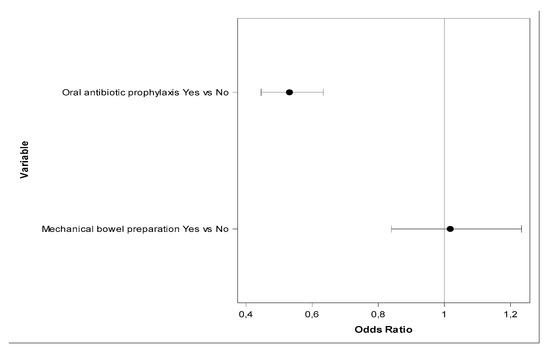
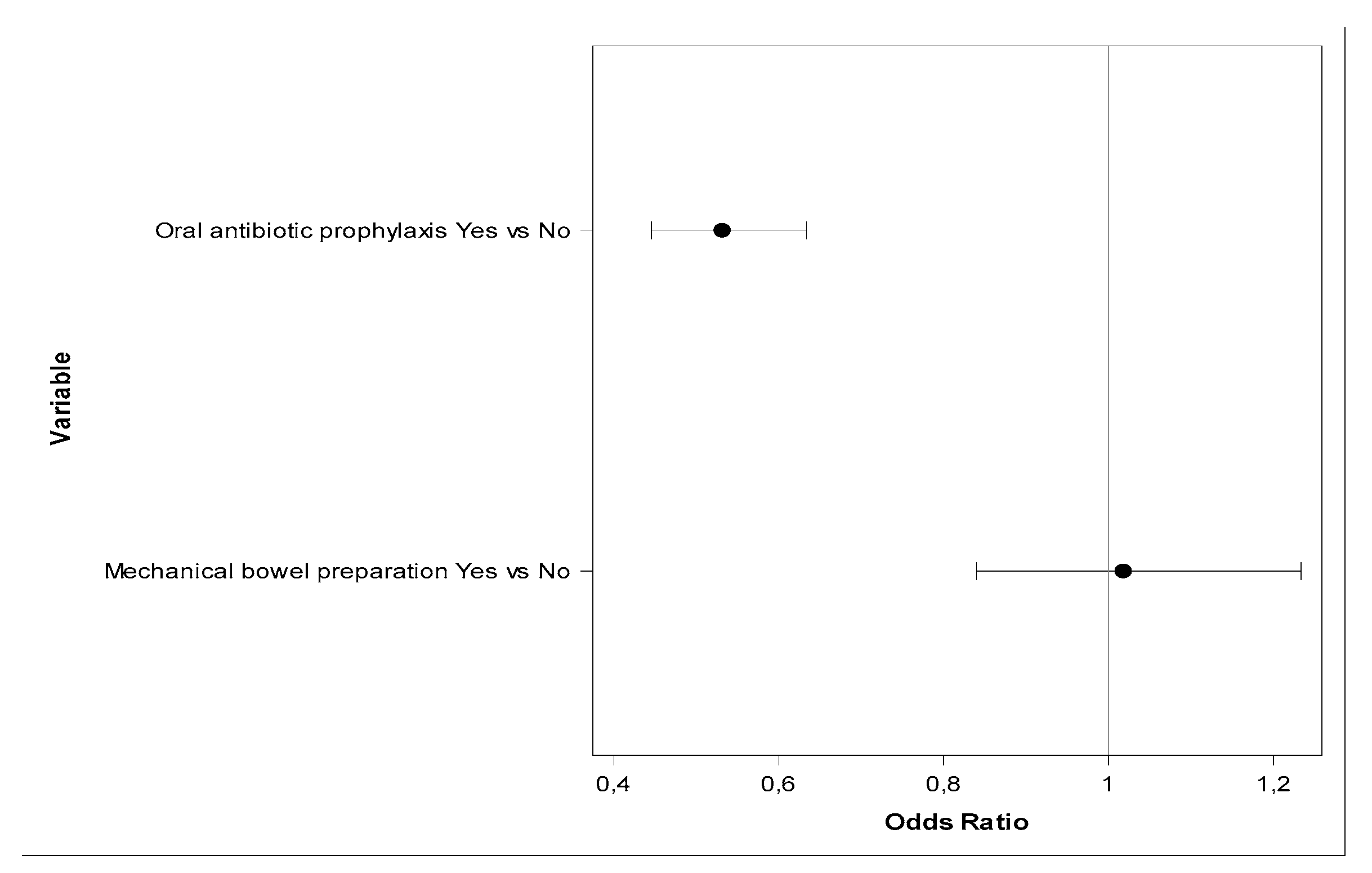
However, in a multivariate analysis of the six measures included in the bundle, OAP maintained its statistical significance (OR 0.531, CI95 0.445–0.634; p < 0.0001), but MBP was not associated with a significant decrease in SSI rate (OR 1.017, CI95 0.839–1.23; p = 0.8584) (Table 5, Figure 1). Adequate systemic antibiotic prophylaxis, laparoscopic technique, and use of double-ring wound retractor also showed a significant protective effect, whereas maintenance of normothermia did not.
Figure 1.
OR with 95% confidence interval for variables OAP and MBP from multivariate logistic model, with response variable SSI and antibiotic prophylaxis, laparoscopy, OAP, MBP and wound retractor as independent variables.
Increasing bundle compliance was associated with lower SSI risk. Patients who received one measure of the bundle had a 16.7% of overall SSI rate, compared to those receiving all six measures, who had a rate of 5.8% (OR 3.250, CI95 1.555–6.794; p < 0.0001).
The effects of OAP were further analyzed by year of surgery (Table 6), and their protective effects remained stable across 2016–2019.
Table 6.
Trends in the effect of OAP on overall SSI during the study period.
3.3. Organ-Space SSI
Patients who received OAP had an O/S-SSI rate of 4.6%, compared to 7.5% who did not (X2 = 32.06, p < 0.0001, Table 3). Administration of OAP was associated with a lower rate of O/S-SSI (OR, 0.592, 0.494–0.710) (Table 7).
Table 7.
Effect of OAP and MBP on organ-space SSI.
The group of patients with MBP had an O/S-SSI rate of 5.0%, compared to 6.4% who did not (X2 = 6.3486, p = 0.0117), with MBP an independent factor associated with lower O/S-SSI in univariate analyses (OR, 0.771, CI95 0.630–0.944) (Table 7).
Nevertheless, the multivariate analyses showed that OAP, but not MBP, remained as a protective factor for O/S-SSI (OR 0.585, CI95 0.465–0.735, p < 0.0001 (Table 7).
4. Discussion
In this study, based on data from the colectomy-targeted VINCat database, the implementation of a bundle of six measures including OAP and MBP was associated with a significant decrease in SSI, O/S-SSI, LOS and mortality. OAP was an independent protective factor against SSI and O/S-SSI, both in univariate and multivariate analyses. This effect remained stable during the study time period.
OAP and MBP are controversial SSI preventative measures which are exclusive for colorectal surgery [36,37,38]. For the last two decades, the development of multimodal rehabilitation programs in colorectal surgery [42], and the publication of several conflicting studies, have fueled this controversy, leading to a significant decrease in MBP and OAP prescription rates worldwide. In 2017, a European survey showed an oral prophylaxis use of only 11% and a routine use of MBP of 29.6% [43].
Nevertheless, in recent years, some authors have begun to advocate for a re-evaluation of the indication of OAP alone or combined with MBP in patients undergoing elective colon or rectal surgery [29,44,45,46].
In 2019, an innovative superiority trial compared MOABP with no bowel preparation in elective colectomy [47]. The analysis of 396 patients did not find differences in SSI rates (7% vs. 11%; OR 1.65, CI95 0.80–3.40; p = 0.17). However, even the authors acknowledge the trial was underpowered to detect this small difference in SSI rate (4%) and to demonstrate the possibility of a benefit in using MOABP, when compared to no preparation [47,48].
Another multicenter randomized trial compared no MOABP with OAP administration (without MBP) in 565 patients. OAP was associated with a reduction in the risk of SSI, although this was only significant for superficial SSIs, due to the low number of infections detected in each subgroup [49].
While waiting for the confirmation of this new evidence, authorized surgical researchers think that the MOABP strategy should not be disregarded, but rather adjusted to the new findings in gut microbiome [45]. Non-antibiotic approaches to limit SSI-related pathogens while preserving beneficial bacteria of the intestinal microbiota have been proposed [45]. In this context of conflicting reports, the debate continues. In the meantime, it seems that the classic formulation of MOABP should be pragmatically tested, and cohort studies including a large number of procedures would probably be able to clarify the situation.
Pragmatic studies focus on an individual decision maker within an actual real-world situation, and put practical solutions above philosophical discussions. This approach to the problem within its broadest context seeks to better understand and ultimately solve the problem [50]. This present pragmatic prospective cohort study analyzed a large national database over nine years and was designed to answer the question whether OAP alone or in combination with MBP lowers SSI, among other postoperative complications.
In summary, the use of OAP correlates with lower SSI, OS-SSI, LOS, and mortality. We think our results can be generalized and are in accordance with those of recent randomized trials [51] and cohort studies [52,53], where MOABP was shown to be significantly associated with reduced risk of SSI in open and laparoscopic colorectal surgery.
The most recent guidelines of several scientific societies also recommend the inclusion of MOABP in their bundles of care for colorectal surgery, even in the setting of enhanced recovery after surgery (ERAS) programs [54,55].
Strengths and Limitations of the Study
This work has several limitations. First, even though the sequential study groups are to some extent homogeneous, some other interventions implemented during the frame time of the study, such as the increased use of the laparoscopic technique, may have interfered with the results. Second, due to the characteristics of the data collection, some related secondary data, for example anastomotic leakage, were not analyzed. However, we think that the data are consistent, precise and reliable, if we give due consideration to the high number of procedures evaluated and its prospective origin, within the framework of a well-consolidated infection surveillance program.
5. Conclusions
A SSI reduction bundle including OAP and MBP was associated with a significantly reduced risk of overall SSI and O/S-SSI. OAP was a strong and independent protective factor against all types of SSI, including O/S-SSI. There is also evidence to suggest that the value of OAP did not decrease over time. Given the strength of the sample size, this may support the routine use of OAP combined with MBP in elective colorectal surgery.
Future prospective trials should clarify the role of OAP in the absence of MBP in this type of surgery.
Author Contributions
Conceptualization, J.M.B., M.F.-Y., N.A.-G., E.L. and M.P. (Miquel Pujol); Data curation, M.F.-Y., J.L.-C., E.L. and Members of the VINCat Colorectal Surveillance Team; Formal analysis, A.V.; Methodology, J.M.B., M.F.-Y. and A.V.; Project administration, J.M.B. and M.P. (Miquel Pujol); Supervision, D.P., M.P. (Miguel Pera), J.L.-C. and M.P. (Miquel Pujol); Validation, A.V.; Visualization, J.M.B. and M.F.-Y.; Writing—original draft, J.M.B. and M.F.-Y.; Writing—review & editing, J.M.B., M.F.-Y., A.V., N.A.-G., M.P.-A., D.P., M.P. (Miguel Pera), J.L.-C., E.L. and M.P. (Miquel Pujol). All authors have read and agreed to the published version of the manuscript.
Funding
This research received no external funding.
Institutional Review Board Statement
The study was conducted according to the guidelines of the Declaration of Helsinki, and approved by the Research Ethics Committee of the Hospital General Universitari de Granollers with code 2021006.
Informed Consent Statement
Patient consent was waived by the Research Ethics Committee due to the retrospective nature of the study, the analysis used anonymous clinical data, and its extraction for the study was covered by the general admission consent of the patient.
Data Availability Statement
Restrictions apply to the availability of these data, which belong to a national database and are not publicly available. Data were obtained from VINCat and are only available with the permission of the VINCat Technical Committee.
Acknowledgments
The authors thank David Morton for his review of the manuscript. We thank CERCA Programme/Generalitat de Catalunya for the institutional support.
Conflicts of Interest
The authors declare no conflict of interest.
Appendix A. Members of the VINCat Colorectal Surveillance Team
Cecilia Diaz, Department of Anaesthesiology. Hospital Universitari Sant Pau. Barcelona, Spain. CDiez@santpau.cat; Marta Piriz Infection control team. Hospital Universitari Sant Pau. Barcelona, Spain. Mpirizm@santpau.cat; Domenico Fraccalvieri, Department of Surgery, Hospital Universitari de Bellvitge. L’Hospitalet de Llobregat, Spain. dofrac@yahoo.es; Anna Abad, Department of Anaesthesiology, Hospital Universitari Vall d’Hebrón, Barcelona, Spain. aat23865@yahoo.es; Lucrecia López, Infection control team. Hospital de Sant Joan Despí Moisès Broggi, Spain. lucre.lopez@sanitatintegral.org.
References
- European Centre for Disease Prevention and Control. Point Prevalence Survey of Healthcare-Associated Infections and Antimicrobial Use in European Acute Care Hospitals 2011. 2012; ECDC: Stockholm, Sweden, 2013. Available online: https://www.ecdc.europa.eu/en/publications-data/surveillance-surgical-site-infections-europe-2010-2011 (accessed on 13 August 2021).
- Study of Prevalence of Nosocomial Infections in Spain. EPINE Website. 2016. Available online: https://epine.es/api/documento-publico/2019%20EPINE%20Informe%20Espa%C3%B1a%2027112019.pdf/reports-esp (accessed on 23 August 2021).
- Smith, R.L.; Bohl, J.K.; McElearney, S.T.; Friel, C.M.; Barclay, M.M.; Sawyer, R.G.; Foley, E.F. Wound infection after elective colorectal resection. Ann. Surg. 2004, 239, 599–605. [Google Scholar] [CrossRef] [Scilit] [PubMed]
- Cannon, J.A.; Altom, L.K.; Deierhoi, R.J.; Morris, M.; Richman, J.S.; Vick, C.C.; Itani, K.M.; Hawn, M.T. Preoperative oral antibiotics reduce surgical site infection following elective colorectal resections. Dis. Colon Rectum 2012, 55, 1160–1166. [Google Scholar] [CrossRef] [Scilit] [PubMed]
- Pujol, M.; Limón, E.; López-Contreras, J.; Sallés, M.; Bella, F.; Gudiol, F. Surveillance of surgical site infections in elective colorectal surgery. Results of the VINCat Program (2007–2010). Enferm. Infecc. Microbiol. Clin. 2012, 30, 20–25. [Google Scholar] [CrossRef] [Scilit]
- Paulson, E.C.; Thompson, E.; Mahmoud, N. Surgical Site Infection and Colorectal Surgical Procedures: A Prospective Analysis of Risk Factors. Surg. Infect. 2017, 18, 520–526. [Google Scholar] [CrossRef] [Scilit] [PubMed]
- Badia, J.M.; Casey, A.L.; Petrosillo, N.; Hudson, P.; Mitchell, S.; Crosby, C. Impact of surgical site infection on healthcare costs and patient outcomes: A systematic review in six European countries. J. Hosp. Infect. 2017, 96, 1–15. [Google Scholar] [CrossRef] [Scilit]
- Shaw, E.; Badia, J.M.; Piriz, M.; Escofet, R.; Limon, E.; Gudiol, F. O053: What surgical site infection rates in colorectal surgery should be considered for benchmarking standards? Antimicrob. Resist. Infect. Control. 2013, 2, O53. [Google Scholar] [CrossRef] [Scilit]
- Harbarth, S.; Sax, H.; Gastmeier, P. The preventable proportion of nosocomial infections: An overview of published reports. J. Hosp. Infect. 2003, 54, 258–266. [Google Scholar] [CrossRef] [Scilit]
- Keighley, M.R.; Arabi, Y.; Alexander-Williams, J.; Youngs, D.; Burdon, D.W. Comparison between systemic and oral antimicrobial prophylaxis in colorectal surgery. Lancet 1979, 1, 894–897. [Google Scholar] [CrossRef] [Scilit]
- Bucher, P.; Gervaz, P.; Soravia, C.; Mermillod, B.; Erne, M.; Morel, P. Randomized clinical trial of mechanical bowel preparation versus no preparation before elective left-sided colorectal surgery. Br. J. Surg. 2005, 92, 409–414. [Google Scholar] [CrossRef] [Scilit]
- Solla, J.A.; Rothenberger, D.A. Preoperative bowel preparation. A survey of colon and rectal surgeons. Dis. Colon Rectum 1990, 33, 154–159. [Google Scholar] [CrossRef] [Scilit] [PubMed]
- Nichols, R.L.; Smith, J.W.; Garcia, R.Y.; Waterman, R.S.; Holmes, J.W. Current practices of preoperative bowel preparation among North American colorectal surgeons. Clin. Infect. Dis. 1997, 24, 609–619. [Google Scholar] [CrossRef] [Scilit]
- Zmora, O.; Wexner, S.D.; Hajjar, L.; Park, T.; Efron, J.E.; Nogueras, J.J.; Weiss, E.G. Trends in preparation for colorectal surgery: Survey of the members of the American Society of Colon and Rectal Surgeons. Am. Surg. 2003, 69, 150–154. [Google Scholar]
- Markell, K.W.; Hunt, B.M.; Charron, P.D.; Kratz, R.J.; Nelson, J.; Isler, J.T.; Steele, S.R.; Billingham, R.P. Prophylaxis and management of wound infections after elective colorectal surgery: A survey of the American Society of Colon and Rectal Surgeons membership. J. Gastrointest. Surg. 2010, 14, 1090–1098. [Google Scholar] [CrossRef] [Scilit] [PubMed]
- Badia, J.M.; Casey, A.L.; Rubio-Pérez, I.; Arroyo-García, N.; Espin, E.; Biondo, S.; Balibrea, J.M. Awareness of Practice and Comparison with Best Evidence in Surgical Site Infection Prevention in Colorectal Surgery. Surg Infect. 2020, 21, 218–226. [Google Scholar] [CrossRef] [Scilit]
- Zhu, Q.D.; Zhang, Q.Y.; Zeng, Q.Q.; Yu, Z.P.; Tao, C.L.; Yang, W.J. Efficacy of mechanical bowel preparation with polyethylene glycol in prevention of postoperative complications in elective colorectal surgery: A meta-analysis. Int. J. Colorectal Dis. 2010, 25, 267–275. [Google Scholar] [CrossRef] [Scilit] [PubMed]
- Güenaga, K.F.; Matos, D.; Wille-Jørgensen, P. Mechanical bowel preparation for elective colorectal surgery. Cochrane Database Syst. Rev. 2011, 2011, CD001544. [Google Scholar] [CrossRef] [Scilit]
- Cao, F.; Li, J.; Li, F. Mechanical bowel preparation for elective colorectal surgery: Updated systematic review and meta-analysis. Int. J. Colorectal Dis. 2012, 27, 803–810. [Google Scholar] [CrossRef] [Scilit]
- Courtney, D.E.; Kelly, M.E.; Burke, J.P.; Winter, D.C. Postoperative outcomes following mechanical bowel preparation before proctectomy: A meta-analysis. Colorectal Dis. 2015, 17, 862–869. [Google Scholar] [CrossRef] [Scilit]
- Dahabreh, I.J.; Steele, D.W.; Shah, N.; Trikalinos, T.A. Oral Mechanical Bowel Preparation for Colorectal Surgery: Systematic Review and Meta-Analysis. Dis. Colon Rectum 2015, 58, 698–707. [Google Scholar] [CrossRef] [Scilit]
- Rollins, K.E.; Javanmard-Emamghissi, H.; Lobo, D.N. Impact of mechanical bowel preparation in elective colorectal surgery: A meta-analysis. World J. Gastroenterol. 2018, 24, 519–536. [Google Scholar] [CrossRef] [Scilit]
- Lewis, R.T. Oral versus systemic antibiotic prophylaxis in elective colon surgery: A randomized study and meta-analysis send a message from the 1990s. Can. J. Surg. 2002, 45, 173–180. [Google Scholar]
- Oshima, T.; Takesue, Y.; Ikeuchi, H.; Matsuoka, H.; Nakajima, K.; Uchino, M.; Tomita, N.; Sasako, M. Preoperative oral antibiotics and intravenous antimicrobial prophylaxis reduce the incidence of surgical site infections in patients with ulcerative colitis undergoing IPAA. Dis. Colon Rectum 2013, 56, 1149–1155. [Google Scholar] [CrossRef] [Scilit]
- Sadahiro, S.; Suzuki, T.; Tanaka, A.; Okada, K.; Kamata, H.; Ozaki, T.; Koga, Y. Comparison between oral antibiotics and probiotics as bowel preparation for elective colon cancer surgery to prevent infection: Prospective randomized trial. Surgery 2014, 155, 493–503. [Google Scholar] [CrossRef] [Scilit]
- Anthony, T.; Murray, B.W.; Sum-Ping, J.T.; Lenkovsky, F.; Vornik, V.D.; Parker, B.J.; McFarlin, J.E.; Hartless, K.; Huerta, S. Evaluating an evidence-based bundle for preventing surgical site infection: A randomized trial. Arch. Surg. 2011, 146, 263–269. [Google Scholar] [CrossRef] [Scilit]
- Allegranzi, B.; Bischoff, P.; de Jonge, S.; Kubilay, N.Z.; Zayed, B.; Gomes, S.M.; Abbas, M.; Atema, J.J.; Gans, S.; van Rijen, M.; et al. New WHO recommendations on preoperative measures for surgical site infection prevention: An evidence-based global perspective. Lancet Infect. Dis. 2016, 16, e276–e287. [Google Scholar] [CrossRef] [Scilit]
- Nelson, R.L.; Glenny, A.M.; Song, F. Antimicrobial prophylaxis for colorectal surgery. Cochrane Database Syst. Rev. 2014, 2014, CD001181. [Google Scholar] [CrossRef] [Scilit]
- Fry, D.E. Colon preparation and surgical site infection. Am. J. Surg. 2011, 202, 225–232. [Google Scholar] [CrossRef] [Scilit]
- Bellows, C.F.; Mills, K.T.; Kelly, T.N.; Gagliardi, G. Combination of oral non-absorbable and intravenous antibiotics versus intravenous antibiotics alone in the prevention of surgical site infections after colorectal surgery: A meta-analysis of randomized controlled trials. Tech. Coloproctol. 2011, 15, 385–395. [Google Scholar] [CrossRef] [Scilit]
- Nelson, R.L.; Gladman, E.; Barbateskovic, M. Antimicrobial prophylaxis for colorectal surgery. Cochrane Database Syst. Rev. 2014, 2014, CD001181. [Google Scholar] [CrossRef] [Scilit]
- Chen, M.; Song, X.; Chen, L.Z.; Lin, Z.D.; Zhang, X.L. Comparing Mechanical Bowel Preparation with Both Oral and Systemic Antibiotics Versus Mechanical Bowel Preparation and Systemic Antibiotics Alone for the Prevention of Surgical Site Infection After Elective Colorectal Surgery: A Meta-Analysis of Randomized Controlled Clinical Trials. Dis. Colon Rectum 2016, 59, 70–78. [Google Scholar] [CrossRef] [Scilit]
- Englesbe, M.J.; Brooks, L.; Kubus, J.; Luchtefeld, M.; Lynch, J.; Senagore, A.; Eggenberger, J.C.; Velanovich, V.; Campbell, D.A., Jr. A statewide assessment of surgical site infection following colectomy: The role of oral antibiotics. Ann. Surg. 2010, 252, 514–519. [Google Scholar] [CrossRef] [Scilit]
- Morris, M.S.; Graham, L.A.; Chu, D.I.; Cannon, J.A.; Hawn, M.T. Oral Antibiotic Bowel Preparation Significantly Reduces Surgical Site Infection Rates and Readmission Rates in Elective Colorectal Surgery. Ann. Surg. 2015, 261, 1034–1040. [Google Scholar] [CrossRef] [Scilit]
- Badia, J.M.; Arroyo-García, N. Bowel mechanical preparation and oral antibiotic prophylaxis in colorectal surgery. Analysis and narrative review of scientific evidence. Cir. Esp. 2018, 96, 317–325. [Google Scholar] [CrossRef] [Scilit]
- Nichols, R.L.; Choe, E.U.; Weldon, C.B. Mechanical and antibacterial bowel preparation in colon and rectal surgery. Chemotherapy 2005, 51, 115–121. [Google Scholar] [CrossRef] [Scilit]
- Hayashi, M.S.; Wilson, S.E. Is there a current role for preoperative non-absorbable oral antimicrobial agents for prophylaxis of infection after colorectal surgery? Surg. Infect. 2009, 10, 285–288. [Google Scholar] [CrossRef] [Scilit]
- Murray, B.W.; Huerta, S.; Dineen, S.; Anthony, T. Surgical site infection in colorectal surgery: A review of the nonpharmacologic tools of prevention. J. Am. Coll Surg. 2010, 211, 812–822. [Google Scholar] [CrossRef] [Scilit]
- Garner, J.S.; Jarvis, W.R.; Emori, T.G.; Horan, T.C.; Hughes, J.M. CDC definitions for nosocomial infections, 1988. Am. J. Infect. Control. 1988, 16, 128–140. [Google Scholar] [CrossRef] [Scilit]
- Horan, T.C.; Gaynes, R.P.; Martone, W.J.; Jarvis, W.R.; Emori, T.G. CDC definitions of nosocomial surgical site infections, 1992: A modification of CDC definitions of surgical wound infections. Infect. Control. Hosp. Epidemiol. 1992, 13, 606–608. [Google Scholar] [CrossRef] [Scilit]
- von Elm, E.; Altman, D.G.; Egger, M.; Pocock, S.J.; Gøtzsche, P.C.; Vandenbroucke, J.P. The Strengthening the Reporting of Observational Studies in Epidemiology (STROBE) statement: Guidelines for reporting observational studies. J. Clin. Epidemiol. 2008, 61, 344–349. [Google Scholar] [CrossRef] [Scilit] [PubMed]
- Kehlet, H.; Wilmore, D.W. Multimodal strategies to improve surgical outcome. Am. J. Surg. 2002, 183, 630–641. [Google Scholar] [CrossRef] [Scilit]
- Devane, L.A.; Proud, D.; O’Connell, P.R.; Panis, Y. A European survey of bowel preparation in colorectal surgery. Colorectal Dis. 2017, 11, O402–O406. [Google Scholar] [CrossRef] [Scilit]
- Fry, D.E. Infection control in colon surgery. Langenbecks Arch. Surg. 2016, 401, 581–597. [Google Scholar] [CrossRef] [Scilit]
- Alverdy, J.C.; Shogan, B.D. Preparing the bowel for surgery: Rethinking the strategy. Nat. Rev. Gastroenterol Hepatol. 2019, 16, 708709. [Google Scholar] [CrossRef] [Scilit] [PubMed]
- Pellino, G.; Espin-Basany, E. Bowel decontamination before colonic and rectal surgery. Br. J. Surg. 2021. [Google Scholar] [CrossRef] [Scilit]
- Koskenvuo, L.; Lehtonen, T.; Koskensalo, S.; Rasilainen, S.; Klintrup, K.; Ehrlich, A.; Pinta, T.; Scheinin, T.; Sallinen, V. Mechanical and oral antibiotic bowel preparation versus no bowel preparation for elective colectomy (MOBILE): A multicentre, randomised, parallel, single-blinded trial. Lancet 2019, 394, 840848. [Google Scholar] [CrossRef] [Scilit]
- Wexner, S.D.; Yellinek, S. Is preoperative bowel preparation needed before elective colectomy? Lancet 2019, 394, 808810. [Google Scholar] [CrossRef] [Scilit]
- Espin Basany, E.; Solís-Peña, A.; Pellino, G.; Kreisler, E.; Fraccalvieri, D.; Muinelo-Lorenzo, M.; Maseda-Díaz, O.; García-González, J.M.; Santamaría-Olabarrieta, M.; Codina-Cazador, A.; et al. Preoperative oral antibiotics and surgical-site infections in colon surgery (ORALEV): A multicentre, single-blind, pragmatic, randomised controlled trial. Lancet Gastroenterol. Hepatol. 2020, 5, 729738. [Google Scholar] [CrossRef] [Scilit]
- Salkind, N.J. Pragmatic Study. In Encyclopedia of Research Design; Salkind, N.J., Ed.; SAGE Publications, Inc.: Thousand Oaks, CA, USA, 2010; Volume 5, p. 1073. Available online: https://methods.sagepub.com/Reference//encyc-of-research-design/n326.xml (accessed on 12 August 2021). [CrossRef] [Scilit]
- Papp, G.; Saftics, G.; Szabó, B.E.; Baracs, J.; Vereczkei, A.; Kollár, D.; Oláh, A.; Mészáros, P.; Dubóczki, Z.; Bursics, A. Systemic versus Oral and Systemic Antibiotic Prophylaxis (SOAP) study in colorectal surgery: Prospective randomized multicentre trial. Br. J. Surg. 2021, 108, 271276. [Google Scholar] [CrossRef] [Scilit] [PubMed]
- Luo, J.; Liu, Z.; Pei, K.Y.; Khan, S.A.; Wang, X.; Yang, M.; Wang, X.; Zhang, Y. The Role of Bowel Preparation in Open, Minimally Invasive, and Converted-to-Open Colectomy. J. Surg. Res. 2019, 242, 183192. [Google Scholar] [CrossRef] [Scilit]
- Hoang, S.C.; Klipfel, A.A.; Roth, L.A.; Vrees, M.; Schechter, S.; Shah, N. Colon and rectal surgery surgical site infection reduction bundle: To improve is to change. Am. J. Surg. 2019, 217, 4045. [Google Scholar] [CrossRef] [Scilit]
- Holubar, S.D.; Hedrick, T.; Gupta, R.; Kellum, J.; Hamilton, M.; Gan, T.J.; Mythen, M.G.; Shaw, A.D.; Miller, T.E.; Perioperative Quality Initiative (POQI) I Workgroup. American Society for Enhanced Recovery (ASER) and Perioperative Quality Initiative (POQI) joint consensus statement on prevention of postoperative infection within an enhanced recovery pathway for elective colorectal surgery. Perioper. Med. 2017, 6. [Google Scholar] [CrossRef] [Scilit] [PubMed]
- Gustafsson, U.O.; Scott, M.J.; Hubner, M.; Nygren, J.; Demartines, N.; Francis, N.; Rockall, T.A.; Young-Fadok, T.M.; Hill, A.G.; Soop, M.; et al. Guidelines for Perioperative Care in Elective Colorectal Surgery: Enhanced Recovery After Surgery (ERAS®) Society Recommendations: 2018. World J. Surg. 2019, 43, 659695. [Google Scholar] [CrossRef] [Scilit] [PubMed]

Publisher’s Note: MDPI stays neutral with regard to jurisdictional claims in published maps and institutional affiliations. |
© 2021 by the authors. Licensee MDPI, Basel, Switzerland. This article is an open access article distributed under the terms and conditions of the Creative Commons Attribution (CC BY) license (https://creativecommons.org/licenses/by/4.0/).