


Abstract
Metformin, a widely prescribed antidiabetic drug, is a representative small (≈0.5–0.6 nm), hydrophilic (log P ≈ −1.43), and positively charged (pKₐ ≈ 12.4) emerging contaminant. Because its molecular size is well below the pore size of ultrafiltration membranes (>2 nm), it cannot be efficiently removed by size exclusion alone, and its high solubility and poor biodegradability further complicate conventional treatment. In this context, hybrid ceramic membranes incorporating adsorptive functionalities offer a promising alternative. However, the fouling behavior of such hybrid systems remains quantitatively uncharacterized. This study provides a quantitative assessment of flux decline and fouling reversibility in kaolin-based membranes containing 0, 5, and 10 wt.% activated carbon, evaluated for metformin removal under dead-end filtration at 4 bars, using a synthetic feed concentration of 20 mg L−1 at neutral pH (≈6.8) over 60 min. Increasing AC content raises open porosity from 29.1% (M0%) to 34.2% (M5%) and 39.1% (M10%), and water permeability from 3.3 to 10.9 and 28.4 L m−2 h−1 bar−1, respectively, without significantly compromising mechanical integrity (>20 MPa). The porosity enhancement is accompanied by a systematic improvement in apparent metformin removal, consistent with a contribution from carbon- and phosphorus-containing phases detected after thermal treatment (which provides abundant surface functional groups for electrostatic and π–π interactions) and is consistent with the observed improvement in permeability and apparent metformin removal. Consequently, metformin apparent removal after 60 min increases from 56.1% (M0%) to 76.2% (M5%) and 91.1% (M10%), while total fouling decreases from 38.5% to 20.5% and 11.0%, and irreversible fouling from 23.1% to 13.6% and 6.0%, respectively.
1. Introduction
Metformin is one of the most widely prescribed antidiabetic drugs worldwide, with an annual consumption exceeding 150,000 tonnes [1]. Due to its high solubility (>300 g L−1) and poor biodegradability, it has become a pervasive aquatic contaminant. Concentrations ranging from 0.1 to 300 µg L−1 are routinely detected in wastewater effluents, while surface waters contain up to 40 µg L−1, and even drinking water sources contain traces in the ng L−1 range [2,3]. Conventional activated sludge processes remove less than 20% of metformin, leading to its continuous environmental release and raising concerns regarding long-term ecological and human health effects [4,5,6].
The removal of metformin is particularly challenging due to its unique physicochemical profile. With a molecular size of approximately 0.5–0.6 nm, the drug cannot be effectively rejected by ultrafiltration (UF) membranes, whose pore sizes typically exceed 2 nm [7,8]. Its high hydrophilicity (log P ≈ −1.43) minimizes hydrophobic partitioning onto membrane surfaces, while its cationic nature at neutral pH (pKa ≈ 12.4) introduces electrostatic interactions that can be either beneficial or detrimental depending on the membrane surface charge. Nanofiltration (NF) [9] and reverse osmosis (RO) can achieve rejection rates above 90%, but they are energy-intensive (3–6 kWh m−3 versus 0.1–0.5 kWh m−3 for UF) and are associated with low water permeability [10]. This underlines the need for high-permeability membranes combining size exclusion with adsorption mechanisms [11].
Ceramic membranes offer high chemical, thermal, and mechanical stability, allowing operation under harsh conditions and aggressive cleaning protocols [12,13]. However, pristine ceramic materials such as kaolin-based membranes exhibit limited performance for small hydrophilic molecules like metformin: they lack both sufficient porosity and appropriate surface functional groups for effective adsorption or electrostatic retention [14]. The interaction between metformin and ceramic surfaces is governed by electrostatic attraction to negatively charged sites (e.g., silanol and aluminol groups at neutral pH), but this interaction is often weak and reversible, leading to limited rejection and significant fouling over extended operation.
A promising approach to overcome these limitations is to incorporate activated carbon (AC) into the ceramic matrix. Activated carbon provides a well-developed micro- and mesoporous structure with a large specific surface area (500–1500 m2 g−1), enabling strong adsorption of organic molecules via hydrogen bonding and π–π interactions [4,15]. The specific adsorption mechanisms for metformin on carbonaceous surfaces include:
- (i)
- Electrostatic attraction between protonated metformin and negatively charged oxygen-containing functional groups (carboxyl, hydroxyl, carbonyl) present on the AC surface;
- (ii)
- Hydrogen bonding between amine groups of metformin and surface oxygen functionalities;
- (iii)
- π–π stacking interactions between the aromatic-like carbon basal planes and the electron-rich guanidine moiety of metformin [2,15,16,17].
Importantly, the adsorption on carbon surfaces is generally more reversible than on clay minerals, which is advantageous for membrane cleanability.
Incorporating AC directly into the ceramic membrane enables the combination of adsorption and filtration within a single material, eliminating the need for additional post-treatment steps [3,18,19]. Moreover, using waste-derived precursors introduces a circular economy perspective [20]. Spent coffee grounds (SCG), an abundant urban waste stream (≈8 million tonnes per year globally), can be converted into activated carbon by thermal or chemical activation [21,22]. Their valorization as functional additives not only reduces material costs but also contributes to waste minimization and sustainable material design [20].
Recent advances in hybrid ceramic membranes for pharmaceutical removal have explored various strategies. Romdhani et al. (2024) [23] developed a sepiolite-based UF membrane sintered at 650 °C, achieving a pure water permeability of around 18 L.m−2 h−1 bar−1 and good performance toward paracetamol. However, their study did not thoroughly examine fouling kinetics or reversibility. Similarly, Fu et al. (2026) [24] developed heterophase YS-Al2O3/α-Al2O3 ceramic membranes for tetracycline and norfloxacin removal, achieving high rejection (>95%) but without detailed fouling analysis. The coupling of powdered activated carbon (PAC) with ceramic supports has also been investigated. Viegas et al. (2020) [25] coupled PAC with ceramic microfiltration for carbamazepine, sulfamethoxazole, ibuprofen, and atenolol removal, achieving 15–18% additional removal via adsorption without significant PAC-induced fouling. However, they did not provide detailed kinetic analysis of flux decline or differentiate between reversible and irreversible fouling.
Polak et al. (2021) [26] incorporated multi-walled carbon nanotubes or graphene oxide into ceramic membranes for tetracycline removal, achieving a high permeate flux (520 L·m−2·h−1·bar−1) but only 45.4% rejection, without evaluating fouling kinetics. Other hybrid systems, such as those incorporating PAC and copper nanoparticles, have shown significant reductions in fouling resistance (45–90% in some cases), but most studies still fail to clearly differentiate reversible/irreversible fouling contributions or model the transition between internal pore blocking and surface cake layer formation [27]. Ainscough et al. (2017) [27] developed a hybrid superhydrophilic ceramic membrane with carbon nanotubes for heavy metal removal, achieving enhanced flux and reduced fouling, but the system was not applied to pharmaceutical compounds.
A critical gap in the existing literature concerns the relationship between membrane structure, interfacial properties, and fouling behavior. In particular, the extent to which carbon incorporation modifies flux decline and fouling reversibility in ceramic membranes treating small hydrophilic pollutants remains insufficiently quantified. In this context, systematic analysis of flux decline, hydraulic resistance, and reversible and irreversible fouling may provide useful phenomenological insight into how membrane composition affects fouling behavior.
While our previous work [3] confirmed that kaolin/SCG-derived carbon membranes sintered at 900 °C (with 15 wt.% SCG) achieve ~91% metformin removal via size exclusion, electrostatic attraction, and hydrogen bonding, that study did not investigate the fouling dynamics underlying flux decline. The resistance-in-series model was not employed, the semi-empirical kinetic exponent *n* was not determined, and reversible versus irreversible fouling contributions were not distinguished. More importantly, quantitative comparisons of flux decline, hydraulic resistance, and fouling reversibility remain limited for hybrid ceramic membranes treating small hydrophilic compounds. These parameters can provide phenomenological insight into the effect of activated-carbon incorporation on fouling behavior.
In summary, while several ceramic and hybrid membranes have been investigated for pharmaceutical removal, none have comprehensively addressed both the kinetics of flux decline and the reversibility of fouling in kaolin/activated carbon systems treating small hydrophilic compounds such as metformin. However, the effect of AC incorporation on flux decline, fouling reversibility, and hydraulic resistance in kaolin-based membranes treating metformin remains insufficiently quantified. The present study therefore focuses on experimentally measurable fouling indicators rather than assigning a specific fouling location or molecular mechanism.
To fill this gap, flat ceramic membranes incorporating 0, 5, and 10% SCG-derived activated carbon in a kaolin matrix were fabricated and sintered at 900 °C. Their structural, mechanical, and hydraulic properties were systematically characterized, and their efficiency for metformin removal was evaluated under dead-end filtration conditions. Fouling behavior was analyzed in detail using the resistance-in-series model and a semi-empirical flux-decline model to determine the kinetic exponent *n*. The objective of this study is to assess whether waste-derived AC can improve both permeability and fouling reversibility, offering a promising sustainable approach for micropollutant control, and to provide mechanistic insight into how the physicochemical properties of small hydrophilic pollutants govern fouling behavior in hybrid ceramic systems.
2. Materials and Methods
2.1. Materials
The flat composite ceramic membranes were prepared using natural kaolinite clay (DD3), sourced from northwest Algeria and widely reported in the literature for membrane fabrication. The pore-forming agent consisted of activated carbon derived from spent coffee grounds (SCG), synthesized according to our previously reported method [15]. All aqueous solutions were prepared using deionized water (18 MΩ.cm, Millipore Milli-Q system). When required, the pH was adjusted using 0.1 M sodium hydroxide (NaOH) and 0.1 M hydrochloric acid (HCl).
2.2. Preparation of Flat Ceramic Membranes
Activated carbon derived from spent coffee grounds (SCG) was prepared according to the procedure reported in our previous work [15]. Briefly, SCG was chemically activated with phosphoric acid, followed by sintering at 600 °C for 2 h. Before membrane fabrication, both SCG-derived carbon and DD3 clay were dried at 110 °C for 24 h to remove residual moisture. The dried materials were then ground and sieved to obtain particles with a size smaller than 100 µm.
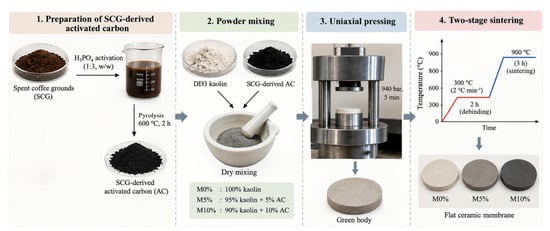
Flat ceramic membranes were fabricated via a dry-pressing method. The SCG-derived carbon activated was mixed with DD3 clay at different weight fractions (M0%: 100% kaolin M5%: 95% kaolin + 5% AC and M10%: 90% kaolin + 10% AC). The homogeneous powder mixture was introduced into a cylindrical mold (50 mm diameter) and uniaxially pressed at 940 bars for 5 min using a hydraulic press to form disc-shaped membranes.
The obtained green bodies were subjected to thermal treatment in a programmable furnace. The heating protocol consisted of an initial stage from room temperature to 300 °C at a rate of 2 °C min−1, followed by a dwell time of 2 h to ensure the removal of physically adsorbed water and residual organic compounds. Subsequently, the temperature was increased to 900 °C at a rate of 3 °C·min−1 in an air atmosphere and maintained for 3 h to achieve complete sintering and ensure the formation of a stable porous structure.
The sequential steps of the membrane fabrication process, including activated carbon preparation, powder mixing, uniaxial pressing, and the two-stage sintering profile, are summarized in the schematic flow diagram (Figure 1). The key parameters (temperatures, dwell times, applied pressure, and AC weight fractions) are annotated directly in the figure to facilitate experimental reproducibility.
Figure 1.
Schematic diagram of the membrane fabrication process: (1) SCG-derived activated carbon preparation (drying at 110 °C, H3PO4 activation, pyrolysis at 600 °C for 2 h); (2) dry mixing of kaolin and AC at 0–10 wt.% ratios; (3) uniaxial pressing at 940 bars for 5 min; (4) two-stage sintering (debinding at 300 °C for 2 h, then sintering at 900 °C for 3 h).
2.3. The Raw Materials and Membrane Characterization
The thermal behavior of activated carbon derived from spent coffee grounds was investigated using thermogravimetric analysis (TGA) with a simultaneous thermal analyzer (SDT Q600 V20.9 Build 20, TA Instruments, USA). Measurements were performed in air at a heating rate of 10 °C·min−1 over a temperature range from 22 to 1000 °C. This analysis was conducted to elucidate the decomposition behavior of organic matter and its relationship with pore formation during the sintering process.
The morphology and microstructure of the AC and prepared membranes were analyzed using scanning electron microscopy (SEM). The surface of the prepared membranes was examined using scanning electron microscopy (SEM, Hitachi S-4800, Japan) at an accelerating voltage ranging from 5 to 15 kV. To ensure sufficient electrical conductivity, all samples were sputter-coated with a thin metallic layer before analysis.
Mechanical strength was evaluated using three-point bending tests with a universal testing system (Lloyd LRX, Lloyd Instruments, Fareham, UK). Rectangular specimens (45 mm × 12 mm × 3 mm) were tested with a support span of 30 mm at a crosshead speed of 0.5 mm min−1. The flexural strength was calculated according to standard beam theory. Reported values correspond to the average of at least three independent measurements.
Open porosity was determined using Archimedes’ principle. First, the dry mass of the membrane (Md) was recorded. The sample was then immersed in distilled water to measure its suspended mass (Msub). After saturation, the membrane was removed, gently wiped to remove excess surface water, and weighed to obtain the saturated mass (Msat). Porosity (%) was calculated using Equation (1):
The chemical stability of the membranes was evaluated by immersing optimized samples in acidic (HCl, pH 2) and alkaline (NaOH, pH 12) solutions at room temperature for 72 h. At 24 h intervals, the membranes were removed, rinsed with deionized water, dried at 105 °C to constant weight, and weighed to determine mass loss.
2.4. Filtration Test
To ensure statistical reproducibility, all measurements, including porosity, chemical stability, hydraulic permeability, metformin apparent removal, and fouling indices, were performed on three independently prepared coupons (n = 3) for each membrane composition (M0%, M5%, and M10%), with each coupon subjected to a single experimental run under strictly identical conditions.
2.4.1. Water Permeability
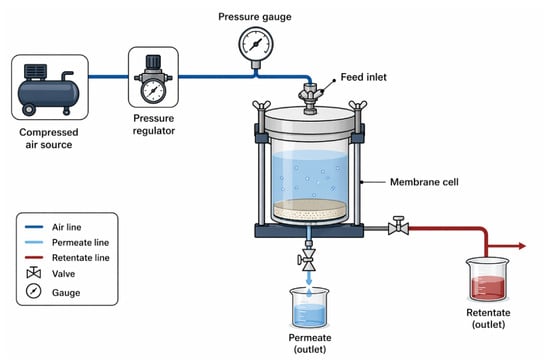
Water permeability experiments were measured at room temperature using deionized water in a dead-end filtration system. A schematic of the experimental setup is shown in Figure 2.
Figure 2.
Schematic diagram of the filtration plant.
The permeate flux (J) was calculated by measuring the permeate volume collected over time, as expressed in Equation (2):
where V is the permeate volume (L), A is the effective membrane area (m2), and t is the filtration time (h).
The hydraulic permeability (Lp) was then calculated using Darcy’s law:
where J is the permeate flux (L m−2 h−1), and Δp is the applied transmembrane pressure (bar), defined as the difference between the inlet and outlet pressures. In this study, the pressure on the permeate side was considered negligible.
2.4.2. Metformin Filtration Experiments
The pollutant removal performance was studied using a synthetic metformin solution prepared at a concentration of 20 mg L−1 (i.e., 20 mg of metformin per liter of solution). Membrane thickness was 3 ± 0.2 mm, and the membrane diameter was 50 mm, corresponding to a geometric surface area of 19.63 cm2 (19.63 × 10⁻⁴ m2). The effective filtration area was 19.63 cm2. The feed volume was 2 L. Filtration experiments were conducted at a transmembrane pressure of 4 bar and a temperature of 25 ± 1 °C. Membranes were pre-soaked in deionized water for 24 h before testing. Although the metformin concentration used here is higher than typical environmental levels (µg L−1 range), it was deliberately selected to enable reliable UV–Vis spectrophotometric detection and to promote measurable fouling and adsorption phenomena within the 60 min filtration period. Metformin concentrations were determined by UV–Vis spectrophotometry using a validated area-under-the-curve (AUC) method adapted from Kakade et al. [28]. The AUC was integrated over the wavelength range 221.0–240.8 nm, following the reported AUC method rather than relying on a single-wavelength measurement. A calibration curve was constructed over the range 5–25 µg·mL−1 using a solvent blank, yielding the regression equation y = 1.356x − 1.0245 (R2 = 0.9941). The limits of detection and quantification were 0.0070 µg·mL−1 and 0.0213 µg·mL−1, respectively. All permeate samples were appropriately diluted to fall within the validated calibration range before measurement. No supporting electrolyte was added to the metformin solution; therefore, no ionic strength adjustment was performed. Recovery and potential interference from membrane- or carbon-derived leachates were not independently determined. Because matrix-specific recovery and interference tests were not performed, the UV–Vis-derived metformin concentrations should therefore be regarded as apparent concentrations under the present experimental conditions, rather than as fully matrix-validated quantitative concentrations. The apparent removal rate (AR%) was calculated using the following equation:
2.5. Hydraulic Resistance Analysis
Fouling was quantified using the resistance-in-series model. The total hydraulic resistance (Rt) can be expressed as [29,30]:
where Rm is the intrinsic membrane resistance (clean membrane), Rf is the fouling resistance, defined as Rf = R_rev + R_irrev = R_t − R_m. After each filtration cycle, a simple hydraulic cleaning procedure was applied by flushing the membrane with distilled water at a transmembrane pressure of 4 bar. The membrane was rinsed until the permeate was clear, and the subsequent pure-water flux was then measured to evaluate flux recovery. No chemical cleaning agent was used.
Rt = Rm + Rf
The hydraulic resistance was calculated using Darcy’s law:
where ΔP is the transmembrane pressure (Pa), μ is the water dynamic viscosity (Pa.s), and J is the permeate flux (m3 m−2 s−1). Filtration experiments were conducted at ΔP = 4 bar (4 × 10⁵ Pa) and μ = 8.9 × 10⁻⁴ Pa.s (water at 25 °C).
2.6. Assessing Membrane Fouling
The fouling impact on the three ceramic membranes was further analyzed with the total fouling ratio (TFR), reversible fouling ratio (RFR), and irreversible fouling ratio (IFR) using the equations given below:
where J0, J1, and J2 correspond to the initial water flux of the clean membrane, the flux of the solution, and the initial water flux of the fouled membrane after rinsing, respectively.
2.7. Semi-Empirical Fouling Kinetic Modeling
To characterize the fouling kinetics, a three-parameter semi-empirical model was applied, as reported in previous studies [31,32]:
where J(t) is the permeate flux at time t (L m−2 h−1), J0 is the initial permeate flux (L·h−1·m−2), α is the fouling-rate parameter (min−n), t is the filtration time (min), and n is a dimensionless fouling exponent. The model was fitted exclusively by nonlinear least-squares regression directly to the experimental flux values on the original flux scale (Equation (10)). All available experimental flux measurements between 0 and 60 min were included. No logarithmic transformation or linearized regression was applied. Model performance was evaluated using R2, RMSE, SSE, and inspection of the residuals. Parameter uncertainties were estimated from the nonlinear regression and are reported as 95% confidence intervals.
Filtration experiments: All measurements were performed on three independently prepared membrane coupons (n = 3) for each composition (M0%, M5%, and M10%). Filtration runs were conducted at 4 bar transmembrane pressure with a synthetic metformin feed (20 mg L−1) over 60 min at 25 ± 1 °C. Permeate samples were collected at 0, 2, 5, 10, 15, 20, 30, 45, and 60 min.
The exponent n is treated here as a phenomenological parameter describing the temporal profile of flux decline. Lower n values indicate a more attenuated time-dependent flux decline within the present dataset. Importantly, n is not used alone to assign a specific fouling mechanism or fouling location, such as pore blocking or surface deposition [33].
3. Results and Discussion
3.1. Characterization of the Activated Carbon
3.1.1. FTIR Analysis
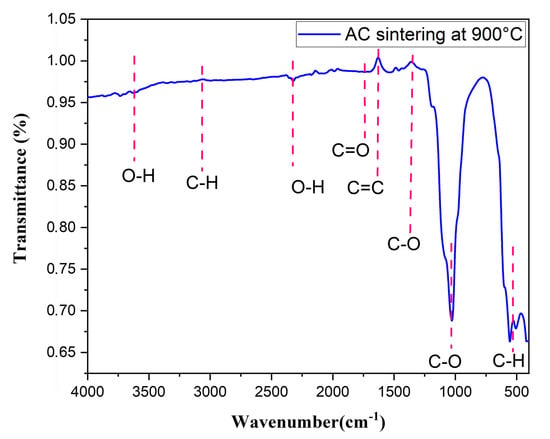
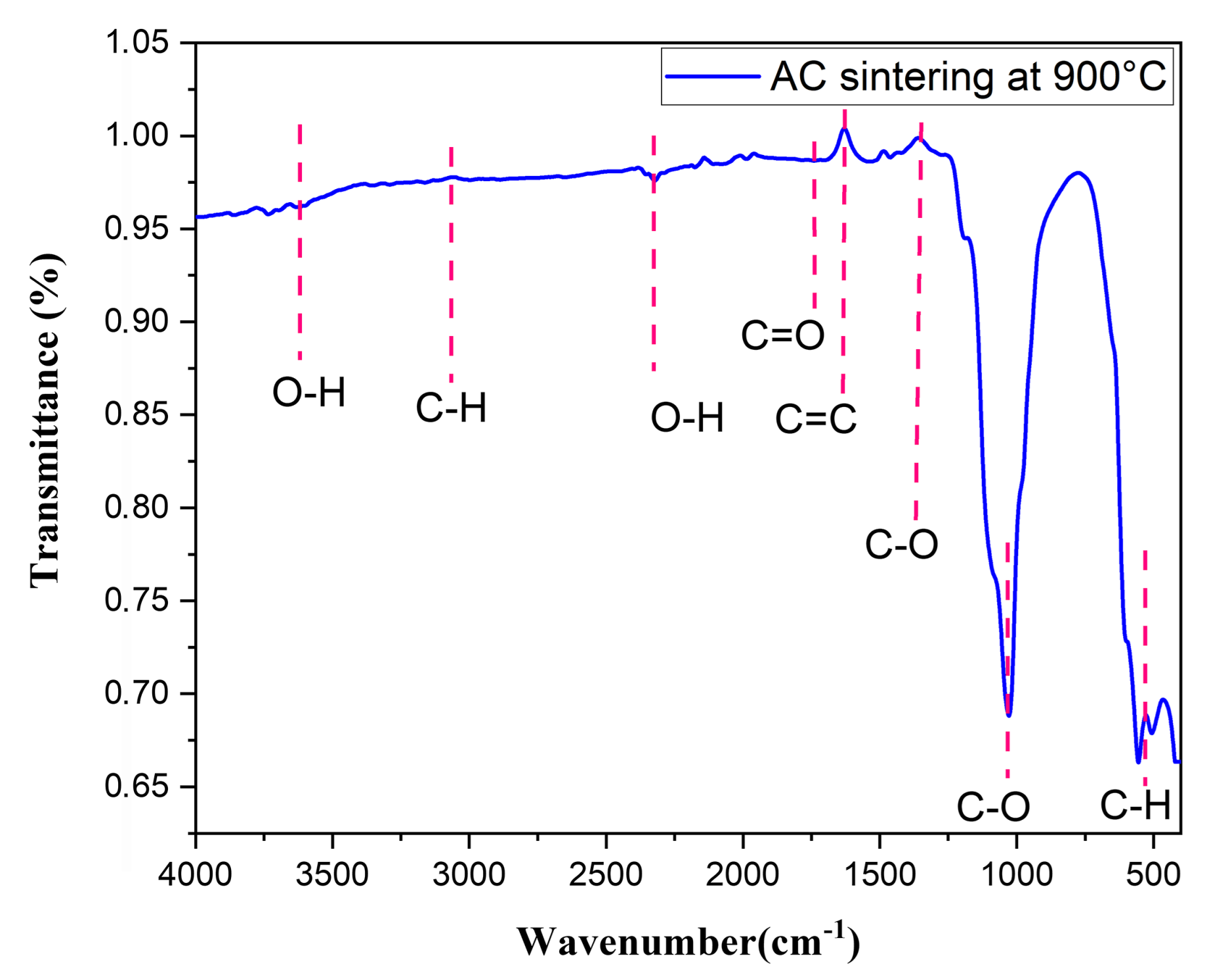
To further assess the chemical functionalities remaining after the high-temperature treatment, FTIR analysis was performed on the activated carbon after treatment at 900 °C. The spectrum (Figure 3) shows a broad band near 3400 cm−1 attributed to O–H stretching, together with bands around 2920 and 2850 cm−1 assigned to aliphatic C–H stretching. The band near 1700 cm−1 is attributed to C = O stretching, while the bands in the 1000–1300 cm−1 region may arise from C–O and phosphorus-containing functionalities associated with the H3PO4 activation treatment. Despite the severe thermal conditions, the observed bands are consistent with the presence of carbon- and oxygen-containing surface functionalities after the 900 °C treatment. However, FTIR provides qualitative information on surface chemical functionalities and does not establish the amount, structural integrity, or porosity of any residual carbonaceous phase. However, FTIR alone cannot quantify the residual carbon content or demonstrate preservation of the original porous structure or adsorption capacity. These limitations are therefore considered in the interpretation of the filtration results [15,34,35].
Figure 3.
FTIR spectrum of the activated carbon after thermal treatment at 900 °C in air.
3.1.2. Thermogravimetric Analysis (TGA)
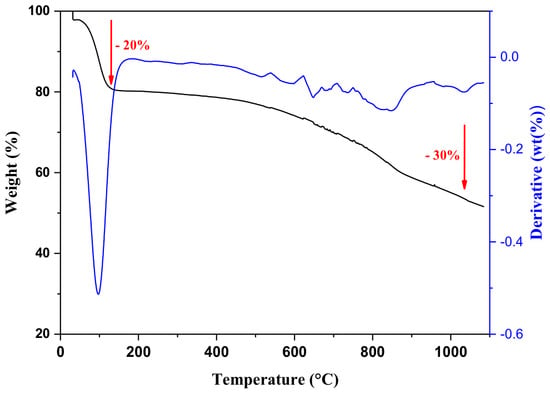
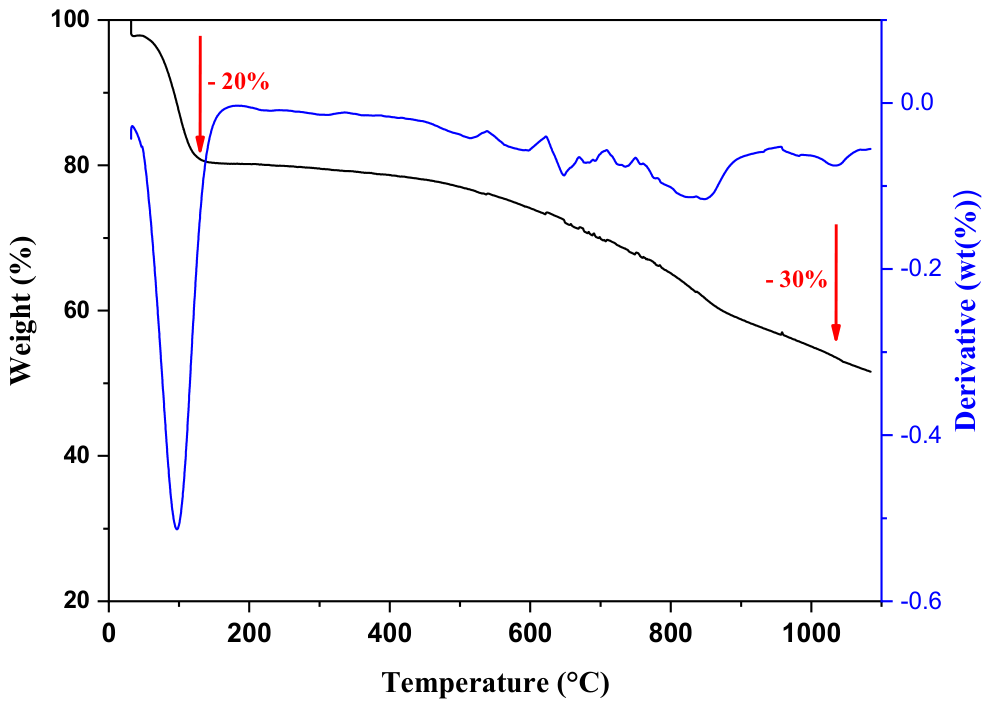
The thermal stability of the activated carbon powder derived from spent coffee grounds was investigated by thermogravimetric analysis (TGA) under an air atmosphere. Figure 4 presents the weight loss curve and its first derivative as a function of temperature.
Figure 4.
TGA thermogram of the activated carbon (AC) obtained from SCG (adapted from Ref. [15] with permission).
The thermal stability of the activated carbon powder derived from spent coffee grounds was investigated by thermogravimetric analysis (TGA) under an air atmosphere, as previously reported in our characterization study of the precursor material [15]. The thermogram shows two main stages of weight loss. The first stage, occurring between 50 °C and approximately 150 °C, corresponds to a mass loss of approximately 20%. This is attributed to the desorption of physically adsorbed water and the release of residual volatile compounds trapped within the porous structure of the carbon [36,37]. Such behavior is consistent with the presence of physically adsorbed water and volatile species within the activated-carbon precursor. However, TGA alone does not provide a direct quantitative measurement of the pore structure.
The second stage, observed between 450 °C and 1000 °C, involves an additional mass loss of approximately 30%. This is attributed to the progressive decomposition of the carbonaceous matrix, including the combustion of amorphous carbon and the degradation of residual oxygen-containing functional groups [36,38]. Notably, the derivative curve shows a maximum decomposition rate around 550 °C, indicating the temperature at which the oxidation of the carbon structure is most intense.
The residual mass at 900 °C was approximately 60%. However, because the TGA was performed in air, this residual fraction cannot be attributed exclusively to the carbonaceous phase and may include inorganic ash and phosphorus-containing species originating from the H3PO4 activation treatment. Therefore, the following functional results (porosity, permeability, and metformin apparent removal) are discussed in relation to the contribution of the carbon-derived phase and/or its associated mineral residues [39]. The TGA profile indicates that a fraction of the precursor remains thermally stable up to the sintering temperature, while progressive oxidation of the carbonaceous fraction occurs at higher temperatures.
3.1.3. Morphology of the Activated Carbon
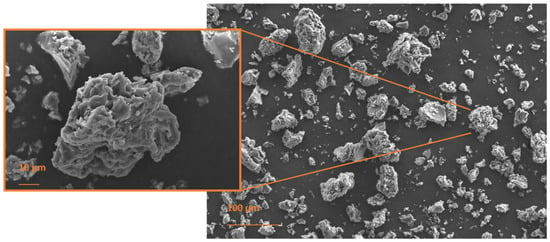
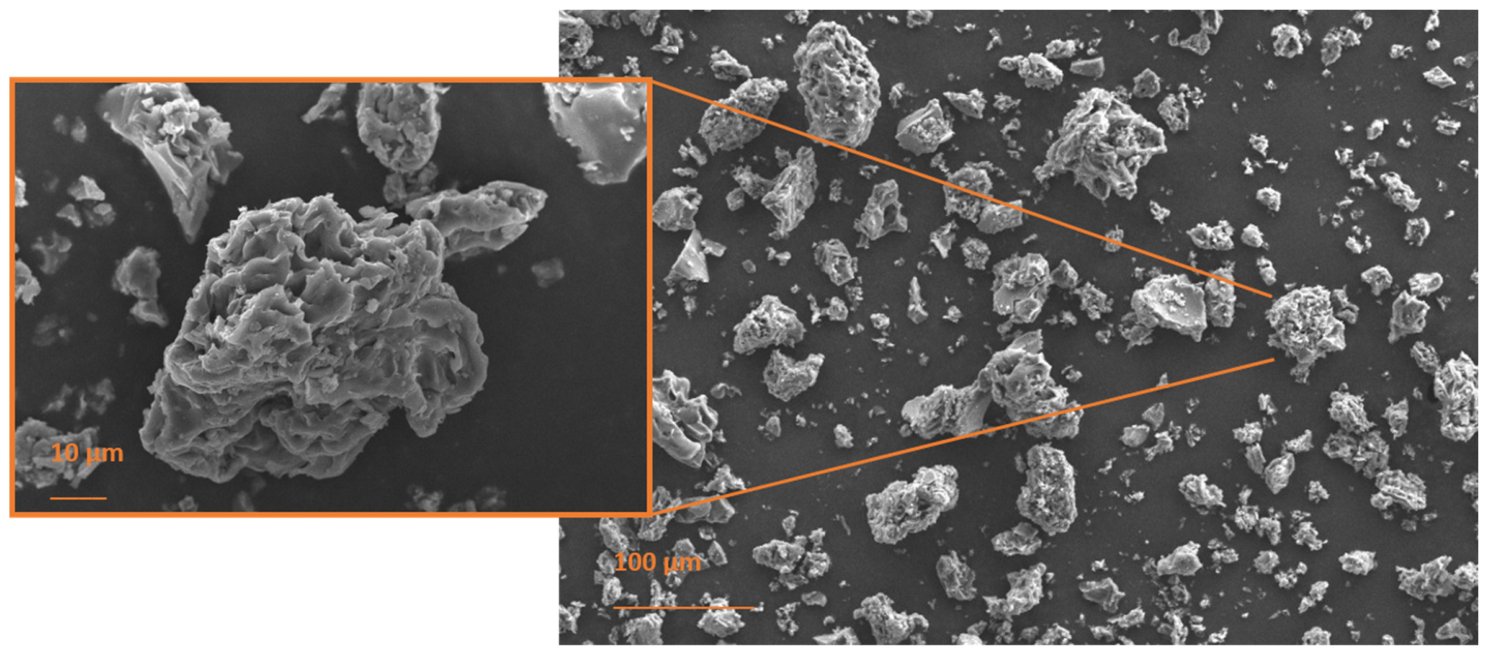
The morphology of the activated carbon was examined by scanning electron microscopy (SEM). Figure 5 shows representative micrographs of the AC.
Figure 5.
Scanning electron microscopy (SEM) of the activated carbon (AC) derived from SCG.
The micrographs reveal a highly irregular and porous structure, characterized by numerous cavities and voids of varying shapes and sizes. This structure results from the combined effect of chemical activation with phosphoric acid and subsequent pyrolysis, which promotes the formation of an interconnected pore network. Both micropores and larger macropores are visible, with the latter facilitating the diffusion of solutes toward the internal adsorption sites. Such a structure is typical of activated carbons derived from lignocellulosic precursors and is responsible for their high specific surface area and adsorption capacity [36,40].
The porous and heterogeneous surface of the AC is expected to play a dual role in the membrane when incorporated into the kaolin matrix. First, it increases the porosity of the composite membrane, as evidenced by the increase in open porosity with AC content. Second, it may also influence local surface wettability and the mechanical interlocking between the ceramic particles. These aspects are discussed in the following sections, where the microstructure, porosity, and functional properties of the hybrid membranes are discussed.
3.2. Characterization of the Hybrid Membranes
3.2.1. FTIR Analysis of the Sintered Membranes
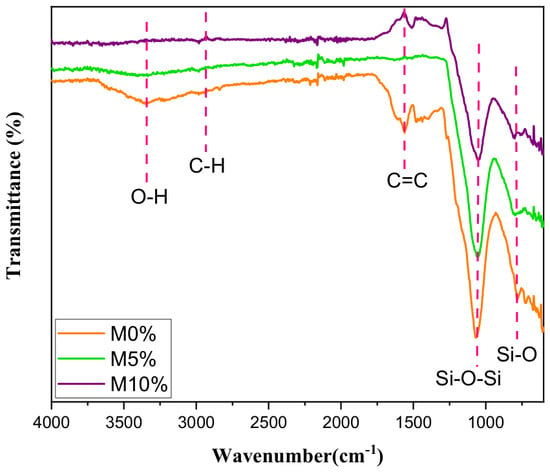
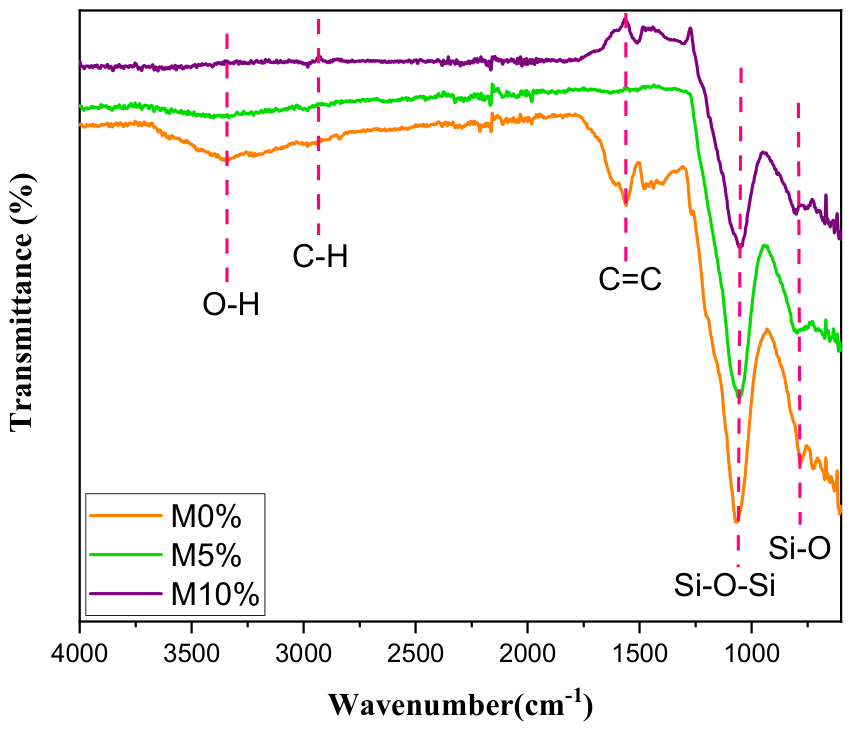
The FTIR spectra of the M0%, M5%, and M10% membranes after sintering are presented in Figure 6. The spectrum of M0%, corresponding to the membrane prepared without activated carbon (AC), exhibits the characteristic bands of the kaolinite-rich aluminosilicate matrix. The bands observed in the 3600–3700 cm−1 region are assigned to O–H stretching vibrations, while the bands around 1025–1116 cm−1 are associated with Si–O–Si and Si–O–Al vibrations. The lower-wavenumber region (540–790 cm−1) contains bands related mainly to Al–O and Al–OH vibrations [41]. These bands are also observed in the spectra of M5% and M10%, indicating that the main vibrational features of the kaolin-based matrix remain detectable after incorporation of AC and sintering.
Figure 6.
FTIR spectra of different membranes M0%, M5% and M10%.
Compared with M0%, the spectra of M5% and M10% exhibit additional and/or more pronounced contributions in regions associated with carbon-containing functionalities, including bands attributable to C = O, C–O, and aromatic C = C vibrations [42]. These contributions become more evident with increasing initial AC content, particularly for M10%. The spectra may also exhibit C–H stretching and aromatic C–H deformation bands, which are consistent with carbon-containing species [41,42]. However, these FTIR features provide qualitative evidence of carbon-associated surface functionalities only and cannot be used to quantify the amount of residual carbon or to establish the preservation of the original porous structure of the activated carbon after sintering.
Overall, the FTIR spectra show that the incorporation of increasing amounts of AC is accompanied by detectable changes in the surface vibrational features of the ceramic membranes. The presence of these carbon-associated bands in M5% and M10% is consistent with the incorporation of carbon-derived species into the kaolin-based matrix. Nevertheless, FTIR alone does not allow conclusions to be drawn regarding the structural integrity, specific surface area, porosity, or adsorption capacity of the carbonaceous phase after thermal treatment.
These spectral features, combined with the systematic improvement in apparent metformin removal and fouling reversibility with increasing AC content, support a functional role of the carbon-derived phase in the hybrid membranes.
3.2.2. Surface Morphology and Elemental Composition by SEM–EDS
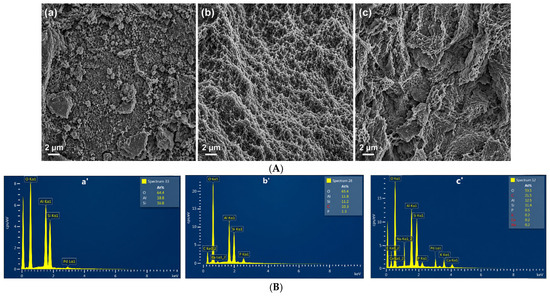
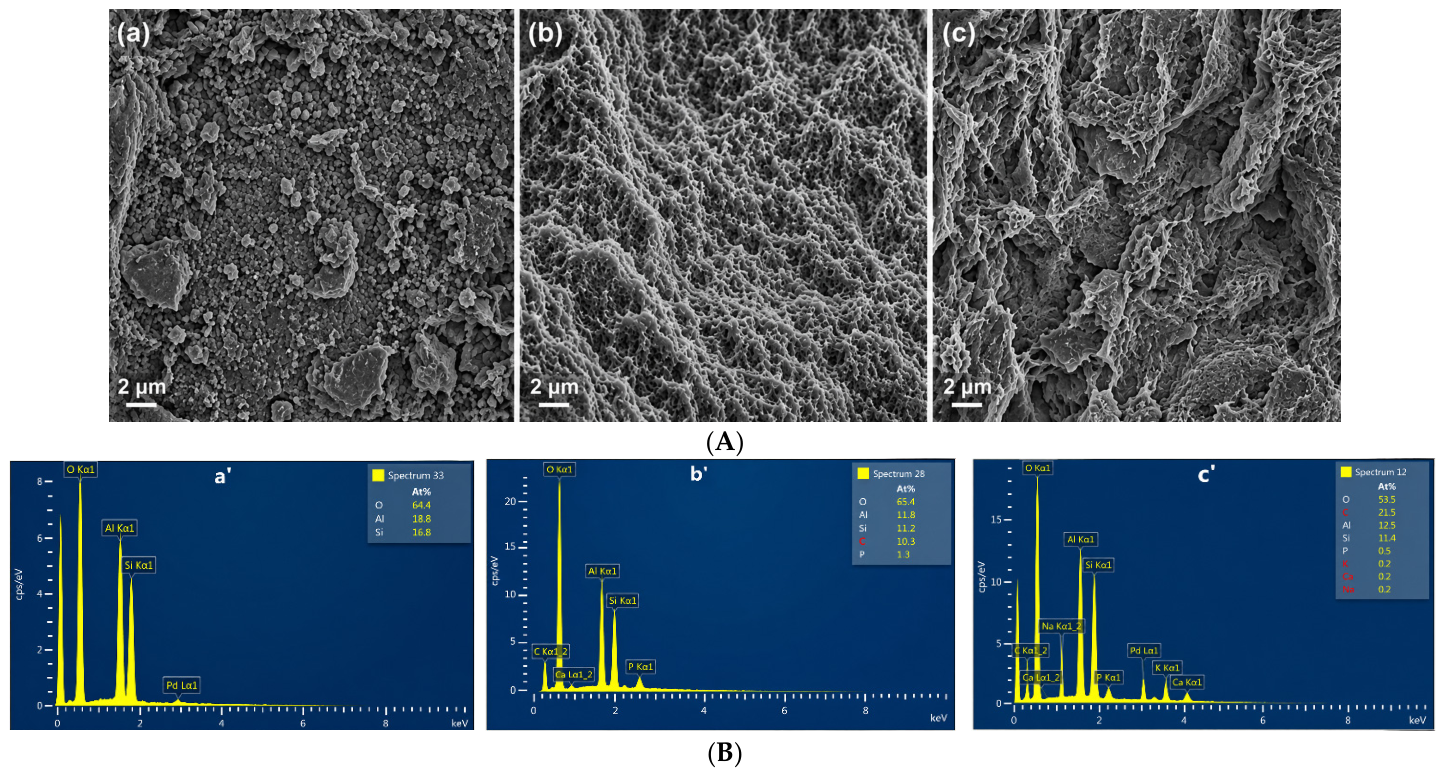
The surface morphology and elemental composition of the hybrid membranes were investigated by scanning electron microscopy coupled with energy-dispersive X-ray spectroscopy (SEM–EDS). Figure 7A(a) and (b) show representative SEM micrographs of the pristine kaolin membrane (M0%) and the hybrid membranes containing 5 wt.% (M5%) and 10 wt.% (M10%) activated carbon.
Figure 7.
(A). SEM images of the membrane surfaces: (a) M0% (pure kaolin), (b) M5% (95% kaolin + 5% AC), and (c) M10% (90% kaolin + 10% AC). (B). EDS spectra of the membrane surfaces: (a’) M0%, (b’) M5%, and (c’) M10%.
The micrographs show that all membranes exhibit relatively homogeneous surfaces without visible cracks, delamination, or major macroscopic defects, suggesting a relatively uniform surface morphology under the conditions examined. The pure kaolin membrane (M0%) presents a comparatively smooth and compact surface with limited visible porosity, consistent with the morphology generally observed for clay-based ceramic membranes after thermal treatment.
With the incorporation of AC, noticeable changes in surface topography are observed. The M5% membrane displays a slightly rougher surface with increased surface irregularities, whereas the M10% membrane exhibits a more heterogeneous and pronounced rough texture [43]. These morphological differences may be associated with the incorporation of AC particles into the kaolin matrix and the resulting modification of the local particle packing and surface morphology. The intrinsic porous nature and morphology of the carbon precursor may also contribute to the observed surface heterogeneity [44]. No obvious large AC agglomerates or macroscopic phase separation are observed at the examined surface. However, SEM observations alone cannot exclude compositional or structural heterogeneities at smaller length scales.
The surface EDS analysis (Figure 7B) provides complementary elemental information on the membranes after sintering. For M0%, the detected elements are mainly O (59.6%), Al (23.7%), and Si (16.7%), consistent with the aluminosilicate composition of the kaolin-based membrane [45]. In contrast, carbon is detected at the surfaces of both AC-containing membranes, with C contents of approximately 10.3% for M5% and 14.2% for M10%, whereas carbon is not detected in M0%. The higher surface carbon signal measured for M10% compared with M5% is consistent with the increasing nominal AC loading. These results provide complementary evidence for the presence of carbon-containing species at the analyzed membrane surfaces after sintering.
Phosphorus is also detected in the AC-containing membranes, at approximately 1.3% for M5% and 0.6% for M10%, whereas it is not detected in M0%. The presence of phosphorus is consistent with phosphorus-containing species potentially associated with the H3PO4 activation treatment of the carbon precursor [15]. However, the EDS results should be interpreted as localized surface elemental measurements rather than bulk compositional data. In particular, the measured carbon contents cannot be directly converted into the total amount of activated carbon retained within the membranes. Moreover, EDS cannot distinguish between different carbonaceous or phosphorus-containing chemical species and cannot determine the specific surface area, pore-size distribution, or adsorption capacity of the carbonaceous phase. Accordingly, the EDS results provide complementary evidence for the presence of carbon- and phosphorus-containing species at the analyzed membrane surfaces after sintering, but do not demonstrate preservation of the original activated-carbon porous structure or adsorption capacity.
3.2.3. Open Porosity
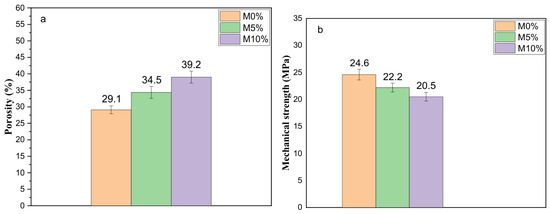
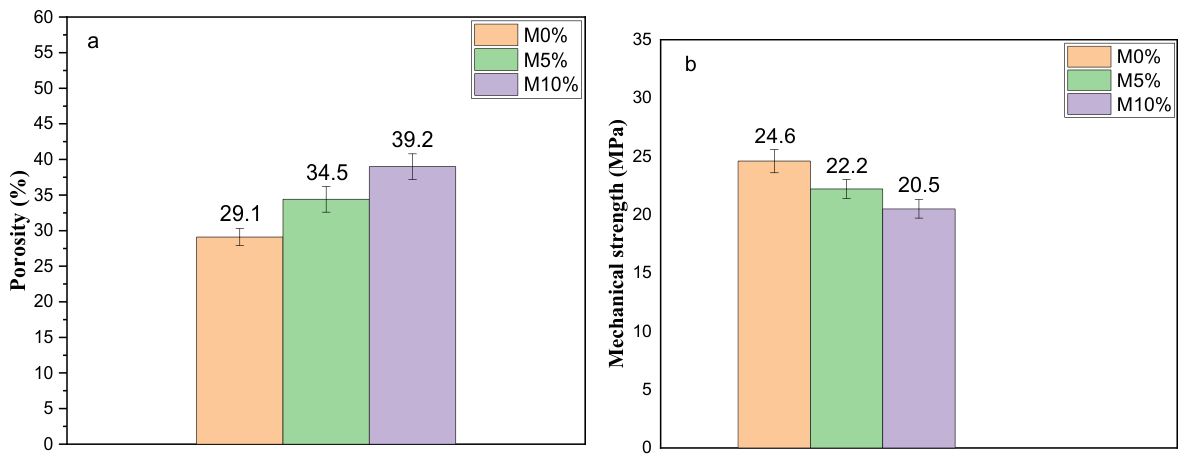
The open porosity of the sintered membranes was determined by the Archimedes method using water immersion Figure 8a.
Figure 8.
(a) Open porosity measurement of sintered membranes using Archimedes’ method. (b) Flexural strength of the membranes as a function of activated carbon content.
The increase in open porosity can be attributed to the microstructural modification induced by the incorporation of AC into the kaolin matrix. Several factors may contribute to this evolution, including differences in particle morphology and packing characteristics between AC and kaolin, the formation of additional interparticle and interfacial voids, and the thermal evolution of the carbonaceous precursor during firing [46,47]. The irregular morphology of AC particles may hinder the densification of the kaolin matrix and favor the development of additional accessible voids. The thermal treatment may also promote pore development through the removal or transformation of thermally labile components of the carbonaceous precursor [47,48].
Importantly, the porosity increase shows a nearly linear relationship with AC content (approximately 1% absolute porosity gain per wt.% AC). This linear and additive behavior suggests a homogeneous dispersion of the AC particles within the kaolin matrix without significant agglomeration. Such controlled porosity tuning is rarely reported in hybrid ceramic/carbon membranes and reflects precise formulation and processing control, which is critical for balancing permeability and mechanical strength. This evolution is consistent with the increase in membrane permeability observed with increasing AC loading, as discussed in the following section.
3.2.4. Mechanical Resistance
Three-point bending tests evaluated the mechanical integrity of the membranes (Figure 8b). The flexural strength decreased progressively with AC addition, from 24.6 MPa (M0%) to 22.2 MPa (M5%) and 20.5 MPa (M10%), representing a 16.7% reduction for M10%. This decrease correlates directly with the increase in open porosity, which reduces the effective solid cross-section. Nevertheless, the strength of the M10% membrane remains above 20 MPa, comfortably within the typical 10–30 MPa range required for micro/ultrafiltration applications [20]. This favorable strength-porosity balance reflects good interfacial compatibility between kaolin and AC, as well as the preservation of a continuous ceramic skeleton without microcracking or delamination.
3.2.5. Chemical Resistance
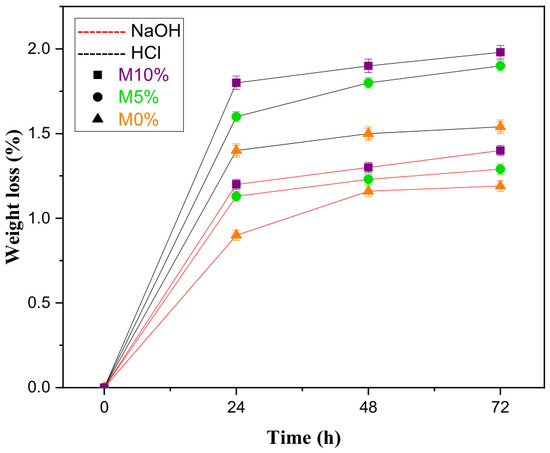
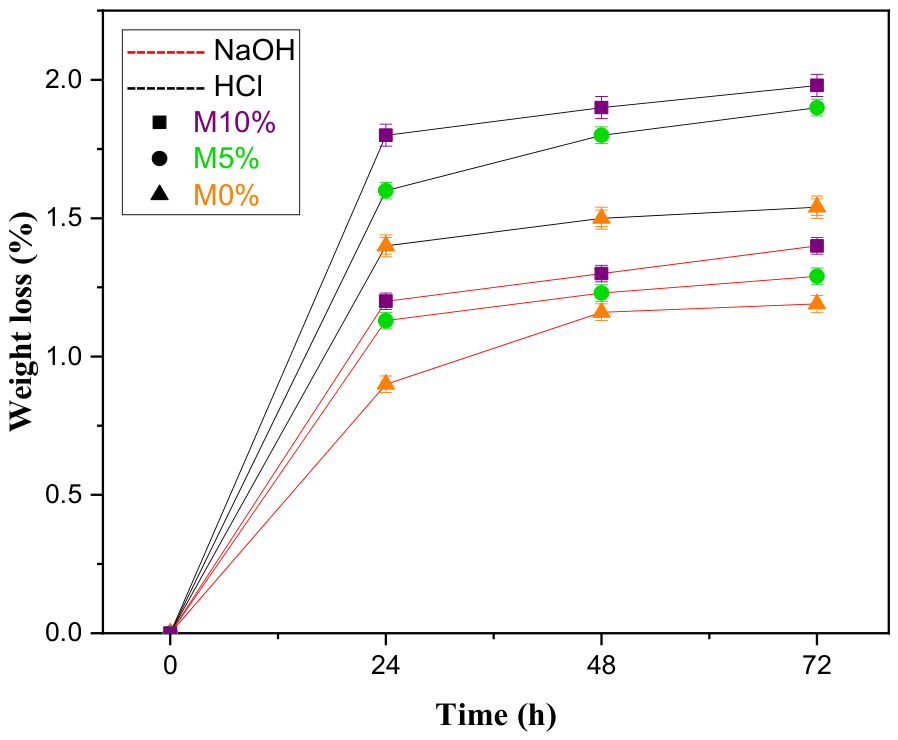
The chemical resistance of the membranes was assessed by immersing them in acidic (HCl, pH 2) and alkaline (NaOH, pH 12) solutions. All membranes exhibited high chemical stability in both acidic (pH 2) and alkaline (pH 12) solutions, with mass losses below 3% after 72 h (Figure 9). No significant difference was observed between M0% and the hybrid membranes (M5%, M10%), indicating that AC incorporation does not alter chemical durability. The slight mass loss can be attributed to the dissolution of minor soluble impurities (carbonates, amorphous phases) present in the natural kaolin or to the removal of loosely bound carbonaceous fragments from the surface of the AC particles.
Figure 9.
Mass loss of M0%, M5%, and M10% membranes after 72 h immersion in (a) HCl solution (pH 2) and (b) NaOH solution (pH 12).
These results demonstrate that all membranes exhibit high chemical stability under both acidic and alkaline conditions.
3.2.6. Pure Water Permeability
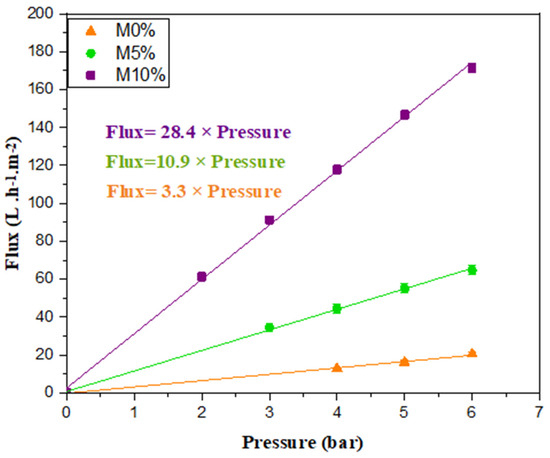
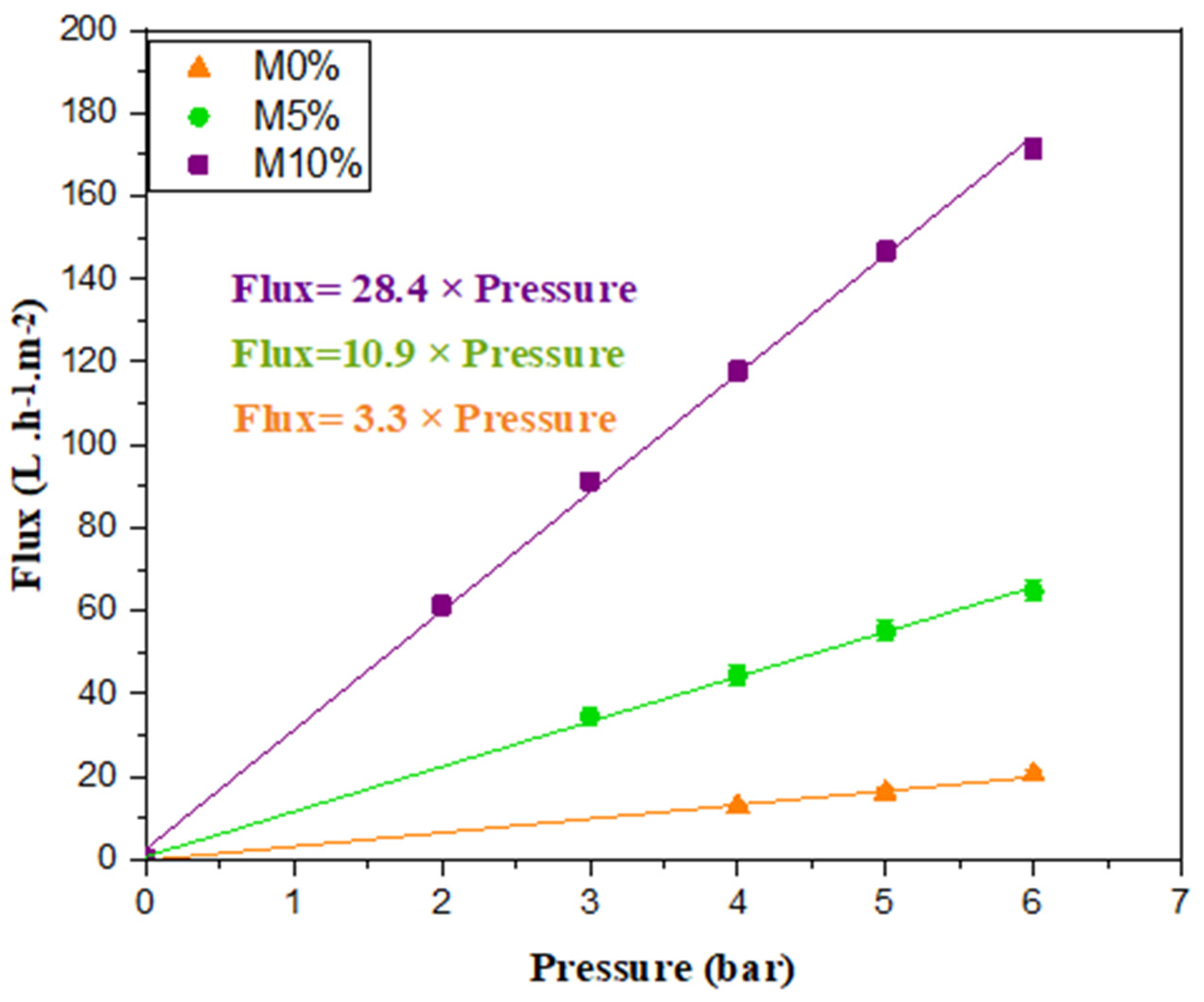
The pure water flux increased linearly with the applied transmembrane pressure for all membranes in the range of 1–4 bar, in agreement with Darcy’s law. This linear behavior indicates that no membrane compaction or structural deformation occurred under the tested conditions (Figure 10).
Figure 10.
Pure water flux as a function of transmembrane pressure for M0%, M5%, and M10% membranes.
The hydraulic permeability, calculated from the slope of the flux versus pressure curves, increased significantly with activated carbon content: from 3.3 L m−2 h−1 bar−1 for the pristine kaolin membrane (M0%) to 10.9 L m−2 h−1 bar−1 (M5%) and 28.4 L m−2 h−1 bar−1 (M10%). This corresponds to a significant 760% increase for the M10% membrane relative to M0%.
This increase in permeability is mainly attributed to the increase in open porosity, which rose from 29.1% (M0%) to 39.1% (M10%) with AC addition [46,47]. This creates additional pathways for water transport. Importantly, the gain in permeability (760%) greatly exceeds the relative increase in porosity (34%), suggesting a super-linear effect. The well-dispersed AC particles not only generate additional pores but also enhance pore connectivity and reduce tortuosity within the ceramic matrix, a beneficial outcome for hybrid ceramic membranes.
3.3. Application of Membranes for Metformin Removal
3.3.1. Temporal Evolution of Permeate Flux and Metformin Apparent Removal
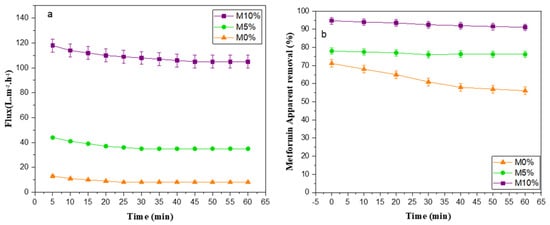
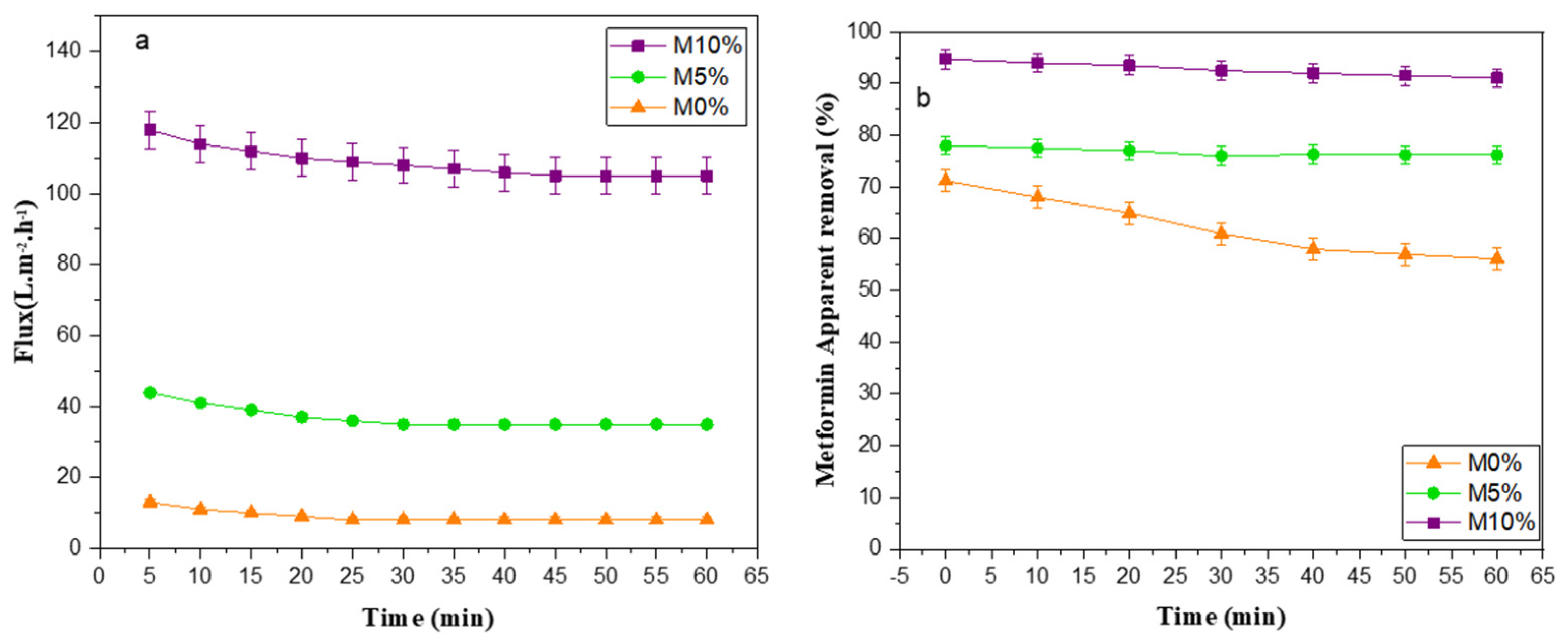
The dynamic filtration performance of the prepared membranes was assessed for the removal of metformin, a highly hydrophilic and low-molecular-weight pharmaceutical. Figure 11 shows the evolution of the permeate flux (a) and metformin rejection (b) during 60 min of continuous dead-end filtration at 4 bar conditions.
Figure 11.
Evolution of permeate flux (a) and metformin apparent removal (b) over time for M0%, M5%, and M10% membranes.
For the pristine kaolin membrane (M0%), the permeate flux decreased from 13.0 to 8.0 L m−2 h−1 after 60 min, corresponding to a relative decrease of 38.5%. Simultaneously, the rate of metformin rejection dropped from 71.2% to 56.1%. This significant flux decline indicates a pronounced fouling effect during filtration. The associated increase in hydraulic resistance is consistent with the accumulation of retained material within or at the membrane surface; however, the present measurements do not allow the precise location or molecular mechanism of fouling to be established [47].
In contrast, the hybrid membrane containing 10 wt.% activated carbon (M10%) showed a significantly higher initial flux (118 L m−2 h−1) and a significantly lower flux decline of only 11% after 60 min (final flux: 105 L m−2 h−1). The apparent metformin removal remained relatively high over the 60-min filtration period, decreasing only slightly from 94.7% to 91.1%. This improved performance is associated with the increased porosity and permeability of the hybrid membrane and may also involve contributions from surface interactions with carbon- and phosphorus-containing phases. However, the specific contribution of adsorption cannot be quantified from the present filtration data alone. The more open pore structure facilitates water transport, while the carbon-derived phase may contribute to additional surface interactions with metformin. The observed reduction in flux decline and irreversible fouling is consistent with improved fouling resistance of the hybrid membrane. However, direct adsorption measurements would be required to quantify the contribution of the carbon-derived phase to metformin capture [3,43].
The M5% membrane showed intermediate behavior, with an initial flux of 44 L m−2 h−1, a 20.5% flux decline, and a final metformin apparent removal of 76.2%, confirming a progressive improvement in both permeability and fouling resistance as the activated carbon content increased.
Importantly, given metformin’s small molecular size (approximately 0.5–0.6 nm), its high metformin apparent removal cannot be attributed to size exclusion alone. Instead, the observed apparent removal likely involves a combination of transport through the membrane and surface interactions. Adsorption and electrostatic interactions may contribute to metformin retention, but the present experiments cannot quantify their relative contributions [49].
3.3.2. Investigating Hydraulic Resistance
The evolution of hydraulic resistance before and after 60 min of metformin filtration is presented in Table 1.
Table 1.
Hydraulic resistance of the membranes before and after metformin filtration.
After 60 min of filtration, the total resistance Rt increased from Rm = 12.4 × 10¹³ m−1 to Rt = 20.2 × 10¹³ m−1 for M0% (+62.9%), from 3.68 × 10¹³ m−1 to 4.63 × 10¹³ m−1 for M5% (+25.8%), and from 1.37 × 10¹³ m−1 to 1.54 × 10¹³ m−1 for M10% (+12.4%). The relative increase in hydraulic resistance was significantly lower for the hybrid membranes. The lower Rm values for hybrid membranes reflect their more open, interconnected pore structure (porosity increasing from 29.1% to 39.1%), while the smaller relative increase in resistance after filtration indicates reduced fouling propensity, likely due to weaker pollutant-membrane interactions and/or a more permeable, less compressible fouling layer.
3.3.3. Fouling Ratio Assessment
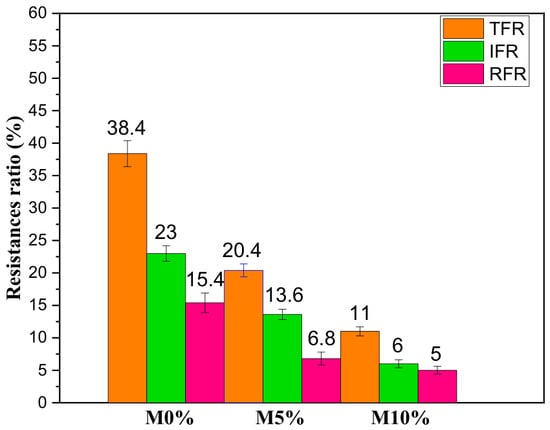
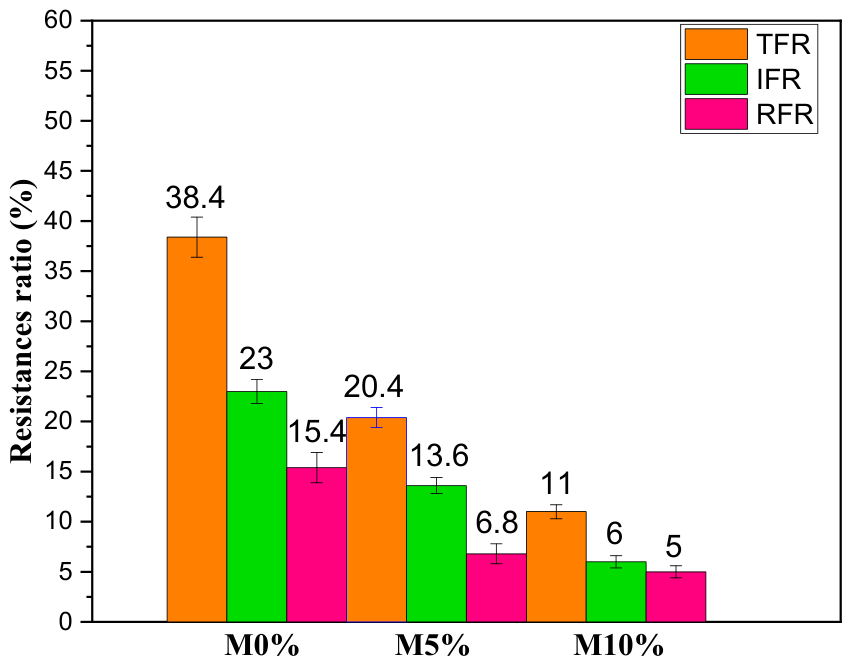
The fouling characteristics of the membranes were evaluated using the total fouling ratio (Rt), reversible fouling ratio (Rrev), and irreversible fouling ratio (Rirrev), as presented in Figure 12.
Figure 12.
Total fouling ratio (TFR), reversible fouling ratio (RFR), and irreversible fouling ratio (IFR) for M0%, M5%, and M10% membranes after 60 min of metformin filtration.
The pristine membrane (M0%) exhibited the highest total fouling (TFR = 38.5%), consisting of IFR = 23.1% irreversible fouling and RFR = 15.4% reversible fouling. Upon incorporating activated carbon, TFR decreased to 20.5% for M5 and 11.0% for M10. Simultaneously, IFR decreased markedly from 23.1% (M0%) to 13.6% (M5%) and further to only 6.0% (M10%), while RFR also declined from 15.4% to 6.9% and 5.0%, respectively. The high irreversible fraction indicates that a significant portion of the foulants remained attached to or trapped within the membrane structure after hydraulic rinsing, suggesting limited cleanability.
The marked reduction in irreversible fouling indicates improved fouling reversibility for the AC-containing membranes. This result suggests that a smaller fraction of the accumulated foulant remained associated with the membrane after hydraulic rinsing. Consequently, the M10% membrane exhibited the lowest overall fouling and the highest cleanability, with only a small fraction of fouling remaining irreversible.
These findings indicate that incorporating activated carbon reduces overall fouling and increases the fraction of fouling that can be removed by hydraulic rinsing. The results therefore demonstrate improved fouling reversibility, although the present measurements do not allow the spatial distribution or specific nature of the retained foulants to be determined.
3.3.4. Semi-Empirical Fouling Modeling
The fitted parameters of the semi-empirical fouling model are summarized in Table 2.
Table 2.
Fitted parameters of the semi-empirical fouling model J(t) = J0/(1 + α·tn).
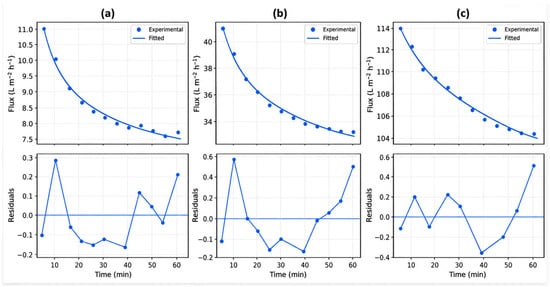
The semi-empirical fouling model (Equation (10)) was fitted to the complete experimental flux datasets acquired over the 0–60 min filtration period, using the raw (nonlinearized) flux scale to preserve data integrity and avoid transformation-induced bias (Figure 13). The model provided a good empirical description of the temporal flux decline for all three membrane configurations, as reflected by high coefficients of determination (R2 ≥ 0.976) and low root-mean-square errors (RMSE ≤ 0.28). The robustness of the parameter estimates was further supported by the narrow 95% confidence intervals and low standard errors associated with the fitted exponents (n), confirming the statistical reliability of the regression.
Figure 13.
Nonlinear fouling model for (a) M0%, (b) M5%, and (c) M10% membranes.
The n values decreased monotonically from 0.140 (M0%) to 0.054 (M10%), indicating a progressively attenuated time-dependent flux decline with increasing activated-carbon content. This parameter is interpreted here as a phenomenological descriptor of the flux-decline kinetics and is not used independently to identify a specific fouling mechanism or fouling location.
It should be emphasized, however, that the n exponent was treated strictly as a phenomenological descriptor of the flux-decline kinetics. While classical blocking laws typically assign specific n ranges to distinct mechanisms (e.g., complete, intermediate, or cake filtration), their direct mechanistic interpretation is not unequivocally applicable to complex, multicomponent feed matrices such as the one investigated here. In line with recent practices in membrane fouling modeling, we therefore refrain from using the n values alone to assign a definitive fouling location (internal vs. external) or a discrete transition between mechanisms. This cautious approach avoids over-interpretation and ensures that the modeling outcomes remain empirically grounded and consistent with the available data.
3.4. Mechanistic Interpretation of Metformin Retention and Fouling Behavior
The enhanced apparent metformin removal observed for the AC-containing membranes may arise from a combination of structural and surface-chemical contributions. The increase in membrane porosity and permeability indicates that simple size exclusion cannot fully account for the observed improvement in removal. In addition, the carbon-derived and phosphorus-containing surface functionalities detected after thermal treatment may provide potential sites for interactions with metformin, including hydrogen bonding and electrostatic interactions. However, these interactions remain proposed mechanisms rather than experimentally demonstrated pathways, as zeta-potential measurements, pH-dependent experiments, ionic-strength studies, and direct adsorption measurements were not performed on the sintered membranes. Accordingly, the observed removal is interpreted as the combined outcome of membrane structure and possible surface interactions rather than being assigned to a single adsorption mechanism. This work is positioned as a preliminary study focused on the filtration and fouling behavior of kaolin/AC hybrid ceramic membranes. A complete characterization of the post-sintering carbon structure (BET surface area, pore-size distribution, zeta potential) and of the adsorption capacity (adsorption isotherms, desorption tests) was beyond the scope of the present study and constitutes the focus of our ongoing work.
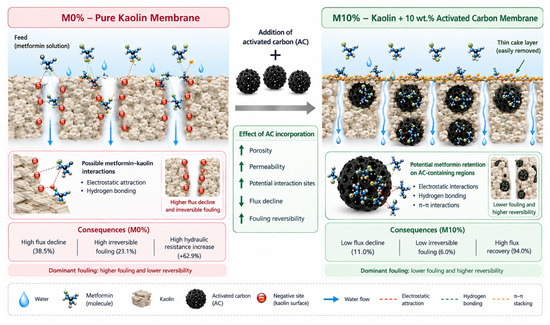
As illustrated in Figure 14, the removal of small hydrophilic micropollutants such as metformin (molecular size ≈ 0.5–0.6 nm, log P ≈ −1.43, pKa ≈ 12.4) [50] cannot be fully explained by size exclusion alone, as the membrane pore sizes (typically in the ultrafiltration range, >2 nm) are significantly larger than the metformin molecule. Accordingly, the observed apparent metformin removal is interpreted as resulting from the combined effects of convective transport, diffusive mass transfer, membrane structure, and possible physicochemical interactions at the membrane surface.
Figure 14.
Schematic illustration of the proposed metformin apparent removal and fouling mechanisms in kaolin/activated carbon hybrid ceramic membranes.
In the pristine kaolin membrane (M0%), metformin removal may involve a combination of diffusion and interactions with the kaolin pore walls. At neutral pH (pH ≈ 6.8), metformin exists predominantly as a protonated cation (pKa = 12.4), while the kaolin surface may contain negatively charged sites associated with isomorphous substitution (Si4+ by Al3+ in the tetrahedral layer) and pH-dependent surface hydroxyl groups (≡Si–O−, ≡Al–O−). These characteristics may favor electrostatic interactions between protonated metformin and the kaolin surface. Computational molecular modeling studies on clay–metformin systems have reported that cation exchange, hydrogen bonding, and electrostatic interactions may contribute to metformin adsorption [51]. These calculations were performed on model clay systems and are used here as a qualitative reference. In addition, the amine groups (–NH2, –NH–) of metformin may interact through hydrogen bonding with oxygen-containing groups present on the kaolin surface, such as silanol (≡Si–OH) and aluminol (≡Al–OH) groups. These interactions could contribute to the increase in hydraulic resistance observed during filtration. For M0%, the total hydraulic resistance increased from 12.4 × 10¹³ to 20.2 × 10¹³ m−1, corresponding to an increase of 62.9%, while the flux decreased by 38.5% after 60 min. The fitted exponent (n = 0.140) describes the temporal characteristics of the flux decline within the semi-empirical model and does not, by itself, establish a pore-blocking or any other specific fouling mechanism. The substantial irreversible fouling observed for M0% (23.1%) indicates that part of the retained or deposited material was not removed by hydraulic rinsing.
The incorporation of SCG-derived activated carbon may modify the transport and retention behavior of the hybrid membranes. The activated carbon precursor used in this study was previously synthesized, characterized, and reported by our group [16]. Briefly, it exhibited a high specific surface area with a hierarchical porous structure, including micropores (<2 nm) and mesopores (2–50 nm). Its surface was also rich in oxygen-containing functional groups, including carboxyl, hydroxyl, carbonyl, and lactone groups, introduced during the H3PO4 activation process. Studies on phosphoric acid-activated carbons from spent coffee grounds have also reported phosphorus-containing groups such as P = O, P–O–C, P = OOH, and P–O–P, together with increases in specific surface area, mesopore volume, and ion-exchange capacity [16,44]. These characteristics suggest that the carbon-derived phase may provide additional interaction sites for metformin. This is consistent with the systematic increase in apparent metformin removal observed with increasing AC content (from 56.1% for M0% to 76.2% for M5% and 91.1% for M10%). Electrostatic interactions, hydrogen bonding, and π–π interactions have been reported as possible contributors to metformin adsorption on carbonaceous materials [16,45,46,52]. However, these mechanisms remain hypothetical for the present sintered membranes, since the surface charge, textural properties, and adsorption capacity of the carbon phase after thermal treatment were not directly characterized.
The incorporation of AC increased the open porosity from 29.1% to 39.1% and substantially enhanced water permeability, with an approximately 760% increase for M10% compared with M0%. This structural modification may improve pore connectivity and facilitate water transport, while the carbon-containing phase may provide additional sites for pollutant–membrane interactions. The observed apparent metformin removal may therefore reflect the combined effects of membrane structure and possible interactions with carbon- and mineral-containing regions. The cumulative permeate volume over 60 min represented only ≈1%, ≈3.7% and ≈10.8% of the 2 L feed for M0%, M5% and M10%, respectively; therefore, feed depletion cannot account for the observed improvement in apparent removal. For M10%, the apparent removal remained high at 91.1% after 60 min, while the flux decline was limited to 11.0%. These results are consistent with a beneficial contribution of AC incorporation to the overall filtration performance. Nevertheless, the present data do not demonstrate that metformin was preferentially adsorbed within the AC particles or allow the relative contribution of adsorption and membrane transport to be quantified. A complete mass balance, including time-resolved feed and retentate concentrations and direct assessment of metformin retained on or within the membrane, would be required to quantitatively distinguish between membrane retention, transient adsorption, and other losses. These measurements were not performed in the present study and are therefore not retrospectively estimated. This limitation is explicitly acknowledged.
The observed differences in fouling behavior between M0% and the AC-containing membranes may therefore reflect changes in pollutant–membrane interactions associated with membrane composition. With increasing AC content, the fitted n value decreased from 0.140 for M0% to 0.054 for M10%, while the increase in hydraulic resistance decreased from 62.9% to 12.4%, the flux decline decreased from 38.5% to 11.0%, and the irreversible fouling fraction decreased from 23.1% to 6.0%. At the same time, the flux recovery ratio increased, reaching 94.0% for M10%. These results indicate a composition-dependent change in the time-dependent fouling behavior and improved fouling reversibility with increasing AC content. However, the parameter n is treated here as a phenomenological descriptor and is not used to assign a specific fouling mechanism or fouling location. Similarly, the higher flux recovery indicates improved removal of the hydraulic resistance after cleaning but does not by itself identify where fouling occurred within the membrane. The observed improvement may be related to modifications in membrane structure and pollutant–membrane interactions induced by AC incorporation, although the individual contributions cannot be separated quantitatively from the present data. Overall, the present results show that AC incorporation progressively improved permeability, apparent metformin removal, and fouling reversibility under the tested conditions.
Overall, the incorporation of waste-derived activated carbon modified the structural and surface characteristics of the hybrid membranes, resulting in increased permeability, improved apparent metformin removal, and enhanced fouling reversibility under the tested conditions. These simultaneous improvements indicate that AC incorporation can enhance hydraulic performance while maintaining apparent metformin removal and improving fouling reversibility under the tested conditions. These observations are consistent with a contribution of the carbon-containing phase to membrane transport and pollutant–membrane interactions, while avoiding assignment to a single adsorption or fouling mechanism. Further post-sintering characterization, including BET surface area, pore-size distribution, zeta potential, adsorption isotherms, and desorption experiments, would be required to clarify these mechanisms quantitatively. This work therefore provides a preliminary assessment of the filtration performance and fouling behavior of kaolin/AC hybrid ceramic membranes.
3.5. Comparative Analysis with Literature
Table 3 summarizes recent ceramic and hybrid ceramic membranes developed for the removal of pharmaceutical pollutants. Several strategies have been explored, including sepiolite-based UF membranes [23], waste-derived kaolin/SCG membranes [3], heterophase alumina systems [23], PAC-coupled ceramic microfiltration [23,24], and carbon nanomaterial-modified membranes [25].
Table 3.
Summary of ceramic and hybrid ceramic membranes used for pharmaceutical pollutant removal, including separation mechanisms and key performance indicators.
As shown in Table 3, most previous studies on ceramic and hybrid ceramic membranes for pharmaceutical removal have focused on permeability and removal efficiency, with limited attention to quantitative fouling analysis. For instance, Romdhani et al. [23] reported a high flux recovery ratio (>90%) for a sepiolite membrane, indicating reversible fouling, but did not apply a resistance-in-series model or quantify irreversible fouling. Viegas et al. [25] observed no PAC-induced fouling, yet did not provide a detailed fouling analysis. Polak et al. [27] achieved high permeability but low apparent removal, without fouling modelling. Our previous work [3] reported metformin removal using SCG-derived membranes but provided only limited flux recovery data. Moreover, most of these studies did not systematically report operational parameters such as pH and applied pressure, making direct comparison difficult.
In contrast, the present study provides a quantitative fouling analysis for kaolin/activated-carbon hybrid membranes treating metformin, integrating (i) the resistance-in-series model to quantify hydraulic resistance changes; (ii) total, reversible, and irreversible fouling ratios; and (iii) flux-decline analysis across different carbon loadings. This integrated approach, together with the systematic evaluation of three carbon contents (0, 5, and 10 wt.%), allows a more comprehensive understanding of the fouling mechanism and its dependence on membrane composition.
Overall, the present comparison highlights that previous studies have generally placed greater emphasis on permeability and pollutant removal than on the combined quantitative assessment of hydraulic resistance and fouling reversibility. The present work therefore contributes a systematic comparison of flux decline, hydraulic resistance, and fouling reversibility as a function of activated-carbon loading.
4. Conclusions
This study demonstrates the successful fabrication of hybrid ceramic membranes by incorporating spent coffee ground-derived activated carbon (up to 10 wt.%) into a kaolin matrix via a one-step dry-pressing route. The addition of AC progressively enhanced open porosity from 29.1% to 39.1% and increased pure water permeability from 3.3 to 28.4 L m−2 h−1 bar−1, corresponding to an ≈8.6-fold improvement, while preserving mechanical integrity (>20 MPa) and chemical resistance under both acidic and alkaline conditions. These results establish a favorable permeability–strength trade-off that is rarely achieved in hybrid ceramic/carbon membranes.
For metformin apparent removal, the M10% membrane maintained a high apparent metformin removal, decreasing only slightly from 94.7% to 91.1% over the 60-min filtration period, while exhibiting an 11% flux decline. The fouling analysis, combining the resistance-in-series model with semi-empirical kinetic fitting, revealed a progressive attenuation of the time-dependent flux-decline rate with increasing AC content. The kinetic exponent n decreased from 0.140 (M0%) to 0.054 (M10%), providing phenomenological evidence of a composition-dependent change in fouling behavior. These results do not establish a specific transition in fouling location or mechanism. Consistent with this trend, the M10% membrane exhibited a flux recovery of 94.0% and an irreversible fouling ratio of only 6.0%, compared with 76.9% and 23.1%, respectively, for the pristine membrane.
The observed performance enhancement is consistent with a contribution from the waste-derived carbonaceous precursor to pore development and the overall metformin removal behavior. The simultaneous improvement in permeability, apparent metformin removal, and fouling reversibility indicates that AC incorporation can enhance hydraulic performance while maintaining the observed removal performance under the tested conditions. However, the specific interactions responsible for metformin retention, such as electrostatic attraction, hydrogen bonding, or π–π interactions, remain plausible hypotheses and cannot be definitively established from the present data. Further post-sintering characterization of the membrane composites and dedicated adsorption and regeneration studies are required to clarify the contribution of the residual carbonaceous and phosphorus-containing species.
Overall, these results highlight the potential of the hybrid membranes as a low-pressure ceramic membrane platform for the treatment of small hydrophilic micropollutants, while further work is required to assess their performance under environmentally relevant conditions and in comparison with established separation technologies.
The present study was conducted under accelerated conditions (20 mg L−1) to enable reliable detection and promote measurable fouling within a short time frame. Validation at environmentally relevant concentrations (ng L−1 to µg L−1) using more sensitive analytical techniques (LC-MS/MS) will be required to assess the applicability of these hybrid membranes to real water treatment scenarios. Furthermore, extended multi-cycle filtration campaigns and systematic regeneration protocols are necessary to assess long-term operational stability. Addressing these aspects constitutes the focus of our ongoing work and will be essential to further develop this proof-of-concept toward a more operationally robust technology for emerging contaminant control. The absence of a closed mass balance and of direct adsorption measurements limits the quantitative interpretation of the apparent removal data. Future work should include time-resolved feed/retentate analyses and desorption experiments to clarify the respective contributions of membrane rejection and adsorption.
Author Contributions
Conceptualization and Methodology, F.A. and A.A.; Validation, A.A., A.D., L.D. and R.B.A.; Formal analysis and Investigation, F.A. and Y.K.; Data curation, F.A. and Y.K.; Writing—original draft, F.A. and A.A.; Writing—review and editing, A.D., L.D. and R.B.A.; Visualization, A.A.; Supervision, L.D., A.D. and R.B.A.; Project administration, L.D. and R.B.A. All authors have read and agreed to the published version of the manuscript.
Funding
This research received no external funding.
Institutional Review Board Statement
Not applicable.
Informed Consent Statement
Not applicable.
Data Availability Statement
The original contributions presented in the study are included in the article. Further inquiries can be directed to the corresponding author.
Conflicts of Interest
The authors declare no conflicts of interest.
References
- Lertxundi, U.; Domingo-Echaburu, S.; Barros, S.; Santos, M.M.; Neuparth, T.; Quintana, J.B.; Rodil, R.; Montes, R.; Orive, G. Is the Environmental Risk of Metformin Underestimated? Environ. Sci. Technol. 2023, 57, 8463–8466. [Google Scholar] [CrossRef] [Scilit] [PubMed]
- Victoria, C.; Amado-Piña, D.; Romero, R.; Martínez-Vargas, S.L.; Regalado-Méndez, A.; Espinoza-Montero, P.J.; Natividad, R. Removal of Metformin from Wastewater: A Review on Physical, Chemical and Biological Processes. Processes 2026, 14, 1713. [Google Scholar] [CrossRef] [Scilit]
- Aouay, F.; Deratani, A.; Attia, A.; Dammak, L.; Amar, R.B. Bifunctional Ceramic Membranes from Spent Coffee Grounds for Selective Removal of Pharmaceuticals and Textile Dyes. Sep. Purif. Technol. 2026, 396, 137971. [Google Scholar] [CrossRef] [Scilit]
- He, Y.; Zhang, Y.; Ju, F. Metformin Contamination in Global Waters: Biotic and Abiotic Transformation, Byproduct Generation and Toxicity, and Evaluation as a Pharmaceutical Indicator. Environ. Sci. Technol. 2022, 56, 13528–13545. [Google Scholar] [CrossRef] [Scilit] [PubMed]
- Hou, W.; Guo, Y.; Liu, Z.; Zhang, G.; Yuan, B.; Xue, H.; Liu, B. High-Efficient Degradation of Antidiabetic Drug Metformin by Ultraviolet-Activated Percarbonate from Water. J. Environ. Chem. Eng. 2025, 13, 117390. [Google Scholar] [CrossRef] [Scilit]
- Selvan, S.A.T.; Paul, J.E.; Nesakumar, N.; Rayappan, J.B.B.; Kulinich, S.A.; Kulandaisamy, A.J. Electrochemical detection of the antidiabetic agent metformin using nickel-cobalt layered double hydroxide (Ni–Co LDH). J. Appl. Electrochem. 2026, 56, 163. [Google Scholar] [CrossRef] [Scilit]
- Hosseinzadeh, F.; Sarpoolaky, H. Advances in Tight Ultrafiltration Membranes: Material Development, Performance Enhancement, and Sustainable Applications. J. Hazard. Mater. Adv. 2025, 19, 100813. [Google Scholar] [CrossRef] [Scilit]
- Alhussaini, M.A.; Souza-Chaves, B.M.; Felix, V.; Achilli, A. Comparative Analysis of Reverse Osmosis and Nanofiltration for the Removal of Dissolved Contaminants in Water Reuse Applications. Desalination 2024, 586, 117822. [Google Scholar] [CrossRef] [Scilit]
- Jallouli, N.; Aouay, F.; Romdhani, M.; Amar, R. High-Efficiency Removal of Diclofenac via Advanced Technologies: A Comparative Study of Photocatalysis, Adsorption, and Nanofiltration. J. Appl. Membr. Sci. Technol. 2025, 29, 239–259. [Google Scholar] [CrossRef] [Scilit]
- Dolar, D.; Ćurić, I.; Ašperger, D. Removal, Adsorption, and Cleaning of Pharmaceutical on Polyamide RO and NF Membranes. Polymers 2023, 15, 2745. [Google Scholar] [CrossRef] [Scilit] [PubMed]
- An, M.; Gutierrez, L.; D’Haese, A.; Morent, R.; De Geyter, N.; Cornelissen, E. Rejection of an Emerging Small Neutral Organic Micropollutant by In-Situ Nanofiltration Membrane Modification for Water Treatment. J. Environ. Manag. 2025, 380, 125052. [Google Scholar] [CrossRef] [Scilit] [PubMed]
- Khmiri, Y.; Aouay, F.; Attia, A.; Aloulou, H.; Dammak, L.; Algieri, C.; Ben Amar, R. Photocatalytic Cleanability of ZnO-Decorated Ceramic Membranes for Rhodamine B Removal. Membranes 2026, 16, 148. [Google Scholar] [CrossRef] [Scilit] [PubMed]
- Bahrouni, J.; Aouay, F.; Larchet, C.; Dammak, L.; Ben Amar, R. Eco-Friendly Ceramic Membranes from Natural Clay and Almond Shell Waste for the Removal of Dyes and Drugs from Wastewater. Membranes 2026, 16, 52. [Google Scholar] [CrossRef] [Scilit] [PubMed]
- Park, K.; Kim, P.; Kim, H.G.; Kim, J. Membrane Fouling Mechanisms in Combined Microfiltration-Coagulation of Algal Rich Water Applying Ceramic Membranes. Membranes 2019, 9, 33. [Google Scholar] [CrossRef] [Scilit] [PubMed]
- Aouay, F.; Attia, A.; Dammak, L.; Amar, R.; Deratani, A. Activated Carbon Prepared from Waste Coffee Grounds: Characterization and Adsorption Properties of Dyes. Materials 2024, 17, 3078. [Google Scholar] [CrossRef] [Scilit] [PubMed]
- Yusop, M.F.M.; Rashid, M.M.; Alam, M.M.; Ahmad, M.A. Cu2+-Surface-Modified Activated Carbon from Nutshells for Enhanced Metformin Removal: Mass Transfer Simulation, Attraction Mechanism and F-Test Studies. Water Air Soil Pollut. 2026, 237, 518. [Google Scholar] [CrossRef] [Scilit]
- Aljadaani, A.H.; Yakout, A.A.; Abdel-Aal, H. Enhanced Adsorption of Metformin Using Cu and ZnO Nanoparticles Anchored on Carboxylated Graphene Oxide. Polymers 2026, 18, 71. [Google Scholar] [CrossRef] [Scilit] [PubMed]
- Shin, Y.; Hwang, T.-M.; Nam, S.-H.; Kim, E.; Park, J.; Choi, Y.-J.; Kye, H.; Koo, J.-W. Evaluating Nanofiltration and Reverse Osmosis Membranes for Pharmaceutically Active Compounds Removal: A Solution Diffusion Model Approach. Membranes 2024, 14, 250. [Google Scholar] [CrossRef] [Scilit] [PubMed]
- Erdmann, P.; Florack, F.; Kaschek, M.J.; Sartor, M. Enhanced Removal of Micro-Pollutants by Hybrid Processes Combining Flocculation or Adsorption with Ceramic Flat Sheet Membrane Filtration. Port-Said Eng. Res. J. 2024, 28, 9–20. [Google Scholar] [CrossRef] [Scilit]
- Aloulou, H.; Attia, A.; Aouay, F.; Khmiri, Y.; Hadj Salem, A.; Saleh, Z.; Amar, R.B. Functional Material Innovations in Ultrafiltration and Microfiltration for Advanced Water Treatment: A Comprehensive Review. Environ. Sci. Water Res. Technol. 2026, 12, 1670–1692. [Google Scholar] [CrossRef] [Scilit]
- Melikoglu, M. Coffee Waste Valorization: A Comprehensive Review of Recent Advancements and Future Directions for a Circular Bioeconomy. Food Chem. 2025, 497, 147004. [Google Scholar] [CrossRef] [Scilit] [PubMed]
- Harizanova, S.; Uzunov, I.; Aleksandrov, L.; Shipochka, M.; Spassova, I.; Kalapsazova, M. The Beneficial Impact of Mineral Content in Spent-Coffee-Ground-Derived Hard Carbon on Sodium-Ion Storage. Materials 2024, 17, 1016. [Google Scholar] [CrossRef] [Scilit] [PubMed]
- Romdhani, M.; Aloulou, W.; Aloulou, H.; Duplay, J.; Charcosset, C.; Ben Amar, R. Performance Assessment of a New Flat Sepiolite Clay-Based Ultrafiltration Membrane for the Removal of Paracetamol and Indigo Blue Dyes from Two Synthetic Aqueous Solutions. Sustainability 2024, 16, 1860. [Google Scholar] [CrossRef] [Scilit]
- Fu, X.; Wu, Y.; Mahmud, S.; Luo, Z.; Li, J.; Yi, Z.; Wang, Z.; Peng, J.; Li, R.; Liao, R.; et al. Supporting Information: Sieving and Adsorption in Heterophase Alumina Ceramic Membranes for Applications in Water Treatment. ACS Appl. Nano Mater. 2026, 9, 6828–6840. [Google Scholar] [CrossRef] [Scilit]
- Viegas, R.M.C.; Mesquita, E.; Campinas, M.; Rosa, M.J. Pilot Studies and Cost Analysis of Hybrid Powdered Activated Carbon/Ceramic Microfiltration for Controlling Pharmaceutical Compounds and Organic Matter in Water Reclamation. Water 2020, 12, 33. [Google Scholar] [CrossRef] [Scilit]
- Polak, D.; Zielińska, I.; Szwast, M.; Kogut, I.; Małolepszy, A. Modification of Ceramic Membranes with Carbon Compounds for Pharmaceutical Substances Removal from Water in a Filtration—Adsorption System. Membranes 2021, 11, 481. [Google Scholar] [CrossRef] [Scilit] [PubMed]
- Ainscough, T.J.; Alagappan, P.; Oatley-Radcliffe, D.L.; Barron, A.R. A Hybrid Super Hydrophilic Ceramic Membrane and Carbon Nanotube Adsorption Process for Clean Water Production and Heavy Metal Removal and Recovery in Remote Locations. J. Water Process Eng. 2017, 19, 220–230. [Google Scholar] [CrossRef] [Scilit]
- Kakade, V.; Lobhe, G.A.; Gandhat, S.; Dhobale, M.; Patel, S. Estimation of Metformin Hydrochloride in Bulk and Formulation by UV-Spectroscopic Area Under Curve Method. J. Drug Deliv. Ther. 2019, 9, 163–167. [Google Scholar] [CrossRef] [Scilit]
- Di Bella, G.; Di Trapani, D. A Brief Review on the Resistance-in-Series Model in Membrane Bioreactors (MBRs). Membranes 2019, 9, 24. [Google Scholar] [CrossRef] [Scilit] [PubMed]
- Cifuentes-Cabezas, M.; Bohórquez-Zurita, J.L.; Gil-Herrero, S.; Vincent-Vela, M.C.; Mendoza-Roca, J.A.; Álvarez-Blanco, S. Deep Study on Fouling Modelling of Ultrafiltration Membranes Used for OMW Treatment: Comparison Between Semi-Empirical Models, Response Surface, and Artificial Neural Networks. Food Bioprocess Technol. 2023, 16, 2126–2146. [Google Scholar] [CrossRef] [Scilit]
- Yang, H.; Yu, X.; Liu, J.; Tang, Z.; Huang, T.; Wang, Z.; Zhong, Q.; Long, Z.; Wang, L. A Concise Review of Theoretical Models and Numerical Simulations of Membrane Fouling. Water 2022, 14, 3537. [Google Scholar] [CrossRef] [Scilit]
- Sandoval-García, V.; Ruano, M.V.; Alliet, M.; Brepols, C.; Comas, J.; Harmand, J.; Heran, M.; Mannina, G.; Rodriguez-Roda, I.; Smets, I.; et al. Modeling MBR Fouling: A Critical Review Analysis towards Establishing a Framework for Good Modeling Practices. Water Res. 2025, 268, 122611. [Google Scholar] [CrossRef] [Scilit] [PubMed]
- Xu, H.; Xiao, K.; Yu, J.; Huang, B.; Wang, X.; Liang, S.; Wei, C.; Wen, X.; Huang, X. A Simple Method to Identify the Dominant Fouling Mechanisms during Membrane Filtration Based on Piecewise Multiple Linear Regression. Membranes 2020, 10, 171. [Google Scholar] [CrossRef] [Scilit] [PubMed]
- Chen, H.-M.; Lau, W.-M.; Zhou, D. Waste-Coffee-Derived Activated Carbon as Efficient Adsorbent for Water Treatment. Materials 2022, 15, 8684. [Google Scholar] [CrossRef] [Scilit] [PubMed]
- Kan, X.; Suo, Y.; Shi, B.; Zheng, Y.; Liu, Z.; Ma, W.; Li, X.; Zhang, J. Synergistic Enhancement of Rhodamine B Adsorption by Coffee Shell Biochar Through High-Temperature Pyrolysis and Water Washing. Molecules 2025, 30, 2769. [Google Scholar] [CrossRef] [Scilit] [PubMed]
- Wang, Y.; Liu, Z.; Chen, X.; Sun, D.; Sun, Y.; Liu, L.; Li, J.; Li, S. Preparation of Biomass Activated Carbon and Its Adsorption Performance for Anionic/Cationic Dyes(10mg/L): A Case Study of Coffee Grounds, Hemp Stalks and Macadamia Nut Shells. Next Mater. 2025, 9, 101258. [Google Scholar] [CrossRef] [Scilit]
- Hassan, H.M.A.; Alhumaimess, M.S.; Alsohaimi, I.H.; Al-Furhud, S.F.; Alqadami, A.A.; Aldawsari, A.M. Synthesis of Polymer Functionalized Spent Coffee-Based Porous Carbon for Efficient Dye Adsorption. Biomass Bioenergy 2025, 203, 108275. [Google Scholar] [CrossRef] [Scilit]
- Campbell, R.; Xiao, B.; Mangwandi, C. Production of Activated Carbon from Spent Coffee Grounds (SCG) for Removal of Hexavalent Chromium from Synthetic Wastewater Solutions. J. Environ. Manag. 2024, 366, 121682. [Google Scholar] [CrossRef] [Scilit] [PubMed]
- Kaur, H.; Bulasara, V.; Gupta, R. Preparation of Kaolin-Based Low-Cost Porous Ceramic Supports Using Different Amounts of Carbonates. Desalin. Water Treat. 2015, 57, 15154–15163. [Google Scholar] [CrossRef] [Scilit]
- Miao, Z.; Che, N.; Chai, W.; Zhang, M.; Wang, F. Hierarchical Porous Carbons Derived from Porous Biomass for High-Performance Capacitive Deionization. J. Phys. Chem. C 2024, 128, 4038–4047. [Google Scholar] [CrossRef] [Scilit]
- Rafya, M.; Misrar, W.; Saâdi, L.; Mansori, M.; Waqif, M.; Hafidi, A.; Zehhar, N.; Benkhalti, F. Ceramic Membrane Support Based on Kaolin and Solid Waste from Hydrodistillation of Rosmarinus officinalis L. Mater. Chem. Phys. 2023, 295, 127030. [Google Scholar] [CrossRef] [Scilit]
- El-Shalakany, H.H.; Samir, I.; Mubarak, M.F. Fabrication and Characterization of an Activated Carbon–Chitosan–Graphene Oxide Hybrid Membrane with Hierarchical Porosity for the Simultaneous Adsorptive Removal of Ciprofloxacin Antibiotic and Hazardous Heavy Metals from Polluted Water Systems. RSC Adv. 2026, 16, 30797–30813. [Google Scholar] [CrossRef] [Scilit] [PubMed]
- Maciel, F.; Areias, I.; Holanda, J. Valorization Potential of Coffee Grounds Waste as a Renewable Pore-Forming Agent to Produce Low-Cost Porous Ceramic Support. Res. Soc. Dev. 2023, 12, e22612240023. [Google Scholar] [CrossRef] [Scilit]
- Khmiri, Y.; Attia, A.; Elboughdiri, N.; Ghernaout, D.; Charcosset, C.; Dammak, L.; Amar, R. Preparing Sustainable Membranes Made From Zeolite–Smectite for Treating Textile Wastewater and Pulp Industry Wastewater. ChemistrySelect 2024, 9, e202404190. [Google Scholar] [CrossRef] [Scilit]
- Aloulou, H.; Aloulou, W.; Duplay, J.; Baklouti, L.; Dammak, L.; Ben Amar, R. Development of Ultrafiltration Kaolin Membranes over Sand and Zeolite Supports for the Treatment of Electroplating Wastewater. Membranes 2022, 12, 1066. [Google Scholar] [CrossRef] [Scilit] [PubMed]
- Kayvani Fard, A.; Bukenhoudt, A.; Jacobs, M.; McKay, G.; Atieh, M.A. Novel Hybrid Ceramic/Carbon Membrane for Oil Removal. J. Membr. Sci. 2018, 559, 42–53. [Google Scholar] [CrossRef] [Scilit]
- Huang, J.; Chen, H.; Qi, R.; Yang, J.; Li, Z.; Zhang, H. Porous Ceramic Membranes from Coal Fly Ash with Addition of Various Pore-Forming Agents for Oil-in-Water Emulsion Separation. J. Environ. Chem. Eng. 2023, 11, 109929. [Google Scholar] [CrossRef] [Scilit]
- Qalyoubi, L.; Al-Othman, A.; Al-Asheh, S. Recent Progress and Challenges on Adsorptive Membranes for the Removal of Pollutants from Wastewater. Part I: Fundamentals and Classification of Membranes. Case Stud. Chem. Environ. Eng. 2021, 3, 100086. [Google Scholar] [CrossRef] [Scilit]
- Zheng, Y.; Shao, Y.; Zhang, Y.; Liu, Z.; Zhao, Z.; Xu, R.; Ding, J.; Li, W.; Wang, B.; Zhang, H. Metformin as an Emerging Pollutant in the Aquatic Environment: Occurrence, Analysis, and Toxicity. Toxics 2024, 12, 483. [Google Scholar] [CrossRef] [Scilit] [PubMed]
- Bellona, C.; Drewes, J.E.; Xu, P.; Amy, G. Factors Affecting the Rejection of Organic Solutes during NF/RO Treatment—A Literature Review. Water Res. 2004, 38, 2795–2809. [Google Scholar] [CrossRef] [Scilit] [PubMed]
- Omrani, S.; Gamoudi, S.; Viseras, C.; Moussaoui, Y.; Sainz-Díaz, C.I. The Use of Organoclays as Excipient for Metformin Delivery: Experimental and Computational Study. Molecules 2024, 29, 4612. [Google Scholar] [CrossRef] [Scilit] [PubMed]
- Akindolie, M.; Choi, H. Surface Modification of Spent Coffee Grounds Using Phosphoric Acid for Enhancement of Methylene Blue Adsorption from Aqueous Solution. Water Sci. Technol. 2022, 85, 1218–1234. [Google Scholar] [CrossRef] [Scilit] [PubMed]
- Qiu, Q.; Gao, M.; Shao, C.; Sun, S.; Liu, Y.; Zhang, H. Copper Nanoparticles Coupled with Fine-Powdered Active Carbon-Modified Ceramic Membranes for Improved Filtration Performance in a Membrane Bioreactor. Water 2023, 15, 4141. [Google Scholar] [CrossRef] [Scilit]

Disclaimer/Publisher’s Note: The statements, opinions and data contained in all publications are solely those of the individual author(s) and contributor(s) and not of MDPI and/or the editor(s). MDPI and/or the editor(s) disclaim responsibility for any injury to people or property resulting from any ideas, methods, instructions or products referred to in the content. |
© 2026 by the authors. Licensee MDPI, Basel, Switzerland. This article is an open access article distributed under the terms and conditions of the Creative Commons Attribution (CC BY) license.