


Abstract
Background/Objectives: Vaccination is a key public health intervention for preventing vaccine-preventable diseases among adults aged 65 years and older. In Australia, five vaccines are currently recommended and funded for older adults: COVID-19, influenza, pneumococcal, shingles and respiratory syncytial virus (RSV). However, coverage remains suboptimal. Independent living unit (ILU) villages may represent an under-recognised setting for improving vaccination uptake among older adults. Methods: The VillageVax Study, a convergent mixed-methods study, was conducted in ILU villages affiliated with residential aged care homes (RACHs) in South Eastern Sydney Local Health District (SESLHD), New South Wales (NSW), Australia. Data were collected concurrently through surveys of ILU staff and vaccination providers and semi-structured focus groups with ILU residents. Quantitative and qualitative data were analysed separately and integrated during interpretation. Resident focus-group findings formed the primary analytic dataset, with survey findings used to contextualise and extend interpretation. Results: Input was gathered from 15 ILU villages, 13 vaccination providers and 39 residents across eight focus groups. Three key findings emerged. First, participating residents generally supported vaccination and trusted healthcare professionals, but awareness of some recommended vaccines and vaccination schedules was limited. Second, life transitions, including retirement, relocation and changes in healthcare relationships, disrupted established vaccination behaviours and sources of support. Third, ILU villages provided opportunities to promote and facilitate vaccination, although organisational practices and responsibilities varied. Conclusions: As an intermediate setting between community living and residential aged care, ILUs present a unique opportunity to support older adult vaccination. Targeted strategies are needed to optimise vaccine access and uptake in this setting. This study identifies ILUs as a promising and under-utilised setting for vaccination interventions among older adults.
1. Introduction
Vaccination is a key public health intervention for preventing morbidity and mortality from vaccine-preventable diseases. Older adults are particularly vulnerable to severe outcomes from respiratory and other infectious diseases due to age-related declines in immune function and a higher prevalence of chronic health conditions [1,2]. Australia has a growing population of older adults, with people aged ≥65 years making up 17.1% of the population in 2022 [3].
There are currently five vaccines recommended and funded for older adults through Australia’s National Immunisation Program (NIP) [4]. From age 65 years, these are the influenza, pneumococcal, herpes zoster (shingles) and COVID-19 vaccines (one annual dose of COVID-19 vaccine is funded from 65 to 74 years). The respiratory syncytial virus (RSV) vaccine and two doses of COVID-19 vaccine annually are funded from age 75 years. Some adults are eligible for these vaccines at younger ages due to Aboriginal or Torres Strait Islander status or medical risk conditions [4]. These free vaccines can be obtained from general practitioners, pharmacies, Aboriginal health services and from some hospitals and other health services.
Despite recommendations and funded vaccines, vaccination coverage among older Australians is suboptimal. Annual influenza vaccination coverage for adults ≥ 65 years was 61.8% as of late-October 2026 [5], stable compared to recent years but a decline since the COVID-19 pandemic [6]. Pneumococcal and herpes zoster vaccination coverage is <50% for adults ≥ 65 years [7], while only 25.6% of adults aged 65–74 years and 14.2% of adults ≥ 75 years were up to date with their recommended COVID-19 doses in 2024 [6]. The RSV vaccine was only added to the NIP for older adults in May 2026, and coverage data are not yet available.
Achieving high vaccination coverage among older adults is increasingly important as Australia’s population ages and the potential burden of vaccine-preventable disease grows. Improving uptake among older adults living in the community may reduce preventable hospitalisations, support healthy ageing [8] and decrease demand on health and aged care services.
Independent living unit (ILU) villages may represent a community setting with previously unrecognised opportunities to enhance vaccination uptake among older adults. ILUs typically provide accommodation for adults aged ≥55 years who can live independently within a community setting [9]. Unlike residential aged care homes (RACHs), where residents receive personal and nursing care [10,11], ILU residents generally manage their own healthcare and access health services through community-based providers [11]. ILUs are typically located within retirement villages, which vary considerably in size, resident population and available services [9,12].
In 2025, the average age of individuals entering an ILU village was 76 years and the average age of current residents was 81 years [13]. Residents lived in each unit for an average of 8.7 years [13]. Transition to RACHs is the most common reason residents leave ILUs, with 31% of residents who exited in 2022 moving to RACHs, increasing to 37% in 2025 [13].
Previous work we conducted in South Eastern Sydney Local Health District (SESLHD) RACHs identified substantial gaps in vaccination status among newly admitted residents and challenges accessing historical vaccination records [14,15]. Given that residents are ageing in place in ILUs and that many will transition to RACHs, ILU villages may represent an important but under-utilised opportunity for preventive health initiatives including vaccination [12,16], and to improve vaccination uptake earlier in the ageing trajectory before entry to residential care.
To our knowledge, there is no previous Australian research specifically examining vaccination among ILU village residents. The VillageVax study therefore aimed to evaluate vaccination practices, identify barriers and enablers to vaccination, and explore opportunities to improve vaccine promotion and delivery for ILU village residents in SESLHD.
2. Materials and Methods
2.1. Study Design
The VillageVax Study was a convergent mixed-methods study conducted in ILU villages affiliated with RACHs in SESLHD, New South Wales (NSW), Australia. Data were collected concurrently through surveys of ILU staff and vaccination providers and through semi-structured focus groups with ILU residents. Quantitative and qualitative data were analysed separately and integrated during interpretation. Resident focus-group findings formed the primary analytic dataset, with survey findings used to contextualise and extend interpretation.
The 5As framework (awareness, acceptance, access, affordability and activation) [17] informed development of the survey instruments and focus-group guide. The qualitative component is reported in accordance with the Consolidated Criteria for Reporting Qualitative Research (COREQ) [18].
2.2. Participants and Recruitment
Eligible ILU villages affiliated with RACHs were identified through a desktop review of organisational websites and consultation with village managers. All identified villages were invited to participate by email, followed by telephone contact where required. One staff member from each participating village completed the staff survey. Where organisations managed multiple villages, a single manager was permitted to complete surveys on behalf of more than one village.
Vaccination providers, including pharmacist immunisers, general practitioners (GPs), authorised nurse immunisers and nurse practitioners, were recruited through Central and Eastern Sydney Primary Health Network newsletters and mailing lists using convenience sampling.
Residents were eligible if they were aged 65 years or older, lived in an ILU, were able to provide informed consent and could participate in English. Village staff assisted recruitment through resident communication channels, resident committees or purposive invitation.
2.3. Data Collection
Two separate surveys were developed for ILU staff and vaccination providers (Surveys S1). The ILU survey collected information on village characteristics, vaccination support practices, perceived barriers and enablers, and opportunities for improvement. The provider survey covered vaccination service delivery, capacity, barriers and enablers to providing vaccination services within ILUs, and opportunities for future development. Both instruments were piloted with Public Health Unit staff not involved in their development. Surveys were administered using REDCap, a NSW Health approved secure platform. Providers completed the survey online, while ILU staff could complete the survey online, by telephone or in person. Staff surveys were completed between October 2025 and May 2026 and provider surveys between October 2025 and April 2026.
Focus groups were conducted between February and April 2026 by three members of the SESLHD Public Health Unit (LNM, MClinEpid, epidemiologist; CM, MPH, project manager; LM, BHSc, senior health education officer), all female and experienced in qualitative interviewing and public health research. A facilitator and co-facilitator attended each focus group, and none had a prior relationship with participants.
Focus groups were held in village common rooms and facilitated using a semi-structured guide informed by the 5As framework (Discussion Guide S1). The focus group discussion guide was piloted with Public Health Unit staff not involved in its design. Discussions explored vaccination awareness, decision-making, record keeping, barriers and facilitators, and potential village-based support strategies.
Sessions lasted 46–103 min, were audio-recorded and professionally transcribed verbatim. Transcripts were checked for accuracy and de-identified. Participants completed a brief demographic questionnaire, and field notes were recorded during and after each session. Village staff attended the first focus group in a support role; their contributions were excluded from analysis and staff did not attend subsequent groups.
2.4. Data Analysis and Integration
Survey data were analysed descriptively using counts and proportions. Staff survey responses were analysed at village level and provider responses at respondent level. A provider response rate could not be calculated because recruitment occurred through overlapping mailing lists.
Focus group transcripts and open-text survey responses were analysed thematically using a team-based approach that combined deductive codes informed by the 5As framework with inductive codes derived from participant accounts [14]. Two investigators independently coded the first two transcripts and developed an initial codebook, which was refined iteratively through review of transcripts and discussion among investigators. The codebook was then applied to subsequent transcripts by three investigators and further refined as analysis progressed. Codes were grouped into categories and developed into themes and sub-themes through review of coded extracts and ongoing team discussion. Although the 5As framework informed initial coding, themes were not constrained by the framework. Coding and data management were undertaken in Microsoft Excel. Analysis was informed by practical thematic analysis methods described for multidisciplinary health services research teams [14].
Sample adequacy was guided by the concept of information power [15] and was considered sufficient given the focused study aim, relatively specific participant group, richness of discussion and recurring patterns across focus groups.
Following separate analyses, staff and provider survey findings were considered alongside resident focus-group findings to refine the themes and inform the conceptual model . Quotations are identified by focus group (FG) and participant (P), staff respondent (Staff) or provider respondent (Provider). Potentially identifying information was removed or replaced with brackets where necessary.
2.5. Rigour and Reflexivity
Participants were informed that facilitators were NSW Health staff undertaking the study. The research team considered how its public health and vaccination backgrounds, as well as staff attendance at the first focus group, might influence data collection and interpretation. Credibility was supported through regular analytic discussions, an audit trail, field notes and reflexive observations. Transcripts and findings were not returned to participants for review.
2.6. Ethics
The study was approved by the SESLHD Low and Negligible Risk Committee (2025/ETH02074). Residents provided written informed consent and survey respondents provided electronic consent before participation.
3. Results
3.1. Participants
3.1.1. Residents
Eight focus groups were conducted across eight ILU villages between February and April 2026. Forty residents participated; one subsequently withdrew, leaving 39 participants in the final analysis. Groups ranged from one to eight participants, with one conducted as an individual interview. Participant characteristics are shown in Table 1.
Table 1.
Characteristics of resident focus group participants (N = 39).
Two village staff members were present during the first focus group and contributed briefly to the discussion. Following review of the session, staff were excluded from subsequent focus groups to minimise the potential influence of staff attendance on resident discussions.
3.1.2. ILU Staff and Vaccination Providers
Fifteen of 25 identified villages (60%) completed the staff survey, two declined and eight were lost to follow-up. Eleven managers responded on behalf of the 15 participating villages; one respondent represented four villages while another represented two, meaning responses were not fully independent. Villages had a median of 79 units (range 10–400) and 105 residents (range 10–470). Eleven villages were co-located with a RACH, and 11 had a minimum entry age of 55 years.
Thirteen providers completed the provider survey: eight pharmacist immunisers, four GPs and one authorised nurse immuniser. Nine (69%) agreed to have their contact details shared with villages, comprising all eight pharmacists and one GP.
3.2. Integrated Findings
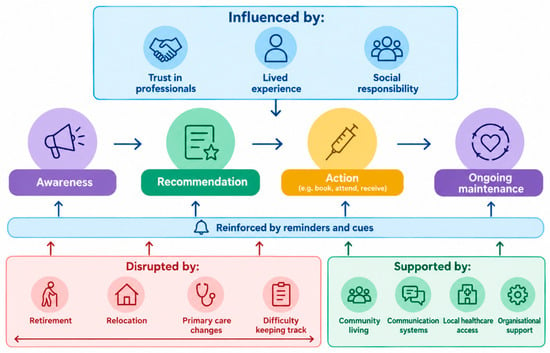
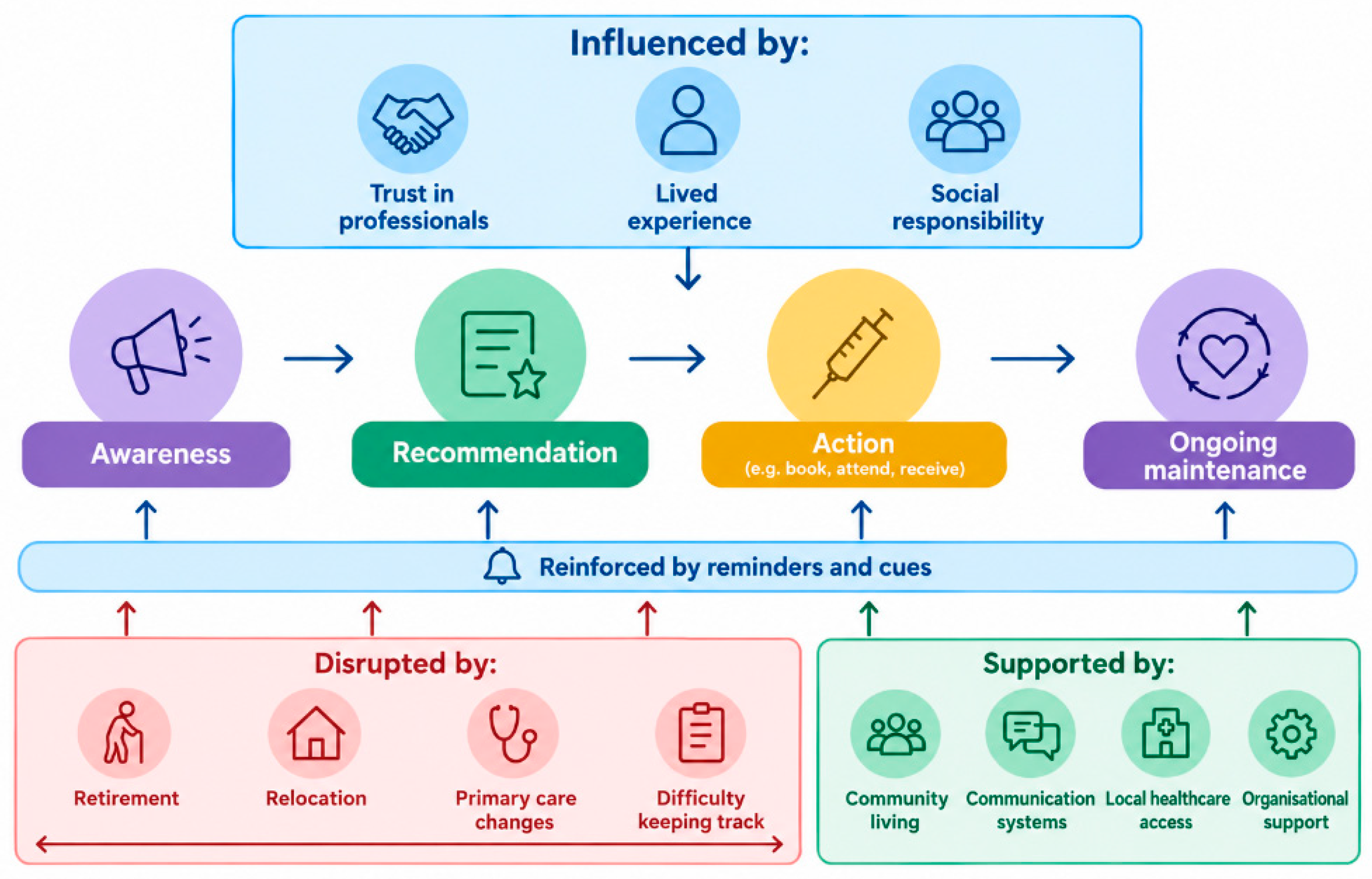
Integrated analysis of resident focus groups and ILU staff and provider surveys identified three interrelated themes: confidence in vaccination; vaccination pathways across life transitions; and the influence of the ILU environment. The themes are synthesised in Figure 1.
Figure 1.
Conceptual model of vaccination pathways among independent living unit (ILU) residents.
- Theme 1: Confidence in vaccination rests on trust in health professionals, lived experience and social responsibility
Participating residents generally expressed confidence in vaccination, describing it as a routine part of later life. Their views reflected trust in healthcare professionals, experiences of infectious disease and a desire to maintain health and protect others. Participants rarely described personal vaccine hesitancy.
- i.
- Trusted healthcare professionals and their recommendations guide vaccination decisions
Trust in vaccination was grounded not only in relationships with individual healthcare professionals but also in confidence in the medical profession and approved vaccines. One participant explained,
“I don’t think we’ve really worried that much about any of the injections. If the vaccine, if they’ve been approved, they’re obviously reasonably safe. And if they’re going to keep us alive a bit longer, why not?”(FG2, P4)
Residents commonly relied on GPs and specialists for vaccination advice rather than independently seeking information. As some participants explained,
“I’m assuming the doctor knows what he or she is talking about. If they say you should have this… They’re experts in this area, not me.”(FG6, P3)
“I must confess I didn’t have the flu vaccine for a long time, but then I needed to go to a haematologist and he said to me, ‘have you had the flu vaccine?’ And I said, ‘no, I don’t think I need it’. And he looked at me and I said ‘you’re telling me I need to have it?’ He said, ‘yes, because you’ve got a low immune system. Have anything that’s going’, so I did as I was told.”(FG6, P1)
Participants often expected healthcare professionals to advise them when vaccines were due.
“I would just rely on the doctor to tell me, like you should get another one”(FG8, P5)
As a result, vaccines could be overlooked when they were not proactively raised during healthcare encounters.
“I think a lot of people wouldn’t know about shingles and pneumonia vaccinations …, they wouldn’t think to ask. And if your GP is not proactive then you slip under the radar.”(FG1, P8)
Participants reported that influenza vaccination was discussed more routinely than other recommended adult vaccines.
“The only booster shot that my doctor talks about is the flu vaccination. Never hear a word about a repeat COVID.”(FG2, P5)
Staff and providers similarly identified healthcare-provider recommendations and vaccination-status reviews as important facilitators of vaccination.
- ii.
- Lived experience makes disease risks tangible
Personal, family and community experiences of vaccine-preventable diseases reinforced perceived disease risks and the benefits of vaccination. One resident reflected on experiencing polio before a vaccine was available:
“I had polio before the vaccine. And another person who lives here also had polio before the vaccine. And so we lived through seeing people die. So when you’ve been through that and come out the other side, you’re very quick to recommend vaccines because that vaccine was not available when I caught it.”(FG7, P3)
Observing another resident become seriously ill with shingles also prompted discussion of vaccination within the village.
“… when someone here years ago got shingles that certainly started the conversation because we could see how ill she was. It was not well known at that point. It was not free. It was not on the media. But I think it scared a lot of us.”(FG7, P3)
- iii.
- Maintaining health, independence and protecting others
Residents viewed vaccination as a way to maintain health and independence in later life. As one participant put it,
“I live by myself. I’ve got to look after myself. So, I’ve got to stay as able as possible.”(FG6, P2)
Vaccination was also seen as a social responsibility, helping protect family, friends and other residents from infection.
“… a lot of people here have health conditions… So, you’re not protecting just yourself. You’re protecting other people that you interact with.”(FG2, P2)
- iv.
- Confidence was reflected in the limited discussion of personal hesitancy
Only two participants reported previous reluctance to vaccinate, attributing this to misinformation or perceptions of low risk rather than general opposition to vaccination.
“The reason I didn’t have the shingles vaccinations, I had misinformation about it and thought I didn’t need it. I was wrong before I got it.”(FG6, P1)
Another explained why they had avoided influenza vaccination when younger:
“… the story was, you had an injection for A but you got B, so I just never had them when I was a lot younger ever. And they weren’t pushing them. I mean they were there available but not saying to our age group, “you definitely should have it”. So yes, I guess I sometimes I don’t go and rush and have them.”(FG7, P3)
Concerns about hesitancy were more often discussed in relation to family members or the wider community. In contrast, staff identified concerns about side effects (7/15 villages), misinformation (6/15 villages) and perceptions that vaccines were unnecessary (5/15 villages) as barriers. These findings suggest that vaccine hesitancy was more apparent in staff reports at the village level than in residents’ personal accounts.
- Theme 2: Life transitions reshape vaccination pathways
Residents described how retirement, relocation and changes in healthcare relationships disrupted established vaccination routines, reminders and access to advice. These changes increased reliance on individual awareness and self-management.
- i.
- Retirement removes established supports and increases self-management
Retirement removed workplace vaccination programmes and reminders, as well as routines that had helped keep preventive health in view. One participant reflected,
“When you retire, it is totally unstructured and you now have to be in charge of your structure. And for a lot of people that goes out the window, they don’t know how to structure their life. They don’t know how to get on and do things.”(FG1, P2)
Another participant highlighted the loss of workplace vaccination programmes and reminders:
“…most of us got free flu vaccines through our employment. So, once you leave employment, it goes a bit off your radar about getting a flu vaccine… I think that’s one important thing about people retiring is that they’re not getting that annual offer necessarily. So, they’re not getting the push notification so much.”(FG2, P6)
Without routine workplace offers, residents relied more heavily on their own initiative to arrange vaccination.
- ii.
- Relocation and changes in primary care can disrupt continuity of care
Moving to an ILU could require residents to find a new GP and establish new healthcare relationships.
“I came from a completely different part of Sydney and I had to find a doctor. So one of the challenges in moving into retirement is building your new infrastructure and until you find a doctor who can come up to speed with your medical history, you might not have the opportunity of having that conversation.”(FG4, P2)
Participants also noted that residents living alone, without transport or established local connections, could face greater difficulties accessing healthcare.
Changes to general practice were also described as challenging continuity of care. Participants reported increasing difficulty accessing preferred practitioners and maintaining longstanding clinical relationships.
“My GP’s moved into a medical centre now…He had his own little practice, and we used to have nice long chats, but you go now—there’s more people.”(FG5, P2)
- iii.
- Life events, healthcare encounters and media act as cues
In the absence of routine prompts, residents relied on life events and opportunistic encounters to trigger vaccination discussions. Family events, such as the arrival of a new baby, and travel prompted some to check their vaccination status.
“I think what else keeps me engaged is that if there’s a new baby in the family, then I know I’ve got to make sure my vaccinations are up to date. Mainly with the whooping cough. So that gets me to the doctor that gets me into the conversation.”(FG1, P2)
Healthcare encounters also acted as prompts. Participants valued practices that contacted them when vaccines were due.
“I’ve had everything the doctor’s got. I’ve got a very good doctor and they just say this is the time to get it on the phone and do it.”(FG6, P3)
However, opportunities to receive advice were not always consistent. One resident noted that advice about the recommended frequency of COVID-19 vaccination was provided during a pharmacy encounter, whereas their GP had not previously discussed it:
“When I had my shots last week at the pharmacy and the pharmacist was giving them to me, I said, that’s good because I had COVID and that because it’s 12 months since I’ve had COVID. And she said to me, you really should get a COVID injection every six months. And that was the first thing I’d heard about it. My doctor’s surgery, hadn’t said anything.”(FG6, P1)
Media coverage also raised awareness of specific vaccines, including RSV:
“I knew all about RSV because it was on the TV so much.”(FG5, P4)
Similar accounts arose in other groups, including discussion of shingles advertising, media reports of measles outbreaks, and television interviews with healthcare professionals promoting influenza vaccination. Together, these accounts illustrated how vaccination awareness could depend on whether recommendations were raised during individual encounters.
- iv.
- Keeping track of vaccination becomes increasingly difficult
Residents described difficulties remembering vaccination dates, understanding schedules and maintaining records. Some developed personal reminder systems:
“Write in your diary what you think will be due when”(FG1, P5)
“I go to the dentist every six months, so I’ll make sure I get the COVID every six months as well”(FG6, P1)
Participants described difficulties remembering when vaccinations were due:
“… you become forgetful about things and you’re not sure when you had it done last and you might have had it done six weeks ago and that was actually three years.”(FG2, P7)
Awareness of vaccines other than influenza was often limited. On seeing the list of recommended vaccines, some were unfamiliar with shingles or pneumococcal vaccination, while others were uncertain about schedules and eligibility criteria.
“I’m looking at some of the shingles. I didn’t know anything about this. And this is all news to me.”(FG2, P5)
“What’s pneumococcal? What’s that for?”(FG2, P1)
Participants also reported confusion about changing eligibility criteria:
“I made a GP’s appointment specifically to get a vaccine that I thought I was now eligible for at over 65, couldn’t get it. They’d changed the goalpost to 70. So, they keep changing who can have what and when. So that’s quite confusing, I think for people.”(FG1, P6)
Maintaining vaccination records was another challenge. Participants described using a range of approaches to access vaccination records, including MyGov, My Health Record, their GP and paper records. While some valued digital records, others preferred a portable booklet they could control. Uncertainty remained even when records were available; one resident stated,
“I think I’ve had my two pneumonia things, and I think I’ve had shingles somewhere but I can’t prove it anywhere.”(FG1, P8)
Staff accounts supported these observations. Managers described difficulties residents experienced keeping track of recommended vaccines and vaccination schedules. One staff member noted that residents were “aware of COVID and flu” but were “not understanding about pneumococcal vaccines” (Staff 15).
Providers similarly emphasised the importance of maintaining accurate vaccination records and regularly reviewing vaccination histories to identify vaccines that were due. One pharmacist suggested residents should “meet with [a] pharmacist at least twice a year to check records” (Provider 8). A GP similarly described reviewing vaccination eligibility and recommendations using Australian Immunisation Register (AIR) records as part of preventative care.
Together, these accounts suggest that maintaining vaccination over time depends not only on access to vaccines, but also on clear recommendations, accessible records and reliable systems for identifying when vaccines are due.
- Theme 3: The ILU environment influences vaccination awareness, access and support
ILU villages offered opportunities to promote vaccination through social relationships, communication systems and links with healthcare providers. However, access to these supports and the extent of organisational involvement varied between villages.
- i.
- Community living fosters shared responsibility and informal social influence
Residents described how living close to others strengthened their sense of responsibility to protect the village community.
“…you want to protect your community. I mean, we live really close together. So, you are concerned that you’re not going to spread something in the cafe to everybody?”(FG7, P3)
Social relationships also provided opportunities for encouragement and informal reminders. One participant described contacting a friend:
“I phoned her the other day after I’d had mine. And I said, [friend’s name], don’t forget to get your flu shot.”(FG6, P2)
However, residents noted that informal networks could also circulate negative information and amplify concerns about vaccination.
“… I think in a village like this, there’s a lot of chatter. People talk and listen, and they won’t always listen to the good news. The bad news is always more interesting, I think…especially if you didn’t have easy access, it would be easy to say, look, I’m not going to bother about it. It’s too risky and too difficult to get there.”(FG8, P3)
- ii.
- Communication systems support awareness, but not all residents are reached
Residents described newsletters, notices, apps, emails and education sessions as important sources of health information.
“I don’t want to overemphasise the power of the newsletter… the newsletter is a very, very strong vehicle for getting that information over.”(FG1, P2)
Staff described using these channels to communicate vaccination information, and residents suggested they could be used more proactively for reminders and education sessions with vaccination providers. One resident stated,
“There’s nurses there and everything, but they are not checking on vaccinations and things like that. And surely to my way of thinking, why wouldn’t they just put a little notification out to people saying, don’t forget there’s April flu shot time or something, just to protect everybody.”(FG6, P2)
Another resident suggested pharmacist-led sessions, as already held in her village for other conditions.
“…one of the local pharmacy comes in every so often and gives a little talk about some of the heart conditions… Maybe something like that for vaccination could be helpful and encouraging people, too.”(FG8, P3)
Several participants considered limited awareness to be a key barrier to vaccination uptake.
“I think [on-site vaccination] would help. It would definitely help because I think a lot of people are not aware of these things. I do think it boils down to awareness.”(FG3, P1)
However, receiving information did not mean all residents were reached or engaged. Participants noted that residents who were less socially connected or experienced mobility, hearing or technology-related barriers could miss information or lack opportunities to discuss it with others. As one resident observed,
“You’ve been talking to the agile people… there’s hundreds of other people in this village who either weren’t interested or didn’t know it was on.”(FG2, P3)
Existing communication systems therefore did not necessarily reach residents most likely to be disconnected from village networks.
- iii.
- Access is shaped by proximity to local services and by individual circumstances
Most residents described vaccination access as manageable because GP practices and pharmacies were nearby. Barriers were more commonly described in relation to other residents, particularly those with mobility limitations, poor health or transport difficulties.
Pharmacies were valued for their convenience and ability to provide vaccination when GP appointments were not readily available.
“…it was going to be a number of days before I could get an appointment. So I walked straight around and said to [the pharmacist], when can I get a COVID shot? And he said, sit down here and I’ll sort it out for you.”(FG6, P3)
Cost was rarely raised spontaneously, although some participants identified the expense of non-funded vaccines as a potential barrier.
“The only thing I’m concerned about is that the vaccination for RSV or something was $300. So a lot of people didn’t have it.”(FG4, P1)
Staff similarly identified transport, mobility and access to healthcare providers as factors that could make it harder for residents to remain up to date with recommended vaccinations.
- iv.
- Vaccination support varies across villages and responsibility is often unclear
Vaccination support varied considerably between villages. Activities included education sessions, newsletters, transport and appointment assistance, and on-site clinics. Eight of the 15 participating villages reported on-site vaccination clinics: five pharmacy-led, two GP-led and one delivered jointly by a GP and authorised nurse immuniser. All eight offered influenza vaccination; six offered COVID-19, three shingles and two pneumococcal vaccination. None offered all funded vaccines.
Residents often wanted villages to play a greater role in vaccination promotion and service delivery. Suggestions included broader on-site vaccination services, reminders and communication about infectious disease activity.
“The chemist is coming and doing that clinic, but it’s only for influenza. And I was saying why not all of the vaccinations and why not more often?”(FG7, P6)
“I would certainly like to know that there is COVID in that building. And it would make me consider whether I should have a vaccination, a booster vaccination or not.”(FG2, P5)
Although all 15 participating villages were affiliated with a RACH, only 11 were co-located and only four of these reported collaborating with the co-located RACH on vaccination activities. Some residents questioned why vaccination support appeared more structured in residential aged care than in ILUs.
“… we see ourselves as one… I would think that’s one of the reasons why we should consider vaccination being a high priority…. I would imagine that in the nursing home they’d be pretty much onto the vaccination situation, wouldn’t they? Whereas, in ILU it’s not the same.”(FG8, P3)
One staff respondent highlighted both privacy concerns and uncertainty regarding organisational responsibility, noting that
“Independent means that privacy and confidentiality creates issues for village management to be too involved” and that “vaccination standards are not part of the ILU remit”(Staff 15)
None of the participating villages reported a formal vaccination policy, and monitoring residents’ vaccination status was uncommon. Nevertheless, 11 of 15 villages were open to additional vaccination activities and a further three might be willing to participate. These findings suggest that uncertainty about roles, resources and appropriate support models may constrain activity despite staff willingness.
Providers generally reported willingness and capacity to deliver in-reach vaccination services. Pharmacist respondents estimated they could vaccinate between 30 and more than 150 residents per day during an on-site clinic, and nine of the 13 providers agreed to share their contact details with villages to support vaccination.
Providers identified management engagement, suitable facilities, consent processes, coordination and funding as important determinants of service delivery. Three specifically identified reimbursement as a barrier, while one pharmacist was uncertain about eligibility to deliver National Immunisation Program vaccines in ILU settings. These findings highlighted the need for organisational coordination and clarity about funding and service arrangements.
Across the datasets, residents’ expectations of greater village support contrasted with concerns about privacy, independence and the limits of village responsibilities. Uncertainty about who should facilitate vaccination emerged as a recurring issue, despite interest among staff and providers in expanding support.
4. Discussion
This convergent mixed-methods study explored barriers and enablers to vaccination among older adults living in ILU villages affiliated with RACHs in South Eastern Sydney. Three key findings emerged. First, participating residents generally supported vaccination and trusted healthcare professionals, but awareness of some recommended vaccines and schedules was limited. Second, life transitions, including retirement, relocation and changes in healthcare relationships, disrupted established vaccination routines and sources of support. Third, ILU villages offered opportunities to facilitate vaccination, although organisational practices and responsibilities varied.
4.1. From Acceptance to Action: Awareness, Recommendations and Continuity of Care
Viewed through the 5As framework [17], the findings suggest that vaccination among ILU residents may be influenced less by acceptance or affordability than by awareness and activation. Residents generally expressed confidence in vaccination but often relied on recommendations, reminders and other cues to identify when vaccines were due and to take action. Reliance on recommendations and reminders aligns with the Health Belief Model, which highlights the importance of cues to action in translating health beliefs and intentions into health behaviours [19]. Our previous work in RACHs also highlighted the importance of vaccination records, reminders and established vaccination processes [20,21].
ILU residents described prompts for action, including healthcare professional recommendations, family events, travel plans and media coverage. However, reliance on these opportunistic cues may leave vaccination needs unaddressed when no prompt occurs. Awareness also varied by vaccine. Participants were generally familiar with influenza and COVID-19 vaccines but less certain about shingles, pneumococcal and RSV vaccines, including eligibility and timing. Similar patterns have been reported internationally, with greater awareness of influenza vaccination than pneumococcal or shingles vaccination among older adults [22]. This indicates that awareness gaps can occur at several stages, from recognising that a vaccine is recommended to identifying when it is due and arranging vaccination.
Healthcare professionals emerged as particularly important sources of advice and activation. Participants often expected GPs, specialists and pharmacists to identify their vaccination needs. Although reliance on trusted professionals may support acceptance, vaccination opportunities may be missed when vaccination is not routinely reviewed during healthcare encounters. A systematic review of 61 studies found that healthcare professional recommendations were positively associated with adult vaccination in most studies examining this relationship [23]. Other research similarly emphasises integrating adult vaccination into preventive healthcare [24,25].
Life transitions associated with ageing may further disrupt these pathways. Retirement removed workplace vaccination programmes and reminders, while relocation and changes in primary care could weaken established healthcare relationships and continuity of care. These disruptions may be particularly consequential when residents rely on healthcare professionals to identify less familiar vaccination needs. Similar challenges have been described in research examining ageing in place, relocation and transitions in later life [12]. Overall, the findings suggest that supporting vaccination requires not only positive attitudes, but also accessible information, proactive recommendations and reliable processes to maintain vaccination over time.
4.2. ILUs Occupy an Intermediate Setting Between Community Living and Residential Aged Care
ILU villages occupy an intermediate position between independent community living and residential aged care. Residents generally remain responsible for their own healthcare but live within organised communities that can influence access to information, social support and healthcare services. Unlike RACHs, ILUs generally lack formal vaccination policies, monitoring processes and clearly defined organisational responsibilities.
This ambiguity may partly reflect the broader policy context. Australian retirement village legislation focuses primarily on governance, contractual arrangements and resident protections rather than establishing explicit responsibilities for preventive health [9,26]. Consequently, the extent to which vaccination is promoted or facilitated may depend on local organisational priorities, leadership and relationships with healthcare providers.
Practices varied across participating villages. Some offered education sessions, transport assistance or on-site clinics, while others reported few structured activities. Residents sometimes expected village management, village nurses or affiliated RACHs to provide information and practical support, while most staff respondents indicated willingness to support additional vaccination-related activities, suggesting scope to build on existing initiatives. Clearer roles, leadership support and collaboration with vaccination providers may help villages build on existing activities without assuming responsibility for residents’ clinical care.
Evidence from other communal living settings provides a useful comparison. In a United States study, vaccination programmes were more commonly reported in nursing homes than in assisted-living communities [27]. Although these settings differ from Australian ILUs, this finding suggests that preventive health activities may be less systematically organised where residents retain greater independence.
The findings do not suggest that ILUs should assume responsibility for residents’ vaccination status. Rather, they may help facilitate vaccination through communication, education, reminders, transport assistance and links to vaccination providers while preserving residents’ autonomy. In this sense, ILU villages may represent an under-recognised setting for the promotion of adult vaccination and other healthy ageing initiatives.
4.3. Implications for Practice and Policy
The findings have implications for practice and policy across four areas, which we discuss below through questions intended to stimulate further consideration and evaluation.
First, should ILU management support vaccination knowledge and access to account for transitions between community living, ILUs and residential aged care? Retirement, relocation and changes in healthcare providers may disrupt vaccination routines, records and follow-up. Strategies to improve vaccination could therefore extend beyond generic reminder and recall systems to consider how vaccination histories, recommendations and plans for follow-up are maintained when living arrangements or healthcare providers change. With appropriate consent and privacy safeguards, routine review of vaccination history, support to access records and clear communication between residents and their healthcare providers may help maintain continuity. Reminder and recall systems remain relevant, as evidence supports their use to improve adult vaccination uptake [28,29], but their effectiveness may depend on accurate records, clear responsibility for follow-up and their integration into routine care.
Second, how can communication strategies reach residents who are less connected to village information networks? Hearing and mobility difficulties, technology barriers and social isolation may limit access to newsletters, emails and organised activities. More personalised approaches, including telephone outreach, face-to-face engagement and peer-based support, may help improve equity of access [30,31].
Third, can partnerships with vaccination providers improve access? Community pharmacies are an increasingly important vaccination setting in Australia, although their role varies by vaccine and funding arrangements [2,32]. Residents described pharmacies as accessible and trusted, and pharmacist respondents reported willingness and capacity to provide in-reach services in ILU villages, with some villages already facilitating this. However, feasibility may depend on funding, consent procedures and organisational support. Evidence suggests pharmacist-led interventions can increase vaccination uptake among vulnerable adults [33], and the International Pharmaceutical Federation advocates integrating pharmacists into life-course vaccination strategies [34]. In-reach models could therefore be explored alongside clear arrangements for consent, documentation and communication with residents’ usual healthcare providers.
Finally, could affiliated RACHs provide opportunities to share clinical expertise, infrastructure and communication systems with ILUs? Only a minority of villages co-located with RACHs reported collaboration on vaccination, indicating that proximity alone does not ensure coordinated support. Previous research has identified that organisational, governance and workforce factors can impede collaboration across health and aged-care services [35,36]. Formalised partnerships between affiliated ILUs and RACHs may represent an opportunity to better utilise existing resources and infrastructure.
4.4. Strengths and Limitations
This study brought together resident, staff and vaccination provider perspectives in an under-researched setting. The convergent mixed-methods design supported integration of qualitative and quantitative findings, while the 5As framework provided a structured approach without constraining the identification of unanticipated findings. Reflexive practice, an audit trail and transparent reporting supported analytic rigour.
Several limitations should be considered. Participation was voluntary and residents were predominantly female, mobile, socially engaged, Australian-born and English-speaking. People with stronger reservations about vaccination, lower engagement with village activities, greater social isolation and from culturally and linguistically diverse backgrounds may therefore be under-represented. The vaccine confidence observed in this sample should not be assumed to reflect the broader ILU population.
Two ILU staff members attended the first focus group before procedures were revised to exclude staff from subsequent groups. Their contributions were excluded from analysis but their presence may have influenced the discussion. Focus group size also varied from one to eight participants, potentially affecting group dynamics and the breadth of discussion.
The staff survey included 15 of 25 identified villages and responses were not fully independent because some managers represented multiple villages. Staff perceptions of vaccination practices were not verified against residents’ vaccination records. The provider survey was based on a small convenience sample dominated by pharmacists, potentially over-representing providers with an interest in delivering vaccination services in ILU villages.
Finally, the study was conducted only in ILU villages affiliated with RACHs in one health district and may not be transferable to stand-alone retirement villages or other jurisdictions. Affiliated villages may have greater access to health-related infrastructure and provider networks than other retirement village models. The study did not directly measure vaccination uptake. Changes to adult vaccination recommendations and funding during and shortly after data collection, including the addition of RSV vaccine to the NIP and changes to the pneumococcal vaccination schedule, may also have influenced participants’ awareness and perceptions of vaccination complexity.
4.5. Future Directions
In response to the barriers and opportunities identified by this study, the Public Health Unit developed an ILU vaccination toolkit, policy template and vaccination provider directory that were shared with the participating villages and made available online [37]. Future research should evaluate the implementation and effectiveness of these resources, including their effects on awareness, organisational practices and vaccine uptake.
Further work should explore the experiences of under-represented groups, assess transferability to stand-alone ILUs and evaluate the feasibility of in-reach vaccination models. Research examining how vaccination recommendations, records and follow-up are maintained across transitions between community living, ILUs and residential aged care may also help identify opportunities to improve continuity of preventive care.
5. Conclusions
This study suggests that vaccination among older adults living in ILUs is shaped by the interaction of individual confidence in vaccines, healthcare-provider recommendations, changing life circumstances and the ILU’s organisational environment. As an intermediate setting between community living and residential aged care, ILU villages represent an under-recognised opportunity for the promotion and delivery of vaccination to older adults. Further evaluation is needed to determine which strategies are effective, acceptable and equitable in improving vaccination outcomes in this setting.
Supplementary Materials
The following supporting information can be downloaded at https://www.mdpi.com/article/10.3390/vaccines14110985/s1, Surveys S1: ILU staff and vaccination provider surveys; Discussion Guide S1: ILU resident focus group discussion guide.
Author Contributions
Conceptualization, C.M. and L.M.; Methodology, C.M., L.N.M., L.M., C.S. and V.S.; Formal Analysis, L.N.M., C.M. and L.M.; Investigation, C.M., L.M. and L.N.M.; Resources, C.M., L.M., L.N.M., C.S. and V.S.; Writing—Original Draft Preparation, L.N.M., C.M. and L.M.; Writing—Review and Editing, C.S. and V.S.; Visualisation, L.N.M.; Supervision, C.S. and V.S.; Project Administration, C.M.; Funding Acquisition, C.M., L.M., C.S., L.N.M. and V.S. All authors have read and agreed to the published version of the manuscript.
Funding
The project team acknowledges funding support from the South Eastern Sydney Local Health District (SESLHD) Research Support Office through the RES-ON Research Funding Program, Tranche B Evidence-Generating Research Scheme. Grant numbers are not issued for this funding.
Institutional Review Board Statement
This study was conducted in accordance with the National Statement on Ethical Conduct in Human Research (2023) and was reviewed through the low and negligible risk review pathway. Ethical approval was granted by the South Eastern Sydney Local Health District Human Research Ethics Committee (HREC reference 2025/ETH02074) following review by the South Eastern Sydney Local Health District Low and Negligible Risk (LNR) Committee at its meeting on 23 September 2025.
Informed Consent Statement
Residents provided written informed consent and survey respondents provided electronic consent before participation. Participants were provided with participant information in English and had the opportunity to ask questions or withdraw their consent at any time. Participation was voluntary.
Data Availability Statement
The data presented in this study are available upon request from the corresponding author. Due to ethical restrictions, they are not publicly available.
Acknowledgments
The authors sincerely thank the staff of the participating independent living unit (ILU) villages for their time, support, and valuable contributions to this study. Their willingness to complete the survey, discuss existing processes, and describe barriers to vaccination was instrumental to this research, as was their assistance in coordinating resident focus groups. We are particularly grateful to the residents who generously shared their experiences and perspectives. We also thank the vaccination providers who took the time to complete the survey and provide insights into their experiences delivering vaccination services to older adults.
Conflicts of Interest
The authors declare no conflicts of interest. The funders had no role in the design of the study; in the collection, analysis, or interpretation of data; in the writing of the manuscript; or in the decision to publish the results.
Abbreviations
The following abbreviations are used in this manuscript:
| COREQ | Consolidated criteria for reporting qualitative research |
| GP | General Practitioner |
| ILU | Independent Living Unit |
| NSW | New South Wales |
| RACH | Residential Aged Care Home |
| RSV | Respiratory syncytial virus |
| SESLHD | South Eastern Sydney Local Health District |
References
- Ruff, T.A.; Taylor, K.; Nolan, T. Australia’s contribution to global immunisation. Aust. N. Z. J. Public Health 2012, 36, 564–569. [Google Scholar] [CrossRef] [Scilit] [PubMed]
- Australian Government—Department of Health, Disability and Aging. National Immunisation Strategy For Australia 2025–2030. 2025. Available online: https://www.cdc.gov.au/resources/publications/national-immunisation-strategy-australia-2025-2030?language=en (accessed on 27 June 2025).
- Australian Government—Australian Institute of Health and Welfare. Profile of Australia’s Population. Available online: https://www.aihw.gov.au/reports/australias-health/profile-of-australias-population (accessed on 30 October 2026).
- NSW Government, NSW Health. NSW Immunisation Schedule (Children and Adults). Available online: https://www.health.nsw.gov.au/immunisation/app/Pages/schedule.aspx (accessed on 1 October 2026).
- Australian Government—Department of Health, Disability and Ageing. Australian Immunisation Register (AIR) Respiratory Vaccine Dashboard Summary. Available online: https://app.powerbi.com/view?r=eyJrIjoiMTFiYTZmZDQtNDFhMi00YWFjLTkzYzktM2ZjNzRhMjI5ZDM2IiwidCI6IjM0YTM5MjljLTczY2YtNDk1NC1hYmZlLTE0N2RjMzUxNzg5MiJ9 (accessed on 30 October 2026).
- National Centre for Immunisation Research and Surveillance (NCIRS Australia). Annual Immunisation Coverage Report 2024. 2025. Available online: https://ncirs.org.au/sites/default/files/2025-10/Annual%20Immunisation%20Coverage%20Report%202024.pdf (accessed on 12 November 2025).
- Australian Government—Department of Health, Disability and Ageing. Australian Immunisation Register (AIR) Older Australian Immunisation, Shingles (Herpes Zoster) (2026). Available online: https://app.powerbi.com/view?r=eyJrIjoiMTUxYzQwNDItZTQ5NS00NGFkLTg0MTQtZjY3MTQ4MTJmYWIwIiwidCI6IjM0YTM5MjljLTczY2YtNDk1NC1hYmZlLTE0N2RjMzUxNzg5MiJ9 (accessed on 30 October 2026).
- McElhaney, J.E.; Gavazzi, G.; Flamaing, J.; Petermans, J. The role of vaccination in successful independent ageing. Eur. Geriatr. Med. 2016, 7, 171–175. [Google Scholar] [CrossRef] [Scilit]
- Hu, X.; Xia, B.; Skitmore, M.; Buys, L.; Zuo, J. Retirement villages in Australia: A literature review. Pac. Rim Prop. Res. J. 2017, 23, 101–122. [Google Scholar] [CrossRef] [Scilit]
- Australian Government—Department of Health, Disability and Ageing. About Residential Aged Care. Available online: https://www.health.gov.au/our-work/residential-aged-care/about (accessed on 10 September 2026).
- NSW Government Planning. Seniors Housing Housing SEPP. Available online: https://www.planning.nsw.gov.au/the-planning-system/housing/housing-sepp/seniors-housing (accessed on 16 October 2026).
- Cheek, J.; Ballantyne, A.; Byers, L.; Quan, J. From retirement village to residential aged care: What older people and their families say. Health Soc. Care Community 2007, 15, 8–17. [Google Scholar] [CrossRef] [Scilit] [PubMed]
- PWC/Property Council. PwC-RLC Retirement Census. 2025. Available online: https://www.propertycouncil.com.au/advocacy/our-divisions/retirement-living-council/pwc-rlc-retirement-census (accessed on 16 October 2026).
- Saunders, C.H.; Sierpe, A.; von Plessen, C.; Kennedy, A.M.; Leviton, L.C.; Bernstein, S.L.; Goldwag, J.; King, J.R.; Marx, C.M.; A Pogue, J.; et al. Practical thematic analysis: A guide for multidisciplinary health services research teams engaging in qualitative analysis. BMJ 2023, 381, e074256. [Google Scholar] [CrossRef] [Scilit] [PubMed]
- Malterud, K.; Siersma, V.D.; Guassora, A.D. Sample Size in Qualitative Interview Studies: Guided by Information Power. Qual. Health Res. 2016, 26, 1753–1760. [Google Scholar] [CrossRef] [Scilit] [PubMed]
- Aged Care Guide. An Introduction to Retirement Villages. Available online: https://www.agedcareguide.com.au/information/retirement-villages-introduction (accessed on 16 October 2026).
- Thomson, A.; Robinson, K.; Vallée-Tourangeau, G. The 5As: A practical taxonomy for the determinants of vaccine uptake. Vaccine 2016, 34, 1018–1024. [Google Scholar] [CrossRef] [Scilit] [PubMed]
- Tong, A.; Sainsbury, P.; Craig, J. Consolidated criteria for reporting qualitative research (COREQ): A 32-item checklist for interviews and focus groups. Int. J. Qual. Health Care 2007, 19, 349–357. [Google Scholar] [CrossRef] [Scilit] [PubMed]
- Janz, N.K.; Becker, M.H. The Health Belief Model: A Decade Later. Health Educ. Q. 1984, 11, 1–47. [Google Scholar] [CrossRef] [Scilit] [PubMed]
- McGregor, C.; Maude, L.; Chee, K.; Tillman, L.; Swift, C.; Ferson, M.; Goodger, B.; Wright, K.; Sheppeard, V. Voices from the Frontline: Understanding the Barriers and Enablers to Vaccination in Aged Care Facilities in Sydney, Australia. Vaccines 2025, 13, 1137. [Google Scholar] [CrossRef] [Scilit] [PubMed]
- McGregor, C.; Tillman, L.; Maude, L.; Chee, K.; Swift, C.; McIndoe, L.; Ferson, M.; Goodger, B.; Wright, K.; Sheppeard, V. Evaluating a Tailored Quality Improvement Intervention to Improve Vaccination Coverage in Sydney Residential Aged Care Facilities. Vaccines 2026, 14, 171. [Google Scholar] [CrossRef] [Scilit] [PubMed]
- Nicholls, L.A.B.; Gallant, A.J.; Cogan, N.; Rasmussen, S.; Young, D.; Williams, L. Older adults’ vaccine hesitancy: Psychosocial factors associated with influenza, pneumococcal, and shingles vaccine uptake. Vaccine 2021, 39, 3520–3527. [Google Scholar] [CrossRef] [Scilit] [PubMed]
- Eiden, A.L.; Barratt, J.; Nyaku, M.K. Drivers of and barriers to routine adult vaccination: A systematic literature review. Hum. Vaccines Immunother. 2022, 18, 2127290. [Google Scholar] [CrossRef] [Scilit] [PubMed]
- Doherty, T.M.; Del Giudice, G.; Maggi, S. Adult vaccination as part of a healthy lifestyle: Moving from medical intervention to health promotion. Ann. Med. 2019, 51, 128–140. [Google Scholar] [CrossRef] [Scilit] [PubMed]
- Torres, A.; Cilloniz, C.; Aldea, M.; Mena, G.; Miró, J.M.; Trilla, A.; Vilella, A.; Menéndez, R. Adult vaccinations against respiratory infections. Expert Rev. Anti Infect. Ther. 2025, 23, 135–147. [Google Scholar] [CrossRef] [Scilit] [PubMed]
- Travers, M.; Liu, E.; Cook, P.; Osborne, C.; Jacobs, K.; Aminpour, F.; Dwyer, Z. Business Models, Consumer Experiences and Regulation of Retirement Villages; AHURI Final Report No. 392; Australian Housing and Urban Research Institute Limited: Melbourne, Australia, 2022. [Google Scholar] [CrossRef] [Scilit]
- Berner, K.J.; Mese, P.O.; Bowblis, J.R.; Applebaum, R. The Prevalence and Impact of Vaccination Programs: Differences Between Nursing Homes and Assisted Living Communities. J. Am. Med. Dir. Assoc. 2026, 27, 106107. [Google Scholar] [CrossRef] [Scilit] [PubMed]
- Jacobson Vann, J.C.; Jacobson, R.M.; Coyne-Beasley, T.; Asafu-Adjei, J.K.; Szilagyi, P.G. Patient reminder and recall interventions to improve immunization rates. Cochrane Database Syst. Rev. 2018, 2018, CD003941. [Google Scholar] [CrossRef] [Scilit] [PubMed]
- Community Preventive Services Task Force (CPSTF). Increasing Appropriate Vaccination: Client Reminder and Recall Systems; Centers for Disease Control and Prevention: Atlanta, GA, USA, 2024. [Google Scholar] [CrossRef] [Scilit]
- Thomas, R.E.; Lorenzetti, D.L. Interventions to increase influenza vaccination rates of those 60 years and older in the community. Cochrane Database Syst. Rev. 2018, 2018, CD005188. [Google Scholar] [CrossRef] [Scilit] [PubMed]
- Gobbo, E.L.S.; Hanson, C.; Abunnaja, K.S.S.; Van Wees, S.H. Do peer-based education interventions effectively improve vaccination acceptance? A systematic review. BMC Public Health 2023, 23, 1354. [Google Scholar] [CrossRef] [Scilit] [PubMed]
- Australian Government—Department of Health, Disability and Ageing. Expansion of the National Immunisation Program Vaccinations in Pharmacy (NIPVIP) Program. Available online: https://www.health.gov.au/news/expansion-of-the-national-immunisation-program-vaccinations-in-pharmacy-nipvip-program (accessed on 26 August 2026).
- Borlini, S.; Pennisi, F.; Pinto, A.; De Ponti, E.; D’Amelio, A.C.; Signorelli, C. Impact of pharmacy-based interventions on vaccination coverage among vulnerable and underserved populations: A systematic review and meta-analysis. Vaccine 2026, 78, 128426. [Google Scholar] [CrossRef] [Scilit] [PubMed]
- International Pharmaceutical Federation. Supporting Life-Course Immunisation Through Pharmacy-Based Vaccination: Enabling Equity, Access and Sustainability; International Pharmaceutical Federation: The Hague, The Netherlands, 2023; Available online: https://www.fip.org/file/5588 (accessed on 12 November 2026).
- Liapi, F.; Chater, A.M.; Randhawa, G.; Stephenson, A.; Pappas, Y. Factors that influence inter-organisational integration: A qualitative exploration of service providers’ perspectives from an integrated care initiative. BMC Health Serv. Res. 2025, 25, 947. [Google Scholar] [CrossRef] [Scilit] [PubMed]
- Johal, J.; Block, H.; Dymmott, A.; Dent, E.; Exley, H.; George, S. Barriers and enablers to primary care in Australian residential aged care homes: A scoping review. Arch. Gerontol. Geriatr. 2026, 140, 106032. [Google Scholar] [CrossRef] [Scilit] [PubMed]
- South Eastern Sydney Local Health District Public Health Unit. VillageVax. Available online: https://www.seslhd.health.nsw.gov.au/villagevax (accessed on 30 October 2026).

Disclaimer/Publisher’s Note: The statements, opinions and data contained in all publications are solely those of the individual author(s) and contributor(s) and not of MDPI and/or the editor(s). MDPI and/or the editor(s) disclaim responsibility for any injury to people or property resulting from any ideas, methods, instructions or products referred to in the content. |
© 2026 by the authors. Licensee MDPI, Basel, Switzerland. This article is an open access article distributed under the terms and conditions of the Creative Commons Attribution (CC BY) license.