


Abstract
Furfuryl alcohol (FFA), a methanol-soluble and highly specific compound for singlet oxygen (1O2), was used as a 1O2 trapping agent to reevaluate physical and chemical 1O2 quenching efficiency of five antioxidants, namely α-tocopherol, butylated hydroxyanisole (BHA), tert-butylhydroquinone (TBHQ), epigallocatechin gallate (EGCG), and quercetin. The total 1O2 quenching rate constants of α-tocopherol, BHA, TBHQ, EGCG, and quercetin were 2.0 (±0.1) × 109, 1.1 (±0.1) × 108, 5.6 (±0.3) × 108, 4.1 (±0.1) × 108, and 2.2 (±0.1) × 108 M−1s−1, respectively. The chemical quenching rate constants of α-tocopherol, BHA, TBHQ, EGCG, and quercetin were 1.4 × 10⁷, 2.0 × 10⁶, 7.7 × 10⁶, 2.0 × 10⁷, and 7.9 × 10⁶ M−1s−1, respectively. The percentages of chemical quenching in total 1O2 quenching were 0.7%, 1.8%, 1.4%, 4.8%, and 3.6% for α-tocopherol, BHA, TBHQ, EGCG, and quercetin, respectively, indicating that the five antioxidants quenched 1O2 almost exclusively by a physical quenching mechanism. This is the first report on the 1O2 quenching mechanism of quercetin in methanol solvent. The results of this study will provide theoretical guidance for the application of antioxidants to inhibit edible oil or fat-containing food from photooxidation.
1. Introduction
In the presence of oxygen, the natural pigments in vegetable oil, such as chlorophyll, are excited under light exposure and can generate reactive oxygen species via two distinct photosensitized oxidation pathways: Type I (secondary pathway) and Type II (main pathway) [1]. In the Type I pathway, the excited photosensitizer transfers an electron or hydrogen atom to a substrate or molecular oxygen, producing free radicals such as superoxide anion (O2−•) and hydroxyl radical (•OH). In the Type II pathway, energy is transferred from the excited photosensitizer to ground-state molecular oxygen (3O2), generating highly reactive singlet oxygen (1O2) [2]. Once 1O2 is generated, it reacts directly with the double bonds in unsaturated fatty acids via a concerted “ene” addition mechanism to generate hydroperoxide, which is further decomposed in secondary oxidations. Due to its high energy and reactivity, 1O2-induced oxidation of oils occurs at a rate over 1500 times faster than that caused by auto-oxidation [3,4]. Furthermore, many free radicals are produced in the process of photooxidation, which can further initiate automatic chain oxidation and increase the complexity of oxidation, resulting in rapid oxidation and deterioration of oil and fats and loss of nutritional value [5,6]. Therefore, inhibiting the formation of 1O2 in oil and fats is crucial for protecting them from oxidative degradation.
To inhibit the formation of 1O2 or quench 1O2 in an oil system, the most common method is to add a 1O2 quenching agent to the oil. In general, 1O2 quenching agents include natural antioxidants and synthetic antioxidants; natural antioxidants include tocopherols [7,8], carotenoids [9], flavonoids [10,11], etc. Synthetic antioxidants include tert-butylhydroquinone (TBHQ), tert-butylhydroxyanisol (BHA), tert-di-butylhydroxytoluene (BHT), and others [12,13]. In terms of mechanism, 1O2 quenching methods include physical quenching and chemical quenching. Chemical quenching means that the reaction between 1O2 and an antioxidant not only leads to the deactivation of 1O2 but also results in a rapid consumption of antioxidants and the formation new compounds, so its antioxidant life is short [14]. In contrast, in physical quenching, 1O2 is converted into 3O2 by either energy transfer or charge transfer, and there is no degradation of the antioxidant [15]. To select and obtain a high-efficiency 1O2 antioxidant, it is necessary to measure its physical quenching and chemical quenching rate constants, a popular topic in the field of oil antioxidation research. At present, studies on the 1O2 quenching rate constant of common antioxidants have been performed mainly in methanol systems [16,17], ethanol systems [18,19,20], pyridine systems [21], and methylene dichloride systems [22]. In a classical singlet oxygen quenching experiment, Foote et al. [23] employed 2,5-diphenyl-3,5-benzofuran (DPBF) as a probe and generated 1O2 photochemically using methylene blue (MB). The total and chemical 1O2 quenching rate constants for α-tocopherol were determined as 6.7 × 10⁸ M−1s−1 and 4.6 × 10⁷ M−1s−1 in methanol, respectively, by applying a steady-state kinetic equation. Similarly, Kim et al. [16] used DPBF as a probe in a methanol system, with 1O2 generated through the chemical reaction of NaMoO4 and H2O2. By this method, the total 1O2 quenching rate constants determined for BHA, BHT, TBHQ, and α-tocopherol were 3.37 × 10⁷, 4.26 × 10⁶, 1.67 × 10⁸, and 3.54 × 10⁸ M−1s−1, respectively. Additionally, an alternative 1O2 trapping agent has been reported for the determination of the 1O2 quenching constants of BHA, TBHQ, and BHT in methanol. Lee and Jung [17] used α-terpinene as a probe and MB as a photosensitizer generating 1O2 photochemically. Their experiments yielded total 1O2 quenching rate constants of 5.14 × 10⁷, 1.99 × 10⁸, and 3.41 × 10⁶ M−1s−1 for BHA, TBHQ, and BHT, respectively, with corresponding chemical 1O2 quenching rate constants of 3.90 × 10⁵, 2.93 × 10⁶, and 1.23 × 10⁵ M−1s−1. Beyond BHA, BHT, and TBHQ, catechins—natural compounds extracted from tea—are commonly employed as 1O2 quenching agents. Their total and chemical 1O2 quenching rate constants have been determined in a methanol system using similar methodologies. Specifically, the total 1O2 quenching rate constants for epicatechin gallate (ECG), epicatechin (EC), catechin (C), gallocatechin gallate (GCG), epigallocatechin gallate (EGCG), and epigallocatechin (EGC) were 4.83 × 10⁷, 2.99 × 10⁷, 1.66 × 10⁷, 1.09 × 10⁸, 1.31 × 10⁸, and 1.32 × 10⁸ M−1s−1, respectively [24]. Their chemical 1O2 quenching rate constants were 8.66 × 10⁵, 5.60 × 10⁵, 3.5 × 10⁵, 1.30 × 10⁶, 1.57 × 10⁶, and 1.63 × 10⁶ M−1s−1 for ECG, EC, C, EGC, GCG, and EGCG, respectively [24]. For quercetin (a natural antioxidant belonging to the hydroxyflavones family), its total 1O2 quenching rate constant was determined in ethanol [18,19] and methylene chloride systems [25]. Among these studies, Nagaoka et al. [18] investigated the solvent effect on the 1O2 quenching activity of hydroxyflavones using rose bengal to generate 1O2. They reported a total 1O2 quenching rate constant of 1.9 × 10⁶ M−1s−1 for quercetin in ethanol solution, determined via a near-infrared fluorescence lifetime measurement system. Notably, the total 1O2 quenching rate constant increased monotonically with solvent polarity (achieved by adding water to ethanol in the range of 0–25% v/v). Sibuea et al. [25] further studied quercetin’s effects on erythrosine-photosensitized oxidation of linoleic acid and palm oil in methylene chloride. Through a steady-state kinetic method, they estimated quercetin’s total 1O2 quenching rate constants as 3.2 × 10⁹ and 4.3 × 10⁹ M−1s−1 for linoleic acid and palm oil, respectively. However, to the best of our knowledge, the total and chemical 1O2 quenching rate constants of quercetin in methanol remain unreported.
In order to study the mechanism by which antioxidants quench 1O2, it is necessary to conduct real-time detection of 1O2 in the reaction system. At present, the commonly used methods are the direct detection method and the indirect detection method. Singlet oxygen can be detected directly via its characteristic near-infrared (NIR) phosphorescence emission at approximately 1270 nm [26]. Direct NIR phosphorescence detection offers high specificity and enables real-time, time-resolved measurements of 1O2 lifetime and quenching dynamics. However, this approach requires sophisticated instrumentation (e.g., sensitive NIR detectors) and is often limited by the low phosphorescence quantum yield of 1O2, particularly in polar solvents such as methanol [27]. In contrast, the indirect chemical trapping method using a 1O2 trapping agent is simple, cost-effective, and well-suited for steady-state kinetic studies in homogeneous solutions.
Previous studies have shown that determinations of the quenching rate constants of antioxidants have been carried out mostly in methanol systems and the probe used frequently is α-terpinene. However, the physical properties of α-terpinene show that it is hardly soluble in methanol and, according to the methods reported by Mukai et al. [20] and Kim et al. [16], this may lead to lower values for the total quenching rate constant of the antioxidants than the real 1O2 quenching rate. Another study used DPBF as a probe to determine the 1O2 quenching rate of TBHQ, BHT, and BHA, but some reports have shown that DPBF also reacts with superoxide anions, reducing the specificity of DPBF for 1O2 [28], which may influence the accuracy of the 1O2 quenching rates of the antioxidants. Therefore, selection of an ideal 1O2 probe for determining the quenching rate constant of an antioxidant is crucial and must meet the following requirements: (1) it must be soluble in the experimental system; (2) it must react specifically with 1O2 with a high rate constant; and (3) it should not physically quench 1O2. Furfuryl alcohol (FFA), being soluble in methanol and fulfilling all the aforementioned criteria, has been employed as a highly efficient probe for 1O2 in methanol solutions [29]. In our previous study, we established a simple, sensitive, and accurate high-performance liquid chromatography-UV (HPLC-UV) method for the quantitation of FFA [30]. This method facilitates the measurement of both total 1O2 quenching rate and chemical 1O2 quenching rate constants when using FFA as the 1O2 trapping agent.
In this study, FFA, a methanol-soluble and highly specific 1O2 reaction compound, was selected as a probe and MB was selected as a photosensitizer for 1O2-induced photooxidation. The goals of this study were as follows: (1) to investigate the relative protective activity of various antioxidants—α-tocopherol, BHA, TBHQ, EGCG, and quercetin—against 1O2-induced photooxidation of FFA in methanol; (2) to measure the total 1O2 quenching rate constants (kr + kq) and the chemical quenching rate constants (kr) of the antioxidants in methanol; and (3) to elucidate the quenching mechanisms of these antioxidants, with a particular focus on quercetin, whose quenching mechanism has not been previously reported. The evaluation of physical and chemical 1O2 quenching efficiency of the antioxidants will provide theoretical guidance for their application in protecting edible oil or fat-containing food from photooxidation.
2. Materials and Methods
2.1. Experimental Materials
Methylene blue (MB, purity ≥ 96%), tert-butylhydroquinone (TBHQ, purity ≥ 98%), butylated hydroxyanisole (BHA, purity ≥ 98%), and epigallocatechin (EGCG, purity ≥ 98%) were purchased from Aladdin Biochemical Co., Ltd., Shanghai, China. The α-tocopherol (purity ≥ 96%) and furfuryl alcohol (FFA, purity ≥ 98%) were purchased from Sigma Aldrich Co., Ltd. (St. Louis, MO, USA). Quercetin (purity ≥ 95%) was purchased from Shanghai Yuanye Biological Co., Ltd. (Shanghai, China). Methanol, formic acid, and acetonitrile (all chromatographically pure) were purchased from Sinopharm Chemical Reagent Co., Ltd. (Shanghai, China). Water was obtained from a MilliQ purification system (Millipore Corp., Burlington, MA, USA).
2.2. Standard Solutions Preparation
Seven stock standard solutions of MB, FFA, α-tocopherol, BHA, TBHQ, EGCG, and quercetin were prepared by dissolving a known amount of each compound into HPLC-grade methanol to a concentration of MB at 6.25 × 10⁻⁵ M, and FFA, α-tocopherol, BHA, TBHQ, EGCG, and quercetin at 1.0 × 10⁻³ M. Working solutions were obtained by successive dilution of the stock solutions.
2.3. Experimental Methods
2.3.1. Determination of the Total 1O2 Quenching Rate Constant
The 1O2 quenching rate constant of α-tocopherol, BHA, TBHQ, EGCG, and quercetin in methanol was determined by using the reported method with a slight modification [16]. In our study, FFA was selected as a 1O2 probe, and 1O2 was generated through a Type II photochemical pathway using MB (which has an absorption maximum at ~660 nm) as the photosensitizer. The series sample solutions were prepared by dissolving a certain amount of FFA (as a probe, 2 × 10⁻⁴ M), antioxidants (including α-tocopherol, BHA, TBHQ, EGCG, and quercetin, 0 to 2 × 10⁻³ M), and MB (6.25 × 10⁻⁵ M) in methanol. Then, 10 mL of each sample solution was absorbed and added to a clean and transparent glass vial, and sealed with a screw cap. The prepared sample vials were transferred into an LED illumination box and exposed to 2000 lux of LED light for 25 min. Aliquots of sample solutions were collected at every 5-min interval to evaluate the effects of antioxidants on the FFA oxidation. The remaining content of FFA was determined by HPLC analysis. The 1O2 quenching rates for each antioxidant were carried out in triplet analysis.
2.3.2. Determination of the Reaction Rate Constant Between FFA and 1O2
The chemical reaction rate constant between 1O2 and FFA in methanol was determined in this study. The series sample solutions were prepared by dissolving various contents of FFA (1~6 × 10⁻⁴ M) and MB (6.25 × 10⁻⁵ M) in methanol. Then, 10 mL of each sample solution was absorbed and added to a clean and transparent glass vial, and sealed with a screw cap. The prepared sample vials were transferred into an LED illumination box and exposed to 2000 lux of LED light for 25 min. Aliquots of sample solutions were collected at every 5-min interval to monitor the remaining content of FFA in the solutions. The reaction rate constant between FFA and 1O2 was carried out in triplet analysis.
2.3.3. Determination of 1O2 Chemical Quenching Rate Constant
The 1O2 chemical quenching rates (kr) of antioxidants were determined by comparing their disappearance rates to that of FFA in methanol, using the known krFFA value for FFA [31]. The sample solutions were prepared by dissolving FFA (0.5 × 10⁻³ M) and MB (6.25 × 10⁻⁵ M), and antioxidants (0.5 × 10⁻³ M) and MB (6.25 × 10⁻⁵ M) in methanol. Then, 10 mL of each sample solution was absorbed and added to a clean and transparent glass vial, and sealed with a screw cap. The prepared sample vials were transferred into an LED illumination box and exposed to 2000 lux of LED light for 25 min (sample contained FFA) or 50 min (sample contained antioxidant). At predetermined intervals, aliquots of sample solutions were taken out, and the residual FFA or antioxidants in the solutions were quantified by HPLC analysis; thus, the apparent reaction rates of FFA and antioxidants during light exposure could be calculated. With the known krFFA value of FFA, the 1O2 chemical quenching rate constants of antioxidants were determined by measuring their relative oxidation rates to that of FFA in the same solution.
2.3.4. Determination of FFA Contents by High-Performance Liquid Chromatography
The content of FFA was determined by using an Agilent Infinity 1260 HPLC (Agilent Technologies, Santa Clara, CA, USA) equipped with a UV–vis detector set at 219 nm for the detection of FFA [30]. FFA was separated using a Shim-Pack SB-C18 column (250 mm × 4.6 mm, 5 µm particle size, Shimadzu Scientific, Columbia, MD, USA) operating at 40 °C. The injection volume was 20 μL. An isocratic elution was applied: at first, a mixture of deionized water–acetonitrile (80:20, v/v) at a flow rate of 1.2 mL/min was maintained for 6.5 min to elute FFA. Then, the mobile phase was ramped to 100% acetonitrile in 20 s and maintained for 2.5 min to wash out any remaining components. Finally, the mobile phase was shifted back to the initial condition and held for 2 min to re-equilibrate the column. Agilent ChemStation (version B.04.03, Agilent Technologies, Santa Clara, CA, USA) was used for data collection and processing. FFA was identified by comparison of its retention time with that of the reference standard. The quantification of FFA was performed by using its external calibration function.
2.3.5. Determination of the Antioxidants by High-Performance Liquid Chromatography
An Agilent Infinity 1260 HPLC equipped with a UV–vis detector and an automatic injector was used for the determination of antioxidants (α-tocopherol, BHA, TBHQ, EGCG, and quercetin). For α-tocopherol, the chromatographic condition was performed according to ISO 9936:2016 using a silica or diol-bonded silica column (250 mm × 4.6 mm, 5 μm), with n-hexane/isopropanol (99:1, v/v) as the mobile phase at a flow rate of 1.0 mL/min. Fluorescence detection was employed with an excitation wavelength of 295 nm and an emission wavelength of 330 nm [32]. For BHA and TBHQ, the chromatographic conditions were performed according to the AOAC Official Method 983.15 using a reversed-phase C18 column (100 mm × 2.1 mm, 2.6 μm). The mobile phase consisted of 0.1% formic acid in water (solvent A) and 0.1% formic acid in acetonitrile (solvent B). The flow rate was maintained at 0.3 mL/min, and the column temperature was controlled at 40 °C. Detection was achieved through electrospray ionization in positive mode (ESI+), with quantitative analysis by multiple reaction monitoring (MRM), and UV detection at 280 nm [33]. For EGCG, the chromatographic conditions were performed according to ISO/TC 34/SC 8 using a C18 analytical column (250 mm × 4.6 mm, 5 μm). The mobile phase consisted of solvent A (water containing acetic acid and disodium EDTA) and solvent B (acetonitrile) under gradient elution. The column temperature was maintained at 40 °C, and UV detection was performed at 278 nm [34]. For quercetin, reversed-phase HPLC was carried out following the method described by Wach et al. using a Luna C18(2) column (250 mm × 4.1 mm i.d., Phenomenex, Torrance, CA, USA). The mobile phase consisted of 25 mM of phosphate buffer (pH 2.5) and methanol operated in gradient elution mode. UV detection was performed at 370 nm as specified in the reference [35]. The identification of the antioxidants was achieved by comparing their retention time to those of the standard compounds. The quantification of the antioxidants was performed according to the peak ratio between each peak and that of the standard compound with known quantity.
2.4. Data Processing and Analysis
All experiments were carried out in three independent replicates, and the results were expressed as mean values ± standard deviation. Analysis of variance (ANOVA) with the Tukey HSD post hoc test was used to ascertain the statistical differences in total and chemical 1O2 quenching activities of the synthetic and natural antioxidants at α = 0.05 by using a SPSS 26.0 statistical analysis program (SPSS Inc., Chicago, IL, USA).
3. Results and Discussion
3.1. Determination of Total 1O2 Quenching Rate Constant (kr + kq)
The total 1O2 quenching rate constants of five different antioxidants (α-tocopherol, BHA, TBHQ, EGCG, and quercetin) were determined via a steady-state kinetic equation. In the reaction, MB was used as a photosensitizer, and an LED was used as the light source to generate 1O2 via Type II photosensitive oxidation. Specifically, MB absorbs photons from LED light, typically in the red to visible range (around 660 nm wavelength). This promotes MB from its ground state (1MB) to an excited singlet state (1MB*). The 1MB* then undergoes intersystem crossing, forming the longer-lived triplet excited state (3MB*). The 3MB* then transfers its energy to ground-state molecular oxygen (3O2). This energy transfer excites 3O2 to 1O2, while the 3MB* returns to its ground state and can be reused in the cycle. When a solution containing a given quencher, MB, and FFA is exposed to radiation, the following reactions will happen:
Note: Physical quenching of 1O2 by FFA is theoretically possible, but its contribution is negligible (kphys ≪ kchem) and is therefore not considered in this work [29,36].
Where kd is the reciprocal of 1O2 lifetime in the solvent; krFFA represents the chemical reaction rate constant of FFA with 1O2; kr represents the rate constant of chemical quenching of 1O2; kq represents the rate constant of physical quenching of 1O2; quencher-O2 is the quencher oxidation product.
In the reaction system without any antioxidant, 1O2 vanishes via two pathways: nonradiative decay (Reaction (2)) and deactivation by FFA (Reaction (3)). If the reaction system contains an antioxidant, 1O2 can be quenched through four distinct pathways, which are nonradiative decay (Reaction (2)), deactivation by FFA (Reaction (3)), 1O2 chemical quenching by the antioxidant (Reaction (4)), as well as 1O2 physical quenching by the antioxidant (Reaction (5)).
In our experiment, equal volumes of two solutions containing the same initial concentration of FFA (one with an antioxidant and the other without an antioxidant) were exposed to the same illuminating conditions. Although the antioxidants in the antioxidant addition group would also quench both the triplet excited state of MB (3MB*) and 1O2, under our experimental conditions, no more than about 4.3% of 3MB* was quenched by the antioxidants. Therefore, when different concentrations of antioxidants were added, the amount of 1O2 produced was approximately equal across different antioxidant concentrations [37,38]. Thus, the total 1O2 quenching rate constant of the antioxidant was calculated with Equation (6), which can be derived from steady-state kinetics [16,17]:
where So represents the slope of the first-order curve for the vanishing of FFA (1O2 acceptor) in the absence of an antioxidant; Sa represents the slope of the first-order curve for the vanishing of FFA when an antioxidant is present; and [Q] is the concentration of the antioxidant.
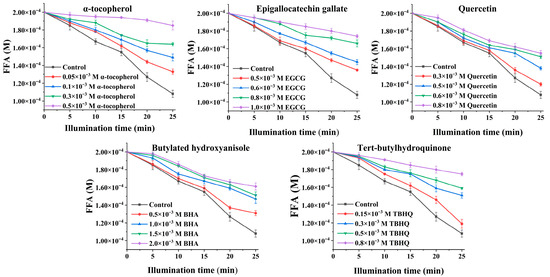
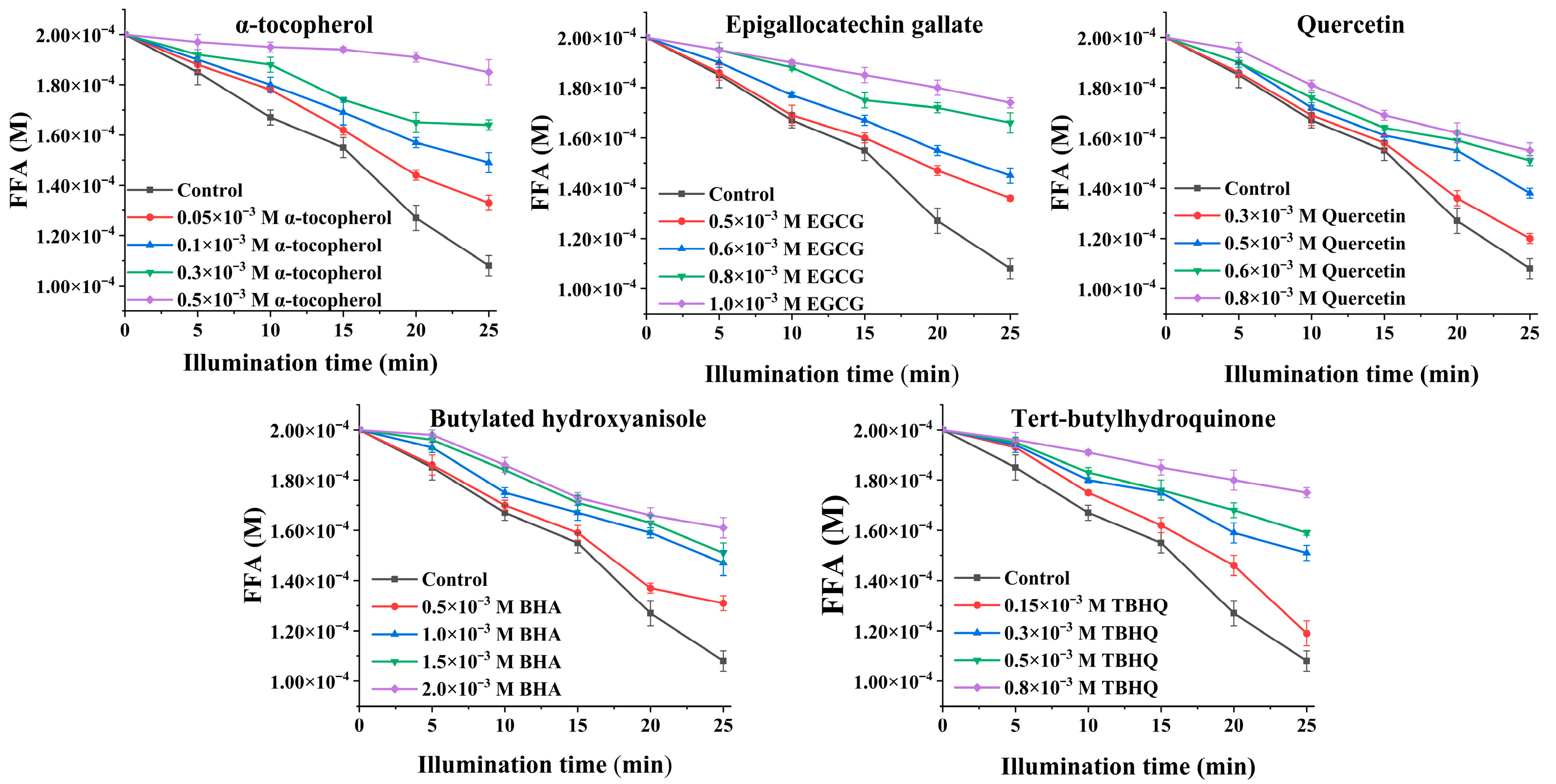
If plot So/Sa compared with [Q], a straight line would be obtained, whose slope is (kr + kq)/kd. By using Equation (6), the total 1O2 quenching rate constant (kr + kq) can be calculated. The 1O2 decay rate in methanol is 1.4 × 10⁵ s−1, as reported by Kim et al. [16] In a methanol system, the effects of antioxidants (α-tocopherol, BHA, TBHQ, EGCG, and quercetin) on FFA photooxidation (Type II pathway) were shown in Figure 1. The results showed that FFA photooxidation in methanol were inhibited by these antioxidants, and their inhibitory effects increased with the increase in antioxidant concentration. The photooxidation of FFA was shown in first-order kinetics.
Figure 1.
Effects of different concentrations of antioxidants on the FFA oxidation in methanol containing MB during LED light illumination (2000 Lux).
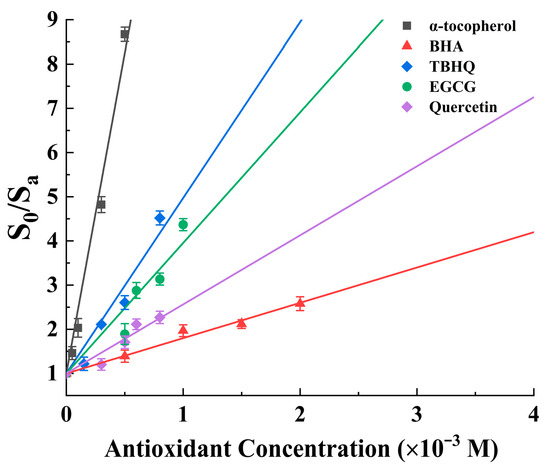
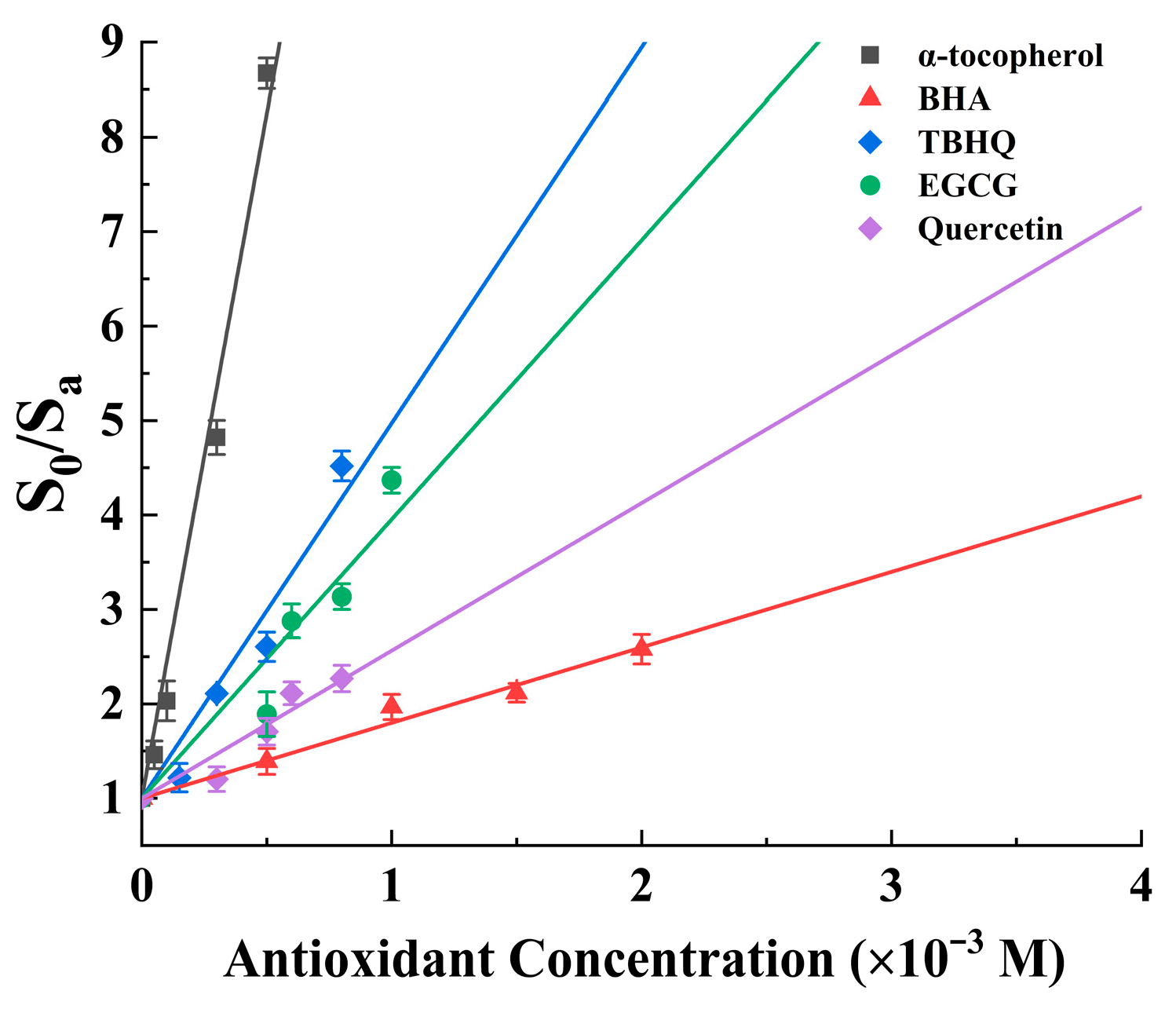
The plots of So/Sa against [Q] for α-tocopherol, BHA, TBHQ, EGCG, and quercetin are shown in Figure 2. It can be seen that as the concentration of antioxidants in methanol increased, the values of So/Sa also continuously increased (Figure 2), which means that the antioxidants had a dose-dependent protective effect on the oxidation of FFA induced by 1O2. The results revealed that the slope of α-tocopherol (Figure 2) was the steepest, followed by that of TBHQ, EGCG, quercetin, and BHA, which means that the protective activity of α-tocopherol against the FFA photooxidation was the highest. Compared with synthetic BHA, quercetin had better protective activity against the 1O2 oxidation of FFA.
Figure 2.
Plot of So/Sa against concentration of five antioxidants (α-tocopherol, BHA, TBHQ, EGCG, and quercetin).
With the known kd value (1.4 × 10⁵ s−1) and the slope of the plot shown in Figure 2, the total 1O2 quenching rate constant values of the five antioxidants can be calculated using Equation (6) and were 2.0 (±0.1) × 109, 1.1 (±0.1) × 108, 5.6 (±0.3) × 108, 4.1 (±0.1) × 108, and 2.2 (±0.1) × 108 M−1s−1 for α-tocopherol, BHA, TBHQ, EGCG, and quercetin, respectively (Table 1). Our data revealed that the total 1O2 quenching rate of α-tocopherol was 18.1 times and 3.7 times greater than that of BHA and TBHQ, respectively, similar to reported data [16] in which the total 1O2 quenching rates of α-tocopherol were 10.5 times and 2.1 times greater than those of BHA and TBHQ, respectively. Our data also revealed that the total 1O2 quenching rate constants of EGCG and quercetin were within the same order of magnitude as that of TBHQ. As a natural antioxidant, α-tocopherol had approximately 4.9 times stronger 1O2 quenching activity than EGCG and approximately 9.3 times stronger 1O2 quenching activity than quercetin in our study. According to the data reported by Choi et al. [24], the total 1O2 quenching rate constant of α-tocopherol was approximately 2.9 times greater than that of EGCG, comparable to our results. Although the reaction system for the generation of 1O2 and the probe used for competitive reactions with the 1O2− in previous reports were different from those in our study, the order of 1O2 quenching activity of the five examined antioxidants was the same.
Table 1.
Total 1O2 quenching rate constant (kr + kq), 1O2 chemical quenching rate constant (kr), ratio of chemical quenching rate over total quenching rate (kr/kr + kq), and ratio of physical quenching rate over total quenching rate (1 − kr/kr + kq).
After further analysis, we found that the absolute values of the total 1O2 quenching rate constants of the five antioxidants were different from those in previous reports. Lee and Jung [17] used MB as a photosensitizer and α-terpinene as a probe, generating 1O2 photochemically in methanol. In their experiment, the total 1O2 quenching rate constants of TBHQ and BHA were 1.99 × 10⁸ and 5.14 × 10⁷ M−1s−1, respectively. In contrast, our results yielded values of 5.6 × 10⁸ and 1.1 × 10⁸ M−1s−1 for TBHQ and BHA, representing 2.8-fold and 2.2-fold increases compared to their data [17]. Similarly, the total 1O2 quenching rate constant of EGCG (4.1 × 10⁸ M−1s−1) determined in our study is also higher than the value (1.31 × 10⁸ M−1s−1) reported by Choi and Jung [24], who used MB as a photosensitizer and α-terpinene as a probe, with 1O2 generated photochemically in methanol. In another study, Kim et al. [16] used DPBF as a probe, and 1O2 was produced by the dark chemical reaction of NaMoO4 and H2O2 in a methanol system. By this method, the total 1O2 quenching rate constants of BHA, α-tocopherol, and TBHQ were determined to be 3.37 × 10⁷, 3.54 × 10⁸, and 1.67 × 10⁸ M−1s−1, respectively, which were only 30.1%, 17.4%, and 30.0% of the values obtained in our study. Beyond methanol systems, the total 1O2 quenching rate constants of EGCG and quercetin have also been evaluated in ethanol solutions. When DPBF was used as a probe with 1O2 generated via thermal decomposition of endoperoxide, EGCG exhibited a total quenching rate constant of 1.47 × 10⁸ M−1s−1 [20]. In a separate study using rose bengal to generate 1O2, quercetin’s total quenching rate constant was determined as 1.9 × 10⁶ M−1s−1 via near-infrared fluorescence lifetime measurements [18]. Notably, our results for EGCG and quercetin showed 2.8-fold and 115.3-fold enhancements compared to these earlier studies.
The reasons for the differences in the total 1O2 quenching rate constants of BHA, TBHQ, EGCG, α-tocopherol, and quercetin between our data and previously reported values may be due to the following: (1) Poor solubility of the probe in methanol. In the reaction system, the probe and antioxidant compete for 1O2. To maintain a steady state—where the rate of 1O2 generation equals its disappearance (including self-quenching, quenching by the probe, and quenching by the antioxidant)—both components must remain within a reasonable concentration range. When the antioxidant concentration increases, the probe’s disappearance rate decreases to preserve this equilibrium. In previous reports [17], α-terpinene was used as a probe in methanol-based competitive systems. However, α-terpinene exhibits poor solubility in methanol, placing it at a disadvantage when competing with antioxidants for 1O2. Consequently, a larger proportion of the antioxidant is consumed during the reaction, leading to an underestimation of the total 1O2 quenching rate constant (derived from plotting S0/Sa vs. [Q]) for the antioxidants compared to that obtained in our study. In contrast, our study employed FFA as the probe. FFA is highly soluble in methanol and exhibits specificity and high efficiency for 1O2 reactions. This allows FFA to compete effectively with antioxidants in a dose-dependent manner. Thus, the slope observed in S0/Sa vs. [Q] plots in our study is steeper, reflecting that the total 1O2 quenching rate constant of the antioxidants exceeds previously reported data. (2) Lack of probe specificity for 1O2. Earlier work [16,23] utilized DPBF as a probe in competitive systems. However, DPBF is not specific to 1O2 and reacts with other reactive oxygen species (e.g., superoxide anions). To protect DPBF from nonspecific oxidation, a greater amount of antioxidant is consumed compared to systems using a 1O2-specific probe. This artifact could reduce the calculated total 1O2 quenching rate constant. By using FFA—a probe with exclusive specificity for 1O2 and a high reaction rate constant—we eliminated interference from nonspecific reactions. This methodological refinement resulted in higher total 1O2 quenching rate constants for BHA, α-tocopherol, and TBHQ in our study compared to prior reports [16,23]. (3) The solvent effect plays a critical role in modulating reaction kinetics. Notably, methanol exhibits significantly higher polarity than ethanol. In this study, the total 1O2 quenching rate constant of quercetin was determined in methanol, whereas the previous study [18] utilized ethanol. As solvent polarity increases, the Gibbs free energy of the charge transfer state decreases, leading to an enlarged standard free energy difference (|ΔG0|). According to the Marcus equation [39], this reduction in activation energy (Δ‡G) enhances the electron transfer rate constant (ket), thereby driving the observed increase in the total singlet oxygen quenching rate constants. This mechanistic interpretation explains why the total 1O2 quenching rate constant of quercetin reported in this study is substantially higher than that documented in earlier literature. The influence of solvent polarity on the total singlet oxygen quenching rate constant of antioxidants can be further demonstrated through comparative studies of α-tocopherol in different solvents. For instance, Mukai et al. [40,41] reported that the total quenching rate constant of α-tocopherol determined in ethanol was 2.06 × 10⁸ M−1s−1, whereas in an ethanol/chloroform/D2O (50:50:1) mixture, the value was 1.35 × 10⁸ M−1s−1 [42]. Comparative analysis reveals a positive correlation between solvent polarity and the total quenching rate constant: higher-polarity solvents (e.g., ethanol, polarity index 5.2) exhibit a higher value compared to lower-polarity solvents (e.g., the ethanol/chloroform/D2O mixture, polarity index 4.7–4.8). Specifically, the value in ethanol is 1.5 times that in the mixed solvent (2.06 × 10⁸ vs. 1.35 × 10⁸ M−1s−1).
3.2. Determination of 1O2 Reaction Rate Constant of FFA
The 1O2 oxidation rate constant of FFA was calculated using Equation (7).
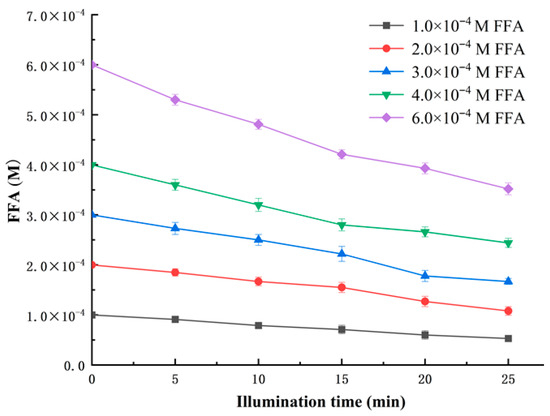
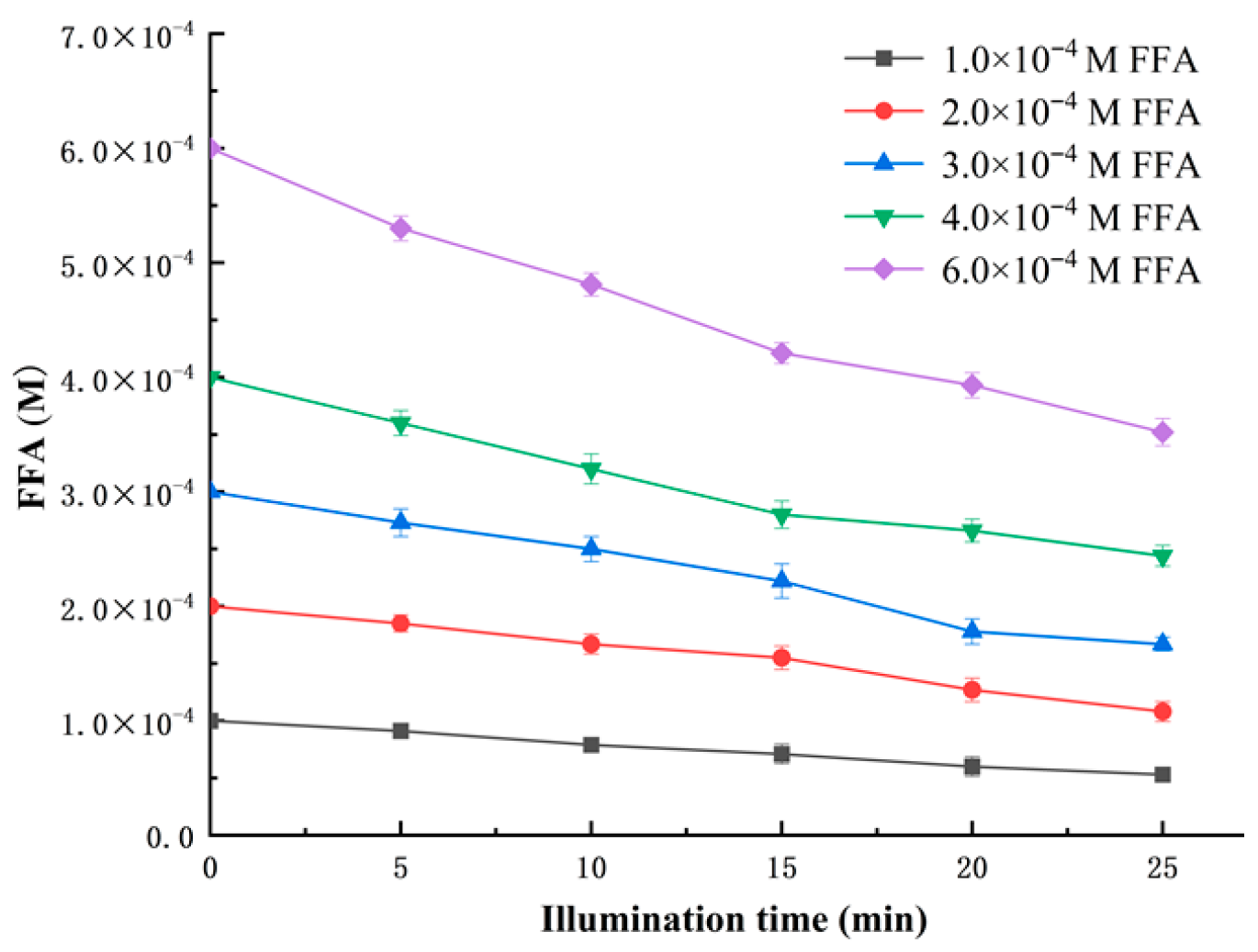
where −d [FFA]/dt is the instantaneous disappearance rate of FFA (also known as the apparent disappearance rate); K−1 is reciprocal of the rate of 1O2 generation; kd represents the decay rate of 1O2 in the solvent; and krFFA is the chemical reaction rate constant of FFA reacted with 1O2. By plotting {−d[FFA]/dt}−1 against [FFA]−1, a straight line would be obtained whose intercept is K−1 and slope is β × K−1. Then, a value of β would be obtained by dividing the slope by the intercept, that is, β = kd/krFFA. The 1O2 decay rate (kd) in methanol is 1.4 × 10⁵ s−1, as reported by Kim et al. [16]. Figure 3 shows the photooxidation of FFA in methanol by using MB as a photosensitizer and LED as a light source. FFA oxidation followed first-order kinetics.
Figure 3.
Plot of FFA oxidation at different concentrations in methanol containing MB under LED light illumination (2000 Lux).
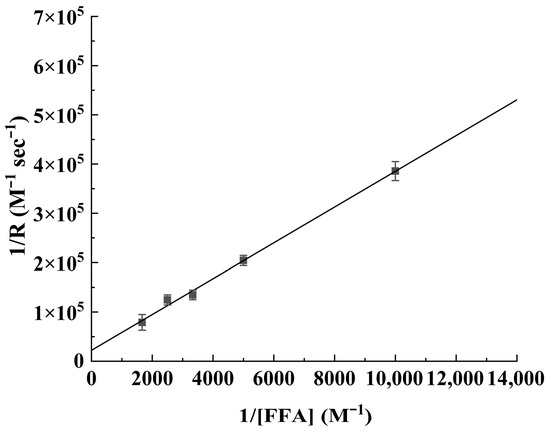
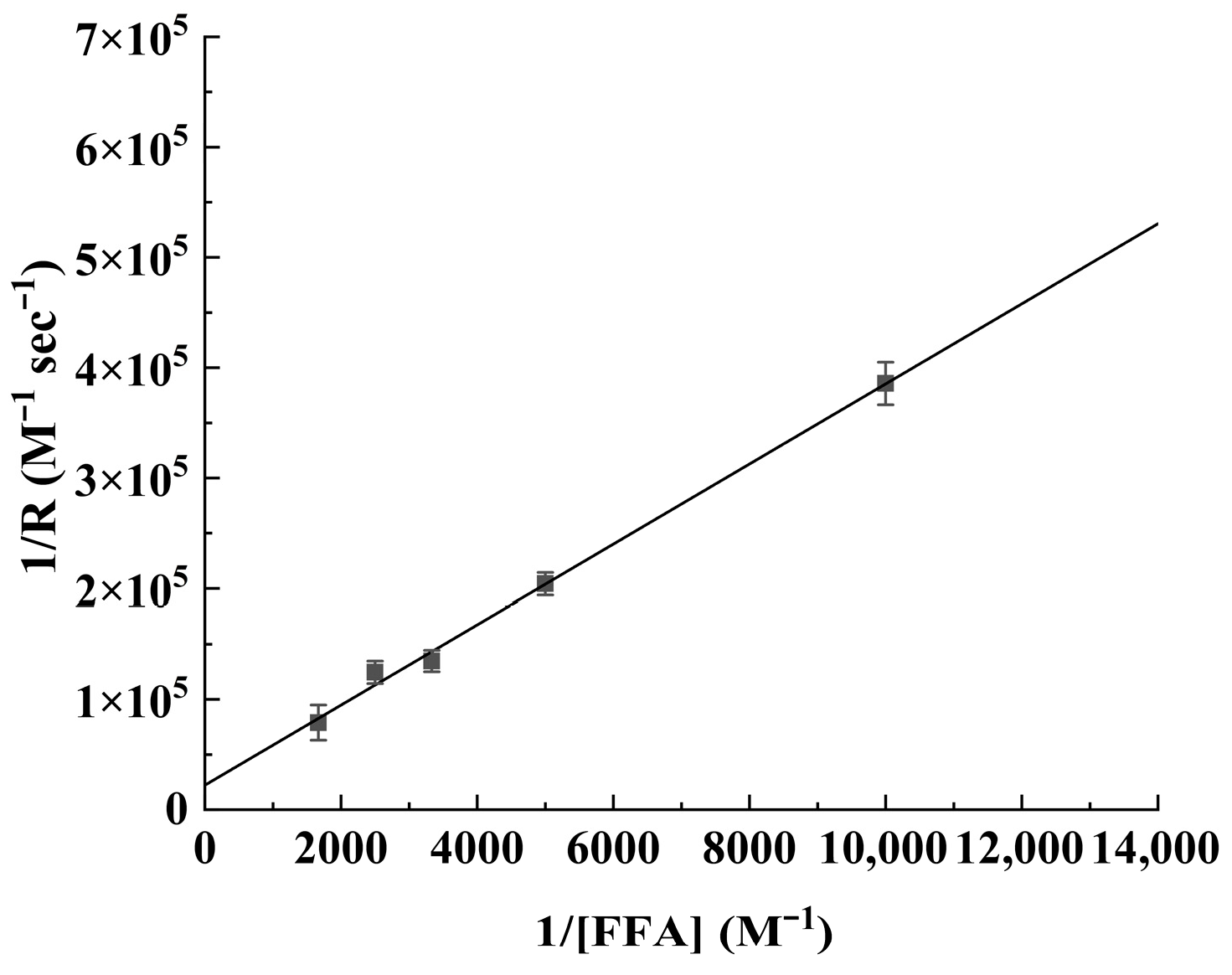
Figure 4 shows the plot of 1/R (reciprocal of apparent rate of FFA disappearance, obtained from (Figure 3)) against 1/C (reciprocal of FFA concentration). According to the plot (Figure 4), the value of β obtained from three replicates of independent experimental analysis was 0.002210. With the known values of kd and β, krFFA can be calculated: krFFA = kd/β = 1.4 × 10⁵/0.002210 = 6.33 × 10⁷ M−1s−1.
Figure 4.
Plot of 1/R against 1/C for the oxidation of FFA.
3.3. Determination of 1O2 Chemical Quenching Rate Constant (kr) and Physical Quenching Rate Constant (kq) of Antioxidants
The 1O2 chemical quenching rate (kr) of the antioxidants in methanol was determined according to the relative apparent photooxidation rate of the antioxidants compared with the photooxidation rate of FFA, irradiated under the same conditions.
where krFFA represents the chemical reaction rate constant of FFA with 1O2; krantioxidant represents the chemical reaction rate constant of the antioxidant with 1O2; −d[FFA]/dt represents the apparent rate of FFA disappearance; and −d[antioxidant]/dt is the apparent rate of antioxidant disappearance.
krantioxidant/krFFA = {−d [antioxidant]/dt}/{−d [FFA]/dt}
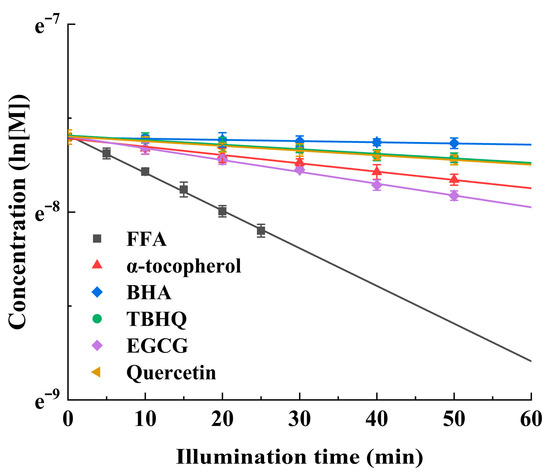
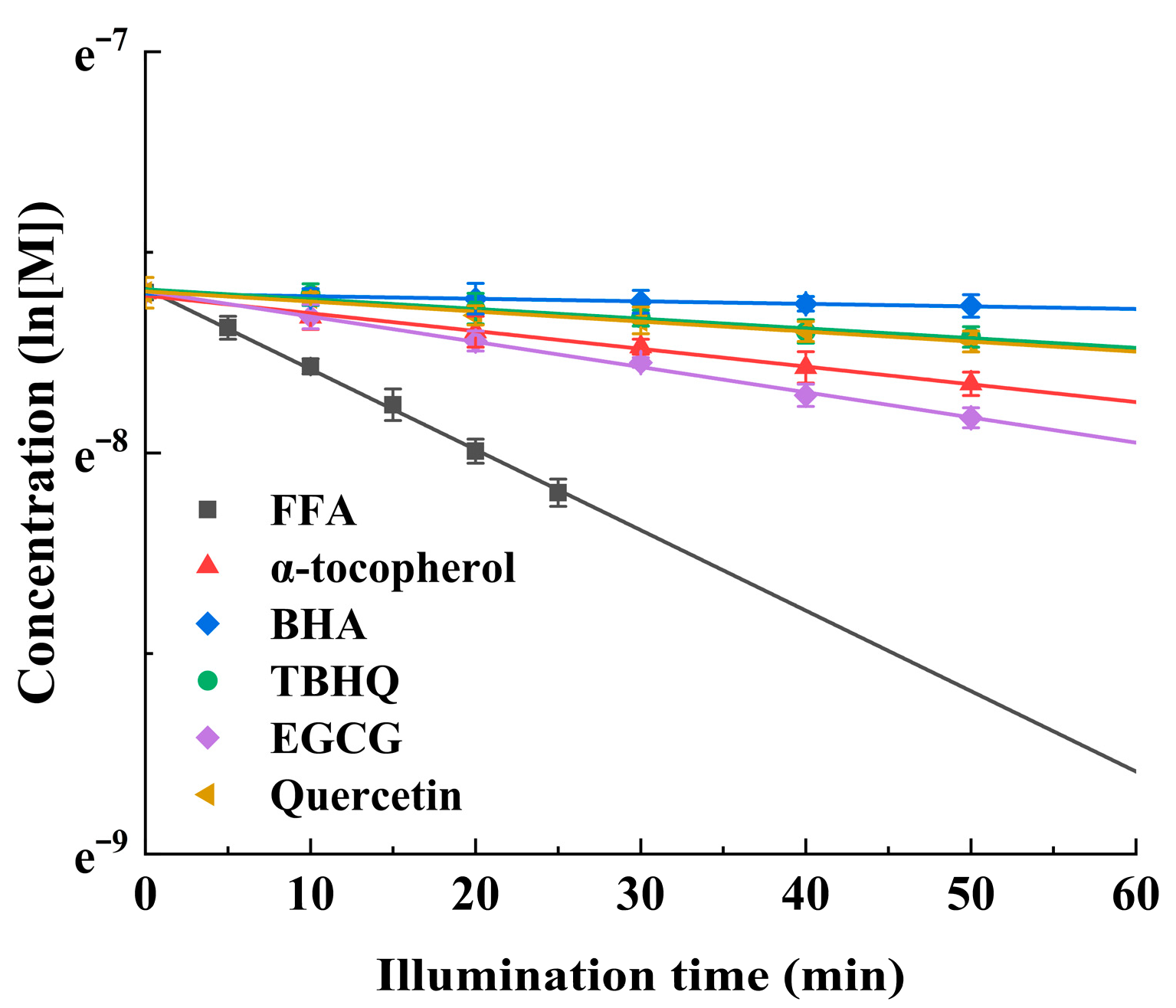
The disappearance rates of α-tocopherol, BHA, TBHQ, EGCG, and quercetin compared with FFA in a methanol solution containing MB during illumination under the same conditions are shown in Figure 5, which shows that the disappearance of the antioxidants followed first-order kinetics. The apparent rate constants (k) of FFA, α-tocopherol, BHA, TBHQ, EGCG, and quercetin calculated by using the first-order kinetic equation were −2.01 × 10⁻² min−1, −4.4 × 10⁻³ min−1, −6.35 × 10⁻⁴ min−1, −2.43 × 10⁻³ min−1, −6.29 × 10⁻³ min−1, and −2.50 × 10⁻³ min−1, respectively. After that, the relative reaction rates for α-tocopherol, BHA, TBHQ, EGCG, and quercetin compared with that of FFA were calculated to be 0.219, 0.032, 0.121, 0.313, and 0.124, respectively. The results showed that EGCG was most reactive to 1O2, followed by α-tocopherol, quercetin, TBHQ, and BHA, in decreasing order. With Equation (8), the 1O2 chemical quenching rate constants for α-tocopherol, BHA, TBHQ, EGCG, and quercetin can be calculated: krα-tocopherol = 0.219 × 6.33 × 107 = 1.4 × 10⁷ M−1s−1, krBHA = 0.032 × 6.33 × 107 = 2.0 × 10⁶ M−1s−1, krTBHQ = 0.121 × 6.33 × 107 = 7.7 × 10⁶ M−1s−1, krEGCG = 0.313 × 6.33 × 107 = 2.0 × 10⁷ M−1s−1, and krquercetin = 0.124 × 6.33 × 107 = 7.9 × 10⁶ M−1s−1 (Table 1). To the best of our knowledge, no previously reported data are available for the 1O2 chemical quenching rate constant of quercetin in methanol. The kr values of BHA and TBHQ, which are commonly used in synthetic antioxidants, greatly differ. The kr values of BHA and TBHQ were determined by Lee and Jung [17] as 3.90 × 10⁵ and 2.93 × 10⁶ M−1s−1, respectively, with the latter being approximately 7.5 times higher than the former. In our study, the kr value of TBHQ was approximately 3.8 times higher than that of BHA. In addition, the kr values of synthetic antioxidants and natural antioxidants were very different. The kr values of α-tocopherol and EGCG were significantly greater than those of BHA and TBHQ. The kr value of BHA was only approximately 1/9.8 of that of EGCG, which means that BHA would remain as an intact active form for approximately 9.8 times longer than EGCG in the presence of 1O2. For the three natural antioxidants, the kr value of quercetin was the smallest compared with those of α-tocopherol and EGCG, indicating that the duration of quercetin activity was approximately 2.52 and 1.67 times longer than that of EGCG and α-tocopherol, respectively. The percentages of chemical quenching in total 1O2 quenching, kr/(kr + kq), were 0.7%, 1.8%, 1.4%, 4.8%, and 3.6% for α-tocopherol, BHA, TBHQ, EGCG, and quercetin, respectively (Table 1). The data (kr + kq)/kr indicates that one α-tocopherol molecule can deactivate approximately 146 molecules of 1O2, whereas single molecules of EGCG, quercetin, TBHQ, or BHA deactivate approximately 21, 28, 72, or 55 molecules of 1O2, respectively, before being oxidized. That is, α-tocopherol, BHA, TBHQ, EGCG, and quercetin quenched 1O2 almost exclusively via a physical quenching mechanism. Approximately 99.3%, 98.2%, 98.6%, 95.2%, and 96.4% of the 1O2 quenching by α-tocopherol, BHA, TBHQ, EGCG, and quercetin occurred through their physical quenching mechanism. However, a previous study [23] reported a lower proportion of physical quenching for α-tocopherol (92.6%) compared to our result (99.3%). This discrepancy may arise from the low specificity of DPBF in competitive reaction systems [43] and from the experimental conditions (e.g., the method of 1O2 generation, the sensitivity of the detection methods for α-tocopherol and DPBF), both of which may overestimate the chemical quenching reaction. To evaluate the antioxidant capability of a 1O2 scavenger, it is essential to determine its 1O2 chemical quenching rate constant and total 1O2 quenching rate constant. If the ratio of the chemical quenching rate constant to the total quenching rate constant of an antioxidant is high, the antioxidant will degrade rapidly due to excessive chemical consumption, resulting in limited operational lifespan during its protective role against 1O2-mediated oxidation of bioactive components or vegetable oils. Our results show that the five antioxidants could protect vegetable oil from 1O2 oxidation without significant degradation during the prolonged period.
Figure 5.
Relative 1O2 reaction rates of α-tocopherol, BHA, TBHQ, EGCG, and quercetin in methanol solution as compared with FFA. “ln” denotes the natural logarithm and “[M]” represents the concentration of the substance (FFA or an antioxidant) at time t.
4. Conclusions
In this study, methanol-soluble FFA was used as a probe for competitive reactions with an antioxidant in a methanol system. Owing to FFA’s solubility in methanol, its specificity for 1O2, and its high reaction rate constant with 1O2, the total 1O2 quenching rate constants of α-tocopherol, BHA, TBHQ, EGCG, and quercetin determined under these conditions were higher than previously reported. The values obtained in our study are 2.0 (±0.1) × 109, 1.1 (±0.1) × 108, 5.6 (±0.3) × 108, 4.1 (±0.1) × 108, and 2.2 (±0.1) × 108 M−1s−1, respectively. According to the kr value of FFA determined first, the kr values of the five antioxidants were calculated by measuring their relative reaction rates with 1O2 to that of FFA under the same conditions. The kr values of α-tocopherol, BHA, TBHQ, EGCG, and quercetin were 1.4 × 10⁷, 2.0 × 10⁶, 7.7 × 10⁶, 2.0 × 10⁷, and 7.9 × 10⁶ M−1s−1, respectively. This is the first report on the 1O2 chemical quenching rate constant of quercetin in methanol. The total 1O2 quenching rate constant of α-tocopherol was greater than that of quercetin, but the antioxidant life of α-tocopherol was shorter than that of quercetin. The ratios of chemical quenching over total 1O2 quenching, kr/(kr + kq), were 0.7%, 1.8%, 1.4%, 4.8%, and 3.6% for α-tocopherol, BHA, TBHQ, EGCG, and quercetin, respectively, indicating that the five antioxidants quenched 1O2 almost exclusively by means of physical quenching and could protect vegetable oil from 1O2 oxidation without significant degradation during storage.
Author Contributions
D.Z.: Writing—original draft preparation, visualization, methodology, formal analysis, and data curation. B.X.: Writing—review and editing, supervision, methodology, and conceptualization. X.W.: Investigation, methodology, visualization, and data curation. L.W.: Methodology and conceptualization. Q.M.: Formal analysis. J.L.: Formal analysis. X.D.: Software. L.L.: Validation. All authors have read and agreed to the published version of the manuscript.
Funding
This research was funded by the National Natural Science Foundation of China (Grant No. 31772094) and the Natural Science Foundation of Henan Province—China (Grant No. 162300410076).
Institutional Review Board Statement
Not applicable.
Informed Consent Statement
Not applicable.
Data Availability Statement
The original contributions presented in this study are included in the article; further inquiries can be directed to the corresponding author.
Conflicts of Interest
The authors declare no conflicts of interest.
Abbreviations
The following abbreviations are used in this manuscript:
| FFA | furfuryl alcohol |
| 1O2 | singlet oxygen |
| BHA | butylated hydroxyanisole |
| TBHQ | tert-butylhydroquinone |
| EGCG | epigallocatechin gallate |
| BHT | tert-di-butylhydroxytoluene |
| MB | methylene blue |
References
- Foote, C.S. Definition of type I and type II photosensitized oxidation. Photochem. Photobiol. 1991, 54, 659. [Google Scholar] [CrossRef] [Scilit]
- Baptista, M.S.; Cadet, J.; Di Mascio, P.; Ghogare, A.A.; Greer, A.; Hamblin, M.R.; Lorente, C.; Nunez, S.C.; Ribeiro, M.S.; Thomas, A.H.; et al. Type I and type II photosensitized oxidation reactions: Guidelines and mechanistic pathways. Photochem. Photobiol. 2017, 93, 912–919. [Google Scholar] [CrossRef] [Scilit]
- Tolay, M.M.; Sacchetto, J.; Massad, W.A.; Airaghi, F.L.; González, M.; Natera, J.E. Yungas propolis in the scavenging of vitamin B2-photogenerated ROS. J. Photochem. Photobiol. A Chem. 2024, 452, 115611. [Google Scholar] [CrossRef] [Scilit]
- Yao, Y.P.; Zheng, Y.; Dai, H.T.; Jia, Y.Y.; Li, C.M. Kinetics of Squalene Quenching Singlet Oxygen and the Thermal Degradation Products Identification. J. Agric. Food Chem. 2024, 72, 15755–15764. [Google Scholar] [CrossRef] [Scilit]
- Xu, J.N.; Bonneviot, L.; Guari, Y.; Monnereau, C.; Zhang, K.; Poater, A.; Rodríguez-Pizarro, M.; Albela, B. Matrix Effect on Singlet Oxygen Generation Using Methylene Blue as Photosensitizer. Inorganics 2024, 12, 155. [Google Scholar] [CrossRef] [Scilit]
- Yang, X.L.; Cheng, L.; Yu, L.; Qi, X.; Zhang, L.X.; Zhang, Q.; Mao, J.; Li, P.W. Moderate elimination of mycotoxins in vegetable oil triggered by superoxide anion and singlet oxygen. Food Chem. 2024, 456, 140082. [Google Scholar] [CrossRef] [Scilit]
- Tian, H.; Li, Y.F.; Jiao, G.L.; Sun, W.Y.; He, R.R. Unveiling the antioxidant superiority of α-tocopherol: Implications for vitamin E nomenclature and classification. Free Radic. Biol. Med. 2024, 216, 46–49. [Google Scholar] [CrossRef] [Scilit]
- How, Y.H.; Nyam, K.L.; Soo, W.X. Effect of butylated hydroxyanisole and α-tocopherol on the oxidative stability of palm olein during microwave heating. Int. J. Food Sci. Technol. 2024, 59, 6340–6349. [Google Scholar] [CrossRef] [Scilit]
- Razzak, S.A. Comprehensive overview of microalgae-derived carotenoids and their applications in diverse industries. Algal Res. 2024, 78, 103422. [Google Scholar] [CrossRef] [Scilit]
- Singh, B.; Semwal, B.C. A Compressive Review on Source, Toxicity and Biological Activity of Flavonoid. CTMC 2024, 24, 2093–2116. [Google Scholar] [CrossRef] [Scilit] [PubMed]
- Carrillo-Martinez, E.J.; Flores-Hernández, F.Y.; Salazar-Montes, A.M.; Nario-Chaidez, H.F.; Hernández-Ortega, L.D. Quercetin, a Flavonoid with Great Pharmacological Capacity. Molecules 2024, 29, 1000. [Google Scholar] [CrossRef] [Scilit]
- Xu, X.Q.; Liu, A.M.; Hu, S.Y.; Ares, I.; Martínez-Larrañaga, M.R.; Wang, X.; Martínez, M.; Anadón, A.; Martínez, M.A. Synthetic phenolic antioxidants: Metabolism, hazards and mechanism of action. Food Chem. 2021, 353, 129488. [Google Scholar] [CrossRef] [Scilit]
- Antonczyk, A.; Mika, M.; Wikiera, A. Influence of Synthetic Antioxidants Used in Food Technology on the Bioavailability and Metabolism of Lipids In Vitro Studies. Pol. J. Food Nutr. Sci. 2023, 73, 95–107. [Google Scholar] [CrossRef] [Scilit]
- Sari, Y.P.; Santoso, U.; Supriyadi; Raharjo, S. Determination of singlet oxygen quenching rate and mechanism of γ-oryzanol. Heliyon 2021, 7, e07065. [Google Scholar] [CrossRef] [Scilit]
- Machado, M.; Rodriguez-Alcalá, L.M.; Gomes, A.M.; Pintado, M. Vegetable oils oxidation: Mechanisms, consequences and protective strategies. Food Rev. Int. 2023, 39, 4180–4197. [Google Scholar] [CrossRef] [Scilit]
- Kim, J.I.; Lee, J.H.; Choi, D.S.; Won, B.M.; Jung, M.Y.; Park, J. Kinetic Study of the Quenching Reaction of Singlet Oxygen by Common Synthetic Antioxidants (tert-Butylhydroxyanisol, tert-di-Butylhydroxytoluene, and tert-Butylhydroquinone) as Compared with α-Tocopherol. J. Food Sci. 2009, 74, C362–C369. [Google Scholar] [CrossRef] [Scilit] [PubMed]
- Lee, J.H.; Jung, M.Y. Direct Spectroscopic Observation of Singlet Oxygen Quenching and Kinetic Studies of Physical and Chemical Singlet Oxygen Quenching Rate Constants of Synthetic Antioxidants (BHA, BHT, and TBHQ) in Methanol. J. Food Sci. 2010, 75, C506–C513. [Google Scholar] [CrossRef] [Scilit]
- Nagaoka, S.I.; Bandoh, Y.; Matsuhiroya, S.; Inoue, K.; Nagashima, U.; Ohara, K. Activity correlation among singlet-oxygen quenching, free-radical scavenging and excited-state proton-transfer in hydroxyflavones: Substituent and solvent effects. J. Photochem. Photobiol. A Chem. 2021, 409, 113122. [Google Scholar] [CrossRef] [Scilit]
- Nagai, S.; Ohara, K.; Mukai, K. Kinetic study of the quenching reaction of singlet oxygen by flavonoids in ethanol solution. J. Phys. Chem. B 2005, 109, 4234–4240. [Google Scholar] [CrossRef] [Scilit] [PubMed]
- Mukai, K.; Nagai, S.; Ohara, K. Kinetic study of the quenching reaction of singlet oxygen by tea catechins in ethanol solution. Free Radic. Biol. Med. 2005, 39, 752–761. [Google Scholar] [CrossRef] [Scilit]
- Fahrenholtz, S.R.; Doleiden, F.H.; Trozzolo, A.M.; Lamola, A.A. On the quenching of singlet oxygen by alpha-tocopherol. Photochem. Photobiol. 1974, 20, 505–509. [Google Scholar] [CrossRef] [Scilit]
- Jung, M.Y.; Jung, D.M.; Wu, J.W.; Choi, D.S. Effects of catechins and green tea extract on the photosensitized singlet oxygen oxidation of linoleic acid in a model system as compared with α-tocopherol. Food Sci. Biotechnol. 2011, 20, 725–733. [Google Scholar] [CrossRef] [Scilit]
- Foote, C.S.; Ching, T.Y.; Geller, G.G. Chemistry of singlet oxygen. XVIII. Rates of reaction and quenching of alpha-tocopherol and singlet oxygen. Photochem. Photobiol. 1974, 20, 511–513. [Google Scholar] [PubMed]
- Choi, D.S.; Jung, M.Y. Protective activities of catechins on singlet oxygen induced photooxidation of α-terpinene in methanol: Structure and singlet oxygen quenching activity relationship. Food Sci. Biotechnol. 2013, 22, 249–256. [Google Scholar] [CrossRef] [Scilit]
- Sibuea, P.; Suparmo, S.; Santoso, U.; Noor, Z.; Astuti, M.; Raharjo, S. Quenching Mechanisms and Kinetics of Quercetin in Inhibition of Photosensitized Oxidation of Palm Oil and Linoleic Acid. Indones. Food Nutr. Prog. 2004, 11, 56–64. [Google Scholar]
- Krasnovsky, A.A. Photoluminescence of singlet oxygen in pigment solutions. Photochem. Photobiol. 1979, 29, 29–36. [Google Scholar] [CrossRef] [Scilit]
- Maity, A. Photophysical Detection of Singlet Oxygen. In Reactive Oxygen Species; Ahmad, R., Ed.; IntechOpen: London, UK, 2021. [Google Scholar]
- Ohyashiki, T.; Nunomura, M.; Katoh, T. Detection of superoxide anion radical in phospholipid liposomal membrane by fluorescence quenching method using 1,3-diphenylisobenzofuran. Biochim. Et. Biophys. Acta (BBA) Biomembr. 1999, 1421, 131–139. [Google Scholar] [CrossRef] [Scilit]
- Appiani, E.; Ossola, R.; Latch, D.E.; Erickson, P.R.; McNeill, K. Aqueous singlet oxygen reaction kinetics of furfuryl alcohol: Effect of temperature, pH, and salt content. Environ. Sci. Process. Impacts 2017, 19, 507–516. [Google Scholar] [CrossRef] [Scilit]
- Lian, Q.; Xu, B.; Yu, H.; Zhao, J.; Liu, X.; Sun, J.; Liu, L. Determination of Singlet Oxygen Generated in Vegetable Oil Using Furfuryl Alcohol as Trapping Agent. Food Anal. Methods 2022, 15, 3458–3467. [Google Scholar] [CrossRef] [Scilit]
- Wilkinson, F.; Brummer, J.G. Rate constants for the decay and reactions of the lowest electronically excited singlet state of molecular oxygen in solution. J. Phys. Chem. Ref. Data 1981, 10, 809–999. [Google Scholar] [CrossRef] [Scilit]
- ISO 9936:2016; Animal and Vegetable Fats and Oils. Determination of Tocopherol and Tocotrienol Contents by High-Performance Liquid Chromatography. International Organization for Standardization: Geneva, Switzerland, 2016.
- AOAC International. Phenolic antioxidants in oils, fats, and butter oil. In Official Methods of Analysis of AOAC International, 21st ed.; AOAC International: Gaithersburg, MD, USA, 2019. [Google Scholar]
- ISO/TC 34/SC 8; Determination of Substances Characteristic of Green and Black Tea. Part 2: Content of Catechins in Green Tea; Method Using High-Performance Liquid Chromatography. International Organization for Standardization: Geneva, Switzerland, 2005. 2005.
- Wach, A.; Pyrzyńska, K.; Biesaga, M. Quercetin content in some food and herbal samples. Food Chem. 2007, 100, 699–704. [Google Scholar] [CrossRef] [Scilit]
- Haag, W.R.; Hoigné, J.; Gassman, E.; Braun, A.M. Singlet Oxygen in Surface Waters—Part I: Furfuryl Alcohol as a Trapping Agent. Chemosphere 1984, 13, 631–640. [Google Scholar] [CrossRef] [Scilit]
- Erickson, P.R.; Walpen, N.; Guerard, J.J.; Eustis, S.N.; Arey, J.S.; McNeill, K. Controlling Factors in the Rates of Oxidation of Anilines and Phenols by Triplet Methylene Blue in Aqueous Solution. J. Phys. Chem. A 2015, 119, 3233–3243. [Google Scholar] [CrossRef] [Scilit] [PubMed]
- Nilsson, R.; Merkel, P.B.; Kearns, D.R. Kinetic Properties of the Triplet States of Methylene Blue and Other Photosensitizing Dyes. Photochem. Photobiol. 1972, 16, 109–116. [Google Scholar] [CrossRef] [Scilit]
- Marcus, R.A.; Sutin, N. Electron transfers in chemistry and biology. Biochim. Et. Biophys. Acta (BBA) Rev. Bioenerg. 1985, 811, 265–322. [Google Scholar] [CrossRef] [Scilit]
- Mukai, K.; Daifuku, K.; Okabe, K.; Tanigaki, T.; Inoue, K. Structure-activity relationship in the quenching reaction of singlet oxygen by tocopherol (vitamin E) derivatives and related phenols. Finding of linear correlation between the rates of quenching of singlet oxygen and scavenging of peroxyl and phenoxyl radicals in solution. J. Org. Chem. 1991, 56, 4188–4192. [Google Scholar] [CrossRef] [Scilit]
- Mukai, K.; Itoh, S.; Daifuku, K.; Morimoto, H.; Inoue, K. Kinetic study of the quenching reaction of singlet oxygen by biological hydroquinones and related compounds. Biochim. Et. Biophys. Acta (BBA) Bioenerg. 1993, 1183, 323–326. [Google Scholar] [CrossRef] [Scilit]
- Mukai, K.; Hirata, M.; Ito, J.; Shiomi, T.; Nakagawa, K.; Nagaoka, S.I. Kinetic Study of Singlet-Oxygen Quenching and Aroxyl-Radical Scavenging Activities of Vitamin E Homologs and Fatty Acids Present in Vegetable Oils. J. Oleo Sci. 2020, 69, 7–22. [Google Scholar] [CrossRef] [Scilit]
- Carloni, P.; Damiani, E.; Greci, L.; Rizzardi, A.; Tinti, M. On the use of 1,3-diphenylisobenzofuran (DPBF). Reactions with carbon and oxygen centered radicals in model and natural systems. Res. Chem. Intermed. 1993, 19, 395–405. [Google Scholar] [CrossRef] [Scilit]

Disclaimer/Publisher’s Note: The statements, opinions and data contained in all publications are solely those of the individual author(s) and contributor(s) and not of MDPI and/or the editor(s). MDPI and/or the editor(s) disclaim responsibility for any injury to people or property resulting from any ideas, methods, instructions or products referred to in the content. |
© 2026 by the authors. Licensee MDPI, Basel, Switzerland. This article is an open access article distributed under the terms and conditions of the Creative Commons Attribution (CC BY) license.